menu

Insider: Standard’s Amorphous Evolution

Are you a Quiet Speculation member?

If not, now is a perfect time to join up! Our powerful tools, breaking-news analysis, and exclusive Discord channel will make sure you stay up to date and ahead of the curve.

Last week, I endeavored to relate the various risks and rewards to trading in unique cards. This is a valuable topic in the realm of MTG Finance because profit margins are often much larger on obscure cards than on Standard staples. My hope was to elaborate upon the mathematical components of profit margins a bit further and…

I can’t do it. There is a much better topic I want to discuss this week. And boring you with some number crunching and percentages seems like a waste of your time. Let me rewind.
How Amazing Is Standard Right Now?

This format has an incredibly diverse metagame and it seems like every week there is a new frontrunner. Cards which used to dominate the format, such as Geist of Saint Traft, Moorland Haunt, and Kessig Wolf Run have now become interspersed with newcomers such as Huntmaster of the Fells, Elesh Norn, Grand Cenobite, and Sword of War and Peace.

I will be first to admit that I have not closely followed the Standard metagame for very long – perhaps since Fairies (uh… I mean Lorwyn) block at the latest. But I am going to jump out on a limb: this has got to be one of the most dynamic and diverse formats we have seen in a while.

We are in the midst of a brewer’s dream. Cards like Splinterfright hold such promise in this awesome metagame. And as soon as a particular strategy seems to earn top notch, another one comes along and trumps it.

Financially Speaking…

This is a financial column. I am not a Pro Tour player and I am not delusional – I recognize I am here to write about MTG Finance and not MTG Strategy.

Don’t get me wrong. This is an incredibly exciting time to speculate in Standard. Modern PTQ season is winding down in less than a month and Standard will garner even more spotlight. It is already the most popular Magic format, but it will gain even more popularity amongst PTQ grinders in the coming months.

This means there will be profiting on the horizon. But this time around we can’t simply acquire the most popular staples because that list of cards is changing at a rapid pace. This makes for exciting tournaments, but not having the trusty Jace, the Mind Sculptor, Maelstrom Pulse or Bitterblossom to acquire in droves makes for an uncertain time.

We speculators will have to work a bit harder this season. There will be tournament results bombarding us from all angles, and it is imperative we are aware of trends. No longer can we acquire Jund and Caw-blade staples in the off-season for some promised profit. Instead, we will have to think.

My Two Cents

I cannot promise that my predictions and speculations will always net you pure profit. If you want a guarantee, purchase Underground Seas. (chart courtesy of blacklotusproject)
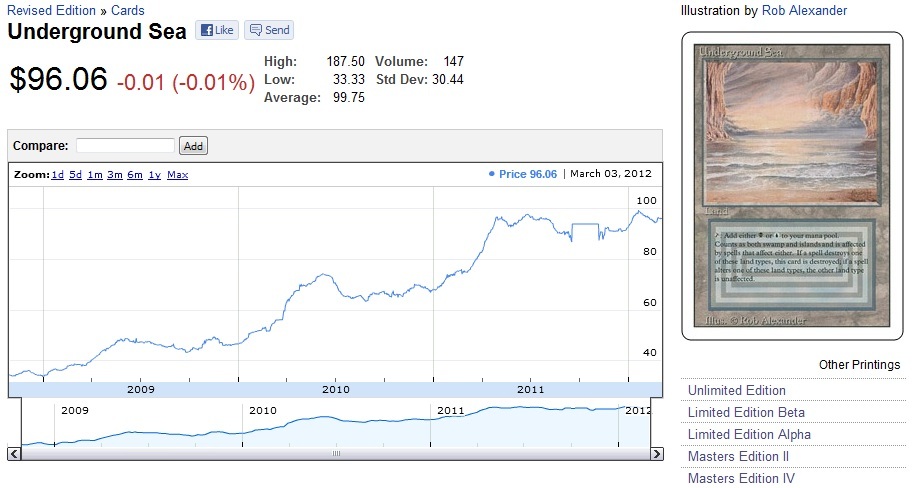
What I can offer is my perspective on what cards are worth considering from four different tiers of risk:

  1. Prime Performers,
  2. Forgotten Favorites,
  3. Gradual Grinders, and
  4. Long Shots (I couldn’t think of another alliterative name).

Allow me to explain.

Prime Performers

No one can really predict what decks will make Top 8 at the next SCG open or Standard Grand Prix. There are a large number of viable options and Avacyn Restored is bound to shake up the list even more!

The idea for Prime Performers is to rapidly deal in the most popular cards. I want to emphasize the window in which you should operate here. As soon as you see a particular card see increase in favor, you need to move on them immediately. There is often a narrow span of a few days when you can purchase or trade for these cards before they peak.

However, you also should be able to unload the card within days of obtaining it. In this way, you can minimize risk. Wait too long and your card may fall out of favor, thereby dropping the card’s price and moving it into the next category.

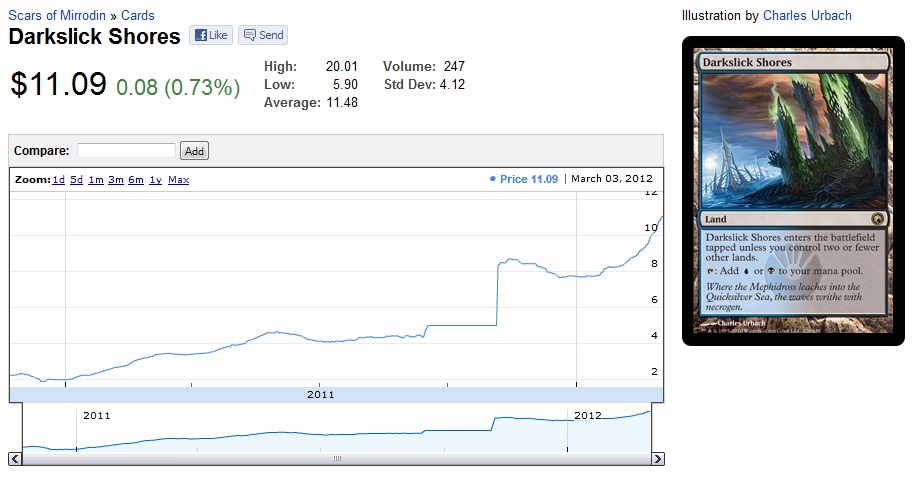
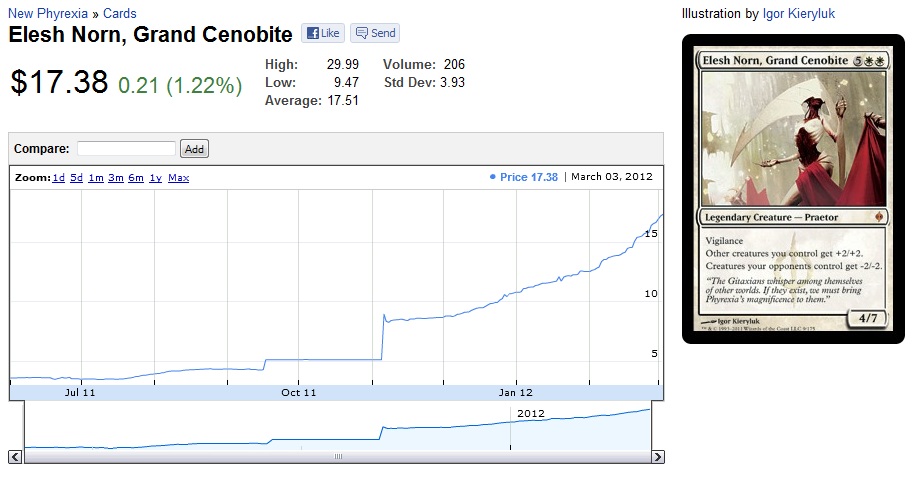
My examples of (very) recent Prime Performers include Elesh Norn, Grand Cenobite and Darkslick Shores (charts courtesy of blacklotusprojects.com). Both have about doubled in price in the last month or so. The moment they started seeing increased play, there was a brief opportunity to acquire them cheaply. Now, the room to profit on these cards is nearly passed. Rest assured there will be others, but, unfortunately, I don’t have any definite candidates right now.

I hear a lot about Zombies – maybe Geralf's Messenger or Gravecrawler?
Forgotten Favorites

Cards in this category made a splash in Standard at one point but have since fallen out of favor due to metagame shifts. They are off their peak price significantly, but the precedence for higher prices is already established. They are still powerful cards.

I would consider these cards slightly more risky than the active top performers, but they have proven themselves already. Therefore you could do worse than to hold a few of these.

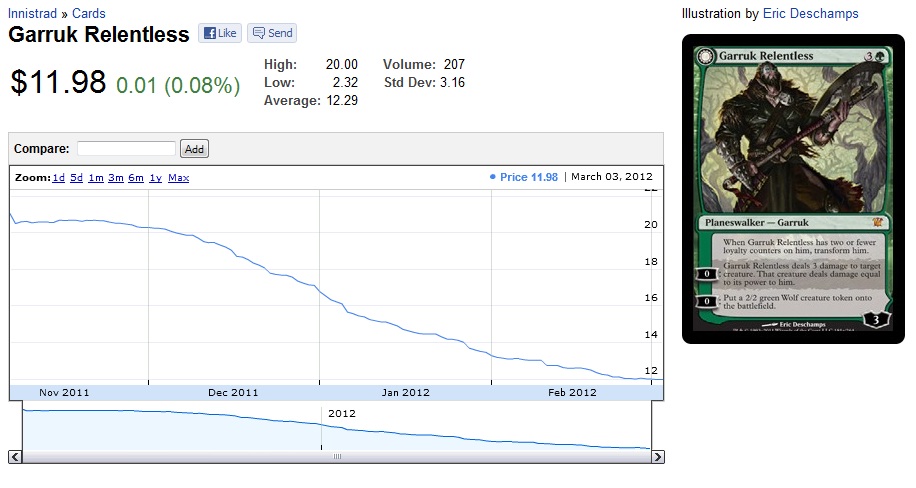
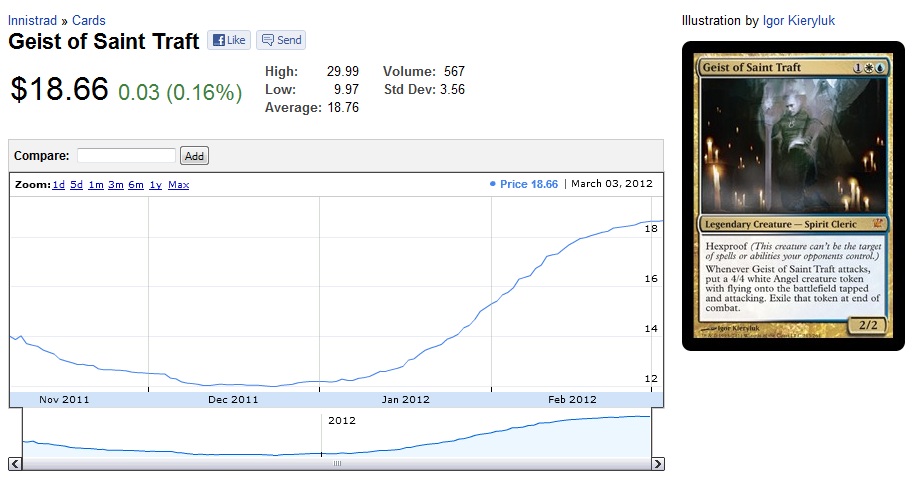
Because of how rapidly this format is evolving, there are many cards in this category. To list a few, consider Garruk Relentless, Geist of Saint Traft, Sword of Feast and Famine, Tempered Steel, Garruk, Primal Hunter, Elspeth Tirel, and the list goes on.

I’ve provided charts for Garruk Relentless and Geist of Saint Traft. The former I feel has nearly bottomed in price, while the latter may soon begin its decline.
Gradual Grinders

This category is my favorite one and, as a result, much of my trade binder consists of these cards. There are very good reasons for this.

Cards in this category should remain fairly well-positioned regardless of how the metagame shifts. While there can be no guarantees, these cards should have a higher likelihood of increasing in value from where they currently are. However, they may be a bit cheaper now because either demand is soft or supply is too large.

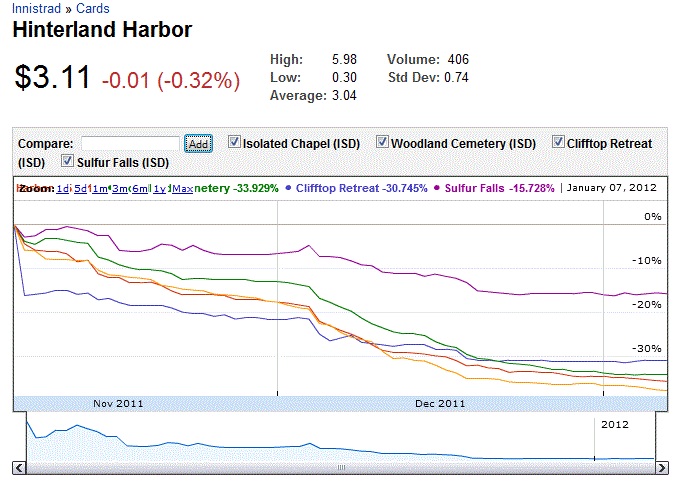
The best examples of these cards are all the rare lands in Innistrad and Dark Ascension. My favorites are the Innistrad Duals. Many of you should already know this because I’ve written about them in the past. In fact, a few weeks ago I shared their price trends, indicating that they bottomed. Don’t believe me? Check out this link: https://www.quietspeculation.com/2012/01/insider-a-very-exciting-time-to-speculate/

Here’s the picture from that article, depicting the trend on the Innistrad duals as of January 11th, 2012:
And here’s the same trend today, as of March 3rd, 2012 (charts courtesy of bloacklotusproject.com):
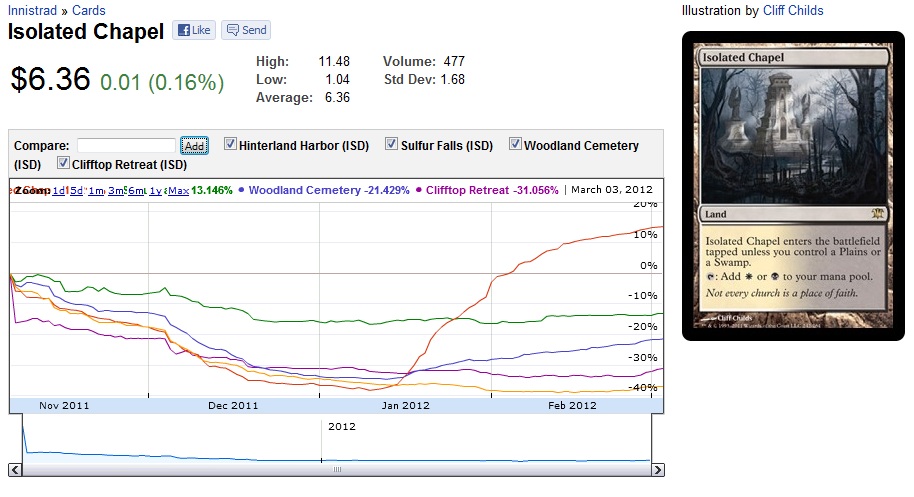
It is quite clear that the bottom I called in early January was in fact accurate (so far). But notice how only Isolated Chapel and Woodland Cemetery have shown recovery.

I want to emphasize that these cards are all mana-fixing lands. Barring a reprint, at least one land from this cycle will be trading at a premium from its bottom. Right now it’s the B/W land, but as the metagame shifts each of the other four may get their chance to shine. Downside risk on these other four is low. Which is why I love this category.

In addition to the Innistrad Duals, the spell-lands from Dark Ascension and Innistrad are also worth acquiring at such a cheap price. Also, Ratchet Bomb would have been a great card in this category before it spiked. Although a reprint, Solemn Simulacrum is another card which should remain strong no matter the metagame.

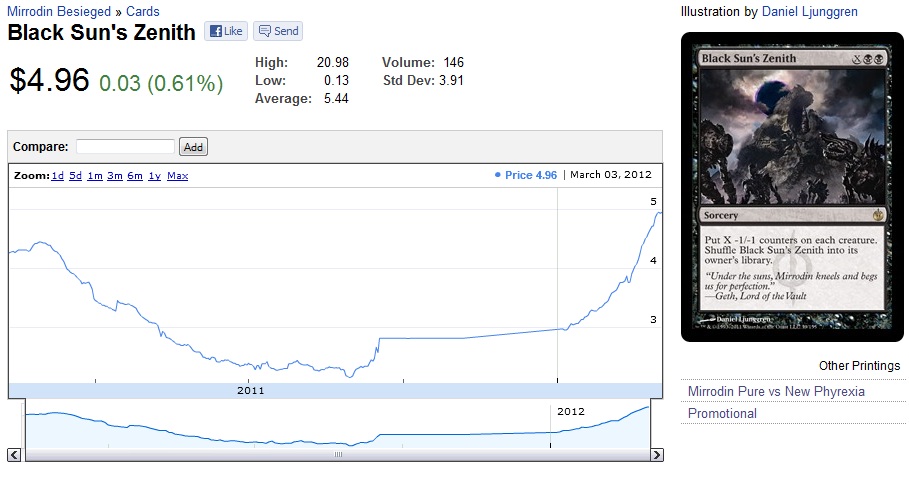
One last example is Black Sun's Zenith. It’s relatively cheap but represents one of the most efficient board sweepers in this Standard format. It’s not likely to become a $10 card, but being a premier board sweeper in Standard earns it a spot in my MTG portfolio (chart courtesy of blacklotusproject.com)
Long Shots

These are the Skaab Ruinator and Splinterfrights of the world. They are cards that seem synergistic with the mechanics of a given set but have not broken out yet. Even Heartless Summoning and Havengul Lich may qualify to fall in this category. While they have made Star City Game Open Top 8s, they have still not shown up in numbers at tournaments. Thus, there is room for them to go up or down.

I like buying a few cards from this category for my collection, but not excessively. Unless you want to make a hobby of collecting a given card for personal reasons, I personally don’t advise going too deep. I tried that with Past in Flames and it came back to bite me. I suppose there’s still time, but the Standard metagame is nowhere near a place where Past in Flames can be good.

A Balance

Like everything in life, a smart strategy is to diversify across all four categories. This way your collection is always relevant and you are enabled to trade with anyone at any tournament looking for Standard cards.

A good goal to strive for is continue to buy, sell, and trade cards regularly so that your collection always has something for everybody. It’s a fair strategy across all formats as well. You’ll rarely make $1,000 on one card this way, but you will always have a full collection worth looking at. After all, with this strategy, it’s all about the journey.

-Sigmund Ausfresser
@sigfig8

Insider: Using Bid Schedulers to Price-Enforce Ebay

Are you a Quiet Speculation member?

If not, now is a perfect time to join up! Our powerful tools, breaking-news analysis, and exclusive Discord channel will make sure you stay up to date and ahead of the curve.

You've browsed through Completed Listings on Ebay before, trying to get a read on what price you should bid for a card you'd like. There are eight or ten at a normal price, and then there's one that went for far less than it should have. Sometimes this happens because the listing ended late at night; other times, it's because an auction for the same item just ended and people might not have aggressively bid on two of the same card.

If you want to be the lucky person snagging those underpriced cards; if you want to assemble a collection while you sleep, with an hour a week worth of work; if you have the patience to wait out some great prices because "your door is always open," then this article is for you. This article is about how you can use bidding schedulers to automatically scoop up cards that you want at prices below what they should be. Kelly Reid coined the term "Price Enforcing" to describe the process of going to local stores and looting the cases for underpriced cards, and there's no reason you cannot do it on Ebay, either.

What is a bid scheduler?

These are programs or websites that will automatically place a bid for you when you tell it to. They will bid the price that you would like and put it in when you specify that it should. You shouldn't just tack bids onto every item you see, because people are emotionally tied to their desire to win. They will just re-raise you. Bidding in the last few seconds cuts off the possibility of a re-raise.

You really shouldn't be paying money for scheduled bids, even if it is a couple of pennies. You should avoid downloaded programs; they are simply a pain in the butt and you expose yourself to spyware. I use www.biddingscheduler.com to bid on Magic cards. They use advertising to make money (ads I don't see, thank you No-Script). Firefox warns me that the information I send is encrypted but going to a third party. This is somewhat concerning, because it has my Ebay ID and password, but my Paypal is not linked to it. I haven't had problems in the months that I've used it. Use your best judgment and never give out a Paypal password.

What cards should I target for price enforcement?

I have been snagging Ravnica shock lands for awhile. They exhibit a high degree of variability in price and they are worth a bit of money; I definitely wouldn't do this with dollar cards most of the time. Generally, any card worth about $15 that has a good trade volume is a good target. Something that makes your trade binder look better is also nice. If you want to narrow things down, take a look at the charts on www.magictraders.com and look up your cards. For example, here is what Breeding Pool says:

Card                            Price StdDev Average  High    Low   Change Raw N

Breeding Pool, 23.08, 8.68, 24.21, 32.99, 16.84, -0.14, 51
This has all the hallmarks of an excellent card to sit on with your bidding scheduler. It's got a good price, a good volume (the Raw N number) and it's got an insane standard deviation. If you avoided Stats 110 in college, standard deviation is generally a measure of how far the price varies from the most common price. The difference between the high and low is nearly $20 and the deviation is $8.68. That means that the price wildly varies, which is corroborated by just looking up the card sales. The cheap sales were regular cards, in good condition. The expensive cards are selling because there are bidding wars on them, not because they are foil/altered/foreign. I made sure that the prices were current and that there were some going low and some going high - pay attention that you're not just looking at the residue of a burst bubble.

How should I bid?

I try to set a price that's pretty close to what the cards are selling for normally. I want a deal, but I also want to win a few of these. I also put in bids on every card at auction. I make sure the shipping price isn't astronomical and I adjust my price on it. Let's take a quick look at some investing theory, by way of Benjamin Graham. He came up with the idea of "Mr. Market," which was a personification of the stock market that sat down at your desk all day during trading hours. Sometimes, he'd say "look, I'll sell you all the Breeding Pools you want at $30" and you'll balk. Other times, he comes in drunk to work and says "sell me as many Breeding Pools as you have for $35." If you don't want to do business with Mr. Market that day, you pass. You only engage the market when it's profitable for you to. You get to act like Mr. Market in this (but sober!). You say to Ebay, "look, I'll buy any Breeding Pools you're willing to sell for $19 shipped." You tell Ebay this by scheduling all of your bids on auctions for Breeding Pools to reflect this. Sometimes, the market won't sell you anything. Other times, you'll get a deluge of good cards for low prices. Since you are assembling cards to trade or flip, you don't care that you now have eleven Breeding Pools.

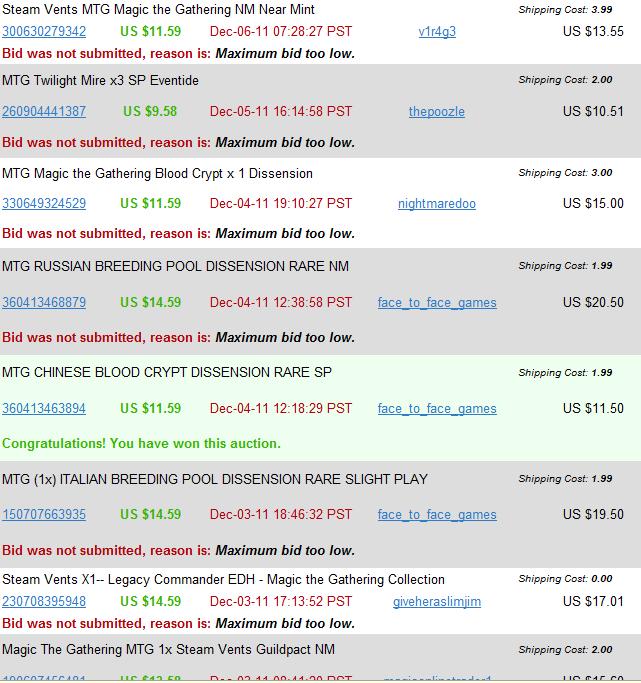
Eventually, your scheduler will look like this:

Only one winner; too many winners and you're doing something wrong.

In this example, I only won one card - a Blood Crypt for $13.50 shipped. The other Blood Crypt went for $18.00 shipped, which was closer to the going rate at the time - a big savings, and one that especially adds up over time.

Note the caption on the picture. If you are winning a lot of these, you are screwing up! You're showing up drunk to work again, Mr. Market! If you're winning a lot, that means that you're paying closer to market price. You are not getting the scoops, you're just paying what every other schmoe does. The cure for this disorder is to lower your "will buy for" price and place a lot more bids. You will win a lot less, but you will get much better deals.

I suggest checking in on Ebay two times a week. It'll usually take a half hour or less to check your list of cards. Use  Ebay's filters and just find the new auctions for cards that you want to watch. Make sure to pay your bills when you win cards and keep a very clear list of what you have won. Check off cards when they arrive (and note who sent them), or you will lose track of something and lose all your money on it. I speak from experience.

If you do this, you will win cards for a lot less than what they normally go for. Look, I can't explain why people set their auctions to end at 2am on a Tuesday morning, but they do. They put up auctions for cards that don't have a lot of motion or turnover, and they'll sell very cheaply. These are the sort of auctions you can win with a good frequency.

Why should I schedule bids if I'm not building a big binder?

This is a legitimate question, and there are two reasons you should still do this. First, you should schedule all of your bids anyway - it's a fact that people will re-raise you on Ebay even if they think they've already bid their highest amount. You're buying commodities, not unique items, so you don't need to win that one antique letter opener (like me last month). Schedulers will tell you when your scheduled bid is too low, so you can raise it if you really need to win the item - and you're doing it with stealth.

Second, if you trade at all, this is a great way to buy trade stock at a really good price. You can buy all the Breeding Pools you can at $20 and then put them in your binder for $27 in trade. That's an entirely fair trading price and you've bought the cards at about a 25% discount. Anything you trade them into will have the same discount applied. You don't even have to pick big, dynamic cards to trade in, as long as they have a good secondary market. I've been sitting on Tawnos's Coffin auctions for awhile now. Every now and then, the $15 card will sell for $4. I'm determined to be the next one to get it at a fire sale price, and the Coffin is such a fun Commander card that I'll have no trouble getting rid of it. I just saw a High Market close for $2.25 shipped, when that card easily trades at $5 on any floor you'll find.

When you are buying your binder's contents for 60 cents on the dollar, you don't have to rip off trading partners to make real profits. Nobody seems to be price-enforcing Ebay right now and this is a great untapped market for Insiders. Like I said, this takes very little work and it will remind you of the old thrills when you first started winning auctions on Ebay again.

I'm happy to answer questions about the theory and practice here. Join me next week when we look at more trading techniques and tips!

-Doug Linn


Douglas Linn

Doug Linn has been playing Magic since 1996 and has had a keen interest in Legacy and Modern. By keeping up closely with emerging trends in the field, Doug is able to predict what cards to buy and when to sell them for a substantial profit. Since the Eternal market follows a routine boom-bust cycle, the time to buy and sell short-term speculative investments is often a narrow window. Because Eternal cards often spike in value once people know why they are good, it is essential for a trader to be connected to the format to get great buys before anyone else. Outside of Magic, Doug is an attorney in the state of Ohio.  Doug is a founding member of Quiet Speculation, and brings with him a tremendous amount of business savvy.

View More By Douglas Linn

Posted in Finance, Free Insider, Special7 Comments on Insider: Using Bid Schedulers to Price-Enforce Ebay

Have you joined the Quiet Speculation Discord?

If you haven't, you're leaving value on the table! Join our community of experts, enthusiasts, entertainers, and educators and enjoy exclusive podcasts, questions asked and answered, trades, sales, and everything else Discord has to offer.

Want to create content with Quiet Speculation?

All you need to succeed is a passion for Magic: The Gathering, and the ability to write coherently. Share your knowledge of MTG and how you leverage it to win games, get value from your cards – or even turn a profit.

Insider: State of the Modern Staple

Are you a Quiet Speculation member?

If not, now is a perfect time to join up! Our powerful tools, breaking-news analysis, and exclusive Discord channel will make sure you stay up to date and ahead of the curve.

Last week was a fun and informative look back at some old trades I made, and I plan to bring it back as a topic in the future, as well as posting new trades, but this week it’s time we got back to the Grindstone, so to speak.

We’re now being inundated with decklists, with GPs and SCG Opens happening nearly every weekend. The information is flying at us from every angle, and it’s easy for a new card or deck to steal the spotlight. Standard seems to be in a good, if predictable, place (not an indictment of the format), so I don’t see too much interesting happening there at the moment.

So, rather than focus on that, I want to look at Modern.

And I’m not here to hype you on the merits of Seismic Assault or something else new that’s come on of late. There were something like 12-14 unique decks vying for Top 8 spots in the last round of GP Hoth, and from that we can deduce a few things.

Yes, it says good things about the format that so many decks were in contention. But it’s still a very fledgling format that hasn’t been sorted yet.

Legacy used to be much the same until it started getting played every week and broken down by the best. That is why there is most certainly a metagame to Legacy now, even if decks occasionally break the mold and pop up (Burn!).

I see Modern evolving much the same way.

So, while you should certainly be aware of the newest trends and act accordingly, you need to keep in mind that it can all change very rapidly.

But we know there are some things in the format that will stay very safe bets, and that’s where I want to focus our attention this week. I’m not just going to provide another list of Modern cards to have, as myself and others have done in the past.

Rather, I want to look at the price of these cards today compared to their price on the day the most recent round of bannings were announced. Since the format seems to be in a healthy place, I think it’s safe to say we won’t see a lot more banned soon unless that assessment changes.

Ergo, we can fairly accurately evaluate the status and changes in the Black Lotus Project (eBay) prices of these staples with confidence. They should stay “staples” for a good while and can help us make our investment decisions accordingly. Let’s dig in.

The Staples

Fetchlands

This is, in my opinion, the safest thing you can do in Modern finance-wise. If you’ve read much of my past work, you know of my love for lands and my Fetchland project. It’s possible we see a reprint of one of these in FTV: Realms, but I doubt it (since it wouldn’t exactly be from “the vault”).

We’re going to use Scalding Tarn as our baseline, since it’s the most commonly used.

Dec. 20, 2011: $10.35

March 1, 2012: $11.67

Here we see the slow growth we expected from the fetchlands. This still leaves a ton of room for upward growth, and, barring reprints, these will continue to rise. Can’t suggest trading into these any more strongly.

Tarmogoyf

Dec. 20, 2011: $73.31

March 1, 2012: $79.05

This still seems as safe as ever, though I imagine the chance of this seeing a reprint somewhere along the line is quite high.

I hit on these two first because it reveals something very important – even cards that were already Modern staples pre-banning are continuing to rise. This means the format is not being viewed as a passing fad by the player base and confidence in the format is high. This means these are stable prices from the angle, and reprints are the biggest thing to watch out for.

Onto more interesting cards (finance-wise).

Hallowed Fountain

Dec. 20, 2011: $22.08

March 1, 2012: $26.04

This is also interesting. The card is down since its highs in September that were primarily driven by speculation rather than actual demand, but has risen since December. I think this strengthens the point above that true demand is driving the prices on Modern staples at this point and will continue to do so.

Chord of Calling

Dec. 20, 2011: $2.87

March 1, 2012: $6.13

Here’s one of the new “staples” of the post-ban metagame, and we see the drastic increase you would expect from such. Ever since Green Sun's Zenith got the boot, this has been the go-to card, over even Summoners Pact. The fact that Melira Pod (which are both cards you should grab on the cheap) is a true player means that Chord will hold value competitively.

But more important is that Chord seems to be an acceptable tutor for Wizards to allow and probably won’t see the banhammer like Zenith did. The biggest reason is probably that Zenithing for a Dryad Arbor in addition to a late-game bomb was too powerful, whereas Chord doesn’t present that danger.

Inquisition of Kozilek

Dec. 20, 2011: $1.78

March 1, 2012: $1.87

We haven’t seen much movement here, but I think this is one of the best speculation targets in the format. More and more decks are starting to use Inquisition over Thoughtseize. It hits a lot of the important cards that ‘Seize does but doesn’t lose you the life, which is proving to be extremely relevant in the format.

Kitchen Finks

Dec. 20, 2011: $3.30

March 1, 2012: $4.91

I understand that it has a set-specific keyword, but this thing has to be ripe for a reprint in some ancillary product in the next year or two. That leaves plenty of time for you to continue to profit off of them, however.

This thing is insane in the format in all variety of decks. And even people who realize it’s not a bulk Uncommon won’t realize it retails for $5-7. Continue to move on these.

Arcbound Ravager

Dec. 20, 2011: $14.34

March 1, 2012: $17.66

Another staple, another price increase. Affinity may be on the edge of having something banned to bring it a little more in line since it’s put up the best and most consistent results of any deck, but for now it seems to be safe, which means Ravager is a fine investment. It’s important to note that this card was worth real money before Modern was a thing, which helps back its price.

Dark Confidant

Dec. 20, 2011: $29.67

March 1, 2012: $34.60

Another card that I would put at risk of a reprint somewhere (because it’s older and so well-known), but for now Bob looks safe. As I wrote back in April 2011 (when I suggested buying Bobs at $14), drawing cards isn’t getting worse any time soon, so I wouldn’t be worried about putting your money in Bobs.

Rounding Up

That’s more than enough cards to spot the trend. Modern cards, across the board, are up solidly in just the last three months. This allows us to throw out the hype from the format’s creation or the rampant speculation that followed and see that demand is truly driving card prices.

What does this mean for us? Besides the fact that our current holdings are staying stable, it means that we can expect slow appreciation on those cards just like we plan on for Legacy.

This means that, moving forward, you can treat something like Cryptic Command or Life from the Loam like you would treat Polluted Delta or Lions Eye Diamond – as cards that will hold value and resell at a better percentage than Standard fare. This bodes very well for Modern as a format and for all the investments you’ve hopefully already made into it.

Thanks for reading,

Corbin Hosler
@Chosler88 on Twitter

Unleashing the Zombie Apocalypse

Are you a Quiet Speculation member?

If not, now is a perfect time to join up! Our powerful tools, breaking-news analysis, and exclusive Discord channel will make sure you stay up to date and ahead of the curve.

This past weekend I traveled out to Columbus, Ohio to attend the two PTQs being held there. While I was away, there were some other big events going on around the east coast. Star City Games held one of their signature events down in Memphis and Wizards held a Grand Prix in Baltimore. Since I was living in my own little Modern world at the PTQs, I missed most of the coverage surrounding these other two events. While taking a look at them this week, I noticed a trend that I wanted to share with everyone today.

Zombies on the Rise

If you're like me, you certainly can't remember the last time that zombies as a tribe were competitive. Until now, zombies have been just another casual tribe that overzealous players have tried and failed to pilot successfully. Well, you had better throw that mentality out the window, because this tribe is here in force with the new cards from Dark Ascension.

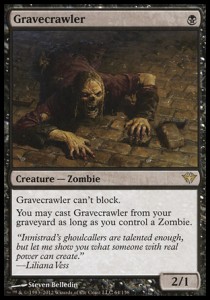
Gravecrawler is the real deal. It feels like cheating when you cast him from the graveyard for the same efficient one-mana cost printed in his upper-right corner. Eat your heart out, Skaab Ruinator! Along with Gravecrawler, Geralfs Messenger provides another aggressively costed creature that synergizes with the zombie theme. We even have Diregraf Ghoul to pair with them.

Since Dark Ascension came out, I have suspected that Gravecrawler and [card Geralfs Messenger]Messenger[/card] would be enough to carry an aggressive black archetype. I put some work into the deck, but it did not seem to come together.

The key to making this deck viable was brought to light in a deck tech from the Pro Tour. The seemingly innocent draft reject Skirsdag High Priest, along with Fume Spitter, provide an additional angle of attack for a typically linear aggro deck.

Skirsdag High Priest preforms quite well against other aggressive decks, especially when you are on the draw or forced into a more defensive role.

Of course, the majority of the time, Zombies will not have the luxury of running defense. Gravecrawler can’t block at all and Geralfs Messenger can’t block the turn you play him. The reigning zombie motto is, “The best defense is a good offense.”

Whichever side of this match-up you find yourself on, remember well this adage.

Managing Your Zombie Hordes

Last Friday I played the blue/black version of Zombies at my FNM and did not lose a single game in the four round event. The deck is for real, and if you dismiss it as sub-par or underpowered, you may well find yourself on the losing end of your match against it. It is quite powerful, and a ton of fun to play as well.

This innocent-looking aggro deck actually involves lots of decisions and allows for ample room to out-play your opponent. A lot of the deck's intricacies are not apparent at first glance.

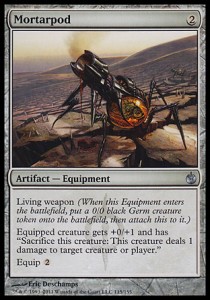
Mortarpod, for example, is one of the best cards in the deck due to its ability to trigger Morbid. Several of my opponents, good players at that, just plum forgot it was a creature. Usually, Mortarpod acts as a mere removal spell that can subsequently be reequipped for value. In this deck, the Germ token has added value as a body to tap for [card Skirsdag High Priest]Skirsdag High Priest's[/card] ability.

Let me mention Gravecrawler again for a moment. While he seems like a fairly straight-forward card, he actually forces you to play a slightly different game.

As competitive Magic players, we sometimes take for granted how we play cards because we are so used to doing things that way. We generally wait to play new creatures until after combat in order to leave mana up. This not only helps us win more combats, but also gives our opponent less information about our plans. In short, playing creatures during the second main phase is almost always better.

In this deck there are plenty of times when that is not the case.

One time in particular, I drew my card for the turn and immediately moved to combat, only to realize that my opponent could block my Gravecrawler. This would leave me without another zombie and hence unable to rebuy the Gravecrawler. Luckily I had top-decked one, but if I not, I would have missed an attack for no good reason.

When to play Diregraf Captain applies here too, but playing your lord before combat to gain the additional power and toughness should be easier to see.

The Anatomy of an Undead Army

Getting back to my original point, Zombies is very good. In case you missed it, the deck made top eight of both the Grand Prix and SCG events this past weekend. At the SCG event, there were a total of two copies in the top eight and two more in the top sixteen.

There is some disagreement over exactly how to build the zombie deck. The core is the same in all of them, but that core basically boils down to Gravecrawler and Geralfs Messenger. Blue mana is not even guaranteed, as one of the SCG decks splashed white for Lingering Souls and some players opt for a red splash instead. All in all, there is still lots of room for innovation.

The version from this weekend that most closely resembled mine was Matt Scott's, which he piloted to the top eight of the Grand Prix. Here is his list:

Matt Scott's UB Zombies

Standard -- Grand Prix Baltimore 2012

Untitled Deck

Creatures

4 Diregraf Captain
4 Diregraf Ghoul
2 Fume Spitter
4 Geralfs Messenger
4 Gravecrawler
4 Phantasmal Image
2 Phyrexian Obliterator
2 Skirsdag High Priest

Spells

3 Geths Verdict
4 Mortarpod
2 Sword of Feast and Famine
3 Tragic Slip

Lands

4 Darkslick Shores
4 Drowned Catacomb
14 Swamp

Sideboard

1 Cemetery Reaper
3 Corrosive Gale
3 Distress
2 Nihil Spellbomb
1 Phyrexian Metamorph
2 Phyrexian Obliterator
1 Swamp
2 Sword of War and Peace


The main difference between this list and mine is Matt's inclusion of Sword of Feast and Famine. This card has been virtually absent from Standard for a few months now, but we may see a resurgence due to the recent popularity of Wolf Run Ramp and Blue Black Control. Sword seems well suited to bring down both of these decks, as attacking their hand can be an effective strategy.

However, Protection is not what it used to be because of the adoption of cards like Geths Verdict, Liliana of the Veil and Slagstorm. The sword's mana cost is also of some concern. With only twenty-two lands, you may have a rough time surprising opponents. Usually you'll need to take a turn to play the sword and another to equip it. Luckily, you do have a recurring threat in Gravecrawler, which makes Sword better.

In the current iteration of my list, I've opted for fewer [card Diregraf Captain]Diregraf Captains[/card] and more [card Fume Spitter]Fume Spitters[/card], but the rest of the cards are basically the same. If you like this deck, there is some wiggle room to adjust it to your play style and preferences.

Conclusion

After playing Red Black Vampires for so long last season, I found it easy to jump on board with this deck. If you enjoy an aggro-control strategy, this may be the deck for you.

You can even relive last season and jam red/black aggro all over again! Just thinking about Brimstone Volley in a deck with Mortarpod and Fume Spitter has me itching to brew up a red/black list.

That, however, is for another day. For now, I am set on the power of Phantasmal Image.

Regardless of your like or dislike for the zombie tribe, make sure you're prepared for it at your next major event. No life total is safe.

Until next time,

Unleash the Zombie Apocalypse!

Mike Lanigan
MtgJedi on Twitter
Jedicouncilman23@gmail.com

Monday Night Magic #299 | Pray I Don’t Alter It Any Further

Are you a Quiet Speculation member?

If not, now is a perfect time to join up! Our powerful tools, breaking-news analysis, and exclusive Discord channel will make sure you stay up to date and ahead of the curve.

"You read it somewhere else, but you heard it here first!"

Hit the button to play, or download the entire episode!

Our Sponsors

We are brought to you by MTGOTraders.comCapeFearGames.comCardHoarder.comDecked BuilderDrafter iPhone apps, MagicOnABudget.comHalfPriceHobbies.comMTGPad.com and MTGMintCard.com!
Get your own MTGCast t-shirt today! - http://www.zazzle.com/mtgcastshirts

MNM Host(s) This Week

Jason 'Chewie' Slate from Monday Night Magic - http://www.mtgcast.com/

Jack LaCroix from Monday Night Magic - http://www.mtgcast.com/

Marshall Sutcliffe from Limited Resources - http://www.mtgcast.com/

Ron Faris  from Black Wing Studios - http://blackwingstudio.blogspot.com

This Week in Magic and other MTGCast News

-- Jack and Chewie are joined by L3 Judge Sean Catanese, Ron Faris of Black Wing Studio (http://blackwingstudio.blogspot.com), and Marshall from the Limited Resources podcast (http://LRCast.com) to talk about everything from warning letters to GP results to PTQs to artistic expressions.  Sure it's a long episode, but it will be well worth your time as we have packed a LOT of information and fun into it!

-- Pastimes responds to playmat fiasco

-- Edgar Flores suspended for 3 months "for misrepresenting game state" supposedly due to his DQ at SCG Indy

-- But Dad, Two Explores by Scott Holmes

-- Congratulations to Raphael Levy who is now officially the all-time leader on Pro Points. He passed Kai Budde with a 32nd place at #gpmadrid

-- GP Madrid

-- GP Baltimore

-- Quote from Scott Marshall (Level 5 DCI Judge):  I expect that the next PTQ round will be placed with stores.  NOTE:  The next season starts on April 1st.

-- Aaron Forsythe Twitter Quote -- Cool #WorldMagicCup fact #1: Team members will be able to talk to each other as they build their draft decks on Day 1.

-- Aaron Forsythe Twitter Quote -- Cool #WorldMagicCup fact #2: The first tiebreaker for determining which player gets cut after Day 1 will be Pro Point total from this year

-- The Magic Cup Rules

-- The Magic Cup Player Race and Possible Qualifiers (Brian David-Marshall)

-- MTGO Release Events -- Feb 22 through March 9

-- What do you think of playing altered cards in a tournament? There's text box confusion, possibility of cheating, etc

-- Heading 3.3 Authorized Cards: Artistic modifications are acceptable in sanctioned tournaments, provided that the modifications do not make the card unrecognizable, contain substantial strategic advice, or contain offensive images.  Artistic modifications also may not obstruct or change the mana cost or name of the card.

The Head Judge is the final authority on acceptable cards for a tournament.

-- The MortarPod Podcast is done and will no longer exist.  The hosts have requested that all of its shows be pulled off of the MTGCast Network immediately as well, making them the first such Podcast to request "self-censorship" from the internet.

-- We'll start here for next week

-- Gold Run at GP:SLC -- $12,000 in free cards

-- MS Charity Magic tourney

Magic Calendar

-- MTG MOM Events Calendar

-- MTGO Events Calendar

MTGCast Website Donations

-- MTGCast in is need of Donations. We are a bit low behind the monthly goals at this point.

MTGO MTGCast Official Clan: Limited Resources

Contact "marshall_LR" in game to join the MTGO Clan, Limited Resources. Marshall can also be reached via twitter at: http://twitter.com/#!/Marshall_LR
Subscribe to the MTGCast Monday Night Magic RSS feed!
RSS feed for Monday Night Magic
iTunes feed for all shows on the MTGCast network
RSS feed for all shows on the MTGCast network
Twitter for MTGCast
Hoodchefz favored by MTGCast crew

Contact Us!
Call us and leave a voice message at 570-486-6637!

Join the MTGCast Facebook Group - Discussion, Photos, Videos and More!

Chewie at chewie@mtgcast.com -- http://twitter.com/#!/themanapool

Jack LaCroix at jack@mtgcast.com -- http://www.twitter.com/jacklacroix
Christopher E. Otwell at otwellc@mtgcast.com-- http://www.twitter.com/otwellc
Tom Gustafson at pitimp@mtgcast.com -- http://www.twitter.com/mtgcast

Chris Lansdell at lansdellicious@gmail.com -- http://www.twitter.com/#!/lansdellicious
Adena Chernosky at prsgrrl@gmail.com -- http://twitter.com/#!/prsgrrl
Eric McCormick at eric@mtgcast.com -- http://twitter.com/#!/EricMTGcast
Conley Woods at conley@mtgcast.com -- http://twitter.com/#!/Conley81
Robert Martin at robert@mtgcast.com -- http://www.twitter.com/thebeme
Tristan Gregson at tsg@channelfireball.com -- http://twitter.com/#!/TristanGregson
Marcel White at marcel@mtgcast.com -- http://twitter.com/#!/AllUpOnMyDeck

Chewie, Jack, Chris, Adena, Eric, Conley, Marcel, Chris, Robert, & Tom - The Monday Night Magic News Team!

Insider: Did You Know..?

Are you a Quiet Speculation member?

If not, now is a perfect time to join up! Our powerful tools, breaking-news analysis, and exclusive Discord channel will make sure you stay up to date and ahead of the curve.

We’re at a in interesting place in the financial world of Magic. And with the changes to set releases back in 2009, the Pro-Tour and GP schedule changes over the last several years, and the increased frequency and spread of the SCG opens, getting a better feel for what the seasonality of demand really looks like is possible.

We also get amazing promotional products geared for different types of players and collectors like Commander products and From the Vaults. Sometimes I get so caught up in the right now, we need to step back and look at the big picture again.

Did you know... Modern PTQ season ends in 31 days?

Our LGS hosted its first PTQ in history this season and it was a pretty awesome event. For the weeks leading up to it, almost all trade talks in the store involved one person trying to locate a Modern card to finish up their deck.

Since then, however, I’ve been watching people dump that stuff back off for Standard cards. Why? Because, believe it or not, when you have a PTQ or even just a “special” event at your store, all the players who play there want to try it out.

They all wanted to give their Modern homebrew a run against the top decks. Now it’s over, they’re ready to go back to EDH or Standard or Draft, or what ever it is that scratches their itch. After Modern season ends, the quantity of people interested in Modern dwindles quickly, and even as the season approaches a close, people will be shifting away form their Modern cards as soon as it becomes irrelevant to them.

In my community, for some players that was this past Saturday. For others it’s in two weeks after a PTQ 80 miles away. I plan to use my Modern deck a few more times, so I can’t tear it apart yet, but any other trade stock is getting dumped at GP Seattle this weekend to the highest Buy List.

Whatever you need to play kepp, but, from a financial standpoint, anything that has already showed significant gains, is ready to ship out. Exceptions are cards that maintain relevance either in Standard or Legacy.

Did you know... Wizards is releasing a Land centric From the Vaults: Realms?

Sure, who knows what 15 lands will be all foiled out for this promotion, but FTV: Dragons still sells for over $75 sealed on eBay. And if we key cards in this set, it will surpass all of its predecessors.

If any retailer starts pre-selling these before spoilers hit of what’s inside, I’m going to gamble on it as big as possible. And so is Ted Knutson, and he usually doesn't open his mouth without knowing what he's talking about.

The art on the front of the announcement sure as heck looks like a Glacial Chasm to me, and I’d be willing to wager we see that in the pile. While a narrow Legacy card, it’s still a Legacy card and alone would see some demand.

Keep in mind, we won’t be seeing Dual Lands or Tabernacle of the Pendrell Vale as they are on the Reserved List, but there are plenty of desirable lands that aren’t. And remember that they usually include a spoiler from the new block in this set, so we should be watching this as it develops very closely.

Did you know... Standard is still Top Dawg?

Back in May of last year, I wrote about “Riding PTQ Waves”. So, let’s keep riding them.

As mentioned in the first section, Modern Season is ending and Standard is on it’s way. Combine that with the LGS promotions WotC is running, including Game Days, makes Standard a “Year-round” format.Of course PTQ season inflates it and we need to be prepped for it.

Innistrad Lands really have shot up a lot faster than I thought they would, so hopefully you started picking them up upon my reccomendation in November. These are only going to continue to grow. Even then I was skeptical of some of the non-Blue lands, but since then we’ve seen the printing of Sorin, Lord of Innistrad and Lingering Souls, so we can safely assume that Isolated Chapel is going to be around.

If you can connect the dots here, I’m suggesting to move out any excess Modern stock for Standard manabase. And do so en masse. I know QS’s own Sigmund (@sigfig8) is sensing the same thing I am, and I’ve spent the better course of a year laying out what this seasonal cycle looks like and how to be best positioned. Time to take the full cycle's results and package it into our business plan to make the next cycle even better.

I’m looking forward to a profitable Standard Season while I close out my profits on Modern.

I’ve been meaning to post a piece about taxes with respect to Magic profits, but I had a delay with my interview, so for those that mentioned it on Twitter, it’s coming next week.

Also, if you’ll be at GP Seattle, ping me on Twitter (@torerotutor) and say hello!

Insider: The Prizes and Pitfalls of the Obscure

Are you a Quiet Speculation member?

If not, now is a perfect time to join up! Our powerful tools, breaking-news analysis, and exclusive Discord channel will make sure you stay up to date and ahead of the curve.

I have a confession to make: I still own and avidly enjoy playing my Sega Saturn. The system flopped miserably in the United States. But before the system was pulled from the market, a few truly unique and exciting games slipped through the cracks and hit store shelves.

Unfortunately many of these sparsely known gems can also fetch a pretty penny! For example, consider what some claim to be the best Sega Saturn game (certainly the best RPG for the system):

Ok, I’ll admit this is an extreme scenario – the game is in mint condition and brand new. Still, opened versions of Panzer Dragoon Saga easily fetch in excess of $300 on popular auction sites. Who is paying this much for a relatively ancient video game?! There is someone out there who must be willing to pay this much or else these rare games would not be so expensive (in fact, there was one offer on this item that was declined).

What Does This Have To Do With Magic?

Like many hobbies, Magic has its fair share of the unique. These oddities often sell for phenomenal amounts of money. Some even exceed the costs of the game’s most valuable set-print card, Black Lotus.

But there is some risk to these obscurities. While they may have an attached retail value, an item’s true value can also be defined as the amount someone else is willing to pay for the item! The eBay listing I referenced above may truly “retail” for $1500. However since the game has no intrinsic value, the seller will eventually have to settle for the value as a second party perceives it. Otherwise the seller will be doomed to hold this game forever.

Thus, we have identified that there can be tremendous profit in the unique Magic Card market. Find the right buyer, who values your oddity at a high price, and you can make significant cash. But this endeavor can be a double-edged sword.

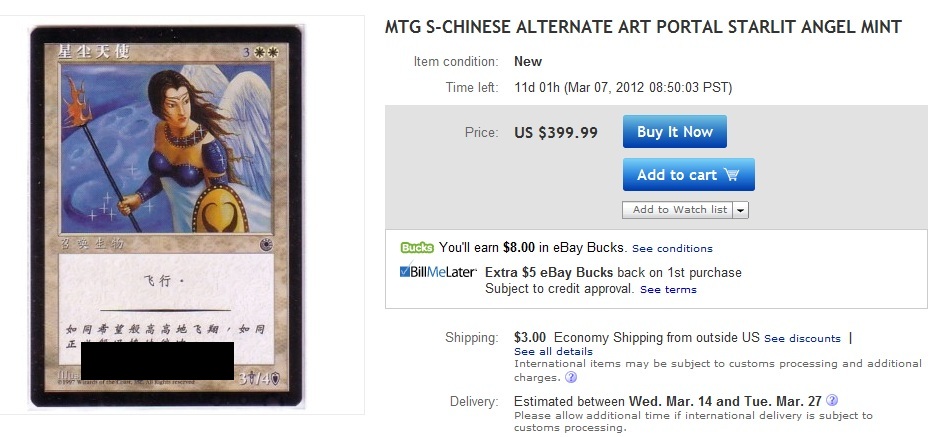
Case Study: Chinese Portal Starlit Angel

Because I collect Angels, this is my favorite obscure card example. What makes this card so rare? To answer, I defer to MagicLibrarities.net for the concise explanation:

The Chinese government has restrictions of what can and can not be depicted. Specifically, depictions of death, religion, or erotica are prohibited. Consequently, when Wizards of the Coast printed card sets for distribution in China, several artworks had to be changed. Over time, the artwork was no longer replaced, but modified. Furthermore, Wizards of the Coast has decided to meet Chinese standards when commissioning new artwork, hence alternate art has rarely become necessary anymore.

As luck would have it, there was one Angel that required special artwork for China – Portal’s Starlit Angel. Because there are many Angel collectors in the game, this card’s retail value has shot up. People who moved on this card early on have the potential to make significant profit!

As a savvy buyer, however, I refuse to pay such a high cost for this card. I am confident that should this card ever go to auction, the final sale price would be significantly lower – equal to the highest amount a buyer is willing to pay.

Being an avid Angel collector, I happen to know that there has not been such an auction for a very long time. I repeatedly see this card relisted every thirty days or so with no successful sale. This seller is a wise one because he knows that forcing bidding to end via a week-long auction will lead to a significantly less payout. Of course, eventually either some desperate buyer will pull the trigger or the seller will get sick of holding this piece of cardboard and he’ll reduce the price. It becomes a game of chicken at this point.

More Realistic Cases

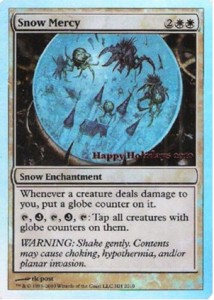
While not many players possess the Chinese Portal Starlit Angel, many players still own cards which are less available than the average Mythic Rare. Examples include Japanese foil playables, [card Snow Mercy]Holiday Promo Cards[/card], Summer Magic, Misprints, Altered cards, and the list goes on.

I’ve already demonstrated that there can be opportunity to profit from these Magic oddities. How can we maximize profit from these rarities when we come across them? I’ll divide this up into two sections: acquiring and unloading.

Acquiring Rarities

There is one fundamental rule that you should follow when acquiring these rarities: research! Knowing what these cards retail for, auction for, and buylist for is absolutely critical to ensuring you are acquiring these cards at a price point which enables profit.

An example I recently encountered involved the Holiday Promo Snow Mercy. I was interested in picking one of these up for my personal collection and so I did some research on their value. I saw that eBay auctions typically ended in the $60-70 price range. Meanwhile, Star City Games buys the rarity for $50 and sells it for…get this…$100!

Did you know that this large of a discrepancy existed? I was absolutely shocked. A few weeks ago I came across a vendor at a PTQ selling a copy of Snow Mercy for the bargain price of $45. I put that meme in the back of my mind and continued to battle through the tournament.

After 7 grueling rounds (and going 4-3 drop, unfortunately), I returned to the same dealer only to observe that the Snow Mercy was still for sale! I was baffled to see that no one saw that this card was priced below buylist price, especially with the ubiquity of Smart Phones. I assume the reason no one else jumped on this opportunity was either because they didn’t do their research or they didn’t want to bother with finding a buyer for this card. But with a guaranteed sale of $50, downside was altogether absent.

The moral of this anecdote is that the average Magic player is not familiar with values of the obscure. These are your opportunities to acquire. Before I get attacked for poor morals and taking advantage of ignorance, I am NOT advocating that you value your friend’s Snow Mercy at $20 in an attempt to profit. You still need to choose a viable basis for your valuations.

However, there should be no moral qualms with valuing your trade partner’s rarity at slightly below eBay price – after all, finding the perfect buyer willing to pay near retail price for the card takes a lot of work and you are entitled to a small premium for doing that work for your trade partner. A pseudo-finder’s fee of sorts, this practice enables the acquirer to make profit while providing the seller an asset which is in much higher demand (cash, format staples, etc.). Not to mention you are saving them the hassle sometimes associated with online sales: waiting for a buyer, fees, having to go to the post office, etc. It is instant gratification for them. And this should carry a price.

If no eBay auctions have ended recently for the given card (such as my Chinese Portal Starlit Angel example), then start with roughly half retail price as a negotiating point.

Unloading Rarities

After you’ve acquired an oddity or two, it becomes time to begin the unloading process. I want to emphasize here that I would not recommend acquiring multiples of a single oddity nor would I myself go deep in picking up obscure cards. This will result in a lopsided portfolio, filled with cards the average FNM attendee couldn’t care less about.

Instead, focus on having a few of these oddities on hand at any given time. Make sure they are fully visible in your trade binder (I’d recommend the center of your front page) so that if you stumble upon the right buyer at a tournament you maximize the likelihood that buyer gets wind of the fact that you own this oddity.

This technique alone may not be enough. My Snow Mercy was in my trade binder for a couple weeks and multiple tournaments and not a single person even mentioned the card while turning the pages of my binder. Clearly, another outlet was needed.

Enter: the internet. Sites like MOTL are a great way to unload obscure Magic Cards because your post reaches a ton of prospective buyers instantaneously. The more people who know of your rare cards, the more likely the one person willing to pay close to retail will be discovered. A match made in heaven.

Finally, as a last resort, I can condone turning to eBay. But only under one condition. Do NOT set your item to sell via auction with a starting bid below a price you’re happy with. Obscure cards like the Chinese Portal Starlit Angel are attractive to very few people. And if not enough such people see your auction, your ending price will end up far below what you had hoped.

Instead, use either the buy it now option or set the starting bid of the auction to be around where you’re hoping to sell. This ensures the card will only sell if someone is willing to pay at least your bottom line. Your profit is protected – just remember that the card is only going to sell when it is cheap enough for the buyer to perceive it is a good price. Typical supply vs. demand economics hold true.

Quite the Adventure

Trading in the obscure can be very exciting, but it is also feast or famine. Pay too high of a price and you will be destined to hold the card forever hoping to find the one desperate buyer.

Your goal should be simple: find the sellers looking to unload their obscure cards for quick cash or format staples and then unload these cards to the collectors who want to complete their sets of obscure cards. By taking on the task of mediating between the two, you can be rewarded with ample profits.

I ended up selling the Snow Mercy on MOTL for $65 shipped. I could have held out for more, potentially waiting until someone would give me close to the retail price of $100. But I recognized that holding this card in inventory was doing me no good, and I was willing to settle with a $15 dollar profit with a quick sale. Perhaps the buyer knows someone who will pay $100 – if so, the cycle will continue.

Eventually the collectors will find the cards they’re looking for and at an acceptable price. The key is to help move that process along while snagging profit along the way.

-Sigmund Ausfresser
@sigfig8

Planeswalking Your Way to Victory

Are you a Quiet Speculation member?

If not, now is a perfect time to join up! Our powerful tools, breaking-news analysis, and exclusive Discord channel will make sure you stay up to date and ahead of the curve.

Ever since they were introduced in Lorwyn, planeswalkers have been some of the most powerful, popular and iconic cards in the game. They have changed the face of the game, redefining constructed formats from casual to competitive.

Such a novel and iconic card type obviously has a huge place in Commander, since so many people love their repeatable effects, swingy ultimates and their sweet art.

One of the first decks many people think of trying in Commander is a five-color deck with a bunch of planeswalkers. In most cases, people abandon the deck due to its inconsistency.

When the deck works, it does some absurdly unfair things and wins very big. However, when it doesn't work you sort of sit around and do nothing.

While you're dealing one damage to an opponent, making a soldier or untapping some lands, your opponents are busy casting Primeval Titan and Time Stretch.

There are generally three problems with the planeswalker deck. Throughout the article we will attempt to remedy each of these in turn.

First, your mana requirements are quite difficult. You need large quantities of color-specific mana early in the game because most of the cards you're building with are double-colored and cost four mana or more.

Second, you want your planeswalkers to contribute to something bigger, so that you're never "just" using an ability and not getting much value.

Third, you need ways to protect your planeswalkers. This is especially difficult when facing down multiple opponents with gigantic monsters capable of one-shotting your auxiliary teammates.

Let's start with the crux of the deck and see where that leaves us. With twenty eight planeswalkers currently in the game, you're pushing the maximum number that you can play while still having the deck do other things. Space is at an even greater premium when a number of those planeswalkers require that you add additional cards to make them more effective.

I think the sweet spot is somewhere around twenty-five. Looking for what to cut, we can identify the three weakest walkers as Sarkhan Vol, Jace, Memory Adept and Koth of the Hammer. These walkers don't affect the board enough relative to their costs.

Sorin Markov is one planeswalker that I won't run for political reasons. He has two of the most hated abilities in this format, which can lead you to getting destroyed when he stays on the table for very long. That's not something I'm interested in dealing with, especially in a deck that needs time to set itself up.

The Superfriends

After those cuts, here's what we're left with:

  • Ajani Goldmane
  • Ajani Vengeant
  • Chandra, the Firebrand
  • Chandra Ablaze
  • Elspeth, Knight-Errant
  • Elspeth Tirel
  • Garruk Relentless
  • Garruk Wildspeaker
  • Garruk, Primal Hunter
  • Gideon Jura
  • Jace Beleren
  • Jace, the Mind Sculptor
  • Karn Liberated
  • Liliana Vess
  • Liliana of the Veil
  • Nicol Bolas, Planeswalker
  • Nissa Revane
  • Sarkhan the Mad
  • Sorin, Lord of Innistrad
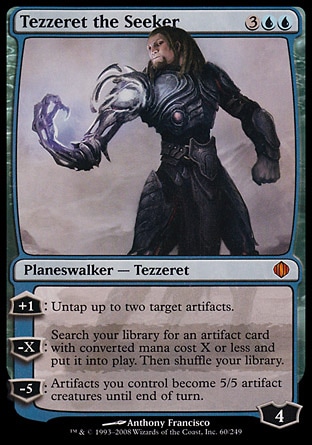
  • Tezzeret the Seeker
  • Tezzeret, Agent of Bolas
  • Venser, the Sojourner

Let's identify a few important things here. Only two of these cards cost three, whereas most of them cost four or five. Seven subtypes are repeated at least once, and there are only fourteen unique planeswalkers.

As more get printed, you can change these numbers to reduce the number of dead draws due to the planeswalker "legend rule." Two of any given planeswalker is probably fine, but three is a little excessive.

With that said, let's start to break these down by function. In general, your planeswalkers do one of three things: protect themselves, generate card advantage, or set up powerful interactions.

The planeswalkers that protect themselves do so either by killing creatures or making tokens. Making tokens is generally better, since the sheer number of opponents and creatures usually means you won't be able to kill all of them and still have enough loyalty to survive an attack.

Tokens are also an important resource in the late-game as you start to lock down the board. The ability to destroy problematic creatures is very important, but the ability to discourage people from attacking you while you set up your shields is even more so.

That said, making tokens isn't quite enough in a format full of evasion, trample, and swarm decks, so you are going to need other ways to protect your planeswalkers.

Generating card advantage is pretty straightforward. If you can protect one of your Jaces and draw a bunch of cards, it becomes easier and easier to slam more planeswalkers or "prisony" pieces and start locking up control of the board. This in turn lets you pull further and further ahead.

The one thing that really does terrify you is board sweepers that hit walkers (such as Oblivion Stone), but ideally you've generated so many cards by that point that it won't matter.

Lastly, you have planeswalkers that set up gamebreaking plays to pull far ahead all of a sudden. The best examples of this are Chandra, the Firebrand and Tezzeret the Seeker, probably the two most powerful planeswalkers for this particular deck.

Doubling up on a Wargate or Genesis Wave into multiple planeswalkers is absolutely backbreaking in most games, and puts you so far ahead that it almost doesn't matter what happens afterward. Similarly, a Tezzeret the Seeker left alone for more than two or three turns single-handedly sets up your best defenses, and makes it very difficult to interact with the rest of your team (More on Tezzeret below.)

Now that we've introduced the team we're working with, let's try to shore up some of the weaknesses, shall we? We'll start with the mana situation created by our excess of double-colored four drops:

Ramping Up to Four

Normally I just lump mana ramp in with the lands, but in this case it's actually of vital importance to the rest of the deck.

As mentioned above, many of your cards cost four mana and require two colors, so we'll need two drop spells that get you whatever color you need at the time. These may not be terribly exciting, but their importance cannot be understated:

  • Rampant Growth
  • Into the North
  • Sakura-Tribe Elder
  • Farseek
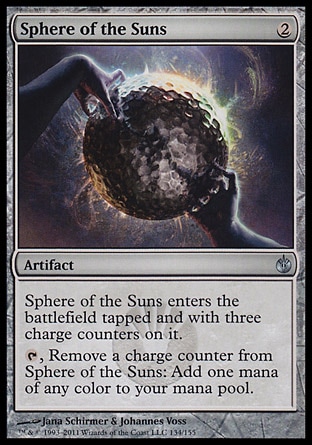
  • Sphere of the Suns
  • Coalition Relic
  • Fellwar Stone
  • Wayfarer's Bauble
  • Birds of Paradise
  • Green Sun's Zenith

Coalition Relic breaks the trend here, but given that it lets you cast a planeswalker even with no other appropriate mana source, I think it adds more than enough to be worthwhile.

The rest are either green or colorless ways to ensure that you'll be able to cast the appropriate four-drop on your third turn, and will go a long way towards keeping pace with the rest of the decks at the table.

This does mean we need to disproportionately skew our mana base towards green lands, but that's a sacrifice we can happily make for increased speed and consistency.

Getting Thematic

There are a number of powerful planeswalkers that force you to build around their abilities in order for them to be any good.

Because of the limited number of slots available, you can only maximize the potential of a certain number of those cards. After including cards to protect your planeswalkers and interact favorably with opposing planeswalkers, space starts to run out quickly.

Let's take a look at the packages I chose to run:

Nissa and Friends

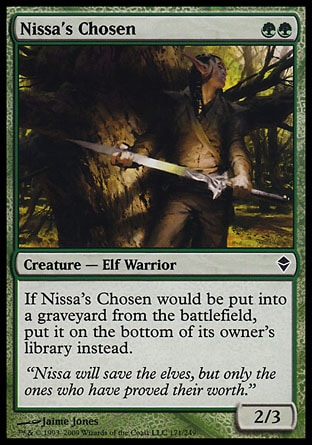
  • Nissa's Chosen
  • Viridian Zealot
  • Deranged Hermit
  • Fierce Empath
  • Glissa, the Traitor

It is unfortunate that Eternal Witness isn't an elf, but this package is still pretty reasonable. Nissa may be pretty underwhelming in most cases, but because of that people tend to leave her alone. If you manage to ultimate her, fetching up all of these guys is a pretty big swing in the game, and something that people won't expect out of a non-elf deck.

Viridian Zealot is your standard artifact/enchantment removal that can be tutored up via Green Sun's Zenith. Deranged Hermit makes a billion chump blockers, and can be a very fast clock in the late game. Fierce Empath tutors up your Sun Titan so that you can recur your "lock" pieces.

Lastly, Glissa, the Traitor interacts well with this next sub-theme:

Tinkering with Tezzeret

  • Executioner's Capsule
  • Mycosynth Wellspring
  • Ichor Wellspring
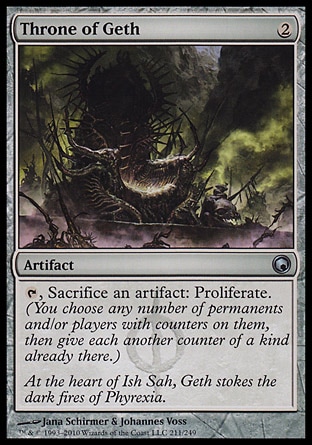
  • Throne of Geth
  • Sword of the Meek
  • Thopter Foundry
  • Nim Deathmantle
  • Rings of Brighthearth
  • Nevinyrral's Disk

All of these cards do some valuable work on their own, but their combined interactions are really what makes them shine.

Executioner's Capsule and Nevinyrral's Disk are great ways to protect your planeswalkers from creatures and other permanent-based threats. Rings of Brighthearth is pretty much a must for any respectable planeswalker deck, and Nim Deathmantle helps protect key creatures and provide late-game inevitability with Sun Titan and Eternal Witness.

Lastly, you have a package of Thopter Foundry, Sword of the Meek, Throne of Geth and the wellsprings. All of these cards interact favorably with one another in subtle ways.

There's the obvious Thopter/Sword combo that makes infinite blockers and fodder for Proliferate. You can sacrifice Sword to Throne of Geth, then put some 1/1 tokens into play with Elspeth, Knight-Errant or some such. Or you can just sacrifice the Wellsprings for extra value!

Making Planeswalkers (More) Awesome

With the rest of the deck figured out, we can dedicate the last few slots to choosing a Commander and enhancing our planeswalkers!

Protecting your Newfound Friends

  • Ensnaring Bridge
  • Peacekeeper
  • Glare of Subdual
  • Sun Titan

These cards, along with your Thopter/Sword engine, are the best ways you have to protect your team from random creatures. (I've chosen to ignore burn spells because they rarely come up in my games.)

Unfortunately, cards like Ghostly Prison are of little use, so these are the few options that you have. Glare of Subdual is the real gem here, since it makes all of your incidental token generation infinitely more effective.

Getting Bigger, Faster

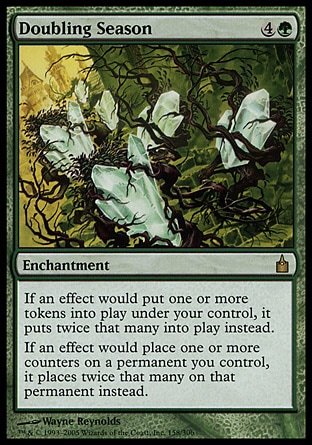
  • Doubling Season
  • Steady Progress
  • Tezzeret's Gambit

There are a good number of cards with Proliferate and other "add counters" effects, but these are the only ones I've chosen to run because they require the least amount of work for the most efficient return.

The only other card I really considered was Inexorable Tide. The problem was that at some point you pretty much just stop casting spells and elect to activate your planeswalkers instead.

Bring in the Back Up

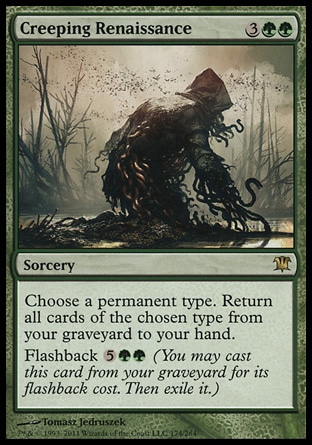
  • Creeping Renaissance
  • Wargate
  • Genesis Wave
  • Stoneforge Mystic
  • Eternal Witness
  • Mulldrifter
  • Shriekmaw
  • Crib Swap
  • Horde of Notions (Commander)

Sometimes even the best team needs some back-up. These tools give you a lot of consistency and resiliency, helping find or recur key pieces of the puzzle. Alternately, some are just over-the-top powerful.

As for Horde of Notions, he gives you more ways to grind out cards and control the board. He's a sweet back-up plan when all else fails.

The Mana Base

  • Rootbound Crag
  • Woodland Cemetery
  • Sunpetal Grove
  • Hinterland Harbor
  • High Market
  • Mouth of Ronom
  • Prahv, Spires of Order
  • Krosan Verge
  • Vivid Meadow
  • Vivid Marsh
  • Vivid Creek
  • Vivid Crag
  • Vivid Grove
  • Reflecting Pool
  • Exotic Orchard
  • Grand Coliseum
  • Command Tower
  • Terramorphic Expanse
  • Evolving Wilds
  • Bojuka Bog
  • Flooded Grove
  • Fire-Lit Thicket
  • Wooded Bastion
  • Twilight Mire
  • Azorius Chancery
  • Orzhov Basilica
  • 4 Snow-Covered Forest
  • 2 Snow-Covered Mountain
  • 2 Snow-Covered Plains
  • 2 Snow-Covered Swamp
  • 1 Snow-Covered Island

This is a pretty budgety manabase, even if it is a little stressed. The deck wants another land or two, probably a Ravnica bounceland and a basic.

Normally, I'm not a fan of the Karoos from Ravnica, but they are quite good in decks like this with hefty color requirements and a low land count. Too many Karoos is asking to get tempo'd out of the game, but a few to reset lands like Bojuka Bog or to inflate your land count are just fine.

Notice that a majority of the mana-base taps for Green. This is in order to maximize your chances of playing a ramp spell on turn two, and provide easy access to your supporting cast of green cards.

This makes the filter lands from Shadowmoor and Eventide much better than normal, because they effectively give you as much access to their respective color as you need. It's also worth considering the similar cycle of lands from Odyssey, such as Skycloud Expanse.

Prahv, Spires of Order is one of the lands best suited for this deck, because of its ability to prevent any kind of damage. One of the things this deck is most afraid of is burn to the face, and Prahv is an awesome out that doesn't really take up a deck slot. It's usually worse than something like Maze of Ith, but under this particular set of circumstances I think Prahv wins out.

With the manabase settled, here's what the final list looks like:

[deckbox did="a150" size="small" width="560"]

I've had time to play a few games before writing this article, and let me tell you: this deck is sweet!

The games you win, you win big. Even the games you lose are close though, because you have so many incidental interactions that help you protect a few planeswakers long enough to start grinding out advantages.

Make no mistake, this is an incredibly grindy control deck; notwithstanding the potential to "combo off" with Doubling Season, you will have to fight against the table for each point of loyalty.

That said, it is a ton of fun to play with. You get to do so many powerful things, and attack from a lot of different angles. It can be a little daunting to figure out the sequencing of your planeswaker activations, but it's enough fun that it doesn't really matter if mistakes are made.

If you haven't tried building a deck with a theme like planeswalkers, artifacts, enchantments or even lands, I would definitely recommend it. Linear decks bring out some very interesting interactions, and make some corner-case cards incredibly powerful. They are very fun to play to boot.

Next week we'll be trying another thematic deck, albeit one that's a little less linear. I tend to avoid both Green and Black when I'm building my own decks, so we'll talk about some Jund exploration!

Carlos Gutierrez
cag5383@gmail.com

@cag5383 on Twitter

A Gallery of Horror: The Intro Packs of Dark Ascension

Are you a Quiet Speculation member?

If not, now is a perfect time to join up! Our powerful tools, breaking-news analysis, and exclusive Discord channel will make sure you stay up to date and ahead of the curve.

Creeping up behind you... hiding beneath the bed... lurking in your closet... since they escaped the confines of their containment unit in Renton, Washington and were unleashed upon our world, the horrors of Dark Ascension are firmly amongst us now. In your opponent's deck, in foil packs on the store shelf, inside boxes and on retailer websites they lurk, waiting for the right moment to strike. And when the moon rises full in the sky, they will...

*cough*

Sorry about that, got a little carried away there. Of course, it's easy to when a block this flavourful comes along, loaded with tribal goodness and top-down design. There's a reason that Innistrad and Dark Ascension events are setting records, and it's been a lot of fun watching how the mechanics, themes, and perspectives of the sets have found their way into the Intro Pack decks.

In the first go-round, Innistrad brought us a trio of tribal decks and a pair of more keyword-based ones. Humans, Vampires, and Spirits each took their turn in the spotlight. Not far behind them were decks based around flashback and morbid.

Some were better than others - the flashback deck (Eldritch Onslaught) was chancy but a lot of fun to play, while the other mechanical deck (Deathly Dominion) was somewhat reminiscent of the first proliferate deck from Scars of Mirrodin, Deadspread, which felt like it had a lofty concept without enough cards to really give it its due. While proliferate would be given its due in the two following sets with Doom Inevitable and Ravaging Swarm, this time around it looks like the one deck is all we'll be getting for morbid. Rather than try and refine earlier efforts, Wizards has given us all new toys to play with.

While some folks out there are snap-buyers of the precon decks, others prefer to take their time, weigh their options, and try to find the deck that is the best fit for how they're looking to command the night. If that sounds like you, you're in luck, for today we'll be looking at the latest crop of Intro Pack decks with an eye to matching them with the right player. And if you're a fan of horror films, then so much the better! So grab a sharpened#2 pencil and piece of paper, and let's dive right in!

Relentless Dead

Tagline: Braaaaaiiiiinsss!

Colours: Blue and Black

Strategy: Overwhelm your opponent with a growing horde of the undead.

Detail: When designing Innistrad, Wizards wanted to be able to fit each of the five primary tribes into two different colours. Black was a given for the Zombies, but casting them as "Skaabs," the Frankenstein-ish creations of mad scientists, was a masterstroke. Both have rather different styles of gameplay- the Black ones begin slowly and begin to overwhelm, rather like Romero's immortal Night of the Living Dead.

That isn't to say that there aren't cards more akin to the "fast zombies" of 28 Days Later (see: Gravecrawler, Highborn Ghoul), but here we're looking at the steady buildup of the undead- until we hit a critical mass, like when it started to rain in Return of the Living Dead.

Meanwhile, your Blue Skaabs offer power over numbers, limited as they are by the need to exile bodies from your graveyard to cast them. The hammer to Black's anvil, if you like grinding down your opponent on the battlefield with numerical superiority, you might find Relentless Dead to be the deck for you.

Monstrous Surprise

Tagline: It's... it's not dead!

Colours: Red and Green

Strategy: A traditional R/G beats deck frame with a supercharged undying engine

Detail: Few things are scarier than something you assumed to be vanquished or dead turning out not quite soMonstrous Surprise harnesses this with the highly efficient undying mechanic. Not only will you get two uses out of your creatures, but when they come back they'll be stronger than ever.

If you've ever seen the heroes relax when they think they've defeated Jason, Freddy, Michael, or any other self-respecting slasher-movie villain, you'll know just what your opponent has in store for them. Even decks packed with removal can struggle to keep a good monster down, and you'll be able to keep the pressure on by attacking fearlessly since any defensive trade they make only makes your army stronger.

Dark Sacrifice

Tagline: Give me your soul, please.

Colours: Black and White

Strategy: Human sacrifice is the name of the game, as you summon Humans victims and those eager to feast on them

Detail: Horror movies abound with the idea of Humans as prey and a source of raw materials. Buffalo Bill in Silence of the Lambs wore women's skin, the demon from Jeepers Creepers reconstitutes its own body with the flesh of its victims, and The Thing is able to take the shape of those it kills, all the better to blend in amongst them.

In Dark Sacrifice, the coin of the realm is Human life, and the deck is filled with ways to take advantage of their harvesting. Some creatures like Village Cannibals get bigger when their fellow man dies, while others like the Skirsdag Flayer offer a more direct result. This is more of a thinking person's deck, possessing a comparatively intricate strategy over simply aiming beaters at the red zone and firing a starter pistol. With combo pieces to assemble, it can be prone to whiffing when you don't draw that final missing ingredient, but when it goes off it can be unstoppable.

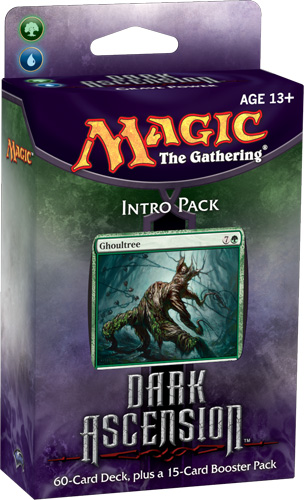
Grave Power

Tagline: There are ghosts in the basement!

Colours: Blue and Green

Strategy: Use self-milling cards to fill your graveyard then pound in with monsters who get bigger the more bodies you've put in it

Detail: In Grave Power, the dead don't come back from the grave. Instead, their essence powers up the living! Our pick for best in show, Grave Power in some ways is an improved version of the Deathfed Event Deck from Innistrad. Use Blue's unparalleled ability to rapidly fill up your graveyard straight from your library, watching your Green finishers like Splinterfright and Boneyard Wurm swell to mammoth proportion.

Intro Pack decks have come a long way since the dark days of Zendikar, and in many ways have been creeping back towards Theme Deck territory as relentlessly as The Blob. We've seldom seen so synergistic and consistent a construction as this one,  as all of Grave Power's cards help support its primary strategy. In a format long marked by extensive use of filler, this is a very promising development.

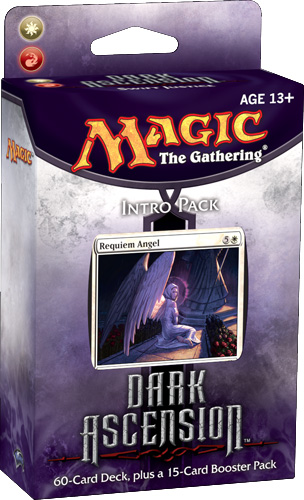
Swift Justice

Tagline: I kick ass for the Lord!

Colours: Red and White

Strategy: Support your aggressive ground troops with some disruptive air support in this Red/White aggro strategy

Detail: In most horror films, the monster is the star of the show and everyone else is reduced to a supporting cast. Or simply dinner. For those of you who like to see good prevail in the end, to see heroes like Ash from Army of Darkness or Ripley from Aliens persevere through strength and fortitude, this deck's for you. An aggro deck that boasts a mana curve perhaps a bit too indulgent for its own good, it still has a number of aggressively-minded creatures to throw at your opponent. Don't fearfully peer under the bed looking for that clown. Crush it instead with your Elite Vanguard and Stromkirk Noble.

Additionally, this deck has a flying subtheme, giving you extra reach across the battlefield once the red zone clogs up. Sadly it suffers a bit from the same lack of removal we've seen throughout Innistrad block, though this smarts a little worse in a Red/White deck which ordinarily should have it for miles. Guess you're gonna have to do your ass kickin' the old-fashioned way - in the red zone!

Scroll End Credits

And there you have it: five new Intro Pack decks for Dark Ascension that should fit most any horror-lovin' Magic player.

No matter how you wish to enslave the world, be it through Human sacrifice, reanimating piles or corpses, or what have you, you have the tools at your disposal. Enjoy them while you can, for the angel Avacyn will be returning before long. With the final set of Innistrad block being a stand-alone set (in the vein of Rise of the Eldrazi), we're likely to find ourselves in a whole new landscape, gaggigly good and filled with joyfulness and light.

Why, it's enough to make you sick.

The Booster Battle Packs Giveaway

You may recall in our last piece on the Innistrad Booster Battle Packs, we were giving away a card set of the Packs. Our winner, drawn at random, was Alan.

Congratulations, Alan! We'll be in touch shortly to get your preferred shipping details.

Watch this space, because the next giveaway is never long in coming!

Jay Kirkman
@ErtaisLament
www.ertaislament.com

CommanderCast S5E7 | Q&A&D

Are you a Quiet Speculation member?

If not, now is a perfect time to join up! Our powerful tools, breaking-news analysis, and exclusive Discord channel will make sure you stay up to date and ahead of the curve.

This week CommanderCast is back with that hard-hitting INVESTIGATIVE JURNALIZM about your favourite casual fantasy trading card game. This is serious business. Andy and Donovan ask Alex and Gavin of the Commander Rules Committee YOUR questions submitted over several weeks regarding the composition of the RC, their stances on contentious issues, and all kinds of other good stuff. Plus we also touch on other subjects, but those can be a surprise for now.

Hit the button or play, or download the entire episode! The full show notes are here.

For more Wrexial-Approved stuff, hit up http://www.commandercast.com/

Insider: Racking Up Rise of the Eldrazi

Are you a Quiet Speculation member?

If not, now is a perfect time to join up! Our powerful tools, breaking-news analysis, and exclusive Discord channel will make sure you stay up to date and ahead of the curve.

Rise of the Eldrazi is the Timmy dream set. It's what you'd get if you built a set with the premise of "no rush till turn 7" and packed mana accelerants in everything. The set is based around the Eldrazi, giant and evil old legends that awaken on Zendikar. There's a little bit of plot to this set, but mostly people remember weird drafts and a couple really big monsters. You see, Rise of the Eldrazi was made to be drafted as triple-Rise. The reason was that most of the cards are just unplayable in draft if you let in stinkers like Steppe Lynx. You'll die before you get two Eldrazi Spawn into play!

While Rise did not add a whole lot to Standard, it was full of cool Commander cards. It remains a popular set in the casual circuit and there are plenty of solid cash cards in here. Most of the expensive cards are also Mythics, so they command a special premium. This is despite the fact that Rise was extensively opened - three packs in every draft. Let's take a look at what commands the money in this set!

All is Dust

$7.00

All is Dust is surprise Nevinyrral's Disk. It's the best friend in a Karn commander deck. It's a fairly priced board wipe that can even nail things like Thrun. All is Dust is a very popular commander card, because every deck gets to play it. The card is also just so approachable - you don't have to look at it too hard to figure out what it can do. This means that it pulls a lot of casual weight, and though it isn't played in Constructed, it's still worth a chunk of change.

Awakening Zone

$1.25

Did you want a Maze of Ith or an accelerator each turn? This gives you both! If you aren't under attack, then this gets you dangerously close to some really big plays. If you're pressed, this takes a bit of heat off of you. The opponent can attack you to keep you off of acceleration, but they're throwing away all of that damage they could pin on another player in a big game. It's even good when you're feeding an Eldrazi Monument, which also bumps up every token that you make with it.

Coralhelm Commander

$2.00

This is the card that really pushed Merfolk over the top in Legacy. We can look at things like Merfolk Sovereign, but the chance to pair this with Reejerey, Sovereign and the Lord of Atlantis and make the Sixteen Lords deck was really incredible. It seems like every other monster in the Merfolk deck pumps his friends, so you can swing in with 4/4 Mutavaults and end things in hurry. The Commander can also hold his own on an empty board later in the game. Turning into a giant flier is also really good; it demands a swift answer. The price on this card has really dropped because the Stoneforge Mystic + Batterskull plan has really screwed up Merfolk decks.

Eldrazi Conscription

$2.25

I get the feeling that a lot of the value in this card is probably wrapped up in Voltron style Commander decks. The card also saw serious competitive play in Mythic Conscription, which was a UWG Standard deck. A Noble Hierarch into a Lotus Cobra on the second turn could generate Sovereigns of Lost Alara on the third turn - so that Cobra is swinging in with a Conscription on it. It's the newest iteration of those old Erhnamgeddon decks.

Eldrazi Temple

$1.50

Some people must really like summoning giant pasta monsters. I don't know why this thing is over a dollar, but it is. That's a truth that we have to live with.

Emrakul, the Aeons Torn

$11.00

Emrakul is the best example of what you can get for infinite mana. It's the creature that you're Show and Telling into play. I'd wager that this would be $25 if it were not the promo card for the set. Emrakul was banned in Commander - before that, it was worth a little more. There were a couple of months in Commander where seemingly every game ended with someone dropping this guy and Time Walking into players.

Gideon Jura

$8.00

I like to think of Gideon as your bodyguard. He he's full of damage-absorbing loyalty, he'll kill guys who come at you, and he'll turn into a bad guy to stomp the opponent. He was part of a UW Standard deck called Super Friends. You'd play a lot of Planeswalkers and sweepers. You could combine things like Gideon's animating and Elspeth's Jump ability to make the game end in a hurry.

Gideon is still asking a playable-Mythic price, which is odd - he doesn't see play in anything and he's been reprinted. Gideon did pop up in Caw-Blade sideboards now and then and he still appears in UW Sword decks in Standard right now. But Gideon is not a $30 mythic by any shot.

Guul Draz Assassin

$1.50

It's a sad world when this is worth three times what most Royal Assassins are. I would probably pass this off as a junk rare, but they seem to be pulling a little bit of cash.

Inquisition of Kozilek

$2.00

I think Inquisition is going to be one of those $3.50 uncommons in a year. It's a stellar Modern card, often just as good as Thoughtseize with a lot less of the downsides. Inquisition isn't getting reprinted, especially because it has a set-specific name in its title. That's kind of a bummer - IoK is a good roleplaying card for a lot of sets. It doesn't punish players for running big monsters and it can slow down faster decks. I wish we'd see more of this card, but the copies we have are all we are going to get.

If I were betting on the long profit, Inquisition of Kozilek would be a top call. With the current support for Modern and its continued pro attention, we'll see a lot of this card.

It That Betrays

$3.50

It That Betrays is a game-stopper in Commander. It'll co-opt any Annihilator trigger, but it also screws up just about any other advantage engine that someone is running. Last week, it stopped me from using Carrion Feeder and Corpse Dance to recur Thraximundar over and over again. This kind of thing happens often. This isn't the greatest guy to swing into someone with; the Annihilator trigger is unimpressive and it can be chumped all day long. The ability to screw up engines and combine into bonkers combos with All Is Dust is why this is solid.

Kargan Dragonlord

$3.25

The Dragonlord is the Great Red Hope for burn decks. The idea is that you run this guy and like Figure of Destiny, it's supposed to go all the way if you draw it later in the game. I don't think that it really works out that way. If you drop him later with, say, Gauntlet of Might out, then sure, it'll get enormous in the span of a turn. It hasn't really worked out, though, that spending R x 10 is a worthwhile play, even in casual games.

Khalni Hydra

$3.75

Speaking of absurd creature costs, we've got this guy, too. I like that a little dude like Llanowar Elf does double duty on casting this card. However, all the work you put into it means that you just get an 8/8 trampler. You don't get a crazy combo engine, you don't get to draw more creatures or kill something else. You just get a big stomper. That said, this is worth a couple dollars. Keep an eye out for this one in binders.

Kozilek, Butcher of Truth

$12.00

I think my favorite use of Kozilek has been as a crazy draw spell in Food Chain decks. You'd play him, draw a bunch of cards, then exile him for more mana to cast Emrakul Lagasse. Kozilek is still fine, but I think his little brother Ulamog is the better Eldrazi. Drawing four cards means that you don't really have to worry about this guy dying - he's already super-replaced himself.

Lighthouse Chronologist

$3.00

Everyone who plays Commander has seen this thing hit ultimate in exactly one game. The player with the Chronologist gets to take four or five turns in a row, then everyone packs up their cards and remembers to point a Lightning Bolt at this in the next game. Make no mistake - this card is Kill On Sight.

Linvala, Keeper of Silence

$4.75

So while Linvala isn't especially "legendary" in her ability, she's a right pain in the butt when she's in play. Even a Noble Hierarch won't tap for mana and Linvala will shut down every good combo that you have. It's a fine card for the White Prison commander archetype and I've gotten a lot of mileage out of Linvala in Modern decks. Those Splinter Twin and Melira decks grind right to a halt when this Angel is around. Linvala is sufficiently annoying and beefy for the mana cost, so it's an easy include in a lot of my decks.

Nirkana Revenant

$5.00

Rise of the Eldrazi has got a whole heap of really fun Mythics, and this is another one of them. It acts like another Cabal Coffers. The turn after you play it, you're getting in upwards of an 18/18 attacker. That's if you just want to punch the mana through your Revenant, too. If you want to Exsanguinate or cast a big Eldrazi, you can do that, too. Revenant has doubled in price in the past year; I could see it holding that price for a long time to come.

Sarkhan the Mad

$4.00

So Sarkhan can only count down, but what a good job he does! He'll play Dark Confidant for a few turns or he'll make a Sprouting Thrinax into a giant Dragon. His Ultimate is a decently good reacher, ending the game a little sooner. Sarkhan is obviously best at home in a dragon deck where you can ideally drop him and fire the Ultimate in one turn, acting like a big, painful burn spell. He's also fine in B/R attrition decks, since his drawing ability is nice and he can turn smaller utility dorks like Hypnotic Specter into game-enders.

Splinter Twin

$3.50

This was a bulk rare when it was printed. We all knew about the Exarch combo, but you've got to realize that Jace and Stoneforge Mystic were still running the house. When they were banned, Twin got its time in the sun. Ponder and Preordain helped to make the deck more consistent. About overnight, this card jumped to $8.00 and stayed there for a long time. It still gets a bit of play in Modern, since the combo is even more robust with Pestermite and Kiki-Jiki. I have to wonder whether people play this legitimately by tacking it onto Sundering Titans and Duplicants.

Student of Warfare

$2.50

Student of Warfare is an upgraded Figure of Destiny. It won't get flying, but the Double Strike is just fine, too. I've seen this pop up in Martyr decks now and then, thanks to Ranger of Eos pulling out two copies. I don't know that Student is quite as solid as it looks - the mana commitment requires that you really just have nothing else going on in the deck. That doesn't typically bode well, even if you end up with a 4/4 double striker.

Training Grounds

$1.50

I'm a bit surprised that Training Grounds is this cheap. People looked at this and immediately cast their eyes on their Sliver decks, the home of billions of activated abilities. Training Grounds means that you can take whatever you'd like with Sliver Overlord and use Necrotic Sliver to wipe the world away if you'd like to. This is the kind of card that could sit around for a dollar for years until some combo that could really use a one-mana combo block emerges. This is not a card worth forgetting.

Transcendent Master

$2.50

I had high hopes for this creature. He's the icon of what happens if you let a creature stay on the board for a little too long. He'll gain life like a Wurmcoil and end up unremovable. The failure of Transcendent Master to make an impact in Standard is conclusive criticism of whether Leveling was actually playable in tournaments.

Ulamog, the Infinite Gyre

$10.00

A gyre, by the way, is a whirlwind or whirlpool. It also shows up in Carroll's "Jabberwocky."

Ulamog shows up in Tron decks in Modern; he'll take out the biggest issue on the board and the indestructibility makes this a really hard problem to remove. I've found that when Ulamog hits, you don't even have to attend to Emrakul. The Annihilator, the Vindicate, the indestructibility - all of this will end the game unless you've got a Path to Exile stashed somewhere.

Vengevine

$8.25

Vengevine got a lot of good play in Standard, thanks to Bloodbraid Elf resummoning this monster. It also got Survival of the Fittest banned in Legacy. I played the blue/green deck and it was just as incredible as you'd think. You would spend the first few turns putting Vengevines in the graveyard, then grab two Basking Rootwallas and smash the opponent for a big pile of damage. If you tossed Wonder in there, blockers were just irrelevant.

Vengevine is obviously powerful, but I like how they made a green creature that could stay around. With Indestructible and Hexproof getting keyed to Green, I think we'll see some more playable and solid green creatures that make Forests worth playing.

Well that wraps up Rise of the Eldrazi! The set is, by far, one of the most lucrative for traders. You've got a gold mine of stellar Commander cards to trade around. Since the next set, Scars of Mirrodin, feels so new that it must have come out last week, I'll be taking a break from set reviews - BUT NOT FROM ARTICLES! - for awhile. Expect more material next week, but we'll be going over other trading and speculative strategies. In the meantime, hit my archives and take a trip all the way back to Tempest and see what the big-dollar cards are in all of the modern Magic era.

Until next week,

Doug Linn

Grand Prix Lincoln (#GPHoth) and Forward

Are you a Quiet Speculation member?

If not, now is a perfect time to join up! Our powerful tools, breaking-news analysis, and exclusive Discord channel will make sure you stay up to date and ahead of the curve.

null

Wikipedia's definition of keystone can be summarized as a wedge-shaped piece of stone that is located at the peak of an archway. This block allows the structure to bear weight and locks the other stones in place. The concept of a keystone will help to illustrate my point about how eternal formats work.

There is one fundamental building block, or keystone, in which eternal formats stand upon. This crucial piece of knowledge is that eternal formats are wide open.

Most of the time in Modern, Legacy, and Vintage, there is no best deck. There are plenty of decks that are playable and these formats reward deck building, innovation, and seasoned players. These things are true because more decks are playable. In older formats, you cannot build a deck meant only to beat a specific couple of decks because of the diversity that is present at events.

When I play Modern or Legacy, I don’t typically play the same deck more than once in any given event. This premise should not dissuade new players from breaking into other formats, but knowing about the keystone to older formats will help give you solid ground to stand on. Many decks are viable, so play the deck you want to play. Make sure the deck is good and that you know it well.

While this concept can be applied to Legacy and Vintage, my point in bringing it up is to discuss Modern, hence the title referring to a big Modern event this past weekend. Modern has been raked over by those at Wizards and cards deemed too powerful have been removed from playability. They have done a great job of allowing many different types of decks to be playable in this format. Let’s take a look at the top 8 of this past weekend’s Grand Prix to see just how diverse the format is:

  • 2 Jund decks
  • 1 Meleria Combo
  • 1 Mono Blue Faeries
  • 1 Blue White Tron
  • 2 Affinity
  • 1 Aggro [card Life from the Loam]Loam[/card]

Even if you know absolutely nothing about Modern, just the fact that there are six different decks is awesome and amazing.

Often in Standard we get to a point where there are less and less decks in the top 8 of events. One reason I like Standard right now is because that is not the case at every event. In Standard, Delver and Wolf Run typically do well at nearly every event, but there are always other decks that find success as well.

Modern, however, has this type of diversity at every event. Six decks is just scratching the surface of the number of playable decks in the format.

LSV had some thoughts on this topic as well in his article this week where he relates his experience playing Blue White Tron to a top 8 appearance. Even if you have no interest in Modern, he shares some important ideas for those of us striving for success in competitive magic. Here is the link to his article.

The line that suck out to me the most was, “It’s very important to pick a deck you like playing, since your attitude definitely impacts how much success you have.”

I see players all the time who are not having fun at the event because they chose to play the winning deck from the week before. That can be a great strategy, but playing a deck you enjoy that you are familiar with will net you more wins. There is a fine line between enjoyment and competitiveness, though, so beware bad deck decisions solely based on enjoyment. Not only did he enjoy this deck, it was a deck he had tested extensively and one he thought was quite good. Both things must be true and it can be hard to find the right mixture of the two.

Important thoughts about Modern

Choosing a deck in a wide open metagame such as Modern can prove to be quite a daunting task. There are a few hurdles we need to jump over if you want to be successful in this format. For those of us struggling to settle on a deck, I've outlined them so we can build our decks accordingly.

Obstacle 1: Affinity

In case you haven’t heard by now, Affinity is quite good. For those of us that were playing when Affinity was in Standard, we already know how good this deck is and what it is capable of. With Modern having so many sets legal for deck construction, there are even additions to the deck that make it better than it was previously.

Mox Opal, for example, is amazing in this deck. In fact, I see it as one reason to play it. The mana is faster than any other deck in the field and, because of this, you will get some free wins just based on your opponents not being able to react quickly enough before they are dead.

The versions of Affinity that have been successful remind me of Red Deck Wins. You should treat them as such. They aim to end the game as quickly as possible by attacking and then finishing you off with burn spells. If you go to an event unprepared for Affinity, it is doubtful you will find success.

Solution: Come prepared with Ancient Grudge, Shattering Spree, or even Creeping Corrosion.

Obstacle 2: Combo

There are a variety of combo decks that are prevalent in Modern and new ones are still being invented. Most players know about Splinter Twin, and though it has not had much success recently, it is a very solid deck that will be played.

Right now Meleria Combo is in the crosshairs because of Andrew Cuneo's second place finish that at Grand Prix Lincoln with the deck. I have played this deck a bit and it is resilient. Most aggressive matchups are in your favor and there are very few things you are actually afraid of. Graffdiggers Cage seems problematic for the deck ,so watch out for that Dark Ascension rare that is starting to be included in players' sideboards.

I would also classify the Life from the Loam deck as a combo deck, though it plays somewhat like a midrange aggro control deck at times. After watching the finals of the Grand Prix, that evidence suggests that this deck should definitely be taken seriously. It can control the game quite well with Flame Jab and Raven's Crime.

These cards make it hard to keep creatures on the battlefield and disallow access to cards in hand as well. This Jund colored deck functions similarly to the Jund aggro decks in that they eliminate your hand and all your creatures. Rather than focus on winning the game, they stop you from winning the game. The Life From the Loam deck does have Countryside Crusher, though, so be aware that games can end quickly if you are not careful.

The final combo deck to think about is Storm. Many of the players that made it to the top 8 had to play against and beat Storm in order to achieve success. They did so by including a couple cards in their sideboard to combat this deck. Ethersworn Cannonist and Rule of Law, for example, provide a sizable roadblock that the Storm deck must overcome in order to win the game.

Combo is a consideration you must think about when preparing for a Modern event.

Solution: Combust, Qasali Pridemage, Graffdiggers Cage, Damping Matrix, Torpor Orb, Relic of Progenitus and other combo hate.

Obstacle 3: Diversity

While diversity is a great thing for a format, in this case it makes it a problem that needs to be overcome in order to succeed. Let’s just take some information from the Grand Prix Lincoln top 8 player profiles on our topic of diversity. Here is what the players had to say about their journey to the top 8.

How many different decks did you play against this weekend?

Eight.

Ten.

Eight. Ad Nauseam, Twin, Caw, Affinity, Fae, Tron, Storm, Melira.
Twelve different decks in Twelve rounds.

Seven. Melira, RUG, Twin, Affinity, Jund, Martyr, Doran.

Nine. Eight plus four Melira decks.

Nine. Storm, Pod, Jund, Affinity, Twin, Vampires!! Zoo, Caw Blade, Faeries.

Seven. Affinity, Jund, Mirror, Mirror with red, Storm, Bant, UR Tron, Mirror with red and white.

There are some things to keep in mind when looking at the data. The first is that there were fifteen total rounds before the top 8, but many of these players had three byes for the event. So we need to consider that for the most part we are comparing this amount of diversity to twelve rounds.

If we look at the sum of the decks player had to battle and compare that to the average of twelve rounds they played, we can deduce that in an eight round event we are likely to play against an average of five different decks. The reason that this is important is because when you are choosing your deck, you need to keep in mind that you will be playing against many different types of decks. This should help in narrowing down the decks you are choosing from as well as helping you to create your sideboard.

Additional Resources:

My favorite author in the Magic community is Alexander Shearer. The work that is does is simply amazing. Not only is it visually appealing, his statistical analysis of the game really puts things into perspective. When his focus is on one particular deck, he breaks down what the deck is doing and his card choices better than anyone else writing articles.

His article from this week is also about Modern. In it he analyzes what decks are making it to the top 8 of PTQs so far this season. If you are interested in the Modern format and are headed to some PTQs, make sure to read his article found here.

I hope all this information will help you on your way to your next PTQ top 8!

Until next week,

Unleash the force on those PTQ's!!!

Mike Lanigan
MtgJedi on Twitter
Jedicouncilman23@gmail.com

Insider: Way Back Trade Stacks

Are you a Quiet Speculation member?

If not, now is a perfect time to join up! Our powerful tools, breaking-news analysis, and exclusive Discord channel will make sure you stay up to date and ahead of the curve.

This week I want to do something a little different, and I have to credit Stric9 from our forums as my inspiration.

In case you didn’t know, our Quiet Speculation forums have a “Rate My Trade” board where people can post their trades to gather opinions or get advice on whether or not to make a particular trade. Stric9 posted one such trade last June, and he recently updated his post to show what those cards have done since then. What a great idea!

Here’s another thing you might not have known unless you’ve been with QS since the beginning. When I wrote my first article nearly 18 months ago, I had no idea I’d still be doing it every week almost two years later. I was just coming into my own as a serious trader/speculator and wasn’t always sure how I did when swapping cards. It was also right after the now-infamous Pack to Power project had completed and everyone was copying the idea.

I never did my own Pack to Power (and I’m glad I didn’t), but I did like the format Jon had used in putting every trade on paper. I emulated the technique for a few reasons. First off, it really helped me to learn card prices. If you look up a card’s price on a smartphone during trading, you’re not as likely to remember it later than if you had taken a chance and only find out later if you won or loss. That emotion helps to burn the price into your head, and you’ll quickly memorize more prices than you thought you could.

Anyway, the point is I used to record the trades I made every week in my column and then analyze them (hence the column name “The Revenue Review”). So let’s look back at some old trades (using SCG prices) and see how these look in the harsh light of 2012!

Date: Aug. 28, 2010

His:

Scalding Tarn ($14)

[card]Steel Overseer ($5)

Mine:

Arid Mesa ($14)

Net: $5

Today:

His:

Scalding Tarn ($15)

[card]Steel Overseer ($3)

Mine:

Arid Mesa ($10)

Net: $8

It turns out Blue Fetchlands are good, something I’ve since turned into a much larger project. I’m sure this was just an example of me moving a fetchland to a guy who needed it and didn’t mind losing some value to get the one he needed.

That’s the warm-up trade of that night. Here’s where that session got really interesting.

Date: Aug. 28, 2010

His:

Primeval Titan ($50)

Mine:

Creeping Tar Pit ($3.50)

Senseis Divining Top ($8)

Cabal Therapy ($5)

Coralhelm Commander ($4)

Daze ($2.50)

Mistblind Clique ($4)

Secluded Glen ($4)

Cryptic Command ($13)

Net: $6

Today:

His:

Primeval Titan ($25)

Mine:

Creeping Tar Pit ($3)

Senseis Divining Top ($12)

Cabal Therapy ($6)

Coralhelm Commander ($3)

Daze ($4)

Mistbind Clique ($3)

Secluded Glen ($2)

Cryptic Command ($15)

Net: -$23

Whew, that looks horrible. If we both held onto stock, I would be looking pretty silly. At the time, though, the Titan was shiny and new, and I knew someone would be dying to pick it up. It is interesting that the pile of cards I traded him have appreciated in price as a whole since then (though I’m not positive that I used SCG pricing then).

Here’s the thing: I would make that trade again. I was able to trade up a ton of cards into the hottest Mythic in print at that point, and I knew I would be able to move the Titan for full value. This metric changes entirely if you don’t have a good outlet for moving expensive new cards, though (like Sorin).

So what did I end up doing with the Titan?

Date: Aug. 28, 2010

His:

Tarmogoyf ($60)

Heavily played Survival of the Fittest ($23)

Mine:

Primeval Titan ($50)

3x Destructive Force ($5)

2x Archive Trap ($2)

Net: $16

Today:

His:

Tarmogoyf ($100)

Heavily played Survival of the Fittest ($17)

Mine:

Primeval Titan ($25)

3x Destructive Force ($1.50)

2x Archive Trap ($2)

Net: $88

Wow. At the time Survival was on the way up in Legacy and Goyf was at an all-time low after (old) Extended was struck down as a format. I remember selling the Survival on eBay for more than the $23 I got it for in trade after it spiked hard, and I sold the Goyf for $50 cash + $45 in buylist value of cards, so I’d say that worked out.

The lesson here is this: It’s difficult to trade into the hot new Standard Mythic and if you hold onto the stock for too long you’ll lose money. But if you can move it at that price, which you usually can due to how badly people want new cards, then you can ask for an extremely good deal on the back end.

Aside

While surfing through my old articles, I came upon this nugget from September of 2010. I’ll just repost it here in all its glory.

It’s been a busy week at work, and my editor (I work at a college newspaper) challenges me to a foot race outside the building to blow off some steam. I win the first race and she (yes, she, I know agreeing to race a girl was my first error) demands a rematch and to switch “lanes” with me. I agree to her terms (my second mistake). In front of me there are a few obstacles – a tree on my left, some light poles on my right, and a grate somewhere in the middle. I line up to the right of the tree so I won’t have to duck under it. This was my third and ultimately fatal mistake, because the grass was significantly longer (and more slippery) there.

My trifecta of mistakes leads to this. I’ve been told it will be the best six seconds of your day. Viewer discretion advised.

Using the life lessons I’ve learned from Magic (never let your girlfriend tell you the game is a waste of time), I’ve decided to turn this experience into a positive. Sure, I ended up with a dozen stitches, a puncture down to the bone, a weekend on crutches, and a potentially scary emergency room bill, but I’m angling for a Tosh.0 Web Redemption! Seriously, show the video to your friends, I’m going viral.

Still waiting on that Web Redemption.

End Aside

Date: Sept. 3, 2010

His:

Misty Rainforest ($13)

Stoneforge Mystic ($5)

Mine:

3xSunken Ruins ($24)

Net: -$6

Today:

His:

Misty Rainforest ($13)

Stoneforge Mystic ($8)

Mine:

3xSunken Ruins ($24)

Net: -$3

I wanted to highlight this trade because it’s such an interesting set of cards. Just glancing at this trade, many people would think that I made money both then and now, but that’s not the case. This just proves how good of a bet Real Estate in Magic is. You can’t go wrong trading for lands, even those that see relatively little play. See also the Scars fastlands and the Innistrad duals out now, which won’t go lower than they will in the next two months until they see a reprint.

Speaking of Fastlands, here’s a trade that I didn’t think much of at the time but is really interesting in retrospect.

Date: Nov. 3, 2010

His:

Copperline Gorge ($2.50)

Blackcleave Cliffs ($3)

Hand of the Praetors ($8)

Mine:

Lodestone Golem ($4)

Leyline of Sanctity ($4.50)

Net: $5

Today:

His:

Copperline Gorge ($10)

Blackcleave Cliffs ($8)

Hand of the Praetors ($2)

Mine:

Lodestone Golem ($1.50)

Leyline of Sanctity ($4)

Net: $14.50

I wish I could say I knew the lands were going up like they did, but I didn’t. I did know that I like trading into lands because they hold value better, and that turned out to work well here. Of course, I probably traded the lands away in the following weeks for something like a Nantuko Shade

That’s all the space I have for this week, but this was a fun and fairly informative exercise for me. I changed the scope of my articles at some point away from trade reviews, so I don’t have anything more recent on paper (that I still have, at least). Still, I might take a camera to FNM this week and bring some of this style back! Let me know if you guys would be interested in a format like this for occasional use, because it’s something that people seemed to enjoy.

Until next week, when you look back at your past, I hope you don’t see this.

Thanks for reading,

Corbin Hosler
@Chosler88 on Twitter

Want Prices?

Browse thousands of prices with the first and most comprehensive MTG Finance tool around.


Trader Tools lists both buylist and retail prices for every MTG card, going back a decade.

Quiet Speculation