menu

Insider: Winners and Losers After SCG Baltimore Weekend

Are you a Quiet Speculation member?

If not, now is a perfect time to join up! Our powerful tools, breaking-news analysis, and exclusive Discord channel will make sure you stay up to date and ahead of the curve.

The release of Shadows over Innistrad and the coinciding rotation of the Standard format means the future of the competitive metagame is an unknown quantity. Before cards hit the table in tournaments, it’s unclear how they'll perform, so the market has yet to fully react to the realities of the future.

Last weekend’s Star City Games Open in Baltimore was the first major event. It will be the target of much scrutiny as the best source of metagame information and quality decklists until the SCG Invitational in Columbus this weekend focuses our picture. The following weekend, the metagame and the market will culminate at Pro Tour Shadows over Innistrad in Barcelona. The results of this event will set the state for the Standard metagame until the release of the next expansion and have massive implications on the price of cards.

It’s wise to prepare for the market volatility of the upcoming weeks by preparing ahead of time. We now have enough information to make educated decisions about the future market, so we can begin to change our positions accordingly.

I’ve identified the cards I don’t have high hopes for in Standard going forward, and which I expect to fall in demand and price. I’ve also identified some cards that have a very bright future over the coming six months and beyond. Let's get to it!

Cards to Sell

R/G Ramp decks were a major force in the metagame last season, and they were expected to make the transition to the new format. Many considered them the new “deck to beat,” but initial results at SCG Baltimore were incredibly disappointing for the archetype. The worst matchups for these decks have been the fastest, most aggressive decks, and while red is on the decline, white has filled its place.

The new metagame looks to be very aggressive, and that leaves ramp decks in an awkward place. Kozilek's Return is certainly a great tool against these decks, so I’m not counting the deck out entirely, but initial results and talk around the watercooler point to this deck being a thing of the past. Most staples will be on the decline.

There was an error retrieving a chart for World Breaker

The primary four-of top-end creature of R/G Ramp, World Breaker, has seen better times and demand is slumping. The price online fell by nearly 20% last weekend, and the paper price will continue to sag and eventually send the price of World Breaker into the realm of a few dollars.

White decks are king, and red is left out in the cold. The departure of Monastery Swiftspear robbed red of its single-best card, and with it the potential for its most powerful starts. Hordeling Outburst, another staple red tool, is also gone, along with red's ability to go wide. Temur Battle Rage, which gave red the ability to act as a combo deck and fight through any number of blockers of any size, is also gone.

All this leaves red aggro in a place without a real identity, lacking the tools to form a coherent and cohesive deck.

There was an error retrieving a chart for Abbot of Keral Keep

We’ve come a long way since Abbot of Keral Keep was flipping Stoke the Flames. Abbot of Keral Keep has been a key component of red decks for as long as it has been in print, and the decline in red means the end of demand for staples like this. There is some hope that it could be used in two-color decks in the upcoming format, but its prospects are few and far between.

There was an error retrieving a chart for Atarka's Command

Atarka's Command has been centerpiece to the success of red decks in Standard, and its high price has been driven by Standard demand. This card will live on as a Modern and casual staple, but the price is largely driven by Standard. I expect it will slowly fall until rotation.

There was an error retrieving a chart for Kalitas, Traitor of Ghet

Kalitas, Traitor of Ghet caught on immediately as an answer to Rally the Ancestors decks, but it soon became apparent that it was a quality card in its own right, especially strong in midrange and control decks loaded with ways to destroy creatures. The legend had excellent prospects with the release of Shadows over Innistrad, which would feature not only graveyard mechanics, but also the return of the vampire tribe.

Now, with the set released and games under everyone's belt, it looks as if the graveyard won’t play a central role in Standard and vampire tribal won’t be a highly-competitive deck. Thus Kalitas, Traitor of Ghet looks less exciting.

It’s certainly a great card that will see play in maindecks and sideboards, but I don’t think we’ll see an increase in overall demand. The price is at an all-time high of $23, where it has been stagnant for over two weeks, and I foresee it falling. In the same two-week period it fell approximately 33% on MTGO, so perhaps Kalitas, Traitor of Ghet will fall back into the realm of $14-16.

Cards to Buy

There was an error retrieving a chart for Prairie Stream
There was an error retrieving a chart for Canopy Vista

With white the best color in Standard, the white dual lands are going to demand a premium. Prairie Stream sees the most play so it's the most attractive, but Canopy Vista is also a good target. Keep in mind that these lands were previously played as one- and two-ofs with fetchlands, but they are now being used in playsets---demand will shift accordingly.

There was an error retrieving a chart for Shambling Vent

I had a lot of hope for Eldrazi strategies going into rotation, and I was keeping my eyes on the SCG event to see how they performed. The most popular and successful version proved to be B/W, championed by a contingent of Roanoke SCG pros including Brad Nelson and Gerry Thompson. It ultimately finished third place in the hands of Eric Hymel.

White is the best color in Standard, so it's no surprise white Eldrazi is best, and this white creature land will demand a premium. B/W Midrange also cracked the Top 8, and Ali Aintrazi proved Esper Dragons still has potential with his Top 16 finish. Shambling Vent is an important part of all of these decks, and it’s going to see steady demand until rotation and even into the upcoming Standard format, where it remains.

There was an error retrieving a chart for Lumbering Falls

The same logic that makes Shambling Vent a good buy also applies to Lumbering Falls. It’s a staple card that fits in a variety of different decks, and it’s going to see continued demand for the foreseeable future.

Four copies were played in the Bant Company deck that dominated the event, so it’s no surprise the price online grew by 33% the day afterwards. The paper price bottomed out in February at $1.4, and has slowly grown to $1.8. I think there is plenty of room to grow, especially considering Shambling Vent has now broken $5.

There was an error retrieving a chart for Dromoka's Command

Declaration in Stone is white’s exciting new removal spell but Dromoka's Command is still great, as evidenced by Jim Davis’ three maindeck copies and no maindeck Declaration in Stone. Instant speed is especially important with cards like Collected Company, Ojutai's Command, and werewolves like Duskwatch Recruiter. The ability to destroy enchantments is especially important now that Always Watching looks to be a key component of white aggressive decks.

The price bottomed out at $3 and is now over halfway to $4. While the $8 it sat at in October is ambitious, the price has the room to gain a few dollars.

There was an error retrieving a chart for Prismatic Omen

Much like the Standard event will be viewed as a source of information for the post-rotation format, the SCG Modern Classic will be scrutinized as an example of post-Eldrazi ban Modern decks, especially in preparation for the SCG Invitational this weekend.

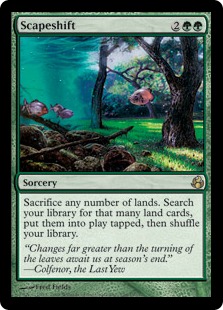
Daryl Ayers, a known Scapeshift player, won the event with Scapeshift featuring four Prismatic Omen. I’ve been on this card since the ban of Splinter Twin put Scapeshift back into the spotlight. Prismatic Omen has been a staple of the deck in the past, and was recently used in a support role in the R/G Scapeshift deck.

Ayers winning with four in his Temur Scapeshift deck is a promising sign for the deck going forward. Omen is from an old set in short supply, and its price would skyrocket if demand heavily increased. I expect this deck will be widely-imitated at the Invitational, and success there would certainly increase demand worldwide.

-Adam

High Stakes MTGO – Apr 3rd to Apr 9th

Are you a Quiet Speculation member?

If not, now is a perfect time to join up! Our powerful tools, breaking-news analysis, and exclusive Discord channel will make sure you stay up to date and ahead of the curve.

Hello and welcome back for another High Stakes MTGO article!

Like the last few weeks, this week was something of a transition. I'm trying to establish positions in rotating staples and other cards likely to gain some value in the new Standard metagame. Meanwhile I'm also looking for good deals in Modern, and I sold a few mature positive positions in order to rotate my investments.

Here is the snapshot of the account.

Buys This Week

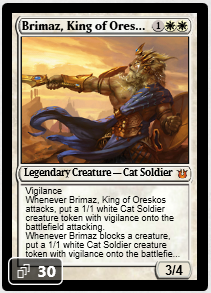
brimaz

This legendary cat from Born of the Gods is not really a powerhouse in Modern and merely sees some play in Legacy. Nonetheless he was able to jump from 3.5 tix to over 8 tix after last October's Standard rotation. His price went back to 4 tix in February and stayed fairly flat for more than a month.

Although it's not necessarily big, I felt there was another speculative opportunity here. I'll be targeting 8 tix again with Brimaz.

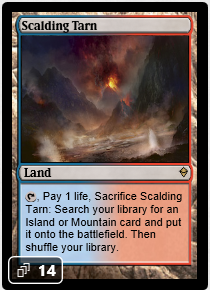
ST

I had been watching Scalding Tarn since it went back around 30 tix around a month ago. I missed the train back then as this fetchland slowly creeped up to 40 tix about two weeks ago. However, the price plunged again and I seized the opportunity this time around.

Regardless of the next Modern metagame, the blue-red fetchland is likely to always be in demand, in Modern as in other eternal formats. Getting in at ~32 tix I'm looking at small gains, but it should be a worthwhile investment for my bankroll.

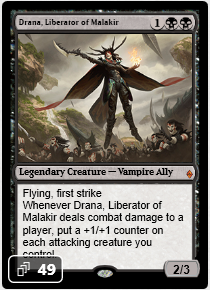
DLM

I lurked on this vampire a while ago and then the first spoilers for Shadows over Innistrad (SOI) spiked its price to 8 tix. At the time I regretted waiting too long to pull the trigger. Now it appears the spike was purely speculative---I bought my copies of Drana when it came back down to 4.5 tix last week. This is still a strong card and I believe it has a good chance to see play in the future, hopefully pushing its price again around 8 tix.

WB

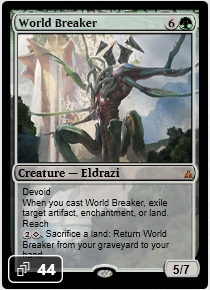
World Breaker is a mythic from Oath of the Gatewatch (OGW) with unique flavor and certainly worthy of a spot or two in midrange or ramp decks in Standard. It seems like the bottom for this card was found around 4 tix about a month ago and World Breaker's price has been on a slow rise ever since. While I'm not expecting a huge profit with this guy the opportunity seemed good enough for me.

UtSD

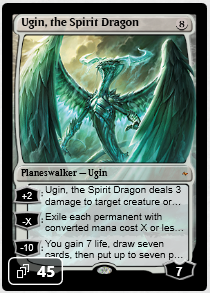
Ugin is an iconic planeswalker that retained a high value as Fate Reforged (FRF) rotated out of Standard. The loss of Eye of Ugin may have handicapped Tron decks a bit but I bet we'll see Ugin in Modern again. I also hope that redemption will help support the price of FRF cards, including Ugin, the Spirit Dragon.

KTK sets

Another six Khans of Tarkir (KTK) sets this week. The price is not currently going down and I'm not even sure if it will during SOI release events. As the top six cards of the set include all five fetchlands, I feel more like buying full sets rather than individual fetchlands. I'm hoping the price will drop back to the low 60's/high 50's in the following two weeks. Ideally I'd like to have something around 20 KTK full sets.

Sales This Week

I bought this card at what appeared to be a long-term floor (around 10 tix), and sold it at what appeared to be its long-term resistance (around 15 tix). I don't know if the new changes to Modern will be more or less favorable to Storm decks. I happily closed this position with a respectable 51% gain in only a few weeks.

The situation with Bonfire is similar to Past in Flames and well suited to what I'm trying to do with Modern positions in general---catch them at the established floor and sell them around previous heights. I'm not looking for the next spike nor the next record high. With this spec I cashed out another 150+ tix of profit.

I sold what I could during the short spike that followed the B&R list changes. The spread was pretty big on this one and I didn't want to sell everything at any cost. This spike was a good opportunity, but the price of this planeswalker is still pretty cheap on sum. I'm okay to wait longer on the remaining copies.

M15

I didn't expect to sell Magic 2015 full sets at these prices. On two different occasions this past week ClanTeam Bots had their buying price for M15 full sets at 97 tix and 69 tix.

Too good to be true? That's actually what I asked them just to make sure I wan't abusing an algorithm glitch. Although they were doing some algorithm adjustments they told that these prices were legit. I don't think I'll ever manage to sell M15 full sets over 69 tix again. 65 tix would already be a great selling price for me.

On My Radar

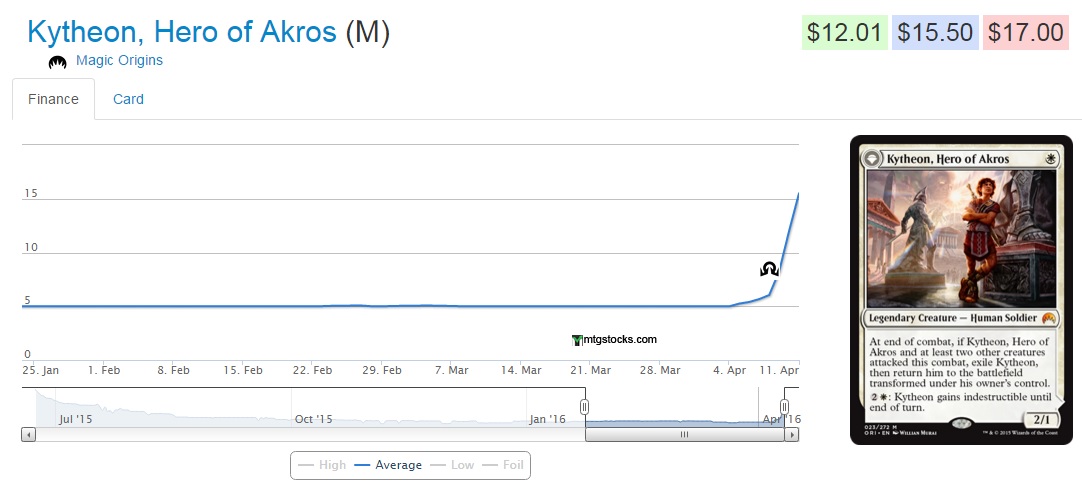
I'm not really looking into new things until Pro Tour Shadows over Innistrad. Buying Standard cards involved in rotation remains my main goal these days. As I write these lines I'm still holding on to Archangel of Tithes and Kytheon, Hero of Akros, but I'm very close to selling them as they tripled since last month.

These are typical spikes related to new decks currently receiving a lot of hype. If I want to give credence to my words I will have to sell them or find a good excuse not to. Do they have more potential price-wise with the PT coming up? Maybe, maybe not. They do, however, surely have the potential to lose all their gains if nothing significant happens in Madrid in two weeks.

Questions & Answers

This week I'll expound a bit on two sets of questions relative to Standard rotation. One question revolves around cards staying in Standard and one on cards leaving Standard.

The BFZ and OGW Lands

Q1

Although it may have been the exact same comment by the exact same reader login in with two slightly different names, the question remains: what should happen to BFZ and OGW rare lands from now on?

To start with, cycles of rare lands in any set have always been very solid speculative targets. Special lands (land producing different types of mana, lands with a special effect, or creature lands) always find a place at some point in the evolution of the Standard metagame.

You almost always want to buy them while they are heavily drafted and thus as close as possible to their absolute bottom. Once Standard rotates and a new set is being opened these lands have a good chance to rise.

Now, a raise can unfortunately happen at any time during their one-and-a-half-year tenure in Standard. If it happens during PT SOI great; if it's later that's also fine. My price target with these lands is between 4 and 6 tix. If at any time such prices are met, I'll consider selling my BFZ and OGW land positions.

KTK and FRF After Rotation

Q2

To start with, my expectation with KTK and FRF full sets is around +30-40%. I would expect that to happen within the first six months. These are typical price increases for full sets and there's no reason to set my expectations too high just because KTK contains fetchlands.

On a case-by-case basis, some cards won't gain much while others could double or even triple. It is not usual, though, for "good" rares to see huge price increases after rotation.

Bulk or cheap rares have a different potential, but take a look at Snapcaster Mage, the Return to Ravnica and Gatecrash shocklands, and Thoughtseize, for instance. Doubling is the most you can expect during their first year post-Standard. You can also clearly see that their price tends to fluctuate a lot.

So for KTK fetchlands, which seemed to have bottomed between 5 and 7 tix, I would not wait for them to reach 15 tix before selling them (unless you want to wait two years).

Since the five fetchlands are pretty much the most valuable cards in KTK and are currently making up an unprecedented 50% of the set's value, my investment in KTK full sets should mirror quite closely what happens to the five fetchlands.

Mythics are the bottleneck cards for set redemption. Bulk mythics are needed as much as a 20-tix mythic. Simply on this basis I would expect bulk mythics to rebound quickly this month and the following. A mythic currently valued at 0.2 tix should soon be priced in the 0.5-to-1 tix price range. I would not expect more since they are most likely unplayable otherwise, but that can be a nice double-up at the reach of small bankrolls.


Thank you for reading,

Sylvain

Insider: Standard Going into the Invitational

Are you a Quiet Speculation member?

If not, now is a perfect time to join up! Our powerful tools, breaking-news analysis, and exclusive Discord channel will make sure you stay up to date and ahead of the curve.

With week one of Standard in the books, it's time for things to really get interesting. This weekend we'll see more innovation at the Star City Games Invitational, and the week after it's time for the Pro Tour. What was immediately evident from Baltimore is that white is the best color in Standard. If you slept on pre-ordering these and you want to play Standard, your wallet will be hurting soon...

There was an error retrieving a chart for Declaration in Stone
There was an error retrieving a chart for Archangel Avacyn

The past few formats have seen red decks come out on top, though this time white is bringing the most generically powerful spells to the table. Human Aggro put up the best results in the tournament, though ultimately Bant Company came out on top.

That said, the theme of week one was very similar to the week ones where we see red win, and that is to keep things simple. Human Aggro, regardless of splash, is just a generic beatdown deck. Bant Company is just dedicated flash, and the white-black decks mostly just play powerful generic answers. The spiciest deck from the Baltimore Top 8 was Todd Anderson's Thing in the Ice brew.

Izzet Control

Creatures

4 Thing in the Ice
4 Jace, Vryn's Prodigy
2 Jori En, Ruin Diver

Spells

2 Chandra, Flamecaller
1 Anticipate
2 Fall of the Titans
4 Fiery Temper
1 Kozilek's Return
4 Lightning Axe
3 Pyromancer's Goggles
3 Magmatic Insight
4 Tormenting Voice

Lands

3 Island
7 Mountain
4 Drownyard Temple
3 Highland Lake
4 Shivan Reef
4 Wandering Fumarole
1 Yavimaya Coast

Sideboard

4 Eldrazi Obligator
4 Fevered Visions
1 Kozilek's Return
3 Negate
2 Void Shatter
1 Chandra, Flamecaller

As a control deck that saw success despite having wasted sideboard slots, I could definitely see this deck being tuned to beat up on Humans and Bant Company. Specifically, Todd was unhappy with the Eldrazi Obligators, and some Fiery Impulse in the sideboard would go a long way towards heavily skewing the Humans matchup.

Despite Bant Company winning the event, I do think Humans is the deck to beat going into this weekend, and I think the best list will be derivative of Kellen Pastore's second place list.

Mono-White Humans

Creatures

2 Consul's Lieutenant
3 Dragon Hunter
2 Expedition Envoy
3 Hanweir Militia Captain
4 Knight of the White Orchid
4 Thalia's Lieutenant
4 Thraben Inspector
3 Town Gossipmonger
3 Kytheon, Hero of Akros

Spells

3 Always Watching
3 Gryff's Boon
2 Stasis Snare
4 Declaration in Stone

Lands

19 Plains
1 Westvale Abbey

Sideboard

2 Felidar Cub
1 Lantern Scout
2 Silkwrap
1 Stasis Snare
1 Hallowed Moonlight
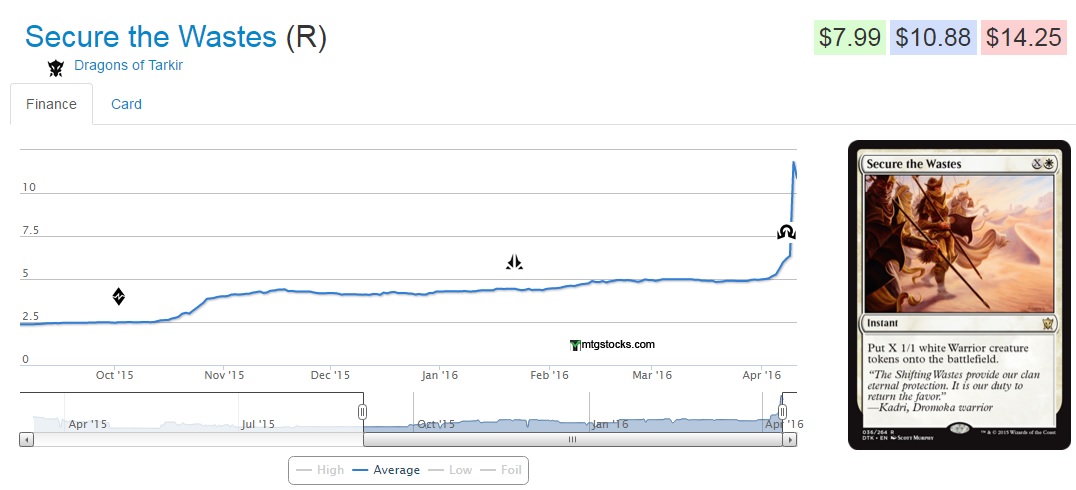
3 Secure the Wastes
3 Gideon, Ally of Zendikar
2 Westvale Abbey

This for two reasons. The first thing this deck has going for it is it sticks to one color. There were two Azorius, and one Selesnya, Humans decks in the Top 8, and plenty peppered in the Top 64---I don't think it's by accident that the mono-white build came out on top.

Not only do the blue and green builds not get a ton of sources of their splash colors, but they also introduce enter-the-battlefield tapped lands into a very aggressive deck. Your ideal curve involves deploying three creatures by turn two, and jamming a million basic Plains is your best avenue for this.

The other thing I like about Pastore's list is the absence of Archangel of Tithes.

There was an error retrieving a chart for Archangel of Tithes

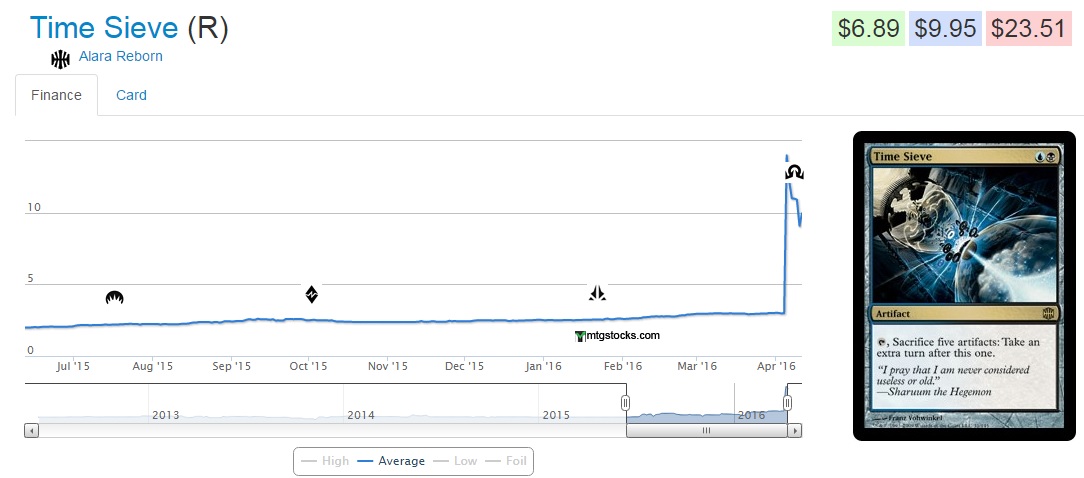
Make no mistake, Archangel is great in play, but the issue is that it it's a four-mana creature that doesn't generate value. As such, you lose a ton of tempo when you cast Archangel and it gets hit by Declaration in Stone or bounced by Reflector Mage. Going forward I expect the mono-white build eschewing Archangel to be the best aggressive build of Always Watching decks, and with the meteoric spike in the price of Archangel of Tithes I believe that card to be a sell right now.

There were a ton of Orzhov decks in the Top 64 of Baltimore, and there wasn't a ton of direction for how to construct the deck. Mostly the plan was to play a bunch of really good generic spells to be ready for anything.

Indeed there are plenty of white cards that are excellent to just jam in any deck, with black mostly contributing gold cards. Players will continue playing Anguished Unmaking and Sorin, Grim Nemesis, and going forward it will be easier to assemble their supporting cast.

A big card that saw a lot of sideboard play this weekend that I expect to start migrating to the maindeck is Tragic Arrogance. This card is great when it comes to taking care of any extra copies of Always Watching in addition to killing most of your opponent's creatures. It's also excellent against any token strategies, and also can end up breaking some clues that you left your opponent with Declaration in Stone. I think Tragic Arrogance is a great penny stock right now.

There was an error retrieving a chart for Tragic Arrogance

Another white card that I think is undervalued right now is Eldrazi Displacer. I understand that Modern Eldrazi hinged heavily on degenerate lands, but there's a reason the Displacer list ended up being the best. This card is a four-of in the Roanoke crew's Orzhov Eldrazi deck because it's great at disrupting your opponent as well as generating more ETB triggers on your side.

Displacer is going to see significant Standard play, and could even end up in a Modern deck with with Eye of Ugin banned. It's worth about three bucks now, and I see that at least doubling in the next couple of weeks---especially if the card has a good Pro Tour.

There was an error retrieving a chart for Eldrazi Displacer

The SCG Invitational will give us more direction this weekend for the future of Standard, and if these positions are good they'll start to move right away. More data will be coming in to give us a better idea of what to expect at the PT, and indeed whether Always Watching will be to this Standard as Tempered Steel was to its block constructed.

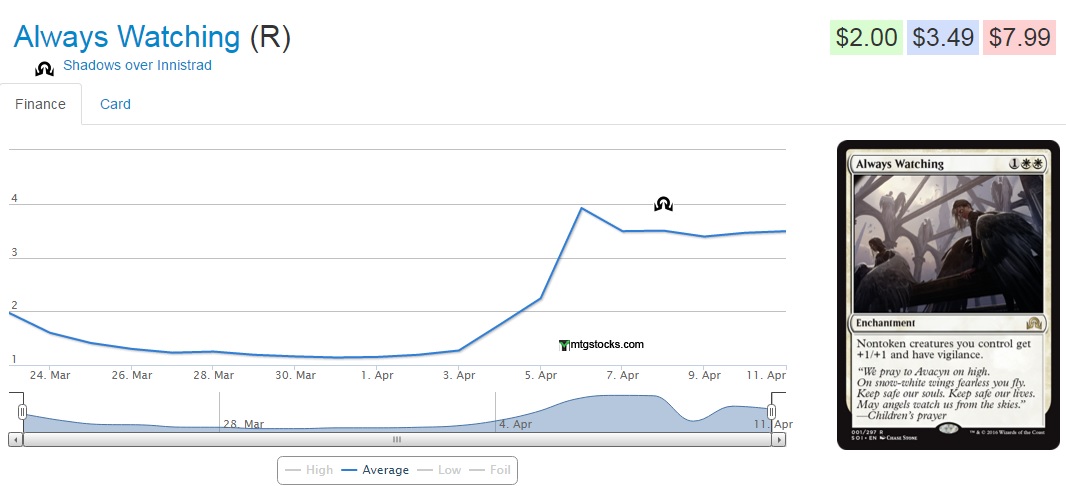
If Always Watching has another great weekend, it could also double or triple from its $3+ price. With the deck being so easy to build an play, growth here wouldn't surprise me in the least.

There was an error retrieving a chart for Always Watching

You'll want to lock in your specs this weekend to make sure the cards ship before the Pro Tour, so it will be important to tune in this weekend, both for Standard and Modern stocks.

With regard to Modern, I expect a good weekend for Jund/Abzan and Snapcaster Mage. I will be in the booth for the Invitational, and next week I'll be breaking down those results for predictions for the Pro Tour specifically. Will it be a white Standard, or will the other colors come out to play?

Thanks for reading.

-Ryan Overturf
@RyanOverdrive on Twitter

Insider: Virtually Infinite – Navigating Set Releases & Updating EMA Specs

Are you a Quiet Speculation member?

If not, now is a perfect time to join up! Our powerful tools, breaking-news analysis, and exclusive Discord channel will make sure you stay up to date and ahead of the curve.

This is the fourth in a series of articles for the player, collector, and speculator seeking to benefit from the coming release of Eternal Masters (EMA). It’s been a few weeks since we checked in, and Shadows over Innistrad is hitting Magic Online. Let’s take stock of our Legacy positions and look at the road ahead.

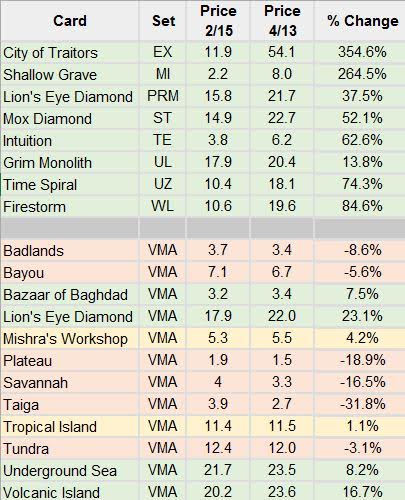
You'll recall we recommended buying Reserved List specs after EMA was announced, and then recommended doubling down on a handful of targeted “gateway” cards a few weeks later. How has our basket of Reserved List specs fared so far?

852a5415-a23c-436d-8885-c8e84577d1ad

A few home runs (City of Traitors and Shallow Grave) and a nice return across the board. Some Standard and Modern positions have done better in percentage terms, but these are really nice percentage gains for cards over 5 or 10 tix (which is important if you don’t want to be buying and selling dozens of cards to make a few tix---as noted, this series is better suited to those who want to buy and hold, rather than make short-term flips.)

The exception, of course, are the specs from Vintage Masters (VMA) which were mostly flat or down. Why didn't they benefit in the same way? This data suggests to me that there is significant slack in VMA cards, since the set was heavily drafted.

This is especially true of the dual lands, each of which has essentially four printings: ME2/ME3, ME4, Promo, and VMA. The VMA version is the least attractive to collectors and has the greatest supply.

The dual lands are iconic cards with price memory, but that oversupply is hard to overcome. They will see gains, but there are better opportunities for your tix. And when it comes to VMA specs, caveat emptor.

A couple of the “gateway” cards I recommended in the last article have done nicely but we have room to grow on each of these. The real demand will pick up once EMA hits the store and people start to build decks.

  • Lion's Eye Diamond
  • Firestorm
  • Gaea's Cradle
  • Eidolon of the Great Revel
  • Ensnaring Bridge (Note: I'd steer clear, as the price hasn't dropped much and this one could appear in EMA.)

Sales This Week

This week I took the opportunity to liquidate Wasteland and Force of Will. I expect a steady decline in these prices, starting with SOI and heading through the end of EMA drafting in mid-June. I even ditched my playset of Wastelands, and will play non-Wasteland decks in Legacy. Wasteland is rare, and I expect the floor to be between 10 and 20 tix, depending on whether they extend EMA drafting as they did with VMA.

Force of Will is a mythic, but has already been reprinted and hit 10-15 tix. I also ditched my playset of Daze, which I see as a likely reprint in EMA.

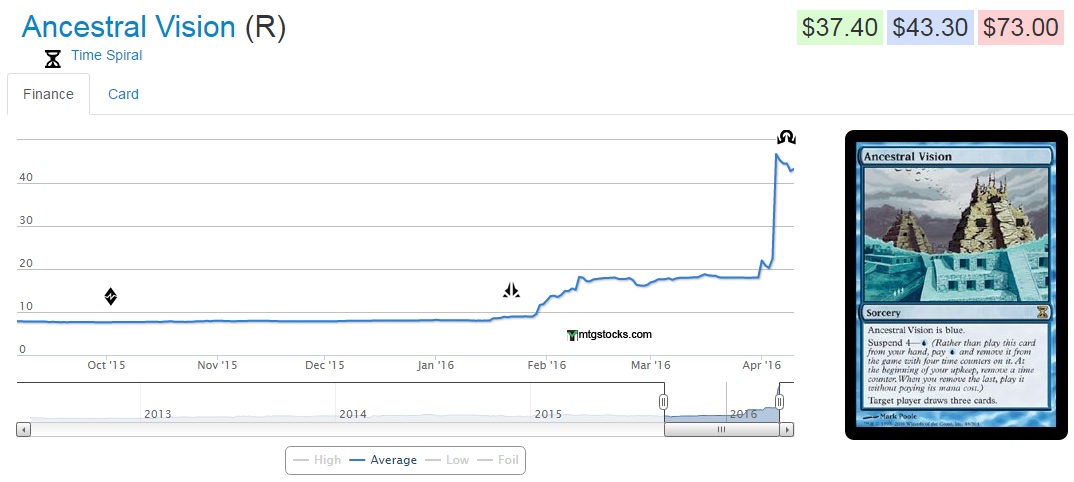
As Matt notes, you may also want to consider liquidating Ancestral Vision and other high-price cards from Time Spiral. These drafts are next in the flashback queue and will drop in price once people realize that. If you don’t need them for a few weeks you can put those tix to work now and buy them back later.

For some players, Tarmogoyf will be an attractive candidate to sell. The timing will be tricky, since it should dip but then bounce back quickly, and beating the spread will be a challenge. There will only be one week of drafting---the expectation of new supply will be much greater than actual new supply. Roughly six times as many packs of Time Spiral will be opened as Future Sight packs.

Navigating the Shadows over Innistrad Release

Wizards made some major changes to the SOI release, but I expect the general trends to be the same: downward pressure on all singles across MTGO as people liquidate old cards to feed new drafts and league entry fees. In general, prices of older cards and boosters drop 10% during each set release and then slowly climb back to their previous positions. You can read my primer on navigating release events here.

SOI singles will start high and plummet within hours of the set release. My advice is to sell everything you draft as soon as possible.

On Friday and Saturday everything will be overpriced, so as soon as your draft is up, make ‘em all tradeable and cash out---even 30 minutes can mean you’ve left money on the table, especially with uncommons and commons.

By Sunday cards will have reached something of an equilibrium, but still have a ways to fall. Stay away unless you need to play with a card now or have a strong read that a particular card is undervalued by the market. Yes, some cards will rise but you are swimming upstream against one of the strongest market forces on Magic Online.

Here's some of my advice on how to handle release events in general, adapted from a previous article:

Day 1: Draft as much of the set as you can. For the first couple days, the EV of drafting will be extremely high, and you are likely to make tix even with a 50% or lower win rate. This “release window” is one of the few times you could justify playing 4-3-2-2 queues instead of Swiss since the opportunities to rare draft and to play more drafts outweigh the extra prize pack that you get in Swiss. Even better is to play 8-4's if you think you have a good feel for the format.

Rare draft like a mofo. When drafting a new set, I always keep open a browser window with a price list. My preference is GoatBots because they show both buy and sell prices and include money uncommons in addition to rares. When I have a question about a card’s price, the answer is but a Ctrl-F away.

I am often surprised by how much random rares are worth during the first few days of drafting, and you are bleeding value if you don’t pick them up.

Sell everything immediately. Basically, you want to unload any commons, uncommons and rares as soon as they hit your binder. These cards are a wasting asset and will continue to drop as long as the set is drafted. Mythics can sometimes be a different case, and experience a mythic bounce.

You can use MTGO WikiPrice to find the best seller, but an alternative is to just make everything tradeable and open up a trade with one of the major buyers. Other good options that won’t show up on MTGOWikiprice include MTGOTraders, TheCardNexus, Cardfiend, AcademyBots, Clanteam, and Dojo Bots. Remember, time is money during the early stages, so don’t spend too much time shopping your cards around---prices will drop hour by hour.

The SOI Booster Play

There should also be an opportunity for short-term booster specs. SOI boosters will quickly head to 4 tix, so if you see them at 3.6 or less snap them up. This is a quick and easy 10-15% profit for every ticket invested, at a low opportunity cost and high level of certainty.

Everything is on Sale

The next few weeks surrounding the SOI release, combined with the Pro Tour excitement, marks a good opportunity to stock up on off-the-radar spec targets. This includes a number of the cards and sets recommended by Sylvain and Matt as well as BFZ and OGW boosters.

It also includes our portfolio of Reserved List cards. Many of these cards may take a dip over the next two weeks. It's a good time to be targeting any of the heavily played Legacy cards on the Reserved List since people will often forget about these in the excitement of the new set, the Modern ban list changes, and the Pro Tour. Keep an eye out for some under-the-radar cards that have been mentioned in this series, and profit.

-Alexander Carl
@thoughtlaced

Building Ancestral Grixis in the New Modern

Are you a Quiet Speculation member?

If not, now is a perfect time to join up! Our powerful tools, breaking-news analysis, and exclusive Discord channel will make sure you stay up to date and ahead of the curve.

Today I will be focusing on Grixis Control. Where it came from, the challenges it faces, how it can respond to the new Modern landscape we find ourselves in, and what role it will play moving forward. For those unfamiliar with my opinions on this deck, you can brush up here, here, and here.

While we have a bit of metagame information to analyze due to the SCG Classic in Baltimore, I’m going to hold off my post-ban metagame analysis until next week at the very least, so we have more than one tournament's worth of information. I’ll still reference results from SCG Baltimore, and talk about how the uncertain metagame as a whole is beginning to take shape, so stick around if you’re not that interested in Grixis. Not sure why anyone would feel that way, but…

Thing in the Ice

My renewed interest in Grixis Control is the result of two providential events: the banning of Eldrazi, and the unbanning of Ancestral Vision. Eldrazi as a broken archetype did many things to the metagame, but its most lasting impact has been the polarization of the archetype spectrum away from combo and towards linear aggro. With Eldrazi gone, these combo decks can come back, but they now have to focus on combating a proliferation of linear aggressive decks.

These slight metagame shifts benefit Grixis Control twofold---by removing the focus from control which will allow it to flourish, and by filling decks with interaction aimed away from control and towards aggro. With Ancestral Vision suggesting the possibility of a fairer, viable Treasure Cruise in Modern geared specifically for control decks, the stars have never aligned so well. Let’s start by looking at where we’ve been.

[wp_ad_camp_1]

Grixis Control, by Patrick Chapin (9th, GP Charlotte)

Creatures

3 Gurmag Angler
4 Snapcaster Mage
2 Tasigur, the Golden Fang

Instants

2 Kolaghan's Command
4 Thought Scour
1 Dispel
4 Cryptic Command
2 Spell Snare
1 Electrolyze
1 Remand
1 Shadow of Doubt
4 Terminate
2 Mana Leak
4 Lightning Bolt

Sorceries

4 Serum Visions

Land

2 Sulfur Falls
2 Creeping Tar Pit
4 Scalding Tarn
2 Steam Vents
2 Watery Grave
4 Polluted Delta
1 Swamp
1 Mountain
3 Island

Sideboard

1 Keranos, God of Storms
1 Izzet Staticaster
1 Spellskite
1 Batterskull
2 Dispel
1 Countersquall
4 Fulminator Mage
1 Shriekmaw
1 Damnation
1 Flashfreeze
1 Slay

The birth of Grixis Control can be traced to GP Charlotte, in the hands of Patrick Chapin. On June 15, 2015, Chapin narrowly missed Top 8 with his fresh look on a control archetype in Modern focused on the powerful synergy between delve, Thought Scour, Snapcaster Mage, and Kolaghan's Command. In the almost full year since his finish, the archetype has gone through multiple iterations, but I remain convinced that the key to Grixis’ success in Modern lies somewhere within this shell.

Kolaghan's CommandChapin's deck exhibits a unique philosophy regarding the Grixis archetype. Here are some key aspects of his particular take:

Abundant interaction. Chapin’s version of Grixis Control capitalizes on cheap removal in excess to disrupt opponents and gain advantage wherever possible. By crafting the game to a state where the opponent’s resources are almost depleted, Chapin is able to pull ahead through the use of his ten two-for-one’s (Cryptic Command, Snapcaster Mage, and Kolaghan's Command).

Instant-speed gameflow. Chapin built his deck to play true draw-go, with only nine sorcery-speed spells. Serum Visions and delve creatures like Gurmag Angler and Tasigur, the Golden Fang can often be cast for one mana, leaving most of Chapin's mana free to interact with the opponent on their turn. This list is clearly focused on putting opponents in the classic control squeeze: do something, it will get countered/killed; do nothing, you play right into control’s gameplan. This list takes pronounced advantage of “free” mana, casting Kolaghan's Command or Cryptic Command whenever possible to gain material advantage and restock on cheap interaction.
Cryptic Command

“Cheap” win conditions. If you can call them that, because no “actual” win conditions are present in the list. Delve creatures function as excellent blockers that could turn the corner and hit hard when ready. Resolving Cryptic Command doesn't end the game immediately, but often puts the opponent at a significant enough material disadvantage that defeat is assured. The strength of this deckbuilding choice lies in its elasticity; rather than set up a pivotal turn or strategy, it focuses primarily on casting spells and making efficient use of mana.

To give context to the above list, we must remember that Chapin’s Grixis existed at a time when Splinter Twin, Tron, Burn, and Affinity were the top players in the metagame. Amulet Bloom had just had its breakout party, and Grishoalbrand was much less common than Living End or Scapeshift. Towards this perceived metagame Chapin’s Grixis was geared---abundant cheap spells and interaction focused on pushing gameplay into the midgame where two-for-one’s are king.

Grixis Control, by Trevor Holmes

Creatures

4 Snapcaster Mage
2 Tasigur, the Golden Fang
2 Gurmag Angler
3 Jace, Vryn's Prodigy

Instants

4 Lightning Bolt
3 Terminate
1 Go For the Throat
3 Thought Scour
2 Cryptic Command
3 Kolaghan's Command
2 Mana Leak
2 Spell Snare
1 Remand

Sorceries

4 Serum Visions
2 Inquisition of Kozilek

Lands

4 Polluted Delta
4 Scalding Tarn
4 Island
3 Creeping Tar Pit
2 Steam Vents
2 Watery Grave
1 Sulfur Falls
1 Mountain
1 Swamp

Sideboard

4 Fulminator Mage
3 Dispel
1 Anger of the Gods
1 Damnation
1 Bitterblossom
1 Vandalblast
1 Inquisition of Kozilek
1 Izzet Staticaster
1 Deathmark
1 Engineered Explosives

The printing of Jace, Vryn's Prodigy, while originally universally maligned, proved to be a force to be reckoned with in both Standard and Modern. Above is the list I played for much of summer/fall 2015, and I can say with confidence that it was tuned perfectly to respond to the immediate post-GP Charlotte metagame. Here are the major features this build brought to the table:

Jace, Vryn's ProdigyJace, Vryn's Prodigy. When supported by a 75 that unlocks his full potential, Jace one of the most powerful cards you can cast in Standard or Modern. While it fails the Lightning Bolt test, Grixis Control wants nothing more than for opponents to keep in cheap interaction that fails to kill delve creatures.

Jace, Vryn's Prodigy has incredible synergy with the foursome of Thought Scour/Snapcaster Mage/Kolaghan's Command/Gurmag Angler. In addition, Grixis can take advantage of every one of Jace’s abilities, looting, flashing back spells, invalidating small creatures or shrinking opposing Tarmogoyf’s, and even winning the game with his ultimate. And by his ultimate, I mean flashing back two spells. That’s generally all it takes.

Prioritizing cheap spells. Cryptic Command as a focused strategy is potent, but difficult to accomplish easily. Cryptic Command in hand goes against every facet of the archetype, and plays at odds with the primary strategy of Grixis: casting multiple, cheap spells. As a result, Cryptic Command often feels awkward and the player is pressured to cast it at the first possible opportunity.

Diverse reactive spells. Jace, Vryn's Prodigy plays best with multiple options to choose from. Discard helps assure he lives (or just takes their best spell) and is a great target to get double use from, especially when we’re casting multiple Kolaghan's Command as well.

Jace, Vryn's Prodigy, while powerful in the above list, exists only as a means to an end. If he dies, he dies. Jace can be pushed, however, from deckhand on a well-built ship to captain of a machine of war.

Grixis Control, by Danny Jessup (22nd, SCG Dallas)

Creatures

2 Pia and Kiran Nalaar
4 Jace, Vryn's Prodigy
2 Tasigur, the Golden Fang
3 Snapcaster Mage
1 Grim Lavamancer

Planeswalkers

1 Liliana of the Veil

Instants

2 Kolaghan's Command
3 Thought Scour
1 Go for the Throat
1 Terminate
2 Mana Leak
4 Lightning Bolt
1 Remand

Sorceries

1 Dreadbore
4 Inquisition of Kozilek
1 Rise // Fall
4 Serum Visions

Lands

1 Mountain
2 Island
1 Swamp
1 Sulfur Falls
2 Blackcleave Cliffs
2 Creeping Tar Pit
4 Scalding Tarn
1 Blood Crypt
2 Steam Vents
1 Watery Grave
4 Polluted Delta
2 Bloodstained Mire

Sideboard

1 Rending Volley
1 Dreadbore
1 Vandalblast
2 Izzet Staticaster
1 Spellskite
1 Nihil Spellbomb
2 Dispel
1 Thoughtseize
1 Rise // Fall
1 Darkblast
3 Molten Rain

Again, the unique features of Jessup's version:

Jace, Vryn’s Prodigy as a core component. Danny Jessup included multiple pieces of technology developed in large part by Michael Majors and others: Rise // Fall, Liliana of the Veil, and discard in high numbers. Jace, Vryn's Prodigy doesn’t play well with counterspells and can only make partial use of instants in general, so many players moved towards a Jund-style build, focusing on casting the most powerful thing possible turn after turn, but with synergy and cantrips instead of Tarmogoyf.
Pia and Kiran Nalaar

Pia and Kiran Nalaar as a stabilizer/win condition. Depending on your opinions on the card, Pia and Kiran Nalaar’s inclusion is a testament either to the awkwardness of the archetype or the strength of the strategy, but it can’t be both!

More clunky than Cryptic Command, Pia and Kiran Nalaar at best provides four power spread among three creatures for four mana, and at worst a bunch of chump blockers. Proponents argue that letting it die and getting it back to recast with Kolaghan's Command or Rise // Fall is gamebreaking, but given that freedom the control deck should be winning anyway.

Grixis for a New Modern

This brings us to today. We see that Grixis Control historically has been built in one of three ways: draw-go, Grixis with Jace in a supporting role, or Grixis Jund. Today, I have two lists for you to check out (or dream nightmares about facing). Your choice!

Visions Grixis, by Trevor Holmes

Creatures

4 Jace, Vryn's Prodigy
4 Snapcaster Mage
2 Kalitas, Traitor of Ghet
1 Goblin Dark-Dwellers

Planeswalkers

1 Liliana of the Veil

Sorceries

4 Ancestral Vision
4 Serum Visions

Instants

2 Spell Snare
2 Mana Leak
2 Remand
4 Terminate
4 Lightning Bolt
3 Kolaghan's Command
1 Tribute to Hunger

Lands

3 Polluted Delta
4 Scalding Tarn
2 Island
3 Creeping Tar Pit
2 Steam Vents
2 Watery Grave
1 Mountain
1 Swamp
2 Blackcleave Cliffs
1 Darkslick Shores
1 Ghost Quarter

Sideboard

3 Dispel
1 Bitterblossom
1 Molten Rain
3 Crumble to Dust
2 Damnation
1 Kalitas, Traitor of Ghet
2 Leyline of the Void
1 Vandalblast
1 Izzet Staticaster

This list is an update to the “Jace as a tool to use and abuse” style of Grixis Control that I have found the most success with. You won’t see any Rise // Fall or Pia and Kiran Nalaar here, just solid, synergistic cards that come together to form a cohesive strategy.

It is essential to view these Grixis lists as more than just a pile of removal and value cards thrown together. While any player can find success with a solid list and a couple changes, the deck performs vastly different once you start to change four or more cards. Thought Scour or no, draw-go or no, discard as a question mark, the mix of removal, the number of four-drops, the focus on delve---these are all questions that need to be answered and players new to the archetype can quickly fall into some deckbuilding traps. While it might look simple to add a singleton Tasigur, the Golden Fang to a Grixis list, the presence of other four-drops (or lack-thereof) can greatly influence the effectiveness of that decision.

Kalitas, Traitor of GhetI was not an early adopter of Kalitas, Traitor of Ghet and Goblin Dark-Dwellers in Grixis (in fact, I solidly opposed their inclusion from the beginning) but the availability of Ancestral Vision has forced me to come around. Goblin Dark-Dwellers recasting Ancestral Vision is the ceiling, but the floor isn’t that bad either. When we are building with Ancestral Vision in mind, we need to take into account games where we don’t find it, or it gets countered or Thoughtseized. In those scenarios, we need some sort of Plan B to pull ahead. A 4/4 and a free re-bought spell on Turn 5 is not a bad backup plan when we can’t draw three cards like we hope.

In addition, Goblin Dark-Dwellers plays great alongside Jace, Vryn's Prodigy discarding Ancestral Vision. A drawn Ancestral Vision in the midgame can be extremely awkward, but instead of waiting four turns for it to come off suspend we can discard it to Jace, Vryn's Prodigy and rebuy it for free a turn or two down the line.

Kalitas, Traitor of Ghet is also much better when we’re playing for a grindy, accumulated-value strategy. Getting one free Zombie will often be good enough, and we have the possibility of getting many more. The floor is just a 3/4 lifelink creature for 2BB, which isn’t too embarrassing when we consider the effect it will have on our opponent’s post-sideboard decisions. If they cut large removal, Kalitas can take over the game, and if they cut small removal, they’ll be interacting with Jace, Vryn's Prodigy at a disadvantage when they’d rather be spending time and mana racing our Ancestral Vision.

Goblin Dark-DwellersWhen we’re including the above heavy hitters we can cut Tasigur, the Golden Fang and Gurmag Angler, not because they are poor options, but because that allows us to cut Thought Scour as well. While we definitely could play 10+ blue draw spells, we won’t have as much time to cast things like that when we’re trying to survive to get our Ancestral Vision off suspend.

There’s also the issue of making our velocity high enough to take advantage of the draw-three. One of the major reasons I’m not interested quite yet in including Thopter/Sword alongside Ancestral Vision is the awkward draws that can come as a result. When our back is against the wall, we don’t want to draw into land-combo piece-counterspell.

In an Ancestral Vision Modern, Remand is absolutely insane. I already loved this card, and pre-Jace, Vryn's Prodigy lists often played at least one, but we have a strong reason to go up in numbers should the metagame break the right way. It’s poor against aggro, but then again so is Mana Leak. Against control and Ancestral Vision however, Remand is now just as good or better than Dispel (previously in the conversation for best blue spell in Modern).

Finally, I’m not sure about Liliana of the Veil in a format where people are drawing three cards. It will be interesting to see where the true “fight” comes in control mirrors---letting opponents draw three and focusing on their actual threats, or fighting over their Vision. Regardless, a repeated effect when we’re looking to grind is still excellent, and I imagine Liliana of the Veil is still solid, if diminished. Apply this thinking to Jund and I’m not too excited to be playing that archetype until they show me some breaker for the control matchup.

Some Grixis Thing, by Trevor Holmes

Creatures

4 Snapcaster Mage
3 Thing in the Ice
2 Tasigur, the Golden Fang
1 Goblin Dark Dwellers

Sorceries

4 Ancestral Vision
4 Serum Visions

Instants

4 Lightning Bolt
4 Terminate
3 Thought Scour
1 Murderous Cut
2 Kolaghan's Command
2 Mana Leak
2 Spell Snare
1 Remand
1 Dispel

Land

3 Creeping Tarn Pit
4 Polluted Delta
4 Scalding Tarn
2 Steam Vents
1 Watery Grave
1 Desolate Lighthouse
3 Island
1 Swamp
1 Mountain
2 Sulfur Falls

Sideboard

3 Dispel
2 Inquisition of Kozilek
1 Vandalblast
1 Anger of the Gods
1 Izzet Staticaster
1 Jace, Architect of Thought
1 Goblin Dark-Dwellers
2 Kalitas, Traitor of Ghet
3 Crumble to Dust

Thing in the Ice is a little more speculative but I’m confident it will see at least some play in Modern. Both Matthew Nester and Dylan Donagan opted to play Thing in Baltimore, and it looks like it served them well.
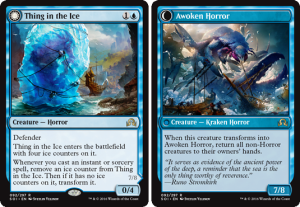
Thing in the IceWhat I love about Thing in the Ice is its casual solid positioning against an overly aggressive field. A Wall of Omens that can bounce our opponent’s board and attack for huge chunks of damage in lieu of drawing a card sounds great if we expect to run into a bunch of Wild Nacatls and the like.

We don’t have to jump through any hoops to give Thing in the Ice a chance to greatly affect the game---we just have to play spells (which we were doing anyways). There’s a limit to how many interactive elements we want when we’re playing Thing, and the same goes for expensive spells, but just chaining cantrips and removal will activate Thing quickly.

In a build like this we definitely want to be chaining spells as often as possible, so Thought Scour is back in. This ensures we won’t run out of things to do to thaw Thing in the Ice. Firing off a Lightning Bolt leaves us down a card, but cantripping into another spell lets us keep chugging.

Without Jace, Vryn's Prodigy in the list, Desolate Lighthouse helps us loot away a late-drawn Ancestral Vision should we need to. Keep in mind that Izzet Charm can also provide this effect. As a fresh Ancestral Vision player, one of the most exciting aspects I’m looking forward to is thinking four turns ahead, learning when to suspend Ancestral Vision and when to throw it away in search of something faster.

Conclusion

It’s still a little too early for any definitive analysis of this new Modern, but initial results look interesting. Scapeshift seems to benefit greatly from Ancestral Vision as well, and it will be up to Grixis Control to keep Scapeshift in check while also beating up on the numerous aggressive decks running around.

If Affinity, Scapeshift, Jund, Infect, and Abzan Company remain at the top, Grixis Control has a real shot to be a major player in this new Modern. Should Merfolk, Burn, and pure control rise up, Grixis might be in trouble. Still, I’m excited to start tuning and I’m looking forward to crushing fools on Magic Online under an onslaught of card advantage!

What do you think about Grixis and this new Modern? Let me know in the comments, and I’ll see you next week!

Trevor Holmes
The_Architect on MTGO
Twitch.tv/Architect_Gaming
Twitter.com/7he4rhitect

Insider: Shadows Over Innistrad Box Report

Are you a Quiet Speculation member?

If not, now is a perfect time to join up! Our powerful tools, breaking-news analysis, and exclusive Discord channel will make sure you stay up to date and ahead of the curve.

Shadows over Innistrad (SOI) is here and it has exceeded my expectations. Rarely does a set go this above and beyond. I am an eternal optimist and that leads to being let down sometimes, but not with this set. The design of so many cards like Thing in the Ice, Westvale Abbey, and Triskaidekaphobia are bursting with the flavor of Innistrad. Many cards have had an immediate impact on the format, and even many that haven't are waiting in the wings for their time to shine.

Many cards in the set are valuable as well, making opening packs not such a terrible prospect. The great part about the value of this set is how it trickles down into the rares. Don’t be fooled by the pricing of Battle for Zendikar and Oath of the Gatewatch because those sets were dragged down by the Expeditions. We have no super mythics worth searching endlessly for in this set. The closest are the flip mythics.

Did you know SOI has 77 rares and mythics? Most big sets like Battle for Zendikar, Dragons of Tarkir, Khans of Tarkir, and Theros contain 68 rares and mythics. Sets with flip cards like Origins and Innistrad had 76 and Shadows over Innistrad pushes the envelope a little further to 77. By adding more cards to these rarities, it makes each individual one more valuable. In addition, it also makes their prerelease versions more valuable.

These numbers are good to keep in mind when determining the value of a set. For example, with the factor of more rares and mythics combined with no super mythics, I would predict more cards in this set to increase or hold their value.

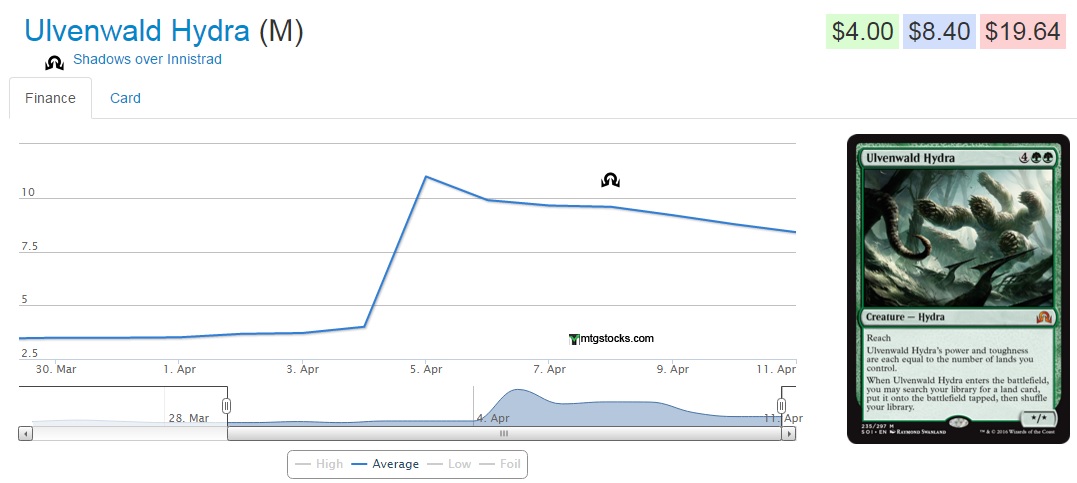
We’ve already seen that with cards like Tireless Tracker and Ulvenwald Hydra, and I expect another card or two to follow this pattern. That type of projection is much less likely to happen with a set like Khans with its fetches, or Battle for Zendikar block with its Expeditions.

Some cards I would look to that may fall under this category are Prized Amalgam, Avacyn's Judgment, Corrupted Grafstone and Deathcap Cultivator. These rares that aren’t worth much currently but I still separated them from the bulk of the set. I also did this with Tireless Tracker; hopefully you did too.

On the flip side, the uncommons are much less likely to be valuable. With more rares and mythics, stores will have to open more product to obtain the same quantity of each card as normal. So cards like Duskwatch Recruit or Heir of Falkenrath, which I would normally start hording, I’ll be unloading ASAP while they still have value.

There are so many interesting financial features about SOI and I am anxious to dive into the data. Take a look at my box break down and we’ll discuss them after that.

Box 1

Mythics

Rares

Foils

Lands

Total Value: $118.5

Box 2

Mythics

Rares

Foils

Lands

Total Value: $147

Box 3

Mythics

Rares

Foils

Lands

Total Value: $100.50

Box 4

Mythics

Rares

Foils

Lands

Total Value: $146

Box 5

Mythics

Rares

2 Tireless Tracker

Foils

Lands

2 Choked Estuary

Total Value: $89

Box 6

Mythics

Rares

Foils

Lands

2 Foreboding Ruins

Total Value: $95

Average Total per Box: $116

There are many things we can learn from analyzing this data. The first that stands out to me is how valuable the rares are in this set. Typically Wizards fills the mythic rare slot with chase tournament cards, and leaves the flavorful and story-based designs at rare. With SOI they seem to have broken that mold.

Take, for example, Startled Awake. This card would be a disaster if it were printed as a rare because people could draft multiples and destroy a draft easily by milling everyone out. The effect evokes what’s going on in the world, though, and casual players will love this card.

Previously I think we would have seen Thing in the Ice's and Startled Awakes' rarities swapped. Think about how much Thing would cost if it were mythic! Wizards did a great job allocating rarities in this set and we are rewarded for their efforts.

Take a look at boxes where I opened Thing in the Ice, Declaration in Stone and Westvale Abbey in the same box. Those three cards add $41 of value! In addition we have other great rares like the breakout Tireless Tracker, Anguished Unmaking, and many more that are worth at least the value of your pack.

In addition, each pack has three potential slots to hit on. Of course you have the normal rarity slot and the foil slot, but you also have the flip card slot. All three of these give you an opportunity to hit with each pack. Even if you open a bulk rare, Archangel Avacyn or Arlinn Kord could be waiting in the flip card spot to brighten your day.

We can see this pack layout having an effect on the value of the boxes as well. We don’t typically see a box average above $100 unless something else is going on like Expeditions or fetchlands. As I mentioned above, we do have 77 rares and mythics so the average price will be higher than normal because less of each card is opened. At the time of writing Archangel Avacyn is sold out on most sites at prices above $40. While I’m not sure she can stay that valuable, I know it’s harder to open her than it would be normally.

If you have the ability to sell packs, I’m certain you have noticed the popularity of this set as well. Packs are flying off the shelves because there is something for everyone in this set. There are legendary creatures, sweet tribal creatures, and cards that truly depict the flavor of the world.

If that wasn’t enough, the draw of opening a three-mythic pack is quite strong. Every shop has their pack openers. You know these people---they just love opening packs. They come into the store and buy a couple packs, open them, and trade in the cards to keep the chain going. Sometimes they aren’t even looking for anything specific!

I would compare this situation to that of scratch off lottery tickets. If you win money on a scratch off, what you do is buy more scratch offs! This same phenomenon goes for cracking packs and Shadows over Innistrad is drawing these people out to the store to test their luck.

Even with all these factors, I think the overall value of the set will still come down. It happens with every set and I expect it to occur here as well. Dealers will have to open tons of packs to get enough Archangel Avacyns to sate the demand of Standard enthusiasts. With the extra cards opened, the market will have more of all the other cards available which will bring down those prices.

So initially I think this set’s financial breakdown will be similar to that of Origins, but not as drastic as what Jace, Vryn's Prodigy caused. Avacyn isn’t Jace. She won’t be seeing tons of play in every format, but she will still hold a disproportionate percent of the value.

Tournament Finance

One last thing I want to mention today: getting rid of that one card that's burning a hole in your pocket. We’ve all been there before. We have twenty copies or more of a random speculation target that hit, or traded into Tireless Tracker at the prerelease, or opened multiple Archangel Avacyns in our case and want to move them while they’re on fire.

Each of these things happen on a regular basis. Yet the way we approach the selling process can make a big difference in the final price we get.

For this example, I’ll refer to the card with the most adjectives I've ever owned. One of my college friends messaged me about a random card she was trying to sell for her boyfriend. He had somehow obtained a foil, Italian, Future Sight Tarmogoyf and wanted to get some money out of it. Just to put this out there, don’t touch unpopular-language foils. This bad boy was terribly hard to move.

Regardless, we all see this situation come up where we desperately want to move a card for one reason or another. You can always sell whatever it is online through any outlet there, but I find myself wanting to skip the time and effort it takes to list the card and mail it out. So I tend to bring cards to big events to sell. This works especially well for lower-end cards that won’t fetch much money online because dealers still have buylist prices posted.

We all have our favorite dealers we’ve chosen for one reason or another. Most of the time they're simply the ones we feel will give us the best price. Once a relationship is developed more price negotiations may take place too, so this is a worthwhile goal.

No matter which dealer you favor though, when you have that one card or that stack of one card, don’t be afraid to ask every dealer in the room what their buy price is. If you’ve never done this before, you’d be surprised how much each store differs in their buy prices. Get the best price by having the most options.

This same principle can be applied if you're buying one specific card as well. The only thing preventing you from getting the best price is time and effort. It doesn’t take that much time to walk the room and look in every dealer’s case for the price on one specific card. You can always save a couple bucks by doing this.

~

Well that’s all I have today. Hopefully my Shadows box data and tournament finance advice helped everyone out today. Let me know in the comments what your thoughts are on these topics and I’ll see you next week.

Until next time,
Unleash the Force!

Mike Lanigan
MtgJedi on Twitter
Jedicouncilman23@gmail.com

Deck Overview- Bant Company

Are you a Quiet Speculation member?

If not, now is a perfect time to join up! Our powerful tools, breaking-news analysis, and exclusive Discord channel will make sure you stay up to date and ahead of the curve.

It's about time we talked about the winning list, eh? Jim Davis came up with a list that plays an amazing game at instant speed, which will always keep the opponent guessing. They also may have come up with the only white deck not featuring Declaration in Stone. Whether or not Dromoka's Command is a downgrade is unclear, though being instant speed gives your opponent one more thing to worry about. Nick Miller did a deck tech on the deck with Keven Jones, which you can find here.

Bant Company

Creatures

4 Bounding Krasis
1 Den Protector
4 Duskwatch Recruiter
1 Hidden Dragonslayer
4 Reflector Mage
4 Sylvan Advocate
2 Tireless Tracker
2 Archangel Avacyn
4 Jace, Vryn's Prodigy
1 Nissa, Vastwood Seer

Spells

4 Collected Company
3 Dromoka's Command
1 Ojutai's Command

Lands

3 Forest
2 Island
3 Plains
3 Canopy Vista
4 Evolving Wilds
1 Fortified Village
4 Lumbering Falls
1 Port Town
4 Prairie Stream

Sideboard

1 Den Protector
1 Hidden Dragonslayer
2 Lantern Scout
1 Tireless Tracker
2 Invocation of Saint Traft
2 Clip Wings
3 Negate
1 Ojutai's Command
2 Declaration in Stone

Both Duskwatch Recruiter slotting well into Company decks and three color shard manabases relying on Evolving Wilds and battle lands were things that I anticipated and documented in my Insider articles during spoiler season, so there aren't any major surprises here. Beyond those changes, this deck is largely reminiscent of Andy Ferguson's Bant Company deck from last season.

Something that Jim has mentioned is that Jace isn't completely at home here. He's not great on turn two, especially considering that you're not playing any Deathmist Raptor to discard and rebuy later with Den Protector like Ferguson used to do. He's great in the mid-late game when you can deploy him and flip right away to flashback a Collected Company, though otherwise he's a zero power looter in your somewhat aggressive deck.

There was an error retrieving a chart for Collected Company

Collected Company still has some room to grow in the short term if this deck can remain on the top of Standard, though we're nearing the point where players will start to dump their copies before the rotational price dip. They're great long term holds for Modern, though you'll be able to acquire them cheaper if you wait. These decks will probably be around in Standard until the card actually rotates, though I don't recommend holding onto more than a set to play with for very long.

Metagame Projections for the New Modern

Are you a Quiet Speculation member?

If not, now is a perfect time to join up! Our powerful tools, breaking-news analysis, and exclusive Discord channel will make sure you stay up to date and ahead of the curve.

Can you believe it was only a month ago when we were picking through the scattered debris of our once beloved format? Or declaring one deck the first true Tier 0 overlord in Modern history? Following the April 4 banlist update, and the subsequent Modern events from April 8 until today, the horrors of Eldrazi Winter seem like a distant, surreal memory. Hopefully, it's how we'll feel when an American presidential victor is announced on November 9 and a certain Eldrazi-like candidate joins Eye of Ugin as a bygone nightmare. No matter how that battle resolves, the fight for Modern appears over--the R&D Gatewatch have won. As I wrote about last Monday, the banlist changes promise an unprecedented era of format diversity. If last weekend's events are any indication, we're on our way to living that dream.

Mana Leak art

We don't have sufficient data to conduct a full metagame breakdown, but we have more than enough to make some informed projections about where the format might be heading. After Splinter Twin's ban earlier this year, we made a similar analysis of the dramatically altered format landscape, using a sampling of events to get a better sense of metagame direction after a major change. That's also our job today as we parse a selection of tournaments in a world without Eye of Ugin and with both Ancestral Vision and Sword of the Meek. This might be my first week as a Nexus author and not its Editor in Chief, but this ain't my first metagame rodeo and I fully intend to keep the evidence-driven updates coming for as long as I'm around. Strap in for the new Modern and get ready for some data tables!

[wp_ad_camp_1]

Data Collection Methods

Monthly metagame breakdowns, like the Tier 0 tragedy in our last check-in, typically require around 100 paper tournaments and 50-60 events on Magic: The Gathering Online. We're not even close to such an n this time around, but we have the data to sculpt a preliminary metagame snapshot. You can't use this preliminary portrait to determine if Affinity is x% of the metagame with Jund at y%, but you can use it to get a data-driven sense of how the new Modern is taking form.

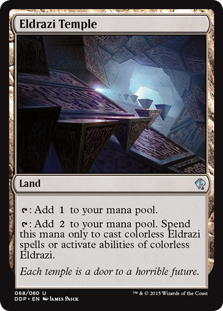
Eldrazi TempleThe April 4 ban update went into effect for paper tournaments last Friday, April 8. MTGO will follow later today (Wednesday, April 13). This means today's preview will have paper finishers from the weekend but no online lists, a hole we'll want to fill in later updates. For now, we'll be working with a dataset of 24 tournaments, spanning 146 actual decklists. In almost all cases, these are aggregated Top 8 standings, following the methodology outlined on our Top Decks page, but we add Top 16s and Top 32s for the few tournaments that list them, just to shore up a smaller n. Spoilers: Eldrazi isn't even Tier 2 and Eldrazi Temple hasn't taken over (yet...).
Two disclaimers before we get started. First, early metagame rundowns like these are inherently limited. I've said this at least twice already, and I'm repeating it here for readers who are eager to fire off an "n is too small" rebuttal. We will be mitigating the effects of a small n by acknowledging the continued potential for a changing Modern landscape, focusing on format themes, and emphasizing relative, not discrete, deck shares. Second, I acknowledge the difficulties in extrapolating format-wide trends from smaller, regional events like those in our dataset. Modern's most defining events are historically Star City Games Opens, Grand Prix, and Pro Tours. Our largest event is under 200 players, so we're not seeing those kinds of format-shaping moments yet. We shouldn't worry about this. For one, most Moderners play at this local level, where this kind of analysis of smaller tournaments is highly relevant. Two, these events are the lead-up to all the major paper scenes--we'd be smart to get a jump on the tech and trends before it takes off. Besides, if nothing else, I've already seen literally hundreds of Modern players formulate sweeping format assessments based on the results of Star City Games' Baltimore Classic alone, so buffing that sample size of = 1 over a thousandfold can only help.

Preliminary Tier 1

In my "Early Metagame Snapshot in Twinless Modern" piece, I avoided deck tiering to reflect an uncertain metagame. After all, it's hard to definitively label a deck as tier-anything when you're building from a dataset with less than 25 tournaments. The problem with this approach is you get a table, like that shown in the "Twinless Modern" article, with too many rows to be too helpful. And that's before you add the potential Tier 3 contenders! I'd rather accept some potential for misclassification and drill a little deeper than leave readers afloat in a sea of percentages, so I'm deviating from the no-tier preview model and constructing some highly preliminary tiers for the new Modern.

Based on our early data collection, here are the initial frontrunners for Tier 1 status. As defined on our Top Decks page, Tier 1 represents the most-played strategies in the format. You must expect to play against any or all of these powerhouses in most Modern events. You should also select your sideboard, and even deck, based on the Tier 1 challengers.

Early Tier 1: 4/8/16 - 4/11/16

DeckPaper %
Jund11%
Burn9.6%
Infect7.5%
Grixis Midrange7.5%
Affinity4.8%
Merfolk4.8%

Gatewatch, be praised! With no Eldrazi in sight and plenty of archetype and deck diversity, this Tier 1 listing represents a promising start to the new Modern. It also represents a return to normalcy, with BGx leading the pack, the big three linear decks of Affinity, Burn, and Infect vying for top slots, and a Snapcaster Mage deck doing its part for blue. All of that is Modern as we know it, which is a safe and stable way to kick off this next chapter. We even see Tier 1-transient Merfolk reappear in the standings!

Looking over Tier 1, and thinking ahead to some related observations in Tier 2 and Tier 3, here are some of the most important themes to derive from this preliminary top-tier group.

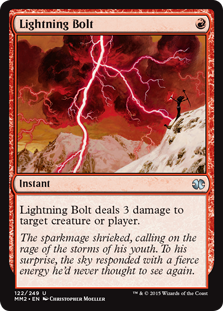
  • Jund reigns: Lightning Bolt is still supreme
    The BGx mainstay is up almost 9% from the last update, suggesting good news for Jund and Modern alike. First: players appear comfortable in wielding a fair deck in Lightning Boltan unknown metagame, not just a goldfish strategy. This didn't happen after Twin's ban, where Affinity, Burn, and RG Tron all trumped Jund in the Tier 1 standings. Jund's initial share might reflect player confidence in the format staying hospitable to police decks, which bodes well for Modern's overall health. Nowhere was this more apparent than the Dutch Open Series Sunday event, a 188-player extravaganza surpassing even Baltimore's attendance which saw four Jund decks in the Top 16 and 9.6% of total players on the midrange monster. Similarly, the Level Up Magic Cup saw three Jund in the Top 8. Second, Jund's top honors underscore Lightning Bolt's continued power, which should come as no surprise after you see Affinity's, Burn's, Infect's, and Merfolk's popularity. Of course, Jund's success is also an endorsement of other staples--Dark Confidant, Terminate, and Kolaghan's Command all combined to earn the deck its 11% share. Meanwhile, Abzan didn't even make the Tier 3 cut, further pointing to red's importance in the BGx policing shell. If you venture into a Modern event, be prepared for Jund's efficient one-for-one removal and beefy clocks.
  • Ancestral Vision leads a Grixis comeback
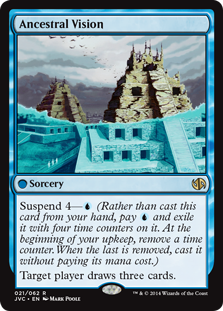
    We haven't seen a single Snapcaster Mage deck in Tier 1 since Twin's imprisonment. We also haven't seen a Grixis Snapcaster deck in Tier 1 since Grixis Twin in October, and a Ancestral VisionTwinless Grixis Snapcaster deck since August. Trevor is going to be happier than Brian Kibler following Wild Nacatl's parole. Outside of leaning more midrange than control, Grixis hasn't changed at all since January... That is, except for Ancestral Vision. Vision's addition has catapulted Grixis Midrange from Tier 3 doldrums to Tier 1 prominence. Only 18% of weekend Grixis lists didn't run Vision, with the other 82% averaging 3.6 copies in the maindeck. These results suggest the theories surrounding Vision's power were accurate--the card is Tier 1 material but doesn't appear to be format-breaking. Grixis was the only Vision deck to push into Tier 1 (Jeskai snagged Tier 2), and it didn't even dethrone top dog Jund. Perhaps this will change in coming months, but if trends hold, Vision looks to be exactly the post-Twin jolt blue mages needed. Prepare accordingly for the one-two-three punch of early Inquisitions, Mana Leaks, and Spell Snares leading into meaty Tasigurs and Anglers, all with Vision to refuel on turn five or later.
  • The Big Aggro Three are here to stay
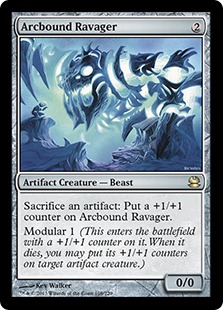
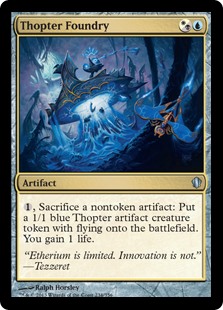
    Grixis hasn't quite earned "format pillar" status, but Burn, Infect, and Affinity certainly have. No one who tracks Modern data should be surprised by their persistence; linear decks are historically reliable options Arcbound Ravagerfor uncertain fields, and last weekend was no exception. What is far more surprising is their order. Burn doubled Affinity's share, with Infect (often the least-played of the three) beating the robots too. As if to rub it in, Merfolk even equaled Affinity in these early standings, a tie that has never happened in our metagame tallies to date. Part of this is undoubtedly Tier 1's increased artifact hate (Ancient Grudge, Shatterstorm, Vandalblast, etc.). With Sword of the Meek and Thopter Foundry on everyone's minds, artifact hate will be rampant and Affinity has likely suffered. Pilots may also have expected such hatred and steered clear. It's also possible this is a small n anomaly and will reverse as we get more events, but that isn't supported by data from the Dutch Open Series where 13 players brought Affinity to Round 1 and zero made Top 16. This may highlight a fundamental Affinity weakness in the new Modern. Going ahead, I'd still expect all three equally. Make sure you have gameplans for these blistering competitors!
  • Oh Sword of the Meek, where art thou?
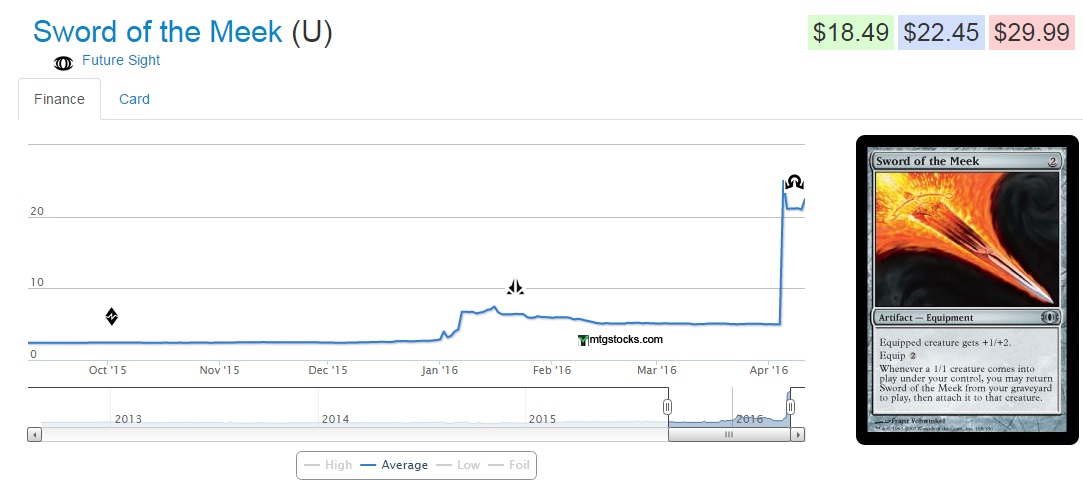
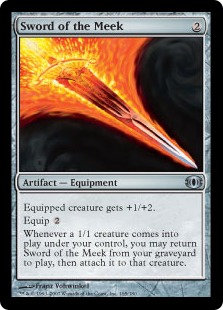
    Vision did its part to elevate Grixis Midrange into Tier 1, but the Thopter/Sword combo is still waiting for its big break. Sure, Darrel Feltner wedged the artifacts into his UW Tron list at the Baltimore Classic, but he didn't swordhave much company. Only about 5% of players this weekend used the combo in any list, and no single strategy was higher than about 2%. As we saw in our Affinity discussion, intensified artifact hate is partly to blame, especially because such silver bullets are so obvious (just run more anti-Affinity cards!). That said, it's unlikely this was the only factor in Sword's early absence. Nor is the combo's power to blame--Lucas Siow won the Mana Deprived Super Series with an Esper Gifts Thopter/Sword variant, suggesting the strategy has real wings. Its current weakness is lack of an obvious home. There are dozens of ways to churn out Thopter tokens, and Moderners are still building and brewing. I don't expect this to change until the June Grand Prix, although the upcoming SCG Columbus Open will help narrow the field. Don't ignore the combo entirely, but don't be too afraid. It's a long way from Tier 1 right now.
I fully expect the next few weeks of data to challenge some of these Tier 1 developments, especially moving past the Columbus Open. That said, my data senses are tingling and this preliminary Tier 1 makes enough metagame and statistical sense that I don't expect it to change dramatically through April and even May. Deck order will change, and I wouldn't be surprised if something like Merfolk dropped out of Tier 1 entirely, but the overall picture today shouldn't be too different from the picture in a month's time.

Preliminary Tier 2

Even with limited data, it's relatively easy to draw conclusions about Tier 1. These format mainstays tend to stick around from metagame cycle to metagame cycle, and if they show up in a new Tier 1 listing, there's a good chance we'll get most (if not all) of them right. Tier 2 is far trickier. At the top of the Tier 2 roster, we'll see decks less than a percentage point under the Tier 1 cutoff. At the bottom, we'll see strategies only a statistical nose ahead of Tier 3. This happens in every metagame breakdown but is most pronounced in snapshots like today's. To account for this, we'll want to keep our Tier 2 expectations flexible, understanding the potential for considerable movement as the format solidifies.

As in previous articles, Tier 2 represents competitive Modern strategies. You do not need to explicitly prepare to face each and every one of these decks, but you should have a general understanding of what all of them are accomplishing. For instance, if you lose to Ad Nauseam at instant speed with your win condition on the stack, you have no one to blame but yourself. Tier 2 strategies also have a baseline of success to suggest they are viable choices for upcoming Modern events, and I encourage you to try any of them at your next tournament.

Early Tier 2: 4/8/16 - 4/11/16

DeckPaper %
Scapeshift3.4%
Jeskai Control3.4%
RG Tron2.7%
Ad Nauseam2.7%
Kiki Chord2.7%

Because our Tier 1 bracket is a bit wider than usual, our Tier 2 listing has necessarily narrowed. We could have instead broadened it on the back-end, but that would have included six Tier 3 decks in the mix, some of which may yet be Tier 2 material (Naya Company, Esper Gifts with Thopter Foundry), and others which might barely have a Tier 3 claim at all (UR Delver, UW Tron). We'll see those potential upstarts later, but for now we're going to focus on core decks I expect will stay Tier 2 even as the metagame develops beyond these preliminary numbers. Here are the core themes from this group.

  • ScapeshiftModern appears slower, fairer, and more interactive than in the past
    Despite the presence of the Big Aggro Three and some combo win conditions, Tier 1 and Tier 2 are both pointing towards an overall tamer metagame. None of the current Tier 2 decks, admittedly a small subset at only five strategies total, can realistically win before turn four, with most geared for turn five wins or later. Scapeshift is the epitome of this approach, with pilots opting for a Bring to Light or traditional Temur build instead of the faster Primeval Titan versions (which themselves languish in Tier 3). Are these decks all proactive? With the exception of Jeskai Control, absolutely. But proactive should not be confused with unfair or non-interactive, and overall these changes might signal a shift to a format-wide slowdown which would benefit grindier cards and strategies.
  • The new Tier 2 should be similar to the old Tier 2
    See any new faces in Tier 2? Although the tier is likely to develop as candidates from Tier 3 earn a promotion, it's unlikely to be much different from the Tier 2s we are accustomed to in previous metagames. Certainly,  most of the current Tier 2 decks are Modern regulars, perhaps with the exception of Kiki Chord which has lingered in Tier 3 in some previous updates. Going ahead, I'd expect some of the Tier 3s such as Naya Company, Abzan Company, and Living End to make it back into Tier 2, maybe even joined by newcomers like Esper Gifts (Thopter style). This means your past Modern experiences will serve you well in the new metagame and, excepting those new Thopter/Sword decks, you won't have to relearn too many matchups, playlines, and sideboard strategies.
  • RG Tron endures
    Urza's TowerWho needs Eye of Ugin anyway? In fairness, Tron took a dive from Tier 1 glory, where it had occupied slots for months, into Tier 2, but a) that's probably for the best (it keeps the deck viable while promoting other strategies), and b) it speaks to the enduring power of Tron's engine. Even without Eye, the deck is still powerful and will still see play in Modern. If anything, it might become more annoying and problematic for those Jund pilots who think they can ditch their land hate from their sideboards. I'm not a fan of that matchup lottery aspect of Modern, but Tier 2 Tron is a fair addition to Modern and I expect we'll see it there for months to come. Keep land destruction handy and look for effects that span multiple matchups--Fulminator Mage should be an obvious candidate here.
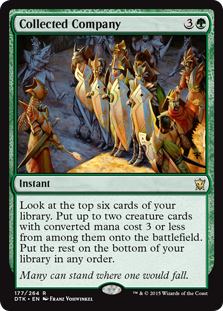
In many respects, Tier 2 is even less defined than Tier 1. Decks might fall out of Tier 1 and land in Tier 2, just as other strategies might climb from their Tier 3 status up into the next echelon. Expect a lot of change here, but regardless of what specific decks stick around, these three themes should still hold.

Preliminary Tier 3

We end our metagame preview with a peek at Modern's Tier 3. Strategies in Tier 3 may be competitive, but their viability is heavily dependent on tournament and metagame context. Player familiarity is also critical when piloting a Tier 3 deck, because many lack the proven power to cut it on their own. Before sleeving up one of the Tier 3 journeymen for your next event, make sure that choice makes sense relative to your expectations of the local metagame. Living End might be a great Tier 3 option if your area is heavy on Jund, but if you know Infect is huge at your local shop, then steer clear.

Early Tier 3: 4/8/16 - 4/11/16

DeckPaper %
UR Delver2.1%
UW Tron2.1%
Gruul Zoo2.1%
Elves2.1%
Esper Gifts2.1%
Naya Company2.1%
Bogles1.4%
4C Gifts1.4%
Living End1.4%
Abzan Company1.4%
Summoning Trap1.4%
Eldrazi1.4%
Titan Shift1.4%
Allies1.4%

As usual, Tier 3 is a mess. It's hard to identify core Tier 3 themes even in larger datasets, and downright vexing when your metagame only encompasses 24 events. That said, there are two overarching narratives we can pull away from this table. Maybe three if we count "PLAY ALLIES AND GO FOR BROKE," but I'm more confident in the other narratives than I am in Kabira Evangel's odds in this new format.

collected companyMy biggest Tier 3 takeaway is just how familiar many of its decks look. Abzan Company, Living End, Elves, Naya Company, Bogles: these are all much more regular Tier 2 participants, not Tier 3 stragglers. That's par for the course in a smaller-n metagame update, and points to Modern's remaining room for growth and evolution. I expect many of these Tier 2 household names to get back into Tier 2 as more fringe contenders take their place at the bottom. This leads directly to my second Tier 3 takeaway, which is the hidden potential of decks in this classification. The metagame is wide open and any of these strategies, except maybe my darling Evangels, could take off in the coming weeks. Don't shy away from these decks just because they appear Tier 3 for now. Diamonds may yet lie in this rough.

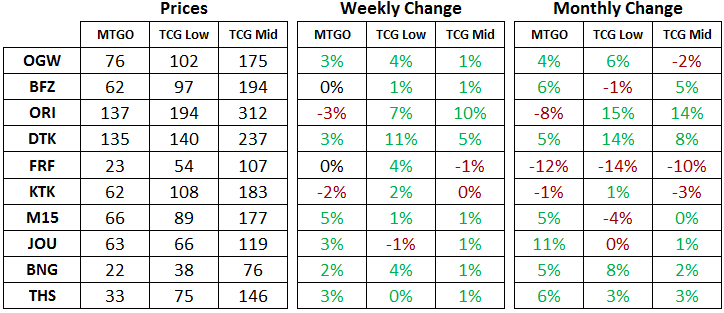
Speaking of potential diamonds in the rough, here's bonus takeaway number four: Eldrazi is smashed to where it belongs, but expect the deck to rise again. Its continued Tier 3 viability, even after a huge ban, suggests we haven't seen the last of the monsters.

One Weekend Down, Columbus to Go!

We're 24 events into the season and SCG's Columbus Open this coming weekend is going to be a big #25 in our dataset. Add all the other smaller tournaments along the way, and you can bet we'll be back next week with another metagame check-in for our new Modern. No matter how Columbus turns out, barring some unholy Eldrazi Temple-fueled coup, Modern is unlikely to look much less promising than we've seen today. Personally, I haven't been this optimistic about Modern's future since just before the Twin ban, and if this was Wizards' vision of the post-Twin format, sign me up for more.

Thanks for reading and let me know in the comments if you have any questions about the tournaments, the format, the numbers, or the different decks we've talked about today. Keep on crunching those numbers as you select your deck for Columbus and I'll talk you all soon!

Deck Overview- Human Tribal

Are you a Quiet Speculation member?

If not, now is a perfect time to join up! Our powerful tools, breaking-news analysis, and exclusive Discord channel will make sure you stay up to date and ahead of the curve.

While there were three different color combinations featured, if you chalk them all up as "Human Tribal" the deck made up half the Top 8 of the Baltimore Open. All four decks featured Always Watching. Two splashed blue for Reflector Mage and Dragonlord Ojutai. Another splashed green for Tireless Tracker. Lastly, the second place list kept it to mono-white.

Mono-White Humans by Kellen Pastore

Creatures

2 Consul's Lieutenant
3 Dragon Hunter
2 Expedition Envoy
3 Hanweir Militia Captain
4 Knight of the White Orchid
4 Thalia's Lieutenant
4 Thraben Inspector
3 Town Gossipmonger
3 Kytheon, Hero of Akros

Spells

3 Always Watching
3 Gryff's Boon
2 Stasis Snare
4 Declaration in Stone

Lands

19 Plains
1 Westvale Abbey

Sideboard

2 Felidar Cub
1 Lantern Scout
2 Silkwrap
1 Stasis Snare
1 Hallowed Moonlight
3 Secure the Wastes
3 Gideon, Ally of Zendikar
2 Westvale Abbey

Immediately, the numbers on the one drops look odd, though the explanation is to decrease your odds of losing two creatures to opposing Declaration in Stones. Dragon Hunter is marginally better than Expedition Envoy, and Town Gossipmonger is either better or worse than both, though the numbers are simply a hedge. I'm inclined to believe that Consul's Lieutenant is just better than Hanweir Militia Captain though, and I'd chalk this one up to experimenting on week one.

One advantage of playing Pastore's list is that your manabase will be more consistent, though the technology that really stands out is Gryff's Boon. Gryff's Boon is reminiscent of Rancor with regard to being a cheap aura that pushes damage through and doesn't always lead to the card disadvantage typically associated with auras. It's not as efficient as Rancor, though granting flying will often be better than granting trample.

There was been a lot of movement in the price of white rares after this weekend, and I can't endorse investing in staples from this deck. The deck is great, and if you want to play it then by all means buy in, though this is a much better time to be cashing in the Declaration in Stones that you pre-ordered if you were so wise as to do so. These prices will be stable and possibly see even more gains going into Pro Tour weekend, though things will settle down after then.

Insider: MTGO Market Report for April 13th, 2016

Are you a Quiet Speculation member?

If not, now is a perfect time to join up! Our powerful tools, breaking-news analysis, and exclusive Discord channel will make sure you stay up to date and ahead of the curve.

Welcome to the MTGO Market Report as compiled by Matthew Lewis. The report will cover a range of topics, including a summary of set prices and price changes for redeemable sets, a look at the major trends in various constructed formats, and a "Trade of the Week" section that highlights a particular speculative strategy with an example and accompanying explanation.

As always, speculators should take into account their own budget, risk tolerance and current portfolio before buying or selling any digital objects. Questions will be answered and can be sent via private message or posted in the article comments.

Redemption

Below are the total set prices for all redeemable sets on MTGO. All prices are current as of April 11th, 2016. The TCG Low and TCG Mid prices are the sum of each set’s individual card prices on TCG Player, either the low price or the mid price respectively.

All MTGO set prices this week are taken from Goatbot’s website, and all weekly changes are now calculated relative to Goatbot’s ‘Full Set’ prices from the previous week. All monthly changes are also relative to the previous month prices, taken from Goatbot’s website at that time. Occasionally ‘Full Set’ prices are not available, and so estimated set prices are used instead.

apr11

Flashback Draft of the Week

Triple Coldsnap (CSP) wraps up on Wednesday. Then we're into the Shadows over Innistrad (SOI) set release window, so flashback drafts are on hiatus until we return with triple Time Spiral on May 4th.

If you are holding the recently unbanned Ancestral Vision, this is your long-range warning that three weeks of opening TSP will put a dent in the price. Remember, triple TSP will be followed by a week of Time Spiral-Planar Chaos draft, and then a week of the full TSP block draft with Future Sight.

CSP uncommon and Legacy staple Counterbalance put in a bottom over the weekend and is now back over 10 tix. Speculators should be cautious picking this card up in the short term. All eyes will be on Standard for the next month with the release of SOI. Combine that with the typical liquidity crunch, and Legacy prices will be under pressure.

A more established price floor would reduce the risk. For now any players who had been eyeing a playset should be patient and wait to see where the price ends up next week.

There will always be a few drafters who hold onto their copies with the hopes of building their Legacy collection. A new set and a fresh Standard format will quickly drain players' available tix, so those extra copies of Counterbalance will soon be converted to tix in order to play in SOI drafts.

Modern

Early returns from the post-Eldrazi Modern format are quite conservative; check out the result from the Star City Games Modern Classic in Baltimore.

Six different archetypes were represented in the Top 8 results with another four different archetypes if you include the Top 16. Ancestral Vision made an appearance in the top deck's sideboard as well as in the maindeck of the two Grixis decks that made Top 16.

Overall this appears to be a very cautious field, but with good diversity. That should encourage Modern players to trot out their favorite decks now that the Eldrazi appear to be vanquished.

Standard

Pro Tour Shadows over Innistrad will be held in Madrid on Friday, April 22 through Sunday April 24. Although there are early signs of what SOI Standard will be like with the recent SCG Open results, the best signal for the direction of SOI Standard will be the top Pro Tour decks. White aggro decks have been off to a flying start, but the format will likely evolve to deal with this archetype.

For speculators benefiting from the higher prices seen on white cards from Magic Origins like Kytheon, Hero of Akros and Archangel of Tithes, look for a price spike with the release of SOI this week. An appearance of one or two white aggro decks in the Top 8 of Madrid will cement a further price spike on cards like this.

The decision to sell into this interest over the next two weeks will be correct as aggro decks ultimately rarely end up being top tier decks.

Standard Boosters

Unlike last week, there was a big drop in BFZ and OGW boosters as we enter that awkward period where SOI is Standard-legal but not yet available on MTGO. Sealed leagues are also closed to new entrants. As a result we are seeing the start of deep selling of these boosters as players look to the new Standard format and start thinking about SOI draft and sealed deck.

Both BFZ and OGW boosters will be good long-term value. I believe there is a 98% chance that each will go higher than 4 tix over the next six months.

In the short term, though, they are set to dip further as we head into prerelease weekend on MTGO. Players looking to put a few Battle for Zendikar block draft sets into their collection will see good prices over the next two weeks.

Shadows Over Innistrad

For the release of SOI, there have been some changes made to the events on offer. Sealed release events that were tix-only and offered good prize support are being retired. In their place will be a weekend of prerelease events (both sealed leagues and swiss draft), followed by normal sealed leagues and draft queues starting on Monday.

The entry fee for prerelease events is tix or play points only. As usual, this means boosters from the new set will be temporarily worth less over the weekend.

On Monday, you'll be able to use SOI boosters to enter drafts and sealed leagues, so the value of SOI will be 4 tix at that time. On the weekend the value of a booster will be less than 4 tix since you cannot use boosters to enter new events. Those players who are tix-constrained will sell the boosters they have won in order to play more Limited events.

Both speculators and players should be willing to buy boosters for a discount over the weekend in order to sell them back into the market after Monday. The price of SOI boosters will not likely dip much below 3.5 tix, so the trade is low margin and low volume. However, if you are looking to save a few tix on the price of boosters, this weekend will be a good time to buy.

A special note on prerelease sealed leagues. In addition to the six boosters of SOI to build your deck, you will also get a bonus foil rare or foil mythic rare, similar to paper prerelease events. This extra supply of foil mythic rares should be seen as a good opportunity for pursuing the foil mythic rare strategy.

For players seeking to play with the new cards, buying the foil version of a given mythic rare is an excellent option. Unlike the regular versions, the foil versions tend to hold their value over time. Don't be afraid to scoop up any foil mythic rare in the 6 to 10 tix range this weekend, which was the bottom end of the price range observed on OGW and BFZ foil mythic rares.

Trade of the Week

As usual, the portfolio is available at this link. This week I sold Hangarback Walker for a loss. Although it is two card types for delirium, getting it into the graveyard in Standard is the trick. With Reflector Mage and Declaration in Stone looking to be Standard staples, both of these cards deal with Hangarback Walker without putting it into the graveyard.

As a regular rare that is just seeing play in the odd deck, the writing is on the wall for this card. I'm 80% certain it will not be getting back into the 10+ tix range while it's legal in Standard.

The Fairness of Thopter Combo and How to Fight It

Are you a Quiet Speculation member?

If not, now is a perfect time to join up! Our powerful tools, breaking-news analysis, and exclusive Discord channel will make sure you stay up to date and ahead of the curve.

Welcome to the second week of the new Modern era! If the chatter in discussion threads and the various articles from the past week are any indication, everyone is happily brewing away with the new toys from Wizards. Control mages are eagerly waiting for Ancestral Vision to tick down and aggro players are happily ruining it by killing them first. Meanwhile, everyone is stuffing Thopters into any deck they can find. All is well in this new brewing season.

Thopter Foundry banner

The most interesting part of all of this for me is the increasing chorus of voices claiming that the Thopter Foundry and Sword of the Meek combo (hereafter known as Thopter combo) is very, very good. Possibly to the point of being broken. I did warn you that this was possible last week (and other than this sentence I'm not going to crow about it) but what strikes me is how frequently the combo is described as unfair. Never being one to shy away from overanalyzing things, this week I'm going to evaluate the Thopter combo for its unfairness. What it does, how it does it, and what that means for answering the combo.

[wp_ad_camp_1]

The Thopter Combo

Thopter FoundryI know most of you already know this but bear with me; it will be important later. Thopter Foundry says "1, Sacrifice a nontoken artifact: Put a 1/1 blue Thopter artifact creature token with flying onto the battlefield. You gain 1 life." Sword of the Meek has some mostly irrelevant text and then "Whenever a 1/1 creature enters the battlefield under your control, you may return Sword of the Meek from your graveyard to the battlefield, then attach it to that creature." Sacrificing Sword to Foundry creates a 1/1, gains you a life and then triggers the Sword's return ability, allowing you to sacrifice it again as many times as you have mana available in a turn.
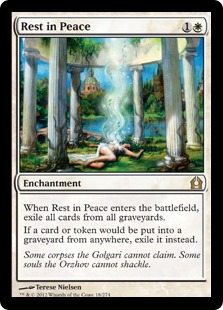
swordIn practical terms this means that the Thopter player can make an army of flying chump blockers/attackers at instant speed and gain an equal amount of life, leaving mana open for counters during the opponent's turn. In other words, a nearly ideal control win condition. I say nearly because neither piece does much on its own and you have to assemble it the first time at sorcery speed. The combo also does not guarantee a win, it merely ensures that you will not die. As anyone who ever tried to beat Zoo using a Circle of Protection knows, spending all your mana not dying every turn without removing the reason you need to not die is a losing proposition.

rest in peaceIt is also highly disruptable, both before and after assembly. Whether it's countering Foundry, killing Foundry in response to Sword's trigger, or more dedicated hate cards like Rest in Peace and Stony Silence, if you want to defeat the combo it is fairly easy to do so. The Thopter Depths decks from 2010 Extended got around this using a combination of tutors and Academy Ruins, but as previously noted the best hate cards didn't exist at that time. It is for this reason that Thopter combo has not seen much Legacy success. The most recent high-profile success I can find is from the SCG Indianapolis Open in January 2015. When Miracles was still called Counter Top it often used the combo but I think it's telling that it has been abandoned in favor of Entreat the Angels.
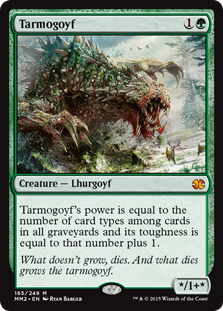
Of course, all of this looks at the combo when it is behind and struggling to catch up. If you are in the driver's seat Thopter combo will make sure you stay there. Zoo and Burn cannot outrace the lifegain plus fliers and even making 3-4 tokens per turn will kill control and combo decks very quickly. It is possible for a deck like Merfolk or Bogles, which do damage in huge chunks, but any stumble will leave them unable to regain lost ground. I suspect this is the scenario players are focusing on when talking about how good Thopter combo is, but it is a valid point. But the question remains: is this fair or unfair?

What is Fair?

Oftentimes we hear the terms fair and unfair thrown around without anyone really defining what they mean. As an academic I find this infuriating since definitions are so important for intellectual inquiry, but they're also extremely difficult. Definitions have to be exclusive enough to meaningfully separate the term and yet inclusive enough to capture the entire intended subject. Jordan found this out last year when he tried to define fair and unfair as part of his Modern Archetypes series.

Based on the discussion Jordan generated and observations since then, I believe most players agree on what fair and unfair means--they just disagree on how to articulate the idea. It's very much a case of, "I know it when I see it," and we're all seeing it slightly differently. I'll prove it: What is a fair deck? What is an unfair deck?

TarmogoyfHow many of you answered Jund/Abzan for the first question? How about Affinity or Storm for the second? We all understand when a deck is being perfectly fair and conversely when something unfair is happening, though I suspect what that means for each player is slightly different, particularly when it comes to what constitutes unfair. What decks are fair provokes comparatively little discussion compared to unfair, so I feel confidant that we all have roughly the same understanding on that point: A fair deck plays by the rules. Necessarily this means that unfair decks don't play by the rules. So what are the rules?
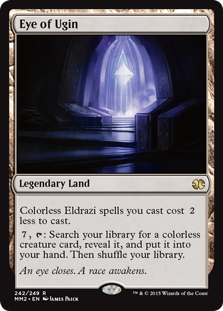
I argue that an unfair deck is one designed to break the fundamental rules of Magic while fair decks operate within them. Draw one card a turn, play one land per turn, generate one mana for each land you control, pay the CMC to cast your spells, and if you want to break any of these rules you have to pay a price. GBx follows these rules scrupulously, even with Dark Confidant who makes you pay life to draw an extra card per turn. Storm joyously breaks these rules via enormous velocity from cantrips, extra mana generation from Goblin Electromancer and rituals, Pyromancer Ascension to do both and Past in Flames to do it all over again. Thus when I think of unfair decks I am thinking of decks that win by generating huge mana and card advantage over the course of a few (or one) turns while the fair decks gradually build up to wins through interaction and efficiency.

Is Thopter Combo Fair?

I say yes. Kinda. What Thopter combo does is actually a fair interaction--it is the end result that is unfair. The combo is using its available mana to generate a finite effect and is (normally) incapable of winning in a single turn or even that quickly, which is fair. The end result of life and Thopter tokens, however, can be seen as unfair, since it is a huge board presence that is technically card advantage.Eye of Ugin I therefore would classify the combo as "fair." I mentioned "fair" decks a few weeks ago in my Shadows preview article talking about Bygone Bishop but I haven't defined it until now. A "fair" deck is one that either does something fair in an unfair way or does something unfair fairly.
Affinity and Eldrazi are examples of the first part, being aggressive creature decks that leveraged a massive mana advantage to generate overwhelming board positions in a turn or two. I consider Infect an example of the latter since it is using something unfair, the infect mechanic, to kill in a fair way. I therefore place Thopter combo in the same category as Infect, a "fair" deck doing an unfair thing (generating huge card advantage and board position) fairly (paying mana over many turns).

Choosing the Battleground

I bring all of that up because if you're going to fight a deck you need to know what kind of deck it is, and that starts by identifying its fairness. Yes, the broad achetypes are important but circumstances and the card pool can make any deck unfair or fair, so you should always begin there. Determining the relative fairness of a matchup can play an enormous role in how you build your sideboard and play the matchup.Karn Liberated For example against Jund you either want to be going over the top with some unfair strategy like Tron or setting yourself for an attrition matchup to "out fair" them. Going for a "fair" strategy can be effective, but it can also backfire if Jund's answers line up well against you, as is the case of Jund vs. Infect.
As I mentioned above, if you're trying to beat a fair deck you don't want to be equally fair. You should either try to be more unfair and ignore their gameplan or be more fair and simply answer everything to win the resource war. In theory the same is true of unfair decks but the reality is a bit murky. If you're a fair deck up against an unfair one it's unlikely that you can sideboard into an unfair strategy that is better than theirs or you would be playing it maindeck. Increasing the fairness of your deck is the only option and that might not work if your answers don't line up well with the unfair deck's hand. Unfair vs. unfair is also odd since it's usually the more fair deck that wins. Look at Legacy Storm where a frequent and effective strategy is to board in additional Thoughtseizes and Dark Confidant in the mirror. "Fair" decks are quite tricky.Thoughtseize The first class of decks are generally hard to disrupt unless you can efficiently target their unfair component before they overwhelm you with their fair strategy. The second class generally fall apart in the face of attrition and answers (Infect vs. removal-heavy decks) or if their unfair thing is not effective against your deck (Extended Life against Aluren).
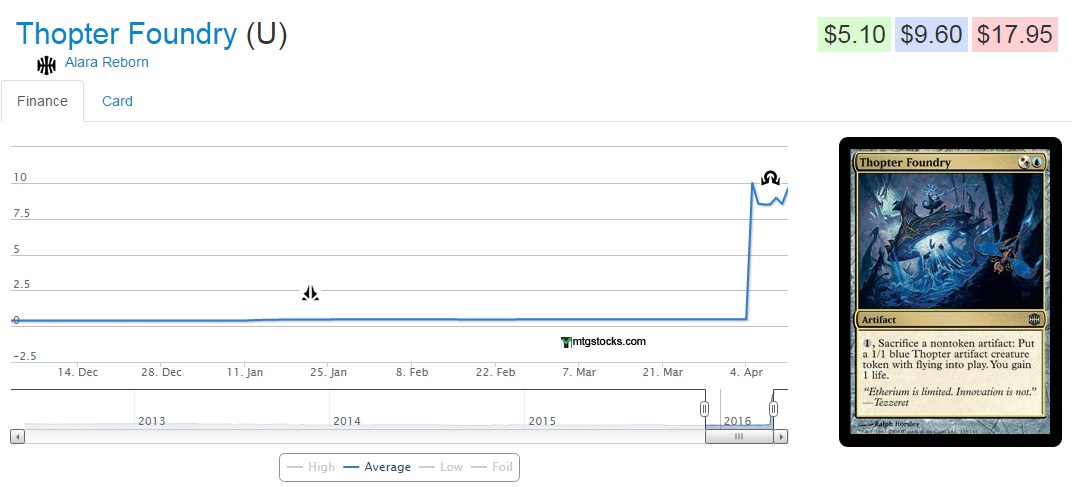
There is a third option as well: enforce fairness. This is the Death and Taxes strategy. It's usually based on mana denial from taxing effects and results in forcing decks to play more fairly. The more unfair the deck was to begin with the more effective DnT is, and vise versa. For instance Storm needs to draw extremely well to win through Thalia, Guardian of Thraben or Thorn of Amethyst, while Jund doesn't care if it has to pay extra as long as it gets the one-for-one and eventually grinds you out of resources. Thus, depending on the unfair thing you want to fight, it might be better to make them play fair rather than trying to be more fair yourself.

Fighting the Thopters

As a class two "fair" deck, Thopter combo can be effectively answered fairly with one-for-one answers rather than specialized sideboard cards. Spell SnareLast week I mentioned that Scavenging Ooze and Abrupt Decay are effective answers to the combo that see maindeck play. To that you can also add Spell Snare and Kolaghan's Command. The combo has very specific timing that allows it to be efficiently answered without it being able to protect itself and so the normal fair strategies should have little trouble. GBx will be a natural predator for this combo, and I expect that Abzan will take the edge thanks to the power of the white sideboard cards like Stony Silence and Rest in Peace, both against Thopters and other unfair decks. Its advantage against Jund will also contribute.

However, the lingering question is what the Thopter combo deck will look like. Context is everything and while the combo may be fairly answered the rest of the deck may make trying to do so a losing proposition. A more fair deck like Frank Lepore's may be able to ignore the disruption and use redundancy to overcome fair answers. An unfair shell might be able to bypass the hate by setting up for a single big turn or use tutoring for redundancy. If this happens then it becomes more important to restrict their mana and shut down the tutoring engine, which means the format might finally be unfair enough for Modern DnT to be good. Thalia is at her best against unfair decks that rely on mana efficiency. Aven Mindcensor/Leonin Arbiter are murderous against tutors. The more unfair the deck the more likely it is to fall apart when forced to be fair.

Prepare for Battle

Until we have a better picture of the metagame (Sheridan's working on it for tomorrow) and/or the makeup of the Thopter deck, I would shy away from the more specialized DnT style of deck. There will be too many fair decks in this first full week of new Modern for a punisher deck to really shine, and the fair answers should work well enough while pilots are still tuning and testing their Thopter builds. Once the optimal, or nearly optimal, list emerges this is likely to change. Keep your eyes open and your mind unclouded; this will get interesting. Disagree with my assessment or have your own take on the problem? I'll discuss it with you in the comments.

Insider: Magic Stock Watch for April 2016

Are you a Quiet Speculation member?

If not, now is a perfect time to join up! Our powerful tools, breaking-news analysis, and exclusive Discord channel will make sure you stay up to date and ahead of the curve.

Welcome back, readers! It's been a while since I did any of this series and while I really love digging up new ideas for articles, sometimes it's important to simply sum up significant changes in the Magic financial realm.

This past week a few major events occurred. We saw a Modern banning, two unbannings, and a Standard rotation. The financial relevance of these events is reflected in the changes we'll outline below, which were largely attributable to them.

Top Gainers

1. Thopter Foundry (+2100% and +1640%) - You can't be surprised about this one, unless you've been living under a rock. Both printings of Thopter Foundry (Alara Reborn and Commander 2013) were down to $0.5 prior to Sword of the Meek's unbanning, so this jump to the $11 range represents a massive percentage gain. Most decks using the Thopter/Sword combo tend to run more copies of Thopter than Sword, which may have given it an extra push.

thopter foundrygraph

2. Sword of the Meek (+321.5%) - No big surprise here either, even if the unbanning itself caught a lot of people off guard. Hopefully you read the various QS articles discussing whether this card deserved to be on the Modern banned list and acted back then. I know I picked up my four copies back in November 2015 for around $2 each.

I wish I had gone deeper. At the time, while I agreed that the card shouldn't be on the Modern banned list, I felt that quite a few cards on the list fit that description and WoTC hadn't really shown any action on them. That being said, an unbanning usually leads to a massive spike, both in the card in question and others that combo with it, as our #1 gainer shows.

sword of the meekg raph

3. Time Sieve (+206.1%) - Again another spike due to the unbanning of Sword of the Meek. Like Thopter Foundry, this card had a pretty low buy-in. This is often a big factor in major price swings as it allows the largest number of people to buy in.

I have yet to see any good results with this one and some believe it's more of a "win more" card, but there's a decent chance some form of U/B Tezzerator deck will move to Tier 1 in Modern thanks to the addition of the Thopter/Sword combo. If it does, Time Sieve may find a home in the deck (though most likely in the sideboard).

time sieve graph

4. Always Watching (+172.4%) - Here's our first gainer due to Standard demand. This card has found a home in the white-based aggressive decks in Standard. It pairs extremely well with Dragonlord Ojutai (turning on hexproof indefinitely thanks to vigilance and putting him out of Languish range). It also combos with another card further down on this list (Archangel of Tithes) by allowing both of the Archangel's abilities to function simultaneously.

always watching graph

5. Tezzeret, Agent of Bolas (+170.3%) - This one had a higher buy-in price, but nonetheless gained a lot from the Sword of the Meek unbanning. Tezzerator decks haven't ever been Tier 1 in Modern despite the plethora of good artifacts available, primarily because they had a hard time beating aggressive decks.

Black has a lot of good answers to early creatures, but if you filled your deck with answers (which are typically instants or sorceries) you weakened Tezzeret's ability to provide card selection and increased the chances of whiffing. We see a similar deck-building limitation with Collected Company decks that try to keep the non-creature count as low as possible.

With the release of Sword of the Meek from the banned list, Tezzeret, Agent of Bolas gets an on-theme way to stabilize against aggressive decks. Lots of people are already brewing with the planeswalker.

tezz graph

6. Kytheon, Hero of Akros (+139.8%) - Another winner from rotation (or rather the entry of Shadows over Innistrad to Standard). Kytheon was originally touted as one of the better Origins flip walkers but he quickly fell out of favor as midrange decks took over and white aggro decks failed to pan out. With a return to the plane of Innistrad and a resurgence in power of the human tribe, he's found a home in the G/W Human decks that have found an early foothold in this new Standard.

kythoen graph

7. Ulvenwald Hydra (+136.4%) - This card started out in the $3 range and several QS members actually went in on it as an undercosted, powerful mythic from the set. Since the thread began, the card has shot up to almost $9.

As a sort of fixed Primeval Titan, searching for any land will likely do well in Commander decks, but the Hydra also has a potential home in Standard decks running bullet lands. It saw some brief time on camera at this past weekend's Star City Games Open but didn't make it into the Top 8. The highest tables were infested with G/W/x aggro decks which meant a six-drop that fetches a land was poorly positioned.

I expect this card will begin to drop given the new metagame. Trade them off now and pick them up later (if you want them for Commander).

ulvenwald graph

8. Secure the Wastes (+134.1%) - Another big Standard gainer. Secure has found a home in several of the W/B Midrange decks that had a good Day 2 showing, although only one copy made the Top 8 dominated by W/x Humans decks. Given Secure the Waste tokens aren't humans and don't get pumped from Always Watching I don't expect this new price to stick.

This is another of the cards that gained a lot of early hype but didn't seem to pan out over the weekend. That isn't to say it may not end up better as the metagame matures, but this Dragons of Tarkir rare is sitting at almost $11 now.

secure graph

9. Ancestral Vision (+132.3%/+113.7%/+90.3%) - Ancestral Vision was the other card that came off the banned list so it was expected to show up on the list somewhere. Unlike with Sword of the Meek, many people (myself included) have been calling for this one to get unbanned for quite some time. If you look at the price graph above you'll see it had gains right before the Oath of the Gatewatch Banned and Restricted announcement.

ancestral vision

10. Undiscovered Paradise (+124.5%) - While this card did technically spike, you can still acquire HP/MP copies on TCG Player for the old price. The implication is that someone noticed there were very few LP/NM copies and tried to force a price spike or manipulate PucaTrade. Alternately, it might be that a few people wanted only LP/NM copies and bought up the few on offer.

There were no major breakthroughs that I'm aware of to indicate an increase in demand for this card. My only other theory is that there may be a push for a resurgence of Dredge in Legacy. Undiscovered Paradise is one of the few Reserved List cards in this archetype that hasn't shot up already (unlike, say, Lion's Eye Diamond).

Dredge is the type of deck that slowly falls by the wayside only to suddenly take down an unsuspecting tournament. This causes players to rush out and pick up extra graveyard hate, which then pushes Dredge back down. We may be seeing one moment in this ongoing process.

Either way, it's on the Reserved List, so while Undiscovered Paradise's new price is unlikely to stick it's also unlikely to fall entirely back to the old price.

paradise graph

Insider: The Formats They Are A-Changin’

Are you a Quiet Speculation member?

If not, now is a perfect time to join up! Our powerful tools, breaking-news analysis, and exclusive Discord channel will make sure you stay up to date and ahead of the curve.

The Shadows over Innistrad (SOI) have descended. The Eldrazi have been vanquished from the Modern format. Mages near and far are using all their stored up gold coins, rupees and gil to purchase Scroll of Ancestral Vision and Sword of the Meek in order to learn these newly unbanned spells in Modern.

What an exciting Magical age we live in. And in this age we are in money spending season, so break out those wallets, credit cards, and store credit and get ready to spend, spend, spend. The fact of the matter is that things are being shaken up and anybody looking to play competitively is likely going to need to "pay to play" right now.

Let's take a look at how the two most important formats in Magic, Standard and Modern, have changed to see if we can't find a handful of spicy financial specs.

Standard

It's a great time to trade off many of the cards we've been holding onto waiting for their day in the sun.

There was an error retrieving a chart for Archangel of Tithes
There was an error retrieving a chart for Kytheon, Hero of Akros

Anybody who put their money on white made out like a bandit. Now is the time to move on these cards as they will likely never be higher than right now. These cards are not particularly desirable, except to people trying to buy in on the hot deck of the week. Sell.

There was an error retrieving a chart for Westvale Abbey

Card is so ridiculously overpriced. I predict it will be sub-$10 in two weeks time.

On that note I also think Thing in the Ice is overpriced right now. However, it could be better in Legacy and Modern than I'm giving it credit for. Either way, no matter how much Star City Games is trying to prop this card up and pretend it's the "next Snapcaster Mage," it probably isn't. Not even close. Sell this sucker before you get caught holding the bag.

The first Open of the season has wound down and the results are pretty interesting. It looks like, at least after the first week, the format is Collected Company and white midrange decks.

It isn't really surprising when one considers that Collected Company is probably the objectively best spell legal in Standard and that most of the best cards from SOI are white.

There was an error retrieving a chart for Collected Company

As of writing this article Sunday night, Collected Company hasn't really moved in value so far. I would be looking to pick up more copies. It's going to be a format-defining archetype moving forward and a solid, popular Modern staple. As people look to buy into new decks the demand will assuredly rise.

There was an error retrieving a chart for Archangel Avacyn

I'm not going to say move on a card that is already $40 because it probably is a losing investment. The price will come down. I mean, look at Siege Rhino---Modern-playable, best card in Standard, and settled at about $4 for most of its legality. This obviously doesn't help if you need it to play Archangel Avacyn next weekend at the Invitational or Open, but if you can afford to, I'd wait it out.

Archangel is the best card from the new set and sure to have a tremendous impact on Standard. When the dust settles I expect it will play a big part in warping the format around it.

If you're looking for good investments I would specifically target cards that play nicely with Collected Company and Avacyn.

There was an error retrieving a chart for Eldrazi Displacer

Standard has the colorless fixing and enters-the-battlefield abilities to really make this card shine. It pairs well with a number of excellent white cards people want to play anyway. It's great with Avacyn, Reflector Mage and Knight of the White Orchid.

I've played Displacer in Legacy, Modern and Commander. So I'm going to say foils are probably a good thing to hold onto long-term. The card is also pretty sick in cube formats. Ultimately it's just a generically good card and cream always rises.

There was an error retrieving a chart for Knight of the White Orchid

Speaking of KOTWO, did you see this card spiked to $5 on SCG? Seriously, who would pay $20 for a playset of this card? It's been printed multiple times. There are a zillion copies in existence. I can't even imagine.

Anyways, I'm a sell on this card---in two weeks, once people who are literally allergic to making wise decisions with their money have all gotten their copies, it will settle back down around $2.

We still have the Invitational and the Pro Tour to help define this metagame. I'm sure the pro teams will figure out things the grinders haven't thought of yet. I'd be kind of surprised if there wasn't a red deck of some kind. I'd also be surprised if a black aggro deck didn't make waves. If some of the red and black cards start to slip or people are willing to let them go cheaper, I'd be looking to pick them up.

Modern

There was an error retrieving a chart for Sword of the Meek
There was an error retrieving a chart for Ancestral Vision

You shouldn't need to be told this but the price on both of these cards is absurdly high and all but certain to come down.

Personally, I don't think either are likely to go into Tier 1 decks. For starters, Wizards hasn't unbanned a card in Modern that is truly great yet. They tend to unban cards that are just niche players. Wild Nacatl is the one exception---and that card isn't even close to needing to go back on the banned list. If they unban it, my intuition tells me the safe bet is on a medium power level.

Sword of the Meek plus Thopter Foundry is the kind of thing that attracts people who like to durdle in droves, so it's going to affect prices as people try to build new decks and sideboards.

There was an error retrieving a chart for Scavenging Ooze

Scooze got way better. It is good against Reanimator, Thopter Sword and Dredge. And with Eldrazi gone, decks like Jund get much better. More Jund players plus more need for graveyard hate equals rising stock for Scavenging Ooze. I've been writing about Ooze being a good investment forever, so why stop now.

There was an error retrieving a chart for Etched Champion

Etched Champion should become more popular in Affinity decks with Eldrazi virtually eliminated from the format. The reason the card disappeared was that it was terrible against colorless Eldrazi creatures. I suspect colored creatures are going to make a pretty big comeback in the coming weeks.

Also, most people don't seem to realize that Thopter Foundry makes blue artifact creatures which means that Etched Champion can skate right past them with a Cranial Plating. Not saying that Etched Champion is great against assembled Thopter-Sword combo, but it is something worth noting.

Champion has fallen to the dregs of its current price point because it hasn't been good in Affinity for a while. I predict an uptick as people figure out it's good again.

There was an error retrieving a chart for Stony Silence

The best sideboard card in Modern somehow got even better. Stony Silence is very close to approaching the territory where it may be one of the 5-10 best cards in the entire format! The fact that it will also be good against Thopter Foundry decks that go all-in on artifact mana and synergies is just gravy for this powerful enchantment.

I'd be surprised if Stony Silence doesn't hit the $20 tag at some point in the next two months. I fully expect this to happen.

There was an error retrieving a chart for Rest in Peace

R.I.P. has already seen some growth lately but it will basically just continue to rise in price until it gets a reprint. The card is absurdly awesome. It is the best graveyard hate card ever printed by a mile. It shuts everything down.

You may have heard that Thopter Sword uses the graveyard... This newest development is a testament to the true power of these sideboard hate cards. When new combos and other degenerate interactions come along, it's often the narrow hate cards that keep them in check. The fact that the list of cards they hose keeps growing larger signals a bright future.

There was an error retrieving a chart for Grafdigger's Cage

Cage may not interact with the Sword combo but I still think it's undervalued at the current price tag. The card is so effective at doing what it does for one mana that I doubt we will ever get anything like it again. It's just a great Magic card. It costs one, the magic number of playability. It will be great forever.

There was an error retrieving a chart for Pithing Needle

Everything I said about Grafdigger's Cage applies to Needle. The card sees a ton of play across multiple formats and I'm not sure why people like to think of it as "just above a bulk rare." As it gets further into the past since the last printing we'll continue to see a steady rise in price, and at some point it's going to really bump up.

Summary

Modern and Standard are undergoing some pretty significant changes right now, and we really want to pay attention and take advantage of potential value gainers.

In Standard, we should look for growth in cards that are great with Collected Company and Avacyn Archangel because those appear to be the best strategies right now. If you want to take some risks, I'd look at red and black aggro as strategies that could have strong showings at the Invitational and PT.

In Modern, I'd look for cards that got better with the departure of the Eldrazi, as well as cards of general quality that acquire added utility against fair decks and Thopter Sword. These are the decks that clearly got better post-banning and will be the main force driving Modern players to buy new cards.

New formats are always fun---even more so when you can make a few bucks off them!

Want Prices?

Browse thousands of prices with the first and most comprehensive MTG Finance tool around.


Trader Tools lists both buylist and retail prices for every MTG card, going back a decade.

Quiet Speculation