menu

A Last Word on the Splinter Twin Banning

Are you a Quiet Speculation member?

If not, now is a perfect time to join up! Our powerful tools, breaking-news analysis, and exclusive Discord channel will make sure you stay up to date and ahead of the curve.

I made a New Year's resolution to minimize participation in ban discussions throughout 2016. Modern has more than enough banlist din in Twitch chat, Reddit threads, and article comment sections across the content-sphere. Then the Splinter Twin banning happened. Wizards' announcement has made it impossible to discuss any aspect of 2016 Modern without some reference to their controversial decision. Everything from sideboard calls to metagame context, deck choices to format direction, and countless other Modern elements in between has been affected. Despite this upheaval, or perhaps with respect to it, I'm ready to depart ban discussion and return to strategies and metagame analysis, but not before giving a personal Last Word on the ban.
Last-Word-on-Twin-Banner

Starting tomorrow, I'm back on my resolution wagon and steering clear of ban discussion. I'll be revisiting banlist issues when we either receive new information about Wizards' policies (please, Sam Stoddard?) or approach the next announcement in April. Today, however, I want to raise two points about the recent decision, digging into some unexplored statistics, and drawing a line on where I stand with regard to the January 18th update. In the past, I have analyzed many of Wizards' decisions and ultimately accepted them at face value. The Twin update did not withstand this scrutiny. There is a body of quantitative and qualitative evidence that exposes two major unanswered and under-addressed elements of the announcement. This article presents those factors as open questions demanding acknowledgment, and I will certainly revisit them as the new Modern evolves.

[wp_ad_camp_1]

Missing Metagame Context

Many ban proponents believe Wizards' justification in the January 18 announcement, centered on Top 8 finishes, was sufficient to explain Splinter Twin's removal. Neither previous updates nor broader metagame statistics support that position. As old banlist changes from Bloodbraid Elf to Birthing Pod have shown, the Twin update is missing a key factor at play in all those preceding format-diversity bans: a significant, metagame-wide format share. This notable absence suggests either Wizards has changed their criteria to emphasize Top 8s at the expense of the broader Modern metagame picture, or that there were other reasons for Twin's ban beyond those mentioned in the update.

Note: this section excludes 2011 bans made before Modern was a Grand Prix format. The addition of a Grand Prix Day 2 metagame dramatically increases our population size and thus changes how we conduct metagame analysis.

The Metagame Factor in Old Banlist Updates
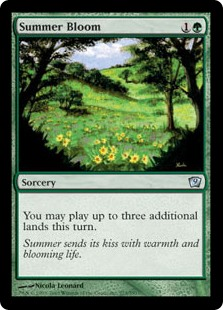
summer bloomThe January 2016 Twin announcement did make a passing nod to metagame shares. In that article, Wizards transitioned from Summer Bloom's ban to Twin's, outlining how they "also look for decks that hold a large enough percentage of the competitive field to reduce the diversity of the format." In his article last Friday, Jordan treated this sentence as a bridge from Bloom discussion to Twin, not an actual statistical summary. He concluded Twin's metagame share did not seem to be a major factor in its eventual ban. Others have been comfortable with the article focusing solely on Top 8s, even if metagame numbers are left by the wayside.

Having reviewed past announcements and crunched the numbers, I view this is a major inconsistency with past bans which we need to recognize.
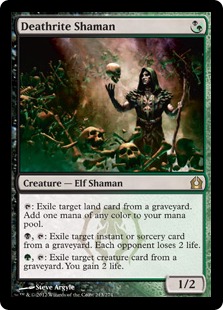
Deathrite ShamanAlthough Wizards regularly presented Top 8 performances in many ban announcements, they also referred directly to metagame-wide shares in most of those pre-Twin updates. Justifying Deathrite Shaman's removal in a February 2014 article, Wizards explained "Having a strong attrition-based deck as a large portion of the metagame makes it difficult for decks that are based on synergies between cards instead of individually powerful cards." Although Wizards does not use the same tiering definitions as used on the Nexus, we share their concept of a wider metagame beyond mere Top 8s, something seen in countless Day 2 Metagame Breakdowns and other metagame pieces on the Wizards site. The quoted reference points beyond Deathrite's Top 8 wins to a broader format violation.

Wizards echoed this metagame concern in the January 2015 announcement. First up were Treasure Cruise and its "replacement", Dig Through Time, both of which Wizards struck down to free up format space: "...as these decks have occupied a large portion of the competitive metagame, the overall variety of successful decks has been suppressed." Birthing Pod came next, drawing not just one but two indictments of its oppressive Modern prevalence (emphases added):

"Over the past year, Birthing Pod decks have won significantly more Grand Prix than any other Modern decks and compose the largest percentage of the field."

"The high percentage of the field playing Pod suppresses decks, especially other creature decks, that have an unfavorable matchup."

In all four of these 2014 and 2015 cases, we see Wizards definitively connecting format-diversity bans to both Top 8 performances and metagame shares. This comprehensive definition of format diversity fits Wizards' overarching aim of maintaining Modern diversity. It's one of the reasons these previous ban decisions were so justifiable.
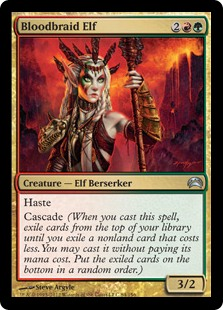
Bloodbraid elfAdmittedly, Bloodbraid Elf's 2013 ban article did not explicitly mention a metagame connection in these same unambiguous terms. It only provided two vague allusions in "Jund has been the most successful deck at high-level tournaments" and "While the rest of the format is quite diverse, the dominance of Jund is making it less so overall." As we'll see below, this omission does not mean broader metagame data was not considered. In fact, Bloodbraid Jund was by far the most offensive metagame violator of all. This strongly suggests its metagame statistics were indeed present in the unclear references quoted above, and in Bloodbraid's eventual ban. More importantly, if Pod, Deathrite, and Cruise were banned for metagame reasons with lower shares, it stands to reason Bloodbraid Jund would certainly have come under fire for significantly higher ones.

Now that we've seen the metagame theme repeated in ban announcement language, we can turn to the actual numbers to see how Wizards' rhetoric corresponds to hard data.

Banned Decks and Metagame Shares

The following data comes from Day 2 summaries for Grand Prix and Pro Tour tournaments. A few events (Grand Prix Kobe, Portland, Chicago, and Brisbane) are omitted for lack of publicly available Day 2 data. I am also excluding broader Paper and MTGO data, both because we don't have the same numbers Wizards does (we have samples, they have the true population), and because I only started tracking such data from April 2014 onward. By contrast, Day 2 metagame numbers are available to anyone with an internet connection.

We start with Jund in the Bloodbraid Elf era. Although its corresponding banlist update made only indirect references to Bloodbraid Jund's prevalence, the deck has the dubious honor of claiming the most lopsided shares of any strategy we'll talk about today.

Bloodbraid Jund (4/2012 - 1/2013): 19.4%

  • Grand Prix Turin: 19%
  • Grand Prix Yokohama: 8.9%
  • Grand Prix Columbus: 6.6%
  • Grand Prix Lyon: 21.3%
  • Pro Tour Return to Ravnica: 29.1%
  • Grand Prix Toronto: 24.6%
  • Grand Prix Bilbao: 26%

During its 2012 reign, the BGx Midrange monster commanded an average 19.4% of all Day 2 fields, with outrageous highs over 24% after Return to Ravnica added Abrupt Decay and Deathrite Shaman to its arsenal. By contrast, the next most-played decks in Modern averaged around the 9%-10% range for the entire year (Affinity and Pod variants). Jund's average doubled those share. Its highs more than doubled the peaks of the runner-ups. As players active during 2012 remember, Bloodbraid Jund set the dominance standard for years to come.

Deathrite BGx wasn't much better, even if the one-mana planeswalker spread his good fortune around many BGx players and not just Jund. The numbers below include all "different flavors of black-green decks", specifically the one-for-one attrition strategies cited in the February 2014 update.

Deathrite BGx (2/2013 - 1/2014): 18.1%

  • Grand Prix San Diego: 18.7%
  • Grand Prix Kansas City: 13.2%
  • Grand Prix Detroit: 20.9%
  • Grand Prix Antwerp: 19.8%
  • Grand Prix Prague: 17.8%

Averaging 18.1% over that post-Bloodbraind ban year, Deathrite Shaman BGx Midrange did its predecessor proud. Non-BGx decks lagged far behind the midrange players: Pod at 11.2%, Affinity at 9.8%, and URx Twin at 7.9%. Although the Shaman never quite reached the Bloodbraid heights of Pro Tour Return to Ravnica, where Jund was literally doubling the next most-represented strategy, the gulf between viable competitive strategies was still huge over 2013. Wizards justifiably axed Deathrite to restore format balance.

Of course, 2014 saw two decks rise to Jund's old 2012 and 2013 levels. Everyone remembers Birthing Pod and Treasure Cruise, and as the metagame statistics below indicate, it's no wonder Wizards cited metagame concerns three separate times in their joint banning article.

Birthing Pod (2/2014 - 1/2015): 16.1%

  • Pro Tour Born of the Gods11.2%
  • Grand Prix Richmond: 12.6%
  • Grand Prix Minnesota: 18.7%
  • Grand Prix Boston-Worcester: 23%
  • Grand Prix Madrid: 9.1%
  • Grand Prix Milan: 14.8%
  • Grand Prix Omaha: 23.3%

Cruise Delver (9/2014 - 1/2015): 17.5% (20.6% with Jeskai Ascendancy)

  • Grand Prix Madrid: 16.4% (18.2% with Ascendancy)
  • Grand Prix Milan: 18.7% (22.5% with Ascendancy)
  • Grand Prix Omaha: 17.3% (21.1% with Ascendancy)

The Pod and Cruise metagames emerged over two distinct but overlapping time periods. For its part, Pod was a multi-year phenomena that tipped past a breaking point in 2014. On the other hand, Cruise decks only became an issue after Khans of Tarkir, which accounts for Pod's shares spanning seven events but Delver's only covering three. As a quick note, I've added Ascendancy decks as a parenthetical, as Wizards mentioned the combo engine in their announcement.
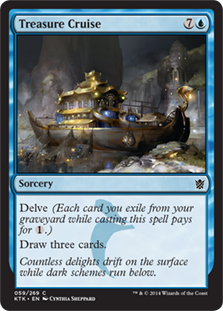
Treasure CruiseWithin those periods, we see the same pattern as observed in Jund. Delver occupied a monstrous 17.5% share during Treasure Cruise's brief stint in Modern. Adding in the Ascendancy and Burn statistics, both of which Wizards called out in their banlist update, would put the share well over 20.6% (a number including Ascendancy but excluding Burn). Trusty Pod took up 16.1% of the format. As in earlier updates, the competing strategies lagged far behind. Every BGx Midrange deck combined only maintained 12% of 2014 Modern, with Affinity at 10.9%, and URx Twin at 9.5%. This fit the same trend as seen in the Bloodbraid and Deathrite bannings, where decks reducing format diversity maintained multiple percentage point leads over competing strategies.

Thinking back to URx Twin's 2015 performances, we might think the combo deck enjoyed the same metagame success as it did in Top 8s. The numbers show a different story.

A Splintered Metagame Picture

Let's repeat the same analysis for Splinter Twin decks over 2015. I'll add in StarCityGames Day 2 statistics to create a separate average, but won't list them out individually to save space. In summary, the varied SCG Premier IQs, Classics, and Opens had a Twin high of 18.8% in February before dropping back to the 10%-11% range for the rest of the year. Incidentally, this fits the Grand Prix and Pro Tour pattern as well.

URx Twin (2/2015 - 1/2016): 12.8% (also 12.8% with SCG)

  • Pro Tour Fate Reforged7.8%
  • Grand Prix Vancouver: 18.5%
  • Grand Prix Charlotte: 18.2%
  • Grand Prix Copenhagen: 16.6%
  • Grand Prix Singapore: 10.7%
  • Grand Prix Oklahoma City: 9%
  • Grand Prix Porto Alegre: 9.5%
  • Grand Prix Pittsburgh: 12.1%

Comparing only raw values without metagame context, URx Twin's average Day 2 share of 12.8% is well underneath the next lowest of the format-diversity ban targets (Pod at 16.1%). Additionally, although Pod's share was increasing in the last months of 2014 after Siege Rhino's printing (which was itself explicitly cited in the update), Twin's had fallen to the 10% range from June onward, normalizing in that band. Naturally, these statistics are also far lower than those enjoyed by Bloodbraid, Deathrite, and Cruise decks.

The broader metagame context makes Twin's position even more puzzling. Throughout 2015, Affinity was right below Twin's 12% at a flat 10%, but BGx Midrange actually surpassed URx Twin at 16.5% for the entire Grand Prix and Pro Tour Day 2 dataset. No previous format-diversity bans took place when another archetype was so close to the so-called offender, let alone when a separate strategy had a higher net share altogether. These similarities also hold if we draw on past Modern Nexus metagame updates as a triangulation source, showing URx Twin at around 11.5% for the entire year across both Paper and MTGO, with Affinity behind at 8% and BGx still ahead at 12.5%.

The Lost Metagame Element

This leaves Twin's banning in an awkward spot. All previous format-diversity bans were justified due to both Top 8 offenses and metagame share violations. They also all targeted decks that were well ahead of the next most-played options. By contrast, Twin only struck out on Top 8 performances. Its metagame stake was well beneath previous diversity violators and trending down instead of up. URx Twin was also much closer to rival decks than were the format problems of earlier eras. This makes Wizards claim that URx Twin was "hold[ing] a large enough percentage of the competitive field to reduce the diversity of the format" much harder to believe.
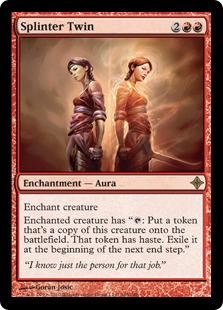
Splinter TwinBased on these missing metagame dimensions, we find ourselves asking a few potentially uncomfortable questions. Going forward, does Wizards no longer emphasize the metagame-wide shares for bannable decks? Or has the metagame bar dropped to a lower level than seen in any previous announcement? If so, will we find ourselves in a "race to the bottom" scenario, where the topmost deck could face ban scrutiny every year? Will that attention be more acute if the deck has a high-profile Top 8 record irrespective of its format presence? Are there other metagame numbers behind Twin's dominance the public can't access? If so, what are those figures? If not, what factors took their place in justifying the ban?

We may not know the answers to those questions for some time (if ever). I'm also confident there are many other questions worth addressing I didn't list above. Until Wizards weighs in or we obtain more information, this is a good starting point for us to continue our skeptical but constructive challenges on these issues. Based on the information we do have, however, this appears to be a striking gap.

The Pro Tour Factor
Ad NauseamNow that we've identified a major numeric inconsistency between Twin's banning and previous format-diversity ban decisions, we can turn to a second possible influence behind recent announcement: the Modern Pro Tour.

This component has already been discussed Ad Nauseam by writers and readers on this site, authors across the internet, and everyone with a keyboard throughout the general Modern community. SaffronOlive made the case on MTG Goldfish, Will Fancher offered a similar assessment on The Meadery, and Corbin Hosler discussed the Pro Tour/banning dynamic on the MTGPrice.com blog. Paulo Vitor Damo da Rosa also criticized the ban decision, concluding Modern should probably be removed from the Pro Tour altogether. To follow up on those positions, and on ones I've articulated in my own ban responses on the Nexus, I want to show where the Pro Tour might influence Modern bannings and talk about why this is problematic.

Timing, Correlation, and Causation

One of the more salient rebuttals to the Pro Tour and banning connection is about their scheduling. This standpoint, which Corbin Hosler articulated in his "Splinter Twin: The Ban, the Reaction, and the Fallout" article, holds that Modern follows an annual banning update cycle in January. Modern Pro Tours have just been added to that existing cycle to make it easier; as Hosler clarifies, "if your plan is to update the banlist once a year, why not time it right before the Pro Tour?" In making their case, Hosler and others alert us to a classic correlation and causation trap, where ban detractors believe the Pro Tour's proximity to the banlist update means it is also the cause of that update. Rather, because the 12-month banlist cycle preceded the Modern Pro Tour's February scheduling, it must be considered an independent event.

Unfortunately, those who hold this viewpoint have made a questionable assumption. They believe that because the banlist schedule was set before the Pro Tour that the Pro Tour thus has no influence on subsequent updates. This may well have been true back in 2013, when Bloodbraid Elf and Seething Song got cut on a January-based update calendar before a Standard (not Modern) Pro Tour in February. I do not think it is true today. As statements by numerous Wizards stakeholders show, there is strong evidence Pro Tour demands have co-opted a possibly independent ban schedule, changing its parameters to suit the Pro Tour's unique needs.

Changed Pro Tours, Changed Bans

The history of Modern bans and Pro Tours inevitably returns to Helene Bergeot's August 2, 2014 announcement about 2015 Premier Play. In the update, the original of which is linked here instead of the edited version, Bergeot revealed all four Pro Tours in the coming year would follow a Standard and Booster Draft format. Modern would instead receive support at the Grand Prix and World Championship level.

There was an immediate outcry across social media, game stores, and content sites. The public overwhelmingly denounced the change, accusing Wizards of trying to "kill Modern" among other charges. This rebuke prompted Wizards to backpedal. A mere eight days later, Bergeot returned with a revision to their original decision: "After evaluating all feedback and after further discussion, we have decided to add Modern to the 2015 Pro Tour schedule." This seemed like a triumph for the format and its players, and everyone was pleased with the community's collective victory.

There were two early signs that should have dampened our enthusiasm, or at least given us pause when we vouched for a Modern Pro Tour in the first place. The first was a Tweet from Aaron Forsythe explaining why Modern had been removed from the Pro Tour circuit in the first place:

In his comment, Forsythe pointed to a possible conflict between the nonrotating Modern and a promotional aspect central to Pro Tours. This shouldn't have come as a surprise. Pro Tours have always been, in part, advertising vehicles for new sets. This was present whether in 1996, when Wizards instituted deckbuilding requirements to showcase Homelands, or in the 2011 decision to name future tournaments after their proximal set release. Despite this longstanding emphasis, this rationale never actually appeared in Bergeot's original article, her retraction, or the edited update. This suggests both that there is more going on in these press releases than is just being written, while also pointing to a larger incompatibility between Modern and Pro Tours.

The second warning came from Magic R&D member Tom LaPille, Tweeting the same day as Forsythe made his own observation. Although LaPille's Twitter account is no longer functional, the screenshot of his message still exists online.
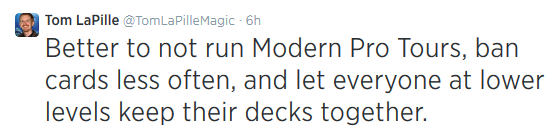
Tom-LaPille-Modern-Tweet

Not only was Forsythe suggesting Modern was a bad Pro Tour format. Now we also had LaPille explaining that Modern Pro Tours would lead to more bans for the format. Sadly, Twitter's character requirements don't allow for much context here, which is a reason many Magic authors lament Wizards' use of the platform to communicate such important statements. Even without added explanation, both Tweets suggest a pair of related reasons explaining why Modern was inappropriate for the Pro Tour, neither of which appeared in the Pro Tour scheduling announcement. LaPille's also draws out a troubling linkage between bans and Pro Tours, although we wouldn't hear more on this for months.

We know what happened next: Birthing Pod, Treasure Cruise, and Dig Through Time got jettisoned from Modern on the cusp of Pro Tour Fate Reforged. As we talked about in an earlier section, those bans were probably justifiable whether or not the Modern Pro Tour was just around the bend. But had the Pro Tour provided an additional incentive, as LaPille suggested? And would that pressure resurface in later updates?

Pro Tours and Bans Today

In a rare moment for internet sleuths, LaPille provided all the additional context we could want to his August 2014 Tweet in an April 2015 interview for the Masters of Modern podcast. I remember listening to that episode back in May and bookmarking his remarks for a later time, and if you haven't heard the whole conversation, take 45 minutes sometime this week to do that. Or read the transcript of the most relevant segment on Reddit, courtesy of user RedThragtusk.

Whether you've taken in the whole episode, reviewed the r/ModernMagic thread, or only heard it mentioned in passing, here is the critical excerpt from LaPille's remarks on Modern Pro Tours:

"I've been in the room several times when we had this conversation, which is "Do we run a boring Pro Tour, or do we ban cards out of a lot of people's decks in stores?" And so far, the answer has usually gone, 'We don't have a boring Pro Tour: we have to ban things.' "

Returning to the earlier discussion about overlapping Pro Tour and ban update timing, this is where we start to see how the tournament comes to influence an otherwise independent schedule. LaPille's remark, which Forsythe's later 2016 comments support, showed that Pro Tours create pressure to ban cards to jumpstart an interesting Modern format. This is what I have referred to as the "shakeup ban." Earlier in the interview, LaPille made the connection even more obvious, observing on bans "I think that's the cost of having a Modern Pro Tour every year, basically." The schedule may well have existed before the Pro Tour, and the Pro Tour may well have been tacked onto the existing schedule for pure convenience. But once the two were linked, regardless of why that linkage initially occurred, LaPille explained how the Pro Tour inevitably steers those future announcements. Are other factors still at play in the decisions? Yes. Is the Pro Tour itself now one of them and, if LaPille is to be believed, a decisive one? Yes again.

In light of LaPille's April comments, Forsythe's more recent remarks on the Splinter Twin banning are much clearer. Forsythe also emphasized the steering role Pro Tours play with Modern bans. Here's a brief rundown of the most important Tweets from the Twin banning weekend. I'll offer some commentary on each to situate them in the broader Pro Tour and banning context.

Between LaPille's original Tweet, his later Masters of Modern interview, and Forsythe's reply above, it becomes very hard to deny the additional "pressure" Pro Tours place on Modern bans. Modern would undoubtedly have "occasional bans" if it followed the schedule of other Eternal and nonrotating formats, but the Pro Tour exerts a secondary influence which those other formats don't feel. This influence affects both the timing and the content of those bans.

Forsythe's use of the word "predicates" is telling, further asserting a link between Modern's bans and the Modern Pro Tours which prompt them. It is important to not read too much into the specific term, however. We do not know if Forsythe is suggesting a direct causal link (unlikely) or simply a direct relationship between the two (much more likely, given the other evidence). Accounting for the statistical picture in the first section, along with the more qualitative elements in this second one, we can infer that Pro Tour demands are just one of many considerations in the ban. Of course, given LaPille's discussion about stagnant formats and bans shaking those up, this consideration seems much weightier than others, especially the metagame share component that is absent in the Twin ban.

Speaking of correlations and causations, the Tweet above most clearly challenges a direct causal connection between Pro Tours and bans. But again, this should not be surprising to anyone. We've already seen that bans have additional factors at play beyond the Pro Tour, whether the many dimensions cited in Jordan's Friday article, Sam Black's and Adrian Sullivan's defenses from last week, or the metagame statistics at the beginning of this piece. Even admitting those other determinants, however, the fact that the Pro Tour dictates timing is itself a major factor.
Birthing PodIn previous format-diversity bans, offending decks were either trending upward (e.g. Pod) or staying flat at obscene levels (e.g. Deathrite BGx) when the January ban hammer came down. In those cases, the Pro Tour's timing was unlikely to play too big an influence on the eventual ban: the numbers were already there regardless of upcoming tournaments. URx Twin was another matter entirely. Twin had fallen significantly from its early 2015 highs into the end of 2016, with no indication of an impending spike. Moreover, Oath of the Gatewatch promised to provide even more tools to Bx Eldrazi, a deck with an even-to-favorable URx Twin matchup. Amulet Bloom would also take a hit after Summer Bloom's banning, cutting one of Twin's best matchups from circulation.

Considering the Twin numbers and the overall Modern context, Splinter Twin's ban seems  premature. It feels particularly early when compared with the other format-diversity bans, which belonged to decks with massive metagame leads compared with Twin's much more modest shares. Unfortunately, because the Pro Tour dictates ban timing, Wizards had strong incentive to act in January 2016 instead of waiting to see how things played out at the Pro Tour. Modern enjoyed unprecedented deck diversity and tournament attendance throughout 2015, and that wasn't going to suddenly diminish in 2016 if Twin remained a 12%-13% format player. The Pro Tour made this more measured approach impossible.

We end with this quote because it encapsulates a number of core issues around Modern, bans, and the Pro Tour. Again, I make all these statements with the disclaimer that Twitter's 140 character constraints are very limiting, and I'd love to see Forsythe and others speak more fully on these topics in a proper article. Until that happens, however, we aren't just going to discount the Tweets entirely because of their shorter word-count. We can also use other sources to help zero in on Forsythe's implications.

The main takeaway is, of course, an umpteenth acknowledgment of Modern Pro Tours leading to Modern bans. By this time, there should be no doubt that such a connection exists and that this connection may have taken precedent over other metagame factors (namely, the missing metagame factor described earlier). The Tweet also teases out a much deeper communication gap in that relationship. Forsythe sounds surprised that Moderners in 2014 didn't consider this ban relationship when they advocated for a Modern Pro Tour in 2015. This should not come as a shock to anyone, because Modern players did not know this connection in August 2014. Bergeot only offered the following to explain why Standard, not Modern, would be 2015's regularized Pro Tour format.

"The first thing you may notice about this schedule is the format, which is consistent among all Pro Tours next year. Standard is the most commonly sanctioned event by a large margin, and it rewards players who are both good deck builders as well as skilled players. While Modern is not a Constructed format that will be used in 2015's Pro Tours, it will still see Premier Play support."

Even by the most generous reading, this passage makes neither a direct nor an indirect reference to Modern Pro Tours necessitating bans. There's also no inkling of the objections Forsythe or LaPille Tweeted the day of the announcement. On the one hand, I respect Wizards' (and, likely, Hasbro's) preferences for a mixed open-and-closed decision-making model. That's common practice in many businesses, and we certainly don't need to know every last justification for every single Magic decision. That said, there's a middle ground between a fully opaque model and a completely transparent one, and the intersection of Bergeot's, LaPille's, and Forsythe's statements show we are very far from that happy medium.

I suspect we wouldn't have pushed so hard for a 2015 Modern Pro Tour if we knew it would lead to bans. Maybe the community would have proven me wrong and stumped for it anyway. Either way, we should have known this information before taking a stand, and Wizards should make these considerations more widely available as we move forward beyond the Splinter Twin ban.

The Future of Modern Pro Tours

Forsythe's last Tweet's offers a final implication, which is also the open question I'll leave us with today: should Modern be a Pro Tour format? LaPille and Forsythe seem to think not, even though the overall community is divided. I have personally not decided, and my eventual argument one way or the other will hinge on the answer to a few final questions. What would Modern's ban schedule look like without Pro Tours in the picture? How else could Modern be supported at the pro player level if not at this tournament?

Taking all this evidence into account, I believe the Pro Tour factor took the place of the metagame dominance factor in this ban update. Twin didn't have the format-wide numbers but the Pro Tour definitely did need a shakeup: the absence of one and the presence of the other is strongly suggestive to me, especially in the context of the statistics and quotes presented today. Even if this connection is more circumstantial than real, this does not obviate the need for better communication from Wizards on Modern, Pro Tours, bans, and format policy. We don't need to know everything that goes on behind their closed doors in Seattle. We do need to know more information about the issues presented today.

Silver Linings

If I look beyond these two pressing objections, I'm still comfortable with the same ban elements I praised last week. Here's a brief list of banning benefits I didn't talk about today but are still worth remembering as we process the announcement:
  • Lightning BoltModern is likely to correct short-term trends towards linear decks.
    We play a powerful format with lots of strategies and synergies. Even if Affinity, Infect, Burn, Zoo, and others dominate for a time, they are unlikely to do so for longer than a few months. Expect BGx and other mainstays to return: Lightning Bolt and Inquisition of Kozilek are still potent regulators!
  • URx strategies will probably diversify.
    Although URx decks have enjoyed sporadic bouts of diversity throughout 2015 (Grixis Delver and Control in spring and summer, UW Control in early fall, etc.), Twin often reasserted itself as the leader of the URx pack. With Twin gone, we have a chance for other URx strategies to shine which could be a net gain for format health. As a related point, it shouldn't be too hard to find new policing strategies to take Twin's place.
  • Modern overall will probably diversify
    Short-term linear tendencies notwithstanding, Modern is likely to move towards more three and four-drops which were otherwise unplayable in a Twin environment. This could make Modern more interactive, as long as decks adapt to rein in any initial slides towards aggro and noninteractive combo.
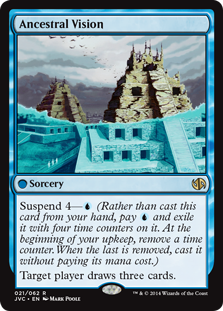
  • Ancestral VisionUnban opportunities abound
    Ancestral Vision, Preordain, and Jace, the Mind Sculptor were all indefensible unbans with Twin in the picture. All three of those cards are now on the table to bolster blue strategies, if they eventually need help. Stoneforge Mystic also becomes increasingly possible, now that a hybrid Twinblade strategy is dead on arrival.
  • Reprint and new card possibilities are opened
    Cards like Counterspell could never happen in a Modern with Twin. They might still never happen in Modern period, but at least the blue design space is opened. I for one would love to see generic answers like Force of Will (or similar variants) to help regulate linear decks.

All told, I am happy with these five possibilities, and have been happy with them since Wizards announced Splinter Twin's death two weeks ago. That said, I am still very dissatisfied with the absent metagame component and the mysterious Pro Tour factor, particularly with the intersection between the two. Even if all five of my banning hopes come true, I would still be deeply uneasy with these elements because they can rear up again in future situations with worse results. Wizards needs to speak to these issues, not for me but for the Modern community as a whole.

This is my Final Stand on the Twin issue for the near future, but you can be certain I'll return to these problems as we gather more information. What do you think about the missing metagame numbers and the Pro Tour/banning relationship? Are there any sources you think I missed or other pieces of evidence you wanted me to discuss more? Do you have any questions about the arguments, cases of your own to make, or objections I should hear? I'll catch all of you in the comments and join me for the rest of the week as we stop talking about bans and start diving into the new Modern and its exciting possibilities!

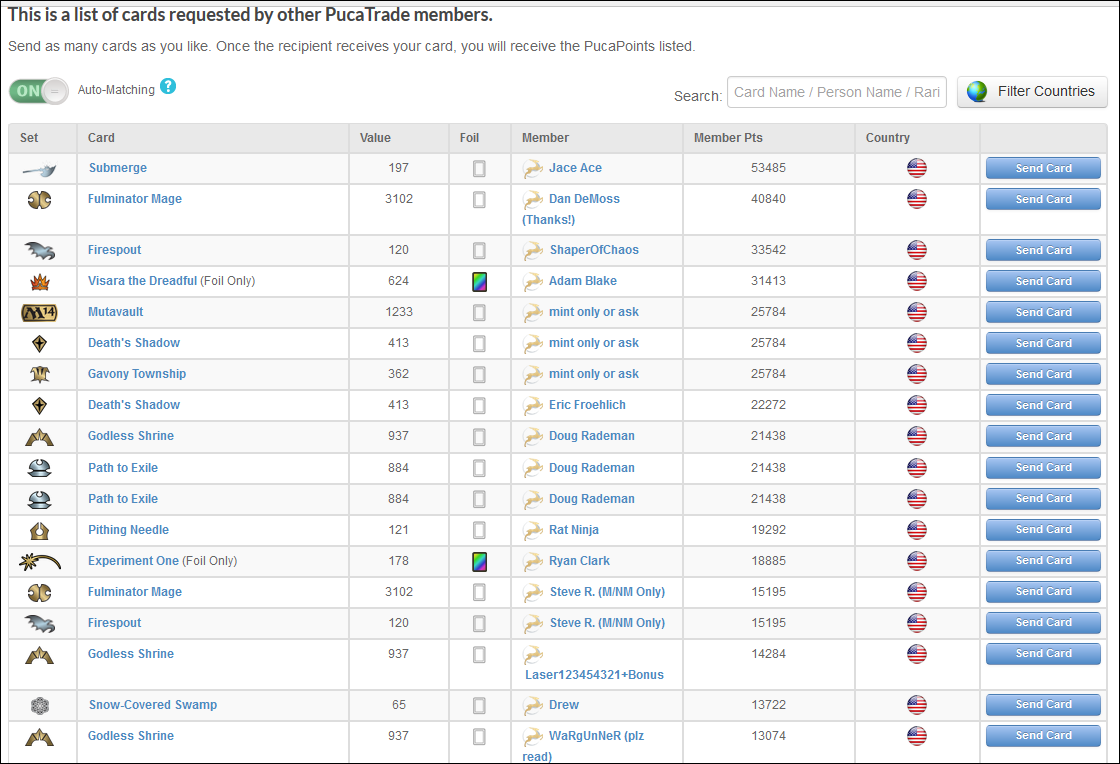
Insider: Mastering PucaTrade – Advanced Techniques

Are you a Quiet Speculation member?

If not, now is a perfect time to join up! Our powerful tools, breaking-news analysis, and exclusive Discord channel will make sure you stay up to date and ahead of the curve.

In the first part of my series on PucaTrade, I covered the basics of how PucaTrade works, the Silver and Gold tiers, and best practices for sending trades. Now I’ll talk about how to really leverage PucaTrade to gain maximum value for the cards you’re sending, and to receive the cards you want before someone else takes them.

Becoming a Silver or Gold User

If you pay to become a Silver or Gold user on PucaTrade, your listings are grouped at the top: gold first, then silver, then the rabble at the bottom. This is a low-pain way to make your cards more prominent. Also, if you advertise your affiliate link and a friend signs up, you get points from PucaTrade... but only if you’re Silver or Gold.

PucaTrade - Gold Users

Offering Bounties

Many of the serious PucaTraders offer bounties on cards they’re really after. Bounties are advertised on user profiles and even at the end of usernames. For example, I might change my username to Username 300pp BOUNTY ON STEAM VENTS. That way, someone scrolling through the listings looking to trade away a Steam Vents might see my name first and desire the extra 300 PucaPoints.

Bounties are an imperfect science, though, since there’s no good way other than the above to promote them, and no way to ensure the recipient sends you the bounty besides the honor system. There’s a third-party site, not affiliated with PucaTrade, called PPBounty that was created to facilitate Puca bounties more easily.
PPBounty - PucaTrade bounties

Activating Bots

Often, the best trades are scooped up in a matter of seconds, leaving only the dregs for casual PucaTrade bargain hunters. For example, if you desire a Standard staple, someone will send it to you instantly. But try to unload a Canopy Vista, and it’ll rot in your Haves for ages.

Bots are automated scripts that attempt to solve this problem by constantly monitoring the Send a Card page for cards you have, then automatically accepting those trades when it finds them. Setup is fairly easy (even easier on a Mac than a PC) and it’s nice to fire up the script, leave for work, then come home and have a big stack of cards to mail out that you couldn’t care less about.

The automated nature of these bots means that you could activate one and accidentally approve a trade that you wouldn’t have manually, so be sure your lists are entirely accurate before doing so.

The PucaTrade people have not banned bots as of yet, so don’t fear that you’ll get into account trouble by using them. However, beware of any third-party app that asks for your account password. If you want a good example of a reputable bot, try Pucauto.

PucAuto - PucaTrade bot

Leveraging Price Spikes

The PucaPoint algorithm is based on price data from numerous sources and is as much a secret formula as the Krabby Patty recipe. However, it’s not updated in real time, but instead periodically throughout the day.

That means that if a card spikes in value on TCG Player due to a buyout, and the corresponding buylist prices rise at your favorite online card sellers, then sometimes Puca can be slow to react. Many sharks take the opportunity to spec on multiple copies of the same card this way, and some get lucky before the Puca values correct themselves.

Be sure you keep an eye on that PucaPoint value and shut off the trades when they start to align themselves. Conversely, when Splinter Twin got banned, many copies flooded PucaTrade before the price started to plummet. Complete those trades before a banned card crashes.

It’s also the case that a card will spike not because of a buyout, but because a deck is hot. It never hurts to hoard Modern Tron staples through PucaTrade, for example, because there’s no ban imminent and prices on cards in the hottest deck in Modern aren’t going anywhere but up for a long time.

Of course, the old maxim is true: the best time to buy into Modern is two years ago, and that goes for trading, too. Keep an eye on when a player discovers a brand new deck in Modern, like the hot Eldrazi deck, and grab everything on PucaTrade as soon as you can. Not only will you get value out of the cards you’re receiving, but if you decide to play with the cards, you’ll get to play a fun new deck.

Acquiring PucaPoints

Officially, PucaTrade doesn’t want you to acquire PucaPoints outside of its own store, where $1 equals 100 points. If you call too much attention to yourself engaging in this practice, you can get banned or suspended. If you do PayPal someone for a big pile of points, though, the market rate is between $0.60 and $0.70 per 100 points.

This makes the trades you receive an even better value, as it means that buying points and acquiring cards on PucaTrade becomes cheaper than buying singles outright. But you didn’t hear it from me.

Sending Many Cards Together

After accepting someone’s trade and agreeing to send a card, have a look through that person’s profile. Often, you can accept a few more trades, perhaps for lower-value cards, and send them all at once to the same person. Not only will you save on postage, but you’ll also get that many more points when the other trader receives and approves all the trades at once.

PucaTrade - Low Value Cards

What Not to Do

There's a meme going around about fleecing PucaTrade users. It goes like this: Speculate on many copies of an obscure card with low supply, then when the PucaTrade algorithm responds to card shops running out of cheap copies and inflates the PucaPoint value, send away to all the unsuspecting casual users that have this card on their want lists.

Don't be that person. When trading Magic cards, reputation is everything. If you feel you might have been taken advantage of in this way, contact a Puca admin and he or she will attempt to resolve the situation.

More to Come

In the next article, I’ll really get down into the nitty gritty and explore real-world examples of all the advanced PucaTrade techniques I’ve discussed. Look for it soon!

Deck Overview- Abzan Blue

Are you a Quiet Speculation member?

If not, now is a perfect time to join up! Our powerful tools, breaking-news analysis, and exclusive Discord channel will make sure you stay up to date and ahead of the curve.

I'll start off by saying that I'm not in love with Standard deck nomenclature. The name here reads like blue splashing Abzan... Sooner or later fetchlands will rotate out of Standard and this nonsense will sort itself out, so we have that going for us anyway. Seeing as the name doesn't realistically tell you anything about this deck, feast your eyes on the list that took 8th at the Open in Atlanta this weekend:

Abzan Blue by Willie Porges

Creatures

2 Den Protector
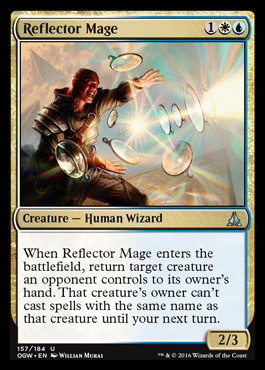
4 Reflector Mage
4 Siege Rhino
4 Warden of the First Tree
1 Wingmate Roc
4 Anafenza, the Foremost
2 Tasigur, the Golden Fang

Spells

3 Gideon, Ally of Zendikar
2 Dromoka's Command
2 Murderous Cut
3 Stubborn Denial
4 Oath of Nissa

Lands

2 Forest
1 Plains
1 Swamp
2 Canopy Vista
4 Flooded Strand
4 Polluted Delta
1 Prairie Stream
1 Smoldering Marsh
1 Sunken Hollow
4 Windswept Heath
4 Wooded Foothills

Sideboard

2 Disdainful Stroke
1 Dispel
2 Hallowed Moonlight
1 Ojutai's Command
2 Jace, Vryn's Prodigy
1 Exert Influence
2 Painful Truths
4 Self-Inflicted Wound

You might be thinking that the decklist here is missing four cards, but it looks like Willie found a way to keep it at 60. Oath of Nissa is a nice way to smooth your draws, but the big upgrade here is in Reflector Mage. Reflector Mage is already making a huge mark on Standard in both this deck and the new lists for Rally the Ancestors- I also watched it take second in a Modern IQ this weekend! The card just generates so much tempo, both as a great early game play to offset your opponents curve, or a late game play to clear up the board a little for a full turn cycle.

There was an error retrieving a chart for Reflector Mage

Interestingly, traditional Abzan lists didn't make a great showing this weekend due in no small part to the very card that Willie adopted! Rally decks have been utilizing Reflector Mage to bounce Anafenza, the Foremost and Kalitas, Traitor of Ghet and go off, which has arguably turned the Rally decks worst matchup on its head. The blue lists, however, can utilize Stubborn Denial to just counter the Rally, which puts them in a much stronger position in the metagame.

I have to imagine that despite not having a combo kill, Reflector Mage is still a very punishing card for Abzan "mirrors", which are also made better by the sideboard Exert Influence and Jace, Vryn's Prodigy. The sideboard Disdainful Strokes also help quite a bit against Eldrazi Ramp, which has been a poor matchup for Abzan historically.

Seeing as four color decks have been successful for the entire run of Battle for Zendikar Standard, it's evident that adding the extra color to Abzan isn't terribly problematic. Given the punch that the blue spells pack against many of the most commonly played strategies in Standard, I'd be surprised if we saw too many Abzan decks without the blue splash in the future.

There aren't really rares in this deck that I like investing in, but I wouldn't be surprised if Reflector Mage ended up being worth a couple bucks before long. If Monastery Swiftspear can be $3 in the most opened set of all time, then I don't see why a small set uncommon with so much promise couldn't do the same.

Insider: Three Specs in a Linear Modern

Are you a Quiet Speculation member?

If not, now is a perfect time to join up! Our powerful tools, breaking-news analysis, and exclusive Discord channel will make sure you stay up to date and ahead of the curve.

It's time to move on from bans and get back to Modern. Although every metagame development after this point will be situated in the Splinter Twin ban context, we still need to push beyond the ban discussion and return to things we love about Modern: metagame analysis, new decks, and zesty tech.

If you want a Last Word on the Splinter Twin ban, you can check out my Modern Nexus article posting later today. If you're Sick and Tired of banlist conversation, stick around here because we're returning to the metagame and some key pickups in this new format.

Big Players After the Big Ban

As many authors and players have attested, Modern is likely to undergo a short-term shift towards linear decks. We saw a similar trajectory back in September and October, when Twin's retreat saw a temporary uptick in Affinity, Burn, Infect and Zoo variants. We are also seeing early signs of this movement in a pair of tournaments reported on Reddit, featuring these same decks along with R/G Tron and B/x Eldrazi.

Ultimately, Pro Tour Oath of the Gatewatch will decide Modern's post-ban landscape, but these initial datapoints (coupled with extensive theorizing) suggest we are looking in the right direction.

This means we also need to look to these linear decks for short-term profit potential. Although Modern is likely to evolve beyond an immediate linear shock, we won't be able to identify this later evolution for some time. Linear staples, however, are hotter than ever before.

Today, I'm going to look at three cards I've had on my investment radar since even before the Splinter Twin banning. Modern's 2016 future has significant uncertainty, but the upside and ceiling of these three cards is a much surer bet.

1. Spoils of the Vault

Remember Ad Nauseam combo? Grand Prix Charlotte viewers will surely look back on Darien Elderfield's 5th place finish with fond nostalgia. Or mild annoyance, if you're not a fan of Modern's linear menagerie. Either way, it's hard to deny Ad Nauseam's power in an unprepared metagame, which is exactly where we find ourselves today.

From an investment standpoint, Ad Nauseam, Lotus Bloom and Angel's Grace all promise some value if the deck takes off, but the card I'm most interested in is the aggressive Spoils of the Vault.

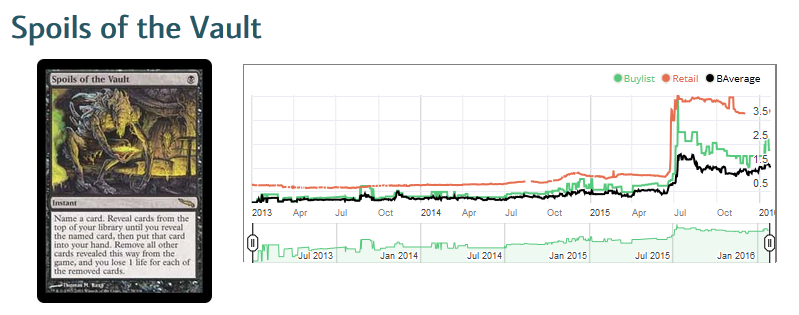
There was an error retrieving a chart for Spoils of the Vault

Spoils has all the trappings of a breakout speculation if its home deck enjoys a breakout performance. It's a Mirrodin rare, which means an old card in a set with no mythics. It has also never seen a reprint, unlike similar Mirrodin money-makers like Oblivion Stone and Chalice of the Void. Even without any history of price increase, these metrics alone would make Spoils a possible steal.

Fortunately for those with Spoils of the Vault in stock, the powerful tutor did have such a spike in its price record. Following Elderfield's Charlotte finish, Spoils leaped from around $1.20 to the $4.30 range.

If this price change could happen after a single Top 8 finish with minimal metagame presence, Spoils could be due for an even bigger jump following a major win at Pro Tour Oath of the Gatewatch or the subsequent Grand Prix events in March.

Spoils Price Chart

Spoils has been falling since Elderfield's finish, but a single notable showing would reverse this. 2016 is ripe for such a turnabout. Before the ban, Ad Nauseam suffered from an uncertain URx Twin matchup and a downswing in one of its favored opponents, Burn.

After the ban, Twin is gone, Burn is likely at its zenith, and R/G Tron is bigger than ever. This is a favorable environment for the combo strategy, and sideboarded Leyline of Sanctity will handle most B/x Eldrazi woes you encounter. The Infect matchup remains awful, which could undermine Ad Nauseam's chances if Blighted Agent and friends slink up to the top of the post-ban pile, but the risk on Spoils is so low that it's likely worth the dollars.

Everyone is far too worried about Affinity, Burn, R/G Tron, B/x Eldrazi, and possible Twin successors to be thinking about Ad Nauseam. Buy in on deck staples now and just wait for combo players to reprise Elderfield's success.

2. Inkmoth Nexus

Ladies and gentlemen. Moderners and Magic investors. I want someone to explain to me why this card still has 23 copies available on TCGPlayer.com as I'm writing this article. You entrepreneurs are either missing your cues or there has been some leaked information about a Modern Infect Event Deck.

Unless it's the latter, go out there right now and clean house on any available copies of this Affinity and Infect mainstay. You can't play the decks competitively without Inkmoth Nexus and these strategies are likely to rack up impressive mileage in the coming months.

There was an error retrieving a chart for Inkmoth Nexus

I've mentioned Inkmoth in many of my recent articles, including last week's piece on the Twin banning aftermath, and I'll continue to do so until their retail price is no longer profitable or a reprint is confirmed. If Glimmervoid can climb to the $40 bracket off Affinity and Lantern Control, you can bet Nexus can get there off Affinity and Infect. The infector doesn't even benefit from a Modern Masters reprint!

From a metagame perspective, Affinity's worst matchup in 2015 was easily URx Twin. Splinter Twin has gone the way of the Birthing Pod, which means Affinity's greatest adversary is gone and the Modern field is ripe for the picking. As I've written about in previous Modern Nexus metagame breakdowns, Affinity has been a Tier 1 deck throughout all of 2015, seeing shares as high as 12% at times.

If that can happen in a URx Twin world, imagine what will happen with Twin gone and with Infect also picking up ground in a Twinless field.

Inkmoth Nexus Enablers

Honestly, the only reason to stay away from Inkmoth is if you are paralyzed by the prospect of an Infect Event Deck. This is definitely not an impossible scenario.

Infect dodged a ban bullet in the January 18th update, and even if this wasn't for sinister marketing purposes, it suggests the deck could be a strong top-tier Event Deck option. The deck has a diverse distribution of cards across the rarity spectrum, and budget versions can be just as viable as better ones. All of this might point to a pending Event Deck nod.

That said, there's already (more than) enough Modern hype around the Pro Tour. It is more likely Wizards would wait on an Event Deck release announcement until the March Grand Prix weekend, instead of spilling the beans during the Pro Tour. Or maybe they use the Pro Tour as a springboard for the Event Deck, knowing a captive audience is in attendance.

Even if this happens, you are guaranteed to make money off Inkmoths in the next 2-3 weeks. If it doesn't happen, however, you'll easily multiply your investment by 150% to 200% in the early months of 2016. It's up to you if you think this is worth the risk, but as we know, Modern speculation goes to the bold.

3. Urborg, Tomb of Yawgmoth

I've been playing Modern since 2011, and I don't remember a breakout deck that caused so many spikes across so many cards in such a short time frame. Eye of Ugin went nuclear from $4 to $34 in the course of one and half months. Inquisition of Kozilek, already looking to push well past $15, is now over $20. Even the humble Relic of Progenitus is now a $4 common!

Hype has been such a driver in these price changes that it's hard to find anything else worth buying. All the staples have already been picked clean across the online and local store markets. That said, I think there's one more card which has not yet reached its peak: the third piece of the so-called Eldrazitron.

There was an error retrieving a chart for Urborg, Tomb of Yawgmoth

Urborg, Tomb of Yawgmoth combines with Eldrazi Temple and Eye of Ugin to form the midrange/ramp hybrid's engine. These are the cards which enable turn two Wasteland Stranglers and turn three Oblivion Sowers. Urborg in particular ensures the deck can play both the midrange Thoughtseize and Inquisition angle while always threatening the big ramp angle.

Urborg is currently hovering around $15, buoyed by a Magic 2015 reprint of its Planar Chaos original. Can the land get any higher given this circulation? I believe it can and again, I look to Glimmervoid as a similar example. The original Mirrodin run of Glimmervoid was actually larger than the Planar Chaos run of old Urborg, Tomb of Yawgmoth, so on this initial count, Urborg seems to have better upside than the Affinity staple.

There was an error retrieving a chart for Glimmervoid

It's hard to compare the Modern Masters and the Magic 2015 runs, but my suspicion is Magic 2015 had more packs than did the limited-printing Modern Masters set. This would be a strike against any financial ground gained by Urborg from its Planar Chaos edge. Moreover, Affinity will probably always see more play than B/x Eldrazi, underscoring a more consistent demand schedule for Glimmervoid.

That said, B/x Eldrazi has a major publicity dimension that veteran Affinity lacks. Also, the space between Urborg's current high of $15-$20 and Glimmervoid's tag of $40-$45 is considerable. As long as Urborg settles anywhere in the middle, you make money.

I expect we'll see lots of B/x Eldrazi at the Pro Tour and in the coming months, and I would be shocked if Urborg, Tomb of Yawgmoth could not sustain a $25-$30 value. You'll need to put more money into this investment than into a steal like Spoils of the Vault (or Eye of Ugin at the beginning of the Eldrazi price shocks), but the return could be big if the deck pays off in February.

Processing the New Metagame

While B/x Eldrazi is processing all your exiled creatures and lands, I'll be processing the metagame data from upcoming Star City Games events and similar regional tournaments. Hopefully we'll start amassing enough data to start drafting a proper picture of a Modern without Splinter Twin. Unless our Modern understanding is more obsolete than we thought, however, linear decks and their staples are likely to be huge in the new Modern.

What other cards are you eyeing as we enter the Pro Tour season? How do you feel about Ad Nauseam, Infect, Affinity, and B/x Eldrazi as February opens? Any last words on the bans yourself before we turn the page on that chapter?

Come find me in the comments and I'll see all of you next week!

A Defense of the Splinter Twin Ban

Are you a Quiet Speculation member?

If not, now is a perfect time to join up! Our powerful tools, breaking-news analysis, and exclusive Discord channel will make sure you stay up to date and ahead of the curve.

My Saturday morning kicks off a lot like yours. I roll out of bed, throw on some Future, have a latte. Get on Facebook. Then, my inbox starts exploding. "Is Modern dead?" “How do you feel about the ban?” Dead? What ban? Wait, there are links. Links from Magic players I’ve never met. The same link, multiple times. I click the link and read. Faster and faster, missing chunks of text. Missing entire paragraphs. I’ll just go back to them later. I reach the end.

"In the interest of competitive diversity, Splinter Twin is banned from Modern.”

combust art mtg

How do I feel about the ban? I don’t know how I feel about it. I’m having many feelings right now. I need some time to think. Let me get back to you.

It’s been six days, and I’ve thought about the Splinter Twin ban. I’ve also read and heard about it. All week. It seems like Modern players think this ban is about the Pro Tour. They call it unfair and premature. They don’t believe Twin had it coming.

I feel the opposite way. Wizards' January 18th announcement outlines a number of causes for the Splinter Twin ban, and they check out. This article explores the viability of Wizards' rationales, dissects unofficial reasons for the ban, and forecasts the future of Modern.

[wp_ad_camp_1]

Processing the Pre-Ban Metagame

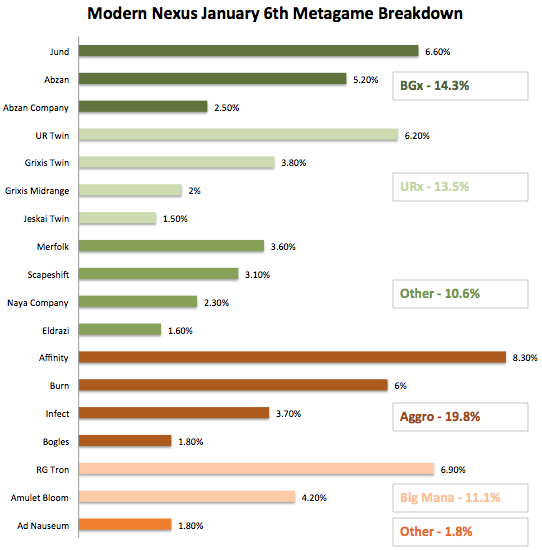
Before discussing whether Wizards was justified in their banning of Splinter Twin, we'll check out the most recent Modern Nexus metagame breakdown, from January 6th, 2016. Visualizing the pre-ban metagame should give us an idea of Wizards' view of Modern.

Screen Shot 2016-01-22 at 12.14.21 PM

I've organized the Tier 1 and 2 decks into six categories, coloring interactive decks green and linear decks orange. We'll refer to this chart throughout the article.

BGx, URx, and Linear City

Modern decks have historically identified with one of three camps. BGx combines flexible removal, catch-all discard spells, and efficient beaters to grind out fair decks and pick apart synergies. These decks include Jund, Abzan, and the more aggro-aligned Abzan Company. URx gets the awesome power of Bolt-Snap-Bolt, Blood Moon, and stack interaction. UR Twin, Grixis Midrange, and my beloved RUG Delver all huddle under the URx umbrella.

BGx and URx represent Modern's pillars of interaction. If you want to interact in this format, you almost always sleeve up one or the other. A spattering of unique decks (Merfolk, Zoo, etc.) comprises a third interactive category, which doesn't fall into BGx or URx. These archetypes have usually occupied a minority share in Modern, even taken together. We can call just about everything else in Modern "linear."

Twin's Banning, According to Wizards

In their January 18th banlist announcement, Wizards gave several justifications for the Splinter Twin ban. This section analyzes each. In keeping with its other banlist announcements, the company chose its words carefully and appeared purposefully cryptic in some of its language. That language is all we get with these kinds of announcements, so it's crucial to carefully dissect the text if we want to fully understand the announcement.

Metagame Presence

"We also look for decks that hold a large enough percentage of the competitive field to reduce the diversity of the format."

Deathrite ShamanMetagame presence bans are well-documented in Modern. Deathrite Shaman, Bloodbraid Elf, Birthing Pod, and Treasure Cruise all crumbled under the banhammer because they helmed ubiquitous decks.

Let's consult the January 6th breakdown. Combined, the Tier 1 and Tier 2 Splinter Twin strategies make up 11.5% of the metagame. That's only 3.3% higher than Affinity, at 8.2%, and about even with BGx Midrange decks, at 11.8%. But we're not seeing a Liliana of the Veil ban.

Twin doesn't seem that offensive to me on the metagame dominance count, so I don't love the inclusion of this sentence in Wizards' announcement. In terms of writing composition, it serves to bridge "gracefully" from explaining the Summer Bloom ban to detailing the Twin ban. Realistically, all it does is confuse players who look at the numbers. Splinter Twin just doesn't make up an influential chunk of Modern compared with past offenders. Moreover, Twin has often hovered around 10% representation in Modern. Wizards hasn't banned it for this reason before, so it makes little sense to ban it for this reason now, especially considering Modern's recent shifts and the looming Eldrazi future.

It appears from the rest of the announcement that metagame dominance is not the primary reason Wizards banned Splinter Twin.

Winning Too Much

"Antonio Del Moral León won Pro Tour Fate Reforged playing Splinter Twin, and Jelger Wiegersma finished third; Splinter Twin has won two of the four Modern Pro Tours. Splinter Twin reached the Top 8 of the last six Modern Grand Prix. The last Modern Grand Prix in Pittsburgh had three Splinter Twin decks in the Top 8, including Alex Bianchi's winning deck."

Splinter TwinMany Modern players consider this excerpt the scariest part of Wizards' announcement, and I think it's the reason for most of the outrage related to the ban. If Splinter Twin gets banned for "winning too much," doesn't Modern become an environment where players root against their own decks for fear of a ban on their own expensive 75? In that case, doesn't this announcement set a paranoid tone for Modern and encourage ban-mania?

I don't think so. After all, banning the winningest deck is nothing new in Modern. Many Twin players I've spoken with, and read, erroneously consider the ban on their namesake card unprecedented. In fact, Modern boasts a rich history of banning decks that succeed too much in Wizards' eyes. Take this quote, from the Birthing Pod ban announcement:

"Over the past year, Birthing Pod decks have won significantly more Grand Prix than any other Modern decks and compose the largest percentage of the field. [...] Pod won five of the twelve Grand Prix over the past year, including winning the last two."

Wizards cares about how well decks perform, and how many Top 8 slots they take up over the course of a given year. The evidence above, like that from the Twin announcement, is restricted to a few sentences. Wizards writes so sparingly on the subject because they've already dedicated three paragraphs to this position, back when they banned Bloodbraid Elf:

"[...] Jund has been the most successful deck at high-level tournaments. Yuuya Watanabe won the Magic Player's Championship playing Jund. Then, Yuuya came in 2nd at Pro Tour Return to Ravnica by playing Jund again.

At that point, it was clear Yuuya was dominating, but the status of Jund in Modern was less clear.

Since then, we have had four Modern Grands Prix. Jérémy Dezani won Grand Prix Lyon playing Jund. Jacob Wilson defeated Josh Utter-Leyton in a Jund-on-Jund finals to win Grand Prix Chicago. Willy Edel won Grand Prix Toronto, also playing Jund. And, finally, Lukas Jaklovsky came in 2nd, playing Jund, at Grand Prix Bilbao. Beyond that, Jund took six of the Top 16 decks at Bilbao."

R&D wouldn't include such an expansive history lesson in a banlist announcement unless it desperately wanted to tell us something: decks that win too much get banned in Modern. Splinter Twin meets this criterion for a ban.

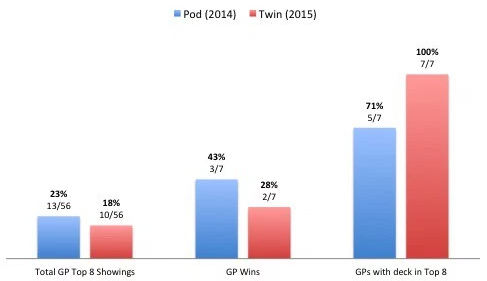
We don't know Wizards' exact parameters for "winning too much," but we at least have some data to mull over. Prior to the Twin ban, Birthing Pod got the axe in January 2015. The most recent ban at that point had been Deathrite Shaman's, in February 2014. Between each banning, we've had seven GPs to consult. I've analyzed each one to compare Twin's win ratio with Pod's.

Screen Shot 2016-01-22 at 6.29.24 AM

2014 GPs: Richmond, Minneapolis, Boston-Worcester, Kobe, Madrid, Milan, Omaha
2015 GPs: Vancouver, Charlotte, Copenhagen, Singapore, Oklahoma City, Porto Alegre, Pittsburgh

Pod leads Twin in number of decks in all GP Top 8s for its ban cycle by just 5%, and in total number of GP wins by one. These two decks, during their respective cycles, are the only ones to win multiple GPs. Additionally, Pod was absent from the GP Boston-Worcester and the GP Kobe Top 8s. Splinter Twin, on the other hand, made at least one appearance in every GP Top 8 since the Pod ban. Notably, Twin hardly made a showing in 2014, holding a 0.7% Top 8 share and winning zero GPs.

"Winning too much" may be a vague, debatable measure for us, but these numbers indicate that Wizards adheres to strict cutoff points when analyzing data. In comparing Twin’s results from the last year to Pod’s similar ones from the year before, that Wizards banned Twin for this reason becomes totally unsurprising.

Keeping Other Archetypes From Succeeding

"Decks that are this strong can hurt diversity by pushing the decks that it defeats out of competition."

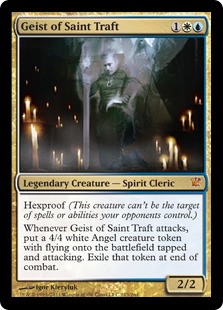
It stands to reason tGeist of Saint Trafthat if Twin by default occupies 18% of all major event Top 8 spots in a given year, the remaining 82% become more competitive, and fewer decks can make it in.
From a brewing perspective, the Twin ban does open up deck design space. No more must players fear tapping out on turn three for Geist of Saint Traft or Domri Rade. Even if a URx player counters the spell, he won't just win on the next turn. Previously, decks with these cards were forced to leave mana up against URx unless their opponent graciously tapped down one of his three lands for a Serum Visions.

We obviously don't know what the Modern metagame will resemble without Twin. Neither does Wizards. But that's fine with them. They'd just like URx to give up some shares at the top tables.

Homogenizing URx

"[Decks that are this strong] can also reduce diversity by supplanting similar decks. For instance, Shaun McLaren won Pro Tour Born of the Gods playing this Jeskai control deck. Alex Bianchi won our most recent Modern Grand Prix playing a similar deck but adding the Splinter Twin combination. Similarly, Temur Tempo used to see play at high-level events but has been supplanted by Temur Twin."

This passage refers to the homogenization of URx, which Wizards correctly identifies as overwhelmingly packing the Splinter Twin combo.

In the January 6th metagame breakdown, the non-aggro linear decks are mostly Big Mana decks. Each flavor of Big Mana has its own fastlands - RG Tron uses the Tron lands, Amulet uses Karoos, and Eldrazi uses Eye of Ugin and Eldrazi Temple.

Screen Shot 2016-01-22 at 6.29.11 AM The three decks don't share a single card between them. As for the aggro decks, Affinity and Burn sit firmly at the top of the heap, but they don't exclude other unique strategies - Bogles, Merfolk, and Naya Company - from the top tiers. Like the Big Mana decks, each aggro strategy has its own set of staples.

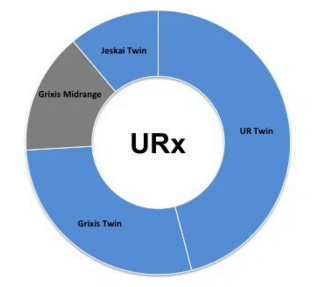
In BGx, things appear a little less diverse. Abzan Company totes a miserly 2.3% metagame share compared with Jund and Abzan's combined 11.8%. The URx section suffers from similar issues. Of the four decks, together represented at 13%*, only one - Grixis Midrange - omits the Splinter Twin combo. This deck clocks in at just 2%.

*I've included Scapeshift in its own interactive category, since RUG builds share their percentage here with toolbox-oriented Bring to Light ones. If we cut Scapeshift's 3.1% share in half, and add 1.5% to the URx bracket to account for RUG Scapeshift, Splinter Twin still shows up in a whopping 73% of all Tier 1 and 2 URx decks.

The recent breakdown numbers initially suggest Rock decks revolving around Liliana of the Veil and Abrupt Decay homogenize BGx as much as Splinter Twin homogenizes URx. But Wizards seldom bans cards for a single reason. Rock decks don't meet the other listed criteria for a ban, and Twin decks do.

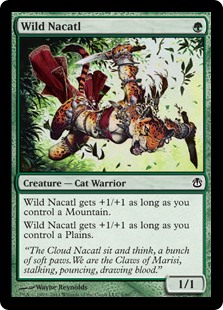
Cards have been banned for this reason before. On December 20, 2011, Wizards banned Wild Nacatl from Modern for homogenizing aggro decks:

"We looked at our Modern tournaments and previous Extended tournaments to find when the attacking decks were fairly diverse, and when they were dominated by Zoo.

[...]

The problem is that other decks try to use synergy to get rewards, but those rewards aren't any better than the Wild Nacatl. For example, the Doran decks use Treefolk Harbinger to find Doran. When it all works, the Harbinger is effectively a 3/3 for Green Mana. With shock lands, Wild Nacatl is a 3/3, and doesn't let you down when your opponent kills your Doran. With some effort, Student of Warfare becomes a 3/3 first strike creature, but that isn't a sufficient reward for the effort compared with Wild Nacatl. This creature is so efficient it is keeping too many other creature decks from being competitive. So, in the interest of diversity, the DCI is banning Wild Nacatl."
Wizards eventually overturned the Wild Nacatl ban, but the banning still set a precedent for removing cards from Modern that homogenize certain archetypes. In the Twin ban announcement, Wizards mentions Shaun McLaren's Pro Tour Born of the Gods finish with Jeskai Control to make the same point. According to Wizards, the "rewards" of casting Splinter Twin in URx greatly outweigh those of trying to win with Spinx's Revelation or Huntmaster of the Fells, and come at a minimal deckbuilding cost to URx mages. Whether or not we agree with this assessment, Wizards has the numbers on their side; among Tier 1 and 2 Modern decks, Splinter Twin undeniably shows up in a remarkable portion of URx strategies.

Non-Announcement Reasons for the Ban

I’m not alone in wishing Wizards were more transparent about ban criteria. It’s a shame so many players felt blindsided by this announcement. As stated above, I don’t think Wizards swung the hammer clumsily this time, nor do I think they ever have. Still, more communication on their part would likely calm the Modern community’s angrier voices.

Naturally, increased transparency only goes so far. If Wizards painstakingly detailed every true reason for the Splinter Twin ban, and players had access to the company’s unadulterated expectations for Modern, the implications are scarier than the prospect of a yearly banning. Imagine Modern finances if every speculator knew months in advance which decks would be legal for the coming season. Modern would also become solved more quickly, and Wizards takes pride in the format’s apparent openness.

Twin wasn’t only banned for the reasons Wizards gave us. This section tackles some other factors that may have contributed to the decision.

Shaking Up Modern for the Pro Tour

I won’t spend much time on this section, since the idea of Wizards banning Twin just to shake up the Pro Tour has already been written about to deathBut I will say that I disagree with this position, which goes like this: “We can’t have a solved Pro Tour format. Splinter Twin won two of the four Modern Pro Tours, and Wizards might want to keep the deck from winning more than half. Wizards will continue to ban cards before Pro Tours to make the event more interesting, without considering format health." In defense of this argument, Aaron Forsythe’s recent Twitter posts do admit a relationship between Modern bans and the Pro Tour, and suggest that bans will happen with higher frequency in Pro Tour formats.

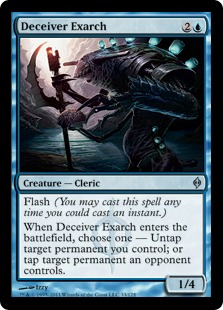
Deceiver ExarchCorbin Hosler’s MTGPrice article displays these tweets in all their glory, and adds to them an important layer of commentary. Many Modern players have read Forsythe’s remarks as indicating the Twin ban only happened because of the upcoming Pro Tour. As evidenced throughout this article, Modern data and history both suggest this claim is untrue. Moreover, Forsythe himself refutes this idea, replying to an insinuation that Twin was banned only to hype the Pro Tour with: “That is a pretty imaginative interpretation of my response.”

It can be difficult to articulate a complex position while respecting Twitter’s 140-character limit. I wish Forsythe had released his comments through a medium more conducive to total transparency, such as the Wizards website. That said, Modern players citing Forsythe’s comments as evidence that Wizards doesn’t care about the health of its darling format should re-read them. 

Resisting Hate

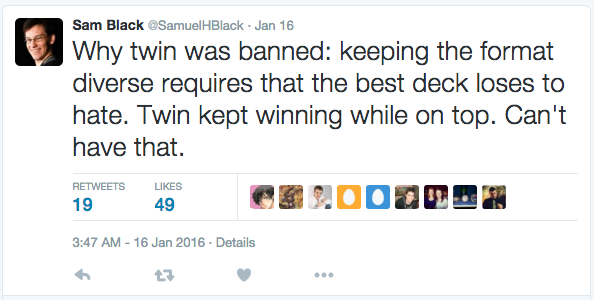
Like Birthing Pod, Splinter Twin was nearly impossible to "hate out." Here's a tweet from Sam Black in response to the ban:

sam black on twin bannings

Modern's typically linear Big Mana decks - Tron, Bx Eldrazi, and formerly, Amulet Bloom - all lose to hate. Specifically, they lose to Blood Moon, a card that sees immense play across Modern for this reason. (To be clear, they lose to a combination of Blood Moon and pressure, or what I call "good Blood Moons.") Twin doesn't just not lose to Blood Moon, it wields the card masterfully. Wizards has probably watched Twin succeed with concern for awhile, printing eye-rollingly tactless checks like Rending Volley that ultimately did little to curb the deck's supremacy. I buy into Black's argument that Twin's resilience contributed to its banning. Notably, Black's opinions on the Twin ban have been explicitly endorsed by Aaron Forsythe.

Limiting Card Design Space

Cards like Preordain and Ancestral Vision have never been safe to come off the Modern banlist, and that predicament owes a lot to Splinter Twin's legality. Twin pilots would add these spells to their lists immediately, and Wizards' conservative policy doesn't unban cards that slot into existing top-tier decks. The case could be made that Twin's presence might prevent them from printing library manipulation, or other strong URx cards, in the future.

Birthing PodIn their Birthing Pod ban announcement, Wizards confirmed that having Pod legal in Modern interfered with future creature design:

"Each year, new powerful options are printed, most recently Siege Rhino. Over time, this creates a growing gap between the strength of the Pod deck and other creature decks. [...] The high percentage of the field playing Pod suppresses decks, especially other creature decks, that have an unfavorable matchup. In the interest of supporting a diverse format, Birthing Pod is banned."

It's reasonable to blame Twin for Preordain's and Ancestral Vision's permanent resident status on the Modern ban list. Possibly, the deck's existence gives Wizards another reason not to reprint "control" cards like Counterspell for Modern.

Turn Four Rule Abuse and Breaking Interactive Shells

This position is my own, and therefore diverges from Wizards' ban announcement canon. While Modern has a turn four rule that Twin didn't violate, I think an interactive deck of its dexterity has no real business winning that quickly. Splinter Twin doesn't exemplify Modern's turn four rule - it abuses it.

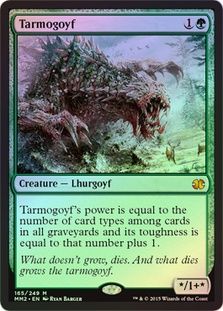
siege rhinoBirthing Pod gave BGx a robust, recursive engine. Pod decks jammed an infinite life/damage combo into an already resilient midrange shell, and enjoyed tremendous success in Modern during the card's legality. By the time Pod was banned, pilots had transitioned to combo-less, value-laden Siege Rhino builds. It became questionable to play a traditional BGx deck at all, as "splashing" copies of Birthing Pod gave these decks an entirely new angle of attack. Sure, Abzan had to run dorks to make it work, but a Pod would turn those dorks into Tarmogoyfs, then Kitchen Finks, then Siege Rhinos for the rest of the game. When Wizards banned Birthing Pod at the peak of its dominance, Abzan Midrange decks continued to police Modern.
Splinter Twin gave URx decks a tool of similar potency, giving the fair, competent midrange shell a fairly consistent fourth-turn combo. Defendants of Twin in Modern argue that the deck exemplified the "turn four rule," since it never went off before then. Let's revisit Wizards' introduction of that rule:

"We used two criteria to guide us in choosing what cards to ban. First, we have a rule of thumb about Legacy that we don't like consistent turn-two combination decks, but that turn-three combination decks are okay. We modified that rule for Modern by adding a turn to each side: we are going to allow turn-four combination decks, but not decks that consistently win the game on turn three."

It seems to me that Wizards is specifically referring to combination decks. Any Splinter Twin pilot will tell you in a heartbeat that he's not playing a combination deck. Like Birthing Pod, Twin is a formidable interactive strategy that happens to have an oops-I-win. It doesn't make sense from a format design standpoint to have a deck like Splinter Twin exist, because it becomes incorrect to play a dedicated combo deck with the same turn four restriction. Twin "goes off" by the same time, but doesn't fold to hate, has mana to interact early in the game instead of setting up an elaborate combo kill, and polices Modern's faster linear decks.summer bloom Summer Bloom was banned because it enabled the Amulet deck to consistently combo off on turn three. Assuming that ban didn't completely kill the deck, but instead made it consistently combo off on turn four, there would be no reason to play Bloom over Splinter Twin.

In my opinion, proficient interactive decks that house an instant-victory combo should not be able to reliably execute that combo on the same turn as dedicated combo decks. Based on their Pod and now Twin bans, Wizards may agree with me. Collected Company emerged as a poor man's Birthing Pod for one more mana, and now inhabits a similar shell in Modern. Wizards even points to a five-mana replacement for Splinter Twin in their banlist announcement:

"We considered what one would do with the cards from a Splinter Twin deck with Splinter Twin banned. In the case of some Jeskai or Temur, there are very similar decks to build. In other cases, there is Kiki-Jiki as a replacement."

Kiki-Jiki, Mirror Breaker pushes Twin's winning turn up by one, and complicates relying on both Cryptic Command and Blood Moon. It also allows opponents to disrupt the Twin combo with a hate card more widely played than even Moon itself - Lightning Bolt!

Modern's Twinless Future

The absence of Twin from the format should change the makeup of URx decks, but not how people feel about buying into Modern.

URx Without Splinter Twin

I'm not concerned about the viability of URx in Modern's future. RUG Scapeshift typifies a reasonable combo deck for Modern. It plays the same interactive cards as Twin, including Electrolyze and Snapcaster Mage. Sometimes, it even dips into tempo threats like Vendilion Clique for better beats. But the deck rarely wins before turn six, and that only happens with ramp effects that compromise the URx shell. Scapeshift also loses to dedicated hate. Unlike previous iterations of URx, it cannot rely on Blood Moon to defeat greedy opponents.

Should URx end up sucking, I can see Wizards releasing Splinter Twin from the banlist. After Wild Nacatlall, there's a precedent for this kind of action, set with Wild Nacatl's unban in February 2014:
"At the time Wild Nacatl was banned, we hoped that this would allow room for other aggressive decks to shine. Artifact-based aggressive strategies have remained popular and a few other aggressive decks have emerged, but the Zoo decks eventually disappeared as a result of the ban and nothing else emerged as a viable traditional aggressive deck. We expect that with the return of Wild Nacatl, those decks will return as a viable option."

The Wild Nacatl ban ended up a death knell for non-Affinity aggro strategies in Modern, effectively reducing format diversity. Wizards reacted by eventually acquitting the kitty of all former offenses. Similarly, if URx drops to a dangerously low metagame share, Wizards may reverse the Splinter Twin ban. Or begin unbanning the blue cards Twin has held hostage for years.

Format Confidence and Investing in Modern

The biggest issue players appear to have with the Twin ban is that it compromises their financial confidence in Modern. Nobody wants to invest thousands of dollars into a deck that may only survive for one year. While Wizards has banned cards from top-tier Modern decks with relative frequency over the past few years, I don’t think that fear is warranted.

For one, Wizards justifies bannings on multiple levels. To quote Aaron Forsythe, they don't ban "randomly." This article specifically examines the Twin ban, but Treasure Cruise, Dig Through Time, Birthing Pod, and Deathrite Shaman - Wizards’ other four most recent bans - all came with detailed explanations. Modern players didn’t react to those bans with a level of revulsion approaching that surrounding the Twin ban, although I can name you a couple fuming Pod-foilers.

Tarmogoyf FOIL MM15As for those foilers, Modern prices are largely unafflicted by bans. The last five cards banned in Modern flexed their dominance in shells comprised of irrefutable format staples. Deathrite Shaman’s ban didn’t weaken the stock of Abrupt Decay and Tarmogoyf, and Pod’s ban hardly dented that of Noble Hierarch and Siege Rhino. Likewise, removing Treasure Cruise, Dig Through Time, and now Splinter Twin doesn’t menace the value of Serum Visions and Snapcaster Mage.

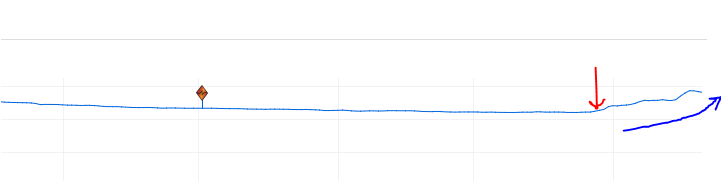

These cards continue to define Modern, and will likely command a premium for years to come, regardless of bans. Given that bans raise Pro Tour viewership and increase Modern buzz, Modern staples should actually increase in price, as they have for years. Financially speaking, a brief overview of Modern's banlist history actually incentivizes investing in format pillars.

This topic deserves its own article. I still wanted to mention it here, as the argument that bannings destroy the value of Modern collections doesn't hold any weight. In the name of format diversity, a possible yearly banning - backed up by data - should not discourage new players from buying into Modern.

Picking Up the Splinters

Hopefully, this article removes some stigma from the upcoming Pro Tour and gives readers a deeper understanding of the January 18th announcement. I look forward to engaging with you in the comments below, and to the exciting future of Modern. Until then, happy brewing!

Jordan Boisvert

Jordan is Assistant Director of Content at Quiet Speculation and a longtime contributor to Modern Nexus. Best known for his innovations in Temur Delver and Colorless Eldrazi, Jordan favors highly reversible aggro-control decks and is always striving to embrace his biases when playing or brewing.

View More By Jordan Boisvert

Posted in Modern, OpinionTagged , , , 51 Comments on A Defense of the Splinter Twin Ban

Have you joined the Quiet Speculation Discord?

If you haven't, you're leaving value on the table! Join our community of experts, enthusiasts, entertainers, and educators and enjoy exclusive podcasts, questions asked and answered, trades, sales, and everything else Discord has to offer.

Want to create content with Quiet Speculation?

All you need to succeed is a passion for Magic: The Gathering, and the ability to write coherently. Share your knowledge of MTG and how you leverage it to win games, get value from your cards – or even turn a profit.

Insider: Early Pro Tour Indicators & More Modern Movement

Are you a Quiet Speculation member?

If not, now is a perfect time to join up! Our powerful tools, breaking-news analysis, and exclusive Discord channel will make sure you stay up to date and ahead of the curve.

I hope everyone enjoyed their Oath of the Gatewatch (OGW) prereleases and is gearing up for the official release this weekend. If my Financial Evaluation articles helped Insiders out this weekend, then fantastic. I still feel very strongly about my predictions, and right now prices are reflecting my expectations.

In the meantime, Modern is still firmly in the spotlight. Prices are fluctuating dramatically on a daily basis, and there have been many changes even since my last article highlighting a select few.

Many of the cards I mentioned there have seen a subsequent increase, and I'm feeling pretty good about having predicted the market. Truthfully, all of Modern is blowing up at this juncture so I can't take too much credit---but I will continue to do my best to figure out where people’s eyes (and wallets) will be heading next.

In the meantime, I was finally able to get into the MTGO Beta client for OGW. While I can’t divulge too much information as per the rules of the Beta, I can say I’ve been testing any and all formats when I get free time.

If I can’t offer any tidbits from the Beta, what I can do is share a website I've been using to see indications of where Modern may be going.

If you're not familiar with Magic-League, it's a decent resource for gauging what players are using in a post-banning meta, or before a set is released. Those are the specific times I like to refer to the site, because it helps with ideas and we get to look at decks before a set release or with a large Pro Tour on the horizon.

Recently I turned my attention to a few of the tournaments the site held marked "Trial." I use those because there are likely more participants. In the particular event I'll look at today there were 5 rounds and 29 in attendance.

Infect

Untitled Deck

Creatures

4 Blighted Agent
4 Glistener Elf
4 Noble Hierarch
1 Spellskite
1 Tarmogoyf
1 Viridian Corrupter

Spells

2 Apostle's Blessing
3 Become Immense
3 Gitaxian Probe
4 Groundswell
2 Might of Old Krosa
2 Twisted Image
4 Vines of Vastwood
2 Rancor
1 Spell Pierce
1 Mutagenic Growth

Lands

3 Breeding Pool
1 Dryad Arbor
2 Forest
4 Inkmoth Nexus
4 Misty Rainforest
2 Pendelhaven
4 Windswept Heath
1 Wooded Foothills

Sideboard

3 Nature's Claim
2 Dispel
1 Dismember
1 Viridian Corrupter
2 Relic of Progenitus
2 Wild Defiance
1 Surgical Extraction
1 Scavenging Ooze
1 Spellskite
1 Kitchen Finks

So it appears everyone's inclination toward Infect, Affinity and R/G Tron might be correct as we enter a Modern metagame devoid of Twin and Bloom Titan. Infect is still a very powerful deck and a logical choice for Pro Tour attendees. With a 5-0 record, the pilot of the deck above leaned on a strategy known to be good instead of venturing out into the wilderness. It obviously paid off.

The archetype is as well positioned as ever now that it can ignore the pesky interaction from its old nemesis Twin, and focus entirely on comboing people as fast as possible. Cutting down to so few copies of Spell Pierce is a telling sign.

Unfortunately most of the deck's cards are already inflated. But there might be additional value to extract if players suddenly clamor to play this deck now that Twin is gone.

Some cards that might still be priced at attractive rates are the following:

It shouldn't be surprising to see these cards listed as candidates for a price increase.

Glistener Elf had a promo foil printing, but that shouldn’t affect normal copies (nor pack foils). Sitting at $0.50 with only one printing, I compare this card closely to a few recent gainers in Ancient Stirrings and even Ghost Quarter. Rising water lifts all boats, and this can easily trickle down to commons and uncommons even with multiple printings. If players need them, they’re going to end up buying them.

Moreover, Glistener Elf increasing to $2-3 dollars doesn’t drastically increase the overall price of the deck, and thus dissuade players. But it would be enough to warrant grabbing copies as both a financial and play investment.

Similarly, Noble Hierarch won’t be suppressed for long, and right now it's a logical buy. As seen in the graph below, Modern Masters 2015 is on an incline---any known Modern staple from that set is about to begin increasing or already has. It won't be long before this crop of cards makes up its lost value and reaches pre-reprint prices.

MM2015 Set Value graph MTGG
Modern Masters 2015 set value (courtesy of MTG Goldfish)

Eldrazi Black

Untitled Deck

Creatures

4 Conduit of Ruin
4 Oblivion Sower
4 Ulamog, the Ceaseless Hunger
1 Kozilek, the Great Distortion
4 Thought-Knot Seer
1 Void Winnower

Spells

4 Heartless Summoning
2 Warping Wail
3 Inquisition of Kozilek
2 Thoughtseize
1 Slaughter Pact
3 Expedition Map
2 Go for the Throat

Lands

4 Ghost Quarter
4 Eldrazi Temple
4 Eye of Ugin
4 Urborg, Tomb of Yawgmoth
1 Cavern of Souls
3 Swamp
2 Tendo Ice Bridge
1 Llanowar Wastes
1 Caves of Koilos
1 Sulfurous Springs

Sideboard

2 Night of Souls' Betrayal
2 Disfigure
3 Vampiric Link
1 Drown in Sorrow
2 Surgical Extraction
2 Ratchet Bomb
1 Damnation
1 Slaughter Pact
1 Duress

It's no surprise that Eldrazi lists continue to show up, and I anticipate the deck making a showing at the Pro Tour. Whether it's successful is another story, but at this point that question is largely moot. The cards have increased drastically, and players are drawn to the deck for its novelty and fun factor.

Fun in the sense that playing City of Traitors and Ancient Tomb in Modern seems borderline unfair. Players enjoy doing unfair things, and I fully anticipate they will continue to do so, regardless of the deck's competitive pedigree per se.

What's interesting is that Eldrazi lists are wide open at this point, and can go large or small. This bodes well for my recent picks from OGW such as Reality Smasher. This card on face may not be as good as Stormbreath Dragon or Thundermaw Hellkite, but in this particular deck it's better than any of its predecessors.

There have been drastic price increases across the board for this deck, and I'm an advocate of locking in profits when possible. I do think the needle is pointing up for these Eldrazi lists, so the upward pressure may not be over yet.

More Bumps in Modern

In the meantime there has been another round of Modern price increases since we last talked. I’ll display them here, and maybe we can see where the market is heading next.

The list goes on. Like I and other writers here have been saying, it’s really the Wild West out there (not to be confused with the terrible movie). Any and every card with even a small chance of seeing play has a good chance of increasing.

If I had to put my finger on the pulse of the Modern market, I would look to the following cards in the near future to start gaining considerably:

That’s my best bet at covering as many prospects as I can over various archetypes. I’m going to keep my ear to the ground in the meantime, and you should all continue to use the QS Insider Forums to quickly relay information. It’s really invaluable, and plenty of us QS writers routinely check in and converse there with others.

Transverse the Modern landscape and use any resources you can---like I have with Magic-League---to gather valuable information as to what players and Pro Tour attendees might be thinking. As always, when I get a hold of information you’ll be sure to hear from me on this subject. Just keep in mind this market is in full swing and information is very time-sensitive.

Until next time.

- Chaz @ChazVMTG

Insider: The Theory of Magic Card Pricing

Are you a Quiet Speculation member?

If not, now is a perfect time to join up! Our powerful tools, breaking-news analysis, and exclusive Discord channel will make sure you stay up to date and ahead of the curve.

You might be coming into this article hoping for a nice tidy equation where you can plug in some supply and demand numbers in exchange for a price. To those people I would sadly have to say, "Hell no!"

There is no magic formula, at least certainly not one I'm aware of. That's not to say, though, that we can't use some of the fundamental concepts of economics and finance to help us understand Magic card prices to better inform our investment decisions.

Price vs. Value

Long ago, Ben Graham taught me that "Price is what you pay; value is what you get." Whether we’re talking about socks or stocks, I like buying quality merchandise when it is marked down.

- Warren Buffet

One of the first lessons in investing is that price and value are distinct entities. They are often heavily related, but a high price does not always guarantee a high value and vice versa. In finance, the price of a stock is what you pay for it, and the value is what you get in dividends. So how do we relate this to Magic cards? Again, the price will be what you pay, but what is the value of a Magic card?

I would argue that the value of a Magic card, much like with stock, is the sum of all the benefits gained from owning the card from now until forever. This will almost exclusively relate to the ability to play particular decks in tournaments. So the cards with the most value are the ones that give us the greatest options in terms of the tournament prizes, learning and fun we can get out of them.

We can't focus only on value to determine price, however. This is illustrated in the Diamond/Water Paradox (or what we might call the Mox/Island Paradox.) Why are diamonds so expensive and water so cheap? Water is needed to survive while diamonds are just nice to look at.

The answer to this puzzle is scarcity. While water is much more valuable to people, it is also much more abundant. In other words, the price of a good is not just based on its value (demand) but also on its relative abundance (supply).

Supply & Demand

supplydemand

Supply and demand curves are some of the most fundamental concepts of economics. The demand curve plots the quantity of units demanded at a given price. Meanwhile, the supply curve plots the number of units that can be produced at each price. In theory, the market will arrive at the equilibrium price and quantity where the lines cross.

If this concept is unfamiliar, you only have to remember the main point: the price of something is determined by a mix of both how much it is demanded and how easily it is supplied.

What does this look like in the world of Magic? Players who need cards will have varying degrees of urgency. Some will be willing to pay more and some less. The same will happen with sellers and the price will fall somewhere in the middle of it all. At the equilibrium price $X, the same amount of people (roughly) will be willing to buy the card for $X as people who are willing to sell for $X.

If more people are buying than selling, the price will push up, and vice versa. Many of the bot algorithms adjust their prices in exactly this way, slowly increasing their price after every sale and slowly decreasing it after every buy.

Factors that influence supply on MTGO

  1. Set (cards opened minus cards redeemed)
  2. Rarity
  3. Alternate printings

Factors that influence demand on MTGO

  1. Constructed demand
  2. Redemption demand
  3. Speculation demand

Intrinsic Value and Sentiment

So we've discussed value and price, but what about their difference? In the world of stocks, where every asset directly outputs cash and the market is highly competitive, you would expect value and price to be very close. If stocks are correctly priced, they should on average give back what they cost: their intrinsic value.

When the price and intrinsic value differ, it is referred to as sentiment. High sentiment represents an overoptimism in the market, and negative sentiment represents underoptimism.

I think this concept has a nice parallel to prices on MTGO. On MTGO, the value of a given card is almost solely based on its Constructed playability. I therefore define the intrinsic value of a card to be the price it would be at if there was no speculation, due solely to players buying it for tournament use.

Sentiment, therefore, will be related to how inflated the price is over the intrinsic value, or how many copies have been picked up for speculation.

Estimating Sentiment

To compare sentiment across cards, we will have to look at cards with similar supply and tournament demand and compare their prices.

To ensure supply is similar, I compare cards of the same set and rarity. To ensure tournament demand is similar, I compare cards with similar Standard metagame dominance percentages, that see no Modern play.

I define metagame dominance as the percentage of decks playing the card, times the number of copies per deck, divided by four. This gives the average number of playsets we can expect in a deck chosen from the field at random. 100% metagame dominance would mean every single deck played four copies of a given card.

Let's take a look at some of this data applied to current Standard staples and other cards of interest. The metagame statistics are calculated using data from MTG Goldfish.

sentiment

Some notes about the cards:

  1. Radiant Flames has seemingly low sentiment because it is priced far below anything with a similar metagame dominance.
  2. Cinder Glade and Lumbering Falls see much less play than their counterparts (Sunken Hollow and Shambling Vent) but speculators seem to think their metagame share will rise in time. This high sentiment inflates their prices relative to the amount of play they're seeing.
  3. Chandra, Fire of Kaladesh and Archangel of Tithes are priced much lower than Nissa, Vastwood Seer and Liliana, Heretical Healer even though all four are seeing a similar amount of play. This means there are a lot more speculators holding onto copies of Nissa and Liliana than Chandra and Archangel of Tithes.
  4. Hangarback Walker sees a tiny amount more play than Abbot yet is priced almost twice as high. This represents a much higher amount of sentiment for Hangarback Walker. A similar relationship exists between Hallowed Moonlight and Llanowar Wastes.
  5. All of the painlands from ORI have seemingly high sentiment. This could be due to speculation on their increased playability alongside "wastes" mana in the coming set.
  6. Knight of the White Orchid has a seemingly low sentiment, although it is hard to tell because the prices of the cards near it are all clearly inflated by high sentiment.

When High Sentiment is Warranted

Oftentimes high sentiment, as I have defined it here, will be warranted. This occurs if speculators have correctly predicted a future increase in price. I'll illustrate with an example.

Let's say that it's not yet Modern season, but due to increased play, card X should be worth around $10 once the season rolls around. (To keep things simple, let's ignore any notions of risk or the time-value of money.) Suppose the card is currently worth $5 due to low levels of play and zero speculation. In this scenario the card has what I have defined as low sentiment and seems like a great investment.

Let's consider three other levels of sentiment.

  1. Moderate sentiment - Let's say a few speculators have picked up the card and pushed the price up to $7.50. This is still a great investment opportunity, even though sentiment is not zero.
  2. Moderate-to-high sentiment - Now let's say a few more speculators pick up the card and push the price to $10. Now it's fairly priced and no longer presents a great opportunity.
  3. High sentiment - Finally, suppose even more speculators pick up the card and the price now settles at $12.50. This now represents a bad investment due to overoptimism.

So as you can see, the trick is not just to spot cards with low sentiment in some absolute sense, but low sentiment relative to what it would be if the card were fairly priced.

Holding all else equal, we want to invest in cards with low sentiment. The reason is twofold. First, the price to buy in will be cheaper, as it will be deflated relative to otherwise similar cards with high sentiment. Second, the prospects of price changes due solely to hype or speculation will be much better. The hype train will take you much further if you get on at one of the very first stops.

Investing in low sentiment cards also avoids some terrible scenarios. One of the worst things you can do is buy into a card whose price has been inflated by lots of optimistic speculators only to see the price crashing down when they all start to sell.

Sentiment by itself, however, does not paint the entire picture. In order to make a great investment, we want to invest in cards which have:

  1. Low sentiment
  2. Low metagame percentage (relative to potential)
  3. Low format interest in the formats they're played in (relative to potential)

The last two points are related to the dynamics and trends in the Magic marketplace. They are affected by things like high-profile tournaments, set releases, PTQ schedules, and what sets are seeing the most Limited play. I will cover these concepts in a future article.

Conclusion

Hopefully this article has made the idea of sentiment and how it relates to picking good spec targets clear. Another way to describe it would be the hype or optimism surrounding a card.

So in summary, a card's price will be determined both by its demand via Constructed play and its demand via speculation. Holding all else equal, we would like to invest in cards with low sentiment because they are cheaper and have a farther ways to increase if they pick up hype. A way to estimate sentiment for cards on MTGO is to compare prices across cards with the same set, rarity, and similar metagame percentages.

Thank you for reading, and let me know your thoughts in the comments!

- Luca Ashok

Insider: Fundamental Changes to Modern

Are you a Quiet Speculation member?

If not, now is a perfect time to join up! Our powerful tools, breaking-news analysis, and exclusive Discord channel will make sure you stay up to date and ahead of the curve.

Despite the fact that Splinter Twin only accounted for around 10% of the Modern metagame, it was the deck you could almost always count on playing against at a given tournament.

More than any other deck, it had a fundamental impact on the type of cards you could play in your deck. Any time your opponent controlled a Steam Vents and two other lands, you had to worry about just dying. This put significant pressure on sorcery-speed spells that cost three or more mana.

There was an error retrieving a chart for Deceiver Exarch

Make no mistake, you're still able to die on turn three or four in Modern, but there will be a lot less guesswork in terms of knowing when you're dead now. Burn can kill you on turn four, but you hopefully know your life total at all times. Infect can kill on turn three, but not without an infect creature or Inkmoth Nexus in play when they pass turn. Grishoalbrand is a bit harder to predict, but you either have relevant interaction or you don't, and that deck relies on a lot more going right than Splinter Twin did.

I don't know if you're more or less likely to die on turn four in the new format, but I do know that you're way more likely to know if you could die on the following turn. That is to say that the decision to tap out on turn three will be considerably more informed going forward.

A specific card that hasn't seen much Modern love in some time that stands to gain a lot by this change is Geist of Saint Traft.

There was an error retrieving a chart for Geist of Saint Traft

Geist was an awkward proposition against Twin, and far too slow against Amulet Bloom. With the proper supporting cast, I could see a significant Geist resurgence in Modern. The deck would presumably be Jeskai colors, which gives you access to white's amazing sideboard cards, the best card in Modern in Snapcaster Mage, and cheap red interaction. Such a deck is my dark horse pick for a strong PT showing.

As far as monetizing this pick, investing in Geist isn't too inviting given the looming Geist duel deck that was spoiled with the Oath of the Gatewatch leaks. But there is some time before that release and a strong PT performance would definitely lead to some short-term growth, at least. I'd look to the supporting cast to find some real winners.

Just like three-mana spells, four-mana spells stand to become more viable in Modern as well. There's a short list of four-mana options for a Geist deck, with Elspeth, Knight-Errant and Ajani Vengeant being exciting options, though these are unlikely to show up as more than one- or two-of type cards. The cards that I would watch more closely are Restoration Angel and Cryptic Command.

There was an error retrieving a chart for Restoration Angel

Restoration Angel is a card that I picked up a short stack of about a year ago given that it sees some Modern play and is an angel. It has just recently started to see some decent price movement, likely due to its presence in Kiki Chord. Resto has been played alongside Geist plenty of times historically, and Kiki Chord isn't going anywhere.

Seeing as Avacyn Restored was a garbage set, I expect to see even further growth out of this card. The buy-in looks to be around $10 at the time of this writing, which is steep, but if you wait on your play set you'll almost certainly be paying more down the line.

There was an error retrieving a chart for Cryptic Command

Cryptic Command was pretty much reserved for Twin and Scapeshift prior to the banning, and even still it has held onto a high price tag. With Twin gone, I expect to see more Cryptic Commands.

First of all I think Scapeshift will hold a higher percentage of the metagame. But there will also be more blue decks looking for things to do with four mana, and now you're more able to utilize less efficient interaction without just dying. It's a phenomenal card to use with Snapcaster Mage, and it makes for a powerful tempo play to follow up Geist of Saint Traft. We could also see Blue Moon take a higher share of the Modern metagame.

As a vendor I've found it impossible to keep Lorwyn copies of Cryptic in stock, though players still buy Modern Masters versions. Despite three printings, this card is great in Commander and poised to see increased play in Modern. I wouldn't be surprised to see a healthy price bump over the course of the year. If a Cryptic Command deck or two top-eights the Pro Tour it will happen sooner rather than later.

Blue Moon might sound like an odd choice, but I actually think the deck stands to gain a lot with the banning of Twin. Sure, you lose Bloom as a deck to beat up on, but that was such a rare matchup anyway. What's really important is that you lose the matchup that could combo-kill you easily off of one basic Island. Not to mention that you're one of the better shells for the ol' Bolt-Snap-Bolt, and you are arguably the best positioned deck to kill people with Keranos, God of Storms.

It's true that Blood Moon is kind of a turd against Burn, but even against Affinity and Infect it at least turns off manlands. Generally you need a clock to back up your Blood Moon against Tron, but Cryptic Command can clean up Karn Liberated and Wurmcoil Engine pretty nicely, too.

Blood Moon is a lot better in new Modern than a lot of people are saying it is, and with continued presence in a format increasing in popularity, it certainly has room to grow at least towards its previous high.

There was an error retrieving a chart for Blood Moon

~

Modern as a format is going to continue to see significant growth, and realistically for the more played decks it's less a matter of what or if, and more a matter of when. The Twin ban should serve as a reminder to diversify, though investing in Modern in general remains a strong position.

Anything currently played that hasn't spiked yet is going to see some growth, though in this piece I tried to highlight a fundamental reason why some previously underplayed cards could see substantial growth. If some previously unplayed cards that cost three or four see success at the Modern Pro Tour, then depending on what set they're from you can expect explosive growth in response.

I've outlined some cards here that I like, though there are definitely others that fit this category. These will be the types of cards to watch for at the PT.

Thanks for reading.

-Ryan Overturf
@RyanOverdrive on Twitter

Re-Evaluate Your Perspective On Bannings

Are you a Quiet Speculation member?

If not, now is a perfect time to join up! Our powerful tools, breaking-news analysis, and exclusive Discord channel will make sure you stay up to date and ahead of the curve.

Today I will attempt to outline my perspective on the recent Modern bannings, and hopefully provide an interesting counter-argument to the general emotionally charged language running around the Internet. As always, my opinion is my own, and I present it to you not in an attempt to argue or sway others to my side, but rather to inform, as best I can, regarding the process that leads me to my opinions. My opinion, yours, and everyone else’s are all equally respected and valued, with the caveat that they originate from a foundation based on fact, with as little bias as possible. My goal for this article is not to change minds, but rather to provide insight into the formative process of a constructive opinion.

Restore Balance Banner

Who defines “balanced”?

Most of my points will center around rhetorical questions, because if the goal here is to be as unbiased as possible, I have to admit that I don’t know the right answers. Instead, the best I can do is posit questions and attempt to answer them as best as I can. Magic players (of which I consider myself a member) often throw around the term “balanced” to the point that it has become a buzzword that carries no real meaning.

[wp_ad_camp_1]

In the context of a format of Constructed play, balanced can mean many things. Return to Ravnica block Standard was widely considered a highly “balanced” format, with Mono-Blue Devotion, Mono-Black Devotion, and U/W Control each sharing prominent positions at the top tier. While these decks were solidly better than the rest of the field, they were comparable in power level to each other. Without a clear “best deck”, tournaments in this time period were approached with the notion that multiple archetypes were capable of taking home the trophy.

Players that enjoyed the intricacy of deckbuilding and gameplay defining RTR Standard would undoubtedly define that format as “balanced”. Players not interested in playing one Balanceof the “Big Three” would disagree, saying the power level gap between Tier 1 and 2 was too wide. So who is right? Without a clear, definite set of outlined rules and characteristics to define a format’s identity, there really is no way to distinguish a format as being “balanced” or not. While highly valuable, weeks and weeks of metagame information, statistics, and long-winded semantics by content writers can only move the discussion so far, at which point we reach a horizon where all that information falls away, leaving only opinion. Is a three-archetype Tier 1 balanced? What about a Tier 1 that contains five archetypes? What about when Tier 1 contains two archetypes, but Tier 2 contains 20 different decks, each capable of beating one of the top-tier decks with the right planning? Can you truly answer those questions with any certainty, while at the same time removing all bias and prior opinions from the equation?
What exactly does a “healthy” format look like?

This topic shares similarities to the previous discussion on “balanced”, but it’s important to distinguish the differences between the two. Can a format be healthy without being balanced? Vice versa? What characteristics must a format have to be considered healthy? Is it format diversity? Room for variation regarding card choice and deck selection? Or something else entirely?

Innistrad Standard, due primarily to the presence of Vapor Snag, required almost every creature to boast an enter-the-Sickenbattlefield effect to even be considered playable. With only a small percentage of creatures in the available card pool actually “viable” for tournament play, can we call Innistrad Standard healthy? Delver decks were definitely powerful, but so were Zombie decks, R/G ramp strategies, and many others. In my opinion, the “healthy” stamp of approval changes frequently, and can be influenced by public perception, metagame shifts, and new cards entering the pool. The Modern format where almost every deck had to find a way to play Ponder/Preordain was considered unhealthy. Why? It both increased the velocity and consistency of decks that employed those cards and put unnecessary pressure on other strategies to keep up. Normally, the feeling of being “punished” by not playing a certain card or strategy is a solid indicator that card or strategy is unhealthy.
What is the long-term goal of a format?

As competitive players interested primarily in playing and winning games, we often focus only on the present, or perhaps the near future, when thinking analytically about a format.

Is Affinity overpowered right now? Am I forced to play Blood Moon in my sideboard or die? Is playing any archetype other than Amulet Bloom this week a bad choice? If you answered yes to any of these questions, call the format police immediately!

One thing we must remember is that format conditions are constantly in flux. We can all remember weeks where Affinity was Public Enemy #1, where we had to make room for Blood Moonextra copies of Blood Moon in our sideboard, where the top tables of an event were seemingly nothing but Infect. Every single week, conditions shift to a point where the right archetype, the right 75 can absolutely dominate an event. Stanislav Cifka destroyed an unprepared field with Eggs, a deck that while strong, was by no means overpowered. The matches weren’t even close. Justin Cohen did the same thing with Amulet Bloom. While both of those decks ended up being banned, in Eggs' case it was due to tournament logistical issues, and the jury is still out on the Amulet ban. The point to take away here is that the snapshot of a format on any given week could be argued as being “unhealthy” in one way or another. Intervention becomes necessary (or at least justified) when these conditions stretch beyond a certain period of time. Jund was top dog for too long, as was Birthing Pod.
Can you remember a time where you didn’t have to go back and change your sideboard because you have no way to kill a Deceiver Exarch through a Spell Pierce? When you chose Nature's Claim over Creeping Corrosion because it hits Splinter Twin too? When Spellskite was arguably the best sideboard card in the format for any deck because of its myriad uses, primarily against Splinter Twin and Infect? Since the creation of Modern as a format, Splinter Twin has been there, and players have been scheming and playing against it forever. Is four years enough time for a deck to be on top (or close) before it is pushed aside for something else to take the spotlight? Who decides?

Wizards’ Objectives

Wizards of the Coast is not evil. Regardless of their handling of Magic Online, they are also not stupid. As a rational adult speaking to other rational adults, I shouldn’t have to provide that disclaimer, but reading some comments on the Internet has me wondering. While they are a business with the primary motivation of making money, that doesn’t mean they are some evil corporation plotting and scheming to stab us in the back and twist the knife while we cry out for help. Name one successful business that is actively trying to piss its customers off. Wizards of the Coast obviously believes they are making the best decision possible, so before yelling and screaming, let’s try and figure out where they’re coming from. Whether that changes your opinion on matters or not isn’t important, but at least we’ll then have something more constructive to add to the conversation than “we can’t trust WotC to do what’s best for the format” (an actual comment).

We’ve established Wizards is interested in making money, as they are a normal business and not insane. Wizards does this by selling cards, and bringing new players into
Prosperitythe game so they can then sell them cards. Arguably the best platform that Wizards uses to market their game is the quarterly Pro Tour events. Regardless of what we may think, regardless of how much we lament the poor commentary, the Pro Tours exist not for the professional players, not even for us, but rather for new players and those unfamiliar with the game. Wizards works extremely hard to craft a particular narrative and generate interest in these events, as their cost of operation is high, and the stakes even higher. A Pro Tour that nobody cares about will generate no interest, and potential new players will go back to playing Hearthstone instead of buying into and growing this great game of ours. More than almost anything, I believe Wizards is terrified of new players coming into Twitch chat, seeing a thousand variations of “Standard sux” and “ResidentSleeper” and heading back to whatever they were doing before.
Wizards has a heavily vested interest in crafting format interest year round, and this process is heavily exacerbated by the spotlight that the Pro Tour places on the mystical definitions of “format health” and “balance”.

A while back, Wizards of the Coast attempted to make the move to remove the Modern format from the Pro Tour circuit. While the language surrounding this was unfortunately unclear and relatively poorly handled, their motivations for this change came from the understanding that Standard Pro Tours are vastly more interesting for the majority of the existing player base and almost all new players entering into the game. New players start with Standard first, and some eventually make the move into Modern. To a new player, the complex Modern interactions on-screen can be daunting and downright scary. It sounds silly, but seriously put yourself in a new player’s shoes and attempt to figure out what is happening when one player suddenly casts Primeval Titan on Turn 2, or makes a million 1/4’s, or cascades into Living End, or casts Scapeshift.

We’ve established Wizards is heavily interested in public perception heading into these spotlighted events. Modern, as a non-rotating format, has the unique danger of becoming abundant growth“stale”, where most entities are already known and flashy “new tech” is rare. New players (and whether we admit it or not, most of us) are not interested in hearing commentary for an entire weekend about the intricacies of the top archetypes’ specific deck composition. It’s much more exciting to hear about the new Amulet Bloom deck, or storylines about the scrappy underdog decks attacking the big players. Those unfamiliar with production might not realize that a lot of time and effort goes into finding and nurturing storylines and talking points for any big event like the Pro Tour. You see it during NFL playoff games. You see it at the Olympics. As humans, we are drawn to the drama of the stage, and it’s the commentators’ jobs to cultivate this interest if possible. Pay close attention to this Pro Tour’s commentary, and you’ll hear the re-iteration of a few talking points over and over. Wizards is trying to tell a story with these events, and they can’t do that if the story is “all these decks are the same as last year”.
Sinister Motivations?

This brings us to now. Whether we agree or not, Wizards feels strongly that Splinter Twin's performance and effect on the format for the past four years have been significant enough that they would like to move forward without the Twin strategy. I hope players understand the Pro Tour influences the timing of bans only, and not the subject. Splinter Twin and Summer Bloom weren't banned because a Modern Pro Tour is coming up and Wizards wants to "shake things up".Splinter Twin Twin and Bloom were banned because of the quantifiable effect that they were having on the format, and if a ban has to happen then timing that ban right before a Modern Pro Tour helps to craft an interesting narrative.

It's important to make that distinction because many players are of the opinion that "if this is how it's going to be then I'd rather not have Modern Pro Tours". While it is possible that Wizards would be more "lenient" in terms of letting Splinter Twin last longer in the format were a Pro Tour not taking place soon, I still believe Splinter Twin and Summer Bloom would have been banned eventually. Removing Pro Tours from the Modern repertoire of events does lessen the spotlight on the characteristics of the format by a significant amount, but in my opinion would do more to hurt the format than help it. I feel this way because when Wizards makes a public statement, I read it. Splinter Twin wasn't banned to make the Pro Tour more interesting, it was banned because it was having a negative effect on the format in Wizards' opinion. In the interest of format diversity, Splinter Twin is banned. Just because a side effect of this ban results in a more interest Pro Tour, we shouldn't be grabbing our pitchforks.

Needs of the Many or Wants of the Few?

So, I'll restate: Wizards is attempting to generate more interest in a format in an attempt to craft an enticing narrative to bring new people to the game. While it’s difficult to quantify hypotheticals like this, let’s try for just a minute. If Wizards’ banning attracts 1,000 new players into the game, but forces 1,000 players into changing their preferred deck from URx Twin to something else, is it worth it? Ex-Splinter Twin pilots would undoubtedly say no, but step away from bias for a second. Would your opinion change had you not been playing Twin before? If so, why, and if not, why not? While there are definitely a lot more than 1,000 Splinter Twin pilots out in the world, does that number change anything? What if it was 1,000 new players at the cost of 15,000 Splinter Twin pilots? I’m sure you could expect some of those players to quit, but what about the undefined other ex-Modern players out there disenfranchised with the format that might be convinced into picking up a deck now that it looks like things will shift around a bit?

How much value should we place in “value”?

I could write a whole article on this topic, but I’ll try and keep it concise. I’ll preface this topic with a disclaimer that I have no paper magic collection, but have had substantial collections many times in the past and know full well the heartbreak associated with losing a deck to banning (I had just finished building Pod when it was banned). Get your pitchforks ready, because in my opinion, arguing about value gains and losses is irrelevant to the big picture.

Magic is an expensive game, as we all know, but many of us delude ourselves with the notion that we can play for free, or somehow cheat the system and get our money back. greedWe pay money for cards, and once we make that exchange, we should let go of that notion of “worth” while those cards are in our position. I have trouble sympathizing with players upset with the falling values of Splinter Twin and Scalding Tarn. You bought/traded for those cards to play with them. Were you ever intending on selling them? Had the bannings not happened, were you planning on selling those cards next week? Does it really matter that card values rise/fall while they are still in your collection? A $15,000 Magic collection is not worth $15,000 while the cards are sitting in your binder. Their worth is defined entirely by the value that you associate with their usage, not some number a few websites put next to a card image online. Anyone that’s actually sold out of a collection will know that they can only ever get 50-60% of that glorified “retail” price anyways, unless they have some connections or are willing to do a lot of work.
I spent $399 for a Playstation 4 at launch. I paid a buddy $40 to wait in line for me in the freezing cold to get it at midnight because I couldn’t go Gifts Ungivenmyself due to a work commitment. I bought Battlefield 4 at launch for $60, along with a few other games. The value of that game system, and those games, and the hours I spent playing them is not equal to what I paid for them, or what they are worth today. When Sony announced a price drop from $399 to $299, when I noticed Battlefield 4 going for $30 on Amazon, I didn’t lament my “lost value”. I paid for the product because I wanted to enjoy it. I cheered for the price drop because it meant more people would buy the system, which means more games, more potential friends, and the promise of a brighter future for the console as more developers work to create games for the influx of gamers. I eventually got tired of Battlefield 4 and moved on to other games. I don’t look at Battlefield 4 on my shelf and consider it worthless because I don’t play it anymore. I’ve no intention of calling EA and demanding they do something to help me recoup my lost “value”.

The way Magic players hold on to this notion of value to justify their hefty expenditures is understandable, but comes from a state of mind that is desperate to hold onto some semblance of control. An exchange of goods for goods is, by definition, an act of relinquishing control of one good in exchange for control of another. By all means, please continue this discussion of what is best for the community and the game at large, but leave your personal motivations regarding your unique perspective on card worth out of it.

Conclusion

Should Splinter Twin have been banned? Was it a “good idea”? I don’t think we can actually accurately answer that question, but if you’re asking if I approve, my answer is yes. I understand the fear associated with bans. I understand the confusion regarding Wizards' unclear motivations. To me, it seems obvious their intent is to promote an exciting narrative for the upcoming Pro Tour, and the recent bannings serve as the removal of a potential danger (in Summer Bloom’s case) and the creation of an undoubtedly exciting shake-up in the format that will make for an exciting event to watch.

If Wizards intends to do this every year, as I think they have clearly shown, I believe they should officially say so, though I understand their hesitation to anger a clearly vocal player base. Misinformation and confusion will only serve to promote fear and hesitation, and if they feel strongly about an issue (which they clearly do, if they are confident enough to sponsor a banning) they should stand confidently behind their decision rather than timidly hoping players won’t get angry. For the first time in four years, I’m excited to watch a Pro Tour that doesn’t have the shadow of Splinter Twin looming over it. I have absolutely no idea what to expect, and I can’t wait.


Stock Watch- Matter Reshaper

Are you a Quiet Speculation member?

If not, now is a perfect time to join up! Our powerful tools, breaking-news analysis, and exclusive Discord channel will make sure you stay up to date and ahead of the curve.

Matter Reshaper is only just launching this week, though I think it's a great card to talk about in terms of price trajectory. This is a card that has seen a good amount of buzz, and is preordering for a whopping $8 from SCG. I highlighted it as an overhyped card in my most recent Insider article, and we're starting to see that come to fruition. TCGPlayer has launched sales for Oath of the Gatewatch cards, and the price has already fallen sub-$6.

There was an error retrieving a chart for Matter Reshaper

Players seem to be realizing that actually supporting Matter Reshaper in the Rally the Ancestors deck isn't as simple as they predicted, and the buzz is wearing off. With the coming Pro Tour being Modern, there's a lot of pressure on Matter Reshaper to see a lot of success on the SCG Tour in the opening weeks, and it will likely tank if it fails to deliver.

As an Eldrazi, it does have potential to appear in Modern Eldrazi decks, but that doesn't generate near the demand that Standard success does for newly printed cards. If you're the type to purchase sealed product and/or if you've cracked some of these in prize packs, I strongly recommend putting them right into your trade binder and looking for people who want them. Even something like a $2-3 buylist would make me happy for this card. Unless this card Top 8s SCG Atlanta this weekend, you'll be sorry that you held onto yours, and even if it does it still has room to fall as a regular rare.

Avatar photo

Ryan Overturf

Ryan has been playing Magic since Legions and playing competitively since Lorwyn. While he fancies himself a Legacy specialist, you'll always find him with strong opinions on every constructed format.

View More By Ryan Overturf

Posted in FreeTagged , Leave a Comment on Stock Watch- Matter Reshaper

Have you joined the Quiet Speculation Discord?

If you haven't, you're leaving value on the table! Join our community of experts, enthusiasts, entertainers, and educators and enjoy exclusive podcasts, questions asked and answered, trades, sales, and everything else Discord has to offer.

Want to create content with Quiet Speculation?

All you need to succeed is a passion for Magic: The Gathering, and the ability to write coherently. Share your knowledge of MTG and how you leverage it to win games, get value from your cards – or even turn a profit.

Unlocked Insider: So Your Deck Got Banned – Transitioning on a Budget

Are you a Quiet Speculation member?

If not, now is a perfect time to join up! Our powerful tools, breaking-news analysis, and exclusive Discord channel will make sure you stay up to date and ahead of the curve.

This past Friday, we were all shocked to see the Banned & Restricted list spoiled three days early. Here I was all set up to profit from the announcement on Monday and then all of a sudden my plans were thrown into disarray. Not everyone knew the new banned cards had been leaked and the internet was staggering to react to the situation. There were many Magic finance opportunities.

For many players though, their thoughts were surrounded by depression and letdown to see their deck was no longer legal in Modern.

When I announced the alleged bannings at the prerelease I was running, there was some excitement due to Summer Bloom getting the axe, but most of us were just in shock at the Splinter Twin banning. At first, I thought the spoiler was fake because Twin getting banned seemed so unbelievable.

What surprised me the most though was a friend of mine nearly brought to tears at the news of no more Twinning in Modern. He started his journey into Modern by building this deck and just as he finished acquiring all the cards, it was no longer legal. What a crushing blow. This article is dedicated to him and other players out there in a similar situation.

So Your Deck Got Banned, Now What?

Not everyone out there has access to the whole Modern card pool to build decks from. Even with access to my shop’s buying power and inventory, I only have most of the viable decks. For many players, especially those with less than five years’ experience, their only foothold in the format is the one deck they have built. So when cards like Splinter Twin, or Treasure Cruise before it, get banned, some players have no viable deck left to play.

Some players’ first reaction to a banned card is to sell the rest of their cards and stick to Standard and Limited. Modern is hard to break into and switching decks is a big deal. With so many cards increasing in value lately, it’s easy to see that the barrier to entry is still quite high.

Take Eldrazi Black for example. That was a budget deck up until a couple weeks ago. Now that players are accepting it as a real part of the metagame, the deck has increased dramatically in value. I can’t even say doubled because it's well above that figure.

While you do have the option of selling out of the format, that’s not the route I would suggest. In fact, if you had Splinter Twin or Amulet Bloom built, you already have some format staples in hand with which to jump into another archetype.

Let's look at what your options are for transitioning without breaking the bank so you can continue to play the amazing, beloved format that is Modern.

Converting Twin

The last version of Twin that did well was the fourth place deck at Star City Charlotte.

U/R Twin by Harlan Firer (4th Place SCG Charlotte)

Creatures

4 Snapcaster Mage
4 Deceiver Exarch
2 Vendilion Clique
1 Keranos, God of Storms

Spells

4 Serum Visions
4 Lightning Bolt
2 Spell Snare
2 Dispel
4 Remand
1 Harvest Pyre
1 Electrolyze
2 Blood Moon
4 Splinter Twin
2 Cryptic Command

Lands

4 Scalding Tarn
4 Misty Rainforest
3 Steam Vents
1 Stomping Ground
3 Sulfur Falls
2 Desolate Lighthouse
5 Island
1 Mountain

Sideboard

1 Ancient Grudge
1 Anger of the Gods
1 Dispel
1 Engineered Explosives
1 Izzet Staticaster
2 Jace, Architect of Thought
1 Keranos, God of Storms
1 Negate
1 Pia and Kiran Nalaar
1 Roast
1 Spellskite
1 Vandalblast
2 Vedalken Shackles

Our starting point is this deck. You may have a different version of Twin built, but it should resemble this list. Obviously we won’t be playing any Deceiver Exarchs or Splinter Twins, but you probably don’t want to run Keranos, God of Storms either and unless you own Blood Moons, you likely won’t want to invest in those immediately.

There was an error retrieving a chart for Blood Moon

The main thing I want to recommend to everyone is, if possible, not to sell the cards you acquire for Modern. Those cards you cut from your deck to build a new one, set them aside and keep them to use for something else later. Wizards may decide to unban Splinter Twin and you don’t need the meager amount of money you’d get by selling them.

Now that we have a pile of red and blue cards, we need a direction to go with our new deck. Let’s start out with Delver.

U/R Delver by SpiritDK (5-0 MTGO League)

Creatures

4 Delver of Secrets
4 Monastery Swiftspear
1 Grim Lavamancer
4 Abbot of Keral Keep
3 Snapcaster Mage

Spells

4 Gitaxian Probe
1 Gut Shot
4 Serum Visions
4 Vapor Snag
4 Lightning Bolt
1 Spell Pierce
1 Forked Bolt
1 Burst Lightning
1 Dispel
4 Remand
1 Electrolyze

Lands

4 Polluted Delta
4 Flooded Strand
3 Steam Vents
2 Sulfur Falls
4 Island
1 Mountain

Sideboard

2 Dispel
1 Izzet Staticaster
1 Magma Spray
2 Molten Rain
1 Negate
2 Rending Volley
1 Shattering Spree
1 Spellskite
4 Young Pyromancer

Alright, so as you can see, we have a great start if our goal is to own this deck. The mana base is all there and you can continue to use whichever fetches you own. Most of the spells are there and we need to focus on obtaining creatures. Luckily some of these acquisitions are easy-to-find Standard cards and you may even own them already!

Here’s the full list of what you would need.

  • 4 Delver of Secrets $1.5 ($6)
  • 4 Monastery Swiftspear $2.5 ($10)
  • 1 Grim Lavamancer $7
  • 4 Abbot of Keral Keep $6 ($24)
  • 4 Gitaxian Probe $3 ($12)
  • 1 Gut Shot $0.25
  • 4 Vapor Snag $0.5 ($2)
  • 1 Spell Pierce $2.25
  • 1 Forked Bolt $0.5
  • 1 Burst Lightning $0.25

Total: $64.25

If you own none of the cards needed to transform your Twin deck into a Delver deck, it would cost you a little over $60. As far as constructed decks go, that is a small price to pay for a competitive deck.

The other great part about this switch is that as a Twin player, you are already used to playing a tempo strategy. One of the main ways Twin used to win was to threaten the combo while keeping pressure on the opponent with small flyers, and then finish them off with Lightning Bolts from the hand and/or flashed back with Snapcaster Mage. Now, with Delver of Secrets, you're much better at executing this strategy and it becomes your main game plan.

Maybe you aren’t interested in playing an aggressive tempo deck and want to stick to more of a combo deck. Well, you’re in luck because that’s easy to pull off as well.

U/R Storm

Creatures

4 Goblin Electromancer

Spells

4 Gitaxian Probe
4 Serum Visions
4 Sleight of Hand
3 Faithless Looting
4 Desperate Ritual
4 Manamorphose
4 Grapeshot
4 Pyretic Ritual
4 Pyromancer Ascension
3 Past in Flames

Lands

4 Scalding Tarn
3 Flooded Strand
3 Steam Vents
4 Shivan Reef
3 Island
1 Mountain

Sideboard

1 Anger of the Gods
2 Blood Moon
2 Dismember
1 Echoing Truth
3 Empty the Warrens
1 Ignite Memories
3 Lightning Bolt
2 Shatterstorm

If combo is what you like, Storm may be the perfect switch for you. There is no Plan B like there was with Twin, but Plan A is harder to disrupt.

Again, you already have a great start towards building this deck. Here’s what you would need to be able to play Storm.

  • 4 Goblin Electromancer $0.25 ($1)
  • 4 Gitaxian Probe $3 ($12)
  • 4 Sleight of Hand $2.5 ($10)
  • 3 Faithless Looting $0.5 ($2)
  • 4 Desperate Ritual $2 ($8)
  • 4 Manamorphose $4 ($16)
  • 4 Grapeshot $0.5 ($2)
  • 4 Pyretic Ritual $1 ($4)
  • 4 Pyromancer Ascension $6 ($24)
  • 3 Past in Flames $5 ($20)

Total: $99

If you want to be storming people out with Grapeshot triggers, you will need a bit more of an investment. $100 isn’t a tremendous amount if you have a collection to leverage or you have some of these cards already. I would say that Twin was a terrible match up for Storm as well so you should be better suited in the metagame now than you were before. That is likely the same for Delver as well.

Both of these decks are reasonable archetypes to play in Modern. The key is to get a working deck first, and then follow that up with changes to suit your play style. In addition, make sure to tailor your sideboard to your local metagame. Use the example sideboards above, but you can always keep some of the cards you used in your Twin board because they will still be good.

Converting Amulet Bloom

If you were playing Amulet Bloom, I think you're in a much worse position than the Twin players. There were definitely more Twin players and the Amulet players should have seen this coming. We all thought Amulet of Vigor was going to be banned the last couple of times it was on the chopping block so the fact that it got cut now is no surprise.

In any case, if this was your deck of choice, you'll still be looking to transition to something new. Let's take a look at a typical version of the pre-banning Amulet Bloom shell.

Amulet Bloom by Kyle Ray (16th Place SCG Charlotte)

Creatures

2 Azusa, Lost but Seeking
4 Primeval Titan

Spells

4 Amulet of Vigor
2 Ancient Stirrings
4 Serum Visions
2 Sleight of Hand
1 Gitaxian Probe
4 Summer Bloom
1 Slaughter Pact
4 Summoner's Pact
2 Pact of Negation
3 Hive Mind

Lands

4 Gemstone Caverns
3 Tolaria West
4 Simic Growth Chamber
3 Gruul Turf
1 Golgari Rot Farm
1 Boros Garrison
2 Vesuva
1 Slayers' Stronghold
1 Cavern of Souls
1 Ghost Quarter
1 Khalni Garden
1 Mana Confluence
1 Radiant Fountain
1 Selesnya Sanctuary
1 Sunhome, Fortress of the Legion
1 Forest

Sideboard

1 Damping Matrix
1 Engineered Explosives
2 Firespout
1 Forest
1 Hornet Queen
3 Leyline of Sanctity
2 Seal of Primordium
1 Slaughter Pact
2 Swan Song
1 Thragtusk

The first thing to note about this deck is that it played some unique cards that are legal in the format. Sure Primeval Titan is great, but it doesn't have that many applications in other established decks. Maybe there is another deck that can utilize Amulet of Vigor, for example, but it's not a known quantity currently.

It’s going to take a lot more work to transform this deck into something else usable. Hopefully the players who owned this deck were already working on a backup plan so this banning wasn’t a slap in the face like it was to some Twin players.

Let’s start by trying to salvage the current deck. After all, Amulet of Vigor itself didn’t get banned, so we can still try to play this deck, it will just be less powerful and less consistent. Here’s a version we could try.

Amulet Bloom Test Deck

Creatures

4 Azusa, Lost but Seeking
4 Primeval Titan

Spells

4 Amulet of Vigor
2 Ancient Stirrings
4 Serum Visions
2 Sleight of Hand
1 Gitaxian Probe
2 Explore
1 Slaughter Pact
4 Summoner's Pact
2 Pact of Negation
3 Hive Mind

Lands

4 Gemstone Caverns
3 Tolaria West
4 Simic Growth Chamber
3 Gruul Turf
1 Golgari Rot Farm
1 Boros Garrison
2 Vesuva
1 Slayers' Stronghold
1 Cavern of Souls
1 Ghost Quarter
1 Khalni Garden
1 Mana Confluence
1 Radiant Fountain
1 Selesnya Sanctuary
1 Sunhome, Fortress of the Legion
1 Forest

Sideboard

1 Damping Matrix
1 Engineered Explosives
2 Firespout
1 Forest
1 Hornet Queen
3 Leyline of Sanctity
2 Seal of Primordium
1 Slaughter Pact
2 Swan Song
1 Thragtusk

You may have to look closely to see my changes because there aren’t many. Obviously we need to remove four Summer Bloom, but we don’t necessarily need to ditch an already powerful strategy. We already play Azusa, Lost but Seeking; let’s just max out on her to be able to get more lands in play quickly. Playing four lets us get around a removal spell as well as draw her more consistently.

There was an error retrieving a chart for Azusa, Lost but Seeking

As for the other two Blooms, I think we should test out Explore. That may not be good enough and we may just want two more Sleight of Hand to slim down the deck even more, but Explore is certainly the kind of effect this deck is looking for. The question is whether it’s good enough.

With so few changes, it seems like this deck can survive, albeit at a lower tier. That is exactly what Wizards was going for with this banning. I would suggest testing out some proxied copies of Azusa before running out and spending $60 on a couple more.

If you're keen on letting the Amulet deck die, never fear---I have a plan for a transition. You may not like it, but it does rely on Primeval Titan.

Through the Breach

Creatures

4 Overgrown Battlement
3 Wall of Roots
1 Spellskite
2 Courser of Kruphix
2 Pia and Kiran Nalaar
4 Primeval Titan
1 Inferno Titan
3 Emrakul, the Aeons Torn

Spells

4 Lightning Bolt
3 Anger of the Gods
3 Beast Within
4 Through the Breach
2 Summoning Trap

Lands

4 Wooded Foothills
4 Raging Ravine
3 Cinder Glade
1 Kessig Wolf Run
1 Ghost Quarter
1 Gruul Turf
1 Temple of Abandon
2 Radiant Fountain
4 Forest
3 Mountain

Sideboard

2 Ancient Grudge
1 Boil
3 Chalice of the Void
2 Crumble to Dust
1 Obstinate Baloth
2 Pyroclasm
1 Rending Volley
2 Scavenging Ooze
1 Summoning Trap

You may notice there's not much in common between R/G Breach and Amulet. If you want to make this transition, you need a whole new deck minus the Primeval Titans and that’s a whopping $500! My thought process here is that most of the cards are in Standard, or from the previous Standard. So, those should either be owned already or would be easily obtained. Yes, this will be a harder build than porting Twin, but it’s definitely possible.

This brings up a great point that I wanted to make in this article. Don’t sell your rotating Standard cards that are playable in Modern! Look at Urborg, Tomb of Yawgmoth for example. That card was just printed in M15 and while it was in Standard it dropped to $5. Players probably sold theirs for less than that to buylists around rotation.

Now, that land has shot up to $20! Most of us in the finance community have been sitting on these lands for this purpose, but this situation will arise again, maybe even this season.

One card of note is Pia and Kiran Nalaar. I’ve highlighted this card multiple times as a pick-up and you can still get it for under $5. Doing that now rather than later is advisable.

There was an error retrieving a chart for Pia and Kiran Nalaar

This is also a great example of a card you wouldn’t want to get rid of when it rotates. If you start following this method, then you will have a growing Modern collection to build from when you want to play a new deck or when something you love gets banned.

Maybe a clunky Through the Breach deck doesn't interest you, either because it costs a lot to build or because you don’t think it’s great in the metagame. (Keep in mind, I'm not necessarily recommending these decks as the best strategy to win the Pro Tour, but rather as a way to continue playing Modern.) My next suggestion is Scapeshift.

Scapeshift

Creatures

4 Sakura-Tribe Elder
2 Snapcaster Mage
1 Eternal Witness

Spells

4 Serum Visions
3 Lightning Bolt
3 Mana Leak
1 Izzet Charm
3 Peer Through Depths
4 Remand
1 Electrolyze
4 Search for Tomorrow
4 Scapeshift
2 Cryptic Command

Lands

4 Misty Rainforest
4 Steam Vents
4 Stomping Ground
2 Valakut, the Molten Pinnacle
4 Mountain
3 Forest
3 Island

Sideboard

2 Blood Moon
1 Lightning Bolt
1 Mana Leak
3 Nature's Claim
1 Negate
1 Peer Through Depths
2 Pyroclasm
1 Repeal
3 Smelt

If you’ve seen the $50 price tag on Scapeshifts, you know that I don’t make this recommendation lightly. I do think this deck is great right now and it definitely gets better with the banned cards removed from the format. Once you have the deck’s namesake along with Cryptic Commands ($25 each), the rest gets easier.

If you're unwilling to obtain a huge chunk of expensive cards then this project may not be for you. Hopefully you've been following the advice of all the writers on staff here, though, and we're making you some money to support these investments.

~

If you don’t have a Modern deck yet and want to get into the format, start getting the Standard cards that are staple crossovers, like the fetches. Once you have those, I’d recommend getting shock lands to go with them. Mana is usually a huge chunk of the expense when it comes to Modern decks. If you can get that out of the way, you free yourself up to build a lot more things.

Hopefully today I’ve provided some steps for making Modern more accessible and shown you how to turn your old deck into something new. Sometimes it’s easier, like porting Twin to Delver or Storm, and other times it’s harder like with Amulet, but they should both be doable with some ingenuity and dedication.

Until next time,
Unleash the Force of the Gatewatch!

Mike Lanigan
MtgJedi on Twitter
Jedicouncilman23@gmail.com

Insider: QS Cast 20 – A Strange New Modern World

Are you a Quiet Speculation member?

If not, now is a perfect time to join up! Our powerful tools, breaking-news analysis, and exclusive Discord channel will make sure you stay up to date and ahead of the curve.

Play

This week, the group talks about the unexpected banning of Splinter Twin in Modern. Don’t worry, they also talk about a solid and secret Standard strategy that might explode soon.

Douglas Linn

Doug Linn has been playing Magic since 1996 and has had a keen interest in Legacy and Modern. By keeping up closely with emerging trends in the field, Doug is able to predict what cards to buy and when to sell them for a substantial profit. Since the Eternal market follows a routine boom-bust cycle, the time to buy and sell short-term speculative investments is often a narrow window. Because Eternal cards often spike in value once people know why they are good, it is essential for a trader to be connected to the format to get great buys before anyone else. Outside of Magic, Doug is an attorney in the state of Ohio.  Doug is a founding member of Quiet Speculation, and brings with him a tremendous amount of business savvy.

View More By Douglas Linn

Posted in Free Insider, QS CastLeave a Comment on Insider: QS Cast 20 – A Strange New Modern World

Have you joined the Quiet Speculation Discord?

If you haven't, you're leaving value on the table! Join our community of experts, enthusiasts, entertainers, and educators and enjoy exclusive podcasts, questions asked and answered, trades, sales, and everything else Discord has to offer.

Want to create content with Quiet Speculation?

All you need to succeed is a passion for Magic: The Gathering, and the ability to write coherently. Share your knowledge of MTG and how you leverage it to win games, get value from your cards – or even turn a profit.

The Quest for a Splinter Twin Successor (Pt. 1)

Are you a Quiet Speculation member?

If not, now is a perfect time to join up! Our powerful tools, breaking-news analysis, and exclusive Discord channel will make sure you stay up to date and ahead of the curve.

I know many Modern players who read the January 18th ban announcement and wanted to eBay off their collections on the spot. Or burn them and overnight the charred Splinter Twin remnants to Wizards in Hallmark condolence cards. Have faith, ye Modern faithful! I too am deeply dissatisfied with Wizards' handling of this recent update, but I'm also a devoted Modern player who retains an unfailing optimism in the format's ability to adapt and evolve. It's time to lace up our boots and take a deep breath after getting the wind slugged out of us. Pack your bags, put a smile back on your face, and join me on the Great Modern Quest of 2016.

Is this the hunt for an Ancestral Vision unbanning? Not yet. An Innocent Blood reprint? Maybe next block. A new linear monster to replace Amulet Bloom? Let's hope not. Instead, come with me as we start to answer the most important Modern question of 2016: what deck(s) will fill the metagame gap left by Splinter Twin's banning?

Quest-for-Splinter-Twin-Ban

As I've mentioned in previous articles, URx Twin and BGx Midrange formed a buddy-cop duo that regulated Modern and kept degenerate decks at bay. Its absence will likely cause a short-term uptick in linear decks such as Affinity, Tron, and Infect (among others). I believe we will push past this initial imbalance and return to the same format diversity we enjoyed throughout much of 2015, but a Twin successor will be an integral player in this narrative. Today's article is a first step towards finding an inheritor to Twin's mantle. I'll identify the three most important themes contributing to the strategy's success, giving some suggestions about how these can play out in months to come. Our search may be a fool's errand. Maybe URx Twin was the only "Twin" deck and no replacement exists. Perhaps Modern doesn't even need a Twin replacement at all! We can't know until we look, and that's where our journey begins.

[wp_ad_camp_1]

The Importance of Internal Regulation

Some of you will likely challenge this article's very premise, asking if we even need a URx Twin alternative when Wizards just took a bite out of the original. After all, didn't Twin get banned for reducing format diversity? If my time with Modern Nexus has taught me anything, it's the importance of policing decks in our format's metagame. Twin and BGx Midrange were the top cops on that block. We saw this in monthly update after monthly update, and today I want to highlight some of these 2015 examples to illustrate why regulators like Twin are important. This will dovetail with the more conventional theories about Twin's relevance, but with an added layer of data often missing from such assessments.

Checks and Balances in Early 2015

As with all quests, this one starts at the beginning. Back in February 2015, right after Birthing Pod and the broken delve sorceries were sent to the gallows, Modern was siege rhinoa wide open format once again. Pro Tour Fate Reforged was right around the bend and everyone was excited for a new metagame. At least, until most people took a gander at one of the least balanced Pro Tour fields in recent memory. Day 2 saw about 30% of the field on some kind of Abzan (overwhelmingly the generic Abzan Midrange with a few Abzan Liege upstarts). The next four decks after Abzan were all linear sledgehammers: Burn (12.4%), Infect (7.4%), Affinity (6.6%), and Zoo (5.4%). Add RG Tron (3.1%), Storm (2.3%), Amulet Bloom (1.9%), plus a few other random stragglers, and you had a metagame that was even more linear than it was Abzan.

Once players began processing event data, however, things looked significantly better. Adrian Sullivan wrote an excellent piece on these numbers, which I'll draw on here. With the exception of Infect, which was extremely well-positioned against Abzan, all of the most-played linear Splinter Twindecks imploded en route to the 18+ points bracket. Burn, Affinity, and Zoo all posted sub-15% conversion rates, which was partly to be expected given how many people were on the decks, but moreso a testament to their positioning: the decks weren't as good as many believed. Meanwhile, good old UR Twin had a rock solid 18% conversion rate (second of all the decks with 12+ players). Antonio Del Moral Leon also won the entire event with his list. Following the Pro Tour, Grand Prix Vancouver flipped the metagame narrative on its head, with URx Twin immediately seizing the Day 2 crown at 18.5%, sending four players to the Top 16, and giving Dan Lanthier his win. This reversal from linear infestation to Twin regulation could find a parallel in the months to come.

As an amusing historical note, Amulet Bloom proved remarkably resilient to Twin's policing during this era. Despite its supposedly subpar matchup, Bloom still managed excellent conversion rates at the Pro Tour and notable Top 8s at both the Pro Tour and the Grand Prix. Part of this was opponent's inexperience, but it also speaks directly to Bloom's strength and eventual ban this year.

Fighting the Linear Menace of Fall 2015

There are a few more instances of Twin's regulatory effects (beating back big-mana decks at Grand Prix Charlotte, keeping Amulet Bloom at the bottom edge of Tier 1 in November, etc.), but my favorite came in the SeptemberOctober, and November metagame snapshots. Starting in July and moving through September, Arcbound Ravagerwe had seen a gradual Twin decline as players tinkered with Grixis alternatives and moved off their trusty combo. The result was a massive Affinity spike, culminating in the robots' 11% share in September, a 4% leap from August. October also saw an alarmingly linear Grand Prix Porto Alegre, a Burn and Affinity hegemony at the SCG States events, and Tron's continual rise from Tier 2 wallflower to Tier 1 mainstay. Gruul Zoo even hit Tier 2 for the first time since I started analyzing Modern numbers in 2014. With all these different pressures, especially a seemingly unstoppable Affinity preying on the false sense of Kolaghan's Command confidence, Modern was looking much sicker than it had in June.
Deceiver ExarchDeceiver Exarch, to the rescue! The November update saw most of these October and September trends retreat as the format rebalanced itself around this format pillar. We saw the beginnings of Twin's return in October, when the traditional UR version climbed 1%, and this continued into November when it jumped another 1% and dominated the RPTQ circuit with a 15% share across tournaments. Although RG Tron (and that darn Amulet Bloom) solidified its Tier 1 status in this time period, all the other linear decks dropped back into equilibrium. Twin's resurgence was integral to that change: one need only watch the Grand Prix Pittsburgh Top 8 to see this principle in action.

All of this is to give some hard data behind the common assertion about Twin's regulatory role in Modern. Twin's presence may have pushed out other options, but this is true of any Tier 1 deck. More importantly, Twin played an important role as a format policeman, something we see in the data above. We won't be getting the enchantment back anytime soon, but this analysis underscores the importance of finding a replacement to Twin if we can. Modern will likely fall out of balance in the future, just as it did over 2015. When that happens (not "if"), we'll want Twin's successor lined up to Restore Balance.

Rising to the Twin Challenge

Now that we've given some important quantitative and qualitative context to Twin's importance, we have a better understanding of what's at stake in a Twinless Modern. This should galvanize us to find a Twin successor. Reflecting on the URx Twin role over 2015 (and in earlier years), I've identified three larger themes to the deck's success that Twin successors will need to meet. There's a long line of candidates for the job, and if we are to successfully separate the next big thing from wasteful flops, we'll need to see how the applicants meet (or don't meet) these criteria.

Criterion 1: Always Threaten the Win

If there was any single secret to Twin's success, it was its ability to always threaten a win starting on turn three. The very fear of an Exarch/Twin Pestermitecombo forced players to keep mana open and lose tempo even if the Twin player didn't have the combo and the opponent didn't have the interaction. This abject terror demanded you mulligan away certain hands and sideboard certain cards. It required foes to scry defensively off Serum Vision, maindeck a Spellskite or Qasali Pridemage bullet, and hold back multiple burn spells just to combat the four-toughness Exarch. Ban supporters will point to this commanding table presence as a justification for Twin's banning and I counter that it was a necessary consequence of nonrotating formats having strong, regulatory decks. Let's table that discussion for now and just agree that if we want a true URx Twin successor, it needs to hold the same kind of fear and respect as the original Splinter Twin.
Naturally, for the threat of a win to be omnipresent, the win condition must itself meet some benchmarks.

  • Surprising
    An opponent shouldn't see your win coming. If victory requires you to play a permanent and then untap with it a turn later, you aren't always threatening the win. Why? Because when that linchpin permanent isn't in play, your opponent has nothing to fear. As long as you have cards in hand, your enemies should be sweating in the knowledge you might win at any moment.
  • Fast
    You need to execute your big win no later than turn five. Ideally, it should be turn four or earlier. On the play, you really need your opponent to sacrifice their vital turn three Liliana of the Veil or Tasigur, the Golden Fang because they needed to hold up Terminate mana: there's a huge power gap between turn three and turn two plays in Modern, and we want opponents to make the tough choice. With enough disruption, you can push this up a turn, but only if you have powerful interaction along the way (e.g. Anger of the Gods, Supreme Verdict). Anything past turn five is too slow.
  • Decisive
    Our Twin 2.0 win condition must end the game on the spot unless an opponent immediately interacts with it. Virtual wins won't always cut it. A turn four Ulamog, the Ceaseless Hunger might spell certain doom to the opposing Grixis mage, but the Burn pilot is going to gleefully answer double Vindicate with double Lightning Bolt. The win doesn't need to be guaranteed in all corner cases (Scapeshift counts even if Soul Sisters and Abzan Company laugh at Valakuts), but it should be final in the vast majority of matches.

Restoration AngelThese three qualifications are best served by single card combos that don't require a lot of setup (Scapeshift), instant-speed cards you can cast without warning (Restoration Angel, Gifts Ungiven), and synergies that don't leave room for response (Through the Breach into Primeval Titan won't end the game immediately in most cases). Based on that, here's a brief and nonexhaustive list of cards and combos which might meet the "always threaten the win" criterion.
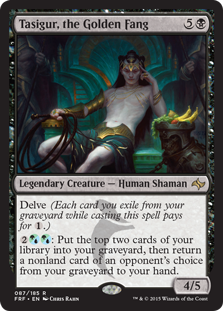
  • Restoration Angel and Kiki-Jiki, Mirror Breaker
  • Deceiver Exarch and Kiki-Jiki, Mirror Breaker
  • Scapeshift
  • Through the Breach into Emrakul, the Aeons Torn
  • Gifts Ungiven for Unburial Rites and fatty

I'm leaving off a lot of "I win" synergies because they might not support the other two criteria (sorry, dear Goblin Charbelcher), but this is still a great starting point before we incorporate our other parameters.

Criterion 2: Role Flexibility

If you take on the URx Twin mantle, you'll find yourself in positions where your primary win condition isn't online. Maybe an opponent TasigurThoughtseized the pieces. Perhaps they are presenting removal mana. Either way, our heir to the throne must be able to shift gears into a new role to beat the hate and emerge victorious. Twin was notorious for this approach, achieved in Game 1 with reach from Snapcaster Mage, Lightning Bolt, and Pestermite, and augmented in Games 2-3 with haymakers like Keranos, God of Storms. Temur and Grixis variants accomplished this with a midrange gameplan courtesy of Tarmogoyf and Tasigur, the Golden Fang, while Alex Bianchi's Jeskai list leveraged Celestial Colonnade. Of course, this gear-shifting must never preclude the threat of our primary win condition. Opponents need to think twice before spending valuable interaction on a rogue Tarmogoyf, lest we Exarch them out in response.
Taking the Twin example, we'll either want a tempo or a control Plan B to our Plan A. It's no coincidence many considered URx Twin the "true" control deck of the format, something showcased in every game where Brian Braun-Duin packed his own UR Twin list. Indeed, in many respects, we wouldn't be wrong describing Twin as a Plan A tempo or control deck with a combo Plan B! This role fluidity makes in-game decisions and sideboarding significantly harder than if we were a pure combo deck. Opponents must weigh disrupting the combo against interacting with our Plan B, which often necessitates different spells and lines of play. Our role flexibility gets weaker if opponents can answer both dimension of our strategy with a single card: Jeskai Twin had great positioning at Pittsburgh because bullets that stopped the Twin combo were useless against Colonnade.

Celestial ColonnadeFocusing on tempo and control options (although it would be interesting to explore aggro or ramp ones at a later time), here are some frontrunning cards and combinations we'll want to remember as we craft the Twin successor.
  • Tempo threats: Vendilion Clique, Pestermite, Restoration Angel
  • Manlands: Celestial Colonnade, Wandering Fumarole, Lumbering Falls
  • Early clocks: Tarmogoyf, Tasigur, the Golden Fang, Geist of Saint Traft
  • Burn reach: Snapcaster Mage, Lightning Bolt, Lightnign Helix, Electrolyze
  • Haymakers: Keranos, God of Storms, Jace, Architect of Thought, Ajani Vengeant

We'll want to focus on these categories as we outfit our deck for post-banning success.

Criterion 3: Bolt, Remand, and Snapcaster

In highlighting these three staples, I point both to the cards themselves and also the effect they represent. Twin enjoyed so much success not Snapcaster Mageonly because it leveraged these Modern icons themselves, but also because it capitalized on the advantage they presented in games. Lightning Bolt is the cheap removal spell that allows early interaction, gives options in the midgame, and widens reach into later turns. Remand is the virtual time walk that punishes flashy and expensive plays, steals tempo, and buys time for either your Plan A or your Plan B. As for Snapcaster Mage, the Wizard requires little introduction: he's arguably (read: probably) the best card in Modern and is one of the only cards that appreciates in value at every stage of the game. Without these three effects, Twin would not have been the powerhouse we remember it as, and although Splinter Twin is gone today, its royal guard remains.
Lightning BoltUnlike my last two criteria, this one is color-specific. You need to be in URx to abuse Modern's Bolt/Remand/Snapcaster trinity, which naturally places some deckbuilding restrictions on any post-Twin strategies. I don't have a problem with these constraints. Bolt is going to be more important than ever in a metagame swarming with Wild Nacatls, Goblin Guides, Signal Pests, and (Bl)Inkmoths. The same is true of Snapcaster, which will remain the best reason to play blue until/unless they ever unban Jace, the Mind Sculptor. Some have argued Twin was not the best deck because of the combo in itself, but because it was the best way to build around Snapcaster Mage. I won't disagree with this, and we'll want to make a similar commitment in 2016.

RemandRemand is also a worthy contributor to the Twin cause, although it's relevance is more questionable today than it was three months ago. Rising linear decks in the Stage 1 Twinless world will be poor targets for Remand's talents. Much more worryingly, Bx Eldrazi decks circumvent the tempo loss with Blight Herder's and Oblivion Sower's on-cast effects. Remanding a turn three Karn Liberated is as good as it gets. Remanding the turn four Ulamog, the Ceaseless Hunger? Not so much. These decks make the counterspell much worse than it was in an earlier metagame, benefiting from the double-cast and often having enough mana to negate it early. Because of this, our Twin successor might need to evolve beyond its Remand origins, even if we keep the instant in mind if the format becomes more hospitable.
TrickbindBolt-Snap-Bolt doesn't have replacements, but there are plenty of viable alternatives to Remand's place in the Twin picture. Here are just a few I'm scoping for future brews.



  • Trickbind
  • Squelch
  • Mana Leak
  • Logic Knot
  • Voidslime
  • Bant Charm

I'm nervous about the three-mana alternatives, but very interested in the rest. Modern might not have Stifle or Counterspell, but some of their replacements might be good enough in the right shell.

The Search is On!

It might feel oversimplistic to distill URx Twin's enduring success to just three themes when so many other internal factors and external contexts were at play. These possible complications aside, I'm comfortable starting with this trio as we look for the next contender to take up Twin's fallen sword. We can add to them as we learn more about the new metagame, and adapt them as we see what a Twinless Modern looks like. You can bet I'll be brewing, testing, and crunching the numbers to see what comes next.

What deck do you think will inherit the Twin tradition? Any tech you're keeping an eye on? Do you even believe Modern needs a Twin deck, or that Twin was the policing force I make it out to be? Take it into the comments and I'll see you all there as we navigate this new format together! I'll be posting a Part 2 to this piece in the coming week after I've conducted some more tests.

Want Prices?

Browse thousands of prices with the first and most comprehensive MTG Finance tool around.


Trader Tools lists both buylist and retail prices for every MTG card, going back a decade.

Quiet Speculation