menu

What’s the Ordeal?

Are you a Quiet Speculation member?

If not, now is a perfect time to join up! Our powerful tools, breaking-news analysis, and exclusive Discord channel will make sure you stay up to date and ahead of the curve.

Just in case your FNM is looking a little dreary this time of year, I’m here to save the day with a little holiday spice. Don’t let your Black Friday be filled with boring old Standard decks that every opponent has seen and tested against many times. Kick it up a notch.

Ordeal #8 (Bant Auras)

Untitled Deck

Creatures

4 Gladecover Scout
4 Favored Hoplite
4 Voice of Resurgence
4 Witchstalker
4 Boon Satyr

Spells

4 Ethereal Armor
4 Ordeal of Heliod
4 Ordeal of Thassa
4 Unflinching Courage
2 Ajani, Caller of the Pride

Lands

4 Temple Garden
4 Hallowed Fountain
4 Breeding Pool
4 Temple of Mystery
5 Plains
1 Forest

Holy cow! What’s the ordeal with that deck list? The ordeals are exactly what I’m talking about actually. Anytime you have cards that have a profound impact on limited formats, I recommend taking a serious look at them for their constructed applications. That’s exactly what I have done here.

Here's the ordeal through which I arrived at the list.

On the Road

As I was finishing up a recent journey out in the east coast region of the U.S., I found myself with a plethora of time at my disposal due to a car of sleepy Magic players. My love for driving is seldom rivaled by anyone in my play group so this is not an uncommon sight for a Saturday or Sunday night.

After a long grueling weekend of intense mental competition, what’s better than analyzing the format and trying to find a weakness to exploit? Based on my prior experience, I’d have to argue that nothing is better. After those long weekends, often all I want is to play more.

So there I was, just jamming away to some music. With no conversation to be had I was left to think through the available card pool. I spent my time desperately trying to find the sprouting of a new idea to grab hold of.

Right before the idea hit me, I had been reminiscing about how great Theros Limited was and how I’d played almost as much of it as I had Standard in the last month or two. There is a lot of interaction between players in this limited format except for times when someone has an early and unanswered ordeal.

I wondered about ordeals for a moment. Two of them was nutty because they trigger each other much earlier and you get their spell effect as well as buff your creature. The idea of two ordeals spurred a line of thought that I was not expecting. Could that idea be transferred into a solid Standard deck?

After the auras deck from last Standard season and Boggles in Modern, players are starting to take the idea of an enchantment Voltron more seriously. If you think it through, the idea is solid. Basically, your opponent can never target your creature, so the more auras you put on it the more your opponent can’t handle what you’re doing. If a giant untargetable monster was not enough, it most likely has lifelink so they can’t race you either.

Filling the Gaps

Was this really going to work though? We only have Gladecover Scout and Witchstalker left as decent hexproof creatures, but there are a couple other ones that are okay. Voice of Resurgence, for example, is a solid threat and if they kill it and the enchantments on it, you still receive a creature in return.

There are a couple of decent auras like Unflinching Courage and Ethereal Armor, but the deck was still lacking something. Could ordeals really be the solution? Ordeal of Heliod seemed a likely inclusion, but the green one was underwhelming at best.

At this point, I was already considering playing some temples for the filtering effect, but they could also help me work in a third color. What could a third color even offer? After a moment of thought, it hit me. Ordeal of Thassa!

Now that was exactly what this deck was looking for. Not only did it give you the ability to have double ordeal draws, but it also drew cards so you would always be putting pressure on your opponent. Adding blue just for this one enchantment may seem like a bit much, but the only real drawback is that you are now required to take some damage from your lands.

That cost is well worth how much the blue ordeal brings to the deck. You would be surprised how often the card reads like this:

1U Sorcery
Put a +1/+1 counter on target creature you control, then draw two cards.

Tons of decks would play that card if it existed and often that is how good it is in this deck. The combination you need to pull off the change of text is any creature and two ordeals.

For example, turn one Gladecover Scout, turn two ordeal, turn three ordeal and trigger both of them. That’s either 20 life, 10 life and two cards, or four cards in addition to giving your creature three +1/+1 counters!

Strengths and Weaknesses

Obviously that’s one of the deck’s most powerful draws, but it happens with relative frequency. Even if you have to wait until turn four to play your two ordeals on your Witchstalker, no big deal because you will trigger them both on turn five!

Despite having some powerful lines of play, there are occasionally consistency issues. As with any deck like this, you need a healthy mix of lands, creatures, and enchantments. If you draw some of each, you will be golden, but there are times when you draw too many of one type and not enough of another.

Also, despite Favored Hoplite adding much-needed consistency and power to the deck, any type of black removal will deal with him swiftly, so be careful about going all in on that creature against any deck with black mana. Sometimes it's your only option, but overall, the risk is worth the reward. Against any non-black deck, Hoplite plus ordeal is going to be hard to deal with.

A note about Ajani, Caller of the Pride. You may have noticed this planeswalker in the deck and not given him a second thought. He pairs well with an aggressive deck so he seems like an easy inclusion. That was not the case for me however.

The main reason he found a home in the deck was because of his synergy with the ordeals. Ordeals don't care where the +1/+1 counters come from. As long as you have three counters, it will trigger and the spell ability will go onto the stack. So with one creature, one ordeal and Ajani, you can trigger the ordeal on the second attack.

Sideboarding Ideas

As it stands now, the sideboard is up in the air. My main thought is what to do against Esper Control. I think that matchup may be the worst by a large margin. You can play all the hexproof creatures you want and all the enchantments you desire, but in the end, they just wipe the board with Supreme Verdict.

It's possible that three or four Mending Touch plus just as many Mistcutter Hydras would be enough to take down the most popular control deck of the format. This deck may need a more transformational sideboard strategy. It's possible you might bring in Rootborn Defenses, Fleecemane Lion, Advent of the Wurm, as well as the Mistcutter Hydras.

One card I know will make the sideboard will be Rapid Hybridization. That removal spell will help you deal with Master of Waves, Desecration Demon, or whatever problematic creature your opponent has in their deck. Here is what I would go with based on my limited testing so far.

Untitled Deck

Sideboard

3 Rapid Hybridization
3 Mistcutter Hydra
3 Rootborn Defenses
3 Advent of the Wurm
3 Gainsay

Overall this is a solid deck with a focused gameplan. Be careful about your mulligans and sideboard cautiously as well.

Not many opponents will be able to handle your hexproof army that is ready with battle enchantments. Most aggro decks can't handle all the lifegain and most midrange decks can't handle the inability to target your dudes. All you need to worry about are decks like Esper.

Hope this ordeal was worth your time. If you find yourself showing your opponent what the ordeal is, post some feedback about your thoughts on the deck.

Until Next Time,

Unleash the #8 ordeal Force!

Mike Lanigan
MtgJedi on Twitter
Jedicouncilman23@gmail.com

Legacy Updates with Regard to RUG Delver

Are you a Quiet Speculation member?

If not, now is a perfect time to join up! Our powerful tools, breaking-news analysis, and exclusive Discord channel will make sure you stay up to date and ahead of the curve.

So, my first foray into Vintage didn’t exactly go as planned. Workshop decks were dramatically over-represented at the event, and Storm doesn’t matchup particularly well with this style of deck. I played one game where my Shop opponent not only killed me on turn three, but did so with three Thorn of Amethyst in play. Next time I play Vintage I plan to prepare more for the event and to play something that isn’t so bad against Shop. I’m not really sure why somebody would willingly play Shop when the tournament allows unlimited proxies, but it’s not my place to say what people should want to do. The deck is among the easiest Vintage decks to play, even if it is easily the most boring.

With the Invitational in Vegas right around the corner, it’s time for me to look back into more popular formats. I’ve been a fan of the red cards and Nykthos in Standard, and for the first time since my first Invitational in Charlotte I feel like I have some brushing up to do with regard to all things Legacy. The format has done a good amount of shifting lately, and there is some pretty real danger out there for a RUG Delver player.

Death and Taxes

The most dramatic change to Legacy, at least from my perspective, is that a lot of players are starting to respect Death and Taxes. A number of decks have been heralded as “designed to beat RUG”, but D&T is the only deck that I’ve ever felt really accomplished this goal effectively. I have lost to D&T with RUG more than any other deck, and the margin isn’t even close. Every other deck that’s “supposed” to beat RUG tends to have vulnerability to Wasteland and/or Spell Pierce. D&T is a pile of basic Plains and creatures.

For the purposes of the Legacy metagame, D&T is more or less a weaker version of Maverick that plays better in the metagame. Knight of the Reliquary lost a lot of steam with the printing of Deathrite Shaman and Savannah is considerably more Waste-able than Aether Vial. Both decks have the same tools against combo decks (Karakas, Thalia and just dying to Storm) but D&T gets access to Waste and Rishadan Port for combatting other fair decks, which have been filled almost exclusively with nonbasics as of late.

While Wasteland isn’t generally especially potent against a mana-light deck like RUG, having functionally 8 copies along with “free” spells off of Vial is. RUG may only need 1-2 mana to operate, but D&T has a lot of draws that are can keep you at zero.

While I would say that D&T is easily RUG’s worst matchup, it’s definitely not unwinnable and the games are often very close. On the RUG side there are a few things we can do to hedge.

Stifle Smart

Much like against Maverick, Stifle is one of RUG’s most relevant cards against D&T. It combats their Wastelands, their equipment and their Aether Vials. By timing your Stifles well you dramatically impact the way the game plays out.

If you’re choked on lands it’s usually right to use Stifle to counter a Wasteland, but when you have more lands to play you can generally just let them have it. Stifle is at its best when you mess up their Batterskull by Stifling the Germ trigger or when you mess up their turn’s mana production/combat by Stifling either the equip cost or trigger to get counters on Umezawa's Jitte. These actions eat far more resources than a singular Wasteland.

When and when not to Stifle Aether Vial is a bit trickier. To do this well, experience with the matchup is invaluable. You need to know when you can afford to let them Vial in Flickerwisp more than anything. Know how relevant your attack is on this turn and pay close attention to what they Vial in, when they elect not to Vial something in and which turns they declined to cast any spells on. This information will help you determine how many 3-drops they have and helps you determine whether or not they have a Swords to Plowshares.

19 Lands

Playing an extra land gave an edge in the mirror when it was popular and it also comes in handy here. If they aggressively Waste you and you keep playing lands you can find yourself completely in control of the tempo of the game.

This also helps you cast your ace in the hole in post-board games:

Sulfur Elemental

Sulfur Elemental tends to jump in and out of RUG sideboards, but I personally have the unfortunate luck of literally ALWAYS playing against the Death and Taxes player at every Legacy event I attend. Even before its recent upswing, I would also be paired against the one guy in the room playing the deck. Not having Sulfur Elemental in this matchup makes life pretty miserable. Casting it usually makes things pretty easy, as 3/2 Plague Winds are want to do.

That said, you still have to play smart even when you have Sulfur Elemental. If your opponent leads on Mother of Runes and you decline to Bolt it because you’ll get it later and they follow up with Stoneforge Mystic you’d better hope you have the Stifle for their Batterskull. Stifle smart and Sulfur smart and you’ll be alright.

I played a Grim Lavamancer in my maindeck and one in the sideboard for the last two Legacy events I played and posted a 6-2 record at the Indy Invitational and a 7-2 record at the Milwaukee Open, but I’m planning on dropping it from the main and possibly the sideboard as well. I included the card at Caleb Durward’s suggestion to combat Baleful Strix in addition to splash damage that it has against decks like D&T. I found that my matchup against Strix decks was already better than forecasted and that Lavaman performed less than great against D&T. It’s bad on the draw against a Mother of Runes, weak to Swords to Plowshares (and let’s be real, this deck doesn’t play enough threats to overload even a deck with only four removal spells), and much too slow of a topdeck in many situations. Lavaman is okay, but I definitely wouldn’t leave home without Sulfur Elemental.

And now for the big reason I’m moving away from Grim Lavamancer...

True-Name Nemesis

True-Name Nemesis is a far cry from format defining, but the card is obviously potent in Legacy. Thus far it has mostly served as an upgrade to Geist of Saint Traft in decks that would normally play the legendary spirit, but I think we’ll start to see it in more strategies as time passes. It shoehorned itself admirably into UWR Delver and Deathblade. Personally I think its best home is likely in a reimagined BUG shell, but I don’t see me being the person perfecting it. For now, I’m content to play the side of the opposition.

True-Name Nemesis, while clearly powerful, doesn’t bother me as a RUG player nearly as much as people say it should. It has the oft overlooked drawback of costing three, so when somebody makes the audacious claim that it “single-handedly beats RUG” I can’t help but feel that they’re missing the bigger picture. UWR Delver and Deathblade are both driven by lands that are vulnerable to Stifle and Wasteland. Three mana is a decidedly vulnerable slot on the mana curve to Daze.

I will grant that TNN is likely the three drop which can’t be Spell Pierced that is most threatening to RUG, but it is slow, can’t block Insectile Aberration and doesn’t really race Tarmogoyf so much as just block it.

What’s interesting to me is that the more popular TNN gets, the less effective Baleful Strix becomes. I’m of the opinion that Baleful Strix is, in most cases, more impactful against RUG than TNN, and that this shift will benefit RUG more than most people seem to believe.

With an anticipated decline in Strix and rise in TNN, the aforementioned Grim Lavamancer is on the chopping block from my RUG list. In it’s place I will commit what I have long considered a sin and include the fourth Daze in my list. I really don’t think I can afford not to given how powerful it is both against three drops in general and against Aether Vial when I’m on the play. I foresee boarding it out rather aggressively, but it seems much more appropriate than it ever has to include it now.

Odds are high that I’ll be battling the “Big Legacy” at the Monster Den this weekend with this maindeck:

RUG Delver

spells

4 Force of Will
3 Spell Pierce
4 Daze
4 Lightning Bolt
1 Dismember
4 Tarmogoyf
4 Delver of Secrets
4 Nimble Mongoose
4 Brainstorm
4 Ponder
4 Stifle
1 Fire // Ice

lands

3 Tropical Island
3 Volcanic Island
2 Wooded Foothills
4 Scalding Tarn
3 Misty Rainforest
4 Wasteland

And I’ll do so without fear. I don’t know how many people would advocate RUG right now, but I remain a believer. As always though, I recommend that everybody see for themselves.

Thanks for reading.

-Ryan Overturf

Insider – Liquidity

Are you a Quiet Speculation member?

If not, now is a perfect time to join up! Our powerful tools, breaking-news analysis, and exclusive Discord channel will make sure you stay up to date and ahead of the curve.

Welcome back, readers and speculators. As I look out my window all I see is rain, which got me thinking about the different levels of liquidity in the world of MTG speculation. That will be the focus of today's article.

What Is Liquidity?

First let's define the term.

Liquidity -- The ability to convert an asset to cash quickly.

- "Investopedia" (http://www.investopedia.com/terms/l/liquidity.asp)

Magic cards are surprisingly liquid in certain marketplaces (stores, tournaments, the internet) but it's important to keep in mind that they are not acceptable forms of currency everywhere. If I were to hand the cashier at McDonald's a Sylvan Caryatid to pay for my meal I would likely get an odd look and a refusal of goods. While this is obvious, we often gloss over it when buying and selling cards.

This is why many speculators tout the phrase "cash is king," because cash is the most liquid of assets. It is the reason why prices at major tournament venues are actually higher than they are anywhere else. The stores value the cash they have on hand highly because they want to buy as many cards as they can in a limited window of time.

Levels of Liquidity

Now that we've defined liquidity let's go over the various card types and their level of liquidity. To make this easier I will use a reference number from 1-8 for each category to define its liquidity.

  1. This card is impossible to move. There is no actual demand and the only way to get rid of it is to sell or trade at bulk status.
  2. This card is not quite impossible to move, but the market is very limited.
  3. This card is moveable but it may take a bit of time (2+ months) to find a buyer/trader.
  4. This card is moveable but it may take a bit of time (2+ weeks) to find a buyer/trader.
  5. This card is pretty easy to move. You'll find demand relatively easily, though it may be difficult to do so at its current price.
  6. This card is easy to trade at its current price (often this means the spread is low).
  7. This card is tradeable above its current price as demand is high enough that a price increase is expected.
  8. This card can be sold for cash at its current price with relative ease (these are rare).

Hot Standard Mythics -- 7 (or 8)

Hot Standard mythics are often very liquid. Stores always want them and their buylist is high to keep supply coming in. These are the cards store owners focus on when going through a trade binder. Often players who want these cards will need them for the next breakout deck.

These are your PT breakout stars (Master of Waves, Thassa, God of the Sea) and the cards that when they are hot everyone will want out of your binder. They are usually 8's for the first couple weeks after their release because supply hasn't caught up with the demand yet and many stores who think they will go up will purchase them in cash. Their time at the 8 status is short.

Dual Lands -- 7 (or 8)

These are some of the easiest cards to trade. Demand is currently very high and the ability to play them in both Legacy (a format beloved by many) and EDH makes them extremely easy to move. The typically high price for them also keeps demand high as most players would rather trade for things than buy them and the price often prevents many from trading for them.

I've found people constantly interested in them and always have offers for any extras that I have in stock. I love trading them down at buylist prices as that's essentially selling them (assuming you ship off the cards you traded in for right away).

Hot Standard Rares -- 6 (or 8)

Similar to the hot Standard mythics, these cards are easily tradeable and demand is high. They also hit the 8 status within the first couple of weeks of the sets release, though they will often lose that status quicker than mythics because supply will catch up to demand more quickly.

These can also be PT breakout stars or simply cards that were misvalued upon release and shown to be far more powerful than expected; Nykthos, Shrine to Nyx and Boros Reckoner are good examples.

Seasonal Staples -- 5 to 8

These are now going to be your Modern staples. The cards that are played in a lot of Modern decks and are well known. Their liquidity will cycle with the season's format.

As many of my fellow writers have mentioned, now is the time to pick up Modern staples as their liquidity is currently lower right now (5) and they are often undervalued and may be "rotting" in someone's binder. That person will often be happy to unload them now for other cards they want or think have more potential.

These are your Kiki-Jiki's, Spellskites, Cryptic Commands. You can make a lot of money by simply picking them back up after the Modern PT season runs its course as many players will unload them after the season to pick up the cards for the next season (and then need to reacquire them the next Modern season). During the season though these cards will be as good as cash to many players as they try to build their decks for the season or the next tournament. This will be the time to unload them to other players.

High-End Legacy Staples -- 5 to 7

There is no real Legacy season, though demand always goes up shortly before a big Legacy GP. Legacy prices are typically stable which makes people feel safer trading for them at current prices as they have less fear of losing money if they trade the card away down the road. This is also why players trading Standard cards for Legacy cards are expected to pay a "Legacy tax" (about 10-20%).

These cards are often easy to trade with most players as they are recognized as decently liquid and stable assets, thus even people with no interest in the Legacy format will often be willing to trade for them. The Legacy staples are your Force of Wills, City of Traitors, Onslaught fetchlands, and Wastelands.

EDH All-Stars -- 5 to 6

These cards are run in a large variety of EDH decks. So long as there's an EDH community where you live there will be demand for these cards, and as the community grows the demand will increase.

The only other factor to consider is the possibility of reprints. WoTC has shown they have no fear of reprinting anything not on the Reserved List, though luckily many EDH players are becoming more like Legacy players with the desire to pimp their decks. This helps original printings and foil versions maintain stable prices.

$4+ Standard Mythics & Rares -- 4 to 5

These are Standard cards with enough demand to keep them at non-bulk status, but not enough to cause the price to be high. These are usually tradeable to people who are looking to build whatever deck runs them or into a store that has run out of their own stock. But demand is low enough for these cards to rot in your binder a while.

$1-4 Standard Mythics & Rares -- 3 to 4

These Standard rares haven't hit bulk status yet, but there are plenty of them and demand is low. They may be one- or two-of sideboard cards. I don't advise trading for them unless you already have an out because they are likely to become bulk before you can unload them.

Low-End Legacy Staples -- 3 to 5

These are the cheaper Legacy staples or the ones that fit really well in a few decks. There is demand for them, but it's limited to people who want to play one of the few decks they are run in and don't already have them. These are your Thalias, Grafdigger's Cages, and Meddling Mages.

Legacy Commons & Uncommons -- 3 to 4

These are the harder-to-find older commons and uncommons used in the Legacy format. Typically they are far more valuable than bulk commons but not so valuable that the demand is all that high. They are usually only tradeable at Legacy venues or to people who are trying to get into the format. These are your Dark Rituals, Counterspells, Brainstorms, Elvish Spirit Guides.

One Deck All-Stars -- 2 to 4

These are cards played in just one deck, like Time Spiral and Mangara of Corondor. More often than not they are some of the best cards in the deck they are played. But their inability to fit into other shells makes them sit in the 2-3 category most of the time, only hitting 4-5 when the deck's popularity spikes. For example, demand for Death and Taxes cards went up almost across the board after it won the last European Legacy GP.

Modern Commons & Uncommons -- 2 to 3

Similar to the Legacy commons and uncommons except they aren't as old or rare and the format hasn't developed the same following. These will sit dormant in your trade binder until you either go to a Modern event and trade with people trying to stockpile commons and uncommons, build a deck, or are just entering the format.

Sub $1 Mythics & Rares -- 1 to 3 (8)

These are your bulk rares. They are impossible or nearly impossible to move outside of bulk status, however, at bulk status they are 8's (you can always sell them to several stores at whatever the store's going rate for bulk rares is). In fact at bulk rates they are about as liquid as you can get with cards and this is the reason they are some of my favorite things to trade for.

Insider: Were Innistrad Rares Ever a Good Place to Spec?

Are you a Quiet Speculation member?

If not, now is a perfect time to join up! Our powerful tools, breaking-news analysis, and exclusive Discord channel will make sure you stay up to date and ahead of the curve.

I’ve been thinking a lot about why I haven’t been excited about investing in Theros cards. A couple weeks ago, Anthony Capece published a great piece over on BrainstormBrewery.com regarding rares from large sets. If you haven’t read it, you really should, because he has some great insight that led to some really compelling points.

As a Magic player who interprets all things from the perspective of Draft, I would add to his points that the yearly Draft format has a lot to do with large-set prices. Consider this: we’re currently drafting three packs of Theros. When Born of the Gods comes out, we’ll still be drafting two packs of Theros and only one of the new set. Finally, Journey into Nyx will come out, and even in the late spring drafters will be cracking packs of Theros. A full 66% of drafted cards this block are going to be Theros, with only 22% and 11% being Born of the Gods and Journey into Nyx, respectively.

That means there’s going to be six times more Theros drafted than Journey, and three times more than Born. Any speculation as to what percentage of cards enter the market via Draft would just be a guess, but I feel confident in saying it’s a substantial amount. The frequency of seeing any given rare differs between a large set and a small set, sure. This is certainly a contributing factor to card prices, but the fact remains that there are going to be a lot more Theros cards in circulation than cards from the other sets in the block.

Examining Innistrad with the Aid of Hindsight

With Innistrad rotated, now is a good time to look at what the rares in the set did during its time in Standard. The block format for Innistrad was large-small-large, meaning that only 55% of drafted cards that year were from the fall set, but if anything, this should mean Innistrad cards were, during the set’s time in Standard, in slightly lower supply than Theros cards will be at the conclusion of the year (ignoring sales numbers, since we don’t have that information available).

Examination of Innistrad shows that there wasn’t a lot of money to be made speculating on rares, except maybe right around the set’s release. Don’t believe me? Take a look at the below list. I think it’s safe to say all of these cards were Standard staples, or at least staple-ish.

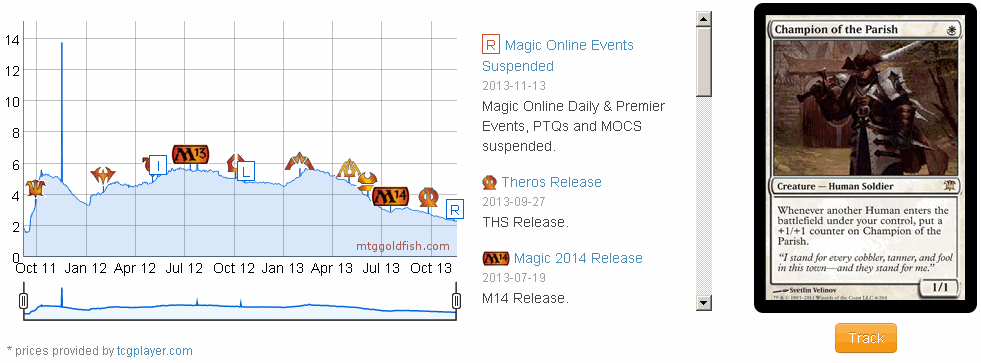
Champion of the Parish: After hitting $5 right around the time of its release, this card stayed in the $4 to $6 range for basically its entire time in Standard. Any deck that played it wanted four copies, and it saw plenty of play in several white weenie variants, most popularly in The Aristocrats. Many saw it as a good spec after Return to Ravnica was released, but it never saw a significant spike.

ChampionoftheParish.pricehistory

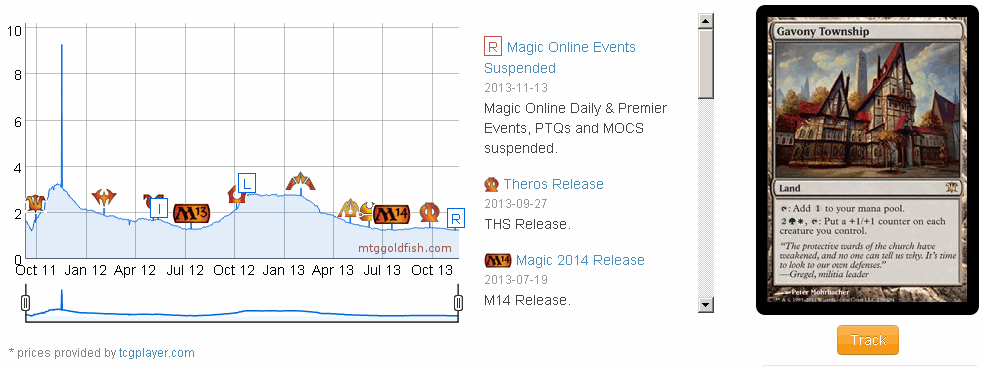
Gavony Township: Here’s a card that saw lots of Standard play, still sees Modern play, and has plenty of casual appeal. I never really heard of people speculating on it, which is probably good, because the price only shifted about 80 cents one way or another from $2.

GavonyTownship.pricehistory

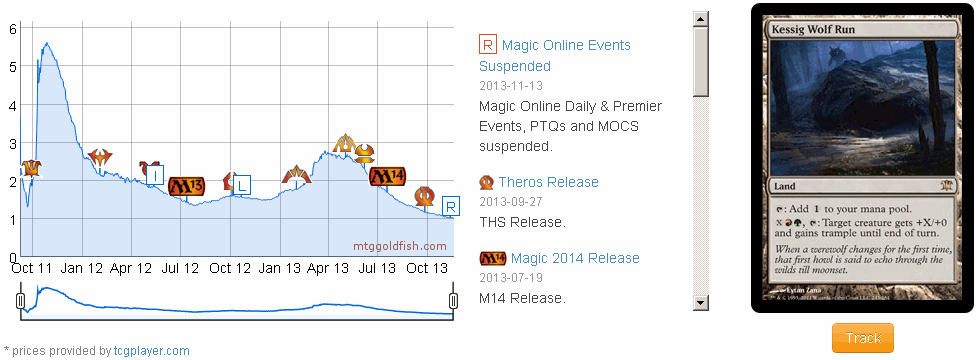
Kessig Wolf Run: There was an entire archetype named after this card. It’s hard to be more of a staple than that. It wasn’t a four-of, but it was played an awful lot. However, unless you bought in at the prerelease and sold right away, you likely didn’t make any money here. The card didn’t fluctuate more than a dollar either way after settling to a normalized price.

KessigWolfRun.pricehistory

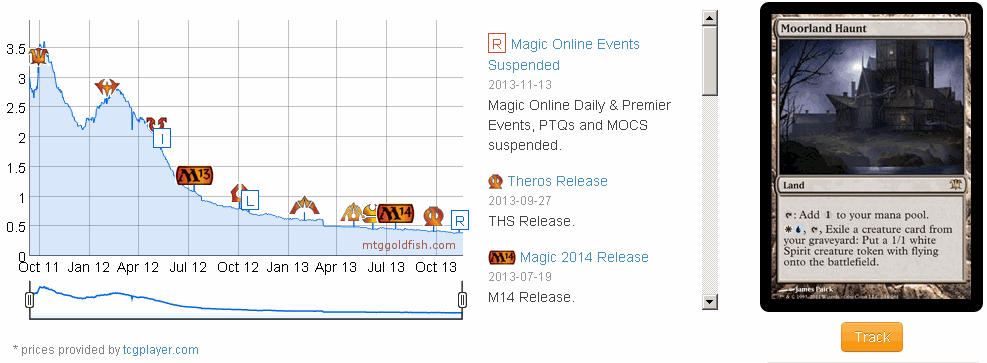
Moorland Haunt: Here’s another card that saw consistent play all year long. It wasn’t ever a four-of, but it has seen some singleton play in Modern. And yet there was never an opportunity to make money speculating here—the card steadily declined throughout its Standard life.

MoorlandHaunt.pricehistory

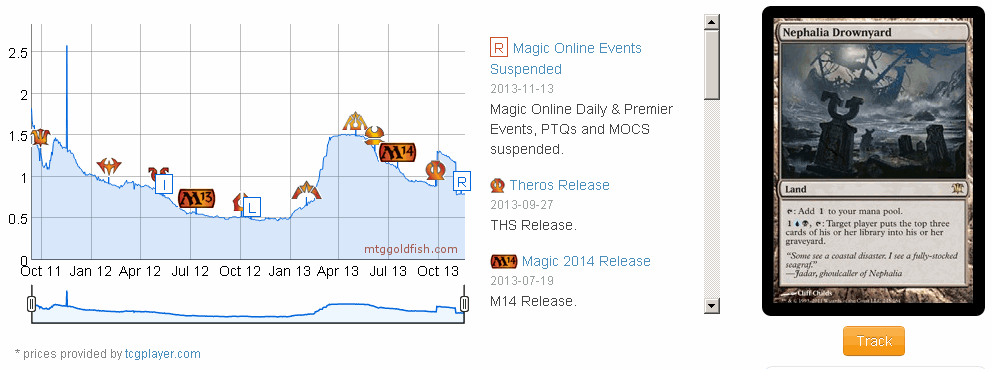
Nephalia Drownyard: This one was a four-of at points, and it actually did triple up between Gatecrash and Dragon’s Maze. However, it tripled up from $0.50 to $1.50, meaning that after shipping and fees, there was not much profit here, unless you went deep at the perfect time and outed en masse.

NephaliaDrownyard.pricehistory

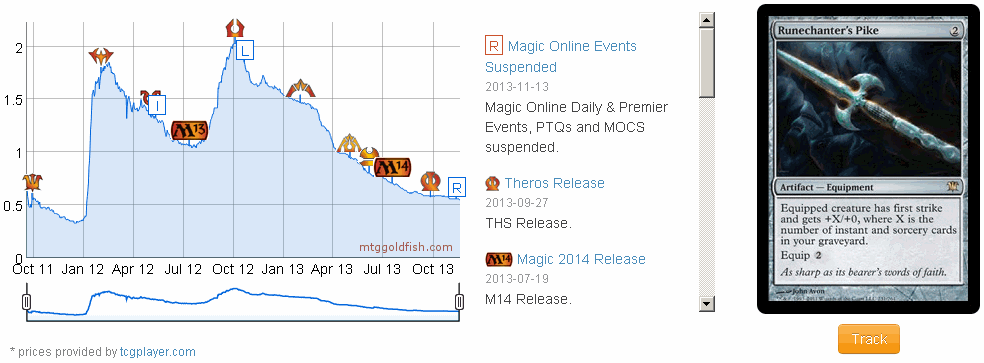
Runechanter's Pike: I know that I bought a couple playsets of this card at $0.49 after Delver won its first big tournament, and sure, I traded them out at $2 each. Profit is profit, I guess, but it certainly wasn’t much. Despite this card being the win condition in a few iterations of similar decks during its time, it never broke past that $2 mark. Why? Obviously there are many factors, but a big one is that it’s a fall-set rare.

RunechantersPike.pricehistory

Finding Opportunity Despite All This

The above graphs sure make it seem like a bad idea to speculate on Standard rares from fall sets. Are there exceptions? Sure! With Innistrad and Scars of Mirrodin, it certainly paid off to pile away the rare dual lands. But with devotion running rampant in Standard, shock lands haven’t spiked like the buddy and fast lands. If a mono-color theme is supported in next year’s block, we may see temples perform more like shock lands than the rare duals of the prior two years. As someone who has a pretty deep position in shock lands (and just generally likes speculating on real estate), I’m hoping the dual-colored gods encourage mana bases with more rare duals. But given the current situation in Standard, it’s hard to advocate moving in on temples. They’re powerful, but they are tap lands.

You know where there was opportunity to make small profits on Innistrad rares? Bulk rares that started seeing play. I didn’t go deep or anything, but I did purchase a few playsets of the following three cards at around bulk prices, $0.15 - 0.25 each:

BlasphemousAct.pricehistory

SevertheBloodline.pricehistory

CacklingCounterpart.pricehistory

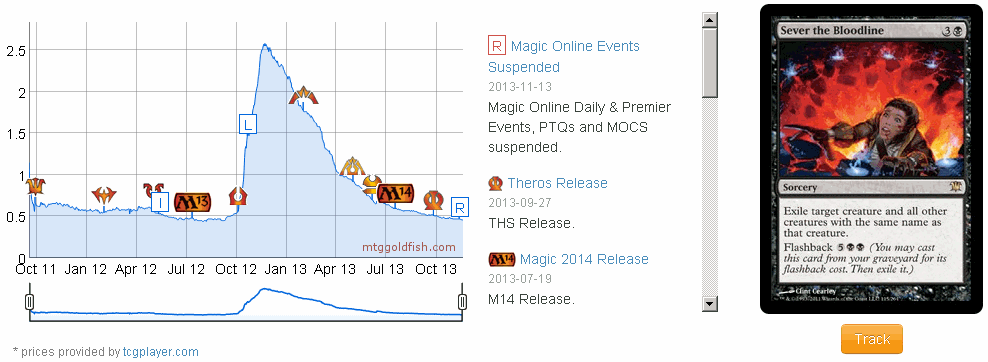
The first two, Blasphemous Act and Sever the Bloodline, I threw in some random TCG Player carts whenever I saw prices at bulk level. This was pretty common while Innistrad was still being drafted. These are both obviously powerful cards that didn’t have a home, but when they found one, they both spiked to about $3. At $0.15 each, that represents a 2000% gain, which is a pretty big number, even though in real life it’s just a couple bucks per card.

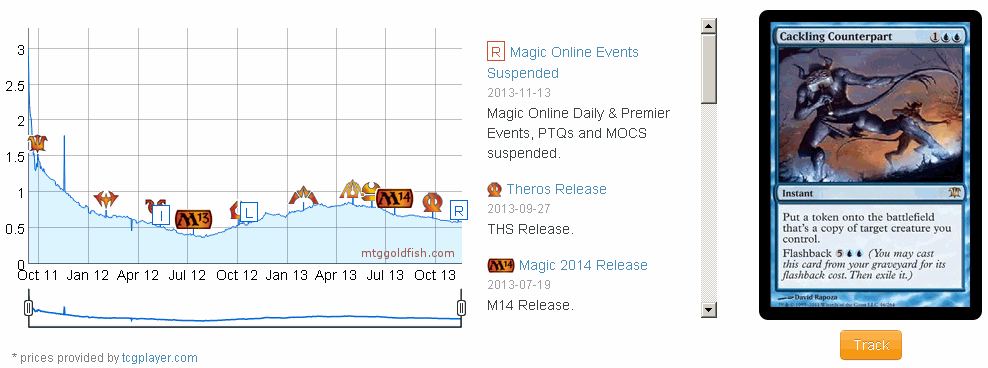
Cackling Counterpart was a fairly common spec based on the populate mechanic. We never got the creature that made the infinite combo here, but just based on casual demand (and probably people speculating the same as me), I was able to buylist out all my copies for at least two to three times what I spent. Turning dimes into quarters isn’t great, but if things had gone differently it could have been dimes into dollars, and that would have been sweet.

Buying in on powerful bulk rares didn’t make me a ton of money, but it did make me some, and put me at very close to zero risk. My advice to you is to wait a couple more months for Theros rares to bottom out, then comb TCG Player for ones at bulk prices. We’re not bottomed out yet, but I’m keeping a close eye on Chained to the Rocks, Fabled Hero, and Prognostic Sphinx.

What you shouldn’t do is speculate on Theros rares that are above bulk but not seeing a lot of play. The godly weapons (e.g. Whip of Erebos) come to mind. These are already sitting at $1 - 3 each, and I think that if they were going to spike, they would have already spiked. At best, they’ll fluctuate within a dollar or two, but I don’t anticipate any triple-ups or better. When all is said and done, don’t be surprised to see graphs that look similar to the Innistrad spell lands discussed above.

The Big Ones

I haven’t mentioned Innistrad’s flagship rare, Snapcaster Mage. This is a rare that outpriced many mythics during its Standard tenure, always maintained a high price, and still hasn’t dropped even post-rotation. On the contrary, it will probably slowly grow forever, at least until it’s reprinted. There are a lot of factors contributing to this price history, but it mostly stems from the card’s eternal playability.

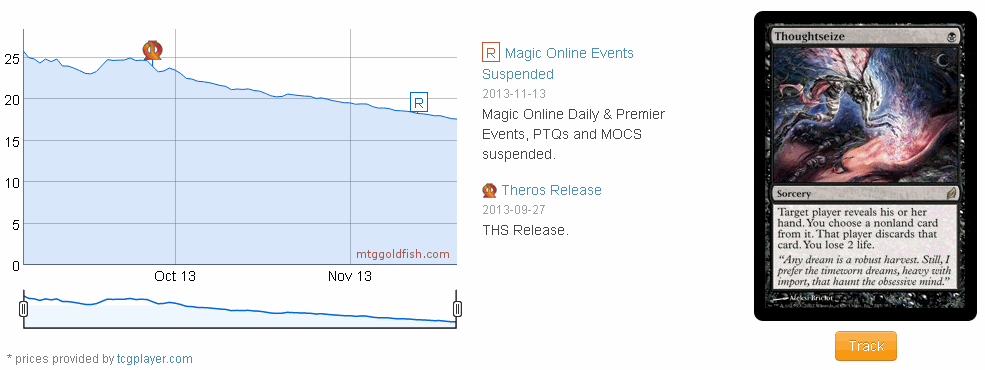
Does Theros have a comparable card? Thoughtseize, of course, has some real pedigree. It’s a Legacy, Modern, and Standard staple, and is possibly even more played than Snapcaster Mage. And yet, check this out:

Thoughtseize.pricehistory

Maybe I’m seeing things, but that looks like a steady decline since the reprint. How much lower can it go? I’m not really sure, but I am sure that people are going to be cracking these in Draft for the next six months. There will come a time to buy in, probably, since a card with this pedigree can’t just fall in price forever, but I think it’s pretty clear that selling is the right call for now. I’ve certainly been selling all of the copies I’ve been drafting.

And Now to Proceed with Caution

Doing this analysis, I’ve learned that after the hype has worn off of fall-set rares, they are not the place to spec if I’m looking for crazy spikes. In fact, it seems like most of them don’t really grow at all after finding a stable price—some consistently-played staples even steadily decline. The big exception in recent years has been rare dual lands, and a little low-risk money can be made speculating on cards at bulk prices, as well. But when I’m looking for potential triple-ups or better, from now on I’ll be looking at small sets, mythics, and eternal cards.

Jason’s Alticle – You’re the Man Now, Dog

Are you a Quiet Speculation member?

If not, now is a perfect time to join up! Our powerful tools, breaking-news analysis, and exclusive Discord channel will make sure you stay up to date and ahead of the curve.

Greetings, Salutatorians,

I have heard tell that a great way to deal with writer's block is to start writing something, anything, just to get in the act of writing and the ideas will come more easily that way.

I think they did that in that movie "Finding Forrester" when Sean Connery was all, "You're the man now, dog," and that kid looked at him for like half a second too long, like he was about to say, "that's pretty racist, you reclusive old fruitcake," but opted not to. Yeah, that movie was awesome.

What was I talking about, again? Oh, yeah.

We're All Bad At This

I mean, not all of us, obviously. So, Maro wrote in some article, or a blog post, or one of his comics....or a drive to work episode... wow, Maro's prolific. Yeah, so in one of his many outlets, he said that when you survey them, 95% or some absurdly high number of competitive Magic players think they're above average.

Everyone knows a handful of truly terrible players, and we're better than them, and then we're not as good as Owen Turtenwald because who the hell is better than Owen Turtenwald? We all fall somewhere between the two extremes of Owen and the guy who has been playing for five years and still draws a card before he untaps his land. We read articles, so we skew high, right? We're actually pretty good because we got 14th at that GPT that one time and we have a SCG subscription.

Guess what? Half of all Magic players are below average. That "below average" demographic contains the guy with a 97-card, unsleeved cat warrior tribal deck with the spot on his head where the scar tissue is preventing hair from growing back in, but there is a 50% chance it contains you. I mean, maybe not, but everyone thinks they are above average (90%+ do, anyway) which means a lot of people are WRONG. You are bads at Magic, goes home and wash de shames off of you.

But even if you're good at this, I would recommend taking a look at what you're doing and how you do it with a critical eye. A lot of people are in the below-average demographic because they think they aren't and therefore aren't trying to improve continuously.

A lot of logical fallacies accompany the kind of delusion a below-average player or speculator engages in. You would think someone who thinks they are a better player than they are would learn otherwise quickly when they scrub out of an event and reality dick-slaps them in the face, but that doesn't always do the trick. "Bad beats," they say. "My opponent was lucky."

Is there an 0-2 bracket for the finance community? Unless you're trying to go infinite in paper finance like me or Ryan Bushard or a few other crazy idiots, it's not always obvious when you're not making money at this because you always have money from your job coming in.

So if you're not destitute and keep your box of shame hidden in a closet so you can forget about the time you bought 100 copies of Rubblebelt Raiders, you may not realize you're below average at this. At the very least, we all have "below average at this person" tendencies.

How best to quantify it?

Excel at MTGFinance

You see what I did there? I made a nice little play on words because I'm not just talking about being excellent at finance, I'm also referring to the program "Microsoft Excel" and I just realized you don't know why that's funny because I haven't mentioned that we're going to track our predictions in Excel yet.

We're going to track our predictions in Excel.

If you haven't taken this advice the million other times it's been offered, you should consider it. Nothing deals with logical fallacies and blind spots like getting the data on paper. It helps you stop making excuses and helps you see what's working. You can track where your best growth is, and it may not be in speculating like you might imagine. Make sure you track collections you buy and how much you made outing them, too.

Obviously, none of these ideas are new, but let this reminder serve as a push to get you actually doing it if you haven't already. I noticed that I was more thoughtful about what I bought when I knew I would have to be accountable later, even if it was to myself.

It's embarrassing to have a box full of Skylashers, it's even more embarrassing to have a cell in an excel spreadsheet telling you the exact size and shape of the bag of farts you ate when you invested in them. My spreadsheet also includes a cell that includes the price point I am looking to sell out so I remember and can just check trend data until I hit my target number.

Bothering to do this has been a good exercise and has helped me with my hangup of feeling lucky about my specs that hit. Confronting your failures has a way of doing that.

So how did the non-speculators do this weekend?

Old Results

I guess they accidentally published the results of Grand Prix DC again. No? Owen Turtenwald won again? Wow, okay. Skill game.

Grand Prix DC Albequerque Coverage

It looks like they messed up and published the results of PT Dublin, actually, because all I see are stupid Mono-Blue and Mono-Black devotion decks. It would appear that the Standard format has been solved a few months early, folks. Thanks for coming out.

What can we even learn from analyzing these results? Nightveil Specter will continue to be expensive because it's in both Magic decks. Nykthos, same.

It's really too bad, because people were really excited about Reaper of the Wilds at the beginning of the weekend. How far down the page are we going to have to look to find a copy? I'm scrolling. Looks like none in the Top 8. Keep going... and none in the Top 16. There were a few interesting decks that I will get to, but check out the "Top 5 cards" of the weekend. It's miserable. Actually miserable.

This is worse than Jund vs. Faeries. It's worse than Necro Summer. Worse than the firebombing of Dresden, even. Okay, okay, I went too far. It isn't worse than Jund vs. Faeries. But still!

Andrew Hanson's Naya list looked like fun. Pat Cox fielded what looked like a nice, consistent Boros beats deck. None of it mattered. You played Mono-Black or Mono-Blue because this is a solved format and the best players figured out the best decks and it's all over. Andrew Hanson's Naya deck looked fine, until he lost in the first round of Top 8 because Todd Anderson stomped his peehole shut with mono-x devotion.

The Mono-Blue decks are jamming four Gainsay in the board to improve the mirror despite their opponents doing the same. Want to play U/x? Prepare for splash damage. Black decks are running Dark Betrayal in the board to improve the mirror despite their opponents doing the same. Want to play B/x? Prepare for splash damage.

I don't have an aesthetically-satisfying third example to go here because people are only running two $&%*ing decks.

What does this mean? If the format is truly "solved" then there will be a lot of negative pressure on the prices of cards that don't go in either deck. Breakout decks are less likely to see big price spikes because of dingleberries waxing analytical about how the breakout deck isn't "Tier 1".

A stale format is going to raise anticipation for the next set, which is still a long way off. With redemption coming up, we could see Standard prices dip quite a bit. I expect that if the next set is truly multi-colored, we will see more deck diversity after the set is out. Cards like Soldier of the Pantheon could really pan out, but I am not buying in until after redemption.

Were those Reaper of the Wilds everyone was talking about more successful at the Open?

SCG Providence Standard

Matt Costa's winning list contained three of the mammer-jammers, but there has been no price movement on SCG. The cards are chilling at a cool $2 and show no signs of bumping up.

Some of the low-hanging fruit on TCG Player has been snatched up, which makes little sense to me, frankly. If the price is the exact same on SCG as it is on TCG Player, why buy 20 copies from each of two vendors on TCG Player when you can buy 40 on SCG and run a decent risk of them restocking at a higher price? SCG being sold out sends a stronger signal to everyone than buying a bunch of TCG dealers out of their one copy, something no one will notice or can even track.

I saw opportunity on Reaper, but even if it hits $5 I can't make a ton of return on it selling on TCG Player. If it hits $5, the buylist moves to.... $2. Not great if you bought in at $2.

Reaper was touted by the reddit community and a few have been on it since its spoiling, but I remain bearish (is that a thing? As in the opposite of "bullish") on the card. I'll take a safer bet. Still, Costa presents an alternative to the devotion decks in the form of a Jund deck, and we know how those "I only play Tier 1 decks, brah" dingleberries love Jund.

I never thought I would live to see the day where I would be glad for a jund deck to emerge... It's a decent enough midrange deck. Huntmaster is replaced, I guess, by Polukranos. Thundermaw Hellkite is replaced, of course, by Read the Bones. It looks decent enough. Can it beat the aggro onslaught from Mono-Blue or the crippling Gray Merchants from the Mono-Black Pack (Rat) Attack?

Don't ask me, ask Matt Costa himself, who conceded in his deck tech that Reaper is in the right colors for the format but stated that Reaper "is a bad card". Will it survive the final cut when the deck ultimately gets picked up by others and tinkered with? Who knows?

Two copies of the budget R/W Beats deck cracked the Top 16. Unfortunately, the deck takes a lot of splash damage from the copies of Shrivel that Mono-Black is beginning to run to deal with things like Master of Waves. Never has the solitary toughness in Daring Skyjek been more of a liability. Still, it's quick and consistent and it's possible the format will open up a bit and let a deck like this get there.

Chris Butcher has a cool name, and he played a Mono-Red deck with Chained to the Rocks, which I didn't initially consider as the perfect white card to splash into a red deck but in hindsight, it's obvious.

Chandra, Pyromaster is falling out of favor a bit, but this deck can make good use of it. I like Chandra's Phoenix in a meta where people are running Thoughtseize and Rakdos's Return and taking a lot of direct damage to the face. The Chained to the Rocks will bail you out if your opponent resolves a Master of Waves, most likely. I kind of like Rubblebelt Maaka as a Lightning Bolt, even more as a Giant Growth, and it's going to be a Hill Giant a non-zero number of times.

Dustin Brewer's deck looks cool, actually. It is another potential vehicle for Reaper, but it also uses old throwback cards like Lotleth Troll and Varolz, the Scar-Striped. Black creatures are pretty hard to kill and G/B gives you the best removal. Golgari Charm is where you want to be right now--who can argue with "Super Shrivel"?

I don't want to talk about Standard anymore, so I won't.

SCG Providence Legacy Top 16

So I got to bear witness to two equally unsavory scenarios--the Open is won either by Sneak and Show, or Alex Bertoncini, literally the worst. If you feel like having your jimmies rustled, check out his Top 8 profile. He is out of the running for player of the year, but he's going a long way toward a "most punchable face" title. He got second, so at least he didn't win.

Bertonisn'titfuntomakecheaterpunswithhislastname played Esper Nemesis blade, jamming a full four copies of the signature Merfolk. Mind Seize is still a good flip, which kind of sucks. I had quite a few copies of cards like Decree of Pain that are now worth next to nothing because of their printing in Mind Seize. I think if you have any of those cards, they will be a long hold to get the value back up. Decree of Pain is silly in EDH and its value will go up eventually. Samesies for Sol Ring, which we've seen hit $10 within a year of reprinting and can likely do so again.

Death and Taxes cracks the Top 8. Some of those cards have a lot of potential to go up. The deck is pretty cheap outside the ridiculous mana base and it is getting there. It races Deathblade pretty well and if they can't Stoneforge out their equipment, Thalia is a nice damper to their plans. Buying a whole turn is good to win the race, usually.

Lots of blade variants. Equipment plus Nemesis is good.

I still like Shardless BUG, and it looks like the format does, too. Free spells are fun, and casting Ancestral Bears or Hymn to Grey Ogre is pretty dandy.

That U/W/R Stone Nemesis deck has made another appearance, in 7th and 8th place. Honestly, come up with a way to beat Stoneforge and Nemesis. You can smash the whole format if you can beat that and not scoop to combo decks. I think Rhox War Monk and Tower of the Magistrate are where you want to be right now, honestly.

Sam Black was on to something with his Bant deck, and being able to run Stoneforge and Nemesis yourself feels dirty but gets there. Blue cards and Gaddock Teeg help against unfair decks. Humility out of the board is nice against both Sneak and Show and Nemesis decks.

I can't decide if Pox or 12-Post gets "Pet Deck of the Week" so I guess it's a joint win. I love Pox and am glad it continues to evolve. Night of Souls' Betrayal is a card I suggested last week for dealing with Nemesis, half joking. No joke, though, it gets the job done.

This is a pretty standard 9th-16th place even if the Top 8 is a little depressing. Legacy could become "solved" too, and that would be really bad for a format whose adoption is tenuous right now. I don't see Legacy going away, but I could see people hating it too much to bother if it gets stale. Banning Nemesis would be a horrible thing to have to resort to and I doubt Legacy gets any bannings any time soon.

That does it for me this week. Join me next week to find out whether Mono-Blue or Mono-Black came out on top that week.

Insider: MTGO Automation and Analysis Week 6

Are you a Quiet Speculation member?

If not, now is a perfect time to join up! Our powerful tools, breaking-news analysis, and exclusive Discord channel will make sure you stay up to date and ahead of the curve.

Article #6! Quite a lot has happened in the world of MTGO since my last article. As a developer and a member of the tech industry I have very mixed feelings on these issues. My emotional attachment to Vintage magic (and Vintage Masters in June) is strong, and is the only thing that has prevented me from selling my collection. It is harder and harder to ignore the rampant technical incompetence displayed at WoTC. I haven't logged into MTGO since black Wednesday when I sold off all my standard holdings, so my article this week will focus on a side topic I enjoy talking about, PRM cards. On the automation side, I want to talk a little about the changes made to the "News & Updates" page.

Automation:

Last time around I wrote about how to use regular expressions to scrape individual decklists from the reported events. Unfortunately since then WoTC has decided there won't be anymore Premier or Daily Events and these were my primary sources of data. To replace them, Wizards now reports the top four decks from up to two on-demand eight man queues in each format. The result is a massive drop in data quality. For example, one of the last reported Daily Events was Standard Event #6282031. This event supplied 53 decklists doing 3-1 or 4-0. To replace this, I can now see the results of two standard on-demand queues, each with four deck lists. These four decklists represent 1-1, 1-1, 2-1, and 3-0. Multiply that by two events and the best we can get is two 3-0 decklists. Not quite the same as 53 unfortunately.

It is also interesting to note that this change required me to update my code! In my previous code, I had the following block:

if(ev.Event_Type__c.contains('Premier')){
Deck_Pattern = Pattern.compile('<heading>[a-zA-Z0-9._ ]+\\([12345678][\\w]+\\)</heading>');
} else if(ev.Event_Type__c.contains('Daily')){
Deck_Pattern = Pattern.compile('<heading>[a-zA-Z0-9._ ]+\\([43]-[10]\\)</heading>');
}

I was performing specific actions off of the "Premier" and "Daily", neither of which are used anymore. To update this, I had to add in a section for "Event" just to scrape the new decks. This does a good job of illustrating how scraping data is extremely dependent on the source code being scraped not changing. One minor difference and I'm suddenly not scraping any decks. I'm still deciding on whether to scrape all the decks, or just the first place deck. I'm not sure 2-1 or 1-1 is a record worth keeping. Unfortunately I think the great reports I was generating will have to go on hiatus until DE's and PE's return. I don't have enough confidence in the source data anymore to present it in an article. Damn you Wizards!

Speculation:

Since I cannot really report on the standard metagame, I thought I'd discuss an area of MTGO specific investing that I greatly enjoy.

In past months MTGO players earned qualifier points that allowed them to take part in the Magic Online Championship Series, or MOCS for short (with the MOCS suspended it will now be a limited queue). In whatever form the event takes, one of the end results is promotional or PRM versions of cards. The list of promos can be seen here: http://www.wizards.com/magic/magazine/article.aspx?x=mtg/daily/other/12182012c . I have been investing in PRM cards for a number of years now and I believe this is a great place to put some tickets on a regular basis. Here are my reasons:

#1 If you aggressively go after copies early, you can pick them up for less than their regular counterparts. If there is an expensive card you want with an upcoming PRM release, wait and buy the PRM version.
Examples:

    • PRM Underground Sea was 25 tickets on release day, while Master's Edition copies still sell for 35+.
      PRM Orim's Chant was 7 tickets on release day, while the Planeshift original was hovering at 18 a few days prior.

      PRM Pernicious Deed was 18 tickets on release day, while the original Deed was 35 tickets.

  • #2 PRM Prices almost always go higher than the originals over time. If you have copies of the originals, sell when the PRM version is announced and buy the PRM version when it is released.
    Examples:

    • PRM Orim's Chant is 15 tickets now, while the original has plummeted to 5 tickets.
      PRM Pernicious Deed is now 35 tickets, while the original is 16 tickets.
      The big exception has been Force of Will, where the iconic original art is still more valuable than the promo art.
  • #3 PRM Prices are insulated to change where regular copies are not. If the difference between a regular copy and a PRM copy is narrow (close to release of the PRM copy), it can be much safer to hold the PRM copy.
    Examples:

    • PRM Restoration Angel is 25 tickets, while the original is 5 tickets. The margin on these a couple of months ago was much much closer.
      PRM Phyrexian Metamorph is 22 tickets, even though the legendary changes crashed the original to 2.50.
  • #4 Eternal playable PRM foils are crazy. I always try and buy at least 1 because the gains can be staggering. There use to only be 32 copies of every card, but now there are closer to 80 copies.
    Examples:

    • I did not buy a PRM Foil Yawgmoth's at release time and they were 100-150. I just bought one last week for 450. Crazy.
      The most expensive card on MTGO is a foil PRM. Know which one? Wasteland. 4x of them sold a few weeks ago for $4000.
      I bought one Foil PRM Underground Sea for 170. This will definitely go up in price once Vintage Masters goes live, as this is one of the most.
  • PRM Strategies can be great for people who want to devote a portion of their portfolio to a non-violent appreciating asset. I tend to focus on Vintage and Legacy playables only, but I suspect Modern cards would pan out as well.

    Conclusion:

    That's it for this installment. Because of the changes, I haven't logged into MTGO much so I'm not sure what my next article will entail. I'm hoping to hear some news from WoTC in the next two weeks that will inspire me a little.

    Insider: Tips for Shopping Holiday Sales

    Are you a Quiet Speculation member?

    If not, now is a perfect time to join up! Our powerful tools, breaking-news analysis, and exclusive Discord channel will make sure you stay up to date and ahead of the curve.

    This upcoming week will see another holiday season (un)officially commence in the form of Thanksgiving--a major holiday in the United States based around giving thanks. The holiday stems from the early pilgrims who settled in the New World and shared food and experiences with the local natives.

    Somehow, lost in translation, the season went through rapid commercialization and has morphed into what it is now. Millions of people will go out in the middle of the night Friday with the hopes of purchasing $99 Flat Screen TV’s and the like. To these people, I say “Good riddance. Knock yourself out, just don’t wake me up.” With the onset of Black Friday, the holiday shopping season will begin.

    From: http://uptownmagazine.com/2010/12/christmas-religious-holiday-or-cultural-tradition/
    From: http://uptownmagazine.com/2010/12/christmas-religious-holiday-or-cultural-tradition/

    Why is this relevant to a MTG finance column? In recent years, American retailers have embraced this holiday tradition by offering stellar deals on Black Friday as well as Cyber Monday, the following Monday. These deals are often very tempting, rivaling even the cheapest of sites like eBay and TCG Player.

    But every deal isn’t a steal. In some cases a deal is made to look tempting simply because the price is favorable from a retailer. Additionally, some prices are slashed deservedly due to a shift in metagame or some other factor.

    This week I’ll share a few helpful tips when considering the holiday sales, and I’ll touch upon some of the cards I’ll be watching closely myself.

    Always Cross-Check Prices

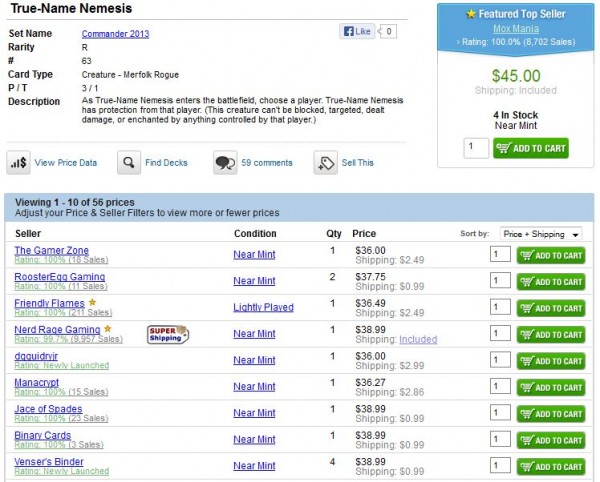
    It’s easiest to highlight this lesson with an example. Let’s say a major retailer decides to offer one of the hottest Commander 2013 singles on the market at a discounted price on Black Friday. They may advertise “25% off all Commander 2013 singles!!” to draw your attention. So you check out the store’s listings and go directly to True-Name Nemesis. After all, that’s the most important card worth grabbing at such a great discount, right?

    Sure enough, the store has precious few copies left in stock marked down from $49.99 to $37.49. This deep discount is alluring--such a comparison leads the human mind to feel they are being offered quite the steal. What’s more, the limited quantity in stock paints an even more urgent picture. Surely you must purchase them as soon as possible in order to capitalize on this rare discount.

    Before snap-buying these deals I beg of you to cross-check prices. Minimally you should review TCG Player and/or eBay completed listings to make sure you’re getting a true bargain. In this example, the answer is a compelling “no”. Although mtgstocks.com lists True-Name Nemesis at $42, there are simply too many copies on TCG Player that cost less.

    TNN

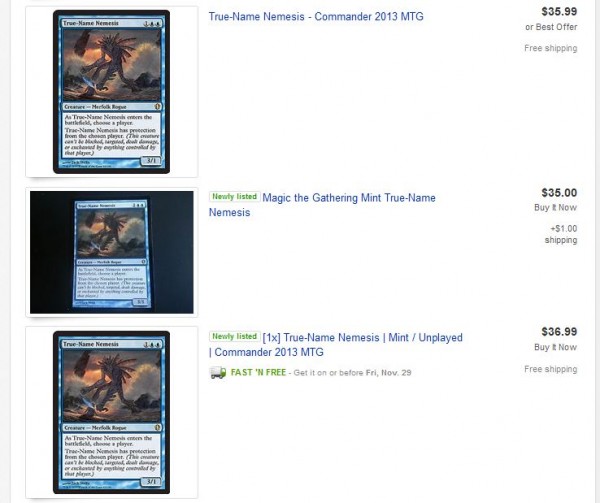
    You may point out that all these cards are below the $37.49 price tag once shipping is factored in. This is true--but I’m not done yet. Check out some eBay prices next:

    TNN2

    Now all of a sudden the retailer’s Black Friday special doesn’t seem so strong. Plus you’ll still have to pay that retailer shipping and you won’t get eBay Bucks out of the deal. Thus, this “discount” really isn’t as much of a deal as one would expect.

    Watch out for this trend on many of the hottest singles. Cards in high demand also usually fetch a significant premium at retail--so much that even a 25%-30% discount doesn’t make the single a profitable buy.

    If you need the cards and plan to buy a bunch of singles from that retailer anyway (or you’re using store credit), then the choice to buy has merit. But if you’re looking to buy out retailers on Black Friday deals with the intent to profit by selling on TCG Player, you must exercise caution.

    Keep Emotions in Check

    Emotions tend to ride high during Black Friday and Cyber Monday sales. The prospect of grabbing a deal before peers makes the allure of shopping on these two days all the more tangible. I have some family members who live for these deals, and they are at Walmarts and Best Buys at 2 am with the rest.

    Before you make any snap-buys, I urge you to consider all the valuable suggestions you’ve read previously on this site. Corbin wrote an excellent article last week on opportunity cost. This rule doesn’t go away here.

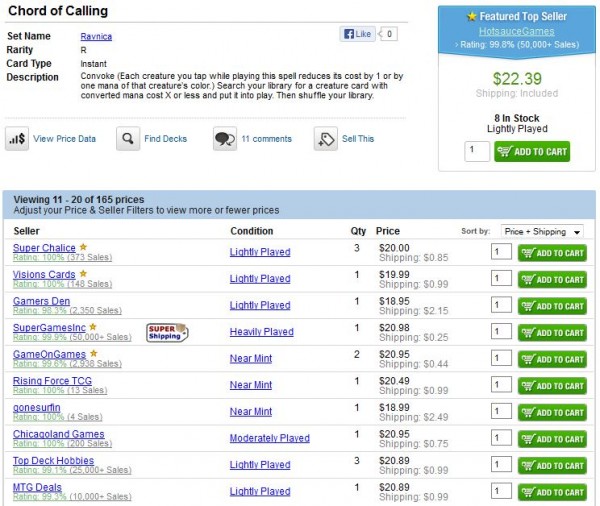
    Just because you get a Chord of Calling on sale for $20 doesn’t mean you’ve made a wise investment. The price may be a full third cheaper than usual retail, but there would be no immediate profit available for you at that price and you’d have to sit on these cards for a while waiting for another possible spike in price.

    Chord

    Another valuable tip to keep in mind is the exit strategy. Even during this crazy time of year, you should always have an exit strategy in mind when purchasing cards for profit.

    Think through why the retailer is marking down prices so significantly. The holiday is a great excuse to mark prices down and clear out some slow-moving inventory. That doesn’t mean you’re getting the deal of a lifetime. It’s possible the dealer had some difficulty selling some of these discounted cards at their previously higher price--if so it’s unlikely you’ll be able to either.

    My Watch List

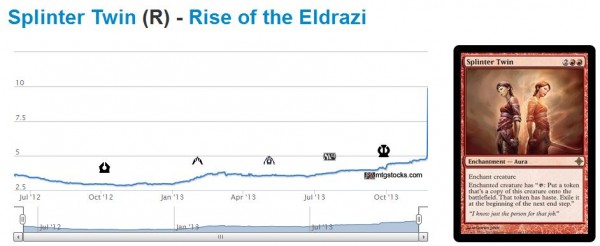
    There are two categories of cards I’m keeping my eyes out for during the holiday sale season: Modern and Theros temples. The former because we will see many more instances of Splinter Twin-like spikes in the next few months. I will be closely watching for deals on Spellskite, Birthing Pod, Scars fastlands, Worldwake manlands, and an array of other cards prone to spiking come Modern season.

    Splinter

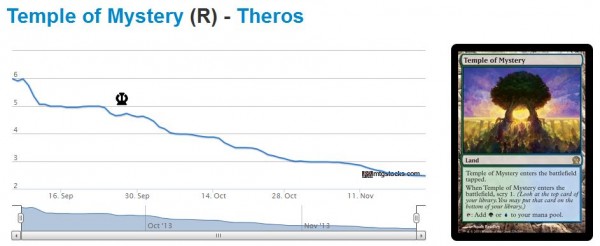
    The latter because of the same reasons I buy into every rare mana-fixing land cycle: prices will bottom soon and rise significantly next year. In fact, Temple of Mystery is already tempting me because I can acquire sets near $8.

    Temple of Mystery

    The other temples are dropping in price as well. Just as I did with Innistrad duals, Scars of Mirrodin duals, and Worldwake manlands, I expect to make solid profit on these acquisitions once shocklands leave Standard.

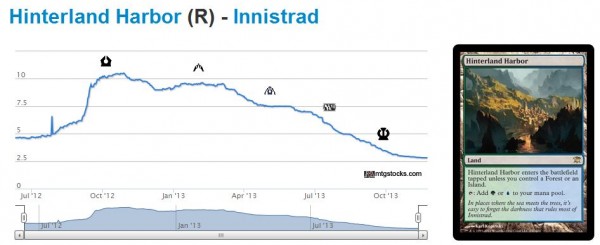
    The time horizon is a bit long, but my high confidence level combined with promise of solid returns makes me feel comfortable with this slow-moving spec. Hinterland Harbor’s curve says it all.

    Harbor

    While I don’t necessarily see all temples breaking $10, I firmly believe at least one or two versions will hit this price tag. The others, while less desirable, will still appreciate significantly in price from their lows. At this point it’s about patience and timing--if I can find them at significant discount during the holiday season, this is one purchase I will be confident making.

    Happy Shopping Season

    Next weekend will be exciting as it always is. Finding those amazing deals and buying stores out of them before others can is an exhilarating experience that many of us MTG speculators live for. But we all need to keep our emotions in check--being the first person to buy out Star City Games of Show and Tell at a 25% discount isn’t really something to brag about. Cross-check first.

    It may even be advisable to plan out what you’re willing to purchase should there be discounts from retail ahead of time. This is essentially what I’ve done, identifying the top cards I’m after heading into the holiday sale season. I can always look up additional opportunities before buying, but being prepared up front will provide me with additional agility. Hopefully this advanced planning will allow me to be quicker with browsing websites so I can find the right opportunities faster.

    Finally, if we miss out on a steal it’s not the end of the world. Remember that these sales are designed to drive people to retailers’ sites, and many of the best deals disappear quickly. Even those who do capitalize by staying up all hours of the night may not be “winning” due to the time they spend searching through all these “bargains”. It’s all about that balance, after all.

    …

    Sigbits

    Here are a couple other cards that would become favorably priced should they be marked down 25% from retail. These just might also land on my sale radar next weekend.

    • Zendikar fetchlands are still high in demand--no surprise here. What is surprising is that NM copies of Misty Rainforest sell for $49.99 at retail while the cheapest copies on TCG Player are in the $43 range. A 25% off sale would lead to a true bargain in this case. It may be similar for other fetches as well.
    • From the Vault copies of Jace, the Mind Sculptor retail for $99.99 and sell for $80 on TCG Player. While a 25% discount wouldn’t lead to a profitable buy, it would lead to a favorable acquisition price if you’re looking for copies of Big Jace anyways. I may not look to outlay this much cash because I no longer play Legacy, but others may benefit from this advanced knowledge.
    • Do I really want to buy more shocklands given their disappointing performance? They're not compelling. But if retailers mark down their shocks by 25% or more, they may have quite competitive prices. This could be your chance to finish out your playsets, for example. Foil copies at this discount would be even better--this is likely where I’d look to spend my money should this sale become reality.

    Insider: Market Update

    Are you a Quiet Speculation member?

    If not, now is a perfect time to join up! Our powerful tools, breaking-news analysis, and exclusive Discord channel will make sure you stay up to date and ahead of the curve.

    The Crash and the Bounce

    The events of the past two weeks have seen some unusual volatility in the MTGO market. Standard set prices dropped by around 10% in reaction to the suspension of Daily Events (DEs). On top of this, the IRL value of collections has taken a hit as the buy price of tix dropped from $0.95 to $0.90 at MTGOtraders.

    Since the initial drop, prices have stabilized or bounced back. Timing the bottom correctly would have been profitable in the short term, with cards like Voice of Resurgence dipping to 23 tix on November 15th, today priced at 27 tix.

    However, market timing is notoriously difficult to take advantage of, especially in the short term. Let's stick to our Voice example. Even if you managed to buy a few copies at 23 tix, the net return would be about 1.5 tix after accounting for a bot buy/sell spread of about 10%. (Goatbots is currently offering 26 tix per copy, so slightly higher profits may be possible).

    This is the type of transaction that can quickly deteriorate into a loss if the timing is not perfect. And this is the primary reason why I avoid these types of short-term trades. It was almost certain that prices would bounce back, but the change has barely covered the bot spread.

    On top of this, there is still a large amount of uncertainty surrounding the future of MTGO. I suspect we are entering a period of stagnant Standard prices, with redemption propping up prices when they drift low enough.

    Set Prices in November

    In the chart below, I've plotted prices of all Standard sets in percentage terms relative to November 1st. Prices are taken from Supernova. The idea of this chart is to show how prices were developing in the lead up to November 13th (the day DEs were suspended) and then how they have moved since that day.

    In the first half of November, prices on Standard sets were mostly moving sideways, with Theros (THS), Return to Ravnica (RTR) and Gatecrash (GTC) on a somewhat negative slant. Prices took a tumble on the 13th, and mostly bottomed on the 15th. Since then, THS has drifted lower as Limited play on MTGO has been largely uninterrupted, and the other sets have all bounced back to a degree, though all are still below their respective November 1st price.

    Contrasting with the price weakness of the Standard sets are the Innistrad (ISD) block sets and M13. The same chart is reproduced below for these sets.

    Here, the overall slant of price was positive in the first half of November, and then the only set to see a significant drop after November 13th was ISD, and even that drop has since been erased.

    The overall positive trend and the lack of a response to the suspension of DEs suggests strongly that the value in these sets has little do with with their playability on MTGO, and mostly comes from their value to redeemers.

    In the back of my mind, when I think about ISD block and the potential for future profits, I have to think that prices on these cards will start moving up the closer we get to Spring and the Modern PTQ season. This is where the redemption link will propel the average price of ISD block mythic rares higher. When probable in-season prices are taken into account, the future gains for ISD block sets are sure to be positive.

    At the moment, ISD is being offered as a flashback draft and it's seeing quite a bit of uptake relative to RTR block draft and M14 draft. There will be some temporary price weakness in cards from ISD as a result. With a long-term positive trend in place for ISD block and M13, don't hesitate to pick up a few copies of cheap mythic rares when you find them.

    Thinking about Thoughtseize

    As THS demonstrates the strongest negative trend among Standard sets, it's important to keep this in mind when evaluating the speculative potential of any card from THS. If the card is priced above junk, then it has room to go down. If it's a rare, and it's priced significantly above junk, then there's lots of room for it to fall further.

    Let's think about Thoughtseize in this context. What is the long-term potential for this card? It's one of the most played cards in Standard in a popular archetype, and it's also heavily played in Modern. The power and utility of this card cannot be questioned. However, it is a completely understood card. No brewers are trying to break Thoughtseize because everyone knows what it does and how useful it is. In the stock markets, they say it is 'priced to perfection', meaning it has mostly downside risk and little upside.

    Fortunately, two recent cards give us a great perspective on the potential price path for an all-format staple printed as a rare in a Fall set. Both Snapcaster Mage and Deathrite Shaman fit the bill. Here are their charts (courtesy of MTGgoldfish) while they were being drafted.

    Snapcaster Mage saw high prices in its first few months of being opened online, but then saw a steady downward trend right up until triple Avacyn Restored replaced Dark Ascension-Innistrad-Innistrad as the current draft format. At that point, it found an equilibrium price in the 5-6 tix range.

    Deathrite Shaman follows a bit more of an interesting path, as the power of the card in formats with fetchlands was not fully appreciated when it was first released. It was also temporarily not opened in draft as the format switched to triple Gatecrash in February. But, by the time Modern Masters and then M14 were released, like Snapcaster Mage, it had settled into a price range of 5 to 6 tix.

    With Thoughtseize from THS, we can already see that it's reached a price range of 5 to 6 tix, with months of being heavily opened in draft to go. Although the Lorwyn version of this card reached lofty heights this past summer (30+ tix!), do not for a moment think that that a price over 10 tix is in this card's future while it is in Standard.

    No one with any sense should be accumulating this card at the moment. The period to be picking these up will not arrive until Journey Into Nyx is released and the last big push of supply hits the MTGO market.

    A Bountiful Standard

    Are you a Quiet Speculation member?

    If not, now is a perfect time to join up! Our powerful tools, breaking-news analysis, and exclusive Discord channel will make sure you stay up to date and ahead of the curve.

    The Standard metagame post-Pro Tour Theros is like Darth Vader walking down the line of bounty hunters giving them a mission. Each bounty hunter is a powerful warrior with a well-honed set of skills. They all have their strengths as well as weaknesses. Take Bossk for example.

    He is an extremely quick and deadly warrior with multiple tools at this disposal. Basically he’s an aggro deck. Bossk is gonna come at you fast and if you aren’t ready for him, you’re gonna go down. If you are prepared and you have some tricks up your sleeve, you will probably survive the attack.

    I might compare Bossk to Mono Blue Devotion or any of the Red Devotion decks. Is Bossk a capable bounty hunter, yes, otherwise he wouldn’t be on the panel of the best in the galaxy. Same goes for either of the two aggressive decks. They are both good and if you aren’t careful, they can beat you quickly and easily, but if you are expecting it and you know how to play the matchup, you can defeat them.

    On the other hand, he could also be compared to Mono Green Devotion. Bossk comes from an extremely strong race, Trandoshan, that can easily overpower their foe. Fast and powerful sounds exactly like how Mono Green plays right now. It is definitely one of the most explosive decks in the format and it can generate degenerate amounts of mana to flood the board with permanents or pump its creatures a bunch of times with Nylea, God of the Hunt.

    Continuing with my analogy, I would compare Boba Fett to Mono Black Devotion or something like Junk Midrange or my BUG Prophet deck from last week. These midrange decks typically play the package of Thoughtseize, Abrupt Decay/Doom Blade/Ultimate Price/Devour Flesh, and Hero's Downfall. This combination of cards completely disrupts what your opponent is doing and allows you to win the game with any number of win conditions. Everyone knows that Boba Fett is the best bounty hunter and these decks are some of the best in the format. If there was not competition for his spot Fett would have been the only one hired. There are lots of other bounty hunters vying for the bounty though and they are just as capable as he is.

    Another part of this lineup is one of the droid bounty hunters, IG88. This black death machine uses his supreme processing power to deviously calculate and plan for ways to take out his prey. He brings the right tools for every job and can customize himself for whatever job he needs to. The finishing blow may seem delayed, but it was always coming, you just didn’t see brewing. Similarly, Esper Control (or UW Control) can be altered from week to week with the appropriate tools to take down whatever threats your opponent presents.

    Your only other option is to go rogue. It’s not that Dengar is horrible or anything its just that the other bounty hunters are so much better. He’s just a random guy with a little bit of armor, a gun, and a ship. That’s cool and all, but he’s not the guy you are counting on to bring back the bounty.

    Playing a rogue deck in Standard right now is just about the same as committing to hiring only Dengar. All the other decks you can be playing do such powerful things, you will have a hard time keeping up without another powerful deck. Once in a while, Dengar pulls out just the right trick and the same goes for your rogue deck. The deck you’ve been working on does have a shot to take the metagame by surprise, but you may be relying on some good pairings to get there.

    So which bounty hunter is the best? That is hard to tell. We know that Boba Fett was the one to track down the Millennium Falcon, but that doesn’t make him the perfect bounty hunter for every job. The same goes for Standard. Each week, we see similar decks being successful because they are all still strong options. Whichever one you are playing and have experience with can lead you to success. Play the deck you can pilot the most skillfully. Make changes that you think would attack the metagame at just the right angle.

    Theros Financial

    Since Theros was released, the set was like a free bounty ready for anyone to collect. Opening the set was so profitable that stores were having a hard time keeping it in stock and getting more ordered. What’s not to like in the set when so many cards you can open are worth as much or more than you paid for the pack? Nearly every mythic was worth at least twice what you paid and many of the rares had a higher than normal value as well.

    While the set is still worth more than many other sets, the value has dropped off considerably. Numbers across the board are down. If you have been holding Theros cards, most likely you missed your window to move them at their peak. It’s still a good time to be trading Theros into cards that will likely gain value so move quickly. I’ve been working a lot with the Theros numbers to make my store profitable, so here is a rough sketch of the current prices. My prices are based on those similar to TCG Player.

    Elspeth, Sun’s Champion 24
    Stormbreath Dragon 18
    Thoughtseize 15
    Thassa, God of the Sea 12
    Ashiok, Nightmare Weaver 12
    Xenagos, the Reveler 11
    Hero’s Downfall 11
    Master of Waves 10
    Nykthos, Shrine to Nyx 9
    Purphoros, God of the Forge 9
    Erebos, God of the Dead 7
    Nylea, God of the Hunt 7
    Polukranos, World Eater 7
    Heliod, God of the Sun 5
    Temple of Silence 5
    Temple of Deceit 4
    Temple of Triumph 4
    Temple of Abandon 3
    Temple of Mystery 3
    Sylvan Caryatid 4
    Fleecemane Lion 3
    Underworld Cerebus 3
    Mistcutter Hydra 3
    Anger of the Gods 3
    Boon Satyr 2.5
    Soldier of the Pantheon 2.5
    Whip of Erebos 2.5
    Ashen Rider 2
    Reaper of the Wilds 2
    Prophet of Kruphix 1.5
    Spear of Heliod 1
    Hammer of Purphoros 1
    Chained to the Rocks 1
    Bident of Thassa 1
    Firedrinker Satyr 1
    Hythonia the Cruel 1
    Magma Jet 1

    The most surprising thing about that list to me is the low cost of the blue mythic rares. Despite both Master of Waves and Thassa, God of the Sea seeing major play, they did not hold anywhere near their peak price and have dropped nearly half in value. Many of the other cards from the set have held fairly close to their previous price and have only decreased slightly. Unsurprisingly, many of the mythics have come down in price. The overall value of the mythics was too high for them to hold their price. I would not be surprised to see some of them come down even more. Over the next month or so, it will be prime time for picking up Theros mythics before Born of the Gods is released in February.

    In case you needed a little bit of Standard spice, here’s the list I’ve been tinkering with for fun. I’m not sure it’s tier one or anything, but it’s the fun FNM list. After all, who doesn’t like winning games with Purphoros, God of the Forge damage from Elspeth, Sun's Champion?

    R/W Devotion

    Untitled Deck

    Creatures

    4 Frostburn Weird
    4 Ash Zealot
    4 Boros Reckoner
    4 Chandra's Phoenix
    3 Purphoros, God of the Forge

    Spells

    2 Chained to the Rocks
    4 Magma Jet
    3 Lightning Strike
    3 Warleader's Helix
    2 Chandra, Pyromaster
    2 Elspeth, Sun's Champion

    Lands

    4 Sacred Foundry
    4 Temple of Triumph
    4 Boros Guildgate
    10 Mountain
    3 Plains

    Which bounty hunter do you think is the best?

    Until Next Time

    Unleash the Bountiful Force!

    Mike Lanigan
    MtgJedi on Twitter
    Jedicouncilman23@gmail.com

    Insider: Opportunity Cost and Diversification

    Are you a Quiet Speculation member?

    If not, now is a perfect time to join up! Our powerful tools, breaking-news analysis, and exclusive Discord channel will make sure you stay up to date and ahead of the curve.

    One of the things I think is important to remember about writing for a site like Quiet Speculation (and really, anywhere) is that you’re reaching a new audience every time you write an article.

    The group of you reading this article right now is not 100 percent the same group that read it last week. Or last month. Or when I wrote my first column three years ago.

    So from time to time I think it’s important to address topics that we often gloss over. Not everyone is advanced in their understanding of MTGFinance or a pro at this. Many people are just beginning to build a bankroll or an investment “portfolio,” as it were, and there’s no harm in even practiced pros going back and evaluating some concepts that we take for granted.

    Today, I want to talk about opportunity cost.

    What It Is

    Opportunity cost is defined as the “loss of potential gain from other alternatives,” when dealing with multiple options.

    Simply put, opportunity cost is what you have to give up in order to get something else. Every time you put your money into one asset, or Magic card, you’re incurring a “cost” by not enjoying any potential benefits of that money being elsewhere. For instance, investing in a traditional CD with a guaranteed three percent return instead of a slightly riskier stock that yields eight percent, that five percent is the “cost” you paid by putting your money in the for-sure bet.

    In Magic finance, this is extremely important, especially as you’re starting out. If you have $100 to invest, you can only put that money in so many places. If you buy ten Deathrite Shamans with that cash, that means you’re completely unable to take part in any other spec that comes up in that time.

    Another example is something like shocklands. Given the print runs and historical data, and extrapolating from that, it’s almost a sure thing that these will be more expensive in five years than they are now (I’m aware this isn’t 100 percent, but for the purpose of this example work with me). So if you take your $100 and put it into shocklands and come back in five years, you’re almost certain to have made money.

    But that means that $100 didn’t go into anything else. It didn’t go into the Boros Reckoners that you caught ahead of the Pro Tour, and it didn’t go into the Scapeshifts you bought the moment after the card was unbanned.

    Let’s say five years down the road you’ve turned your $100 into $300. That’s great. But if you had that money available to invest in other things along the way, it would have turned into $500. That’s the “cost” associated with any spec.

    Why it Matters

    As you can see from the example, it’s an important concept to understand. It’s why I get annoyed when I see these “I have $100 to invest, TELL ME WHERE TO MAKE MONEY” posts on Reddit and the like. There are so many things they don’t take into account, such as the time period, risk tolerance, etc. Opportunity cost is also ignored here.

    I do understand that everyone has their own budget for speculation, and we all play in different markets. Some readers maybe want to speculate on San Diego Comic Con Planeswalkers (and that worked out), while some of us are still just trying to accumulate a playset of shocklands to speculate on. For some people, “speculating” means trading for an extra playset of a card, while for others it means buying hundreds of copies.

    We’re all operating at our own levels, but everyone deals with opportunity cost just the same.

    Considering Opportunity Cost When Investing

    One of the things we often talk about speculating on is sealed product. We all know about Sigmund’s mess of Innistrad boxes, and I have a fair amount of sealed product as well. At the moment, that means one of each Commander 2013 deck, two boxes of Modern Masters, a box of Dragon’s Maze, and a From the Vaults: Twenty.

    I’ve seen a bunch of opinions regarding whether or not these are good investments. When I asked on Twitter if I should bust the Grixis deck for True-Name Nemesis or keep it sealed for the longer-term hold, opinions were mixed. Keeping it sealed will almost certainly yield a solid return a year or two down the road, but opening it now to flip for cash could turn out to be the best play.

    I also have several hundred Zendikar basic lands. These are going for about 75 cents to a dollar apiece on eBay right now, up from something like 50 cents a year ago. That’s a great percentage return, but in terms of actual dollars it’s not very impressive. Unhinged lands are all under $7-8 right now, and it’s been quite a long time since they were released. Surely that money could have been better spent elsewhere, but is doing so necessarily the right move?

    That comes down to your personal strategy, and how much risk you’re willing to tolerate. Sure, speculating on Standard cards could yield a much higher return, but it could also flame out entirely. Some people don’t want to follow the day-to-day of Magic, and would rather just stock something in their closet. It’s why people invest in things like mutual funds or CDs in the “real” world. Sometimes you just want something to make you money without any additional effort.

    Forming Your Own Plan

    Here’s the thing. I’m not here to tell you whether you want to take the low-risk, low-return or the riskier but potentially more rewarding play. It’s your decision.

    But the best piece of advice I do have is this: Don’t put all your eggs in one basket.

    This is where talk of “diversification” comes in. Of course, true diversification means putting your money in investments that aren’t Magic at all (and I do advocate for that), but we also want to diversify within Magic.

    So if you have $100 to invest, don’t ask me where you should put it, because there’s no singular answer. Some of that would definitely go into Modern staples or Standard spec targets or long-term holds. It’s whatever best fits your strategy.

    Personally, I’m not worried about whether the sealed product I have is getting me the best possible return, because it’s doing exactly what I want it to do. I’ve managed by Magic budget so that the money I have tied up in that product isn’t preventing me from investing in the next spec that comes along. But whatever happens with those other speculations, I know I have a closet full of assets that are slowly appreciating.

    What diversifying like this does is mitigate our opportunity cost. That money that I spent on the sealed product isn’t precluding me from taking other positions.

    I’ve been in the finance game for awhile, and while I would say I don’t have even half of my Magic money tied up in this sealed product, the low-risk, slow-gainer is part of my “investment plan.” If you’re just getting started and have a limited budget, this may not be where you want to put your money. When I started doing this I didn’t really dabble in sealed product at all; I wanted to get in on the next spec and take the profits and apply it to the next spec.

    But as I went along, I stopped reinvesting 100 percent of my bankroll into the next spec. I began to “bank” some of these profits by converting it into stuff like dual lands or sealed product. Now, I don’t have to sweat a busted spec like Master of the Pearl Trident. When something doesn’t work out, it sucks but it’s not crippling to my overall strategy, and that principle remains the same if you have $100 or $100,000 to invest, so long as you diversify.

    So what’s right for you? Only you can answer that question. But I want to impress upon you that you shouldn’t be afraid to invest in something like sealed product just because it isn’t seen as the “optimal” play. Opportunity cost is something you must consider, but it doesn’t mean you always have to chase max profits; it’s okay to take the “sure thing,” even if it’s less exciting.


    Thanks for reading,

    Corbin Hosler

    @Chosler88 on Twitter

    Insider: Lessons from Grand Prix DC

    Are you a Quiet Speculation member?

    If not, now is a perfect time to join up! Our powerful tools, breaking-news analysis, and exclusive Discord channel will make sure you stay up to date and ahead of the curve.

    Welcome back speculators! Today's article will focus on the lessons I learned from my trip to Grand Prix DC.

    The Good

    Large events are the ideal places to locate hard-to-find rarities. I used this as an opportunity to convert some cards I was unable to move into some really great EDH cards that are hard to find including a judge foil Vampiric Tutor, a german Demonic Tutor, and a foreign Mana Crypt.

    GPs are also great places to pick up LP cards from dealers. I was able to get two Ionas for 12 each and a couple other random EDH cards from the SCG HP section, which is a godsend for EDH players and a great way for SCG to unload some cards they wouldn't normally pick up. These sections tend to get raided of the best stuff early on, so if you want the best selection you need to hit up their booth early in the day.

    The beauty of the larger events (and mutiple vendors) is that it creates actual competition among dealers. This means better prices for players, though I am still in awe of the apathy of many players. I heard several players sell their promo to the first vendor they came to (at $5) when I'd heard the vendor next to them tell people they were paying $8 for them.

    This also means that dealers who wanted to stock up on certain cards had to offer higher than usual buy prices (one dealer offered 14 dollars on Jace, Architect of Thought, while all others were more in the $8 range). Needless to say that dealer got all of my remaining Jaces. The best dealers are often aware of what their competition is charging and change prices to reflect that.

    GPs have lots of fun and interesting side events that aren't available at other venues. I suggest anyone who has never been to one to go (especially if it's decently close).

    The Bad

    Despite my best efforts someone managed to steal a Jace, the Mind Sculptor and foil Elesh Norn out of my binder. Now my normal rules for trading are:

    1. Only one binder out at a time. The more you have out the more "targets" you give people.
    2. Only trade with one person at a time. A lot of thieves will use a multi-person approach to get your attention.

    However, I did (until this occurred) allow my trade partners to pull out cards they were interested in so that I could get a feel for what values to look for. Unfortunately, I believe this was the mistake I made that allowed them to take advantage of my binder.

    I'm now implementing some new trade rules:

    1. Cards are not to be removed from the binder until the trade is actually occurring. I realize that people will want to verify condition on many of the higher-end cards. If this is the case then I would need to pay very careful attention to the process.
    2. Binders are to remain on the table at all times. (I believe another trick thieves use is to lean the binders on the table and their lap, which forms a ramp and they might pull cards out and allow them to "slide" down to their lap).

    The last way to help protect your trade binder would be to keep all the slots full. This is how I realized my cards were missing (there were "holes" where there shouldn't have been).

    The Ugly

    While I was bulking out a Tropical Island to a player who was thrilled to get one, one of the TO's employees tapped me on the shoulder and asked to talk to me at the front. I was walked up to the front and told that I was being asked to leave the venue on suspicion of buying/selling cards.

    I had not offered to buy or sell any cards from anyone besides an approved vendor (i.e. one of the several stores that was on site). Their "evidence" was my bulk trade mat (which to be fair looks exactly like a store's buy mat) and the fact that I had a calculator.

    I asked to appeal to the TO as there was no actual evidence and it was entirely based on hearsay. I met with the TO, made my case, and was told that since there was no actual evidence and I had not been to one of his events before that I was still going to have to leave on Saturday, but would be allowed back Sunday so long as I didn't bring the mat. He stated that they had a zero tolerance policy of buying/selling cards and he was maintaining it.

    So the lesson I learned and suggest to all of you is not to bring a trade/buy mat to a venue as it is apparently damning evidence of misdeeds. I will be reworking mine hopefully to be less "buy mat-like" and more bulk trade mat. To do this I'll need to replace all the $ call outs and replace them with: 1 rare, 2.5 rares, 5 rares, 7.5 rares, 10 rares, 15 rares, 20 rares, 30 rares, 40 rares, 50 rares, etc.

    But before I bring it out at any venue I will first get the TO's blessing, as I believe that being upfront and honest with them will help head off any concerns before they occur.

    Now I fully understand the TO's desire to maintain the zero tolerance policy. His only income is from actual entry fees and vendor fees for the event, thus he's going to have a strong desire to keep his vendors happy (and protected). To make matters worse, given those are his income sources he has no actual incentive to believe people who are there solely to trade, thus his over-zealousness makes perfect sense.

    GP Tidbits

    True-Name Nemesis was the breakout card before the tournament. Dealers were offering over $40 before the tournament, however, during the tournament they were only offering $26, despite maintaining the price tag of $60+. Owen Turtenwald won the GP with American Delver running three True-Name Nemesis and a total of nine made the Top 8.

    The Dulles Expo center was a great location for the event. It's only downfall was the fact that it only had two restrooms, which meant that if you had to use the restroom later in the day (and you were a guy) you had to wait in a line and had your senses assaulted upon entering the restroom. It was great that they have a Wal-Mart within walking distance (with a Subway in it) as well as several other restaurants directly adjacent to the facility.

    The Legacy metagame is still as healthy as ever. For all those upset with the recent success of Sneak and Show decks, the most common deck I was seeing was American Delver and/or Stoneblade variants. The Top 8 consisted of eight different archetypes (Dredge, Bant-Blade, American Delver, Elves, Death and Taxes, Sneak and Show, Shardless BUG, and Esper Stoneblade).

    Larger events (especially Legacy ones) will tend to attract more thieves (as evidenced by the theft of my property) because there are a lot more high end cards. When attending any events of this magnitude extra vigilance is necessary. It is tempting to bring your best stock as you'll have the most opportunity to unload the high-end items due to increased demand.

    I suggest using the strategy I saw several stores use, which is simply to print off pictures of the cards you're going to trade and allow people to pick them that way, though obviously this doesn't work as well with the weirder, rarer stuff (unless you take actual pictures of your cards). This prevents people from having direct access to your cards until the trade is underway (and it means that you are the only one to touch your cards).

    Trade binders are always picked up in airport security. So your best bet is to pull them out (like you would a laptop) and place them in the bins that you send through the x-ray machine or have them in your checked luggage (though given how rough I've seen some airport employees be with luggage I would propose you make sure everything around your cards is soft.

    If you're driving more than 30 minutes to the event site it is imperative that you verify traffic issues before leaving. We managed to avoid a big accident that had some of our fellow players tied up for more than an hour. They were nice enough to call us and give us a warning (though we noticed it on the road signs and took the detour accordingly).

    Vintage Fever

    Are you a Quiet Speculation member?

    If not, now is a perfect time to join up! Our powerful tools, breaking-news analysis, and exclusive Discord channel will make sure you stay up to date and ahead of the curve.

    For the past week and a half I’ve been out with mono. I had never had mono before, and the impressions I had gotten led me to believe that people with mono basically got to do whatever they wanted while they were too incapacitated to do any work. Well, that’s pretty much completely wrong. Now I know first hand that mono basically leaves a person with enough energy to sleep and spend several hours a day wishing that they were still sleeping. I would say that I’ve even been watching less Netflix since I’ve been sick because I really just don’t want to do anything.

    Needless to say, this illness has left me completely untested for the Vintage tournament this weekend. Despite being sick and unprepared, I’m going to go ahead and battle the tournament anyway, because frankly I’m tired of doing nothing all the time.

    Given the fact that I will have no idea what I’m doing on Saturday, I don’t think it would be wise for me to battle with Gush Delver as I intended. It is true that it’s the deck that plays most like a deck that I’m familiar with, but my confidence in Legacy Delver has a lot more to do with my knowledge of what my opponents can do than what my deck can do. Trying to play a deck with considerable control elements in a new format is probably a bit on the ambitious side.

    Instead, I want to play something more on the proactive side. The Merfolk deck from Vintage Champs looks much more straightforward, but I really, really hate playing Merfolk outside of Lorwyn limited.

    Option 1- Robot Shop

    One deck that intrigues me is the Workshop “Affinity” deck. And by that I mean the Workshop Skullclamp deck. If you’re unfamiliar, it looks something like this(source: themanadrain.com):

    Robot Shop

    spells

    4 Arcbound Ravager
    3 Frogmite
    4 Genesis Chamber
    4 Lodestone Golem
    1 Mana Crypt
    1 Mana Vault
    4 Memnite
    1 Memory Jar
    1 Mox Emerald
    1 Mox Jet
    1 Mox Pearl
    1 Mox Ruby
    1 Mox Sapphire
    4 Phyrexian Revoker
    4 Signal Pest
    4 Skullclamp
    1 Sol Ring
    2 Steel Overseer
    4 Tangle Wire
    1 Thorn of Amethyst

    lands

    4 Ancient Tomb
    2 Gaea's Cradle
    4 Mishra's Workshop
    1 Strip Mine
    1 Tolarian Academy
    1 Wasteland

    This deck features some of the disruptive elements of typical Shop decks, but instead of going all-in on disruptive artifacts it features a more aggressive suite of creatures along with Skullclamp and Genesis Chamber as a draw engine. The major problem that I have with this deck is that I don’t know how effectively it could ever beat an Oath of Druids and I really don’t know what the proper set of disruption would be for this shell. Tangle Wire is easily one of my favorite cards, but how good is it in Vintage? I know it’s a 3-cost artifact that doesn’t do anything on turn one, which seems awkward. Most likely, my lack of experience eliminates this deck as an option.

    Option 2- Tezzeret

    Another option that intrigues me is dedicated Voltaic Key + Time Vault combo. The issue here is again going to be that dedicated Key Vault is something of a control deck with a combo finish. For reference, I’d be looking to play something like this(source: morphling.de):

    Key Vault

    spells

    1 Black Lotus
    1 Grim Monolith
    1 Mana Crypt
    1 Mana Vault
    1 Mox Emerald
    1 Mox Jet
    1 Mox Opal
    1 Mox Pearl
    1 Mox Ruby
    1 Mox Sapphire
    3 Sensei's Divining Top
    1 Sol Ring
    1 Time Vault
    2 Voltaic Key
    3 Dark Confidant
    1 Demonic Tutor
    1 Vampiric Tutor
    1 Yawgmoth's Will
    1 Ancestral Recall
    1 Brainstorm
    2 Flusterstorm
    4 Force of Will
    1 Hurkyl's Recall
    2 Jace, the Mind Sculptor
    3 Mana Drain
    1 Merchant Scroll
    1 Mystical Tutor
    2 Spell Snare
    3 Tezzeret the Seeker
    1 Time Walk
    1 Tinker

    lands

    3 Island
    2 Polluted Delta
    4 Scalding Tarn
    1 Tolarian Academy
    2 Underground Sea
    2 Volcanic Island

    The other problem with this deck? Aside from the fact that everybody should be ready for Key Vault, I haven’t the slightest idea how close this list would be to optimal. It’s definitely more dated than anything from Vintage Champs. I am intrigued by having the option to just kill people with Vault Key though, which leads me to a third option…

    Storm

    There has been mild discussion on the Facebook page of the store which will run the event, and a very interesting point was raised in one of the threads. Apparently Reid Duke felt that his Storm list was off by a good margin. Most notably, the Simian Spirit Guide in the deck doesn’t appear to do anything. Martin Lohman posed the question of why the deck doesn’t just run one copy of Key Vault, and I thought the inclusion sounded pretty neat. The deck already features Tinker and Voltaic Key isn’t completely worthless outside of the combo considering the few pieces of artifact acceleration. If I wanted to play Storm, I’d play this updated (for better or worse) version of Reid’s deck:

    Storm

    spells

    1 Ancestral Recall
    1 Black Lotus
    1 Brainstorm
    1 Cabal Ritual
    1 Chain of Vapor
    1 Chrome Mox
    4 Dark Ritual
    1 Demonic Tutor
    4 Duress
    1 Grim Tutor
    1 Hurkyl's Recall
    1 Imperial Seal
    1 Lion's Eye Diamond
    1 Lotus Petal
    1 Mana Crypt
    1 Mana Vault
    1 Memory Jar
    1 Mental Misstep
    1 Mind's Desire
    1 Mox Emerald
    1 Mox Jet
    1 Mox Pearl
    1 Mox Ruby
    1 Mox Sapphire
    1 Mystical Tutor
    1 Necropotence
    1 Ponder
    1 Sol Ring
    1 Tendrils of Agony
    1 Time Walk
    1 Timetwister
    1 Tinker
    1 Vampiric Tutor
    1 Wheel of Fortune
    1 Windfall
    1 Yawgmoth's Bargain
    1 Yawgmoth's Will
    3 Gitaxian Probe
    1 Voltaic Key
    1 Time Vault

    lands

    1 Badlands
    3 Bloodstained Mire
    4 Polluted Delta
    1 Swamp
    1 Tolarian Academy
    2 Underground Sea

    The advantages of this deck are pretty clear- it has a lot of ways to “just win” the game, which is far preferred to actually playing Magic. Of course, Storm can be a very difficult deck to pilot optimally, and I’m not sure how much my limited experience with the Legacy version helps. Wheel of Fortune is dramatically different from Burning Wish, after all.

    Would it be wise to bring this pile in not knowing how well it can perform against decks packing Flusterstorm, Force of Will and Mental Misstep? Probably not. It’s definitely not the safest option, but it seems to very clearly be the most powerful. At the time of this writing it’s very likely that I’ll be throwing caution to the wind and battling with Storm. I already probably shouldn’t be playing anyway, may as well go deep.

    ~

    As a quick update on the Pauper front, I’m going to take another week and look over current Mothership coverage of the format and see about jamming 5-3-2-2s. Thus far it seems tougher to have a real read on the metagame, but playing is more available than ever. Either way I should have a conclusion about Tron coming out in the near future. Just know that I haven’t forgotten about the project.

    Thanks for reading.

    -Ryan Overturf

    Jason’s Alticle – Scion Follows Me On Twitter

    Are you a Quiet Speculation member?

    If not, now is a perfect time to join up! Our powerful tools, breaking-news analysis, and exclusive Discord channel will make sure you stay up to date and ahead of the curve.

    Greetings, Exsanguinators!

    This week I will demonstrate how true to my word I am.

    I Didn't Even Lose a Bet

    What I did do was play FNM on Friday. Some of you know this is uncharacteristic of me. I often say that actually playing Magic is the least enjoyable aspect of the game, so sleeving up for even the most casual of events is a bit outside my comfort zone.

    "No one ever lost to variance during a trade," I like to say, and I haven't found myself missing the grind. The last major event I went to was a PTQ where I played against Bant Hexproof, if memory serves, four out of five rounds.

    However, that PTQ was not a total loss because I got word that someone at the event was a listener and wanted to meet me. That listener was Ryan Archer and he has been laboring to make a card that many people have to pick up and read whenever it's cast against them a real thing. That card? Scion of Vitu-Ghazi.

    "What Happened to FNM? I'm So Lost..."

    I'm getting to it, give me a break. Anyway, Ryan told me he was deep on Scion of Vitu-Ghazi because the card has serious legs and he agreed with my assessment that G/W would be a strong contender after rotation given how well it performed at the Block PT. It made sense given that G/W wasn't going to lose anything and could only stand to benefit from new cards.

    Ryan had constructed a robust list that shrugged off the Ratchet Bomb everyone assumes will keep this deck from ever taking off. I liked how the deck played and I kept it in mind over the last few months.

    Recently we managed to get Ryan to join the staff at BrainstormBrewery.com and write about how Theros cards have impacted the deck, both in terms of additions and a new metagame. The first article discusses the list and card choices and makes, I think, a compelling case for the deck. He's at work on a followup that should go live on our site this week wherein he'll discuss sideboarding and additions he would make to the deck since getting 3rd at an SCG Open a few weeks ago.

    I liked the deck and it uses cards that aren't used in Esper Control. This became relevant when workout enthusiast and Magic sidekick Joey D browbeat me into hanging out with him on Friday which turned into me playing FNM. He was jamming Esper or U/W or some such nonsense and he had his Voice of Resurgences and Temple Gardens just chilling in a box.

    What's a curmudgeonly finance grinder to do when he's offered 75% of a deck? Break his rules, I guess. I don't like using the "n-word" in the shop, but I had to do it this week. The penalty for this particular n-bomb was paying the kind of prices for cards like Vitu-Ghazi Guildmage that will keep the lights on at an LGS.

    Odyssey games store owner Johnny Blaze (that's literally his actual name. He didn't change it to Johnny Blaze because he likes comic books, his actual last name is Blaze. Mise) sold me everything he could and lent me everything he couldn't. When your community conspires to make sure you can play crads, I guess you play crads.

    I didn't take notes because FNM, but I did mention that if I won I would write a tournament report. I didn't expect to do well but I did want to get some firsthand experience in with the deck. Here is the tournament report I promised to no one in particular, constructed with about as much care as you'd expect from someone who spent the entire night telling his opponents that he doesn't play Magic.

    Round 1 -- My opponent was playing a Bant deck that seemed like a homebrew. It had a lot of the same cards as my deck, but it splashed blue for Detention Sphere which helped against me. Supreme Verdict and Sphinx's Revelation were also in the mix. Advent of the Wurm battles ensued.

    He must have gotten flooded game one because I had no idea what he was playing and didn't know how to sideboard. I boarded in a Druid's Deliverance for Detention Sphere because I never bothered to read Druid's Deliverance. It's not a Naturalize.

    Game two went largely the same as the first one. He managed to keep me from playing Scion for any value. That's not true. I played a naked Scion, held down the ground with a 4/4 and populated a second bird, which was enough to wrap the game up. I'd say that is value. Aerial beats are the best beats.

    Round 2 -- My opponent was playing a non-traditional Mono-Black with White (deck names are getting stupid) deck. It featured Nighthowler which I think it pretty good but also pretty slow.

    Game one I realized that Ryan was right in his write-up; Blood Baron of Vizkopa is miserable. I eventually read Advent of the Wurm and saw that it didn't make a token that had white anywhere in it. His deck had Whip but no Obzedat, which is fine albeit a little confusing. I think Nighthowler on a Blood Baron beats most anything, but he had mana issues games two and three, and despite vomiting nearly his entire hand stuck on three lands, I won handily.

    I managed to live the dream and turn four EOT Advent only to untap and jam a Scion. People get really sad when you go from no board to fifteen power like that. Vitu-Ghazi Guildmage won game two on its own. I have been a believer in the card since the days of Séance.dec--it is better in the main than Trostani a lot of the time, which seems odd but is absolutely true.

    Round 3 -- This was a pseudo-mirror. I feel like I have my finger on the pulse of the Magic metagame, so when I built what I thought was a relatively obscure deck I didn't expect to see a lot of others running it. I got a downpair to someone running G/W Populate who had himself lost in the previous round to GWr Populate with Mortars. Fun night for him, right?

    We went three games. I mulled to five game one but gave zero craps because the hand seemed curvaceous at least. I hit turn one Experiment One, turn two Fleecemane Lion, turn three Smiter and managed to hold him off despite him making things interesting with maindeck Unflinching Courage. I managed to get a few tokens from throwing Voice of Resurgence under the bus on two consecutive attacks. The stag tokens weren't going to be enough--that is until I peeled Scion.

    I went from two 2/2 tokens to three 5/5 tokens, a Scion and a bird. That felt truly oppressive to me and windmilling the Scion made my opponent frown. Peeling another Scion off the top made him concede at 40 life with me at 6. Lucky topdeck? Sure, but the first Scion was arguably more powerful because of how it improved my board. The card is a beast.

    I swung awkwardly one turn in game two hoping he would get greedy. He was forced to play Rootborn Defenses to save his dudes and the resulting Voice of Resurgence tokens (one from playing a spell on my turn, one for blocking and murdering Voice) were joined by a Scion. I don't know if there is a better one-two punch in Magic right now. Scion vomits value.

    Round 4 -- My opponent played Mono-Green. His deck was good and he was a competent player, but his only way to interact was to race. It's tough to race my deck.

    Vitu-Ghazi Guildmage just sat there with a pile of untapped mana and when he was forced to trade in combat, I replaced the dying creatures with ready-to-go untapped dudes and he couldn't keep up.

    I sandbagged a few dudes in my hand, which may be one of the best things about Vitu-Ghazi Guildmage. You force them to deal with the same threat over and over, leaving you free to play around sweepers and generally just sit on some cards. Between the ability to sandbag and Rootborn Defenses, Ratchet Bomb and Supreme Verdict aren't an issue. Ratchet Bomb kills like nothing in the deck, and what it doesn't kill is very lethal. Losing a wurm token doesn't feel all that bad if they still have to deal with a 4/4 Scion, a 3/3 or 4/4 lion and a Boon Satyr.

    I won this round somewhat quickly due to the overwhelming card advantage populating gave me.

    Round 5 -- I might have played this out but first and second place are very close in value so there was no real incentive not to ID. My opponent would have been on Esper which I would like to test the deck against, but Ryan has already done way more testing than me and since I'm unlikely to play again soon, I wasn't worried about it. I am now even more bullish on Scion, especially given its bulk rare status.

    What puzzles me about how Scion is treated isn't the reaction from the "I won't test it because it must be bad, and if it weren't bad, a pro would have already told me it was good" crowd that makes up the large majority of the player base. There's no reaching those people, ever.

    No, the real puzzling thing is that people were clamoring for Scion. People were disappointed at Wayfaring Temple and really wanted something that populated as an ETB effect. Not only does Scion populate, it also creates a token so you never play it for no value. But for some reason, the people that wanted that effect didn't care.

    There you have it. I didn't know what a bunch of my cards did, I had no experience playing the format and I threw the deck together mere minutes before the event started and I sleepwalked my way to 4-0. Every time I resolved Scion it felt like cheating.

    The deck is a credible alternative to the other decks in the format and Ryan Archer has played against all the matchups you're already typing in the comment section that I didn't face. Ryan has had several Top 8 finishes with several iterations of this deck, and other G/W Populate builds have been popping up, but those haven't been running Scion which is a mistake. If you're interested, check our site later in the week for a follow-up article where he discusses lines of play and sideboarding against the best decks in the format.

    Turns out I wasn't the only one who played Magic this weekend.

    The Last Gasp of a Dying Format

    LEGACY!

    1,700 people didn't get the memo that Legacy sucks, is too expensive and is going away in a year, so they all converged in our Nation's Capitol over the weekend to dish out some serious beats and bitch about True-Name Nemesis.

    It's been about three or four weeks since someone from my area wowed everyone with a spectacular performance at an event, so we were due. This last weekend, Michigan grinder Deshaun Baylock made his way into one of the most stacked GP Top 8s I have ever seen, eventually falling in the first round of Top 8 due to a combination of the overwhelming power of the player who finished second in the event and Deshaun's own inability to correctly fill out a decklist sheet.

    We were nonetheless proud of his accomplishments, and my only regret is that not everyone in the world will get the chance to go on a road trip to an event with Deshaun. He is literally the best value ever in that he's a bottomless font of fast food lifehacks.

    I took four semesters of college calculus and I still can't figure out how he manages to go into a McDonald's and pay half price for breakfast sandwiches through a complicated series of ordering individual component parts and making substitutions. Watching him order a Sausage McMuffin with Egg for $0.37 must be how non-Magic players feel watching someone try to go off with ANT.

    Did you know the best-tasting and cheapest fast food fried chicken is at Long John Silver's? No! No one did, because who the hell eats at Long John Silver's? Legacy GP Top 8 champion Deshaun Baylock, that's who.

    Up until last week, Deshaun was pretty sure he was running RUG Delver, but putting equipment on True-Name Nemesis was too powerful an urge to resist. He elected to run Esper while the event's winner Owen Turtenwald elected to run an "I swear to God I will curb-stomp the next person who says 'American'" color scheme. If Deshaun hadn't lost to a deck registration error and a turn two Emrakul, we might have seen an epic Stoneblade mirror in the finals.

    As cool as it is that Owen won the GP, it didn't make me poop in my pants. A Baylock victory would have made me poop in my pants. Not even out of surprise or anything, but I'd do it because I said I would, kind of like earlier when I wrote a tournament report as a vague pretense for suggesting people buy a few Scions. There I'd sit, stoically filling my drawers, my heart swelling with pride for Kalamazoo's native son taking down the event.

    Would Esper Stoneblade have been able to unseat Craig Wescoe's Death and Taxes? The White Weenie master himself threatened to take the event down with a Mangara-less build that is unfortunately the new face of the deck. Adrian Sullivan lamented on Twitter that people refer to Death and Taxes as White Weenie since the decks have such disparate plans of attack, but in my day Death and Taxes had a little more death and a little more taxes.

    Without Mangara, you're a white beatdown deck, albeit one with a significant number of "taxation" elements including a full complement of Rishadan Port and a baby named Karakas that was not thrown out with the Mangara bathwater. Karakas does tend to laugh at Emrakul.

    Andrew Cuneo in the Top 8 was not that surprising, and I guess doing it with Elves is not that surprising either. Deathrite Shaman has made this deck a real contender. There aren't enough Legacy Grands Prix in North America every year. We need at least three.

    I should mention Dredge made it, blah blah, whatever. Not to denigrate the deck or its pilot, Drew Tunison, who played a version I like with Dread Return to bring back Griselbrand for lolz (and value). But I really want to talk about Sam Black's Bant deck right damn now. So, Dredge, awesome, good to see it didn't get hated out completely, and also Ted McKluskie and Shardless BUG, a deck I predicted would Top 8. Bant time yet?

    Okay, so Bant. This is the third deck that already existed but got a lot better with True-Name Nemesis. Unlike the other builds, this one often gets a turn two TNN and has a lot of late game action. I like Maverick variants, but this particular configuration harkens back even further to the days of maindeck Terravore. I like this configuration a lot, and Stoneforge Mystic and True-Name Nemesis mean it's competitive.

    The format will evolve to be able to deal with this potent combination, but until it does, we had three decks with essentially the same core, but they were three deck archetypes that were totally different, existed already and don't change a whole lot with the addition of TNN. I will always play "Mono-Black" and I'm glad he continues to come up with good stuff to keep the game interesting.

    The Top 16 had a few copies of Team America, which I am surprised to see, given how all the BUG players seem to want to jam Shardless Agent now. Tombstalker is cool and all, but when your Gray Ogre has a Hymn to Tourach attached to him, your turn two couldn't be better.

    Some RUG Delver in the Top 16 as well, but I imagine they found out what Deshaun already knew--RUG Delver needs to get on the "Stoneforge-TNN plan" ASAP, or figure out how to beat it at least. Night of Souls' Betrayal? Pyroclasm? Supreme Verdict? Adapt or die, Legacy folks. It seems like week in and week out, Legacy proves that it always has and always will elect to adapt.

    I am forced to conclude that SCG ran the GP in DC and there was no Open this weekend. That suits me down to the ground, frankly. What better way to end than by only having to write about Legacy?

    Flip those TNNs, guys. They're "Legacy-altering" good, but they're also getting farted out of the Wotc pipeline, and soon the price will come down a bit. I'd be watching cards like Ophiomancer, Toxic Deluge and From the Ashes as I think there is more money to be made buying low and selling high with those.

    As always, this has been another installment of your favorite Magic article. Follow me on Twitter where I talked about Ryan Archer's decklist so much the Scion car company thought I was talking about them and started following me. You can't make this stuff up.


    Want Prices?

    Browse thousands of prices with the first and most comprehensive MTG Finance tool around.


    Trader Tools lists both buylist and retail prices for every MTG card, going back a decade.

    Quiet Speculation