menu

An Invitation for Success

Are you a Quiet Speculation member?

If not, now is a perfect time to join up! Our powerful tools, breaking-news analysis, and exclusive Discord channel will make sure you stay up to date and ahead of the curve.

It was a warm summer morning and the sun was on its way up to blind the morning drivers once more. The excitement welled up within me like how it used to when I was on my way to compete in a larger event.

Every season I search endlessly through testing and theorizing to find the best, most fun deck that crushes the metagame from just the right angle. Sometimes I find just what I was looking for and wreck up an event. Usually it happens right when we have a new format forming. I tend to be a little bit ahead of the metagame right at the beginning.

That edge is the leverage I use to be successful at this game. Of course it doesn’t work every time, and I am left with a few meager wins before many losses, but more often than not, my analysis of the initial metagame has proven effective.

As the long morning drive passes by, I found myself thinking about whether or not today would be one of those times I had my finger on the pulse of Standard or if my day would be ending early. Of course I had written an article about the deck I was going to play, but as usual it was not as well received as I had hoped. Many of my decks seem a bit unusual and abnormal so players don’t necessarily want to jump on board with “some crazy deck.” I’m no Travis Woo or Conley Woods, but I’ve had some off-the-wall brews that have been quite successful for me.

I was feeling really good about my deck today though. It was aggressive, resilient, and also had the ability to sort of combo-kill my opponent who thought they were sitting pretty at whatever comfortable life total they were at. I was still surprised that more players did not respect the design I had come up with though because it was based on a previously successful archetype.

And that’s where it all started, with a short road trip to a TCG Player event with some friends for a day of fun and Magic. As it turns out, I did have it all figured out and only one player stopped me from winning the event. I met him in the finals with my RWB Human Aristocrats deck, which is now one of my favorite decks of all time. He was the only one that event who overcame the humans turning into zombies and their vampire friends.

After the event was over, I found myself playing and winning a lot with that deck. My success was mainly at TCG Player events and so attending the TCG Player Invitational seemed like an obvious requirement to make it to.

Fast forward three months and I was freaking out about what I should play at the upcoming huge event. I had more than enough points for entry plus my two byes, but what I didn’t have were decks. That’s right, decks plural. For some reason, many players did not know this event was multi-format. Anyone playing in the Invitational would be playing both Standard and Modern. To my knowledge, this was the first event that was both of these two formats. I was excited but I needed to nail down my deck selections.

Initially when Theros created a new Standard environment for us to compete in, I was playing a midrange Naya Zoo deck I called Naya Forgemaster due to the game-winning Purphoros, God of the Forge in the deck. Inconsistency led me to try other decks like Mono-Red Devotion splashing green, but that deck was just as sketchy as the Naya deck.

I needed something powerful that would also play well over two days of competition. With a longer event like this or a Grand Prix, it’s important that your deck be able to hold up well over many rounds of play. An all-in deck may be a poor choice because of how many rounds you will be required to play. Since this was two formats, that risk was lessened, but still I wanted something consistent.

For a while, I had been toying with Master of Waves decks because it was one of the cards I identified early as a powerhouse. There was not a time when I considered playing him in a single-color deck, but there were many two-color decks I tried him in.

My goal was to build a more midrange deck that could protect Master so your finisher stayed on the board. Thus I was playing cards like Syncopate, Negate, and Dispel. As it turns out, if you are playing a bunch of aggressive creatures before turn four, your opponent will have to deal with them or die and then you can follow up with a Master to finish them off.

Since I needed a new deck, I decided to try the successful Master deck, Mono-Blue Devotion, and see how I liked it. My main concern with the deck was having as aggressive a start as possible so my opponent did not have much time to stabilize. It was for that reason that I wanted to try out Galerider Sliver. The card quickly impressed me with its ability to evolve Cloudfin Raptor as well as help your Mutavaults fly over your opponent’s blockers. Mono-Blue was also consistent and that was a quality I was looking for. Here’s the list I played at the event.

Mono-Blue Devotion

Untitled Deck

Creatures

4 Judge's Familiar
4 Cloudfin Raptor
2 Galerider Sliver
4 Frostburn Weird
4 Tidebinder Mage
4 Nightveil Specter
4 Thassa, God of the Sea
4 Master of Waves

Spells

2 Cyclonic Rift
3 Bident of Thassa

Lands

4 Mutavault
1 Nykthos, Shrine to Nyx
20 Island

Sideboard

2 Jace, Architect of Thought
3 Rapid Hybridization
2 Aetherling
3 Domestication
1 Nykthos, Shrine to Nyx
2 Gainsay
2 Negate

As you can see, I ended up running the list I posted in last week’s article. Overall, I was happy with the deck. Because everyone had tested against this deck, my opponents knew basically how to play against it so I did not have my normal edge of playing something unexpected.

I found the Cyclonic Rifts underwhelming and sided them out almost every match. I did like the more creatures version with the Galeriders but I think the spells maindeck could be changed to Rapid Hybridization or maybe something else. I enjoy playing the deck, but I may try adding a second color in the future. Take a look at how the Standard portion played out.

Day 1 - Standard

Round 1 - Bye

Round 2 - Bye

Round 3 – Mono Black Devotion 2-1

This match is always close, but if you have an early aggressive curve you should win most of the time. What you want to watch out for are their double-Desecration Demon hands. Those ones make for the most difficult games.

Round 4 – Esper Control 2-0

Even though this seems like an awful matchup, it's in your favor more than you might think. You need to force them into a place where they are tapped out for Jace, Architect of Thought or Supreme Verdict so you can resolve Bident of Thassa. Once Bident is online, they won't be able to keep up with your card advantage.

Post-board, I like siding out some one-cost creatures and bringing in Gainsay as well as Aetherling. You don't always need those cards to win, but they make it much easier for you to close the game.

Round 5 – Naya Control 0-2

I think this is a tough matchup, but your win percentage is directly dependent on the number of Anger of the Gods they draw. Usually they need two Angers plus strong followup plays.

Ending 2-1 (4-1) was disappointing but my loss was a bit out of my control. My opponent’s hand was basically perfect in game one, and in game two I couldn't cast my spells. It would have been interesting to see what happened in game three, but I tried not to focus on it too much because we had some Modern to play.

Deciding on my Modern deck was a little challenging as well. I’ve talked a bit about the Grixis Delver deck that I was piloting in PTQ’s and GP’s before in my articles. That deck was naturally a possible contender for my Modern deck, but I ended up not going with it because of what I expected the metagame to look like.

It’s important to consider all the factors going into an event. Take this event for instance. Players most likely qualified for this event by trading for their points or by winning in Standard. Many players would be scrambling for a Modern deck I felt safe to assume there would be more Affinity, Burn, and Jund as well as some random decks through most of the field.

As it turns out, I was correct in this assumption. I talked to countless players that were just hoping to get lucky in Modern. One guy was even playing Slivers because he did not have any other Modern cards. In a field like that, Grixis Delver does not seem well positioned to me.

Going on the assumption that the metagame would be random and out of the ordinary, I wanted to have a proactive and powerful game plan. It wouldn’t hurt if it was a deck that I had played before so that I could base some of my lines of play on actual experience rather than just theory. This Modern event felt more like the second week of Theros Standard than an actual developed metagame.

It had been a while since I’ve played a Pod deck, but I thought that might be a good choice for this event. With Naya Pod specifically, I felt like many players would not know how to play against it and so I would be able to do well with it. I could not come up with a better solution, so that ended up being the deck I went with. Here it is.

Naya Pod

Untitled Deck

Creatures

4 Birds of Paradise
4 Noble Hierarch
3 Voice of Resurgence
2 Kitchen Finks
2 Deceiver Exarch
3 Restoration Angel
2 Kiki-Jiki, Mirror Breaker
1 Izzet Staticaster
1 Wall of Roots
1 Fauna Shaman
1 Scavenging Ooze
1 Phantasmal Image
1 Qasali Pridemage
1 Murderous Redcap
1 Glen Elendra Archmage
1 Linvala, Keeper of Silence
1 Zealous Conscripts

Spells

4 Birthing Pod
2 Chord of Calling

Lands

4 Arid Mesa
4 Misty Rainforest
4 Grove of the Burnwillows
2 Gavony Township
1 Stomping Ground
1 Temple Garden
1 Breeding Pool
1 Hallowed Fountain
1 Sacred Foundry
1 Steam Vents
1 Rugged Prairie
1 Forest
1 Plains

Sideboard

3 Gifts Ungiven
1 Unburial Rites
1 Elesh Norn, Grand Cenobite
1 Iona, Shield of Emeria
1 Harmonic Sliver
3 Relic of Progenitus
1 Avalanche Riders
2 Sowing Salt
2 Path to Exile

As you can see, the main deck is fairly standard by this point. I tweaked some numbers and cut a couple one-ofs, but for the most part the deck is similar to any other version you are likely to play against.

The sideboard though, now that’s a sight to see. A total of zero opponents would expect me to have a Gifts package post-board especially out of Naya Pod. That was one of the reasons I was drawn to play the transitional sideboard. I'm not certain that it is good enough to play in a wide open metagame like I would normally expect at a GP or PTQ, but for this event, I thought it was fitting. Here's what I ended up playing against.

Day 1 - Modern

Round 6 - BUG Mill 2-0

This round I played Ryan Hipp who writes for magic.tcgplayer.com. The match was a crazy rollercoaster ride where we were keeping track of how many cards were left in my library. The whole time, I was trying to decipher what was left in my deck based on my hand and graveyard. It was intense.

Gavony Township won the first game along with my aggressive mana creature draw. Game two was much closer but I was able to find a way to combo and win once I blew up his Ensnaring Bridge so I could attack.

Round 7 - Esper 1-2

My opponent started out game one by playing only black and white cards. I sideboarded to play against this "B/W Hate Bears" deck. Despite what I wrote down I was playing against, my opponent decided to play a different deck in game two and three, this time with blue mana.

After destroying my color-screwed opponent in game one, my deck decided that I needed enough lands for both players. Unfortunately this happened not only in game two but also in game three as well. There were three or four turns in a row that I had any nonland permanent as outs in both games. I was disgruntled to have this happen two games in a row, but there was really nothing to be done.

Round 8 - R/G Tron 2-1

Tron is always an interesting match for this deck. On the one hand they have maindeck Pyroclasm, but on the other, they don't have many ways to stop you from completing your combo. Despite this fact, when you don't draw the combo pieces or the ways to tutor for them, they can race you easily with Wurmcoil Engine.

Game one should be vastly in your favor, but it was not for me this time. Game two, I stalled for a long time and then eventually comboed him out. Game three was an interesting one that showcases how powerful this deck can be when you are not making infinite attackers. My play sequence went like this.

Turn 1 - Land, Noble Hierarch
Turn 2 - Land
Turn 3 - Land, Avalanche Riders
Turn 4 - Pay echo
Turn 5 - Cast and blow up Torpor Orb with Qasali Pridemage then copy Avalanche Riders with Phantasmal Image
Turn 6 - Cast Restoration Angel to get another land destruction spell and a concession

Sometimes this is a tempo/disruptive deck.

Round 9 - UB Merfolk 2-0

This deck was a popular choice for the event because it's new and shiny. I'm not sure it's actually good though. For my deck, it was not hard to beat. Basically you just have to race them. They cannot disrupt your plan much, so as long as you can slow them down or pull off the combo, you should have an easy win.

After the day was over, my final record was 7-2 which automatically qualified me for day 2 and some amount of prize. I was happy to be playing on day 2, but disappointed my record did not turn out a little better. I felt I really should have went 4-0 in Modern instead of 3-1.

Day 2 - Standard

Round 10 - Mono Black Aggro 2-1

This deck was interesting, extremely aggressive, and hard to keep up with. If I did not have the Galerider Slivers in my deck I surely would have lost this match. They were clutch in allowing me to fly over my opponent's blockers. Game one, he was never really in because I grew an extremely large Cloudfin Raptor and held the ground with double Frostburn Weird. I was able to finish him off with an unblockable Thassa.

Game two, I almost won but my draw was a bit clunky and I just couldn't keep up with his fast start on the play. In game three, he tried to disrupt my hand and kill my guys but his deck did not do a good Mono-Black Devotion impression and I was able to keep playing threats then win the game.

Round 11 - R/W Devotion 1-2

I would say this was my favorite deck of the weekend. It was similar to the deck I played, Red-Green Devotion, but instead this one splashed white for Boros Charm and Chained to the Rocks. Mono-Blue has a hard time dealing with Chained to the Rocks for their Master of Waves. I was chained down in game one and that allowed him to win the race. Game two, he could not keep up with my triple one-drop hand plus other guys to evolve the two Cloudfin Raptors. Finally in game three both of our sequences were insanely good, but his was better. Here was mine on five cards.

Turn 1 - Cloudfin Raptor
Turn 2 - Frostburn Weird
Turn 3 - Judge's Familiar and Frostburn Weird
Turn 4 - Master of Waves

Unfortunately his draw was even sicker.

Turn 1 - Land
Turn 2 - Ash Zealot
Turn 3 - Burning-Tree Emissary, Nykthos, Shrine to Nyx, Chandra's Phoenix
Turn 4 - Chained to the Rocks, Ash Zealot, Fanatic of Mogis
Turn 5 - Lightning Strike and Boros Charm for the last 7 points of my life total

I would say his draw was unbeatable for my deck. A draw like that should beat any deck in the format.

Day 2 - Modern

Round 12 - GR Tron 2-1

Game one, I had Birds of Paradise and Wall of Roots plus an active Birthing Pod, so I was able to follow the four-part chain to win the game quickly. Game two, my turn three Avalanche Riders was too slow and I couldn't catch up to his natural tron draw. Game three I played some tempo creatures and lost some to Pyroclasm, but I was able to assemble the combo after destroying his artifact.

Round 13 - Affinity 2-0

Once again, my deck showed me how much of an aggro-control deck it can be sometimes. I was on the play and used my Deceiver Exarch to tap his mana on turn two, then blink it twice with Restoration Angel two turns in a row. Even though I had the game locked up with my creatures attacking, I still finished with the combo because it killed him a couple turns quicker.

Game two showed me that the Gifts Ungiven package can really blow players out sometimes. I played Wall of Roots on turn two into Gifts on turn three and on turn four, he had no more creatures in play thanks to Elesh Norn, Grand Cenobite. It was a beating.

Round 14 - UWR Control 1-2

This last match of the day was a feature match against a pretty good player. Game one was a long and grindy affair as games in this match tend to be, but I was able to tap him out on his turn and combo him off.

Game two I made a poor decision and allowed him to Path to Exile his own Aven Mindcensor when I believe redirecting it to my Spellskite would have won me the game. As it turns out, I could have killed him easily early in the game except I had naturally drawn both Kiki-Jiki's so I couldn't bring them in with Birthing Pod or play them without the proper mana.

Game three was a frustrating way to end an event. I sat eagerly awaiting my lands for many turns in a row to no avail. He did kill three mana creatures with burn spells which punished my light land draw. I fought with the resources I had and eventually drew another land or two but it was too late.

Final Record: 10-4
21st place

I felt so close to top 16 or top 8 depending on tie breakers at my first huge event, but I couldn't quite make it. My play was tight for the majority of the weekend and there were only a couple matches where I thought I did not play optimally. Both decks are great and I will play them both again, most likely with minor changes. My time is coming soon. Stay tuned next week to find out what happens next in my journey to qualify.

Until Next Time,

Unleash the Force!

Mike Lanigan
MtgJedi on Twitter
Jedicouncilman23@gmail.com

Infinite via Pauper- Tron Part I

Are you a Quiet Speculation member?

If not, now is a perfect time to join up! Our powerful tools, breaking-news analysis, and exclusive Discord channel will make sure you stay up to date and ahead of the curve.

I’m not even going to try to conceal my excitement about this week’s deck. I first started attending Magic tournaments during the first Ravnica block, and IzzeTron was the second competitive Standard deck I ever owned. Seeing this list 4-0 a Pauper Daily made me quite nostalgic:

Fragoel2’s Pauper Tron

spells

4 Fangren Marauder
4 Mulldrifter
4 Sea Gate Oracle
4 Chromatic Sphere
4 Chromatic Star
4 Expedition Map
4 Firebolt
2 Flame Slash
4 Preordain
4 Prophetic Prism
2 Rolling Thunder

lands

1 Haunted Fengraf
3 Island
2 Mountain
1 Shimmering Grotto
1 Smoldering Crater
4 Urza's Mine
4 Urza's Power Plant
4 Urza's Tower

sideboard

2 Ancient Grudge
3 Circle of Protection: Green
3 Circle of Protection: Red
2 Flame Slash
4 Pyroblast
1 Ray of Revelation

I almost immediately picked up all the cards I was missing from the deck and started battling. My initial testing has confirmed that the deck is not only sweet, but also competitive.

Playing the Deck

Tron is, of course, a “big mana” deck. The shell here is rather similar to that of Modern Tron decks, though the power level is obviously quite a bit lower. Early turns are spent playing mana-fixing spells and trying to assemble Tron, with the ultimate endgame being to use the same spells that fix our mana to gain an unreasonable quantity of life with Fangren Marauder. Marauder is simply lights out in most games against aggressive decks, particularly Affinity which relies rather heavily on Atog. Mulldrifter is also featured to help combat more grindy decks in addition to a miser’s Haunted Fengraf to help insure that we ultimately stick a threat. If all else fails, eventually a giant Rolling Thunder solves most problems- namely the problem of your opponent’s life total being greater than zero.

The most impactful decisions while playing the deck tend to be when to crack your Chromatic Things/Maps and knowing what to find with Map. The Map toolbox isn’t terribly expansive, but there’s definitely more to it than just finding a Tron piece that you don’t have. Some games you’ll need to find Shimmering Grotto just to fix your mana and others using it for Smoldering Crater as a four mana Cycle will give you the best chance of winning. Further, with all of these “rocks” it’s important to pay mind to whether you should be using them early to draw cards/fix mana or to save them for when you have an active Fangren Marauder.

Matchups, Strengths and Weaknesses

I’ve only been playing the deck for about a week, but I’ve felt favored against everything aggressive. You can hiccup in the early game and just die, but once Fangren Marauder gets going it’s extremely difficult for them to catch up. Grindy decks also tend to be favorable matchups, as you tend to go bigger than they do. Having blue cards, aka Mulldrifter is also just a huge trump against monoblack.

The major weakness of the deck is to counterspells. There really aren’t a ton of must counters in the deck, and even having an opponent cast Spellstutter Sprite on your Chromatic Spheres can cause you a lot of problems. Suffice to say, the four Pyroblasts on board are 100% justified. I’ve contemplated having a counter or two in the main to try to combat this problem, but the mana is a bit far on the rough side and they do dilute the deck’s A plan. Were I to decide to play any, they’d almost certainly be Negates, but even then counter heavy decks are likely to be able to double-counter you. Your best bet is to just jam haymakers and hope that they brick before you do.

The mana can also be problematic, but it’s better than it looks. Your best hands also have simply insane mana- that is being able to produce 7 mana with some of it being of any color on turn three. This opening sequence is very often lights out:

Turn 1: Tron Piece- Chromatic Something
Turn 2: Tron Piece- Prophetic Prism
Turn 3: Tron Piece- Fangren Marauder + sac Chromatic Something for five life and your choice of burn, more Chromatic Somethings or Preordain. Throwing an Expedition Map into the mix only slows this sequence down by one turn.

Initial Feedback and Updates

While the deck has been performing admirably thus far, there are a few elements of the initial list that I thought needed improving. For starters, Firebolt feels like more of a sideboard card while Lightning Bolt seems like the better maindeck inclusion. Part of this is that once you’re generating five mana flashing back Firebolt almost always takes a backseat to playing draw spells and Fangren Marauding. More importantly, Lightning Bolt gives you some instant speed interaction with problematic cards like Spellstutter Sprite, Ninja of the Deep Hours and Sage's Row Denizen.

Sea Gate Oracle is a pretty strong card and a mainstay of slower blue decks in Pauper, but the body is often very close to irrelevant, and in a deck that just takes over games as they progress I’m more inclined to play a few copies of something that digs a little deeper. I will recognize that the three toughness body can buy a little bit of time, so rather than cut them entirely I’m currently advocating a 2-2 split between Oracle and Compulsive Research. I’ve also seen people playing Deep Analysis but that one is a little on the slow side for me. Not to mention that Foresee is arguably just better in this style of deck.

The Rolling Thunders are somewhat worse in practice than they appear on paper. Lethal copies are a lot harder to come buy in Tron than they were in Post. I think I like having one for the random blowout factor, but the second copy strikes me as slow/extraneous.

The last change that I would offer to the maindeck is to include an Izzet Boilerworks. The inclusion seems minor, but a dual land that assists in making two land drops goes a long way in a big mana deck. It also gains a bit of value with Compulsive Research and in games when you had to play your Smoldering Crater.

The sideboard had a few head-scratchers in my opinion. The mana can definitely support Circles of Protection, but COP: Green just doesn’t seem like it fits. Green creatures die to red spells and green decks probably already want artifact/enchantment removal against you to mise wins by killing your Prisms. Or they just anticipate the COPs and bring in their Gleeful Sabotages anyway.

The Ancient Grudges didn’t make much sense to me either. The problematic cards out of Affinity are red cards (Atog, Galvanic Blast and Fling) and it doesn’t really solve your actual problems against Spire Golem decks. Maybe I’m missing something, but I wasn’t impressed. I’ve opted to run a couple Hydroblasts instead. It’s good against Affinity, buys time to set up Fangren Marauder against burn decks and is an all-star against Kiln-clops.
All that in mind, this is the list that I’ve been battling with:

Tron

spells

4 Fangren Marauder
4 Mulldrifter
2 Sea Gate Oracle
2 Compulsive Research
4 Chromatic Sphere
4 Chromatic Star
4 Expedition Map
4 Lightning Bolt
2 Flame Slash
4 Preordain
4 Prophetic Prism
1 Rolling Thunder

lands

1 Haunted Fengraf
3 Island
2 Mountain
1 Shimmering Grotto
1 Smoldering Crater
4 Urza's Mine
4 Urza's Power Plant
4 Urza's Tower
1 Izzet Boilerworks

sideboard

2 Hydroblast
4 Fireblast
2 Circle of Protection: Red
2 Flame Slash
4 Pyroblast
1 Ray of Revelation

Cost of the Deck

If you build my list card for card, the total cost is approximately 32 tickets. As per usual, much of this cost is found in the sideboard in the Blasts. If you want to play Pauper and try out multiple different decks, these will likely always be staples of Pauper sideboards. The rest of the deck has a good amount of dimes, and a few .2-.4 ticket cards (surprisingly a set of Chromatic Spheres runs at about a ticket), but excluding the blasts everything else is maybe 8 tickets. I will note that Rolling Thunder was sold out or low on every Cardbot at the time of this writing and there was only one actual listing for them in the classifieds with few sellers on MTGOlibrary. At just under two tickets, it might be a good spec target.

Anyway, if you’re a fan of the format and own a grip of staples, this deck is dirt cheap and a ton of fun. Join me next week when I found out how viable it is.

Thanks for reading.

-Ryan Overturf
@RyanOverdrive on Twitter

Insider: No Longer a Skeptic

Are you a Quiet Speculation member?

If not, now is a perfect time to join up! Our powerful tools, breaking-news analysis, and exclusive Discord channel will make sure you stay up to date and ahead of the curve.

I’ve been an Insider here at Quiet Speculation for close to a year, and have found the articles and forums to be valuable supplements to my speculative pursuits. When I’ve got a speculation itch that needs scratching, I always go to the Single Card Discussion forum and read the latest on each card in my shopping cart, adjusting my orders based on the best arguments. It’s nice to have a community of intelligent, invested people who can either confirm what I already suspect or can illustrate why my opinion is wrong. This alone has saved me a lot of money.

Another major resource available to Insiders is Trader Tools, which quickly allows you to see what various dealers are paying on almost any card you might be looking to sell. Trader Tools has been useful to me during the last year, but mostly just to help my decision-making process when deciding whether to speculate on a card. Seeing that a card has a low spread can really give me confidence in a spec. If dealers are paying closer to retail, that means demand is high and the price is likely on its way up. This is crucial information when deciding where to put my money.

On the other hand, I’ve never really used Trader Tools for its main purpose, which is helping the user quickly maximize the buylist value of a pile of cards. To be honest, I’ve always kind of disliked the idea of buylisting. Trading allows me to get “full value” for my cards, selling in my community often allows me to get around TCG low, and selling on eBay allows me to get somewhere between TCG low and buylist. Buylisting is just leaving money on the table, right?

Moving Junk

You know, after this past weekend, I’m not so sure. As I’m sure many of you have experienced, being an active trader/speculator in addition to a regular drafter has left me with lots of random odds and ends. These are the type of cards that are “worth something,” but aren’t necessarily high-end or high-demand. They’re EDH cards that are just above bulk, random mythics from decks long since rotated, draft foils that nobody ever wanted, and more. Are cards that have been in my binder for more than a year and never received any interest actually worth something? Despite TCG Player telling me that, yes, these cards have value, I wasn’t really seeing any evidence.

Fed up with trying to extract value from the same old cards that nobody wanted, I decided to just purge my collection of this junk. So I went to Trader Tools and started making piles. I didn’t put anything too exciting in these piles. In fact, they were mostly cards worth under a dollar. After I went through my trade binders, I went through my spec box and pulled out the failures and mild successes (nothing is more thrilling than buying in on a card at 43 cents and outing it at 55, right?). I also checked on a bunch of casual and Modern cards I’m not using. I was surprised to see that a lot of these were buylisting for more than I paid for them. Seems like profit. Oh, and then there were old draft leftovers. I got 18 cents each on Typhoid Rats, people. That’s a pretty recent common, and it buylisted for more than your average bulk rare.

All told, my list totaled close to $200 among the four major retailers included in Trader Tools. There are virtually no cards in those piles that I will miss or regret selling. They were draft leftovers, rotated cards, trade bait that was failing to bait anyone. All of my big specs are still with me, but my binders and boxes are more streamlined and ready to fill with more liquid investments.

I won’t say that this process didn’t take a lot of time, but let me tell you, I am really, really enjoying the Theros Draft format. So much so that I’ve been drafting it on MTGO multiple times a day. I play fast and never double-queue, so I often have time to kill in between rounds. What better way to use the captive time at my desk than to pull dimes and quarters to the tune of $200?

Keep in mind that I’m still waiting to get paid (in fact, I’m going to mail the packages right after I submit this article), so I may have a different opinion in a few weeks. But assuming everything goes as planned, I’m converted. After this weekend, I can say that buylisting is (relatively) quick, easy, and cuts down on my least favorite part of speculating on Magic: going to the post office.

If you haven’t been using Trader Tools to its full potential, or even at all, I suggest you stop spewing value, because you’re making a mess. And I mean that literally, because you almost certainly have a bunch of useless cards sitting around, collecting dust, taking up space, getting in the way. The next time you’re on hold with customer service, or are listening to a podcast, or waiting for an MTGO round to start, or whatever, don’t just play Angry Birds on your phone. Turn that dead time into dollars and cents. You’ll even be more organized afterward. Now that’s value.

@dbro37 on Twitter

Avatar photo

Danny Brown

Danny is a Cube enthusiast and the former Director of Content for Quiet Speculation.

View More By Danny Brown

Posted in Finance, Free InsiderTagged 5 Comments on Insider: No Longer a Skeptic

Have you joined the Quiet Speculation Discord?

If you haven't, you're leaving value on the table! Join our community of experts, enthusiasts, entertainers, and educators and enjoy exclusive podcasts, questions asked and answered, trades, sales, and everything else Discord has to offer.

Want to create content with Quiet Speculation?

All you need to succeed is a passion for Magic: The Gathering, and the ability to write coherently. Share your knowledge of MTG and how you leverage it to win games, get value from your cards – or even turn a profit.

Insider: Ooooh Shiney (A Look at Eternal Foils)

Are you a Quiet Speculation member?

If not, now is a perfect time to join up! Our powerful tools, breaking-news analysis, and exclusive Discord channel will make sure you stay up to date and ahead of the curve.

Welcome back speculators!

Today's article will focus on foils, specifically in regards to Eternal foils. Why you ask? Well that's easy, because they often have the most ridiculous multipliers when it comes to value.

Without looking up prices, which card do you think is worth more right now:

1x Sphinx's Revelation (foil) - A Standard-legal mythic played in quite a few decks whose regular copy is worth $23 (TCG Mid).

1x Daze (foil) - An older Legacy-only common whose nonfoil value is $2.44

And the answer is

.....

.....

.....

.....

.....Foil Daze and it's not even close. You could get two Sphinx's Revelations in foil for one copy of a foil Daze. The foil Daze is worth $63-65 at TCG-Mid pricing. A foil Sphinx's Revelation is worth about 1.5x a regular one's value. A foil Daze is worth about 30x.

Why you ask? Because Eternal players like to pimp out their decks more than Standard players. The mindset is since your lands (duals/fetches) are often $50+ dollars each (or $80+ if they are blue) you might as well have the whole deck be as expensive as possible.

This mindset is a goldmine for players who specialize in trading foil legacy staples. The beauty of eternal foils is that so long as the format is alive, they will be highly valuable. Now, the downside is that they can be harder to trade, as they are considered more of a "luxury", but with all the outs available to people these days (TCG Player, eBay, MagiccardMarket, etc.) you can always sell them.

The Basics

There are a few factors to consider when trying to get eternal foils.

  1. Is the card in its original printing (many Eternal players prefer foils from the original set or in some cases the first printing that could be foil). For example; a 7th Edition foil Counterspell is worth around $17-$20, whereas a Mercadian Masques one is worth closer to $13-15.
  2. Pack foils are preferred to judge foils (compare a pack foil Polluted Delta $350-370 to a judge foil Polluted Delta $220-235) (though it's not possible to determine the number of each in circulation as the Onslaught print run is not public knowledge).
  3. Condition is huge. While many people just getting into older formats (especially Legacy) will be perfectly content with beat-up duals, the people who are foiling out their decks are not. They are putting a lot of extra money into the deck so LP/MP foil cards will be very hard to move.
  4. Legacy vs. EDH/Cubers. In an interesting turn of events, Legacy players who are foiling out their deck tend to like non-English (ideally Japanese/Korean/Russian) because those are harder to find. The goal for the deck is to make it truly one of a kind. EDH foilers on the other hand prefer English for an obvious reason....EDH is a more casual environment with a much stronger possibility of having newer players in the mix. It is taxing to keep explaining what a card does over and over because your opponents can't read it. The same can be said for cubers. This is less of a problem with Legacy, because while the card pool is just as large, Legacy is so much more cutthroat when it comes to "playable" that the card pool is inherently much smaller because decks play the best of the best cards and don't look for similar substitutes.
  5. The customer base is much smaller because a lot fewer people want to put the money into pimping their decks. Thus, you're far more likely to "sit on" a valuable foil card waiting for an interested party to come along.
  6. These do tend to appreciate at a more rapid pace than the regular versions, thus they can provide very solid profits.
  7. The biggest trick to picking up Eternal foils is to determine which ones will likely make it while they are Standard-legal. For the most part this is the "cheapest" they'll be as the value is kept deflated while people think they can keep opening them in packs.
  8. Most people put foils at twice the price of regular cards (except the older Eternal foils that are well known).
  9. Foils are harder to price out as many of the basic trading applications people use do not include foils (in fact if someone were to design an add on or new on similar to MTG familiar that did they could make a lot of money selling it).

Trends

It's difficult to track the trends on these foils, as Black Lotus Project and MTG Goldfish, which are the sites I prefer to use for card price history, do not track foil prices. So I can't go look back in time and show you a graph with two lines (one with the price trajectory of the regular version and the other of the foil version) as I'd like to.

However, I can show you the "multiplier" of a lot of Eternal foil staples and you can see how much greater than the typical "2x" it is. This multiplier is calculated by simply taking the current foil price and dividing by the current non-foil equivalent price.

Now we know that WoTC is going to push the Modern format as their "eternal format of choice" which means that they will keep supporting it. This means that in the long run players will play it (even if currently it seems they only play it when they have to). That being said, the next logical step is to look at the Modern/Legacy foils as they have the most opportunity for growth, and then the Modern-only foils, and lastly the creme-de-le-creme, the Standard/Modern/Legacy foils.

The ultimate goal is to find the cards with a low multiplier as these have the highest probability of growth. You'll also notice that a lot of uncommons/commons have high multipliers, which often occurs because they play pivotal roles in multiple decks and thus the demand for them is higher.

Eternal Foils (Legacy Only)

Card Name Foil Price Non-Foil Price Multiplier
Polluted Delta $364.13 $88.05 4.1
Flooded Strand $284.29 $68.99 4.1
Brainstorm $149.97 $1.61 93.1
Counterspell $13.64 $0.89 15.3
Preordain $11.17 $0.48 23.3
Ponder $6.10 $0.90 6.8
Dark Ritual $48.15 $0.80 60.2
Flame Rift $16.72 $0.91 18.4
Jace, the Mind Sculptor $628.40 $114.37 5.5
Sensai's Diving Top $70.53 $16.82 4.2
Stoneforge Mystic $81.97 $9.99 8.2


Eternal Foils (Legacy/Modern)

Card Name Foil Price Non-Foil Price Multiplier
Spell Pierce $14.99 $0.99 15.1
Faerie Macabre $7.55 $0.37 20.4
Tarmogoyf $536.46 $133.00 4.0
Dark Confidant $173.10 $72.50 2.4
Liliana of the Veil $185.75 $43.46 4.3
Lightning Bolt $3.32 $1.25 2.7
Leyline of Sanctity $20.33 $11.15 1.8
Elspeth, Knight Errant $85.00 $23.24 3.7
Knight of the Reliquary $21.56 $5.69 3.8


Eternal Foils (Modern Only)

Card Name Foil Price Non-Foil Price Multiplier
Living End $17.29 $8.47 2.0
Urza's Mine $13.36 $1.30 10.3
Urza's Power Plant $11.90 $1.09 10.9
Urza's Tower $13.49 $1.29 10.5
Sylvan Scrying $7.55 $2.93 2.6
Path to Exile $10.73 $4.99 2.2
Remand $27.79 $14.37 1.9
Cryptic Command $50.75 $25.99 2.0
Kitchen Finks $17.71 $4.63 3.8
Fulminator Mage $49.99 $26.97 1.9
Expedition Map $7.99 $1.16 6.9


Eternal Foils (Standard/Modern/Legacy)

Card Name Foil Price Non-Foil Price Multiplier
Abrupt Decay $30.99 $6.83 4.5
Deathrite Shaman $71.82 $14.20 5.1
Mutavault $79.99 $23.61 3.4
Scavenging Ooze $27.99 $12.00 2.3
Thoughtseize $160.00 $44.73 3.6


I've highlighted the cards from my lists that have lower than expected multipliers. I've also tried to avoid cards that are also incredibly desirable in EDH (though I will admit Expedition Map does make its way into a lot of decks) as the EDH crowd does often love to foil out their decks.

Having talked to a lot of Modern players I do know that many are weary of foiling out their modern decks just yet because WoTC has been so quick to drop the banhammer on decks that are outperforming. Hence, why I suspect that many of the Modern-only cards have such a low multiplier (save the Urza lands, which have a lot of casual appeal as well).

One of the coolest aspects about investing in foils (specifically original print run foils) is that reprints of the basic cards don't hurt the foil price much. While this can halve a normal copy, the foil may barely budge and in fact may go up (as the reprint creates renewed interest/demand in the card).

Jason’s Alticle – All the Good Panicking Does

Are you a Quiet Speculation member?

If not, now is a perfect time to join up! Our powerful tools, breaking-news analysis, and exclusive Discord channel will make sure you stay up to date and ahead of the curve.

Greetings, Hoarders!

Ever feel like you're the last sane person on earth?

Predictions Made

True-Name Nemesis was true to his true name this weekend. His first day of legality and he was stomping faces in multiple formats and giving slower formats a clock. The only way to get ahold of True-Name Nemesis was to preorder him for $40+, pay the $70 Star City Games was charging for the precon he was in, or doing what I did.

I went to Wal-Mart.

In a brief tour of Meijer and WalMart stores in my area, I got five of each Commander deck and could have gotten more. The most I paid was $30 for them. There were plenty available, even of "Mind Seize", the deck that contains both True-Name Nemesis and Baleful Strix, and I paid MSRP. I know I say to support your LGS, but my LGS sold out of their initial allotment very quickly through a combination of a good track record of customer service and a strange, novel sales tactic called "selling the %#&*ing things for MSRP" that, reportedly, few Local Games Stores around the country are attempting.

So how many predictions about this set came true? Let's go down the list.

1) True-Name Nemesis Is Eternal-Playable

That's a big affirmative. I'll get into it when I cover decks, but the card is a mini-Progenitus in a lot of situations, but one that can hold equipment and get buffs from a big pile of merfolk lords.

The card is a multi-format player, and while its initial play may be experimentation and hype, I don't expect it to fall off completely, and with decks besides just Merfolk jamming it, the card may be here to stay. Again, I don't want to harp on it too much here because I'll cover results later.

2) Better Pre-Order the Commander Decks

My reaction to this at the time was "why?" and if you didn't need specific cards for Eternal Weekend or something, you will have all the opportunity in the world to pick up these decks cheap.

3) The Commander Decks Will Sell Out Fast

I never got this mentality. Wizards came out and said that they were not limiting the print run of this set and would print more as needed to make sure everyone who wanted some got some. They may go quickly initially, but unless you want to flip them (and how can you when Walmart has them for MSRP?) or bust Mind Seize open for singles, there is no real hurry.

Stores will restock this product for a long time and you'll be able to buy this to play with or even sock away, although the time frame for investment could be pretty long with the continuous-print policy. Given the last decks taking two years to double, this was always going to be a long-haul investment regardless.

4) There Is no Point in Buying Decks Other Than Mind Seize

This is the same logic as saying "There is no point in buying decks other than Political Puppets--just flip them for the Flusterstorm and Chaos Warp" right when they came out last time, or "Just flip them for the Scavenging Ooze" a month later.

Political Puppets and Counterpunch are the two cheapest decks now. It is going to be tough to predict which sealed set will be the most expensive in two years and all five decks have unique singles that are good in EDH like Toxic Deluge, Unexpectedly Absent and Primal Vigor.

If I had to guess, I would say the Esper deck has the best chance of being worth a ton in two years. Luckily, I don't have to guess. Considering the three decks that weren't the "OMFG so obvious value" decks last time all did better than double, I say you pick them all up.

5) Mind Seize Will be $70 on SCG By Next Week

Awesome. You shouldn't buy from SCG, then.

What we have seen is that these are widely-available and when I checked out eBay to see what I could get for the sealed Mind Seize copies I bought Friday night, they were going for about $40. After fees and shipping, I would lose money. People who needed them Thursday night for Eternal Weekend may have been paying $70 from SCG and picking them up at the event, but there is no way to capitalize on that need unless you were going to be at the event since you couldn't ship cards to those few desperate people in time.

What we have is a few people who really misread signs in the market because they don't understand MTG finance at all. They saw short-term price gouging and saw the new normal. They saw a few LGSs upping prices and thought it was a good idea to buy at $45 and flip in a week when they doubled. They saw empty shelves at Target and thought we had another San Diego Comic Con Planeswalkers or FTV20 on our hands.

Worst of all, some of these people are podcast hosts, article writers and members of communities like Reddit and MTG Salvation, and their misreading of the market sowed a lot of panic. It's important to look at historical data and other factors when determining what to do in a situation like this. I don't think there was much panic in the QS forums, but other places online were not quite as calm and rational.

Now that the weekend is over, my advice is to pick these up slowly, at your leisure and sit on them. A card in one of the other four decks that are not Mind Seize is likely to break out soon the way Scavenging Ooze did, and if you want to flip your set then, be my guest.

I plan to sit on the sets I bought for a good long while, but I only bought them this weekend because I had the money and wanted to flip Mind Seize.

In a way I am lucky because the Merfolk actually put up good numbers, otherwise I would be stuck with the set least likely to grow more in the short term once it's ruled out. It has Baleful Strix, but I couldn't sell those for $12 last week so I can't imagine I want to sell them for a loss now that there is way more supply.

No, I think the play is to hold, remain calm, and just wait for another single card from these sets to go bananas. No one knows which one yet, but since there are good cards in all of the decks and Commander players seem to love them, these are a solid long-term investment. Just don't get carried away, and don't make the same mistakes when Commander 2015 comes out.

So Many Tournaments!

And it was a good weekend for it. Let's do this quickly because there is a lot of ground to cover and maybe a ton doesn't need to be said about all of it.

Is True-Name Nemesis the real deal?

Eternal Weekend Vintage Coverage

Well, Joel Lim won the event with one in his Merfolk deck. Merfolk was always a thing in Vintage because tempo matters a great deal, creatures frequently go unblocked and since blue is the best color, why not go mono-blue?

I think having an un-dealwithable merfolk in the deck was all it needed to really grow the beard. An unkillable yet pumpable clock in the deck was too much for a metagame unused to dealing with it could handle.

I don't think there is a ton of financial relevance to a Vintage event that didn't use a ton of new cards or a new archetype, but I should mention briefly that Vintage is a great, robust format. We had eight different decks in the Top 8, and I want to use my bully pulpit to give a shout out to Michigan's own Vintage master Kevin Cron.

Kevin is a guy who plays Vintage most weekends and laughs at the notion that the format is dead. You may have to travel a bit to find what sometimes amounts to a rinky-dink store tournament, but if you win enough of those it's real money and real practice. Kevin is a cohost of the "So many insane plays" podcast and a damn nice guy to boot. I wish he hadn't insisted on being photographed in that hideous U of M hoodie, but no one is perfect. Nice work, Kevin!

I will say that it's fun that Legacy strategies like RUG Delver and Merfolk translate well to Vintage. With prizes on offer for the best finish in the event without using power, you could somewhat easily port a Legacy Merfolk deck or Legacy Delver deck pretty affordably to the format. Without power to buy, the rest of the meta-game adjustments are cheap--you'll add some Steel Sabotages, Mental Missteps, maybe a Null Rod or four.

The winning Merfolk deck likely benefited greatly from Time Walk, Mox Sapphire and Black Lotus, but let's not pretend it wouldn't have been competitive without them. If it were me, I would have gotten cutesy and added a Time Vault and a fourth Merrow Reejerey, but I'm a dingleberry like that. Sort of a nonbo with the Null Rods, but Null Rod is a fine choice for the metagame. Sure it doesn't allow you to run Aether Vial, but you wouldn't do that in Vintage anyway.

Looking at Vintage coverage I see a lot of Griselbrand. Gris is too cheap right now. I expect him to pull an Ulamong in six months, so I'd buy now. They probably won't get cheaper.

Honestly, there is more play advice than finance advice buried in the Vintage coverage, so take some time and check out the matchups. It's a fun format, and next time you hear some neckbeard in your LGS waxing philosophical about how it's no fun to get killed on your first upkeep, ask him how many Vintage events he's played in. Chances are it's zero.

I know I harp on this concept a lot, but if you did a $10, split prizes with the store, unlimited proxies Vintage event in your LGS, people will come to it. If you offer great prizes, even better. If you talk to Kevin Cron or Stephen Menedian and ask them about how to run it with "Vintage Achievements" it will be even more fun. What else do you guys have to do on a Sunday afternoon? Date?

Eternal Weekend Legacy Coverage

I really don't hate it when Ari Lax wins stuff. Along with Kyle Boggemes, Ari was the result of an aggressive training program at RIW hobbies that involved kidnapping infants from amusement parks and training them to be Magic phenoms by making them jam games against Mark Heberholtz and Pat Chapin until they understood the game on a muscle memory level.

Ari's a genuinely pleasant person, as well, and reports to the contrary should be taken as seriously as reports that Vintage is a turn-one format. Okay, for the first sentence of the next paragraph to make any sense, pretend the phrase "Death and Laxes" somehow naturally came up in this paragraph. It might not make any sense right now, but bear with me.

Speaking of Death and Laxes, Ari used a Death and Taxes deck to win the Legacy portion of Eternal Weekend! (nailed it).

The deck was a breakout of a European Grand Prix, to the extent that a known Legacy deck that is dormant and suddenly gets a lot of publicity can "break out". That deck's sudden popularity completely negated the judge foil printing of Karakas and made Rishadan Port double in price.

The deck is saucy, it's one of the reasons I have a billion copies of Thalia stashed and it's easy to play but intricate enough that you benefit from taking the time to really learn it the way Ari has. Great job, Ari, and great deck. He didn't invent it, but he had the balls to show up with it in a room full of Sneak and Show. So did Micah Greenbaum, in fact.

There were five unique archetypes in the Top 8 here, with repeats being Delver and D&T. I call it D&T because I played the deck enough to garner a sort of familiarity. I, of course, added green, then green and black, then back to just green, then just black, then I quit competitive Magic. Delver was an obvious repeat, but what wasn't obvious was the lack of Sneak and Show in the Top 8. Legacy MUD did better.

Toxic Deluge wasn't in a Top 8 deck, but I expect it to be a thing in Legacy. Deluge is in the Esper deck, making my bet on that deck being the one most likely (right now, and I'm guessing) to spike in the medium-to-short-term seem a bit better. Deluge is a great board wipe spell and it pulls Delver's pants down, though not enough to keep several copies out of the Top 8.

There isn't a lot new here, so let's move on to the GP.

GP Santiago Coverage

South American Grands Prix aren't the best-attended and with a lot of Pro players being at the Eternal Weekend event, the Top 8 was a bit of a mixed bag. The Top 8 profiles are hilarious, because they left the hometowns from another event in there so it looks like all of the players are from the US even though they say where they're from later in the profile. Whoops! Someone should hire an editor.

It's not super exciting that there were three Mono-Blue decks in the Top 8. What is perhaps more exciting is that there are zero Mono-Black decks in the Top 8. Maybe this is a regional preference, but black mostly stayed a splash in this Top 8 that featured it in Esper and more importantly in one of the new decks of the weekend.

People thought Exava was a good pickup months ago when Hellrider was poised to rotate and it hasn't caught on--until now that is.

It was always saucy to put a Madcap Skills on a Tormented Hero, but Luis Navas went further, adding a ton of good humans along with Xathrid Necromancer. When your devotion to black was higher than the number of blockers they had, the game could end quickly with Mogis's Marauder, another card like Gray Merchant and Fanatic of Mogis that was tested in Standard after great success in Limited.

Shutting off all of their blockers and swarming seemed like it got there. Hasty creatures and burn helps, too. Cards from this deck spiked sharply on MODO, but I don't foresee paper following suit necessarily. Precon copies of Exava put a nice cap on that card's price, something we don't see on MODO where the card is up 300%. Watch paper and see if there is a similar trend. The deck is potent and affordable and it's a nice alternative to the absurdly-expensive Mono-Blue and -Black piles we see.

Another card not in this deck but spiking anyway on MODO is Underworld Cerberus, which is cheap right now despite having obvious power. Craig Wescoe called this one of the cards he thinks will go up, but whether you ignored him or just waited, either way the price is lower now than when he said that, so if it goes up, buy in. Paper lags behind MODO, but sometimes it just never follows it at all.

The R/W deck also looks fun and buildable, and its Top 8 finish should give it some credibility and get people testing it. It's nearly mono-red midrange, but has Chained to the Rocks and Assemble the Legion out of the board. I like it a ton and think it warrants testing.

No real surprises other than that. Watch those RB cards this week.

SCG Open Los Angeles Standard Top 16

While we're talking Standard, let's keep talking Standard.

Eight decks in the Top 8? What is this, Vintage?

This really should temper any out-of-control speculation about the R/B cards that are in the winning Santiago deck and have been seeing play in Jund builds online. There is no "best deck" in the current Standard, and that's a very good thing. This Standard season is the healthiest I have ever seen the metagame and I want it to stay that way.

When a deck dominates the Top 8 at a PT, it's likely one team broke the format and all of them are playing copies of the deck. When you don't see it the next week, you know the metagame has adjusted. I love this current Meta. Last week's winning Naya Control deck managed one Top 8 finish but lost in the first round. This is not a "solved" meta; play skill matters and playing with a deck you're comfortable with is more important than metagaming right now. This is pure Magic and I love it.

Ajani could go up a bit on the back of Ben Lundquist tuning everyone up with it in his winning R/W deck. Ajani needed good creatures to kill people with, and he finally has them. This deck is all in one beatdowns.

Daring Skyjek is a card that I'm surprised took this long to get there. It is a bit better than Firefist Striker in a lot of cases, but people weren't triggering battalion with white creatures other than Frontline Medic. This deck is pure beats and it punishes bad draws. Best of all, until Ajani heats up, the deck is pretty cheap. SCG sold out of Ajani today, take notice.

The R/W devotion deck is interesting. All-in on Nykthos, the deck makes good use of Hammer of Purphoros, too. Fanatic of Mogis is "fanatastic" in a deck where the white is barely there. Red devotion splashing White got there in Santiago and did here as well. Be able to beat Assemble the Legion out of the board, or stay home.

Alex Gerlock's G/W deck isn't quite as "popular" (see what I did there?) as Ryan Archer's from last week, but it jams Soldier of the Pantheon instead of Scion of Vitu-Ghazi, making it pretty close to what Rob Dougherty played at the PT. Ajani is starting to pop up more and more, isn't it?

The rest of the Top 8 isn't a surprise, but no Mono-Black Devotion making Top 8 anywhere was a bit of a shock. The format continues to evolve and it's not trending toward less diversity but actually toward more. Pick a deck you like and jam it--play skill matters more than deck selection for the time being. This is good news for financiers because more cards are worth more than average in metagames like this and players switch decks more often, also good for us.

SCG Open Los Angeles Legacy Top 16

True-Name Nemesis is nowhere to be found in this Top 16. Expect more if it next week as it's tested in BUG, RUG, Merfolk and maybe even a few new archetypes.

This is a very boilerplate Top 16. I'm not even calling a "Pet Deck of the Week" because these are all Tier 1. Maverick is back again after being dismissed for some reason, but it's a pretty uninspiring field. The winner was determined by a playoff between RUG Delver and Sneak and Show, which, at least for me, is about as novel and exciting as watching someone else open booster packs. This is as good a time as any to wrap this one up.

Join me next week where we'll likely have a few new Standard decks to discuss and another week worth of testing Legacy to see how Commander is going to shape up. You won't want to miss it, and if you do, I'll find you.

Insider: A Shocking Turn of Events

Are you a Quiet Speculation member?

If not, now is a perfect time to join up! Our powerful tools, breaking-news analysis, and exclusive Discord channel will make sure you stay up to date and ahead of the curve.

My name is Sigmund and I have a problem. In fact if I review the “Money Where My Mouth Is” thread in the QS forums, it appears many of us have this problem.

We are all sitting on way too many shocklands.

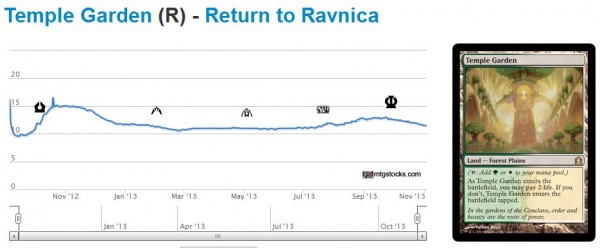
Now that normally would be a terrific thing, but a number of factors have been working against the value of shocklands, leading to an unattractive price curve. Many of these lands have a shape similar to this one:

Garden

This was supposed to be a sure thing. In September shockland prices began their steady rise and this was supposed to continue for months. I was expecting all-time highs by February. Clearly Wizards of the Coast had other plans.

The Bad News

The perfect storm was brewing. We lost important mana-fixing lands in both the Innistrad and the Core Set check lands. This means that supporting a deck of three or more colors became dependent almost solely on shocklands. Thus demand was likely to spike dramatically. What’s more, Modern season was supposed to be starting in the near future, driving demand up even higher.

Combine that with the fact Return to Ravnica block won’t be opened nearly as much now that Theros is released, and the trajectory for shocklands was looking spectacular. Being savvy MTG speculators, the QS community moved accordingly. We all acquired aggressively–-if we pooled all of our shocklands, I’d wager we could sell them all for a BMW 3 Series or comparable car. Or at least, we could have if the unexpected hadn’t occurred.

As it turns out, Wizards of the Coast didn’t want Modern season to come so soon. Maybe they want more time to review the banned list before the next Modern PTQ season. Maybe they are planning to launch Modern Masters 2 before the season. Or maybe they just felt like shaking things up to set the speculator community back.

Whatever the motivation, Modern season has been delayed significantly. This means the expected demand for shocklands from the PTQ grinders will have to wait.

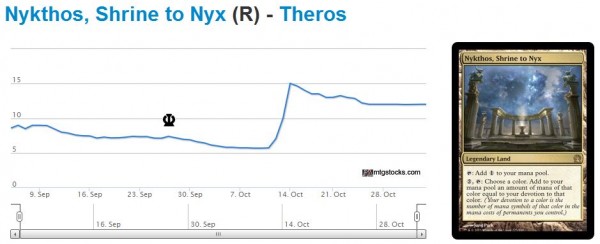
Then Theros launched, and this happened:

Nykthos

It comes as no surprise that Nykthos, Shrine to Nyx can become incredibly powerful in mono-colored decks. Imagine that-–devotion is best when fewer colors are played. While the revelation made me significant coin thanks to the spike in price on the graph above, it also had a negative impact on shockland values. In mono-colored decks, shocklands are strictly worse than their basic land counterparts.

Now there’s a glut of shocklands due to the quantities printed and opened in Return to Ravnica block and the demand just dropped significantly. Hence we have the price drop negatively impacting our portfolios.

So What’s The Good News?

For now there isn’t a whole lot. With Theros becoming a major success, shocklands will at least be opened in much fewer quantities. The supply should largely be at a peak. The problem lies primarily in the lack of demand. But this may yet be overcome.

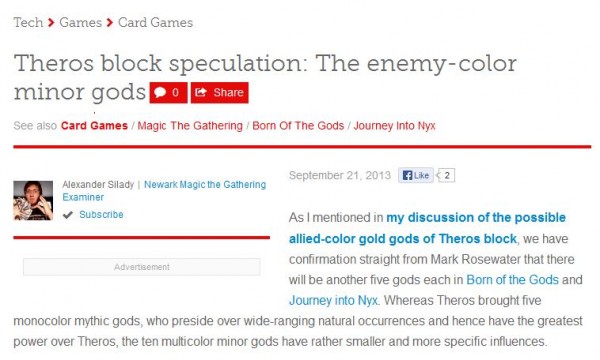
First, we have the upcoming Born of the Gods release. Rumors I’m hearing entail some multi-colored gods. This could mean multi-colored devotion and this could bode well for shocklands. If decks of three or more colors become popular again the demand for shocklands should increase.

(from http://www.examiner.com/article/theros-block-speculation-the-enemy-color-minor-gods)

If this fails, then we will simply have to wait for Modern PTQ season. Wizards postponed the season once, but there is virtually zero possibility they do so again. When Modern season does inevitably roll around demand will finally get an increase. The Modern metagame is heavily populated with multi-colored decks relying on fetch-shock land pairings for mana support--Affinity possibly being the exception in the list of Tier 1 decks.

Meanwhile…

“Hurry up and wait.” I hate this saying. But it’s fitting here don’t you think?

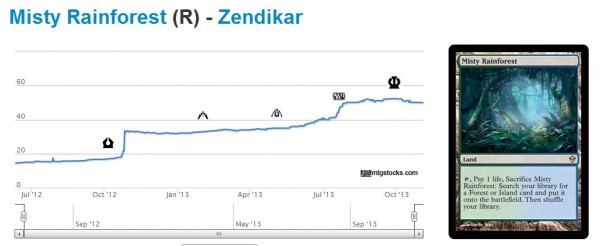
We are all sitting on this major investment which isn’t panning out in the short term. So the options are either sell now for a loss (breaking even at best) or sit around and wait for these to finally get some love. I doubt they will drop in price when they rotate out of Standard–-they are way too popular in Modern and even EDH. It’s likely these do what the Zendikar fetchlands did.

Misty

The Zendikar fetchlands declined little if at all when they left Standard. Then they increased in price steadily as Modern gained traction. If we expect Modern to remain strongly supported by Wizards (and hopefully we get a third-party SCG Open-like circuit of Modern tournaments in the future as well) then the same trend can be expected. Thus there is still plenty of upside on shocklands.

But I would be remiss if I neglected to mention the risk: reprints. Wizards wants Modern to be an affordable Eternal format. They have already demonstrated their dedication to this goal by giving us Modern Masters and reprinting shocklands, Mutavault and Thoughtseize in Standard. With a few exceptions, these reprints have reduced prices effectively. And it's only a matter of time before Tarmogoyf and Dark Confidant follow the same trend. Consider yourself warned.

Thoughtseize

Shocklands could easily be reprinted yet again, further damaging their price. Do I think this is likely? Not in the next couple years. I personally feel Wizards will target fetchlands when they next think about what lands to reprint. (Perhaps as a selling point for M15? Having fetches and shocks in Standard for three months wouldn’t be that terrible.) But the prospect of shockland reprints is not impossible.

Weighing all these risks and potential rewards, we need to make our own personal choice. I’m probably going to wait until Modern season to see what kind of price increase we get. If I can out these profitably–-even for a fraction of a percent--I may take advantage. If the opportunity doesn’t present itself, then I’m likely in it for the long haul. Two years from now these should see some recovery, much like filter lands and blue Worldwake manlands have seen.

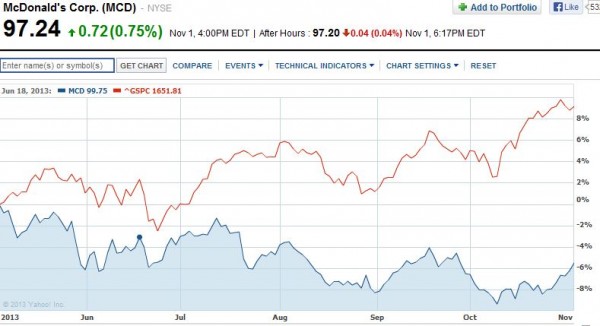
I just hate sitting on such a large investment knowing the short-term returns won’t be there. I feel like my opportunity cost is quite high on these, but selling for a loss also feels wrong. It’s like owning McDonald’s stock and watching it do nothing while the rest of the market hits all-time highs.

MCD

Alas this is the risk we take when investing. Sometimes even the blue chips like McDonald’s and shocklands falter. Rather than look at the price of entry, we need to focus on the price of exit. What are you> going to do with your shocklands?

Sigbits

  • How badly have shocklands dipped? Well, Hallowed Fountain is now down to $9.99 at retail. It is interesting to note that foils haven’t dipped in the same way as their non-foil counterparts.
  • I’ve said it before and I’ll say it again: Mutavaults have gotten expensive. SCG is sold out of M14 copies at $24.99. Next stop on the price increase train is likely $29.99.
  • As it turns out, M14 contains a lot of value. In addition to Mutavault, we have stuff like Chandra, Pyromaster now retailing for $29.99! One card that hasn’t seen a price bump is Scavenging Ooze, which is still retailing for $11.99. My expectation is that this one gets its price bump come Modern season. Yet another slam dunk investment getting interfered with by the shift in PTQ season schedule.

Insider: Picking the Better Deck to Make Money

Are you a Quiet Speculation member?

If not, now is a perfect time to join up! Our powerful tools, breaking-news analysis, and exclusive Discord channel will make sure you stay up to date and ahead of the curve.

Ok, let's start with a premise: black devotion decks are better than their red counterparts in Standard. Examine the reasoning behind that premise: Whip of Erebos and Rescue From the Underworld to recur it's enter the battlefield effects, unconditional removal in Hero's Downfall to go along with Doom Blade, access to life gain thanks to its Gray Merchant of Asphodel.

Red can recur Chandra's Phoenix and try to generate value through Young Pyromancer, rely on Magma Jet and Lightning Strike for removal and some deck manipulation but gaining life is a problem. When your opponent gains life, red has always had a difficult mountain to climb, but red decks not gaining life themselves means blue's turn three Nightveil into turn four Master of Waves is too difficult to recover from. Against blue aggro, red's best solution is Anger of the Gods. That card is too symmetrical for Red to rely on it to steal a victory.

The Point

So what? You are here to make money. Well, correctly judging a deck's/card's playability is the easiest way to trade, buy and sell profitably. To evaluate cards and ignore the environment they are most likely to be played in (Standard) is a mistake. Scrylands are terrible, right? I mean, sure they are better than a dead land draw late, but when Shocklands offer speed and flexibility it isn't too surprising these newer dual lands have a hard time appreciating in value.

Of course, when Shocklands rotate players will be left with ONLY Scrylands. Smell the opportunity? You don't need a smart phone to pick up out of favor cards for your "good stuff". I know most QS readers have loaded up on Shocklands. They remain an excellent pick up, but trading into two or three of the Scrylands for a single Shockland will hedge your position. Shocks leaving Standard will have a negative impact on their pricing, at least temporarily, but the positive effects that rotation will have on Scrylands will help you weather the post-rotation price flux.

The Picks

I've had several players complain in my company about Purphoros and his progressively worsening value. Well, consider the opening paragraph of this article and you have a reasonable explanation for the red god's decreasing popularity. Meanwhile, Whip of Erebos is a three dollar card that can function as an engine/ finisher in black devotion decks. I already like the Whip to get to $5 thank's to it's casual appeal (Commander), but reanimation is always a popular strategy and this is one of its few enablers in Standard.

Master of Waves was totally under appreciated. A merfolk always deserves extra attention thanks to the Legacy archetype. The Master looks pretty good in decks that are likely to have 4-5 devotion when he lands. In standard, he might expect 3-4 devotion when cast. That means 4 mana for 4-5 permanents. That is card advantage better than Opportunity at -2cc.

Seems more than a little playable in Standard, but people still doubted the card because "it dies to removal." Theros gave us more counterspells and Negate is still in the core set. The profitable trade is behind us now, but it's always worth examining the "why" behind card spikes. While supply constraints lead to plenty of unpredictable spikes in formats with a larger card pool, a spike in Standard is more often evidence of the ignorance of crowds. If you love value, knowing you can always count on others to misjudge cards is great news.

Devour Flesh has a place to shine in standard, and always looked like a common powerful enough to compete for space in every MtG format. If you can still pick this up as a throw-in or as if they were "just another" common go ahead and start squirreling them away next to your collection of Dark Ascension's Tragic Slip. This thing is worth at least twenty five cents, no? You can likely trade out to Standard players in need for at least that much today, and if not ending up with many copies of any playable Magic card is a winning proposition.

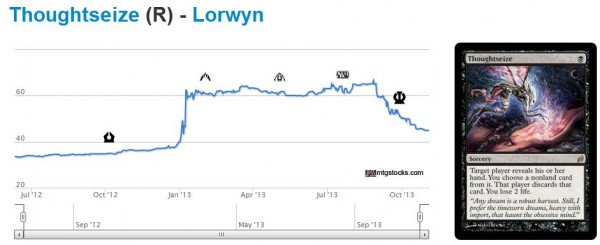
Thoughtseize is sporting some new art! Apparently that means it's now worth a lot less. Here is a card that will be run as a four of in Standard decks for months to come, that's also already proven itself in older formats. I know plenty of Theros is being opened, but picking these up with the modest expectation they get to $25 seems like a pretty safe assumption. If you doubt that, at least spend some time looking at the price of Scavenging Ooze over the last 3 months.

The Takeaway

Just in case you aren't paying attention, or can't read between the lines: I like the Scrylands at these sub $5 prices. I'm looking for them to reach $10 once players in Standard have fewer options. Whip of Erebos looks cheap too ($3), it contributes mightily to consistency in Standard decks that run it and has a lot of casual appeal. Thoughtseize is suffering a price move in our direction, lets take advantage of easy plays when we can. Along the lines of Devour Flesh: I know most of us see the value in Young Pyromancer and pick them up cheaply whenever possible. Did you know that Guttersnipe is still worth at least half as much to dealers? When you are in a room full of people obsessing over value, make the easy play for the cards they ignore/devalue.

Insider: Tracking M14 and the MTGO-to-Paper Ratio

Are you a Quiet Speculation member?

If not, now is a perfect time to join up! Our powerful tools, breaking-news analysis, and exclusive Discord channel will make sure you stay up to date and ahead of the curve.

Regular readers of this column will know that I use set prices for both digital and paper to calculate the MTGO-to-Paper ratio, a metric that can signal whether an online set has value or not. The theory is that when an online set is cheap relative to paper, it should attract buyers who intend to redeem their digital sets into paper. This activity drives up the price of the online set as cards are removed from MTGO.

This effect is most noticeable in the price of mythic rares, the redemption bottleneck. Understanding what redemption is and what it means to the MTGO market place is important, so read up on it here. The first version of the ratio is analyzed at further length in this column.

The original ratio used Supernova prices for MTGO, and Star City Games (SCG) prices for sets. This formulation gave a good sense of relative prices between sets, but with SCG prices remaining relatively static, it basically just ended up tracking online prices. Back-testing this ratio showed the predictive powers to be somewhat weak, although it confirmed the underlying theory. See more on how I back-tested the original ratio in this article.

Dropping SCG prices in favor of a more dynamic paper price seemed like it would improve the analytic results. Also, the redemption fee for all sets after Return to Ravnica (RTR) was increased from $5 to $25, meaning that comparisons between sets would be weaker if this change was not accounted for in some way. It became obvious that the ratio needed an overhaul, so from June onwards I began tracking TCG prices (h/t to forum user WeQu for the data) in order to calculate the ratio. I wrote about the overhaul here.

One criticism of the overhauled ratio was that TCG low prices weren't a good representation of a set's value. With this in mind I began tracking how the ratio for TCG Low, Mid and High moved over time on a daily basis, starting with the release of M14.

The latest iteration of the core set has been available online for three months now, so the data represents a good sample of the set release period, the opening of redemption and then the shakeup to Standard with Fall rotation.

 M14 Ratio % Changes

In the above chart, daily percentage changes in each version of the ratio are plotted on the vertical axis. The ratios are all normalized to 100% on August 21, 2013. This was the online price bottom for M14 on Supernova at 82 tix.

The general movement in the ratios is downward as the release events in early August inject supply into the market, a general uptrend as redemption opens in September, and then an acceleration of the uptrend in October as the release of Theros (THS) and Fall rotation shake up the Standard environment. These are all expected trends confirmed by the movement of each of the three versions of the ratio.

However, it's obvious that TCG High prices are volatile and prone to data points best described as outliers. There are also times where TCG High prices are moving in the opposite direction of the Low and Mid prices. As a tool, it looks like the High Ratio is strictly worse than either of the Mid and Low Ratios. It's included here only as a curiosity.

Similarly, the Low Ratio is more volatile than the Mid ratio. So, it appears that the MTGO-to-Paper ratio calculated with TCG mid prices is less noisy and the best version of the ratio. Going forward, I will continue to collect daily data on all relevant sets, but the Mid Ratio will be the favored version of the metric.

Analyzing M14

Between August 21st and October 31st, the M14 Mid Ratio increased by 50%. One question for online speculators is how much of this change was due to increased MTGO prices. Well, the set price on Supernova went from 82 tix to 129 tix, an increase of 57%, while TCG Mid prices went from $272 to $261, a decline of 4%. This is basically as anticipated.

Redemption has been lowering paper prices slowly but surely, while at the same time supporting online prices. Interestingly enough, most of the MTGO price increases are tied into the rares of the set. Notice that Mutavault is currently the most expensive M14 card at around 20 tix. In the post-mythic era, I'm not sure there's been another Standard legal set where the priciest card was a non-mythic rare.

As more players migrate away from THS Limited towards revisiting RTR block or M14 draft, the price of a card like Mutavault will come down, regardless of its use in Standard. As supply of the non-mythic rares builds up and prices come down, more redemptive value should accrue to the mythic rares. If, like me, you are still holding many of the junk mythic rares from M14, there will be higher prices on these in the future so don't rush to sell them just yet.

Comparing Theros to M14

With the release of THS in early October, WOTC changed the entry requirements and the prize structure for release events. In particular, 16-person on-demand sealed queues had a reduced entry fee combined with reduced prizes. With the older prize structure, grinders would relentlessly enter the sealed queues and then sell off their prizes and opened cards in order to play in more queues. This reduced prices on both boosters and secondary market singles.

Using the daily value of the MTGO-to-Paper ratio (TCG Mid prices), let's compare how this metric changed over time after the set release date for M14 and THS.

M14 vs THS

In the above chart, the Mid ratio for both sets is plotted on the vertical axis starting with the release date. M14 is missing the very first data point, but the overall impact in the prize structure change should be clear. With M14, a flood of supply quickly lowered prices with a large drop in the first week of release events. In comparison, the THS ratio started much lower, but generally stays higher than the M14 ratio over time.

Things are complicated a little by the Pro Tour event in Dublin where many cards from THS were in the spotlight with the success of blue devotion strategies. The hype around PT THS brought online prices up the weekend after THS was released (Day 4 and Day 5 approximately). After the Pro Tour wrapped up, prices came down to Earth.

The New Release Queues

WOTC's intentions behind the change to the prize structure were not clearly outlined. However the results have been that booster pack prices are less volatile than in previous sets, and it's taken longer for THS prices to plumb the post-releases depths. It looks like the change was put in place in order to increase price stability. From the viewpoint of the MTGO-to-paper ratio, they have succeeded.

There are two things to take away from this analysis. First, booster pack prices will not crash after release events start. This means that boosters from the new set should be accumulated during prerelease events in order to make a quick flip to drafters after these events finish.

Because prerelease events and drafts are tix only, booster packs are worth relatively less at that time. Once release events start up, boosters are usable as part of event entry fees. This makes them worth relatively more and the change in relative value is a good short term opportunity for speculators. In this case, a little bit of work can pay for a couple of months of your subscription to QS.

The second takeaway is that prices still come down over time and that the change to the prize structure has only had a marginal effect. Supply is still coming into the market, bringing prices down. It has just taken a bit longer than it has in the past. MTGO users should be looking to pick up their play sets of relevant cards right now, i.e. just prior to redemption opening.

With at least eight more months of THS being drafted, speculators must avoid making long-term plays on cards from THS, especially non-mythic rares such as Thoughtseize and Hero's Downfall. These rares will be coming down in price over time, and speculators should not be considering taking any medium- to longer-term positions on cards from THS at this time. The one exception is for junk mythics and junk rares, which are fine to buy at 0.35 tix or less and 0.05 tix or less, respectively.

At these prices, cards are already at their bottom so lately I've been buying the odd Polis Crusher. It's doubtful this will be another Nightveil Specter, but a card priced at junk that is hostile to enchantments should not be ignored while there are two more sets to come in an enchantment block.

Insider: Do I Leave the Last 10% to the Next Guy?

Are you a Quiet Speculation member?

If not, now is a perfect time to join up! Our powerful tools, breaking-news analysis, and exclusive Discord channel will make sure you stay up to date and ahead of the curve.

Standard is more or less settled for the moment right now. There’s not a ton of financial opportunity since Pack Rat and Underworld Connections hit (glad I called both of those, in particular Connections back the week before the Theros release).

Now it's time to take our profits on those cards, if you haven’t already. Time to get paid!

Or is it?

This question, which we've been discussing recently in the forums, isn't answered as easily as you might think. If you haven’t read the entire thread, I suggest taking a few minutes to do so; in-depth conversations like this are what make our forums the best medium available for discussing Magic finance.

Kurt brought up some good points in his post, and I want to thank him publicly for posting the topic. His main point is that your entry point into a card shouldn’t matter, and it’s one I absolutely agree with. Still, as the thread evolved a few points came up. I’ll do my best to summarize them here, because I think it’s a conversation worth bringing to everyone’s attention.

  • Your entry point doesn’t matter when you’re selling out of a spec.
  • Should you sell on the way up, or wait for a card to top out in search of maximum profit?
  • Should your goal be to maximize profit or just turn a solid return on speculating?
  • “Leave the last 10 percent to the next guy.”

I want to address these in order and explain them in terms of the Magic finance fundamentals.

Entry Point

“Your entry point doesn’t matter when you’re selling out of a spec.”

I agree 99 percent of the way here. The relevant economic term is “sunk cost.” Basically, once you’ve paid money to acquire the cards that money is sunk because you have no way of getting back your initial investment. Instead, you can only take what the current value of that investment is.

The example that came up consistently was Jace, Architect of Thought. I got into Jaces for about $8-10. I got out between $20 and $25. Here’s the thing. Those numbers are only useful for calculating the ROI (return on investment), which really only serves for record-keeping purposes. The argument is that when making the decision to sell or not sell, the price you paid is irrelevant.

What does everyone think about this? In theory, I agree completely. It doesn’t matter if you overpaid or underpaid for that Jace--if it’s time to sell, it’s time to sell. When I got Jaces I pinpointed $20 as the target price, and when the card hit that mark I began to sell mine. In theory all that matters is that I made X dollars when I sold them, but there’s more to the story than theory.

Let’s be honest. We’re not dealing with huge budgets with expenditures on one side and revenue on the other. The majority of us are investing into a few specs at a time and following those closely. And whether or not it should matter, what we got in at does matter to us. Sure, Jace obviously continued to go up past $20, but I was happy to double up on the card, so I began to out mine when that happened.

Here’s the thing. This isn’t a stock market, where fundamentals stay pretty constant and are constantly factored into a price. This is Magic, where things don’t always behave rationally. Sure, by selling a little early I didn’t completely maximize my profits, but the bottom line is I doubled up, and that feels good.

And, really, that’s my point. Most of us speculate not just for the cash, but from the rush we get doing it. I know Sigmund has talked about the excitement of speculating before, and I think ignoring that is ignoring the reality of the MTG finance market. And in that reality, what we paid absolutely matters.

You should do your best to eliminate your entry point from your decision-making process. If you think a card has topped out, sell it. More importantly, if you think a card is doing nothing but heading down, sell it, even if you’re losing money on that spec. Make that decision without regard for what your entry point was, because a lot of the time holding a card to avoid a loss turns into even greater losses.

But remember why you’re doing this. Very few people get rich speculating on Magic cards. Sure, maybe you think Jace could go to $35 and you’d make more money by holding. But maybe you’re wrong. If you’re happy with the profit you could make by selling now, do it. That’s a decision that requires calculating your entry costs, and because most of us do this as a hobby, I think that’s okay.

Selling at the Peak

“Should you sell on the way up or wait for a card to top out in search of maximum profit?”

This was a contentious point, and again it’s one where the theory doesn’t quite align with reality. In theory, you wait for a card to peak, and as soon as it shows signs of plateauing, you sell, maximizing your profits. But that’s not how this market works. Instead, cards are hot when they’re going up, and much less so once they’ve topped out. This has very real implications.

As several people pointed out, the number of copies you have matters because it takes time to sell that many copies. Gus (who runs a store) posted that it’s much easier to sell 150 Jaces on the way up than wait until they’ve topped out, and I agree.

The key factor here is momentum, or velocity. You want to be the person selling the cards when there is a rush to get them, rather than be trying to sell yours when everyone who bought in on the way up is trying to out their copies. Why?

In this market cards prices can change quickly. When something is on the way up, there’s the “race to the top” effect, where someone lists their copies and they’re sold immediately, setting a higher price point for the next one. Well, in today’s market a lot of those buyers are planning to resell later.

Let’s look this time at Tidebinder Mage, which rose quickly after the Pro Tour. The card’s average on TCGPlayer went from a dollar to $6 at the max. So if we sell ours when the card hits $4 on its way up we’re missing the top point by $2, but selling at this point yields much more consistent results.

When that card does eventually plateau, in this case at $6, we start to see the “race to the bottom” take effect. This is not the time to caught with copies in hand, because with each passing hour that your cards don’t sell you lose money.

When a card is going up, everyone wants to list theirs higher and higher, not lower and lower, which allows you to sell into that hype for a good price. As soon as the hype machine and initial frenzy slows down and the card becomes static, people begin to undercut the market, even if the mid-price is stable at a higher number.

These outliers undercutting the market pull everyone down. As Gus alluded to, it's much harder to sell in this environment than the previous one. The velocity of a card is extremely important in selling.

But what about the cards that spike twice?

This is of course the counterargument to what I outlined. What if after spiking to $5-6, Tidebinder had another great weekend and went up to $10? After all, that certainly happens with some cards, for instance recently with fetchlands.

The fact is that many more cards go the opposite way. For instance, Tidebinder Mage. In Magic Finance, the original spike is, in the majority of cases, the highest that card ever reaches.

If you think this time is the one in 10 that will spike again, then feel free to chase it. The problem is that I've seen far too many people chase that and lose money in the meantime. I'd rather "lose" money on that one spec out of 10 and max out on those other nine than chase that spike on all 10. In my experience, this is the more profitable strategy.

There's another important aspect: buylists. A lot of my selling goes to buylists, or at least did in the past before I started working out of a store. After the Pro Tour, Master of Waves spiked to $20ish. Great. In that first week, dealers are trying to stock up on the card, so they're offering a buylist price of (say) 75%, or $15. We can out at that price and be happy with our money.

Let's say we think the card will go even higher, so we hang onto them (again, Master is just an example; insert whatever card name you want here). Dealers restock after the initial run and put it at $25. Great, you were right.

But that card's price is now more static than it was before because there's no hype and no active run on them. Dealers lower their buy price because they aren't selling as fast, even if they are selling at the new price. Now their buy price is a more typical 55%. That number is $13.75.

And of course we're assuming the card in question is spiking because it's actually a tournament contender. There are many Exquisite Bloods and Hall of the Bandit Lords that will leave you absolutely destroyed if you try to wait for a card to plateau. Dealers may be slow to drop their retail prices on this stuff, but buylists plummet once they know it's going nowhere.

Goals in Speculation

“Should your goal be to maximize profit or just turn a solid return on speculating?”

To me, this is a personal question. I’d much rather make a solid, consistent return on my cards than chase maximum profits. For someone else, maybe you don’t mind losing on some specs by holding too long because you think it’s worth it, and that’s fine too. It all depends on your risk tolerance.

The Last Ten Percent

“Leave the last 10 percent to the next guy.”

This is probably one of my most-repeated adages, in part because I think it is so often a successful formula. Due to the #HypeTrain and the way speculators like us work in this market, Magic finance is chock-full of cards that spike suddenly, sometimes out of nowhere. And the vast majority of the time those spikes do not represent a new baseline price. Instead, they represent impatience on the part of Magic players who need it right now, and prices come down later.

This isn’t always the case. Fetchlands, for instance, only went up more. And the truth is that wasn’t hard to predict. They were played all over, weren’t even possibly a flash in the pan and weren’t getting reprinted soon. In other words, they had the fundamentals to back up the price spike.

To me, these spikes are few and far between, and they’re easy to recognize when they occur. There’s a big difference between Misty Rainforest on one hand, and Aluren or Hall of the Bandit Lord or Didgeridoo on the other.

But “leave the last 10 percent to the next guy” is way easier to sell than “leave the last 10 percent to the next guy, except in this case, or that case, or maybe possibly this case.” Instead, it’s one blanket rule I tout regularly because it regularly is the right course of action.

When something diverges from that, like the spike on Jace, I write about it. I said that I was beginning to unwind my position on Jace but wasn’t in a rush to sell because I thought the new price had some fundamentals behind it. Compare that to something like Scapeshift which exploded overnight when Valakut was unbanned. I sold my copies immediately because there was nothing but hype behind the price change.

And that’s the case more often than not, either because of hype-based spikes or because the card in question is in the current set (looking at you, Master of Waves) and will continue to be opened, increasing supply on the market.

Perception of Value

I completely agree that what you "think" a card is worth should influence when you decide to sell. Jace, for instance, I thought would be $20-25. When the card hit $20 I started selling, though I didn't firesale them (as I mentioned above). So if I think the price could stay or even go higher, why did I sell?

Because even if I "think" a card deserves to be $25 and it only hits $20, there are so many unpredictable factors in this market that I'm going to take the money. I'm not so arrogant to think that I nailed the price perfectly. If I think a card is worth $25 and therefore refuse to sell when it hits $20 and I'm wrong, for the reasons outlined above I'm going to lose more as the card falls than I will gain if it reaches the goal I had in mind.

Say after the initial spike Jace turns out to be trash, even if I don't think it really is. The price hits $20 and I don't sell because I think it's going to be $25. Instead, I'm wrong and it heads the other way and falls a few bucks in a week. Due to the nature of buylists and the "race to the bottom" on TCGPlayer, all of a sudden I'm losing way more due to the retail price falling $5 than I would gain by it rising $5.

But all of this can only be applied after a card nears a target price. You can't look at Jace when it hits $12 and say "well I lose more if it goes down than I gain if it goes up." This is where you have to actually be able to speculate on cards, and compare past precedents to determine a target price.

If I think Jace is seeing enough play to hit $25, based on how similar past cards have performed, I'm going to wait until it at least nears that number, or spikes suddenly. Due to how fast this market moves once it starts to, this point is usually easy to locate. It takes more than just looking at MTGStocks graphs to understand how to properly operate in this market.

Wrapping up

This has been quite a long essay, and I apologize if I rambled a bit, but I want to be clear I’m not here to sell you academically-sound economics theories that will never be wrong. All I can do is share what I’ve learned from my years in the finance game and what’s worked for me.

I don't claim to be an economics expert (I have degrees in journalism, broadcasting and PR, note that none of those are business-related), so all I can do is share the strategies that have made MTG finance such a huge part of my life.

This is certainly not intro-level stuff, but I think whatever side of the discussion you fall on, it’s one worth having. What are your thoughts on the subject?

Thanks for reading,

Corbin Hosler

@Chosler88 on Twitter

Devoted to Red, Then Blue, and Financials Too

Are you a Quiet Speculation member?

If not, now is a perfect time to join up! Our powerful tools, breaking-news analysis, and exclusive Discord channel will make sure you stay up to date and ahead of the curve.

Some events you just aren't meant to win. It seemed I was destined for mediocrity this past Saturday at the Star City event in Indy. Although I started out 2-0, the next three rounds were not kind to me.

I found myself not only making a couple inefficient plays, but also took the mulligan bus all around the town. Some of my stops on the bus involved me not playing any lands, while other games I was granted half the lands my deck possessed. The killer combo of mulligans, mana issues and misplays is a sure-fire way to find yourself chilling in the outskirts of the lower tables. It was not my day.

There were some adjustments from the list I proposed last week, so let me start with the list and follow it up with a brief synopsis of my thoughts.

Red Green Devotion

Untitled Deck

Creatures

4 Frostburn Weird
4 Ash Zealot
4 Burning-Tree Emissary
4 Boros Reckoner
3 Chandra's Phoenix
4 Fanatic of Mogis
3 Purphoros, God of the Forge
3 Stormbreath Dragon

Spells

3 Mizzium Mortars
4 Domri Rade

Lands

4 Nykthos, Shrine to Nyx
4 Stomping Ground
4 Temple of Abandon
1 Gruul Guildgate
11 Mountain

Sideboard

3 Burning Earth
2 Chandra, Pyromaster
2 Hammer of Purphoros
2 Anger of the Gods
2 Electrickery

With all the problems I had at the event, it’s no surprise that I did not have many explosive or even good draws with the deck. Although I started out well, I did not really get to see what the deck is capable of.

In testing this deck performed much better, but with a limited amount of experience, I would say that it is not consistent enough to see play right now.

My main concern is that it can be a bit clunky. Although it is capable of some extremely fast starts, when your opponent has removal for your first few permanents, it will be difficult to get the deck into gear. If your first few turn are uninterrupted, you opponent most likely does not have a chance at winning if you have even a mediocre hand.

If you are going to play this deck in the future, I would advise testing it before taking it to a big event. Some of the lines are unintuitive unless you have played against a variety of strategies.

One positive for me was the power of Chandra's Phoenix. That card impressed me in the matchups I faced. The Chandra, Pyromasters were extremely good from the sideboard as well.

I wonder if a version of this deck with a lower mana curve would perform better. The reason I am not a fan of a lower curve is because I don’t like the one-mana threats. Maybe I need to play some games with Firedrinker Satyr before I can see how good he is, but at the moment, I can’t get on board with him.

If the next set provides some red one-drops with a bit of utility, this deck could become a legitimate contender. As for now, it is too clunky and what used to be an amazing threat in Stormbreath Dragon has now become Doom Blade fodder. The metagame is not in the right place for Red Devotion to thrive.

If you were curious about the actual event, I had to face a number of different controlling strategies. Here are the opponents I faced.

  • U/W control – Win
  • RWB – Win
  • G/B Midrange – Loss
  • Esper – Loss
  • UWR – Loss

Standard Financial Observations

You may not know this about me, but I love the financial side of Magic almost as much as the competitive side. The entire time I’ve been playing this game, the value of cards and trading has been an important and enjoyable aspect of why I stay with it. At the beginning, I traded because I could not afford to purchase cards I needed. If I needed a new deck, I literally traded for the whole thing.

For a while even traded for commons and uncommons at the prerelease so I would have everything I needed to play. From there, it spawned into trading for cards I thought were undervalued. The truth is, I just really love to trade.

Eventually, I convinced a local shop owner who did not carry singles to let me sell cards in his shop. It was amazing how fast my small business grew. All of a sudden, the players at the shop could get a hold of the cards they needed for their decks. The competition at the shop rose dramatically and everyone seemed to have more fun because they had access to all the cards they wanted for their decks instead of suffering with sub-par cards.

That situation ended up not working out and I sold off the stock from the business after a quick six months selling there for a nice profit. I called that endeavor, ‘Case to Shop.’ It was one of the best experiences I’ve had in Magic.

Fast forward to a month ago and I found myself in a position to purchase a different local shop with a friend of mine. The owner basically made us an offer we couldn’t refuse. We have gotten off to a great start, but still have a ton of work to do in order to make Galaxy Games a bigger name in our area. (If you are ever in the southeastern part of Ohio, stop out to hang out.)

The reason I bring this up is because the shop is doing pretty well so far. We completely sold out of Theros packs and boxes as well as all major singles from the set. Because I had an opportunity to attend the Star City Indy event, I thought it sounded like a great opportunity to trade for singles that we needed at the shop.

I had a plan. Take all our older cards that weren’t selling and turn them into Standard mythic rares we can sell in our case. Normally this would be a terrible idea because the older cards are much more likely to hold their value than the high-variance Standard ones. In my case, we just needed to turn them into cards we could sell since we couldn’t afford to open more product for singles.

Trading my decently playable older cards for Standard mythics proved harder than you might think. Most of the people at the event were Standard-only players and didn’t really want older cards. In addition, I could not make some deals work with players because everyone wanted to use the prices listed at the venue. Overall, I was okay making ‘bad trades’ because many of the cards in the shop binder were obtained through our buylist. So either way, I’m coming out ahead.

The majority of mythics from Theros were, as you can imagine, in high demand. I have noticed higher prices across the board with this set than previous ones, as I’m sure everyone has.

With so many of the mythics from this set being valuable, my theory is this: rares from Theros will have a much lower price threshold than that of a normal set. So much product was/will be opened just to meet the demand the mythics are generating, how can the rares be worth much money at all?

Before I came to this realization, I was prioritizing the lands in the set because they should increase in value long term. With how many copies will be available, I doubt we will see much of a rise next year during the typical spike. Even cards like Hero's Downfall and Nykthos, Shrine to Nyx should fall in price despite their high playability because there are just too many copies out there for sale. Keep this in mind as you are obtaining your cards from Theros.

Devoted to Blue: The Color Crisis

What is going on with this aggressive blue deck anyway? In the time I’ve been playing this game, the only time I’ve ever seen twenty-something creatures in a blue deck is the one time I designed it myself.

To be honest, I love this development. I think blue creature decks are a ton of fun to play with and it’s awesome that we have that option in Standard right now.

With that being said, this is no typical blue deck. The normal progression of this deck goes like this:

Turn 1 – guy
Turn 2 – guy
Turn 3 – guy
Turn 4 – draw some cards
Turn 5 – more guys or bounce their guy

That is not the recipe for any blue deck I’ve ever played against. It is more the normal process for a white weenie deck.

You may notice the similarities between Mono-Blue Devotion and Mono-White Devotion because they are basically the same deck. As crazy as it sounds, the difference is the blue deck has much better creatures and a better god.

Think about if Thassa cost four mana like all the rest of the gods instead of the aggressively-costed three she actually is. I don’t think Mono-Blue would be a tier one deck if her cost was adjusted to match the others in her cycle.

Even though the blue creatures are better than the white ones, that does not mean that the blue ones are very good. Tidebinder Mage was excellent when the deck first debuted but now that the metagame is not all red and green creatures, you are casting a vanilla 2/2 most of the time. If the next set gives us some better blue cards, as Wizards is prone to do, we may even see the deck evolve into something even better.

When I’m thinking about this deck, a man name Paul Sligh comes to mind. That name may resonate with some of you, while others have never heard the name or the story. You may think the name sounds familiar and that is because his last name turned out to be highly influential to the game of magic.

Mr. Sligh was a mathematician, focused in Statistics I believe, who liked to play Magic. This is not an uncommon thing today, but he was most likely the first of this breed of player who analyzes the game by breaking down card choices and decisions by percentage. When I first started playing, his story, as well as the deck concept he designed, fascinated and inspired me in many ways.

The deck he is famous for creating is the eponymous Sligh. Traditionally, many red decks have been called by the name, but too few of them have followed in the original intent of the deck. The goal was to utilize all of your mana each turn by casting efficient creatures and then finish your opponent off with cheap burn spells.

Ideally you would have some type of utility lands to turn your lands into damage as well. In case you’ve never seen it, here is the breakdown for the mana costs of your creatures. Remember as you are looking at these numbers, the curve is designed so that it’s statistically likely you will cast a creature on each of your first three turns.

1 mana slot: 9-13
2 mana slot: 6-8
3 mana slot: 3-5
4 mana slot: 1-3
X spell: 2-3
Removal/Burn: 8-10

Setting your deck up in this manner lets you take advantage of the early game. Your goal is to present a board state that your opponent cannot come back from.

If you compare this curve to that of the blue deck, you will find that it falls right in line with most of the sequence. The part that is not quite right is the one-mana cost creature spot. Mono-Blue needs more one-drops for this curve to work out on a regular basis. Theoretically, it needs more removal spells as well.

For a more detailed Magic History lesson, check out these links here and here.

With that in mind, here is my current version of Mono-Blue Devotion. It is light on spells, but heavy on devotion. The main difference from the other lists is the addition of Galerider Sliver.

Some players have been supporting this change and I’ll admit I was skeptical about the card, but my initial impression is that it is very good. Sometimes it is just another one-drop to fill out your curve and make the deck more consistent, but other times you can jump your Mutavaults over your opponents creatures.

The sideboard is just tentative right now so keep that in mind. I do think the cards I put there are potent cards to bring in for a variety of different purposes but I’m sure not all of them will stay.

Mono Blue devotion

Untitled Deck

Creatures

4 Judge's Familiar
4 Cloudfin Raptor
2 Galerider Sliver
4 Frostburn Weird
4 Tidebinder Mage
4 Nightveil Specter
4 Thassa, God of the Sea
4 Master of Waves

Spells

2 Cyclonic Rift
3 Bident of Thassa

Lands

4 Mutavault
1 Nykthos, Shrine to Nyx
20 Island

Sideboard

2 Jace, Architect of Thought
3 Rapid Hybridization
2 Aetherling
3 Domestication
1 Nykthos, Shrine to Nyx
2 Gainsay
2 Negate

As you can see, the list is quite similar to others of the same name, but my hope is that this version is more streamlined and consistent. Post-board, you can make your deck a little better or transform into a deck with more midrange and late-game threats.

At the moment, I feel like Domestication is the best answer to a bunch of different decks, but most importantly the mirror. I may also want a Dispel or two. In previous versions, that card has impressed me.

As long as testing goes well, it’s my plan to rock this deck at the TCG Player Invitational this weekend in Columbus. If you are at the event, stop over, say hi, and well talk about your thoughts on the metagame. Good luck to all those going.

Until Next Time,

Unleash the Nykthos Force!

Coherence in Deck Construction

Are you a Quiet Speculation member?

If not, now is a perfect time to join up! Our powerful tools, breaking-news analysis, and exclusive Discord channel will make sure you stay up to date and ahead of the curve.

Unfortunately for Pauper and prospective Pauper fans I’m not yet ready to roll out another deck as of yet. I burned a lot of time preparing for the Indianapolis Invitational this weekend which didn’t leave much time to think about Pauper. Instead for this week I would like to talk about the deck-building concept of coherence.

What Means This “Coherence”?

In a deckbuilding capacity, coherence refers to how the cards in a deck work together to execute a plan. The concept lies somewhere between consistency and synergy. A perfectly consistent deck would be one filled entirely with cards that fulfil the same role- say all Lightning Bolts. A perfectly Synergistic deck would consist of all spells that benefit from the other spells in the deck- say, all Lord of Atlantis.

Coherency takes things a step further, and asks whether every card in the deck is “on plan”. The Lightning Bolt deck has the clear plan of burning the opponent out with some wiggle room for interacting with problematic creatures/Planeswalkers and the Lord of Atlantis deck’s plan is all about attacking and blocking. Intermingling the two spells leads to drops in consistency and direct synergy, but better promotes the plan of defeating a non-goldfish opponent. A mix of these two spells leads to a deck with a coherent focus of attacking/blocking well while being able to interact with opposing creatures/planeswalkers/life totals.

How About Some… Realer Examples

Fair. The above was an abstract oversimplification that doesn’t have a good amount of value. For a better example of coherence, let’s talk about my original submission for Pauper Rats! While working on this deck I wanted to find a way to make Gray Merchant of Asphodel work, but in all of my testing the card felt pretty weak, while Corrupt tested much better. The major reason for this was that Corrupt coheres much better with the strategy of a removal-heavy control deck. One can sit back, kill opposing creatures, make land drops and eventually Corrupt will be lethal. Better yet, non-lethal copies will serve to buy time for the lethal ones.

Alternatively, if all you’re doing is throwing around Victim of Nights, Gray Merchant isn’t gaining any value. The simple inclusion of Oubliette dramatically altered the coherence of the deck. Now, instead of just binning cards on both sides of the battlefield the deck features a removal spell that simultaneously advances the removal plan and the lethal devotion plan- or makes the decks A and B plans better cohere with one another, if you will.

My favorite example of a coherent deck is, to the surprise of no one, RUG Delver. The spell suite in the deck works extremely well at operating on very few lands while simultaneously forcing opponents to attempt the same. The trifecta of Stifle, Wasteland and Daze are seen by many as something of a “Free Win” engine, as they heavily restrict opposing resources, but more so Stifle and Daze allow the RUG player to function on as few of its own lands as possible.

Daze serves the primary function of crippling the opponent’s tempo, but it’s also quite valuable at allowing the RUG player to manage his/her own mana. In RUG, you generally only hit your third land drop to fight counter wars or because you want to set up a Brainstorm + Fetchland. In these circumstances, Daze then will allow the RUG player to Brainstorm away the land that they never really wanted to play in the first place.

Stifle plays a similar role in the deck. Typically heralded as a piece of mana denial, Stifle gets considerably less credit for the other important role it plays of countering opposing Wastelands. If not for Stifle a deck with as few lands as RUG would be extremely weak to Wasteland. Stifle demands opponents play more lands while at the same time allowing RUG to play fewer.

While we’re on the topic or RUG, this seems like as good a time as any to call out a trend that I find baffling. Gitaxian Probe is wildly incoherent with the rest of RUG’s strategy. RUG’s playability is entirely dependent on its spells interacting positively with those of its opponents. The deck is built in a way so that all of its spells are efficient enough to advance its own game play while interacting with opponents on most turns of the game. Nowhere in any of this strategy does the deck care much at all what the opponent has in hand.

Legacy is a format filled with dramatically more “must counter”s and “never counters”s than it is “sometimes counter”s. The success of a RUG pilot is dependent on careful execution of this turn in preparation for the next. Without knowing the top card of an opponent’s library, or worse the three that they Brainstorm/Ponder into, knowledge of their hand doesn’t give a RUG player a ton of value. The deck is built to have a fighting chance against anything. Knowing what that thing is doesn’t make your chances better, it just tells you whether the game is possible or not.

This is not to bemoan the power of information, even in a format such as Legacy, it’s just to say that Probe is much more coherent in decks with a focus of this turn. If you cast Gitaxian Probe and see that the coast is clear for your Tarmogoyf now you gain fairly minimal advantage, whereas Probe will allow a Storm/Sneak and Show player to know if their opponent is dead right now.

That all said, sometimes incoherence can be to your benefit.

Strategic Incoherence

The most powerful (and dominant) deck to follow incoherent gameplans was the Dark Depths Thopter decks of the now dead Extended format. For reference:

”Thopter Depths by Grand Prix Oakland 2010 Champion Gerry Thompson”

spells

4 Dark Confidant
4 Vampire Hexmage
4 Chrome Mox
4 Muddle the Mixture
4 Thirst for Knowledge
4 Thoughtseize
3 Repeal
3 Thopter Foundry
2 Sword of the Meek
1 Compulsive Research
1 Slaughter Pact
1 Smother
1 Engineered Explosives

lands

4 River of Tears
4 Dark Depths
4 Sunken Ruins
4 Urborg, Tomb of Yawgmoth
3 Island
2 Swamp
2 Tolaria West
1 Academy Ruins

It’s slightly misleading to say that this deck is incoherent without any qualifiers. The deck is very clearly a focused combo deck, with a coherent focus of killing opponents with discard/counter backup. The incoherence comes from what the opponent must do to properly interact with the deck.

A timely Path to Exile could deal with a Merit Lage token, but was laughably bad against Thopter Foundry + Sword of the Meek. Pithing Needle could hit one combo, but not both.

By comboing out in two unique ways, DDT’s minor incoherence forced opponents to try to interact in ways that were generally much less coherent.

Of course, such strategic incoherencies tend to be exploitable only in certain environments. In Legacy the Oops all Spells deck gains a small edge by turning from a graveyard deck in game one to Belcher in sideboarded games, but all combos in that format are comparably weak to counterspells.

Wolf Run Ramp from a couple years back was another strong example, as the best card in the deck was a giant monster (Primeval Titan) while the second best was a land (Kessig Wolf Run). Interacting positively with both forced control players to play a range of spells that fluctuated dramatically in power by game. Sure, Pithing Needle stopped Wolf Run, but you can’t afford to draw too many needles while facing down a 6/6 beater.

Coherence and Limited

The place where I see deck coherence most often neglected is in limited. Many players, new players especially, tend to focus on the “bombs” featured in their limited decks. Unfortunately for players with such a focus, most of their deck is going to be comprised of commons. This tends to be what holds these players back in Cube as well- with a fistful of bombs they forget that they’re trying to build an actual deck.

The more you draft and the more sealed you play, the more you start to value your commons. The less you complain about not drawing “cardname” and the more you focus on executing a particular strategy.

Scars of Mirrodin was a terrific draft environment for learning about coherence. While it was often excusable to play a deck featuring creatures with and without the Infect mechanic, it was usually wrong to be aggressive with a mix of both. Cystbearer made for an awesome early blocker for a Dinosaurs style deck, but a miserable attacker for a faster damage-based deck.

One of the best decks I ever drafted in Scars block was a UR Infect deck featuring four of each Blighted Agent and Razor Swine, in addition to double Corpse Cur. My first pick in this draft was a Batterskull. Batterskull was among the best cards in the format, and easily the least valuable card in my deck.

By the time I was making my fifth land drop, my opponents were dead or damn near it. Batterskull was still fine (obviously) as it could recover games where I fell behind fairly easily on its own, but I’m not convinced that a six drop, say Wurmcoil Engine, would’ve been at all playable in the deck. Batterskull at the very least could suit up to an Infect creature and advance the plan I was on all along. While Wurmcoil Engine was known for winning games on its own, it can’t do that every game and such a deck demands that it does so to be worth a slot at all.

Ultimately, every article ever written on drafting particular limited archetypes has in some capacity explored deck coherence in terms of limited. Developing pick orders and the understanding the contexts for which such orders should be altered are fundamental elements of building coherent limited decks and becoming better at drafting.

~

Next week I fully intend to get right back into Pauper. Hopefully what I’ve written here is of some value to deck builders, aspiring deck builders and drafters alike. Thanks for reading.

-Ryan Overturf
@RyanOverdrive on Twitter

Insider: Looking Forward to Modern Season

Are you a Quiet Speculation member?

If not, now is a perfect time to join up! Our powerful tools, breaking-news analysis, and exclusive Discord channel will make sure you stay up to date and ahead of the curve.

Before Modern season last year, Vendilion Clique was a $30 card and seemed too high. Celestial Colonnade could be had at $2. Fetchlands were less than half what they are now. Looking at today’s prices, these numbers from little more than a year ago seem kind of unreal. And while many of these cards have dipped from their peaks, they have largely retained value.

Modern season is still several months away, but I don’t think it’s too early to wonder what we can expect this year. It’s hard for me to believe that big-ticket cards will see such dramatic growth a second time. In other words, the chance of Vendilion Clique becoming Modern’s next $100 card is small. However, you can be pretty sure that it, and almost everything else, will see growth.

If you’re a player, I suggest determining the deck or decks to which you want access during the season and start obtaining the pertinent cards now. Some cards will only see small percentages increases, but you can be sure that last year’s huge spikes will be replicated this year—just with different cards. Let’s take a look through the top 16 decks from Grand Prix Antwerp and I’ll show you what I mean.

Splinter Twin

Two Splinter Twin decks made the top eight of GP Antwerp, with one of them winning the whole event. Kiki-Jiki, Mirror Breaker and Splinter Twin are the pieces that make this combo work. Kiki-Jiki spent most of the previous Modern Season at close to $30, and is now available for around $20. The lower price is certainly a reflection of Modern Masters adding more supply to the market, but also the fact that fewer people are playing Modern right now. Is there money to be made speculating on Kiki-Jiki? Probably not much. But if you want to play with it in a few months, you should have it on your radar and try to trade for copies as you see them. Getting your playset now is going to save you $20 to 40 in cash or trade value down the line.

Splinter Twin, on the other hand, seems like a pretty reasonable target for speculators. The card has been slowly rising, going from $3 at the beginning of the year to $4.50 today. The card is an automatic four-of in a combo deck that has shown it has the tools to win big events. It didn’t spike last year, but it seems poised to double up this next season. I’ll be keeping an eye out for them in trade binders and looking to scoop up any underpriced copies I see for sale.

Tron

Like Kiki-Jiki, Karn Liberated has falled off from its $35 peak during last Modern season to $28 today. This card seems like a lock to hit $40 if Tron remains a significant part of the metagame. Buying in at $28 won’t be highly profitable, but if you’re going to play the deck, you will save yourself $50 by getting these before everyone else wants them. Wurmcoil Engine also seems underpriced, though being a release promo lowers its ceiling a bit. Still, I’d be surprised if there were any copies available for less than $20 in six months.

Living End

The ship is long past sailed on Fulminator Mage and Living End, and it’s hard to believe more money can be made from those cards. Living End may have room to grow if the deck continues to put up top eights, but it’s not a four-of and is extremely specialized, so it’s probably close to its ceiling.

No, I’m going to add yet another voice in favor of the Scars of Mirrodin fastlands. This decks runs eight of them. QS Insiders have been pointing to these since last year’s rotation, waiting for the price to reflect the power level and amount of play they see. That could happen this year, and you should probably get your full set of 20 before you’re forced to pay twice as much. These can still be found in binders—you just need to prioritize picking them up.

Infect

It’s been a while since Infect did anything, and as a huge fan of the mechanic, I have to say it’s about time. Hands down, the most expensive card in this deck is Noble Hierarch. Here’s a card that was conspicuously absent from M13 (where green got no exalted) and Modern Masters. Wizards has shown they are serious about reprinting Modern staples, though, so my suggestion is to get rid of your extra Hierarchs. Yes, the shard-specific colors and exalted mechanic make this trickier to reprint than more generic cards, but I believe Wizards will find a spot for it before too long.

This deck runs Inquisition of Kozilek out of the board, which will likely see Remand-like prices come next Modern season. The card is difficult to reprint given its flavor, good against a variety of decks, and not exciting for casual releases. Its price may be depressed due to the reprint of Thoughtseize, given that many players were running Inquisition as a cheaper alternative to the former $70 all-star, but $10-15 seems inevitable if there’s no reprint.

Jund

I have to be honest: I’m not really a fan of Jund. Discussing it in depth is basically repugnant to me, so let me point out quickly that Scars of Mirrodin fastlands and Inquisition of Kozilek are also in this deck. My real pick for this one, though, is Raging Ravine. If Celestial Colonnade is over $10, why is Raging Ravine only $3? Pick this up, and take a look at the other Worldwake man-lands, too. Besides Colonnade, they all seem like they have room to grow.

Affinity

Affinity is fun because all of the expensive cards are already expensive and all of the cheap cards seem likely to stay cheap. To me, the biggest exception to this rule is Inkmoth Nexus. At only $6, this seems likely to double up in a few months and hit $15 to 20 in a year or two. There were one or two event deck printings to mitigate anything too crazy happening, but that didn’t keep the card from being $20 while in Standard. If more decks adopt this card, expect big things. The power level is high, and it was from a small set that saw less drafting than many others.

Melira Pod

I’ve said it before and I’m saying it again: Birthing Pod is going to be at least a $10 card this Modern season. Yes, it saw event deck printings. But it’s a four-of in a hugely popular deck and is even seeing mild success in Legacy testing. I’m very confident it’s going to happen, and I’m in pretty deep on the card. My biggest fear is that Wizards will pull the trigger on yet another banning, but with no copies in the top eight of this event, my guess is that we’ve avoided that for now. (For the record, I don’t think the card is so powerful that it warrants a banning, but after consecutive GP wins, I was afraid Wizards may want to shake things up again).

Kiki Pod

I’m really not sure whether to consider Kiki Pod a completely different deck than Melira Pod, given that the basic strategy of each is the same. I think I’ll err on the side of calling them two distinct decks, which conveniently strengthens my argument for Birthing Pod. It’s a four-of in two popular Modern decks, people.

Restoration Angel is down to about $5 these days, but it’s a three- or four-of in Kiki Pod, as well as seeing play in a few midrange and control strategies. I think these are well worth picking up. As a combo piece and an excellent provider of incidental value, Restoration Angel has a real future in this format and $5 is just too low.

What About Modern Masters 2?

I am of the opinion that there is no way Modern Masters 2 is coming next year. Modern Masters was one of the most popular Draft formats in recent memory, and Wizards is not going to rush the second installment. If the Draft format isn’t as good, it will sully the good name of the product line and hurt sales of Modern Masters 3 and Modern Masters 4. No, the team is going to take its time to develop another truly special set, and I think that means 2015 is the earliest we’ll see it. Supporting this is the fact that the official announcement for Modern Masters came on October 22 last year. We’re now approaching November, and unless I missed something big, no announcements have been made. Of course, if I’m wrong and Modern Masters 2 is coming next year, then Modern cards are dangerous targets on which to speculate. But I really don’t think that’s going to happen.

Last year’s Modern season was one of the craziest times in MTG finance history. I doubt this year will be as crazy, but I expect to see big financial shakeups. As a speculator, it’s not too late to start piling away cards that didn’t spike last year. And as a player, if you want to play next season, save yourself several hundred dollars and start building your decks now.

@dbro37 on Twitter

Insider: Nuances of the Trade Binder

Are you a Quiet Speculation member?

If not, now is a perfect time to join up! Our powerful tools, breaking-news analysis, and exclusive Discord channel will make sure you stay up to date and ahead of the curve.

Welcome back, Traders!

This article's focus will be on preparing  your trade binders, whether for regular FNM events or a large GP or PT. It is critical to know what you have and what its current value is. Just as important is how you present it.

Binder vs. Box

While it seems obvious, there are many differences between a binder and a box of trade stock. Binders are usually more organized and they display your stock in a much cleaner fashion. They allow you to keep stock of what you have easier and can also help keep track of what you're missing.

Trade boxes are fine for low-value stuff or bulk/near bulk cards you have tons of. It doesn't make sense to take up three pages of binder space with the same uncommon.

But when you want to trade with people, pulling out a box sends certain signals.

  1. This person isn't organized (i.e. they're new to trading).
  2. This person likely doesn't know all that they have.
  3. This person probably has mostly bulk or crap.

#1 will attract sharks who actually don't mind #3 as much because they believe you're likely to have a few hidden $5-10 cards they can trade other bulk for. #2 means you're unlikely to notice when something goes missing (which attracts thieves).

One way to avoid these issues is to keep a binder with pictures of the cards and a box to store them. I've seen this approach from a few stores, and I like it a lot. It prevents people from pulling stuff out of your binder which may or may not end back up in it, it doesn't stretch pages (which happens when people put multiple copies of a card in the page to consolidate space), and it gives a clean, professional look.

The downside is that this strategy doesn't let someone know how many copies of a card you have (which requires you to either keep a running tally in your head or constantly check) and doesn't present the condition of the card (many traders who sell online want NM only).

Choosing Your Binder

This seems like a pretty simple concept, but there are quite a lot of options out there. The table below will list the most common ones along with the pros and cons.

Type of Binder Pros Cons
Standard 3-Ring (Round)
  • Cheap
  • Easy to Use
  • Not too Flashy
  • Holds large amount of cards
  • Can be expanded
  • Sleeves can be swapped out
  • Can damage cards if too many pages are used
  • Bland/boring (look the same)
  • Cards fall out when binder is upside down
  • Top-loaded
Standard 3-Ring (D-Ring)
  • Cheapish
  • Easy to Use
  • Not too flashy
  • Can hold large amount of cards
  • Can be expanded
  • Sleeves can be swapped out
  • Less likely to damage your cards (as the pages all sit on the "flat" of the DBland
  • Boring (look the same)
  • Cards fall out when binder is upside down
  • Top-loaded
Monster
  • Easy to Use
  • Holds cards firmly in place
  • Looks professional
  • Side-loaded to protect cards from falling out
  • Expensive
  • Limited number of cards can be held per binder
  • Can't be expanded
  • Pages can stick together or smell "plasticy" if left in the heat
Ultra Pro
  • Easy to Use
  • Look decent
  • Cheaper than Monster binders
  • Often have a strip to hold binder closed
  • Limited number of cards per binder
  • Can't expand them
  • Cards can slide out of sleeves
Portfolio Binder
  • Cheap
  • Cool Artwork
  • Cards not firmly held in place
  • Can't expand them
  • Cards can slide out of sleeves
  • Top-loaded


This covers the majority of your binders. You can always get the trapper keeper three-ring binders, which will prevent cards from falling out if flipped upside down, but my personal preference is for the Monster Binders. I put all my Standard and high-end Legacy/Modern in Monster binders with one card per pocket, in an older sleeve.

Building Your Binder

There are two camps of binder organization, each with its own merits.

1. Organized

  • Allows browser to quickly determine if the desired card is available.
  • Looks clean and professional.
  • Allows players with color preferences to focus on certain areas.
  • Allows owner to quickly find out which card he's out of.

2. Disorganized

  • Forces trade partner to peruse whole binder, which may cause them to find previously unconsidered cards (similar to the candy placement at your local grocery store).

I fall squarely in the Organized category. I have all binders organized by color and separate binders by format. This allows me to focus on what my trade partner wants. When dealing with most FNM traders I only need to bring in the Standard binder (and leaving the more valuable Legacy binder in the car reduces risk of theft).

This also prevents me from "overwhelming" some newer players who will often fixate on something expensive which they can't afford and then they give up on stuff in their price range. It also prevents the annoying, "I have $60 worth of these random Standard cards...can I get your dual land for my EDH deck," as well as the typical fallout after the "No thanks" that ensues.

Work With What You Have

I understand that players come from all sorts of socioeconomic places. We have some with full time professional jobs who can and will dump $400+ dollars a month into the game all the way down to middle school kids who might get a pack a month after saving up extra lunch money (I was in this category as a kid).

It's easy to give up on your own binder when you see the guy with four of everything. Just keep in mind that the two easiest ways to build up a collection are time and money. Work with whichever you have.

I've seen plenty of younger players build up solid collections by being shrewd traders and keeping on top of price changes. If you're in middle school or high school you likely have more free time than a lot of the professionals. So when you see a card spiking or think one will try to get all the copies you can. From the professional's standpoint, don't be afraid to pull out your smartphone and teach those whippersnappers a lesson.

Tradeable vs. Not Tradeable

I have a few friends who go by the creed that "everything is for trade...at the right price." While this  creed sounds like the one you want to follow, the problem is "the right price" is incredibly vague and highly unlikely to occur many times.

What they end up doing is putting all their stuff into one binder, except some cards really aren't for trade unless the offer is so astronomically in their favor that they can't justify refusing. As you'd guess this has yet to occur.

What it does do is upset their trade partner when they finally find something they really wanted only to find out it's not for trade.

This is even worse when people put cards with strong sentimental value in their trade binders (the first rare they ever got, their favorite card, the card they got signed by the artist they met that one time). Guess what, your trade partner doesn't share that sentimental value and they won't pay you for yours.

I personally have Not-for-Trade Binders (where I keep my personal play sets) which I don't bring to events. Everything in my trade binders is tradeable. I've seen plenty of trades collapse because a lynchpin to a trade was in that "not really tradeable" category. Keep it simple, if it's in your trade binder that you hand to someone, it's for trade. If you go into a trade with that mindset you're far more likely to actually complete a trade.

To Bling or Not to Bling

This is the strategy of putting all your valuable stuff in the front of your binder. Often this is meant to sort of show off as well as make it easy for the traders who are only looking for big ticket items. I see this in a lot of newer traders binders, with often the first page including the best of what they have, followed by a couple of pages of random Standard rares, followed by uncommons and commons.

The problem with this strategy is that it discourages people from really looking at your binder. If you organize this way, many traders will look at the front few pages and if they don't see anything they need on page one or two they just say, "sorry I don't see anything I need."

While this is helpful when your goal is to conduct large quantities of trades, when you have a smaller binder you don't need lots of trades; you need a few good ones to get what you want or need. This strategy also tends to be favored by those with the "disorganized" binder approach mentioned previously.

Know What's in Your Binder

This serves two purposes. First it helps conduct trades quickly when people desperately need cards before a tournament (maybe they haven't finished their deck yet or just discovered they forgot something at home). These trades can often be the most lucrative, especially if they're seeking something hard to find.

Two, it protects you from potential thieves. After all, who makes a better target: the person who knows what they have when they hand you their trade binder or the person who has no idea? Hopefully the answer is obvious...

Avatar photo

David Schumann

David started playing Magic in the days of Fifth Edition, with a hiatus between Judgment to Shards. He's been playing Commander since 2009 and Legacy since 2010.

View More By David Schumann

Posted in Finance, Free Insider, Trading13 Comments on Insider: Nuances of the Trade Binder

Have you joined the Quiet Speculation Discord?

If you haven't, you're leaving value on the table! Join our community of experts, enthusiasts, entertainers, and educators and enjoy exclusive podcasts, questions asked and answered, trades, sales, and everything else Discord has to offer.

Want to create content with Quiet Speculation?

All you need to succeed is a passion for Magic: The Gathering, and the ability to write coherently. Share your knowledge of MTG and how you leverage it to win games, get value from your cards – or even turn a profit.

Want Prices?

Browse thousands of prices with the first and most comprehensive MTG Finance tool around.


Trader Tools lists both buylist and retail prices for every MTG card, going back a decade.

Quiet Speculation