
menu

Drafting for Multiplayer: The Commander Cube

Are you a Quiet Speculation member?

If not, now is a perfect time to join up! Our powerful tools, breaking-news analysis, and exclusive Discord channel will make sure you stay up to date and ahead of the curve.

My first encounter with cube drafting was many years ago. A longtime Magic player and friend asked me if I wanted to draft. "Of course!", I replied. I love drafting. He proceeded to pull out a long cardboard box full of unsleaved cards and began assembling them into piles, much to my confusion. After he gave a quick overview, I was instantly intrigued.

For those of you who (somehow) haven't heard of cube yet, let me sum it up for you. Instead of using sealed booster packs for a draft, you use a pre-made 'set' of cards that are randomly distributed into 'packs'. The allure of this format is that you can craft your cube any way you want. A pretty typical cube is just a collection of very powerful cards. On the other hand, I've seen other fun themes employed in a cube. Your imagination is the only limit!

Fast-forward a few years. At this point I've experienced many varieties of cubes, and almost everyone I know has one. I've always wanted to create one, but I could never come up with a good theme. There was no way I would stoop to making a 'good card' cube, because c'mon, everyone has one of those. I've toyed around with thematic cubes but could never settle on an idea.

Then one day it hit me. I love Commander, so why not make a Commander cube!?

Sadly, my brainchild has yet to come to fruition. I got tied up with a new job and haven't had as much time for Magic. But I've spent a good deal of time brainstorming what a Commander cube might look like. What cards would it have? How many cards? Better yet, how do I deal with the Commander aspect of the format?

I have a good sense of which cards would be fun and powerful in a Commander cube and also how to keep it balanced. I think the tough part would be the whole logistical aspect. There are a few questions that should be addressed.

How Does a Player Choose His/Her Commander?

My first idea was to incorporate plenty of legendary creatures in the cube pool and rely on each player choosing one during the course of the draft. The problem with this method is if a player doesn't draft a commander soon enough, it will be difficult for that player to build for synergy. This takes away from the spirit of the format.

This brought me to a second idea. There would be a smaller pool of legendary creatures players would draft prior to the regular draft. Each "legend pack" would consist of about five legendary creatures. You would make a first pick and pass to your left, just as in regular draft.

After the Commander packs were drafted, each player could use any or all of their picks in their deck (and one as a commander). I'm not sure if five is the right size for each pack, but tweaking this number should be easy after a few drafts.

The benefit of this method, tedious though it is, is that a player has several possible commander options to build around. This encourages fun, dynamic drafting strategies over simply picking the best card every pack. It also adheres to the flavor of Commander.

Here's a random sample pack (which would you choose?):

How Many Cards Does Each Player Draft?

In a typical draft format players draft roughly 45 cards and create a 40 card deck out of these (using about 23 of them plus basics). Would I just scale this linearly to the Commander format? The math says that decks are 2.5 times as big, so players should draft 2.5 times as many cards. This equates roughly to 113 cards per player.

That is quite a large pool of cards. But is it enough to provide a solid pool for a 100 card deck? Again, this question can be answered by simply drafting a few times. I think the card pools would scale just fine and perhaps could be trimmed down a bit.

How Many Cards per Pack?

The traditional number is fifteen. I have seen people on several occasions alter this number based on the number of drafters. If there are only four people drafting, five packs of nine are used (yielding the same size card pool). This allows for more 'first picks' and overall creates better decks.

Does this then scale to a Commander draft, with each player drafting 8 packs of 15? This equates to 120 cards for each person which is a good size pool. A typical Commander deck uses about 55 to 65 cards (about half the pool). This would let players spend picks on lands and mana fixing. This would allow for more dynamic decks because of more color options. Again, a few test runs would work out the kinks.

How Many Cards in the Cube?

If a good number for each person is roughly 120, how many people would the cube support? I think a good number of players for this format would be four. Four people at 120 cards per person is 480 cards! This doesn't even leave a cushion of extra cards, so I would probably bump it up to about 550. This is quite a bit more than a standard cube (roughly 300-400 cards). It will require a lot more balancing work, but like every other problem this can be remedied through many trials.

I think four people is ideal because Commander is a multiplayer format. After the draft, the participants would play in a four-player game (or several). Alternatively the cube could be bumped up to support six players (allowing two games of three people each), but this would require some 800 cards, which would make things more difficult, but doable.

A Daunting Task

A cube like this would require quite a bit more effort that a regular cube. First, the sheer number of cards required would easily double the cost to assemble it. Second, it would require a significantly large series of playtests to get the balance right. Finally, it would take extra organization to separate all the legends prior to each draft.

All in all I think this is a worthy task. It brings the idea of a cube draft to a whole new level. This is a project that I would like to complete someday, but currently I don't have the collection or the funds to accomplish. I've always pondered this and would be delighted to see it in action because of my love for both drafting and Commander.

For anyone looking to try this out, here's a summary of the basic steps:

  1. Players draft randomly created "legend packs," each consisting of five legendary creatures.
  2. Players do a second draft of eight 15-card packs (alternating left-right as per tradition)
  3. Each player designates a legend to be their Commander.
  4. Each player constructs a Commander deck (adhering to the standard Commander rules) using their pool of 125 cards (5 legends + 120 drafted cards).
  5. Finally, everyone plays Commander!

Overall I think it would be a sweet format, combining the exuberant multiplayer chaos of Commander with the strategic complexity of a draft. The format would be more open to themes than a standard cube. It would also be more interesting due to the nature of Commander. Since different cards are powerful it would create unexpected dynamics that you don't see in other cubes.

I wish I had gone through with this idea back when Commander was called EDH, and the cards were significantly cheaper. Hopefully I can slowly accumulate cards for a Commander cube so I can finally give it a try. I would be very interested to hear if anyone else has thought of this, or even tried it out. Please feel free to leave comments!

Thanks for reading.
Good Luck, High Five! Episode 6: Weirdo Hustle

Are you a Quiet Speculation member?

If not, now is a perfect time to join up! Our powerful tools, breaking-news analysis, and exclusive Discord channel will make sure you stay up to date and ahead of the curve.

Banner

(The views expressed in "Good Luck, High Five!" are those of the personalities featured and do not necessarily represent the views of and should not be attributed to our host.)

Parental Advisory: May Contain Mild Obscene Language

Insider: Recommended for Review

Are you a Quiet Speculation member?

If not, now is a perfect time to join up! Our powerful tools, breaking-news analysis, and exclusive Discord channel will make sure you stay up to date and ahead of the curve.

Reviewing past analysis and recommendations can be important for understanding where one might have a blind spot or a weakness in speculative strategy.

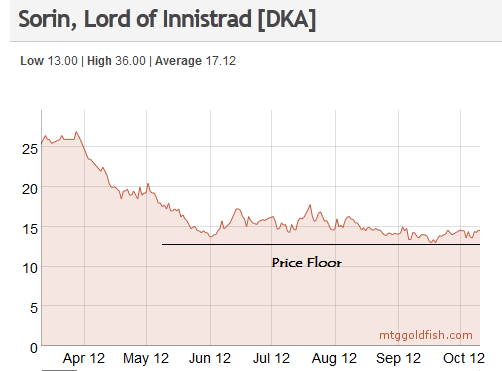
In a previous column, I named Sorin, Lord of Innistrad on MTGO as a top pick from Innistrad block heading into Return to Ravnica spoiler season. Another, more recent pick I made was Bonfire of the Damned. Comparing these two picks yields valuable insight into the relation of risk to price, and how reducing risk can ensure a strong margin of safety when speculating.

Sorin, Lord of Innistrad

At the time of this recommendation, there was very little available information about Return to Ravnica. Although Sorin's colours are aligned with Orzhov, the fact that tokens as a strategy were nerfed in block suggested that WoTC was worried about tokens in their testing. Thundermaw Hellkite as a foil to tokens is another indicator of their perceived menace.

Early returns from Fall Standard tournaments indicate that tokens is currently a fringe strategy, and Sorin is not necessarily an integral part of a token build. It's still possible that tokens emerges within the new Standard metagame, but at this point the original hypothesis has proven to be incorrect. It's time to carefully reexamine this position.

On the positive side, the price floor of 14 tix has steadily held up. The popularity of this vampire planeswalker has supported the price and the Innistrad block structure has kept supply lower than it otherwise would have been. Buying at or near a price floor is a great way to reduce risk and if one had purchased Sorin on the recommendation, the total loss at this point can be attributed only to the buy/sell spread.

This illustrates an important way to reduce risk. Buy cards that are cheap! Making a call to buy a card should take into account the current price and the price history of a card. Combining these with analysis of how the Standard metagame might develop resulted in the call to buy Sorin. Now that the metagame analysis has proven to be incorrect, the margin of safety on this pick comes from buying at or near the price floor of 14 tix.

Continuing to hold means tying up capital in the near term which might be better deployed elsewhere. Down the road the Gatecrash spoiler season should perk up interest in this card from brewers and competitive players. Modern season also might deliver a bump in price as token strategies continue to make the odd appearance in the winner's bracket.

Moving Forward

The plan with this card is to hold onto the position unless the price floor of 14 is violated, i.e. if Cardbot begins to regularly price Sorin at 12-13 tix. If this happens, then it's time to sell the position and accept the loss of capital. Once a card begins a steady decline and breaks though a price floor, a new floor will typically have to be established. This means there will be a lower price at which to buy this card before Gatecrash spoiler season drums up interest and starts driving the price up again.

If a token deck featuring Sorin breaks out in Standard, then this will interrupt the price decline. As long as Sorin maintains the current price floor, holding for this possible shift in the metagame is a better option than selling and eating the buy/sell spread.

Bonfire of the Damned

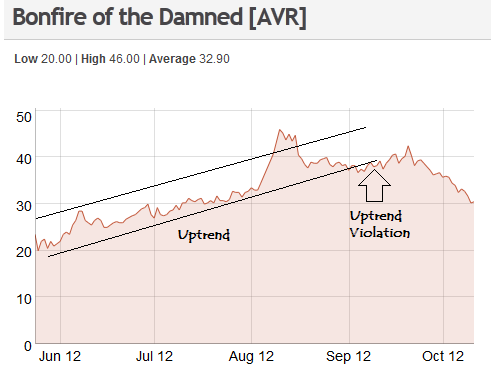
This card was outlined as a risky strategy, but due to its price momentum, powerful in-game effect and scarcity as a 3rd set mythic, signs pointed to further increases. At the time of the recommendation, Bonfire was off its peak but still within the uptrend price channel.

The card lost price momentum, signaled when the uptrend price channel was violated. It drifted sideways for a while and then started a downwards trend. When the trend changed, indicating that the factors involved in propelling Bonfire's price upwards were on the wane, it was a warning sign to be cautious.

At this point, there is no clear sign of where or when Bonfire will stabilize, but 20 tix will be an important level. If it holds 20 tix and establishes a new price floor, then it will be time to apply new analysis to decide if Bonfire is a worthwhile purchase. If you are holding Bonfire of The Damned in order to speculate, the risk of further downward price movements are high and selling now would be recommended.

A Comparison in Risk

Bonfire has a shorter price history than Sorin and has also shown more volatility. Sorin might not be played very much in Standard, but the price has been steady. Buying Sorin at a price floor was much less risky than buying Bonfire in the late stages of it's uptrend.

By minimizing your risk and buying when cards are cheap, you will protect your capital until a good opportunity arises. Cards that are cheap carry a higher margin of safety. They can only go down in price a certain amount, while an expensive card has the potential to fall much further. Trying to catch the last wave of Bonfire's increase proved to be foolish. This mistake could have been avoided by paying more attention to the reduction of risk while taking speculative positions.

Top 10 Return to Ravnica Cards

Are you a Quiet Speculation member?

If not, now is a perfect time to join up! Our powerful tools, breaking-news analysis, and exclusive Discord channel will make sure you stay up to date and ahead of the curve.

As I was preparing to write for this week, I realized I hadn't written my top ten article for Return to Ravnica yet. The top ten article is always an enjoyable one for me. Looking at a set from this perspective helps me understand its impact on Standard. I encourage everyone to do similar work breaking down sets for this purpose.

The other reason I enjoy the top ten article so much is because some of the choices I make are always controversial and I want to hear other players' opinions. I hope you guys enjoy the article as much as I do.

Exclusions from the Top Ten:

It's odd to start a top ten list with cards that were purposely excluded, but these two cards warrant explanation. I did not include either Supreme Verdict or Rakdos's Return despite other players' strong feelings about these two cards.

Supreme Verdict is certainly a step up in power level from what we have seen in the past, but today's resilient creatures laugh in the face of this mass removal spell. Uncounterability is nothing compared to stopping regeneration or exiling the creatures. Destroying all creatures most likely does not even rid you of all the creatures in play, making this new Azorius card undesirable. It does serve some function against white or green decks but it will not do everything like Wrath of God used to.

The second card I did not include is Rakdos's Return. This spell is way overcosted in my opinion. Blightning was broken in Standard and I hated playing against it but this x spell pales in comparison to the former Jund staple. It is not unplayable, but merely a strong sideboard card. Many writers are predicting the dominance of this sorcery, but I doubt it will play out that way.

Honorable Mention:

Though it did not crack the top ten, Mizzium Mortars is a great removal spell early and even better late. One thing holding it back is the fact that it's a sorcery. Making it an instant would dramatically increase the amount of play it would see.

The second factor hurting Mortars is the triple red in the overload cost. I have worked on a lot of decks that would definitely play this card but since they only splash red, they have no chance of getting to the Plague Wind effect. If a red-heavy deck like U/R Delver becomes popular, this card should see more play.

10. Rakdos Cackler/Dryad Militant/Call of the Conclave/Dreg Mangler

Number ten is a four way tie between the new hyper aggressive creatures. They are obviously powerful due to their high power-to-mana ratio and all are likely to impact Standard.

Rakdos Cackler might be the most important of the bunch because it fits right into an existing aggro deck. Dreg Mangler is similar but players do not agree on the correct way to build Zombies, so the amount of play he sees will depend on how the format shifts.

White Weenie and G/W Aggro are both starting to use Dryad Militant and I expect that trend to continue. I think Dryad Militant may even see play in older formats as well.

A deck with Call of the Conclave has not found success yet but I think it will in the future. Who knows, when Gatecrash comes along with both the Boros and Gruul guilds, we may even have a new zoo deck that wants Watchwolf 2.0.

9. Loxodon Smiter/Centaur Healer

For number nine we also have a tie but this time only two cards are fighting for the spot. The problem with these cards is that they are so similar. They both have the same mana cost, a good power-to-mana ratio and a relevant ability. Most decks that want one of these cards wants both of them. The problem is that one is good against aggro and one is good against control.

Without many counterspells in the format, I think Centaur Healer has the edge right now. If Standard shifts and discard becomes a large factor, Smiter's stock goes way up. Both cards are quite good for Constructed. Loxodon Smiter may even see play in older formats because his can't be countered ability is so much better in those formats.

8. Underworld Connections

Up next we have Underworld Connections. This enchantment is one of Standard's best draw engines. One life per card is a reasonable rate and one that is easily paid. This Phyrexian Arena variant is one reason that Jund Control is doing well in Standard. The card is sure to be a hit in Commander as well. Drawing an extra card per turn is such a powerful effect I even think that Zombies should be sideboarding Underworld Connections in against control decks.

7. Detention Sphere

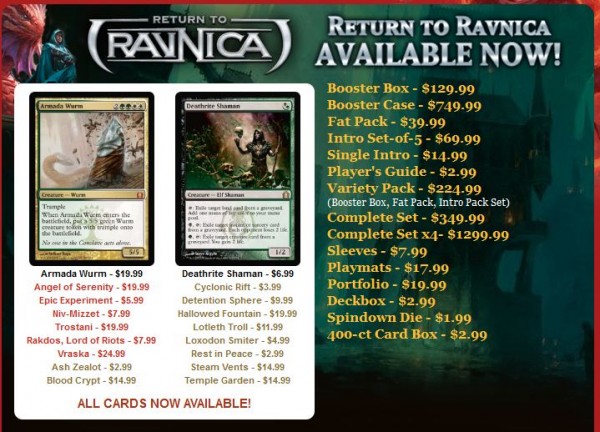
The only reason my number seven pick, Detention Sphere, is not higher on this list is because Oblivion Ring is already legal in Standard. Detention Sphere is better than Oblivion Ring but not by much. They will often function exactly the same but one is harder to cast.

The first time you exile two of your opponent's permanents with one Detention Sphere though, you will believe in its power. It will be as obvious as dollar bin dual lands. Zombie players beware the sphere before playing two Gravecrawlers!

6. Armada Wurm

Number six is the card I've thought about the most since it was spoiled, Armada Wurm. Bad jokes about the art aside, I'm sure all of you know how much I love this card. The first time I saw the armada of ten evasive power for six mana, I knew it would be awesome. The prohibitive mana cost may hold it back a bit, but as the format progresses I expect it to pop up more and more. The Frites deck, for one, may want this card as an additional threat.

5. Dreadbore

Initially, Dreadbore was much lower on my list. With the recent success of planeswalkers in Standard, the Terminate variant's stock has gone way up. When I first considered this card for play in Standard, I thought the sorcery-speed drawback would hold it back. As it turns out, your opponent usually taps out for the planeswalker they're casting, leaving you free to use your sorcery to kill it. Oh, it also kills creatures, but that is less important.

4. Angel of Serenity

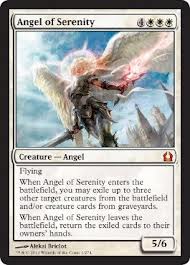
The number four card seems to be the prime finisher for ramp and reanimation decks in Standard. It's worth getting this seven-mana angel in play even if they kill it immediately. Hopefully you can target another copy in your graveyard in addition to two of your opponent's creatures in play. At the reasonable cost of seven, this finisher gets cast from your hand as well as cheated in from the graveyard. For now, she is the best option; we'll see if something from one of the Gatecrash guilds takes her place.

3. Abrupt Decay

The number three spot goes to the card that will affect the most formats, Abrupt Decay. The uncounterable ability is one of the most powerful effects in older formats where counterspells are so crucial. The shear fact that Abrupt Decay kills Counterbalance will ensure its place in Legacy. Also killing Tarmogoyf or Delver of Secrets in Modern and Legacy makes it an influential new card for those formats.

It's also amazing in draft and sealed, but people are obviously more concerned with its playability in Standard. We all know its good, but the question is how many do you want? Regardless of the number run in decks, two mana for this effect is pushing the power level for certain. I suspect this is one card likely to hold its price tag for quite some time.

2. Lotleth Troll

The man taking the number two spot is Lotleth Troll. Man? More like creepy, horrific, monster troll eating what looks to be a man's heart.

Disturbing art aside, I am constantly astounded by the power level of this creature. With so many abilities and a low mana cost, he is powerful enough to see play in multiple formats. This troll is quite a formidable foe and will impact Standard until he rotates out. Considering how he dominates games on his own, it should be no surprise to see him up here at number two.

1. Jace, Architect of Thought

Taking the number one spot, we have the newest edition in the line of Jace clones. While this version of Jace is not as broken as Jace, the Mind Sculptor, I rate him as one of the most powerful ever printed. I would not be surprised to see two different versions of Jace taking spots one and two in most players' minds for best planeswalkers of all time. Elspeth, Knight-Errant is powerful and won't give up her number two spot easily, but she may have no choice.

Jace, Architect of Thought is much better than the initial assessment most players gave him. This guy is no joke and I expect players to be gunning for him the whole time he is legal.

In my opinion, these top ten cards for Return to Ravnica were fairly obvious. If you do not agree, please post below your own top ten. I encourage your feedback on this topic. Let's hear what you have to say!

Until next time,

Unleash the Return to Ravnica Force!

Mike Lanigan
MtgJedi on Twitter
(I'm active on twitter again, so send me a message sometime.)
Jedicouncilman23@gmail.com

The Revenue Review – What We Learned in Cincinnati

Are you a Quiet Speculation member?

If not, now is a perfect time to join up! Our powerful tools, breaking-news analysis, and exclusive Discord channel will make sure you stay up to date and ahead of the curve.

So there was a Star City Games Open last weekend you may have heard about. Or, more likely, there was an SCG Open last weekend AND YOU HAVEN’T HEARD ABOUT ANYTHING ELSE!

There’s a good reason for that. We finally saw the new format in all its Zombie-infested glory. And it was certainly a very telling event. We’ve had several articles already talking about some of the financial movers from the weekend, so I’m only go to touch on those briefly before moving on to the bigger question of why there were so many big movers.

Let’s start with the Top 16.

4 Zombie decks (and a bunch more in the top 32)

3 Bant decks

2 UWR Control (including the winner)

2 Reanimator (one made the finals)

2 Jund decks

1 GW deck

1 RB Aggro

1 UW Aggro

Of these, I think the ones we’ll see the most going forward are the UWR Miracles deck, as well as the Jund decks. The Reanimator decks looks solid, but cards like Rest in Peace are very difficult to beat, which will limit how much success they can have over the long-run.

And, though it may be blasphemous to say it, I don’t love Zombies going forward. There are many hate cards against the deck that as the format becomes more fleshed out there will be fewer and fewer Zombie pilots. Control decks will be able to tune against the Zombie decks more going forward, and a lot of what Zombies has going for it right now is that it’s the only “battle-tested” deck, having come from a successful shell last season and having easy cards to slot in. Now that other decks are being discovered and refined, Zombies is naturally going to fall off some, even if it remains very good.

This means stuff like Lotleth Troll, Falkenrath Aristocrats and the pair of Dark Ascension zombies don’t strike me as good holds right now. I think they’ll all continue to trade very well (same with the GB lands), and certainly aren’t going to drop overnight.

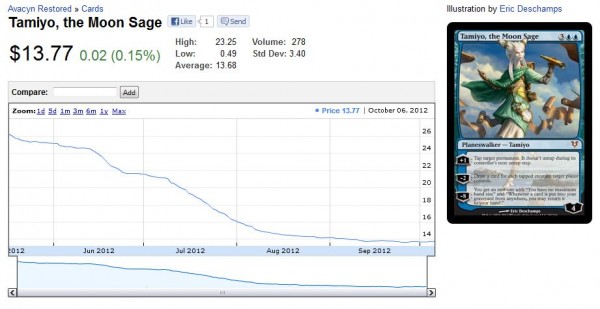
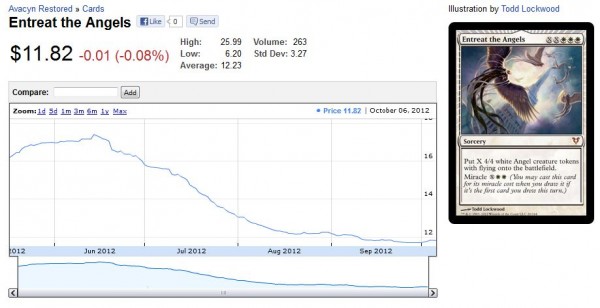
As we’ve seen already, there’s been a huge increase in the cards for the Miracle deck, and I’m inclined to believe the jump on Entreat the Angels is real, as well as the one on Tamiyo.

Jace at $50 is ridiculous. Remember Liliana at this time last year? She started pushing past $60 and toward $70 (something I called ridiculous then, too). Jace is very good, as I said in my set review. I still think he’s going to settle near $30 as I predicted in that review. There’s simply no way $50 holds for more than two months at the max. That doesn’t mean, of course, that there isn’t money to be made, but be aware.

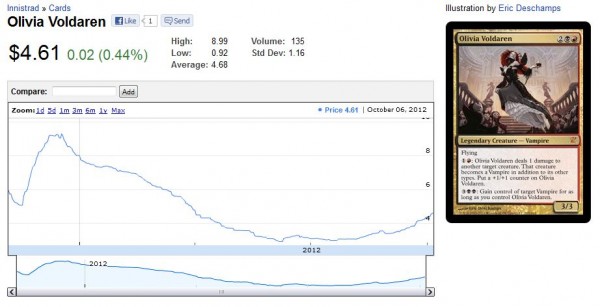
Now let’s talk about a few cards that didn’t receive as much hype this weekend but still performed well. The first is Olivia Volderen. She saw a jump to $15 (glad I got that Insider blast out to you guys in time for that), and I think $10+ is going to hold. She’s very, very good. Remember what I said about Niv-Mizzet? That he’s a better Olivia? Well, the regular Olivia is still plenty good as well. And the Jund decks are very, very real. As I said on the podcast (BrainstormBrewery.com) I think Jund is going to become the best deck of the format, and I can see the prices on Olivia and Thragtusk coming along for the ride.

Why do I think this? To break it down, the Jund deck operates much like its namesake. Every card brings card advantage. There are very few 1-for-1s in the entire deck, and it has the tools to handle aggro while being resilient enough to stack up against Control. And it has Mizzium Mortars to answer the Entreat the Angels play that other decks can’t.

The next card I want to touch on is Angel of Serenity. I called it $10-15 medium-term in my set review, but I think I have to revise that upwards to $15-20. The card is nuts, and it’s definitely a 3-4-of in the decks that want it. On its face, you would think it’s way worse than Elesh Norn, and, while that’s true to an extent, it still does great work in the Unburial Rites decks. And it’s not unreasonable to hardcast it in these decks, either. Combined with the Angel casual appeal, I think $20 is going to be reasonable.

SCG Opens Driving the Market?

I remember it very clearly. I was watching a SCG Open, and there was only one deck anyone could talk about. The commentators went on and on about how the new set changed the format, and this deck was here to stay.

And Contested War Zone was the cog that made it all go.

I bought 20.

Needless to say, that one didn’t work out so well for me. Why, then, did last weekend’s SCG Open move the market so much? Generally only prolonged play of a card or a big weekend at the Pro Tour has this kind of effect. So what gives? Should we be watching Opens every weekend, ready to buy out TCGPlayer at the mention of a card in preparation for the next spike?

No.

I believe there are a few reasons why last weekend was an anomaly. Let’s break them down.

-       It’s the first weekend. This is the most obvious, but I don’t think it’s fair to stop there. SCG Opens really have become more of a driver in the last year or two, so it’s not unreasonable to see movement based on SCG results. We’ve obviously seen it with Legacy recently. While the “first weekend adjustment” tells some of the story, it’s not everything.

-       States. To me, this is the biggest one here. The drive last year solidified that people want their decks together for States, and for those who aren’t into brewing, copying whatever did well at the only large Standard tournament we have is their only option.

-       Increased viewership. Give SCG its due, viewership on Opens has been rising, and, while it’s not quite the same as a Pro Tour, I do think we’re going to see market moves from Opens, especially after formats are shook up.

-       Increased speculation in the market. This is also important. There are more people than ever trying to “break it” and going deep on their cards. Combined with the increased player base and the increase of financial knowledge in the game, this isn’t something going away. We can only try to be ahead of the curve, as we’ve done so far.

So moving forward, keep a close eye on the SCG Opens for potential tech, and don’t be scared to buy in, as we’ve seen this weekend as an example of it working, but don’t go hard on every piece of tech that shows up, either. It’s one thing to stay ahead of the market, it’s another to get too far ahead and lose everyone else while you’re doing it.

Thanks for reading,

Corbin Hosler

@Chosler88 on Twitter

Insider: Post-Release Shifts Just Before States

Are you a Quiet Speculation member?

If not, now is a perfect time to join up! Our powerful tools, breaking-news analysis, and exclusive Discord channel will make sure you stay up to date and ahead of the curve.

How does it feel to have all these Return to Ravnica cards in your hands? I’m really enjoying this new set, and preparing for the Team Sealed Grand Prix this coming weekend. I’ve also managed to make a decent chunk of cash just in these first couple weeks dumping my over-inflated rares. We've now got some input from the tournament scene as two 5k’s happened this weekend, and in all honesty, we didn't see too many surprises.

I’m still immediately selling any shocklands I happen across from drafts. Seeing the massive quantity of these that are being opened, it's only a matter of time before they start to dip down in price. My game plan for these is to attempt to acquire them just before the draft season changes to triple Gatecrash. We will have a full 3 months with no RTR drafts as Gatecrash will be drafted alone. During that time we’ll see an artificial spike in the RTR shocks until the third set in the block comes out, especially once Modern PTQ season starts in the Winter. I’d like to be buying shocks at about half of their current price, and I have no doubts that that will be a reality within just a couple months.

States is this weekend. Remember last year? Scars lands hit their peak, as Innistrad lands will. If you haven’t moved these out yet, I’d be doing so immediately. States is the last major event for Standard for quite some time, with the exception of the year-round nature of the StarCityGames and TCGplayer 5k events. That being said, once they come back down again stashing them for next year’s Standard PTQ season is a must.

Standard brought us some decks I was expecting. I’ve anticipated a control deck featuring 4 Jace, Architect of Thought and 2-3 Tamiyo, the Moon Sage. Tamiyo has already started to bounce back up as a result, and this should stay above $20 for the remainder of the year. She can still be found at a few places under $20, and at that price I like her as a buy. As Bonfire of the Damned comes down in price, Tamiyo will come up and replace some of that value. Remember, Mythic Rares in the same set are linked in pricing with a negative correlation.

As I’ve discussed in this column before, the overall value of a set is mostly fixed, so as one Rare or Mythic drops another typically rises to average out to the same expected value per pack. The GerryT list that performed well at the StarCityGames open was only a few cards different from the version I had brewed, and mine featured the Chromatic Lantern. Perhaps that means it’s not good enough, or perhaps it means that others haven’t discovered how great it is. I’m still convinced, and still picking these up around $3 in trade whenever possible.

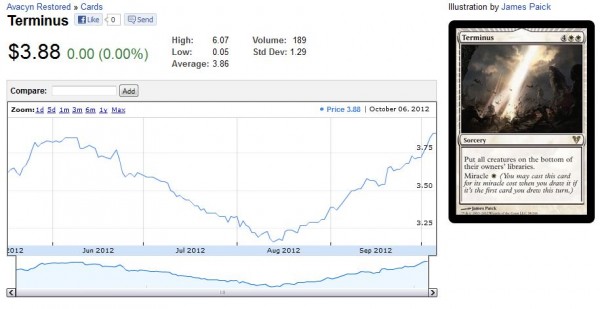
On the same note, and echoing Sigmund’s article from earlier this week, I like Terminus and Entreat the Angels as buys. Since Bonfire has so far to fall, some of that value will hit other cards from that set that are seeing standard play. Terminus is criminally underpriced, while Entreat might see a slight spike as people try out the new U/W/x control brews.

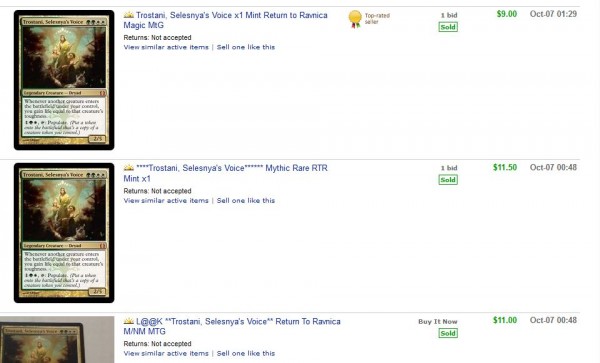
The G/W cards such as Armada Wurm and Trostani are seeing a lot of hype after this weekend although neither of them put up good finishes in the Standard events we’ve seen. I’ve also heard some reputable sources on Twitter talking about these cards in anticipation of a sweet deck appearing. I’m not yet sold on these, both are very weak against the sweepers in this format, and would have trouble dealing with a deck that features 4xTerminus plus some number of other sweepers too. If you picked up on these before the hype and are holding them, I’d personally sell out into the hype now.

On the Legacy side of things, we’re starting to see a shift. Some BUG Delver lists appeared featuring a small number of Abrupt Decay and Thoughtseize. While I don’t condone buying Abrupt Decay at it’s current price, Thoughtseize is a staple and is worth considering. The lists I saw only played two copies, and from the people I’ve talked to, upping that to four is likely correct. It’s already crept up a couple dollars in the last few days, but it probably has room to go higher.

About a month ago we looked at ways people will try to combat Show and Tell, and now Omniscience versions, and Thoughtseize, along with other black discard, was the answer. It’s happening, so time to make a move on these while you still can. This will shoot up above $30 in no time. Inquisition of Kozilek is another card to consider, as it often operates in tandem with Thoughtseize. While it’s not as good for answering Omniscience, it does hit Living Wish and Show and Tell, and is a good budget option. It’s already at $3, but as it’s essentially impossible to find, and Rise of the Eldrazi packs are insanely expensive, I could see this climbing to $5 pretty easily. Both of these cards are a strong buy for me right now.

What comes next? What are the next level answers to these new Standard brews, and can we get out in front of them with some speculation? I think Ash Zealot is a good option right now, as a RDW strategy could easily trump the Control decks I’ve seen. I’d envision it being similar to the B/R Zombies brews we’ve seen but less black, and more red. Stromkirk Noble combined with Ash Zealot is pretty insane, both of these are cards I'm picking up on the cheap. Rakdos Cackler would appear in this deck, and while it’s already a $1 uncommon, I expect it to stay at that price or higher for a while.

Are there other archetypes in Standard or Legacy you’ve tried and haven’t made the limelight in the tournament scene yet? Have faith in your testing and make some speculations on decks that will come back to fight the control decks.

Junk Updates, with Regard to the Absurdity of Angel of Serenity

Are you a Quiet Speculation member?

If not, now is a perfect time to join up! Our powerful tools, breaking-news analysis, and exclusive Discord channel will make sure you stay up to date and ahead of the curve.

Last night I was playtesting Todd Anderson’s UWr control deck against Chris Pennock, piloting Chris Weidinger’s Reanimator from SCG Cincinnati. I was firmly behind with essentially no board and a sparse two life remaining against a couple of green monsters. I drew my card for what I thought would likely be my last turn and Miracled an Entreat the Angels for nine. Everything was finally coming up Milhouse!

Or so I thought.

Chris casually untapped and Angel of Serenity’d away three of my angel tokens. This put me on blocking duty, as he had gained a grip of life off of some Thragtusks. On his next turn he swung his Angel into my army. I blocked with all of my man’s and cast Azorius Charm to gain 24 life. At this point he cast a second Angel, putting the one from his graveyard under it as well as killing two more of my 4/4s. Killing me from there was all too easy for him.

I cast Entreat the Angels for nine and I still lost. I can’t say that it was particularly close either.

Meet the latest incarnation of the truth.

That wasn’t the first or last time Angel of Serenity proved its worth in our playtest session. It seldom mattered what else happened when the game entered the Angel phase. I hit my mark when I said on Good Luck; High Five! that the card would be worth money, but I completely missed by not declaring that it was going to be the best endgame in Standard.

Unsurprisingly, Travis Woo knew all along.

It’s really a card that you have to see in action to fully understand its power. After a few matches, you’ll find that the anecdote I included above isn’t an extreme case, but is rather pretty close to the norm.

This, and a few other forthcoming notes in mind, I’m going to present some revised opinions about cards that I’ve previously discussed, in addition to suggesting some cards that I haven’t yet talked about that are worth looking at.

How embarrassing is it to think this card might not be good enough?
Let’s start with Restoration Angel.

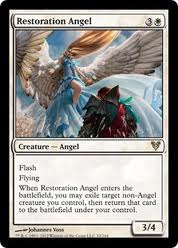
Former Standard roleplayer, current Modern all-star- we’ve seen plenty from this card. As much as it pains me to write this, I don’t think that Restoration Angel is good enough anymore.

I included four in my Junk list last week in order to blink cards like Centaur Healer and Thragtusk, but I now intend to cut the card entirely.

In the games when your Healers and Thragtusks aren’t good enough on their own, they generally don’t survive long enough to be blinked anyhow. In the games where they are good enough, just adding a 3/4 flier to the mix doesn’t change things that much. For the record, this line of thought also makes me lose interest in Disciple of Bolas.

Whether you’re winning or losing with your early creatures, Angel of Serenity is a fantastic top-end. When your ground guys are sticking around you just Fiend Hunter* your opponent’s team. When your ground guys die, you get to Raise Dead them and probably get a Fiend Hunter* or two in on top of that.

*Well, upgraded Fiend Hunter.

The power level of Angel of Serenity also makes me lose a lot of respect for Armada Wurm. There is only so much room for top-end in a deck, and Armada Wurm is so much more than one mana worse than Angel of Serenity. Against the aggressive decks the two are somewhat comparable, but against a control deck a single Supreme Verdict undoes your Wurm, and its little friend too. Wraths on Angel of Serenity are considerably worse, particularly Supreme Verdict, as having an Angel in your graveyard is pretty ideal for when the time comes to play a second copy.

Because of Angel’s ability to “chain” with redundant copies in your graveyard, the best answers are going to be things that don’t put it in the graveyard. That more or less leaves these as the best options:

Sphere, Sever and Terminus have the added ability of completely blanking Entreat the Angels, and with Miracles winning the first week of the format that’s a very good place to be. Sphere and O-ring obviously work well as answers to Planeswalkers too, another mainstay of Miracles.

On the topic of Sever the Bloodline, I think that this was the most glaring omission from Chris Weidinger’s maindeck. If you’re going to be casting Mulch and Grisly Salvage, you may as well include the best removal spell with flashback to answer any opponents trying to go as big or bigger than you.

With these points about the format in mind, here is an updated Junk list:

The Yard 2.0

spells

4 Thragtusk
3 Angel of Serenity
4 Sever the Bloodline
4 Tragic Slip
4 Centaur Healer
3 Garruk, Primal Hunter
2 Loxodon Smiter
4 Knight of Glory
4 Farseek
2 Oblivion Ring

lands

3 Plains
2 Swamp
4 Temple Garden
4 Overgrown Tomb
1 Forest
4 Sunpetal Grove
4 Woodland Cemetery
4 Isolated Chapel

The only change to the list not previously discussed is the addition of Farseek. With Angel of Serenity being the endgame of choice, it stands to reason that mana acceleration/ having more virtual mana sources in the deck will benefit this game plan.

Another quick note on Oblivion Ring is that it’s very useful as an answer to opposing Detention Spheres on your Angels, which as I stated earlier is one of the few good answers to the card.

I have to say that this list is dramatically better than the previous version. It doesn’t really lose much against decks like Zombies, while gaining a much stronger endgame.

Now the question for this deck, and a question that I know I’ll find myself asking about every deck that I build in the immediate future, is whether or not this is the best Angel of Serenity shell. As with all things Magic, time and testing will tell.

Personally I won’t be able to make it out to play States, but I feel confident recommending this deck for this weekend. For all of you battling, good luck; high five!

-Ryan Overturf
@RyanOverdrive on Twitter

Insider: Tricks of the Trade, Part 2 – Endowment Effect & Trading Tricks

Are you a Quiet Speculation member?

If not, now is a perfect time to join up! Our powerful tools, breaking-news analysis, and exclusive Discord channel will make sure you stay up to date and ahead of the curve.

In part 1 of this series we explored the world of finance and poker through two books I consider must reads. We explored that as soon as we see something as a potential ‘gain’, our mind differently from when we see something as a potential ‘risk’. This can affect our judgment as easy as in a Magic game as soon as you are playing to win or worse: playing to survive.

In this article I look to examine how we think as Magic traders and how to improve ourselves.

Endowment Effect & Sentimental Value

Ever stumble across casual players, having casual chat in an EDH game, when someone takes a long turn and you mention that you'd like to do some trades. You and your potential trading partner exchange binders and allow the trading process to begin, where you both start picking cards.

The problem is that every card that you are interested in, for whatever reason, your trading partner’s facial expression shows a sign of doubt and regret.  "Eh. I'm not sure if I can trade that one, I started playing Magic with that card in my first deck."

More than likely, you have encountered this or you have said it once yourself. It is often very hard to get the card from this player, often first being hesitant but later willing to let it go for a number far higher than any reasonable index price.

This is a classic example of how different value can appear from separate points of views. Various studies have been done on this phenomena because it is interesting why people put in a high selling price for product X while they would buy the exact same product X for a significant lower amount.

A study done by Kahneman, Knetsch and Thaler (1990) illustrates through an experiment that there is a gap between the valuations of a simple mug when selling and buying. The sellers – who received the mug therefore ‘own’ them – were asked what the lowest sum would be to sell the mug. At the same time the buyers were asked what the highest sum they would have to spend to acquire the mug.
The researchers concluded that the average selling price in this setting was twice as large as the average buying prices.

This gap between selling and buying prices can be related back to loss aversion. When people put value other than pure financial value into a certain card, they are seeing the card as a reminder of the good times they had with this particular piece of cardboard in a certain deck. Therefore trading it away can and most likely will feel as a bigger loss than they would get in exchange.

They also lose the right to play with the card until the exact same card is acquired somewhere else. This is big because, even when people trade away their card, I recommend looking at facial expressions as they are most likely not satisfied with the trade.

When aiming for longevity in trading, thus establishing new trade relationships, this can be bad news as the link with you – as a trader – and the pain of losing the card in a trade can easily be made.

Now Dan Ariely and Ziv Carmon also performed multiple experiments in 1998 regarding basketball tickets. Based on what they concluded in their research article, they argued that ‘marketers may want to consider influencing consumers’ choices and behavior via the perspective from which they evaluate a transaction’.

For example, consumers who buy new products can have a different focus from those who are upgrading existing products (ie. Giving up current products). Thus, framing new purchases as replacements rather than as new purchases can have a strong effect’.

Now how can this help us in making a successful and satisfying trade for both of the parties when trading with a person as I described in the beginning?

I would make a point to saying that the card they put sentimental value in is easily replaceable with other cards that are better or even slightly worse, mostly distracting them from the potential loss they are creating.

One can also say that the card is easily available at the LGS but, since you are not fond of buying cards, you prefer trading it with them. This is a weak argument so I wouldn’t recommend using it.

Last but not least, one can use the reference prices they use to gain some value by making this trade.

If you want to save the time, though, you can just pick other cards from his binder that your trading partner is not attached to.

The point I want to make with this phenomena is that one can apply this with almost everything. Dan Ariely wrote in his 2011 book The Upside of Irrationality that ‘the effort that we put into something does not just change the object. It changes us and the way we evaluate that object’.

The illustrations Dan Ariely wrote about are objects like Do It Yourself furniture and Origami. In Magic we can relate this to collectors who have been collecting for X years and suddenly need the money. Or Magic players who quit and put their bulk on Craigslist saying they paid X amount for it and they want something like 80-90% of X, which is absurd.

It is hard to convince these people, so I am mostly aiming to redirect their attention or to simply not put any effort in it.

On the trading floor

When on the trading floor at your local FNM, the trades of nowadays are completely different than when I was playing Magic even six years ago. Smartphones are common, price memory is a term people know about and so on.

I still think we can create an edge amongst any other trader without sharking them out. Some other Quiet Speculation writers have written about these small "Tricks of the Trade" that can make trading easier with your potential trading partner.

Most players are somehow attracted to a game of Magic, especially one involving 100 card Commander decks. I especially love pulling out my binder and opening it to the front page while playing a Magic game before any event starts. The front page of my binder is full of eye catching cards so if people are ‘’Wow’’-ing, I know they would likely make a good trading partner.

My front page ( as of 10-07-2012) consists of: Krenko, Mob Boss, Ajani Vengeant, Trostani, Selesnya's Voice Ajani, Caller of the Pride, Bonfire of the Damned,  Vraska the Unseen, Sword of Body and Mind, Yeva, Nature's Herald and Woodland Cemetery.

With Return to Ravnica, I am aiming to fill more Ravnica slots to the front and 2nd page to create a good first impression. What does your first page look like? I am very curious!

Another small trick others have mentioned is to deliberately say to your partner that you are fine with him taking out the cards he would like to acquire, own or have. I would phrase it as the ‘eBay effect’ where people feel more or less that they own the card already, hence putting more effort in it in actually getting it.

I can actually relate this back to the Sentimental Value section above, as people will value it higher whether it is a simple eBay auction or the card they really want and actually have in their hand. If you can talk like a cardealer, you can even mention how great the card can be in their deck so their mind is focused on all the great things they can do with it. It creates excitement, which is converted into even more sentimental value.

Now I would not call this sharking, but I am open to exchange opinions about this since I do think it is kind of borderline. But then again, if they are indeed going to make these great plays and are happy with the trade...

Last summer I visited one of my Poker friends in Estonia, where we went to a good restaurant. Afterwards we checked out, the waitress gave us the bill with some gummybears and peppermints. Now this waitress was not particularly cute, but I love gummybears. So I grabbed a handful and ate them.

Later on, when we were walking to the car, my friend asked me the reason restaurants hand out sweet candy to their customers in the end. I didn’t know at first and I was instantly curious to this trick, as he mentioned that people tip more and associate a sweet good feeling with the restaurant. As a Dutch person, I tipped that waitress 10-15% instead of rounding it up, which in the Netherlands is considered normal.

Strohmetz, Rind, Fisher and Lynn (2000) did an experiment regarding the use of candy to increase restaurant tipping. They successfully concluded that just a small piece of chocolate along with the check resulted in a bigger tip. They argue that this comes from the notion that any sweet candy enhances the positive mood the customers are in. The second reason is that customers tip more because they feel obligated to reciprocate when receiving an act of generosity.  Last but not least, when the waitress gave the candy along with the check, the waitress is being perceived as very friendly which increases the chance to receive a bigger tip.

Now what does this all have to do with trading? Have you ever bought a bag of candy most people liked (I would not advocate black liquorice outside the Netherlands, it doesn’t work overseas!) and offered some to your trading partner after you finalized a trade? An unexpected act of generosity from you, while it cost you nothing, is something that has a big return of investment.

For example, when trading with someone and you just cannot find something for a small bulk rare in decent sized trade, you may just make the trade without the bulk rare. Then some moments later you walk up and give him the bulk rare anyway, saying something like ‘’You can use this card more than I can right now. I hope you have loads of fun with it!’’

This unexpected event would catch your trading partners off guard and they're more likely to reciprocate in later trades. Instead of being perceived a shark, you are seen as a person they can play a casual game with, get strategy tips and make some fun trades.

I suggest next time to buy some of candies, let go of bulk and try it out yourself. Focus on the long-term with this strategy, because it can take some time to make new trades, but the investment is well spent. One note to make is that if QS members buy/trade cards with each other, I tend to include Quiet Speculation in the shipment as well just for the fun, I already gave a couple of members these cards and they liked the fun!

~

On a completely separate topic, my Prerelease was superfun. I saw 80 players at one prerelease where they normally expect 50ish.

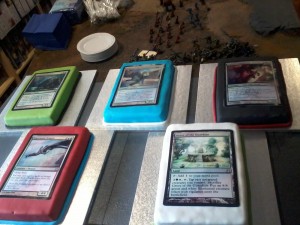
Oh, and the judge also said there was a cake for the participants. Although I thought the cake is a lie I was quite surprised to see this:

I made some very good trades, acquiring hard to get cards like Sylvan Library and Humility for some Standard staples. It was fun and I certainly am looking forward to Gatecrash Prereleases. I sincerely hope you had loads of fun at yours too!

~

One last thing, what would the ideal amount of tickets be to start out as a speculator on Magic Online? 100? 200?

~

Thank you for reading!

- Gervaise


Notes

  1. D. Kahneman, J. Knetsch, R. Thaler. 1991. ''Anomalies: The Endowment Effect, Loss Aversion, and Status Quo Bias'' Journal of Economic Perspectives 5 (Winter, 1991): 193-206.
  2.  Z. Carmon, D. Ariely. 2000. ''Focusing on the forgone: How Value can appear so different to buyers and sellers'' Journal of Consumer Research 27 (December, 2000): 360-370
  3. D. Strohmetz et. al. 2000. ''Sweetening the Till: The Use of Candy to Increase Restaurant Tipping'' Journal of Applied Social Psychology 32 (2002): 300-309

Recommended Readings

  1. D. Ariely. 2011. The Upside of Irrationality, HarperCollinsPublishers, London


Insider: The Devil’s In the Details, Part 2

Are you a Quiet Speculation member?

If not, now is a perfect time to join up! Our powerful tools, breaking-news analysis, and exclusive Discord channel will make sure you stay up to date and ahead of the curve.

Welcome Back!

A lot has happened since we last talked. A Standard metagame has started to shape up, many cards have boomed or busted, and I’ve put a little more time and thought into smartphone dealing. The inherent problems plaguing high turnover trading where phones are involved revolves around a few core issues.

Firstly, the ratios tend to be smaller. When a person has relatively accurate pricing information at their fingertips no matter what, it’s difficult to find the normal holes in common knowledge that occur when a person is simply less into finance than you are.

Secondly, the lower rate of return is compounded by the not insubstantial amount of time it takes to look up all the prices. First world problems, right? Unfortunately, due to the limited nature of trading in terms of investment, I’ve been trying to come up with a way to work within the confines of smartphone trading.

This is Befuddlement. Three and a half more steps is Befuzzlement.

Last article we discussed ways to approach the trade from a psychological point of view, and I’m sorry to say I found myself just as befuzzled as I’d always been. There were some great comments about what people do at their local stores, and how they approach trading, but I still think there’s a lot we can work on.

Does This Mean I Have To Do Math?

Last time I talked about ratios, a concept I like very much. This week I hope to approach that in more detail, and give you some examples of cards with good smartphone ratios.

To begin with, the ridiculous sounding ‘smartphone ratio’ is simple. If the value of a card on your chosen source (StarCity, an arbitrary buylist) is what you want to use to determine value, and the guy you’re trading with wants to use a price aggregate (magiccards.info is a common choice), knowing both numbers is difficult.

I tried and, even though I have a good head for numbers, I still couldn’t become confident in keeping them straight without ludicrous amounts of wasted time.

Well That's Good... Simple Is Better... Right?

Enter the solution. What card should we demonstrate on? I know! How about Jace, the Mind Sculptor! He is, after all, better than all. Jace is currently sold out on StarCity at 80. There’s a lesson in this, but since that may have come as a surprise to some of you, I’ll assume that you’ll be able to figure out that they might be a good target in the next few weeks while they sneakily rise in price. If your region has caught on, no worries. Next boat and all that.

He’s also about 70 on magicards.info, and while those numbers aren’t very hard to compare, that’s not a good reason to think every card will be so simple. His buylist is a lofty 50 SCG, a particularly high price, and about the same ratio-to-selling-price that Star has been paying for him since time anon.

Since the price you want to use is 50, the cash value, and the price the smartphones get is 70, the ratio is a good cross section of how valuable a card is to trade for when smartphones are involved.

Jace’s ratio is about .714.

Once Was Enough, Tucker. Can We Move On?

Guys, I’m having a great time - what card should we try next?

I know! One of the new Shocklands! Since I think Blood Crypt is dumb for not going up in price and making me millions of dollars, let’s do that one.

Magiccards.info on Blood Crypt is 12, which seems fairly similar to StarCity’s price of  15 on the new ones and 18 on the old ones. The buylist, and this is interesting, is 8 on RTR crypts... and 6 on original Dissensions.

This is the Neverending Math Article. Up and Away, Falkor!

On Dissension Crypts, this ratio is about .5, while RTR is .66 repeating.

An important conclusion, and an important aside, is that knowing the buylist of old reprinted cards sometimes leads to interesting situations that most people aren’t aware of. More simply, target RTR Crypts over Dissension, and if possible trade for an RTR with some junk thrown in in exchange for your far less valuable Dissension Crypt.

The basic way this ratio works in your favor, along with streamlining card price research, is that knowing the ratios on a bunch of different cards is very useful when it comes to deciding how to make trades. If all cards are valued by an aggregate, the cards with higher ratios are the ones you trade for, while the lower ratios are the ones you trade away. Let’s bust out some more.

  1. Thragtusk is MC.I at 16, and buylist at 8. Ratio? .500.
  2. Jace is MC.I at a little over 45, and buylist at 30. Ratio? .666 Repeating.
  3. Armada Wurm is clearing at 16.5, and buylist at 10. .606 ratio.
  4. Olivia Voldaren is around 15, buylist at 8. Ratio is .533
  5. Garruk Relentless is 11, buylist 6. Ratio comes to .5454 repeating.

We've Gone Too Far To Go Back, Onward!

I was going to make a donner party joke, but that seemed bad. So here's a kitten instead.

Gosh, those numbers are close! Even the worst is about a 50% ratio, while the best barely goes .16 higher. In a vacuum it would be a better idea to trade for Jace than for Thragtusk, but there’s more at work than these raw numbers.

You may have noticed that the two new cards broke 6, while the three old cards didn’t get past 5.5. The demand for the new set along with the limited availability of product artificially boosts prices, and closes the gap between buy and sell. In addition, the very highly ratio’d Jace is nearly 50 dollars on MC.I, and we all know that the buy:sell ratio gets higher the more expensive a card is.

There have got to be flaws in this algorithm. At the very least there have got to be cards for whom this narrow band of relative value breaks down. The easiest starting point is low valued cards, cards with fringe or sideboard playability that don’t have the versatility or demand of the more popular finishers and mythics.

  1. Rest in Peace is a fairly well hyped card, and goes for 2.50 by aggregate. The buylist is disastrously low,
  2. however, at 50 cents. Ratio? .200. That’s much lower than we’ve been seeing. How about some more.
  3. Detention Sphere, MC.I 7, buy 3. Ratio is .428.
  4. Loxodon Smiter, MC.I 4.75, buy 1. Ratio is .211
  5. Sulfur Falls 11 MC.I, buy 6. Ratio is .5454 repeating.
  6. Entreat the Angels MC.I 14.5, buy 8. Ratio is .552.

This is still hazy, but a clearer picture is becoming evident. Highly playable cards played in large quantity that have proven their value are higher - Sulfur Falls and Entreat the Angels both see a significant amount of play, and there are very few alternatives in those slots.

Contrast to Smiter, who sees fringe format play at best, and is often time ignored in favor of a common in the same cost slot. Rest in Peace is another low cost card that sees only fringe play, most often in sideboards.

The Eternal Quest, Cheap Valuable Things

This could, however, all be biased accounting. What if the low ratio cards are just low ratios because of their price? Are there sub-5 dollar cards that can produce the same high value propositions as a tried-and-true Thragtusk? Much to my ire, some problems exist.

Apparently, the best cost for a useful rare card is 8 dollars. Dreadbore, Clifftop Retreat, Supreme Verdict... irritating. Wait! Mizzium Mortars!

  1. Mizzium Mortars clocks in at at prestigious 4.5 dollars MC.I, with a buylist at 2. Ratio? .444. BOOM! SUCCESS! Do any others exist?
  2. Primal Hunter MC.I 5.5, Buy 2. Ratio is .36 repeating.
  3. Wolfir Silverheart MC.I 4, Buy 1. Ratio is .253
  4. Thalia MC.I 4.5, Buy 2. Ratio is .444
  5. Cyclonic Rift MC.I 4, Buy 1. Ratio is .253

Well, some hits, some misses, but the more mainstream a card is the more money it’s worth. Makes sense to me.

This concludes my brief thought experiment on evaluating cards, I for one plan to remember that Loxodon Smiter is absolutely not worth trading for if a smartphone is involved - the ratio is so low and the demand is so godawful that practically anything I trade for it will be a loss to me unless a misvalue occurs. Despite that vitriol, I will happily take elephant man for a buck apiece

And That's A Wrap

I hope this was as helpful for you as it was for me. I’m going to be working on putting together a list of commonly traded cards and their values as much to have an understanding what not to trade for as what side of a Bonfire I want to be on.

If this kind of article appealed to you, numbers and all, please let me know. If you prefer my more psychological and common sense based approach, let me know that to! I look forward to hearing your questions, comments and snide remarks in the comments section.

~

P.S.: Sorry for not responding on the last article, I didn’t realize I had responses until too many days had passed for my statements to be relevant. I absolutely read and appreciated everything you had to say.

Avatar photo

Tucker McGownd

Hi, I'm Tucker McGownd. I'm a low risk trader that spends most of my time in Minnesota, where I go to school, play magic, study for school, play Ultimate for my college team, study for school, and read. I've been playing for a long, long time (I first played during Mercadian Masques block, and first bought a pack in Urza's Saga). I was incredibly lucky when I cracked packs until I learned how much cards were worth, at which point I proceeded to open Thoughtlace in every set until Scars, where I picked up more than my fair share of molten psyche. I'm currently looking forward to the inevitable reprint of Chimney Imp.

View More By Tucker McGownd

Posted in Free Insider2 Comments on Insider: The Devil’s In the Details, Part 2

Have you joined the Quiet Speculation Discord?

If you haven't, you're leaving value on the table! Join our community of experts, enthusiasts, entertainers, and educators and enjoy exclusive podcasts, questions asked and answered, trades, sales, and everything else Discord has to offer.

Want to create content with Quiet Speculation?

All you need to succeed is a passion for Magic: The Gathering, and the ability to write coherently. Share your knowledge of MTG and how you leverage it to win games, get value from your cards – or even turn a profit.

Jason’s Archives: When Speculation Shouldn’t Be Quiet

Are you a Quiet Speculation member?

If not, now is a perfect time to join up! Our powerful tools, breaking-news analysis, and exclusive Discord channel will make sure you stay up to date and ahead of the curve.

Greetings, Speculators!

As I like to say, I write articles on a finance website, but I don't write finance articles.

It's not my purview to make financial calls or predictions. I'm more in the "post-game" analysis racket, which is much easier than trying to predict the future. Since I'm not an Insider writer, I also can't give out relevant information about cards impacted by the weekend's events until Monday night, after the Insider-only e-mail blasts have alerted our insiders.

Such blasts did a good job of warning everyone before [card Trostani, Selesnyas voice]Trostani[/card], [card Jace, Architect of Thought]Jace[/card], Armada Wurm and [card Olivia Voldaren]Olivia[/card] spiked. If you're into buying a Jace at $38 before it hits $50, I think Insider is a worthwhile investment. I don't get paid extra to say that, so at the risk of sounding like a shill without getting paid to be a shill, we can move on.

Who Doesn't Want to Buy Jace at $38 Before It Hits $50?

Well, me, for one. I see the spike to $50 (on one website; try and guess which one!) as short-term. Some stores got heavy allocations of sealed RtR product, and once everyone gets their playset and the "impatience factor" wears off, I see Jace settling below $50. (The "impatience factor," you may be wondering, is my term for the high prices people pay to preorder cards they want to play in the first weekend event.)

Despite Jon Medina's advice not to bother, my cohort Ryan Bushard and I like "penny stocks". Magic cards aren't true penny stocks, however, as a bulk rare has a minimum intrinsic value so buying at bulk is practically no risk. If the card hits, you rake in a ton of profit. If it misses, you get almost all of your investment back selling the cards in bulk.

One night a few years ago, Ryan logged on to all the major retail websites and bought every copy of Death's Shadow he could find. When the card hit in the short term, he sold all of his copies at 2000% of what he paid. That gave him enough one dollar coins to fill a swimming pool and dive into like Scrooge McDuck. (He hurt his back quite badly doing this; it is not recommended.)

When Ryan told me he was going deep on Seance, I decided I could follow suit and quietly speculate (hur hur) along with him, or I could do something that really hasn't been done before. I could shout it from the rooftops.

Isn't He Angry That You Gave Away His Secret?

No, he isn't, and he was in on the whole thing. The magic card market is vast and there are opportunities for many more people than you might imagine. The player base of this game is in the millions and we finance nuts are in the minority. I actually don't make more money when I withhold information from other speculators because I don't have the resources to buy every copy of a card or move every copy quickly following a price spike.

I actually think speculators can actively benefit from sharing their picks with others. If Seance suddenly becomes a $3 card (which seems reasonable), stores will already have a million copies in stock from their bulk purchases. They'll increase their buy price from "bulk" to something like 50 cents. Even though they can get $3 on the outs, they still have thousands of copies to clear out before they need to worry about restocking.

That's why the more people who go deep on a called shot, the better. When the card hits, with more copies in the hands of the finance community and fewer in the hands of stores, they will raise their buy price more quickly and the dumping can commence. With the player base taking notice, this actually shouldn't create a glut of everyone dumping at once. If you bought 20 copies at a quarter each, you may be inclined to eBay or MOTL or straight up trade them closer to the $3 retail (for the purposes of this theoretical exercise) and thus not put too many copies in the hands of buylist buyers.

This was my rationale for telling anyone who would listen that I went deep on Seance and that there were still lots of cheap copies available. I want us all to win big; I have no selfish motives and if the card hits, all of the credit goes to Ryan Bushard anyway. He believed in this card back when I was still teasing him about it, he pioneered the decklist being tested by some of the grinders from Lansing and Grand Rapids, Michigan and he let me in on it.

Remember, if the card whiffs and you have to out it for bulk in a year, I told you it would be a card. If the card hits and you make a bunch of money, Ryan Bushard said it and I deserve none of the credit. My only rationale for being vocal about this card is that I think it's fun to speculate on "penny stocks" and I think anyone who participates in a success will agree. Since it's low risk, anyone who buys at close to bulk stands to lose next to nothing. If they go deeper, Caveat Emptor-- I'm not omniscient and this card could go nowhere. But if that gives you pause, remember, I invested my own money in this gamble.

Why Is Seance a Winner?

Glad you asked me that, rhetorical device. The deck has been solid in testing, and several groups have added it to their testing gauntlet or took it to events last weekend. When more people play with Seance and observe how much better it performs than Unburial Rites in conjunction with [card Trostani, Selesnyas Voice]Trostani[/card], Thragtusk, Armada Wurm and Craterhoof Behemoth, the tech will catch on.

Seance is a repeatable Rites which leaves your mana available to populate with Trostani, cast more creatures, or use Mulch and Grisly Salvage to find Seance food for turns and turns. Unburial Rites is one activation per turn cycle for a maximum of two activations. Seance is two activations per turn cycle until they deal with it.

I am not down on Unburial Rites as I think Frites variants are strong and one just got Top 8 in Cincinnati (more on that later). But Seance is better in certain situations and has a higher upside. For example an Armada Wurm put into play by Seance not only lets you keep the token it makes, it itself is a token so you can copy the original with Trostani and keep 15 power in creatures when the turn ends. Good luck dealing with "The Ghost of Thragtusk Past" during your own upkeep, Zombies. Maybe you should carry four spears.

Test it. You may find you want to play it. There's always the "Seance, Mirror-Mad Phantasm, Laboratory Maniac" combo deck which is better-positioned given fewer counterspells and instant-speed removal from control decks. You could also go heavy into the populate theme and maybe even jam Parallel Lives to optimize those triggers from Armada Wurm and Thragtusk. There is also brewing your own deck. The card is far from the do-nothing that many have dubbed it and with another year of legality, I expect to see Seance-containing decks post results, soon. It's only been one weekend, after all.

And What a Weekend It Was!

Hey, Wait a minute! This is Jason's Archives, Not Jason's Editorial Page! You Can't Skip Straight to Decklists!

OK, take it easy. I'll give you your fix. I had no idea you cared that much.

The 5th copy of Emrakul?

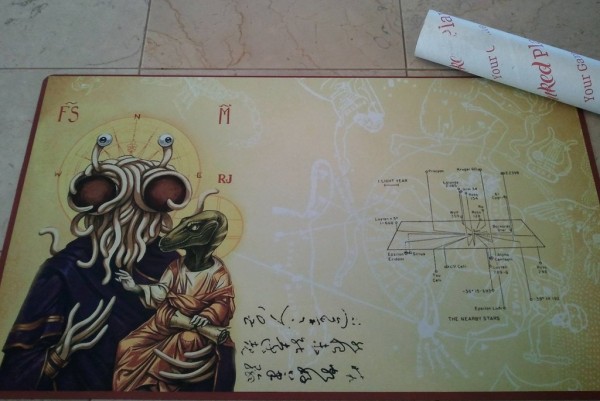
Redditor Idiosync shares with us his custom Flying Spaghetti Monster playmat. Not originally a devotee of FSM, I converted from Church of the Subgenius when I married a Pastafarian. His noodly appendages have been known to snatch victory from the jaws of defeat. Nice mat, idiosync!

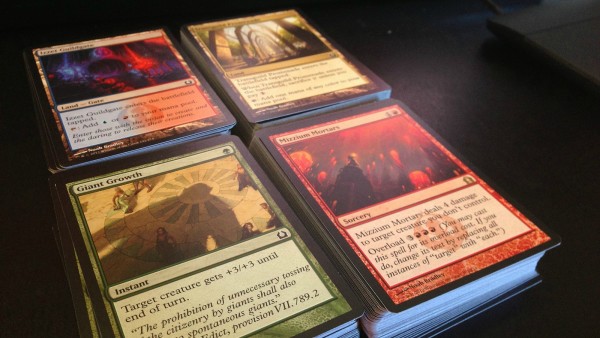
Wonder if you can guess which pile runs out first.

Artist Noah Bradley stops by reddit on occasion, and he took the time to let us know his Return to Ravnica artist proofs had arrived in the mail. Looking good! That has to be the best Giant Growth ever printed. Subtle yet evocative. No, that wasn't me trying to mock art critics, that was actually my reaction to seeing it for the first time. Someone needs to call me out on my malarkey, and it looks like it falls to me.

There's nothing else good on reddit this week. Literally.

Now for Deck Lists!

The SCG Open in Cincinnati this weekend was the first glimpse into post RtR Standard.

Ever braggadocios, I wagered an amount of fine Fat Tire Amber Ale (we can't agree on how much) to serial griefer @deathandstuff based on my prediction that zero Zombies decks would Top 8 and his prediction to the contrary.

His decision to bet me was based on his total lack of an imagination. I wagered that the Magic community would know Zombies was the obvious deck and wouldn't show up in Cincinnati with a deck that couldn't beat it. I also remembered when people went ape over B/W Tokens when Dark Ascension came out, and that deck never materialized.

How much would it matter that Zombies was a deck already, unlike B/W Tokens? Was Joe right that the Magic Community lacked imagination and couldn't brew anything new, preferring to run familiar archetypes from pre-rotation? Or was I right that brewing would prevail and prove the faith I have in the imagination and ingenuity of the community is not unfounded?

SCG Open Cincinnati Top 32 Deck Lists

Motherf%@*$#

An astonishing three unique lists in the Top 8 makes me think a lot of brewing went into finding a Zombie deck that beats the mirror as opposed to finding a deck that beats Zombies and everything else.

Jund seems to be popular, putting three variants in the Top 8. R/B or G/B was five of the Top 8, unless you count the four-color Frites build (I didn't, so that would make it 6).

Todd Anderson solved the problem of how to build a control deck much earlier than we'd anticipated. Usually the first week or two is dominated by aggro as control decks take longer to dial in. But a format where counterspells are meaningless and terrible may be easier to build in if you just jam tapout control spells.

[card Jace, Architect of Thought]Jace[/card] and [card Tamiyo, the Moon Sage]Tamiyo[/card] make strange bedfellows on paper but in reality they are quite a pair and compliment each other's abilities (and the mana curve) nicely. Expect Entreat the Angels to lag behind Jace's price spike but spike itself nonetheless. Detention Sphere is better than $5-$7 right now and even Azorius Charm made a surprising impact despite it initially looking like the weakest of the cycle. On a hot streak of late, Anderson continues to be a guy to watch. Just like that, we have a control deck to test.

Dan Kauffman was ready for Zombies with Elite Inquisitor in the board. Another card I went deep on when it was a dime, this beater is ready for a field full of zombies. The rest of Kauffman's Selesnya deck is all power all the time. Four Sublime Archangels seems like the right number in a deck that outpaces zombies but lacks their reach.

Not ready to give up, Caleb Durward jammed Delver to an impressive 19th place. Not bad for missing Ponder, Mana Leak and Vapor Snag.

Geist of Saint Traft is another card that heated up. Populating the angel token can be fun, and just drilling the face for 6 is edifying in its own right. If it were me, I'd try to jam Parallel Lives in a deck with Geist, but I am no Todd Anderson. I'm closer to Louie, probably. A few Azorius and Bant beatdown decks also featured the new Ghost Dad. He seems a solid card to hold onto for a bit to see where his price stabilizes.

Congrats to all the Standard players.

Legacy Deck Lists from Cincinnati

No bets associated with this Top 8, but if I had to, I would have bet that people would jam Abrupt Decay and see how it played.

Tezzastrix by Caleb Durward seems like a good deck choice. Managing to restrain himself and avoid Delver, he ran a hostile gauntlet of Abrupt Decays to finish supreme Legacy champ on the weekend.

Those Planechase decks continue to be treasure troves of expensive cards, and continue to be available for $20 at big box retail stores. If I had to guess how many times I've walked into a Meijer in the past month and walked out with a Chaos Reigns or three under my arm, it would be "all of them". The only way to get Maelstrom Wanderer, Shardless Agent and Baleful Strix is from these sets, so snap them at $20.

I'm sitting on a few in anticipation of future increase, but the rest get busted and cannibalized to feed my eBay store its eBay store food. Properly fed, my store excretes a steady stream of cash for me to squander on Seances.

So Caleb didn't top eight with Delver. You know who did? Three other people. Ugh.

It's good to see Death and Taxes top eight. I was a fan of Junk and Taxes as Junk easily supports the [card Mangara of Korondor]Mangara[/card]/Karakas combo and also lets you ruin their lives more with discard. This is the pure white version though, which jammed maindeck Phyrexian Revoker as a 4-of. Seems better than the Jotun Grunt that used to occupy that spot. Thomas Enevoldsen managed Top 8 despite playing nonlands that survive an Abrupt Decay.

My prediction that Decay would be laughed off by Mother of Runes seems similarly wrong as zero Maverick decks managed Top 25 for the first time since I can remember.

Lands did make a top 25, piloted by Bobby Kovacs.

I can use my bully pulpit to point out another Top 8 by Kalamazoo local hero Deshaun Baylock. I would have preferred he top eight standard with my Seance build, but he dropped Maverick for the first time in months and it looks like it paid off. Congrats, D!

A nice-looking Top 25 for Legacy brings this week's article to a close at just under 3,000 words. Thanks for sticking with it the whole time.

That's All, Folks

So no Seance in the Top 8. I'm not worried as only a few players had our list and as the metagame continues to develop, I think a Seance build has a place. If control is shifting to tapout with sorcery-speed removal, Seance can help you get some real value out of the creatures they don't manage to Terminus. With another year of legality, I feel like this is a solid call and I'm more than happy to share any and all of my picks with my readers. But take whatever I say with a grain of salt. Remember, I don't write finance articles.

Insider: (Even More) Maximizing Ebay Profits

Are you a Quiet Speculation member?

If not, now is a perfect time to join up! Our powerful tools, breaking-news analysis, and exclusive Discord channel will make sure you stay up to date and ahead of the curve.

It's kind of hard to believe that I've been writing weekly for QS for over two years - but then, I've been writing about Magic since 2004 (for a paycheck!) and I'm often pleasantly surprised at my endurance. One of the first articles I wrote for QS was Maximizing Ebay Profits, an article about how to get the most money from Ebay. This week, I'm going to review it with you and we'll talk about what's the same, what's different, and how you can continue to make money from listing cards on Ebay.

First, take a look at the article!

Ebay is the primary way to dispose of excess Magic cards; it generates enormous traffic, is relatively safe to sell through, and it allows for easy visual displays of your items.

Ebay is probably not the primary way to get rid of excess cards anymore, especially for speculators. It has been replaced by the buylist, especially because of advances in TCGPlayer and its aggregation qualities. Two years ago, this sort of thing was much harder to do. Ebay is still a great way to get rid of older and more dinged up cards. I've sold dual lands and Onslaught fetches that had seen some love.

Unsurprisingly, people still lose their brains when it comes to auctions.

In the original article, I went on about the psychological effects that lead to higher Ebay prices. They still hold true today - people get worked up about an auction and have to win it! This is evident in many auctions where the sell price is above the BIN price - people didn't do their homework or didn't care. Think about it - people play poker and know they may throw their money away, or lose a little more than they thought. The thrill of winning kicks in and it's an easy leap for a bidder to think "well I'll spend $3 more to make sure that guy doesn't win it instead!"

Let's address another factor, which I touched on in the original article but needed more development. People will pay a premium to have the certainty of getting cards and avoid the problem of waiting for them. This is how people shop with BIN auctions. This is rationalized but come on, you can wait two days to save $5, right? Many people will not, though, and want those cards now. It's better to place the standard staples in BIN and lock up the really cool stuff in auctions, in my experience.

Competing on the BIN market is easy and powerful.

When I shop for cards, I type in something like "4 Deadly Insect" and then flip it over to BIN-only, low-to-high listings. I want to find the absolute cheapest set of cards and Ebay makes this easy, since they add the price and shipping together. As I mentioned in the original article, you can undercut the market by a quarter or less if you want! You end up getting that sale while someone else loses it because your listing will appear over theirs. This is simple and just requires a little bit of homework, which is something most power-sellers cannot be bothered with.

This, of course, depends on your desire to sell at the lowest price. A price determined by someone else. Maybe you need to get more out of the cards, but you'll have a hard time selling them at premium prices without a reputation for quality. Not everyone gets to be KidIcarus power-sellers.

20:00 GMT-4 is the Golden Hour.

That time, Eastern Standard time at 10pm, remains the golden hour for getting the most from your bids. Contrary to our advice, people don't often use bidding programs to place bids and prefer to do it live. Why is 10pm so good? That's a bridge hour between when people on the East Coast of the United States are getting ready to go to bed and when people in California are getting home from work. It represents a narrow band when you can capture all of America to bid on your auctions as they end. I don't have a scientific study of the best day to post an auction, but I have had great results with Sunday. It's to where I'll schedule an auction for 5 days just to make it end on Sunday if I missed my first chance!

Scheduling an auction on Ebay is easy. Remember that you are scheduling when the auction starts, not when it ends. Naturally, it will end at the end of 7 days at that very time. Thus, you set it to start at 10pm on a Sunday and that's when it will end. It costs 10 cents, which is a bargain.

The complaint of "Fee-bay" is still true.

Ebay has been losing volume in auctions over the last few years. The novelty is wearing off and Amazon is making it much more attractive for small stores to set up shop. You probably cannot avail yourself of an Amazon shop, so Ebay has decided to jack up the prices on you. The prices have risen in the last few years, especially since Paypal is the de facto paying option. If you sell that set of Snapcaster Mages that you've traded for at FNM and gleefully get $75 for them online, here's how your fees break down:

BIN insertion fee: $0.50

Sale price: (11% of $50[5.50] + 1.5) = $7

Paypal fee of 2.9% + .30 = $2.48

For a grand total of $9.98 in fees. Or a sale price of closer to $65.00 than what you originally thought. Oh, and you still have to ship it. And Ebay now charges the same fees on shipping as it does on the sell price, meaning that you can't charge $9 for shipping and hope to dodge them anymore. You don't practically catch any breaks for listing it as an auction instead.

This is sobering; it's a 13.3% rake before you put the object in an envelope. Ebay is, in my opinion, still good for getting rid of the older stuff, but buylists have seriously given it a run for selling commodity cards.

Shipping your cards is now more expensive.

Shipping is more because you now lose fees on the entire cost and there are serious incentives from Ebay to make you list it with free shipping. For one, your auction "wins the tie" on any listing where it's competing with paid shipping - yours gets listed above, so it appears cheaper. You should offer free shipping, anyway - it generates more sales. It's a psychology thing and not a science thing, but it makes you money. When we sold books on this site (many moons ago), we upped the sale price, said "free shipping" and enjoyed about 20% more sales immediately. This translates to Ebay. Plus, if you are selling a $200 playset of cards, you engender a lot of goodwill among bidders by saying that you're covering protected shipping. This leads to more trust and better bids.

On the topic of shipping, I have now expanded my list of countries to whom I shall not ship from "Italy and Spain" to "any country that doesn't rhyme with 'Smuh-merica.'" International scamming is frequent, Ebay will take your money and side with the buyer, and tracking breaks down internationally. Much safer to sell to the already-huge US market.

Think of BIN as free advertising for rare stuff.

And rare stuff doesn't just mean Magic cards, it can mean the other stuff, too. There was an original piece of art, the Ice Age painting of Icy Manipulator, that sat on Ebay for months, for about $5,000, unbid. It costs virtually nothing to keep rolling this over and over, and eventually someone bought it. I think that the final buyer was someone who kept looking at it over and over and finally jumped for it. There are just too few people who buy the really rare, expensive stuff to make an auction go anywhere. It's much safer to use BIN on a large, rare item and open it up to Best Offers. You get the same appeal of an auction (people blindly bidding numbers) and you don't have to sell until something good comes along.

I hope that you are fortunate as a player and seller to have the opportunity to move some truly rare and cool pieces of Magic history!

Pictures will make or break you

We both know that the older or more expensive the card, the more pictures you need. An auction for a Beta Tundra should be drenched in photos. If you're selling something old, use the macro feature on your camera, get some pictures against different backgrounds and show what the card looks like from all angles. You may think "well I don't want to show just how junky it is," but bad photos scare bidders. I'd rather avoid something that I can't see than willingly bid on something I know looks worse. Who knows, maybe I'll get into a bidding war and fight over it anyway!

With auctions for standard staples, it's not much work to pull a photo from online and use it as a stock photo. I'm still amazed at auctions with no photos! This is also a good point to mention that the more you write, the better your auctions end up. More auction writing lets me know that you are a human and not a drone that lists for some store, and it makes me feel like I have a better shot at getting things resolved to my satisfaction.

In summary, Ebay remains a good place for a lot of cards, even if the lower-end stuff is best sent off to dealers or sold through MTGO. A lot has changed in two years, but a lot remains the same! Please share your Ebay tips and suggestions below!

Until next week,

Doug Linn

Douglas Linn

Doug Linn has been playing Magic since 1996 and has had a keen interest in Legacy and Modern. By keeping up closely with emerging trends in the field, Doug is able to predict what cards to buy and when to sell them for a substantial profit. Since the Eternal market follows a routine boom-bust cycle, the time to buy and sell short-term speculative investments is often a narrow window. Because Eternal cards often spike in value once people know why they are good, it is essential for a trader to be connected to the format to get great buys before anyone else. Outside of Magic, Doug is an attorney in the state of Ohio.  Doug is a founding member of Quiet Speculation, and brings with him a tremendous amount of business savvy.

View More By Douglas Linn

Posted in Finance, Free Insider11 Comments on Insider: (Even More) Maximizing Ebay Profits

Have you joined the Quiet Speculation Discord?

If you haven't, you're leaving value on the table! Join our community of experts, enthusiasts, entertainers, and educators and enjoy exclusive podcasts, questions asked and answered, trades, sales, and everything else Discord has to offer.

Want to create content with Quiet Speculation?

All you need to succeed is a passion for Magic: The Gathering, and the ability to write coherently. Share your knowledge of MTG and how you leverage it to win games, get value from your cards – or even turn a profit.

Building for Trostani

Are you a Quiet Speculation member?

If not, now is a perfect time to join up! Our powerful tools, breaking-news analysis, and exclusive Discord channel will make sure you stay up to date and ahead of the curve.

I got pretty excited when I found out the guild leaders in Return to Ravnica were being redone. I had been looking for new ideas and RtR was a perfect set for new commanders.

I had to make a decision about which legend to make a deck around first. My options were Trostani, [card Niv-Mizzet, Dracogenius]Niv-Mizzet[/card], [card Jarad, Golgari Lich Lord]Jarad[/card], or [card Isperia, Supreme Judge]Isperia[/card]. Niv-Mizzet and Isperia are cool, but in terms of a commander they are pretty bland. Jarad would be fun to make a deck around, since he has several fun abilities, but I decided to go with Trostani.

Initial Ideas

When I first saw Trostani, Selesnya's Voice, I thought of a deck idea immediately. Obviously it was tokens, but I wanted to bring it in a direction that token Commander token decks don't usually go in. Big tokens. Typically a token deck produces multiple small creature tokens and then buffs them all in some way. I decided to show some love to the big token making cards. The bigger the tokens, the better populate is.

Besides making tokens, Trostani also reliably gains life. This can be quite helpful but also dangerous. I've noticed that players will often attack the person with the most life, which is wrong in most situations, but still happens. My idea to combat this was to incorporate cards that you could spend life on, like Sylvan Library.

Step 1: Token Makers

The first thing I did was compile a list of token making cards, focusing on the ones that made large tokens. I wasn't sure if there would be enough at first, but after writing a list of them I was pretty surprised. I tried to choose cards that made 4/4's or bigger. Here are some of the all-stars:

Step 2: Token Synergizers

The next step was to find cards that worked well with tokens. I like every single card with populate, plus some other obvious ones:

Step 3: Taking Advantage of Extra Life

The final set of thematic cards were those that took benefit from having extra life. After searching gatherer I found there aren't many white or green cards that let you spend life to do stuff. I had to settle with cards that benefit from either gaining life, or having lots of life:

Step 4: Fill in the Gaps

The theme of this deck fills the rolls of threats, so I don't have to worry about adding any large creatures. However, the deck is lacking answers to my opponents permanents. Some standard Commander staples should fill the role just fine:

It would also be silly not to take advantage of green's mana ramping capabilities. It's what green does best, and in my opinion, is the best strategy in Commander:

Step 5: Lands

This part is easy. Add a bunch of dual lands, some staple utility lands, couple basics and you're done. I've found that in two-color decks you can get away with quite a few basics, which turn out to be quite helpful in many situations.

The Finished Deck

Untitled Deck

Commander

Token Makers

Token Synergy

Life Cards

Utility

Lands

8 Forest
8 Plains

Final Thoughts

This is a nice and friendly Commander deck. There aren't any combos or any annoying cards, just some good old fashioned large monsters and life gain. It could probably be made much more competitive, but as it is it fits the spirit of Commander.

This deck should also be easy for a newer Commander player to pilot. Continually pumping out large monsters to pummel your opponents with is straightforward but still powerful. Also, life gain is alluring to newer players. Typically I wouldn't incorporate life gain as a primary theme, but Trostani pretty much throws it in for free, so why not.

Creating decks that are fair and fun is my primary goal when constructing a Commander deck, but at the same time it needs to be powerful so I don't lose every game. I think this deck is pretty cookie-cutter when it comes to a Commander deck. It reliably creates threats and has a good package of cards to deal with whatever your opponents do.

I haven't gotten a chance to play with it yet, but I foresee if being decent. My Commander decks always go through several stages of development before I get them where I want them. I'm sure this deck needs some fine tuning, so if you have any suggestions feel free to post them in the comments.

Thanks for reading!

Insider: There’s a New Speculator In Town?

Are you a Quiet Speculation member?

If not, now is a perfect time to join up! Our powerful tools, breaking-news analysis, and exclusive Discord channel will make sure you stay up to date and ahead of the curve.

This past weekend saw over 400 Magic players battle it out at the Star City Games Open in Cincinnati, Ohio. This was the first major event broadcast online with the new Standard, and there were certainly some significant shifts! The metagame will never again be the same, as evidenced by incredible number of Return to Ravnica cards seeing play as well as the Innistrad block cards not seeing so much play – namely, Delver of Secrets.

But there was a different type of shift I noticed from this past weekend. As the tournament evolved and certain decks rose to the top, Twitter was abuzz with the cards to grab for speculation. What was particularly interesting to me was Star City Games’ effort to remain on the cutting edge of this speculation.

There were a handful of examples of this behavior. Let me explain further.

U/W/R Miracles Deck - The Winning Deck

Many of the Star City Games veterans, including Todd Anderson and Brad Nelson, were on this deck. It basically consists of lots of removal spells, lots of Miracles, Jace, Architect of Thought and Tamiyo, the Moon Sage. Many of the removal spells, such as Detention Sphere, are from Return to Ravnica, but the deck relies fairly heavily on cards from Avacyn Restored, so naturally it has my attention as a speculator.

Before the event, Tamiyo, for example, was averaging $12-$14 in auction and was retailing for just a little more (chart from blacklotusproject.com).

But once this deck broke the scene, Star City Games was one of the first retailers to adjust accordingly, increasing their price first to $19.99 and then $24.99. Their buy list price for Tamiyo is now $15, where as many eBay auctions are ending in this area. Clearly Star City Games wants to remain ahead of the curve, and they are almost speculating on Tamiyo here, which was only a 2-of in the deck.

They also turned an aggressive eye to the other Planeswalker in the deck, Jace, Architect of Thought, by increasing their buy price to $30 and their sell price to $49.99!

Another card that Star City Games has quickly become bullish on from this deck is Terminus. I’ve been on this card for a while after seeing it make Top 8 in major Legacy events, and the card has finally moved some. Star City Games are again on the forefront, upping their buy price to $4 and their sell price to $7.99. This is astronomically high for a board sweeper. Once again, the card usually auctions for around $4 each (chart from blacklotusproject.com).

Frites

The other deck that made the finals was a remake of Frites, relying on Unburial Rites to unearth large creatures. The newest member of the team: Angel of Serenity. The only card I preordered from Return to Ravnica is likely to payoff. For those of you who joined me in buying the card when it was $6-$8, we can now immediately profit on our copies by selling to Star City Games, who is buying the card now for $10. Their sell price has been upped as well, to $19.99.

What’s surprising to me is not that Angel of Serenity is making a splash in Standard. Rather, it’s Star City Game’s immediate response to increase their buy and sell price that has me raising an eyebrow. Paying $10 on a Mythic Angel that saw play in one specific archetype may be the right move, but doing so after the first weekend the card is legal seems to me a bit gutsy.

While I’m at it, the price increase on Trostani, Selesnyas Voice is even more intriguing. Going through the Top 8 lists, I don’t see a single copy of this legendary creature. Yet Star City Games is selling it for $19.99 and buying at $10. I understand that this card is already a casual favorite, but paying $10 on the card when it reliably sells for $10-$12 on eBay seems flat out premature.

Again, I understand it’s a casual favorite, but without making an impact on Standard I’m not sure how this card is worth $20. I grabbed a few at $9 each and I intend to sell or trade them very quickly once they arrive.

Jund/Zombies – Yawn

I cannot discuss the Cincinnati SCG Open without at least mentioning Jund and Zombies strategies. There were three Jund decks and one Golgari Zombies deck that made Top 8, so clearly this deck is a force to reckon with.

The biggest mover I see from these lists has been Olivia Voldaren. This card is once again retailing for $15 after seeing a major pullback from its previous peak (chart from blacklotusproject.com).

The success of this card largely hinges upon the continued success of these Jund/Rakdos strategies. I saw the card in action watching the live coverage of the SCG Open and I am on the fence. I’m not going to call this card a buy at $15 without seeing it make Top 8’s repeatedly. For now, this card will continue to be my “pick-up if cheap” play.

Under the Radar

I also want to touch on a few cards that saw decent play this past weekend and may be due for a price increase despite not seeing an immediate price bump at Star City Games.

First, consider the Miracle Entreat the Angels (chart from blacklotusproject.com).

Since June this card has been on a steady decline. The chart finally appears to have reached a stable bottom, and, with three copies in the U/W/R Miracles deck, that price floor just became more stable. I expect this card to see a small bump up and I’ve bought my set in preparation for the new metagame, even if Star City Games hasn’t shifted their price just yet.

Another “under-the-radar” card worth mentioning is Huntmaster of the Fells (chart from blacklotusproject.com).

This creature has already been on a rebound since bottoming in July. Two decks in the SCG Open Top 8 ran a full set of Huntmaster, and his relevance may still be in tact post rotation. If you can find people offering this one up on the low end, it may also be worth acquiring a couple. Star City Games is selling these at $18 and I don’t see too much immediate upside from there, but should we see more Jund in the future, he seems like a mainstay in Standard.

A New Speculator In Town?

I’ve always considered Star City Games on the forefront of MTG Finance. They have many people working for them who keep their finger on the pulse of the metagame, identifying where price changes are needed. This has not changed.

Where I see a subtle difference is in their reaction time. This past weekend we saw a few cards show up in Standard decks that we haven’t often seen before, and Star City Games has moved accordingly. In some cases they increased their buy prices so high that they are paying more than the cards sell for on popular sites such as eBay and TCG Player.

Are they trying to capitalize on the hype? Are they acquiring frantically in anticipation of States? Or are they simply desperate to gather copies to meet pre-order sales?

In any case, they are definitely revealing their hand a little earlier than usual by upping so many buy prices (and dropping others, such as Vraska the Unseen to $10). Our task is to respond accordingly and to identify the cause for the rapid changes. Either way there are some profitable opportunities available to us right now if we make some wise pick-ups.

But you can’t pick up everything as the overall average value of the set will eventually drop. The trick is to pick up the cards that will continue to impact Standard after all the hype has settled down.

Here are my weekly tidbits of information. I think from now on I’ll call this section “Sigbits” to keep the explanation here to a minimum.

Sigbits

  1. Woodland Cemetery did see a lot of play this past weekend at the SCG Open, but the retail price remains $14.99 with a buy list price of $8. I can’t see this going up any more and I hope you’ve sold yours for a nice profit as I have.
  2. Blue Zendikar Fetch Lands are on the rise, thanks to Modern. Scalding Tarn and Misty Rainforest are both retailing for $19.99, and they are difficult to acquire on eBay for less than $14. I suspect there will come a time when this will be the bottom of the price cycle instead of the top.
  3. Gaeas Cradle is out of stock at Star City Games at $79.99. What may be more interesting is that the price of the Judge Foil version seems to be dropping. Slightly Played copies can be had for $175, even though eBay auctions are ending in the $180-$200 price range. This discrepancy seems odd, but I don’t see an easy way to profit from it.

-Sigmund Ausfresser
@sigfig8

Want Prices?

Browse thousands of prices with the first and most comprehensive MTG Finance tool around.


Trader Tools lists both buylist and retail prices for every MTG card, going back a decade.

Quiet Speculation