menu

Why Your Sensei Should Have Taught You Not to Top

Are you a Quiet Speculation member?

If not, now is a perfect time to join up! Our powerful tools, breaking-news analysis, and exclusive Discord channel will make sure you stay up to date and ahead of the curve.

I've been meaning to write an article on this subject for quite a while, but after an eye-opening experience last weekend, I'm glad I waited. Then again, the initial reason I wanted to write an article about Sensei's Divining Top is still entirely relevant, so let's start there.

Surface Issues

The most obvious argument against Top in Commander is the reason it's banned in Modern and was banned in old Extended. It simply takes too much time to use.

This issue is the main reason that I don't run any shuffling effects in my Mimeoplasm deck, but Top is an even bigger offender.

What's wrong with these time sinks? As Aaron Forsythe describes them, they're loading screens. Nobody plays video games in restless anticipation of a slowly filling bar and nobody plays Magic for the joy of shuffling after [card Misty Rainforest]making a land drop[/card]. In fact, I, for one, would be happy if Wizards printed sets of strong new duals over the next few years and then banned the Fetch lands in Modern. But that's another subject entirely.

The point is, people have to put aside time to play Magic and they're doing that because it's fun. Adding large chunks of game play during which nobody's doing anything brings about less enjoyment or a larger time commitment. And there's no good reason to make those sacrifices for game elements like dual lands that can be implemented differently.

Then again, Top doesn't quite fit into that category. After all, the person actually Divining is making decisions. I was confused as to why Top felt worse than Fetch lands in Commander and I couldn't find an adequate explanation.

At first I thought it might have to do with when the loading screen took place: while you know what you're grabbing with a fetch and can do the actual fetching later, any time that you plan to tap Top, you need to stop the rest of the game while you look. But when I actually examined how I felt when people used Top without interrupting the rest of the table, I found that it was still more aggravating than a Fetch.

So what happened last weekend? On Saturday a friend and I made the two hour trip from San Francisco to Sacramento to play in a Pro Tour Qualifier. Neither of us managed to Top 8 the event, but he wanted to do a draft afterward, so I sought out some strangers to play Commander with.

The majority of the people neither drafting nor too exhausted to hang around were devoted traders, and, as I've come to expect, their pimped out decks were a little bit more competitive than the norm. After watching a game that ended with [card Jhoira of the Ghitu]Jhoira[/card] suspending Devastation result in not a single complaint, I decided that I probably didn't need to bring [card Chorus of the Conclave]Chorus[/card] to this table, so I pulled out the most powerful brew I had with me: The Mimeoplasm. I was unable to battle back through Living Plane + Goblin Sharpshooter. And after another similar game, people split off to trade.

A Game of Lands

After doing a bit of trading myself, James (one of the people I'd been playing with) and I decided to run some Commander duels, so he pulled out his Azusa, Lost but Seeking deck and I ran Mimeoplasm again.

About seven turns into the game, James went off. I don't mean he combo killed me, as this was his casual deck. Rather, he spent about fifteen minutes drawing cards and producing mana with cards like Slate of Ancestry, Sword of Feast and Famine, and Rude Awakening.

He was taking the pieces of an extra turn and putting them all together into essentially eight or nine consecutive turns minus the attack steps. Afterward I untapped, used an Oblivion Stone and managed to barely pull out a win.

The next game he put on the same show on turn five, but between Genesis Wave and Eternal Witness, the turn probably took about half an hour, and he ended up with most of his deck on the table.

Long after I'd left the venue, it dawned on me that there's a very good reason for Sensei's Divining Top, Time Warp, and Genesis Wave to be even less fun for me than endless shuffling: they preclude table talk.

While someone's shuffling, everyone can converse. And anyone who prefers live Magic even slightly to online play and has even a hint of Social Timmy in their psychographic makeup will still have fun. On the other hand, when one player has to think hard, they're in a world of their own. Especially when the opposition is tapped out, they're more or less playing solitaire.

This isn't a flaw of Magic. In fact, it's the very essence of the game. People get much more invested in their decks than in their piece on a Monopoly board not only because they put work into building their decks, but because their choices shape their basic experience.

Every Magic player wants to make an impact with their plays: Spike wants to show his skill through correct and clever decisions, Johnny wants to demonstrate his creativity through unconventional card uses, and Timmy wants to experience all of the powerful outcomes of making plays. The social aspect of Magic stems from the constant exchange of this deciding position, so that everyone can feel involved simultaneously.

DANGER

The tough part of this realization is that self-indulgence is dangerous to the Commander format. Since we all like making plays, many of us have the initial inclination to be the one playing as often as possible in Commander, but doing so deprives the rest of the playgroup of their fun. Unlike most Magic formats, it's very easy to play the game alone without winning in Commander. Without being aware of what we're doing, Commander games turn into groups of of five playing solitaire side by side and we lose out on everything else Magic has to offer.

I'm as guilty of this as anyone, if not more so. I even wrote about a huge Genesis Wave being fun and memorable for the entire table. Sure, seeing a Genesis Wave for 72 was cool, but the minutes of trigger stacking that came next certainly weren't. The same applies to using a bunch of sacrifice effects with Shirei, Shizo's Caretaker, or tapping and untapping a bunch of Merfolk in a [card Sygg, River Guide]Sygg[/card] deck. In fact, my primary means of choosing Commanders up until now has been finding a cool engine to go off with.

The fact of the matter is that multiplayer Magic involves more lag time than duels. So, if anything, we should seek to shorten the spurts in which we're playing alone, not lengthen them. I'm confident that people will continue to play Commander for the satisfaction of their own game plans regardless, but the format has a strong foothold as a social gathering and I'd rather see that come about as a product of playing together than poking fun at a friend while they goldfish.

Jules Robins
julesdrobins@gmail.com/Google+
@JulesRobins on twitter

Cubing with Carlos

Are you a Quiet Speculation member?

If not, now is a perfect time to join up! Our powerful tools, breaking-news analysis, and exclusive Discord channel will make sure you stay up to date and ahead of the curve.

    For the longest time, the only kind of Magic I played was limited. My favorite limited formats were Champions of Kamigawa, Lorwyn, and Shards of Alara blocks, and I drafted those almost compulsively while I was in college. Over my first year, I made a name for myself as "the limited guy" at our local FNMs. Big fish, small pond, etc., I know.

    Everything changed at the end of that year when one of my friends built a Cube.

    The initial list was based on Evan Erwin's Cube, and that was pretty sweet. There's no limited format quite like Cube, and if you haven't tried it yet, I suggest you look into it. Cubing is easily the most fun I have ever had playing Magic. The ability to build a limited format to play exactly the way you want it to is just incredible!

    This is the format where I got to lock someone with Mindslaver and Goblin Welder, and then kill them with Chain of Plasma, making them discard their hand to Lightning Bolt themselves.

    Our first Two-Headed Giant draft ended up with each team having a U/x control deck and a combo deck. What other format does that happen in? Where else do you get to Volcanic Fallout someone after they cast Rude Awakening? The amount of pure shenanigans and awesome things that can happen are completely unparalleled by any other format I've ever played.

    Unfortunately, our Cube group died after my Junior year. Too many Magic players graduated and there weren't enough people interested after that year. That's when we started playing Commander instead.

    Recently though, someone at our local shop decided to build a Cube and we got to draft it after FNM. Needless to say, I was incredibly hyped about the opportunity to get back into cubing and decided that it'd make an interesting article, since there aren't too many Cube draft recaps.

    Drafting

    Pack 1, Pick 1 style=options:true toggle;pick:Sword of Fire and Ice;

    Cards I considered out of this pack were: Sword of Fire and Ice, Birds of Paradise, Karn Liberated, and Mogg Fanatic. Sword of Fire and Ice and Karn Liberated are the best cards when you're unfamiliar with the Cube. The key thing to understand here is that drafting an archetype is much more important than drafting good cards. If you know that Green- or Red-based beatdown decks are supported, then you can easily crush people drafting slower decks by building a deck with a good mana curve.

    Since I don't know what the Cube looked like, I thought that Sword of Fire and Ice was just the safest pick, since it leaves you open and will make your deck every single time. That said, it won't always be the all star that a Birds of Paradise might be in the appropriate deck.

    Pack 1, Pick 2 style=options:true toggle;pick:Day of Judgment;

    The cards I'm looking at here were Wheel of Fortune, Day of Judgment, Snuff Out and Garruk Wildspeaker. Wheel of Fortune and Snuff Out are great beatdown cards and help enable you to get in with your Sword. Planeswalkers are just as good in Cube as they are in any other limited format. Sweepers are slightly less good but still very important tools.

    Pack 1, Pick 3 style=options:true toggle;pick:Vendilion Clique;

    At this point I'd seen some of the pieces for a deck very similar to one of my favorite: Blue-White tempo with Swords. Besides that, Cube is a fun, casual format, which provides infinite opportunities to improve your technical play. Since Vendilion Clique is such a difficult card to play with, I thought I'd take that opportunity.

    Pack 1, Pick 4 style=options:true toggle;pick:Razormane Masticore;

    I think the pick here is very clearly between Flooded Strand and Razormane Masticore. Generally I tend to take non-basics lands very highly. However, new Cubes tend to run a lot more fixing than they really should, so I figured I could get that later. Razormane Masticore, on the other hand, just wins games against non-Red creature decks. Good five-drops are hard to come by!

    Pack 1, Pick 5 style=options:true toggle;pick:Land Tax;

    Here there were a few cards I wanted. There's Force Spike for a more tempo-oriented deck, Land Tax for a more controlling deck, and Academy Ruins for an artifact-based deck. Of these, I woud prefer a Force Spike or a Land Tax since I don't have a way to take advantage of Academy Ruins. Land Tax has a much higher upside, since it interacts favorably with Brainstorm and Scroll Rack and other card selection engines.

    Pack 1, Pick 6 style=options:true toggle;pick:Glen Elendra Archmage;

    I think this pick is pretty straight forward. Glen Elendra Archmage is clearly the best card for a U/W control deck. However, it's worth noting that I could have taken Force Spike and then Cloistered Youth to start looking like a sweet U/W tempo deck.

    Pack 1, Pick 7 style=options:true toggle;pick:Absorb;

    Now here's an interesting pick. Faerie Conclave carries Swords like a champ, but there's two U/W cards I want here: Grand Arbiter and Absorb. I took Absorb, since I think it's good against more decks, where Grand Arbiter is only at his best against mana hungry decks. It's also worth mentioning Solemn Simulacrum. I don't like him in U/W because you care much more about going from two mana to four mana, rather than four to six.

    Pack 1, Pick 8 style=options:true toggle;pick:Calciderm;

    Now, I'd usually pick up a Doom Blade and splash it. But in a draft with multiple new players, I'd rather send as clear a signal as possible. Besides, Calciderm is sweet for buying time against beatdown decks or just crushing control decks that tap out too early.

    Pack 1, Pick 9 style=options:true toggle;pick:Scroll Rack;

    We do already have Land Tax, so might as well, right?

    Pack 1, Pick 10 style=options:true toggle;pick:Celestial Colonnade;

    I really want both Decree of Justice and Remand, but Colonnade is the best kind of win condition since it doesn't take up slots that typically go to answers. That said, I wouldn't fault anyone for taking either of the other two cards here.

    Pack 1, Pick 11 style=options:true toggle;pick:Kor Sanctifiers;

    Another easy pick. It's great to have a way to deal with artifacts and enchantments in our pool this early.

    Pack 1, Pick 12 style=options:true toggle;pick:Hellspark Elemental;

    I could pick up a splash here, but I really don't want to play against a good Hellspark Elemental Deck and I don't think I really need a splash unless I find the fixing for it.

    Pack 1, Pick 13 style=options:true toggle;pick:Academy Ruins;

    Wheeled it anyway. Maybe we'll find Nevinyrral's Disk or something. I am sad to see a Smokestack this late, since it's hands down one of my favorite Cube cards.

    Pack 1, Pick 14 style=options:true toggle;pick:Hypnotic Specter;

    I'm very happy with where we are after Pack 1. Plenty of countermagic, a sweeper, and great mid- and late-game cards. Now I just want some spot removal and redundancy and to fill out some of the lower spots on our curve.

    Pack 2, Pick 1 style=options:true toggle;pick:Balance;

    So this is a pack. We're obviously taking Balance, but just look at everything else that's here. We'll be able to learn a lot about the table by what wheels out of this pack, since there are so many other cards we want out of it. I'd most like a Wall of Denial or Journey to Nowhere, and I'd be shocked if Wall of Denial doesn't come back.

    Pack 2, Pick 2 style=options:true toggle;pick:Cryptic Command;

    As much as I said I wanted removal, there's a Cryptic Command. There are very few cards I like casting more than Cryptic Command, and it's pretty far and away the most powerful card here.

    Pack 2, Pick 3 style=options:true toggle;pick:Forbid;

    This is a pick that I regret looking back. I don't need more countermagic at this point, I need Porcelain Legionnaire. Forbid was very good for me, but I definitely end up wanting more guys at the lower end of my curve, even if they are vulnerable to every kind of removal.

    Pack 2, Pick 4 style=options:true toggle;pick:Force of Will;

    Huh. Even more counterspells. This one at least puts you ahead on tempo. It plays really well with Balance too! With a card like this, I'm certainly going to want to be on the draw against other control decks.

    Pack 2, Pick 5 style=options:true toggle;pick:Mana Leak;

    I'd love to take Preordain here, but I think Mana Leak is just better, since it gives us more game against aggressive starts. Cloudgoat Ranger is pretty reasonable, but I think a control deck can generally do better.

    Pack 2, Pick 6 style=options:true toggle;pick:Swords to Plowshares;

    Well. We can either go for the old-school Zuran Orb/Balance combo, or take the rock solid, tier one removal spell. I've already gone on about how much I want some removal and this is as good as it gets.

    Pack 2, Pick 7 style=options:true toggle;pick:Gideon Jura;

    I'm suddenly much less concerned about beatdown. Gideon Jura is about as close as it gets to a card that says "win the game" in a lot of matchups. Gideon is very tough to deal with and is certainly going to crush a few of our games.

    Pack 2, Pick 8 style=options:true toggle;pick:Sword of Body and Mind;

    The choices here are City of Brass or Sword of Body and Mind. Sword is a super fast clock against control decks, while City makes our mana slightly better, but is just the worst against aggro. I think we can be more demanding of our fixing.

    Pack 2, Pick 9 style=options:true toggle;pick:Man-o'-War;

    Well, Wall of Denial wheeled, but now I have a second sword, and I want bodies that will carry them. Man-o'-War is still a sweet tempo card and it'll do just fine carrying swords.

    Pack 2, Pick 10 style=options:true toggle;pick:Memory Lapse;

    Pack 2, Pick 11 style=options:true toggle;pick:Porcelain Legionnaire;

    Somehow this wheeled? I'm not at all sure how that happened, but I'll gladly take the gift.

    Pack 2, Pick 12 style=options:true toggle;pick:Sinkhole;

    Pack 2, Pick 13 style=options:true toggle;pick:Great Sable Stag;

    Pack 2, Pick 14 style=options:true toggle;pick:Raging Ravine;

    Pack 3, Pick 1 style=options:true toggle;pick:Mystical Tutor;

    There are a number of cards I very much want from this pack, like Oblivion Stone and Stillmoon Cavalier. That said, I think a second copy of Balance is too good to pass up, since that's by far our best card right now.

    Pack 3, Pick 2 style=options:true toggle;pick:Stoneforge Mystic;

    Awww yeah! Sometimes you run good and sometimes you run the best! Now we'll just play Stoneforge Mystic turn two on the play every game! Now we have two copies of our best two cards, Sword of Fire and Ice and Balance!

    Pack 3, Pick 3 style=options:true toggle;pick:Strip Mine;

    This is a tough pick, but I think that Strip Mine is just the best card. There are a lot of good lands, and you can always just mana screw your opponents. It's sad to pass Jace, Memory Adept, but hopefully Wall of Omens makes it back our way.

    Pack 3, Pick 4 style=options:true toggle;pick:Blade Splicer;

    Easy pick, I think. I guess you could make an argument for Disenchant or Ancient Tomb, but I don't think this is particularly close.

    Pack 3, Pick 5 style=options:true toggle;pick:Tundra;

    I'm pretty glad I didn't take that City of Brass, but I wish I'd picked up one of the fetchlands we saw.

    Pack 3, Pick 6 style=options:true toggle;pick:River Boa;

    Hello card we can't beat. Why don't we keep you safely away from everyone else?

    Pack 3, Pick 7 style=options:true toggle;pick:Faiths Fetters;

    I really wanted a Brainstorm here, but I think that Faith's Fetters is correct. It's infinitely better against aggressive strategies and does a little of everything. The fact that it answers any permanent type makes it also very good against control.

    Pack 3, Pick 8 style=options:true toggle;pick:Enlightened Tutor;

    Why not. Another Sword of Fire and Ice. Maybe we'll find Crucible of Worlds!

    Pack 3, Pick 9 style=options:true toggle;pick:Arid Mesa;

    Aaaaand wheeled the fetch. Must be nice, etc, etc.

    Pack 3, Pick 10 style=options:true toggle;pick:Bloodbraid Elf;

    Pack 3, Pick 11 style=options:true toggle;pick:Soltari Priest;

    Pack 3, Pick 12 style=options:true toggle;pick:Disenchant;

    Pack 3, Pick 13 style=options:true toggle;pick:Nantuko Shade;

    Pack 3, Pick 14 style=options:true toggle;pick:Albino Troll;

    Out of this mess, here's the deck I ended up building:

    [deckbox did="a139" size="small" width="560"]

    Matchups

    Match one I payed against a W/Bb beatdown deck with discard and Armageddon. Game one I lost the die roll but had an early Mystical Tutor to find Balance to sweep away his board. Razormane Masticore came down two turns later and locked the game down. Game two I had Stoneforge Mystic turn two on the play, and Sword of Fire and Ice took over the game pretty easily. We played game three for pride. And he crushed me. He had one drop, two drop, Duress away my Sword of Fire and Ice off of Stoneforge Mystic, then Armageddon me. Sometimes there's not much you can do about that.

    In the second match I played against a sweet B/G reanimator deck. He started off with a turn two Wild Mongrel then pitched and dredged Life from the Loam. Then he reanimated Grave Titan and I died shortly thereafter. In the next game, I stuck an early Land Tax and Enlightened Tutor for Scroll Rack. From there I was able to Mystical Tutor for Day of Judgment and sweep the board, then Forbid all of his relevant plays. In the last game he played a few aggressive guys, which I got to Balance away. Then his reanimated Wurmcoil Engine got Faith's Fettersed. Next turn, Stoneforge Mystic found Sword of Body and Mind and closed the game shortly thereafter.

    In the last match I played against my girlfriend, who'd forced mono-Green ramp. She won the die roll and led off with Forest, Mox Emerald and Rofellos, Llanowar Emissary. Then on her next turn, she Primal Commanded my land and fetched Eternal Witness. Next turn, she Primal Commanded again for Terastodon. And I died. The next game was very similar, but involved Joraga Treespeaker into Plow Under, which was equally one-sided.

    All in all, it was a blast being able to Cube again and I'm definitely hoping it becomes a post-FNM tradition of sorts, in addition to the typical Commander games. On the note of typical Commander games, be sure to let me know what you think of these alternative articles as a change of pace once in awhile. N

    ext time we'll see a return to form, looking at Zedruu, the Greathearted. Someone I've been pretty excited to build around!

    Carlos Gutierrez
    cag5383@gmail.com
    @cag5383 on Twitter

Insider: A Fortune in Foil! (Part 1: Identify)

Are you a Quiet Speculation member?

If not, now is a perfect time to join up! Our powerful tools, breaking-news analysis, and exclusive Discord channel will make sure you stay up to date and ahead of the curve.

Some people love foils and will go out of their way to trade for them at values that seem absurd. Others take a firm “anti-foil” stance, as in whether or not a card is foiled does not affect its playability, and, therefore, its desirability. Whether or not you’re a member of either camp becomes irrelevant when you start attributing values to them, as there is a FORTUNE IN FOIL ready to be had by us!

In Part 1 of this two part series we will be looking at why certain cards are worth so much more than their non-foil counterparts, and how YOU can identify them.

This was once a $90 card!

Why Foils?

Foil cards were introduced to the magic community upon release of Urza’s Legacy in 1999. Granted there were various “test foils” released that didn’t follow this rule, this was its first true release to the general public. Originally shunned due to their similarities with Pokemon “holofoils”, they have since been embraced as a way to pimp out decks or add value to collections. The rising popularity of foiling out decks, cubes, and simply collecting various foils has created a strong secondary market that does not necessarily follow the price points of their non-foil counterparts. This pricing disparity makes it beneficial for us to study the effects that foils have and identify which ones are best to speculate and trade for. In this case, knowledge is definitely power… and profit!

Foil Factors

So we know that foils have value. But why is this the case? What types of people are looking to trade for them and how can we identify these people? What kinds of decks contain the best foils and why are some of them worth so much compared to others of comparable rarity from the same sets? What are some of the factors that would make foil versions of a card a preferable pickup? Let’s see if we can identify a few factors together.

NOTE: Many of the foils that have value are also such because they are used throughout many of the examples listed below. Having a card that is great for Commander does not mean it can’t also be played in Legacy, and its value is a reflection of its playability in all the formats it’s used in.

Commander Decks

Wizards has successfully integrated the Commander format into every day Magic. No longer is it a judge exclusive format, for now peons across the globe can vie for supremacy with their own legend of choice!

The individuality of each player is reflected in their Commander decks, as no longer is anyone forced into playing 4x Tarmogoyfand 4x Force of Will in order to be competitive. As such, foiling Commander decks is another way to express your commitment to the game and really impress your friends with a truly pimp deck.

With that said, however, certain cards seem to be staples of the Commander format, as with every other. These cards tend to be much more obscure and knowing the market for EDH foils is one of the best ways for you to find great trades. The Commander explosion has been paramount to the sharp increase in foil value over the past year and will continue to be a driving force on foil value for the existence of the format.

Some examples of Commander Foils of exceptional value include:

Card Name Non-Foil Value Foil Value % Difference
Coalition Relic $2.50 $18.00 720%
Mirari's Wake $5.00 $30.00 600%

Vintage / Legacy Playable Foils

Vintage & Legacy decks are the most costly around. Once you start foiling out the key cards, their overall value skyrockets even more. Since these decks are already at the upper echelon of the pricing scale, the only way to increase their values further are by adding foils.

In contrast to Commander decks, these bad boys will look for 4x of the cards in foil-need when possible, which increases the value since demand will be on playsets, not just 1-of’s like Commander, since you only need to foil 1x Dark Confidant in your Commander deck, but you need to foil 4x of them in your Legacy.

Because of this, premiums are often offered on playsets of the desirable cards, as finding them all in one place represents not only opportunity, as many of these cards are very rare, but also convenience.

Some examples of Vintage / Legacy foils of exceptional value include:

Card Name Non-Foil Value Foil Value % Difference
Polluted Delta $23.00 $95.00 413%
Infernal Tutor $4.00 $15.00 375%

Cube Cards

Many playgroups put together a collection of a couple hundred of the best cards in Magic and call it a “Cube”. Check out Carlos' article (posted today!) for a Cube adventure.

A Cube is an incredibly fun way to practice draft with friends and often includes cards from all sets and backgrounds. Whether it’s the thrill of playing a Black Lotus or that nostalgic feeling you get from dropping a Sengir Vampire, Cubes have become a common way to game and avoid the repetitive play of battling constructed decks against each other, all while saving money from actually having to purchase packs.

Because of the fact that a Cube is a reflection of the builder, and since the Cube will be seen by many players, the more pimp the cards, the higher the chance that you’ll “wow” one of the drafters and earn props for the pimped out cards within. Foil cards are almost like Magic status symbols, so you’ll often be seen as king of the roost if all your friends are talking about how great it was to play your Cube and how awesome the cards were within it.

Some examples of Cube Foils of exceptional value include:

Card Name Non-Foil Value Foil Value % Difference
Oblivion Stone $2.00 $20.00 1000%
Karmic Guide $5.00 $90.00 1800%

Casual Appeal

How can we forget the casual appeal that certain iconic cards will have for players and collectors alike? You KNOW that angel collector is going to want your foil 7thed Serra, and that Vinnie-Vampire-Player is in love with your Foil Hexmage. We often see these cards in the form of common tribal themes, so we can add elves, zombies, dragons and the other iconic creature types to this list.

Some examples of Casual Foils of exceptional value include:

Card Name Non-Foil Value Foil Value % Difference
Death Baron $5.00 $12.00 240%
Imperius Perfect $4.00 $9.00 225%

Considerations and Risks

Not all foils are created equal and there are quite a few things we need to keep in mind when collecting foils for value. As a huge foil collector myself, I have had these factors come into play on more than a few occasions and they have ALWAYS resulted in negative value on my foil portfolio. Here are a few factors you will need to bear in mind and stay on the lookout for in order to avoid losses:

1) FTV (From the Vault) Sets

Yes, these are supposedly limited release products, so not everyone can go to their local Walmart and buy a case of them on the cheap. However, they still add a huge number of foils to the market, which in turn reduces the value of the original foils.

Sure, the original versions will always be worth more in nearly all cases, but, with any reprint, their value is still going to go down. A huge example of this was with the resent FTV: Legends released. Since Commander is a popular format and people like to have a foil general, it helped the market just getting into the format, but it really hurt those of us who already owned our foil Captain Sissays and Dorans. When you can buy the FTV versions for a fraction of the cost of the original, it will take people out of the market for the original, which reduces its demand, which reduces its price.

2) FNM Promos

Though they have not yet started reprinting rares as FNM promos, clearly the high value commons & uncommons are not off the radar. Foils that used to be worth a huge amount like Krosan Grip, Wild Nactal and Quasali Pridemage have all seen deflation of their value due to these reprints. It’s frustrating when you just finish your playset of foil Go for the Throats only to find out they will be next months FNM promo. Paying attention to the artwork of these promos is important as well, since a promo with some amazing art can sometimes become more valuable than the originals.

3) Set Rotation

While keeping high value cards as foils acts as a buffer to a certain degree upon rotation, it does not protect it from all losses. High value foils retain their prices better because of the fact that they will remain in high demand. When Jace, Memory Adept rotates, we can be assured that its price will plummet. However, since Jace is both iconic, fits into EDH decks, is a casual player's dream (mill decks anyone?) and a planeswalker, its value should theoretically decrease less on a percentage basis in FOIL because of the “pimp” factor associated with it.

4) Bannings

While foil Vengevines were once considered a safe pickup due to their dominance in Legacy, when Survival of the Fittest got banned, the both cards' prices plummeted hand in hand. Similar to what happens to both foils and non-foils, it’s worthwhile to point out that the banning of a card will obviously effect its value in a negative way.

Shine On!

It would be nice if we could issue a blanket statement and say that “all foils are worth twice as much as their non-foil equivalents” or something, but, sadly, that is not the case. The huge gap that exists between certain foils and regular cards can be both as profitable as it is confusing.

It is only through identifying what makes particular foils worth so much more than others that we can ensure we’re going to be getting product that isn’t just a shiny version of another worthless card that we paid extra for erroneously.

BONUS: TRADE OR NO TRADE!

Here is an actual trade that went down this Friday. I’m not going to list value for this one until next week in Part 2 so that we can discuss it in the comments without having the “bias” of dollar values. I feel that this one will come down to more of a personal choice on the piles, but let’s talk about it and see which one YOU would choose and why!

<< TRADE 1 – Foil or Folly? >>
PILE 1 PILE 2
2x Garruk, Primal Hunter
2x Elspeth Tiriel
1x Liliana of the Veil
1x Primeval Titan
1x Garruk Relentless
1x Underground Sea (VG+)
1x FOILGarruk, Primal Hunter
1x FOIL Batterskull
1x FOIL Geist of Saint Traft
1x FOIL Tezzeret, Agent of Bolas
1x FOIL Chandra, the Firebrand
1x Scavenging Ooze
1x Tropical Island (NM+)

[poll id="8"]

Stay tuned next week for “A Fortune in Foil! (Part 2: Profit)” where we will be identifying MORE of the foils that are already out there with a huge premium.

Cheers,
Carl Szalich

CommanderCast S4E12 | Call-InFerno Mark II

Are you a Quiet Speculation member?

If not, now is a perfect time to join up! Our powerful tools, breaking-news analysis, and exclusive Discord channel will make sure you stay up to date and ahead of the curve.

Eight members of the CommanderCast audience have offered their voice to the digital alter of podcasting to entertain you for just over ninety minutes. With eight topics filled with ten minutes of discussion each, this show has something for everyone, with topics ranging from a redesign of EDH from the ground up, independent of Mt:G, to the implications of DCI Judges in a playgroup. It's fast-paced, it's wildly varied, and it's TOTALLY SWEET: it's CommanderCast's third call-in show!

Hit the button or play, or download the entire episode! The full show notes are here.

For more Wrexial-approved content, head over to CommanderCast.com

Insider: The Secrets of Shadowmoor, Pt. 2

Are you a Quiet Speculation member?

If not, now is a perfect time to join up! Our powerful tools, breaking-news analysis, and exclusive Discord channel will make sure you stay up to date and ahead of the curve.

Welcome back to another week of scouring old Magic sets for big dollar cards! Last week, we started with Shadowmoor and checked out hits like Greater Auramancy. This week, we'll get into the second half of Shadowmoor. The Lorwyn block is quietly full of awesome money cards that people will give away because they don't know the casual value. This week, I'll show you some great finds to rescue from the junk bin as we take a look at the rest of the set!

Mana Reflection

$4.50

The cat's out of the bag on this casual hit, but I'm surprised that it's not more money. People like Mana Flare effects and when they're limited to you, like Mirari's Wake and this card are, they're even better. You can jump way ahead in Commander games with the Reflection and it also does really cool things with cards like Gilded Lotus (get six mana) and filter lands (net three mana!). I'd earmark this card for a possible base set reprint, but it holds its value very well as it is.

Mystic Gate

$4.25

Here's something that will surprise you: this blue filterland, in the best color combination, is this cheap. All the on-color ones are, for that matter. I was shocked to find that out. People are speculating on these cards for Modern, and I think that's worthwhile, but that's not driving these numbers. I think the big factor in why a UW dual land is this cheap compared to Twilight Mire is that we have a surfeit of UW dual lands. Take your pick of Seachrome Coast, Celestial Colonnade and more. These are low on a player's priority list for their casual deck. If you want to make a deck for Glissa, The Traitor, though, you've got a much smaller pool to work with; the filters are likely to be your best non-Bayou option.

Oona, Queen of the Fae

$3.25

I remember when Oona was a buck - that's when I picked up my Japanese copy. These have steadily risen, thanks to casual play. Oona is a decent Commander general; she sucks when you play her the third time, but for six mana, Oona is an insane dragon-level card. Think about it - you could get Keiga, which will steal a dude, or you can get Oona, a mobile aircraft carrier that operates at instant speed and sucks up all your extra mana. She'll eventually mill someone out and plays well with infinite mana combinations. If you want to alienate your friends, she's a good centerpiece for a Faeries deck. I like Oona a lot and I think she and Wurmcoil Engine are probably the best things to do with six mana in Modern. Oona is one of those cards that makes me giddy when she survives the opponent's turn. When you untap with Oona, it's pretty hard to actually lose the game.

Oversoul of Dusk

$1.50

I remember Oversoul seeing decent play in Standard, simply because it had Protection From Being Removed. It's a giant wall if you are being attacked - it plays The Abyss pretty well. When you want to go on the offensive, there's nothing that really stands in its way. I remember when Oversoul was spoiled, too - it was hype-creating simply because we haven't seen that much protection tacked onto a guy before.

Painter's Servant

$6.25

Painter is a big-ticket item, though it's banned in Commander. Combine with Grindstone to mill a person to death. Tooth and Nail for Painter and Iona and lock everyone else out of the game. Painter is absurdly powerful if you combine it with the right color-specifying cards. I'm bummed that there are so many great options for it that it has to be banned in Commander. I wanted to name Black with it and then use Reap and Compost. Is that too much for a man who loves card advantage to ask for?

On a serious note, Painter gets misvalued a lot because people don't think it can be worth this much.

Prismatic Omen

$3.75

Prismatic Omen is like the Painter's Servant of land themes. You can combine it with Valakut, Scapeshift and zero Mountains to murder people with one spell. I like it with Last Stand; why not get a dozen tokens, draw a pile of cards and gain a bunch of life? Omen fixes shaky manabases too, but I think that's a bad reason to run it. If you don't draw it or it gets blown up, you're stuck looking at Academy Ruins and staring at an Etched Oracle, wondering how you'll get Sunburst. I lean heavily on Coalition Relics in most of what I do and even I think Omen is unreliable if all you're asking it to do is make a bad manabase less bad. I love the card, though, and it's clear that other people feel the same way.

Reflecting Pool

$8.25

The price on Pools varies widely. I use a lot of them in my Modern decks and I think people have forgotten about them. Combined with filter lands, Reflecting Pool is a fantastic resource. I prefer the Tempest ones, but the price does not vary between editions that much. I tend to think that about ten bucks is the highest they'll go. Pick them up if people undervalue them or you see them marked lower in stores. It's really tough to catch a break on the price of Pools, especially since they are Commander all-stars.

Rhys the Redeemed

$6.25

Fact #1: Rhys is a Welsh name.

Fact #2: Generals in Commander used to have to cost 6 mana or more; that rule has since been lifted.

Fact #3: That's a good thing, because people love the heck out of their Rhys decks in Commander. This guy comes down on the first turn if you want him to! He's got Doubling Season built into him! Rhys is a nice general because he's always there to soak up some extra mana. I always found it too challenging to manage serious numbers of tokens, but people manage better than I do, apparently. This is another card where I'm sure you'll find people who undervalue it.

Runed Halo

$2.00

I like Runed Halo a lot and I simultaneously have a hard time spending two dollars for a copy. It seems like a narrow card, and it certainly is. It's a white Duress in some ways and a Swords to Plowshares in other ways. It's kind of like casting Eradicate on a creature or Quash on a spell. If the Martyr-Proclamation decks pick up more in Modern, I think they'll flock to Runed Halo as an extra level of protection from things that could still get through their piles of lifegain.

Spectral Procession

$1.00

These still reliably sell for a dollar. Dig them out of your boxes and flip them!

Sunken Ruins

$5.00

Even with the UB land, historically the most valuable combination for casual players, we're only looking at five dollars here. Like I said, all the allied filters are much cheaper than the off-color alternatives.

Swans of Bryn Argoll

$1.50

Swans have seen a bit of combination play. You usually pair them with some red spells to shoot at them; Lightning Bolt becomes Ancestral Recall, for example. Eventually, you draw something like Seismic Assault and dump piles of cards into your Swans, drawing a big grip and then throwing them at the opponent to kill them. It's a playable combo in Modern, especially with Punishing Fires around for the time being. Swans are a good card to sit on because there's the possibility that a Swans deck breaks out during the Modern PTQ season. At a little over a buck apiece, you can afford to sit on a couple of these eggs.

Sygg, River Cutthroat

$1.25

Sygg is a solid UB general because he triggers whenever someone loses three life; with four opponents, that can be a lot of cards! People also tend to ignore little old Darth Sygg and leave him around to draw you four cards before someone wipes the board.

Vexing Shusher

$2.25

Some people really don't like getting their spells countered. The right way to play this, by the way, is to only spend the mana reactively. If they bite and counter something, you respond by making it uncounterable. In no way is this a Force Spike or Sphere of Resistance for the player using it if they know what they're doing. Shusher used to be decent in Goblins sideboards in Legacy because it beat Counterbalance decks. However, I think it tends to see its value mostly from casual players who want to play their spells and not be bothered.

Wheel of Sun and Moon

$2.00

On one hand, this is a way to beat all the people who use milling decks on you. On the other, it's a near auto-win against Dredge decks. Wheel is an all-around utility card, making sure you can keep drawing your one bullet over and over (if that's what you want to do). Because it is cheap to cast, I think people run it a lot in casual Enchantress decks. I definitely don't think it should be worth two dollars, but it is.

Wilt-Leaf Liege

$4.50

If people could make this their Commander general, I'm sure they would. The fact of it is that Green and White are the best colors for token generation. Combine something like Selesnya Guildmage with this and you've got a machine to make Elephants. It doesn't hurt that this is a Knight and also fights black discard decks.

Wooded Bastion

$3.00

Another on-color filter land. It's important to note that G/W has a more than the usual number of really good dual lands, thanks to cards like Horizon Canopy.

Woodfall Primus

$7.00

I had no idea that this card passed two dollars. Talk about a sleeper! Primus gets all of its attention from Commander play. People love to combine it with Oran-Rief, the Vastwood, Heartmender and anything else you can think of that lets them cheat out more Desert Twisters. These seem to go up and up - it's nearly tripled in price since last year at this time. Pick these up off guys like me who didn't know that they had climbed!

That's it for Shadowmoor, but we'll take a look at Eventide next week. That set has enemy filter lands, enemy cards and legendary enemies in general! I can't wait!

Until then,

Doug Linn

Insider: Preparing for the Big Event

Are you a Quiet Speculation member?

If not, now is a perfect time to join up! Our powerful tools, breaking-news analysis, and exclusive Discord channel will make sure you stay up to date and ahead of the curve.

As you might have heard if you follow me on Twitter (@Chosler88), I’ll be heading to play in the SCG Invitational in Charlotte this weekend courtesy of my second-place finish at SCG: Kansas City (report here), and I’m excited for a few reasons.

The first is that I’ve had a pretty good success rate at Opens. I’ve played in exactly one Open in my lifetime (KC Legacy), and one Invitational, in which I finished a disappointing 31st and still pulled in $500 in cash. It was disappointing because I was in 2nd place overall after Day 1 and due to a mixup missed the first round on Day 2 and then experienced the worst run of variance in my life over the next four rounds (No second Island in UR Twin 10 turns in after digging?!? Next game draw all 4 Splinter Twins and no second Mountain?!?). Anyway, I’m excited to play in a big tournament this weekend, but that’s not what this is about — it’s about how to prepare for big events like this from a financial perspective.

For me, the Invitational is the big event of the season. For you, it might be a Grand Prix in your area, an open or even just a PTQ. But there are some basic steps you should take to make sure you’re prepared.

Before you arrive

Make sure you have a goal for the weekend. It’s an old concept, but it’s one that will always hold true. Having a written or stated goal makes you much more likely to accomplish it rather than having a vague, abstract idea of “doing well.”

For me, I want to cover the cost of the trip in either winnings or selling cards. The playing side of it is easy to outline. If I cash at the tournament, I’ll cover my expenses, which break down to something like $100 for gas (Driving time to Charlotte from Norman? 19 hours. Can’t wait.), $70 for the room and probably $50-60 in food, for a conservative total of about $250.

While I won’t list all the sweet tips for traveling (Gavin Verhey has an excellent article here detailing many), I do have one tip. If you can, try to stay in a hotel that is more of a residence inn-type place. For example, I volunteer to handle hotel accommodations on all trips I go on because I love hunting for deals.

For the Invitational, the $100/night rate at the hotel SCG had a deal with expired long before our travel plans were set, so we were stuck looking on the open market. I called around a ton of hotels near the convention center and ended up finding a residence inn for $105 a night that is actually closer to the convention center than the SCG hotel.

The benefit to a place like this is that we have a stocked full kitchen in our room. Importantly, that means there’s dishes and a refrigerator and we can bring the typical cheap food (Ramen, anyone?), to significantly cut down on your food costs. If you’re not careful, food will eat up all the cost of your trip when you’re forced to eat out for every meal, so something like this can really save you money over the course of a weekend.

Onto the cards. Make sure you’re familiar with the retail prices and buylists of the vendors you know will be at the event. For an SCG Open, it’s easy. Just pull up their buylist and know what prices they’re selling at so you’re armed with the best knowledge out there on the trade floor. Doing some of this homework in advance will save you time on site.

If you frequent FNM, it also helps to keep a short list of the cards some of your locals are looking for that no one has. You can pick these things up while you’re away, and get home and trade them at a premium due to the scarcity at your store. Not only is this profitable, but it also engenders some goodwill.

On the floor

If you’re at something like a GP, make sure to make the rounds (on Friday) and pick up the buylists so you can find what the dealers need and you can find gems that they are buying at an increased price. This creates a great opportunity for you on the trade floor to score some easy profits when you trade away cards that have a lower buylist-to-retail spread than what you’re picking up. This technique allows you to make trades that are “fair” on the surface but in reality increase your “buylist binder,” meaning you make the profits when you sell.

Negotiate. Dealers know what they can sell a card at, and if they want it, they can usually offer you a little more than what is posted on their buylist. This is especially useful if you get to know a few of the dealers or know one well. Obviously something like this works much better when you make many events, but even some time spent during a dead period talking to a dealer and letting them know you’re well aware of the financial game and not some random shark or casual player can help you out later. In short, make friends with the dealers, and the benefits will come, be that in the form of better buy prices or tips on what’s hot that weekend.

Another tip is to not accept the first offer you get, especially when you’re dealing with multiple smaller dealers at a GP. Some places like SCG or CFB will negotiate to an extent, but on the whole they get enough business and enough stock that you need them more than they need you.

But with smaller dealers, if you have a pile of cards you know you’re wanting to sell, rather than going through the “thumb through my binder” routine, you can get a quote and then take it to another dealer and ask them if they can beat the previous price. This will help you pad your margins even more, but you can’t be scared to ask. You should never come across as confrontational, but you are making a business deal with a dealer when you sell, and you deserve to win just as much as he or she does.

One of my favorite tactics at events is to target one or two cards that I know have a high buylist price in relation to their perceived value. My last major event was GenCon, and the scores that weekend were Hero of Bladehold and Angelic Destiny. Due to Destiny being (at the time) a casual-only card and Hero being a prerelease promo, the perceived value on both rested around $4-7.

However, what most players there didn’t take the time to figure out (probably because the dealers were in a separate room) was that you could sell both cards for $5-6 in cash that weekend.

Both cards are obviously worth much more now, and I held onto a few of each, but it was 100% the right move at the time to trade into each of those hard and flip them for cash. I went through probably 20-25 of each in the relatively short time I spent trading (I wasn’t playing in Nats, so I just went to trade/cover the event for QS/hang out with the crew), and made the bulk of my profits on that discrepancy.

You can do the same at most events. Scour the buylists and find the right cards to move on, and work towards those cards in trades, while also doing all the usual trading moves to make your money.

Well, I’m already out of space for this week, so I might even stretch this into a two-partner and detail my experiences from the Invitational next week. Let me know if this is something you guys want to see more of. I love writing theory articles, and there’s always a place for speculation and card calls, but I think these on-the-floor tips are very practical and useful as well.

Who knows, maybe the next time I check in I’ll be $10,000 richer. You never know.

Thanks for reading,

Corbin Hosler

@Chosler88 on Twitter

Solve the Equation!

Are you a Quiet Speculation member?

If not, now is a perfect time to join up! Our powerful tools, breaking-news analysis, and exclusive Discord channel will make sure you stay up to date and ahead of the curve.

As a high school math teacher a lot of different things make sense to me as equations. Magic, Standard specifically, seems like an ever changing equation to solve. If you have read any of my articles, you know that I am typically not one to follow the crowd and play the best deck. Always, I am trying to find a way to attack the metagame as a whole and find a weakness to exploit, or solve the equation if you will. Sometimes there is a clear answer and others its a bit harder to pin down. When Jund was the big deck my answer was Naya that transitioned into Boss Naya and I found so much success with that solution. Recently when the big baddy was Caw-Blade, I ran Red Black Vampires successfully. I must have been one of the only players I know who was actually sad that cards were banned from that deck because I was perfectly fine beating up on it with my little blood suckers. The past few months, I have been a huge advocate for Blue White and then Green White Puresteel, which I obviously named Voltron because that's way cooler right? Well, at least I think so. The point is that the metagame was defined and I developed an angle to attack.

So, the question of the day...

Is Standard solvable right now? Let's take a look and see.

Based on the metagame right now, there are two main decks to beat in my opinion. The first is the aggro match in Blue White Illusions and Blue White Humans. While these decks are very different, their goal is the same. They both aim to play aggressive creatures and disrupt you just enough to win the game. They do this primarily with Mana Leak but also many of these run Oblivion Ring and the Illusions deck runs Gut Shot and Vapor Snag. To be honest, all of the creatures in these decks suck. In fact the creatures that are being played in Standard all suck accept the almost too slow Hero of Bladehold. The one thing I have realized though, with all the testing I have been doing for the Star City Invitational Weekend in North Carolina, is that these decks are doing the best job with the available cards in Standard. There really just aren't better options. Go look through the database of cards in Standard and you will see what I mean.

We can basically throw Red Deck Wins in this category as well because while the cards do not overlap, the strategy does. So, what is the key to beating these decks? Well red has some obvious cards in Timely Reinforcements and Celestial Purge. Neither of those is a new thing but we certainly cannot forget about preparing for red. The two blue white decks need to be interacted with in the early turns of the game or you can find yourself in a tempo hole so big even super human powers won't help you. If you can deal with the first few creatures they play by playing guys of your own or killing them, you will probably win the game. Basically, just get those thief skills on and steal the tempo from them. That is how you beat these types of decks. Once you are controlling the pace of the game, it is much harder for them to overcome whatever super hero you have deployed to protect you. Moorland Haunt is one way they can but usually that is not enough. Day of Judgment is not enough because of all the Mana Leaks, so pack those one and two cost spells to help the early game.

One important concept that I have realized this week is with sideboarding. Since we must dedicate these inferior cards main deck to beating the aggro decks, you need to have cards in your sideboard to replace all the cards you want to take out when you are facing down other decks like Kessig Wolf Run of whatever colors are the new thing and whatever control decks are brewed up. One key with your sideboard is to find cards that apply to a variety of matchups. That way, you can bring in more total cards. We do this in order to remove all the cards like Gut Shot that are irrelevant in certain matches.

The other decks you have to beat are Ramp/Control. These come in a variety of forms already mentioned but their basic goal is to control the game and then stick a threat that your opponent can't deal with.

so...

Option 1: Play one of the aggro decks you have tested and tweak it to your play style.

Option 2: Play ramp or control but you need to be conscious of each card choice more so here than the aggro decks. Testing here is key but the major factor is tech. Bring something unexpected or forgotten so your opponent will be unprepared. My friend did this by running Timely Reinforcements main deck in his Esper Solar Flare Control build. Really threw his opponents off.

Option 3: Play something new or fix a deck that has fallen out of favor.

You know me, I go for option 3!

Let's start with this week's brewing. With all my negativity towards the aggro decks in particular this week, my goal was to build something better or make changes to one of the existing decks. Looking at Illusions and watching Todd Anderson's videos made me think on the creatures in the deck. Are they actually good? Was there something better? Basically no, but black is close to being a better support color than blue. Black gives us some really good one drops in Dirgraf Ghoul and Fume Spitter. I was working on a version of "Illusions" with those cards but I just could not get the mana to work. The main reason I was having a hard time was because the main reason I was playing black was for Phyrexian Obliterator. I ended up with too much black mana so I could never cast my blue spells. The black cards are quite good though and if we see some support for black in Dark Ascension, I think that deck could really take off.

After I was done messing with the Illusions shell and trying a variety of iterations, I moved onto testing something I already was familiar with, Green White Puresteel. A couple weeks ago, I advocated this deck heavily for most of the same reasons that the Channelfireball crew took Tempered Steel to Worlds. There was a hole in the metagame for an artifact heavy deck to break out. Now, even though there is not a ton of hate, I realized that the White Weenie decks are not as good of a matchup as I thought. These games are much closer than I want them to be. Since this type of strategy is such a large percent of the metagame, Voltron does not seem well placed at the moment. Other than Blue White humans though, I like Voltron against basically everything else, so I am still considering playing it.

I was unsettled on the aggro decks I was working on so I moved to control. Pondering control's place in the metagame made me really rethink how control is played right now. Mostly control is a small percent of the metagame because in order to compete with the field, you must run a shaky manabase to support all the important cards. Though they are different than those already being played, my efforts also yielded similarly crazy mana requirements. Sadly I did not have time to test this deck to see how good it is but I will post the list for reference and hopefully I will have time to test it before the Invitational.

Untitled Deck

Creatures

2 Spellskite
4 Snapcaster Mage
3 Thrun the Last Troll
2 Consecrated Sphinx
2 Inferno Titan

Spells

4 Shock
3 Arc Trail
4 Mana Leak
1 Negate
3 Slagstorm
1 Dismember
3 Forbidden Alchemy
2 Garruk Relentless

Lands

3 Rootbound Crag
4 Copperline Gorge
4 Hinterland Harbor
1 Sulfur Falls
1 Woodland Cemetery
1 Drowned Catacomb
6 Forest
3 Island
3 Mountain

Now despite the deck being untested, there are a lot of things I like about it. Thrun the Last Troll is quite good right now just being an uncounterable wall that can attack once the board is cleared up. He is good against aggro and control and should be seeing more play. Some of the numbers are probably wrong because it would certainly need tweaked; however, including things like a maindeck Dismember to deal specifically with Hero of Bladehold and Negate for planeswalkers are what you want your control deck to be doing. One reason I think red should be included in control decks right now is due to the power of Arc Trail. This removal spell is just so good right now. The red removal spells are even more potent with Snapcaster Mage.

Though there may be more questions about this deck than answers, I like the direction of the deck. With what it is trying to do, the threats it presents, and the way it controls the game, this seems like what a control deck should be doing right now to beat a large portion of the metagame.

The other deck I wanted to talk about today was the main focus of my testing this week. Green White Tokens. I know, I know, everyone says this deck is basically dead. There were no copies in the top 8 of Worlds or the last Star City event. I know these things. What is the main problem with Green White Tokens right now? The tempo decks, and some others, started playing Gut Shot to kill your Birds of Paradise and Avacyns Pilgrim and they keep playing things while you are stuck waiting on your mana. Why is Gut Shot such a problem? Two mana creatures are really terrible right now is why. I spent a lot of time researching in the Gatherer this week and two mana creatures basically are vastly underpowered. There is one two mana creature that I feel has been overlooked, especially in a strategy like this.

Enter our hero...

It's a two drop. It has seen play in Standard. It is still an aggressive creature that can trade with your opponents creatures, all the while ramping you to the land you need if they kill. I was immediately impressed with this change to the deck. This one change is exactly what the deck needs to make it playable once more. When I thought about this addition to the deck, it blew my mind. There was one more change to the deck that is unprecedented. Removing Elspeth Tirel and Geist Honored Monk from the deck. These two cards are just not very good right now. They are too slow with too low of an impact against both the aggro decks and the ramp decks. Take a look at my current list.

Untitled Deck

Creatures

4 Avacyns Pilgrim
3 Birds of Paradise
4 Viridian Emissary
4 Blade Splicer
3 Mirran Crusader
4 Hero of Bladehold
2 Sun Titan

Spells

3 Mortarpod
3 Oblivion Ring
4 Garruk Relentless
2 Gideon Jura

Lands

4 Razorverge Thicket
4 Sunpetal Grove
4 Gavony Township
8 Forest
4 Plains

You will notice that most of the cards are the same types of things you are likely to see in any other Green White Tokens list. The important cards are the ones that are different. Seriously, Viridian Emissary is very good in the deck. You can even equip Mortarpod to him so you can get your land whenever you need it. I am not sold on the fourth Garruk Relentless. He is always good in testing but I am not sure the fourth copy is necessary. I do not know what would replace that spot if I chose to remove it though but it is worth considering.

I really like this deck and I think this version is solid. It matches up well against the metagame and the Sun Titans go over the top of a lot of decks. This is the deck I am leaning towards for some events over the course of the weekend. The sideboard is still undecided but it is more of the numbers rather than some new piece of tech.

Hopefully this article has given you incite into my week of testing for this event. Everyone's process is different so develop yours and go from there. If you are looking for a change, give Green White Tokens a chance again. It is still a good deck and even more so with the changes I suggested. Thanks for reading!

Until next week,

Unleash the Token Force!

Mike Lanigan

MtgJedi on Twitter

Jedicouncilman23@gmail.com

Insider: The Wingman

Are you a Quiet Speculation member?

If not, now is a perfect time to join up! Our powerful tools, breaking-news analysis, and exclusive Discord channel will make sure you stay up to date and ahead of the curve.

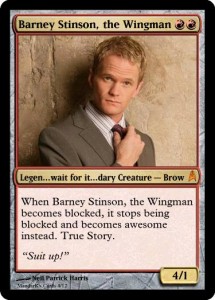
Shamelessly stolen from Habibson @ Deviantart.com

One thing I’ve learned over the last decade, is the value of a good wingman. Having been “attached” for most of that time, I’ve developed a pretty good skill at it myself. But not to worry, this isn’t another dating article for Magic players (those never seem to go well, do they?). I thought to write this article, because over the last several days, I’ve had lengthy chats with one of our subscribers, and a good friend of mine, Joe (@SoupaJoeViola on twitter). We spent almost the entire weekend at the LGS, drafting, playing Magic and trading. At one point, our chats even brought about the concept of team trading, and unrelatedly what a wingman can do for a guy trying to catch a girl.

Let’s restart. One thing I’ve learned over the last week, is the value of a good wingman. Finding someone who complements your strengths and fills the gaps in your weaknesses is a great asset to a trader. My style is to target specific cards that I expect to see gains, and avoid cards I’m not sure I can easily move. For me, pairing up with people who are going to find undervalued gems in people’s binders, can help me finalize a trade that I might have settled on at a lower value. Keep in mind, the wingman needs to be careful, as anyone who feels “tag-teamed” will surely walk away.

In dating, any old wingman won’t do. You need one who knows the role, and how to execute it. I’m going to follow the same form as the linked article, and talk about 10 ways you can (or better yet, your friend can) help you maximize your trading time.

Number 10: Understand the Mission
Whatever this specific mission is, depends on your goal as a trader. My personal goals, are to get rid of cards in my binder, for cards I think will hold value better, or gain value over time. I especially want to get rid of cards that have been rotting and taking up space. A wingman needs to know what I’m shooting for, if they are going to help me accomplish it.

Number 9: Keeps you Presentable
Not physically presentable, but psychologically. Trade partner becomes wary of your valuations? Wingman can make a very light comment supporting your values. This is a key point. If your wingman is hovering too closely, or being aggressive, they’re going to do more harm than good. It’s more “sellable” if the wing man is casually sitting next to you, perhaps scanning through his own trades/decks, rather than leaning over the trade space directly.

Number 8: Understands your Language
I can copy this one almost directly from the dating article I linked above. “You've been in the trenches together. You know your wingman well, and he knows you well. You don't have to talk to communicate about every situation. He can read your body language, signs and codes, and act accordingly to help your cause.” This is important. When I was trading at the LGS this weekend, I was deep into a profitable trade. I had an opportunity to find another “Throw-in” from my partner’s binder and finalize the trade. I had already hit most of the cards I was interested in, and didn’t want to short change myself with the final card I pulled. Joe noticed (either through my hesitation, or body language) that I was unsure what to select from the binder. He said simply, “Oooh, that foil Unburial Rites looks sweet, maybe grab that?” Within moments, the deal was done, the trade partner didn’t feel “ganged up on” and both parties left happy. I likely would have selected a lower valued card, as I wasn’t sure exactly how much the foil trades at, and I felt I already got the key cards I was looking for. Joe calls this the “icing” but that’s a whole different article.

Number 7: Prevent Interference
Maybe your trade partner has his own wingman, or buddy who is hovering or interfering with your trade. Your wingman should pull out his own binder and distract this person with a separate trade. Keep them occupied enough not to interfere with business at hand. This isn’t always necessary, and I don’t condone trade practice that someone would object to anyway, but some people enjoy throwing wrenches in trades, and the wingman can attempt to redirect the attention of the problem friend.

Number 6: Read the Terrain
This is how you and your wingman make value together. You both provide support to each other as wingmen. I know Joe especially likes foils, so I if I see someone with a spicy foil, I’m going to let Joe know about it, and facilitate an introduction between the two parties. If Joe knows I”m looking to pick up specific Uncommons (that I listed in last weeks article) he’ll let me know someone has Dismembers that they value around $1, and I can seek them out.

Number 5: Going Kamikaze
This has a slightly different meaning than it does in the dating realm. We’re not suggesting he fires an assault at everyone in the room who has a binder, just to gain information for you, but when you’re in a trade, he has no purpose but to help you trade, and vice versa. If this means he loses a chance to trade with that person when you’re done, so be it.

Number 4: Big ups to the point man
It’s really important that your wingman does this only in the right spots. Again, an overzealous wingman will do more harm than good. But if the trade talks get a little dicey, they will lighten the mood. They will talk positively about you throughout their own trades, and help you network with trade partners. A good example, “Oh, you’re buiding Deck ABC? You should talk to Chad after we’re done, he’s got experience with that deck, and could probably help you finish it.” A statement like that automatically adds value to my trade with that person. If they come to the trade expecting to gain insight and information, in addition to cards, values are not going to be the focus of the conversation.

Number 3: Fills the gap
This is the one spot where I actually have to come up with my own, because “Taking the Ugly Friend” is not only a strategy I don’t agree with, but doesn’t apply to trading. However, I will say, that on a rare occasion, working your wingman INTO your trade is possible. Maybe you and your partner can’t agree on a fair deal. Let your wingman throw his binder in the mix, and you two can hash out the difference later. I’ve used this in the past, and it tends to work out just fine.

Number 2: Goes Undercover
This is less important in trading than dating, but is worth a mention. Smart traders keep their ears open to what people are looking for. If your wingman hears about something and you’re better prepared to make a deal, relaying all the appropriate information to you before the trade can be extremely valuable. If someone desperately needs a card, they may not offer that information voluntarily. Even more valuable, if you know they need something, but they don’t know that you know!

Number 1: Pumps you up
Your wingman shares in your victories, and encourages you to keep trading. Jokes, high-fives, and feedback are all part of this process. Not to mention, it will be more enjoyable.

Find a wingman. Be a wingman. A trading team isn’t as intimidating as it sounds, but the benefits are immediate and obvious.

Chad Havas
@torerotutor on Twitter.

Avatar photo

Chad Havas

Chad has been with Quiet Speculation since January of 2011. He uses price speculation to cover all his costs to keep playing. Follow his journey from format to format and be prepared to make moves at the right times.

View More By Chad Havas

Posted in Finance, Free InsiderTagged 6 Comments on Insider: The Wingman

Have you joined the Quiet Speculation Discord?

If you haven't, you're leaving value on the table! Join our community of experts, enthusiasts, entertainers, and educators and enjoy exclusive podcasts, questions asked and answered, trades, sales, and everything else Discord has to offer.

Want to create content with Quiet Speculation?

All you need to succeed is a passion for Magic: The Gathering, and the ability to write coherently. Share your knowledge of MTG and how you leverage it to win games, get value from your cards – or even turn a profit.

Insider: A Different Look at Modern

Are you a Quiet Speculation member?

If not, now is a perfect time to join up! Our powerful tools, breaking-news analysis, and exclusive Discord channel will make sure you stay up to date and ahead of the curve.

Modern season is nearly upon us, but the infancy of the format has driven a lot of instability and uncertainty around what the metagame will look like. It seems Wizards of the Coast has the perfect format in mind, where 33% of the field is control, 33% is aggro, and 33% is an array of combo decks that do not win before turn four. (For those math experts out there, the remaining 1% can be left behind for some sort of home-brewed “other” category.) Any deviation from this balance has thus far been stunted via critical card bannings.

Whether we agree with all the bannings or not, we must navigate around them if we wish to profit during this season. After all, many Modern card prices have subsided significantly since the Modern “hype” generated upon announcement. Opportunities are definitely out there; we simply need to identify which cards will remain robust regardless of what Wizards of the Coast does to the format.

Possible Scenarios

During the Pro Tour, aggressive Zoo decks were widely prevalent in the metagame, led by incredibly efficient creatures and the notorious Grove of the Burnwillows/Punishing Fire combo. This two-card combination, when undisrupted, creates an infinite loops scenario that most people are already familiar with. Is there a future for these two cards in Modern? Possibly. Though, judging by Twitter forums and Star City Games’ recent drop of Grove’s price (from $14 to $12), many people are hedging their bets that one of the two will be banned.

The only other card I hear rumors around is one of the aforementioned efficient creatures, Wild Nacatl. At 3/3 for just one mana, Wizards may have finally identified a vanilla creature that is too powerful. My initial reaction to these rumors was immediate denial. I felt Wizards could never ban a simple 3/3 creature that can only be strong with a particular mana base.

Then it hit me (in the form of a tweet). Kird Ape, an arguably inferior version of Wild Nacatl, was once banned long ago. It seems that the ability to attack with a 3/3 creature on turn two just might be too powerful for this fragile format.

Implications

Souce: http://www.moopysavessummer.com

Should one of the above cards become banned in Modern, there may still be hope for a Zoo-type aggressive deck in the format. However, if Wild Nacatl is banned AND the Grove of the Burnwillows / Punishing Fire combo becomes no more, this could have a profound impact on the Modern metagame.

Zoo decks, adhering to the typical Red/White/Green color combination and driven by the pesky 3/3, may cease to exist. While Loam Lion still does, the loss of one power may be too much to overcome. The result will be a much different metagame. One where aggressive decks can actually be tribal themed and control decks stand a fighting chance.

Without knowing what will happen to the Modern banned list, it is very difficult to anticipate what cards will shine. So in light of this difficulty, what cards are wise to acquire while waiting for the fateful December 20th announcement?

Cards I’m Watching

There are a handful of cards I am considering buying (as well as selling) and they each can be separated into specific “categories.” First and foremost, there are the cards which should remain strong no matter what bannings occur. But before rambling off some obvious choices, we also need to keep in mind that Wizards of the Coast has a second bomb they may drop: reprints.

Certain authoritative figures at Wizards have already suggested that some powerful Modern cards will be reprinted. As a result, we cannot simply go on eBay and purchase every reasonably priced Shock Land available. In fact, one major reason these card prices have been kept in check relative to Legacy Dual Lands is the threat of reprint. Dark Confidant is another card which has carried a higher price tag in the past but has since recessed in light of rumors of reprinting. Especially since he would fit in very well with the Dark Ascension theme.

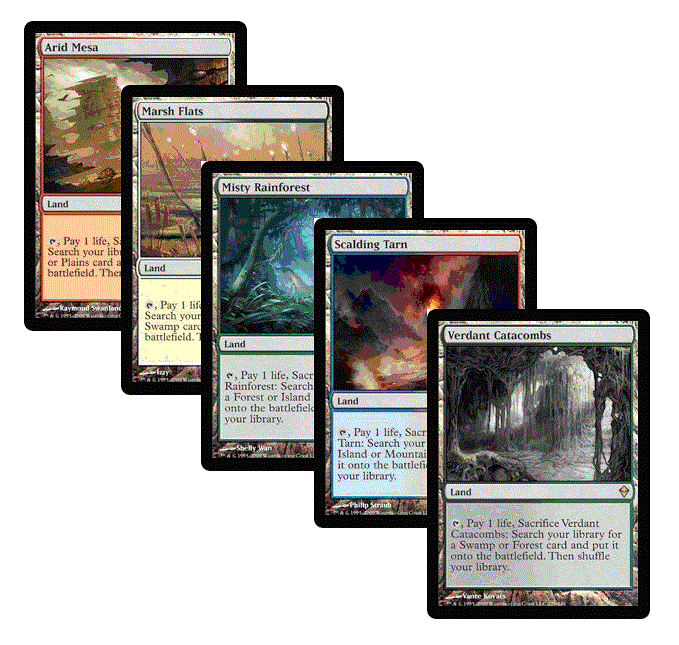
So what Modern cards are versatile enough to be strong regardless of metagame and don’t have a chance of seeing a reprint in the future? The first group of cards that come to mind are Zendikar Fetch Lands.

While these were opened in abundance, there will always be a constant demand for these cards as long as eternal formats exist. Progress may be slow, but these lands will one day exceed their $10 price tags.

Misty Rainforest and Scalding Tarn are especially unique because they are Blue. While Zoo decks currently dominate the metagame, the rise of Blue will be inevitable as it always is. In short, these lands will never drop below $8-$10, will always be as liquid as cash, and have the potential to increase during Modern season regardless of what Wizards does. A strong buy.

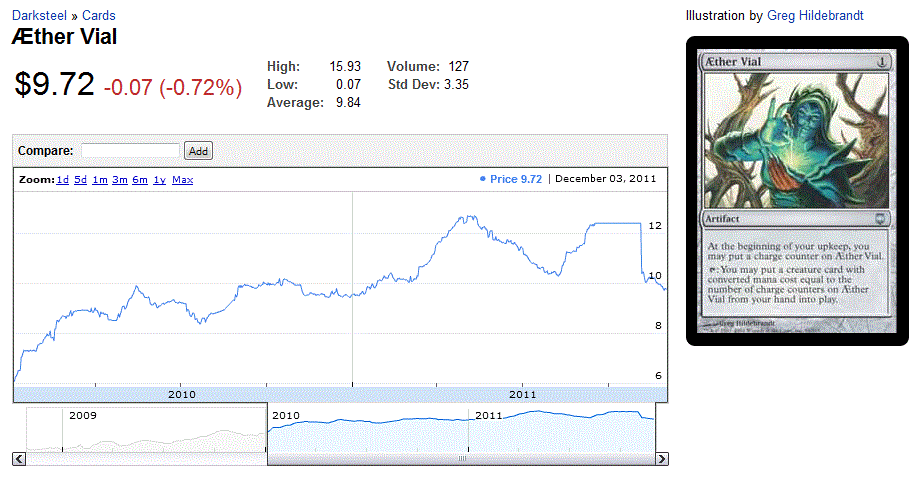
Another category of cards to watch are cards which received a price bump when Modern was initially hyped but have since resided to a lack of play in the format. Two examples I want to suggest watching in this category are Aether Vial and Thoughtseize. The reason is twofold.

First, both cards are highly played in Legacy, and so demand will be present regardless of the Modern metagame. Second, and more importantly, both cards jumped on Modern hype but have since dropped in price because they do not yet have a consistent home in the format.

If Zoo loses Tier 1 status, then a wide array of Vial-enabling Aggro decks are possible. Additionally, some [card Melira, Sylvok Outcast]Melira[/card] combo decks already run this Aether Vial to some success. The future level of play for this card isn’t definite, but the downside risk is minimal. (Chart courtesy of Blacklotusproject.com)

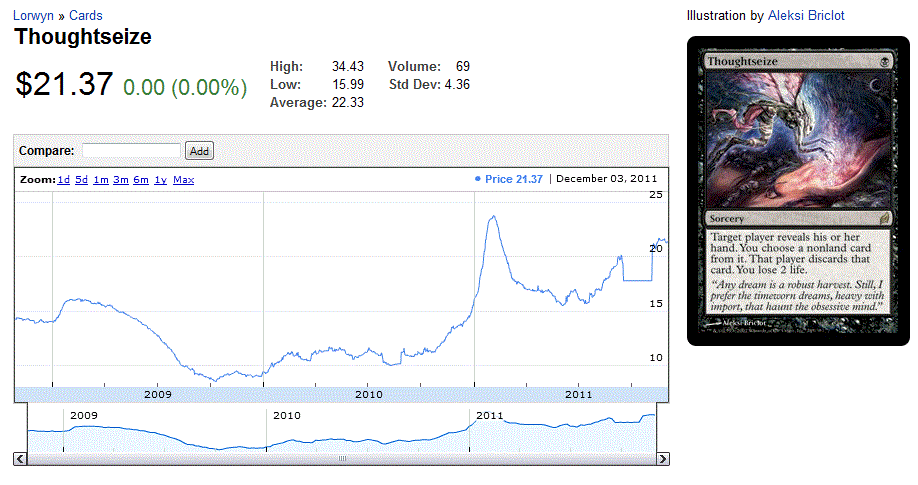
Thoughtseize is a premier disruptor, sure to find a home in a control or combo deck at some point. This card has reached as high as $30 and is a staple in Legacy. Black is severely underpowered in the current Modern format, however, and the card’s price trend reflects this. Now is definitely a good time to acquire your playset of this card. (Chart courtesy of Blacklotusproject.com)

A third and final category I want to touch upon are the cards in underplayed decks which were outperformed at Worlds. In other words, while Zoo is getting all the attention, there are still some strong and strongly overlooked strategies with viability to become more noticed with no regards to the rumored bannings on December 20th or not. Let’s start by taking a quick look at some of the top performing Modern decks from Worlds.

First, I want to point out a trend. The top four performers, albeit with low match count, have one color in common: Blue! While it isn’t as obvious as in Legacy, Blue is still the uncontested strongest color.

Second, I want to highlight decks which ranked highly but also had a decent number of matches. We are basically looking at Melira, Jund, Death Cloud, and Mystical Teachings.

This information is very useful, especially since none of those decks would suffer tremendously from a banning of Wild Nacatl, Grove of the Burnwillows, or Punishing Fire.

Rares and Mythic rares from these decks may be another safe place to turn to for speculation options. My favorites are Maelstrom Pulse from Jund, Death Cloud from its namesake deck, and even Knight of the Reliquary from an array of decks and for her all around utility.

I would also suggest some strong Blue control cards. Snapcaster Mage would be a prime prospect if the card ever drops in price! Nevertheless, there are many options worth considering in these lists and I encourage you to do some into other ideas.

Concluding

I encourage you to share any other ideas and which category they fall into in the comments section below. And hurry! The holiday season always flies by and Modern season will be here before you know it.

The Seven (Casual) Wonders of the Worlds

Are you a Quiet Speculation member?

If not, now is a perfect time to join up! Our powerful tools, breaking-news analysis, and exclusive Discord channel will make sure you stay up to date and ahead of the curve.

With the World Championships a few weeks behind us, you've no doubt grown tired of reading about all the latest tech in Standard and Modern. But with Adam Styborski (@the_stybs) as living proof, I know that there's a lot more to do at big tournaments than compete. Sure, in addition to the main event, the last Worlds of its kind had lots of Standard, Modern, Sealed, and Draft queues, but for those looking to let off some steam, as I was on Sunday, there existed a multitude of intriguing alternatives.

Privatized

For me, the saddest part of the changes to Worlds isn't the loss of another 'Pro Tour' to qualify for, but rather the loss of a venue in which to meet up with Magic personalities from across the globe. When you bring a bunch of awesome people together, they're bound to come up with some great activities of their own, and I was privileged enough to get in on some pretty awesome things that you wouldn't have seen listed on the event schedule.

I. Cube Draft

For those of you who have yet to play a cube draft, let me start out by saying that cubing is one of the most enjoyable activities known to man and is likely the best use you can put your cards to. Of course, building a cube is extremely time consuming and difficult, so the cautious among you will no doubt want to try the format before sinking your time and money into building your own.

Luckily, Gathering Magic has been working to help you do that with the Community Cube project. After cubing with it at Worlds, I took the cube to it's next venue: a PTQ in Santa Clara where I passed it along to Lokman Chen. Watch the cube's progress on Facebook and make sure to get in on a draft when it comes your way!

Then again, when you get the opportunity to cube with Adam Styborski himself, it's hard to pass up a chance at using his exquisitely tailored Pauper list. Adam and I Winston Drafted, and though the games mostly came down to one of us being mana screwed, it was still a great time. An impressive feat indeed!

II. Commander

What would a day of casual play be without at least one game of Commander?

Between drafts I sat down with Wizards' Trick Jarrett, Gathering Magic's Adam Styborski, and CMDR Decks' Uriah Oxford. Trick had finally managed to procure a foil Grimgrin, Corpse-Born earlier in the day and was excited to get to play it, and Adam was ready to show off his new Mono-You Sakashima the Impostor deck. Uriah decided on Eight-and-a-Half-Tails, and, as I'm liable to do, I pulled out Chorus of the Conclave.

The game started off with Adam drawing everyone a bunch of cards via Howling Mine and Trick deploying a couple of Zombies. Soon I started ramping a bit and Uriah established an untouchable board with his commander.

Trick started building up a horde with Endless Ranks of the Dead and I looked to draw a few cards off an Etched Oracle with some additional counters from [card Chorus of the Conclave]Chorus[/card], but Trick saw a better alternative and promptly stole it. Uriah had continued to build his board, but Adam was prepared with Brittle Effigy for Eight-and-a-Half-Tails.

Protection from White did nothing as the Effigy had already departed this corporeal realm, and the Fox Legend was dealt with for the moment. I took this opportunity to dismantle some of Uriah's artifacts and enchantments with Terastodon, but soon the Fox was back alongside Battletide Alchemist, Endless Horizons, and Caged Sun.

Now that's a lot of protection activations!

Trick's Grimgrin began his feast on my creatures while Uriah's [card Battletide Alchemist]Alchemist[/card] held off the hordes and Adam deployed [card Cackling Counterpart]a trio[/card] of Wurmcoil Engines and decided that one Solemn Simulacrum [card Rite of Replication]simply wasn't enough[/card]. This display was certainly the best Commander I've seen out of a mono Blue deck, and I would recommend it as an example to anyone looking to build decks to enhance everyone's enjoyment.

By this point, the game had gone on for quite a while and the board was really clogged, so I declined to play my freshly drawn Austere Command and instead made a 21/21 Skyhunter Skirmisher. Trick continued to grow his Zombie army, and Adam made a few [card Sakashima the Impostor]more[/card] Engines. I ran the Skirmisher into Uriah's Maze of Ith, after which he promptly summoned Glarecaster with enough mana to stop two thirds of the creatures on the board. Everyone was getting hungry, so Adam sent in the troops and soon all those unable to [card Glarecaster]cast glare[/card] were dead.

III. Curses, Foiled Again!

After Uriah headed off, Adam, Trick, and I met up with Lee Sharpe and Adam's wife, Diana, to grab some grub. We ended up at an Italian seafood restaurant near Fisherman's Warf, and quickly got seated to order. While we were waiting, Lee proposed we try out a new game called “Eight Curses.”

Like Lands, Eight Curses is played with Magic cards, but is really a separate game entirely, more akin to Liar's Dice than anything else.

  • There's a shared curse deck, containing eight copies of each of Innistrad's six curses alongside Curse of Wizardry and Nettling Curse
  • The entire deck is dealt out as evenly as possible among the players as hands.
  • The first player places a card from their hand face down in front of one of their opponents and asks “Is this a [NameOfCurse]?”
  • That player can either answer or look at the card and ask an equivalent question of one of the players who hasn't been involved in the bluffing this round.
  • When somebody answers, the card is revealed. If the answer was correct, the most recent asker gets cursed and a wrong answer curses the respondent.
  • The turn order progresses clockwise from the original bluffer.
  • If a player gets one of each curse, each other player curses that player with a random card from their hand.
  • A player loses if they get four copies of the same curse. There is no winner: the game ends when somebody loses.

I'm not sure who invented Eight Curses, but I want to thank Gavin Verhey (@GavinVerhey) for lending us his deck! After playing a bit at dinner, we met up with Richard Castle (@richardfcastle) for some Coldstone, then headed back to the out-of-towners' hotel for more Cursing.

Worlds Exclusives

Besides whatever one's friends were doing, Wizards certainly did its part to cater to those neither qualified for Worlds nor intent on grinding Planeswalker Points with a wealth of interesting public activities.

IV. Artist Signings

Right past the dealer booths, one would find an ever-changing roster of artists ready to sign their masterworks for the crowd. I personally have never been a fan of signed cards. I derive pleasure from how my cards look aesthetically rather than a vague 'specialness,' so my foils remain unadorned. That said, many love this sort of authentication, and I was happy to note that many of the artists were careful to sign cards with colors that complemented their artwork.

V. Magic Online Drafts

On top of the constant stream of artists, the 2011 World Championships featured free to join Magic Online Phantom Draft queues to all attendees. I ended up playing in one, and it was a ton of fun to draft without having to worry about trying to break even by taking expensive cards. Moreover, the low bar of entry brought a lot of people in. I even saw a father drafting cooperatively with his two grade school aged sons!

VI. ?

For those looking for some more competitive non-competition, Mark Rosewater hosted an Innistrad trivia game named “Question Mark.” While I didn't participate myself, I watched a decent chunk of the competition, and Bradley Rose (@bradleyrose)'s team even managed to win a box for Top-8ing. Anyway, you can (and should) read Bradley's own account of the weekend here, so I won't tread on his toes too much.

VII. Spellslinging

On top of getting to interact with the wider Magic community, Worlds offered a rare opportunity to meet the people who make the game we all love so much. Spellslinging with the people in charge of making Magic is a great way to get their ear while having fun, but Bradley and I cooked up a more devious plan which he started to describe in his article last week.

After waiting in line and letting people go ahead of us for quite a while, we finally managed to sit down across from Mark Rosewater and Eric Lauer at the same time. Mark took out his Standard Zombie deck to battle Bradley's Unhinged deck, and I told Eric I was playing casual. After Eric procured some sort of weak mill concoction, we shuffled up and he told me about the last time he'd spellslung casual and faced some sort of Legacy-level brew. I, of course, promptly led off by cracking a foil Verdant Catacombs for Underground Sea.

The good Mr. Lauer eyed me suspiciously, but I assured him that I wasn't doing anything quite that broken. I spent the next couple of turns learning from [card Demonic Tutor]Demons[/card] and [card Vampiric Tutor]Vampires[/card] before slamming a fourth turn Swirl the Mists on Black.

I'm not sure what was running through Eric's mind at this point. Was I going to go off with Murkfiend Liege and Unliving Psychopath? Or what? When he passed the turn back, I glanced over at the other game to see Bradley falling to a Zombie horde. I drew my card, tapped three lands, and intoned the holy mantra:

Hey Mark, Ass Whuppin' your Undead Alchemist.

We all had a good laugh, and I managed to take out a Call to the Grave before getting decked, though it still wasn't enough to save Bradley's delicious, delicious brain.

The Last of its Kind

I'm positive that Wizards is doing what they believe is best for the game by changing Worlds, but that doesn't mean I won't miss it. The Magic community is fantastic, so, even if you don't play competitively, I highly recommend hitting up any large events that you can make it to. Hopefully I'll meet you there.

Jules Robins
julesdrobins@gmail.com/Google+
@JulesRobins on twitter

Insider: Straight Speculation

Are you a Quiet Speculation member?

If not, now is a perfect time to join up! Our powerful tools, breaking-news analysis, and exclusive Discord channel will make sure you stay up to date and ahead of the curve.

Before I started writing for QS, I was an avid reader of the site and probably one of the first to actually sign up for a premium membership all those months ago. I figured “If the tips and tricks I learn here will at LEAST cover the costs of my membership, I’d be happy”. Theory is great, and learning to trade is obviously better than just having someone tell you to buy “Card X” for “$Y” and sell it for “$Z”, but sometimes a little STRAIGHT SPECULATION can go a long way!

... I told you it was good!

As a new writer for QS I haven’t had the chance to just explode and give you a ton of my picks. Today we’ll be building on one of my previous insider articles: “Waking Up The Sleepers In Innistrad”, where we developed techniques to look ahead at what we expect to be released in future sets and invest in cards that compliment them. We’re going to take this theory one step further now and review the cards across the standard board and make some more educated pickups from M12 -> Scars -> Innistrad.

A lot of these calls will be based on the fact that the following card has just been spoiled by WotC in the second issue of the new Magic: The Gathering Comic book. This Red Careful Study x2 is amazing and will see play all the way to Legacy, and possibly even Vintage! Previously we thought that they’d be pushing flashback in the next set, now we know this to be true, and can speculate as such.


I’ll be using the following grading scale as was suggested by Todd Stevens in the comments section of the aforementioned article. Thanks for the suggestion Todd! Everyone, please keep comments coming as they will help us continually improve, and, as you can see, we intend to act on them!

Current Value Future Value Safety Factor Grade
Today’s eBay completed listing price. A prediction of its future value. A scale from 1 (low) to 10 (high) on how safe an investment I feel it is. Overall grade from A+ (high) to F- (low) on its expected performance.


Mining M12

Poor little M12. Lost. Alone. Defeated and ignored. Not many people have been talking about you lately, but I think it’s time to change that!

Visions of Beyond
Current Value Future Value Safety Factor Grade
$1.50 $4.00+ 8 A-
Everyone likes Ancestral Recall… and that’s exactly what this card has the potential to be. It started off being worth $5 due to speculation, but then, since there was nothing to support it, crashed. This looks like an obvious plant for Innistrad and at its current value can’t even sink any lower. It’s already had moderate success in the old Pyromancer Ascension deck, so it may even have Modern application should it fail to perform in current Standard.

Jace, Memory Adept
Current Value Future Value Safety Factor Grade
$11.00 $15.00+ 4 C
The “biggest” Jace and one that so far has seen virtually no play, causing his value to slowly erode. Putting 10 cards into a graveyard is nothing to eschew and this guy works a dual function of either putting your own cards in the graveyard (for effects like Laboratory Maniac / Bonehoarder Wurm) OR milling your opponents deck as per the Turbo-Fog style. I’ve made him a fairly “unsafe” pick as he is already quite expensive and thus has a huge margin to gain OR lose… high risk, high reward.

Jace's Archivist
Current Value Future Value Safety Factor Grade
$0.50 $2.00 5 C
When we start thinking outside the box, this little guy really starts to shine. Currently not on any radar anywhere, this guy will not only let you get your entire mitt full of flashback cards into the graveyard, but he will also reward you with a new hand! Trying to dig for that Burning Vengeance? Why not draw 7 and discard these seven other enablers for the combo? Card advantage that fills your graveyard at instant speed, this card could enable any number of decks from the Boneyard Wurm / Splinterfright / Kessig Cagebreakers deck to the self mill deck with Laboratory Maniac to even the U/R burn deck that’s emptying its hand by T4 and using the Archivist to refill it. I’m hot on this guy on MTGO where I’ve been buying him up for only 0.10 tix!


Scouring Scars

Although this is the older block and most things have already been either discovered or dismissed, there is still profit to be made with a keen eye and a quick trigger finger. I wasn’t able to find as many as I’d have liked since it’s been mostly picked clean, but there are a few that stood out to me.

Necrotic Ooze
Current Value Future Value Safety Factor Grade
$0.50 $2.00 5 C
He’s a combo enabler that already has a home in Modern and is seeing some play in Standard. Did YOU know that Ooze + Grimgrin, Corpse-Born + Bloodline Keeper = Infinite P/T Ooze? This deck is starting to get a little attention since each individual card is good on its own even without the “combo”!

Bonehoard
Current Value Future Value Safety Factor Grade
$0.25 $1.00 3 D+
We’re putting tons of cards in the graveyard and this guy is getting bigger with every creature we ditch. His graveyard-centric theme, and therefore his playability, is linked directly to the quality of the mill cards we’ll see in Dark Ascension.

Blackcleave Cliffs
Current Value Future Value Safety Factor Grade
$4.00 $6.00 6 B-
The red-headed step child of the Scars block cycle of lands. It hasn’t yet had the opportunity to shine in any deck and therefore has had to sit on the sidelines while his big brothers Darkslick and Seachrome continue to gain. Chapin played B/R in his deck at Worlds to support Olivia. And speaking of which, R/B Vampires will be primed to make a comeback in the upcoming sets so be ready! If Sorin is back and badder than ever, his bloodsucking buddies won’t be far behind. (ESPECIALLY if they design Sorin like they did Nissa Revane, except with a Vampire tribe effect instead of Elves.)


Invading Innistrad

Some of the cards listed below have already been studied previously, but they are worth bringing up again for now we have more concrete information on where the set is going. We can now add a few more that complement the graveyard theme and flashback.

Bloodline Keeper
Current Value Future Value Safety Factor Grade
$4.00 $6.00+ 8 A-
I can’t say enough good things about this card. And I’m not the only one. Pro’s are advocating adding it to decks because it can win through card advantage and damage all on it’s lonesome. As mentioned while discussing Blackcleave Cliffs, Vampires will be back and this is their lord. He will be played as a 4x. His demand is all over the place though, so, even if the Vamp tribe is a failure, he will still see play in control and midrange.

Skaab Ruinator
Current Value Future Value Safety Factor Grade
$4.00 $8.00+ 7 B
NICE! I’d mentioned in my previous article that this guy needed a “buried alive” style effect and we (sort-of) got one! R/U should now have enough mill cards to actually make this guy a feasible play on T3, between Dream Twist and Faithless Looting. $20 when first spoiled, now available for pennies on his former dollar. He’s mythic, so PERFECT to speculate on!

Kessig Cagebreakers
Current Value Future Value Safety Factor Grade
$0.50 $2.00 6 B-
You could throw the “trio” as I call them all into this category, the other two members of the trio being Splinterfright and Boneyard Wurm. Cagebreakers will be the end of the game if it gets in a single attack around the proper build. The faster we can get cards in the grave, the better this card becomes. Many games will end on a Cagebreaker swing. Besides, they’re all wearing such cute little hats. How could you NOT want to stock up on them? 😛

Burning Vengeance
Current Value Future Value Safety Factor Grade
$0.25 $1.00 9 A
This deck was already pretty tight, but now it’s insane. This is the “Dispatch / Despise” of the set, the money uncommon that you will see across the table from you burning you out for two at a time and gaining massive card advantage. I can’t quite call it a “Dismember” since it has a narrow use, but its power cannot be denied. It will see play in a competitive deck alongside Snapcaster. (<- Period)

Devil's Play
Current Value Future Value Safety Factor Grade
$1.00 $2.00+ 7 B
As above, this card will be in the Burning Vengeance deck. Not only that, but it was a breakout card in Grixis control decks as well. I am just getting into MTGO, but I find that if a card there has value > 1 tix, that means it is actually in demand. This card is worth > 1 tix online already, so it fits that criteria, which is a shame because if it was lower I’d be buying them en masse right now. The fact that it was a promo will hurt it a little bit, but still worth picking up a few while they’re cheap. I can see decks starting to play this greater than a 1-2 of as well since it can kill an early Bird or a late Hero… then do it again!

Nephalia Drownyard
Current Value Future Value Safety Factor Grade
$0.75 $2.00 5 C
It puts cards in the graveyard and is being used as an alternate win condition in some control decks. If flashback decks are going to be extremely popular, these will start to show up as 2-3x main. They actually have a little bit of value already, so are already seeing at least a little play.


Speculating-Shmekulating!

So, again, we are basing our speculation on cards that we suspect either will come out or, in the case of Faithless Looting, now exist. We’re beginning to receive confirmation of all those things we’d predicted, which means that, so far, we’re on the right track!

In a month’s time it will be interesting to re-visit this article to see how we made out. Though we won’t fully know until the 3rd set is released and has had a tournament or two to get some results, there should still be some movement on these card that we can track using a great tool I’d like to introduce you to if you weren’t aware of its existence (as showcased scrolling across the top of this website): http://blacklotusproject.com/.

Once you enter a card name in the upper right hand “search” field and press enter, it will give you a graph showing all of the movement as well as current and past prices of the cards in question. Soon, however, Quiet Speculation's "Project Condor" will have its wings and we will have access to some awesome new tracking tools.


Trade or NO Trade?

Let’s end our time together today with a “Trade or NO Trade”!

<< TRADE 1 – Speculators Delight! >>
PILE 1

PILE 2

3x Skaab Ruinator
3x Visions from Beyond
2x Bloodline Keeper
3x Blackcleave Cliffs
1x Jace Memory Adept
3x Koth of the Hammer
3x Chandra's Phoenix
4x Devil's Play


So what do you think? Pile 1 or 2? Or are they even?

Think about it before you scroll down…

<< TRADE 1 – Speculators Delight! >>

PILE 1

PILE 2

3x Skaab Ruinator $4x3=$12
3x Visions from Beyond $1.5x3=$4.5
2x Bloodline Keeper $4x2=$8
3x Blackcleave Cliffs $4x3=$12
1x Jace Memory Adept $11
3x Koth of the Hammer $13x3=$39
3x Chandra’s Phoenix $3x3=$9
4x Devil’s Play $1x4=$4
TOTAL = $47.50
TOTAL = $52.00

You probably guessed, based on this article, that Pile 1 is currently worth less than Pile 2.

With the exception of Devil’s Play, however, everything in Pile 2 has already spiked and dipped, while Pile 1 has a good chance at going up in value. The most expensive cards in the trade are ALL coming from Pile 2 in the form of the 3x Koths, so it’s expected that they will want a little more anyway… it just so happens to be that we’re probably prepared to “give a little” to get the stuff we’re speculating on though, anyway.

Best of luck in your quests for profit. See you all next week and in the comments!

Cheers,

Carl Szalich

Tariel, Wrecker of Graveyards

Are you a Quiet Speculation member?

If not, now is a perfect time to join up! Our powerful tools, breaking-news analysis, and exclusive Discord channel will make sure you stay up to date and ahead of the curve.

Everyone who's played more than a game of two of Commander has run into one of the many graveyard decks in the format. Whether the deck is a combo deck, an attrition deck, or some hybrid of the two, decks that use the graveyard as a resource are some of the most powerful and resilient in the format, and many people have a lot of difficulty interacting with this style of deck. In fact, Chris wrote in last week asking about exactly this issue.

His metagame has a number of decks which rely on the graveyard as a resource. Mainly a Karador, Ghost Chieftain deck and a Glissa, the Traitor deck, both of which try to combo out of the graveyard as early in the game as possible. The problem that Chris has run into is one that many people have to deal with at some point or another. What kinds of cards are most effective against these decks, and how many do you need to run in order to solve the problem?

We only have to look as far as sideboards in Eternal formats to see this kind of issue reflected in a "real" metagame. Everyone knows that graveyard decks are good in these formats, but no one wants to dedicate the slots to beating those decks until the deck's prevalent enough that you're obligated to hate them out.

Similarly, in Commander, you only have ninety-nine slots in your deck and there are a lot of things you have to be able to answer. There comes a point where there's not much space left in your deck and Graveyard hate is usually the first thing to get cut. Because most people have this kind of mindset, it allows the graveyard decks to run rampant.

Now, what a lot of people are tempted to do is to build "hard counter"—a deck that discourages or outright prevents people from relying too heavily on their graveyard. Something like Chainer, Dementia Master and The Mimeoplasm. The problem with this approach is that these decks are overtly hateful, which means that good players will play around them. As someone who has extensive experience playing decks that abuse the graveyard, I can tell you that I frequently refuse to overextend my graveyard until I can kill the player or players who are most capable of disrupting it.

Enter Tariel, Reckoner of Souls. Not only is this guy in a sweet color combination that doesn't get nearly enough love, but he hates on graveyards in a very unique way—one that people won't take seriously until it's too late. Tariel encourages you to moderate the contents of other players' graveyards over the course of a game so as to minimize the randomness of her ability. She makes you actively want to run graveyard hate as part of your approach to the game rather than sacrificing slots for "real" cards.

Graveyard hate is where this deck has to start, right? Fortunately, Wizards has printed a glut of very powerful graveyard hosers in recent sets. It's also fortunate for us that many of these cards are cheap artifacts, which are easy to take advantage of. These, in conjunction with other cards that allow you to exile specific cards, will enable you to disrupt graveyard-based decks very easily.

Bring on the Hate!

  • Scrabbling Claws
  • Phyrexian Furnace
  • Nihil Spellbomb
  • Relic of Progenitus
  • Salvaging Station
  • Leonin Squire
  • Auriok Salvagers
  • Sun Titan
  • Stonecloaker
  • Nezumi Graverobber
  • Suffer the Past
  • Faerie Macabre

This is the fundamental basis on which the deck is built. The most efficient ways to do that are with the pieces of artifact hate, and so those are what the deck is really built around. Because of cards like Salvaging Station, artifact-based graveyard hate is the most efficient way to control graveyards in a longer game. Even better, this means I get to build a little around Sun Titan, which is probably my favorite Commander card, bar none.

The more interesting cards, however, are the ones that can target specific cards in graveyards, so you can exile key spells and creatures, even at instant speed. These guys power up your cards like Scrabbling Claws and Relic of Progenitus, and let you leave more of the graveyard intact, so you can abuse it later. Those cards get better and better the fewer cards that are in that opponent's graveyard.

Both Stonecloaker and Nezumi Graverobber love to be recurred with Sun Titan, which provide great targeted removal and absolutely huge upsides!

Lastly, Suffer the Past is a card that ought to see much more play than it does. It rips graveyards apart at any point in the game while being a burn spell in the late game. It's not as obviously game-ended as something like Exsanguinate, but it does the job just as well.

Some Other Pieces

Now what I wanted to do was build in a few more engines into the deck so that you aren't just a pile of graveyard hate and [card Tariel, Reckoner of Souls]Tariel[/card]. You need some power in the mid game so that you can get to a point where [card Tariel, Reckoner of Souls]Tariel[/card] is relevant and can take over the game. To do that you need mechanisms for generating cards and board presence. Your plan in the midgame is to deplete people's removal so that you can stick [card Tariel, Reckoner of Souls]Tariel[/card] and to get some good creatures in the graveyard, since [card Tariel, Reckoner of Souls]Tariel[/card]'s power is proportional to that of the creatures it can reanimate.

Baubles and Recursion

  • Executioner's Capsule
  • Dispeller's Capsule
  • Expedition Map
  • Wayfarer's Bauble
  • Twilight Shepherd
  • Phyrexian Reclamation
  • Unburial Rites
  • Krovikan Horror
  • Necromancy
  • Liliana of the Veil
  • Debtor's Knell

Now, these cards do a number of things, but they mostly tie together your Bauble engine with ways to control the board while developing your mana. Dispeller's Capsule and Executioner's Capsule are great ways to control the board, especially with the addition of Twilight Shepherd alongside your other recursion mechanisms. Expedition Map and Wayfarer's Bauble both help you develop your mana base consistently.

Liliana of the Veil is probably the least synergistic of these cards, but she is also the most powerful. In multiplayer, her first ability generates a ton of card advantage, and the ability to repeatedly [card Diabolic Edict]Edict[/card] people and take their guys later with [card Tariel, Reckoner of Souls]Tariel[/card] is very powerful. You can get value by discarding something like Krovikan Horror, but even then she has much less synergy with the deck than something like Necromancy.

Just think for a second about how Necromancy interacts with Twilight Shepherd.

Regardless of whether they kill Necromancy or Twilight Shepherd, you can get all your cards back and still have access to both of them. You can even do a similar trick with Nim Deathmantle in the place of Necromancy, but each iteration is more expensive. Similarly, cards like Phyrexian Reclamation and Tortured Existence are worth considering because they imitate your other recursion engines, though they are less powerful and more attrition-based.

Disruption

  • No Mercy
  • Life's Finale
  • Damnation
  • Austere Command
  • Swords to Plowshares
  • Path to Exile
  • Terminate
  • Return to Dust
  • Orim's Thunder
  • Wrecking Ball
  • Vindicate
  • Stranglehold
  • Price of Glory

While there are a number of generically good disruption spells here, most of them serve a very particular purpose. No Mercy, for example, is harder to deal with and easier to cast than Dread for a very similar effect. Similarly, the spot removal suite is filled with a number of top-tier removal spells and a number of worse-than-average removal. The reason for this is because I wanted to fit Sunforger into the deck, and Sunforger gives you a ton of utility if you're willing to run a few cards that are a little underpowered.

Lastly, Stranglehold and Price of Glory are your way of making Blue decks play fair. Most other colors rely on the graveyard or on creatures to some extent, so you can interact with them along the deck's primary axis. However, Blue decks interact primarily on the stack, which is something that this deck will have trouble with.

Equipment Package

I briefly mentioned Sunforger's role in the deck construction process. White-based decks always tend to have a suite of Equipment, since the color is very creature-based and Equipment powerful engines can be easily tutored up. I'm not sure whether Stoneforge Mystic, Stonehewer Giant, or both would be best for this deck, but when in doubt I tend to choose the less expensive card.

  • Darksteel Plate
  • Swiftfoot Boots
  • Lightning Greaves
  • Basilisk Collar
  • Nim Deathmantle
  • Sunforger
  • Stoneforge Mystic

Swiftfoot Boots, Lightning Greaves, and Darksteel Plate are there just to make [card Tariel, Reckoner of Souls]Tariel[/card] more difficult to deal with. Haste and protection are two abilities that Tariel desperately wants, and these are likely the best cards to give it to her.

Anyone who's read anything of mine before will know about my love affair with Nim Deathmantle and I already mentioned Sunforger, so I won't linger on those. Basilisk Collar is not only a generally good card, but it also interacts very well with both random utility guys and Krovikan Horror.

Utility

  • Capricious Efreet
  • Archon of Justice
  • Angel of Despair
  • Weathered Wayfarer
  • Phyrexian Arena
  • Solemn Simulacrum
  • Anger

Finally, we've got some much needed card advantage and some ways to tutor up game-winning enchantments and non-basic lands. In addition to that, there's some sweet creature-based removal.

Angel Despair is the most generic of these, but Archon of Justice is probably the most powerful, considering this deck runs a number of sacrifice and recursion engines. Capricious Efreet is here to fit into loose theme of pseudo-random effects.

For those unfamiliar with the interaction, Capricious Efreet is pseudo-random because you can choose up to two permanents you'd like removed and one of yours. Then with the trigger on the stack, you sacrifice your permanent. When the effect resolves, it will randomly chose between the one or two remaining permanents.

Last, but certainly not least, Anger is another source of Haste, which is very important for enabling [card Tariel, Reckoner of Souls]Tariel[/card] and for giving this deck a sort-of-infinite combo with Breath of Fury!

Winning the Game

  • Breath of Fury
  • Grave Titan
  • Solitary Confinement

So the plan is to cast Breath of Fury on a creature. Then declare attackers such that your furious creature will connect. With the trigger from Breath of Fury on the stack, activate [card Tariel, Reckoner of Souls]Tariel[/card] and attach Breath of Fury to whichever creature [card Tariel, Reckoner of Souls]Tariel[/card] reanimates. If you have Anger in your graveyard, you can repeat until you can no longer connect with your enchanted creature.

Solitary Confinement isn't nearly as powerful as Breath of Fury, but it can create a soft lock in conjunction with either Sun Titan or Twilight Shepherd. You can also just pay for the upkeep each turn with a card like Krovikan Horror or Phyrexian Reclamation.

Acceleration

  • Oath of Lieges
  • Coalition Relic
  • Everflowing Chalice
  • Sol Ring
  • Gilded Lotus
  • Thran Dynamo
  • Worn Powerstone
  • Cabal Coffers
  • Thawing Glaciers

This deck is incredibly mana hungry and the amount of artifact acceleration here should demonstrate that, especially given that I don't tend to run very many mana rocks. However, this deck is already incredibly slow and a suite of the best acceleration in the format will do a lot to alleviate that.

Unlike in many two-color decks, I'm counting both Cabal Coffers and Thawing Glaciers as spells rather than lands. Neither of these can produce mana on their own and both are very slow without their requisite combo pieces (Urborg, Tomb of Yawgmoth and Deserted Temple, respectively). Consequently they feel more like spells that cost a land drop instead of mana.

Manabase

  • Orzhov Basilica
  • Rakdos Carnarium
  • Boros Garrison
  • Isolated Chapel
  • Clifftop Retreat
  • Dragonskull Summit
  • Fetid Heath
  • Rugged Prarie
  • Graven Cairns
  • Deserted Temple
  • Bojuka Bog
  • Vesuva
  • Command Tower
  • Reflecting Pool
  • Rupture Spire
  • Grand Coliseum
  • Vivid Meadow
  • Vivid Marsh
  • Exotic Orchard
  • Urborg, Tomb of Yawgmoth
  • Hall of the Bandit Lord
  • High Market
  • Phyrexian Tower
  • Mistveil Plains
  • 6 Swamp
  • 5 Plains
  • 3 Mountain

This is far and away the most fragile part of the deck.

Three color decks that aren't base-Green generally have quite a bit of trouble with mana fixing, since you tend to rely on fragile artifacts to get it done. This deck isn't terribly reliant on artifacts, but it's also very short on dual lands, fetch lands, and pain lands, all inclusions which would improve the mana by a significant margin. That said, the [card Fetid Heath]Filter Lands[/card] are some of the best lands you can have in a deck like this, since they allow you to cast double-colored cards of either color they can produce, even if you only have zero sources of one of the colors.

High Market and Phyrexian Tower are the two most interesting lands here that haven't been discussed before. They're mostly here to enable your recursion engines and to allow you to rebuy your opponent's "Enters the Battlefield" effects. Similarly, Mistveil Plains allows you to rebuy instants for Sunforger.

With that finished, let's take a look at the finalized list!

[deckbox did="a138" size="small" width="560"]

All in all, I think that this is a pretty solid starting point. You may have to tweak the amount and type of graveyard hate. This might have too many "sweepers" like Nihil Spellbomb and not enough "spot removal" like Withered Wretch, but I think this is pretty close to correct.

That said, the real question is whether or not Tariel is capable of winning the game on her own or whether there will be too much removal for her to take over the game. This may necessitate the addition of cards like Shield of Kaldra and Indestructibility, but only time and testing will tell.

Be sure to check out next week's article, where I take Zedruu, the Greathearted for a spin!

Carlos Gutierrez
cag5383@gmail.com
@cag5383 on Twitter

CommanderCast S4E11 | Last Minute Audible

Are you a Quiet Speculation member?

If not, now is a perfect time to join up! Our powerful tools, breaking-news analysis, and exclusive Discord channel will make sure you stay up to date and ahead of the curve.

The final episode of CommanderCast's crossover month is here, with a surprise guest host. In a way, having Chris Lansdell on a podcast should never serve as a surprise to anybody, but since Jack LaCroix couldn't make it, Mr. Lansdell was happy to answer the call. This week we're also joined by MistveilPlains aka Mr. 40 minute deck primer aka Big YouTube Money for a 90 minute podcast on underpowered decks in powerful metagames, counterspells, and a Mistform Ultimus entourage.

Hit the button or play, or download the entire episode! The full show notes are here.

For more Wrexial-approved content, head over to CommanderCast.com

Want Prices?

Browse thousands of prices with the first and most comprehensive MTG Finance tool around.


Trader Tools lists both buylist and retail prices for every MTG card, going back a decade.

Quiet Speculation