menu

Five MTG Financial Mistakes I’ve Made and How to Avoid Them

Are you a Quiet Speculation member?

If not, now is a perfect time to join up! Our powerful tools, breaking-news analysis, and exclusive Discord channel will make sure you stay up to date and ahead of the curve.

I started playing Magic in 1994. From those days of poring over printed price guides assembled weeks earlier, to having practically up to the minute prices at our fingertips digitally today, Magic finance has evolved considerably in the past twenty-seven years. Regardless of the decade, some Magic finance lessons are timeless and many of us learned them the hard way over the years. Here’s a countdown of five of the worst MTG finance mistakes I’ve made over the years, what I learned from them, and best practices on how you can avoid them.

Mistake 5 (2000): Trading My Guru Lands For Standard Cards

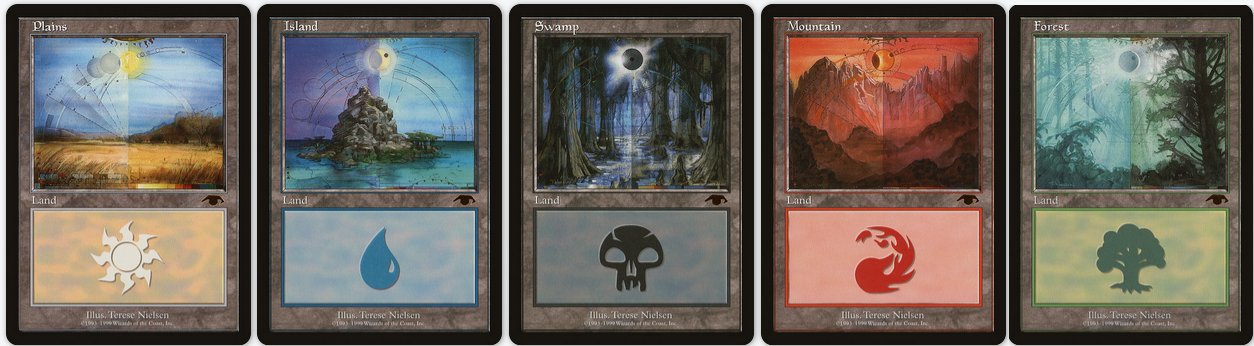
From July 1999 to February 2001, Wizards of the Coast ran The Guru Program, a program to encourage existing Magic players to teach new players the game. Each "Guru" received a teaching kit including sample decks and earned points towards rewards for each person they taught to play. For every ten points a Guru accumulated, they were awarded a booster pack of the current set, and a unique-to-the-program Guru basic land, chosen at random.

I participated in the program for the early part of its duration and received my set of Guru basics in mid-2000. At the time, I was hot on building a new blue/red mana denial deck in Standard using Parallax Tide, and Tangle Wire and was actively trading for those and other rares to complete the deck.

At the time, I kept most of my Standard-playable cards together in one binder, and it was in this binder that I slipped my Guru lands. When I found a guy who had all the cards I needed for my deck, I was trading out of this same binder. He immediately spotted my Guru lands and offered me most of the rares I was looking for in exchange for the five of them.

The five Guru Basic Lands

The latest issues of Scrye and Inquest we were trading with didn’t list the price of the Guru lands, but the owner of our LGS had his personal set in the case for sale at about $10 each. I was trading for Tangle Wires and Parallax Tides at $8 and $6.50 each respectively, so on paper I was getting a great deal trading for playsets of both for my set of Guru basics, but something about the trade felt off to me. I felt an attachment to the lands because of the effort I’d put into obtaining them, and they were unique compared to the rest of the lands in my collection. I made the trade, built my new Standard deck, and enjoyed playing it, but I regretted parting with my Guru lands. This regret only intensified as they climbed in value exponentially in just that first year.

Lesson: If The Deal Doesn’t Feel Right, Just Don’t Do It

No matter how much value you appear poised to gain, if something about a deal feels off to you, it’s always better overall to just walk away. Sure, if I’d held on to my Guru lands I’d have certainly been forced to work harder to acquire the cards for my Standard deck, but I could have done so without giving up what turned out to be a lot of long-term value both personally and monetarily.

Best Practice: If It’s Not For Trade, Don’t Put It In Your Trade Binder

After this situation, I moved my cards that were for trade into a separate binder, and the only cards that went into that binder were cards I was absolutely prepared to part with. Doing this not only keeps me from having any qualms about what I’m trading away, but it also saves anyone I’m trading with time and aggravation. While it may seem an obvious solution for seasoned MTG financiers, I still regularly sit across from folks trying to make a deal only to find that most of what’s in their binder isn’t for trade, or they are hesitant to part with their cards, as I was in this example. Keeping your trade fodder separate from your real collection makes everyone’s life easier.

Mistake 4 (2009): Trading My Dark Depths For Way Less Than Their Value

There was an error retrieving a chart for Dark Depths

Today Dark Depths is a powerful and valuable card. Banned in Modern, it sees play only in Vintage, Legacy, and Commander. When Coldsnap first came out in 2006 though, the card was bulk, and I managed to pick up multiple playsets of them as throw-ins in trades because I thought the card was quirky and nostalgic. Fast-forward a few years later, the card had crept up in price, and I began trading away my stash of them at $3 each.

In September 2009, an answer to planeswalkers and anything else with counters on it was spoiled in the new Zendikar set. Vampire Hexmage not only killed planeswalkers, and answered some cards with counters, in combination with Dark Depths, it allowed you to quickly cheat out a Flying, Trampling, Indestructible 20/20. Dark Depths quickly shot up in price to around $20 or more. Not having seen the spoilers that day, I traded six of my copies of Dark Depths away at the $3 going rate they’d been at and didn’t realize until later that the price had exploded.

Lesson: Pay Attention To Spoilers, And Always Double Check Prices

I can’t emphasize enough the importance of spoiler season when it comes to not only making value but protecting yourself from loss. Had I been paying attention, I could have either traded my Dark Depths at the new higher price, or if the price hadn’t immediately spiked, have the knowledge that it likely would increase, and hold my copies rather than move them at a lesser price. I imagine every store who recently sold out of their copies of Chain Of Smog in the hours after Professor Onyx was first spoiled before bumping up their prices felt the same pain I felt trading away my Dark Depths.

Best Practice: Do Your Homework Before Making Any Deals

Sometimes sites won’t have up-to-the-minute price updates. That’s why it’s important to keep up on spoilers so you can react appropriately. As notable fantasy author Terry Goodkind is attributed to have written, “Knowledge is a weapon. I intend to be formidably armed.”

Mistake 3 (1998): Cashing Out My Non-Standard Cards To Buy My First Car

In 1998 I was desperate to raise enough money to buy my first car, every teenager’s first major financial investment. I decided to get quick money by cashing out the non-Standard part of my Magic collection, because I wasn’t using them. At the time, my Revised duals were retailing for $10-$15 each at most, so I took the $5 each I was offered for them, plus money from other rares, and walked out with under $200 cash in my pocket. I bought the car, a 1987 Chevy Monte Carlo with low miles, and it was a great first car, but the full-time job I picked up that summer paid way more in a week than the chump change I’d parted with my collection for.

Lesson: When Cashing Out, Only Cash Out As Much As You Have To

Ultimately, I realized I shouldn’t have cashed out as completely as I did, as I wasn’t quitting Magic. There may be times when we need money more than we need cards, but ultimately, if you’re not quitting the game entirely, and you don’t need the money immediately for survival, it’s better to hold cards that you’ll possibly want to use down the road. If you sell them and want them later, you may be forced to buy them back at an inflated premium, as I was forced to do over the next several years.

Best Practice: Always hold onto your mana base.

There was an error retrieving a chart for Underground Sea

If you’re not permanently quitting Magic, but needing funds has you considering cashing in, the best thing I could suggest is not to cash in your mana base. Sell your Thoughtseizes, your Force Of Wills, whatever you need to, but holding onto your duals, your shocks, or your fetches means you’ll have a much easier time jumping back in when whatever’s going on in your life settles down. The most expensive part of a constructed deck, depending on the format or decklist, is usually the mana base, so it’s the only part of my collection that I’m willing to hold onto at all costs.

Mistake 2 (2019): Sleeping on Mystery Booster "Playtest" Cards

When Mystery Booster playtest cards hit the market, they screamed to be added to my cube of Un-, Conspiracy, and quirky cards from throughout Magic’s history (looking at you Shahrazad). I assumed incorrectly when learning about them that they were part of the regular run of Mystery Booster products, akin to the recent Mystical Archives of Strixhaven, and not something exclusive to “convention edition,” boxes of the product. With the main cards in the set mostly unappealing to me, I didn’t pay much attention to the set, and slept on buying any of the playtest singles floating around at reasonable prices throughout most of 2020.

Lesson: Pay Attention To The Product Details And Know When To Buy

Pretty much any point in 2020 would have been a decent time for me to move in and start picking up Mystery Booster playtest cards. While the top-end cards like Slivdrazi Monstrosity have spiked and fallen and spiked again, many of the lower-priced cards like Wizened Arbiter and Bucket List fell from their initial highs and remained relatively flat for most of 2020.

Best Practice: If It’s Something You Want, Move In When You Can

For cards that I’d planned to buy and hold for personal use, I should have moved in on most of them early after the initial hype died down and prices flattened. Instead, I’ll be looking to draft as many events as I can at my LGS from the small round of product coming to them soon as part of WOTC’s Summer Of Legend, and hoping the influx of product will take the prices of singles back down to 2020 levels.

Mistake 1 (1997): Not Buying A Mint Unlimited Black Lotus For $275

As soon as I turned sixteen, I rushed out and got my first job bagging groceries at the local grocery store. Two weeks later, when that first sweet paycheck arrived, I went straight to the local card shop. My plan was to either buy Cursed Scrolls for Type 2 (Standard), or buy a couple booster boxes of Tempest and hope to crack them. As had been the case for weeks, the shop had no singles in stock, but the shop owner pulled two boxes of Tempest from the shelf behind him and put them on the counter next to the register.

“Before I ring you out for these, let me show you something,” he said. He took me to a glass case that used to be filled with high-end sports cards, and now had several shelves of Magic singles on display. He opened the case, removed a card from its stand, and put a mint Unlimited Black Lotus in my hands. It was an awesome moment. I had some Unlimited, Beta, and Alpha cards in my collection, mostly commons and uncommons, but I’d never even held a piece of power in my hands before that moment.

“I’ll do it for you for $275,” he said.

There was an error retrieving a chart for Black Lotus

Faced with a choice of rolling the dice on two boxes of Tempest and not pulling the cards I needed for Standard, or owning not just an actual piece of power, but the most sought-after card in all of Magic, I hesitated. Either way, this was my entire first-ever paycheck I’d be spending in one purchase. Did I want to spend that on just one card? It’s laughable in retrospect, but these were the thoughts flashing through my sixteen-year-old brain. I handed the card back to him, walked away with my two boxes of Tempest, and away from the cheapest Black Lotus I ever had a chance of purchasing.

Lesson: When A Unique Opportunity Presents Itself, Take It

While I can and did have more opportunities to acquire cards for that Standard deck, that Black Lotus I passed up on buying was sold when I went back to the shop less than a week later. I never saw one in as good condition for that kind of price again. The lesson I begrudgingly learned was that sometimes unique opportunities will come along, and it’s important to be able to recognize those situations and act accordingly.

Best Practice: Be Open To Possibilities Beyond Your Goals And Expectations

I went into the shop looking to buy cards for Standard. By having that rigid goal, I was so tunnel-visioned into purchasing Tempest cards I was unable to recognize the unique opportunity I was presented and to act on it. By keeping expectations open in all my MTG financial moves, and in life in general, I’m better able to act on unique opportunities when they appear.

These are some of the mistakes I’ve made over the years, and the lessons I’ve learned from them. While I know I’ll make more mistakes, the goal is always to learn not only from one's own experience but also from the experiences of others, which helps us all be better prepared to make informed decisions.

What are some MTG finance mistakes you’ve made over the years, and what lessons did you learn from those experiences? Please share in comments or email me at pauljcomeau@gmail.com. I can’t promise I’ll respond to everyone who emails, but I’m interested to hear your own stories, lessons, and best practices.

Modern Horizons 2: Spoilers and More!

Are you a Quiet Speculation member?

If not, now is a perfect time to join up! Our powerful tools, breaking-news analysis, and exclusive Discord channel will make sure you stay up to date and ahead of the curve.

OH BABY IT'S TIME! Modern Horizons 2 is scheduled to be released on June 18, 2021. Like the original Modern Horizons, this set will be introducing new cards to Modern and the other eternal formats while never being legal in Standard. There will be 303 cards total in the set, with 42 of them being reprints. Modern Horizons 2 will include draft boosters, set boosters, collector boosters, a bundle, and will be the first non-Standard set with prerelease packs.

Exciting news - all five enemy-colored fetchlands appear in the rare slot and will be able to be found in regular draft boosters! They are also continuing the "old" frame treatment for some of the cards in this set, including the fetch lands. Check back with us frequently for the latest spoilers and my MTG Finance flavored commentary! I’ll be covering our favorite highlights from spoiler season – if you want to see the entirety of everything that has been spoiled you can check out Wizards’ updated card gallery once it has gone online.

June 2, 2021

The time has come, my friends, all of Modern Horizons 2 has been spoiled! What do you think? What are you most excited about? Let me know in the comments, in the QS Discord, or hit me up on Twitter!

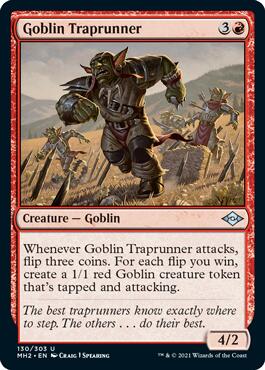
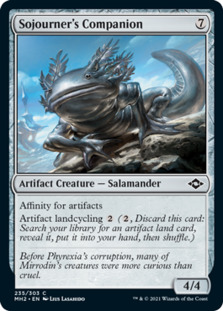
We get a fun uncommon goblin today! Goblin Traprunner probably won't see any constructed play, but I'm definitely going to try to draft it because I am a masochist who likes flipping coins! Sojourner's Companion is an awesome-looking affinity Salamander that I imagine will see play in several formats, and it's pretty cute to boot!

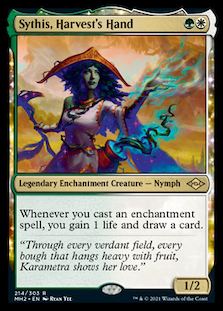
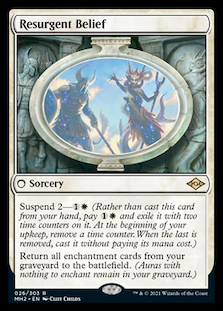
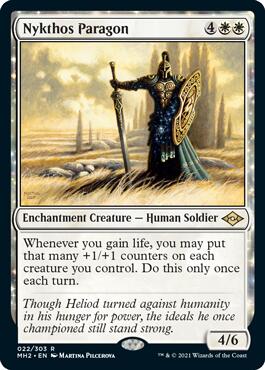
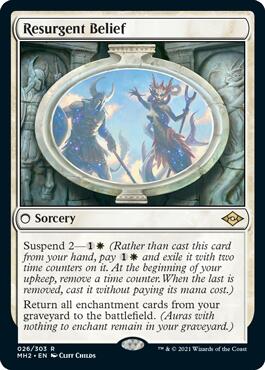
Nykthos Paragon looks like a fun enchantment/lifegain piece in Commander and Enchantment players are going to love Resurgent Belief!

June 1, 2021

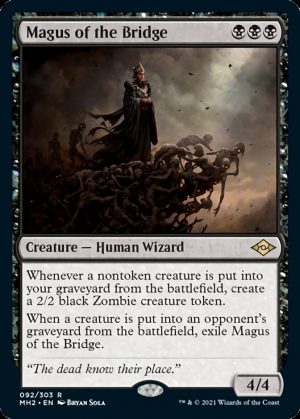
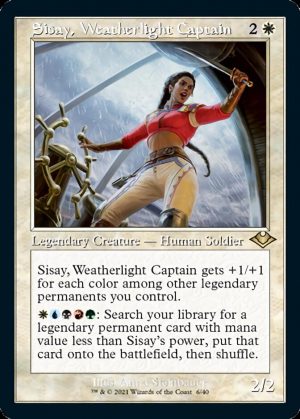
Magus of the Bridge and Sisay, Weatherlight Captain!

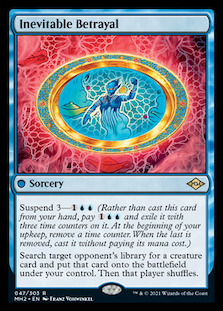
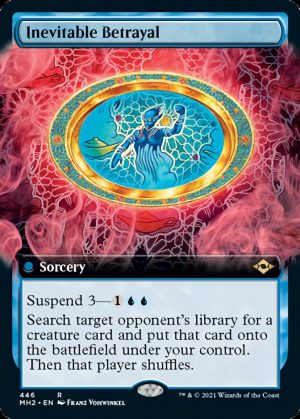
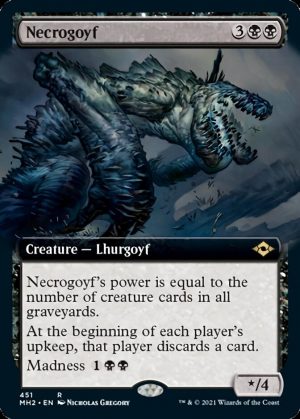
Inevitable Betrayal and Necrogoyf!

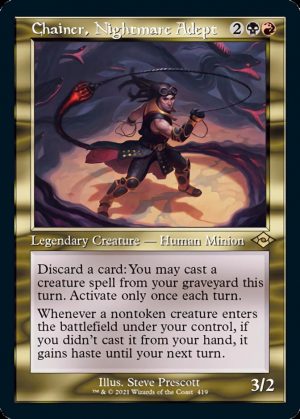
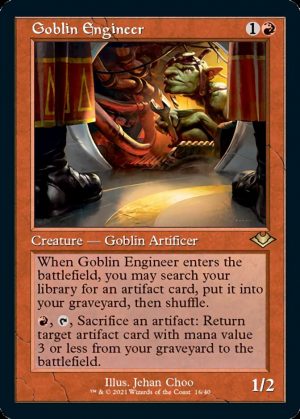
Chainer, Nightmare Adept and a Goblin Engineer reprint!

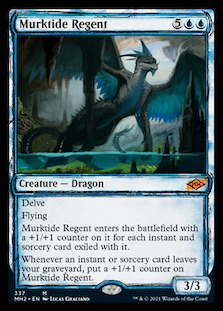
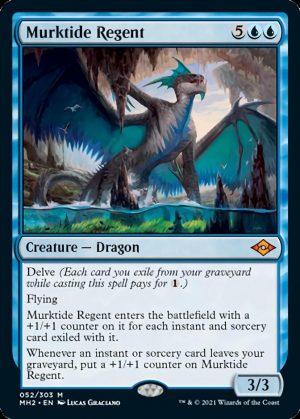
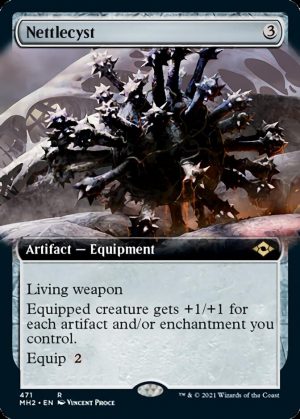
Murktide Regent and Nettlecyst!

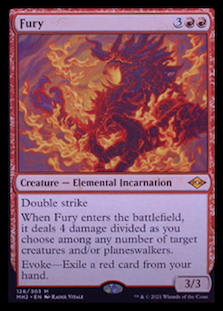
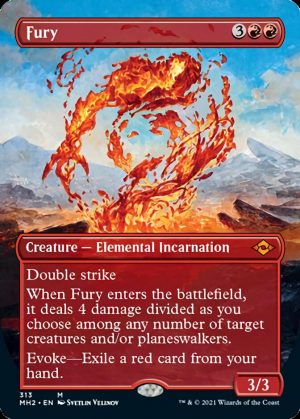
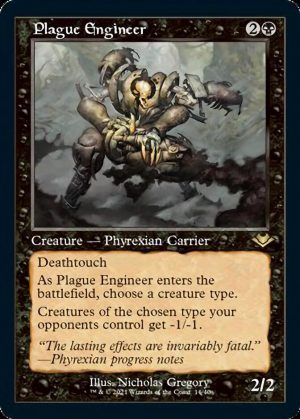
Fury and Plague Engineer!

May 31th, 2021

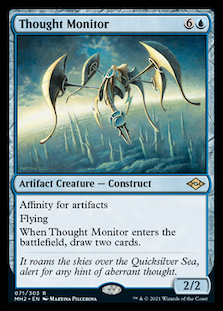
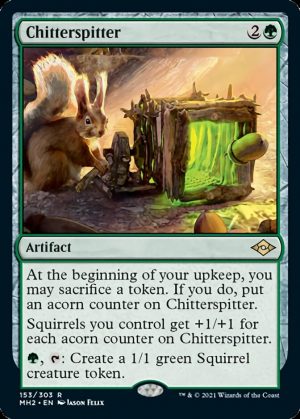
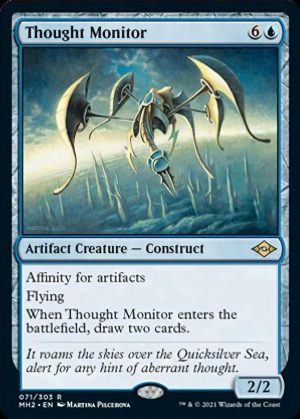
Chitterspitter is one of the funniest card names I've ever seen, and I might be in love with it. Squirrel fans rejoice! Thought Monitor is a sweet creature for Affinity fans. with gorgeous art to boot!

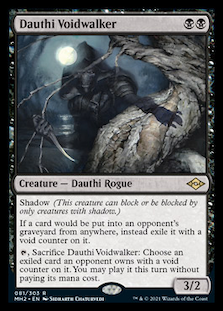
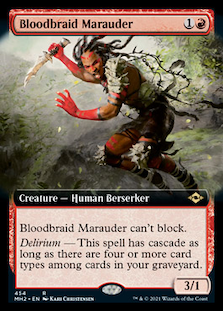
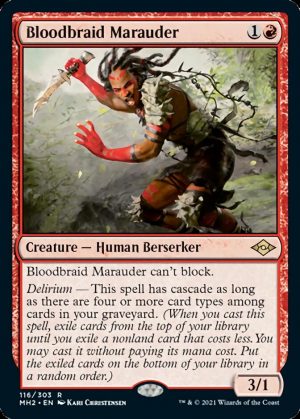
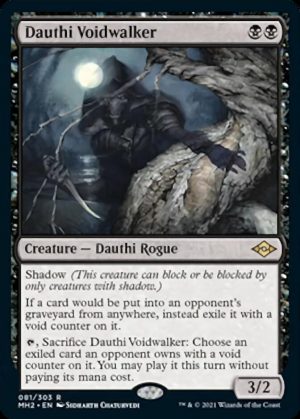
Bloodbraid Marauder's Delirium cost giving it cascade is going to make for an interesting, aggressive card in Modern that I'm excited to see played! Dauthi Voidwalker is some super sweet anti-graveyard tech with a bonus for players playing heavy black!

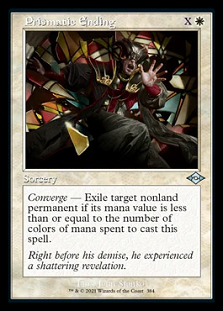
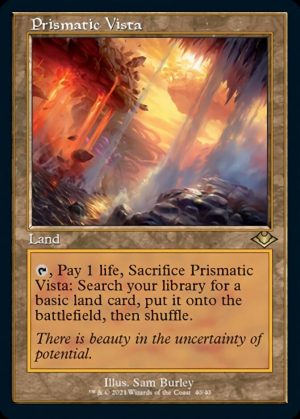
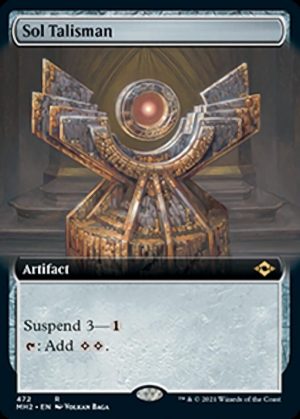
The retro Prismatic Vista is making me drool! How cool does it look with this treatment? Sol Talisman is quite the interesting way to bring a Sol Ring effect to modern - how good do we think this is going to be in Modern?

May 29th, 2021

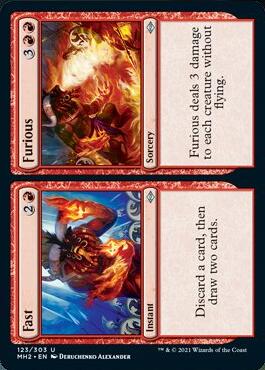
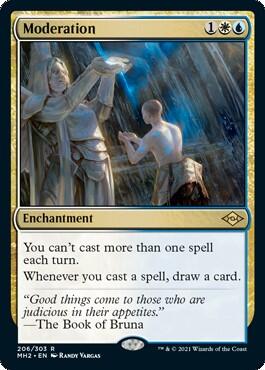
Fast and Furious! Moderation!

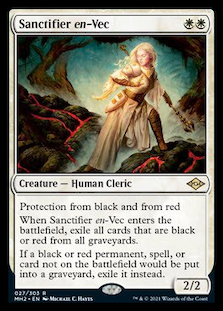
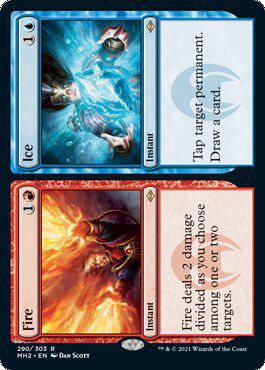
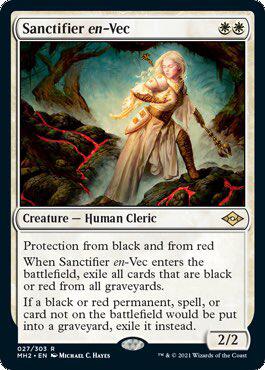
Fire and Ice and Sanctifier en-Vec!

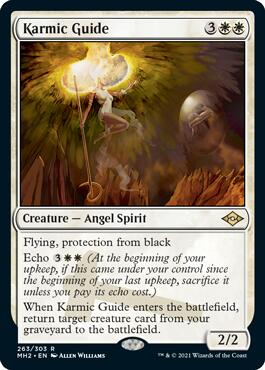
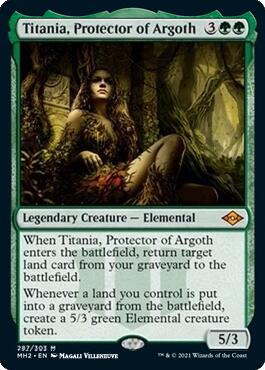
Karmic Guide and Titania, Protector of Argoth!

May 28th, 2021

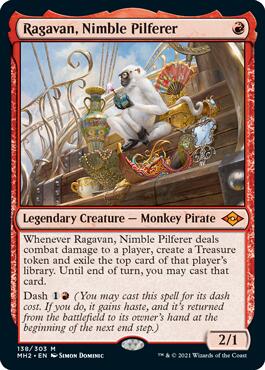
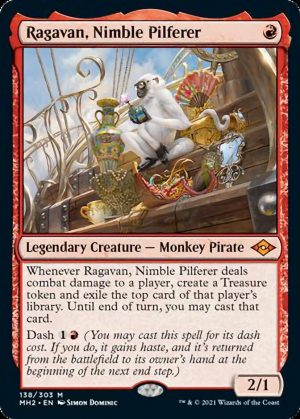
I never knew it was something I desperately wanted, but dear reader, you better believe I squealed with joy when we found out that Ragavan, Nimble Pilferer was getting its own card! Previously just seen as a token produced by partner in crime Kari Zev, Skyship Raider, it's about time our favorite monkey pirate got some time in the sun!

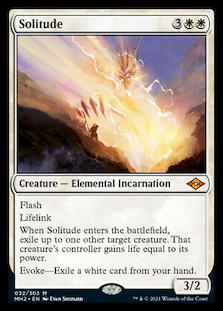
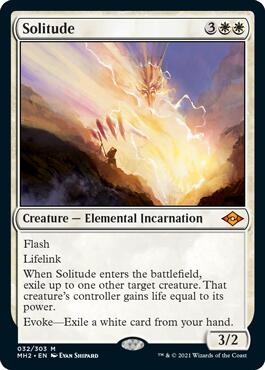
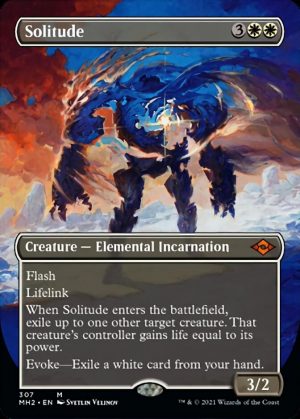
Solitude is basically a Swords to Plowshares on a creature, and it seems pretty dang powerful. I'm sure this will see plenty of play with its evoke cost.

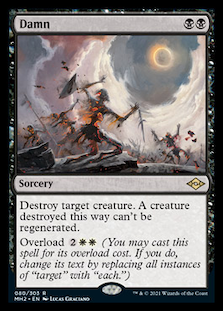
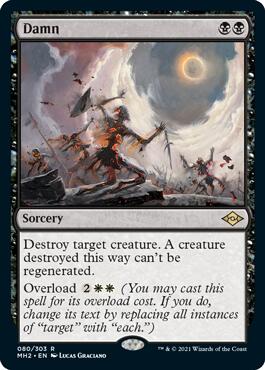
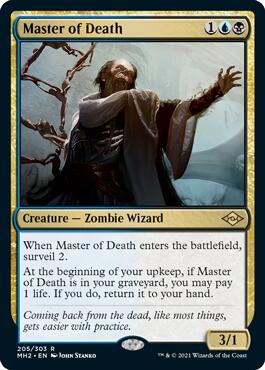
Damn and Master of Death!

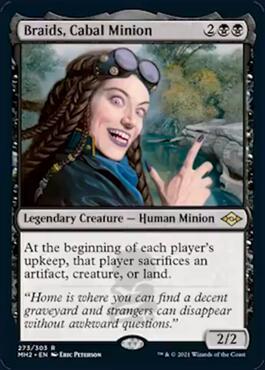
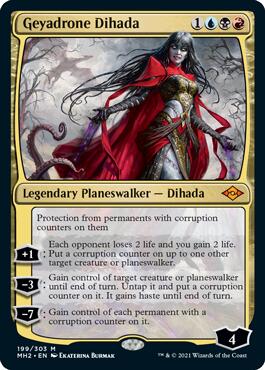
Braids, Cabal Minion and Geyadrone Dihada!

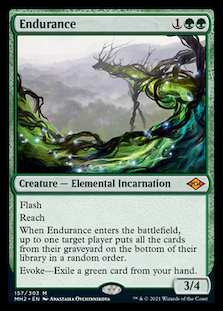
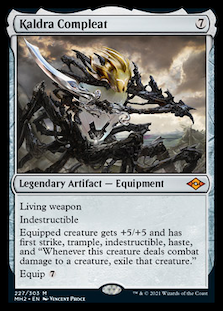
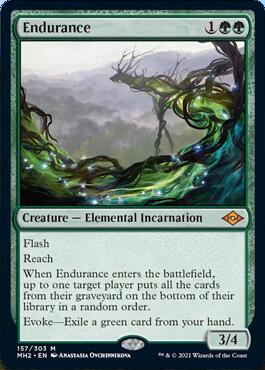
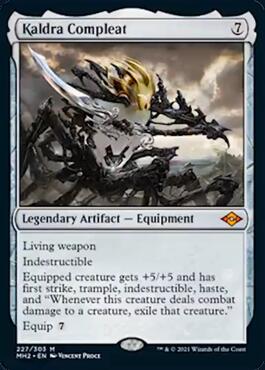
Endurance and Kaldra Compleat!

May 27th, 2021

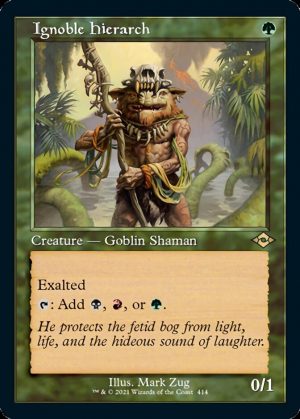
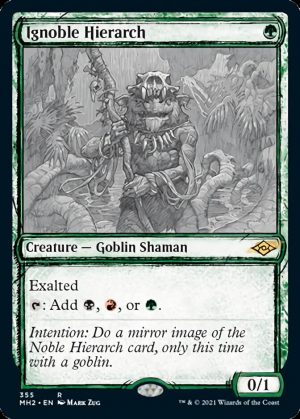
Well, well, well. Ask and ye shall recieve! I was begging for the alternate arts for Ignoble Hierarch and my wish was granted! I can't wait to add these to my Goblin collection!

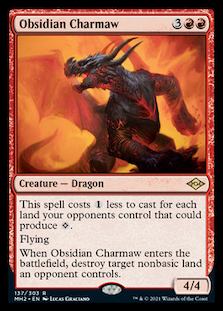
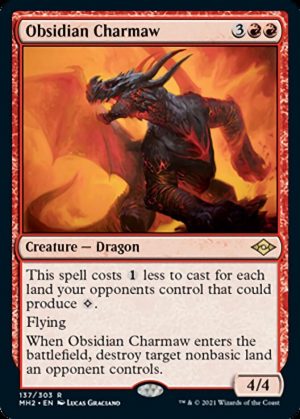
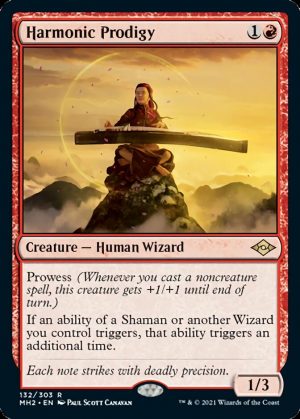
Harmonic Prodigy and Obsidian Charmaw!

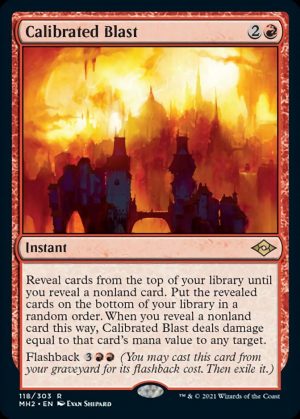
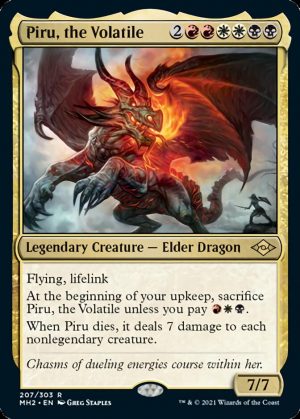
Calibrated Blast and Piru, the Volatile!

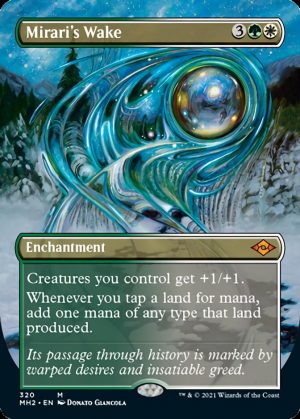
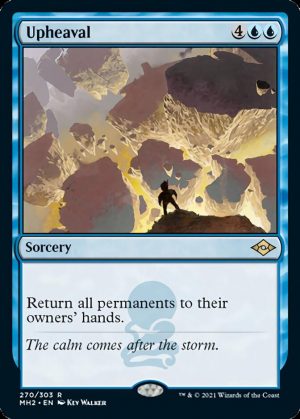
Mirari's Wake and Upheaval!

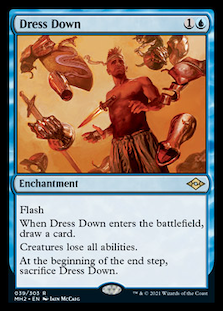
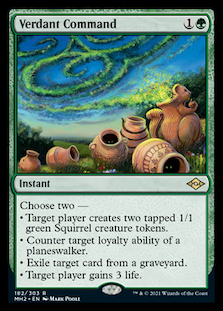
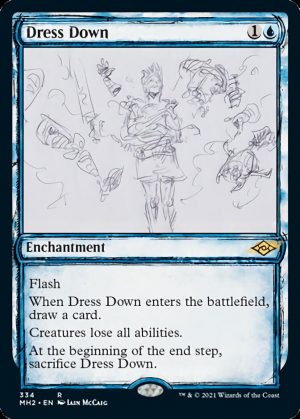
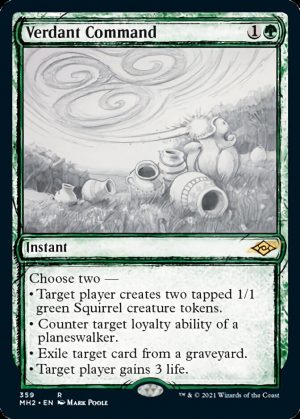
Dress Down and Verdant Command!

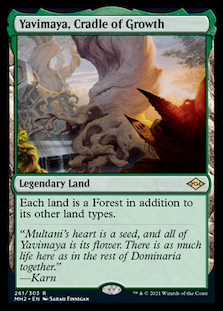
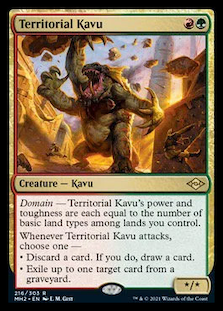
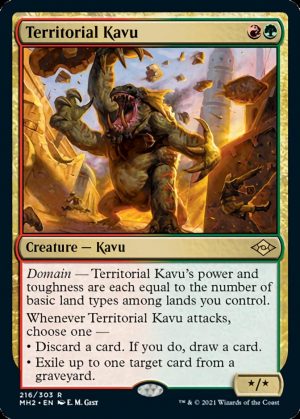
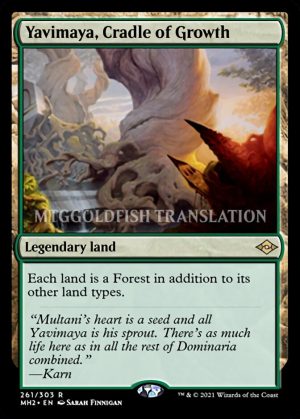
Territorial Kavu and Yavimaya, Cradle of Growth!

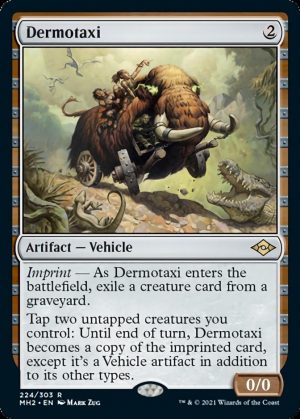
Dermotaxi and HOLY MOLY Ragavan, Nimble Pilferer is getting it's own card!

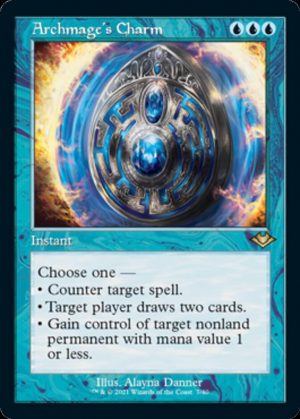
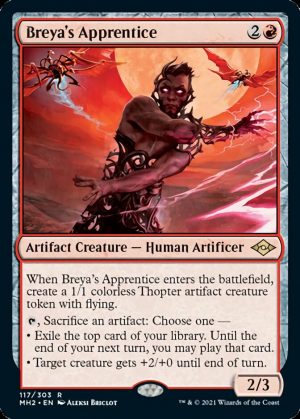
A neat retro Archmage's Charm and a thopter making Breya's Apprentice!

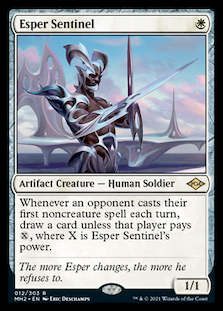
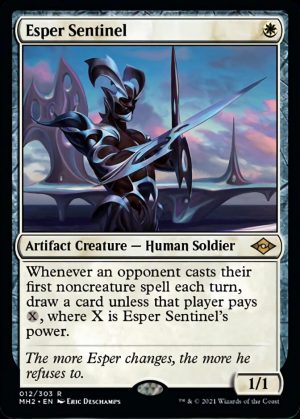
Esper Sentinel and Solitude!

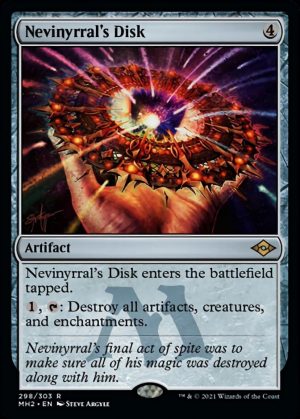
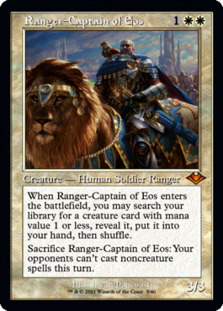
Nevinyrral's Disk[card] reprint and a very pretty [card]Ranger-Captain of Eos!

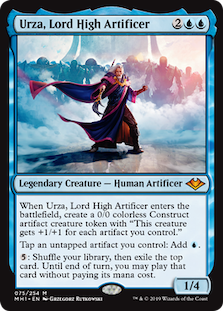
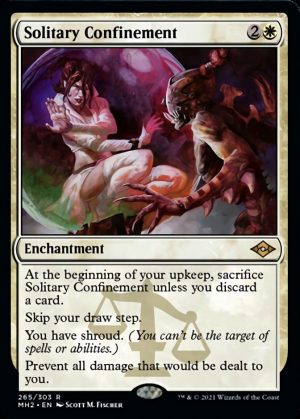
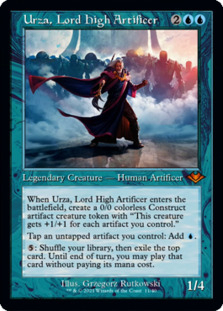
Solitary Confinement and Urza, Lord High Artificer!

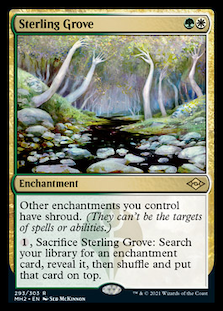
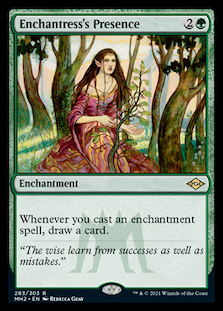
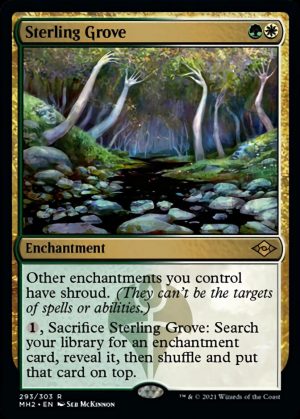
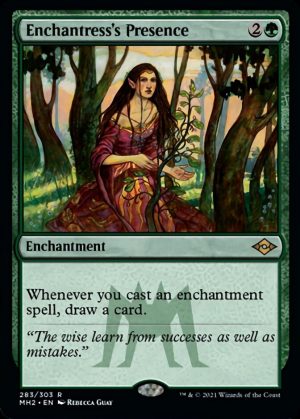
Sterling Grove and Enchantress's Presence!

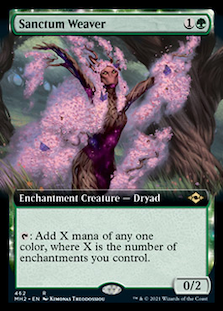
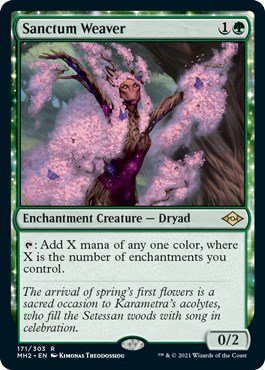
Sanctum Weaver seems pretty darn good in an enchantment build!

May 26th, 2021

OH MAN OH WOW I FEEL LIKE THEY PRINTED A CARD JUST FOR ME:

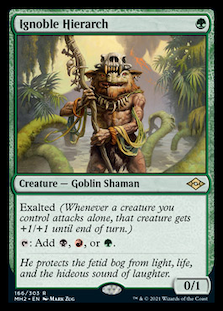
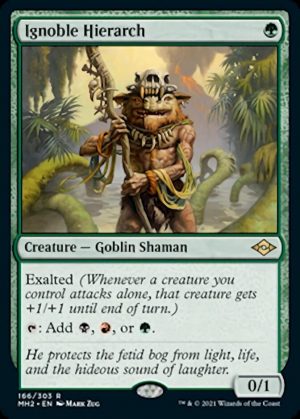
Ignoble Hierarch is a goblin - which anyone who has consistently read my articles knows is my absolute favorite tribe in Magic. I play goblins in every format, and this fun-hating little shaman is going to be tested in all of the ones it's legal in. Not only does this check the box of my ultimate love in Magic, it checks another one of my favorite boxes: it's playable in Modern Infect (which, as I've mentioned before was my first Modern deck and still my favorite pet deck in the format.) This might be the piece that brings the BG Infect lists back into the limelight! People are going to be seriously testing red pump spells! At the very least, I feel like this is Noble Hierarch number five (or six) in the UG infect lists that were running Birds of Paradise in that slot.

Bottom line - I'm in love with this card and crossing my fingers we get a sketch and old frame version.

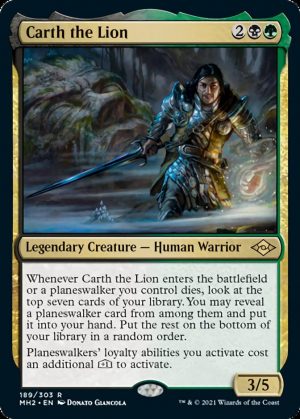
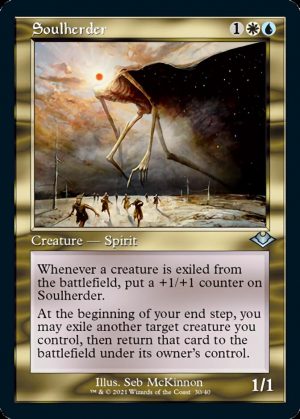
Carth the Lion and Soulherder!

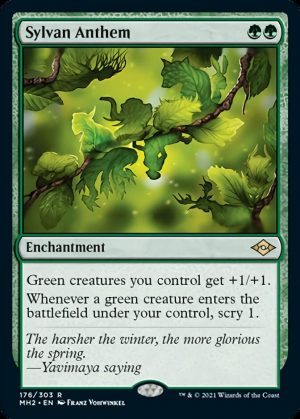
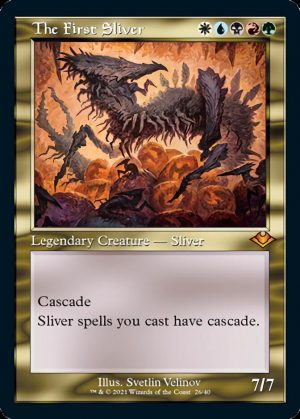
Sylvan Anthem and The First Sliver!

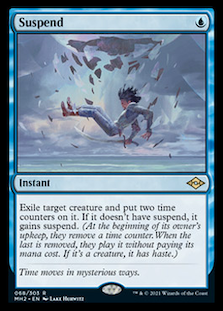
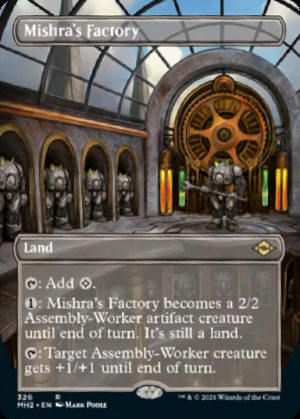
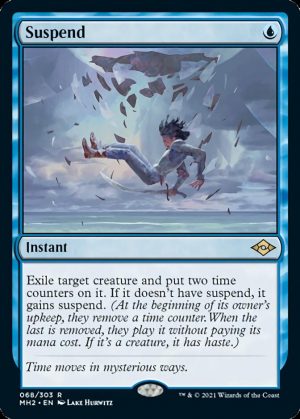
Mishra's Factory and Suspend!

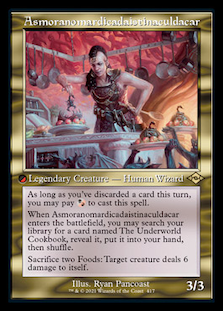
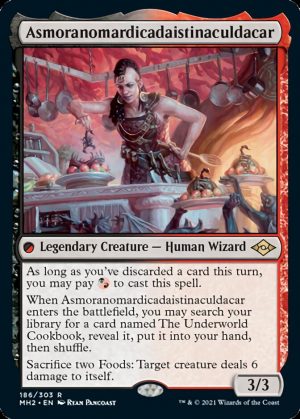
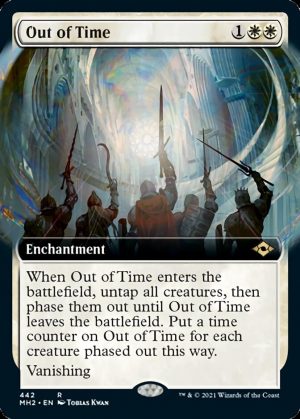
Asmoranomardicadaistinaculdacar is a mouthful and this Out of Time is very pretty!

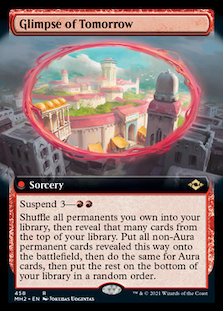
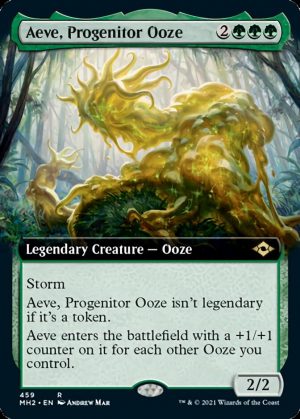
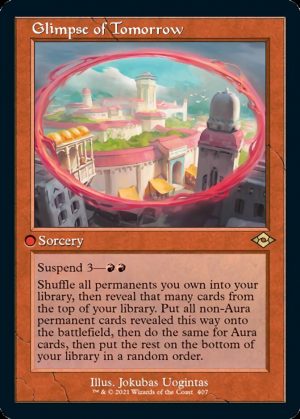
Aeve, Progenitor Ooze and Glimpse of Tomorrow!

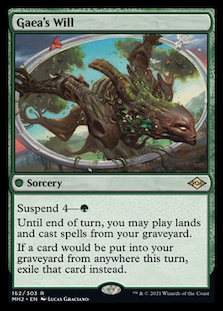
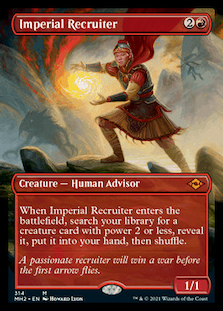
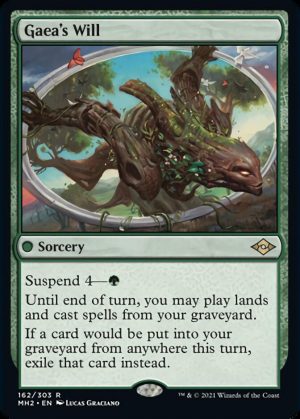
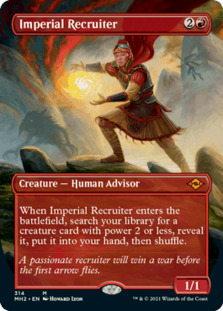
Gaea's Will and holy moly humans is getting yet another toy with Imperial Recruiter's reprint!

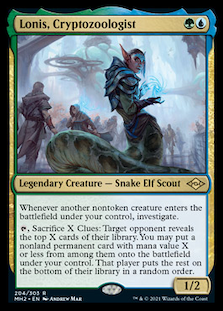
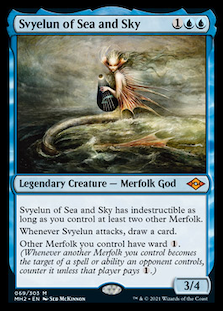
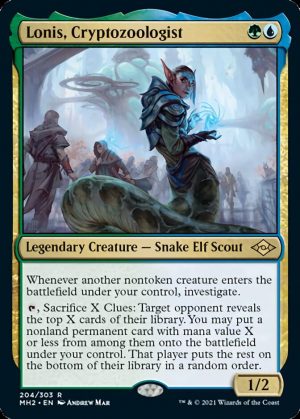
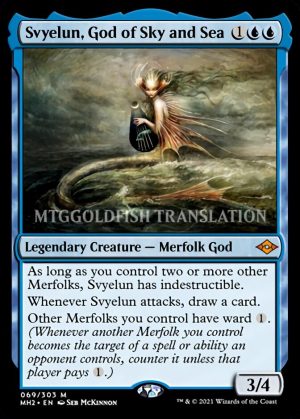
Lonis, Cryptozoologist and Svyelun, God of Sky and Sea!

May 25th, 2021

Another day of exciting spoilers awaits us! How is everyone feeling about the set so far? I'm getting pretty pumped to try and draft it a few times!

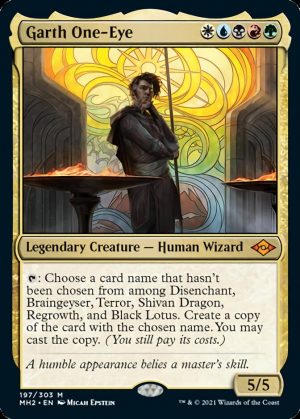
Black Lotus in Modern, Legacy, and Commander? Sort of? Garth One-Eye is a super interesting Legendary Creature with the ability to make copies of some classic cards. I imagine Garth will be relegated to casual Commander tables, but I dig the design and look forward to seeing how people end up using it!

There was a lot of speculation after the squirrel spoilers yesterday that we might be getting a reprint of Deep Forest Hermit - and here it is! I love the frame on this one. Speaking of squirrels... we got even more squirrel hype at the end of the day!

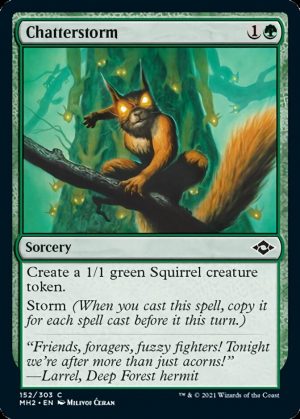
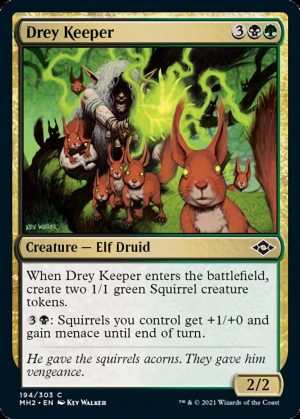
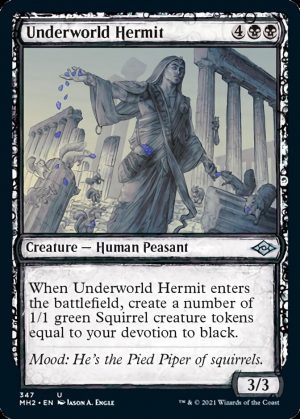
Chatterstorm already has the Pauper community a little worried. Storm wincons have proven to be problematic in the past, so this will be one to keep an eye on. In the meantime, I'm going to try to storm off with SO MANY squirrels! Drey Keeper has some of the best flavor text I've ever seen, and it looks like it could be a ton of fun in Draft or Commander. Speaking of flavor text, the sketch version of Underworld Hermit made me laugh out loud when I saw it on Twitter. Again, this is probably only at home in Draft or Commander, but it's a sweet card.

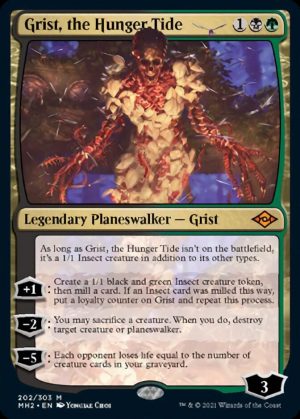
Grist, the Hunger Tide is one of the coolest designs for a planeswalker that we've seen in a long time. Because of it being a 1/1 Insect whenever it's not on the battlefield, it can be your commander, it can be found by all kinds of spells that normally couldn't find a planeswalker, and it is primed for all kinds of wacky three-mana planeswalker Shenanigans (which is also getting a reprint in this set at uncommon)!

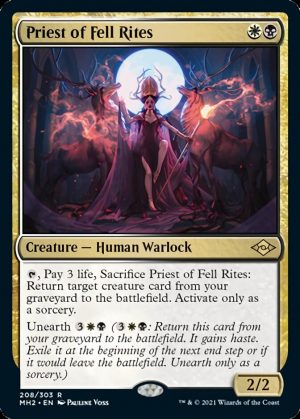
Priest of Fell Rites is a nifty way to get stuff back out of the graveyard, and it comes with Unearth too!

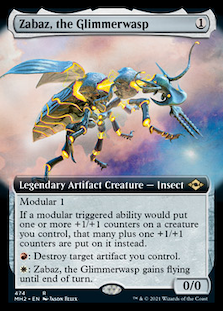
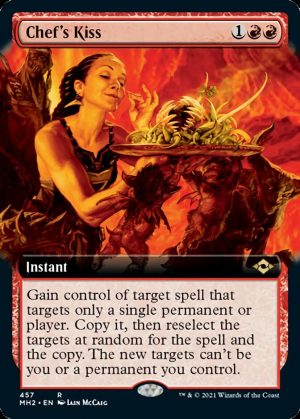
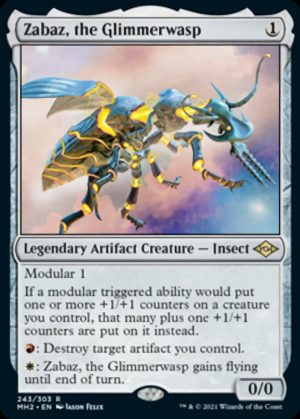
Chef's Kiss might win the prize for best Magic card name ever, and it will make for some random hilarity in your Commander games! Zabaz, the Glimmerwasp is a neat design, but I don't know if it's cool enough to make all the affinity lovers out there forget about the loss of their beloved Mox Opal in Modern.

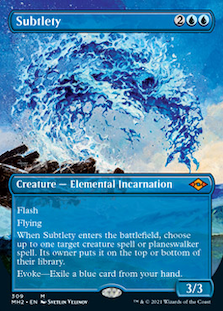
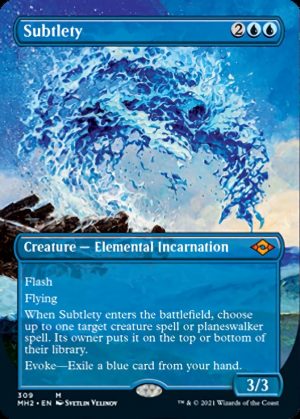
Well, it looks like Wizards decided Force of Will was too powerful for Modern but they gave us something kind of close with Subtlety - a similar effect on a creature! This will be a fun one to watch as it enters the Modern format.

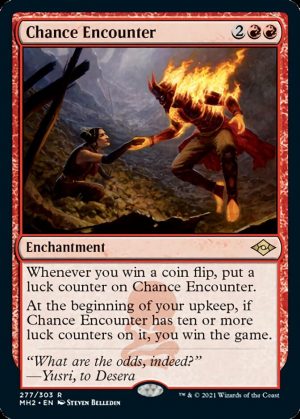
We also get another fun coin-flip card for those players who love leaving their victories up to chance in Chance Encounter. This is a pretty sweet win-con if you have enough coin-flips packed in your deck! Will it see Modern or Legacy play? Maybe. It'll for sure feature in those sweet, sweet coin-flip Commander decks I love so much.

May 24th, 2021

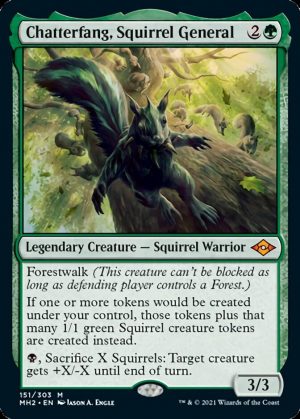
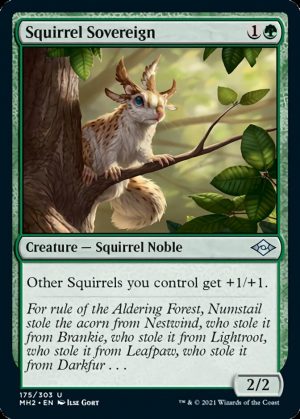
This morning we were treated to fantastic news: a new squirrel commander! Chatterfang, Squirrel General looks like a super fun build-around card for tribal Commander fans out there, and I know that people are going to do their best to make squirrels happen in Modern too! That lofty goal will be helped along by our brand new squirrel lord, Squirrel Sovereign! A classic 2/2 for two mana lord, Squirrel Sovereign will be awesome to draft at uncommon and be a boon to anyone trying to make squirrel tribal happen in any of the constructed formats it is legal in.

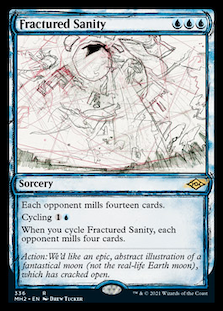
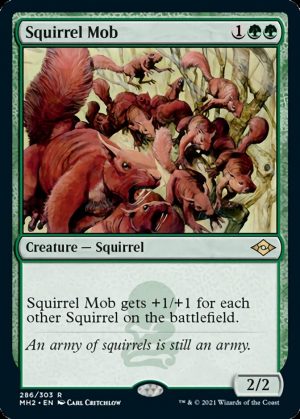
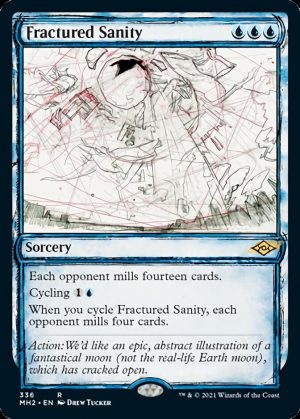
To go along with those squirrels (and a couple other uncommons not shown in this article) we get a Squirrel Mob reprint! Another archetype getting some love is Mill, with the pretty intense seeming Fractured Sanity. Will this be enough to push the Modern Mill archetype up a tier? Possibly! Time will tell!

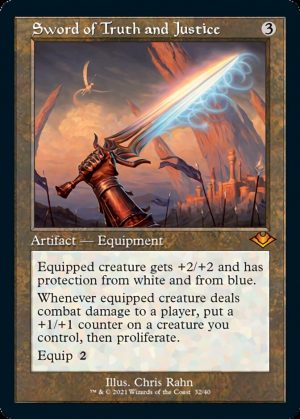
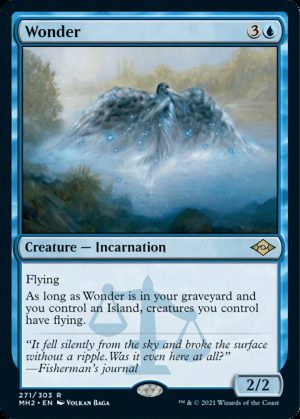
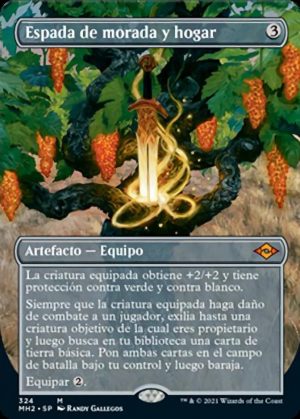
We are also getting a cool Timeshifted style reprint of Sword of Truth and Justice! We are also getting a reprint of Wonder, which I would argue is less exciting but still kind of neat.

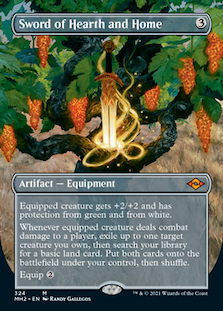
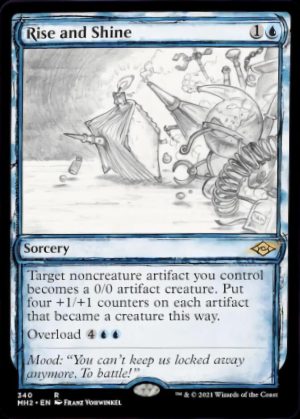
Rise and Shine seems like a pretty neat addition to artifact-based decks, and the sketch version looks AMAZING! Sword of House and Home (which might not be it's actual title) has my Taxes heart feeling full! Here's a potential translation, borrowed from MTGGoldfish:

Equipped Creature gets +2/+2 and has protection from green and from white.

When equipped creature deals combat damage to a player, exile up to one target creature you own and search your library for a basic land card. Put both cards onto the battlefield under your control, then shuffle.

Equip 2.

My head is swimming with potential for the creatures I want to bounce with this, and I can't wait to pair it with my friend Stoneforge Mystic!

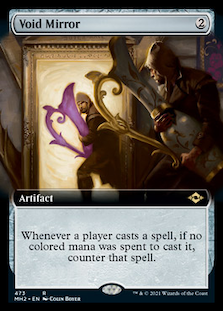
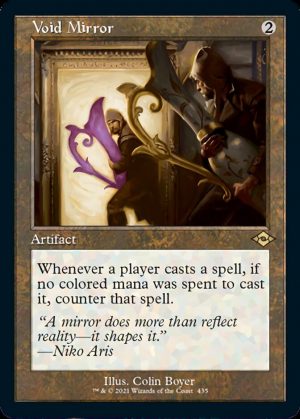
Void Mirror takes the cake for the most drama caused on Twitter so far for this spoiler season. This card is going to be sideboard gold against all forms of Tron and some Affinity style decks, to the point that if it drops early enough you're going to be shuffling up and moving onto the next game. Time will tell if it's going to be effective enough to warp the meta, but it's definitely a card that will be living in most Modern players' sideboard for a good long time after release.

May 20th, 2021

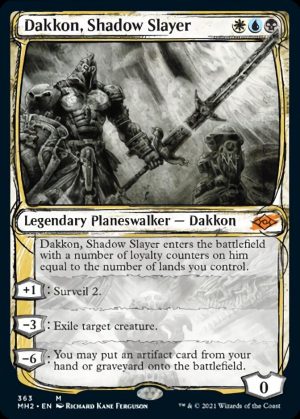
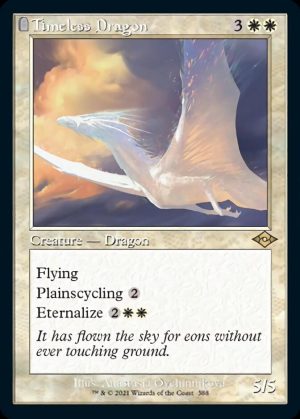
Hot dang, there was a whole slew of cool cards spoiled today! Most of the cards spoiled today have several different printings, but for the purposes of saving space, I'm going to default to the Timeshifted frame versions because I like them best.

Dakkon, Shadow Slayer's sketch art is gnarly! At first glance, I don't see it making a huge impact in Modern or Legacy right out of the gate, but I think it will be an interesting card to play with! Timeless Dragon is neat! I like the flavor a lot, and it seems like it'll be a fun one to play in Sealed or Draft events.

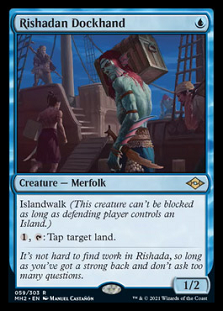
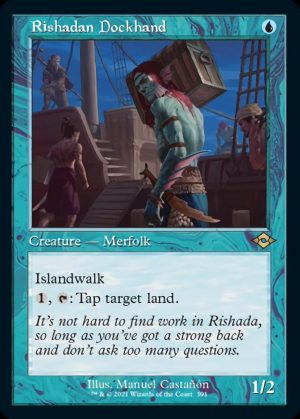
I saw a lot of Merfolk players getting pretty excited about Rishadan Dockhand on my Facebook wall today! This is a very classic feeling Merfolk. With Islandwalk and the ability to tap a land, this one drop will make a cool, aggressive addition to the Fish decks out there.

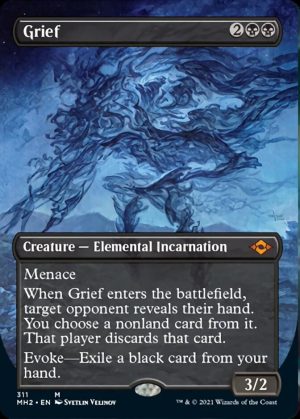
I think this art for Grief is both very pretty and very spooky. This is basically a Thoughtseize that you can pay for like a Force of Will, which seems pretty dang good to me and I wouldn't be surprised to see it being played across from me in either Modern or Legacy.

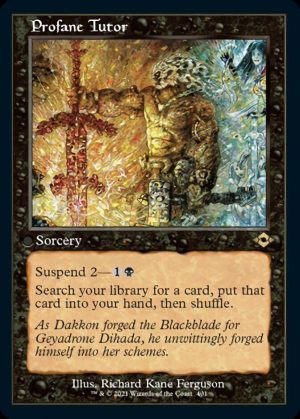
A tutor! With Suspend! And Richard Kane Ferguson art! If my excessive use of exclamation points wasn't a giveaway, I'm pretty excited about this one. I will be looking for excuses to play with it in all of the formats it is legal in!

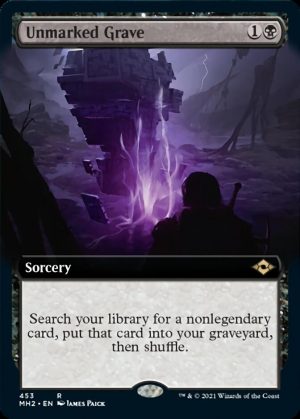
Unmarked Grave is also a tutor, but one for the graveyard aficionados out there. There's a good number of graveyard interaction decks that will be testing this out!

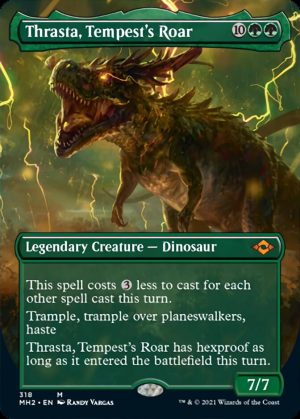
This dino tramples over Planeswalkers! Now that's a line of text I wasn't expecting, and I'm here for it. Thrasta, Tempest's Roar looks like it's going to be a very impressive mythic from this set.

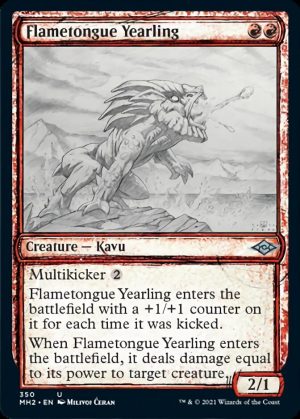
Flametongue Yearling is a neat aggressive uncommon, and I'm particularly hyped on the sketch art. I really enjoy having special arts not just for rares!

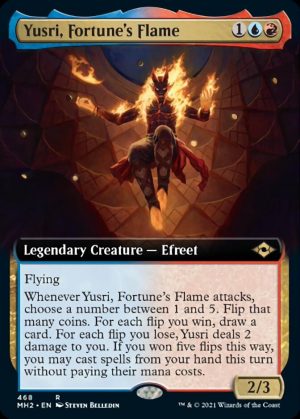
I love coin flip mechanics (I know several members of my playgroup just rolled their eyes reading that just now) and I'm pretty pumped to flip coins with Yusri, Fortune's Flame! My mind goes first to Commander, but I imagine there is potential for some pretty interesting Modern and Legacy interactions as well.

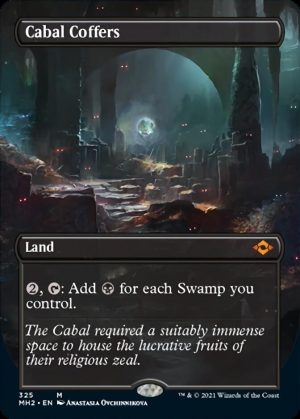
I wasn't expecting to have Cabal Coffers reprinted into Modern, and I feel like it's either going to end up being super busted or not played at all. I'm excited to see what it does though! Plus, it was a much-needed reprint price-wise for newer players who are getting into Commander.

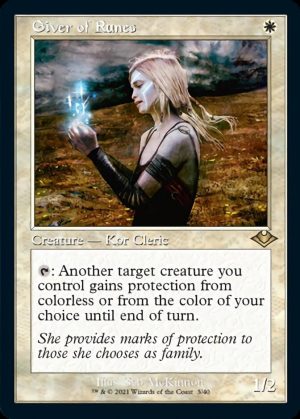
These are probably the two cards I'm personally most excited for, just because the Timeshifted borders look SO GOOD on them! Giver of Runes is a card I play a ton, and I'm super excited to pick up these versions for all of my Taxes shenanigans.

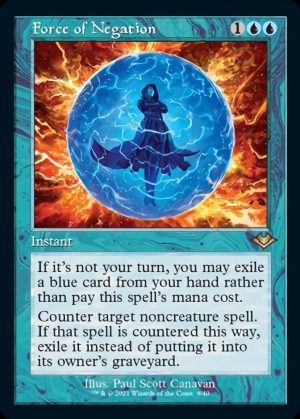
Force of Negation is going to be a huge hit with this Timeshifted version, and I imagine it'll fetch a premium.

May 6th, 2021

There were some pretty exciting cards spoiled today and the hype is building! Before I start drooling over enemy fetches, let's check out the rad Buy-a-Box promo:
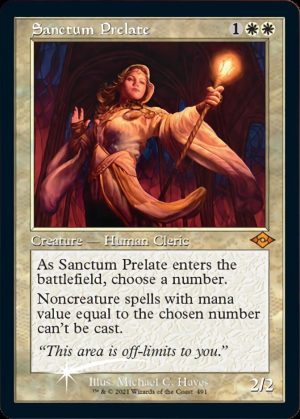
It's a new, old school looking Sanctum Prelate! It won't be found in any Modern Horizons 2 boosters and will mark this Legacy Death and Taxes star's debut into the Modern format. Modern Death and Taxes is going to be excited about this new addition!
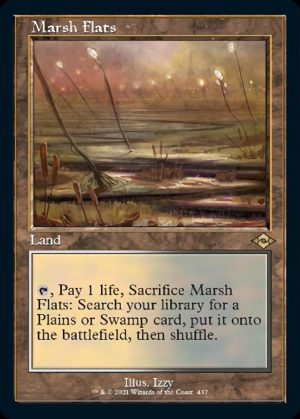
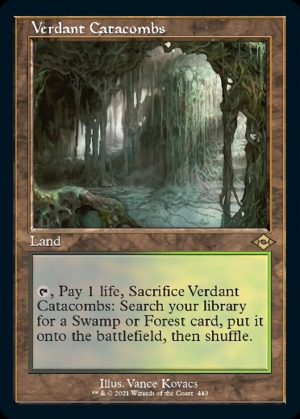
Okay, okay, it's fetch time. The enemy fetches are going to be available with normal art, full art, and possibly most exciting (for me) of all: old frame art!

Marsh Flats and Verdant Catacombs!

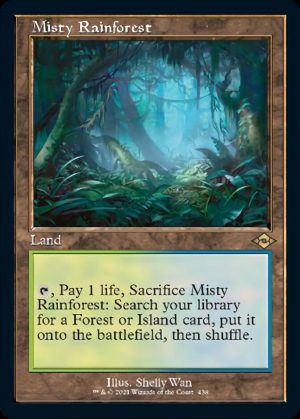
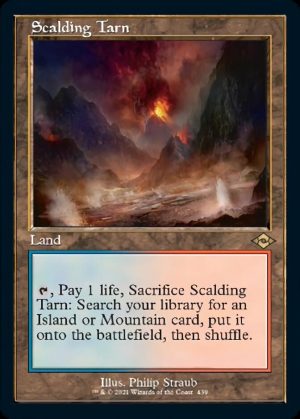
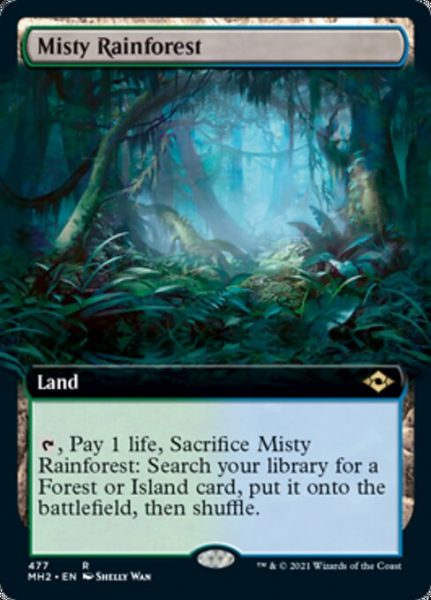
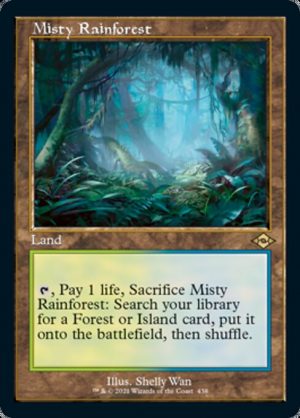
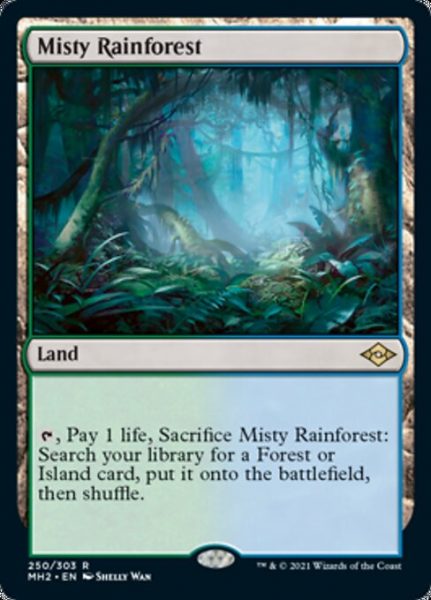
Misty Rainforest and Scalding Tarn!

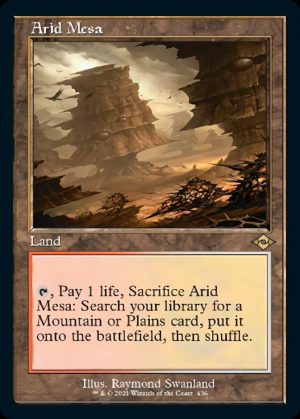
Last, but not least, good ol' Arid Mesa! I really didn't think I was ever going to need or want to upgrade my fetchland collection, but HOLY MOLY do I have a mighty need for these. I also imagine that they are going to be fetching (heh) quite a premium. I wouldn't be surprised if these end up being either the, or close to, the priciest of the enemy fetches.

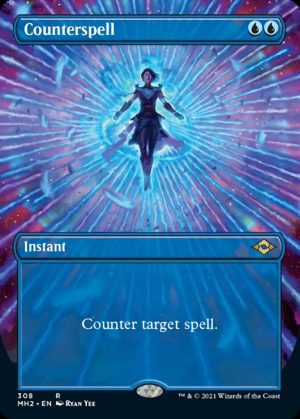
Counterspell is coming to Modern! The regular version will be at uncommon, but I thought this full art was gorgeous so that's the version I'm using for the article. I've seen people either certain Counterspell won't see much play at all or will see all the play ever, but all I know is our very own Chroberry will be sleeving up a playset and cackling with joy while he gets to play one of his Legacy favorites in Modern.

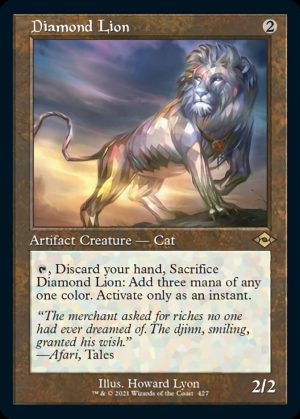
Diamond Lion is a sweet-looking mana rock of sorts, and I think Howard Lyon's art looks stellar with the old frame treatment.


Prowess Paramount: May ’21 Metagame Update

Are you a Quiet Speculation member?

If not, now is a perfect time to join up! Our powerful tools, breaking-news analysis, and exclusive Discord channel will make sure you stay up to date and ahead of the curve.

I'm interrupting this spoiler season with an important bulletin: it's time for the metagame update! And this will be a strange one. Although... I'm not entirely clear on what a normal metagame update might look like. I mention that there's something unexpected happening every month. It's never the same weird thing, but it's always something diferent. So, maybe I should be saying "Guess this month's oddity!" Or maybe just shut up and get to the data. Let's go with the latter.

Something to note, even though it doesn't affect anything, is that paper events have started to return. I went to my first in-person FNM in 14 months last week, and it felt amazing. However, it was slightly tempered by the knowledge that eventually, I'll have to include paper events in this data. I'm not sure exactly how I want to deal with paper. The old system wouldn't work quite as well anymore due to overweighting the online results. I'll have to figure out how properly integrate the paper results before actual large events start up again. Probably not for several months if not until 2022. But better to get ahead of the problem.

The Problem With Prowess

Speaking of problems, Izzet Prowess was a huge problem in May. It vastly over-performed relative to the rest of the field and was skewing the data. This probably sounds familiar, and that's because it should: I said almost the same thing about Heliod Company last month. However, I decided to include Heliod Company in the data because I could not conclusively determine if it was an outlier. This time, it wasn't a problem. Izzet Prowess was clearly an outlier and multiple tests confirmed this as the case. Here's the Izzet Prowess data from May compared to Heliod Company's from April.

Izzet's Total #Heliod's Total #Izzet's Total %Heliod's Total %
Population755915.3611.46
Points11610714.6811.53
Average Points1.551.81

Izzet earned significantly more places and points than Heliod did. That alone might qualify Izzet as an outlier, but the clearer visualization (which I couldn't get onto the table in a way I found ascetically pleasing) is the degree to which they respectively outstripped the competition. Heliod's population was 1.59x's above its next competitor (Izzet Prowess, go figure) and earned 1.53x's the points in April. Izzet Prowess beat Eldrazi Tron's population by 2.5x's and its points by 2.37. That's an absurd gap and would have led me to declare an outlier even if the actual statistical tests had disagreed. Which they decidedly did not.

As a result, I am reporting Prowess's data, but I did not include it in the analysis. Had I included it, Izzet Prowess would have been the only Tier 1 deck. And the number of decks making the list would have plummeted, another clear indication of an outlier. By removing Izzet Prowess, the resultant analysis looks more normally distributed and I believe gives a more accurate picture of what the metagame looks like.

It's NOT Tier 0!

After all I've said, there is a temptation to declare Izzet Prowess Tier 0, something I've never done before. I will resist this temptation and everyone reading should do so too. Izzet Prowess is nothing like Hogaak, Arisen Necropolis or Eye of Ugin-powered Eldrazi. The deck is slightly different from the previous few months when it was Tier 1, but not outstandingly so. Plus, it's taking over the top slot from another deck that just spiked out of nowhere. There's no reason to think that this spike won't also go away.
More importantly, I can explain away Izzet's numbers as nothing more than absurd, unexpected, and arguably unjustified popularity. Check the table again: Izzet averaged only 1.55 points per placement. Which is considerably lower than Heliod's from April, but doesn't really mean much, because the average is a moving peg to be compared to the baseline. And May's baseline average points is 1.58, meaning that Izzet's performance was slightly below average given its population. To be Tier 0, I'd expect any deck to take down sufficient Top 16 or higher slots to stay above the base. Not necessarily sky-high, but well above the baseline.
I can say with certainty from going through all the results: Izzet did not do that. Its position in the tier list is thanks to putting up lots of Preliminary 3-1 and Challenge Top 32 results. It had some good Challenges, but mostly was an average performer. If a deck is adopted in large numbers, it should get lots of results, and the data reflects an expected results from mass adoption.

A Plausible Explanation

I have no idea why Izzet Prowess was so popular. I have no way of finding out besides surveying hundreds if not thousands of MTGO players about their deck choices. I'm too lazy to try to track down individual players and no better than to trust online survey data. I can, however, at least make a grounded and educated guess.

Observation #1: Red decks are popular online
For as long as Modern Nexus has been doing metagame data, we've observed that red decks tend to be more popular online than in paper. There's never been a good explanation for this deviation other than red decks tend to be cheaper than the alternatives. It's never been universally true, but it tends to be accurate. Assuming that players don't like spending money on digital cards, which is plausible, this would lead them to favor red decks over alternatives.

Observation #2: The online metagame is very volatile

Just look back at all the metagame articles I've written. The composition of each tier and which deck belongs where changes wildly month to month, far more than when there were paper results to consider. This is likely caused by the next observation...

Observation #3: Rental services reduce the opportunity cost of deck switching

Straightforward enough—if you don't have to constantly buy and sell cards to make new decks, you can experiment and change decks easily. There's a reason players will buy one deck in paper and play it for years, regardless of metagame positioning (*cough* Jund).

Observation #4: There is a correlation between price spikes and decks falling off
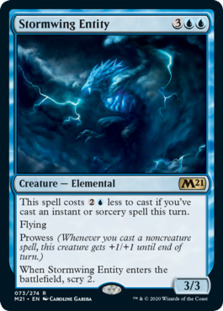
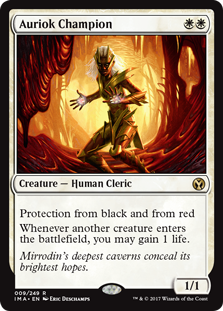
Looking at the price history of key cards and the metagame data suggests that price is a significant factor in deck popularity. For example, Auriok Champion is a key card in Heliod Company. It saw a huge price increase in March with multiple additional spikes in April before falling off in May. At the same time, Heliod exploded in popularity in March, peaked in April, and is no longer anything special. There is a similar pattern for other key cards like Heliod, Sun Crowned. Stormwing Entity is repeating this pattern. Correlation isn't causation, but it is suggestive.

Conclusion: Izzet Prowess's popularity was due to it being cheap to rent. Once the rental time is up, the ongoing card price spike will drive players away, and Izzet will fall off.

We'll see in July whether I was right. But with that out of the way, let's shift gears away from Izzet Prowess to look at the rest of the metagame data.

April Metagame

To make the tier list, a given deck has to beat the overall average population for the month. The average is my estimate for how many results a given deck “should” produce on MTGO. Being a tiered deck requires being better than “good enough;” in May the average population was 6.88, meaning a deck needed 7 results to beat the average and make Tier 3. This is a pretty standard average as these go. Then we go one standard deviation above average to set the limit of Tier 3 and cutoff for Tier 2. The STdev was 7.81, so that means Tier 3 runs to 15, and Tier 2 starts with 16 results and runs to 24. Subsequently, to make Tier 1, 25 decks are required. Amazing how all those numbers are the lowest ever after I cut out the top performer. Almost like that's how math works.

The Tier Data

May’s data was incomplete relative to April, though not as bad as March's. A PTQ and at least two Challenges did not get reported for reasons unknown. I've been reliably informed that these events were scheduled and fired, so I'm guessing Wizards just messed up. The loss is not severe, but it does mean the individual decks fell slightly from 65 to 61. Had I included Izzet Prowess in the analysis, total decks would have fallen from 20 to 16. Because Izzet was excluded, instead the total decks rose to 23. Which is impressive considering how many slots Izzet gobbled up.

Deck NameTotal #Total %
Tier 1
Izzet Prowess7515.36
Eldrazi Tron307.26
Amulet Titan276.53
Heliod Company276.53
Tier 2
Burn245.81
Esper Control215.08
Ponza194.60
Jund Death's Shadow194.60
Dredge174.11
Boros Prowess163.87
4-C Bring to Light163.87
Izzet Through the Breach163.87
Tier 3
Niv 2 Light153.63
Mono-Green Tron122.90
Hammer Time122.90
UW Control112.66
Living End81.93
Grixis Death's Shadow81.93
5-C Bring to Light81.93
Death and Taxes81.93
Sultai Control81.93
Mono-Red Prowess81.93
Inverter71.69

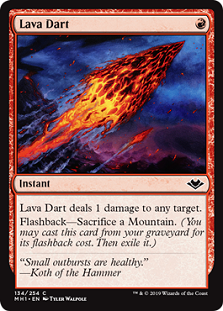
Eldrazi Tron was the best non-Prowess deck. This is not surprising, as mainboard Chalice of the Void grants it an above-average matchup against the most popular deck. I expect E-Tron to maintain a high position so long as prowess variants are popular and disappear again once prowess isn't everywhere. Regular Burn just missed Tier 1 status. Eidolon of the Great Revel is of course very good against Prowess, but Burn is also a red deck that dodges a lot of Prowess specific hate.

Power Rankings

Tracking the metagame in terms of population is standard practice. However, how do results actually factor in? Better decks should also have better results. In an effort to measure this, I use a power ranking system in addition to the prevalence list. By doing so I measure the relative strengths of each deck within the metagame. The population method gives a decks that consistently just squeaks into Top 32 the same weight as one that Top 8’s. Using a power ranking rewards good results and moves the winningest decks to the top of the pile and better reflects its metagame potential.
Points are awarded based on the population of the event. Preliminaries award points for record (1 for 3 wins, 2 for 4 wins) and Challenges are scored 3 points for Top 8, 2 for Top 16, 1 for Top 32. If I can find them, non-Wizards events will be awarded points according to how similar they are to Challenges or Preliminaries. Super Qualifiers and similar level events get an extra point if they’re over 200 players, and a fifth for over 400 players. There were 2 events that awarded 4 points in May but no 5 pointers. The missing PTQ may have been worth 4 or 5 points for all I know.

The Power Tiers

The total points in May were down from April, from 928 to 790. It would have been higher if all the events had been reported, but still wouldn't make April's numbers because there were fewer events. The average points were 11.23, so 12 points makes Tier 3. The STDev was 12.92, which is relatively small just like with population, so Tier 3 runs to 25 points. Tier 2 starts with 26 points and runs to 39. Tier 1 requires at least 40 points. Both Inverter and Grixis Death's Shadow failed to make the power list and no other decks replaced them. Inverter just missed with 11 points, but GDS had as many points as it had entries. It epitomizes the deck that made the tiers thanks entirely to population, not being good.

Deck NameTotal PointsTotal %
Tier 1
Izzet Prowess11614.68
Eldrazi Tron497.27
Amulet Titan476.97
Tier 2
Heliod Company395.79
Burn385.64
Ponza355.19
Jund Death's Shadow324.75
Esper Control314.60
Dredge314.60
Boros Prowess304.45
4-C Bring to Light274.00
Izzet Through the Breach263.86
Tier 3
Niv 2 Light233.41
Hammer Time202.97
Sultai Control182.67
Mono-Green Tron172.52
Death and Taxes162.38
UW Control152.22
Living End152.22
5-C Bring to Light142.08
Mono-Red Prowess121.78

Heliod just misses Tier 1. Oh, how the ostensibly broken have fallen. Also worth noting that the top of Tier 2 is mostly red decks. Players should really be metagaming against that color more than they are.

Average Power Rankings

Finally, we come to the average power rankings. These are found by taking total points earned and dividing it by total decks, which measures points per deck. I use this to measure strength vs. popularity. Measuring deck strength is hard. Using the power rankings certainly helps, and serves to show how justified a deck’s popularity is.
However, more popular decks will still necessarily earn a lot of points. This is where the averaging comes in. Decks that earn a lot of points because they get a lot of results will do worse than decks that win more events, indicating which deck actually performs better. A higher average indicates lots of high finishes, where low averages result from mediocre performances and high population. Lower-tier decks typically do very well here, likely due to their pilots being enthusiasts. So be careful about reading too much into the results.

The Real Story

When considering the average points, the key is to look at how far-off a deck is from the baseline stat (the overall average of points/population). The closer a deck’s performance to the baseline, the more likely it is to be performing close to its “true” potential. A deck's average points equaling the baseline means that it performed exactly in line with its representation. The further away from the baseline a deck's average is, the more that deck under- or over-performs. On the low end, the deck’s placing was mainly due to population rather than power, which suggests it’s overrated. A high-scoring deck is the opposite.

Deck NameAverage PointsPower Tier
Sultai Control2.253
Death and Taxes23
Boros Prowess1.872
Living End1.873
Ponza1.842
Dredge1.822
Amulet Titan1.741
5-C Bring to Light1.743
4-C Bring to Light1.692
Jund Death's Shadow1.682
Hammer Time1.673
Eldrazi Tron1.631
Izzet Through the Breach1.632
Baseline1.58
Burn1.582
Izzet Prowess1.551
Niv 2 Light1.533
Mono-Red Prowess1.503
Esper Control1.482
Heliod Company1.442
Mono-Green Tron1.423
UW Control1.363

Sultai Control was the best-performing deck relative to its popularity in May. What is Sultai Control? I'm using the descriptor as a catchall term for slow, answer-heavy BUG decks. Each deck was pretty different from the others, united only in speed and strategy. Which may have contributed to its good performance. It didn't actually make the power tier, and so isn't included, but Grixis Death's Shadow did the worst of any deck I've ever had in these articles. Its average power is 1; its presence in the population tier can therefore be attributed to its pilots stubborn dedication to their deck and not to any real success. Which is a paper-player attitude, and not something I'd count on from MTGO players.
Prepare for the Unexpected

In addition to the expected Izzet dropoff, June's update will be wildly different thanks to Modern Horizons 2's arrival. I predict a big surge in Merfolk's popularity. Now I wait to see how prescient I really am.

On Modern Horizons 2 Prices

Are you a Quiet Speculation member?

If not, now is a perfect time to join up! Our powerful tools, breaking-news analysis, and exclusive Discord channel will make sure you stay up to date and ahead of the curve.

I tend not to follow recent sets of Magic these days—my interest in keeping up with the game itself has waned significantly over the past few months. After diving heavily into Magic Arena for about a year, falling in and out of love with the historic metagame, I decided to take a hiatus from the platform.

For this reason, I am intimately familiar with Ikoria and Zendikar Rising but couldn’t name more than a card or two from Kaldheim and Strixhaven.

Of course, I still follow the Magic community closely via my Twitter feed, so I noticed a bunch of pretty cool spoilers lately. As it turns out, Modern Horizons 2 is a set filled with older reprints, cards with classic frames, and a bunch of throw-back references. I never would have guessed that Wizards would have made a card based on the famous chef quoted on Alpha rare Granite Gargoyle.

There was an error retrieving a chart for Granite Gargoyle

Because of my interest, I did a quick search to browse the set and see what cards are selling for. After a brief search on MTG Stocks, I am confident this set is extremely overpriced.

How Many $20+ Cards?

According to MTG Stocks’ market pricing, which pulls from market prices on TCGplayer, there are nine cards from the original Modern Horizons set worth more than $20. Force of Negation and Prismatic Vista are both rare, and the other seven cards are mythic rares. MTG Stocks also offers an Expected Value feature, and currently the market-calculated EV for a booster of Modern Horizons is $8.17.

Now let’s skip ahead to Modern Horizons 2, the new set that releases on June 18th. From that set, guess how many cards currently have a market price over $20. The answer: 27! That’s right, there are currently 27 cards that have market prices north of $20.

Don’t get me wrong, this set is sweet. Some of the reprints are of some high-value cards, including the enemy-colored fetch lands and Cabal Coffers. But I just don’t see 27 cards sustaining prices over $20 once the set releases. A few months from now, that number will probably reduce to about one-third, probably to around ten.

There was an error retrieving a chart for Scalding Tarn

What’s more, of those 27 cards, 11 are rare and 16 are mythic rare. That means about 41% of the cards selling for over $20 are currently rares. Compare that to the first Modern Horizons breakdown, where just 22% (two out of nine) of the cards worth over $20 are rare. This comparison really makes Modern Horizons 2 seem overheated to say the least. There’s no set EV calculated yet for the set, but I have to imagine it is way above $8.17 offered by the first Modern Horizons.

An Additional Factor at Play

There’s a secondary reason I expect the set EV of Modern Horizons 2 to sell off dramatically in the coming months. The first Modern Horizons had no special print variants—you either pulled the regular card or its foil. And with one foil per booster pack, foil prices from the set didn’t merit the same elevated premium as other sets.

With Modern Horizons 2, I still don’t fully understand what you can open in a booster pack. I believe it varies depending on the kind of pack you open. When I visited Scryfall to browse spoilers from the set, I noticed there are a multitude of print variations that exist:

  • Regular printing
  • Alternate-art borderless cards
  • Showcase cards
  • Old-frame bonus sheet
  • Extended art cards

On top of this, I expect at least some of these cards also come in foil, or etched, or some sort of shiny variant. As a result, in Modern Horizons 2, you can open a Misty Rainforest with many different looks.

I hypothesize that this print variation proliferation will reallocate some of the sets value away from standard printings and towards the more premium (rarer) variants. We’ve seen this happen before—Wizards releases a set with certain special, ultra-rare cards, and those cards end up “subsidizing” the value in the rest of the set. For players this is terrific, as the base entry to obtain the cards for play is reduced.

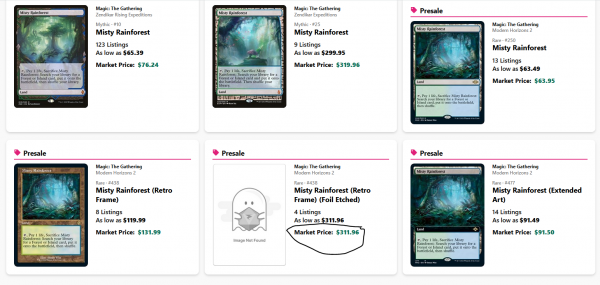
But if you live in MTG finance world like I do, then these special variants bode ill for the value of the regular printings of the set. We’re already seeing this unfold in pre-order prices:

The market price for the Modern Masters 2017 Misty Rainforest is about $60. That’s the ballpark price for the Modern Horizons 2 base copy (I expect this to drop quite a bit
probably to $35-$40). The version with the retro frame has a market price of $131.99 (though listings are already below that
this number will also drop). Then you have the extended art version, which is selling for around $90 for pre-orders. Lastly, there’s the retro frame, foil etched version, which currently has a market price of over $300!

This will lead to a scenario where the foil etched printing, being the rarest and most desirable, will maintain an elevated price point. Other special printings will also command a premium. The base printing
I expect that one to drop the most.

Reapplying this across the rest of the set, you can see where I’m going. If so many of the set’s value is locked up in these special print variants, it subsidizes the value of the base card printings of the set. The set’s EV can only go so high; if it exceeds some threshold (assuming no shortage of product), vendors will simply crack open more packs to create singles inventory to sell. The more they do this, the greater the supply of the normal printings, the lower their price goes.

High Dollar Reprints

The other thing about Modern Horizons 2 that seems to stand out to me is not just the presence of reprints, but the number of high-dollar reprints in the set. Here’s a list of some of the heavy hitters:

  • Misty Rainforest
  • Scalding Tarn
  • Verdant Catacombs
  • Marsh Flats
  • Arid Mesa
  • Cabal Coffers
  • Imperial Recruiter
  • Mirari's Wake
  • Patriarch's Bidding
  • Solitary Confinement

Each of the reprints above have base printings with market values currently north of $10; many of these have values over $20. The cycle of fetch lands, in particular, brings five high-value reprints into the set, at rare.

With this many desirable reprints, can all these cards maintain high price points? I understand this is a premium set and draft booster packs currently sell for about $8.75 on TCGplayer. But the set’s EV simply can’t remain so high, or else all these boosters will simply be cracked. This will flood the market with greater supply, and these reprints will all see their prices tank. I suspect Cabal Coffers will remain fairly high, being a highly desirable mythic rare reprint.

There was an error retrieving a chart for Cabal Coffers

The fetches will also maintain strong demand, though I expect all their prices to drop by 30-40%. Imperial Recruiter, Mirari's Wake, Patriarch's Bidding, and Solitary Confinement will all get hit particularly hard. I predict their price to drop in half at the lows.

There was an error retrieving a chart for Patriarch's Bidding

One Last Aside

Tangentially related to my article this week, I just want to point out how confusing Magic sealed product shopping has become. When I started playing, you had just two choices for sealed product: a booster pack or a booster box. If it was a large set, you could also buy a tournament pack of 60 cards, or a box of tournament packs.

I searched for Modern Horizons 2 on TCGplayer to look up pricing of sealed product, and here were my options:

I believe a Draft Booster Box is like a standard booster box from days of yore. Collector boosters are fancy, high-dollar boosters. Then there’s set booster, which is in between I guess? Then there are displays and boxes, the bundle (aka “fat pack”), and the good old draft booster case. The options are endless, and it is admittedly confusing to an older player like myself who isn’t used to all the print variations.

I’m not sure if all this SKU proliferation is healthy for Magic, but I guess they’re tailoring their product to their diverse player base. Some just want the cards to play, so they buy the standard draft boosters (also good for drafting obviously). Others want a shot at the higher value cards in the set, so they’re attracted more to the premium products. I understand this delineation, but it’s just a little overwhelming to me when I want to look up a product’s price.

/rant

Wrapping It Up

This article ended up being quite negative in tone. In reality, I’m very excited for Modern Horizons 2. While I don’t actively purchase new product these days, I may dabble in a booster pack or two (my birthday is coming up, after all!). A chance to open an enemy fetch land is enough to entice me, but some of the classic throwbacks like Asmoranomardicadaistinaculdacar are pretty sweet as well.

But my interest in the set ends there. From a financial standpoint, I believe nearly all the cards are currently pre-ordering for far too much. It’s fairly typical when a new set is spoiled—pre-order prices are high. After the set’s release, there’s a cool-off period as supply floods the market. Modern Horizons 2 will not be an exception to this rule.

I just feel like Modern Horizons 2 will suffer a pullback a bit larger in nature than your typical set. Prices seem very high, and there are so many cards pre-selling for over $20. Comparing this to the number of cards in the first Modern Horizons selling for over $20 (currently just nine), its obvious prices need to cool off a great deal. What’s more, with all the print variations available in the set, I believe the standard printings of cards will have their price subsidized by the more premium versions. This means prices will fall even further.

If you’re eager to pick up some of these cards, my advice would be to wait. Or, perhaps open up sealed product on day one, sell the overpriced singles as quickly as you can, and then buy back what you really want after a couple months.

Don’t forget, Wizards is constantly churning out new products. Modern Horizons 2 is receiving all the hype right now, but three months from now we’ll have other products to be excited about. Modern Horizons 2 will fall out of the limelight, and in doing so the prices will fall. That’s a wise time to start shopping.

And I definitely encourage shopping. There are a lot of great cards in this set. They will have value and they will appreciate slowly over time, after the initial sell-off. When the bottom is in, it’ll be a prime time to pick up the best, most iconic cards in the set for the long term. Despite my lack of interest in new Magic sets, rest assured I will be watching the market on these Modern Horizons 2 cards closely and will try to highlight the opportunities when they arise.

May ’21 Brew Report: I Sea Change

Are you a Quiet Speculation member?

If not, now is a perfect time to join up! Our powerful tools, breaking-news analysis, and exclusive Discord channel will make sure you stay up to date and ahead of the curve.

Starms a-comin' in. You know, Modern Horizons 2? As usual, though, Modern players aren't content to just sit around and wait for the new cards. They're as busy as ever creating, tuning, and tweaking new creations! Today, we'll look at a couple of notable developments this month: the propagation of tech from UR Prowess and how different creature themes are helming new and exciting decks.

Ripple Effect
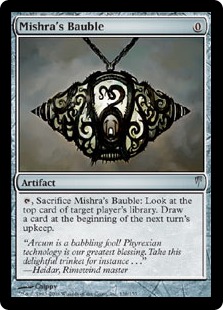
When decks start to perform in Modern, or enjoy continued success, it sometimes occurs that other decks—even established ones—become curious about the steaming hot tech next door. We've already seen BGx adopt Mishra's Bauble to some degree, but the following couple lifts surprised even me!

Burn, MCWINSAUCE (4-0, Preliminary #12295332)

Creatures

4 Eidolon of the Great Revel
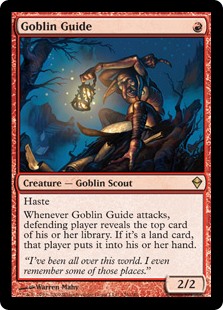
4 Goblin Guide
4 Monastery Swiftspear

Sorceries

4 Lava Spike
3 Rift Bolt
2 Skewer the Critics

Instants

4 Boros Charm
4 Lightning Bolt
2 Lightning Helix
4 Searing Blaze
2 Skullcrack

Artifacts

3 Mishra's Bauble

Lands

2 Arid Mesa
1 Fiery Islet
4 Inspiring Vantage
3 Mountain
2 Sacred Foundry
4 Scalding Tarn
4 Sunbaked Canyon

Sideboard

2 Skullcrack
3 Kor Firewalker
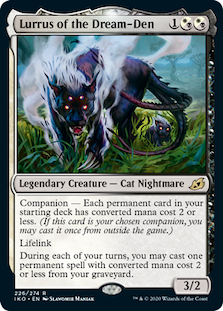
1 Lurrus of the Dream-Den
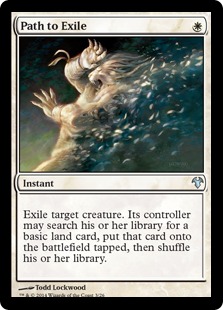
4 Path to Exile
1 Pyrite Spellbomb
2 Roiling Vortex
2 Smash to Smithereens

UR Prowess is indeed very powerful this season, but good ol' Burn has been putting up results here and there, too; as players budget their life totals and deck constructions to just beat Prowess, they give up points against the original Lava Spike deck. This build features what is arguably the most free card in Prowess, Mishra's Bauble... even though it's got a full set of Eidolons to punish all players packing the 0-drop. What gives?

For starters, there is some precedent to running Bauble in Burn. The trend dates back to when Lurrus of the Dream-Den was unfixed, meaning companions could be cast directly from the sideboard without first being put into the hand. That build of Burn quickly established itself as a deck-to-beat and helped contribute to the rules change taking place. This Burn deck also runs Lurrus in the side, which explains the Baubles. But is it worth adding  slow-trips to a deck that often kills opponent at exactly the right time just to extend the deck's mid-game potential against attrition decks?

Apparently, yes. Even with the extra cost demanded by companion, having a Lurrus plan to fall back on is alluring enough that plenty of Modern decks still run the 3/2. It certainly looks great against the UW and Esper Control decks running rampant to quell Prowess. And if MCWINSAUCE could turn the artifact into a 4-0 Preliminary stretch, there may be more to running the trinket in Burn than I had assumed.

Grixis Shadow, HODORTIMEBABY (3-1, Preliminary #12295332)

Creatures

4 Death's Shadow
4 Gurmag Angler
2 Snapcaster Mage
4 Street Wraith

Sorceries

3 Expressive Iteration
2 Inquisition of Kozilek
4 Thoughtseize

Instants

2 Dismember
4 Fatal Push
4 Stubborn Denial
2 Temur Battle Rage
4 Thought Scour

Artifacts

4 Mishra's Bauble

Lands

1 Blood Crypt
4 Bloodstained Mire
1 Island
4 Polluted Delta
3 Scalding Tarn
1 Steam Vents
1 Swamp
2 Watery Grave

Sideboard

2 Aether Gust
2 Ceremonious Rejection
2 Disdainful Stroke
2 Kolaghan's Command
3 Kozilek's Return
1 Lightning Bolt
3 Soul-Guide Lantern

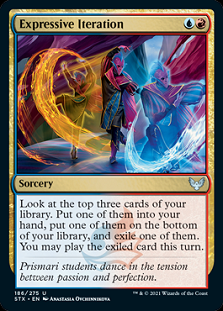
The next deck borrowing from UR Prowess is one that isn't so strategically divergent: Grixis Shadow. Shadow definitely trends more interactive than Prowess, but that interaction comes with ensured land drops, and land drops improve Expressive Iteration greatly. This two-mana cantrip has by and large replaced Light Up the Stage in UR Prowess decks, for a few reasons:

  • It hides the information, improving tricks like Mutagenic Growth or Spell Pierce
  • It works from behind, letting players claw their way back into the game
  • It doesn't require an attack, generating more prowess triggers or helping break a board stall
  • It digs a card deeper, increasing the odds of finding the right card

All these benefits seem to outweigh the fact that iteration comes with a hefty price compared to the twice-as-cheap Light Up. I had wondered about the card in Delver shells before concluding that it was just too much mana to pay there. But still, its effect is formidable in a spell-based aggro-control deck. Grixis Shadow seems like a natural fit, and I wouldn't be surprised to see most builds adopt this development going forward. Snapcaster Mage is slower and more conditional, making it a better card to draw into with Iteration than one to be naturally drawing into early on.

Dream Theme

Themed creature decks aren't just the stuff of casual players; many great Modern decks are built around a shared mechanic, such as Prowess, or winning tribe, like Humans. Then there are other mechanics and tribes which, while less powerful, have their fans and can succeed in the right context... or if given a little twist!

Tribal Landfall Zoo, MARTSJO (5-0)

Creatures

4 Akoum Hellhound
4 Steppe Lynx
4 Brushfire Elemental
4 Death's Shadow
4 Scourge of the Skyclaves
4 Street Wraith

Planeswalkers

3 Wrenn and Six

Sorceries

4 Tribal Flames

Instants

4 Boros Charm
4 Lightning Bolt
2 Might of Alara

Lands

2 Arid Mesa
1 Blood Crypt
3 Bloodstained Mire
1 Forest
1 Godless Shrine
1 Marsh Flats
1 Overgrown Tomb
1 Sacred Foundry
1 Steam Vents
1 Stomping Ground
1 Temple Garden
1 Windswept Heath
4 Wooded Foothills

Sideboard

2 Damping Sphere
2 Destructive Revelry
1 Natural State
4 Path to Exile
1 Soul-Guide Lantern
1 Tormod's Crypt
4 Veil of Summer

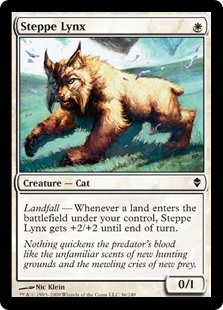
Tribal Landfall Zoo blends two underperforming Modern decks, Tribal Zoo and Landfall Zoo, into a league-clearing concoction. I proposed Landfall Zoo way back when Akoum Hellhound was spoiled, but ended up disappointed; Hellhound found its place in Shadow Zoo, the grandaddy of this new deck, as a color-shifted Steppe Lynx, effectively replacing Lynx as R was easier to afford than W early in the game. But the deck didn't want 8 Lynxes, nor did any deck.

Until now, that is, when the landfall strat smashes head-on into Tribal Flames: a sorcery (with its pal Boros Charm in tow) that deals tons of damage for two mana. And getting out all the land types is easier than ever with Wrenn and Six in the mix. On a good day, Might of Alara might even act as a one-mana Tribal Flames!

Notably absent are Wild Nacatl, the de facto face of Zoo, and Monastery Swiftspear, the de facto face of aggro. Instead, meet the 12 landfall creatures, and the 8 Shadow creatures. (Oh, you've already met those guys? My mistake....)

Sorin Slivers, BLACKDOVE26 (3-1, Preliminary #12295332)

Creatures

4 Morophon, the Boundless
4 The First Sliver
2 Cloudshredder Sliver
1 Dregscape Sliver
1 Harmonic Sliver
1 Sliver Hivelord
2 Sliver Legion

Planeswalkers

4 Sorin, Imperious Bloodlord

Sorceries

2 Search for Glory
2 Shimmer of Possibility

Instants

4 Eladamri's Call
4 Remand
4 Summoner's Pact

Enchantments

2 Oath of Nissa

Lands

1 Breeding Pool
1 Cavern of Souls
1 Gemstone Caverns
4 Gemstone Mine
4 Mana Confluence
1 Murmuring Bosk
1 Reflecting Pool
1 Snow-Covered Forest
1 Snow-Covered Plains
1 Snow-Covered Swamp
1 Stomping Ground
1 Temple Garden
1 Urborg, Tomb of Yawgmoth
4 Windswept Heath

Sideboard

2 Cavern of Souls
3 Abrupt Decay
1 Containment Priest
3 Defense Grid
4 Leyline of Sanctity
2 Weather the Storm

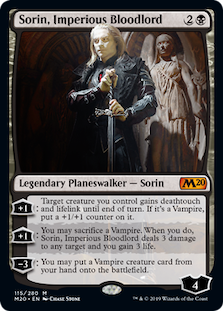
I know I'm not the only one who began frantically searching Gatherer for Vampires when they spoiled Sorin, Imperious Bloodlord. Nor the only one crestfallen to discover that the best threat to cheat out was actually Morophon, the Boundless, which doesn't do much on its own. But man does it do much paired with a whole tribe.

With Sorin Slivers, BLACKDOVE26 takes the old tribe to new heights by pairing Slivers with the Sorin strategy, giving the deck a never-before-felt combo element. Sorin cheats out Morophon as early as turn three; from there, Slivers can cast The First Sliver for 0 mana and kick off a chain of cascades. Cloudshredder gives them all flying and haste, so the game ends pretty much right away. And Dregscape lets players do it from the graveyard.

More Where That Came From

Modern players never cease to disappoint when it comes to new brews. If you've seen something spicy, let me know in the comments! In the meantime, stay tuned for some brews of my own featuring some of those sweet new Horizons cards.

A Shift in the Markets

Are you a Quiet Speculation member?

If not, now is a perfect time to join up! Our powerful tools, breaking-news analysis, and exclusive Discord channel will make sure you stay up to date and ahead of the curve.

I've been taking a look at a number of specs recently that I feel signal, if not display a turn in the tides. With the release of Modern Horizons 2 coming up soon, and in-store play's return imminently approaching, a new dawn is upon us. With the general trends of a market, it is often a matter of cash flow. If a lot of money is flowing into a certain area, it likely is being shorted away from another area; if all areas are succeeding, then they all can show more growth, albeit at the expense of another sector.

With the fall of Modern card prices at the beginning of the pandemic, and the rise of Reserved List and Commander cards to unheard-of highs, the market experienced a massive shift in focus. Modern is already experiencing a massive resurgence, whether predicted or realized, the money is already shifting away from Reserved List cards, and into Modern. Commander cards seem to be holding steady for the most part, likely capitalizing on the same advantages that Modern will have when in-store play is reinstated. Let's take a look at some of the movements and see if there are any good specs to keep an eye on while the market approaches an epoch.

Commander, a Self-Correcting Object

With changes in the world happening around us constantly, Commander is the one format that seems to have always stayed standing up. It gets tipped a bit, but it never falls completely, it simply corrects. Like the Gömböc, a self-correcting shape, that when tipped over, will always return to its point of stability, Commander, despite all the tips and turns, has found ways to survive, and thrive.

The Gömböc

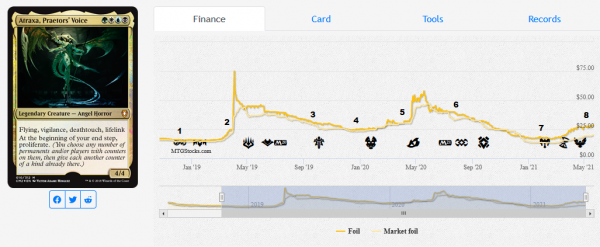
There are a number of Commander cards that have experienced very decent price drops, while still maintaining stability long term, and holding well as of now. One of the cards I've been looking at is a very interesting case. Atraxa, Praetors' Voice has seen a very turbulent couple of years. I believe that Atraxa, Praetors' Voice shows us a great analogy for Commander as a whole, and can be used to demonstrate the events of the previous years.

Atraxa, Praetors' Voice

In order to further demonstrate the patterns we are seeing here, I have marked out some important points on this graph. You can probably tell from just looking at it, they are periods of changes, big, small, and almost unnoticeable, but important nonetheless.  The first marker is an important period of market stagnation. No new information is being presented, and there is really no reason for this card to change much. You'll have the normal demand of players; no one really needs to sell these too quickly, and players aren't rushing to get them. This is important to note because it is the only period of time where a period of stagnant stability is present, as the rest of the last two years have not fit this classification. Point number 2 is a period of massive growth, this is simply player-driven, short-lived, and tells us something very important about that time.

The number of cards being sold was enough to satisfy the number of players buying them in point 1, however, when demand rose during spoiler season of War of the Spark, the demand was tipped ever so slightly, and the market could not keep up. Prices rose rapidly as sellers could not acquire enough inventory to catch up with new demand, and by the time supply was acquired, the period of horizontal decline began. Point 3 marks this period, all the way from the release of WAR until right after Theros: Beyond Death, when the market was slowly recurring to a correct valuation. The card was no longer needed as much as was perceived, and supply outweighed demand. Stores eager to generate liquidity and offload inventory lowered prices, encouraging hesitant players and sellers to "buy-in low".

Point 4 begins a period of consolidation. The majority of players currently seeking a brand new Atraxa, Praetors' Voice had already been sold, and the majority of these cards found their home for the time being, especially as lockdowns started across the country, more and more players turned to online play, and fewer players in store to trade in their cards. This diminishing supply shows its face in point number 5, as the lockdown had begun, and people started to realize that it was the long haul, players stocked up on cards needed to build their decks, looking for interesting, fun, and new decks to play through webcam Magic. The compound of a preceding consolidation allowed for the price to rise, in a stable fashion, before recurring to a further period of declining demand. This contrasts with point 2 in the mere reason for the increase. The ever speculative spoiler season does not make for sustainable prices and demand. A legitimate market force, now that's something that I can get behind most of the time. Finally, in points 6, 7, and 8, we can see a similar pattern to 3, 4, and 5.

This pattern is pretty consistent in a lot of cards, and some cards simply have consistent upward growth. Take Smothering Tithe for example. This card has seen nothing but upward momentum since its inception. This is likely just due to the overall strength of the card regardless of setting, and the rise of Commander in the mainstream has done nothing but help this momentum.

There was an error retrieving a chart for Smothering Tithe

High-End Reserved List

With a fairly predictable pattern of Commander cards, let's take a look at some of the spicier sauces offered in some of our nation's finest establishments. Reserved List. Specifically high-end EDH or CEDH staples on the Reserved List. Common inclusions are the dual lands, Wheel of Fortune, Timetwister, Gaea's Cradle and Mox Diamond. These cards have seen a very consistent uptick over the past two years. I can say confidently that with the consistent interest, especially with the widespread growth of CEDH, more and more players are picking these up for the long haul. I expect to see a very major supply bottleneck in the near future, as the growth of CEDH has been an unstoppable beast, riding the wave of Commander's success, and these players will be a bit more hesitant to sell their prized decks, in comparison to the cheaper Commander cards you can trade-in without too much thought.

Once the supply starts to run dry, some will rush to cash out, but I have confidence that after a couple of waves of overjoyed cashouts, these will find their long term homes, and since these are already very low supply in comparison to some CEDH staples, and they also will never see more supply than what we have now, the prices will rise consistently, pressuring players to sell. I can also see long-term HODLers cashing out at a certain point, causing a price recursion and likely a repeat of this cycle. In the short term, we have seen a lowered interest despite massive success, and while this is nowhere near a bad thing, we will not see quite as much interest in these types of cards in the near future, as a portion of that interest shifts.

There was an error retrieving a chart for Wheel Of Fortune
There was an error retrieving a chart for Timetwister
There was an error retrieving a chart for Gaea's Cradle
There was an error retrieving a chart for Mox Diamond

Modern Cards

Modern is a powerhouse. It's a great way to play. It has always been a strong market. Until the pandemic hit, and Modern prices fell drastically. Cards that used to go for upwards of $100, dropped to a mere fraction in weeks, and in a lot of scenarios, that hasn't quite healed yet. Some of these prices are starting to rise very quickly, while others are taking a bit more time. Let's take a look at a couple of cards.

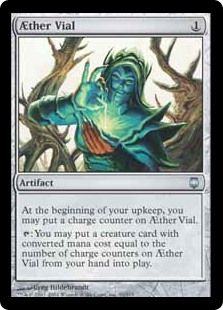
Aether Vial

The first card I would like to talk about is Aether Vial. This is a great example of the pattern I am trying to highlight. It shows a steep devaluation at the start of the pandemic and moves very steeply up at the first sign of the pandemic ends. Makes great sense, as Modern did not see much online play during the pandemic, making Modern a largely in-person format.

There was an error retrieving a chart for Aether Vial

Fiery Islet

Fiery Islet saw very little time between its first printing and the pandemic. It really didn't have much of a chance to be played beforehand, and now that it is starting to get a chance, prices are rising. The valley of the mid-summer of 2020 has crested into the summer of 2021. This is honestly just a great card, and I can see a lot of room for positive growth.

There was an error retrieving a chart for Fiery Islet

Karn, the Great Creator, and Karn Liberated

Both Karns see play in Tron play equally important parts in the decks' win conditions and removal strategies. Seeing that both cards are very important parts of a popular Modern deck, it makes sense it would follow this path.

There was an error retrieving a chart for Karn, the Great Creator
There was an error retrieving a chart for Karn Liberated

Noble Hierarch

Noble Hierarch is an interesting permutation of this pattern.  While it has not retraced upwards, it also has had a downward spiral for a bit before the pandemic, but now is seeing the same benefits, if only slightly. Will Noble Hierarch achieve the same success as its other counterparts? Maybe. I can see that it may be a possibility, as the meta-game that existed in its decline, has long since changed. It may also bypass the problem of large-scale viability in play by a simple matter of price memory. Even if people aren't playing it buy and large, people might still purchase at higher prices, simply because it seems cheap based on price memory. Time will tell.

There was an error retrieving a chart for Noble Hierarch

Force of Negation

There was an error retrieving a chart for Force of Negation

It is very much comedic to me, that hundreds of speculators, investors, players, and collectors all the like, stated with such confidence that Force of Negation would not be reprinted in Modern Horizons 2, despite the clear lack of abundance of a reason for WotC not to. They have said more recently that MH2 is going to be pulling all the stops this time, and by golly there sure isn't much like a reprint of a staple that only has one previous printing.

Overall, it follows a similar pattern of diagonal growth, a little slower, however, and then has recently experienced slightly more of a downward tick after the reprinting was announced. I think that this reprint, while isn't going to be massively harmful to prices on certain high-demand cards like Force of Negation, I do believe that prices will lower substantially.

What's next?

With the next phase of most of our lives unraveling before us, the possibilities are endless. The speculator and the planner within me are eager and excited for a new phase of existence, and I cannot wait for the new opportunities and scenarios that will play out in this changing world. I am very bullish on Modern, as most should be right now, and I believe that the best day to get in, is yesterday, and the day before.

If you haven't taken advantage of these low prices, maybe take a look. Be skeptical about it, but really dig deep and try to find some good specs, cause with the changes that are coming, they will be somewhere. Have a great rest of your week, and I advise all of you to be smart, be responsible, be honest, and as the old adage goes, invest in cardboard.

Incoming Turbulence! Modern Horizons Spoilers Week 1

Are you a Quiet Speculation member?

If not, now is a perfect time to join up! Our powerful tools, breaking-news analysis, and exclusive Discord channel will make sure you stay up to date and ahead of the curve.

Welcome to the start of Modern Horisons 2 spoiler season. The official start, anyway. The teasers we’ve already received don’t count. Because those were preseason teasers, not spoilers. There must be a difference other than semantics. I have no idea what beyond the timing is actually different, but there must be one to justify calling Monday the official start of MH2 spoilers. Rather than what we got two weeks ago. Or last Thursday. I’m starting to think Wizards just wants Magic news to be one, continuous spoiler season. Which would help explain this year’s release schedule, now that I’ve said it out loud.

In any case, Wizards does appear to be taking a more measured approach to MH2 compared to Modern Horizons. MH1 had a lot to prove as the first direct-to-and-designed-for-Modern set in Magic’s history. This may be why Wizards looked to push the flashier cards and more powerful cards on us. Which went well. Having learned their lesson (and with less player-skepticism to overcome) Wizards looks to have scaled things back and is focusing on answer cards. So far. But MH2’s Hogaak, Arisen Necropolis may be waiting until the last minute to appear, for all we know.

Rishadan Dockhand

Of course I was going to start with the Merfolk. The most important Merfolk printed since Master of the Pearl Trident, no less. I’m neither joking nor exaggerating. Rishadan Dockhand, a 1/2 for one with islandwalk, is better than any other one-drop Merfolk printed since Cursecatcher. I thought that might be the case when Kumena's Speaker was spoiled, but that proved incorrect. It happened again with Benthic Biomancer. The problem is not that Merfolk lacks one-drop beaters. It had all the lordly beef and mana-curve power to be an aggro deck. And that wasn't enough to keep up in Modern.
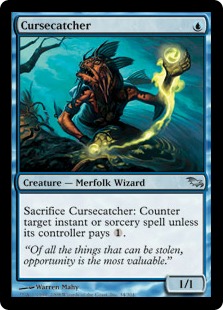
What was missing was something disruptive to upgrade or compliment Cursecatcher. Because just look at the gap between Cursecatcher and Mausoleum Wanderer. The key to aggro in Modern is to either be blisteringly fast (Ă  la Prowess), include a combo kill (Affinity, Company decks), or be highly disruptive (Spirits, Death and Taxes). Back when I was on the all-Merfolk, all-the-time plan, Cursecatcher was a solid creature and piece of disruption. Over the years, the creatures got better and the spells got cheaper and suddenly Cursecatcher just didn't do much anymore. To have a chance, Merfolk needed something interactive at one mana, not more beef. The lords had that locked down.
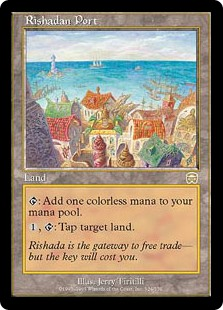
That has finally arrived in the form of Rishadan Port on legs fins. Wizards is continuing their practice of bringing Legacy cards to Modern as creatures instead of spells. And I am perfectly fine with that. Speaking as a player of Legacy Death and Taxes, Port is not for Modern. More on that shortly. Being a 1/2 looks weird and isn't particularly aggressive, but is perfect for a metagame defined by Lava Dart and sideboard Plague Engineers. Having islandwalk reduces the need for the lords to chip in the last few points of damage. I'm very excited to get back to my Aether Vial roots with Dockhand.

The Importance of Port

Those who've never played with the card may wonder why Rishadan Port is a big deal. Patrick Sullivan explained it best when he said that Port's power lies not in the fact that it trades 2 of your mana for 1 of your opponent's mana (a bad rate), but that it gives players the ability to do so at any time on a land that otherwise taps for colorless (a fantastic option to have throughout the game), giving this deceptively powerful effect a very low opportunity cost.

The entirety of my experience with Port is in Legacy, and it is extremely powerful as part of DnT's prison plan. Some of this is having Wasteland too, but Legacy is generally so land-light that Port is frequently devastating. So long as you're not behind on board. Then Porting lands just makes you lose more slowly. At best.

That out of the way, how does being on a creature affect Port's power and playability? On the one hand, the ability to keep opponents off mana is powerful in Modern too. By which I mean Porting Tron. Porting Tron lands is awesome, and will feel far better than Porting Cloudpost in Legacy because it will happen more often. Dockhand isn't a land, so it doesn't tie down your own mana as much as Port. Thus, Dockhand won't harm your own board development as much as Port. However, this comes at the price of being a creature and therefore far more vulnerable than a land. Relying on Dockhand to save you is asking for heartbreak.
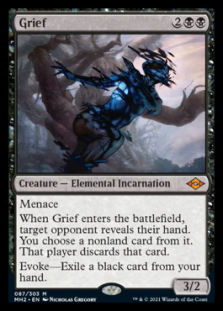
Merfolk will be playing a full set of Dockhand because it is a Merfolk first and foremost. After that, there's the question of whether to just Port the opponent's lands or attack. I suspect the decision to be largely contextual, shifting turn-by-turn depending on matchup and game state, and made much easier by having Aether Vial in play. However, outside Merfolk, the appeal will be the Port effect, and I expect UW DnT to see a lot of play once MH2 is released. And yes, I'm already testing that deck... stay tuned!

Good Grief

Next up is something I never expected to see in Modern: manaless discard. Grief is a more powerful but less flexible Entomber Exarch if actually paid for. However, its evoke cost turns Grief into Unmask. Or as Unmask was intended to be used, anyway. These days, Unmask is mainly used by Reanimator and Dredge as an emergency discard outlet, with going after the opponent's hand frequently a secondary use. I've lost to a lot of opponents mulliganing to five, then turn 1 Unmasking themselves discarding Griselbrand only to immediately ReanimateGriselbrand. That can't happen with Grief, even in Legacy. As a compensating bonus, Grief can't be Force of Negationed and could also come with a menacing body.
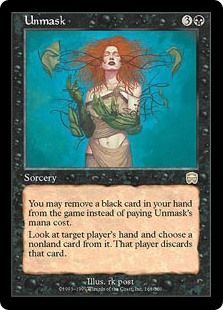
Unmasking a Problem

Grief can only ever be used to disrupt opponents, not to advance one's own unfair gameplan. But critically, evoking Grief creates card disadvantage. Thoughtseize is a 1-1 trade whose value comes from trading up on card quality and mana value. An evoked Grief is -1 card (the exiled black card), then the discard is a 1-1 trade. It's harder to say if a 4-mana 3/2 menace is better than the discarded card. Free is much better than costing something, but that only actually matters if you then do something with the mana that's saved. And given the density of black spells that will be necessary to make Grief reliably free (using Force of Will math), the likely other turn-one play is a cantrip or a discard spell, which again just leaves the caster even on cards. By any measure, evoking Grief leaves its caster lower on resources than the target.
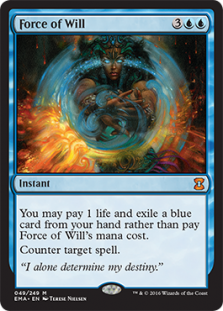
Which is why Unmask never saw much play. The reason that Reanimator and Dredge are the only decks that consistently play Unmask in Legacy is that they don't care about throwing away cards. All that matters is setting up their broken thing, and if that happens, they should win. Thus, it's worthwhile to 2-for-1 themselves to ensure their opponent can't disrupt them or to get the needed card into the graveyard. Fair decks have never made use of Unmask because they have to care about resources. Records are thin because Unmask is from before the internet was widespread, but I could only find three examples of Unmask in Standard or Extended. All three were running additional sources of card advantage to make up for Unmask's disadvantage. Two of them were looking to Dark Ritual huge threats into play on turn one and needed to guard against Force of Will.
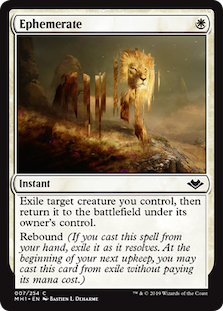
Squeezing Out Value

Since Modern doesn't have really broken things for black decks to do through Force right now, I'm pretty skeptical of the value of evoking Grief, and subsequently its playability. However, that won't stop players from trying. I've already seen players losing their minds at the thought of responding to the evoke trigger with Undying Evil or Ephemerate. And it's true that successfully combining those cards with Grief makes up for the card disadvantage, since Grief would then remain on the battlefield, not to mention rip another card. And it's not hard to imagine that working out favorably.

Still, that strikes me as the best-case scenario, and constructing a deck to do so consistently makes me question how well it functions outside of that specific play pattern. The accepted hypergeometric probability to have a given card in the opening hand is just under 40%. The probability of having Grief and another specific card is 16%-42% depending on how you perform the calculation. And that's not including the need to find another black card. In other words, trying to make evoking Grief work in a deck that cares about resource economy is going to be a lot of work. Work that could have gone into building a more reliable engine.
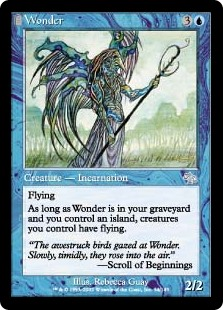
Casting Grief is fine, but 3/2s for four mana don't see play even if they have evasion. By then, it's often too late in the Modern game for the discard to be relevant in anything other than control matchups (Thought-Knot Seer is so good because it generally costs a functional three mana). Tribal Elementals may use Grief in that capacity, especially since it does play acceleration and Cavern of Souls. I'd be very surprised to see Grief anywhere else.

A Wonderous Reprint

Immediately after Grief was spoiled, there was speculation that it was part of a cycle because it was an incarnation. That's a rare creature type and always shows up in cycles. Are we to see more evoke creatures? That is still possible, but the spoiling of Wonder has dampened those hopes. Not that I'm complaining; it's great to see an old friend again. I have very fond memories of winning my first FNM with UG Madness thanks to Wonder jumping my alpha strikes over Phantom Centaur and Nantuko Shade. However, I don't think there will be any of that today. There are no fair blue decks with discard synergies which would use Wonder for its intended purpose. Grixis Death's Shadow is the closest, but I don't think it needs Wonder nor can spare the space. Also, graveyard hate wasn't a thing back then.
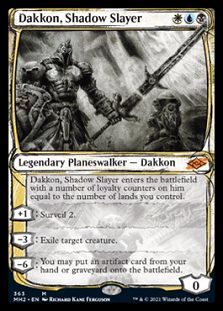
Dredge is another candidate, but it doesn't normally run any Islands and I can't imagine that it wants to change up its manabase. Especially when it doesn't worry too much about being blocked in the first place. And also has Conflagrate to clear blockers out or win the game. Millvine on the other hand does already run Islands, dump its library, look to win via quick alpha strike. Wonder is a more natural fit there. It just makes me sad to see my old friend working for the enemy.

Fast Facts

There are a number of other interesting reprints too. However, there's not enough to say about them to warrant whole sections. So I'm going to wrap things up today with some quick-fire card reviews.

Cabal Coffers: Another Odyssey block reprint. It's much better now that Urborg, Tomb of Yawgmoth and Dryad of the Ilysian Grove exist and let Coffers see play outside of mono-black decks. It's much, much worse because the opportunity cost of playing lands that don't make mana themselves is so high in Modern.
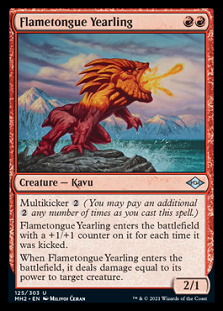
Dakkon, Shadow Slayer: Dakkon is proof that Wizards actually can balance three mana planeswalkers. With turn-two ramp, Dakkon can ultimate is turn 5. Otherwise, it's turn 6 at earliest. And that ultimate is only good if it's been set up first. Thus, he's much better the later he's played, and so not really a turn-three play. Which leads me to ask why you need to use Dakkon to cheat in the artifact rather than just cast it? Or Refurbish it several turns earlier? Surveiling every turn is decent, especially as a way to set up graveyard synergies, and exiling creatures is very good. But is either enough for Dakkon to see play?

Flametongue Yearling: I don't know if Flametongue Kavu would see play in Modern today, but I'm betting Yearling won't. It's worse than Kavu at the same mana value, and decks that would potentially play Yearling don't need mana sinks. Especially ones that just kill creatures, and at a mediocre rate for anything above three toughness. Also important to note, Yearling kills itself if played on an empty board. A chip off the old block.

Prismatic Ending: This card will see a lot of play in UWx control because it kills Prowess creatures and Wrenn and Six on curve. I don't know if any deck other than control wants a sorcery-speed exile spell. Also, it has a hard ceiling of mana value 5, so it's not quite as unequivocal as Detention Sphere.

Back Into the Horizon

We've only had a bare glimpse of what MH2 has to offer, and while the early indications are good, don't let your guard down. I underestimated Astrolabe last time. But, that will have to wait. Next week is the May metagame update. See you then!

Of Chess and Magic

Are you a Quiet Speculation member?

If not, now is a perfect time to join up! Our powerful tools, breaking-news analysis, and exclusive Discord channel will make sure you stay up to date and ahead of the curve.

If you follow me on Twitter, you may have noticed that I haven’t tweeted much recently. I mainly use the account for engagement with the Magic community, and I haven’t really played Magic for a few months. At one point I was jamming as many games on Arena as I could, striving to hit Mythic every month. Now my free time has centered around a different game: chess.

Personally, there are some components to chess that Magic lacks, which I really appreciate. First and foremost, there’s no “luck” in chess. Outside the random chance of blundering a piece or having your opponent blunder a piece, the game starts the same way every time. Whether you win or lose depends solely on skill. I also appreciate chess’s ELO rating system (which incidentally, used to be reapplied for Magic ratings). When every game impacts your rating and global rank, it feels like every win counts. There are meaningful games that impact ranking on Arena too, but gold/diamond/etc. doesn’t carry the same weight as a precise number, in my opinion.

Obviously I can’t write about chess finance or ladder my interest in the hobby back to Magic finance. But I did come up with a clever idea for this week.

I’ve been watching this one Grand Master’s YouTube series, where he plays through games of chess and explains to the viewers his moves along the way. His name is Daniel Naroditsky, and if you’re interested in learning more about chess I highly recommend his YouTube channel. It’s been extremely helpful to watch. Now that I’ve watched over 70 of his videos, I’ve learned a few rules of thumb that he likes to repeat while he plays. I’m going to take some of those phrases and re-tool them to describe Magic finance strategies. The parallels won’t be perfect, so I ask readers for a little creative license here. With some luck, there will still be some useful tidbits.

Prepare Slow, Attack Fast

This phrase could describe some Magic decks. Combo decks come to mind—when I used to play Ad Nauseam in Legacy, I would spend the first couple turns to cast a few cantrips and disrupting my opponent’s hand. My opponent would always know when I was launching “the attack” because I’d get out a die to keep track of the storm count!

There was an error retrieving a chart for Ad Nauseam

As it turns out, this is a reasonable strategy in chess as well. I have found that if I attempt to launch an attack prematurely, before developing my pieces optimally, a capable opponent is able to thwart my efforts. This leaves me licking my wounds (likely leading to a loss).

But how does this concept apply to Magic finance? When speculating on a card, especially a card with a long-term time horizon, sometimes it is wise to accumulate the card slowly and be prepared to sell quickly. If a new card is printed and is clearly a powerful Commander staple, it may be wise to acquire a bunch of copies. But new cards that only see play in Commander take a while to appreciate in price. If you rush out and buy a ton of copies day one, you may be overpaying. In these situations, I’d recommend gradually purchasing copies, allowing the price to come down a bit post-release and helping you cost average your investment.

Then when the time comes and the card spikes or reaches that inflection point, it’s wise to cash out fast. Reprints are everywhere these days, and you never know when your spec will get hit with fresh, new supply. That’s why I advocate cashing out quickly when the time is right!

A good example of this is Sliver Hivelord.

There was an error retrieving a chart for Sliver Hivelord

If you had bought the Magic 2015 mythic rare upon release, you would have bought in too early. The card’s price hit a bottom a few months after the set’s release. Then the card’s price languished for a few years; this would have been the best time to gradually pick up copies. Then, once new slivers were revealed in a recent set, the card spiked to $40. But it didn’t hold that price point for long—this would have been the prime opportunity to cash out fast. Funny enough, the card recently spiked again to $40, but is already on a downward trajectory. So in this case, you had a couple chances to sell out before a major reprint. Sometimes, we don’t get a second chance!

Knights on the Rim are Grim

This is one of my favorite chess sayings. In the game, it refers to the fact that placing your knights on spaces near the edges of the board limits the number of spaces the piece has access to. Thus, they are “grim” in their prospects.

With a little creative license, I can relate this to Magic finance pretty easily. The rule of thumb would be that cards that are only played sparsely, especially in sideboards (i.e. the “rim”), have grim prospects for financial gains.

It is trivial to suggest that cards that see more play have more upside, all other things equal. While sideboard cards have their place in decks, the reality is such cards don’t offer the same upside potential as cards that see any significant play, especially as a 4-of, in the main deck. That’s not to say that sideboard cards can never be valuable—there have been numerous costly sideboard cards across the history of the game. Leyline of the Void and Leyline of Sanctity come to mind readily. And there was a moment when Rest in Peace was a $10 card.

But in general, sideboard cards don’t have as much upside potential as cards that are played in the main deck. A recent example is Modern sideboard card Plague Engineer.

There was an error retrieving a chart for Plague Engineer

Modern Horizons cards that dodge reprint are likely going to be hot as in-person Magic events resume. We’ve already seen some cards in the set climb. While Plague Engineer has its place in Modern sideboards, it really can’t be justified in the main deck as it would be a poor draw too much of the time. Stuck in the sideboard, the card’s price growth is relatively limited; I would much rather buy the cycle of dual lands in the set, or perhaps Altar of Dementia, a Commander staple, despite the multiple reprints.

There was an error retrieving a chart for Altar Of Dementia

Not Every Piece Has to be an All-star

I’m paraphrasing this last chess concept because Daniel Naroditsky varies this one a bit. One of my favorite versions is, “Not every piece has to be out there finding a cure for COVID.” What he means is, while it’s nice to develop each piece on an optimal square, the reality is that you can’t do that perfectly in every game. Sometimes, you just need to accept the fact that a piece needs to be a bit more passive, at least temporarily.

I can translate this to Magic finance when I think about the diversification of my collection. While I would love all cards I purchase to be homerun specs that spike quickly and leave me with hefty profits, I have to recognize that this isn’t really feasible. There are times when we need to be okay with throwing some cards in a box for a couple years in the hopes that the spec pays off.

In both Magic and stocks, I am an advocate of diversification. It is wise not to over-expose yourself to a single card or format because you leave yourself vulnerable to reprints and shifts in the metagame. While it’s fun to buy dozens of copies of a new, flashy card, it’s also wise to find those slow-and-steady growers and sit on them for a couple years.

Of course, the exception here is the Reserved List. Cards on the Reserved List cannot be reprinted, and are from the game’s earliest days; both factors make for a wise investment, which is why Reserved List cards have overheated recently. But even still, I recommend diversifying—all the Reserved List cards feel overpriced currently, so if you want to put money to work, it probably needs to be something else. I cannot support buying some of these cards
 I mean, $30 for Spiritual Sanctuary? Come on, now!

There was an error retrieving a chart for Spiritual Sanctuary

It’s probably worth diversifying and picking up a smattering of newer cards. The triomes from Ikoria seem like good medium-term investments as long as they dodge reprint. The same can be said for the pathways from Zendikar Rising and Kaldheim, which will likely be mainstays in Standard and Pioneer. Or if you want a penny stock, I still have a stack of Genesis from Modern Horizons and Ruin Crabs from Zendikar Rising—I’m hoping to cash out of these at a buck apiece at some point in the future
distant future, perhaps. But my entry price was low enough that I don’t mind the wait.

There was an error retrieving a chart for Ruin Crab

Wrapping It Up

Daniel Naroditsky has taught me a great deal about chess strategy and in an entertaining way. He has a bunch of other phrases that I could have worked with.

“You can’t make an omelet without breaking some eggs” is one I particularly like. Then there’s his description of “potential energy” versus “kinetic energy” when it comes to positioning pieces. I never thought learning about chess could be so fun—I know that sounds cheesy, but it’s really helped keep my interest.

Despite my virtual abandonment of Magic play for chess in recent days, I still practice Magic finance as fervently as ever. The market is very exciting right now as prices fluctuate, inflation rises, and Reserved List cards hit retreat from all-time highs. I think that even if I lose interest in the game of Magic, I’ll never lose interest in the collectability and investability of the cards.

For this reason, I decided to have some fun this week and convert some recent chess tidbits into Magic finance tips. I hope readers enjoyed the exercise as much as I did. In fact, if you did or did not appreciate this foray into a different game, please mention something in the comments below or on Twitter (@sigfig8). If I get positive feedback, I may do this again. Either way, I have a feeling I’ll be eschewing Arena for chess for the foreseeable future.

Insider: Beledros Speculation Opportunities

Are you a Quiet Speculation member?

If not, now is a perfect time to join up! Our powerful tools, breaking-news analysis, and exclusive Discord channel will make sure you stay up to date and ahead of the curve.

We have seen multiple cards that play well with Strixhaven's "pest" creature type spike in the past few weeks. The two biggest are:

There was an error retrieving a chart for Savra, Queen of the Golgari
There was an error retrieving a chart for Creakwood Liege

The most likely reason is Beledros Witherbloom decks as typically when an archetype sees multiple spikes it is due to a new card entering a format. When we look for cards that would seem likely to be auto includes in this deck it is important to remember that Beledros creates tokens and acts as a mana doubler at the cost of life. So if you assume you always have access to those two options, then we need to look at what is "missing" for the deck to powerfully function. The pests created by Beledros provide minor life gain and optional sacrificial creatures for any sort of engine. To me, the biggest missing piece of the puzzle is card draw of some sort.

When a new card or mechanic gets spoiled we will often see the other half of the combo or the best card that plays with said mechanic spike in price; for example, Chain of Smog when the magecraft mechanic was spoiled.

There was an error retrieving a chart for Chain of Smog

However, thanks to the singular nature of Commander and its massive card pool, we typically get a bit more time to find our opportunities as the hivemind gets to work on various builds and an optimal list takes shape. This doesn't mean that we have months and months to decide what to pick up, but it does mean that if you don't buy immediately you will be priced out just as fast.

Today, we'll look at a few speculation targets that either haven't moved or still remain under $2, as I believe a low buy-in is crucial to maximizing your profits with regards to speculation.

There was an error retrieving a chart for Evolutionary Leap

Evolutionary Leap is a card I actually brought up in the discord chat over a week ago as a potentially good buy. Golgari builds tend to have plenty of options when it comes to sacrificing creatures for value, however, neither color tends to have a lot of card advantage, so Evolutionary Leap provides a cheap sacrifice outlet to convert a token into a creature from your library. Given Beledros' ability to untap all your lands having a card that gives you something to do with that mana seems ideal.

There was an error retrieving a chart for Izoni, Thousand-Eyed

Golgari decks often run some form of graveyard recursion, so creatures with good ETBs gain extra value. Izoni can act as a repeatable mass token generator in this type of deck and is currently sitting at bulk rare status. Normally, I prefer to avoid newer cards as speculation targets due to the sheer number of copies in circulation, but this one seems pretty low-risk given the low buy-in. Izoni also provides card draw, a sacrifice outlet, and life gain which are all things every Beledros deck will want.

There was an error retrieving a chart for Species Specialist

While a bit more niche than our other two options, it seems WotC has been careful about including "non-token" when creating cards that allow you to draw a card when a creature dies. Species Specialist will allow repeated card draw when one type of creature dies, so if you name pest you can generate card advantage when Beledross is in play.

There was an error retrieving a chart for Dark Prophecy

This is definitely an auto-include in Beledros decks as it does trigger off tokens dying and the life loss is counteracted with the life gain from the pests themselves. It is important to note that this card's price has already moved up to be on average above my initial $2 threshold but you may be able to find copies under $2. This is the card on my list that I believe has the most potential. It was printed once, 7 years ago, in a rather unimpressive core set, and being an enchantment it tends to be harder for opponents to deal with.

Conclusion

Beledros Witherbloom appears to be one of the breakout commanders in a set full of legendary creatures. It has caused multiple cards to rise in value and there is likely room for that list to grow both in value and in the number of cards included. There are numerous other cards I expect to move upward as more players build this deck, but, the four I listed are the ones that likely have the most opportunity for growth due to their overall usefulness and low buy-in.

Spell Spotlight: Prismari Command

Are you a Quiet Speculation member?

If not, now is a perfect time to join up! Our powerful tools, breaking-news analysis, and exclusive Discord channel will make sure you stay up to date and ahead of the curve.

When it was first spoiled, Prismari Command wasn't particularly exciting to Modern players. But this month, we're seeing the card on a noticeable uptick, with players registering two to even the full four copies in archetypes as strategically diverse as value, combo, and control. Clearly there's something to this three-mana instant! Today, we'll take a look at the various roles Prismari Command can play for different decks, how it compares to sister spell Kolaghan's Command, and some of the lists that are taking advantage of the Strixhaven newcomer.

Digging In

To get started, we'll dissect what Prismari Command does, exactly, and why the comparisons to Kolaghan's Command may tell a deceptive story when it comes to the card's power level.

Parsing the Modes

Prismari Command has four modes, of which casters may choose two:

  • Prismari Command deals 2 damage to any target.
  • Target player draws two cards, then discards two cards.
  • Target player creates a Treasure token.
  • Destroy target artifact.

The first and last modes, also native to Kolaghan's Command, are no strangers to three-cost instants (more on the two Commands below). But the other two are newer.

Creating a Treasure token appears on paper like the spell's weakest mode. But in jamming Magic: Arena of late, I've come to better appreciate the secret power of Treasure tokens, and I don't just mean alongside Urza, Lord High Artificer. Assuming you're planning on casting a spell next turn or this turn, Treasure essentially makes that spell cost one less mana, which often adds up to the initial, Treasure-generating spell costing one less mana. That means that in a pinch, pilots can be paying a functional two mana for any one of Prismari Command's modes, which gives the modal spell an interesting cost-reduction dimension and a heck of a lot of versatility.

Plus, making a Treasure is actually better than just "sometimes costing one less." It's ramp. Simian Spirit Guide was just banned in Modern thanks to the ease at which it let players slam haymakers or combo components a turn early. Seeing as how many of those spells cost five mana (Through the Breach, Ad Nauseam, etc.), Prismari Command can potentially fill the gap, interacting or digging on turn three while "locking in" a Simian Guide for the next turn. And since it's so much more versatile than Simian Guide, we're going to start seeing that pseudo-Guide effect in a lot more decks than had it before going forward.
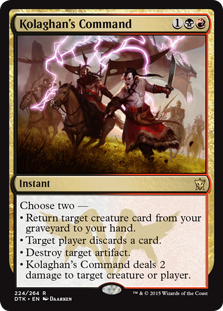
Then there's the ol' draw two, discard two. This mode evokes yet another banned card: Faithless Looting. You heard it here first, folks: Prismari Command is two banned cards in one! Well, not really. Looting costing a single mana is a huge part of its success; after all, Izzet Charm also features this mode and sees virtually no Modern play.

Kolaghan's Card Advantage

It's not nuts to compare Prismari Command to Kolaghan's Command, even if thanks to their respective colors, the spells were fated to end up in different decks regardless of their text boxes. One key reason: they're nonetheless costed similarly, at 1RC. Another: half of their text boxes are identical.

Among Kolaghan Command's most backbreaking mode pairings is 2 damage and destroy an artifact, a play that often dismantles enemy board states, and at instant speed to boot. Prismari Command shares these two modes, making the same potential blowout possible in URx and giving blue mages a far more flexible option than Abrade when it comes to dealing with artifacts with main-deckable cards. Still, it's worth nothing that Kolaghan Command's other two modes are chosen quite frequently, and that's where Prismari might leave something to be desired.

Target opponent discards a card causes the opponent to minus one, generating a net gain of one in card advantage: Kolaghan's caster spent one card to remove a permanent on the board, and the opponent lost an additional card for good measure. The other mode, return target creature from your graveyard to your hand, also puts the caster up a card. In other words, every mode pairing on Kolaghan's Command generates card advantage.

Not true of Prismari Command; only the mode pairing it shares with Kolaghan's Command will actually plus one indiscriminately, and that's also the most conditional of Kolaghan's card advantage parings, as it requires the opponent to have very specific permanents in play. Prismari's other commands of create a Treasure and draw two, discard two are a wash in terms of card economy, although the former generates an interesting ramp dimension and the latter provides card selection. Prismari Command is simply not a card advantage spell, and comparing it to Kolaghan's Command—one of the format's premier card advantage spells—therefore runs the risk of selling the newer Command short. To Prismari's credit, card advantage is not a premier in-game element in Modern relative to in other non-rotating formats. The same can't be said of tempo and card selection, both of which hold multiple cards hostage on the banlist.
tl;dr: Prismari Command is indeed worse than Kolaghan's Command in terms of card advantage. Most Modern decks care more about other in-game dimensions more than they care about card advantage.

Hold On, We're Comboing Home

If we're not making card advantage, what exactly are we doing with Prismari Command? Proactively, ramping, digging, and dumping; defensively, killing artifacts and creatures. In other words, five things beloved by big-spell combo decks, which seem like the most obvious home for the instant. Take these decks, for instance:

Temur Breach, BALLTAP (8th, Champs #12293241)

Creatures

4 Snapcaster Mage
4 Emrakul, the Aeons Torn

Planeswalkers

3 Wrenn and Six

Instants

4 Archmage's Charm
2 Cryptic Command
4 Lightning Bolt
4 Opt
4 Prismari Command
4 Remand
4 Through the Breach

Lands

1 Breeding Pool
1 Castle Vantress
3 Flooded Strand
4 Island
1 Ketria Triome
4 Misty Rainforest
4 Scalding Tarn
1 Snow-Covered Mountain
2 Steam Vents
2 Sulfur Falls

Sideboard

1 Abrade
4 Aether Gust
2 Force of Negation
1 Magmatic Sinkhole
1 Mystical Dispute
3 Veil of Summer
3 Weather the Storm

Breach decks have long been combo-control piles wielding tempo cards to modify the game's pace en route to victory, as Splinter Twin once did. Temur Breach is no different, leaning heavily on Wrenn and Six to support Snapcaster Mage in a grind game. The loot from Prismari not only dumps excess combo pieces like spare Emrakuls, but loots through the wrong half of the deck, letting it assemble its combo or amass value depending on the matchup. And of course, a turn three Prismari threatens a turn four Breach, giving the deck that ever-feared dimension from Twin. Opponents aren't even safe with something like Meddling Mage in play, since Command can shoot that as it ramps up to five.

Idomitable Breach, SPIDERSPACE (15th, Challenge #12293271)

Creatures

4 Emrakul, the Aeons Torn

Planeswalkers

3 Teferi, Time Raveler

Sorceries

4 Indomitable Creativity

Instants

4 Lightning Bolt
4 Opt
4 Path to Exile
4 Prismari Command
4 Remand
4 Through the Breach
2 Valakut Awakening

Lands

4 Arid Mesa
2 Bloodstained Mire
3 Dwarven Mine
1 Island
1 Mountain
1 Plains
1 Raugrin Triome
2 Sacred Foundry
4 Scalding Tarn
2 Steam Vents
2 Wooded Foothills

Sideboard

2 Aether Gust
1 Anger of the Gods
3 Cleansing Wildfire
1 Dispel
4 Leyline of Sanctity
2 Mystical Dispute
2 Rest in Peace

It so has it that Prismari Command is efficient enough that the Breach decks don't need to divert their gameplan in hopes of prolonging the game. This UR Breach deck doubles up on payoffs with Indomitable Creativity and splashes Teferi, Time Raveler as additional combo protection. From there, the gameplan is simple: ramp into a big spell and land that Emrakul.

Niv-Mizzet Omnath, FLSHT0PH (21st, Challenge #12293271)

Creatures

4 Omnath, Locus of Creation
2 Birds of Paradise
3 Niv-Mizzet Reborn
1 Valki, God of Lies

Planeswalkers

1 Nahiri, the Harbinger
4 Teferi, Time Raveler
4 Wrenn and Six

Enchantments

4 Abundant Growth
4 Utopia Sprawl

Sorceries

4 Bring to Light
1 Supreme Verdict
1 Unmoored Ego

Instants

1 Abrupt Decay
2 Assassin's Trophy
4 Kaya's Guile
3 Lightning Helix
4 Prismari Command
1 Vanishing Verse

Lands

1 Breeding Pool
1 Godless Shrine
1 Indatha Triome
1 Ketria Triome
3 Misty Rainforest
1 Overgrown Tomb
3 Pillar of the Paruns
4 Prismatic Vista
2 Snow-Covered Forest
1 Snow-Covered Island
1 Snow-Covered Mountain
1 Snow-Covered Plains
1 Snow-Covered Swamp
1 Steam Vents
1 Stomping Ground
1 Temple Garden
2 Verdant Catacombs
3 Windswept Heath
3 Wooded Foothills

Sideboard

1 Crumble to Dust
1 Deicide
3 Fatal Push
1 Shadows' Verdict
4 Thoughtseize
4 Veil of Summer
1 Yorion, Sky Nomad

Niv-Mizzet isn't so much a combo deck as a value deck; its game-winning play is to draw a bunch of powerful gold cards. That does mean the deck can choke on the wrong spells at the wrong time, and it can use all the help it can get at assembling five mana for Bring to Light, Niv-Mizzet, or even Omnath-plus-fetchland. Enter Prismari Command, looter and ramper extraordinaire that also does Kolaghan's Command things, making it both a prime enabler and a worthy payoff to flip off Niv-Mizzet. I'll take 4, thanks!

Summing Up

Prismari Command may not be Kolaghan's Command in terms of card advantage, but its modes are flexible and versatile enough to make it a Modern staple we'll be seeing years down the road, just like the OG Shock-Shatter. As illustrated, the modes on Prismari are far better in the right deck than returning a creature or making opponents discard, both of which are mostly best suited for... well, Jund. We're so used to being on the receiving end of great Kolaghan's that Prismari can seem underwhelming at first, but based on its very stellar month in Modern, I'd wager that's about to change!

An Abundant Harvest from Historic

Are you a Quiet Speculation member?

If not, now is a perfect time to join up! Our powerful tools, breaking-news analysis, and exclusive Discord channel will make sure you stay up to date and ahead of the curve.

I don't get Wizards's decision making. So many calls over the past few years just leave me scratching my head. I'm sure I'm not alone in this, and there have been editorials aplenty on every possible issue already. Instead, today I want to examine one very specific decision and its consequences. Specifically, Wizards made the decision to preprint a card from Modern Horizons 2 in the Strixhaven Mythic Archive. Which in practice means that it was made legal in Historic before any other format. And it is already having an impact, in ways which are suggestive of how Modern will react.

Before I continue, I should note that I am no expert on Historic. I don't play Arena much because the economy is... poor, to be diplomatic. Subsequently, I have very limited experience evaluating Historic decks. That won't matter because I'm just using them as a jumping-off point to investigate Modern applications. However, in addition to this standard disclaimer, I'm going to make the following plea: does anyone get Historic? Specifically, what is it supposed to be? It made sense as Pioneer-light initially, but now it's become this weird mishmash of Pioneer and Legacy and I don't understand where Wizards is going with Historic. Is it an experiment in creating a format? Do they intend to replace Legacy with Historic? Do they even have a plan? If you know or at least have a decent explanation, let me know.

Abundant Harvest

Preprinting Abundant Harvest is the strangest thing Wizards has done in some time. With everything else controversial, there's been decent arguments for it being good or bad. This time, though, it's just bizarre. Reactions to the revelation were primarily "huh, that's weird." As time's gone on, discussion has moved more towards the power of the card, but with the caveat that it's only legal in one constructed format. Talk about a risky marketing move. As an early preview that can be played, what happens if it proves too good before it's even released? Or worse, not good enough? The former would make players dread the set; the latter would turn them off. It's a very fine line, and I'm not sure how it is playing out.

As for the card itself, Harvest is an effect Modern's seen before, but not in green. There's a long line of this effect in black, stretching back to Demonic Consultation. The closest comparison in Modern is Spoils of the Vault. Harvest is neither as powerful nor as risky as Spoils. Both cost one mana, but Spoils finds a specific card or no card to set up Thassa's Oracle. Alternatively, it kills its caster. Harvest asks if its caster wants a land or nonland, then gives them the first chosen type it finds. Straightforward and without risk. Green has had a number of cards in the vein of revealing cards to find a certain type, but they're usually limited to creatures or lands and look five cards deep at most. Harvest is anywhere from one card to the entire deck. And finds any nonland, potentially. Ancient Stirrings is eating its heart out.

Using Harvest

I've heard this called a card selection spell rather than a cantrip; it is both neither and both. It's only selection in that the caster chooses whether they want a land or a nonland. After that, they take the first instance revealed. The picked card being random doesn't really mean card selection to me. There's no choosing among options or setting up draws like Ponder or Oath of Nissa. It doesn't have a desirable effect and then replace itself, like Veil of Summer or Remand. It's not a tutor because the card is random. Thus it's not some freeroll card; players need to want to dig for a land or nonland to run Harvest.

The single most powerful usage, and where I think a lot of players are leaning towards, is using Harvest to guarantee land drops. A one-land hand with a cantrip is better than one with no cantrip, but it's still a risky keep. Replace that Opt or Serum Visions with Harvest, and this risky keep becomes a snap-keep. Theoretically. So long as Harvest resolves and you name land, you will make your next land drop. Will it be an optimal land? Who knows. But it will be a land, and that's most important. For most decks, this is no problem; one land is as good as another. In decks that require specific lands, lack of choice may be a problem. As such, I suspect that many players will try to Turbo Xerox their decks with Harvest. More on that shortly.

Finding nonlands is a vital but significantly less potent feature. Harvest does find all spells, which is good when flooding or otherwise out of gas. But again, there's no control over what spell is found. It might be useful, and it might be effectively blank. Stirrings and Oath give a choice of options so you get the most relevant spell, if any are present. A guaranteed spell is always good and deckbuilding can mitigate risk of a bad pull, but it is important to remember that Harvest finds a random spell where current cantrips give players choices.

Exploiting Harvest

Worth noting, Harvest is exploitable. The obvious way is naming nonland in a primarily land deck. Which means that Zombie Hunt moves ever-so-incrementally towards viability. I realize that the whole point of the deck is its cheapness, but by adding green and Harvest, Hunt won't have to mulligan so aggressively for Treasure Hunt. Instead, it can stop with a Harvest in hand, confidant that it will find either Hunt or Zombie Infestation. I will bet anything that the memelords will instigate a resurgence of the deck at minimum.

While potentially also useful for finding a land in Oops, All Spells, I don't know why anyone would bother. Seriously, given the MDFCs, why would anyone bother running one land and Harvesting for it? If Harvest let players stack their deck, that'd be one thing, but it doesn't. Therefore I don't see how it's possible to use Harvest naming land for a nefarious purpose which is better than existing options. Pay attention to that phrase, it will come back later.

A Warning From Historic

Everything I've said so far is great in a vacuum, but Abundant Harvest is not a card in a vacuum. Historic players have had just under a month to tune, test, and win with Harvest. They've already done the work, so now it's time to learn from them. And... I'm not entirely sure what I expected (again, I don't understand Historic), but it definitely isn't what's happening. At time of writing, Harvest is not a very popular card in Historic. It isn't even in the top 10 played cards from Strixhaven. And while the usual excuses of "Historic isn't Modern" in either cardpool or metagame are certainly applicable, they're not persuasive. Historic indicates that Harvest will not behave as expected in Modern, and might not even be played.

Those Who Ignore Historic...

As alluded to above, the expectation was that Harvest's guaranteed land would lead to players aggressively cutting lands. This has not happened in Historic. I don't know why precisely, but even high-cantrip, low curve decks play 20 lands minimum, and most decks play upwards of 23. I suspect this is because a lack of fetchlands requires decks to play more lands to meet their color requirements. Mana curves are generally higher than Modern's, but not so much so to explain the higher land counts. And remember, this is a format with Brainstorm and Faithless Looting. If aggressive land-cutting was viable, it would be happening.

The second unexpected discovery was that Harvest doesn't see play in aggressive decks. The most common deck I see run Harvest is UB Mill Rogues, which is a slower tempo deck, similar to mono-Blue Tempo from a pervious Standard. Rogues can win fast, but its main plan is to ride a single threat for many turns and grind the opponent out. This strategy doesn't usually work in Modern. Behind Rogues are GRx decks, split between Gruul Beatdown and Jund Sacrifice. Jund is decidedly midrange while Gruul is on the slower side of aggro, more like stompy than a truly aggressive deck. I thought that Harvest's natural home would be Legacy-style cantrip beatdown, and while players have tried to make those decks work, the data indicates that they just don't.

My third observation is that Harvest doesn't see much play in the decks interested in specific cards. This makes sense, as again Harvest finds a random card. However, this applies more generally than I expected. Based on limited experience watching streams, the value of Harvest isn't actually finding lands early but mitigating midgame flood. The decks that play Harvest have high land counts, and don't need to use Harvest to save sketchy hands. Instead, they struggle with their higher counts on later turns and there's no better card for pushing through a string of lands than Harvest. A problem that Modern players are quite familiar with.

...Are Doomed to Repeat It

In light of Historic's experiment with Abundant Harvest, I have strong doubts about its Turbo Xerox value. Historic has more and more powerful cantrips than Modern, and Harvest isn't very successful in cantrip heavy lists. Even as a way to push past Brainstormed cards. I'm certain that players will try anyway, but if Historic Dreadhorde Arcanist lists don't always run Harvest in a format which is more amenable to it, how much success can it expect in Modern? Especially when it sees little play already?

Outside of aggressive decks, there are slower decks that might enjoy midgame flood protection in Modern. Thus, they might use Harvest similarly to Jund Sacrifice. Outside of that, I'm not sure. Tron wouldn't give up Stirrings, the selection is too potent. Amulet Titan cut Stirrings a long time ago and I can't imagine it needs a more random version. Valakut decks, particularly Titan Shift, might want Harvest as a way to dig towards payoff cards, but I can't imagine they want to sacrifice their ramp cards to make space. Harvest presents more of a deckbuilding challenge than a clear tool. Which is a relief. I worried that Harvest would be an auto-include card.

The Main Problem

Additionally and relatedly, let's say that players make Harvest and/or Arcanist work as a Modern deck. How would such a deck be better than Prowess? Any Turbo Xerox-style deck will necessarily be playing in similar design space, and the decks will have significant overlap. However, an Arcanist deck will necessarily be slower than Prowess because the whole point is value acquisition, and that doesn't happen at Prowess speeds. I can hear stalwarts arguing that Arcanist generates more prowess triggers, but A) it's not like Prowess decks need more of those and B) they could already do that, but don't. Which speaks volumes.

The question that Harvest will have to answer is how, in a format as fast and tempo-driven as Modern, is it worth a deck's time to durdle in the midgame? Right now it's not, so Harvest must make a very convincing case. Outside of Tron, Storm, and Izzet Prowess, decks don't bother with large numbers of cantrips because they can't take time off from playing to the battlefield. And even in those few cantrip heavy decks, they're intrinsic to the gameplan in a mana neutral or better way. Tron's jewelry makes mana, Storm and Prowess' cantrips generate storm count and damage. A (not free) cantrip for cantripping's sake just doesn't fit with Modern's style and makes me question whether Harvest can make a home in Modern.

Experiment By Doing

However, there's only one way to find out. I'm sure that players have already tested Harvest extensively and can say with more certainty than I if it passes muster. Plus, this week marks the start of official MH2 spoilers, so maybe there's more cards that will help Harvest fit in Modern. We all just have to see.

Inflation’s Impact on Your Magic Investment

Are you a Quiet Speculation member?

If not, now is a perfect time to join up! Our powerful tools, breaking-news analysis, and exclusive Discord channel will make sure you stay up to date and ahead of the curve.

Last week, Wall Street investors closely scrutinized a data point that had profound implications on the stock market. The chart of this metric looks akin to a Reserved List Magic card during a buyout, but I assure you this is not the case.

The chart is in fact a depiction of America’s inflation rate using the Consumer Pricing Index (CPI) reported by the Bureau of Labor Statistics.

As you can see, the CPI number for April 2021 came in extremely hot, well above the trending data from the past year and the highest it’s been in over ten years. Is this cause for concern? What will the impact of inflation be on the collectibles market? I honestly wasn’t sure, so I googled exactly this and I stumbled across a New York Times article from 1978! This week, I dust off that article and highlight some key insights that apply today to a market that didn’t even exist when it was written: the Magic card market.

The Inflation Concern

Well, there are two sides to this debate. Some say this inflation is transitory and reflects expected adjustments in prices as the economy re-opens following 14 months of hibernation via lockdowns. This group of individuals aren’t too concerned about the data point and expects the number to retrace. They point to some of the most influential prices that drove up the CPI number so drastically: gasoline, hotels, used cars, airfare, and the like.

The argument here is that these prices were all suppressed for months while everyone stayed at home under lockdown conditions. Now that the economy is opening up again, people have pent-up demand for travel and lodging, hence the increase in airfare and hotel costs. Gas prices also will rebound with this new demand, and the pipeline hack didn’t help the situation. Lastly, the automobile market is overheated right now because of the worldwide chip shortage, and this is inflating used (and new) car prices.

In theory, once the market equilibrates, inflation will return to a more modest value.

Others are not so confident in this hypothesis. There’s a group that’s truly concerned that inflation is going to run away from the Fed, interest rates will have to rise to combat rampant inflation, and this could lead to a recession. This group was the more influential one for most of last week as stocks sold off, though there was a nice recovery on Friday as buyers came in to take advantage of the dip.

Either way, at least for now it looks like we have some inflation on our hands. As I observed the CPI value make waves in the stock market, I couldn’t help but research what the impact may be on the value of my Magic collection.

New York Times: Aug 6, 1978

When I googled the impact of inflation on collectibles, this was one of the first matches: a New York Times article from 1978. How relevant is this article to the Magic market, which didn’t even exist until 1993? Surprisingly, there are some pretty valuable nuggets of insight!

The article opens with a reassuring sentiment: “
all collectors have traditionally had the inside track in surviving periods of inflation and general monetary disarray, such as those that beset many investors today.” It’s interesting how history repeats itself, right? If I had just inserted this comment in an article I suspect I could have passed it off as something written in May 2021 and not August 1978!

The author goes on to say, “Intuitively, collectors, whether passive or not, know that the values of tangibles invariably rise during periods of inflation because what they have or what they want costs more each day. Besides, collectors are also consumers and don’t have to be told that the dollar buys a bit less each day.”

But it gets even more interesting in the next paragraph, where it’s explained that portable and private collectibles tend to appreciate in value fastest! The author provides examples of portable collectibles, such as coins, art, rugs, or stamps. Of course, Magic cards would also fit into this category. The explanation passes the sniff test, in my opinion. If sitting in U.S. Dollars loses purchasing power over time, there’s motivation to store value in alternate assets. The more portable, the easier to manage. Magic cards would fit this bill nicely
the dollar may drop in value, but an Underground Sea can preserve value while also offering utility in the meantime!

There was an error retrieving a chart for Underground Sea

The article goes on to explain how some investors are more aggressive and seek out leveraged deals. “Today, usually conservative collectors increasingly borrow money to acquire both collectibles and investments such as precious metals and stronger foreign currencies.” In 2021, I would lump cryptocurrencies in that bucket as well.

But are people really taking out loans to speculate on Magic cards? It’s been done in the past, so it wouldn’t surprise me. Though, I suspect some of the more enfranchised investors/speculators don’t need loans to put a dent in the Magic market.

The next section of the article describes numbers that definitely don’t represent 2021! The fixed mortgage rate (in New York state) is cited as 8.5 percent, which is way higher than where they are in America today. And gold’s price ad recently “soared” to $207.50 an ounce, about one-eighth where it trades today. What’s more, gold hasn’t been rallying with the recent bout of inflation—it could be because people are using cryptocurrencies as their inflation hedge instead, but that’s a topic for another day.

Words of Wisdom from the Article

The New York Times article proceeds to describe “a number traps [SIC] that await the unwary.” I bet these are relevant to the Magic card market today, even without reading through the entire article beforehand!

The first caution from an investment specialist interviewed for the article is “people buying collectibles with a view to making money must consider their purchases as long-term affairs because of the high markups.” This could not be more well-put for Magic cards today! Prices of Reserved List and Old School cards—some of the most investible—have already appreciated significantly in the past year. Inflation could mean higher card prices, but it may take a while because prices are already pretty lofty. While vendors will continue to buy and sell cards to pay their bills and make money, the hobbyist investor may require more patience for prices to stabilize and then, eventually, climb higher.

The second caution in the article is that “in inflationary periods people transferring savings to tangible goods often select items they are familiar with as collectors
this often distorts one’s investment judgment. Because collectors may quickly become speculators without actually realizing it, I advise clients with strong emotional or other ties to particular collectibles to sit down, cool off and breathe calmly for a while before chasing after the market.”

This paragraph resonates most of all! How many times have I written about the pitfalls of letting emotions cloud judgment when dealing in Magic finance? If you’re looking to save/make money, you’re best off avoiding emotions altogether. Unfortunately, this is particularly difficult when dealing in Magic cards because we often get attached to the cardboard—especially those cards that are in decks! If you’re going to invest in Magic cards with the end goal of financial gain, you need to be willing to sell cards at the exact time when they’re most exciting to own. If you don’t want to do that, that’s perfectly fine. But know this about yourself when making those purchases, and go into each purchase with a planned exit strategy, whether short term or long term.

The final warning is also 100% applicable to the Magic card market: “Mr. Sinclair also warned of manipulated markets, ‘where a handful of dealers skilled in mass communication can create trends in collectibles almost overnight.’”

Does that happen in MTG finance? You bet it does!

There was an error retrieving a chart for Silhouette

Vocal community members with a large social media presence can easily manipulate card prices, whether intentionally or unintentionally. We also see common behaviors with manipulation of prices on TCGplayer, where a card is bought out and then re-listed at a 500% increase. This causes the card to “spike” on MTG Stocks, and some naïve investors may take that as a buy signal, chasing prices higher. This article could not be more spot on in describing Magic cards!

Wrapping It Up

The New York Times article goes on to state that inflation will be here to stay because it’s inherent in how our government is set up. I won’t get into the politics of it all, but it’s safe to say the US Dollar will be worth less in the future than today.

“Given this outlook, Mr. Sinclair said that the trend toward investments in collectibles will continue. ‘Whenever economic or social conditions, worsen, people yearn nostalgically for the so-called good old days, even if they were figments of one’s imagination,’ he explained. ‘And nostalgia always draws people to mementos of the past.’”

This statement resonates with me completely. It’s precisely why I have really cherished my Old School collection. Even if we put aside the investment prospects of a Black Lotus, there’s something to be said for the nostalgic factor. Owning a card as an adult that I always wanted as a kid but could never afford is one of the most fulfilling aspects of collecting Magic cards. I don’t think this feeling is going away anytime soon, which is why I believe Magic cards remain excellent investments (even if we put inflation aside). The same can be said for nostalgic video games, comic books, or any other collectibles that we grew up desiring and can now afford as adults.

This factor alone can drive prices upward for years to come. And this nostalgia is so strong, that I could honestly see it outlasting Magic as a game. Hasbro could stop printing cards today—there would probably be some panic selling, but I expect many card prices would remain robust (or even climb higher given the guaranteed stoppage of supply) because the game will always have a spot in many players’ and collectors’ hearts. It’s this driving force, above inflation, that gives me confidence in the long-term prospects of a Magic investment.

Risk Management in Collection Buying: What Can You Do to Minimize Risk?

Are you a Quiet Speculation member?

If not, now is a perfect time to join up! Our powerful tools, breaking-news analysis, and exclusive Discord channel will make sure you stay up to date and ahead of the curve.

Purchasing collections is a great way to get lots of cards, very quickly, and for a very good price. Sometimes the seller will throw in some fun extras, or you might find something unexpected while sorting. Personally, my favorite thing to see when buying collections is assorted storage boxes. Bundles are the most abundant, but seeing all the different styles, construction, and box art is always refreshing. Sometimes ill get some cool dice, an old pre-release box from days of old, some novelty sleeves, or a stack of oversize commanders that I'll never get around to using. Sometimes you'll find a card that holds sentimental value, and you'll the warm fuzzies.

The best thing to see is when you get something you don't expect but always hope for. Cards with unexpected value, or cards you never knew were included. It makes you feel like you are sailing the seven seas, finding hidden treasure in a forgotten cove. This feeling of euphoria is dangerous. Success is a drug, and it's easy to get addicted, and when your expectations are pumped full of gas, you might get burnt.

Why buy a collection?

When discussing risk management, it is important to discuss intent and motivation. The definition of "risk" changes based on your reasoning, intent, and motivation. If you are just looking to pick up some cards to boost your collection, get trades, and get cards for that sick new Scrambleverse deck that you are sure can make Top 8, (hopefully, it goes as well as your Atogatog commander deck did) then the risk is only as much as you are willing to spend, and how much more you are willing to spend if you don't get a full playset of Blacker Lotus's for your silver-bordered homebrew deck.

There was an error retrieving a chart for Scrambleverse

If you are looking to do so to turn around and sell the cards, then the risk associated is obviously a lot higher, as you must account for the amount fees and shipping costs that will heavily cut into potential profits. If you just want to pick up a bunch of cards on long-term speculation, or on the assumption that those cards will eventually go up, then the risk is lower, but depends heavily on how long you are willing to wait for returns. Let's jump into the individual analysis and mitigation of these risks.

Estimating Value

One of the most important things to look for scouting out a collection is value. Whatever that purpose may be, the way you estimate your value may change, but for today we will go off of financial value. If you are buying a large lot of high-value cards, then it may not be as necessary to be able to quickly guess and add up value. If you can get a list of these cards beforehand, that makes things very easy. However, if you are appraising on-site, without too much prior knowledge, as these deals sometimes are, then it may be necessary to refresh yourself on some prices. I personally will look through TCGplayer for every card priced around $5, all the way up to several hundred dollars.

If you are actively buying collections regularly, it might be a good idea to do this every once in a while, and keep an eye on big swings in price. Some might not have the ability to check prices in this wide of a range often as you might need it, so the next best(or best depending on your situation) option is to try to narrow down the general era of the cards you are purchasing, and look through the cards in that era. Another great idea is to check out oddball cards, promos, foils, and other specialty cards. Once you can get a general idea, you can get an estimate and make an offer.

How much should you pay?

Before purchasing any collection you should ask yourself first, what is the cost of moving the cards you buy, and how fast are you able to move them. With format staples and other commonly played cards, I usually give those the most weight, as I am able to move those the quickest, any other cards I usually hold to a lower value, as the cost of them sitting in storage, and the risk of tying up funds in low-demand assets. Another thing to consider is the cost to move these items.

It can take practice, but try to get an understanding of how much you will be paying in sales tax, shipping fees (especially with cards higher than $25-$50, as TCGplayer will require delivery confirmation), and shipping materials. If you can lower all of these costs to a minimum, you can pay the person you are buying from more, and leave empty-handed less, without cutting as much into your profits. I'll go more into how to reduce these costs as much as possible later on, but let's throw out some numbers to give you a good idea of how much to budget for.

There was an error retrieving a chart for Land Tax

At the high of the spectrum, you may be paying somewhere between $7-$12 dollars for shipping, insurance, delivery confirmation, and shipping supplies. For sales lower than $50 dollars, you can drop that down to below a dollar. Taxes could as high as almost 10%, and TCGplayer will also charge you an additional 15% or so percent as a marketplace fee. This means that with these costs of shipping, you should hold at most around 45% of the market value for cost of sales. That just doesn't work very well. Not much of a margin for error there, so the question becomes now, how low can we get those costs.

Let's take a look at optimized costs, and see how much we can save. Obviously, the taxes and fees stay the same regardless, but lowering the cost of shipping can be a big boost. Using third-party shipping label purchasing, I've seen some get shipping prices down to $3 for tracked, and delivery confirmed shipping. For good measure, round up to $4.50-$5. For shipping materials, I've seen listings on Amazon for 25 packs of bubble mailers for $8-$10, and top loaders can be purchased as well for around $0.20 apiece if you find the right seller, getting price of shipping materials generally down to less than $0.60 an order, even less if you order in bulk quantities.

There was an error retrieving a chart for Tireless Tracker

With these reductions, you can reduce the percentage cost down to at most 30%. With that information, you can offer as much as it takes to make the deal(with good regard for price of course) and leave the difference for profits/reinvestment. A good rule of thumb is to offer about what the stores around you are offering, which in my experience would be somewhere between 40% and 50% of market value, and pay at most 5%-10% more than that.  This allows for you to pay the seller a fair price, and also still leaves some meat on the bone for you. At the end of the day, if you can't get a full picture, never pay for more than what you can see.

Risk Mitigation

When you are buying collections, even when you know exactly what you are buying, is risky. Unknown factors can make or break the success of a deal. If you are buying to flip the cards, this becomes very important. Any unknown damage can immediately change your outcomes, with little hope of recovery. Something I have dealt with a lot is water damage. Imagine you are appraising a collection, and you have hit the gold mine. Hundreds of seemingly near mint cards, all with value enough to make your mother weep. You get home and start entering inventory in, and the realization sets in. The bottom half of every card is warped, and the ink is seeping through the side. It happened on small parts of collections where I was able to just barely break even, and on entire boxes of potentially promising "bulk".

There was an error retrieving a chart for Teferi's Protection

Examining every aspect of seemingly trivial prospects is important. Another thing to know is to not underestimate bulk. There have been dead-end deals where I was looking at substantial losses, but buy listing hundreds of $0.50 cards and selling hidden gems put me over the top. Looking for the path less traveled and thinking outside the box can not only save disastrous deals, but increase profits on good ones.

Know when to fold them

The hardest part of buying collections is knowing when to walk away. Some lots just aren't worth buying. Sometimes they are worth buying. If you can't tell, the safest bet is to walk away. It's hard to do sometimes, as sometimes the people you buy from are people in your community, people you know, or people who are just too nice to walk away from. Sometimes they expect way too much from you, or have unrealistic expectations about what they have on their hands. It's a common sight, some kid inherits a couple boxes of bulk from their parents, or a parent finds their kid's old collection, and all they know about Magic is that it's worth money.

There was an error retrieving a chart for Deepfathom Skulker

I see postings all the time of 3-ring binders filled with commons and lands from Oath of the Gatewatch, and they'll ask for hundreds of dollars. It breaks my heart to tell those people that all they have is bulk, bulk, and more bulk. Those seem like no-brainers, but the hardest come from when the person does have good stuff, but they want way more than anyone would pay. If your seller won't come to their senses, or it simply isn't worth it, never take the chance, it almost never works out for you, and it sets unrealistic expectations for the laymen.

The best things in life

The best things in life don't come free, and the best deals take work. You may have to drive a couple hours, you may have to get screwed a couple times, and you may lose a lot of your personal time. If you want to make money, that's easy. If you want to truly succeed, you have to work night and day, sacrifices may be made, and then you may truly achieve what you seek to achieve. As always, have a great week, be smart, and invest in cardboard.

Want Prices?

Browse thousands of prices with the first and most comprehensive MTG Finance tool around.


Trader Tools lists both buylist and retail prices for every MTG card, going back a decade.

Quiet Speculation