menu

Snap Thoughts: SCG Legacy Open in Orlando, Florida

Are you a Quiet Speculation member?

If not, now is a perfect time to join up! Our powerful tools, breaking-news analysis, and exclusive Discord channel will make sure you stay up to date and ahead of the curve.

On Sunday, in Orlando, Florida, StarCityGames.com’s Legacy Open tournament wrapped up. As the first high profile Legacy tournament since the introduction of Mental Misstep, there are a few things worthy of note.

Full decklists can be found here, on SCG’s site. Results are as follows:

  • 1st place: Team America by Chris VanMeter
  • 2nd place: Mono-Blue Control by Gerry Thompson
  • 3rd place: Mono-Blue Control by Drew Levin
  • 4th place: Painted Stone by John Cuvelier
  • 5th place: Team America by Josh Jacobson
  • 6th place: Merfolk by Nicholas Spagnolo
  • 7th place: Team America by Edgar Flores
  • 8th place: Metalworker by Jason Raflowitz
  • 9th place: Merfolk by Dakota Rogers
  • 10th place: Mono-White Mystic by Daniel Payne
  • 11th place: Painted Stone by Bronson Magnan
  • 12th place: Merfolk by Chris Lewis
  • 13th place: Merfolk by Vincent Lanceford
  • 14th place: Metalworker by Ali Aintrazi
  • 15th place: Merfolk by Tim Landale
  • 16th place: Merfolk by Steven Goanos

In the Top 8:

  1. There were 27 Mental Missteps in the Top 8.
  2. All eight Top 8 decks played blue.
  3. Only one deck in Top 8 didn’t play Mental Misstep.
  4. Six decks playing Mental Misstep played a full set of 4, the other playing 3.
  5. Only three decks ran Tarmogoyf: Team America, Team America, and Team America.
  6. Team America displayed three creature choices: Tombstalker, Dark Confidant, and a dangerously aggressive inclusion of both Tombstalker and Dark Confidant.
  7. There were 12 [card Llawan, Cephalid Empress]Llawan, Cephalid Empresses[/card] in the sideboards of five Top 8 decks.
  8. There were five archetypes: Team America, Mono-Blue Control (with white for [card Swords to Plowshares]Swords[/card]), Painted Stone, Merfolk, and Metalworker.

From 9th-16th:

  1. There were an additional 18 [card Mental Misstep]Mental Missteps[/card].
  2. Three decks didn’t play Mental Misstep: Mono-White Mystic, Merfolk, Metalworker.
  3. There were 9 [card Llawan, Cephalid Empress]Llawan, Cephalid Empresses[/card] in the sideboards of four decks.
  4. Only one deck didn’t play blue: Mono-White Mystic.

Top 16:

  1. Fifteen of the Top 16 played blue.
  2. Twelve of the Top 16 played Mental Misstep
  3. Three Team America decks made Top 8, one making finals and taking 1st as a result of Gerry Thompson scooping.
  4. Two Mono-Blue Control decks made Top 8, one making finals and taking 2nd.
  5. Two Painted Stone builds made Top 16, one making Top 8.
  6. Six Merfolk builds made Top 16, one making Top 8. Only one didn’t run Mental Misstep
  7. Twenty-one [card Llawan, Cephalid Empress]Llawan, Cephalid Empresses[/card] were found in the sideboards of 9 decks—over half of the Top 16.
  8. Two Metalworker builds made Top 16, one making Top 8.
  9. Three Karn Liberated made a showing in Metalworker. Two in one deck, one in the other.

Congratulations to everyone this weekend! The meta has definitely felt a shift and I am interested in how it will respond to the potential impact of Mental Misstep.

I think we’ll see a few more [card Llawan, Cephalid Empress]Llawan, Cephalid Empresses[/card] in sideboards, pushing a little more hate Merfolk’s way. It made an impressive showing in the Top 16, but fell out of favor the closer it got to finals.

Maybe then we’ll see Merfolk splashing green for Tarmogoyf in order to sidestep the [card Llawan, Cephalid Empress]Empress[/card]. Or—what’s more likely—not.

How does everyone feel about this week’s results? Where might the format head from here on out?

Tyler Tyssedal

(Miss)Stepping Through Danger

Are you a Quiet Speculation member?

If not, now is a perfect time to join up! Our powerful tools, breaking-news analysis, and exclusive Discord channel will make sure you stay up to date and ahead of the curve.

Let’s have a second opinion of a card that may be more Hype than Hope, offering a bit of a shield to those who do not follow the popular thought while illuminating the risks for those who support it. Remember, before a battle can be fought on the field, I must first happen in someone's mind. Tread carefully.

First Look

Over the past few weeks there has been a lot said of Mental Misstep.

There seems to be a consensus that it’s one of the strongest additions to Legacy in quite a while, drastically warping the format as a default auto-include 4-of in every deck, seeing that it can be cast in any deck.

I'm not going to tell you that it's not good—it is. I'm a firm supporter of free spells.

First I'll explain why you should be playing it first...

Wait. No.

If you play Legacy, you’ve already seen the multitude of 1 cost spells found in any random sampling of decks. In case you haven't:

etc... The list is so long I feel like a bad infomercial, “BUT WAIT, THERE'S MORE!”

Even someone's special home brew based around that lovable creature type Thrull, from Fallen Empires and Ravnica, will probably have something you can counter with Mental Misstep. On top of that,

It's Blue! It pitches to Force of Will!

All things considered, if you think you can, you should probably be playing some number of this card… at least if you're listening to everyone else.

Reality Bites... Hard

Now that I'm done hopping on the bandwagon, let's be completely honest.

Someone somewhere is hinting that you should auto-include 4 Mental Missteps in every single deck played from its official release until Time's end—or until it gets banned from there being 32 copies present in the Top 8 of every tournament for 1.5 months (I promise I'm funny).

Honestly, though. What deck have you seen in Legacy that is just completely at a loss if their turn 1 play is stopped?

Chalice of the Void has been in the format for a much longer time and it does not guarantee a win when it's set at one. If a card that counter every 1 drop spell for the rest of the game doesn’t seal the deal, what makes you think this will?

If you look at what it counters its best targets, in no particular order, are Swords to Plowshares, AEther Vial, [card Goblin Lackey]Lackey[/card], Putrid Imp, High Tide, and other Mental Missteps. It may seem like a super short list in comparison, but think of it this way: do you really care about anything else on the list from earlier? Can you think of anything that you're truly, deathly, Force of Willingly afraid of?

1 cost spells are rarely going to utterly beat you. You would, admittedly, enjoy stopping them, though.

From One for One to None for One

In a lot of ways, it'll feel like you just [card Stifle]Stifled[/card] a spell. If you've ever played Stifle, you've already experienced how much of a champion that can make you feel like.

It's also true that you can protect a creature from Swords to Plowshares with Mental Misstep. That's actually extremely relevant…

I mean, you can counter all four copies of their [card Swords to Plowshares]Swords[/card]!

... on a 1:1 ratio. That's so awesome. You can comfortably stop one removal spell with a single card! You don't even have to keep mana available for the counter. And, of course, they won't draw all 4 [card Swords to Plowshares]Swords[/card] in a every single game. You've got this.

But then you realize that you used it to stop something else earlier. Maybe you countered an AEther Vial or a [card Sensei’s Divining Top]Top[/card] on turn 1. Maybe you pitched it to a Force of Will to stop [card Tarmogoyf]Goyf[/card] from hitting the table so early. Either way, you're now down to 3 left to your disposal, mysteriously floating around in your library...

By the way, did you notice that [card Tarmogoyf]Goyf[/card] comment?

This card is not a catch all. It pitches to Force of Will against Tarmogoyf and doesn't stop a Force of Will unless it's being used to as the fuel to cast it. This spell will never counter a [card Lord of Atlantis]Lord[/card] from Merfolk. It'll never stop ANT or TES from casting Ad Nauseam and, of course, they'll be peaking at and going for your hand before they dare go off.

High Tide can be countered. But, unless you've got a strong clock in place, you're going to lose to the time they still have left to sculpt a hand.

Equivalent Exchange

While we’re on the subject of your opponent's counters, it’s true that they can run Mental Misstep, too.

There's an old saying, “What's good for the Goose, is good for the Gander.”

While I know they weren't thinking of Magic, the statement holds true. If you’re the Goose, the rest of the format flirting with the inclusion of Mental Misstep is the Gander. Since Misstep is susceptible to other Missteps, you’re offering Misstep targets to your opponents by including Misstep in your own deck.

Imagine, if you will: Your opponent is short on mana—let’s say their Brainstorm bricked on turn 1 and you had the sickest read on their hand. Your opponent then casts a second before he plays his land on turn 2. You attempt to Misstep his spell paying 2 life, seeing that you Pondered earlier. Bam! Suddenly you're staring at your opponent's own Mental Misstep! You look back to your hand at a Force of Will disappointedly wishing for a target... Yet you don't have another blue card for it.

It was a good try, though.

Another situation: They cast Brainstorm to find a counter for your Counterbalance. You attempt to Misstep it. You cleverly decide to play it without costing you life, using up your last blue mana... Smile! Your opponent has a Daze, now being able to easily counter whichever spell they choose. No Counterbalance for you.

Sure, you could have stopped his spell if he didn't have the Daze and you knowingly chose to play around it. But sometimes we’re pushed into a corner where we have to make a decision and we make one of the (many) incorrect ones.

We all have tons of thought on the things we could have done differently, but the reality always sits as it is. We didn't do those things differently. Sometimes these mistakes cost the game, sometimes they don't.

Like the Others

I mentioned earlier that successfully using Mental Misstep was like [card Stifle]Stifling[/card] a spell. Let’s explore the similarity a bit further here.

It's not that Mental Misstep’s a bad card. Saying that would be like saying free spells with narrow application are bad.

...did I just say that? Someone just closed their browser.

Perhaps I should explain. In most situations, countering a 1 cost spell isn't going to win the game. If this spell wasn't available for free, it wouldn't be played in any format beyond perhaps Standard or Block. If you need a reason you probably haven't been reading and/or comprehending this article.

I'll explain it like this: Spell Snare costs 1 blue mana and counters any spell with a converted mana cost of 2. It routinely fights for position with Spell Pierce in Legacy. Spell Pierce is currently winning because it can counter beasts like Show and Tell and Natural Order, even extending application to aid in counter battles or annoy combo. Even then, with a resurgence of Counterbalance based decks you may find that Spell Snare's application and use may increase.

Let's look at the list of cards that can be countered with Spell Snare:

And even Daze if you're feeling frisky or just think you got it like that.

Do you see the spells in that list?! Which of those would you let hit play? Even [card Qasali Pridemage]Pridemage[/card] is a one heck of a threat, as Exalted is one heck of an ability.

... So Cheap

So what makes Mental Misstep different than Spell Snare? Why would I play a spell that hit's a list of spells that are inferior threats? Why not just play Spell Pierce, as most of the relevant spells are non-creature?

The answer's easy. It’s free!

Free is a powerful word. Economically, we all love free things. Want a free sample? Well, of course I do!

It's exactly the same way in Magic.

  • Affinity once ruled Standard because nearly everything became free to cast, at least. You still had to come by the cards, and we won’t get into the ethics of theft here...
  • Cascade played a free spell. Sometimes more if you Cascaded into another Cascade spell!
  • Storm places free copies of a spell on the stack. So many of them, in fact, that you usually lose the game even if the first is countered.

All of these are easy to spot in Magic because they do things for free.

Mental Misstep is, in Magic’s mana currency, free. That's why it will be an incredibly inciting option for some time, at least until the community realizes this card doesn't beat every deck on its own and takes a big step back to get the big picture.

Pun Intended

I don't want to mislead you. The card is good. It's actually pretty darn good. But you have to remember a couple of things:

  1. Remember that your opponent is able to play Mental Misstep as well. Don't fall victim to the thought that you're the only one aware and able to acquire them.
  2. This format is full of cards. Not all of them cost 1. I know I don't need really to say that to you, but, if you listen to the hype, you may be lead to believe it can solve most of your issues. I just want you to realize that, sometimes, those aren't your issues and it may be best to ignore them.
  3. You don't have to play 4. Magic is an amazing game that lets you play up to 4 of any non-basic land card. “Up to” is a misleadingly strong statement. If we really had to play 4 of everything in every deck, I would simply play Burn.
  4. Every deck that you would put Mental Misstep in has to be able to function without it. So, as a general rule, if you can't beat a turn 1 play without Mental Misstep, you should consider rethinking your deck.
  5. The best way to fight Mental Misstep is with Mental Misstep... or just avoid having cards with a converted mana cost of 1. Looking at you, Dragon Stompy.
  6. Just because something's good, or even great, doesn't mean that it belongs in your deck.

Until Next Time…

I can't just close without giving you something else to think about. So, here’s a question that'll make you think... at least a little bit. There is no right or wrong answer, only strong justifications—and “someone else said so” isn't a very strong justification.

So, “Why would Thoughtseize be the best spell you can play into a known/suspected Mental Misstep?

Until next time,
Ian Ellis

MTGO Pauper: Invigorate, Mono-Green Infect, and NPH

Are you a Quiet Speculation member?

If not, now is a perfect time to join up! Our powerful tools, breaking-news analysis, and exclusive Discord channel will make sure you stay up to date and ahead of the curve.

Jesse Onland discusses the explosiveness of Mono-Green Infect in Pauper online, a tuned sideboard and its future with New Phyrexia.

Attack.
No blocks?
Get you.

That's how a Mono-Green Infect pilot wants the game to end. Take a look at this list:

Mono-Green Infect

Untitled Deck

Creatures

4 Ichorclaw Myr
4 Blight Mamba
4 Rot Wolf
4 Llanowar Augur

Enchantments

4 Rancor

Instants

4 Invigorate
4 Predators Strike
4 Vines of Vastwood
4 Giant Growth

Artifacts

4 Lotus Petal

Land

20 Forest

Sideboard

4 Corpse Cur
4 Natures Claim
3 Sandstorm
4 Thermokarst

The strategy should be clear: connect with an Infect dork at the earliest opportunity, pump it up to 10 power, and simply win the game. Burn decks in Eternal formats are sometimes characterized as combo decks, where the “combo” is simply any five spells. In this respect, Mono-Green Infect plays out much like a burn deck. Your “combo” is a creature and any three pump spells.

Creatures

Until New Phyrexia is released on MTGO, the Infect creatures available at common in green and colorless are as follows: Blight Mamba, Blightwidow, Corpse Cur, Cystbearer, Ichorclaw Myr, Phyrexian Digester, Rot Wolf, and Tel-Jilad Fallen. Of these, only the most efficient make the cut. Hence, the creature base is comprised of aggressive two-drops, [card Llanowar Augur]pump spells with legs[/card], and Rot Wolves.

  • Ichorclaw Myr is the best creature in the deck. The disincentive to block created by its triggered ability helps ensure it connects, which will often end the game. Mono-Green Infect’s nut draw involves casting Ichorclaw Myr on turn one via a Lotus Petal.
  • While Blight Mamba is the only green Infect two-drop in the format, its ability to evade burn makes it well worth the inclusion. Unwary opponents will not be inclined to block while regeneration mana is available. That mana can then be spent to transform the Blight Mamba from a 1/1 garter snake into a 7/7 anaconda or more.
  • While Cystbearer survives Disfigure, Rot Wolf is present instead because it provides the deck with a source of card advantage. In a longer game against opponents who would rather block with multiple creatures than risk the pump kill, Rot Wolf prevents the Infect player’s hand from becoming depleted. Some builds, however, opt for running a mix of Rot Wolves and Cystbearers, dropping a few lands.

Pump & Mana

The list above also contains 24 pump effects, half of which grant the all-important trample.

This is the Invigorate deck—how would you like to cast a free +8/+4 instant-speed pump spell? Nothing tilts an opponent like losing on the second turn of the game to double Invigorate.

While Vines of Vastwood provides a beefy +4/+4—which, with Infect, is actually like giving a creature an additional eight power—its most important use is as means to win fights over removal. Casting a kicked [card Vines of Vastwood]Vines[/card] in response to Lightning Bolt or Chain Lightning often signals the end of the game.

Invigorate and [card Vines of the Vastwood]Vines[/card] are the most desirable pump spells in an opening hand, but these alone would not be enough. The pump suite is further filled out with Predator's Strike, Llanowar Augur, Rancor, and Giant Growth. The density of trample-granting effects prevents opponents from simply blocking every attack.

Rancor is a staple of creature-oriented green decks in Pauper, and so Mono-Green Infect would be remiss to exclude this pay-once, permanent pump spell. And it’s true that Giant Growth is not a very powerful spell in the abstract, but an aggressive Infect strategy allows it to shine.

The manabase is a stack of basic Forests, although the inclusion of Tranquil Thickets is acceptable.

Yes, Lotus Petal is common. This Vintage-restricted mana accelerant provides the opportunity to power out an attacker on the first turn of the game, threatening lethal poison damage as early as the second.

Sideboard

The sideboard is geared to deal with specific strategies that one is bound to come up against in the Dailies on MTGO.

  • Corpse Cur comes in against Burn, Mono-Black Control variants, and other removal-heavy control strategies.

    Burn in Pauper is similar to its Legacy counterpart. Expect Kiln Fiend and Keldon Marauders along with every quality common burn spell available. These include but are not limited to Lightning Bolt, Chain Lightning, and Incinerate. Every time Corpse Cur re-buys a creature that Burn spent a spell on, Infect gets further ahead.

    The black Pauper strategies like Mono-Black Control and Rats involve a lot of removal and hand disruption in the form of cards like Disfigure, Grasp of Darkness, and Ravenous Rats. Corpse Cur ruins black's hand disruption and battles with most things a black deck is going to attack with. These games will often be a grind and Corpse Cur ensures that the Infect deck doesn't fall too far behind in cards. Also note that pump spells can be used to counter the -2/-2 and -4/-4 effects that black decks use for removal.

  • Nature's Claim is a no-drawback, one-mana, instant-speed Vindicate against Affinity. Like Burn, Pauper Affinity plays out similar to the Legacy archetype. They have artifact lands, Thoughtcast, Frogmite, Myr Enforcer, Carapace Forger, and Galvanic Blast. When Affinity stumbles on land, Nature's Claim is there to crush their mana—the most important resource in Pauper. When Affinity plays a Myr Enforcer to block, Nature's Claim will happily remove it at instant-speed.
  • Storm is format-defining in Pauper and the primary win-condition of red Storm decks is Empty the Warrens. Once a red Storm deck has gone off and put an army of 1/1 Goblin tokens into play, Sandstorm will usually be enough to put victory out of reach for them. If the red Storm opponent untaps, they'll be doing so without any creatures on the battlefield or cards in hand, often without any lands. They will not be coming back.
  • Sandstorm is also reasonable against some weenie-oriented strategies, including White Weenie and Goblins. Their armies of 1-toughness creatures allows for many 2-for-1s.
  • The final and most important sideboard card in this deck is Thermokarst. Mana is the most important resource in Pauper and several strategies involve abusing lands. Familiar Storm and the slew of Cloudpost-based decks are the format’s boogiemen.

    Familiar Storm intends to repeatedly untap Azorius Chancery and Dimir Aqueduct with broken Urza Block cards like Cloud of Faeries and Frantic Search, generating an enormous amount of mana, casting several spells made cheaper by [card Sunscape Familiar]Sunscape [/card]and Nightscape Familiars, and finally Boomeranging their opponent's entire board with Temporal Fissure.

    The tempo and mana advantage created by a Thermokarst targeting the Familiar Storm player's karooland, however, will set them far enough back that Infect will have time to assemble the kill. Similarly, many Cloudpost strategies, such as Blue-Red Post Control and Mono-Green Post, will be unable to operate effectively without being able to abuse the mana advantage produced by Cloudpost—a card considered a pillar of the format.

Variations, the Future, New Phyrexia and Masques

Others have advocated for a less "all-in" versions of the deck, featuring more creatures and fewer pump spells. Sometimes they'll even ruin the manabase by adding black.

This strategy gives up the real strength of Infect: the speedy kill. Who wants to be playing a dumb aggro deck in a format defined by Storm strategies? A combo-burn strategy sounds a lot more exciting than getting stuck on mana and hoping to eventually get there with a lone Flensermite.

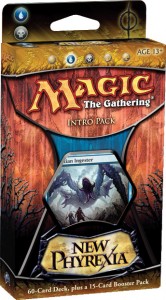
The impending releases of New Phyrexia and Masques Block on MTGO are the real reasons you should be thinking about Mono-Green Infect. As some people have noticed, NPH contains both a 1-mana green creature with Infect and a "free" green pump spell. Expect these to significantly amp up Infect strategies in Pauper.

The Mono-Green Infect of the future involves only 1- and 2-drop creatures, which will push back the pivotal attack step to a very consistent second or third turn kill. Lotus Petal will no longer be necessary as a mana accelerant. Disfigures will also become less effective.

Furthermore, Masques Block will be greatly increasing the MTGO supply of Invigorates, a card which is currently only available in the Garruk vs Liliana Duel Deck and hence presently difficult to obtain.

Infect and other green aggro strategies fill about 3% of the Pauper Daily metagame, which is a significant number in a format as diverse as Pauper. Expect that number to be on the rise.

The Cost

The cost breakdown of the deck is as follows:

  • 4 Invigorate at 5.50 = 22.00
  • 4 Lotus Petal at 5.50 = 22.00
  • 4 Rancor at 2.25 = 9.00

That’s 53.00, plus about 1.50 more for the rest of the deck, for a total of about 54.50 tix.

Certainly on the pricier end for a Pauper list.

Invigorate is currently very difficult to find. I had to give up on bots and haggle with other Pauper players for mine.

Lotus Petal is an Eternal staple. It's played in Classic, Legacy, and Pauper, and is integral to Pauper Affinity strategies. Consider Lotus Petal an investment in Pauper as a format rather than one in Mono-Green Infect.

Rancor is another Pauper all-star and is played in every aggressive green deck. A strong investment.

If the price tag is turning you away from the deck, simply wait until the release of Mercadian Masques on MTGO. The price of Invigorate is bound to fall steeply.

If you're interested in picking up a combo-burn aggro deck and killing your opponents out of nowhere, consider Mono-Green Infect. If you run this or a similar list in some Pauper events, let me know how you do!

Leave a comment, send me a tweet (@thefringthing), or stop by #mtgpauper on EFNet.
Jesse Onland

Journey through Judgment

Are you a Quiet Speculation member?

If not, now is a perfect time to join up! Our powerful tools, breaking-news analysis, and exclusive Discord channel will make sure you stay up to date and ahead of the curve.

Where Torment focused on making Black take the forefront, Judgment was a set designed all around White and Green. That was a loftier goal; Black has always been powerful, with banner cards like Necropotence and Hypnotic Specter. White has Wrath of God and Balance, and green has... Desert Twister? The set had some interesting innovations and designs. The most significant addition has been the Wishes, based on the Arabian Nights card Ring of Ma'Ruf. They changed sideboards for a long time because creative players could pack their board with all sorts of answer cards, while casual players started packing 1000-count boxes with bullet cards to Wish for (and I'm serious about this; find people who play the Five-Color format, you'll see).

Judgment also brought in the Phantom creatures, which played off of White and Green's ability to prevent damage. These were interesting because one could pair a Phantom creature with a toughness-enhancing Aura and have their creature around forever! The set also included some creatures that you just didn't want on the battlefield on the first place. A 2/2 flier for 3U is limited-worthy, but when that card is Wonder, you have a card that dramatically changes how combat actually takes place.

For a third set, Judgment is packed with winners. Let's take a look at the valuable cards!

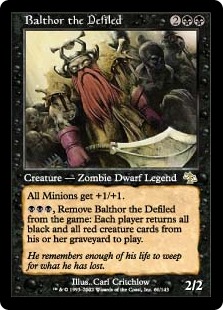
Balthor the Defiled

Returning from defiling the Golden Corral buffet.

Poor Balthor. He was a red Dwarf for awhile, but people like him a lot better now that he's dead. Balthor is a moderately-popular EDH general; he's got a really cool, unique effect for the format. Dropping big monsters into the graveyard is not exactly challenging, after all. Balthor never made a big tournament splash, but he's good at attrition (imagine bringing back Flametongue Kavu, after all) and when people need a copy, they usually need four copies. Balthor the Defiled is great to remember for a dollar-box diver because he's usually undervalued.

$2.25

Breaking Point

I am frankly puzzled why this card is actually worth something. It does, I suppose, have the effect of concentrating your burn spells; you don't have to waste burn on creatures if you can just fire this at the opponent. They either lose their guys or you clock them for six damage. The red “decision” cards like this and the next example are pretty bad, but people still seem to love them. Fact or Fiction, this is not.

$2.25

Browbeat

Browbeat makes a little bit of sense in a burn deck, since it may just draw you into more burn spells. It's a little more effective in that regard. Browbeat used to be a solid $3.50, but it's been reprinted in Fire and Ice and that's driven the value down a lot. They're still worth picking up because people tend to trade them around a lot.

$1.50

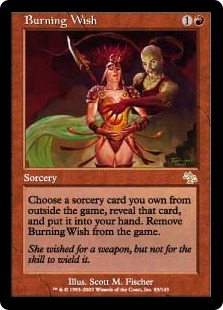
Did Aladdin know Genie could do this kind of thing?

Burning Wish

The stories I can tell about this card! Burning Wish was part of a Mirari's Wake deck that used the Wish to get Firecat Blitz. An ideal turn would see you untapping with six lands and the KittyBlitz in hand. Tap out to summon those cats and kill the opponent on the spot! Burning Wish could also grab Wrath of God, which was pretty sly. Unfortunately, Burning Wish wasn't the right call for the Wake deck. It had a lot of cool removal like Firebolt, but when the format is Aquamoebas and Basking Rootwallas, a Shock is pretty useless.

Burning Wish also formed the bedrock of Long.dec, the original busted Storm deck in Vintage. The idea was that you would cast Burning Wish, sacrificing Lion's Eye Diamond in response. Luckily, that Wish got Yawgmoth's Will and boom, your LEDs came back, you had a free Will, and you were well on the way to ten spells and Tendrils of Agony. This interaction was so powerful in a time before Spell Pierce and Thoughtseize that it caused Burning Wish and LED to be restricted, where they remain today. Burning Wish is so capable in Vintage that it occasionally still shows up as a single copy. I have played one to get hits like Deep Analysis, Balance, Rolling Earthquake, Mind Twist (!) and more. Before the Wishes were nerfed to prevent them from getting Exiled cards, it could also grab a spent Yawgmoth's Will, which was almost too good for words.

Burning Wish is hyper-efficient to this day, so people like to have the card and their big Box of Answers. It doesn't see much competitive play, but Burning Wish has enough star power to stay at a high price.

$6.25

Cabal Therapy

In developed formats, Cabal Therapy can be better than Thoughtseize when you know the decks to expect. The flashback means that you can gut an opponent's hand for the cost of a Plant token or a Thrull. Cabal Therapy currently sees play in Dredge, since it's a free way to make more Zombie tokens with Bridge from Below. Cabal Therapy also has a significant psychological effect on people when you get it right. I love the card because it really rewards paying attention to what has happened in the game to that point and valuing what could be the worst play from an opponent. My favorite casting of the card had my opponent rolling his eyes when I blind-named Goblin Warchief and he had to discard three.

Cabal Therapy hit $4 back in 2005 and basically never came down since then. It was a staple in Extended and it remains one of the most powerful cards in a Green-White set.

$4.50

Commander Eesha

Like Wall of Denial, Commander Eesha is a great multiplayer wall. It's hard to remove and is nonthreatening; its biggest role is to send attackers elsewhere, since they won't get through when facing this Bird. She's also essential for Bird decks, which are rumored to actually exist in casual circles.

$1.75

Cunning Wish

Burning Wish was good, but Cunning Wish is better. This one lets you get bounce, counterspells, more draw, and that's just in Blue! In Tog decks, it could get Smother or Ghastly Demise. In Wake decks, it got mirror-shattering Ray of Revelations. In Vintage, it got your sideboarded Misdirection to steal an Ancestral Recall. Currently, Cunning Wish sees play in High Tide in Legacy, where it can get Blue Sun's Zenith to deck an opponent, a Turnabout to make more mana, or a Snap to remove a problematic monster. Though it costs more than Burning Wish and Instants are generally not as powerful as Sorceries, Cunning Wish has always been slightly superior to its Red cousin.

$4.25

Fledgling Dragon

Here's an economy Dragon; simply run through enough of your deck and this guy becomes a real threat. It has seen tournament play here and there; four mana isn't hard to get, after all. When it came down later in the game, it would end things pretty quickly. The problem with it is that Fledging Dragon had to compete with Grim Lavamancer for attention in its block. An early Lavamancer all but prevented a player from ever hitting Threshold, and four or five Shocks are generally better than a Dragon. That history has held back Fledgling Dragon from being a real power player in its home format.

$1.75

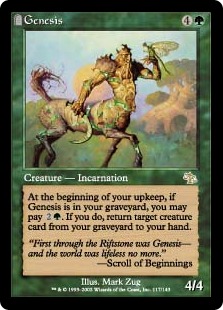
Genesis

The Genesis Reunion Tour 2031: Phil Collins has really let himself go...

Genesis has always had fans, from early Survival of the Fittest decks onward. It occasionally popped up in UG Madness decks, since you'd have some recursion to fall back on in the later game. This Incarnation is notably popular because of EDH, though. It has a light mana requirement, it's a reasonable monster on the board, and Genesis is highly problematic when you're playing a deck with Mulldrifters, Baneslayer Angels and Acidic Slimes. Everyone wants a Genesis in their list; it's one of the best green creatures and it's hard to come up with reasons why you aren't running a copy. Genesis trades very well, both to casual players and binder-grinders.

$7.00

Guiltfeeder

A lot of people aren't hipped to Guiltfeeder. Let me fix that for you. It has Fear and eats an opponent's life total at about seventeen points per hit. I love Guiltfeeder, but most people don't know about it. This guy is a casual superstar – just befriend the guy playing a mill deck and you'll have unimaginable power.

$1.75

Hunting Grounds

In a long enough game, Hunting Grounds is a psychotically strong Aether Vial. It hits the board and you've got dreams of skating underneath all that countermagic, slamming down Reya Dawnbringer and Akroma. Enough people like that idea to make Hunting Grounds a valuable card, even though it doesn't do a thing before you get Threshold.

$2.00

Living Wish

Of the relevant Wishes, Living Wish gets the short end of the stick. Creatures blow compared to spells like Balance and Fact or Fiction! Living Wish can get a land if you need it, which is cool enough, I suppose. Living Wish has seen tournament play, including the first iterations of CounterTop in Extended.

$3.25

Surprisingly playable even without Decree of Justice!

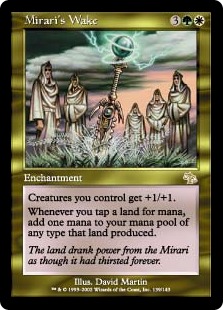
Mirari's Wake

Wake would eventually be recognized as the best deck in Standard. It was identified shortly before the format changed and the card rotated out, which is kind of sad. Wake ran blue cards for Cunning Wish, Deep Analysis and Circular Logic. It could also rapidly blow through the deck with Compulsion. Imagine that you've got your Wake down and the opponent is threatening to swing their Madness creatures into you. You can flip through five or six cards to find a Wrath of God, but you can even pitch and flashback a Moment's Peace to buy some time. Eventually, Wake would cycle Decree of Justice or make Elephant tokens and win through those. It was an annoying deck to face because when you boarded in your Ray of Revelations, they had boarded out Wakes and brought in Exalted Angels. What a groaner.

Wake is still incredibly popular with players. When you think of the best enchantments in EDH, this shows up alongside Necropotence and Debtor's Knell. It has been reprinted as a judge foil, but that did not affect the original's price at all.

$5.50

Phantom Nishoba

This is a strong reanimation target; he blunts aggressive decks and buys back all the life you spent getting him brought back from the dead. I don't think people legitimately look at paying retail mana for this creature; you need to put him out with Quicksilver Amulet or the like. When it's on the field, your opponent starts doing the math and realizes that this creature will Lifelink you into 28 more life points. Strong!

$2.00

Silver Seraph

People like Angels, people like Crusade effects, and people like paying lots of mana for both of 'em. That's my best explanation for this!

$1.50

Solitary Confinement

When this card was printed, people started putting it with Squee, Goblin Nabob to lock out an opponent. They also put it in Eternal Dominion decks; get this to stop the opponent, then get Honden of Seeing Winds to keep feeding it. Nowadays, Solitary Confinement sees play in Enchantress in Legacy, where it is a cornerstone. Few decks can beat a supported Confinement and it shuts down both aggressive decks and combo decks.

$2.75

Spelljack

I've known players to keep a list of cards, written on their copiesof this, of what Spelljack has snagged. In a big mana format, Spelljack can borrow a Mind Twist or stop a Damnation from ever resolving. It's a demoralizing card, which is fun for people who fancy Islands.

$1.00

Test of Endurance

Alternate win conditions in Magic present fun design ideas for many casual players. Lifegain is a beloved mechanic and Test of Endurance actually funnels that hard work into a victory. Sometimes, players will put it in decks that can gain infinite life as a way of sealing the deal when they've made sure they will never die to burn. It rarely makes its way into competitive decks, but Test of Endurance is a casual staple.

$2.50

Wonder

Alongside Cabal Therapy, Wonder is the power uncommon in this set. Free Flying for everyone is so ridiculous and Wonder helped UG Madness fly over the competition, time after time. Wonder showed up most recently in UG Survival Madness in Legacy, where it assisted Vengevines hitting the opponent too quickly. Wonder doesn't make many appearances in casual decks, which is interesting to me. Apparently its value is a reflection of lingering power and people who want to rebuild their UG Madness decks of old.

$3.25

That's it for Odyssey block! It's an underappreciated block, especially when you compare it to Invasion and Onslaught. One was full of gold cards, the other packed with Tribal mechanics, and in the middle was this strange block with unintuitive mechanics. The value of the block has held up well and I think you'll find that Judgment has fared very well, compared to other third sets.

Join me next week when we look at why creature types matter in our look at Onslaught!

Until then,

Doug Linn

Divide and Conquer

Are you a Quiet Speculation member?

If not, now is a perfect time to join up! Our powerful tools, breaking-news analysis, and exclusive Discord channel will make sure you stay up to date and ahead of the curve.

Previously, I've written about the debates surrounding hybrid mana and format staples. This week I’m going to touch upon another such divide which I’ve noted hasn’t garnered as much public attention and debate: how many Commander decks should one build? I know a lot of people who only keep one Commander deck at a time. I, on the other hand, currently have five completed, with another two under construction, and dozens of deck lists in the works. This divide doesn’t fall solely along lines of availability or expendable income; a friend whose collection must be worth at least twice what mine is takes his current Commander deck apart every time he decides to build a new one, and another with an even larger collection has only ever played one Commander. I’m not really sure why they choose to play this way, but I can tell you why I’ve chosen the alternative route.

Variance

The first reason is the same one that makes limited so popular: even with six times as many different cards, playing the same ones game after game can get tedious and repetitive. (But we’re working to reduce that, right?) Personally, I burn out quickly. After a full night of gaming with one Commander, I don’t want to touch that deck for at least a week. You might not get tired of your deck as quickly, but somebody else in your playgroup could.

Playing along the same strategic lines might still be enjoyable for you but particularly if your deck is one of the more powerful ones at the table, or does a good job of dictating pacing, other players are going to get fed up with games that feel like repeats. You can work around this issue by making your deck less consistent, but with one deck you’ll have a tough time both keeping it fresh and having your deck play out in a way you enjoy.

Weaknesses

Moreover, even a deck that consistently leads to novel games which you enjoy is going to get frustrating to play after a while. Magic is a game of tradeoffs, and every deck you build to be good at one thing will come with a weakness to some other strategy. You’ll encounter that strategy …and you’ll lose.

And the next time …you’ll lose again.

And again.

And again.

Pretty soon it may start to feel as if it’s impossible to beat, or you may catch yourself thinking that their deck is unfair, or too competitive. It probably isn’t, but if you only run one deck you have no point of reference to gain perspective. You’ll be able to keep having fun if you play different decks. Sure your [card Wort the Raidmother]Wort[/card] deck lost to Mageta the Lion, but he’s not going to have so much luck against the great [card Sapling of Colfenor]Sapling[/card]. Moreover, if you play a lot of different decks your playgroup won’t have the above reaction to your brews. If someone in your group can’t beat one of your Commanders, it won’t be as hard on them if that Commander only represents you for a quarter of your games.

Rampant Growth

Even beyond immediate effects on gameplay, building a lot of Commander decks can help you grow and evolve as a player. In brewing deck lists, you’ll probably find recurring themes that you build around across Commanders. Maybe, like me, you’ll find that your [card Shirei Shizos Caretaker]Shirei[/card] deck is all about sacrificing creatures with enters-the-battlefield abilities for another use. Your [card Kiki-Jiki Mirror Breaker]Kiki-Jiki[/card] deck is an assortment of 187 creatures you’d like to trigger again. Your Rubinia Soulsinger list is a conglomeration of [card Momentary Blink]blink[/card] effects and [card Sun Titan]Titans[/card]. You might be okay with whatever your tendencies are, but they can lead to a lot of games that resemble one another.

Through identifying these tendencies, you can consciously build your decks to explore new strategies. You might just find something new to enjoy(to the Horizons). Even without uncovering whole new ways of playing the game, by building more decks you’ll have to play more cards and, thusly, gain more exposure. Assuming you aren’t completely disregarding your Commander, you’ll try new types of cards in search of synergy. I would never have played Tombstone Stairwell if I didn’t build a Glissa, the Traitor deck, but doing so opened me up to a whole family of [card Genesis Chamber]board[/card] [card Liege of the Hollows]cloggers[/card].

Beyond just finding new cards, you’ll get to practice incorporating them into decks. The more decks you build and play, the more feedback you get about what works well or poorly in deck design. You’ll improve your ability to build working decks off the bat for Commander, and this practice will help you brew for competitive formats if that’s up your alley. Moreover, playing all of these different strategies will make you more comfortable with different play styles in general. If you’ve always been an aggro player, but you build a [card Teferi Mage of Zhalfir]Teferi[/card] list, you’ll quickly learn to play a more controlling game, and these new skill sets will carry over into other formats. In fact, you’ll be able to try out even more than you’d expect to just from having more decks to improve: while with a single deck you have to make all of your changes at once so that you have something to play, running multiple Commanders lends you the flexibility to get in on the action while you’re in the editing process!

Investment

On top of all of the positive implications for your game, investing more in Commander decks will most likely help your wallet. Commander’s growing quite quickly at the moment, and I can only assume that the format’s growth will accelerate with the release of the summer products. This means that the trends you’re already seeing, like [card Minds Eye]Mind’s Eye[/card] going from $1 to $4, will continue, and most of what you invest in Commander cards now will pay you back whenever you take those decks apart. You’ll get to play your cards and make some money off of them rather than having to choose one (Standard) or the other (Binder). Even if you aren’t looking to make a profit, the more Commander decks you’re working on the easier time you’ll have finding cards you want to trade for with whomever is desperate to get their hands on your newly opened Sword of War and Peace.

Community

But the real reason you want Commander cards isn’t to make a profit: you want to play. I bet you’re asking yourself whether I’m going to tell you that you can play with your multiple decks. As insightful as that might be, instead I’m going to tell you that other people can play with your decks. Many a potential Commander inductee is lost because they come up to ask you what you’re doing, you explain yourself, and then they go do something else.

Don’t let them go.

If you have more than one deck, you can lend them out. No matter how much you tell a friend that playing Commander is awesome, nothing will convince them of the fact so readily as playing it themselves. Once you play your first game of Commander it’s easy to get hooked, and the more people you bring into the community the more people you have to play with. I’ve often had games with new Commander players that were four of my decks facing off. While it might not have been the most exciting for me because I know the ins and outs of each of my decks, a few weeks down the line each of the players I’d lent a deck to had constructed their own.

Even if you already have a healthy-sized playgroup, bringing in new players still benefits you. Until fairly recently, Wizards of the Coast didn’t pay any attention to Commander in designing sets, but as the community has grown so too has our spending power. Today, Wizards designs a few cards for Commander in every expansion, and a lot of cards are tweaked with us in mind.

It could still be more.

What if as many cards were designed for Commander as for Standard in a given set? There’s no reason that with a slightly bigger demographic we couldn’t have tipped the scales so that our mythic Living Weapon was an [card Akroma Angel of Wrath]Akroma[/card] instead of a [card Kiyomaro First to Stand]Kiyomaro[/card]. The more people we pull in, the more cool cards we get, and more importantly, the more people get to enjoy this wonderful format we call EDH, er ...Commander.

How many decks do you have? What factors have contributed to your decision? Do you plan to build more? Let me know!

Jules Robins
julesdrobins@gmail.com
@JulesRobins on Twitter

Brew Phyrexia

Are you a Quiet Speculation member?

If not, now is a perfect time to join up! Our powerful tools, breaking-news analysis, and exclusive Discord channel will make sure you stay up to date and ahead of the curve.

With a new format becoming available for the first time Friday, it's time to take a quick look at what's available. For the most part, these will be aggro or combo decks, since control decks need to be built towards the metagame. As it stands, Caw-Blade is the premiere control deck in the format, and it can be played as-is with the mere addition of Batterskull.

With an unknown metagame, any sideboard I would give here is purely speculative, so I'm just throwing out a bunch of 60-card lists.

Here are both of the new combo decks, stuffed together into one brutally awkward shell:

16 Dead Cards

Untitled Deck

4 Scalding Tarn
4 Creeping Tar Pit
2 Lavaclaw Reaches
4 Darkslick Shores
4 Blackcleave Cliffs
3 Island
1 Swamp
2 Mountain
4 Deceiver Exarch
4 Splinter Twin
4 Gitaxian Probe
4 Jace, the Mind Sculptor
4 Lightning Bolt
4 Spell Pierce
4 Bloodchief Ascension
4 Mindcrank
4 Staggershock

With no tutors, this deck either does nothing or wins instantly. If Bloodchief Ascension were able to "go off" without the need to dome them for 2 twice, it'd be worth considering, but as it stands I can't recommend this deck. The Exarch-Twin combo may exist as a standalone deck, however.

Moving on to everyone's new favorite Myr, we want to pair it with Lotus Cobra and Joraga Treespeaker, bringing us to this deck:

UberMyr Green

Untitled Deck

23 Forest
4 Joraga Treespeaker
4 Lotus Cobra
4 Myr Superion
4 Kozileks Predator
4 Nest Invader
4 Llanowar Elves
4 Leatherback Baloth
4 Fauna Shaman
1 Acidic Slime
4 Lead the Stampede

Note that Llanowar Elves and a Nest Invader token can also cast the 5/6, and Kozilek's Predator can readily set up a Myr Superion as well. The question is whether this is any better than the red/green Beastmaster Ascension deck that's popped up intermittently in the past. I don't think it is, and I'd rather go big than put a bunch of effort into casting small dudes.

Monogreen Eldrazi

Untitled Deck

4 Eldrazi Temple
1 Eye of Ugin
11 Forest
3 Verdant Catacombs
3 Misty Rainforest
3 Tectonic Edge
4 Overgrown Battlement
4 Primeval Titan
4 Lotus Cobra
2 Oracle of Mul Daya
1 Emrakul, the Aeons Torn
1 Kozilek, Butcher of Truth
4 Chancellor of the Tangle
1 Wurmcoil Engine
3 Ulamog, the Infinite Gyre
4 Summoning Trap
4 Explore
3 Growth Spasm

Chancellor of the Tangle is nuts, and easily pushes the deck over the top. I'd expect to see some variant on this pop up in Orlando or Louisville. The big advantage to playing Chancellor over a more flexible accelerant (such as Joraga Treespeaker) is that Chancellor is at least a decent fatty, and that's a lot better to flip off a Summoning Trap.

Trinketry

We're in a more open metagame for the time being, so it may be useful to examine a proactive "control" deck. Much like red Caw-Blade (Angry Birds), this deck packs the Sparkmage-Collar package, and the new Hex Parasite is an useful tool for Trinket Mage to get in a planeswalker fight.

Untitled Deck

4 Celestial Colonnade
4 Seachrome Coast
3 Arid Mesa
3 Scalding Tarn
4 Glacial Fortress
1 Mountain
3 Island
4 Plains
4 Cunning Sparkmage
4 Stoneforge Mystic
4 Squadron Hawk
1 Hex Parasite
3 Trinket Mage
1 Basilisk Collar
1 Batterskull
1 Sword of Feast and Famine
1 Sword of War and Peace
1 Sylvok Lifestaff
4 Jace, the Mind Sculptor
3 Spell Pierce
2 Gideon Jura
4 Preordain

This is probably too greedy by half, but it's really only lost Mana Leaks and a removal spell from conventional Caw-Blade.

White presents us with a few options for decks. The first is to replace Vector Asp with Hex Parasite in the return of Steve Sadin's Pro Tour: Paris deck.

Hawkward

Untitled Deck

4 Contested War Zone
15 Plains
4 Memnite
4 Etched Champion
4 Porcelain Legionnaire
4 Signal Pest
4 Hex Parasite
4 Phyrexian Revoker
4 Glint Hawk
4 Tempered Steel
3 Mox Opal
4 Glint Hawk Idol
1 Shrine of Loyal Legions
1 Remember the Fallen

Porcelain Legionnaire is an absurdly potent beatstick in this deck, since Tempered Steel turns it into a 5/3 with First Strike. The 1-ofs at the end of the decklist are just alternative options I'd like to highlight as cards which play well: Remember the Fallen is a potentially playable re-buy, much like Morbid Plunder, since it gets back 2 creatures after a Wrath. Shrine of Loyal Legions is far more likely to be played, since it makes 3/3 tokens if Tempered Steel is on the table.

The other absurd white card in New Phyrexia is Puresteel Paladin, which could see play in a return of Monowhite Quest.

Quest for Puresteel

Untitled Deck

4 Inkmoth Nexus
4 Contested War Zone
12 Plains
4 Stoneforge Mystic
4 Puresteel Paladin
4 Glint Hawk
4 Memnite
4 Porcelain Legionnaire
4 Hex Parasite
4 Signal Pest
4 Kor Skyfisher
1 Argentum Armor
1 Sword of Feast and Famine
1 Sword of War and Peace
1 Batterskull
4 Quest for the Holy Relic

Porcelain Legionnaire's status as an artifact helps Puresteel Paladin hit Metalcraft - a Mox or a Memnite in addition will be enough to enable him to freely equip an Argentum Armor played by a Stoneforge Mystic. The deck becomes less reliant on Quest as a result.

For those who just plain don't like unreliable cards, it can be played as a straight White Weenie deck, reminiscent of the ones we played in Mirrodin-era Standard.

Puresteel

Untitled Deck

18 Plains
4 Inkmoth Nexus
4 Puresteel Paladin
4 Stoneforge Mystic
4 Squadron Hawk
2 Kor Sanctifiers
4 Student of Warfare
4 Memnite
4 Dispatch
4 Flayer Husk
2 Mortarpod
2 Batterskull
1 Sword of Body and Mind
1 Sword of Feast and Famine
1 Sword of War and Peace
1 Bonehoard

This list finished third in a Magic-League tournament, but the creator was probably on to something: Flayer Husk is a very good card to run in a Puresteel Paladin deck. It's a cheap creature that draws cards and bumps the Metalcraft count up. The deck on the whole seems highly vulnerable to the Splinter Twin deck, and I'm not sure it's fast enough to outrace Valakut and G/x Eldrazi, so those are probably issues.

There's been a lot of talk about Gitaxian Probe and the potential return of Pyromancer Ascension. Kelly Reid has been championing the green splash, thanks to the power of Lotus Cobra, Explore, and the newly-printed Noxious Revival to go alongside the Probe. I haven't had the chance to see this beast in action yet, but if it can set off the Ascension reliably, the added land acceleration should put it well ahead of the conventional lists, and Noxious Revival is a great deal faster than Call to Mind.

RUG Pyromancy

Untitled Deck

4 Mountain
3 Forest
5 Island
3 Halimar Depths
4 Misty Rainforest
4 Scalding Tarn
4 Lotus Cobra
4 Pyromancer Ascension
4 Gitaxian Probe
4 See Beyond
4 Preordain
4 Explore
2 Reality Spasm
4 Lightning Bolt
4 Mana Leak
3 Noxious Revival

Moving on to the burnt metal part of the color pie, we see that Kuldotha Red has gained a new toy in Slag Fiend, which gives it the ability to recover from sweepers or from dumping its board in the yard. It's possible that the deck could be built to abuse it more readily, but this is a more conventional build which dismisses that in favor of a straightforward kill plan.

K-Red

Untitled Deck

4 Contested War Zone
14 Mountain
4 Memnite
4 Hex Parasite
4 Goblin Bushwhacker
4 Goblin Guide
4 Signal Pest
2 Slag Fiend
3 Goblin Wardriver
4 Kuldotha Rebirth
4 Chimeric Mass
4 Lightning Bolt
3 Mox Opal
2 Devastating Summons

Slag Fiend isn't even the red card I like the most. My favorite red card from New Phyrexia is actually Volt Charge, which is going to take some time for people to figure out the optimum decklist for. The list of cards which benefit from the Charge is a long one:
Shrine of Burning Rage, Zektar Shrine Expedition, Koth of the Hammer, Everflowing Chalice, Tumble Magnet, Quest for Pure Flame, Pyromancer Ascension, Kargan Dragonlord, Chimeric Mass, and possibly some cards which haven't even seen play yet.

If we were to build a deck to maximize Volt Charge itself, it might look something like this:

Prolifer-Burn

Untitled Deck

4 Teetering Peaks
16 Mountain
2 Arid Mesa
2 Scalding Tarn
4 Kargan Dragonlord
4 Spikeshot Elder
4 Goblin Guide
4 Koth of the Hammer
4 Volt Charge
4 Shrine of Burning Rage
4 Chimeric Mass
4 Lightning Bolt
3 Tumble Magnet
1 Red Suns Zenith

This deck is in a somewhat awkward position- if it doesn't draw Volt Charge it's simultaneously just plain worse than both conventional RDW and the Big Red deck with Everflowing Chalice and Kuldotha Phoenix. If it draws Volt Charge, it can turn that 3-mana burn spell into a lot more than 3 damage. The ability to Ultimate a Koth on the turn after he enters play has been written about, but using Charge midcombat to bump up a Chimeric Mass or a Kargan Dragonlord is a play which can just as readily end games, not to mention the fact that it puts 2 counters on Shrine of Burning Rage.

Speaking of putting 2 counters on something...

Pick An Enchantment

Untitled Deck

3 Scalding Tarn
3 Arid Mesa
16 Mountain
4 Lightning Bolt
4 Volt Charge
4 Burst Lightning
4 Searing Blaze
4 Staggershock
4 Arc Trail
4 Slagstorm
2 Red Suns Zenith
4 Pyromancer Ascension
4 Quest for Pure Flame

Both Pyromancer's Ascension and Quest for Pure Flame are basically under-priced conditional Furnace of Raths in this deck, and with 8 in the deck you're pretty likely to get one or the other in your opening hand. At that point, you just keep the board clear and eventually win with doubled-up burn.

The purists will complain that the Enchantments are poor draws lategame, but the critical mass of burn and good red cards makes it possible for us to just dome people out from 20 the hard way. With Pyromancer Ascension gone, there's no reason not to play Goblin Guide as well, which brings us to our next deck:

Stupid Red Burn

Untitled Deck

3 Scalding Tarn
3 Arid Mesa
16 Mountain
4 Goblin Guide
4 Lightning Bolt
4 Volt Charge
4 Burst Lightning
4 Searing Blaze
4 Staggershock
2 Arc Trail
4 Slagstorm
4 Shrine of Burning Rage
4 Zektar Shrine Expedition

This, of course, suffers from a lack of repeated damage. While Shrine of Burning Rage offers a form of inevitability, the inability to steadily tick the opponent's life total down from 20 to 10 before killing in a flurry of burn forces us to dismiss it.

If we move to a more combo-control mindset, we can do something like this instead:

Pure Flame

Untitled Deck

4 Scalding Tarn
16 Mountain
4 Arid Mesa
4 Quest for Pure Flame
4 Staggershock
4 Volt Charge
4 Lightning Bolt
4 Arc Trail
4 Searing Blaze
4 Shrine of Burning Rage
4 Slagstorm
4 Koth of the Hammer

Maxing out the Quest is usually game over here, with either Shrine of Burning Rage or Koth's ultimate representing the killing blow. However, this deck is hideously inconsistent and should just be axed, as it can't do much of anything without the Quest.

That brings us to the question: Why focus so much on abusing Volt Charge? Why not just play it as a 3 mana 3 damage spell and just reap the ancillary benefits of proliferate? In short, why not just slot it into modern RDW?

Red Deck Wins

Untitled Deck

12 Mountain
4 Arid Mesa
4 Scalding Tarn
4 Teetering Peaks
4 Ember Hauler
4 Goblin Guide
4 Spikeshot Elder
4 Plated Geopede
4 Lightning Bolt
4 Searing Blaze
4 Koth of the Hammer
4 Shrine of Burning Rage
4 Volt Charge

With 16 creatures, this deck can rack up damage over time, use the burn to clear the board, and use Koth or Shrine as a killing blow. The question is whether a deck like this benefits more from the proliferation on Volt Charge or the extra point of damage offered by Staggershock. It's critical to note that Shrine gets ticked up twice by Staggershock because Rebound casts the spell, so the only advantage Volt Charge has is the Koth interaction.

We could, of course, play both...

Smart Red Burn

Untitled Deck

4 Scalding Tarn
4 Arid Mesa
11 Mountain
4 Teetering Peaks
4 Goblin Guide
4 Spikeshot Elder
4 Ember Hauler
4 Lightning Bolt
3 Volt Charge
4 Koth of the Hammer
4 Searing Blaze
3 Staggershock
2 Arc Trail
4 Shrine of Burning Rage

Plated Geopede gets the axe because he's just a face-beater, and he has a way of constantly getting chumped.

Somewhere in or between this pile of red decks is the right one to play.

Moving on from the flames, there's one last thing I want to discuss this week. Sheoldred is 7 mana, and Debtors' Knell once saw play. In a format where people will have only a single Titan in play, it's entirely possible that Sheoldred is a viable top-end to a BUG deck, looking something like this:

SheRock

Untitled Deck

4 Misty Rainforest
4 Verdant Catacombs
4 Darkslick Shores
4 Creeping Tar Pit
5 Forest
2 Island
3 Swamp
3 Sheoldred, Whispering One
4 Lotus Cobra
2 Grave Titan
2 Oracle of Mul Daya
4 Jace, the Mind Sculptor
4 Preordain
4 Explore
3 Mana Leak
1 Garruk Wildspeaker
3 Despise
2 Dismember
2 Go for the Throat

It's a new format. Get brewing!

Joshua Justice

@JoshJMTG on Twitter

New Phyrexia Black & Red Design Review

Are you a Quiet Speculation member?

If not, now is a perfect time to join up! Our powerful tools, breaking-news analysis, and exclusive Discord channel will make sure you stay up to date and ahead of the curve.

Hello again! This is part 2 (of 3) of my design review of New Phyrexia. Design reviews are like most set reviews, except instead of telling you boring stuff like how highly to pick a common in draft or taking a wild guess at a card's constructed value without designing a deck first, I tell you what I think about the design of the cards. Are they interesting? Why are they here? Let's find out!

Black


Oh cool, there is a minicycle of these in this set. Unlike Impaler Shrike, it should be a lot more clear most of the time whether you should sacrifice Blind Zealot or not. It's not all that different from Hideous End, really. You deal 2 to them and kill their best guy. There's also the "snake time" you get before you sac it. By which I mean this card acts as a snake (the multiplayer politics meaning), hovering around and saying "don't put out anything that threatens me, or I'll kill it!"


Aww c'mon! We couldn't get Kiss of Phyrexia here? Well, even though they missed on perfect naming, the design here is a big hit. Before I left R&D, I overheard, and was involved in, more than one conversation about using poison as a cost for a spell. It doesn't work out, because if the spell is any good, you put whatever number of them that wouldn't add up to 10 poison into your deck and get a big advantage without every really paying the poison cost. Caress of Phyrexia avoids this problem by taking 3 life and giving 3 poison, so that you feel some cost no matter what. It can also function as a poison kill spell, of which there are extremely few. Note that even if you think that the math is better with other numbers (like 4 life and 2 poison), the 3-3-3 makes the card easier to parse and to remember. Aligning numbers is a much bigger deal than you think, not just on individual cards, but across mechanics.


This might be the best one of this cycle. The life drain itself sounds excellent, but doesn't affect the board state like some of the other abilities do, so it doesn't make the opponent feel that you lucked them into a big disadvantage. Even better, is the fact that gaining 3 life gives you more time to cast this 7-mana monstrosity before you are killed by a faster deck. Then, if you're behind but manage to stick it, the lifegain will get you back in the game in a hurry.


A fine black flier / discard spell. May lead to some interesting decisions and interesting plays. Clearly not meant to be a powerhouse, this card does a good job of filling a black common slot. It's new and different from previous cards while remaining simple enough and staying well within Blacks wheelhouse.


I am surprised to see this card. Last I checked (admittedly a while ago) R&D was intentionally avoiding writing "planeswalker" on cards. The feeling was that since creatures killed them, it was too heavy-handed to make answers that only hit planeswalkers. I guess this indicates a change of heart on the matter. All that aside, this is another good Duress variation; getting creatures and planeswalkers (and noteably leaving non-creature artifacts unscathed) might make it better than Inquisition of Kozilek. Since expensive sorceries seem to be totally out of fashion these days, I'd just play both.


You know they've been saving this name of a saucy removal spell! A serviceable use of Phyrexian mana (not too creative, but pretty cool), it's almost Vendetta-like in many situations.


Yay! I love Enslave (not sure why, I just do) so I'm happy to see it reprinted. Good choice too as it already has the "lose 1 life" theme going.


Aaron was on this set? He loves him some Gravediggers. Probably was created in design, but still. I really like that this solves the Gravedigger conundrum, when you have nothing dead and only this to cast to pressure your opponent. Having said that, I bet the first time I draw this both my opponent's hand and my graveyard will be empty. [Note: Between writing and publication I played in the Prerelease, and the first time I chose the discard option my opponent showed me two land and three creatures. I lost that game.]


I guess 1B and draw a card would be asking too much? Another reprint, in case you were not aware. Also in case you were not aware: the Phyrexians are evil. Pure, concentrated evil. Don't touch it.


Continuing the "lose 1 life" theme... the life loss almost seems silly next to the edict effect, but it's a fine card design.


Very interesting. This newest member of the Takklemaggot family tells a neat story. A story of evil and corrutpion. A story of the slow descent into the cold dark night. Actually, maybe it's more like Unstable Mutation? It sort of doubles the power of the creature you put it on before slowly shrinking it. I don't expect you to use it on your own guys very much, though. Against a deck without any infect, the first of these is almost certainly a Doom Blade, but the fourth one might not be such a great idea. See? I told you it would be interesting.


Cool. I like the way proliferate is used on the spells in NPH. This card reminds me of the Blight mechanic from GDS2. The first one sets up the curse, and each subsequent one progresses the curse and sets up a new curse. (If used on a creature with greater than 2 toughness in the first place, that is.) I think this card will be a lot of fun to play, and I hope the charge-counter decks will be a lot more interesting in NMS drafts. [Note: At the prerelease, I cast this targeting my own Carnifex Demon. You can kill multiple 5-toughness creatures with that combo.]


This is no Disaster Radius, that's for sure. This design bothers me a bit, I think because it feels so useless. Even in casual games, a 7-mana wrath is pretty weak, and this one requires you to sacrifice a creature. More than that, you have to sacrifice a creature with power equal to or greater than the toughness of their biggest guy. If you have that, you probably don't need to wrath them. Certainly not for 7 mana. I'm not saying it actually is useless. If you have a big guy, and they have several small guys and you don't want to get multi-blocked, you can use this and a small guy you have lying around to kill all the small guys and leave your fatty alive. You, know like Infest would do. I don't want to say this design is disappointing because it's weak, but because it misleads players into thinking it will do something, when it really won't (or at least not that a card like infest does just as well with less complication).


A much more interesting wrath. Players love removing threats from their opponent's decks, they love it! This design lets you feel very satisfied that you killed their guy and they won't be drawing another one. Just don't pull out their Vengevines.


This is cute. It sort of has that Green "can deal combat damage if blocked" thing, but worded in a Black way. Anyone want to build the Fling combo deck with this guy? So right there, that's why this is a great design, despite being a relatively simple card. You can imagine big upsides and cool things to do with it.


Designs that tell stories, episode 347. A pretty gross and very Phyrexian story at that.


I found it very easy to make mistakes with Phyrexian Negator. This design, on the other hand, should avoid that problem quite nicely (your opponent will make mistakes against it, however). It was a great idea to take that classic and make the all-upside version. This might be Black's Baneslayer Angel. I certainly would think twice about blocking it with one.


Another Phyrexian mana filler card. Perhaps I'm judging the use of Phyrexian mana too harshly, but "this could be cheaper for life" seems like an extraordinarily spikey mechanic, and it's hard to consider the design of cards that use it without thinking if the card is exciting to cast the alternate way. This one certainly is not. I'd rather have Bala Ged Scorpion, Skinrender, Blister Beetle, or well, almost anything, really. The ability is nice, and fits the set, at least.


Looks like a Gruesome Encore variant to me. Does this block have a higher than usual number of similar cards in the different sets? Maybe I never paid enough attention to that before. Well, Postmortem Lunge and Gruesome Encore each only hit one graveyard, not both, so they're different enough. This use of Phyrexian mana falls into the approved group for me. The X in the cost can always make that extra mana matter, and I can imagine aggro decks of other colors being interested in having access to this card.


This effect looks like fun. I certainly like this design. I find it a little odd that they went with double-black in the mana cost. Isn't this just the sort of effect you want to allow into 4 and 5 color decks? Perhaps they didn't want you to always be able to play everything in their deck. Note that artifacts, the theme of this block, are particularly vulnerable to this effect.


What a cool poison ability! It combines well with the stats to put your opponent in a tight spot. How interesting would it be on a 2/2? A 3/1? Actually, still pretty interesting, because the ability is very cool. The stats they actually chose are probably some of the most interesting and situation-creating, and that's likely why they chose them.


Yowza! Now that is a mythic rare design! Black has had a bunch of "you sacrifice a guy each turn" fatties in recent years, but I think this one takes the cake. The combination of sacrifice and reanimation will give the game a feeling of inexorable doom. (Be sure to read the name as "she-old-red" it's funnier that way.)


This is a fine use of Phyrexian mana, for the same reason Faerie Macabre works the way it does. Graveyard combos are best broken up by free instant abilities. In general I'm avoiding constructed comments, but here's an exception: useful against Vengevine, and perhaps some vintage stuff. Not very useful otherwise.


Infect & regeneration sound like fun, but they're actually a pretty annoying combo to have to deal with. Hence the 1 toughness and general low-power of this card.


A cool use of Phyrexian mana. The lifelink here is what really sells it for me. Surely you'll make up that 2 life very soon, right? (Yes, but you would have been ahead 2 more life - it's really more about how much life is worth to you in this particular game.)


Another member of the "when do I sacrifice it" family. I'm pretty sure the answer is "as soon as the opponent has the same number of cards in hand as they have poison counters" but don't quote me on that. Infect creatures always seem more valuable to me than non-infect creatures, so I feel I'd be afraid to sacrifice one, but maybe I've played too many drafts where I started infect but then it was cut off from me.

Coolest / Most Exciting: Phyrexian Obliterator (it wasn't close)
Most Interesting Design: Caress of Phyrexia (but there are many pretty close choices)

Red


The big secret about "gain control" spells is that the Instants are ten times better than the Sorceries. This 5-mana effect will certainly be worth 4 life and 3 mana on many occasions, and therefore I approve of this use of Phyrexian mana. It feels Phyrexian to use your stuff against you, of course, so no surpise that such a spell might be part of their arsenal. Everyone thinks of this as the Blue card, Ray of Command (and indeed, the wording is identical), but the first such effect appeared on Disharmony, a Red card in Legends. Disharmony spells out exactly how to best use the card - take and attacker before blockers are declared - by forcing you to only use it in exactly that way. To a designer this is of particular interest. Is a design better if it is narrow but clear in flavor and instructive on how to play magic with greater skill, or more open ended? All the cards that followed in Disharmony's footsteps chose the latter. There are about a dozen such cards, half Sorcery and half Instant.


This Goblin Grenade gives you the "or artifact" option, of course, as it is in an artifact block. Another good card to keep the sacrifice decks rolling along. Red has had a few cards like this over the years, and 5 damage turns out to be the correct amount almost every time. (Goblin Grenade, Magma Rift, Shrapnel Blast, Fiery Conclusion; okay exactly every time. On that note, this should probably cost 3 mana, not 4.)


I have to love this, it reads like a card I would design, or at least it reads like a card I would like to have designed. It tells a great story too, everybody grabs a priceless magical artifact and starts bashing each other's heads in with them. Note the repeated use of X here for all variables. Using the only number all artifacts have - a converted mana cost. I suppose you could make the equip cost always be 2. That might have made a more powerful card... actually I think I would have done it that way, even if it means there's another number on the card. A heckava lot of equipment has an equip cost of 2, which is why I think setting it to 2 wouldn't be confusing.


Free turn-1, hasty goblin is pretty sweet for an goblin-based red deck. This ability seems pretty innocuous, and probably won't feel to unfair as an opening-hand effect, but it may be very deadly. I don't like the wording of the second ability, because it's so bad on an empty board. You cast a 7-mana guy and all you get is a virtual vanilla 5/5 and a 1/1? Yuck. I would have picked a number and given you that many goblins. Or I might have considered making this a Goblin lord - giving them a massive +3/+3 or something sexy like that. Well, I suppose if you have 3 guys when you cast this you're getting 9 power for 7 mana. Not bad, but just not very exciting to me as the second ability on this card.


Oh baby! Infect (or Wither) + pinging = sick. That's an equation we all learned in Shadowmoor, and it's rarely delivered all at once. Add to that the fact that Infect makes this a ping-for-2 against the opponent's face and this is quite an exciting card. You don't want this effect to become too annoying, so even at uncommon you have to weigh it down a bit with slightly higher mana and activation costs.


Yep.


A pretty interesting way to make a 1-mana 1/1 cool. This is extremely efficient damage against an opponent's face (better than Lightning Bolt, in damage:mana ratio). This card also has another red magic number: 3. You almost always get 3 damage when you sacrifice a guy, or when your guy dies. It's enough to make the card feel threating and have a real effect on the game, but not so much it can take out a big creature.


Not sure why this is restricted to creature spells. Oh well and artifacts - but that part is obvious. Once you are restricting it, clearly artifacts are OK if we're in Mirrodin. Why restrict it at all? That aside, going from 4 mana to 7 mana puts this in an interesting spot. It gets you to Inferno Titan, Chancellor of the Forge, Spine of Ish Sah... not too shabby! I don't know about you, but to me Red having spell-speed extra mana still seems like a "change" in the color. It's been that way for a really long time now, though. Mind you, it is a change that I completely approve of.


This design seems both obvious and dull to me. The obvious cards are often correct to make, but I can't help but feel this is a waste of a card slot. It's a correct use of Phyrexian mana, and it's giving players the card they expected to see... but still too boring for me.


This is a cool use of Imprint. It's a 3/2 stone rain guy, but it uses Imprint to create an Ankh of Mishra for just one type of land. Great idea, well executed.


Great use of Phyrexian Mana. Firebreathing will always be interesting with life-payment, because it gives a great risk-reward decision to its controller. Also, I am really happy to see a powerful Dragon card here. So few of the recent Dragons have been worth playing in constructed, which makes me very sad. They're the #1 most awesome creature type, and they never get to show up in top decks. There should be one in every block, if not every set! Sweet flavor text too.


As with the blue infect creatures, when Infect is added to a new color, the creatures have to be very good, so that the color can work out for you in draft. This guy can certainly be your only infect creature, as it might easily do the job all by itself. Red's recent history has a few firebreathing 0/X creatures, and I think they've become a great red creature staple for use once per block. They play very well, feel red and yet add defense and flexibility to a color whose creatures are often one-note.


This red mechanic - "free" guys, or just guys that return RRR to your pool, has had a few iterations in the past. They are usually pretty exciting in limited play, and with a lot of equipment and useful little artifacts in this block I can imagine this card feels pretty good. It's a great mechanic for red because it seems to add a big points for variety.


Seems like every block has a red card that gives you a damage trigger when you use the set's mechanic. I find this one particularly cool because the mechanic it uses gives you cheaper spells, but this card outputs damage based on the full cost, so you'll feel like you're getting something extra for free.


Another lesson from Shadowmoor, -1/-1 counters and first strike are like chocolate and peanut butter. It's important to keep these small in almost all cases, as they might be frustrating in play if they are bigger.


Red has a common Panic effect in most sets. In an artifact block, why not make a Panic that gives artifact creatures the advantage? Actually, you had better make it work better or worse against artifact creatures, if you're in an artifact block - that's the designer's job! This is an okay use of Phyrexian mana, though it's not really necessary.


A bit of a strange Lava Axe here. Still, it has a dream, and cards with a dream are often great designs. One of the tricks is that most players don't do the math before they build their deck. They just try to get all the artifacts they can into their yard and assume it will work out, and they'll have fun playing it even if it only half-works. So when designing such cards you don't have to worry about their constructed or even limited viability. So long as they sound good they'll be a good design. Of course, development still has to test them. Sometimes they turn out way more powerful than expected.


Is this card best-buddies with Scrapyard Salvo? Seems like there just has to be an Ichor Wellspring & Mycosynth Wellspring Sacrifice deck in here somewhere. This design reminds me of Death's Shadow. You can't cast it that early (Turn 1: Mountain, Mox Opal, Mox Opal, Slag Fiend!) but it's grossly undercosted if you get to a point where it's a fatty.


Meow! There seem to be an awful lot of 4-power red creatures these days. (There are 9 in Scars block, but 5 of those are constructed-worthy, which is why it seems like there are so many.) This card feels sleek and sexy, which is a nice effect to achieve on the design of a haste creature that has a cost-reduction mechanic.


Another "choose one" whose choice always turns out the same way. Sure, we can all think of corner cases when the +2/+0 will be used, but it's really there to fill out the Exarch cycle. (Nothing wrong with that.) Being a 2/2 gives it some nice symmetry with the +2/+0 and the -0/-2.


An elegant and pleasing design. Two simple effects that are so cute together you ask yourself why it hasn't been done before and why you didn't think of it yourself. A+


Demolish is great in an artifact block, and adding the "lose 1 life" sub-theme to it is an excellent way to bring it further into the fold. Splendid common design.


Proliferate makes its appearance in Red! This card is extra-exciting due to the existence of Koth of the Hammer. Better to print this in a set after Koth (rather than the same set), if Koth is powerful (which it is), so that players will be more excited to see it.


Perfectly serviceable design, but most obviously filler. There's only one vanilla creature in Red, but there might as well have been two.


This is very nice - you feel it could be a one-sided Pyroclasm. Getting a player excited about a card like this is an important accomplishment. Actual power level aside, this card is much more effective at holding a player's interest than Pyroclasm would be in this slot, and that's what you want in your set.

Coolest / Most Exciting: Uarabrask the Hidden
Most Interesting Design: Bludgeon Brawl

That's it for part 2! I bet you can guess what I'll be talking about next time. See you then!

Gregory Marques

Announcing the Prediction Tracker (and making some predictions)

Are you a Quiet Speculation member?

If not, now is a perfect time to join up! Our powerful tools, breaking-news analysis, and exclusive Discord channel will make sure you stay up to date and ahead of the curve.

Today I’ve got some exciting news for Insiders. It’s not easy to keep up with the Magic financial market. Luckily you’ve made the right decision to become a QS Insider where you’ve got a dedicated team to help keep you on top of the market.

But when does it all become too much information? When you’re out on the trading floor, it’s not always easy to remember exactly what price Inferno Titan has risen to, or which writer suggested picking up Splinter Twin. And what was that card Kelly suggested picking up a few weeks back? Wouldn’t it be nice if there were some way to keep all of this straight besides trying to memorize it?

Today I’m announcing the project that aims to make it easier for all of you to do just that.

What is it?

For now, we’re just going to be calling it a Prediction Tracker. The concept is simple: To organize all the predictions made by the dedicated team of writers on QS. This likely will come in the form of a spreadsheet that will be updated weekly or biweekly. It will organize all the writers’ predictions on cards together. This may be as simple as a “buy,” or it may be something more specific, using predictions from financial set reviews.

Grouping all this information together allows Insiders to quickly compare the calls on a particular card. With New Phyrexia releasing this weekend, what’s the consensus on Phyrexian Metamorph? Hot prospect or future bulk rare? A quick check of the Prediction Tracker will allow you to compare opinions and make your own decision.

This should become a static page on QS that you can access through your computer or smartphone, saving you the hassle of having to navigate to four or five articles to gather predictions.

The initial page will most likely just contain card names and projected prices from each writer, but I hope to figure out how to configure it to automatically update each card’s price from Black Lotus Project. This will allow you to compare the current price to the predicted price and act accordingly. I’m not the spreadsheet master that McNutt is, so I’m not sure if this is possible, but know that it will hopefully become a reality before long.

The first update of the Prediction Tracker should be available next week, or worst-case scenario, the week after. The biggest problem right now is getting everyone on the same pricing system. I prefer Black Lotus Project prices to something more arbitrary like Star City Games, but the first step is to get everyone on the same page.

I often talk about how important it is to be accountable for your trading technique and, if you’re a writer, to be accountable for the advice you give your readers. Right now, myself and a few of the other writers here look back every few months at their calls in that time frame. This is a great step, and one that helps keep the system transparent while still making for a good read.

I see the prediction tracker as taking that concept one step farther. Once it is optimized it will allow for a real-time check on the predictions made by any writer who contributes to it. It is my hope that this will become an invaluable tool available only to our Insiders.

Making predictions

Stay tuned for more updates on the Tracker. As someone suggested on my column last week, I’m going to take a shot at calling some of the impact of New Phyrexia on the Standard and Legacy metagame that hasn’t been looked at yet. A lot of the current press has been about which cards to pick up, so I’m going to try to point out some cards you should be selling.

Starting with Standard, I think it’s safe to say that Caw-Blade is not going to be the ONLY deck, though I expect it to still be very good. There’s going to be more Into the Roils played, along with Celestial Purges showing up in sideboards. The reason is that Roil is the best maindeck answer to both Deceiver Exarch/Splinter Twin and Swords, and Purge is the best answer out of the sideboard to answer both Splinter Twin and Pyromancer Ascension, a deck that also received a few upgrades.

Unfortunately neither of these cards is Rare, otherwise we’d be in a good position to profit from it. But I would gather up your Celestial Purges and throw them into your binder, if nothing else. As for everything else in CawBlade that isn’t Stoneforge Mystic, it’s likely going to drop off a little. I don’t think you’re going to find a better time than now to pitch Gideon Jura, which has been rumored to be coming to M12 (which would hurt his price).

Pyromancer Ascension has been steadily rising (up $.50, or 50%, in the last week). One thing to note is that Ascension peaked above just $2 last Standard season, but there’s little to no risk jumping in on these now and flipping them to players looking to build the deck.

As for Splinter Twin, I can’t see it climbing much higher, so I would get rid of yours in the next few weeks. Even if it’s a real deck, it’s pretty tough to imagine it staying at the absurd price it’s at now.

And, if you haven’t already, now is the time to sell your Primeval Titans. As LSV’s recent series on Channel Fireball showed, the deck just can’t compete with CawBlade, and it doesn’t exactly race a Turn 4 Splinter Twin, either. All of the Titans’ prices are going to fall off a cliff come M12 anyway, since the price will drop whether or not they are reprinted.

Another Uncommon out of New Phyrexia to pick up is Dismember. I’m not sure whether or not the card can make waves in Legacy (I wouldn’t be surprised), but it’s also going to be the only catch-all answer to Deceiver Exarch since it can go in any deck, and it really shines in a Black deck.

I’ve been toting Spellskite since it was spoiled. The card is nuts, in more than just Splinter Twin combo. Get in on these ASAP.

One other card to have on your radar is Phylactery Lich. This is the most unlikely to hit, but if mono-black Control becomes a real deck and plays this card it’s going to shoot up hard. It was a solid $3-4 card in trading for months after its release and it will easily pass $5 if it becomes a real card. There are certainly worse things in the world than Turn 1 Inquisition of Kozilek, Turn 2 Contagion Clasp, Turn 3 Phylactery Lich into Turn 4 Phyrexian Obliterator. Just something to keep in mind.

Looking at Legacy, obviously the big card is Mental Misstep. There are a lot better people to ask about the playing implications of the card, but the consensus seems to be that’s it’s very close to the nuts. The first thing that sticks out to me is more decks are going to be reliant on “free” mana engines rather than one-casting cost stuff. Think less Dark Rituals and more Lion's Eye Diamonds. I suggested picking up LED’s two weeks ago, and they’re still on the way up.

I don’t have any expertise about whether or not High Tide will still be a deck after Misstep, but the time seems right to sell off any Candelabra of Tawnos or Time Spirals you might have. The popularity of the deck is severely limited by availability issues, so it’s unlikely we’ll see much more demand for the Candles than we are now. Flip them and be happy with your profit. Same goes for Spiral. Hopefully you picked them up right after the announcement of their unbanning, and now seems like one of the best opportunities to sell them you’re going to get.

That’s all the room I have for this week. I hope you are excited for the Prediction Tracker as I am! And if you have a better name for it, don’t be afraid to suggest it 😉

Thanks,

Corbin Hosler

@Chosler88 on Twitter

Land Destruction in Commander

Are you a Quiet Speculation member?

If not, now is a perfect time to join up! Our powerful tools, breaking-news analysis, and exclusive Discord channel will make sure you stay up to date and ahead of the curve.

Today I'd like to talk about one of the taboo topics of Commander: land destruction. We'll look at both the single target variety and the mass destruction type. There's been a wide variety of it printed over the years, and every color has access to it, through lands and artifacts at the least. Overwhelming popular opinion is that land destruction is antithetical to the nature of the format and should be played sparingly as a last resort to deal with particularly troublesome lands like Cabal Coffers or Volrath's Stronghold.

As many people have already mentioned in format primers and discussions, the best ways to win usually involves getting ahead on mana and winning the tempo race by playing the huge bombs for which the format is famous. This does not strike me as a healthy metagame. My personal feeling is that the lack of land destruction in the format is what causes this, and a little land destruction would do most playgroups some good.

In more traditional formats, the traditional way to disrupt the opponent from playing game-winning effects is to use countermagic. You can see examples of this in pretty much every dueling format. In multiplayer, there simply aren't enough counterspells to go around. You can't counter every bomb, and you can't deal with every potential threat from three or more opponents.

For those out there who are old school enough and remember the days of Stone Rain and Sinkhole, there is a proactive form of countermagic: simply blow up your opponent's lands before they can actually cast a spell. We've even seen it do well on the tournament scene a few times in the past. But this is Commander, the format of [card Titanic Ultimatum]Ultimatums[/card], [card Primeval Titan]Titans[/card], and [card Ulamog the Infinite Gyre]Eldrazi[/card]. Destroying lands will definitely make you The Threat, whether you like it or not.

The Pros of Land Destruction

Dealing with Broken Lands

Doing a quick Gatherer search can easily turn up multiple lands worth destroying. Academy Ruins has a tendency to do very dumb things. Volrath's Stronghold causes similar issues. Gaea's Cradle cranks out mana like it's going out of style. Emeria, the Sky Ruin is less scary initially, at least right up until it's online.

Sometimes you just really need to get rid of a land.

This is the standard reason people run Strip Mine and Wasteland in every deck they play (and to a lesser extent Tectonic Edge and Dust Bowl), and most people have no problem with running any or all of these. They do tend to get upset when you decide to recur them a bunch, though.

Controlling Ramp Strategies

Being able to slow down heavy ramp strategies is a huge deal. The biggest argument behind banning some of the format staples such as Sol Ring and Mana Vault is that whoever finds one early wins by virtue of the tempo advantage. While an individual deck needs to be able to capitalize on this bonus mana, the general idea is getting to the bombs sooner. Cards as simple as Mind Stone are considered great in the format just because they provide that early mana advantage needed to get your most powerful spells online before your opponents. While this is a column aimed at casual players rather than the more competitive types, everyone still likes to win. Different players like their tribal Elf or Goblin decks as much as other players likes their tribal Dragon decks that just plays mana ramp until one can cast the first dragon.

When I look at this format I see a format designed for the archetypal casual player, Timmy, being able to play what he likes best. The concept that lands are sacrosanct keeps more aggressive strategies from flourishing in the format. When you play your whole hand by turn 5 and your opponents still have five or more cards in hand because they designed their decks to take advantage of the extra 20 life they start with and focused on getting ahead on mana and cards, you're likely in a very bad position for dealing with more than one opponent. You've also painted a bull's-eye on your chest for the entire table since you theoretically have the most dominate board position. It's a bit hard to deal with multiple 6/6 flyers on turn 5 when your deck plays a few tribal cards on turns 1 through 4 rather than trying to ramp into something huge.

Enables Aggro Strategies

Interestingly enough, the colors that are the most likely to dump their hands and have little in the way of backup are the colors with mass land destruction available: red and white. Following up your four weenies with an Armageddon or the Bust half of [card Boom Bust]Boom//Bust[/card] will give you a few turns to get in the damage before your board gets wiped. By slowing down your opponents ramping, you have a much more realistic chance of winning with your smaller creatures.

Right now, aggro is extremely ineffective as a strategy because it can't get in 40 damage before an opponent can deal with the quick creatures they drop, let alone enough to kill another opponent. This forces aggro to build very resilient decks, but they still run into the problem of not having the right kind of haymaker punches that most of the other decks do. The solution is either to shift into a midrange deck, or to slow your opponent down enough that you can keep up with your smaller creatures and lower curve. Land destruction provides the latter.

Reinforces a Good Mana Curve

What do you do if you have to worry about people blowing up your lands? You either play counters to it or you build your curve such that you can recover from losing a few lands. One thing I often see in Commander decks is a terrible, terrible curve. It appears that many people build decks that don't do anything relevant (including accelerate mana or draw cards) until turn 3 or 4. In a non-40 life format, they'd get destroyed for that or at the very least be on the back foot for several turns. Putting a little LD in your deck will force your opponents to do something before turn 4, and helps make up for you spending cards early to deploy threats by forcing them to do the same.

Punishes Greedy Mana Bases

From Aaron Forsythe's Twitter account:

I just took Sundering Titan out of my Commander decks because everyone whines. When every person agrees the card sucks, it should be banned.

I disagree that Sundering Titan should be banned, and that's because of 5-color goodstuff decks. I'm guessing that many of you know what I'm talking about: the deck that plays nothing but the best spells and effects across all 5 colors and plays nothing but original duals, Ravnica block duals, and fetches along with the broken lands I mentioned above.

There's only one way to really stop decks like this and that is to attack their mana. While that might not be fun for that player to deal with, it's often not fun for the rest of the table to play against a deck that's just filled with the best cards available for multiplayer. I fully advocate talking to the person first and asking them to play a deck that is more fun for to play against per the Social Contract, but if they refuse or don't understand why everyone's asking for it sometimes the best solution is to return the favor.

Tit for tat only goes so far regrettably. Sundering Titan is by far the best way to go about returning the favor since you can selectively destroy only the 5 color player's mana and leave the rest of the players untouched. Hopefully after a few games the player will understand why you're annoyed at that point.

The Cons of Land Destruction

Against the Spirit of Commander

This is the elephant in the room, the 800 pound gorilla on the LD player's back, etc, etc. Commander is supposed to be about big spells and effects that normally don't see constructed play because they are too expensive. Getting to play with more fatties and silly sorceries is one of the reasons I love this format (the others are the multiplayer focus and the flavor inherent in Commander).

Unfortunately, some people feel the need to play other effects that aren't banned and are effectively auto-wins when they resolve. Time Stretch is Public Enemy #1 in this category. The problem with a lot of these types of effects is they don't truly become broken until the other player has a way to generate truly ridiculous amounts of mana, and when they do the game is very often just over with no one having a way to respond to it. While this can be okay every once in a while, more often than not the entire deck is built around doing that continuously. Personally I'd rather play against a few land destruction spells than Time Stretch recursion. I'm sure many people would say they hate them both, but sometimes you're in a position where you have to choose between the lesser of two evils.

Causes Lopsided Positions

Many people dislike land destruction because it causes lopsided board positions: the aggro player has 5-10 power worth of guys out and Armageddons, leaving the rest of the table to figure out a quick way to get out of the hole before he kills someone. This is a bit of a fallacy, as every spell that is considered "good" in Commander is good because precisely because it pushes other players ahead in the tempo game and gets them closer to being at the point of inevitability.

The true problem is that as much as people hate countermagic, they hate not being able to play their spells more. I agree that it can be very unfun to play against land destruction when your deck is chock-full of spells you can't cast because you need more mana, but just as countermagic can be played around, land destruction can be played around. As I mentioned above, building a deck with a true mana curve that has 15 or so 1, 2, and 3 mana spells will go a long way toward mitigating the problem of having people destroying your lands because you'll still have relevant things to do on the early turns.

Slows Down the Game

Land destruction has the potential to slow the game down. However, it certainly has the potential to speed things up by giving more aggressive decks the chance to get opponents into the danger zone before they establish board control, like many Commander decks are designed to do. Being in a position where they have to respond to the current board position forces the more controlling decks to play more proactively as soon as possible rather than sitting back on their answers and threats. For players who want to have a faster game, this is a great way to encourage it.

Famous Last Words

I can say with sincerity that the greater majority of Commander games I have played I have felt no need to play land destruction beyond point removal for some of the broken nonbasics I mentioned earlier. It all depends on your playgroup. There's frequently a thread running in the Rules Discussion section of the official Commander forums detailing how people hate mass land destruction and think it should all be banned.

However, if you ban all the answers, you're left with a situation where blue-based combo is allowed to run rampant. The only answer to decks like that is to take out their lands before they can combo out or to run some sort of combo of your own 99% of the time. If you have no decks like that in your playgroup, that's fantastic. Skip the mass land destruction completely if you want …but it might not hurt to bring a few more removal effects beyond Strip Mine and Wasteland, too.

The Intro Decks of New Phyrexia

Are you a Quiet Speculation member?

If not, now is a perfect time to join up! Our powerful tools, breaking-news analysis, and exclusive Discord channel will make sure you stay up to date and ahead of the curve.

For those of you who have been enjoying the Precon Deck Buyer's Guide, have no fear- we'll be continuing the series next week. But with New Phyrexia hitting the shelves, I'd like to get this out today for the benefit of those considering purchasing one (or more) of the decks. We'll resume the Buyer's Guide articles next week.

Welcome to the official first Magic Beyond the Box piece for New Phyrexia, and what a road it's been. After being wrapped in a secretive cocoon, full of fakeouts and speculations and even a specially-altered Game Day promo, to a mixture of shock and titillation we found the entire set spoiled with the leaking of a "godbook." Even the Intro Decks were not immune, themselves being spoiled on MTG Salvation shortly before prerelease. For those who enjoy the slow-roll deployment of spoilers for a new set (and I'm assuredly one of them), it was a very disappointing outcome.

On the upside, the absence of a real spoiler season is about the only disappointing thing about New Phyrexia. By now you've likely attended a prerelease or had a chance to pore through the visual spoiler, and pored through all the goodies this set has brought us. Today we'll be looking at the Intro Pack decks, and discoering what 'goodies' lie in store for us there, as well. There have been some changes to the format of the decks this time around, one of them in particular has caused no shortage of controversy.

When looking at the New Phyrexia intro decks, here are four things that stand out, followed by details of our latest giveaway!

1. Core Set filler has become synergistic.

In my feature on the Five Elements of the Best Theme Decks, I highlighted the challenge to the sense of identity a particular deck can have posed by its dilution with Core Set filler. There I contrasted Zendikar's filler content (around 33%) with Scars of Mirrodin (a much more gratifying 9%). This was a huge reduction, not least because as the first set of a block, Scars had less tools at its disposal than its expansions would, and more motive to reach outside its own borders.

Mirrodin Besieged reversed the trend somewhat, jumping to over 15% filler content, but New Phyrexia has reined itself in at just over 11%. Furthermore, New Phyrexia seems to have reassessed the very concept of 'filler' and found it in need of improvement. In the recent past we've seen inclusions that have stood out like a sore thumb. Deadspread contained a couple of [card Maritime Guard]Maritime Guards[/card] and a Harbor Serpent. The best that Phyrexian Poison could do for removal was a pair of [card Assassinate]Assassinates[/card]. While Doom Inevitable trundled along with a Barony Vampire and Mirromancy packed in an impressive ten cards from Magic 2011, Mirrodin Besieged started to show what was possible with a more thoughtful approach towards integrating Core Set cards with the themes and aims of the decks. New Phyrexia has really brought that fusion home in an exciting way.

Are they perfect? No. But you can see the thought process behind the inclusion of Mighty Leap in Artful Destruction, for instance: if you have the Precursor Golem out, giving your Golem Army a power-and-toughness boost and flying can close out games on the spot. In the same deck you'll find a Stone Golem and Garruk's Packleader. The latter in particular shows the triumph of strategy over theme: it's an exceptionally powerful card in this deck given its abundance of 3/3 Golem token generation via the Splicers.

It continues on through the other decks. Devouring Skies, the flying/equipment deck, carries a pair of [card Augury Owl]Augury Owls[/card]. Amongst the ways to kill your own critters for fun and profit in Feast of Flesh is Fling, and Life for Death brings a Lightning Bolt and a Solemn Offering.

In short, Core Set contributions to the decks seem to have a greater deal of synergy with the decks themselves, rather than just stuffed in in a seemingly arbitrary fashion. Scars block has been trending away from Zendikar block in a most pleasing direction, and it's good to see that even within the block improvements continue to be made.

2. Decks continue to feel like theme decks.

Again, I've written before how the Scars block decks feel like they are moving back towards their theme deck roots, and the New Phyrexia decks follow this most welcome path. Intro Decks in previous blocks (Zendikar especially, but to some degree Alara block as well) seemed to have a higher amount of cards that didn't support the overall aims of the deck. This is in part deliberate. One of the roles of intro decks is to nudge novice players to tinker with and improve their deck. This explains the prominence of the Goblin Piker, for example.

Theme decks, if they had this goal in mind, were much more subtle about it. The themes of each deck tended to be the primary consideration going into their design. New Phyrexia returns to that feel. Artful Destruction has a very strong synergy and cohesion based around the assembling of a Golem army, much as Ally and Sliver decks build around other similar cards in the deck. Life for Death not only has a very hefty contingent of Phyrexian mana spells to give you a good feel for the mechanic, but it also comes packed with a strong core of lifegain spells to help you get some of that resource back!

While it's important to have intro decks offer some room for nascent deckbuilders to build their skills and confidence around, it's important to note that you can have it both ways:  quality deck with some room for improvement. It seems New Phyrexia has struck this balance.

3. A change of rarity.

The most contentious news regarding the intro decks of New Phyrexia was this surprising tidbit. Rather than contain two rares from the latest set, each deck would only contain one new rare (which would be the foil premium card). The second rare would be from an earlier set in the block. Reaction has been largely negative for understandable reasons: players are excited about the new set, and prefer to play with new cards rather than ones they've seen already (and may very well own).

I understand this perspective, but I respectfully disagree with it. Let's take a look at each of the non-NPH rares in the intro decks.

Artful Destruction -- The 'Golem Army' deck, what better rare to take the second slot than Precursor Golem? Don't let the premium rare Blade Splicer fool you as there is no Green equivalent at that rarity.

Devouring Skies -- The aforementioned flying/equipment deck has a welcome home for Argentum Armor. Having its second rare be equipment makes a lot of sense, considering that this deck packs in nine other pieces of it. But what other options were there? The Lashwrithe looks like a natural contender, until you're reminded that Wizards doesn't like to mix mechanics in their intro decks (Phyrexian mana has its due elsewhere). [card Bonehoard]Bonehoard's[/card] already been featured in Doom Inevitable. Darksteel Plate is novel, but not aggressive enough. Livewire Lash? Maybe, but it's more optimal in a deck with a lot more combat tricks so that you can force the bonus effect. Nim Deathmantle? Strata Scythe? Both of those don't answer the concern about which set they came from, and besides, a nice fat piece of equipment like the Argentum Armor is a good one to use when you're running [card Brass Squire]Brass Squires[/card].

Feast of Flesh -- The exception that proves the rule, I suppose. Granted this deck is packed with very diverse burn and removal, but even that premise isn't enough to justify the inclusion of the absolutely dreadful Tower of Calamities in a deck with no ramping options. A terrible pick.

Life for Death -- This deck capitalizes on Phyrexian mana to flood the board with cheaper creatures and effects. The downside, however, is that you're using up your life total to do so, leaving yourself vulnerable to your opponent. There may be other solid options to include here, but a board-sweeper like Phyrexian Rebirth is hard to argue against. The card can win games all by itself, and at the very least can hit the reset button and buy the Life for Death pilot more time to draw some lifegain.

Ravaging Swarm -- Another less exciting option, this deck runs Inexorable Tide in hoping to use proliferate to finish what its infect creatures started. It's solid and dependable, but not the sexiest option around. Still, the block is filled with role-playing blue rares that have an application a bit too narrow for an intro deck. Dissipation Field? Distant Memories? Mitotic Manipulation? Xenograft?

Although the disappointment at not getting two New Phyrexia rares is understandable, I think looking at the overall picture it's in many ways a step forward rather than a step back. If the wish is to have intro decks that play more cohesively, that is more like theme decks, then giving them a wider pool of cards to build from can only be a good thing.

I'm very excited about the trends I've witnessed throughout the course of Scars block, and am looking forward to seeing them continue in Innistrad this Autumn. Wizards has redeemed themselves from the disaster that was Zendikar block, and as these three observations illustrate we're continuing to move towards improved intro decks. Long may it last!

And finally... a giveaway!

Want to win a copy of the new Devouring Skies Intro Pack this week? Quiet Speculation has an extra one lying about and we're looking to find it a good home! We'll be having another random drawing to pick a winner, and there are two ways to get your name in the hat!

1. Retweet the official contest tweet that will be going out on Thursday, 12 May after this column goes life. It'll be under my Twitter account (@ErtaisLament). Retweeting this will get you one entry into the hat!

2. Leave a comment below with your thoughts on the New Phyrexia intro decks. Let us know what you think of them, or how you feel about the new rare policy. Has one deck in particular caught your eye? Leave a comment, and you'll get your name in the hat a second time!

Then, on Wednesday 20 May we'll be drawing a name from the hat, and the winner will be announced in the following week's Magic Beyond the Box.

Good luck, everyone!

Speculating in Phyrexia, Snap Calls (Rerun)

Are you a Quiet Speculation member?

If not, now is a perfect time to join up! Our powerful tools, breaking-news analysis, and exclusive Discord channel will make sure you stay up to date and ahead of the curve.

(Stephen Moss is taking a week off, so I decided to rerun one of his old articles for our none insiders to let them see what they are missing! This article came out the night the godbook was leaked, showing just how on top of the game you can expect writers here to be. This information may be old to some, but new to others, and is worth another quick look one way or the other.

David Conrad - Financial Editor)

I had originally written today's article with the intent on looking back through Magic's history at other Phyrexian names cards, and hoping to find some to speculate on last moment before the set was spoiled, but today we got what appears to be the entire set spoiled. Looking through the freshly spoiled set from a so called "Godbook", sadly none of the cards I was looking to speculate on were there. I was rather sad to see that none of the older, cooler Phyrexian cards had made the transition into New Phyrexia. You can find the projective spoiler here on MTGsalvation.

Regardless, we do have a number of rather awesome cards to look at, so I'll try to highlight a few of them, starting with the mythics. I'll be trying my hand at snap calls tonight, so if anything sounds too crazy, please forgive me.

The first of the new mythics we haven't seen yet is:

Jin-Gitaxias 8uu
Legendary Creature - Praetor (M)
Flash
At the beginning of your end step, draw seven cards.
Each opponent's maximum hand size is reduced by seven.
5/4

The blue praetor has a very blue feel to him. His cost is prohibitive to his use in constructed formats, but I can see him being a very popular EDH general. I would get at least 1 if you're able, because he's the kind of big mana, huge splashy effect that Timmy players love, and EDH players enjoy using to lock opponents out.

Projective: $4 Mythic. A foil one will probably fetch $10-$15, maybe higher to the right person.

Vorinclex, Voice of Hunger 6gg
Legendary Creature - Praetor (M)
Trample
Whenever you tap a land for mana, add one mana to your mana pool of any type that land produced.
Whenever an opponent taps a land for mana, that land doesn't untap during its controller's next untap step.
7/6

In keeping with the common Praetor theme now, this one is also cost prohibitive to seeing constructed play. I'll give the same advice I did on this one, but I would get two. Why? Many newer players love smashing with green fatties above almost all else. In the first few weeks you can probably trade this for almost any newer value card you can find to the right EDH/Timmy player. Aside from that, his effect is rather awesome. At a lower price I could see him finding some form of use in constructed combo, but as of now I just don't see it happening.

Projective: $6 mythic. The "Green fatty smash, awesome legendary creature" will carry some price weight here.

Batterskull
Artifact - Equipment (M)
Living weapon
Equipped creature gets +4/+4 and has vigilance and lifelink.
: Return Batterskull to its owner's hand.
Equip

Alright, this is a mythic I can get behind. For 5 mana you get a 4/4 vigilance and lifelink creature. if the creature dies, the equipment stays behind to be picked up and reused as a creature again. This means we now have a recurring decent creature we can fetch out with a stoneforge mystic.

Projective: $8-$10 mythic. I may be calling it low here, being a recurring source of damage with lifelink and vigilance isn't anything to sneeze at. We'll have to see how the constructed guys make use of it though.

Etched Monstrosity
Artifact Creature - Golem (M)
Etched Monstrosity enters the battlefield with five -1/-1 counters on it.
wubrg, Remove five -1/-1 counters from Etched Monstrosity: Target player draws three cards.
10/10

Another awesome, splashy effect, another $5 Mythic. Its basically a 5/5 for 5, unless you can find a way to come up with one of each mana or  a way to eat the counters, it wont see much more of a price raise.

Sword of War and Peace
Artifact - Equipment (M)
Equipped creature gets +2/+2 and has protection from red and from white.
Whenever equipped creature deals combat damage to a player, Sword of War and Peace deals damage to that player equal to the number of cards in his or her hand and you gain 1 life for each card in your hand.
Equip .

This is borderline insane. Put a Sword of Body and Mind on first, then this thing, proceed to win Caw Blade mirror unchallenged. Magical Christmas Land? Yeah probably, but I can dream. Needless to say, get all of these you can. We saw what the older swords did as thy aged and matured, even the new swords carry a decent price tag.

Projective: $10-$15+. It could easily go higher depending on its impact on Legacy (if any), and how used it is in Caw Blade.

That's all the new mythics, but lets go and look at the new rares we get to play with. Some of them could see some demand, and where there is demand, there is profit to be made.I won't look at all of them, but I will look at a few that catch my eye.

Chancellor of the Annex 4www
Creature - Angel (R)
You may reveal this card from your opening hand. If you do, when each opponent casts his or her first spell of the game, counter that spell unless that player pays .
Flying
Whenever an opponent casts a spell, counter it unless that player pays .
5/6

Hooray for casual cards! If there is something that everyone should remember it's that the casual market is a goldmine if you know how to use it properly. While this is another "most likely won't see constructed play" pieces, it is casual gold. No shame in keeping one on hand to help even out deals with EDH players, or trade off to someone who likes it.

Projective: $1

Chancellor of the Spires 4uuu
Creature - Sphinx (R)
You may reveal this card from your opening hand. If you do, at the beginning of the first upkeep, each opponent puts the top seven cards of his or her library into his or her graveyard.
Flying
When Chancellor of the Spires enters the battlefield, you may cast target instant or sorcery card from an opponent's graveyard without paying its mana cost.
5/7

Same as above, just add in the fact that mill and casting free spells are cool.

Projective: $1

Life's Finale 4bb
Sorcery (R)
Destroy all creatures, then search target opponent's library for up to three creature cards and put them into his or her graveyard. Then that player shuffles his or her library.

Sadly, I'm having trouble finding any gold in the gold as far as constructed goes, but hopefully as we continue on that will change. More casual cards though, which is always good if you have a strong casual/EDH group.

Projective: $2, up from $1 because of wrath effects that remove more threats. Cool factor dollar if you will.

Birthing Pod 3{pg}
Artifact (R)
1{pg}, t, Sacrifice a creature: Search your library for a creature card with converted mana cost equal to 1 plus the sacrificed creature's converted mana cost, put that card onto the battlefield, then shuffle your library. Activate this ability only any time you could cast a sorcery.

This has the possibility to be good, but the requirement to be 1 plus the sacrificed creature's cost will most likely hold it back.

Projective: $3, similarities to Survival and Recurring Nightmare will probably keep this price out of the bargain bin, but it wont be high.

Fresh Meat 3g
Instant (R)
Put a 3/3 green Beast creature token onto the battlefield for each creature put into your graveyard from the battlefield this turn.

Caller of the Claw anyone? I like this card, and it could give a needed boost to green aggro based strategies that are currently dependent on the opponent not drawing mass removal. Keep an eye on this one.

Projective: $3 with a chance to move to $5 if it finds use.

Melira, Sylvok Outcast 1g
Legendary Creature - Human Scout (R)
You can't get poison counters.
Creatures you control can't have -1/-1 counters placed on them.
Creatures your opponents control lose infect.
2/2

Cool ability, and if infect starts gaining popularity after this sets release and into the rotation she could see high demand. Pick up a few if possible, though I wouldn't value them any higher than $2 each. I know quite a few kitchen table players who would love this card against a friends infect deck, and they should trade for approximately $5 each at the end of the day.

Phyrexian Swarmlord 4gg
Creature - Insect Horror (R)
Infect
At the beginning of your upkeep, put a 1/1 green Insect creature token with infect onto the battlefield for each poison counter your opponents have.
4/4

I do love token generating creatures, and the ability to survive bolts is fun. I'm starting to lose hope in finding a stand out rare though.

Projection: bulk

Jor Kadeen, the Prevailer 3rw
Legendary Creature - Human Warrior (R)
First strike
Metalcraft - Creatrues you control get +3/+0 as long as you control three or more artifacts.
5/4

I could see this finding use if Boros were retooled to hit metalcraft often. I'll pick up a few of them when possible, as I do like to have cards with potential use on hand.

Projection: $1

Caged Sun
Artifact (R)
As Caged Sun enters the battlefield, choose a color.
Creatures you control of the chosen color get +1/+1.
Whenever a land's ability adds one or more mana of the chosen color to your mana pool, add one additional mana of that color to your mana pool.

More casual meat. Enjoy the free cash

Hex Parasite
Artifact Creature - Insect (R)
x{pb}: Remove up to X counters from target permanent. For each counter removed this way, Hex Parasite gets +1/+0 until end of turn.
1/1

I've already talked about this guy, and I think he's going to be that constructed card I'm hoping to profit from the most.

Myr Superion
Artifact Creature - Myr (R)
Spend only mana produced by creatures to cast Myr Superion.
5/6

The myr have been building an army, and this guy could very well lead the charge. Pick up some, because this is just saying "under rated" to me

Projective $1-$4, a wide margin because even I might be under rating the myr possibility here.

Torpor Orb
Artifact (R)
Creatures entering the battlefield don't cause abilities to trigger.

Another possible amazing rare. Stopping [cardSquadron hawk[/card]s and stoneforge's from searching for the cost of two is attractive, and ETB triggers define the current meta.

Projection: $3

That's almost all of what I wanted to go over, but there is one last card I felt needed a mention.

Mental Misstep {pu}
Instant (U)
Counter target spell with converted mana cost 1.

Another card much like Surgical extraction, but with uses limited almost completely to legacy. Outside of stopping a few bolts and goblin guides in standard, it won't be massive. It could easily be this sets chase uncommon, since you can simply pay 2 life to stop a turn 1 effect even if your opponent is going first. Stopping that turn 1 Vial, Top, or Guide can very well swing the game into your favor. Get all you can.

Projective: $5+ Don't under estimate the power of paying life to counter spells even before your first turn.

That's all for this week, thanks for reading!

Stephen Moss

@MTGStephenmoss on twitter,

mtgstephnmoss@gmail.com

New Phyrexia White and Blue, a Design Review

Are you a Quiet Speculation member?

If not, now is a perfect time to join up! Our powerful tools, breaking-news analysis, and exclusive Discord channel will make sure you stay up to date and ahead of the curve.

OMG, like, could I totally come up with a longer title, or what?!

Here's the first part of my full set, card-by-card review of New Phyrexia. Please note that this is a design review. I'm examining the design of these cards, not so much their Standard or Limited potential. There are plenty of other reviews out that for that (and I'm sure you'll read those too, I know I will). I hope you enjoy my unique approach to a set review.

Colorless

I was pretty surprised to see this design on Karn. To be clear, I wasn't surprised to see Karn as a planeswalker card. I knew he'd have one because it was planned before I left R&D, but heck, we all knew he was going to be a planeswalker somewhere in this block, right? How could they pass up the opportunity? Now, what I am surprised about is the set of abilities. That's because abilities similar to these were originally written for Sarkhan the Mad. Sarkhan the Mad was tested with abilities very like these (the game restarting was not there, you just got all the stuff into play, and the numbers were totally different, oh, and the middle ability hit a card in a graveyard instead of one on the battlefield, I think). It made for a very fun card, but I recall stating that I felt they were Liliana Vess-like abilities. Others agreed, and so I set about finding a better Sarkhan (and you know how that turned out), and the abilities were set aside for a future Liliana... or so I thought. No particular future Liliana was planned at the time, mind you, but surely one day there will be one.

So what we have here is a card that, like many planeswalkers, should win you the game is a crushing manner if left alone for a couple of turns. I love that this ultimate, like those on Koth of the Hammer, Chandra Nalaar, Liliana Vess, Venser the Sojourner, Sarkhan Vol and a couple of the others, almost but not completely wins you the game. What could your opponent do after it resolves, right? But they have some chance. Maybe you didn't exile much with Karn, maybe there weren't quite enough dead creatures for Liliana, maybe 10 to them and all their guys wasn't quite enough. I like the size of the escape window this ultimate leaves. I also love the theoretical near-infinite maximum. You might start a new game with 10 things in play, and totally steamroll 5 other players who are all now ganged up against you. It's a very exciting card design.

White


Setting aside the Phyrexian mana for a second, we have here a standard "protection from color" instant. The added "artifact" in both halves - in what you can protect and what you can protect it from - is a nice touch for a Mirrodin block card. I wonder if the possible uses of it will be a little hard to calculate when it's in your hand.

Now for the Phyrexian mana: obviously, brilliant mechanic design. Is it particularly interesting here? Not really, since you won't be tapped out (still needing 1 to cast this). I expect most of the time the "cheaper" cost of these cards will be most interesting design-wise when it makes the card surprisingly aggressive. This isn't one of those cases, and probably uses Phyrexian mana just to fill the quota for the set.


More like salvagers, which I will probably call them by mistake about twenty times. Cards that brings dead stuff directly back into play always read very exciting, and I'd rather see a more expensive card that does it this way than a cheaper one that puts the card in your hand. The bonus of attaching it is a great touch - well worth the extra text.


The first card on the Golem theme. I like that there are aready some saucy golems in the block, yet this "mechanic" was saved until the third set. It may not have been planned from the start, but Precursor Golem sure makes it look like it was a very cunning plan. These cards remind me of Awakener Druid or moose & squirrel. I like the way the little guy gives the bigger one an ability, and how they all will interact together. It's cool that if you played some golem makers, and they died, but you still have a golem or two, then you play another golem maker and suddenly all your golems have abilities again. These guys will do a lot for drafting depth (variety of strategies).


I like this design in theory, but it feels like the kind of place where words could have been cut from the set. It deals 6 damage to kill Titans, obviously, but it dies to Inferno Titan's attack trigger? Nice that there's finally a combo for "can block any number of creatures" spells. So it's a cute design, but a 1/4 deathtouch wall would probably be more efficient at playing this role. Phyrexian mana here also feels pointless - meeting that quota.


I am a huge hater of "before the game beings" effects (leylines in particular). This cycle, however, is making me reconsider that hatred (at least as a blanket hate). Maybe there are cases where it's okay? I certainly like excuses to put 7-mana fatties in my decks, and if this is how we get there, I can take it. Also, the pre-game abilities on these cards don't seem as mean as the leylines are. White has a history of "your opponent's stuff costs more" and it seems pretty well used here. A very fair sounding ability that may swing the game in a way that doesn't feel dumb.


That's a bit of a swing for metalcraft, eh? Nearly useless to best white removal spell ever? It's good for metalcraft cards to include this kind of power swing in their range of effects so that they'll be left in the pack for late pick up by those who are sufficiently committed to the mechanic.


Notice how this design interacts with Haste - one of the primary creature mechanic's of Red, White's sworn enemy. They cast a Hero of Oxid Ridge and you can respond with this, untap, and wrath their team with the Day of Judgement you drew off of it. Nice work.


This is a straightforward design - the kind that makes you think it may have been done before (in a good way - it speaks to how good the design feels as a Magic card overall). Ascendant Evincar is pretty close. It's a very fun effect to have on your creature, and with 7 toughness it will be a little harder to get rid of than Evincar. I'm pretty sure all my white Commander decks will be needing one of these.


A sexy Oblivion Ring variation. Great use of imprint too - since you want to exile the card anyway, and the benefit you get needs to reference it - a perfect fit! I could imagine this being feel-bad to play against at a lower mana cost (besides, O-ring + Crainial = 7). Got a problem? This will solve it, and very permanently!


So Han Solo was forced to worship Darth Vader? Is that what they're telling us here? I certainly would have found a way to properly reference Star Wars in the title or flavor text here, were it up to me (obviously, it should not be). As for the design, I think the lack of "can't block" text here is dangerous. Players are very accustomed to having both lines of text on this type of card that they will make misplays around this card all the time. If you want to add the "reuse" ability that's fine, but they should have increased the casting cost and left "can't block" in the text box.


Cute use of choose one. Depressing use of WW for yet another 2/2. Couldn't WW be put on a 3/1 for a change? I could fill all the white creature slots of a cube with WW 2/2s that look like they have great potential yet have never seen the inside of a decklist.


The infect creatures in New Phyrexia really get me excited. I love seeing new numbers combinations on them - it feels as though those stats never existed in all of magic before. What a cool thing poison / infect has done for the game!


What? Really? A white 4/2 at common? I feel this is breaking the color pie; so why would they do it? I bet it has everything to do with keeping non-infect viable in pack 1 of NMS draft. White is one of the main metalcraft colors and needs late pick creatures that can carry the weight of pack 1 on their backs. This guy will trade with a Blightwidow, for example.


I wish this art was on a better card. Design-wise this is a typical white effect, though I much prefer Choking Fumes as the Phyrexianized version of the effect over this Phyrexian mana version. Not very intersting. The use of Phyrexian mana in white does not impress me so far.


What a slap in the face to Ambassador Oak! This whole golem cycle feels like the revenge of moose & squirrel, and this one changes the math on the equation quite forcefully. What's not to like?


Finally! A cool use of Phyrexian mana! Both the cost and the payment use it, and both make the card more interesting and exciting by doing so. Four life is certainly worth if it will protect you from two turns of beat-down. The opponent will probably pay life, but that gives the card a nice Eye for an Eye feel to it.


Hey look, Lich is white now, when did that color pie shift take place? This is a cute Lich variation, in that it really looks like it will make your opponent kill you twice. That's what I feel like a Lich effect should do, so I like this design a lot. Changing the rules is White, any Phyrexian stuff adds a little Black to everything, so it seems okay overall.


I adore me some white 3/1s. The first strike and potentially two-mana casting cost make this card look exciting despite being very simple.


Enchantress type cards have been build-around me staples since Alpha. I love this equipment variation. Even better, I love that the existence of living weapons means a deck full of equipment and this guy won't fail when it runs out of creatures (the way enchantress decks so often do). The use metalcraft here is either brilliant or superfluous, I can't be sure without having watched the card through development. If it was needed to hold back the power level during the early turns it's brilliant. If they just threw it in there because they needed more keyword mechanic appearances and you'll always get the benefit because you're running equipment, well, then it's kinda dumb. Let's assume it's the former, shall we? Finally, the trigger is set to "enters the battlefield" instead of "cast." Clearly to make it work with Stoneforge Mystic, Quest for the Holy Relic, and Venser, the Sojourner. When designing cards it's important to keep these subtleties in mind.


Grim Discovery can be white, if you get back an artifact. I like how the concept here is Elspeth crying over spilled milk, again. It seems like that's her entire plotline - go to some place, it gets wrecked, cry about it, repeat. Let's hope she avoids all the planes we like, especially Earth. Back to the card's funciton: it's interesting that both this and Morbid Plunder exist in the same block. They feel a little too close to me, and while it's really hard to look out for these things, I think it might be better if they spread them out more. I suppose you could argue that it makes for a mechanically cohesive feeling world? I think it looks too much like ideal stall-out instead.


Hmm, the one that costs 3 gives first strike and the one that costs 5 gives vigilance? Which one did we give to Baneslayer Angel? Oh right, the good one. Well, some of them need to be late-picks so that they are only good in the all-splicer deck. Cards that are obviously worse than others teach players to put better cards in their decks when they get a hold of them. It's something that should be done at least once per set.


What is this doing here? I mean, these numbers show it's clearly not a Tunnel Ignus type of card - one that punishes the previous block so the new cards can get a foothold. Is it just a random lifegain creature variation? It just happens to care about lands? It's a fine design in a vacuum; I like it for it's simplicity and it looks like it plays really well. I can't help but feel that I wish this was actually in Zendikar block or that it was saved for a few years later when Landfall was out of mind. I assume some would say the opposite: that it's perfect to put this in the block right after Zendikar so that you think you'll get the trigger more often - but to me it just looks awkward. I will not be surprised to see this reprinted in Magic 2012 or 2013.


A perfectly good set of numbers for this set.


So cute! It's Blood Seeker and Soul Warden at the same time! Blood Seeker was surprisingly fun and interesting in draft, so I hope this guy is too. This card feels very B/W to me, and I'm a little surprised that this was not saved for a gold or at least hybrid card, as they are so much harder to design. Maybe we'll see a powerful 2-life version on a 2/2 body for BW (at rare) in the future?


Everyone's favorite slot, the bad lifegain common! Counting artifacts is an obvious move here, but nonetheless this sort of design is important to magic.

Awards
Coolest / Most Exciting: Puresteel Paladin
Most Interesting Design: Phyrexian Unlife

Blue


A variation on Liquimetal Coating, it's nice that they put another such card in the block. I bet it helps make more decks work out now that we'll be down to a single back of Scars of Mirrodin. Also a fine use of "draw a card" because the effect really is not worth a card.


Sorcery "look out, here comes my team" cards are interesting to design. As a player you might feel you want them to be instants so you can always crush your opponent, but as a designer you have to look past that and know that they are more fun when the opponent sees them coming and must decide what kinds of bad blocks they want to make to avoid the ill effects. In related news, don't be shocked when a 2B, sorcery, Until end of turn, creatures you control gain "Whenever this creature deals combat damage to an opponent, that player discards a card." is printed in the next year or two. Perhaps they'll call it "Claws of the Spectre."


Unblockable Infect? I did not think we'd get this card. I suppose we did get Jhessian Infiltrator (as a two-power unblockable for two mana), so it's not like its way out of line. It's not as scary as it looks, but it sure looks scary to me. Well, that is the idea with Phyrexia and poison. You should be afraid, be very afraid.


A sea serpent disguised as a horror! As a designer / developer on this set you need to make sure the infect creatures in the new colors will see some play. More than that, they need to be attractive enough that players feel comfortable picking them up (in draft) when they know the other packs won't contain infect creatures in that color. So if you're going to have a 5/5 Infect, is better to put it in the new Infect color than the old Infect color.


I suppose it's cute that this card fuels itself, but do you really think that you would ever get to seven mana against a deck that has instants and sorceries in it without the opponent playing a single one? You'll always have targets! I am a fan of the Memory Plunder ability, but when I read it starting from the top I expected a savage milling self-combo, instead. Despite getting you off to a 7-card start, I don't feel that enticed to put this into a milling deck. For me, this design fails as a milling build-around and also isn't the Memory Plunder build-around that we got in Wrexial, the Risen Deep (which is a totally awesome card).


A predictable "if poisoned" card, but a good design nonetheless. I find it interesting that the situational counterspell concept has been turned around in this block. Instead of counters that only work when your opponent does a certain thing, this and Stoic Rebuttal work better when your have created a certain situation. See also Unified Will.


Are there an unusually high number of blue 1/4s in this block? I suppose those stats are particularly good against infect creatures. This combination of two blue commons (some kind of turtle and a twiddle effect) make for a fine looking uncommon. The "choose one" wording seems a little heavy to me though, why not just "tap or untap target permanent?" [Note: between writing and submitting this article I saw Zac Hill answer that question on Twitter: "A. We wanted the Exarchs to be, very deliberately, "I win, you lose." We felt that a little extra text was worth the messaging."]


Red and Black have had their share of +/- enchantments, so it's only fair for Blue to get a -/+, right? It might not look like much, but finding these unharvested simple designs are a designer's pride.


Peeks effects are loved by new players, perhaps because they don't yet know what they don't know, and aren't yet good at predicting what's in their opponent's hand. Usually such cards are miserably weak, I wonder what Magic might gain from one this strong? I also like peek effects, as information is very valuable in magic. I like to think the top pro players don't need peeks, but when I'm watching coverage I often realize that if they could peek they would win easily with that information, instead of having to battle their enemy's wits.


When do you take the cards? A three-power flier is certainly a win condition, so when are your chances of winning improved by three more cards? Always? Is 2UU for three damage and three cards? What is the difference between this and a version that always must be sacrificed for cards? While Magic would be a lot worse off with a glut of cards like this, a few here and there can be great. This is an interesting decision to have to make during games, and also makes for a great conversation between magic loving friends outside of games.


Awesome! I love this design for an exciting, Blue, expensive creature. It gives you 7 cards a turn and probably Mind Twists your opponent. Another awesome things this card does is put the game in a new state: one where you have all the choices, and your opponent only has one: do they play they card they just drew, or not. (Okay maybe they also have targeting or kicker choices, but you know what I mean.) I even like flash here because the design justifies it. Allowing you to cast Jinny during your opponent's end step if them discarding is more important to you than getting a new hand for yourself (you know, before they can untap and kill it).


What should I say about the design of this card? So much has and still will be said about the implications of it for many formats, but what about the design? Perhaps that is entirely it? This card was designed to have an effect on formats (Mark Rosewater has already said he fought against it, in fact, which tells you a lot about who might have added it and why they did so, if you read between the lines.) It is a most excellent use of Phyrexian mana, as well as superb narrow-counterspell design.


Phyrexian once again means "pretend Black is in the cost" here. This card totally reads Nicol Bolas to me. Or maybe that would be more like: "Bolas's Cunning: 2UBR, Sorcery, You draw three cards and target opponent discards three cards. Cardname deals three damage to that opponent." You see, it's like Jace's Ingenuity, but with three times as much "Muahahahahahahaha." Oh and WotC, if you're reading, I hereby expressly give you permission to use any card ideas I write up in my articles on Quiet Speculation. (Like duh, what am I going to do with them otherwise?)


Where was I? Oh right, Phyrexian means pretend Black is in the cost. Well, here we are again, this set's keep-a-creature-tapped aura does exactly that. Note also that this is, of course, "artifact or creature" to fit better into the block. The life loss makes this card a giant leap more appealing to me than similar cards from the past because it gives you a little more progress toward winning. It puts your opponent in a position where they don't just set their creature aside and ignore it for the rest of the game. Perhaps we can see a more pure-blue version in the future. Such as: "Deep Trauma: 3UU, Aura, Enchanted creature doesn't untap [etc]. Creature spells cost enchanted permanent's controller 1 more to cast." or "Web of Chains: 3UU, Aura, [doesn't untap text] At the beginning of the upkeep of enchanted creature's controller, that player taps another permanent they control."


Dear Duplicant, you are fired. Well, from blue decks anyway. The use of +X/+Y is dangerous, but Imprint does a good job of keeping track for you. Just slide that other creature under this guy leaving only the P/T exposed. Also take note, amateur designers: why not token creatures? Because you wouldn't have P/T to read off of them. (Also probably some rules thing about Imprint, but if there's one thing you should have learned from Rosewater by now it's that you shouldn't be concerned with the objections of rules managers.)


Sculpting Steel variant. Perhaps Clone variant? Except for being an artifact, this would be strictly better than clone. Personally, I wish Magic would do more Clone designs than Control Magic designs; it's more fun when everybody has a fatty, amirite? You can be sure they designed this card because they were trying to do an update to Sculpting Steel because that card appeared in Mirrodin. I think they got a really nice design out of it.


Doesn't this already... oh that's Psychic Membrane I'm thinking of (name-wise). I thought this was going to be a wall for a second there. Instead it's a slight modification to Remove Soul. The subtleties of good design show here, when you do a twist on a generic, common, staple slot card like Numbing Dose it's cool if you can repeat that twist on the other common necessities.


Anti-shuffle designs are a curious thing. Does R&D do them to punish players who search a lot? Or are they here so that players who are tired of waiting for their opponents to shuffle feel they can grief them in some sort of revenge move? On a different axis, this card does almost nothing to affect the game, yet it will be very fun for a lot of players. If you think this is bad design, I have some bad news for you: you've got more learning to do. (Also, you're a spike.)


This card is disturbingly close to Gust Skimmer for me. I really don't see the point of printing them in adjacent sets. This is still something that R&D struggles with (and honestly, it's not a big deal); it's tough to track every common from one set to the next and keep the diversity high. There are just so many other, more important factors to consider that effort spent on "fixing" this "problem" is never going to be worth it. In related news, this seems like a pretty dull use of Phyrexian mana to me. I would have campaigned for a 2/2 here, if not something entirely different.


Magic's second 3/3 flash flying. Bet you thought there were more, eh? Seems like a great combination of stats and words. The precedent is pretty different in other ways too (Wydwen, the Biting Gale). Good design-find!


Ever since we did them in Magic 2011 I have been in love with the concept of Planeswalker spells. This one is certainly a winner for me. Tezzeret loves artifacts, getting advantages over others, and has no concern for his long-term health. Proliferate for the artifacts and the option to pay life to get the effect cheaper; this card couldn't suit him more!


Ok, look here Brady / Doug / Jenna / whoever named these blue cards. Stop making them so similar to previous blue cards that do totally different things (Vapor Snare)! Continuing along with the "lose 1 life" theme for blue tweaks on necessary blue effects, we have another solid common design. I hope this one gets reprinted as a replacement for Unsummon.


Do you see what I see? Another 1/4!!!! While I like the "lose 1 life" minitheme, I don't think "all we gots are 1/4s" is a good theme. The rest of this card though, yowza! I expected the repeatable-for-just-mana Proliferate to be saved for a rare card. This is such an exciting design that hits casual Johnnies, possibly Spike-Johnnies, and even Spikes playing limited. Note that without the reminder text there are just 3 words (and a mana cost) in the textbox. As with cards like Core Prowler, the abilities interact superbly.


They are not kidding around with these splicers. I'm glad to see that, as often a cute subtheme like this is pretty sidelined because the individual cards are weak or don't quite work out well.


So what is this doing here? Shouldn't this be in a creature-type set? Well... there is the Golem thing. Also there are Allies in the previous block. It can further be justified because Phyrexians are like the Borg: they assimilate every different thing and make them all their own. I hope there is a small creature type thing in Innistrad as well. This is a cool effect done simply and elegantly.

Awards
Coolest / Most Exciting: Jin-Gitaxis, Core Augur
Most Interesting Design: Impaler Shrike

To Be Continued...
We've come to the end of White and Blue. Join me next time for Black and Red, won't you?


Indy, Vampires, and the Metagame

Are you a Quiet Speculation member?

If not, now is a perfect time to join up! Our powerful tools, breaking-news analysis, and exclusive Discord channel will make sure you stay up to date and ahead of the curve.

The Rules:
1. Play the deck you enjoy playing.
2. Play the deck you have tested the most.
3. Play the deck you have been the most successful with.
4. Play a new, broken deck because it is so much better than the rest of the decks.

What is the best deck in Standard right now? Your answer almost certainly was CawBlade because it has a strangle hold on the format. It is possible that you might have named another deck with one of the titans but CawBlade has put up consistent results week after week. That in my mind is all I need to determine the best deck in a format.

What is with all these rules? Other writers have mentioned similar things but I continue to find this out the hard way that they really are true. These principles are a central concept in Magic that we sometimes forget about. My team sometimes gets so caught up in innovation and that leads us too far away from these rules. If you look at the Star City Games tournament series and the players it has made into champions, they all follow these rules.

After a few weeks of constantly switching decks and innovating with no success to show for it, I finally realized I was breaking most of the rules. I was trying to force rule four to be true all the time, and the truth is that it just isn’t true most of the time. With the Bant deck I talked about, it actually was true and I am still disappointed that I did not earn a spot to Nationals. What I realized by playing that deck was that, while I actually do like playing CawBlade and its variants, it is not likely that I will top eight or win a tournament with it because of how long it takes to win games. If you are playing the deck and constantly find yourself drawing or losing the mirror, either step up your testing or switch decks. I came to this realization and I advocate you decide what the right move is for you as well.

Seeing the results from the National Qualifiers and thinking back on the article I wrote on Vampires, I was led back to that deck. I really love this Vampire deck and what it is capable of, I play it well, and I have had more success with it than any other deck this season. With all those things being true, how could I not play it again?

So, I headed out to Indiana to hang out with some friends and attend the Midwest Masters, TCG Player joint qualifier. Here’s the list I rocked.

Vampires!

Untitled Deck

Creatures

3 Viscera Seer
4 Vampire Lascerator
4 Bloodghast
4 Kalastria Highborn
2 Vampire Hexmage
4 Gate Keeper of Malakir
1 Hero of Oxid Ridge

Spells

4 Lightning Bolt
2 Burst Lightning
2 Doom Blade
3 Staggershock
2 Mortarpod

Lands

4 Verdant Catacombs
4 Blackcleave Cliffs
4 Dragonskull Summit
4 Lavaclaw Reaches
9 Swamps

Sideboard

4 Mark of Mutiny
3 Shatter
2 Go For the Throat
3 Duress
3 Pyroclasm

Let me discuss a couple notes before I get into the report. The first thing that should stand out are the Mortarpods! That is my new tech and man, was it amazing! Think about how good Mortarpod is in CawBlade. Now think about it with Bloodghast. Finally, think about it when you have Kalastria Highborn and other vampires, maybe even also a Bloodghast. And yes, it really was that good. The next important thing was the Doom Blades. Let me give you some advice, never play this card. I lost games because this was Doom Blade and not Go for the Throat like it usually is. With the rise of RUG and Tezzeret, Agent of Bolas decks I thought that Doom Blade was the better choice, but man was I wrong. The more important things you need to know are that you have Lightning Bolts for the Precursor Golem, the Tezzeret decks sometimes have Phyrexian Crusader, and Vampires is now a part of the metagame. PLAY Go for the Throat!

Other than some odd numbers on cards the only other important thing to note is the amount of lands I played. That number was 25 and I wouldn’t ever change it. Despite its low curve, Vampires demands a lot of mana and you always want to consistently hit your land drops to recur your Bloodghasts. Usually the games I lose are the ones where I end the game with three lands in play.

Let’s get to the games!

Round 1 – CawBlade
What a great way to start the day off, playing against the best deck in the format. I know this player from a variety of events and I know he is very skilled. I start on the play and just punish him for keeping a controlling hand. After all, what spells do you actually want to counter in Vampires? He does play well though but I have every answer that I need. I did not have enough speed to kill him early but I did have enough lands to always recur my Bloodghast. He plays Sun Titan on seven mana, so I untap and play my Gatekeeper of Malakir. Since he is such a good player though, he animates his Inkmoth Nexus that is in play and sacrifices it instead of the Sun Titan. That was not good enough though because the Doom Blade still eats the Sun Titan and I swing for the win.

Game two was all him. I did not draw many creatures, he has the Condemn for my Bloodghast and then he starts casting his sweet expensive spells like Gideon Jura, Baneslayer Angel, and Sun Titan. I concede quickly to make sure we have enough time for game three.

Being on the play is a huge advantage against CawBlade but the Duresses from the sideboard help tremendously as well. One thing I have realized against CawBlade is that you don’t actually want Inquisition of Kozilek against them. The only targets you care about taking are all able to be taken with Duress. It is fine for them to cast Stoneforge Mystic or Squadron Hawk because they are using their mana to do so. If they get the Sword of Feast and Famine either you can just kill the Stoneforge so they have no creature to equip or you can take it with Duress. Personally, I recommend using the Duress to prevent them from playing Condemn, Day of Judgment, or Gideon Jura. Without these cards they cannot stabilize and you should win the game. This was how game three played out exactly. I play turn one Vampire Lascerator into turn two Bloodghast. He played turn one Preordain into turn two Stoneforge Mystic. I untapped and killed it with a Burst Lightning after I Duress the Condemn from his hand. The rest of his hand consisted of Day of Judgment, Baneslayer Angel, two Gideon Juras, and two lands. Once he got to four mana, he played the Day of Judgment but he was tapped out to do so and I took the game. The Lightning Bolt at end of turn, land to recur the Bloodghast on my turn and then a second Bolt finished him off. Plan executed.

Record: 1-0

Round 2 – Kuldotha Red
Before we started playing I thought I recognized this guy from round one. He sat a couple seats down from me but at one point I looked over and saw him smashing his opponent down on turn three. I was not sure if it was this guy or not but it turned out I was right. With Vampires, the cool thing is that you can actually act like a control deck depending on how you play each matchup. Against Kuldotha Red you must be the control otherwise you cannot beat them. The idea is to get as many two for ones as possible against them and your card advantage should win the match. My opponent for this round forgot to write down some cards in his sideboard so I had a free game one win. This match can be close sometimes but if you know how to play going in, it makes it much easier. Turn one he was on the play with Goblin Guide but I had a Vampire Lascerator that certainly blocked his creature the next turn. I used my removal on his early threats and Gatekeeper of Malakir plus Bloodghast to start actually attacking on turn four or five, whenever he was out of cards in hand. With my life total safe at fifteen and him with no cards, I easily finished the match.

Record: 2-0

Round 3 – Vampire Mirror
Hey, remember when I said those Doom Blades were horrible? Oh yeah, I definitely drew both of them game one to lose horribly. The Vampire mirror is so close in almost every game, and packing two dead cards will so very often lose you the game. Game two was also close as usual, but my Mortarpod tech was taking over the game until I picked up my cards and punted them across the room. Alright, it was not that bad and I would have lost anyway, but it still was a major blunder on my part. I was at two life, but he was at four life and had two Bloodghasts. I had Vampire Hexmage and a Mortarpod but the germ token was used up. For some reason I was really concerned with the time and after looking at the game clock, failed to equip the Mortarpod. Instead if I had equipped, I would have been able to block and sacrifice to not die that turn. It turns out that I had a land on top which would have allowed me to return my own Bloodghast and sacrifice to Mortarpod but that would have left him at one life and I still would have lost the game. It was very close but I just couldn’t get there either way.

Record: 2-1

Round 4 – GW
Game one was the biggest beatings of the tournament for me. It was no big deal for him though. He just went turn one Birds of Paradise, turn two Fauna Shaman which I killed, turn four Baneslayer Angel, turn five Wurmcoil Engine. I basically had no shot. I didn’t have removal for the Baneslayer and even then, I could not fight a Wurmcoil Engine also. Games two and three were completely lopsided in my favor though. First of all, he couldn’t find any early drops against me and also I sided all four Mark of Mutiny. Green/White really cannot handle Mark of Mutiny because they have no way to kill my sacrifice outlet.

Record: 3-1

Round 5 – Another Vampires Mirror
Seems like every tournament I play in I have to play the Vampires mirror, so I have a lot of experience playing it. That does not mean I beat it all the time as we saw from round three, but does mean that I have an edge though. Game one, I had a Kalastria Highborn that he could not answer and it was just too much for him to handle. Game two, his side boarded Bonehoard tech got me and there was nothing I could do about it. That game was the first game I’ve ever lost where I drew three Gatekeeper of Malakirs. Game three was very close again but I had the burn to finish him off.

Record: 4-1

Round 6 – CawBlade #2 with tech
Game one, I had some sweet Viscera Seer/Bloodghast combo action going to draw straight gas. One thing I have found with this interaction is that unless you need a specific card to not lose the game or are light on lands, usually it is correct to leave whatever actual spell or creature you find and ship the lands to the bottom. That is exactly what I did this game and his counters stayed in his hand the whole game while my two guys and my manland took chunks from his life total. He played cards like Tumble Magnet to slow me down, but when it ran out of counters, he was in trouble.

Game two was a similar story of stalling on his part. Two Tumble Magnets, four Squadron Hawks, and two Stoneforge Mystics all threw themselves against my hoard of bloodsuckers. The last stall tactic almost had me though because I did not expect it at all. In combat he casts White Sun's Zenith to take out my team and leave him with some 2/2’s. Luckily, Mortarpod is seriously sick, especially with Bloodghast.

Record: 5-1

Round 7 – Elves
I knew I was playing Elves before the match started and let me tell you, that is not a good thing. Elves is the worst possible match for Vampires in my opinion. They have more and bigger guys, planeswalkers or Vengevine, an I win card in Eldrazi Monument, and a sick sideboard strategy with Leyline of Vitality. Overall it is so hard to actually win a game, let alone the match. So, when one of the three undefeated players got paired down against me and it looked like the math was going to work out in my favor, I agreed to draw. This unfortunately was the end of my tournament, a disappointing 9th place. I think if two of my opponents that did well had not played each other in the last round or the CawBlade player I beat round one had beaten his opponent in the last round, the math would have worked out in my favor.

Final Record: 5-1-1, 9th place

Vampires is still my favorite deck at the moment and I did enjoy playing it again. I will be working on the deck with new cards from New Phyrexia so in one of my next articles, I will have a new list to share with you.

Until next time,
May your Bloodghasts always have Mortarpods equipped ready to Unleash the Force!

Mike Lanigan

Jedicouncilman23@gmail.com
Mtgjedi on Twitter

Contest time!

I will send the first person to post constructive feedback here in the forums a Destructive Force signed by me. I will also send one to the first person to do the same on twitter. Also, I have a criminally low following on twitter so when I reach 50 followers, I will send out the first foil Destructive Force I traded for, signed by me of course, to a random follower. If we can get to 111 followers, I will do something special. : )

Good luck!

Want Prices?

Browse thousands of prices with the first and most comprehensive MTG Finance tool around.


Trader Tools lists both buylist and retail prices for every MTG card, going back a decade.

Quiet Speculation