menu

Hidden Gems: Planeshift

Are you a Quiet Speculation member?

If not, now is a perfect time to join up! Our powerful tools, breaking-news analysis, and exclusive Discord channel will make sure you stay up to date and ahead of the curve.
 

The assault begins. Darkness sweeps across the pristine landscape as a mechanical army marches on the living, bent on utter compleation. A former resident of the plane returns, twisted in image and mind. The oil spreads, and the defenders are beleaguered, bloodied and seemingly outmatched.

Sound familiar? It is not that long ago that Mirrodin Besieged was released, allowing Magic players to side with the Mirran or Phyrexian factions at prerelease events and Game Days. But at around this time maybe 10 or so years ago, the Phyrexians were slamming the plane of Rath on top of Dominaria, triggering a full-scale war that featured Dominaria’s finest heroes scrambling to save their people against the forces of Yawgmoth. I’m talking about the Invasion block, and its second set, Planeshift.

It was an exciting time to be playing Magic when Planeshift was released. Having just been introduced to a bevy of new options for playing multicolored decks by Invasion, Planeshift upped the ante by further bleeding the colors of cards into one another, while introducing the "gating mechanic" - when this creature comes into play, return a creature you control that shares a color with it to its owner's hand - which is one that I think is a little underrated in Commander.

So, speaking of Commander, and of Planeshift, I’m going to mash the two together and provide my flavorful commentary on a number of cards in the set that I think would make some interesting and viable options in Commander. As in my Invasion segment, I’m likely to gloss over cards that are played more frequently in the format (like Eladamri's Call, the Charms or the Lairs) in favor of the quirky, unique and borderline playable. Let’s go!

Cavern Harpy

The last time I believe this card was played in Constructed was...Legacy, actually, with the Aluren deck, which isn’t that long ago. Regardless, you can replicate some of that deck’s shenanigans with a cheap, repeatable bounce effect. Crypt Angel? Fleshbag Marauder? Mulldrifter? Venser, Shaper Savant? For two mana and a life, Cavern Harpy is a sweet little card advantage engine.

Cloud Cover

Cloud Cover embodies everything that Faeries used to be: happy, pretty and only borderline playable. Then Wizards printed Bitterblossom and everyone's perceptions of the tribe quickly changed. Cloud Cover offers a nice shield for preserving your permanents, and opponents can't force you to bounce them, either, since it's an optional ability.

Deadapult

Ah, the good old Magic artwork returns. If this were printed today, a gritty, realistic-styled artist like Dave Kendall would work the heck out of a card like this. But, Deadapult was printed 10 years ago, so we have this flaming zombie - who is apparently ambivalent about being on fire - jumping at your face. With a knife! He’s gonna cut ya, then eat ya!

But I digress. Playing a Zombie deck? Infinite Shocks for everyone! Seems pretty hilarious with Tombstone Stairwell.

Destructive Flow

It’s like The Abyss, except for nonbasics, which pretty much everyone plays. Considering it’s a tri-colored card, you’re probably playing nonbasics too, so it’s kind of a “At least I’m griefing myself while I’m griefing you, too.” card. You can combo it with It That Betrays, which will probably earn you a (deserved) punch in the stomach.

Diabolic Intent

Such an underrated tutor. If you’re playing a token deck, stole someone else’s creature and/or have Grave Pact on the table, you can get a lot more value out of this card. The artwork is also mildly unsettling, with Crovax grinning deviously while Tsabo Tavoc sinks in some pile of mush.

Dominaria's Judgment

Now here is an interesting protection card. Essentially, whatever land types you control will grant your creatures protection of the color for one turn. Obviously this is awesome in 5-color decks (and/or decks running Prismatic Omen), but I think it has potential for other applications as well. It also shows that even 10 years ago, John Avon’s artwork was kicking ass.

Doomsday Specter

Doomsday Specter was one of the chase cards of the time, and for good reason: look how epic that card is. Has there been a more powerful discard effect printed on a creature? For the relatively minor drawback of bouncing a blue or black creature (which often isn’t even really a drawback), you can super-Thoughtseize someone when you hit them. Again, an underrated card in my opinion.

Ertai, the Corrupted

In case you didn’t know, Planeshift featured three alternate-art foils that you could only get from boosters: Tahngarth, Talruum Hero, Skyship Weatherlight and Ertai, the Corrupted. I believe these fetch a fair sum of money now, but Ertai mostly because he is the most playable of them.

I think corrupted Ertai would be a cool Commander choice: you get a repeatable counterspell for one mana (albeit only once per turn), and black and white can offer the tokens to feed Ertai, while blue can help steal opponents’ creatures that you can sacrifice. Politics galore! Sacrificing an enchantment is also an odd but potentially useful option. Enchanted Evening, perhaps?

Forsaken City

I think it is a sign of great progress for Wizards that multicolor players now have much better rainbow land options than Forsaken City. I mean, it is technically playable, as long as you never resort to exiling a card from your hand to untap it. Garruk Wildspeaker is pretty good for that. Otherwise, losing a card just for an untap is less than optimal, to put it lightly.

March of Souls

While not the best option for taking care of token decks, March of Souls is a nice sweeper option that certainly takes care of the various fatties in the format. In rare political scenarios, you can use it to hate out the fatties players while keeping the tokens players happy.

Meteor Crater

Probably more playable than Forsaken City, although I don’t think it’s by very much. A lot of times it won’t even provide all five colors of mana unless you play with a lot of multicolored permanents and they all manage to stay on the board. It’s like a dollar, so it probably wouldn’t hurt to try out. Not a good replacement for Reflecting Pool, though.

Natural Emergence

Now this card has some finisher potential. The first strike is a little uncommon but certainly welcome, and making lands 2/2s is such an awesome deal. Like with many other manland/token generating effects, a combination with an Overrun effect usually ends the game. As with other lands-become-dudes cards, make sure you get the job done in one turn, or you may find yourself landless thanks to Wrath of God.

Questing Phelddagrif

Best. Card. Ever. If you disagree, I will fight you!

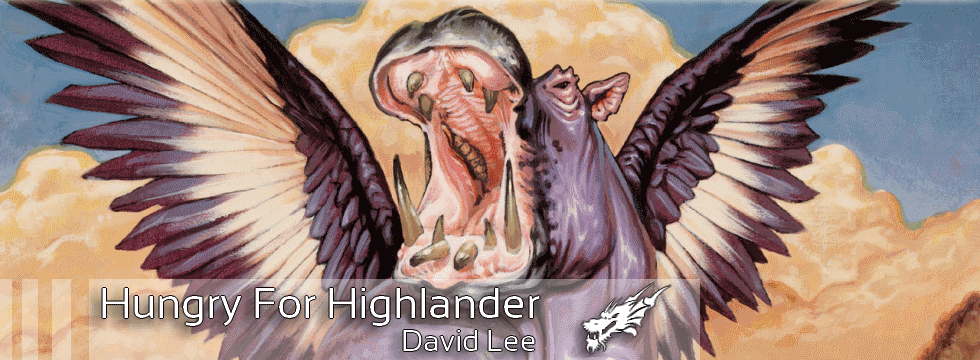
Seriously, look at its political potential. If one player is dominating the table, or is about to combo off, you can help other players dig through cards to put him or her back in check. You can mess up combat math if one player is trying to kill another by offering increments of 2 life. You can give people blockers, or power up your Defense of the Heart. All of this, while pumping your versatile beatstick of a hippo.

And now you know why Questing Phelddagrif accompanies each of my articles.

My collection count is also at a meager 54 copies. If you have any you’d like to part with, get at me on Twitter! @derfington.

Radiant Kavu

This is my candidate for “Most Unintentionally Funny Card of the Set”. First off, you think something called “Radiant Kavu” would be a serene, sublime-looking creature. Nope: standard angry Kavu tearing a Phyrexian’s face off! Second, look at its eyes. It’s clinically off its frigging rocker. Third, the flavor text reminds me of Dr. Zoidberg’s ink splash defense, except with flash-bangs of light. “Woop-woop-woop-woop!”

The real reason I put Radiant Kavu on the list was because a fog effect for black and blue creatures is pretty darn nice, not the least because those two colors usually have some bad intentions. Plus, politics! For a straight-up Naya deck, Radiant Kavu is a neat utility option.

Root Greevil

Whoever wrote the flavor text, I hate you. Geordie Tait probably hates you, too.

Sawtooth Loon

Craziest. Loon. Ever. And I should know about loons, being Canadian and all.

That aside, I think the filtering power of Sawtooth Loon is a little underrated. For four mana, you can dig two cards deeper into your deck, and shift the worst two cards in your hand to the bottom of your library. Yes, four mana is a little expensive, and you can only do it at sorcery speed (barring some shenanigans), but being able to do it repeatedly is something worth exploring.

Skyship Weatherlight

A card that lets me exile a bunch of cards from my deck with the promise that I might be able to put one in my hand every turn? That might be okay...

...Wait, it’s at random? And you just cast Return to Dust on my Skyship Weatherlight? FML.

Skyship Weatherlight, I wish you were playable. Predator, Flagship you are not.

Well, that wraps up my review of Planeshift. Check back in next week, when I finish off the block in...apocalyptic fashion.

David Lee
@derfington on Twitter

R&D’s Top 10 Biggest Design Failures

Are you a Quiet Speculation member?

If not, now is a perfect time to join up! Our powerful tools, breaking-news analysis, and exclusive Discord channel will make sure you stay up to date and ahead of the curve.

Wizards has to pump out a lot of cards every year. Most of the time, they get it right. This article is dedicated to the times when they got it wrong. I'm not talking about getting it wrong like with weird Johnny cards like Shape Anew or seemingly unplayable cards like One With Nothing. These are things that, for one reason or another, should never have happened.

Honorable Mention: Rehiring Rebecca Guay - This has nothing to do with R&D, which is why it's only honorable mention. Also, I understand that Wizards commissions freelance artists and all sorts of other legal mumbo jumbo that means she was never technically fired. Even so, I will be so happy if I never see another stupid piece of Rebecca Guay artwork. Why, you ask? Because every single thing she draws is a self portrait. Even the guys. I know that every artist on the face of the planet includes some of their own traits whenever they draw a person, but this isn't even remotely subtle. Of course, I'd find this behaviour 100% forgivable if Rebecca Guay was hot, but she's not. Not even a little bit. I await your hate mail.

10. Substance - Unless you've ready my article on Sydlexia about the 10 Worst Magic Keywords of All Time, there's a really good chance you've never even heard of they keyword "substance." In Mirage, Wizards introduced "enchantstants": enchantments that could be played at instant speed and were sacrificed at end of turn. Unfortunately, this didn't work properly with the Classic Sixth Edition rules changes. You could play the cards during the end phase to get the effect on the following turn, and, even worse, an enchantment that pumped a creature like Armor of Thorns would go away before damage was cleared off the creatures. This was a nightmare, and creating substance was the best way they could come up with to fix it. Anytime a keyword exists that never appears on a card I think we can agree that it's the result of an epic failure.

9. Not having artwork guidelines - Back in the day, artists received a card name, text, and flavor text and were told to draw. This worked well for the most part, but not always.  You'd get cards like Whippoorwill that depicted a flying creature (Because it's a real type of bird; what else would you draw?) but didn't have flying. You would also get an artist like Richard Thomas that doesn't realize that a "lemure" is not the same thing as a "lemur", in which case you get the [card Hyalopterous Lemure]cutest mistake ever[/card]. The final problem that this created? Renegade artists who refuse to play by the rules. Waiting in the Weeds was originally supposed to make squirrel tokens, which would have been a boon for all those squirrel enthusiasts (and would have made sense as it Mirage block had [card Liege of the Hollows]another squirrel token generator[/card]. The story goes that Susan van Camp knew it was supposed to make squirrels, but deliberately opted to draw cats instead. Frankly, I'm happy with the change because cats are awesome.

8. Lich - Lich was an ambitious card. It was extremely flavorful, but any card that lets you draw en mass has the ability to be horrifically broken. They did a good job balancing this card; in fact it's actually very underpowered. Why is it a failure then? Lich sets your life to zero, makes you sacrifice permanents for every damage you take, and lets you draw cards instead of gaining life. The problem, and it's a big one, is that they forgot to print the words "You don't lose the game for having 0 or less life" on the card. Naturally it was errata'ed, but even though Lich is just an enormous block of text all it really says is "You lose the game. Oops!"

7. Goblin Game - The first time I saw Goblin Game I thought it was fake. It was in someone's trade binder, and I didn't play during Planeshift because my Magic friends and I were all at colleges in different states. The first thing that threw me off with this card was the use of the word "objects". It is the only card to have the word "objects" in its rules text, and I was baffled. I finally read the card a few times over and discerned what it did, which is terrible. I don't know what The Pit is like at Wizards HQ, but apparently they think that Magic players are all as senile as Bingo players and that we all have an army of miniature troll dolls sitting on the table next to us when we play. Also, how am I supposed to keep it secret how many things I'm hiding? Unless I hide them up my ass before the start of the game, I'm pretty sure my opponent is going to see how many I hide. Needless to say I run Goblin Game in EDH, and I sit very uncomfortably until I draw it.

6. Ceasing use of anagrams - Everyone loves anagrams. Finding out that Telim'Tor is Mr. Toilet is hilarious. And Mangara being an anagram of the word anagram? Brilliant! I was heartbroken to discover that their official policy was to never do this again (Although like all rules, R&D broke this with the villainess Liliana Vess). Magic is a game; let's have some fun with it! I want card names like [card Matopi Golem]I am pot[/card] or [card Nevinyrral's Disk]Larry Niven's Disk[/card] to entertain me, as well as flavour text like that on Reparations and Sneak Attack. If that's wrong, then I don't want to be right. Of course, anyone who's talked to me knows that I'm always right, ergo that can't be wrong.

5. Cold Storage - This is a pretty intuitive card. You can put cards on Cold Storage, and, when you're ready, take them off. "Cold storage" is a real thing that we're all familiar with, so it's not hard to figure out. Problem is, R&D was a little too familiar with the term. So familiar, in fact, that they forgot that being "on Cold Storage" doesn't have any rules relevance. Lich may have been a huge mistake for killing you when you cast it, but at least it did something. Other than physically moving your cards for no actual effect, Cold Storage doesn't do anything at all as printed. Ironically, when Tempest was released my friends and I played Cold Storage correctly without even realizing that it needed an errata, let alone knowing about the correction.

4. Archenemy - I loved this idea when it was announced. Most of our multiplayer games result in one person versus everyone, and that one person is normally me. As such, this is the sort of product that would naturally appeal to me. There are two problems, however. The first is that the schemes are broken. I flipped a turn one Perhaps You've Met My Cohort and dropped Nicol Bolas, Planeswalker into play. Through his ability to destroy lands, I had already removed one opponent from the game and threatened to steal their creatures or wreck their worlds. That was the only game of Archenemy we ever played. The other problem? No one wants to play unless they're the archenemy.

3. Skullclamp - If you don't know the R&D story of Skullclamp then you're probably an idiot. Let me educate you: Skullclamp was originally going to give equipped creature +1/+0. Development discovered during playtesting that this card was far too powerful and couldn't be printed. Unfortunately, they didn't find out with enough time to design and playtest a new card before having to send the set to the printers. Designs solution? "Hey, let's make it give +1/-1 instead. That should make it fair...right?" Wrong! Much like with heroin (which is super-concentrated opium) which was created as medicine to cure opium addiction (and it technically worked!), the cure is worse than the disease. I'm really curious what standard would have looked like if they didn't "fix" Skullclamp, though apparently it would've been banned anyway.

2. Unhinged - This entire set was an unmitigated disaster, with the sole exception of Super Secret Tech. Unglued was funny and fun to play. Unhinged was neither. I can see the pitch meeting  now: "I know we've run into a wall trying to figure out what tribe we can use to top the clams from Unglued, but here me out. My kid got in trouble for swearing in school yesterday. When I went to reprimand him, he informed me that, get this, 'ass' actually means 'donkey' so it's not really a swear. It's even in The Bible! Gentlemen, this thing's gonna be bigger than curly fries!" Dedicated a huge portion of a set to ass jokes is not only unfunny, it's really lazy. Not only did it fail on the humor front, but the "Gotcha!" mechanic was horrific. R&D must have decided that Magic players are entirely too social, and we all need to be punished for opening our mouths. When you're designing cards explicitly for the purpose of making people laugh, trying to make them sit in silence is a bad place to start.

1. Assuming that symmetrical cards are fair - Whether you agree or disagree with my other choices, this is irrefutably the worst decision that R&D ever made. It took them years to figure it out, but putting an enormously powerful ability on a card and then assuming that it's automatically balanced because it's symmetrical is not only lazy and stupid, but it is responsible for some of the most unbalanced cards ever printed. As I mentioned in a previous article, a turn one consisting of "Mox, Mox, Mox, Mox, Mox, Rack, Balance, go" is not even remotely fair. Spending your first three turns emptying your hand of white weenies and then casting Armageddon is not fair. Emptying your hand of burn spells and then casting Wheel of Fortune to refill your hand of burn and another Wheel is not fair. Printing Wildfire in a set full of ridiculous artifact mana and [card Covetous Dragon]Junk Dragon[/card] that conveniently has 5 toughness is not fair. And I'm not even gonna touch Time Spiral or Windfall. While Wizards has learned their lesson and these cards are now few and far between (and normally with unwieldy casting costs), they were the most vicious plague that Magic players have had to endure. Had R&D not learned their lesson, this game surely would have died.

And there you have it, design's ten biggest mistakes to date. God willing, there will never be a mistake like any of these again and I will never have to update this list.

Meandering Through Masques, Pt. 2

Are you a Quiet Speculation member?

If not, now is a perfect time to join up! Our powerful tools, breaking-news analysis, and exclusive Discord channel will make sure you stay up to date and ahead of the curve.

Welcome back to our romp through Mercadian Masques! We'll be taking a look at the back end of the set, along with the big-ticket foils in the set. Let's get started with our list...

Nether Spirit

A long time ago in Standard, Nether Spirit was part of a blue/black/red deck that would aim to discard one of its two copies of the Spirit and then start recurring it as a blocker, then win condition. It was even better if you could pitch it off of a Probe! It's also an all-star with Entomb, making a 2/2 for a single mana that's challenging to remove. Later players would exploit this with Contamination, making a hard lock that, if set up early, a lot of decks could not break out of.

Nether Spirit is largely a casual card right now; it sees a little play in Legacy Reanimator, but Bloodghast is more entertaining in that role. Still, people like it and remember it.

$2.50

Power Matrix

Another EDH hit, the Matrix makes things much better when you point it at them. If that thing happens to be a Commander, you can rack up some serious general damage in an EDH game. I like to think of it as sort of a “Mantle of Akroma.” It's even more fun when you help out a buddy by saving their monsters with it! It's traded very infrequently, so it can be good to sing the praises of this card to other traders who like EDH. It goes in any deck, which is pretty rad.

$1.25

Yet another colorless land in this set...

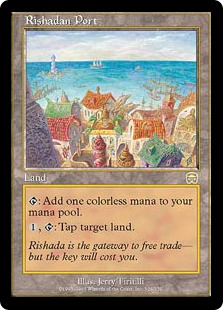
Rishadan Port

An elegantly simple land, so highly disruptive in play that it was banned in Masques Block for making games take too long.

Rishadan Port plays on some real peculiarities of the way Magic is played, and I mean this on a fundamental level. In just about every other game that involves drawing cards every turn, you draw at the beginning; not so with Magic. Instead, the upkeep phase lets you do little hijinks before anyone sees a new card, and that little quirk makes the difference between Port being junk and an all-star. If it had only read that you could activate it after the draw step, it would be collecting dust in bins. However, that the Port can slow opponents down by a turn or more, every turn, makes it incredibly powerful.

Rishadan Port saw play all through its Standard reign, following through Extended and even Legacy and Vintage. In Legacy, it sees play in Goblins and Lands, both being decks that benefit from slowing down an opponent and can spend the spare mana each turn. It sees marginal play in Vintage in the manabases of MUD decks. Rishadan Port has been ticking up in price; during GP: Columbus last year, they were $17, and they've increased by about 40% since then. What a jump!

$23.25 ($90+ in foil)

Rushwood Elemental

Because, hey, you need something for those Cytoplast decks, right?

I don't get the huge appeal in this card, since it's basically a 5/5 for 5 with trample that hates other colors. That said, it can get big and people like their +1/+1 counters. Surprisingly expensive for a green beater.

$2.00

Saprazzan Heir

This is kind of in line with Hatching Plans, in that it makes you do weird stuff to get a pile of cards. I see this card appealing to people who like auras and equipment. Imagine tacking it on something bearing a Sword! Either block it and Ancestral Recall me, or take a whole heap of bad effects. Even more annoying when it can regenerate.

$1.00

Squee, Goblin Nabob

From feeding Masticore every turn and taking away Bazaar of Baghdad's drawback to making Survival of the Fittest hum, Squee is the utility creature to lust after. When I use him with Survival, I remember that Simpsons episode where they're in Japan and Bart finds a fish that talks and will grant him wishes. He ignores this because he's busy chanting “knife goes in, guts come out!” I think “Squee goes in, dude comes out!” when I recycle it over and over.

Squee's days of being a $10 card are over, which saddens me because I bought my copy at that price. He took a big hit in Tenth Edition, losing 80% of his value. At least the foils are still stupidly expensive!

$2.50

Tower of the Magistrate

make those Swords fall right off...

Kelly Reid will tell you this is the best land in EDH because it is often relevant and annoying. Mainly, I think Kelly uses it to drop equipment from creatures. It's a colorless source, so it'll get past any protection that a Sword is offering. It also randomly protects against things like Razormane Masticore. The Tower is another colorless utility land in a set full of them.

$1.25

Unmask

Free spells are perennially popular. This saw play in Free Spell Necro, in Reanimator, Manaless Ichorid and all the Suicide Black decks you've ever seen. Unmask offers this great promise: for the cost of losing your worst black spell in hand, it'll rip out the best spell from the opponent – you even get to cast spells because you aren't tapped out! Usually, this effect costs a couple points of life and a black mana, so the discount is pretty good here. Unmask is thought of as the black Force of Will for good reason. It also has some sweet art. Unmask was popular from the beginning and it has legions of fans.

$3.50

Vine Dryad

Again, people like free things. Vine Dryad appeals a lot to the casual player (once they read it a couple times to figure it out). The coolest thing you could do with it was play it on your opponent's first turn, before you even had a turn of your own! Slap a Briar Shield on that thing and go nuts. It was a cornerstone of 10 Land Stompy, a deck from ages and ages ago in Vintage that could put a Rancor on this lady and start charging in. Vine Dryad is now outclassed by anything that can stand up in a stiff breeze, but it has a few fans yet.

$1.00

The Foils!

Masques has a lot of crazy expensive foils, mostly due to Vintage and EDH. They are really hard to price because many rarely sell. You can be sure that Gush ($18) and Dark Ritual ($23.50) will have ready fans because they're Vintage staples. Before it was restricted, Brainstorm ($33) was hugely expensive in Vintage, often clocking over $60, and it wasn't rare!

Other cards are largely driven by the EDH market. The banner child of blue in the format, Bribery, is $37 and has ready buyers for any copies you have. On the other hand, depending on the day and the bidders, you might get $22 for a Dust Bowl or you might get closer to $40. Land Grant ($8) is one of the hidden gems in the set if you can find it in a bulk foils bin.

Next week, we'll look at the grim followup sets to Masques, which I assure you, have valuable cards hidden in them...

Until then!

-Doug Linn

Breaking The CawBlade Mirror

Are you a Quiet Speculation member?

If not, now is a perfect time to join up! Our powerful tools, breaking-news analysis, and exclusive Discord channel will make sure you stay up to date and ahead of the curve.

Blue-White Control is an archetype older than dirt.  The first deck in Magic history that didn't suck as bad as the rest was Brian Weissman's The Deck, a UW Deck that splashed red for Red Elemental Blast.  In the days when Juzam Djinn was bad because it dealt you damage, and you were lucky to trade five [card Tundra]dual[/card] [card Tropical Island]lands[/card] to some schmuck that thought lands were better than a Shivan Dragon, the idea that you could sit back on Counterspells and win after taking control of a game with one of only two Serra Angels was revolutionary.

UW went through many permutations through the years, from Zvi's creature-based The Solution to the slowest-you've-ever-seen builds in Onslaught block to the UrzaTron centered builds during Ravnica/Timespiral.  After Ravnica and the UrzaTron left Standard the Control decks mostly became UB to fully abuse Mystical Teachings, and UW faded from the spotlight for quite a while, until The "Patrick Chapin" Innovator and Co. brought it back at PT San Diego.  Since then it has moved from a Tap-Out style deck with lots of large, expensive spells to a more counterspell based brew to the Sun Titan centered mixture that Wafo-Tapa played at French Nationals, leading up to Brian Kibler's innovation at Worlds, featuring Squadron Hawks.

The addition of the [card Squadron Hawk]Hawks[/card] was a masterstroke, allowing the deck to play out an early blocker/threat while still holding up mana for counterspells.  Fish (aggro-control) strategies have always had good percentages against Control, and the addition of [card Squadron Hawk]the Squadron[/card] allowed this build of UW to play like a Fish deck against other Control decks and also have a steady stream of cheap blockers against Aggressive decks.

Then came PT Paris, where Ben Stark won with a list put together by the Channel Fireball crew.  The addition of Mirrodin Besieged to the format gave us Sword of Feast and Famine, which could be searched up with Stoneforge Mystic.  The [card Sword of Feast and Famine]Sword[/card] allows the current builds of UW to play even more like a Fish deck, sticking a small creature or two and then countering any of the opponent's attempts to clear the board.  The Sword gives a significant upgrade to the clock while also allowing its controller to simultaneously tap out for threats and hold up counterspell mana, which cracks a mirror wide open.  The fact that it also generates card advantage isn't bad either.

Anyone that picked up the list immediately after its unveiling at PT Paris had a week or so of free wins by being miles ahead of the curve, but by now most people playing UW have caught on to the tech and are packing [card Stoneforge Mystic]Mystics[/card] of their own.  It's safe bet today that everyone is familiar with the list at PT Paris.

[deckbox did="a54" size="small" width="567"]

This is the new standard, stock list.  This is what you'll be playing with or against (or both) for the foreseeable future.

This deck is capable of changing game plans on a dime.  It plays a defensive game until it is able to assemble a Sword and a creature suit up, at which point it can quickly become the attacker.  Jace, the Mind Sculptor can dig for answers when needed, and later can use his under appreciated -1 ability to bounce a blocker and clear the way for an equipped creature to connect.  Gideon Jura is also a double-duty expert, buying time early and hitting hard later in the game.  He can also carry a sword if need be, allowing you to clear the board with a Day of Judgment and then connect with an equipped 6/6.

Another great strength of this incarnation of UW is that it makes the opponent's removal lose value.  All the the creatures in this list have already generated card advantage when they resolve, making one-for-one removal quite unappealing against them.  We all know Lightning Bolt and Doom Blade are good at handling threats like Fauna Shaman and Plated Geopede, but they are less appealing against [card Squadron Hawk]1/1s[/card] and [card Stoneforge Mystic]1/2s[/card] that draw a card when they enter the battlefield.  If they don't have removal, however, they are even worse off as then the equipped dorks are going to deal significant damage.  This is very similar to the Next Level Bant deck that Brian Kibler won GP: Sendai with not terribly long ago.  Making opponents chose between two options after sideboarding (removal in or out) is nice, but its even better when there is no right answer.

The biggest strength of this deck, however, is certainly the ability to hit with Sword of Feast and Famine attached.  Having the opponent discard a card of their choice isn't as good as drawing a card for yourself in my book, but it is still card advantage.  Untapping your lands is almost always relevant, and the two abilities together are almost a Time Walk.  Once you are behind against CawBlade it becomes harder to catch up with every turn that goes by.

This is the new kid on the block, and for the time being I expect it to be the most played deck.  It won the Pro Tour, put four players in the top eight of the first Star City Qualifier at GP: Denver, including the top three spots, and had nine of the top sixteen at SCG: DC, including the winner.  After demonstrating that level of dominance it can expect to have a target painted on its back until it starts losing more than it is now or rotates.

One attempt to break the mirror was the addition of Red, as demonstrated by Gerry Thompson.  He splashed Red in his CawBlade for maindeck Lightning Bolts, as well as a sideboard with a full playset of Cunning Sparkmages, a Basilisk Collar, and an Inferno Titan.  The Lightning Bolts are a nice surprise when thrown at any creature in response to equipping with a Sword, depriving an opponent of an untap they may have been depending on.  The addition of instant speed removal is also particularly helpful against Fauna Shamans from GW Quest and Hero of Oxid Ridges from Boros, two troublemakers that were previously impossible to answer with value.

Other modifications to the main deck in the quest for an edge in the mirror that we've seen so far are the possible additions of Sun Titan and Condemn.  Sun Titan was explosive in Control mirrors some time ago, allowing its controller to return Jace Beleren to kill off an opposing Jace, the Mind Sculptor, Tectonic Edge to strip an opponent of their lands, or [card Scalding Tarn]fetch lands[/card] to put them out of Mana Leak range, and perhaps his time has come again.  Jace Beleren is significantly worse now than he used to be given the more aggressive nature of the UW Control mirrors today, but bringing back fetchlands is still good and returning Tectonic Edges to repeatedly Strip Mine your opponent is still as [card Cheatyface]cheaty[/card] as could be asked for.  The Titan's most important object to return today, however, may be any deceased [card Sword of Feast and Famine]Swords[/card].  At this point most players are sideboarding at least two Divine Offerings to destroy opposing Swords, and seeing a Sun Titan come down the turn after casting Divine Offering is just embarrassing.  He also fights against Gideon Jura fairly well.  The Condemns can deprive an opponent of an untap they were expecting if you clear away a creature that was carrying a [card Sword of Feast and Famine]Sword[/card] which has the potential to be crippling.  More often, however, it will "just" deal with a Gideon Jura or Celestial Colonnade, both of which can otherwise be large problems to clear away.

After sideboarding a much larger number of options are available to mages looking for an edge in the mirror.

Divine Offering: The sideboard at Paris had two, and they weren't expecting much of the mirror - they were there just for random utility.  Today many players have moved to three, as the mirror really is all about Sword control.  The instant-speed status of the Offering gives it the nod over Revoke Existence, as most Swords are put into play via Stoneforge Mystic at the end of turn.  A better answer to something like Wurmcoil Engine or a more permanent answer if the other guy is playing with Sun Titan would be nice, but the instant speed is important enough to be worth it.  There are no enchantments that are seeing wide play at the moment, so that difference is negligible.  The fact that it can also gain a significant amount of life by destroying Argentum Armor or Bonehoard in other matchups makes it the Sword killer of choice.

Kor Sanctifiers: The Sanctifiers are another option for destroying opposing Swords, but they suffer the same problem as Revoke Existence - being Sorcery speed.  Some people have said that they are a proactive answer, but if you are playing the Sanctifiers before there is a Sword on the other side of the field it seems a safe bet you are misplaying.  I could see playing the Sanctifiers if I needed another killer of Swords after playing four Divine Offerings or wanted another creature, but not before then.

Baneslayer Angel: The Baneslayer can fight with any creatures in the mirror, whether equipped or not.  The fact she is flying is also helpful if they have Elspeth Tirel, a commonly played one-of in many sideboards for the mirror.  A First Striking 5/5 with Flying is also well suited to fighting against Tezzeret, Agent of Bolas and the artifacts he animates, and the Lifelink has obvious applications against decks with Mountains.  Having the ability to be useful against several decks is important to me when selecting the cards for my sideboard as there are only so many spots available, so [card Baneslayer Angel]BSA[/card]'s ability to fight the good fight against other decks besides the mirror is quite a bonus in my book.  The only problem with her is that she fails both the [card Gideon Jura]Gideon[/card] and the [card Jace, the Mind Sculptor]Jace[/card] test.  She can be bounced by Jace without much of a cost because she doesn't generate value upon resolution, like a Sun Titan would, and she will lose to Gideon Jura in a head-to-head fight.  If the opponent hasn't figured out yet that Day of Judgment is bad in the mirror and hasn't boarded them out she could also just die a horrible death after being cast, leaving you with less value than if you had played another trump in that spot.  I don't have any Baneslayers in my sideboard for the mirror at the moment, but she is high on my list of options to consider and she could make her way back in at some point in the future.

Elspeth Tirel: Elspeth will win any game that goes long enough, whether by blowing up the other side of the board or making you an army.  That said, in a world where everyone is playing Squadron Hawks she is not what I'm looking for.  She can certainly be a game ender, but she could just as easily be a terrible Spectral Procession that fogs two damage.  I have always preferred a consistent six or seven on a ten point power scale to a card that bounces between a ten and a four, so I'll be leaving [card Elspeth Tirel]Elspeth[/card] on the bench for the foreseeable future.

Sword of Body and Mind: This is here to stay.  Only a few people are not sideboarding one Sword of Body and Mind, and then only if they found room for it in the maindeck.  A second Sword gives you additional search targets with late game Stoneforge Mystics and provides insurance against artifact destruction.  The Protection from Blue can protect an equipped creature from being fogged by a -1 from Jace, the Mind Sculptor, an additional Protection for Green can be quite helpful against Vengevine decks, and the milling provides an alternate win condition when the opponent has gained a significant amount of life from a Wurmcoil Engine or Baneslayer Angel.  It does everything you could ask for, and then it bakes you cookies.

Sword of Vengeance: This Sword hasn't seen any play yet, but it an interesting option worth exploring.  The First Strike would mean your creature would live if fighting against another Sworded creature instead of trading, the Trample means that they cannot just chump block with a Squadron Hawk, Vigilance makes it unappealing for them to attack back and gives you immunity from Gideon Jura, and who doesn't like Haste?  There are two strikes against this Sword, however.  First, it is more mana to equip than the others, which isn't always relevant but is particularly painful when it does become relevant.  Second, it seems to be a win-more card.  I would not want to search this up with my first [card Stoneforge Mystic]Stoneforge[/card] in place of Sword of Feast and Famine, and it is at its best when you can take advantage of the Trample by equipping to a creature that already has a Sword attached thus preventing any effective blocking.  While it could be effective in the late game it doesn't seem as strong as other options that could help you catch up if behind, rather than help you cement a game in which you already had a lead.

Sun Titan: See above.  Bringing back Swords, Tectonic Edges, Squadron Hawks to fight again... all good things.

Condemn: Having an answer to such powerful effects as Gideon Jura (at least a third of him) and Celestial Colonnade is better than not. Condemn can also kill off a Goblin Guide or other hasty creature more effectively than Oust.  The reason Oust was played instead at Paris is that Oust is much better against Valakut decks, many of which are currently running Lotus Cobra.  With Valakut declining slightly in popularity at the moment, it could be time to gamble by cutting the Ousts for Condemn.

Tumble Magnet: Tumble Magnet is a surprisingly large headache for Sword-centered decks.  Because CawBlade's plan is to turn a small, irrelevant creature into a monster with equipment, if you can neutralize the one monster, all they have left is a couple of small, irrelevant creatures.  Tumble Magnet is also proactive, which is a plus.  If you draw a traditional removal spell, it is effectively a mulligan until an appealing target presents itself, but the proactive Magnet is never a dead card.  Only having three uses is a downside, but the hope is that it would buy you enough time to find a more permanent answer.

Hammer of Ruin: The Hammer hasn't seen any play yet in tournament winners, and I expect it to stay that way.  A couple of people have been suggesting it as a mirror answer, but I think it is a trap.  Swords are almost always going to come into play at the end of the turn via Stoneforge Mystic, which means you have to take a hit from the Sword, then play your Hammer and attack.  I don't want to have to take a hit from a Sword before being able to destroy it, and I don't want to have my kill spell for a Sword blockable.  The biggest argument in favor of the Hammer is that it is a repeatable effect, making it good against Sun Titan and it is tutorable.  That said, it seems a bad Sword of Vengeance to me.  If you have the Sword of Vengeance it trumps any Swords an opponent has in play, which is basically as good as destroying them.  If they aren't actually destroyed, just negated, Sun Titan loses a significant amount of his relevance, and they are both tutorable, so what does the [card Hammer of Ruin]Hammer[/card] do that [card Sword of Vengeance]Akroma's Sword[/card] doesn't?  If the opponent doesn't have a Sword of Feast and Famine or [card Sword of Body and Mind]Body and Mind[/card] I would rather have the Sword of Vengeance any day.

Volition Reins: This hasn't seen play in UW for some time.  It was a popular option long ago when [card Frost Titan]Frost[/card] and Sun Titan were widely played, but as the metagame has moved away from such Battlecruisers it fell out of favor.  I don't think the time is right for it to make a comeback appearance, but don't forget it exists if people start sideboarding more Sun Titans and Baneslayer Angels.

These are the most popular sideboarding options for CawBlade against the mirror.  Exactly which you chose and in what numbers depend on your expected metagame, there is no one perfect sideboard combination that will guarantee a win.  The most important thing is to continually adjust so that you can try to stay one step ahead.  If everyone starts playing with Sun Titans and Baneslayer Angels, it may become correct to leave in your Day of Judgments instead of bringing them out.  If Tumble Magnet takes off, the sorcery speed drawback on Kor Sanctifiers will count for less and they will get better.  Don't think of a sideboard as fixed, it should be fluid and change from week to week.

Thanks for reading.

Brook Gardner-Durbin

@BGardnerDurbin on Twitter

P.S. If you're playing the mirror, there aren't many hands without a White creature I would be happy to keep.

District of Magic

Are you a Quiet Speculation member?

If not, now is a perfect time to join up! Our powerful tools, breaking-news analysis, and exclusive Discord channel will make sure you stay up to date and ahead of the curve.

This was certainly an eventful weekend. I got up at 3 AM Friday leading into SCG DC and flew out with [card Squadron Hawk]Caw-Blade[/card] and [card Kuldotha Rebirth]Kuldotha Red[/card] prepared for Standard, as well as [card Lord of Atlantis]Merfolk[/card] and Natural Order [card Rhox War Monk]Bant[/card] skeletons next to my Ad Nauseam [card Tendrils of Agony]Tendrils[/card] deck prepared for Legacy. The flight left at 6 AM and landed in DC bright and early.

Unfortunately, the crowd I was splitting the hotel with wouldn't show up until something like 7 PM.

Awkward.

In theory, I was going to take my laptop to the Library of Congress and use The Internet there in order to do some work. In practice, something had set off my allergies, and that combined with my lack of sleep to make me unable to do anything productive. I found a diner for lunch (which was miserable and overpriced), wandered around a bit, then took a cab back to the hotel and sat in the lobby for a few hours. Eventually they showed up and I more or less passed out on the bed after making fun of someone's deck.

I had given up on finding a Caw-Blade list I was 100% satisfied with, and as a result I switched over to Kuldotha Red. Dave from 02drop borrowed my entire Caw-Blade deck as-is, and ended up going 2-3 or something like that.

First round, I got paired against Caw-Blade with Red for Cunning Sparkmage and Basilisk Collar. I didn't know it yet, but Angry Birds was the breakout deck of the tournament, and while this variant wasn't the same as what Gerry Thompson won with, it had great similarities. Namely, it crushed Aggro decks, starting with mine.

Second round, I got paired against one of my hotel roommates on Boros. He beat me in two close games, and I was out. Sat around moping for a while, decided to buy into Merfolk rather than Natural Order for Legacy, and entered the Legacy Challenge.

A 2-2 performance later, I felt like the deck was grossly underpowered and I don't know how anyone can consistently win with it. Any time a Tarmogoyf hit the other side of the table I wanted to just throw my deck in the garbage can.

Attacking is for losers.

Untitled Deck

cantrips

4 Brainstorm
4 Preordain
3 Ponder

discard

4 Duress
2 Thoughtseize

fastmana

4 Dark Ritual
4 Cabal Ritual
4 Lions Eye Diamond
4 Lotus Petal
1 Chrome Mox

tutors

4 Infernal Tutor
2 Grim Tutor

win

1 Ad Nauseam
1 Ill-Gotten Gains
2 Tendrils of Agony

lands

3 Swamp
3 Island
4 Polluted Delta
2 Flooded Strand
2 Tropical Island
2 Underground Sea

sideboard

3 Ghastly Demise
3 Xantid Swarm
4 Dark Confidant
3 Krosan Grip
1 Hurkyls Recall
1 Echoing Truth

There, that's more like it.

Round 1: Dredge. I get hit by 3 [card Cabal Therapy] Therapies[/card] game one and can still win “next turn” right up until the final Flashback strips my hand completely and I die to nothing more than a trio of [card Bridge from Below]Zombie tokens[/card] – one from each Flashbacked Therapy.

I only take 3 points of damage game 2, in which a rather hilarious play happened. He had something like Putrid Imp, two Narcomoebas, and a resurrected Ichorid on the board. He had a Dread Return and [card Iona, Shield of Emeria]Iona[/card] in the graveyard, but felt that he needed to Flashback a Cabal Therapy at me. I responded with Ghastly Demise on one of his remaining creatures in order to prevent him from casting Dread Return. This tilted him so hard he forgot he could remove Ichorids to each other in order to get attacks in, and I gained several turns to combo off.

Game 3 he led off with Breakthrough for 0. I retaliated with [card Tendrils of Agony]Tendrils[/card] for 20.

Round 2: Enchantress

Game one I killed him on turn 4 with no difficulty.

Game 2 I started out with a Krosan Grip in hand, and kept since I knew what was coming. As the game progressed, I cantripped into Echoing Truth, which was critical. On turn 5 my opponent was chaining enchantments, and at one point a spectator called a Judge. My opponent had just played Utopia Sprawl on Serra's Sanctum, which I didn't see any problem with at the time. Apparently Sprawl only enchants Forests, which is a problem. After some hassle regarding what the proper policy was with him having drawn cards, the Judge eventually had him put two random cards on top of his library and let him cast the Sprawl on an actual Forest, drawing them back. This seems a rather circuitous way of handling things, but apparently that's how their policy is written. Eventually (on the same turn) he had two Runed Halos naming Tendrils (of Agony) and a Sterling Grove. He sacrificed the Grove to get Solitary Confinement, chained it into play, and passed the turn. I played Krosan Grip on the Confinement, Echoing Truth on the Halos, and set up an Ill-Gotten Gains loop to kill him.

Round 3: Show and Sneak

I won game 1 because he hit me with Emrakul, the Aeons Torn.

That's going to require an explanation, isn't it? Fine. I had three uncracked fetchlands on the table, since I didn't want to tip my hand as to the deck I was playing since I had no action. My opponent went to 16 off fetchlands and Ancient Tomb so I only needed 7 storm plus Tendrils to win. My hand consisted of Swamp, Dark Ritual, Cabal Ritual, Cabal Ritual, Infernal Tutor.

In response to the Annihilator trigger, I cracked all 3 fetchlands to put lands into play and sacrificed those to the trigger, resulting in 6 cards in my graveyard. I can't remember if the Ill-Gotten Gains was in my hand (which would be a guaranteed win) or if I was merely playing to my outs and setting up a win so long as I didn't topdeck a land. With only 9 lands left in the deck I had pretty good odds of winning if this was the case. Either way, I pulled out the win.

Game 2 I kept a hand which won on something like turn 2 or 3, only to have it shut down completely by a turn one Null Rod screwing over my mana. At one point, a Duress revealed that I needed to win this turn or lose all my lands to Sneak Attack + Emrakul. I didn't have a guaranteed Ill-Gotten Gains victory so I went for Ad Nauseam but came up short and had to settle for Tendrils for 10, boosting my life total to 16, and giving me a strategic hand. This put my opponent at 7, and when he cracked a fetchland and used two Ancient Tombs to Sneak out Emrakul, it put him at 2 and me at 1 with no mana sources. I needed to draw a black source and a Ritual and didn't get there in the one turn I had before he hit me with Progenitus. Nice draw.

Game 3 my turn one Duress revealed a pair of Force of Will and a slew of blue cards to pitch to it. I couldn't get a second discard spell in time, and lost to Emrakul followed by Progenitus.

Round 4: Elves!

Game 1 he comboed me off with Mirror Entity and infinite mana on turn 3.

Game 2 and 3 I comboed him off a turn before he would have comboed me. I think there was a Ghastly Demise involved in one of the games. I had to use Ad Nauseam the third game since I didn't have an Ill-Gotten Gains loop to win.

Round 5: Burning ANT

Ugh, this matchup is horrible. Both decks play a ton of discard spells and cantrips, but Burning ANT has 2 additional [card Burning Wish]tutors[/card] and some number of Orim's Chant which gives them a huge advantage in winning the matchup. This round's opponent even brought in Silence for game 2, and I didn't win the match.

Round 6: Blue/Green Elves

The Blue is for Coiling Oracle, which I didn't even realize was an Elf, since I remembered it from the Snakes deck from Ravnica-era Standard. I'm not entirely certain how you get a Snake Elf, but I'm sure there are highly detailed diagrams on the internet.

I was expecting to see Daze, Spell Pierce, Force of Will, Gaddock Teeg, anything – but no hate ever made its presence known and I absolutely demolished him with Ill-Gotten Gains into Tendrils two games in a row.

Round 7: Burning ANT

I stripped an Ad Nauseam from my opponent's hand and had a win ready to go the next turn protected by another Duress, but a topdecked Orim's Chant stopped me. Fine, I'll take a Dark Ritual. Pass the turn, I've got another Duress. In response, another Orim's Chant. Seriously? Fine, I'll take the second Dark Ritual and pass the turn, I'll win next turn. Lotus Petal, Lion's Eye Diamond, Lion's Eye Diamond, Infernal Tutor off the top, and I'm dead. Damn.

I boarded in the Dark Confidants, and as we stripped each other's hands clean, my Confidant beat him down. Eventually, I cast a Tendrils for 10 and won with Confidant beats.

Game 3 was a real heartbreaker. He didn't have enough mana to win, so I took one of his two Infernal Tutors. I had something like 3 mana floating off an Ad Nauseam and went all the way down to 3 life before giving up, figuring I'd set up a win on the next turn with lots of mana, Cabal Rituals, and an Infernal Tutor. He topdecked a Lion's Eye Diamond and killed me. Sigh.

Top card of my library was my own Lion's Eye Diamond, which would have let me kill him. I stopped at 3 life because I had both Grim Tutors left in my library.

4-3, out of contention.

Later on I found out that I should have tried to play 2 further rounds, as going 2-0 would have let me play the tiebreaker lottery at 6-3 for $50. Ah well. I won't be dropping at a positive record in large events again.

My next major event will be SCG Memphis, at which I hope to snap this run-bad streak I've had since GP: Atlanta.

Joshua Justice

@JoshJMTG on Twitter

Cube SWOT: Artifacts and Conclusion

Are you a Quiet Speculation member?

If not, now is a perfect time to join up! Our powerful tools, breaking-news analysis, and exclusive Discord channel will make sure you stay up to date and ahead of the curve.

While blocks like Ravnica and Shards of Alara have recently shown the power of multicolor cards, artifacts have been amongst the most powerful cards in the game with cards like the original Moxen, Cursed Scroll and Umezawa's Jitte making an impact throughout Magic's history. These powerful cards have their own inherent strengths and weaknesses which will be discussed as well as a general overview of the cube SWOT series and how to utilize the lessons learned from it in your cube.

Strengths:

While it may be very obvious, it still needs to be said: due to their colorless casting cost, artifacts are extremely flexible as they are playable in just about every deck.  Aside from the obvious fact that colorless spells are easy to cast, the fact that artifacts are colorless is useful for several reasons. The cards themselves tend to be earlier picks in a draft as artifacts do not tie a player to a color, since a card like Sword of Light and Shadow or Masticore can be used in any deck. While some cards like Bonesplitter may be better in aggressive archetypes, it's the idea that Bonesplitter can be used in any aggressive deck, regardless of color, that makes it a much lower-risk card to take in a draft.

Artifacts can be played in anything, obvious fact is obvious, right? What about some other, less obvious strengths of artifacts?

Some artifacts provide abilities that are typically aligned with certain colors to every color.

Photobucket

In almost all of the previous SWOT articles' mono-color sections, I've noted how powerful artifacts can be very useful in these decks, as I gushed about how amazing Molten-Tail Masticore and Cursed Scroll are in white, black, red and green mono-color archetypes and cards like Oblivion Stone and Nevinyrral's Disk are useful in mono-blue decks.  This is because powerful artifacts help to shore up weaknesses inherent in colors and archetypes.

Due to the fact that Molten-Tail Masticore is a source of direct damage (a mostly red ability) that can deal damage to a player it can be a very powerful card in a Golgari deck since it can destroy planeswalkers, something that can be difficult for those decks. On the other hand, a card like Oblivion Stone can help a control deck with few ways of destroying hordes of opposing creatures (such as a Dimir deck with only a Black Sun's Zenith) ass well as annoying permanents such as Sulfuric Vortex.

Obviously, Molten-Tail Masticore is still amazing in a deck like Boros or Gruul aggro, but the ability to shore up important weaknesses is an especially useful trait of artifacts.

Photobucket

Equipment brings the ability to increase power and toughness to creatures of all colors as historically, "buffs" have typically relegated to green and white with few cards in the color colors performing that task.   Many of these cards are very universally playable, as a card like Sword of Light and Shadow are extremely useful in just about any deck with creatures.  The reach element provided by equipment is especially important since powerful equipment is useful in all aggressive decks, giving easy ways to close the game out.

Photobucket

Cards like Lodestone Golem and Winter Orb provide means of mana disruption, a strength mostly best represented in red and white. These powerful cards help to keep the opponent in the early phases of the game, making these cards aggro all-stars and making black and green aggressive decks stronger by giving them a unique ability that is mostly underrepresented in those colors.

Photobucket

Lastly, artifacts contribute colorless mana acceleration through cards like Mind Stone, Everflowing Chalice and the controversial Signets, an ability normally represented in green. No matter which ones a cube designer uses, these powerful cards assist control-based decks in accelerating past the early stages of the game that they seek to minimize.

Weaknesses:

Some artifacts are not as powerful as their chromatic counterparts.

A few examples are in cards like Bonesplitter and Triskelion as these cards are less powerful than Rancor and Inferno Titan, respectively. Both artifacts are powerful cards, but it is important to note that more powerful color counterparts exist.  Does the fact that more powerful cards with mana symbols exist bar a card from a cube?  Not necessarily.

Artifacts are also vulnerable to artifact destruction cards.  While, again, this may seem like an obvious statement, this is important to note since colors heavy in artifact removal, namely green and red, can easily destroy these powerful cards. It is also important that these colors have that strength of being able to easily destroy artifacts since artifacts are so easy to play in a cube, and cards like Uktabi Orangutan can act similarly to Nekrataal against the appropriate permanents.

Opportunities and Threats – Usage of Artifacts in Cube:

As mentioned earlier, artifacts play a very important role in cube due to their ease of inclusion – while Rancor may be an extremely powerful card that's overall more powerful than Bonesplitter, picking a card like Bonesplitter will almost guarantee that the card will make the deck whereas Rancor may not due to it being green.

While this may give the impression that artifacts can warp a cube, I have found that this is not necessarily the case. This could happen if the colorless artifact cards outnumber the main color (WUBRG) sections, because then the emphasis shifts to drafting artifacts and then committing to a color later. Think of Mirrodin draft and how drafters could easily take artifacts and mana Myr in early picks, eventually settling on a later color. This is a rather extreme example and I have yet to see something like this happen in a cube.

It is important to note that much like all cards in a color aren't universally playable and some are best in archetypes like aggro or control, the same applies for artifacts in cube.

Aggressive Artifacts:

  • Bonesplitter
  • Grafted Wargear
  • Ankh of Mishra
  • Tangle Wire
  • Smokestack
  • Mana Crypt

These artifacts are aggressive in nature because they help a player deal as much damage as possible.  Who cares if your Bonesplitter-equipped Isamaru dies when it attacks into an Obstinate Baloth?  There are more creatures that are attacking with it!

Mana Crypt is a card that some mistakenly play in midrange and control but bad there since mana crypt is great due to assumption that game will end quick - game will end quick if you're in aggro and you're able to cast Soltari Champion on turn 1 and Avalanche Riders on turn 2!  (If you're going to try to cheat in some late control finisher, Crypt will likely just kill you.)

Midrange/Universal Artifacts:

  • Crystal Ball
  • Mox Emerald (and the rest of the original Mox cycle)
  • Skullclamp
  • Loxodon Warhammer
  • Mimic Vat

Universally playable artifacts such as those listed above are deemed so because they are very useful due to their flexible nature as since they're useful in just about anything: Crystal Ball is useful because card selection is useful in many archetypes. Aggro doesn't want early beaters in the midgame, control wants to hit its gas in the late game.  While likely better in control, it is universally playable (the analogue being Ajani Goldmane or similar cards.)

Control artifacts:

  • Nevinyrral's Disk
  • Oblivion Stone
  • Wurmcoil Engine
  • Myr Battlesphere

Control-based artifacts are most useful in control decks since they align with a control-based strategy: gaining massive card advantage through mass-removal and big late-game finishers.

Something also important to note: cards such as Crystal Shard and Vedalken Shackles, while they appear to be artifacts with no color commitment upon first glance, are actually blue cards since they are optimal in decks with Islands. (And Shackles is just useless without Sslands at all!)  It is important to consider these cards as blue cards when building a cube and putting them in the appropriate section as such due to the fact that they are essentially blue cards and putting them in a blue section helps to keep a cube balanced.  (Also to note, blue in general has a very good synergy with artifacts as these cards amongst many others are great in "the artifact deck" which is typically blue-based because of cards like Tezzeret, the Seeker, Tinker, Trinket Mage and Tolarian Academy.)

SWOT Conclusions and Lessons:

I hope that you've enjoyed this series of articles looking at the sections in cube from a holistic and analytical point of view.  Of course, this isn't just meant to be a refresher course, nor a mere cataloging of strengths, weaknesses and archetypes from a powered cube perspective as of the release of Mirrodin Besieged.   My articles seek to be for people who have all types of cubes and this SWOT series is no exception.  But if a peasant (only commons and uncommons) cube can't have cards like planeswalkers and Hero of Bladehold as a strength in white, what lessons can be gleaned?

The first thing to note is that over the course of Magic's history, the 2-color decks have mainly had the same strategy over time.  For example, Gruul's best decks have typically been aggressive in nature, whether they were curving from Kird Apes into Erhnam Djinns or Rift Bolts into Scab-Clan Maulers. While the exact cards used in the examples for what a color brings to an archetype may be different in different rarities and types of cubes, the overall components play the same role.  Even if white doesn't have access to planeswalkers in a commons cube, a white-based control deck will still use cards with repeatable effects like Cenn's Enlistment.

But other strengths play very different roles using the concept of comparative advantage.  For example, in a peasant cube, red has a plethora of amazing mass-removal effects such as:

  • Pyroclasm
  • Breath of Darigaaz
  • Volcanic Fallout
  • Slice and Dice
  • Firespout (which is actually a mainly-red card.)
  • Sulfurous Blast

As mentioned in the red SWOT, red has mass-removal in powered cubes through cards like Starstorm, Crater Hellion and Rolling Earthquake.  However in peasant cubes, it's important to note that this strength is particularly powerful since there aren't many in other colors outside of relatively inefficient ones such as Pestilence, Crypt Rats and Dakmor Plague as there is no Wrath of God, Damnation or Black Sun's Zenith at uncommon or common.  This makes red's already solid strength of mass-removal even better due to its comparative advantage and it is important to note these strengths in a cube.

On the same page, it is important to realize that some themes in a color won't manifest very well some cubes.  For example, one of the historical themes of white has been in life gain and for the most part, these cards aren't very powerful.  This is apparent in a powered cube since there aren't many cubeworthy lifegain cards outside of something like Lone Missionary and the partially-white Kitchen Finks. But in a pauper cube, cards like Renewed Faith, Lone Missionary and Aven Riftwatcher are pretty solid cards due to the lower power level in that format. Therefore, lifegain is relevant as a strength as pauper control decks to effectively combat aggressive decks since the cards are efficient enough to be used in that format, but not necessarily in a non-large powered cube.

How exactly these themes manifest is ultimately based on what you want your color to do.  While there are lots of dragons in red and mass-removal effects in white, including a lot of them doesn't support their archetypes appropriately and archetypes like Boros will suffer.  Sure, archetypes like Boros ramp and midrange will do well, but since the archetype is best represented by an aggressive strategy, making it so that Boros midrange is its ultimate form is ultimately a disservice to the archetype and both colors, since better-built archetypes will destroy Boros (this isn't to say that Boros midrange and ramp shouldn't happen, but when Boros is seen in a cube, it should be aggressive most of the time.)  On the other hand, if extremely powerful artifacts are taking over a cube, including more red artifact destruction like Smash to Smithereens and Manic Vandal may be useful to combat those strategies and to give drafters an incentive to have more mountains in their decks.  Just don't get carried away and start including suboptimal cards like Gate to Phyrexia in your cube, it's always important to keep overall power level in mind.

This is what is the most important lesson to be learned from these articles – to understand how the colors and color pairs play optimally and to play to their strengths to make the colors able to compete and to have all 5 cylinders must be firing at once! This is because if blue control is supported but red aggro isn't supported, this will result in a lopsided metagame where red will be a weak color and have its control-based cards taken by control-based decks and its aggressive cards left in sideboards.

Once colors act in accordance to their strengths and are built with their optimal archetypes in mind – you will find that your cube will be a much better environment.

Thank you for reading!

@UsmanTheRad on Twitter.
idratherbecubing.wordpress.com - my cube blog with my various cube lists.
The Third Power – a cube podcast that Anthony Avitollo and I co-host.

What’s Paupin’?

Are you a Quiet Speculation member?

If not, now is a perfect time to join up! Our powerful tools, breaking-news analysis, and exclusive Discord channel will make sure you stay up to date and ahead of the curve.

Hello everyone, and welcome to the first (and hopefully not the last) edition of What’s Paupin. My name is Chris Ross and I’ll give everyone a quick look at my Magic background. I started playing Magic around 1999. I continued to play until Torment, when I took a short break do to me moving and finding a new store. I restarted during Mirrodin, and then I quit again. I restarted the last day of Kamigawa block's life and never really quit again after that. I’ve had some mild success; I’ve split in the finals of a GPT. I have a top eight in a JSS. Now for the most part, do to time constraints, I almost exclusively play Magic Online which brings me to the reason I’m writing this article to begin with. I love playing Pauper.

Why Pauper?

That’s easy; it’s a fun, competitive format that’s cheap to get into.

What’s Pauper?

Pauper is a format consisting only of commons. It’s supported by magic online as a classic format, but if you really look online, people hold Standard tournaments -unsanctioned by wizards- for event tickets.

How does Pauper play?

Well, basically Pauper plays like Legacy, just a few steps slower, due to the lack of cards that are playable. But depending on what you’re playing, games can still end on turns three to five.

What’s the Meta like?

As of now the meta is pretty fresh. The most played deck as of right now is mono Black Rats, a Control deck that I will write about another time. Other tier one decks include: Izzetpost, mono Blue Faeries, Goblins, Storm, mono Red, Affinity, and Orzahov control, along with a host of other fun and powerful decks to play.

Other fun things to note?

Pull those Cloudposts out baby because Pauper plays them. They are the fastest way to get a lot of mana and since they printed Glimmerpost they can make eight mana a pop. Just about every Control deck plays them unless they are creature based, such as the Faeries deck. There are only three mass removal effects in the format: Evincars Justice, Sandstorm, and Rolling Thunder. Rolling Thunder being a slight odd ball, because it’s an X spell that targets the creatures and players it’s dealing damage to.

What am I playing?

I have three decks as of right now: I play a landfall-based Boros Pauper deck and a R/G (or Gruul) "big mana" deck that plays Cloudposts and Sprout Swarm (it’s nuts), and the deck I’m going to talk about today is a Gruul Aggro deck.

Below is the list and prices for the cards in the deck.

Untitled Deck

Creatures

4 Basking Rootwalla
4 Goblin Bushwhacker
4 Keldon Marauders
4 Mire Boa
4 Wild Mongrel
4 Wild Nacatl

Spells

2 Vines of Vastwood
4 Firebolt
4 Incinerate
4 Lightning Bolt

Lands

8 Mountain
1 Plains
9 Forest
4 Evolving Wilds

Sideboard

4 Molten Rain
4 Naturalize
3 Gorilla Shaman
2 Vines of Vastwood
2 Pyroblast

Basking Rootwalla .65
Goblin Bushwhacker .02
Keldon Marauders .08
Mire Boa .05
Wild Mongrel .65
Wild Nacatl .05
Vines of Vastwood .03
Firebolt .35
Incinerate .12
Lightning Bolt .05
Evolving Wilds .12

Molten Rain .05
Naturalize .02
Gorilla Shaman 3.75
Vines of Vastwood .03
Pyroblast 1.50

Grand Total $23.21

Why did I pick this deck?

Well when you know very little about a format, it’s usually safest to play an aggressive deck. So I put together the best one and two drops in the game together and this is what I came up with. It has the former “best two drop ever” in Wild Mongrel. When I see it can’t help but play him
 and I usually do. This deck also has a lot of options against the format. It can end games relatively quickly if not stopped, and with the format's lack of mass removal, that’s a rarity.

I’m going to explain my card choices and thought process behind each card and its relevance to the metagame.

Lightning Bolt: Is an obvious include to any Aggro deck with Red.

Incinerate: Is basically the same way and I know there is a better card than Incinerate but I’ll explain about that later.

Firebolt: This card has won me at least three games as a finisher lately. It works double duty and sometimes your opponents just forget you played it, making it a sneaky little bugger in the late game. Also you can discard it to Mongrel and still use it later.

Basking Rootwalla: This has multiple uses. Against mono Black it’s a free 1/1 that becomes a 3/3. It discards to pump your Mongrel during combat. Lastly it has an onboard combat trick, and anything like that always has a potential use.

Goblin Bushwhacker: This card's purpose is for an explosive turn four or three. It can push that last bit of damage in or just give another creature you played that turn haste.

Wild Mongrel: Is the second best two drop ever, right behind that stupid [card Tarmogoyf]goyf[/card]. Also it makes those late game lands into decent pump spells.

Mire Boa: This card is a meta choice. I thought since Mono Black Control was rising in popularity that that an unblockable (Swampwalk) creature was a good addition. Also, in a pinch, it’s a great blocker since it has regeneration.

Keldon Marauders: This guy here is a tossup actually. It’s a good card that can equal an easy five damage, and at its worst it’s worth two damage. I’ll address what I mean about this card being a tossup later.

Wild Nacatl: This card was a no brainer. It’s almost always a 2/2 by turn two, and crashing for one mana it’s just too good not to play. It also explains why I’m playing a one-of Plains, because what’s better than a 2/2 for G...? A 3/3 for G!

Vines of Vastwood: This is a good pump spell but can turn out to be a great Counterspell too. If mono Black or Red want to kill one of your creatures during combat, or a Sparksmith is looking to shoot at your Basking Rootwalla, you can blindside them with it.

The sideboard choices were pretty easy.

Molten Rain: Easy choice because it messes with the Cloudpost decks and counts for an extra two damage as well.

Gorilla Shaman: You need this card, PERIOD!!!!! Affinity is a powerhouse and starts out much faster than any other deck outside of Elves. The Shaman can shut them down by destroying their lands which does double duty by setting them back and also turning off metalcraft.

Naturalize: it’s kind of a beat all. See Gorilla Shaman, but it also works as kill spell in the Affinity match up.

Pyroblast: It’s just in the board for the mono Blue or Izzet match up. They play counters
 why can’t you?

And the other two Vines of Vastwood are for mono Black.

So how does the deck play?

This deck is good, and it has good game against almost every deck in the format except Affinity. Postboard I’d say this deck is a heavy favorite. I’ve beaten Goblins, with ease. Smashed the IzzetPost deck, and I’ve crippled mono Black. As long as you realize “who’s the beat down,” you should have no problem.

Want a matchup break down?

You got it!

Affinity: This matchup is extremely hard game one. It kind of depends on your draw and theirs, but I’d say game one is 35% in your favor. Postboard it shoots up to 67% or better depending on draws.

IzzetPost: I’d say it’s an easy 65% and only gets better after you sideboard in Molten Rains.

Goblins: 72%. Your guys are just better and if you use the burn spells as removal they don’t get many options.

Storm: This is just an outright race, so it’s roughly 50%. It can get better post board assuming they are playing the land enchantment version.

Mono Black: Assuming they aren’t playing Evincar's Justice this matchup is way easy: 70% or better. Their cards kind of suck if you don’t have a hand to attack (which is frequent). Postboard it gets a bit better because their removal doesn’t do anything when you Vines their target.

Those are the matchups I have the most experience with.

Like I have said there are a lot of cards I could play. I’ll tell you a few of them.

Chain Lightning: Great card, and it works like Lightning Bolt, but if your opponent plays Red it may end up blowing up in your face.

Horned Kavu: Now this beast is a 3/4 for two mana. It has the drawback of returning a red or green creature to your hand. But is that really a drawback? I mean return that Keldon Marauders for another two damage. Return that Bushwhacker to make your 3/4 a 4/4 haste. It seems like this card has a lot of potential but I haven’t tried him out yet.

Mogg War Marshal: Now he is a Goblin, but when he comes into play he makes a token, and when he leaves another token joins the team. He seems pretty good with Bushwhackers as well. He may replace the Keldon Marauders one day but I just don’t know.

Mogg Fanatic: It’s always been a staple in Red Aggro decks.

Thrill of the hunt: Yes, I know it only gives one guy +1/+2 until end of turn, but I am playing that singleton Plains, making it worth a bit more due to flashback.

River Boa: See Mire Boa but for Blue.

Scab Clan Mauler: He’s a 3/3 that has trample for two. Seems pretty good in my opinion.

And that’s what I’m playing right now. I hope my input was informative and I hope that you readers dip your foot in the card pool known as Pauper. Thanks for reading What’s Paupin,’ and I hope to do this again really soon.

Chris Ross

The Myth of Mythics

Are you a Quiet Speculation member?

If not, now is a perfect time to join up! Our powerful tools, breaking-news analysis, and exclusive Discord channel will make sure you stay up to date and ahead of the curve.

Hello everyone! It's been awhile, I know, but some time life just takes over and writing is the last thing you want to do. However, I am now taking over the Friday financial spot and will hopefully be able to find 4 topics a month that aren't rehashed or common sense. Consider this the Making Money with Magic Advanced Class.

I think there is a lot of crap that is just thrown out at you in the disguise of financial advice when in fact, you are just being entertained and not being taught anything. I have heard everything from obvious fake trade and deals where it makes the author look like a genius to a writer on a "major" site tell his audience to just pitch bulk commons and uncommons instead of saving them to sell off in bulk later on. It was one of the most idiotic things I have ever read, especially since you can make a TON of money on bulk, but I digress, that is not the topic of this week's article. This is all about Mythics and the argument that they are bad for magic and why I think that they are in fact good.

Mythics were brought in during Shards of Alara to add more flavor to the game. Since then, we have had $1 mythics and we have had $80 mythics and everywhere in between. I hear a lot about people saying they want mythics out of the game because they are making the game too expensive but I think they are making the game cheaper!

The last rare to go big while in Standard was Tarmogoyf, granted he had two main things going for him: Third set print run and fit into most decks in all 4 competitive formats. They created the perfect storm for this monster to explode in price and to maintain a similar price to this day. Since then, some rares during Lorwyn-Shadowmoor block have gone around $20-$30, but nothing to the height of Mr. Goyf. Then, once Shards block hit, everything we knew about rares changed. The biggest hitters that saw $10 during that time was Maelstrom Pulse, Noble Hierarch, and Knight of the Reliquary. Ranger of Eos was flirting with it, but was only at that level for a week or 2. These were played in either the most popular deck by far (Jund) or played in all 4 competitive formats (yes, even Vintage). Currently, in type 2, the only rare to break $10 is Stoneforge Mystic with his ridiculous showing in PT Paris as well as finding homes in Extended and Legacy.

Mythics on the other hand can blow up at any second and reach significant prices, far higher than any rare will hope to reach. Jace, The Mind Sculptor went from $35 to $60 to $80 since his release. Gideon Jura has gone from $30 to $40 down to $20 and now has started to climb back up to $30. Mox Opal started at about $30, went all the way down to $10 or so and has now gone back up to $18ish due to Boros and Tezz decks popping up. Mythics are a fickle bunch in reality and a few choice examples illustrate how expensive they can get. They are performing one important function though and that is keeping rare prices down.

Imagine if Jace was a $50 rare, like Tarmogoyf was during his reign. He would be a lot more accessible to people due to such a large amount being available. However, he would be put on the rare sheet with the likes of Stoneforge Mystic and Celestial Colonnade along with the other mythics in the set. This would create fewer of those cards being printed in the long run. I could easily foresee Colonnade being a $10+ card with its play in Extended and Type 2. Stoneforge Mystic would potentially break $30 due to him seeing a large uptick in play. The Scars of Mirrodin lands, especially Seachrome Coast and Darkslick Shores would all see a huge spike in price, and go from $3-$4 each to upwards of $10-$12.

Another point to note are the Zendikar Fetchlands. If there were no Mythics, there would be far fewer of the lands available. They would go from an easy $8-$9 on eBay to upwards of $15-$20. The Onslaught fetchlands would also see a rise in price due to there being fewer Zendikar Fetches to replace them.

Let's look at an example, GerryT's U/W/R control deck that won the SCG DC 5k last weekend:

Current price for Rares/Mythics in the Maindeck (Using rough eBay averages):

1 Sword of Body and Mind - $10
1 Sword of Feast and Famine - $16
4 Stoneforge Mystic - $15
3 Gideon Jura - $20
4 Jace, the Mind Sculptor - $80
4 Day of Judgment - $2.50
4 Arid Mesa - $8
3 Celestial Colonnade - $4
2 Glacial Fortress - $2
3 Scalding Tarn - $8
3 Seachrome Coast - $3

Total: $557

This has been the norm for Type 2 Tier 1 decks for awhile now: huge price tags. Let's compare it now to my best guess at what prices could look like without any mythics around to keep rare prices in check:

1 Sword of Body and Mind - $8
1 Sword of Feast and Famine - $13
4 Stoneforge Mystic - $30
3 Gideon Jura - $20
4 Jace, the Mind Sculptor - $50
4 Day of Judgment - $5
4 Arid Mesa - $15
3 Celestial Colonnade - $8
2 Glacial Fortress - $5
3 Scalding Tarn - $18
3 Seachrome Coast - $10

Total: $599

The difference is $42, which is about a 7.5% increase of cost of the deck. Buying from a site like Star City would only amplify the difference between costs since their prices are a lot higher than eBay at the moment.

Mythics have clearly been the most important change to the Magic Finance game since probably eBay was created, and that isn't even a hyperbole. They have changed the way cards are available and priced forever. Rares that go above $10 will now be the exception, not the norm. I would rather have people complain about the price of 2-3 cards than complain about 10+ cards that are overpriced due to availability.
Join me next week when I explain how to go infinite on MTGO, and this one won't be for the weak-hearted either. Start saving those pennies now!

Contact
E-mail: tennis_stu_3001@hotmail.com
MOTL/MTGO: stu55
AIM: stoopskoo15
Store: The Vault- Greensburg, PA

Why Stoneforge Mystic costs $20

Are you a Quiet Speculation member?

If not, now is a perfect time to join up! Our powerful tools, breaking-news analysis, and exclusive Discord channel will make sure you stay up to date and ahead of the curve.

Welcome back to your regularly scheduled Revenue Review, where this week I’m going to explore the factors that have pushed Stoneforge Mystic to a $20 pricetag. Noah Whinston touched on this earlier in the week, but I plan on taking a different approach and break down the exact economic factors that have led to the card’s rise.

Before I get into that, I want to share a few stories from the PTQ I played in last week, one of which is the best Magic story I’m ever going to have. If you’re not interested in what (I think) are interesting PTQ stories and just want the financials, CTRL+F to “How we got here.”

I played GW Trap, and I think the deck is very powerful, though I certainly wish I had packed Qasali Pridemage in the main (probably over Fauna Shamans), because Sword of Feast and Famine was the only card to beat me on the day. I open up Round 1 by getting paired against the top-ranked player in the State, setting up the No. 1 vs. No. 2 "feature match," where he was able to Mistbind Clique me out of running games while I have Fatties hidden under lands. Both my match losses on the day also included mulligans to five, so there’s that too.

I’m playing Game 2 against Faeries after taking Game 1, and we’ve each flooded the board, though none of it is very impressive. I have a few Hideaway lands with the best thing being a Cloudgoat Ranger under a Mosswort Bridge, and a couple blanks. I’ve got some Hierarchs, Nest Invaders, and Birds of Paradise in play.

I finally draw a Primeval Titan and cast it. It resolves and I search up two Windbrisk Heights, hoping to find an Emrakul, the Aeons Torn or a Cloudthresher. One Heights turns up a Hierarch while the other finds a Razorverge Thicket. Of course, he untaps and plays Sower of Temptation, stealing my Titan. I draw for my turn and see Emrakul, the Aeons Torn, which is the card I ALWAYS drew after whiffing on Hideaway. I ship the turn back, and he just swings with Titan, grabbing 2 Creeping Tar Pits.

I know I only have one draw step, and I have a few outs. I draw Summoning Trap, which is pretty solid. I don’t want to mainphase it so I can try to play around a second Sower. He activates both Tar Pits and swings with the team. I Trap, and finding a Cloudthresher or Emrakul should win me the game. Instead, the only relevant card I see is my second Cloudgoat Ranger. I throw it on the board and go deep into the tank. After a ton of thought (and math), I eventually tap the three tokens to give my Ranger flying, use my Mutavault to activate itself and get exactly to 10 power, and use my Hierarch to play my second Cloudgoat Ranger from under the Bridge. After another few minutes in the tank to double-check my math, I chump a Vendillion Clique with Birds, Sower with flying Ranger, and throw 5 toughness in front of the Titan to go to 1 life, and I’m able to untap into exactly lethal.

Now for the story I’ve been teasing on Twitter, which is the most epic game win I’m ever going to have. Round 4 against Faeries, I lose Game 1 to being stuck on 5 mana sources for Turns 3-7 with two Titans and a Trap in hand until eventually a Sword did me in.

Game 2. I draw 7. Six lands, Titan. Mull to 6. Five lands, Emrakul. Mull to 5. 4 lands, Cloudthresher. Mull to 4. No lands. Mull to 3. 2Nest Invaders and a Lotus Cobra. Snap keep. I’m on the play, so I choose to not play a land and I pass the turn. Turn 1 he Thoughtseizes away my Cobra. I topdeck Windbrisk Heights like a champ and even hide an Emrakul.

Turns 2 and 3 he plays back-to-back Bitterblossoms. I whiff on land for a turn but play, then draw a Murmuring Bosk. I play out a Nest Invader, and he Sowers it to keep me off getting to three attackers. I draw a Bridge, play it and hide a Cloudthresher underneath and play my second Invader. He attacks me down to 4 and passes the turn. He casts Vendillion Clique during my draw step, sending back a Trap. Now it gets sick.

Untap, enter attack phase. No Cryptic Command. Attack with my team, lose all three to blocks. Pay a life from my Bosk to cast Emrakul. Take an extra turn. Use Bosk to activate Bridge and play Cloudthresher, killing all his blockers and taking myself down to 1 life. This allows my Emrakul to swing for the win due to his Bitterblossom damage, even though he had about 15 permanents.

Yeah, I won off a mull to 3 with no lands on the play, AND he had a Thoughtseize, double-Blossom start. I figure nothing I do in my Magic career is ever going to match that. For sweet justice, I rolled him Game 3.

Okay, time for some Finance. I hope you found that at least somewhat entertaining, I’m not sure I’m able to do either of those situations justice with words.

How we got here

As a note, I’ll be using BlackLotusProject.com prices. As has been well documented, Stoneforge Mystic first picked up playability after the emergence of “Boss Naya,” and the card spiked to $5, where it stayed for a few months before dipping to about $3 apiece in Summer 2010. It began to steadily gain value after the release of Scars, and saw some Legacy play as well. Back to the present, the card blew up at Pro Tour: Paris and now fetches $15 a copy.

But why? Why is the little Mystic That Could one of the very few select non-Mythic cards to break $10? To understand the Mystic, we need to go back a little ways and say hello to our friend Maelstrom Pulse.

At its peak, Maelstrom Pulse fetched $17 apiece on BLP. By today’s standards that’s insane for a card with a gold, not orange, expansion symbol on it. The card carried a $15 price tag for months and still fetches $10 due to its use in Extended.

When we think about what affects a card’s price, a few obvious things come to mind. Playability. For 99 percent of new cards, that means Type 2. Rarity. Non-mythic rares typically flatline around $5 or lower, and Mythics apparently have a ceiling of $100 and a basement of $2, with massive variation in between. Casual appeal. Random cards like Archive Trap can fetch a couple dollars because casual players like mill.

With Maelstrom Pulse, it passes most of these tests. Not only was it heavily played in Standard, it even made a splash in Extended and a few rare appearances in Legacy. Stoneforge Mystic is along the same lines. 4-of in Standard, big Extended player and solid Legacy contributor, while also being a popular EDH or kitchen-table card.

But all those things can be said about Misty Rainforest or Goblin Guide. So why is a Misty Rainforest only worth roughly half a Stoneforge Mystic?

The answer may seem obvious, but its something that many Magic players, and even Magic financiers, tend to overlook. It’s a simple problem of supply. Economics 101. The Vintage scene has been hiding the key to Stoneforge Mystic all along, who knew?

Worldwake, the set Mystic was printed in, was opened in disastrously small numbers. There are a few reasons why. First, the ZZW format was almost as mindless as ZZZ, and not a good drafting format at all. Secondly, and more importantly, Rise of the Eldrazi came along and did away with Worldwake entirely. This means Worldwake was only opened for 2 months. Simply put, there is just a massive disparity between the number of Mystics and Misty Rainforests on the market, even though the fetchland is much more heavily played.

While this effect is much more easily seen in Jace the Mind Sculptor, where it contributed to a “perfect storm” to create the first-ever $100 Standard card, it has trickled down to the other cards in the set. Cards like Abyssal Persecutor and Avenger of Zendikar have inflated pricetags as well, despite only seeing marginal play.

"$20 Stoneforge Mystics?"

We should have seen this coming

“But Corbin, how could have we known a random niche rare would hit $20?”

Because we’ve already seen it happen.

Remember Maelstrom Pulse?

Just like Mystic, Pulse came from a small set that wasn’t drafted for very long. This showed us the effect that simple card availability had on prices. While Pulse was a high-dollar card from the get-go, unlike Mystic, it served to show us the ceiling for rares in the post-Mythic era, and the set as a whole shows us the effect that limited supply has on prices. Remember must-have cards from Alara Reborn such as Sphinx of the Steel Wind, Dragon Broodmother, Nemesis of Reason and Mind Funeral? I didn’t think so. But all these cards still sell for way more than their peers from other sets would seem to indicate. Alara Reborn laid out the roadmap for us, but an overwhelming majority of financial writers (I don't remember anyone calling it last summer) couldn’t find the highway when Worldwake came around. People kept calling a cap on Jace as it went from $50 to $60 to $80 dollars, and each time it climbed higher.

Now, I’m proud of the fact that I caught on to Stoneforge Mystic before its latest and greatest price surge, but in retrospect I’m actually a bit embarrassed I wasn’t on board when the card hit $3 last summer. Did I really expect Mirrodin to not contain playable equipment? After Sword of Body and Mind was spoiled, did we really not see more broken swords coming? Sword of Light and Shadow and Sword of Fire and Ice still see Legacy play. Why wouldn’t the rest of the cycle see Standard play, especially when there’s a ready-made tutor available at $3 a copy?

What Stoneforge Mystic and Maelstrom Pulse have done is clearly demonstrate what can happen to rares from a small set that isn’t drafted. Jace grabbed all the headlines with Worldwake, but the factors that led to it being a $100 card aren’t unique to the Mind Sculptor himself – they are prevalent with every card in Worldwake.

This is a lesson we need to remember when the new set comes out, whether it’s Mirrodin Pure or New Phyrexia. Playable cards out of the set will have a higher ceiling than their counterparts from Scars or Besieged. Casual demand cards such as Mind Funeral are going to carry a strong price tag from the set, and I know I’m going to be on the lookout for the sleeper hits from the set because there is going to be money to be made after rotation. I encourage you all to do the same, and be on the lookout for these “sleepers” while the high-dollar cards from the set grab all the headlines.

Until then, I hope your mulligan’s to 3 work out as well as mine.

Corbin Hosler

@Chosler88 on Twitter

The ‘Second Chance for a Prerelease’ Contest

Are you a Quiet Speculation member?

If not, now is a perfect time to join up! Our powerful tools, breaking-news analysis, and exclusive Discord channel will make sure you stay up to date and ahead of the curve.

Allow me to apologise in advance if you've come to Magic Beyond the Box today expecting a hard-hitting, in-depth look at the preconstructed world of Magic: the Gathering, but I hope you won't be too disappointed. I'll be taking one of the Mirrodin Besieged Event Decks into battle right out of the box on Game Day this weekend, and next week's column will detail the agony and ecstasy of that light-brigade charge.

Instead, we have a contest to announce of such excitement that we didn't want to tuck it away on the bottom of a column. That was fine for our foil Elspeth Tirel/Fauna Shaman giveaway. This is something much bigger!

As you know, Wizards has been going all-out pushing the theme and flavor of war between the Mirrans and Phyrexians for this block, and the prerelease for Mirrodin Besieged really drove that flavour home. Special "Faction Pack" boosters were whipped up just for it and have been commanding quite a premium on the secondary market. Prereleases in general are always a lot of fun, but as one-shot events if you missed it... you missed it!

...or did you?

We here at Quiet Speculation are delighted to offer you a second chance at a prerelease. Or perhaps for some of you a second prerelease, as this contest is open to everyone! But first, allow us to tantalise you with the Grand Prize!

What's Up for Grabs?

Just like at the prerelease, the winner of the Second Chance contest will gets to declare a faction (Mirran or Phyrexian). That gets them either

The Mirran Package

That's three Mirran faction packs, a foil prerelease promo Hero of Bladehold, an Ultra Pro deck box, and the limited edition faction card box released for the event.

Alternately, the winner might prefer...

The Phyrexian Package

That's three Phyrexian faction packs, a foil prerelease promo Glissa, the Traitor, an Ultra Pro deck box, and the limited edition faction card box released for the event.

Is That All?

We're just getting started! The winner also recieves the following:

* Three boosters of Scars of Mirrodin, to complete the prerelease experience

* Two card boxes (one for each faction) from the Mirrodin Besieged Fat Pack

* An original drawing from Inkwell Looter from one of the designs recently featured on his website

* As Magic players, we all make misplays, and even the most advanced profession players will tell you they make them often. You might have seen Jon Medina's feature match this past weekend on SCG Live at the Star City Open in Washington, DC, where he snatched defeat from the jaws of victory. Because this is the Second Chance sweepstakes, Jon will be sending the winner one of the foil Destructive Forces from his deck, signed by him to commemorate the occasion!

Wow, sounds great! So how do I enter?

It's simple! Just leave a comment here, for this "article," describing why you missed out on the prerelease the first time around. It could be the savage, naked truth. It could be a stunning flight of fiction. It could be shameless embellishment. Or any combination you like! Whether you missed the bus, overslept, or were abducted by aliens, we want to know why you didn't make it and why are the one most deserving of that most rare and wonderful thing: a second chance!

The contest will run until 11:59 PM EST on Wednesday, March 9, 2011 at which time submissions will be closed. After that it will be in the hands of our panel of celebrity guest judges to decide who will be declared the winner and walk away with a veritable treasure chest of goodies. The winner will be notified in the St. Patrick's Day (March 17, 2011) edition of Magic Beyond the Box!

Meet the Judges

Here's who will be judging the entries for the giveaway, in alphabetical order.

Dr_Jeebus

Filled with piss and vinegar (generally in the good sense), the gruff Dr. Jeebus is a fixture in Magic's Twitter community. He shares his no-baloney approach to the game each week here at Quiet Speculation and on his own weblog as well.

Inkwell_Looter

Noted Magic comic illustrator Inkwell_Looter is a regular presence in the community through his hilarious comics posted on his site. His work has been featured on the mothership, and most recently on the Wurmcoil token business cards used for Joe and Joey of the Yo! Mtg Taps podcast.

Jay Boosh

The brash and outspoken Boosh is a mainstay as one of the four members of one of the game's premier podcasts, The Eh? Team, where he brings his expertise and oversized personality as "The Limited Champion." Where he treads, casual flights tremble!

Jimi Kirkman

Bringing a touch of class to this rogues' gallery is Jimi, one of the founders of Ertai's Lament and a frequent playtester for the site's avowed quest to review each and every preconstructed deck ever released for Magic.

Jon Medina

If the word 'legit' didn't exist, Jon would have invented it. As one of the game's preeminent financial and trading minds, he's a writer for Star City Games and the author of the well-established "Pack to Power" series.

In Conclusion

I'd like to wish good luck to all participants. Again, I'll be back with actual content next week for preconstructed Magic, but I'd say a giveaway is worth a little detour, no?

Balancing the books

Are you a Quiet Speculation member?

If not, now is a perfect time to join up! Our powerful tools, breaking-news analysis, and exclusive Discord channel will make sure you stay up to date and ahead of the curve.

The past three weeks I've covered the basics of trading, speculation, and working within the magic community. I'm a huge proponent of trying to help people whenever they ask for it, and while the past three weeks have been for a specific audience, this weeks article will be centered on the general audience. Come to think of it, this weeks will be about just that; the audience.

It doesn't matter if you're trading in a one on one situation, or within a group, knowing how to speak with someone will give you more of an edge than any smart phone price list will ever be able to.

This week I'm going to cover the fine art of telling people no.

All of us at one point or another have been asked the common phrase: "Do you have any of InsertCardHere?", and we've all had to say no for whatever reason. How you say no can impact your future dealing just as much as having the card they are looking for. Most of the time when we hear people looking for a specific card and we have it, there is a list of things we ask ourselves.

- How much can I up the price?

- Is he or she desperate?

- Does he or she have the look of need, or are they just looking for it casually?

All of those are valid questions when we have the card, but what do you do when you don't? Ask yourself if you've ever said any of these.

- No.

- No, sorry.

- Completely ignore the person.

- Snarkey comment.

If so, you've probably done some damage to yourself in that person's eyes. While its fine to say that you don't have a card, try these ways of phrasing it instead.

- That's a really great card for (deck), but right now I don't have any.

- Right now I'm all out, it's been popular.

- I don't have the one you're looking for, but I do have this (card), which is a lot like it.

All three of those follow one of the basic rules of business, which is to soften the blow. While you may not think of it as anything major to simply say no, to the person you're trading with its often too easy to come across as someone that doesn't value them. This follows the same principal that can be applied to most B&M stores as well; you are replaceable, customers are not.

Each of the above ways of saying no also leaves themselves open to adding on resolution statements. Sometimes you're at the local shop and you don't have all of your cards with you, and the one they are looking for happens to be at home. Sometimes you know you can make a decent profit margin trading for it, so you can buy the card online and then trade it for profit to them the next week. Here are a few resolution statements for you to use.

- I can get it for you by next week if we agree on a trade today.

- I have them at home, (if home is close) and can get them before we're done tonight OR (if home is too far to get to between rounds) I can have it here for you next week.

- I'll see if I can find a copy for you.

- I'll keep my eyes open for some, and let you know if I find any.

All of these help solidify that you value their time and appreciate them coming to you for cards, and help you keep business ties strong with the people who ask you for items.

Occasionally though, we have to tell people no for other reasons. Most commonly its because we don't agree on a price for a trade. The way you tell someone "No" to their valuation of a card or to a proposed trade impacts the current and future deals.

I won't go over the different forms you might have used to tell someone no, as there are to many to list in one column. What I will say is that if you laugh, chuckle, or do anything to show some kind of amusement at their offer, it is completely within their rights to take their cards and walk away. There is no need to belittle someone, even if you know they are a shark and its a lopsided trade. In this community we need people that are part of the solution, not the problem.

Here are a few ways you can word your "No" better when working out prices or deals.

- I can't trade it for that price due to it's recent demand.

- That's below the average price, how about $XX.XX.

- This deal heavily favors you, may I look through your book again?

- I can't accept that offer, are you willing to even it out more?

All of those replies are situation specific, but rarely are you going to tell someone no to a deal when you're already ahead. When we tell someone no its often too easy for us to forget we're dealing with other people as well. Don't get so caught up in your own self that you give off the wrong attitude.

Gainers

This past week saw the SCG open Washington D.C., where Caw-Blade continued to make up the majority of the top 16, taking nine slots and winning the event. Stoneforge Mystic is still hot, but rotation time is coming up, and if the decks popularity wanes her price could drop again. Her use in legacy helps to act as insurance on her price, but I wouldn't want to be caught holding a number of them when she leaves the spotlight.

Tombstalker saw a small uptick after seeing play as a four-of in the winning Legacy Open list. I don't see him hitting a spike, but its worth keeping a set or two around in the event he does see increased play, which translates into higher profits.

Both Mirrodin swords continue to see play, with Sword of Feast and Famine seeing more play overall than Sword of Body and Mind. I expect the swords to continue gaining over the next few months, with either one rising in use depending on the meta.

That's all for this week, thank you for reading!

Stephen Moss

@MTGstephenmoss on Twitter

MTGstephenmoss@gmail.com

Stephen Moss

Stephen Moss currently lives in Lancaster, CA, is a usual PTQ grinder in the southwest region and working on his Masters in Business Administration. He has an obsession with playing League of Legends when not working on articles or school work. His articles often take on a business minded tone, and usually contain information applicable to magic trading as well as real world business.

View More By Stephen Moss

Posted in Finance, Free InsiderTagged , , , 2 Comments on Balancing the books

Have you joined the Quiet Speculation Discord?

If you haven't, you're leaving value on the table! Join our community of experts, enthusiasts, entertainers, and educators and enjoy exclusive podcasts, questions asked and answered, trades, sales, and everything else Discord has to offer.

Want to create content with Quiet Speculation?

All you need to succeed is a passion for Magic: The Gathering, and the ability to write coherently. Share your knowledge of MTG and how you leverage it to win games, get value from your cards – or even turn a profit.

The Life of a Card

Are you a Quiet Speculation member?

If not, now is a perfect time to join up! Our powerful tools, breaking-news analysis, and exclusive Discord channel will make sure you stay up to date and ahead of the curve.

Welcome back to Whinston’s Whisdom on the ever informative Quietspeculation.com. Today, I want to guide you through pricing trends that apply to certain subgroups of cards, and how you can use these trends to predict how a card’s price will change in the future. I’ll be examining how these cards are viewed on release, and how that changes throughout their lifespan.

1)      The underrated role-player

Example: Stoneforge Mystic

A role player fills a specific need in a deck. It doesn’t create a new archetype around itself, and isn’t great when not in conjunction with other cards, but still plays an important part in a deck’s success. Stoneforge fits this description because it requires a deck to be committed to equipment, yet if that is the case, it is very powerful. Let’s take a look at Stoneforge’s life to this point:

--Underrated release:

On its release, Stoneforge was greeted as a good but not stellar card. At the time, the only worthwhile equipment to fetch was Basilisk Collar, and while this was good, it wasn’t enough to turn heads. As such, Stoneforge remained a card only for white based aggro rather than the big stage

--Price spike #1:

At Pro Tour San Diego, LSV and other members of his team utilized Stoneforge Mystic with Basilisk Collar and Cunning Sparkmage in the “Boss Naya” deck, named after Tom “The Boss” Ross. After the results from the PT came in, the Mystic’s price spiked.

--Stagnation:

Between PT SD and the release of Scars of Mirrodin, there wasn’t much for Stoneforge to do. It was still good with Sparkmage to serve as a machine gun, but no new playable equipment was printed, causing it to remain at the same price for an extended period of time.

--Small peak with high potential:

At the release of Scars and the printing of Sword of Body and Mind, speculators and players saw that Stoneforge would gain in playability. While its original peak was small, because the new sword was good but not amazing, many saw the printing of the first sword as a trend, heralding more swords down the line, and increasing Stoneforge’s potential.

--Price spike #2:

And finally we come to the modern day, with Stoneforge sitting high after its success at Pro Tour Paris in the Caw-Blade UW deck piloted by Ben Stark and many others to great success. The printing of another playable sword only increased the amount of value Stoneforge could generate.

So what does this path show us? Always be on the lookout for a card that can be a roleplayer in popular archetypes. While it may not be good at the moment, all it takes is a few good tools before it becomes good, opening up an avenue for profit.

2)      Underrated flagship

Example: Jace, the Mind Sculptor

A flagship is a card that defines an archetype as a whole, not just a variant. Without a flagship, that archetype could not exist because it would not be able to compete. Primeval Titan in Valakut or Bitterblossom in Faeries are also good examples of this. And on to the life of everyone’s favorite ‘walker


--Underrated release:

Before Jace’s release, debate ran wild about whether he was good enough to see play over his 3 mana infant sidekick. Even those who expected him to be excellent valued him at $40-50. Hindsight is 20/20, so I think it’s safe to say that we were all pretty wrong.

--Price Spike:

At PT San Diego, Pat Chapin piloted his UW Control deck with Jace to a top 16 finish. Though the list didn’t disseminate very quickly, it still got around and soon everyone was clamoring to build it, sending Jace’s price upwards a significant amount.

--Steady increase until price becomes stable:

After its spike, unlike many other tournament staples, Jace didn’t sink back down. Instead it continued to rise steadily as its playability was discovered in other formats, especially eternal, until it reached a high price of $100. at the moment, I feel that this price is stable, and Jace will not see too much more of a rise in price in the future.

And what does this teach us? A potential flagship should never be underestimated. Even if the archetype is not currently powerful, it still can be in the future. I’ve made my own mistakes on this front. I underrated Tezzeret, despite him being a flagship, saying he was not worth more than $20, and look at the U/B control decks coming out of Paris! Flagships may be fickle, but they are always powerful and expensive.

3)      Overrated:

Example: Sarkhan Vol

This pretty much speaks for itself. An overrated card is over priced on release and quickly falls after it never puts up any numbers.

--High Hype

The driving force behind overpricing, hype is a fickle and dangerous foe. No one wants to miss the next big card, so they buy everything they can hoping to get lucky. This leads to ridiculously high prices on some not very good cards. Sarkhan started at $40+ apiece, just from the hype surrounding him.

--No Results:

Despite the hype, Sarkhan never put up a decent result, let alone a win at a major event. All the tokens decks at the time were either G/W or B/W, so Sarkhan just didn’t fit in with their strategies, and so was ignored.

--Rapid price drop:

After everyone saw that Sarkhan wasn’t good enough to make the competitive cut, he quickly fell in price.

The lesson? Don’t buy into the hype. Hype is the rationality killer, and never brings about good things. Letting the instincts of others determine your own actions is a recipe for disaster and financial heartache.

4)      The diamond-in-the-rough or the rediscovered gem

Examples: Dark Depths, Time Spiral, Power Artifact

The rediscovered gem is usually an older card that becomes competitive and playable with changes in the format, either unbannings or the printing of new, synergistic cards. Rather than tracing the lifespan of any of my examples, I just look at how each of them fit the definition of a rediscovered gem.

Time Spiral: perhaps the most basic of rediscovered gems, Time Spiral rose in price after it was unbanned in Legacy, adding another format in which it could be played. Though it has yet to put up any results, just the fact that there is a whole new market of players looking for it causes the price to increase.

Dark Depths: gained in playability with the printing of a new card, Vampire Hexmage, that opened up the possibility for a turn two 20/20, obviously a powerful combination. When looking at a new set, evaluating which previously printed cards improve with its release will allow you to pick up the cards that not everyone is thinking about, and avoid getting caught in a tide of other speculators all rushing for the same card

Power Artifact: this one is much like Time Spiral in that it involves unbannings, but in a more subtle way. With the unbanning of Grim Monolith, Power Artifact experienced a price increase because it was a part of that two card combo, somewhat like a combination of Dark Depths and Time Spiral, due to it involving an unbanning of a different card, but one that still made an impact on Power Artifact’s price.

Predicting a rediscovered gem is difficult. Obviously, staying up ‘til midnight on the night before banning and unbanning announcements go up is a good way to get a leap on seeing which cards will shoot up, but before then, it’s very hit or miss. I wouldn’t recommend buying up older cards that only have a small potential to be big.

That’s all for looking at trends in card pricing, so let’s move on to our tip of the week


Tip of the Week: Inferno Titan/Basilisk Collar

Buy buy buy. Both these cards played important roles in taking Gerry Thompson to the top slot in the most recent SCG Open in Washington DC. Gerry played a W/U/R Caw Blade variant, utilizing the Red to have better matchups against aggro and the mirror. Inferno Titan and Collar are both key parts to the post board strategy, so I recommend trading for them.

The comment contest will continue for another week as once again there was only one person who submitted a full response, but by the next article a definite winner will be chosen. Remember, comment under the article or tweet me (nwhinston on twitter) with one positive comment, one constructive criticism, and one future article topic.

Don’t hate, innovate,

--Noah Whinston

Mtgplayer@sbcglobal.net

Nwhinston on Twitter
Arcadefire on MTGO

Baldr7mtgstore on ebay

State Based Actions and You Too!

Are you a Quiet Speculation member?

If not, now is a perfect time to join up! Our powerful tools, breaking-news analysis, and exclusive Discord channel will make sure you stay up to date and ahead of the curve.

We covered some of the common ones last week, lets get right into the rest of the State Based Actions.

Tokens not on the battlefield cease to exist.

When your tokens die and go to the graveyard, or get returned to your hand, or even when they get phased out, they will disappear.

A copy of a spell or ability anywhere other than the stack ceases to exist.

If you Remand a copy of a spell, it wont stay in your opponents hand long enough for them to do anything with it. This takes care of that unlikely scenario.

If two legendary permanents with the same name are in play, both of them are put into the graveyard.

This one has been around forever, and most people know of it as "The Legend Rule."

If two or more permanents have the supertype world, all except the one that has been a permanent with the world supertype on the battlefield for the shortest amount of time are put into their owners’ graveyards.

There hasn't been any printed in a while, but "Enchant Worlds" are still legal in Eternal formats, so this rule still exists. Your Bazaar of Wonders and Caverns of Despair can't be in play at the same time, sorry.

If an Aura is attached illegally to an object or player, or is not attached to an object or player, it is put into its owners graveyard.

When your creature dies, the Auras attached to it have to go somewhere. Also, any active Mutavaults that have Pacifism on them will be less passive when the turn ends.

If an Equipment or Fortification is attached illegally to a permanent, it becomes unattached.

If your equipped creature gets protection from artifacts, all equipments fall off. And when Darksteel Garrison finally sees the light of day again, we might see this SBAs full potential.

If a creature is attached to an object or player, it becomes unattached. Similarly, if a permanent that’s neither an Aura, an Equipment, nor a Fortification is attached to an object or player, it becomes unattached.

With Tezzeret, Agent of Bolas making artifacts into creatures, this SBA has seen a lot more action lately than it usually does. The last time it was really in use, Convulsing Licid was wreaking havoc on Judges everywhere.

If a permanent has both +1/+1 and -1/-1 counters on it, remove one of each in pairs until there are no longer both counters on the permanent.

This exists mostly to keep things clean. If you had to keep track of both counters all the time, some games would get quite cluttered.

If a permanent with an ability that says it can’t have more than N counters of a certain kind on it has more than N counters of that kind on it, all but N of those counters are removed from it.

This one seems like it should just be common sense, but the Comprehensive Rules tries to make sure all its bases are covered. If your Melira's Keepers ends up with counters on it somehow, this SBA will take care of them for you.

The last three are for non-traditional games of magic.

In Two-Headed Giant, if one team has zero or less life, that team loses the game.

In a Commander game, a player that’s been dealt 21 or more combat damage by the same commander over the course of the game loses the game.

These cover a couple of new ways to lose a game. The 2HG rule is pretty standard, but the Commander (EDH) rule is pretty interesting if your not familiar with the format. If you aren't, you should be!

In an Archenemy game, if a non-ongoing scheme card is face up in the command zone, and it isn’t the source of a triggered ability that has triggered but not yet left the stack, that scheme card is turned face down and put on the bottom of its owner’s scheme deck.

And finally, Archenemy is the newest variant of Magic, and with it comes our newest SBA.

And that's all 21 of them. These are the rules that truly keep the game of Magic going. So the next time your creature falls to Infect, or even worse, you lose the game to the same ability, you will know exactly why things happen the way they do.

As Always, Keeping it Fun,

Kyle Knudson

Level 2 Judge

Allon3word at gmail.com

Want Prices?

Browse thousands of prices with the first and most comprehensive MTG Finance tool around.


Trader Tools lists both buylist and retail prices for every MTG card, going back a decade.

Quiet Speculation