
Are you a Quiet Speculation member?
If not, now is a perfect time to join up! Our powerful tools, breaking-news analysis, and exclusive Discord channel will make sure you stay up to date and ahead of the curve.
Last week I wrote about how I leverage Magic to keep myself distracted during this pandemic. One of those suggestions involved organizing bulk and then sifting through commons and uncommons looking for nickels and dimes to ship to buylists. This remains one of my favorite time-killing activities.
Typically, this activity starts with a couple more meaningful cards that I intend to buylist. Recently I had a played Hellfire that I flipped to Card Kingdom while they were offering $105 on near mint copies ($73.50 for HP). After adding this card to my sell cart, I browse a few sets I have bulk from to see if I can ship anything additionally—I’m paying shipping already, so why not?
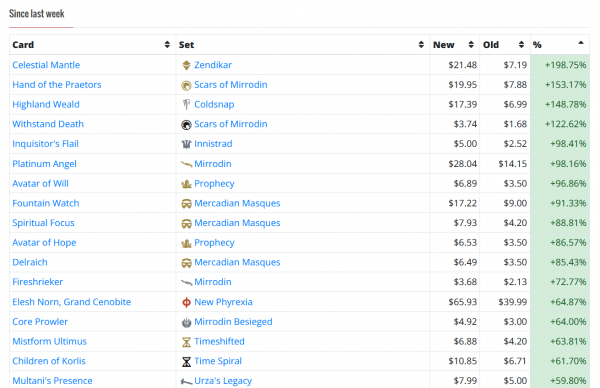
In repeating this practice numerous times, I’ve noticed a trend. After Standard rotates and the metagame shifts, commons and uncommons that see a significant bump in play—especially those from the previous year—see a measurable jump in value.
This week I’ll share some of the most valuable and played commons/uncommons in Standard as a way to encourage folks to keep the new stuff organized and to watch the metagame for clues on what to pick out of bulk.
Throne of Eldraine
Throne of Eldraine has to be one of the most overpowered sets in recent history. When was the last time so many cards from a single set were banned in Standard? Mirrodin? Urza’s Saga? It’s incredible. So far we’ve seen Cauldron Familiar, Escape to the Wilds, Fires of Invention, Lucky Clover, Oko, Thief of Crowns, and Once Upon a Time all banned.
Therefore, it should come as no surprise that some of the most valuable commons and uncommons in Standard come from Throne of Eldraine. And with the recent turnover in the metagame, some prices may be surprisingly high. Keep in mind, I’m not looking at the Brawl Deck cards; I’ll only be focusing on cards you can open from a typical booster pack.
The leader of this group by far is Drown in the Loch. Card Kingdom pays a whopping $1.80 for this uncommon. Though a little less dominant, this is the Fatal Push / Path to Exile of Standard right now. Being two colors limits the decks this card can go in, but it’s still a four-of in any list that involves the Rogues strategy. In Rogues, this is basically a split card that says “destroy target creature” on one side and “counter target spell” on the other. For two mana!
Distantly behind Drown in the Loch are a few other popular Standard cards. This includes Mystical Dispute, All that Glitters, and Mystic Sanctuary, which buylist for $0.72, $0.36, and $0.24 respectively. Mystical Dispute is definitely going to remain relevant for the rest of its time in Standard. The other two are a little more meta-specific. Either way, these are definitely worth picking out of your bulk boxes and draft chafe to ship for a bump in your next buylist!
Theros Beyond Death
Theros Beyond Death wasn’t as powerful as Throne of Eldraine when it came to requiring Standard bans. Only Uro, Titan of Nature's Wrath earned the boot from Standard from this set. But in my [now daily] Arena play, I come across a few commons and uncommons from the set that are worth picking.
Funny enough, a couple popular sideboard cards are some of the most valuable uncommons from Theros Beyond Death. Soul-Guide Lantern and Cling to Dust have both seen elevated play lately. They are effective at slowing the Rogues deck down while also disrupting your opponents’ plans with Escape cards. They also can disrupt a Call of the Death-Dweller type effect in a pinch. These two cards buylist for $0.60 and $0.25, respectively.
Other noteworthy uncommons from Theros Beyond Death include Hydra's Growth. Destiny Spinner, and perpetually-obnoxious enchantment The Birth of Meletis. These three cards can be shipped to a buylist for $0.52, $0.32, and $0.26 respectively, and should definitely be picked and shipped while you’re mailing in a buylist anyways.
Looking Ahead
I could repeat this exercise for newer sets. But the reality is, they’re still too fresh to merit really aggressive buylist pricing. I’ve been monitoring Ikoria commons and uncommons since the set’s release and there’s very little that can net you more than a quarter. Like a fine wine, these cards have to age a little bit before they are at their most valuable.
That said, I want to look at Ikoria, Magic 2021, and Zendikar Rising to identify which commons and uncommons are seeing the most Standard play. This will be a “watch list” of cards that are worth picking now in anticipation of a bump in value in a few months.
Topping the list is Heartless Act from Ikoria.
This premier removal spell can already be buylisted for $0.65. But I think that number is likely to climb. Like Drown in the Loch, this will become a go-to removal spell for many decks during its time in Standard. Right now Drown in the Loch buylists for nearly triple Heartless Act—I suspect this gap will close in the coming months. Heartless Act may have some restrictions in its utility, but it only requires one color, which is a huge plus for the uncommon.
If UR spells rises in popularity in Standard, Sprite Dragon could see higher prices. Right now it can be buylisted for $0.50—I’m not confident in a climb from there but I’ll be watching the Standard metagame closely to find out. The same can be said for Ikoria’s Bastion of Remembrance, which is very metagame dependent. Lastly, Zenith Flare could see a significant bump if cycling finds a spot in the Standard metagame.
From Magic 2021 I have my eye on a couple key cards that see extensive play in Standard. Cultivate is a reprint, but hasn’t been in a Standard set since Core Set 2011. I don’t know how much its million printings in Commander sets will hamper its potential, though. I expect the card will remain relevant and will climb a little bit, but I’m a bigger fan of a different Magic 2021 uncommon: Eliminate. This is yet another popular removal spell in Standard (noticing a trend?).
Lastly, again dependent on the metagame, Village Rites is likely worth picking and holding aside. The card only buylists for a measly $0.08 now, but this could get to a quarter if the metagame favors it during its lifetime in Standard.
Finally, there’s Zendikar Rising, Standard’s newest set. There are a couple cards I would definitely pick from bulk and set aside for a future buylist. Topping the list is…you guessed it, another removal spell! I would argue Bloodchief's Thirst is one of the best removal spells we’ve seen printed in quite some time. For one mana it can kill a pesky Scavenging Ooze or Edgewall Innkeeper. Or for the fully kicked four mana, this deals with nearly every threat in the game, including heavy hitters like Ugin, the Spirit Dragon. This buylists for a quarter today, but I can see it selling for over a buck next summer.
Two other cards I’m keeping a close eye on from Zendikar Rising are Feed the Swarm and Ruin Crab. The former is yet another removal spell—it’s only a common, but it does something that black historically has struggled with: kills enchantments. Don’t forget Theros Beyond Death had a heavy enchantment theme. There are likely to be good targets for this sorcery-speed removal spell as long as Theros is Standard-legal.
As for Ruin Crab…well players love their milling strategies. This will always be popular in casual mill decks in any and all formats. Hedron Crab is worth $5. Think about that. Granted it was printed only in original Zendikar and the Mystery Booster set. Still, as long as it dodges reprint, Ruin Crab has got to be one of the safest penny stock plays. It should also get a boost from Standard play. I can see this uncommon buylisting for a buck or two this time next year.
Wrapping It Up
With more time on my hands, I’m noticing a trend when picking my Standard set bulk. When Ikoria was initially released, I picked through my bulk for a Card Kingdom buylist and there were only a couple cards worth a nickel. As the set has aged, the most played commons and uncommons have steadily climbed in price. The same has happened with Theros Beyond Death and Throne of Eldraine.
This trend will surely continue, and the most popular commons and uncommons from Zendikar Rising, and Magic 2021. In anticipation of this trend, I’d spend the time required to sift through any bulk you may have from this set and put aside some key cards. Removal spells seem to be in high demand right now given Standard is filled with tier 1 decks that like to attack. But mill strategies are always casual favorites, so keep an eye on Ruin Crab as well.
With this strategy, you’ll never break the bank. It can be time-consuming as well. But if you’ve got some spare time on your hands and want to feel like you’re being productive (especially during a pandemic), organizing your Standard bulk and keeping aside key picks for a rainy-day buylist just may be what you need. It’s one of my favorite activities for calming my mind, and I hope to continue the practice as each new set comes out.
 have an answer at the time, and because Prowess was so
  one of, if not the, most successful decks this year. Pre-pandemic,
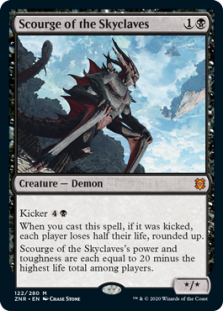
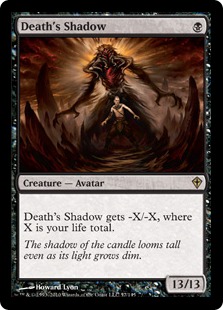
 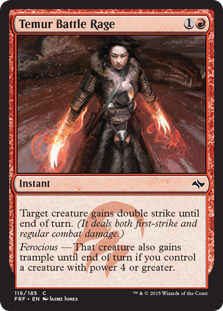 The big change, and I suspect the reason for Rakdos Shadow overtaking all other options, is Scourge's combo with Temur Battle Rage. In case you don't know, if the opponent is at 15 life and Scourge's controller is at 10, then Battle Rage on Scourge is lethal: the first hit deals five, and the second deals 10. This is a much easier and lower-work kill than previous Battle Rage decks laid claim to. As Grixis Death's Shadow taught us well
  One can always blame these kinds of collapses on changing metagames, adaptation, or popularity shifts, and sometimes it's right to do so. MTGO has long had a reputation for being far more volatile than paper for a reason. However, I think that explanation is inappropriate this time. The lifegain out of the Uro piles is certainly devastating against Rakdos Shadow, but that was a problem it
  I think the likely explanation for Shadow's October decline is that in exchange for a boost in explosiveness, it has inherited all the
 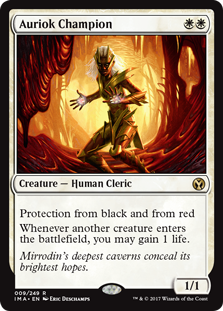 creatures, so trying to go around the Champion just plays into it. And that means that it becomes harder and harder to cast Scourge. When it does hit, Champion can potentially kill Scourge if there's a flurry of creatures afterward.
 However,



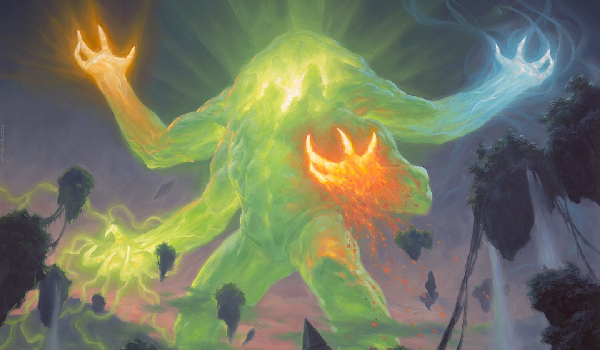
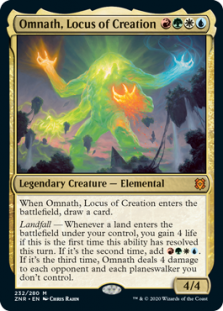 The problem is that Standard is far slower than Modern and has worse answers. This let Omnath sit on the board more often and accrue value. Or, even better, take advantage of weak aggro decks and let Omnath hang out in hand until the time was optimal to cast it, play a land to trigger the lifegain, follow up with Fertile Footsteps, trigger the mana ability, then end the game with Escape to the Wilds. Modern's aggro decks kill on turn four and usually have some kind of disruption, so the optimal Omnath line isn't possible. And this isn't counting how much harder four-color decks have it in a format with Blood Moon and
 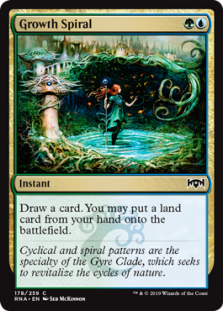 The only ramp comes from 2 Growth Spirals. The rest of the spells are interactive, with the only constants being 4 Path to Exile. Everything else is negotiable or a metagame call.
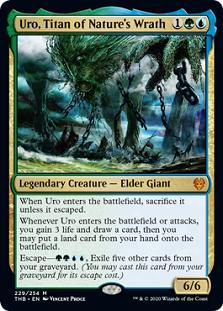 The problem is that the four-color value lists, whether this Field/Uro centric or not, are massively durdly. To the point of actively doing nothing a lot of the time. In testing, Uro's had to mulligan very aggressively for hands that did anything. I'm not even talking about curving well, I literally mean that a lot of hands I've pulled have just done squat, playing a turn 3 Uro at most. Most of the problem is that the deck is exactly 48.3% lands. Most hands will be mostly lands by simple math.
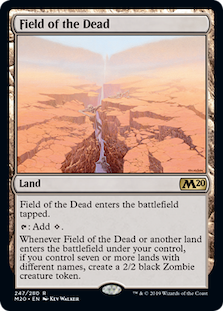 thought must go into each fetch because, doing it even slightly wrong will severely constrain available mana down the line. And that's not getting into the additional calculations for Cryptic Command and Mystic Sanctuary. This is a deck that wants to and must hit every land drop perfectly.
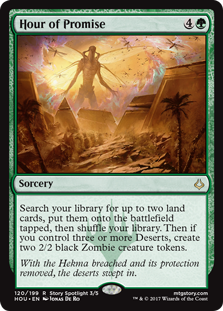 makes you dream about crushing opponents that thoroughly again. Which is my explanation for the deck's popularity; gotta chase that high (variance sequence).
 splutter out due to unreachable color requirements. Copycat doesn't have to get a Triome first then hit another fetch or die every game! That alone is reason to switch.

 No clever deck titles here --
  David wrote
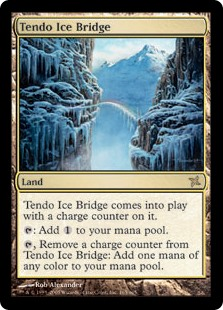 Needleverge finds its stride in a deck like this one, that doesn't fetch but loves painless, flexible lands to smooth out its mana. Thanks to the new land, Ideal has little trouble stretching to splash red, which affords it access to heavy-duty land hate in Blood Moon and Boil.
 I have been playing and working on Death and Taxes (hereafter: DnT) for
  I won plenty of local events over the years thanks to correctly anticipating metagames and preparing accordingly. However, whenever I took DnT to wider metas, it just couldn't compete. The power and universality wasn't there. And Humans did a lot of the same things but with a faster clock, so why bother with the pet project? Until 2020, of course. DnT has exploded over the past month thanks to Zendikar Rising. So today I'll be looking at these finally successful builds and breaking down the card choices.
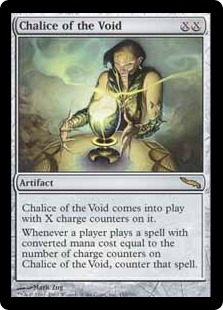
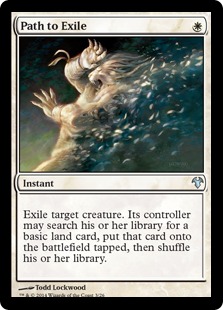
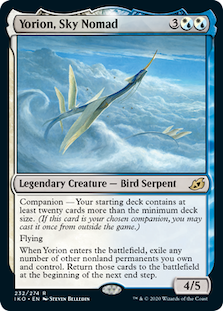
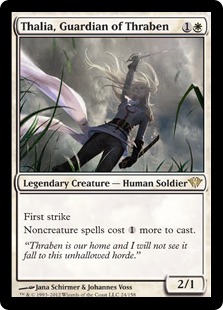 The key to the deck are the eight disruptive creatures, Thalia, Guardian of Thraben and Leonin Arbiter. I might have seen one list that didn't run full sets of each. Without these speedbumps, DnT cannot keep up with the rest of Modern. Thalia is better than Arbiter in the sense that noncreature spells see more play, and the tax is more consistently disruptive than soft search prevention, but that's balanced by Lava Dart. Arbiter is crippling against unprepared decks and makes Ghost Quarter into Strip Mine while Path to Exile becomes the best removal spell ever.
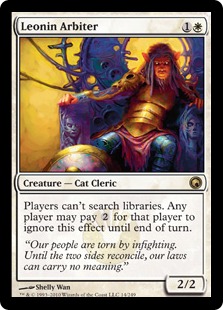 Both creatures form the heart of the deck. The trick is knowing which one is more relevant. As mentioned above, DnT is very much a deck that requires and rewards format knowledge. Given a choice, it is highly contextual which one to play first: not just the opponent's deck must be considered, but also how your own turns will play out. Playing Arbiter may or may not cripple the opponent's mana development, but it will make it harder to cast Stoneforge for several turns. Thalia may stunt the opponent's gameplan, but will also tax Path. Planning ahead and knowing what's most important in the matchup is key.
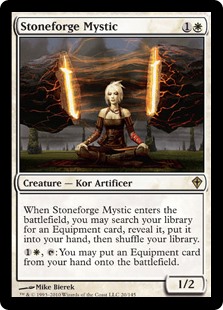 Stoneforge Mystic is the card advantage engine in the deck. In the past, it wasn't clear that she was better than the traditional Blade Splicer advantage engine, but every list I've seen so far has been on Stoneforge, so that's no longer the case. Despite
 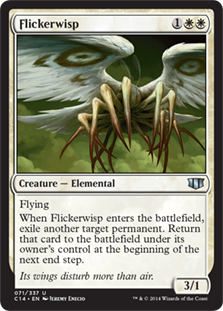 Equipping on entry is huge by itself, but it also synergizes with Flickerwisp. Thus, it has functions as a combat trick, stalemate breaker, and a normal equipment. A very strong pickup.
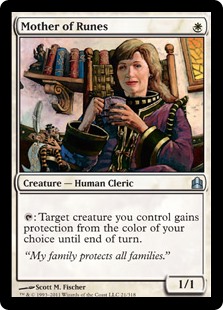 Giver has always suffered from not being Mother of Runes. Gaining a point of toughness and the ability to protect from colorless cards is solid, but not being able to protect herself really let the side down. In a world where Jund was a big player, it was too easy for Step-Mom of Runes to die uselessly. In Legacy, Bolting an untapped, active Mom ensures a two-for-one since she'll protect herself from the first Bolt. In Modern, it's no risk to Bolt Step-Mom, then Bolt whatever she tries to protect. I kept running Thraben Inspector over Giver as a result.
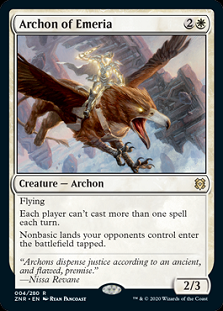 Archon of Emeria
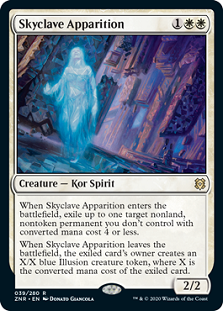
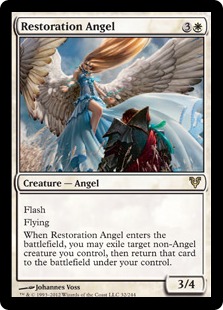 Angel is the old standby, and is at her best in a grindy metagame. Blanking even a single removal spell can be backbreaking against Jund or control. Being a 3/4 is also frequently relevant, and when blocking is essential, Resto will always be my pick. Current builds are not the best place for her, as there's no special way to get any value except blinking Apparition. Blocking isn't great right now given Prowess, and true attrition is down. Jund is Tier 2 and Omnath is about drawing lots of cards. The lower removal counts in the Omnath decks do make a single blink far more valuable, but on the whole I think Resto isn't the call, at least this month.
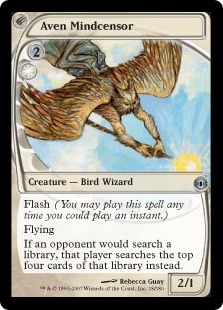 I have a strained relationship with this card. On the one hand, it is the best hard-counter for search effects in white and phenomenal against Primeval Titan, Scapeshift, and Bring to Light. On the other, Mindcensor has a long history of making promises to me it couldn't keep, dating back to failing to prevent Dragonstorm from going off five times at 2007 Regionals. Mindcensor can't prevent the opponent just having it, and counting on it does just lead to heartbreak. I think that having a few in the 75 is a good idea given how the meta is moving. However, the body is fragile enough and effect narrow enough I'd keep Mindcensor in the sideboard.
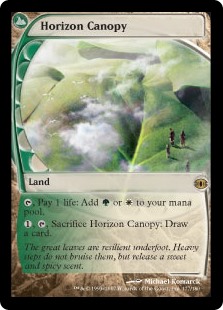
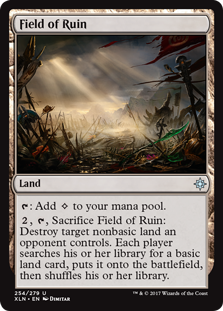 Every mono-white DnT list I've seen is running 23 lands. A few Boros lists run 21-22 because they're swapping a Field of Ruin or two for Cleansing Wildfire, but they're outliers. The overall breakdown has also very consistently been 11 Plains, 12 utility lands. The utility lands are typically distributed as 4 Horizon lands, 4 Ghost Quarter, 4 Field of Ruin. Again, as of writing, this specific distribution is at least 90% of the lists I've processed, so I'd call it the default. The main deviations are whether to run Horizon Canopy, Silent Clearing, or Sunbaked Canyon, and it really doesn't matter.
 Eiganjo does nothing against Lightning Bolt, rarely saves Thalia in combat, and requires two mana to stop a Lava Dart. It's a pale shadow of Karakas and I wouldn't bother.
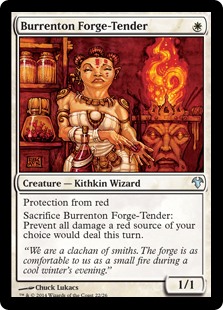 Forge-Tender is a very good card in a format where specific red spells need to be answered and/or blocked and/or Anger of the Gods is everywhere. This is pretty accurate at the moment. The issue is that Auriok Champion is generally better in more matchups, especially the Scourge of the Skyclaves decks that have started spiking up. Also, given Champion's popularity, a lot of decks are giving up on Anger in favor of Kozilek's Return. Therefore, I'd run Champion as my anti-red card and pack Selfless Spirit for sweepers.
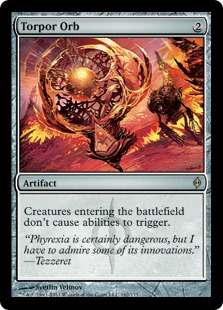 If the only deck that needed Relic-Warder as an answer was Affinity, that would be ok. Exiling a counter-laden creature is very good. However, the main decks with artifacts run Karn, the Great Creator. This lets them wish for Torpor Orb, and most do run a copy. Orb means all the ETB creatures are effectively textless, which means no answers to the Ensnaring Bridge follow-up. For that reason, DnT is better off with Disenchant or Revoke Existence.