Are you a Quiet Speculation member?
If not, now is a perfect time to join up! Our powerful tools, breaking-news analysis, and exclusive Discord channel will make sure you stay up to date and ahead of the curve.
*Sigh* Oh, Magic Online. It is only now, with paper Magic shut down, that I am forced to regularly use you. And remember that I love/hate you. The ability to pick up and play my preferred format anytime, and against anyone in the world, is a true joy. Having to navigate your stubbornly obtuse command schemes and a frequently salty playerbase is a nightmare. However, you are what I have to work with, so I will make due.

While paper Magic languishes under pandemic lockdown, the online world is thriving. Wizards even added another category of events called Super Qualifiers to keep up with surging demand. Which means that there's more valid (read: non-curated) data coming out of MTGO than we've seen in years. It's still not enough to build a robust and statistically useful data set, but the premier events are large enough that they are reasonable stand-ins for the paper events I have been working with.
There is one minor problem that nonetheless leaves a big asterisk over this data: repeat players. Given that MTGO is online and the entry fees are low, and considering that a lot of people are currently quarantined, there's an incentive for individuals to just grind events. When I was going through events, I saw a decent number of result that were from the same gamer handles on the same deck, which inflates the numbers. Perspective dictates whether the results are then any less valid, but this scenario does happen more frequently online.
3/14 MTGO Challenge
As a result, I have data for the week running from March 14 to March 21. Or at least, I have all the data from the results that had been posted when I started this article. It's always possible that I've missed something or another event has been posted since I started working; Wizards can be weird about posting decklists. I'll be going through them in (roughly) chronological order, beginning with the Modern Challenge's Top 32.
| Deck Name | Total # |
|---|---|
| Bant Snow Control | 4 |
| Mono Red Prowess | 4 |
| Bant Snowblade | 2 |
| Eldrazi and Taxes | 2 |
| Mono Green Tron | 2 |
| Izzet Control | 2 |
| Dredge | 2 |
| Jund | 1 |
| Amulet Titan | 1 |
| Simic Urza | 1 |
| Eldrazi Tron | 1 |
| Niv to Light | 1 |
| Temur Urza | 1 |
| Humans | 1 |
| UW Control | 1 |
| Mono Blue Tron | 1 |
| Heliod Company | 1 |
| UW Stoneblade | 1 |
| 4c Snow Control | 1 |
| Infect | 1 |
| The Rock | 1 |
As there haven't been paper events since the banning, I'm regarding the metagame as a blank slate. Once Upon a Time saw widespread play, and though it wasn't critical to anything, did change the format enough that I don't think the previously defined metagame is valid anymore. I will be using that Titan/Prowess-pillared format as the baseline against which to compare the new data.
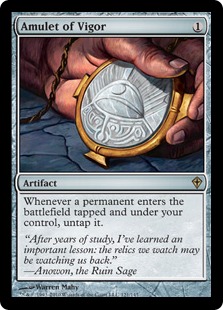 With that in mind, the format has definitely changed. There is only a single Amulet deck, which is very down even by the standards of non-SCG events. In its place, Tron appears to be rising. Tron had been down from its usual place during the past few months, though I'm not sure why. I suspect that Amulet was a tricky matchup, but I never heard anyone discuss it nor did I personally see how it played out. Prowess is still holding on to a top slot, though it's not running away with them, unlike previous results.
Instead, Prowess is level with Bant Snow Control. However, I could have really lumped Snow Control in with Bant Snowblade. Both decks are built on the same core of Arcum's Astrolabe, Uro, Titan of Nature's Wrath, Ice-Fang Coatl, and countermagic. The difference is the number of counters and the support cards. Bant Snow is finally coming into its own in this event, marking a trend to watch.
There are no Company combo decks in the Challenge, though that isn't surprising. Collected Company decks are rarely well-represented online because there's no way to shortcut the combo and truly go infinite. Besides, Company combos have a lot of moving pieces. This means lots of opportunities to mis-click or time-out, so their online presence is suppressed. Their actual metagame place therefore remains unclear.
3/15 MTGO PTQ
Next up is the MTGO PTQ. A PTQ is a PTQ, so I'm assuming that it is similar population-wise to the paper PTQs I'm familiar with. In other words, this is likely to be the most competitive event, and therefore most indicative of the metagame. It was also eight rounds, yielding a relatively large population for a very random sample. Once again, Wizards released the Top 32.
| Deck Name | Total # |
|---|---|
| Bant Snow Control | 3 |
| Eldarzi Tron | 2 |
| Temur Urza | 1 |
| Dredge | 1 |
| Mono Green Tron | 1 |
| Jund | 1 |
| Humans | 1 |
| Dredge | 1 |
| Izzet Delver | 1 |
| BR Unearth | 1 |
| 4c Snow Control | 1 |
| UW Urza | 1 |
| Jeskai Whirza | 1 |
Bant Snow Control is the top deck again, but not by much. Eldrazi Tron is a close second. I've always wondered about E-Tron's online popularity, as it never does that well in paper; cost and deck loyalty are frequent explanations, but that doesn't stop paper players from switching decks. Certainly, I don't see anything indicating E-Tron is suddenly better-positioned to explain its numbers. Of course, this may simply be par for the course, since I don't track online results typically.
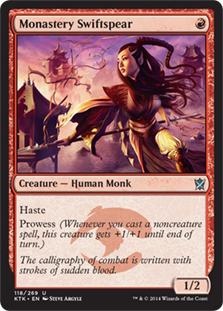 The more interesting results are the non-results. Neither Amulet Titan nor Prowess appear in this data. Amulet's absence isn't very surprising to me, but Prowess actually had legs and results in the previous meta. The fact that it isn't in this data is something of a mystery.
Snow may be the most-represented archetype, but not by enough for Uro's lifegain to be holding Prowess at bay. Also, even if Uro is a problem for Prowess, Bant has so little removal that the matchup shouldn't be unwinnable for red. The overall Top 32 is not particularly hostile either. I was led to believe that Prowess was popular online because it's cheap, too, so this is another result to watch.
A Plethora of Prelims
The next category is the preliminaries. There were five reported in the surveyed period, here lumped together for convenience. There should be more, as the schedule said there's one per day. However, I didn't see them when I looked for the results. It should also be noted that these are the events with more repeat players and decks. However, this is the best survey I have of where competitive players' heads were over the course of the week.
| Deck Name | Total # |
|---|---|
| Eldrazi Tron | 10 |
| Mono Green Tron | 10 |
| Temur Urza | 9 |
| Bant Snow Control | 8 |
| Jund | 8 |
| Amulet Titan | 6 |
| Mono Red Prowess | 5 |
| Humans | 4 |
| Dredge | 3 |
| Bant Scapeshift | 3 |
| 5c Niv to Light | 2 |
| Titanshift | 2 |
| Bant Snowblade | 2 |
| Ad Nauseam | 2 |
| Gifts Storm | 2 |
| UW Whirza | 2 |
| Amuletless Titan | 1 |
| Ponza | 1 |
| Dimir Whirza | 1 |
| RG Zoo | 1 |
| Bogles | 1 |
| Blue Moon | 1 |
| Restore Balance | 1 |
| Jeskai Whirza | 1 |
| Golos Tron | 1 |
| As Foretold | 1 |
| 4c Kiki Chord | 1 |
| 4c Underworld Breach | 1 |
| Simic Urza | 1 |
| Infect | 1 |
| Temur Snow Midrange | 1 |
| Grixis Shadow | 1 |
| Burn | 1 |
| UG Titan | 1 |
| RB Unearth | 1 |
| Izzet Control | 1 |
| Shadow Zoo | 1 |
In a twist from the previous results, Snow Control is not the top deck. It's actually tied for fourth with Jund. Instead, the two Tron variants tie for first. Normal Tron has been good for so long that its position is not particularly surprising. In a shifting metagame, it makes sense that a powerful standby would do well. The same might be said for E-Tron, but I would dispute that in light of generally only ever being as good as Chalice of the Void is at a given time. I'm not seeing anything in the data to indicate that is true. I could be under-appreciating the simple power of big, under-costed creatures, but if that was enough, why hasn't the deck sustained a presence since 2017? Yet another thing to watch!
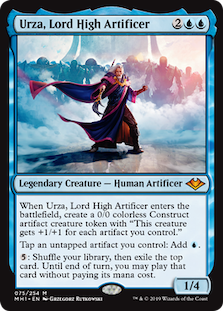 Temur Urza is in third, and this is the sort of deck I was worried about when Mox Opal was banned. Prior to the banning, the essential core of Urza lists—Whir of Invention or no—had nothing to do with Opal. Rather, they utilized Urza and Emry as artifact value engines. The card advantage engines were the problem more than the speed of the deck, and banning Opal didn't affect that at all. Now, Urza lists are just leaning on that value aspect, adding in Uro because frankly, why not? There are few decks that fill their graveyards like Urza decks do now.
Amulet Titan and Prowess had reasonable showings in these events, but nothing indicating that last month they were the presumptive best decks. I think it fair to say they've been knocked off their pedestals.
3/21 Super Qualifier
The final event is the newest one, and I don't just mean chronologically. Super Qualifiers are something new that Wizards has added to make up for the cancelled paper qualifiers. The main difference, as far as I can tell, is that there's an additional qualification for second place. In any case, it's another highly competitive event that released a Top 32.
| Deck Name | Total # |
|---|---|
| Humans | 3 |
| Amulet Titan | 3 |
| Bant Snow Control | 3 |
| Mono-Red Prowess | 3 |
| Eldarzi Tron | 3 |
| Dredge | 2 |
| Burn | 2 |
| Mono Green Tron | 2 |
| Titanshift | 2 |
| Temur Turns | 1 |
| Temur Superfriends | 1 |
| Jund | 1 |
| Temur Urza | 1 |
| Dimir Whirza | 1 |
| Jeskai Snow Control | 1 |
| Infect | 1 |
| Ponza | 1 |
| BR Unearth | 1 |
In a twist, no one deck stands out from the pack. There's a very even metagame, which Humans won, with a five-way tie for first.
Humans has been present in all the data I've looked at over the past few months, but it's never stood out. I was never sure why, as there 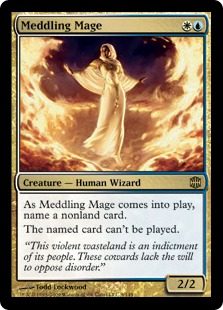 have been a lot of decks vulnerable to Meddling Mage. Oko was hard, but not unbeatable, and Amulet had severely cut its removal. I suppose that the influx of Jund may be to blame, but Jund hasn't been doing much better than Humans. I suppose it's just fallen out of favor.
There are a surprising number of rogue decks in this event; more than in previous single events. That they're not all exploiting the same cards and interactions is a signal of format health. When any deck can enter an event and do well, it indicates that the power of the format is relatively even and there's room to metagame, explore, and thrive. Hopefully the data continues to reflect this openness.
Metagame in Aggregate
Taking all these events together, there are a few trends that stand out. The first is that there is not a clear front-runner. Bant Snow and variants thereof are doing very well overall. However, they're not doing much better than any other deck. At the beginning of the week, Bant Snow was the most successful deck. However, as the week 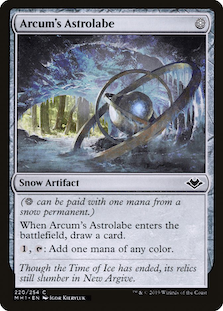 rolled on, that narrative faltered. Snow did well in the preliminaries and the Super Qualifier, but proved middle-of-the-pack in the former and just part of the crowd in the latter. There's power in the new deck, but nothing yet indicating that it's anything special.
However, there is a clear trend towards midrange decks. There's only a few combo decks in the entirety of these results, and aggro is clearly slacking relative to slower decks. The lack of aggro may be a holdover from the previous meta, where Prowess pushed a lot of other decks out. However, the rise of Jund and Bant Snow is making life harder for aggro. I believe that this can be overcome with strategic adaptation and better sideboarding, but we will need to see how things develop. As for combo, there may be bias against certain ones on MTGO, as previously mentioned, but Breach Station was touted as the new menace and it's not particularly hard to play online. I think evidence is mounting that it's just not as good as advertised.
An Issue of Uro
The Bant core has gained ground, and the usual suspects are moaning already. I can appreciate some of the complaints, as Arcum's Astrolabe has a far lower opportunity cost than I expected and as a result is a bit too good at its job. Whether it's too good for Modern is another story. Again, the evidence for snow being good is there, but it's not noticeably better than anything else. Now, I've mentioned that Uro is unexpectedly good. I'd even give Uro credit for making the UGx decks competitors. Coatl is a good card, but it's not enough to win the game. Uro's body is another story, especially when coupled with recursive value. This naturally is drawing ire.
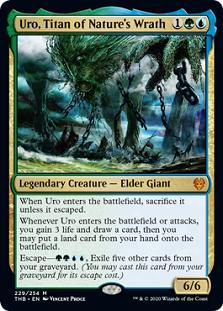 In a general sense, I think that UGx deserves a chance to be a deck in Modern for a while. Midrange decks not only being good, but not being Jund, is pretty rare in Modern. Long-suffering Simic enthusiasts have earned their day. Uro has proven to be above the curve, but again, I don't think that's the whole story. I keep banging on this point, but Uro does nothing against graveyard hate. And when sampling decks, there's a general lack of hate.
The decks that do have hate tend to have a reasonable amount, but not every deck is ready. Jund decks are running lots of hate in the sideboard, but they've cut on maindeck Scavenging Ooze. As a result, they're struggling more in Game 1 than they should against all the graveyard decks. I think a lot of the resentment for Uro is misplaced. Players aren't angry at Uro so much as frustrated that Modern still requires a lot of graveyard hate.
Still in Transition
That said, this is just the first look I've gotten at the overall metagame. One data point, even one built over the course of a week, is not defining. If the trends continue during my next look, that will be a clear argument about the metagame. However, we just have to wait and see.


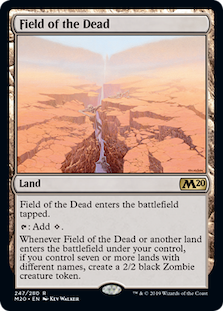
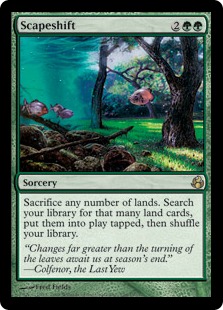 that plan but does away with the red splash entirely, preserving only Valakut among red-producing lands. The reason? Blue-green happens to be a competent interactive combination for the first time
 We'll kick things off with the classic
 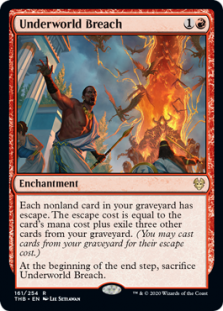 Yet another
  Adding another twist to the strategy,




 Frequently, it isn't obvious how Jund's winning each exchange, because the trades are one-for-ones. When
  The above Jund list has an average mana cost of 2.14. Part of Jund's advantage is that it maximizes its mana like few decks can, ovrerwhelming the opponent with card quality and efficiency.
 Again, consider the example list. Jund's plan is to win once everyone's hand is exhausted. The only means it has to actually draw extra cards going long is to recur Barren Moor or Nurtured Peatland with Wrenn and Six, which is fairly slow, and in the case of Peatland a tempo hole. Bloodbraid Elf, Kolaghan's Command, and arguably Kroxa are all two-for-ones, but they're the equivalent of a burst of nitrous into the engine rather than a fuel refill. It's the price Jund has paid in dropping Dark Confidant for the more versatile and robust Wrenn.
 This gives combo the time to draw more cards and reassemble.
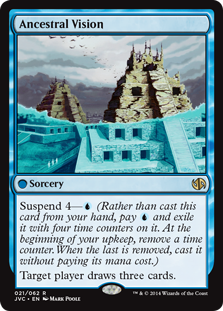 of the
 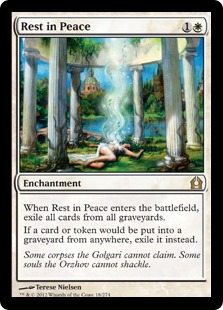 Jund may not be a true graveyard deck in the way that Dredge is, but it really needs a graveyard for many of its cards to be good. Against Rest in Peace, Tarmogoyf is just a 0/1, Ooze is a 2/2, Kroxa is a bad Raven's Crime, and Wrenn can only downtick for any value. Sure, Jund can Trophy Rest and rebuild from there, but it will have expended resources to do so, and it's not like Jund can instantly refill that graveyard. Besides, Jund may be unable to remove the Rest because it can't afford to use the removal spell on the enchantment. By squeezing Jund strategically, decks generate a lot of virtual card advantage, which swallows up Jund's value generation engine.
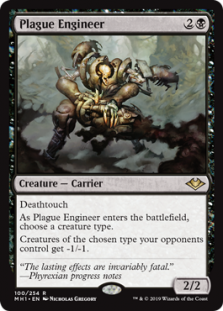 For example, playing Humans against Jund, I know that post-board Jund will have more cheap removal and more importantly Plague Engineer, but at this point sweepers are very rare. So I will take out my very easily Wrenned-to-death Thalias and Phantasmal Images in favor of more robust creatures and Dismembers. The plan: endure Jund's removal, build a board even under Engineer, and win through Jund's attack.
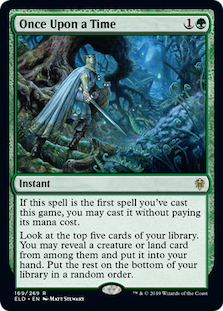 I know very little about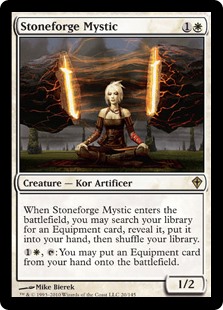
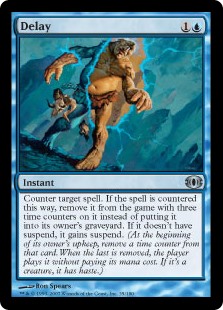 The slots leftover from removing Once are filled with more interaction, including the elusive Delay; since Shadow decks enjoy an aggro-combo dimension with Temur Battle Rage, giving enemy spells suspend is often the same as countering them, as opponents won't ever get a chance to resolve that critical spell. Overall, though, the deck's composition remains unchanged.
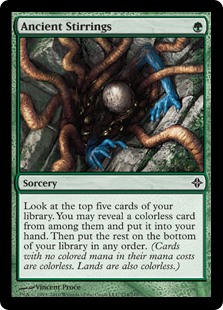 Without Once, the deck can happily return to being fully colorless, although Once didn't warp its mana terribly; indeed, the deck had been content to run a single Forest findable by Expedition Map, aiming to cast Once for free most of the time anyway. So it's a return to business-as-usual for this old Modern stalwart, whose continued relevance will surely be met with a resurgence in Tron decks powered by the
  With the format shifting towards midrange, though, Burn seemed like it might again have its day; count-to-20-style strategies such as these aren't interested in trading resources with opponents, and Lava Spike is a lot harder to effectively one-for-one than Monastery Swiftspear.
 A newer arrival is Kiln Fiend, which heavily pressures opponents trying to string together a value engine. Once Uro gets going, it can be hard for Burn-style decks to content with; the Titan walls everything, hits like a brick, digs pilots into more interaction, and even gains life! But it's also slow, leaving a window for Fiend to "Crash Through" and dent opponents enough that they can't recover.






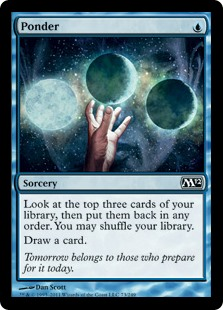 Casting Once reduced the variety of opening turns to the point that games were looking too similar to each other. Again, Wizards has mentioned this as a reason to ban Preordain and Ponder, but those hits also came about due to other problems relating to Storm decks. All Once did was reduce variance, which apparently made games unacceptably stale.
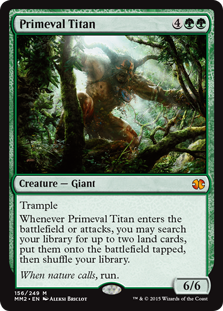 instead, but that seems unlikely; if they weren't doing so before, I can't imagine they'd do so now. Always costing two mana and seeing one fewer card are significant power reductions.