Are you a Quiet Speculation member?
If not, now is a perfect time to join up! Our powerful tools, breaking-news analysis, and exclusive Discord channel will make sure you stay up to date and ahead of the curve.
I pulled the trigger. After playing Magic Online (MTGO) for the past fifteen years, I finally sold out. This article explains why I finally exited—and why you may want to consider doing the same.
For years I was heavily invested in Magic Online, both financially and emotionally. The platform had its flaws, but for a former competitive player with family and career obligations, it was the only realistic way to get my Magic fix.
What’s more, with the guidance I was getting from Quiet Speculation, MTGO was free to play. By reading the forums and Matt Lewis’s articles, I learned to capitalize on the predictable cycles and market inefficiencies of the MTGO economy to accrue thousands of tix of value. (For more on that you can read some of my old articles, which laid out how the average player-trader could maximize their value with minimum hassle.)
After cashing out my speculation collection last year, I still had a fully stocked MTGO account that allowed me to play any deck in any format without laying down cash. So yeah, you could say I was pretty invested in MTGO.
Last month I decided to sell the rest of my collection. Stormy seas are ahead for MTGO and I want to wait to see where things go before getting back in the water.
The Key
My journey began seven months ago when a stranger offered me a mysterious key. The stranger was a WotC rep, and the key granted me entry to the MTG Arena Beta. To be honest, I had been a skeptic of Arena–I just wanted to play Magic and didn’t care about all the bells and whistles—but figured I ought to give it a try. Maybe my feedback could help make it better.
After eight months on the Beta now I can tell you: this game is for real. It still has a few flaws, but the interface is streamlined and appealing. The gameplay is on point. It’s not some stripped-down version of Magic—it’s real Magic with a modern digital interface. While it is a more polished “video game” than MTGO, it counterintuitively feels more like playing paper Magic than MTGO ever did. When you are on Arena, the interface fades away and you are left with the art and the gameplay.
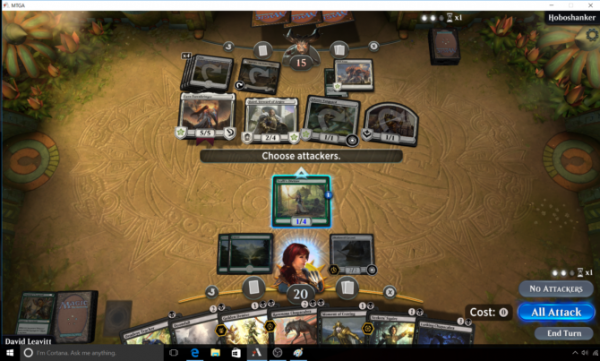
Magic Arena now has full Standard and the current-set draft available. Behind the streamlined interface is a “full control” mode that allows you to set stops, bluff, and do everything that you would be able to do in Magic Online. Even in Beta, Arena has a robust player base and you rarely have to wait more than 30 seconds for a match to start. Once you become accustomed to the pace, graphics, and sound of Arena, it’s hard to go back to MTGO.
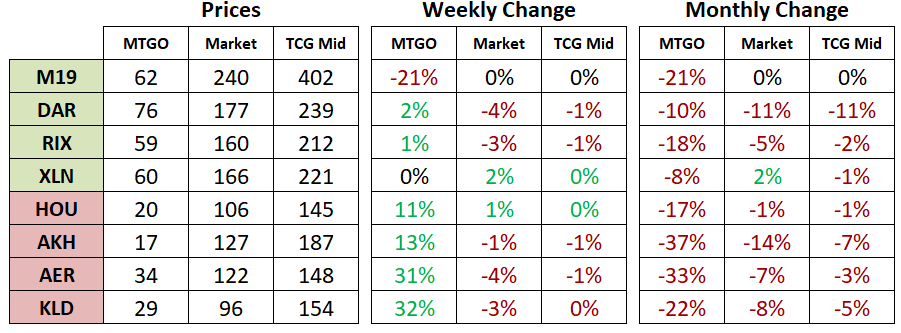
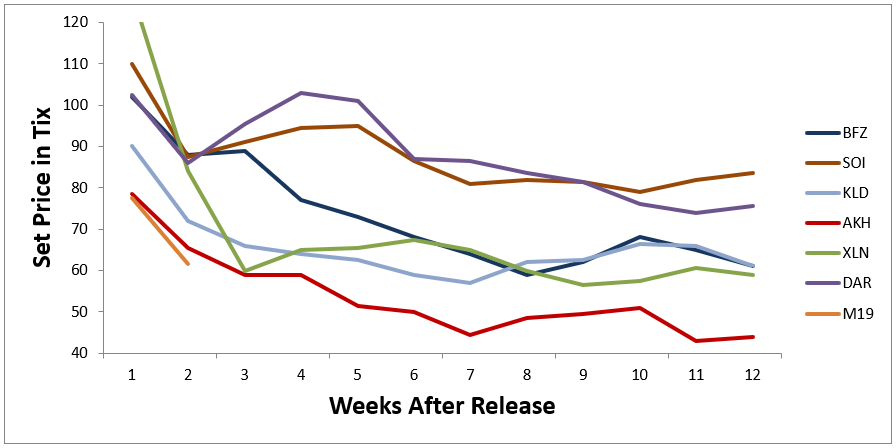
Since the first rumors of “Magic Digital Next” in early 2017 people have been saying that WotC’s new digital product posed an existential threat to Magic Online. So far the demise of MTGO has been greatly exaggerated. Yes, on several occasions the market has dipped with news of progress in MTG Arena, but card prices stabilized when it became clear that MTG Arena was not an imminent threat. MTGO card values have indeed declined in the face of Arena, and some of the downside risk is already priced in. But there is still a lot of value locked into MTGO that could disappear in a moment should prices tumble.
I believe that day of reckoning is fast approaching. When it will come is unclear, but I think it’s sooner rather than later. MTG Arena is a superior product and will soon be available to everyone who currently plays Magic Online. The first big step is this week, when Wizards started giving out thousands of Beta keys–everyone currently on the Beta just got codes to pass on to five friends. In principle, that will expand the Beta player base fivefold. And no doubt there is pressure on the digital team to get this product out of closed Beta to start generating revenue, and they will move to a wide Beta as soon as ready.
What does that mean for MTGO finance? In the short run there is no guarantee that MTGO will tank. But if you are still heavily invested in the MTGO it’s time to hedge your bets.
Enough Room for Both?
Could both MTGO and Arena survive? In principle, yes. Magic has a large player base and if the two platforms offer a distinct experience they could exist side by side. After all, MTGO and Duels of the Planeswalkers were both successful.
The difference is that these products were aimed at distinct audiences and had different capabilities.
With each update, MTG Arena comes closer to doing everything MTGO does and doing it better. You can now play full Standard. You can draft current and recent sets. They are experimenting with casual formats (Singleton, and soon Brawl). Once the player base grows, they will be able to offer all these options at once. And it’s only a matter of time before old formats like Modern and Legacy are available on Arena.
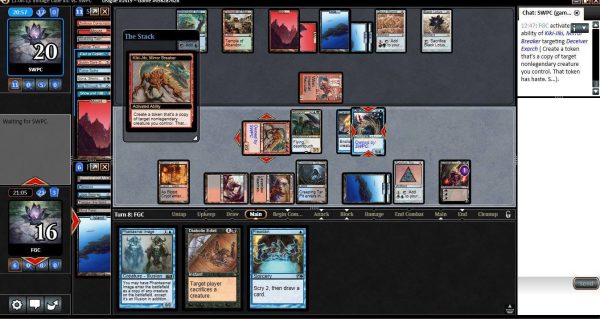
Games are subject to what economists refer to as “network effects.” The more people playing a particular game or platform, the more attractive it is to others. Once a game drops below a certain player threshold it will start to dwindle and die. Have you ever gotten excited about drafting an older set on MTGO only to enter the queue and see the timer tick up while players enter and leave? That only needs to happen a few times before you get frustrated and look elsewhere.
Wizards understands that Arena represents the future of digital Magic. They want their flagship digital offering to be something that appeals to casual fans and players of other video and digital card games, not something that only caters to heavily invested Magic players.
On the other hand, they don’t want to kill MTGO, which is their golden goose and a major revenue generator. (MTGO has been a huge boon for Wizards because they can leverage their intellectual property to essentially sell the same cards twice.)
You can be sure Wizards is trying to balance this out and ensure that MTGO does not die. But ultimately, the choice will be in the hands of the people. Will they prefer MTGO or Arena? As someone who has played a lot of games on both, I think the answer is clear.
Arena for All
What happens when MTG Arena goes into an open Beta or full release?
Last month, Kyle Rusciano wrote an article here on Arena and MTGO. He makes a lot of good points, many of which still hold. His central question is the right one:
The most important question to me is whether Magic Arena is being designed and executed in such a way that the player base on MTGO will change. Will Magic Arena directly compete with MTGO for Standard and Limited players? Will Magic Arena spur such significant growth in the game overall that the MTGO playerbase will stay the same, or perhaps even grow? These are the sorts of questions I am asking – because they will impact the MTGO economy and the value of our collections in the future.
Based on the design decision recently unveiled, the answer is clear: Arena will directly compete for Standard and Limited players.
Today, I choose to spend about 95% of my time on Arena. The only times I have chosen to play on MTGO were when the set I wanted to draft (first Dominaria and then M19) was not available in Arena.
Arena has no Sealed deck. It has no Modern or Legacy (two of my favorite formats.) It has no Vintage or Brawl or Multiplayer. It has no Cube. Draft still pits you against bots. And yet I found myself logging into Arena instead of MTGO. This is true even before full Standard was available and we could only play a truncated version.
Arena’s Hidden Advantage
Some of the analysis of MTGO versus Arena has focused on Expected Value (EV)—how much is a particular event expected to earn or cost for the average player over the long run.
That’s an important consideration, as Magic players are sensitive to financial incentives. When given a choice, players will choose to play the format that offers the greatest expected value. However, that applies only when comparing options on the same platform. If players significantly prefer the MTG Arena interface, they are likely to put in their play time there rather than on MTGO.
Moreover, what some of these straight EV analyses miss is the strong built-in incentive structure offered by Arena through two features that Magic Online does not have: quests and daily rewards.
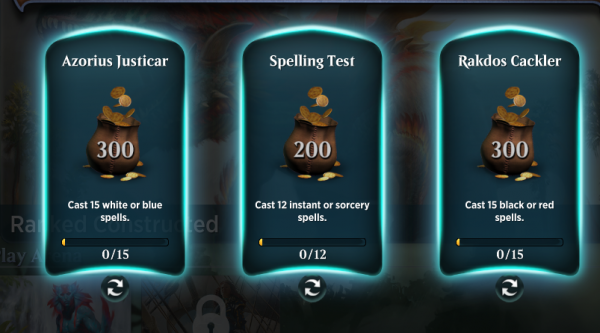
MTG Arena has a daily rewards system common to many digital games. It’s quite generous. You win 250 gold for your first win of the day, and 100 gold for wins two, three, and four. In addition, each day you get a new quest to complete (playing 25 lands or casting 20 blue or white spells). These quests offer 500 to 750 gold. So each day if you win four matches and complete your quest you will earn an average of 1000 gold, which is equivalent to $1 (and allows you to acquire one pack or pay entry fee for a couple events.) You can complete these daily rewards and quests playing limited or constructed events, or you can complete them playing for free on the ladder.
This means that for the first four wins of each day (roughly one hour of play time, depending on your skill level, format, and deck) Arena is essentially paying to play. This payment is a artificial currency which, unlike Event Ticket (tix) on MTGO, cannot be cashed out. But it nevertheless feels like a reward. Psychologically it is very appealing to hear the clink of new gold in your account, something that this sort of "freemium" game has thrived on. The game incentivizes you to play each day, because each day you skip you are missing the chance to earn rewards, improve your collection, or save up for your next draft.
Even when exciting MTGO formats were available, like Cube, I often found myself logging into Arena first to complete my daily rewards before turning to MTGO. And I am an enfranchised player who has no trouble setting my stops on MTGO and who can play any format I like. Daily rewards will be especially critical to the “Free to Play” (F2P) player; in fact, the only way to build your collection in F2P is to be relentless in completing quests and attaining daily rewards.
The Endgame
So what happens when MTG Arena achieves market share over MTGO? The exact economic implications are hard to predict, but it’s not going to be pretty.
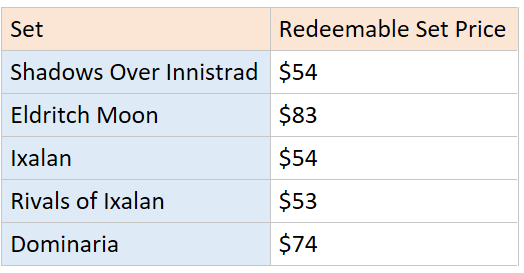
For cards from current sets, redemption will prop up prices. These cards are safe to hold since as long as cards are redeemable, they have a floor.
In contrast, older cards have value only based on demand for play in those formats. We’ve already seen major declines in the indices for Modern and Legacy cards, with MTG Goldfish’s “total format price” for Legacy dropping from 2200 tix at the time of Eldritch Moon down to 1034 today. Modern saw something of a price resurgence after Masters 25 (A25), and also hovers in the 1000 range.
The only reason that these cards have value at all is the demand by competitive players. There are relatively few buyers of these staples, and if the major bot chains stop buying there is nothing propping up these values. If Magic Online becomes a ghost town, the bottom will fall out on the index faster than you can say, “Bolt you for lethal.”
After playing Arena for seven months I think it’s a matter of when, not if, that happens.
-Alexander Carl
@thoughtlaced
Agree? Disagree? See something that I’m missing? I will give an MTG Arena Beta code to first two (real) comments on this article by people not already in the Beta.


 -4 Eldrazi Mimic
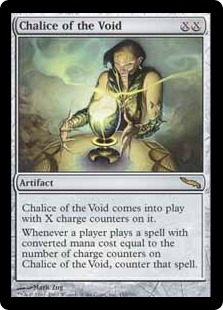 Chalice of the Void is integral to this plan both on the play and draw. The first Chalice almost always comes down on 0, and unconditionally on the play, making it the best card to look for with Serum Powder. Turn one Chalice on 0 slows Affinity to a crawl regardless of how many cards it blanks on resolution, but that number tends to be pretty high, as the viability of Affinity hands frequently revolves around their explosiveness.
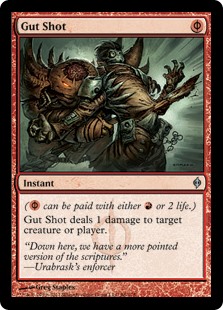 They should usually be killed in that same order. Vault Skirge, Memnite, and Ornithopter don't hassle us at all; Blinkmoth Nexus trades with all of them on defense, and we can ignore any points won off lifelink, as we want to win a longer game. We've got Ghost Quarter for the manlands, and Simian Spirit Guide and Gut Shot prevent opponents from killing us out of nowhere and enable blowouts.
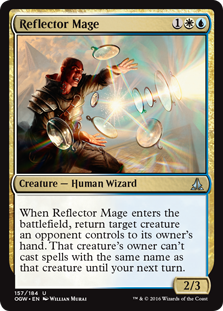 Thalia, Guardian of Thraben and Kitesail Freebooter are examples of cards that help make Humans a force in Modern, but positively stink against Colorless. On the other hand, Reflector Mage and Phantasmal Image (especially in conjunction with Reflector, or when we deploy our own curve-toppers) can make things very difficult for us. So can an early Thalia, Heretic Cathar, but Humans seems to be phasing her out. Between it all lies Mantis Rider, which kills us faster than anything in the deck.
 -4 Simian Spirit Guide
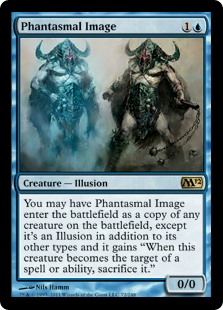 We're again much better equipped to deal with Humans after siding, and they're worse off against us than they were in Game 1. But it bears repeating that Reflector Mage and Phantasmal Image can ruin our day regardless of other factors. Smasher in particular should be cast with caution, as it's the most worthwhile target for Image in either player's deck.
 Of Men and Machines

 However, that isn't necessarily true. The
  Based on observations, personal and second hand, the most played decks in the Denver area are Tron variants, Elves, Burn, and various blue based control decks, particularly UW. Affinity, Collected Company decks, Grixis Shadow, and various graveyard value decks are frequent contributors. I also know that many grinders gravitate to Jund and Burn when there's no clear best deck in the overall metagame. There are also several that play whatever deck is the flavor of the month, which right now is either Ironworks or Infect.
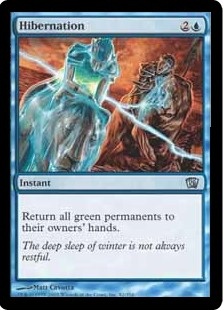 for Merfolk with Hibernation, but I can't fix the UW Control matchup. Merfolk doesn't do well against multiple sweepers alongside Field of Ruin for Mutavault. D&T has a better time with all its two-for-ones, but it's still not favored. Merfolk has the additional problem that its only plan game 1 against combo is to race, which isn't reliable enough for me. Tron was good for D&T, but the local players have been maxing out on sideboard sweepers recently, and it's become even at best.
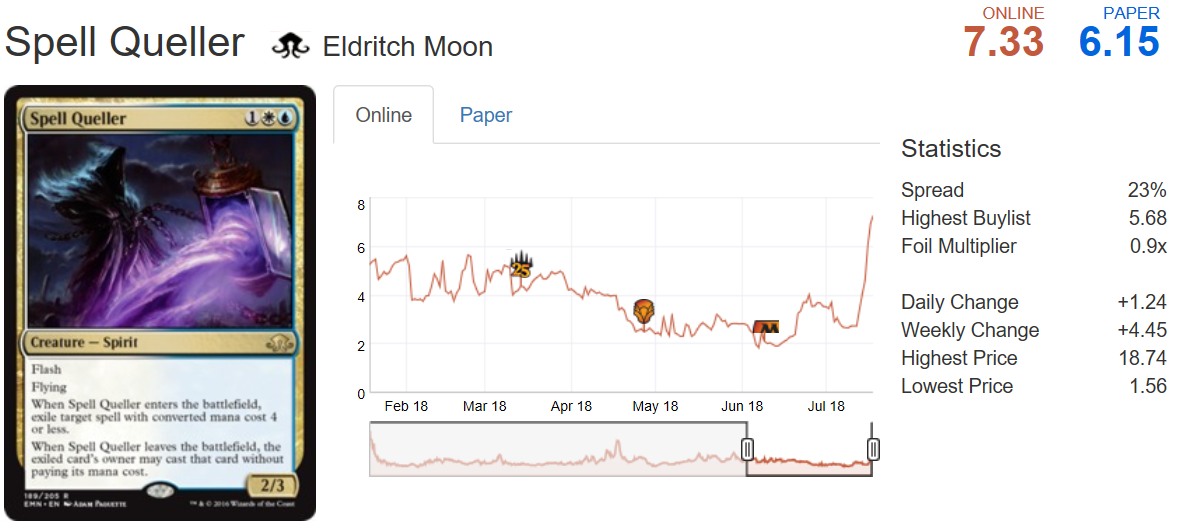
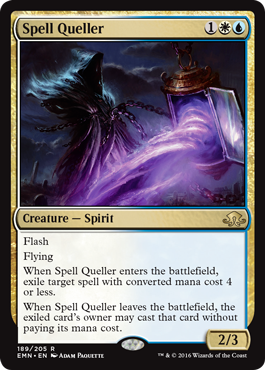 and Chord with Mausoleum Wanderer, and Spell Queller snags every payoff card in the deck. Tron is also a far better matchup now. The extra two drop in Phantom means that dropping a couple threats and then Ghost Quartering Tron repeatedly is a solid strategy. Burn's a little dodgy, but can be fixed with sideboard cards like Kor Firewalker or even Azorius Herald.