menu

Insider: MTGO Block Staples to Watch – Ravnica

Are you a Quiet Speculation member?

If not, now is a perfect time to join up! Our powerful tools, breaking-news analysis, and exclusive Discord channel will make sure you stay up to date and ahead of the curve.

Hi, guys,

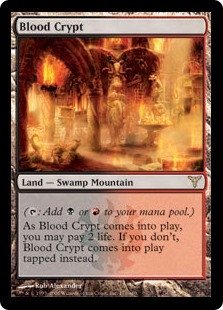
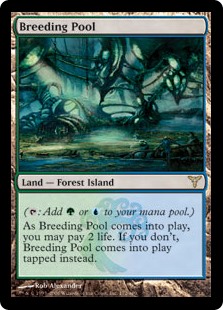
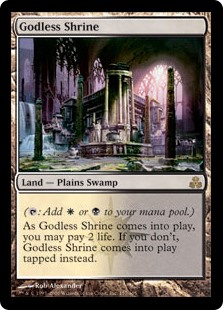
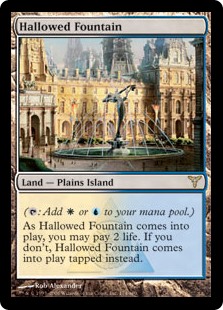
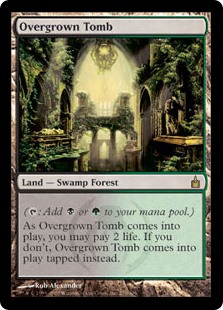
Welcome to another article on block staples to watch. This time around we are going to visit Ravnica block, which is known for the shockland cycle drawn by Rob Alexander. Shocklands are the most played lands in Modern. Every player who is active in Modern should own at least a couple of sets of these.

Below is the low price for each shockland where I would suggest picking up copies for investment:

Name Buy-in Price
Steam Vents 5 tickets
Stomping Ground 4.5 tickets
Sacred Foundry 2.5 tickets
Blood Crypt 2 tickets
Hallowed Fountain 2.2 tickets
Breeding Pool 1.8 tickets
Godless Shrine 2.2 tickets
Temple Garden 1.2 tickets
Overgrown Tomb 1 ticket
Watery Grave 1.2 tickets

Some of the shocklands are pretty cheap in spite of seeing a lot of play. For example, Overgrown Tomb and Blood Crypt are played in Jund and Abzan midrange variants, but the price for these cards is relatively low.

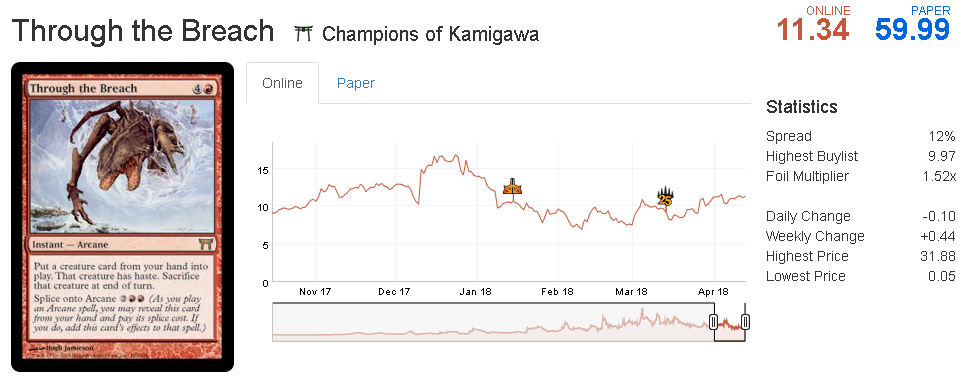
This is mainly because only one to two copies of each land is needed in the deck that plays it. On the other hand, Steam Vents and Stomping Ground are played as four-ofs in decks like UR Breach and RG Titan Shift. The difference in the number of copies played directly affects the demand for each card and hence the price.

Other lands played as four-ofs, like Temple Garden and Sacred Foundry, can go pretty high in price when decks like Burn, Zoo, or Bogles are good. Overall, if you pay attention to the shocklands, you won't be expecting spikes—but in the long term you should be able to make some extra tickets out of them.

Next, let's look at other cards I think we should keep our eyes on.

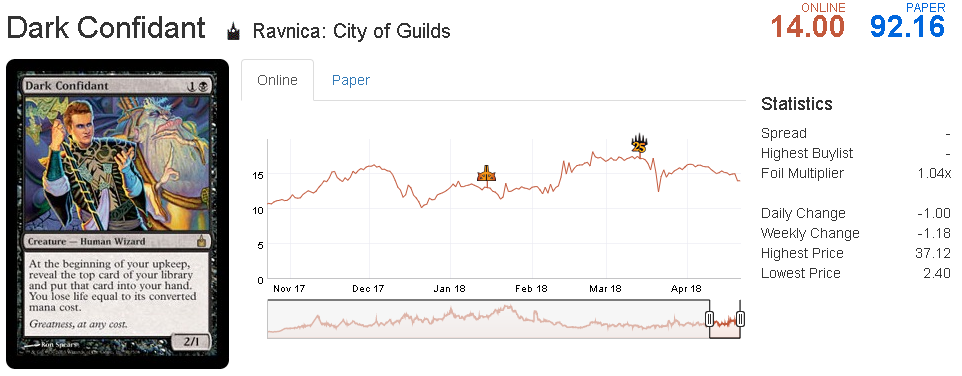
Dark Confidant is the king of card advantage in black-green decks, a good friend of Tarmogoyf and Liliana of the Veil. Whenever there's a deck that plays Goyf and Liliana, the chances of Dark Confidant showing up is very high.

Currently, Jund is no longer that dominant compared to the time when Bloodbraid Elf was fresh off the ban list. I think the price of Confidant is going to drop slowly, something you can already see starting to happen in the graph above.

Based on the graph, Confidant's lowest point recently was between 10 and 12 tickets, while the high point was 18 tickets. The card will have difficultly reaching 18 tickets again, unless Jund players discover some special tech to bring the deck back on top of the metagame. I suggest waiting for the price to drop to 10 tickets to acquire your copies.

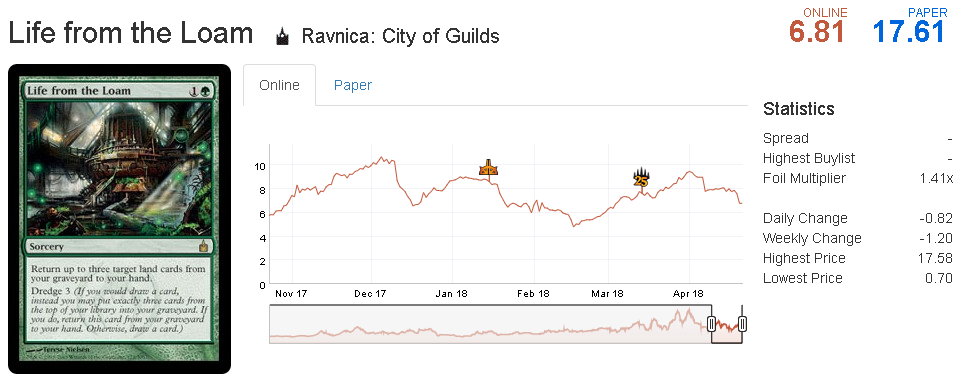
Life from the Loam is a staple in Modern and Legacy. This card fluctuates relatively fast compared to many other Modern staples. Players who have played with this card before probably know how good it is when combined with fetches and any graveyard strategies.

At the moment Loam is dropping in price, and it's almost reached the point where we can buy playsets for investment. In my opinion, the ideal price to stock up on Loam is 5 tickets. It won't be too long until the price increases again to over 8 tickets, so this is one of the best singles in Ravnica block to keep on our watchlist.

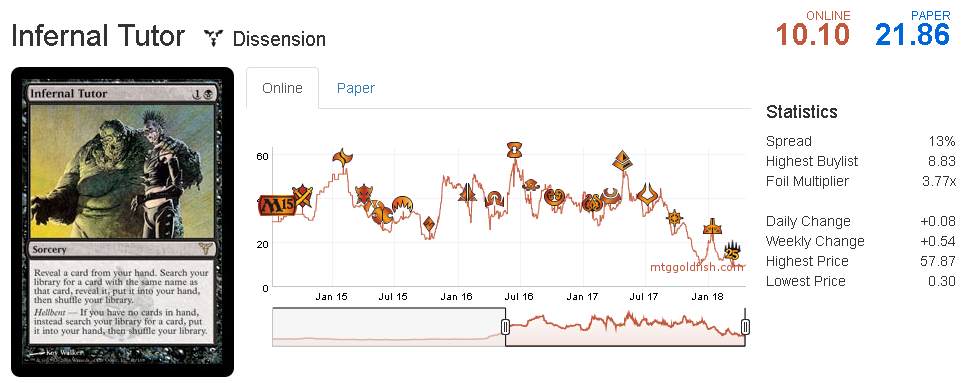
Infernal Tutor is a staple in combo decks. Look at the data since June 2014, we see the price spike many times. Whenever there's a deck that becomes competitive all of a sudden because of Infernal Tutor, it's time for us to earn some profit.

Right now the card is at about 10 tickets each. Compared to the price earlier this year it has decreased by 10 tickets, but this is definitely not the end for this card. The chances of Infernal Tutor spiking again in the future is very high, and this pick is relatively safe as we can see from the past trend.

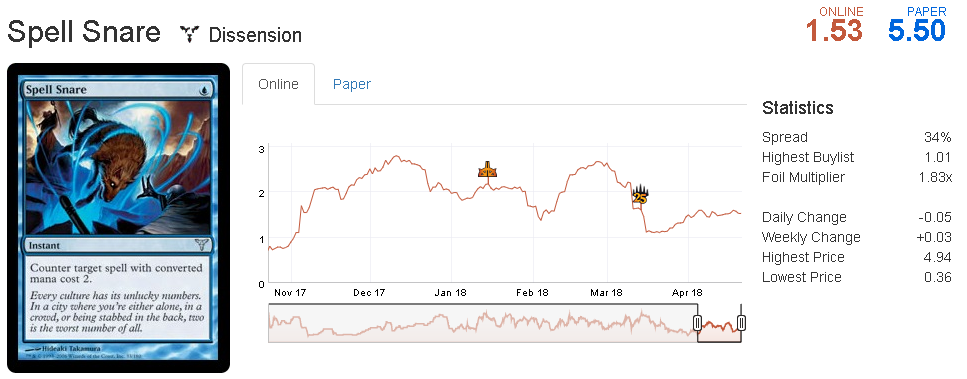
I talked about this card a few weeks ago. I was saying that Spell Snare is the answer to most aggressive and midrange decks in the format. At the end of last year, Spell Snare was still below 1 ticket. It subsequently went up to nearly 3 tickets, before dropping back to 1.5 tickets recently.

I like to keep an eye on Spell Snare because Modern is full of powerful two-mana cards, and a one-mana counterspell for those threats is very efficient. I suggest buying playsets whenever the price is 1.2 tickets or lower.

Golgari Grave-Troll was unbanned in Modern before, and then got the ban hammer again not long after that. This card is still played in Legacy and Vintage. I'm not an expert in those formats—but just by looking at the graph, I think Grave-Troll is worth investing in when it's low.

This is what's known as a cyclical price change, and investing in this kind of singles is pretty safe. The floor seems to be around 1 ticket, so that's what you want to aim for.

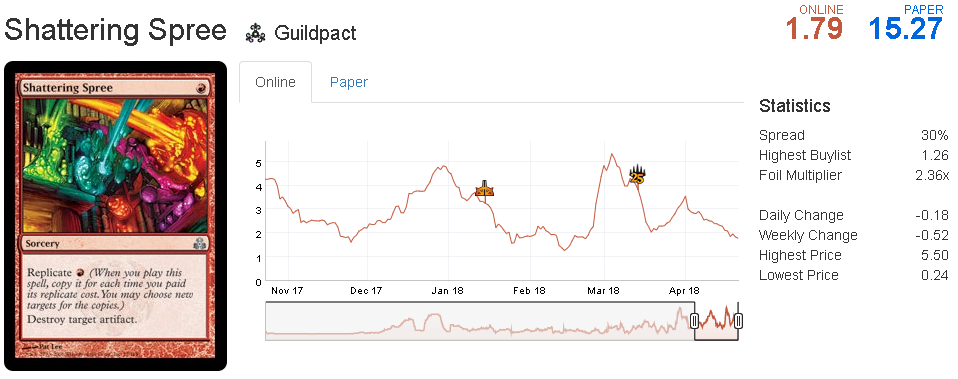
Shattering Spree is efficient artifact removal for decks like Burn or other aggressive red decks. As an uncommon, it's quite impressive to see it reach 5 tickets as you can see in the graph. This card doesn't have any replacement as of now, so I think it's a great card to keep on our stock watch list.

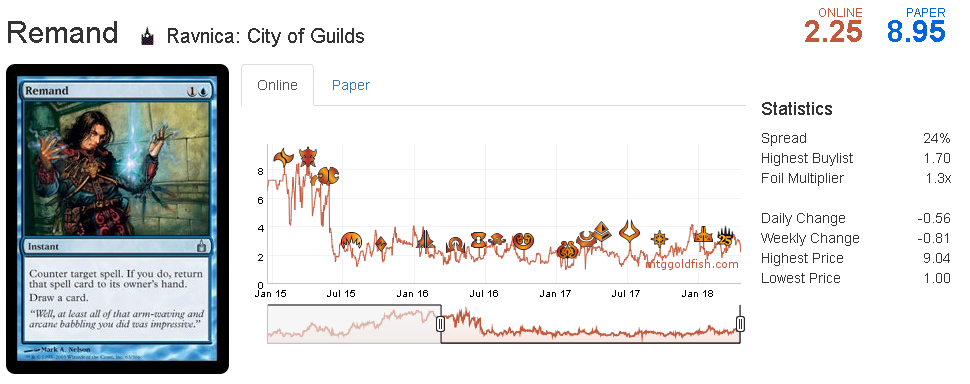
I did think of the scenario where Shattering Spree gets reprinted in future sets. If that ever happens, it might heavily affect the price of Guildpact copies and reduce them to bulk. You can see a similar case in another Ravnica block staple, Remand.

Look at the point where Remand was reprinted in Modern Masters 2015. The price went downhill quickly from there. So if you decide to invest in Shattering Spree, do take into consideration the possibility of the price tanking if it gets reprinted.


Alright guys, that’s all for this week. Thanks for reading and I’ll see you again next week.

Adrian, signing off.

Fear the Goblins: Testing Skirk Prospector

Are you a Quiet Speculation member?

If not, now is a perfect time to join up! Our powerful tools, breaking-news analysis, and exclusive Discord channel will make sure you stay up to date and ahead of the curve.

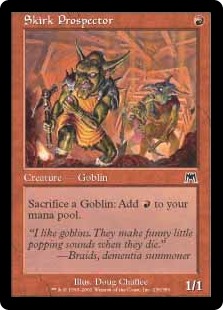
Now that Dominaria's Prerelease is over, the brewing season has begun. Players are plugging in likely candidates, looking for the missing pieces in their decks. While there are plenty of interesting new cards in Dominaria, I'm still stuck on a reprint. I've been working on verifying my belief that Skirk Prospector is the real Modern standout. The results have been encouraging.

The First Pass

The focus of my efforts has been tribal Goblins. This just makes the most sense, as Prospector needs goblins to sacrifice. I left off last week with this list.

New Goblins

Creatures

4 Foundry Street Denizen
4 Skirk Prospector
4 Goblin Guide
4 Legion Loyalist
4 Mogg War Marshal
4 Metallic Mimic
4 Goblin King
4 Goblin Chieftain
2 Murderous Redcap

Instants

3 Lightning Bolt

Sorceries

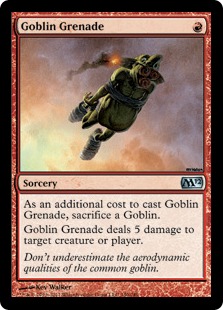
3 Goblin Grenade

Lands

4 Bloodstained Mire
4 Wooded Foothills
4 Cavern of Souls
8 Mountain

This deck was fine, but it didn't wow me. Prospector was great, but not in the way most would expect. Mana acceleration isn't really useful in the deck, as it's almost entirely one-drops, but it can struggle to make land drops. Prospector turns superfluous one drops into mana, so we can play lords and then attack for real damage, like a more flexible Aether Vial. I really wished that I had better payoff cards for all the mana we generated, but Goblin Grenade is more efficient and reliable than Banefire.

However, Lightning Bolt was surprisingly bad, and my testing wasn't going well overall; in testing games over the past two weeks, I went 6/12 against Jund and 8/19 against UW Control. The main issue was that I didn't really have any haymakers or evasion to finish games. A few sweepers or the right removal and I just petered out.

Something was missing, and I had thought a combo was that thing. But I found the combo too inconsistent to be a real consideration. We have to draw and play it naturally, making it very vulnerable to disruption. This indicates to me that the only reason similar combos work in Company decks is that Collected Company is insane. I did combo out my opponents a few times, but once they became aware that it was possible, they adjusted their play patterns to hedge. This did mean I could sneak in damage and gain tempo as they feared a combo death, but it rarely changed the outcome of the game. More was needed.

Goblins 2.0

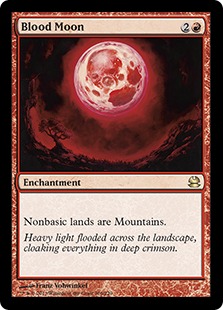
I mentioned at the end of last week that Paul, my Goblins expert, played maindeck Blood Moon. When my first crack at Goblins underwhelmed me, I changed my deck to accommodate Moons.

New Goblins 2.0

Creatures

4 Foundry Street Denizen
4 Skirk Prospector
4 Goblin Guide
4 Legion Loyalist
4 Mogg War Marshal
4 Metallic Mimic
4 Goblin King
4 Goblin Chieftain
2 Murderous Redcap

Enchantments

2 Blood Moon

Sorceries

4 Goblin Grenade

Lands

4 Bloodstained Mire
4 Wooded Foothills
4 Cavern of Souls
8 Mountain

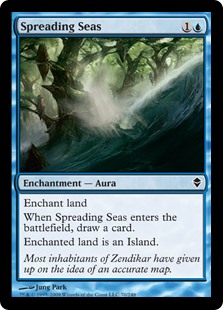
Blood Moon is really good in this deck, much like how Spreading Seas is great in Merfolk, only potentially more devastating. In testing, I crushed Jund on several occasions using Prospector to play a topdecked Blood Moon turn two. Once my opponent became aware of this possibility, he tried to fetch for basics first, which wasn't always possible and sometimes hurt his development. The UW deck played more basics naturally and didn't mind Blood Moon. My results have improved to 8/14 against Jund while still a mediocre 7/15 for UW.

One thing that couldn't be quantified was the discomfort this deck caused for my Jund opponent. He says that knowing what the deck is capable of and having to defend against being Mooned out, comboed out, or blitzed was really disquieting and tense. He could protect against an early death well enough with discard, but knowing what was lurking in my deck hung heavily on his decisions. Moon did what I wanted the combo to do.

In Comparison

These results are nice, but they don't really answer whether this new Goblins deck is actually good. A deck's value can't be accurately judged in a vacuum, you need context. The most successful versions of Goblins right now employs Bushwhacker to blitz opponents. It couples a swarm of one-drops with the haste and power boost from the Bushwhackers to deal enormous damage in an attack or two, finishing the opponent off before they can react.

8-Whack, Queek (5-0 Modern League)

Creatures

4 Fanatical Firebrand
4 Foundry Street Denizen
4 Goblin Bushwhacker
4 Goblin Guide
4 Legion Loyalist
4 Mogg Fanatic
4 Burning-Tree Emissary
4 Reckless Bushwhacker

Instants

4 Lightning Bolt

Sorceries

4 Goblin Grenade
2 Devastating Summons

Lands

18 Mountain

Sideboard

2 Forked Bolt
3 Relic of Progenitus
2 Abrade
3 Dragon's Claw
1 Roast
4 Smash to Smithereens

This deck kills quickly or never. Its creatures are outclassed by everything, and while Goblin Grenade is a potent burn spell, it can't win the game by itself. If the opponent stabilizes above ten life, 8-Whack won't win. Goblins doesn't have this problem, as it has more late game creatures that don't require a critical mass to be playable. Lords are obviously better with more subjects, but they're better on their own than Goblin Bushwhacker once in play. Having the combo kill also gives Goblins hope when the early rush gets stifled while 8-Whack is all-in. However, this is just the situation on paper. Reality may be different.

To accurately judge the value of my deck against the established 8-Whack list requires testing. Unfortunately I didn't have time to do that last week. Fortunately, I knew some players doing online testing for the upcoming SCG team opens and after calling in a favor they agreed to gather some data for me. They ended up playing 40 games with each deck: 10 games each against Affinity, Jund, GR Tron, and Ironworks Combo. These preliminary results may prove enough to tell whether Goblins is a worthwhile pursuit.

8-Whack

  • Games Won: 19/40
  • Win Percentage: 47.5%
  • Average Win Turn: 3.53

New Goblins

  • Games Won: 23/40
  • Win Percentage: 57.5%
  • Average Win Turn: 4.04
  • Combo Kill: 1 turn four, 2 turn five

This admittedly small sample validates my hypothesis. The Goblins deck is noticeably slower, and the combo is inconsistent, but the deck's win percentage is higher. Goblins could only muster five turn three kills, but two of the turn five kills were functionally turn two ones thanks to an accelerated Blood Moon against Jund. Had they gone pure beatdown in those games, they were on track for a turn 3-4, but Jund would have had answers to play. This indicates to me that the trade off of speed for resilience is valid, and that Goblin tribal with Blood Moon is worth pursuing.

Blood Moon on the Rise

My experience and the wins from turn two Blood Moon made me wonder if there's value in going for that as a primary strategy. Blood Moon is a very powerful card can lock out manydecks by itself. Those games against Jeskai and Jund when I functionally won on turn two made me wonder if I could use Skirk Prospector to reliably play a Moon effect on turn two and have it be better than current versions.

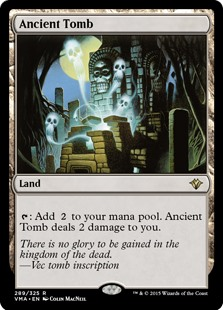
The logical endpoint of this thought is Legacy Moon Stompy, which I'm told is very good. All the best decks are 3+ colors and depend on fetchlands and cantrips to function. Shutting them down kills the deck, and Legacy has the means to do so while the only answer is Force of Will and sometimes Daze. Between all the fast mana and the "Sol" lands (Ancient Tomb and City of Traitors) it's hard for the deck to not have three mana on turn one.

Legacy Isn't Modern

Moon Stompy is a powerful deck, and apparently a good choice if you're not playing the best deck, Grixis Delver. However, there's a problem: this strategy doesn't really work in Modern.

Yes, prison decks exist, but they're not all-in like the Legacy deck. Fast mana is weak in Modern. The Sol lands aren't legal, and the best accelerants are banned. The only way to turn one a lock piece is Simian Spirit Guide, and that is mathematically unlikely. As a result, it is far more likely that an opponent will be given the opportunity to play Magic, and when that happens, Moon Stompy struggles to win. It's just not a deck that can win fairly, and that's the subtle reason it hasn't worked in Modern.

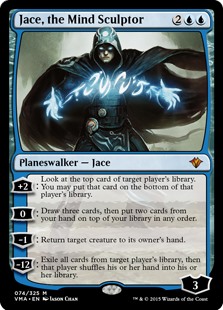
Modern is about robustness while Legacy depends on maximized efficiency. Because of all the cantrips and Deathrite Shaman, most Legacy decks run very low to the ground, generally 2-3 lands lighter than their Modern equivalents and almost entirely one drops. The only four drop that regularly sees play is Jace, the Mind Sculptor. Furthermore, basics are rare in Legacy, while in Modern, most decks play 2+. As a result, Legacy decks are far more vulnerable to being locked out by Chalice of the Void on one or Blood Moon. It can happen in Modern, but it's far less likely.

Modern Prison will then put up results, but not consistently, and it doesn't play much of a factor in the metagame. When prison decks do emerge, they tend to be slower hybrids between prison and control (Lantern is the exception). The most successful version is Sun and Moon, which put up results back in 2016.

"Sun and Moon, Todd Stevens (32nd Place Modern Open 2016)

Creatures

4 Simian Spirit Guide
1 Emrakul, the Aeon's Torn

Planeswalkers

2 Chandra, Torch of Defiance
3 Gideon Jura
4 Nahiri, the Harbinger

Artifacts

4 Chalice of the Void

Enchantments

4 Blood Moon
1 Banishing Light
2 Journey to Nowhere

Instants

4 Lightning Helix
1 Blessed Alliance

Sorceries

3 Anger of the Gods
2 Wrath of God

Lands

4 Arid Mesa
4 Temple of Triumph
2 Sacred Foundry
2 Rugged Prairie
2 Clifftop Retreat
1 Needle Spires
9 Plains
1 Mountain

Sideboard

3 Leyline of Sanctity
3 Rest in Peace
2 Stony Silence
2 Blessed Alliance
1 Chandra, Flamecaller
1 Elspeth, Sun's Champion
1 Anger of the Gods
1 Crumble to Dust
1 Wrath of God

Sun and Moon can play hard prison, but that's not its purpose. The lock pieces exist to slow opponents down enough for the anti-creature cards to clean up the board. It's a creature control deck that integrates prison locks, not actually a prison deck. That honor lies with Lantern Control, and now that it's become a known part of Modern, it isn't very effective.

Can We Come Close?

Just because Legacy-style prison hasn't worked so far doesn't mean it can't. Early Blood Moon is still incredibly powerful and while not having Sol lands hurts, it is still possible to play Red Prison in Modern. Jordan has tried before, but has since transitioned to colorless Stompy decks. There are Ponza decks that look similar to what he was working on, but those are more tempo-focused. I know other players have had some success, and I've lost to turn one Blood Moon, but I've also seen that deck fail to win a match in an entire tournament.

The issue has been that the current incarnations play a lot of air in order to guarantee a fast lock. But what if we replace the rituals with a goblin package?

Modern Goblin Moon

Creatures

4 Skirk Prospector
4 Mogg War Marshall
4 Magus of the Moon
4 Goblin Rabblemaster
4 Simian Spirit Guide

Planeswalkers

4 Chandra, Torch of Defiance

Enchantments

4 Blood Moon

Artifacts

4 Chalice of the Void
3 Trinisphere
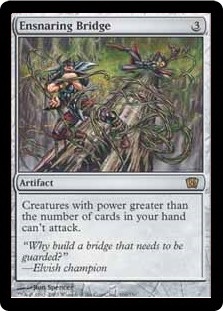
4 Ensnaring Bridge

Sorceries

1 Banefire

Lands

20 Mountain

The idea of this deck is to use Prospector and Spirit Guide to accelerate into lock pieces, then win with Goblin beatdown or Chandra. We can also just use Goblins to gum up the board until Ensnaring Bridge comes down, let Rabblemaster build up tokens, then turn them all into mana to Banefire for lethal. Thanks to Prospector and Guide, it is very easy to drop a Moon or Trinisphere turn two, and turn one is possible though unlikely. A turn two Chandra is also possible with Prospector and War Marshall, though I've never done that and don't know if it's actually a strong play.

Is It Good?

Well...sort of? I goldfished 20 games with this version and the Sun and Moon deck for comparison, and Goblin Moon dropped a three mana lock piece on turn two 12/20 games compared to 5/20 for Sun and Moon. Not surprising, considering how many each deck is playing. Including Chalice ups those numbers to 16/20 and 11/20, with Goblins having to decide between Chalice or another piece 7 times compared to once for Sun and Moon. In other words, Goblins have a high chance of successfully locking the game early compared to the more successful version. This is a very strong vote in its favor.

However, that should be taken with a grain of salt. I was just playing alone; I can't say that the piece I deployed would have actually locked a real game against a disruption-packing midrange or combo deck. Furthermore, the Goblins deck is very vulnerable to aggro. Realistically, it won't win against anything fast without Ensnaring Bridge. I played a few games between Goblins and Merfolk, and it was pretty one-sided for the fish. Goblin Moon won once because it got an early Bridge and Merfolk didn't find Echoing Truth. Merfolk doesn't really care about Chalice for one or Blood Moon in the first place, and Aether Vial renders all the lock pieces except Bridge irrelevant. Goblins also cannot present a fast enough clock to realistically race Merfolk and it has no cheap interaction. I know from PPTQ experience that the matchup is better for Sun and Moon.

Given that the metagame appears to be speeding up, I don't think that this version is viable. It is solid against midrange decks and combo, but just can't keep up with aggressive strategies. However, that doesn't mean that the idea itself is bad. Dropping Blood Moon on turn two is lights out for many decks, and combo dreads the combination of Trinisphere and Chalice. Ensnaring Bridge is the best answer to aggressive creature strategies available, but my build could not find it consistently. Faithless Looting or Cathartic Reunion could be the answer, though that would slow the deck down and I don't know if it would be worthwhile.

Goblin Rush

I stand by my original statement that Skirk Prospector is the real Modern gem in Dominaria. Turning otherwise worthless goblins into mana has proven to be powerful in the past, and I think that it will be again. At the very least it enables some broken starts.

While I believe there is promise for it to find a home outside of Goblin tribal, the evidence is weak. The boost Prospector gives Goblins is simply more immediate. Whether the combo is actually good enough remains to be seen. I know that the threat is very strong, but the consistency problems are real.

Another option is simply to cut Redcap and run more Blood Moons, but I think it's important to maintain the threat of the combo. What I'm trying now is four Moons and two Banefires instead of Goblin Grenade, and it feels far better than my tested version. In any case, I hope it works out for Goblins. That's the only way that my long-held dream of Tivadar of Thorn being playable will ever come to pass.

Daily Stock Watch – Benalish Marshal

Are you a Quiet Speculation member?

If not, now is a perfect time to join up! Our powerful tools, breaking-news analysis, and exclusive Discord channel will make sure you stay up to date and ahead of the curve.

Hello, everyone and welcome to a new edition of the Daily Stock Watch! Dominaria is coming out this week, and the hype for the set has somehow lived up to its expectations. A lot of players are excited to play Standard again, and financial-wise, mythic rares from this set have started acting like they are indeed ones that are worth the most when you crack packs. One particular mythic that I have kept an eye on is History of Benalia, which I think will be a breakthrough card in Standard if things go according to my speculation. In lieu of this, my focus for today will be on one of the cheaper cards from the set where we could possibly get some financial gains by speculating on it.

There was an error retrieving a chart for Benalish Marshal

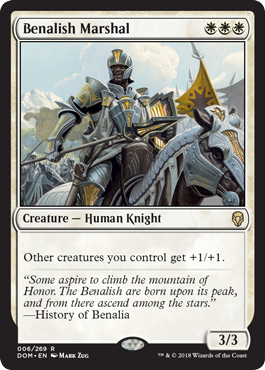
There are a handful of knights in Standard that could receive the boost from History of Benalia's bonus effect once it hits the third phase of its saga, so I'm quite sure that it's going to be an actual deck given the push. With the presence of Clifftop Retreat, Inspiring Vantage, Isolated Chapel and Concealed Courtyard in the format, it's still very much possible to play the mana-restricted Benalish Marshal as the three drop in your curve. This crit gives your deck a pseudo-Glorious Anthem effect which is very much needed in a deck that aims to put constant pressure on your opponent. One particular list that I am trying to build is an Orzhov variant which gives us the ability to have removal for opposing creatures, and some powerful cards off the board to help in keeping us relevant against control decks.

Orzhov Knights

Creatures

2 Aryel, Knight of Windgrace
4 Benalish Marshal
2 Danitha Capashen, Paragon
3 Dauntless Bodyguard
4 Knight of Grace
4 Knight of Malice
2 Kwende, Pride of Femeref

Instants and Sorceries

4 Fatal Push

Other Spells

4 History of Benalia
2 Legion's Landing
3 Radiant Destiny
2 Seal Away

Lands

4 Concealed Courtyard
4 Isolated Chapel
6 Plains
2 Shefet Dunes
4 Swamp
4 Unclaimed Territory

Sideboard

2 Authority of the Consuls
2 Bloodcrazed Paladin
3 Duress
2 Ixalan's Binding
2 Lost Legacy
2 Profane Procession
2 Settle the Wreckage

At its current price tag of $1.99 via MTGStocks, it's actually a decent creature that could either hit $5 easily, or go down to a $1 if the deck doesn't get the exposure that I'm expecting it to. I'm just looking at it as a possible spec target because it might work well with one of the chase mythics from the set, but this could also end up as a bust if History of Benalia doesn't end up as one of the major players in Standard. The three mana color-restricted cycle from DOM was made for a reason and I'm looking at Benalish Marshal as a good pick up now at this price because there's very little room for error for such a cheap card with high upside on it, despite of the limited decks that it might be present in. We could gauge how this goes once the Pro Tour is over, so I'm really excited about picking them up now while supplies are at its peak.

At the moment, you could find copies of Benalish Marshal for anywhere between $1.49 up to $1.81 via TCGPlayer, Card Kingdom and StarCityGames for anywhere between $1.49 up to $1.99 for non-foils. I'm not seeing any competitive Modern use for the card (but I could be wrong, ofcourse!) so getting foils isn't really my priority right now, and isn't also across the horizon for my taste. I would trade for a few copies of this card if it's within a dollar's range once supplies flood the market, and wait out if it sees some gains after a few Standard tournaments. I see very little room for error if we pick up a few sets of this card at its current price tag. There will always be a casual appeal for white creatures with effects like Benalish Marshal even if it doesn't end up as a roleplayer in the format. Let's get them while it's cheap!

And that’s it for today's edition of the Daily Stock Watch! See you again next time, as we continue to speculate on cards that might be on the rise, or try to get rid of the ones that are at risk of losing value. As always, feel free to share your opinion in the comments section below. And if you want to keep up with all the market movement, be sure to check in with the QS Discord Channel for real time market information, and stay ahead of the hottest specs!

Insider: Fallen Empires Appreciation

Are you a Quiet Speculation member?

If not, now is a perfect time to join up! Our powerful tools, breaking-news analysis, and exclusive Discord channel will make sure you stay up to date and ahead of the curve.

Nearly four years ago to the day I wrote an article here on Quiet Speculation about one of my favorite sets: Homelands. The column opened with a tweet regarding Koskun Falls, a pseudo-Propaganda in black that also combos with King Macar, the Gold-Cursed.

There was an error retrieving a chart for Koskun Falls

Since then the black enchantment has slowly risen from about $0.65 to $3.50, with plenty of upside to go. Percentage-wise, an annualized return of over 100% is phenomenal. However anyone who bought a stack of these is going to have a miserable time selling them one-at-a-time to Commander players. Your best bet would be to wait for Card Kingdom to sell out and then ship 24 of them at once to their buylist.

Since the returns are so underwhelming, I started talking about other relevant cards in the set—not for speculative purposes but for awareness. Many of us have seen or combed through Homelands bulk in the past, and with no rarity indicators on the card it can be easy to overlook something relevant.

Four years later, another underappreciated set is making headlines: Fallen Empires. I want to run through some of the relevant cards in the set so you are aware of them. Perhaps some are already sitting in your bulk boxes at home, waiting to be picked and brought to the light of day.

Fallen Empires - A Brief History

The first few Magic expansions were largely underprinted relative to demand. Hobby shops would preorder a ton of boxes and only receive a fraction of what they wanted. Packs would sell out and local players would be massively disappointed. This is never a good place to be from a company’s standpoint.

So in November 1994, Wizards of the Coast printed a truly massive quantity of the latest set, Fallen Empires. The story goes that shops expected to get under-allocated product yet again, so they ordered well in excess of the quantity they actually needed. The thinking went, “If I really want 100 boxes, I had better ask for 500 so I get at least 50.” But the joke was on them: Wizards printed so much that shops were receiving what they ordered.

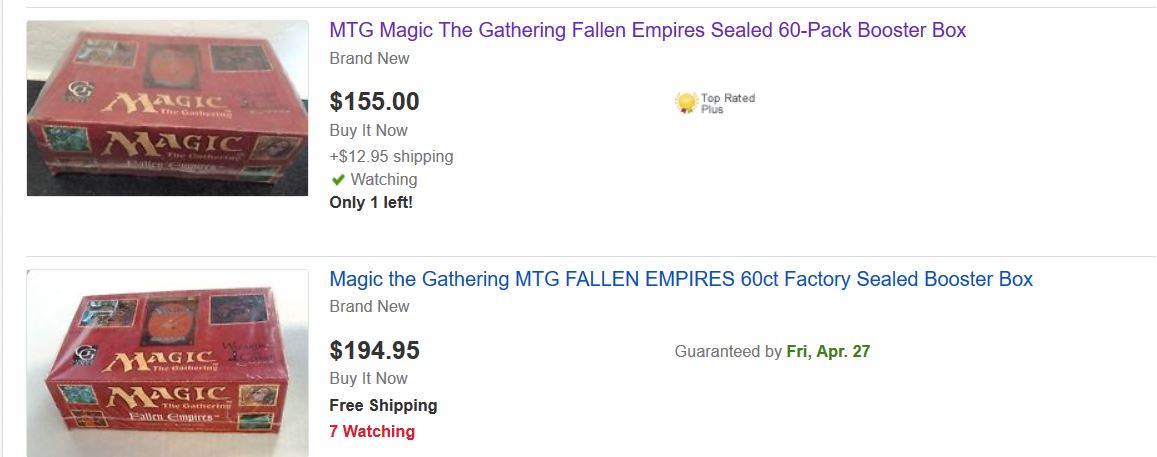
This, combined with the underpowered nature of the set, let to a major glut in the market of Fallen Empires boxes. This is why after 24 years you can still purchase boxes for around $170 whereas boxes of a similar age have rocketed through the stratosphere.

The print run numbers are available for this set on Crystal Keep, and you can readily see the crazy increase in numbers. There are 128,000 copies of each U1 (“rare”) in The Dark. In Fallen Empires this number jumps to 744,000!

In the grand scheme of Magic history, this is still a tiny print run relative to 2018 sets. If there were any relevant U1s in the set, they would be quite valuable. A shame there aren’t…until now!

A Relevant Fallen Empires Card?!

Everyone knows the only playable cards from Fallen Empires in a 60-card format: Hymn to Tourach and High Tide. Why aren’t these cards worth more? Because they’re commons printed with multiple artworks, that’s why! The number of copies could very well be breaking into eight-figure territory. Therefore the cards never really grew beyond a buck or two. Once High Tide fell out of favor in Legacy and Hymn to Tourach was reprinted in Eternal Masters, the financial relevance of these cards disappeared.

Once upon a time Hand of Justice reigned supreme, retailing for $6-$8. It combined well with white weenie strategies and was quite the menace back in the day. But I think the time since this card was worth any money can be measured in decades.

Very recently, a new card has risen in price to take the “most valuable Fallen Empires” crown. Say hello to Elvish Farmer.

There was an error retrieving a chart for Elvish Farmer

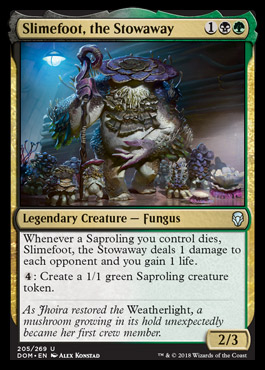
Why is this card suddenly so valuable? It’s all thanks to a little uncommon called Slimefoot, the Stowaway.

At long last Fallen Empires fans have gotten their Fungus Lord! Not only does this creature give you benefits when your Saprolings die, it also helps you create new ones. At the low, low rate of just four generic mana, you can create Saprolings to feed your Deathspore Thallids, Nemata, Grove Guardians, and…you guessed it, Elvish Farmers.

Slimefoot has only been available on EDH REC for a tiny amount of time, so the number of datapoints for this commander is limited. But people are brewing and I must say the lists look pretty exciting for Saproling fans. So far Elvish Farmer shows up in six of the eight lists, but it’s way too early to tell if it’s a mainstay or not.

This doesn’t matter, of course. People are chasing each other on any buyout nowadays, and this Reserved List card from Fallen Empires is no exception. I’ll admit even I grabbed some played copies when I saw a QS Insider selling his copies for $7.99 a pop. That $2.20 buylist at Card Kingdom is a nice backdrop as well.

All in all, the relative risk/reward seemed attractive. We know the print run on these is fairly small as a U1, and the card can never be reprinted, so downside is minimal if the time horizon is long enough. Time will tell, but for now this card is Fallen Empires’s most valuable!

Other Relevant Cards

Elvish Farmer may have spiked, but there are other Fallen Empires cards worth picking or at least being aware of. First of all, there are 27 Reserved List cards in the set. I wouldn’t bother memorizing them all because they’re mostly terrible. But we know how reckless Reserved List speculation has gotten recently—you never know when one of these could be targeted.

If you have some Fallen Empires bulk lying around, it may be worth your time at least pulling out the Reserved List cards and setting them aside. However I would not advocate speculating on them. There are far better cards on which to spend your money.

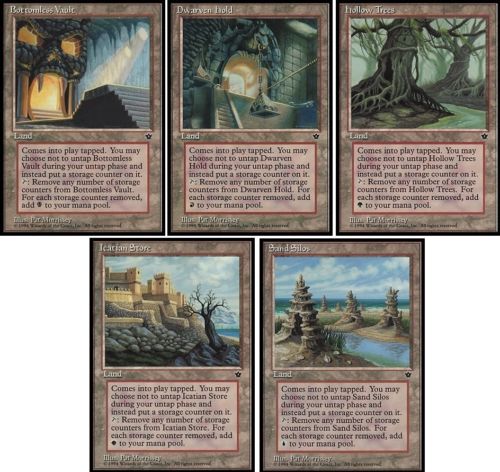
Instead, I’d focus on the more playable stuff. For example, the cycle of storage lands are actually pretty cool, and are worth more than bulk.

A full playset of all five will commonly sell for about $13 on eBay. Not something to write home about, but definitely worth picking. They also show up on buylists due to their utility.

Next, there’s Rainbow Vale—a card I’ve actually written about in the past. While I’ve given up on Rainbow Vale Pack Wars, the concept is still pretty interesting. The card is also playable in Zedruu. This is one that pulled back from its spike but will continue to appreciate over the long term. Again, not worth going deep but definitely worth being aware of.

Another card that merits attention is Fungal Bloom. This Reserved List enchantment helps you accelerate the growth of your fungi.

There was an error retrieving a chart for Fungal Bloom

Is this good enough for Commander? I have no clue. But if it hits speculators’ radar, that probably doesn’t matter. This card could easily match the price of Elvish Farmer for a day. I would not advocate speculating here either, but it may be worth nabbing a few cheap copies while you’re shopping for other stuff. The card also buylists to Card Kingdom for $0.80, so there is that.

Lastly, let’s talk about the only other Fallen Empires card with an MTG Stocks price of over $1: Goblin Warrens.

There was an error retrieving a chart for Goblin Warrens

This enchantment is a Goblin-making machine! It actually shows up in nearly 1,000 EDH REC lists. This isn’t enough to get me excited most of the time, but for a Fallen Empires card this is pretty high! It’s even on Card Kingdom’s buylist for $0.38. That’s definitely worth picking if you ask me!

The downside with this one is that it’s not on the Reserved List; it was reprinted in 6th Edition, 5th Edition, and Anthologies. But let’s face it, these sets are all ancient anyway. As long as the card dodges additional reprints (as it has for 19 years), it does have some slow and steady growth potential.

Wrapping It Up

This week I wanted to take a trip down memory lane and appreciate what one of Magic’s least impactful sets had to offer. It seemed timely since Elvish Farmer topped MTG Stocks throughout the week. I’m quite excited to see a card from Fallen Empires make waves, and I really hope it is playable enough in Slimefoot to remain relevant.

Even if it doesn’t, I don’t see this Reserved List card from 1994 dropping below a buck again. These older cards are simply too rare and nostalgic, even if they are unplayable. Speculators have really reached as low as they could in the barrel, and it won’t be long before they discover Fallen Empires.

My take: don’t buy deeply on any one card. Instead, I advocate what I always do with these older cards. Buy what you want for your collection, pick up a few extra cheap copies while you’re shopping for other cards, and watch the market closely. Of course if you find copies of Elvish Farmer at the old price and below buylist, take advantage. But on other stuff that hasn’t moved in 24 years, it’s really not worth your time or money to go deep.

That said, it is definitely worth your time to be aware of the relevant Fallen Empires cards. There are just a few that buylist for more than a dime, so it should be fairly easy to remember them. Then there are the 27 Reserved List cards in the set—mostly terrible, but they’ll never be reprinted again. If these buyouts continue, we may see a day when these become worth something. The U1s are about 6x more common than U1s from The Dark. If Frankenstein's Monster can be worth $6, then maybe Icatian Lieutenant can be worth $1 or $2.

There was an error retrieving a chart for Frankenstein's Monster

With the passing of time, we’ve seen movement in all Magic’s earliest sets. Perhaps it is finally time for Fallen Empires to have its time to shine. If not, these are still classic cards with great flavor worth your appreciation in the meantime.

…

Sigbits

  • Card Kingdom increased some of their buylist prices fairly aggressively over the past week. I already talked about dual lands recently, but those continue to climb. Also buylisting for a new high is Mana Crypt from Eternal Masters, which Card Kingdom will now buy for $85.
  • This one is a bit random, but I noticed Card Kingdom added the Land Tax Judge Foil to their hotlist. They’re paying $62 for Near Mint copies of the card. There really aren’t many copies of Land Tax on TCGplayer, and the Judge promo is the only foil printing. I’m not sure what you can do given how few of these are for sale, but I would certainly pick one up now if you want one. Just be careful. It could show up in some Masters set down the road and crush the value of all printings besides the original Legends.
  • After being bought out a couple of times, it appears the higher price on Sliver Queen is sticking at last. Card Kingdom still has a $52 buy price on the legendary creature. This is wild given she’s not even a preferred Commander choice for tribal Slivers—Sliver Overlord is almost ten times more popular on EDH REC. But you can’t argue with nostalgia and the Reserved List. These make up a nasty combination sure to make any classic card expensive.

Daily Stock Watch – Geth, Lord of the Vault

Are you a Quiet Speculation member?

If not, now is a perfect time to join up! Our powerful tools, breaking-news analysis, and exclusive Discord channel will make sure you stay up to date and ahead of the curve.

Hello, readers and welcome to the freaky Friday edition of the Daily Stock Watch! In case you aren't familiar, I tend to feature cards that are skyrocketing in value during this time of the week even though they aren't really popular in Commander, Modern, or Legacy. Our featured card for the day is a mythic rare from Scars of Mirrodin that hasn't really cracked any deckbuilder's code or dreams, but has steadily rose to $10 territory through the years just by, well, being a Lord.

There was an error retrieving a chart for Geth, Lord of the Vault

Geth, Lord of the Vault is a great Magic card at first glance, but staring at it longer and trying to realize what it is capable of will make you cringe a little. It is not easy to block in combat (thanks to intimidate), it steals opposing creatures or artifacts from the dead and makes it his own slave and last but not the least, it mills your opponent's library for the amount of mana that you've spent in trying to steal what was rightfully his. Pretty dope for a big guy, right? I bet you'd be surprised to hear that you wouldn't find him lurking (even in the sideboard!) of any competitive decks in any format. The only place where you'll find him is just as good as my guess.

Geth, Lord of the Vault

Commander

1 Geth, Lord of the Vault

Creature

1 Archfiend of Depravity
1 Avatar of Woe
1 Bane of the Living
1 Butcher of Malakir
1 Chainer, Dementia Master
1 Drana, Kalastria Bloodchief
1 Dread Cacodemon
1 Extractor Demon
1 Harvester of Souls
1 Kalitas, Bloodchief of Ghet
1 Massacre Wurm
1 Necrotic Ooze
1 Nezumi Graverobber
1 Nirkana Revenant
1 Reaper from the Abyss
1 Reiver Demon
1 Sheoldred, Whispering One
1 Visara the Dreadful

Artifacts

1 Caged Sun
1 Coalition Relic
1 Extraplanar Lens
1 Gauntlet of Power
1 Gilded Lotus
1 Grimoire of the Dead
1 Keening Stone
1 Mana Crypt
1 Mana Vault
1 Oblivion Stone
1 Rings of Brighthearth
1 Sol Ring

Other Spells

1 Liliana of the Dark Realms
1 Liliana of the Veil
1 Liliana Vess
1 Black Market
1 Dictate of Erebos
1 Grave Pact
1 No Mercy
1 Oversold Cemetery
1 Phyrexian Arena
1 Phyrexian Reclamation

Instants and Sorceries

1 Beseech the Queen
1 Black Sun's Zenith
1 Damnation
1 Death Cloud
1 Decree of Pain
1 Demonic Tutor
1 Diabolic Revelation
1 Grim Tutor
1 In Garruk's Wake
1 Killing Wave
1 Life's Finale
1 Mutilate
1 Overwhelming Forces
1 Rise of the Dark Realms
1 Torment of Hailfire
1 Go for the Throat
1 Hero's Downfall
1 Malicious Affliction
1 Murder
1 Murderous Cut
1 Slaughter Pact
1 Tendrils of Corruption
1 Tragic Slip
1 Victim of Night

Lands

1 Cabal Coffers
1 Crypt of Agadeem
1 Nykthos, Shrine to Nyx
29 Snow-Covered Swamp
1 The Tabernacle at Pendrell Vale
1 Urborg, Tomb of Yawgmoth
1 Volrath's Stronghold

Whack your opponent's creatures and make them your own. That's what basically this deck is all about, and it's up to you to decide if it justifies the all-time high price tag of Geth, Lord of the Vault at $11. There are other better creatures out there that could be your black commander, but if destroying things and stealing them for a later use is your kinda thing, then this dude is definitely your guy. Financially though? Not my kind of thing.

At the moment, you could find copies of Geth, Lord of the Vault from StarCityGames, Card Kingdom, ChannelFireball, and TCGPlayer for anywhere between $8.99 up to $12.99 depending on the card condition that you're buying. At its current price, I suggest that you start moving unwanted copies before it becomes reprinted in any coming sets (since Brawl is being pushed by WotC, expect legendary creature cards to appear more in future sets/products as reprints) and earn from speculating. It isn't really a breakthrough card that would still increase financially, so I think that we've reached its financial ceiling for now.

And that’s it for this week's edition of the Daily Stock Watch! See you again next time, as we check out a new card that should be on the go, or good enough for speculating. As always, feel free to share your opinion in the comments section below. And if you want to keep up with all the market movement, be sure to check in with the QS Discord Channel for real time market information, and stay ahead of the hottest specs!

Just a Phase, Pt. 1: Upkeep and Draw

Are you a Quiet Speculation member?

If not, now is a perfect time to join up! Our powerful tools, breaking-news analysis, and exclusive Discord channel will make sure you stay up to date and ahead of the curve.

I knew when I wrote Colorless Eldrazi Stompy Mini-Primer: Play Tips that I was leaving out plenty of juicy information. Not on purpose, of course; there's just only so much I can fit in one article, or that comes to me at one time. It's been recently pointed out to me by spectators that I navigate the phases of each turn very deliberately with the deck, and I realized I'd never actually read a piece on this particular area of theory, let alone written one.

Phases are an important resource players have access to during a game of Magic—one that can be used to deny opponents of resources, such as mana, or buy ourselves resources, such as information.

Just a Phase seeks to address the lack of content on phases. I'll start the article with some more general phase theory and then move into specific interactions, using Colorless Eldrazi Stompy as the primary reference deck. I say "primary" because this series aims to cover phases as they apply to Modern generally, and isn't exclusive to my deck. This first article delves into the nuances between upkeep and draw step.

Colorless Eldrazi Stompy: Decklist Update

Before we get started, here's the reference deck and a quick blurb on where I'm at with a post-Dominaria list.

Colorless Eldrazi Stompy, by Jordan Boisvert

Creatures

4 Eternal Scourge
4 Eldrazi Mimic
4 Matter Reshaper
4 Thought-Knot Seer
4 Reality Smasher
4 Simian Spirit Guide

Artifacts

4 Serum Powder
4 Chalice of the Void
1 Smuggler's Copter

Instants

4 Dismember

Lands

4 Eldrazi Temple
4 Zhalfirin Void
2 Gemstone Caverns
3 Ghost Quarter
4 Blinkmoth Nexus
2 Mutavault
2 Scavenger Grounds
2 Wastes

Sideboard

1 Gemstone Caverns
3 Spatial Contortion
1 Gut Shot
4 Relic of Progenitus
1 Surgical Extraction
3 Ratchet Bomb
2 Sorcerous Spyglass

Updates to the deck since my last posted list are minimal. The mainboard remains unchanged; it turns out I was right on the money about 4 Void. Sorcerous Spyglass replaces a Ratchet Bomb and the Pithing Needle in the sideboard to help with the Tron matchup, which at the moment is a bit too close for my tastes.
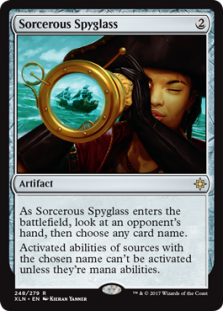
How it basically shakes out is that Spyglass is better in this matchup and Needle is better everywhere else (Jeskai can go either way). We aggressively keep turn one Chalice hands against Tron, but still need the effect for Oblivion Stone in many games, so Needle has a lot of tension with our plan in this matchup specifically. If the matchup improves dramatically, I'll cut one Spyglass for either Bomb or Needle, and maybe bring the other card back over the second copy as I continue to improve.

Acting in Upkeep

Upkeep and draw step have a lot in common: they both occur after a player untaps, but before that player receives an opportunity to cast sorcery-speed spells. There are two differences between them.

  • Major: how many cards players have access to. By the time players receive priority in the draw step, the active player has already drawn for turn. Acting in the upkeep denies that player their draw for a particular interaction.
  • Minor: how cards interact with each phase. Dark Confidant, Aether Vial, and Howling Mine are examples of cards with triggers in one of these phases, and can therefore affect how players wish to interact with them.

Subsequently, there are two immediate reasons to act during the upkeep: denying opponents a draw and sequencing plays around certain triggers.

Denying the Draw
As most players understand it, the rule about acting on an opponent's turn is to do so as early as possible. The reverse is true for one's own turn. This second rule is easiest to explain; FNM-goers are quick to explain to newbies that immediately slamming lands and creatures, while perhaps automatic, is strategically detrimental. Rather, players should draw a card, make their attacks, and then add more creatures to the fray in main 2, denying opponents information about how the board might look next turn while they must make decisions in the combat step. Main 2 is the latest possible time players can play lands and sorcery-speed spells.

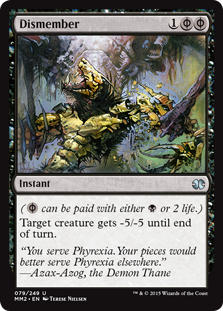
The former's a bit trickier, as it's less intuitive to a newer player why they might want to act on an opponent's turn at all. Of course, seasoned Modern players know of many such instances. Say an opponent has four blue lands untapped and a Restoration Angel in play. It makes more sense to throw Dismember at it during the opponent's turn, since doing it on our turn gives them an opportunity to spend that four mana on Cryptic Command. Passing the turn asks opponents to either burn the Command bouncing a permanent and drawing (which also gives us a window to cast Dismember), or just take their turn without spending that mana. So in this case, waiting a turn denies the opponent four mana.
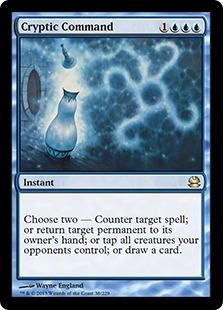
Which brings us to acting in upkeep. In the above example, we've decided to Dismember the Angel on the opponent's turn. But when? Killing it in the upkeep denies our opponent their draw for the turn for this particular interaction. If the Command is actually on top of their deck, they won't have the luxury of countering Dismember. Or if it's another threat, they might not mind if the Angel dies, making them less likely to spend mana protecting it in a scenario where they have that information.

Generally speaking, it's indeed ideal to deny opponents of as many resources as possible. Information is one such resource, and one critical to making effective plays. Acting in the upkeep lets players looking to move on the opponent's turn deny those players information while they make that move.

Resources denied:

  • One card of potential interaction for our play
  • One card of information

Interacting with Triggers
Other situations call for upkeep action because of specific triggers. Dark Confidant's the easy one; Bob provides literally a draw, so similar rules apply. Something like Aether Vial, which generates mana, can prove more complicated.

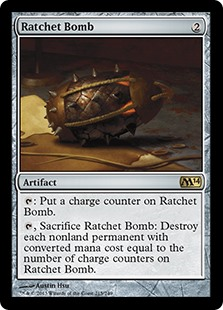
It comes up every so often that I'll have Ratchet Bomb on one counter to my opponent's Aether Vial on two counters. I could crack the Bomb on my main phase and nab the Vial right away, but that gives opponents the opportunity to flash in a creature first. Such a play might be worthwhile if I want to assess the battlefield for an attack, as nobody wants to run Eldrazi Mimic into Thalia, Guardian of Thraben. Otherwise, I'll wait until their upkeep.

Should opponents tap the Vial on my end step, I can decide whether to tick Bomb up again and kill what they've put on the board, or pop it now to deny them another turn of Vial mana. Critically, I've lost nothing by waiting this long—only gained information. Opponents sometimes wait with their Vial activations for this reason: they don't want us to tick up the Bomb at all, and are trying to bait its activation to clear the path for their creatures. Recognizing that plan early lets us leverage the extra tempo by getting more aggressive and forcing them to play into our disruption.

Should opponents simply take their turn without putting a creature into play, I've gained valuable information about their hand. They're unlikely to have many two-drops, if any. And they're also likely to call a Vial trigger in the upkeep to start putting three-drops into play.
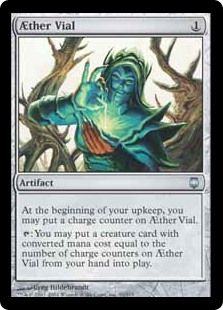
If I'm in the market for blowing up Aether Vial at all, this is where I respond by cracking Bomb, regardless of whether opponents intended to actually add a counter (that decision is made upon the trigger's resolution). Now, opponents don't get to put a three-drop into play, let alone a scary one like Flickerwisp that can save Aether Vial from destruction. And if they were planning to merely draw without adding a counter, acting in upkeep denies them the chance of drawing a two-drop for turn and putting it into play with Aether Vial. They can tap Vial for the two-drop they held off on producing last turn, but that's fine, too, since we've effectively denied opponents a turn's worth of Vial mana by waiting with Bomb.

Resources gained:

  • Information about opponent's hand
  • Tempo as opponents play around artifact removal

Acting in Draw Step

Waiting until the draw step to act gives opponents additional cards and information to work with. Sometimes, though, that draw improves our own plays. Besides granting opponents resources, drawing also moves cards from one zone to another. After drawing, players have:

  • One more card in hand
  • One fewer card in the deck

More Cards in Hand

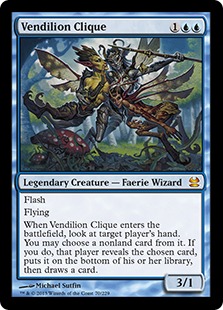
This one's relatively straightforward: some effects shine brightest when opponents have more cards. Vendilion Clique and Thought-Knot Seer (given pseudo-flash via Aether Vial) are examples of creatures expertly deployed in draw. If opponents draw after, they might find something even better than what we took.

Fewer Cards in the Deck

Spells and abilities that force opponents to search their libraries are plentiful in Modern, with Path to Exile, Field of Ruin, and Ghost Quarter among the most popular. These effects all improve when opponents have fewer cards in their decks, since opponents will have a harder time finding cards to search out with those cards gone.

Path to Exile is often reserved for an opponent's turn because it gives them a tapped land in exchange for brutal efficiency. Tapped lands can't be used the turn they come into play, so a main phase Path gives opponents one more resource for next turn. Pathing a creature during the draw step prevents opponents from using the land from Path this turn, and also gives them the opportunity to naturally draw the land they would have found with Path.

That said, it's often better to throw Path in upkeep, and rarely right to do so in draw. Combat creatures, utility creatures, and lands alter the above "rules" based on the phase they become valuable in during a turn.

Combat Creatures
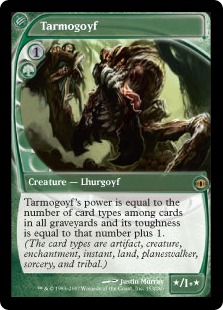
Creatures are primarily used for combat, and sometimes do little in other phases. Take a combat-exclusive beater like Tarmogoyf. Most Goyf-slingers are in Jund colors, so they won't have countermagic; baiting responses in the upkeep before they see their draw doesn't do much for us. We'd rather wait until opponents attack with Goyf, or consciously choose to leave it as a blocker and end their turn, to remove it.

By then, opponents have already drawn for turn, so the basic for Path may be out of the deck. But there's still no reason to remove Goyf before main 1, since doing so gives opponents a clearer board picture with which to make plays for the turn. It's usually ideal to Path combat creatures in upkeep (vs. decks with possible answers) or as late as possible (i.e. when they attack or on end step), and not in draw.

Utility Creatures

Certain creatures gain value earlier than the combat step, and it can be correct to Path these in draw. It's no Modern all-star, but we'll use Captivating Crew as a first example. Crew's ability can only be activated at sorcery speed, making it useful as of main 1. Pathing it in draw denies opponents the ability to activate Crew in their main phase, gives them the land tapped, and introduces the possibility of Path not finding anything.
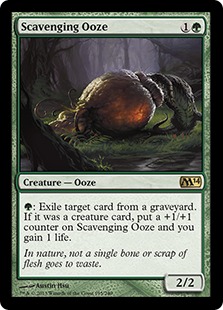
For a more subtle, but Modern-relevant, example, look no further than Scavenging Ooze. Ooze gains value depending on the number of green sources players have on the field. In the main phase, the active player can play a land without passing priority. Waiting until combat to Path the Ooze gives opponents the ability to drop Forest and exile an additional card from our graveyard. Conversely, hitting it in our main might ramp opponents into something like Bloodbraid Elf, and firing off Path in upkeep doesn't give opponents the chance to draw their last basic. Here, it can be ideal to Path the Ooze in draw.

Lands

Lands are similar to these utility creatures, as they gain value as early as main 1. That's when they can be used to cast sorcery-speed spells.

Even many Modern dabblers are familiar with the age-old, draw-step Quarter crack on a Tron land. Ghost Quarter must destroy the second Urza land before main 1, so Tron players can't assemble Tron and cast Karn Liberated with their seven mana. And since Tron decks historically play few basics, it rapidly became common knowledge to throw Quarter in draw rather than sacrifice it in upkeep. After all, Tron has nothing to do with the extra information from another draw, and there's no real chance they topdeck a Squelch!
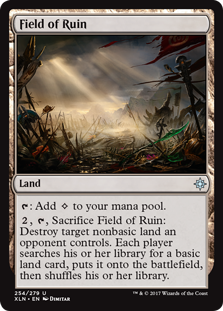
The next level is destroying color-producing lands before opponents can tap them for the right colors. For a high-profile example, consider the match between Reid Duke's Jund and Paul Cheon's BG Rock in the Team Modern Super League back in February. Paul aggressively targeted Reid's red sources with Field of Ruin, prompting some Jund players to begrudgingly accommodate a Mountain (Reid not among them). A few seconds after the above linked video comes in, Paul fires off Field in his main, preventing Reid from untapping with red and having Lightning Bolt or Kolaghan's Command. But it's sometimes better to wait until draw for this kind of effect—if, for instance, the only red spell we care about is Bloodbraid Elf, and we'd love for opponents to throw a Bolt or Command at nothing.

I Quarter opponents off colors quite frequently in Colorless Eldrazi Stompy, even if they can just fetch up another source. Knowing how many basics each deck plays is crucial to success with the strategy. CES is aggressive enough that opponents may not be in a position to Lava Spike themselves for the right color. I sometimes find myself cracking Quarter after damage if combat goes a certain way, and I anticipate my opponent will need a certain color in main 2. But it's more common for me to blow up lands in draw.

Forcing Activations
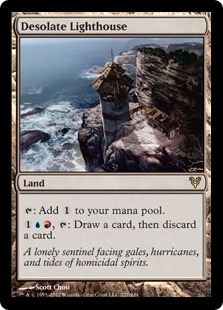
One big reason to hit utility lands or creatures with Ghost Quarter or Path to Exile is to force their activation. Say opponents are looking for an out to our Thought-Knot Seer. If we Ghost Quarter their Desolate Lighthouse on upkeep, they can activate it for an extra look. But doing so costs them a net three mana, complicating non-Path outs like Supreme Verdict or Snapcaster Mage. The main idea with forcing activations is to bait opponents into committing resources to a play (i.e. spending mana on a loot) while depriving them of other resources (i.e. the information gained from their draw for turn).

To wrap things up, I'll give an example of forcing activations that came up for me at a local tournament this week. My Jeskai opponent had four mana-producing lands in play, including Steam Vents, Hallowed Fountain, and Celestial Colonnade. So did I, including two Quarters and a Mutavault; I also had Smuggler's Copter and Eternal Scourge. I wanted to attack with Copter this turn and loot away a Serum Powder, but put my opponent on Lightning Bolt.
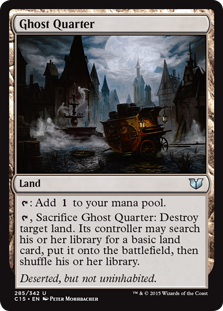
In my upkeep, I Quartered his Steam Vents. He tapped for red and searched up Mountain. Here, I could Quarter his Mountain, but he could then spend the mana from both destroyed lands to animate Colonnade and have a blocker up this turn. So I moved to draw step, drew for turn, and then destroyed the Mountain. He again floated red and searched up an Island.

Next, I moved to main phase, crewed the Copter, and went to attacks. Crewing in main 1 ensured that if my opponent tapped my team with Cryptic Command, I would be able to animate Mutavault in start of combat and still sneak in some damage. He ended up Pathing the Copter, so I did get in with Mutavault, and was able to land an unchecked Smasher the following turn to close out the game over a few attacks.

Can't Phase Me

Understanding phases as a resource is key to wielding them effectively. The marginal benefits gained from proper phase play add up over the course of a game, a match, and certainly a tournament. Things get even denser when it comes to flexible hosers like Relic of Progenitus and Surgical Extraction, which I'll cover in a future episode. Until then, do you have any interesting phase stories? Share them with me in the comments!


Insider: Cards to Watch after Dominaria

Are you a Quiet Speculation member?

If not, now is a perfect time to join up! Our powerful tools, breaking-news analysis, and exclusive Discord channel will make sure you stay up to date and ahead of the curve.

Dominaria is one of the most anticipated sets in Magic’s history, and it seems to have exceeded expectations so far. It comes after some lackluster sets like Masters 25 and Iconic Masters, so those exceeded expectations have reinvigorated players and the market. Today I’ll discuss some cards the set is increasing demand for and identify some metagame trends that could have market implications.

The most important card in Dominaria for Standard is Llanowar Elves, and it dominated online leagues on Wednesday and Thursday after the reprinted cards became legal, but before Dominaria was actually released. It has elevated green to a new level in the metagame and makes all the color's card more appealing. What’s really exciting is that it allows for a Mono-Green deck, which has already put up a 5-0 finish in a league with just Llanowar Elves, and is getting even more great tools in Dominaria. Adding cards like Steel Leaf Champion, Adventurous Impulse and Memorial to Unity may bring the deck to tier-one status, so I’m eyeing its staples.

There was an error retrieving a chart for Nissa, Vital Force

I came across one of the Mono-Green decks when playing Standard online, and it included Nissa, Vital Force. The planeswalker was extremely impressive, crewing Heart of Kiran and dealing haste damage with its 5/5, which was amazing for enabling Ghalta, Primal Hunger. I can see Nissa, Vital Force becoming a role-player in Standard over the next few months, so it looks like a bargain at $3, especially when you consider that over the long term, this planeswalker is likely to appreciate nicely once it leaves Standard, as planeswalkers tend to do.

There was an error retrieving a chart for Resilient Khenra

A key card for the Mono-Green deck, and in other Llanowar Elves decks like Red-Green, is Resilient Khenra, which is better than ever because Llanowar Elves helps pay its eternalize cost. Its price is still under $0.50, but it has been trending up very slowly over the last six months from $0.30, so this sudden increase in play and demand should only accelerate the process and move it towards $1, or even a few dollars like Earthshaker Khenra.

There was an error retrieving a chart for Jadelight Ranger

At $10, Jadelight Ranger is already pretty expensive for a rare, but I see the pressure being on it to rise now that Llanowar Elves will increase demand, and now that Dominaria will become the current Limited set and players will stop opening Rivals of Ixalan.

There was an error retrieving a chart for Rhonas the Indomitable

Rhonas the Indomitable is better now that it can be cast on turn two, and Steel Leaf Champion is a very convenient way to enable it, so it’s a big winner from Dominaria. Online, it's up to 4.6 tix from 3.2 a month ago, and this year its paper price has gone from $8 to $10, and I see it continuing to grow.

There was an error retrieving a chart for Gilt-Leaf Palace

The Magic Online price of Gilt-Leaf Palace has seen big growth this past month, up from around 2 tix to 4, while the paper price sits at $15, where it has been for the past two years. The sudden interest is likely explained by an Elf deck reaching the top eight of Grand Prix Hartford last weekend with a set of Glint-Nest Palace included.

That decklist doesn’t include anything new, but online, the most popular version of the Elf deck includes a set of Bloodbraid Elf, which has given the deck a boost compared to before the card was unbanned. There has been a general uptrend in Elves since the unban, and I think the printing of Llanowar Elves in Dominaria has stirred up nostalgia for the tribe and added some new casual tools like Marwyn, the Nurturer, so everything's coming together to put Elves in the spotlight. That gives me a strong outlook for Glint-Nest Palace, which could see another price spike like it did two years ago, and has me looking into other Elf staples, including Elvish Archdruid, which is also trending upwards online.

There was an error retrieving a chart for Cavern of Souls

The success of Elves also adds to the demand for Cavern of Souls, which has seen its price grow by around 50 percent in 2018, to nearly $90. With the current momentum of Humans in the metagame, and the success of Elves, it’s headed towards $100.

Modern’s Black-Red Hollow One deck has grown from a Magic Online curiosity to what might be the most broken deck in the format. This meteoric rise is most clearly seen in the price of Goblin Lore, which it has brought to the absurd level of $40, making it the most expensive uncommon in Modern. It took a while for the deck to be tuned to the current version that has become so popular, and there have always been different versions. Specifically, green versions that use Vengevine to take advantage of the same looting spells and Hollow One’s ability to be cast for free, a variation of which is now starting to take off online.

There was an error retrieving a chart for Vengevine

The list is loaded with creature that can be cast for free to trigger Vengevine, Walking Ballista, Hangarback Walker, and Endless One, which gives it incredible explosive potential, especially because these creatures will trigger Bridge from Below if they are cast for 0 mana and generate even more battlefield presence.

There was an error retrieving a chart for Bridge from Below

The deck reached the 4 of the Modern Challenge online last weekend, and I’m paying close attention to the deck to see if it breaks out in more events. It has a few potential spec targets, with Vengevine and Bridge from Below being essential pieces.

There was an error retrieving a chart for Copperline Gorge

A smart spec may be Copperline Gorge, a staple of the manabase, and is a relative bargain compared to Blackcleave Cliffs and Darkslick Shores, and a surge in demand would lead to a surge in price.

There was an error retrieving a chart for Hangarback Walker

Hangarback Walker has seen huge growth online over the past month, from 1.6 tix to 4.5. Its paper price is stagnant but started to increase over the past couple weeks, and I think it has a ton of long-term potential, between its Modern applications, casual appeal, and even Vintage play, so now might be the time to move in on them.

There was an error retrieving a chart for Endless One

I’m also watching Endless One, which has been growing towards $1 after bottoming out in February, and is appealing because it’s also an Eldrazi staple.

What are you looking at in the wake of Dominaria?

–Adam

Daily Stock Watch – Molten Rain

Are you a Quiet Speculation member?

If not, now is a perfect time to join up! Our powerful tools, breaking-news analysis, and exclusive Discord channel will make sure you stay up to date and ahead of the curve.

Hello, readers and welcome to a new edition of the Daily Stock Watch! We've seen lots of movements in cards on the Reserved List lately and it would be nice to stray away from some pricey spec buying by doing some minor penny stocks (well, of sorts) for today's segment. This card is one of the main reasons why Ponza became a thing in Modern again, and why players have been in love with the idea of disrupting the opposing player's mana base on their way to victory.

There was an error retrieving a chart for Molten Rain

Bloodbraid Elf made some new friends when it returned to the Modern scene and one deck that resurfaced is the classic land destruction scheme we call Ponza. There has never been a shortage of one-mana dorks in Modern, as well as that of three-mana land destruction spells in the format, but what pushed it over the top is BBE's ability to consistently produce a relentless assault on the opponent's lands by cascading into a Stone Rain, Blood Moon, or the now $2.76 uncommon Molten Rain. The deck returned to prominence since Andrew Wolbers steered it to a championship finish at SCG Modern Open Dallas, and it hasn't turned its back since.

Gruul Ponza

Creatures

4 Arbor Elf
2 Birds of Paradise
4 Bloodbraid Elf
1 Courser of Kruphix
3 Inferno Titan
2 Pia and Kiran Nalaar
4 Tireless Tracker

Instants and Sorceries

2 Lightning Bolt
3 Molten Rain
4 Stone Rain

Other Spells

4 Blood Moon
1 Chandra, Torch of Defiance
1 Nissa, Voice of Zendikar
4 Utopia Sprawl

Lands

7 Forest
1 Kessig Wolf Run
2 Misty Rainforest
1 Mountain
3 Stomping Ground
3 Windswept Heath
4 Wooded Foothills

Sideboard

2 Ancient Grudge
3 Anger of the Gods
1 Chandra, Torch of Defiance
2 Kitchen Finks
1 Obstinate Baloth
2 Scavenging Ooze
1 Shatterstorm
1 Thrun, the Last Troll
2 Trinisphere

This deck has somehow evolved since this finish by Andrew, but it has stayed true to its concept of trying to win by suffocating your opponent's resources. On the front end of this approach has been the consistent beatdown by threats such as Tireless Tracker and BBE, while it just tries to go big at one go with the arrival of a colossal Inferno Titan. Molten Rain does a handy job of softening the opponent's life total with that pesky two damage that it packs upon resolution, therefore making it the preferred weapon of choice for the Ponza player.

Valuable Modern Masters 2017 Uncommons

Only these four uncommons are priced at $2 and above among majority of online sellers, considering how good the rares and mythic rares of that set has been throughout the past two years. The rise in the value of Molten Rain doesn't really mean that the rest of the uncommons from this set will start to move, but it could be attributed to the fact that it became a vital cog of a winning deck that has been used consistently by players who are performing well in tournaments. If you were able to crack lots of MM3 boxes and store a majority of your hauls, now might be the best time to start digging for your copies of this card. The format has been shaky, but players have been open to the idea of switching decks every now and then. There will always be a market nowadays for cards that are ticking upwards in Modern, so start moving your Molten Rains now.

At the moment, you could find copies of Molten Rain for anywhere between $1.49 up to $1.81 via TCGPlayer and Card Kingdom. StarCityGames is out of stock at $1.99, and they should refill soon at above $2 once the other sites are dry of supply. There's still a hefty amount of them in the open market, so don't be fooled by its new price tag. Try to acquire copies at a dollar if that's possible, and move them around at $2 in places where you could afford to do it. Don't stock up too much and try to move them around if it's possible. This is one of those cards that are moving upwards because of exposure, and should go down in price once the hype dies down and the decks in the format are trimmed down.

And that’s it for today's edition of the Daily Stock Watch! See you again next time, as we continue to speculate on cards that might be on the rise, or try to get rid of the ones that are at risk of losing value. As always, feel free to share your opinion in the comments section below. And if you want to keep up with all the market movement, be sure to check in with the QS Discord Channel for real time market information, and stay ahead of the hottest specs!

Insider: Dominaria Cards to Hunt During Prerelease Weekend

Are you a Quiet Speculation member?

If not, now is a perfect time to join up! Our powerful tools, breaking-news analysis, and exclusive Discord channel will make sure you stay up to date and ahead of the curve.

I haven't been so excited with a new Magic release in, well, ever.

Not only does Dominaria herald the return to the most iconic and awesome plane (and it's not close) in the history of Magic lore, from a gameplay and power standpoint, the set is absolutely stacked. Just on the basis of its history, I would have been excited about a weak-sauce Dominaria set, but one that is deep, thoughtfully designed, and has seemingly boundless stuff going on is absolute gravy.

Step one is to get to the prerelease and enjoy this truly special MTG moment. I can hear Jay and the Americans crooning it out real smooth: This MTG Moment, so different and so new, was like any other, until my Dominaria wish came true...

The prerelease being great will take care of itself, because it always does. It's pretty fun and easy to jam a bunch of brand spanking new cards with some friends. However, we all know the drill – in between rounds, there is great value to be had trading with the local players who typically sling their spells at the kitchen table at home with friends.

One of the coolest things about a prerelease is that it brings everybody out to the game store to experience the cards for the first time. Everybody from the local pros, to the weekend warriors, the grinders, the commanders, and even the kitchen-table generals comes out to share these unique cross-sections of Magic history.

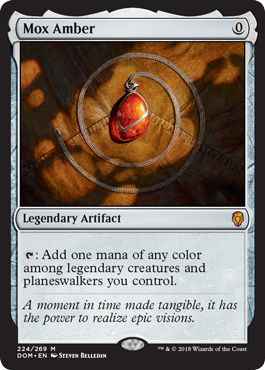
Mox Amber

Being that the whole gang is there, prereleases are a great opportunity for the adept trader or collector to make some nice trades. What that doesn't mean is that you should rip off more casual players who don't know what their cards are worth. But you absolutely can be mutually beneficial to each other.

Note that the random dude with a dusty binder full of Beta Underground Seas, asking if they are worth anything, doesn't actually exist. Even if he did, he would just look up the price on his phone. Even if an opportunity was there, I'd hope that my fellow financers are not out on the street taking advantage of the casual players, townies and small children.

Rather, casual players are great trade partners because they are looking for unique subsets of cards that other players don't typically prize as highly. I usually try to add the casual players I make happy trades with on Facebook and let them know to hit me up any time they are looking for something and that I'll hook them up. It's a great way to make new remote trade partners. Your network of potential trade partners can never be too big.


Okay, enough about how great prereleases are and the virtues of establishing good ties with the casual crowd. Let's get to the business of skimming the value from Dominaria.

The first impulse that I have looking at the set is that it is super deep without too many obvious busted strategies calling out to slam the door on everything else. The powerful "Red Four-Drops of Doom" obviously create a baseline for the format, as do the remaining Energy shells, but by and large, a lot of these Dominaria cards will eventually have their day in the sun, which is how Magic should be.

Historic and Legendary Synergy Cards

I'm always interested in trading for cards that appear to be undervalued from a new release. The obvious good cards come out of the gate hot and overpriced, but finding the cards that other people have been sleeping on is a great way to grind some early, free value.

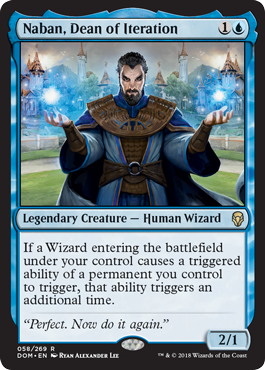
Naban, Dean of Iteration

I believe Naban, Dean of Iteration will be a straight-up Constructed bigwig. First of all, the card is just good for the cost. Two mana for a 2/1 with a great ability is real. The fact that it has double great typing, Wizard and legendary (which counts as historic), gives the card a lot of room to make an impact.

Tribal Wizards look to be on the fringe of Constructed playable, and don't forget that we'll get another set of synergy cards to match up with him. He triggers "historic matters" conditions and turns on Mox Amber early. The card will be in competitive decks, but Naban seems like a spicy Mono-Blue Wizards Commander as well. This means picking up foils will be a good play.

There was an error retrieving a chart for Sram, Senior Edificer

Sram is another Legendary card that will likely play nice with Mox Amber in certain shells. He's basically a bulk rare right now, but I don't expect that will last for long. A Mox is nothing to be messed with, and any two-drop legendary creature should be on your radar right now, as harnessing the power of the Mox will likely be a major sticking point of the new Standard (and possibly Modern) format.

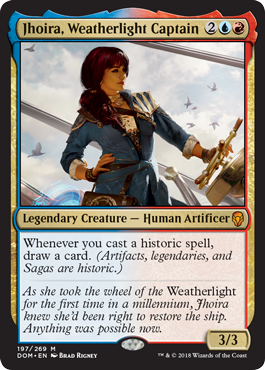
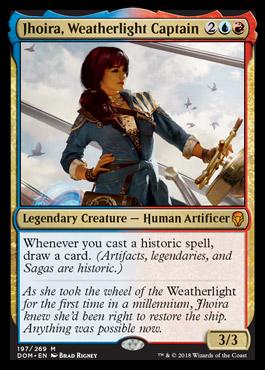
Jhoira, Weatherlight Captain

Meanwhile, we have a powerful mythic with a surprisingly low starting price point. I think this card has potential in Constructed formats. In particular, decks that play a lot of Moxen in Eternal formats. Four mana for "draw a card when you play an artifact" already exists on much weaker bodies and doesn't see play, but attaching the ability to a respectable body and having it also trigger for artifacts and legendary permanents makes the card considerably better.

I also anticipate foil copies being a hot commodity, as Jhoria seems like an absolutely busted Commander general. It's such an obviously good and fun "build around me" general in a great color combination.

Why Are People Not More Excited About These Absurd Three-Drops?

Another exciting cycle of cards that seems not to have captured people's imaginations:

Benalish Marshal

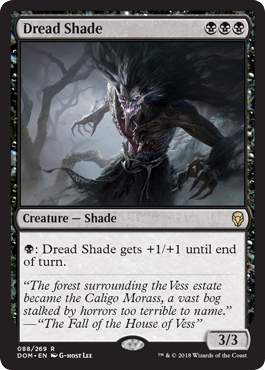
Dread Shade

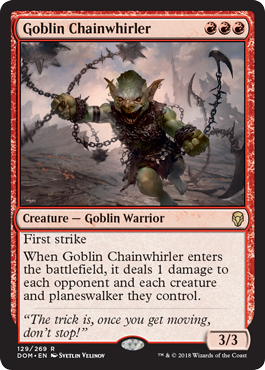
Goblin Chainwhirler

These cards are absurdly powerful if you can meet the mana commitments, and I think all of these cards slot nicely into doing the kinds of things mono-colored decks like to do: be aggressive and play all lands untapped every turn.

The whole cycle is gas. Also, don't forget that with Aether Hub, fast lands and the reprinted Innistrad land cycle, a player can essentially get 12 "splash" sources of mana in a basic heavy mana base for a low cost. I think these cards will have a huge impact and can't understate how good I believe they will be in Standard.

The green one has already surged up to $8, and I'm not even sure he is better than Benalish Marshall or Goblin Chainwhirler, although I admit the card seems like a saucy blocker against Red Decks.

Legendary Spells

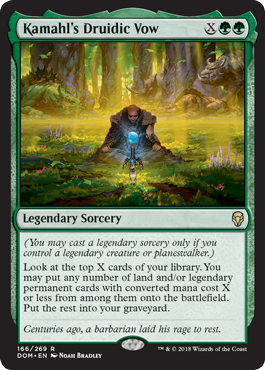
We've had "epic" spells, but these are the first legendary sorceries to actually exist, which is pretty cool. Basically, they are just regular spells, except you must control a legendary creature or planeswalker to actually put them onto the stack. I like the flavor – the player needs to have a legend on the battlefield to actually execute this tactic.

These are cards that would typically be relegated to scrap because the conditions are simply too awkward to realistically meet. However, in a block where most of the playable creatures are randomly legendary and give buffs to other historic cards, the condition might be nearly free.

It is also worth noting that Llanowar Elf is back, which makes ramping things out likely one of the best things anybody can do.

Kamahl’s Druidic Vow

The card makes me think of Genesis Hydra back in the RG Devotion decks. Simply make a ton of mana and reap a ton of rewards by casting a giant X spell. There are good planeswalkers that ramp already, and I wouldn't be surprised to see some of these legendary spells paired up with them.

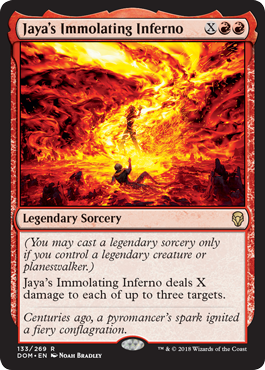
Jaya’s Immolating Inferno

The card is very close to a Bonfire of the Damned in a deck that can field it. A potentially triple removal spell? I think this is a very spicy option for midrange duels as long as it can be cast.

And Finally, a Completely Unreasonable Card That Nobody Is Talking About

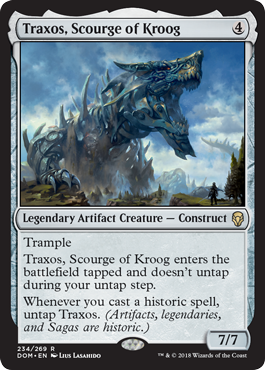
Traxos, Scourge of Kroog

What in the world!? Four mana for a 7/7 with trample and no drawback?

Okay, it has a drawback, but not one in any deck where it will appear. I will likely be jamming this card in Legacy and Vintage. It may not have an obvious spot in an Affinity deck, but this card has absurd stats. I think this is a card to be picking up for speculative purposes. Four mana for a 7/7 with trample is not something that comes along every day.

Well, those are my thoughts on the underrated cards from the new set. The set is so deep that there are a lot of potential places to search for value. It doesn't matter if you are an old-school grinder returning home or a new player experiencing Dominaria for the first time: enjoy the prerelease and enjoy the return!

Video Series with Ryland: Bogles

Are you a Quiet Speculation member?

If not, now is a perfect time to join up! Our powerful tools, breaking-news analysis, and exclusive Discord channel will make sure you stay up to date and ahead of the curve.

Ah yes, everyone's favorite archetype, Bogles. A deck so frequently complained about that we can't even agree on how to pronounce its name. Hate it or love it (I imagine many more exist on the hate-it side), it's been around for a while and isn't likely to go anywhere. The hexproof mechanic is certainly what put this deck in Modern, but slapping enchantments on a creature to make a huge fatty is a strategy nearly as old as Magic itself.

How much can really be said about this deck? Every deck in Magic has its own complexities, just within different decision points. Most of the interesting decisions with Bogles lie within three main categories:

  1. Deckbuilding decisions
  2. Sideboarding decisions
  3. Mulligan decisions

That is to say that primarily your in-game decisions will be less difficult and crucial relative to some other Modern archetypes. Amulet Titan, for example, will consistently have more difficult in-game decisions than Bogles. In the Magic community this is often a source of contempt for a deck, but realistically, it should be the opposite. When making deck choices for an event, people often overestimate the ability to leverage play skill, and underestimate the advantage of saving mental energy by reducing the number of difficult decisions. You will consistently make more mistakes playing Amulet over 15 rounds than Bogles.

Does that mean people should always be choosing to play Bogles? No, of course not. However, likeliness to make mistakes should play a larger factor than I think it currently does. That said, am I more likely to play Bogles than Titan in a coming event? Realistically, no; you're way more likely to see me slinging Primeval Titans than Gladecover Scouts. There are factors other than simplicity at play. I enjoy Amulet a lot more, I have relatively established sideboard plans for most matchups, and I've played the deck a lot more.

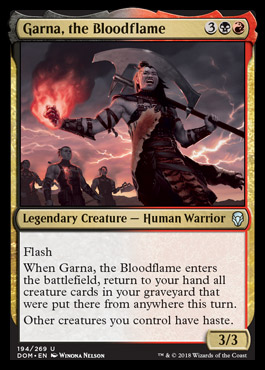
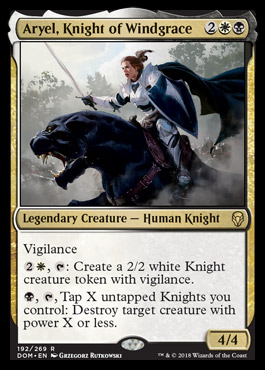
Honestly, Bogles is not a deck I particularly enjoy the style of, and I rarely play anything similar. That said, I am a firm believer that it benefits me to pick up a deck that I would not normally play. It helps me round myself out as a player, and puts me in the shoes of a common enemy that I am likely to face in the future. If you've been on the other side of the table, you will often have a slightly better understanding of the overall matchup.

As the target on Bogles's back gets larger, I think it will quickly become a poor meta call. Frankly, it all just depends on how much people want to come after the deck. Considering, however, how visceral the contempt for the archetype is, I would imagine it will quickly get pushed out again. Regardless of when it falls out of favor, one thing is for certain: it will be back again.

I hope you enjoy the matches and, as usual, I'm interested to hear what kind of content you'd like to see moving forward, so I can continue to evolve and improve my videos. Please let me know your thoughts, and any improvements you would like to see concerning formatting, presentation, or whatever else strikes your fancy. To avoid spoilers, I won't repeat it here, but there is a question in the wrap-up that I'd love your feedback on. If you'd like to see similar content, check out my Twitch channel for some more live Modern!

[youtube https://www.youtube.com/playlist?list=PL261kJ_cAQC9Zt87_QwJmSx9vO8HHgtd2]

Bogles, by Jonathan Sharp (8th Place, GP Hartford)

Creatures

4 Slippery Bogle
4 Gladecover Scout
4 Kor Spiritdancer

Enchantments

3 Cartouche of Solidarity
4 Daybreak Coronet
4 Ethereal Armor
1 Gryff's Boon
2 Hyena Umbra
4 Leyline of Sanctity
4 Rancor
2 Spirit Mantle
2 Spider Umbra

Instants

2 Path to Exile

Lands

1 Dryad Arbor
1 Forest
4 Horizon Canopy
1 Misty Rainforest
2 Plains
4 Razorverge Thicket
2 Temple Garden
4 Windswept Heath
1 Wooded Foothills

Sideboard

1 Dromoka's Command
1 Ethersworn Canonist
3 Gaddock Teeg
2 Path to Exile
2 Rest in Peace
2 Seal of Primordium
1 Spirit Link
3 Stony Silence

Insider: Commander Picks from Dominaria (Gold Pt. 2)

Are you a Quiet Speculation member?

If not, now is a perfect time to join up! Our powerful tools, breaking-news analysis, and exclusive Discord channel will make sure you stay up to date and ahead of the curve.

Welcome back, readers!

Last week I covered the uncommon gold commanders from Dominaria. As I mentioned in that article, there are plenty of gold commanders left to go. So without further ado, let's dig in.

Uncommon

There was one last uncommon commander that I didn't cover last week.

Garna, the Bloodflame

Garna is another build-around commander I really like from this set. This card seems like an interesting variant of Shirei, Shizo's Caretaker. While it doesn't return your creatures to the battlefield, Garna has no restriction on the creature's power, and is in two colors. Granting all your creatures haste is also a very relevant ability to have tacked on.

Unlike Shirei, Garna will let you recast the creatures you get back immediately. The downside is that, given Garna's casting cost of five mana, recasting creatures after triggering the ability will require a significant amount of mana.

Note that the ability refers to creatures put into the graveyard from anywhere, which includes discarded or milled. While black and red are limited somewhat in what can be milled, the discard loophole seems ripe for abuse.

  • Apocalypse - As much as I loathe this card in Commander (since it serves as mass land destruction), it's a very powerful combo in a Garna deck. You could cast it, float a bunch of mana, then cast Garna to return all creatures you discard to Apocalypse.
  • Mindslicer - This card briefly broke into Modern (hence why it's not actually a bulk rare anymore). Its ability is a double-edged sword, but if you can cast it and Garna in the same turn you get to recoup all creatures you discarded and be the only player with a hand.
  • Knollspine Invocation - Typically we see this played in a deck with very large creatures that you "throw" at your opponent. However, thanks to Garna, one could double up on a big creature and do a whole lot of damage for just six mana.
  • Insidious Dreams - A ramped up Vampiric Tutor that requires card disadvantage to stack your deck. When you can recoup all the cards you discarded (if they are creatures) it seems like a pretty solid play. The fact that Garna has flash means you could do this at the end of an opponent's turn for maximum value.
  • Thought Gorger - Again, this requires nine mana to pull off, but being able to discard your hand to make Thought Gorger big, recouping all the creatures, and then getting to draw a bunch of cards when it dies, seems pretty powerful.
  • Volrath's Dungeon - This seems like an interesting option. It's a single-print bulk rare from Exodus. You could really wreck an opponent (by discarding a bunch of cards and forcing them to stack the top of their deck awkwardly). However, it's most likely only good versus a single player, and they'll likely pay the five life during their turn. Still, this seems extremely powerful and conveniently fits in the curve the turn before casting Garna (so hopefully it sticks around one turn cycle).

Rare

Aryel, Knight of Windgrace

Aryel is the "Knight commander" we've been waiting for. While we actually have a fair number of legendary Knights in Magic's history, it isn't until Ixalan block that we got any black-white combinations. The Ixalan block options are also Vampires and have cool abilities, but none of them actually care about the Knight creature type in any meaningful way.

  • Champion Lancer - I'll admit that despite playing since 1997, I didn't know this card existed and have never seen anyone play it. However, what is interesting is that it's been on a pretty steady decline the last few years, falling from around $4.50 all the way down to $2 despite never being reprinted.

So many good creatures have come along since then that I imagine it simply gets pushed out of most decks. However, it is a Starter 1999 rare (with no other printings) and a pretty useful ability. This is one of those cards I could see spiking pretty easily, though the real question is whether there will be enough people who want to play a Knight-themed Commander deck to sustain its value. I like it as a short-term pick-up, but other than being a unique and rare Knight, you don't get a whole lot for the six-mana investment.

  • Haakon, Stromgald Scourge - This has always been one of those cards begging to be broken. I've seen players try it out in Modern (to repeatedly cast Nameless Inversion), but it's never really found a home. It does seem like an auto-include in an Aryel deck, though getting it into the graveyard will likely require some effort.
  • Sidar Jabari - This is a rare from Mirage on the Reserved List. The ability is useful, though not game-breaking (good for an aggro style deck to push through damage).

For other options, I suggest reading Adam's article on Knight tribal in Dominaria.

Grand Warlord Radha

Radha looks extremely powerful. Commanders that generate large amounts of mana have tended to be pretty broken (Rofellos, Llanowar Emissary, Selvala, Heart of the Wild). You get a 3/4 with haste for four mana which is already playable on its own, and the mana ability means you can very quickly get way ahead on mana, especially if you have a lot of attackers.

Some of the good spec targets with this card are:

  • Aggravated Assault - It seems we have yet another possible infinite combo with this card (we already had a few), but the fact that you only need to attack with five creatures total to go infinite seems like a no-brainer. Interestingly enough, the Invocation of this card has dropped back down to its pre-spike price, after hype surrounding Neheb, the Eternal subsided. There was a recent printing in the Explorers of Ixalan product, so copies can be picked up in the sub-$8 range—and it's a pretty easy double-up at that price.
  • Bedlam - With only two printings (7th Edition and Urza's Saga) there aren't a ton of these floating around in trade binders, yet the card is pretty much a bulk rare. It seems perfect for a deck that wants to be aggressive (likely with small creatures) and would help make sure you didn't suicide them into bad attacks just for mana. It also plays extremely well with the aforementioned Aggravated Assault.

Jodah, Archmage Eternal

This seems like an extremely powerful commander that likely just plays a bunch of ridiculous spells and mana fixing. I think the key speculation targets here will be centered around mana fixing. The goal of a Jodah deck will likely be to cast your ridiculously expensive spells as fast as possible, which requires extremely good mana.

  • Chromatic Lantern - I realize this one is already expensive and honestly a bit of a gamble. The fact that WotC only included it in one of the four-color Commander 2016 decks was extremely surprising to me (I unloaded ten of them at a GP shortly after they announced they were doing four-color decks because I assumed it was an obvious inclusion for each deck). That being said, it's already sitting at $14-plus and is unlikely to drop, barring a reprint (though arguably it could easily be included in just about any Standard set).
  • Prismatic Geoscope - This card has only two printings, as a one-of in the "Stalwart Unity" deck and as a judge promo (which is currently sitting in the $5-$6 range). I like the judge promos as a spec, simply because the multiplier is so low compared to regular versions.
  • Crystalline Crawler - Another of our Commander 2016 cards only included in one deck ("Breed Lethality"). This is essentially free when cast off Jodah, as it comes in with five +1/+1 counters on it and you could remove them immediately to re-use Jodah's ability. Then in future turns you could add counters and remove them for one of any color needed.

Firesong and Sunspeaker

Here we have our "promo only" card from the set with cool and powerful abilities. It also happens to be a Minotaur, though sadly it doesn't include black, which means that a lot of Minotaurs from Theros block can't fit in the deck. Luckily, it's not really designed to go in a Minotaur-deck and instead screams red-white burn.

  • Sunforger - This seems like the most obvious inclusion for this style of deck, as it tutors out and casts instants and sorceries to trigger Firesong and Sunspeaker. It's practically a bulk rare (thanks to two reprints), but it would almost assuredly be an auto-include in this style of deck.
  • Aurelia's Fury - An X-mana burn spell that happens to be both white and red seems extremely powerful. Its only printing is as a mythic from Gatecrash. When it was originally released the price tag was $30-plus thanks to a lot of hype from well-known pros. It never got its day in the sun and quickly plummeted, and now sits as a bulk mythic. It also serves as a powered-up Silence that you can cast to stop all your opponents from interfering with your plans for the turn.
  • Brightflame - This card gets pretty silly with this commander as you would gain a metric ton of life if even a small number of creatures that share a color are on the battlefield. It only has a single printing (Ravnica: City of Guilds) and foils have dried up for the most part.
  • Energy Bolt - A Reserved List rare from Mirage, this honestly doesn't seem amazing; but the fact that it's Reserved List and the static ability of Firesong and Sunspeaker does mean you get both options makes this worth a look.

Mythic

Muldrotha, the Gravetide

While I covered the card I was most excited for last week (Tatyova, Benthic Druid) this one is a close second. This general screams "value town." It allows you to re-use fetchlands every single turn, making sure you always hit your land drop and thinning your deck. It also seems fantastic with evoke creatures and any permanent with a built-in sacrifice ability.

This seems like a deck that will have a hard time figuring out what to cut, but these cards seem like they are always likely to make the cut:

  • Pernicious Deed - Thanks to a recent reprinting at rare in Masters 25 (a downgrade from its previous reprinting in Conspiracy at mythic), this card is very cheap. Being able to recast Deed over and over seems extremely powerful, and I can't imagine building this deck without including it. Best of all, the recent printing retained the original artwork (which I'm a fan of, as I loved playing this card back when it was Standard-legal). As copies are currently sitting in the $1 range, I'm a buyer at $0.5 and will be happy to trade for them at their current price.
  • Birthing Pod - After its ban in Modern this card took a huge hit, but it has slowly climbed its way back up to a reasonable $9 price tag. This provides a constant supply of creatures in the graveyard that can be recast with Muldrotha, and enter-the-battlefield abilities on creatures play well with both Pod and Muldrotha.
  • Voidmage Prodigy - This card might be less of an auto-include, but the ability to always have a counterspell available (that itself can't be countered easily) seems like a powerful inclusion for this type of deck. It can also provide a sacrifice outlet for other Wizards you might be playing. It already spiked once thanks to the "Arcane Wizardry" deck, but there's still some room to grow as the price has dipped back down a bit.

Jhoira, Weatherlight Captain

The catch with historic is that all artifacts trigger it. So new Jhoira decks are likely to play a lot of cheap artifacts and will play a lot like Modern Puresteel Storm decks. The good news is that most cheap artifacts are common or uncommon (so the deck's price ceiling is somewhat limited). That being said, I do think there are a few good options for speculation targets:

  • Helm of Awakening - It has only a single uncommon printing from Visions and is often a key card in a lot of combos in Commander. The current price is sitting around $3-$3.50, and this could easily double up should the Jhoira deck become a favorite of competitive players (and repeated "draw a card" triggers tend to be attractive to them).
  • Kuldotha Forgemaster - Scars of Mirrodin really isn't that old, but it certainly seems like forever ago, and thanks to the massive growth in the playerbase, rares from older sets can be extremely hard to find. This one is sitting very cheap (with copies as low as $1.50-$2) and it tutors up any artifact and puts it directly into play. This is the type of deck that really loves that option, as it will likely have plenty of cheap artifacts to sacrifice.

Darigaaz Reincarnated

This is the most vanilla of the new commanders. A 7/7 with flying, trample, and haste is alright, but its second ability is pretty redundant when Darigaaz is your commander. Basically you have the option to trade the increased mana cost (from replaying your commander) for three turns of not having access to it—unexciting to say the least.

I don't see this option replacing Karrthus, Tyrant of Jund as the Jund Dragon commander of choice, and as such I don't see any good speculation targets Darigaaz.

Conclusion

Dominaria is looking to be a fantastic set for us Commander diehards, and this week we covered some more great options. I think there's definitely some excellent speculation opportunities on the table (and I've had a lot of recent success the past two years specing on these types of cards).

Did I miss any obvious ones? Disagree with any of my picks? Comment below.

Insider: MTGO Market Report for April 18th, 2018

Are you a Quiet Speculation member?

If not, now is a perfect time to join up! Our powerful tools, breaking-news analysis, and exclusive Discord channel will make sure you stay up to date and ahead of the curve.

Welcome to the MTGO Market Report as compiled by Matthew Lewis. The report will cover a range of topics, including a summary of set prices and price changes for redeemable sets, a look at the major trends in various Constructed formats and a "Trade of the Week" section that highlights a particular speculative strategy with an example and accompanying explanation.

As always, speculators should take into account their own budgets, risk tolerances and current portfolios before buying or selling any digital objects. Please send questions via private message or post below in the article comments.

Redemption

Below are the total set prices for all redeemable sets on MTGO. All prices are current as of April 16, 2018. The TCGplayer low and TCGplayer mid prices are the sum of each set's individual card prices on TCGplayer, either the low or mid price respectively.

All MTGO set prices this week are taken from GoatBot's website, and all weekly changes are now calculated relative to GoatBot's "full set" prices from the previous week. All monthly changes are also relative to the previous month's prices, taken from GoatBot's website at that time. Occasionally, full set prices are not available, and so estimated set prices are used instead. Although Hour of Devastation (HOU), Amonkhet (AKH), Aether Revolt (AER), and Kaladesh (KLD) are no longer available for redemption, their prices will continue to be tracked while they are in Standard.

Ixalan (XLN) prices have dropped off this week in paper, and there's no doubt the return of redemption is contributing to that decline. Both XLN and Rivals of Ixalan (RIX) are now priced at fair value and are no longer suitable for speculators.

Dominaria

Dominaria (DAR) drops this Friday on MTGO with Sealed Deck leagues available throughout the weekend. This is a change from the preview leagues that were run for Rivals of Ixalan (RIX), where leagues took a break for the weekend, no doubt to ensure that players attended paper prelease events. It's not clear what the motivation for this change is, but we are unlikely to see a drastic run-up in prices this weekend like we did with RIX.

There was an error retrieving a chart for Rekindling Phoenix

That being said, whenever there are changes to the events there are usually opportunities to make a few tix. In this case, it will be worth paying attention to the price of DAR boosters. With only Sealed Deck leagues available, it's possible that DAR boosters will be priced in the secondary market below the key price of 3.3 tix. Since you can always enter a draft with the tix-only entry fee of 12 tix, the tix plus booster entry fee must be equivalent. So, three boosters of DAR plus 2 tix must equal 12 tix or one booster of DAR will be priced at around 3.3 tix in equilibrium, which is why it's a key price to keep in mind.

Without demand from drafters on the weekend, it's possible some excess supply of DAR boosters creeps into the market, bringing the price down below 3.3 tix. Once drafting starts up on Monday the price of a DAR booster will snap back to 3.3 tix or higher, so be on the lookout for cheap boosters this weekend and don't be afraid to snap up any you can find. If prices get to 3.0 tix or less, being an aggressive buyer of DAR boosters makes a lot of sense to me, and I'll be scooping up as many as I can find if prices get that low.

The foil mythic rare strategy will be in full effect with the release of DAR. If you are curious about this strategy, I've written about it extensively in the past.  It's a low-risk proposition for players who want to fill out their collection with the newest mythic rares, and patient speculators can anticipate ten- to twenty-percent gains in three to six months. I will be looking to buy at least my playset of foil mythic rares over the next ten days.

There was an error retrieving a chart for Kumena, Tyrant of Orazca

With the end of the two-set block era, redemption is going through a change as well. Sets will be guaranteed for redemption for fifteen weeks and then available for redemption for another five weeks or until supply runs out. Practically speaking, this is a short window when compared to large sets like Kaladesh (KLD), but a longer window when compared to small sets like Hour of Devastation (HOU). Speculators should not be overly affected by this, as the full-set strategy will still be employable given this redemption window.

Standard Boosters

A draft set of two RIX boosters and one XLN booster has dipped to 7.14 tix at the time of writing this article. Look for further weakness once DAR events begin on Friday with Sealed Deck leagues. It's inevitable that booster prices from the old Draft format decline whenever a new set is released. Players are excited about the new set and just won't be interested in drafting the old format at all. Inevitably, these players sell their excess boosters for tix, which drops the price, opening up an opportunity for patient speculators to make some tix. In reviewing my notes from the fall when XLN was released, a draft set of two HOU boosters and one AKH booster dropped below 6 tix and even got as low as 5.6 tix, which turned out to be excellent value. Check out what I wrote about it at the time in this article.

There was an error retrieving a chart for Carnage Tyrant

Today I am looking to do the exact same trade but with draft sets of RIX and XLN boosters. A price of 6 tix or less is a safe level to be a buyer, and I anticipate being able to sell them back into the market for 7 tix or more by June. This is a grindy, low-risk spec that requires a lot of transactions to turn a large profit so if you have the time and some spare tix, throw a few draft sets into your collection and forget about them for a couple of months. Players who like to draft as cheaply as possible are also encouraged to be buyers of RIX and XLN boosters this week.

One important thing to note is that choosing to speculate on one of RIX or XLN over the other is not advisable. Last time you would have done very well if you had focused only on HOU, so just blindly repeating that pattern would suggest RIX should be the booster to target this time. Howeve,r the RIX preview events in January injected a ton of RIX boosters into the market and this has shifted the relative scarcity of RIX and XLN boosters. It's difficult to predict which way each booster will trade in the coming weeks but it's easy to predict that a cheap draft set will eventually rise in price. Sticking to draft sets reduces the risk and ensures a profitable trade, and that's what I plan on doing.

Trade of the Week

For a complete look at my recent trades, please check out the portfolio. It's a great time to be looking at cards from XLN and RIX that are, for whatever reason, under appreciated. With drafting winding down and DAR going to be released this week, cards that are currently abundant will start to dry up as the supply slows down with the change of draft formats. Radiant Destiny is one that I like and have been buying for the portfolio this week.

There was an error retrieving a chart for Radiant Destiny

It shows up in W/B Vampire decks in Standard that are definitely playable but are not among the top decks. Here's a list from MTGgoldfish. The reason I like this deck's potential a lot is the reprinting of Isolated Chapel. This deck doesn't have to get anything else added to it and it will be quite a bit better just from having a more consistent mana base. Vampires will be a deck that will be tested in the early weeks of DAR Standard and I think it's reasonable to expect it do grab a bigger share of the metagame than it does currently.

Alternatively, this card could find its way into another tribal archetype that is definitely getting a boost, namely Goblins. DAR has a number of impactful Goblin reprints and a R/W based deck is plausible with Clifftop Retreat entering the Standard card pool.

There was an error retrieving a chart for Clifftop Retreat

With multiple potential paths to success, an already playable deck that uses it and the supply from draft just about to shut off, Radiant Destiny is a low risk speculative target with an upside price target of 1 to 3 tix. If W/B vampires disappears from the metagame and no other tribal deck uses this card, the downside price target is 0.1 tix or less. Speculators must judge the risk and reward of this card for themselves but I find it compelling at current prices.

Insider: MTGO Block Staples to Watch – Kamigawa

Are you a Quiet Speculation member?

If not, now is a perfect time to join up! Our powerful tools, breaking-news analysis, and exclusive Discord channel will make sure you stay up to date and ahead of the curve.

Hi, guys.

Welcome to another article on MTGO Block Staples to Watch. This time we will be going through singles from Kamigawa block. This block is full of legendary creatures inspired by Japanese myths and powerful spells that are core components of top tier decks in many formats.

Let's start with some core components of a combo deck: Grishoalbrand. Three cards from the deck are actually among the picks I would like to talk about today.

Grishoalbrand

Goryo's Vengeance is one of two spells in Grishoalbrand that can put creatures into play at instant speed. For only two mana, it can reanimate powerful creatures like Griselbrand and Borborygmos Enraged from the graveyard, and combo off from there.

As you can see from the graph, this card's price reached 20 tickets five different times in a two-year period, while the average price is somewhere around 15 tickets. If you want to invest in this card, the best timing to do so is when it drops below 10 tickets, like now. Keeping this card on your watchlist should be an easy way to earn some free tickets.

Nourishing Shoal wasn't a popular card until some players figured out that it can combo with Worldspine Wurm or any huge green creature to make the reanimator deck more consistent. The ability to gain 11 life means extra activations of Griselbrand. With this card in the deck, the combo is extremely hard to interrupt and unlikely to fizzle.

As you can see in the graph, the average price is around 1 ticket. Whenever the price drops to about 0.5 ticket, that's the moment you should decide whether to buy copies for investment.

Through the Breach is another piece in Grishoalbrand that can cheat big creatures into play. It requires more mana than Goryo's Vengeance, but benefits from seeing play in other combo decks. In the current meta, there are a few decks that play Through the Breach: RG Valakut, UR Breach, and of course Grishoalbrand.

Through the Breach used to be extremely expensive. Since being reprinted as a Masterpiece, the price has rarely gone above 15 tickets, but it's not impossible to make a profit from it. If you manage to catch the moment when Breach is really low—let's say 7 tickets—I believe you won't want to miss the opportunity to buy them up.

Format Staples

Next let's look at some format staples. Kataki, War's Wage is a great sideboard card in white creature decks, against Affinity and other artifact-based decks like KCI Combo and Lantern Control. Another card that will fight with Kataki for a spot in Modern is Stony Silence, so the price of these two cards depend greatly on the metagame.

Currently this card is heavily played in Humans, even though it's not a Human itself. Now is definitely not the right time to buy Kataki, but if you're patient enough, you can wait for the price to drop below 4 tickets to purchase them.

Ninja of the Deep Hours is not played much in Modern. The reason it's so high in price is because of Pauper. Ninja is one of the best cards in the Pauper format as it can gain plenty of card advantage just by swapping out a flier with the ninjutsu ability. Any Pauper player that wants to play blue is likely to buy a playset of Ninjas, so whenever more than one blue deck is doing well online, the price for Ninja is likely to increase.

It's hard to predict when the price will go down unless you're actively playing Pauper online. But if you follow my suggestion and maintain this on your list of cards to watch, you shouldn't miss out on the opportunity when it arises.

Gifts Ungiven became part of Modern Storm relatively recently, making the deck more consistent than the older Pyromancer Ascension version. Since then, the rate of price fluctuations has increased significantly. Keep in mind that Storm is not the only deck that plays Gifts Ungiven, as many decks also play it alongside Unburial Rites.

I predict that the price of Gifts will be going down soon, as there isn't much Storm action going on lately. When the price drops below 5 tickets, I would suggest picking up some playsets as investment.

Kira, Great Glass-Spinner used to be a popular card in Modern when it was played in Merfolk as a kind of virtual card advantage. Kira also provides a little bit of evasion with the ability to deal damage in the air.

The current price below 1 ticket is definitely too low for this card, as it used to hover between 3 and 5 tickets. I strongly recommend grabbing some copies of Kira for investment as the price shouldn't be going any lower. It will only be a matter of time before Merfolk comes back into popularity and Kira's price rises again.

Threads of Disloyalty is another card that fluctuates a lot depending on the metagame. When cards like Tarmogoyf and Grim Flayer occupy a big portion of the metagame, Threads of Disloyalty is one of the best sideboard cards in a blue deck to combat the cheap, powerful creatures. Although cards like Abrupt Decay and Maelstrom Pulse can destroy it, players often trim or remove such removal spells against a blue control deck.

At only 0.6 tickets each, I can't think of a reason you wouldn't want to buy several playsets of this card for investment.


Alright guys, that’s all for this week. Thanks for reading and I’ll see you again next week.

Adrian, signing off.

Want Prices?

Browse thousands of prices with the first and most comprehensive MTG Finance tool around.


Trader Tools lists both buylist and retail prices for every MTG card, going back a decade.

Quiet Speculation