Are you a Quiet Speculation member?
If not, now is a perfect time to join up! Our powerful tools, breaking-news analysis, and exclusive Discord channel will make sure you stay up to date and ahead of the curve.
Even if Modern is the sole format you follow or play, by now you've almost certainly heard of Frontier. This format is the newest craze in the Magic community, leading to all sorts of excitement, debate, and taking of sides. I'll start out by saying that I don't really have any stake in Frontier, although I am watching its development with interest. The arrival of Frontier may have particular implications for the future of Modern, and Magic as a whole.
In case you're still in the dark, Frontier was first introduced to us by the Japanese card shop, Hareruya. Similar to Modern, it's a non-rotating format with a cutoff date set at the newest card frame (starting with Magic 2015). Unlike Modern, it doesn't have any Wizards of the Coast oversight which means, among other things, no ban list. The format is still in its infancy and support is very small outside of the LGS (local game store) level. There are no PPTQs, GPs, or Star City Games Open events using the Frontier format. There is some support for decklist tracking available on MTGGoldfish, but decklists are not widely published.
[wp_ad_camp_1]
Wherefore Frontier?
When players create a new format, it's to serve a need, perceived or real, that isn't being satisfied by current available formats. In the case of Frontier, it's a direct response to two factors: the perceived stagnation of Standard, and the rising prohibitive cost of Modern. Frontier is supposed to serve as a bridge between the two major formats, and thus address players' complaints of both.
The Appeal
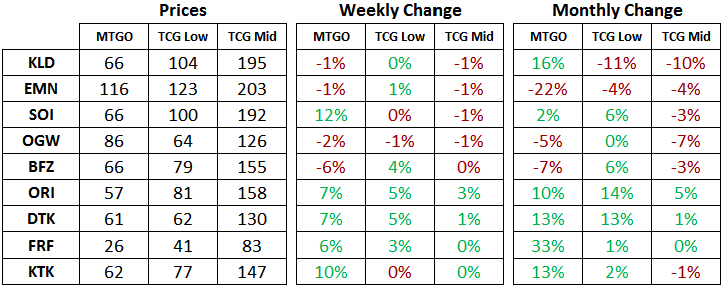
As opposed to Modern, in Frontier cards are plentiful and prices are low. The currently legal sets are pretty recent. Khans of Tarkir has been opened exponentially more than early Modern sets like 8th Edition, 9th Edition, or even later sets like Shadowmoor. 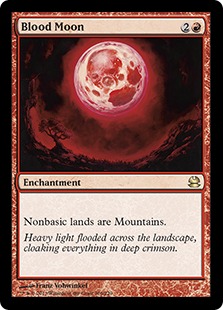 In addition to a smaller card pool that necessitates fewer purchases, there are no Inkmoth Nexus's, Blood Moons, or Tarmogoyfs ratcheting up the cost of any individual deck. Jace, Vryn's Prodigy might be an asterisk to this claim, but for now it's the only card most people would consider "expensive."
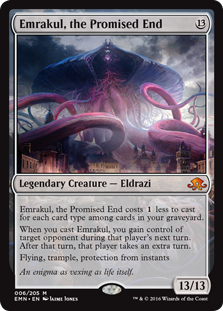
On the competitive front, Frontier is supposed to offer an experience that's more dynamic and interesting than Standard, but still more forgiving than Modern or Legacy. The perception of Standard right now (whether right or wrong) is that strategies using Smuggler's Copter and Emrakul, The Promised End are crowding out everything else. Modern, for its part, is in the midst of one of the most linear metagames in its history, to the chagrin of those who feel the format is little more than ships passing in the night. Frontier is supposed to be the happy middle ground between these two environments.
But possibly the most endearing aspect of the format (at least to my eye) is that it's totally and completely unsolved. Uncharted territory like this is ripe ground for deckbuilders and brewers. In some ways it feels similar to the origins of Modern, when nobody knew what would be good and the sky was the limit.
Disadvantages
Frontier isn't without its issues, of course. As an unsupported format, there are no large tournament series available to test your skill. An undefined metagame can turn off players who prefer to take their decks from articles or Top 8 finishes. And the small card pool creates some problems of its own. Many of the best decks right now are ones from recent Standard past that players were all to happy to see rotate: Siege Rhino, Rally the Ancestors, Collected Company, etc. 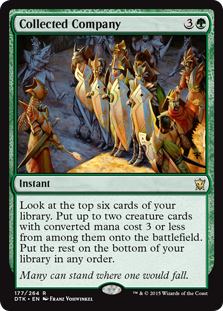 The mana is also pretty miserable—there are no full ten-card cycles of any dual, which leads to some unfortunate deck-building restrictions.
There's also the question of cost. Despite the fact that it's cheap right now, these sets comprise the most expensive Standard format from recent memory. Many people complained about the fact that 12-fetch mana bases were unwieldy and extremely expensive. This is history that can easily become a reality again if the right situation presents itself and Frontier gains popularity too quickly.
Ultimately, a lot of the support that stores have for the format right now is because it's causing players to buy cards that were previously difficult for them to sell. I'm sure that the number of Siege Rhinos and Mantis Riders sold in the last month far exceeds the number sold since they rotated. Given all these things, it's an open question whether Frontier will gain in popularity or peter out like other player-made formats that fell by the wayside.
Magic Formats in Competition
You may be asking what all this has to do with Modern. I have a theory about Magic formats which I believe can shed some light on what's happening. Basically, the popularity of Magic formats is a zero-sum game—when one rises, another has to take a hit. Allow me to explain.
 Every Magic player has a certain amount of time to devote to any and all of their various hobbies. For all intents and purposes, the total amount of free time doesn't change, nor does that portion devoted to Magic specifically. Magic is a very time-consuming hobby which often leads to almost all of one's time devoted to playing the game. Building a deck, playing in tournaments, and even sleeving your cards can eat into your free time. It's very difficult for most players to increase the amount of time they're currently spending on the game.
If we assume the amount of time that a player spends on a week on Magic is constant, then each format will compete for their time. I don't know about you, but even during periods of increased play I often find myself devoted to one format due to the preparation time required. If I'm trying to solve a Limited format it will eat into brewing time in Standard. If I'm trying to test my Modern deck against the gauntlet to hone my sideboard, I'm less likely to have time for casual Commander games. And so on.
It appears that Modern has begun to take the lion's share of most players' time. It's a format that never rotates and has recently become fairly easy to get into. Card availability isn't usually a problem and deck prices have been slipping in the last few years due to Masters sets. What this ended up doing was pulling people away from Standard and Legacy, and toward Modern as their Constructed format of choice. It was really a perfect storm. Modern has most of the longevity of Legacy without the price tag. 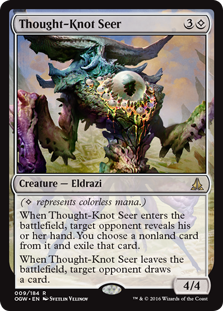 The introduction of the fairly inexpensive Eldrazi and Dredge decks, as well as a pretty unsavory Standard format, pushed Modern to the top.
I don't think that Frontier is a bad format or that it will kill Modern or anything like that. What I do believe is that too many formats existing at the same time makes it harder to find someone to play your format of choice. Not everyone has a deck for every format, and the more formats out there, the more likely they are to have a gap. Even right now, if you go to your LGS there is no guarantee the people there will want to play your favorite format. While unlikely, it's even possible that 14 players or so show up to a store to play Magic and still can't fire a tournament.
So in short, I think pushing a new eternal format like Frontier is not in Wizards of the Coast's best interest, and probably wouldn't end well for players that enjoy Modern. I'm not advocating that you should support one format over another or convince people it's not worth playing Frontier. I just want to let you know what the past data shows. Realistically, only a finite number of formats can exist with competitive support. We should choose carefully.
Thinking of the Future
A large amount of what happens next depends on if and when people start holding larger tournaments for Frontier. Even if card prices start to rise due to player interest or speculation (the latter which I would advise against), they won't hold their new prices unless there's a thriving tournament scene to aspire to. While it's very difficult to gauge how much interest there is in a format when Magic is traditionally at its lowest point of the year, there are certainly a lot of people talking about Frontier. It's simply too early to tell if this is the second coming of Commander or another flash in the pan like Tiny Leaders. 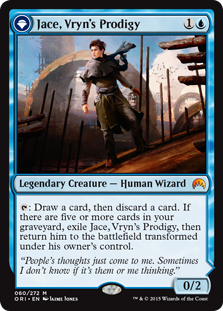 At this point I just want to see if Wizards of the Coast decides to entertain the idea of hosting it on Magic Online. That requires the least amount of resources and could give us the biggest glimpse into what that format can actually do.
Financially, I wouldn't advise doing anything rash. As I alluded to just above, I don't think Frontier staples are a great speculation vehicle since the future of the format is so uncertain. Buying cards now could save you a few bucks, but the needle has already started to move and there isn't enough data to suggest this is a good time to buy. Of course, hindsight will always be best and this might be the time to buy but I think the risk is too high.
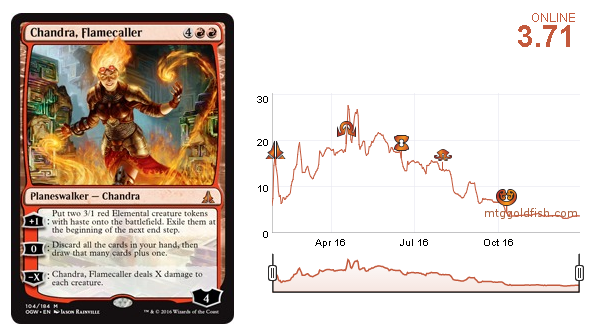
The one set of cards that I would advise considering are Modern cards that seem to be picking up steam in Frontier. If you don't have your playset of Tasigur, the Golden Fang, Jace, Vryn's Prodigy, or Collected Company, now might be the best time to pull the trigger. Especially if you're looking to add to your Modern collection before Modern Masters 2017, these cards are in no danger of reprint compared to stuff like Snapcaster or Tarmogoyf.
On Modern Financial Deck Techs
One last note before I close today. I'm overwhelmed by the positive feedback I got from my last article. I'm glad to hear that the Modern Financial Deck Tech was something people wanted to read, but I want to clarify one thing: nothing is foolproof. When dealing with financial predictions you have to tread very carefully. It's incredibly hard to predict reprints and the only information we have to influence our decision is past data. As such, not every card mirrors exactly whatever card we try to compare it to, and our educated guesses can easily prove wrong. This risk is pretty significant in Modern, since nothing's on the Reserved List—cards basically can't remain insanely expensive forever.
That said, critically examining the financial outlook will generally prepare us better to make these decisions. So you can look forward to more Financial Deck Techs in the near future. I'd like to write one per month—the next one I'm planning will be on Infect.
How do you feel about Frontier? Are you excited to get brewing in the "new Modern" and see what it's all about, or are you standing by the old guard? Let me know in the comments and I'll see you next week.
 At a glance, this metagame doesn't look so bad. No one deck takes up 10% or more of the metagame, and there seems to be a healthy spread of archetypes present. Infect is the clear top dog, and Jund comes right behind it, boasting one of the best Infect matches in the format. Up next are Dredge and Tron, softies to Infect that crush fair strategies like BGx. Burn takes last place, joining Infect as a linear aggressive strategy that has no problem dismantling the attrition breakers. We're met with a classic rock-paper-scissors scenario: linear aggro beats Dredge and Tron, those decks beat BGx Midrange, and BGx beats linear aggro.
 One of Modern's fundamental problems (or quirks, depending on your standpoint) is its lack of generic answers. Without Force of Will and other efficient Counterspell effects, tremendous strain is placed on sideboards to address the many powerful strategies employed in Modern. When players need to beat a lot of unique decks, though, they run out of space in their sideboards quickly.
 Neither of those creatures cares too much about graveyards, either, giving BGx yet another leg up on its interactive would-be-colleagues: with all the Dredge running around, Rest in Peace, Relic of Progenitus, and Leyline of the Void have become common hosers. The huge chunk of lower-tier Modern decks that relied on the graveyard (Storm, Chord, CoCo, Grishoalbrand, Monkey Grow, etc.) have lost even more ground—if you're going to lose to grave hate, you might as well play the best loses-to-grave-hate deck in the format.
 As for finding relevant things, that would be the point of the unban. We want slower, interactive strategies to get a boost in Modern, and to be able to draw their interaction without mulling to four only to get blown out by a Nature's Claim.
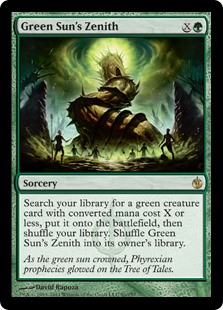 Green Sun's Zenith: Synergy-based toolbox decks are deader than ever right now, but Zenith would undoubtedly make an appearance in every Chord/Company deck going forward. Either way, I don't think it homogenizes deckbuilding the way it used to. Modern's top decks are extremely strong and have all carved out their niche. I doubt many of them would play Green Sun's Zenith.
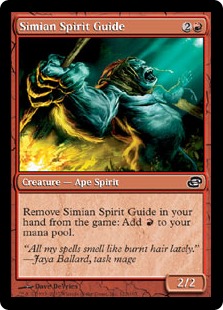 Like Dredge, Infect doesn't currently fit into any of Wizards' five bannable categories. Arguing for a Become Immense ban at this point seems silly to me, since this card is clearly not responsible for Modern's strife. A hit to Dredge would equally hurt Infect and other pump-based aggro-combo decks, which would suffer both from the loss of a popular, favorable matchup and the loss of a deck that polices its own policeman.
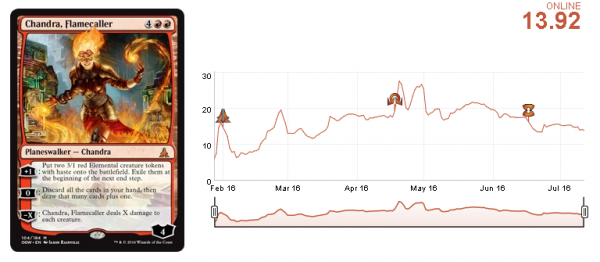


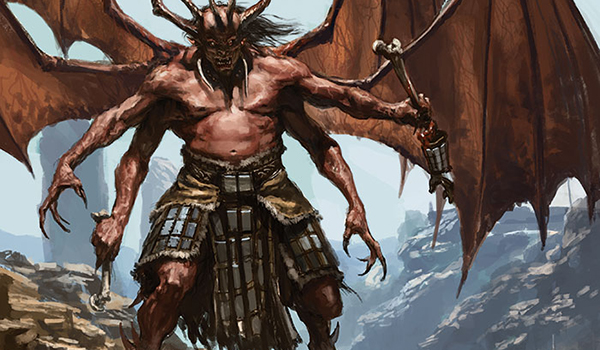
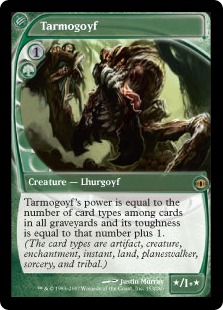 In my opinion, the major issue with Mardu has been the lack of a solid two-drop to put pressure on the opponent. Mardu’s strengths in discard and removal tend to push it to play a reactive game similar to Jund Midrange, but without Tarmogoyf to bring things together the deck can feel like spinning tires some of the time. We still have the issue of drawing the wrong half of our deck against opponents who refuse to play along by casting creatures for us to Murder, and we can often find ourselves scrambling to put a gameplan together against all the various strategies present in Modern.
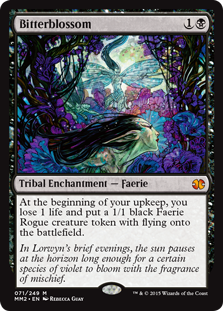 That answer is complicated, but in my opinion, it starts at the top, with the most popular decks. Infect, Jund, Tron, Dredge: all of these strategies present a cohesive angle of attack that Mardu is uniquely able to handle. That hateful sideboard of 3 Rest in Peace, 3 Stony Silence, and 3 Blood Moon is no accident. This is a deck built to attack the top of the tree, while still retaining the ability to just play Magic against the rest of the field. This Mardu list is built on the premise that, regardless of what the opponent is doing, Lingering Souls and Thoughtseize are probably good against it.
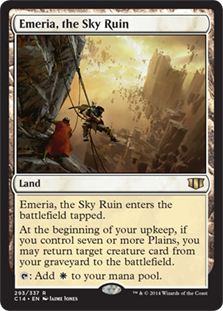 Again, I point you to the top decks in Modern currently. Amulet Bloom is gone, as is Splinter Twin, and the field has become much more linear and easy to attack. UW Sun Titan Control possesses a latent strength against most aggressive and midrange decks in the field (provided it doesn’t kill itself with a slow draw) leaving its power wholly to the question of which combo decks are seeing play currently. Right now, that’s Dredge and Tron, followed distantly by Death's Shadow Zoo and Ad Nauseam. 4 Ghost Quarter slows down Tron long enough for Surgical Extraction to come around, and should they assemble the combo, Detention Sphere can take care of pretty much anything. Dredge has to fight through Detention Sphere and Surgical Extraction as well, along with Supreme Verdict and the appropriately sized Wall of Omens. Given my time playing UW Spell Queller Blink, I can say from experience that a simple Wall of Omens is a surprisingly excellent card against Dredge’s primary angle of attack.
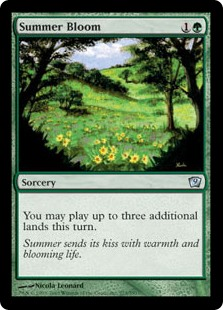 With Summer Bloom gone, the archetype really only took a step back. In a world of Splinter Twin, one turn was often the difference between a win and a crushing loss, but Twin left when Bloom got the axe—so why haven’t we seen Amulet Bloom until now? The answer is, we have—but only here and there, cashing a League event probably once a week. Most of the work on this archetype has been done by three players, which suggests to me either that they’re onto something, or that they’re holding on to the last embers of their dying hopes and dreams, and would do better to give it up and move on.
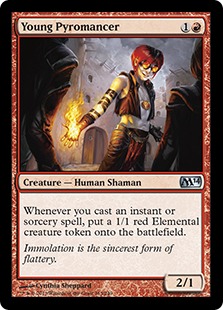 It breaks my heart that Kevin Jones has tricked so many players into sleeving up Young Pyromancer. Technically it provides some percentage points against Lingering Souls and isn't stone-terrible against Eldrazi decks. But for the most part the card is inefficient, and moving away from it has been the biggest upgrade to Modern Delver strategies outside of cards that have since been banned. Young Pyromancer does offer the deck more punch, which enables you to play the deck more aggressively, but in all of my experience being more aggressive and less disruptive just ends up diluting the deck. Post-sideboard I am always looking for the way to be the control deck in a given matchup, and adding Pyromancer and Gitaxian Probe ultimately eats up slots that I use for interactive spells. It's a different school of thought, and I will grant that play style matters when making these considerations, but I believe that when I personally register Pyromancers I am doing myself a disservice.
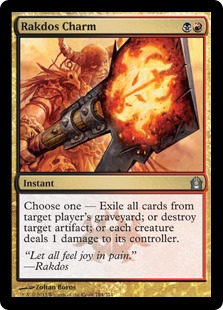 He even has a Rakdos Charm as supplementary hate, and Izzet Staticaster to deal with Narcomoebas and Bloodghasts. Brad went 0-2 against Dredge in this tournament, even though he was clearly gunning for the archetype with extremely narrow sideboard cards. The hate cards selected here get around Nature's Claim, though none of them automatically win, and all of them are vulnerable to Thoughtseize. Brad really did all that he reasonably could have to combat Dredge—arguably, going overboard with excessive slots—and still got crushed.
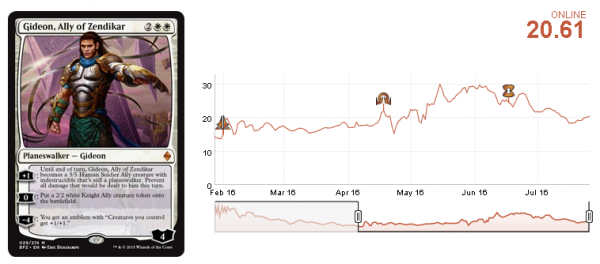
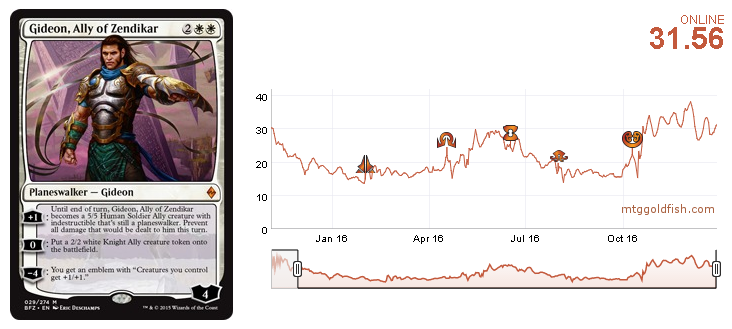
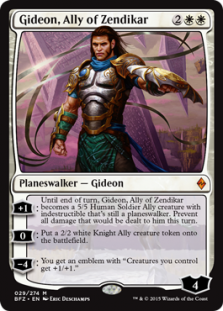 Given that Jeskai has no access to delve threats or Kolaghan's Command, Thought Scour simply doesn't cut the mustard, and I'm way happier jamming Gideons than Young Pyromancers, as Gideon requires far more resources to answer and far fewer to take over games with. Playing Lightning Helix always made the deck feel like a weak Burn deck to me. This slot is better served by Electrolyze, which still allows you to close with burn but can also play a solid value game. It has the side benefit of being strong against Lingering Souls, and kind of nuts in any Delver mirror.
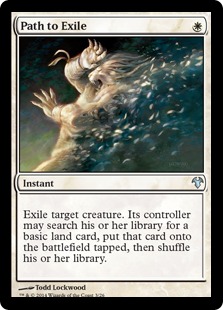 Some of the more established tactics in this vein include Jund shifting to Abzan when Lingering Souls (or Rest in Peace) is strong, or Tron switching out their Lightning Bolts for Path to Exiles to combat the onslaught of linear aggressive decks. Much more could be written about this strategy in general—when it's appropriate, how to determine what to shift to, which archetypes are better suited to it, etc. Perhaps this is a subject we can explore further in subsequent articles.