menu

They’re Coming! SCG Syracuse Analysis

Are you a Quiet Speculation member?

If not, now is a perfect time to join up! Our powerful tools, breaking-news analysis, and exclusive Discord channel will make sure you stay up to date and ahead of the curve.

Good news, PPTQ grinders! We have data for you. As if the monthly metagame update wasn't enough for you, this week we have the SCG Syracuse Open to look at, and Jordan will be talking about his PPTQ experience later in the week. Here's to making informed decisions based on actual data!
Grave-Troll-Banner-cropped

Dredge won the event, and given the Top 32 decklists I'm not surprised. I had a feeling that Dredge was favored going into Syracuse, and as soon as the Top 8 decks were revealed I became certain that it was. Once the decklists were posted I knew that Dredge would have to fall apart not to take first. I warned everyone back in May to be ready and not lose to Dredge, but the Syracuse field was not prepared well enough to stop Ross Merriam. Most of the decks relied on a couple Relic of Progenitus's or Grafdigger's Cages to fight the recursive menace and that just isn't good enough. Doing something powerful and explosive yourself is a viable strategy as Nicolas D'ambrose showed in the quarterfinals, but everyone else needs to dedicate the slots or Dredge will just get there. Prepare.

[wp_ad_camp_1]

The Data

Let's get the boilerplate disclaimer out of the way: I am unpacking a single data point of the wider metagame data. The conclusions I reach can be extrapolated to the wider metagame only weakly as a result. That said, it is useful to investigate whether this point models the wider metagame and to use it track shifts and transitions.

Day 2 Metagame

We have a lot of information to go through, but not as much as I would like. Star City lists the decks of the Day 2 metagame but not the total from Day 1. Thus we cannot evaluate the Day 2 conversion rate, which is a very strong indicator of actual deck strength. It would also have provided a large enough sample size for me to do some hard statistical analysis. As is I will have to rely on some basic stats and a lot of qualitative analysis.

Deck Name# Present% of Field
Jund913.8
Jeskai Control710.8
Dredge57.7
Abzan Company46.1
Bant Eldrazi46.1
Burn34.6
Infect23.1
GR Tron23.1
Merfolk23.1
RG Valakut23.1
RG Breach23.1
Grixis Delver23.1
UW Control23.1
Affinity11.5
Death's Shadow11.5
Grixis Control11.5
Kiki-Chord11.5
GR Ponza11.5
Jeskai Geist11.5
Temur Control11.5
BG Infect11.5
Bogles11.5
Abzan11.5
GW Hatebears11.5
Bant Retreat11.5
Jeskai Ascendancy11.5
Bant Spirits11.5
Mardu Control11.5
Mono-Blue Tron11.5
UR Prison11.5
4C Humans1
1.5
Bant Company11.5

Well, that is quite the list. It appears to be quite the diverse metagame, with 65 players and 32 different decks. It's much healthier than it was earlier in the year, that much is certain. While hard to evaluate in a vacuum, we can compare these decks to known data and then use that as a basis to compare a smaller subset of data.
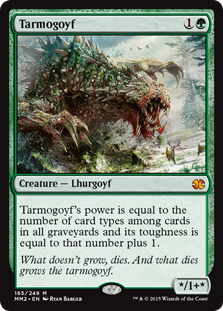
TarmogoyfThe first place I'd start is with a comparison to the Top Decks rankings. Jund is on top of both, which I'm never certain represents the strength of the deck or the experience of the pilots. Jund is always a solid choice but it has also been around forever. Modern rewards experience and mastery more than metagaming your deck choice so I always expect long-time Jund pilots to do well, regardless of the wider metagame.

Beyond that the next interesting point is that the top five decks all outperformed their rankings, in Jeskai's case by more than double. Again, barring the Day 1 metagame list, I cannot definitively say whether this was a function of the total population or actual deck strength. That said, it looks like the SCG Tour elite think that you either want to be grinding value for your wins (Jeskai and Jund) or trying to do something unfair (Dredge, Abzan Company's infinite life combo, arguably Bant Eldrazi). This leads me to think these play styles are what you should prioritize preparing against.

The rest of the field underperformed relative to their Top Decks statistics. Burn sits 0.9 percentage points below expectations and only one Affinity deck made the cut, a measly 1.5% compared to its 4.7% overall metagame share. Burn can be excused due to the influx of Abzan Company, but Affinity is an anomaly. Looking through the available decklists there isn't an abnormal amount of hate present. From this I would speculate that Affinity was underrepresented in Syracuse, especially given that the pilot, Odin Enzmann, got 14th.

Top 16

PlaceDeck
1Dredge
2GR Breach
3Jund
4Infect
5UW Control
6Dredge
7Jund
8Jund
9Jund
10GW Hatebears
11Temur Control
12Dredge
13Burn
14Affinity
15Jund
16Mono-Blue Tron

Alright, this is something to really dig into. There is clear deviation from what we see in the Day 2 results in terms of decks represented. This is where we get the clearest picture of the actual strength of these decks at Syracuse.

The first thing to note is Jund. Out of nine players piloting Jund on Day 2, five were represented in the Top 16. That's a full 55% of Jund pilots who converted to a Top 16 finish, and there's another copy that appears in the Top 32. That is a statement, and something to discuss further.
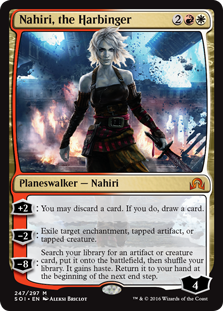
1_nahiriThere are no Jeskai Control decks present. It has gone from 10.8% to 0% population. The highest Jeskai finish was Jim Davis at 25th. This is another important result to investigate.

Dredge won the event and put three pilots into the Top 16, a 60% conversion rate. These points are also worth dissecting.

I'm not sure that I can draw any meaningful conclusions from the remaining non-Affinity finishes. Yes, they do boast impressive conversion rates. 100% of Temur Control and Mono-Blue Tron players made Top 16 (just). However, I'm inclined to believe that such results speak more about the pilot's skill than the power of the deck. We're not seeing these decks have wider metagame success (they're not even Tier 3 currently), so if you bring such a deck to an Open or GP, I'm inclined to think you've mastered the deck. As such these results are unique to the pilots.

As I mentioned above, the only Affinity player to Day 2 did make Top 16. In Affinity's case, which has a much stronger pedigree over the history of Modern, I'm more inclined to conclude from this finish that it's well positioned. Certainly pilot skill could still be at work here, but the drastically low number of Day 2 Affinity decks just looks odd considering it has been posting consistent Tier 1 results. This leads me to believe Affinity was underrepresented even though the format wasn't that hostile to it. The deck is hard to pilot and it's entirely possible that leading up to Syracuse the perception was that the format would be hostile, and Affinity players understandably lost their nerve. Don't read into the result, keep sideboarding artifact hate!

Finally, Burn is Burn, and given the field I'm shocked that Thomas Watson did as well as he did. There were a lot of bad matchups represented in the Day 2 decks so his result is more a reminder to respect Burn than it is a statement on its place in the metagame.

What Does it Mean?

Numbers are all well and good but unless we dig into them they don't tell us anything. I'm going to discuss my interpretations of these results beginning with the lowest and moving up to the winner.

Jeskai Bombs Out

The fact that Jeskai had the second highest representation on Day 2 yet didn't place in the Top 16 is shocking, especially considering its fifth-place position in Tier 1. So why did this happen, and what does it mean? While I can't say for certain what happened, I can hypothesize given what I know about the deck.
Emrakul the Aeons Torn

One explanation is variance. Jeskai Control relies on grinding out one-for-one trades and pulling ahead with Snapcaster Mage and sometimes Ancestral Vision. If Jeskai doesn't draw sufficient answers or its answers are not the correct ones for the matchup at hand it will lose. There are a wide variety of decks that attack from a number of angles in the Day 2 data, so it is conceivable that the decks fell when they hit bad matchups or drew poorly.

This might have contributed to the problem, but it isn't the full solution. Variance might be the explanation for a few results but all of them? No.
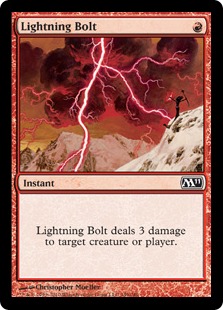
Lightning BoltPersonally, I blame deck design. Jeskai decks have been increasingly focused on becoming glorified Burn decks with Snapcaster Mage and are skimping on their sweepers. That's fine against Jund but not against the metagame. Look back at the Day 2 shares for Abzan Company and Dredge. Anger of the Gods is Jeskai's best game one answer to those decks and Davis played none in his maindeck. Michael Hartman played one. Add in a lack of Supreme Verdict for Bant Eldrazi and I think that the Jeskai decks fell to their overreliance on Lightning Bolt. When your removal cannot keep up with their board development or doesn't actually remove creatures, you're sunk without sweepers.

Worse, against Dredge one-for-ones just don't work because the creatures come back. The current Jeskai builds assume that if you Bolt something once, it will stay dead. Dredge specializes in bringing creatures back from the dead. You need to Anger them away for good. Davis did pack two Angers alongside a pair of Rest in Peaces in his sideboard, and that might explain his comparatively high finish.

The lesson I take from Jeskai's disappointing finish is that they should stop relying on one-for-ones to the exclusion of all else and build some forgiveness back into their lists.

Jund, Jund Everywhere

Putting 55.5% of their pilots in the Top 16 and 66.67% in the Top 32, Jund was clearly very successful in Syracuse. I'm loathe to read too much into this because Jund players will stick to their deck rain or shine and that mastery will carry them even when their deck isn't favored on paper. This is a lesson in and of itself on the value of practice. However, when we look at what happened in the Top 8 there are some interesting things to note.
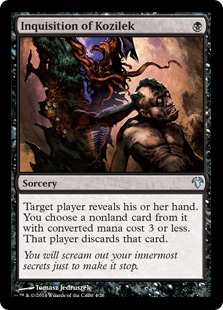
Inquisition of KozilekDiscounting the Jund v. Jund quarterfinal, the Jund decks fell to the most unfair deck on their side of the bracket. Chris Andersen fell to Matthew Voltz on RG Valakut and Andrew Boswell lost to Ross Merriam. Jund really doesn't have the tools to fight RG Valakut decks compared to the RUG versions, and the decks weren't well prepared to deal with Dredge. The one-for-ones again don't work and Scavenging Ooze is too slow and easy to overwhelm to be truly effective. The only Jund deck that looks really ready for Dredge is Ryan Hare's 15th place deck with four Leyline of the Void. I'm not actually a huge fan of Leylines, as they're only great in your opening hand, and I would prefer a hate card that I can draw into. Still, good on him for recognizing the threat.

I think the lesson here is that Jund is Jund. It out-fairs most fair decks but struggles against unfair decks unless it really takes the time to beat them. It certainly can beat any deck and masters can find a way to do it, but when Jund doesn't get to play its game or that game isn't the right one then they're sunk.

Dredging Up the Past

The real boogeyman of Extended seasons past has returned with a vengeance. In Extended, the old combo-centric version was always a threat but it was beatable as long as you dedicated the sideboard spaces to doing so. It was when you got complacent that it returned. A similar dynamic took place in Legacy over several years.
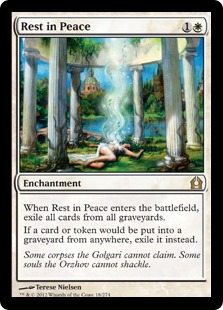
rest in peaceI think we're seeing this dynamic again at play in Modern. There is not a lot of dedicated graveyard hate in the Top 32, much less the Top 16. Despite the warnings from MTGO results, players either underestimated Dredge or overestimated their ability to fight it. Unless you have a very powerful or fast clock that can ignore Dredge's board, you need hate to win. Simple as that.

What do I mean about fast clocks? Think Infect, which intends to kill before Dredge can develop (when things go better than they did for D'ambrose). Or Affinity, which can go all-in on an unblocked creature to win. Just because you can get there doesn't mean that it's a viable plan. Merfolk can win without hate when Dredge has a slow start and you islandwalk past blockers, but that doesn't happen enough to be a viable plan A. If your plan A is a blitz-like and unfair kill, then you're fine. Otherwise, pack answers.

And I do mean hard answers. As our financier notes today, Grafdigger's Cage is a pretty soft answer. I get the appeal: it hurts a lot of decks. Combining limited graveyard hate with shutting down Chord of Calling and Collected Company is very powerful. I understand. If it weren't for Dredge the Cage would definitely be the correct card to run in that hate slot Golgari Grave-Trollprecisely because of its versatility. However, Dredge requires hate that actually empties their graveyard.
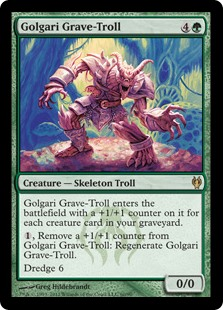
Why? Players underestimate Dredge's ability to switch gears and play something similar to fair Magic. Once you shut down Narcomoeba and Prized Amalgam with Cage, they can still keep dredging back Golgari Grave-Troll, playing it and beating face like Rosewater intended. Rather than the broken engine they can use dredgers to simply grind players out and make gigantic threats. They can also do as Merriam did and use Bridge from Below and Greater Gargadon to go ridiculously wide. As long as Dredge has access to its full graveyard, they are dangerous. Cage buys you time, but unless you're Affinity-fast it won't be enough.

Why Dredge Won

The only deck that has a naturally decent matchup against Dredge in the Top 8 is Infect. This was proven in the quarterfinals. Jund and UW Control don't have a fast enough clock or a powerful way to go over Dredge to consistently win. Fair deck like them are natural prey for Dredge. Scooze from Jund might work if Dredge is very slow, but they have so many cards that are important to remove that it doesn't do enough in the early game to actually protect you from Dredge. This left Infect and RG Valakut to stop Dredge.

In fairness to D'ambrose, his draws weren't that great against Merriam. I don't know what was actually in his hand, but based on what was played I'm not sure he would have beaten any deck. As for Voltz, it is instructive that the game he won was because he got to do his powerful thing and completely ignore Dredge. He could have won more quickly if it weren't for Collective Brutality, but the point remains that when he got to build his mana and play Prime Time, Dredge was powerless to stop him. When he tried, or was forced, to go more slowly and interact (while lacking powerful graveyard hate) he lost.

What Now?

Hopefully Syracuse was a wake-up call and players start packing their Rest in Peaces, Tormod's Crypts, and Relic of Progenitus's in sufficient quantity to keep Dredge down. Recognize that its strength and adaptability are sufficient enough that weaker hate isn't enough. Have a plan, have the hate.

Beyond that, practice and test your matchups and build some forgiveness into your deck if you can. Having ways to come back from a bad start is no bad thing.

Next week will most likely be an IQ report where I am not playing Merfolk (going to salvage something of my intended PPTQ grinder series, dammit). See you in the comments and next week!
Insider: Top Ten Battle for Zendikar Gems

Are you a Quiet Speculation member?

If not, now is a perfect time to join up! Our powerful tools, breaking-news analysis, and exclusive Discord channel will make sure you stay up to date and ahead of the curve.

When last we last left Zendikar, the Eldrazi had just gone all Rome on Carthage, and then Chandra went all Jean Grey Phoenix on D'Bari. Ka-boom! Let's just say that Zendikar became less of a destination and more of a smoldering dumpster fire.

The downside is that the entire plane was left in complete and utter desolation. The upside is that travel and vacation rates are very affordably priced! With the world becoming abuzz about Kaladesh it is the perfect time to hone in and revisit everybody's favorite decimated world.

A few things to keep in mind before we go back to Zendikar. First, don't drink the water. Ulamog's Revenge. I don't want to get too specific but it isn't pleasant. Second, Battle for Zendikar block (and particularly BFZ itself) were sets with singles that were suppressed by the value of the premium Expedition lands. As a result, the actual cards have been cheaper than they might otherwise have been because the Expeditions drove the prices down.

It's over a year later now, and the demand and hype surrounding the Expediations has faded while people are no longer clamoring to crack packs of BFZ. People have moved on and forgotten about poor, lonesome Zendikar.

The article I set out to write this evening was about Standard cards that I thought had significant potential upside as a financial investment as we move toward Kaladesh. Once I had narrowed it down it turned out that every single one at the top of my list was Zendikari.

10. Sire of Stagnation

There was an error retrieving a chart for Sire of Stagnation

To say that the demand for Sire of Stagnation had stagnated would be a play on words...

I actually thought the card was on the edge of constructed-playable when the set first came out and designed a deck around it for a CFB article. With that being said, I don't think it is outside the realm of possibility that the card has a shot at seeing constructed play in new Standard when the Collected Company oppressors rotate.

If the stars were to align and Sire of Stagnation were to find some fringe playability it would certainly help the price of the card. However, I think that the real value this card may have hidden away has very little to do with its constructed appeal. If it sees some Standard play that would be great but even if it doesn't I still think the card has long-term potential.

As far as big dumb creatures go this one is pretty grand. It also doesn't hurt in the flavor department due to its creature type of Eldrazi. The card is good in Commander. Have you ever cast a Collective Voyage with this guy in play? Wowie. If you haven't tried it, I highly recommend it.

9. Quarantine Field

There was an error retrieving a chart for Quarantine Field

Q-Field is a card that I think has value attached to whether or not it ends up being good in Standard post-rotation. It is a card that I have played in Standard more than most people and have been overwhelmingly impressed by.

As an investment, I love the combination of a card I know is great and a dirt-cheap buy-in. This is about as cheap as a playable mythic can be.

It is one of those cards that can't really go down in value too much but could easily make significant gains if the format is right for it. Low risk, high reward.

8. Wasteland Strangler

There was an error retrieving a chart for Wasteland Strangler

Strangler is a good card. I've played it in B/W Eldrazi and Taxes decks in multiple Modern tournaments. Not only did the card pull its weight but it was actively impressive in my deck.

The card is teetering dangerously close to the bulk rare range and is Modern-playable. How does that work exactly?

It also cannot possibly hurt that the card has the Eldrazi creature type. I don't mean to bombard you with the repeated mantra of, "...and it's an Eldrazi too," but I do think it is important. Eldrazi are the new Slivers, and the kitchen table crowd will want these for years to come.

7. World Breaker

There was an error retrieving a chart for World Breaker

It breaks the world---if that doesn't get you excited I don't know what will.

I've seen this card played across a wide array of formats. Good in Standard. Good in Modern. Good in Commander. I've even seen it played in Legacy to some success.

I'm not even going to mention that it is an Eldrazi. Damn. Well, it is.

The card is very unique as a recurrable, uncounterable Disenchant effect attached to a giant creature with great stats. I mean, who wouldn't want to play with that card in basically every Commander deck ever for the rest of time? It's also a mythic which means it can maintain a little higher price tag.

Also, did I mention it's an Eldrazi?

6. Lumbering Falls

There was an error retrieving a chart for Lumbering Falls

The Origins painlands are going to rotate with Kaladesh which means no enemy-colored dual lands besides the tapped lands and this cycle of creature lands. It also doesn't hurt that the creature lands are very, very good cards in Standard.

The thing I like most about the BFZ creature lands is that the price tag is dirt cheap.

I also enjoy the fact that Lumbering Falls is in the color of Sylvan Advocate. It doesn't even matter to me that Collected Company is rotating because I'm certain that Advocate will be good on its own merits. I also think this card has fringe Modern applications.

5. Corrupted Crossroads

There was an error retrieving a chart for Corrupted Crossroads

Speaking of "the Origins lands are rotating with Kaladesh..."

It seems pretty significant to me that all five of the best sources of colorless and colored mana, aka painlands, are rotating and leaving a big void for decks that want to cast devoid Eldrazi spells. There is a pretty good chance that if there ends up being an Eldrazi deck this card could see some play.

I'm also not prepared to completely disregard the idea that there are more devoid spells with colored mana costs coming down the line. Corrupted Crossroads is a unique card and there is always potential for that.

4. Stone Haven Outfitter

There was an error retrieving a chart for Stone Haven Outfitter

Kaladesh is full of artifacts. Maybe some of them will be equipment...

I've played a lot with Stone Haven Outfitter and the card is off-the-charts powerful but just hasn't had the right supporting cast to go with it. If the stars are right in Kaladesh I could see this bargain-bin favorite making some serious gains in the future.

It is also worth noting that this card will always have a home in equipment-based casual and Commander decks.

3. Shambling Vent

There was an error retrieving a chart for Shambling Vent

It may not be in the color of Sylvan Advocate but that doesn't mean I can't play it in an Abzan deck! We're also likely to see a B/W Standard deck post-rotation.

All things considered I think that Shambling Vent is the best of the BFZ block creature lands by a wide margin. The card is easily good enough to be a Modern mainstay in Abzan midrange decks and B/W Tokens from now until the end of time.

The price is cheap enough right now and I find it hard to imagine it could go much lower. On the other hand, its continued playability in Modern after rotation all but ensures higher upside.

2. Void Winnower

There was an error retrieving a chart for Void Winnower

The only card on this list that I've actually happily sleeved up and played in Vintage. Void Winnower has proven pretty savage to Oath up against Workshop decks. Turns out they don't have a lot of odd-cost cards.

Nevertheless, I think the card also has a lot of potential as a reanimation target in other formats like Legacy or Modern. It could even find a home in UrzaTron sideboards at some point.

The effect is sufficiently powerful and unique that I think it will be a casual and constructed niche card long after it has outlived its time in Standard.

Oh, and did I mention it's an Eldrazi!!!

1. Painful Truths

There was an error retrieving a chart for Painful Truths

I may be a little bit of a homer on this card considering I'm actually on a podcast called "Painful Truths." (If you get a chance check it out.)

It's worth noting that I wouldn't consent to being on a podcast named after a card that sucks...

I could see Painful Truths getting better in Standard if the mana is good. However, I think the long-term gains for this card are more closely linked to Legacy and Modern. The card has already proven it is a player in non-Standard constructed formats and will be for a long time. If you want to draw three cards for three mana few other cards will let you do what P Truth does. It's a great efficient value card for grindy matchups.

~

Well, that wraps up my Battle for Zendikar block picks. I'm very excited for Kaladesh but it's important to keep one's eye on the prize. While there are sure to be plenty of exciting things yet to come, let's not forget to appreciate and show a little bit of love for where we've been---even if the Eldrazi did leave it a foul, barren, reeking waste.

Insider: A Strong Foundation – Spread

Are you a Quiet Speculation member?

If not, now is a perfect time to join up! Our powerful tools, breaking-news analysis, and exclusive Discord channel will make sure you stay up to date and ahead of the curve.

Welcome back, readers! Today's article continues my series on concepts that will build a strong foundation for any speculative endeavor. The previous ones can be found here:

  1. Price 
  2. Cost
  3. Value
  4. Risk

Spread

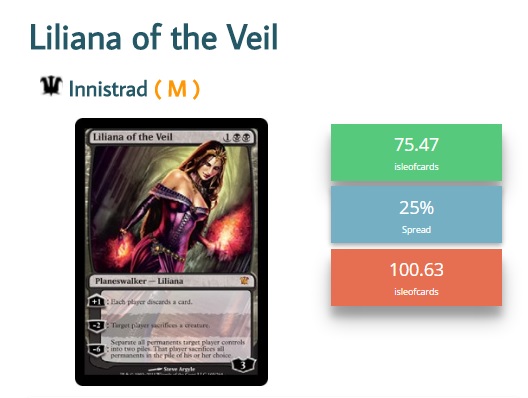
Spread is the percent difference between the sell price and buylist price. Spread is typically calculated using the following formula: (Sell Price - Buylist Price) / Sell Price. You can see it when you use QS's Trader Tools software. As shown below, the spread on Liliana of the Veil at Isle of Cards is 25%.

lotv spread

Of course, this is just one way to calculate the spread, even if it is the most prevalent. Here we're looking at the sell price from just one entity---a fuller picture can be seen looking at spreads across different sellers. Here are the numbers Trader Tools is showing right now for Liliana of the Veil:

Buyer Buy Price Sell Price Spread
Isle of Cards 75.47 100.63 25.00%
ABU Games 67.51 119.99 43.74%
Cool Stuff Inc 60 100 40.00%
Card Kingdom 60 105 42.86%
Star City Games 60 100 40.00%
Channel Fireball 60 100 40.00%
Adventureson 55 N/A N/A
Mythic MTG 50 110 54.55%

To find the absolute lowest possible spread, we could take the lowest sell price (Isle of Cards) and compare it to the highest buy price (SCG/CFB/CSI). In this case this calculation yields a spread of 24.53%.

At first glance the spread might seem like a footnote that isn't relevant to speculators. After all, why should I care what a store is going to sell the card I buylist to them for if I have no intention of rebuying it back at a loss?

The reason we care about monitoring the spread so much is that the spread represents the confidence store owners have in the card's price. This has obvious applications for future purchases and decisions about whether to sell in the first place.

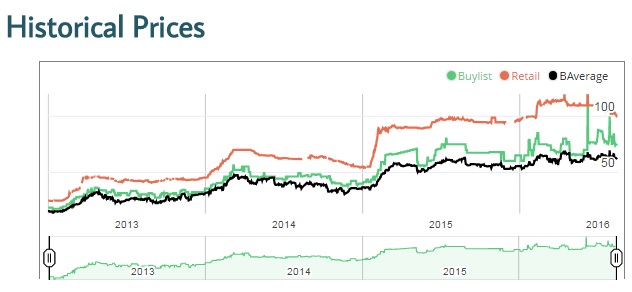
historical spread

Above is the historical price index of Liliana of the Veil (also found on Trader Tools). Now I wouldn't be surprised if a lot of people see this as just more "random data" offered by Quiet Speculation, but it's more significant than that.

If store owners are confident a card will retain its price or go up they are more likely to buy extra copies. The more confident they are that it will go up, the more copies they want to have now so they can make a higher profit later.

On the flip side if store owners think a card's price will go down they don't want to buy extra copies at a competitive price. They drop their buy price either to discourage people from selling them copies (and not tying up capital in cards they feel will lose value), or to make sure they don't buy higher than the projected near-term value. If a store thinks a $50 card will drop to $30, they want to make sure they are buying them for less than $30.

Another critical point to consider is that buylists are dependent on the competition, but not exclusively so.

On the one hand, smart store owners are going to check their competition's buylist in order to compete on pricing. If my competitor is buying Liliana of the Veil for $55 and I don't have any in stock I will likely need to offer at least $55 (if not more) to make sure I get copies as well. Otherwise all the players who shop around will just sell to my competitor. Thus my price is dependent on my competition.

However, if I don't need any copies of Liliana of the Veil, then I am free to offer whatever I want (though it's important to keep in mind how that will affect those who would sell them to me). Thus my pricing is also independent of my competition as my needs may be different than theirs.

Buylist Spread

I bring this up as a segue into the next part of the historical price graph that I want to discuss, which is the difference between buylist and buylist average. I call this the buylist spread.

This is calculated similar to the regular spread: (Store's Buylist - Buylist Average) / Store's buylist. Here are the buylist spreads for Liliana.

Buyer Buy Price Buylist Spread
Isle of Cards $75.47 19.18%
ABU Games $67.51 9.65%
Cool Stuff Inc $60.00 -1.66%
Card Kingdom $60.00 -1.66%
Starcity Games $60.00 -1.66%
Channel Fireball $60.00 -1.66%
Adventureson $55.00 -10.90%
Mythic MTG $50.00 -22.00%
Average $61.00

When the buylist spreads are close together it means all the competing stores are in agreement about a card's price vs. demand. What's interesting is when they vary by a significant amount. When this occurs I see one of two explanations.

  1. The store with the highest buylist price really needs to restock the card. Alternately they may think it's underpriced currently and want to hoard copies.
  2. The store with the highest buylist price hasn't updated their price to reflect current market trends. We see this most often when a card gets banned in a format.

While it's not always easy to figure out which one of these two possibilities is at work, the second one tends to have telltale signs. Obviously, if a card was banned recently then you want to unload it ASAP to lose as little as possible. If the card hasn't been banned or reprinted, you can review the card's performance in the metagame.

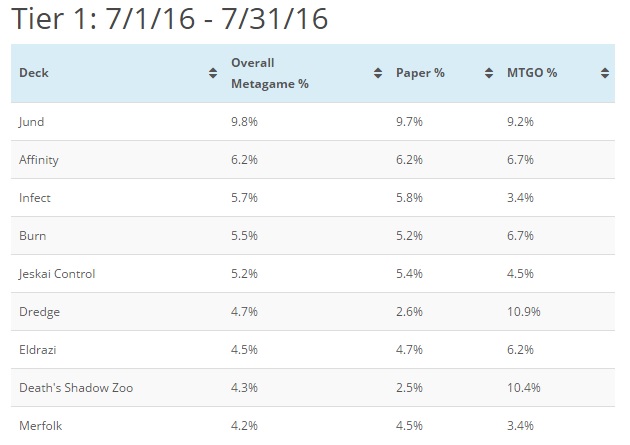
Our sister site, Modern Nexus, tracks metagame information for Modern. They recently published this metagame breakdown for the month of July.

current meta

The first thing to take away is that Jund is almost 10% of the metagame (a huge amount in Modern). This is significant for Liliana of the Veil, which is typically played as a four-of in Jund.

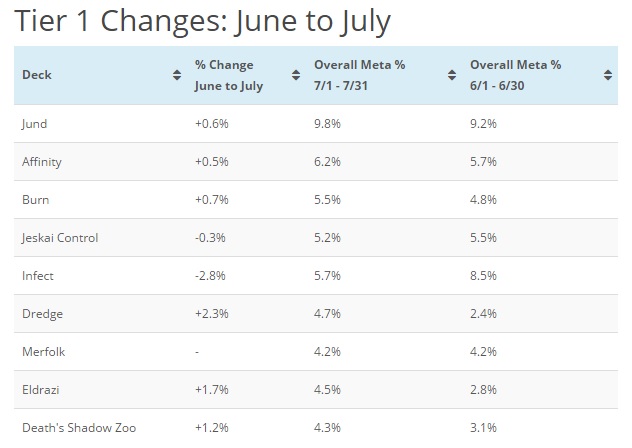
Just as important we can also see the metagame changes from June to July.

meta changes

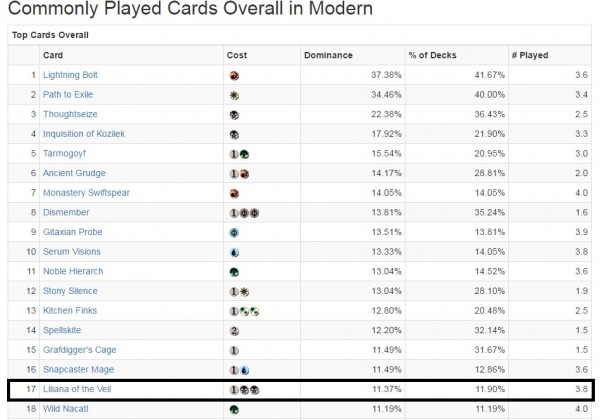
What we see is that Jund as a deck increased in the metagame by 0.6%. Granted this doesn't seem like a whole lot, but it does imply that we should see an uptick in demand for Liliana of the Veil simply because more people are playing it. She ends up at #17 on the most played cards in Modern at this time according to MTG Goldfish. (Editor's note: Since the time of writing, Liliana has jumped to the #12 spot.)

most played cards

If Jund, and Liliana as a consequence, begins to see less play in Modern, we may see her price dip. This is pretty easy to understand. What the relatively low spread indicates is that stores believe, on average, that Liliana will continue to be valuable.

Why the Digression?

In the case of Liliana, this is a simple conclusion since it's been a staple more or less since the introduction of the format. Where things get murkier is with less-proven cards or Standard staples (which on average almost always post higher spreads than eternal cards).

Monitoring spreads can help you keep track of where others see the price moving in the future---and inform when an opportunity may arise if you disagree with the common assessment.

Understanding why buylists differ is an important skill set to develop as a speculator. It can help you determine whether you really do want to buylist a card or not. Sometimes you just need the money and that's okay, but when it comes to investing (of any sorts), understanding where an investment is going, and why, is where the real money can be made. Reviewing card spreads and buylist spreads is one method to approach this.

Deck of the Week: RG Valakut

Are you a Quiet Speculation member?

If not, now is a perfect time to join up! Our powerful tools, breaking-news analysis, and exclusive Discord channel will make sure you stay up to date and ahead of the curve.

Here at Deck of the Week we've focused, mostly by design, on the no-tier dregs and the brewers' oddities. Today I wanted to highlight a deck that, having fallen from its Tier 2 showing in May, has nonetheless still been making the rounds in competitive play. The deck I'm calling RG Valakut looks to have some real chops in Modern. Over the last four SCG Opens it has put two people in Top 8 (Matthew Voltz and Daniel Hendrickson) and one more in Top 16 (Adam Liu). However, these high-profile finishes aren't really buttressed by a ton of lower-level showings, which helps explain its low tier. This deck may not be crushing handily but it's certainly not flash-in-the-pan either---I liken it more to something like Grixis Control or Elves which are frequently flirting with Tier 2 and may be awaiting the right metagame developments.

Primeval Titan-cropped

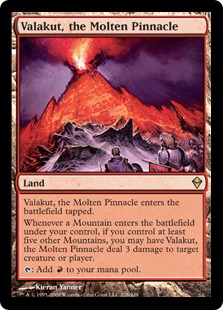
There seems to be little consensus on how to build a red-green Valakut deck, which I suspect is one of the things holding it back from the higher tiers. What these decks share in common is the pairing of Valakut, the Molten Pinnacle with Primeval Titan in their best impression of the classic Standard deck. Through the Breach typically makes an appearance as well. Where they differ is in the inclusion of Emrakul, the Aeons Torn, Summoning Trap, Oracle of Mul Daya/Courser of Kruphix, and Scapeshift.

[wp_ad_camp_1]

Here's Matthew Voltz's build that he took all the way to the finals in Syracuse this weekend.

RG Valakut, by Matthew Voltz (8th, SCG Open Syracuse)

Creatures

4 Sakura-Tribe Elder
4 Primeval Titan
2 Obstinate Baloth
1 Courser of Kruphix
3 Emrakul, the Aeons Torn

Instants

2 Lightning Bolt
2 Summoner's Pact
2 Summoning Trap
4 Through the Breach

Sorceries

2 Anger of the Gods
1 Explore
4 Farseek
4 Search for Tomorrow

Lands

2 Forest
6 Mountain
4 Bloodstained Mire
2 Cinder Glade
4 Stomping Ground
3 Valakut, the Molten Pinnacle
4 Wooded Foothills

Sideboard

2 Relic of Progenitus
1 Grim Lavamancer
2 Obstinate Baloth
2 Ancient Grudge
2 Lightning Bolt
2 Sudden Shock
1 Summoning Trap
1 Anger of the Gods
1 Crumble to Dust
1 Shatterstorm

Anyone familiar with Modern needs no introduction to the card Valakut, as its typical bedfellow Scapeshift has been a long-time Tier 2 staple of the format. Where Scapeshift tends towards the control spectrum, buying time with countermagic or accessing a toolbox via Bring to Light, the red-green versions are true combo decks. They've been reported under a myriad of different names, from Titan Shift, to Through the Breach, to Summoning Trap, to Scapeshift, but each of these builds works along a fundamentally similar strategic axis.

Why Red-Green?

At first glance Primeval Titan might seem merely like a weaker Scapeshift. If your goal is to one-shot opponents from nowhere, then it's hard to argue with that assessment. ValakutBut where RG Valakut excels in comparison to its bluer cousin is in setting up for a near-interactionless kill several turns later, of which Titan is an instrumental part.
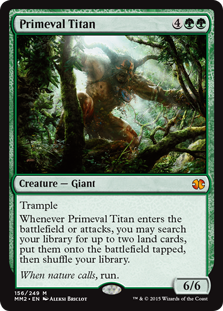
To understand why this deck plays so differently from Temur versions of Scapeshift, the first place you have to look is the mana base. With 12 Mountains and an additional 8 fetches to find them, once you've set up an active Valakut virtually every land drop becomes a Lightning Bolt (or better). In contrast, the Scapeshift deck I played at the SCG Milwaukee Open ran only 9 Mountains and 4 fetches. It wasn't uncommon to run out of Mountains in the mid- to late-game, and there were plenty of Flooded Groves and Islands to top-deck when I was praying for that last Bolt. My build tried to address this with Prismatic Omen, but that doesn't come for free. It's another spell that has to resolve, can be interacted with, and sits helpless on the table ready for a timely Nature's Claim.

RG Valakut, on the other hand, is a terrifying well-oiled machine as soon as it hits that seventh land. Besides the Valakuts themselves, only two lands in the whole deck (basic Forests) fail to trigger it. So while the first Primeval Titan may hit for a less-than-lethal number before getting pathed, the opponent is left staring down a lethal mana base---notoriously hard to combat using typical answers found in Magic. Primeval titanAt this point, every Farseek and Sakura-Tribe Elder becomes 3-6 damage. And those are the set-up spells---the Valakut pilot is still drawing to actual business spells too. Scapeshift can accomplish this mono-business-in-library trick using Prismatic Omen, but as I've said above there are costs associated with that and it's answerable. RG Valakut accomplishes this largely in deck construction itself.
The other advantage these builds of Valakut have over the more popular Temur and Bring to Light versions are just their speed. They trade off interaction and flexibility for balls-to-the-wall fast kills and consistency. These decks are going to execute their plan the same way more or less every time barring disruption, and there are a lot of redundant parts. When your whole mana base is Mountains, setting up Valakut is relatively trivial, and resolving a Primeval Titan won't be strictly necessary in every game.

Of course when you do resolve it, and assuming it lives one turn to attack (or comes in off a Through the Breach) that's a quadruple Rampant Growth attached to a six-point hit to the face. While the first Titan hit usually isn't lethal by itself, it will be rare to see a second one that doesn't get the job done.

Bells, Whistles, and Supplemental Plans

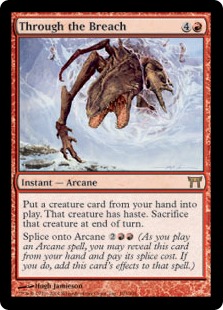
Through the Breach allows for some tricky plays against controlling decks, where you can test the waters end step with a Breach. If that gets countered you can untap and slam Titan. Cheeky Valakut players have also been known to cast the "bluffed" Breach---if they know an opponent can't afford to let it resolve they might finesse a counterspell Through the Breachout of their hand even when they had nothing to cheat into play. Traditionally, the Breach plan was augmented with Emrakul, the Aeons Torn for another win-on-the-spot button, which we see in Voltz's build above. He makes use of another old piece of tech, Summoning Trap, to provide more avenues for putting his expensive monsters on the battlefield.

Other builds of RG Valakut elect instead to augment Prime Time with anywhere from one to four copies of Scapeshift, or rely entirely on Titan and land drops as win conditions. Alternately we see Oath of Nissa to dig for threats, a variety of midrange threats like Pia and Kiran Nalaar or Obstinate Baloth, the inclusion or omission of Prismatic Omen, different selections in ramp spells, etc.

Overall this extensive variation points to an underdeveloped archetype. There doesn't seem to be a strong consensus on what the best build is which, together with the relatively small number of pilots, may be hurting the archetype's chances at climbing the tiers. I for one would love to see the archetype in the hands of more players; there appears to be some opportunity here to tune a deck that's still largely misunderstood by much of the Modern playerbase.

Insider: High Stakes MTGO – Aug 7th to Aug 13th

Are you a Quiet Speculation member?

If not, now is a perfect time to join up! Our powerful tools, breaking-news analysis, and exclusive Discord channel will make sure you stay up to date and ahead of the curve.

Hello, everyone, and welcome back for another High Stakes MTGO article! One week after a very entertaining Pro Tour, prices are starting to recover and move toward a more stable position. It's often, if not always, a good strategy to sell during the PT hype. A lot of cards, including those in winning decks, are unlikely to hit higher prices afterwards.

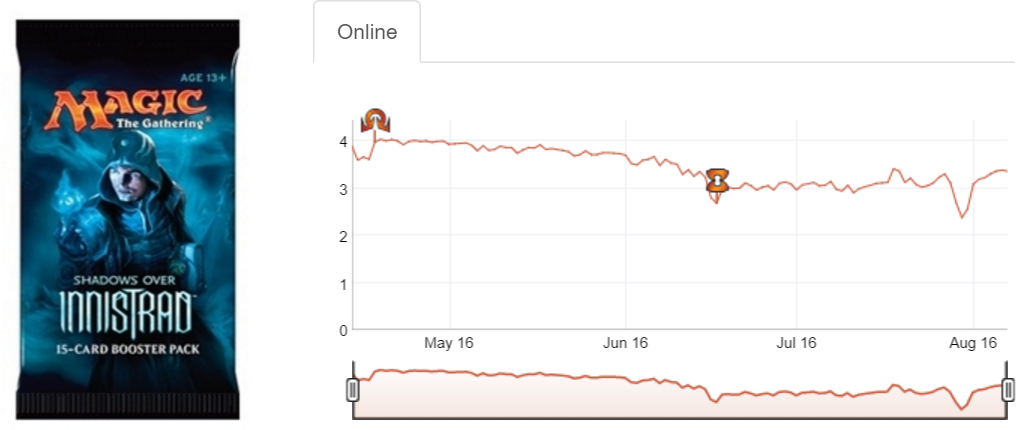
While this didn't happen after Pro Tour Shadow over Innistrad, when G/W Tokens dominated the subsequent environment, the Standard metagame usually evolves quite a bit after a Pro Tour. This means that the price height reached during a Pro Tour may not happen ever again.

A few cards such as Shaman of Forgotten Ways, Goldnight Castigator and Wandering Fumarole have been on a straight upward trend since Pro Tour Eldritch Moon (PT EMN). But there's another phenomenon on display that we've seen several times before---a big downward price swing among all sorts of cards, independently of their success during the Pro Tour.

These price swings are another side effect of the Pro Tour speculative frenzy, as people overreact by selling everything from top cards to worst failures, thus putting more pressure on prices.

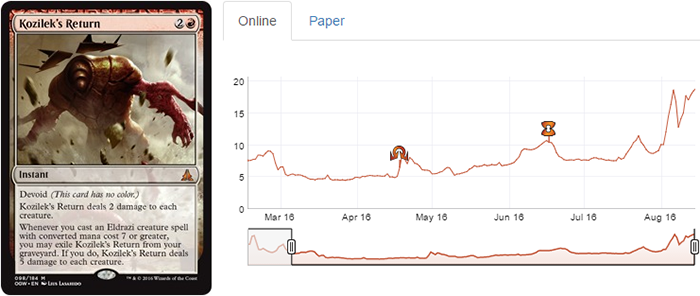
From 18 tix, Kozilek's Return dropped about 6 tix in two days before getting back to 18 the next weekend.

Kozi2

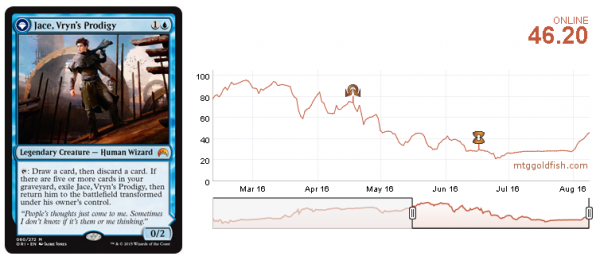
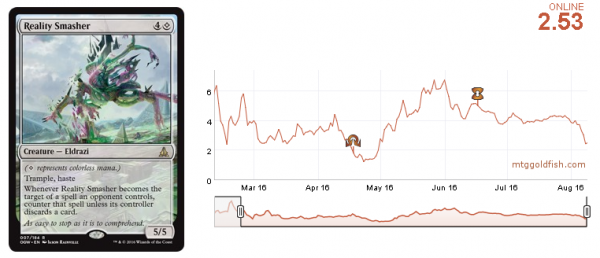
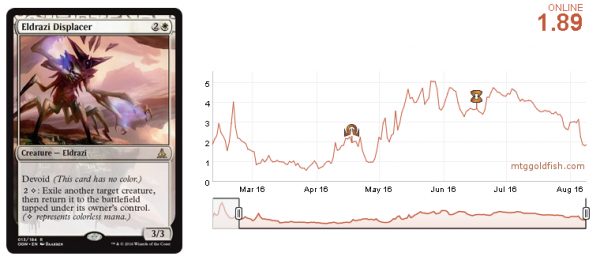
Sylvan Advocate and Matter Reshaper lost about 50% of their value in a few days and then recovered just as fast. Thought-Knot Seer and Reality Smasher are two powerful cards that didn't see much play at PT EMN---after a big drop last week they too have quickly recovered to their pre-PT EMN level. Eldrazi Displacer as well is another Eldrazi that didn't do much at PT EMN and which is now recovering after a 35% drop in two days.

This price storm usually lasts a week or two before we see stronger and more reliable price trends shaped by SCG Standard tournaments, Standard GPs, and of course MTGO results. While these price movements may caught novice speculators to be surprised in a panic-wave of sales, they also create great buying opportunities for experienced speculators and players able to rapidly read how the Standard metagame will evolve.

Although I missed some buying opportunities, with Reality Smasher and Kozilek's Return for instance, most of my buys this past week were based on that principle---trying to grab valuable cards at discounted prices.

If you hadn't bookmarked the link to the live portfolio, it's here.

Buys This Week

TtU

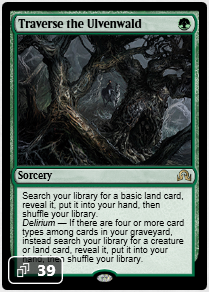
A breakthrough card for Pro Tour EMN, Traverse the Ulvenwald was among the most-played card in the top decks and the Top 8. It was also one of the many cards to see a relatively big drop immediately following the PT and rebound the very next day.

Rather than selling, I doubled down on this card and bought an additional 39 copies at 0.69 tix per copy on average. Despite still being drafted along with two EMN packs, I think this card should see a lot of play now and after Standard rotates. I see this card being at or above 2 tix sometime in the coming year.

That's a vague and wide timeline but I'm okay to wait and even ready to add more playsets to my stock if Traverse the Ulvenwald moves back to 0.5 tix again.

PA

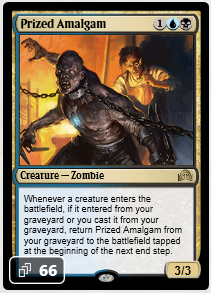
Prized Amalgam was also getting some attention before Pro Tour EMN and got included in the most recent version of Modern Dredge decks. In Four-color Emerge and in Zombies, this new zombie finished outside of the PT EMN Top 8 last weekend. With a price stabilizing between 0.5 and 0.6 tix I decided to jump in for 66 copies.

This is not a slam dunk as the price is exceptionally low and, as with Traverse the Ulvenwald, packs of SOI are still being opened. However I believe the card has enough potential in Standard and Modern at this point to make it a decent spec, with 2 tix as a target price.

OoN

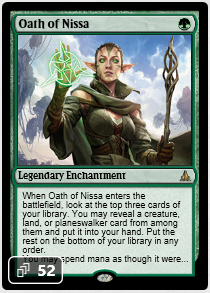
The price of the green Oath from Oath of the Gatewatch is also on a nice roller coaster ride---from 2 tix to 4 and then back to 1.6 in barely a week. This card didn't finish strong at the last PT, as G/W Tokens is no longer the dominant deck.

Nonetheless this is still a very solid card that will certainly be played in many Standard and Modern decks in the future. In my opinion this is an easy pick-up at 1.6 tix and I know now that 4 tix is the target ceiling for this card.

DS

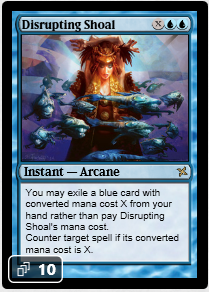
While this shoal doesn't have any permanent home it plays wonderfully in any number of Travis Woo or SaffronOlive brews. The long-term price baseline of Disrupting Shoal seems to be fairly anchored in the 3-4 tix range.

I had bought 20 copies after the Betrayers of Kamigawa flashback drafts at the beginning of this year, and now that the price is getting closer to 3.5 tix I'm adding a few copies to my initial stake. It's a game of patience with this spec but since the potential to double (or more) is real I'm fine waiting.

NVoZ

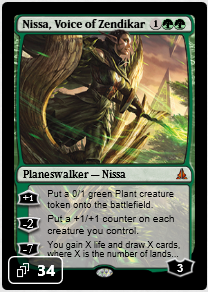
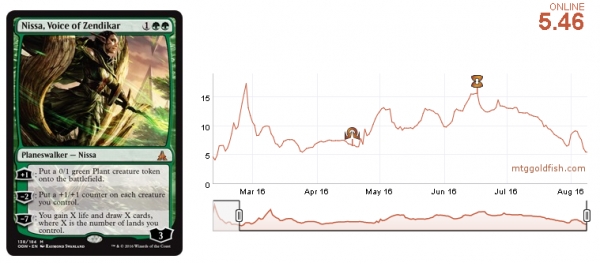
Along with other very good targets, both QS writers Matt Lewis and Nicolas Cancellara pointed out last week that Nissa was most likely a great pick-up now. From a height of 15 tix thanks to the dominance of G/W Tokens, this planeswalker dropped to 5.5 tix last week, its absolute floor so far.

Nissa, Voice of Zendikar might be a little bit out of favor with EMN but there's no reason to think this card won't maintain a certain level of play in Standard and even in Modern.

Sales This Week

These two were the painland winners of the last PT. I'm not going to wait any longer to see how high they can go after this PT; I'm selling now. While my pile of Shivan Reefs only contains a few playsets left to be cleared away, I'm still sitting on hundreds of copies of the Coast (and of the other three painlands as well).

I'm selling as soon as my minimum price target is reached. Unfortunately, while Reef keeps climbing Coast fell below the 1 tix bar in the middle of last week. Considering the current popularity of UGx decks, I'm still confident Yavimaya Coast will get above 1 tix---where I want to sell---again quickly.

The last of my foil EMN mythic quickflips. This one didn't make me any tix but as a part of a bigger plan I sold it without any regrets.

These two red cards got better recently and Abbot even had an additional momentary boost with the emergence of the U/R Thermo-Thing deck. For two cards about to rotate and for which I was losing money anyway, I gladly sell them now with a little bit fewer losses. The first half of 2016 is definitely not for red---such a waste for two cards that would have probably been great in almost any other Standard metagame.

fAW

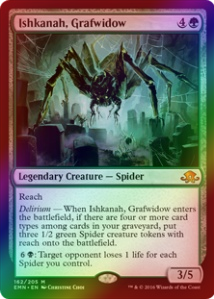
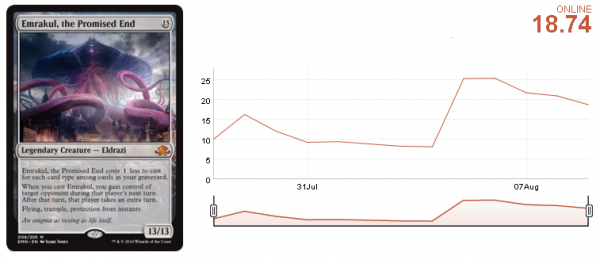
Similarly to foil Emrakul, the Promised End I took advantage of the price spike hitting the foil version of the legendary spider as well. With more and more supplies entering the market, I expect the price of both foil and regular versions of Ishkanah, Grafwidow to stabilize under 10 tix, perhaps before the foil version takes off again in a few weeks.

Two cards soon to be flashback-drafted, which I would rather sell now than wait on or keep in my portfolio for a while. I should most likely have sold these guys earlier but I think it will get worse so let's get rid of them now. I somehow managed to break even with Iona but I'm losing 50 tix with the Inquisitions. Nevertheless, two cards to keep an eye on and probably rebuy this month.

On My Radar

Zendikar block drafts are going to be the big attraction in town for speculators in the coming three weeks starting this Wednesday. Between Zendikar, Worldwake and Rise of the Eldrazi, an amazing minimum of 30 cards could be on speculators' buying lists. From Scalding Tarn to Flame Slash, from mythics to commons, there will be buying opportunities for all sizes of bankrolls.

With so many potential targets, my advice is simply to focus on what fits your bankroll. I won't be buying any Kiln Fiends whereas Celestial Colonnade may not be a great choice for others.

If the ZEN fetchlands are the number one targets everyone wants to grab, you might as well focus on cards with a bigger potential such as Pyromancer Ascension, Vengevine, or even Eldrazi Temple if prices drop by a lot. Due to their popularity, the prices of ZEN fetchlands may not tank that much and their return on investment could therefore be limited. I don't think you can realistically double up on Scalding Tarn whereas you could quadruple up on an Inquisition of Kozilek bought at a timely moment.

If the timing for targeting Worldwake and Rise of the Eldrazi cards is rather simple since they are only drafted for one week, Zendikar will however be drafted for two weeks. The cards in the highest demand such as the fetchlands are likely to see their biggest drop this very next weekend, while other cards may lose ground continuously until the very end of the flashback series.

If you're planning on buying multiple copies it might be worthwhile to spread your purchases over several days so you're not missing a part of the action but are also letting the door open to buy more if prices keep falling.

Thank you for reading,

Sylvain Lehoux

Insider: The Last Ship to Rise?

Are you a Quiet Speculation member?

If not, now is a perfect time to join up! Our powerful tools, breaking-news analysis, and exclusive Discord channel will make sure you stay up to date and ahead of the curve.

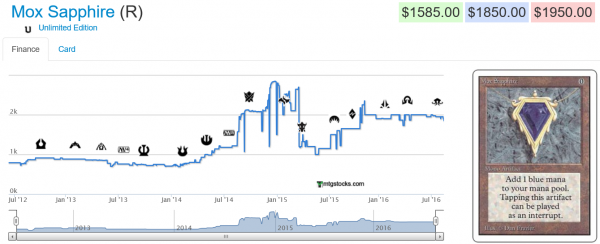
In recent months I have been pounding the table on acquiring high-end Vintage staples. The most noteworthy (and certainly most iconic) of these would be your set of Power Nine. Despite a little bit of pricing volatility during spikes and buyouts, these have all offered spectacular return on investment since the inception of the game.

Sapphire

But while these have always been steadfast investments, I have advocated picking up whatever Power you have on your radar as soon as possible because I’m noticing an interesting trend. What’s more, I have some secondhand accounts of interesting data consistent with what I’m seeing online. While I never enjoy spreading MTG speculation rumor, I have enough trust in my source to believe at least some of his story.

Intrigued? Good. Allow me to dive in.

Observation 1 - Other High-End Cards

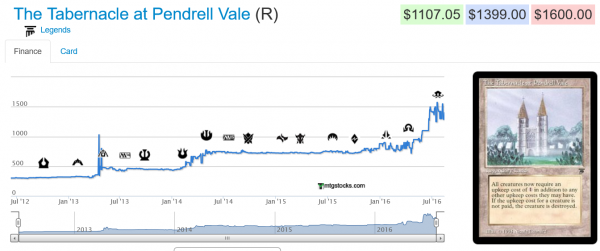
By now, every MTG speculator should be familiar with the recent trends in Old School and Reserved List staples. Cards like Juzam Djinn, Nether Void and Moat have all soared to their all-time highs. Some of the more desirable high-end staples, such as The Tabernacle at Pendrell Vale, have had an especially aggressive run-up in price.

Tabernacle

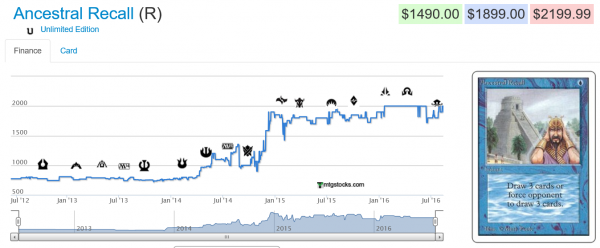
At this moment, Tabernacle is sitting at around $1400---doubling its price from ten months ago! Not only is Tabernacle much more expensive relative to itself, it’s also becoming awfully expensive relative to other cards. Consider this: a Tabernacle can now be traded for a played Mox Sapphire. If that’s not the Power you’re after, Tabernacle is also convertible into other Moxen, Time Walk (with plenty left over), or Ancestral Recall. How did this legendary land become so valuable?!

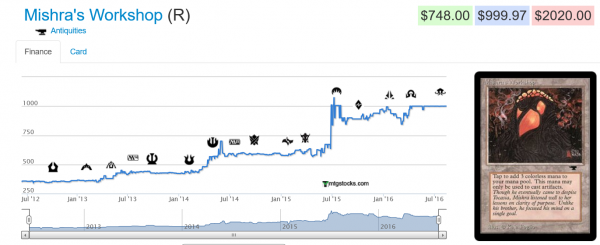
Another example is Vintage favorite Mishra's Workshop. Here's a land from Antiquities that has also hit all-time highs lately.

Workshop

Three years ago this card was in the $300-$400 range. One year ago it was in the $600 range. Then the massive spike happened, sending it to four digits: $1000! While I firmly believe Eldrazi has made this card more popular than ever before in Vintage, I still have to do a double-take at the price.

I mean...at $1000 you could pick up really nice copies of most Moxen (sans Sapphire), a nice Time Walk, or even a sleeve-playable Ancestral Recall. This may be more of a Vintage metagame factor, but I have to imagine a couple people may be tempted to move their set of Workshops into the game's most iconic card: Black Lotus.

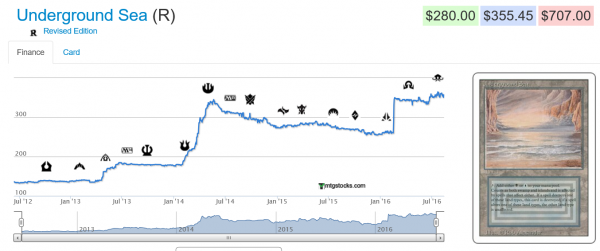
To a lesser extent, many other popular Legacy and Vintage cards are soaring to new heights. Underground Sea is at its all-time highs as we speak, notching the $350 mark according to MTG Stocks. It seems like only yesterday this card was hitting $100 at retail, causing a stir in the MTG community. Now we’re looking at a $400 card at retail, with playsets worth enough to trade into any piece of Power except for Black Lotus.

Sea

I often refer to the phrase, “a rising tide lifts all ships,” and in this case the last ships to rise will be Power. With other more “obtainable” cards so expensive, it is only a matter of time before Power gets the next spike higher.

Observation 2 - Retailer Stock

Since I have a large portion of my portfolio exposed to Power, I tend to monitor pricing and stock very closely. The other day I noticed a sudden shift in stock…

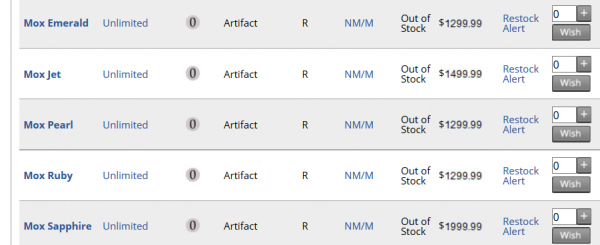
Mox Stock

Star City Games used to have a decent variety of played and minty Power across Alpha, Beta, and Unlimited sets. Now they have exactly zero copies available for purchase across all three sets. What’s more, the pricing is set at the highest ever.

Even Moderately Played Mox Emeralds and Mox Rubys are likely to sell in the $900 range seeing as Star City Games is paying $500 on their buylist for each. I recently made an observation that any sleeve-playable Moxen will no longer be found for under $600, and these aggressive buy prices are part of the reason why.

A quick scan of Channel Fireball’s site reveals an identical result: they’re completely sold out of all Moxen across all sets and conditions. I did notice that Card Kingdom had a few Near Mint copies for sale, but even their stock was clearly light with no “affordable” sleeve-playable copies available.

Would it kill a vendor to list an MP Mox?! I’m sure they’d be eager to…if only they had any! I’ve even been noticing that Moderately Played and Slightly Played Power has been selling fairly readily on the High End Facebook group---another sign of true demand.

Boil it down, and you have a rising tide, increasing collection values for players fortunate to have been in the game for a couple decades, and very thin stock across the world’s largest retailers. What more do we need?

Observation 3 - A Rumor

This isn’t the first time Star City Games has shown zero stock on Power. Not long ago I noticed their stock was nearly wiped out. But this wasn’t due to a massive run on these nine cards in particular---rather, stock was pulled for a major Grand Prix. This makes perfect sense. When a store brings unique, high-end cards to a major event they need to take down this stock in case some of the cards sell at said large event.

In this case, I initially thought the absence of Power was due to a temporary unstocking to bring Power to Gencon. And that may have been the case, at least at first.

Then on Friday I was talking with a good friend of mine when he mentioned an interesting anecdote. This friend, whom I wholeheartedly trust, said that a friend of his had observed a massive transaction take place at Gencon between a guy in a Star City Games shirt and a different vendor. The contents of the transaction: a stack of Power.

I have no way of verifying the veracity of this story, but the evidence is pretty compelling. There are definitely a couple of vendors out there who could afford to make such a move on Power, so both the buying and selling ends of this hypothetical transaction are 100% plausible.

Unfortunately when I asked for more specifics, my friend was unable to provide updates as he was already hearing the story secondhand. The only other comment he made was that the Star City Games party alluded to difficulty in moving graded Power (which of course makes sense).

Wrapping It Up

I’m not sure if we’re on the verge of another spike in Power or if we’re still going to remain flat-lined for years to come. But if I had to guess, I’d wager prices are due for another bump in the near future. As stock in the high-end cards dwindle on major websites, eventually they’ll need to increase their buy and sell prices to restock.

Until then, you can rest assured that a position in Power is equivalent to one of the safest investments the hobby can offer. A bet on Power is essentially equivalent to a bet on Magic as a whole. As long as the game remains strong, values will gradually trickle higher in the high end and the collectible, promising rising prices.

Recall

You may not double up over a weekend like more recent cards can sometimes offer. But given enough patience, these high-end items are a great way to park funds into this hobby for a long, safe return. Since my primary objective with Magic is to gradually build up resources to help fund my son’s college education, I couldn’t ask for a more attractive investment. Plus there’s an added bonus: I get to play Vintage! I just started trying it out recently and it’s a crazy format of brokenness! It’s been a blast.

If you’re on the fence about making a significant investment in a single card, let me offer up two last points to try and help you decide.

First, remember how rare these older cards are---not just Power, but all the older high-end stuff. There are so few Mishra's Workshops, Library of Alexandrias, and Bazaar of Baghdads in existence. Any bump in demand---even from one or two players---is enough to move the needle on these rarities. Add in the fact that these twenty-something-year-old cards are only becoming older, rarer, and harder to find, and you have yourself an attractive investment vehicle.

Throw in the fact that Wizards of the Coast has promised they’ll never print these cards again? How can you not like these investments? In a world where interest rates are near zero (negative for much of the world) and it’s difficult to find safe returns, rare and collectible Magic cards offer up a sound alternative. The playability on the side is just an added bonus...

...

Sigbits

  • According to MTG Stocks’ All-time High list, my favorite card ever printed just hit its highest price ever: Shahrazad. It may be banned in every format, but who can argue with the flavor and uniqueness of the Arabian Nights card. Being on the Reserved List means WoTC will never print this card again. It may surprise you that Star City Games is sold out at $89.99 now, but a year from now I suspect we’ll be used to the higher price.
  • Zombies, zombies, and more zombies! Shadows over Innistrad and Eldritch Moon have rekindled interest in the moribund archetype. That’s probably the reason for Ghoulcaller Gisa’s recent surge in price. While it continues to hit fresh highs, Star City Games is gradually running out of stock. They have just nine SP copies currently, with a $6.79 price tag. I don’t see any reason she can’t hit $10 in the next 12 months.
  • If you’re interested in tracking Old School cards like I am, then take note: Star City Games restocked a couple copies of multiple Arabian Nights cards. Stuff like Island of Wak-Wak, Diamond Valley, Library of Alexandria, Elephant Graveyard and Juzam Djinn have all been restocked with just a couple copies. The prices are all higher---now we just need to wait and see if copies sell at these new prices. It may take a while, but I don’t think we can anticipate price drops any time soon.

Insider: Buying Into Beating Modern Dredge

Are you a Quiet Speculation member?

If not, now is a perfect time to join up! Our powerful tools, breaking-news analysis, and exclusive Discord channel will make sure you stay up to date and ahead of the curve.

I hope you were paying attention to last week's article. As tracked in our past two Modern Nexus updates, June through July has seen Dredge rise from fringe pipe dream to top-tier breakout star.

Even before Star City Games' Syracuse Open, Dredge was solidifying its position at the top of the metagame heap. Then the deck sent four of is five Day 2 pilots to Top 32, with two making Top 8 and Ross Merriam winning it all.

Believe it: Dredge's Tier 1 status is all but assured going into the end-of-August Grand Prix streak.

Modern Dredge is real

It remains to be seen if Dredge can stay atop the Tier 1 pedestal once players start taking it seriously. Grand Prix weekend will be a major test for one of Magic's most unique and (in)famous strategies. That said, the financial status of Dredge's staples is far more certain. Cards were spiking even before Ross Merriam's list took gold at Syracuse, and if you didn't follow my advice last week, you probably missed this hype train.

I'm just sorry I was on vacation for a big chunk of July and couldn't sound the investment alarms earlier! Hope you got those Greater Gargadons then or, like me, had them from the glory days of Restore Balance combo.

There was an error retrieving a chart for Greater Gargadon

Although Dredge buyouts continue to spike staple prices, there's another subset of critical Modern cards which will also benefit from the deck's rise: graveyard hate. Modern has some of Magic's most spiteful anti-graveyard spells, and if Dredge continues its Tier 1 reign, these cards are sure to see increasing play in the leadup to the Grand Prix.

Today, we'll focus on a few key anti-Dredge cards which should pique your interest as players and investors. With Dredge on the upswing, Modern players will need to pack certain hate cards more than ever, which means there's extensive space for both strategic developments and financial profits.

The Big Graveyard-Hating Guns

Since Ravnica fatefully introduced one of Magic's most broken mechanics, graveyard hate has been one of the most reliable and impactful means of ruining Dredge's game. Nowhere is this truer than in Modern, which gives players access to all-star graveyard exilers like Leyline of the Void, Relic of Progenitus and Rest in Peace.

That said, as anyone who has tried making a perfect Modern sideboard knows, not all hate cards are created equally. Some anti-Dredge bullets are better than others, which means you'll want to focus on select standouts if you're trying to beat Dredge or beat the spike on the next big thing.

Following this, here are the three best anti-graveyard cards which are likely to beat Dredge, beat other decks without overcommitting to the Dredge matchup (important!), and make you big bucks.

Leyline of the Void

Despite two printings, one in the core Magic 2011 set no less, Leyline of the Void is already valued at a surprising $6-$7. This, despite Leyline seeing very little play in even Modern, where it shows up in the occasional Jund sideboard and few other decks.

With Dredge pushing ahead, Leyline's stock improves dramatically. Snapcaster Mage decks alone rarely justified the Leyline. Add Dredge to Modern's other graveyard decks, and the card is looking more attractive with every new event Top 8.

There was an error retrieving a chart for Leyline of the Void

As an added bonus, even Dredge decks are using Leyline as their anti-Dredge card of choice. That was definitely Ross Meriam's call at Syracuse, and more pilots are sure to follow suit. I expect this one gaining at least a few dollars by the end of August, if not doubling in price outright to dual demand from rising Dredge and format king Jund.

Grafdigger's Cage

The single-printing rare from the seldom-opened Dark Ascension is one of those unique cards which commands a higher MTGO pricetag than a paper one. Both of these are likely to increase even further once players start running more Grafdigger's Cage copies to trump Dredge.

There was an error retrieving a chart for Grafdigger's Cage

Like Leyline, the Cage is relevant in a variety of matchups including against Dredge, Nahiri, the Harbinger strategies, Abzan Company, Kiki Chord, budding Eldritch Evolution decks, and others. I can't emphasize enough how important it is to run versatile sideboard cards in Modern, and Cage illustrates this perfectly.

Don't be surprised to see Cage keep climbing from the $8-$10 range into the $12-$15 range by the end of the month. It gets an additional edge over Leyline for being an artifact---any deck can run the colorless one-drop without worrying about mana requirements.

Rest in Peace

Single-printing rares are always great investment targets, and Rest in Peace is no exception. The Return to Ravnica rare runs for around $4 in the current market, which is definitely undervalued if it takes off as an anti-Dredge option.

Jeskai strategies have remained major Tier 1 players since May, with Mardu and Esper mages trying to push out of Tier 3 into the upper metagame circles. Add Abzan Liege, Hatebears, Death and Taxes, and other white-based strategies, and it's easy to see where decks are going to pick up Rest in Peace and jam it in their boards alongside the mighty Stony Silence.

There was an error retrieving a chart for Rest in Peace

Unlike Leyline, Rest is a symmetrical effect which somewhat limits its usability. Snapcaster Mage decks might balk at the card, although Syracuse's 5th place Alan Breitman did use Rest in Peace to get into the Top 8 against a Dredge opponent in the later rounds. Other strategies, notably the Wx Eldrazi/Hatebears/D&T decks, have no such anti-synergies, and will gleefully use Rest in Peace to take matchup edges.

I'm less confident in Rest in Peace's stock than the more proven Leyline and Cage, but with white decks experiencing somewhat of a renaissance in Modern, it's a great bet at its current low pricetag.

Other Anti-Graveyard Options

If you only had limited time for testing and money for speculating, Leyline, Cage and Rest in Peace are probably the safest options. On the other hand, if you're willing to go off the beaten path, or willing to test around cards that aren't necessarily very profitable, here's a short list of other options to consider:

  • Relic of Progenitus - It's a versatile one-drop like Cage, with just as widespread relevance in Modern. Check out the foils for some real value, although even non-foils linger in the upper $1-$2 range after tons of reprints.
  • Scavenging Ooze - Jund, Abzan Company, Elves, and other green-based decks will use the Ooze as a flexible answer to numerous strategies, Dredge included. Ooze will rarely keep up with Dredge's onslaught, but its versatility and utility still give it a nod.
  • Anafenza, the Foremost - I'm big on Eldritch Evolution in the new Modern, and I love the idea of turn two Anafenza off a mana dork in the Dredge contest. The legend shuts down most of Dredge's strategy cold.
  • Yixlid Jailer - A bizarre oldie but a real goodie! Jailer has long been outclassed by other two-drop creatures, but if Dredge is here to stay, black-based decks might take a second look.

Versatile Dredge Bullets

Graveyard hate isn't the only way to go against Dredge. Sometimes, it's not even the best---we watched Tom Ross win through Leyline of the Void just last weekend due to Insolent Neonate beatdown. Here are some alternate solutions to Dredge, both of which are strong against the deck and have some real potential for profit.

Anger of the Gods

Aggro is big in Modern these days, especially aggro with three-toughness Wild Nacatls in the backbone. Good news! Three is also Dredge's Magic number (except for big papa Gargadon), with everything else from Prized Amalgam to Bloodghast hitting exile after the Anger sweep.

With just a single printing, albeit in a recent Standard set, Anger of the Gods has a lot of potential for growth. It doesn't hurt that red is already one of Modern's best colors and Anger sees frequent play across strategies.

There was an error retrieving a chart for Anger of the Gods

I'm particularly keen on Anger because it works so well alongside trendy Nahiri decks, particularly those using Through the Breach. Anger is also a Jund sideboard mainstay, and despite failing to take down Syracuse, Jund is still arguably Modern's "best" deck. All of this points to Anger being a big winner in August and beyond.

Primal Command

Here's a niche one straight out of the SCG Syracuse coverage. Harrison Gil put this limited-run rare to work in his later round Dredge matchup, leveraging its shuffling and Fallow Earth modes to take the match. Whether you're playing R/G Ponza, Nykthos Green, or any of the other green-based ramping decks, Primal Command is worth a second look in the coming weeks.

There was an error retrieving a chart for Primal Command

Admittedly, Command is probably the most niche card featured in this article, with only a few decks capable of fielding the powerful five-drop sorcery. Then again, Scapeshift, Valakut, and other ramp decks are among some of Modern's strongest these days, with numerous Tier 2 and even Tier 1 slots. All of this makes Command a worthy investment both from a financial and a strategic option.

Other Dredge-Busters

Don't get caught in the graveyard-hate trap against Dredge! Sometimes, the best way to beat the deck is to employ other resources (or, as is often the case in Modern, to just race the strategy). Assuming you take the more interactive route, here are a few options to consider for your arsenal:

  • Hallowed Moonlight - Can't we just get Containment Priest? In lieu of the better Legacy card, Moonlight might have what it takes to fill a sideboard or maindeck bullet slot in the Dredge contest. It has enough cross-matchup relevance to be worth a second look in this new format.
  • Ghostly Prison - Dredge's primary path to victory is through the combat phase, and Prison grinds that route to a halt. Prison is often going to beat out Ensnaring Bridge in this role because Ancient Grudge can't hit the white enchantment.
  • Elesh Norn, Grand Cenobite - What can I say? I love Eldritch Evolution! If you can get this one out quickly, or hold the line long enough to get this by turn 3-4, she'll cut Dredge's creatures out of the game (Bridge from Below tokens included!).
  • Darkness - I'm an Ad Nauseam guy, so Fog effects are my sideboard specialty. Darkness, Holy Day and classic Fog are spectacular in this metagame, buying a critical turn against Infect, Dredge, Affinity, Death's Shadow Zoo and many others.

Adapting in Time for the Grand Prix

As Dredge opponents have known since Ravnica, having a solid anti-Dredge sideboard (or even maindeck) plan is no guarantee of victory. We've seen Dredge pilots win through even Leyline of the Void, and between answers like Ancient Grudge, reach and removal from Conflagrate, and Plan Bs from Gargadons and Grave-Trolls, Dredge can still pull out games even from the jaws of apparent defeat.

The moral? Be cautious when facing down Dredge, even if the deck is a much weaker version of its nuclear Legacy option. Also watch out for Dredge's evolving technology, whether the Gargadon and Bridge from Below combo of last week, or the unveiling of Collective Brutality this week (another card I eyeballed early and I hope you didn't wait too long to pick up).

There was an error retrieving a chart for Collective Brutality

Two weeks to go, many more events in between---the Grand Prix weekend is on the horizon and we have a lot more Modern in store as we get close. Make sure you've reviewed the Modern Nexus July metagame update before doing serious preparation for the events, and stay tuned for more Modern content in the 11th hour before the Grand Prix. Hit me up in the comments if you have questions and I'll see you all soon!

Bracing for Bedlam Monkey Grow

Are you a Quiet Speculation member?

If not, now is a perfect time to join up! Our powerful tools, breaking-news analysis, and exclusive Discord channel will make sure you stay up to date and ahead of the curve.

Move over, Shiloh---It's Modern season! The next few weeks in my calendar are full of Modern PPTQs, Opens, and GPs, and I think I finally know what to sleeve up. Two weeks ago, I introduced Traverse Delver, a mid-game-focused, Traverse the Ulvenwald/Bedlam Reveler-powered grow deck that finally solved Temur Delver's miserable Jund matchup. It did so for a hefty price: weakening Monkey Grow's highly favorable linear matchups.

breeding pool art crop

My current iteration of the deck runs a traditional Monkey Grow configuration in the mainboard, and sideboards into Traverse Delver. This article unveils that deck and discusses its current metagame positioning, which I believe to be phenomenal.

Threshold and Super Grow

We'll start with some history. Legacy's Canadian Threshold exemplifies a modern grow deck. Threshold wants to deploy a threat, then trade off resources to keep opponents from casting the cards in their hands, all while attacking every turn and protecting its creature from removal. If all goes well, by the time opponents manage to neutralize the assault, the board will look as though it's still turn two, and opponents will be sitting at around six life. That's low enough for Threshold to Brainstorm into some Lightning Bolts and finish the game.

Creatures in general are much better now than they used to be. Threshold plays some of the most efficient threats in the game: Delver of Secrets, Tarmogoyf, and Nimble Mongoose. The deck it grew out of, Miracle Grow, used to supplement Mongoose with Werebear and Quirion Dryad. But Miracle Grow had its own huge benefit: a highly efficient source of card advantage.

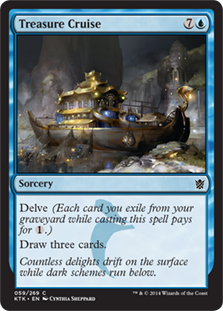
Treasure CruiseSuper Grow describes a grow deck that can transition to a control gameplan by converting an unused resource (i.e. land drops or cards in the graveyard) into cards. Extended Miracle Grow, Vintage Gro-A-Tog, and Legacy/Modern Treasure Cruise Delver are all shining examples of once-legal Super Grow decks. As anyone who played Legacy while Treasure Cruise was legal can attest to, giving one of the format's best decks (URx Delver) a way to turn its enormous graveyard into more cards just breaks the archetype. Canadian Threshold is great against linear decks but can be ground out by fair decks like Punishing Jund or Miracles; with a card like Gush or Treasure Cruise, it suddenly can't.
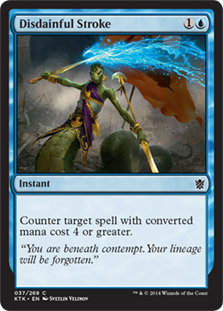
I'm not saying Bedlam Reveler will "break" the Tier 3 deck that is Temur Delver. In fact, as far as draw engines that slot into grow decks go, it seems incredibly balanced. I'm just saying it gives us access to a toy historically dangerous in grow decks. Key differences to note are that including Bedlam Reveler in the mainboard cuts into valuable disruptive spots and pushes us more firmly in the direction of midrange. Since Reveler can't be cast until the graveyard is full of instants and sorceries, it's lousy at clocking fast, linear decks. But it is superb against midrange.

[wp_ad_camp_1]

A Moment of Clarity

I'd be lying if I said Traverse the Ulvenwald and Bedlam Reveler didn't make me delirious. Brewing always gets me excited, but the prospect of a suddenly favorable Jund matchup had me euphoric. With Jund solved, I figured I had something unbeatable on my hands, and jumped into a series of competitive events with Traverse Delver. My results at these events, in which I never managed to crack Top 8, revealed a few things to me.

Problem: Interacting With Linear Decks

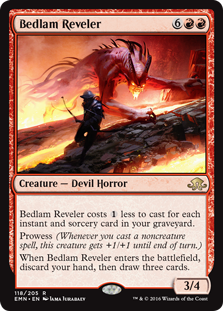
Skewing Temur Delver's mainboard so heavily to fit Reveler severely impacts our linear matchups. Hooting Mandrills disdainful strokeand Stubborn Denial were integral to fighting Modern's many linear decks. With a drastically improved Jund matchup came noticeable slips against opponents itching not to interact. No longer could I laugh in the face of Tron, for whom I now had to sleeve up Disdainful Stroke; gone were my days of effortlessly crushing Burn, which now incentivized me to run Feed the Clan.
Traverse Delver also proved exceptionally soft to certain hate cards. Rest in Peace totally hosed me. So did Chalice of the Void. Traditional Monkey Grow had Huntmaster of the Fells to go over either card, and Destructive Revelry to blow them up. Traverse Delver, with its single Ancient Grudge and pair of lowly Natural States, came up short on this front.

Problem: Clocking Linear Decks

When opponents spend their turns Bolting our Delvers, we have no problem keeping the threats coming by Traversing into more, and eventually by drowning opponents in cards generated by Bedlam Reveler. We can't do that against linear decks, which refuse to interact with our creatures and therefore lower our chances of hitting delirium. Without four or more card types in our graveyard, Traverse the Ulvenwald won't search for a threat, and it becomes difficult to put a clock on opponents doing unfair things.

Solution: Introducing More Delirium Enablers

The one-two punch of losing Denial as a key reactive piece, and Hooting Mandrills as a key proactive one, made our linear matchups much harder than I thought it would. One solution was to try addressing the issue with more delirium enablers (specifically, Mishra's Bauble).

A pair of Baubles helped a lot against linear decks, but not as much as I would have liked. I also realized during a testing session with the updated deck that I had fallen into the brewer's trap of playing too many crummy cards to enable one that might not fit. Bedlam Reveler helped Temur Delver's interactive matchups, but made the deck much worse elsewhere.

Back to Basics... Again

I missed Monkey Grow. But I knew that if I returned to that deck, I'd need to integrate Bedlam Reveler somehow, lest I lose all my Jund matchups again. I'd tried Traverse and Reveler in my Monkey Grow sideboard before, shortly after Bedlam was spoiled; it performed badly for me, but I had been playing Reveler alongside Hooting Mandrills. Those two threats and Traverse the Ulvenwald have significant tension in the same 60.

The next step was to test Traverse/Reveler as a transformative sideboard plan in Monkey Grow and board out all my Mandrills when I brought it in. I tweaked the list for close to a week until I landed here:

Monkey Grow, by Jordan Boisvert

Creatures

4 Hooting Mandrills
4 Delver of Secrets
4 Tarmogoyf
1 Snapcaster Mage

Instants

4 Lightning Bolt
2 Tarfire
2 Vapor Snag
1 Simic Charm
3 Thought Scour
4 Disrupting Shoal
3 Mana Leak
3 Stubborn Denial

Sorceries

4 Serum Visions
4 Gitaxian Probe

Lands

4 Misty Rainforest
3 Scalding Tarn
1 Wooded Foothills
2 Steam Vents
1 Breeding Pool
1 Stomping Ground
3 Island
1 Mountain
1 Forest

Sideboard

4 Traverse the Ulvenwald
3 Bedlam Reveler
3 Blood Moon
2 Pyroclasm
1 Natural State
1 Destructive Revelry
1 Ancient Grudge

If you're not familiar with traditional Monkey Grow, you can read up on the deck here.

Besides its transformed sideboard, this deck has a few small changes from the previous version of Monkey Grow. I cut two Simic Charms for Vapor Snag, whose low cost works better with Bedlam Reveler, and the Forked Bolt for another Tarfire, which helps turn on Traverse the Ulvenwald. I also cut a Scalding Tarn for a Mountain, a necessary evil in the Reveler deck.

The Perfect Balance

Bedlam Reveler plugs holes Monkey Grow was notorious for. Its inclusion gives us tremendous reach over the metagame.

Beating Linear Decks

The Monkey Grow core is already well-suited to fight linear decks. Lightning Bolt and Tarfire interact very well with linear aggro decks, while Mana Leak and Stubborn Denial keep linear combo from ever getting off the ground. Disrupting Shoal pulls weight in either scenario, doubling as extra removal against Infect or Affinity while stopping crucial enablers like Expedition Map and Pyromancer Ascension elsewhere.

To back up our disruption, Monkey Grow boasts some of the most efficient beaters in Modern. Outside of Burn and Zoo, Linear decks rarely have Bolts of their own, making Delver of Secrets a matchless threat. Clocking opponents every turn while disrupting them has always been the best recipe to deal with linear decks, and Monkey Grow pulls off that gameplan better than anyone---even Inquisition of KozilekJund, the king of fair decks, which outputs damage slower than we do and can succumb to opposing topdecks even after deploying a flurry of discard spells.

Another point to consider in this comparison is that Inquisition of Kozilek and Thoughtseize are tempo-negative: they trade a card and one mana for an opponent's card and zero mana. Our counterspells trade one, two, or zero mana for some of our opponent's. Obviously, discard spells are very good, but when we're playing the tempo game against linear decks, stealing mana helps us steal the game.

Adding Bedlam Reveler to the mainboard, cutting Stubborn Denial and Hooting Mandrills, and switching from Remand to Mana Leak helped my interactive matchups, but it gutted Monkey Grow of its superb anti-linear suite.

Beating Interactive Decks

Monkey Grow's cards are so tempo-efficient that it's possible to just go under interactive decks. This plan has been especially easy for me to execute against Jeskai Nahiri, a deck that plays noncreature four-drops as Denial bait and relies on the easily Shoalable Ancestral Vision to pull ahead of us.

Modern's other fair deck has always hassled me. While going under Jund might be manageable pre-board (and is still difficult), post-board it becomes impossible. Jund brings in all their removal against us and has a functional eight Tarmogoyfs between Goyf, Ooze, and Kalitas. I've long searched for a solution to this matchup, and it seems like Bedlam Reveler answers my prayers.

Bedlam RevelerBut as discussed above, it's not worth 2-0'ing Jund to nerf our linear matchups. So, I slotted a full Bedlam Reveler package into the sideboard over Huntmaster of the Fells. Traverse Delver had a number of open flex spots in its side, since Huntmaster proved unnecessary with the superior Reveler in the deck; we can painlessly move Reveler into those spots and re-adjust our mainboard configuration with the extra space to look more like Monkey Grow.
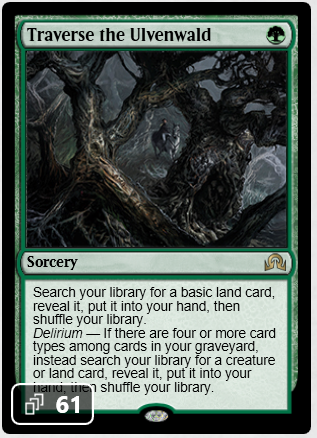
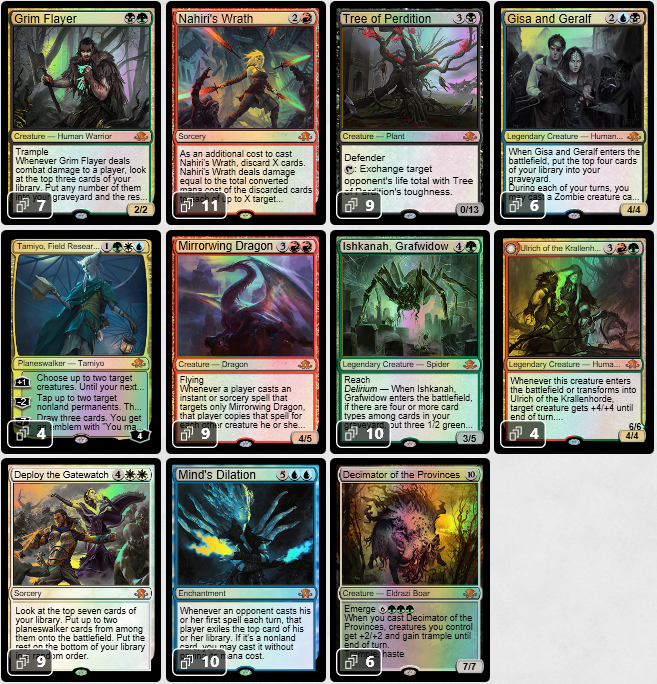
Our sideboard plans for interactive matchups end up being totally transformative. Here they are for Jund and Jeskai.

Versus Jund

-4 Hooting Mandrills
-3 Mana Leak
-3 Stubborn Denial

+4 Traverse the Ulvenwald
+3 Bedlam Reveler
+3 Blood Moon

Versus Jeskai

-4 Hooting Mandrills
-3 Thought Scour
-2 Vapor Snag
-1 Simic Charm

+4 Traverse the Ulvenwald
+3 Bedlam Reveler
+3 Blood Moon

With these plans, the chances of interactive decks "stabilizing" become slim to none. We almost only lose to those decks if they manage to go under us. That's easier for Jeskai Nahiri to accomplish, since it can become a Burn deck with its many Bolt effects and Snapcaster Mage. Moon shuts down Colonnade in that deck, which can put us into burn range if left unchecked.

Jund has a much harder time closing out games. With our counterspells gone, we never have a dead draw, and achieve delirium very quickly as Jund kills our first Delver or Goyf. From there, we just chain Revelers and drive Jund into the ground. Our gameplan against Jund used to be to cheese them with a Blood Moon or draw multiple Huntmasters after hitting four land drops. Now, Moon can still crush them, but Bedlam takes over for Huntmaster as another pricey red threat that wins us the game far more often.

Deck Weaknesses

I apologize if I've made this deck out to sound unbeatable. I'm just excited! Like every deck (we hope), this new Monkey Grow has its weaknesses.

Rest in Peace: This card destroys us. We don't have the Peace-proof Moon-Delver-rest in peaceHuntmaster plan anymore, and a mere four threats that do anything under the enchantment is not enough to defeat opponents who are drawing even remotely well. We definitely preferred Huntmaster to Reveler against Rest in Peace-running creature decks like Hatebears, even though Reveler has a better effect in those matchups. I'm assuming UW Merfolk decks packing the enchantment will also be tough to beat.

Natural State and Destructive Revelery in the sideboard hope to cover for this weakness. I think two removal spells is enough, since most decks don't play Rest in Peace to begin with. Natural State is the favorite to remove it for cost reasons, but unlike Revelry, it doesn't help with our next problem...

Chalice of the Void: Chalice has always been problematic for Delver decks to get over, since they run so many one-mana spells. We're no exception. Reveler is actively better than Huntmaster here, since it can at least help us dig for Ancient Grudge or Destructive Revelry, and it doesn't die to Anger of the Gods (a card often played in Chalice decks).

If Chalice had a larger presence in the metagame, I would play more answers to it. As it is, the card only consistently shows up in Tier 3 or lower decks like WR Lockdown. As long as we can make it to the winner's bracket, we should be able to dodge the artifact for most of a tournament. Besides, we can beat it; it just doesn't come easily.

Bracing for Bedlam

Some version of this deck is what I plan to play this Modern season. I unfortunately won't be able to make Syracuse this weekend, but there are still plenty of competitive events on the horizon to allow me to get some reps in with the deck. As always, the Nexus readership will be the first to know how it goes.

High Stakes MTGO – Aug 31st to Aug 6th

Are you a Quiet Speculation member?

If not, now is a perfect time to join up! Our powerful tools, breaking-news analysis, and exclusive Discord channel will make sure you stay up to date and ahead of the curve.

Hello and welcome back for another High Stakes MTGO article!

Pro Tour Eldritch Moon just ended, bringing with it a huge change to the Standard format. We saw a lot of Emrakul and Kozilek's Return, no W/x Humans and only two Bant Company in the Top 8. Lukas Blohon took home the trophy with a W/B Control deck. In summary it was a great weekend for players and also for speculators, as a lot of cards under scrutiny did great in this tournament.

On a personal level, the tix I was accumulating over the past few weeks were put to good use during PT EMN. Besides being a little disappointed to have sold Kozilek's Return too soon last week and missed the Emrakul, the Promised End spike, I'm rather happy with my quickflips. I'm especially happy to see Yavimaya Coast as the most played card among the Top 8 decklists, as I'm still holding more than 350 copies of this Magic Origins painland.

The latest snapshot of my portfolio can be found here.

Quickflips This Week

Since most of my transactions aimed at quickflips this past weekend, I'll review them in this special category this week. A strategy I used once or twice in the past consists of quickflipping all of the mythics from the newest set that have even a slight chance of being played at the Pro Tour. This strategy has more to do with dynamite fishing than with careful investment, and this very low-risk strategy leads to low profit.

This idea is to capitalize on the Pro Tour hype and the very low supply of mythics from the newly released set. After only one week, the MTGO supplies of the newest set are fairly low. Independently of their price, one or two days prior to the Pro Tour all cards are susceptible to spike if they're exposed on camera or among the top Standard decks.

Though I would not consider a 40-tix card such as Liliana, the Last Hope, anything else under 15 tix is worth considering. Very often I advocate for an equal distribution of tix in a basket of positions. In this case you don't want to be too heavy on copies as it could be very costly to liquidate 100 copies of a losing quickflip. For this reason I would rather simply buy 30 to 50 copies even if that means 350 tix in one position and 35 tix in another one.

Below is the list of the EMN mythics I speculated on following this strategy. Let's get this out of the way now---I missed Emrakul, the Promised End. I was not sure about her appearance at the PT and with the time shift between Australia and the US I couldn't follow real-time info about the rise of the legendary Eldrazi.

With the exception of Deploy the Gatewatch these were all sold by Friday night, after the end of Day 1 at the Pro Tour. Yes, I barely kept these cards for 24 hours. I only sold Deploy the Gatewatch on Sunday morning because I didn't have time before and because it didn't matter much at that point considering the card's value. Otherwise I would recommend selling everything by the end of Day 2.

Unless you can follow the action and price movements all weekend long, cherry-picking what to sell and what to keep for one or two more days can be the beginning of some troubles. The mythics that didn't make it---the majority of them---quickly plunge and you really want to sell them by the end of Day 1. The goal is to break even with the misses and make a profit as large as possible on the few winners.

Gisela, the Broken Blade, Deploy the Gatewatch, Nahiri's Wrath, Mirrorwing Dragon, Gisa and Geralf, Tamiyo, Field Researcher and Decimator of the Provinces ended up costing me 13.3 tix, an insignificant 1.3% loss considering more than 1000 tix were invested in them. Some were slightly profitable (Gisela, Gisa and Geralf), some not (the Dragon), some totally crashed over the weekend (Decimator of the Provinces), and Nahiri's Wrath actually doubled by Sunday!

Grim Flayer and Ishkanah were the two winners of my basket, for a cumulative +208 tix. Because I was not able to connect to MTGO until Friday night, my average sale price for the legendary spider was only 15.5 tix though it was possible to sell it over 17 tix mid-day. After a little dip to 13 tix, Ishkanah is back to 18 tix by Sunday night and it's doubtful this will last.

Despite missing the actual biggest winner of this past weekend (Emrakul almost tripled!) my quickflip plan with EMN mythics yielded a decent net of 195 tix.

EtPE

While I considered them, foils were ultimately not a part of my quickflip strategy. I did buy some mythic foils with an eye to a longer-term window, including Emrakul. Unlike foil Ishkanah, Grafwidow, which didn't follow the price trend of the regular version, the foil version of Emrakul, the Promised End did actually spike.

Since I believe the price spike won't last for either version it was an easy sale after the price doubled. +100% in 24 hours is definitely a good quickflip, even if that wasn't my intention at purchase.

I had also bought this red angel just in case. Nothing really happened for this card except taking a few slots in some sideboards. Nonetheless the price jumped by about 50% over the weekend.

Since I was on a quickflip option with the Castigator I didn't look further and sold it with a little less than 50% profit. I still believe this card can do more in Standard but that just wasn't my strategy this week. I might come back to it if the price dips under 1 tix again.

Buys This Week

TU

Traverse the Ulvenwald was a card everyone talked about way before this Pro Tour and it turned out to be the exact toolbox card everyone thought it was. With much more delirium enablers now, Traverse is really becoming a one-mana Demonic Tutor for creatures and lands. I think the ceiling on this card is much higher than the 1.5 tix it saw on Saturday, or the sub-1 tix price on Sunday.

16 copies of Traverse the Ulvenwald were in the Pro Tour Top 8 but none of the decks playing them passed the quarterfinals. That's about the only reason I could find for this temporary dip.

24 copies of this card also appear in the 8-2 or better Standard finishers! This is a great opportunity to buy more copies of the green sorcery (which is what I'm doing as you read these lines) before it rises to new heights very soon.

EMN Foils

As noticed by James Chillcott and Matt Lewis in last's week MTGO Market Report, several foil mythics from EMN started with a price tag relatively low for their long-term expected price. Foil mythics under 5 or 6 tix, including potentially playable mythics, are a quasi sure bet in the long run.

Thus I decided to pull the trigger on several of them, including Ishkanah, Grafwidow and Emrakul, the Promised End, which had even higher chances to rise in price considering their current Standard playability. While foil Ishkanah is lagging in price the foil version of Emrakul doubled, which I immediately converted into cash.

CoT

Crush of Tentacles was a missed opportunity this weekend. It was meant to be a quickflip but I have to admit I bought this card against the trend. I could not sell this card at a good price and now I'm stuck with it. That might not be the best option but I'll stick with it for a while and see what happen next.

Sales This Week

Apart from the half dozen or so quickfilps, I made two regular sales. I should actually say one since the SOI boosters specs turned out to be much faster than I anticipated, and I ended up flipping these boosters after only two days.

SOI

The idea here was really good and I wish I had more time available last weekend to buy more of these. As of last Monday morning the price of SOI boosters was still around 2.5 tix and I was planning on buying more copies once back home from work. Well, that was too late. As of Monday night the price of SOI boosters was already back up to 3 tix and the time to sell had arrived.

This was a spectacular booster spec opportunity as it was almost possible to make a 1 tix profit per pack, in less than a week. What was also exceptional about this spec is that the price of the SOI boosters dropped from 3.2 tix to 2.5 tix in one day and stayed that low for about two days before bouncing back to the original price in about 24 hours.

The price of ORI Yavimaya Coast started to move last week after the good performance of Cory Dissinger's U/G Crush deck. Since I still needed to get rid of about 500 copies of the painland I couldn't pass up an opportunity to sell at double my buying price. I therefore liquidated 128 more copies of Coast. It seems that a price of ~1 tix or more should sustain in the mid-term considering the decent success of decks running blue and green.

On My Radar

An immediate consideration is to consolidate my foil EMN mythic positions for those under 6-7 tix. For the foil mythics still above 8 tix I'm going to be more patient and see if the price decreases over the next few weeks---that's what we observed for some foil OGW mythics. In the following days I'll also be selling the rest of my ORI positions that didn't go anywhere during this Pro Tour, which now have virtually no chance to pick up in price before rotation.

The next big opportunity I'm preparing for are the Zendikar flashback drafts opening in just a little bit more than a week. I'm going to shake the dust off my portfolio and sell any useless positions in order to accumulate a good stack of tix for these events. Zendikar, Worldwake and Rise of the Eldrazi really have a lot to offer speculators.

Thank you for reading.

Sylvain

Insider: MTGO Cards to Buy, Sell or Hold – Episode 5

Are you a Quiet Speculation member?

If not, now is a perfect time to join up! Our powerful tools, breaking-news analysis, and exclusive Discord channel will make sure you stay up to date and ahead of the curve.

Hello, investors! Hope you all had a profitable weekend. Pro Tour Eldritch Moon has shaken the Standard metagame, as usual, and we will have to adjust our strategy. This is a great opportunity to get plenty of cheap cards as they hit their historic low. Just because something didn't perform very well at the PT doesn't mean it won't be played again in the future.

The Standard metagame in the last years has been changing every week. It's by far the most important constructed format, and Star City Games tournaments are growing and playing a larger role in price movements. All of this combined makes Standard extremely volatile.

I will be doing an all-Standard Buy, Sell or Hold this week again. Here we go:

Emrakul, the Promised End

Emrakul, the Promised End

The big winner of the weekend! Emrakul, the Promised End was played in the new decks that got everyone attention and instantly spiked. The best moment to sell Emrakul was after Day 1 when it stooped rising and investors started to liquidate at 25 tix.

If you missed the chance and still have some copies I would wait until this weekend to have a clearer view of the new metagame. The card will go up again if the field is full of Delirium, Emerge, or any other deck playing it, but it will go slowly downhill if we have a diverse metagame.

Verdict: Hold

Jace, Vryn's Prodigy

Jace, Vryn's Prodigy

What a surprise to see the little Jace back in the super expensive range! The card is great but it will leave the format soon and this spike won't last long. I would sell Jace, Vryn's Prodigy now even if have to close the position in negative to minimize the loss. Sell into the hype!

Verdict: Sell

Reality Smasher

Reality Smasher

The aggressive Eldrazi went unnoticed at the Pro Tour and that was enough to crash its price. As I mentioned above, now is a great chance to grab cards that underperformed at the Pro Tour. Reality Smasher will rebound as soon as people pick it up again, and we still have some time to wait before it leaves Standard.

Verdict: Buy

Nissa, Voice of Zendikar

Nissa, Voice of Zendikar

The G/W Tokens deck did so bad at the PT that all of its cards crashed unless they were played in some other deck. Nissa, Voice of Zendikar didn't find a home and dropped down to 5.5 tix---I don't think she'll go any lower, though, so it's time to buy.

She is a planeswalker and a mythic, which means super fast spikes if she returns to the top tables. Maybe we could see her in a different build or even in new decks with the release of a new set. Short- or long-term, Nissa has great potential.

Verdict: Buy

Eldrazi Displacer

Eldrazi Displacer

Eldrazi Displacer is another card that wasn't played much at the Pro Tour but which I expect to rise again soon. It should see some play again at some point before it leaves the format. Don't miss the chance now that it's really cheap.

Verdict: Buy

See you next week!

Insider: Preparing for Kaladesh

Are you a Quiet Speculation member?

If not, now is a perfect time to join up! Our powerful tools, breaking-news analysis, and exclusive Discord channel will make sure you stay up to date and ahead of the curve.

My schedule is pretty busy for the next couple of weeks. As such I spent some time earlier this week thinking about the next big event I'd be able to play. On those lines, I got curious as to when Kaladesh will be released. Turns out September 30th---a mere month and a half from now. Where does the time go?!

I will likely just be ignoring the current Standard environment as a player, and now is a great time to start thinking about the next format from a financial perspective anyway. For today, I combed through the rares and mythics that are currently Standard-legal in search of undervalued gems.

In this search, I was careful to be wary of Battle for Zendikar and Oath of the Gatewatch cards due to the Expedition effect. Normally, this block would be prime for investment from a rotation sense, though as we all know regular rares from these sets are generally poor value plays. That in mind, let's talk about some picks!

Anguished Unmaking

There was an error retrieving a chart for Anguished Unmaking

Hopefully by now we're all over the notion that three life is too much to pay for this effect. This card is very pushed, and as of now Humans is the only major deck punishing that life loss. Lucas Blohon's PT-winning deck has two maindeck copies and a third in the sideboard, and it's clear that this card can be featured as a three- to four-of.

The lifelink on Shambling Vent is part of what helps facilitate this, and luckily it will be sticking around as well. Anguished Unmaking is about $1.50 right now, and I could see it hitting $4-5 during its time in Standard.

Arlinn Kord

There was an error retrieving a chart for Arlinn Kord

Part of what is holding Arlinn Kord down is that her abilities are slightly awkward, though her real barrier to play has more to do with Collected Company being the premier four-mana green spell of Standard. There's not much that would draw somebody to play Arlinn instead of Company, especially with red being so ill-supported in Standard.

Company rotating will help Arlinn, and I'm certainly hoping red gets some love from Kaladesh. To this point Arlinn has maintained a $9 price tag off of being a flip mythic and casual appeal, though if she becomes a major Standard player you could easily double up or more here.

Thing in the Ice

There was an error retrieving a chart for Thing in the Ice

This was one of my picks leading up to the PT, and frankly it was a lackluster draft performance by Pedro Carvalho that kept it from paying dividends this week. He went 9-1 in the Constructed portion of the PT with three copies of Thing in the Ice in his deck, and a Top 8 berth certainly would've caused more action on this card.

His deck is generating buzz nonetheless, and this one could be great should the Izzet deck get solid camera exposure at the SCG Invitational next weekend. There is plenty to keep this deck going post-rotation, and I expect to see it alongside Take Inventory in the future. At $4, I think you can at least double up here.

Bygone Bishop

There was an error retrieving a chart for Bygone Bishop

When Collected Company rotates, we're going to have to work for our value. If Spirits is to be a deck, the extra cards off of Bygone Bishop would give it staying power into the late game. I liked this pick better when Bishops were under a buck, though at their current sub-$1.50 rate there is room for growth and I like owning a set or two.

Chandra, Flamecaller

There was an error retrieving a chart for Chandra, Flamecaller

I'd check the price on this one in a few weeks. As of now $10 is kind of steep, especially for a card from Oath of the Gatewatch, though I don't think it would be crazy to see Chandra show up as a three- or four-of post-rotation. We are going to her home plane after all!

If she falls into the $7-8 range I'll be pretty bullish on her. She's a phenomenal planeswalker, and is holding at her current price while being a fringe card. Buylist prices being $8+ right now certainly demonstrates confidence.

Corrupted Crossroads

There was an error retrieving a chart for Corrupted Crossroads

This card is dirt-cheap right now, and when painlands rotate from Standard it wouldn't surprise me in the least to see Corrupted Crossroads casting Kozilek's Return, Elder Deep-Fiend and Distended Mindbender. There's no way that we get more devoid cards, though the existing colorless and devoid cards offer plenty of playable goodies that are promising for Crossroads' playability.

Cryptolith Rite

There was an error retrieving a chart for Cryptolith Rite

This card was a force in Standard once, and once Dromoka's Command rotates it's not hard to imagine it shining again. Rite is just under $2 now, though it returning to prevalence in Standard would easily make that $5-6. The existence of Decimator of the Provinces makes future Rite shells sound great to me, which makes this a solid buy.

Fevered Visions

There was an error retrieving a chart for Fevered Visions

This card is seeing play right now as a four-of in the aforementioned Standard Izzet deck. Murmurs suggest that the deck is great, which suggests to me that this is a great position at under a buck. Again, this one gets better when Dromoka's Command rotates, and I think Izzet has a bright immediate future in Standard.

Hanweir Battlements

There was an error retrieving a chart for Hanweir Battlements

I feel like the thing stopping this card from seeing play currently is that there is too much stuff going on in Standard. This effect seems quite strong, and as a sub-$1 flip rare I'm intrigued. The meld is very powerful, and the land offers a form of pseudo-reach that also helps mitigate flood.

The biggest barrier, near as I can tell, is once again that red sucks right now. This one is speculative, though one way or the other this card should have some casual appeal, is a flip rare, and certainly has constructed potential.

Kozilek, the Great Distortion

There was an error retrieving a chart for Kozilek, the Great Distortion

Speaking of casual appeal, how is this card $4? It's generally worse than Ulamog, and I don't know if it will see significant Standard play, but it's a big dumb alien.

Kozilek strikes me as a great long-term play. Maybe it drops a little as it rotates out of Standard, though the price is so low for such a unique, awesome card.

Sorin, Grim Nemesis

There was an error retrieving a chart for Sorin, Grim Nemesis

Sorin plays to the earlier claim that the Orzhov cards are pushed, and like Chandra it's currently not super represented in Standard. At $7-8, I would expect to double up on this one at some point during Sorin's time in Standard.

This card is just a backbreaker. I have never been happy, or even okay, with the fact that my opponent was casting a Sorin. It was only a one-of in Blohon's PT-winning list, though when we lose Read the Bones I can easily see just including more copies of this haymaker in such decks.

~

With Magic Origins and Dragons of Tarkir serving as the first "block" in Standard under the new model, the data for price trends regarding future rotations are questionable. The Expedition effect will likewise put an asterisk next to the second Zendikar block for this purpose.

Even still, we do know that waxing and waning popularity for Standard staples continues to impact prices. In a few months we'll have a better idea of exactly how this is all going to work, though for now we have enough information to make some good picks.

Thanks for reading.

-Ryan Overturf
@RyanOverdrive on Twitter

Perfecting the Formula: Improving UW Spell Queller Blink

Are you a Quiet Speculation member?

If not, now is a perfect time to join up! Our powerful tools, breaking-news analysis, and exclusive Discord channel will make sure you stay up to date and ahead of the curve.

Last week, I introduced you to UW Blink, the archetype I brewed on stream with Spell Queller from Eldritch Moon. In that article, I discussed my philosophy behind the deck, analyzing card choices and discussing particular interactions Spell Queller has with the deck and the format in general. I was then, and still am, convinced that UW Blink will grow to become a steady force in the format. Whether it takes a week, a month, or a year, Spell Queller in Modern is the real deal, and I intend to stay on the frontlines, innovating and adapting.

Wall of Omens-cropped

Today, as promised from last week, I’ll be taking a deeper look into the archetype. I'll go over specific matchups and finer points, as well as highlight the progression from my original list to my current configuration. Let’s get to it!

UW Blink, by Trevor Holmes (5-0, Competitive Modern League)

Creatures

1 Eldrazi Displacer
4 Flickerwisp
4 Restoration Angel
3 Snapcaster Mage
4 Spell Queller
1 Vendilion Clique
4 Wall of Omens

Artifacts

3 Aether Vial

Instants

2 Mana Leak
2 Ojutai's Command
4 Path to Exile
2 Remand

Sorceries

3 Serum Visions

Lands

3 Celestial Colonnade
4 Flooded Strand
1 Ghost Quarter
2 Glacial Fortress
2 Hallowed Fountain
3 Island
1 Moorland Haunt
2 Mystic Gate
3 Plains
2 Windswept Heath

Sideboard

2 Ancestral Vision
1 Celestial Purge
2 Condemn
3 Dispel
1 Engineered Explosives
1 Gideon Jura
2 Kitchen Finks
2 Stony Silence
1 Worship

This is the list I originally brewed and took to a 5-0 finish in my first Modern League, along with an overall starting record of 11-3. Initially, I was looking to try out a few different cards in the “three-drop value” slot, hence the singleton Eldrazi Displacer and Vendilion Clique, with Kitchen Finks in the board for specific matchups.

[wp_ad_camp_1]

Ojutai's Command

During the brewing process I suspected Ojutai's Command would end up being the worst card in the starting 60, but I wanted to try it out regardless. Given that the rest of my deck was pretty linear, a modal spell that gave me a bunch of options and would never be truly dead was pretty alluring. Ojutais CommandReturning a Wall of Omens and drawing a card (plus the card off the Wall) after an opponent spent time and mana casting Terminate on it felt pretty good, and even just getting back a Snapcaster Mage to grab another Path to Exile felt strong as well. Maindeck lifegain against burn and racing situations was very welcome, and the ability to counter a creature meant Ojutai's Command would be able to interact against most decks in the format in at least some fashion.
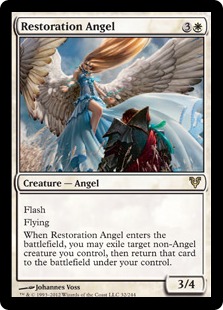
In practice, Ojutai's Command did a lot, but just wasn’t worth the mana. While countering a Thought-Knot Seer or Reality Smasher was nice, most other decks in the format either played creatures that were way cheaper than Ojutai's Command (making it very clunky), had ways around it (Cavern of Souls/Aether Vial), or I didn’t care to counter their creatures anyway. When Wall of Omens is clogging up the ground, countering creature spells isn’t really what I want to be doing with my mana. Thus, this card immediately felt like a four-mode spell that I was really only getting three-modes worth of value out of most of the time.

Restoration AngelAs I said above, having maindeck lifegain against burn and racing situations was another big draw to my initial interest in the card. In practice, however, I found that my matchup against Burn was better than expected (thanks in large part to Spell Queller), and against other decks in the format I was usually winning races in Usain Bolt fashion (read: quickly and easily). When Restoration Angel blinking Wall of Omens can Fog a Tarmogoyf for multiple turns, usually I was winning races with a solid life total left. Situations have come up where four life would have been the difference, but not enough to justify Ojutai's Command definitively.
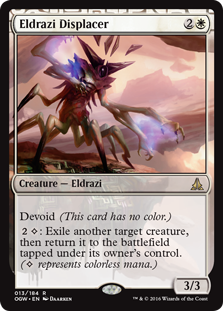
Finally, the return option was nice, but rarely worth justifying the four mana I was paying for it. With only seven two-drops in the maindeck, I’m not really an Ojutai's Command deck. Were I splashing black for Tidehollow Sculler I could definitely see revisiting Ojutai's Command, but I knew the card was underperforming in that slot and there were other spells I was trimming to fit it in.

Eldrazi Displacer

Eldrazi Displacer started as a singleton and quickly impressed me in almost every matchup. Flashing in and exiling our own creature as a more expensive Flickerwisp in response to removal gave it a lot of utility, and just threatening to blink Wall of Omens repeatedly played well into our draw-go style of gameplay. Eldrazi DisplacerPass the turn, hold up Spell Queller, opponent doesn’t play along, blink Wall of Omens and draw a card. A lightning rod for removal, Eldrazi Displacer often cleared the way for Spell Queller by taking a Lightning Bolt that my opponent might have held had I played a Flickerwisp instead. In grindy matchups like Jund and Jeskai, Displacer was an all-star, demanding an immediate answer lest it win the game by itself.
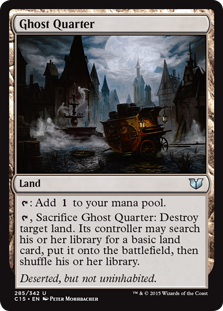
Four colorless sources in the list to activate the singleton Displacer felt like enough, but I quickly swapped a basic Island out for an Adarkar Wastes in testing, bringing the total up to five. The deck only requires double blue for Vendilion Clique or Snapcaster Mage on Serum Visions, so often just a Hallowed Fountain or Celestial Colonnade satisfied my blue requirements for the whole game. The ability to fetch basic Plains and cast all of our spells, even with a bunch of colorless sources, makes our manabase smooth and painless.

Moorland Haunt & Ghost Quarter

Of the few times I drew Moorland Haunt, it was significant about 50% of the time. Against an Affinity player on a Signal Pest/double Inkmoth Nexus draw, Moorland Haunt was great, giving me a few Spirit tokens to trade with his creatures and guarantee victory. Ghost QuarterAgainst Jund, having an extra creature to buy time against Tarmogoyf or rack up 3-4 damage was nice, but not game-winning by any stretch. Usually, I had more than enough things to do with my mana thanks to the value engine of Wall of Omens/Flickerwisp, and Moorland Haunt sat on the bench ready to chip in but ended up never needed. There’s nothing particularly wrong with the card; it just isn’t necessary.
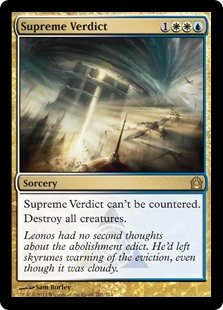
Rather, Ghost Quarter overperformed. Against Tron (a horrible matchup) Ghost Quarter is necessary for victory, and even then the matchup can be tough. Like Jund, it’s possible we just want to give up the Tron matchup, as Tron isn’t really a good choice for this metagame and has largely disappeared as a result. But I feel that with a bit of tuning we can get up to 40% or possibly even better. Outside of the Tron matchup, Ghost Quarter was great format-wide, killing Inkmoth Nexus out of Affinity and Infect and punishing Death's Shadow Zoo for playing no maindeck basics.

Gideon Jura

For the sideboard, Gideon Jura was rarely brought in and quickly abandoned. In theory, it's a flexible threat that adds to the board without getting swept up in Supreme Verdict, aids in races with the must-attack clause, and acts as spot removal to boot. In practice, I rarely wanted to bring it in, as it was expensive and didn’t seem to help us in the areas where we are weak. Infect has a tough time ever beating this card if it lands, but playing into their Negate was not something I wanted to do. Against Eldrazi, we really only fog them for a turn, as they can build up large, powerful boards. Sitting back and popping their Thought-Knot Seers one by one sounded fun, but I never got to that point. A noncreature against control and Jund is solid in theory, but those matchups ended up being solid enough that I didn’t need it.

The Updated List

After a lot of thought, and around 30 matches of tuning, this is where I’m at currently with UW Blink.

UW Blink v2.1, by Trevor Holmes

Creatures

4 Spell Queller
2 Eldrazi Displacer
1 Vendilion Clique
4 Flickerwisp
4 Restoration Angel
3 Snapcaster Mage
1 Kitchen Finks
4 Wall of Omens

Artifacts

3 Aether Vial

Instants

2 Mana Leak
4 Path to Exile
2 Remand

Sorceries

3 Serum Visions

Lands

3 Celestial Colonnade
4 Flooded Strand
3 Ghost Quarter
2 Glacial Fortress
2 Hallowed Fountain
2 Island
2 Mystic Gate
3 Plains
2 Windswept Heath

Sideboard

2 Ancestral Vision
1 Celestial Purge
2 Condemn
2 Dispel
1 Negate
1 Engineered Explosives
1 Kitchen Finks
1 Supreme Verdict
2 Stony Silence
1 Worship

As explained above, Ghost Quarter has been upped to fight against Tron specifically, and the field in general, and Eldrazi Displacer has been increased as well. Vendilion Clique is fine but unspectacular so it remains. Supreme VerdictI'm thinking about cutting it for the second Kitchen Finks, which both frees up a sideboard slot and replaces some of the maindeck lifegain lost from the removal of Ojutai's Command. One of the Dispels became a Negate, to help a bit more in the Tron matchup specifically, and Supreme Verdict was added to help against Elves and Eldrazi.
It might seem like a nonbo to include Supreme Verdict in a deck with 23 creatures, but it isn’t until you play with the deck that you see how swingy Verdict can be in the matchups where we want it. Left to our devices, most creatures we cast replace themselves, so while killing our own creatures isn’t a good idea, it isn’t devastating in the normal sense. Most matchups against Eldrazi devolve into racing in the air while they attempt to put as much power on the board as possible, and in many situations a Supreme Verdict can just end the game on the spot. In one match, my Eldrazi opponent sacrificed a Thought-Knot Seer and tapped two Eldrazi Temple to flash in Elder-Deep Fiend, which was horrible enough that I don’t want put myself in that position ever again. worshipI would much rather play my game, draw some cards, buy some time, and wipe my opponent’s board once he’s dumped his hand and go from there.
Supreme Verdict also does work against Elves and Merfolk, two other fairly difficult matchups. Against all three decks, Worship is an all-star as well. So it’s possible I just want to be playing more Worship, but I’m hesitant to go all-in on that card just yet. Merfolk can still kill us with Vapor Snag, and I’m not familiar enough with my opponents' board plans against me to know if Worship is truly a bomb they can’t deal with, or just a card they can answer eventually. I imagine the Verdict should just be another Worship, but I’d like a few more games of testing before I pull the trigger.

Matchups

At a macro level, UW Blink grinds through most of the reactive decks in the format and stalls most of the aggressive decks. It struggles against combo archetypes, as they blank a large portion of our removal and blockers, and capitalize on our relative slowness to kill. As a result, in my opinion the deck positions itself similarly to Jund, thought it trades the access to discard and “game against everything” characteristic Meddling Magefor a more focused gameplan and better points in specific matchups.
Where Jund offers a lot of power and strength against everything, it suffers from bad draws in the lategame, the weakness of “drawing the wrong half of its deck,” and few outstanding matchups. In exchange, UW Blink offers a lot of consistency and power, invalidates the other reactive decks, and is able to focus strongly on a few specific matchups, in exchange for an inherent weakness to combo. This is important to realize, as the case is quickly being made for adding Meddling Mage, or black for Tidehollow Sculler and discard, to shore up our combo weakness.

Jund

Currently 9% of the online metagame, Jund has grown in popularity in response to the increase in play of Death's Shadow Zoo and Jeskai Nahiri specifically. We talked a lot about the Jund matchup last week, so I won’t go into it much more here, other than to say that our recent changes help the matchup even more. Ghost Quarter for their Raging Ravine along with more Eldrazi Displacer will help us grind much easier in the matchup, and this is one I’m confident in and happy to face all day. Currently my Jund opponents have been adopting a Fulminator Mage plan of attack, which probably isn’t great but can get us if we don’t fetch basic Island. So, fetch basic Island.

Death's Shadow Zoo

Death's Shadow Zoo can be difficult, given that they can kill on turn three and our deck is full of three-drops that are too slow on the draw. Winning the die roll definitely helps the matchup, but isn’t necessary for victory. Path to Exile is the one card they hate to see the most, Path to Exileand Wall of Omens can save us a bunch of life and make progress really hard for our opponent. One Mutagenic Growth is all they need to kill it, but remember that in that situation, we saved five damage, drew a card and made our opponent discard a card.
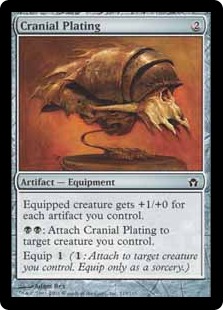
If we can make it to our turn three we should be fine, as any number of plays like Snapcaster/Path or Spell Queller eating a Temur Battle Rage should guarantee victory for us. Death's Shadow Zoo cannot beat a Worship or an Engineered Explosives, and getting to bring in Kitchen Finks, Dispel, Condemn, and Celestial Purge gives us a lot of interaction. I think this matchup is great but slightly worse than Jund. Mulligan non-interactive hands!

Affinity

Affinity is Affinity. Sometimes they get the Cranial Plating draw and hit us fast and hard, other times they get the Steel Overseer draw and make a huge board. For the most part, we have a bunch of interaction and ways to buy time, and once we get Eldrazi Displacer onto the board it is usually over.

Cranial PlatingI’ve been thinking about trimming down on Stony Silence, if that says anything about my feelings on the matchup, but I probably won’t until I can play a solid ten-game set to really get a feel for the how the game flows. Affinity cannot beat a Worship either, and I think swapping the second Stony Silence out for a second Worship actually helps the matchup, and of course gives us points against the field. Stay out of Galvanic Blast range and you should be more than fine.
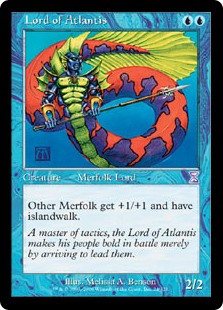
Dredge

Dredge is an interesting creature, as we can’t interact with any of the unfair things they're doing, but they can’t interact with any of the fair things we do and our fair stuff seems more powerful. Wall of Omens and Restoration Angel are just better than a bunch of 3/3’s and 2/1’s. As long as we don’t die to a really quick draw, I am rarely scared about this matchup. They are priced into having to Conflagrate our board, but our toughness is so high they have to do so in such a way that they lose guys and open themselves up to blink effects. Rally the Peasants is worth mentioning, but in over ten matches against the deck online (with various decks of my own) they've cast that card once, and I had a Remand. I'm not too worried about it. They also cannot beat a Worship.

Merfolk

On paper, Merfolk is probably a slightly unfavorable matchup, but with careful play we can get there. Islandwalk is potent against our plan of blocking with Wall of Omens, but we actually don't play as many Islands as you would think. Without looking at the list, try to guess how many we play... Four. That's not bad, and we can go the whole game without Island if we need to, either by luckily not drawing it or holding it in hand. Lord of AtlantisWith Celestial Colonnade, Glacial Fortress, and Mystic Gate giving us blue mana, we have more than enough ways to cast our spells, not to mention Aether Vial cheating them in. Since we're UW, I've had a few Merfolk players even board out their Spreading Seas, making it even easier for us to block.


Still, the matchup is tough, and they can Vapor Snag to kill us with a Worship out, but that's another card they don't really want to be casting against our deck. To this point, I've killed them with Worship twice and have yet to see a post-board Snag, so it's possible they are boarding it out. Still, in that situation the one card I'm looking to draw into is Spell Queller to soft-lock them, which speaks to the power of the card. This matchup is tough because we're priced into racing, but they can build a better board faster. Engineered Explosives, Worship, or Supreme Verdict to bring us back to parity is what we're looking for here.

Conclusion

UW Blink doesn’t do anything crazy, but what it does, it does consistently well. The whole deck is built around moving the game to a point where our opponent has to play into a blowout by Spell Queller or Flickerwisp, and if we can do that we’re in great shape. Wall of Omens is the glue that holds the deck together, and in matchups where it’s ineffective, we struggle.

Currently, I’m happy to play against most of the decks in the field and consider myself favored against a bunch of the top choices. It is the state of Modern that we can feel strongly advantaged against Death's Shadow Zoo and still lose horribly, but for the most part I’m happy to face almost every non-combo deck in the field. Currently, combo in Modern is at an all-time low, which is allowing a deck like UW Blink to shine. Maybe the board should be shifted to allow for a bunch of Meddling Mage, or perhaps we want to be adding black for a few options.

For now, I’m doing well and making small tweaks, and loving every second of it! If you’ve been working on the deck, or if you have any questions/comments, stop by my stream or let me know below! Thanks for reading and I’ll see you next week.

Trevor Holmes

The_Architect on MTGO

Twitch.tv/Architect_Gaming

Twitter.com/7he4rchitect

Deck Overview- Standard Bant Control

Are you a Quiet Speculation member?

If not, now is a perfect time to join up! Our powerful tools, breaking-news analysis, and exclusive Discord channel will make sure you stay up to date and ahead of the curve.

While looking over the Competitive League decklists, I came across a really cool one. Tamiyo, Field Researcher has gotten a lot of hype since she was spoiled, though for the most part the focus has been on her +1 ability, and including her as a 1-2 of. Today's deck takes advantage of the +1 ability, but it also looks to aggressively use the -2 to lock down opposing creatures. Check out the list that Misterfalcon used to 5-0 a Competitive Standard League:

Bant Control

Creatures

3 Archangel Avacyn
2 Dragonlord Ojutai
4 Spell Queller
4 Sylvan Advocate

Spells

4 Tamiyo, Field Researcher
2 Tragic Arrogance
2 Blessed Alliance
3 Clash of Wills
1 Hallowed Moonlight
3 Ojutai's Command
3 Void Shatter
3 Stasis Snare

Lands

3 Canopy Vista
4 Evolving Wilds
1 Forest
4 Island
4 Lumbering Falls
3 Plains
3 Port Town
3 Prairie Stream
1 Yavimaya Coast

Sideboard

1 Blessed Alliance
2 Hallowed Moonlight
1 Dispel
1 Felidar Cub
1 Jace, Unraveler of Secrets
1 Linvala, the Preserver
3 Negate
2 Not Forgotten
1 Planar Outburst
2 Summary Dismissal

This deck is very particular about the creatures it chooses to include, with an emphasis on value and rate. Sylvan Advocate is the only creature that makes the cut on rate, and the other creatures are all able to generate card and/or tempo advantages with their abilities. While Advocate may not have any non-combat abilities, it does do a great job at holding the fort in addition to being an efficient threat to target with Tamiyo's +1. Beyond that, the deck aims to counter, kill, or otherwise incapacitate all of the opponent's plays. Tamiyo is great at locking down opposing creatures, and access to the full four allows you to -2 the turn you play it and the turn after just to play another copy.

For me, the big lesson here is not only that we can play four Tamiyo, but also that we can do so in a controlling deck. This deck is more than fine using the -2 on back to back turns just to play another Tamiyo, and indeed it's not hard to imagine playing a deck more focused on the +1 once Collected Company rotates.

There was an error retrieving a chart for Tamiyo, Field Researcher

Standard has a lot going on right now, and one League is nothing to go nuts speculating over, but this is still worth paying attention to as deckbuilders, and there is likely to come a time when this deck can inform speculation. I would expect that Tamiyo will depreciate in value for the next month or so, and given the knowledge that the card just makes sense in multiple shells as a four-of despite being three colors I imagine that we'll see a point where she becomes a very solid buy. For now, this looks like a cool deck to play, though the current price is a little high. Her time will come though.

Want Prices?

Browse thousands of prices with the first and most comprehensive MTG Finance tool around.


Trader Tools lists both buylist and retail prices for every MTG card, going back a decade.

Quiet Speculation