menu

Insider: Under-the-Radar BFZ Specs – Observing Suspicious Price Movement on MTGO

Are you a Quiet Speculation member?

If not, now is a perfect time to join up! Our powerful tools, breaking-news analysis, and exclusive Discord channel will make sure you stay up to date and ahead of the curve.

Because of their high-profile nature, Pro Tours are milestone events in the evolution of competitive metagames and financial markets. In the weeks and days leading up to a Pro Tour, professional players dissect the format and attempt to unlock the secrets of new cards, while speculators take positions based on future expectation.

When the cards hit the table Friday afternoon, a picture of the Pro Tour metagame will begin to develop, and the market will react strongly over the weekend. Cards that don't live up to expectations will fall in demand and price, and cards that exceed expectations will rise.

This second category is the interesting one, because it holds the opportunity for profit. The trick is to identify the cards with the highest potential PT performance relative to current expectations.

An expensive card like Gideon, Ally of Zendikar is likely to perform well at the Pro Tour, but it’s already expected to and that's reflected in the price. On the other hand, when a bulk rare is discovered as a critical component in a winning archetype, it will make huge gains.

Because of playtesting demands, Pro Tour players are heavy factors in the purchase of Magic Online cards during release week. They also have valuable inside information regarding the Pro Tour metagame.

Thus, it's prudent to believe at least some number of them are involved in speculation in some fashion, even if it’s done indirectly by disseminating information.

I have been studying the MTGO market, and found some startling price movements around a cluster of cards that point towards a new archetype. Given the large gains enjoyed by these cards and the obvious synergy between them, I am confident they will have coming out party at the PT that the community at large isn't anticipating.

As of 5am EST Thursday, compared to 24 hours earlier:

  • Wasteland Strangler is up 660%, to 1.14 from 0.15.
  • Blight Herder is up 1620%, to 0.86 from 0.05.
  • Stasis Snare is up 145% to 0.76 from 0.31.
  • Horribly Awry is up 68% to 0.32 from .019.
  • Quarantine Field is up 49% to 2.23 from 1.5.
  • Oblivion Sower is up 44% to 9.44 from 6.57.
  • Infinite Obliteration is up 900% to 0.30 from 0.03.
  • Silkwrap is up 238% to 0.27 from 0.08.

Ingest and Process

These cards point to an Ingest-Exile deck that seeks to make the most of Wasteland Strangler and Blight Herder--both highly overpowered creatures when their restrictive conditions are met.

There was an error retrieving a chart for Wasteland Strangler
There was an error retrieving a chart for Blight Herder

Here’s a sketch of a potential decklist:

Esper Exile

Creatures

4 Hangarback Walker
4 Fathom Feeder
4 Wasteland Strangler
4 Blight Herder
1 Oblivion Sower

Spells

4 Horribly Awry
2 Spell Shrivel
4 Silkwrap
4 Stasis Snare
2 Utter End
2 Quarantine Field

Land

4 Shambling Vent
4 Polluted Delta
4 Flooded Strand
2 Sunken Hollow
3 Prairie Stream
2 Plains
3 Island
2 Swamp
1 Blighted Cataract

Sideboard

2 Surge of Righteousness
2 Arashin Cleric
3 Painful Truths
2 Transgress the Mind
2 Infinite Obliteration
2 Disdainful Stroke
2 Radiant Purge

Fathom Feeder, Horribly Awry, and Silkwrap reliably enable a fully-powered Wasteland Strangler on turn three. The addition of Stasis Snare, Spell Shrivel, Utter End and Quarantine Field help attain the critical mass needed for a turn-five Blight Herder producing Eldrazi scion tokens.

Even the sideboard provides enablers, with Transgress the Mind, Radiant Purge and Infinite Obliteration.

Wasteland Strangler is beautifully positioned in a metagame of cheap creatures like Jace, Vryn's Prodigy, Mantis Rider, Warden of the First Tree, and Abbot of Keral Keep. Blight Herder is a nightmare for opponents relying on one-for-one removal, and the Eldrazi scions can even help cast future spells.

Assuming these creatures have a breakout performance at the Pro Tour, they have to raise higher than their current prices around $0.5.

Return of The Aristocrats?

I have also taken note of:

  • Grim Haruspex, up 500%, to 0.18 from 0.03.
  • Abzan Ascendancy, up 92%, to 0.25 from 0.13.
  • Rally the Ancestors, up 96%, to 0.49 from 0.25.
  • Zulaport Cutthroat, up 89%, to 1.36 from 0.71.
  • Carrier Thrall, up 400%, to 0.10 from 0.02.
  • Catacomb Sifter, up 48%, to 0.49 from 0.33.

These cards point to an Abzan Aristocrats-style deck combining sacrifice outlets like Nantuko Husk and Evolutionary Leap with two-for-the-price-of-one creatures like Carrier Thrall and Catacomb Sifter.

Add engine cards like Grim Haruspex, Zulaport Cutthroat and Abzan Ascendancy and you have a synergistic deck that can generate insane value. Rally the Ancestors could bring everything back for another go.

Speculating on the Aristocrats deck is tricky, because it relies on commons and uncommons from Battle for Zendikar rather than rares and mythics. But if the archetype finds success, everything in it, regardless of set, will trend upwards.

Pro Tour Battle for Zendikar is shaping up to be an eventful tournament. Stay tuned to Quiet Speculation for all of the latest updates.

-Adam

Building Knightfall: My Deckbuilding Process

Are you a Quiet Speculation member?

If not, now is a perfect time to join up! Our powerful tools, breaking-news analysis, and exclusive Discord channel will make sure you stay up to date and ahead of the curve.

Battle For Zendikar is finally live on Magic Online, which means two things. 1) I’m out of tickets, and 2) we can finally grind some matches with new updates!

Retreat to Coralhelm banner

I’ve got a lot of things in the works, and expect some B/W Tokens and Bring to Light articles and videos coming soon, but for now there’s one deck I can’t stop playing. I give you Knightfall.

[wp_ad_camp_1]

"Knightfall - Trevor Holmes"

Creatures

4 Noble Hierarch
3 Birds of Paradise
4 Steppe Lynx
4 Geist of Saint Traft
4 Tarmogoyf
3 Voice of Resurgence
2 Loxodon Smiter
4 Knight of the Reliquary

Instants

4 Path to Exile
3 Remand

Enchantments

4 Retreat to Coralhelm

Land

1 Breeding Pool
1 Hallowed Fountain
2 Temple Garden
1 Oboro, Palace in the Clouds
1 Sejiri Steppe
1 Gavony Township
1 Horizon Canopy
1 Ghost Quarter
4 Windswept Heath
3 Misty Rainforest
3 Forest
2 Plains

Sideboard

1 Dismember
2 Spellskite
2 Stony Silence
1 Aven Mindcensor
3 Kitchen Finks
1 Crucible of Worlds
2 Dispel
2 Feed the Clan
1 Deprive

While I gave a brief introduction to the basic strategy here, today I wanted to take a more in-depth look at the archetype now that I’ve had the chance to test some actual games. While I am not yet a Knightfall expert, I have been able to test the deck a significant amount with some different configurations and have learned a few things. Let’s get started!

Overview

The combo of Knight of the Reliquary and Retreat to Coralhelm may be very powerful, but my take on the archetype aims to utilize each card effectively when I don’t have the combo. For those unaware, Retreat to Coralhelm with an active Knight of the Reliquary lets us burn through our deck, grabbing fetches for Forest/Plains to untap our Knight with Retreat and keep the chain going. The end result is a large attacking Knight of the Reliquary with access to protection from Sejiri Steppe (more on the intricacies of this combo below). While together they provide a fast combo capable of winning on turn three, what do these cards have to offer us individually, and how can we build to reinforce those strengths?

Knight of the Reliquary
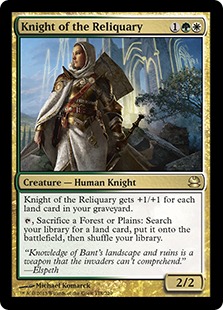
Knight of the ReliquaryBesides being Brian Kibler’s favorite ever Magic card, what else does Knight of the Reliquary have going for it? For one, it’s a relatively cheap, hard-hitting threat that can apply the beats like any other fair man. A few fetchlands in the graveyard can see Knight up in the 4/4 or 5/5 range, putting it on pace or better than Loxodon Smiter for the same mana. Knight’s real power lies in her ability to tutor up any land and put it directly into play, assuming we have a Forest/Plains to feed it. This lets us find bullets like Ghost Quarter against Tron, Gavony Township on an anemic board, Sejiri Steppe to protect a creature, or Horizon Canopy if we need to draw cards. At its worst, Knight serves as a Birds of Paradise, letting us float a mana and then tutor up another land to function as a pseudo mana-elf.

Retreat to Coralhelm
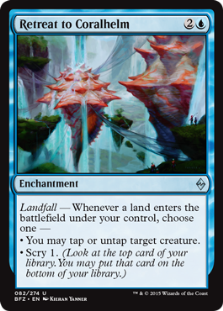
Retreat to CoralhelmWhile definitely not on the level of Knight of the Reliquary, Retreat to Coralhelm provides just enough value that it’s not an entirely blank combo piece on its own (unlike Splinter Twin). Tapping down blockers with every landfall trigger can really help us push damage past a clogged board, and can even be used defensively (against Twin, for example) if we hold fetchlands to sacrifice on our opponent's turn. Scry 1 might seem minor, but anyone with experience playing Temples in the previous Standard format can speak to how deceptively powerful that ability can be. This effect is compounded by the ramped-up card quality in Modern, as less lands and more powerful effects translate into more value for scry (just look at UR Thopters from Pro Tour Vancouver). While we would never play Retreat to Coralhelm on its own in Modern, we can still work to take advantage of its abilities by focusing on compounding its tempo-generating tap ability.

Process

With these characteristics in mind, we can start to think about the shell we’d like to build around Retreat to Coralhelm and Knight of the Reliquary. Remember, our goal is to craft a strategy that can Twintake advantage of either card’s unique abilities without requiring both to win. Otherwise, we are just another clunky two-card combo deck and should probably be playing Splinter Twin. So, starting at the bottom, we have two sorcery speed three-drops, one costing 2U and the other 1GW. This automatically suggests Bant, or at least G/W/u. While we could splash for a fourth (or fifth) color, keeping our mana requirements as simple as possible will let us play more colorless bullet lands for Knight of the Reliquary. Bant has access to two excellent mana creatures in the form of Birds of Paradise and Noble Hierarch, which will help us accelerate out three-drops as early as turn two, and even contribute to attacking in Noble Hierarch’s case.
Mana

Decks with mana creatures tend to want less lands to reduce the risk of flooding, and I always like playing Gavony Township alongside cheap mana guys if possible. While we could play eight or even nine mana guys, I tend to prefer seven as a solid starting point. Any more than that and we start to get flooded often, and I don’t anticipate playing many spells that cost more than three. For our manabase, we should be looking to play 21 or 22 lands, and we have to make sure we have enough Forest/Plains to grow Knight up to one-shot range. Remember that each Forest/Plains can contribute two points of power to Knight, as we will tutor up fetches and then go get another Forest/Plainsto keep going (and get extra Retreat triggers as well). A 9-7 split on basics/fetches with five “bullets” should give us the ability to one-shot our opponent and fit some spicy stuff in as well. At this point I think it’s a good idea to look at where we’re at, because from here the deckbuilding decisions become a little murkier and branch out.

"Core Cards"

Spells

4 Noble Hierarch
3 Birds of Paradise
4 Knight of the Reliquary
4 Retreat to Coralhelm

Land

2 Temple Garden
1 Breeding Pool
1 Hallowed Fountain
3 Forest
2 Plains
4 Windswept Heath
3 Misty Rainforest
1 Sejiri Steppe
1 Ghost Quarter
1 Gavony Township

This gives us 15 spells and 19 lands, leaving us two land spots and 24 spell slots to fill. Any green deck looking to attack with creatures needs a big reason to not play Tarmogoyf, and besides price I can’t think of one, so he’s in. Other than that, we aren’t “forced” to play anything, so I want to slow down and explore our options, talking about some concepts before we start adding to the list again.

Identity – What are we trying to do?

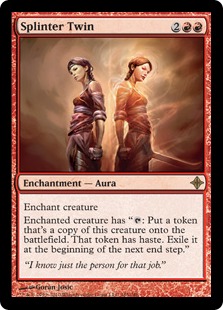
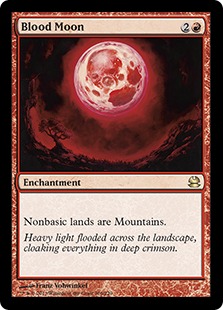
When working on a new archetype, the first thing I look to for guidance is context (shocker, I know). Those familiar with my articles have heard me speak of context time and again, and until I hear complaints I will probably continue to do so.Blood Moon When I refer to context, I’m talking about the collective environmental factors that influence the state of Magic as we see it today. Burn as a major format player, Splinter Twin as a punisher for non-interaction, Blood Moon as a safeguard for crazy manabases, Tarmogoyf as a ubiquitous threat; all of these and more contribute to this notion of “context” that many refer to as the metagame. Whether your realize it or not, our card evaluation process always involves one or more of these factors: “I can’t play 4 Dismember because of Burn”…”5 Color sounds sweet, but how do you handle Blood Moon?”…”Nicol Bolas, Planeswalker is the man, but dude…” Context can be carried further, however, and it’s important to remember “identity”, or what this archetype is doing that is unique to itself. Merfolk exists as a strong, linear deck that punishes blue decks and can grind out opponents relying on one-for-one removal. This elevates it above the teeming masses of Sliver Aggro, Allies, Vampires, Goblin Tribal, Zoo, etc because while each of these decks does something slightly different, at their core they are just a worse Merfolk deck. Now sure, there is value in playing a similar strategy that attacks the field from a different angle (ex: playing Zoo when Merfolk hate is prevalent) but if you can’t easily answer the question “Why aren’t you just playing X” then maybe you should just play X.
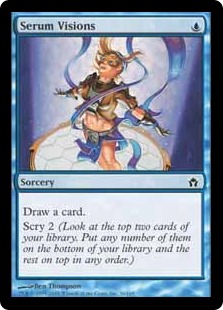
Serum VisionsI say all that to observe this; we have to be careful of where we sit on the archetype spectrum. Adding Serum Visions and Mana Leak to our deck might be right, but at that point we start to do a lot of the things that Twin can do better, and I find that worrisome. On the other end of the spectrum, we could go all-in on aggro, playing Delver of Secrets and Vapor Snag and end up with an incohesive strategy where our combo is out of place. For me, Retreat to Coralhelm’s tap ability and Knight of the Reliquary’s aggressive sizing suggests a close fit alongside cards that help to generate and push tempo. Our identity, if we were to label it, should be something along the lines of aggro-tempo with a combo element.

Filling out the Deck

Voice of Resurgence functions as not only the second best two drop in our colors, but works well with our combo elements.Voice of Resurgence Discouraging use of both counterspells and instant speed removal, Voice of Resurgence often functions as a pseudo-Grand Abolisher by forcing our opponents into using mana on their own turn. Unsuspecting players will often look to maximize mana efficiency in the face of a Voice of Resurgence by powering out threats where they would otherwise leave up removal/countermagic, paving the way for us to execute our combo. The mere threat of free Elemental tokens is often enough to discourage our opponents from interacting with us at instant speed, which is exactly where we want to be. Even Voice’s fail-state (dying to Lightning Bolt) still leaves an Elemental behind and helps clear the way for Knight to live later.
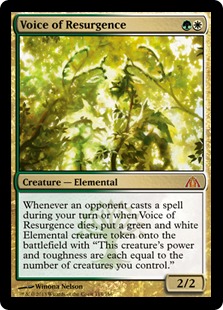
With a stable tap effect in the form of Retreat to Coralhelm, Geist of Saint Traft starts to look very appealing. One of the most powerful three mana-creatures that doesn’t see much play, Geist has always been held back by ever-present blockers threatening to get in his way. The two card combo of Geist/Retreat may not win the game on the spot like Knight of the Reliquary, but rest assured that two turns of tapping down blockers gets the job done just as well. Alongside seven mana-dorks, Geist of Saint Traft can often come down a full turn earlier than normal, which can be devastating against many opponents.

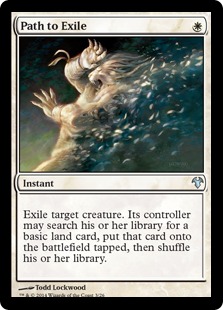
Due to the prevalence of fast aggro, mana creatures, and creature-based combo, almost every deck in the format that isn’t all-in combo needs some form of interaction. This often takes the form of counterspells, removal, or both. In our colors, removal means either Path to Exile or Vapor Snag.Path to Exile I like playing the full set of Path to Exile here, as it is the stronger spell, lets us keep our blue to a relatively light splash, and we often don’t mind giving our opponent a free land. Killing a creature cheaply and efficiently, no questions asked, is what we’re in the market for, and Path to Exile delivers. In this same vein, Remand works to buy time and gives us a broad answer to all sorts of threats, be they Tarmogoyf, Mana Leak, or Splinter Twin. As long as we’re presenting a clock or forcing through our combo, the “card disadvantage” associated with Remand giving our opponent back their spell is often irrelevant, as we are usually too far ahead on tempo for this to matter.
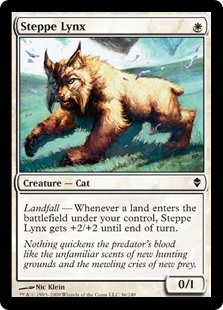
Once we start heading down the path of playing spells like Remand, I really want to be sure we will be able to take advantage of the tempo-generating effect it provides. Remanding a spell while we aren’t capitalizing with free attacks is a "spinning tires" steppe lynxfeeling I would like to avoid, which leads me to wanting more early drops. While we have a plethora of two-drops available to us, our identity as a landfall deck along with our seven fetchlands really makes me want to try Steppe Lynx. Having a second creature out that can go huge with Knight of the Reliquary burning through land drops is great, but I’m more excited for what 11 one drops does for our consistency. While it can sometimes be awkward to have both mana creatures and Steppe Lynx in hand on turn one, the ability to always have something to do on the first turn of every game is not to be undervalued, and goes a long way towards pushing that tempo effect we’ve talked about so much. Again, even if Steppe Lynx eats a Lightning Bolt, that is one less removal spell our opponent is aiming at our Knight of the Reliquary, and the ceiling on Steppe Lynx is huge. Go on, attack with Steppe Lynx for eight damage over two turns and tell me you’re not having fun!
"Maindeck"

Creatures

4 Noble Hierarch
3 Birds of Paradise
4 Steppe Lynx
4 Geist of Saint Traft
4 Tarmogoyf
3 Voice of Resurgence
2 Loxodon Smiter
4 Knight of the Reliquary

Instants

4 Path to Exile
3 Remand

Enchantments

4 Retreat to Coralhelm

Land

1 Breeding Pool
1 Hallowed Fountain
2 Temple Garden
1 Oboro, Palace in the Clouds
1 Sejiri Steppe
1 Gavony Township
1 Horizon Canopy
1 Ghost Quarter
4 Windswept Heath
3 Misty Rainforest
3 Forest
2 Plains

Sideboard

The final numbers are still up in the air, but this is the basic thought process I used to arrive at the list I outlined at the beginning of the article. So you don’t have to scroll up, here is where I’m at before we move on to the sideboard. I am currently trying two Loxodon Smiter in place of the fourth Remand and Voice of Resurgence and have been liking them so far, but there is definitely some wiggle room in the maindeck. I could see anything from a fifth removal spell to a Dispel or even a Spellskite depending on the metagame and our exact configuration. Rather than just hand you a 15 card sideboard, I’d like to briefly go over some spells I chose and let you explore with me what we should be preparing for.

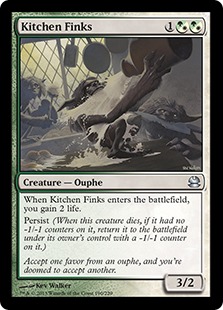
Kitchen FinksKitchen Finks is one of the best cards legal in Modern without a great home. Great against aggro, midrange, and control, Kitchen Finks punishes one-for-one removal and even goes nicely with our Gavony Township. A must include for any archetype looking for help against Burn or Jund.
Dispel is the best blue card in Modern, maybe tied with Snapcaster Mage, and directly supports our plan of attacking with cheap creatures and protecting said creatures cheaply. I would definitely like to find room for three, but I’ve been playing two.

Feed the Clan is really only for Burn, but it's excellent against them. Five life ends up being around 1.5 cards, and we have multiple creatures to enable ferocious. If we ever cast this for 10 life it’s very difficult to lose. We might be fine without it against Burn, but it’s never wrong to play it safe.

Spellskite is the ever-present catch-all answer for Modern, and you can find a use for it post-board in pretty much every matchup. A great protection effect that doubles as disruption against Twin, Infect, and Bogles, there’s a reason why Spellskite is played so much in Modern.

Stony Silence is one of the best, if not the best, answer for Affinity that also does work against Tron. An auto-include at this point for any Modern deck with access to white mana.

Aven Mindcensoraven mindcensor is a solid role-player against Tron that does good work against Scapeshift and Amulet as well. I’ve found some difficulty with the Tron matchup and I’ve liked the 2/1 flying body too, but Mindcensor could definitely be anything else if you need the room.
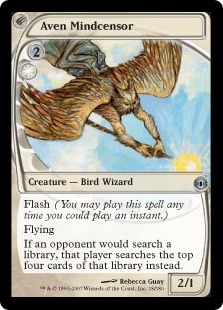
Dismember is another solid catch-all removal spell for when we need a fifth or sixth piece of creature-kill. As always, Dismember provides access to removal that can kill a Goblin Guide, Deceiver Exarch, Tarmogoyf or Gurmag Angler for one mana in colors that are not black. If you need more removal, Dismember is probably second best after Path to Exile.

Crucible of Worlds is a fun bullet against Tron that has, in my opinion, done a lot of work to make a poor matchup much more manageable. Rebuying Ghost Quarters is the dream, and has been a solid way to attack the matchup in my experience.

Deprive is a great no-questions-asked counterspell for when we need such a thing, and it can serve as either the fifth Remand or a slightly slower, much more versatile Dispel in matchups where we are looking to go a little more reactive.

Conclusion

Currently, that is where I’m at regarding Knightfall in Modern! While I’ve had a fair amount of experience with the deck in a variety of matchups, the sideboard and maindeck have both been in flux to the point where I can’t speak with complete clarity regarding positive/negative win rates and exact sideboard configurations. As is always the case with an unexplored archetype, the amount of work that goes into tuning/preparing the deck against established, well-oiled machines can be daunting, but the results can be rewarding.

I hope you enjoyed this look inside my process for building Knightfall, and if you have any thoughts/opinions/suggestions feel free to let me know in the comments below! As always, stop by my stream at twitch.tv/Architect_Gaming if you want to see this deck in action! I’ll see you there.


Trevor Holmes
The_Architect on MTGO
Twitch.tv/Architect_Gaming
Twitter.com/7he4rchitect

Insider: Standard on the Cusp of PT BFZ

Are you a Quiet Speculation member?

If not, now is a perfect time to join up! Our powerful tools, breaking-news analysis, and exclusive Discord channel will make sure you stay up to date and ahead of the curve.

Holy price shifts, Batman!

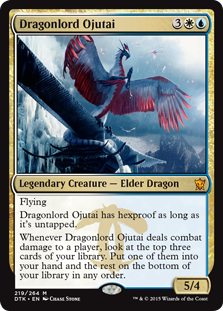
The recent price fluctuations of cards like Dragonlord Ojutai and Den Protector got the gears turning in my head. We are moving into an era of Magic with more rotations, which means more opportunity to make money through Magic finance.

There was an error retrieving a chart for Dragonlord Ojutai

That time will be here sooner than you think. The new rotation schedule kicks in early in 2016. January will bring us Oath of the Gatewatch, the second and final set in this block. April will then bring the new rotation into full force when Khans and Fate Reforged rotate out with “Tears,” but Origins and Dragons are still legal for another six months!

The appearance of new decks like Jeskai Black and the updated G/W Megamorph cause prices to shift in response. Now we'll have the opportunities presented by a new format twice a year. That is an exciting prospect for the finance community.

The window for spikes will be shorter, but history has shown us that spikes rarely occurred during the later months anyway. That time was usually characterized by drastically dropping prices due to the imminent rotation.

Once we get closer to April, you'll see many writers discussing how to transition into the new format. Until then, enjoy your time in the world of finance.

These days, the price spikes we’re seeing remind me of 10-15 years ago before Medina’s Pack to Power escapades escalated finance and brought the topic into the forefront of the Magic community. Little surges in price like Crackling Doom and Avatar of the Resolute are accompanied by huge swings in value like Jace, Vryn's Prodigy and Dragonlord Ojutai.

The point is, if you have your ear to the ground and pay attention to the metagame trends, you too can make lots of money.

Standard Shifts

The new metagame is establishing itself quite nicely. G/W Megamorph and Jeskai Black seem to have taken the top spots so far, with Atarka Red and five-color decks in the mix as well. Normally I would consider Abzan Blue a top deck, but to me, it's just another version of G/W Megamorph.

The key to both of these decks is taking advantage of the early turns of the game.

Jeskai Black

Take Jeskai Black for starters. For the first two weeks of this format, blue mages have lived a life of luxury with no fear that their turn two Jace would be eliminated. He has ample time to flip and start gathering massive amounts of card advantage.

Strangely, the decks with red mana are good against each other because they have access to Wild Slash and Fiery Impulse. With no other cheap removal in the format, if you are looking to kill creatures early, red is your only option. Running Wild Slash also allows you to play multiple spells per turn.

Let’s take a look at Todd Anderson’s version that took 3rd place this past weekend.

Jeskai Black by Todd Anderson (3rd place SCG Atlanta)

Creatures

4 Seeker of the Way
4 Jace, Vryn's Prodigy
4 Mantis Rider
2 Monastery Mentor
2 Dragonlord Ojutai

Spells

3 Wild Slash
2 Dispel
2 Silkwrap
1 Valorous Stance
3 Crackling Doom
2 Jeskai Charm
2 Murderous Cut
1 Sorin, Solemn Visitor
2 Treasure Cruise

Lands

4 Bloodstained Mire
4 Flooded Strand
4 Polluted Delta
2 Battlefield Forge
2 Prairie Stream
2 Smoldering Marsh
1 Sunken Hollow
1 Island
3 Mountain
3 Plains

Sideboard

2 Arashin Cleric
1 Hidden Dragonslayer
1 Stratus Dancer
1 Mastery of the Unseen
2 Disdainful Stroke
1 Dragonlord Silumgar
1 Sorin, Solemn Visitor
2 Exert Influence
2 Radiant Flames
2 Self-Inflicted Wound

The first thing to notice is the deck is light on threats. The main damage dealers are Mantis Rider and Dragonlord Ojutai.

Instead of the second two Dragonlords, Todd put in two Monastery Mentors, which adds a lot of power to this archetype. Seeker of the Way helps out on this front as well, but I wouldn't look to him to close a game for you anytime soon. I might look to squeeze a third copy of Ojutai or Mentor into the list somewhere.

This “new” deck isn’t really new at all. We’ve all seen and played against similar decks over the past year. The main difference is Jeskai now has real removal spells. They can cast Crackling Doom or Murderous Cut to rid the board of any pesky threat.

Finally, we have my favorite removal spell in the meta right now, Silkwrap. I’ve spoken about this card in previous articles and in practice I’ve been even more impressed. Theoretically this card is great because it’s a one-card answer to Hangarback Walker. Additionally it does deal with Deathmist Raptor, although Dromoka's Command means your enchantment might not be safe the whole game.

Another potential option for answering the problematic threats from G/W Megamorph are the devoid commons from BFZ, Touch of the Void and Complete Disregard. Both can exile a Hangarback or Raptor, and are reasonably costed to kill other early threats. I would not be surprised to see these adopted in some capacity.

G/W Megamorph

Speaking of G/W, that's the other deck that has established itself as an early pillar.

G/W Megamorph by Christopher Thomas (2nd Place SCG Atlanta)

Creatures

4 Warden of the First Tree
4 Hangarback Walker
4 Deathmist Raptor
4 Den Protector
2 Hidden Dragonslayer
3 Nissa, Vastwood Seer
3 Wingmate Roc

Spells

2 Silkwrap
3 Dromoka's Command
3 Valorous Stance
4 Gideon, Ally of Zendikar

Lands

3 Flooded Strand
4 Windswept Heath
4 Wooded Foothills
3 Canopy Vista
6 Forest
4 Plains

Sideboard

3 Arashin Cleric
2 Whisperwood Elemental
3 Evolutionary Leap
1 Silkwrap
2 Surge of Righteousness
1 Valorous Stance
2 Radiant Flames
1 Tragic Arrogance

Brian Kibler built this deck to generate value, which is reflected in the creature base. Practically every threat is capable of generating card advantage. You don’t need much knowledge about Magic to see that getting value out of every card leads to victories.

G/W Megamorph reminds me of The Aristocrats. Both the Abzan and Mardu versions of that deck were filled with virtual card advantage. The difference is The Aristocrats had to sacrifice creatures in order to build incremental value. With this deck, the only restriction is that you probably want to unmorph something throughout the course of the game to recur Deathmist Raptor.

If you were curious, I chose the 2nd place deck over the first place version because I think its choice of two Silkwrap over a land and a Dromoka's Command is preferable. Shaving those two cards seems well worth gaining another removal spell that's so well positioned right now.

I would sideboard against this deck similarly to Abzan Midrange from last season. This deck doesn’t have as many traditional removal spells, but when Deathmist Raptor starts trading with multiple creatures, you will start to realize they don’t need as many ways to kill your guys.

The last note I wanted to make about this deck is that while it may appear aggressive, it's really more midrange. The only aggressive opening available is turn one Warden of the First Tree into Deathmist Raptor turn three.

Don’t get me wrong, if you follow that sequence up with a removal spell and Wingmate Roc, it might seem like you're applying the sick beats. But most of the time the deck will function like a slower midrange deck that's trying to get value out of their cards.

If you look at G/W Megamorph this way, the role of aggressive deck in Standard is still up in the air. I think Atarka Red will assert itself even more over the coming weeks. There’s no other deck that can win on turn three, nor is another one capable of dealing 14 damage out of nowhere.

Developing Hangarback Warriors

A couple weeks ago, I spoke on another aggro deck I've been working on, a black-white deck centered around warriors.

Hangarback Warriors

Creatures

4 Bloodsoaked Champion
4 Dragon Hunter
4 Hangarback Walker
3 Anafenza, Kin-Tree Spirit
1 Blood-Chin Rager
4 Chief of the Edge
3 Drana, Liberator of Malakir
3 Blood-Chin Fanatic

Spells

3 Ruinous Path
3 Silkwrap
3 Gideon, Ally of Zendikar
1 Sorin, Solemn Visitor

Lands

4 Shambling Vent
4 Caves of Koilos
4 Scoured Barrens
6 Plains
6 Swamp

Sideboard

3 Duress
1 Sorin, Solemn Visitor
1 Ob Nixilis Reignited
1 Silkwrap
3 Reave Soul
1 Murderous Cut
2 Valorous Stance
1 Utter End
2 Gilt-Leaf Winnower

Now that’s an aggro deck. We have two different versions of Savannah Lions backed up by an aggressive sligh curve of creatures. I thought that adding in so many non-warriors would dilute the deck into an anti-synergistic mess, but this deck has been rocking through everything the metagame has thrown at me.

Chief of the Edge does a fine Fleecemane Lion impression and when you have multiples, it’s like you made them both monstrous. Additionally, Chief buffs your one-drops which helps increase the early pressure.

It’s the new cards that really add punch though. Drana, Liberator of Malakir instills fear in the hearts of your opponents and draws a removal spell every time they have one. If not, she takes over the game.

A lot of words have been written about Gideon, Ally of Zendikar, and he lives up to the hype. He’s worth every bit of his current price tag and I doubt he'll be dropping down any time soon.

There was an error retrieving a chart for Gideon, Ally of Zendikar

Lastly, Shambling Vent has constantly overperformed for me. Whether being the extra attacker to get those last points of damage through, or attacking after a sweeper when you topdeck a land, or getting awakened by Ruinous Path to become a 6/7 lifelinking beatstick, this manland does not disappoint.

The two cards I am uncertain of are the two warriors-matter creatures, Blood-Chin Rager and Blood-Chin Fanatic. In the FNM I won with this deck, I didn’t draw either of them much and sided them out often. That doesn’t mean they need to be cut but it does put them on the chopping block.

I think they would both shine in the G/W Megamorph matchup, which I didn’t play against. (I beat two Atarka Red decks, Esper Dragons, and Jeskai.) I think these Blood-Chin will be central to beating that deck so they’re staying in for now.

I could also see this deck moving in the direction of Knight of the White Orchid and trying to jump straight to the great four-drops. Dirt cheap and full of potential, Knight looks like a great pick up right now.

There was an error retrieving a chart for Knight of the White Orchid

As always, the sideboard is in an ever-changing state, although I'm happy with most of it. Duress, for example, has been excellent against Atarka Red, Esper Control and Jeskai Black alike.

The additional removal spells have proved quite integral. I may switch Reave Soul over to Complete Disregard, but the two-mana cost is quite helpful against other fast decks, so I'm not certain yet. Sorin has been versatile as well, because it can gain life against aggressive decks but also provides a threat against control that's difficult to answer.

~

For now, this is the deck I have been having the most fun with (and winning is sweet too). Let me know what you think in the comments. Have you tried something similar?

Feel free to post general comments about the metagame heading into the Pro Tour as well. I’m sure we'll get our socks rocked off this weekend as the pros show us how it’s done.

Until next time,
Unleash the Warrior Force!

Mike Lanigan
MtgJedi on Twitter
Jedicouncilman23@gmail.com

Insider: [MTGO] An Introduction to Short Selling – The Case of Jace

Are you a Quiet Speculation member?

If not, now is a perfect time to join up! Our powerful tools, breaking-news analysis, and exclusive Discord channel will make sure you stay up to date and ahead of the curve.

For several months, there has been talk, by myself and others, of the possibility of short selling on MTGO. I began to write a long article (which will probably be broken into several parts) about short selling on MTGO five months ago. Although I'm close to finishing the whole thing, I didn't want to postpone the discussion any longer.

Recently I executed a successful short sale of Jace, Vryn's Prodigy. I figured this was a good opportunity to introduce the concept, at least briefly, here on QS.

While attractive, short selling has been widely regarded as difficult or impossible to apply to Magic cards. MTGO, however, seems to provide a more conducive environment, with significantly smaller spreads, instant transactions and an ease of finding transaction partners.

My short sale of Jace proves that it's possible. Today I'll explain exactly how I did it.

Jace, Vryn's Prodigy

The new version of Jace has already proven itself in several Standard decks (pre- and post-BFZ), in Modern and, apparently, even in Legacy and Vintage. This time around it seems that the new Jace, the Mind Sculptor is really here.

There was an error retrieving a chart for Jace, Vryn's Prodigy

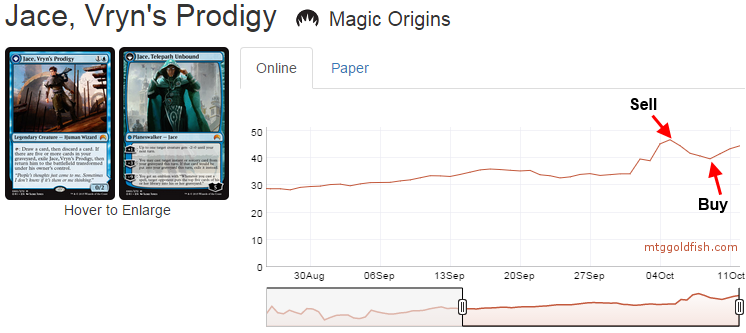
Although little doubt remained that Jace was the real deal, its price bumped from an already respectable 35 Tix on Thursday, October 1st, to 47 Tix on the following Monday. Ironically, no Jaces were found in the finals of the first Standard Open after rotation, SCG Indianapolis, nor in the top two finishers of this past weekend's Standard Open, SCG Atlanta.

Faced with this abrupt spike and a 45+ Tix price tag at the end of the weekend, I sold 10 copies on Sunday night at 43.4 Tix each, and another five copies on Monday night for a little over 45 Tix each. This averages to 44 Tix per copy.

SELJVP

By Thursday night I had bought back my 15 Jaces at 40 Tix each.

BGTJVP

So I made 60 Tix by short selling my Jaces and buying them back four days later. This is clearly not your typical Magic finance scenario...

How did I end up with 15 copies of Jace, Vryn's Prodigy, a card that should have been avoided as a spec target due to its high starting price? Why would I buy a spec back if the goal is to sell as high as possible and then move on? And why buy back a card that is likely to go farther down anyway?

Let's try to make sense of all this and see how to make short selling a tool in the MTGO speculator's arsenal.

Short Selling Magic Cards - Why Not?

Since speculation became part of the Magic economy, it has consisted in buying a card, and then selling, ideally higher. Short selling is a speculative move that calls for the complete opposite: selling first, and then buying, lower if possible.

Short selling is a well-established practice in economics and the stock market. It usually consists of borrowing a security you don't own in order to sell and then later return to its owner. The bet being made is that the borrowed security is about to lose value. The essential mechanics--to buy low and sell high--haven't changed, but the order of the two transactions has.

An Inadequate Model for Magic?

The Magic finance system as it's set up currently is not really suited for short selling. The basic problem lies in the difficulty of finding someone willing to loan out their cards.

We can break down the owners of any given card into just a few categories:

  1. Players, who need the card "full time."
  2. Vendors, who also need cards available at any time to keep their storefront stocked.
  3. Speculators, who plan to hold the card while its value increases. They too have an interest in constant access, in order to sell as soon as the target value is reached or when they believe a drop will occur.

What's lacking here is someone with no need to sell their cards in the short term, nor the desire to use them in events. In this situation, the owner would not care much about price fluctuations.

This set of circumstances may be rare, but it does describe the situation of at least one group of people: anyone currently speculating on full sets.

Investing in Full Sets - More Than Meets the Eye

Back in February I talked about my plans to invest in full sets, specifically of Khans of Tarkir (KTK). I bought about four dozen full sets of KTK, and a similar number of Fate Reforged (FRF) and Dragons of Tarkir (DTK).

More recently I also invested in 15 Magic Origins (ORI) full sets. As discussed back then, full sets require little time and offer decent returns, while allowing you to invest a large quantity of Tix at once.

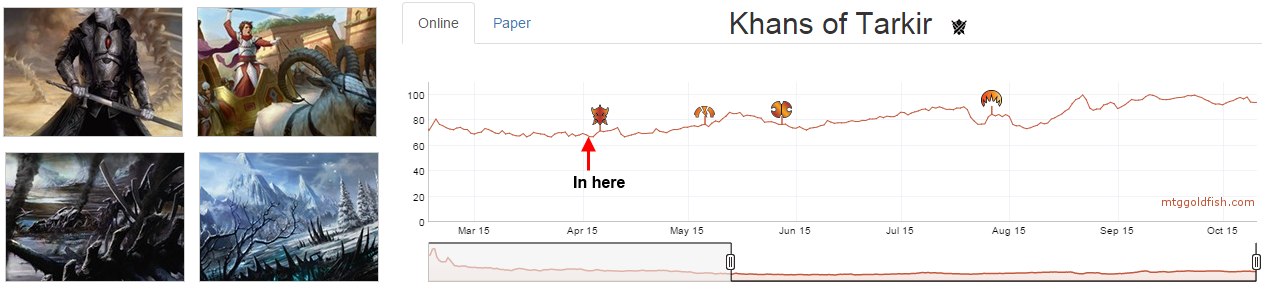
You can see how my full sets are faring at the moment in the chart below. KTK and DTK are doing well, whereas FRF is lagging a bit.

KTK

The theory behind full set speculation is fairly simple. Hold onto a stack of 269 cards, in the case of KTK full sets, for several months and then sell the same 269 cards at a profit. The price fluctuations of individual cards don't matter, only the full set's price. Since the value resides in the integrity of the set, there's no incentive to sell individual cards even if they spike.

This creates the perfect terrain for short selling. The owner can loan out cards without interfering with their speculative strategy. Or they can short sell their positions themselves.

There are a lot of factors to consider, but basically every time you suspect a card in one your full sets is headed downward, there's a potential short sell to execute. If you can do so successfully, you'll supplement the return on the full set speculation with additional profit.

Short Selling Jace

I bought my ORI sets at 101 Tix each with the declared goal of selling them sometime later this Fall or early this Winter with a 30% to 50% profit. By definition, buying 15 ORI full sets included buying 15 copies of Jace, Vryn's Prodigy.

Quickly after release, Jace established himself as the most expensive card in ORI, above 20 Tix. Jace kept increasing in price and was way over 30 Tix by mid-September.

30 Tix is already an impressive price for a core set mythic. As far as mtggoldfish can track (from M12 to M15) only two mythics reached that price--Thundermaw Hellkite and Nissa, Worldwaker. Nissa only sustained that price for two weeks while the Hellkite hung in there for about two months.

Needless to say, a 40+ Tix price tag puts us in completed uncharted territory for a core set mythic. Uncharted, and most likely, unsustainable.

Especially after a 10 Tix price spike, a subsequent drop, even momentarily, was inevitable. This is why I decided to sell my 15 copies of Jace. The price did drop and four days later I rebought.

JVP

Why rebuy so early if I believe Jace is overpriced and additional drops are inevitable? Remember, my main goal here is to speculate with ORI full sets. Short selling Jace was no more and no less than a quick flip. I simply grabbed my 60 extra Tix and kept riding the ORI full set wave, independently of Jace's future movement.

Another reason to rebuy Jace after only four days is that the card will still be in demand and the price could increase again. Wednesdays and Thursdays are usually the days of the week when prices are at their lowest on MTGO, so rebuying my Jaces on Thursday made sense. It turned out prices went back up on Friday...

Finally, the price of Jace, Vryn's Prodigy will be insanely high as we enter Pro Tour Battle for Zendikar. Depending on Jace's performance during this event it could seriously tank. To sustain a 50+ Tix price Jace needs to show up in nearly every deck and be outrageously dominant.

I'm not sure this will happen, and I want to hold my Jaces this Sunday in order to, that's right, short sell them again!

For Once, Wishing for the Worse

Holding on to full sets from Standard makes me want to see cards with high expectations miss the mark at this weekend's Pro Tour. Weak showings provide as many opportunities to short sell the cards in question.

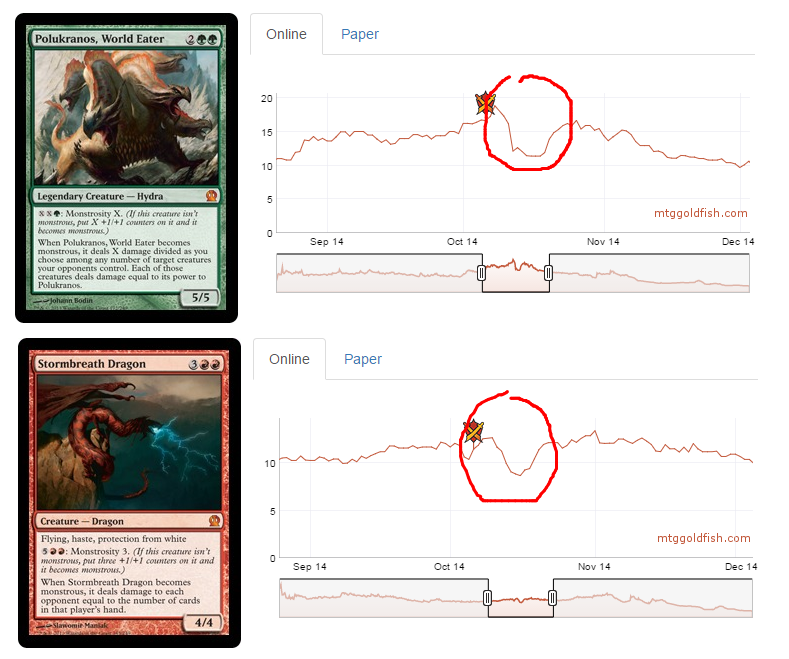
Last year, the aftermath of Pro Tour Khans of Tarkir saw Polukranos, World Eater and Stormbreath Dragon rapidly shed a big chunk of their value for failing to meet expectations.

poldrag

These were clearly excessive reactions as both cards bounced back soon after, and they continued to play an important role in Standard.

If similar dips occur during PT BFZ, then short sales could be executed, provided you own full sets of ORI, KTK, FRF or DTK, or can borrow the cards. Jace, Vryn's Prodigy is my number one candidate for a short sale this weekend.

~

There's a lot more to debate regarding short selling on MTGO. Much remains to develop in the area of theory and technique, as well as a potential business model. But we know the strategy is doable and capable of generating gains.

Those who follow my "100 Tix, 1 Year" project know I had already executed a few short sales on that account. The difference there was I borrowed the cards from my main account.

Although I was technically borrowing cards from myself, I paid fees from the 100T1Y account to my main account. Thus the transaction completely mirrored a "real life" short sale in which a speculator borrows cards from someone else. This was in line with the purpose of the "100 Tix, 1 Year" project--anybody can do what I do, including borrowing cards with a fee and short selling.

It will be interesting to see how short selling develops in the Magic world. Look for my more in-depth article series on the topic soon.

Thank you for reading,

Sylvain Lehoux

Full Art Basics Confirmed for Oath of the Gatewatch

Are you a Quiet Speculation member?

If not, now is a perfect time to join up! Our powerful tools, breaking-news analysis, and exclusive Discord channel will make sure you stay up to date and ahead of the curve.

From MaRo's Blogatog:

Oath of the Gatewatch will have full art basic lands. They will be the same full art lands from Battle for Zendikar (complete with expansion symbol). The Oath of the Gatewatch fat packs will also have full art basic lands. The Battle for Zendikar gift box, by the way, will not have full art basic lands (except, of course, for inside booster packs).

Given the limited print run of Battle for Zendikar fat packs, I'd imagine that Oath of the Gatewatch fat packs will be in limited supply as well. This is unfortunate for those who like to acquire fat packs to have them, but the silver lining is that, even with a limited run on both fat packs, this does put a lot of full art lands into circulation. Hopefully your LGS is good about how they handle the supply that they get.

Avatar photo

Ryan Overturf

Ryan has been playing Magic since Legions and playing competitively since Lorwyn. While he fancies himself a Legacy specialist, you'll always find him with strong opinions on every constructed format.

View More By Ryan Overturf

Posted in Free2 Comments on Full Art Basics Confirmed for Oath of the Gatewatch

Have you joined the Quiet Speculation Discord?

If you haven't, you're leaving value on the table! Join our community of experts, enthusiasts, entertainers, and educators and enjoy exclusive podcasts, questions asked and answered, trades, sales, and everything else Discord has to offer.

Want to create content with Quiet Speculation?

All you need to succeed is a passion for Magic: The Gathering, and the ability to write coherently. Share your knowledge of MTG and how you leverage it to win games, get value from your cards – or even turn a profit.

Insider: QS Cast 8: PT: BFZ

Are you a Quiet Speculation member?

If not, now is a perfect time to join up! Our powerful tools, breaking-news analysis, and exclusive Discord channel will make sure you stay up to date and ahead of the curve.

(apologies for eighty colons in the title)


This week, Kelly, Doug and Chaz outline their best speculation targets going into the Pro Tour. Kelly also has some exciting news for our Insiders...

Play

Douglas Linn

Doug Linn has been playing Magic since 1996 and has had a keen interest in Legacy and Modern. By keeping up closely with emerging trends in the field, Doug is able to predict what cards to buy and when to sell them for a substantial profit. Since the Eternal market follows a routine boom-bust cycle, the time to buy and sell short-term speculative investments is often a narrow window. Because Eternal cards often spike in value once people know why they are good, it is essential for a trader to be connected to the format to get great buys before anyone else. Outside of Magic, Doug is an attorney in the state of Ohio.  Doug is a founding member of Quiet Speculation, and brings with him a tremendous amount of business savvy.

View More By Douglas Linn

Posted in Free Insider, Podcast, QS CastLeave a Comment on Insider: QS Cast 8: PT: BFZ

Have you joined the Quiet Speculation Discord?

If you haven't, you're leaving value on the table! Join our community of experts, enthusiasts, entertainers, and educators and enjoy exclusive podcasts, questions asked and answered, trades, sales, and everything else Discord has to offer.

Want to create content with Quiet Speculation?

All you need to succeed is a passion for Magic: The Gathering, and the ability to write coherently. Share your knowledge of MTG and how you leverage it to win games, get value from your cards – or even turn a profit.

Insider: Buying Jace, Vryn’s Prodigy for Modern

Are you a Quiet Speculation member?

If not, now is a perfect time to join up! Our powerful tools, breaking-news analysis, and exclusive Discord channel will make sure you stay up to date and ahead of the curve.

While everyone else was distracted by low-performing Battle for Zendikar singles, one Magic Origins staple rocketed from its release price of $15 to a September high of $50, and then again to an early October spike of $85+.

The man, the legend, and the biggest breakout in recent Magic finance history: Jace, Vryn's Prodigy.

There was an error retrieving a chart for Jace, Vryn's Prodigy

Jace has seen widespread Standard play since mid-September, including as a playset in the hot new Jeskai Black deck. Clay Spicklemire secured 6th at the October 3rd SCG Open in Indianapolis. Jeskai Black was also the most-played Day 2 deck at last weekend's Open in Atlanta. We're also seeing Jace in Bring to Light control, aggressive Jeskai strategies, and pretty much everywhere in Standard that can splash for the walker (minus those holdout Esper Control players, but that's just a matter of time).

Needs More Jace

Anyone who pays attention to Magic markets has caught onto his rising price. Some have tried to explain his ascent while others just observed it as a historic financial moment. Some have gone so far as to suggest Jace might need a Standard banning if prices aren't tamed. I'll let you separate the critical analysis from the obvious alarmism, but it's hard to ignore how much buzz Jace has generated throughout the Magic world.

Many financial commentators have pointed to Jace's multi-format relevance as an important factor in his rise. As Modern players, we must ask how our format is driving his price, and what his long-term prospects are in Magic's second-biggest Constructed scene. More specifically, I'm looking for metagame indicators that Jace is either a good or a bad investment target in Modern. What's his ceiling? What metagame context will affect his stock? You don't want to make rash financial decisions about Jace, Vryn's Prodigy, and today we'll see how Modern is going to affect his prospects.

Jace in Modern History

Every time I read an article on Origins Jace, I hear about him being a Modern all-star. Although there is some truth to this classification, I suspect many of these authors can't actually point to specific Jace finishes in Modern. That's not necessarily because they are ignorant of Modern and its tournaments, but rather because there really aren't that many Jace finishes in the format.

At least, not yet.

Generally speaking, Jace has seen two homes in Modern since his July debut. He's seen the most success in Grixis Control/Midrange strategies, notably in Michael Majors' 5th place list at SCG Charlotte and in two separate builds at the SCG Oklahoma City Top 32.

I'm not entirely comfortable calling some of theses lists, including Majors', "Grixis Control". Many of them lack Cryptic Commands and/or includes cards like both Inquisition of Kozilek and Liliana of the Veil. Even so, they are still Grixis representatives, existing in the lineage of the delve/Kolaghan's Command decks that have characterized Modern since June.

Grixis Midrange, by Michael Majors (5th, SCG Charlotte 2015)

Creatures

2 Tasigur, the Golden Fang
4 Jace, Vryn's Prodigy
4 Snapcaster Mage

Instants

2 Spell Snare
2 Thought Scour
3 Kolaghan's Command
3 Remand
3 Terminate
4 Lightning Bolt

Sorceries

4 Inquisition of Kozilek
4 Serum Visions

Planeswalkers

2 Liliana of the Veil

Lands

1 Blood Crypt
1 Darkslick Shores
1 Mountain
1 Steam Vents
1 Watery Grave
2 Bloodstained Mire
2 Creeping Tar Pit
2 Island
2 Swamp
3 Blackcleave Cliffs
3 Scalding Tarn
4 Polluted Delta

Sideboard

2 Dragon's Claw
2 Nihil Spellbomb
2 Spellskite
3 Dispel
3 Molten Rain
2 Pyroclasm
1 Thoughtseize

It's currently unclear how much we can extrapolate from Jace's appearance in these decks.

On the one hand, Grixis decks struggled mightily in September. As I talked about in my Modern Nexus metagame breakdowns, Grixis saw a stunning metagame decline from about 6.2% in August to roughly 2.6% in September. It's hard to call cards like Jace a "multi-format all-star" when they are showing up in decks with huge metagame share drops. As many players have learned, Kolaghan's Command is no longer the format-defining bomb we thought it was back in June.

There was an error retrieving a chart for Kolaghan's Command

On the other hand, Grixis didn't fall out of the charts because it was bad. Rather, it fell due to Modern's hyper-preparedness for the matchup.

Many decks at the SCG Opens, GP Oklahoma City, and Worlds 2015 signaled a format that was over-prepared to handle Grixis. As an example, September also saw RG Tron and Abzan rise back into the format's top tier, an anti-Grixis reaction that also allowed Infect to creep back up. Jace, Vryn's Prodigy might give Grixis decks the tools they need to return to the spotlight. There's certainly enough precedent from the last few months to suggest it, including finishes like Majors' and those at GP Oklahoma City.

Where else does Jace show up in Modern? Naturally, in the format's best and longest-running blue deck: URx Twin.

Grixis Twin, by Mitchel Weisrock (4th, SCG Milwaukee 2015)

Creatures

1 Pestermite
2 Tasigur, the Golden Fang
3 Jace, Vryn's Prodigy
4 Deceiver Exarch
4 Snapcaster Mage

Instants

2 Kolaghan's Command
2 Remand
2 Terminate
4 Lightning Bolt

Sorceries

1 Thoughtseize
3 Inquisition of Kozilek
4 Serum Visions

Enchantments

1 Blood Moon
4 Splinter Twin

Lands

1 Blackcleave Cliffs
1 Blood Crypt
1 Bloodstained Mire
1 Darkslick Shores
1 Desolate Lighthouse
1 Mountain
1 Sulfur Falls
1 Watery Grave
2 Steam Vents
2 Swamp
3 Island
4 Polluted Delta
4 Scalding Tarn

Sideboard

2 Dragon's Claw
1 Spellskite
1 Glen Elendra Archmage
1 Mulldrifter
1 Blood Moon
2 Dispel
1 Murderous Cut
1 Tribute to Hunger
1 Olivia Voldaren
1 Keranos, God of Storms
1 Damnation
1 Rise // Fall
1 Shatterstorm

Like the different Grixis variants, URx Twin has seen more than a few players try to incorporate Jace. Also like those Grixis decks, the URx Twin strategy has suffered a format-wide dropoff starting in August and extending into September.

Thinking broadly about Modern, we shouldn't be worried about this metagame dip in the long-run: Twin is an enduring format pillar and it's only a matter of time until one deck is back on top. Moreover, even though no single deck has enough representation to be Tier 1 on its own (4% for Grixis, between 2%-3% for UR Twin), the URx Twin strategy as a whole is still well-represented at 8%+. Don't leave those Rending Volleys at home!

This metagame context has big implications for Jace's outlook in Twin. For one, declining metagame shares suggest Twin needs some innovation to get back into the action. Jace could be the man to provide that edge. Both Joshua Satterfield and Elliot Mork brought Grixis Jace Twin lists to top finishes at SCG Indianapolis on October 4th. I could see this heralding a new Twin approach in a metagame where Twin needs help.

Then again, we saw more tradition U/R and Grixis lists at that same event, so it's possible Jace wasn't the ace in the hole many thought he would be.

Another reason to be optimistic about the Jace/Twin pairing is Abzan's gradual climb back into Tier 1. Many BGx players are returning to a fairer version of their staple deck, one relying on Lingering Souls to trump one-for-one removal and Path to Exile to remove delve fatties at virtual parity (more parity than Bolt, at least). Origins Jace joins Jund's Dark Confidant and Burn's Eidolon of the Great Revel as two-drop staples you really don't want to Path.

There was an error retrieving a chart for Path to Exile

We're seeing a metagame with more Paths and more grindy matchups. Jace is well-positioned to fill those gaps.

Perhaps more importantly, Jace already has a successful track record in both Grixis and Twin decks, so it's not just baseless speculation to think we'll see more of the planeswalker as these lists continue to evolve in this new metagame.

Jace's High Ceiling

Now that we have some idea of where Jace has been in Modern, we can now talk about where the Origins posterchild is going. At least for Modern, the answer is probably "nowhere but up".

Realistically speaking, Jace isn't the second coming of Stoneforge Mystic, Tarmogoyf, or the other iconic Modern two-drops that define both this format and Legacy. Lightning Bolt alone is always going to make turn two Jace feel a bit risky, and, unlike Dark Confidant, you don't get value out of the flipwalker unless you untap with him and have a full graveyard. This inherent weakness puts a cap on Jace's long-term Modern profile.

There was an error retrieving a chart for Lightning Bolt

That said, Jace has enough upside to overcome Bolt, including natural synergies with two of Modern's best creatures: Tasigur, the Golden Fang and Gurmag Angler.

The Bolt- and Decay-proof delve creatures are probably the best attackers outside of Tarmogoyf, and they fit alongside the powerful Grixis shell. Even in a U/R shell, you're still playing Jace with the powerful Thought Scour and Serum Visions cantrips, not to mention Bolt and Snapcaster Mage.

That's clearly a strong theoretical basis for Jace's prospects. What about a metagame one? As I mentioned earlier, there are enough metagame changes to suggest Jace is just getting started in Modern, and I'll be surprised if he doesn't see more play in the format.

There are two reasons we should expect Jace to see more Modern play, both of which will justify a high price-tag.

The first is based on Twin's recent shortcomings and a tendency in Modern for good decks to rise back up after lulls. We've seen this phenomenon with every longstanding Tier 1 deck in Modern. Both Jund and Abzan have alternated as Tier 1 players following temporary absences. Affinity is now back on top after months of lingering around 6%. The same is true of Burn, which has shifted from a middling 6%-7% to commanding 10%+ shares.

It seems like Twin is up next, where at least the U/R or Grixis builds are likely to come back on top with a little bit of metagame help and some new innovation. Jace, Vryn's Prodigy is the innovation Twin is looking for. It gives Twin some legs in the grindy midrange and control contests, but still lets you play the Twin package, which itself is strong against the linear decks. You're also slotting Jace into the Grixis Twin shell, which has the better midrange Plan B than other Twin options.

I expect to see a lot of Jace and Tasigur as players keep trying out Grixis Twin incarnations to get ready for the big Modern events in November.

There was an error retrieving a chart for Tasigur, the Golden Fang

The second reason to expect Jace's rise is, perhaps surprisingly, his Standard relevance. Whenever a card does well in Standard, people tend to experiment with it in Modern. Cards like Den Protector and Dragonlord Silumgar obviously don't make the Modern cut, but we've seen other staples such as Hangarback Walker and Dragonlord Ojutai make the transition.

The more people play Jace in Standard, the more likely we are to see him thrown around in Modern lists. I doubt we'll see too much experimentation in this respect: Modern players are notoriously averse to brewing, often preferring to lean on format mainstays instead of innovating something new. This further suggests we'll see Jace show up in Grixis and Twin decks, the two strategies where Jace already has an obvious home.

That said, we'll still see Jace in a variety of other lists, including perhaps Scapeshift, UWR Midrange and Control, Sultai lists, etc.

Where Will Jace Show Up Next

All of this is to reinforce Jace's status as a Modern all-star, even if he hasn't quite come into the spotlight just yet.

Is Jace really a $75 or even $100 card? My suspicion is no, at least in the short-term. In the long-run, however, Jace's dual Standard and Modern demand are easily enough to keep him above $75, and all it will take is a solid finish (probably in Grixis Twin) for the planeswalker to blow up even more than he already has.

Jace, Vryn's Prodigy: The Real Deal

Modern off-seasons tend to see stagnant metagames. Of course, they also see a degree of innovation by players looking to capitalize on lower-stakes events to prepare for bigger tournaments.

Jace, Vryn's Prodigy fits nicely into this picture, and I'll be shocked to not see him make more waves as part of URx Twin lists or Grixis lists, particularly as we get into the major events in November and December.

If you have Jace in your trade binder, hold on to him for now because he's probably going to go up from here. If you want to get Jace, I'd consider waiting for the first sight of a price drop before jumping in: these drops won't last once Jace starts making a bigger Modern impact.

Where else do you see Jace impacting Modern? Do you think he has what it takes or will he bust out like his Origins sister, the much-hyped Liliana, Heretical Healer? Let me know in the comments and I look forward to seeing more Jace's as Modern figures out how best to adopt Magic's hottest new star.

Who Teaches the Mentor?

Are you a Quiet Speculation member?

If not, now is a perfect time to join up! Our powerful tools, breaking-news analysis, and exclusive Discord channel will make sure you stay up to date and ahead of the curve.

Greetings Modern Nexites! I have seen most of you before, but unless you pay attention to the comments you have no idea who I am. I am David Ernenwein and for the past several months I have been the content editor of this illustrious site. Normally I stay behind the scenes but today I have been awkwardly shoved onstage to buy time am giving Sheridan a well-deserved break to finish testing for his upcoming series on the Modern banned list. To that end, let's talk about brewing. Specifically, how I failed to find the right brew.

monastery mentor

Before we begin, are there any current or former academics in the audience? (I can't see you so I'm going to act like there are) Have you ever dedicated months to a project, expended vast amounts of resources and brainpower, proposed and disproved dozens of hypotheses only to realize what you have discovered is the actual question and you have no solution? This is one of those stories.

[wp_ad_camp_1]

It All Began So Innocently

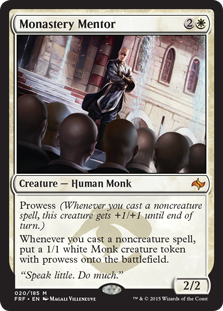
Monastery Mentor CardThis story begins with the spoiling of Monastery Mentor. I was intrigued from the start. It looks like Young Pyromancer, but it costs more. But Mentor and its tokens are more powerful. This cannot be good in Modern. It is insane in Vintage, it is really expensive for how little play it is seeing right now, and I should be trying this card out!
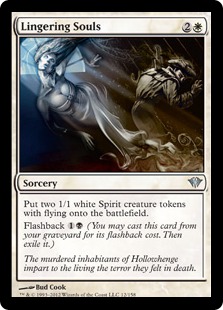
Naturally, I spent the weeks leading up to GP Denver, and about a month after, trying to fit Mentor into the Standard Jeskai Tokens list I used to money at the Grand Prix. It didn't work because the three-drop slot was too clogged and it was weaker than the other options. I was glad I didn't play it. I promptly put the Mentor down and forgot about it.

Then SCG States rolled around. I was knocked out of mine early thanks to an unexpected glut of Storm decks. Irritated, I waited until decklists began to be posted to see if this was an actual trend or if I'd just been unlucky (the answer was "yes", by the way). That is when I began to notice that there were a number of Mentor lists. I was intrigued.

My First Attempt

I had to try out an Esper Mentor list. I had to. So I began looking at, aggregating, and making lists until I arrived at a deck I was willing to start testing and running at my local game store.

Untitled Deck

Creature

4 Monastery Mentor
4 Snapcaster Mage
2 Tasigur, the Golden Fang

Planeswalker

2 Sorin, Solemn Visitor

Instant

4 Path to Exile
2 Spell Snare
4 Serum Visions
1 Slaughter Pact
4 Mana Leak

Sorcery

4 Inquisition of Kozilek
2 Thoughtseize
4 Lingering Souls

Land

3 Creeping Tar Pit
2 Celestial Colonnade
4 Marsh Flats
4 Polluted Delta
2 Watery Grave
2 Hallowed Fountain
2 Godless Shrine
2 Island
2 Plains
1 Swamp

I ended up with this deck since it had the critical mass of cheap non-creature spells to fuel Mentor along with the disruption and protection I needed to actually make it stick. And it did. This list was exceptional at disrupting the opponent to let me cast my Mentors. Inquisition of Kozilek, Mana Leak, and Thoughtseize made it difficult for opponents to accomplish anything during the early game. Lingering Souls was, and still is, the best way in Modern to gum up the board and provide pressure. Tasigur was simply outstanding at being a late-game card advantage engine and Tarmogoyf impersonator, and Sorin, Solemn Visitor was also surprisingly powerful and easy to ultimate. Twin in particular has a difficult time beating the Visitor's emblem. In the (at the time) Twin and Burn heavy metagame I was hitting, this Mentor list did very well.

For a time.

Trouble Brewing

As I kept playing and tuning the list, I kept having two problems. The first was that I was expending all my resources just to prevent my opponents from winning. This might seem fine, but it meant once I was able to drop my Mentors it was far too often just a Gray Ogre. Snapcaster and Souls helped a little, but making one token was not good when it could only attack as a 1/1. Not losing was all well and good, but you need to turn that "not losing" into "winning" and this was not happening.

The second problem built off the first: Esper Mentor failed to close out games even when I was the last one standing after an attrition fight.Lingering Souls As I mentioned, the deck was exceptional at disrupting the opponent. I then usually spent far too much time just staring at my opponent, unable to attack for more than two at a time thanks to Spirits that had survived the attrition war. That was too slow. With no reach and no surprise combo, I just had to slowly plink away during the mid to late game, and that wasn't good enough. Opponents could weather my anemic beats until they found a more impactful threat and then I was doomed. This also exposed a weakness of the deck, where resolved threats where extremely dangerous. I only had five removal spells in my main 60, so Jund and non-burn aggro were extremely dangerous (Jund is built to play a long removal game and stick a single threat to win, just like Mentor, and if I can't trade for Souls tokens then those drops are lethal). It also couldn't beat Tron. Once my opponents adjusted to the Mentor game plan and I couldn't get free wins from surprise anymore, I struggled to break even at events.
Stubborn Denial

But I wasn't about to give up. I knew I could overcome the flaws and make this deck viable. The mana base was excellent, the discard was powerful, Mentor was as powerful as I thought (when I got it to work), and I am stubborn. In games where the first problem didn't come up, Mentor often won the game in one attack. So I set out to close the holes and improve my brew.I didn't.

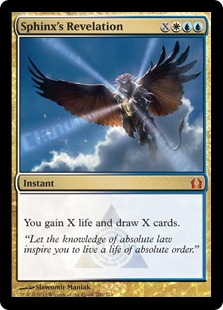
sphinx's revelationI decided the problem with Monastery Mentor was that since it really wanted you to have cards in your hand you should always have more cards in your hand. Because I rarely got above five lands, I knew Sphinx's Revelation was not a great option. This was fortunate because I really wanted to use Esper Charm again (it was a Standard favorite of mine). On paper, Charm was perfect, a versatile instant that drew cards in my colors. In practice...let's not speak of how it was in practice but calling it clunky would be charitable.
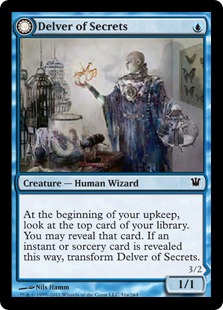
Card draw in Modern is very weak and there's no getting around it. Of the options available, I could never come up with one that fixed the problem and played well with Mentor. Charms were bad, Revelation was bad, the sorcery speed options were too slow. This left me playing more cantrips, but Thought Scour and Sleight of Hand didn't help very much. Remand showed promise, but didn't play well in a control shell. When I played an answer, I wanted it to permanently answer something. Then I remembered Remand plays well with another old friend, Delver of Secrets! Now, playing these together wouldn't solve my first problem, but maybe it would solve the second problem and thereby eliminate the need for the first problem. And with that, I was brewing again.

Second Verse...

Again, a question for academics. Have you ever spent an inordinate amount of research time to end up back where you started with only minor modifications to the original protocol to show for it? Yeah, that's how I ended up with this list.

Untitled Deck

Creature

4 Monastery Mentor
4 Snapcaster Mage
4 Delver of Secrets

Planeswalker

2 Sorin, Lord of Innistrad

Instant

4 Path to Exile
2 Disfigure
4 Remand
1 Slaughter Pact

Sorcery

4 Inquisition of Kozilek
4 Serum Visions
4 Lingering Souls

Lands

4 Marsh Flats
4 Polluted Delta
3 Creeping Tar Pit
2 Celestial Colonnade
2 Hallowed Fountain
2 Watery Grave
1 Godless Shrine
2 Plains
2 Island
1 Swamp

Over a week of evening testing sessions to just shave a land and move some spells around. Oh well, take it to the weekly Modern events anyway, see how it goes.

...Not Quite Like the First

It didn't do badly. In fact, Esper Delver played quite well. Delver is incredibly powerful and this deck and had more than the minimum spells to flip it. Adding in Remand meant that I could protect my Delver's without running out of cards for the mid-game when I got my Mentor's online. The addition of Disfigure improved my matchups against other Delver lists and Elves considerably. Taking out Thoughtseize didn't hurt much (pun realized after addition) since combo was not a significant enough a presence to worry about and Inquisition was excellent across the board.Delver I didn't need as many answers as before since the pressure of Delver was usually enough.
I was right about closing out games making up for lack of resources for Mentor. Being able to apply solid pressure early improved many matchups just by being able to actually take advantage of stumbles. My default has always been aggression and I am a long-time tempo enthusiast in Modern, so going back to my tempo roots felt good. I know that in traditional slow matchups whoever has the mana advantage is presumed to win but I've found that if you cannot take advantage and close out a game then mana advantage doesn't count for much. I'll take a damage advantage if that's alright. Delver is sometimes a free win and that's what I was getting again, even after my deck became known. I was doing reasonably well in local events and even at IQ's with Esper Delver.

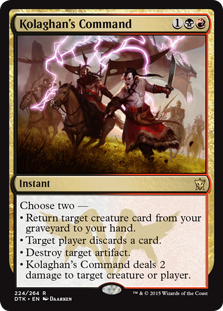
And Then Kolaghan's Command Happened

And then Kolaghan's Command happened. Yes, that is so important I said it twice. Command was the death knell for Esper Delver.Kolaghans Command It wasn't necessarily that it was a great answer for the threats, it was how Command affected the format. Grixis became the default blue deck, and my list suffered against opposing discard and counters. Also, Lightning Bolt. The proliferation of Command meant more Bolts and Bolt is a great answer to all of my threats except Colonnade. More removal heavy decks was bad enough, but Command proved to be such an amazing value engine that it meant that the first problem of running out of resources came back with a vengeance. Souls just wasn't enough to make up for it. I was getting my early game stuffed more often and this made the lack of card advantage, especially compared to Grixis decks, more glaring.
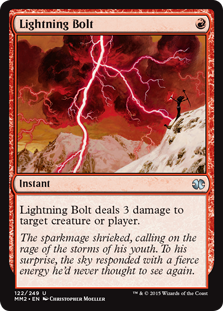
That said, what really made me give up on Esper Delver was the realization of how much the deck needed Lighting Bolt.Lightning Bolt I found that a lot of my losses now happened with the opponent in burn range, but I had no reach. I wanted burn, and I knew that burn played well with Pyromancer, so it should also be good with Mentor. So I ditched the black for red, and then for several months ditched Mentor entirely in favor of a Jeskai control list because I wanted to see if the Temples are Modern playable (they were, mostly).
And Here We Are

After a few months getting to know my controlish side, I once again failed to resist the call of Monastery Mentor and decided to try again. This time I would take everything I'd previously learned and put it together and THIS time it would work. In a sense I guess it did, I finally know what my real problem was.

Untitled Deck

Creatures

4 Monastery Mentor
4 Delver of Secrets
4 Snapcaster Mage

Instant

4 Lightning Bolt
2 Path to Exile
2 Vapor Snag
4 Lightning Helix
4 Mana Leak
2 Cryptic Command

Sorcery

4 Serum Visions
4 Gitaxian Probe

Land

4 Flooded Strand
2 Marsh Flats
4 Celestial Colonnade
4 Steam Vents
2 Hallowed Fountain
2 Sacred Foundry
2 Plains
2 Island

To preempt questions I never once fetched for a basic Mountain so I just cut it for another Plains and changed the Scalding Tarn to Marsh Flats since there was a lot of Blood Moon when I made it and I really needed to fetch basics that weren't Mountain. Is it right? Don't know, it rarely came up and wasn't an actual problem for the deck.

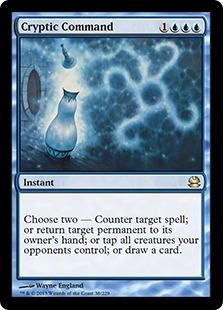
This was an excellent Mentor/Delver list. It had more than enough spells to flip the Delvers and plenty of cheap cantrips to fuel Mentors.Cryptic Command It had raw power and value in Cryptic Command and the burn to finish off games. It powered through matchups and could race or win out of nowhere. And would fail to win many games. There were times that it just clunked along despite the game going to plan with a flipped Delver and cards in hand to power out a Mentor turn. Changing Mana Leak for Remand did nothing. Trying new cards like Soulfire Grand Master didn't help (though it did make Burn and other Delver decks into very, very good matchups). It's hard to describe the problem any other way than the deck felt like it was tearing during games. There would be Delver style games and control style games where you won via Mentor just like expected and then there were in between games when something...just felt wrong. Like the deck was doing what it wanted to be but didn't actually want to do it. Changing the boarding strategies didn't help, nor did moving around card numbers. Something was fundamentally wrong with my deck.
At Last, Clarity

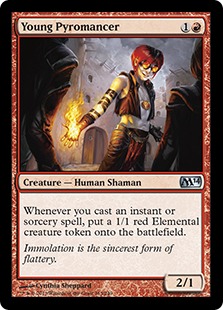
It was during one of these games that looked fine but felt awkward that I had an epiphany. The Delver plan and the Mentor plan didn't gel together.Young Pyromancer They looked like they should. Sometimes they played like they did. But often there was just this tension between the strategies that make Mentor/Delver lists a poor choice for now. The reason I think is Mentor's mana cost. Young Pyromancer plays so well with Delver of Secrets because Delver already wants to play with red spells while white is not nearly so compatible. Red just has more universally proactive non-creature spells than white and they complement aggressive strategies better. Also Pyromancer costs two which neatly fits into the Delver game. Turn one Delver, turn two Pyromancer, turn three start chucking burn is a very effective and proven strategy. The ideal with Mentor is turn one Delver, turn two Remand, turn three Mentor, turn four go nuts. That turn difference means that Mentor is just slightly off the beat with Delver, making Pyromancer a much better partner. Delver and Pyro sync well while Mentor and Delver step on each other's toes too much.

Where Do We Go From Here?

I remember thinking when Mentor was spoiled that it was a control card, and I guess I just really needed to prove it to myself. What Mentor really wants is for you to spend a lot of cards on the opponents turn to make tokens and then untap with some card draw, play more spells and win in a single attack. This suggests a control shell that intends to win like a combo deck. I have not found such a shell yet. It needs to be fairly draw spell heavy and yet full of early interaction. It also probably must find Mentor to win. I have no idea if this deck exists or is better than the Mentorless lists I've played in the past. This means for the foreseeable future (specifically SCG States) I'll be playing one of my proven standbys (UW Control or Merfolk). Will I try again with Mentor? Probably. The urge to brew is like an itch that only gets worse when your brew doesn't pan out. So I'm handing this brew off to you. If you have some ideas or your own tales of trying Mentor I would be happy to hear them in the comments. Maybe you can figure out what I missed or where to go from here.

Avatar photo

David Ernenwein

David has been playing Magic since Odyssey block. A dedicated Spike, he's been grinding tournaments for over a decade, including a Pro Tour appearance. A Modern specialist who dabbles in Legacy, his writing is focused on metagame analysis and deck evolution.

View More By David Ernenwein

Posted in Brewing, ModernTagged , , 24 Comments on Who Teaches the Mentor?

Have you joined the Quiet Speculation Discord?

If you haven't, you're leaving value on the table! Join our community of experts, enthusiasts, entertainers, and educators and enjoy exclusive podcasts, questions asked and answered, trades, sales, and everything else Discord has to offer.

Want to create content with Quiet Speculation?

All you need to succeed is a passion for Magic: The Gathering, and the ability to write coherently. Share your knowledge of MTG and how you leverage it to win games, get value from your cards – or even turn a profit.

Lost and Found – Restoring Faith in Humanity

Are you a Quiet Speculation member?

If not, now is a perfect time to join up! Our powerful tools, breaking-news analysis, and exclusive Discord channel will make sure you stay up to date and ahead of the curve.

In case you missed this story, there was a binder valued at approximately $60,000 misplaced and returned at New York Comic Con through communication on Reddit. The binder was found by a young man, who put the legwork in to getting the binder back to its original owner- the owner's thank you letter can be found here.

For his actions, the young man who returned the binder was awarded an expedition Wooded Foothills and a promo Glorious Anthem- which is worth quite a bit more than the Foothills.

The returner has received a lot of gratitude on Reddit--and rightfully so in a world where we celebrate the police catching collection thieves, not one where we expect lost articles to be returned.

Yesterday he made a post thanking the community for all the praise he has received, but what stood out to me was his mention of one particular user shaming him as a potential thief.

Many people posted saying how I was amazing for not hiding the truth and just selling the collection. And I want to be honest: I did think about doing so. When I picked the binder up and saw the contents, I was overwhelmed. I could have kept this or sold it. I knew there was so much value and it was just really tempting to keep it home. Maybe that's why I brought it home with me instead of bringing it directly to the Lost and Found at Comic Con.

Once I was home, I just stared at the binder for a good 30 minutes thinking what to do. I think what ultimately led to my decision of posting on this subreddit was when I compared my joy to Mr. Grayson's sadness. I didn't know that the collection was worth 60k, but I did know it was worth A LOT, more than the amount of money I've made working at the library. I knew that whoever lost the binder would probably be depressed about it for the rest of their lives as compared to me who would be temporarily happy getting a lot of money. That's when I decided to post on the subreddit.

After I posted the "found a lost binder" post, I felt relieved that I had done the right thing. All the weight kind of dropped off my shoulders and it felt pretty good. But soon after, there was a guy who said pretty mean things about the actions I took. Whoever made the comment deleted it but basically, I took it as him indirectly calling me a thief. And it really hurt me because it could have been true. It didn't help when it became one of the most upvoted comments on the post, and I just kind of felt really terrible about myself. I know that the internet isn't the kindest place in the world (which you guys proved to be not necessarily true!) but yeah, it really hurt.

To attack the character of somebody who did the right thing in a situation with significant gains for doing wrong is deplorable. Most people would be tempted to keep the collection in this instance, and you'd better believe that many would have indeed done so. Further, if you wouldn't be tempted to do wrong, then your good actions aren't really worth much, are they?

I would imagine that most readers of Quiet Speculation themselves own substantial collections, and, as somebody who has had a few lost articles turned in to convention lost and founds, as well as having a tablet stolen recently, I am appreciative of the actions of this young man and others like him.

I've written about theft several times recently, but it's also important the remember that sometimes things are simply misplaced, and for that reason it's worth reposting PSAs to this effect. Take measures to make your collection uniquely identifiable, and whether lost of stolen you will increase your chances of getting it back.

Avatar photo

Ryan Overturf

Ryan has been playing Magic since Legions and playing competitively since Lorwyn. While he fancies himself a Legacy specialist, you'll always find him with strong opinions on every constructed format.

View More By Ryan Overturf

Posted in FreeTagged , 3 Comments on Lost and Found – Restoring Faith in Humanity

Have you joined the Quiet Speculation Discord?

If you haven't, you're leaving value on the table! Join our community of experts, enthusiasts, entertainers, and educators and enjoy exclusive podcasts, questions asked and answered, trades, sales, and everything else Discord has to offer.

Want to create content with Quiet Speculation?

All you need to succeed is a passion for Magic: The Gathering, and the ability to write coherently. Share your knowledge of MTG and how you leverage it to win games, get value from your cards – or even turn a profit.

Insider: MTGO Market Report for October 14th, 2015

Are you a Quiet Speculation member?

If not, now is a perfect time to join up! Our powerful tools, breaking-news analysis, and exclusive Discord channel will make sure you stay up to date and ahead of the curve.

Welcome to the MTGO Market Report as compiled by Sylvain Lehoux and Matthew Lewis. The report is loosely broken down into two perspectives.

A broader perspective will be written by Matthew and will focus on recent trends in set prices, taking into account how paper prices and MTGO prices interact. Sylvain will take a closer look at particular opportunities based on various factors such as (but not limited to) set releases, flashback drafts and banned/restricted announcements.

There will be some overlap between the two sections. As always, speculators should take into account their own budget, risk tolerance and current portfolio before taking on any recommended positions.

Redemption

Below are the total set prices for all redeemable sets on MTGO. All prices are current as of October 13th, 2015. The TCG Low and TCG Mid prices are the sum of each set’s individual card prices on TCG Player, either the low price or the mid price respectively.

All MTGO set prices this week are taken from Goatbot’s website, and all weekly changes are now calculated relative to Goatbot’s ‘Full Set’ prices from the previous week. All monthly changes are also relative to the previous month prices, taken from Goatbot’s website at that time. Occasionally ‘Full Set’ prices are not available, and so estimated set prices are used instead.

Oct13

Theros Block & M15

This week saw the price trajectories for digital and paper sets of Theros (THS) diverge, shown in the "Weekly Change" and "Monthly Change" sections above. This is a signal that the bottom is in and speculators should begin deploying tix into Modern staples and mythic rares from THS.

As paper prices shift to an upward trend, the groundwork is laid for future demand from redeemers seeking to capitalize on the price difference between paper and digital. It's no surprise that THS is bottoming just after its rotation. Take advantage of this cycle by targeting cards like Elspeth, Sun's Champion which is currently at 1.2 tix.

M15 doesn't have the same value proposition as THS, with a smaller gap between a set on MTGO and the TCG Low price. For this reason, it's riskier at this point to go bottom-fishing for cards from this set.

Junk mythic rares at 0.4 tix or less are still reasonable targets, but broad purchases are not yet recommended. Enemy-colour pain lands, Urborg, Tomb of Yawgmoth, Chord of Calling and four single-printing planeswalkers should ensure good value for M15, but the bottom is not yet in on these cards.

For the impact of rotation on MTGO prices, look to the price of former Standard staple Temple of Malady. This rare from Journey Into Nyx was higher than 20 tix in the last year, and it currently sells for 0.04 tix. Although it's not clear whether this particular card will ever be played in Modern, junk rare prices are attractive entry points for cards with potential, even if slight.

Put a few of these in your long-term, long-shot spec basket as the risk-reward ratio is favorable. Temple of Epiphany is a similar story, but at a higher entry price it's not worth tying up a significant amount of tix. If the blue-red temple drops into the 0.1 tix or less range, it will be time to start buying.

On the topic of temples, Temple of Malice from BNG is played as a four-of in Modern Grishoalbrand decks. At prices less than o.2 tix, it is considered a buy. Elsewhere in the middle set from Theros block, Courser of Kruphix has fallen below 1 tix and should be on speculators' list for rotation pick-ups.

Brimaz, King of Oreskos is another one to keep an eye on. This card is on the short list of white three-drops that can be considered Modern and Legacy fringe playable. Players shouldn't hesitate to pick up their playset at current prices.

Tarkir Block & Magic Origins

A set of Origins (ORI) is up substantially this past week, showing a 10% increase. ORI is no longer being heavily drafted and shows a $58 difference between digital and TCG Low set prices ($33 after the redemption fee).

A narrowing of these two prices is inevitable as redeemers take supply out of the MTGO market. Speculators who have been buying cards from ORI will see steady gains in the near term as this process unfolds.

The Tarkir block sets do not have the same potential, but value will flow to and from different cards as Fall Standard takes shape. One of the early winners of this process is Warden of the First Tree from FRF, which has risen to over 8 tix and is now the most expensive card from that set. Look for a further price increase this weekend if the card continues to show up in Abzan strategies at PT BFZ.

From DTK, both Zurgo Bellstriker and Thunderbreak Regent have seen gains on the back of the early success of Atarka Red. Aggressive red strategies usually have success out of the gate in any new iteration of Standard and they are often a cheaper deck to put together on MTGO. Both cards look set for further gains over the coming weeks, but they might run out of steam as the format adapts to beat this strategy.

All boosters from Tarkir block and Magic Origins have dipped in price with the start of BFZ release events. Once the excitement around the new set dies down, players will naturally gravitate towards their favorite formats from the previous year.

The relatively cheap price of these boosters will also encourage drafting them. Speculators should not hesitate to buy them up at current prices. ORI and DTK boosters will reach 4 tix at some point over the next eight months and should be considered the top two targets for boosters at the moment.

Battle for Zendikar

BFZ prereleases have come and gone and release events are in full swing. Price changes for this set will be entered in the set price table starting next week.

At the moment, most of the set's value is tied to Gideon, Ally of Zendikar, but it's still new enough for a breakout card at PT BFZ to jump much higher. Oblivion Sower and Ulamog, the Ceaseless Hunger at 6 to 7 tix have potential as breakout candidates heading into this weekend and are worth keeping an eye on.

Those who are looking to play with the new cards should consider pursuing the foil mythic rare strategy detailed earlier by Matthew Lewis in September.

This strategy recommends buying a playset of each of the foil mythic rares from BFZ. Due to the dynamics of the MTGO economy, a basket of foil mythic rares will actually accrue value over the coming month.

Although the upfront costs are higher, players should have faith that their tix are much safer in foil mythic rares than in regular versions. It's guaranteed that Gideon, Ally of Zendikar will fall below 20 tix by March, but the foil version could well hold onto 30 tix over the same time frame.

Modern

Battle for Zendikar release events are upon us and the Total Price Modern Index faithfully reflects the seasonal price depreciation. The index has already dropped by 7% compared to last week and the fall is likely to continue. This is a perfect time to stock up on relatively cheap Modern positions.

While many prices are falling to new lows every day, catching the absolute floor should not be the end goal. Rather, speculators should aim to identify as many solid targets as possible that fit their bankroll and portfolio strategy. The Modern Staples list linked above is a great tool to find speculative targets.

Cheap cards experience the biggest price fluctuations by percentage and thus are more interesting for speculators, especially those with smaller bankrolls. About a dozen Modern staples have lost 50% or more of their value in less than a week, including Stony Silence, Gitaxian Probe, Tectonic Edge, Rest in Peace, Slippery Bogle and Serum Visions. The other cards mentioned last week have also dipped further.

ZEN Fetchlands have also been affected by a significant price drop last week. Misty Rainforest, Arid Mesa and Scalding Tarn have lost 20% or more since last Wednesday. This is probably the combined effect of BFZ release events and the new Expedition lands weighing on original ZEN fetchlands.

The long-term effect of Expedition lands might drag the price of all ZEN fetchlands down farther for months to come, and speculators should be cautious about a small rebound in ZEN fetchland prices this time around.

Some of these dramatic price changes are an opportunity for speculators to reinforce positions they already hold. For instance, if your bankroll and portfolio strategy allow it, Serum Visions is a position worth consolidating as a perennial must-have in Modern.

Legacy & Vintage

Legacy and Vintage prices continue mostly flat, with only expensive Legacy staples such as Rishadan Port, Sneak Attack, Misdirection and Show and Tell gaining some ground. The November Legacy MOCS, one of the few events likely to move Legacy prices, will start at the end of the month. Griselbrand has been announced as the promo.

Through the Official MTGO Tumblr, Lee Sharpe announced the first major Vintage event to be held on Saturday, October 24. Vintage players have been waiting months for a large event to sink their teeth into, but that's no guarantee that a large crowd will show up, nor that it will impact prices.

A successful and repeated tournament series is needed to draw a large number of players and put prices on an upward trend. The only upside for players at this point is that Vintage has never been cheaper on MTGO--this might be a big incentive to buy into the format.

Pauper

This week's big breakthrough comes from Crop Rotation. After being under 0.5 Tix for almost two years, the green instant first jumped to 1 Tix about a month ago, then came back to 0.2 Tix last week before exploding to ~1.5 Tix this week.

Despite seeing little to no play, even in Pauper, Seal of Strength also moved out of bulk range to the neighborhood of 0.5 Tix. On the other side, Nettle Sentinel, also a Modern staple, has dropped from its previous floor of 2 Tix to 1.4 Tix, an eight-month low.

Targeted Speculative Buying Opportunities

Standard

ORI boosters
DTK boosters
FRF boosters
KTK boosters

Modern

Elspeth, Sun's Champion
Temple of Malice

Targeted Speculative Selling Opportunities

None

A U/W World

Are you a Quiet Speculation member?

If not, now is a perfect time to join up! Our powerful tools, breaking-news analysis, and exclusive Discord channel will make sure you stay up to date and ahead of the curve.

Sometimes it's worth remembering where you came from and seeking knowledge and tech from the past. The 2015 World Championship brought unexpected decks to the forefront with Living End and Bogles making waves almost out of nowhere. While those decks appear to have had their moment and then quietly vanished Yuuya Watanabe’s UW Control shell has really stuck with me.

Dragonlord Ojutai Art

The deck ran zero Snapcaster Mages and used Sun Titan and Dragonlord Ojutai as finishers. This list looked strong and clearly took inspiration from decks that once gave Jund a hard time, namely the older UW Kitchen Finks and Sun Titan decks. Yuuya’s UW Control shell plays more like a midrange deck, since it uses Celestial Colonnade to finish grindy games while applying pressure earlier with Vendilion Clique and Dragonlord Ojutai. Today, I'm going to review the cards that make this deck tick, discussing the deck's strengths and weaknesses in the current Modern metagame.

[wp_ad_camp_1]

A Worthy Opponent

I picked up this deck online after the World Championship, and it is surprisingly complex with many decision trees. Once I started wading through the choices and got some reps under my belt, however, I discovered it has a lot of power. Looking at the full list, it immediately looks foreign, especially compared to some of the other UW Control shells floating around at events like SCG Modern Premier IQs and Grand Prix Oklahoma City, typified by the list that Trevor ran a few weeks ago.

White-Blue Control, Yuuya Wantanabe-2015 World Championship

Creatures

4 Kitchen Finks3 Restoration Angel1 Sun Titan4 Wall of Omens2 Dragonlord Ojutai2 Vendilion Clique

Enchantments

2 Detention Sphere

Instants

3 Cryptic Command4 Path to Exile2 Remand4 Spell Snare

Sorceries

3 Supreme Verdict

Lands

3 Island3 Plains4 Celestial Colonnade4 Flooded Strand4 Ghost Quarter2 Hallowed Fountain4 Mystic Gate1 Eiganjo Castle1 Minamo, School at Water's Edge

Sideboard

1 Crucible of Worlds1 Grafdigger's Cage1 Spellskite2 Aven Mindcensor1 Glen Elendra Archmage2 Stony Silence3 Threads of Disloyalty1 Celestial Purge1 Dispel2 Negate

If Sheridan is right then we will be seeing more and more UW Control soon, and I think that Watanabe's deck is far more powerful and worthy than most pilots are giving it credit.

We Have the Beats

In direct contrast to most traditional UW Control decks, this deck uses a higher number of creatures to close out games. Dragonlord Ojutai is a five-mana beater that does everything this deck wants: blocks well, survives removal, generates card advantage, and quickly ends the game. The ideal threat for this deck, Ojutai immediately applies massive pressure and swings a close board into your favor.Dragonlord Ojutai Most decks have a hard time removing Ojutai if he does not attack, making him an impenetrable brick wall to aggressive decks. He also has good synergy with some of the other cards in the deck, particularly Restoration Angel and the two utility lands, Minamo School at Water's Edge and Eiganjo Castle. Restoration Angel and the two utility lands can blank a piece of targeted removal while reestablishing hexproof to protect your Dragonlord. Minamo acts as instant speed hexproof for Ojutai and Eiganjo Castle can prevent combinations like Lightning Bolt and Kolighan's Command from killing Ojutai. Overall, Dragonlord Ojutai is the deck’s premier threat and closes the game out quickly, often in three turns with fetches and shocklands helping out.
Next up is Sun Titan, the one-of engine that loops value cards and buries the opponent in a long and grindy game.sun titan Titan has always been a powerhouse: when paired with Kitchen Finks and Ghost Quarter it can grind down and crush most fair decks. Watanabe adds in cards like Wall of Omens to create more card advantage and Vendilion Clique as a disruptive threat to stifle the opponent’s plans. Sun Titan can have more utility than just hitting those few cards, such as returning Celestial Colonnade or Flooded Strand, but those are the most common recursion targets. As with Ojutai, Sun Titan will quickly end the game if left unchecked. Titan is particular strong with Restoration Angel, who can set up an attack, get your recursion value, and then blink Sun Titan. This saves it from combat and gets another piece of value from the graveyard. In a format as fast as Modern, it is risky to run more than one six-drop and it will often be your first cut against non-GBx decks that want to grind and have few answers to recurring Kitchen Finks. While not as premium as Dragonlord Ojutai, Sun Titan serves a major role in the deck, giving greater late-game grinding potential without losing steam in the mid- to late-game like traditional UW Control.
Vendilion CliqueThe next set of threats are the deck’s fliers, Restoration Angel and Vendilion Clique. Both of these cards synergize with the rest of the deck by having flash and by generating value through information or enter the battlefield effects. These two cards are often your first threat in the game and demand answers or they can start chipping away at your opponent’s life totals. Though neither threat is as difficult to answer as Ojutai or Titan, they both apply pressure to the opponent and can create blowout situations due to their flash ability. While both of these threats are impactful, they are more tied to the synergistic elements of the deck and can apply pressure. Titan and Ojutai are your main finishers, alongside the mighty Celestial Colonnade.
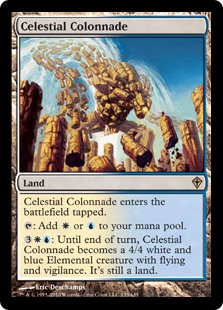
Column Attack

Celestial Colonnade plays a different role here than in traditional UW shells. For us,  Celestial ColonnadeColonnade is often a tempo card where you tap out to race in conjunction with another flier, ending the game in two swings around turn seven or eight. Colonnade is not the big premier end-game threat in this deck unlike its role in previous UWx control lists. Use Colonnade as a battering ram that can quickly close your opponent’s game before you hit the very late turns. Of course, the card still functions as a good finisher if you start running out of gas or the board gets stalled without your fliers. Colonnade is also a great blocker, assuming you can survive until turn six to get this additional blocker. Colonnade is much more flexible in this deck, where we have a tendency to tap out for threats like Ojutai or Sun Titan and an ability to end the game around turn eight or nine, rather than turn 15.
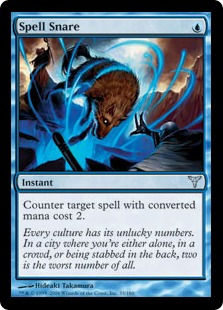
Protect and Remove

Like most blue control or midrange decks, this deck uses blue countermagic as a form of removal and white hard removal to deal with troublesome cards.Path to Exile The deck runs four copies of Path to Exile for single problem creatures like Pestermite, Tarmogoyf, or Tasigur, the Golden Fang. Path is usually a last resort to avoid giving your opponent additional resources, but here Path is unavoidable. The deck runs two Detention Spheres to handle difficult planeswalkers like Liliana of the Veil, and for threats that easily multiply, such as spirit tokens or Voice of Resurgence. Detentions Sphere works very well against Zoo decks that cannot afford to play around a three-mana enchantment by sandbagging repeat copies of threats such as Kird Ape or Wild Nacatl. Another big benefit of being UW is access to three Supreme Verdicts that can help against Merfolk, Affinity, Zoo, and other decks that commit most of their resources to the board. It is also uncounterable against Delver decks, making it far more effective than other sweepers.

In addition to removal, the deck runs seven hard counterspells and two tempo-based soft counters. The deck cannot afford to run Mana Leak since it relies on Path as its main form of hard removal.Spell Snare Instead, it plays four copies of Spell Snare to slow down opponents and hit some of the massive threats from decks like Abzan, Jund, Affinity and Infect. While four copies can seem like overkill, an unanswered Tarmogoyf or Dark Confidant can destroy you. The other great thing about Spell Snare is casting it on the draw enables turn one interaction outside of Path. Like most heavily blue decks, this deck also runs Cryptic Command. The difference here is that we k only run three copies. This UW Control build wants to end the game quickly, and drawing multiple Cryptics instead of threats is much worse here than in other blue decks.
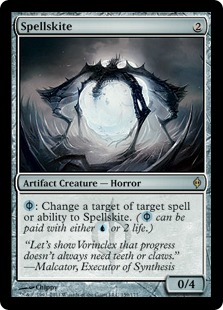
Best of the Rest

The rest of the deck acts as synergistic filler to stall for card advantage in order to find key cards you need, not unlike other control-oriented decks in Modern.Kitchen Finks Kitchen Finks and Wall of Omens act as roadblocks for more aggressive strategies, are hard to cleanly remove, and gain extra value from Sun Titan recursion in the late game. Kitchen Finks’ life gain is very important against decks like Burn and Naya Zoo, since they put you very far behind early while you find your footing in the game. Cards like Ghost Quarter help you deal with troublesome lands and force opponents off splash colors depending on how they fetch. There have been a few times where, between Crucible of Worlds in the sideboard and Sun Titan in the main, I have Strip Mined my opponent out of the game with an endless stream of Ghost Quarters until they were equal on board but landless. After that, it's easy to pull ahead and take the game.

Sideboard

The sideboard is heavily skewed to beat decks like Abzan and Grixis, dedicating very few slots to address other matchups. Sideboard cards like Spellskite, Glen Elendra Archmage, Celestial Purge, Negate, Dispel, and Threads of Disloyalty are all very good against Abzan and Jund.Spellskite All of those cards, except Threads, also dramatically improve Grixis Control and Delver matchups. These cards are also highly relevant against Grixis Twin, although the threat of Splinter Twin can make it the hardest of the Grixis contests. Looking beyond the anti-Grixis arsenal, there are only six cards left for the rest of the format. Aven Mindcensor helps against Scapeshift, a deck that could be poised for a rise in popularity with Bring to Light acting as Scapeshifts five through eight. It also doubles as random hate against decks like Amulet Bloom and Company lists with Chord. Stony Silence targets Affinity and Crucible is for land destruction matchups like Living End and sometimes GBx decks that overload on Fulminator Mage. Overall, the sideboard is very GBx and Grixis-targeted, as these are two very big players in the meta. Although there is not much hate for other decks, most of those matchups are already decent or favorable (such as Affinity).
How Does UW Control Matchup?

Arcbound RavagerLooking at the matchups in a broader sense, the deck is very meta-dependent and can easily steal a tournament against the right field. First up is Affinity, one of the big players in our current meta. Affinity is an excellent matchup for this deck as you have interaction early with Spell Snare and Path to Exile with Supreme Verdict and Ghost Quarter coming online later to deal with the more problematic cards. The deck does not change much post board, but Stony Silence can just end the game on turn two since Affinity rarely has the cards to significantly improve the matchup from game one to game two (just save those Spheres for Ghirapur Aether Grid). Even if they do answer Silence, it buys you time to catch up tempo-wise and land your own answers and win conditions.
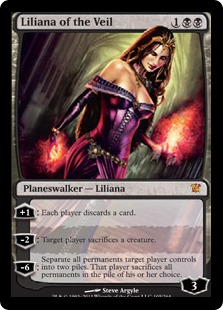
Liliana of the VeilThe GBx decks are slightly favorable. Their big hitter cards are Liliana of the Veil, Dark Confidant, and Tarmogoyf: answer those cards cleanly and start closing out the game with Ojutai or Sun Titan, and BGx will have a hard time catching up. That said, dealing with a resolved Liliana can be very difficult for this deck. After sideboarding, the matchup gets better with many tools added to deal with the three hard hitters, like Negate for Liliana or Threads of Disloyalty for Tarmogoyf and Dark Confidant. Overall, the Abzan and Jund matchups are slightly favorable if played properly. Abzan will be somewhat harder, with Lingering Souls to clog up the skies and Path to Exile as harder, non-damage-based removal.
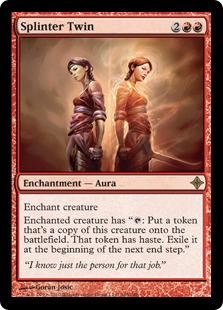
Grixis is a diverse archetype, and this deck has a good matchup against Twin and an excellent matchup versus two other major types of Grixis (Control and Delver). Path and Remand deal with delve cards cleanly so UW Control can push its advantage while presenting Kitchen Finks and Dragonlord Ojutai, threats that Grixis Control has trouble answering advantageously.Splinter Twin Restoration Angel is an all-star in this match-up and acts as a threat, an ambush blocker, and a way to blank removal. This deck also answers Grixis Delver’s threats cheaply and uses Supreme Verdict as a reset button after the opponent has burned through their resources, resulting in an easy way to close out games. Twin is the hardest variant since there is no easy way to answer Splinter Twin outside of countermagic and Path. Depending on the skill of the Twin player, they may board into a more controlling shell that eschews the combo, which is much better for us than for them. Then again, the players I have seen on Magic Online board into a more combo-oriented version with extra Dispels and Negates, which will make games two and three significantly harder.
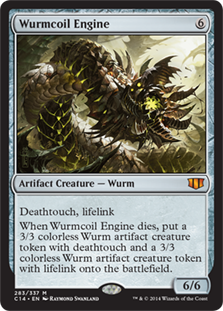
Wurmcoil EngineThe deck’s worst match-ups are Tron and Burn. Both decks will just win the game if you give them too much time, and no matter how many counterspells you have or how many threats you drop, both decks are much more likely to have you dead on turn eight than the other way around. While there are some decent sideboard cards against Burn, such as Negate, Spellskite, and Dispel, Tron is the deck that really feels like a must-dodge matchup. Ghost Quarter helps far less than you think and we are very soft to a turn three Tron. Luckily, Tron is not a huge player in the meta right now. If it becomes prominent, however, this is not the deck to play.

Moving forward, I feel like there are many ways to tune or tweak this deck to fight the meta. You could become a more controlling shell, or add more planeswalkers as threats. Note, however, that this is a very meta-dependent deck, and picking the wrong threats in the wrong meta is a recipe for a quick 0-3 side event tournament.

How would you shape the deck to fit your local meta or build it to prepare for a big event such as Grand Prix Pittsburgh? Let me know in the comments below!

[MTGO] 1 Year, 100 Tix – September Report

Are you a Quiet Speculation member?

If not, now is a perfect time to join up! Our powerful tools, breaking-news analysis, and exclusive Discord channel will make sure you stay up to date and ahead of the curve.

Welcome back to the September report of the "100 Tix 1 Year" project. This report signals the beginning of the final stretch. With only three months left, the end of September marks the beginning of a new speculative phase focusing more on Standard specs.

This month the unlocked article from my Nine Months of Portfolio Management series is Part 9 – Quick Flips & Very Short Term Specs. This article discussed the potential of short-term specs based on hype and how to quickly generate Tix with minimal risks.

These quickflips, where a position is held for only a few days, can help small bankrolls grow rapidly. I've already used them with the 100 Tix, 1 Year bankroll to great success. If properly executed, the benefits are almost guaranteed and the risks are virtually nonexistent. Check the article out for more details!

More information about the 1 Year, 100 Tix project can be found here:

September Numbers

Not much happened this month concerning the value of the account. The value added in September comes to a grand total of +2 Tix. After the strong month of August which yielded +44%, this is an anemic +0.4%. Not all months are meant to be spectacular in the world of MTGO finance.

While little changed on the value front, the content of the account changed significantly over this period. I sold a good chunk of my Modern positions and invested in 19 Magic Origins (ORI) targets.

Summary of the Specs

Here is a snapshot of the account as of September 30th.

The picture here is quite different from August. Last month, out of 37 positions, 25 (69%) were Modern specs and 7 (19%) were Standard. This month, out of 43 positions, only 13 (30%) are Modern and 27 (63%) are now Standard. This marks a shift in my strategy for the last three months of the project, to capitalize on the rotation of Standard and the high speculative potential of core sets on MTGO.

I still hold several Modern positions though. My bet is that Splinter Twin, Noble Hierarch, Karn Liberated and company will gain additional value in the coming weeks.

I'm probably not done with Modern, as the rotation of Standard and the release of Battle for Zendikar (BFZ) will create some price drops in the format. These could be exploited in the three months I have left before the end of the year.

Exiting Magic Origins Positions

Core sets have always been interesting for speculators, as a large number of mythics and rares turn out profitable during their time in Standard. Between mid-August and mid-September, core set prices are at their lowest and almost any card with Constructed potential is likely to see a price increase at some point in the following year.

Core sets are large sets, drafted for only about ten weeks before the new Fall set kicks in, and in a well-established Standard environment with little room for new cards. Then Standard rotates and suddenly everything from the core set is in demand. With supply low and demand high, it doesn't take much for prices to start rising.

The other great speculative opportunity with core sets is the reprints. They are often underestimated but of great value. The vast majority of cards that were valuable in the past will be again in the future.

Mythics, rares, planeswalkers and lands are all good targets if they were Constructed-playable before.

This year with Magic Origins, the five painlands all have my attention. As you may have noticed, I put about 20 Tix in each painland, more than any other position I hold. Prices are still low as I write these lines; you may want to jump in if you haven't done so yet.

One Year of Profit...

In the unlocked articles of my Nine Months of Portfolio Management series dedicated to M14 mythics and rares, I discussed the impressive number of core set cards that turned out to be profitable during their year in Standard. In Closing M15 Positions – Another Great Ride With a Core Set I applied the same strategy with M15 mythics and rares.

Not only was the average return on my M15 positions very nice (circa 66% for mythics and 80% for rares) but a great number of them ended up positive. Almost everything went up sooner or later. With better timing and more patience, every single pick from M15 could have been positive.

Let's take the M15 rares as an example. Some, such as Hushwing Gryff, Goblin Rabblemaster, Battlefield Forge and Hornet Queen, went up early during Fall and Winter.

Others, including Caves of Koilos, Chord of Calling and Obelisk of Urd, spiked later in Spring and Summer.

The point here is to seize the opportunity when a spike occurs and be more patient with other positions. This almost guarantees successful speculation with core sets, unless you don't have the luxury of being able to wait until the next summer.

...Squeezed in Three Months

One year of patience is exactly the resource I don't have with the 100 Tix, 1 Year project. Rather, I only have three months left for my Magic Origins positions. Making the most of my 19 ORI positions between now and December 31st means jettisoning patience from the equation.

Most ORI prices will take off in the days and weeks following PT Battle for Zendikar and as MTGO drafters move from ORI to BFZ, thus limiting the flow of Magic Origins supply in the market. With the short window available to me, I'm more likely to sell even after a moderate spike. I won't wait to see if a price rise continues.

For losing positions or positions that are still flat in November, I will have to decide quickly what to do. Should I wait a few more weeks for a metagame change to boost flat positions? Or is it better to sell now to avoid risking additional loss?

Overall, my expectations will clearly be lower than if I had ten months in front of me. For ORI positions bought at 1 Tix or more I may be satisfied with a 50% increase, whereas otherwise I would try to double up. For bulk ORI positions, I'll be happy to sell them at 0.5 Tix while other speculators might wait for them to reach 1 Tix or more.

I may pull the trigger faster than usual here, but I'm still confident most of these positions will be profitable before the end of the year.

Thank you for following and reading!

Sylvain

Insider: Legacy After the Ban – Looking at the Post-Dig Metagame

Are you a Quiet Speculation member?

If not, now is a perfect time to join up! Our powerful tools, breaking-news analysis, and exclusive Discord channel will make sure you stay up to date and ahead of the curve.

Welcome back, readers!

This week's article is about my favorite format, Legacy. The banning of Dig Through Time on September 28th didn't come as much of a surprise to those who had seen how dramatically it was warping Legacy. Perhaps the more surprising announcement was the unbanning of Black Vise.

There was an error retrieving a chart for Dig Through Time

Since the banlist changes we've had a few big tournaments to look at results. Let's break down the metagame shifts and see what cards are poised to gain or lose value.

Indianapolis 5K Premier IQ (October 3)

  1. Shardless BUG
  2. Sneak and Show
  3. Eureka-Tell
  4. Grixis Delver
  5. Lands
  6. Goblins
  7. Goblins
  8. RUG Delver

Atlanta 5K Premier IQ (October 11)

  1. Storm
  2. Shardless BUG
  3. Esper Deathblade
  4. Miracles
  5. Infect
  6. Storm
  7. Elves
  8. Infect

Banning Effects

Losers

The first thing you'll notice is that Omni-Tell decks were nowhere to be found, which is also the case if you look at the Top 16 of either event.

The pre-ban Omni-Tell decks relied heavily on Dig Through Time, both to find combo pieces to cheat in Omniscience and wincons afterwards. The consistency offered by Dig had allowed these decks to cut Dream Halls as a secondary combo piece and rely solely on Show and Tell. Against any deck planning to stop this with counterspells, they ran Boseiju, Who Shelters All.

There was an error retrieving a chart for Omniscience
There was an error retrieving a chart for Boseiju, Who Shelters All

With the archetype dying off and Boseiju at an all-time high, now is the time to move any copies. You can still buylist them for around $12, which is close to TCG Low.

Omnscience itself has also taken a bit of a hit, though you can still buylist copies of this card for almost $18.

There was an error retrieving a chart for Cunning Wish

Lastly we have Cunning Wish, which is sitting around $19 (TCG Mid). The top buylist on this one dropped from around $13.5 to $11 after the announcement, but has held steady since then.

Cunning Wish has been found before in High Tide decks, so it's not entirely driven by Omni-Tell. Thanks to the price of Candelabra of Tawnos though, High Tide decks are usually not a large percentage of the metagame.

Winners

The biggest likely winner will be Sneak Attack, as the Omni-Tell players revert back to the other successful Show and Tell deck. It actually hasn't moved since the announcement, which may be because players who recently picked up Omni-Tell are hesitant to shell out for the bigger investment required to play the deck, Volcanic Island.

There was an error retrieving a chart for Sneak Attack

The printing of Containment Priest was a big reason for the initial move away from Sneak and Show, so if that continues to find a home in sideboards it will keep the deck in check. That being said, should Sneak and Show start placing highly in large tournaments, we may see quite a jump on Sneak Attack (which isn't a bad card for EDH either).

There was an error retrieving a chart for Goblin Ringleader
There was an error retrieving a chart for Heritage Druid

The other big winners from this banning appear to be creature-based decks, with two Goblins decks and an Elf deck reappearing after a long hiatus. These are some of the few decks with true card advantage (as opposed to card filtering from Brainstorm/Ponder/Top) and they are best when combo decks are kept in check by aggro-control decks.

The loss of Dig Through Time hit Miracles as well, which preyed on the tribal decks thanks to Terminus. There might have been a reduction in Miracles builds this past few weekends, as control players adapt their decks to a new metagame without their best source of card advantage.

There was an error retrieving a chart for Tendrils of Agony

We also see a resurgence in Storm decks, which were faster than Omni-Tell but much worse at fighting through countermagic. With a decline in Omni-Tell and the rise of tribal decks, Storm is ready to come back and come back hard.

The deck has a real drawback in its difficulty level. But it's incredibly powerful, resilient to most forms of hate, and can win incredibly fast (sometimes on turn one).

There was an error retrieving a chart for Inkmoth Nexus

We saw two Infect decks make the Top 8 this past weekend. While I don't think it was kept in check by Omni-Tell, Infect lost nothing while its competitors lost a key card. It's also the type of deck that can blow out unprepared opponents, so it can appear intermittently as the metagame forgets about it.

Lastly, you'll notice that Shardless BUG is starting to put up good results again. This deck has access to actual card advantage in cascade, powerful planeswalkers and Hymn to Tourach. It seems like a reasonable choice for control players looking for a substitute for the defunct Dig Through Time engine.

Unbanning Effects

There was an error retrieving a chart for Black Vise

The format finally got Black Vise back, which did little to nothing relevant from a play perspective. It did jump from $0.5 to around $4 per copy though, so I can pull them out of my spec box and revel in my 750% gains (assuming I can unload them fast enough).

I do feel like Black Vise may have an application in sideboards to fight against Miracles decks. They have a difficult time getting rid of it (many only have Council's Judgment as a solution), and the effect is incredibly powerful for one mana.

The problem is that Legacy decks are just too efficient for this card. In a format dominated by one-drops and a premier counterspell that requires card disadvantage, hand sizes are often below four. Many Legacy aficionados have advocated for Black Vise's unbanning before, precisely for this reason. Its power level in modern Magic simply doesn't line up with the collective memory of its past dominance.

It's interesting to see how WoTC continues to accompany bannings with an unban, usually of a card the community has advocated for. There are other cards on the banlist that don't really measure up in power level, and WoTC could easily release them at some point in the future.

Even if they don't prove useful in the competitive metagame, hype alone from an unbanning can generate solid revenues.

The two cards I'm currently watching are Earthcraft and Mind Twist. I feel neither of these would break Legacy (although it's possible Elves with Earthcraft is a bit much). In the event of an unbanning, they'll spike in price and I'll advocate unloading them to the brewers who want to see what they can do.

Want Prices?

Browse thousands of prices with the first and most comprehensive MTG Finance tool around.


Trader Tools lists both buylist and retail prices for every MTG card, going back a decade.

Quiet Speculation