menu

MaRo’s Blogatog Delivers Potential Spoilers

Are you a Quiet Speculation member?

If not, now is a perfect time to join up! Our powerful tools, breaking-news analysis, and exclusive Discord channel will make sure you stay up to date and ahead of the curve.

Mark Rosewater's blog Blogatog is a forum that he uses to answer player's questions. Often enough, Blogoatog throws out some information pertinent to sets not yet released. Recently, Mark was asked a question regarding mana dorks.

Q: carloszero asked: Why are recent manadorks more than 1-cmc? The only exception is Elvish Mystic.

A: Development has come to the realization that they are little too strong at one mana.

This statement is being interpreted as stating that Birds of Paradise will not be in Origins. Of course, you have to wonder if it's not a red herring with Rosewater. Perhaps they came to this realization after Origins was submitted, or decided to give it one last go anyway. There's no way for us to know for sure, but this is as good a signal as any that there won't be a BoP reprint.

There was an error retrieving a chart for Birds of Paradise
Avatar photo

Ryan Overturf

Ryan has been playing Magic since Legions and playing competitively since Lorwyn. While he fancies himself a Legacy specialist, you'll always find him with strong opinions on every constructed format.

View More By Ryan Overturf

Posted in Free, SpoilerTagged 6 Comments on MaRo’s Blogatog Delivers Potential Spoilers

Have you joined the Quiet Speculation Discord?

If you haven't, you're leaving value on the table! Join our community of experts, enthusiasts, entertainers, and educators and enjoy exclusive podcasts, questions asked and answered, trades, sales, and everything else Discord has to offer.

Want to create content with Quiet Speculation?

All you need to succeed is a passion for Magic: The Gathering, and the ability to write coherently. Share your knowledge of MTG and how you leverage it to win games, get value from your cards – or even turn a profit.

Insider: My Top 10 Post-Rotation Standard Buys

Are you a Quiet Speculation member?

If not, now is a perfect time to join up! Our powerful tools, breaking-news analysis, and exclusive Discord channel will make sure you stay up to date and ahead of the curve.

With the Magic Origins release soon here, most players will cease drafting Dragons of Tarkir-Fate Reforged and begin drafting the new set. Supply of cards from these sets will begin to dry up, and we will see prices increase as new players enter the ever-growing Standard format.

Savvy investors have noticed that the price of Khans of Tarkir cards has already begun to rise, and will continue to do so until the fall. Typically we see prices of many Standard cards peak in the weeks after rotation, so today I am sharing my top 10 Standard buys with an aim towards moving immediately after rotation.

These cards are a bargain now, but they will increase in price over the summer with a crescendo this fall after rotation. Many of these cards also have long-term potential.

10. Monastery Swiftspear

There was an error retrieving a chart for Monastery Swiftspear

Monastery Swiftspear is currently a key part of Atarka Red and Monored Aggro decks, and has great synergy with Dragon Fodder and Hordeling Outburst. Both of these spells will be in Standard after rotation, so I see no reason why Monastery Swiftspear won't see heavy play in the format.

Bolstered by Eternal demand, it's currently over $2, and I would not be surprised to see it hit $4-5 during its Standard lifetime, with potential upwards of $8 in the long-term.

9. Sorin, Solemn Visitor

There was an error retrieving a chart for Sorin, Solemn Visitor

Sorin, Solemn Visitor is the most expensive mythic in KTK, but it's a bargain at under $9. With fetchlands dominating the attention, it's easy to forget that Sorin, the Solemn Visitor is a very solid Standard card that's going to be a staple for the rest of its life in the format.

While not a format-defining staple that will see a $20 price tag, like Elspeth, Sun's Champion, it's likely to see a modest rise in price, perhaps to around $15, and has some potential to go even higher.

8. Outpost Siege

There was an error retrieving a chart for Outpost Siege

With Chandra, Pyromaster rotating out of the format, Outpost Siege will fully bear the role of red card drawing engine in Standard. It has been proven in various archetypes since it was printed, and it's sure to have some impact on the Standard season.

It has potential in all varieties of decks, from aggressive burn strategies to controlling midrange strategies, and it's highly splashable. With a price currently sitting around $1, it has nothing but upside during its Standard lifetime.

7. Siege Rhino

There was an error retrieving a chart for Siege Rhino

With scrylands and painlands leaving Standard, it's not certain that Standard will be able to support wedge decks, but it's very likely, especially with the gainlands picking up some of the slack, and if any wedge card sees play, it will be Siege Rhino. Any speculation on Siege Rhino is also buoyed by Modern and long-term casual appeal, so it's not entirely based on Standard play.

Currently under $5, Siege Rhino will likely creep up towards $8 during its Standard lifetime, and I would not be surprised to see it break $10 or more in the long-term.

6. Soulfire Grand Master

There was an error retrieving a chart for Soulfire Grand Master

Soulfire Grand Master iniatially made a big splash in Standard in R/W Aggro, and sees play in the rare Jeskai deck, but it has been relatively quiet beyond its inclusion as a staple in Mardu Dragons. The card is quite powerful in RWx and UWx shells, and this versatility makes it a surefire Standard player at some point in its future. This mythic has the potential to be a true star and could double its $9 price tag.

5. Dig Through Time

There was an error retrieving a chart for Dig Through Time

Dig Through Time defines blue control decks in Standard, and it's going to play that role as long as it's in the format. While the mix of spells supporting it is sure to change, there are sure to be spells supporting it. With a pricetag under $6, there is a lot to like about the card, which I expect will break $10 sometime next season.

Most of the great black removal spells in the format are rotating out, so look for cheap, efficient removal spells in Magic Origins and beyond for more clues as to where control is headed. It's also an eternal and casual staple that will be in demand for years to come.

4. Zurgo Bellstriker

There was an error retrieving a chart for Zurgo Bellstriker

Aggressive red strategies always have a place in Standard, and Zurgo Bellstriker will be a key part of red Standard decks as long as it's in the format. Historically, red aggro is especially successful and popular right after a formate rotates, so Zurgo Bellstriker could have a high price tag this fall, and should at the minimum nearly double its current price of $2.5. It has excellent long-term casual and eternal appeal.

3. Wingmate Roc

There was an error retrieving a chart for Wingmate Roc

Wingmate Roc is an absurd bargain at just $3. It once sat over $10, and it could easily hit that price or more if it becomes popular after rotation. Wingmate Roc is very powerful, and not only do I expect it to make a comeback this season, I can't imagine it not being played next season.

2. Tasigur, the Golden Fang

There was an error retrieving a chart for Tasigur, the Golden Fang

Tasigur, the Golden Fang is not only great in a variety of potential Standard decks, it's also an eternal staple. Remember when Snapcaster Mage was in the draft format? Tasigur, the Golden Fang has nearly the same level of eternal playability, and should be treated as such. Its price trajectory in Standard is uncertain, but in the long-term the price is going to explode upwards.

1. Rattleclaw Mystic

There was an error retrieving a chart for Rattleclaw Mystic

With Sylvan Caryatid, Voyaging Satyr, and even Elvish Mystic leaving the format, Rattleclaw Mystic is slated to take on the role of premier mana-acceleration creature in Standard. Synergy with Deathmist Raptor makes Rattleclaw Mystic even better, and a surefire Standard staple come October and beyond.

Currently had for under $2, and even under $1 in some places, I would stock up now in anticipation of the price hitting $5 or more. Sylvan Caryatid reached a price over $15, so the sky may be the limit for Rattleclaw Mystic.

Keep your eyes peeled towards Magic Origins, which could include other mana acceleration. Something like Rampant Growth or Farseek could knock Rattleclaw Mystic down a notch, but regardless it's going to see plenty of play.

Insider: Evaluating the Origins Planeswalkers

Are you a Quiet Speculation member?

If not, now is a perfect time to join up! Our powerful tools, breaking-news analysis, and exclusive Discord channel will make sure you stay up to date and ahead of the curve.

There's a rule in Magic finance when it comes to preorders and planeswalkers, and it's that you never do it. With all of the new transform planeswalkers in Magic Origins pre-ordering in the twenty-dollar range, they will be no exception. These card are extremely likely to be casual hits due to the sweet flavor, so they'll also coincide with the other planeswalker finance rule that after they bottom out when they rotate they'll increase in value over time.

So the finance here is boring, but the cards themselves are anything but. With Pro Tour Vancouver being my long-anticipated return to the PT, I've been paying very close attention to Origins spoilers, and I feel that evaluating these cards correctly is paramount to maximizing my odds of success. Now that we have seen the entire set of five, it seems the appropriate time to find out what they're made of.

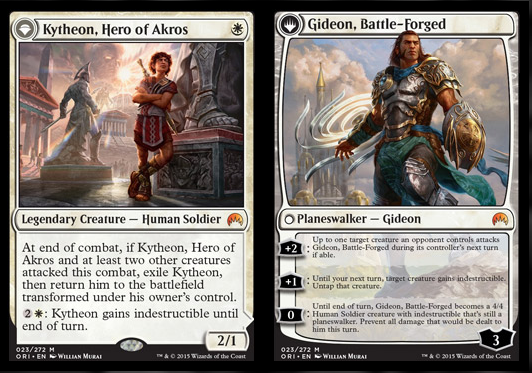
Kytheon, Hero of Akros

Kytheon,_Hero_of_Akros

Kytheon has the advantage of fitting the bill for a constructed-playable one-drop even without the ability to transform. The legendary supertype is, of course, a drawback, but with Origins in Standard the format will be huge and there will be a handful of one- and two-drops available to battle alongside him.

I've heard complaints that the planeswalker is boring because it's basically just Gideon Jura. This doesn't really bother me, because Gideon is great.

There was an error retrieving a chart for Gideon Jura

The problem with a card like Kytheon, is that Drown in Sorrow and Anger of the Gods are still legal, which makes trying to be a low-to-the-ground aggressive deck difficult. The upside is that flipping into Gideon leaves you with a 4/4 attacker even if your opponent has a sweeper. Sure, Gideon can be Downfalled, but then they just spent three mana on your one-drop.

Boros hasn't been good in Standard since the printing of Dromoka's Command, and it's hard to imagine that Kytheon alone properly addresses the barriers that the deck has to being competitive. Kytheon is definitely a strong card, but I think his power level is pretty obvious and he seems a little weak for Standard play.

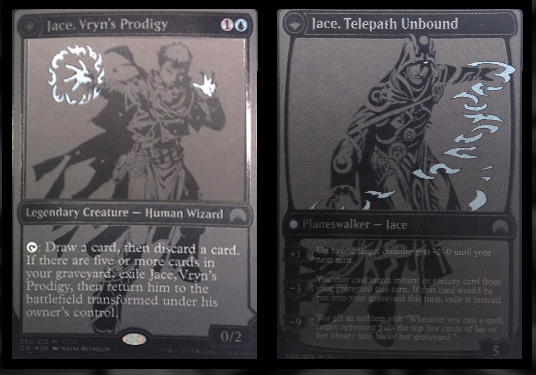
Jace, Vryn's Prodigy

Jace,_Vryn's_Prodigy

The image there is a little hard to read, so here's the card text:

Jace, Vryn's Prodigy
1U Legendary Creature- Human Wizard (0/2)
Tap: Draw a card, then discard a card. If there are five or more cards in your graveyard, exile Jace, Vryn''s Prodigy, then return him to the battefield transformed under his owner's control.

Jace, Telepath Unbound
Planeswalker- Jace (5)
+1: Up to one target creature gets -2/-0 until your next turn.
-3: You may cast target instant or sorcery card from your graveyard this turn. If that card would be put into your graveyard this turn, exile it instead.
-9: You get an emblem with "Whenever you cast a spell, target opponent puts the top five cards of his or her library into his or her graveyard".

I've heard a lot of disappointment with regard to Jace. Part of this is the fact that Merfolk Looter doesn't look as much like a constructed card as Savannah Lions. Even when Jace flips, people aren't too impressed. All told, Jace's backside is pretty weak. The reason that I think that the card has potential is that you get all of this for two mana, which might be worth it in total.

If you look at Jace as just a two-mana planeswalker, the card does exactly as much as I would hope that a two-mana planeswalker would; it has one ability that seems kind of good. -3 is a lot of loyalty, but that second ability is certainly worth two mana to activate once. From there, Jace can even kind of protect himself.

The -3 is a little weak abstractly, but contextually this Standard supports it very well. I've been trying to find a way to make Jace work with Treasure Cruise ever since I first saw the card, and Thoughtseize is also a great one to rebuy.

I don't think that a Merfolk Looter would be close to good enough in Standard, so having ways to flip Jace quickly will be essential to unlocking his potential. It also happens that cards that do this tend to play well with Treasure Cruise.

There was an error retrieving a chart for Commune with the Gods

Jeskai Ascendancy Combo is the most obvious place to shoehorn Jace, but once again Dromoka's Command is a serious detriment to our new planeswalker friend. There's also the fact that the deck was kind of fringe even pre-Command, and that Jace is a very bad topdeck in a deck that has a lot of air in it in the first place.

I have half a mind to try to build a Jace deck with Temur Ascendancy, though I really have no idea how to construct such a thing. Being able to flip Jace the turn you play it is great, but the two cards are rather incoherent as the baseline for a deck. I know that ways to mill yourself, Jace, Ascendancy, and some fatties are what you want, but I haven't yet been able to come up with a list that isn't just a worse version of some other deck.

At any rate, I see constructed potential in Jace, even if I haven't figured it out just yet.

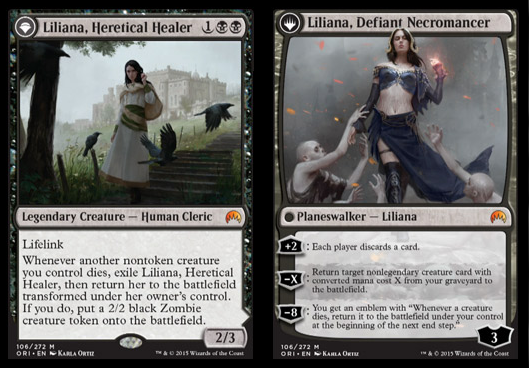
Liliana, Heretical Healer

Liliana,_Heretical_Healer

The front half of this Liliana is really bad if it just eats a removal spell, but the planeswalker side is great and the free zombie you get when she transforms also makes this card worth well more than three mana when it works.

Butcher of the Horde and Tymaret, the Murder King are the best ways to flip Liliana immediately by your own volition, though decks featuring these cards aren't necessarily in the market for a card like Liliana.

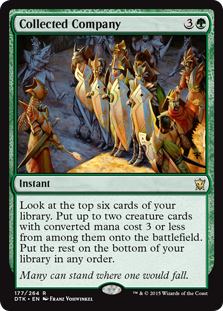
Collected Company is an exciting way to set up Liliana, either by grabbing two copies, sacrificing one to the legend rule and flipping the other immediately or by just finding a different creature to block mid-combat. I'm not positive that a Liliana CoCo deck is great, but it's where I would start looking if I wanted to Liliana.

There was an error retrieving a chart for Collected Company

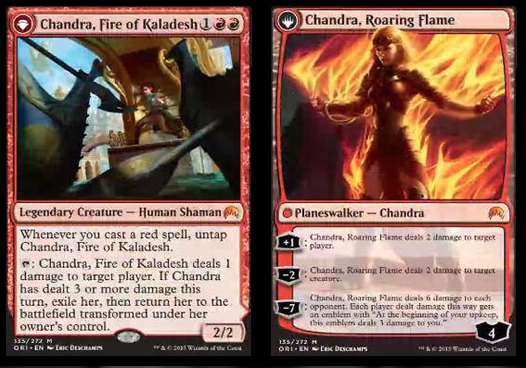
Chandra, Fire of Kaladesh

Chandra,_Fire_of_Kaladesh

Chandra is often referred to as being the worst planeswalker in multiple cycles. For this cycle, I'd say she's clearly the worst. Cinder Pyromancer is not remotely constructed-playable and the planeswalker side here is extremely under-powered even if you could just cast it for three. I honestly can't think of any way to try to make this work in Standard, especially when Goblin Rabblemaster isn't even a given anymore.

I've stood up for Chandra Nalaar plenty, but this Chandra just doesn't cut it.

Nissa, Vastwood Seer

Nissa,_Vastwood_Seer
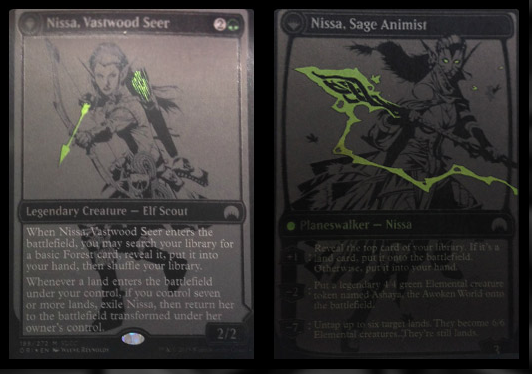
Once again, the image here sucks. Here's some card text:

Nissa, Vastwood Seer
2G Legendary Creature- Elf Scout (2/2)
When Nissa, Vastwood Seer enters the battlefield, you may search your library for a basic Forest card, reveal it, put it into your hand, then shuffle your library.
Whenever a land enters the battlefield under your control, if you control seven or more lands, exile Nissa, then return her to the battlefield transformed under her owner's control.

Nissa, Sage Animist
Planeswalker- Nissa (3)
+1: Reveal the top card of your library. If it's a land card, put it onto the battlefield. Otherwise, put it into your hand.
-2: Put a legendary 4/4 green Elemental creature token named Ashaya, the Awoken World onto the battlefield.
-7: Untap up to six target lands. They become 6/6 Elemental creatures. They're still lands.

Nissa would clearly be absurd if you could just cast her for three, but given the way the card works she's really more like a seven-drop. The real tragedy here is that you only put the land that you tutor into your hand, so you don't even get chain Nissas to flip one early.

At the end of the day, Nissa generates card advantage, which makes her a solid option for breaking open grindy mirrors. She's definitely not as good as Elspeth and in a way occupies the same space that Elspeth should, though the tutoring for a land does make the decision to play her or, say, the fourth Elspeth less obvious.

If a Rampant Growth effect shows up in Origins then a deck with Nissa and Kiora might be a thing, but for now the support just isn't there. Atarka's Command also helps us turbo out Nissa, though the other modes on the card just don't make sense in a Nissa deck. Nissa seems great with the proper support--we just don't have it yet.

~

Planeswalkers were very misunderstood when they were first printed, and indeed many new Magic cards are. This cycle is one of the wildest things to happen to Magic in some time, and I'm excited to get to work battling with them. Except for Chandra. Man, she really sucks.

Thanks for reading.

-Ryan Overturf
@RyanOverdrive on Twitter

Mana as a Resource: Grixis Control at GP Charlotte

Are you a Quiet Speculation member?

If not, now is a perfect time to join up! Our powerful tools, breaking-news analysis, and exclusive Discord channel will make sure you stay up to date and ahead of the curve.

There are many things I love about Magic. The infinite possibilities that come from access to a diverse card pool, branching decisions trees that spread from one singularity, and the delicate balance of resource management. While each Magic format has its own unique qualities and characteristics, the one attribute of Modern I appreciate most is the importance of mana as a controllable resource, both in deck construction and gameplay.

Snapcaster Mage Art

Below, I’ll define the role resource management plays in Modern, analyze some examples of this principle in practice, and discuss how it applies to Grixis Control, my deck of choice for GP Charlotte. Let’s begin!

[wp_ad_camp_1]

Mana as a Resource

Magic, at its foundation, is a struggle to manage finite resources. Both players start at 20 life, with seven cards in hand (hopefully). Players draw one card and play one land per turn. Life points can be spent and exchanged like any other resource to gain an advantage elsewhere. The same goes for cards, where “card advantage” as we commonly refer to it involves gaining resources or extra value for what we pay (Supreme Verdict vs. a board of opposing creatures). Life as a resource is nonrenewable: once you use it, it’s gone (barring an exchange of resources a la Healing Salve). Cards as a resource is carefully controlled: you only get one new card a turn (barring effects such as Brainstorm). Mana, on the other hand, is given freely. Every turn, on the untap step, the hourglass resets, and all spent mana is refilled, ready to be used again. Whether we have access to two mana or ten, the fundamental rules of Magic allow us to leverage those resources again and again, equal to the amount of mana available multiplied by the amount of turns we play in the game.

We are all familiar with the untap step. What is your point?

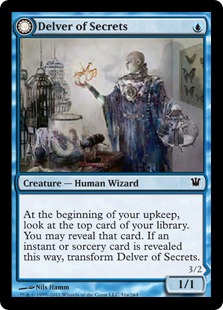
DelverThe most successful strategies in Magic’s history have been decks designed to maximize mana efficiency at every stage of the game. This is seen all the time in high-powered formats such as Legacy and Vintage, and occasionally in Standard when the stars align. One classic example of this theory in practice is UW Delver, seen here taking 1st place by Yuuya Watanabe at GP Manilla 2012. Capable of deploying fast, cheap threats as early as the first turn, and then backing them up with counterspells and other protection spells made this deck a formidable force, and the consensus best deck during it’s time in Standard. While everyone remembers Delver of Secrets as the tool that beat them, the most important lesson this deck taught its opponents (whether they recognized it or not) was how incredibly powerful maximizing mana-use can be.

At every stage of the game, UW Delver found ways to maximize its mana usage. Pass turn with mana up and opponent plays around Mana Leak? Flash in Restoration Angel. Have an extra mana or two free? Dig through the deck with Ponder and Thought Scour. Have all the mana in the world? Equip a Runechanter's Pike and get to work. While opponent’s were busy scrambling to answer Delver and playing around counterspells plus Vapor Snag, all UW Delver cared about was maximizing its mana usage, using all available mana on every turn, generating small advantages and leveraging them into larger gains in the areas of tempo and card advantage.

So we get an untap step, and we can use all the mana we want. Got it. But shouldn’t we be casting the biggest thing we can turn after turn? Isn’t that the goal?

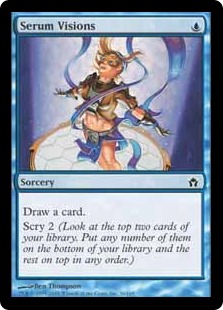
Serum VisionsSure, that’s the goal if you’re playing RG Tron, and your opponent isn’t set up to stop your unfair things. Look, there’s a reason why big, flashy cards seen flying across the table at Standard FNM’s don’t make the transition to Modern and Legacy. In high-powered formats, the cheapest option for an effect is usually the best. That's why, in Modern, Serum Visions is a stronger card than something like Peer Through Depths or Think Twice. Yes, Peer lets you dig two cards deeper into your deck, but Visions costs one less, which is a really big deal. Why? Mana efficiency! The ability to leverage our card resources faster, with greater ease, and fill in the gaps of our curve will translate into greater advantages later in the game.

Another classic example of mana efficiency is Remand. Sit down against any opponent piloting Big Green Whatever. Both of you have access to five mana, you spend two casting a creature, one casting a card draw spell, and pass with two mana up. Your opponent spends four on a Huntmaster of the Fells, which you answer with your Remand because you’re a Professional Magic Player (a PRO, if you will). Not only did you deal with your opponent’s threat and gained two mana on the exchange (your two-mana Remand for his four-mana Huntmaster), your opponent also wasted a mana by casting only Huntmaster on his turn. Meanwhile, you maximized mana efficiency by gobbling up everything on your plate. Congratulations, you deserve dessert! Keeping this principle in mind during deckbuilding is essential, it’s why I will usually choose a cheap option like Bitterblossom over something like Olivia Voldaren when building decks.

Modern - The Mana Tiers

Whether you’ve noticed it before or not, it bears repeating that Modern is a format defined by mana efficiency. Modern playable spells can generally be organized into four tiers, each looking to accomplish a specific goal. Let’s take a look.

One-mana spells: answers and card selection

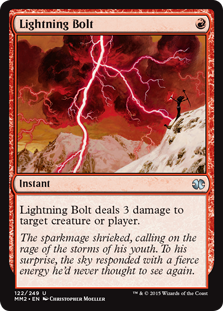
Lightning BoltWith the exception of green, every color in Magic contains a one-mana answer widely played in Modern decks. Path to Exile, Lightning Bolt, Thoughtseize, Spell Snare; these highly efficient spells establish the baseline for what we “should” be spending to answer threats in Modern. This is why cards such as Go for the Throat and Hero's Downfall don’t see much (if any) Modern play; there are simply better options available for less mana. Why do Abrupt Decay and Terminate see play then? Flexibility, without a drawback! While excellent, Lightning Bolt only hits < 4 toughness threats, and Path to Exile grants your opponent a free land.

As for card selection, Serum Visions exists as the last man standing for cheap card draw, as Ponder and Preordain are banned. Establishing this baseline for cheap answers and card draw allows us to evaluate rate for individual cards. Ancient Stirrings seems like a weak option compared to Serum Visions, but when we factor in synergy and the “puzzle piece” factor, we might start to re-evaluate cards like Stirrings.

Two-mana spells: threats and more threats

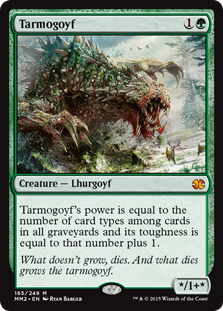
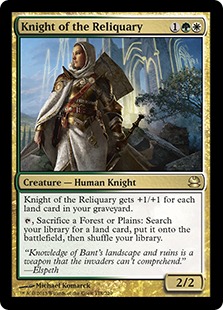
TarmogoyfTarmogoyf. Dark Confidant. Young Pyromancer. Eidolon of the Great Revel. Voice of Resurgence. Two mana in Modern grants you a resilient threat, barring outliers like Monastery Swiftspear and Delver of Secrets. Not counting the hyper-aggressive linear strategies, most threats in Modern are costed around two mana. This is important because, as with the one-mana tier of answers, two-mana threats establishes the baseline for what we “should” be paying for a threat in Modern. This is why creatures like Loxodon Smiter and Knight of the Reliquary don’t see much play, regardless of how many times Brian Kibler tries to make them work. Paying an extra mana for some counterplay against discard or land-based synergies often isn’t powerful enough to justify the extra resource investment, which is why Smiter and friends don’t see wider play. This push towards two-mana threats also has an interesting effect on counterspells in the format. Cards like Mana Leak, Deprive, and Remand see play, but not to the extent of Lightning Bolt and Path to Exile because a lot of things have to go right for these counterspells to be considered “good”.

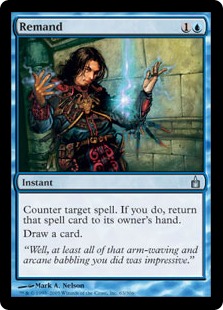
RemandTake the Remand example from earlier. The PRO player was able to generate advantages both in tempo and mana efficiency because he was able to answer his opponent’s four-mana threat with two mana at instant speed, while using the rest of his turn to accomplish other goals. Mana Leak on Tarmogoyf is acceptable, yet we are still trading two mana for two mana, and not gaining an advantage (a push, if you will). Mana Leak exists as a playable spell in the format because of its broad applications. Similar to Abrupt Decay, it can answer a wide range of threats both early in the game and late. The issue with Leak (and most two-mana counterspells in Modern) is that most threats in Modern are two mana, so it becomes much more difficult to generate an advantage with them, not to mention their inability to deal with two-mana threats while on the draw. Leak in particular suffers from a narrow window of effectiveness, as it cannot answer opposing threats at the start to the game, and can be played around a few turns down the line once mana has been developed. This is why Spell Snare is such an important card, a functional Path or Bolt that can answer Tarmogoyf, Bitterblossom, Terminate, and opposing counterspells even on the draw.

Three-mana spells: card advantage

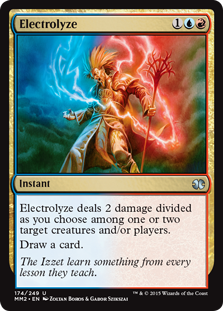
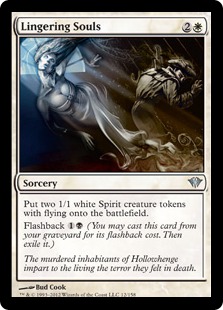
ElectrolyzeThis category includes cards like Electrolyze, Kolaghan's Command, Liliana of the Veil, Lingering Souls, and Kitchen Finks. If one mana gets us answers and two mana presents threats, it stands to reason that playable three mana spells should offer something more. All of the above cards generate card advantage in some way, either by answering a threat at no loss of card quality (Electrolyze), generating a built-in two for one (Kolaghan's Command), or functioning as “more than a card” through Lingering Souls' flashback and Liliana's resiliency. This trend towards three-mana spells as card advantage explains why things such as Maelstrom Pulse and Detention Sphere see little play. More often than not, these spells function as expensive three-mana answers that don’t generate any advantage (Maelstrom Pulse against Bitterblossom, Detention Sphere against Keranos, God of Storms) where a one- or two-mana spell could have done the job.

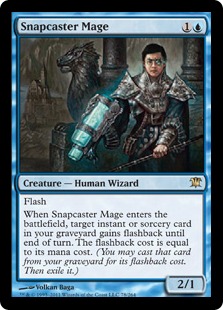
On the other hand, this is why Snapcaster Mage is, in my opinion, the best individual card in Modern. Snapcaster functions as a modal spell that can be cast as either a cheap, unassuming 2/1 flash creature for two, or can be cast for three (or more) to rebuy previously cast spells again and with a 2/1 attached. Snapcaster's value appreciates as the game lengthens, which cannot be said for any other card I can think of. On turn three, Snapcaster can rebuy a Lightning Bolt. On turn six, it can rebuy a Cryptic Command. So when it comes to three-mana card advantage spells, the two-mana Snapcaster is the undisputed king.

Four-mana: win the game

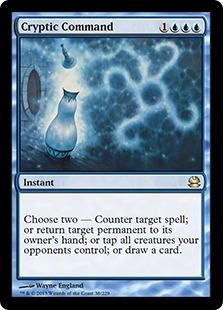
Building on the principles established in previous tiers, a four-mana investment should naturally provide something well worth the price. That means Cryptic Command, Supreme Verdict, Shatterstorm, or Splinter Twin. In Modern, four mana often occupies an entire turn’s worth of mana. The prevalence Cryptic Commandof highly efficient threats and answers in the format, along with counterspells, means if you intend to spend four mana on a spell, it better win the game. It can also generate a significant enough advantage that the opponent should have difficulty moving the game back to parity. In addition, the presence of Splinter Twin strategies along with other fast combo decks work to push curves lower, as tapping out for a large spell can often “spell” doom (sorry: had to) if it doesn’t end the game on the spot. As I said earlier, many players suggest Olivia Voldaren as a possible option for Jund and Grixis decks, but a four-mana 3/3 that takes over the game only if you can untap with it is a pretty large investment risk, especially in a format full of one-mana removal like Bolt and Path. Jund strategies seem to be the only decks that can employ expensive spells like Huntmaster and Outpost Siege (gross) that don’t immediately end the game, because the rest of their deck works to guide the game towards a topdeck war where both of these threats excel at generating advantages and burying the opponent.

As a final note, Collected Company exists as a four-mana card advantage spell that requires lots of support to make it work. Decks casting Company basically have to hit two creatures to not fall behind on-rate. Even then, cards such as Lingering Souls can more-or-less do the same thing without having to jump through hoops. While the ability to dig through the deck has applications as far as searching for sideboard cards and combo pieces go, there’s a reason Collected Company is always seen alongside mana creatures.

Grixis Control and GP Charlotte

With these principles in mind, I began preparation for Grand Prix Charlotte knowing I wanted to find a strategy that worked within these established tiers of Modern mana investment. Grixis Delver was an established strategy that I felt was doing a lot of things right, and Tasigur, the Golden Fang and Kolaghan's Command seemed to add a lot of play to the strategy. The core of Serum Visions, Lightning Bolt, Snapcaster Mage, and Thought Scour was incredibly powerful, and I knew any deck I was going to play would be packing four Snapcaster Mages.

Grixis Delver, by Trevor Holmes

Creatures:

4 Delver of Secrets
3 Snapcaster Mage
1 Gurmag Angler
2 Tasigur, the Golden Fang
3 Young Pyromancer

Sorceries:

4 Serum Visions
3 Gitaxian Probe
2 Inquisition of Kozilek

Instants:

4 Thought Scour
2 Kolaghan's Command
4 Lightning Bolt
2 Terminate
1 Electrolyze
2 Mana Leak
2 Remand
2 Spell Snare
1 Deprive

Lands:

4 Polluted Delta
4 Scalding Tarn
2 Steam Vents
1 Watery Grave
1 Blood Crypt
1 Sulfur Falls
3 Island
1 Mountain
1 Swamp

Sideboard:

2 Blood Moon
1 Dispel
3 Dragon's Claw
1 Engineered Explosives
1 Izzet Staticaster
1 Magma Spray
1 Negate
1 Rakdos Charm
1 Rending Volley
2 Spellskite
1 Vandalblast

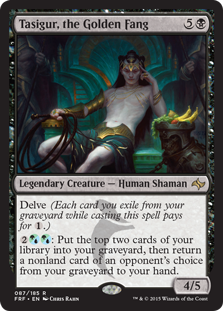
After testing a few games with this deck, I found my Delvers and Young Pyromancers were underwhelming, while Tasigur continued to overperform. As a huge threat that came down for usually one or two mana with barely any conscious work to enable him, Tasigur was just excellent. In Grixis he functions as a black Tarmogoyf that draws cards, can’t be shrinked, and dodges Abrupt Decay. When I started cutting Delver of Secrets in post-board blue matchups and against removal-heavy opponents, I started leaning more heavily on Tasigur. That's when I knew I needed to make a change.

TasigurCutting Delver allowed me to also cut Gitaxian Probe. While a perfectly fine card, Probe puts a little too much stress on our life total and is not something I want to be doing when facing Burn or Affinity, so cutting them was not something I found too painful. While on one hand removing Probe can make Snapcaster slightly worse (running him out turn two while flashing back a Probe is an excellent play) cutting Probe made my draw steps and Thought Scours more powerful. So as far as Snapcaster goes, I’d call it a push. And once you’re cutting Delver and Probe, Pyromancer starts to not look so hot. Remand also becomes less amazing when we’re not looking to apply quick pressure or protect a combo on a pivotal turn.

At this point I knew I wanted to play more of a Grixis Control type strategy, with more Tasigurs and no Delvers. I liked that a lot of pros were writing articles about Grixis, and I was looking forward to blanking opposing Decays in G1’s, and bringing in Blood Moon or Bitterblossom after board. After making some changes and incorporating some ideas from Patrick Chapin’s excellent Sultai/Grixis article (SCG premium), I arrived at the following list.

Grixis Control, by Trevor Holmes (GP Charlotte 2015)

Creatures:

4 Snapcaster Mage
2 Gurmag Angler
2 Tasigur, the Golden Fang
2 Young Pyromancer

Sorceries:

4 Serum Visions
2 Inquisition of Kozilek

Instants:

4 Thought Scour
2 Kolaghan's Command
2 Shadow of Doubt
3 Terminate
4 Lightning Bolt
1 Electrolyze
2 Spell Snare
2 Mana Leak
1 Deprive
1 Cryptic Command

Lands:

4 Polluted Delta
3 Scalding Tarn
1 Bloodstained Mire
2 Watery Grave
2 Steam Vents
1 Blood Crypt
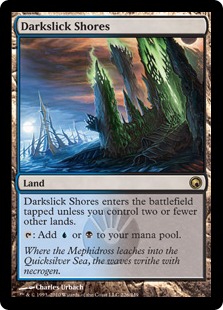
1 Darkslick Shores
3 Island
1 Mountain
1 Swamp
3 Creeping Tar Pit

Sideboard:

1 Vandalblast
1 Dispel
2 Deathmark
1 Flashfreeze
3 Blood Moon
1 Dragon's Claw
1 Magma Spray
2 Bitterblossom
1 Thoughtseize
1 Izzet Staticaster
1 Kolaghan's Command

This list was exactly what I wanted to be doing in Modern, and where I wanted to be for Charlotte. Gurmag Angler as extra copies of Tasigur really brought the deck together and gave it an actual gameplan. Pure control is difficult to accomplish in Modern, as there is just too much discard and too many wacky things to be able to control everything. Shaun McClaren can win with Jeskai, but normal humans seem to have some difficulties. As a result, I wanted my Grixis “Control” deck to be able to turn the corner quickly when ready, and there’s no better way to do that than one-mana 4/5’s and 5/5’s. Bolts and Kolaghan's Command-Shocks also work better at killing our opponent if we’ve hit him for four or five once or twice, and the removal of Delver and Probe allows us to play Creeping Tar Pits, up our individual card quality and settle in for the long game.

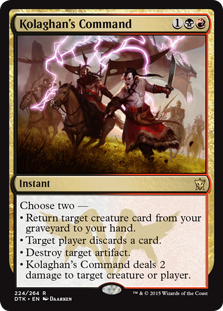
Kolaghans CommandComing off of the Season Two Invitational, big mana decks such as Amulet Bloom and RG Tron seemed like they would be popular due to their recent success. For Charlotte, I expected a field consisting primarily of big mana decks, fair decks tuned to fight the big mana decks, fast aggro decks looking to capitalize on everyone tuning their decks to fight the big mana decks, and Twin. I knew Kolaghan's Command would be excellent against everyone, as the Snapcaster/Command loop buries all the fair decks and Command is an amazing two-for-one against Affinity and Burn as well. Even against the big mana decks, snagging an Amulet of Vigor or Expedition Map is fine and can help us steal a victory. Like most everyone else with access to red, I planned on packing Blood Moon in large numbers to fight Amulet and Tron, both tough matchups. For everyone else, Snapcaster and Tasigur supported by cheap interaction and Kolaghan's Command to keep things going would be strong enough against to give me game in every matchup.

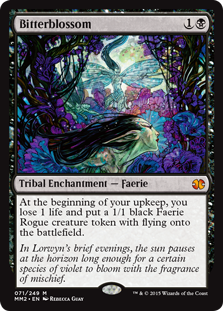
BitterblossomAs for the rest of my board, I knew I wanted a trump for the blue mirrors, even if probably not necessary to win games. I didn’t have enough time to test the intricacies of the matchup and wanted something my opponents wouldn’t be prepared for. There is a fine line between “trump” and “too cute”, but I’ve found success by bringing something new to the table that my opponent isn’t expecting. I say all this to preemptively defend my decision to run two Bitterblossoms in the board, as I knew it was a topic of contention while testing on stream (twitch.tv/Architect_Gaming!) and I would have to explain it to salty opponents as well. In a Delverless Grixis Control deck, Game 1’s often ended by with me gaining virtual card advantage due to opponent’s being stuck with semi-dead Decays and Bolts they have to send at my face while I’m clocking them with Gurmag Angler. After board, I expected many opponents to board out Decay, at which point I would be boarding in Blood Moon or Bitterblossom in the blue mirrors and Jund matchups. While my opponents were preparing to settle in for a long game, using their first few turns to play tapped lands of their own and cast some Serum Visions, I was casting Inquisition of Kozilek into Bitterblossom and leaving them dead in the water.

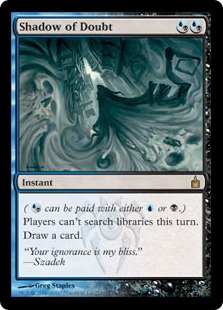
In Charlotte, I went 7-1-1 on Day 1, beating Faeries, Elf Company, Burn, Jund, Little Kid Abzan, Jeskai Control and Grixis Twin, while losing to Affinity and drawing with Amulet Bloom. Most of my matches were not close and six of my seven wins were 2-0. On Day 2, I took an early loss to Etched Champion again, beat another Grixis Twin deck (2-0), then lost two weird games to UW Sun Titan Control and Jund to finish my Day 2 run. My opponents were constantly confused as to the makeup of my deck, and several times I had opponents ask me after the match if I was playing Delver or the combo. Shadow of Doubt is often boarded out after game 1’s along with Mana Leak, but I “got em” a few times over the course of the event, and it does enough against big mana and Chord of Calling that I feel it's earned its slot. I’m not against cutting it either. Many viewers of my stream have suggested Olivia Voldaren instead of Bitterblossom against Jund and other decks. My response has always been the same: I’ll take the cheap, efficient, hard to deal with threat over a four drop that dies to Lightning Bolt everytime.

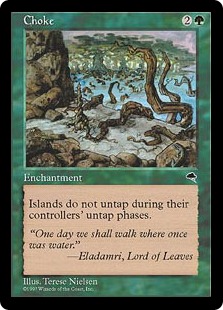
Darkslick ShoresA few matches into Day 1, I knew my list was a few cards off from perfect. I swapped my 4th Island for a Darkslick Shores in an attempt to support my two maindeck Inquisition of Kozileks, but this in turn made my manabase worse when trying to operate under Moon. This was done in an attempt to play early discard without losing much life against Affinity and Burn, while having another blue dual like Creeping Tar Pit that gets to untap under Choke. But the Shores should probably just go back to being an Island.

I moved a Kolaghan's Command to the board to fit discard in the main, and boarded in the Command almost every time in exchange for the Shadow of Doubt after game 1. This was done under the reasoning that Shadow is really a game 1 card and better on the play, and I often was boarding it out when on the draw (which most of my game 2’s were on the draw over the course of the event). After making the swap all event, I realized I should just cut the Shadow, move the Kolaghan's Command maindeck and free up a sideboard slot to help out a bad matchup.

Dragon's Claw in the board should probably just be Dispel. Claw is excellent against Burn but Dispel is almost as good, gaining anywhere from 3-8 life just like Claw would normally, while allowing me to continue to be immune to Destructive Revelry. In addition, Dispel is excellent against opposing Cryptic Commands, so much so that I’ve been cutting my own Cryptics in blue mirrors that I’d like to have access to the extra counterspell.

Post GP Charlotte Grixis Control

I’d like to close by talking about this Cryptic Command issue a little more, along with some discussion on my updated decklist and how it compares to Patrick Chapin’s 9th place list at the Charlotte. See the list below:

Grixis Control Revised, by Trevor Holmes

Creatures:

2 Gurmag Angler
2 Young Pyromancer
4 Snapcaster Mage
2 Tasigur, the Golden Fang

Sorceries:

4 Serum Visions
2 Inquisition of Kozilek

Instants:

4 Thought Scour
3 Kolaghan's Command
4 Lightning Bolt
3 Terminate
1 Electrolyze
2 Cryptic Command
2 Spell Snare
2 Mana Leak
1 Deprive

Lands:

4 Polluted Delta
3 Scalding Tarn
1 Bloodstained Mire
2 Watery Grave
2 Steam Vents
1 Blood Crypt
1 Darkslick Shores
3 Island
1 Mountain
1 Swamp
3 Creeping Tar Pit

Sideboard:

1 Vandalblast
2 Dispel
2 Deathmark
1 Flashfreeze
3 Blood Moon
1 Magma Spray
2 Bitterblossom
1 Thoughtseize
1 Damnation
1 Izzet Staticaster

I found myself cutting Cryptic Command in blue mirrors, as I found I was rarely able to use it safely and often had to cast it on turn four to protect a creature, rather than later in the game when I could support it with Spell Snare and Deprive. My reasoning was that I would rather be the player casting Dispel on my opponent’s Cryptic rather than the other way around, and I eventually trimmed down to just one copy for my final list. Pat placed 9th on breakers with a very similar Grixis control list, playing Fulminator Mage over Blood Moon and cutting the Young Pyromancers and Shadow of Doubt for a full playset of Cryptics. Many viewers on stream asked if I would be switching to his list and what I thought about it, so I figured I’d give my perspective here in writing.

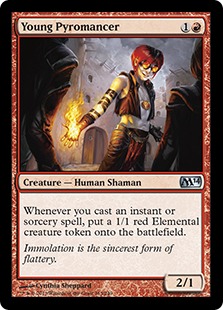
Young PyromancerFirst and foremost, Patrick Chapin is an excellent player and I’m probably a tenth of the player he is, which is why I probably wouldn’t do well with his list. Though they are only a couple cards off, Chapin’s decision to cut Pyromancers and max out on Cryptics shows a strong predisposition to stretching the game out as long as possible. Similar to the way a Jeskai Control deck would operate, I imagine all Pat wanted to do over the course of the weekend was find opportunities to cast Cryptic for value, burying his opponent once he was able to fire off two or three. I play better when providing pressure, which supports my decision to retain Pyromancers in my list, and I feel that you can find success either way. I would be much happier to be casting Cryptic Command if I had more Dispels to protect it, and if I decide to cut the Young Pyromancers I would probably replace them with Cryptics for sure.

What do you think? Do you agree with my decision to trim Cryptic Command? What about my classification of Modern’s mana tiers? Is there anything you would change in my list? Thanks for reading and let me know in the comments!

Trevor Holmes
The_Architect on MTGO
Twitch.tv/Architect_Gaming
Twitter.com/7he4rchitect

BUG Landfall EDH

Are you a Quiet Speculation member?

If not, now is a perfect time to join up! Our powerful tools, breaking-news analysis, and exclusive Discord channel will make sure you stay up to date and ahead of the curve.

Welcome back, all, to another reach into my bag of EDH decks. Today we're talking about one of my favorite decks with a lot of tricks. In my early days of being exposed to EDH I was a sponge looking for the next idea to suck up and run with. My friend Alexis had a spare BUG deck with a few landfall mechanics in it and I was without a deck that day. I took it, piloted it and started thinking to my self...I will take this and make it great!!!

Her list wasn't as synergistic as I wanted it to be and by brain started cooking. I wanted a hybrid ramp-combo deck and when this deck was initially built Primeval Titan was still legal in the format. I wanted to keep the colors so I couldn't run Valakut, the Molten Pinnacle nor did I want it to be that kind of deck. I liked the landfall mechanic and quickly started looking for all the cards i could find within the color wedge.

Of course with any new mechanic that i'm trying to built around I always dive back into older sets with similar mechanics that would compliment my initial idea. Here's what i came up with, post-Primeval Titan ban.

BUG Landfall EDH by Julian Biondillo

Commander

Creatures

Spells

Lands

5 Swamp  5 Forest  3 Island  Bayou  Underground Sea  Tropical Island  Watery Grave  Breeding Pool  Overgrown Tomb  Polluted Delta  Misty Rainforest  Verdant Catacombs  Dimir Aqueduct  Golgari Rot Farm  Simic Growth Chamber  Drowned Catacomb  Hinterland Harbor  Woodland Cemetery  Oboro, Palace in the Clouds  Command Tower  Bojuka Bog  Opulent Palace  Undiscovered Paradise  Ghost Town  Tolaria West  Terrain Generator  Halimar Depths  Dismal Backwater  Jungle Hollow  Thornwood Falls  Tainted Isle  Tainted Wood

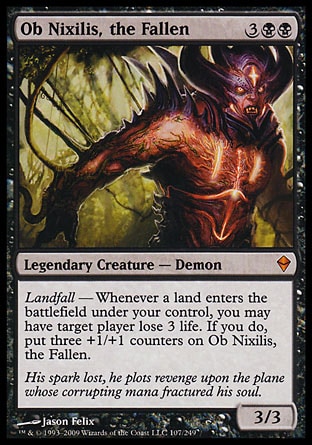
Okay, so where to start? Bloodghast and Perilous Forays, how awesome? Sac the ghast, get a land, trigger landfall, ghast comes back, repeat. Obviously this will be limited to the amount of open mana and basic lands left in the deck. Couple this with any other landfall trigger like Ob Nixilis, the Fallen or Grazing Gladehart and reap more value.

I'm not the biggest fan of infinite combos in EDH, although if you have all the right cards in play you can just win if no one can disrupt the combo. Amulet of Vigor and Patron of the Moon with any of the "bounce lands" (Dimir Aqueduct, Golgari Rot Farm, or Simic Growth Chamber) and you can net infinite mana and infinite landfall triggers.

With Zuran Orb and Elixir of Immortality you can infinitely cycle your lands back into your library and take advantage of Scapeshift or Boundless Realms. Making absurdly huge plant tokens off Avenger of Zendikar can also swing you in for the win as well.

Parallax Tide should be used on your own lands primarily. Removing five lands from the game at EOT and bringing them back on your next turn grants you landfall triggers in a pinch if need be.

The backbone of the deck and potentially the most important cards is Oboro, Palace in the Clouds. It's the one land that you can pick up on one-mana notice and replay as many times as you can.

The win conditions in the deck are, of course, the general Vorosh, the Hunter, Ob Nixilis, the Fallen, Avenger of Zendikar and Rampaging Baloths. The games do take a long time to set up to really abuse the deck's theme so I'd highly recommend not playing the deck in a one-on-one game.

This list hasn't been revamped in a bit so I'm hoping to hear some feedback about other suggestions and with Battle for Zendikar coming up in October, I have high hopes of adding new cards.

Thanks for reading!

x Julian Biondillo x
Julian, AKA hardcoreniceguy on Twitter
biondillodesign@gmail.com

Insider: Card Evaluation and Magic Origins

Are you a Quiet Speculation member?

If not, now is a perfect time to join up! Our powerful tools, breaking-news analysis, and exclusive Discord channel will make sure you stay up to date and ahead of the curve.

Like many people of my generation, I don’t watch TV like my parents. Thanks to Netflix, Hulu, and Amazon Instant Video we now have full shows at our fingertips any time we want. It’s been a while since I patiently waited for the next episode of a show to come out on TV. I love watching shows like this. It makes them into something more like a movie series, rather than a typical TV show.

The latest in my queue has been Warehouse 13. This science fiction show set in present day has the agents tracking down magical items that have eclectic and sometimes bizarre powers. One of the agents is a guy named Jinx with the ability to tell when someone is lying. A useful talent indeed I must say. He says it can sometimes be a curse to know a person’s intent.

Sometimes I feel that way about Magic cards. Card evaluation is a key skill to playing this game at a high level. The vast majority of the time, proficiency in this area of your game will promote you to better results. Occasionally, you might be sad that you can’t play that sweet card because it costs too much mana, but winning is always exhilarating and it makes up for it. I see this a lot in draft where cards are lying to players. On the surface, they seem super fun but also very good.

Most recently we’ve seen this reasoning in the forefront of Magic news with the foil Tarmogoyf versus Burst Lightning pick, but this happens regularly at draft tables in stores everywhere. Do you take the card that will help your current deck, the one that will help your constructed deck, or the one that’s worth the most money?

Of course, it’s more complicated than that, but the short version is that assessing the strength of your available cards is an essential component of playing this game successfully. The card's strength can change based on the strategy you are trying to build as well. So keep in mind all factors when building your decks.

There was an error retrieving a chart for Tarmogoyf

Play Better

If card evaluation is so important, what’s the best way to improve that skill? I tell every new player the same thing. Start playing as much Limited as you can. Draft frequently and hit all those sealed events at prereleases.

Not only are they intensely fun, but they also help you build the skills you need to improve as a player. These situations force you to evaluate cards on the fly and hopefully you can learn from your misevaluations. After the event, look back on your deck and try to figure out what the weakest cards were and why they didn’t work out like you thought they would.

Often, players dive right into Standard because they can get a good deck list from another player and find moderate success right away. The part they are missing is the decision-making process that goes into choosing the cards for the deck they are playing. Why is there that random card that you’re not sure of its purpose? By playing Limited and building your own decks, you can level all of your Magic skills.

Finance Better

Card evaluation is critical for your financial future in the game as well. I’ve noticed a trend lately that cards on the spoiler that go up for presales have been undervalued. Take the last Standard set, Dragons of Tarkir, for example. If you remember back to before the set was released, the two highest value cards in the set were the two planeswalkers. Take a look at their value now.

There was an error retrieving a chart for Narset Transcendent
There was an error retrieving a chart for Sarkhan Unbroken

I think Sarkhan Unbroken is quite undervalued right now and might be a major player in the next Standard format, so I would be picking up your copies of that card as soon as possible, but Narset Transcendent seemed to me like it would obviously decrease drastically in price.

The Dragonlords, Deathmist Raptor and Collected Company are all now double or more of their presale value. I’ve thought that there was a lot of opportunity lurking out there to make some money before these new sets are released. These cards are proof that I was correct.

Over the years I’ve made some decent money when I had the capital to follow my instincts about what cards were selling for under what I thought their value should be. One of my first speculation targets was Vengevine and it followed a similar trajectory to that of Deathmist Raptor. Recently I made money on Torrent Element of all things, which in the end dropped right back down in price. Luckily it stayed at $6-8 and I was able to make some money.

Using your card evaluation skills, you can identify which cards are good investments. Let’s look at the most recent spike for a moment, Nourishing Shoal.

That card is awful. Yes a deck that was in the Top 8 of a Grand Prix used it successfully, but Goryo's Vengeance is the card that made it all possible. He may have used Nourishing Shoal to propel him to victory but it was on the back of other cards. I highly doubt that card will stay valuable for long so if you found cheap copies of that card, unload them asap.

Heritage Druid on the other hand has been waiting for the right moment to jump in price. Here’s the breakdown for both cards.

There was an error retrieving a chart for Nourishing Shoal
There was an error retrieving a chart for Heritage Druid

If you want a shoal to propel you to victory, start picking up Shining Shoal. I just got a bunch of copies in the mail and it seems insanely good right now in Modern. Tom Ross used the card in his Soul Sisters deck, but it seems great in any deck with white cards.

You can freely tap out against Burn to further your board state with no fear of losing because you can redirect the last burn spell at them for free! It doesn’t get much better than that. You can also pay mana for the card instead of exiling a card from your hand. Older cards like this have great potential in an unrotating format like Modern. Are there any cards like this you have identified as potentially going to spike due to a surge in play? Let me know in the comments.

Evaluate Better

The main reason I wanted to discuss this topic today is because I have been trying to bring these skills to bear on the flip planeswalkers from the upcoming final core set Magic Origins. The centerpieces of this set are creatures and that once certain criteria are met, flip and turn into planeswalkers.

The five characters who are imbued with their spark for us to see are Gideon, Jace, Liliana, Chandra, and Nissa. If the spoilers are correct, we know all five so let’s analyze them.

Jace, Vryn's Podigy
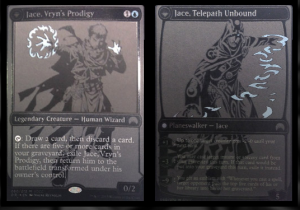
Jace,_Vryn's_Prodigy

That picture may not be too clear, so here is the text on his card.

Jace, Vryn’s Prodigy
1U
Tap: draw a card, then discard a card. If there are five or more cards in your graveyard, exile Jace, Vryn’s Prodigy, then return him to the battlefield transformed under his owner’s control.
0/2

Jace, Telepath Unbound
+1: Up to one target creature gets -2/-0 until your next turn.
-3: You may cast target instant or sorcery from your graveyard this turn. If that card would be put into your graveyard this turn, exile it instead.
-9: You get an emblem with “whenever you cast a spell, target opponent puts the top five cards of his or her library into his or her graveyard.
5 loyalty

The most important detail about these new cards is how they will play out unflipped. We must consider a number of things when determining the playability of this strange new planeswalker cycle. At the top of the list are questions like, "is a two-mana 0/2 that loots a playable card in Standard?" This Merfolk Looter effect has not been playable outside of graveyard-based decks for many moons, so if we are going to play it, we must have a good reason to be including it.

One might suggest that him flipping into a planeswalker is a good reason. I’m not sure I see it though.

I do like the potential for Jace, Telepath Unbound to flashback something powerful. The ability to rebuy cards from your graveyard has always been potent. From Regrowth and Yawgmoth's Will back in the day to Snapcaster Mage and Eternal Witness now in Modern, getting back cards from your graveyard adds strength to your deck in a way that many other strategies cannot.

This card does have potential, but including a looter doesn’t seem very appealing unless you have a big payoff once he flips. Usually if the card isn’t playable in Standard that bars it from mention in Modern, but this may be the exception. In Modern, Snapcaster is even more powerful because the cards he flashes back are overpowered respective to their mana cost. Jace benefits from the same phenomenon.

Jace seems innocent enough but there are circumstances where he can seem broken. This is the thought process you can develop by playing a lot of Limited and building your own decks. When you start that process, you will begin analyzing each card for their strengths and weaknesses in different situations.

Let’s move on and dissect another new planeswalker getting their spark, which in my opinion, is the coolest flavor in the game up until this point.

Nissa, Vastwood Seer
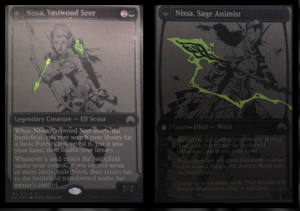
Nissa,_Vastwood_Seer

That picture may not be too clear, so here is the text on her card.

Nissa, Vastwood Seer
2G
When Nissa, Vastwood Seer enters the battlefield, you may search your library for a basic forest card, reveal it, put it into your hand, then shuffle your library.

Whenever a land enters the battlefield under your control, if you control seven or more lands, exile Nissa, then return her to the battlefield transformed under her owners’s control.
2/2

Nissa, Sage Animist
+1: Reveal the top card of your library. If it’s a land card, put it onto the battlefield. Otherwise, put it into your hand.
-2: Put a legendary 4/4 green elemental creature token named Ashaya, the Awoken World onto the battlefield.
-7: Untap up to six target lands. They become 6/6 Elemental creatures. They’re still lands.
Loyalty 3

So, we had Merfolk Looter Jace and now Borderland Ranger Nissa. The difference here is that flipping Nissa requires seven lands in play. That’s a lot of lands. Depending on the format, that might be viable, but relying on that as one of your primary game plan seems loose.

If you flip her, she is a solid planeswalker. You can plus every turn to accelerate to more than seven mana or draw an extra card. Summoning a 4/4 is great and all, but why is it legendary? The ultimate seems like something to strive for especially if you have more than seven lands in play, but it’s going to take a while with only a +1 each turn.

I’m sure this will be a hit in formats like Commander where you actually want to get more than seven lands in play, but as for Standard, I have my doubts. A starting goal of seven lands in play for Standard is not what you should be striving for. If you are already playing a ramp deck and you wouldn’t mind a Borderland Ranger that is sometimes more than that, then Nissa is the girl for you though.

Chandra, Fire of Kaladesh
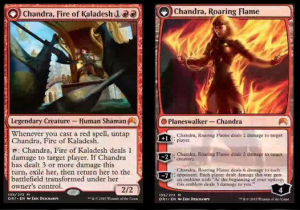
Chandra,_Fire_of_Kaladesh

In our quest for knowledge about our new planeswalker friends, they have both been comparable to commons and that doesn’t stop here either. Chandra, Fire of Kaladesh is as close to a Cinder Pyromancer as you can get. She might be the best Cinder Pyromancer there ever was, but being a 2/2 instead of a 0/1 isn’t much of an upgrade. When you talk about flipping her though, that’s an achievable goal.

To break it down, once you have her in play, all you need to do is untap with her and play two red cards. That is much easier than seven lands in play, for certain. In order to complete this sequence you also get to Lava Spike your opponent basically for free. Then, you get to follow up with an additional two damage because you can activate these planeswalkers the turn they flip. So, with Chandra, you get to deal five damage in one turn! You get to choose whether that additional two damage is deducted from the players life total or is blasted at one of their creatures as well.

One minor dilemma with this version of Chandra, which seems pretty good so far, is that there will likely be a conflict of how you build your deck with her in it. Building a deck with cheap red creatures would be an easy way to flip her, but since her ability will give you a free Lava Spike, you may want more burn spells. The problem with that is if you have lots of burn spells, your opponent will have removal spells sitting unused in hand to kill her with.

So, any deck that runs Chandra will likely want to be balanced between creatures and burn spells. That can happen, but sometimes is easier said than built. You also want many cheap cards so that you can play two of them on turn four and depending on what cards are legal may determine how much play she sees. I do like this card and it seems playable. With the overall card quality rising, that’s not always enough for a card to earn a spot in the metagame, but when the time comes, Chandra, Fire of Kaladesh has earned a second look.

Kytheon, Hero of Akros
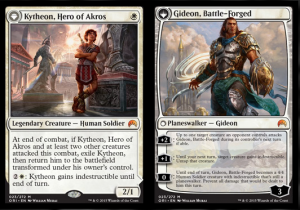
Kytheon,_Hero_of_Akros

Luckily for us, Gideon, or Kytheon apparently, was spoiled before I was finished writing my article this week so we get to talk about him as well. Despite me being irritated about him having a different random name, even if it makes sense because of the storyline, he seems like the one that may see the most play.

Once we move past the Courser of Kruphix midrange festival that is Standard, we will still have to deal with Deathmist Raptor and crew, but early aggressive creatures may be playable again outside of red. I look forward to that time because I am an early aggressive creatures type of player.

For players like myself, this card is amazing. First of all, we can still compare it to Savannah Lions--no not any of those other 2/1-for-one-mana dorks, the real truth used to be Savannah Lions. I’ve cast many a lion in my day and beat a horde of opponents with them as well. Creatures with power greater than their mana cost will always be decent. When everyone has Sylvan Caryatid to block your guys with, they become less good, but that tree is almost dead and I can’t wait.

A cheap aggressive creature that turns into a bigger threat later in the game reminds me more of Figure of Destiny or Warden of the First Tree though. In fact, Gideon is almost like the planeswalker reincarnation of Figure of Destiny. Gideon is a Figure of Destiny because he was destined to become a planewalker.

His Windbrisk Heights triggered ability isn’t that hard to pull of either. You may want to be playing Raise the Alarm but any cheap aggressive creatures will do. It’s a shame that he’s not a warrior, because he could have been the missing piece to that puzzle, but regardless, he is definitely good enough to play. Being able to flip him on turn three seems great as well, but even on a board stall he would be good. When your early-drop creatures are also good late game, you know you’re onto something.

On the flip side, okay I had to do it at least once, he becomes like a smaller version of Gideon Jura. He can make one creature attack him, make an indestructible blocker, or turn into a 4/4 indestructible creature himself.

Gideon’s thing is not having a real ultimate apparently, but that’s cool in my opinion. Your deck is already geared towards creatures and attacking so why not add a 4/4 that your opponent can’t easily kill to your assault squad? I like Gideon, I hope he finds a home, and I will be working towards finding him one myself.

Liliana, Heretical Healer
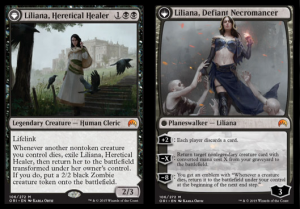
Liliana,_Heretical_Healer

Even though Gideon was the last to be spoiled I still saved the best for last. Liliana might have been the first of these new wave planeswalkers to be spoiled, but she gets to be last because she’s the best. That’s right, I think Liliana is the best of the batch. Other than Gideon, she is the best creature in her own right. Her base stats are decent and she gets lifelink. Lots of writers have talked about her because she’s been known the longest so I will keep her summary short.

Your opponent is most likely going to kill your creatures. So, they have a choice. They can kill your other creatures, which are hopefully more threatening, or they can kill her. If they kill her, your other guys live and if they kill her, you get to flip her. When deckbuilding you have a choice of whether or not to build your deck so she can flip, which is the most likely course of action.

If our goal is to flip Lili, then we will need some tools to do that. Normally I would suggest cards like Viscera Seer or Cartel Aristocrat, but those cards are no longer legal.

Instead we have a whole mechanic devoted to helping us flip our friendly neighborhood necromancer. Exploit seems destined to do Liliana’s bidding. Whether that be with strong cards like Sidisi, Undead Vizier or innocent-looking ones like Sidisi's Faithful or Minister of Pain, there are a lot of options to pair with Lili. We even have Merciless Executioner in our available card pool as well.

When I’m analyzing Liliana, Heretical Healer I see her as replacing herself. I know she is turning one of her friends into a zombie on accident, but I mentally compare her to a card like Xathrid Necromancer or maybe Loyal Cathar. Either way, when she flips, you still get a creature and that doesn’t happen with any of the other planeswalkers except sort of Gideon. I like having access to Bloodsoaked Champion in this type of deck as well because it’s a great card to discard for her +2 ability since you can get it back later.

The point is that there’s a lot you can do with new Lili. When you factor in her Zombify ability, things get even more complex as well. These are all good things and lines of play that make your deck not only interesting but usually successful as well. She is the type of card that births an archetype and I’m excited about using her to do some crazy things. Who knows, maybe she will even make my pile of Risen Executioners more valuable.

That’s all for this week. Stay tuned for more card analysis of Magic Origins in the coming weeks. If you have more thoughts about this flavorful new cycle of planeswalkers or insight into card evaluation, please post below.

Until next time,
Unleash the Force!

Mike Lanigan
MtgJedi on Twitter
Jedicouncilman23@gmail.com

Do Eighth and Ninth Edition Belong in Modern?

Are you a Quiet Speculation member?

If not, now is a perfect time to join up! Our powerful tools, breaking-news analysis, and exclusive Discord channel will make sure you stay up to date and ahead of the curve.

Earlier this week Brian Braun-Duin suggested in his article that removing Eight and Ninth Edition from Modern would improve the format. His argument rests on the fact that cards like Blood Moon and Choke lead to completely non-interactive games and that Tron is lame.

There was an error retrieving a chart for Urza's Tower

It's an interesting argument, but there are a few problems. Part of the issue is that at it's face the argument ignores a lot of sweet cards that are Modern legal. I know that Intruder Alarm, Greater Good, Form of the Dragon, Fecundity, Kird Ape and a number of other Modern legal cards aren't exactly tearing it up right now, but they certainly don't deserve to just be banned.

It's a reasonable point that Eight and Ninth hardly embody the ideals of Modern Magic, but they do have the new card frame, and I have a feeling that you'd have a difficult time explaining that Eighth and Ninth have been removed to newer players, or players that just don't pay too much attention to such announcements.

It makes more sense to me to just ban the list of cards that are actively hated from Eighth and Ninth, but then the argument suddenly sounds kind of silly. The reason being that the individual cards that this move would target aren't currently banned, and the decks that feature them have been in the format for quite a while.

The last point that I'd like to make, is that for as much as I hate Blood Moon, I feel that the Modern format doesn't put nearly enough pressure on non-basic lands. Legacy has Wasteland, and even there people play maybe one or two basics, often incorrectly. How are we going to pretend like the color of your spells matters in a format where you have fetches and shocks and only need to worry about Tectonic Edge and Ghost Quarter?

So, what are your thoughts? Do Eighth and Ninth belong in Modern?

Hot Tech out of GP Charlotte

Are you a Quiet Speculation member?

If not, now is a perfect time to join up! Our powerful tools, breaking-news analysis, and exclusive Discord channel will make sure you stay up to date and ahead of the curve.

Most of the buzz to come out of GP Charlotte was on the awesome decks in the Top 16. Ad Nauseam combo? Elves? Griselbrand? Did we just wander into a Legacy tournament? Or maybe a kitchen table match, with stuff like Nourishing Shoal and Codex Shredder? Twin, Affinity, Burn, and all the familiar top-tier faces may have been out in force, but it was the innovative and crazy decks that snagged the spotlight. In this article, however, I don't want to look at the decks themselves. Instead, I want to dig a level deeper and look at some interesting and exciting cards that stole the stage at GP Charlotte.

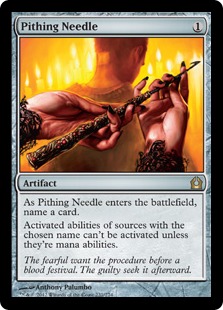
Pithing Needle Art

Modern may be a format defined by cards like Tarmogoyf, Snapcaster Mage, and Lightning Bolt, but it's also defined by players who pioneer new uses for old cards. This article picks out some of the better technology from GP Charlotte, looking for cards that could find home in either sideboards, or even maindecks, elsewhere in the format. Some of these cards you will recognize from past seasons, hopefully finding new appreciation for them after the GP. Other cards have rarely been used in Modern before, although they may have new homes after this past weekend.

[wp_ad_camp_1]

Darkness (and company)

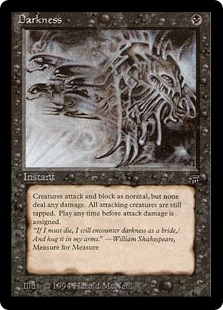
Darkness LegendsOne of the funnier moments at GP Charlotte came in the 13th round, when Ad Nauseam pilot Darien Elderfield was facing off against Infect specialist Ken Van Sciver. While building up a huge mana advantage in game 2, Elderfield was staring down a number of Infect creatures and needed to buy time. Van Sciver swung and Elderfield cast Darkness. But not the time-shifted version from Time Spiral. This was the black-bordered Legends copy, and the look on your face now as you try and interpret the picture to the left was basically Van Sciver's as he tried to figure out what this card did. Or what its art depicted. Or what a card with a 1994 copyright line was doing in a 2015 GP.

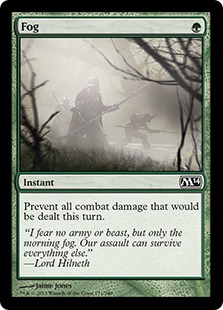
FogElderfield would go on to win the matchup and make it to the Top 8. A big part of his strategy were the 3 copies of Darkness in the sideboard of his Ad Nauseam combo list. Fog effects have always seen some play in competitive formats, most recently in the Maze's End decks of Return to Ravnica Standard, or their Turbo Fog predecessors from the Innistrad era. These kind of combat damage-prevention tricks are excellent in decks that need to buy a quick turn to set themselves up for the big win, but they have been largely absent in Modern. Although good against Affinity and Infect, the cards seemed weak against countermagic heavy Twin (it's a temporary solution and it folds to countermagic like maindecked Dispel) and weak against Burn decks that finished you off outside of combat. Because of this, most Modern decks avoided both Fog and its variants like Darkness and Holy Day.

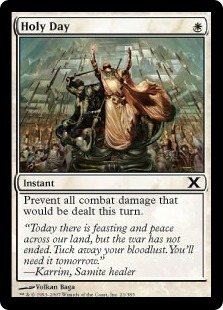
Holy DayElderfield's use of the card will likely cause some players to reconsider these cards. I had a lot of success with Darkness in the past when I played Mill (don't judge: everyone played Mill at least once), and I think the Fog effects are a lot more viable than people give credit. They are excellent in strategies that just need one more turn to win the game, but are otherwise soft to the more mainstream turn 3-4 decks like Affinity, Infect, and Twin. Strategies benefitting from Fogs could include numerous rogue turn 4 combo decks like Possibility Storm, Jeskai Ascendancy, Enduring Ideal/Enchantress, Time Walk combo, Nykthos Green/Tooth and Nail, etc. These turn 4 decks tend to fail because they are often just worse versions of Twin. Darkness and company give them an edge here, allowing them to buy a turn against three huge tier 1 decks to set up their own plan and force an overextension. The cards are particularly strong against Affinity and Infect, where they can screw up combat math and set an overcommitted opponent back multiple turns. Fogging a Become Immense is effectively a Time Stretch on an Infect player, and can have a similar effect on Affinity if paired with disruption. As more rogue combo decks try to break into the Modern scene, I expect them to leverage Darkness and its variants to give them a leg up.

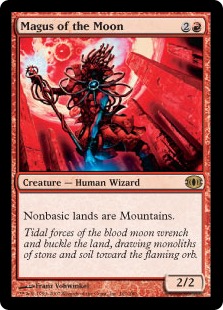
Magus of the Moon

Magus of the MoonIn this current metagame, I could probably write a Blood Moon article every week and still not run out of things to say. Decks are worse off if they lack access to Moon, which is bad news for those non-red decks that can't run it (or decks with other card restrictions, like Collected Company-powered strategies). Thankfully, another Time Spiral block oddball is here to save the day for those decks that can't run Moon. Enter the Moon's worshiper, Magus of the Moon. Magus saw two Top 16 appearances this past weekend. The first was in the sideboard of Paul Rietzl's 10th place Naya Company deck, a two-of supplemented by a singleton enchantment Moon. The second was as a maindeck bullet in Mark Klusa's 14th place Abzan Company list.

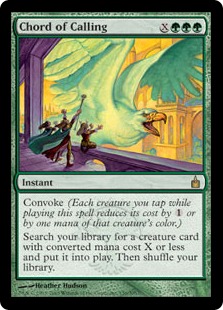
Chord of CallingAs I discussed in my GP Charlotte review article on Tuesday, Company decks are going to be big going into the rest of the summer. This isn't just hype: it's a legitimate metagame trend. And if Company decks are going to have a fighting chance in this metagame, they to need to leverage Moon without screwing up their Company flips. It's a testament to the power of Magus that Klusa chose to run it in a deck without a single source of land-based red mana. This is in part due to the Birds of Paradise colorfixing, which also helps accelerate you into the powerful turn 2 Moon effect. But it's also due to Company itself and, most importantly, Chord of Calling. One of the biggest problems with Moon in Modern is unreliability. Numerous players at Charlotte complained about not having a narrow sideboard answer when they needed it, and this is particularly important with Moon. Company decks get around that by playing 4 tutors for Magus (effectively running 5 copies right there), and then 4 additional Company cards to try and flip Magus off the top. Very few decks can support 4 maindeck Moons because that's not a card you want to run in multiples. In Company decks, Magus lets you effectively run 5 copies, which is a huge strength that only Company-powered decks can lean on.

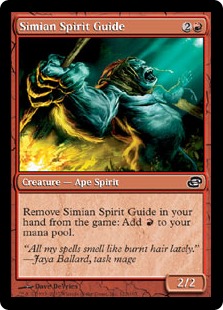
Simian Spirit GuideCompany and Chord may be Magus's natural home, but the Wizard will also find a home outside of these decks. Charlotte proved the power of Moon, both in the matchups where it was supposed to work (Amulet Bloom being the big one), and in matchups where it has always been relevant (Abzan, Zoo, Jund, etc.). Because of this, I expect to see more decks either using Magus on his own as an aggressive body with an upside, or as part of a deck that can run multiple Moons and try to drop one early. In the first case, we could definitely see Magus as part of an RG Human or Werewolves deck (which might end up actually being another Company deck: future brew, anyone??). But we can also use it in a red-based Moon deck that is already trying to accelerate into redundant, early threats. Simian Spirit Guide can ensure either the turn 2 Magus/Moon, or the turn 1 Chalice of the Void at 1. This kind of strategy can be very effective in certain metagames, and I expect more players to try it as Moon continues to prove its worth in Modern.

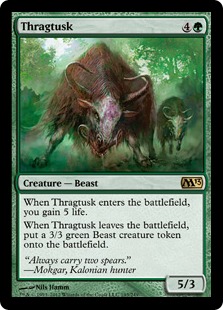
Thragtusk

ThragtuskI didn't play Standard during the reign of Thragtusk (I actually don't remember the last time I played Standard period), but the green Beast has proved its worth well beyond its early days. Unlike Darkness and Magus, Thragtusk has seen a respectable amount of Modern play in recent years. GP Charlotte saw the card appear in Amulet Bloom decks, such as Alexander Hayne's 17th place build, Jund, Temur Twin, and even as a maindecked bullet in the winning Elves list. In all cases, Thragtusk served the same function even if its context changed. The Beast remains one of the most cost-efficient ways to go over the top of fair and grindy decks, and for stabilizing board states. It's just impossible to interact profitably with this card. It trades with Tasigur and the average Goyf (not to mention Rhino, despite Abzan's flagging metagame share). It also kickstarts life totals and puts a body on the board. You really can't remove this card without 2-for-1ing yourself, and definitely can't hit it off Lily. Tusk is particularly strong against decks without lots of creatures to actually block the 3/3 mini-Beast, where an opponent is virtually guaranteed to emerge from a Thragtusk fight at card disadvantage: nothing feels worse than Bolting that token.

Lingering SoulsThere are two places I see Thragtusk thriving through the end of the year. The first, and most obvious, is as a continued sideboard answer to certain decks. Thragtusk caused huge problems for fair decks all weekend, and I would expect lots of green-based fair decks to start running the card. Even Abzan Company ran the beast at Charlotte (Klusa again: between Tusk and Magus, this man's a visionary), even though it has zero synergy with the deck's namesake spell. The card is much better now than it was back in February, when Lingering Souls tokens clogged up the board and allowed Abzan mages to ignore the Beast. Amulet Bloom was still running Tusk card back then, but apart from Reid Duke on his GP Vancouver Death Cloud list, the Beast wasn't that present. Today, the Soul-less Jund is the BGx deck in charge, which makes Tusk a much better choice going ahead. Add to that the rise of Grixis decks and you have a real monster. Seriously, what is a deck like Grixis Delver even supposed to do against this card?

utopia sprawlThe second place where I see Thragtusk shining is in big mana decks. Currently, Modern has only two premier big mana decks in RG Tron and Amulet Bloom. And of those two, Amulet Bloom only really becomes this kind of over-the-top deck in games 2/3, when it sideboards in monsters like Tusk, Hornet Queen, and Dragonlord Dromoka to combat opponents who focus too heavily on stopping their combo. Following the impact of these decks in the early weeks of June, I believe more Modern players will start building these kinds of decks. In many respects, they will reflect Legacy's Nic Fit deck, although we don't have any Veteran Explorers and Cabal Therapys to play with. We do, however, have potent engines in the Bolt-proof "dork" of Utopia Sprawl, and his Bolt-magnet buddy Arbor Elf. We've seen a number of decks, primarily on MTGO, use this combo to facilitate early Tooth and Nails. That's a bit excessive and risky for my tastes, but the concept of a turn 3 Thragtusk is very exciting. Fair decks have a very hard time handling these kinds of threats, especially when paired with stuff like Cavern of Souls, a card that is increasingly valuable in a Grixis-defined metagame. If these ramp decks take off, Thragtusk will be a big part of it. Even if they don't, we will see more of this card in the decks that already exist in the metagame.

Shadow of Doubt

Shadow of DoubtBack at Worlds 2013, a number of control players (notably Shahar Shenhar) used Shadow of Doubt in their sideboard or even maindeck. Like Thragtusk, Shadow is a card many Modern players are familiar with, the cantripping, instant-speed Sinkhole with bonuses against decks like the late Pod, the current Company decks, and big-mana builds like RG Tron and Amulet Bloom. Shadow saw some play in control decks back in the Treasure Cruise era, but it had mostly fallen out of favor by the time the January banlist announcements hit. But if I learned anything about control decks this weekend, it's to never underestimate Patrick Chapin paired with Cryptic Command, and that Shadow is still maindeck material in this current format.

Snapcaster MageChapin ran Shadow as a singleton bullet in his deck, following a similar strategy he used in maindecking a lone Dispel and Electrolyze. Given the field he was up against, however, he probably could have gone up to 2 Shadows and enjoyed nothing but success. Shadow of Doubt is very strong in this current metagame for a number of reasons. For one, there are lots of decks with search effects outside of fetchlands: RG Tron, Amulet Bloom, Company variants, etc. These decks constitute at least 15% of the metagame right now (our Top Decks page was updated yesterday to reflect these changes), and give Shadow a lot of game 1 play. These matchups also make Shadow an automatic one-of in sideboards for any deck aspiring to play a control gameplan. This brings us to the second reason Shadow is viable: the increased viability of control decks. For the longest time, UWR Control had been hanging on for dear life, with Esper Control and Cruel Control scrounging around near the bottom of tier 3. Grixis Control changed that. In a similar vein to Gerard Fabiano's Sultai Control list, back from SCG Baltimore, Grixis Control combines a decidedly reactive gameplan with some proactive elements. Tasigur, the Golden Fang and Gurmag Angler are huge here, and without these cards, the archetype could  never have taken off. Paired with these proactive plan B's, the control staples of Cryptic Command and Snapcaster are able to shine anew. Reid Duke called Snapcaster the most powerful card in Modern (in an obnoxious banlist context, but we'll give him a pass on that), and Shadow plays into Tiago-based strategies nicely.

Cryptic CommandAnother key strength of Shadow is its hybrid mana cost. Because of its natural synergy with Snapcaster and in blue-based control, players often forget that a blue-less deck can definitely cast this card. Although Shadow is less strong in decks without Snapcaster, and in decks without countermagic, it can still be a nice surprise in the more controlling versions of BGx decks. Of course, its home is always going to be the blue-based control decks. There are some players who are worried about the viability of blue-based control in Modern. When your only real control deck in the Top 32 is Chapin's, then yeah, that can be a reasonable worry. But having watched Chapin on camera and looked at the metagame, I think control is much more viable than people give it credit. Can you play a straight draw-go deck in Modern? Probably not, at least not with this card pool. But hey, you can't play every strategy in every format: just ask aggro (Zoo, Goblins, Merfolk) players in Legacy! As long as you are willing to have some kind of proactive element in your control deck (e.g. Goyf for Temur or Tasigur/Angler for Grixis), then the rest of your control shell should work just fine. Cryptic Command was outrageous at the GP, at least once its players got to turn 4. So long as you are using cards like Dispel and Shadow of Doubt to get you to turn 4, everything else should fall into place around those cards. I look forward to seeing more Shadows in control decks across the format, and more control generally after the GP. If nothing else, Sinkole is just as fun now as it was in the 90s.

Pithing Needle

Pithing NeedleLantern/Fateseal/Top Control is one of those zany Magic decks you expect to see at Modern FNMs. So when Zac Elsik piloted his list to a 15th place finish, the Modern community definitely took notice. There are lots of interesting cards in Elsik's deck including Surgical Extraction, Ensnaring Bridge (I could write a whole article on that card), and Duress, all in the maindeck and all taking him to the Top 16. But the card I want to focus on today is a sideboard bullet that has existed for years but is often passed over in favor of other, more direct threats: Pithing Needle. Needle is one of those cards you look at and immediately try to jam into your sideboard. Modern is just packed with activated abilities, so it seems like Needle would be the perfect answer for sideboards everywhere. And yet, the card almost never shows up, except for some random showings alongside cards like Tezzeret, Agent of Bolas and maybe Ancient Stirrings.

Fateseal Control (I'm going to bounce around on this name for a while, so bear with me) was obviously an incredibly specific application of Needle, but I think it's time for this card to take wings elsewhere. In a wide format like Modern where you can't possibly sideboard against every single deck, it's important to have versatile technology for handling overlapping matchups. This is why a card like Spellskite is so strong, or why blue decks run the Dispel/Negate/Flashfreeze package so regularly. Needle fits perfectly into that tradition. For just one mana, you get a proactive answer to all the following decks and their cards:

  • Scavenging OozeRG Tron: Karn, Liberated, Oblivion Stone, Eye of Ugin
  • Affinity: Cranial Plating, Inkmoth Nexus, Arcbound Ravager
  • Jund/Abzan: Liliana of the Veil, Treetop Village, Raging Ravine/Stirring Wildwood, Scavenging Ooze
  • Twin: Deceiver Exarch/Pestermite (do NOT name "Splinter Twin" or you will wind up as a reddit gif)
  • Abzan Company: Viscera Seer, Spellskite, Scavenging Ooze, Gavony Township

And that's just looking at the tier 1 decks (and not even listing every card in those decks)! Going into tier 2 we find even more applications for Needle. This kind of versatile sideboard card is perfect for a lot of Modern decks who are afraid of only a few narrow cards but can't possibly find overlapping answers for all of them. Even if you aren't playing against decks with lots of activated abilities, you can still name different fetchlands to screw with mana development. Of course, I also don't want to overstate Needle's relevance in Modern. There's a reason that such a widely-known card hasn't seen play, and it's not just that players aren't willing to try new things. Needle is sometimes too specific, stopping a variety of threats but only one at a time. This makes it bad in decks that need to answer a diverse range of cards, but great in decks that just need to answer a few. Or great against decks that rely on a few activated abilities to win. I don't see Needle taking over the format, but I do see decks reexamining its value and putting a few copies in the board. Fateseal Control proved the card's viability and other players will look to try it in their own 75.

More GP Charlotte Technology?

Knight of the ReliquaryWith all the awesome decks at the GP, it's easy to pull out interesting cards. I really liked the Tidehollow Sculler playset in Ian Bosley's 6th place Abzan Company list, just as it was really excited to see all the Knight of the Reliquarys in a format that had long declared her dead. This kind of technology shows that Modern is both much more open than many players assumed, and that the cardpool is still home to relevant cards that aren't seeing as much play as they should. What other cards piqued your curiosity? Any other tech you will be trying out ? I'm excited to continue the Modern extravaganza in June and look for even more cool cards coming out of the next few events.

Deck Overview- Modern Lantern Control

Are you a Quiet Speculation member?

If not, now is a perfect time to join up! Our powerful tools, breaking-news analysis, and exclusive Discord channel will make sure you stay up to date and ahead of the curve.

With Collected Company and Kolaghan's Command shaking up Modern, it's easy to forget that there was already a ton of under-explored space in Modern. Zac Elsik was well aware of this fact when he sleeved up his Lantern Control deck and took it to a 15th place finish at Grand Prix Charlotte. His deck is... well, it's unique.

Lantern Control

creatures

3 Spellskite

spells

4 Codex Shredder
4 Ensnaring Bridge
4 Ghoulcaller's Bell
4 Lantern Of Insight
3 Pithing Needle
2 Pyrite Spellbomb
2 Abrupt Decay
2 Surgical Extraction
3 Mox Opal
4 Ancient Stirrings
2 Duress
3 Gitaxian Probe
3 Inquisition of Kozilek

lands

2 Blackcleave Cliffs
2 Copperline Gorge
2 Ghost Quarter
4 Glimmervoid
4 Llanowar Wastes
1 Tendo Ice Bridge
2 Academy Ruins

sideboard

1 Grafdigger's Cage
4 Sun Droplet
2 Welding Jar
1 Ancient Grudge
3 Nature's Claim
1 Bow of Nylea
3 Pyroclasm

The gameplan is to empty your hand, land Ensnaring Bridge, and then mill them out while somewhat controlling their draw step with Lantern of Insight and your Millstone-y cards.

There was an error retrieving a chart for Lantern of Insight

If you're interested in learning more about how to play the deck, you can find the decktech that SCG did for it here.

The deck is jam-packed with all of the misery of Legacy prison decks, but unlike prison in Legacy the Modern deck actually seems strong. Zac claims that the deck is very capable of beating hate cards like Ancient Grudge, and his record in the tournament lends credence to this notion.

Insider: MTGO Market Report for June 17th, 2015

Are you a Quiet Speculation member?

If not, now is a perfect time to join up! Our powerful tools, breaking-news analysis, and exclusive Discord channel will make sure you stay up to date and ahead of the curve.

Welcome to the MTGO Market Report as compiled by Sylvain Lehoux and Matthew Lewis. The report is loosely broken down into two perspectives. A broader perspective will be written by Matthew and will focus on recent trends in set prices, taking into account how paper prices and MTGO prices interact. Sylvain will take a closer look at particular opportunities based on various factors such as (but not limited to) set releases, flashback drafts and banned/restricted announcements.

There will be some overlap between the two sections. As always, speculators should take into account their own budget, risk tolerance and current portfolio before taking on any recommended positions.

Redemption

Below are the total set prices for all redeemable sets on MTGO. All prices are current as of June 15th, 2015. The TCG Low and TCG Mid prices are the sum of each set’s individual card prices on TCG Player, either the low price or the mid-price respectively.

All MTGO set prices this week are taken from Goatbot’s website, and all weekly changes are now calculated relative to Goatbot’s ‘Full Set’ prices from the previous week. All monthly changes are also relative to the previous month prices, taken from Goatbot’s website at that time. Occasionally ‘Full Set’ prices are not available, and so estimated set prices are used instead.

Jun17

Return to Ravnica Block & M14

Prices on RTR and GTC continue to tick higher in both paper and MTGO. For paper, there is no expected break in this trend as interest in Modern continues to grow while Standard is in a fallow period. Modern season will get under way in the paper PTQ system in the latter half of the summer, which will sustain interest and rising prices up to the start of the season. MTGO is a little different as the PTQ system will continue to offer a variety of formats to play.

Keep in mind though that the main factor when considering prices of these sets is that Magic Origins (ORI) will be released at the end of July. Like every major set release on MTGO, this will trigger a liquidity crunch in the digital economy, driving up the value of tix relative to cards. Selling cards in a liquidity crunch is a losing proposition, so be sure to sell off your positions in cards from these sets over the next month. Also, core set releases tend to be excellent speculative opportunities so building a supply of tix now, with an eye to deploying in August, is the best course of action.

Value continues to migrate between cards from M14 but the total set price has been flat in the past week and month. With no evidence of rising demand for cards from this set, the increase in the set price since the fall has largely been seen. Although there is little downside to holding cards from this set at current prices, there is little upside evident. Speculators should consider the opportunity cost of continuing to hold cards from this set as the release of ORI approaches.

The lone card to pay attention to in DGM is Voice of Resurgence and it continues to drift down in price. Watch for this card to sink to 20 tix or below, at which point it will be worth considering again. Prices on Modern-playable cards tend to fluctuate up and down over time and keeping tabs on the downswing for cards like this one is good preparation for establishing a position.

Theros Block & M15

These sets were largely stable in price this past week on MTGO as the interest in MM2 drafting steadily winds down. Paper prices are another story as discounting on these sets continues as rotation draws nearer. Right now, speculators should be eyeing junk mythic rares that have bottomed in price, as well as Legacy- or Modern-playable rares and mythic rares that aren't heavily played in Standard.

Exhibit A is Keranos, God of Storm which has risen 50% in the past two weeks, riding the surge of interest in Modern. The fact that JOU is a third set, and that its prime drafting period overlapped with the release of VMA, means this set is in short supply on MTGO and contributes to large price swings. The past price bottom of 10 tix should be considered a good, long-term entry point on this card if prices come down over the summer. Other Modern- or Legacy-playable cards from JOU to keep an eye on for an early bottom are Eidolon of the Great Revel and Mana Confluence.

On the other hand, Thoughtseize of THS is a staple of both Modern and Standard, so it is not up for consideration at the moment for speculators. Standard players will continue to need and use this card, keeping the price elevated. Although the rotation dip on this card will be smaller than most, lower prices are anticipated in October.

Tarkir Block

Similar to THS block, the set prices for KTK, FRF and DTK rebounded this week due to waning interest in MM2 drafting and the resultant normalization of the MTGO economy. Noticeably, KTK in paper was positive for both low and mid TCG prices. Although too early to be certain, it's possible that KTK has bottomed in paper, which would set the stage for further price increases for the MTGO version via redemption.

On a more card-specific front, last week's episode of Brainstorm Brewery featured Gerry T speaking highly of Monastery Mentor from FRF and its utility in Legacy. One doesn't have to look very far to see that this card also shows up strongly in Vintage.

Having a presence in these two formats bodes well for the long-term price of this card, in both paper and on MTGO. Combine that with the upcoming switchover to ORI drafting, as well as FRF and DTK coming off of their price bottoms this week, and this looks like an excellent long-term pickup at its current price. With a Legacy MOCS scheduled for November, and a brand new Standard format coming with the release of Battle for Zendikar, this card has close to zero downside and should be considered an excellent speculative bet.

Modern

GP Charlotte featuring Modern Constructed was held this past weekend. Michael Malone’s Elves took the trophy home and the overall results show how diverse the format is. Tier 2 decks posted strong finishes and the Top 8 decklists themselves could be considered a surprise. Ad Nauseam, Elves, and a Griselbrand-Goryo's Vengeance deck featured in the Top 8, along with more familiar faces like U/R Twin, Burn, Affinity and Abzan Collected Company. The Top 62 finishers even included a mill deck!

Splinter Twin variants were the most represented decks in Day 2 and in the Top 8. Infect, Amulet and Jund (or GBx midrange) decks were quieter than expected despite a decent number of players choosing these decks (and two 9-0 Jund lists after Day 1). Scapeshift decks are still nowhere to be seen and Blood Moon was in all decks able to cast it.

This event further pushed prices and revitalized cards not yet on everyone’s radar, including Through the Breach, Goryo's Vengeance, Chord of Calling, Ad Nauseam and Phyrexian Unlife, as well as making a new star of Nourishing Shoal.

Aside from the Lantern Mill deck, none of the decks mentioned above are completely new to this format. Prices have jumped in reaction to these results but speculators should not forget that high prices triggered by spikes are unlikely to sustain themselves, even in the short term. Selling cards that have benefited from this past weekend’s GP result is advisable.

Modern Master 2015 drafts have been extended to July 8th from the initial end date of June 17th. This announcement will delay the expected price rebound and will accentuate the price drop for uncommons (mostly Remand and Dismember) and some of the cheaper, less-in-demand rares. The whole MM2 set price has been relatively flat for about two weeks now, but delaying further MM2 purchases until the end of this week is recommended in order to get better buying prices.

Finally, Modern Festival preliminaries start next week, June 24th. This one-week event should be the near-term peak for Modern demand. For speculators, this will be a good time to sell Modern positions that have been growing for several weeks now.

Legacy & Vintage

Again this week, nothing has changed with these two formats. Tempest Remastered is the only place to see some price action. Propelled by its top five most expensive cards, the set has established a slow upward trend for its overall price. Wasteland is currently over 70 Tix and it looks like the desired effect to decrease the price of a playset of Wasteland is slowly failing as the price converges to its pre-TPR price.

Pauper

The Pauper metagame continues to evolve and with it prices keep swinging up and down, although not necessarily accordingly. Familiars, Stompy and Burn are the most popular decks these days. Pauper doesn’t have the impressive price variations and heights of Modern but opportunities are available for speculators willing to closely monitor price fluctuations.

Sunscape Familiar is up nicely but Snap is down by 1 tix since the release of MM2. Mono-Black has decreased in popularity and Chittering Rat almost dropped to its all-time floor thus presenting a decent buying opportunity.

Seat of the Synod has also hit a low point this week and is an interesting card to consider for Pauper speculators. Kiln Fiend is now a card to watch as this common crossed the 1 tix bar recently, rising from the being a bulk common.

Targeted Speculative Buying Opportunities

Standard

Monastery Mentor

The Mentor has proven to be a playable creature in pretty much all formats from Standard to Vintage but it hasn't made a splash--yet. Tarkir block cards will soon start rising as we are approaching Standard rotation. We are confident that Monastery Mentor is a good buying opportunity and that it could be in the upper 10s Tix by next October.

Targeted Speculative Selling Opportunities

Modern

Scalding Tarn

Of all the five ZEN fetchlands, Scalding Tarn's growth has been uninterrupted since late April. Its price is now very close to its pre-KTK price. Although Modern events are to come online we think additional growth of the most popular of the ZEN Fetchlands is rather limited and we therefore recommend selling it.

On the other hand, the other ZEN Fetchlands have declined a little bit since the release of MM2 but we think they will have a good chance to rebound with the Modern Festival and the Modern MOCS coming up.

Insider: Modern – Land of 1000 Combos

Are you a Quiet Speculation member?

If not, now is a perfect time to join up! Our powerful tools, breaking-news analysis, and exclusive Discord channel will make sure you stay up to date and ahead of the curve.

...Well, maybe not 1,000 exactly but there are certainly a lot of combos floating around.

I've spent the past two weeks completely focused on the Modern format in preparation for the SCG Modern Open and Modern Grand Prix Charlotte, and now that it is all said and done I've reached one very definitive realization: Modern is all about the combo decks.

If you haven't already checked out the coverage from the Top 8 of the event: Elves, Twin, U/R Affinity, Ad Nauseam, Goryo's Vengeance, Abzan Company, U/R Twin, and Burn all made it.

Basically, all "combo" decks. While Affinity and Burn may not technically be combo decks in the purist sense they are both similar to combo in that they are fast, linear, non interactive decks. I don't actually think it too much of a stretch to consider Modern Affinity or Burn to be "combo" decks.

Anyways, the Modern is all about being fast, ending the game, and trying to be as non-interactive as possible.

My Take on Affinity

I actually got a chance to play in Grand Prix Charlotte and finished in the money with a record of 10-4-1.  My weapon of choice for this event (the same weapon of choice I seem to always gravitate back to) was Affinity.

Here is the list that I played:

Affinity by Brian Demars (121st at GP Charlotte)

Creatures

4 Ornithopter
2 Memnite
4 Signal Pest
4 Vault Skirge
3 Steel Overseer
4 Arcbound Ravager
1 Spellskite
2 Etched Champion
2 Master of Etherium

Spells

4 Mox Opal
4 Springleaf Drum
1 Welding Jar
4 Cranial Plating
2 Spell Pierce
2 Galvanic Blast

Land

3 Glimmervoid
1 Mana Confluence
4 Blinkmoth Nexus
4 Inkmoth Nexus
4 Darksteel Citadel
1 Island

Sideboard

1 Illness in the Ranks
1 Etched Champion
1 Spellskite
1 Thoughtseize
2 Ancient Grudge
2 Blood Moon
2 Ghost Quarter
2 Dismember
1 Torpor Orb
2 Whipflare

If I played the deck again (and I'm sure I would) I would cut the two maindeck Master of Etherium for two Etched Champions. I would also cut the Welding Jar for a second Spellskite.

After playing a bunch, I was pretty surprised how often I was put into the aggro-control role by faster, more deadly combo decks. I wanted to board in more colored spells but I think there is a cap to how many one can reasonably bring in. I don't need my three-drop fatty to be a colored spell when there is a perfectly good alternate in Champion.

In the sideboard I would have packed more combo hate if I had the option to do it over again. I would scrap the Illness in the Ranks, Thoughtseize and Etched Champion, and add two copies of Torpor Orb and a Relic of Progenitus.

Linear Combo Everywhere

My pairings for the tournament also kind of reflect a combo-oriented metagame: 3 UWx Control decks, 1 Amulet Bloom, 5 Splinter Twin, and 4 Burn.

The most obnoxious thing that happened to me all day was as follows. My opponent plays Glimmerpost and Amulet of Vigor. On turn two he plays a second Amulet of Vigor and a bounce land (untapping it twice to make four mana). He Summoner's Pacts for Azusa, Lost but Seeking and replays the bounce land.

In response to the untap trigger I Galvanic Blast the Azusa thinking that he will be done, unable to pay for his pact, and I win... Right? Wrong. He Pact of Negations my Galvanic Blast and kills me...

So, turn two kill with a counterspell back up, you say? Welcome to Modern.

You know it is a rough world when even the Junk midrange decks go infinite...

There was an error retrieving a chart for Anafenza, Kin-Tree Spirit

I'm not going to grumble too much about the format being "this" or "that" or wishing it was one way or another. Personally, I don't enjoy a format where combo is prevalent but I don't get to ban the cards. I will say that there were a lot of people complaining about the feel of the format at the event and based upon the speed of some of the most powerful decks I think that it is likely that we will see some DCI action in June.

There was an error retrieving a chart for Summer Bloom

I will be shocked if this card doesn't get banned. After a very strong showing two weeks ago at the Invitational it didn't make Top 8 this time around. I still think the calm, casual turn-two kills this deck can produce are too much.

There was an error retrieving a chart for Goryo's Vengeance

Another easy-peasy turn-two combo win that actually did have a breakout at the Grand Prix.

My line of thinking is that if the DCI is actually serious about Modern being a turn-four format then these two decks simply should not exist.

If I would have had the cards for one of these two decks I probably would have played them instead of Affinity at the event. The problem was that since RIW burned down and I couldn't borrow cards, and I didn't want to buy into either of these decks for fear they get banned next month.

It is also interesting that these two decks didn't see any major reprints in Modern Masters 2015 which might imply that they were already on the ban radar for WOTC.

In the Event of a Ban...

What changes if they ban the turn-two decks?

The biggest thing that would happen to the format is that "fair" decks would get a lot better. First of all, decks wouldn't need to worry about getting killed because their opponent had the audacity to cast a 2cc Sorcery on turn two (Bloom or Vengeance). Why in the world would I want to play a fair deck when something like that can happen to me?

I think one of the reasons that URx Twin is so popular is that it actually has counterspells to protect itself from some of these "oops, you're dead" fast combos.

It would certainly make Splinter Twin public enemy #1 with the other faster, more linear combo decks out of the way. I actually have no problem with Splinter Twin as a combo deck in Modern. It is a two-card combo that revolves around putting a four-cost aura on a three-cost creature. It gets broken up by any removal spells, counterspell, or Disenchant. There are multiple hate cards that break up the combo that can't be countered.

Twin is exactly the kind of combo deck that should exist in Modern. It keeps people honest in the sense that you have to play some cards to interact with it but it is also fairly easy to interact with.

I think that removal-heavy midrange decks become much better (which is a good thing) and I also think that without hyper-fast combo decks ramp style decks could come back. Right now, there is very little point in playing a ramp-combo deck like Scapeshift when Amulet Bloom can do the exact same thing but on turn two!

I wouldn't mind things slowing down a little bit. I'd like to enjoy my games and have them potentially last longer than five turns.

Five Cards That Get Better

There was an error retrieving a chart for Scapeshift

It would be hard for Scapeshift to be worse in the metagame than it is right now. The old adage of "don't play a bad something else" certainly applies here.

However, if the competing combo decks stop killing several turns faster I could see Scapeshift once again becoming a solid metagame force as it was a year or so ago.

Unfortunately, Scapeshifts are still really expensive for no good reason. So, I'm actually going to say that the silver bullet card to try and pick up is:

There was an error retrieving a chart for Valakut, the Molten Pinnacle

These can be easily had for a couple of bucks a piece which seems about as low as a solid card from an older set can realistically be. I like the idea of trading for these right now. I don't think they can really go down and there is some real upside.

There was an error retrieving a chart for Abrupt Decay

I know it seems kind of weird to pick out Decay as a card to pick up when it just had a spike recently, but I'm pretty high on this card. I think the ceiling is still quite a ways up and I'm still happy to trade for this card at $16 from players.

If faster combo decks go away Twin really does become the best combo deck in the format. If that is the case, Abrupt Decay is the best answer. I also argue that BGx decks get much better without some of these speedy linear killers around. It all checks out.

There was an error retrieving a chart for Inkmoth Nexus

Kind of a weird speculation target because it is also expensive--but for good reason; the card is absolute gasoline.

It is a cornerstone of both Infect and Affinity, which would tend to get a lot better if the turn two decks didn't exist. I especially think that Infect would get a lot better as it is a pretty solid turn-three deck. It would probably be left as the fastest deck in the format.

Inkmoth is a really unique and powerful card. I don't see them going down anytime soon and I think they still have room to grow. Also, the card is from a bad set.

There was an error retrieving a chart for Gavony Township

I love this card as a pickup right now. First of all, it is simply an awesome Magic card. It provides a ton of value and has really cute synergies with persist creatures.

In a world where things are more grindy this card becomes a huge game in G/B mirrors. The card also has the sick casual appeal. I'm buying in on this card right now for sure.

There was an error retrieving a chart for Anafenza, Kin-Tree Spirit

For how good this card is it is simply too cheap right now. There is also a very real chance that it will be good in Standard at some point during its lifetime. When new stuff gets printed and a bunch of the other cards rotate out there is a shot that it will be a player.

It is already Modern-playable in a midrange combo deck that gets smoked by the super fast decks. Abzan Company would be a big winner if the turn-two decks were to go away. So, I really like this card as something to pick up right now.

There is the "where we are right now" and the speculative "what might happen in the future" when it comes to assessing which cards will be in demand. I've sort of laid out a scenario to be thinking about where some drastic changes could and might occur in Modern and what might get better were those changes to come to light.

Generally speaking, I like the idea of trading for any cards that would get better if some change were made to the banned list to eliminate turn-two combo decks.

Four Lessons from GP Charlotte

Are you a Quiet Speculation member?

If not, now is a perfect time to join up! Our powerful tools, breaking-news analysis, and exclusive Discord channel will make sure you stay up to date and ahead of the curve.

It would be hard to pick a "best" moment at GP Charlotte. With all the awesome feature matches (big props to Starcitygames for the coverage), interesting deck techs, online buzz, and general community involvement in the event, it really felt like an interactive experience even for those stuck at their desks. Although Charlotte was not Magic's biggest Grand Prix, an honor that goes to Richmond 2014, it was definitely one of its most influential. Coming off a long offseason and a high-impact ban announcement, it was unclear how the format would look. Charlotte gave the format direction, and it's up to us to figure out how things will look after the event.

Elvish Champion

My article yesterday talked about the metagame-wide conditions surrounding Charlotte, drilling more into the quantitative side of the event and avoiding the higher-level takeaways. Today, I want to go back to those top-level conclusions and focus on four lessons we can learn from the event. GP Charlotte gave us a lot of information to digest, but these lessons in particular will affect your Modern experience going into the rest of the year.

[wp_ad_camp_1]

Lesson #1: Collected Company is Real

collected companyBefore the GP, both pros and regular players shared skepticism about Collected Company's viability in major events. There was no doubt Company itself was powerful. The issue was just figuring out its shell. Options included Naya Zoo, a "Podless" Melira Pod deck, Elves, Bant Midrange, and a variety of other homes. This uncertainty led many to believe that the card itself might not be that strong: Tasigur, the Golden Fang in Fate Reforged and Atarka's Command in Dragons of Tarkir had found their homes almost overnight, which suggested Company might just be overhyped. But there were many players who weren't so sure. As early as April, Abzan Company and Elves were enjoying considerable success on both MTGO and in paper. Both were solid tier 2 decks during the month of May, and this looked to be true going into June. That said, SCG Columbus challenged our assumptions about the deck, where Company cards underperformed at both the Invitational and the Open. Based on this, Company's future was unclear going into GP Charlotte.

Anafenza, Kin-Tree SpiritThe weekend is over and the results are in: Company is now looking like the real deal. As I discussed in my metagame article yesterday, Abzan Company is one of the only decks in the format to enjoy consistent metagame increases in all periods of time since April, which is exactly the trend you want to see in an up-and-coming deck. One reason people undervalued this card was their focus on where it might find a home. And honestly, I don't think this question has been resolved: we see three different Company decks in just the Top GP decks, and all their copies made up 25% of that Top 32. But that's not the important takeaway here. The conclusion isn't that a certain Company deck is better than another. Rather, it's that Company as a card has now proven itself as a Modern staple. I've heard it described as the green Dig Through Time, and although that's a misleading characterization (often stated by people who are spouting banlist nonsense), it does get at the underlying power of a card many people lost some faith in.

Heritage DruidThis is an important distinction for deckbuilders and players. For deckbuilders using Company, it means the Modern world is your oyster. Want to build Company Humans? Go right ahead! Try out Zombie Company? Shamble away! Bounce between Elves, Abzan Company, and Naya Company? Any of those are probably fine! In all these cases, the decks are strong enough to be carried on the card itself, so you don't need to worry too much about what Company deck you are playing. In many respects, it becomes a green Snapcaster Mage more than a Dig. The card alone gives multiple decks legs, not just one or two. You will also need to respect Company as a player. As you go to tournaments this summer, don't expect just Elves or just Abzan Company. Instead, you'll need to expect the "Company decks" as a more general foe. This means you can't just hedge your bets on Grafdigger's Cage, because neither the Zoo nor Elves variants care about this card. Instead, you will need to focus on cards that are good against all the Company decks (e.g. Anger of the Gods, which is looking more and more maindeckable with each weekend). Just as we have come to expect Snapcaster as a blue staple or Bolt as a red one, so too will we need to start accepting Company as a green one. Yes, there will be green decks that won't play this card because its deckbuilding restrictions are so strict. But it will see enough play at any given time that you need to be ready for at least 10%-15% of an event to be on some kind of Company deck.

As a final thought on this, if someone forced me to play a Company deck tomorrow, here's the list I would play. It's essentially Bradley Robinson's 16th place Charlotte list with some changes. Note the Decays (you need this in a diverse format with weird cards), the bullet Voice of Resurgence (there's a lot of control), the two maindeck Oozes (it's that good), and the sideboard with both singleton bullets (Magus is super sexy) and redundant answers to problem decks.

Abzan Company Revisited, by Sheridan Lardner

Creatures:

4 Kitchen Finks
1 Spellskite
4 Birds of Paradise
3 Eternal Witness
1 Fiend Hunter
1 Murderous Redcap
2 Noble Hierarch
1 Qasali Pridemage
2 Scavenging Ooze
2 Viscera Seer
1 Voice of Resurgence
2 Wall of Roots
2 Anafenza, Kin-Tree Spirit
1 Linvala, Keeper of Silence
1 Melira, Sylvok Outcast

Instants:

4 Chord of Calling
4 Collected Company
2 Abrupt Decay

Lands:

2 Forest
1 Plains
1 Swamp
2 Gavony Township
1 Godless Shrine
2 Horizon Canopy
2 Marsh Flats
1 Overgrown Tomb
2 Razorverge Thicket
2 Temple Garden
2 Verdant Catacombs
4 Windswept Heath

Sideboard:

2 Path to Exile
3 Thoughtseize
1 Burrenton Forge-Tender
1 Orzhov Pontiff
1 Kataki, War's Wage
1 Magus of the Moon
1 Reveillark
3 Fulminator Mage
1 Sin Collector
1 Reclamation Sage

Lesson #2: The Format can Self-Police

amulet of vigorI'll admit: I was worried about Amulet Bloom going into the GP. It had everything going for it including experienced pilots, a commanding matchup win percentage on MTGO, tons of high profile finishes, the highest win percentage at the Pro Tour, and volumes of Amulet-hating anecdotes from across the Modern community. It was so bad that SCG, in one of its less-fine hours, asked every single person who walked in front of the camera what they thought about Amulet Bloom in the format (read: "what should Wizards ban from it?"). Some of this ban discussion was nothing but hype, but a lot of it was also pure statistics and data analysis. It really did have a lot of scary datapoints going into GP Charlotte, and the hope was that something would change at the GP to tame the deck before R&D tamed it with a banlist update.

Of course, when the dust settled and Elves was on top, Amulet Bloom was basically nowhere to be seen. It didn't send many players to day 2, didn't send many of those day 2 qualifiers to the Top 32, and was overall not the tournament monster everyone feared. Were there some conditions at play that toned down Amulet, or was the format's "best" deck just going through an offday?

Blood MoonLooking at Amulet, I see two factors at play that bode well for Modern . Both relate to the concepts of self-policing and self-regulation, and both were on display at Charlotte. The most obvious was preparation. Anyone who read the section header above and didn't think this section would contain a picture of Blood Moon doesn't know me very well. Formats, especially nonrotating ones, are defined by their police cards. Before Charlotte, we had no idea if Modern's police cards would be enough to stop Amulet. Sure, Moon was good, but only if you drew it and only if you were in colors that could support it. Would other cards and decks be able to corral the Amulet "menace"? The answer after Charlotte was a resounding "yes". Between Moon, countermagic, maindecked land destruction paired with pressure (e.g. Fulminator Mage), and a variety of other tools, Modern responded to Amulet Bloom and regulated itself. This speaks to the quality of police cards in the format and suggests Modern can do it again if needed. But there's also a danger here. As many pros have argued, Modern can be a format of 80-20 matchups heavily determined by sideboard bullets and luck. Although this is a gross overstatement of the statistical reality, it has a kernel of truth: matchups really can be defined by some narrow cards, and that can be challenging when picking a deck. It remains to be seen if Modern's police cards are too narrow to stick around or if they can become mainstream enough to always police decks like Amulet Bloom. Thankfully, with more GPs on the horizon, we'll know this soon enough.

Primeval titanThe second factor in regulating Amulet was player knowledge and experience. Every time I analyzed Amulet results, I knew there was some chance these numbers were being artificially inflated by inexperienced opponents who didn't know how to beat the deck. This was painfully obvious in feature matchups, where the wrong lands were destroyed with the wrong sequencing, or the wrong cards were countered/discarded. I made this a sticking point in my GP Charlotte predictions article, although it was unclear to what extent inexperience was playing a part in the deck's ascension. With the GP in the books, it's still not quite decided, but it's certainly more decided than before the event: players are better at understanding the deck and, by extension, beating the deck. Maybe they didn't master the matchup but they at least knew what was going on. This gave them a much better chance at both preparing for the deck beforehand (selecting cards like Moon) and beating it if they faced it. All of this is to say that knowledge is as much a self-regulatory tool as are the cards themselves. If you don't know how to beat a deck, it doesn't matter what cards you bring in against it.

Overall, GP Charlotte showed us the format has two self-regulatory tools we can lean on in the future. Players can both learn scary matchups and then bring cards for those matchups. It is still possible that Amulet Bloom is a broken deck that will eventually evolve beyond player knowledge/preparedness. We will know more about this after the next two GPs. But tentatively, this deck looks a lot safer now than it did before. So if you wanted Bloom gone then too bad: it's probably here to stay (other GPs depending). But if you wanted to buy into the deck but were worried, Charlotte is a convincing datapoint as to its security.

Lesson #3: Know How to Interpret Hype

Kolaghans CommandIt's no coincidence that I keep using this "hype" term in my recent articles. Modern, as a format, generates a lot of it. We see this in decks, strategies, tournaments, and, of course, card prices (RIP Snapcaster Mage). From a metagame perspective, this was one of the most hype-driven offseasons in recent memory. Between Amulet Bloom, Jund, Grixis, Burn, and all the Tarkir cards at the core of those decks, everyone (Nexus included!) had an opinion to share on these decks. I think I've tagged more Kolaghan's Command cards in the last few weeks than there were copies in the Top 32. But a huge challenge in this was interpreting the hype and converting it to actionable intelligence. Should you play these hyped decks? Should you learn to beat them? To what extent should they inform your deckbuilding?

Most players look at hyped decks and either accept them blindly or reject them outright. They might put in some testing or discussion behind these decisions, but they are so influenced by the hype factor that it impairs their judgment. They either buy too easily into hype or, perhaps worse, are categorically allergic to it. Most readers don't need convincing about why it's bad to jump on a hype train. But, maybe more surprisingly, it's probably just as bad to reject hyped decks too unconditionally.

TasigurLet's take Grixis Twin as an example. Going into the GP, there was a lot of hype surrounding this deck, with many players believing it was both the strongest Grixis and the strongest Twin variant. For those who piled on the Grixis Twin hype train, I'm sorry: you were on a deck with one of the most disappointing finishes at the GP. This datapoint seems like it vindicates the players who didn't buy in to the hype and stayed away. Not so fast! If you were one of the players who thought the deck was oversold, you might have played something else, but you were also probably unrepared for the 12% of the field who made day 2 with the deck. It's true that many of those players failed to make Top 32, and it's true their deck was overhyped. But if you ran into those players and weren't ready for Grixis Twin, you probably lost and probably didn't make it either. We would see a similar effect with Jund. If you dismissed the Jund hype too quickly, you wouldn't have been ready for the 10% of the day 2 metagame that very much believed in Jund's power.

When going into a hype-filled metagame, it's not enough to be the enlightened soul who has seen through the popular opinion. You also need to understand that many players won't reject the hype and will be on hyped decks and cards. So although you personally might not play that deck, other people definitely will. Prepare accordingly. That said, sometimes you also need to be aware that hype can be well-placed: see Collected Company as an example of this. You can't always see hype and run away. You need to remain open. This kind of critical thinking will serve you well as you go into the Modern events of the summer.

Lesson #4: Never Underestimate Weird Decks

Ad NauseamBecause I moderate a major Modern forum, I'm rarely surprised when I see a new deck. Chances are that someone has brainstormed it on the boards before, and the GP Charlotte oddballs were no exception. Even the strangest of the lot, the Fateseal/Lantern of Insight Control/Top Control deck piloted by Zac Elsik, is one of our oldest and most-trafficked developing deck threads. But it wasn't the decks that were surprising. It was that decks like Ad Nauseam, Lantern Control, and Griselbrand Shoal actually finished in the Top 16 of a Grand Prix. You know you are dealing with an open format when you list three rogue decks and Ad Nauseam is the most mainstream of the group.

Nourishing ShoalIn my pre-GP Charlotte article, I warned players to expect weird decks. This warning was totally spot-on (seriously: Ghoulcller's Bell has no business being in the Top 16 of a multi-thousand player GP). but I also want to take it one step further. Don't just expect weird decks. Rely on them. Play them. Practice them and make them yours, because these rogue and weird decks can be extremely rewarding even at the highest levels of play. In part, this returns to the argument about Modern being a format that's polarized around narrow hate and answers. If everyone else is preparing for Jund, Grixis, Burn, Affinity, Amulet, and all the usual top-tier suspects, there's a lot of room for Nourishing Shoal to sneak through. It also gets at the importance of knowing matchups and being familiar with the varied playlines of your deck. Jumping around tier 1 and tier 2 decks might put you on an established Modern staple, but that won't matter if you don't know the deck you are piloting and don't know its matchups.

To be clear, this doesn't mean all rogue decks are viable just because they are underplayed. Sometimes underplayed decks are just plain bad, or at least worse than another option. But if you have an unexpected deck with some baseline power, by all means run it at your events and don't let tiers or metagame breakdowns tell you otherwise. Just be sure you aren't picking a rogue deck just for the sake of it being new and different. Make sure it's a legitimate contender (i.e. test, test, test). And by a similar token, expect other players to follow this strategy and prepare for the weirdos accordingly.

Life After GP Charlotte

It's tempting to overstate the importance of a single GP. Like all major tournaments, Charlotte existed in the broader Modern context leading up to the event. There are also two more major GPs coming up in the next month: it's easy as an American player to forget about our Modern brothers and sisters overseas. Despite these complicating factors, it's still important to focus on GP Charlotte and look for the big takeaways from this event. These four lessons are the big ones I will internalize with GP over and done, and I hope they are helpful as you go into the rest of the Modern season. We are in a whole new Modern world after Charlotte with new decks, new cards, and a new metagame: it's a great time to play Modern and I look forward to seeing all your tournament finishes in the future.

Tiny Tuesday- Toshiro Umezawa

Are you a Quiet Speculation member?

If not, now is a perfect time to join up! Our powerful tools, breaking-news analysis, and exclusive Discord channel will make sure you stay up to date and ahead of the curve.

When Toshiro Umezawa was first spoiled (showing my age here) I was very excited about the card. As things played out, his Jitte ended up stealing the show, but Toshiro remains a pretty sweet design, and Tiny Leaders is the ideal format to put the old Samurai to work.

There was an error retrieving a chart for Toshiro Umezawa

There are certain leaders that will make taking full advantage of Toshiro difficult. Geist of Saint Traft comes to mind. Forbidden Orchard is an option for Toshiro decks to give you something to kill, but then you also need to expend resources to kill the spirit tokens. Instead I like just filling up on a few choice removal spells and a bunch of great card advantage spells.

There was an error retrieving a chart for Forbidden Orchard

This is my current list for Toshiro Umezawa:

Tiny Toshiro

creatures

1 Dark Confidant
1 Gatekeeper of Malakir
1 Fleshbag Marauder
1 Merciless Executioner
1 Geralf's Messenger
1 Chainer's Edict
1 Hymn to Tourach
1 Inquisition of Kozilek
1 Read the Bones
1 Damnable Pact
1 Dark Ritual
1 Phyrexian Arena
1 Thoughtseize
1 Toxic Deluge
1 Liliana of the Veil
1 Funeral Charm
1 Geth's Verdict
1 Night's Whisper
1 Bitterblossom
1 Loxodon Warhammer
1 Pharika's Cure
1 Tribute to Hunger
1 Vicious Hunger
1 Lightning Greaves
1 Consume Spirit
1 Sensei's Divining Top
1 Mimic Vat
1 Hero's Downfall

lands

1 Wasteland
1 Expedition Map
1 Cabal Coffers
1 Urborg, Tomb of Yawgmoth
1 Bloodstained Mire
1 Polluted Delta
1 Marsh Flats
1 Verdant Catacombs
1 Bojuka Bog
12 Swamp

The deck is a little light on win conditions and is definitely on the suicidal side, but the interactions are sweet. Mimic Vat and Fleshbag Marauder is a pretty nice little combo that only gets better with an active Toshiro.

The sideboard for this deck needs to be dedicated to "correcting" matchups. The edits here are great, but very lack-luster against Elves or Goblins, so having access to cards like Shrivel and Drown in Sorrow is a must.

Want Prices?

Browse thousands of prices with the first and most comprehensive MTG Finance tool around.


Trader Tools lists both buylist and retail prices for every MTG card, going back a decade.

Quiet Speculation