menu

Insider: Buylisting and Kiki-Podding in Richmond

Are you a Quiet Speculation member?

If not, now is a perfect time to join up! Our powerful tools, breaking-news analysis, and exclusive Discord channel will make sure you stay up to date and ahead of the curve.

Selling to Buylists At Events

From my past experiences, the Grand Prix event site is usually a depressing empty room on Friday night. Grand Prix: Richmond was the exact opposite. Players who compared the recent Grand Prix in Richmond and Vegas to a Magic version of Woodstock are definitely conveying the situation realistically. The hall was crazy. Every dealer had twenty players waiting to buy or sell cards and there were lots of other players jamming side events all night. Grand Prix in general are amazing and super fun time, but enormous record breaking events like Richmond and Vegas are epic experiences of a lifetime.

While I was at the GP on Friday night, I sold a lot of cards. I had recently purchased two collections and needed to move most of the cards that I was not able to sell individually. Even if you don’t like buy listing your cards online, give it a chance in person. From my perspective, and in the opinions many other Finance people I know, there is a vast difference between in-person and online. The most crucial difference revolves around condition grading and your ability to say "no". When you sell your cards online, I have found that the graders tend to be much harsher because they don’t have the owner sitting there right in front of them to say no to an awful offer on a card. In person, you have the chance to decline their offer or try to negotiate a higher buy price. Typically the more you are selling them, the easier it is to negotiate on a couple key cards you are trying to unload.  ( Just don't be That Guy; the one who argues over quarters on every card.  Be reasonable. )

One question I get asked a lot is, “Who should I sell to?” I think the only answer that matters is that you should sell to whomever you feel comfortable with. Prices may vary between merchants, but it will mostly even out in the end. Rather than give you a list of who you should sell to, I want to give my broad opinion. I prefer to sell to smaller companies for most of my cards because they have the power to offer you any amount of money. The big online retailers tend to have a rigid buy list that they must adhere to, so negotiating doesn’t really happen. The large stores are good for moving stuff that no one else wants, so don’t dismiss them.

Keep Your Eyes and Ears Open

While I was waiting at various dealers trying to buy and sell, I listened and observed some price trends. Although I don’t think it will transfer over to a permanent increase in price, players and dealers were going crazy for Anger of the Gods. I Most of the dealers had them priced between $4 and $7. Even though I thought those prices were crazy, players were still buying them. In addition, the entire hall was sold out of foil versions of the card. After searching for three hours, I finally tracked down a dealer that had bought some. Because the card was so hot, I was able to flip two of the three copies to another dealer five minutes later for more than what I paid. So, even though you can buy a foil Anger of the Gods on TCG Player today for around $6, I was able to sell my copies for $12 each. There are many financial opportunities like this at Grand Prix.  You just have to look for them.

The next trend I noticed was how much Modern staples have risen in the last few months. Now, I know that many other authors on this site have talked many times about specific cards spiking, but that’s not exactly what I am saying. Everything is increasing in price. Every time I turn around, my Modern collection is worth more money. After being surprised to see the prices on some cards like Splinter Twin, I looked up many more to get a better sense of the trajectory of the market. Here are some of the more interesting ones.

They're Worth HOW Much?

[cardimage cardname='Splinter Twin'][cardimage cardname='Birthing Pod']
[cardimage cardname='Thrun, the Last Troll'][cardimage cardname='Tarmogoyf']
[cardimage cardname='Celestial Colonnade'][cardimage cardname='Grove of the Burnwillows']
[cardimage cardname='Scalding Tarn'][cardimage cardname='Misty Rainforest']
[cardimage cardname='Verdant Catacombs'][cardimage cardname='Arid Mesa']
[cardimage cardname='Marsh Flats'][cardimage cardname='Sulfur Falls']
[cardimage cardname='Living End'][cardimage cardname='Fulminator Mage']
[cardimage cardname='Ensnaring Bridge'][cardimage cardname='Serum Visions']
[cardimage cardname='Noble Hierarch'][cardimage cardname='Cryptic Command']
[cardimage cardname='Spellskite'][cardimage cardname='Bitterblossom']
[cardimage cardname='Batterskull'][cardimage cardname='Phyrexian Obliterator']

Let’s Play some Modern

Modern is one of my favorite formats because it covers all the cards from the time I have been playing the game. When it was announced that Modern would include all sets back to original Mirrodin, it was like they created the format just for me. I had an immediate connection with Modern because I have been playing competitively since Mirrodin's release. Modern may be much more powerful than Standard, but it is also more balanced and Wizards is doing a great job keeping it that way.

Since I have been participating in every Modern PTQ season, I have played many decks in the format. This not only gives me a lot of knowledge about the format, but it also helps me when it comes time to decide on a deck to play for an event. While preparing for Grand Prix: Richmond, Birthing Pod had been my leading deck choice. I chose to play Kiki-Pod, as I have had much more success with it than Melira-Pod. In addition to significant play experience with the deck, I also had strong theories about how to improve it. This is the version I brought to battle in the largest constructed Grand Prix to date.

Kiki Pod

Mike Lanigan

Untitled Deck

Creatures

4 Birds of Paradise
4 Noble Hierarch
2 Wall of Roots
2 Kitchen Finks
2 Deceiver Exarch
3 Restoration Angel
2 Kiki-Jiki, Mirror Breaker
1 Phantasmal Image
1 Qasali Pridemage
1 Spellskite
1 Voice of Resurgence
1 Harmonic Sliver
1 Murderous Redcap
1 Glen Elendra Archmage
1 Avalanche Riders
1 Linvala, Keeper of Silence
1 Thrun, the Last Troll
1 Zealous Conscripts

Spells

2 Domri Rade
4 Birthing Pod

Lands

4 Arid Mesa
4 Misty Rainforest
4 Grove of the Burnwillows
2 Gavony Township
1 Stomping Ground
1 Temple Garden
1 Sacred Foundry
1 Hallowed Fountain
1 Steam Vents
1 Breeding Pool
1 Rugged Prairie
1 Forest
1 Plains
1 Mountain

Sideboard

2 Ancient Grudge
2 Back to Nature
2 Choke
1 Ethersworn Canonist
2 Rule of Law
2 Ghostly Prison
2 Path to Exile
1 Voice of Resurgence
1 Thragtusk

There are some major differences from previous versions that I have played. The one that sticks out the most to me is cutting down to only one copy of Voice of Resurgence. In my experience, Voice has been unimpressive. Even though other versions of Kiki-Pod have run three copies, I felt this deck only needed a single copy to fetch with Birthing Pod. The second noteworthy addition is Domri Rade. There's no better way to abuse this Planeswalker than with thirty creatures and 8 fetch lands. He did not disappoint. Domri certainly has a higher potency in Modern Pod decks than he does in any Standard build.
[cardimage cardname='Domri Rade'][cardimage cardname='Voice of Resurgence']
Finally, I included a couple silver bullets in my starting 60 that many players either leave in the sideboard or omit entirely. Both Avalanche Riders and Thrun, the Last Troll are amazing cards for a deck like this. I will always advocate keeping Avalanche Riders in the main deck because he is good against every deck in the field. Even in matchups where it might seem too slow - such as Affinity - I have won games simply by casting him and then flickering him with Restoration Angel. Thrun was definitely good, but he could easily move back to the sideboard.

The Matches

I had a two-round bye, so my tournament began in round 3 with a sterling 2-0 record.

Round 3: Melira-Pod

Kiki-Pod gains major appeal due to its strength against Melira-Pod. You have a much easier time completing your combo, and your opponent has a harder time disrupting it. Their best avenue for beating you is by resolving Linvala, Keeper of Silence or hoping you can’t combo because they can legitimately beat you through attacking. Game one, my opponent successfully did both of these. He not only presented an aggressive attacking force, but also cut my deck to no Birthing Pods all while having Linvala in play.
[cardimage cardname='Linvala, Keeper of Silence'][cardimage cardname='Kiki-Jiki, Mirror Breaker']
Even with a game 1 loss, the match can still easily be won. Game 2 started out as an aggressive battle with me leading the charge. The problem is, if the Melira deck taps out to continue their aggressive onslaught, you can combo them out with no fear of disruption. He tapped out and promptly lost the game. In game 3 my opponent missed a land drop, then Deceiver Exarch into Restoration Angel into Restoration Angel kept him from ever recovering. 3-0

Round 4: Affinity

Affinity is one of the more popular archetypes in Modern. Considering there were 4301 players at the event, that means a lot of Affinity players. As it turns out, Affinity was one of the most popular and also successful decks at this Grand Prix. Sometimes Affinity has an unbeatable draw where they use every card in their hand, including double Galvanic Blast, and kill you on turn four. That was exactly what happened to me in game 1. Had I drawn a Birthing Pod I might have won the game, but that is the case the majority of the time. I did not, and so I lost.
[cardimage cardname='Arcbound Ravager'][cardimage cardname='Cranial Plating']
Game 2 was odd. It featured my opponents Blood Moon and my Kiki-Jiki + Avalanche Riders combo to keep him off lands until I could find Zealous Conscripts to win the game. As a note, Darksteel Citadel under Blood Moon is not indestructible. Good to know. Game 3 seemed well within my reach. Even though I did not have much disruption nor the combo, I was successfully winning the race until he top decked a Cranial Plating to defeat me out of nowhere. I was disheartened to lose this match because I felt extremely unlucky with my draws in all three games. Affinity is a fast, unforgiving deck that can win games out of seemingly nowhere, so even tiny play errors and poor luck can be amplified. 3-1

Round 5: Living End

I was immediately concerned because my opponent had an early Living End in game 1. It turned out to be okay because he only had one creature in his graveyard to bring back. Once I clawed my way back into the game with my Birthing Pod, he was forced to Living End again and I was able to get my whole graveyard from the first time back in play. All I needed was an untap step to win the game. Untap, Upkeep, Die.

In game 2, I punished my opponent with a mana deprival strategy. I used Deceiver Exarch to tap a land, then Avalanche Riders and Phantasmal Image to kill 2 more. I even took a turn to pay the echo cost! This combo is quite potent and most opponents are not prepared to play against it, especially not from the Kiki-Pod deck.4-1
[cardimage cardname='Phantasmal Image'][cardimage cardname='Avalanche Riders']

Round 6: Melira Pod

Matching up against Melira-Pod again was great luck for me but just like the first time, I couldn't seem to do anything against my opponent in game 1. I took down game 2 through disruption and aggression and I straight combo'ed off to win game 3.5-1

Round 7: GB Rock

After starting off 5-1, I felt like I was gaining steam and charging ahead. That continued right on into game one of this match against this almost-Jund deck. This was the only game all day when I drew Thrun, the Last Troll and he was useful. He was not just useful; he was amazing, providing ample pressure alongside a few flying creatures. I was able to quickly cut my opponent's life total down.
[cardimage cardname='Phyrexian Obliterator'][cardimage cardname='Torpor Orb']
Unfortunately, the rest of the match did not go so well. The second game featured my opponent drawing Phyrexian Obliterator plus enough removal spells to kill everything I played. The third game was a train wreck. My opponent cast Torpor Orb while I was choked on mana. That combo plus a couple of powerful creatures on his side of the board was enough to kill me quickly.

In addition to being in a tough spot, I made a play error. Since I actually had Birthing Pod (but really no creatures to sacrifice), I paid six life to get Thrun in play. This would have been a perfect play except I was at six life and he had six power on the board. What that meant was that I had to block his Tarmogoyf or die, making the Pod play I made completely pointless. Even though I don't think there was any sequence I could have played to help me win this game, that one was definitely wrong. 5-2

Round 8 – Burn

When my opponent plays a basic Mountain on turn 1 late on the first day of a Grand Prix, I jump for joy on the inside. I have never lost to Burn in a Modern tournament before and I don't believe Burn is a competitive archetype in the format. I'm quickly proven wrong in game 1 when he opens with Goblin Guides on turns 1 and 2. In addition, I drew the clunky half of my deck so I was nowhere near fast enough to beat him.
[cardimage cardname='Goblin Guide'][cardimage cardname='Lightning Bolt']
Game 2, I was able to sideboard Thragtusk. In the right situations, he is still king of the hill. After I gained my five life, I had plenty to feed to the Birthing Pod in order to combo kill him. Somehow I won the second game through not one, not two, but three Goblin Guides. Thragtusk is that good.

Game 3 was a sad end to my day. I ate 4 damage on his first turn after I chose to put Vexing Devil in his graveyard. He followed up with a pair of Goblin Guides on turn 2. Hopefully he drew one that turn though because if not, he missed out on a free two damage. Even though he had another sick start, I was still hanging on and devised a line of play that would win the game on turn 6. I didn't get a turn 6; My empty-handed opponent drew a burn spell to kill me from exactly 3 life a turn too soon. Sometimes Burn actually has all the burn spells. For as many Goblin Guides as he played, it's no wonder he only had one loss on the day. 5-3

At the end of the event, I reflected on my play throughout the course of the day. It's important to think about what possible mistakes you made to try to improve your game. Other than the bad Birthing Pod line against GB and a couple minor other things, I was extremely happy with my play throughout this event. I felt I played well and did everything in my power to win my matches. As you know by now, this deck did also win the whole event, so I was on the right page in terms of deck choice.

When we were walking out of the hall to leave, I was telling my friends about how I wanted to change my deck for the next time I got to play Modern. Most of the changes I proposed were actually represented in the deck that won the event with the exception of 2 Scavenging Ooze. I have not liked that card in Kiki-Pod but with where the format is right now, I think they would be a solid choice. Since none of us made day two, we did the only reasonable thing left to do. We grabbed a couple beers and played Commander all night.

Until Next Time,

Unleash the Force on Modern!

Mike Lanigan
MtgJedi on Twitter
Jedicouncilman23@gmail.com

Modern Deck Primer: Splinter Twin Pt. 2 – TarmoTwin

Are you a Quiet Speculation member?

If not, now is a perfect time to join up! Our powerful tools, breaking-news analysis, and exclusive Discord channel will make sure you stay up to date and ahead of the curve.

Part 1: Splinter Twin | Part 2: Tarmo-Twin  |  Part 3: WUR Twin


In Part 1 of the Splinter Twin Modern Deck Primer, we discussed the basics of how these decks operate, how they want to win the game, and how they sideboard.   We also looked at a sample deck list from Pro Tour: Born of the Gods called "Tempo Twin".  Today we're going to look at another PTBNG deck list that performed quite well.  This list also contains the Splinter Twin combo engine, but aims to be more aggressive and present early threats.

Tarmo-Twin

Patrick Dickmann

Untitled Deck

Creatures

4 Snapcaster Mage
4 Tarmogoyf
2 Scavenging Ooze

Combo Pieces

3 Pestermite
3 Deceiver Exarch
4 Splinter Twin

Spells

4 Serum Visions
2 Gitaxian Probe
4 Lightning Bolt
2 Flame Slash
4 Remand
1 Electrolyze
2 Cryptic Command

Lands

4 Scalding Tarn
4 Misty Rainforest
3 Steam Vents
1 Breeding Pool
1 Stomping Ground
2 Island
1 Forest
1 Mountain
2 Hinterland Harbor
2 Sulfur Falls

Sideboard

2 Ancient Grudge
1 Nature's Claim
2 Anger of the Gods
1 Engineered Explosives
1 Combust
1 Dismember
1 Spellskite
1 Batterskull
1 Sword of Feast and Famine
1 Scavenging Ooze
1 Dispel
1 Negate
1 Counterflux

Cute Play of the Deck: When an opponent uses countermagic targeting one of your spells, consider responding with a Remand targeting your own spell. It's slow, but it's good value! Remand is also particularly effective against spells that are being cast via flashback (Snapcaster Mage, Lingering Souls, Unburial Rites). The countered spell will be exiled rather than returned to your opponent's hand, and you still get to draw a card.

Get the new art when Duel Decks: Jace vs Vraska comes out. Way cooler.

If you're looking to win a Modern tournament, Tarmo Twin is my recommendation. Tarmogoyf is a perfect fit for the deck because it's an extremely efficient creature that can come down turn 2, before you want to be holding up mana to represent a combo kill. Additionally, Tarmogoyf combines nicely with Deceiver Exarch to overwork opposing removal. Most decks don't play enough answers for this many 4+ toughness creatures. Your opponents will have to make difficult decisions regarding whether they want to lose life to the Tarmogoyf on the board or lose the game to the potential Deceiver Exarch in your hand.

Tarmogoyf is also a metagame call in that it is an efficient blocker against the recently unbanned Wild Nacatl. Tarmo Twin puts less emphasis on the combo aspect of the deck, instead favoring the fair game plan. Tarmogoyf and Scavenging Ooze are definitely fair cards, replacing more combo oriented cards such as Dispel, Spellskite, Kiki-Jiki, Mirror Breaker, and Vendilion Clique. Scavenging Ooze stretches the mana base a little, but it's really not too rough considering Tempo Twin was already splashing some green for Ancient Grudge in the sideboard.

[cardimage gid='197855'][cardimage gid='370458']


The two colorless lands are cut, which is justified in 3 ways. First, one of the lands that got cut was Tectonic Edge, which obviously doesn't generate mana after it's sacrificed. Second, Kiki-Jiki, Mirror Breaker was cut from the deck, and it was the most expensive card. Third, two Gitaxian Probes were added. 0-mana cyclers can help you hit early land drops and make your deck, effectively, 58 cards instead of 60. The sorcery count was doubled to support Tarmogoyf, adding 2 Gitaxian Probes and 2 Flame Slash.

Perhaps the most important change to the sideboard is Anger of the Gods over Grim Lavamancer. Sweepers such as Anger of the Gods are much better when some of your creatures are large enough to survive them. Additionally, Anger of the Gods is a great metagame decision against Wild Nacatl, and for exiling creatures such as Kitchen Finks and Voice of Resurgence against the ever-popular Birthing Pod decks.

[cardimage gid='373604'][cardimage gid='370458']

In Part 3, we'll be covering the more defensive and controlling WUR Twin, a good choice if your local metagame is flooded with aggressive decks or aggressive people.

Insider: GP Richmond (From the Floor)

Are you a Quiet Speculation member?

If not, now is a perfect time to join up! Our powerful tools, breaking-news analysis, and exclusive Discord channel will make sure you stay up to date and ahead of the curve.

Welcome back speculators! Today's article comes from what I saw dealers selling (or not selling) on the floor of the latest Modern Grand Prix in Richmond.

GP Richmond had around 4300 participants and had to be split into two separate halls. The main hall had all the vendors, whereas the other hall (where I ended up) had no card vendors (though SCG set up a booth to sell sleeves, mats, etc.) This meant that I didn't have as much time as I'd have liked to peruse vendor displays, but there were definitely cards that were very hot.

Hottest Modern Cards

Birthing Pod

Word in the hall was that someone went around buying all the Birthing Pods (which used to be $10-12), causing the average price in the hall to be closer to $25 leading up to the event. Melira Pod's recent success on the PT gave this buyout some weight, though I don't think the new price will stick. Although it is up almost 80% in the past two weeks (averaging $18).

[cardimage cardname='Birthing Pod'][cardimage cardname='Melira, Sylvok Outcast']

Other Cards to Pick up - With the jump in Melira Pod decks, other good targets include Reveillark (sitting at a low $3); Ethersworn Canonist (while only a two-of in the sideboard it is a tutorable answer to Storm that also has potential in other sideboards); and Scavenging Ooze--another sideboard card, but one that saw play in many other major decks. While the M14 reprint did kill the old value (close to $40) the banning of Deathrite Shaman made graveyard-centric strategies strong choices.

[cardimage cardname='Reveillark'][cardimage cardname='Ethersworn Canonist']

Slaughter Pact

This saw play in the Ad Nauseam combo deck, killing many Spellskites and maybe even a few Gaddock Teegs or Ethersworn Canonists. I heard people asking for it over and over, while perusing dealer booths, but none of them had it. The current buy-in is around $2 so there is minimal risk. The printing in Modern Masters greatly helped deflate the old price.

[cardimage cardname='Slaughter Pact'][cardimage cardname='Ad Nauseam']

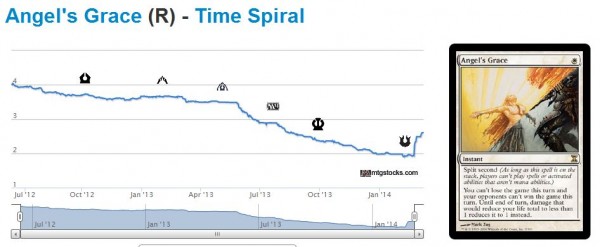
Other Cards to Pick up - The Ad Nauseam deck seemed to be pretty popular at the GP (primarily because it's one of the cheaper combo decks). The key cards are still quite cheap and should it become really big, they will likely jump in price. These include Phyrexian Unlife  and Angel's Grace.

[cardimage cardname='Phyrexian Unlife'][cardimage cardname="Angel's Grace"]

Ajani Vengeant

The planeswalker of choice for the RWU Control decks. This archetype will only grow as it has a high power level and game against just about every deck in the format. Ajani can be picked up easily for $7-7.5 online but at the venue site they were $11-15. The multiple printings will prevent the ceiling from being too high, but this card could easily be $15-16 during PTQ season.

Other Cards to Pick up - The other planeswalker in the deck is Gideon Jura ($4.50-$4.75). It has a low initial investment and both printings are mythic. Its biggest downside is that it's typically a one-of in the sideboard (for now).

[cardimage cardname='Ajani Vengeant'][cardimage cardname='Gideon Jura']

Anger of the Gods ($2.2) was another key addition to the deck, however coming from a Standard-legal set that will be heavily opened for the next six months keeps the ceiling pretty low.

Last but not least, Wrath of God, a long-time $8 card that only recently dropped to around $5 thanks to its Commander 2013 printing. The "can't be regenerated" clause becomes big because most of the green decks have adopted Thrun, the Last Troll to beat RWU (coming from someone who played RWU in the GP, take it from me Thrun is nigh imposible to get rid of.)

[cardimage cardname='Anger of the Gods'][cardimage cardname='Wrath of God']

Steel Overseer

This card shows up in a lot of Affinity lists. It's currently selling online for $7-8 but one vendor at the GP was buying them at $7 (thus it has a low spread). Its limited printing from M11 and in the Elspeth vs. Tezzeret duel deck mean that it will likely continue its upward trajectory as more players try to build Affinity.

Other Cards to Pick up - Most of the Affinity stuff has already jumped, but there's a strong chance that a little bit of profit is still available in cards like Etched Champion or Glimmervoid. Affinity's strong showing at the GP will further increase the demand for these cards.

[cardimage cardname='Etched Champion'][cardimage cardname='Glimmervoid']

Maelstrom Pulse

The strong overall showing of G/B/x decks at the venue (but not in the top 16) caused a lot of people to try and pick this card up from my trade binders. There are several printings, including the most recent in Modern Masters.

Many have given it up due to Abrupt Decay's uncounterability and instant speed, but the increase in RWU control decks which have adopted Ajani Vengeant and Gideon Jura, as well as the green devotion decks playing higher-CMC cards, make a catch-all that can occasionally two-for-one someone an enticing option.

[cardimage cardname='Maelstrom Pulse'][cardimage cardname='Abrupt Decay']

Other Cards to Pick up - Abrupt Decay, while it often fights for the same spot as Pulse, shares the same color combination and is part of the removal package of choice for these G/B/x decks.

Thrun, the Last Troll

The increase in RWU control decks (and the continual fear of Faeries) has caused a demand for a difficult-to-answer threat in green. Playing RWU Control at the GP, I was knocked out due to a Thrun I just couldn't answer. Some control decks even adopted Wrath of God almost solely because of a fear this card. He hasn't had any real jump in price and is due for a spike should he continue to see play (even in sideboards).

Other Cards to Pick up - The decks that play Thrun tend to play cards already mentioned (Maelstrom Pulse, Abrupt Decay).

Cursecatcher

This card was in high demand at GP Richmond. Vendors were selling them at $12-13 each. There were a lot of people who audibled to Merfolk, believing it had a good matchup versus a lot of the field. However, looking at its current price on TCG Player it appears that the GP price wasn't much more than standard dealer-gouging at a major event.

[cardimage cardname='Cursecatcher'][cardimage cardname='Lord of Atlantis']

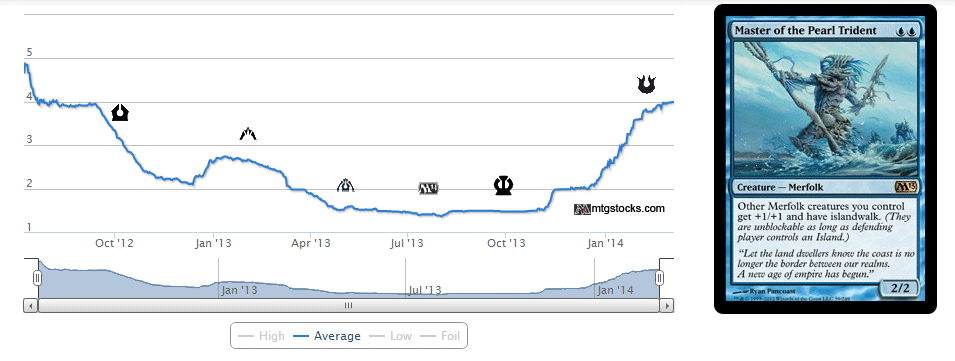
Other Cards to Pick up - Other Merfolk cards with more room to grow include Lord of Atlantis and more likely Master of the Pearl Trident. Aether Vial wouldn't be a terrible trade target but its current price tag of $20 and original printing at uncommon should mean the ceiling is nearly reached--it also got an FTV and MMA printing to help keep the price from skyrocketing.

Leyline of Sanctity

This is the sideboard card of choice for combo decks against hand disruption. In addition the mono-white enchantment deck discussed by Patrick Chapin broke shortly before the GP and this enchantment was sold out almost everywhere. Unfortunately its current cost of $17 is a bit high for speculation given its limited use in most sideboards.

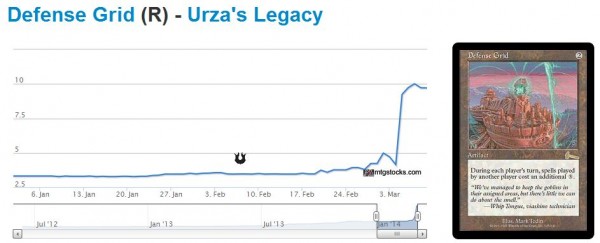
Other Cards to Pick up - Defense Grid is in a similar vein to Leyline. Whereas Leyline protects from hand disruption (and getting burned out), Defense Grid interferes with countermagic and limits players to casting spells (mainly) on their own turn. Defense Grid has had several printings, but it also sees a fair amount of Legacy play.

[cardimage cardname='Leyline of Sanctity'][cardimage cardname='Defense Grid']

The recent jump to $8 (from $2.50) might turn a lot of people off, but this could easily be a $14-15 card within the next year--especially if it doesn't get reprinted in anything and control decks continue to be a strong choice for pros. I would try to get this one only in trade though, as the buy-in price is high and the payoff is likely less than 60%.

Blood Moon

This card first really broke out at GP Valencia in the Blue Moon deck--previously it was a sideboard card in U/R Twin decks as a way to disrupt the opponent's mana base long enough to combo off. The fact that so many Modern decks now run so few basic lands means that it's very good against a large portion of the field. Unfortunately the only similar cards are ones like Spreading Seas and/or Sea's Claim which only target individual lands.

[cardimage cardname='Blood Moon'][cardimage cardname='Fulminator Mage']

Other Cards to Pick up - A lot of decks have started playing Fulminator Mage and/or Tectonic Edge to disrupt the opponent's mana base. When this strategy is used, the ability to recur destroyed lands is invaluable, thus cards like Crucible of Worlds gain a lot of value. I used it in my RWU sideboard as a way to bring back Tectonic Edges and Celestial Colonnades, and other players brought it in (in the mirror) with the same idea.

[cardimage cardname='Crucible of Worlds'][cardimage cardname='Celestial Colonnade']

Modern Deck Primer: Playing and Sideboarding Splinter Twin Pt. 1

Are you a Quiet Speculation member?

If not, now is a perfect time to join up! Our powerful tools, breaking-news analysis, and exclusive Discord channel will make sure you stay up to date and ahead of the curve.

Part 1: Splinter Twin | Part 2: Tarmo-Twin  |  Part 3: WUR Twin


This is the first in a series of Modern Deck Primer articles that aims to cover the major archetypes of the format. These primers are written with enough simplicity that somebody new to the format can follow along, but with enough depth that more experienced players will still learn important aspects of the deck. I wanted to analyze Splinter Twin first because it placed an impressive 3 pilots into the Top 8 of Pro Tour: Born of the Gods. Even more impressively, each of the pilots was playing a different color combination, highlighting the versatility of this combo deck's core.

How It Works

Splinter Twin is a combo or "unfair" strategy. The deck aims to win by casting Splinter Twin targeting Deceiver Exarch. The Deceiver Exarch is then tapped to create a copy, the copy enters the battlefield and its ETB trigger untaps the original Deceiver Exarch. This process is repeated as many times as you like, after which you attack with your horde of tokens for lethal damage. This deck can win as early as turn 4. Deceiver Exarch + Splinter Twin is not the only way this archetype can combo. Any 1 of Deceiver Exarch, Pestermite, Village Bell-Ringer, Restoration Angel, or Zealous Conscripts can combine with either Splinter Twin or Kiki-Jiki, Mirror Breaker to go infinite. There is one exception in that Restoration Angel + Splinter Twin doesn't work.

Far more deceptive than the "got your nose!" game parents play with their children.

An Ideal Game

Turn 1: Cast Serum Visions to dig for whatever your opening hand is lacking. This might be a land, early interaction like a Lightning Bolt or Remand, or a specific combo piece.

Turn 2: Cast Remand targeting whatever the opponent casts. This slows the opponent down giving you time to assemble your combo, and draws a card to help you find all the right pieces.

Turn 3: Hold up 3 mana until the opponent's end step. Then cast Deceiver Exarch tapping a land that the opponent might otherwise use to interact with your combo.

Turn 4: Cast Splinter Twin targeting your Deceiver Exarch, make an arbitrarily large number tokens, and attack for the win.

[cardimage gid='193474'][cardimage gid='214365']

In the early days of Modern, most Splinter Twin variants were purely combo decks. Over time, they have moved away from pure combo towards a hybrid strategy that relies on the efficiency of cards such as Snapcaster Mage and Lightning Bolt to play a "fair" game of Magic, backed up by the ever-present threat to combo off. Pure combo decks are generally more effective in the first game of a match, but they have trouble dealing with the wide variety of sideboard options available in Modern.

There are multiple instants, artifacts, enchantments, and even creatures that will cause problems. Path to Exile is a one mana, instant speed answer that can hack through the 4 toughness of a Deceiver Exarch to earn a game-saving 2-for-1 when cast in response to Splinter Twin.

Dismember does the same thing, without requiring any colored mana. Slaughter Pact requires black mana but can do the same thing, and is much more effective because it allows the opponent to tap out completely, where a player holding Dismember might want to leave 2 mana up to play around the "tap target permanent" ability from Deceiver Exarch or Pestermite.


[cardimage gid='370457'][cardimage gid='230082']

Abrupt Decay and Combust cost more mana, but they can't be countered.

Artifacts such as Torpor Orb, Damping Matrix and Pithing Needle can stop the combo outright. Enchantments including Ghostly Prison and Suppression Field are particularly difficult to interact with.

The creatures Spellskite and Linvala, Keeper of Silence are commonly played in the main deck by Birthing Pod strategies. Spellskite can redirect Splinter Twin, Pestermite's triggered ability, or Zealous Conscripts' triggered ability.

[cardimage gid='217992'][cardimage gid='193660']

Spellskite cannot stop Deceiver Exarch + Kiki-Jiki, Mirror Breaker, Village Bell-Ringer + Kiki-Jiki, Mirror Breaker, or Restoration Angel + Kiki-Jiki, Mirror Breaker because none of those have abilities that can target an opponent's Spellskite. Note that both Spellskite and Linvala, Keeper of Silence have 4 toughness which is just barely enough to survive the format-defining Lightning Bolt that most Splinter Twin decks play as a 4-of main.

Imagine trying to predict, sideboard for, and draw the right answer at the right time against all of those cards. You can see why people prefer to just play a hybrid strategy and win some fair games of Magic, 2 or 3 damage at a time. Note that as your opponent sideboards in cards like Damping Matrix to beat your combo plan, he/she is typically becoming weaker against your "fair" plan. You will often sideboard out combo pieces in favor of cards that are more helpful in a fair game of Magic. This is particularly effective considering what your opponent's sideboard plan is likely to be.

Now, let's take a look at one of the Twin deck lists from Pro Tour: Born of the Gods.

Tempo Twin

Anssi Alkio

Untitled Deck

Creatures

1 Spellskite
4 Snapcaster Mage
2 Vendilion Clique

Combo Pieces

1 Kiki-Jiki, Mirror Breaker
4 Deceiver Exarch
2 Pestermite
4 Splinter Twin

Spells

4 Serum Visions
4 Lightning Bolt
1 Dispel
1 Spell Snare
1 Peek
1 Izzet Charm
3 Remand
2 Electrolyze
2 Cryptic Command

Land

5 Island
2 Mountain
4 Scalding Tarn
3 Misty Rainforest
3 Steam Vents
3 Sulfur Falls
1 Stomping Ground
1 Desolate Lighthouse
1 Tectonic Edge

Sideboard

1 Threads of Disloyalty
3 Ancient Grudge
1 Dispel
2 Grim Lavamancer
2 Blood Moon
2 Batterskull
2 Relic of Progenitus
2 Flame Slash

Cute Play of the Deck: If Deceiver Exarch and Pestermite aren't available, Splinter Twin on a Snapcaster Mage can be a win condition. Double up on all your instants and sorceries!

This list is relatively focused on the combo plan when compared to other Tempo Twin decks. It features 11 combo pieces, with both Dispel and Spellskite as relatively narrow cards that are at their best when protecting the combo. Durable Deceiver Exarch is favored over the 2-power, flying attacker that is Pestermite.

Snapcaster Mage, Cryptic Command, Electrolyze, and Lightning Bolt form the backbone of the "fair plan" in the main deck. Serum Visions allows for a lower land count and helps dig for whatever you need, most often a combo piece or a land. Vendilion Clique aids both plans as a 3-power, flying attacker that can remove meaningful interaction from the opponent's hand or, more rarely, target yourself to get value out of a redundant combo piece.

Just cast Lightning Bolt and win. Magic hasn't changed much since 1993, after all.

Splinter Twin on Spellskite can blank almost all opposing removal. Splinter Twin on Vendilion Clique is pretty weak because of the Legend rule. Spell Snare, Remand, and Izzet Charm can protect the combo, but are typically more useful as early interaction in a normal fair game of magic. Note that Izzet Charm can help dig for the combo or a particular answer in difficult positions.

This list plays a lot of 1-of, 2-of, and 3-ofs that perform similar roles in slightly different manners. This is a nice feature that allows the pilot to consistently execute a game plan while retaining access to a number of options from which to choose, allowing him to find the best possible line of play in a given situation without sacrificing the core functionality of each card's role. A deck with 60 1-ofs probably won't be consistent, and a deck with 15 4-ofs won't have as many options and thus, is less flexible at dealing with the multitude of possibilities a tournament will present. Desolate Lighthouse is at its best in a combo-focused Splinter Twin deck because the deck often creates standoffs in which neither player wants to act on their own turn, preferring the opponent's end step. These games tend to go long, giving the Loothouse the time it needs to work through your deck and stack your hand with the perfect cards.

The Sideboard

Ancient Grudge is mostly a hate card against Robots. Batterskull out of the sideboard is the premier 5-drop in Modern for beating up on fair strategies. It can be slow and useless in game 1 against combo decks and fast evasive decks such as Robots, but in sideboard games where people typically weaken their proactive plan to bring in interaction for their opponents, the slow grindy Batterskull is a brutal beater. Sometimes people forget that you can pay 5 to equip Batterskull to one of your creatures. Don't make that mistake. It's important.

[cardimage gid='233055'][cardimage gid='370419']

Blood Moon was a good metagame call at "Pro Tour Wild Nacatl". So good, in fact, that a deck with 4 copies in the starting 60 made it to the Top 8. With so much attention focused on Blood Moon, I would expect it to be a poor metagame choice for the near future. If you decide to play this list, those might be the first 2 cuts you make to support more hate for whatever your expected meta requires.

Dispel might come in against any deck playing Snapcaster Mage, and with Deathrite Shaman banned there are a lot of those.

Flame Slash deals the crucial 4th damage that Lightning Bolt can't against annoying creatures such as Spellskite and Linvala, Keeper of Silence.

Grim Lavamancer beats up on any deck that plays many small creatures such as Robots, Pod, or the mirror match.

Threads of Disloyalty is probably at its best when stealing a Tarmogoyf, but is generally good against the same decks as Grim Lavamancer.

[cardimage gid='74652'][cardimage gid='370404']

Relic of Progenitus is useful against a variety of graveyard strategies in Modern, and is quite a tricky card to play with and against. When you're combining Relic of Progenitus with a damage source to destroy an opposing Tarmogoyf, it's usually wise to refrain from activating Relic until the damage is on the Tarmogoyf. If you activate Relic before the damage is on the Tarmogoyf, your opponent might be able to save the Tarmogoyf by putting new cards in the graveyard after the Relic of Progenitus effect resolves and before the damage destroys the Tarmogoyf.

Next, we'll cover Tarmo-Twin and WUR Twin before moving on to other crucial Modern archetypes.  While Tempo Twin is a formidable deck, make sure you check in again soon because one of these other two archetypes may actually give you a better chance to win games at your next Modern event.  In the mean time, go check out some other Deck Primers!

Standard Deck Primer: Playing and Sideboarding Boros Burn

Are you a Quiet Speculation member?

If not, now is a perfect time to join up! Our powerful tools, breaking-news analysis, and exclusive Discord channel will make sure you stay up to date and ahead of the curve.

The last two weekends I started out 3-0 in PTQs before the wheels fell off. I lost rounds four and five in Fargo but battled out six and seven for a 5-2 finish and a very generous three packs. In Minneapolis I left as soon as I lost in round six despite significantly better prize support due to the fact that I wasn't four hours and a dead car battery away from my bed. Obviously I was chasing a PTQ win, but a 9-4 record isn't anything to scoff at.

I was deflated when I lost to an opponent who Thoughtseized away one of two copies of Searing Blood in lieu of the Chained to the Rocks that ultimately felled his turn four Desecration Demon, but I had a number of games where I would never guess abstractly that this deck could win. I won a game where my opponent played Desecration Demon and Gray Merchant of Asphodel on the same turn to jump from 9 to 13. I won a game against a UW opponent who controlled an Elspeth, two Blind Obedience, seven untapped mana and six cards in hand. Clearly I wasn't invincible this weekend, but there were moments when I felt to be damn near it.

[cardimage cardname='Desecration Demon'][cardimage cardname='Blind Obedience']

In Fargo I played this list:

Boros Burn

spells

4 Shock
4 Searing Blood
4 Boros Charm
4 Lightning Strike
4 Chandra's Phoenix
4 Young Pyromancer
1 Annihilating Fire
3 Warleader's Helix
4 Magma Jet
4 Skullcrack

lands

4 Mutavault
1 Boros Guildgate
4 Sacred Foundry
4 Temple of Triumph
8 Mountain
1 Temple of Silence
2 Temple of Abandon

sideboard

4 Chained to the Rocks
4 Mizzium Mortars
3 Toil // Trouble
2 Stormbreath Dragon
2 Boros Reckoner

To these results:

R1: 2-1 Vs. Selesnya Aggro
R2: 2-0 Vs. Mono U Devotion (This guy Top 8'd)
R3: 2-0 Vs. Mono U Devotion
R4: 0-2 Vs. Gruul Monsters
R5: 0-2 Vs. Mono B Devotion
R6: 2-1 Vs. Rw Devotion
R7: 2-1 Vs. Mono G Devotion

Over the course of this tournament the non-triumphant scrylands felt very lackluster, and over the course of the week I slowly cut them all and never missed them. I found myself boarding in all of the Chained to the Rocks in every match in Fargo, and indeed they're only ever a bad draw against UWx control decks. I didn't have it in the main because of that matchup and because I just wanted to gear the deck more towards racing, but I made some changes after the event that were copacetic with maining Chains.

[cardimage cardname='Chained to the Rocks'][img n='Ash Zealot']

Chained to the Rocks is most impactful when it enables an attack, and I found myself wanting for another body with this build. The only creature that fit the bill, and the singular card that generally performed the best out of Red Devotion, was Ash Zealot. I got to messing around with the deck and came to this list for Minneapolis:

Boros Burn

spells

4 Shock
4 Searing Blood
4 Chained to the Rocks
4 Lightning Strike
4 Chandra's Phoenix
4 Young Pyromancer
1 Annihilating Fire
4 Warleader's Helix
4 Magma Jet
4 Ash Zealot

lands

4 Mutavault
2 Boros Guildgate
4 Sacred Foundry
4 Temple of Triumph
9 Mountain

sideboard

4 Boros Charm
4 Mizzium Mortars
3 Toil // Trouble
4 Skullcrack

Which I piloted to these results:

R1: 2-0 Vs. Rw Devotion
R2: 2-0 Vs. Boros Aggro
R3: 2-0 Vs. Brad Nelson Naya Aggro
R4: 1-2 Vs. Azorius Control
R5: 2-0 Vs. Bw Devotion
R6: 0-2 Vs. Mono B Devotion

Overall, I was much happier with this build. Though the results were pretty similar, those 2-0s were a lot more convincing than Fargo's 2-1s. I'll readily admit that this build is going to concede more game ones to UWx decks than not, but everywhere else the list felt heavily favored. Even with a Chained to the Rocks in hand I was on like a 20-outer over three turns to win my game one in round 4, and my round six loss revolved around me doing some more bricking.

The Annihilating Fire feels pretty terrible, but at the same time it's the only 75th card that I want in all three games in every matchup, which is a rather vexing problem. Noting this issue I went back to battling the deck some more on MTGO and decided that it would look better on the sideboard. Considering that I'm happy with all of the other cards, the issue then became one of what sideboard card I wanted to maindeck.

[img n='Mizzium Mortars'][img n='Boros Charm']

Mizzium Mortars and Toil // Trouble are right out, as I want something that is going to be live and efficient everywhere. Boros Charm is the best sideboard card against the field, but it's less impactful against burn's most frustrating opposition:

The 60th maindeck card just has to be Skullcrack. I don't care for the card as a miser's copy though, as Unflinching Courage gains life more than once and beating multiple Sphinx's Revelations is often necessary to winning against UW. Warleader's Helix is another card that I want in against everyone post-board, but that kind of stinks on efficiency in terms of this deck's A plan. As of now, I'm experimenting with moving two of them to the sideboard in favor of having three maindeck Skullcracks. Enough to reliably mitigate lifegain, but not so many that I'm forced to interact on one-dimension.

That leaves us here:

Boros Burn

spells

4 Shock
4 Searing Blood
4 Chained to the Rocks
4 Lightning Strike
4 Chandra's Phoenix
4 Young Pyromancer
3 Skullcrack
2 Warleader's Helix
4 Magma Jet
4 Ash Zealot

lands

4 Mutavault
2 Boros Guildgate
4 Sacred Foundry
4 Temple of Triumph
9 Mountain

sideboard

4 Boros Charm
4 Mizzium Mortars
3 Toil // Trouble
1 Skullcrack
1 Annihilating Fire
2 Warleader's Helix

Depending on how things go I could see switching one more Skullcrack/Warleader's Helix in either direction, but I'm very happy with this deck as of now. I fully intend to play this or something very close in Milwaukee next month.

Sideboarding

The sideboard here is fairly straightforward in terms of what to bring in, but what to take out might be a little surprising. Basically you take out Ash Zealot everywhere except UWx and when you're on the play against Black Devotion. It's a strict downgrade from a burn spell when your opponent can block it and with two mana Black Devotion has a million ways to kill it. The Skullcracks generally end up on the same side of the board as the Zealots, which leaves us with this plan:

Out against UWx

In

The Pyromancers get the axe due to being completely miserable against Jace, Architect of Thought. Not to mention that not having haste just doesn't cut it against Detention Sphere and Supreme Verdict. He can randomly be very good, but I wouldn't advise keeping in more than one.

Out against Black Devotion on the play

In

Out on the draw

In

Shock is just too low impact against a Thoughtseize deck, and Ash Zealot was discussed above. Mizzium Mortars gets the nod over Annihilating Fire for the ability to double-up on a Desecration Demon with Searing Blood and to randomly kill multiple creatures. If your opponent is on Blood Baron of Vizkopa then you just switch the Mizzium Mortars and Boros Charm numbers on the draw, and you lose the Warleader's Helix for Mortars on the play.

Out against everything else with creatures

In

From this baseline you can pretty much figure out what you want against any flavor of deck. If anything major changes I'll be sure to write about it, but for now this deck is my pony for Standard. Here's hoping for Lightning Bolt in M15!

Thanks for reading.

-Ryan Overturf

Insider: Holding on for Dear Life

Are you a Quiet Speculation member?

If not, now is a perfect time to join up! Our powerful tools, breaking-news analysis, and exclusive Discord channel will make sure you stay up to date and ahead of the curve.

It’s really hard to know what to do as a casual player of Modern in this crazy marketplace.

Birthing Pod is a card I’ve been touting since before I even started writing for Quiet Speculation. I bought in at $3 ages ago and have patiently waited for my target selling point of $15. As of this writing, the top buylist price is $14. This more or less meets my goal, so it may be time to take the profit and run.

[cardimage cardname='Birthing Pod'][cardimage cardname='Splinter Twin']

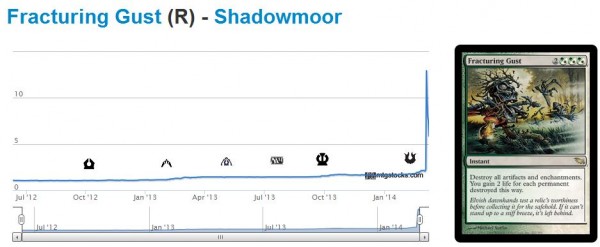
But here’s the thing: it’s not even Modern PTQ season yet. That doesn’t start until June 7, almost three months away! And yet fervor over the format has led to crazy prices on just about everything that’s received any attention in the last several months. We definitely have the Reddit effect contributing to spikes on randomly bought-out cards of which very few people are even aware (I did not know Fracturing Gust was a card, for example), but cards like Splinter Twin and Birthing Pod were foreseeable price corrections based on consistent play in the format.

So I’ve hit my target for Birthing Pod, and I’m with Corbin on leaving the last 10% for the next guy. But is selling now leaving only 10%? If a few big Modern events can lead to price spikes like we’ve never seen before, what will an entire season of constant Modern events do? Without more copies hitting the market, I don’t think it’s unreasonable to think that Pod hits $30 this summer, and I’d be extremely surprised if Wizards has a reprint lined up before then. Of course, the other big risk is a banning, and after five Pod decks making the top eight of Grand Prix Richmond, that’s a real possibility. A very reasonable argument could be made that cards for Birthing Pod decks should be outed before the next banned and restricted list update.

In the meantime, I have sold a few Modern cards over the last several months and made tangible profit on them. Then I’ve watched as prices went even higher, and in many cases the difference between the current buy price and my sell price is higher than the profit I made. It’s hard to be mad at making money, but it sure doesn’t feel good to realize I’ve left quite a bit on the table.

My short-term reaction has been to pull all of my Modern cards out of my trade/sell binder and put them into a box for holding. I may reconsider some cards on an individual basis, but I’m finding myself unwilling to part with any Modern cards at this time, with the exception of cards seeing hype-fueled temporary spikes. Except for a few scattered reprints in Conspiracy and Magic 2015 I don’t think we’re going to see any major printings to quell these out-of-control prices. I don’t think Wizards foresaw this situation, and I know they don’t work fast enough to address it yet. If they had a plan, they would have told us by now.

Don’t Worry, Be Happy

Lots of people are upset about the current situation in Modern. Here was a format that was supposed to be accessible to the average player, one where Wizards can reprint literally anything. But now prices are out of control, with $100 fetch lands and $200 Tarmogoyfs. The masses are angry, and I see a constant stream of Twitter rants railing against Wizards for not doing enough to help the format.

Of course, it’s unfair to say that Wizards hasn’t done anything to help Modern. R&D has shown a consistent willingness to reprint certain needed cards in Standard: remember $30 shock lands, $40 Mutavaults, and $70 Thoughtseizes? And before you point out that Mutavault is back up to its pre-reprint price, remember that 1) it was available for $10 for a lengthy period, and 2) it sees all the Standard play. R&D has reprinted some necessary cards where it has had the opportunity, and will continue to do so.

[cardimage cardname='Mutavault'][cardimage cardname='Thoughtseize']

There’s also Modern Masters. You could make the correct argument that it didn’t do enough to help the format, but it did drop prices on almost everything reprinted for a time. Wizards was walking a tightrope of trying to avoid Chronicles 2.0 and trying to help Modern, and they may have leaned a little too far to the former. On the flipside, the product couldn’t be considered anything other than an enormous success, and you can be sure that Wizards heard the complaints about it being underprinted.

But here’s the thing: everyone knows that Wizards works well ahead of schedule. We saw some serious Modern spikes last year, but the last six months have been nothing like anything we’ve ever seen before. Six months just isn’t enough time for R&D to respond appropriately. Whether or not that’s good business practice isn’t really the question. The fact is that the infrastructure and systems in place at Wizards are not prepared to react that quickly to card availability problems. We have to assume that because it is fact. It’s also unreasonable to expect Wizards to quickly change its procedures that have been developed literally over decades —that’s not how large organizations work.

So the way I see it, we’re inevitably getting Modern Masters II in 2015, and there’s going to be a much larger print run than there was for the original Modern Masters. Wizards may be slow to act, but act they will, and much more aggressively than in the trial run of 2013. We’ll probably get some big-deal reprints in Standard and supplemental products between now and then, but I’m just accepting the fact that real help for the format is going to take some time.

To Everything There is a Season

Where does this leave us? The current situation is that Modern prices are out of control. I did not think I would ever be able to swap my Scalding Tarns and Misty Rainforests fetches one-for-one for Flooded Strands and Polluted Deltas, but that appears to be the world we live in now. It’s more than a little crazy. It’s pretty obvious that the time to get out of Modern staples is during this summer’s PTQ season, when prices are likely to be their highest. There may be a couple of individual cards to hold for future seasons, but I expect to be largely sold out of the format by summer’s end. But what about my personal playsets of staples?

[cardimage cardname='Scalding Tarn'][cardimage cardname='Flooded Strand']

As prices continue to grow, it makes staying in the Modern format significantly harder for the average player. Many players bought into the format early. The price difference between a full set of fetch lands today ($1,422.40) and a full set of fetch lands one year ago ($554) is $868.40 (all prices from MTG Goldfish). And that’s just one of the format staples. Anyone who got into Modern a year or more ago has made a lot of virtual profit just by playing the format.

The problem is, of course, that cards from your deck can be reprinted or banned. In either case, the value of those cards will be negatively impacted, but a banning can have collateral damage on other cards that were only good in certain decks. As players’ Modern decks near the value of top-tier Legacy decks or even a nice used car, players are going to have to worry about the bottom dropping out and losing a lot of value due to action by Wizards.

[cardimage cardname='Misty Rainforest'][cardimage cardname='Polluted Delta']

Of course, if you bought into the format cheaply, you may just be getting your value from being able to play a format which you otherwise would have been priced out of. But as a financially-minded player, more and more I feel like selling my personal playsets of format staples is inevitable. I strongly believe Wizards is going to address the availability issue in 2015, and as opportunities to play at other times are limited, the end of this summer’s Modern PTQ season is likely to be the best time to sell out of my format staples.

At the current rate, we’re either going to be seeing fewer Modern events (for the same reasons we see fewer Legacy events—people can’t afford to play) or we’re going to see mass reprints to make the format accessible again. In either case, do you really want to be holding on to your Modern cards through 2014 into 2015? Let me know what you plan to do in the comments!

Jason’s Alticle: Going Broke By Making a Profit

Are you a Quiet Speculation member?

If not, now is a perfect time to join up! Our powerful tools, breaking-news analysis, and exclusive Discord channel will make sure you stay up to date and ahead of the curve.

Greetings, Matriculators!

How can you tell I think there is a fairly good chance of Modern prices normalizing lower than they are now and reprints helping to control costs?

I'm selling cards right now.

Going for Broke

Back in January, Brainstorm Brewery superfan and Dutch crazy person Sander Van Der Zee wrote something I liked because he used a matrix to divide speculation targets into four categories based on their risk and reward values. I still like this matrix and I am a little surprised not to see it in finance articles before.

What got lost along the way was his uniting thematic element and brief shot-call at the end. He liked Gavony Township as a pickup, especially for 0.12 tix on MODO. Today, Township has quadrupled to .5 tix on MODO and rocketed up to $3.50 in paper.

Sander was totally right about what he called "The Little Township That Could" because he doesn't seem to care about opening up Brainstorm Brewery LLC to the possibility of intellectual property claims from Platt & Munk or other interested parties associated with the unrelated 1930s children's book "The Little Engine That Could" (which doesn't mention Gavony Township anywhere.)

I remember this story being less terrifying.

Sander was right in that he saw the card as a decent spec, but he didn't imagine it would hit nearly $4 in paper (or 0.00057 Euro) or he might have said so. Even the guy who saw it coming didn't see that coming.

Of course, all of the retrospect finance geniuses are coming out of the woodwork to talk about why it's so obviously a $4 card and anyone who doesn't see that is blind. "It's played in Pod," "It has casual appeal," "It's an EDH staple," etc. Analysis that would have made some people some money if it had been done when the card was $1.50 is now being done at a furious rate.

Is Gavony Township a $4 card? I don't know, maybe. Is it an $8 card? I don't know, maybe.  Today I will be making the case that there is money to be made in not caring.

Money Can't Buy Happiness

What? Of course it can. Money can buy a refrigerator for your new house, and if that makes your wife happy then that totally works in your favor.

A while back, Corbin decided to move his 60 or so fetchlands that traded for at $10-$15 over a year or so. In today's money, 60 Benjamins is pretty sweet, but Corbin sold out while Scalding Tarn and Misty Rainforest were closer to $30. We asked him about it on the cast this week, and his answer didn't surprise me--although it may surprise some of you.

He'd do it again.

Sure, holding out for $100 would have been ideal, but he was able to lock in the profit he had made, do something productive and grown up with the money and he'd do it all over again.

It can kind of sting if a card you just sold goes up, but there are opportunity costs to having money tied up, too. If a card quadruples over a year but you sell after a month after it "just" doubles and use that money to buy cards that double in a month and reinvest that money, you are likely to come out ahead.

Also, while I do this for a living, speculating and viewing certain cards as an investment is a small percentage of what I do. I view a small box of cards as my "investments" but I view the rest of my cards for what they are--inventory. And inventory should be blown through as fast as possible.

Charles Kaiser wrote a book called "No One Ever Went Broke Making a Profit," and I think getting hung up on the one time out of ten where you sold too early can paralyze you if you dwell on it. Don't let fear over potential missed profits make you make the wrong play the next 9 times out of 10. Take your profit and leave 10% for the next guy even when that 10% turns out to be 100%.

If you have ever had to turn down a collection because you had too much money tied up in specs like I have, you understand how your money can do more for you if it's free to do some work.

Listeners to the podcast will be familiar with our "Pick of the Week" segment where we all identify a card we think is worth buying (or, in rare cases, selling). When one of our team members, Brian Dale did some analysis, he determined that I overwhelmingly tend to pick short-term gainers that are best dumped within a month or two. They tend not to go up again, and even if they do, you take the money and buy the next big spec.

Speculation is fun, folks, but there is way steadier money in buying for buylist and selling for retail, in moving casual cards away from competitive players and competitive cards away from casual players and in flipping collections. If you're buying at buylist and a card spikes, increase your buylist number and go about your day.

I'm not saying don't speculate, I'm saying keep cycling. Don't sit on cards forever if you can do more with that money in the short term. Sell your cards, lock in your profits and call it a day.

Be Good to Each Other

This went up Yesterday.

If you can't figure out why, you probably didn't see the photo album of buttcracks that was passed around facebook and made the front page of reddit. Is it funny when super fat dudes' ass cracks are hanging out? Yeah, kinda.

But is it okay to post that album online? The guy who made the album didn't include faces or names, which makes this look not super malicious, but I am still reminded of Dr. 8 sides and that whole debacle.

Remember this isn't about free speech, this is about maintaining an environment where attendees can feel safe. Worrying that someone is going to embarrass them publicly is not something a player should have to worry about on top of worrying about keeping their play tight, all of their belongings on them at all times so they don't get stolen and how they can afford a $40 Teferi for their sideboard and still have $8 left for a convention center cheeseburger.

I don't think posting someone's pasty coin slot on reddit for the public to ridicule is tantamount to physical violence or theft or cheating or the other things that can get you banned from events, but I don't think the laughs he got were worth the expense. Some of the people being derided are going to feel pretty shitty about themselves when they see that album, and I don't think that's worth the chuckles you got.

Regardless of how I feel about the album, I think it's up to WotC to maintain a culture where people feel secure at events and I imagine they're likely going to take action in this case, as they did with Dr. 8 sides. Regardless of how any of us feel about that, I think it's something they need to do to keep tournaments appealing.

Folks, don't do stuff like this. Don't bring up the First Amendment in defense of this guy (for lots of reasons), don't share the album on facebook, don't upvote it on reddit (not that it needs it, it's on the top of the front page).

It may be funny at the time, but giving non-Magic players something to laugh about at all Magic players' expense in general, and a few crack dealers specifically, doesn't do a service to our community. I see the whole issue as a little senseless--the gain was pretty small compared to the cost and I don't think it was worth it.

This community may contain a lot of tubby guys and some people have gone so long between showers that they contribute a veritable miasma so thick it could block a Tarmogoyf, but they're our stinky brethren and we need to stick together. Be good to each other.

What Happened in Richmond Besides Butts?

GP Richmond Top 8 Decks

So what kinds of decks did well at the largest Constructed GP ever? Both kinds--Melira Pod and Kiki Pod.

With five Pod decks in the Top 8 of the event, it didn't take long for the community to fold its arms and declare the format solved. However, hopefully some of the other decks that people like do well to save us all from Wizards having to ban Birthing Pod, something that is not currently necessary and which I hope never becomes necessary.

Someone bought all the $12 copies of Birthing Pod off of TCG Player over the weekend, but almost everyone restocked at close to that so his dreams of $30 pods will have to wait until another day. $20 seems reasonable on these but Star City would have to put them at $25 for TCG Player to see $20 so I don't anticipate that soon. It's gratifying to see an attempted buyout whiff like that.

Another attempted buyout, this time targeting Ad Nauseam, also whiffed with restocking taking place around $5-$6, up from the $3-$4 it was before. No profit after fees, there. Someone hoped $8 would be the new price, and they can keep on hoping.

I saw someone say they thought Ad Nauseam would be $20 soon and it was a little hard not to laugh. I feel good staying out of these crazy spikes because when the dust settles and Monday rolls back around, there is never as much profit as people hoped.

The Ad Nauseam deck is fringey. Reuben Bresler did respectable with it Day 1, but the deck's inconsistencies accumulated and losses dragged him down. The deck is not new, but a lot of people acted like it was, and like it being played on camera was somehow an endorsement of the deck by Wizards. Not the case. Reuben got a Round 2 feature match because of who he is, not because of what he was playing. Later camera matches were based on his record, not his deck.

I am glad he did well and a few others did as well with the deck, but it's not going to make Ad Nauseam a $20 card any more than the one copy in ANT in Legacy has. We didn't like any of the cards as specs for the last few weeks (apart from Lotus Bloom, a Pick of the Week of mine) and nothing changed besides the camera being on the deck this weekend.

In fact, the only deck that looked at all new was the G/B Obliterator Rock deck. Everything else was all Tarmo Twin, Affinity and Pod with the occasional other deck sprinkled in.

Unfortunately, I think the new price of Mox Opal is likely to stick, but if those budge down at all, I might snag some. Affinity will always be a solid choice in Modern and Legacy and a lot of the components have applications in Vintage.

Mox Opal has the word Mox in it the same way Lotus Bloom has the word Lotus in it and that should not be ignored. Affinity stuff seems like it's a solid investment, but I don't expect big jumps in anything apart from maybe Etched Champion which is quite strong and not super reprintable given its keyword ability.

Not much to say about Richmond. It was insane, lots of people were there and Tier 1 decks did well despite all the talk of fringe decks.

There was no need for an SCG Open since SCG ran the GP, so you'll have to wait until next week to get your Legacy and Standard fix.

Sage Advice

That's all for this week. Don't buy into hype, keep your inventory moving, and pull your pants up. Everyone's phone has a camera on it these days.

Avatar photo

Jason Alt

Jason Alt is a value trader and writer. He is Quiet Speculation's self-appointed web content archivist and co-captain of the interdepartmental dodgeball team. He enjoys craft microbrews and doing things ironically. You may have seen him at magic events; he wears black t-shirts and has a beard and a backpack so he's pretty easy to spot. You can hear him as co-host on the Brainstorm Brewery podcast or catch his articles on Gatheringmagic.com. He is also the Community Manager at BrainstormBrewery.com and writes the odd article there, too. Follow him on Twitter @JasonEAlt unless you don't like having your mind blown.

View More By Jason Alt

Posted in FreeTagged , , , , , , , , 40 Comments on Jason’s Alticle: Going Broke By Making a Profit

Have you joined the Quiet Speculation Discord?

If you haven't, you're leaving value on the table! Join our community of experts, enthusiasts, entertainers, and educators and enjoy exclusive podcasts, questions asked and answered, trades, sales, and everything else Discord has to offer.

Want to create content with Quiet Speculation?

All you need to succeed is a passion for Magic: The Gathering, and the ability to write coherently. Share your knowledge of MTG and how you leverage it to win games, get value from your cards – or even turn a profit.

Insider: [MTGO] Weekly Market Selection

Are you a Quiet Speculation member?

If not, now is a perfect time to join up! Our powerful tools, breaking-news analysis, and exclusive Discord channel will make sure you stay up to date and ahead of the curve.

Today I'll share with you the positions I focused on this past week, either buying or selling, with some explanations and perspectives.

Modern is the driving force of my investment these days. While most of the cards are trending up, following the PT path, others we saw last week, such as Oblivion Stone or Karn Liberated, are clearly at a bottom now and constitute a perfect pickup for healthy profits in a couple months.

Here is what happened in my portfolio last week.

Buying

Serra Ascendant

Serra Ascendant is a pillar of the Soul Sisters deck. Relying on small creatures and huge quantities of life gain, this deck is fairly popular on MTGO and pretty unattractive for pros during a PT. Therefore the deck was nowhere to be seen in Valancia, creating a nice opportunity for us here.

Currently at 2-2.5 tix, with a potential ceiling of 6 tix, Serra Ascendant is at a perfect price to pick up. With Modern season still ahead of us and ceilings always trending higher, this is a 100% easy profit in two months.


Phantasmal Image

Phantasmal Image is a versatile card that can appear in at least two decks: Pod and Merfolk (Modern and Legacy respectively). It lost a bit of its magic with the modification of the legend rule, but it's still unmatched as a two-mana clone.

A little bit above 1 tix right now, and at an eight-month low, this is another safe bet for the Modern season.

Grim Lavamancer

M12 Lavamancer is currently sitting around 1.5 tix, its baseline for the past year and a half. Curiously, the Torment version is worth close to 5 tix and was constantly trending up since last summer. Will the M12 version close the gap during the Modern season? Most likely they will meet half way, at around 3.5 tix.


Amulet of Vigor

Will you take another ride? Prior to PT Born of the Gods I had started to accumulate the Amulet at around 1 tix, and sold the few playsets I had into the hype. Probably one of my best ROI's in such a short period of time.

After this unexpected explosion and these even more unexpected returns, Amulet of Vigor is almost back to a 1 tix value, exactly where I want it to be just before the Modern season. The Amulet deck is probably far from Tier 1, but it's interesting and competitive enough for Amulet to sustain a 2+ tix price tag during the Modern season.


Hive Mind

Because of the Amulet deck, Hive Mind also saw a crazy jump from 0.2 tix to 1 tix in two days, and then nothing. Almost back to 0.2 tix, Hive Mind represents a nice investment for smaller bankrolls. Here again, aim for doubling your tix--it is uncertain that Hive Mind will hit 1 tix again this season. Nonetheless, this card is playable in different deck archetypes, and 0.5-0.6 tix is a legitimate goal.

Anger of the Gods

Two weeks after the PT, the price has settled a little bit. It is tricky to speculate on currently drafted Standard cards. But as I mentioned before I firmly believe in this card, both as a major new addition to Modern sideboards and a potential first-choice sweeper in Standard (this year or next). I'm accumulating Anger of the Gods whenever the price gets under or close to 0.5 tix.

Selling

Shadowborn Demon

I bought this card back in August at 3.3 tix, waiting for a spike or moderate increase between January and April. I sold a few copies in early December when the card spiked because of Conley Wood's brews. I should probably have sold all my stock at that point to move to Modern targets. Now that the demon is spiking again, I won't miss this opportunity. I'm gradually selling playset after playset above 5 tix.

Chord of Calling

This card is a major, non-reprinted, staple in the current Modern metagame. Chord of Calling is breaking record after record since the end of February, and Pod decks made a huge splash at GP Richmond this weekend.

However, if Pod Decks are good they are also not easy to play optimally on MTGO. I wonder if we are not close to a bubble here with prices flirting with 25 tix. I'm willing to let go of some of my copies now at 22-23 tix now, and I'm watching the trend carefully.

Thanks for reading,

Sylvain Lehoux

Unlocked Insider: Finding Value in Born of the Gods

Are you a Quiet Speculation member?

If not, now is a perfect time to join up! Our powerful tools, breaking-news analysis, and exclusive Discord channel will make sure you stay up to date and ahead of the curve.

Born of the Gods (BNG) release events have wrapped up this past week. The new set has shaken up the Theros (THS) Block Constructed format and made a few ripples in Standard as well. Even in Modern, Courser of Kruphix and its four toughness has pushed Modern Jund in a different direction. Cards that reveal information about the top card of the library seem to find a home in that fetchland powered format.

When considering the new set for speculating, the impacts on the various constructed formats are good to keep in mind. But, from a supply perspective, BNG still has a number of months of drafting left in it. The prime time to explore opportunities in this set will be in June and July, after the release of Journey Into Nyx, but before the release of Magic 2015. Nevertheless, prices have settled down enough to start an early appraisal on the new mythic rares.

The Rating System

I use this rating system to think about the value of mythic rares. I feel the system has utility and is a good way to assess whether or not cards are worth buying. Each mythic is followed by the current price and a rating, either Good Value, Fully Priced or Borderline.

  • Good Value -- At current prices or in the given price range, this card is a buy and I expect it to see higher prices in the medium- to long-term. These cards are the best speculative targets from a value perspective. Some of these cards might never make a splash in competitive constructed formats, but the risk of loss, if bought at the suggested prices, is low.
  • Fully Priced -- This is the other end of the spectrum, where downside risks are high. Fully Priced cards might maintain a high price, but further gains are doubtful. Do not buy these at current prices to speculate on.
  • Borderline -- This is somewhere in the middle of the other two, with some possibility of moving up or down in price. For cards with this rating, further scrutiny is required beyond just the price. If you have a large amount of capital, buy some amount of these cards and scoop up more if the price falls.

All prices are taken from mtgotraders and are current as of March 5th, 2014.

Fully Priced

Ephara, God of the Polis: This card has made an impact on Standard, but is not played as much as two of the gods from THS, Erebos or Thassa, both of which are below 8 tix. Look for this card to drift down in price over the coming months. At the moment, this card is 11.63 tix and Fully Priced.

Brimaz, King of Oreskos: The most expensive card of the set, it looks like this cat will be a factor in Standard, but it doesn't look like it's made a big impact out of the gate. I'd be prepared to load up on this card in June, but for the moment it's better to be patient and let the price fall until it finds its footing. Right now it's 18.27 tix and it's Fully Priced.

Phenax, God of Deception: I can't see this one making any competitive waves. It's too conditional and too expensive at its current price. If it got down into the 1.0 to 1.5 tix range, I'd buy more interested in buying these but for the moment it's 2.95 tix and Fully Priced.

Chromanticore: This card looks like a ton of fun, which is keeping its price above junk levels. It will probably get into the 0.5 to 0.8 tix range eventually, so I would refrain from buying at the current price. Once THS block is no longer the current draft format, this probably creeps up to be a 2 tix card. But for the moment it's 1.54 tix and thus Fully Priced.

Champion of Stray Souls: This card is pure junk. It used to be that I'd advocate purchasing any mythic rare for 0.35 tix or less. With the new redemption fee of $25, it seems that the floor on junk mythic rares has dropped somewhat. Buy this if it hits 0.25 tix, but currently it's priced at 0.43 tix and so it's Fully Priced.

Kiora, the Crashing Wave: I've only played with this card a little, but the abilities are powerful. It can protect itself, it can draw cards and it can develop your board. It doesn't look like it has a home currently, but that's bound to change at some point. I'd be somewhat interested in buying this card in the 10 to 12 tix range, but I am also happy to wait and see. The best case scenario for a value speculator like me is that this card sees little Standard and Block play, and gets down into the 4-5 tix range. Right now though, it's still quite shiny so it's priced quite high at 14.39 tix and that means it's Fully Priced.

Borderline

Xenagos, God of Revels: This looks like it will be used as long as the R/G Monsters deck is playable in Standard or Block. However, as a five-drop that needs another creature in play to have an immediate effect, it's not a 4-of. Whatever price this gets down to in June, it will probably be safe to buy a bunch with an eye to seeing modest profits in the Fall, but for the moment it's priced at 6.46 tix and thus it's Borderline.

Karametra, God of Harvests: The cheapest of all the gods so far, this looks like it will be on it's way to junk. Gods have some sort of appeal as pseudo planeswalkers, but I would be hesitant to load up on this card at the current price. Look for it to get down into the 0.5 to 0.8 tix range. Currently, it's priced at 1.09 tix and so it's Borderline.

Mogis, God of Slaughter: I probably liked this card too much at first, but it's starting to show up as a two-of in some of the new THS Block Constructed lists. 2 tix seemed to be the floor for THS gods, so I'd be more inclined to wait for this card to hit that price level before buying. Right now, it's 3.14 tix and thus it's Borderline.

Good Value

Flame-Wreathed Phoenix: Stormbreath Dragon sees a lot of play and is priced to match. The budget conscious just might want to try this card out instead, particularly in an aggressive red deck where the mana curve tops out at the 4cc spot. This card is a snap-buy in the 1.0 to 1.5 tix range, but I still think it's current price of 1.85 tix represents Good Value.

Wrapping Up

Keep your eyes out for how Mogis, Flame-Wreathed Phoenix and Kiora perform in Standard and Block over the coming months. These are the cards which I think could see some play at some point and could be good value.

Some of the mythic rares will be good value if bought at the right price, but if they are junk or near junk, they will only be in demand from redeemers so be exceptionally price-conscious on cards like Karametra and Champion of Stray Souls.

Insider: Thoughtful Reactions to Buyouts

Are you a Quiet Speculation member?

If not, now is a perfect time to join up! Our powerful tools, breaking-news analysis, and exclusive Discord channel will make sure you stay up to date and ahead of the curve.

What’s that? Fracturing Gust is a useful one-of sideboard card for a few decks that want to play hate against enchantment- and artifact-themed decks? And even though tier-one decks like Melira Pod (five mana to destroy Birthing Pod seems loose), Splinter Twin, Jund and Scapeshift don’t worry about Fracturing Gust, there are a few decks that do? BAM!

Fracturing Gust

I promise you this was the last bit of sarcasm in this article. But isn’t the current reality of Modern speculation absolutely ridiculous? If Fracturing Gust can become a $15 card overnight then anything is truly possible.

Of course three days later the price halved to just over $5 with the trajectory still pointing downwards. But that doesn’t mean no profit was made on this card. When the baseline is a buck, there’s a lot of potential.

Reacting Intelligently to Buyouts

It may come as no surprise to you that not all buyouts are well-planned and well-executed. On many occasions someone gets wind of a new card seeing Modern play and immediately buys out all cheap copies on TCG Player. This action manipulates mtgstocks.com, which in turn convinces many other foolhardy speculators to follow suit. Action precedes thought far too frequently nowadays.

I would propose that missing out on a buyout such as this one may be more of a blessing than a curse. These buyouts do contain some valuable information, which can often be reapplied. Consider a recent situation I came across coming out of Pro Tour Born of the Gods involving two sideboard artifacts.

Ensnaring Bridge

One successful Pro Tour deck jammed two copies of this powerful artifact in its sideboard. I am completely serious when I say that I used to own a set of these for casual play and absolutely loved how they disrupt an opponent’s attack plan. Sadly I sold my copies for just a few bucks each when I decided to move my funds elsewhere.

Ensnaring Bridge

The single top-performing Modern deck that ran this artifact was piloted by Dominink Prosek in an aggressive Red Burn-type build. While there were three printings for Ensnaring Bridge, the card hasn’t seen print recently. This led to a smaller supply on TCG Player, which in turn triggered an easy buyout. Classic hype.

Compare this card to…

Defense Grid

This card was also printed in three different sets, and very similar sets for that matter. It’s also an artifact that saw some play in sideboards at the Pro Tour. For some reason, Defense Grid was not readily noticed like Ensnaring Bridge. Notice how the card spiked about a week later.

Defense Grid

When I saw the Ensnaring Bridge spike my first reaction was not to look for Ensnaring Bridges to buy. Instead, I discovered a tweet (one that I sadly cannot find) that pointed out a significant comparison. The tweet elegantly stated that two copies of Ensnaring Bridge could be found in the top performing Modern PT decks. Meanwhile there were a total of nineteen copies of Defense Grid in those same deck lists.

Yet Ensnaring Bridge was bought out and not Defense Grid?! Upon discovering this disconnect I purchased eleven copies of the cheaper artifact for an average price of under $3 each. Maybe I should have gone deeper, because the subsequent price spike was virtually inevitable.

Reapplication

Reapplication is a powerful concept. The word is synonymous with the over-used phrase “don’t reinvent the wheel”. The situation above can be reapplied to discover future opportunities before it’s too late.

After all, this isn’t an isolated incident. As crazy as it seems, the most played Scars of Mirrodin fastland-- Razorverge Thicket-- was the also the cheapest. These opportunities are real.

Now it’s Sunday morning, before Day 2 of GP Modern-is-a-hit Richmond has officially begun. Yet the speculators didn’t bother to wait to see top deck lists. They jumped all over Ad Nauseam, the cornerstone of a newly successful deck in Modern. Looking at the list played by the pros at PT Born of the Gods, I can identify the cards that may have been overlooked during this buyout.

There are many.

Angel's Grace is one I really like. The card is incredibly powerful and practically uncounterable.

Grace

The card was reprinted in Modern Masters, but so what? Cryptic Command was reprinted at rare, too. And Time Spiral is an awfully old set relative to Shards of Alara. As a four-of in the Modern list (along with fringe Legacy playability) I can see Angel's Grace moving higher.

Another Time Spiral card from the list is Lotus Bloom. Again, the artifact was reprinted in Modern Masters but unless it’s reprinted again, this won’t matter much to speculators.

Gemstone Mine is another four-of in the list, and a versatile one for that matter. The only problem here is that Gemstone Mine has already rapidly risen over the last couple months. I didn’t even notice this until now--did you?

Gemstone Mine

Reapplying Reapplication

The Modern Ad Nauseam example is just the most recent one I could come up with. There have been others in the past and there will be more in the future.

Rather than dwell too long on the specific suggestion above I ask that readers focus on future opportunities. Speculators tend to fall in love with an idea before thoroughly evaluating what the best targets are. Often it’s a snap-decision to buy in response to someone’s post or tweet.

My recommendation is to use logic in order to evaluate what the best targets are for a breakout card. Sometimes it may be the card everyone’s already targeting, but not always. Market inefficiencies do exist and they can lead to significant profits.

While everyone focuses on a select few sideboard cards, take a critical look at what's seeing the most play and what is truly effective. You may discover the next big thing...before everyone else does! Example:

Choke

The reality of today is that there are many naïve, emotional speculators trying their hand at this business. Some will be better than others, and some will be more rash in their decision-making. When this happens it’s best to take a step back, apply your knowledge and experience, and make an informed investment. While Ad Nauseam spiked overnight, Lotus Bloom and Angel's Grace will continue their upward trajectory for months to come.

Most of the time, I don’t mind waiting. It’s easier to sell a card after a steady rise than after a buyout.

When prices race to the bottom, as they often do after a buyout, profiting at the higher price becomes tricky because so many people dig out their old copies to sell immediately. Not so with a gradual increase. Buy a couple sets of the overlooked cards and proceed to reap the rewards when the timing suits your needs.

…

Sigbits

  • Speaking of Gemstone Mine, did you know that the card is sold out at SCG for $6.99? I suppose they do have some foils in stock if you’re willing to cough up $39.99 a copy.
  • SCG is struggling to identify the right price for Modern staple Birthing Pod. After the buyout, they upped their price to $19.99 only to drop it back down to $14.99 shortly after. They still reside at $14.99, only SCG has zero in stock. I suspect these are going back to $19.99 by next week.
  • SCG has only five MP copies of Snapcaster Mage in stock. NM copies are currently priced at $39.99, but could they go even higher by PTQ season? I suspect it’s possible.

5 More Modern Sideboard Cards You Need To Consider

Are you a Quiet Speculation member?

If not, now is a perfect time to join up! Our powerful tools, breaking-news analysis, and exclusive Discord channel will make sure you stay up to date and ahead of the curve.

Sideboarding, a source of frustration for some, is a source of opportunity for the savvy player. Sideboards allow players to adapt their strategies in any number of ways to next-level their opponent. A very recent example is from Tomoharu Saito’s UW Azorius Control deck in Standard. His maindeck is a creatureless UW control strategy.  The stock Standard UW control deck plays no creature, so opponents expect Saito to have no creatures. Saito one-upped them by bringing in Soldier of the Pantheon and Archangel of Thune in game 2 , and opponents were caught off guard. The story goes that Saito would bring in this package against every single opponent, and he used the strategy to reach the elimination rounds of two PTQ in a row and put himself within a game of the invitation. This strategy is employed time and time again. Always be aware of everything the opponent is capable of.

[cardimage cardname='Archangel of Thune']

Keep in mind that sideboarding strategy needs to take into account what the opponent is going to sideboard. You are not sideboarding against their game one deck, but against their post-sideboard configuration. This creates a world of meta-sideboarding, so keeping up to date on what popular decks are sideboarding is a necessity. Some online research into popular decklists provides total awareness of what opponents are likely to have access to in games 2 and 3. Sideboards are typically used to combat the common decks in a tournament metagame. Certain matchups pose more problems than others, so sideboards are tailored specifically to beat the most difficult opponents.

Anger of the Gods

[cardimage gid='373604']
Anger of the Gods has become the best sweeper in the post-ban Modern format. This was formerly Pyroclasm, but the move away from the format defining, two-toughness Deathrite Shaman towards the three-toughness Wild Nacatl has raised the critical damage threshold accordingly. Anger of the Gods is a sweeper for three that also exiles creatures, meaning it hoses persist creatures and Voice of Resurgence. Anger of the Gods is used in the sideboards of many top decks, including UWR Control, Jund, and Splinter Twin combo.


Thrun, the Last Troll

[cardimage gid='214050']
UWR Control won the Pro Tour, and it relies on counterspells and targeted removal to deal with creatures. The deck has no good answer to Thrun, the Last Troll,  so it puts the opponent on a very quick clock. Be careful to play around Porphyry Nodes, a possible sleeper hit for the UWR control deck this weekend.  Thrun’s 4 toughness also insultates him from the now-popular Anger of the Gods, so very few of the popular removal spells in the Modern format can handle this threat.


Blood Moon

[cardimage gid='370419']

Modern is driven by its fetchland-shockland manabase, and Blood Moon hoses it completely. It also turns off the huge number of utility lands in the format like Desolate Lighthouse and Celestial Colonnade. Nearly every opponent is playing multiple colors, and many of them are extremely susceptible to Blood Moon. It is a great tool in the arsenal for some, and a dangerous threat to others. Blood Moon is most often seen in the sideboards of UR combo decks like Splinter Twin and Storm, but it also sees play in some UR Control decks and the occasional Affinity deck.

Fulminator Mage

[cardimage gid='142009']

Another card that attacks the manabase of Modern decks is Fulminator Mage. This card is in nearly every BG Rock and Jund sideboard. It functions as specific hate against Urza Tron and Scapeshift, but is used broadly against any mana-hungry deck. Fulminator Mage is often used in mirror matches, against UWR Control, and against all combo decks.

Threads of Disloyalty

[cardimage gid='74652']

Modern is filled with powerful two-drop creatures, most importantly Tarmogoyf, Dark Confidant, Voice of Resurgence, and Spellskite. Threads of Disloyalty is a full-fledged Control Magic against these creatures, a two-for-one in card advantage and a tempo-positive play. In a pinch Threads of Disloyalty can disarm cards like Wild Nacatl and Kird Ape. Threads of Disloyalty is seen from the sideboards of Splinter Twin combo and UWR Control, but I would expect it from any blue deck focused on board presence.

One final tip: When playing paper Magic for high-stakes against astute opponents, shuffle in 15 cards every time! The opponent will see you take fifteen cards out,  but they will have no idea how many cards you actually changed. Best to keep them guessing.  Have fun this weekend!

Insider: Never Go To Plaid

Are you a Quiet Speculation member?

If not, now is a perfect time to join up! Our powerful tools, breaking-news analysis, and exclusive Discord channel will make sure you stay up to date and ahead of the curve.

Everyone knows, the key to winning at speculation is to get in at the right time then get out before it all goes bad. Or even Plaid. The character Barf in Mel Brooks' classic "Spaceballs" once uttered the phrase: "THEY'VE GONE TO PLAID!" Plaid is one of those signs things have really gone wrong.   No one really wants to wear plaid. Except, maybe this guy:

1260244319_8ced9afbe1"Pimpin' ain't easy"

One of the many problems that strikes me is that the clear and evident "bad" times are becoming more and more confusing. I'm sorry. Let me rephrase: What people believe are "bad periods." There are none. If you've done your homework. If you've struck when the time was right. If you've managed to put the work in on the trade floor - EVEN IF you have 60+ copies of a card - eventually you will be able to find a buyer or exit strategy at profit. *Barring any foreseeable reprints from WotC (yes, they are all foreseeable).

The seasons are more "ebb and flow" instead of just "on & off" these days. This means you must be prepared with the correct plan. Today, I'm going to talk about what items to remember, when making that plan.

1) Buy Low//Sell High

Let me be the 5,000,000th person to drill this into your head.

THIS IS EVERYTHING.

It doesn't matter how you do it. Typically it just matters when you do it. If you have the benefit of buy listing for a store, can pick up collections for less than retail, or are spec targeting on the trade floor - you need to get in when the card is the lowest. Recently, I had a stock of roughly 65 copies of Master of the Pearl Trident. Have you seen his price graph lately? Take a look:
Master-of-the-Pearl-Trident
Keep in mind, I primarily pick up cards on the trade floor. I do not have the luxury of a brick and mortar at this moment, and I don't deal very much with Craigslist. I also very rarely buy into a card via other vendors. Over the course of post rotation I was picking them up 3-8 copies per weekend, and slowly amassing them around the late October 2012 to June 2013 time period. I had done my homework, paid attention to the trends and figured at some point there would be a demand spike that I could ride for a net of $2-$4 per copy. The key was picking them up while everyone still thought it was trash, unusable, or wouldn't ever go higher than current expectations. (Remember blue Zendikar fetchs at $15? Ya, something like that scenario). The key was in knowing and/or recognizing what WotC was doing with that card. Knowing it's role player status and looking beyond it's current applications. Finally, when there was an uptick in demand - I grossed about 500% on 3/4th of the stock I had. I eventually limited the number available, for I still think the card has not reached it's cap yet.

The point: There was a time period I was wondering if I had made the wrong decision. I bought low, and was expecting everything to change much later on. As the price kept dropping, I wondered if I pulled in the initial copies too high. As long as they were readily available, and I kept my price consistent with the trends, I knew it would be ok. I will admit I started to see how many copies I had set aside and was wondering if I was just accumulating "box rot."  In other words, cards that would never do anything constructive. I was taking figurative dollars I could leverage, and allowing it just to sit. I knew my game plan though, and as long as more copies were being easily acquired, I had to trust in my assessment of the card. I will admit, around October 2013 I was wondering if I started if I would ever realize my gains.

2) Figure out what "the right price" is

A friend of mine is talking about getting a shirt for me that says: "I'm interested in anything at the right price." Honestly, truer words couldn't be spoken. I do a lot of homework to figure out what the right price is though. It's more than just simply looking at price charts, though. Multiple factors go into knowing where you should start or how you should determine that right price. Every market is different based on what each store is doing for said market. If there are too many stores not providing enough packs in prize support, I can promise you this will lead to a shortage of the appropriate targets you have selected.

This will force you to look online, or attend much larger events in order to increase your target card pool. This means more travel, or less play. If a card is doing particularly well in your area, but yet no one has it in stock - buying from an online retailer to flip for +/- 20% in trade all of a sudden looks like a great plan. Even if that price doesn't change, traders will become much more pliable and willing to talk if there are simply no copies to be find in your market. That's just one example of many situations that will determine what your right price is.

3) Put in the work

This is my new mantra. As everything can come down to if you've put in the work or not. One aspect of this is analyzing cards. Ever stopped, taken a moment, and really looked at what the powerful cards do. Do you play multiple games? Ever looked at the broken concepts from say Yu-Gi-Oh? I've always felt one of the most broken concepts in all of Magic is using your life total as a resource. Usually in the form of casting cards or drawing cards. Necropotence is the pinnacle of this to me. I can't help but look at when they decided to FIX Necropotence, for instance. When they revealed Yawgmoth's Bargain I almost laughed out loud. They did not simply increase it's mana cost.

THEY DOUBLED IT.
THAT DID NOT WORK.

If you understand the impact of doubling a card's mana cost, adding more colored symbols or even making a card multi-colored, then you probably can understand how dramatic a difference doubling should be. Even with that, Yawgmoth's Bargain showed that drawing cards with your life created enough issues that multiple cards were eventually banned in an effort to figure out who was actually the culprit. This leads me to Griselbrand for instance:

Griselbrand
This card has been talked about in multiple scenarios as a problem child for Legacy right now. Mainly because there are too many ways to get him into play. Once he is in play he can just take over the match typically right then and there. After his release, and the price dropped to below $10 - the common thought was that he would never be above $15. This is VERY short sighted, as we can tell now. As I mentioned at the beginning of this piece - there are no bad times to invest in a card these days. What did my assessment tell me? Looking back on history, I placed Griselbrand as a $30 card in the long run. Once he became hard to find, his ceiling should hit $60. Karn Liberated is making me reassess situations like this though, so a follow up will be due in a future article.

Keep in mind though, when I speak of assessing the power level of a card - there are no bad assessments, just bad assessors. If you missed the big hubbub of a card getting ready to take off, more than likely you didn't put in the correct amount of work to see it. Maybe you were too occupied with school. Maybe it just didn't click one day in the right way. Either way, you have to focus on what's going on. Dependent on the people, information, and time you have access to will completely determine how much work you have to put in.

I have a wealth of experience going back to The Dark in 1995 to draw on. I've witnessed three "emergency bans." I can not recall how many "neuterings" of strategies I've seen. Or even how many times Wizards has left things completely alone. In this experience, I've started to get a feel for what Wizards has done in the past. You may not have that same experience yourself, but talking about Magic with friends, gamers, commentators or other Magic personalities is not hard. A lot of us LOVE to talk about this game - so feel free to ask questions. Starting from what you don't know, and working backwards is a great way to start figuring out where you need to start.

When you can put all three things together, no matter how the market changes - you won't be effected. The changes in price will not conflict with your long term goals for a card, and the price you entered in at will not interfere if your plans have to change. If you're consistently aware of what's going on, you can make changes on the fly and continue the upward progression and growth necessary to consistently move forward. All it takes is did you put in the work? If you can answer that question as "Yes." then you will never know what "plaid" feels like.

-Till Next Time.


Avatar photo

Dylan Beckham

Dylan has been involved in Magic: The Gathering since the heyday of The Dark. Continually invested in the community, he's been a Pro Tour Player, Trader, Judge, Tournament Organizer, Volunteer, and Vendor. Currently involved with the day to day operations of selling online, Dylan has brought his experience to Quiet Speculation to make you a better investor. Hailing from the Atlanta area, and now part of the Dallas scene - he's often at big events sourcing cards or discussing Life, the Universe, and Everything. Have a question? Feel free to comment, message, or email anytime.

View More By Dylan Beckham

Posted in Finance, Free InsiderTagged , , , , 2 Comments on Insider: Never Go To Plaid

Have you joined the Quiet Speculation Discord?

If you haven't, you're leaving value on the table! Join our community of experts, enthusiasts, entertainers, and educators and enjoy exclusive podcasts, questions asked and answered, trades, sales, and everything else Discord has to offer.

Want to create content with Quiet Speculation?

All you need to succeed is a passion for Magic: The Gathering, and the ability to write coherently. Share your knowledge of MTG and how you leverage it to win games, get value from your cards – or even turn a profit.

Want Prices?

Browse thousands of prices with the first and most comprehensive MTG Finance tool around.


Trader Tools lists both buylist and retail prices for every MTG card, going back a decade.

Quiet Speculation