menu

Jason’s Alticle – Conversion

Are you a Quiet Speculation member?

If not, now is a perfect time to join up! Our powerful tools, breaking-news analysis, and exclusive Discord channel will make sure you stay up to date and ahead of the curve.

Greetings, Salivators,

Ever feel like people getting into Magic now are spoiled?

Thallid Days

I started playing this silly children's card game when I was still a silly child. Even at age 12 I quickly realized that the correct response when confronted by my peers was "embarrassment" followed by "trying to change the subject." But by age 14 or so I had managed to stop caring what pretty much anyone at my school thought and played shamelessly at cafeteria tables all throughout school.

1996 was an odd time to start playing. Duelist magazine was in the double digits, we had four whole editions of the core set (five if you can count) and the newest set, Ice Age, really captured players' imaginations because we were stupid back then and thought it couldn't get any better than Jester's Cap and Stormbind.

One store in town sold these cards and they had a "Magic night" on Mondays which was eight people crowded around a table in a store room with boxes all around. The table was eight feet long on its shortest side which meant it was difficult to see the cards of the person across from you.

I had no idea how to trade and got my pants pulled down a bit trading cards I didn't care about like Time Elemental for cards I did like Chronicles Nicol Bolas. It was a simpler, more innocent time.

It totally blew.

Lacking a driver's license, we were at the mercy of our parents to drive us across town to "Magic night" and when a scheduling conflict came up, our last link to the community was severed. The internet was still in its infancy back then and all of the usenet groups I managed to find discussing the game were a bit over my head. I read Duelist but that could only get me so far.

I was the best player at my school which put me high in the running for "not quite in the bottom 10% of players in the city". A second store kept opening up and closing down in six months because the guy who kept opening them was a total scumbag but we'd try to play events there during those brief windows.

Today the same city still has that same old store that used to run Magic night almost two decades ago, but it also has three other shops within a mile of each other, all fighting for the patronage of a decent-sized player base.

With more than one format to choose from for FNM, a great singles selection given the many different store inventories and competition for players' business, there has never been a better time to be a Magic player in that city. Players are frankly a little spoiled by choices given three locations to play.

You can understand why I was a little confused when I found out about a group of casual players that hung out at a doughnut shop to play EDH.

Glass Houses

Do I know the doughnut shop well? Yes, of course I do. I used to play Magic there. I think the most important distinction we need to make, though, is that I played there because I had to.

I probably pissed the group of them off when I saw a post about their get-together on facebook and told them they were lucky to be playing during a time when there were so many LGSs in the area and asked them to support them. The gist of the response was "Um, of course we support the LGSs," which I admit I wasn't prepared for.

They play on a Sunday when most of the LGSs close a bit early (a business decision I can't wrap my head around at all) but yesterday while they were playing EDH, one of the LGSs was doing an unlimited proxy Legacy tournament. For $4 entry and zero cost per proxy you could play to win Legacy cards like Chrome Moxes, Scalding Tarns and dual lands.

Who showed up? Serious Legacy players and like one person besides me who proxied a deck (I don't get high from my own supply--inventory is inventory).

If ever an event screamed, "Introduce more casual players to Legacy as a format," it's this one. For $4 you could spend the entire afternoon playing Legacy, learning the format and hanging out and supporting the LGS. The event utterly failed to attract anyone other than Legacy players and I can't figure out why.

But We Need to Figure It Out

LGSs are not super profitable. When run correctly they can thrive in an area for many years, but many of them live and die by event attendance.

Wizards has done a good job of moving the prerelease to the LGS to get everyone supporting their store and bringing some casuals out of the woodwork. They play a tournament in the store, meet some new people, have a good time and there is a non-zero chance of turning a few into regulars, or "converting" them.

However, there is a group of players out there in the world for whom something so casual as FNM is much too competitive and overwhelming. How do you convert those people?

I have been pretty successful at finding where they hide out and going to them, bringing boxes full of cards they've never seen before. As anyone who has traded a fistfull of bulk rares for a Snapcaster can tell you, even if you make sure values add up to the penny, you're going to feel like you won big. The best part is, so are they.

So how do we get those people out of their Community College libraries and doughnut shops and basements and get them to come to the LGS to be a part of the larger community? Do they contribute to the LGS in other ways that aren't as visible? Will we never be able to convert those people?

I realize that the article this week should have been more solution-oriented, but I guess this is the result of my worldview being challenged a little bit. I always had a, "if you schedule it, they will come," attitude toward events that make different formats more accessible to non-competitive players, but clearly a tournament isn't the ideal venue for that.

I have a few ideas.

Bring Them With You

If you're going to where casual players hang out, make the case to them directly. Get your LGS to set aside a block of time just for Magic durdling. Most stores don't have their schedule booked solid and there is likely time and space to get some casuals into the store.

Even if they just do EDH or casual durdling, they may spend some money and do some trading. There's no guarantee you'll get people uprooted from where they're comfortable hanging out, but if you convert even one person, it was worth it.

Pre-Releases Are Key

The guys who hang out in the doughnut shop in my example are mostly players who also spend time in the LGS, but even more casual groups of people are less likely to know about things like the prerelease. Make sure you let them know what the prerelease is all about, when it is and how many events there will be.

New sets are exciting, the gimmicks Wizards has concocted to make those events appeal widely are working and there really is no better introduction to the LGS than that. Make sure you set your LGS up for success by bringing the target audience to the event.

Find Out What Would Bring Them Out

The best way to design an event that would get a large number of casual players to make their first trip to the LGS is to ask them what they want to play in. Sometimes the answer is "nothing" and at least you tried, but sometimes something as simple as a sealed league will do the trick.

A Brief Reminder

The whole reason you want people to come to the LGS is that it's still the number one best place to develop the community and individual players. People congregate naturally, the game is a social one. Having more people in your community increases the talent and card pool and keeps the case stocked as people open cards they don't want and sell to the store. Bigger events means bigger prize pools.

As much fun as it is to bring your binder to groups of total casuals and have them react like you're a magician when you produce an entire playset of promo Bident of Thassa, it's more fun for those players to get better and contribute to the larger community as well.

The LGS isn't for everyone, but it never hurts to see if you can convert a few people into regulars. This is a social game after all, and even if you get people who do support the LGS to support it more, you'll find that the value you get is paid back tenfold when new trade binders, decks and money comes into the community.

Or you can keep impressing a group of casual players with your ability to show up every week with more copies of Colossus of Akros. I can see the benefits of both approaches.

Planes, Trains and Automobiles

So let's talk about the Grand Prix. It almost didn't happen. Flights were cancelled due to weather, Dallas was paralyzed by sheets of ice on the roads and even people like Corbin Hosler who live a few hours away didn't make the trip because the modest drive time was estimated to have been quadruple the normal duration.

Reports of judges slipping on the ice and getting injured (including one poor guy who broke some bones) have been coming in, and people are still in Texas a few days later trying to get out, because why would you want to stay in Texas?

Only 800 players managed to play in the event, which sounds like a big GP for 2003 but it is not a big GP for 2013. Do we discount the results accordingly? A lot of snark monsters on twitter seemed to want to based on how they reacted to Huey Jensen losing in the finals.

I'm going to pretend like this was a normal GP and the results are a good sample of the metagame because that's really all we can do.

Grand Prix Dallas/Fort Worth Coverage

It looks like it's a good thing that they bothered to have an event because Standard has been shaken up slightly.

There is a relative newcomer in the form of Orzhov Aggro which is actually a B/W Humans build from the look of it. Pairing the mono-white aggro shell with cards like Orzhov Charm and Xathrid Necromancer, this deck is just another option for players who don't want to play a monochromatic control deck.

Orzhov Control is also a new thing, and the event's winner, Marlon Guitierrez ran this type of deck, obviously to great effect. It's an odd deck considering Esper Control is nearly a thing of the past. Many of the Esper players have dropped the third color in favor of a more stream-lined Azorius control deck. To see Orzhov control pop up and do well is heartening. Quite a bit of variety is possible in Standard.

There was a lot of Mono-Black Devotion in the Top 16, which is odd since it did so poorly last week. It still has capability so ignore it at your peril.

Huey Jensen's Azorius deck looked boring. Any deck that relies on Elixir of Immortality should be strangled in the cradle before it grows up to teach other decks that it's okay to entirely lack win conditions. One Elspeth and two Mutavaults as your only way to attack for damage is just annoying. I'm not glad he lost, but I am glad he didn't win. Would it kill you to jam one Aetherling in there for me?

Carlos Becerrea Reyes came with an interesting deck, a kind of Gruul-colored mostly red deck. Devotion is a powerful mechanic but players are already finding ways to splash other colors for spell versatility and it has made for an entertaining meta. For a while there it was Mono-Blue and Mono-Black duking it out but it looks like Standard is a bit more interesting than we feared.

Soldier of the Pantheon may no longer be a long-term hold. It's at an all-time low so now may be the time to get in if it's going to see more play in Standard than we thought. Mono-colored decks are no longer the only option and more and more dual-colored creatures are creeping up, with removal packages following suit. I'd buy them under $2 on TCG Player if you can. I think they have a lot of promise.

Darren Minard has three copies of Spark Trooper in his sideboard in the Top 8. Now I've seen everything.

Take a bit to go over the deck lists here. Even some decks within the same archetypes are making pretty different card choices and that's only good for Standard.

Somewhere Sunnier

The SCG Open in Oakland may have gotten a bit of an attendance bump as stranded travelers audibled to a sunnier climate with an airport that actually allowed people to land.

SCG Oakland Standard Top 16

Five different decks in the Top 8 is encouraging. The only overlaps were the three copies of Mono-Blue Devotion, which can't really be helped.

U/W Control may be here to stay as it won this event piloted by Joe Lossett. Lossett's strategy involved playing a few more win conditions than Jensen and that may have gotten him there. Be able to beat this deck, and expect a blue-white temple to be worth some actual money when the next set is out.

I like Chained to the Rocks in a mono-red shell. It probably works just as well in mono-white splashing red since you have four Sacred Foundries and can hold off a good removal spell until you find the Mountain late in the game.

Stormbreath Dragon is a bad Thundermaw, but a bad Thundermaw is better than no Thundermaw so expect it to maintain its price. The decks that want it want four. Warleader's Helix is worming its way into 75 cards again, which I like. The same adage that applies to bad Thundermaws applies to bad Lightning Helices as well.

Mono-Blue looks the same week to week.

I like Zacarias Milton's Golgari beats deck. I think his removal suite is one of the best in the game right now and his creatures are solid. Mistcutter Hydra may make its way maindeck in this sort of build soon if all this blue nonsense persists.

Reaper of the Wilds is a decent card but I feel like there was never a good time to buy to make money. Unless SCG restocks at $5, this was a bad spec but it is getting about as much play as we can expect. "Good in block" sometimes translates, sometimes doesn't. Watch what SCG restocks this card at, I guess. Right now its spread is at 50% and that's about average for a fringe-playable card.

I bet on the wrong pony when I bought a bunch of copies of Hammer of Purphoros. I sold for an amount of money I am relieved to say can be classified as "not a loss" but these things are everywhere in binders and showing up as one- or two-ofs in decks.

Still, Spear is popping up, which is good. I think Spear of Heliod and Bow of Nylea have the most casual appeal and are decent bets to go up over time. How long it takes might depress you, though. I wouldn't invest now.

Spear sure is doing work right now. It can't deal with truly annoying stuff like Blood Baron, Stormbreath Dragon or Aetherling, but it can make sure you only take three from a Reckoner and help you win the race. Not a bad use of extra mana late and it's bonkers with Assemble the Legion. Who needs creatures?

Mono-Black still is and always will be a thing.

This deck is one of the few that intrigued me. I like it a lot and it's nice when new decks pop up. I'd sleeve this up for FNM if I wasn't having so much fun ruining lives with Scion of Vitu-Ghazi. This deck is basically Junk Goodstuff and it's fun to see goodstuff in a sea of "I picked a color" decks.

Let's onward to Legacy.

SCG Oakland Legacy Top 16

Right off the bat, it's safe to call Doomsday the "Pet Deck of the Week".

Elves could have taken that title but lately, as in, "Since they printed Deathrite Shaman," Elves has become a legitimate deck in Legacy. It's a fine deck, most builds are comparatively pretty cheap and it's fun to play tribal. I wish there were more than three viable tribal decks (four if you count Slivers, which I do), but whatever. I'll take it.

"Oops, all spells?" More like "Oops, your deck name is $%^&ing stupid."

Death and Taxes is probably going to put at least one copy into the Top 8 for the next year. I'm cool with that. I have played that deck in Legacy since it still ran Mangara of Corondor.

Esper Stoneblade and other blade decks are going to do well in a post-True-Name Nemesis landscape. I played Sam Black's Bant in that Legacy tournament on Sunday and my toughest opponent was fatigue.

Having my land blown up was bad, but boarding in Gaddock Teeg and riding a Nemesis to victory with Supreme Verdict stuck in their hand got there. I played like a total monkey because I don't play much anymore and the deck just carried me.

Legacy is going to figure out a way to deal with True-Name Nemesis. People are already starting to play cards like Stifle to deal, and Supreme Verdict is good against everything already.

Edit- I have been asked to "Please stop suggesting that [stifle] is a viable solution to True-Name Nemesis". Since Stifle does not stop them from selecting a player and therefore not help you, I am officially out of ideas. You can wrath True-Name or you can just bend over. Wizards has designed the perfect card that can't be interacted with and it costs 7 mana less than Progenitus (someone check my math). I will no longer make any suggestions at all about how to True-Name Nemesis because nothing works the way I want it to. If your opponent resolves Nemesis, just go to Game 2.

Affinity? Why not. That deck always has a chance but it doesn't get played much anymore. It's somewhat easy to hate out, but who's bothering? Etched Champion can do work right now. Cranial Plating on him can be just as scary as Batterskull on True-Name....who am I kidding? It's still potent, though.

Delver decks are starting to jam the Nemesis, and some are even also jamming Stoneforge. UWR is going to be a real deck for the foreseeable future.

OmniTell and no other Sneak decks confused me. I guess TNN is the new card of choice for people who hate playing fair.

Dredge is another deck that does well when no one is hating it out. Now is a good time for this particular unfair deck. If it does much better it will be hated out but for the time being it's fun to see it pop up every once in a while.

That's all for now. Join me next week where I'll think of something to write about at the last second.


Insider: Strengths, Weaknesses, and Preferences

Are you a Quiet Speculation member?

If not, now is a perfect time to join up! Our powerful tools, breaking-news analysis, and exclusive Discord channel will make sure you stay up to date and ahead of the curve.

Most of us don’t know everything. I’m pretty sure that I don’t. We each have strengths and weaknesses, and by identifying them we allow ourselves to make the best possible decisions given our circumstances. As MTG financiers, taking the time to identify our areas of strength will help us to maximize our profits and minimize our risks.

Many of our strengths and weaknesses come down to preference, really. If you just like Legacy more than other formats, you’ll find yourself putting in more time and effort toward speculating on Legacy. As you continue to focus on the format, you’ll begin gaining expertise, and eventually you’ll be able to call the Legacy format one of your strengths.

The obvious response to this line of thought is to just make every format and card type and investment style a focus, thus gaining expertise in it all. This may be a possibility for some, and for those making a living off the game, it’s probably a necessity. But for those of us with a more limited schedule and budget, the need to make choices becomes inevitable.

Foiled

I’m not a fan of foils. There’s a limited amount of money I can tie up at any one time, and higher-priced cards with no extra utility are not where I want to put that money. It’s important to note that I don’t think investing in foils is wrong, it’s just something that doesn’t fit with my goals or expertise. By identifying my weakness in this area, I get an advantage.

Now I can take action in one of two ways: I can put in the time and effort necessary to learn the market, or I can choose to just avoid foils. I’ve chosen the latter, mainly due to personal preference that stems from the fact that foils warp, provide no tangible value or advantage, and can get you accused of cheating, possibly even disqualified from a tournament. I see them as an extravagance in casual play and a liability in competitive play, and I want no part of them. This is the reason you haven’t often seen me advocate buying foil copies of cards, nor will you likely see that in the future. A weakness? Yes. But by identifying it, I can avoid stupid mistakes.

Modern Man

On the other hand, I’ve had a reasonable amount of success speculating on Modern cards. After doubling up or better on a number of Modern specs, I realized that the format was profitable for me. I pushed myself to further focus on understanding what factors can contribute to Modern cards spiking and what pitfalls to avoid. As such, I gained some insight into the format, which has allowed me to make some reasonable calls, most recently suggesting that you buy Splinter Twin here.

I still have a lot to learn, of course, and not all of my calls have panned out. But by identifying the success I’ve had in this area and coupling it with research, focus, and determination, I’ve been able to grow my expertise and make a few bucks in the process. Again, this is partially due to personal preference, as I just like Modern more than Standard. It’s okay to focus on the things you like — you’ll have more fun and be more invested.

Big Things and Small Things

Partially due to budget and partially due to being risk averse, I like to acquire cards worth more than $5-10 in trade. This doesn’t mean I never buy more expensive cards for speculative purposes, but it does mean I pick and choose very carefully. Again, I’ve got a limited budget (and life makes it more limited all the time), so tying up large amounts of cash in cards that may take a while to grow is not always an option for me.

This can cause some feel-bad situations, I admit. Recently, I’ve been looking for Phyrexian Obliterator and Griselbrand, but as I related in my article last week, I’m not seeing a lot of non-Standard stuff at my Draft-only MTG nights lately. I’ve been asking about both for several weeks, but attained exactly zero copies of each by the time the spikes happened. I was confident in these, but decided saving some money for the holidays took priority over buying in. Now I’m stuck with the feeling that I could have a lot more gift and travel money, but I thought these were specs for Modern season, not the holiday season. (And by the way, if spikes like these are happening now, I can’t wait to see what’s going to happen this summer when the format is actually being played.)

One thing I recommend is to have a portion of your MTG collection in its most liquid form—cash. This means that you don’t always have to spend all of your spec money immediately upon outing a position. In my case, I’ve had some extra expenses lately (including moving, which is costly) and had to dip into my MTG budget to make ends meet. As a result, I’ve been playing catch-up and haven’t quite replenished my spec money. If I had, maybe I would have bought some Obliterators, although my preference for trading for bigger cards would likely still have been a factor.

Instead of buying pricier cards, I like to buy cards in the bulk to $3 range. Cards like Nightveil Specter, Pack Rat, and Tidebinder Mage have shown that even inexpensive Standard cards can yield some pretty hefty returns. When is the last time you saw a $20 card shoot up by 1000%? It rarely happens, but we often see $1 cards go to $5 or $10 when the meta shapes up correctly.

I’d probably classify my hesitance to buy in to more expensive cards as a weakness, though in reality it’s more related to preference and circumstance. It can, however, be a strength during spoiler season—when hype causes high prices and rosy outlooks, it’s nice to be the guy refusing to buy in to anything but the most sure-thing specs. In any case, this isn’t a weakness I’m content to just accept. I think it’s worth my time to research whether I’d be better off spending money on big-ticket items as opposed to speculative small stuff, and I’ll be going into some of my findings in future articles.

DIY

What are your strengths and weaknesses? If you haven’t taken the time to figure this out, you’re probably leaving value on the table. Identifying the special insights, opportunities, and capabilities that only you have will help you to focus your speculating and trading in directions that will make you the most money. You probably have a good idea of your preferences already. If you’re working with limited time and money like I am, I suggest choosing one or more of your strengths or weaknesses and creating a plan to maximize value. Fortunes aren’t made on winging it—focus, research, and determination are what make us successful.

Insider: Estimating from Past Trends

Are you a Quiet Speculation member?

If not, now is a perfect time to join up! Our powerful tools, breaking-news analysis, and exclusive Discord channel will make sure you stay up to date and ahead of the curve.

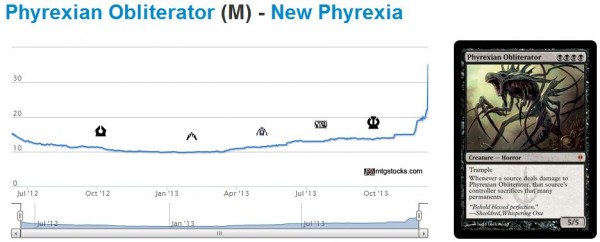
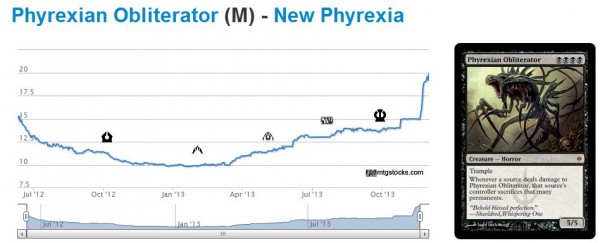
Modern cards are still on the move. Throughout the past couple weeks I’ve been slowly adding to my positions in Inkmoth Nexus and Birthing Pod. Phyrexian Obliterator just saw a significant spike this morning.

Oblit

As I mentioned last week, Phyrexian Obliterator may be a powerful card when paired with the devotion keyword, but it’s yet unproven in a major Modern event. I think there’s potential here, but I must confess I am tempted to unload my two copies into this spike.

Many people have predicted around $30-$35 for this card come Modern season, and that trajectory may have been accelerated just now. But I’m not delusional enough to believe this is a $50 card--buying here seems foolish unless cheap copies (<$20) can still be found. I much prefer selling into spikes. While the chart on Phyrexian Obliterator is still evolving, other price trends are more mature and thus more easily analyzed. This week I’ll look at a couple recent trends and try to identify their near-term trajectories applying basic technical tools, mostly trends and rough estimates. But the discipline of using historical data to identify reasonable price targets is still far preferred over emotional gut-reactions. Thus the tools will be useful even qualitatively.

Example: Birthing Pod

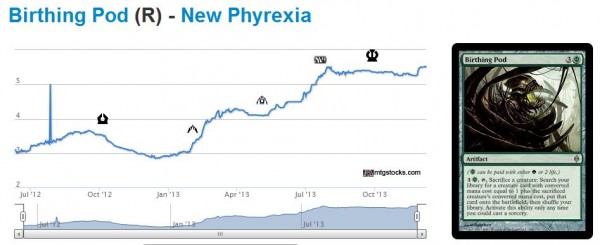
I love the price chart on Birthing Pod because a basic technical analysis suggests to me a bullish sentiment. Examine the uptrend in the card’s price throughout the past year and a half.

Pod

This card has established a sequentially higher price floor three separate occasions in the past year: Jan 2013, May 2013 and Oct 2013. Now we see the price starting to tick even higher throughout the last couple weeks.

As Modern season approaches I expect this trend will continue and a new price floor will be established. If I were to extrapolate, I’d say the next price floor is likely to be around $6.50 with a potential spike to $8.

To me this suggests I should be open to acquiring more copies under $5. On the other hand, paying cash for copies which are more expensive may be reckless if I seek short-term profits. This card does not strike me as a candidate for a massive, speculative buyout. Instead, the price is more likely to gradually rise in a similar fashion. Needless to say I’ll be monitoring this trend closely.

Inkmoth Nexus – A Similar Story

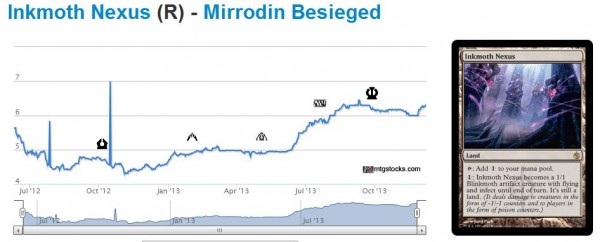
My analysis of Inkmoth Nexus brings me to a similar conclusion.

Inkmoth

Notice how the price has steadily risen since last winter, with a similar price stabilization pattern. In late Spring 2013 and late Fall 2013, the price on this card remained flat for months at a time only to move sequentially higher. Once again I noticed a small uptick in recent weeks which I expect is the beginning of the next step higher.

In the case of Inkmoth Nexus the next price floor is probably in the $8 range with a possible spike to $10. The growth on this one is slightly more accelerated than Birthing Pod, hence the higher price target. Consistent with this are the top buy prices on Trader Tools: $3.20 for Birthing Pod (42% spread) and $4.41 for Inkmoth Nexus (30% spread).

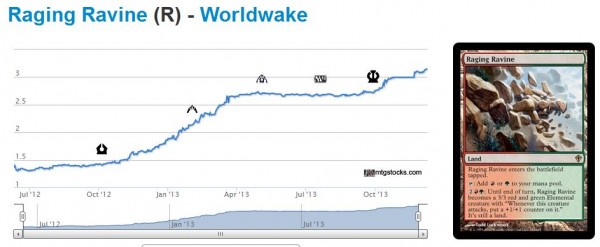
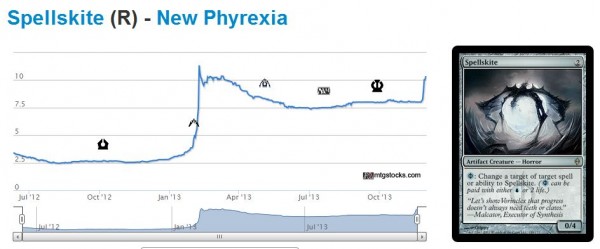
The upward trend characterized by steady rise paired with periods of consolidation can be found on numerous Modern cards. Raging Ravine remains one of my favorites, and Spellskite displays a positive trend as well.

Ravine

But rather than list out more, let me shift gears to a trend that isn’t as favorable.

Zur the Enchanter – A Different Assessment

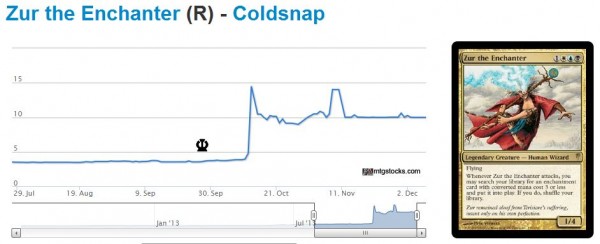
Here’s an interesting price history:

Zur

I’ve trimmed the timeline of this chart because literally zero interesting things happened to this card’s price from July 2012 to September 2013. Then when Theros was launched and super-amazing-God-Enchantment-Creatures were printed, Zur’s popularity spiked. Modern deck brews also led to speculative buying, which caused a buyout. After spiking to $15, Zur the Enchanter leveled out at around $10.

This seems like a huge success story for speculators everywhere. But I would argue this is true only for those who bought up the $5 copies looking for quick profit. On the other hand, buying this card for long-term potential seems like a poor play. Allow me to explain.

This card tried to spike again back in November. The price approached $15 only to be beaten back down to $10 for a second time. To me, this indicates that demand is fairly inelastic.

As the card’s price goes up from $10 to $15, suddenly people are eager to sell their copies, which drives Zur’s price right back down again. This type of phenomenon suggests we’re near a long-term price plateau. Growth is possible, but I would not expect upside heading into Modern season as I do for Raging Ravine and Inkmoth Nexus.

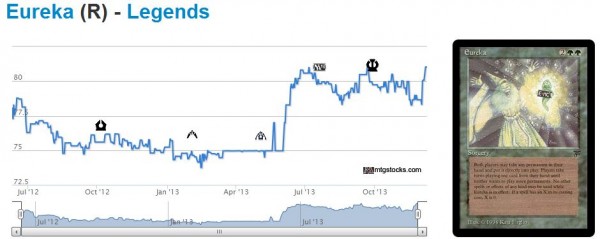
Believe it or not, the trend on Zur reminds me of Eureka.

Eureka

Legacy demand caused a sudden spike on this card, followed by a wave of selling. Then the card rose again only to fall back down again. As I write this article, Eureka is up near its peak for a third time.

While a breakout is certainly possible (even inevitable given Eureka’s age and casual appeal) the above chart leads me to invest my funds elsewhere. If you want to invest more safely based on technical analyses, the cards mentioned at the top of this article are much preferred.

Of course…if Eureka does break through that $80 price barrier the card’s next price ceiling could be substantially higher. But for $80 that’s a risk I’m not really interested in taking.

Art vs. Science

Doing these qualitative technical analyses on Magic Cards is more art than science. History does tend to repeat itself, but we can’t always rely on past performance to predict the future. Too many other factors can come into play: reprints, shifting metagames, dramatic changes to PTQ schedules, etc.

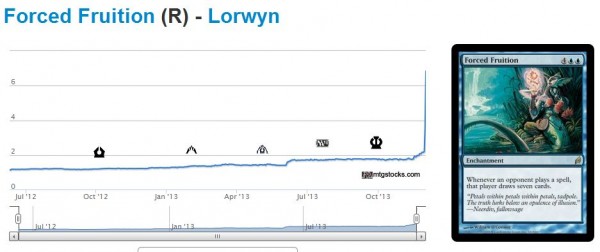
The key message here is that many tools are at your disposal to enable logical investment choices. Emotions are almost never the way to go--especially if you’re looking for slow-and-steady growth with a low risk profile. Sure, you can go and buy out additional copies of Phyrexian Obliterator and Forced Fruition. But these price trends are not reflective of a stable investment.

Don’t get me wrong. I like flipping spiking cards for immediate profit just as much as the next guy. But when it comes to buying cards with cash to place in my binder and forget about for a few months, I like to use whatever data I have available to make an informed decision. These price trends can be useful to estimate what may happen in tomorrow’s uncertain world. Emotions are never a good basis for investing.

Sigibts

Forced Fruition and Wheel and Deal are still keeping their higher prices thanks to the new Commander 2013 card Nekuzar, the Mindrazer. Here are some other cards on the move, likely due to this general.

  • Wheel of Fortune has always been a fun card. Who doesn’t like ditching their old hand for seven new cards? But with Nekuzar out your opponents will be much less happy having to take seven damage to draw that new hand. The trend is obvious--this card is on the move, and with Wheel of Fortune being on the Reserved List, it seems like a sweet buy here. I may pick up a set myself as an investment because $20 is not out of the question. Also note the 14% spread between TCG Mid and highest buy price. This is definitely a strong buy.
  • How about something outside the box, like Winds of Change? Sure, it’s been reprinted a couple times and it’s not on the Reserved List. Plus it’s not as powerful as Wheel in the late game. But it’s also much cheaper (price and casting cost), and Legends copies did show up on the Interests list last Sunday. Also, the Portal artwork is pretty sweet on this card. Definitely a stretch, this one is worth at least watching.
  • I could really reach here and suggest Timetwister, but the illiquidity of such an investment makes this buy unattractive. Instead I’d prefer something like Wheel of Fate, which is much more likely to gain traction should Nekuzar continue to influence the market the way it has been.

RUG Battles XI

Are you a Quiet Speculation member?

If not, now is a perfect time to join up! Our powerful tools, breaking-news analysis, and exclusive Discord channel will make sure you stay up to date and ahead of the curve.

I don’t know if it’s fair to call my approach to Legacy “testing”. I play tournaments and on occasion I’ll help somebody else play a new deck with them against whatever they like. I know that it’s not fair for me to confirm that TNN isn’t that big a deal against RUG just yet, but after this weekend I’m 2-0 against decks playing the card in matches. This would be laughable preparation for a Standard tournament, but that’s the beautiful thing about Legacy- things change gradually if at all. This new universe in which TNN exists is pretty darn close to the old one in which it didn’t.

The aforementioned matches were played at the Monster Den’s monthly “Big Legacy” tournament in Minneapolis, at which I played this 75:

”Old Reliable”

spells

4 Force of Will
3 Spell Pierce
4 Daze
4 Lightning Bolt
1 Dismember
4 Tarmogoyf
4 Delver of Secrets
4 Nimble Mongoose
4 Brainstorm
4 Ponder
4 Stifle
1 Fire // Ice

lands

3 Tropical Island
3 Volcanic Island
2 Wooded Foothills
4 Scalding Tarn
3 Misty Rainforest
4 Wasteland

sideboard

3 Red Elemental Blast
2 Blue Elemental Blast
2 Sulfur Elemental
2 Tormod's Crypt
1 Vendilion Clique
1 Dismember
2 Submerge
1 Spell Pierce
1 Ancient Grudge

The big changes for me are playing the fourth Daze (though this has been “stock” for some time) and the sideboard Vendilion Clique (which is also quite popular). I’m 40% convinced to switch the maindeck Dismember out for a second Fire/Ice or a Forked Bolt to combat Death and Taxes, but Dismember has always been good to me. It just offers something that no other card could offer RUG. The burn spell and/or blue card are obviously good, but Dismember adds a dimension that must be played to be believed. I board it out plenty, but that would be true of any card that I replaced it with as well.

I’m rambling (what’s new?). Let’s talk about battles.

Round 1 vs. Troy Thompson on Sneak and Show

I hate being paired against the heroes in round 1, and local heartthrob/beard aficionado Troy Thompson is mostly certainly heroic.

Troy has been on Show and Tell for a while, which is more than reasonable. I believe that the matchup is favorable, but the de facto best combo deck can easily dispatch blue decks with its best draws.

Troy did not have such draws. After Gitaxian Probe-ing me in game one he chuckled.

“Your hand is a lot better than mine.”

That was more or less the story of the match. I drew better than Troy did and won 2-0. There were some interesting plays though.

At one point Troy controlled a basic and a fetch to my dual, fetch and Delver. He knew that I had Stifle in my hand from Probing me but he had to play the fetchland since then. My hand was already good against him and I had a Brainstorm. Usually I would save the Brainstorm to fix bad draws I might encounter later, but I decided to fire it off to see if he would fetch in response. I had a good hand and pressure, so I didn’t think I’d end up missing the Brainstorm.

Troy ended up fetching in response, to which I responded by fetching and casting Stifle. Troy played Force of Will, I countered back, and Troy cast a second Force of Will. While he won the battle for his fetch, this ended up leaving him without a counter when I countered his Show and Tell.

Anyhow, the play that I wanted to highlight there was Brainstorming in the hopes of forcing an error. Being able to fetch after the resolution of a Brainstorm is powerful, but it wouldn’t be nearly as good for me as the above line of plays turned out to be.

Round 2 vs. Budget Sneak Attack

The only enjoyable element of this match is that it was short. I guess I won the die roll, too. So that was sweet.

I led with a turn one Delver and my opponent led with City of Traitors, Lotus Petal, Seething Song, Sneak Attack... Worldspine Wurm. Clearly less good than Emrakul, the Aeons Torn. Clearly still more than good enough to kill me.

Game two my opponent played an early Chalice of the Void for one, which my Brainstorm failed to find an answer for. I want to say I countered a Blood Moon or something before this happened as I can’t imagine keeping a hand without counters, but at the same time I’ve certainly made worse punts.

Anyway, a little later down the road my opponent had been doing a good amount of nothing and I Vendilion Cliqued him on his draw step. I was quite happy to see a hand of steaming garbage, Through the Breach and Inferno Titan. Wheeling the Titan was a no-brainer and my opponent spent the rest of his turn Through the Breaching in Griselbrand. I assumed he’d be able to figure out the play of “do literal anything with this Griselbrand” and I conceded.

Caleb Durward tells me that Monored Sneak Attack is a pretty bad matchup for me. I think having the Blue Elemental Blasts on board makes it around 50/50. It’s one of those decks that has a good number of “unbeatable” spells but is quite vulnerable to counterspells. Though you do have to draw them.

Round 3 vs. Mike Hawthorne on BUG Good Cards

Mike has been messing around with True Name Nemesis BUG and I think his deck is pretty good. The list he was playing had Deathrite Shaman, Daze, Stifle, Force of Will, Abrupt Decay, Baleful Strix on the board… You know. Good cards.

The matchup is very close and developing/denying proper mana is the primary goal of both players. True Name Nemesis is a better “late” game than anything RUG is doing, but RUG plays on much less mana. All three games we played were close and I ended up taking it in three. There weren’t any super interesting plays that I recall, but one thing to keep in mind while battling Deathrite Shaman is that while you can’t always kill it, sometimes you can keep them off of green or black mana to mitigate its relevance.

One line that I took that’s worth discussing was running a Tarmogoyf into an obvious Daze. I don’t remember the exact board state, but I made the play because either my Goyf would resolve or casting the Daze would push a potential True Name Nemesis back a turn. Depending on the situation, I think that purposefully playing into Daze (assuming they’re not hardcasting it) is worth losing a card.

Round 4 vs. UR Nemesis

I pretty well dominated game one to the point where I was uncertain if my opponent was UR or UWR. Normally I wouldn’t pay much mind to which fetchland I Stifled, but my opponent’s unresolved Flooded Strand got to me. If my opponent were UWR I’d want Ancient Grudge post-board, but I decided to instead bring in a Vendilion Clique to hedge against Stoneforge Mystic even though it’s a card I really wouldn’t want in either matchup. Looking back, leaving both on the board was probably the right call.

Game two I was in a position where I needed to Daze a Young Pyromancer and I fell victim to two True Name Nemesis shortly after. Game three I was back on the play was able to keep my opponent off of the problematic three-drop and won pretty handily again.

The UR Nemesis deck is at least one dimension more shallow than the UWR deck, and is a significantly easier matchup by my estimation. Swords to Plowshares and Stoneforge Mystic pack a heavy punch against fair decks, and when your opponent doesn’t have them your Tarmogoyfs are dramatically better.

Round 5 ID into top 8

It was a five round tournament with somewhere around 28 players and the top four tables were all able to safely draw into top 8. Mise.

Quarterfinals vs. RB Goblins

When my opponent played a Chrome Mox and imprinted an Earwig Squad I raised an eyebrow. I thought that Monored and WR Goblins were the only played flavors currently.

I feel like I played a little loosely in this matchup, but Goblins is generally favorable assuming you use your Stifles properly. Interestingly enough, when Goblins boards in Relic of Progenitus they kind of overload your Stifles. Depending on how much your game plan revolves around your green creatures, Relic is something you need to be mindful of when casting Stifle. There are a lot of powerful triggers in the deck, but there are game states where Stifling a Goblin Matron/Goblin Ringleader will give your opponent the opportunity to win the game and draw a card for two mana.

At any rate, I won 2-0 and was on to the semis.

Semifinals Vs. Dragon Stompy

In the semis I played against a local guy who a reputation for the strange. I had overheard him complaining about some outcome of a Chaos Warp earlier, so I knew he was on something red and weird.

Game one he resolved an early Blood Moon to my flipped Delver and I ultimately lost the race to the threats he dropped by two life when I failed to ever draw a Lightning Bolt.

Stompy has a lot of overlap with Monored Sneak Attack, and I’ll admit that I boarded incorrectly. I ended up winning game two off the back of triple Lightning Bolt but I ended up losing game three more or less on the spot when my opponent’s second Blood Moon effect resolved. So it goes.

Closing Thoughts

Despite losing to two Blood Moon decks, I feel that the matchup is close/favorable and there’s not much more I can do as I’m already packing the fourth Daze.

On that note, I felt pretty satisfied with the Daze. I definitely don’t think the card is especially good against Sneak and Show, which can usually pay for multiple Dazes, but I think that this is the best the card has ever been in fair matchups.

The only thing that I don’t feel good about is the sideboard Vendilion Clique. Flash creatures are great against combo, but it’s pretty incoherent with the rest of the deck. I would prefer to have another counterspell. Basically everything that I think is playable has an unfortunate restriction. Currently I’m torn between another Blue Elemental Blast and a Swan Song. Beating Blood Moon is pretty relevant, but beating Show and Tell is likely moreso. The blast is pretty narrow, and not countering Artifacts/ giving away a 2/2 kind of sucks.

There’s another local Legacy tournament this Saturday and I’ll be jamming one of them in place of the Clique in preparation for Vegas. At this point, I’m feeling like my points from last week were pretty accurate. Just need to jam more games and figure out Standard. Oh, and get lucky.

Thanks for reading.

-Ryan Overturf

Insider: Liquidity Crises and MTGO

Are you a Quiet Speculation member?

If not, now is a perfect time to join up! Our powerful tools, breaking-news analysis, and exclusive Discord channel will make sure you stay up to date and ahead of the curve.

The Global Financial Crisis (GFC) reached its nadir in September of 2008, triggered by the failure of Lehman Brothers.  This event signaled a deepening of the economic contraction now known as the Great Recession. Although there are many suggested roots of the GFC, the short version is a liquidity crisis (or credit crunch) initiated by a repricing of risky assets.

A liquidity crisis is a sudden tightening of lending standards by banks and other institutions. Modern economies are founded on credit, with companies juggling both short- and long-term needs through borrowing. When banks become fearful to extend credit, companies without enough capital to cover their short-term needs end up in financial trouble, sometimes even going bankrupt.

Back in 2008, banks and other financial institutions were wising up to the fact that mortgage-backed securities were shoddy investments. Originally minted as high quality debt, they had the intoxicating combination of low risk and high returns. It was easy to become enamored with their perceived safety. Once the real estate bubble burst though, these investments turned out to be much riskier than previously thought.

Risk Gets Repriced

As companies grappled with the repricing of these assets, it became evident that some large financial institutions were heavily exposed to mortgage-backed securities. Even companies who didn’t touch these risky assets could be in trouble due to the interconnectedness of the global economy. If you were exposed to entities that were exposed to mortgage-backed securities, their tolerance to risk became your tolerance to risk.

All of a sudden, it wasn’t clear who was solvent and who wasn’t, which prompted the liquidity crisis. Lending from banks dried up, forcing companies to sell down their capital in order to meet their short-term obligations.

At the same time that credit all of a sudden became unavailable, the price of assets was collapsing for the same reasons. Those that were heavily invested in mortgage-backed securities found out that their ‘investments’ were worth pennies on the dollar.

This is what happened to Lehman Brothers. Without enough capital to cover their obligations, and no one willing to lend to them, bankruptcy resulted.

Credit Crunches on MTGO

Although this summary of the GFC glosses over many details, there are useful ideas to be considered. On MTGO, we haven’t seen a catastrophic event analogous to the GFC since the switch over to Version 3. The recent suspension of Daily Events turned out to be a week-long blip, with many prices having since recovered to their pre-suspension levels.

But we do see periodic credit crunches in the MTGO market, where the price of cards (assets) falls and demand for tix (liquidity) rises. These periods are known as release events.

During release events, demand for tix/liquidity, is high. Players need tix so that they can enter the tix-only release events. Players end up selling their old cards that they aren't using currently for tix so that they can play with the new cards. All of a sudden the short-term needs of the player base takes precedence over the longer term, so they go into the market to raise tix/liquidity to by selling cards/assets.

Meanwhile, MTGO dealers also need tix/liquidity so that they can buy all the new cards in order to stock their bots. But with players also looking for tix, older cards/assets are rolling in. Simultaneously MTGO dealers are grappling with a higher supply of older cards and the need to stay liquid in order to stock up on the new set.

In order to conserve their capital in the face of growing supply of older cards, dealers lower buy prices. Competition between bots then reduces sell prices as well.

All of a sudden, there is a repricing of cards/assets due to the release of the new set. Tix become more valuable while cards become less valuable. Because tix are pegged at about 1 for $1, we don’t observe a fall in the price of tix. But we do see a fall in the price of cards and boosters.

This is a credit crunch or a liquidity crisis. Market participants (MTGO players) are looking to raise tix/capital just as the banks (MTGO dealers) are less willing to give out tix.

Get Liquid In Advance of Release Events

In a previous article, I looked at how the Zendikar fetchlands tended to drop in price during release events. This was more of an observation at the time, but it got me thinking about what could be the cause of this periodic drop.

Hopefully the liquidity crisis hypothesis makes sense. As speculators, we’ll be well served by moving into tix/liquidity in advance of release events, and then buying up cards/assets as they drop in price. By providing liquidity to the market just when it needs it the most, speculators will be able to scoop up value priced cards.

Matthew Lewis

Matt Lewis currently lives in Ottawa, Canada and is a long time player and PTQ grinder who now speculates and plays exclusively on MTGO. He's always ready to discuss ideas and investment strategies, so drop him a line in the comments, the forums or on modo, username mattlewis.

View More By Matthew Lewis

Posted in Finance, Free Insider, Magic Card Market Theory, MTGO2 Comments on Insider: Liquidity Crises and MTGO

Have you joined the Quiet Speculation Discord?

If you haven't, you're leaving value on the table! Join our community of experts, enthusiasts, entertainers, and educators and enjoy exclusive podcasts, questions asked and answered, trades, sales, and everything else Discord has to offer.

Want to create content with Quiet Speculation?

All you need to succeed is a passion for Magic: The Gathering, and the ability to write coherently. Share your knowledge of MTG and how you leverage it to win games, get value from your cards – or even turn a profit.

Insider: ‘Tis the Season…for Modern

Are you a Quiet Speculation member?

If not, now is a perfect time to join up! Our powerful tools, breaking-news analysis, and exclusive Discord channel will make sure you stay up to date and ahead of the curve.

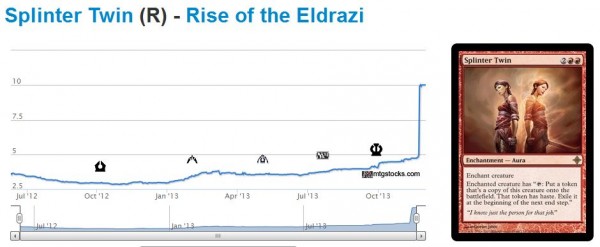
Splinter Twin. Spellskite. Phyrexian Obliterator. Threads of Disloyalty.

All Modern cards which have spiked in the past few months. All cards out of season, so to speak. All cards we’ve predicted here.

What’s next?

I’ve talked repeatedly about how the time to invest in Modern cards is not when the PTQ season is upon us--or even when it’s nearing--but now, when it’s on few peoples’ radars.

The pillars of the format are primed to go up in-season regardless of any small metagame changes. But there are also some other targets we can look at as possible risers, which is the plan for today.

The Criteria

What do all the cards above have in common? They’re all from older sets, often third sets, meaning supply is lower than that of many other cards. We’re not looking to find Snapcaster Mage or Deathrite Shaman here, though those are probably safe pickups as well at this point. What we want to find is the next Chord of Calling or Fulminator Mage.

First, let’s check in on some of the other cards I’ve talked about in the past few months that I really like picking up for Modern right now that haven’t moved yet.

Format Staples – A Check-in

Liliana of the Veil

Holding steady at about $40. I don’t think there will be a ton of upward movement necessarily, but barring a reprint--which may not come until MM2?--Lily is likely to continue to creep up.

Birthing Pod

The spike on this one has been more of a solid growth so far, and it remains to be seen if that’s the precursor to a hard to $10 or just a continued growth. We don’t know the answer to that, but we do know that there’s nothing but upside for the next year with these.

Path to Exile

Somehow the original Conflux printing is the cheapest right now, but all are essentially between $5-6. Path was $8 at its peak, and I wouldn’t be surprised to see it head back that way. Again, this is a slow gainer that banks more on the format season than any particular change in demand. Paths are always going to be safe.

Inquisition of Kozilek

We’ve actually seen some weakness for this over the past few months as Thoughtseize has become easier to obtain. That said, there’s no reason this will decline. It doubled up last Modern season, and while I don’t expect that again I do think it will gain a few bucks. A nice trade target.

Going Deeper

Raging Ravine

Remember Celestial Colonnade and how cheap it used to be? Well, that’s Raging Ravine now. Much like the Scars fastlands that I’ll keep harping on because there’s no reason not to invest in them, Ravine is a solid land that will likely always find a home in Modern.

It’s continuing to climb, from $1 a year ago to $3 now. This is a steady rise, and stock is starting to dry up. Sound familiar? It’s what propelled Splinter Twin to a huge gain, and it’s what could see Ravine suddenly become $8-10 when the general masses catch wind of dwindling supply.

Restoration Angel

I liked it a month ago at $4 (when I first mentioned it) and I still like it at the $5 it’s at now. There’s a copy available on TCGPlayer for $3.50, and that’s just insane. It’s from the same set that’s giving us a big riser in Griselbrand, and is played way more in Modern. I know there’s a promo, but there’s no way this isn’t $10 in a year.

Thrun, the Last Troll

I’m not sure if this is really going to catch on, but it may actually fit into the G/B shell that’s so strong right now. It may forever be a one- or two-of in the sideboard that doesn’t see much price movement, but it’s exactly the kind of card that could have a big weekend and hit $15 overnight.

Elesh Norn, Grand Cenobite

One weekend of a Gifts deck performing well and this will be $20. It’s up from $10 to $13 since I last talked about it, and its casual appeal makes it safe even if it doesn’t go anywhere in Modern.

Torpor Orb/Stony Silence/Grafdigger's Cage

All sideboard options, and all super cheap. I was big on Orbs when they were nearing bulk status despite shutting down a ton of decks, and I still like them now that they’re up to a buck. Orb is steadily trending upward, and being from New Phyrexia supply is somewhat limited.

All three of these cards are unlikely to ever really take off, but they’re great trade targets that you will do well on if you have in your binder in six months. The time to acquire these is now while they’re basically throw-ins in a trade.

Wurmcoil Engine

Hard growth followed by a plateau, this sits at about $13-14 dollars right now. The promo will keep this from going nuts, but SOM was a long time ago at this point. No reason this won’t be $20 in-season.

Staying Ahead

Remember, the time to care about Modern is not in the middle of the season. If we can catch these cards now, we’ll stand a much better chance of getting in at the ground floor of prices.

I realize a lot of the stuff I’ve talked about today has been mentioned before, either in my column or in other QS columns. And there’s a reason for that. These seemingly-sudden spikes like Splinter Twin don’t come out of nowhere. If you’re paying attention you’ll usually see these things coming.

And here’s to that.

Thanks for reading,

Corbin Hosler

@Chosler88 on Twitter

One Part Finance, Three Parts Standard

Are you a Quiet Speculation member?

If not, now is a perfect time to join up! Our powerful tools, breaking-news analysis, and exclusive Discord channel will make sure you stay up to date and ahead of the curve.

As someone who concerns himself with Magic finance, I have learned a few tricks of the trade along the way. I love the finance side of the game nearly as much as competitive play, but not enough to give up trying to qualify for the Pro Tour.

For a while in my life, knowing the value of cards and how to trade effectively was not just something I did for fun. Being a good trader was an essential part of being able to compete. While I was in college, I was what you would consider a poor Magic player. I did not have tons of spare money to throw at the game to insure I had everything I needed for a deck. Instead, I needed to plan and trade for cards ahead of time.

Back then, there were no financial articles to read online so I had to figure things out on my own. Luckily it worked out for me and I figured out quickly what I was doing. All it took was one player ripping me off (my $20 card for his $2 card), for me to commit to figuring out how to trade fairly but also such that it benefited me.

Bulk Box!

Over the years, one concept I adopted was keeping my own bulk box. Often finance players will unload their bulk rares to dealers early and often so they can keep their binder filled with all the good cards. There is nothing wrong with this line of play but I would suggest that there is a better way.

Instead of frequently bulking out your rares for meager profits, throw them all into a box together. Shops and dealers do this all the time. You can walk into any reasonable shop and you will likely find a box or binder labeled $1, or maybe six for $5, etc.

As finance grinders, we are prone to digging through these cards to find the hidden value. Oh look a $2 card in the dollar box! Occasionally, there are some drastically mispriced cards in these places and you can really strike gold. If you are not checking the store's bulk box, you should start.

In the months before Innistrad was released, I wanted to take finance to the next level in my life. Of course I had been speculating successfully on and off for a couple years as well as developing mad action trading skills, but I wanted to kick it up a notch. I wanted to move from trade grinder to dealer.

The shop I was playing at semi-regularly did not have singles and he already had a policy in place that allowed players to sell cards to each other for a minor cut. This seemed like an ideal opportunity and I worked out a deal with him to sell cards in his store.

It was amazing. I had so much fun managing my inventory, deciding on buy prices for Standard cards, and dealing in his store. That unfortunately ended after about six months but I learned more in that time than in the decade I’d been playing before that.

One key concept I learned during that time was that it doesn’t matter how big your business is, you too can have a bulk rare box. At first, mine started small, but then players kept bulking out their cards to me and it grew rather quickly.

In no time at all, I needed to expand out of the thousand-count box to a five-thousand-count one. My suggestion is to limit your box to five thousand and bulk out the twenty extra copies of some cards to another dealer. If you expand beyond that size, players most likely won’t take the time to dig through it.

Getting back on topic, by keeping your own bulk box, not only can you get full value out of a card when a player trades you bulk rares for it, but often it can be even more profitable than that. The reason this idea came to mind this week was because I struck gold in my own bulk box!

There are a number of reasons that your bulk box can benefit you.

The first reason the bulk box is an amazing finance tool is because sometimes you will be able to trade those rares at between $.50 and $1 up for basically any other card players might want. It’s easy to see how quickly your collection can increase if you trade for a card at $.15 and then trade it away for $1. In the dealer world, this is common practice. If you can adopt this practice, the value of your cards will increase as long as you have an outlet for low-end cards like this.

Even if you don’t have players who will trade for bulk rares, like the Commander crowd, you can still profit from building your own bulk box. We all know that players bulk cards that are worth more than bulk, so there will be a small amount of value to be had just by committing to bulking players that want to bulk.

The real gold is when a card jumps in value that you have in your bulk box. For example, over the weekend there was some talk about Forced Fruition going well with the new Grixis commander, Nekusar, the Mindrazer. What used to be a junk rare from Lorwyn is now $4-5.

Pulling five copies of this card from my bulk box was like hitting the lottery. I was able to sell all five copies into the hype at the current $4-5 price point and make a quick profit. So, what are you waiting for? Get to bulking!

Stale Standard

Fear not competitive content readers, I bring you news of new decks to spice up your holiday season. While it may seem like Standard is going nowhere fast due to the dominance of the devotion decks and Esper Control, some players are making a stand and trying out new strategies.

I still love the Bant Hexproof deck I have been working on and I think hardly any players will be prepared to face down creatures they can’t target, but other options are available.

Players like Reid Duke are forging the way with new decks like Bant Control. Kibler is doing his normal aggro thing with Golgari Aggro too. There are unexplored strategies lurking in the shadows of Standard waiting for someone to spot them. Here are the two pros decks in case you have not seen them yet.

Prophet Bant
by Reid Duke
As written about here

Untitled Deck

Creatures

4 Elvish Mystic
4 Sylvan Caryatid
2 Voyaging Satyr
4 Polukranos, World Eater
4 Prophet of Kruphix
1 Prime Speaker Zegana
2 Aetherling

Spells

2 Detention Sphere
4 Jace, Architect of Thought
2 Plasm Capture
1 Primeval Bounty
4 Sphinx's Revelation
1 Curse of the Swine

Lands

4 Breeding Pool
4 Hallowed Fountain
4 Temple Garden
4 Temple of Mystery
2 Nykthos, Shrine to Nyx
6 Forest
1 Island

Sideboard

2 Mistcutter Hydra
3 Nylea's Disciple
1 Sylvan Primordial
1 Detention Sphere
2 Sensory Deprivation
3 Gainsay
2 Bramblecrush
1 Curse of the Swine

G/B Aggro
by Brian Kibler
As written about here

Untitled Deck

Creatures

4 Elvish Mystic
1 Korozda Guildmage
4 Lotleth Troll
4 Scavenging Ooze
4 Dreg Mangler
3 Varolz, the Scar-Striped
4 Boon Satyr
3 Polukranos, World Eater

Spells

4 Thoughtseize
3 Abrupt Decay
1 Hero's Downfall
1 Bow of Nylea

Lands

3 Golgari Guildgate
4 Overgrown Tomb
9 Forest
8 Swamp

Sideboard

3 Mistcutter Hydra
2 Gift of Orzhova
2 Underworld Connections
2 Dark Betrayal
2 Doom Blade
2 Golgari Charm
2 Ultimate Price

Neither of these decks are exactly what I want to be doing in Standard right now, but they are close.

If you have been reading my articles you most likely saw similarities between Reid's Bant deck and the BUG deck I've been working on. They both try to control the game by abusing the untap ability of Prophet of Kruphix. I would prefer my midrange control deck to have black mana for all the things that color has to offer rather than white, but they are similar in design and game plan.

After watching the videos of Kibler playing Golgari, I was not very impressed, but I think the idea is solid. I think what he is lacking is a more aggressive mana curve of creatures to start attacking his opponent earlier in the game.

The two main cards that concern me are Elvish Mystic and Boon Satyr. Both of these seemed to have little impact on the games I saw. Granted, he was only able to showcase a small sample size of games, but I think the deck would be better served by playing Tormented Hero as well as his own Pack Rats.

Finally, he mentioned a number of times how much the lack of a green and black temple was hurting his consistency. It's possible that at strategy like this cannot be successful right now due to the absence of this land.

There is one more deck I want you guys to take a look at today.

W/U Devotion
by Brian Grimm

Untitled Deck

Creatures

4 Soldier of the Pantheon
4 Judge's Familiar
4 Precinct Captain
4 Boros Reckoner
2 Angel of Serenity

Spells

2 Syncopate
4 Azorius charm
2 Cyclonic Rift
2 Detention Sphere
3 Spear of Heliod
3 Sphinx's Revelation
1 Heliod, God of the Sun

Lands

3 Nykthos, Shrine to Nyx
1 Mutavault
4 Hallowed Fountain
4 Azorius Guildgate
4 Island
10 Plains

Sideboard

3 Fiendslayer Paladin
1 Detention Sphere
2 Gainsay
1 Psychic Spiral
1 Dispel
2 Negate
1 Jace, Memory Adept
2 Supreme Verdict
2 Rest in Peace

That is definitely not your typical White Devotion deck, that's for sure. What I love is the ability to use the huge mana generation of Nykthos, Shrine to Nyx to generate a huge advantage on the board. That concept is the main reason I think the Green Devotion deck is underrated. The huge mana gives both decks this explosive capability so that your opponent can't possibly keep up unless they plan to clear the board.

All it will take for you to be hooked on this deck is casting Angel of Serenity in Standard again. Your opponent is not prepared to face a giant angel that clears their board, I can tell you that for sure.

Don't forget about the sweet sideboard plan where the deck boards out twelve creatures and turns into a makeshift U/W control deck. Spear of Heliod in a control shell is actually a huge beating. You can take some damage and then kill their creature. Then, when you revelation, you can replenish your life total. Overall, the deck is a solid aggressive deck with plans in case the game goes long.

No matter what you are doing in Standard, there are a lot of options for you. What sweet decks are you guys playing right now?

Until Next Time

Unleash the Force!

Mike Lanigan
MtgJedi on Twitter
Jedicouncilman23@gmail.com

Insider: How to Buylist

Are you a Quiet Speculation member?

If not, now is a perfect time to join up! Our powerful tools, breaking-news analysis, and exclusive Discord channel will make sure you stay up to date and ahead of the curve.

Welcome back, speculators!

Today I would like to discuss how to properly buylist.

Perhaps you've read this article by Chas Andres: A Colossal Waste of Time.

I have nothing but respect for Mr. Andres, but his methodology for buylisting wasn't well thought out. His first argument was the concept that buylisting is leaving money on the table. The problem is that is only the case if you can actually unload the items you're buylisting.

Normally I only buylist cards I can't get rid of or want to get rid of quickly (usually because they have recently spiked and I don't believe the new price is sustainable). In that sense I'm not leaving any money on the table because the stuff I'm getting rid of has little if any demand. I do not advocate buylisting hot cards but rather those with low liquidity.

Some of my favorites are the older uncommons that nobody in my area seems to ask for and aren't worth enough to lug around to major events. These are typically the casual all-stars that stores will pay a decent amount to stock up and then the buylist price drops back to bulk after they have built up sufficient stock.

These can also be some of the more recent good uncommons, as the print run was large enough that they are likely not worth more than a dollar or two and again aren't worth carrying around all the time just in case you run into the one person who actually wants them.

Now let's get into the actual process of buylisting efficiently. First and foremost:

Organize your Collection

This aspect is critical. Chas's attempt at buylisting proved inefficient because his box was unorganized. While it will take a good bit of time and require some maintenance, organizing your collection is well worth the effort. It allows you to quickly search for cards and verify quantities.

I have broken my collection down by set (which seems the most logical). It does take quite a bit of time upfront, but luckily it's one of those things you can do bit by bit. The task for many of us seems quite daunting (if you're staring at 10,000+ cards) but luckily you can do one box a night or so and progress will show quickly.

I will warn you ahead of time that because there are so many sets, making piles or boxes of each set will take up a lot of room. If you're planning on doing a little at a time you'll want to make sure you have space available until the job is complete.

I'm currently in the process of putting each set or block into a 1000-count box with labels on the top and end. This allows me to easily find the set I want to focus on as well as help me build EDH decks.

I have already pulled the Legacy commons and uncommons (Reanimate, Exhume, Innocent Blood, Brainstorm, Ponder, Preordain, etc.) and placed them in a seperate "Legacy Staples" box which allows me to quickly and easily build most Legacy decks. This box is also sorted by color (though a second box for just blue cards was needed).

For each set I then verify I have a playset of each card (which I put in penny sleeves) and then all extras go to the back.

This might be a bit more than most people want to do, but EDH is big in my area and I often get requests from friends for a bunch of random older cards to build a themed EDH deck. They'll trade me well in order to get those cards easily.

Determining Which Buylists to Use

The QS forums are very useful when reviewing various sellers and stores. A quick 10-20 minute read will highlight issues your fellow Qsers have suffered at the hands of various stores as well as which stores have a good reputation. I won't dictate which stores to use, but there are certainly a few that I personally would prefer to focus on.

Once you've determined which ones you want to use, the next step is to take a blank piece of paper, write the names of each store and use them for sorting. Condition is a major factor when selling to buylists.

According to the forums, and confirmed by my personal experience, you must be diligent and thorough in your grading, especially if the store you're sending to doesn't accept LP cards. You may end up getting hammered not only on the price you're paid, but also by a reduction to cover shipping costs for the non-NM cards they rejected.

It's also important to visit each store's site as many have different ways of doing their buylist. For example:

  • Card Kingdom has you use a card search tool and add the card to your selling cart. They request you order the cards the same way you list them in your buylist order.
  • AdventuresOn has you look up the card via set and add to your selling cart. They request you order the cards the same way you list them in your buylist order.
  • Troll and Toad requires you to download their buylist in spreadsheet form, add the cards your selling in the sell qty, and resubmit it to them.
  • ABU Games also requires you to look up the card via set and add to your selling cart. They will list which cards they accept in non-NM condition, otherwise you're wasting your time.

Using MTG.GG Efficiently

The MTG.GG program provided by QS is ideally used in two ways.

If you've isolated a pile of cards you want to buylist you can simply type in each one and place each card in the highest store's respective buylists.

The other way to do this (and the way I prefer) is to filter by set and a specific price. When filtering by set you can quickly run through each set and look for only a few cards at a time.

For my low-end filter I use $0.25. While I can understand the desire to unload those $0.03-0.07 commons (which is a much higher rate than the bulk $0.003), one factor to consider is that each card has a weight which will (potentially) add to postage costs. That's why I think $0.25 is a good cutoff and why I don't really touch the super cheap commons and uncommons.

Mailing Your Buylisted Cards Off

Now that you've isolated which cards you're sending off you need to ship them.

It's important to keep in mind the cost of postage as well as the cost of whatever packaging materials are needed to ship the cards. I bring this up because if you have any buylist piles of 15-25 cards that only buylists for $4-5 dollars you will likely find that after postage and packaging materials it's no longer worth sending.

I've found that you can ship small amounts of cards (four or less) in plain white envelopes in a plastic top loader and penny sleeve with a standard stamp and they'll be fine. More than ten cards and you'll likely need to use a bubble envelope.

These cost considerably more than plain white envelopes. I have yet to purchase them in large bulk (as some of the other guys on here have, so they've likely reduced costs considerably) but you can get these types of envelopes for $0.50 or so.

Your shipping cost from USPS (which from my experience is the cheapest way to ship these smaller packages) will likely be from $1.00 (small orders) to $2.50 (50+ card orders). If you're sending a huge buylist sell off (hundreds or thousands of cards), I would look into the flat rate packaging provided by USPS.

Now you wait. Unfortunately, even the best stores seem to take a while to send payment. Many stores now offer payments via PayPal, so if you pay your bills with PayPal or plan on using the money for online orders that will speed up the process a bit. But even then I hear that a lot of the stores take a bit of time to process payments.

I do want to apologize to all the non-US readers as I don't know how often you guys can buylist--most of the buylists I'm aware of are all US based--and international postage costs can be astronomical. I do hope that the basic principles of the article are universal enough to provide everyone with something useful.

Jason’s Alticle: The Cost of Doing Business

Are you a Quiet Speculation member?

If not, now is a perfect time to join up! Our powerful tools, breaking-news analysis, and exclusive Discord channel will make sure you stay up to date and ahead of the curve.

YO

You're supposed to Capitalize each important word in a headline but to me, it always ends up looking like something tweeted by Spike Lee.

Yo


You know what else is a cheap trick? Taking 8% of your money.

That Time I Almost Lost 8%

Like none of you know because you don't see me as a person, but rather an advice dispenser that is only as valuable as my last good spec tip, I live in Michigan. On purpose.

It's cold as balls in December, the unemployment is high and no one realizes that the movie Robocop was satire, but there are real advantages to living here, too. A low cost of living means it's almost too easy to make a living at MTG finance. Also, this weekend, living in Michigan came in handy when I decided I wanted to drive to Grand Prix Toronto.

Easy Come

We drove across one of the bridges and stopped on the Canadian side to exchange money. Each American dollar was buying us $1.05 Canadian, which doesn't exactly harken back to the salad days of a strong American dollar, but isn't a shotgun blast to the groin either.

If something that cost $1 in the US was only going to cost $1.05 in Canada, that would be super, but we know that isn't true. Gas, food, hotels, even Canadian strip clubs cost more because anything smaller than a $5 bill comes as a coin and it's impossible to slip a Loonie into some high school dropout's G-string. Still we got a modest bump at the border and we were going to make the best of it.

Easy Go

I knew I was going to Canada to sell Magic cards and chew bubble gum and a pack of bubble gum is like $11 in Canada. That 5% bump was ever present in the back of my mind because I knew that everything I made up there was going to be subject to the sticky end of the currency conversion rate on the way home.

I assumed I would lose 5% going back across the border, potentially because I am rather naive. Part of this naivete was fueled by the fact that previous trips to Canada were on the heels of American Grands Prix and a lot of the dealers still had a lot of their money in US dollars.

Since the exchange rate was pretty close, they paid me in American dollars and saved themselves having to exchange them and I saved myself the same hassle. I was hoping to work that same deal this time around and no one took me up on it.

That 5% I'd lose changing Canadian plastic loony fun bucks into actual currency? Yea, it's was more like 8.125%

How I Accidentally Got There

Despite spending all of Sunday and a few hours of Friday and Saturday selling to dealers, I only came back with about $200 Canadian to exchange. I lost ~$16 where I expected to lose only $10 and wasn't the happiest camper.

I wasn't the unhappiest camper in my car because my constant companion and partially-hetero lifemate Ryan Bushard had quite a bit more money to exchange and the dick sammich he ate at the border was much larger and without condiments.

How did I avoid such a fate? Total accident.

Okay, perhaps it wasn't a total accident. I sat down at all the dealer tables with most of my cards ogred. If you aren't familiar with this term, it's one we coined to refer to a technique invented by Matthew "Ogre" Stevens. "Ogreing" is the technique of figuring out the buylist price you need ahead of time for your cards, then sorting them by price. You present the cards to a dealer and tell them to take any cards they want at that price.

It saves them having to look stuff up on a buylist, it saves you taking a number that's lower than you wanted and has the side effect of occasionally getting a dealer to take a card at a higher price than they would have offered because they find they want the card enough.

You run the risk of them taking a card at a lower price than they would have offered, but, who cares? If it was a number you were happy with when you put it in the box at that price, you lost nothing, and saved a ton of time in the process.

Ogreing a portion of my cards saved me a ton of time. For higher-end stuff you will take the cards to dealers who typically pay the best and let them offer their numbers. Even then, you can save yourself some time by just ogreing to their buylist specifically. If you know which vendors will be at the event you're attending you can see which of them pays the highest and put together a box just for that vendor.

Since my cards were ogred the dealers accepted my numbers with the expectation that they would pay me Canadian dollars for the cards and my expectation was that I would want to get an amount of money that would be equivalent to selling those cards to a buylist in America.

Losing $5 every hundred could be construed as the cost of shipping or whatever other breakage is involved with buylisting, but I wasn't interested in losing 5% on the barrelhead.

I asked to be paid in American dollars which none of the dealers had this time because no one was in America last weekend like last time I was in Toronto. I asked the dealers to tack on 5% and I'd take Canadian money and no one was willing to do that. Oddly enough, I did manage to get one dealer to agree to tack an extra 5% onto their trade-in bonus.

I shipped them a majority of the cards and stocked up on cards that people back home had asked me for. If I sold those cards at TCG Player prices in person I could avoid TCG fees, currency exchange fees and could get the closest possible thing to getting paid in American dollars. Some of their cards were a little overpriced, but a generous trade-in bonus mitigated the higher costs somewhat.

Some cards hadn't gone up yet and lagged behind the American market quite a bit, making them an even better place to stash value. I still wanted to come home with some cash, but I parked a great deal of what I buylisted in cards for orders.

If you go to a lot of Grands Prix or even smaller events with a lot of dealers and know of people who don't get out much, offer to pick them up cards. Sure, anyone could buy stuff online, but sometimes it's easier to get obscure cards through you.

I also advocate making friends of casual players and those kind of players would rather go through someone they trust than order cards online sometimes. I would have no idea what the best website to use for ordering hockey equipment is despite being enthusiastic about hockey, and casual Magic players are the same way about ordering cards online to some extent.

Make a case for it being either easier, cheaper or faster to have you bring them cards back from a GP and you should get some number of people inclined to have you bring them the stuff back. If you get a trade-in bonus for cards you buylisted, you make that bonus percentage on top of the transaction meaning it's better than getting cash and buying cards.

Sure, the buylist only pays 40-60% of a card's value usually, but you were going to buylist anyway. This is a great way to trade piles of cards you don't want for more cash than usual and all you're doing is helping a friend get cards they want. It's a win-win.

Having a long list of cards I needed to bring back for people at home helped me park a lot of my value in cardboard which was not "taxed" at the border. Sigmund makes a good case for using the trade-in bonus instead of taking cash when you buylist cards either in person or through the mail, and while I am not always inclined to agree, it sure paid off in this case!

One more factor on my favor was my inability to resist a "Played Case". Vendors will put cards that are played or damaged in a special fire sale case with very low prices to move through them and I can't not buy cards from them.

$15 Maze of Ith with a little edge wear? Call me Robocop because dead or alive, you're coming with me. $60 Unlimited Tropical Island with a crease in it? Sold!

My actual favorite kind of Magic card is a card played without sleeves on a cafeteria table. The front is pristine and the back is jaaaaacked up. Tapping a card on a hard surface covered in crumbs and other bits of detritus leaves scratches and whitening on the back of the card but leaves the fronts relatively unscathed.

You know which cards were tapped the most frequently in an era before sleeves? If you said "dual lands" then you win a prize. The prize is a bunch of really cheap dual lands if you know where to look.

When I pick those cards up in trade, I make sure to emphasize how jacked up the back is and try to get the lowest price possible. The seller is usually happy that someone is willing to pick up damaged cards. When I get rid of them, I make sure an emphasize how good the front looks and how the card will be played in sleeves anyway making the back irrelevant.

Selling on TCG Player is an excellent way to get rid of played cards because often the pricing difference between conditions is very low (sometimes one penny) and people just want the cheapest copy and won't complain as long as you grade the card correctly.

I bought a lot of played cards at the event and that ate into my cash pile very quickly. Those cards will be turned into dollars back home. I certainly wasn't thinking about how I was beating the exchange rate, I was just unable to pass up a $12 Griselbrand with very light scratches on the back that will trade out for near full value.

What I Should Have Said Was Nothing

One more reason I didn't have a ton of cash to bring back with me was the opportunity I had to help raise some money for charity, even if that charity was a crazy Canadian charity whose monetary contributions are, by my math, 92% as effective as American contributions. QS alumnus Ryan Abcede organized some celebrity gunslinging for charity and asked if I'd like to participate.

This guy knows what I'm talking about.

Heavy Meta's Matty Studios, Mana Deprived's Dave Lee (AKA Derfington), myself, Ryan Bushard, and The Eh Team's Scotty Mac all took turns playing against challengers who wagered a charitable donation that they could beat us at cards. There were prizes available if they won, based on the size of the donation.

We all built sealed decks to play against people who wanted to use their pools from the main event but over the course of the day I played every format. I played more games of Magic in nine hours that I have all year, I think, and while it was an exhausting day, screw it, the victims of the typhoon in the Philippines have it a lot worse than I do so I was glad to help.

824973711

You can kind of see the back of my head in the middle, there. We raised some money for charity and a good 75% of the people who came up to the table knew who Ryan and I were by virtue of our Brainstorm Brewery t-shirts and my sitting next to Matty. The Eh Team and Heavy Meta are quite popular, especially among Canadians, and I was glad Matty and Scotty were there to lend me some of their gravitas and credibility.

Should what happened in Canada prompt a re-evaluation of buylisting cards for credit instead of cash? Perhaps! Stay tuned for that article as soon as someone else writes it.

Wrapping Up

Since Grand Prix Toronto was sealed, and there was no SCG Open, I can cut out early this week.... there was a GP in Europe, wasn't there? I just know it would be too good to be true.

Mother%&*^er

Okay, I've calmed down now. Let's make a deal. I'll gladly look at the Top 16 of this event and write about any and all new or emerging archetypes.

Let's look at the Top 8.

Mono-Blue

Esper

Mono-Blue

Mono-Blue

R/W Devotion

U/W

White Weenie

R/W Devotion

Okay, fine. All snark aside, I want to talk about two of these decks. Also worth noting is the absence of Mono-Black in the Top 8. This is worth your time and mine.

White Weenie splashing a teensy bit of red to Boros Charm faces is intriguing. Temple in a deck with twelve one-drops is ballsy but I like it. I think with even the "devotion" decks beginning to jam extra colors, Soldier of the Pantheon is this set's Champion of the Parish.

I expected it to go up when the next set was announced because it will most likely have a multi-colored theme if twitter is to be believed, but it's already crept up to $3 most places. I don't think $3 is terrible, but these are a great trade target and I snagged a ton to launder Canadian money after a trade-in bonus.

Nothing like turning a pile of Heedless Ones into what I picture being a $5-$7 card next year. Is $7 potentially too high? It looks wrong to me and I don't know why. $5 just "feels" like the right number to me but I could be comparing it too much to Champion of the Parish, a card that was actually narrower.

Still, one of you dingleberries is going to say "lol remember when he said Soldier of the Pantheon would be $7? What a jagoff!" in like six months, so let's agree this is a $5 card gettable for $2-$3 now and an excellent trade target.

Ajani continues to be buoyed by decks like this. I don't see room to make money on Spear based on what the other weapons are doing (nothing, that's what) but this has decent EDH appeal. No one plays Coastal Piracy in EDH but a lot of people play anthem effects and this one can keep their general off of your back if they're playing a Voltron deck. Probably no money here, though. White Weenie being viable is cool.

The other deck running Temple of Triumph is a red devotion deck splashing a little white that put two copies in the Top 8. I like all the sideboard options the white splash opens up, and four Sacred Foundry is not a liability and the four Temples of Triumph serve as smoothing that you might want to run anyway just because they're better than a Mountain most of the time.

Chained to the Rocks is great as a white splash. Assemble, Helix, Wear // Tear--all solid cards and you sacrifice nothing to access them. This is the new face of devotion.

Wow, no Mono-Black in the Top 16 at all. Mono-Blue is clearly the heavy favorite. You know what isn't the heavy favorite? Zero copies of Voice of Resurgence in the Top 16. Being as it is from Dragon's Maze, a set worth approximately a pack of Dragon Shields, Voice is unlikely to come down due to the economics of redemption sets.

One way to get more Voices is open DGM packs, which is distasteful to say the least. The other way is through redemption, and if you are buying a redemption set on eBay, you won't want to pay $150 and then turn around and out the Voice for $10. Either redemption stops because it isn't worth it because no one wants the set and demand keeps the price up or the fact that the set is otherwise worthless keeps the price up. Cheap Voice of Resurgence is a pipe dream for a long time to come despite how little play it sees.

That's about all the news that's fit to print out of Austria, so let's say "G'Day" to the Austrians and move on. Throw another shrimp on the barby! Hope a dingdong didn't eat your baby! #AustrianReferences

According to SCG's website, there was no Open this weekend, and also, Willy Edel won GP Toronto with an innovative Jund deck. This is probably a big surprise to Ari Lax who actually won GP Toronto with an innovative draft deck because it was sealed. Ladies an gentlemen, industry leader Star City Games. Let's give them a round of applause.

Hugging and Learning

If this were a heart-warming sitcom, we would talk about what we learned. What did we learn?

I learned that you shouldn't get paid American prices in Canadian dollars if you're going to lose 8%. I learned that if you try to cross into Canada with Deshaun Baylock in your car, you're going to be subject to a "random vehicle search" every single December.

I learned that I still love the played case, Brainstorm Brewery has fans in Canada, blue rare is the only way to order a steak, my EDH decks suck and I wouldn't have it any other way, Canadian hotels don't have free breakfast pretty much ever, there are not 1.8 liters in a gallon so don't assume that's the case when you buy gas, people aren't embarrassed to wear Vancouver Canucks jerseys in public even though they should be and sometimes playing Magic can be fun.

Congratulations to Ari Lax for his win, Ryan Abcede for his successful charitable event (come back and write for us, Ryan) and to the currency exchange in Sarnia, Ontario for getting more value out of Ryan Bushard in five minutes than anyone who traded with him all weekend combined.

I'll be back next week for more money laundering tips and more bitching about how much Mono-Blue there is. Brew something with Voice of Resurgence, people. It's it's going to be $30, it should act $30.

Insider: Zero to Draft – Refocusing

Are you a Quiet Speculation member?

If not, now is a perfect time to join up! Our powerful tools, breaking-news analysis, and exclusive Discord channel will make sure you stay up to date and ahead of the curve.

Zero to Draft Series: Part 1 | Part 2 | Part 3 | Part 4 | Part 5 | Part 6 | Part 7


Howdy, folks! It’s been a while since we checked in on my Zero to Draft project, so that’s the plan for today. If you haven’t read the intro article, you can find that here.

Let’s start with taking a look at my overall stats:

Events played: 11 total – nine drafts, one sealed, one 2HG sealed
Money spent: $114
Money received from card sales: $75.52
Buylist value of trade binder: $62.92
Net money spent: -$24.44
Packs held: 9
Draft record: 19-3
Sealed record: 5-3

When I first began this project, my vision was to combine good trades with occasional prizes to draft for the season at little to no cost. As it’s turned out, besides opening Stormbreath Dragon, Thoughtseize, and Xenagos, the Reveler at prerelease and release events, cards of significant value have eluded me. Those three high-value cards were a great start to the project, but I sold the two mythics right away while prices were still in prerelease-hype land, and used the Thoughtseize to trade up into an Arid Mesa. The fetch land isn’t going anywhere until Modern season, and since that trade, the most valuable card I’ve drafted has been Heliod, God of the Sun. That means I haven’t really had significant trade bait during the course of this series.

Luckily, I’ve been winning a lot. My Draft record is almost embarrassingly good— way better than I imagined when I started this project. I wish I could say I’ve solved the format, but I haven’t been nearly as successful online. Still, I’ve done around 60 Drafts on MTGO, so I likely have significantly more experience in the format than all but a few players at my LGS. My Draft record is certainly impacted by some easy matchups against newish players, but I’ve also won my share of matches versus competitive players with varying levels of Pro Tour and Grand Prix success. Regardless of who I’ve played, 19-3 is way better than I expected.

I obviously think this whole situation is sweet, but the problem is that I don’t want you to think you need an 86% win percentage to play for free. I’ve noted that I’ve been getting unlucky with what I open, but I’d be foolish to think my win-loss record wasn’t at least partially impacted by good luck. These kinds of things ebb and flow—sometimes you might find yourself opening money rare after money rare but completely unable to win a match. We can’t plan in advance for our wins and losses or what we crack in packs, but we can make the best of our situation once it becomes known.

This is a finance website, though, and I’m not here (or probably even qualified) to teach you how to win in Theros Draft. But with so little trade bait, I’ve been making very few trades. How can I bring the spotlight of this series back to finance?

Refocusing

Part of my problem is that I’m not thinking on the correct scale. I’ve been telling folks I need Spellskite and Griselbrand and Cavern of Souls, but I don’t have a binder full of sweet Modern cards or expensive Standard cards to trade for those up-and-coming staples. Furthermore, Draft night at my LGS is Draft only, which means Constructed players aren’t really hanging around in great numbers. The trade binders of Limited players are often made up of only the set(s) being drafted, and I’ve been pretty vocal about not being interested (for now) in what Theros has to offer with regards to speculation.

All this has resulted in me just not trading as much, but dammit, I want to be trading more. So I’m going to have to figure out what Theros, M14, and Return to Ravnica block cards are worth targeting despite my misgivings. In this type of situation, I like to check Trader Tools to determine which cards have the lowest spreads.

Theros

The lowest spread for a card in Theros is for Temple of Silence at 30%. The next lowest are:

Stormbreath Dragon (32%)
Erebos, God of the Dead (33%)
Sylvan Caryatid (35%)
Temple of Deceit (36%).

Based on the points I made in my article last week, I’m holding off on getting in on any scry lands. I think there’s a good chance they’ll be worth buying eventually, but I anticipate a drop in price when Born of the Gods is released. As such, I don’t love them as a spec at this time, nor do I like the other rare on this list, Sylvan Caryatid.

This leaves Erebos, God of the Dead and Stormbreath Dragon. Of these, I like Erebos significantly more: it sees play in Mono-Black Devotion, is a mythic, is currently priced lower than $10, and is just generally cool. The dragon is cool, too, but is it really going to spike to Thundermaw Hellkite levels? Remember that the Hellkite was from a core set, which are notoriously undersold. Thus, there are going to be a lot more Stormbreath Dragons in existence than Thundermaws, and this isn’t even taking into account the fact that Thundermaw is probably better. Buying in at $20 seems dangerous.

M14

I’ve been trading for Liliana of the Dark Realms, as the spread is only 29% and $5 is roughly the floor for most planeswalkers. I don’t have a ton of faith that this will ever spike, but Mono-Black Devotion is a thing, so it is possible. I don’t particularly like the card, but I’m happy to pick them up at this price, even if it's just to out them whenever I submit my next buylist.

Mutavault and [card/]Scavenging Ooze[/card] are priced a little high right now, but I still like acquiring them in trade when I have the chance. Eternal reprints in undersold sets like this have a good chance to rebound back in price more than your typical reprint.

Dragon’s Maze

Ignoring the 11 cents Troll and Toad is paying for a single copy of Wind Drake, the lowest spreads for cards in Dragon’s Maze are:

Master of Cruelties (26%)
Blood Baron of Vizkopa (32%)
Maze's End (32%)
Progenitor Mimic (34%)
Voice of Resurgence (36%).

All five of these are mythics, and Dragon’s Maze was a small third set that was generally disliked. Add to this the fact that its Draft format was disrupted by the release of Modern Masters. These circumstances alone probably make any cheaply-acquired mythics from the set a good hold, but if I had to choose one, I’d pick Progenitor Mimic for its casual appeal and low price. There’s not much risk here, but there’s a lot to gain if it hits, both in the short term and the long term.

Gatecrash

I’m unexcited by the cards with the five lowest spreads in this set, but scanning further down the list shows Prime Speaker Zegana at a reasonable 39%. I’ve been touting this card since it fell below $3, and I still have faith that good things could happen here. Like Progenitor Mimic, this one is nice because if it fails as a Standard spec, it will likely still pay off in the long term as a casual spec.

Return to Ravnica

The card with the lowest spread in which I’m most interested is Abrupt Decay(36%). This is kind of an interesting one, because it’s a rare from a fall set and there are basically infinite copies out there. But the card is a Modern and Legacy staple and there will likely not be a similar card printed for some time. Scooping these up when the opportunities present themselves shouldn't be bad.

With the same spread, Chromatic Lantern is also a good pickup, but in this case, it’s for the casual crowd. This seems likely to be a $5 card in a year or two, similar to Coalition Relic. Remember that EDH doesn’t need new people to start playing to create a demand for more cards, it just needs the current players to build more decks (Jason Alt detailed this line of thought quite well in the Brainstorm Brewery podcast from a couple weeks back).

Taking Action

When I don’t take the time to do this type of research, trading can be a crapshoot. Since I don’t play Constructed, there aren’t often cards I need for decks. If I don’t have specific cards I’m seeking, I just end up winging it. Sometimes this causes me to make bad trades, but more often it just causes me to waste time. Picking out about ten recent cards to focus on acquiring helps both my trade partners and me.

I still think Modern cards are the place to be these days, but since the binders I’m seeing are filled with Standard/Limited cards, it seems prudent to determine which ones are the best to target. As traders, we should know what types of cards are likely to show up in local trade binders, know which specific ones offer the most potential profit, and have the appropriate stock to make the trades happen.

Let me know what Standard cards you think are best to target in the coming weeks. Spread isn’t everything, but it sure can be instructive. Is there a card with a high spread that nonetheless has a high upside for profit? Please share your thoughts in the comments!

Insider: So Much for a Quiet Holiday

Are you a Quiet Speculation member?

If not, now is a perfect time to join up! Our powerful tools, breaking-news analysis, and exclusive Discord channel will make sure you stay up to date and ahead of the curve.

Before I begin this week’s article, I want to take a step back and acknowledge that I have been writing for Quiet Speculation for roughly two years now. In light of the recent holiday, I just wanted to give thanks to the QS staff, writers and most importantly, the subscribers. While it’s true this site couldn’t exist without editors and writers, this site would be a waste of time if we didn’t have such an engaged, energized community. For this I thank you all.

Has anyone else noticed the recent resurgence of price jumps lately? Just last month I was writing about how MTG finance was becoming stale. Now every time I check mtgstocks.com I notice interesting movement. This morning it was Forced Fruition, which I can only imagine is being bought out for the same reasons Wheel and Deal spiked one week earlier.

Fruition

In case you’re wondering, I do not plan on buying into this one. Don’t get me wrong, I did a quick search for any remaining cheap copies. But unlike the case of Wheel and Deal, this buyout was very thorough. TCG Player, eBay, and Amazon were all virtually bought out.

I could acquire $3 copies on Card Shark, but at this price point I begin to doubt what upside remains. I bought into Wheel and Deal because I could find copies still in the $1.50 price range. In the case of Forced Fruition I’m going to stay on the sidelines.

Modern Spikes: What’s Going on Here?

As you all know, Modern PTQ season has been delayed. Man, that is a shame. That means all my Modern investments won’t go up for another six months or so. I mean…wait a second…what the heck?!

Twin

Are you serious???

Spellskite

Why are these Modern staples jumping now despite the delay in Modern season? I understand these cards are likely to go up eventually, but it's odd that so many players and/or speculators are taking interest now. Other than local FNM’s there are not even many competitive Modern events available to play in. So why the sudden spike in demand?

A Theory, Nothing More

As MTG speculators we like to be on top of things. Often times the most profit can be had by being one of the first to embrace a card’s potential growth. We all knew that Splinter Twin was the cornerstone of a successful tier-one Modern deck. We also knew that this same tier-one Modern deck could be slowed down significantly by Spellskite. Thus the recent price jumps come as no surprise.

The first people to recognize how cheap these two Modern staples were made the highest profit. But if this was so obvious, why didn’t the spike in price take place earlier? Why did Spellskite even drop in price at all? Why didn’t it just go higher and higher?

In my opinion, the rationale is tied to Standard. Yes, Standard. Allow me to explain.

When Dragon’s Maze launched, it was greeted with a lukewarm reception. What’s more, the impact this set had on Standard was minimal due to the maturity of the format.

Everyone knew Innistrad would be leaving in a few short months, causing a sudden increase in demand for many Return to Ravnica block cards. Then when Theros launched and Standard rotated, the RtR block spike occurred.

Jace

Chandra

With Standard rotation we saw speculation all over the place. Planeswalkers jumped after seeing tournament play at major events, removal spells became more costly, etc. Clearly cash was pouring into the format as everyone wanted their chance at some profit. Hopefully they sold in time.

Now that Standard has once again reached equilibrium, many are turning their focus elsewhere. The quick, easy money from Standard rotation has already been made. Recent selling activity in the cards above and others has led to an increase in cash among the MTG finance community.

With this recent jump in cash stores, I propose that many speculators are now turning their attention towards Modern. They recognize the disadvantages of holding cash (high opportunity cost) and they want to put their funds to work. Because Modern demand is an inevitability, why not start investing now?

This could have led to the recent spikes we’ve been seeing.

What to Do About It?

I see two forces at work. First, we know that Modern season doesn’t actually start for months. This means that genuine demand from actual players may not have arrived just yet, implying prices could go even higher.

Second, Born of the Gods could shake up the Standard format significantly, leading to shifts in demand. Some Standard cards may jump in price when this happens, yielding multiple profitable opportunities in the near term (while Modern cards sit around and wait for demand).

If my theory is correct, we may see small price pullbacks in recent Modern interests once Born of the Gods is released. People may take some profits on cards like Phyrexian Obliterator and Splinter Twin to invest in the right Standard cards for a quick flip.

Obliterator

But this pullback could be temporary. Surely a month or two after Born of the Gods is released Standard will once again stagnate. What’s more, Modern PTQ season will only get closer and closer. Eventually interests will shift completely to Modern, sending prices even higher.

Therefore if you need funds to speculate on Standard in the coming months, I cannot fault you for taking some Modern speculation profits off the table. On the other hand if you can afford to sit on them, Modern staples should yield a healthy payout this summer.

I plan on holding any Modern cards I firmly believe will remain relevant during the Modern PTQ season. This means deck cornerstones like Splinter Twin, Birthing Pod and Inkmoth Nexus will not leave my binder.

I do wonder if selling speculative cards like Phyrexian Obliterator could be the play. I may miss further upside, but I also take profits now without risking a drop should the mono-black devotion strategy not pan out in Modern. Food for thought.

So Much for a Quiet Holiday Season

There’s always a bull market somewhere. I firmly believe in this statement, and although it is typically used to refer to Wall Street, it may also be applicable to MTG investing.

If a format stagnates, perhaps it’s inevitable that speculators turn their attention elsewhere for opportunities. After all, the Single Card Discussion forum within this site always contains new ideas, many of which are worth pursuing.

It just goes to show you that a community of speculators will always chase the bull market. So much for a quiet holiday season.

My advice to you comes in three parts. First, make sure you observe market trends closely to detect any shifts as I have noticed above.

Second, consider acquiring Modern staples which haven’t seen as much of a price bump yet. Their time will come.

And finally, begin to strategize about your Standard portfolio three months from now. Do you want to play the nonbasic land strategy again by acquiring cheap temples? Do you prefer buying Standard cards that will eventually see Eternal play? Or do you like to buy cards right before they spike when a new set is released?

Either way, take this time to identify what your strategy will be after the New Year. Many opportunities will present themselves in the coming months. The more prepared you are, the less likely you’ll get distracted by stuff like Forced Fruition and Wheel and Deal. Focus on the cards that really make sense and you won’t be disappointed.

Sigbits

  • Foil Celestial Colonnades have jumped in price significantly over the past year. Earlier this year I purchased a couple copies from Star City Games at around $6 each. Now SCG only has a couple SP copies in stock at $19, and TCG Player appears to be completely sold out of the set foil. Copies are even difficult to find on eBay. Perhaps moving into foil Creeping Tar Pit is the next play here?
  • SCG is selling Commander 2013 copies of Baleful Strix for $14.99. Don’t be fooled--this card just isn’t worth this much anymore. Copies are selling for $7 on TCG Player and eBay. Quite the spread, I must say. That being said, if you can trade using SCG prices at your LGS, this could be a fun one to buy online and trade locally. Just be aware that this card’s retail price will eventually go lower.
  • You know what hasn’t been talked about as much recently? Zendikar fetchlands. Have these finally reached a plateau? I see Scalding Tarn retails for $55 and foils for $200. Regular copies can be had on TCG Player for about $10 less, at around $45. This seems like a healthy cash-retail spread, and I suspect fear of reprint will keep speculators at bay on this one.

Insider: The Return of Daily Events

Are you a Quiet Speculation member?

If not, now is a perfect time to join up! Our powerful tools, breaking-news analysis, and exclusive Discord channel will make sure you stay up to date and ahead of the curve.

This week, WoTC via Worth Wollpert announced the probable return of both Daily Events (DEs) and Premier Events (PEs) after the downtime on December the 11th. You can read the announcement on the mothership here.

This was welcome news to grinders, fans of DEs, and patient speculators. Although market disruptions can bring opportunities for quick flips, the much easier (albeit slower) strategies rely on a stable-to-growing game, which is where I like to allocate my capital.

We don't know at this point what queues will be leaving, but I expect things to return to approximately what we had before the suspension. This means no Legacy or Pauper 8-man queues and the removal of the 6-booster THS sealed queues. I'll consider what the return to normalcy means for my portfolio in the coming months.

M14 Boosters

These have been drifting down in price since DEs were suspended. This was partly due to Two Ticket Tuesdays being offered on demand, but mostly to a lack of demand for M14 Limited play. Without M14 sealed events to absorb supply of boosters, combined with the continuing interest and popularity of Theros (THS) Limited, there has been no strong push into M14 as a limited format.

The return of DEs should spark some demand for M14 boosters, supporting booster prices going forward. Interest in M14 Limited will level off in advance of release events for Born of the Gods (BOG), so the selling window for these will be the last two weeks of December into the first two weeks of January.

Once BOG hits, there will be renewed interest in THS-based draft so it's not advisable to be holding M14 boosters beyond the end of January.

My original price target for these was 3.5 tix or so, with some thought given to the potential for higher prices. Recent events have forced me to downgrade my expectations and I am now looking for these to reach 3.3 to 3.4 tix before I start selling.

I will continue to reassess the situation as we get closer to the end of December, but keep in mind both the selling window and the target selling price. Deciding when to sell depends on both of these factors, with the time element becoming more important the close we get to BOG release events.

Shocklands

As a whole, these have been rather disappointing. The strong awareness of the financial community around these cards reduced upside by raising the price bottom last year. Next, they have suffered as a speculative strategy due to the push that monocolour decks got from M14 and THS.

I've sold some of my stock, especially ones that reached prices close to or above 4 tix, such as Sacred Foundry and Godless Shrine. I will look to sell the rest after the release of BOG and the ensuing shakeup of Standard.

In the past twelve months of Standard, the pendulum has swung from three-colour as the norm to the recent rise of monocolour devotion decks. The rumor of multicolour demigods showing up in BOG implies that we'll see another swing in the pendulum, away from monocolour strategies and back towards two- and three-colour decks.

February and March will be the best time to catch this shift, and I will be sure to sell down all of my remaining shocklands in that time frame.

Theros Boosters

Originally I had pegged THS boosters as the perfect vehicle to move profits from M14 boosters into. The normal pattern was for the price of THS boosters to come down over time due to the prizes awarded from DEs. After BOG is released, DE prizes would switch to awarding BOG boosters. But with two boosters of THS needed to draft, prices would eventually rise as supply dwindles.

The suspension of daily events disrupted this plan. Prices on THS booster have remained high, and are only starting to come down in the last week. If the suspension of DEs had continued, it was looking like there would be no speculating on boosters this winter.

However, things are looking up with the probable return of DEs in December. In order for this trade to work out, prices have to dip low enough, so look to buy THS boosters in the 3.1 tix range or less.

There will be an absolute price bottom during BOG prerelease events as tix come into high demand. This means the buying window will begin in January and end once BOG release events wrap up.

Down the road, THS boosters should get back into the 3.5 to 3.7 tix range. Although speculating on M14 boosters might turn out to be more marginal than anticipated due to recent events, THS boosters should follow historical patterns if DEs and PEs return as expected.

Modern

Prices took a dip in recent weeks, but have showed signs of recovering. The return of DEs and PEs is a good sign for Modern cards in the short run. In the medium term though, WoTC did not confirm whether or not PTQs and larger events will return to MTGO in time for Modern season. As it stands, they are doubtful that PTQs will return in time for Standard season in January.

I think the lack of PTQs removes some upside on Modern cards in general, but not enough to deter speculating on staples. If you've been paying attention to the Single Card Discussion forum, we're seeing lots of action recently on paper Modern staples, especially those from Scars of Mirrodin block which have just gone offline for redemption. It looks like the paper market is moving in anticipation of Modern season in the Spring.

In terms of MTGO, history suggests there will be a period of price weakness during BOG release events, so don't fret if you haven't begun establishing positions in Modern staples. There will be one last good opportunity before we start seeing the in-season premium on Modern cards.

Don't get too fancy here though and stick to the basics and cards that are not in Standard.

Matthew Lewis

Matt Lewis currently lives in Ottawa, Canada and is a long time player and PTQ grinder who now speculates and plays exclusively on MTGO. He's always ready to discuss ideas and investment strategies, so drop him a line in the comments, the forums or on modo, username mattlewis.

View More By Matthew Lewis

Posted in Finance, Free Insider, Magic Card Market Theory, MTGO, Predictions1 Comment on Insider: The Return of Daily Events

Have you joined the Quiet Speculation Discord?

If you haven't, you're leaving value on the table! Join our community of experts, enthusiasts, entertainers, and educators and enjoy exclusive podcasts, questions asked and answered, trades, sales, and everything else Discord has to offer.

Want to create content with Quiet Speculation?

All you need to succeed is a passion for Magic: The Gathering, and the ability to write coherently. Share your knowledge of MTG and how you leverage it to win games, get value from your cards – or even turn a profit.

Unlocked Insider: Can the Market Be Moved?

Are you a Quiet Speculation member?

If not, now is a perfect time to join up! Our powerful tools, breaking-news analysis, and exclusive Discord channel will make sure you stay up to date and ahead of the curve.

Talk of market manipulation arose last week, as Splinter Twin was rapidly climbing from $4 to $10. While some of us were ahead of the curve, others were not. And some of those people, possibly after having their orders canceled, suggested the spike had been deliberately orchestrated.

This argument pops up over and over again. Whenever a card takes off and the market quickly drives up, a certain subset of people want to blame “speculators” for the spike. After all, if not for all those faceless, evil people buying up copies of a card, all the players in the world could have their copies.

I hope this sounds as ridiculous to you as it does to me. There are a myriad of reasons why it doesn’t work like this, which I’ll delve into today. But I’ll start with the premise that 99 percent of the time it’s impossible for speculators to create a significant and —vitally— lasting impact on the market. After all, as Jason said, if it were that easy, Séance would be $10 and he would own his house.

Setting the Record Straight

Frustrated by this the other night, I posted this on the MTGFinance subreddit addressing the subject briefly. I want to elaborate on the subject today.

Being ahead of a spike is not the same as causing it, which is pretty much what it all boils down to. I tend to group price spikes into one of three categories.

  1. A clear buyout, with no tournaments results or even hype to back it up. This is your Aluren or Hall of the Bandit Lord, where the card jumps after being bought out but can’t sustain the new price because there is no demand. Six months later it’s back to where it began.
  2. Overnight spikes. These are difficult to predict and are usually the result of a breakout Pro Tour deck or an unbanning. This is also where frustrated speculators get their orders cancelled. These spikes hit a high point a day or two after the first movement, and cool off from there.
  3. Predictable rises that can grow slowly or spike if attention is drawn to them. This is Splinter Twin. The card was dwindling in supply and getting hot in Europe (all things we discussed in the forums). When people began to catch on in the US it started a run on the card, which turned a slow burner into a hot riser.

Telling the Difference

Sometimes you can only tell in retrospect which category a spike falls into. There’s usually little way of knowing if something that starts in Category 1 or 2 can make it into Category 3, where it holds its price. Usually, though, these things don’t happen. There are also times where cards we lump into Category 3 (Birthing Pod, for instance) never seem to take off, for whatever reason.

I’ll also tell you this. The money is not to be made in Category 1 or 2. Sure, we should all try to buy stores out when there’s a rush on a card in Category 2, and sometimes following the lead in Category 1 will make you money. But these are fraught with risks, namely stores canceling orders or the risk of buying in too late.

Category 3, on the other hand, is where we want to live, and it’s the kind of specs I work with and share on here. Jace, Architect of Thought, Blood Baron of Vizkopa, Aetherling, Splinter Twin and Spellskite are all cards in this category that I’ve written about in the past year--many of those have made us money.

But the fact that I called these “predictable” raises the question: If it’s so predictable, why doesn’t everyone know about it?

Because most Magic players simply aren’t interested in that aspect of the game. They want to get their Standard cards when they need them, and that’s that. There was no doubt that Jace was going to see more play this season, and yet the price spike happened anyway.

The biggest difference between Category 1 and the other two is that Category 2 and 3 spikes come as a result of actual demand. Even if that demand is only hype, as it sometimes turns out to be in Category 2, it’s real demand. If a card sees sustained demand after a spike, it will continue rising slowly or even jump again, as fetchlands did earlier this year.

Moving the Market?

So back to the central question at hand: Can the market be manipulated through buying out copies of a card, as some have suggested happened with Splinter Twin?

Logic tells us that if you can create demand for a card while removing supply, prices will rise. But it turns out that creating demand is nowhere near as easy as simply removing supply. It doesn’t matter if I own every Oath of the Ancient Wood in the world if no one wants to buy it.

This is why you can’t ever “manipulate” the market in this way. We, as speculators, cannot create demand where there is none. Even one pro cannot create enough demand to significantly alter the price of a card.

A group of them theoretically could (as some have erroneously accused Star City Games of doing in the past), but that’s a self-correcting problem. SCG pros hype a card and people buy in as the price rises; it then does nothing and the price falls back down. Maybe it works once, but it comes at the cost of both the individuals’ and the company’s credibility, which is why this practice doesn’t occur.

The few times we have seen this happen (Hall of the Bandit Lord), it doesn’t really work out. Remember, your hypothetical market manipulator must unload the cards for more than they bought in for (after all expenses) in order to turn a profit. That means they not only have to move the TCGMid price (by buying all the copies then relisting much higher), they have to actually sell enough cards at that price to profit from it.

But we’ve already established that you can’t create demand out of thin air, and the speculating community has grown savvy enough to not just jump on every price hike. And if no one is buying these en masse from stores (as they would if the card saw actual demand), buylists just don’t move. Buylists on Aluren barely moved, and the same goes for Hall of the Bandit Lord. All of these factors make it very difficult to make this sort of play profitable.

Here’s another argument. If this worked, we would see it more often. There are a ton of cards out there with low supply I could go buy out today. The same goes for a lot of companies with a lot more money to throw around than I do. If this were truly possible, it would be happening. We would see new, random cards being bought out every week to run this scheme.

But it doesn’t happen. That should be enough to discredit this argument.

What About Real Cards?

Categories 2 and 3 are where speculators such as ourselves can actually move the market. We certainly are behind the overnight price spikes from Pro Tour breakouts like Nightveil Specter (though this saw heavy play in Block and I suggested trading into it even before the season began).

That said, even this wouldn’t happen if it were’t profitable the vast majority of the time. And why is it profitable? Because these are the new decks that Magic players want to play, and they’re buying at the new prices. That’s a sign of a healthy market, and again, being ahead of the curve doesn’t mean you’re manipulating it.

Now, onto Category 3 and the area where I feel Birthing Pod and Spellskite live right now.

If we, as a group, went and bought out Birthing Pod tonight, the price would probably double overnight despite not seeing any more play tomorrow than it does today. Does that mean we’re manipulating the market?

That depends. If no one buys in at the new price, we’re going to lose money on this, in which case we’ve failed miserably. If, however, people do buy in at the new price, it means the market can support the card at that price point, and buying in when the price was lower was a prudent decision.

That’s not manipulation, it’s speculation. If the market will support a price higher than the current price, and you exploit that difference, you’re not manipulating anything. You’re simply fulfilling a basic function of a capitalistic market, and there’s nothing wrong with that. That’s why we’re here, after all.

This is what people on the outside don’t understand. If I buy out a card and the price doubles overnight and stays at that new price, don’t blame me; blame the players buying from me at the new price.

That’s why the hate directed at SCG for the fetchland buyout is misplaced. They simply acted as a good business should. They did the same with Tarmogoyf and Dark Confidant.

There’s a reason they’re the largest store in the world. The company’s decision-makers, namely lead buyer Ben Bleiweiss, are very good at what they do. And when speculators get ahead of the market on Splinter Twin, a card that displayed all the signs of an incoming price correction, they aren’t manipulating the market. They’re doing what they do well.

That’s the market as I see it. The only way to truly manipulate it is to control both the supply and the demand, and that’s something that cannot be done.

Until next time, remember this: It’s our job to predict the market, not create it.

Thanks for reading,

Corbin Hosler

@Chosler88 on Twitter

Want Prices?

Browse thousands of prices with the first and most comprehensive MTG Finance tool around.


Trader Tools lists both buylist and retail prices for every MTG card, going back a decade.

Quiet Speculation