menu

Insider: Zero to Draft – No Longer a Misnomer

Are you a Quiet Speculation member?

If not, now is a perfect time to join up! Our powerful tools, breaking-news analysis, and exclusive Discord channel will make sure you stay up to date and ahead of the curve.

Zero to Draft Series: Part 1 | Part 2 | Part 3 | Part 4 | Part 5 | Part 6 | Part 7


During the first couple weeks of my Zero to Draft challenge, I only played Sealed events. This week I finally had a chance to draft Theros, and I was pleasantly surprised. The Draft format feels significantly more nuanced than the Sealed format, so I am hopeful this will not end up another Avacyn Restored, a fear I previously expressed.

I lost in the finals of my first Draft with this deck:

UGb

spells

2 Omenspeaker
1 Vaporkin
1 Leafcrown Dryad
1 Voyaging Satyr
1 Agent of Horizons
2 Nessian Courser
3 Nimbus Naiad
1 Nylea's Emissary
1 Prognostic Sphinx
1 Shipbreaker Kraken
1 Horizon Scholar

1 Lash of the Whip
1 Dissolve
1 Time to Feed
1 Voyage's End
1 Savage Surge
1 Artisan's Sorrow
1 Lost in a Labyrinth

lands

8 Island
8 Forest
2 Swamp

The pack payout for first and second place in this single-elimination Draft is 5/3. Usually I split so that I have a draft set for the following week. In this case, I had five packs before this tournament, so after packing in, I had one left over. Losing and getting three packs would still leave me with a draft set, so I decided to go for it. I lost a close three-game match in the finals, but I can only blame myself. Not playing much this summer has led to some pretty sloppy play on my part, and I’m going to have to get back in the proper mindset to win events.

I drafted a second time this week at a different LGS, paying $15 in cash for the privilege. The payout was 9/5/3/3, and I finished at 3-1. Unfortunately, this put me in fifth place on breakers, so I didn’t score any packs. I did tighten up my play quite a bit, with both losses in my losing match coming with my opponent dead on my next attack. It was frustrating to not win anything, but I can take solace in the fact that I played a little better. Here’s my deck:

UW

spells

1 Favored Hoplite
1 Battlewise Hoplite
1 Leonin Snarecaster
1 Cavalry Pegasus
1 Lagonna-Band Elder
1 Nimbus Naiad
1 Wingsteed Rider
1 Coastline Chimera
1 Thassa's Emissary
1 Sealock Monster
1 Oservant Alseid
1 Mnemonic Wall
1 Medomai the Ageless

1 Sea God's Revenge
1 Griptide
1 Voyage's End
1 Last Breath
1 Vanquish the Foul
1 Dissolve
2 Gods Willing
1 Ordeal of Thassa

lands

9 Plains
9 Island

This deck was kind of a hybrid Heroic-Control deck. Some games I curved out with my early beaters backed with Ordeal of Thassa, other times I just defended until I could land Medomai and close out games I was losing by a lot. I’d prefer to avoid hybrid decks in the future and just go with optimal builds, but this one played okay.

I like the tempo-based nature of the format, and consider blue to be possibly the best color. Voyage's End and Griptide seem as good or better than the best common removal in other colors, and with all the enchantments and +1/+1 counters everywhere, it’s not hard to get a card or two of value off of these bounce spells. In addition, blue has the best common bestow creature (Nimbus Naiad), lots of good five- and six-drops, and the ability to play either an aggressive or controlling game.

Trades this Week

Anger of the Gods for Vraska the Unseen

In my second Draft this week, I opened Anger of the Gods. Obviously this card is going to be a player in Standard and possibly Modern, but I think it’s near its peak right now. An awful lot of Theros is going to be opened, driving the price down. And remember that Slagstorm was only around $4 in Standard, despite being a four-of in Wolf Run Ramp, one of the most popular decks of its season.

On the other hand, Vraska is a Planeswalker, probably near its floor, and has much more room to grow, being a mythic from last year’s block. I also got a slight bit of value here by leveraging the hot new card into a boring card from yesteryear. Even if Vraska doesn’t go up, the liquidity and stability of a bottomed-out Planeswalker in my collection is a net positive.

Arbor Colossus for Prognostic Sphinx

This is a relatively minor trade, but I’m hoping there’s upside. Prognostic Sphinx can be had for as low as 50 cents right now, and the card is just bonkers in Draft. That may not translate over to Standard play, but if there are blue decks that want to land a finisher a few turns before Aetherling comes down, this seems like the obvious choice. Keep in mind that without Cavern of Souls in the format, it’s going to be harder to resolve Aetherling, which may impact Prognostic Sphinx positively. I like this card enough that I actually bought a couple playsets—my first Theros spec (note that this purchase is outside the bounds of the Zero to Draft challenge).

Boon Satyr for Whip of Erebos

Yeah, I made this trade on Friday night, before Boon Satyr showed up as a four-of in the Cleveland Open winning decklist. It looks bad for now, but I’m hoping it will pan out after a few weeks. If not, that’s too bad, but I don’t think the upside on Boon Satyr is enough to lament over a couple lost dollars.

As for the Whip, people are excited about its synergy with Aetherling and Obzedat, so I figured grabbing a copy couldn’t hurt. I’ll trade for more at this price, but I’m not super high on the spec, it’s just what was available in this trade.

Medomai the Ageless for $2 Cash

This might have a future as a casual pick, but I think it will go down before it goes up. I’m happy to accept retail value in cash on it for now.

Taking Inventory

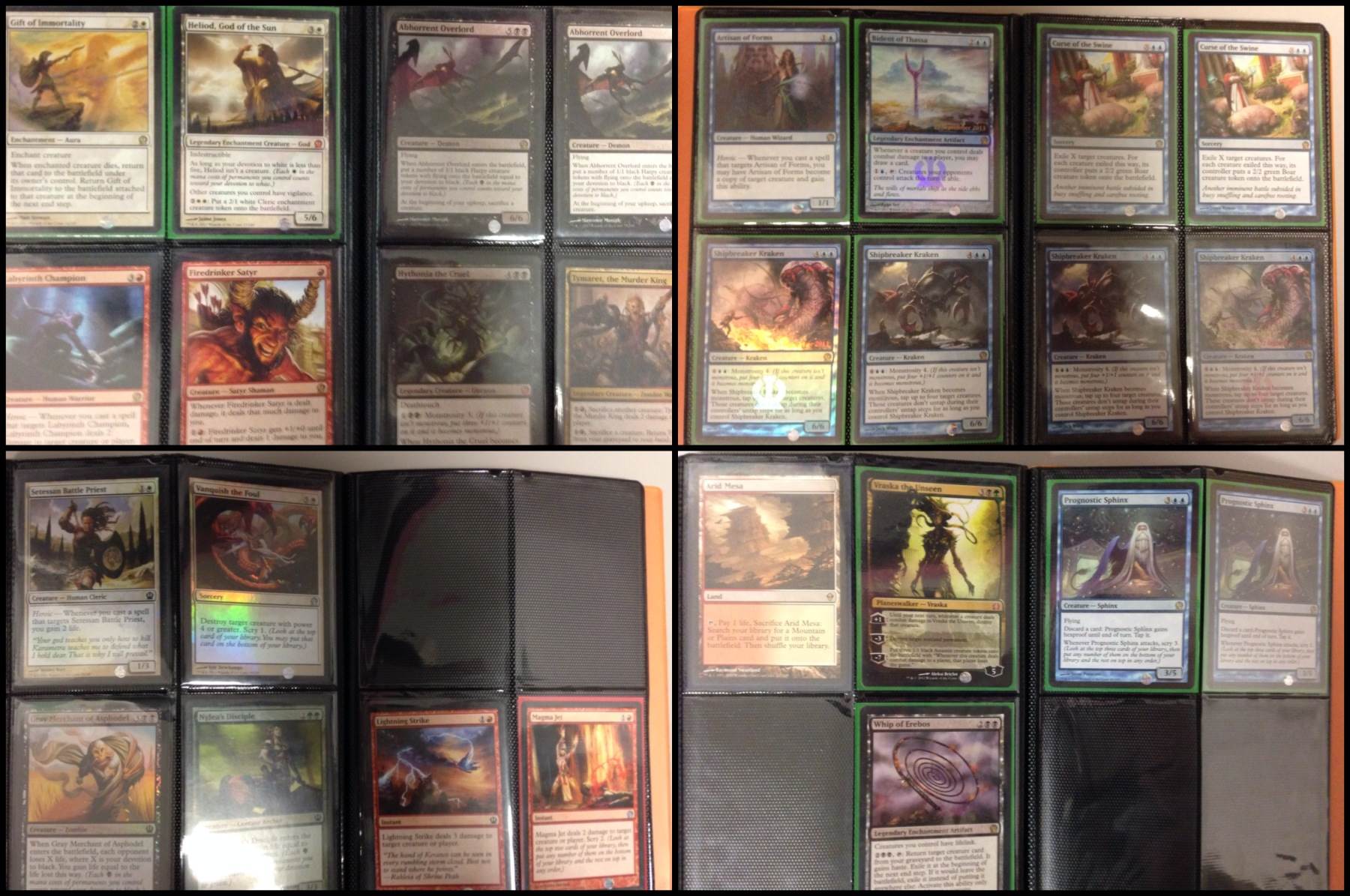
For having built this small collection from only four Limited events, there’s actually some nice substance to what I have right now. Here a breakdown of everything in my binder at the moment:

photo (4)

A conservative estimate of these cards (Theros foils and promos are not on Trader Tools yet, so I put down everything not listed as 10 cents) has a buylist value sitting at $52.56, which when added to my actual sales, puts me $25.56 above what I’ve paid so far, in addition to four packs for my next Draft.

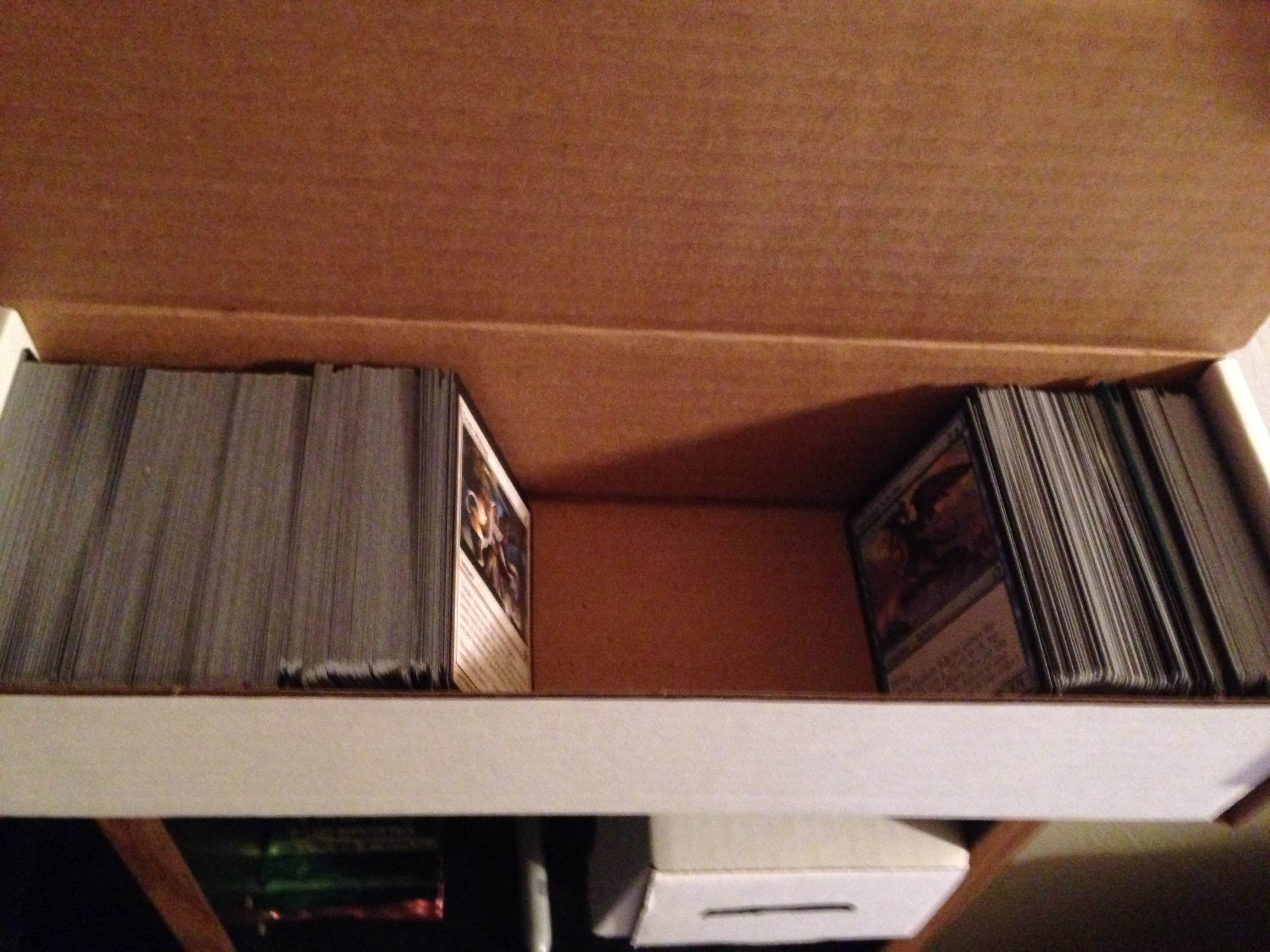
I have also accumulated a fair amount of bulk, including two or three discarded Draft decks in addition to the cards I opened myself:

photo (3)

When I fill this 800+ count box, I should be able to get about a Draft’s worth of value from it. Don’t let your leftovers go to waste—this box is filling extremely fast for how few events I’ve played so far.

Wrapping Up

Here’s a summary of the Zero to Draft challenge so far:

Events played: Four total – two drafts, one sealed, one 2HG sealed
Money spent: $90
Money received from card sales: $63
Buylist value of trade binder: $52.56
Net money spent: -$25.56
Packs held: 4
Draft record: 5-2
Sealed record: 5-3

I’m doing quite well considering I haven’t yet won a tournament. Granted, I’ve gotten lucky enough to open money cards in each event, but that’s a little easier when a set is new, since everything is overpriced. That’s why my policy has been to trade or sell everything from Theros (Prognostic Sphinx aside).

With how things are going so far, my goal is well within reach, although a few losing weeks with no money cards will put me right back in the hole. I’ll need to continue to tighten up my play and win some events, but more importantly, I need to leverage my current trade stock into bigger and better things. Just because I’m ahead right now doesn’t mean I can relax. If anything, I need to become ever more vigilant. Let me know what you think in the comments!

@dbro37 on Twitter

Jason’s Article: Feeling Lucky

Are you a Quiet Speculation member?

If not, now is a perfect time to join up! Our powerful tools, breaking-news analysis, and exclusive Discord channel will make sure you stay up to date and ahead of the curve.

Greetings, Therosians!

Anyone else feel like the first week of new Standard directly contradicts the second week of new Standard?

Signals

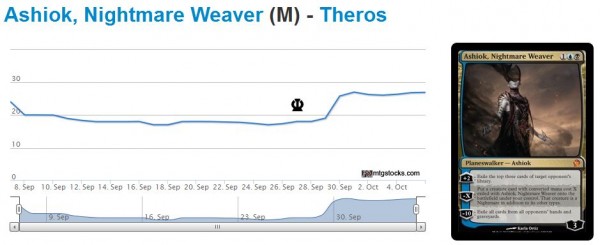
Based on what we saw at the first tournament of the new Standard format, I thought Ashiok, Nightmare Weaver at around $15 and Hammer of Purphoros at $1.50 were good buys. I figured given a week for the rest of the metagame to notice how much play they got would see them peaking and me selling. So far there is barely movement on either.

Meanwhile, that money is gone and a whole raft of cards popped up this last weekend that are totally different and I'm kicking myself for not waiting. Ashiok was nowhere to be found this weekend, nor was Jace, nor Hammer (Mono-Red in general underperformed given how strong it was last weekend) all of which leads me to wonder whether I should have given it a second week to draw lines between data points a little bit.

Watching coverage this weekend, I don't feel like I got a better sense of things right away. Even armed with three block rotations as a financier to draw inferences from, I felt lost. Not because I think I'm bad at this, but because I want to understand it even better than I do.

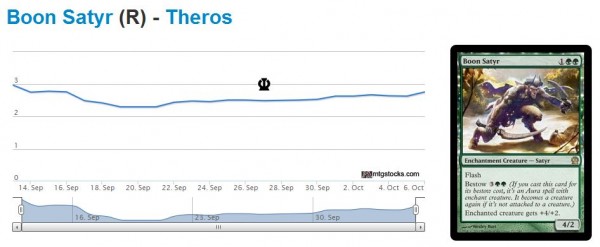
Is Boon Satyr a good buy at $5+ given it saw play in one deck over the weekend? I bought in closer to $3 and feel good about it and I think it has more playability than its inclusion in just one deck would indicate. Would buying Reverent Hunter at $1 and targeting $5 for a sell point be a better play than buying Satyr at $3-$5 and hoping it pulls a Boros Reckoner?

Feeling like a monkey for having a big pile of Ashiok on the desk next to me--although I think I'll be vindicated by Dublin as pros play control more than people at SCG Opens--I took a more holistic look at the spikes from this weekend. My hip-shot method didn't feel sustainable to me, and I made so many good calls last year fueled by nothing more than a gut feeling it was hard to feel like I was good at this. I felt like I was lucky at this.

If I want to stop feeling like a lucksack when I'm right and a monkey when I'm wrong, I'm trying to steer away from speculating based on gut feelings. After all, in the immortal words of Rob Gordon from High Fidelity, "my gut has shit for brains".

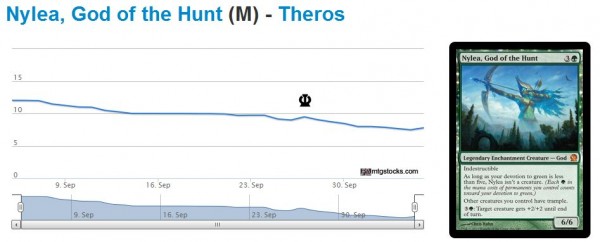
I think cards that only work in Mono-Green are not likely to be good speculation targets, and I feel good about that conclusion. Reverent Hunter may be an okay spec just because he's a damn dollar and I like low-risk specs, but he seems low-reward, too. Comparing Nylea's $7 to Purphoros' $25 only makes sense if you think Purphoros will maintain that $25, which I don't. I still think $7 for Nylea seems low, but compared to how "off" Temples at $4 feel, I would rather "invest in real estate".

I decided to do what I used to do in past situations, and look at cards whose entire price is based on demand. Low supply is going to artificially inflate prices farther than pure demand would, so I decided to hope--"Hope is not an investment strategy!" - Sigmund's Dad or whoever--Ashiok goes up and, if not, sell to break even, shrug my shoulders and get back to my roots. A lot of Ravnica block cards are going to go in decks and they could move based on this weekend.

I am bullish on Boon Satyr, but not convinced. What I am convinced of is that $3 for Advent of the Wurm is ridiculous. Ridiculous! You know what's $3? Master of Cruelties. Aurelia's Fury. Nightveil Specter is up to $2.50 based on the rock solid logic that "maybe, kinda, sorta, turning on black or blue devotion might be kinda okay, maybe." You think Advent is at the very least $0.50 better than that? I sure as heck do! I think you will feel better about a $4 Advent of the Wurm than a $7 Nylea in a few weeks.

Detention Sphere shot up this weekend, but caveat emptor--it's in an upcoming precon. Someone is buying out TCGPlayer under $5. A card with approximately all of the copies on Earth floating around that's going to be in a precon being sold out on SCG at $5 has never made me want to pay $4 cash, especially since that seems to be twice the best buylist price I could find. I don't care how sold out SCG is, a 48% spread has never instilled confidence.

Would I have differentiated between Advent of the Wurm and Detention Sphere in this same judicious manner two years ago? Would I have gone with my gut? Flipped a coin?

I can't say for sure, but as much as the old adage "Better lucky than good" gets thrown around in the play community, I don't want to feel lucky. I want to feel good. I want my financial advice to mean something because I want to feel like I arrived at my conclusions based on all of the data. You can ignore a lot of factors and be right because those factors didn't matter, and that is a trap new speculators fall into. But you'll never be as right consistently as someone who takes more into account.

I am confident about Hammer. Even if it only ends up a two-of, I think I can double up--$1.50 is junk rare money and $3 seems attainable. I am also confident about Ashiok, because I don't expect a ton at a SCG Open and if they see play in Dublin I should be just fine. If not, TCG Mid is $26 already and although I sell for TCG Low, I should make a few bucks per copy.

I love that we're in a business where "just a little bit right" still pays out. What I am most confident in is that I am better at this than I was last year when I hit an insane hot streak of good specs. I felt lucky that my "gambles" "paid off". This year, I feel "confident" that my specs "were rooted in solid logic".

My attitude is if you think you're good at speculating, you should gut check yourself before you bet big on it. Are you betting big because you considered every possible factor there is to consider and you are confident your spec is rooted in solid logic? Or are you betting big because your gut feeling is that you're about to hit a big payoff? Should you always go with your gut?

Your gut has shit for brains.

Up All Night to Get Lucky

Speaking of luck, sometimes entire organizations can be lucky. In this case, Quiet Speculation has acquired the Podcasting network MTGCast. If you're a dedicated listener to podcasts, you may have noticed that the Quiet Speculation ads at the beginning of each podcast are gone now, and that's a very good thing. Speaking as someone whose podcast left MTGCast due to a conflict caused by the ad (not QS' fault, but still annoying) I am glad to be able to come back.

I wrote a little blurb I'd like you to read if you're interested in podcasts and are uncertain about the future of MTGCast.com.

Check it out at this link.

If you're not someone who listens to podcasts, why not? You would likely be interested in Brainstorm Brewery, QS's own Doug Linn's 15-minute MTGFinance News podcast called Merchant Scroll, or podcasts about other aspects of the game.

I try to read five articles a day for my own edification and I listen to as many podcasts a week. Four idiots with a microphone have a decent shot of coming up with a few profound points if they can get all four idiots to agree and four people with a lot of experience can consistently put out compelling product and have interesting guests on their casts. I have replaced watching television for the most part with an equivalent amount of podcast listening and I feel like it's helped me immensely.

Whether or not you already listen to podcasts, I would like to invite you all to consider MTGCast as a site worth spending time at in the future. With new improvements planned and being implemented on a weekly basis, the site will only continue to get better, and nothing you liked about the site before is going away. I hope you'll all be proud of the work we do there and if you're not a listener, you'll pick one or two casts and give them a chance. Nothing dulls the monotony of a long car trip or cures a case of the Mondays (don't kick my ass!) like some edutainment.

But I'm not getting paid anything extra to say all this, so I'll stop before I sound preachy. Hit me up with questions or concerns about the transition.

How I Got Lucky

I was lucky enough to attend Gen Con this year with a press badge, which afforded me a few opportunities not available to the general public. I told you a few weeks ago that I got to play Rob Dougherty and Darwin Kastle's new game, Star Realms, and my intial impression was "hells yes."

Well, the Kickstarter went live, as followers of yours truly on social media well know. If you're not following me on twitter, by the way, is it because you don't have twitter or because you do but only like my opinion on 140,000 character increments, not 140? Either way, remedy that toute de suite, because you may have missed out on all the early bird tiers of this kickstarter and I think you will really like this game. I think all Magic players will.

Kickstart your heart.

It would be cool if they were paying me, but they are not. 100% of my alarming amount of enthusiasm is based on having played the game.

It's like a stream-lined version of Ascension that is more interactive, less luck-based and quicker to play. It's also scaleable in ways that Ascension is not and I supported the kickstarter so I could have enough sets to give out to friends and play Two-Headed Giant, because any card game that allows Two-Headed Giant needs to shut up and take my money.

If you don't want to support the kickstarter, at least keep an eye out for it when it hits stores--its price point is attractive and it's all of the fun to play.

Who Else Got Lucky?

Corbin Hosler got lucky because he was on the Wizards coverage team for the Grand Prix in Oklahoma City. He wrote a few good pieces for the event and was going to be at the event anyway. This could be the start of a regular gig for him, and that's pretty awesome.

Did you check the page out? If you did, you'll see the format was Limited, which means I don't have to write about it. How lucky can one man be?

So, the only thing to talk about is the Star City Open. Speaking of Star City, did you notice that SCG will be continuing Legacy in 2014? A lot of people told me I was an idiot for not seeing the signs that Modern was going to replace Legacy at SCG Opens. I don't think this one is luck on my part. This is pure, unadulterated "I told you so."

Let's talk about Margical Crads before I stop wanting to.

SCG Cleveland Open Top 16 Standard

In first is the deck that made me the most happy. I liked Craig Wescoe's deck from the Block PT, so when I saw no love for Green-White last week, I was a little sad. That Mono-Red is low-hanging fruit and it was obvious to build, but I don't know that it will be the consensus best deck moving forward. I think G/W has chops, and I bought a big old pile of Advent of the Wurm to celebrate.

Trostani, Selesnya's Voice could stand to be a two-of if you ask me, but I could be the most biased dude on Earth in this instance. I think the lifegain gives red fits and the populate is too powerful to ignore. Rootborn Defenses is such an elegant response to many problematic things and you get another 5/5 to boot. Be able to beat this deck, or stay home.

Advent also made a splash in the second-place Junk deck. I like this configuration and I feel like it has a lot of good tools to beat the future format. Can it handle the caliber of control deck we're likely to see out of Dublin? Only time will tell. Obzedat, Ghost Council plus Whip of Erebos is very potent--whip is a very good buy right now.

Advent is in the third place Naya deck. See a pattern? I also think Loxodon Smiter is underpriced right now. I expected Naya to take advantage of the Temples at its disposal, but turn one dork seems important, so the only Temple played is of the Garden variety. Not, like, a "garden variety" temple as in a generic one, I was mentioning that the dude played Temple Garden. That's all I was saying. I bought Domri Rade very cheap and sold him a long time ago. For a profit, but, still. I wonder how high he will go.

Mono-Green struggled to fit Advent of the Wurm and eventually cut it because it was totally uncastable. It is a good home for Boon Satyr, too, so trade for these at $5. They may not be done going up. I don't like these for cash right now, though.

B/W and B/R/W Midrange are both solid midrange choices. The Obzedat and Whip combo is potent and oppressive, and if you don't have Ooze or Deathrite, come up with some creative way to deal with the combo because it ends games.

Mono-Red managed a Top 8, but it was a decent percentage of the field. Mono-Red deals 18 damage very easily. It struggles to deal 24 damage, however, and just when Thragtusk and Restoration Angel were gone and Mono-Red thought it would have its day in the sun, Trostani and Obzedat, Fiendslayer and Courage, Blood Baron and Warleader's Helix showed up to prove it wrong. Can Mono-Red survive? I think so, and Chandra's Phoenix and Burning Earth are key components in the strategy. Skullcrack couldn't hurt, either.

If you are looking for cards to buy, there is stuff from Theros that could spike. However, don't forget stuff from RTR block that will get played in all of these decks. There are a few cards that are just way too cheap and their price spikes will be based solely on demand and will be more predictable. Yes, listen to the guy with an envelope full of Hammer of Purphoros, right?

Speaking of "Legacy forever!"

SCG Cleveland Open Top 16 Legacy

City of Traitors is going to spike again. It's going to happen, and it will likely be $70 when it does. If you don't see much upside to buying in, do you think it's likely Ancient Tomb will also spike? It's potential will be attenuated by the number of copies from its myriad (maybe not quite 10,000) printings, but its buy-in price is lower and you can sock away more copies. Food for thought. Don't listen to me, I don't write finance articles.

U/W/R Stoneblade looks somewhat novel, and somewhat novel is somewhat good. I love that Legacy has gone oldschool and dealt with Deathrite Shaman with Grim Lavamancer. Modern could easily do the same thing and likely won't. I am a little surprised not to see Basilisk Collar anywhere in the 75, but the guy just won an Open so I will defer to his judgment.

Second and Third were both Reanimator? Legacy is a format where the metagame is regional, even in the age of the internet, and I love that. I haven't seen a ton of Tidespout Tyrant lately, so maybe that inclusion is regional as well. Solid work, guys.

Goblins in the Top 8 and no Merfolk. Suck it, Hosler. I know you're reading this.

I think we can call Belcher the "Pet Deck of the Week". I like seeing Belcher decks Top 8. They are fun to watch, fun to play and can take down the best of them.

Painter's Stone is back to its roots here. It's very much a Welder deck as opposed to the "Make everything blue and MURDER IT" deck that Reuben Bresler played on camera. No Blood Moons here, just Transmute Artifact, Welder stuff and combo kills. Very nice.

Speaking of Welder decks, a Metalworker deck made it! Metalworker decks need to Top 8 every once in a while to remind people that Metalworker isn't banned in Legacy. Grim Monolith was unbanned a few years ago and nothing bad happened. It's nice when that happens.

I love the four-color cascade deck. I wish it had won the event. Having a non-zero chance to hit Bloodbraid Elf -> Shardless Agent -> Strix/Hymn is devastating, and can be accomplished on turn three. Every card in the deck is gas, it fuels Goyf nicely and it isn't boring. I love decks like this existing! I want to play this deck.

That's all for now, Kiddos. Join me next week where I'm sure I'll have a bad beat story about eating it on a pile of Ashioks. Shoulda sold at $21, Future Jason!

Insider: Buying Into a New Set

Are you a Quiet Speculation member?

If not, now is a perfect time to join up! Our powerful tools, breaking-news analysis, and exclusive Discord channel will make sure you stay up to date and ahead of the curve.

Welcome back, Speculators!

Today's article was inspired by a forum post by QS's own Wes. He wanted to know if it was worth it to buy a box (or boxes) for trading purposes. A special thanks goes out to QS's WeQu for continually calculating and updating the Theros EV (estimated value) (his data is shown in italics). I will be using a lot of his data for this article. It's also important to note that for these calculations the value of commons was ignored, simply because it's hard to get value on most commons you'll pull from packs.

Let's start with a baseline (it's important to take notice of the date stamp for this information).

Sept 17, 2013

THS >>> 3.94 <<< THS
BOOSTER ( 1/8*AVG[10.59;12.69] + 7/8*AVG[2.07;2.65] + 3*0.14 ) = 3.94
BOX ( 36*[3.94] )= 145.44
Set Total = L=286.11;M=364.21;H=564.41
Mythics (15x)
TOT : L=158.87;M=190.36;H=279.30
AVG : L=10.59;M=12.69;H=18.62
Rares (53x)
TOT : L=109.61;M=140.47;H=205.25
AVG : L=2.07;M=2.65;H=3.87
Uncommons (60x)
TOT : L=8.56;M=16.76;H=34.25
AVG : L=0.14;M=0.28;H=0.57
Commons (101x)
TOT : L=9.07;M=16.62;H=45.61
AVG : L=0.09;M=0.16;H=0.45

This is basically the preorder average price. Theros's official release date was September 27th and the prerelease was September 20.

Sept 21, 2013

THS >>> 3.91 <<< THS
BOOSTER ( 1/8*AVG[11.58;13.74] + 7/8*AVG[2.06;2.70] + 3*0.08 ) = 3.91
BOX ( 36*[3.91] )= 142.92
Set Total = L=292.68;M=379.39;H=573.39
Mythics (15x)
TOT : L=173.76;M=206.15;H=274.73
AVG : L=11.58;M=13.74;H=18.32
Rares (53x)
TOT : L=109.22;M=143.14;H=211.76
AVG : L=2.06;M=2.70;H=4.00
Uncommons (60x)
TOT : L=4.63;M=16.71;H=36.92
AVG : L=0.08;M=0.28;H=0.62
Commons (101x)
TOT : L=5.07;M=13.39;H=49.98
AVG : L=0.05;M=0.13;H=0.49

This is the next important date we have. Here we see a very slight drop in overall EV, but 3 cents could easily be distributed to minor price drops for some of the lower end stuff. Not a lot to concern ourselves with.

Sept 30, 2013

THS >>> 3.59 <<< THS
BOOSTER ( 1/8*AVG[10.42;14.04] + 7/8*AVG[1.60;2.63] + 3*0.07 ) = 3.59
BOX ( 36*[3.59] )= 131.04
Set Total = L=249.13;M=383.38;H=799.85
Mythics (15x)
TOT : L=156.30;M=210.59;H=373.34
AVG : L=10.42;M=14.04;H=24.89
Rares (53x)
TOT : L=84.62;M=139.19;H=286.01
AVG : L=1.60;M=2.63;H=5.40
Uncommons (60x)
TOT : L=4.24;M=17.65;H=62.09
AVG : L=0.07;M=0.29;H=1.03
Commons (101x)
TOT : L=3.97;M=15.95;H=78.41
AVG : L=0.04;M=0.16;H=0.78

By now Theros has been officially released (for a couple days) and we start to see the expected price dropping. The overall EV dropped about 9% (which isn't that bad).

Oct 4, 2013

THS >>> 3.42 <<< THS
BOOSTER ( 1/8*AVG[9.99;13.33] + 7/8*AVG[1.52;2.49] + 3*0.07 ) = 3.42
BOX ( 36*[3.42] )= 124.92
Set Total = L=238.84;M=364.4;H=747.6
Mythics (15x)
TOT : L=149.78;M=199.97;H=311.70
AVG : L=9.99;M=13.33;H=20.78
Rares (53x)
TOT : L=80.60;M=131.98;H=282.11
AVG : L=1.52;M=2.49;H=5.32
Uncommons (60x)
TOT : L=4.39;M=16.94;H=76.64
AVG : L=0.07;M=0.28;H=1.28
Commons (101x)
TOT : L=4.07;M=15.51;H=77.15
AVG : L=0.04;M=0.15;H=0.76

This is well into October and the EV has dropped a bit more, about a 13% drop since release day. Still not that bad.

Analyzing the Data

Now that we have some solid data, we can get into the analysis.

Assumptions:

  1. You couldn't get the boxes at dealer cost ($77 - 80 here in the US) so you paid $95 for your pre-order.
  2. You're only planning to buy one box, not enough to pre-sell cards (you'd have to buy a lot of boxes for the odds to be good enough).

Investment: -$95

EV @ Release Date: $3.59 per pack

Difference = (EV * # of Packs) - Investment = (3.59 * 36) - 95 = $34.24

The good news is if you were able to unload all your rares, mythics and uncommons at cost you'd have made $34.24, but that's rather unrealistic.

The important thing to keep in mind with EV is that it's the average value of all the cards divided out. This means that the more packs you open the closer to the EV you'll get, but with only one box it's unlikely that you'll actually get anywhere near the EV (either higher or lower depending on luck). Thus the original EV calculation of $129.24 per box is misleading because the basis of the EV calculation was on a large sample size.

There are 15 mythics in Theros, nine of which lie below the average mythic price (13.33), which means that 9/15 or 60% of your mythics will cause the EV (per pack) of your box to be lower. With an average of four mythics per box, this means that you're likely to get two mythics below 13.33, one above, and one that's either above or below. This implies that with a small sample size, the average mythic price you pull would be considerably lower than 13.33 (which is buoying the total EV). So let's weigh our Mythic EV and multiply it by 60% (to make it more realistic of a small sample size).

Average Mythic EV of 1 box = $8

Secondly, it is unlikely that you'll be able to trade or sell many of the rares you pull. For every Fleecemane Lion or Thoughtseize there are usually five to six Hundred-Handed Ones. In other words the average rare value is also often buoyed by a small percent of the total rares, of which you'll often only get a few per box. There are 53 rares in Theros, 32 of which are below the average price, again about 60%. So we'll recalculate our average rare value as well.

Average Rare EV of 1 box = $1.50

We'll use the same calculation as before with weighted numbers (we don't have a low to average with the high, like WeQu did, but we'll be okay since they are already weighted downward):

Booster Pack EV from 1 Box (1/8 * 8 + 7/8 * 1.5 + 3 * 0.07) = $2.52

Now let's recalculate your booster box value with the weighted pack EV.

($2.52 * 36) - 95 = $-4.28

Thus, we prove that it is not worthwhile to purchase a box of Theros for the sole purpose of trading. To make matters worse the set is still new and a lot of the cards will continue to drop in value as more packs get opened. We can look at sets that have been out a while to see where our expected EV (large population) will likely end up.

  • RTR Booster: (1/8 * AVG[4.38;6.06] + 7/8 * AVG[1.68;2.45] + 3 * 0.07) = 2.67
  • GTC Booster: (1/8 * AVG[3.50;4.84] + 7/8 * AVG[1.40;2.05] + 3 * 0.09) = 2.30
  • DGM Booster: (1/8 * AVG[6.36;8.42] + 7/8 * AVG[0.37;0.80] + 3 * 0.06) = 1.62 + 0.41 (for the land slot) = 2.03
  • M14 Booster: (1/8 * AVG[6.74;8.96] + 7/8 * AVG[1.06;1.82] + 3 * 0.08) = 2.48

I actually like Theros as a set and feel it's more likely to mimic RTR than any of the others, as what it lacks in Eternal-playables (no Deathrite Shamans or Abrupt Decays) it makes up for in casual staples (gods, god weapons and Prophet of Kruphix). Thus, we can expect about a 30% drop in EV from release date for the long term.

I also want to remind you that this analysis is from a purely profit standpoint. I enjoy opening packs of the new set, having the cards so I can trade what I want, and having a play set of commons and uncommons (which typically takes two boxes worth of product).

I personally purchased two boxes of Theros (1x Korean and 1x Japanese) because the cost addition per box (21% and 10.5% respectively) is less than the typical "multiplier" you can get for the higher end cards (Korean 1.75 - 2x, Japanese 1.5x) and foil versions are often 4 - 8x (depending heavily on demand).

Looking over the analysis it seems if you really enjoy trading, you're stuck between a rock and a hard place.

Preordering is typically considered a bad investment as there are usually only one or two "break-out" cards in a set compared to a vast majority that go down from their original pre-order price. This is why many more stores and people are jumping on the "preorder" band wagon. You get to sell all the bad cards at considerably higher prices than they'll be worth shortly after release and you only "lose" money on the few breakout cards that you sold below market price.

However, it's important to keep in mind that the one final aspect to consider is that when demand is incredibly high (i.e. right after release when people are trying to build decks) you can trade the new cards into better speculation targets that people are often less willing to trade.

Case in point, I traded three Soldier of the Pantheons and a couple Precinct Captains for a Snapcaster Mage this past Friday because the guy needed them for his FNM deck. Even thought he would have preferred not to trade his Snapcaster, he did anyway.

So in the end it's still on you (the speculator slash trader) to determine how much risk you want to take on this endeavor. The math shows that for the most part you're likely to lose out, but if you feel that cracking packs is worth the slight loss (it's not terrible and all it takes is a slightly above average box to make it profitable) you're welcome to go for it.

Insider: Early Theros Specs in Standard

Are you a Quiet Speculation member?

If not, now is a perfect time to join up! Our powerful tools, breaking-news analysis, and exclusive Discord channel will make sure you stay up to date and ahead of the curve.

We now have two SCG Standard Opens in the books since Theros launched. These Top 8’s have some interesting differences. Most notably, check out the lack of blue from Cleveland’s Top 8. This result really causes me to question some of last week’s hyped up buys–-Jace, Architect of Thought, Ashiok, Nightmare Weaver, and Sphinx's Revelation.

Jace

Of course, many have accurately pointed out that these early Standard events are likely not indicative of the metagame to come. The Pro Tour is generally our first glance into what strategies are truly strongest, and which cards will break out in the season to come. These two Star City Games tournaments are often block decks with Theros cards added or simple strategies like Mono-Green or Mono-Red. These decks may not be at all powerful enough in a month.

But it’s still interesting to look for speculation ideas using these results, especially when observing which Theros cards were first to prove themselves worthy in Standard.

It’s usually not like me to write an article strictly on speculative plays, but this is my theme this week. I’ll review the Top 8 decks from the last two SCG Opens and try to come up with some safer targets that should see some play (albeit perhaps in a different form) at the Pro Tour and beyond.

Green Is Everywhere

Fun fact: the Cleveland Top 8 had five decklists with green cards in them. Yet every deck in the Top 4 had green, with one deck mono. All three of the non-green decks lost in the quarterfinals of the Open. Red Deck Wins couldn’t get there for a repeat and the BWR/BW decks also came up short last weekend.

While I won’t be so bold as to say green will definitely remain dominant after the Pro Tour, I think it’s fairly safe to conclude there are some powerful green cards out there right now. This is especially true when paired with white.

The green and white combination allows you to play aggressively-costed creatures Fleecemane Lion, Loxodon Smiter, Voice of Resurgence, and token generator Advent of the Wurm. This is an impressive list, and it wouldn’t surprise me to see green and white paired up often moving forward. The inclusion of red to make Naya or black to make Junk can add some additional powerful cards while risking land robustness.

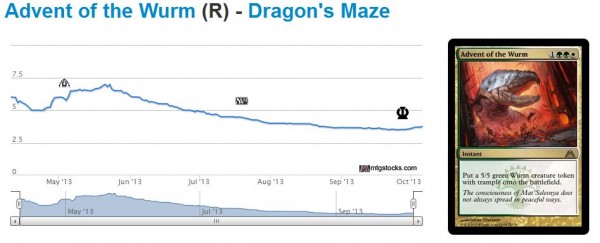
From a speculation standpoint, I am wondering if Advent of the Wurm is now strong enough for Standard. The card’s been around for a while now, but it never really got traction price-wise. Maybe with a smaller card pool in Standard, and the combination of many powerful G/W creatures, the instant token generator now has a shot. I’ve purchased myself a set and I’ve got my eye on this one.

Advent

Loxodon Smiter has already been creeping higher in price, and I’m not sure what its ceiling is. But with Advent being in Dragon’s Maze vs. Smiter being in the much-more-opened Return to Ravnica, I’m inclined to put my money on Advent first. I’m avoiding Voice of Resurgence for now due to cost of entry and I feel Fleecemane Lion has been expensive since almost day one.

The other green card worth watching very closely is Boon Satyr. I know many in the QS forums have been on this card for a while now, and I’m on the verge of jumping onto the bandwagon if it isn’t too late. The commentators during the SCG Open talked nonstop about how great this creature was, especially against blue decks.

It seems having a four-power dude with flash for three mana is pretty amazing against removal like Supreme Verdict and Detention Sphere. The double-green mana cost is a minor inconvenience, but I fully expect this guy to show up in any creature-based deck with sufficient green sources.

Boon

Now Let’s Get Super Speculative

Why has no one been talking about the god cards? Well for one, they saw little play (or at least camera time) at the last two SCG Opens. But I can’t help but feel these are very powerful cards worth a closer look. In fact, the entire theme around devotion seems to be underutilized completely.

Either this means Wizards made the ability too weak or such a deck strategy takes significant effort to refine sufficiently. My suspicion is the reality lies in the latter--brewing a completely new deck based on the Theros mechanic is so risky and challenging that the general player base hasn’t had enough time (or motivation) to build it.

Let’s face it--it’s much easier to build a Block deck like U/W Control and simply add in a few relevant Theros cards.

But Block decks won’t cut it at the Pro Tour. Players will be as innovative as ever, and I suspect we’ll see some gods make themselves known next weekend. The gods I’ve got my eye on: Nylea, God of the Hunt and Heliod, God of the Sun. The former was in the Top 8 Mono-Green deck of SCG Cleveland and the latter was mentioned in Gerry T’s article on SCG’s website.

Nylea

These are both still under $10, which makes their upside much greater than their downside. Besides, some card in Theros has to be worth more than $30. If it’s not Ashiok, Nightmare Weaver then why not one of the gods?

Ashiok

In line with the gods and the devotion mechanic, what about the land that everyone went crazy over for like a day, Nykthos, Shrine to Nyx. This land is exceptionally powerful in the right home. I personally believe that home just hasn’t been found yet. With EDH playability and two more sets of Theros block to come, I don’t mind acquiring a couple sets of these as the price continues to drop. Once again downside is becoming much smaller than potential upside.

What About SCG Worcester?

If I had to describe the Top 8 showing at SCG Worcester with two words, they would be “conservative” and “boring”. Half the decks were U/W or Esper Control variants, and the only interesting addition was Ashiok. The rest of the deck lists were fairly predictable. Mono-Red isn’t worth talking about, and that leaves us with the two green decks.

These two green decks--one Naya and one G/R--were really just precursors to the decks of the Cleveland Standard Open. Net, I don’t really see any other Theros cards worth mentioning. Elspeth, Sun's Champion seems Standard-playable, but probably as a two-of in the right control builds. Thoughtseize is Thoughtseize--no one should be surprised that this card is seeing play.

Wrapping It Up with a Portfolio Update

I’ve sold most of my Return to Ravnica specs, for better or worse. They all paid off nicely and I’m pleased with the QS community’s ability to identify the winners so far in advance. My one regret is selling my Jaces prematurely, and this is a lesson learned for next time. No sense in ruminating over a lost opportunity, especially when profit was still made.

While I don’t like buying into cards based on pre-Pro Tour Standard results, the most profits can be had by leaning forward on at least a handful of bets. I am usually risk-averse, but this time I have decided to test out a new strategy. I’ve been buying into Theros cards showing promise. This includes Heliod and Nylea, Nykthos, and Boon Satyr. These are the cards that will be showing up in my mailbox in the coming week.

As for non-Theros cards--my buying has been tempered back significantly because most of the cards seeing play haven’t been much of a surprise. I’ll rely on the Pro Tour for opportunities here.

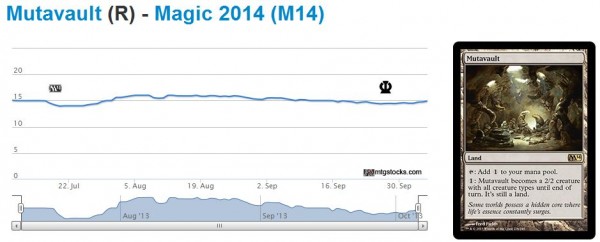
Finally, I want to mention my two favorite M14 cards right now--Mutavault and Scavenging Ooze. In fact currently I prefer the former, but I like both at the right price.

Mutavault was out of favor when it initially entered Standard because everyone played three-colored decks. With devotion, there’s now motivation to play decks with just one or two colors, which means there may be a home for Mutavault. The card is also strong against the aforementioned sorcery-speed removal spells. My only caution is that the cost of entry is already fairly high--these may be better to acquire in trade or by sniping eBay auctions.

Mutavault

This has been my strategy heading into the Pro Tour. I’ve sold the spiking cards and used the funds to make some speculative buys, based on early SCG results. If a Theros card can break into essentially what’s been a couple of Block tournaments, then it’s likely pretty powerful. And with the devotion mechanic being severely underused, the god cards and Nykthos have dropped to attractive prices. Thus, I’ve placed my bets.

Now it’s the waiting game. Hopefully I’ll get at least one of these right, justifying the strategy for the future. If not, then I may be sitting on these cards for a while hoping the next two sets bring synergies along. Fingers crossed.

Sigbits

All this Standard talk almost causes me to forget about Modern. No longer.

  • Star City Games has exactly one copy of Chord of Calling in stock, at $34.99. Could this go even higher still?
  • Not all Modern cards are immune to price drops. According to Sunday’s Interests page on mtgstocks.com, Daybreak Coronet dropped about 7%. Though Star City Games still hasn’t restocked any copies at $14.99.
  • Zendikar fetchlands have appeared to stabilize in price for now. The blue ones are listed at $49.99 and the nonblue at $34.99 on SCG’s site. There may be a short-term bump during Modern season if these aren’t somehow reprinted first, but I can’t help but feel the potential on these lands is fairly minuscule versus the inherent risk of reprint.

-Sigmund Ausfresser
@sigfig8

Insider: Early Bottom for Avacyn Restored?

Are you a Quiet Speculation member?

If not, now is a perfect time to join up! Our powerful tools, breaking-news analysis, and exclusive Discord channel will make sure you stay up to date and ahead of the curve.

Last year, cards from Scars of Mirrodin (SOM) block hit their post-rotation bottom on MTGO in the first half of November. Speculating using the redemption strategy on MTGO means targeting mythic rares as they scrape their price lows, and then riding out the gains as prices tick up due to the steady demand from redeemers. It's been a stable and predictable way to make profits.

With last year's pattern in our back pockets, this gave us a rough guide for when to anticipate a price bottom on the (now-rotated) sets from Innistrad (ISD) block. But, in the past couple of weeks something strange has been happening.

Recent Market Moves

The mythic index from Avacyn Restored (AVR) is up to 6.0 from 4.7, a substantial 28% gain. The mythic index from ISD is up to 6.7 from 5.7, almost a 20% gain. The Dark Ascension (DKA) mythic index has nudged up to 2.5 from 2.3, a 9% gain, though this is a small enough change that we could ignore it. This type of price activity is unusual for cards that are leaving Standard and is worth investigating further.

Another look at prices from last year on the SOM block mythic rare indices at mtggoldfish.com tells us that between the release of M13 and the release of RTR, the trend on the SOM, MBS and NPH mythic rare indices was flat or down. This is what we would expect to be happening this year for ISD block. Observing the marked change in pattern confirms that something unusual is happening.

The question to consider is, what could account for these recent price increases? Clearly it's not a burst of product being opened as we have Cube draft and throwback Ravnica queues to keep people interested, not to mention the relatively novel M14 limited environment. Obviously there's been a round of buying, but who is responsible?

It's possible that enough speculators are pursuing the redemption strategy that prices have bottomed earlier than they have in the past. When enough of the market are speculators or are acting like speculators, then any obvious opportunities to profit are going to disappear quickly. This possibility is consistent with observed market activity.

Next, it's also possible to think that the growing popularity of Modern and older formats is contributing to the recent buying. Modern staple Liliana of the Veil recently dipped to just over 40 tix, but has since soared back to 57 tix. She's showing no signs of a rotation price slump as of yet, suggesting that expanded interest in the format might have altered the price patterns that have typically been seen in the Fall. The recent price increase for Griselbrand from AVR also confirms this possibility.

These are the two most likely reasons for the recent bump in prices. They are not mutually exclusive, i.e. they might both be occurring at the same time and contributing to an altered pattern. The question before speculators now is whether it's time to get invested.

The MTGO-to-Paper Ratio

Using the MTGO-to-Paper ratio is my first step for analyzing the market from a broad perspective. The ratio is the price (as quoted on supernovabots) of a digital set plus the redemption fee, divided by the sum of the TCG low prices for the given set.

Generally speaking, this can determine when prices are not well aligned between MTGO and paper. When prices are not well aligned, something's gotta give.

 October 3, 2013
Set Ratio Nova TCG Low
Innistrad 1.20 121 105
Dark Ascension 1.58 40 28
Avacyn Restored 1.26 103 86
Magic 2013 0.94 72 82
Return to Ravnica 0.94 148 163
Gatecrash 0.95 104 136
Dragon's Maze 1.34 85 82
Magic 2014 0.77 104 167


Looking over the most recent data, the first thing that jumps out is that DKA carries a high price on MTGO relative to paper prices. This suggests to me that DKA does not have good prospects for profiting from future demand from redeemers.

The next thing to consider is that the cheapest online set relative to paper is still M14. This makes sense as we are coming out of a period of relatively heavy M14 drafting. RTR and GTC are also relatively cheap.

Next, both AVR and ISD do not look like they are "on sale" relative to paper. The trend for paper prices on the rotating sets is down, and history suggests that this trend will continue into November. In the face of declining paper prices overall, demand from redeemers for these set should be low. The strategy of buying up mythics in order to sell to redeemers in the future won't work if there's no demand there. We need a relatively low online set price in order to attract demand from redeemers.

For further context, in November of last year on Supernova, SOM got down to 56 tix, MBS hit 39 tix, and NPH came down to 63 tix. Only DKA is at a comparable online price, but the low paper price for that set suggests there is not much opportunity to profit.

The Next Step

Overall, it's not clear to me that there is currently any opportunity in purchasing ISD block mythic rares in order to capitalize on future demand from redeemers. If nothing changes over the coming weeks, my advice would be to be selective about which cards to buy from ISD block, focusing on those with application in Modern or Legacy. After the market swings of the past ten days, the redemption strategy does not look like it will be profitable to undertake.

Theros: Past, Present, and Future

Are you a Quiet Speculation member?

If not, now is a perfect time to join up! Our powerful tools, breaking-news analysis, and exclusive Discord channel will make sure you stay up to date and ahead of the curve.

A Ray of Light on Theros

Last week, I posted my quarterly Top 10 list and talked about many sweet Theros cards. Between its reposting on Reddit and those who viewed it on this site, I got a lot of feedback. Thank you to those of you who took time to comment. While I don’t respond to everyone, I do read every post. There are a couple things I want to clear up that people seemed confused about.

The main point that I wanted to get across last week was that there are so many cards in Theros with similar power level, they all could not be included on the Top 10 list.

Fleecemane Lion is a great example of this. Is the new Watchwolf solid, of course. Will it see play, definitely. Is it one of the ten best cards in the set, maybe but probably not.

With all that being said, I played the lion in my deck this weekend. Sure it’s a reasonable creature to cast and once in a while you do make it monstrous, but it’s not as impactful as you might think. I have found this to be the case with tons of cards from Theros. The list of playable constructed cards in the set is enormous. Based on how many cards might see play, I would guess Standard will be evolving each week as more and more cards enter the metagame.

Two cards, both red, impressed me more than any of the others. Overwhelmingly the readers of last week’s article felt Stormbreath Dragon should have been on the list. After playing against it this weekend, I would tend to agree.

In my opinion, this dragon’s playablity depends on what the metagame looks like. Right now, there's tons of white creatures and removal floating around. Stormbreath Dragon obviously shines in this type of environment. Against something like Mono Red or a deck with black removal though, I think you would find yourself underwhelmed by the card.

Nevertheless, our new dragon pal should have been on the list, over Magma Jet I’d imagine. The second red card that stood out was Hammer of Purphoros. There was one game in particular where the card just took over the game. Even though I did mention it last week, I think I underestimated how good it is against a control deck. It doesn’t win the game on its own, but it comes close.

Spotlight on the Past

Shards block was a turning point for me in competitive play. When that set was released, I was immediately inspired by the Naya shard. Seemingly all of the great cards in the set were in one shard, or at least that’s how it seemed at the time. Even before the full spoiler was out, I began brewing green, white and red decks with cards from the set.

Certainly I had been playing competitively for a while before this set, but it was not until States 2008 that I truly began to believe I could be successful at larger events. States is not the most competitive tournament of the year, but it is one of the most fun. Often it is the first tournament of a brand new Standard format, which makes it a great time to build your own decks. Also, it’s a great way to get FNM players to go to a bigger event.

Despite it not being that big an event, I tested more for States than any tournament before and for a long time after. I was so excited about Naya! I did quite well and as you might imagine, landing in sixth place at this event had a big impact on my future with Magic. Here’s the list I played.

2008 Naya

Untitled Deck

Creatures

4 Wild Nacatl
4 Figure of Destiny
4 Rip-Clan Crasher
4 Woolly Thoctar
4 Ranger of Eos
3 Siege-Gang Commander

Spells

4 Magma Spray
4 Naya Charm
3 Puncture Blast
3 Sarkhan Vol

Lands

2 Brushland
2 Fire-Lit Thicket
2 Karplusan Forest
1 Rugged Prairie
2 Wooded Bastion
4 Terramorphic Expanse
5 Mountain
4 Plains
1 Forest

Sideboard

3 Relic of Progenitus
1 Elvish Hexhunter
1 Siege-Gang Commander
3 Oblivion Ring
4 Guttural Response
3 Ajani Vengeant

At this time, everyone disagreed with me about how good Wild Nacatl was. As soon as I saw the card, I began working on a deck to fit it into.

One of my favorite parts about the deck was that it was extremely aggressive, but also had a midgame strategy. If you needed to grind your opponent’s life total down all you needed was to get a Sarkhan Vol into play and then cast your other creatures. Once you had your planeswalker in play, all the rest of your dudes got bigger and had haste. If they had a blocker, you just used the -2 ability to remove it so you could deal them more damage instead.

Figure of Destiny flew over for a ton of damage late game and if you needed to get your Woolly Thoctars through, you could tap their guys with Naya Charm. Magma Spray and Puncture Blast were sweet removal spells for this format because they allowed you to remove Kitchen Finks or Murderous Redcap with just one card.

The manabase was a little shaky but other than that the deck had everything. The best play of the event had to be ultimating Sarkhan Vol and then playing a second one to kill my opponent from his starting life total.

New Rays of Revelation

How does my States deck from 2008 relate to what’s happening in Theros Standard? The answer to that question lies in one of the most iconic cards Theros has to offer: Purphoros, God of the Forge.

As I mentioned last week, the red god is the one card that has had all my attention since I learned about it. The format is full of possibilities and many of them in my mind include this new legendary enchantment creature.

Upon examining Purphoros in detail, I noticed a startling similarity to my favorite planeswalker of all time, Sarkhan Vol. You may think that Ogre Battledriver or Hammer of Purphoros would do a better Sarkhan Vol impression, but Purphoros offers something neither of those other cards have: the ability to win the game without attacking.

Every time I have the Forgemaster in play, he feels like a planeswalker that my opponents cannot attack and kill. In fact, a couple of my friends as well as opponents have made similar observations.

One downfall to both Sarkhan Vol and Purphoros, God of the Forge is that they often do not impact the board the turn they come into play. That makes them tricky to play, but the payoff is well worth figuring that out.

Once I noticed the similarities between the two powerful cards many blocks apart, I started to see other cards having counterparts with much in common from that States deck. There was a powerful red-green planeswalker, an aggressive curve, and most importantly, a follow-up to the red god that would end most games on the spot.

With these comparisons lingering in my head, the next step was obvious to me. I had to try to recreate my States 2008 deck. Without further banter, I present to you, Naya Forgemaster!

Untitled Deck

Creatures

4 Experiment One
4 Soldier of the Pantheon
4 Voice of Resurgence
3 Fleecemane Lion
3 Boros Reckoner
3 Loxodon Smiter
3 Purphoros, God of the Forge
3 Scion of Vitu-Ghazi

Spells

3 Mizzium Mortars
4 Domri Rade
3 Advent of the Wurm

Lands

4 Temple Garden
4 Stomping Ground
2 Sacred Foundry
4 Temple of Abandon
2 Temple of Triumph
5 Plains
2 Forest

Sideboard

4 Unflinching Courage
3 Selesnya Charm
1 Electrickery
1 Flames of the Firebrand
2 Glare of Heresy
2 Boros Charm
1 Xenagos, the Reveler
1 Elspeth, Sun's Champion

Early aggressive creatures to put your opponent on a clock and get some free wins, check.

Good removal for the format, check.

Card advantage and a some nice synergies, check.

Late game play, definite check.

The great thing about this deck is it can play whatever role you need to. Against Mono Red or White Weenie, you can control the game with big blockers and some removal spells. Post-board, you can lower your curve to race them with Unflinching Courage and more removal. Against any control or midrange deck, your threats are often just too much for them to handle.

You apply as much pressure as any other aggressive deck, but you also have many permanents they cannot deal with. Once Purphoros hits the field, how is any deck supposed to beat you? All you have to do is keep playing Magic. Play your creatures and your opponents die. It’s as simple as that.

Against most aggressive decks, the Forgemaster plan is too slow, but occasionally, you can control the board so well that you end up winning with it. Often your gods and scions are sided out against aggro though, but you need a plan to beat both types of decks.

Each card was chosen for a particular reason. The creatures in the deck, including Advent of the Wurm, were chosen because they are the best options at each mana cost but also with the mana curve in mind.

For example, there are only three each of Loxodon Smiter and Boros Reckoner because there are also four Domri Rade and we don’t want too many cards at three mana, lest we get clogged at that spot. Ideally, you will cast something at each point along the curve each game.

One important aspect of the deck is the scry lands. If you have too many one-cost spells, a scry land allows you to set up your next draw while still casting your spells. They work particularly well with Domri because setting up a free creature draw is important.

As the metagame stands right now, this deck is perfectly positioned to defeat every archetype. The aggressive decks are a little harder to beat because they don’t give you much time to draw the cards you need. The post board plan of lifegaining enchantments plus a couple extra removal spells has worked effectively.

Playing against the control decks is much easier with this deck and then the four-card package of two planeswalker plus three relevant modes on Boros Charms makes them that much easier to defeat.

Shining a Light on Actual Events

This deck is the real deal and not just some crazy idea I had one day to turn an old deck into a current one. I took it to the TCG player event at Empire Cards this past weekend and was pleased with the results. Even though I slipped back into my old lose-the-first-round-of-top-eight, I was still playing in the top eight.

Winning four rounds and then drawing two followed by losing the quarterfinals is not the most impressive performance, but it does showcase some of what this deck is capable of. Here’s the way the rounds went.

  • Round 1: RWB Midrange WIN
  • Round 2: UW Control WIN
  • Round 3: Mono Red WIN
  • Round 4: RG Monsters WIN
  • Round 5: ID
  • Round 6: ID
  • Quarterfinals: Mono Red LOSS

As you can see, even though I had to play fewer rounds than half the top eight, I did defeat a variety of archetypes on my way there.

The quarterfinal match was unfortunate. Basically I did not get to play game one because I never drew lands after my opener. Game two I crushed him with the sideboard plan and game three I had the dreaded three scry land game where I was just too slow.

I did face a hard decision at a low life total on whether or not to cast Loxodon Smiter or Experiment One plus Soldier of the Pantheon. Let me know in the comments, but I think the right play is the Smiter to brick wall them. That is the play I made but he had Act of Treason, which I was not expecting to see, for my exact life total. Although if I had made the other play, I think he could have burned me out.

Overall I still like the deck, but I think the main needs adjusting in order to be better game one against aggro. Here’s what I would play if I could make it to SCG Cleveland this weekend.

Naya Forgemaster

Untitled Deck

Creatures

4 Experiment One
4 Soldier of the Pantheon
4 Voice of Resurgence
4 Fleecemane Lion
4 Boros Reckoner
2 Loxodon Smiter
3 Purphoros, God of the Forge
2 Scion of Vitu-Ghazi

Spells

3 Flames of the Firebrand
4 Domri Rade
3 Advent of the Wurm

Lands

4 Temple Garden
4 Stomping Ground
2 Sacred Foundry
4 Temple of Abandon
2 Temple of Triumph
5 Plains
2 Forest

Sideboard

4 Unflinching Courage
3 Selesnya Charm
1 Flames of the Firebrand
3 Mizzium Mortars
2 Boros Charm
1 Xenagos, the Reveler
1 Elspeth, Sun's Champion

The changes are minor but here’s a list to make things easier.

-1 Loxodon Smiter
+1 Boros Reckoner

This minor change is just a concession to fighting aggro. Reckoner is so much better against them because it makes their burn spells work against them. I think losing one Smiter against control is worth making the aggro match better.

-3 Mizzium Mortars
+3 Flames of the Firebrand

Making this switch was a difficult one because Mortars fits much better in the mana curve. The reason I was okay with it is because rarely did I cast my removal spell on turn two. The goal of this deck is to put pressure on the opponent early. I cannot do that if I am tapping out to kill a creature on turn two.

The other reason I think Flames of the Firebrand is the choice is because of how incredible it was for me this weekend. Especially against Mono Red (but I think this translates to other aggro decks as well), it was the card I wanted to draw every game. That proved difficult with only one copy.

It’s true that I will be bottle-necked at three mana but hopefully I can play my lands tapped on turn four to take advantage of multiple three-mana spells. Flames often kills two creatures and once in a while, three.

-1 Scion of Vitu-Ghazi
+1 Fleecemane Lion

Because I made the switch on my removal spells, I decided to lower this part of the curve. Ideally, I want to play a creature on turn one and two and then follow up with removal, or a planeswalker, on turn three. In order to maximize this sequence, I added the fourth Fleecemane. Scion is too slow against aggro most of the time anyway, so this is another concession to the prevalence of Mono Red.

Sideboard Changes:

-1 Electrickery
-2 Glare of Heresy
+3 Mizzium Mortars

Mortars is great against any deck with green mana and I think I want these removal spells in the sideboard. In the future the metagame might be at a place where I want a 2/2 split of Mortars and Flames or just Morters, but for now, I think they belong in the sideboard. Glare of Heresy seems unnecessary since I have other removal spells in their place.

Rules Knowledge

After a long discussion with some judges to make sure I was correct, here is some rules info about Purphoros, God of the Forge.

  • He can always be countered with Essence Scatter, but never with Negate.
  • He can always be countered with Annul and Swan Song.
  • He will trigger evolve only if you have the devotion for him to count as a creature.
  • You will always draw him with Domri’s +1.
  • You can only use Domri’s –2 if you have the devotion to make him a creature.
  • Once in a while you may want to use Domri’s -2 with Purphoros and Boros Reckoner to Fireball your opponent, but it doesn’t come up often.

Quotable Quotes

“This tournament felt like Level 1, and by that I mean we haven't even begun to scratch the surface of what's good and what isn't in Standard just yet.” - Todd Anderson

Also,

“There are no wrong threats. Only wrong answers.” - Todd Anderson

His whole article this week was great. If you have Starcity Premium, definitely check it out here.

Until Next Time,

Unleash the Forgemaster Force!

Mike Lanigan
MtgJedi on Twitter
Jedicouncilman23@gmail.com

Week One of Theros

Are you a Quiet Speculation member?

If not, now is a perfect time to join up! Our powerful tools, breaking-news analysis, and exclusive Discord channel will make sure you stay up to date and ahead of the curve.

As much as I want to start cranking out Pauper decks, I think that it would be prudent to get a feel for the post-ban metagame before I start publishing lists. I also see Theros as having a reasonably significant impact on the format. Suffice to say, don’t be surprised if the deck I feature next week features Gray Merchant of Asphodel.

Instead, let’s take a look at week one of Theros Standard and talk about some cards that I see as as solid speculation targets.

Level Zero

It’s unsurprising to see monored place four decks in the top sixteen in Worcester- or in week one of any Standard format. There are usually enough tools for a decent red deck in Standard, and a good percentage of the field tends to be people playing under-tested piles. It just so happens that red decks prey on such opposition.

I don’t say this to mean that red decks will be a flash in the pan. I fully expect red decks- big and small- to have a lot of staying power in this format. It’s easily the fastest monocolor deck and also offers a lot of powerful tools to midrange/controlling strategies.

Esper was the other big winner of the weekend, again to the surprise of no one. Jace, Architect of Thought and Sphinx's Revelation are the real deal, and aren’t going anywhere anytime soon. Of course, the ship has long sailed on investing in any of the major players in the Esper deck. Jace has nearly tripled in recent months and Sphinx's Revelation has had a steep buy-in for some time- neither card showing much room to grow.

Midrange decks didn’t do particularly well in week one, but knowing the enemy clearly benefits them going forward. They’ll need enough cheap removal to beat a deck with 12 one drops and enough aggression to race Sphinx's Revelation. This might seem like obvious information, and it’s clearly an oversimplification, but the underlying point is that midrange decks rely on having carefully sculpted lists more than aggressive or control decks.

Anyhow, let’s just get down to brass tacks.

One Big Maybe

I haven’t been able to convince myself to pull the trigger on Boon Satyr yet, but I definitely see the card as undervalued at $2. Pat Chapin rated it as his pick for best green card out of Theros, but it seems to me that Theros is of a generally lower power level than Return to Ravnica block.

It’s very good at evolving creatures and contributes a lot of power at instant speed, but I’m just not sure that it fits into a very coherent deck at this point in time. As a three drop in an aggressive deck it dies to everything, and the more aggressive a deck is the less it wants a five-mana Aura. It also seems pretty low-impact for more midrange strategies.

Even still, I won’t be surprised to see the card find a home somewhere in the next year. As a regular rare though, it’s not a great spec at $2. I’ll be keeping an eye on them, and would easily buy a grip at 50 cents to a buck.

On Matters More Certain

Firedrinker Satyr

Jackal Pup is worse now than it’s ever been, but RDW is obviously a powerful strategy. The deck was strong in block, and an extra 2/1 for one never hurt anybody. Except your opponent… And in Firedrinker Satyr’s case it hurts you, too… but you see my point.

These guys go for $1-2, but given its role this looks to pretty easily be a $5 card. RDW will continue to be played by a lot of people, and some of these people are going to top eight and even win events.

Ember Swallower

Ember Swallower, as has been stated by many, is in something of a sweet spot being immune to both Mizzium Mortars and Selesnya Charm. I’ve seen lists cutting Ember Swallower entirely for more copies of Polukranos, World Eater. I don’t understand this for a few reasons.

Polukranos has somewhat significant drawbacks compared to Ember Swallower against aggressive decks and control decks. When it comes to controlling opponents, Ember Swallower has a dramatically more impactful ability. Against aggressive opponents being able to monstrous Polukranos is comparable to being able to play additional copies to block, but over the course of multiple turns the extra blocker matters more and more.

My testing has thus far has supported the claim that Theros is quite a bit weaker than RtR, and a ⅘ for four is more impactful than I initially gave it credit for. A few copies breached the top 16 in Worcester, and as midrange decks get hashed out I anticipate this card being a major player.

While Ember Swallower is both a prerelease promo and an intro pack rare, the price tag of less than a half-dollar that it currently carries is laughable. Not everybody who played a prerelease got an Ember Swallower and the intro pack just doesn’t have enough value to justify buying it over singles. This card has been an easy buy for me.

Rakdos's Return

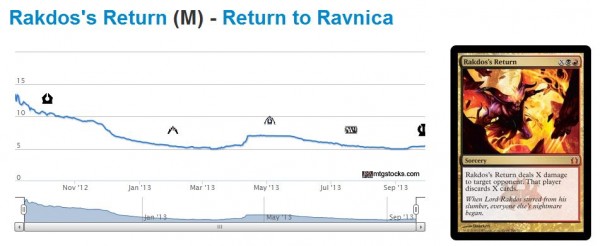
This card has been $5 for a long time and that’s just a joke. People picked up on Obzedat when Gerry Thompson featured his BWR list on Starcity, but Rakdos's Return is only just starting to sell. If you’ve tested the deck at all, Obzedat is solid, but Rakdos's Return actually ends games. It’s the deck’s linchpin, and is a very easy 2-3 of in any midrange deck that generates black or red mana. It obviously isn’t what you want against aggressive decks, but it devastates midrange and control decks alike. Over the course of the weekend the card sold out on Star City, so pick them up at fives while you can.

Master of Waves

Another $5 mythic. If this card is at all playable, that price tag will never hold. That’s just not how mythic rares work. As of now, Frostburn Weird and Jace, Architect of Thought are the best ways to generate devotion to blue, and both are quite playable. I’m uncertain if the list Mark Nestico posted this week is the real deal or not, but every good blue permanent in Theros block will only make this card more viable. I’d be very comfortable buying these at fives.

~

I apologize for the brief delay that the bans have caused on my Pauper series, but I think that it’s for the best that I wait another week to provide the best possible lists. Thanks for bearing with me, and thanks for reading.

-Ryan Overturf
@RyanOverdrive on Twitter

Insider: The Spike is Here. What’s Next?

Are you a Quiet Speculation member?

If not, now is a perfect time to join up! Our powerful tools, breaking-news analysis, and exclusive Discord channel will make sure you stay up to date and ahead of the curve.

It’s happened. We’re there. The time has come. So on and such.

Winter is no longer coming, it is here. And now that it is, there’s money being made everywhere. Right?

Few things I want to address. The first is the Myth of Making Profits, something I’ve talked about before and which is especially relevant right now. It’s great that you got your Jaces at $10 and now they’re $25. But until you cash out (whatever your outlet is), you haven’t made a penny. Keep that in mind.

The second thing I summed up in a tweet a few days ago:

Screen shot 2013-10-01 at 7.07.59 PM
Let’s address these in order before we talk about some individual cards.

Myths and Theros

If you didn’t read the link, the TL;DR version is this: Until you actually cash out your cards, you haven’t made any money, and your specs have not paid off.

Now let’s look at Theros. Several of the cards I predicted to spike did, including Anger of the Gods and Elspeth, Sun's Champion, but remember that they’re likely at or near the peak right now. Having them to play with is great, and if that was your goal, congratulations. I hope I saved you some money.

But if not, and you want to flip some of these cards, you need to do so in the next two weeks. Lock in your profits now while you can and use that to fund your next few drafts or the rest of your Standard deck. Just don’t let yourself hold onto the cards for too long, happy that you “made money,” while buylists begin to drop.

Now What?

So let’s assume you did the right thing and got in on these cards while you could. What’s the play now?

In short, it’s probably time to sell. Yes, the Pro Tour could shake things up and push some of the premier cards even higher, there’s also another few weeks of busting open Theros until then, and I would refer you to the tweet above. And, remember, everyone is throwing their cards upon TCGPlayer to sell, so the race to the bottom is already in effect.

So what’s next?

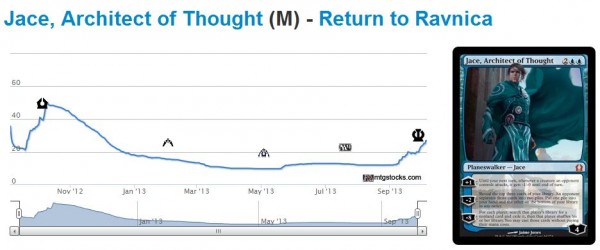
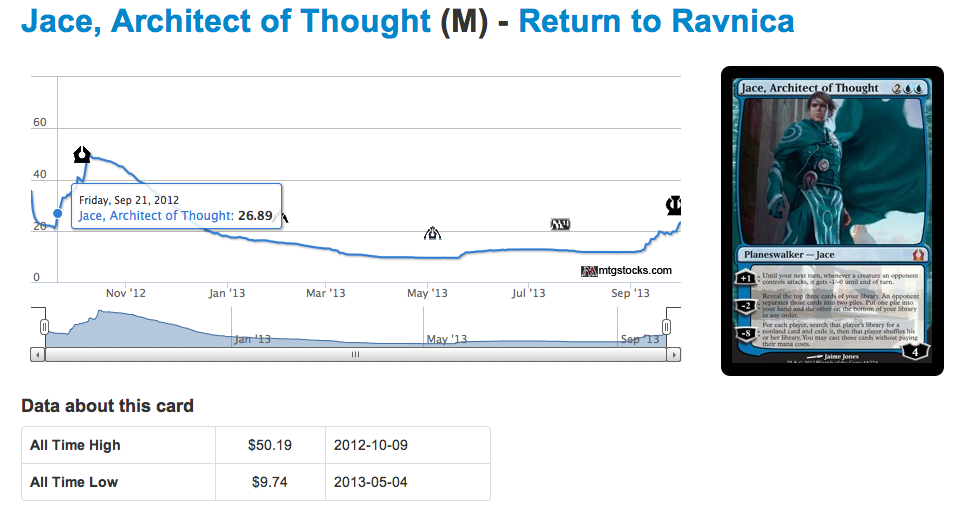
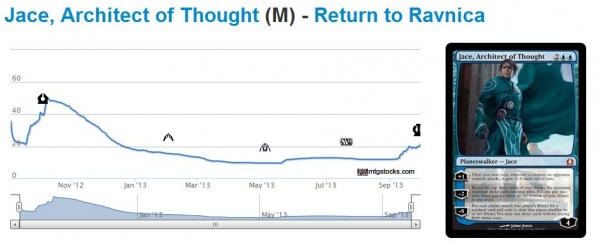
Let’s look at what has been my favorite spec target for the last six months: Jace, Architect of Thought.

Screen shot 2013-10-01 at 7.04.12 PM

We see that our friend has gone back over $20, exactly like we predicted he would. He’s all over the Top 8 and will probably continue to be for the coming weeks.

I’m selling mine.

I don’t think a firesale is in order like with Elspeth or Anger of the Gods or anything else, but I do think it’s probably time to take our profits and walk away. To be honest, I don’t really see Jace going below $15 and I could see him spiking again to $30-35 after the Pro Tour, which is why I’m slowly unraveling my position rather than just dumping them all at once.

So really it’s all about how comfortable you feel with your position on Jace. If you got in cheaply, it’s probably time to sell and be happy with more than a double-up. On the other hand, if your “in” price isn’t as good, maybe you see if you can squeeze a little more out of him.

The major reason I’m not in a rush to unload these is because the blue man group of one is just really good. Even if the meta shifts or more copies hit the market, this is not a buyout situation, nor is it a one-week spike. Even if it doesn’t go any higher it’s going to come down slowly, which means we’ll see the writing on the wall and can proceed from there.

Unloading

So, back to the “What’s Next” question, I want to talk about one theory of unloading a spec. There’s not an official name or anything (or there could be in investing theory, I wouldn’t know). Anyways, I’ll call it the “break-even” practice.

Say we own 20 Jaces that we specced on at $9 apiece. Today after fees we can probably get $18 for these. In order to recoup our initial investment of $180, we need to sell ten copies. That leaves us with ten copies to hold.

I don’t always advocate this (because usually I feel like it’s just correct to sell once you’ve made your money), but in this case I think applying this strategy is valid. The major reason for it is that Jace could dip a little in either direction, but he’s more likely to be $30 two weeks from now than $10. With the upside that high and the risk minimal, I think it’s worth playing the market a little here, and seeing how it goes.

It could be a bust and you end up selling the last ten Jaces for something like $14-15 a copy, but even at that you’re still profiting. On the other hand, it exposes you to the opportunity to get $25 a copy, all while guaranteeing you’re still making a profit on the spec as a whole.

Keep in mind that I approach speculation with a conservative viewpoint, and I’m not the all-or-nothing type of guy. I’ll draw the last round of FNM to split packs every time instead of playing it out, and I take the same approach to speculation. But at the end of the day it makes money instead of losing it, and that’s how I’m approaching selling my Jaces.

What About the Rest?

While Jace is a bit of special case, remember that the rest of the cards that spiked this weekend are getting a sell call. One interesting note is that green-white didn’t make much of an appearance at all, which I’m not sure will be representative going forward. I still like holding onto those cards (other than Fleecemane Lion) until we get some more info.

Whether you’re deep into your Theros specs or just have a few Return to Ravnica goodies, this weekend was a profitable one for you, as long as you allow it to be. Sell or trade away some of those specs now to cover your costs, and reap the benefits with the rest.

Thanks for reading,

Corbin Hosler

@Chosler88 on Twitter

Insider: Why I’m Avoiding Theros in Favor of RTR Block (For Now)

Are you a Quiet Speculation member?

If not, now is a perfect time to join up! Our powerful tools, breaking-news analysis, and exclusive Discord channel will make sure you stay up to date and ahead of the curve.

As of this writing, I haven’t preordered, purchased, or traded for a single Theros card. Just like with almost every new set, Theros cards are priced too high across the board right now, especially for cards that very few have played extensively. These prices are driven by limited supply and hype, and while individual cards may go up, the price of the average rare is going to drop significantly in the coming months.

On the other hand, we’ve had a full year of Return to Ravnica block, and the cards are very known quantities. We’ve had a Block Pro Tour that provides us with tons of data about what post-rotation Standard might look like. The new-set hype is in the past and card prices are based more on real factors—how good is it, how much play does it see, and what is the supply? We’re coming off of the summer, when tournament attendance wanes and card prices are depressed.

There is real opportunity here because everyone is so focused on Theros right now. When Innistrad was current, many cards from Scars of Mirrodin block shot up in value, including Wurmcoil Engine, the fast lands, and even uncommons like Gut Shot. Just before Return to Ravnica was released, Olivia Voldaren only cost $4, Craterhoof Behemothwas practically a bulk mythic, and cards like Sever the Bloodline could be had for less than a quarter.

This isn’t to say there’s no money to be made speculating on Theros cards right now. There certainly is, but I prefer a more cautious approach. I’ll be waiting until after a couple SCG Opens and the Pro Tour to have an idea of what the meta looks like, then use that knowledge to move forward on Theros specs. In the meantime, I’d like to discuss a few Return to Ravnica block cards that are good financial opportunities.

Advent of the Wurm

What I like:
• The card was a four-of in the Block Pro Tour winning deck.
• It’s powerful on its own and synergistic with other cards in its color combination.
• Two decks showed up in the top 32 of SCG Worcester with four copies.
• A higher upside because of low supply due to being from Dragon’s Maze.

Risk factors:
• Selesnya does not currently have a scry land, and if the GW temple is printed in the spring set instead of the winter set, this might never reach top-tier status.
• The token does not assist with devotion, which could hurt this if green devotion strategies are relevant (which I doubt).
• Ratchet Bomb provides an easy and cheap answer to these tokens.
• No decks in the top 16 of SCG Worcester ran the card.

I’m looking to obtain copies in trade only, because Advent of the Wurm’s future is highly dependant on whether the GW temple is in Born of the Gods or Journey into Nyx. By the time the spring set comes out, the meta will be well established and I doubt too many new strategies will catch on. I also believe that the meta will settle into color combinations that have an option to play temples instead of guildgates, so the order in which the remaining temples are printed is crucial for speculators.

Prime Speak Zegana

What I like:
• A buy-in price of less than $3 for this mythic is very low risk.
• There is a scry land for the Simic color combination in Theros.
• Even if this card never sees play in Standard again, its desirability in EDH limits how much lower it can drop.
• Synergy with Prophet of Kruphix, giving you additional opportunities to play all those extra cards you drew.
• One of the few card-draw spells that might be able to compete with Sphinx's Revelation in terms of efficiency.

Risk factors:
• The Simic color combination is not traditionally very powerful in Standard, due to its lack of removal.
• Zegana got worse with the rotation of Thragtusk.
• Bant strategies might still prefer Sphinx's Revelation to Prime Speaker Zegana. Will BUG or RUG strategies even exist?

Prime Speaker Zegana is at or near its floor right now and I’m looking to trade for or even purchase competitively-priced copies. I think this will hold casual value forever, and it could spike to $10 or more if it sees any Standard play in the coming months.

Thespian's Stage

What I like:
• Its closest comparable, Vesuva, is a $10 card.
• After the legend rule change, its synergy with Dark Depths in Legacy became noteworthy. This caused a temporary spike up to $3 a couple months back, which has since settled down, but nobody has played the deck yet. If a theory can cause a 300% spike, imagine what happens if somebody actually makes the combo work.
• It’s another option for 12-post strategies in Legacy.
• It gets better each time a powerful new land is printed.
• Even if competitive decks never end up using it, it will be an EDH staple forever.
• At only $1, it’s a perfect throw-in to even out trades.

Risk factors:
• A lot more Gatecrash was printed than Time Spiral, so this may never reach Vesuva’s $10 price point.
• If this never sees Legacy play, its ceiling might be limited due to only being played in EDH, a singleton format. Then again, it can go in every EDH deck, so this effect may not be as pronounced as with non-land cards.

I’ve liked Thespian's Stage for a while, and acquire them in trade every chance I get. A couple weeks ago I mentioned purchasing 17 copies for 99 cents each, and I have so far felt no buyer’s remorse. I’m pretty confident there’s money to be made on this card, but I haven’t yet determined an exit strategy. I think it’s a long-term hold, but I might start trading them out slowly once the price has gone up to a steady $3.

Beck // Call

What I like:
• Its closest comparable, Glimpse of Nature, is a $20 card.
• With Glimpse of Nature banned in Modern, this is the only option for combo elves in the format.
• It comes from underopened and underloved Dragon’s Maze.
• The buy-in price is only 50 cents right now.
• The card doesn’t have to be in a winning deck to see a spike—all it takes is one brew shared by a popular writer to cause an increase.
• Even if the card doesn’t spike before next year’s rotation, it’s a Modern spec and therefore still viable for years.

Risk factors:
• This hasn’t seen any play yet. It may never see play.
• Being a split card with a not-particularly-useful second half, the card is just uglier than Glimpse of Nature.
• The second color and mana requirement makes this less good than its counterpart.
• If it makes Modern Elves too good, it will almost certainly follow Glimpse of Nature onto the banned list.

I’ve got a couple dozen copies of this card, and will continue to pursue them as throw-ins. I bought 20 copies a few weeks ago at 49 cents each, and I don’t think I’m going to go deeper in cash. Still, I feel very comfortable having multiple playsets of Beck // Call on hand, so I’m happy to have made the purchase.

Time is of the Essence

The first draft of this article included a section on Blood Baron of Vizkopa, but its spike from $10 to $14 in the last week largely invalidated my comments. Being from Dragon’s Maze, Blood Baron has a chance to get even more expensive, and I was all for trading for them at $10. But now that they’re $14, I think the risk is too high for a speculator. If you need a playset, though, I’d pick it up as soon as possible.

My point is that Return to Ravnica block cards are starting to see price jumps, and if there’s anything on which you’re looking to speculate, you might want to get on it. Now that Return to Ravnica block is no longer being drafted, in a month or two, cards from those sets will be overpriced. On the other hand, Theros cards will be all over the place and much more attractive spec targets.

Some final thoughts on picking up Return to Ravnica block cards:

• Cards from Gatecrash and Dragon’s Maze have more upside than Return to Ravnica, due to their lower buy-in prices and lower supply for those sets.
• Gatecrash guilds already have scry lands in Standard, so Gatecrash guilds are likely to see slightly more play than Return to Ravnica guilds until Born of the Gods.
• It’s probably too late to jump on cards that have already spiked like Jace, Domri Rade, Obzedat, etc. Don’t let yesterday’s targets become today’s mistakes—if you missed the boat, wait for the next one.

Zero to Draft Update

I played a four-round Sealed release event this weekend and managed a 3-1 record. I opened Thoughtseize, Temple of Triumph, and Soldier of the Pantheon, so at retail values I exceeded the cost of entry—another stroke of luck for me.

Given my belief that Theros cards are generally overpriced, I was looking to flip these cards immediately. I exchanged Thoughtseize for a Steam Vents and a Garruk, Caller of Beasts. I then traded the Garruk, Steam Vents, Soldier of the Pantheon, and Temple of Triumph for a copy of Arid Mesa. Any day I have a chance to trade Standard cards up into Modern staples is a good day indeed.

Here’s a quick overview:

Events played: two sealed events (including a 2HG)
Money spent: $75
Money received from card sales: $61 (plus $7 claimed but not yet received)
Notable cards held: Arid Mesa, lots of bulk
Packs currently held: 5

Have comments? Please share below!

@dbro37 on Twitter

Insider: SCG Boston Review in a Flash

Are you a Quiet Speculation member?

If not, now is a perfect time to join up! Our powerful tools, breaking-news analysis, and exclusive Discord channel will make sure you stay up to date and ahead of the curve.

Hi everyone! We have just had our first weekend of tournament results with Theros added to the mix and Innistrad/M13 kicked out of Standard. This article is only one of a million things I have to do this week before I move so I am going to jump right into my thoughts for the week.

Initial Impressions

1) They sure did paint the town Red this weekend in Worcester, didn't they? Mono-Red won the whole tournament, but I think the more interesting point was Owen Turtenwald also playing Mono-Red. We have to be aware that he is testing for a Pro Tour and is unlikely to play any of his team's real decks, but he had the option of going with the "known" quantities UW or Mono-White, but choose Mono-Red instead.

2) The second thing we can take away from the Mono-Red lists from the T8 and most of the T16 is that very few played Boros Reckoner. Boros Reckoner was seen more in the G/R type decks and not the aggressive Red decks like previously. The combinations of Firefist Striker and Goblin Shortcutter help negate the opponent's Boros Reckoner, especially in the mirror match. I feel like there was a lot less Reckoner in the top decks than was expected. Maybe Boros Reckoner won't have the huge surge that everyone is expecting, I know I haven't been aggressively buying in.

3) The card that WAS all over the T8 was Jace, Architect of Thought. Jace experienced a late week surge in price around 15%, and according to Twitter today, saw another jump up to the low $20s. I have been telling people to buy-in aggressively and this is why. Another solid week of results for Jace and I think we could see $30+ before the Pro Tour. I would want to sell before the Pro Tour if the results are excellent in Cleveland. If they are not, I think waiting for after the Pro Tour is the right play.

4)Thoughtseize saw some sideboard play in the Esper decks in the T8. I think this is where we are going to see Thoughtseize hang out for the time being. The format is just far too aggressive to make [cardThoughtseize[/card] a maindeck card. If there is a spike to be had with this card, it will have to be around Modern season and unlikely during Standard unless a drastic change in the metagame occurs.

5) Last card I want to touch on this week is Ashiok, Nightmare Weaver. A lot of people wrote this card off at the beginning as being mostly unplayable, but if you remember to my article a couple weeks ago, I recommended getting on board with it. It has gone up nearly 66% over the weekend from $15 to $25.

6) Last of the main archetypes in the T8 were the G/R and Naya aggressive decks. Both used Domri (sound familiar to those who follow me on twitter?) and Chandra with Xenagos nowhere to be found. Ruric Thar is potentially a great pick up in the short term. It saw sideboard play in both decks and if the metagame continues to be balanced by Mono-Red on one end and Control on the other, Ruric Thar is in a great place to see some gains.

7) Some cards that didn't see play that everyone was hyping was the God Cards and Voice of Resurgence. Either the metagame won't allow something like Voice of Resurgence to dominate like it did previously, or not enough time to brew with like the God Cards. I would keep an eye out for any metagame shifts to see if any of these cards can sneak into the T8 in the future.

That is it for me this week. I have to go prepare for interview 1 of 2 this week and get ready to move at the end of the week. I will be able to check comments throughout the week so let me know if I missed anything or if you just liked it! Thanks!

-Stu
www.twitter.com/ssomers55

Jason’s Article: Living in the Past

Are you a Quiet Speculation member?

If not, now is a perfect time to join up! Our powerful tools, breaking-news analysis, and exclusive Discord channel will make sure you stay up to date and ahead of the curve.

Greetings, Chrononauts!

Pop Quiz

"If yesterday was two days ago tomorrow, will the day after tomorrow be today or yesterday?"
—Temporal Manipulation 101 final exam, Tolarian Academy

This is one of my favorite flavor texts. It's from the Ninth Edition printing of Temporal Adept. Did you know all of us are Temporal Adepts, when you think about it? Our brains work via the firing of impulses across our brain. We're powered by electricity, and electricity moves pretty quickly indeed, but the point is that it doesn't move instantaneously.

The time it takes all of our cognitive processes to gather, sort, interpret and react to sensory input is estimated at about 80 milliseconds--small but non-trivial. If you could shave that down a little, you'd be at a competitive advantage in some small, measurable way. It might not ever accumulate to any measurable difference in achievement, but if you can imagine the case of someone who took an entire second to process everything, you could see how a quicker processing time would be a leg up as surely as a slower one would be a big hindrance.

And just how vital is an amount of time that's less than a second? I don't know--ask the stock trading industry--an industry that commissioned a $300 million undersea bundle of fiber-optic communication cables between New York and London to shave an imperceptible fraction of the lag time that New York-based traders experienced when they traded on the London Stock Exchange (insert your own "footsie" joke here).

That's a lot of expense if that small, incremental advantage isn't a big deal. I realize that's a long preamble about split-second timing if I have no intention of talking about the advantages of trading on up-to-the-second information, but... I have no intention of talking about the advantages of trading on up-to-the-second information. Deal with it.

Your Undersea Cable

You have internet access. Don't lie to me, how are you reading this then? Presuming mine is not the only article you read each week (Purphoros help you if it is) you're on the right track because you read articles to get a competitive edge.

Make no mistake, finance is competitive. There is a finite amount of money and price discrepancies get noticed and the market is corrected frequently, so you're trading on information imbalances that won't stick around forever.

But is it necessary to trade on up-to-the-minute information in the world of Magic finance? I'd say probably not. No one is installing $300 million fiberoptic cable to communicate between their smartphone and some website's card inventory at millisecond speed. If a card is excelling in an event at 8:00 am and you notice, you generally have a few hours. You used to have a few days.

Even farther back in Magic's history, there was no finance, really, but you had to buy cards even then, and sometimes it was a matter of either checking eBay or waiting until three weeks after a set's release for Scrye magazine and its pricing guide. As information began trading faster, the pricing got more efficient, but we're still not at a place where milliseconds matter and likely never will be.

As much as we love to high-five each other and point out that cards are a commodity we're trading, the majority of Magic cards bought and sold are bought and sold with the intention of being used, which also makes them non-fungible, tradeable goods. Well, to the play community cards aren't fungible, I think the finance community probably feels differently.

If we want to think of ourselves as commodities traders because it's cheeky and fun to do so and has a substantial grain of truth at its core, let's do it. But let's also remember that while we have a pretty efficient market and live in the digital age, there is still a decent lag time to exploit, and you're less likely to lose because your connection between your buying platform like a smartphone or computer is a millisecond too slow and more likely to lose because you said "screw it" and didn't pay attention to Magic the Gathering for an entire week.

I was busy this weekend and didn't watch any coverage, but even then it was nearly impossible not to have attention paid for me.

Feudo

Feudo

Feudo

If you cut Paul from the list I got information about the format from mostly non-players. You have to go a long way to actively try not to get information if you give Twitter even the cursory glance I gave it to go find two or three tweets. Everyone is waxing philosophical about the format right now and if you didn't buy any cards yesterday, I have to ask what you were thinking.

I don't write a finance article, folks (it gets less and less believable each time I say that, doesn't it?) but there are a few cards that you may still be able to make some money on.

If Hammer of Purphoros is still around $2 by the time you're reading this, you may want to consider scooping a few. Sustainable or not, I think there is decent upside.

I didn't like Ashiok, Nightmare Weaver as a card. I still don't, but I am warming to it as a spec. This could be another Jace, Architect of Thought--a planeswalker that spikes to insane levels after a strong performance in the first event of the new Standard, then dies down. I'd sell Ashiok at the first sign of upside as I don't predict it spiking twice or climbing from its next peak.

But I didn't predict $15 being a good entree, did I? We didn't need undersea fiberoptic cable for me to watch Ashiok do serious work on camera, durdle for a few hours and see that there are still dozens of copies around $17 on TCG Player. I didn't like buying in blind, but I like buying before a bit of hype I can sell into, and even though there weren't a million Ashioks in the Top 16, it surprised some people.

Speaking of Jace, Architect of Thought, wow. $30? I really wish I hadn't sold so many at $18. I profited selling at $18, but, still. I know Corbin says "leave 10% for the next guy" but I think the next guy got quite a bit more than 10%. If you have a few copies left like I do, you could sell now, but I think I may actually wait and see if $30 is even the ceiling.

Prices will be slower to fall back down than they are to spike, and with all of the Innistrad walkers gone, something will have to step up and fill the void. Why not a card we all lost our collective minds over this time a year ago?

I can talk a bit more about results from the weekend at length later.

A Few Finals Thoughts

Sure, we all live in our own past, victims of the lag time between our eyes and our brains. But that's no excuse for not abusing the lag time between perception and reality. If you even paid a cursory amount of attention to this weekend, a crucial event for the financial future of a lot of these cards, you saw things that may have surprised you.

There is financial opportunity in surprise. Surprise means there was a discrepancy between hypothesis and result. When that happens, the prices of cards are likely incorrect because the basis for those prices was based on conjecture. Sure, there is an amount of historical data built in, but how much of presale pricing is guessing, restocking at a higher price if a card sells out at a given price and exploiting impatience? I maintain a great deal of it.

I had been holding everything I opened and had a stack of cards set aside, ready to snap-list tonight. Everything that underperformed or was absent that I'd already had the inclination to sell is now listed. I pulled a few over-performers out of that pile and set them aside.

I had another pile of cards I felt wold likely maintain, and if they are likely not to drop sharply it's worth it to hold a bit and see if they might go up. I left that pile relatively unchanged, but did add a few cards to it.

Finally, I have a stack of lottery tickets--cards that I thought might go up from their presale price (it was a small stack before) and added a lot of cards to it based on the results of this weekend.

One important caveat--Don't focus too much on Theros! There is a whole raft of cards from older sets that may be buoyed by Theros cards and mechanics. Ever want to target your whole team and get a big stack of heroic triggers? Aurelia's Fury can do that. If it's really worth it to do that, Aurelia's Fury has upside at its bottom-barrel $3 price tag.

I think that's more cute than good, but guess what? Vizkopa Guildmage and Exquisite Blood was more cute than good, and I made a ton off of Exquisite Blood, and I am sure a lot of you did as well. Remember, we're commodities traders. We're not building a box full of deck stock, we're trying to flip some cardboard. Fury likely can't go down much more from its current price tag, and any modicum of hype, real or imaginary, could be good for the price. Mythics experience a greater percentage increase in price based on hype due to their scarcity.

Hammer of Purphoros looked good out there. Could Assemble the Legion be a good pairing for it? Again, cute, but also powerful albeit Johnny-esque. You don't have to guess, you just have to watch the relative amounts of cards like this in stock and move if you see movement.

I would say that "cute" combos, like the Vizkopa Guildmage-Exquisite Blood one I mentioned, are more likely to increase as a result of the spoiler season as people buy copies of the older card in preparation of pairing it with the new card. I'd caution you to think hard about moving into Assemble the Legion, for example. For every Exquisite Blood that goes up when its mate in the new set is spoiled, you have a big pile of Otherworldly Atlas that does nothing.

If that combo with Notion Thief were going to be picked up, it would likely have moved right away, because people don't tend to wait to pick up parts of a cute combo until they see someone on camera at an SCG Open. They tend to want that cute, stupid combo right away so they can rule the kitchen table. So since Assemble hasn't moved a ton yet, I don't know if it's going to.

I do think there is little downside to being prepared, however, as you'll likely not lose much value buying Assemble at its current price so it's nearly all potential upside. Do as I buy, not as I say, right? I haven't bought any copies of Assemble, but I am keeping a very, very close eye on the card.

There are a few other cards in that category with Assemble and Aurelia's Fury that I think bear paying attention to. Remember, this isn't the stock market--paying attention can mean "checking it twice a week". You likely have a matter of a day or two to buy in unless the card is widely-played, at which point you would have heard about it from multiple sources (and likely a QS Insider e-mail blast) and hopefully been quick enough to buy in.

You don't need an undersea fiberoptic cable to buy ahead of a price spike like that, but that doesn't mean you don't have to pay attention at all. We lose 80 milliseconds just waiting around for our brain to tell us what's going on. Don't waste any more time than that if you don't have to.

You Mentioned Some Manner of Tournament?

I did, indeed, and let's have at it.

Saturday told us nothing other than that Team Sealed continues to be fun and Wizards is doing a poor job of making Team Sealed and Two Headed Giant widely-played formats, although they totally could.

Let's not forget, community luminaries no less prestigious than Aaron Forsythe himself predicted that a certain Grand Prix on the east coast would see a greater attendance than a certain Grand Prix in the desert of the western United States due to its team format.

If you're going to make a ballsy prediction like that (it turned out hilariously wrong, but it wasn't an illogical thing to say at the time by any means), you must have some faith in the popularity of team formats, yet barely any of those events are scheduled. Two Headed Giant was a PT and GP format for about 45 minutes before they saw how much fun I was having and decided to discontinue PTQ and GPT 2HG events, Player Rewards and Christmas [citation needed] all in the same year.

So Team Sealed is cool and all, but tells us little that is financially relevant. Onward to Standard!

SCG Open Worcester Top 32

This is the first Standard event of the new format, and since I wrote this early, I had to sit and watch coverage for about fifteen minutes to see who won.

It was Mono Red. Chandra's Phoenix and Chandra herself do WORK. I think Burning Earth is going to make people want to play two colors rather than three, Fanatic of Mogis is a Flametongue Kavu that only targets life totals and the clock this deck presents is just brutal. I watched the event's winner Philip Bertorelli pull Max Tietze's pants down game two, and Max never had a prayer.

Max is a name you'll recognize from this article series as he has won multiple SCG Opens and Invitationals. He didn't have any black in his deck which made his mana base less greedy and prone to Burning Earth, he knows how to play control and he made it to the finals by outplaying a tough opponent in the form of Christian Calcano, although by some accounts Calcano was playing a bit loose.

In any case, Max was ready for Philip's deck and he is a competent player who has won this event in the past and who out-controled Christian Calcano. He still lost two quick games in which he never had a chance. Yoked Ox is good against Boros Reckoner--unless Chandra doesn't let it block. Then you're blocking with your face and hoping a Ratchet Bomb popped on turn six is good enough. It wasn't.

I always get a little sad when a deck I feel is somewhat uncreative takes home a trophy. This red deck has existed in a similar form for a while now. However, once you get over the initial revulsion of a deck with Gore-House Chainwalker in it smashing a deck full of Elspeth (not as bullish on her anymore, by the by) and Sphinx's Revelation, you realize that there is a Theros-specific bent to the build.

It makes the best of a good, solid clock, and keeps a lot of creatures in play instead of burn spells because Fanatic of Mogus is a game-ender. With just a Boros Recknoner in play, you hit them for four damage for four mana. If you live in Magic Christmas land where you hit a one-drop, a two-drop like Ash Zealot or Burning-Tree Emissary, then Reckoner then Fanatic, congratulations, you beat an opponent who did nothing.

But you also demonstrated the power of Fanatic, a card with no financial upside because it's narrower than cards like Burning-Tree Emmisary which did go for a buck or two during their reign. It's worth noting that curving into Fanatic comes down a turn before Supreme Verdict, although Philip went into the Top 8 in 8th place meaning he was never on the play Game 1 and didn't play a lot of Game 3s.

Mono Red was powerful in a lot of its forms. I don't know if the many printings of Chandra's Phoenix reduce its potential upside too much to bother, but expect them to trade briskly and four-at-a-time. Chandra herself is up but perhaps not peaked. And Burning Earth is just brutal.

I liked it more than anyone else on Brainstorm Brewery, it was the only card I wanted to talk about, and I'll admit even I underestimated it a bit. With two color decks ballsily (that's a word) slotting in Mutavault, a card I think has a lot of upside even at its current ~$15, Burning Earth is a real card.

Owen Turtenwald played two Hammer of Purphoros in his board, and if Deadbridge Chant is any indication, cards in his board go up. Expect Hammer to experience some growth. Flip into said growth. I don't see this sustaining too much above $5ish, but it over-performed for Owen. Not being maindeckable in all likelihood may hurt it.

Owen also played Firedrinker Satyr, which I don't like too much, and he played Shock over Magma Jet, which surprised a lot of people. Jet may not be good just because it was before--same for Steam Augury, Firedrinker Satyr and Ratchet Bomb.

Ashiok is another card that over-performed on camera. Ryan said on BSB it was a good way to win control mirrors. I wasn't on board until I saw it in action. It's luck-based to be sure, but you can't ignore it like I thought you might be able to.

Xenagos, the Reveler is a card that you can ignore. It really under-performed although there were roughly as many Xenagos in decks as there were Elspeth and Ashiok. Those numbers were dwarfed but the number of copies of Jace, Architect of Thought, however.

I always like Ross's decks

There was a lot of Junk being played early in the day, but it didn't manage to perform as well as other decks. I can't verify this, but maybe greedy mana bases are taking too much punishment. Mana isn't as easy as it once was, as temples are a poor substitute for buddy lands if your curve is low.

Polukranos is a card I thought was overrated. Seeing it in action, I still think it's overrated, but it's getting a lot of play. Its absolute price ceiling is $20 as it's in a duel deck, but I don't see it approaching that anyway. It's a card people are playing and that surprised some pundits (yes, this community has pundits) but I don't see upside regardless.

How about that Jace, Architect of Thought? Ryan Bushard called those like nine months ago and has been building a big pile out of them since then. He was overpaying back in the day, but it won't matter now that they're $30. Is $30 the ceiling? Not historically!

80 Milliseconds

Pay attention to coverage, Twitter, friends, Facebook. Pay attention to what people at your LGS are saying. Watch card prices and card inventories and watch how much you spend pre-ordering cards. I feel like there is more money to be made on cards that spike after this first tournament than there is to be made pre-ordering unless there is a card that is clearly wrong like Angel of Serenity and Thragtusk were.

There is a generous lag, people love to sell cards to other players just to have more cash to throw away on boosters this first week and there is a nice window to sell into. Look to the past to figure out if there are trends you should watch--lessons learned from last rotation are especially valuable. But don't live too far into your own past, either. 80 milliseconds is long enough.


Insider: Trading at Level 2

Are you a Quiet Speculation member?

If not, now is a perfect time to join up! Our powerful tools, breaking-news analysis, and exclusive Discord channel will make sure you stay up to date and ahead of the curve.

Welcome back readers. Today's article will focus on trading, which means those who prefer to buy and sell online may not enjoy it that much. Hopefully those who enjoy trading will enjoy it considerably more...so the overall utility remains the same.

There are quite a few articles from pro players extolling the desire to "play at the next level". This concept refers to the considering not only what cards your opponent is likely to have, but also what cards he might think you have.

This article is devoted to teaching people to trade at a higher level. But first a ritual I think every serious speculator/trader should do...

Your First Task at Every Event

Do you know the easiest, fastest way to find out which cards are the hottest? Just walk over to the retailer booth and see what's sold out. If you have those cards, people will likely want them throughout the day. Note the current "sold out" price and adjust accordingly.

Looking at what is on sale can also alert you to any recent price changes you may not have been aware of. I recall in GP: Atlanta that Restoration Angel had just recently jumped in price and dealers were buying them at $8. Had I bothered to check this out I wouldn't have traded them at $8. This is why the first thing I do at every event is peruse the retailer booth(s).

Current & Future Projected Price

When trading it's important to compare the current price (CP) of a given card to it's future projected price (FPP), what you anticipate it will settle at down the road.

For example, currently (as of 9/23/13) Griselbrand is $12 (TCG Mid) and Snapcaster is $22 (TCG Mid). This means that if one were to trade 2x Snapcasters and a $2 rare they could get a playset of Griselbrands.

However, prices are always a picture of demand at a moment in time. As speculators we need to use logic to determine what we believe the future price will be. While I can't fault my trade partner for wanting Snapcasters (he even got them at $20 each from me), it's my belief that Griselbrand's complete brokenness could easily put him in Emarkul range within the next couple of years (and he doesn't have a promo printing).

I believe Snapcaster is also a solid bet for steady gains over the long run, but I feel that his value will rise to about $25-27 within the next year or so, whereas I can see Griselbrand hitting $20-25 in the same time frame. Thus, I was happy to pick up Griselbrands all day at $12 (in trade).

The "What I Got It For" Myth

This is one I've fallen into several times and I see plenty of others doing it on the forums. Basically this is where you've already profited on a speculation target, and as a result actually undervalue it because you got it even cheaper than you're trading it for.

In the end a $20 card is a $20 card, whether you picked them up at $5 or $15. Our brains will often accept taking an actual loss in a trade because rather than valuing the card at its current price, we remember how much we paid for it and make a jump.

For example (this one hits close to home):

Player 1: I need your Thoughtseize and Temple of Silence.

Player 2: Well I need Steam Vents....so at current values three Steam Vents is close to that.

Player 1: Sure, I got them for $4 anyways.

In this painful instance, I was player 1 and my trade partner player 2. I had an abundance of Steam Vents and wanted the Thoughtseize for the deck I was going to play the next day, but that is irrelevant. I made a poor trade because my brain jumped back to the value of the cards when I picked them up, instead of when I was trading them away.

In your head you've redefined the value of the cards to somewhere between what you got them for and what they are currently worth. A shrewd trader will try to get every copy of the cards that fall into this category as you are basically undercutting yourself on their current value. So the next time you find yourself trying to rationalize a bad trade because of what you "got them for," just remember what they are currently worth and trading below that is eating into potential profits.

The 60:40 Ratio

For those who enjoy legacy, you'll often hear that a 60:40 win percentage for a deck is pretty outstanding. Ideally you want as many matchups like that as you can get in any tournament, as it means you're favored in each matchup.

The same idea can be applied to trading. It's extremely unlikely to "win" or come out ahead of every trade you make, especially at a big event with lots of trading going on. That's okay.

I've had to take this one to heart on several occasions. We are all human, and we rarely have perfect information. Obviously, you always want to come out ahead or at least break even on trades. You'd think that with everyone having smart phones you should have perfect information, but alas, many large event venues get terrible reception (at SCG Atlanta even people with $500+ 4G phones were getting one bar most of the time.)

When that occurs you tend to just give up and go with the last price you knew a card to be. Sometimes you lose, sometimes you win. The point is that as hard as it can be to do, when you do find out you got railroaded, you have to shrug it off because it happens to everyone. Every single person, from your favorite writers on QS to the local shark at your FNM.

If you come out ahead 60% of the time then you should be good over the long run. The only time it really hurts is when you're off by a huge margin in that 40% of the time. A way to prevent this is to a) keep up with the prices of most commonly desired cards, b) look up a price if you really don't know it and haven't looked it up in a long time, and c) walk over to the retailers booth and see what they are selling it for to get some perspective.

The Horizontal Trade

This is simply when you're trading across the board (i.e. not trying to directly get value off of your trade partner). A good example would be trading a play set of $5 cards for a play set of a different $5 card, looking not at the CP vs. FPP but instead looking for cards with higher liquidity in your area.

It seems hard to believe, but more often than not the cards that are in high demand at your LGS may well not be in demand at all in another LGS 200 miles away. I do a lot of this style of trade when I attend larger events because there are a diverse collection of metagames and many store owners looking to rotate stock.

This is also the type of trade I like to do when trying to pick up rarer EDH cards (foils, miscuts, older cards). A great example of this is when I traded a Crucible of Worlds and an Engineered Explosives for an Iona, Shield of Emeria and an Elesh Norn, Grand Cenobite. Both cards he wanted had been languishing in my binder for over six months. I traded off the Iona later that day and Elesh Norn is always in demand from my local Commander players.

Trading to Store Owners

This is more of an addendum to the horizontal trade in that store owners (especially at major events) are primarily there to rotate their stock and to pick up cards they need. They are often more willing to trade Legacy/Modern for Standard so long as the prices are reasonable. This is especially true of the stores that only have a strong Standard presence, but occasionally pick up older stuff in collections. The beauty is that they view the cards as currency rather than collectibles or game pieces.

If they have been out of Supreme Verdicts for two weeks and have had to turn away customers in need of them, then they have an immediate demand for Supreme Verdicts. That means the ones you have can be valued at what they plan on selling them for.

It's similar to trading at buylist prices, except in this case the prices are the selling prices. This is an awesome way to convert Standard into other format staples without paying the "tax" often associated with this type of trading.

Diversify

This is another pretty obvious consideration I often see people fail to account for. I like to have Standard, Legacy, Modern and EDH tradeables in my binders. This is especially critical when trading at major events as people with all kinds of needs will be there.

If your LGS only focuses on Standard or draft, you don't have to carry those binders with you all the time, but be prepared for the bigger events by having them available. You can also leave them in your car when you go to your LGS (and get them if needed).

It also means that it's better to have a lot of options than a lot of the same cards. My best example is with dual lands. More often than not people need these for either a Legacy deck or (more recently) EDH decks. This means that while having 4x Underground Seas in your trade binder may make one person happy, it's more useful to have one each of Underground Sea, Tundra, Tropical Island, Volcanic Island, Bayou and Plateau.

The "Matching Site" Myth

"It doesn't matter what site we use as long as we use the same site." I hear this all the time when I ask people how they value their cards. The thing is, it does matter. A great deal.

Let's use an example. On SCG, Obzedat, Ghost Council is $14.99 and sold out. On TCG it's $8.99 on the mid. That's a huge price difference.

The rule of thumb is usually that SCG prices their cheaper Standard cards way higher than TCG-Mid, but their older Legacy cards or high-end Standard staples are much closer to TCG-Mid. That means if someone says I really want your play set of Obzedats and uses SCG pricing, you have $60 worth of trade product you can find in their binder.

That also means that you'll want to stay away from a lot of low-end cards that SCG charges $1-1.50 for because you could buy the same ones on TCG player for $0.5-0.75. Instead you'll want to trade up or go for something that SCG prices higher per card, say 3x Kalonian Hydra. By SCG pricing you're both at $60, but by TCG pricing you traded $36 for $58.

This is why it's critical to determine what price system you'll be using to trade with players. Another concern is when players use SCG but only ask for cards that are "sold out" and demand that the current price is used despite the fact that when SCG resupplies, the "in stock" price will be higher.

This is a pretty common tactic I've seen and watched out for. For your own amusement pick only higher-end cards SCG is also out of stock of and flip the tables on them. My favorite example of this was at an SCG Atlanta event where one player wanted all my Remands at the current SCG price of $9.99 (out of stock) but wouldn't do 5x Remands for his 2x Vendilion Clique $24.99 (out of stock).

Beware the High Dollar Guy

Occasionally you'll run into the trader with just a small binder and when you open it you realize it's all high-dollar cards. They'll actually value their cards pretty fairly, however, they'll often try to get a bunch of lower cards from you, but the numbers won't add up.

For example, say they have a $100 card you really want. They go through your binder and pick out 3x $30 cards, 1x $80 card, 2x $60 cards* as the only things they want. Their goal is to make sure that what they pick out can't be made into a pile that's actually $100 worth of cards.

No matter how you stack it the piles will be $90 (which they just flat won't accept) or $110 which they will. At this point they either convince you to lower the value of your own cards so they equal $100, just accept you're taking a $10 loss....or walk away.

I haven't done any experiments yet to determine exactly how likely someone is to walk away from a trade that they've put more than one minute into, but I'd guess it's a lot less often than you'd think.

Expand Your Market and a Note on Buying/Selling

This seems obvious enough, but you can only trade to people who you have contact with. This is the reason so many of us take the 10% hit using eBay or TCG player when converting cards into cash. A lot of other people use Craigslist or other similar sites to find new collections or sell stuff they don't need.

I would suggest scouring Facebook or some other social media website for MTG trading groups and if one doesn't exist in your area, create it. I did just that because I found it paid off to have a non-store-specific trading group. It also gives me a place to post my personal buy list as well as a want/trade list.

On a slightly different note, it's important to note that a lot of card shops don't like you buying and selling cards in their shop. It makes sense, given they pay rent in order to have a presence there and you're directly cutting into potential business, so always respect that.

In a similar vein, you are never allowed to buy/sell cards at a major event in the event hall. The reason is simply the actual dealer(s) with booths paid for that booth and thus they are the only ones with the right to buy and sell in that event hall. Not following this rule can easily get you kicked out or banned from events which will really hurt your ability to trade.


***EDIT***I removed the 1x $20 card from the list because as someone pointed out..$80+$20=$100.

Insider: What’s Next After Rotation?

Are you a Quiet Speculation member?

If not, now is a perfect time to join up! Our powerful tools, breaking-news analysis, and exclusive Discord channel will make sure you stay up to date and ahead of the curve.

The past few weeks have been a wild ride for speculators. With Standard rotation looming, so many price fluctuations are taking place. Innistrad block cards are pulling back as they say farewell to Standard. Well, most of them anyways. Liliana of the Veil and Snapcaster Mage may be the big exceptions.

Liliana

Meanwhile, players need to fill the gaps in their Standard deck strategy that have been vacated by the rotating cards. Enter Return to Ravnica block cards. Now these are getting their time in the spotlight–-they are opened much less often nowadays and demand should increase. Hence, we have trends like Jace, Architect of Thought’s:

Jace

My advice as Theros launches is to begin selling some of these hyped cards. Feel free to try and time the market perfectly. This is a gamble I usually avoid because I’m risk-averse and like to lock in profits. But there’s plenty of merit to the strategy.

With all these recent spikes, you should be profitable on many holdings. Ringing the register and earning some dough should be a great feeling.

Now I have a question: what’s next? We’re generating all this revenue from sales, but there may not be an obvious place to speculate next.

A Time for Quick Flips

This is arguably the most interesting time in Standard from the standpoint of MTG finance. In addition to the movement on cards, both rotating and non-rotating, we begin to see how the newest set impacts the format. Many players are speculating on what strategies will dominate and what Theros cards support those strategies. This is a fine approach.

But I like my approach a little more due to my risk aversion. I simply wait until the first SCG and Pro Tour results come in. A SCG Standard Open just concluded yesterday (sadly results aren’t available until after this article is due). There were likely some Theros cards that made a splash–-these could be worth grabbing for a quick flip.

Or perhaps with a smaller card pool, we learn that something like Dreadbore is actually an amazing card. Perhaps Rakdos's Return makes a comeback. Either way, there will likely be something that spikes in demand as a result of these events. My advice is to buy quickly into these opportunities for the quick flip. To make this a profitable endeavor, you’ll need liquidity.

Return

Remember to favor mythic rares for their higher price ceilings. Avoid speculating on expensive rares unless they are multi-format all-stars. And even then, rares don’t exceed $20 cash nowadays--don’t expect this to change. I’m looking at you, Thoughtseize.

Thoughtseize

Random Aside

Hey look at that, AlphaBetaUnlimited is a newly launched seller on TCG Player? Is this the ABU Games? If so, then it’s interesting to see another major retailer on the site. If not, then ABU should try and go after that guy for using their name if they can. Seems a bit dishonest to create a seller profile and name yourself after a major retailer. Just saying.

Okay, back to the topic at hand.

Quick Flips Not Your Thing?

The quick flip speculation route has made me solid bank in the past. Craterhoof Behemoth and Tamiyo, the Moon Sage were both cards I purchased after they saw play in a major Standard event. By the time they arrived in the mail their sell and buy prices jumped significantly, providing me with an easy, profitable outlet.

But I recognize not everyone on this site has the same opportunities I have. Mainly, this refers to my location. Being in the United States means I have more buying and selling outlets than some members in other regions. As a result, the quick flips may not be viable due to time lag and/or shipping costs.

No need to fear, I’ve got a couple other ideas up my sleeve.

May I suggest moving some profits into a booster box or two? Innistrad boxes reached $160 while still in Standard. While I don’t expect Return to Ravnica boxes to reach quite as high (more supply, arguably less fun to draft) I still fully expect these to rise in the coming year. FYI I’m taking my own advice on this one--I just purchased two more boxes last week during an “eBay Bucks promotion” of sorts. Parking hundreds of dollars into sealed product isn’t for everybody, but it’s a safe way to convert short-term gains into long-term investments.

Yawn – Sealed Product Is Boring

Modern can be a tempting format to invest in, but I’m becoming weary of this play. I already have sizable Modern bets and I’m hesitant to deepen them. This is mostly due to risk of reprint--I still expect some sort of Modern Masters 2.

And if this doesn’t happen before Modern season, there are still the new Commander decks which could potentially have many Modern cards. For example, I could see Wizards including fetchlands and/or Worldwake manlands in each Commander deck. Boy, wouldn’t that stunt the growth on stuff like Celestial Colonnade?

Colonnade

Because every Modern staple has a potential target on its back, it’s difficult for me to suggest many safe bets in this format. I still like sideboard cards Torpor Orb and Spellskite. Scars of Mirrodin dual lands are safe, but they also haven't really moved at all. I sure hope these cards start to get some life in them next Modern season.

Other than that, the only other safe Modern bet could be original-set foils. Not everyone has the cash to sink into foil Liliana of the Veil or Snapcaster Mage, and the upside on these is arguably less because their prices are already so high. But how about foil Melira, Sylvok Outcast? Or foil manlands? Or even foil M14 Mutavaults, which are so much cheaper than their Morningtide counterparts despite having identical artwork? The same goes for Scavenging Ooze.

Mutavault Prices

These are all viable places to park some cash if you’d prefer a longer-term time horizon and don’t have access to quick flip opportunities.

Might I Suggest…

Don’t forget cash is king. When I am looking to unload a position, the most powerful bargaining tool people can present is cash. Trades are nice, but they don’t yield true monetary gains. These are only achieved when you have more cash in your pocket than when you started with.

Therefore, it’s okay to sit on some dough while we wait for things to evolve. You don’t have to be in a ton of speculative positions all the time. Sometimes having increased liquidity is advantageous because it allows greater flexibility when the time to buy does finally come.

And if you absolutely hate cash because you fear your net worth drops as inflation creeps higher, you could always do what I do. Every time I hit a certain threshold in sales, I take the profits and invest in the stock market (or as I like to call it, “RL Investing”). This isn’t for everybody, but it’s a smart way of converting paper gains from MTG finance into a sustainable investment in your future.

The approach may be less exciting, but it’s also much less work and more stable. Major companies on Wall Street will be around for many years to come. We can only hope the same is true for Magic, and that ten years from now I can be writing a similar article about Standard rotation.

Sigbits

  • It feels like Hallowed Burial was a flash-in-the-pan type of card. All this discussion on the Eventide rare took place on Day 1 of GP Detroit, and by the end of Day 2 all the hype had died. Jund kind of destroyed almost all the other Modern strategies out there. This is yet another reason why I’m hesitant to move in on Modern staples--Wizards is likely to do something to shake up the format in the coming months.
  • Star City Games had a nice sale last month, and some mark-downs made some of their cards reasonable buys. That is, assuming you were quick enough to actually pull the trigger. I saw SCG restock their Snapcaster Mages multiple times at $15.99, only to have them sold out again within minutes. Expect the $20 price tag to return to stay once this sale is over.
  • Here’s one I didn’t know about until I just looked them up--do you have any idea how expensive foil Tron lands are? Foil copies from both 8th Edition and 9th Edition are retailing for about $12! The prices are no lower on eBay--this is an opportunity I most certainly missed.

-Sigmund Ausfresser
@sigfig8

Want Prices?

Browse thousands of prices with the first and most comprehensive MTG Finance tool around.


Trader Tools lists both buylist and retail prices for every MTG card, going back a decade.

Quiet Speculation