menu

Insider: Shockland Exit Strategy

Are you a Quiet Speculation member?

If not, now is a perfect time to join up! Our powerful tools, breaking-news analysis, and exclusive Discord channel will make sure you stay up to date and ahead of the curve.

Fall Standard rotation is almost upon us, with Innistrad (ISD) block and M13 set to head out of Standard. In the meantime, some players are still playing with Bonfire of the Damned, Huntmaster of the Fells and Snapcaster Mage but really they are thinking about how they'll be turning on devotion or hoping to complete their play set of Thoughtseize.

For online speculators, it's the best time to have a few tix handy, so it's time to consider our standing positions, and whether or not it's a good idea to sell out for some tix.

One position that every speculator should have taken in the past six months is with shocklands. As pointed out by many writers and commentators in MTG finance, real estate has been a steady and rewarding vehicle for speculation in the past. Lands that produce more than one colour of mana make Magic more fun and are essential for the competitive player. This past winter, the consensus was that speculating on the Return to Ravnica (RTR) and Gatecrash (GTC) shocklands would be a no-brainer.

There was a brief bit of terror around the time when the land slot of Dragon's Maze (DGM) boosters was announced to be carrying the shocklands, but in general speculators have held a consensus that it would be a sound strategy to pick up shocklands. The message, loud and clear, was to accumulate shocklands, any and all of them, hold until the Fall and then to profit.

Recently more dissent from the majority opinion has cropped up. Jason Alt wrote about it in his article this week. Be sure to check out the comments as well; many of the best financial minds of the QS community chimed in with their thoughts. Forum user koen_knx also came out with a forum post this week saying they had recently completely sold out of their speculative shockland position.

These dissenting opinions should be taken seriously, but I disagree with their conclusions.

The Trend

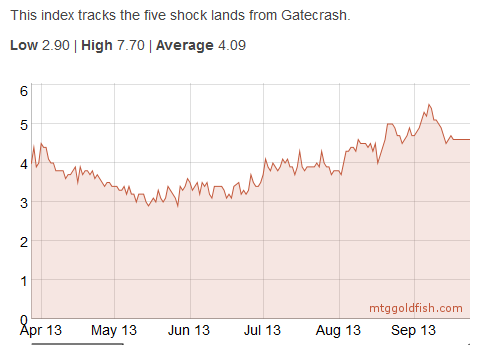
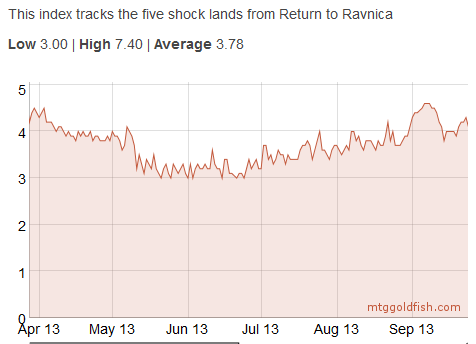
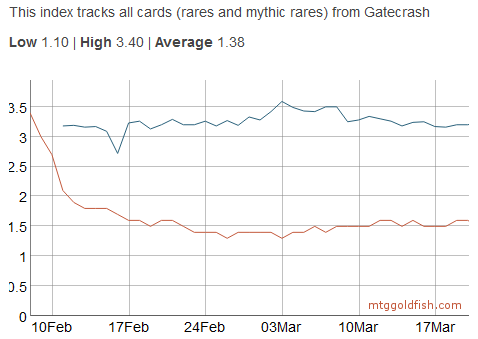
Let's investigate how the shocklands are performing overall. In the two charts below, we can see that the trend for both the GTC and RTR shockland indices is up since June. After finding a bottom of around 3 tix, both indices have started uptrends, with a series of higher highs and higher lows. This tracks the expected pattern of price correlating with supply from drafters. As Modern Masters was released, and then subsequently M14, this took interest away from RTR block draft. As supply from drafters fell, prices stabilized and then have been trending higher.

GTC Shocks

I'll draw your attention to the price peak in early September, followed by a substantial drop. I hypothesize that this was a round of late buying by some combination of speculators and players, followed by some speculators deciding to take profits. For my own portfolio at that time, I decided that it was worthwhile to sell some of the GTC shocklands, and I sold off a few play sets at attractive prices.

RTR Shocks

Lastly, it's important to recognize that some of the recent drop might be attributed to the throwback Ravnica-Guildpact-Dissension (RGD) draft queues which are associated with the latest round of Cube draft. Players might have reacted by panic-selling their shocklands due to the fear of a market flood.

My experience suggests that Cube drafts do not award enough product to encourage a lot of drafting. Usually to get a substantial amount of product into the market, you also need a high expected value from the associated draft queues.

In this case, the presence of Dark Confidant, Chord of Calling and four of the shocklands in Ravnica: City of Guilds suggests that that pack does offer some value to drafters. However, these are rares from the pre-mythic era, meaning they are harder to come by than rares today. For every Glimpse the Unthinkable there's a Warp World, Woodwraith Corrupter and Agrus Kos, Wojek Veteran, among others.

Notably though, the last two packs in the RGD draft, Guildpact and Dissension, do not have anything equivalent to the money cards in the original Ravnica. Each have an expected value less than half that of  Ravnica: City of Guilds. The combination of awarding phantom points for Cube draft and the low expected value on RGD drafts suggests to me that there will not be a lot of repeat drafting and that shocklands will not be flooding the market as a result of these events.

The Exit Strategy

As of today, prices have not yet recovered to the recent peak earlier in the month. But, we are entering a period of renewed interest in Standard with the possibility of multiple shifts in the metagame. Standard of October is going to be substantially different from the Standard of December, and then there will be a further shake up of the format with the release of Born of the Gods at the beginning of February. On top of that, the Standard PTQ season might provide a slight premium to RTR block cards come January.

This gives a substantial five month window where anything is possible, where a hot deck can easily drive the prices up on singles for a few weeks. This is the type of interest that I will be attempting to sell into. Most of the shocklands will probably trundle along in the 3.5-4.5-ticket range for the coming months, but if one breaks out into the 6+ tix range, that would be an opportunity to sell.

However, in the short term, Fall Standard is not yet even upon us. Selling before rotation has even occurred goes against fundamental principles of speculating in the MTGO economy. In my experience, many players are short-sighted and have not been acquiring the cards they need to play Standard in the Fall. The urge to draft and the need for tix trump many future considerations for online players. Demand for shocklands has not yet peaked.

When players are impatient, it's up to the speculator to apply patience in order to maximize profits. If you've acquired a bunch of shocklands in the summer, you've got some more waiting to do. RTR, M14 and Theros Standard has plenty of time to run its course, and I'll be there to sell into the big spikes in demand.

Some of the early price increases will no doubt be met by speculators unloading their stock. The biggest gains will come after most speculators have sold down their shocklands, and supply becomes much scarcer. If prices haven't increased substantially on a given shockland by March, it will be time to consider selling the stragglers at market prices. The goal will be to make outsized profits on the hottest shocklands, and to make small profits on the rest.

Taking small profits on all of the shocklands right now is a strategy which will ensure a gain, but I feel confident that no shockland will breach it's price floor over the coming months, and that speculators will be better served by waiting for periods of high demand.

Merchant Scroll #2: Power in a Day

Are you a Quiet Speculation member?

If not, now is a perfect time to join up! Our powerful tools, breaking-news analysis, and exclusive Discord channel will make sure you stay up to date and ahead of the curve.

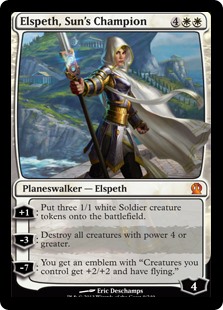
This episode of Quiet Speculation's ten minute market podcast goes over Elspeth, Sun's Champion - do you buy them at $30 or sell all of your copies? Also, we've got an interview with Kelly Reid of QS about how he turned a pile of trash cards into a nice-looking piece of Beta power. And instead of grinding binders over months, Kelly pulled this off in a day and tells you how you can do it, too. What kind of cards are you holding onto that nobody ever asks to trade out?


Merchant Scroll #2: Power in a Day (click to play in browser, right-click to save it)


Here's the trade list of cards that Kelly was working with.


Your show comments are always welcome and you can get to me here or through Twitter with @QuietSpec too!


Douglas Linn

Doug Linn has been playing Magic since 1996 and has had a keen interest in Legacy and Modern. By keeping up closely with emerging trends in the field, Doug is able to predict what cards to buy and when to sell them for a substantial profit. Since the Eternal market follows a routine boom-bust cycle, the time to buy and sell short-term speculative investments is often a narrow window. Because Eternal cards often spike in value once people know why they are good, it is essential for a trader to be connected to the format to get great buys before anyone else. Outside of Magic, Doug is an attorney in the state of Ohio.  Doug is a founding member of Quiet Speculation, and brings with him a tremendous amount of business savvy.

View More By Douglas Linn

Posted in Free, Free Finance, Merchant ScrollTagged , , 3 Comments on Merchant Scroll #2: Power in a Day

Have you joined the Quiet Speculation Discord?

If you haven't, you're leaving value on the table! Join our community of experts, enthusiasts, entertainers, and educators and enjoy exclusive podcasts, questions asked and answered, trades, sales, and everything else Discord has to offer.

Want to create content with Quiet Speculation?

All you need to succeed is a passion for Magic: The Gathering, and the ability to write coherently. Share your knowledge of MTG and how you leverage it to win games, get value from your cards – or even turn a profit.

Insider: Looking Back at Magic 2014

Are you a Quiet Speculation member?

If not, now is a perfect time to join up! Our powerful tools, breaking-news analysis, and exclusive Discord channel will make sure you stay up to date and ahead of the curve.

Time to look back at Magic 2014. That means it’s that chance for me to see what I predicted right and what I totally failed on this time around.

Entering M14, we knew a few things. First, that slivers were coming back, which was cool, as was Mutavault, which is also cool. Second, we knew that the set sucked, which was decidedly not cool.

That led to a lot of speculation that this set would be opened less than other core sets, a point that’s going to come up again as we go through this. Going in, though, I wasn’t sure that would be the case. But looking back at it, I’m not surprised that prices are holding higher than they typically would, which certainly indicates a lack of cards opened in comparison to past sets.

Also, it’s possible that Modern Masters cut into this set some, just as it did with Dragon’s Maze. Sure, most (but not all) of Modern Masters was off the market when M14 came out, but not all of it. Vitally, it’s also possible that people were simply tapped on cash after the expense of the Modern set, and that coupled with a lack of excitement likely all caused a smaller amount of sales for M14.

Anyway, let’s get to the cards.

Archangel of Thune

Then:

“Baneslayer Angel this is not. While the ability is cool and this is a bit of a roadblock for aggressive decks, it’s nowhere near the $25 it’s preselling for unless there’s some cheap, incidental lifegain stuff to break it, which I don’t expect.”

Now: Still stubbornly at $25, despite seeing very little Standard play and just a hint of Modern play. Honestly, this is one of the cards that validates the hypothesis above. Even if it were to take the Sublime Archangel route and stay around $15-20 on casual and fringe play, the $25 mark doesn’t make sense because it’s sometimes played as a one-of in Modern. To me that’s a signal of supply-side factors at work. I expect it to take a Sublime Archangel route in the next year.

Garruk, Caller of Beasts

Then:

“I think this is a cool design, and probably does have a place in a few decks, though certainly as a four-of.

The way I see this being used is in a ramp deck full of stuff bigger than six mana. That way, ramping into this with a huge monster in hand is good, and even has the backup plan of ramping into said big guys anyway. In addition, casting this and plussing it helps you find said huge monsters.

That’s pretty much the only shell I see for it, and that seems pretty narrow. With that said, $25 seems way too high, and $10-15 more likely.”

Now: $17. After an initial bump, this guy is back on his way down, likely heading toward the mark I laid out originally. G/x is a very good shell in the new Standard, but I’m not sure they want a six-mana planeswalker, and if they do it may just be Elspeth.

Kalonian Hydra

Then:

“This seems like one of the best hydras we’ve ever seen. While it’s certainly not groundbreaking, it does kill in two swings.

More importantly, imagine curving Exava, Rakdos Blood Witch into this. That allows you to swing for 8 immediately on the turn your hydra comes down and also pumps your other unleashed dudes.

I’m not sure if curving a four-mana guy into a five-mana guy is good enough since it slows down your aggro deck, but I do know it isn’t $30 good enough. This thing will likely halve in price by rotation, and we’ll re-evaluate then.”

Now: $21 and trending downward. Again, we’ll see if he sees play, and if he does he'll probably hit $30 again, but I’m guessing he doesn’t see serious play, and the price will continue to drop.

Primeval Bounty

Then:

“Though this really belongs in a later section, I’ll include it now. I don’t like this at the $8 preorder, but I do like stocking up when it eventually bottoms out. While it’s not exactly an all-star must-include in EDH, it is playable there, and most importantly is a mythic.”

Now: Holding steady at $7. Have we seen the bottom yet? I’m inclined to think not, but it’s probably not too far away. If this doesn’t go any lower in the next month, it’s probably time to start picking them up for that Parallel Lives box.

Fiendslayer Paladin

Then:

"The power level on this is nice but not overwhelming. As such, unless B/R decks become huge in the format it won’t hold its $6 pricetag. But even narrow sideboard cards like Rhox Faithmender can hold $5 if they remain in high demand, which is something to keep in mind if this becomes too cheap.”

Now: Been fairly steady at $8. Another card that demonstrates the lack of M14 opened. In what world do marginally-played, Standard-only Rares hold $8? One where no wants to open M14.

Imposing Sovereign

Then:

“I don’t hate this card at $3. The risk at that price is pretty low, and it certainly seems like a powerful tool in Naya decks. The control decks have been partial to Blind Obedience, and now you get one that bears them for two as well. I like grabbing this to prepare for a possible jump, though $5-7 or so seems like the ceiling here.”

Now: Still $3, and with some hype behind it going into the new Standard. Several pros have talked up this card, so keep it on your radar if nothing else. Certainly if you traded for them at $3 you’re still doing fine, and increase your holdings if you’re a believer. Soldier of the Pantheon is going to open up a lot of good decks, and I think G/W is a solid player early.

Lifebane Zombie

Then:

“I would not be surprised if this saw some play, since it’s powerful and usually a two-for-one against the relevant decks. That said, I don’t see much upside at $6.”

Now: $8. I correctly pegged this as seeing play, and that there wasn’t much upside at $6. Certainly a cash buy at that price wouldn’t have been profitable (outside of the 2-3 days where you could buylist these for $7-8).

Remember what I said about G/W being good? Well, certainly one of those two colors will be, and I actually think this guy is a decent pickup right now. I’m not sold on black being part of the control decks yet, but this may just be a reason.

Mutavault

Then:

“My pick for the most-overhyped card in the set. We all remember Mutavault fondly, but that was in a time when tribal decks were all the rage and decks weren’t as color-intensive.

How in the world do Naya decks fit many of these in? How do three (or more)-color control decks fit it? We don’t know for sure about post-rotation, but we can assume the mana certainly won’t be much better than it is now, since M14 doesn’t even have a cycle of duals. Unless people move to less color-intensive decks I see Mutavault dropping to under $10 from $15 now, at which point I suggest stocking up on them for sure.”

Now: Holding steady at $15, literally unchanged from the preorder price, another sign of a lack of product opened.

I see a big opportunity with Mutavault right now. I was right about it when it came out that it wouldn’t make a huge splash, but two-color decks are much more viable these days, and while the colorless mana can hurt you, I see this picking up play in this Standard. Trading in at the $13-15 range is not a bad play.

Savage Summoning

Then:

“I know people are talking about this, but they’re mostly wrong. This is not a $6 card.”

Now: $1 and on the way to bulk. Told you, Ryan.

Scavenging Ooze

Then:

“This will surely see a fair amount of play. I think it could drop to $10 or so in the next two months, but as we near Modern season I think this fluctuates between $14 and 20 or so from there. We’ll also see how much this sees play in Modern and how much that affects its price moving forward.”

Now: $15. This behaved exactly as I predicted, dropping to $12 before rising back up to its current price.

I also don’t think this is a bad pickup right now. These Modern staples from M14 could spike early next summer as we enter the PTQ season. That said, I think they’ll drop back down after that, as the end of the season runs pretty close to rotation. It’s at that point we’ll have our next opportunity to buy in.

Witchstalker

Then:“I think this will likely be a big part of the Hexproof deck, and actually improves it a bit. I think it could spike above the $6 it is now, but probably won’t stay that high. Post-rotation, I’m not sure if there are enough pieces for the deck to survive, and this could tank pretty hard if not.”

Now: $3 and on the way down. I’m still surprised it didn’t see play in Hexproof, so the spike never occurred. I’ve also seen people testing this in new Standard, but I’m not a huge fan. Then again, I’ve been wrong on this once, so you never know.

But, yeah, not a fan of this even at $3, and one I missed hard in the set review. I think part of the reason I did was that control decks were already adjusting to Voice of Resurgence (and not playing spells on the opponent’s turn), so this thing’s second ability became an actual blank.

Door of Destinies/Sanguine Bond/Darksteel Forge

Then:

“I wanted to talk about all these at once. Some people are decrying the casual reprints Wizards seems to be doing regularly these days, but I’m not quite so gloom-and-doom. Sure it sucks that these formerly-valuable cards are worth less now, but it also means you can find more of them in binders now.

These will tank, but casual players will still want them. Just wait two months or so for them to bottom out, then begin stocking up again, same as you should be doing with Akroma's Memorial and the like from last year.”

Now: All of these have seemed to bottom out. While I don’t think the upside is going to make you rich, now is the time to pick up these slow, casual gainers for the future.

The Grade

And, that’s it! Overall, I’m not disappointed with my predictions here. Outside of Witchstalker, I didn’t really miss the playability of anything, and across the board the prices have held higher than we could typically expect, even from a Core Set. The fact that so many of these cards haven’t tanked like we could usually expect points in that direction.

That said, it now gives us an opportunity. It means that the casual cards and the Modern staples (and even the possible breakout Standard cards) have a higher upside than they otherwise would. That’s an opportunity, and it’s one I intend to take advantage of.

Thanks for reading,

Corbin Hosler

@Chosler88 on Twitter

Insider: Bankroll Managment 2.0

Are you a Quiet Speculation member?

If not, now is a perfect time to join up! Our powerful tools, breaking-news analysis, and exclusive Discord channel will make sure you stay up to date and ahead of the curve.

I am sitting here, writing this sentence, and having absolutely no idea what to write about. I could write about my favorite picks from Ravnica block or Theros. Done. I could write about how to buy a collection and break it down. Done a thousand times (to be honest, if you don't know how, why are you buying it in the first place?). I could give you future price suggestions with a spread between $5-$15, but that doesn't help anyone. Done, recently.

It's like everything has been said and we are just waiting on the next set of tournament results to come to get a real chance to put our knowledge to work. Even at this point, I have been investing in comics instead of Magic cards because until I can cash out my Standard spec box, I am working on a limited bankroll. Hmmmm, I think I have just backed my way into the topic of my article this week. Half of it will cover bankroll management, which I think I did previously but needs an update, and the other half will actually cover comics (stay with me on this one, it is actually worth the time).

Bankroll Management

If there is one that that I feel is not discussed enough, it is bankroll management. You get articles using imaginary money or that just tells you to "Buy Buy Buy!" and assume you have infinite money. No one has infinite money, sorry to burst your bubble. I have very strict rules which I follow when it comes to how much money I have tied up in inventory or specs. I never want to fall below a certain threshold I have set for myself when it comes to my disposable income. I basically have my income broken down into four categories (with 1 subsection) so that I have perfect information at all times regarding what I can or cannot spend.

1) Collection Money: This is my bread and butter. I have always been into buying and turning collections. My main rule is, no matter what I want to keep for myself, I have to resell until I breakeven and then make an additional 10%. Sometimes there is nothing I want to keep and I make more than 10%, but that is my cut off. This ensures that my other accounts continue to grow. I have an upper threshold for this account so when I exceed that limit I allocate those funds to my other accounts. My Income Tax Money account and Savings Account are the most important accounts when it comes to this excess money so they get roughly 75% of my profits between the two of them.

1a) Income Tax Money: Death and Taxes indeed! Based on my expected profit from a collection, I move a percent into this account to make sure that I am ready when March comes around to properly file and pay my taxes on time. I am very worried about a lot of the advice that is given to people because this is almost never mentioned other than by me. What we do, making money on Magic, IS a taxable income. All it takes is a random audit to hit you and there will be a lot of questions asked as to where this extra money comes from and good luck explaining and continuing to operate how you were previously. Set some money aside after every deal and you will barely even notice the difference in the grand scheme of things.

2) Speculation Money: This account is on an even stricter budget due to the inherent risk attached to it. I am literally gambling that a card is going to spike in value and not depreciate. I need to be able to continue to operate at 100% capacity even if a worst case scenario occurs (i.e., entire spec box goes to $0 value). Mine caps out between $3000-$4000 right now. This account will continue to grow as the collection money excess is spread around. When I cash out a spec, the initial investment plus a percent is put back into the money pool and the rest is spread out between the two accounts below.

3) Personal Living Income: This is the money that I earn at my real job. This lets me live and afford all the luxuries that I desire. There are times near the end of the pay cycle where I have to settle for chicken instead of lobster, but self-control is very important. There are rare times that I will dip into this money to buy a collection, but that is only if the collection can be flipped in under a month. This make sure that my personal life is not afflicted by my magic life. The excess money that goes into this account is usually just enough to pay a bill or 2 each month, but that adds up in the long run over your lifetime of being involved with Magic.

4) Savings Account: AKA my mattress (just kidding!). This is where all of my "money for a better tomorrow" goes. Emergency car or medical needs and future wedding or college funds. This is the most important account I have and a lot of the money is stored in long term assets gaining interest with a giant sign that says "do not break in case of emergency and even then think about robbing a bank instead." It is all of my hard work over the past 19 years of playing and dealing magic and it is my proudest achievement. This is not only important because it is what you have worked so very hard for, but it gives you motivation to continue on and keep making the smart decisions financially.

Comics

Now, I know this has nothing to do with Magic, but consider it a free bonus. I have always dabbled into comics since I was younger and collected comics with my dad during the 90's bubble of comic collecting. When the bubble burst in the late 90s, collectors were left bitter after having spent $1000's on comics that were now worth pennies on the dollar. Publishers learned in the early 2000's that print runs and limiting comic production will help maintain value of the comics and restore some consumer confidence in their product. I have learned a few key points that I can pass on to you to maybe help you diversify a bit if you are bored or help you continue to invest during down times with Magic.

The first comics I really took a shot at investing in was when Marvel launched their Ultimate line back in 2000. This was a complete retelling of the current "Earth-616" Marvel that everyone is familiar with. I picked up multiple first print-run copies of Ultimate Spider-Man and Ultimate X-Men including a few variants. I still have a few copies and these continue to appreciate as the years go on. Publishers limited the first print-run, making them a highly desired commodity among the collectors that did not lose their heads when the 90's bubble burst. A similar reboot happened in DC recently and I picked up several sets of the "New 52" print runs because I remembered what happened with Marvel.

The next product I picked up after Marvel was the 9/11 issues of Amazing Spider-Man #36. It was an all black cover that told the story of what happened on 9/11 from Spider-Man's perspective. These were very limited and I remember grabbing every issue I could find. Not only was it a great issue that really put this tragedy into a new perspective for the 16 year old kid I was, but from what I remember, some of the proceeds went to the 9/11 charity funds. Finding limited edition issues that focus on specific, real life events are great pick-ups because they have real-world attachment that creates nostalgia and demand. There were recent political issues of Spider-Man that featured different political figures on the cover depending on the print-runs. The Barack Obama issues still remains one of the more popular issues.

My recent pick-ups have been the Villains Month issues of the current DC library. I got in late on this pick up because it wasn't until the second week of the month that I started to hear of problems with the covers of the issues in the first print-run of each comic. Certain issues have a special "lenticular" cover that has created some problem with the durability of the comic. According to the stories, the covers are very sensitive to heat and when store owners placed the comics in the windows of their stores to advertise the issues, the covers melted. This also occurred in several delivery trucks who had their whole shipment of these covers arrive to the stores melted. These covers also required a longer production period, so DC allocated the special covers based on previous order volume from the retailers, and this caused there to be a shortage of supply for the higher than expected demand of these issues. The special covers were limited to first print-run only and are going to only get rarer.

That is it for me this week. I hope you enjoyed this slight change of pace article this week. This coming weekend we get our first look at Theros in action and then we can get back to business as usual.
-Stu
www.twitter.com/ssomers55

Pauper Updates – Winners and Losers

Are you a Quiet Speculation member?

If not, now is a perfect time to join up! Our powerful tools, breaking-news analysis, and exclusive Discord channel will make sure you stay up to date and ahead of the curve.

While I did play in a Theros Sealed flight for the prerelease this weekend, I don't have much to say on the topic that you won't hear better somewhere else. The removal is bad, Bestow is good (and counter-intuitive) and big monsters reign supreme. Unfortunately, the timing of the effective date of the ban list make this a pretty useless week for a deck breakdown, as Pauper Dailies for the new format won't be available until October 2nd. Instead, I'm going to talk about some of the major players, and perhaps some more overlooked strategies, and how the bans will impact them- both generally and with some depth where the situation calls for it.

The Winners

Delver

I touched on this last week, and this seems pretty obvious. Delver has the most efficient card-filtering in the format along with most disruptive spell suite to back up a fast clock. Its weakness tends to be to opponents casting "bigger" effects than it can- if opponents can survive long enough to do so. Killing Cloudpost makes this feat more difficult.

Daze gains quite a bit of stock without Cloudpost in the format, and also happens to assist Delver greatly at stopping decks from casting those bigger effects, such as Serrated Arrows and Mulldrifter.

That all said, I'm going to make the not-so-bold prediction that cards that kill Delver of Secrets- and in turn nearly all of the Delver deck's threats- will become much more widely played in the format. Maindecking Fume Spitter and Electrickery is much less embarrassing without the Post decks more or less blanking your removal spells.

Delver is, of course, resilient, and sideboard options such as Stormbound Geist (championed by myself) and Curse of the Bloody Tome (not championed by myself) will allow the deck to combat removal-heavy opponents. Even with everybody gunning for it, I still expect Delver decks to earn the lion's share of cashing records.

Rats

Rats, Monoblack, MBC, whatever you want to call it. Killing creatures is just going to be WAY better than it used to be. Having access to Grim Harvest also allows the deck to compete quite well with slower opponents- often completely invalidating slow decks lacking in Graveyard hate.

The glaring issue with Monoblack Rats, though, is that in many respects it feels like a worse version of another deck:

UB Trinket Control

Crypt Rats paired with Grim Harvest is strong. Crypt Rats paired with Grim Harvest and an easily tutored Sylvok Lifestaff is virtually unbeatable for aggressive decks. It's a loop that's a bit on the slow side, but the deck comes with a good chunk of cheaper removal to help it get there, such as the Trinket Mageable Executioner's Capsule. Not to mention that casting Mulldrifter is just dramatically better than casting Chittering Rats.

Urza Tron

While I haven't seen any decks utilizing this set of lands yet it is clearly possible and wasn't viable at least in part because Cloudpost was just better. Unlike with Cloudpost, I'm not convinced that you can play a two-color Tron deck in Pauper. It just makes your mana too awkward and you don't have Glimmerpost to make up your tempo and then some for "free".

As for which color could best exploit the Tron engine, I'm not completely certain. I'd definitely put it between Blue and Green though.

In all likelihood, Blue decks are better off just playing regular lands, drawing extra cards and casting their spells eventually. Green is much better suited to accelerate its mana otherwise (because, let's be real, Tron-ing in Pauper isn't going to be a consistent turn three-four thing) and, outside of card draw, generally has better things to be doing with large (but not Cloudpost large) quantities of mana. A Tron-updated version of Greenpost wouldn't surprise me. I don't know how good it would be, but Ancient Stirrings and Serrated Arrows isn't exactly a bad start to a deck.

Losers

Elves and Goblins

These decks strugger IMMENSELY with removal-heavy decks. You know, decks with the spells that just got a lot stronger. There are versions of Goblins that can have a pretty good Delver matchup, and Elves can steal games there as well, but I predict a near-extiction of these two tribes.

Affinity

While affinity has more game than Elves or Goblins against a removal heavy opponent, it's really not by much. A 4/4 stands up pretty well against Lightning Bolt, but not against Doom Blade or Geth's Verdict. Large Atogs into Fling is a line that the deck has, but I wouldn't want to crutch on such a "combo" against what I anticipate will be such a significant portion of the metagame.

Additionally, Affinity tends to strugger against Delver draws involving the deck's namesake. Delver just races much better than Affinity when it's on.

Hexproof

Hexproof's recent resurgence had a lot to do with the fact that it could beat Fissure Post. With that deck out of the picture and with Counters and Edicts abound, I wouldn't recommend picking up Hexproof.

Kilnclops

I never thought this deck was very good, and it just got worse. Most of Kilnclops' wins came from playing against opponents who were bad at interacting and were just trying to race. Much like with Affinity, decks that can kill four toughness creatures with any consistency won't sweat Kilnclops.

Stompy

I'm going to grant that I've never played with, nor had the desire to play with, Monogreen Stompy, but it always felt like a very good matchup for me when I was playing Delver or when I was good at killing creatures. It's possible that a shift to more River Boas and an attempt at playing a more resilient version of the deck will prove my initial thoughts wrong, but I'm going to say with some confidence that Stompy still won't be where I want to be come October.

One Last Winner...

And last but not least, the biggest winner from the most recent ban is going rogue. While Delver is still going to punish a great deal of strategies, the ban of the farce of a mana engine that was Cloudpost opens up a TON of possibilities for grindier decks. Tortured Existence gains a lot of stock in a world where it can't be Rolling Thunder'd or Temporal Fissured out of the game, and I won't be the least bit surprised to see Chris Kronenberger piloting five-color Skred.

Next week I'll be looking at a specific deck for battling in the new Pauper format, why I think it's a good choice, and what it costs to build. I know I'm excited.

Thanks for reading.

-Ryan Overturf
@RyanOverdrive on Twitter

Insider: Zero to Draft – Theros Prerelease

Are you a Quiet Speculation member?

If not, now is a perfect time to join up! Our powerful tools, breaking-news analysis, and exclusive Discord channel will make sure you stay up to date and ahead of the curve.

Zero to Draft Series: Part 1 | Part 2 | Part 3 | Part 4 | Part 5 | Part 6 | Part 7


I opted to skip normal prereleasing this weekend and instead did a two-headed giant event with my wife. This was the first time I ever played sanctioned two-headed giant, and it really was a blast. Because the prerelease used the seeded boosters, we got to construct two decks from twelve booster packs instead of the normal eight. I don’t know about you, but I consider playing with overpowered Limited decks to be ridiculous fun.

Paying an entry fee of $50, I was putting myself immediately into a hole with my draft-for-free project. Things would need to go well over the course of the day just to break even. Luckily, my concerns were alleviated pretty quickly:

photo (2)

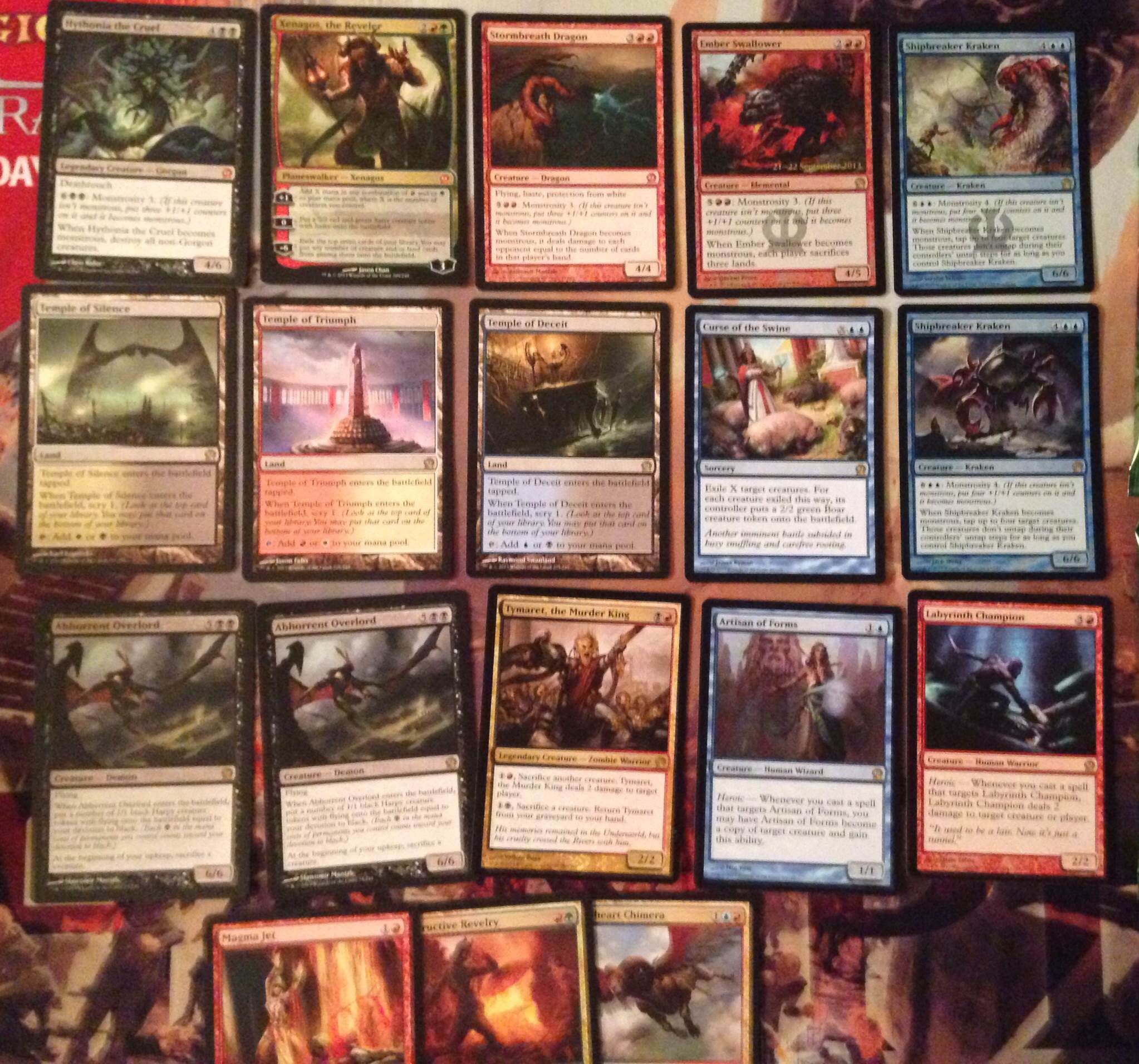
Yep, that pack-foil Shipbreaker Kraken sure made me feel better about the entry fee. Oh, and the Planeswalker and mythic dragon were good, too. For my deck, we decided to supplement the Path of Wisdom with some ambition:

”U/B”

spells

2 Omenspeaker
1 Returned Phalanx
2 Nimbus Naiad
1 Mogis's Marauder
1 Breaching Hippocamp
1 Thassa's Emissary
1 Cavern Lampad
1 Keepsake Gorgon
1 Hythonia the Cruel
2 Shipbreaker Kraken
2 Abhorrent Overlord
2 Voyage's End
1 Griptide
1 Dissolve
1 Lash of the Whip
1 Viper's Kiss
1 Pharika's Cure

lands

1 Temple of Deceit
9 Island
8 Swamp

Two notable things about this deck: a high curve and a lack of good removal. The high curve was a conscious decision that I’ll discuss in a moment, but the lack of removal was not really something over which I had any control. I played what I opened and wished I had more. For my wife’s deck, we supplemented the Path of Battle with a little might:

”G/R”

spells

1 Sedge Scorpion
1 Arena Athlete
1 Satyr Hedonist
3 Voyaging Satyr
1 Leafcrown Dryad
1 Spearpoint Oread
4 Nessian Courser
1 Ill-Tempered Cyclops
1 Ember Swallower
1 Stormbreath Dragon
1 Destructive Revelry
1 Fade into Antiquity
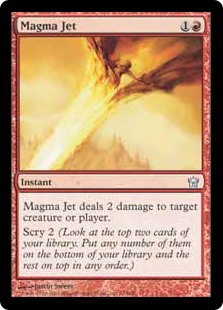
1 Magma Jet
1 Lightning Strike
1 Rage of Purphoros
1 Savage Surge
1 Feral Invocation

lands

9 Forest
8 Mountain

This deck is fine on its own, but it worked especially well in concert with the UB deck we constructed. Because Voyaging Satyr is able to untap any land, we played all our copies in this deck in order to help the UB deck ramp up to its fatties. This deck also had a significantly lower curve for two reasons: help us survive until the UB deck can take over the game, and put on pressure to force opponents to use early removal on relatively unimportant creatures. When this plan worked, it worked really well.

The Tournament

I won’t go into too much detail about individual rounds, but I’ll discuss each briefly. Our first match was against a RW Heroic deck paired with a UG deck of some sort. We played Stormbreath Dragon, did eight damage with its heroic activation, and just won easily from there. Our opponents were not helped by their UG deck flooding out.

Financial musings from round one : Stormbreath Dragon was really good. I don’t think it’s as good as Thundermaw Hellkite, but protection from white is a nice consolation prize. I was also underrating its monstrous ability—making this thing a 7/7 and tacking on a few points of direct damage (maybe more than a few when playing against control) is quite the upside. Monstrosity may not shine as much in Constructed, where removal will be more plentiful and efficient, but having that additional option is big game. I could see this card being pertinent in Standard, but still suspect Thundermaw Hellkite is better for Modern.

During the second round, we fought a BW deck and a RG aggro deck. The RG deck put on some early pressure, and Erebos came down mid-game for the BW deck. Our opponent didn’t once draw an extra card with it, which I found somewhat strange, and also never reached the needed devotion threshold. The game was very stalled out and I was afraid we were going to go to time, but eventually Hythonia the Cruel cleared the board and we won easily from there.

Financial musings from round two: My first chance to play against one of the new god cards left me underwhelmed. Our opponent didn’t play it to maximum efficiency, so I’m reserving full judgment for now, but in Limited, at least, it appears these gods may not be everything I’ve been hoping. Hythonia the Cruel won us the game hands down, but it’s hard for me to believe it will see any Constructed play outside of EDH.

In round three, we fought a RW heroic deck and a UB flyers deck. The blue deck led with Vaporkin into Nimbus Naiad, with the heroic deck also applying pressure. They flooded the board quickly and we were on the back foot with very few ways to deal with flyers, so we played to our one out—playing and activating Hythonia. I hit every land drop on time and played Hythonia with seven lands out, ready to sweep the next turn, but was forced to block a two-power creature to stay alive and was blown out by Lash of the Whip. What we really needed was one of my wife’s Voyaging Satyrs to activate Hythonia a turn early, but it was not to be.

Financial musings from round three: Our UB opponent played a Thassa in this game, which was slightly more impressive than Erebos. Three to four scrys probably netted about a card of advantage, two or three creatures came in as unblockable, and Thassa did get to eat a blocker once when devotion was reached. We eventually used Fade into Antiquity to get her off the board, but the damage was done. Still, in a Standard blue deck, when will Thassa’s devotion threshold ever be reached? Blue isn’t exactly a permanent-based color.

For this tournament, a 3-1 record paid eight packs to a team and a 2-2 record paid two packs. Our round four opponents offered the split (so five packs per team), which we declined. We were facing a BW deck and a UR deck. We played a very exciting game in which we had a monstrous Stormbreath Dragon and a monstrous Ill-Tempered Giant enchanted with Nimbus Naiad, but we lost almost single-handedly to a 1/4 common in Scholar of Athreos (which drains for two off each activation in two-headed giant). Our opponents' Shipbreaker Kraken going monstrous sealed the deal for them. We needed to draw Lightning Strike or Savage Surge to kill them from three, and neither came up. I guess we should have accepted that split?

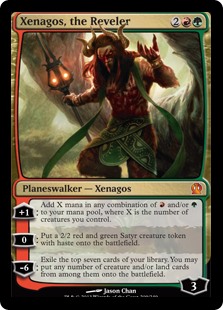
Financial musings from round four: Not once in all four rounds did my wife get to play Xenagos, the Reveler, which was pretty disappointing. I was hoping to have some insight regarding this card, but it just never came up. So I’m still just theorizing that Domri is better. It’s easy to say I was wrong to decline the split, and maybe I was. I usually accept them when it’s splitting first and second, but lower-level splits like this aren’t as appealing to me.

Adding Up the Score

Arrangements have been made to sell Stormbreath Dragon and Xenagos, the Reveler, for $45 to a local player. There’s a chance either or both could see an increase (I expect the dragon will, in fact), but getting TCG Player low in cash isn’t always possible. In the week following the prerelease, though, card availability is an issue and folks who plan to play Standard the following weekend will pay a premium in order to be prepared. I could have waited to see where the prices go, but my stance is that new cards should almost always be traded or sold. I might miss on individual cards on occasion, but in general, this practice nets some nice rewards off of cards that are later available for a pittance compared to prerelease values.

I also sold my Dismiss for a dollar, which means I have already recouped $46 in cash from my $50 entry fee. With two packs, three scry lands, several dollar rares, and about 150 bulk non-rares, I think it’s safe to say I am playing for free so far. However, this was more due to luck than anything—if I hadn’t pulled two money-mythics in this event, I would be far behind. I’ll need to tighten up my play for future events.

In closing, I want to mention some of my worries regarding the format. Not once was our Stormbreath Dragon removed during this tournament. The removal in this set is extremely weak, especially against larger creatures. Enchantment removal seems completely main-deckable, which will help somewhat with the problem, but it won’t solve it. The only thing keeping me hopeful is R&D’s obvious excitement and belief that the set is badass. If they think it’s going to work, I’ll have faith, but I have to admit I’m not looking forward to a year of being unable to kill big creatures. If this set plays like Avacyn Restored, which many are saying it does, there will be times where good deckbuilding and tight play will not be able to beat certain bombs, and that’s going to make this project harder. That is, unless I’m the one pulling the bombs. I’m going to hope for that. Until next time…

@dbro37 on Twitter

Insider: Looking for the Legacy of Theros

Are you a Quiet Speculation member?

If not, now is a perfect time to join up! Our powerful tools, breaking-news analysis, and exclusive Discord channel will make sure you stay up to date and ahead of the curve.

Welcome back speculators! Today's article we'll be going over the Theros cards which I believe will have an impact in the Legacy format. As I've mentioned in previous articles about potential Legacy cards from a new set, I use the following criteria to evaluate a card's potential.

  1. Power -- In order for any card to see Legacy play it either needs to match or surpass the power of an existing card, or provide a completely unique effect.
  2. Converted Mana Cost -- The lower the better. While this is important in all formats, it is especially so in one as efficient as Legacy.
  3. Pitchable to Force? -- While this obviously isn't a deal breaker, blue cards should be scrutinized more simply because blue is the most powerful color.
  4. Similarity to Staples -- Does it do something similar to a card that already sees play

Rather than the usual format in which I simply copy that four-reason list and enter the cards' information, I thought this time I'll actually try to do that all in a more reader-friendly format. Please leave your comments about which way you prefer.

The most obvious card for Legacy has got to be:

Cavalry Pegasus

Finally a card to make your un-flipped Delvers fly...just kidding...please don't play this in Legacy, unless your goal is to troll people because they'll have to read it and continuously question their own deck's strategy against this clearly secret-tech card.

Ashen Rider

This one's pretty easy as it's a straight upgrade to Angel of Despair. The difference in mana cost is inconsequential since the decks that would play it don't ever plan on actually paying for it. But Ashen Rider gives you not only an ETB effect, but also a death trigger. The fact that it exiles the permanent is just gravy as one of the more favorite ways to cheat other creatures into play is via the graveyard.

I expect all the decks that run Angel of Despair in the sideboard to swap her out for Ashen Rider. This means that her ceiling isn't all that high because she's strictly a sideboard card, but she is a mythic. This is also an auto-include in any EDH deck that would run Angel of Despair as well (mainly Junk Reanimator decks like Karador).

Swan Song

This one's getting plenty of hype because it's a one-mana conditional counterspell. The fact that WoTC printed it at rare, unlike Spell Pierce, makes people think it was meant for Legacy.

It does screw Sneak and Show style decks pretty hard. But as others have mentioned, the deck most likely to want this effect (RUG Aggro) does not want to give its opponent a 2/2 flier which can trade with Insectile Aberration.

I just can't see that many instances in which this card is better than Spell Pierce. It's likely to show up in decks that don't care about the 2/2 but need to shore up the Show and Tell matchup (like Miracles) and it is pitchable to Force of Will.

Curse of the Swine

At first this one seems easy to pass over as Legacy-unplayable, but the fact that it exiles (like Swords to Plowshares) is interesting. Add to that the fact that it scales with mana, and most importantly, it's mono-blue. I understand that for the most part Legacy mana bases are so smooth that when given the choice to go mono-colored or just splash for removal most will choose to splash for the removal, but if any decks need this effect but don't want to splash for it, this could be the card they go to; the fact that you can pitch it to Force helps too.

Chained to the Rocks

There is plenty of thoughts on whether this card will make it in Legacy or Modern. While it's nice to have another one-mana white removal spell, this is inferior to Swords to Plowshares in almost every way. In a format with Wasteland running rampant I'll take Swords as my #1 removal spell and Path to Exile as my #2.

Thoughtseize

This is the obvious one because it's a reprint of an existing staple. The only point to take from this one is to pick them up from players who don't want them while they are cheap. It's biggest downside is that everyone already knows how good it is in eternal formats, and it will likely be over-priced for its first month of Standard legality.

As people keep opening Theros packs, the supply will catch up and the price should drop. I honestly see this as being similar to Scavenging Ooze with it's price trajectory. It's more easily splashable, but far more Theros will be opened than M14.

Thassa, God of the Sea

This card really intrigues me. I personally think this is the one god with the highest chance of making it into Legacy. I really like her in a Merfolk shell because a lot of their lords cost UU (thus two devotion). The static "scry 1" ability is exactly what Merfolk needs as a synergistic deck where the power level of individual cards is lower than many other decks.

The unblockable ability will come in handy in stalemates but isn't that likely to become a dominating aspect of the card. I can't wait to see someone vial in a lord to turn on her devotion and block/kill an attacking Tarmogoyf. Yet another blue card that pitches to FoW.

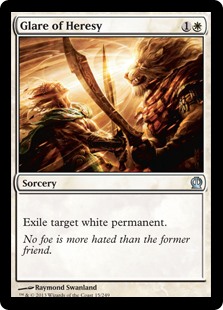
Glare of Heresy

While I don't forsee this card making huge waves in Legacy, it is always critical to notice cards with a powerful effect at a low cost. These cards tend to be very specific solutions to problems.

One and a white to exile a white permanent fits the bill of powerful and efficient spell with a limited range. I liken this one to Perish, Submerge and Sulfur Elemental as it is likely to appear in a sideboard as a one- or two-of if any permanents (with white in their cost) take a hold of the format.

Dark Betrayal

Here's another efficient solution card that falls into the same category as Glare of Heresy. The problem is that it is limited to black creatures, and for one white mana we get Swords to Plowshares without the color restriction.

Still this is one of those "keep it in mind" cards. It also deals with Griselbrand far better than Swords to Plowshares (given that if they pay life to draw a bunch of cards, they aren't going to get that life back should they let it resolve).

Akroan Crusader

This one doesn't look like much at first, but it does play well with Young Pyromancer. The downside is that, outside of removal spells, there aren't many Legacy-playable cards that target creatures. I don't have high hopes for this card, but if you see foil copies it wouldn't hurt to get them as throw ins.

While suggesting this may be questionable, you could use Trait Doctoring on him to make change the "red" in the token and with Young Pyromancer in play and a clear board to attack, make quite an army of 1/1s in a hurry. I think this interaction is far more likely to be Standard only, but it is kinda cool. You would get two tokens for casting Trait Doctoring and another two when you attack and cipher it.

Warriors' Lesson

For one green mana you get the potential to draw two cards, which isn't terrible. I really like the idea of this card with double strike creatures as it could turn into a draw four for G. I can also see this being played in R/G style EDH decks that like to have multiple attack phases.

Spellheart Chimera

A lot of Legacy players are excited about this card. It plays well with Delver of Secrets and Young Pyromancer alike, and might finally give RUG players a reason to go straight RU, shoring up their mana base a bit. Flying plus trample gives you a sort of double evasion that allows it to push past Lingering Souls tokens. Three toughness means they'll need three tokens (ie. both halves of the card) to kill it. And in a pinch he pitches to Force of Will.

Tymaret, the Murder King

This one may fit in the Zombardment deck as another sac outlet. He's a zombie to turn on your Gravecrawlers and can come back via a Bloodghast. It is a shame that his shock ability only hits players as he would be a lot better in that deck if he could kill Deathrite Shamans.

Daxos of Meletis

This card is also on the maybe list. A majority of creatures in Legacy have three power or greater, so he's mostly unblockable. The repetitive life gain could prove useful in tempo vs. tempo matchups. Given the average mana cost in Legacy, you usually won't gain a lot of life, but against some decks (Sneak/Show or Know and Tell) there is potential to gain tons in one shot. The fact that he exiles the spell (even if you don't cast it) also means you can mess with the top of your opponent's deck and force them to play their Brainstorms at less opportune times. And last but not least he does pitch to Force of Will.

Jason’s Article: Champions of Avacyn

Are you a Quiet Speculation member?

If not, now is a perfect time to join up! Our powerful tools, breaking-news analysis, and exclusive Discord channel will make sure you stay up to date and ahead of the curve.

Greetings, Pontificators!

Who else played in pre-release events over the weekend?

What We Learned

When I heard they were going to do a block based around Greek mythology, I immediately thought back to the last "flavorful" block, Champions of Kamigawa.

Sure, there is flavor in every block, but Kamigawa was the block that sticks out the most because it almost felt forced. As much as a lot of us like Japanese culture (read "anime and vending machines with questionable wares"), Kamigawa block felt weak at the time, sandwiched between the absurdly-powerful Mirrodin block and the limited format home run that was Ravnica. In a lot of ways, Kamigawa block was a Nicolas Winding Refn film--all style and no substance.

Not even God can forgive this movie.
Not even god can forgive this movie.

What's the Problem?

I don't know that there has to be a problem with more style than substance. I actually like Nicolas Winding Refn movies. Drive may have lagged a little in the middle, but the man wanted to include a little exposition in between car chases.

You all know the caption.

A lot of critics walked out of a screening of Only God Forgives because they said it was all style and no substance. Guess what? It's a visual medium, assfaces. I really enjoyed that movie, and walking out of it like it's Final Destination 5 is pretty lame, especially if watching the movie is your only job.

So, since I really don't mind the concept of "style over substance" in movies, is it a problem to have a block like Kamigawa every once in a while that focuses heavily on the lore but doesn't contribute too much to Standard?

As a financier, I especially don't mind because Kamigawa block has contributed so many accidental $5-$10 cards that were bulk during Standard but now buoyed by EDH. Also, there were a few Kamigawa block PTQs and those were a blast to play in. While you don't get many Block PTQs outside of MODO, Theros taking after Kamigawa wouldn't be all bad. There were a lot of things to like about Kamigawa block despite it being widely regarded as one of the worst blocks in the game's history.

I took the mindset of the set's similarity to Kamigawa block into everything. When I updated the Quiet Speculation Spoiler page, I was cognizant of the fact that flavorful cards are better in the long term if they don't contribute much to Standard or Modern but appeal to casual players.

I identified cards like Bow of Nylea as potential pickups with upside, but for the most part didn't see a whole lot that will get played in Eternal (there are very obvious exceptions, though, like Swan Song). I told myself that this would be an interesting limited format, just like Kamigawa block draft was and that will keep people opening lots of packs and getting cards into the market. I predicted the gods would maintain a decent value because of casual appeal and thought about which cards would be this set's Azusa, Lost but Seeking or Hall of the Bandit Lord. I prepared for potential EDH sleepers to dip so I could scoop them for cheap and wait for the EDH crowd to start ramping up their demand.

There was just one, teensy flaw in my logic.

This Is Avacyn Restored 2.0

Anyone who played in the prerelease can tell you the same.

I suppose I should have seen it coming--the bestow mechanic being so similar to soulbond in some ways, the lack of removal, the giant, haymaker cards like monstrous creatures that would make players feel bad to have nuked after they invested 12 mana into playing and growing them. I was so focused on the financial impact of the rares and mythics that I didn't take a second to think about cards like Ordeals and how much they would matter.

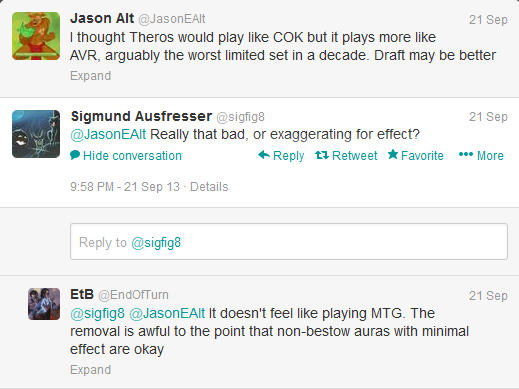
Blinded by my financial bent, I went into the prerelease expecting a Kamigawa-esque experience. Don't get me wrong, I went X-1 at the event I played (I'm really cutting back from the five events I played for Return to Ravnica and Gatecrash) but it "didn't feel like playing real Magic."

And it wasn't just me who thought so.

Now maybe it's fine for auras to be good for a while. It was certainly conventional wisdom for them to be bad in Limited, and sets lately have aimed at making auras a little more playable. Mark of the Vampire and Trollhide, cards that would have never seen play in M11 Limited, are routinely the lynchpin in powerful limited archetypes in M14, a trend which continues with the Ordeal cycle and other non-bestow auras laughing at the pitiful amount of removal, and bestowed creatures closing the game out quickly.

Casting a near-Thragtusk's worth of extra damage at instant speed is a pretty nifty combat trick, and it feels even better if you get a 4/2 if they manage to deal with the creature. I managed to ride a pile of Purphoros's Emissary to victory because no one could deal with them. Two-Headed Cerberus with any bestow guy enchanting him closed games out more quickly than games should have been closed out. I found myself agreeing with my opponents that this was not real Magic as I was pulling their pants down. I wouldn't say I outplayed anyone, but I really didn't have to.

I was reminded of the Avacyn Restored prerelease where I went X-0 and split for first because I had a deck with Dark Impostor in it. If I drew Impostor I just couldn't lose the game and it felt really bad.

The next day I had Craterhoof Behemoth and a pile of angels, and results were similar. No one was able to stop me from riding a 2/4 flying lifelink to victory and it felt really non-interactive and boring. In many ways, Avacyn Restored is a much better comparison for Theros than Champions of Kamigawa. Wizards R&D didn't want players to contend with too much removal and turn off their souldbonded guys; similarly a monstrous creature eating a Doom Blade would make people ragequit.

Avacyn Restored offered a lot of powerful cards to the Standard format and a lot of solid casual cards that are only going to go up in value over time. It's with this frame of mind we need to take a second look at Theros for financial potential.

Courting Controversy

There is one more topic I want to bring up and not discuss at length too much. This was something I was keeping relatively mum about because I feel like the entire finance community is against me on this one, but since it blew up on Reddit today, here goes.

I don't think shocklands are a great investment.

I know some QS insiders are 1,000+ deep on these things, and I know you're going by the old "invest in real estate" adage, but I can't get behind it. I stayed quiet about this for a long time because I felt like there was no real upside to disagreeing with everyone I have ever met or will meet in the future in MTG finance.

Shocklands have been a boilerplate, conspicuous, safe-seeming investment strategy for new financier and veteran alike and I really didn't want to have to argue with everyone for months. I was content to let it lie until something in me snapped today and I finally blurted out how crazy I felt that I don't agree with everyone.

Either I'm the worst person at MTG finance in history or you're all basing your investment on a few faulty assumptions and building a gigantic house of cards. Since there were no dissenting voices out there, I didn't want to be the first to stick my neck out.

Well, the neck's out now. I mentioned something on reddit and withing 15 minutes my inbox blew up. A lot of it was people asking the same questions, and the rest of it was really smug &*$% talk from people who loved to tell me what a moron I was. My entire credibility as a financier was suspect, apparently, and I decided that I didn't want to sift through all that garbage every time I logged on to Reddit. I deleted all the postings with mentions of shocklands, but the bell could not be unrung.

The Argument

Since apparently this is my new finance cross to bear, I better get my position down in writing so I can just link to something and not have to answer the same question a million times.

I think there are a lot more shocklands out there than people realize. With their printing in a block that was drafted quite a bit and their inclusion in Dragon's Maze (admittedly not drafted as much as it should be) in the land slot, there are quite a few copies out there. I have seen people cite the shocks climbing to $50 in the short term when Modern was first announced as a format, but they dropped to around $25 even before their reprinting was announced in Return to Ravnica (even before the announcement of the set). If you think they can hit $25 again with a much greater supply, I can't agree.

The craziest part to me was around GP Philadelphia when Scalding Tarn and Misty Rainforest went to $30, people were buying shocklands at $15 and not Verdant Catacombs at $15. I bought Catacombs, Flats and Mesas at $15 and sold at $30, and it turns out even that was incorrect as Scalding Tarn and Misty Rainforest are approaching $60. In the time it took Misty Rainforest to go from $15 to $60, an Overgrown Tomb went from $25 to $15. Not a great return.

"Well, Jason, I thought the plan was to hold these until they spike." Well, yes. That's everyone's plan. If a shock does approach $25, we're going to see a massive sell-off from all of the speculators who were waiting for that price point. A huge glut would hit the market, and with no real increased demand to soak up the excess supply, the price is bound to free-fall. With no buyers and an abundance of sellers, the values will plunge and people will be lucky to get out for what they paid to get in.

There is demand for them in Modern, but not near the level of demand in the current Standard, so their price would potentially maintain or only dip a little, but the transition from Standard to Modern will hardly make the price spike. Fetchlands make shocks good in Modern, but M10 lands made them good in Standard, and greedy mana bases were possible. Standard routinely had four-color decks with shocks doing a lot of the work.

That's another point. With some of the mana fixing from Innistrad and M13 gone, mana bases are going to get much less greedy. Two-color decks will be the new norm going forward when three or four were the norm before.

Some predicted the disappointing Theros temple cycle would make shocks go up because the shocks are so much better by comparison. I disagree. I think the disappointing--only as mana fixers, though, they are good, especially in non-blue decks--Theros temples cycle means that three-color decks will be nearly impossible, leaning on Caryatid very hard. The average number of shocks per deck in Standard is only going to go down post-rotation, and that bodes poorly for their even maintaining their current, modest price.

Buying these at $15 seems atrocious if you're never going to be able to sell them for $25 because that's when tens of thousands of copies are going to come pouring out of spec boxes, and if you can buy them at $5 now, why not just snap-sell them for $12-$15 on eBay or TCG Player and re-invest that money? I love to buy shocklands, but I sell them in twenty-four hours because I don't want to be holding the bag when the market crashes.

I truly believe a bubble is building with regard to these lands and I don't want to be underneath when the house of cards comes down. That's how insane you people are--that wasn't even a result of me making a crazy mixed metaphor, I think what you're doing is building a house of cards...on top of a bubble.

On second thought, maybe I do want to be underneath when it happens. It's going to be raining cards. Shocklands, probably. I'm sure people are going to be happy just to recoup their initial investment, and I'd be delighted to buy up all those copies and flip them, just like I'm doing now.

Cautious for Once

I'm not typically someone who plays it safe when it comes to investing in this game, but I'm playing it safe now. I think there is little more upside to buying shocks at retail and hoping to flip them later than there is just buying at buylist now to sell immediately, and I think the potential downside could be the first true MTG financial crisis.

Every time I think there is no way I could possibly be right about this, I remember that big-eared, smug douchebag Ben Stein laughing at Paul Krugman on Fox in 2008 when Krugman predicted the housing crisis. Did I just compare myself to Paul Krugman? I mean, kind of, but only to illustrate the point that someone has to be a doomsayer.

I don't think I understand MTG finance as well as Krugman understands mortgage-backed securities, but I think when I see so many people with the exact same plan, I have to wonder what's down the road when they all execute that plan and try to divest on the same day. I'm betting it's going to be bedlam, and I'd rather miss what I consider modest potential gains to avoid the risk of being part of that crash.

In short,

  • I see little upside to buying shocklands now.
  • A selling spree will trigger long before there is real growth on the price.
  • Demand is waning, not increasing.
  • Modern can't sustain the demand Standard does.
  • The return is not much greater than just buying cards at buylist and flipping.

I'm sure I am going to get a million comments on this article telling me how wrong I am. Fine. Convince me. Ignore what I'm saying. As long as you don't just go on your merry way, scooping these up and waiting for the selling frenzy in the future without taking a second to consider you may be making a grave miscalculation.

There are plenty of other cards I can buy with the money I'd use to buy shocks now, and I wonder what will look better in a year, $35 Verdant Catacombs, or $15 Overgrown Tombs. Only one way to find out.

Insider: A Word of Caution

Are you a Quiet Speculation member?

If not, now is a perfect time to join up! Our powerful tools, breaking-news analysis, and exclusive Discord channel will make sure you stay up to date and ahead of the curve.

Things are starting to get exciting again in the world of MTG finance. Everywhere you look there are suggestions of what cards to pick up in anticipation of Standard rotation--many from Return to Ravnica block and M14.

Supreme Verdict is now the main board sweeper of the format. Detention Sphere is enchantment-based removal that can eliminate indestructible gods. Obzedat, Ghost Council is getting attention thanks to some articles on SCG’s site. Chandra, Pyromaster is being tested en masse due to her recently “discovered” power level. The list goes on.

Not only are these cards getting hyped up, but their price targets continually rise. The QS forums are jam packed with price targets and people are buying like crazy in the hopes of making some easy profit come Standard rotation. This must be the easiest time of the year to profit from Magic.

Or is it?

A Reality Check

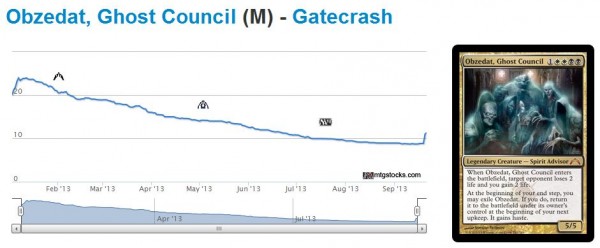
While everyone gets excited about the money they’re going to make once Standard rotates, I have taken a more conservative view of the market. Cards are getting bought up left and right, fueling the hype that drove prices higher in the first place. Obzedat, Ghost Council is the most recent example of this phenomenon.

Obzedat

A well-timed article combined with a higher buy price and this card is off to the races.

Many expect this card to be a dominant force in the new Standard. And it very well may be. Along with all the other cards I’ve mentioned previously. And the shocklands. And Abrupt Decay. And Jace, Architect of Thought. And…you see where I’m going with this?

I’m just beginning to wonder if every one of these cards can actually be great at the same time? I’m not trying to suggest these cards are necessarily mutually exclusive. It just feels like there is an awfully large pool of cards suddenly on the climb.

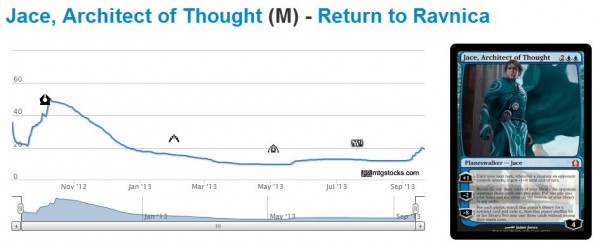
Jace

These recent price increases aren’t driven by increased play (in most cases–-Chandra, Pyromaster may be an exception). They are simply driven by the anticipation of increased play. People remember these cards being strong in Block, and so they expect them to be good when Standard rotates.

The theory is solid, but I am uncomfortable with how much people are banking on it.

Jace, Architect of Thought is a fine planeswalker--I fully expect him to be tested ad nauseam come rotation. But now that he’s already nearing $20, do people really expect a ton of upside buying here? It’s one thing to buy a set to play with--it’s another thing to be speculating on a $20+ planeswalker. Not many planeswalkers get much higher, and it feels like people are neglecting this fact.

This is my first caution. But I have more to say.

How Expensive Can a Set Be?

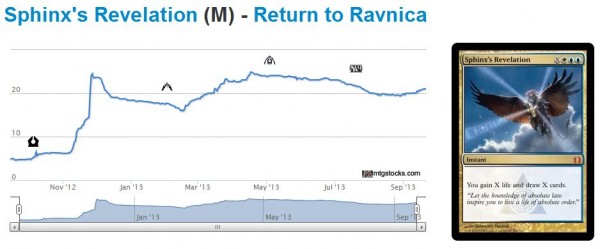
Let’s assume Jace, Architect of Thought is a $30 card and all the speculators out there are right. You also have Sphinx's Revelation as a $20+ card from Return to Ravnica.

Sphinx

Then there’s Deathrite Shaman, Abrupt Decay, five shocklands, Supreme Verdict (which people expect to approach $10), Detention Sphere, and many other money cards in the set. Oh, and don’t forget the $1 uncommons many are expecting, such as Azorius Charm.

Could this possibly become the most valuable set of Magic ever? One may leap to this conclusion, but I would be remiss not to bring up a couple factors that generally balance out a set’s value.

First of all, if the EV of a set becomes high enough, retailers will rip open packs for the singles, which increases the supply and puts downward pressure on the price.

Next, there’s MTGO redemption. As long as Return to Ravnica remains redeemable, there seems to be another way of keeping the balance of supply and demand reasonable.

Finally, there’s the simple fact that Return to Ravnica was opened in large quantity. We’re talking the most popular set of all time here--I assure you there are lots of copies of all these singles available. If the player base continues to rise this factor may be overcome, but this cannot be assumed.

My Advice

All I can advise is that everyone proceed with caution. As I mentioned at the beginning of the article, this is an exciting time in MTG finance. I haven’t even touched upon other formats such as EDH and Modern. People are throwing money all over the place looking to buy the next hot card for profit.

Before letting emotions take control, I urge you to make your own judgment of what a card’s price trajectory will likely be.

Will Chandra, Pyromaster really see more play than Gideon Jura did when he made his first appearance in Standard? I don’t remember Gideon Jura climbing much beyond $30, so speculating on Chandra above $20 seems quite risky.

Likewise it’s important to remember what board sweepers have been valued at historically. I remember Terminus in the $12 range, but this card was also heavily played in Legacy for a brief time. Supreme Verdict is strong, but it’s only a one-of in Legacy and it’s not really a card at the moment in Modern (it's not in Jund or Melira Pod). Also the color requirement may become awkward in a format with suboptimal manabases.

Of course, some of these high price targets will in fact bear fruit. Some strategy has to be successful in the new Standard. But I'd be surprised if every card people are speculating on becomes dominant in new Standard. Some of them just may not get there.

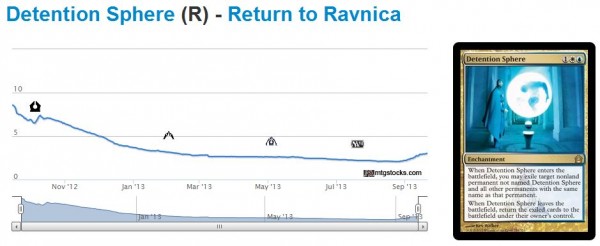
Since we don’t know which ones those are, my approach has been to trim my positions while people get emotional. No one wants to miss the key card, so they buy a bunch of everything. While prices increase, I sell some of the cards I feel have less upside from here. Detention Sphere is a handy removal spell, but at $3+ I don’t really love the upside. So maybe I should sell a few copies.

Sphere

If you disagree, that’s fine. But make sure you consider what cards you do think are incorrectly hyped and then make some guaranteed profits while you still can. It can be thrilling to hold out for those 200% gainers, but profit is great even if it isn’t maximized. Let someone else sit on the risk and pray that their cards break Standard. In the meantime you can begin focusing on the next buys.

…

Sigbits – Rotating Cards of Note

  • There sure is a lot of support for Snapcaster Mage even days before it leaves Standard. Every time a few more become available on SCG’s site (sale price of $15.99) they sell out within minutes. If you are patient, you may find these a tad bit cheaper, perhaps during the winter holidays. But I suspect they won’t drop far on average.
  • I am surprised that foil copies of Liliana of the Veil have dropped in price. A couple months ago I was ecstatic to win one of these at auction for $172. Then SCG slapped me in the face by marking theirs down to $170 for NM and $149 for MP! It’s not their fault though, as I’ve noticed copies on eBay selling for a little cheaper as well. I wonder if these have much room to drop before gaining traction and moving higher.
  • Geist of Saint Traft was marked down significantly on Star City’s website as well, and for a while these were actually in stock and very cheap. But they're out of stock now, and I believe the price has gone up slightly too. Now they’re sold out at $14.39, and I suspect these won’t go much lower despite not being played in Modern Jund. That being said, if you have the bankroll I like foil Liliana and Snapcaster better.

-Sigmund Ausfresser
@sigfig8

The Theros Price Guide Cheatsheet

Are you a Quiet Speculation member?

If not, now is a perfect time to join up! Our powerful tools, breaking-news analysis, and exclusive Discord channel will make sure you stay up to date and ahead of the curve.

You asked for it, so here it is again - the Theros price guide cheat sheets for the prerelease.

I've had requests from people to do both price-sorted and alphabetically-sorted sheets, so I made both. Who loves ya?

Theros Cheatsheet, sorted by Price

Theros Cheatsheet, sorted by Name


Douglas Linn

Doug Linn has been playing Magic since 1996 and has had a keen interest in Legacy and Modern. By keeping up closely with emerging trends in the field, Doug is able to predict what cards to buy and when to sell them for a substantial profit. Since the Eternal market follows a routine boom-bust cycle, the time to buy and sell short-term speculative investments is often a narrow window. Because Eternal cards often spike in value once people know why they are good, it is essential for a trader to be connected to the format to get great buys before anyone else. Outside of Magic, Doug is an attorney in the state of Ohio.  Doug is a founding member of Quiet Speculation, and brings with him a tremendous amount of business savvy.

View More By Douglas Linn

Posted in Free, TherosTagged , , 1 Comment on The Theros Price Guide Cheatsheet

Have you joined the Quiet Speculation Discord?

If you haven't, you're leaving value on the table! Join our community of experts, enthusiasts, entertainers, and educators and enjoy exclusive podcasts, questions asked and answered, trades, sales, and everything else Discord has to offer.

Want to create content with Quiet Speculation?

All you need to succeed is a passion for Magic: The Gathering, and the ability to write coherently. Share your knowledge of MTG and how you leverage it to win games, get value from your cards – or even turn a profit.

Merchant Scroll Podcast #1: M14 Rares and Modern Specs

Are you a Quiet Speculation member?

If not, now is a perfect time to join up! Our powerful tools, breaking-news analysis, and exclusive Discord channel will make sure you stay up to date and ahead of the curve.

Hey! This week's episode of Merchant Scroll is live. You can find it here:


Merchant Scroll #1: M14 Rares and Modern Specs


You can chat with us at @quietspec or the new Twitter feed we set up for this, @merchantscroll


Let me know what you think!

Douglas Linn

Doug Linn has been playing Magic since 1996 and has had a keen interest in Legacy and Modern. By keeping up closely with emerging trends in the field, Doug is able to predict what cards to buy and when to sell them for a substantial profit. Since the Eternal market follows a routine boom-bust cycle, the time to buy and sell short-term speculative investments is often a narrow window. Because Eternal cards often spike in value once people know why they are good, it is essential for a trader to be connected to the format to get great buys before anyone else. Outside of Magic, Doug is an attorney in the state of Ohio.  Doug is a founding member of Quiet Speculation, and brings with him a tremendous amount of business savvy.

View More By Douglas Linn

Posted in Free, PodcastTagged , , 2 Comments on Merchant Scroll Podcast #1: M14 Rares and Modern Specs

Have you joined the Quiet Speculation Discord?

If you haven't, you're leaving value on the table! Join our community of experts, enthusiasts, entertainers, and educators and enjoy exclusive podcasts, questions asked and answered, trades, sales, and everything else Discord has to offer.

Want to create content with Quiet Speculation?

All you need to succeed is a passion for Magic: The Gathering, and the ability to write coherently. Share your knowledge of MTG and how you leverage it to win games, get value from your cards – or even turn a profit.

Insider: Theros Release Queues

Are you a Quiet Speculation member?

If not, now is a perfect time to join up! Our powerful tools, breaking-news analysis, and exclusive Discord channel will make sure you stay up to date and ahead of the curve.

The announcement for MTGO Theros (THS) prerelease and release events went up on September 16th on the mothership; you can see it here. WoTC has decided to change the structure of the 16-person sealed deck release queues, reducing both the cost of entry and the prize payout. Here's a summary of the changes.

Per player previously: 24 tix entry fee, 6 open boosters to play with, 3.9375 sealed boosters in prizes

Per player now: 20 tix entry fee, 6 open boosters to play with, 2.25 sealed boosters in prizes

There's been much outrage on the internet at the change. You can see some of it on reddit at this link, including a response from Worth Wollpert of WoTC. On the surface, this is a 4-ticket drop in entry, but about a 1.7 drop in sealed boosters awarded per person. The numbers look pretty bad, and many players have expressed their frustration.

But is this the case of a vocal minority being vocal, or will players in general avoid the THS sealed queues in October? Let's delve a little deeper to figure it out.

WoTC's Perspective

From an economy-wide perspective, every booster and event ticket is created by WoTC, either in the queues or in the store. So, let's consider how WoTC perceives the change. Are they going to see a big benefit from the slashed prize structure? On the surface it definitely looks that way, but consider this.

Per 16-person sealed event previously: 384 tix entry fee, 159 boosters handed out, a rate of 2.415 tix per booster.

Per 16-person sealed event now: 320 tix entry fee, 132 boosters handed out, a rate of...(wait for it) 2.424 tix per booster.

The change in entry fee and prizes amounts to slightly less than a 0.4% increase in the price of boosters entering the market as a whole. So from the macro perspective, each sealed event will deliver a similar amount of boosters per tix used as entry fee. The catch is that you have to count opened product and sealed product as the total amount of boosters. For WoTC, this is absolutely how they do the accounting so this top-down look is a reasonable way to think about it.

On the surface, this change is not going to be a big deal in the MTGO economy, but any policy change typically has distributional consequences. When players participate in release events on MTGO, they are not thinking about the entirety of the online economy. They are enjoying a personal experience.

Previously some players enjoyed the prize payout because they captured most of the value in the event. The players who didn't get any prizes were subsidizing the above average players, the ones who could consistently win prizes. Now things will be different.

Let's look in on the average player, this time expanding our analysis to include a budget constraint.

The Player's Perspective

Comparing the cost and prize structure of release events in a vacuum is a knee-jerk reaction. In order to do proper analysis we need to give our average player a budget to work with. We know that not much is changing from WoTC's perspective, so let's try to square this reality with the player's reality.

Let's suppose our hypothetical player has 120 tix to spend on sealed queues during release events, and let's also assume the average player is constrained by budget and not by time.

Previously: 120 tix is enough to enter five events, getting 30 boosters of opened product and just over 19.7 packs in prizes.

Now: 120 tix is enough to enter six events, getting 36 boosters of opened product and 13.5 packs in prizes.

Here, the numbers make it clear that a little over six boosters has been redistributed from sealed prizes to opened product. This means that some of the value of release events has been shifted from the players who won prizes to every player who enters the event. This is a good thing overall for the growth of MTGO.

More players getting value means fewer "feel bad" experiences. Players will feel better about going 1-3 or 0-4 if they can play in more events. A growing and more active player base has to be a good thing overall, and probably means the average skill level in release sealed queues will decrease. Although grinders have been whining about the reduced prizes, it will be easier to win prizes with more average-to-below-average players in the queues.

Due to the reduction in sealed boosters awarded as prizes though, fewer packs will be resold into the secondary market. Not to mention the fact that packs are being added over more events in time.

This has implications for speculators. Fewer packs resold and a longer time frame means that booster prices in terms of tix will be higher on average than they have been in the past during release events.

The Speculator's Perspective

Let's examine how the last large set was released online and how the prices of opened and sealed boosters fluctuated during the release events for Gatecrash (GTC). I'm using GTC instead of Return to Ravnica (RTR) because it looks like the changes in the redemption fee have impacted singles prices almost exclusively. THS and GTC both have the same redemption fee so they are the best comparison available.

The orange line tracks the GTC index from mtggoldfish. The index is the average price of a rare, mythic or otherwise. On MTGO, commons and uncommons are generally not worth much so it's a good proxy for the average price of an opened booster.

As you can see, the price of the average rare drops steeply over time before bottoming out at the end of February. This is a fairly standard pattern online as supply floods the market during release events, bringing prices down. Eventually prices drop far enough that more players start buying what's available and/or they start holding onto their cards. Either way, prices stabilize.

The blue line tracks the booster price of GTC on the secondary market. GTC boosters dipped briefly below 3 tix, but generally stayed in the 3.0 to 3.3 ticket range for most of the GTC release events.

Predictions for THS

Without a steep drop in secondary market booster pack prices, the surety of speculating on boosters is diminished. It's doubtful we see THS boosters dip below 3 tix like Gatecrash did, and I'd expect boosters to be in the 3.4 to 3.9 ticket range during release events.

As for the THS index, once release events open, I still expect the price drop to be just as steep as any other release event. The fact that product is being shifted from sealed to open makes things a bit murkier though. Just because more cards enter people's collection doesn't mean there will be an equal increase in cards entering the secondary market.

Eventually prices drop enough that players stop dumping their cards for tix and thinking about playing Constructed. The price bottom for the THS index will probably be lower than previous sets, but the new cost and prize structure for release events will not completely crater the secondary market.

It is bad news for speculating on boosters though. Prices on boosters should be more steady and closer to the fair value of around 4 tix.

Last year, I managed to successfully speculate on 1000+ boosters of GTC. This scale of activity might not be worthwhile going forward. My comfort zone for speculating on boosters was to buy in the range of 3.3 tix or less for a large expansion like THS. This value will have to be adjusted to the new realities of MTGO and it will be interesting to watch how the price of a THS booster evolves over time.

Matthew Lewis

Matt Lewis currently lives in Ottawa, Canada and is a long time player and PTQ grinder who now speculates and plays exclusively on MTGO. He's always ready to discuss ideas and investment strategies, so drop him a line in the comments, the forums or on modo, username mattlewis.

View More By Matthew Lewis

Posted in Finance, Free Insider, Magic Card Market Theory, MTGO, Theros4 Comments on Insider: Theros Release Queues

Have you joined the Quiet Speculation Discord?

If you haven't, you're leaving value on the table! Join our community of experts, enthusiasts, entertainers, and educators and enjoy exclusive podcasts, questions asked and answered, trades, sales, and everything else Discord has to offer.

Want to create content with Quiet Speculation?

All you need to succeed is a passion for Magic: The Gathering, and the ability to write coherently. Share your knowledge of MTG and how you leverage it to win games, get value from your cards – or even turn a profit.

Want Prices?

Browse thousands of prices with the first and most comprehensive MTG Finance tool around.


Trader Tools lists both buylist and retail prices for every MTG card, going back a decade.

Quiet Speculation