menu

Tailoring to your Audience

Are you a Quiet Speculation member?

If not, now is a perfect time to join up! Our powerful tools, breaking-news analysis, and exclusive Discord channel will make sure you stay up to date and ahead of the curve.
Last week we touched on the subject of the "new" format that the bannings will bring. We talked about which cards you should be looking to rise, and what the general consensus is for old staples. We will see after this upcoming weekend how everything pans out, but I stand by what I said.

Titans - At this point, we're almost certain the whole cycle is going to be reprinted. Their demand currently will be capped by that confirmation of each, and their value will drop from there. Get what you can for them, since I don't expect them to stay at current levels, even with a higher demand for them

Avenger of Zendikar - The first of many rotating cards on this list, get him cheap if able, but move him asap.

Splinter Twin - A bit of a trap, but I think many players will be flocking to the Twin deck in the next few weeks. I expect this card to drop shortly, and continue down until rotation.

Koth of the Hammer - A lot of talk about red is going on in a lot of forums, playtest groups, and the general social ring of magic. Koth won't be rotating, so its worth remembering that he is a decent planeswalker in his own right, and worth picking them up cheap when able.

Mindbreak Trap - The most "meh" card on this list in my opinion, though it always holds possibilities. Its a decent effect, though I don't think permission decks are going to be running rampant.

Summoning Trap - Rotating, so be careful when getting these. Eldrazi green and a few other decks use them though, and if it shows up in force they may have a bit of a spike before they go back down.

Inkmoth Nexus - Since its not rotating, getting some of these cheap is worth it. They may continue to be in demand over the next few months, time will tell.

Jace Beleran - With a new one shown, Beleran will be rotating out this fall. His price will steadily drop form this point, only slowed by his demand for tournament play.

Vengevine - Elves and other green based decks love this card. I would expect him to continue to see play in other formats as well, and regardless, he will always be a fan favorite even after rotation.

Eldrazi - Another safe investment, much like Vengevine. They will see a significant price drop from the rotation, though their casual appeal will remain high.

As a general rule of thumb, you don't want to trade for these unless you have someone that's actively looking  for them. That's where this weeks bit comes in. Currently, the most common question in everyone's mind is "what am I going to play next week?". This is the best question for you, since it allows you to take results from previous events that weren't dominated by caw-blade style decks, and offer those decks up to friends and other players. As it just so happens, you also have some of the staple cards that they need. Setting the pitch up with a proven list is one of the best ways to move excess inventory of key cards I know, since it helps them with what they need, and helps you move cards out before they become worthless.

I've done a bit of the research here for you, but there is always more that can be done. This should give you a good working start though.

Valakut

What you offer: Valakuts, Primeval titans, Summoning trap

Audience: The players who enjoy the damage/combo to the face set-up, you should be able to pick them out easily, just look for the guys that played caw-blade because they had to.

Eldrazi Green

What you offer: Giant space aliens, All is dust, Summoning trap

Audience: Anyone who scoffs at the idea of Valakut, but is still looking for a high quality deck; spike players

Exarch-Twin

What you offer: Splinter twins and any necessary uncommons. These can command a high price if they are in scarce supply

Audience: People who didn't switch over to Twin-blade in the last two weeks. Many caw-blade lovers are sad to see the deck go, so offer it up as the next best piece of it. After all, it made it into the Blade deck, didn't it?

Infect

What you offer: Inkmoth Nexus, Phyrexian Vatmother, Phyrexian Crusader, Infect support cards

Audience: The guy who wants to play one of the "cooler" decks of the format, usually the timmy/johnny style players that still attend tournaments.

Kuldotha Red

What you offer: Koth of the hammer, Mox Opal

Audience: Anyone looking to play the faster deck of the format, the aggro player looking to crush people in the early game.

I feel like I'm missing something still, but we're going to run with that. While some of these bleed into each other for cards demanded, that's even better for you. If someone says they want to play with Primeval Titan again, you can offer them more than just one deck, and possibly trade out multiples if they are indecisive.

I also wanted to cover a few of the preview card's that we've seen so far, and highlight my top 4 that I'm looking at.

1. Jace's Archivist - Oh the awesome things this card can do. The possibilities are quite large with a windfall you can use every turn. It's just another piece in a possible very degenerate combo deck that looks to be close at hand. I want to pick up a few of these early, though since its only rare, I'll get them at the pre-release.

2. Visions of Beyond - Awesome blue spells are awesome. It cantrips itself early in the game, and later on becomes a mean draw engine. It also combos well with Archivist, which is always nice.

3. Grim Lavamancer - Woohoo! Grimmy is back! Odyssey R/G beats was a ton of fun to play, and this guy won me more games than he ever should have. While it may just be nostalgia kicking in, I have a feeling that he's going to find his way into the top tier of cards from this set.

4. Goblin Grenade - Was there ever a more "fair" burn spell? Sure, its sorcery speed, but when its 5 damage for 2 cards, does it really hurt that much? When those 1/1's are sitting on the field knowing all they can do is chump block, suddenly they can sacrifice themselves for the greater glory of you! Or at the very least, 5 damage.

Lavamancer and Grenade are both reprints, so I wouldn't expect them to go too high, and the Grenade is only an uncommon, with many older versions out there for people.

That's about it for this week, thank you for reading!

Stephen Moss

MTGstephenmoss@gmail.com

@MTGstephenmoss on twitter

Five Questions for the New Standard

Are you a Quiet Speculation member?

If not, now is a perfect time to join up! Our powerful tools, breaking-news analysis, and exclusive Discord channel will make sure you stay up to date and ahead of the curve.

In case you hadn't heard yet, Jace, the Mind Sculptor and Stoneforge Mystic are both banned in standard, effective on the first of July.

If you hadn't heard, I would like to welcome you back to the world from your outerspace voyage, deep sea exploration, coma, or other state of being that resulted in you not hearing the news before now, and thank you for reading my article before any others.

In my article last week I walked through a number of possible decks that could rise to fill the void left by CawBlade if either Jace, the Mind Sculptor or Stoneforge Mystic was banned, but it didn't even occur to me that banning both was a possibility.  I considered Wizards would surgically cut away one piece or the other, and instead they dropped a nuke.

After brainstorming a few ideas and talking about the new standard format for a bit, I was all set to start decktesting and get down to some good old-fashioned brewing when it was pointed out to me that M12 would be legal in less than a month.  The prereleases are less than two weeks away, the Ninth, which makes spending any significant amount of time on the format as it currently exists an exercise in futility.  While some spoilers for M12 exist there are still many blank spaces left to fill in, and there's enough to render entire archetypes unplayable or push fringe strategies to the forefront.  Imagine working on perfecting a MonoRed list, only to see Circle of Protection: Red was being reprinted, or perfecting a new blue-based control deck just in time to see Red Elemental Blast was back.

With CawBlade in its recent incarnations gone the metagame is seemingly wide open.  Any number of archetypes can claim to be the new top dog, and the viability of many cards goes up without the fear of a Jace making them irrelevant or a turn three Batterskull attacking too quickly for them to come online.  Until some tournament results come in to fill in the gaps any talk about the new metagame will be little more than an educated guess, but we can still know questions need to be answered.

1) What happened to blue's stock?

It would be easy to say that Blue lost most of the reason to play it after Jace's banning - after all, how many blue decks have made the top eight of a tournament recently that didn't have four copies?  Jace was one of the best reason to put blue mana in your deck and has been for quite a while, and decks frequently played blue for fewer than ten cards other than Jace.  With him gone, the question arises whether there is any reason to play Islands at all.

While many players are going to assume the answer is no, I look forward to playing blue in the new metagame (maybe I just like going against the grain).  Blue has been in the limelight for some time, so much so that everyone knew it was the best.  People that had never played blue before were playing with Jace in addition to the old school blue mages.  Now that he is gone and a legitimate case can be made for another color being the best some of the imposters, groupies, hangers-on, and barns will leave blue alone and allow the real Blue Mages to show their colors, like the true fans of a winning sports team being lost in the crowd and then re-emerging after time passes after their team wins a championship.

Consecrated Sphinx is one of the cards that gained the most from the departure of Jace due to the oppressive effect of his -1 Unsummon on large creatures.  Mana Leak and Preordain are still around, and Jace Beleren is too.  Blue Sun's Zenith can put a game away, Sea Gate Oracle does a passable Preordain impression and can block Goblin Guides all day, Venser, the Sojourner provides a win condition while also allowing card draw or selection when combined with Wall of Omens or Sea Gate Oracle, and Sphinx of Jwar Isle (aka Jwar Jwar Sphinx) is still a problem for many decks.  With all this still around I find it hard to believe Blue will vanish from the metagame.

If anything, I would expect to see more blue decks, just with more variety between them.  The loss of Stoneforge Mystic from the metagame will help blue decks more than losing Jace hurt them and will possibly allow a return to blue-centered "true" control decks of the kind we haven't seen since PT: Paris.

One of the possible blue decks for the foreseeable future is Venser-centric:

[deckbox did="a89" size="small" width="567"]

This was the list I won The 2010s with last year, and I would love to blow the dust off.  While clearly many of the numbers would need to be changed for the current metagame, the core provides a good place to start.

With Wall of Omens and Sea Gate Oracles aplenty, this list is better prepared for aggressive decks like Boros, Goblins, Vampires, or a creature-heavy RDW than most UW decks, and  Venser, the Sojourner is one of the best planeswalkers for fighting against control decks.

One possible strike against this style of deck, however, is Consecrated Sphinx.  Venser lets you draw approximately one bajillion cards, but he makes you work for it.  Your deck has to be built around abusing his abilities and requires you to play a number of tier two or three cards, much like Tezzeret, Agent of Bolas.  Consecrated Sphinx's also lets you draw approximately a bajillion cards, but its only price is blue mana in your deck and surviving through the opponent's upkeep step.  As a flier it is also unblockable to a Venser deck's blockers.  If the format shakes out such that the Sphinx can live a reasonable percentage of the time it may single-handedly invalidate Venser-based decks.

Another possible direction for blue deck to go in the coming weeks is more of a traditional, land-go, grind-'em-out style of control that hasn't been seen in standard for some time.

[deckbox did="a90" size="small" width="567"]

This was Guillaume Matignon's winning list from Worlds last year.  Without Jace this list would be sorely lacking in the card-draw department, but there are fixes available.

Here is the UB list I have been working on recently:

[deckbox did="a91" size="small" width="567"]

This kind of deck is well equipped for fighting against any deck that isn't trying to kill you before turn four.  With targeted discard and a plethora of must-counter threats, as well as its own counterspells, it should have the upper hand against any other control deck while the removal and large threats can lock out any midrange strategies and protect against the Deceiver Exarch-Splinter Twin combo if that remains viable.

That said, it is very vulnerable to decks like Kuldotha Red or a quick draw from Vampires or Boros, and a burn-heavy build of MonoRed would be near-unbeatable.  This kind of deck simply can't kill the opponent quickly enough to race a hand full of Lightning Bolts and Staggershocks, and there aren't enough hard counterspells to fight that kind of fight.

If the format slows down as a result of Stoneforge leaving this would be a good place to start work on a new deck, but if MonoRed and friends take over the format UB would need a significant overhaul to hope to remain viable.

2) Is Valakut tier one again?

Valakut was the Big Bad Wolf going into PT: Paris, where CawBlade was unleashed.  More players were playing Valakut that anything else and everyone needed a plan against it to be competitive.  When Stoneforge Mystic let control players put Valakut on a significant clock without tapping out in the late game for a Gideon Jura or Titan of some kind, everything changed.  Valakut could no longer wait out the control decks and land a game ending Primeval Titan.  Valakut also got a few new toys to play with from NPH, most notably Phyrexian Metamorph and Noxious Revival.  Both of these allow Valakut to effectively up its Titan count without upping the manacurve.  An early Revival could rebuy a Cultivate or other ramp spell while also threatening to turn into a Titan in the later stage of the game, while the Metamorph could serve as a Flashfreeze-immune Titan, provided one had already resolved.  Even if the board was empty it could make the opponent think twice about playing their Consecrated Sphinx or other threat.

Rampant Growth is also in M12, giving Valakut another ramp spell to choose from.

With a number of upgrades available and its primary predator banhammered out of existence, Valakut could be poised to make a comeback.

Here's the thing though: people hate losing to Valakut.  Whether right or wrong, it has a reputation of being a deck that plays itself and requires little skill to pilot, and its games are frequently non-interactive.

If Valakut does prove to be tier one again, people will be quick to dust off their Flashfreezees, Spreading Seas, Memoricides, or other hate cards.

Between Vampires' ability to play Doom Blade and/or Go for the Throat and the new Shrine of Burning Rage Valakut could have a hard time racing the new breed of aggro decks, even with Rampant Growth speeding it up a bit, and it is more vulnerable to hate than many decks.  These could easily keep it from tier one status.

3) Is Mono Red the premier aggressive strategy?

Grim Lavamancer is being reprinted in M12.  So is Goblin Grenade.  Incinerate and Shock, too.

Mono Red had seen an uptick in popularity recently, mostly due to Patrick Sullivan, and with a number of excellent new burn spells coming in just a few weeks Mono Red appears to gain more from M12 than any other currently existing aggressive deck.  Of course Vampires or Boros could play the same burn spells, but they already have access to many good burn spells, and don't want as many as a deck like Mono Red does because then they don't have enough room for creatures.

The traditional argument for playing a deck like Vampires or Boros instead of Mono Red, ignoring metagame considerations, has been that their creatures are basically repeatable burn spells.  A Pulse Tracker "Shocks" the opponent every turn that it is alive, allowing a deck with creatures to go the distance even if it starts drawing land after land off the top.  Burn heavy decks are more prone to running out of gas than decks that are a mix of creatures and burn, and every turn they draw a land instead of a spell after spending their hand is much more painful to them than to a deck that has a creature or two in play to continue the assault.

Now that Mono Red has Grim Lavamancer to complement Shrine of Burning Rage, it can avoid running out of gas much more easily.  Even if it draws blank after blank Mono Red will still be threatening a minimum of one more damage per turn from the Shrine, and an active Lavamancer can threaten an additional two damage per turn.

With more new tools from M12 than any other aggressive strategy and multiple ways to avoid stalling out, Mono Red could become the best aggressive deck if it can find a good answers to both Kor Firewalker and Leyline of Sanctity.

4) Is UR Twin still a deck?

The UR [card Deceiver Exarch]Exarch[/card]-[card Splinter Twin]Twin[/card] deck had been doing well before the banning, mostly held in check by Dismember from the CawBlade decks.  The good news is that now that Stoneforge Mystic is gone from the format maindecking three Dismembers is going to be a lot less appealing, which means anyone looking to beat UR Twin is going to have to play more mana intensive answers.  As being more mana efficient than the other guy was UR Twin's specialty, this is going to help out significantly.

The bad news: Jace got banned too.  Maybe you heard.

Without Jace UR Twin is going to have to find another way to dig for the combo or answers.  It can still get lucky and end the game on turn four if an opponent is not prepared, but it will have a much harder time answering Phyrexian Revoker, Spellskite, Torpor Orb, or any other problem permanents, or any instant speed disruption.

Shrine of Piercing Vision is an option that hasn't been explored yet that could let UR Twin find its combo pieces or any needed answer, but it is slow and easily disrupted.  See Beyond can cycle away excess land and fits well on the mana curve, and Gitaxian Probe can provide some helpful information while digging a little deeper, but nothing does a good job of taking Jace's place as a repeatable source of card advantage.

My guess is that if UR Twin remains a deck after the loss of Jace it will look more like a UR Control deck that has a combo finish than like a combo deck.

[deckbox did="a92" size="small" width="567"]

While this still has the capability to "oops I win" on turn four, it can also easily play a long game and win without relying on the combo.  Having access to targeted removal from burn spells and cheaper board sweepers than UW's Day of Judgment is a plus, but it would still be left hurting if matched against a burn heavy MonoRed list.  Valakut could also be quite a rough matchup if the combo didn't present itself quickly or if Valakut had an answer.

Combining Deceiver Exarch with Splinter Twin is still one of the most powerful plays available in standard and I'm sure attempts will be made to mold them into a new deck.  Without Jace, however, its going to be an uphill battle to assemble the combo, and later to find answers to any meaningful opposition.

5) Are Swords still worth playing?

The Sword cycle has some of the most powerful equipment ever printed.  They can allow an aggressive deck to present a [card Day of Judgment]Day[/card]-or-lose board state without needing to dump their entire hand, letting them to last later in the game than otherwise possible and generate some card advantage.  They can also let control decks attack for significantly more damage with their creature-lands, letting them save slots on actual kill conditions (Creeping Tar Pit with Sword of Feast and Famine is still good, it turns out).

Stoneforge Mystic was good not just because it could save a mana on the Swords and get around countermagic, but because it could tutor for them.  This allowed decks to play one Sword of Feast and Famine and one Sword of War and Peace, and perhaps even one Sword of Body and Mind and always have the perfect one for the moment.

Without the ability to tutor decks that want to play Swords are going to have to play fair--they won't get to play only one of each Sword and still have it at the right time, and they won't be able to put it into play at the end of an opponent's turn without fear of countermagic.  They are still extremely effective and could catch opponents off guard if they are too quick to remove their Divine Offerings or other answers from their sideboards, but without being to cheat them in they get significantly less appealing.

The first problem is the question of how many swords to play.  The problem here is that the Swords have significant diminishing returns--the second Sword is less than twice as good as the first Sword, and I don't want to think about drawing three.  If you draw one Sword, suddenly all your small dorks that a control deck could previously ignore suddenly demand an answer or they can run away with the game.  In an aggressive matchup the first sword (hopefully) lets you make a creature unblockable, bash and collect your $200, then move the Sword to a blocker for defense.  The second Sword...makes your dorks even more answer-or-lose, and it lets you beat an aggressive mirror even harder.  It is not exactly stellar.  There are of course corner cases where a second Sword is exactly what the doctor ordered but in general it is not what you are hoping to draw.

The more Swords a deck has the higher the chances of drawing one, but also the higher the chances of drawing a useless second or third copy.  Without a reasonable chance of drawing a Sword in the early game it becomes foolish to build your deck around them, but finding the line where a deck draws enough but not too many will be quite a challenge.

Hopefully next week will see enough of M12 spoiled it will make sense to start seriously brewing instead of making broad guesses.  If not, please let me know in the comments if you would prefer some Legacy talk or a partial review of the set as it stands, or about any other topic that you would like to read.

Brook Gardner-Durbin

@BGardnerDurbin on Twitter

Commander Deck Tech: Karrthus, Tyrant of Jund

Are you a Quiet Speculation member?

If not, now is a perfect time to join up! Our powerful tools, breaking-news analysis, and exclusive Discord channel will make sure you stay up to date and ahead of the curve.

Today, I’m going to talk about my Dragon tribal Jund deck, led by Karrthus, Tyrant of Jund. Big stompy creatures like Dragons are a big part of Commander, and I’ve been a huge fan of Dragons since my earliest days of Magic. The very first single I bought was a Fourth Edition Shivan Dragon from my local store for $20, which I still own today. I got a copy of From the Vault: Dragons on release day, and that convinced me I needed to build a proper Commander deck to take advantage of all those foily goodies. I originally looked at Scion of the Ur-Dragon to by my commander, but I decided I wanted to stick with the Jund dragons. Since then I’ve considered going 5-color a few times, but there’s no other Jund general that really interests me so I’ve stuck with Karrthus.

This deck is all about the Dragons. Every one of the meaningful creatures (25 of them in fact) are Dragons. There are a few random utility creatures to help the deck function but it’s pretty much all Dragons, all the time. I also tried to pick Dragon-flavored spells where I could as well, with the exception of the reanimation subtheme. Since there are only so many cards that cost six or more that you can cast in a turn, and you’re likely to have your Dragons killed by a sweeper effect or two along the course of the game, it’s pretty important to be able to recur them when you need to do so.

Notable Moments Playing Karrthus

  • Timmy Moment: Casting Dragonstorm with a storm count of three with Karrthus, Tyrant of Jund on the battlefield, getting Hellkite Overlord, Kilnmouth Dragon (revealing three other dragons), and Bogardan Hellkite.
  • Johnny Moment: Activating Sneak Attack to put Kilnmouth Dragon onto the battlefield after one of my opponents was hit for 12 damage, drawing six Dragons, then activating Sneak Attack six times on my turn to beat for damage and following it up with a Patriarch's Bidding to bring them all back my next turn.
  • Spike Moment: Curving out with turn 1 Sol Ring, turn 2 Buried Alive for Hellkite Overlord, Broodmate Dragon, and Eternal Witness, turn 3 Living Death.

Why Karrthus?

Since we’re going for Dragon tribal, why choose Karrthus over some of the other options? First of all, he’s a Dragon himself. To me, that’s important. If I’m going to build a tribal deck I want my commander to be a member of that tribe, otherwise it feels like a bit of a flavor fail to me. Second, Karrthus gives all my Dragons a bonus, and hasty dragons are much better than non-hasty dragons. I want to have a reason to play my Commander, not just leave him in the Command Zone forever. He also has haste himself, which makes him a big threat in the red zone all on his own (and even more reasons to cast him as soon as possible)! Finally, he gives us access to the colors we want the most: red for Dragons (obviously), black for some tutoring and reanimation effects, and green for a little acceleration and a few other powerful effects like Survival of the Fittest.

I have also tried both of the other possible commanders in this slot that fit the archetype, Darigaaz, the Igniter and Vaevictis Asmadi. Vaevictis Asmadi was actually the commander before Karrthus was printed. Darigaaz, while really awesome at doing silly amounts of damage, doesn’t really do a whole lot more than most of the other dragons I could play. He can be handy if you have players who are big on multicolored spells or mono-color decks, but he didn’t really excite me to cast most of the time.

Vaevictis has a cool name and is one of the original Elder Dragon Legends that spawned this whole format, but man is he disappointing in today’s world of threats and answers. I had fun making him into a one shot general damage kill a few times just with his native pump ability, but it’s really frustrating to pay his upkeep cost and then have him get killed before you can attack. Replaying him more than once or twice is really hard too. Karrthus was just the perfect fit.

Focus #1: Dragons!

As I said above, this deck is all about the Dragons, all the time. When I got From The Vault: Dragons I knew I was going to play every single one of them in here that I could. I was disappointed that I couldn’t run Nicol Bolas and Niv-Mizzet, the Firemind (Rith, the Awakener was already the Commander of my token deck at the time), but I slipped them into one of my normal multiplayer decks and all was well with the world. I still run all the Dragons from the set that are legal in this deck, even the terribly outdated Shivan Dragon. I know I should cut him, but it’s a nostalgia thing at this point. I do include a few changelings so I can play a “Dragon” or two before turn six, but it’s specifically the ones that are great in large multiplayer games.

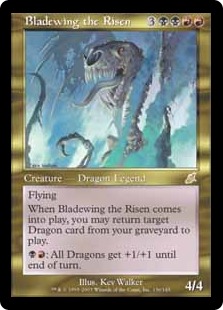
The most important Dragons are by far the ones that do something when they hit the battlefield. Malfegor is an underrated sweeper. He’s not a great way to get your guys into the graveyard for a mass reanimation spell most of the time, but he does take out a lot of annoying creatures very easily and leaves a huge body behind. Thunder Dragon does a great Pyroclasm impression, which is very important when you’re looking to keep chump blockers out of your way. Ebon Dragon seems bad at first glance, but the discard actually works out quite well surprisingly often since by the time you cast him, your opponents are generally down to holding nothing but bombs. Bladewing the Risen gives you a lord effect and a friend all in one package – hard to say no to that.

When running a tribal deck, it’s important to make sure your tribe members do more than just beat for damage. With a multiplayer game, you will need to be able to interact with your opponent beyond just attacking – no playing out a bunch of guys and just attacking until he’s dead. Commander has too much life for that to work on more than one opponent. You need to be able to execute on your plan as well as disrupt your opponents’ plans. Finding members of your tribe that can help with that means you can run more creatures in your tribe and spend fewer slots on cards that just disrupt.

Focus #2: Graveyard Shenanigans

I love shenanigans, don’t you? The best way to make sure our dragons are getting in for damage consistently is to be able to pull a few shenanigans and get them back where they belong – on the battlefield and devouring helpless villagers (that is, your opponents). To that end, you need to make sure you’re in control of your own graveyard for as much of the game as possible. I only run two mass reanimation spells in here:Living Death and Patriarch's Bidding. Living End lets people see it coming and take advantage of it or stop me, and I’m not a fan. Liliana Vess is a tutor and a reanimation spell, so she also gets the nod.

Phyrexian Reclamation is a great card that should not be overlooked because it can save your important guys from instant speed graveyard removal. Last but certainly not least, we have Survival of the Fittest and a typical package you’d see to go with it: Anger, Genesis, and Squee, Goblin Nabob. Squee thinks he’s a Goblin, but really he’s a card that says, “ {G}: Search your library for target busted card and put it into your hand. Use this ability only once per turn and only when you control Survival of the Fittest.”

I’ve considered cutting some of the other support spells for some single target reanimation effects from time to time. I eventually always decide I’d rather be able to accelerate my mana a bit and actually cast my Dragons rather than having to cheat them into play from the graveyard. A single reanimation spell lets me get one Dragon back, but having 7 or 8 mana available lets me cast a Dragon every turn. I’ve only rarely felt like I really wanted another reanimation spell, and I’ve always wanted another mass reanimation effect rather than a single target one, so Twilight's Call would likely get the nod over anything else.

Focus #3: Supporting Cast

Unfortunately, very few tribes are deep enough to do everything you’re likely going to want to do with your Commander deck, and Dragons are no exception. Dragons are really good at being big, flying, and burninating the countryside (read: killing creatures), but not so good at handling other types of permanents, or accelerating into playing other dragons. Thus, we fill out the rest of the deck with things that let us do this more effectively. I also elected to go for some high-flavor spells that fit very well with a dragon deck, like Ashes to Ashes and Mystic Melting.

For your acceleration, you want to stick to 2-for-1s as much as possible. Thankfully, green has a plethora of these effects, and they’re all fairly low on the curve, so you can generally play them without having to have a backup accelerator first (at least by Commander standards). I recommend running most if not all of them available.

Cards for Consideration

There are a few newer cards that I’m considering getting in here, but I haven’t had a chance to decide what to cut yet. Let’s take a quick look:

Moltensteel Dragon
This guy seems like a great choice because he’s a 4/4 for 4. I don’t like that he’s vulnerable to artifact destruction though, so he may or may not make the cut. I’m also not a huge fan of Dragons that just beat for damage as I have several of those already and this guy isn’t particularly better at that than the ones I’m already running.

Skithiryx, the Blight Dragon
I like him, but I feel the infect ability is almost a drawback in here since I’m so focused on trying to kill players via normal damage. I might give him a shot at some point, but it probably won’t be right away unless someone has a convincing argument in the comments.

Death by Dragons
This is a definite possibility for inclusion, especially since I can steal everyone’s Dragon tokens when I cast Karrthus. It’s just a matter of deciding what to cut for it and whether everyone will realize what I’m planning on doing with the tokens and attack me with all of them as soon as I cast it.

Mana-Charged Dragon
I want to cast this guy and swing at the combo player so very, very bad.

The Deck

One giant pile of Dragon-y goodness:

Untitled Deck

General

1 Karrthus, Tyrant of Jund

Dragons!

1 Taurean Mauler
1 Chameleon Colossus
1 Dragon Whelp
1 Ryusei, the Falling Star
1 Broodmate Dragon
1 Dragon Broodmother
1 Flameblast Dragon
1 Hoard Smelter Dragon
1 Kokusho, the Evening Star
1 Malfegor
1 Shivan Dragon
1 Steel Hellkite
1 Two-Headed Dragon
1 Bladewing the Risen
1 Ebon Dragon
1 Hellkite Charger
1 Kilnmouth Dragon
1 Knollspine Dragon
1 Thunder Dragon
1 Bogardan Hellkite
1 Hellkite Overlord
1 Scourge of Kher Ridges
1 Vampiric Dragon
1 Dragon Tyrant

Board Control

1 Ashes to Ashes
1 Jund Charm
1 Maelstrom Pulse
1 Pernicious Deed
1 Decimate
1 Mystic Melting
1 Sarkhan Vol
1 Lavalanche
1 Violent Ultimatum

Graveyard Engine

1 Anger
1 Genesis
1 Squee, Goblin Nabob
1 Scrabbling Claws
1 Life from the Loam
1 Necrogenesis
1 Phyrexian Reclamation
1 Crucible of Worlds
1 Eternal Witness
1 Liliana Vess
1 Living Death
1 Patriarch's Bidding

Drawing & Tutoring

1 Demonic Tutor
1 Survival of the Fittest
1 Buried Alive
1 Greater Good
1 Sarkhan the Mad
1 Dragonstorm

Acceleration

1 Sol Ring
1 Sakura-Tribe Elder
1 Cultivate
1 Dragonspeaker Shaman
1 Kodama's Reach
1 Yavimaya Elder
1 Explosive Vegetation
1 Skyshroud Claim
1 Sneak Attack

Lands

1 Badlands
1 Barren Moor
1 Bayou
1 Blood Crypt
1 Bloodstained Mire
1 Bojuka Bog
1 Command Tower
1 Dragonskull Summit
1 Fire-Lit Thicket
3 Forest
1 Forgotten Cave
1 Golgari Rot Farm
1 Graven Cairns
1 Gruul Turf
1 Miren, the Moaning Well
3 Mountain
1 Overgrown Tomb
1 Raging Ravine
1 Rakdos Carnarium
1 Reflecting Pool
1 Rootbound Crag
1 Savage Lands
1 Scorched Ruins
1 Spinerock Knoll
1 Stomping Ground
1 Strip Mine
2 Swamp
1 Taiga
1 Tranquil Thicket
1 Twilight Mire
1 Urborg, Tomb of Yawgmoth
1 Verdant Catacombs
1 Volrath's Stronghold
1 Wooded Foothills

Until next time, go tribal and love it.

Teaming the Cube: SCG Invitational and Survivor Draft

Are you a Quiet Speculation member?

If not, now is a perfect time to join up! Our powerful tools, breaking-news analysis, and exclusive Discord channel will make sure you stay up to date and ahead of the curve.

A few weeks back, StarCityGames.com held the culmination of the first 6-months of their Open Series: the Invitational. Not only was I invited to play in the main event (which I liken to the old U.S. Nationals before the payout nerf: a small tournament with very high value per player), but I was also slated to stay in a room with three of the most awesome cubers I know: Adam Prosak, Dan Nosheny, and Usman Jamil. In addition to that awesome cubic room, I knew that a lot of sweet players/cubers/people would be in attendance and that there would be a fair amount to a metric ton of cubing to be had. How could I possibly miss it? (Ahem, Kranny.)

Travel Note: If it is Free Donut Day, be sure to stop at the first Dunkin' Donuts you see because you may never see another in the next 200 miles of driving. I'm still grumpy about that. (And fat.)

I’m not going to give a huge breakdown and analysis of the main event. With the Standard bannings having hit, the whole format is going to change and anything I say about it will be out of date. As far as Legacy goes, I have been very disappointed with the printing of Mental Misstep, and have been rethinking my entire view of the format. Let’s just say that when tribal decks have to run an off-color, non-tribal card in the main deck there is something wrong.

Instead, I’ll just talk about a couple things of interest and provide a general breakdown before getting into the fun stuff.

The decks I took into battle:

Standard – U/R Twin: We took Flores’s TCGplayer-winning list and took out all the non-Deceiver Exarch three drops, then made some sideboard changes (most notably Mental Missteps and Combusts). I have been playing the deck since then with virtually the same list to pretty good success.

Legacy – U/W/R Counterbalance: Very similar to my list here, but with more Fire // Ices and a better anti-Merfolk plan.

Round by Round:

Rd1 – R/U/G Twin, W – 127th
Rd2 – U/G Fauna Shaman, W – 110th
Rd3 – Monored, W – 8th
Rd4 – Mirror withSea Gate Oracle, L – 31st
Rd5 – Painted Stone, D – 59th
Rd6 – U/W Mystic, L – 7th
Rd7 – U/B Storm, W – 79th
Rd8 – U/W Mystic, D – 22nd
Rd9 – W/B Mystic, L
Rd10 – U/W Mystic, L
Rd11 – U/W/B Mystic, L
Rd12 – Vampires, W
Rd13 – Mirror with Oracle, L
Rd14 - Dropped to cube!

Points of Interest:

  • I went 4-2 in Standard, the format I play the least, but went 1-4-2 in Legacy, the format in which I am most comfortable. That Merfolk matchup I was concerned about? Never played it.
  • In Standard, I played against Stoneforge Mystic zero times. In Legacy? Five times. Nice card.
  • I played two people on day one who wound up making Top 8. Both are awesome people and I’m glad I know each of them. My record vs. them? 1-1, with my loss coming at the hands of Celestial Colonnade. In Legacy. Awesome.
  • I finished day one in 44th place, and thought I was in good shape to make Top 32 and take home some nice cash. After starting day two 0-3 I was in good shape to be cubing the weekend away.
  • In round 4 I let my opponent take up too much of the clock and wound up losing 1-0 in the mirror match. The same thing happened in round 5, but I wound up drawing that match. I really am too nice when it comes to people taking too long to make decisions turn after turn; I just need to learn to call a judge once I ask people once to hurry up and make a decision. The worst part? I ended both matches with a Jace, the Mind Sculptor on double digit counters.
  • Speaking of ties, I got a game loss in round 8 for registering my Counterbalance deck with ‘4 Counterbalance’ and ‘3 Counterbalance’ (instead of Counterspell). Oops, my first deck registration error for me since the Clinton administration. Good timing! I wound up winning a 45-minute game two in which my opponent was locked out of resolving any spells, but I couldn’t find a win condition. He probably should have conceded earlier in order to try to win game three, but oh well. Scoreboard: he finished in Top 32.

After the Invitational was over, we decided to do a Cube draft (shocking) but we had a small problem: we had ten people that wanted to draft. My cube easily supports ten drafters, but if we did a normal team draft it would likely take forever. Luckily, someone had a brilliant idea: Survivor Draft!

Survivor Draft is named after the reality TV series, and keeps in the spirit of the show. Once you draft and build (and have your teams), everyone plays their first round only. Here’s the catch: after the round, each team must vote someone off of the team! They may go to the loser’s table/redemption island/have to go on a food run, whatever you decide should be apt punishment for getting voted off.

As our group was ten people, we divided into teams of five each (after the draft, of course) and got our game on! Here is the cast of characters who were in this draft:

Good
Anthony Avitollo: The hero of our story; all-around awesome and modest guy.
Adam Prosak: Winner of SCG San Jose, SCG writer, and person with whom I originally built my cube.
Dan Nosheny: Longtime Magic player, cube aficionado, and Sousaphonist extraordinaire.
Ben Weinburg: SCG Player of the Year runner-up in 2010, fan of blue cards, and vegetarian who has eaten at Fogo de Chao.
Mike ‘Auggie’ Augustine: MORTAL COMBAT!! That’s all you need to know.

Evil
Samuel Stoddard: Co-host of the In Contention podcast, @samstod on Twitter. Kicker of puppies.
Kenny Mayer: Battle of Wits master and attacker for 2; thinks kittens are ugly.
Usman Jamil: Co-host of The Third Power podcast, cube writer, and No-Fly list member.
Jake Meiser: Cincinatti resident, cube fanatic, and probably a Bengals fan.
Anthony Eason: US National Team 2010, even though he hates our country.

(Evil team member descriptions are not intended to be factual statements. But they might be.)

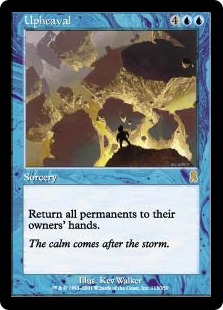
The draft went very well for me; for the third time in three cube drafts on the weekend I opened Upheaval.

Quick note on Upheaval: Some people still think that this card is slow and unwieldy because they think of the worst-case scenario in casting it (turn 6 with no mana acceleration as a defensive measure) instead of the game-restart-with-an-advantage that it truly is. As it turned out, I had cast Upheaval in the worst-case scenario vs. a Bitterblossom aggressive deck, and I was a savage topdeck by my opponent away from winning that game! If the worst-case scenario is stopping a sure loss and a second chance to turn the game around in your favor…well, there are worse cards you could be playing in your blue section. Like almost all of them. So play it. Go!

So with Upheaval in my deck again, I stuck to blue but also managed to pick up an early-ish Metalworker. Artifact Blue is one of my favorite archetypes in cube draft, so I don’t mind committing to it and trying to catch ‘em all with signets and relevant artifacts. During the third pack I remember hoping that I would somehow catch one of the Academy cards, and sure enough I got passed Tolarian Academy! The final result was probably the best version of this archetype I’ve been able to assemble in a booster draft; only a Tinker would have made it better. Here it is:

U/r Artifacts

Creatures

*
1 Goblin Welder
*
1 Spellskite
*
1 Phyrexian Revoker
*
1 Willbender
*
1 Metalworker
*
1 Lodestone Golem
*
1 Solemn Simulacrum
*
1 Master Transmuter
*
1 Venser, Shaper Savant
*
1 Karn, Silver Golem
*
1 Sundering Titan

Artifacts

*
1 Winter Orb
*
1 Golgari Signet
*
1 Izzet Signet
*
1 Rakdos Signet
*
1 Selesnya Signet
*
1 Simic Signet
*
1 Lightning Greaves
*
1 Icy Manipulator
*
1 Mindslaver

Spells

*
1 Mana Leak
*
1 Memory Lapse
*
1 Fact or Fiction
*
1 Upheaval

Lands

*
1 Tolarian Academy
*
3 Mountain
*
12 Island

Bonus decks! I was able to reassemble these decks after the draft, but without the exact numbers of basic land in the multicolor decks. There are a couple of spicy ones…

Jake Meiser:

B/R Burn

Creatures

*
1 Vampire Lacerator
*
1 Grim Lavamancer
*
1 Nezumi Graverobber
*
1 Withered Wretch
*
1 Dark Confidant
*
1 Nantuko Shade
*
1 Graveborn Muse
*
1 Nekrataal
*
1 Abyssal Persecutor
*
1 Flametongue Kavu
*
1 Zombie Cutthroat
*
1 Shriekmaw

Artifacts

*
1 Chrome Mox

Spells

*
1 Lightning Bolt
*
1 Duress
*
1 Firebolt
*
1 Sarcomancy
*
1 Chainer's Edict
*
1 Go for the Throat
*
1 Terminate
*
1 Terror
*
1 Arc Trail
*
1 Bottled Cloister
*
1 Hit // Run

Lands

*
1 Rakdos Carnarium
*
1 Lavaclaw Reaches
*
1 Badlands
*
1 Bloodstained Mire
*
1 Verdant Catacombs
*
11 Basic lands

Auggie:

Red Aggro

Creatures

*
1 Tattermunge Maniac
*
1 Mogg Fanatic
*
1 Slith Firewalker
*
1 Blood Knight
*
1 Kargan Dragonlord
*
1 Fire Imp
*
1 Ball Lightning
*
1 Sulfur Elemental
*
1 Blistering Firecat
*
1 Skizzik
*
1 Siege-Gang Commander
*
1 Greater Gargadon
*
1 Moltensteel Dragon

Artifacts

*
1 Sword of Fire and Ice

Spells

*
1 Demonfire
*
1 Banefire
*
1 Incinerate
*
1 Sulfuric Vortex
*
1 Staggershock
*
1 Char
*
1 Flame Javelin
*
1 Koth of the Hammer
*
1 Word of Seizing

Lands

*
1 Mutavault
*
16 Mountain

Kenny Mayer:

W/G Aggro

Creatures

*
1 Mother of Runes
*
1 Isamaru, Hound of Konda
*
1 Savannah Lions
*
1 Figure of Destiny
*
1 Loam Lion
*
1 Soltari Priest
*
1 Soltari Monk
*
1 Mire Boa
*
1 Eight-and-a-Half Tails
*
1 Paladin en-Vec
*
1 Mirran Crusader
*
1 Uktabi Orangutan
*
1 Juggernaut
*
1 Blastoderm
*
1 Giant Solifuge
*
1 Baneslayer Angel

Artifacts

*
1 Sword of Light and Shadow

Spells

*
1 Path to Exile
*
1 Spectral Procession
*
1 Call of the Herd
*
1 Ravages of War
*
1 Elspeth Tirel

Lands

*
1 Stirring Wildwood
*
1 Windbrisk Heights
*
1 Temple Garden
*
1 Savannah
*
1 Treetop Village
*
13 Basic Lands

Now onto the REAL tournament report!

Round 1

Stod (Bant Ramp) defeated Ben (mono-blue control), as was evidenced by his ritualistic dance. Word on the street was that Stod cast a Treachery on his own creature with a Mirari's Wake in play, and then did something absurd with the extra 5 mana.

Adam (U/B Stax) defeated Jake (B/R burn), even though Jake cast a turn one Dark Confidant, turn three Graveborn Muse, and turn four Bottled Cloister to bury Adam in extra cards in game one. Adam got his revenge in game three, however, as he was able to leave Jake without any permanents in play due to Smokestack. House rules dictate that a player with no permanents in play is not allowed to talk; Jake had a very silent final six turns of the match wrought with hand gestures.

Auggie (monored) defeated Kenny (W/G aggro) with the help of Blood Knight (nice white creatures, brah) and Koth of the Hammer. There was also a Word of Seizing/Greater Gargadon combination sighting.

Dan (U/B planeswalker control) defeated Usman (B/W control w/4-5 wraths) in a long match, with Mimic Vat doing some major work. One of the games featured a Misdirection’ed Vindicate onto Usman’s own Precursor Golem (before Usman cast the Vindicate, Dan flashed me the Slaughter Pact in his hand, laughing. “This isn’t very good versus that guy!”).

In the Anthony mirror, Eason (Naya aggro) obliterated me (U/r Artifact) because almost every one of his creatures destroyed an artifact/land when it enters play. Both games played out something like: turn one Taiga+Wild Nacatl, turn two Tin-Street Hooligan, turn three Duergar Hedge-Mage, turn five Goblin Ruinblaster for my only nonbasic land (with which I could have Upheavaled with a head start if I can untap). It wasn’t remotely close!

Elimination: Ben from the Good team (due to getting embarrassed by Stod so badly), and Usman from the Axis of Evil (for being the slowest player). Note that both players lost their first round, so neither could really complain (too loudly). Good 3, Evil 2.

Round 2

Adam and Sam had an epic battle of early 2000's Ohio mages that Adam won (albeit without the dance). I dismantled Kenny by Upheavaling into Lodestone Golem two games in a row. Dan got beat about the head and shoulders by Jake. And Auggie vs. Eason didn’t end well for the mono-red good guy. Adam and Eason were the lone remaining undefeateds at 2-0.

Elimination: Dan for the Good team, by virtue of his finishing the slowest and Kenny for the Evil team (who voted for himself in a mire of self-loathing after finishing 33rd in the main event). Good 5, Evil 4.

Round 3

I lost to Jake in a tight three games, the last of which I almost won because Dark Confidant revealed, in order: Bottled Cloister, Graveborn Muse, and Hit // Run. Sixteen ya! Auggie also lost, this time to Stod’s engine of Reveillark + Crystal Shard/Momentary Blink. However, Adam defeated Eason in the battle of the undefeateds because of Smokestack/Braids, Cabal Minion. So the round wasn't a complete sweep for the bad guys.

Elimination: Auggie from the Good team (who voted for himself as well), and Jake from Evil (by virtue of having the worst among remaining decks). As it turned out, both of those guys bounced from the event site after being eliminated to drive back to Cincinatti together, so it was another good set of eliminations. Good 6, Evil 6 - all tied up!

Round 4

Adam got destroyed by Eason’s almost-constructed Zoo deck in a rematch (Adam later said he was lucky to beat him the previous round), and Stod and I had an interesting match. By interesting, I mean interesting for me to play and Stod to watch...

Game 1: I played a turn one Goblin Welder, turn two Signet, turn three Fact or Fiction (revealing two lands and three more signets; I took the pile of 2 signets and a land), turn four double Signet, turn five Mindslaver, turn six he Sower of Temptation'd my Welder, but I still activated Mindslaver. With the active Welder (if I can get it back) and 4 other artifacts on board (and more in hand), I proceeded to take Sam’s next 6 turns and do unspeakable things like:

  • Cast Momentary Blink on his own Sower, targeting itself and getting my Welder back (and flashing it back)
  • Crashed his Academy Rector into my Solemn Simulacrum, failing to find an enchantment
  • Failed to find with a Farseek
  • Evoked a Reveillark without returning anything
  • Activated Knight of the Reliquary multiple times to Stone Rain his own lands

Even though I drew a lot of running lands and actually had to let Stod control a turn or two of his own, I was able to start taking his turns again until I found a win condition.

Game 2: I had a really fast start with a turn two Lightning Greaves, turn three Metalworker into attacking with Karn, Silver Golem, turn four attack with Karn and a freshly cast Signet, turn five attack and Upheaval into a concession with some mana floating!

Perfect in your 'winning' theme deck.

Elimination: Sam and Adam, both for losing. Good 7, Evil 7.

Round 5

Anthony mirror match rematch! This time, Eason played creatures that only attacked and I was able to win the first game mainly through cycling my Lodestone Golem and Solemn Simulacrum in and out using a Greaves-protected Welder.

In game two I was able to protect my creatures/artifacts with Spellskite and an active Welder long enough to Upheaval (Seeing a trend? Nice card.) into Tolarian Academy/Welder/Greaves/Sundering Titan, ready to bring back a Lodestone Golem the next turn (having Lodestone post-Upheaval is amazing, but I already did that a few times so I wanted to just blow up his first land with an instant-speed Sundering Titan). Once again our match wasn’t that close; judging by the amount of head-shaking and cursing about Spellskite, I confirmed that the 0/4 almost-defender had earned a long-standing spot in my Cube with his performance.

Good 8, Evil 7. It went right down to the wire, but we did it! Doing the Survivor draft was really fun (and I hope we can do it again soon), but I would suggest a few things before trying it yourself:

  • Make sure everyone in your draft is OK with being very competitive, but not so much so that they would get upset about getting voted off. My recommendation is to use experienced cube drafters to play this format.
  • The larger the draft, the better. I would suggest a minimum of eight people in the draft.
  • Have some paper, writing implements, and a box of some sort available (you can use the cube box, likely), so people can cast their secret ballots. Feel free to read them dramatically.
  • Don’t be afraid to take the theme as far as your players would appreciate. Maybe on 'Redemption Island' players play single elimination for the right to get back on. Maybe all of the eliminated players vote for the final champion. Maybe you play for some sort of fabulous prize to encourage people to draft/play/vote well. Maybe you could give an ‘immunity idol’ to the person with the coolest play/finished first and won/had the biggest blowout. You could also have two winners: the winning team, and the winning player (the 'survivor'). Make it as fun and thematic as you want!

That’s all for now! If you are looking for some variation or a step-up in competitiveness in your cube drafts while taking the 'team' concept to the next level, give Survivor Draft a try!

May all your squares be three-dimensional!

-AA

Violence of the Sun | CommanderCast S3E5

Are you a Quiet Speculation member?

If not, now is a perfect time to join up! Our powerful tools, breaking-news analysis, and exclusive Discord channel will make sure you stay up to date and ahead of the curve.

We're examining the best color this week with the first installment of our monocolor series: red is in the spotlight during Strategy and Tech! But the real star of the show is Devon Rule, aka @Obsidiandice, who is guest beasting in this episode as our red specialist, and also provides his perspectives on card design. We round things out by continuing to climb the mana curve with converted mana cost 2 cards in Curving Out. Don't forget, this is also the last week to get your sharpie alters in for the Season Three Contest!

You know http://commandercast.blogspot.com/ is where it's going down for this week's full show notes, articles, videos, and links.

Click the button to play or download the entire episode!

Insider: Doctoring a Card Part 2

Are you a Quiet Speculation member?

If not, now is a perfect time to join up! Our powerful tools, breaking-news analysis, and exclusive Discord channel will make sure you stay up to date and ahead of the curve.

The New, Old, Borrowed Blue Box

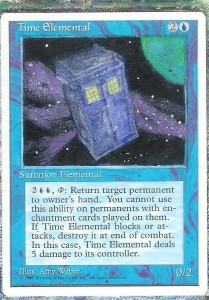
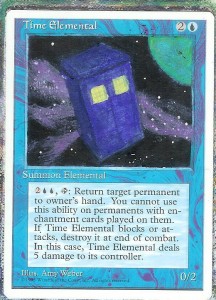
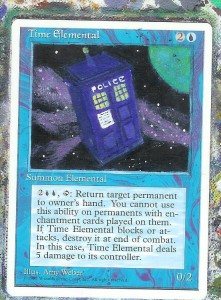
Welcome back again to the Painter's Studio. Today we finish our project from last week and discuss some of the things we learned from it. As you remember we had finished the background of our spacy-wacey new alter and now have to paint the subject of the picture. You should all know what a TARDIS is by now, because you took my advice and watched a little Doctor Who this past week. Those stubborn few who haven’t can take this time to Google “TARDIS” and get the general idea. Do be careful not to get carried off by links to Karen Gillan pictures though, you may never come back!

Stop daydreaming about redheads...

So, to begin we need a base coat of blue so lay one down with your Ultramarine Blue. The windows will be yellow, so be sure to leave those alone as yellow does not cover well. My first coat looks like garbage, but it served its purpose of helping to cover that unsightly sketch of mine. After you have finished with your base coat, feel free to fill in the windows with a mixture of Cadmium Yellow and Titanium White. You wouldn’t know it from my picture, but the white helps the yellow cover the sketch lines.

Next we add another layer of Ultramarine blue to the TARDIS. The layer looks by far better than the last but we seem to lose all depth perception with it. To fix this we must add shadow to the box, and to do that we must consider our light source. The planet in the background is a decent source of light, but that would throw the front of our subject into shadow, so I have decided (at least for my own picture) that a more prominent light source lays outside the borders of my picture and shines directly on the front of the TARDIS. This would put the visible side of the TARDIS into shadow. By adding a very small amount of black to Ultramarine Blue we achieve the desired color, after that it's just paint by number.

Details, Details...

The details always prove to be the hardest part, and this proves doubly so when recreating a cultural icon. People already have an expectation of what a TARDIS should look like, and are often disappointed when a painting does not meet that expectation, though most are willing to forgive any inaccuracies due to the small size of the project. Either way, me must try our best to come as close as we can to the real thing. I used black to paint in the square indents in the paneling. With a flat brush and a very small amount of ink, I touched the very tip of the brush to the spot to create a very thin line, and continued this to create the squares. I used this technique with blue to create the bars on the windows, and with white to draw and fill in the white panel. I also used it to help define the beveling on the top of the TARDIS.

I used a small lining brush to do the words, though you may use the corner of a flat brush to the same effect. After that I just tossed on the antenna and called it a day.

Hating Yellow and Eating Crow...

I'd like a take a moment and share a few lessons that I was reminded of while doing this project.

The first is a simple one. Some colors cover better than other colors. Yellow and orange in particular will take many more coats than anything on the blue side of the color wheel. This is important to keep in mind when painting fire. The second is a lesson in humility. Every so often as a painter I become so confident that I honestly believe I can paint anything. This is a brilliant thing because it allows me the courage to try more challenging alters. Every so often though, I run into something that is a little beyond my capabilities. This TARDIS certainly gets the job done, but it is by no means something that I would proudly display. When you are forced to eat a little crow, it is important to learn from the incident and move on. Remember that the reasons you have failed are not reasons to give up, but only a reminder that there is always more to learn and practice.

Reader Feedback is Required

You may have noticed that I have been making an attempt to keep my articles shorter. This is because I have found that when I read articles online, I tend to read shorter articles more thoroughly and skim the longer ones. So I put the question to you: Would you prefer a longer article each week?

-The Painters Servant

Twitter: PaintersServant

Email: Mbajorek02@gmail.com

A New Challenger Approaches!

Are you a Quiet Speculation member?

If not, now is a perfect time to join up! Our powerful tools, breaking-news analysis, and exclusive Discord channel will make sure you stay up to date and ahead of the curve.

So the commander preconstructed decks were released the other weekend, and I spent a great day playing with the Devour for Power deck at a local gamestore. It was a ton of fun to play with these preconstructed decks, not only because I got to bash face with a new, shiny, oversized dinosaur arm, but also because it's sort of a return to basics; to a time where we were playing Commander decks built out of bulk rares and cards we had lying around. That said, The Mimeoplasm stared down some pretty competitive lists, devoured some souls, and was generally awesome!

All in all, I'm pretty happy with the product. We certainly saw a number of players who were new to the format, and they thought it was an awesome introduction. The games were a lot of fun, and I hope that the ease of entry will keep those new players in the format.

However, the thing that excites me the most about new sets are the one or two new legendary creatures in any new set. This printing is unique in that it gives us fifteen new commanders to work with, and I'm excited to take a look at them and build some skeleton lists for the ones I'm most interested in! Let's start with the guys available in the deck that I played: Devour for Power.

Skullbriar, the Walking Grave

Absolutely no one was excited about this guy in the preconstructed decks at my Release. However, he seems like a fairly unique card to build around. You can take some tricks from the infect decks in legacy, pauper, and standard, and run goodies like Invigorate, Vines of Vastwood, and other efficient pump spells, to get people out of nowhere.

Skullbriar's weakness is twofold. Firstly, he's pretty abysmal against efficient spot removal, but that can be said for any general. The trick with Skullbriar is to be careful about who you're attacking, and when you do it, so that he can grow to a threatening size and leverage his haste in the late game. His second weakness is that he just dies to any removal based on -1/-1 counters. Forever. This makes having sacrifice outlets incredibly important, so that you can Command Zone him to safety.

Damia, Sage of Stone

Damia is downright unfair in games with other preconstructed decks, where not many people have card advantage engines. I drew upwards of 20 cards with her in several games on the day, and won many of them solely because of Damia.

However, the difference between Precons and constructed Commander decks is efficiency and utility. In "real" games, Damia never made it around the table: either drawing removal, or attacks that forced her to block.

The most interesting thing I can think to do with Damia is to set up a turn where you dredge most of your deck, and then play out of your graveyard for the rest of the game. The problem is always going to be finding a way to untap with her, but I can certainly see building a goodstuff deck that backs her with countermagic being very sucessful. The key to building with Damia is not to rely on her too much, and to make sure you can protect her.

The Mimeoplasm

Anyone who's spoken to me since The Mimeoplasm was spoiled knows that I was incredibly hyped for this card. Let me tell you: he never disappointed. The Mimeoplasm has a ton of utility in the midgame, rebuying creatures like Eternal Witness and Acidic Slime, hating on graveyards, or just threatening General Damage. If (when) the game goes long, you get to do stupid things like being a copy of Necrotic Ooze or take a Lord of Extinction's power.

The Mimeoplasm is incredibly well positioned to take advantage of the things that the BUG color combination does best: gigantic creatures, utility creatures, and recursion, and it ties all of those together in an aggressively costed creature that doubles as a utility guy and a win condition. Long story short? Respect the Dino-Arm, or it'll eat your face.

Next, let's take a look at the deck most people seemed interested in at my Launch Party, the red-blue-green Mirror Mastery deck. Sadly, none of these commanders impressed me much in preconstructed fights, but they seem very exciting to build around!

Animar, Soul of Elements

Sadly, the only time Animar did anything at my release was when I copied him with The Mimeoplasm, and proceeded to play my creatures at a huge discount. That was fair.

Still, even though he didn't do much, Animar is incredibly exciting to build around. He's really aggressively costed, grows over time, and enables all kinds of "enters the battlefield" shenanigans, something that these colors are traditionally good at.

Here's what I'm looking at to start with Animar: all the best enters-the-battlefield creatures to generate card advantage, turn Animar into a gigantic threat, or just threaten to go infinite.

[deckbox did="a96" size="small" width="560"]

Edric, Spymaster of Trest

Going into this, I thought Edric was massively overhyped, and to be fair he was pretty abysmal in precon games. However, I did face down a deck built around Edric in one of my pods, and that deck was brutal. He used Edric and low casting cost elves to draw cards, make tokens, and draw more cards, then used that to fuel Forbid with buyback to lock multiple players down.

In the end I still don't think Edric lived up to his hype, but he definitely makes for some interesting decisions, and is certainly very powerful. The problem, in my mind, is that Edric is incredibly symmetrical and is a huge threat. The more creature-oriented decks are going to get at least as many cards off of him as you do, and the more controlling decks will kill him on sight.

I have to say though, my favorite thing about Edric is that he does something subtle that leads to more intersting games: he encourages people to attack and progress the game along.

Riku of Two Reflections

Riku is interesting, in that he's very similar to Animar in functionality. In my opinion, his creature-based ability is slightly less powerful, but the ability to double-up both creatures and spells is incredible in a format where card advantage is king. It also makes it much less disappointing to see ramp spells in the late game, since they're always going to do something.

Honestly, I'm just waiting until I see a deck with this guy, Time Warps, and Izzet Chronarch/Mnemonic Wall to buy back Time Warps. In short, Riku is very generically powerful. You can't really build around him, but he'll be good in any deck that plays creatures, instants, or sorceries.

Next we'll take a look at the Counter Punch deck. I assumed this would be one of the most popular decks after the hype around Karador, host Chieftain months ago; did it live up to the hype?

Karador, Ghost Chieftain

I misread this card so badly when I first saw it. I had thought you got to cast a creature for free every turn. Just being able to cast one is very different. Still, the ability to replay a Deranged Hermit or a Shriekmaw every turn is nothing to scoff at. What's interesting is that you never have to overextend your graveyard into a Tormod's Crypt; with enough sacrifice outlets, you can just keep replaying the same utility guy every turn and force people to deal with that one before you find a new creature.

I'm working on a turbo-dredge build of this that just dumps its deck into its graveyard, and Dread Returns into a Reveillark or Necrotic Ooze combo. Karador significantly lessens not only your reliance on Hermit Druid to mill your deck, but also on a combo win.

[deckbox did="a99" size="small" width="560"]

Ghave, Guru of Spores

Let me say this up front: Ghave plus tokens makes combat math a huge headache. I really like that Ghave has a built in sacrifice outlet to protect itself, and to enable the recursion of token generators.

Besides the obvious token theme, I'd be looking at Morningtide cards like Oona's Blackguard and some of the Spike Weaver-style creatures, since they make your token army more awesome and make combat even more complicated.

I'm sure there are some pretty absurd things that you can do with Ghave, but I think I need some more time to think about it before I find something more interesting than Oona's Blackguard.

Vish Kal, Blood Arbiter

As usual, I really like that this creature has a built-in sacrifice outlet to protect it from tuck and such. However, that's where my interest in Vish Kal ends. Honestly, it seems like it's just a bigger copy of Teysa, Orzhov Scion, and efficiency is more important to me than being a big creature. I honestly don't see this guy as being very distinct from the other white-black commanders, since they all involve sacrificing creatures for various effects.

That said, if you take the "stock" white-blacck lists with lots of recursion, add Vish Kal and some ways to give him haste, I can definitely see one-shotting people with him. And who doesn't love doing that?

Ruhan of the Fomori

Ruhan is the card that I was the most disappointed in before playing with him. After seeing a deck built around Ruhan in action, I'm still not sure I'm convinced. He seems an awful lot like [card Uril, the Miststalker]Uril[/card], in that you just want to Voltron him up and kill everyone, but paying an extra mana for trollshroud and being in the right colors for Runes of the Deus seems pretty huge.

That said, Ruhan seems to be a very polarizing card. Some people like whole "Don't blame me, the dice did it!" concept, while some people absolutely can't stand it. Personally, I feel like you're more likely to lose because you can't attack the right person than you are to win because Ruhan is a 7/7 for four.

Nin, the Pain Artist

Nin never hit play during my release event, so I can't say that I've seen her in action. However, I can't think of many interesting things to do with Nin outside of the obvious Stuffy Doll, Coalhauler Swine, and Repercussion.

Besides that, Nin has a ton of interesting political applications. You can kill your own creatures, help people draw into answers, and do other cool tricks. Even more exciting, Nin can shoot herself to avoid tuck effects!

Nin is certainly incredibly powerful, and has a ton of political implications. I just haven't thought of anything to do with her that I find particularly interesting.

Zedruu the Greathearted

Zedruu is probably the most fun general out of the entire product for me. There are all kinds of things to donate to people, but the more interesting part of playing Zedruu isn't donating Howling Mine, but deciding when you can donate lands and other real resources, and who you can donate them to.

I've definitely heard a lot of exciting ideas about what you can donate to people, and I've had a few of my own. Here's what I'm working with so far:

[deckbox did="a97" size="small" width="560"]

Kaalia of the Vast

So, over on Commandercast we all got pretty hyped about Kaalia before the release event. It was very, very well deserved. Kaalia is actually a lot like Zur the Enchanter; both are very aggressive , but Kaalia is aggressive in a fair and exciting way. You can certainly do some pretty absurd things with her ability, but it's hard to be upset with a general that has to attack and "only" drops dragons, as opposed to one who gets a Diplomatic Immunity or a Necropotence.

Kaalia seems like a very fun commander to build around, and I'm really excited to cheat some of these into play:

[deckbox did="a98" size="small" width="560"]

Basandra, Battle Seraph

Basandra is in an awkward position as a general. Red White is one of the most aggressive color combinations, and some of its biggest strengths is in messing up combat, and Basandra forces you to play fair.

Not only that, but you can't force people to attack into your awesome blockers, because opponent's can choose to attack other players. All you can really do is use the ability to clear the way for your creatures, and hope that yours are bigger.

Unfortunately, I really don't think that Basandra is very exciting, which is really disappointing since she has awesome art! If you've got a sweet deck or idea for Basandra, I'd be excited to see it, since I'm really looking for an excuse to get one altered! [Editor's Note: Carlos clearly dislikes me, so I'll link to my own scrappy Basandra-based article.]

Tariel, Reckoner of Souls

Apparently, I'm one of very few people who was really excited about Tariel. Unfortunately, he's not nearly as aggressively costed as some of the other legends in this product, but to me, he seems really interesting as a foil to other graveyard based strategies.

Tariel subtly encourages you to play a ton of graveyard hate to reduce the randomness of his effect (and to protect yourself from someone Entombing Phage the Untouchable in response). But, ignoring that, isn't it fun to play the lottery sometimes? The ability is always going to be upside, but the times you get an Eldrazi are going to be the kind of epic stories this format is about.

And those are my impressions of the new commanders after a week of playing with them. You can bet I'm going to be looking into these and other approaches, and I'm interested in hearing what your impressions or ideas with these new commanders are. I'd be thrilled to see some of your stories and ideas in the comments, on Twitter or by email.

Next week we'll see more of a return to proper deckbuilding form, talking about an issue that's affecting my local playgroup, and an attitude which seems to be coloring the opinions of both the online and local communities: the 5 color stigma.

Carlos Gutierrez
cag5383@gmail.com
@cag5383

Dealing with Dragons

Are you a Quiet Speculation member?

If not, now is a perfect time to join up! Our powerful tools, breaking-news analysis, and exclusive Discord channel will make sure you stay up to date and ahead of the curve.

The other week Worldgorger Dragon was unbanned. Honestly, I'm not quite sure how I feel about the unbanning with regards to the health of the format, but while it's unbanned, I want to take advantage! That said, I really don't like the standard Animate Dead infinite combo with the dragon; I'd much rather see if there are more interesting things to be done with it. Thinking about it, if you can sacrifice him at will he blinks all your guys and untaps all your lands, which is an obviously broken effect, especially in red! There is a lot we can do with that!

Conveniently enough one of my favorite cards in Magic is Dragonstorm. We all know that just about each storm card ever printed has been unfair in one format or another. Consider also that Tooth and Nail is considered a staple of Commander , and is responsible for winning many games. Isn't Dragonstorm just Tooth and Nail with storm? Sure, you’re restricted to dragons but aren’t most of the best red creatures Dragons anyway? That seems like all upside in a format where people derive just as much enjoyment from flavor and “epicness” as from powerful and efficient plays.

So how does one go about breaking Dragonstorm? It’s always a mistake to build around a single card in this format, since you’re going to be completely reliant on tutors to give you any kind of redundancy. The first step for building a deck like this is to look for similar effects that you can build into the deck without changing the fundamental purpose. Here’s what I want to start with as a basis:

The Gameplan

Commander: Bladewing the Risen

Dragonstorm
Warp World
Where Ancients Tread

Entomb
Buried Alive
Patriarch's Bidding
Twilight's Call
Victimize
Balthor the Defiled

Using this as gives us Dragonstorm as a primary plan, with a strong reanimation plan to back it up, and Warp World to recycle Dragons. The part of this that I’m most excited about is Where Ancients Tread: with all the Dragons that will be going in and out of play, I think it seems really powerful to make them all Bogardan Hellkites.

From here, it’s important to note that any one of these game-breaking sorceries isn’t going to win the game on its own and that you have to have ways to rebuy your win conditions, especially in decks that are built around doing one or two very specifics things. You also have to have ways to tutor up those win conditions. Tutors and recursion combined give you a sort of consistency and resiliency that are really important to the success of a deck in any format, especially a singleton format like Commander.

Tutors, Recursion, Card Drawing

Anarchist
Recoup
Yawgmoth's Will

Gamble
Demonic Tutor
Vampiric Tutor
Beseech the Queen
Diabolic Tutor

Ancient Craving
Ambition's Cost
Phyrexian Arena

So now that we can consistently dump dragons into play, it’s time to decide which dragons are worth playing and which are a little under the curve. Honestly, I probably want to be playing about 10 Dragons, since you already have a number of expensive sorceries and don’t want your hand to be full of miscellaneous expensive spells. Here be Dragons!

Dragons

Bogardan Hellkite
Vampiric Dragon
Knollspine Dragon
Hellkite Charger
Dragon Tyrant
Fire Dragon
Mordant Dragon
Steel Hellkite
Rorix Bladewing
Worldgorger Dragon

There are a couple of important interactions here that affect what you Dragonstorm for. First, Bogardan Hellkite plus Knollspine Dragon is a one-sided Wheel of Fortune, which is obviously awesome. Second, hasty Dragons plus Hellkite Charger get in for a ton of damage if you can activate the Charger that turn. Rorix Bladewing has haste to start with, but we'll be giving other Dragons haste too.

The other interesting point of discussion is the role of Worldgorger Dragon in the deck. There aren't terribly many dragons with "enters the battlefield" abilities that I want to play, but blinking Bogardan Hellkite and Knollspine Dragon is no joke, and adding Where Ancients Tread to the mix is downright nasty!

At this point, the deck’s late game is all but figured out. What I really want to do here is to figure out how the deck is going to function in the early to midgame; make sure you don't get steamrolled by early Rafiq of the Many beatdown, and can interact with the engines of other decks:

Removal

All is Dust
Nevinyrral's Disk
Oblivion Stone

Aftershock
Go for the Throat
Duplicant
Helm of Possession
Corpsehatch

Nihil Spellbomb

The purpose of these spells is always to buy time until you can start casting “real” spells. The artifact-Wraths backed by a small suite of spot removal will get you there most of the time. Helm of Possession is particularly good because it lets you recast your general for value later in the game!

Now we need to make sure that the deck can cast it's spells in a reasonable time-frame. The mana acceleration in red--black is typically artifact-based, but because of the reliance on artifact-Wraths, I want to avoid those if possible. There's nothing worse than having to blow up your own mana rocks.

Ramp
Solemn Simulacrum
Darksteel Ingot
Wayfarer's Bauble
Expedition Map
Thawing Glaciers

Caged Sun
Coalition Relic
Cabal Coffers
Urborg, Tomb of Yawgmoth

There are a few cards here that might seem questionable. Expedition Map and Thawing Glaciers aren’t really acceleration, but they lend consistency to your land drops that red-black is typically lacking. Besides, Deserted Temple makes Thawing Glaciers almost like acceleration, running that doesn’t cost you anything, and it interacts positively with Cabal Coffers, which is as always a powerhouse mana producer (thanks, Urborg!).

At this point, the skeleton is mostly finished, and I'm mostly looking for things to tie the deck together. What I’d like are some ways to give my guys haste, some more early creatures, some more creature removal, and a few more flavorful cards. The haste will make your “combo” turns infinitely more impressive. The early creatures will give you more to do with your Helm of Possession, might make more recursion worthwhile, and will hopefully give the deck some way to abuse ‘enters the battlefield’ effects.

Haste

Anger
Mass Hysteria

Mid-Game Engines
Kik-Jiki, Mirror Breaker
Zirilan of the Claw
Sneak Attack

Basilisk Collar
Hoarding Dragon

Krovikan Horror
Mogg War Marshal
Undead Gladiator

Now, there’s actually a lot that’s been added to the deck with these cards that hopefully shores up the problems of the deck, and adds another layer of synergy. First, you can give your dragons haste, which is always awesome. Second, you have Kiki-Jiki, Mirror Breaker, Zirilan of the Claw, and Sneak Attack to generate some card advantage, cheat on the costs of dragons, and generally make your deck relevant in the midgame.

Next, I added Basilisk Collar since it makes any early creatures into pseudo-removal, it combos really well with Vampiric Dragon, and could potentially be part of a creature-control engine that helps the deck’s mid-game. Enter Hoarding Dragon! Now you can Dragonstorm for Hoarding Dragon and Vampiric Dragon to set up the Basilisk Collar plus Vampiric Dragon engine.

Krovikan Horror is a creature that doesn’t get much love, but is deceptively powerful. It recurs itself for some card advantage mid to late game, it’s a sacrifice outlet, which is good for various Dragons, and it loves to be given a Basilisk Collar. Mogg War Marshal and other low cc creatures give the Krovikan Horror some ammunition, chump blockers, and card advantage from Kiki Jiki, Mirror Breaker.

Finally, Undead Gladiator gives you a recursive guy who gets dragons into your graveyard and helps you dig for the spells you’re missing. It's also worth noting that Undead Gladiator plus Krovikan Horror is a slow but reasonable draw engine, since the Gladiator can always be directly over the Horror in your graveyard.

Now with the leftover slots we can really see what the deck is missing, and look for ways to tie the mid- and late-game engines together. This will hopefully let the deck transition smoothly from surviving the mid game to dropping Dragons and taking control of during the later turns. Here’s what I’ve got:

More Tutors
Sarkhan the Mad
Dimir House Guard

More Artifact Ramp
Mind Stone
Everflowing Chalice
Crucible of Worlds

More Recursion
Nim Deathmantle
Strands of Night

Sarkhan the Mad is the nuts in this deck. He turns your Mogg War Marshal into dragons. Kiki-Jiki tokens? Dragons. Steal your opponent’s guy with Helm of Possession? Dragon. Oh, you drew it late? Just fireball everyone with the dragons you already have in play. Or draw cards, that’s an option too, I guess.

Dimir House Guard is a reasonable blocker, a sacrifice outlet, and serves the purpose of tutoring up important cards, like Solemn Simulacrum and Sneak Attack. It’s a solid role-player, and does what it needs to pretty well.

Because the deck has such a powerful late game, and such mana intensive mid-game engines, I wanted more artifact acceleration. Mind Stone and Everflowing Chalice are my two favorite cheap accelerants, and while Crucible of Worlds doesn’t accelerate you exactly, it provides consistency and utility to your mana base that no other card does.

Next, I added a few more recursion engines that are more attrition-based and not as explosive or combo-tastic. Nim Deathmantle and Strands of Night are both powerful late game cards that are reminiscent of Recurring Nightmare. You get to recycle your Dragons with powerful effects, like Bogardan Hellkite, but also get to protect your Dragon Tyrant from spot removal. I really can’t oversell how powerful these cards are; once you have the resources to invest in them they just take over games.

Finally, let's take a look at the mana base. Like I've said before, the mana base is something a lot of people gloss over but it really is a place where you can make a significant number of improvements to your deck's functionality.

Deserted Temple
Vesuva
Spinerock Knoll
Scrying Sheets
Molten Slagheap
Bojuka Bog

Miren, the Moaning Well
High Market

Tectonic Edge
Mouth of Ronom

Terramorphic Expanse
Evolving Wilds

9 Snow-Covered Swamp
15 Snow-Covered Mountain

There’s a couple of things I want to point out about this. Firstly, the snow engine gives a ton of utility, including repeatable creature removal in Mouth of Ronom, as well as Scrying Sheets helping you hit land drops and draw gas.

Deserted Temple is stellar in this deck, and would be even better if you wanted to make space for a Maze of Ith. This deck loves untapping Thawing Glaciers, Scrying Sheets and Cabal Coffers, and even Molten Slagheap.

Beyond these superstars, you have some card advantage and utility in Spinerock Knoll, Bojuka Bog, and your Strip Mine effects to help make the deck more spell-dense while still hitting land drops.

The mana base here provides a lot of utility and power, and is one of the reasons such a top-heavy deck functions reasonably well.

[deckbox did="a88" size="small" width="560"]

Now, the important question is, what exactly does Worldgorger Dragon do for this deck? Well, that depends on how easy it is to sacrifice once you've exiled all your permanents. High Market and Miren, the Moaning Well are fine if you save your land drop. Sneak Attack is really good at killing it, as is Krovikan Horror and Dimir House Guard if you can float the mana.

Really, if you resolve a Worldgorger Dragon you're either going to win the game, or lose to spot removal in response to his trigger. It's one of the swingiest cards I've played with in a long time, and I still can't decide if that's a good thing or not. Only time will tell if unbanning him was a good idea, but my initial impression is generally positive.

As always, I'm glad to hear any feedback and constructive criticism. Feel free to get in touch with me to talk about my articles, your decks, or any ideas you want to talk about. I'm especially interested in any applications for Worldgorger Dragon you see in the coming weeks!

Hot Dog, the Pauper’s Food!

Are you a Quiet Speculation member?

If not, now is a perfect time to join up! Our powerful tools, breaking-news analysis, and exclusive Discord channel will make sure you stay up to date and ahead of the curve.

It's cookout season, and whether you celebrate Canada Day, the Fourth of July, or Ratcatcher's Day, it's the perfect time to invite some friends over, throw some meat on the grill, and hang out in the yard until way later than you expected. [Editor's Note: This is pretty much the best thing ever. Really!] And the food! Burgers, steaks, chicken, corn on the cob, and the subject of today's article, hot dogs.

We all have our own favorite style of hot dog. Mine is the all-beef kosher frank, but you might like ballpark-style mixed meat ones, or chicken, turkey ones, or even vegan options. But if you really want to impress your friends this summer, why not serve up something they've probably never had before?

First, a bit of history on how these tasty white weenies have been prepared in the past:

[deckbox did="a94" size="small" width="567"]

[deckbox did="a95" size="small" width="567"]

The first is by Kasparadi from 5/3/2011, and the second is by Eightfists8 from 6/20/2011; both were undefeated in their respective Pauper Daily Events. As you can see, the basic recipe hasn't changed all that much between spring and summer. Both of these are certainly good, but they're a bit too traditional for my taste. And while they're usually pretty well-received, they rarely make a really memorable impression. I've tried these things out all kinds of different ways, and I've cooked up a recipe that spices them up without diluting the flavor that makes them a true classic. Some of the changes might be jarring at first, but don't worry; I'll explain them all in good time. Take a look:

[deckbox did="a93" size="small" width="567"]

If you'll allow me to drop the decklists-as-recipes conceit for a moment, I'll explain how I arrived at this list. I started by making a few observations about the White Weenie deck and its place in the metagame:

1. Fliers are awesome in this format, and this deck can run more and better fliers than anything else.

2. Most of the best and most commonly played removal in the format is sorcery-speed, so if there are any creatures that are immune to sorcery-speed removal, they're probably worth a look.

3. The deck likes to play a lot of artifacts.

4. The deck really wants to play a big, bad four-drop, badly enough to play the non-evasive and incredible mana-intensive Shade of Trokair.

5. The biggest strength of the deck as a whole is the ability to play huge bombs that shut out certain decks.

Bearing those in mind, here are the reasons for some of those atypical card choices:

Glint Hawk Idol: This is the slot usually occupied by Leonin Skyhunter, but Glint Hawk Idol is just better in my view. With the help of Ancient Den, it usually activates for free, and immunity to Flame Slash, Journey to Nowhere, Arc Lightning, Rolling Thunder, and a host of other key removal spells makes it a great inclusion.

Vault Skirge: Best one-drop in the format, best card in the deck, and best creature ever printed. Ok, some of that is hyperbole, but my love for this card is through the roof. Leading with Vault Skirge followed by the already-awesome Bonesplitter is probably the single strongest opener this deck has.

Thundering Tanadon: Shade of Trokair is ok, but you're kind of putting all your eggs in one basket with it, and tapping out every turn to try to deal damage is no fun. Thundering Tanadon is a monster for a one-time payment of four mana and four "life," whatever that is. Plus, it runs right over chump blockers and trades with Affinity's copious 4/4s. Sounds like a winner to me.

That's really it, but some of the omissions might seem equally puzzling. I only run two Benevolent Bodyguards and zero Icatian Javelineers, because I just don't think they make enough impact, and I want to run as many fliers as possible. I see this deck as an exercise in applying steady pressure in between blowing your opponent out with bombs.

And there are bombs aplenty in this deck to be sure, each meant to blow out a specific opposing deck. Holy Light can swing any combat in your favor (hence the single maindeck copy), but it really shines when it's single-handedly winning games against token decks and red-based storm. Prismatic Strands is an even better Moment's Peace against monocolored aggro decks (which just so happens to be nearly all of them), and it also really puts the hurt on burn and red storm. Order of Leitbur is practically unbeatable by Mono-Black Control. Aven Riftwatcher, Kor Skyfisher, and Vault Skirge make burn decks a highly favorable matchup even pre-board. Journey to Nowhere easily breaks up creature stalls, and Dust to Dust can buy you enough time to win against Affinity, especially when they can't block any of your creatures because they all have flying. With this many high-impact plays, it's not that hard to get there with a bunch of 1/1s and 2/2s.

Pretty rosy picture, huh? Well, there's one tiny problem: the phrase "Frantic Storm" does not appear anywhere in the above paragraph. That's either an oversight on my part or an indication that Frantic Storm is an absolutely atrocious matchup for this deck. Seriously, it's grim, you guys. Fortunately, I happen to have a three-pronged attack plan to take it down:

1. Don't play against Frantic Storm. This is the best option. Every version of this deck that I've tested has been most successful in this matchup when I just don't get paired against Frantic Storm in the first place.

2. Use your removal to take out some of their familiars. This will buy you an extra turn in about one out of every five games. Unfortunately, you probably spent that turn tapping out for Holy Light, so it doesn't help much. This really only works if they have a bad enough hand to be a turn or two slow to begin with.

3. Use Benevolent Bodyguard to keep Thundering Tanadon on the board even after they combo out. This only works if they're already at really low life, because otherwise they'll just bounce it the following turn. To be honest, I'm not even sure it's possible to win a game this way.

And if all of that fails, just mash the F6 key repeatedly, make your opponent play out every game until the bitter end, and hope they accidentally run out the clock. Yeah, it's miserable. However, there is some good news on the horizon: Frantic Search is banned! Yes, really!

Don't get too excited, though. The deck is still real, and losing its best "free" spell isn't enough to stop it from being a bad matchup for white weenie. What it does is:

  1. Make the matchup something more like 60-40 against instead of 99-1 against, and
  2. Make people far less inclined to play it.

Don't expect it to drop off the face of the Earth completely, but most of the folks who were playing it because of how massively unfair it could be will probably put it down post-banning, which should make for a metagame that's a lot less hostile to creature decks of all kinds. Furthermore, white weenie actually stands to benefit more than most, because its matchup against Frantic Storm is so horrendous and its other matchups are generally pretty decent.

It gets a secondary benefit as well: as more and more people pick up creature decks in this new, less-hostile world, white weenie shines even more thanks to its ability to trump opposing creatures with Journey to Nowhere and Holy Light. The future of white weenie, like the sun as it shines down on our metaphorical cookout, is truly a bright one.

That's all for this week. I hope you find this new style of white weenie to be just as juicy and delicious as I have!

Insider: Scouring Scourge

Are you a Quiet Speculation member?

If not, now is a perfect time to join up! Our powerful tools, breaking-news analysis, and exclusive Discord channel will make sure you stay up to date and ahead of the curve.

Scourge, the last set in the Onslaught block, is known more for its spells than its creatures. While Scourge did push the limits on what monsters can do, it is notorious for unleashing the Storm mechanic on Magic, changing every set that it touched. Scourge also had a heavy Dragons theme, with cards like Day of the Dragons and Form of the Dragon. This made it a clear fan favorite, and though the aforementioned cards aren't worth anything, they're great fun and full of flavor. But we're not here for flavor, we're here for cash, so let's take a look at the cards in Scourge that are worth a bit of money!

Ambush Commander

Ambush Commander is the Elf answer to Siege-Gang Commander. It lacks a lot of the board impact of the Goblin, but it can amplify any elf effects that count the number of creatures. Look to Alpha Status in the same set or reach for Timberwatch Elves to see the benefit of making five or more Forests count as elves. Though it doesn't see play in competitive Legacy elves decks, the Ambush Commander is interesting enough to pop up in casual decks.

$1.25

Bladewing the Risen

Kai Budde played a Buried Alive deck at one point that would bin Rorix Bladewing, this card, and Bladewing's Thrall. A reanimation spell on The Risen and you'd have 13 power worth of guys the next turn; pretty strong for the time! Bladewing the Risen still gets a bit of attention because he's a dragon that can immediately impact the board; when he pulls something back, there might be no getting back from it. You can handle one dragon, but two is a different story...$2.50Brain FreezeThe Big Freeze is the main kill condition in a lot of Storm decks because it can be fetched with Merchant Scroll and Cunning Wish. It may seem like getting up to fifteen spells requires a lot of work, but with cards like High Tide and Time Spiral fueling the madness, this gets lethal pretty quickly. On top of that, because Brain Freeze is so cheap to cast, it's not that hard to cast two at about eight storm and win as well. This is an uncommon to dig up and hold on to, they trade very well.$2.00Call to the GraveThe Abyss this is not, but it may be better. Zombie decks are kind of hard to peg because they aren't all that aggressive, and you have to notice cards like Call to see that they should probably be grinding, attrition-based decks. Call to the Grave sits out indefinitely if you have but one Zombie in play, giving you a lot of power in casual games. On top of that, it's not an Enchant World like The Abyss is, so you can have two of them out at the same time! How sick! That this card holds much value is proof that Zombies are a fan-favorite tribe, and Call is good enough to show up in non-Zombie decks, too.$2.50Daru WarchiefDaru Warchief, at this point, is a known power uncommon – people are willing to pay far and above bulk rare prices for it. The Chief, however, was a great example of an early card that you would easily dismiss if nobody told you what it went for. The fact is that soldier decks are popular enough to warrant seeking out lords for them, and the Warchief is a decent lord. It's no Veteran Armorsmith, but it does give Holy Strength to each Soldier you make with your Mobilization. I remember several people being awed that the Warchief is worth anything, as if they, just then, realized that casual players have money and want thematic cards for their decks. Go through your boxes of Scourge and take a look for this guy; it's worth a glance.$2.00Dawn ElementalI only remember this being played in monowhite control decks, since its casting cost is... exacting. Dawn Elemental is sort of like Commander Eesha in that it effectively acts as a wall, directing damage from attackers onto other players in multiplayer formats. People also like to get cute with it by putting Pariah and the like on it. Four white mana, though, keeps it out of all but the most dedicated decks.$1.25Decree of JusticeThe Decrees took cycling benefits and brought them even further, presenting cards that you might not want to pay full cost for if you had the option. For example, you could blow up everything with Decree of Annihilation, but if you just wanted an Armageddon and a card to go with it, you could have that at a discount. Decree of Justice was similar because it offered two choices: you can dump ten mana into it in your main phase and get three angels (three angels!) or you could wait until the opponent's endstep and get seven soldiers, a card, and an uncounterable effect. Almost always, people chose the second option (unless Mirari's Wake was on the table...). DoJ is so good that people ran it in Vintage control decks, since it made a fine token producer and people, at that time, could win a Vintage game with just three Soldier tokens. Mana Draining into the thing is the bee's knees, by the way.$2.50Decree of PainSo we go from a tournament all-star, a solid white token maker that creates your variety of kill conditions, to a black Wrath effect that was so bad, so overcosted, that it wasn't played in Block. And that black spell costs more money than the white spell. Why? In Commander, hitting the mana required to hardcast Decree of Pain is as simple as having Gilded Lotus or a High Market active for awhile. When you fire it off, you draw twenty or more cards in some instances. Decree is light on the colored mana requirements – Cruel Ultimatum it is not – and gives you a solid chance of winning the game. Where most people cycled DoJ, most people hardcast this card. It's so powerful and easily-splashed that folks want it for their EDH stacks, which drives up the price.$3.25Dragon TyrantDragon Tyrant derives a lot of its value from being really, really cute with Sneak Attack and Through the Breach. That double strike damage adds up if you can make it firebreathe for a turn or two.$2.00Dragonspeaker Shaman
A lot of players have Dragon decks, and in them, they pack many different kinds of winged lizards. However, the central problem with a deck full of dragons is that you don't have much to do before turn 6. Dragonspeaker Shaman makes all those fatties come out to play much earlier in the game. Where you might have a dozen different dragons in a dozen different dragon decks, all of them play this red accelerator. The thought of having two out and landing Shivan Dragon for RR is exciting, after all.

$2.00

Dragonstorm

When it was printed, Dragonstorm looked like a bit of a joke. When are you going to cast this for more than one copy? Red at that time had no Rite of Flame, no Seething Song, no Desparate Ritual. The best Dragon to summon with it was Rorix Bladewing, and that guy is Legendary! Along came the aforementioned accelerators, along with Bogardan Hellkite and a reprinting in Time Spiral, and that pushed Dragonstorm all the way to the top. One now needed only three spells before the Dragonstorm to go lethal, so it was elementary to ramp the mana for it. Other players used Spinerock Knoll and burn spells to cast the expensive Storm spell, which resulted in four or more Dragons hitting the field and a lot of fire flying around.

$1.75

Eternal Dragon

I like the Dragon a lot, primarily because he can nab dual lands. He was part of some misguided monowhite Legacy control decks, but it has rightfully been sent to the casual field at this point. Later in the game, it just comes back over and over for the most expensive Ivory Gargoyle you could think of. Eternal Dragon is just a great example of a card that you want to cycle early on and actually cast when you have the resources.

$3.50

Forgotten Ancient

Many moons ago, Wizards ran some you-design-it card contests. This was the first to be made, and it has proved a fan favorite. Like Quirion Dryad, it grows with spells, but this grows a lot faster and it can make a lowly Birds of Paradise into a giant flying threat. Players also helped design Crucible of Worlds, but Vanish from Memory is roundly terrible, and I don't fault Wizards for taking a break from asking for fan contributions. The Ancient is eminently splashable, so he shows up in a lot of casual decks.

$1.75

Goblin Warchief

Goblins, as a modern competitive deck, is possible only because of this creature. It makes Goblin Matron a playable card and pushes Goblin Piledriver over the line on power level. It costs about as much as Daru Warchief, even though it's much more playable. I think the reason for this is that people know that the Warchief is worth money, so they are more likely to pull it out of boxes that they are looking through. Make sense?

$2.25

Raven Guild Master

Did you know this junk is worth money? People love their milling effects! Sure, I see the surprise of unmorphing it, but do you think someone will neglect to block it later?

Full disclosure, I have lost drafts to people pairing this with Crafty Pathmage.

$2.75

Sliver Overlord

Of all the Sliver legends, this is probably the best Commander. Paired with things that can change creature types, you can take opponents' creatures with it. It also usually wins in a fight against another Sliver EDH deck that doesn't have ready access to it. The Overlord got reprinted in the all-foil Slivers set, but that set sold poorly and there are not many copies of the reprint floating around. That makes Sliver Overlord still worth a pretty good deal.

$4.75

Stifle

Man, am I miffed that they haven't reprinted this card again. Stifle is a solid anti-fetchland card, though it's rare that you want to blow a Stifle on anything less. It also shuts down Storm triggers, which is highly relevant. That Stifle remains so expensive with having only a marginal playability in Legacy boggles me.

$10.75

Sulfuric Vortex

Red has few answers to lifegain and even fewer card drawing solutions. What do you do when the opponent stops that last bit of burn and stabilizes? Sulfuric Vortex has been a reliable answer, sort of a reverse Howling Mine that lets you draw a Shock every turn. It shows up in Zoo and Burn decks all over and really frustrates an opponent who hasn't planned for it.

$1.00

Tendrils of Agony

Tendrils is the banner Storm kill spell and revolutionized Vintage when it was printed. Previous combo decks like Academy relied on getting sixty or so blue mana and then casting Braingeyser (which was restricted!) to deck the opponent. This led to all sorts of goofy restricted cards like Hurkyl's Recall – can you believe that used to be considered too powerful? Now, all you had to do was make nine spells, which was easy to do when half of them were Dark Rituals and Yawgmoth's Will gave you double the castings. Will was powerful before Scourge, but the ability to Xerox your spell count was what made it ridiculous. Some decks, like the Standard deck called DNA, used Tendrils without any Black mana in the deck, just to cast it through the Mind's Desires. Tendrils is just that good.

$1.00

Undead Warchief

Like Soldiers, Zombies need a Warchief and this is the most aggressive one that they have. Zombies tend to cost more mana, too, so this is useful addition to their collection.

$1.75

Wirewood Symbiote

This little bug is the center of many near-infinite mana combos with Elf decks. It bounces Elves to make new bugs with Wirewood Hivemaster, it untaps your Priest of Titania to make more mana, and it keeps people back for blocking after an attack. It makes the deck hum and I'm grumpy about its existence because I kind of disrespect Legacy elf decks without cause.

$1.75

Xantid Swarm

As if Storm wasn't already a great way to beat decks with counters, Scourge gave Vintage a way to shut down all the counters that a combo deck could expect. They're often referred to as “bees,” leading to the aftereffect of a Swarm attack being called “covered in bees!,” a reference to an old Eddie Izzard joke. It's about all the humor you can muster when you're looking at a dead Force of Will and the opponent just resolved Yawgmoth's Bargain.

$1.50

Scourge might as well have been called Storm because that's been its long-lasting effect on the game. Just about none of the Storm spells were fun to play against because people could orient their decks to get the most out of the storm copies. Even getting nailed with five copies of Temporal Fissure was a total kick in the junk. What were your favorite cards from Scourge? What have you traded from the set recently? Post your response below!

Next week, we look at Mirrodin, a block that nearly killed Magic. Seriously.

Until then,

Doug Linn

Skinshifter – Exclusive M12 Preview!

Are you a Quiet Speculation member?

If not, now is a perfect time to join up! Our powerful tools, breaking-news analysis, and exclusive Discord channel will make sure you stay up to date and ahead of the curve.

For our exclusive preview from Magic 2012, we asked some of our staff to voice their thoughts!

It's a Bird! It's a Plant!

Corbin Hosler (Forecasting Manager)

I'm pretty sure this guy is actually just insane for Green post-rotation, and probably before then. I see him fitting perfectly in a Fauna Shaman deck, probably played alongside Chancellor of the Tangle and Lotus Cobra.

Any game that starts off with a Chancellor into either Skinshifter or a mana dork (like a Turn 1 Cobra into Skinshifter) represents an insane start for the deck. He can beat for 4 on Turn 2 (which is unheard of outside of Steppe Lynx, and for just one mana it can stay out of Red sweeper range. On top of all that, he can turn evasive when he needs to.

For the time being it looks like Fauna Shaman decks are going to be held back by Valakut, but it's possible they'll be able to adapt in the new format now that Valakut is clearly in the crosshairs.

I'll be picking these up at the prerelease, and his medium-term price point rests solely on how powerful midrange Green (Shaman, Cobra, Vengevine) decks are in the post-bannings meta. If these decks are able to compete, I can see him sitting around $8. If Valakut holds down those decks as expected, then Skinshifter looks like he'll stay in the $3-5 range and be a good pickup (once his price drops from the initial hype) for post-rotation play.

Tyler Tyssedal (Legacy Editor)

The main mitigating factor for Legacy is the mana expenditure each turn.  At 4/4, it narrowly rivals Tarmogoyf.  Equipping it with Swords and sending it skyward will be relevant for decks like Bant and Zoo (when running equipment) lack evasion beyond Birds of Paradise.  When comparing Skinshifter to Tarmogoyf, we have to ask if Goyf's conditional nature is preferable to an activated ability that costs mana.

The fact that it can become a gigantic wall that can easily stop Knight of the Reliquary and Terravore, as well as opposing Tarmogoyfs, will become important in aggro-on-aggro matchups.  As a Green Sun's Zenith target, it makes for a great sword-carrier and can usually find a role in the current game state.   A 2/2 flier is always useful for assassinating opposing Planeswalkers and carrying over the last couple points of damage, and the ubiquitous man-lands of Legacy can't do much to stop him.  The 0/8 plant form can even stop a Batterskull equipped with a Sword!  Most decks in Legacy will play enough spot removal to toast this guy, and many decks still play Spell Snare.  It's main use in Legacy will be as a role-player or a Green Sun's Zenith target, since it fills three roles that no other single card does.

Kelly Reid (Editor-In-Chief)

This card is Morphling.  Sure, it dies to Terror or whatever the kids are calling it these days, but it survives Dismember!  Beating for 4 on turn 3 is very nice.  It can ground pound, evade, or block.  What else can you ask of a 2-drop? I want to say that people are going to over-react, but this guy really seems nuts.  I'd spot the card at $5, which might be conservative given its power level.  Very few cards in Magic can beat for 4 and block for 8, and none do it at 2 CMC.

Well, that was my reaction before I realized that you can only shift him once per turn! In light of that, I'm revising my prediction to start him at $4 instead of 5.  He's definitely not morphling after all, since you can't do shifting shenanigans multiple times during combat, but all things considered, he's a scary 2-drop for certain.   There are plenty of answers, so $4 is my max.  I would put it's 2 month target at around $2, unless I have colossally misjudged both the metagame and this card.

Ryan Bushard (Rogue Trader)

Our exclusive preview card for M12 looks to be an exciting addition to the 2-drop creature slot.  The ability to provide  steady clock and stand up to any burn spell in the format, this guy will find a home in a midrange green/x deck. This guy has it all; in the early game he can help keep you alive. Late game, after you have stabilized, Skinshifter starts going to town, either by beating for four on the ground or flying over to keep the damage coming.  Green does not often have access to fliers, so Skinshifter offers green an evasion option outside its normal color wheel.
The low mana cost  allows Skinshifter to be played as a 3-drop, allowing for mana to boost his toughness on the same turn.  There are a few disadvantages to this card that make it a slightly awkward choice for a metagame quickly shaping up to be fast and full of burn.  Considering how good Red's spells are, even without Bolt, Skinshifter is effectively a 3-drop.  Running him out there without mana to boost his toughness is a surefire way to get him killed.
The fact that his ability can only be activated once a turn also limits his potential.  He can be burned in
response and has far fewer "broken"  interactions (such as becoming a 4/4 flying trample)r. That being said,
he is still a solid contender if he can find a home in the future year.
As a rare in a large core set we can assume a few things about Skinshifter’s price immediately, based on previous knowledge. He will likely begin his life in the three to five dollar range, as with most
playable rares, and from there his playability will decide his price point. With a definite shot
at seeing competitive play I don’t see him dropping below two to three dollars but at the same time
given his drawbacks we can assume he will not break the five to seven range. I personally feel like the
recurring mana cost keeps him from being a contender in a quick aggressive strategy, forcing him into a
midrange deck which limits his playability and price. I expect him to debut at $4 and slowly drop closer to $2 unless he begins to see competitive play. He does appear to be a four-of in most decks that would want to run him, but his narrow utility will keep him below $5.
----
If you liked what you saw here, please consider supporting Quiet Speculation by signing up for an Insider Membership!  You'll get access to our prediction tracker and our entire library of financial news and advice!  We don't run -any- ads on the site;  we're 100% member-supported!

Dylan Lerch Spike editor

Skinshifter does a number of intriguing things. My first thought was to dismiss it as a Leatherback Baloth with an upside, but I think there may be more going on here.

First and foremost, he can act as a 0/8 blocker. With Grim Lavamancer coming back in M12 alongside Skinshifter, and with Dismember setting the pace for spot removal moving forward, having 8 toughness is huge. Playing this guy on turn 3 with G open helps to negate his 1/1 base stats, and threatens to turn him into either a 0/8 or a 4/4 blocker.

Where will Skinshifter's price settle in? I think it's pretty clear that it's a worse card than Fauna Shaman, M11's 1G chase rare of sorts, but how much worse remains to be seen. Both cards clearly fulfill different roles.

Skinshifter's main asset as far as I can tell is his ability to play defense and still attack back for 4 when the opening exists. Any 2-drop that can threaten a 5-turn clock is something to be considered for Standard.

Unfortunately, he's still "just a guy." Skinshifter doesn't have an ETB ability, it doesn't provide you any value beyond attacking and blocking, but that's something that sure hasn't stopped cards like Tarmogoyf from becoming powerhouses. Being able to use its ability only once per turn should keep this card from becoming a 2-drop faux Morphling. A savvy opponent will be able to remove it, albeit at a 2-for-1 cost most of the time.

Fauna Shaman can be had right now for $6.50 or less. I have a hard time seeing the more one-dimensional Skinshifter cracking $4.

Congealing a Mimeoplasm

Are you a Quiet Speculation member?

If not, now is a perfect time to join up! Our powerful tools, breaking-news analysis, and exclusive Discord channel will make sure you stay up to date and ahead of the curve.

As promised, this week we're going to dive into some real deckbuilding with the new cards. I was intrigued as soon as I saw The Mimeoplasm; who wouldn't want to fuse their favorite creatures together? Today I'm going to document my deckbuilding process from start to finish.

Taking Command

The first step in building a Commander deck is choosing a theme. If you've been looking to build a deck around Sunforger, you should commit to doing that even before selecting your Commander. If you aren't building the deck as intentionally, your initial theme will often just be your Commander. This is usually a good place to start because you don't have to end up with the theme you start out with, and looking for ways to complement your Commander will lead you to other possible themes.

Initial Synergy

Once you've picked a centerpiece for your deck, you'll want some cards to support it. There are a lot of things to do with a Dino-Ooze, but being primarily a Johnny I wanted to do something strange, unique, and near impossible to accomplish without my Commander. Now that I knew what I was aiming for, it was time to find some cards for the deck! What could accomplish this task? I needed to look no further than Ken Nagle's suggestion of Triskelion + Polar Kraken? For those of you unaware, this would result in The Mimeoplasm entering the battlefield as a Triskelion with fourteen +1/+1 counters on it! Once you've found a good area to mine, it's time to hit Gatherer. Use Gatherer to find cards that share attributes of the ones you know (and don't forget to start by limiting the colors to cards you can play by choosing 'not Color' for each color that your Commander isn't). This is easy for Polar Kraken, I ran a search for all the on-color creatures with power 9 or greater, and came across:


The legendary Eldrazi and Mirran Colossi were right out because they refused to stay dead, but the rest migrated over to my fledgling decklist. Now for the Triskelion side of things. Working with abilities can be a bit more difficult because there can be variations which your search criteria miss but would still be good in your deck. For instance, if you knew you wanted creatures that grabbed you lands for a Warp World based deck and had an Ondu Giant handy, you might search Gatherer for cards with “When enters the battlefield, you may search your library for a , then shuffle your library.” in their rules text. Such a search would not return Quirion Trailblazer even though it does exactly the same thing as Ondu Giant! For this exercise, I searched Gatherer for cards with “remove +1/+1 counter” which gave me some cards that don't work (like Baton of Courage), but also such hits as Fertilid. Now we're starting to get some cards worked in, but there's undoubtedly more synergy we can squeeze out.

Tech Support

In addition to the cards that immediately sprang to mind, a synergystic mechanic can often yield a diamond in the rough. Looking at The Amalgamation, one of my first thoughts was that the amplify mechanic, from Legions, could be useful on cards with abilities like Canopy Crawler's, and while that wasn't the case the searching nonetheless led me to Mycoloth and Thought Gorger. More interesting was an idea I came up with when looking for cards that cared about power: Persist. The +1/+1 counters that The Mimeoplasm enters the battlefield with will cancel out the -1/-1 counters that Persist gives, so if I have enough, I should be able to exile the persistant creatures in my graveyard for the Greater Good of drawing my deck. In went Woodfall Primus and his less impressive kin.

Theme Music

After squeezing everything you can out of your central theme, it's time for some support. Black is able to tutor with impunity, and green can tutor creatures up with ease, but beyond the ubiquitous Demonic Tutor I wanted synergy with my themes. Entomb and Buried Alive make your favorite flavor of Ooze on the cheap, and fan favorites Survival of the Fittest and Fauna Shaman can keep fueling new types of goo indefinitely. As I discussed last week, replicating card functionality requires not only tutors, but also recursion. There are a lot of ways to get cards back from the bin, but unfortunately that's not where The Mimeoplasm sends them. Our choices are somewhat limited, but I tentitively included Riftsweeper and Mirror of Fate in this role.

Under the Radar

Next, we look to subthemes. Playing a bunch of Persist creatures begs for sacrifice outlets to support them, and what better way to start than with ones that get better with huge creatures? Greater Good, Momentous Fall, Twisted Justice, and Altar of Dementia quickly made their way into the deck. On the other end of things, a lot of these enormous creatures have big drawbacks to balance them (until recently, Wizards seems to have had an aversion to creatures that kill in two hits). Looking over the list, my gaze fell upon Phyrexian Dreadnought and I thought of its Legacy deck. After all, if we're including all of these things from the deep (like, you know, Thing from the Deep) anyway, we might as well get to attack with them. In came the surprisingly short list of Stifles:

Culling the Weak

And finally, we start to winnow the list down. There are always more cards or ideas that I catch after the culling has begun, but when you find yourself at a loss it's time to start. There is one very important note: keep track of the cards you cut. As you cut cards, keep them in a list below your decklist; these cards may gain relevance as you shift your themes, new cards come out, or even as the rules change. Even if none of those come to pass, this list will give you an easy reference point for new cards to try out when something underperforms. With that out of the way, we begin the process.

As early as it's plausible, you should try to figure out if you're cutting out any themes or subthemes because doing so can dramatically alter the value of the other cards in your deck. Here I chose to cut out the Persist creatures because while slightly different, I felt that the deck would end up too similar to my Shirei, Shizo's Caretaker list. With these cuts, playing Twisted Justice and friends looked a lot less appealing and they came out too.

At this point I started to worry about whether the deck would do anything interesting. It had a lot of cards that interacted well with The Mimeoplasm, but all of them drew cards, made mana, or created tokens. I'm not a fan of tokens as they're a pain to keep track, and I have less fun swinging with them than with huge creatures. So why not just make huge creatures? The token makers came out, and I thought about where I could find more beaters.

Doh! I'd forgotten the Lhurgoyfs! With all of my new enormous */* creatures, the deck was practically an Elvish House Party. Now beating with huge creatures is fun, but it tends to be pretty straightforward and similar from one occasion to the next, and thus removes a lot of variance from the games. In an effort to counteract this inevitability, I cut everything that searches for a nonland. But wait! Now that I've cut the sac outlets that were underwhelming without Persisters, and I've cut my graveyard-filling tutors, how am I supposed to turn Dino-Ooze into something cool?

Fresh Eyes

I guess I could, you know, cast the creatures and battle with them. This is a major change in game plan, and it requires a lot of reworking. Now I actually care what the creatures I'm playing do on the board, and suddenly those Leviathans don't look as appealing. Of course, if I'm not playing a bunch of creatures with horrific downsides, there's not a whole lot to Trickbind, so those effects come out as well. Moreover, it takes a lot of mana to cast enormous beaters that don't have drawbacks; time to add a bunch of ramp. And if I'm ramping, why not Genesis Wave into enormous creatures. And if I'm Waving and playing black, shouldn't I run a Cabal Coffers engine?

But with all of these do-nothings, the deck was looking a little bit short on action, and having already looked through the biggest creatures, I decided to investigate the wonderous world of 8 powered monsters. Haste and untargetability from Gaea's Revenge seemed like a good fit for a 21+ power Commander, and Silvos, Rogue Elemental's combination of Regeneration and Trample seemed beneficial as well, but the real gem was Uktabi Kong. I wouldn't have been surprised to see this in Scars block without the extraneous token making ability; after all, green should get in on the Reiver Demon/Furnace Dragon action. Past that, I tried to think of other fun if more reasonably sized fatties, and in went Sheoldred, Whispering One and Mossbridge Troll.

ALL YOUR (MANA)BASE ARE BELONG TO US

And finally, the lands. Color fixing choices are fairly straightforward and uninteresting (hint, "Shock" lands are better than Scars Duals), but some of the other choices are worth mentioning. I'm running the Cabal Coffers + Urborg, Tomb of Yawgmoth combination for extra mana, and  include Vesuva which works well with the engine. For some reason a lot of lists eschew Deserted Temple which often outperforms Vesuva; not this one. Petrified Field helps keep your mana together, Tolaria West finds your pieces, and Cephalid Coliseum can set up some sick Mimeoplasms. The rest is pretty standard fare, so let's move on to the de...

Wait a second...the new Commander cards weren't on Gatherer when I was making this list! We wouldn't want to leave these great beaters on the sidelines:

*Tweak* *Tweak* There we are, ready for display.

Untitled Deck

Commander

Power Overwhelming

Huge

Ramp

Lands

7 Forest
2 Island
2 Swamp

In Conclusion

I'm abroad right now, so I won't be able to respond to your comments on this article or the next one when they go up, but I'd love to hear if this was helpful to you, and which parts in particular you thought were good or useless. Also, please feel free to share your thoughts on the deck or on my deckbuilding process. Feedback is always welcome.

Jules Robins
julesdrobins@gmail.com
@JulesRobins on Twitter

Insider: The Great Machine: The Cogs

Are you a Quiet Speculation member?

If not, now is a perfect time to join up! Our powerful tools, breaking-news analysis, and exclusive Discord channel will make sure you stay up to date and ahead of the curve.

After months of writing articles and divulging information to you, the readers, it occurred to me that I had missed one of the most important elements in the trade world. The trading community is a very tight knit group: similar to the high level pros, we work together to ensure that we stay on top of our game. Keeping up with pricing can be a daunting task for anyone, and it is even more so for someone who makes a living, or at least a part time job, out of this. When you sling cards to put food on the table you best be sure to know what you are doing, and having a group of individuals to converse with can certainly be a huge boon. This article will explain the basics, including why a community is so important, as well as what you can expect from attending a major event attended by a plethora of backpack traders.

The first obvious move is to actually attend an event. This can appear to be a very expensive venture at first glance, but if you know how to carpool and can pack into a room like sardines, it is actually extremely cheap. This past weekend in Kansas City cost each person in my carpool a total of approximately ninety dollars. Knowing where to look for cheap hotels is a great asset, and with the help of The Internet you can find a room for almost any price range. We traveled from Michigan, which was about a twelve hour car ride, meaning we needed to pack a car in order to keep the individual expenses down. In this scenario we see the first example of where a community of traders working together can be so beneficial. As of Wednesday afternoon we did not have a fourth person in our car and with us leaving in less than twenty four hours, it appeared we may have to suck up the cost. Due however to the fact that I know people in the trading community I sent out a few messages seeing if anyone was interested in being our fourth. Kelly, the owner of QuietSpeculation.com and a good friend and trader got contacted me, and within a few hours I had indeed found our fourth. This benefitted both parties and in turn created an equally enjoyable weekend with a friend I see only at events.

The Day Before

Once you are actually at the event, the real work begins. The first and probably the most important thing you can do is to memorize your stock and brush up on your prices. The Magic financial market can be volatile at times, and even though you think you may know all your prices, it never hurts to double check. If someone requests a certain card, you want to not only know if you have it, but also be able to locate it quickly. This will streamline your trades and make you appear more knowledgeable to other traders. I almost always attempt to show up at an event the evening before in order to make sure I have times to prepare before I hit the floor the next day. This will provide you with some time to adjust as well as a good night’s rest before a long weekend of trading.

Day One

Usually, the first day of a large event is slower than the rest as many of the players have not yet arrived. Those that are there are usually grinding for byes or entrance into the main event the next day, so utilize this time to interact with other traders. In addition to trading and conversing with other traders, Friday is also the best day to sell to the vendors. For starters, vendors have not adjusted their buy list for that particular event so you can at times sell cards for more than what they will be by the end of the weekend. Additionally, vendors come to pick up stock so if you hit the tables early they will typically be looking for a greater array of cards than near the end of the weekend. This will also help you gauge what cards are hot so you can proceed to acquire those throughout the weekend. Knowing what cards are high on a vendor’s buy list is one of the most important factors on the trade tables, and memorizing these lists is crucial. After a few hours with the vendors you can hit the floor; many people have finished with their pods and some of the main event crowd has begun to show up by then. In addition to finding players to trade with, Friday is ideal for stock trading with other player vendors. I will go more into detail in the follow up articles on how to go about introducing and conducting yourself ,but for now we will stick to the basics. Usually Friday is an early night, so enjoy the city, find a nice place to eat, and relax with some friends. You will be busy all weekend so a period of relaxation is certainly welcome.

One of the best parts of Magic is traveling, so if you get the chance, take a tour around the city!

Day Two

This is probably the busiest and most stressful day of the weekend, so be prepared for 12+ hours of trading. The early morning is usually dead on the trade floor due to everyone being in the main event, so utilize this time to do any dealering you weren’t able to finish the day before. After rounds two or three people begin dropping from the main event: this is where your day truly begins. There are a few different ways to proceed on the trade floor, any of which can be successful. The first is to walk around looking for trades, asking anyone you see with a binder to trade. The second is to set up shop at a highly visible table where you can let the trades come to you. I will usually place my binders on the table to signal to others that I am available for trading. Another great part of working with other backpack dealers on the floor is shown using this method. Sitting near other backpack dealers and having your binders out, even if not to trade, often makes people feel less intimidated on the approach. If you have a group of three to four people already trading, or at least what appears to be trading, you are more likely to have people gravitate toward you. Bringing the trades to you can be a huge boon, saving you both time and energy, allowing you to get the maximum out of your weekend. This method also allows you to see what is in someone’s binder and how their pricing is without having to trade with them. Once you get the chance in line you will already know what cards to look for and what they under- and over value, again saving you time. There is a lot more to this process, as well as with the actual trade circle itself, that I will again be covering later in this series over the next few weeks.

The key, as I am sure you have figured out by now, is to save as much time as you can. The more trades you can grind, the greater your margins will be, and that is the mutual end goal of all the backpack dealers at the table. After a long day of trading you will usually find yourself leaving the venue after the tournament has wrapped up for the day meaning you will probably just be grabbing some food and heading back to the hotel. I usually suggest getting an early night’s sleep if you can because Sunday you want to be up and around as early as possible.

Day Three

The final day of the weekend is usually a hybridization of the other two. You want to get in as many trades as you can in; however you must also make sure you have time to go dump what you have obtained during the weekend to the vendors. Knowing a set dollar amount you want to obtain before the beginning of the weekend is helpful, and Sunday is the day to reach that number (or more!) if possible. In addition to selling and trading, Sunday is also the day for buying. Many vendors will lower some of their prices near the end of the weekend, hoping to unload some of their product before going home. Use this to your advantage and pick up cards you need for people back home, for your own decks, and for speculative called shots. One of my called shots from last week’s article, Dark Confidant, has been steadily climbing so I picked up a set this past weekend for ninety five. I saw some vendors by the end of the weekend selling them as high as forty each. Though that may sound outrageous now, I guarantee Bob has a long ways to go before we see him cap off. I am predicting a rise as high as sixty or seventy by the end of the year so a set for approximately one hundred seemed like a deal I could not pass up. Once you have concluded your business with the dealers, hit the trade floor for a few more hours to restock your binder and dump anything you suspect may be on the decline.

Tracking Our Progress

This is a new segment I will be including in each article in order to give you a good idea of what cards I believe to be on the rise and fall. This week we have had quite a change to Standard with the bannings announcement Sunday evening. We have already seen the decline of both cards as well as some key players in those decks such as Splinter Twin, Batterskull and Swords. All hope is not lost however, and in fact, this is a great opportunity to make some long term cash. Everyone will be looking to unload their Stoneforge Mystics and Jaces in an impulse move to potentially gain some value back. Take advantage of this and pick them up cheap. Both cards are players in Legacy and I expect both to reach at least seventy five percent of their old value within a year.

Next we have a called shot I made a long while back and was one of the first few to place stock in, Consecrated Sphinx. This weekend the card went from selling at vendors for six to being bought by vendors at the end of the weekend at seven. Due to the banning of Jace the popularity will only grow so jump on the train at eight to ten while you still can, this guy will be a major player in the next Standard. I expect the price to spike at some point during its life in Standard to upwards of fifteen to eighteen as Frost Titan did. Jumping on the card when I mentioned it weeks ago could have already netted you a healthy margin.

As I mentioned earlier Dark Confidant is on the rise. I placed the sell price at thirty five two weeks ago and people felt that may be lofty, but already we see the price over that at some major retailers. This card still has a lot of room to grow so if you can find them under thirty I would trade heavily.

Urabrask, the Hidden is one of the more playable Praetors, yet it is still overlooked. With the return of Valakut expect this guy to show up in some seventy fives, speeding up their clock by a turn and providing another solid beater while slowing down midrange decks. I expect this guy to also trend like Consecrated Sphinx in where he will start low until he sees mild play then spike heavily within the coming months. Picking these up at three to four is an absolute steal!

Dump your Batterskulls! This is one of the more obvious things to come out of the bannings and probably doesn’t need to be said but in case you lapsed and forgot why this guy was so good, now is the time to unload if you can for a solid price.

Sheoldred is one to watch out for. Like Urabrask she has a lot of room for growth, although as I have mentioned before she does have some downsides which now also include the reprinting of Grave Titan. Even with all of that the current price tag is cheap enough that I feel the risk is worth the reward and would recommend picking any you can up at four or less.

Precursor Golem is going to be a player in the next Standard. With the announcement of there being no Lightning Bolt in the M12 Core Set, expect this guy to reach the four to five dollar mark if he finds a solid home.

Jace Beleren is one nobody else is talking about and I feel like that is totally incorrect. With a probable return in M12 and now with his Big Brother gone baby Jace appears to be the go to guy for blue card draw. I expect a slight rise to just over ten before the release of M12.

Well, that’s all for this week. Join me next week as I discuss more in depth on the topic of trade circles and how to join a community already so tight knit. If you have any questions or comments I am always looking for constructive feedback so please feel free to contact me on here or Twitter.

Until next time keep the sharks close and the fish closer!

Ryan Bushard

@CryppleCommand on Twitter

Want Prices?

Browse thousands of prices with the first and most comprehensive MTG Finance tool around.


Trader Tools lists both buylist and retail prices for every MTG card, going back a decade.

Quiet Speculation