
menu

Insider: More Examples of Predictive Senses

Are you a Quiet Speculation member?

If not, now is a perfect time to join up! Our powerful tools, breaking-news analysis, and exclusive Discord channel will make sure you stay up to date and ahead of the curve.

It's another week of examples today, selected to help hone some of your predictive senses on speculation. I'm going to share some cards today and I'll be honest - sometimes, I still don't know why these things act the way they do. Join me as we tease out the reasons why cards go up or fail to go up. If you didn't catch my article last week, here it is. You'll get a sense of my thinking process and the questions that I'm asking myself along the way.

First off, let's start with one I called about a month ago...

Baleful Strix

Baleful Strix is a little wonder-bird that showed up first in the new Planechase set. It has three really powerful abilities - Deathtouch, flying and cantripping - it replaces itself when you cast it. This card has been creeping up pretty quickly, and let's look why.

Does it exist in an earlier set? No, certainly not. We have never seen a card with this kind of utility before and like Bonfire, which I talked about last week, this looks unique. The closest we've gotten is Tidehollow Strix, which has made completely zero impact on constructed sets. However, this one trades off a point of power for a full card. Thus, it's sort of hard to compare this Strix to that Strix.
Terrified of small birds getting caught in its jet engines.

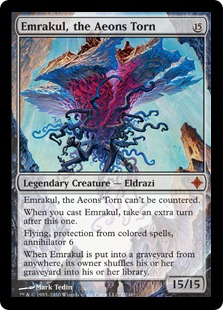
How powerful is this card? Baleful Strix is mighty powerful in the right environment. Baleful Strix is a freebie to cast. It pitches itself to Force of Will. It conquers the mightiest of attackers - even Emrakul bows to the avian's fetid touch. The combination of Flying and Deathtouch means that the Strix will trade with any attacker or blocker it comes across - this is an incredible deterrent to attacks. On top of that, it draws a card - a control deck can therefore gain both a blocker and a card. It adds beef to the board and a 1/1 with the right backup is a fine win condition.

Baleful Strix would be a Standard all-star. It would spawn a thousand fascinating and fun control lists and it would be a fine bird to wield a Sword. However, Baleful Strix is only legal in Legacy and Vintage. We must, then, look at it in the lens of these two formats.

Baleful Strix has not made much of an impact in Legacy and the reason is that there are too many creatures for it to trade with. Hear me out on this, since it seems like a good reason to play the Strix in the first place. The creature quality is both low enough and dense enough in Legacy that you're not going to get much advantage out of swapping this for a Delver or Nimble Mongoose. A 1/1 will die to plum anything in Legacy, even if it has to take something out with it. U/B is a bad combination on its own in Legacy and this card does not solve the problem of too few cards that can seal up the game. Therefore, you're not going to play the Strix when Delver of Secrets can probably do the same or better job and will actually put enough pressure on things to win the game in Legacy.

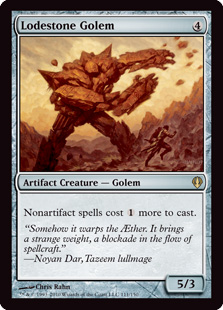
Vintage, however, is another monster indeed. Remember that Vintage games play out much differently than any other format. Mishra's Workshop, in particular, warps a lot of play. Shop decks typically run big artifact punishers. Think of Chalice of the Void, Lodestone Golem, Sphere of Resistance and more. They aim to shut you down and then pound you to death with big robots and they are very good at punishing blue-based decks. This Strix solves a critical problem that blue decks face. Entertain this possibility: a Shop deck plays a Mox, an Ancient Tomb and a Thorn of Amethyst on their first turn. You reply with a humble Island. They play another land and then a Lodestone Golem - you're on the clock and you don't even have some lucky Moxes to beat their taxing effects! However, you peel that Polluted Delta, get a Swamp and play a Baleful Strix right through both of their resistance effects. That Golem is completely shut down and the Shop player is going to have to wait on more threats to pressure you. You've got a serious chance of winning the game, even if all you have is a 1/1 on defense. It's doubly dangerous if you've got Goblin Welder trading your Strix in and out, drawing cards and producing a Deathtouch blocker when needed. On top of that, it's pretty good against Noble Fish, a deck that leans hard on Tarmogoyfs to get their damage through.

Are people going to love to play this card? Baleful Strix applies to a specific kind of player: the value-added man. Nothing is thrilling about Baleful Strix on its face, but this is a total grinder card. This is the card that you lovingly trade for a big man from the opponent, knowing that you paid UB and zero cards to eliminate their worst threat. It's not going to see much play in Legacy, but I see it as a role-player in Commander. None of this explains, however, why this card is going up so much in price.
When Juggernaut just isn't good enough...

Conclusions: Let me give you a little bit of history with Baleful Strix. About a month ago, I posted in the QS forums to keep an eye on this card. It was at about $5 at that time and I had seen several of my Vintage teammates do very well in a regional tournament with it. Their decks gladly ran four of the card. This card has a narrow print run and limited availability, so it was prime for growth. However, Vintage doesn't exactly move card prices. Lodestone Golem and Grafdigger's Cage, two epic Vintage noteworthies from recent times, can be had for a song. Nonetheless, Baleful Strix was going to be a key part of Vintage, even if it wasn't a big market. I was pleased and impressed that it jumped to $10 in that time, but I am at a bit of a loss to explain why. My theory is that the lack of card availability on this (you aren't opening this uncommon in packs) and the need to have four in a deck combine to drive a market on this. On top of that, people LOVE to play blue decks in Vintage, so lots of people are going to try out the Strix. I normally discount Vintage impacts from influencing the price of just about anything in Magic, but I am pretty sure that this card has reached this price because of that boutique format. I see Baleful Strix rising ever more after Planechase disappears from shelves. I'm not going to call it a great buy at $10, but getting it for that in trade is a fine idea. The remainder of the Planechase deck it comes with has some nice cards, too - meaning that you can buy the boxed set, crack it for the Strixes and still cover some of your expense.

I'll also caution you that this is not an endorsement of jumping on cards that only have Vintage appeal. In this instance, the Strix's limited availability beat the fact that it's only Vintage-playable to make it worth something. This isn't usually the case.

Memnite

Memnite is the first creature with an actual power that you get for free. It's a true gambit that asks "what's a 1/1 worth to you? Would you spend card slots on it?" A lot of times, the answer is "yes, I'd love to play this thing."

Does it exist in an earlier set? No, Memnite has never existed before. It has somewhat-close analogues in the instances of Phyrexian Walker, Ornithopter and Shield Sphere.

How powerful is this card? I've gotten beat to death enough times by Memnites to tell you that this is a powerful card. Free is a fine price to pay for a 1/1 in the right deck. What kind of deck? Well, Affinity for one... Modern loves this card. Further, people have seen success with it in Tempered Steel decks and red aggressive decks with Kuldotha Rebirth. Plus, it's a fun card. You get something for nothing with seriously no strings attached.

Are people going to love to play this card? Emphatically, yes. I believe that this card is going to follow in the footsteps of Shield Sphere among casual players in that it will have a long and loyal following. Shield Sphere is a dumpy little wall that is outclassed most of the time by Steel Wall. However, it's free and it's from an older set. Shield Sphere nets a dollar and it's not as good as Memnite. You must consider the draw of "free." People are going to play with these in every deck; they'll get beat up from play. They'll get buried in boxes. They'll continue to see banner play in Affinity. These are cards to hold onto.
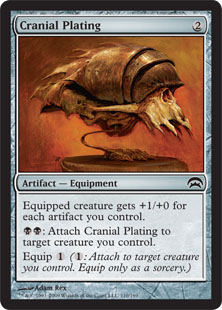
As long as this card is legal in Modern, Memnite will have a home alongside Mox Opal and Springleaf Drum.

Conclusions: I see Memnite getting into the $3 range in a year or two. Remember that Memnite is going to rotate out of Standard, meaning its $0.90 current price will likely dip down a bit for awhile. There will never be another card printed that's as good as Memnite for the price, and we are unlikely to see a straight reprint. Pick up this guy and hold onto it.

A final note to follow up from last week. In the feedback, pipdickenz took me to task for claiming that Bonfire of the Damned would not hit $45 in print. I'm bearish on this card and I'd like to explain my reasons. At print time, the card was about $28 from Ebay. It's gone up in stores because chase rares typically behave that way, but the prime indicator of the market is Ebay - it's hard to disagree with what people are actually paying for a card. The card is currently closing for about $32 plus shipping, which is a far cry from $45. I don't think it'll get to that threshold on Ebay. We'll see.

Until next week,

Doug Linn
Insider: M13 Release Impacts on the MTGO Market

Are you a Quiet Speculation member?

If not, now is a perfect time to join up! Our powerful tools, breaking-news analysis, and exclusive Discord channel will make sure you stay up to date and ahead of the curve.

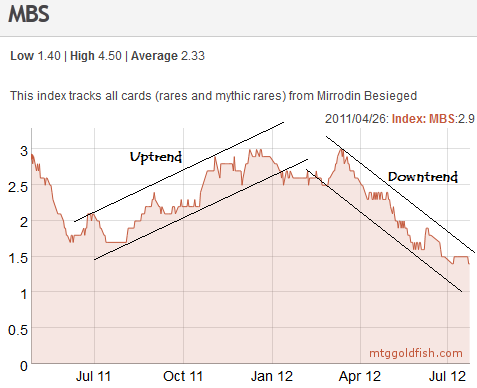
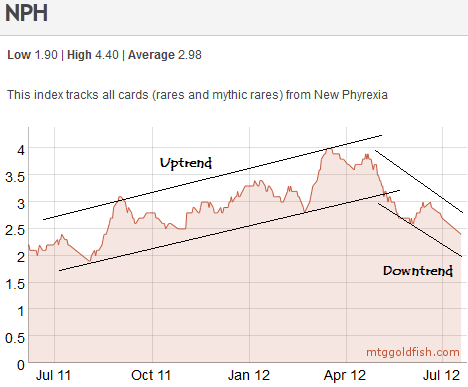
Looking over historical price trends, one notices that the price bottom for the cards from Mirrodin Besieged (MBS), as represented in the MTGGoldfish chart of the MBS index, is the end of July 2011. New Phyrexia (NPH) has a similar chart. That last week of July coincided with M12 release events, a time when prizes for sealed events are quite generous.

The attractive payout structure pushes the demand for tix higher as they are the only means to play in sealed deck release events. Ordinarily, limited events accept a combination of boosters and tix as entry, but not in this case. The attitude of most MTGO players is such that they are enamored with the idea of ‘going infinite’, ie, not having to pay to play.

Combined, these effects broadly depress prices for singles, as the quickest way for players to gather some tix is to sell singles into the market, typically to bots. This, along with the shift towards M12 as a draft format, gives a reasonable explanation for why these indices hit a low during core set release events.

Spot the Trend


Further examination of the chart shows that after the observed low at the end of July, an uptrend begins, which is defined as a series of higher highs and higher lows. For MBS, the trend is intact until January 2012. And for NPH, the trend lasts until May of 2012.

After the upward trend is broken, both MBS and NPH begin a downtrend where a series of lower highs and lower lows are reached. This downtrend is ongoing at the moment, as players eye the Fall rotation. It will continue until approximately October, when Scars block and M12 rotate out of Standard.

This observed pricing trend is useful to speculators. As a general rule, when considering the timing of taking positions in the latest sets, the core set release event period is the best window of opportunity.

As M13 release events begin firing, any of the best speculative targets from Dark Ascension (DKA) and Avacyn Restored (AVR) should be purchased. Each of the following proposed targets carries two ratings, one for risk and one for return. Here ‘Risk’ is the chance of suffering a loss on a medium time horizon (3-6 months) if purchased at the suggested prices while ‘Return’ measures the potential gain if things work out as predicted. When considering taking a position, it’s prudent to always consider risk first.

Top Picks

Sorin, Lord of Innistrad

(Risk: Low to Medium, Return: Medium to High)

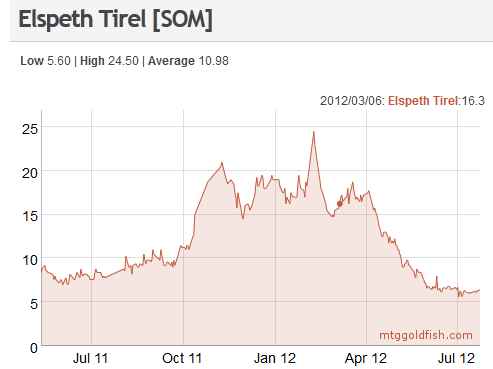
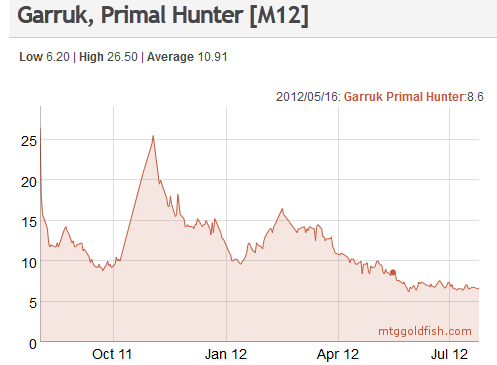
This Planeswalker sees sporadic play in Standard at the moment and has found a price floor of 14-15 tix. As players try to crack the metagame of Fall Standard by trying out strategies both new and old, expect a resurgent interest in this card. Both Elspeth Tirel and Garruk, Primal Hunter saw huge spikes in price during October of last year as the metagame sought to establish itself. Expect Sorin to see similar price action as players test out W/B tokens in the new format.

Usually a key predictor of the Fall Standard metagame will be the decks from Block Constructed. However, this year Lingering Souls and Intangible Virtue were banned in Block so the successful Block decks we have seen online are not entirely representative of what we can expect in the Fall. The true power of token decks is probably quite high an,d for this reason, Sorin, Lord of Innistrad is under priced relative to other Block staples such as Bonfire of the Damned and Huntmaster of the Fells.

As a strategy, Tokens might take people by surprise in Fall Standard. As a good speculator, don't be surprised.

Downside protection on buying Sorin, Lord of Innistrad is offered in the run up to the release of Gatecrash in early 2013. That set will have the Orzhov guild returning, so any powerful W/B cards will have extra interest at this time as deck builders anticipate using the new cards in Gatecrash. Acquire this card for 14-15 tix during M13 release events.

Restoration Angel

(Risk: Low to Medium, Return: Medium)

This card has powered up Delver variants in Standard as well as Birthing Pod decks in Modern. This card is a staple for both formats.  The price has settled into a range of between 6 and 8 tix lately, but we can expect a small dip in price during M13 release events. The start of the Modern PTQ season in January 2013 offers downside protection on this position -- if the price remains stable or falls once rotation hits, then higher demand during the PTQ season should provide the best opportunity to exit this trade.

Acquire this card for for 5-6 tix during M13 release events, either through posting to the classifieds and picking up copies that players are dumping or through the bots. This price range is a high level to stake out a position in a rare, but recent examples of rares hitting 10+ tix include Stoneforge Mystic, Kalastria Highborn, and Birthing Pod.

As of Aug 8th, this card is priced at over 9 tix, so if it doesn't get down closer to 6 tix, steer clear. 7 to 9+  tix is too high to speculate on for an in print rare.

Gravecrawler/Geralf’s Messenger

(Risk: Medium, Return: Medium)

Both of these rare zombies have seen their prices hover between 3 and 5 tix since the start of June. Typically they have moved together, with Gravecrawler holding a slight premium. They form the backbone of any aggro zombie strategy in Standard, and the current builds will be largely intact come rotation of Scars block and M12.

There might be a good opportunity to sell these before rotation, so keep your eye open and don't just file these away for October. Holding for rotation will not be a mistake, though, as the early stages of a new Standard format are often filled with aggressive strategies, so expect to see Zombies taking it's place in the metagame right off the bat.

If possible, pick these up for around 3 tix, though as of Aug 8th they are both above 5 tix, which brings an unacceptable level of risk.

Value Play

Tibalt, the Fiend-Blooded

(Risk: Low, Return: Low to High)

This card has been in a steady down trend since AVR was released. With a restrictive casting cost and few practical applications at the moment, this card has fallen to an all time low for a single printing in-print Planeswalker.

When you start to talk about the cheapest mythic Planeswalker ever, it's time to pay attention.

With the price so low, it will quite literally have difficulty going lower. Buying this card might never yield any profit, but at worst it will result in a small loss. On the upside, if it finds a home, it could rise to 6-8 tix. Buy this card as a low risk gamble for between 2.5 and 3 tix.

Unfortunately, the recent spike in the price of Bonfire of the Damned and Temporal Mastery has dragged upwards the price of all AVR mythics. As of Aug 8th, Tibalt is hovering closer to 4 tix.

Value Trap?

Wolfir Silverheart

(Risk: Medium to High, Return: Low to Medium)

In comparison to Tibalt, this rare is at a critical juncture of price and playability. It is good but is it good enough?

Wolfir Silverheart has been sitting in the 1.5 to 2 tix range and copies of it are all over the top decks of ISD Block Constructed. If things break right, it could see a price of between 3 to 4 tix. However, as a rare (as opposed to a mythic) it could just as easily settle into a range of 0.5 to 1.5 tix.

And with Jund decks being over represented in ISD Block Constructed, this card has little going for it at the moment.

The Dark Horse

Hellrider

(Risk: Medium, Return: Low to High)

For much the same reason that Wolfir Silverheart is priced too high, this card is priced too low. Tokens being nerfed in Block means that this enabler isn't in high demand at the moment on MTGO. Stick a few of these under the mattress for Fall Standard.

Pick them up for 2 tix or less and on the upside they could hit 5+ tix. Expect Tokens to be a part of the metagame in the Fall. This guy will be in the thick of things as another pseudo anthem effect.

Summing Up

The case has been made here for a few cards with varying potential.

Sorin, Lord of Innistrad carries the best risk/return ratio of the cards considered here. After Pre-Release weekend for M13, prices softened on many cards but there are a few in demand cards for Standard that have hit new highs, such as Restoration Angel and the DKA zombies.

Keep your eyes open for prices to slide over the first weekend of Release events and get your tix ready to snap up any opportunities. Remember, don't over pay for these cards as a higher price increases risk and reduces potential return.

Matthew Lewis

Matt Lewis currently lives in Ottawa, Canada and is a long time player and PTQ grinder who now speculates and plays exclusively on MTGO. He's always ready to discuss ideas and investment strategies, so drop him a line in the comments, the forums or on modo, username mattlewis.

View More By Matthew Lewis

Posted in Free Insider, MTGO16 Comments on Insider: M13 Release Impacts on the MTGO Market

Have you joined the Quiet Speculation Discord?

If you haven't, you're leaving value on the table! Join our community of experts, enthusiasts, entertainers, and educators and enjoy exclusive podcasts, questions asked and answered, trades, sales, and everything else Discord has to offer.

Want to create content with Quiet Speculation?

All you need to succeed is a passion for Magic: The Gathering, and the ability to write coherently. Share your knowledge of MTG and how you leverage it to win games, get value from your cards – or even turn a profit.

Innovating Near Rotation: What’s Your Angle?

Are you a Quiet Speculation member?

If not, now is a perfect time to join up! Our powerful tools, breaking-news analysis, and exclusive Discord channel will make sure you stay up to date and ahead of the curve.

As we get closer to Standard rotating, players spend less time developing new decks. By this point in the season, everyone usually has a deck or two they're used to. More time goes into tweaking existing decks than trying to build something completely new. This is quite understandable.

For those of us unsatisfied with where the format is, this is the perfect time to innovate. There are more players bringing the best decks to each event and fewer bringing rogue decks. When this happens it is much easier to build a deck to beat the expected field.

The three big archetypes you need to prepare for are Delver, Zombies, and Green-based aggro (Monogreen, Green-Red, and Naya with or with out Birthing Pod). That may seem like a diverse array of decks but they are all just aggressive strategies that try to win the game as fast as possible. They have a weakness in common which we can exploit. They all have a hard time beating a wrath effect.

Last weekend, Reid Duke won the Standard porting of Starcity Games DC with a deck similar to what I was advocating earlier in the season, Wolf Run Blue. For my perspective on the deck take a look at these two articles here and here. Reid's deck went in a different direction than mine with the main difference being four copies of Temporal Mastery. This is the list he ran.

Wolf Run Blue by Reid Duke
2nd Place in Starcity Games Open D.C.

Untitled Deck

Creatures

2 Phantasmal Image
1 Snapcaster Mage
3 Solemn Simulacrum
2 Thragtusk
2 Frost Titan
4 Primeval Titan

Spells

4 Ponder
4 Farseek
4 Rampant Growth
1 Blasphemous Act
3 Bonfire of the Damned
4 Temporal Mastery

Lands

2 Cavern of Souls
4 Copperline Gorge
4 Glimmerpost
4 Hinterland Harbor
1 Inkmoth Nexus
1 Kessig Wolf Run
5 Forest
4 Island
1 Mountain

Sideboard

2 Thragtusk
2 Beast Within
3 Crushing Vines
2 Negate
1 Karn Liberated
1 Blasphemous Act
2 Whipflare
2 Cavern of Souls

Reid's angle was to kill his opponents' creatures with Bonfire of the Damned, play a titan, then follow up with Temporal Mastery to close the game.

One main point in the decks favor was how unexpected it was. No one saw this deck coming or knew how to play against it. He beat some extremely good opponents throughout the course of this event and playing a rogue deck helped him accomplish that feat.

Wolf Run Blue is still a great choice right now so if you are still eager to cast your Primeval Titans, this is the deck for you.

The Brews

As I mentioned above, a large part of the format is creature-based aggressive strategies. We can exploit this by building a control deck designed to fight against those decks.

I have two new decks to talk about today. Both of them may need some tweaks but they are quite good at what they do.

Updating Solar Flare

The first deck is basically an Esper Control/Solar Flare hybrid deck. The funny part is that I didn't arrive at this list by starting with either of those decks. I started this deck with four Terminus and three Day of Judgment and developed the deck from there.

Solar Flare Esper Control

Untitled Deck

Creatures

3 Phantasmal Image
4 Snapcaster Mage
2 Sun Titan

Spells

2 Dead Weight
2 Go For The Throat
4 Ponder
3 Thought Scour
3 Think Twice
4 Lingering Souls
3 Day of Judgment
4 Terminus
2 Sorin Lord of Innistrad

Lands

3 Evolving Wilds
1 Darkslick Shores
2 Drowned Catacomb
2 Glacial Fortress
4 Isolated Chapel
4 Seachrome Coast
2 Island
3 Plains
3 Swamp

This is not your typical Esper Control deck and it plays much differently. The spells you want to cast in the early game are Ponder, Phantasmal Image and Lingering Souls. Think Twice and Thought Scour are in the deck to set up Terminus as an instant so they should be saved for the midgame. Ponder also helps with this. Don't be afraid to use your [card Snapcaster Mage]Snapcaster[/card] on turn three to flash back Ponder either.

[card Sorin, Lord of Innistrad]Sorin[/card] may seem a bit out of place but his role is important. The best time to play him is as follow up to one of your wrath effects but he also acts as a pseudo-finisher by pumping your tokens to lethal range. Ideally you want to set up an instant speed Terminus on your opponents turn and then play Sorin on your turn, a sequence that will win you most games.

On the note of this not being a typical control deck, there are no Mana Leaks. Cavern of Souls keeps making Mana Leak worse and worse. The only countermagic I would suggest is Negate in the sideboard or possibly Mental Misstep.

In my article last week I mentioned the power of Terminus right now. This deck abuses that power quite well and with Day of Judgment for back up, your opponent will have a hard time keeping creatures on the board.

This deck plays out much differently than you may be used to. For example, even if you can miracle a Terminus, if you have two Phantasmal Images in play, it may be better to look for a Day of Judgment so you put them in your graveyard rather than on the bottom of your library. Little things like that can drastically improve how well the deck plays.

Finally, this deck wins a lot of games by flashing back a bunch of Lingering Souls late in the game. If you have done a good job clearing the board for most of the game, a couple spirit tokens can easily put it away.

Naya Trading Post Control

If you thought that last deck was rogue, prepare yourself for this crazy little number.

Naya Trading Post Control

Untitled Deck

Creatures

3 Sigarda, Host of Herons

Spells

3 Pillar of Flame
4 Whipflare
3 Oblivion Ring
3 Day of Judgment
3 Bonfire of the Damned
2 Devils Play

Artifacts

4 Ichor Wellspring
4 Mycosynth Wellspring
3 Trading Post
3 Staff of Nin

Lands

4 Evolving Wilds
4 Clifftop Retreat
4 Phyrexias Core
2 Buried Ruin
5 Mountain
5 Plains
1 Forest

The primary objective of this deck is to kill absolutely everything your opponent plays. After that, it should be fairly easy to wrap up the game with both halves of Devils Play and some Staff of Nin activations.

Speaking of the staff, I think it is one of the most underrated cards from Magic 2013. If you had to play against it in a sealed event, then you caught a glimpse of how powerful it can be. Six mana is a lot, but drawing an extra card per turn should not be underestimated. With your removal keeping the board clear, the staff begins to limit your opponents options since they can no longer rely on any creature with one toughness.

Trading Post gives you a variety of options each game but mostly it functions as a draw engine with the wellsprings.

Only three creatures may seem like a risk, but this deck harkens back to the classic control decks of Magic history that used to kill with as many (or fewer) win conditions. By playing no other creatures, you shut down your opponent's removal and obtain some virtual card advantage.

This deck is well-positioned to take down the format. It's possible that Terminus belongs in it as well, but as you can tell from this and last week's article, my perspective on the card may be a little skewed. The biggest question I have is about the inclusion of Pillar of Flame. Considering the plethora of other removal in the deck, I'm not certain it's necessary. If it were to come out, more artifacts may be a good idea to further support Trading Post.

Both of these control decks are designed for one specific purpose: to defeat the creature decks dominating Standard right now. My schedule is extremely busy in the next month so I am not certain how much time I will have to play Standard. If you test out these decks or have suggestions, please post them in the comments below.

I know these decks are not your typical fare, but that is intentional. With so many cards legal in Standard, now is the time to innovate. Do not let the lull between rotation drag you down; use this time to be on the cutting edge.

Until next time,

Unleash the Rogue Force!

Mike Lanigan
MtgJedi on Twitter
Jedicouncilman23@gmail.com

Insider: “Way Back” Trade Stacks #2

Are you a Quiet Speculation member?

If not, now is a perfect time to join up! Our powerful tools, breaking-news analysis, and exclusive Discord channel will make sure you stay up to date and ahead of the curve.

In case any newer readers don’t know, when I first started writing for this site almost two years ago, every week I would record the trades I made at FNM and present them here.

I did so for a few reasons. The first was simply a thought exercise for me; to see how well I did trading and how much money I was realistically making a week. This was fun (and pretty helpful), and people seemed to like it. I also used it to show what cards I was targeting in trades and what, if any, techniques I used to complete the trade.

Now what’s more fun than recording and analyzing trades? Why, recording and analyzing those same trades months or years later! I visited this concept here, and today I want to do the same.  If you’re curious as to why this exercise is actually important to you as a trader, and why I suggest you try it out yourself, I suggest you start here. I also wrote a companion piece this week on LegitMTG you can check out for a more recent explanation.

Let’s get started.

Date: Aug. 5, 2010

His:

Twilight Mire ($4.50)

Mystic Gate ($5.50)

Gaddock Teeg ($4)

Rite of Replication ($1)

Mine:

Ad Nauseam ($1)

[card]Kozliek, Butcher of Truth ($10)

Net: $4

Today:

His:

Twilight Mire ($12)

Mystic Gate ($7)

Gaddock Teeg ($5)

Rite of Replication ($2)

Mine:

Ad Nauseam ($1)

[card]Kozliek, Butcher of Truth ($20)

Net: $5

I find it really interesting that this trade hasn’t changed much at all in the way of net profit even though the value of the cards involved has fluctuated quite a bit. And honestly, looking back at this trade, I’m not positive which side I’d like to be on today. Without checking buy prices, I feel like I’d rather have the Kozilek, simply because it’s such a hot-ticket item, though I’m not sure I would give $5 in trade value to get it.

What I’m taking away from this trade is this. We knew when the three Eldrazi were spoiled that they were going to be big-ticket casual items for years to come. We didn’t know the extent to which EDH would blow up, but still. On the other hand, we didn’t yet know how out-of-print Mythics would fare (very well), and I was trying to pick up cards for Extended season by grabbing the lands, which have appreciated exactly as I expected them to.

Looking at SCG buylist numbers now for this trade, we see the lands pile comes out exactly a dollar ahead. This reaffirms my belief I’d rather be on the receiving end of the Kozilek. When $5 of “book value” equates to just one dollar of cash value (though noted SCG isn’t buying the Rite), I want the high-ticket item. Chances are I would be able to trade down the Kozilek into much more than $1 in cash value if I wanted, or I would have the ability to trade it up as part of a larger trade.

Onto the next one, from the same FNM.

Date: Aug. 5, 2010

His:

Groundbreaker ($2)

Trinisphere ($3.50)

Coralhelm Commander ($3.50)

Phylactery Lich ($5)

Ulamog, the Infinite Gyre ($9)

Nevinyrrals Disk ($5)

Mine:

2x Birds of Paradise ($10)

Sorin Markov ($8)

Net: $10

Today:

His:

Groundbreaker ($2)

Trinisphere ($4)

Coralhelm Commander ($3.50)

Phylactery Lich ($1)

Ulamog, the Infinite Gyre ($16)

Nevinyrrals Disk ($6)

Mine:

2x Birds of Paradise ($12)

Sorin Markov ($6)

Net: $14.50

Here I get to be on the receiving end of the Mythic Rare, and we see how much better it worked out for me, as I’m up $4 more than at the time of the trade. But there are a few other interesting things going on here.

First off, in case you’re wondering, I picked up the Groundbreaker to trade to a friend who was looking for it. If I remember right, he never ended up taking it so I got stuck with a Groundbreaker for an undetermined amount of time. Lame.

Another interesting note is that Magic 2010 Birds have actually gone up since this trade was made (more recent ones are $5). The card has been printed, quite literally, a million times at this point, but it can still command a very solid price for a rare. I’ve always moved Birds without a problem when they’re in my binder, so it’s helpful to see that it’s a trend that’s been going on a for a while.

On a related note, Birds at $6?!? I understand we’re using SCG as our price point, so it’s not the lowest price you’ll find, but it is what you hear quoted most often on the trade floor. In my experience these have been trading for $3-4, meaning you can make a good amount of value by simply grabbing a pile of these in trade.

I know Birds isn’t in M13, but the speculation is it will be in Ravnica, since that’s the same trick they pulled last time around (Not in Core set, appeared in original Ravnica). I kind of like this as a target right now, provided you get in at the $3 price point I usually see these going for. These are a solid couple bucks on a buylist, and you can probably finagle even more of a discount when you bring up the fact that it’s “about to rotate.”

Looking at the rest of the trade, we can see how I got burned on the stupid Lich. Scars was about to come out, so it seemed like a safe speculation target. I don’t have it in my binder now, so that means it went somewhere, but I have to imagine I took a loss on it. Also worthy of note is that the Lich is the only one of the cards that was Standard-legal at the time of this trade that has come down in price. Eternal appeal, folks.

One more:

Date: July 24, 2010

His:

Birds of Paradise ($4.50)

Steel Overseer ($5)

Leyline of the Void ($4)

Grave Titan ($35)

Mine:

Leyline of Sanctity ($6)

Kargan Dragonlord ($14)

2x Textless Bituminous Blast ($5)

Net: $23.50

Today:

His:

Birds of Paradise ($6)

Steel Overseer ($3)

Leyline of the Void ($1.50)

Grave Titan ($7)

Mine:

Leyline of Sanctity ($5)

Kargan Dragonlord ($4)

2x Textless Bituminous Blast ($2)

Net: $6.50

Talk about taking a beating. This just goes to show how you can “win” a trade at the time you make it, but still totally understand why the other person made said trade. I can only hope I got rid of that Titan quickly. And seeing that Dragonlord was $14 is a trip, since these days I look to pick it up as a near-bulk Mythic since that’s how most people value it.

Also, it makes me incredibly sad these textless cards are just a dollar apiece. I get that it’s not played in anything, but all these Player’s Rewards cards just look so cool! And they obviously aren’t being reprinted in that form. Just makes me want to buy up all of these that exist on the Internets.

Next week I plan on having an event primer, since I’ll be at GenCon next week!

Thanks for reading,

Corbin Hosler

@Chosler88 on Twitter


Pondering Trading Post Iin Standard

Are you a Quiet Speculation member?

If not, now is a perfect time to join up! Our powerful tools, breaking-news analysis, and exclusive Discord channel will make sure you stay up to date and ahead of the curve.

I haven’t been brewing nearly as much as I used to, and when I first saw Brad Nelson’s monoblack trading post deck I barely skimmed the list. I wrote it off almost entirely because it was monoblack, as my brain currently filters monoblack to “bad”.

Since then, Brad has continued to write about the card ad nauseum, but for the most part his lists haven’t been very exciting.

A couple days after Brad posted his initial list, my friend Jens Erickson sent me this spicy meatball:

First Post

spells

2 Wurmcoil Engine
3 Solemn Simulacrum
1 Phyrexian Metamorph
1 Batterskull
2 Tumble Magnet
3 Trading Post
4 Pristine Talisman
1 Mortarpod
1 Ratchet Bomb
1 Karn Liberated
1 Spine of Ish Sah
4 Bonfire of the Damned
3 Terminus
2 Mycosynth Wellspring
4 Ichor Wellspring
2 Entreat the Angels
2 Oblivion Ring

lands

2 Buried Ruin
4 Mountain
9 Plains
4 Phyrexias Core
4 Clifftop Retreat

Now this, this got my wheels turning.

The basic Trading Post engine is more or less this:

This list plays a few more artifacts, but these are the ones that I consider the most important when moving forward with Trading Post brews. These cards make up your life gain package, your card advantage engine and your win condition.

While this deck struggles somewhat in the early game, the life gain of Pristine Talisman, Trading Post and Wurmcoil Engine makes stabilizing rather easy provided you survived long enough to cast them. I’m also pretty sure that Spine of Ish Sah + Trading Post is about as powerful as endgames come.

Jens took roughly this list to the most recent PTQ in Madison and ended up losing his win-and-in to go 5-2 on the day. As suspected, his list had some trouble against Delver decks.

The major problem with this list is that it’s not really two colors. It’s a monowhite deck that splashes Bonfire of the Damned. This is awkward for a few reasons. The first reason being that the deck can’t reasonably support lower-end red cards like Pillar of Flame and Whipflare - aka red cards that are good in the Delver matchup. The other awkward element is that the deck is splashing for what is far and away its strongest card.

I discussed this at length with Jens and we decided that a “Big Red” deck was probably just more powerful and consistent than his initial list. I spent some time brewing and came up with the following:

Repost

spells

3 Trading Post
4 Ichor Wellspring
4 Pristine Talisman
4 Bonfire of the Damned
4 Sphere of the Suns
2 Wurmcoil Engine
2 Phyrexian Metamorph
1 Batterskull
3 Whipflare
1 Slagstorm
4 Solemn Simulacrum
2 Pillar of Flame
2 Dismember
1 Spine of Ish Sah

lands

4 Phyrexias Core
16 Mountain
3 Buried Ruin

In addition to having access to more, cheaper removal, the other major change that I made in constructing this list was adding Sphere of the Suns. This is largely a nod to Dungrove Elder. From my experience playing UR Bonfire Control, I’ve played a lot of games where Dungrove Elder was just a turn ahead of my Bonfires, and having more mana acceleration helps to combat this problem.

The other cool thing that Sphere of the Suns does is enable a “2-4-6” curve into Wurmcoil Engine, or just an early active Trading Post. Not to mention that “cycling” dead Spheres is pretty sweet.

I like this list quite a bit. It’s pretty consistent and powerful. As a matter of fact, if counterspells were a non-factor I would have stopped brewing here...

But that’s not the world that we live in.

When I say that counterspells are a factor, I mean two things. There’s the obvious point that this deck is drawing to a few very specific spells, which makes it somewhat weak to counters. The other manner in which I mean that counterspells are a factor is that this deck doesn’t get to play any, and that means that it doesn’t have any manner of catch-all for opponents that decide to go over the top.

You basically just have to pray that the things that you’re doing are better than the things that your opponent is doing. You also really don’t want to play any manner of Trading Post mirrors, as whoever draws the first Post will probably just win.

Unless, of course, they’re monoblack, in which case you probably just win as you have four copies of “dome you for a million”.

Anyway, this line of thought led me to exploring monoblue Post. My starting point for this was to look at Brad Nelson’s Grand Architect deck from GP Minneapolis. I really liked the idea of having both the Trading Post engine and the Snapcaster Mage engine in the same deck.

Upon trying to build Architect Post, I concluded that playing Architect just made you too weak to Vapor Snag, Dismember and sometimes Bonfire. This felt like an awkward place to be. I quickly cut every copy of Grand Architect and ended up with a monoblue list playing four Pristine Talisman. The card played exceptionally well in the other lists and monoblue shouldn’t be any different in this regard.

Even without Architects, Vapor Snag was still good against Wurmcoil Engine. Additionally, with Delver of Secrets and Rancor being problem cards for the format at large, I made some room for Mental Misstep in my deck. It also happens to do work against Zombies and Elves, which seem to be picking up popularity. Mise.

My current monoblue list looks something like this:

Counter Repost

spells

3 Phantasmal Image
4 Mana Leak
4 Ponder
4 Vapor Snag
4 Ichor Wellspring
2 Trading Post
1 Spine of Ish Sah
2 Wurmcoil Engine
4 Snapcaster Mage
4 Pristine Talisman
1 Phyrexian Metamorph
3 Mental Misstep
2 Dismember

lands

2 Buried Ruin
4 Phyrexias Core
16 Island

The Trading Post engine remained more or less intact, with the most noticeable cut being Sad Robot. I like Solemn Simulacrum quite a bit, but I needed to make room for the Snapcaster Mage package. This deck doesn’t really have any problems generating insane value in the late game, and I’m of the opinion that the number of spells that cost more than three should be kept to a minimum.

When people see me playing this deck, the most common question asked is “How do you win?” And the best answer that I can give is “Eventually.”

The deck plays out in a pretty straightforward manner. You spend the early turns countering/bouncing/copying opposing threats while digging for a Wurmcoil Engine. Once you get one to stick the game becomes very difficult to lose. I have had many opponent’s copy my Wurms only to realize that they’re much more relevant to the guy with the Trading Posts and Buried Ruins.

While Trading Post mirrors have been awkward for previous incarnations of the deck, the monoblue Post list has the huge advantage of being able to counter opposing Posts, the value of which cannot be overstated.

At this point in time I’ve used this deck to take down a couple FNMs and a Game Day, but these achievements aren’t terribly notable. I’ll be taking this deck to the SCG Open this Saturday in Kansas City, and I don’t hate my odds.

Next week I’ll be sure to fill you in on how that event goes (went?) in addition to discussing various matchups. Of course, the best way to learn is just to try it out for yourself.

Good luck, high five.

-Ryan Overturf

Insider: Standard Updates for M13

Are you a Quiet Speculation member?

If not, now is a perfect time to join up! Our powerful tools, breaking-news analysis, and exclusive Discord channel will make sure you stay up to date and ahead of the curve.

This past weekend I failed miserably at a Southern California PTQ. This did, however, give me a chance to wander around the room and look at people's decks. There were tons of the usual suspects including G/R Aggro, Naya Pod, Mono-G, Ramp and Delver, but a bunch of the fringe strategies showed up, and G/U Infect showed up in force. Ultimately U/W Midrange took down the event over a buddy of mine, John Kassari (www.twitch.tv/ehhhhhhh) playing RUG Ramp. This particular event hand a handful of vendors, and as usual, the top tier Mythics skyrocketed at the event site.

Bonfire of the Damned

At the event site, Bonfire of the Damned was selling at $40+ and dealers were buying them at $25 when doors opened but as high as $32 minutes before the Event started. I still feel this card settles down in the $20-25 range, but me and some friends had a discussion, and they didn't agree with me. I'm fairly confident in my estimate, but they presented a good argument that I wanted to pass on. "What percent of decks are playing Bonfire?" (About Half) "And how many copies do they play?" (Four.) "So, the card is a 4-of in 50% of the format. $30-40 isn't absurd."

I think this line of thought is fine, and I understand it. The issue I have with this is that even though limited season is over for Bonfire, it's price could reach a breaking point where Dealers simply break open product to find more of them. Whenever a price gets this high, it affects the overall value of a box. The more and more that dealers crack, the more that hit the market, and we'll see it decline back to Earth. Further, we have no idea if it will continue to see the quantity of play that it does now. Over the last 24 hours, EBay listings have been closing right at $35 range, and in a fairly decent volume. Some say that if it begins to see play in Legacy it could hit as high as $50.

Sean, my local dealer who you may know from the forums is my resident Legacy expert. He claims that this is exactly the card Control decks in Legacy would love, but there just isn't a true control deck that can use it yet. These arguments are not unfair. In my experience, cards like this dominate a format, and people have to adjust their deckbuilding so that they aren't stone-cold-dead to a miraculous Bonfire. Until a true control deck arrives in Standard, we don't really have decks that are able to side-step the burn spell. I'm still on the side of the fence that says it has to come back down to the $20-25 range, but be aware there are those that disagree with me.

Trading Post

This was my "sleeper" for M13, and so far, it's looking like a good pick. What started out in the $1 rare bin, is now up to $2.50 on retail sites, and it may have room to creep up a bit more. I got my set cheaply, as I was excited to play with the card, and traded for a few more while it was still around $1. The Mono-Black list has been running it, executing a Mindslaver lock as a possible win.

At the PTQ I saw a 4-color post deck, as well as U/B. Trading Post is a tricky card, because unlike other format staples, the card itself doesn't dictate what the deck surrounding it must look like, and it will take some time for people to find the right build. Especially when the format has so many powerful decks, the best innovators may not be looking at new decks until the format rotates.

I'm still advocating picking up Trading Posts, but mostly in trades, not at retail. Buy lists have this card around a quarter, which is about 10% of retail, so this is one that I'd be using the buy list pricing if you're trading with people that like to look stuff up. Of course, we also want to keep our eye on spoilers too. If Selesnya really has a token theme, maybe these Goat tokens will have more uses than chumping.

Talrand, Sky Summoner

As a cornerstone of the newest iteration of Delver, this Legend has crept up to the $5 range on EBay as of this writing. This price is fair for him, but a bit higher than I'd expect him to settle. At $5, we don't have much room for him to pick up any more steam. It's possible he makes an appearance in Modern, which would totally change my valuation, but barring that, he's at about his ceiling.

His playability is fairly narrow to certain decks and his Legendary status, but I will mention I've seen some pretty sweet EDH decks featuring him as a General. I'd be targeting foils of this card as heavily as possible, especially after rotation when we may see him dive back down a bit with the rotation of Ponder and Mana Leak. If you need copies of him for Standard, I don't think you stand to lose much by buying in now, but if you can wait, I would.

Liliana of the Dark Realms

Has everyone forgotten about her yet? She's fallen to as low as $18 on some retail sites, like Card Kingdom, but I wonder how low this could go before it's a good buy. She's got powerful effects, but is only playable in certain strategies. I fear she has a taste of the Tezzeret, Agent of Bolas syndrome, which I did lose some money on last year. This has me a bit hesitant to even consider her, but even Tezzeret had moments in the spotlight where his value shot up.

How low does she need to go before it's worth taking a risk on her? I'm confident enough that Shocklands are coming back, that I'm guessing she'll have utility in more than just Mono-Black Control, but even then, is $18 too high? If this comes to $13-15 I'm picking up at least one set, and going to ride it out.

Now that the format is developing with M13 in it's wake, what cards have new valuations or potential going forward? Is there any cards that are going to find their way into older formats like Legacy or Modern? I'm hopeful for Trading Post to be my big winner of this set, and I want to find a new speculation target from M13 while drafts are still running rampant at my LGS. The last tip I want to mention is Blood Artist. It's selling rapidly at $5/set on EBay, and my local dealer has bumped his up to $6/set. If you're moving these online, you may want to do the same.

Jason’s Archives: Cubes Made of Liquid, Trees Wielding Swords & Other Boggling Riddles

Are you a Quiet Speculation member?

If not, now is a perfect time to join up! Our powerful tools, breaking-news analysis, and exclusive Discord channel will make sure you stay up to date and ahead of the curve.

Greetings, Speculators!

We all play this game to have fun. Winning usually is, but the same can't always be said for the work put in to get there. Grinding the 90th consecutive Delver versus Pod match to optimize sideboards can get miserable and start to feel like a job. Certain aspects of Magic are quite the opposite of fun.

But all is not lost when the specter of drudgery rears its head. Over the years playgroups have invented their own variants or sidegames to keep the game interesting and the barrels of guns out of their mouths.

You may recognize some or all of these. Formats like 2-Headed Giant and Commander (I don't want to get sued by Duncan McLeod; he's not particularly litigious but he lets his [card Tatsumasa, the Dragons Fang]Tatsumasa[/card] do the talking) were so universally embraced by the community that Wizards decided to adopt them as sanctioned formats (read "found a way to monetize them").

The most meta example ever: my long-time partner in crime and 2HG, "The Godslayer" (née Aaron Sulla), and I were paired against other friends at a 2HG tournament, so we decided to intentionally draw and kill the next hour with 2HG Type 4 instead.

In addition to being a ton of fun, these formats sometimes lead to the discovery of new tech.

Once, bored at a tournament and lacking anything besides a box of bad rares, I suggested to my buddy Travis Cullum that we build a Type 4 pile and derp around to kill some time. Two of the three games we played, he managed to use Sovereigns of Lost Alara to grab Celestial Mantle and cave my dome piece in (our all-rare pile lacked the removal most often printed at uncommon or common). "This card HAS to be good!" Travis kept saying, referring to Sovereigns. "What," I said "you want to fetch up Celestial Mantle in Standard? Yea, good play, chief."

A little later they printed Eldrazi Conscription and Travis finally had what he needed to make Sovereigns a card. You know how the rest of that season went. Travis didn't have to play Celestial Mantle, Zvi's Mythic deck didn't have to run Rampaging Baloths and there was finally a credible alternative to Jund. The combo between Sovereigns and Conscription was so good that I jammed three Sovereigns and two Conscriptions in my Naya deck. It was like the Spanish Inquisition.

The New Arrival

The point is, boredom has contributed both to good tech and the creation of new formats that help players blow off steam when Magic has starting to feel like a grind. Recently a new development, promising the most potential for a good time since the arrival of EDH, has materialized.

I'm referring, of course, to The Booze Cube. The Booze Cube is designed to turn any gathering of Magic players into a date with a stomach pump. While I don't condone underage drinking, binge drinking, public intoxication, drunken driving, worm eating or listening to Party Rock Anthem, responsible adults can use a Booze Cube to spice up their night of cube drafting.

The Booze Cube Needs Your Help

The Booze Cube recently contacted some Magic podcasts about submitting cards for potential future expansions. One of the participants was Brainstorm Brewery. While it's too late to get cards submitted to Brainstorm Brewery in time for our contest, if you have a great idea submit it to The Booze Cube directly.

Even if they decide it's not for them, the booze cube is meant to be printed and drafted at home (I would double sleeve; drinks WILL be spilled) so making your own cards is half the fun. If you're inclined, you can check out the Brewery Crew's contributions at this link.

Jason's Anal-Retentive Bum Cover

The Booze Cube isn't for everyone. The website has some no-no words. It advocates drinking alcohol. Some of the puns are of a sexual nature. First, let me stress that I did not invent The Booze Cube. I am sharing it with my audience because I think most of you are grownups and you can handle hearing about something fun. However, if you

  1. Are under 21.
  2. Don't approve of profane language.
  3. Don't approve of "adult" humor.
  4. Are otherwise a curmudgeon.

then The Booze Cube may not be for you, and if you click on the link and it ruins your day, I warned you.

If you're a grownup and you think The Booze Cube looks like fun, you're right. I would advocate pacing yourself; many of the cards are designed to give you drinks in lieu of damage and I can see games going VERY long. Anything that says "chug a beer" or "drink a shot" strikes me as something to avoid, but I know my limits.

Print it out. Invent your own cards. Get some cheap, filthy beer (you won't taste it after turn six anyway), some good friends and make a night out of it.

Magic is supposed to be fun and The Booze Cube is a good way to guarantee the good times. If you have a Booze Cube party, send me some pictures at altjason17@gmail.com and I will share your drunken revelry with the rest of my reading audience.

Back in the World of Sober Magic

Competitive players in the community congregated in our nation's capitol this weekend to sling some cardboard and prove things actually can get done in DC. Let's see how it played out.

Top 32 Standard Decks

Wolf Run's Lesser-Known 'Blue Phase'

Last week I got a kick out of the concept of adding blue to the traditional Wolf Run build, and it looks like that concept paid big dividends for Reid Duke.

Temporal Mastery is a clunky-looking card in an aggro-ramp deck, but it serves a valuable purpose. Ramp often taps out to cast an enormous spell, hoping their hard work isn't undone by a board sweeper. With Ponder to set it up and the mana-producing juice to hardcast it, Temporal Mastery lets a ramp player take that next turn right away and hit them when their defenses are down. Two swings with any beater and an active [card Kessig Wolf Run]Wolf Run[/card] are usually enough to put any game away.

The deck also gets mileage out of a terrific interaction between two cards that haven't been tried in concert that often: Primeval Titan and Phantasmal Image. Although imaging a titan is nothing new, ramp in particular stands to benefit from a double rampant growth for any two lands at the mere cost of a Farseek.

A man after my own heart, Duke also included a block favorite that I expect to pop up more as we approach rotation -- Blasphemous Act. Act, or BA as I like to call it because I grew up watching the A-Team, deals with pesky swarms of opposing spirits, larger-than life praetors, hexproof ghosts and trolls. It even deals with opponents at thirteen life or less if you're monkey enough to jimmy jam a Stuffy Doll or two into your 75 (I am!). It's a one-of in Duke's list, but sometimes the best part of [card Bonfire of the Damned]Bonfire[/card] is wiping the board, and ramp has the mana to cast this no matter how few creatures you need to kill.

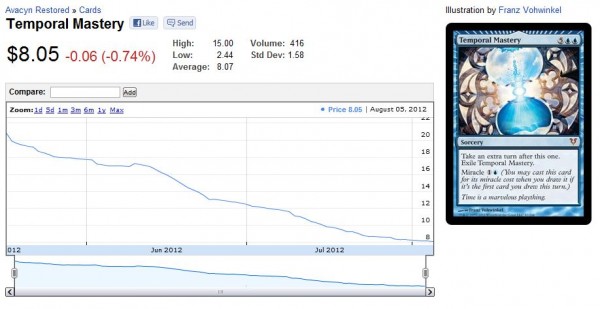
Should you be going after super cheap copies of Temporal Mastery? It's not my place to say, but I will mention that I have been squirreling away a few playsets. EDH guys will never reject Time Walk effects and with a Mastery deck taking down an SCG event, there is potential. If Temporal Mastery starts to see more play, you may see yourself vindicated.

Angry Trees (with Swords)

After the delicious tequilla shot that was Reid Duke's winning list, came the cold, sobering bite of lime wedge. Four Delver decks in the Top 8. One-ofs of Frites, Naya Pod and Dungrove Beats rounded out the Top 8 nicely, seeming to mitigate the multiple copies of Delver piles with the reassurance that perhaps the format is healthy after all.

Seven Delver decks in the Top 8 seems unhealthy. Four is doable, especially given my suspicion that the percentage composition of the Top 8 pretty closely mirrored the percentage of the field represented by each deck. I bet there were way more than four times as many copies of U/W Delver as there were copies of Dungrove Aggro, so in that sense, Dungrove outperformed Delver.

And how could it not? The biggest complaint about Dungrove Elder before was his idiotic inability to deal with chump blockers. This necessitated the clunky inclusion of Bellowing Tanglewurm to help him muster the courage to face a couple of the g-g-g-g-ghosts that control was only too happy to present. Dungrove Elder was obviously a beast when wrapping his little tree branch mitts around a Sword of War and Peace (mostly war, let's be honest) or bellowing his way past chumps, but when his advance was stymied by a cluttered battlefield he fell short.

Now Elder has a new friend and the game has changed. Rancor is the new weapon in the fight against flying [card Wild Nacatl]nacatl[/card] and the key to Dungrove Elder's recent resurgence in popularity. Trampling and hexproof, a rancorous Dungrove Elder is nearly impossible to deal with barring a bigger blocker or a wrath effect.

Top 8 finisher Joseph Smith (I won't make the joke, I'm sure he's sick of hearing it) tried to minimize the number of times he'd need to attack with Elder by including several copies of what Corbin affectionately calls "kick the castle": everyone's favorite Might of Oaks substitute, Revenge of the Hunted. Predator Ooze, another card I've been picking up for quarters and squirreling away for a day like today when he is front and center in a beats-heavy green list, makes an appearance and is quite good wearing a Rancor.

The Frites list is pretty stock-standard, but Michael Wayne still deserves a high five, if only because he chose not to play Delver.

Congrats to the entire Top 8!

Top 32 Legacy Decks

Travis Gibson, who the Star City coverage referred to as William Gibson at one point (any Neuromancer fans here?) decided that Delver was too good for one format and jammed him in Legacy to great effect. Gibson's list bears mention because he went back to nine months ago and dragged along a popular card that has recently fallen by the wayside a bit: Grim Lavamancer.

Grims is the man in so many situations it's hard to fathom his ever having fallen out of favor. What's the toughness on a flipped [card Delver of Secrets]Delver[/card]? If you answered "the exact number as the amount of damage dealt by a Grim Lavamancer" you're starting to see why being prepared for the RUG Delver mirror pays. And well, in the form of giant novelty checks and trophies. To beat the mirror Gibson also had four copies of Submerge riding the pine in the sideboard. Someone read this metagame like a book. Congrats Will..., er, Travis!

Being prepared for Maverick can't hurt as the deck put an impressive nine copies in the Top 32, including 2nd and 3rd place piloted by Chas Hinkle and Orrin Beasley respectively.

Perhaps the most noteworthy aspect of the Top 32 was a higher frequency of burn decks (one) than Sneak and Show decks (zero). After the community clamored for a ban of some of the Sneak and Show components a few months ago, it turns out the best answer to the deck is to "play a better one." With Show and Tell pushing $60, clearly lots of players are sleeving this deck up. But where are they when prizes are announced? Perhaps this deck isn't the boogeyman we thought.

Platinum Qualifier Top 8

Also worth a quick mention was the Platinum Qualifier at Phoenix games over the weekend. The Top 8 was pretty unremarkable with one major exception. Joseph Neuman recognized the awesome power of the Black Market deck and since he Top 8'd with it, it seems worthy of some analysis.

Abusing the absurd interactions between Trading Post and artifact creatures, this monoblack control deck revels in the long game. Between a wall of removal and reusable sources of lifegain, this deck seems pretty miserable to play against when it gets a good draw. Trading Post is a card that merits building around and this is just one example of the success some players have found with it. Great job, Joseph!

That's What I Got for You

Remember to send me some booze cube party snaps. I'll be back next week with a collection of homemade Magic cards representing some of science fiction and fantasy's favorite characters. You won't want to miss that, so meet me right back here in a week. Same Alt time, same Alt channel.

Jason Alt
@JasonEAlt on Twitter

Insider: How to Develop Your Predictive Senses

Are you a Quiet Speculation member?

If not, now is a perfect time to join up! Our powerful tools, breaking-news analysis, and exclusive Discord channel will make sure you stay up to date and ahead of the curve.

Speculation depends at its core on your ability to make a decision quickly and then act on it. Sometimes, the window is hours or days, but other times, it's mere minutes. Land Tax has been unbanned. It's 12:06am when your friend texts you to wake you up. You need to make decisions on whether you want to get out of bed and buy some white enchantments. Are there are other angles to play on the card? Should you get Scroll Racks, Mox Diamonds? Truth is, this happens a lot more than just with unbannings, because spoiler season is full of this sort of thing. Spoiler season happens four times a year, and typically lasts a month. Wrap your mind around this: for about a third of the year, you can actively speculate just on spoilers. Beyond that, there are enough SCG Opens and Grands Prix to make the speculator busy.

What I'd like to share with you today are some case studies on cards that I think will help develop some basic heuristics. "Heuristics," by the way, means a set of problem-solving skills that you develop through experience. Let's shortcut some of the experience needed to get some of these simple concepts. Look, a lot of speculation is just short of voodoo, but good speculators fall back on a few predictive rules, even at a subconscious level.

Battle of Wits

Battle of Wits was spoiled to big fanfare in M13. Why not, this was one of the few alternate-win cards that actually saw play. It shook up what it looks like to play tournament Magic in a physical way. Your opponent sits down with a huuuuuge pile of cards and you know it's one and only one thing. Battle is fun and it's also been competitive in climates more suited to blue spells like Repulse (woof!). So when Battle was announced, I wondered whether there was any dough to be made on the card. Unfortunately, I concluded that there wasn't room to make a profit, and here are the steps I went through mentally.

Does it exist in an earlier set? Yes, Battle popped up first in Odyssey and then in 9th Edition. This is typically a bad thing, even if that card was nuts in the previous printing. Reprinted rares tank in value (but we'll look at this a bit more). The two crucial facts that made me keep investigating were that it was printed in a set with an old frame and there were foil versions of that set. So original foil Battles exist and were cheap - about $2 when it was announced. If there was money to be made, it would really only be on those foils. Nobody wants ugly 9th edition cards when they can get slightly-less-ugly ODY cards.

How powerful is this card? Battle of Wits says "win the game" so yeah, it's powerful when you read the card. However, Battle did its best when Magic was much different. William Jensen ran it in 2002 to a 1st place finish at GP: Milwaukee, but his deck was ABSURD. Take a look at this. You had so many powerful cards in standard that Battle just gave you an excuse to run them all. Exclude, Flametongue Kavu, Dromar's Charm, Fact or Fiction... those cards are just too good to be reprinted and Baby Huey had all of 'em. Of course you're going to do well with Battle when you can run 240 really, really good spells. Since his victory, creatures have gotten better and spells are worse. Battle doesn't have crazy cards for you to cram into your deck, it has Birthing Pod and a bunch of medicore kill spells. In short, Battle isn't what it was a decade ago.

Are people going to love to play this card? Even if a card kind of blows, it can be part of a second-tier strategy if it's well-loved. People love Battle of Wits, let's not be mistaken on that. However, far less people own the actual cards to play Battle. You need 240 really playable, good cards to make a deck out of the card. Now you've got Mythic rares to work into the cost, too. You'll end up with a few people looking to make a pimped-out and awesome Battle deck, but they won't move the market enough to make foil Battles a real card.

Conclusions: Battle was just printed far too much and isn't the right card right now - I didn't buy into it and I'm happy with that decision.

Meddling Mage

Meddling Mage is another fan favorite that made a reappearance in Shards block. Let's look at the same factors applied to that card.

Does it exist in an earlier set? Yes, Meddling Mage was an iconic card of Planeshift. It was an invitational card with a seriously cool ability. It's a card like Jester's Cap in terms of fan love - you can stop the opponent totally with it! Further, it was printed in a middle set. There are few cards that can sustain a value above $5 long after they rotate out, and Meddling Mage was one of them.

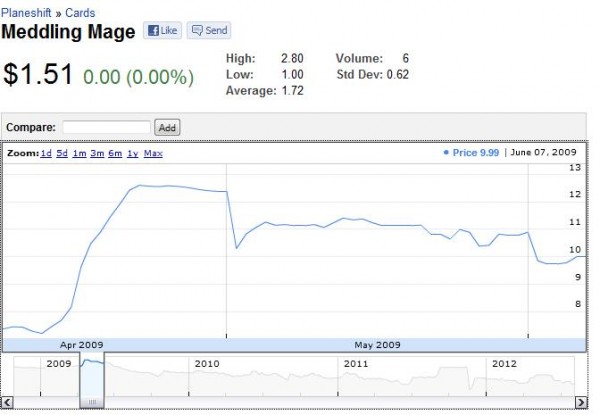
Are people going to love to play with this card? Yes, people wanted to play Meddling Mage in everything they could! Meddling Mage was about $6 for a very long time and as soon as its reprint was announced, the card nearly doubled in price. Take a look:

Planeshift Meddling Mage, focusing on April 2009

How powerful is this card? Meddling Mage is potentially really strong, since it can lock out huge haymakers from the opponent. In Standard of years past, though, Meddling Mage usually just chanted away the removal spell that you could count on. At the time, it was frequently Repulse or Urza's Rage. You could reasonably predict which of the two or three playable kill spells would be aimed at the Mage. That basically just gave the first one Shroud, which was still a rare ability in those days. Shroud or the option to close off cards in their deck was and is decent. However, Meddling Mage had a few issues at the time that limited its power. Remember again that creatures got a lot better! A 2/2 bear with a good ability was way above the curve in Invasion, but two mana gets you much more these days. In Alara block, it got you Putrid Leech, for example. Jund was the big menace at the time and if you played out Mage and then they answered with the Leech or Sprouting Thrinax, well, you really have not done anything to change the board, have you? If 5-color Control gets its Cruel Ultimatums cut off, they can still Wrath away your little man. Meddling Mage saw nearly zero play because the environment wasn't right for it and the card isn't as good as it once was.

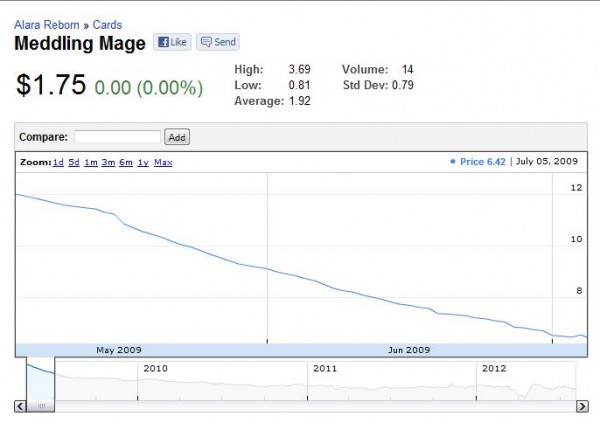
Conclusions: I'm torn on reporting a concrete lesson from Meddling Mage because if you bought up copies as soon as it was spoiled, you would have made a very tidy profit. However, look at how quickly this card nosedived when the Shards version came out:

Shards printing of Meddling Mage, first two months of printing

In one month, it dropped $4, and by the end of June, it was worth half of what it was at its peak. If you had gotten into these any later than "as soon as the spoiler was announced," then you would have gotten burned hard. The best lesson from this is that a reprint rarely makes a card's value go up, and if it does go up, it won't hang there for long.

Bonfire of the Damned

Bonfire is currently one of the hottest cards around and there's a lot of talk about what ceiling it has. When the card was first announced, people were lukewarm on it, which adds to the mystique - it's the Tarmogoyf effect of spotting a hidden gem. Let's make it our final study.

Does it exist in an earlier set? No, and we could be done with that, but I have to mention that Bonfire looks a lot like some other cards we'd seen - cards that negatively influenced what we thought of Bonfire. For example, it looks kind of like Pyroclasm - but Pyroclasm costs 2 and Bonfire costs 5 to get the same sweep. It looks like Earthquake, but Earthquake always costs XR. The thing we were missing about Bonfire, thinking it was just a bad Earthquake, was the value in only sweeping away an opponent's creatures. You see, we said "Earthquake was never played and this is no Earthquake" and we ignore that this card was not an Earthquake! We've never really played with a card that can selectively sweep away just the opponent's field. That negative historical bias influenced a lot of people, including myself.

How powerful is this card? Turns out, really powerful. Ramp decks can play it because it won't kill their own guys - au contraire, a weenie like Avacyn's Pilgrim actually helps cast it. Bonfire at retail is not great - but it's not bad, seeing as how all of Standard's monsters are usually X/2s or less. Casting this at 4R is painful but effective. We play Blasphemous Act for that price quite frequently. I think it took testing to see how gamebreaking the Miracle was, though.

Are people going to love to play with this card? Honestly, no. It's clunky for casual players. It's just another variant burn spell for Standard, but with some new qualities. It's not a banner Planeswalker or a beloved reprint. We cannot factor in the love appeal on this card's price.

Conclusions: Bonfire escaped notice for at least a week after being spoiled. I think this was in part due to people misunderstanding the card as printed and not looking to see if casting it for 4R was still a decent value in Standard. It's still a hot card, even though I don't think it'll hit $45 in its Standard run. It's one of those cards that got away from me personally - it takes a bit more work for me to buy into an $8 Mythic than an uncommon that's only a dime, and I think a lot of other speculators held off for the same reason. After all, Entreat the Angels is down about 30% from its peak during spoiler season and that card is going to keep going downward. Speculating on Mythics is especially risky.

If you have analytic tools you use, questions in mind that you always ask, or danger signs that you look for, let me know in the feedback here! If you appreciated an article that went back to the basics, let me know and I'll work on some more.

Until next week,

Doug Linn

As a bonus tip, Shardless Agent is seriously, seriously powerful in Legacy. Start picking these up for under $8, I don't think you'll regret it. I'll explain more next week (in respect to my source).

Insider: Why I Profit from Magic: The Gathering

Are you a Quiet Speculation member?

If not, now is a perfect time to join up! Our powerful tools, breaking-news analysis, and exclusive Discord channel will make sure you stay up to date and ahead of the curve.

The past few years have seen a large boom in MTG speculators and financial experts. It seems every significant online retailer has at least one finance writer. Follow enough MTG people on Twitter, and you’ll inevitably believe everyone has an opinion on everything related to MTG Finance.

After all, there are now 155 pages in The Source’s finance/card prices thread. Read through a few pages and you’ll quickly agree - everyone has an opinion.

The rapid influx of people interested in the game’s monetary aspect is intriguing and today I'll analyze the driving force. This is important to understand because I feel some people believe MTG speculation is the best way to achieve certain goals, while surely there are superior alternatives. It all relates back to the predictability of our human nature to behave irrationally.

Living the Dream: Going Infinite

Many players (including me) have a goal of funding their MTG hobby through savvy trades and wise investments in cardboard. We stock up on dozens of a hot card that may see a spike in value. We dig deeper into the metagame to identify the potential break-outs, and we go after aggressively priced Legacy staples to trade down into profit.

All this is done with the hope that we can slowly build our collection and essentially enter a few tournaments for free. Making money is nice – making money while doing something we love is living the dream.

This optimistic outlook is inspiring, but the thought process is inherently flawed. For example, what is the opportunity cost of my owning 40 NM Revised Dual Lands, a few sealed booster boxes, and a lineup of other Standard and Legacy playables? The collection may be appreciating and I love having a hobby that nets me cash but is this really optimal from a financial standpoint?


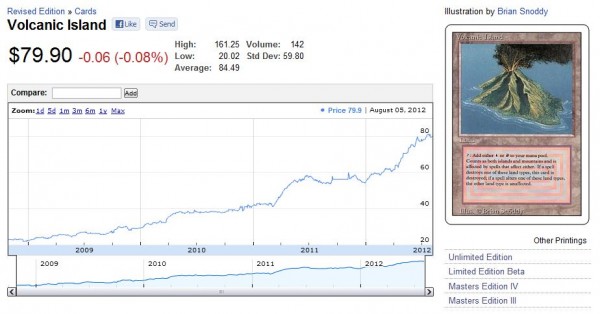
(chart courtesy of blacklotusproject.com)

Once in a while I will observe price trends showing an increase here and a decrease there, which then impacts my MTG portfolio by a fraction of a percent. On a rare occasion, I will make a killing on a card like Scroll Rack or Food Chain thanks to some sudden hype. But aren’t there other investment opportunities passing me by in the meantime?

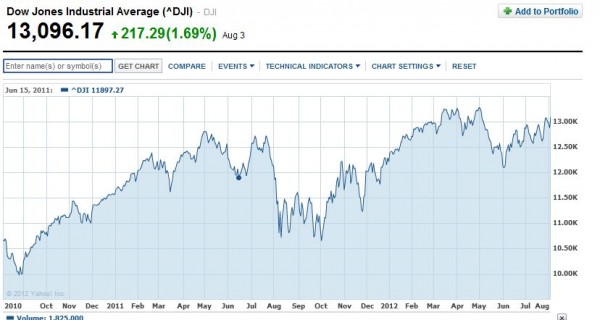
While I am slowly making bank on a couple sealed booster boxes of Unhinged, my [Wall Street] stock portfolio is experiencing rapid price swings weekly. While I may be profiting hundreds of dollars in my Magic hobby, my retirement fund is advancing by the thousands. Others may even have access to additional opportunities – real estate, commodities, currencies, etc.

So again I need to ask the question: why are we so interested in sinking hours of our time into research in order to gain an amount of money we could make in a month of passive investing? It cannot be simply to fund our hobby. There are many other opportunities out there to make some cash which carry less risk than a collectible card game. (Note: exceptions would be the ultra rare and unique cards, which are more like an investment in art than in a risky stock).

Enjoyment

One level deeper we discover a stronger motivating factor – the fact that we enjoy the adventure. Before I actively dealt in cards, I would leaf through a trade partner’s binder and drool in jealousy over the value within. Each time I asked myself: how was it possible that someone could possess such a valuable collection without spending tens of thousands of dollars in booster packs?

Now, after actively buying, selling, and trading Magic: the Gathering cards for a few years, I have seen so many cards pass through my fingers. The once intimidating fifty dollar trades can now be made at the blink of an eye. I barely have to think twice before making a $100-$200 purchase if I am confident value could be made. Practice has made me even more adept at scouring the internet for deals.

But, in all honesty, the Legacy boom was really the only catalyst to a gigantic price bump in my collection. Without beating the majority of the playing field to this format, it’s very possible I could not have come this far. While it is inspiring to try and find the next boom in the game (EDH, Modern, etc.), I really haven’t made such a large percentage in profit since.

If my goal was to enhance my trading experience by acquiring higher valued cards, couldn’t I simply invest the cash in the stock market and take profits/dividends and use them to purchase cards? This would still net me the valuable cards with which to trade while not taking on the high risk of investing in a card game. It seems there must be more to the hobby that is motivating me to invest so much time and money to simply earn a few bucks.

Deeper Understanding of Human Motivation

There is a unique aspect to dealing in Magic Cards that I cannot experience when trading stocks – the personal interactions.

The enjoyment I have in dealing in Magic Cards, making a solid prediction, and profiting on a speculation all carry a value unmatched by my stock investments. This is really the driving force behind my desire to deal in cardboard. When I do profit successfully, the hobby is even sweeter. But even if my portfolio remained neutral in value year on year, I would still be enjoying a hobby, networking with a great community and hopefully making a difference.

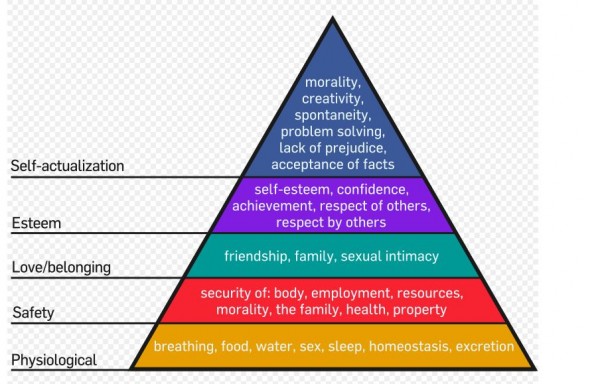
In a way, these different levels of accomplishments from MTG trading is relatable to Maslow’s Hierarchy of Needs.

On the safety level, one needs to have finances in order to sustain the hobby. Thus, we are motivated to simply gain value when on this level.

One level higher (love/belonging), we start to make connections and develop friendships when we participate in the hobby. This is where the distinction between investing in Magic Cards and investing in real estate / the stock market starts to manifest itself. I love being able to share speculation ideas in the QS forums and swapping success stories on Twitter. While this can still be done to a degree with the stock market, there are subtle differences.

At the esteem level, one develops a level of confidence and respect within the MTG community after some successful speculations. In my view, this is where I am currently operating. I love making a few bucks on the game and making connections, but gradually earning respect from the MTG community is immensely rewarding. Despite the fact that I’ve done fairly well in the stock market, I will never have the same level of respect on Wall Street as I do within the MTG community.

This is why I speculate.

Self-actualization

In an ironic sense, I am attempting to transcend to the level of self-actualization by writing about self-actualization. What I mean is that I am thinking creatively about MTG Finance and sharing thoughts that no other writers have done in the past.

Writing that one should buy Temporal Mastery and sell Snapcaster Mage soon really only addresses the safety level of the hierarchy above. (Disclaimer: I currently own no Temporal Masteries but I may pick one up soon if I feel demand may pick up).


(chart courtesy of blacklotusproject.com)

Even articles about trading and fostering a healthy culture only crack the esteem level. But taking a step back, analyzing the game for what it is and identifying underlying human motivators in a creative way – that is a level on its own.

Sometimes such articles are a hit, and other times the risk may not pay out. But, in the end, I believe these conceptual articles are insightful in their own way, just as I participate in MTG speculation for my own unique set of motivations.

I’ve analyzed why I’d rather spend 10 hours to make $100 in Magic trading than 10 minutes to make $1000 in the stock market. I’d challenge you to consider how much time you’re spending on the hobby and how much profit you’re netting.

I’m not only in it for the money. Are you?

-Sigmund Ausfresser
@sigfig8

Avatar photo

Sigmund Ausfresser

Sigmund first started playing Magic when Visions was the newest set, back in 1997. Things were simpler back then. After playing casual Magic for about ten years, he tried his hand at competitive play. It took about two years before Sigmund starting taking down drafts. Since then, he moved his focus towards Legacy and MTG finance. Now that he's married and works full-time, Sigmund enjoys the game by reading up on trends and using this knowledge in buying/selling cards.

View More By Sigmund Ausfresser

Posted in Finance, Free InsiderTagged , , , 15 Comments on Insider: Why I Profit from Magic: The Gathering

Have you joined the Quiet Speculation Discord?

If you haven't, you're leaving value on the table! Join our community of experts, enthusiasts, entertainers, and educators and enjoy exclusive podcasts, questions asked and answered, trades, sales, and everything else Discord has to offer.

Want to create content with Quiet Speculation?

All you need to succeed is a passion for Magic: The Gathering, and the ability to write coherently. Share your knowledge of MTG and how you leverage it to win games, get value from your cards – or even turn a profit.

Insider: Looking Ahead by Looking Back

Are you a Quiet Speculation member?

If not, now is a perfect time to join up! Our powerful tools, breaking-news analysis, and exclusive Discord channel will make sure you stay up to date and ahead of the curve.

To start, I’m glad my concept of the “dead zone” in Magic (and by extension, Magic finance,) was received so well. Last week I talked about some ways to make the best use of that time, since everyone else is in holding pattern.

Well, about that holding pattern. The following exercise is something that is very helpful as a player, and by extension, a trader. It’s true we don’t know what Ravnica holds or what decks it may bring, but what we can do is look at the current decks and break them down by set. I find this is always a really useful way to determine if the important cards in each strategy are a buy, sell or hold.

Of course, we’ve talked about the easy sells. Everything from Scars block should be gone by now, except for any lands or such that you’re holding for Modern. I’ve personally moved almost my entire Scars stock, and cleared out the last Ratchet Bomb a few days ago.

But what Innistrad cards do we want to hold onto? As I mentioned, we can’t really predict what new decks will show up (just the powerful cards), but we can figure out if the current top decks will exist in any form post-rotation.

Let’s start.

U/W Delver

Losses:

Swords of X and Y

Mana Leak

Phantasmal Image

Phyrexian spells

Vapor Snag

Ponder

While these things may not seem like a death knell to the deck, they are certainly very bad for it. Delver is still great and all, but without Ponder to set it up and Phyrexian spells and Snag to protect it, the deck becomes much, much less consistent.

In addition, the Talrand versions are pretty much just dead, since they can’t jam Phyrexian spells and call it good. This means that, as a whole, the deck is not as well-positioned going forward, and that means a few things. Esper Midrange, which is essentially Delver-less Delver, is also dead with so many rotating spells.

First up – Restoration Angel. Yes, the Angel is good in a lot of decks, but it’s at its best here. Every share of the metagame something like Zombies or Vampires takes away from Angel decks means a drop in price. This has probably peaked, so don’t feel bad getting rid of yours. That said, it’s still extremely powerful and will be a metagame pillar, so I think it’s fairly stable.

It does stand to reason that Geist of Saint Traft could fall. Without Snag and Gut Shot to clear blockers, this thing becomes a lot easier to deal with. But another consequence of Snag leaving is that Human decks should be able to make a return to the metagame, and I suspect those decks will play Geist simply because of how much damage it puts out and the fact there will be less Clones. I’m looking at Geist to stay fairly stable post-rotation, though it could dip to $15.

Human cards, on the other hand, from Champion to Silverblade, will likely trend upwards.

Pod Decks

Every Pod deck is gone, obviously, with Pod itself rotating. But not every “Pod deck” was always Pod. In fact, Naya decks have been successful even without the Pods.

But these decks will all suffer from losing Phantasmal Image and Phyrexian Metamorph. The Clone effects really held these decks together, and with those gone, as well as Green Suns Zenith, they too lose a lot of consistency.

I still look for Bonfire of the Damned-based decks to be very strong, but the shell that is built around Bonfire could go through a lot of changes. As such, I can only recommend that Bonfire will continue to be the most expensive card in Standard.

Wolf Run

Losses:

Primeval Titan

This is pretty much the only card that matters, though Solemn Simulacrum and Inferno Titan both go as well, as does its sweepers.

People know this, and a lot of the associated cards have fallen accordingly. But another card you would do well to get rid of is Zealous Conscripts. Right now the Conscripts occasionally pops up in maindecks, but it’s mainly a fixture of the sideboard because it rocks Frites and Titans in general. It will still be good against Frites, but the removal of Titans means stealing one is way less relevant. Conscripts was in an intro deck and will probably halve in price because of it.

Elves

Losses:

Ezuri, Renegade Leader

Genesis Wave

Green Suns Zenith

Llanowar Elves

Birds of Paradise

Another deck that is effectively dead with the loss of the Elves and some of the explosiveness. Elvish Archdruid is a little less desirable once rotation occurs unless the tribe gets enough support in Ravnica. I do still like Soul of the Harvest, though, assuming there’s enough creature acceleration and/or finishers to make a deck like this happen. Ramping into Bonfires isn’t exactly bad, either.

Zombies

Losses:

Mortarpod

Phyrexian Obliterator

Dismember

Fume Spitter

Clones

Here we have our first big winner of the rotation. The losses incurred by Zombies is relatively small, and many versions weren’t even playing Oblitator anymore. The Burn-backed variant has had the most success recently, and I expect that trend to continue after rotation, when I foresee a lot of Human vs. Zombie battles happening.

Along those lines, I like foil Human Frailtys, and going a little deeper, Elite Inquisitor and Riders of Gavony. I think Champion of the Parish into Inquisitor into Silverblade is insane, and a play we’ll see a lot of post-rotation, assuming Ravnica doesn’t blow away Innistrad in terms of power level.

On the other hand, the Miracles deck from the Pro Tour could come back to combat these decks, in which case I like Devastation Tide as the cheap pickup for that deck, in addition to the lands.

Red decks

Losses:

Nothing irreplaceable.

Red spells are red spells, and they burn your face. What I like most about red post-rotation is that Timely Reinforcements is gone. That alone opens a lot of space for Red decks, as does the loss of Vapor Snag and Gut Shot, both of which helped to hold down Stromkirk Noble, a card I’m looking for a rise out of after the rotation.

It should be noted, though, that both Thragtusk and Restoration Angel are very good against red, so that’s going to hurt the potential success of Red decks.

That pretty much covers the top decks. Doing simple analysis like this is often how I choose targets for the coming season, and these calls often pay off. It’s difficult to impossible to predict an exact metagame after rotation, but we can come close to approximating what shells will survive with this technique, and that helps to shape our goals moving forward.

Thanks for reading,

Corbin Hosler

@Chosler88 on Twitter

Adventures in Qualifying: PTQ #4

Are you a Quiet Speculation member?

If not, now is a perfect time to join up! Our powerful tools, breaking-news analysis, and exclusive Discord channel will make sure you stay up to date and ahead of the curve.

Last weekend I participated in the last Standard PTQ in my area for this season. As I have mentioned before, my work lately has been mostly theoretical and that was one hundred percent true for this event as well. Even with zero testing of the list I played, I was confidant it was good. The list was strong and my prediction about its best card was accurate.

I based my decision to play this deck on one question. What is the best card in Standard right now?

This is a question that I, along with other competitive players, Ponder from time to time. Thinking this way often leads me to building new decks to attack the format.

For me, the best card in Standard right now is Terminus and it's a not close race. The decks finding the most success right now are all creature decks. Control decks are having a hard time beating all of the resilient creatures with built in card advantage. Terminus is the best card in the format right now because it is good against all of these creature based decks. It is good against any Delver deck, Pod variants and Zombies of red or blue, and even against Wolf Run it is decent.

I'm curious to hear if other people agree with me that Terminus is the best card in Standard. Let me know in the comments.

Rather than trying to run Terminus in a more traditional deck like Blue White Control, I created an updated version of Wolf Run that worked well with the wrath effect. Here's the list I played.

Wolf Run White

Untitled Deck

Creatures

1 Birds of Paradise
1 Borderland Ranger
3 Solemn Simulacrum
1 Huntmaster of the Fells
1 Thragtusk
1 Acidic Slime
3 Primeval Titan
2 Elesh Norn, Grand Cenobite

Spells

2 Pillar of Flame
4 Rampant Growth
4 Farseek
1 Oblivion Ring
2 Garruk Relentless
3 Green Suns Zenith
4 Terminus
3 Entreat the Angels

Lands

4 Sunpetal Grove
4 Rootbound Crag
3 Cavern of Souls
2 Inkmoth Nexus
1 Kessig Wolf Run
1 Slayers Stronghold
4 Forest
1 Mountain
4 Plains

Sideboard

3 Combust
3 Ratchet Bomb
1 Acidic Slime
2 Thragtusk
2 Stingerfling Spider
3 Surgical Extraction
1 Inkmoth Nexus

As you can see, I kept most of the Wolf Run shell intact. I am still playing the Green Sun's Zenith package with a wide array of targets. It may be time to remove Birds of Paradise because often it can be a liability due to the prominence of Gut Shot. I am not certain the Borderland Ranger is necessary either because I never searched for it. The card has been good in the past though and I never mind having one in my deck.

The numbers of cards may seem odd but there are reasons for each choice.

3 Primeval Titan -- This is probably the most controversial choice. I understand this card is extremely powerful, but one problem with Wolf Run decks right now is their reliance on titans. Resolving a titan no longer means automatically winning the game. I do have the eight titan spots filled, just not all with titans. Three Primevals, three Entreat the Angels, and two Elesh Norn, Grand Cenobite fill the spot of "titan" in this build.

2 Pillar of Flame, 1 Oblivion Ring -- I wanted three targeted removal spells in the deck. I started with all three of those spots as Pillar, but right before the event I decided to diversify my removal a little bit. There is not as much red mana as in most versions either so I wanted some removal that could be cast with other colors.

1 Huntmaster of the Fells, 2 Garruk Relentless -- Is Huntmaster better than Garruk? Yes, by a lot. I chose these numbers because the planeswalker has a lot of synergy with Terminus.

4 Terminus -- This card is the entire reason I played this deck. It was the best card in my deck by far and every game I cast it, I won easily. I did not think Day of Judgment was good enough because of undying creatures but Terminus deals with them permanently.

I would have played more than four copies if I were allowed. Because of this, it may be just better to play a deck with both Terminus and blue mana so you can draw them more often with Ponder, Thought Scour, and Think Twice.

1 Kessig Wolf Run, 1 Slayers Stronghold -- The red-white land was actually one reason that I wanted to play white mana in Wolf Run. Haste and vigilance combine really well together, especially in a deck that is often in a defensive position. Stronghold also allows you to turn Inkmoth Nexus into a clock without using all of your mana.

Ultimately I am satisfied with my deck choice even if I was not successful with it. Sometimes you have to take risks like this if you want to play a rogue deck. As for changes, I think the two Pillar of Flame and one Oblivion Ring might need to be changed to Bonfire of the Damned, as I found throughout the event that four sweepers was not enough. Day of Judgment may be better than Bonfire in this deck so that is a possibility as well. As I mentioned, Day of Judgment is not ideal, but it may be enough in addition to Terminus.

I will continue to work with Terminus in this deck and others because it really is that good right now.

Cheering On Friends

While I didn't fare so well, the story of the PTQ was my friend, Josh Milikin, who took down the event. It is almost as great a feeling as winning yourself when one of your friends does really well in an event. Here is his list.

Mono Green Stompy

Untitled Deck

Creatures

4 Birds of Paradise
4 Llanowar Elves
4 Strangleroot Geist
4 Dungrove Elder
1 Champion of Lambholt
1 Borderland Ranger
2 Thrun the Last Troll
3 Phyrexian Metamorph
1 Bellowing Tanglewurm
1 Wolfir Silverheart
1 Thragtusk
1 Acidic Slime

Spells

4 Green Suns Zenith
4 Rancor
2 Garruk Relentless

Lands

23 forest

Sideboard

1 Melira Sylvok Outcast
3 Torpor Orb
2 Dismember
2 Beast Within
2 Crushing Vines
2 Fresh Meat
1 Thragtusk
2 Overrun

There are a lot of things I like about Josh's list. One of the strongest aspects of this deck are actually the cards he didn't play. There are no copies of Revenge of the Hunted, no lands other than Forests, and no equipment. These oft-included cards make the deck clunky and fall prey to your opponents preparation.

The main reason I like his list is because it is streamlined. He plays the most copies of his best cards by playing the full four Green Sun's Zenith. In addition, he also plays Phyrexian Metamorph, which Josh said was amazing for him all throughout the event.

Of course the card that really put this deck over the top is Rancor. The reprinting of this enchantment will affect Standard the whole time it is legal. This version also plays two different ways to break through your opponents defenses. Both Champion of Lambholt and Bellowing Tanglewurm allow you push damage through while ignoring whatever your opponent is doing.

Overall, both decks offer you a competitive way to have fun in Standard right now. Give them a shot and remember to post your thoughts on best card in Standard below in the comments. Also, if there are any specific topics you would like me to discuss, post those below as well.

Until next time,

Unleash the Force!

Mike Lanigan
MtgJedi on Twitter
Jedicouncilman23@gmail.com

Insider: Return To Ravnica Speculative Thoughts

Are you a Quiet Speculation member?

If not, now is a perfect time to join up! Our powerful tools, breaking-news analysis, and exclusive Discord channel will make sure you stay up to date and ahead of the curve.

As we venture into the month of August, we're getting closer and closer to rotation, and the current Standard metagame has shifted all sorts of different ways in the meantime. Although Delver is reappearing as the monster of the month, I feel this format may rotate before we've finished finding all the decks.

For a while, it felt like everyone wanted rotation to come crush Delver out of the format, but in my experience, people are enjoying tweaking and playing it or trying to beat it. Overall, it has been a pretty exciting Standard PTQ season. I've got my last PTQ for Return to Ravnica this coming weekend, and then the next relevant Standard tournament in my corner of the country isn't until 2012 States in fall.

What types of things are we looking for going into fall?

Prices are already well on their way to post-rotation and planning ahead can be rough without knowing what the format will look like in 8 weeks. Part of this is why people are so fanatic about spoilers and leaks. The more we know about Return to Ravnica, the more we can plan for its arrival. Right now we know very little. We know we have a large set, featuring 5 guilds: Azorius(W/U), Selesnya(U/G), Rakdos(B/R), Golgari(B/G) and Izzet(U/R).

That means as of release (October 5th), the new set will make up just over a quarter of the legal cards in the format. While Innistrad block strategies may come to shine in Standard, we may also see new support in these 5 color combinations. This week I'm going to look at each one, and think about what potential gainers might be, so we can be ready to move, or gamble early. Also, be sure to read Matt's article from earlier this week about Shocklands on MTGO.

Azorius

While U/W Delver has been the boogie-man for quite sometime, many feel it's time in the sun is gone once they lose Mana Leak and Ponder. While I don't think it's likely, a new counterspell may arrive that fills that role for this deck. Remand was from Ravnica, after all. Additionally, cards like Moorland Haunt don't care about Delver specifically, and would immediately be included in any creature based strategy that is supported.

We could see a continuation of last years U/W Haunted Humans deck, especially if we see amazing two-drops in RTR like Azorius Guildmage. Geist of Saint Traft has been falling precipitously, as it isn't even included in many current Delver builds, and is a powerful enough card to fuel a deck post rotation. If this card comes down much further, I see it as a solid target.

Selesnya

Selesnya was previously a token based guild and we may or may not see something similar this time around. If so, we could see cards like Intangible Virtue spike up. I think this is a great play as they can be found under for $0.50 a piece from various retailers, and this is a card that could be a big winner come time for States. Parallel Lives, while a long shot, could be a powerful effect. Something to consider.

Also, what token based strategy doesn't love a Gavony Township? That card's available at $3/set retail. Ajani likely fits in this strategy too, but isn't really in the conversation for speculation targets. Geist-Honored Monk saw a small amount of play in the anti-Delver strategies this Summer, and he could make a comeback as well (@ $1/set!).

Rakdos

Rakdos is an interesting one. Will vampires be a supported tribe in this guild? If so we could see some sweet tribal action in Stromkirk Captain. These are currently under $1/set, and if the deck is real, would easily quadruple in value. In this stage, that's a gamble, but at the first spoiling of a decent vampire, I'd be jumping on this train as quickly as possible.

A card like Flames of the Firebrand would be a sweet inclusion in a deck like this. While I wouldn't pick it up now, it is something to keep in mind. Even without vampires, there could be support for a Grixis control deck, dare I say it would include Nicol Bolas, Planeswalker? Who knows, but that is a card that would shoot up quickly if it did find a deck that could play it. Perhaps it's a U/B deck that uses Liliana to find a Blood Crypt to make it happen.

Golgari

Golgari is the first "enemy" colored pair we've seen yet. What the enemy color pairs bring is (likely) a full set of 8 duals for Standard. When combined with the Innistrad lands, we'll see Enemy colored strategies with the best mana they've seen since Reflecting Pool rotated from standard. Woodland Cemetery is at least in the conversation here, as it plays quite nicely alongside the Shocklands. G/B has never been a very popular Standard strategy, but has appeared in plenty of 3-color decks including Junk, Jund and BUG.

Out of the current standard, cards that stand out to me include Garruk Relentless, who has interesting synergies with black, triggering Morbid with his "fight" ability as well as his Tutor on the reverse side. Golgari was previously a graveyard-centric guild, if so, Morbid could be a central theme of a strategy involving the new cards. Of all the guilds, this one has the least action that's apparent to me thus far.

Izzet

Izzet is the one that has me drooling. U/R decks have always complained about terrible mana, and we're likely to see an end to that. Sulfur Falls may see a climb, but what else will we see? We have hints that Jace will be aligned with Izzet, but will he be U/R in color? Will the new Niv-Mizzet be constructed playable? Cards like Burning Vengeance are thought to be dead, not having gotten enough support in Innistrad block, but more flashback spells is not what that deck needs. It needs cantrips and rituals to fuel a Past in Flames kill. Red sweepers are a premium in such decks, so Bonfire of the Damned would be an inclusion in that strategy, but is way too close to it's ceiling to buy into for speculatory purposes.

In a true Counter-Burn strategy, Rewind gets strong, as does Talrand, Sky Summoner. Talrand is still a bit inflated, considering it's in an Intro Deck, but if it creeps down at all, I'd be willing to gamble on him. Typically in most U/R decks, we see a lot of powerful common/uncommons doing more than their typical fair-share of work, due to overwhelming synergies, so junk uncommons that may hit the limelight aren't limited to Burning Vengeance. Mystic Retreival and Desperate Ravings may find their time to shine. Lastly, the Desolate Lighthouse is one that fits in a controlling U/R very easily.

Okay, Now What?

October is still a ways away, but that doesn't mean you can't get prepared. First, figure out what else I missed. Secondly, you can start picking favorites, and investigating where to find each the cheapest, so that when news comes out, you can be primed to swoop up your targets quickly. Further, you can start to plan a budget for the season: How much do I want to put into speculation this season? What's a reasonable expectation of my return? How does my expected return compare to my risk and how does that compare to other options available to me?

This is all a jumping point for broad speculation without even looking at Block strategies from last year. If this type of article is well received, we can focus similarly on the Block strategies in the future.

Behave Yourself: On Bad Gaming Habits and Proper Play Etiquette

Are you a Quiet Speculation member?

If not, now is a perfect time to join up! Our powerful tools, breaking-news analysis, and exclusive Discord channel will make sure you stay up to date and ahead of the curve.

After my unspectacular finish in Columbus I found myself playing in a TCG Player sealed side event on day two.

It was there that I battled what was probably the rudest player I had ever played against.

He gave me a “you were dead next turn” after I beat him in game one (with no respect to my five cards in hand nor the fact that I would have played differently had he actually had any shot in that game) and very angrily flicked the match slip at me while giving me a death stare as I signed it.

Sure, my turn one Arbor Elf into turn three Chandra was pretty nuts, but welcome to sealed.

Now, it might be true that I made a called shot that I wanted to “ruin that kid’s day” at the very beginning of the tournament, and it also might be true that I giggled uncontrollably as I shuffled up for our match in round four, but I’m not trying to make myself out to be a hero here.

What I’m getting at is that there is a lot of rudeness going around in the world of competitive Magic and that it would be great for the game as a whole if we all worked harder at respecting our fellow competitors. I’ve frequently heard many players saying that they can’t stand the competitive nature of even an FNM, which is pretty much supposed to be casual Magic with promos.

Below I have compiled a non-exhaustive list of bad behaviors in which I regularly see players engaged. Some of these offenses are more absent-minded than rude, but I believe that all of these behaviors have some negative impact on Magic as a whole.

On Checking Pairings

This section doesn’t really apply to smaller tournaments at all, but it’s something that you’ll see all the time at Grand Prixs and SCG Opens.

Blocking the Pairings Board to Line up Your Pairing

Don't block the pairings board. Don't be a Snorlax.

This one feels like a no-brainer to me, but I always see somebody doing this. A player’s table number is listed about an inch away from their name. There is no reason that you need to use paper or a card to line the two up. All that you’re really accomplishing is making it impossible for people with names after yours to find their tables.

I apologize if there is some manner of visual impairment that makes lining up such objects especially difficult for some portion of the population, but I can match up my pairing from two or so feet away.

Yelling All of Your Friend’s Pairings

Listen, I know that you like your friends a lot. I’m sure that they’re great people and all, but they should have to wait in line just like everybody else. Not to mention that by turning around to call to them you are either taking up more space and preventing somebody else from seeing the board or yelling in somebody’s ear.

Shuffling Etiquette

Riffling Your Opponent’s Deck

Or at least ask first if you really feel the need to. Even if they riffle their own deck, even if their deck is beat to hell because of it, you should still ask.

The reason for this being that there is no actual uniformity to riffle shuffling. Different players' fingers will fall on different places on the deck and apply different levels of pressure. I know multiple players who riffle in such a way that I can always tell which cards are theirs. If you had multiple such players riffle one anothers' decks, then they’d just end up a crumpled mess.

Of course, if you play a limited deck unsleeved then you should be aware that you are giving your opponent an invitation to riffle your deck. There is just no other way to reasonably shuffle unsleeved cards.

Flipping Your Opponent’s Deck Around

I’m not even sure how this one even happens, but it tends to happen to me at least once a tournament. When you pick up your opponent’s deck to shuffle it, you should make sure you put it back facing the same direction as when you picked it up. Honestly, I don’t know what part of shuffling has anything to do with changing the orientation of the deck, so this one is really baffling to me.

Shuffling Your Opponent’s Deck for in Game Shuffle Effects

This one isn’t especially rude, but it just eats time off the clock. If your opponent is a documented cheater then this is acceptable. I can also see doing it at very high level play when both players are otherwise playing at a crisp pace. For the most part, though, a simple cut should do the trick.

Pile Shuffling More than Once and/or Late in the Round

Don't be this guy.

I strongly recommend that everybody familiarizes themselves with this piece by Michael Flores on pile shuffling.

Basically, the point of his post is that pile shuffling is inefficient, not random and only useful in terms of counting a deck. Performing two pile shuffles before one game is a fantastic way to eat clock and will increase the number of unintentional draws you receive overall.

Performing a pile shuffle after a long game is behavior that I would argue borders on stalling, though in most players hands I am willing to admit that it is probably unintentional. Do everybody a favor and share the above Flores post though. It is beneficial on multiple levels.

This is another thing that I don’t think is rude, per se, but it is ungodly boring to watch my opponent pile shuffle while I actually randomize my deck.

Communication

Wearing Headphones

Why do people insist on doing this? Even if you don’t have the time of day for your mouth-breathing gorilla of an opponent, there is still going to come a time when the headphones are going to have to come off. Not everything can be communicated nonverbally.

Oh, and you look like a giant tool when you play with your headphones in.

Not Confirming Life Totals

This is something that is especially relevant in eternal formats. People near-constantly miss the life loss from fetchlands and Force of Wills. It takes all of two seconds to confirm life total changes as they happen.

I played against an extremely unpleasant individual piloting Merfolk when last I was in Indianapolis and he would never confirm when I stated life totals aloud. I don’t know if his intention was to tilt me or if he was just otherwise being a curmudgeon, but it made the entire match miserable.

Belittling Your Opponent

This one comes in all shapes and sizes. There is no reason to be ill-tempered with your opponent when they nut you out. It’s not like you’ve never done the same. Take your beating in stride and get on with it.

One of the more bothersome exchanges that I’ve seen happened at the most recent SCG Invitational. Michael Jacob was playing against some kid and the kid wasn’t sure what happened when his Gilded Drake died in response to its trigger. MJ explained that the exchange wouldn’t happen and the kid decided to call a judge. You know, like you’re supposed to.

To this, MJ responded by stating, “I know how Magic works, but whatever.” I couldn’t really believe what I was hearing. The very purpose of having judges is to clear up such questions. And you’re not supposed to trust your opponent in the first place. MJ was attacking his opponent for engaging in exactly the type of behavior that he should be expected to engage in.

Another thing that bothers me is when people accuse their opponents of slow rolling when their opponent clearly just didn't see the play. This happens to everyone. For instance, it takes me significantly longer to pilot a deck filled with tutors than it does for me to pilot one without.

Additionally, sometimes your opponent is just less experienced than you are. Just chill out and give the kid a break. When somebody is actually slow rolling you, it should be obvious.

Pace of Play

Your pace of play isn’t only important to you and your opponent. When you go to time, you cost everybody in the event hall a chunk of their day as well. Fifty minutes should be more than enough time to finish three games the vast majority of the time. If you’re going to bring a deck like lands to an event, then do everybody a favor and make yourself immensely familiar with the deck.

Not Acknowledging When You’re Drawing Dead

I cannot tell you how many games I’ve watched drag on for tens of turns despite one of the players drawing to a no-outer. Most often this happens in limited games at small shops. I know that it sucks, but you should really just be honest about it and scoop when your opponent lands that unbeatable Akroma's Memorial. You’re not going to have any fun playing the game anyway.

I understand that there is some merit to playing unwinnable game ones for a few extra turns to try to see more cards or to try to make your opponent think you have outs, but there is generally no reason to drag out the last game in a match.

Playing Turbofog

Don’t play Turbofog. It’s bad, and if it’s the type of deck that you enjoy playing you should feel bad. You are worse than the guy playing Battle of Wits. At least they can win in turns.

Post Game Etiquette

Not Extending the Hand

I get cut off like this all the time.

It is my firmly held belief that the loser should always extend the hand in order to concede. Even when your opponent’s sealed deck has 15 more rares than yours. Even when your opponent made a thousand more misplays than you did. Just do it. It’s a sign of integrity and it shows that you have respect for the game. I’m not perfect in this regard, but it’s something that I do far more often than not.

And don’t forget to give a good handshake. Limp handshakes and cutting your opponent off are not acceptable.

Showing Your Opponent How You Sideboarded

There is no greater way to dagger your opponent than to show them how wrongly you sideboarded after you beat them. If you lost then it’s perfectly acceptable to ask what you did wrong. Most players mean well when they win and do this, but it really just translates to rub-ins.

Additionally, showing your opponent what you still had in hand (aka, still had all deez) is extremely rude.

Saying GG

Geordie Tait’s “GG” is another piece that I recommend that everybody reads. The simple fact of the matter is that saying “GG” when the Gs were in fact not G, but were, rather B is another form of rub-ins. Geordie covers the intricacies of this very well.

~

I understand that, no matter how much is written on the topic, bad behavior in the community will persist. That said, I’m of the belief that there is intrinsic value in acting as a respectable human being. Magic is a great game, and acting in ways that cheapen the experience for others is pretty shameful behavior.

Personally, I stew over my own bad behavior just as much as I stew over misplays that I make. I treat each event as one more step towards reducing the instances of both, and I think that Magic would be a lot better if everybody did the same.

-Ryan Overturf

Want Prices?

Browse thousands of prices with the first and most comprehensive MTG Finance tool around.


Trader Tools lists both buylist and retail prices for every MTG card, going back a decade.

Quiet Speculation