menu

Brewing with OGW- Devoid Aggro

Are you a Quiet Speculation member?

If not, now is a perfect time to join up! Our powerful tools, breaking-news analysis, and exclusive Discord channel will make sure you stay up to date and ahead of the curve.

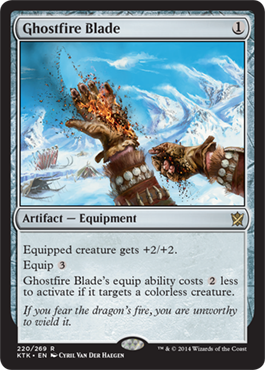
When Battle for Zendikar first launched, the ingest mechanic was met with some skepticism. The cards just seemed odd more than anything, and the power level just didn't seem to be there. Ingest never made a constructed splash, and Oath of the Gatewatch features no cards with the keyword. There are some cards in Oath that help fuel processors, but the tools just don't seem powerful enough to make processing a thing in Standard. If such a deck were to exist, Ghostfire Blade always looked to be one of the more exciting elements. While ingest doesn't seem any better, I believe that devoid now shows promise.

There was an error retrieving a chart for Ghostfire Blade

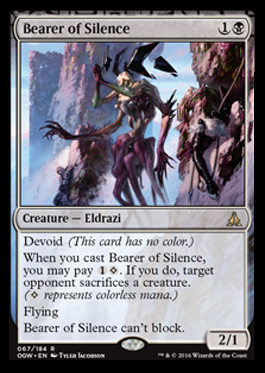
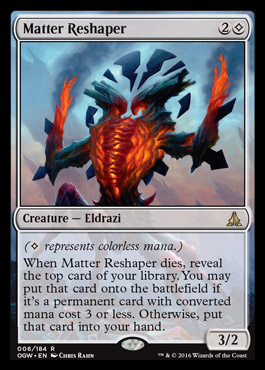
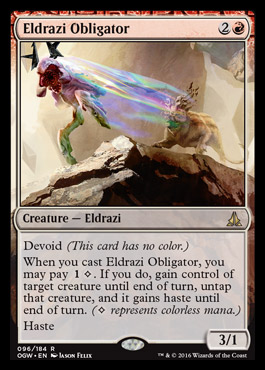
Oath is introducing several cards with devoid that are costed efficiently, and even a number of colorless creatures that have significant upside relative to their casting cost. There are a number of possible directions to take a devoid deck, but I believe that these are the most appealing new cards for the archetype:

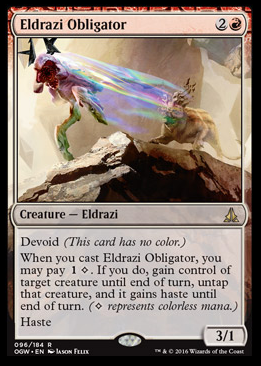
Bearer_of_Silencematterreshaper (1)eldraziobligator

These cards all provide reasonably costed bodies with high potential upside. The edict and threaten abilities make Bearer of Silence and Eldrazi Obligator scale very well, and Matter Shaper will replace itself pretty often. These are my picks for the most appealing new devoid critters, though the set also offers some other solid bodies, even if they don't come with the same upside.

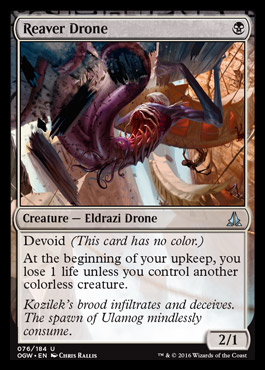
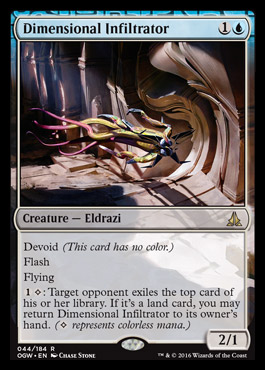
reaverdronedimensionalinfiltrator

Put them all together, add the most efficient existing bodies for the deck and the other value creature in Hangarback Walker, and we have what looks like a good starting point for a Standard deck.

Devoid Aggro

Creatures

4 Reaver Drone
4 Hangarback Walker
4 Bearer of Silence
4 Forerunner of Slaughter
4 Dimensional Infiltrator
4 Matter Reshaper
4 Eldrazi Obligator

Spells

4 Ghostfire Blade
2 Roast
2 Duress

Lands

4 Crumbling Vestige
4 Corrupted Crossroads
4 Shivan Reef
1 Island
2 Swamp
1 Mountain
4 Bloodstained Mire
1 Smoldering Marsh
1 Sunken Hollow
2 Ruins of Oran-Rief

This deck definitely isn't as explosive as Atarka Red, and it doesn't offer the same value of other Standard decks, but it does offer explosive starts, some great value creatures, and a reasonable amount of resilience. It's possible that Ruins of Oran-Rief just doesn't offer enough for the deck, and that my choices for the spell slots aren't the best options, but I think there's something here. If I were preparing for a big Standard event I would definitely run this deck through the gauntlet and try to find the best version. The elements featured here are rather unique, and if you get the best list before anybody else you could take a tournament by surprise with this shell.

From a financial perspective, this deck doesn't employ any mythic rares so there aren't any big movers. I like picking up the new rares if you can find cheaper copies, though there aren't any great targets here. Matter Reshaper is already pre-ordering for too much, though Bearer of Silence is probably a good pickup if you can find them for around a buck. It looks like they're pretty easy to find for $2, which isn't a terrible price for a set to play with.

Insider: Real Market Value vs. Buyout Hype

Are you a Quiet Speculation member?

If not, now is a perfect time to join up! Our powerful tools, breaking-news analysis, and exclusive Discord channel will make sure you stay up to date and ahead of the curve.

"A rising tide lifts all boats."

- John F. Kennedy

We often throw this aphorism around to imply that increasing costs of some cards in a format will help the value of all cards in the format. Unfortunately, this isn't always true (in fact it could be argued that it's inversely true in many instances).

south-harbor-boats

When Legacy dual lands started to rise back in 2013, Force of Will, Wasteland, and Rishadan Port were soon to follow. It seemed like Legacy was seeing a new renaissance and all was right with the world.

Fast forward to the end of 2015. Star City Games decides to no longer offer Legacy events and tons of players start selling out of the format. At the SCG Open this past weekend I saw a ton of Heavily Played (HP) and Moderately Played (MP) duals sitting in cases at their pre-spike prices and nobody was biting.

The format seems to have begun to die off as interest jumps to the Modern format. So what happened next really shouldn't come as a surprise...

Big Modern Spikes

All of these cards have spiked within the past two weeks, and all for no apparent reason. I understand that all of them are good cards and some (like Spellskite) are played in quite a few decks, but massive spikes adding 50-100% to a card's value is not healthy for the format or the game as a whole.

A lot of people think this is being driven by speculators (or possibly a single store). I don't have any information on who is buying out these cards but I do know it's not a wise decision in the long run. Why, you might ask? Market Value.

Market Value: The price an asset would fetch in the marketplace.

Sounds pretty simple, right? Here's the catch. True market value is driven by true demand, by which I mean actual demand from the population. Buyouts imply a massive increase in demand, and some people will get caught up in the hype and buy for fear of missing out, but a large majority won't.

The next thing that occurs is that the market will dry up of copies and the new inflated price will show up on all the major retailers' sites (and on open marketplace sites like TCG Player). Everyone who already had extra copies will try to sell them as quickly as possible and lock in their profit.

The best way to sell something quickly is to be the cheapest, which results in a typical "race to the bottom" where sellers try to beat each other's prices to lock in sales. So the cards seem to gain a ton of value very quickly and then lose it just as quickly.

This leads to a feeling of instability and insecurity in the marketplace and deters players from entering, which in turn prevents the player base from growing, which leads to fewer buyers over all.

Finding an Equilibrium

general-parabola

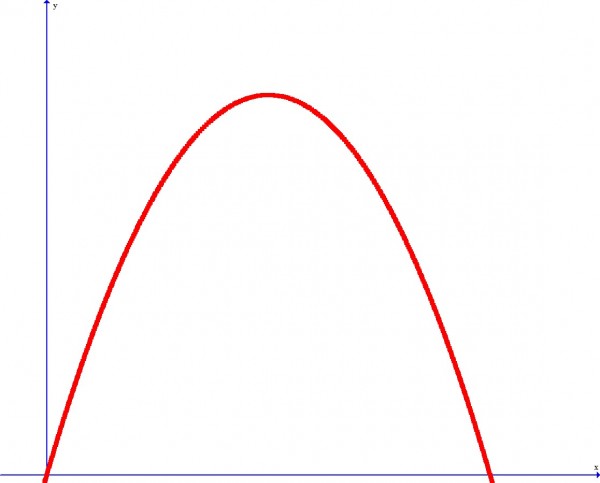
Now true market value typically requires a large number of transactions for the seller's value to align with the buyer's value. The basic idea is similar to using the guess check method when trying to find the inflection point on a parabola. One of my professors in college referred to it as "trapping the answer."

The way you found your final answer was to guess a number and find out if it's slope was positive or negative. You then guess another number (ideally a much larger or smaller one) and see where it fell. You'd do this until one guess was positive and one was negative. You now know the inflection point is somewhere in between them. Then you take the mean of them and calculate its slope. Depending on your answer you would then take the mean of that mean and whichever of your previous two guesses had a differing slope sign.

If you think of the true market value "function," positive slopes are values at which people are happy to sell the card, and negative slopes are values people will buy the card at. True market price is the inflection point of this function, at which the largest number of people are happy both buying and selling the card at the given price. Buyouts make people think the curve has shifted when it hasn't.

If you want another great example of true market value versus perceived market value (due to a buyout) all you had to do was check the dealer booths at SCG Charlotte this past weekend. Both vendors had their Spellskites and Inquisition of Kozileks at the new price...and I didn't see a single one move. (Note that SCG's new printed sheets actually make it impossible to gauge what they do and don't have, but at the Troll and Toad booth I saw several of each card added to the case and they just sat there.)

In my trade binder I had my personal copies of Inquisition and my extra playset of Spellskites which I purchased from Aethergames back at the Charlotte GP of last year (for $12 a pop)---everyone who saw them joked about the recent spike with zero interest in acquiring any.

One player even lamented how he was planning to pick up Inquisitions because they were cheaper than Thoughtseize only to find out they were considerably higher. Nobody wanted my extra Gaddock Teeg or Glen Elendra Archmages either. Now I'll grant that this was a small sample size to pull from, but overall, all the interest in these cards came from people trying to unload them.

With this in mind it seems our original aphorism needs a bit of an addendum.

"A rising tide lifts all boats, but rising too fast drowns those on the shore."

- David Schumann

Maybe a bit morbid for some, but it gets the point across succinctly.

and now for something completely different

SCG Charlotte Notes

The Open itself had over 800 people and was supposedly the second largest in SCG history (only falling behind last week's monster 1000+ player Modern Open). The huge turnout is a strong indicator of a Magic playerbase hungry for the Modern format. And that means we'll continue to see Modern staple prices rise due to actual market demand.

This is great news for those of us who have stockpiled Modern staples, and if you were thinking about entering the format in the upcoming year, you should consider doing so now.

However, nothing is guaranteed by any means. Modern has been around now for several years and many Modern players have all (or most) of the cards they need to play. Thanks to this format being eternal there is no "forced demand" caused by rotation---the only forced demand occurs with bannings/unbannings or new cards entering the format.

Luckily, the only way for new cards to enter the format currently is via a printing in a Standard-legal set, which typically keeps prices down. Thus, while we may see a few cards here and there jump dramatically, overall the prices should stabilize if the Modern playerbase itself doesn't continue to grow by leaps and bounds.

Dealer Booths

At SCG Charlotte there were only two vendors, Troll and Toad and Star City Games themselves. I'm hoping we'll see more vendors start to show up at these events (and if they continue to attract large numbers of players we likely will) which will force them to be competitive within the event hall. This is why I love GP's so much; with so many vendors around, the ones doing all the business are the ones with the best prices.

Even though we only had two vendors, Troll and Toad very smartly brought a lot of their foreign/foil/HP stuff with them and it was moving. My friends and I dug through their $1 box of randomness and pulled out:

  • Spanish Zur the Enchanter
  • FTV: Exiled Skullclamp
  • Spanish foil Demonic Pact
  • Italian Austere Command

They also had some great prices on other foreign/played cards. I got:

  • 2x Spanish Path to Exile - $5 each
  • 4x Spanish FNM promo Serum Visions - $4 each
  • 2x Italian Ghostly Prison - $3 each
  • Leyline of Sanctity with a GP stamp on it - $7
  • Lightly Played (LP) Mindbreak Trap - $3
  • HP (but sleeve-playable) Eidolon of the Great Revel - $4

All in all, it's smart for vendors at events to bring these types of items because many players are much happier buying some of that stuff in person (where they can see the play/wear themselves) than they would be online. Because the cards are discounted, you feel like you're getting cards for a steal. It adds a good bit of cash to the vendor's coffers and lets them continue to buy collections.

Insider: 7 Modern Cards to Watch

Are you a Quiet Speculation member?

If not, now is a perfect time to join up! Our powerful tools, breaking-news analysis, and exclusive Discord channel will make sure you stay up to date and ahead of the curve.

Welcome to Modern mania. The format is hot as the sun and prices are surging left and right.

The hype is real. The format is actively becoming the most popular format in all of constructed Magic and people need cards. Lots and lots of cards...

We've been talking about betting on Modern prices for some time now. Many of the cards I've mentioned in the past months have already hit their stride. My impression of what's going on in Modern is basically that every card that sees play is trending upward at the moment. So, any time you can trade non-Modern cards for Modern cards you are likely investing wisely.

There was an error retrieving a chart for Inquisition of Kozilek

A $25 card? Wow. The key is that this is the trend for Modern prices in general. Maybe not jumping $10 overnight, but the prices are all going up. The key is to find cards that have room to grow and get in on them before it happens.

In today's article I'll point out some cards that I think are sitting in the basement just waiting to climb in value sometime over the next few months.

Urborg, Tomb of Yawgmoth

There was an error retrieving a chart for Urborg, Tomb of Yawgmoth

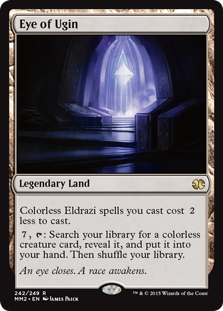
Can you even imagine a more wicked pairing than Yawgmoth and the Eldrazi? Well, the stars have aligned and the two are fighting side-by-side in the Eldrazi Black decks. The interaction between Urborg and Eye of Ugin is undeniably busted. The Eye makes Eldrazi cost two less and the Urborg makes the Eye tap for {B}. Build-your-own Mishra's Workshop is still a shop...

Eldrazi Black has already established itself in the running for the best midrange deck in Modern, and Oath of the Gatewatch (OGW) has previewed some pretty insane Eldrazi creatures that may make the deck even better.

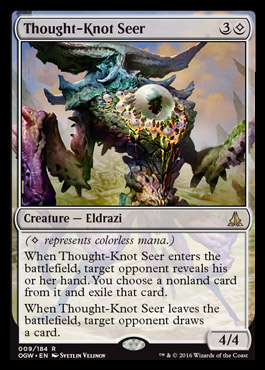
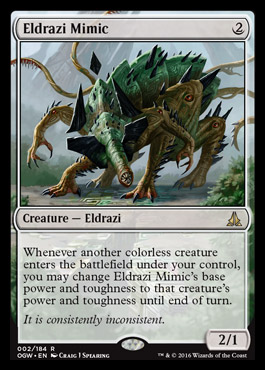
thoughtknotseer eldrazimimic

Mimic is completely free with an Eye in play, which is crazy when you consider it may be attacking as a 5/5 or bigger. Thought-Knot Seer is a Vendilion Clique with a much bigger body that doesn't let the opponent recoup the lost card until after it dies.

I also like the idea of picking up these new Eldrazi creatures right away, before people start hyping them as part of the Eldrazi Black decks before the Pro Tour.

If you think about it, Urborg is an absurdly powerful Magic card. It goes into lots of Commander decks and gets played across multiple archetypes in Modern. I've played it in Jund, Faeries, and various Smallpox decks. I feel very strongly about the strength of this pick right now.

Pia and Kiran Nalaar

There was an error retrieving a chart for Pia and Kiran Nalaar

As it turns out I was 100% right when I wrote about this card in my Magic Origins spec review. The value and versatility it provides, spaced out across multiple bodies that double as removal spells, is very good in a format where grinding is important.

"Chandra's Parents" have essentially established themselves as the premier grindy threat in Modern. Grixis Control, Splinter Twin, Naya Company, and others have all found room to incorporate this fearsome four-drop. Heck, I've even sideboarded this card in Affinity before...

I've been stockpiling this card ever since the prerelease and it's become difficult lately to find copies at local game stores. The most likely reason is that the price is too low compared to demand. I expect to see a jump at some point in the not-too-distant future.

As a side note, it's kind of tough to find foil copies of this card. I personally know four people who play at my local game store (who don't buy cards online) who have all been looking for this Standard-legal foil for weeks to no avail! Premium copies also seem like great investments at the moment.

Burrenton Forge-Tender

There was an error retrieving a chart for Burrenton Forge-Tender

Secretly, but not so secretly, this is one of the most important sideboard cards in Modern.

Many of the best decks in the format plan to deal with creature-based strategies using Pyroclasm effects. Forgetender is essentially a one-mana preemptive solution to these decks' best answer. Also, using Aether Vial to drop this creature in response to a sweeper is terrific sweetness.

Let's not discount that aside from countering Tron, Twin, and Grixis's sweeper, the Forgetender is also a stone brick wall against Zoo and Burn. Hmm, is Maze of Ith plus Counterspell good against the Burn Zoo match-up?

The card is basically cheaper than a playable Standard uncommon and has only seen a reprint in a crappy Modern Event Deck. I think we can expect some gains for everybody's favorite sideboard kithkin.

Scavenging Ooze

There was an error retrieving a chart for Scavenging Ooze

I don't even understand how this card is still not $10. It's one of the most universally played creatures in the format and hasn't seen a ton of printings. It was in a Commander deck a long time ago and an M-set a few years back. That's it.

I've been snapping these up every chance I get over the past few years and I fully expect the card to see some gains soon.

The card has showed up in Jund, Abzan, Death and Taxes, Collected Company, Zoo, and even Elves. It is simply one of the best green cards legal in the format. It has great utility against any deck that wants to use the graveyard and the life gain is huge against burn-based decks. It's also pretty sweet that the exile feature could be a potential enabler for Eldrazi processor abilities.

One of Ooze's key features is how it beats Lightning Bolt and Kolaghan's Command by quickly growing out of range. So many decks crux on Bolt effects to deal with cheap, efficient creatures, and this card is pretty well positioned to trump that strategy if the games go late.

It seems very underpriced to me. I don't even put copies of this card in my trade binder because I'm not willing to trade it at $7.50. Honestly, I wouldn't give any of my copies away for $10 because I see the card as being more expensive than that at some point in the future!

Thalia, Guardian of Thraben

There was an error retrieving a chart for Thalia, Guardian of Thraben

Thalia is exactly the kind of card that's primed to become expensive as Modern grows. First of all she's the best card in the Death and Taxes deck. She has fantastic statistics and her "sphere" effect is devastating against half the field.

Most importantly, she goes into the creature decks (which everyone seems to love), and is great against those decks' typical bad match-ups (Bogles, Infect, Burn, Storm, etc.)

It also seems significant that Innistrad block was a long time ago. She hasn't seen a reprint yet and it's tough for players to find copies nowadays. If Gaddock Teeg saw a significant price spike already I assume that means there is demand for G/W Hatebears type cards, and Thalia is the flagship of those decks. It stands to reason that demand for Thalia ought to also be on the rise in the future.

It also helps my opinion of this card that I've spent a lot of time working on Death and Taxes the past few weeks and I believe it's among the best decks in Modern at the moment. I'm expecting the archetype to continue to be good as people figure out more about the format.

Finally, if Stoneforge Mystic gets unbanned, the price tag on Thalia will be "choose your own adventure."

Leonin Arbiter

There was an error retrieving a chart for Leonin Arbiter

Everything I said about Thalia applies to Leonin Arbiter. A $2 price tag is an absolute joke on this card and I've been buying up as many copies as possible over the past few weeks.

I wrote about this card last week and I feel even better about the pick this week, as I've gotten an opportunity to play more with various white Aether Vial decks.

Stony Silence

There was an error retrieving a chart for Stony Silence

The best sideboard card in all of Modern? Probably.

Basically every single deck playing white runs between 2-4 copies of Stony Silence in the sideboard. In fact, when given an option of splash colors in various blue-red or black-green decks, people often choose white specifically for access to this card!

Affinity cannot beat it. Tron dies to it. And anybody who would even consider trying to play artifacts has to be aware that this card will be there to punish them.

It's impossible to keep in stock at local game stores which tells me one thing---$6 is too cheap. I expect we'll see a nice uptick on Silence in the near future.

~

Modern is a pretty awesome format right now. I can only expect that once the Banned and Restricted announcement hits we'll see more movement with regard to prices in advance of the Pro Tour. Now is the time to get your trades and buys in because next month is going to see major price shifts and then things will start to settle back down.

I'm loving the format and loving these price spikes! Modern is an investor's paradise.

Drawn and Quartered: Ghost Quarter at the Charlotte Open

Are you a Quiet Speculation member?

If not, now is a perfect time to join up! Our powerful tools, breaking-news analysis, and exclusive Discord channel will make sure you stay up to date and ahead of the curve.

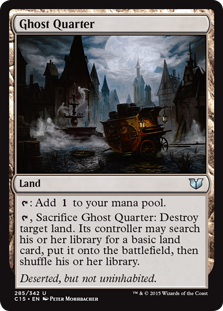
And they said Wasteland wasn't Modern legal! Ghost Quarter has been a poor man's Wasteland replacement for years, but with the recent rise of RG Tron, Bx Eldrazi, and other big-mana strategies, the Dissension uncommon is quickly emerging as a major police card in a format notoriously lacking the generic hate of Legacy. Nowhere was this more apparent than at the StarCityGames Open in Charlotte over the weekend. En route to his undefeated Day 1 performance, along with his Top 8 run, Josh Cho packed four of the lands into his BW Tokens maindeck. We also saw a Quarter as a singleton in the winning Jund list, as a pair in Cody Minnix's 6th place Abzan build, and as a one-of bullet in Todd Stevens' Naya Company 60. Quarter is no Wasteland, but it's doing everything in its power to make a good imitation of the Legacy staple.

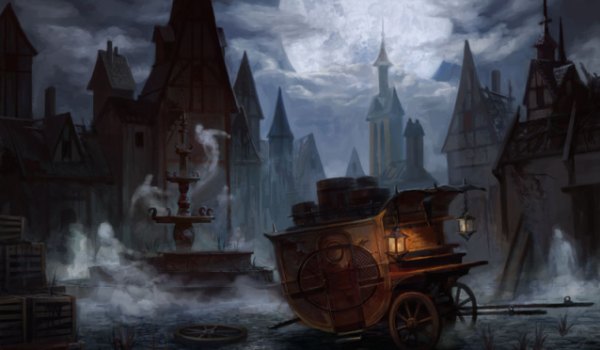
Ghost Quarter Art

We have a major pair of banlist pieces publishing tomorrow and Wednesday, leading with the Amulet Bloom piece I've been promising for weeks and following with a general prediction article. Our plan is still to roll out some more entertaining and fun Modern-themed content next Monday (not that Ghost Quarter isn't a deserted wagon full of laughs), so today's piece is going to be on the shorter side. We'll look at Ghost Quarter's general utility in Modern, how to best use it, and some representative lists that successfully wielded the land. For some of you, Ghost Quarter's profile will come as no surprise. For others, you've been looking for a big-mana-buster for weeks and Quarter might be the card for you. Either way, Modern is moving towards these decks and cards that hate them out, and Quarter is an important piece of that narrative.

[wp_ad_camp_1]

Lining Up Targets

Although it's tempting to frame Ghost Quarter's relevance solely as a newfound development in response to big-mana decks, this undersells much of the card's utility. Quarter explodes key targets in a surprising array of matchups, whether it's ramp engines in RG Tron, midrange finishers in BGx, or aggro clocks in Affinity and Infect. Take our December metagame update as an example. Looking at Tier 1 decks alone, Quarter hits relevant lands in every matchup except Burn. That's the kind of multi-matchup relevance normally reserved for Spellskite and Inquisition of Kozilek, which should already pique our interest.

Ghost QuarterHere's a quick rundown of key Tier 1 targets Quarter can mow down:

  • Affinity: Inkmoth Nexus and Blinkmoth Nexus
  • RG Tron: Urza's Tower, Urza's Mine, Urza's Power Plant, and Eye of Ugin
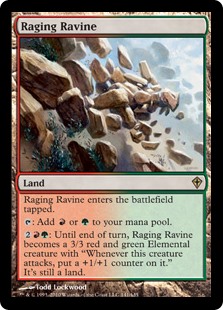
  • Jund: Raging Ravine
  • URx Twin: Desolate Lighthouse and Cavern of Souls
  • Abzan: Stirring Wildwood and Shambling Vent
  • Amulet Bloom: Most of the deck (just don't hit the wrong card at the wrong time like 80% of people on camera...)

Now let's add to that some Tier 2 victims:

  • Infect: Inkmoth Nexus and Pendelhaven
  • Merfolk: Mutavault and Cavern of Souls
  • Scapeshift: Early Valakut, the Molten Pinnacle drops
  • Abzan Company: Gavony Township
  • Naya Company: Stirring Wildwood and Kessig Wolf Run
  • Bx Eldrazi: Eldrazi Temple, Eye of Ugin, and Urborg, Tomb of Yawgmoth
  • Jeskai Twin: Celestial Colonnade

These specific targets are on top of the random mana screw Ghost Quarter can wreak on a fragile land setup. Timely Quarters can cut off the major three-colored decks from one of their colors, which is something we saw a few times (notably in Cho's BW Tokens matches) throughout the weekend in Charlotte.

This combination of general utility and matchup-specific relevance make Quarter one of Modern's strongest bullets. Lands tend to be unusually resilient in this format. It's no coincidence that BGx grindfests are often decided on manland immunity to Lightning Bolt and Abrupt Decay. Remember how many times we saw Raging RavineRaging Ravine put in work all weekend? Or how many times Twitch chat erupted into a chorus of "ATTACK WITH RAVINE"? Manlands win games, and the Charlotte Open was a testament both to their strength and the importance of answering them. These durable clocks were also a major contributor to Jeskai Twin's success at Grand Prix Pittsburgh, where Colonnade dramatically improved the BGx contest. By a similar token, many decks struggle against the Nexus fliers in Affinity and Infect, which lie dormant until the coast is clear before ending the game in a single hit. Or chiseling away with Signal Pest to close a match over a few turns. Either way, Ghost Quarter gives you an out that other decks might not normally have access to.

Of course, no Ghost Quarter discussion would be complete without mentioning the main reasons for running Modern Strip Mine: big-mana ramp. Interacting with RG Tron and Bx Eldrazi spells is often a losing proposition. Blight Herder still resolves Eye of Ugina Hordeling Outburst if countered or killed. Turn four Ugin, the Spirit Dragon seals the game even cast turn four after a mulligan to five, something we experienced at least twice over the Charlotte weekend. Interacting with those kinds of cards after they hit the battlefield is generally unprofitable. Blowing up their enabling lands, however, is a much more effective attack angle. Just be sure to pair your disruption with pressure! Both Tron and Eldrazi have ample ways to draw or search into more lands: the latter can even cast their spells naturally as early as the mid-game. Add in a clock, however, and Ghost Quarter becomes an effective Strip Mine that should dash an opponent's chances on the spot.

Finding Quarter a Home

Modern has plenty of decks which can fit Ghost Quarter, and plenty more under-explored synergies which might find new relevance in 2016 (who doesn't want to live the Crucible of Worlds dream?). Ignoring the defensive uses of this card, notably Tron's self-Quartering to dodge Crumble to Dust, there are generally three ways you'll see Quarter in Modern. You can certainly innovate outside these lines, but most Ghost Quarter decks will fit into these categories.

Quarter's most common application is as a 1-2 copy inclusion in a 24+ land deck that doesn't have intentional Quarter synergies. Jund and Abzan are the most obvious representatives here, although we've also seen Kiki Chord, Naya Company (more intentional with Knight of the Reliquary), Grixis, and other decks leverage this strategy. Here's the highest-finishing Abzan list from Charlotte to show this setup.

Abzan, by Cody Minnix (6th, SCG Open Charlotte, 1/9/2016)

Creatures

3 Siege Rhino
2 Kitchen Finks
2 Scavenging Ooze
4 Tarmogoyf
2 Tasigur, the Golden Fang

Instants

4 Abrupt Decay
4 Path to Exile

Planeswalkers

4 Liliana of the Veil

Sorceries

3 Inquisition of Kozilek
4 Lingering Souls
1 Maelstrom Pulse
3 Thoughtseize

Lands

1 Forest
1 Plains
2 Swamp
2 Ghost Quarter
1 Godless Shrine
1 Horizon Canopy
4 Marsh Flats
2 Overgrown Tomb
2 Shambling Vent
1 Stirring Wildwood
1 Temple Garden
1 Twilight Mire
4 Verdant Catacombs
1 Windswept Heath

Sideboard

2 Engineered Explosives
4 Fulminator Mage
2 Kitchen Finks
2 Stony Silence
2 Surgical Extraction
1 Sorin, Solemn Visitor
1 Damnation
1 Duress

In Minnix's setup, Quarter is just a metagame call dropped into a utility land slot. In another tournament, we might see those Quarters become Gavony Township, Vault of the Archangel, and/or additional manlands. Given the environment Minnix likely expected at Charlotte, however, Quarter was the more appropriate choice. You can follow this example in your own decks, ditching the more common manabase inclusions for a more contextual Quarter singleton or pair.

The second place we tend to see Quarter is alongside synergies that make it better. Death and Taxes, along with Hatebears, are the two major representatives in this category. Word for the wise: the main difference between these two decks is Flickerwisp, along with the presence or dearth of "When ___ enters the battlefield" effects. Both lists pair Quarter with haters like Leonin Arbiter and Aven Mindcensor to turn a virtual Strip Mine into an actual one. Here's Craig Wescoe's GW Hatebears build from his exciting Top 4 finish at Grand Prix Pittsburgh.

GW Hatebears, by Craig Wescoe (Top 4, Grand Prix Pittsburgh 11/21/2015)

Creatures

2 Aven Mindcensor
1 Brimaz, King of Oreskos
4 Leonin Arbiter
1 Linvala, Keeper of Silence
4 Loxodon Smiter
4 Noble Hierarch
2 Qasali Pridemage
3 Scavenging Ooze
2 Thalia, Guardian of Thraben
4 Voice of Resurgence
3 Wilt-Leaf Liege

Artifacts

4 Aether Vial

Instants

4 Path to Exile

Lands

1 Forest
4 Ghost Quarter
4 Horizon Canopy
1 Plains
4 Razorverge Thicket
2 Stirring Wildwood
2 Tectonic Edge
4 Temple Garden

Sideboard

2 Burrenton Forge-Tender
1 Choke
2 Dismember
1 Gaddock Teeg
2 Kor Firewalker
1 Sigarda, Host of Herons
2 Spellskite
4 Stony Silence

To some extent, this entire deck is a metagame call much like the 1-2 Ghost Quarters are themselves metagame calls in Jund or Abzan. That said, Hatebears and Death and Taxes are much better decks than they are often given credit, with plenty of context-specific power in cards like Quarter, Wilt-Leaf Liege, and Voice of Resurgence, as well as blanket hate in Path to Exile, Leonin Arbiter (fetchlands are just so ubiquitous), and Scavenging Ooze. These kinds of decks get much better when you play them to target subsets of the metagame, as Craig did at Pittsburgh, and Quarters are a huge part of that advantage.

Ghost Quarter's final home, and one we see less frequently, is in a mono or two-colored decks that can afford to jam in a Legacy-style, Wasteland-homage playset because the colorless mana doesn't affect their gameplan. Josh Cho's neat BW Tokens list is a perfect example of this, going all-in on Quarters because he has the curve and mana symbols to support them, and because they are sweet metagame calls in a Tron-packed format.

BW Tokens, by Josh Cho (5th, SCG Open Charlotte 1/9/2016)

Creatures

3 Auriok Champion

Enchantments

4 Intangible Virtue
4 Bitterblossom

Instants

1 Murderous Cut
4 Path to Exile
1 Slaughter Pact

Sorceries

4 Inquisition of Kozilek
4 Lingering Souls
2 Spectral Procession
2 Thoughtseize
2 Timely Reinforcements

Lands

3 Plains
1 Swamp
3 Arid Mesa
2 Fetid Heath
4 Ghost Quarter
2 Godless Shrine
4 Marsh Flats
2 Shambling Vent
1 Vault of the Archangel
1 Windbrisk Heights
3 Flagstones of Trokair

Sideboard

3 Fulminator Mage
2 Rest in Peace
3 Stony Silence
1 Worship
1 Disenchant
2 Surgical Extraction
1 Kataki, War's Wage
2 Duress

Cho's list highlights a few important prerequisites before you jam Ghost Quarter playsets into everything you build. For one, Cho is also playing the 24+ land manabase, just as we saw in the Jund and Abzan representatives rocking the Quarters. This ensure you can play one-drops like Thoughtseize, Inquisition, and Path while not worrying about missing a turn one play due to a bad draw. Second, BW Tokens has plenty of ways to capitalize on Quartered lands with all its flying clocks. Many are also ghosts, so bonus Vorthos points to Cho! Durdling after a Quarter often backfires as most opponents can still benefit from the fetched basic land to do something else. Finally, Cho doesn't assume Quarter alone will get the job done. He adds three Fulminator Mages out of the board, ensuring land destruction effects come online in those first three turns in matchups where it matters most.

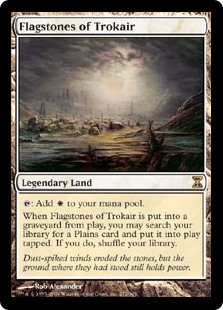
Flagstones of TrokairThese three lists are great starting points as you figure out more ways to incorporate Quarters into your own decks. And if you can find tricky ways to Quarter, like nuking your own Flagstones of Trokair to get access to black mana for Duress at a critical moment, shoot me an email and I'll give you a shoutout in the next article on this awesome land.

Overall, I want to see more Ghost Quarters in Modern. This card deserves to enter the police-card annals along with Decay, Thoughtseize, Bolt, and others as a primary format regulator, and I expect more players to abuse its strengths in the new year. How else do you want to see Quarter used? Where else is the card at its best? What are some dangers in using it? I'll be responding in the comments and I'll see you all tomorrow when we dive into bans, the 18th announcement, and the cards likely to get the axe.

Brewing with OGW- Eldrazi Ramp

Are you a Quiet Speculation member?

If not, now is a perfect time to join up! Our powerful tools, breaking-news analysis, and exclusive Discord channel will make sure you stay up to date and ahead of the curve.

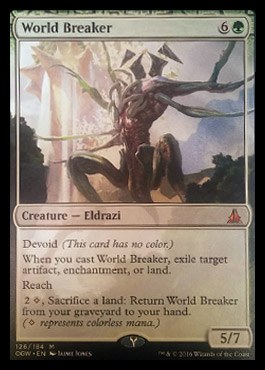
Throughout our spoiler coverage of Oath of the Gatewatch I have been focused on the future of Eldrazi Ramp. The deck is solid as it exists, but it's clearly missing something. When World Breaker was spoiled I identified it as potentially being a piece of the puzzle. With the full spoiler up, I believe the tools for this deck to succeed are indeed available, and it all hinges on this card:

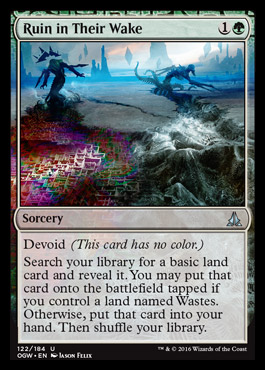
ruinintheirwake

If you showed this card to somebody who doesn't play the current Standard format, they would laugh at how terrible this card looks. They made Rampant Growth worse, and they made it uncommon. Given the context of following Standard, it still took me a minute to consider the play-ability of this one. The current ramp in Standard simply does not compare to the power of Rampant Growth, but there's a ramp deck that has seen fringe success. Given those terms, maybe jumping through some hoops could yield significant payoffs.

The Eldrazi Ramp decks already play 8 colorless sources in Shrine of the Forsaken Gods and Sanctum of Ugin. Cutting any of these seems ill-advised, and adding too many additional colorless sources clearly leads to mana issues. Luckily, Wastes can be found with Evolving Wilds. It's possible that you're able to afford playing more than one Wastes, though initially I like starting on one. I think the risk of playing Ruin in Their Wake as a bad Sylvan Scrying is easier to brush off than not playing enough colored sources and/or too many lands. This is my current list for the deck:

Elrazi Ramp

Creatures

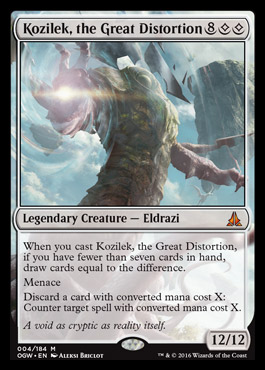
1 Kozilek, the Great Distortion
2 Ulamog, the Ceaseless Hunger
4 World Breaker
4 Hangarback Walker

Spells

4 Map the Wastes
2 Nissa's Pilgrimage
4 Explosive Vegetation
4 Ruin in Their Wake
3 Kozilek's Return
4 Ugin, the Spirit Dragon
2 Hedron Archive

Lands

1 Mountain
4 Sanctum of Ugin
4 Wooded Foothills
8 Forest
4 Evolving Wilds
1 Wastes
4 Shrine of the Forsaken Gods

The ideal start is to play Evolving Wilds finding what you're missing between Forest and Wastes on turn one, ramping to three with Ruin in their Wake on turn two, ramping to six with Explosive Vegetation or Hedron Archive on three, and then playing either World Breaker or a Shrine of the Forsaken Gods powered Ugin on four. This potential is well worth exploring the number of Wastes that you can fit in the deck.

On the other side of things, the deck still has decent play even if things don't line up perfectly. That chain is only pushed off a turn if you have to play Map the Wastes as your first ramp spell, and Hangarback Walker is good at buying time.

I know that you want to maindeck some number of Kozilek's Return, though it's unclear how many you want. It's great against Atarka Red, but relies on being "flashed back" to matter too much against most other decks. I believe the correct number is two, three, or four, though grinding it out is the only way to be sure.

Kozilek's Return is already pre-ordering for quite a bit, and I don't think pre-ordering it will yield significant profits. World Breaker, on the other hand, is pre-ordering for $2-$3, and could easily jump to $10 or more if a deck like this is successful. Brad Nelson spoke highly of the card in his most recent Premium article, and his list for Ramp also features four copies, and this was before Ruin in Their Wake was spoiled. I like the idea of pre-ordering at least a set.

Insider: Investing Around Modern Banlist Update Scenarios

Are you a Quiet Speculation member?

If not, now is a perfect time to join up! Our powerful tools, breaking-news analysis, and exclusive Discord channel will make sure you stay up to date and ahead of the curve.

T minus six days until banlist launch! Love it, hate it, or just want the discussion to stop, you can't deny the potential impact of the upcoming announcement.

From a metagame perspective, we are unlikely to see the kind of shakeup witnessed a year ago. The Birthing Pod and delve bans upended Modern as we knew it. Most of the ban scenarios this time around will only have a modest effect on the format's top decks, barring any crazy changes.

Possible Update Scenarios on the 18th

From a policy perspective, however, the update is a major precedent setter. It will confirm or challenge our understanding of the turn four rule. It will determine how Wizards views Tier 1 regulars like URx Twin. It will also show how Wizards unbans cards in relatively stable metagames, which could range from a limited unbanning to a major upheaval.

As someone who tries to stay in dialogue with evidence and historical examples, I expect January 18 to set the tone for many updates to come.

We've got six days until the update, but if last year is any indication, Wizards has already made their decision. Now it's time to figure out what changes they have in store.

In today's article, I'll go over a few ban and unban scenarios, and how you can position your money and cards to profit from those possibilities. A lot of speculation has already happened surrounding the impending update, but there are still underappreciated targets to pick up.

Ban Scenarios

Some of this is going to be a review of my Modern predictions article from last week. I've seen enough people online who are totally off-base on their ban rationale that it's worth going over again.

To be clear, it's entirely possible Wizards doesn't follow my line of thought on bannings! That said, there is a substantial body of evidence out there which I try to stay in conversation with, something many other banlist opinions ignore. So although the 18th might not go down as predicted, I argue this is the most probable set of scenarios based on the data we have.

An Amulet Bloom Banning

Let's start with the Primeval Titan in the room: it is extremely likely something from Amulet Bloom eats a ban. Since Pro Tour Philadelphia, Wizards has consistently enforced the turn four rule, a foundational banlist criterion that is frequently mentioned and seldom understood.

As I explain in a Modern Nexus article on the turn four rule, there's more to the guideline than decks just winning too frequently before turn four. Decks must both consistently win before turn four and be top-tier. We saw this most clearly in the Seething Song banning, not to mention countless articulations of the policy on Wizards' website.

Like U/R Storm and its Epic Experiment variant, Amulet Bloom has now solidified its status as violator of the turn four rule. It is time for Wizards to act.

The Amulet Bloom Monster

I'll discuss this more in a Modern Nexus article publishing tomorrow, but here's a general overview of where Bloom crosses the line.

To start, Amulet Bloom is unquestionably top-tier both by objective tiering standards and, more importantly, by the same standards used to peg U/R Storm as top-tier in 2013. When Song got axed, Storm was about 4%-5% of the paper metagame, had just over 11% of MTGO Modern, and took a single Top 8 plus four 18+ point finishes at Grand Prix Lyon and Pro Tour Return to Ravnica respectively.

There was an error retrieving a chart for Seething Song

Today, Bloom has fluctuated between 3% and 7% of the paper metagame all year long, although it's averaged in the 4%-5% range for the latter part of 2015. On this count, it's evenly matched with Storm. Unlike Storm, Bloom was not the second most played MTGO deck during the last months of its run, but it did secure a 6% share to take fourth place.

Those metrics alone might make Bloom somewhat less offensive than Storm, but once we factor in Grand Prix, Pro Tour, and Star City Games Open performances, Bloom emerges in a league of its own.

As compared to Storm's paltry finishes at those tournaments, Amulet Bloom took Top 8 at a Pro Tour and two Grand Prix events. That's in addition to three Grand Prix Top 16s (two at ninth place), an SCG Invitational Top 8, and another pair of Top 8s at SCG Opens. Add Bobby Fortanely's win at Cincinnati to the mix, and it's impossible to deny Bloom's top-tier status.

As for Amulet Bloom's consistency, I'll publish the full stats in my Nexus article, but for now I will say that Bloom's pre-turn-four win-rate is right in the Storm range. In a bootstrapped sample of about 30 games, I calculated a Storm turn 2-3 win-rate at around 24%-25%. Amulet Bloom, in a similar sample analyzed with similar methods, was at 22%-23%.

All this suggests Amulet Bloom qualifies on all the same banning metrics as U/R Storm, and will likely receive the same treatment next Monday.

This also ignores the mountain of qualitative and anecdotal evidence against the deck (read: an entire salt mine throughout reddit, articles, coverage streams, and game stores across the world). Those factors alone might be damning, but the quantitative data really pushes it over the edge.

Of course, that leaves us with the more pressing question: what might get banned?

Summer Bloom Banned

Based on the Seething Song example, Summer Bloom appears to be the ideal ban target. Like Song, Bloom is effectively a ritual that accelerates the deck three lands (and potentially six mana). Also like Song, Bloom is a card unique to its combo deck that can be removed without utterly destroying the strategy's core identity or engine.

There was an error retrieving a chart for Summer Bloom

We saw a similar ban aimed at 2011 U/R Storm when Rite of Flame took the DCI hammer in an effort to tone down combo strategies. Like Rite and Song, Bloom has worse replacements available in Explore, Journey of Discovery, and additional Azusa, Lost but Seeking copies. All of this suggests this is a likely ban if Wizards doesn't want to totally gut the deck.

Could Amulet Bloom Titan recover from a Summer Bloom ban? My guess is yes. The deck would drop down to Tier 3 and remain a fringe metagame pick, like how U/R Storm occasionally pops up at random events. It would be a worse deck but it would survive in a hamstrung form.

Amulet of Vigor Banned

Then again, maybe Wizards does want Amulet Bloom gone for good. If so, Amulet of Vigor is the card to go. This would be similar to the 2011 Blazing Shoal ban, where a card is deemed so offensive that the entire underlying strategy is yanked out of Modern. Infect critters survived Shoal's banning, but the blue-focused, countermagic-heavy Shoal variant was gone for good.

There was an error retrieving a chart for Amulet of Vigor

I personally don't think there's enough evidence to destroy Amulet Bloom with an artifact ban, but I also don't have all the stats Wizards has access to. Maybe the holistic MTGO picture is much worse than I've estimated. If so, Amulet is exactly what Wizards will go after to slash the deck off the face of the map.

An Amulet banning would naturally be a disaster for the deck. The effect is irreplaceable and without it, Bloom starts to feel like a worse Tron. With the loss of Titan shenanigans, I expect this ban would kill the deck completely given the current cardpool.

Unlikely Ban Scenarios

Looking to Amulet Bloom itself, few other cards stand out as possible ban targets. A Primeval Titan ban would hurt the deck, but would also destroy the Titan Scapeshift lists that have enjoyed MTGO success and a Grand Prix Top 8 run. That would also stop the Summoning Trap/Through the Breach ramp hybrids we've seen for years. Based on past examples, such a ban seems too broad and thus not very probable.

There was an error retrieving a chart for Primeval Titan

Hive Mind is another possibility. It's definitely the least interactive and most un-fun part of the deck, but it also doesn't address the core issue with Amulet Bloom, which is fast ramp. Wizards banned rituals from Storm, not Grapeshot or Empty the Warrens, so it seems more likely the deck's virtual "rituals" will take the fall.

Financial Action Steps

If you haven't sold off your Amulet Bloom staples, there's a good chance it's too late to do so. The good news is that many should hold value even after a possible ban. Azusa, Lost but Seeking is still a Commander powerhouse, and with ramp gaining Modern relevance by the week, we should see her retain stock in our format. The same goes for Primeval Titan, which remains a ramp monster.

Generally speaking, if you have an Amulet Bloom card that is in at least one other Tier 1 or Tier 2 deck (e.g. Ancient Stirrings, Serum Visions, Cavern of Souls, etc.), you'll want to hold onto copies.

Bloom Cards to Keep

If the deck does take the ban, it's time to move in on the inevitable crash. Hive Mind is unlikely to recoup value after a ban, but Summoner's Pact will be low enough to justify investment. The same goes for Gemstone Mine, which is only in the $8-$10 range but is likely to go lower after Bloom's possible demise.

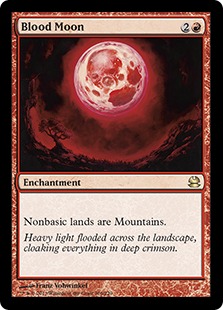
The other place to pick up post-banning value is in metagame shifts. Jund gets better after Bloom dies off, although this will be tempered by rising B/x Eldrazi decks and the continued Tron presence in Tier 1. More importantly, Blood Moon starts to get a lot worse once Amulet Bloom is out of the picture. If we've learned anything from 2015 its that Moon has a very high ceiling. If the card drops in the months following January, move in quickly.

There was an error retrieving a chart for Blood Moon

Finally, you'll want to think about where Bloom players will migrate after any bannings. Good bets include Ad Nauseam combo, which uses pacts and dig and fits elements of Bloom's playstyle, as well as B/x Eldrazi and R/G Tron. The latter two are major ramp players and Bloom mages might still want the rush of going over the top.

With the exception of Ad Nauseam, which remains a decent investment, those other ramp decks have nowhere to go but up, so anything you can snag before the migration will be worth the expense.

Unban Scenarios

I'm feeling confident about my banning predictions. There's just so much evidence and not a lot of alternate interpretations of the numbers. Not so with unbans.

Wizards has been notoriously stingy and unpredictable with its unbannings. We got Valakut, the Molten Pinnacle right before a 2012 Pro Tour, and then no unbans at all to soften the Bloodbraid Elf and Seething Song bans less than six months later. Wizards killed Deathrite Shaman in 2014 and gave us an awesome Wild Nacatl/Bitterblossom consolation. Then we lose format-pillar Birthing Pod and two defining sorceries, but just get lowly Golgari Grave-Troll in exchange.

Modern Unbanning History

This is a very conservative pattern. Wizards does not want to unban cards that can disrupt Modern's careful (some may say, tenuous) equilibrium. For instance, you don't ban Pod and then unban something wacky to take its place. You need to see what a post-Pod format looks like before you do anything else. We've also seen numerous announcements with "No Changes" during the year, although it is important to note these updates weren't before a Pro Tour.

Based on this history of conservatism, but acknowledging possible new developments, I expect we'll see two unban scenarios.

Sword of the Meek Unbanned

We've seen a 2016 packed with linear, damage-based aggro. This includes Affinity, Burn, Burn Zoo, Gruul Zoo, Naya Company, and all the Burn/Zoo hybrids I've forgotten to mention in between. Meanwhile, we saw a brief 2-3 month run by the innovative Grixis Control before even the most dedicated Grixis mages ditched their reactive Cryptic Commands for a more midrangey approach.

Given the relative failing of blue-based control and the relative success of damage-based aggro, Sword of the Meek seems like a safe unban that addresses multiple issues at once.

There was an error retrieving a chart for Sword of the Meek

In addition to these metagame factors supporting a Sword unban, many of the initial reasons for Sword's banning may no longer be valid. The Thopter Foundry combo was oppressive in a world without Abrupt Decay and Kolaghan's Command, two huge safety valves against possible Sword dominance. Aggro also has far more tools against the Sword than it did in old Extended.

All of this suggests Sword is the kind of limited-ends unban that would strike back against aggro (while not crushing it) and also empower underrepresented blue-based control (while not pushing it over the top).

Stoneforge Mystic Unbanned

Whaaaat? I know what you're thinking: a Grand Prix promo announcement alone isn't enough evidence to suggest a Stoneforge Mystic unban. I've already spoken about Mystic's unban chances, but it's time to revisit her with the update right around the corner.

There was an error retrieving a chart for Stoneforge Mystic

After seeing the format evolve over 2015 and some recent playtesting with Affinity vs. Stoneforge Abzan, I think Mystic is a safer unban than many give it credit for. To start, the kor directly powers up lagging white strategies: except for Abzan, white is not where you want to be in Modern and has never been Tier 1 throughout 2015. Mystic enhances Jeskai Midrange, Jeskai Delver, Hatebears, and Death and Taxes decks, potentially improving their Modern odds.

I also think Modern has enough police cards and strategies to handle the artificer. Between the omnipresent Lightning Bolt, combo decks that ignore Mystic, and aggro decks that can race her, Modern isn't in a bad place for accommodating her power level.

Of course, there are still some worries. Abzan remains a major player and is already surpassing Jund in the December and January period. Perhaps more worryingly, the theoretical "Twin Blade" deck might be a real monster, pushing the already powerful URx Twin strategy over the top.

Those dangers acknowledged, I still don't understand why Mystic would be our 2016 Grand Prix promo if it weren't about to get a Modern release. Could Wizards be setting a new precedent by doing so? Perhaps. Maybe they unban the Mystic this year as a way to increase stock in advance of a 2017 unbanning. But coupled with metagame factors and the surprising safety of Mystic in early tests, I don't think her reintroduction is impossible.

Unlikely Unban Scenarios

There has been a big movement towards Bloodbraid Elf's release from banlist purgatory, but I don't think we see it this time around. Jund just got both Tasigur, the Golden Fang and Kolaghan's Command this year alone. Even if Abzan gained Mystic, I expect Wizards would want to throttle the flow of powerful cards into Modern to keep a better sense as to what is gamebreaking and what is not.

I do believe Elf is fair enough for Modern and that she will eventually return to the Jund legions. I just don't think it will happen now, given the back-and-forth play between Jund and Abzan throughout the year. BGx has been a problem before and Wizards will be cautious with it in the future.

There was an error retrieving a chart for Bloodbraid Elf

Ancestral Vision is another option that I considered almost as likely as Sword. I'm doubling down on Sword just because my own tests with URx Vision Twin brought up some concerns.

I'm uncomfortable vouching for cards I haven't tested rigorously, and I think this might reflect Wizards' own conservative approach to such a card. The same goes for many other staples like Jace, the Mind Sculptor and Green Sun's Zenith.

Financial Action Steps

Test first, speculate later. Apart from its obvious synergies like Thopter Foundry, Sword opens up a range of strategies we need to investigate in order to separate the good from the bad. I've been really enjoying the combo in a Jeskai Control shell, giving a proactive Plan B to the reactive Plan A that characterizes the typical Jeskai deck.

From an investment perspective, this might not open up specific cards like Thirst for Knowledge, but it would raise the stock of any strategy staples in decks using Thopter Sword. Something like Snapcaster Mage will go nuts if a Tiago deck adopts the combo.

There was an error retrieving a chart for Snapcaster Mage

A Stoneforge unbanning opens up the entire world of Modern investment opportunities. Playing white? Your deck might benefit from Mystic. I'd keep an eye on Death and Taxes and Hatebears, two decks with excellent metagame positioning in a ramp and Affinity-heavy environment. Aether Vial looks pricey now, but wait and see that card's value if these two white-based decks see breakouts after a Mystic unbanning.

Changing Format Landscapes

Join me next week when I break down the financial implications of our banlist update. Whether you're looking for short-term gains or long-term value, the banlist is sure to make big waves in Modern and I'm excited to see where the chips fall on Monday.

I'll be unsurprised if Mystic stays on the list, but her unbanning would be the biggest change in Modern since the format's birth, and it would mark a crazy start to 2016.

What other banlist scenarios or questions do you have about Modern? Any other financial prospects I've missed or given insufficient credit? Let me know in the comments and I'll see you all in a week!


Insider: Mastering PucaTrade – An Introduction

Are you a Quiet Speculation member?

If not, now is a perfect time to join up! Our powerful tools, breaking-news analysis, and exclusive Discord channel will make sure you stay up to date and ahead of the curve.

Hello! This is Steve Horton. I'm a marketing manager by trade, write comics professionally, and play a lot of Magic. Today kicks off a series I'll be writing for Insiders on mastering PucaTrade.

I've been using PucaTrade effectively since it started, and I've learned a few things about how to maximize value with this revolutionary trading service. Over the course of the series, I'll explain how to rid yourself of what you don't want, gain what you do want, and increase the value of your collection in the process.

A New Way to Trade

pucatrade_banner500w In the Stone Ages, in order to trade Magic cards through the mail, there had to be a certain level of trust involved. A few sites tried to facilitate this with reputation management, to varying degrees of success.

There would always be cases, though, where one person would get their cards, and the other wouldn't, or there'd be a dispute over condition, or printed language, or version. It became such a huge hassle that trading mostly remained a local phenomenon, or players simply gave up and bought the singles they needed.

Enter PucaTrade. (Note: This first link is affiliate-free, but all further Puca links will have the author's affiliate link attached.) This tool has been around for a couple years, but it only recently exploded in popularity, having processed its three-millionth confirmed trade. PucaTrade works on an asynchronous point system. That sounds like a mouthful, but here's a simply-worded explanation for how it works.

PucaTrade Step by Step

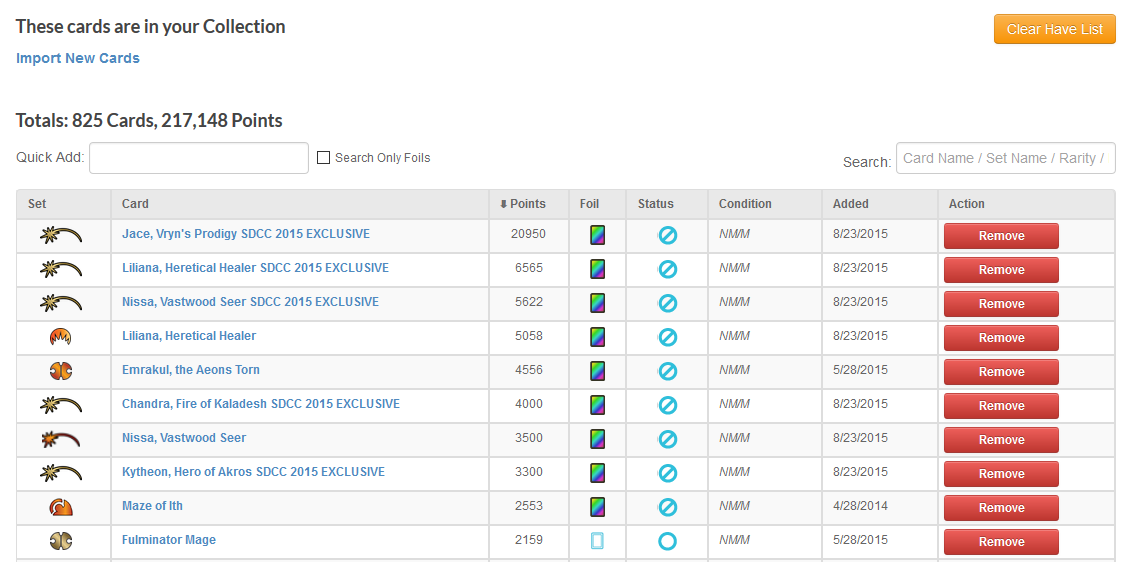
  • You post the cards you have for trade under Haves, and cards you want in trade under Wants. Each has a point value that PucaTrade's system determines based on average sale prices. This value fluctuates frequently as cards rise and fall in value. Cards must be Near Mint or better.

Screenshot 2015-12-30 16.52.54

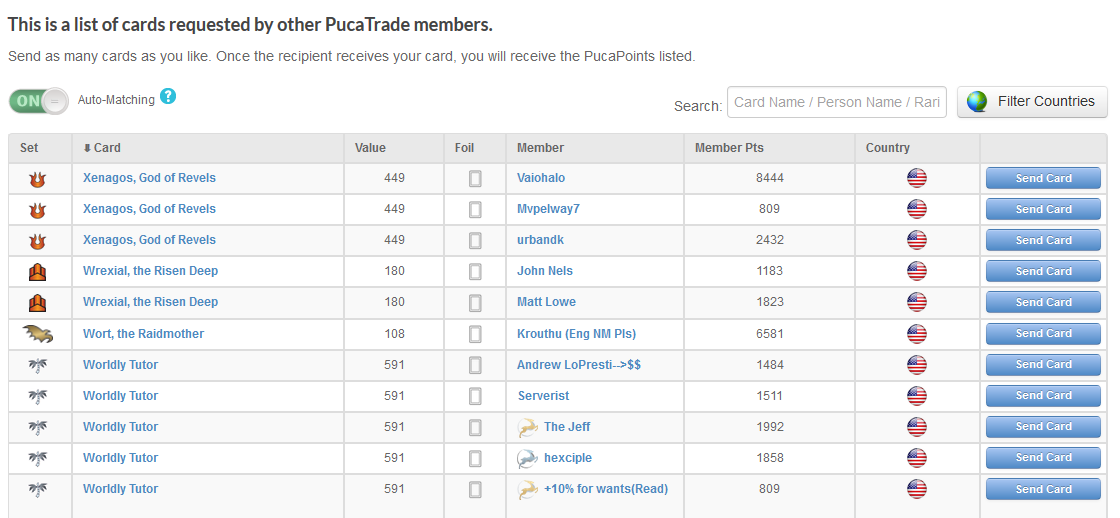
  • You look through cards that people want that you've listed in Haves. Look under the Send a Card screen and click Auto-Matching.

Screenshot 2015-12-30 16.56.58

  • You approve a trade with someone. The point value is locked in at that time until the trade is completed.
  • You send that person a card. (Be sure it's packed securely in a sleeve inside a taped toploader, inside an envelope. One stamp will do unless you're sending more than two toploaders' worth of cards. You must send within two days of approving a trade.)
  • When that player receives the card and is satisfied, they mark the trade as complete and you gain the appropriate PucaPoints.
  • Now that you have points, the cards you want will quickly be approved by quick-thinking PucaTraders, and your points will drain out of your account.
  • Once you receive the card you're looking for and approve the trade, the sender will receive those points. Then, the process starts all over again as you send and receive more cards.

Disputes and the PucaTrade Sweet Spot

Disputes are handled user-to-user unless one person is unsatisfied, at which point PucaTrade admins step in to resolve the dispute. If you accidentally agree to send a card that you don't actually have, you have a short window to cancel the trade; if you wait too long, you have to contact the admins to fix it. Admin intervention used to take more than a week, but times have been shortening even as the user base grows.

Keep in mind that everyone wants to unload popular Standard cards, so the odds of moving a Standard card that's not on the level of a fetchland or Jace, Vryn's Prodigy are slim. On the flipside, any card that's extremely in demand without a lot of supply will disappear from the Send a Card list in a matter of seconds, so you have to be vigilant and lucky to send out one of those cards.

The sweet spot seems to be high-value cards that are somewhat difficult to come by, such as a specific promo foil or Legacy card. If you've got one of those cards and don't want it anymore, odds are you'll be able to ship it and get maximum value.

Silver and Gold PucaTrade Levels

Normally, PucaTrade has no fees at all. For $5 or $10 per month (less if you pay for a year upfront), you get the Silver or Gold level, which allows you to trade foils, gift PucaPoints, and, under the Gold level, track the valuation of a card over time, among numerous other features seen below. You'll also get a one-time PucaPoint reward just for joining.

Screenshot 2015-12-30 17.00.46

Those are the basics of PucaTrade. It has revolutionized Magic trading and made it amazing and fun---and also made going out to the mailbox unusually thrilling.

The brains behind PucaTrade recently ran a successful Kickstarter for a revamp of the system, which will include things like foreign cards, less than near-mint cards, and a feature that's hotly anticipated: trading between paper Magic and MTGO. Look for these features to roll out throughout 2016 and beyond.

Last-Minute PucaTrade Tips

I’ll end with a few basic PucaTrade tips:

  1. Send multiple cards to the same person at the same time for the lowest postage expense and the highest point gain. This is the best way to trade away small-value cards: include them as part of the same package to the same player buying a high-value card, given that the player wants both.
  2. Be sure the cards you’re sending are Near Mint and English, unless the receiver’s profile page makes it explicit that foreign or less than NM cards are fine.
  3. Bounties are extra points that a user will kick in so that you pick their want over someone else’s. These are a great way to unload a big card you desperately want to get rid of and to get bonus points in return.
  4. There’s a lot of rain this time of year. To protect your shipment, put the card in the inner sleeve, put the card plus sleeve into the toploader upside down, then tape it closed. That way, any rain that gets in won’t damage the card.
  5. Use tracking for any card worth over $10-15. Puca’s admins will side with you if the tracking says the card arrived.
  6. Go find the card and have it in hand before approving a send. This is crucial. Don’t rely on your memory.
  7. Write the Trade ID# on the back of the envelope and even on the toploader, so the receiver can approve the trade easily.
  8. An International Stamp is fine for sending a few cards overseas, but keep in mind that the cards will take a long time to get there.
  9. Some PucaTraders are cooler than others. Look for wacky drawings, throw-in foils and other strangeness as you do a lot of trading. Feel free to do the same. The community has really made it fun.

In future columns, I'll explore how to get maximum value out of PucaTrade, whether you're a player with a suitcase full of cards, a brick-and-mortar storefront or a Magic dealer over the Internet. See you then, and keep on PucaTrading!

Seeing Snakes: GRx Blood Moon, Post-OGW

Are you a Quiet Speculation member?

If not, now is a perfect time to join up! Our powerful tools, breaking-news analysis, and exclusive Discord channel will make sure you stay up to date and ahead of the curve.

The Oath of the Gatewatch spoilers are upon us, and it seems like every other day Wizards reveals a Modern hopeful. Battle for Zendikar, Oath's universally panned predecessor, is even making waves in the format as Bx Eldrazi Processors continues to pick up steam. New decks don't always come from new cards, though. Modern's vast card pool often ensures the "next big thing" has been sitting in our backyard the whole time pro players complained about format staleness. It took weeks for Bx Eldrazi Processors to take form, months for someone to bring Amulet of Vigor to a real tournament, and years for Tom Ross to grasp the resilience of Phyrexian Crusader. Today, we'll reacquaint ourselves with a creature that slithered into obscurity after Brian Kibler taught us Parseltongue in 2013: Lotus Cobra.

lotus cobra art crop

I have a singular interest in disruptive aggro decks, and spend most of my Magic hours with Delvers and Blood Moons. Since Moon often shuts players out of games, Delver more obviously represents interaction. But GRx Blood Moon is highly interactive; turn two Blood Moon just happens to interact so efficiently with the format's top decks that it can seem uninteractive to onlookers. Prerequisite readings concerning the archetype:

The first article describes Abzan Moon, which uses mana dorks to follow Blood Moon with Siege Rhino. The second explores ritual effects in GRx Moon, and explains the archetype's core components. Lotus Cobra's addition brings the explosiveness of ritual decks to a stable, dork-reliant shell.

[wp_ad_camp_1]

Cobra Moon, by Jordan Boisvert

Creatures

4 Lotus Cobra
4 Noble Hierarch
4 Birds of Paradise
4 Tarmogoyf
3 Stormbreath Dragon
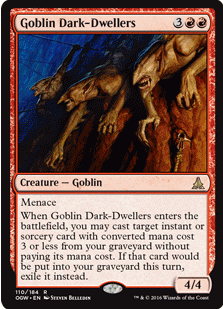
2 Goblin Dark-Dwellers

Instants

4 Lightning Bolt

Sorceries

4 Faithless Looting
4 Boom // Bust

Enchantments

4 Blood Moon
4 Oath of Nissa

Lands

4 Darksteel Citadel
4 Wooded Foothills
4 Windswept Heath
1 Misty Rainforest
2 Stomping Ground
2 Mountain
2 Forest

Sideboard

2 Ancient Grudge
2 Shatterstorm
4 Huntmaster of the Fells
2 Dismember
1 Grafdigger's Cage
2 Anger of the Gods
2 Spellskite

How to Charm a Snake

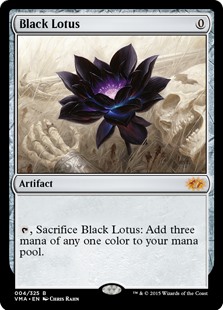
In a fetchland format, Lotus Cobra truly lives up to his name. Playing Windswept Heath, cracking it for Forest, and tapping that Forest for green nets three mana - the Snake literally turns each fetchland into Black Lotus. Except with upside, since the Forest sticks around to produce mana later. Even under a Moon, lands produce two mana when they enter the battlefield. Lotus Cobra's "hidden mode" is just being a 2/1, which utility figurehead Snapcaster Mage has taught us is far from trivial. Turning the little dude sideways every turn in lieu of a "real threat" adds up quick, especially as opponents struggle to find basics. With exalted from a Hierarch, Lotus Cobra swings like a Wild Nacatl.

Despite his apparent strength, Lotus Cobra hasn't seen much Modern play; after all, he dies to Lightning Bolt. Granted, the same can be said of many staple two-drops, including Dark Confidant, Young Pyromancer, and Jace, Vryn's Prodigy. But these cards don't require the attention to deckbuilding Lotus Cobra does. In a curve-conscious deck that bets on sticking an early Cobra, losing the Snake to a Bolt can mean some clunky turns. Losing a Confidant? No worries; Jund players live to trade cards with opponents. Pyromancer? That's one less Bolt for my Delver of Secrets. Jace? Well, that card sucked anyway.
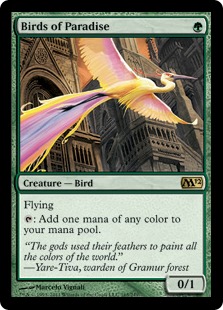
Aether Vial decks, and to an extent Birds of Paradise decks, suffer the same problem as Lotus Cobra ones - failing to stick that crucial enabler makes things pretty awkward. But opponents can't Bolt a Vial, and if they Bolt your Birds, at least you broke even on mana investment. Regardless of these limitations, I believe Cobra can flourish in a supportive shell.

Snakes Love Birds

Birds of ParadiseLotus Cobra wants us to spend a lot of mana. We also need to build in such a way that if the Cobra dies, we can still play a reasonable game of Magic. Stocking up on Birds of Paradise effects helps hit this sweet spot. Mana dorks compete with Cobra for an opponent's precious Lightning Bolts, and going turn one dork, turn two Cobra puts us dramatically ahead of anything else in Modern. Early in my testing, I won a game on turn four with the following sequence:
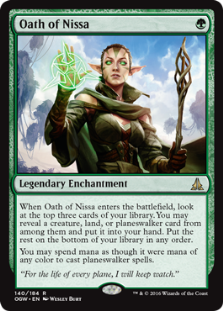
  • Turn 1: Play Forest, play Birds of Paradise.
  • Turn 2: Play Lotus Cobra, play Darksteel Citadel, Boom our opponent's land.
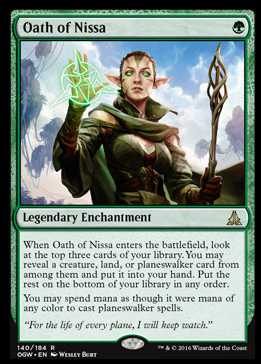
  • Turn 3: Play [tippy title="Oath of Nissa" width="330" height="330"]Oath of Nissa[/tippy] to find a creature or land. Play a fetchland, crack it, play Stormbreath Dragon, attack for six.
  • Turn 4: Play a fetchland, crack it, activate monstrosity for X damage, attack for nine.

Turn four wins aren't new to Modern. In fact, the format is built on the premise that decks either win on the fourth turn or disrupt opponents trying Lightning Boltto do so. The above scenario still breaks new ground for GRx Moon. Pre-Cobra, the deck could never secure a victory that early while simultaneously disrupting opponents and digging for pieces.
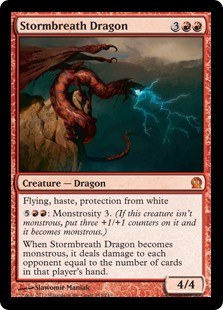
In this and similar scenarios, if our mana dork eats a Lightning Bolt, Cobra comes down on turn two to pick up the slack. If the dork survives, Cobra makes sure we have the biggest start possible: we can cast Cobra, play a fetchland and crack it, and resolve turn two Blood Moon with five mana available for turn three. Cobra also allows late-game lands to fuel monstrosity, chain Lootings, and hardcast Bust. And if opponents save their Bolt for Lotus Cobra, we're likely to have two lands and a dork on the field. That's more than halfway up our curve, which stops at five.

High Five!

My GRx Moon decks have always stopped curving at four mana. Setting a curve limit lets us maximize Faithless Looting by cycling through any mana source I find beyond my fourth. Lotus Cobra rewards us for playing lands over the course of a game, enabling us to reliably cast five-drops. It also ramps into these expensive spells on the third turn. Subsequently, the Cobra Moon curve stops at five.

Up Top!

Stormbreath DragonI loot Stormbreath Dragon away very aggressively while setting up my mana. But from turn three onwards, we can't draw a better card. Stormbreath Dragon resists Lightning Bolt, Abrupt Decay, and Path to Exile, and can't be chump-blocked by pesky Lingering Souls tokens. If the mana really abounds, we can go monstrous, which generally deals more than the Dragon himself with a Blood Moon on the table to gum up an opponent's hand.
Down Low!

[tippy title="Goblin Dark-Dwellers" width="330" height="330"]Goblin Dark Dwellers[/tippy] gives this deck a unique angle of attack. With only 12 potential targets (Boom // Bust, Lightning Bolt, and Faithless Looting), and eight that we even want to target, I capped out at two Dark-Dwellers after trying four, then three. Buying back Bolts is always a pleasure, but we don't need a Snapcaster effect to cast Looting again. The real money maker is Boom // Bust, which can be targeted by Dark-Dwellers at CMC 2 and then cast as Armageddon.

Goblin Dark DwellersMass land destruction has infamous roots in aggro decks, dating back to Tom Chanpheng's 1996 Worlds-winning White Weenie. Blowing up all the lands significantly favors the player with the most pressure on the board, since that pressure can easily "get there" as defending opponents struggle to rebuild. Aside from nuking the landscape with his effect, Dark-Dwellers contributes to whatever pressure we've already established with a respectable body. Threatening to "combo" as early as turn three, the Goblin might ask opponents to play differently by slow-rolling their lands. But in a format as curve-dependent as Modern, they rarely have that option.

Life's Simple Pleasures: Destroy Target Land

"Destroy target land" is a line of text as iconic as "Counter target spell" or "Draw three cards," but not nearly as synonymous with tournament success. From a 2002 Wizards article on Ponza, here's Brian David-Marshall succinctly summing up the goofy nostalgia many players associate with land destruction:

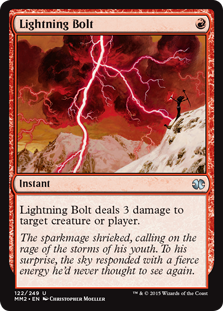
Kill their creatures and destroy their lands!… probably one of the oldest strategies in Magic. If you have been playing Magic as long as I have, then you remember the first powerful cards you had four copies of were Stone Rain and Lightning Bolt. Everyone tried to trade for four Sinkholes and if they were successful added them -- and Terror -- to the decks. Unfortunately, back in those prehistoric days we were playing 90+ cards and our decks were likely to also feature Serra Angel, Force of Nature, and Counterspell. Land destruction was good.

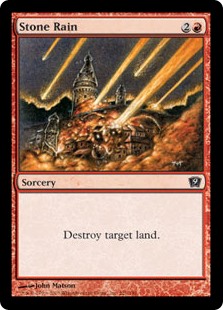
Stone RainBDM's analysis resonates with me. It's a blast to blow up lands! I love the dopey exhilaration of casting Stone Rain in Modern, or slapping Curiosity on Hooting Mandrills, or growing 8/9 Tarmogoyfs. Beyond tickling my funny bone, land destruction has always proved strategically invaluable to GRx Moon, since they deal with the "ones that got away" - basic lands opponents luckily opened or wisely fetched. I've religiously played Molten Rain and Stone Rain in my GRx Moon sideboards since I began working on the archetype some years ago, but I've sometimes pined for them in Game 1. Without a Pillage reprint, Modern has always lacked a land destruction card flexible enough to warrant mainboard inclusion.
The Turning Point

Goblin Dark-Dwellers turns Boom // Bust into a Stone Rain-now, Armageddon-later piece of versatile carnage. Between eight fetchlands and a set of Darksteel Citadel, Boom rarely inflicts friendly fire. In my other builds, hardcasting Bust was unrealistic, but Lotus Cobra provides more than enough ramp for the job.

As BDM's anecdote implies, competent Magic players tend to consider land destruction spells "bad." But the clunky sorceries are surprisingly potent in Modern, a format defined as much by speed as by greedy manabases and big-mana decks (Tron, Amulet Bloom, and now Bx Eldrazi Processors). Land destruction also pulls its weight in matchups where Blood Moon kind of sucks, like UR Twin and GR Devotion.

Goyf is Blue? Well, Ponder is Green

At least, that's what Wizards seems to think. Okay, [tippy title="Oath of Nissa" width="330" height="330"]Oath of Nissa[/tippy] isn't quite Ponder. But in some decks, it's close. Between Oath and Faithless Looting, GRx Moon gets more consistency than any non-combo deck in the format.

If You Build It, They Will Cantrip

Unlike Ponder, Nissa's Oath requires savvy (read: not tremendously lazy) deckbuilding to actually replace itself. Since it exclusively hits creatures, planeswalkers, and lands, the enchantment has a chance of whiffing. I've adjusted my sideboard to reflect this caveat, playing findable answers like Spellskite, Liliana of the Veil, and Jace, Architect of Thought over Flame Slash, Engineered Explosives, and my darling Tarfire.

Oath of NissaCantrips improve decks in two ways. For one, we can include fewer lands. Alan Comer's Turbo Xerox teaches us to remove a land for every two cantrips we run, helping us draw more business over the course of a long game. Secondly, we gain selection. In the mid- or late-game, we'd much rather draw [tippy title="Oath of Nissa" width="330" height="330"]Oath of Nissa[/tippy] than a land, since it could become a Goyf or a Stormbreath Dragon. In the early game, we're also happy to draw Oath, since it digs for land. This selection effect lets us include some cards in smaller numbers (like [tippy title="Goblin Dark-Dwellers" width="330" height="330"]Goblin Dark Dwellers[/tippy]) and see them anyway. And if Oath finds us something disagreeable, like a land in the late-game, we can still recycle that card with Faithless Looting.

Growing Goyfs and Breaking Rules

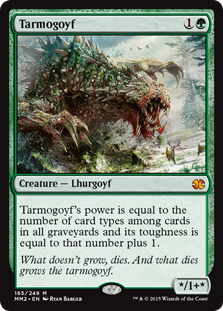
Tarmogoyf[tippy title="Oath of Nissa" width="330" height="330"]Oath of Nissa[/tippy] is a legendary enchantment with a static ability that doesn't scale. Once we've got one on the field, the rest will hit the bin as soon as they resolve. Tarmogoyf benefits greatly from enchantments entering the graveyard like sorceries; whether we can't draw Faithless Looting or simply don't feel like cycling Blood Moon, [tippy title="Oath of Nissa" width="330" height="330"]Oath of Nissa[/tippy] all but guarantees he'll have an enchantment to gnaw on eventually.

It's easy to get caught up in [tippy title="Oath of Nissa" width="330" height="330"]Oath of Nissa[/tippy]'s first ability and to completely ignore the second, which violates one of Magic's fundamental tenets: the color pie. Even under Blood Moon, Oath does a Prismatic Omen impression for planeswalkers only, allowing us to run off-color 'walkers guilt-free. Ajani Vengeant seems like the best option here, since he freezes basic lands or "recovers" with his Lightning Helix effect. Sometimes, aggro opponents get ahead of GRx Moon as we try to fix our mana or set up a play with Faithless Looting. We need our four-drops to bring us back into the game when this happens, and Helix on a planeswalker does exactly that. (So do the Huntmaster of the Fells' in the sideboard.) My favorite thing about Ajani: he's a removal spell we can find with [tippy title="Oath of Nissa" width="330" height="330"]Oath of Nissa[/tippy]! A pair tested very well initially, but I cut them to pack more mainboard mana sources. Still, it's probably worth keeping Oath's sleeper static ability in mind as the deck develops.

Snaking Right Along

Between [tippy title="Goblin Dark-Dwellers" width="330" height="330"]Goblin Dark Dwellers[/tippy] and [tippy title="Oath of Nissa" width="330" height="330"]Oath of Nissa[/tippy], GRx Moon is set to receive a lot of new toys when Oath of the Gatewatch enters Modern at the end of the month. Dark-Dwellers gives us a real incentive to play Lotus Cobra and Boom // Bust, and Oath combines with Faithless Looting to give me the high-velocity, cantrip-heavy experience I crave in Magic. As I continue tweaking, I'll keep the Modern Nexus readership updated on my progress with Cobra Moon. Until then, join me in praying the last ~60 cards of Oath house a sweet surge card for my Delver decks.

Jordan Boisvert

Jordan is Assistant Director of Content at Quiet Speculation and a longtime contributor to Modern Nexus. Best known for his innovations in Temur Delver and Colorless Eldrazi, Jordan favors highly reversible aggro-control decks and is always striving to embrace his biases when playing or brewing.

View More By Jordan Boisvert

Posted in Brewing, Modern, TechTagged , , , , 28 Comments on Seeing Snakes: GRx Blood Moon, Post-OGW

Have you joined the Quiet Speculation Discord?

If you haven't, you're leaving value on the table! Join our community of experts, enthusiasts, entertainers, and educators and enjoy exclusive podcasts, questions asked and answered, trades, sales, and everything else Discord has to offer.

Want to create content with Quiet Speculation?

All you need to succeed is a passion for Magic: The Gathering, and the ability to write coherently. Share your knowledge of MTG and how you leverage it to win games, get value from your cards – or even turn a profit.

Insider: The Mechanics of MTGO Trading

Are you a Quiet Speculation member?

If not, now is a perfect time to join up! Our powerful tools, breaking-news analysis, and exclusive Discord channel will make sure you stay up to date and ahead of the curve.

Let's cut to the chase. I'm here to help you make money. I'm not here to entertain or impress you. I'm here to pass on what I know about Magic finance in a way that can be applied to your own personal situations.

A few quick notes about myself. I've been a Magic player for 17 years. I also spent two years in grad school studying game theory, especially in its applications to financial markets. As a result, my approach to Magic finance comes from a more theoretical perspective, which I aim to share in my articles.

About eight months ago I lost in the finals of an online PTQ, which presented me with an important decision. I could either redouble my efforts to qualify for the Pro Tour or call it quits and try something else. I chose the latter and decided to shift my focus to the financial aspects of Magic to see where it took me. The goal of my articles will be to communicate what I've learned so far over the course of this (ongoing) journey.

I'll start today by discussing the mechanics that underlie any successful trading strategy on MTGO.

An Argument for MTGO Over Paper

Over the past eight months I have been drawn heavily towards digital speculation targets as opposed to physical ones. Here's why:

  1. Lower transactions costs. There is a distinct advantage to trading digital cards in that you can circumvent any costs related to shipping, wear and tear, sorting, etc. This effect multiplies when you implement automation through bots, by reducing opportunity cost in the form of effort and time.
  2. Larger price fluctuations. There are typically much larger fluctuations in the prices of online cards. This presents a greater opportunity for profit.
  3. Higher liquidity. In a matter of minutes you can sell hundreds or even thousands of cards. The faster buying and selling process lets you take greater advantage of price fluctuations with a higher total number of transactions.

For these reasons I will primarily dedicate my articles to speculating on MTGO.

Tools of the Trade

In order to make money buying and selling on MTGO, you must first understand the mechanics that make it possible. These mechanics can be divided succinctly into four categories:

  1. How to buy tickets with cash
  2. How to buy cards with tickets
  3. How to sell cards for tickets
  4. How to sell tickets for cash

(Although it is certainly possible to buy and sell cards with cash, I have not found any practical uses for it and therefore do not discuss it.)

One of the very first things I did when I wanted to learn about MTGO finance was to read every single article written by Sylvain Lehoux and Matthew Lewis on QS. I cannot recommend this enough. Over the span of their articles, they cover all MTGO mechanics in detail, and much of what I know about these mechanics (and all of MTGO finance in general) I learned from them.

1. Buying Tickets With Cash

For most people, MtgoTickets will be the go-to place for buying tickets. To my knowledge, it is the cheapest place to buy tickets without running the risk of getting scammed. Because mtgotickets.com themselves have to deal with scammers, you may be limited on the amount of tickets you can buy from them. When you hit your quota you'll have to find alternatives or buy directly from the MTGO client.

In the absolute best-case scenario, you'll be able to buy tickets directly from a trusted individual at even cheaper prices than a store like mtgotickets.com.

Overall, I feel this step is not of particular importance. The difference between the best- and worst-case scenarios isn't great, with ticket prices ranging from $0.85 to $1.05. The amount of money you make from speculation will hinge much more on the quality of your investments.

If you shift from a biannual 20% portfolio return to 40%, it will take just two years to almost double your money, due to the increased quality of investments. Your main focus should lie here.

2. Buying Cards With Tickets

Now things start to get interesting. Buying can be broken down into two broad categories:

  1. Buying cards with a bot
  2. Buying cards manually

Botting is a more advanced technique that trades off lower quality pricing for higher scalability. I think it makes sense to first understand manual trading and then graduate to botting when you want to scale.

If botting sounds interesting to you, I would check out mtgolibrary.com to get your feet wet. That's the software I use since it's crucially linked to a centralized price listing in MTGO Wikiprice.com. ClanTeam will also provide botting software, and I'm sure there are further options besides them. This will be a topic for future articles.

So, manual trading. MTGO is made in such a way that trading between humans is possible but extremely unwieldy. To buy or sell a card to another human you can search for a particular card on the classifieds, although this will almost never work out. The vast majority of your manual trades, therefore, will be done with a bot.

How do we pick the best bots to trade with? It begins with a solid understanding of the bot credit system.

One of the awkward features of the MTGO economy is that the main form of currency cannot be divided beyond a single ticket. The current solution is for bots to save fractional credit that can be used on future trades.

This is how I conceptualize bot credit in my decision-making process: assuming a uniform distribution of leftover credit, when you choose to use a bot you are paying a 0.5 tix sunk cost to gain access indefinitely. Let's say you intend to buy five cards, lifetime, off a new bot. You'll break even if you make at least 0.1 tix profit per card. If you instead plan on buying 100 cards lifetime, you'll break even with at least .005 tix profit off of each card, and so on.

You can imagine that for good bots, you will be buying thousands of cards and the decision to start using these bots will be a no-brainer. Some bot credits can be used across multiple bots that form a "bot chain." For these bots the initial 0.5 investment effectively allows you access to every bot in the bot chain.

The best strategy for buying cards manually from bots is fairly intuitive. If you want to buy a particular card, search for the bot that offers it at the lowest price. If you have already been using that bot chain, grab the card. If not, consider whether the new bot chain is worth investing your 0.5 tix sunk cost. Eventually you'll get a feel for which bots are likely to have the best prices and just check between your trusted bots.

My current routine is to check MTGO Wikiprice, Goatbots and Cardbot. Sometimes I will also check ClanTeam bots (mtgoclanteam.com). The nice thing about these websites is you can see prices without having to open a trade within the client. This can save valuable time. Here's what goatbots.com and mtgowikiprice.com look like:

qs2qs3

A note on bot pricing. Since many bots don't have access to any kind of real-time pricing data, they use their own algorithm to slowly arrive at the correct market price. The algorithm works like this: If they're getting more sales on a card than buys, they slowly increase the price. If, on the other hand, they're getting more buys than sales, they slowly decrease the price.

This means bots usually will sell you up to a playset of a card at a time and increase the price on every subsequent playset (or decrease the price if you're selling to them). Sometimes you can game the system a bit by buying three copies of a card, and then four more copies, all at the original price. (I've had it work for me before on Goatbots, but sometimes it switches to the higher pricing on the last four copies.)

Remember to add bots to your friends list. This way when you're searching the classifieds you can opt to search only within users that are on your friends list.

qs1

3. Selling Cards for Tickets

Selling cards for tickets is analogous to the buying process. Find the best bot chains and find the best buy prices. Sometimes bots with inflated sell prices will also have inflated buy prices. Keep your eye out for these. As with buying, the selling process can be automated through the use of a bot if scalability is needed.

4. Selling Tickets for Cash

Selling tickets for cash is likewise similar to buying tickets with cash. Mtgotickets.com is likely your best reputable source. A trusted individual will again always be the best option. It's also worth noting that Goatbots.com will buy tickets but only if you are selling 1,000+ at a time. Recently, I read on the MTGO reddit that MTGOtraders.com is another option for selling tickets.

~

And that's about it. If you made it this far, you should now understand the basic mechanics underlying all trades on MTGO. I've kept things as concise as possible---we'll delve more into the finer details in later articles.

There are a lot of directions I can take this column in, and I'm interested to know what topics you'd like me to cover in future articles. Some for your consideration:

  • Theory of pricing (and its application to Magic)
  • Theory of decision-making under uncertainty (risk management)
  • Dynamics of MTGO market trends
  • Tracking and recording MTGO investments
  • Running a bot for profit
  • Machine learning as a tool for prediction

Let me know in the comments sections if these or any other topics pique your interest. I'm excited to be writing for Quiet Speculation, and hopefully I can contribute to a better overall understanding of the MTGO market in the finance community.

Thanks for reading,

- Luca Ashok

Avatar photo

Luca Ashok

Luca has been playing Magic on and off since Invasion, but for the past year has chosen to shift focus to the financial aspects of the game. He uses his studies in economics at Stanford as a basis for his thoughts on the MTG marketplace. He has been known to play Pauper from time to time and was the first person to develop the Esper Familiars deck for which Frantic Search and Temporal Fissure were eventually banned.

View More By Luca Ashok

Posted in Finance, Free Insider, MTGO20 Comments on Insider: The Mechanics of MTGO Trading

Have you joined the Quiet Speculation Discord?

If you haven't, you're leaving value on the table! Join our community of experts, enthusiasts, entertainers, and educators and enjoy exclusive podcasts, questions asked and answered, trades, sales, and everything else Discord has to offer.

Want to create content with Quiet Speculation?

All you need to succeed is a passion for Magic: The Gathering, and the ability to write coherently. Share your knowledge of MTG and how you leverage it to win games, get value from your cards – or even turn a profit.

Insider: An Early Look at Oath of the Gatewatch

Are you a Quiet Speculation member?

If not, now is a perfect time to join up! Our powerful tools, breaking-news analysis, and exclusive Discord channel will make sure you stay up to date and ahead of the curve.

We have right around half the set spoiled, but already Oath of the Gatewatch looks to have a much higher average power level than Battle for Zendikar. There's nothing quite as insane as fetchable duals or Gideon, Ally of Zendikar, but there are a lot of cards that are easily Constructed-playable. Let's dive in and take a look at the major movers and shakers from Oath of the Gatewatch.

Legacy

It's not often that we get new tools for Legacy, though Oath offers two cards that are definitely worth thinking about. The first has rather obvious applications to explore.

stormchasermage

A blue two-drop with haste and prowess could be exactly what is needed to push Izzet Delver to the forefront of Legacy. Stormchaser Mage fits right in with Delver of Secrets and Monastery Swiftspear, and it pitches to Force of Will to boot. The evasion and resistance to Lightning Bolt is also worth noting.

I don't know if it will be my preferred flavor of the deck, but I fully expect some players to adopt it, and as such I like the idea of picking up foil copies.

The other card that caught my eye for Legacy is a bit further off the beaten path...

hedronalignment

The stars... er, hedrons... will really need to align for this card to see competitive success. But if it happens anywhere, my bet is on Legacy. The problem is that shy of actually winning the game, the card doesn't do anything. This is a similar problem to many cards in Show and Tell decks, so it might be workable, though the explosive nature of Show and Tell simply cannot be emulated by Hedron Alignment.

That said, seeing as the win condition only takes four slots, there could be an Intuition-based prison deck, or even a deck with access to a different combo that capitalizes on Hedron Alignment. Actually winning games with the deck will require a finely-tuned shell and a lot of work, but the potential is there.

If foil copies are cheap then I recommend picking some up, though I wouldn't invest real money in this one until the deck proves itself.

Modern

You could make the argument that Stormchaser Mage matters for Modern as well, though I'm less convinced. The cantrips simply aren't there, though a decent deck could be constructed. In terms of Modern applications, the cards that are most exciting are all Eldrazi.

kozilekthegreatdistortion thoughtknotseer realitysmasher

Kozilek is a potential player for Tron, though the deck already has good inevitability for that stage of the game. Where all of these cards could matter in a big way is in the Eldrazi Black deck. Even there Kozilek is a one-of type card that will be driven by casual demand more than anything, but is still in the Constructed conversation. Reality Smasher and Thought-Knot Seer, on the other hand, are four-of creatures that give the deck a real shot in the arm.

The benefit that Reality Smasher provides is that it's bigger than basically everything in Modern and it doesn't require any setup the manabase doesn't already provide. Blight Herder does a decent Tarmogoyf impression even without enablers, but Reality Smasher is just great with the only condition being the ability to cast it, made painfully easy by Eldrazi Temple and Eye of Ugin.

There was an error retrieving a chart for Eldrazi Temple

Thought-Knot Seer adds even more to the deck. Not only is it a large creature that doesn't demand any enablers, it also happens to be a processor enabler itself. The deck already plays discard, and this is just disruption, a solid return and an enabler all rolled into one. In a deck that has the potential to play it on turn two.

The existing Eldrazi decks are already quite good, and these additions just might push them over the top. As of now Tron and Affinity exist as pretty bad matchups, but the additional speed and disruption could turn the tide.

I personally like the black-white versions the most due to access to Path to Exile, Lingering Souls, and some great sideboard cards, so that's where I'd personally look for investment opportunities. Caves of Koilos is poised to see additional play in Standard and in this deck, so it's a great pickup. Eye of Ugin has of course been rising, so it's also worth paying attention to.

Two cards with high buy-ins that haven't been impacted yet are Marsh Flats and Cavern of Souls. Both add a lot to the deck and aren't likely to be reprinted in the near future. Those two certainly aren't for the faint of heart, and demonstrate a lot of confidence in this deck, though I have been seeing more Caverns in Modern in general lately.

There was an error retrieving a chart for Cavern of Souls

Standard

For individual cards, there aren't better bets than Nissa, Voice of Zendikar. You can snipe a set for around $60 on eBay if you're lucky, and that price is stellar. I'd be amazed if you didn't see positive returns on that. Even at a $20 buy-in, I imagine there will be significant growth in the initial weeks after Oath launches.

nissavoiceofzendikar

There was a time when it looked like the community had learned its lesson about planeswalkers and had made pre-order prices inaccessible, but with Jace, Vryn's Prodigy, Gideon, Ally of Zendikar, and now the newest Nissa it looks like we're back to seeing some good pre-order opportunities.

Colorless Enablers

Picking exactly which colorless mana spells will shine in Standard is a bit tough given the amount of relevant information we have, but I'd say we know enough to guarantee painlands will see an increase in play, minimally when Khans rotates. Picking up one set is very cheap, and if you need them to play you won't be sorry.

Which ones exactly will see the most play in Standard is a more uncertain matter at this point. I'm confident suggesting a playset or two, but for investment purposes beyond that you'll want to invest in the specific land that will see the highest returns. I'm inclined to believe that could be Caves of Koilos given my thoughts on Modern, but I'm definitely open to the possibility of a better choice.

There was an error retrieving a chart for Caves of Koilos

The Rise of Ramp

The deck I see gaining the most from Oath is Eldrazi Ramp. The information that we have already provides the groundwork for a build with a lower mana curve, which makes it better at interacting with faster decks, as well as some interesting disruption to keep the bigger versions of the deck from easily going over the top. I have a strong feeling that World Breaker, along with some other new additions, will give this deck a powerful facelift.

Sylvan Advocate worldbreaker kozileksreturn

Sylvan Advocate is a big upgrade to Jaddi Offshoot, providing relevant anti-red technology that isn't horrendous elsewhere. Of course you can still board the Offshoots, and together they might even be enough to swing this matchup in Ramp's favor.

Likewise, Kozilek's Return is a great tool against Atarka Red that isn't completely dead in other matchups, and World Breaker "flashes back" Kozilek's Return quickly while also providing relevant disruption and a huge body. A build incorporating these elements doesn't rely on hitting so many ramp spells so early, and mitigates the problem of getting Ulamog flooded.

If this deck sees a serious surge, then Shrine of the Forsaken Gods and Sanctum of Ugin should see a little price bump. They are regular rares from BFZ, so it won't be huge. We all know what happened with Mantis Rider.

I actually don't hate the prospect of picking up World Breaker if you can get them for a buck or two. I'm pretty convinced that this is the groundwork for a competitive deck, and I can think of worse bets to make.

~

This article has been far from an exhaustive list of cards worth watching from Oath of the Gatewatch. There are quite a lot of promising cards from the set, which is very exciting. If you haven't already been reading them, I strongly recommend checking out our single-card posts on the free side for some great information on individual cards.

Thanks for reading.

-Ryan Overturf
@RyanOverdrive on Twitter

Analyzing Addictions and Evaluating Brews!

Are you a Quiet Speculation member?

If not, now is a perfect time to join up! Our powerful tools, breaking-news analysis, and exclusive Discord channel will make sure you stay up to date and ahead of the curve.

It’s 2016, and I feel like brewing. I’m not sure why, as usually I leave that business to the Sam Blacks of the world. Regardless, an overabundance of creativity resulting from the potent combination of Christmastime and copious amounts of free time off from architecture has put me in an interesting mood, and I just can’t stop designing. Introspection towards this quirky trait of mine often draws comparisons to "brewing" in Magic, so I thought it'd be a good idea to sit down and explore the two together. Maybe somewhere along the way I'll discover why my mind does the things it does. Maybe I'll unlock my inner mutant. Today, we’ll briefly dive into the disturbed mind of one Trevor Holmes and his creative process, and then somewhere along the way we’ll apply it to Magic. Welcome to my column. You knew what this was.

Part 1 – The Architecture of an Addictive Personality

Sea Gate Oracle art

I’ve known for almost my entire semi-adult life that I have an addictive personality. While this phrase often carries with it a negative connotation (due to its association with alcohol, drugs, and country music) for me it’s always been associated with semi-innocent activities. I’m talking Oreos for dessert every night from ages 5-12. I’m talking playing the same 12 songs over and over again, in order, until I can recite them from memory and putting them on shuffle just feels wrong.

[wp_ad_camp_1]

Naturally, this behavior applies to life interests (otherwise known as hobbies) as well. I’ll go through phases where I get OBSESSED with solving a Rubik’s Cube, to the point where I spend every waking moment researching solving strategies, filling composition books with complicated algorithm diagrams, and carrying the damn thing around with me everywhere I go. The remnants of my chess phase lie on my bookshelf, where actual dozens of chess strategy books and opening dictionaries solemnly gather dust. My videogame phase is more of a long con, as I continually dump money into a growing Steam backlog, contemplate upgrading my perfectly capable custom-built PC and devour reviews of games that I’ll never even play.

Currently, I’m in a designing phase. For Christmas, I combined a few talents (Adobe Photoshop, model-building, and a 3D modeling program called Rhino) into a laser-cut world map for my girlfriend (she loves maps). 20 hours of work later and the result sits on our living room wall, and I’m currently completing a map of Middle-Earth for one client and a throwback 2002 Tampa Bay Buccaneers Super Bowl season plaque for myself.

MapPic

When I say “I’m in a designing phase”, it doesn’t really describe what is currently happening. I planned on streaming this morning. It’s 4:00 PM and I haven’t eaten. Instead, I’ve been at my computer all day, drawing lines in Illustrator and painting pixels in Photoshop, and I know from experience I won’t stop until certain bodily functions force my muscles into action. I've been furiously sketching out ideas for pieces I can cover my wall with, and have been scheming on how to capitalize on the prevalence of bandwagon Panthers fans in my social circle and exactly how much trouble I'd get in if I started selling unlicensed NFL team designs. (Editors Note:  All of the trouble. Seriously. Just don't.)

Curse of ThirstI say all that to say this: I can attribute every single success in my life to this aspect of who I am. Looking back on 2015, my successes were many: winning an invite to, and going 8-8 at, a Pro Tour, growing a successful Twitch stream from nothing into something moderately successful, completion of my first year of my Architecture program, and a growing repertoire of digital design skills. All of that can be attributed to this equal-part blessing and curse. Even my very presence on this site can be attributed to my unwillingness to give up on my ArchitectGaming blog and relentless streaming to an oftentimes empty room (and of course, Modern Nexus’ gracious hospitality).
Recently, I’ve been trying to focus this unstable energy into something tangible. Instead of bouncing around from interest to interest, I hope to focus on something long enough to see it grow. Whether that’s my Twitch stream, my tournament success, my writing career, or some enterprise completely unrelated to Magic (laser cut designs maybe?) is unclear at this point.

Part 2 - Brews: Distinguishing Between Good and Bad

As an outsider looking in on this topic for almost the entirety of my Magic career, I feel like my perspective regarding brews is semi-interesting. So I’m going to share it with you. There exists a divide in the Magic community, between two distinct groups of players. On one hand, behold the soulless individuals that hold no allegiance to any card/deck/strategy, caring only for success and the glory that it can bring. Across the burning chasm of defeated planeswalkers and removal spells lie the Disobedient Mob, brave soldiers who include Tibalt, the Fiend-Blooded in every deck because they have seen his unrealized potential. Some know of these soldiers and call them Johnny.

Johnny Combo PlayerTo the uninitiated, Johnnys' ways seem taboo, bordering on alien. Influenced by misinformation and propaganda, innocent Johnnys interested only in a better world for all are looked down on, mocked, even called Tea Partiers. While Johnnys can often get carried away in their quest for self-expression, the Spikes among us should recognize the value in exploring their creations, and beware the danger of ignoring their machinations. Otherwise known as the Summer Bloom/Zur the Enchanter Spectrum, knowing the perils in the wild can only serve to increase knowledge and preparation, and could even save you the next time some psychopath casts Heartless Summoning.
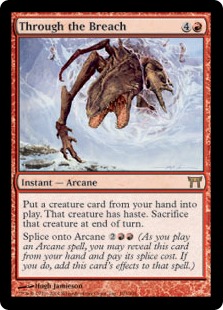
I catch myself falling into a cycle time and again, where the limited time I'm able to apply to Magic over some time period ends up focused on top performing decks and updates to existing archetypes. Part of this has to do with my philosophy regarding context; I'm more interested than most when it comes to deck evolution and manipulations responding to metagame factors than I am to "the hot new thing". Unfortunately, this has the negative side effect of a "surface-level analysis" that can miss gems hiding out outside of the Top 16 of events. New technology almost always appears first in the wilderness, before eventually emerging into the spotlight of the winner's circle. It's time I dug a little deeper and started taking a serious look at the Wild West of Brews.

The Tested and True

Behold, the hall of fame:

  • Second Sunrise Eggs
  • Living End
  • Lantern Control
  • Amulet Bloom
  • B/W Eldrazi

These decks are, at this point, classic examples of what a brew “can” become, given the right conditions. While the jury is still out on whether Eldrazi decks can compete in Modern under dedicated hate, the other decks have all shown an ability to win/go deep in large events and beat top decks in the format consistently, even after their “breakout week”. The next time you dismiss a brew because of its identity as a brew, think back to this list.

The Unknown

"R/G Ramp, by Heiring (3-1 MTGO Daily, 1/3/16)"

Creatures

3 Emrakul, the Aeons Torn
1 Courser of Kruphix
1 Huntmaster of the Fells
3 Obstinate Baloth
4 Primeval Titan
4 Sakura-Tribe Elder
1 Thragtusk

Instants

3 Summoning Trap
3 Terminate
4 Through the Breach

Sorceries

2 Anger of the Gods
2 Farseek
4 Search for Tomorrow

Land

1 Blood Crypt
4 Bloodstained Mire
1 Cinder Glade
2 Forest
5 Mountain
1 Smoldering Marsh
4 Stomping Ground
3 Valakut, the Molten Pinnacle
4 Wooded Foothills

Sideboard

1 Anger of the Gods
2 Ancient Grudge
1 Boil
3 Crumble to Dust
3 Nature's Claim
2 Rending Volley
3 Slaughter Games

Before getting into Heiring's list, I want to reiterate my hatred for ramp decks. An illogical artifact that exists as a remnant from my control-biased past, I can’t remove my dislike for these archetypes no matter how hard I try. Their reliance on a delicate balance of mana sources, ramp enablers, and payoff cards is in the end no different from a control deck’s reliance on mana sources, reactive spells, and card advantage. But it just feels different. Regardless, this deck has been popping up here and there with increased regularity, and players would do well to become familiar with it.

Through the BreachUsing Through the Breach and Primeval Titan as an avenue for victory, rather than Scapeshift or Urza's Tower, results in a natural resistance to widely accepted “land hate” cards like Fulminator Mage and Blood Moon. Summoning Trap as control hate is still excellent, and even the “fail-mode” of hitting only an Obstinate Baloth is not bad. Thirteen creatures is a lot of solid flips, and even if we’re casting this for six mana at instant speed, that’s still fine if we’re following up with another must-answer on our own turn. I count a full sixteen threats that count as “payoff” cards, and excluding Primeval Titan and Emrakul, the Aeons Torn all of our creatures either block early or gain life, helping us stay alive.
The only thing I wonder about this deck is how it matches up against the Eldrazi deck. Oblivion Sower and Blight Herder to set up Ulamog, the Ceaseless Hunger seems slow for Modern, until you actually play against it and realize how ineffective Fulminator Mage and Terminate are against this type of strategy. Eldrazi Temple just ramps so fast, and one Oblivion Sower undoes all attempts at mana-denial. RG Ramp’s natural weakness seems to be combo-oriented decks and decks that go over the top, but it has the tools to beat up on both aggro, control, and normal midrange.

"Jeskai Ascendancy Gifts, by Scott Kirkwood (23rd, SCG Cincinatti 1/3/2016)"

Enchantments

4 Jeskai Ascendancy

Creatures

4 Birds of Paradise
2 Fatestitcher
1 Snapcaster Mage
4 Sylvan Caryatid
1 Elesh Norn, Grand Cenobite
1 Iona, Shield of Emeria

Instants

4 Gifts Ungiven
2 Izzet Charm
3 Lightning Bolt
3 Path to Exile
1 Sphinx's Revelation

Sorceries

1 Faithless Looting
1 Flame Jab
2 Life from the Loam
4 Serum Visions
1 Unburial Rites

Lands

1 Snow-Covered Forest
1 Snow-Covered Island
1 Snow-Covered Plains
1 Breeding Pool
2 Copperline Gorge
2 Flooded Strand
1 Hallowed Fountain
1 Lumbering Falls
4 Misty Rainforest
1 Sacred Foundry
1 Simic Growth Chamber
1 Steam Vents
1 Stomping Ground
1 Temple Garden
2 Windswept Heath

Sideboard

1 Engineered Explosives
2 Obstinate Baloth
1 Terastodon
3 Leyline of Sanctity
1 Celestial Purge
1 Dispel
2 Nature's Claim
2 Negate
1 Sigarda, Host of Herons
1 Ghost Quarter

On the other hand, I’m in love with this deck. I dunno, Scott’s just speaking to me I guess. There’s something about the graceful unity of two individual entities, that shouldn’t go together but somehow fit so well, that just entices me. I could get into why this possibly has to do with my preoccupation with dating individuals that are my exact opposite, but we’re in Part Two now, so consider yourselves spared. Where Gifts Ungiven decks would often sputter out, or draw an awkward collection of value cards and attempt to cobble up a defense, Scott has instead married the Gifts strategy with the Jeskai Ascendancy combo. In doing so, he has somehow increased the consistency of both!

FatestitcherHere, Jeskai Ascendancy can be used for value, discarding Fatestitchers to be returned later as normal. With the Gifts package addition, however, we can even discard fatties in hand for Unburial Rites, or Rites itself to flashback later! Alongside Flame Jab and Life From the Loam, we’ve got a strong graveyard package going, but we’re far from one-dimensional. Most Gifts decks fall apart under dedicated graveyard hate, but Fatestitcher sure doesn’t care about that when we’re chaining through cantrips and attacking for significant damage with Ascendancy triggers. Often “dual-angle” decks like Living Twin and the like can be clunky, with combo pieces just getting in each other’s way. Not this deck, which functions more like a symbiote and less like a parasite, with both entities benefiting from each other’s presence.

Conclusion

It might seem strange that in my article about brews, I don't introduce a brew of my own. I thought about it for a few days, and I found myself "forcing" a decklist onto paper. While I might not be the most experienced when it comes to the brewing process, I know that's not the way to go. To me, the perfect brew can't exist without a healthy dose of individuality. Some players love Training Grounds. I know a guy that owns a literal hundred Mindshriekers. For me, I've always been a sucker for value, and one of my favorite decklists of all time always jumps to mind when I'm looking for something to play. What initially caught my eye in Scott's Ascendancy list wasn't the double combo, but rather the one-of Faithless Looting and Sphinx's Revelation. Sure, those two cards together seem to be going in different directions. I don't care. I have a list in front of me with four of each, and blank space below. It's almost assuredly bad, but it will absolutely be fun.

This year, I’m resolving to push myself further. While I’m at risk of sounding cliché, I’ve realized that I tend to take the safe path in life, and leave the exploration to others. It was a big step out of my comfort zone to start streaming, and again to start writing, and again to start placing some confidence in my own creative work to the point where I could comfortably start selling my design work to others. 2015 was an incredible journey for me, as I dove headfirst from my stable position as an observer of other’s work into the vast ocean of creative content and self-expression.

For those that have been following my stream since the start (a few of you) and those of you that remember my first articles on this site (more of you) I think you can see a shift in the content I’m producing. For those that have asked about my Video Series, I’m taking some time to revisit the content and bring it up to where it needs to be quality-wise. I’ll make some mistakes, I can guarantee nothing will be perfect, but I strive to push myself farther and I hope you guys will join me on this ride. Thanks for reading, and I’ll see you next week!

Trevor Holmes
The_Architect on MTGO
twitch.tv/Architect_Gaming
twitter.com/7he4rchitect

Insider: Evaluating Oath Spoilers (Part 3)

Are you a Quiet Speculation member?

If not, now is a perfect time to join up! Our powerful tools, breaking-news analysis, and exclusive Discord channel will make sure you stay up to date and ahead of the curve.

Welcome back, eager Magic players, to my latest installment in the Evaluating Oath Spoilers series. If you missed them the first time, be sure to check out Part 1 and Part 2.

On the docket today we will explore the landscape of beautiful Zendikar to see how the land manifests itself, how the magic enchants the land, and how the Eldrazi seem to be taking over the plane. Let’s go exploring!

Manlands

One of the most exciting parts of Oath of the Gatewatch (OGW) for many of us is the gift of new manlands. Wizards started the gears turning back in original Zendikar with the allied pairs, Raging Ravine, Stirring Wildwood, Creeping Tar Pit, Lavaclaw Reaches and Celestial Colonnade.

Once we had the allied pairs, it was easy to speculate on what the enemy pairs would be. With OGW releasing soon, we will have the completed cycle. Let’s see how the landscape of Zendikar will be attacking us now.

Needle Spires

Needle_Spires

First up, we have the first land spoiled from this cycle, Needle Spires. As one might have suspected, we got a double-striking land.

As a 2/1 this manland is in an awkward spot right now, because it doesn’t fight through any of the five-toughness creatures. Once Siege Rhino and Tasigur, the Golden Fang rotate out of the metagame at the beginning of Summer, the Boros land should be much better positioned to see play.

One thing to remember is that all the clans from Tarkir block can play two manlands now. For instance, Mardu can run both the new Needle Spires and Shambling Vent. Most likely your deck wouldn’t need the full eight manlands, but it’s possible you would run some combination of the two.

Shambling Vent is a 2/3 and it sees a lot of play, so I may be overestimating the five-toughness creatures as a barrier to the format. A four-mana activation for this creature is a decent rate, and well worth the investment. It may not be exciting and new like the other two from OGW, but it's still good.

Wandering Fumarole

wanderingfumarole

Speaking of flashy and new, our Izzet counterpart is a Wandering Fumarole! And just what the heck is a fumarole? Until I saw the spoiler and started writing about this card, I had never heard the word before. It’s a strange one for sure, but apparently a real thing. Let’s turn to wonderful Google for the answer to our question:

A fumarole (ultimately from the Latin fumus, 'smoke') is an opening in a planet's crust, often in the neighborhood of volcanoes, which emits steam and gases such as carbon dioxide, sulfur dioxide, hydrogen chloride, and hydrogen sulfide.

- Google, via Wikipedia

In spite of the awkward name, the blue-red manland provides great incentive for players to use it in their manabases.

This land is a shout-out to old-school Magic cards. There were plenty of old cards that switched the power and toughness of a creature. We don’t see this effect often anymore, but it’s a fun one that can also be very good. With our Fumarole, switching between a 1/4 blocker and a 4/1 attacker is great.

Unfortunately, all the removal spells that kill it as a 4/1 will still kill it due to the timing of the rules.

Here’s how it works. You attack with your 1/4 and activate the switch ability. As long as your opponent responds, even if you try to switch it back, your creature will still die. As the stack resolves, your second activation will actually make it a 4/1, then their spell will resolve before your other activation gets a chance to switch it back.

This interaction is reminiscent of damage on the stack, and I expect better players will know how it works and uninformed players will get punished by it.

Even with that slight drawback, the card is still decent. Many blue-red decks will want a dual land that can turn into a pretty big attacking creature. You also have the upside of a reasonable blocker as well. I would have liked to see the activation of the land at three instead of four, but we can’t have everything we want.

Hissing Quagmire

hissingquagmire

Ultimately, I think the green-black land should see the most play of the new group. Allowing Abzan Aggro to have access to two manlands, both with a three-mana activation, seems risky to me but I’m glad Wizards finished the cycle. My cube certainly appreciates the manabase upgrades.

Our Golgari land might seem innocent, but it's deceptively powerful. Deathtouch on a land is so powerful. Your last threat will be one that can fight through any enemy and that’s amazing. The activation cost is always key as well. The cheaper the activation, the more often you'll get to attack with it, and three mana is the lowest it goes for this cycle.

Overall, I think all five manlands are worth playing. Even the worst of the group, Lumbering Falls, has been great for me. None of these rare lands should be very expensive. They're all preselling for around $4, but I expect them to retain close to that value for their term in Standard. Get your playset so you can start including them in your lists right away.

Planeswalker Oaths

Welcome to your planeswalker initiation ceremony. The first matter of business to attend to is developing your oath to protect the galaxy. Here are some examples for you to peruse that may help you in this process.

Oath of Gideon

Oath_of_Gideon

First of all, I must say, the flavor of this cycle fuels the joy in my heart. The main storyline is this group of planeswalkers fighting against the gravest threat in the galaxy, the Eldrazi. In order to accomplish this goal, Gideon swears to bring an army to battle to aid the Gatewatch.

Getting two 1/1’s doesn’t exactly resemble an army, but if you combine the ability with his planeswalker card, then we’re getting somewhere. The fact that this enchantment costs three mana puts it in the perfect spot in your curve. You can start out by casting some aggressive white or black creatures, then have Gideon speak his Oath, and finish up by casting Gideon, Ally of Zendikar himself with an additional loyalty counter.

What is an extra loyalty counter worth? This will obviously vary by planeswalker, but in Gideon's case it means you can ultimate him immediately and have him stick around! That is pretty ridiculous. Either we get an emblem and are left with one counter, or we make a 2/2 and keep Gideon at five loyalty and just out of reach of the four-power creatures of the format.

The interaction with Gideon is just one example. There are other planeswalkers in Standard and Modern that Oath of Gideon may interact with favorably. At the very least, getting planeswalkers to their ultimate a turn early seems like a great plan.

I will be trying to work these Oaths into my Standard decks for testing. My initial impression is that they are better than they seem at first glance, due to interactions like the one I outlined with Gideon.

Oath of Jace

Oath_of_Jace

Draw three, discard two for three mana. That might be good enough on its own. Oath of Jace would be especially helpful if you were searching for a combo to put together, but either way, you get to loot and not lose a card. Faithless Looting, and cards like it, help you find cards you are looking for. Usually they do so without netting you a card. Oath of Jace isn’t super card advantage or anything, but it is great card selection.

If you also have planeswalkers in play, then you start getting to scry every turn, which is incredible. While living in the real world, we might be lucky enough to keep one planeswalker in play while we also have our Oath. If so, then this enchantment turns into a pseudo-Thassa, God of the Sea, but with no threat of becoming a creature.

Jace’s Oath seems to be competing with the already sidelined Monastery Siege for space in a deck. Both three-mana enchantments seem great but take a turn to get online. At least with the blue Oath, we get to loot the turn it comes into play. This one seems decent but unlikely to make the cut.

Oath of Chandra

Oath_of_Chandra

Chandra is here and she brought her fire! Sadly this Oath isn’t an enchantment version of Searing Spear. Being able to hit only creatures will likely render her unplayable. I wouldn’t mind paying an extra mana to have the option of hitting creatures or players.

Dealing damage to opponents after you play a planeswalker is cute but not that impressive either. I wish Wizards had pushed this enchantment a little instead of being super cautious with its design.

If you're playing both planeswalkers and red mana, there’s a slight chance you would want this as a sideboard card against aggressive decks, but even then, I’m not sure you would want a sorcery-speed burn spell with little upside.

Oath of Nissa

Oath_of_Nissa

Green gets the best of the cycle with Oath of Nissa. In the past few years, Wizards has been making an effort to push green a bit more so that it has an equal share of the spotlight. I feel like their efforts are a success and it has been noted by players.

With Oath of Nissa specifically, players have dubbed it “the green Ponder.” This card is definitely a hit and a lot of decks will happily run it. You can play it turn one or two to search for a threat, or you can wait until later in the game to find some gas to keep the engines running. There’s not a lot to dislike.

The second ability isn't likely to be super relevant. It might be useful if there's a planeswalker deck built around Call the Gatewatch, and I could see Abzan using it for double white to cast Gideon.

A note about the cycle as a whole. All of these enchantments are legendary. That's not super-important since the best abilities in each case are the enters-the-battlefield triggers. But it does mean you can't double up on extra loyalty counters, scrying multiple times or the like.

What about Oath of Ob Nixilis? I’m not sure how the story line will go, but I don’t think our friendly planeswalker of the swamp variety will be helping our heroes to victory. What about Kiora though? Shouldn’t she be there to help the Gatewatch crew save the planet? Only time will tell, but if we have four out of five colors in this cycle, that will be irritating.

Eldrazi Kickers

Lastly today I want to mention an interesting cycle of cheap Eldrazi creatures that basically have kicker. Each of these creatures provides a reasonable body for the mana cost as well as an additional effect if you pay more mana upon casting.

Eldrazi Obligator

Eldrazi_Obligator

Red gets a lot of threaten effects, but I think the best ones are attached to creatures like Zealous Conscripts. We already have a similar effect in Jeering Instigator, which hasn't snuck into many deck lists in the time he's been legal. With the Obligator we get an upgrade on our initial creature's baseline stats.

I could definitely see jamming some of this guy into aggressive red decks. Keep in mind you can just run him out there on turn three in a pinch. The challenge will be getting enough colorless sources into the manabase to kick him semi-regularly.

Bearer of Silence

Bearer_of_Silence

Shush. (There's no talking in here, we have to be quiet.)

Okay I can't bear it anymore. The weight from the Bearer of Silence is massive.

Not only can you play this Eldrazi as a reasonable 2/1 with evasion for two, you can also kick it to do a Nekrataal impression. Being non-targeted removal is significant. The only other creatures that have done this in the past are Predatory Nightstalker and Gatekeeper of Malakir---the first one was never in Standard, but the second one was, and it saw lots of play in Vampire decks.

Comparing this to Gatekeeper is interesting. It costs a little more to play fully kicked, but assuming you can reliably make colorless mana it's probably easier to cast. It also gets evasion in exchange for the ability to block, which is certainly a good tradeoff if you're looking to beat down.

Either way the prospects of this card are impressive. I expect the little Eldrazi to see a lot of play in Standard and maybe even in Modern.

Vile Redeemer

Vile_Redeemer

We've seen green flash creatures be playable in the past as long as their mana-cost-to-power-and-toughness ratio is solid. Vile Redeemer has all that plus upside. I've always loved Caller of the Claw and Fresh Meat. I'm hoping this time around that Vile Redeemer might see some play. It could be a backup plan in Rally decks, or just a good sideboard card to answer wrath effects.

As for the rest of the cycle, it appears to be completed by creatures with activated abilities in white and blue (Eldrazi Displacer and Dimensional Infiltrator, respectively). It could be, however, that these are red herrings and that the white and blue ETB creatures are still unspoiled. Either way, the cycle is interesting, and I'm excited to get brewing with it.

~

That's all for me today. If all goes as planned, we will have the full spoiler to dive into next week, so make sure you stop back for my quarterly Top 10 article!

Until next time,
Unleash the Force of the Gatewatch!

Mike Lanigan
MtgJedi on Twitter
Jedicouncilman23@gmail.com

Playing Unfair Magic in Modern- All in Red

Are you a Quiet Speculation member?

If not, now is a perfect time to join up! Our powerful tools, breaking-news analysis, and exclusive Discord channel will make sure you stay up to date and ahead of the curve.

Hey there!

As this is my first article for Quiet Speculation, let me introduce myself. My name is Ryan Hipp, and I've had a non-zero amount of success playing Midwest magic on the TCGPlayer and StarCityGames circuits, including a 50k and several 5k wins. I prefer to create my own 75 for a tournament and catch my opponents unprepared. I'm the kind of player who gives underrated cards a chance to shine. That said, calling myself a technical player to be taken seriously isn't unreasonable either.

With spoiler season in full swing, talking about standard feels less relevant than an eternal format. Plus, what better time is there to discuss how to beat an overpowered deck than right after it convincingly wins a tournament?

A few weeks ago, I played in the SCG Invitational. While the main event didn't go that well, I did manage to top 16 the Modern Classic Event with a legitimate brew. While the deck I brought was great for the weekend (R/W Moon Decktech: here), quite a few of my wins came from locking out my opponent on turn one or two via Chalice of the Void or Blood Moon. There was another player in the top 16 doing similar things but in a much more committed shell. What could a Bloom Titan fear more than a turn one Blood Moon every game?

All-In Red by Peter Niemeier

Creatures

4 Kargan Dragonlord
4 Magus of the Moon
4 Prophetic Flamespeaker
4 Simian Spirit Guide
4 Wild Cantor

Spells

2 Koth of the Hammer
4 Chalice of the Void
2 Sword of War and Peace
4 Blood Moon
4 Desperate Ritual
3 Pyretic Ritual

Lands

13 Mountain
4 Cavern of Souls
4 Gemstone Caverns

Sideboard

3 Damping Matrix
2 Ratchet Bomb
2 Relic of Progenitus
2 Trinisphere
3 Pyroclasm
3 Shattering Spree

I saw this deck in action a few games, and from what I saw it looked like cheating. Playing around with this deck recently has only confirmed those suspicions. Prophetic Flamespeaker was generally only ok, it never ended the game like I wanted it too unless Sword of War and Peace was involved. A card like Goblin Rabblemaster, on the other hand, can end the game in just a few turns on its own. Playing Rabble on turn one is often good enough against particular strategies. This allows for us to win without a Blood Moon effect in play, which very rarely happened with Flamespeaker. Perhaps that isn't a fair way to evaluate cards, but after playing a few hands of the deck it becomes quickly apparent what the game plan is.

There was an error retrieving a chart for Goblin Rabblemaster

One of the big differences between this deck and the R/W Moon deck I played is the ability to defend yourself. Not being able to remove Vault Skirge holding a Plating is brutal, and losing to U/R Twin when they have a single basic island to combo on turn four through the maindecked hate cards sucks. An early Spell Pierce or Snare can throw a huge monkey wrench into the game plan of All In. That said, if your opponent cannot cast their spells it simply doesn't matter what they're trying to do.

Against Bloom Titan, everything in this deck is gas. Chalice of the Void, Blood Moon, Magus of the Moon, acceleration, and even Sword of War and Peace as it enables kills in a relevant time frame. If the Titan player doesn't have the actual nutter butter hand, it's very difficult to lose. This is actually a common complaint about the modern format: Matchups are too decided on if someone drew their hate cards. The great part about this deck is that there is plenty of hate to go around. Maindeck no less. If the deck remains untouched and unbanned, I would recommend giving this list a spin to make them all feel silly.

I played around with Empty the Warrens in the board. There are hands that can cast 4-5 spells like Wild Cantor, Chalice of the Void for zero and ritual into Empty the Warrens on turn one or two. Far too often I would get Engineered Explosives'd, Golgari Charmed, or Anger of the God'd out of the game though. Unfortunately, each of those cards are perfectly reasonable to bring in against the deck anyway. That aside, it did win some games where other threats wouldn't have. Notably against Liliana of the Veil midrange decks, but most of the time Blood Moon will get the job done there.

This is the kind of deck that cannot live in fear. Often, in the dark on turn one, the deck needs to play that Magus of the Moon and hope it doesn't get Bolted. Other times, playing Koth on turn two is the route to victory while hoping that they don't have Remand. While there are certainly hands that involve Cavern of Souls or Chalice of the Void to solve these issues, there are also hands that are perfectly reasonable keeps which do not.

R/W Moon may not have been quite as strong against Bloom Titan, but it certainly had ways to win in that match up. Being more resilient to Twin, Infect, Merfolk or non-Blood Moon-able decks is a very desirable quality for a longer tournament. Below is an undated list from the deck I played in Vegas. If something is banned from Bloom Titan, this deck may be the better choice.

I won't say too much else about this deck, but its hard to recommend a deck without posting a list.

An updated list:

RW Moon 2.0

Creatures

4 Wall of Omens
3 Brimaz, King of Oreskos
3 Simian Spirit Guide
2 Hero of Bladehold
4 Restoration Angel
2 Kiki-Jiki, Mirror Breaker
1 Thundermaw Hellkite

Spells

4 Chalice of the Void
4 Lightning Helix
3 Pyroclasm
2 Rest in Peace
3 Blood Moon
1 Gideon Jura

Lands

4 Arid Mesa
2 Cavern of Souls
1 Gemstone Cavern
1 Mountain
8 Plains
2 Rugged Prairie
3 Sacred Foundry
3 Temple of Triumph

Sideboard

2 Wear // Tear
1 Celestial Purge
2 Stony Silence
3 Aven Mindcensor
2 Kitchen Finks
3 Stasis Snare
2 Boil
While this argument is like fighting fire with fire, none of the cards in either of these deck lists are powerful enough to warrant a ban. People may have spoken out against Simian Spirit Guide in the past, but the card is boarded out against ANY other deck playing fair. It is card disadvantage, and is only crucial when needing to get hate cards on board in a relevant time frame. 'A Relevant Time Frame' meaning before the opponent has a chance to do their overpowered thing. Drawing one on turn 6 isn't ideal, and it really doesn't have other applications than being -1 card +1 Red mana. Mox Opal does it better, and has more synergy with the decks it goes into.
If you are looking for hot pickups from these decks, Brimaz King of Oreskos, Gemstone Caverns and Kargan Dragonlord are at their reasonable floors value wise. Keep in mind that these decks aren't meant to ever be tier one, and if someone comes prepared to deal with Blood Moon, they can easily do so. These decks are a ton of fun to play and even have some reasonable finishes to boot. Yet I wouldn't be surprised if no one picks it up at the Pro Tour.
-
Thats all for this week I hope you enjoyed reading enough to come visit again!
Follow me on Twitter and Twitch! @BDP1337.
Ryan Hipp

Want Prices?

Browse thousands of prices with the first and most comprehensive MTG Finance tool around.


Trader Tools lists both buylist and retail prices for every MTG card, going back a decade.

Quiet Speculation