If not, now is a perfect time to join up! Our powerful tools, breaking-news analysis, and exclusive Discord channel will make sure you stay up to date and ahead of the curve.
Everyone has his or her opinion. You know, the one about the card that is suddenly going to break Standard after rotation and shoot up to $25. The one that fits into some deck they presume will take the world by storm.
For someone I know, recently it was Savage Summoning. He thought that once M14 came out a blue-green control shell would take over with Aetherling as the finisher and Summoning as the most important card to push it through.
Obviously that didn’t happen. Sorry Ryan.
But it leads me to my larger point. Sure, looking at interactions is extremely important, but it’s just one way to determine specs. And, I would argue, it’s not usually the best way.
So what is?
Power Level (insert “over 9,000” joke here).
All About Power
So on one end of the spectrum we have “good in a designated archetype,” like Savage Summoning or Lotleth Troll last year when people thought B/G Zombies was going to be the best thing ever.
But the other end of that scale is where I prefer to operate; the end where we find the most powerful cards, find the underpriced ones and just assume they’re going to find a home. This also carries some risk, as the metagame may not develop to a point for the card to find a home, or something else may come along to knock it off its perch (like Aetherling did to Niv-Mizzet).
But this is a tried-and-true tactic for me come rotation. When the format is at its smallest, decks will adapt to run the most powerful cards in a vacuum rather than rely on worse cards that function on synergy.
That sort of stuff can work if the format has enough tools for those cards to form a whole greater than the sum of their individual parts. But the first two or three weeks of October is not when that happens.
It is, however, when powerful cards find a place and spike accordingly.
A Year Ago
A year ago there were two cards moving from Block to Standard that I was behind at this stage in the game: Champion of the Parish and Sigarda, Host of Herons.
Which one do you think made me more money?
All the pieces were there for Champion. There were a ton of humans floating around, and I speculated on it with this reasoning. And I was right. The card saw a lot of play and the copies I had picked up for around $3 in trade went out at $6-7 in trade a few months later.
Sigarda, on the other hand, didn’t fit into a specific deck. There were no other pieces that made it tick or look like a good spec. It was just powerful, and I thought it would find a place because of that.
How did it turn out?
Pretty well, turns out. I traded into a bunch of Sigardas at the $5-6 mark and got rid of them at $12. While this is still just a double-up like Champion, it represents a much greater absolute profit, which is really important when you start factoring in costs like time spent (basically, the opportunity cost), which is the same for both cards but cuts into my Champion spec more than my Sigarda spec.
So which spec was more successful? Both were good, but obviously Sigarda made me more money than Champion, and I think that’s a testament to the strategy more than anything inherent to the cards themselves. After all, Champion went on to be heavily played and nearly doubled up, but it was also something that I think in retrospect was more risky than Sigarda.
We can look at something like Disciple of Bolas, which was another hot spec once all the B/G Zombies in Return to Ravnica were spoiled, as everyone thought B/G Zombies was the new thing and Disciple played great in that deck. But even though the assumed synergy was there, that never really panned out for the spec because the deck just wasn’t powerful enough.
Basically, it’s the difference between looking for devotion enablers in RTR Block and just picking powerful cards up from the Block. Both can hit, but one strategy is safer, if possibly less profitable.
The Powers That Be in Ravnica
With all of that in mind, let’s look at some cards from last year which I think are purely powerful, and therefore likely to find a home post-rotation, even if we can’t see exactly where that may be yet.
Jace, Architect of Thought -- I get that this, along with Sphinx's Revelation, are kind of a cheat since we already know how powerful they are, but it’s worth mentioning anyway.
Detention Sphere & Supreme Verdict -- I cannot recommend these two cards enough, as I have for the last few weeks. I still think these are both steals at $3-4 in trade, and are headed north of $5-6 in the coming weeks. This is one of the few ways to deal with anything in the new Standard, and I expect the blue-white deck to be all over the place.
Mizzium Mortars -- Another one I’ve talked about at length, so I won’t go on about it much more, except to say I still think you want to acquire these in trade, though not as much as D-Sphere.
Hellhole Flailer & Unflinching Courage -- Grouping these together since both are uncommons I expect to make an impact. While the format for these has been in and out so far, both are powerful enough, and the Flailer in particular has been completely forgotten. It’s a great bit of reach in red decks. Probably also worth throwing Lyev Skyknight into this.
Loxodon Smiter & Voice of Resurgence -- G/W looks to be quite powerful, and these are the big drivers on that. I think the upside on Smiter is probably higher, so that’s where I’d prefer to put my money, but there’s probably some money to be made on both.
Trostani, Selesnya's Voice -- Just too much of an aggro killer, and one that’s already seen Block play. At $6 right now, this seems like a strong target.
Domri Rade -- I think the time to really profit off of this has passed, and I hope you got in a while back when we were talking about it. That said, it could spike past the current price of $25 after a good first week.
Overall, I think there are better targets on this list, but I wanted to include it because I think it’s still a solid play, though one with less upside.
Firemane Avenger -- This just in, Lightning Helix is good, and this is currently under a buck.
Obzedat, Ghost Council & Blood Baron of Vizkopa -- Both of these are seeing play in Block, and moving to a format with easier mana means that will likely continue. Both are mythics and primed to double in the course of a week if they see big play out the blocks. I like Blood Baron as a pickup more because of the lower entry price, but I can’t fault you for either.
Boros Reckoner -- Card is still nuts, and is a super devotion enabler at that. Love this at $10 in trade. Again, I don’t think the upside is great, but it could move back to $15 without too much trouble.
Scion of Vitu-Ghazi & Advent of the Wurm -- Both from an under-opened set, and both super powerful. Much more upside to Scion, obviously, but these alongside Smiter and Voice seem like the backbone of an insane deck.
Aetherling -- Obviously the finisher of choice. Movement over $5 likely.
Exava, Rakdos Blood Witch -- What this card does depends entirely on whether or not B/R turns out better than R/G. That means coming up with a reason not to play Rampager (which isn’t on this list due to the four-of Event Deck printing).
Anyway, we got a new 2/1 for one in Theros in black, so this may see its time in the sun. It’s super powerful at the top of the curve, and at near-bulk I’m all over this.
Top Five picks (No Order)
Based on a combination of power-to-upside concerns:
If not, now is a perfect time to join up! Our powerful tools, breaking-news analysis, and exclusive Discord channel will make sure you stay up to date and ahead of the curve.
Due to real life being a thing, I haven’t been all that active at my LGS this summer. In fact, I’ve only been to one draft since the M14 prerelease. But that period is coming to an end. With the release of Theros, I will once again be enthusiastically engaged in my local Magic community.
My trade binder hasn’t been touched since my last draft a couple months ago. That being the case, I have some preparation to do before hitting the trade tables. Since I’ve spent the last year trading into long-term holds (especially shock lands), my binder is fairly sparse at the moment. The few cards in it were for trade as of my last draft, but things have changed as the summer has passed. It’s time for me to reevaluate what to do with these cards.
Standard Trades
]
The first section of my binder (and the only one I’ll be discussing today) is made up of Standard cards, arranged by color. As you can see, this section of my binder is not especially large at this time. There’s really not much left to trade after outing most of my Innistrad stock and stashing undervalued Return to Ravnica block cards.
There are a few options for the cards I have left in my binder. I can 1) keep them up for trade, 2) hold them until values increase, 3) move them to my bulk box, or 4) pull my hair out because I just don’t know. Here’s how I’m sorting these:
1) Still for trade:
Fiendslayer Paladin; Xathrid Necromancer: I’d like to trade these sooner rather than later, since both of their respective decks lose a lot after rotation.
Blind Obedience: These were around $4 when I last drafted, and are now $2. I’m tempted to hold my copies, but we’re losing a lot of hasty threats to rotation.
Chandra, Pyromaster; Garruk, Caller of Beasts: Both of these have held their value surprisingly well this summer. You could argue that these are holds, but I think the downside outweighs the upside and I’d prefer to just trade them out at current values.
Legion's Initiative: Boros looks to be getting a reasonable amount of support in Theros, and the fact that this is an enchantment could be pertinent. But I’d still rather trade this for around its current $4 value. Spear of Heliod was spoiled recently, and it seems like the better anthem for Standard.
Firemane Avenger (promo): I should have just thrown this on eBay shortly after winning it at Game Day. It’s gone from $30 to $10, and I have a hard time believing it will ever get back to that $30 price tag. I’m keeping it in my binder for the time being, but I’ll be somewhat picky about what I’ll take for it. There may be long-term potential.
Plains (APAC): I’m just waiting for the right person to see this. I’ve had a few offers, but none have been enticing enough to part with this beautiful Japanese landscape.
Angelic Overseer; Silence; Colossal Whale (promo); Haunted Plate Mail; Burning-Tree Emissary; Truefire Paladin (foil); Sunhome Guildmage (foil); Zameck Guildmage (promo); Jarad, Golgari Lich Lord (DD foil); Corpsejack Menace (promo); Zhur-Taa Druid (foil); Orzhov Guildgate (foil); Maze's End (promo), Plains (DGM promo): All of these are a little too valuable to move to the bulk box, but there’s not much upside in holding them. I will happily trade these for the $1-3 dollars at which they each currently sit.
2) Hold for later:
Underworld Connections (foil): This is a short-term hold based mainly on Corbin Hosler’s “Pick of the Week” from last week’s Brainstorm Brewery. As Corbin pointed out, the card is an enchantment and is good for devotion. But if it doesn’t break out in the first few weeks, it’s going right back into the trade binder.
Tajic, Blade of the Legion; Obzedat's Aid: These are probably on the fast track to the bulk box, but I’ll be watching.
Master Biomancer: I’ve written about my dislike for this card in the past (more due to bookkeeping than power level, to be fair), but several writers I respect seem to think there is potential here. It would be shortsighted of me to let my own opinions outweigh those of multiple experienced speculators, so I’m going to hold this copy for now.
3) To the bulk box:
Bogbrew Witch; Teysa, Envoy of Ghosts
4) Dilemmas:
Restoration Angel: This is still holding $7.50 on TCG Player mid and may be worth trading at that price, but it sees Modern play in both combo and control decks. I may still trade it if I can get $8, but if it dips any lower it’s definitely going into my hold pile.
Vampire Nocturnus: Before this was reprinted, it was a $20+ card. This copy has been in my binder since the M13 Magic Celebration. I could hold it and see if casual demand ever picks back up but let’s be real: I’ll happily trade this for its current value if I can.
Stromkirk Noble: It’s not really Modern playable, so any future value it has will be based on casual demand. How many casual vampire decks include red? My guess is not many. So any potential these have is based on the novelty of red vampires. I don’t anticipate that novelty to be very profitable, so I’ll take what I can get for these before they become bulk.
Farseek (FNM promos): What a bummer. I had a deal at one point to sell these for $20, but the guy kept flaking until he finally backed out. My LGS offered me $12 but I decided to get more value through trade. Then I stopped trading for the summer. Now they’re virtually worthless, so I guess I’ll throw them in a box on the off chance they ever see Modern play or the card is reprinted in a shock-land Standard again. I really dropped the ball on this one.
Obzedat, Ghost Council: The black-white deck that has been seeing play the last few weeks looks sweet, and Obzedat is a big reason for that. But Restoration Angel seems crucial for that deck’s strategy. Currently at $9, this card could go either way. I’m going to leave it my binder for now, but I’ll be keeping a close eye on it going forward.
Sigarda, Host of Herons: On one hand, it’s a rotating card worth a solid $5. On the other hand, it’s a legendary mythic angel from a third set. You could make an argument to trade it while it’s still worth $5, but I’m going to hold this copy.
Glacial Fortress; Drowned Catacomb; Clifftop Retreat: These are the buddy lands I still have left. I’ll trade the Clifftop Retreat if I can still get $5 for it, but at $2, I’m just going to hold the allied color ones.
Penny Stocking Up
With not many cards up for trade but with a lot of cards I’m looking to acquire, I recently decided to set aside $50 for specs. So on what did I spend my hard-earned money? Penny stocks. Check it out:
Beck // Call: 20 copies at $0.49 each – Glimpse of Nature is a $20 card, and this is the only option for Modern Elves. I doubt it will ever be lower and being from unpopular Dragon’s Maze gives it huge upside.
Diluvian Primordial: 3 copies at $0.25 each – A near-bulk price for a potential casual hit.
Firemane Avenger: 6 copies at $0.75 each – I wrote about my high hopes for this card several weeks ago, and I still think there is profit potential here. This was a good price so I bought them.
Luminate Primordial: 3 copies at $0.19 each – See Diluvian Primordial.
Mana Bloom: 6 copies at $0.25 each – It’s a ramp option leading into an enchantment block, and by self-bouncing can trigger ETB abilities multiple times.
Merciless Eviction: 4 copies at $0.45 each – Six-mana sweepers are not always playable, but this one has options and it kills Gods. I would have bought more at half the price, but at this price I wanted to have a few just to hedge.
Molten Primordial: 2 copies at $0.15 each – Getting in at literal bulk price absolves me of all risk.
Plasm Capture: 8 copies at $0.66 each – You may not have noticed, but this is Mana Drain. It’s hard to believe there won’t be casual demand for this card down the line, and this seems like a fine buy-in price.
Scion of Vitu Ghazi: 4 copies at $0.42 each – I honestly don’t have a lot of faith in this one, but it’s getting some buzz in the community and I wanted to cover my bases.
Sepulchral Primordial: 4 copies at $0.26 each – See Diluvian Primordial.
Thespian's Stage: 17 copies at $0.99 each – Vesuva is a $10 card and Gatecrash wasn’t nearly as popular as Return to Ravnica. I already had a few playsets of this card set aside, and this seems like a fine buy-in price to solidify my position.
Wear // Tear: 13 copies at $0.23 each – This is a few cents higher than I would have liked to buy in, but it seems like solid sideboard tech for both Standard and Modern. My biggest concern with this one is that it doesn’t kill Gods, but it’s still a versatile card that’s a straight-up two-for-one.
With a couple dollars for shipping, my total for these cards came to $48.94. I’m confident that most of these will appreciate in value over time, and by buying in so low, I’ve minimized my risk.
That’s It
Join me next week when I continue to discuss my preparation for rotation. This is the time of year where money is just begging to be made, and cards you pick up now can be paying off for months or even years down the road. Do your research, have a plan, and make it happen.
If not, now is a perfect time to join up! Our powerful tools, breaking-news analysis, and exclusive Discord channel will make sure you stay up to date and ahead of the curve.
I’ve been posting positive records in the Dailies with UR Delver over the past week, but I’ve also been noticing some recurring problems with the deck. Namely, the aggressive matchups seem to be worse for this deck than MUC. This is due to the fact that it usually takes a couple turns to produce red mana, and even at that sometimes you only have access to one red mana per turn. The slowness makes you weak to Goblin Cohort/Nettle Sentinel and the shortage makes you weak to Vines of the Vastwood. The general lack of bounce spells also makes Atog rather problematic, as he’s pretty immune to damage-based removal.
Oddly enough, I’ve found that the inclusion of red has greatly benefitted the more grindy matchups. Having access to some reach allows you to use your counterspells against their proactive spells rather than needing to protect threats, and then when the time is right you can just kill them out of nowhere.
At any rate, that’s not the deck I want to talk about this week. I want to talk about Pauper Goblins. It’s not generally the type of deck you would find me playing, but after losing to it at 3-0 in round four of a Daily I started pondering the deck’s position in the metagame. At first thought it seemed like Goblins was probably fast enough to beat Fissure Post… which has basically been my criteria for what I want to do in Pauper right now. If that’s true, I feel the rest is easy to figure out.
After playing a handful of Dailies with Goblins the deck paid for itself three times over. This led me to an interesting idea. For the foreseeable future, I’ll be dedicating my column to breaking down Pauper decks- decklists, how they play- and what they cost to build. Then I will document a few Daily Events with each deck and come to a conclusion about whether the deck is worth the investment. For the most part my writing on Pauper has been about decks specifically catered to my style of play, but if my goal is to enlighten the community at large on the format and to spark interest in archetypes befitting any manner of player, then this will be a pretty awesome project. Seeing as Pauper is the cheapest format to get into when it comes to MTGO, doing well with Pauper is really the best way to go about “going infinite”- that is, playing online for “free”.
This week will be a bit unusual as from the get-go I already have a list that is a few cards different from “stock”, which I will go over below the list:
”Goblins”
spells
4 Goblin Sledder
4 Mogg Raider
4 Mogg Conscripts
4 Goblin Cohort
4 Foundry Street Denizen
1 Goblin Arsonist
2 Goblin Matron
4 Goblin Bushwhacker
4 Mogg War Marshal
2 Kruin Striker
4 Lightning Bolt
4 Chain Lightning
1 Tarfire
1 Death Spark
lands
15 Mountain
2 Teetering Peeks
sideboard
3 Smash to Smithereens
3 Flame Slash
2 Death Spark
3 Sylvok Lifestaff
4 Pyroblast
This deck is somewhat straightforward- try to play guys every turn, attack, play burn spells. That said, the synergies are not to be understated. Goblin Sledder and Mogg War Marshal play exceptionally well together, and Foundry Street Denizen makes for even more explosive Goblin Bushwhacker turns.
The playstyle of Goblins caters to players who love attacking, are good at managing on-board tricks and enjoy playing aggressive decks with a reasonable amount of reach. Naturally, the deck will not attract many stereotypical control players.
As I said, my list varies somewhat from what is stock, so let’s go over what I’ve changed:
Notable Absences
The biggest different in my list from most is the absence of Sparksmith and Fireblast in the main and Raze in the sideboard.
Sparksmith and Fireblast were tested as far too high of liabilities. Sparksmith was not only slow, but in matchups where I wanted to be able to activate more than once it basically killed me. It’s really strong against decks with very low creature counts and absolutely zero reach, but that’s a very, very small percentage of the metagame. It can steal games against Stompy, but you really need it and Lifestaff for it to really matter. Your odds just aren’t very good.
Fireblast just didn’t feel good at all. It’s a burn spell that most of the time can’t be used to remove blockers in a deck chock full of creatures. I tried anywhere between one and three and was underwhelmed at all times by it. It’s especially bad against blue decks, as Dispel is fairly popular.
I haven’t tested Raze extensively, but it leads to an inconsistency in the deck’s gameplan against Cloudpost and Esper Fissure. The idea behind Raze is that you can hinder these decks before they get off the ground but Raze has some pretty awkward implications. For starters, Goblins doesn’t play many lands, and having a spare one for Raze can sometimes slow you down enough so that you can’t kill them before they stabilize on lands again. Additionally, it’s only good at all if you draw it VERY early in the game, and it’s your only card that interacts on the resource-denial front. It seems to be in the vast majority of 3-1 or better lists, so maybe I’m just wrong, but I’m not sold on the card.
The Replacements
The cards that I’m playing that don’t show up terribly often are Goblin Matron, Tarfire and Kruin Striker, as well as Flame Slash on the sideboard.
Goblin Matron gets the honor of being the best and worst card in the deck. On the one hand, it provides at least two turns of attacking with Mogg Conscripts if it resolves and also functions as additional copies of basically every spell in the deck. On the other hand, it’s very mana-intensive in a 17 land deck. I’ve mostly seen zero or three in decklists, and more zeroes than threes, but I’ve been happy with two. An important aspect of playing Matron is that it tends to be a lot more on the “worst card” side of things against blue decks, and siding it out when it can get countered seems like the right play to me.
I haven’t really seen Tarfire in any other decklists, which is strange considering that the deck has a lot of slots for burn spells. Your first burn spell almost always is aimed at a creature, and Tarfire kills most of the ones that bother you. Goblin Matron. Mise.
Kruin Striker has the weakness of dying to literally everything, but when he’s on, he’s on. Having a Striker and a Goblin Sledder in play when you play a Mogg War Marshall leads to very profitable combat steps. The only reason that I don’t play more than two is because this deck has to keep a lot of one-land hands.
Cost of the Deck
If you were to purchase my list as is, it would cost approximately 35 tickets. The bulk of this, 20 tickets, comes from the Pryoblasts. These aren’t in every list, and are often not included in favor of Raze. Buying Raze over Pyro will save you 8-10 tickets, but will be less useful in terms of building other Pauper decks (Raze is only in Goblins, whereas Pryoblast is in a number of other Red decks) and has more narrow applications in practice with the Goblins deck itself. Raze basically only comes in against the Temporal Fissure decks, and even there they often have access to Fade Away and they always have access to Ghostly Flicker- both of which Pyroblast matches up much better against. There is also a non-zero chance that Temporal Fissure, or some component of the deck, is banned in the near-future. Just some food for thought.
Other than that, Goblin Matron, Smash to Smithereens, Chain Lightning, Mogg Conscripts, and Mogg Raider are the only cards that cost more than .1 ticket, all ranging from .5-1.5 tickets. Of these, Chain Lightning and maybe Smash to Smithereens are the only cards that are likely to end up in a different deck, but the cost of all of these combined is pretty low.
Next time I’ll do a brief play by play of a few dailies and talk about the specific matches and matchups that I play. I anticipate doing at least three dailies for every deck, as this will showcase a good amount of games as well as the fact that cashing one out of three dailies is generally the minimum you’ll need to do to stay positive on entry fees.
Thanks for reading.
-Ryan Overturf
@RyanOverdrive on Twitter
If not, now is a perfect time to join up! Our powerful tools, breaking-news analysis, and exclusive Discord channel will make sure you stay up to date and ahead of the curve.
Welcome back everyone! As you are reading this, I am probably in the middle of wrapping up my testing for GP Detroit. I am more than likely running a stock Red/Green Tron list. It is essentially the Show and Tell of Modern so I rather make it hard for my opponents to interact with me then to try to play something more reactive. However, this has taken my mind into various different directions for the week which include testing, job hunting, and managing my current inventory, which has left me little time to think about an article. Heck, this is the 3rd time I am rewriting this thing.
I was initially going to write some boring recap of the events this weekend at SCG Philly or dynamic something or other, but Ari Lax suggested a much more exciting topic: Reprints. I am going to cover the reprints themselves and then I want to go over how other cards that are effected by said reprints.
Reprints and You
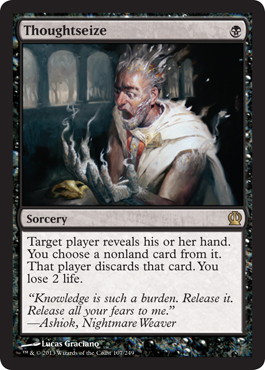
With Dark Confidant and Tarmogoyf being reprinted in Modern Masters, Jace, the Mind Sculptor coming in FTV:20 and Thoughtseize arriving in Theros, the Magic community is seeing an unprecedented level of reprints of high end singles these days. This is both scary and exciting when it comes to finding ways to exploit the reprints and make a good bit of money.
When a reprint occurs, the first thing that occurs is either mass cheering or jeering and then a mass sell-off. The price proceeds to drop by a large percentage and stays at this depressed until there is a change, whether that is additional reprinting or it is out of print. Obviously, if there are additional printings, the card tanks and has probably lost significant value for years, so for this article we are going to focus on the card being reprinted only once.
I want to focus on Thoughtseize and Baneslayer Angel right now. Baneslayer Angel was a stud in Standard, it went to unprecedented heights of price and was clearly the Queen of Standard while legal. Then the reprint happened, it proceeded to lose nearly 80% of its value and was quickly outclassed by the Titans and has seen little to no play in Modern or Legacy. It has the angel benefit, but that will only carry a card twice-printed card so far. However, here we are two years later and Baneslayer is now starting to rise in price again. This shows us that no matter how little play a card is receiving, as long as the card is playable, a reprint is not The End for a card's price in the long term. No matter how bleak it gets in the present, the future can be brighter.
How can we apply this to Thoughtseize? Well, the fact that Thoughtseize cut in half instantly upon announcement means that people are already looking for a reason to dump the card. The moment that happens, that is when we should buy in and buy in hard. I believe this moment to be shortly after the 2014 Core set is released. Modern season will be wrapping up, people will be looking to cash out of Modern for the year and more people will be ready for a new set to come out and Thoughtseize will soon be out of print.
Thoughtseize should start to rebound in the fall as more of the Fall 2014 set is opened and new players to the game need to start to acquire the Thoughtseizes to enter into Magic. This also assumes the format doesn't develop to the point that every single deck starts to play Thoughtseize to counter Thoughtseize, in which case the spike comes a lot sooner.
Some Other Case Studies
We can now look at cards like Sanguine Bond, Door of Destinie, and Gilded Lotus. These three were all recently reprinted in core sets and saw massive drops in price. As long as these cards don't continue to see reprints in core sets, they should all start to rebound. The casual market is probably more active than the tournament market for singles, and with every new cube, every new EDH deck, every new casual Sliver deck, more and more of these cards will be needed. This makes them very active buys right now.
Sets like Modern Masters, From The Vault, and special Promos present a completely different aspect to reprints. The reprints from these sets are extremely limited and make even better profiting targets. Take Tarmogoyf and Dark Confidant from Modern Masters. They were announced and right before the set came out people were dumping these cards in anticipation of lower prices for these cards. However, looking at the price of these cards today compared to 6 months ago, there is almost no change. There was just simply not enough put into the market to satisfy demand. Yes I know some vendors started buying at retail numbers, but that is what happens on a short supply of high demand cards. The rares from that set are slow to catch up, but I think given a year or so, most of the cards will regain a lot of value.
The same can be said about From The Vault sets and promos. There is just simply not enough copies put into the population to justify a long term price drop. Best guess is that something like 75,000 new copies enter the market, and when there are already millions in circulation, this is a drop in the bucket. A lot of these copies don't even get opened and are kept in collections still sealed, so maybe 50,000 enter circulation. Not a whole lot in the grand scheme of things. Prerelease and Release promos do a fair amount of damage to a cards value, but just look at something like Emrakul now. It is a $25-$30+ card right now and it was a prerelease card. If a card is in high enough demand, it will spike eventually and buying in on the bottom floor during release time can yield large profits a couple years down the road.
Cards Affected by Reprints
This part is going to be significantly shorter. Thoughtseize being reprinted, along with Dark Confidant and Tarmogoyf is going to allow a lot more people into Modern and Legacy. However, a lot of cards were not reprinted such has the Fetchlands and Inquisition of Kozilek. People are not going to replace Inquisition with Thoughtseize, because honestly in my mind, all of the important spells in both formats can be removed with Inquisition and Thoughtseize is usually in addition to Inquisition. Fetchlands are also going to see another boost since more people will want to play in Modern after acquiring the hard to find Thoughtseizes.
This also applies to cards that had been reprinted previously. Each time a big card is reprinted, it attracts more people to the older formats. Because Dark Confidant and Tarmogoyf gets a reprint, all of the cards that are needed to play the decks those two cards in get a boost with people buying in. Now Thoughtseize gets reprinted, you have a new group of people buying into Modern and the cards that are needed, so Dark Confidant and Tarmogoyf get another boost, as do the previous group of cards that were needed by the Tarmogoyf/Dark Confidant people. See how this can snowball quickly?
Once they own the Dark Confidants and Tarmogoyfs, they are only a few cards away from a viable Legacy deck in Jund. Onslaught Fetchlands and Dual Lands get a small boost from this increase interest and so forth. It might take longer to feel the effect of these older cards getting bought, but eventually someone will notice the supply going low again and buy in, causing another spike in cards. The goal is to be among the first people to notice this or piggy back on this rush.
I am not sure if I have completely mucked this up or if any of this actually makes sense to anyone. There are two major takeaways if anything from what I have said. This game is popular and is growing all of the time. Just because a card is reprinted doesn't mean it is going to lose its value permanently. Cards are destroyed, put into collections, or more people arrive and need them. The second item is that you need to look beyond just the card being reprinted to see the full scope of changes from the reprint. Inquisition of Kozilek and Fetchlands are both poised to see a spike as more people get into Modern as more of the expensive cards are reprinted.
Next week I am going to cover GP Detroit results, additional Theros thoughts, and how to analyze previous block cards that are undervalued so you can find nice targets to focus on.
-Stu
If not, now is a perfect time to join up! Our powerful tools, breaking-news analysis, and exclusive Discord channel will make sure you stay up to date and ahead of the curve.
This morning, I got to thinking about what it takes to make this community happy.
The Grass Isn't Always Greener
I love writing for the free side of Quiet Speculation. My work being shared outside this website is a good feeling, and not feeling like I have to provide content that will make people money (although sometimes I still do) leaves me free to talk about my bowel movements or cat pictures or whatever.
One consideration I do have to make, though, is that not everyone who reads my work is a QS insider. A lot of you are, and that's great, glad you are taking the time to read an article you technically didn't pay for directly, thus diluting the overall value you're getting from your membership fee.
But for the rest of you, thanks for reading, and if you are at all interested in finance, you should consider the investment, and a big reason why is the Quiet Speculation forum. A good source of finance information, it also provided the inspiration for today's editorial.
Is it "qq" or "QQ"?
I never played any online game where that was used to mock someone who was whining, but I do know people who say, out loud and in person, "QQ" (or "qq") as if that were at all acceptable. One of these people, when I finished hitting him with his own shoe, explained that it is supposed to look like a set of eyes that are crying.
I think "QQ" and "qq" are tied for "looks the least like someone crying" so it's a toss-up. Either way, I wanted to use this hip interweb lingo used by you whippersnappers with your skateboards and your sexting and your injecting heroin into your scrotums or whatever kids are doing to get high these days.
The point is, there is a lot of Qq'ing going on and I actually wanted to mock the internet because I blame the internet. How do you make people in the Magic Community happy?
What Was All That About the Forum?
I'm getting to that. Let me get there at my own pace.
I Wish You Would
Right, anyway, as I was saying, this article was inspired by some "queue cue" action in the forum today.
If you're not aware of the QS forum because you're not an insider or you are an insider but have never been in the forum because you really hate value, the QS forum is exemplary. Seriously, it is the best. If you have been anywhere else and you come back here, you'll understand how good it is.
People are generally helpful, the paywall helps police behavior to an extent because no one who is paying for access really wants to troll and the occasional troll is policed by the community. People are much more open about giving actionable financial tips because they know everyone reading them paid to read them and will likely not proliferate them outside the site for free. It may have been by total accident, but the paywall on the forum has actually made it, in my opinion, the best place on the web to talk finance, and probably the best place to talk any kind of Magic.
Is that bias talking? Well, considering I don't actually have a financial incentive to convert new subscribers, I don't think so. So far, no one has signed up for a membership and said "I'm here for the forum!" because the only way to make that statement sound more ridiculous to most people would be to say "Im hear 4 thu forumz dawg #yolo #Swag #Kony2012".
It even sounds ridiculous to me and I'm literally advocating for the forum. So this isn't a sales pitch, it's a statement; the QS forum is exemplary in this opinionated opinion writer's opinionated opinion.
It's so good and yet I feel like the best metaphor for it is a Swedish prison.
Here's a "cell":
This is literally nicer than my wife's old single dorm room.
a cell block:
This is literally nicer than my Grandfather's retirement home, and that's called "Atrium Manor".
and here's the view from a typical cell, through the window, not bars:
This is literally nicer than the view from my window where I see my neighbor's Terrier humping a tricycle.
And yet, all anyone actually inside a Swedish prison ever says is “Prisøn sucks, I want tø gø play øn the fjord.” Have these people never seen another prison? If they had, they might know how good they have it. Similarly, I think QS forum members may sometimes forget how good they have it. Sure, internet discussion forums are going to have inherent problems like new people not knowing what they're doing coming in and posting, but everywhere else it's worse.
They're not bad people, quite the opposite. They are the constituency of the best online Magic community there is. I think everyone just needs to be reminded from time to time that the grass is not always greener elsewhere. Sometimes everywhere else is worse by comparison.
You're not wrong for wanting the QS forum to be the best it can be. Not wrong at all. You're not even Big Lebowski "not wrong, just an asshole" not wrong. But let's all take a deep breath and remember that things could be a little better and they could also be a lot worse.
If the biggest problem with a forum is that too many new people are joining, then life is pretty good. Spend five minutes on any other finance forum if you don't believe me.
Are Finance People Just Spoiled?
Far the hell from it! In fact, when QS insiders are complaining they are roughly half as annoying as the average Magic player quietly shuffling a deck and politely making small talk with their opponent. I have a great example.
This is a picture of a sliver:
They should have called this one "Predator Sliver".
The Magic Community managed to really surprise me during M14 spoiler season when they announced there would be slivers in M14. I expected a roughly 75/25 split between "Sweet, I like slivers" and "Boo, I hate slivers." What I was treated to were myriad different complaints.
"These don't look like slivers."
"I don't like how they don't share abilities with opponents' slivers. They keep dumbing the game down. I should quit."
"They cost too much."
"These are going to ruin Limited."
"Great, another Muscle Sliver. Might as well burn my Merfolk deck."
"Slivers are native to the plane of Rath. How could slivers possibly end up on the plane of Shandalar?"
What's worse is finding out these creatures don't share abilities with opponents' slivers because they were not developed as slivers. They were going to be sliver-like creatures, native to Shandalar (if I got the plane information wrong and you feel like correcting me, I'm warning you in advance that I don't care) or whatever plane M14 is on.
Wizards decided at the last minute, "Screw it. We should just make them functionally better slivers so players can add these to their sliver decks with their old cards. Our players are good people and they deserve something nice." The "good people" of the community responded by bitching up a storm.
Remember, they didn't do anything controversial. What they did was make a last minute decision to throw us a bone and they were treated to complaints the likes of which I was naively unable to anticipate. Why do anything for these people?
Well, it turns out Wizards could predict the bitching, and they didn't care. It turns out Magic is insanely popular and grows and grows each year. "Bitch all you want online, Johnny Neckbeard. We both know your Vorthos-loving ass is buying a box of M14 and you're jamming those slivers in your deck," is probably the correct attitude here.
It's not about Wizards not caring about what their fans want, by any means. It's about Wizards putting out what they feel, based on past success and input from the design and development team, is the best product, knowing there will be bitching no matter what.
Too Late to Start with a Quote
But maybe not too late to include one.
We get a lot of feedback about Brainstorm Brewery. Well, we see it as feedback. People who give it see it as valuable, life-saving advice to help us get back on track and stop messing up like we have been all along.
One particular bit of feedback was pretty scathing. In addition to criticizing the length of the cast, it criticized the banter between hosts, specifically the "Shut up, Corbin" meme. The gist was that they don't tease each other on "good" casts like Limited Resources--nice, imply we're a bad cast by comparison; very subtle--and the writer "wouldn't be surprised if we didn't like each other or hang out outside the podcast."
Worst of all, it singled me out as Corbin's main antagonist, but instead of saying so, callowly stated, "I won't say who it is," which is easily the douchebaggiest thing to say in that situation and it's not particularly close. "You're going to lose a lot of listeners if you don't change," was the final bit of advice imparted.
I stared at the screen for a few minutes, feeling like, "Why do we even bother with a podcast," until Marcel saved the day by replying to the four hosts with an e-mail, which said, succinctly,
"I don't know the key to success, but the key to failure is trying to please everybody." - Bill Cosby
People who have never met Corbin come up to him and tell him to shut up. That meme has easily been one of the strongest unifying elements for our fanbase, and even Corbin thinks it's funny unless he's heard it like thirty of forty times in the past 24 hours. If we took all the "advice" people gave us about the podcast that was absolutely, positively the step we needed to take unless we were idiots, we would have to:
Lengthen it to two hours.
Shorten it to thirty minutes.
Put all the information in the show notes (presumably eliminating the need to actually listen).
Be nicer to Corbin.
Be meaner to Corbin.
Talk more about finance.
Talk less about finance.
Never bring a guest like Christine Sprankle back.
Have a guest like Christine Sprankle every week.
I guess the only thing we learned was that people are going to bitch about something. We'll take advice if it resonates with us and fits with our core philosophy, but at the end of the day we put out the best quality product we can and realize we'll never please everyone. Wizards did that with slivers and QS is doing that with the forum.
No product will ever be received without bitching, and we have to accept that as the cost of doing business. The internet has given everyone the notion that because they have the ability to make their opinion known, they are obligated to do so.
The QS forum is awesome, it's great to have slivers back and if you don't shut Corbin up every once in a while, he's going to talk about Taylor Swift or encourage you to invest in cans of Surge. This is just how it is.
QQ more.
What Else Happened?
GP Prague was Limited, so I don't have to talk about it, which is good for both of us. I may get all the way through to SCG results before wanting to kill myself. I know, kyoo kyoo more, right?
Philadelphia isn't all Liberty Bells, lawyers with AIDS and a hockey team that makes terrible decisions regarding their goaltenders. It's also home to Motyka and Slick Jagger, the homebrew geniuses behind the upcoming "Brainstorm Brew," and it was home to an SCG Open this weekend.
Standard is nearing the end of its life. Will the old, lame ducks limp on? Is new tech already being tested? Let's take a look before we put a pillow out of this format's face and put two in its dome once and for all.
Kibler Gruul gets there, predictably. The more straight-forward a deck is, the fewer late-game, Hail Mary topdeck answers it has, but if you can punish stumbling in the early game by your opponent, you win.
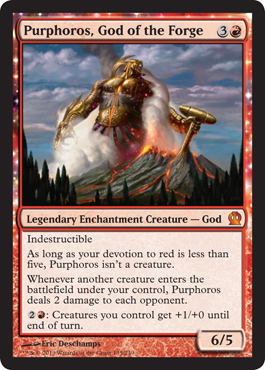
If you are predicting that Xenagos, the Reveler will be a factor in the continued success of this deck going forward, I can't agree less. The last thing it needs is another non-creature. Expect Domri to maintain or go up due to Searing Spear getting a functional reprint and all the initial excitement around Porphoros.
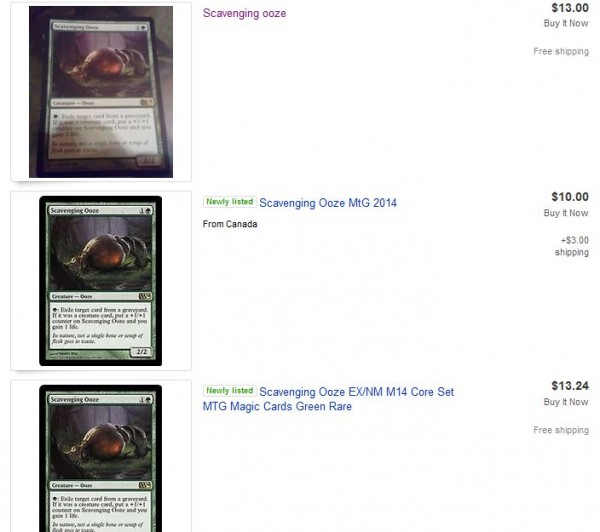
Scavenging Ooze seems like it could maintain as well, but with all the relevant graveyard stuff rotating, it may get less play in Standard. It's still a solid bear, but it's less important going forward.
The Naya midrange list in second tells us almost as little about the future.
I like Zachary Schultz's B/W Midrange list, but it's almost all rotating. Without Liliana of the Veil, I don't know what this deck archetype would do. Obzedat, Ghost Council and Desecration Demon are sticking around, and with a black, instant-speed Terror that nukes planeswalkers, it may be something to brew with going forward.
If black gets weaker or white and green get stronger, expect the price of Lifebane Zombie to fluctuate. Currently it seems overpriced, but core set rares are funny. Thundermaw Hellkite experienced a nice price renaissance, and while that's a mythic, core set cards are funny. Core sets don't get opened as much, giving real price upside if there is a sudden spike in demand. This is a card to watch for sure. As for Varolz, without anything to sac for value, get out while you can.
I think the B/G Midrange decks that people took way too long to embrace are good indicators of likely future archetypes. We will retain Abrupt Decay, Desecration Demon, Lifebane Zombie, Deathrite Shaman, Vraska the Unseen, and we will get a ton of new goodies in Theros. The Rock is a fine arcehtype and it looks like we have all the tools. Losing Liliana hurts, but we managed when we lost Jace, too. Black is going to have a lot of solid tools going forward while white and blue lose the most.
Bant Hexproof simply won't be a deck anymore. Good. An auras build is still possible, especially given the occasional juicy-looking bestow guy and the retention of Ethereal Armor, but it won't look anything like it does now in all likelihood. Cards that could retain value are Voice of Resurgence, Fiendslayer Paladin and Unflinching Courage.
I would look to Block decks like Wescoe's G/W as a good place to start testing for the future. Naya looks poised to do good things as adding red gives access to the closest thing we'll get to Path or Swords. Brew something--that's how good spec discoveries get made. It was testing that finally convinced me to go deep on Deadbridge Chant and I made so much money selling those at $8 that now I can afford to drink brand name Orange Juice.
He would say that, wouldn't he? Reid Duke, of course, won the event with Elves. What these people see in that silly deck I'll never understand.
At least Reid didn't jam the one-of Ruric Thar advocated by Jon Johnson, a decision that hurts my head because it's so ridiculous yet I can't come up with a compelling argument against it.
Natural Order fell heavily out of favor, but decks like this could see it return to its glory days of high prices and high demand. Seems like a decent time to buy low would have been a few months ago when it was $25--try and see if you can get them for $25 in trade. People might not know they're back up.
I didn't watch coverage, so I have no idea how Reid beat Shawn Tappen's Reanimator, considering Elesh Norn just pulls that whole deck's pants down. Iona naming green is similarly-troubling.
Kurt Spiess wins "Pet Deck of the Week" with his Top 16 finish with Lands. Any given Sunday, right?
Garfield creator turned Magic player Jim Davis managed to get 4th with Goblins while the best Merfolk finish was 9th. Shut up, Corbin.
Epic Storm is seeing a lot more play. This was a real 2009 kind of deck, but it's replacing ANT lately because a partial combo isn't a loss if you can Empty the Warrens for 12 tokens. Burning Wish doubled in price this summer but looks like it may be cooling off. I wouldn't buy in now.
Lots of decks are running Gitaxian Probe. There are a lot of those promo probes still sitting in binders, being undervalued. While set foils are more pimp, the promos are low-hanging fruit. They snap-sell online, so try and underpay on those because they're being undervalued.
Maverick may no longer be the hotness, but it can still throw down. Cards common to this deck and decks in Modern should keep the prices propped up. Not a lot of opportunity here. Foil Thalia is back down to around $15 and that's a price I'm comfortable paying. I don't expect rotation to hurt the foils too much, but I will wait and see if they tank anyway. It's going to feel really good if the non-foils drop to like a buck. If they do, I'm cashing in my 401k to buy out the planet.
The W/B/R Deathblade deck is back, and I think it's a real deck to watch. The current format is cold to Grim Lavamancer. The biggest difference between this list and the former failed experiment, Team Italia, is that this deck has Deathrite Shaman and also murders Deathrite Shaman.
Badlands is up to $80. I hope you bought them at $40 when I said to--Jund is never going away and these are never going back down. At this point, just buy Plateau on principle because the odds of a deck never coming along to push the price up is so remote it's hardly worth mentioning.
Similarly, there's no way that Arid Mesa doesn't hit $50 soon. The blue fetches went from $15 to $30 and not many people pounced on Catacombs, Mesa and Flats at $15. Sure as shooting they went to $30. With the blue ones at $50 now, I have been advocating buying Catacombs for a while, only to have people say, "But it was in an event deck," to which I can only reply, "then why aren't they still $15?"
Catacombs, Mesa and Flats are going to be $50. Probably in the next few months. Modern isn't even driving the blue ones up because blue is not dominating Modern. Decks with Catacombs in them are doing that. Be smart, buy the fetches that haven't gone up a second time yet.
That's All For Now
With no GP to talk about it's time to wrap things up. Join me next week for more quality content and to feel like you're being attacked on a personal level in a subtle way you're unable to prove. I know, it's not my typical 4,000 word output.
If not, now is a perfect time to join up! Our powerful tools, breaking-news analysis, and exclusive Discord channel will make sure you stay up to date and ahead of the curve.
A few weeks ago, Wizards spoiled some of the MTG finance community’s plans to profit handily on the coming Modern season--they postponed the season by almost a year.
My initial reaction was to expect a delay in price increases on many Modern staples. This would be driven by demand shifting later to match up with the new PTQ schedule. Basic supply and demand concepts led me to this conclusion. But apparently I missed something, because many Modern staples have increased significantly since the announcement was made!
This week I want to look at which cards are seeing price movement now and which ones appear to be waiting. I’ll do my best to provide some theories as to why certain cards are moving better than others. Finally, I will discuss plans moving forward now that some price trajectories have progressed sooner than anticipated.
Recent Spikes
Many cards not printed in Modern Masters fall within this category. In fact, many speculators (including myself) did expect these to go up in price, only we were thinking it would happen during last PTQ season. After seeing the delay in Modern PTQ season this time around, I fully expected to have to wait much longer to see some investments pay out. Certain cards are bucking this trend.
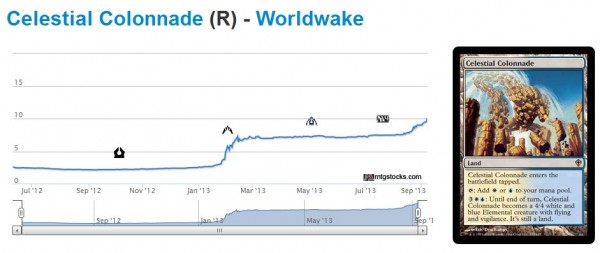
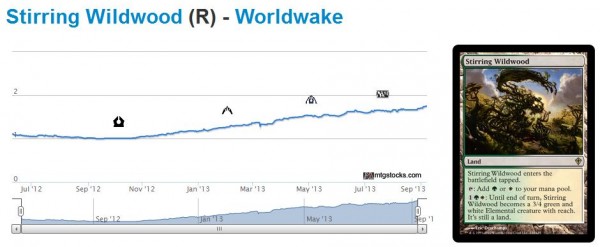
Consider Worldwake manlands for example. All of these are on an upward trajectory, but Celestial Colonnade and Stirring Wildwood appear to be increasing further still during the past month, when I would have expected them to take a breather on the PTQ season schedule change.
I know these manlands see some play in Modern, but has Modern been growing this much in popularity? Are there enough Modern FNMs out there to justify the steady price rise even though Modern PTQs won't show up for over half a year?
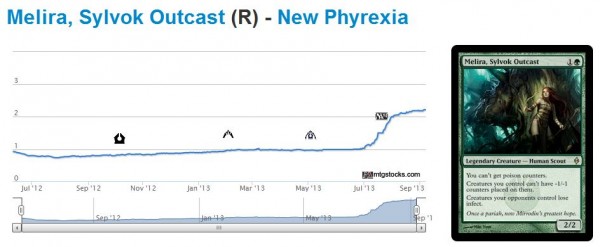
How about Melira, Sylvok Outcast? This card was under a buck for nearly its entire life, even as the Melira Pod strategy rose to become one of the strongest in Modern. But it wasn’t until recently that this card started seeing a serious bump in price.
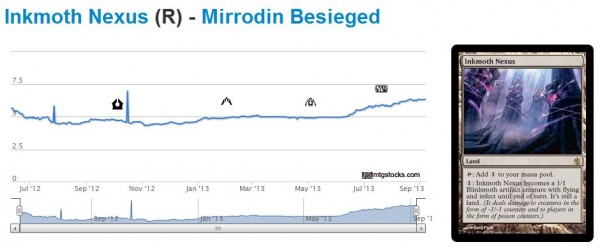
Inkmoth Nexus is another card seeing a recent rise in price. This causes me to pose the same question as before: is Modern really spreading in popularity this much, despite a delay in Modern PTQ season?
Other examples of recent price movement on Modern cards include Zendikar fetchlands, Daybreak Coronet, and Keen Sense.
Not Everything Is Moving Up
If the above price movement is strictly due to an increase in Modern popularity at everyone’s local hobby shop, then other Modern staples should also be rising. But some surprising cards aren’t participating in the rally.
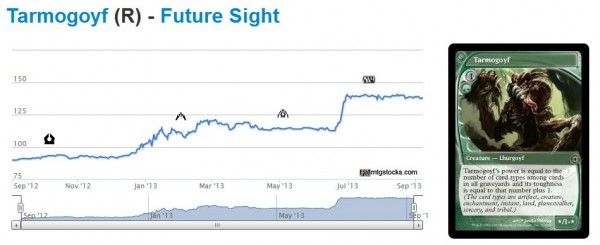
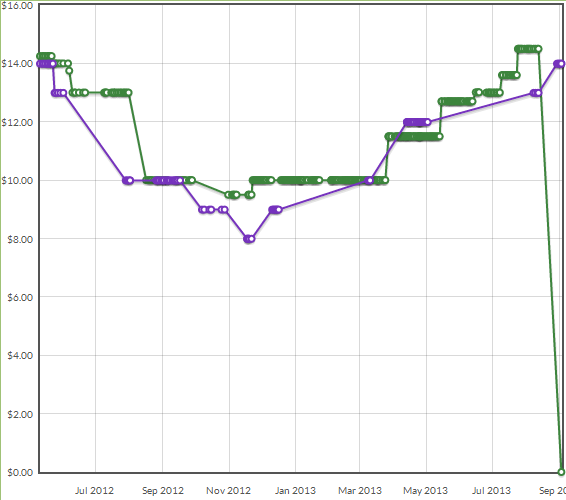
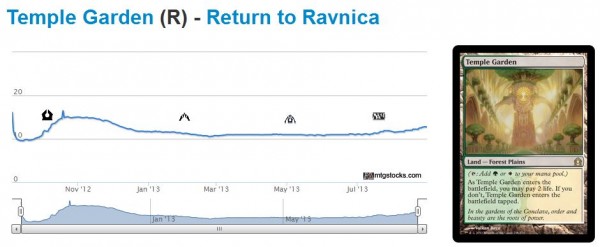
Consider Tarmogoyf for starters:
Notice how Goyf's value has completely stagnated and even slightly declined since July? Did the jump earlier this summer already take into account all increase in demand? This was my suspicion--that the rise in demand due to a popular Modern PTQ season was already priced in. Perhaps this is why this card hasn’t moved lately while other cards (which previously had not risen as much) are on a tear.
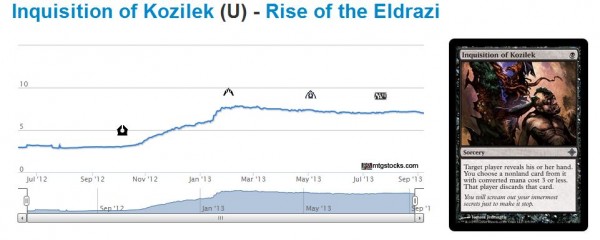
Another surprisingly stagnant card is Inquisition of Kozilek.
Everyone thought this card would become $10, but it just hasn’t happened. Now with Thoughtseize suddenly becoming more affordable this may never happen. But the fact of the matter is that even before Thoughtseize was spoiled, Inquisition has been price-stagnant for months. If Modern demand was truly increasing, I would expect this card to participate in the rally.
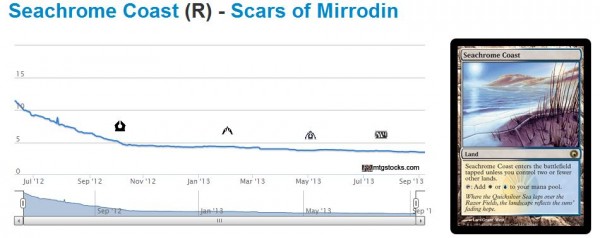
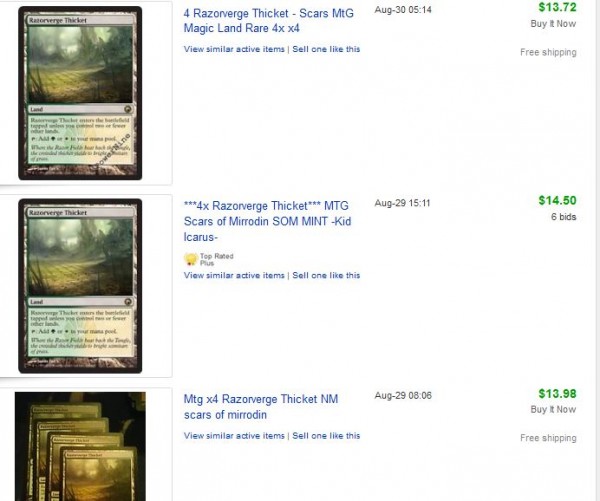
How about Scars of Mirrodin fast lands? Surely these will increase in price as the Modern format grows in popularity, right? Apparently not…
I know these lands are not as ubiquitous in Modern as fetches and shocks, but I still expect them to bump up in price a little. Filter lands became very expensive lately, but these haven’t even followed in trend, let alone price! Even Razorverge Thicket, which is seeing the most play of the five fast lands, is still stagnant in price.
Understanding the Disconnect
Why are some Modern cards suddenly spiking while others are left in the dust? In my opinion, one factor alone is not the cause. Instead, many variables are likely having an impact.
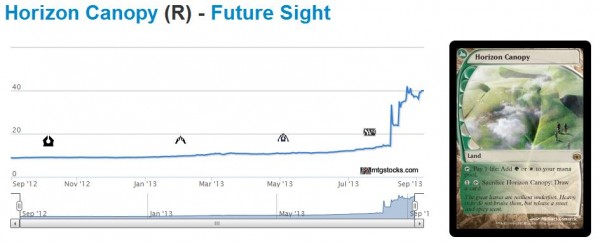
How recent a card was printed is definitely significant. Cards from Future Sight and Ravnica like Horizon Canopy and Chord of Calling are older and rarer, so I understand why they’d move more readily. Meanwhile Scars of Mirrodin is still fairly recent.
Another factor may be related to deck popularity. When Reid Duke played a unique Hexproof Modern deck at the 2013 World Championship, many players took notice. The deck was also fairly cheap at the time, and I suspect it’s a lot of fun to play.
Hence the deck gains in popularity, people want the cards to build the deck, and voilà, instant price jump. It’s no coincidence that the July 31st, 2013 date coincides nicely with the recent price jump of cards in Reid’s deck, such as Horizon Canopy.
The recent rise in popularity of Reid Duke’s deck explains a lot of the recent hype, but not all of it. A white-green deck gaining traction cannot explain why Celestial Colonnade has been an interest on mtgstocks.com many times in the past couple weeks. Reid’s deck also has nothing to do with Inkmoth Nexus.
Are there other factors, then, which dictate why certain cards get their deserved “pop” in price while others remain flat? Maybe fear of reprint is a potential factor? I know I personally refuse to own Tarmogoyfs and Dark Confidants right now because I am confident more will be printed. I had the same feeling with Thoughtseize, which paid out nicely.
There are likely other factors as well. But at the end of the day shouldn’t all Modern-playable cards see a price increase going into Modern season? Barring cards currently rotating out of Standard, all Modern cards will see increased demand in the coming months. I just don’t understand why some cards are seeing increased demand now, while others are waiting on the sidelines.
Concluding with a Challenge – Spellskite
Throughout this article I’ve been completely transparent. I’ve admitted that some of these incongruities in Modern card prices have intrigued me. While some trends are obvious, such as cards in Reid Duke’s World Championship Modern deck, others are puzzling.
I’ll conclude this week’s article with a case study that embodies my point: Spellskite.
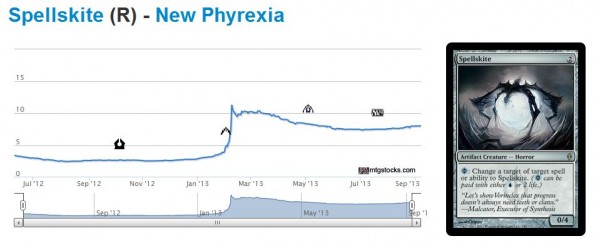
Spellskite is a powerful card in Modern these days because it helps keep so much in check. The Kiki Pod and Splinter Twin strategies suffer greatly against an opponent’s Spellskite. And with so much removal in the format, this creature ensures you can do what you need to without fearing an Abrupt Decay or Lightning Bolt.
Spellskite's utility was proven during last PTQ season. The result--it spiked to over $10 throughout the season. Then the card dipped a little as the season ended. What confuses me is how much the horror’s price has dropped even further in recent months.
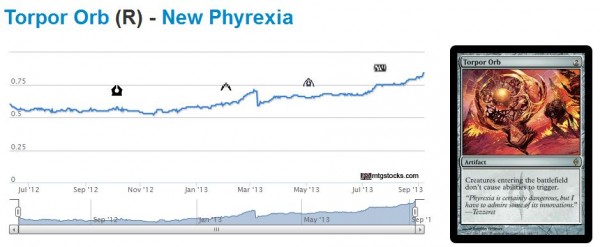
This movement is opposite of many other Modern staples and I’m not sure why. Isn’t Spellskite still amazing and versatile in Modern? Melira, Sylvok Outcast and Birthing Pod are from the same set and they’ve been increasing lately, so why hasn’t Spellskite? Even Torpor Orb has been on the rise lately–-same set and also mostly a sideboard card.
Perhaps Spellskite just hasn’t had his moment yet. It’ll come--of this I am fairly certain. The same goes for fast lands and all the other Modern staples which haven’t budged in price for a while. And it’s with this expectation that I set my latest purchases towards cards which haven’t moved recently, but should be moving right along side all the other great Modern cards.
…
Sigbits
Besides Spellskite, here are some other cards which haven’t moved lately. While this is not always the case, I suspect for these cards it’ll just be a matter of time…
I seem to recall that I used to be able to buylist Magus of the Moon for $5-$6. Now this card sells on TCG Player in this range or even a little lower. But there were three copies in the runner-up SCG Legacy Open decklist last week. In fact I’ve noticed that a turn one Blood Moon effect has risen in popularity a good deal in Legacy. The fact that Magus is Modern-legal and hasn’t been reprinted gives the 2/2 hate bear some serious upside.
I really like Basandra, Battle Seraph. She’s a sweet legendary angel from a Commander set. Although her demand is mostly from casual players, SCG’s $3.49 price tag feels pretty low. In fact it’s lower than every price on TCG Player. I’m sitting on a few extras waiting for her price jump to come–-it may take a while, but I’ll be patient.
Abrupt Decay is on life support. Despite being playable in Standard, Modern and Legacy, this card is only worth about one fourth its peak. Foils have also suffered a little bit, although their prices have been more robust overall. Since this is a newer card, I anticipate the wait on it to be a bit longer. But considering its versatility in Modern and Legacy I suspect this removal spell will have its day yet again.
If not, now is a perfect time to join up! Our powerful tools, breaking-news analysis, and exclusive Discord channel will make sure you stay up to date and ahead of the curve.
It's been a little over a year since I've started writing on a regular basis for Quiet Speculation. At first I was afraid that I'd run out of ideas and things to write about. It turns out, the more you write, the more ideas you get!
But more importantly, this column has given me ample opportunity to analyze what works and what doesn't work when speculating on MTGO.
Focus on the Fundamentals
Paying attention to the fundamentals is responsible for the majority of my profits. Speculating on MTGO is dominated by three fundamental factors: drafting, redemption, and rotation. Keeping these factors in mind when assessing a potential spec will ensure positive returns.
Drafting
At it's core, MTGO is a program people use to booster draft easily. Having the next draft just a few clicks away is incredibly addictive and it makes limited play the most popular activity on MTGO. It also means that drafters and their collective actions dominate the digital economy.
The current set is always in steady supply and thus it will sit at a relatively low price. When that set is no longer drafted, supply shrinks and prices normalize.
When you are looking at stocking up on staples, buy them while the set is still being drafted in order to ensure low prices. Buying low and selling high is pretty straightforward online. Outside of metagame shifts, you only have to ask yourself what is currently being drafted and when will it stop being drafted. Let the market take care of the rest.
That's the supply side of drafting, but the demand side from drafters is just as important. They need digital boosters to draft with, so being able to sell boosters to drafters means you can realize consistent profits buying and selling these objects.
The current set is awarded in prizes for both limited and constructed play. Over time, this leads to a high supply of boosters and a depressed price on the classifieds. All things being equal, boosters should go for around 4 tix and this is the price they gravitate to over time. Once a particular booster is no longer awarded for constructed play, the supply will steadily dwindle and the price will rise.
This pattern is very exploitable. In the weeks prior to a new set release, start buying up the set that is currently being given out as prizes for Constructed. It should be at or near its bottom at that point, around 3 tix. After that, it only requires two to four months to see the price creep back towards 4 tix, yielding profits in the 10-30% range.
Now the percentage gains might be small, but boosters are extremely liquid. This means that if you need tix, it's easy to sell these. The market for boosters is also extremely competitive so you don't give up as much to the bots when buying and selling boosters.
Overall, booster speculating has high predictability of returns.
Redemption
This is a subject I often refer to in my writing, but it bears repeating. Redemption is the link to paper prices that ensures digital objects have some value. For speculators, it means that mythic rares always have some value to redeemers.
If you are buying up cards that are currently being drafted, pay attention to junk mythic rares. These can get quite low in price during periods of heavy limited play and they are a lock for profits down the road.
Recent examples include cards like Darksteel Forge and Ring of Three Wishes from M14. The sell price for these got as low as 0.25 to 0.35 tix during release events. The current buy prices at Goatbots is 0.45 for Darksteel Forge (one in stock) and 0.46 for Ring of Three Wishes (zero in stock).
These two cards have already yielded small, but predictable, profits. They will probably creep higher as we get into October.
Rotation
Redemption ties in with Fall Standard rotation as another source of predictable profits. At rotation, cards often go from being important cogs in Standard to basically worthless. Demand for tix is also high due to release events for the Fall sets.
Combined, these factors ensure that prices have only one direction to go and that is down. For casual cards, the prices can bottom any time around October, but for competitive cards, the prices usually bottom at the end of October.
While the market is selling and prices on rotated cards are dropping, you should be the one buying. Eventually players will stop selling their cards for tix and prices will stop dropping. At that point, online sets can be very attractive to redeemers. They get to buy digital cards for low prices, redeem the sets, and sell at higher paper prices. Demand from redeemers ensures a steady increase in mythic rare prices from rotated sets.
But this process doesn't happen overnight, which allows the patient speculator to buy up cheap mythic rares and hold onto them until prices have normalized. The actionable strategy here is to buy up mythic rares from rotating sets in October and November, and hold onto them into the winter.
The other factor that will ensure profits is playability in Modern. This is a growing format and it looks like it has successfully established itself online in the Daily Events, which fire steadily.
The strategy here is to buy up Modern staples at rotation and hold until the PTQ season. In the first two years of Modern's existence, this mean until the winter. This year, Modern season has been pushed back to the summer. Nevertheless, I'll be picking up Huntmaster of the Fells, Snapcaster Mage and Liliana of the Veil in the coming months.
Rotation means a steep drop in prices in general. Demand from redeemers and Constructed players will eventually push prices back up. All it takes for steady profits is a willingness to surrender tix for a few months and wait until prices normalize.
Avoid Marginal Strategies
These are three pillars of the MTGO economy from the speculators perspective. Unfortunately, and I include myself in this, it's easy to get distracted from the fundamentals and to take on marginal strategies.
Speculating on Legacy and Classic would fall into this category. These are niche constructed formats without much of a player base, so one should avoid speculating on these cards. If it's a niche market, it should be a relatively small part of your portfolio.
Another marginal strategy is to bet against the fundamentals. My foray into speculating on Thragtusk earlier this year falls into this category. As a non-mythic rare, this card had no redemptive value. It was still being opened in limited play (Core Set sealed deck and draft both fire throughout the year on MTGO). Also, rotation was just around the corner.
Literally I went against all three of the fundamentals when I decided to speculate on Thragtusk. Quite the blunder.
It's easy to get excited about a marginal speculative strategy, especially in the Spring and Summer. By that time of the year the best specs are mostly wrapped up and one probably has an account flush with tix. It's easy to talk yourself into putting those tix to use because otherwise they are just sitting there. Unfortunately, the tendency to want to "do something" led me to pursue a strategy which just didn't have much going for it.
Straying from the fundamentals is an easy way to start losing tix. We shouldn't be trying to reinvent the wheel, but rather focus on what works and maximize the strategies tied to the fundamentals. The next two opportunities tied to the fundamentals include buying M14 boosters and picking up cards from Innistrad block.
Buying M14 boosters during Theros release events is a sure fire way for small profits. They should be dropping into the 2.8 to 3.0 tix range at that time. By December, players will have gotten their fill of triple Theros drafts and will be looking for something else to do. By that time, M14 boosters should be back in the 3.4 to 3.6 tix range.
Otherwise, I'll be loading up on Innstrad block Modern staples after Theros release events have finished up. Be sure to keep a few tix handy for the best buying opportunity of the year.
If not, now is a perfect time to join up! Our powerful tools, breaking-news analysis, and exclusive Discord channel will make sure you stay up to date and ahead of the curve.
Two events in particular over the past week got me thinking about a concept we don’t like to talk much about in MTG finance.
After all, who wants dwell on their failures?
If we’re doing our jobs (or hobby, however you view it), then failure isn’t something we should concern ourselves too much over. While that’s a great concept in theory, it doesn’t always hold up in the real world. We all fall down, make mistakes and screw up, and sometimes we even do it when it comes to Magic.
I want to make it clear up front that there’s nothing wrong with this. The important thing is that we learn from it and apply those lessons learned in the future.
Anyway, back to the story I was telling before I so rudely interrupted myself.
The First Failure
The first incident stems from the aftermath of a large collection I bought. If you haven’t seen my tweets about it, I’m currently into several collections I bought on the same day for about $2,000, which marks the largest amount of money I’ve ever tied up in collections at the same time before. I’ve been piecing it out over the Internet before flipping the rest at GP: Oklahoma City (my hometown) next month.
This is already a stressful situation even though I was confident going in, and the amount of work I’ve incurred in the past month as a result is not insignificant. Not that I mind that part exactly, but I don't exactly have all the free time in the world.
Now we come to the part where I admit failure. A lot of the cards from one of the collections I bought are from Innistrad block, and we all know that means: dropping prices across the board.
Of course, I did know this going in and tried to prepare. I lowered my prices from the outset and thought I’d get rid of them all in a week or two tops so I could get out of them before buy prices completely disappeared.
That was three weeks ago.
Now I have a big stack of things like Hinterland Harbors and Falkenrath Aristocrats that no one wants, and I’m looking at a real possibility of actually losing money on some of these cards because I drug my feet too much. I’m certainly not going into the red on the collections as a whole (I’m positioned to do well but it’s not one of my better flips in terms of percentages), but looking back over my spreadsheet I see where I overpaid pretty badly on some of these cards.
There are a few reasons. I thought I’d be able to move a few more than I did, I missed some nicks on several cards that damage value, and the seller was a pretty skilled negotiator who walked out of the store with a better deal than someone who doesn’t know what they’re doing.
Maybe he reads these articles.
I’m not sure exactly why I screwed up here, but the bottom line is I did, and that’s very dangerous to a store as small as mine. Just because I’m not losing money on the deal doesn’t make it a success. Costs have to be paid, and that includes my time--to be honest when I’m dealing with the store I see losing money on any buy as an unacceptable failure.
Of course, I’m somewhat new to running a full business, so is this just something I should be prepared for?
At the end of the day, I’m going to make money on these cards, and some would consider it good money. But I can’t shake the feeling that I failed by paying what I should have known was too much on a bunch of rotating cards.
Another Failure
Moving these collections from the back of my car into my office at home, I also came upon a small box full of a certain Rare from Magic 2013:
I was very public about speculating on this card, and my love of Merfolk is well-known. I paid just under two dollars per copy on these back when I thought Gatecrash would be filled to the brim with fishies.
As we all know, the card did nothing, and Wizards trolled me with Merfolk of the Depths (I also feel trolled by the new mythic merfolk in Theros, but that’s a topic for another day). Anyway, my spec on Masters has been publicly deemed a failure, and I’ve endured a certain amount of ridicule over it, which I understand.
Today, four stores on my usual list buy Master of the Pearl Trident for nearly what I paid for them.
The Difference?
Two decisions, two outcomes. In one I lose money on several cards I bought but it’s considered successful because I’m able to cover it up with other profitable moves. In another, I make a speculation that is widely considered a failure, even though I can cash out for basically what I put in.
So what do I take from this? I’d love to hear your opinions on the matter. Am I stressing out too much over some bad buys, or is this as serious a mistake as I think it is? How should I feel about my Merfolk speculation? After all, that money was tied up and basically did nothing. Are these two situations even comparable? Which one is actually a “failure?”
Here’s my take.
Every Mistake Is Different
A mistake is not always a failure.
When it comes to Master, I went in knowing the fundamentals behind the card were strong. It had Eternal playability, was a lord of a popular tribe and only printed once, in a core set at that. Sure, it didn’t take off like I thought it would, but I knew those other factors would help to provide a safe haven if things didn’t pan out like I hoped.
It’s the same reason I’m so keen on speculating on bulk rares, like Scion of Vitu-Ghazi right now. It may hit, it may not, but at current prices it’s extremely difficult to lose. I knew this with Master, so I didn’t feel bad about sinking my money into the venture; I knew what I was getting into and planned accordingly.
Thinking the card would spike was a mistake, but I can’t categorize this as a failure.
Now, on to the collection. Yes, I made a mistake by overpaying on several cards. It bothers me because I knew what I was getting into with rotating cards, and yet I still allowed myself to make the mistake.
But at the end of the day, I am going to make money. Much like I knew the background appeal of Master of the Pearl Trident would hedge my bets, I think that paying what I did on the other cards in that collection hedges against the risk of overpaying on rotating cards. Yes, it sucks to have overpaid, but I think that looking at every buy as a singular monolithic event is wrong. What matters is the whole.
The Takeaway
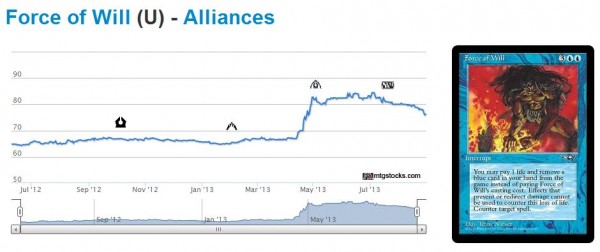
I believe this lesson can be applied to every part of MTG finance. I sold all of my blue Zendikar fetchlands (~80) when they hit $35 retail thinking I made the right move. It’s easy to look at them now pushing $60 and say that I screwed up. But I quintupled up on those lands, and profit is profit. I also traded a pair of Tarns for a Force of Will a few months ago, which also looks pretty bad in retrospect.
But you can’t get hung up on these mistakes, or they’ll negatively impact everything you do from here on out.
If you dwell on a card that goes up more after you sold it, you’ll end up holding on to the next card too long when you should be selling into the hype instead. Still stressing about trading away an Emrakul two years ago? All of a sudden you’re worried to trade any card with long-term potential for fear of screwing up.
We’ve got to move on. You may feel bad about getting rid of Desecration Demon a month ago after the first jump in price, but remember that profit is profit, and at the end of the day if you still made money (or at least didn’t completely sink yourself), consider yourself lucky.
Look back at your mistakes. Dissect them. Figure out what went wrong. Hell, write an article about it. But learn the lesson and move on to what’s next.
Failure is not a period, it's a comma. A mistake is not always a failure, and don’t let anyone tell you differently. Even if all you have to show for it is a lonely pile of islandwalking fish.
If not, now is a perfect time to join up! Our powerful tools, breaking-news analysis, and exclusive Discord channel will make sure you stay up to date and ahead of the curve.
Welcome back everyone! It looks like my last article was very well received, so they have let me write another one! Last week I discussed a few picks from Modern and Standard that I like a lot as potential for giving a nice return on your investment. This week I want to cover a few obscure pick-ups you can make as well as do some reflections on Theros spoilers.
Specs to make you think
1) Hermit Druid, Black Vise, and Mind Twist: I lumped these 3 together because I think they all represent the same concept. These are cheap, banned Legacy cards that I think all have the potential to come off of the banned list. I don't think you will ever lose on these cards, and if you do, the amount invested to get a significant number of the cards is minimal.
2) Jace, the Mind Sculptor (WWK, Foil): This one will probably get the most comments. Currently, these are sub-$500 on ebay and that just doesn't seem right. I understand that there was a big influx of FTV foil Jaces into the market, but I feel like those have more in common with non-foil Jaces, than with the set foil Jaces. This is still a mythic foil from a set that wasn't opened for long. People who want to pimp their decks are more often than not going to want the original version. Also, the foiling on the FTV is different than the foiling on the set foil and I am hearing a lot of people complain that a lot of the cards are curling a lot faster in this From the Vault set than other ones. This card should make it back to $700 and that will be a near 40% return of value which is significant when going in on a card of this value.
3) San Diego Comic Con Foil Sets: These debuted at $250 a set and since they were released, have nearly doubled in price, and I don't think they are done growing. I can see this hitting $800 by the end of the year. They are super limited with no more coming, think along the lines of promo Mutavault. Super limited, started around $100 and then spiked to $500+, only with these Comic Con sets, instead of 1 playable card, you get 4 (Seriously, who thinks Liliana of the Dark Realms is playable?). This is another high-end item with the chance to go sky high!
Theros Time!
I wanted to keep that previous section short and sweet so we can get to the good stuff. I am not going to hit on all of the new stuff, but just a few cards that have caught my eye as being cards of value in this new set.
1) God Cards: The last time there was a card type as new as these, it was the Lorwyn Planeswalkers. I see the "bad" God cards holding some value between $8-$15 depending on how playable they are in Standard and Commander. I think the only 2 that have constructed potential is Heliod, God of the Sun and Thassa, God of the Sea. Thassa is obvious with her power level, being able to scry every turn is pretty good. I do think turning her into a 5/5 unblokable creature will be easier than now expected with double blue costs in the Jaces and Aetherling and Detention Sphere getting the chance to be heavily played going forward.
I am also high on Heliod because of Boros Reckoner. A one/two drop (Voice of Resurgence or Precinct Captain maybe?), plus Reckoner plus Heliod means a turn four 5/6 with all of your creatures pulling double duty attacking and blocking. This card is also pretty good against the control decks with being able to just continually make threats so it helps limit flooding in the aggro decks. I think these 2 cards have the potential to be $20+.
I want to make a brief note on Purphoros, God of the Forge. Preselling for $20-$25, I just don't see him staying this high. He has potential to be amazing, but I think it takes a lot of work plus he does nothing the turn he comes into play. You have to over-commit to the board to turn him on and I think there are too many good red creatures leaving that right now he will struggle to find a place in standard. Of course, this is all based on the assumption of what has been spoiled so far, things could change.
2) Elspeth, Sun's Champion: Well, to put it bluntly, Elspeth doesn't seem very good. Three soldiers for +1 loyalty is big game, but at 6 mana, is running out Aetherling in a control deck just better? I get she makes a ton of tokens for a +1, which is awesome, but the rest of the card's abilities seem very average. She might appear as a 1-2 of as an additional finisher or SB card, but I think that is it. She is starting at $20-$25 right now, but she is by far the weakest of all of the Elspeth's, so I see her coming down to earth around $10-12 unless something drastically changes. I do see a rebound because she is probably a Commander All-Star.
3) Thoughtseize: The elephant in the room. It currently is starting at $20-$25 on the presales, and I think it stays in this range while in Standard. Yes, I understand there are already Thoughtseizes out there and yes it is only a rare, however, it was printed in 2007, when the game was not as big as it is now and I am sure plenty are off the market now through various different means.* I think a highly comparable card price wise will be Snapcaster Mage. It was around $20 for the majority of time it was in Standard and is used just as much in the other formats as Thoughtseize is and the general consensus is that it has nowhere to go but up after it leaves Standard. However, it is after Thoughtseize rotates from Standard is when this card gets exciting. Assuming no other reprintings for awhile, I see this card rising back up to $40+. Supply will dry up, demand will continue to grow with the game, hence a rise in price, so I see this as more of a long term pick up.
*I just wanted to note, last week I made the same assumption based on the initial rumor that Thoughtseize would be a mythic in the middle set of the block, but I still feel like this card stays at it's price and has nowhere to go but up.
An Aside on Torpor Orb
So, anyone that follows me on Twitter will know that I got on board with Torpor Orb this past week based on the numbers of it showing in sideboards across Modern. A lot of people made the argument that it is only a Sideboard card but I am here to say "who cares?" It is still played as a 2 or 3-of in the 75, regardless of if you start it or not. It is very good against the Twin and Pod decks that are going to be heavily played in the format and every deck can run this as effective hate. This card should see buylists at $1-$2 come Modern season and there is no reason for it to be under $1 right now. I understand New Phyrexia was "recent" but it was still a 3rd set rare and has room to grow.
Once the new set comes out I am going to start covering the SCG and GP events more closely and give my reactions to the tournaments, hopefully to make my articles more current than just random spec pick thoughts and ideas. Hope you all enjoy the rest of your week!
If not, now is a perfect time to join up! Our powerful tools, breaking-news analysis, and exclusive Discord channel will make sure you stay up to date and ahead of the curve.
What’s your favorite holiday? Mine is Spoiler Season! The great thing is we get to celebrate four times a year too. Let’s dive right in!
Removal and Utility
Magma Jet
Maybe some of you have not been playing long enough to remember Magma Jet in Standard, but you may have seen it in Modern. For a while, the Burn deck played this Shock variant.
What makes Magma Jet so great is obviously the scry ability. When was the last time your removal spell killed a creature and then set up your next turn? Magma Jet does something that Magic cards just don’t do. If you are trying to burn your opponent out, it also will help filter your next couple cards to find another burn spell to kill them.
The reason why I used to own more Magma Jets than any other uncommon from Fifth Dawn is because I drafted every single copy I ever saw in a draft. It did not matter if I was not in red, because I would just splash red for any copies I got. Not only is it amazing in Limited, it ports to Constructed as well. Scry is one of my favorite mechanics of all time and pairing it with a removal spell is one of the best things you can do with it.
Chained to the Rocks
First came Swords to Plowshares.
Next was the underwhelming Condemn.
After that we had the oh-so-close Path to Exile.
Now, we are granted Chained to the Rocks.
To me, this card seems obviously powerful to the point that nearly everyone should be in agreement about it. This deceptively-multicolored card is everything Banisher Priest dreams about being.
The determining factor for its success in Standard will be the playability of Boros.
The other point to consider is how much enchantment hate is floating around. If Standard is so filled with enchantments that everyone has Demystify in their sideboard, or even worse maindeck, then obviously this becomes the opposite of amazing.
All in all though, our new Greek Swords to Plowshares could even impact Modern with its ability to deal with any creature at a slim mana cost. Chaining beasts to the rocks is the way of the future.
Thoughtseize
Obviously every Magic writer on the internet will be talking about this card, but you should definitely listen! When you have a card that already sees play in both Modern and Legacy because of its power level, it becoming legal in Standard is going to be a big deal. It will shape the format as long as it’s legal.
I am not alone in this belief either. If I did not have my playset, this is a card I would be preordering or trading for ASAP. Even if you decide not to play black in Standard, you might well want it for the older formats. There is no obvious deck for it to go into, but I assure you, there will be at least one or more decks running this amazing spell.
Don’t be afraid of losing two life to take your opponent's best card. I have beaten the Modern burn deck after doing five damage to myself during my first turn (fetch, shockland, Thoughtseize).
The information you gain is also a valuable resource. That alone is sometimes enough. Other times, you remove the one card their entire game plan revolved around and it’s all downhill from there. Thoughtseize is one of the only spells of its kind you can easily play four copies of in your maindeck because it is good against every deck. Do not underestimate this card.
Gods
When talking about the playability of any of the new legendary enchantment creatures, the first aspect you need to dissect is its playablity while it is not a creature. No matter how devoted you are to a particular color, there will be countless times when you have an indestructible enchantment and not a beasty creature.
Purphoros, God of the Forge
Step one, is this a playable enchantment? If you ever considered playing Ogre Battledriver or a similar card, then you are required to agree that this would make one heck of an enchantment. Even if this were not ever going to be a creature, this would still be the card I am most excited about in the set so far. The internet seems to agree because his starting price tag is around $25.
His always-on ability allows you to deal two damage to your opponent each time a creature enters the battlefield under your control. You can take advantage of this ability by…well, just playing the creatures you were planning to play anyway.
If you want to go more all-in than that, start by adding Young Pyromancer and Molten Birth. Sadly Siege-Gang Commander is not legal, but there are plenty of other token makers to build around this card. The hard part is with a heavy token theme you most likely won’t be attacking with Purphoros.
Either way, the second ability to pump all your creatures +1/0, will give you a mana sink and a way to get more damage out of each creature. No matter how you play him, this god will be breaking out of the forge to deal damage for you.
Nylea, God of the Hunt
Step one, is this a playable enchantment? No. To go more in depth, if Primal Rage was on the spoiler, I don’t think anyone would be rushing to jam it into decks. Doubling the mana cost on the card does not help at all.
Certainly the pump ability is decent, but four mana for an Elvish Fury is a heck of a lot of mana. You can use the ability each turn, but that is a large investment for a slim payoff.
Then if you are devoted enough, it becomes a 6/6. Oh wait, it doesn’t have evasion? Really? This card seems so underwhelming. Even though the new gods are hard to evaluate, perhaps almost as much as when planeswalkers were first introduced, this one seems like a sure dud.
Thassa, God of the Sea
Step one, is this a playable enchantment? Free scry 1? Where do I sign up? This is the new Mirri's Guile, the new Sylvan Library, the new Sensei's Divining Top!
For three mana, the cheapest god yet, you get quite the bargain. Being able to make your creatures unblockable for the affordable price of two mana is an ok ability as well. When it does become a creature, it is still a reasonable 5/5. The part that surprises me the most is the mana cost. Why does the blue one in the cycle get to be the most cost efficient? If you are a blue mage, I’m sure you’re drooling over Thassa right now, as you should be.
Heliod, God of the Sun
Step one, is this a playable enchantment? Although it is a little on the expensive side, I would say yes. This god reminds me of Mobilization from back in the day. Giving all your creatures vigilance is a nice static ability to have for all your tokens as well.
I’m not sure if this one will see play, but there is a definite possibility. Many of the cards in this set, plus the planeswalkers that already exist, make me think a deck like Blue-White Tap Out could make a comeback in the next Standard season.
Theros is shaping up to be the most flavorful set ever. I’m excited to look at spoilers for these new sweet cards every day. Next week, we’ll take a look at some more Theros cards, starting with the crazy new planeswalkers we are going to get to play with.
Tournament Tips
Back when I first started playing, I dove into competitive Magic right away. My friend Julian, who taught me, had been going to local events for a couple years and since I had played Star Wars CCG at some local events, I was excited about playing competitive Magic. I wish I would have pushed harder to qualify for the Pro Tour back then when PTQs were much smaller, but that is a story for another day.
I remember one specific event vividly. It was the biggest local event I had played in, I think about 40-50 players but maybe only 30, and I was doing really well. Going into the last round I was undefeated and excited to play to win my first “big” event.
Even back then I was a brewer. My deck for that day was Mono-black Clerics, which was good in Onslaught-Mirrodin Standard. The deck reminds me quite a bit of the Aristocrats deck I’ve been playing in Standard since the M14 release. Most of the deck I built myself, but Mike Flores wrote an article about it and I adjusted my build some with a few of his suggestions.
My opponent for the finals was playing Tooth and Nail. It was an early version and not quite as powerful as it became later on.
Here’s the situation. I have a couple creatures and a Blinkmoth Nexus. My opponent has a giant monster “that I had to block” and nothing else threatening. The game was really close and I remember thinking, “one misplay and I will lose.” My life total was not terribly low but low enough for whatever monster he had in play to be lethal.
He found some way to get rid of all my creatures, which was impressive since that deck featured Rotlung Reanimator, and all I had left was my manland. We were at a standoff for a couple turns with me in the “must not attack because I need to block” mentality and my opponent searching for a way to not lose.
Why was my opponent searching for a way to not lose? Turns out because he was at one life. That’s right, one life. I sat there for three or four turns not attacking because I was too focused on being able to block that I missed the on-board kill for multiple turns.
I’ve come a long way since then, and while everyone misses an on-board kill once in a while, I’ve never done anything that silly since. That's because I learned from that mistake. Luckily I won the game when I realized it but my friends still razzed me after the match.
The moral of the story: pay attention to the game state. Much of what happens in a game of Magic is right before your eyes. If you stop making mistakes from lack of attention to what’s happening in the game, you will start improving. This is a lesson that all of us need to hear sometimes. Think through your plays quickly but also thoroughly to make sure you are making the best one available.
If not, now is a perfect time to join up! Our powerful tools, breaking-news analysis, and exclusive Discord channel will make sure you stay up to date and ahead of the curve.
Guy Pearce plays a character named Leonard who suffers from a total loss of short-term memory. He was attacked in his home and suffered a blow to the head. As a result, he cannot form new memories and will forget things minutes after they happen. He uses tattoos on his body to remind him that he is on a quest to find his wife's killer.
Director Christopher Nolan (you may have heard of him) decided to show the film in a kind of reverse order--the scenes play out in real time but they are stacked in reverse chronological order, starting with Leonard taking his revenge on his wife's murderer and ending with you finding out nothing is as simple as all that. You find out more information that has happened earlier, but since Leonard doesn't remember anything he learns, the ending is shown first and the information Leonard has forgotten tells you more about the plot.
Why am I talking about the movie Memento? I actually don't remember where I was going with this, just like I don't remember the great article idea I came up with on Friday. Sit back, strap in, and prepare for me to come up with an article idea I'm way less excited about than I was about the one I forgot.
Thinking Beyond Rotation
Lately, I haven't gone to many GPs, PTQs or other events where there are a lot of dealers set up. One side effect of that which I hadn't anticipated is that it's been a lot tougher to keep track of prices. I find myself a little more reluctant to trade right now and when I do I tend to take my trade partner's prices rather than offer my own. I'm not losing money trading (I'd rather take a second to look something up than lose money) but it's uncomfortable not knowing my prices all that well.
When you're at an event where there are a lot of dealers, they will have their cards priced and spread out in display cases. Just looking at those for a few minutes is a great way to absorb card prices. Your unconscious brain is a lot better at retaining that information than you'd think.
If you don't believe me, go to an event and spend a few minutes looking at the prices on some obscure cards whose prices you don't think about often. Don't even stare at any price in particular, just let your eyes wander over all of the cards. Have someone quiz you an hour later, and you'll be really surprised how well you do.
Don't think or try to work the price out, just hip shoot the first number that pops into your head. The human brain does a great job of retaining this information redundantly in different parts of your brain and if you try different things to access that information, one of them will hook you up.
This weekend I helped out QS Insider Nick Becvar at his booth at the PTQ in Flint. Nick paid me to help him buy and sell, but he didn't pay me to shill for his company. That I will do for free.
/Tangent
Let's talk some more about the PTQ. It was run by a store called Gamer's Sanctuary, which caused a lot of people to show up at Gamer's Sanctuary's Flint location. This was a misplay; the event was not there. A lot of people sat in the parking lot by the closed store before they either got wise and checked their phone to see that it was actually at a rented space across town or they went home.
Also, the PTQ was the first ever to say it started at 9:00 am but so many people are used to PTQs starting at 10:00 that people were still trying to sign up at 9:30. That coupled with the people at the other location making their way over, the event started after 10:00. The whole "if enough people are wrong for long enough, they become right" principle applies to things other than speculation, it would seem.
There were three dealers: Alter Reality Games, Empire Cards and Affinity for Games. One dealer might have been enough for the sub-100 person attendance, but everyone did some buying and selling. Since there was a bit of down time, I made my way around the room and checked out the prices of cards. Some have gone up significantly recently but since they weren't that noteworthy no one made a big deal out of it. Cards that trickle steadily upward aren't as sexy as a card like Kor Spiritdancer quintupling overnight, but steady gainers are a much safer investment.
However, I was struck by something else, and it started when I saw two cards in Nick's case that were the exact same price.
These are two cards that he had in the case for $18. They're both mythic angels, both EDH and causal favorites and they're both at roughly the same price right now depending on the metric you use. However, if you examine their price trajectory over the past year, you get a different picture.
Iona, Shield of Emeria price trajectoryAvacyn, Angel of Hope price trajectory
Not only that, it's pretty likely that Avacyn is due for a bit of a plunge when rotation hits. What you have is a card that is the same price as Iona now, will be less in a month, and will likely be as much and follow the same incremental upward growth when it normalizes after rotation.
If you don't want either card to play with, what I see is the opportunity to buy an Iona for as little as $10 on some sites a month from now by instead buying an Avacyn, waiting for them to catch up and exchanging at equivalent values. To illustrate this point, let's look at one more graph.
Wurmcoil Engine price trajectory
Ignore that last little bit. Wurmcoil Engine is poised to hit its pre-rotation levels in under a year and appears poised to exceed it the farther we get from the set's out-of-print date. This card was a pre-release freebie and you can still buy Scars packs some places, but look at Wurmcoil.
When did it rotate? October 2012, right when you see it dip sharply after sliding down up until that date. That's with Wurmcoil getting as much play in EDH as it does now. That's with Wurmcoil being just as popular with casual players, the kind of players who don't sell cards at rotation, the whole time. Expect Avacyn to take a similar dip and correct in less than a year just like Wurmcoil.
So what's the best way to buy an Iona? If you said "buy an Avacyn next month, wait six months and trade straight up" you probably sound like a lunatic, but maybe you're not wrong.
Looking at the prices of Champions of Kamigawa block legendary creatures was also an odd experience. Cards like Azusa, Lost but Seeking are $13-$15 based on how good they are in EDH. Imagine how many copies of Azusa you could have gotten for one Umezawa's Jitte in 2006. In that time Jitte has grown by roughly 50% whereas Azusa has grown by 2000%.
Now, no one could have predicted EDH's popularity back in 2006 when it wasn't really a thing, but Azusa's power level was apparent back then, even if applications for it weren't obvious.
I want you to go into Theros with the same things in mind. Cards that have real potential but lack immediate, obvious application (especially in Standard) are likely going to become very affordable. Affordable means incredibly high profit potential and incredibly low risk. Those are my two favorite things. Speculate accordingly.
PAX Therosa
Clearly the play for people who love Magic: the Gathering, a trading card game, would have been to skip Gen Con, a card and tabletop gaming convention, and instead go to PAX Prime, a video game convention put on by the guys at Penny Arcade. There were a ton of Theros spoilers at PAX, parties thrown by Wizards for Magic people and it was close enough to GP Oakland that you could have done both if you could miss two weeks from work.
To see our reaction to some of those spoiled cards, check out the Theros spoiler page at this link. Sigmund, Gervaise and I are updating dutifully to make sure you don't miss a single spoiler. Sure, you could check MTGSalvation, but that wouldn't give you any analysis, and whenever I compare a card like "Hunt the Hunter" to a "shotgun blast to the ballbag" the comment gets deleted.
That happens way less often on the QS Spoiler page. Check it out, and tell Doug and Kelly it's the best thing you've ever read and maybe they'll give us all raises and I can finally afford to stop stealing towels from the hotels I stay in.
SCG Cinci
So, last night, this happened.
The best part is he responded after his match was announced
The reason for considering writing about Reuben Bresler? He decided he wanted to play some Legacy, so he sleeved up that wacky East Coast Painter's Stone deck with the thousand damn dollars' worth of Imperial Recruiters and made it to game three of the finals at the SCG Open in Cincinnati. I checked Twitter throughout the day, and when I noticed he was posting a lot about winning, then how he was a lock for Top 8--Well, okay, he said 70% for Top 8, but he made it, didn't he?--I decided to tune in if he was featured.
The deck is a regular Painter's Stone deck, but it is going to name blue with Painter's Servant because not only does it jam a full complement of maindeck Red Elemental Blast, it also runs a singleton Jaya Ballard, Task Mage to really smoke blue stuff.
Another wacky addition to the deck? That's right, Chandra, Pyromaster. The little planeswalker that couldn't is actually right at home a house in a format with so many x/1 creatures.
In the finals against Eric Rill, he seemed like a strong favorite to win, and probably would have easily if not for Eric drawing an improbable three Dazes and one Force of Will by turn three. Game two was actually miserable for Rill as Chandra was potent enough to make him scoop them up early. Young Pyromancer, unflipped Delver, Dark Confidant--all were like chaff before the wind.
Is Chandra a good buy at $10? It's hard to say right now. What I will say is that, at least in Reuben's deck, the card over-performed.
What's more, it over-performed on camera. When I tuned in to the finals there were 6,000 pairs of eyes on the match. You can bet this card stands a decent chance of going up in the next few days, so watch it. It's not great in Standard, but casual appeal coupled with how strong it appears in the current Legacy metagame could buoy the price significantly.
I only like to speculate on cards that have the potential to double in case I have to out extra copies to a buylist, but if I am going to be selling these for $17 on TCG Player in a month, I'd prefer to have paid $4 rather than $9. I'm not going to say "buy" yet, but I will say "watch" because that's what I'm doing. Anytime a card performs well on camera at an Open, you can bet there will be movement irrespective of whether the card has wider appeal outside of that one deck.
What beat Reuben's Chandra, and his face? a Grixis Delver deck with Young Pyromancer--a card many didn't expect to see Legacy play despite how obviously bonkers it was in Vintage.
Enough of this, let's actually just launch into the event wrap-up formally.
We've done 25% of a Legacy wrap-up already, so strap in and prepare to eat dessert before dinner, just like a real grownup.
I covered the Bresler-Rill match a little, but check out the decklists. There isn't much in Rill's deck that Chandra doesn't pull the pants off of. Even if he manages to flip a Delver, Reuben still has Lightning Bolt and Red Elemental Blast.
Does the Delver attack Chandra or Reuben? Probably Chandra, considering I watched three games and Ancient Tomb dealt roughly 93 damage to Reuben in that time. However, that Ancient Tomb is a turn two Blood Moon or Magus thereof, and that's GG for a lot of decks.
Being budget-conscious, I'd probably rather run the hilaribad werewolves deck I watched Jon Johnson's stomp people with, but either way, turn one Mountain turn two Ancient Tomb or City of Traitors Blood Moon or Magus of the Moon is gonna make some people sad.
When Reuben doesn't have a Chandra out, Rill's deck packs a wallop. Young Pyromancer isn't as bad in Legacy as some might have thought. It has some very distinct things going for it and Rill's build takes advantage of all of them.
Pyromancer is funny with Cabal Therapy.
Pyromancer is powerful with Gitaxian Probe.
Cabal Therapy is insane with Gitaxian Probe.
Pyromancer is good with Force of Will.
Pyromancer is good with a lot of instants.
Delver of Secrets is good with a lot of instants.
You can probably see where I'm going with this.
If you just make a list of cheap spells that are good with each other, you can cut both the "Canadian" and the "Threshold" out of "Canadian Threshold" and what you're left with isn't "nothing" but rather "a silly advantage engine". I would argue that Young Pyromancer is even better with Cabal Therapy than Veteran Explorer, but I don't expect a lot of agreement.
What everyone has to agree with is that not having to play green and a ton of basic lands for Veteran Explorer is good. Nic Fit is off everyone's radar. Grixis Delver just won an Open.
Third place was the pet deck of the week. Belcher! I love when Belcher gets there! Lots of people were surprised that Belcher got Top 8, because they don't read my article. If they did, they would see I make a big deal out of it every single time Belcher gets Top 8.
Decks are trimming their Force of Will count a bit, but even so you have your own Forces and can even run all-in, gotta-win-now cards like Pact of Negation. He who belches once belches best. Or something.
Jeff Hoogland didn't have the best Four-Color Loam finish in the room. That has to be like the first time your son beats you in one-on-one basketball. You're proud in a way, but also a little miffed you lost. Hoogs (as he likes to be called) still made Top 16, so he has even more to be proud of.
Jacob Dwenger is disqualified from the "Pet Deck of the Week" race for finishing 9th. Tough luck, Jacob. That will teach you to have the exact same record as 7th and 8th.
Shardless BUG made it, as expected.
A Stoneblade variant made it, as expected, but it was not a deck we expected to see. It's very similar to Team Italia and runs the Grim Lavamancer-Basilisk Collar combo that I used to love so well.
Lavamancer is a fine card, and a great tool in a field full of Deathrite Shamans. Using Stoneforge Mystic to fetch the collar is solid and I think this deck has potential.
Team Italia was a bad deck. The format has shifted enough that this deck deserves a second look. A low mana curve makes Bob less of a liability, it has a great removal package and it is reminiscent of early Maverick builds with black subbed for green. Solid stuff.
Since I have to, let's look at Standard real fast.
Lo and behold, an actual surprise! Heather Perdue and a G/W Archangel of Thune-based beatdown deck gets there. You know how easy it is to trigger Archangel in this deck? So easy. This deck runs Trostani, which is actually my favorite thing in the world. With ample ways to trigger Archangel, this may be the deck we have been waiting for to justify the insane cost of Archangel.
Sublime Archangel did next to nothing and its price stayed high, so Archangel of Thune was never going to be cheap. I'm glad it's earning its keep, and doing so in a big way. This deck loses a few things to rotation, but it won't be crippled the way decks like Jund will, so expect to see some population from the...population. Post-rotation. Expect a post-rotation population celebration. Or don't, I don't care.
The Aristocrats was a deck I loved but am now sick of. It's like that Silversun Pickups album I left in my CD player for an entire road trip to a GP. It was playing really low in the background so only my unconscious brain picked it up, but it saturated my psyche to the extent that whenever I hear "The Pit" I look for one to drive my car into.
I feel the same way about the decks in Standard. This isn't even the fun Aristocrats deck with Voice of Resurgence and Varolz, either. It's six months ago boring Falkenrath trash. This is the movie "Twilight" of decks. Ugh, I am just so bearish on Standard right now I can't even tell what I hate because it's a bad deck and what I hate because it's Standard.
I guess I should be talking about financial opportunity. Do we think Falkenrath Aristocrat will go up after rotation? Well, when its price was 100% determined by casual appeal because we weren't playing it in Standard yet, this card was trash. They were like $3 at one point. Casuals clearly give as few shits as actual vampires (they don't eat food) about this card.
A good thing to do with Falkenrath Aristocrat now is to wish you'd sold it six months ago, and try to sell it now. The Card Nexus on Bidwicket is paying an astounding $10 for four copies right now. When the cards arrive, expect them to say "we changed our mid, here's $3.50". Actually, don't expect that. I've never sold to Card Nexus. They could be awesome dudes and just honor the hell out of that $10.
Theros looks like a slowish set, so my hopes of not having to see the word "midrange" applied to every single deck have been dashed. It's like Punxsutawney Huntmaster came into my LGS and announced another two years of stupid adjectives.
I said last week that the Big Red deck was not going to survive rotation because it's losing too many cards. Well, I hope I didn't say it that definitively. What I hope I said was that we need to wait and see what replaces what it's losing.
We got Magma Jet to replace Searing Spear and all of a sudden things are looking up. Chandra's Phoenix just got a hell of a lot more playable in my estimation. We'll very likely get replacements for Hellrider and Thundermaw Hellkite.
This deck seems very devoted to red, and that devotion might buy us a big angry red god to help us go over the top like Stallone in that arm wrestling movie. Burning Earth may be a thing post-rotation after all.
Bant Hexproof hasn't even lost all it's going to lose to rotation and already it's barely cracking the Top 16. Fiendslayer Paladin has always been a card I like more than almost anyone else I talk to. Without decent auras to strap on, he is lost. If white gets a decent ordeal or something playable, building your own Baneslayer is a possibility. But then so is an actual Baneslayer and a slower format may spell curtains for a creature that is pretty poor in creature-on-creature combat.
Khyler Fields played a green-white deck, too, but this one is filled to capacity with rotating cards. No lessons here, other than that green-white is potent. Expect Heather Perdue's list to be the standard, not Khyler's.
Honestly, I feel like that durdlage above with the graphs tells you more about how to handle rotation than these decklists do. Get excited for Theros, do some testing, and take all the finishes of these lame duck Standard decks with a grain of salt.
There was no GP due to PAX and the Community Cup, the latter won overwhelmingly by the players this year. Congrats, players!
That does it for me this week. Join me next week when we'll be one step closer to having new decks to talk about. Theros is full of goods, Chandra is better than you thought and a Limited GP in Prague means I get to cut out early at a scant ~3,700 words. Good night, and happy topdecking.
If not, now is a perfect time to join up! Our powerful tools, breaking-news analysis, and exclusive Discord channel will make sure you stay up to date and ahead of the curve.
Since the beginning of my journey through MTG finance, I’ve become familiar with certain truths.
Some are fairly constant. For example, trading down often merits small value gain. Or, real estate is a safe acquisition target.
Other truths seem to shift over time. A couple years ago, trading Legacy staples for Standard cards often yielded a significant premium. Now with the rise in popularity of Modern, this gap may be closing in some cases. I for one would not want to trade my foil Liliana of the Veil towards Force of Wills without a major premium because I perceive much more potential upside on the planeswalker.
There is one truth that’s not only everlasting, but can also be indicative of upcoming trends as well. This truth lies in the pricing of cards.
The Hierarchy of Card Prices
At times I am baffled at the range of prices I can find on a given card. For example, I can see Scavenging Oozes selling on eBay in the $12 range, while M14 copies retail around $19.99. This is nearly double the price! But often times there are valid reasons for the existence of these price discrepancies.
Retailers often command a significant premium on cards for sale. As much as we complain how expensive cards are from a major store, the fact of the matter is these stores have bills to pay. Employees require paychecks, buildings have rent and utilities, etc. To cover these bills, many retailers choose to price their cards a bit higher--for better or worse. By the same token, these retailers also have lower buy lists to facilitate the bill-paying.
Besides the major retailers, there are many up-and-coming finance pros looking to make a living on this hobby. These establishments may not have personnel to pay or a brick and mortar store to maintain, but they still are trying to put food on the table from their business. I liken these sellers to some of the more expensive TCG Player stores--below pricing of the major sites, but above eBay pricing.
Speaking of eBay, I often refer to eBay to identify pricing trends because that is where supply and demand truly meet. Most buyers on eBay will purchase the cheapest cards available in the right quantity and condition. Prices can be lower on eBay because many, many people use the site to sell their cards. Speculators, mom’s cleaning out their son’s closets, and everybody in between are selling Magic cards on eBay. Many times the sellers are happy to get any fair price near the market rate.
And thus we have a rule of thumb established to describe the pricing hierarchy. Major retailer > smaller retailer > auctions/personal sellers > buy list.
How This Helps
It may take time, but there usually is a system of checks and balances that keeps this hierarchy fairly consistent. The moment a retailer charges too little for a card, speculators buy that retailer out and force the price higher. Likewise if a buy list price is too low, a store runs out of stock and is forced to increase their buy price. Makes sense.
But the invention of internet, social media and instant connectivity has led to a rapidly evolving MTG finance market. News can flow to some people slower than others, which creates a discrepancy. It may take hours for the discrepancy to be found or it may take weeks. Either way, these discrepancies may be useful to predict short-term trends in the market.
Case Study #1 – Scavenging Ooze
Consider Scavenging Ooze as a case study. This card is pretty hot right now--it’s been the top searched card on mtg.gg for over a week and the trend isn’t slowing. The card appears in Kibler’s Gruul deck as a three-of and it has proceeded to increase in price on TCG Player.
The above chart indicates that the average seller on TCG Player is selling this card for about $17.50. Star City Games has the card listed for $19.99–-so far there are no inconsistencies. The interesting part is where this card is selling on eBay…
This is concerning to me as I am sitting on a number of copies of this card. Why is there such a large disconnect between retail ($20) and eBay ($13)? I expect a premium, but this is a large gap! What’s more, the price has been steadily dropping on eBay. It used to be difficult to find $14 copies and now there are listings showing up under $13 left and right. After fees, these prices are not far from the top buy price of $10.50, which also seems strange.
In my opinion, this pricing trend indicates a likely price decrease at retailers and on TCG Player alike. Buy prices are also prone to decreasing. The overall short-term trend does not bode well for the Scavenging Ooze investment. Luckily M14 won’t be opened much longer, and once Modern season rolls around these should pick up again.
Case Study #2 – Temple Garden
Star City Games has a number of Return to Ravnica Temple Gardens listed at $11.99. This sounds inconsequential, except this price is actually lower than most sellers on TCG Player!
In this case the major retailers seem to be priced too low! What’s more, the card sells for nearly $11 on eBay–-this is baffling because I’d expect eBay prices to be significantly lower than retail. Instead, it’s only about 10% off! The most interesting tidbit of all is the fact this card buy-lists for $9.
In the case of Scavenging Ooze, retail was highest at $20 followed by TCG Player at $17.50, then eBay at $13 and finally buy list at $10.50. With Temple Garden we see a completely different trend. Retail is second highest, with $12 while TCG Player is averaging higher, at about $12.75. eBay is next highest at $11 and buy list is not far behind, at $9. These prices are much closer together, meaning not a lot of profit is being made right now on this card!
My prediction: not surprisingly, Temple Garden is due for a bump in retail prices, though buy list prices may not rise much in the short term. I expect these to sell on Star City Games in the $14.99 range come Standard rotation so that the price differences make sense again.
Case Study #3 – Ash Zealot
Last week I saw a valuable tweet. Unfortunately I was just a little late to the party:
Why am I so disappointed I missed the Ash Zealots on SCG’s website? While I do think the card has potential upside, I also acknowledge that the price hierarchy was completely out of whack! Star City Games was selling many copies of Ash Zealot for $0.99 even though the top buy price online was $1. Meanwhile TCG Player indicates an average price near $1.50, same as eBay.
So for the case of Ash Zealot we had eBay highest at $1.50, then TCG Player just behind at about $1.48, then buy list at $1, and finally SCG at $0.99. It’s almost completely backwards!
The implication: the market for Ash Zealot is there, and at least one retailer is bullish on the card. Perhaps Star City Games had excess copies they wanted to unload cheaply. In any event, these cards are up to $1.49 on SCG now, which is still a little low. I wouldn’t be surprised to see it hit $1.99 come Standard rotation.
It’s Still Detective Work
While the general price hierarchy is fairly robust on average, there are some cases where things get out of whack. This often implies a price change is on the horizon. But there are no guarantees. We still have to play detective to try and anticipate direction.
In the case of Scavenging Ooze, I expect the price to drop in the short term before rebounding long term. But perhaps retailers are trying to skip over the price drop period and focusing on long term–-they don’t want to get burnt by a sudden price spike caused by Standard rotation or Modern season. In the case of Ash Zealot, the card could end up a bust in the new Standard, driving price right back down again. The future is never definite.
All I can propose is that we use the general truths of MTG pricing to glean as much information about the future as possible. Price discrepancies cannot last long in the 21st century. As soon as there’s an opportunity, it becomes exploited. Therefore any time you notice something that seems priced out of place, it likely means there’s a change ahead. Retailers cannot charge less than buy list forever, but nor can retailers buy cards above retail forever.
When this happens, something’s gotta give. The trick is identifying who will cave first in this game of chicken. Developing a thesis to explain what may occur will help us make swift, informed decisions on how to react.
Sigbits – More Pricing Disconnects
In the spirit of this week’s article, here are a couple other pricing disconnects I’ve observed lately. In each case I expect a price change–-I’m just not sure which direction!
I’m trying to figure Keen Sense out. The card spiked over $3 on TCG Player and SCG is sold out at $2.99. But I struggled to sell copies on eBay in the $2 range. Luckily, ABU Games finally upped their buy price to $1.71, yielding me a decent out. It’s good to see buy prices finally move higher, but I’m not sure why retailers can’t keep these in stock, while eBay copies remain cheaper. Either the eBay copies need to sell out or the TCG Player average needs to drop.
Got any Mox Lotus for trade? The silly card from Unhinged sells for around $6 on eBay while TCG Player average is nearing $10. According to mtg.gg, Strike Zone is willing to buy three copies at $7.20 while ABU Games will buy a bunch more at $5. All of this makes some sense, although Strike Zone would probably be better off simply buying copies from eBay. What baffles me most is that SCG still has these listed at $5.99 (NM), although out of stock. This is below top buy price and eBay. I expect SCG to move their price higher in the future.
Razorverge Thicket has another interesting price setup. On the retail side, I see SCG selling for $2.99 and TCG Player average is $2.32. Reasonable. Buy list price is also in line at $1.75. But the eBay selling price is out of place, with sets selling at around $14! That’s $3.50 each–-higher than all other prices out there. Could this card finally be gaining some price momentum upwards?
If not, now is a perfect time to join up! Our powerful tools, breaking-news analysis, and exclusive Discord channel will make sure you stay up to date and ahead of the curve.
The summer can be a quiet time for the game of Magic but Theros (THS) previews are starting up next week and excitement is building for the Fall. Prices on redeemable sets have also started moving in interesting ways, showing distinct breaks in trend. I've been gathering data for the updated MTGO-to-paper ratio and this week I'll present the weekly level of the ratio for each redeemable set.
For new Quiet Speculation readers, be sure to check up on the original MTGO-to-paper ratio here, and then the overhauled ratio here.
The gist is that redemption is a key factor in how the MTGO economy operates. When prices between paper sets and their digital equivalent are out of whack, redemption can be the conduit for them to equalize.
The MTGO-to-paper ratio is an attempt to identify which sets have value to redeemers, and thus guide speculative purchases. The ratio is calculated by taking the price of a complete set from Supernovabots, and dividing it by the TCG low value of that set.
Scars of Mirrodin Block and M12
Presented below is the chart of the digital-to-paper ratio of Scars of Mirrodin (SOM) block and Magic 2012 (M12) since the second week of June. These are the sets that rotated out of Standard last year.
It's not pictured here, but they found their bottom as whole in early November last year. I wrote about this and referred to the ratio in my column at that time last year. Note that the MTGO store ran out of complete sets of Mirrodin Besieged (MBS) in the spring. Back in June SOM, M12 and MBS were all at about the same level, but since that time the MTGO value of MBS has eroded relative to paper due to losing the link that redemption provides.
There's probably going to be one more bump up in the metric for NPH, SOM and M12 just prior to redemption closing. The redemption cut off dates for these sets are in the first week of November. This does not suggest that they are a good value at this time, but if you have some mythic rares from these sets kicking around this will be the last window to capitalize on the redemption value on these cards.
What's more important is to observe how the ratio moves over time and what we might expect out of sets that are rotating out of Standard.
Innistrad Block and M13
These sets are set to rotate shortly with the arrival of Theros (THS). The ratio for both Innistrad (ISD) and Avacyn Restored (AVR) have both recently peaked and started downward. This looks like the start of the broad decline in price prior to rotation.
Some good buys on junk mythic rares have started to show up. The AVR mythic rare angels should be targeted in the one-to-two tix range. Mirror-Mad Phantasm already fell to 0.3 tix and has bounced back to 0.45 tix. In general though, I am steering clear of these sets until October. Nibble at a few good deals and casual cards, but any card currently played in Standard will see lower prices in October.
Dark Ascension (DKA) has the highest ratio among all redeemable sets. The paper price of a set of DKA is low and dropping further, and the digital price has yet to catch up. This suggests that redemption will not be a factor in supporting the price of DKA mythic rares until the ratio falls into the 0.8 to 1.0 range. Thus, one should avoid speculating on junk mythic rares from DKA at this time.
Also, the ratio will not be a good guide for when the bottom comes on Modern-playable cards in the set. Nevertheless, do your best to look out for price bottoms on Modern-playable cards. Huntmaster of the Fells is one to pick up due to its play Modern in Jund decks, and Sorin, Lord of Innistrad has some appeal as a planeswalker and a borderline-playable card in Modern.
Return to Ravnica Block and M14
Return to Ravnica (RTR) and Gatecrash (GTC) have been tracking each other quite closely, and both have headed up in recent weeks. It looks like digital prices have been on the move up in anticipation of Fall Standard. Both presented good value during M14 release events, and should continue to appreciate in price into October. If the ratio on these increases into the 1.2 to 1.4 range, I'd consider that a strong signal to start selling.
Dragon's Maze (DGM) has also headed higher, but it was already at quite a high level. One interpretation of this is that paper prices are too low relative to MTGO. There's nothing really actionable on this on MTGO, but I think it's interesting to observe.
M14 on MTGO looks like it bottomed in price on Aug 21st. The ratio also happened to bottom on the same day. Redemption for M14 opened on Wednesday, August 28th, so I think we've seen the lowest prices for the mythics as a whole. The junk mythics will probably appreciate so prices of less than 0.35 tix on these won't occur again. As for regular rares, I continue to avoid buying into them and will wait until the middle of September.
The Third-Set Effect
One thing of interest is to notice is the elevated level of third sets relative to the other sets from a given block. The ratio for NPH is much higher than SOM or MBS. This is also visible for honorary third set DKA as compared to ISD and AVR, likewise for DGM compared to RTR and GTC.
While this is not conclusive evidence, it suggests that the third-set effect is stronger on MTGO than it is in paper. If the third-set effect was equivalent between MTGO and paper, I think we'd see the ratio at a lower level and the ratio of these sets would be more comparable to each other.
Comparing like to like is one way to infer some expectation and is a technique used by almost all Magic players and speculators when trying to assess the value of a new card. We should do the same when thinking about the ratio and its level for different sets.
This idea will be worth keeping in mind when considering when to buy and sell cards from a third set. RTR and GTC are good comparisons because they are both large sets with shocklands. For the MTGO-to-paper ratio of third sets like DGM, it's best to compare its level to other third sets, like NPH and DKA.
Fall Rotation
October and November will present the biggest buying opportunity of the year as ISD block and M13 rotate out of Standard.
Modern-playable mythic and regular rares should be targeted and then held until Modern season. Other mythic rares will appreciate in price as redeemers capture the value in the online sets that are depressed in price relative to paper. The MTGO-to-paper ratio can be a guide to identify a price bottom in general, and the preliminary evidence presented here suggests ISD and AVR should be favored over DKA.
Want Prices?
Browse thousands of prices with the first and most comprehensive MTG Finance tool around.
Trader Tools lists both buylist and retail prices for every MTG card, going back a decade.