menu

Getting Creative in Standard

Are you a Quiet Speculation member?

If not, now is a perfect time to join up! Our powerful tools, breaking-news analysis, and exclusive Discord channel will make sure you stay up to date and ahead of the curve.

Some recent deck developments have left me astonished about the creativity in deck building taking place in Standard right now. Many professional players have said Standard is a deck builder's paradise, but it is easy to forget that based on the majority of players’ eagerness to netdeck. You think Standard seems stale what with six Rakdos mirror matches in one event, but like me, you just need to look closer. There is a lot of innovation happening in Standard, maybe more than any other format.

In fact, preparing for Standard events this season has been very different from week to week. One week a deck can be a great choice and the next it's completely invalidated by another strategy. The best cards are still being played by a lot of players, but finding new cards to play along with them or using them in different combinations can create the feel of a completely new deck.

Think about both Rakdos and Bant. Each of them has undergone a variety of successful iterations since the first week of Ravnica Standard. For a while Rakdos was hated out of the metagame, but then players started adding Hellrider and Thundermaw Hellkite to completely change the way the deck plays out. Bant similarly has changed immensely from its original version. The point is that even though both decks have been around for a while, even they have changed a lot over the course of the format.

In addition to the expected decks evolving from week to week, there have been many new decks popping up. For a couple weeks we had the Craterhoof Behemoth reanimator deck that forced the metagame to adopt graveyard hate or be run over. Right around that time the Izzet Staticaster plus Nightshade Peddler Jund deck showed up. Those are just a couple examples, but the point is that innovation in Standard is being rewarded now more than ever.

This past week gave us the two newest examples of Standard creativity. First of all, at Grand Prix Nagoya the Japanese proved their innovative abilities once again. The event was won by a brand new deck. Well, basically a brand new deck. It’s a reanimator deck so some of the enabling cards are the same as in other reanimator decks, but the other half of the deck is entirely different. Here’s what took the metagame by storm in Japan.

Yuji Okita
1st place at GP Nagoya

Untitled Deck

Creatures

4 Angel of Glorys Rise
1 Goldnight Commander
4 Huntmaster of the Fells
4 Izzet Staticaster
4 Nightshade Peddler
1 Zealous Conscripts

Spells

4 Chronic Flooding
4 Faithless Looting
2 Izzet Charm
4 Mulch
1 Trackers Instincts
4 Unburial Rites

Lands

4 Cavern of Souls
1 Clifftop Retreat
2 Hallowed Fountain
2 Hinterland Harbor
4 Rootbound Crag
4 Steam Vents
1 Sulfur Falls
1 Sunpetal Grove
4 Temple Garden

Sideboard

4 Cathedral Sanctifier
1 Geist-Honored Monk
2 Goldnight Commander
2 Izzet Charm
2 Ray of Revelation
2 Rolling Temblor
2 Zealous Conscripts

Now that’s a reanimator deck! Not only do you have the normal graveyard enablers like Mulch and Faithless Looting, but he also uses Chronic Flooding on his own lands to do it! The premise is equally awesome. Fill your graveyard with creatures, which all happen to be humans, then cast Unburial Rites on Angel of Glory's Rise to bring them all back. This play is reminiscent of Patriarch's Bidding because it puts your entire graveyard into play. The core of the deck is actually the same as the Peddler Jund deck I was playing a couple weeks ago, which should make matchups against non-Rakdos aggressive decks good.

I really like what this deck is doing. The game plan is inherently powerful and there is a lot of consistency. In addition to being a win condition in this deck, Angel of Glory's Rise is naturally good against anyone trying to amass an army of zombies.

The long-term effectiveness of this strategy may be in question because there are many spells designed to beat graveyard decks. The success of this deck and the Craterhoof deck proves that you need to be prepared to fight against your opponents’ graveyard. So even if a reanimator deck doesn’t do well for a few weeks due to players oversideboarding for the matchup, make sure you leave some card in your sideboard to deal with this type of strategy.

Angel of Glory's Rise is not the only crazy thing happening in Standard right now though. Players are actually casting Door to Nothingness to win games!!!

Omnidoor

Untitled Deck

Creatures

1 Thragtusk
2 Griselbrand
2 Angel of Serenity

Spells

4 Farseek
4 Rangers Path
3 Chromatic Lantern
2 Gilded Lotus
2 Fog
4 Supreme Verdict
2 Increasing Ambition
2 Temporal Mastery
4 Sphinxs Revelation
1 Door to Nothingness
1 Nicol Bolas, Planeswalker
1 Omniscience

Lands

4 Temple Garden
4 Hinterland Harbor
4 Overgrown Tomb
4 Sunpetal Grove
4 Hallowed Fountain
2 Cavern of Souls
1 Alchemists Refuge
1 Forest
1 Steam Vents

Sideboard

3 Thragtusk
2 Ultimate Price
4 Rhox Faithmender
3 Centaur Healer
1 Terminus
2 Dispel

This insanity people call a deck is a lot to handle at first glance so let me give you the scoop in case you're not familiar with it. At heart this deck is a five-color ramp deck. Cards like Rangers Path and Chromatic Lantern help advance this game plan. Your cards to ramp into are any of the creatures, Sphinx's Revelation and Nicol Bolas, Planeswalker.

The roles of the other cards are harder to nail down. The real goal of the deck is to ramp into Omniscience, which should win you the game if you have eight free mana.

  1. Cast Omniscience
  2. Flashback Increasing Ambition (This is the part that requires mana, as Omniscience doesn't reduce flashback cost.)
  3. Find Temporal Mastery and Door to Nothingness and cast both.
  4. Take your exta turn and activate Door (usually off of a Chromatic Lantern.)

The hard part is surviving until you have that much mana. Fog, Supreme Verdict, and even Sphinx's Revelation help in this area. From the sideboard there's a ten-to-thirteen card package you can bring in against the aggressive decks to transform into Bant Control. Normally this is a deck I would dismiss as too crazy to be playable, but it's actually viable. LSV 4-0’d a daily with this deck so I full-heartedly believe other players will adopt this deck.

The third deck I want to mention today is a new version of an old deck. It uses a lot of inherently powerful cards that already see play in Standard. We have not seen or heard much about this deck for quite some time, but I think it is well-positioned right now to race the other decks in the field. If I wanted to play something unexpected this weekend, this is one deck I would definitely consider.

UW Hexproof

Untitled Deck

Creatures

4 Invisible Stalker
4 Snapcaster Mage
4 Geist of Saint Traft
3 Restoration Angel

Spells

4 Thought Scour
4 Unsummon
4 Azorius Charm
2 Cremate
3 Ultimate Price
2 Tragic Slip
3 Runechanters Pike

Lands

2 Cavern of Souls
1 Moorland Haunt
1 Vault of the Archangel
4 Hallowed Fountain
4 Glacial Fortress
4 Drowned Catacombs
4 Isolated Chapel
1 Island
1 Plains
1 Swamp

Sideboard

2 Negate
3 Dissipate
4 Lingering Souls
2 Cremate
2 Dramatic Rescue
2 Jace, Memory Adept

Well, well, well. As I said, this is certainly nothing new, but it would be new for the current metagame. Considering how many people are sporting red and black aggro cards, I think this is a great way to race them. It may even be correct to swap the one Moorland Haunt for a second Vault of the Archangel for this purpose. This is a deck that will utilize the lifelink part of Azorius Charm more than most decks as well.

Splashing black seems like the best thing at the moment because the removal is much better than the red ones. You also get maindeck Cremate, which is not only a cantrip to fuel Runechanter's Pike, but also works well against a lot of strategies right now. I could see making room for Detention Sphere somewhere in the 75 because that card is the essence of versatility.

The sideboard is more like some suggestions rather than a finalized 15 extra cards so keep that in mind. Lingering Souls from the sideboard is some sweet spice and additional help against any control strategies. Note the lack of counterspells main deck, an important change from similar decks. The prevalence of Cavern of Souls obviously decreases the effectiveness of counters as removal so I moved them to the sideboard. I don't want to talk too long about a deck players are very familiar with but I do think this deck is in a great place right now and I think this list is close to perfect.

That's it for this week folks. Three interesting decks to attack the metagame from different angles. Do you have a different angle of attack? Share your rogue deck ideas in the comments. You never know what might spark an idea for one of my articles!

Until next time,

Unleash the Creative Force!

Mike Lanigan
MtgJedi on Twitter
Jedicouncilman23@gmail.com

Insider: The Myth of Making Profits, Revisited

Are you a Quiet Speculation member?

If not, now is a perfect time to join up! Our powerful tools, breaking-news analysis, and exclusive Discord channel will make sure you stay up to date and ahead of the curve.

This is what started it all.

“Marianne: So how did it go?

Me: It was okay. I went 3-1 playing, but I made like $30 trading!

Marianne: Great, so are you taking me out to dinner tomorrow night? Or are you going to buy me shiny things?

Me: Well, it’s more like “theoretical money”

Marianne: So macaroni and cereal again?

Me: (sigh) Yeah, but I really like those!”

…

That’s the conversation that began it all, and it's how I started off The Myth of Making Profits, which I consider to be one of the most important concepts I’ve championed in the small bubble that is the financial side of Magic.

These have changed quite a bit since I wrote that article, almost exactly two years ago. For starters, I graduated college, found full-time work as a sportswriter, and most importantly, I got married, finally fulfilling the promise of “shiny things” with a surprise trip to London to propose to Marianne.

Today, Marianne and I are eating a little better than macaroni and cereal (though I certainly still indulge in those often enough).

Just as much has changed in Magic. Importantly, the financial revolution has been fully completed. Two years ago, people were beginning to come around to the idea that Magic could be serious business after the success of Jonathan Medina’s Pack to Power, but it was an ongoing process. People often debated the merits of treating pieces of cardboard like dollar bills, and smartphone apps to check the price of every card weren’t quite as ubiquitous as now.

We’ve also seen the rise of CawBlade and Delver, of $100 Jaces and $50 Red Sorceries. Baneslayer Angel is no longer the end-all, be-all of the format, and EDH is now one of the biggest drivers of card sales, rather than a niche format played in judges’ hotel rooms across the country.

The More Things Change…

You know the rest. The Myth of Making Profits is just as important now as it ever was, and I want to address some tenets of my original thesis and see how they’ve held up for the last two years.

The underlying notion behind the Myth is that no matter how much cardboard you have in front of you, you haven’t truly profited until you turn that cardboard into cash.

Is this still true? At its heart, yes. Speculation is nothing without the cash to show for it. As Tucker put it earlier this week, “sell for the profit, not for the story.”

The Profit

I have a few thoughts on this. On the one hand, it is absolutely the money that matters. Take your Rhox Faithmender spec, buy the ten you can when the spike begins, and double up on them a week later. Sure, maybe it’s not as flashy as hoarding thousands of a particular card, as some people I podcast on Brainstorm Brewery with (cough cough Ryan) like to do, but you make your money and move on.

This is correct. Many of us on this site are making money from Magic, and there’s nothing wrong with that. This game has given me a lot, and I do my best to try and repay that, with the understanding it’s about more than dollar bills.

Or the Story?

But I also think we need to be honest about one point. If it were just about the money, then we’re all doing it wrong. You can make plenty of money from Magic, but you’re not going to retire off Thundermaw Hellkites. Grinding out a few dollars at a time gets tedious, but the rush you feel when you call something right and watch the money add up when you sell is priceless, and it’s why many of us do what we do.

So if you have a spec you believe in strongly enough, as Ryan did with Deaths Shadow and then Seance, go for the gusto. Get your story, and hopefully you’ll make some money, too. This is why I wrote an entire article about my mass buy-out of Splinterfright. That was the biggest missed call of my life, but I’m proud of myself for going all-out on it, even though it didn’t work out.

Debunking the Myth?

My inspiration for the first article came from multiple situations where a person would come up to me and show me all the Finest Hours in their binder and say something like “And I got in on them all at a dollar, look how much money I made!”

That is a Myth. Was when I wrote the original article, and is now. You have not made a single dime. Too often people do something like and then just let the cards rot away in their binder, only to be thrown in a box a year later when the price plummets. This is why I’m in the process of selling all of my Hellriders right now. I made a good call on them and picked them up cheap. I’m now cashing that in and locking in my profits. I don’t think the card is dropping in the next few months, but I also think it’s near its ceiling, so why take the risk of missing the boat and waiting for “the next spike” only to be stuck with them in a year? Instead, I’m taking the cash and truly profiting. To do anything else is to fall victim to the Myth.

Or is it?

There’s a line I didn’t address in the original article, because I wanted to get my point across. Today, I want to dig into it.

Not everyone is out solely to make money.

Even on this very website, where you assume most people just want to make cash, we have a variety of motivations. Though I am not, many of you are serious players and grinders. Sure, you know Hellkites can’t go much higher than they are right now, but maybe playing with them is more important to you than squeezing out every dollar.

If you’re out strictly to not become a victim of the Myth, then you’d sell your Hellkites off and make your money. But then you can’t crush your FNM with them. I’ve seen people literally stress themselves out over this decision. Do I sell my Legacy duals because I think they can’t go much higher, or do I keep them because they mean something to me and leave money on the table?

To me, it’s simple. Unless it’s truly a significant financial problem and you need the money, Don’t Sell Your Merfolk.

The line between being solely profit-driven and caring only about playing is a difficult one to walk, and you can’t let the financial aspect of it become so important that it keeps you from enjoying Magic. Because enjoying Magic is why we’re all here. If it wasn’t, I’d take my trend-spotting skills and spend as much time studying the stock market as I do the Magic market.

The Top 10%

I’ve seen people in the forums in recent days saying they wish they hadn’t cashed in their Hellkites yet, even after tripling up on the card. Since buy prices have gone up $5 in the last week, they’ve lost a lot of money!

Not true.

Profit is profit. Don’t ever feel bad about making money. It is way more important to make $10 on a card (and statistically the correct play for MTG) than to hold it in the hopes of making $12 down the road. The first dollar you make, the one that puts you in the black on a transaction, that’s the one that is the most important. Everything else is just gravy.

Make your profits, and then let someone else assume the risk in hopes of chasing that last 10%. Don’t be so worried about hitting the peak that you stand still while the ravine slowly pulls you down.

Don’t Be a Prisoner

I still believe the Myth of Making Profits to be an instrumental concept to creating sustainable success in the #MTGFinance world. It drives nearly all my decisions when it comes to Magic cards, and that’s fine.

But as a drunk guy in the Caribbean reminds me seemingly every time I turn on the Cable, “it’s more what you’d call guidelines than actual rules.”

If your duals mean something to you, ignore the money. If you want to keep a bunch of overpriced Standard cards so you can tear up FNM, do it. If you’re dealing with a card that you just want to make money on, don’t fall prey to the Myth.

Thanks for reading,

Corbin Hosler

@Chosler88 on Twitter

Refinement to “Smart” Search

Are you a Quiet Speculation member?

If not, now is a perfect time to join up! Our powerful tools, breaking-news analysis, and exclusive Discord channel will make sure you stay up to date and ahead of the curve.

My friend Zack noticed something "interesting" about TT's autocomplete function today. I think his words were, "Does this prioritize cards in Standard?" or something like that. In a sense, yes. A good search function should be able to predict what you're looking for and deliver the most relevant results.

Towards that end, the first optimization (the one Zack noticed) was to return search results sorted by the card's release date. When you query "Temple Garden", it's more probable that you are interested in the RTR version than the original. But what happens when you just type the word Temple? Your first result is Temple Garden (RTR) but the second was a lame-ass uncommon from Portal 2. The original RAV Temple Garden was way down the list, below cards that 99.99% of the population has never even heard of.

As a result of this minor annoyance, I tweaked the autocomplete's sorting function to prioritize cards by rarity, only using recency as a tie-breaker. Thus, when you search for "Temple", you'll see the first three results are Temple Garden (RTR), Temple Bell (M11) and Temple Garden (RAV). Much better than before.

I'm not shy to admit that I'm more than a little bit obsessive about user experience.

Taking a play out of Google's playbook, I've spent a non-zero amount of time figuring out how to prioritize search results in the autocomplete. My #1 goal with TT was to make it fast. Damned fast, especially on mobile devices. So far, so good. The first problem most sites have is they load way too much stuff. I think the technical term is "cruft". I'm constantly trying to remove elements, not add them. That keeps load times at a minimum.

The real enemy is at your fingertips, literally. The mouse click (or finger-tap on touch screens) is the single most time-consuming action after the page-load. I measure the efficiency of the software by the number of taps it takes to achieve a specific goal. In the instance of search, there's an easy way to solve that.

Get smarter.

Each letter a user must type to get the search result adds both time and potential error to the process. Reducing the number of letters the user needs to type can dramatically increase lookup time. The above improvements to autocomplete result matching should reduce the number of key presses by quite a few.

The shortest Magic card name I could find was 3 characters, Opt, and after 3 characters the universe of candidate results has been narrowed down dramatically from the ~15,000 unfiltered names. In such a limited world of options, a few smart (and dynamically-learning) filters should be able to predict, with a high degree of accuracy, which card you're searching for with as few letters as possible.

Rarity and recency are the two most obvious ways to filter results by relevance. A more advanced idea might be to use historical search volume (with a decaying recency-of-search weight) as well. This idea patches a major hole in the current algorithm. Cards like Force of Will, which are very old, and only Uncommon, will display far below a totally irrelevant card like Force of Nature. Of all cards beginning with the letters "For", Force of Will is likely the most important. Unfortunately "Forest" shows up first. Perhaps that might be a good tweak to make after all 🙂

UPDATE: Tuned the algorithm a bit more. NOW try searching "Force". Heck, try searching "For". See what card crops up first.

[insiderCard gid='4747' f='0']

Insider: Investing in Modern Archetypes

Are you a Quiet Speculation member?

If not, now is a perfect time to join up! Our powerful tools, breaking-news analysis, and exclusive Discord channel will make sure you stay up to date and ahead of the curve.

Ahead of Modern season, prices on staple cards have yet to settle. Looking over the card lists on MTG Salvation forums for potential spec targets may seem a bit obvious, but with players unable to settle on a price for their Modern must-haves I see a wishlist with plenty of room for profit.

Graveyard Goodies

Vengevine is going to make a splash in Modern. Two days ago single copies were selling on ebay for around $15. Interestingly, most were being snatched up via BIN auctions at $15 with no shipping. Meanwhile, playsets at the time were not always finding bidders even with free shipping and pricing less than $15 per Vengevine. Today, prices have drifted up to about $18 a card. That is slightly higher than the lowest TCG pricing (around $17). Here an auction set to end 9am EST Dec 11th already has bids for a playset valuing each card at $17.88. Meanwhile, TCG is still loaded with copies from gold star sellers at $18.

Modern Dredge calls for this as a 4-of and this archetype remains a popular choice among new and old players. Because Dredge decks have appeal across formats many dredge pieces make stable investments for MtG speculation. Bloodghast is selling on Ebay for about $4 a pop. This represents another recent price increase as TCG had copies available a month ago for less than $3. Bloodghast will always get attention in a binder if you've an MtG crowd playing something other than (or in addition to) Standard. This is easy to trade at $5 and has some great upside leading into the next Modern season.

Pod People

If Birthing Pod is going to be a thing, than $2 is too cheap for Razorverge Thicket. Most Modern Pod decks are going to run 4 copies of Thicket and sucking up copies today in trade, even buying old M13 event decks at retail makes sense. Fastlands are going to be in demand because they keep tempo and in a format where combo is a real threat, having usable mana on turn one matters.

Ever hear the one about how multiple reprints destroy value? I hope you didn't let that maxim keep you from picking up Birds of Paradise on the cheap as they left standard. Birds are going to be very comfortable in any Modern Birthing Pod deck, and will remain in demand anytime someone is trying to rush into mid-game. Buying Birds of Paradise for less than $4 is too hard considering how little the average trader is going to value them. Pick them up on the cheap. They are likely to return to Standard sometime and will continue to find a home in enough formats to justify an investment.

Drawing Poison

Go take a look at all the Infect variants in Modern. Don't you feel like, maybe Inkmoth Nexus should be worth at least as much as Blinkmoth Nexus? That represents a potential doubling of value for Inkmoth. Here is another card that, like Vengevine, is pricing out slightly higher than TCG on Ebay. That is probably a bullish indicator for both cards and a good reason for you to test a retailer's willingness to fill your spec order.

Infect is a tough deck to make further specs on. Mutagenic Growth could be a long term value play assuming you can grab copies on the cheap. Creeping Corrosion, which should be a sideboard card in Infect to deal with Affinity, might creep up in value if it becomes popular in other side boards. Still, an investment in Infect probably starts and ends with the Nexus. At least, I can't think of anything representing that combo of value and upside.

How About Jund?

Lotus Cobra has a chance to impact the Modern format's most consistent performer: Jund. Presently copies can be had on Ebay for about $4.50 and that price is just half a buck under listed NM TCG pricing. Looks like people have noticed the extra speed the Cobra gives lists can lift Jund past more aggressive decks. Probably a good pick up as this mythic and the set in general seem to get harder to find.

Liliana of the Veil looks like an interesting play if you are a fan of putting money into Jund. This is one of my favorite planeswalkers ever, but at today's prices she seems fully valued. I admit, I thought the same about Thundermaw Hellkite at $30. That said, Liliana is being bought up on Ebay BIN auctions for under $20 including shipping. I'd trade into more Liliana at 18ish all day, but if I am buying Jund - I'll gamble with the Cobra.


Insider: Everyone Has a Price – Sell for the Profit, Not for the Story

Are you a Quiet Speculation member?

If not, now is a perfect time to join up! Our powerful tools, breaking-news analysis, and exclusive Discord channel will make sure you stay up to date and ahead of the curve.

Irrational Love


When I first started playing magic, I was introduced to all kinds of wondrous new cards… I remember distinctly a Stone Rain destroying a Karplusan Forest, and loving the imagery involved. When Urza’s Destiny came out, however, I was enthralled for a whole different reason- Thorn Elemental.

For those of you who’ve never experienced the awe inspiring beauty of Thorn Elemental, allow me to be the first to tell you that you won’t find it. Beauty is not a quality that one easily attaches to that card, though the artwork is, in its own way, beautiful. Instead, the image, so tiny in its cardboard square, manages to convey a sense of unbelievable size, and overwhelming power, while still making it seem old, and sentient.

Maybe I’m just reading too much into it. Maybe Thorn Elemental is another boring, overcosted 7 drop to every single person who reads this… but for me, those old Urza’s Thorn Elementals are amazing. They’re one of the reasons I still play magic, being able to look through my collection at all the cards that I recognize only as a distinctive art that serves only to determine what price I put on its head.

Every person has a few sentimental cards… I also go doe-eyed over an Exploration, along with such ancient favorites as Tangle Wire and Joven's Ferrets. The question you have for me at this point is obviously why does this matter… why does it matter what Tucker likes? Why does it matter what old cards he won’t stop talking about, even though they’re hopelessly outdated? The reality is that everyone has these sentimental fixtures, the first rare they opened, the orc that they thought looked like their sister, and it’s important to respect that.

For me, the comparative value of a Thorn Elemental is very high, and an Exploration even higher. I’m willing to make trades that, on paper, look very bad in the interest of getting my favorite cards. I usually end up trading the Explorations away a few weeks later, always at a loss compared to what I picked them up for. Obviously, from a business perspective, I’m doing nothing but hemorrhaging money. There is no viable reason to do this, from a financial standpoint- but I do it anyway, because I love those cards, and at the point when I decide I can’t have cards I like because I don’t want to trade cards I don’t like to begin with for them, I should quit.

We all have our price, and for me it’s nostalgic old cards that are frustrating to play against. It’s important to note, however, that my price is what it is for a very specific reason- it keeps me around. By acknowledging in this ever so slight way that Magic is still a game, I give myself a reason to keep enjoying it, and keep making money. The point in time when I made the most money off of magic was also the point when I liked it the least, the point when I spent every other day quitting cold turkey and not looking back. For most people this isn’t an issue, and I don’t claim that this approach is normal, but a balancing act like this is something every trader needs to keep in mind when they deal with objects as erratic as cards.

I bought in on Bonfire of the Damned fairly early, getting a few playsets at silly numbers of dollars and holding on to them. A short while later they hit 35, and some dealers were buying them for 20 dollars apiece- I sold immediately. A few months later, they were buylist for 35, a truly obscene price for any card in standard. If I could have gone back and made a different decision, would I have? Would you have? You might, but I sure wouldn’t.


Rational Logic (I Hope)


The saying goes that a bird in the hand is better than two in the bush, and as archaic as that sounds it’s actually very accurate. If you’d held onto Bonfire at that point, you could have potentially seen another increase in price, leading up to its monstrous peak price only a couple months later, but why? Why risk such a sure thing as Bonfire on something so simple as greed? By trading at not much and selling at 20, I guarantee a massive chunk of profit, while risking very little. The card seemed good, wasn’t played, wasn’t worth all too much while in a set that wasn’t likely to be opened in great quantity. It didn’t hurt to pick up, and after making sure its momentum was real, I sold at the first opportunity.

I recommend you do the same. The smartest trader in the stock market isn’t the one who rides a stock up as long as he can, hoping he can hit the very peak, it’s the one who waits just long enough to make a tidy profit, and gets out with no regrets. One of the many reasons why Magic players make good poker players is that you can make the right play and still lose, and a good magic player will make the right play every time, knowing that sometimes the game won’t turn out as well as they’d hoped. I read this concept in an old article many years ago, the idea that the best magic players will make the right play and lose ten times in a row, and make the same play the 11th time because they know that the play is correct.

Gambling is not an effective way to make money for yourself, not in the long term. Knowing that the card making you money for sure now is better than maybe making you money in the future is the first step to a true understanding of the financial side of Magic. It doesn’t pay to hold onto your speculation with white knuckles as you watch it plummet, certain that it will go back up, and it’s just as bad to refuse to let go in the vain hope that the ceiling is still in the distance.

What do you gain, after all, for holding onto your Bonfires? Let’s assume you held onto your playsets through the price peak around States. How much did you make? How much did you make considering that at a bare minimum, you had hundreds of dollars invested in Bonfires? How much could you have made if that huge pile of value hadn’t been gathering dust in the corner of your binder for four months?

Every good trader has their price, and I recommend that that august group include you. Be willing to sell before the stock stops moving up, be willing to move off Thragtusk at 20. Yes, it’ll probably hit 25, but what if it doesn’t? Invest in the sure thing, and as soon as you see the profits, cut it loose and invest in the next sure thing. Unless it’s Thorn Elemental- then you should talk to me.


Until next time, if you have Questions, Comments or Snide Remarks I look forward to seeing them in the comments!


-Tucker

Jason’s Archives: When to Hold ‘Em, When to Fold ‘Em

Are you a Quiet Speculation member?

If not, now is a perfect time to join up! Our powerful tools, breaking-news analysis, and exclusive Discord channel will make sure you stay up to date and ahead of the curve.

Greetings, Speculators!

A couple months ago, Jon Medina was a guest on Brainstorm Brewery. Before casting we were talking about speculation. (I wax philosophical on this topic a lot, so if you've heard ramble about this before, just bear with me.) In the course of our discussion, I learned that there are really two prominent schools of thought regarding Magic finance. I'm calling them the "Medina School" and the "Bushard School," because it's my article and I'll name my own theories after my friends if I please.

The Medina School of Magic Finance is all about turnover. If you can buy a card for a buck and sell it for two bucks, congratulations, you made an extra buck. Use those two bucks to buy cards you can sell for four bucks. Congratulations, you taught your money to reproduce asexually. Repeat as necessary, subtracting your overhead costs. In the Medina school, not having cash on hand to buy more cards is bad since you always want to be buying and selling, so having money tied up in stock that won't move is folly.

The Bushard School of Magic Finance is about called shots. If you can buy Sever the Bloodline for a dime or a quarter and sell it for a dollar a bit later, you made 75 cents. If you had 100 copies, you made 75 dollars. If you had 1,000 copies, you made 750 dollars. Congratulations. You taught your money how to get a job and bring home a paycheck. Now use that 750 bucks to buy thousands of copies of the next called shot.

That little bit of exposition should helps frame the conversation we had about speculating a little better. Jon isn't a fan of the Bushard School. If you know that [card Snapcaster Mage]Snapcaster[/card] will hit $25 tomorrow and you can buy it via buylist for $15 and sell it for retail, then make that $10. It's a sure thing.

Selective Reporting

When pressed a bit more, he revealed that he didn't appreciate when speculators focused on their successes and neglected to mention their failures. I think he's absolutely right to feel that way about a tendency shared by many in this community. I won't name names, but honestly nobody specific even comes to mind. We all do it to an extent. That time you snagged a playset of Tarmogoyfs for $20 makes a great story. (That was my first big score, years before I turned to finance.) Less exciting is that time you pre-ordered Time Reversal for $30 a copy. (I didn't do this, but if I had I wouldn't cop to it anyhow.)

See? Even writing this I used a hit of mine as an example of success and made up a fake one for an example of failure. It would be dishonest to fix it since this article is about transparency. I'd rather that everyone see even in this discussion about the cognitive dissonance that goes into diminishing one's failures, I am not even being honest.

This mindset is so ingrained into us all that even with a conscious attempt to overcome it I still engaged in it unwittingly. Here's one -- I bought 200 copies of Collective Blessing for a quarter each. Even if they go up, I got all pee-pants and sold them at a loss as bulk so I can't even benefit from them potentially going up in a year or so. That's some honesty.

Will I learn from concealing my failure? Will I give an accurate representation of how good I am at speculating if I only talk about my successes? Will misleading you convince you I'm smarter than I am? Do I even care if my opinion is valued?

Well, I've come to realize that the answer to that last question is yes. I've been accused of being falsely modest (humblebragging) when I downplay my success this month calling a lot of cards before they skyrocketed. I think my reluctance to take a bow and accept praise for a pretty dynamite string of calls that netted me literally thousands of dollars stems from the conversation with Jon on the podcast.

The truth is that I'm still learning this and I've made a lot of mistakes. I am going to come clean with you because there is an ugly side to speculation that no one talks about because no one wants to admit we all suck at it. Let's not pretend we don't -- it's dishonest and we all know we can improve.

When Do You Sell?

Did you buy Thundermaw Hellkite at $10? You had a few opportunities to do so, most recently around the time of GP Philadelphia. I bought a lot of them. As they started to creep up, my collection peaked at 107 copies. This isn't exactly the mother lode, but at $10 a pop I had quite a bit invested. Thundermaw took off, the price hit $25ish on eBay and I sold playset after playset. The ones I had left I decided to firesale and outed for $18 each at the $50k.

After fees on eBay I made a little over $20 a copy. Not bad, not bad. The ones I outed to a dealer I made $8 a copy on. That's 90% profit, nicely netted. But I was physically sweating holding the box of Thundermaws at the $50k. You might have seen me darting from dealer to dealer trying to find the best price, then outing a pile before the dealer could change his mind. I was so worried they'd say "Yea, we have enough of those for now" and offer $11, I was almost sick to my stomach.

You'll perhaps sympathize with how I felt watching the coverage this weekend as Thundermaw ruled the skies in both Standard and Modern and talk of its potential to hit $45 was discussed. Still seeing a lot of copies at $30, I declined to buy back in in the hopes to retail them for $45 (more like $38 on eBay, which is hardly worth the effort).

But is it not worth the effort to out them for $38 if you paid $10 and still have a ton of copies laying around? In other words, as much as I made by buying early, how much did I lose by selling early?

Look, maybe it's a bit unfair to say we all suck at knowing when to sell because knowing that is much harder than any other aspect of speculation. But let's take another case to illustrate another point.

Even though one of my orders was cancelled, I still ended up with about 80 copies of Rhox Faithmender. (Big props to RunMTG for actually having the 30 copies that I thought I only ordered because of a glitch and for mailing them out promptly. I am forever a fan!) This card very quickly hit $4 on a popular retail website, which means it buylists for about $2 now. Since I was quick and got a ton at $1, I can reap the sweet reward of a $1 extra per copy that I sell to a buylist! Is that not the best thing ever?

...Hang on. I was quick, I got a good tip from my boy Nick Becvar and Brad at ARG (making friends with dealers is like buying and selling with cheat codes, you've been advised) and ordered from multiple places to avoid the pains of cancelled orders. Hence this was one case where I made the same money Medina would have if he simply noticed the spike, adjusted his buy price to $2, and sold them for $4. The best case scenario on my spec is Jon's day to day routine.

If Faithmender had not spiked as high as I'd hoped, I'd be eating a dick sammich with Rhox Faithmenders as bread. Sure, I can probably get about $3.50 on eBay, but not everyone has that out. Maybe this was a spec I should have avoided. I made money, and no one in the forums has complained (yet) since I guess they did too, but I am not calling this one a win. In hindsight, there was less upside than I'd thought.

What Was That Crap about Poker?

The crux here is that even though I'm getting ridiculously good at picking cards about to nonuple in value, I still have room to improve on maximizing my profit, and you can all learn as much from my failures as from my successes. For example, I sold Sphinx's Revelations at $12 on eBay three days before they hit $25 on a popular retail site. Sure, I bought them at $4, and had about 60 left over, but selling 20 to one dude for $12 still made me sick to my stomach when I saw they had spiked again. Had I waited a bit instead of being a pee-pants I could have maximized my profit.

But being a pee-pants let me sell out of [card Craterhoof Behemoth]Craterhoofs[/card] before everyone realized that deck was just OK, and they probably didn't need to be a 4-of. Dealers stopped buying them day two of the $50k and those who kept buying cranked their price way down. I ended up holding none, and selling a card I was able to buy for $1 a few months ago at 9$ a copy felt good.

The point is, sticking to one strategy won't always work. I always hold, I make more on some cards and lose big on others. I always sell, I get to watch a second spike enrich those who bought from me. The lesson here is to think -- to think as hard about when to hold and when to fold as I did about buying.

It's the hardest, most nuanced part of speculation to be sure, evidenced by the number of people in the forums who ask about the right time to sell. But it's something we should all be honest with ourselves about. Just buying for a low price isn't good enough if your best case scenario is slightly better than breaking even. If you would have made just as much money buylisting and selling at near retail, the spec wasn't worth the risk. If you don't think about whether a card has future potential (me ignoring how good Thundermaw could be in Modern hurt me in this case) you might not maximize your profit.

I'm trying to improve at this, and since I made money on every spec I can't complain too much, but one thing I won't do is pretend I'm better than I am so more people will listen to me. Only by addressing how badly I screw up sometimes will I ever hope to improve.

A Tournament, a Tournament, a Tournament of LIES

What happens in Vegas....goes largely unnoticed as there were two major Grands Prix this weekend which overshadowed the SCG event.

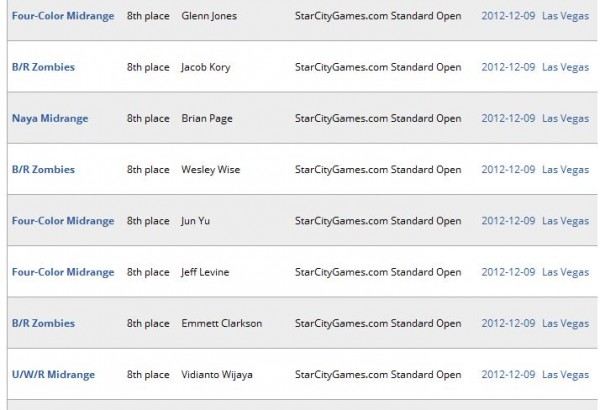
SCG Las Vegas Standard Top 8

A lot of "midrange" here.

A Naya deck pre-Boros and also pre-Gruul is encouraging. I'm not sure how much new stuff will get incorporated and how much old stuff will persist, but Naya has a lot of tools right now and will likely benefit from a larger card pool. Not farting around with Faithmender, Brian Page still ran a decent amount of lifegain to stymie the aggro decks. Restoration Angel plus Thragtusk is a potent combination and not just for Bant anymore. [card Bonfire of the Damned]Bonfire[/card] is a card to pick up as I believe it's at its lowest point and is starting to get played a bit more. Great job, Brian.

Three Zombie decks in a top eight that also contained three copies of "Four-Color Midrange" would seem to indicate the format may be getting less diverse. These four-color decks are essentially the Naya deck plus Sphinx's Revelation. I won't let the results of one event convince me Standard is flattening out this close to Gatecrash, but it could be. B/R Zombies continues to perform better than a fringe contender, due in large part to Hellrider and Knight of Infamy. Will Knight of Glory make a similar splash as a tool to fight off the increasing number of undead lists in the top eight?

A 7th place finish for the consensus best deck (according to pros and the results from Indy) says a lot about the field. I think most people were in Toronto at the GP, and Vegas isn't super accessible for most. I don't know the attendance numbers, but I imagine they didn't break any SCG records.

SCG Las Vegas Legacy Top 8

So Sneak and Show makes a big comeback and its pilot is rewarded for being the first person to top eight in over a month with top honors. Were people not ready? Seems possible. In fact, a lot the top eight decks were combo -- Sneak and Show, Hive Mind, ANT, Elves. Only one copy of the BUG deck that was all over last week's top eight, this time piloted by an AJ Sacher who must have slept through his alarm to wake him up for his flight to Toronto. That, or he liked the idea of a weekend in Vegas and light competition for prizes.

"Bant Midrange?" This is very close to the New Horizons builds that were dominant a few years ago before Maverick became the go-to [card Knight of the Reliquary]KoTR[/card] deck, and it's essentially my blue Maverick list. I never thought to call it "Bant Midrange" because that name is terrible. Stop calling everything midrange. Did you lose a bet with Brain Kibler?

The only thing I'll say about this deck is that I usually want an [card Elspeth, Knight-Errant]Elspeth[/card] main, and infrequently I'll side it out for a [card Jace, the Mind Sculptor]Jace[/card]. With a combo-heavy meta, turn three Elspeth is usually good for wrapping up a game quickly, and Jace isn't much help against a resolved Show and Tell. Since stopping it from resolving is of import, "Maverick" decks with Force of Will seem to be the only ones reaching top eight. They're called hate bears, guys. Use 'em.

All said, a pretty typical top eight. More combo than usual, but that's fine. Seems like all competitive decks are represented except for Elves. Congrats to everyone.

I'm Nagoya Dwell on This GP for Long

GP Nagoya Top 8

The Japanese sure do love to cast red spells. Red was all over the GPs top eight. When the Japanese started getting really interested in Thundermaw Hellkite, I paid attention. Similarly, their renewed interest in Bonfire of the Damned is almost certainly going to be relevant to the American market.

Angel of Glory's Rise is el cheapo right now, so if you want to get a million copies, they may go up and they will certainly trade out well. There were three Zombie decks in the top eight on the SCG event. Zombies is cheap to build, easy to pilot and punishes bad draws. And Angel pantses the Zombie decks, plain and simple. The Japanese were clearly expecting some zombies, and the Angel decks kept them at bay to an extent. In fact, Okita's winning deck is chock full of interesting tech. Mill yourself with Chronic Flooding? Check. Peddlecaster? Check. Goldnight Commander? Totally in there.

The rest of the top eight reinforces the idea that Thundermaw is due for another price spike, possibly to $40 (d'oh), and that Bonfire will be headed back up. Another card to watch is Stromkirk Noble, a card I pee-pantsed over and now have to pick back up at $2 or $3. If Boros becomes a deck off a flurry of new humans from Gatecrash, an unblockable, growing one-drop seems like a no-brainer. The Japanese are already all over this card, so it is worth picking up if you can. Don't panic-sell them for $2.50 like I did, even if it means you get to sell so many your wallet won't close.

Karaoke After GP Toronto but Not Nagoya?

Explain that!

GP Toronto Top 8

It's a Modern GP, just like the one they announced for next season in Detroit. I'm not thrilled, but I'm sure some will be. Honestly, even as a Michigan native, I think Detroit is a pretty bad place to hold an event. GP Lansing or GP Ann Arbor or something would be better in terms of parking, culture, and avoiding so many hobos playing dice in the alley outside the event center. (Although we keep going back to Atlanta, don't we? Do I ever have stories about that place.)

Digressions aside, Modern. Boo.

The new Scapeshift deck looks positively annoying. Fortunately, holding Cryptic Command back to make Scapeshift resolve isn't particularly strong. Command does have a tendency to bounce an untapped land EOT so you can go off main phase, so it is still good in the enabler role. Modern has its combo players playing a lot of bad cantrips, but this list proves people will still do it.

I like the Superfriends list a lot. I am not sure whether unbanning Jace, the Mind Sculptor would be a problem. Obviously no one is testing him in Modern to find out, so we're all just guessing. I just think he may not be too oppressive, certainly not compared to how he was in Standard.

The winning Jund list has far more innovation than I've seen in a Jund deck since the days of "In response to Blightning I'll Harrow for a mountain and my one-of island. Swerve." Lotus Cobra is positively bonkers and leads to very early Thundermaws, which I hear gets there. This adoption in Modern is partially fueling the second spike in the price of Thundermaw. That is twice in a month the price has nearly doubled.

The decks that just missed top eight are worth looking at. Nearly 100% of the time, 9th place has the same record as 8th with tiebreakers being the difference. Getting randomly paired against a scrub round one who drops at 0-3 isn't your fault, but sometimes the X-1-1 gets 9th. The 9th place list here is very interesting, but judging by the number of Thundermaw Hellkites in the top eight, it would have been an uphill battle.

Also worth looking at is the pseudo-Maverick list in 10th place.

All in all Modern is still shaping up as unbannings and printings lead to new archetypes as well as just plain old innovation. Expect the format to continue to grow and diversify as time goes on.

Personal Word Count Record Broken

Thanks for bearing with me. I'll be back next week for more shenanigans and maybe some henanigans if I have time.


Insider: Dragons Ahoy

Are you a Quiet Speculation member?

If not, now is a perfect time to join up! Our powerful tools, breaking-news analysis, and exclusive Discord channel will make sure you stay up to date and ahead of the curve.

So Thundermaw Hellkite happened.

Juza's tweet naturally had everyone scrambling and by weekend's end the 'Red Baneslayer' had jumped to $32 TCG Mid while ebay auctions varied from the high 20s on single copies to as much as $30/per for playsets. Of course it also won a Modern GP (along side Lotus Cobra which could be a spicy pick up for Modern season) while having 37 copies in the top 16 of GP Nagoya and 28 copies in the top 16 of SCG LV.

This of course begs the question, what now?

I'm inclined to agree, there isn't enough money left in Thundermaw Hellkite to justify any real play beyond trade stock.

Crazy is certainly one word for it. I think there is money to be made making a play on Angel of Glory's Rise at <$.50, if the deck has real success at the SCG Invitational it should be $3 by this time next week.

Its worth noting the Humans combo list from Nagoya runs a playset of Huntmaster of the Fells which was also everywhere in SCG LV as a mainstay of the various 3 and 4 color midrange lists with 27 copies in the top 16. We could see a price spike in the near future, well before official Gatecrash spoilers come out. If you were looking to pick copies up to sell into Gruul hype during spoiler season in January its best to pick them up sooner rather than later.

-----
I love the smell of napalm in the morning.
The lesson learned over the summer has been remembered; there were 22 Bonfire of the Damned in the top 16 of GP Nagoya and 28 in the top 16 of SCG LV spread across various midrange and Rakdos decks. I've been very high on this card for a few weeks now and I think there is still an opportunity to make a play if you can get in at $20 or so. People remember the summer of $50 Bonfires, and if the card starts to get hyped the spike should come hard and fast.

B/R was everywhere this weekend, and while most of the SCG LV versions played it by the book, there was a lot of variation in the B/R aggro decks at GP Nagoya as players looked for edges in the 'mirror', and it appears not all Rakdos aggro staples are created equal. The most notable variation being a red based aggressive deck that eschewed most of the black entirely including all of the zombies and sometimes Hellrider in favor of Ash Zealots, and Stromkirk Nobles. Both of these aggressive red staples were already reasonable anticipatory pick ups for Gatecrash but as with Huntmaster the time table for acquiring them may have changed going forward. On the flip side, both Geralf's Messenger and Gravecrawler have been stagnant as of late despite all of their recent constructed success and a possible shift away from them should only continue to hurt their prices.

Hellrider is a different story as even some of the otherwise 'stock' Rakdos lists battled without the double red costing devil. If its popularity wanes over the next few weeks keep an eye out for a temporary price dip or just people looking to unload the copies they might not need anymore. The card has a lot of potential with Boros and Gruul coming in Gatecrash and should rebound quite easily.

~
The table below is from mtgstocks.com which tracks the pricing history of cards based on TCG Player Mid.

Now that RTR is beginning to bottom out (I don't think its done yet) there isn't any reason to get cute when making long term calls, stick with real cards like Angel of Serenity, Jace, and the shock lands. I don't have a problem picking up cheap Loxodon Smiters or the like, but it shouldn't be your focus as the real money is usually in the mana fixing, planeswalkers, and splashy mythics and I doubt RTR will be any different.

Insider: The Modern Spike and Modern Masters

Are you a Quiet Speculation member?

If not, now is a perfect time to join up! Our powerful tools, breaking-news analysis, and exclusive Discord channel will make sure you stay up to date and ahead of the curve.

After a couple months of Return to Ravnica, the Standard metagame finally seems to be settling. A quick look at the Top 8 at the latest SCG open from Las Vegas solidifies this point.

In short, you’re either playing Zombies or some form of Midrange deck that likely includes Thragtusk and Restoration Angel, with the U/W/R Midrange deck being an exception.

This metagame is fairly boring for the speculator – we’ve seen all these decks before at least in some form, and I do not see much opportunity for price shifts. Sure, Thundermaw Hellkite is achieving Bonfire of the Damned-like status and Loxodon Smiter may be a reasonable sleeper pick.

But I am not seeing true innovation in the form of Craterhoof Behemoth and Sphinxs Revelation. Not even a quick flip like Rhox Faithmender.

Because of this, I am going to shift focus this week to Modern. Modern season is nearly upon us and this past weekend’s GP in Toronto showcased the latest metagame for the format. And while there were not any major breakouts (at least not after Day 1), I still feel like there are some financially relevant facts worth highlighting going into January.

The Modern Spike Is Back

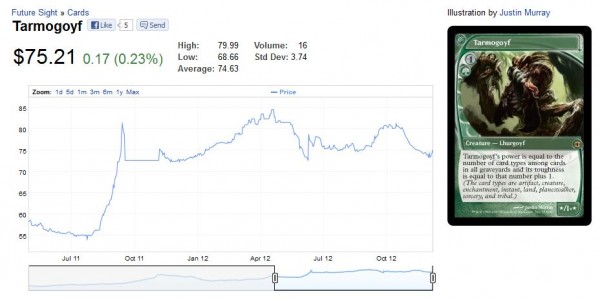
During the last Modern season, many staples did see a bit of a price bump. Looking at the plot for a card like Tarmogoyf, you can see the Modern season spike in April within the graph.

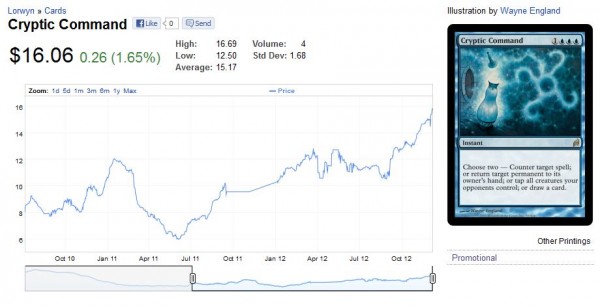
The same trend can be seen on other Modern staples as well, such as Cryptic Command (chart from blacklotusproject.com).

Only in the case of Cryptic Command, a card is seeing an even greater price spike in anticipation of the next Modern season. Almost one year later, some of these Modern cards are slightly harder to find due to normal card attrition and a small increase in the format’s popularity. Thus the additional price spike on a card like Cryptic Command or even the Zendikar Fetch Lands shouldn’t be too surprising.

Because of these price increases, I believe Modern is the format to make some profits on in the next month or so leading up to Modern PTQ season and Gatecrash release. Although many of the price jumps have already begun, there may be a small window remaining to acquire some Modern staples at a discount from other players.

Some Pickups of Note

MOTL and eBay have been my largest source of Modern acquisitions, though I’d imagine trading in person could also provide additional opportunity. I recently bought a set of Cryptic Commands for $44 on MOTL only to see that the cheapest Buy It Now listing on eBay is $70. It took a week, but I finally managed to unload my set for some profit.

Vengevine is another one of those overlooked cards. I’ve seen copies sell on MOTL as low as $9 and eBay auctions sometimes end a tad bit higher. But Buy It Now listings on eBay are still cheapest at $60 for a playset. Star City Games has maintained their price of $17.99. Vengevine only has to have a so-so performance during Modern season and he will pay off. I wouldn’t pay more than $11 on this creature, but seeing as I’ve bought 8 copies in the last 2 weeks for under $10, there could still be some opportunities to acquire these at discounted pricing.

I’ve mentioned the Eldrazi creatures in previous articles, but no Modern article would be complete without their recognition. I still cannot believe Ulamog and Kozilek retail for $29.99. And that foil Kozilek, Butcher of Truth I bought on Card Shark for $38 finally has its first bid on eBay: at $59.99. This is still a full $20 below retail and the bidding may not end there.

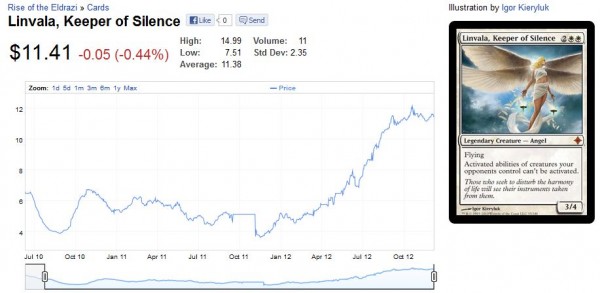
Needless to say, many people don’t realize how much Rise of the Eldrazi card prices have risen in general. Linvala, Keeper of Silence anyone? (chart from blacklotusproject.com).

As a general catch-all, any Modern staples that are not in the spotlight and are not prone to reprinting in Modern Masters could be a strong pickup. I wouldn’t rely on massive returns from Zendikar Fetch Lands simply because they are already on everyone’s radar. On the other hand, something like Linvala, Vengevine and Raging Ravine may be a better pick-up. Interestingly, the last time Raging Ravine saw a spike was back in April – once again driven by Modern season.

A Tougher Question: Time to Sell?

Wizards has made it very clear they want Modern to be a premier, affordable format. Tarmogoyf is not too powerful for Modern, but is currently too expensive – hence the upcoming reprint in Modern Masters. I fully expect other costly staples such as Dark Confidant, Thoughtseize and Vendilion Clique to also get a reprint.

This is where the contradiction comes in. Wizards wants Modern to be affordable and so they are printing Modern Masters, but at the same time we are being calmed by the notion this set will have a very limited print run. I understand the need for a limited print run as we do not want to see another Chronicles. However, if the print run is too low, prices won’t drop a whole lot, negating the purpose of the set. I anticipate Wizards will print enough copies to bring prices down significantly, though, of course, not the same magnitude as Chronicles.

If we carry this assumption, then the potential implications on our Modern portfolios are noteworthy to say the least. I don’t want to be sitting on Tarmogoyfs and Bobs if the price is about to reduce by 50% in six months. It isn’t good for business. So what’s the right action to take here?

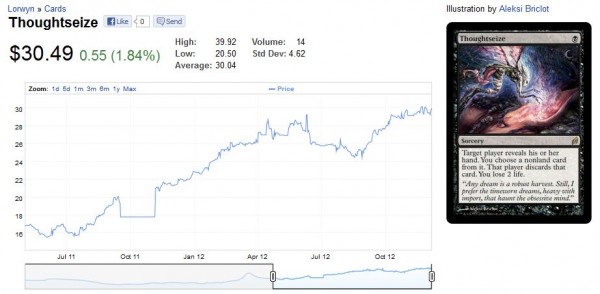
If I want to put finance first, then I strongly believe I should be selling out of my expensive Modern staples next month during the Modern price bump. There will be three months of everyone needing Tarmogoyfs for their Jund PTQ decks, and selling my playset for $300 seems like a strong play. The same goes for Dark Confidant and Thoughtseize, which have already seen a small bump (chart from blacklotusproject.com).

It may pain me to part with these trusty staples, but the decision seems 100% correct from a strict financial perspective.

No-Lose Situation?

Selling my expensive Modern staples prone to reprinting seems like a no-lose situation. If Wizards reprints these in Modern Masters, their prices will drop some, minimally from people panic-selling. If they don’t, then I will happily run my cheap Melira-pod deck during PTQ season and buy back into these staples in a few months when the inevitable price drop occurs (see July-September in chart above). Either way, I’m not parting with any cards for good and there will be ample time to re-buy.

So while everyone is closely watching Standard and waiting for the next big thing, I’ll be looking to sell out of Modern. I haven’t decided on the best time to do so – perhaps it’s in January and perhaps it was two weeks ago. I also haven’t decided on the venue to sell. MOTL seems like a strong option since I can avoid eBay fees, though if eBay prices average more than 15% higher, then the fees may be worth it.

All I’ve decided at this point is that the time to sell out of Tarmogoyf, Dark Confidant, Thoughtseize, Vendilion Clique, etc. is now. Otherwise I will be left holding a Modern collection of less value when Modern Masters comes around. And even if Modern Masters drives prices up in the long term due to increased interest in the format, I am confident there will be at least a small window where people panic-sell and these staples will be acquirable at lower prices than today's.

What do you think?

…

Sigbits

  • Some retailers still think Umezawas Jitte is more expensive than it really is. Auctions often end sub-$17 on eBay, yet Card Kingdom is paying $17 for the equipment. Star City Games is still paying $15. This seems remarkable considering the card is banned in Modern (for now), sees little play in Legacy and isn’t super fun in EDH. Plus it was reprinted as a GP promo. I always like to keep a copy in my binder to sell to dealers at larger events.
  • Do you know anyone with piles of useless Unhinged cards? It may be time to sift through them again. Everyone knows the lands and some obscure foils are money, but there are some other random cards that buylist for $0.10. This includes Ass Whuppin, Cheatyface, Little Girl and Rocket-Powered Turbo Slug. City of Ass even buylists for $0.50!
  • Channel Fireball is still paying $70 on Jace, the Mind Sculptor, which is just incredible. This is a full $10 more than Card Kingdom and Star City Games. Not a day goes buy where I don’t contemplate selling these. Some sort of reprint seems so inevitable.

-Sigmund Ausfresser
@sigfig8

Insider: Holiday Cube on MTGO

Are you a Quiet Speculation member?

If not, now is a perfect time to join up! Our powerful tools, breaking-news analysis, and exclusive Discord channel will make sure you stay up to date and ahead of the curve.

Holiday Cube

Cube draft returns for the holidays, replete with the Power Nine! These will be phantom drafts, so you don't get to keep what you draft. But you also don't have to use booster packs to enter. Entry is 8 tix, or 2 tix and 10 Cube tickets. Cube tickets are awarded in prizes from Cube draft. 1st place gets 2 boosters, 12 Cube tickets and 1 QP for MOCS purposes, 2nd place gets 1 booster and 8 Cube tickets. 3rd and 4th get no packs and 6 Cube tickets. 5th through 8th get 2 Cube tickets.

Cube draft will be available for two weeks. In the first week awarded boosters will be from Urza's block, and in the second week the amalgamated Mercadian Masques block packs. Each Cube draft that fires will push one draft set onto the market. This is an effort to push more out-of-print supply onto the market without destabilizing prices too greatly.

Online Cube History

The first time Cube appeared on MTGO it awarded in-print packs, Innistrad (ISD) and Dark Ascension (DKA). Cube proved so popular that the prizes flooded the market as players sought to Cube draft again and again. This knocked down the secondary market value of ISD and DKA packs. DKA packs in particular are still struggling to get pack to par, and are currently at 2.3 tix on the classifieds.

WoTC realized they had a money maker on their hands, but they decided to fine tune the prizes in order to inject supply of older cards and avoid cannibalizing their own pack sales. They moved to out-of-print packs as prizes with the second Cube offering, which awarded Time Spiral-Planar Chaos-Future Sight (TSP) packs (cube tickets would come later). To give players an outlet for their prizes, they temporarily brought back TSP draft queues, with nix tix entry fees. Cube was just as popular this time around and with TSP as prizes combined with nix tix queues, prices of TSP draft sets crashed. The price of Tarmogoyf temporarily fell by a third as well.

The next go around of Cube awarded Onslaught-Legions-Scourge (OLS) as prizes, and the accompanying OLS draft queues required 2 tix as well as packs for entry. Cube kept right on rolling, but the lack of money rares in OLS meant that OLS drafting wasn't very popular and OLS boosters came down in price, a lot. Legions and Scourge are still the cheapest boosters widely available on the secondary market at 0.71 and 0.74 tix respectively (prices taken from supernovabots.com). An OLS draft set is one third the retail price at just under 4 tix.

Since then, WoTC has gone with a new object as prizes, the Cube ticket. It's an untradeable digital object usable only for entering another cube draft. This has the result of reducing the huge price swings we've seen in packs and singles from the awarded sets. Essentially WotC wants to sell Cube drafts and reap the revenue from that, without disrupting other draft formats or the secondary market too much. The Cube ticket neatly captures the revenue they want, and keeps drafters coming back for more. When prizes were in devalued packs like OLS, drafters were getting discouraged by not being able to draft again from their prizes.

Urza's Block Queues

Prices below on non-foil cards are current as of December 4th, 2012 and are taken from Cardbot's website. Prices on foil versions are taken from Supernovabot's website.

Urza's block queues will kick things off with all tix entry for 14 tix, or boosters plus 2 tix. These queues are 4-3-2-2.

Urza's Saga doesn't have much in the way of money commons, but it does feature cards like Argothian Enchantress (16 tix), Exploration (16 tix), Gaea's Cradle (41 tix), Gilded Drake (14 tix), Show and Tell (36 tix), Sneak Attack (13 tix), Time Spiral (10 tix), and Tolarian Academy (15 tix). This is also a pack to watch out for foil versions, as they command a much bigger premium than normal foils. A foil version of Yawgmoth's Will is priced at 37 tix, about seven times the regular version. Goblin Lackey (2 tix) is a notable uncommon to keep in mind as it's not very good in draft so it tends to be passed late.

Next up is Urza's Legacy, and if you didn't pick off a money rare to help pay for your draft, you might make it up here with money commons such as Cloud of Faeries (4 tix), Rancor (2 tix) and Snap (2 tix). There is one money rare to watch out for, Grim Monolith (14 tix).

Urza's Destiny finishes off the block with a few more money rares such as Academy Rector (21 tix), Metalworker (19 tix) and notably a foil version at 108 tix, Replenish (10 tix), Rofellos (8 tix) and Treachery (6 tix). There's not much in the way of money commons or uncommons in this pack though.

If you're trying to stretch your budget to play these queues, two older articles from puremtgo might help, both by TheRegularGangster. The first article has to do with drafting with expected value in mind. The prices are out of date so be sure to double check the numbers. The second one is more specific to Urza's block draft strategy.

Mercadian Masques Block Queues

The second week of Cube draft will award Masques block booster packs as prizes, with the corresponding 4-3-2-2 draft queues available during the same time. They did something funny with these sets and combined them all into one big mess of a pack. It creates a somewhat strange limited environment that is apparently very slow and grindy.

Keep in mind the following money rares when drafting: Dust Bowl (10 tix), Food Chain (9 tix), High Market (7 tix), Misdirection (36 tix), Nether Spirit (9 tix), Rishadan Port (65 tix) and Unmask (6 tix). There are quite a few money commons in Mercadian Masques so keep your eyes open! Ancestral Mask (4 tix), Brainstorm (2 tix), Gush (2 tix), Invigorate (7 tix), Sandstone Needle (3 tix), Saprazzan Skerry (3 tix) and Snuff Out (2 tix).

There are some pricey commons in Nemesis too. Accumulated Knowledge (3 tix), Daze (8 tix), Thran Dynamo (2 tix) and Flame Rift (3 tix), as well as one expensive uncommon in Submerge (9 tix). Rares worth taking include Kor Haven (7 tix), Lin Sivvi, Defiant Hero (4 tix), Parallax Tide (4 tix), Parallax Wave (7 tix) and Tangle Wire (37 tix).

As for Prophecy, there's only one card worth a mere sniff, which is Rhystic Tutor at 3 tix. For more on Masques block draft on MTGO, check out this article.

What's the Play?

If you are not interested in drafting these sets, and would like to speculate on the cards instead, the prices on all the above cards should give you a good place to start. Their high prices are mostly due to low supply online as their sets were never released as a current draft format. Some of these cards have appeal in competitive formats and some don't, so do some research to figure out which is which. Focusing on cards with competitive appeal in Legacy or Pauper will reduce the risk.

Drafters will be selling their cards into the market, depressing prices while the queues are up. If you have time, post a buy ad to the classifieds and pick up the cards that you like. Pauper staples generally rebound in price eventually so making a play on the commons is a decent call. This would include the money commons from Urza's Legacy such as Cloud of Faeries and Snap, as well as Invigorate, a powerful card in the Pauper Infect deck.

Two Events, Two Decks

Are you a Quiet Speculation member?

If not, now is a perfect time to join up! Our powerful tools, breaking-news analysis, and exclusive Discord channel will make sure you stay up to date and ahead of the curve.

This past weekend, I traveled out to Indianapolis to play in the TCG Player Invitational. To qualify for this event, you needed to earn twenty points by playing in TCG Player sponsored events. By earn I obviously mean you can purchase these points extremely easily with your own hard-earned money. Many people at the event were willing to trade their points for cards and if you didn’t have any cards to trade you could always buy points from any of the vendors. The cost for entry was about fifty dollars, which is a lot of money, but not really a lot of cards.

The other part of the event that was important was the byes. Players could redeem twenty or forty points to gain one or two byes. In my opinion this was broken. Because it was so easy to get the points if you wanted to, over 65% of players had two round byes. That percentage is staggering and should really be a wake up call for the TCG Player organizers. Byes stop being important or good if everyone has them.

The main thing to remember about this event overview is that if you want to play in a high stakes tournament, you can. TCG will hold this event next year and as of yet, they have made no changes to the process. I expect more players to take advantage of the easy access next year but so should you.

For the event, I chose to play the Four-Color Peddler deck I talked about a couple weeks ago with some changes. Here’s the list I registered.

Untitled Deck

Creatures

3 Deathrite Shaman
4 Nightshade Peddler
4 Izzet Staticaster
4 Huntmaster of the Fells
3 Falkenrath Aristocrat
3 Olivia Voldaren
2 Thundermaw Hellkite
2 Thragtusk

Spells

3 Pillar of Flame
4 Farseek
3 Trackers Instincts

Lands

4 Cavern of Souls
4 Overgrown Tomb
4 Blood Crypt
4 Steam Vents
3 Woodland Cemetery
3 Rootbound Crag
3 Hinterland Harbor

Sideboard

3 Slaughter Games
2 Silklash Spider
1 Pillar of Flame
2 Bonfire of the Damned
2 Evil Twin
1 Falkenrath Aristocrat
3 Zealous Conscripts

The first thing I want to say about this deck is that I love it. It is so powerful and there are so many interactions. What I don’t like about it is the lack of consistency. The Tracker's Instincts help, but in the aggro matchups you do not really have time to be casting that card. The main problem is that some opening hands that are generally solid happen to be horrible against specific decks.

So, if you keep a hand that seems pretty reasonable, you could be in a bad position depending on what deck you end up facing. Some decks are amazing game one decks; this one is the terrible game one deck. Once you know what you are playing against, you can decide if the hand is keepable. Let me give you a couple examples.

If this was your hand game one, would you keep?

I think this is an auto keep every game one. How can you throw this hand back? Turn two Farseek into turn three Olivia. Then you even have a Trackers Instincts to look for a Nightshade Peddler to pair, or another threat to follow up with.

The problem is this hand is horrible against a lot of decks. Let’s say you are paired against UW or UWR this round. Obviously you don’t know that, but it could easily happen because that deck is gaining popularity again. I’m not sure you can beat them with this hand, even if you draw a Cavern of Souls. Unless they miss land drops they'll just use their Unsummons and Azorius Charms to stall you into oblivion.

What about this one on the draw?

Again, I think this is a keepable hand. This one is a little closer, but if you start mulliganing this type of hand, you will find not many hands are keepers. Against many decks, this hand is fine, but what about against Rakdos or GW Humans? If you find yourself paired against one of those two decks, you may not have time to stabilize before they kill you. I would say this hand is a trap, but I think it’s a keep the majority of the time.

Obviously your analysis can change depending on what you are playing against. Once you know your opponent’s deck, you can decide on a mulligan a lot more easily. I still see this deck putting up results at events, but it is a risky choice in my opinion. Until you play tons of games, you won’t realize the level of risk you are taking by showing up to a large event with this deck. If you are looking for a deck to take to FNM, this is a great decision, and you will probably win that event. Just make sure to scout your opponents.

Battling at the Invitational

So what happened at the Invitational? Well, those two hands I did keep, and I was paired against the deck they were bad against. Unsurprisingly, I lost those matches. The UW match was much closer than I believed it to be but it is still a very winnable match. The card you don’t want much of is Olivia and I proceeded to draw the other two that game as well. Game two I won quickly with an aggressive start, but game three I lost again by drawing two Olivias and nothing else of note.

In addition to losing to that deck, I also lost to two Rakdos decks and a Mono Red deck. Mono Red seems like a very bad matchup even with access to Pillar of Flame. Rakdos is very winnable though. In both matches I lost to the deck, game three I stalled the game so it went long and then I proceeded to flood out. One of the games I had eleven mana in play when I lost and another four on the top of my deck. The Rakdos match is not one you want to face with this deck though, as it is not in your favor.

Because of that, I don’t think I would take this deck to an event again. I did beat one Rakdos deck but other than that, my record was horrid. Despite not drawing well, losing a lot of games, and feeling like my deck was out-classed against the best deck in the format (Rakdos), I played very well. After the event I analyzed my play and there were only one or two plays that I made judgment calls on I was unhappy about. Neither of them were play mistakes, but rather a calculated decision that ended up not working out.

With no luck making day two of the Invitational, I struggled to figure out what to play the next day for the 5K. My friend wanted to test his Bant deck against Rakdos so I played the aggro side of the matchup. After destroying him the first five games without sideboard, I realized just how powerful the Rakdos deck is. Every card in the deck is inherently powerful and there is some synergy as well. The main feature is that the creatures are hard to kill, which is one of the things I look for in an aggressive deck. We played a bunch of sideboard games and he won about half of them which gave both of us a lot of information.

Based on how strong the Rakdos deck was, I decided to just play that the next day. It was similar enough to decks I had played before that I felt I could play it well. I didn’t change much from the main deck, but I did altar the sideboard quite a bit. Here’s what I played for the 5K.

Untitled Deck

Creatures

4 Diregraf Ghoul
4 Gravecrawler
4 Knight of Infamy
4 Geralfs Messenger
4 Hellrider
4 Falkenrath Aristocrat
2 Thundermaw Hellkite

Spells

4 Pillar of Flame
4 Searing Spear
2 Victim of Night

Lands

4 Blood Crypt
4 Cavern of Souls
4 Dragonskull Summit
1 Mountain
4 Rakdos Guildgate
7 Swamp

Sideboard

1 Flames of the Firebrand
3 Rakdos Return
3 Bonfire of the Damned
2 Victim of Night
4 Vampire Nighthawk
2 Zealous Conscripts

This may seem like a very stock list, but I did actually put a lot of thought into the card choices. The sideboard especially, was my own creation. So what happened at the event?

Round 1 – Mono Red
Round 2 – Rakdos
Round 3 – Rakdos
Round 4 – Rakdos
Round 5 – Rakdos
Round 6 – Rakdos
Round 7 – GWb Humans
Round 8 – Rakdos

That’s right, six Rakdos decks out of my eight rounds! That many mirror matches in one event was insane. By the end of the day I was asking myself, are there other decks in the format? I also started asking my opponents what they had played against. Most of them said they played a variety of decks. One opponent said he had a similar experience to what I was having. Take a look at how I did.

Round 1 – Mono Red, win
Round 2 – Rakdos, win
Round 3 – Rakdos, win
Round 4 – Rakdos, win
Round 5 – Rakdos, lose
Round 6 – Rakdos, lose
Round 7 – GWb Humans, win
Round 8 – Rakdos, lose

You definitely do not want a play by play of the event but I can tell you a little about the mirror match. Go figure, right?

Despite the reputation of previous aggro mirrors, the Rakdos mirror is quite skill intensive. There are many opportunities to outplay your opponent. If you are considering this deck, make sure you test the mirror because it is the hardest match by far.

Most of the time, when you are on the draw, you need to consider yourself the control deck and be concerned about your defense. This is not always the case though. If you have a turn one play and they don’t, that can easily turn the tempo in your favor. Learning when to play a creature or hold for removal is important. If you are bad with combat math, this mirror is going to be tough for you to win. Often it comes down to attacking while playing defense to make sure you kill your opponent first. The biggest swing in the mirror is usually Hellrider so calculate how much damage your opponent could do with it before you make your attacks.

Tips for the Mirror

Treat every mirror different because there are many lists with unique features. Some of those features include Blood Artist, Rakdos Cackler, more removal, less removal, Tragic Slip, Vampire Nighthawk, Mark of the Vampire, etc. Some of those typically are sideboard strategies but I had to play against all of those cards throughout the event.

Sideboard differently for each mirror as well. I would want a sideboard plan for a stock list like the one that won the Grand Prix, but remember to change your plan depending on the specifics of your opponents deck.

Remember to make the switch from offense to defense when needed and vice versa. If you are keeping track of your opponent's plays and life total, you should be able to plan your line of attack based on the game state. If you are dead to a fresh Hellrider from your opponent, you need to leave back blockers.

The normal sequence of plays is not always correct. For example, normally you play Geralf's Messenger on turn three and Falkenrath Aristocrat on turn four. There are times when you want to play around your opponents Pillar of Flame by casting Geralf's Messenger the turn after you play Aristocrat. Each game is different and each game state unique so make your plays based on what has actually happened so far.

In the Hellrider vs. Falkenrath Aristocrat debate, Hellrider should win almost every time because your damage output is higher. The times when it is correct to play Falkenrath Aristocrat first are usually when they have passed with mana open. As long as you have another creature, you should probably play Aristocrat first.

Speaking of Falkenrath Aristocrat, knowing when not to play it is important as well. Almost always, if you don’t have any other creatures in play, you should play another creature first. By playing your most resilient threat without a way to protect it, you downgrade the power of the card significantly. Even though you could get in four hasty damage this turn, more than likely it is better to play your other creature first so you have a way to make Aristocrat indestructible.

One of my strategies for beating the mirror was boarding in Rakdos's Return. It may seem counter-intuitive but I liked the plan a lot on the play. If you make them discard two or three cards, they basically can’t win. This strategy usually won't work if you are on the draw or if they have Rakdos Cackler. Just keep it in mind while sideboarding.

As for what actually happened, this event was yet another close call. I started the day 4-0 beating RDW and three mirrors in a row. After that, I lost two close mirrors, beat a mana screwed humans player, then lost my last match to miss prize.

Of the matches I lost, one of them was a legitimate loss. My first loss of the day was to a mirror with two Blood Artists main deck and a third in the sideboard. He drew both of them game one and then all three game three. Because of that swing in life totals and the enormous amount of lands I drew game three, I lost that match. If I would have drawn a threat to go with my pile of removal, I would have moved to 5-0.

The loss right after that was to Christian Calcano, quite a good player. The games were close but ultimately I couldn’t draw a land for two turns game three, which sealed the deal.

Evolving Rakdos

On the drive home I was thinking about one version of the deck that uses the additional sacrifice outlet of Bloodthrone Vampire so you can play main deck Mark of Mutiny. I think this version should have the edge in the mirror because of the better removal and the life swings from Blood Artist in addition to the creature stealing effect. This is the list I will be working from. I like a lot of what it is doing. Might need some Hellriders though.

Untitled Deck

Creatures

3 Blood Artist
3 Bloodthrone Vampire
4 Diregraf Ghoul
4 Falkenrath Aristocrat
4 Geralfs Messenger
4 Gravecrawler
4 Knight of Infamy
4 Rakdos Cackler

spells

3 Mark of Mutiny
3 Tragic Slip
1 Victim of Night

Lands

4 Blood Crypt
4 Cavern of Souls
4 Dragonskull Summit
1 Rakdos Guildgate
10 Swamp

Sideboard

3 Appetite for Brains
3 Bonfire of the Damned
1 Duress
2 Pillar of Flame
3 Vampire Nighthawk
1 Victim of Night
2 Zealous Conscripts

In closing, Rakdos is definitely a big part of the metagame. Make sure you are prepared to face it with whatever deck you decide on because you never know when you are going to have to play against six Rakdos decks in one event.

Until next time,

Unleash the Rakdos Crushing Force!

Mike Lanigan
MtgJedi on Twitter
Jedicouncilman23@gmail.com

Insider: The Next Big Thing

Are you a Quiet Speculation member?

If not, now is a perfect time to join up! Our powerful tools, breaking-news analysis, and exclusive Discord channel will make sure you stay up to date and ahead of the curve.

In my job as a sportswriter covering local high schools and University of Oklahoma sports, I’ve found that nearly everything is measured in terms of age. Is this a senior-led team or are they young and inexperienced?

If they’re young, it’s all about how they could develop into the “next” someone, be it Sam Bradford or Keilani Ricketts or whatever your sport of choice is. On the other hand, if they’re upperclassmen, it’s all about who’s coming next. Who’s the hotshot freshman or sophomore who’s going to be the next big thing?

In Magic Finance, it’s also always about the next big thing. A few weeks back I was all over Hellrider and Thundermaw Hellkite. Go back even farther, and I was accumulating Scalding Tarns like it was nobody’s business.

As soon as those cards jumped as I predicted, I was done with them. With the upside gone or significantly reduced, they become completely boring to me, much like how Adrian Peterson’s freshman season was so much more exciting than his junior year.

This is where Standard is at right now. It was cool when Bant Control was new and offered opportunities, and it was cool when the Jace/Hellkite decks took off. Hell, it was even acceptable when Zombies with Hellrider became a thing again.

But, outside of Rhox Faithmender, very little has changed in the last three weeks or so. At this point, we’re likely to see metagame shifts of a rock-paper-scissors nature rather than anything new.

But that doesn’t mean there aren’t some opportunities, even if we have to look a little farther for them. So let’s see what we can do.

Parallel Lives

This has nothing to do with Standard, but it’s been discussed heavily on the forums and needs to reach everyone. There is little to NO time to get in on these. People already know it’s not bulk. Soon they will realize it’s closer to $5 than $2.

Add in the fact that Innistrad is done being opened, and you can see why we’re running out of time on a card that is climbing past $4 on TCGPlayer.

Tree of Redemption

Now, this is me being speculative. Faithmender is good, and it’s certainly excellent in a lot of the grindy matchups where people are gaining a million life. But not every deck can play white mana, nor does every deck want to overload on lifegain outside of Thragtusk and Faithmender.

And, by the way, Tree of Redemption with Faithmender on the table is insane. If you weren’t aware, as long as your life total goes up (even if by exchanging) it counts as life gain, so activating Tree with Faithmender on the table is actually absurd.

But that’s not all. Jund, for instance, could make really good use of the Tree since it doesn’t play White. Hellkites and Hellriders are a lot less of a problem when you don’t have to do any blocking to gain significant amounts of life.

Furthermore, this is a mythic. Honestly, this is the only reason I like this as something other than a throw-in. We watched Faithmender quadruple in price (a card that I suggested grabbing at the M13 prerelease, by the way), so if Tree starts to see play it could go much higher. It can be had for less than a dollar on TCGPlayer, so I’m suggesting getting on these now through trades and be ready for a cash buy if it starts to show up more.

Nephalia Drownyard

Sadly, winning in Standard is coming down to milling more and more. Drownyard is a good pickup for trades, because it’s going to trade much better than it will buylist.

Jace, Memory Adept

It’s probably not a good sign that this and especially the next card on this list are growing in popularity. But then again I haven’t been a huge player at FNM recently, so I can’t comment on how enjoyable the format is, only what’s trending upwards.

Sands of Delirium

I’m not even joking. This card is seeing sideboard play, and is actually better in some ways than big Jace. It comes down fast, dodges most of the removal in the format, and allows you to do something with your 10+ mana in the long-game.

I refuse to believe this sees much movement, but I wanted to bring it to your attention since it may be a legitimate sideboard plan and is basically bulk right now.

Slayer's Stronghold

This is popping up in more and more lists as a way to make your post-wrath play much better, and it’s absurd on a Geist. With the Boros guild just a little bit away, this is a pretty good target in trades for the next month.

…

The way I see it, Standard is in a holding pattern right now, and outside of really metagame-dependent choices, I don’t see anything besides Tree and Parallel Lives that could merit a cash buy. All of the above, though, I consider great trade targets for the next few weeks, and it’s made even better by the fact most of them are cheap.

Gatecrash is certainly going to shake things up, and there’s going to be a bunch of hype flying around. Until then, I’ll be trying to get ahead of the metagame by targeting cards like these, and let’s hope I’m at least close to as successful as I was with the last month of Standard speculation.

Thanks for reading,

Corbin Hosler

@Chosler88 on Twitter

Insider: Standard Follow-Up and Timeline Check

Are you a Quiet Speculation member?

If not, now is a perfect time to join up! Our powerful tools, breaking-news analysis, and exclusive Discord channel will make sure you stay up to date and ahead of the curve.

Last week we looked at predicting the future of Standard, and there were some big events already since then. We saw a resurgance of the U/W/r Flash decks and some changes to the Rakdos, Bant and Reanimator decks. We'll take a look at those changes, and see how they impact how we feel about the coming weeks.

We also want to double check our calendars because we're just about dead-center in the Return to Ravnica Season, leaving about 7 weeks until Gatecrash Pre-release, which means spoilers aren't terribly far away. A few spoilers came out towards the end of last month, but we still haven't seen the guild mechanics, so our last chance to make moves based on speculative upcoming strategies is coming soon.

Standard Follow-Up

Between the TCGplayer Championship and the StarCityGames Open this past weekend it appears the format wasn't ready for the UWr Midrange deck that took both 1st and Second at the TCGplayer event. The StarCityGames Open saw mostly the lists we were expecting.

In addition to these decks, one Nightshade Peddler deck did make an appearance, as well as a 5-color-control deck. The 5-color deck featured 3 Chromatic Lanterns, which many of you will know is something I'm happy to see. Perhaps there is room for it to grow after all. They still sit around the $3 price tag they were at when I picked them up at the onset, so I'm not really risking anything by waiting to see what happens with this 5-color brew. He also included a singleton of both Garruk, Primal Hunter and Nicol Bolas, Planeswalker.

Another thing of note, there were many copies of the B/R deck in the top 8 of the StarCityGames event, but many of them are already trimming down on Thundermaw Hellkites and Hellriders. Hellkite is being played in the UWr Flash deck so it's not going anywhere soon, but I'm still expecting a steep falloff on Hellrider in the next week or two.

Gerry Thompson was still on a Hellkite-less version, so it's hard to say if he'll stay in those lists or not. Beyond those notes, we're still in the mode we were last week, with regards to standard. Expect the format to shift again once the control decks move to heavier sweeper density and the aggro decks bring their mana curve down.

Timeline Check-in

As a writer, we have these fluxuations in our topics, as they correspond to format rotations, PTQ seasons, bannings and most importantly, set releases. We've had nearly two months to play around with Return to Ravnica, figure out what cards we liked and how the formats would shift around, but it won't be long before we start getting sneak peeks into Gatecrash. Everyone has their speculations about what the guilds mechanics might be, but soon enough there won't be anymore guesswork.

One of the things I've heard around, and agree with, is the Innistrad lands that match with the Gatecrash guilds are likely to see more play once there's direct support for them via Shocklands. This includes Hinterland Harbor, Clifftop Retreat and Isolated Chapel. These are all still reasonable buys, and while I'm not actively picking them up, I'm hanging on to any copies I already have.

Regular readers of my articles know I'm also looking at Utility Lands that may see increased play next season, and the one I've made a move on is Nephalia Drownyard, but a case could also be made for Kessig Wolf Run. Beyond that, I'm not confident enough in what the new set will bring to make further speculations, but if you're feeling confident in what might be ahead, you've got short time to make moves before we see what mechanics the guilds will bring.

PTQ Profits

On the other side of our timeline is the PTQ season schedule. We sit in the middle of Sealed season, which on its own doesn't provide tons of information for finance, besides the massive quantity of packs that get opened at every PTQ. PTQs are an interesting environment now that the professional TO's no longer run the events, but rather Local Gaming Stores. The learning curve for a successful PTQ is steep, and LGS owners are (in general) spread too thin to really nail down an event like this on their first run.

We also see inconsistent types of events. Some places hold the event in their shop, of course saving on space rental, while others will rent a space somewhere to hold the event. Sometimes there will be outside vendors, in other cases the LGS is the only vendor on site. This makes it hard to know what to expect, but in the short time since the policy change, I've found all types have their benefits, and a small bit of research before the event can be well worth your time. I learned this lesson the hard way, but luckily for me, learning this lesson will pay off in spades this coming weekend.

I attended a PTQ this past weekend, and after losing my win-and-in in Round 7 of 8, I perused the dealer booths. Some of my friends had mentioned to me that some of the dealers had some good buy prices, but I was focused on my event and didn't get around to it until the end of the day.

I went to the Shuffle & Cut booth, picked up their buylist, and started peeking through it. Doomed Traveler $0.10, Crusader of Odric $0.25, Murder $0.10. As I scan down this list I'm agonizing over the enormous pile of draft chaff sitting in a box at my house. I'll never find a trader or buyer who wants a Crusader of Odric ever again. Ugh. Just from a long box of marginally playable commons and uncommons I had with me, I pulled over $50 in cards that I was happy to sell at their buy price, and I was being selective.

I find out they are located too far away from me to make it worth while to return to their location at a later date with my stuff, but to my luck, they will be at the PTQ I'm heading to the next week. Since then I've sorted out over $100 in cards to sell them that are simply sitting at home waiting to be proxied on. I have 37 Emancipation Angels, and yes, I will sell them all at $0.10ea and be happy about it.

Good Habits to Form

The problem with spending tons of time organizing and gathering a bunch of awful cards to sell at an event, is you don't know which vendors, if any, will be there. Going forward, I'll be contacting the LGS that is putting on the event and ask them about it. If they are the only vendor, ask them for a buylist in advance. If they don't have one, suggest they prepare one before the event day. It really is in their best interest to do so, and it gives you a chance to build rapport with the person on the other side of the phone.

Buylists are important because someone might otherwise have not asked the LGS to look at their cards for sale if they fear it will be a waste of time, but someone who otherwise wasn't planning to sell might do so once they see your list. Be sure to say something when you visit in person, letting them know you did indeed show up and you liked that they took your idea into consideration (whether they followed through on it or not). If they will have vendors on site, contact them for buylists.

Shuffle & Cut was able to do this for me for the next event I will see them at, but once I contacted the other vendors on site, I found even more cards to bring this weekend. For the PTQ Grinder, you want to hit as many PTQs as you can in a season to increase chances at qualifying, but if you can reduce your costs for each event by planning smart before you go, it makes it a lot less painful. Soon enough, PTQ season will be Modern, which will bring new advantages and challenges to buying and trading at events. Once the season gets closer we'll revisit these dealer strategies and see what is working and what isn't, and how things change in Modern as compared to Sealed.

Want Prices?

Browse thousands of prices with the first and most comprehensive MTG Finance tool around.


Trader Tools lists both buylist and retail prices for every MTG card, going back a decade.

Quiet Speculation