menu

Insider: Count your Commons

Are you a Quiet Speculation member?

If not, now is a perfect time to join up! Our powerful tools, breaking-news analysis, and exclusive Discord channel will make sure you stay up to date and ahead of the curve.
Quiz time. How much is a Rupture Spire for? How about Wild Nacatl? Ashenmoor Gouger?

The answers might surprise you.

Gouger goes for a quarter, as does Manamorphose. Spire goes for 10 cents (and probably more soon due to Commander precons). Nacatl is good for a nickel.

Remember Journey to Nowhere? The card you threw back on the table after a Zendikar draft? Sells for a quarter. Its big brother Oblivion Ring will get you up to 50 cents.

I realize I am talking about literally nickel-and-diming your way to profits, but any good grinder knows this is where you guarantee your margins. Everyone knows Kitchen Finks and Mental Misstep are worth some money, but how many people realize that Countersquall is being bought at a quarter or that Mind Funeral is being bought at two dollars?

One of the most common things I hear from QS readers is that they want to be able to demonstratively prove that they made back their subscription fee in any given month. If you’ve been playing for any amount of time, I have very simple way for you to do just that – Dig through your old boxes and pull out cards. I know most of us have already done that (a number of times) but I think you’ll find that there’s a lot more value hiding there than just the Path to Exiles you were looking for.

I have a pretty keen eye for non-bulk cards, but even I was surprised by how much I found when I began actively searching my collection for such gems as Shield of the Oversoul ($.10) Ardent Plea ($.25) and Voracious Hatchling ($.20). The fact that you just had to read those cards again to remember what they do shows how little most people know about these cards. Does it give you more options when trading to know that Blasting Station ($.50) is worth more than a ton of rares from the most recent set?

I understand that it’s not easy to find these cards, because most people don’t carry them around. How, then, to make use of the lack of knowledge regarding these commons?

The two primary ways you’re going to come across these is when buying collections and when digging through completed drafts.

We’ll start with Drafts. Mediocre grinders know that Memnite is a solid dollar bill, but are you also grabbing all the Spell Pierce ($.05), Contagion Clasp ($.10), Memory Sluice ($.10), or Relentless Rats ($.40)? If not, you need to be.

I didn’t for the first few years I played Magic. Even so, I still managed to pick up random stuff like Bramblewood Paragon ($.50), and I’m willing to bet you did too. Spend a Sunday afternoon digging through your boxes and I guarantee you’ll come out with something to show for it. I even managed to come across a few Cranial Platings ($.50) and Hedron Crabs ($.25).

When buying collections, these things are going to pad your margins much faster than you’d expect. Most people will overprice their rares to an extent, and it’s in the commons and uncommons that you will make that back. Don’t stop digging just because you’re past the Splinter Twins and have started running into the Mercy Killings ($.10).

I want to direct you to this list. While it’s not perfect (since not every card on there is actually bought at a nickel or above), it’s an incredible resource to keep handy when cleaning out collections, either your own or one you’ve acquired. Pull out the cards on this list, price them out, and be happy for the $20 bill you got for ā€œfreeā€ when purchasing a collection (not to mention the occasional Senseis Divining Top).

I’ll be back tomorrow with an update to the Prediction Tracker, and I’m going to try and address some of the more frequently-asked questions regarding it.

Until then, keep the commons coming.

Corbin Hosler

@Chosler88 on Twitter

The 5 Worst Intro Decks of Scars Block

Are you a Quiet Speculation member?

If not, now is a perfect time to join up! Our powerful tools, breaking-news analysis, and exclusive Discord channel will make sure you stay up to date and ahead of the curve.


Welcome back for another installment of Magic Beyond the Box, where we'll be busy today exploring the dark underbelly of the Scars block Intro Decks. Last week we took a cheerful, happy jaunt through some of the block's success stories:Ā the five best-rated decks from our in-depth reviews on Ertai's Lament. But life has a way of leading us to balance, and with that in mind we'll be taking a look a the five worst decks today.

I'd like toĀ stressĀ first that "worst" is a relative term. The worst car on the lot at 'Friedrich's Haus of Benz' is probably better than the best car at 'Wheedle's Used Automotive and Appliance.' When we last took the best/worst approach, in Zendikar, we had some real clunkers to contend with, like Rise of the Eldrazi's Totem Power and Zendikar's Pumped Up. These were dreadful decks which quite rightfully deserved the ill-attention they drew. However, some measure of mercy should be shown to the decks of Scars block, which have made strides to redeem the format.

Although we never intended our grading system to represent an 'absolute value' for a deck, our 5-point scale has given us a good idea of where a deck stands in relation to its fellows. For instance, when we look at the average rating for Zendikar block, we find it clocked in at 3.88 (a solid 'C'). And Scars block? 4.35, which is just shy of B+ territory. And that's the average score, mind you. It does give us cause for optimism when Magic 2012 and Innistrad are released later this year.

But if we're not finding faults with the decks, then we're not trying, and on that basis here are the five worst Intro Decks of Scars block, the ones on the low side of the score.

5. Metalcraft (Scars of Mirrodin)

This deck represented the first real attempt since the original Mirrodin block in 2003 to revisit the mechanic of affinity. One of the game's most famously broken keywords, it had quietly resurfaced in artifact-themed casual releases such as the Planechase deck Metallic Dreams as well as Duel Decks: Elspeth vs Tezzeret. Naturally enough, these were controlled environments where the inclusion of the odd Frogmite, Qumulox, or Myr Enforcer couldn't do a lot of harm.

With a return to Mirrodin we could reasonably expect to see the return of affinity in some form, and Wizards did not disappoint. With metalcraft, certain cards offered increased benefit if you had three or more artifacts in play, a simple and more balanced answer to the desire to encourage play with artifacts (the original impetus behind affinity). Alas, here Wizards did disappoint a bit. It's not that the deck was bad, it's just that it was somewhat bland. First of all, it left you at the mercy of the red zone. Despite the presence of red it only had three burn spells, and despite the inclusion of blue there was only a single bounce, so most of your talking would be done in combat.

The bulk of the deck seemed to be crammed with cards that were as much gimmick as they were utility. Cards like Golem's Heart and Golem Foundry are dreamcrushers if drawn late, and the Riddlesmith and Embersmith similarly get worse the longer the game goes on. Metalcraft would continue to improve as the set went on, but sadly Metalcraft is as it is forever.

4. Doom Inevitable (Mirrodin Besieged)

Forget the rather cheesy name (which still makes me think of this every time). Forget the somnewhat goofy 50's-style sci-fi design of the premium foil rare, Psychosis Crawler. To be sure, Doom Inevitable is a flawed deck.

It has inconsistent removal, a bit too much gimmickry, and is more than happy to give you extra card draw to draw into some of its more egregious clunkers. Even if you get to ā€˜live the dream’ of popping an Oculus to Vivisection, there’s every possibility that all you’ll be doing is filling your hand with a Horrifying Revelation, Trigon of Corruption, or Armored Cancrix. Death-by-proliferation is a strategy which in the absence of a Contagion Engine requires focus to perform consistently well. Doom Inevitable falls woefully short here, and ears the three-slot on today’s list as a result.

But you know what, let’s forget all that, too, and take a moment to acknowledge Doom Inevitable’s more noteworthy place in history. This past February, Wizards R&D mouthpiece Tom LaPille wrote about Intro Packs in his weekly column Latest Developments, perhaps inspired by the recent Great Designer Search 2 challenge focused on them. ā€œWe think a lot about simplicity when building Intro Pack decks,ā€ Tom explained. ā€œWhen we include a set's new mechanic in a deck, like kicker or landfall, we don't include another new mechanic. Once a prospective player has learned something relatively complicated like infect, we want to reward that person for it, not punish him or her with another equally complicated thing.ā€

We don’t have to go back all that far to see this principle in action. Indeed, we need only glance at last year’s middle set, Worldwake. As a second set should, Worldwake took the core mechanics of Zendikar to new places. Zendikar gave us kicker, while Worldwake amped it up to multikicker. Landfall was one of Zendikar’s more exciting innovations; Worldwake took the keyword and extended beyond creatures and into instants and sorceries. Indeed, the Intro Decks for the set were neatly divided amongst these mechanical lines. On the one hand you had the multikicker decks, Brute Force and Flyover; and on the other there were Mysterious Realms and Rapid Fire, which played with landfall. The odd-man-out was the tribally-themed Fangs of the Bloodchief, which featured only one card with either mechanic (Bloodhusk Ritualist).

What’s interesting is that while LaPille mentions ā€œset’s new mechanic,ā€ none of these decks dip so much as a finger into the opposite mechanic from Zendikar. You won’t find a single kicker card in Rapid Fire, for instance. What a difference a year makes! While the decks of Scars of Mirrodin stuck to this formula, Mirrodin Besieged turned it on its side by blending two different mechanics in one deck. Thus we are treated to an unusual hybrid in Doom Inevitable, the intersection of proliferate and living weapon. Alas there’s not a dollop of synergy between them, so while it marks a very welcome layer of complexity to the Intro Decks,Ā here we are at number three.

3. Battle Cries (Mirrodin Besieged)

Despite factional differences, Battle Cries is every bit the sibling of Doom Inevitable. Like its Phyrexian kin, it too mixed together two different keyworded mechanics- metalcraft and battle cry, with equally lackluster results. While there's perhaps a shade more synergistic overlap here with cheap-costed artifact creatures like Memnite which up your artifact cound and provide aggressive cannon fodder for an over-the-trenches, battle-cry-fueled charge, only one card really tied both halves together (Signal Pest).

You might think that Battle Cries would at least fare better than Doom Inevitable, but it is itself doomed by heightened expectation. The other deck was by half too clever and gimmicky, but it gets points for trying. I'm much less charitable with a red and whiteĀ deck that packs a lackluster burn suite and underwhelming creature selection, things which are firmly in its wheelhouse. The Accorder Paladin was a particular disappointment, as the Scars environment is filled with ways to punish one-toughness attackers. Doom Inevitable tried to do something novel. Battle Cries was just aĀ weak Boros deck.

2. Relic Breaker (Scars of Mirrodin)

There seems to be a buddingĀ tradition with Mirrodin that each visit to the plane has to include the release of a 'spoiler' deck, one which excelsĀ with the very narrow meta of its own set, but gets dramatically weaker outside of it. Wicked Big was Mirrodin's, an obese, bloated deck filled with green fat and artifact hate. This time around, they've added red but still kept some of the fat.

Even accounting for the playset of mana Myr in the deck (two for each color), a whopping ten cards have a converted mana cost of 5 or more. The trap with such an expensive spread is that it greatly increases the chance of drawing an 'effective mulligan,' an opening hand where one or more cards are simply uncastable while you develop your manabase. This isn't so bad when you're up against some of the slower proliferate-based decks, but something capable of quick starts like Myr of Mirrodin will often run rampant before you're able to establish board presence.

I don't normally call for the inclusion of Core Set cards, but Manic Vandal would have been a nice tempo inclusion here and tiled the deck a little more towards a manageable midgame. And that burn suite? Two Arc Trail, a Fireball, and a Turn to Slag. Enjoy.

1. Deadspread (Scars of Mirrodin)

Pity poor Deadspread, for it was doomed from the start. Broadly speaking in the context of Scars block, there are four different ways to maximise proliferate: planeswalkers' loyalty counters, artifacts' charge counters, players' poison counters, and creatures' -1/-1 counters. In the designing of an Intro Pack deck, mythic rare planeswalkers were right out. So was poison (again, note Tom LaPille's dictum against crossing the streams quoted above). That left charge counters, which isn't all that glamourous, and -1/-1 counters. It was in that moment that the notion of proliferate as effective removal was born. By now, three sets in, we have plenty of tools to take advantage of the mechanic, but not in the beginning. Deadspread, in short, was a victim of its time, with an aspiration that the card pool it had access to could not hope to fulfill.

Last February during the course of the Great Designer Search 2, Tom LaPille had this to say about Shawn Main's blight mechanic:

Blight frustrated me a lot, as every blight did half of what I wanted it to do. I just wanted to kill stuff, and the delayed blast that blight had was really frustrating...Ā [One submitted card]Ā reads, and plays, to me like "Destroy target creature. Just kidding, actually don't. Maybe next turn." It made me wish I just had Doom Blade.

LaPille could just have easily been talking about Deadspread. The struggle to get on those first critical -1/-1 counters often felt like half the challenge of the deck itself, and you already have enough to play against in a game of Magic (Hint: your opponent). Then once you had one or two on, then came the grinding, expensive work of making them multiply fast enough to kill your opponent's critter before it killed you. However cool the concept and mechanic, Deadspread was just not an adequate vehicle to showcase it. And the Doom Blade? Almost as if to teast you, Deadspread packed in a miser's copy.

As I mentioned in the beginning, one shouldn't read too much into the word "worst" this time around. The top of the list was a triumph of overreaching ambition over ability and the rest were varying stages of medicore. I didn't get the feeling that I had to hold my nose in playtesting these decks as I did with the last block, and I'm thrilled to see the direction that Wizards is taking the Intro Pack. Even in this day of the Event Deck, the introductory-angled product doesn't need to be bland to be effective. Chances were taken in Scars of Mirrodin, and that in itself is worth of praise, even when the occasional attempt fell rather short of the mark.

_________________________________________

Jay Kirkman

@ErtaisLament

www.ErtaisLament.com

Top Five Underrated Cards in Standard

Are you a Quiet Speculation member?

If not, now is a perfect time to join up! Our powerful tools, breaking-news analysis, and exclusive Discord channel will make sure you stay up to date and ahead of the curve.

It has been a few weeks since my last article.Ā  Writer's block has been defeated, however, and I am back. In that time New Phyrexia has become legal for play and has started to affect the metagame.Ā  CawBlade has not been removed from its throne at the top of the metagame, and as long as it stays in place every deck will have to be measured against it.Ā  The addition of the Splinter Twin-Deceiver Exarch combo to the metagame has enabled a number of various shells around the combo to emerge, Spellskite has reduced the effectiveness of targeted removal somewhat, and Sword of War and Peace has added a new kink to the CawBlade mirror.

With the exception of the new combo deck, however, the new metagame is very similar to the metagame before rotation.Ā  Edgar Flores won the first SCG Open with NPH legal with a UW CawBlade list that looked very similar to the pre-rotation lists. In this metagame there are a number of cards that are being underplayed, in my opinion.

Phyrexian Revoker is live against almost every tier one deck.Ā  Against CawBlade it can turn off a Jace to rob them of their card advantage, Gideon Jura to protect your creatures and allow you to attack, or Tumble Magnet to force a creature wearing a sword through.Ā  Against Twin-Exarch in any form it is a proactive problem that has to be answered before they can win (just remember to name Deceiver Exarch, not Splinter Twin), and it can answer a Fauna Shaman from Vengevine decks even if you are on the draw, and most importantly - it is maindeckable.Ā  It might not be the best answer to any of the problems, but it can answer many of the problems of today's metagame better than anything else.Ā  Vampire Hexmage or Hex Parasite may get rid of problem planeswalkers more permanently, Torpor Orb can be a larger thorn in the side of a Twin-Exarch Combo player because they have fewer maindeck answers, and Lightning Bolt or Oust are better answers to an early Fauna Shaman, but none of those are as easily maindeckable in any deck as the Revoker is.

Phyrexian Revoker is clearly vulnerable as a 2/1, but it has several things going for it making its one toughness less of a liability than before the rotation.Ā  First and most importantly, it can be protected from harm by Spellskite.Ā  Spellskite can also fit into any deck that wants to play it, allowing any deck to run Revoker as an answer to problems and Spellskite to protect it.Ā  Second, aggressive, particularly red, decks are going to drop in popularity for two reasons-the fact that Batterskull and Sword of War and Peace are going to be staples in every deck playing Stoneforge Mystic, and they can't race the Twin-Exarch combo decks.Ā  More slow decks and fewer aggressive decks means that not only will Phyrexian Revoker have more good targets, but it will also face off against fewer good answers.Ā  Another plus in Revoker's column that didn't exist before rotation is the addition of additional equipment in the form of Sword of War and Peace and Batterskull.Ā  Both are exellent pieces of equipment that can be maindecked easily and provide additional toughness to the Revoker's otherwise puny rear end.Ā  Playing a Revoker before NPH, when the opponent could simply leave a Squadron Hawk or other small creature on defense to stop you from attacking, was worse than Pithing Needle.Ā  Now that you can suit him up with any number of appealing options, however, the Revoker can attack and do good business even if the opponent is leaving a creature behind to block.

I have never been a big fan of the leylines, either old or new.Ā  Most of them weren't worth the mana cost to play fairly, and weren't worth the cost of a card in hand to play for free if you were lucky enough to have them in your opening hand.Ā  Drawing multiples was also a disaster.Ā  Leyline of the Void was necessary against some blisteringly fast graveyard-based decks, but that was the exception.

Leyline of Sanctity, however, has slowly gained my love and adoration.Ā  It allows you to relax somewhat against Valakut without fear of being shot for a million by a mountain or two entering play, deprives Vampires of its combo finish with Kalastria Highborn + Viscara Seer, and it can also remove most of the sting of a Koth of the Hammer, as more games are lost to his emblem than to attacking 4/4s in my experience.

Most importantly, it can proactively counter any opposing Duress effects.Ā  The most popular shells around the Splinter Twin-Deceiver Exarch combo have been Grixis flavored, playing blue to find the combo, black to strip answers from an opponent's hand with some combination of Inquisition of Kozilek, Duress, and Despise, and red just for the Splinter Twin. They can use Gitaxin Probe and their Duress effects to see your hand and remove any answers to their combo, then go off.Ā  If you begin the game with Leyline of Sanctity in play, however, they have to go in blind.Ā  Leyline isn't an answer by itself but it will protect your answers from being stipped away.

Another impact of the combo deck's emergence is Darkblade has come back into popularity after falling somewhat in favor of UW CawBlade, as Darkblade can play with its own Duresses or Inquisitions of Kozileks to help fight against the combo, which means even more targeted discard running around in the metagame.

Speak of the Devil...

Inquisision of Kozilek is the default targeted discard at the moment, for good reason.Ā  While many games can go long, it is not uncommon for games to be decided in the first couple of turns.Ā  Stopping an early Pyromancer Ascension, Stoneforge Mystic, or Mana Leak can have a large impact on the game and four Inquisitions should be the first four targeted discard spells in any deck.Ā  If more than four card slots are wanted, however, the secondary choice becomes a fight between Despise and Duress.

Despise is certainly powerful, and is the correct choice in many decks.Ā  Any deck that is trying to win the long game and is worried about a Jace, the Mind Sculptor on the other side of the board or an early Stoneforge Mystic or Squadron Hawk coming to the party will want Despise.Ā  Many people, however, have been switching their Duresses for Despises without a second thought, which is incorrect.

Duress and Despise can both take away any planeswalker.Ā  They differ, however, in their other capabilities.Ā  Duress is better suited to taking a Mana Leak or other counterspell, while Despise shines when it comes time to take away a creature.Ā  This makes Duress better in decks that are more concernded with their spells resolving than with early attackers or late game bombs such as Plated Geopede or Sun Titan.

The deck that come to mind that would prefer Duress to Despise in these circumstances is Grixis-Twin, the combo deck.Ā  The combo deck can go off as early as turn four, which should make early attackers such as Stoneforge Mystic or Steppe Lynx less of a concern than for many decks.Ā  The most important thing for the combo deck is for its spells to resolve which makes the ability to take a Mana Leak or Spell Pierce quite valuable.Ā  Duress can also take away many of the potential answers to the combo that people may begin to play if they get tired of losing non-interactive games on turn four, such as Due Respect, Celestial Purge, Nature's Claim, Vapor Snag, Act of Aggression, or Doom Blade variants.

I could also see wanting Duress in place of Despise in UB lists that wanted to force through a threat more than it wanted to strip away a Stoneforge Mystic.Ā  If UB felt confidant in its abilities to survive a Stoneforge or other early threat and wanted to make sure its spells resolved through opposing countermagic it would probably want Duress over Despise.Ā  This seems better suited to a slightly more aggressive strategy than the lists that more closely resemble the grind-em-out style of slow control UB from Worlds.

I recently played the following list to success, based on this strategy:

Untitled Deck

Maindeck

4 Abyssal Persecutor
3 Jace, the Mind Sculptor
3 Jace Beleren
4 Inquisition of Kozilek
3 Duress
4 Go for the Throat
2 Into the Roil
2 Black Suns Zenith
2 Consume the Meek
1 Geth, Lord of the Vault
4 Mana Leak
1 Sword of War and Peace
1 Sword of Feast and Famine
4 Creeping Tar Pit
3 Inkmoth Nexus
3 Tectonic Edge
4 Drowned Catacomb
4 Darkslick Shores
4 Island
4 Swamp

Sideboard

2 Grave Titan
3 Precursor Golem
1 Black Suns Zenith
3 Ratchet Bomb
2 Doom Blade
2 Disfigure
1 Into the Roil
1 Duress

I built this deck in the car on my way to a tournament.Ā  I was going to spend the night after playing FNM, then play om the real thing on Saturday - which was sealed, so I wasn't worried about having the perfect seventy-five before I left.Ā  I started working on it because I wanted to be as aggressive as possible to fight against the Twin-Exarch decks while still playing a blue deck.

I actually played with Despise over Duress, but I realized halfway through the first round that I had chosen poorly and it should have been Duress.Ā  With seven manlands and two swords to beef them up, on top of the playset of Persecutors and a game-ending Geth, I was significantly more aggressive than most blue decks and taking away an early counterspell to ensure my Persecutors would resolve would have been more useful than stripping away a creature.Ā  I didn't care nearly as much about most early creatures as most decks did because I could quickly trump them with a Persecutor.

Mirran Crusader hits capital-H Hard.Ā  It comes down early and has an immediate impact on combat math, more so than any three-drop since Knight of the Reliquary.Ā  You remember how bonkers she was?Ā  The comparison is made slightly weaker by the fact the Crusader is smaller and has doublestrike while the Knight was generally fatter.Ā  There are many situations where a 4/4 is preferable to a 2/2 with doublestrike, such as if the opponent is holding a Lightning Bolt or has a 3/3 creature, but in current standard I believe the 2/2 doublestrike is better.Ā  As I have already said, Twin-Exarch combo is going to have a large impact on the metagame simply by existing, even if it isn't dominant.Ā  Many aggressive decks are going to fall away because they are not fast enough to race, which means fewer Lightning Bolts running around, and DarkBlade will become more popular because it can play with targeted discard to fight the combo as well as Doom Blade/Go for the Throat effects.Ā  With fewer damage-based removal spells around and more black targeted spells in the metagame the Crusader is ready to shine as its lack of toughness will be relevant less often and its protection from black status will confound control decks more than before NPH's release.

Another strike against the Crusader in the past was that it was easy for it to be blocked all day by a series of Squadron Hawks until an answer could be drawn or a Gideon could resolve and -2 it away.Ā  As the hipsters say, however, that was SO last week.Ā  In today's world we get to play with Sword of War and Peace, allowing a Crusader to become virtually untouchable and nigh unblockable, and many are following Edgar Flores' lead and cutting Gideons from their CawBlade lists.

...Have you ever equipped a Double Strike creature with a Sword of either War and Peace or Feast and Famine, or a Batterskull?

It is just as hilarious and game-ending as it sounds, I assure you.

This one is purely theoretical.

Spreading Seas was a four-of in every deck with blue mana not long ago, but it went the way of the dodo when the control decks began dying off and playing Stoneforge Mystic.Ā  When decks were playing four manlands, two or three Titans, and Jaces as their win conditions a Spreading Seas could represent a significant dent in their capability to win in addition to being an early color-hoser and cantrip.Ā  The threat of a Stoneforge coming down on the opposite side of the field on turn two, however, has recently made spending your second turn turning an opponent's land into an Island seem like a poor choice.

So why should it come back to favor now?Ā  People are still playing Stoneforge, aren't they?

Yes, and it is possible there isn't enough room in decks for Spreading Seas to make a comeback, but if the metagame unfolds in the coming weeks the way I am expecting it to then the Sinkhole Cycler could become the new hot tech.Ā  Again.

The most popular flavor of Twin-Exarch is Grixis, playing red almost or entirely exclusively for Splintertwin.Ā  Splashing for a card that costs double mana can be tricky, and removing a red souce from them could slow them down significantly.

If DarkBlade does surpass UW CawBlade in poplarity it will also be vulnerable to pseudo manadenial.Ā  Even if their capability to cast their spells is unaffected, "destroying" a Creeping Tar Pit can have a huge impact on the game due to its unblockable status and the devastating effect a Tar Pit with a Sword can have on the game.

Spreading Seas is never a dead draw, even if it isn't the perfect draw, and turning off a manland or Tectonic Edge can be quite powerful for such a cheap cost.Ā  Toss in that it cantrips and my expectation for more three colored decks to start popping up and you have the potential for an unexpected superstar to emerge.

I am always brewing and tweaking, attempting to stay one week ahead of the metagame.Ā  These cards may not be the right choices in two weeks, but they are all underrated and off the radar at the moment which can allow you to catch an opponent unawares.Ā  Playing with last week's deck at this week's tournament won't always cost you, but it can, and playing with powerful cards that an opponent is not used to playing against and doesn't have a sideboard plan for can allow you to steal games you have no right winning.

With that in mind, here is the deck I will be playing in my $500 tournament later today (as I write this it is seven in the morning, tournament day):

Untitled Deck

Maindeck

3 Phyrexian Revoker
2 Mirran Crusader
3 Spellskite
4 Stoneforge Mystic
4 Preordain
4 Jace, the Mind Sculptor
2 Gideon Jura
4 Mana Leak
4 Cunning Sparkmage
1 Basilisk Collar
1 Batterskull
1 Sword of Feast and Famine
1 Sword of War and Peace
3 Plains
3 Island
3 Mountain
3 Scalding Tarn
4 Arid Mesa
3 Seachrome Coast
2 Glacial Fortress
4 Celestial Colonnade
1 Inkmoth Nexus

Sideboard

1 Mirran Crusader
2 Lightning Bolt
3 Pyroclasm
2 Linvala, Keeper of Silence
3 Mental Misstep
2 Divine Offering
1 Emeria Angel
1 Phyrexian Revoker

I started work on this deck after the tournament where I played Abyssal Persecutors, trying to think of another way to stay aggressive while playing with Stoneforge Mystic.Ā  The addition of the combo deck to the format has made playing a true control deck impossible in my eyes because it is too hard to protect against all the angles an opponent may attack you from, which means I want to end the game as quickly as possible (while still playing Jace, of course.Ā  Why would I ever not play Jace?)Ā  I decided to cut the Squadron Hawks for the Sparkmages because the Hawks seemed the would be less able to hold an opponent's Sworded creature at bay than in the past and Sparkmages could shoot down anything that wasn't carrying a Sword of War and Peace.Ā  The Phyrexian Revokers went in as a proactive, aggressive answer to many of the questions of the format today, and once I was playing with Revokers and Sparkmages as my answers it made sense to cut any sweepers to avoid killing off my own guys.

You have no idea how depressed I got when I realized it was not *that* innovative a brew, but was basically an updated SparkBlade.Ā  I played the deck for the first time in a tournament to a 5-0 finish in FNM earlier, but in a few hours it will be given its first true test.

Wish me luck,

Brook Gardner-Durbin

@BGardnerDurbin on twitter

PS

Food for thought:

The Manabase:

What would you play for lands if you were running this, and why?Ā  I don't think the mana is by any means perfect, just close enough to fake it at the moment.Ā  I have considered cutting a Glacial Fortress for the fourth Seachrome Coast to make sure the early drops come in untapped and allow the deck the stay aggressive, but felt a mix may be correct.

Is the one Inkmoth for one more Sword-able creature just too greedy?

Gideon:

Another change I have considered is cutting the two Gideons for Tumble Magnets.Ā  This would lower the curve significantly, cutting the highest costing cards and filling out the curve at the three spot, making the change from Glacial Fortress number two to Seachrome Coast number four make even more sense.Ā  Thumbs up or thumbs down?

Trinket Mage:

One of the most recent and agonizing decisions I made was cutting a package of two Trinket Mages and a Hex Parasite for the three Spellskites.Ā  The Mages allowed additional ways to search for the Basilisk Collar, allowing the deck to sidestep sometimes awkward plays like Stoneforging for Collar instead of a Sword.Ā  The Hex Parasite was also quite good against Tumble Magnets--the fact it could kill Jaces as well was just icing on the cake.Ā  Is this a good change?Ā  Can something else be cut to make room?Ā  If the Mages go back in are there any other tutor targets that should go in with them?

Mirran Crusader:

On a scale from Very to Super Duper, exactly how awesome is hitting someone with a Batterskulled-and-Sworded Double Stiker?Ā  (don't answer that one until you've done it)

BGD

Insider: Market Watch

Are you a Quiet Speculation member?

If not, now is a perfect time to join up! Our powerful tools, breaking-news analysis, and exclusive Discord channel will make sure you stay up to date and ahead of the curve.

Alright, so it's pretty evident that right now is a good time to be selling off cards that do well. You've got new innovations from GP's, SCG opens, and other events; a recently released set that's making its mark felt still, and an upcoming rotation. This is the best time to sell your cards off for good prices before they rotate, or the hype dies down.

I had an excellent question from my article last week that I wanted to address here, from QS member Jimmy

With Energy Field being legacy's latest darling (at least financially), how long would you sit on extra copies of them Stephen? Kronenberger's (sp?) deck and 1st place finish strike me as more of an aberration than an evolution for MUC, with other writers claiming Back to Basics and Misdirection did the true heavy lifting. Think it's safer to hold them indefinitely than to auction them off now while his victory's still fresh in everyone's mind?

This is a valid question, and after this weekends activities I would say hold them for the time being. Most shops aren't buying them for a price I would consider selling them for, and as an old Urzas Saga card, it's price will continue to rise slowly, and another event where it has decent performance can push it to a point I would sell.

But what of the other two cards mentioned in the above question? Back to Basics is seeing prices between $6 and $9 from a variety of stores, and I would say trade for these if possible, as the market has generally adapted already. Misdirection isn't anything new, and already above $9 across the known board. If you're looking for the long term investment strategy, it's worth buying them at their current price, as long as you realize now that it will most likely be a year or more for these cards to begin seeing profit, and it will tie up your resources for that time as well.

In France there was the Bazaar of Moxen, you can see 18 lists here on SCG. Again, there are a few Sylvan Libraries scattered around, and I would still say pick up copies from Legends if you can get them for under $10. The 4th and 5th edition ones are worth considerably less (about $5), so you may be able to use that to score legends ones for a better rate.

Green Sun's Zenith has shown up again in legacy as well. I have a feeling this will continue to be the case, so these are a good pick up for the long term. I would be looking to get them dirt cheap around rotation time. We're still a year out from that, but its something worth keeping in mind.

Speaking of things to keep in mind, we have Hive Mind. The hype has generally died down, but the card is still powerful. It looks as though it will be a cycle spike card; that is, every so often the deck will be in a good spot to do well, then will do well, and then demand will spike again for a few days. Pick these up in a few weeks when everyone has forgotten about them. If, however, Hive Mind does well in the Invitational this weekend, all bets are off for them being a cycle spike card, at least for a while.

One of my favorite cards that no one really talks about is Elspeth, Knight-Errant. She continues to show up in Legacy zoo decks alone or in pairs, and while shes not a super high value card, I think part of this is due to her recent printing and reprinting in Elspeth vs Tezzeret. It should be noted that outside of mythics currently used in legacy, we don't really know how mythics will really react to the Legacy supply/demand game a few years down the road. If you're looking to invest long, I would pick up mythics that see use, and have a powerful enough effect to make an impact on Legacy. Elspeth fits the bill nicely, and I would get a few of the duel decks version to keep tucked away in my trade binder if you see yourself still investing in a few years time.

The average price for either copy is between $11 and $13, trade for them at $9 and below if possible. Using the reasoning of two printings, extended season being over, and Gideon taking the white Planes Walker slot in the next core set should be enough to get the prices low in trade.

This weeks prediction tracker updates

Added to hot list:

Dark Confidant ($15/$20) legacy powerhouse, and will continue to rise. Should the modern format take hold, expect his demand to push hard.

Remand ($1/$3) Another modern format call, easy to see how this could push a bit past the $3 target I have it at, but we'll see what happens. It's also never a bad thing to have extra Remands around.

Tectonic Edge ($2/$4) This and Ghost Quarter will be the Wasteland of Modern, and while either could do well, I see Tec Edge being the go-to man.

Watch List:

Manriki-Gusari Equipment that is cheap and destroys other equipment seems good. I'm just putting that out there. There are quite a few round the net, and they are all cheap.

Pyrostatic Pillar Hasn't been talked about much lately, and seems like its in a good spot to do some damage. Demand spikes could give you a decent profit on a few of these, but for now its only an item to watch.

Ditch list:

Inquisition of Kozilek It's rotating soon, and Thoughtseize is better than it in pretty much every way. Vendors still want them, now is the time to sell.

Worldwake Manlands - Drop them for the time being if you can get a good price, but be ready to change that at a moments notice. All of them could find use in Modern, and with more use comes higher prices.

Last moment update!

Sol Ring is in every every upcoming commander deck. Don't overpay for them!

That's it for this week,

Stephen Moss

@MTGstephenmoss on twitter

MTGstephenmoss@gmail.com

New Phyrexia: Compleat Pauper Review

Are you a Quiet Speculation member?

If not, now is a perfect time to join up! Our powerful tools, breaking-news analysis, and exclusive Discord channel will make sure you stay up to date and ahead of the curve.

New Phyrexia has only just now been released on Magic Online, but the pauper community has been all atwitter for weeks because it’s going to impact the format in a big, big way. Because of that, and because I care about you, and because it’s just the thing to do while waiting for the set's singles to be widely available, I’m doing a set review. Or a partial one, anyway. Since I can’t be bothered to come up with forty-five different ways to say ā€œThis card stinks!ā€ I’m just going to hit what I think are the ten best cards poised to make their mark on the pauper format, along with a few potential sleepers of which you might also like to be aware.

Let’s begin.

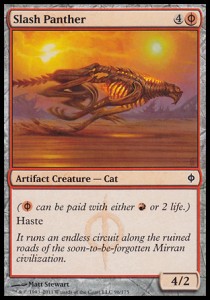
10. Slash Panther

Some of you are probably thinking that this card isn’t that good, and that you’d never play it over fellow newcomer Thundering Tanadon. You’re right, it’s not as good as that. But I wouldn’t count it out just yet because haste can be tricky.

Assuming you attack every turn, this guy outdamages Tanadon until your ninth turn when they’ll each have dealt 20 damage. That’s pretty impressive. Now, it’s also true that you’re unlikely to actually hit somebody five times with it, thanks to its measly two toughness, but it does trade with the x/4s in the format, which is a good thing. Unfortunately, it goes down hard to certain cards that are pretty commonly played, such as Disfigure, Frogmite, and Lightning Bolt, and it doesn’t give you much value for any of them. Look for this to be played against decks that don’t feature any of those, either sideboard or maindeck depending on how prevalent those decks are.

9. Apostle's Blessing

If this could target your opponent’s creatures and therefore counter Invigorate and Edge of the Divinity, it would be an instant format staple. As it is, it’s still pretty good, and a fair number of non-blue decks would like access to this effect. It’s not that exciting, but I’d be surprised if it didn’t see a decent amount of play.

8. Gitaxian Probe

This is easily the most overrated card in the set (a surprising number of people are just adding four to any deck they make for the sake of deck-thinning; do not do this), but that doesn’t mean it’s not good. Its obvious interaction is with the storm mechanic, and while the Frantic Storm deck probably won’t run it (it doesn’t really have trouble getting to the relatively low storm count it needs to bounce all of its opponent’s permanents), it’s worth an extra damage and/or two 1/1's to a red-based storm deck, a pretty huge for a zero-mana cantrip. In a less obvious application, I could see this finding a home in monoblack control to make Duress more effective, as well as in the sideboards of Cloudpost decks to let you know when it’s safe to tap out for Rolling Thunder or Ulamog's Crusher.

7. Mutagenic Growth

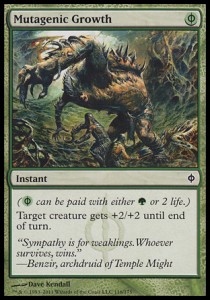
This is another solid utility card, and it’s actually quite a bit more versatile than it looks at first glance. It protects your creature from burn, it gets a couple extra points of damage in, and it can turn an unfavorable combat step into a mini-blowout. But of course, the biggest reason to play this card (and the deck that will play it the most) is infect. The deck already has access to several free pump spells, and this one should push it to a critical mass of them and make those turn two and three kills a lot less hypothetical.

6. Viridian Betrayers

Not too much to say about this one. It’s an obvious include in infect decks, because power equal to casting cost is kind of a big deal to them. It’s one of the better cards in the set because it makes an already pretty good deck better and will see a lot of play for that reason.

5. Porcelain Legionnaire

There’s a lot of hype about this one, and I’m not sure it’s all warranted. Basically, it’s a 3/1 with a combat ability for two mana. That’s good, right?

Except it really does die to every removal spell in the format, doesn’t get by Affinity’s 4/4s, and doesn’t have a whole lot of x/3s to prey on with its first strike. Still, it is a three power two-drop, and that’s nothing to sneeze at. Every deckbuilder who’s playing something even moderately should be considering this card right now, and it’s bound to work out in at least some of them.

4. Immolating Souleater

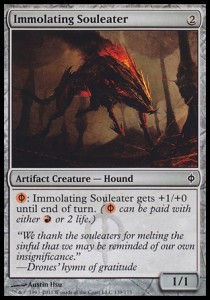
It might seem a little odd to say it about something I’m ranking so highly, but this is the one card on this list that really might not see much play at all. That’s because there’s no current deck that can easily run it, and it might be tricky to get a good deck built that uses it effectively. So why do I think so highly of it?

Think of the possibilities! Remember when all Suicide Black needed to win was a creature and a Hatred? This card is both of those! It’s the Channel and the Fireball! How is that not awesome? Look, it might work out and it might not, but as a deckbuilder I can tell you that I for one am not going to stop messing with it any time soon.

3. Vault Skirge

If Porcelain Legionnaire is a decent card that looks amazing at a glance, Vault Skirge is an amazing card that looks decent at a glance. Having an evasive lifelinker ready to attack on turn two is pretty spiffy, and the list of cards that have synergy with this is as long as my arm. Think about how quickly this can get out of hand with Rancor or Bonesplitter. Think about how good Ninja of the Deep Hours is when you have access to a flying one-drop that doesn’t suck. He might not look like much, but I suspect you’ll be seeing him all over the place soon.

2. Glistener Elf

You know those two infect supporting cards above? They’re pretty good. They help the deck out. But Glistener Elf is that deck.

Monogreen infect has been so hungry for a one-drop that some people have been playing Virulent Sliver in it, and that doesn’t even have Infect! It’s hard to overstate the impact this card will have on the format. It makes infect a tier one deck as soon as it’s available, and it’ll stay a tier one deck until it has sufficiently warped the format around itself. You’re going to see a lot more Lightning Bolts and Disfigures once this guy hits, and a whole lot less sorcery-speed removal.

I might sound hyperbolic, but trust me: this guy has the same ā€œmust kill on sightā€ status that Goblin Lackey once had in Legacy. You’re going to need to be as prepared for infect as you are for affinity, and that’s all thanks to this measly 1/1.

1. Thundering Tanadon

Bum-pa-bum-pa-bum-pa-bum-pa-bum-pa-bum-pa-bum-pa-bum-pa

ā€œWhat’s that?ā€

Bum-pa-bum-pa-bum-pa-bum-pa-bum-pa-bum-pa-BUM-PA-BUM-PA

ā€œUh...ā€

BUM-PA-BUM-PA-BUM-PA-BUM-PA-BRAAAAKSKSKKRSHHHAAAAAHOHTHEHUMANITY!

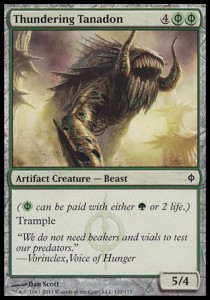
That’s a short play I wrote about what happens when you attack with Thundering Tanadon. Through the use of metaphor, I was also able to make it about Thundering Tanadon’s arrival in this format. Put simply: this is the best five power four-drop in the format with the very debatable exception of Blastoderm, and it’s not even truly green. Any deck can play this.

Late-game beef for white weenie? Check. Aggressive alternate win condition for elves? Check. Even makes Suicide Black playable? Uh... almost check? Seriously guys, it’s good. It’s the kind of ridiculous, efficient fatty that just doesn’t get printed at common, and we should all give thanks to Wizards for this gift.

In addition to those 10, there are a few other noteworthy cards:

Spined Thopter - I feel a little bad omitting this one, because all of his buddies from the same cycle made the main list. You’d be number eleven, little guy. I know there are a bunch of great two-power fliers for two mana already available in the format, but I’m sure plenty of people will opt to play you instead of them. Awww, ugly duckling.

Blighted Agent and Lost Leonin - Remember what I said above about Infect warping the format around itself? These guys might come into play after that happens. Right now, the consistency that mono-green offers means that a splash isn’t really worthwhile, but there may come a time when outside tech is needed, and both of the creatures are very, very good. In fact, they’re the two best infect two-drops. Lost Leonin is appealing because it’s just so aggressive, but I actually think Blighted Agent is the better of the two. Monogreen infect decks are so desperate for evasion that they’re playing jank like Predator's Strike, so I’m pretty sure an unblockable creature would be a welcome addition.

Geth's Verdict - Not spectacular or anything. Probably not even immediately playable. I only bring it up because it’s a solid utility card that’s good at what it does (i.e. replacing Diabolic Edict in monoblack control lists that still run it), and probably also the only decent card in its cycle. Try not to forget it exists, because it will be useful someday.

Remember the Fallen - I’ve seen people bag on this card, but I'm counting on it showing up here and there. Drawing two cards for three mana is not terrible at least, but regrowing two cards for three mana is surely better, right? If you’re playing a deck with a ton of artifacts, many of which are creatures that you can play in the same turn that you cast this, this card might work if there are, you know, any decks like that out there.

Artillerize - It’s not Shrapnel Blast, but it is solid. This would probably have made my top ten list if there weren’t so many good burn spells already, but I’d be surprised if this didn’t see play.

So that’s New Phyrexia. Infect is the big winner, but there are a number of good additions to the format, and thanks to Phyrexian mana a lot of them are playable across a wide range of decks. All in all, I expect this set to shake up the format and add a ton of variety.

Insider: Mother Myr Part 2

Are you a Quiet Speculation member?

If not, now is a perfect time to join up! Our powerful tools, breaking-news analysis, and exclusive Discord channel will make sure you stay up to date and ahead of the curve.

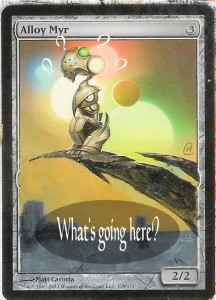
Welcome back to this continuation of last weeks article. Last week we covered how to select a card that is best suited for a full art alter, and detailed the steps leading up to this point on our Alloy Myr. This week, I'd like to cover some of the possibilities that come with full art cards and we'll obviously finish the Alloy Myrtoday.

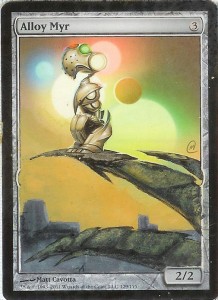
At this point, you have the sky and ground finished, and the branch on which the Myr sets is blocked in and ready to be colored. Before we do that, I'd like you to take a look at your card. The composition of this card as it is right now is a touch unbalanced. There is a lot of foreground space that is empty in the bottom half of the card. There are a couple of ways to deal with this, we could add more to the foreground to help balance the subject (the myr) or we could add a lot more detail to the ground and use that to satisfy the balance issues. These are typical issues that must be dealt with in order to paint full art cards successfully. It is important to note that while the average person does not know much about composition and balance as it pertains to art, they will still know when the balance and composition are off. This sentiment is commonly heard in the following phrases: ā€œSomething's missing!ā€ or ā€œI dunno, it just seems off...ā€.

Are we gonna paint today or what?!?

For my composition and ultimately today’s tutorial, I chose to add another branch to the foreground. I did so by using Mars Black to block in the shape of the branch. I borrowed the shape of the branch from the one above, and only differentiated them slightly. Make things easy on yourself, the design is already there, so use it. I dry-brushed a mixture of Unbleached Titanium, a touch of Cadmium Yellow, and a gray that I made from Titanium White and Mars Black. Also, create a dark gray to use for shadows under each ā€œplateā€ on the branch.

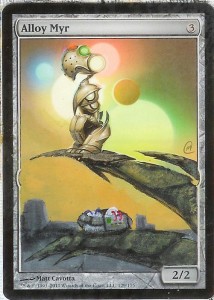
Okay, so we've solved the balance problem, there is now a foreground object using the lower space. While many people would stop here, I generally insist upon taking it one step further. It is my belief that when you extended the art of a card you are telling the viewer that there is more to this art, more story to be told here. So far the only story we've told is that the myr is high off the ground. Perhaps you did not get this far in your brainstorming, I didn't, so take this time to brainstorm ideas on how best to tell ā€œthe rest of the storyā€ (thank you Paul Harvey). If you are not in a position to do so (Reading at work? Shame on you!) then you can follow along with mine. I warn you, my brain and I ramble quite a bit.

Step into my head

ā€œI mentioned in the first part of this article that I thought our subject had some bird-like qualities. So let's follow that thought line. Perhaps we could add a dead mouse into it's mouth, dripping blood down to the branches below. Birds tend to fly around in flocks, why not ass a couple smaller myr on the lower branch, maybe one comically trying to fly. We could add another creature trying to climb up to the myr with less than pleasant intentions. Maybe this myr is guarding something, perhaps a nest? I like the nest idea, how would that look? Well the nest would be made of metal (everything on Mirrodin is), maybe it made a nest out of wires as if they were grass. It has hands and some intelligence, it would probably build more of a bowl than a nest out of scrap metal. What color are the eggs? This particular myr is capable of producing any of the five colors on mana, maybe one if each? That's a big nest, or small eggs, probably just two eggs. Also, the eggs should be egg colored, otherwise we might as well paint bunny ears on the myr. How do we know what kind of myr will come out of them? We'll add some wires, perhaps they are being infused with a certain color from the start, as part of the incubation. Good idea, go for it!ā€

To avoid insanity, please step out of my mind and exit to your left...

So there you have it, that was the though process (roughly) on how I finished the card. I would be very interested to see what you guys brainstormed up. There is a whole wide world of possibilities out there, especially if you don't follow the ā€œbirdā€ theory. Send in your work and it will get posted here.

Also, seeing my twitter following triple over the last few weeks (almost to 12!) has told me that the time may be right for another contest. The last one went so well for me in particular how could I not try again? Stay tuned and keep painting!

-The Painters' Servant

Twitter: PaintersServant

Email: Mbajorek02@gmail.com

What does it take?

Are you a Quiet Speculation member?

If not, now is a perfect time to join up! Our powerful tools, breaking-news analysis, and exclusive Discord channel will make sure you stay up to date and ahead of the curve.

It started in Dallas over a month ago.

There were talks before that but nothing serious.

It was not until the entire top eight had four copies of Jace the Mind Sculptor in their main deck that the talks became serious.

We all knew nothing would happen then because New Phyrexia was yet to be released, in printed form at least. But now, the release has come and gone, players have adopted some new cards into their decks, and a new deck or two have made tournament appearances.

So, what’s changed then?

Not much.

Nothing has changed other than one of the top two decks, RUG, has become obsolete. Now, Caw-Blade’s strangle hold is even more pressing, and it is closing its grip on the format. This past weekend in at the Star City Games tournament in Kentucky was really when it hit me.

5-22-11
SCG Louisville
7 out of the top 8
12 out of the top 16

I did some quick research for larger tournaments since New Phyrexia has been released to find the following.

5-15-11
SCG Orlando
4 out of the top 8
8 out of the top 16

5-22-11
SCGIQ Lansing
5 out of the top 8

5-22-11
SCGIQ Chester
4 out of the top 8

5-22-11
SCGIQ Wilmington
3 out of the top 8

5-23-11
TCG Big Apple
6 out of the top 8
12 out of the top 16

Statistics can be misleading so let’s talk about them for a moment. The first major tournament after New Phyrexia’s release was in Orlando. Many new players would be playing new decks with the new cards. Still, there were four Caw-Blade decks in the top eight. The following weekend at Star City’s smaller events, the Invitational Qualifiers at local shops (SCGIQ), on average half of the top eight spots went to Caw-Blade. The thing to keep in mind about those statistics is that the majority of the local players do not have access to all the high end cards like Jace. I play at three different shops around my area and less than 25% of players at the three shops combined have access to the best card in Standard. Looking at the other large tournament from this past weekend, the TCG Player tournament in New York, basically the same result happened as did a couple states away in Kentucky. What we keep seeing is top eight after top eight, completely dominated by Caw-Blade. Sure sometimes we have new versions of Caw-Blade trying to play black, green, or red mana in addition to the standard blue and white, but they are all basically the same deck. Even the Caw-Blade with Deceiver Exarch is still just Caw-Blade with some different creatures.

So what is the point of all this? The point is, do we really want to be dealing with this weekend after weekend for four more months? Can the Magic player base handle this stale, degenerate format for the PTQ season we are about to enter? If nothing is done will GP Pittsburgh get the attendance Wizards is looking for?

The answer is no. I, as well as many players I know, have skipped many events recently because the format is horrible and no fun to play. You know that the format is broken when older formats start using the same cards. Stoneforge Mystic, Jace the Mind Sculptor, and all the equipment in Standard right now are a big part of the Extended and Legacy metagames. Why is that? Why is it not? They are so powerful, how could they not get played in multiple formats.

What then can we do?

We can hope and pray that Wizards, in their upcoming banned restricted announcement the first week of June, includes some cards that are banned in Standard. If not, we have a depressing four months of Standard to look forward to.

The only other time we can compare this current metagame to is when Affinity was this dominant. I am not going to go into detail to defend that point, but I truly believe it to be that bad. We have not seen dominance on this scale since Ravager Affinity. The difference is that Affinity was not terribly expensive to build. If Jace the Mind Sculptor were a thirty dollar card, we would see numbers like fifty to seventy five percent of the metagame playing Caw-Blade.

I want to move on because rather than just talk about the problem, talking about the solution seems more helpful.

What would happen if there was a banning in Standard? Well, some players would be upset, but the majority would rejoice. I assume when I mention banning something in Standard the first thing everyone thinks is Jace the Mind Sculptor. Do I think Jace being banned would help, yes certainly yes, but I do not think that would solve the problem.

Recently my friends and I have been talking about the possible bannings and the repercussions they would have. When we discussed the possible ban of Jace, I brought up Consecrated Sphinx. The Sphinx, by the way, is steadily increasing in value, up to five dollars on most sites, so if you don’t have any you may want to consider getting a hold of them. My statement was that if Jace were banned, it would not solve the problem because Caw-Blade would just add three Consecrated Sphinx to their deck and it would be about the same power level as before. The Sphinx already appears in decklists and side boards as a way to break the mirror so that line of thought seems logical to me.

Well, if banning Jace would not solve the problem, then what? I think we don’t just need to ban one card, more is required to make the format fun again. Stoneforge Mystic. To put this creature in perspective, let me share a quote some of you might not have seen.

Stoneforge Mystic – THE BEST CREATURE EVER PRINTED! That's right, I said it. She is better than Dark Confidant, Tarmogoyf, or any of the one-drop Goblins (Goblin Lackey, Goblin Welder, Goblin Guide). Even Hermit Druid and Protean Hulk have their merits, but since I'm the one making the claim, I can likewise decide the criteria for judging. Here are my criteria: Fits into all formats, defines at least one format, fits into an array of decks in multiple formats, and top 8'd a Pro Tour in two different archetypes in its debut weekend of tournament eligibility.

-Craig Wescoe

Craig’s article can be found here for those interested. I have a lot of respect for him and the article was refreshing as well.

Even if you don’t agree with him about it being the best creature ever, you must admit that it is up for consideration. Just the fact that a mainstay pro believes it and that if you had the conversation you would have to at least discuss the topic says a lot to me. If Stoneforge Mystic is one of the best creatures ever printed, it being too powerful for Standard seems completely logical to me.

Alright so think about a Standard format where there is no Stoneforge Mystic or Jace the Mind Sculptor. Hard isn’t it? It took me a minute to just start thinking of strategies that don’t include those cards. Vampires is an obvious one for me because it is a deck that I have played a lot this season. Elves, another tribal deck, shows up on and off. And then there’s Valakut. With no Jace and Stoneforge to keep Valakut in check wouldn’t it just dominate the format? Wouldn’t Eldrazi Green pop up to try to fight Valakut in the pseudo mirror? When my friend made his points about Valakut, my response was that Mono Red would just start showing up to destroy Valakut. If that is the case though, we would be in the same place as we are right now. Valakut would be the deck taking six out of every top eight spots, followed by Mono Red that was fighting it. Why is that? The reason is that Primeval Titan is broken also. In other formats, he would be the card to beat because Primeval Titan in a format with Valakut the Molten Pinacle is a one card combo. Play Primeval Titan and win the game.

These three cards are so high in power level that other strategies are made completely obsolete by their existence in Standard. There are plenty of tournament quality cards in the format right now but they are just outclassed by the three kings of the format.

With all that being said, we can only hope that when the Banned Restriced Announcement is posted it reads…..

Standard
The following cards are banned in Standard

Stoneforge Mystic
Jace the Mind Sculptor
Primeval Titan

Can you feel the anticipation building? Just the thought of playing Standard with out these cards has me excited and ready to start building decks again. There would be interesting articles to read about again with new innovative decks. Players would be excited to go to FNM again because they might have a chance of winning with the new deck they built. Even the Event Decks would be somewhat reasonable again.

Enjoy thinking about this theoretical environment that would be interesting, fun and diverse. Enjoy it while you can because I fear it will never become a reality. I hope someone at Wizards listens and makes Standard exciting to play again. I hope that something is done about these cards that are warping the format so drastically. Unfortunately, the most likely response will be that M12 is coming out soon and maybe that will help. Maybe. It is possible. Those are the types of words that never seem to pan out and actually help anything. If not, better save up to buy some Jaces because that is the only way you can compete right now.

Dear Wizards, please make Standard fun again!

So, until next time…

Unleash the Force on Wizards. Let them know how unhappy we are.

If you agree or disagree, I would love to hear what other players think about this topic in the forums or through my usual contact methods.

Mike Lanigan

MtgJedi on Twitter

Jedicouncilman23@gmail.com

The RePodcastening | CommanderCast S3E1

Are you a Quiet Speculation member?

If not, now is a perfect time to join up! Our powerful tools, breaking-news analysis, and exclusive Discord channel will make sure you stay up to date and ahead of the curve.

CommanderCast's noise-pollution generating machine is back operating at full capacity for another 13 episodes of Commander's realest talk. A near two-hour extravaganza opens the season with Andy, Carlos, Byron and Donovan spitting truth into the EDH cipher. For the Season Premiere, we're busting the mailbag wide open, talking early-turn plays, and of course, Secret Tech is back on deck bringing you some obscure and delicious cardboard for your decks to absorb.

As always,Ā commandercast.blogspot.com is where you can find full show notes and additional information, content, and rules for the Season 3 Contest.

Click the button to play orĀ download the entire episode!

Lands Before Time

Are you a Quiet Speculation member?

If not, now is a perfect time to join up! Our powerful tools, breaking-news analysis, and exclusive Discord channel will make sure you stay up to date and ahead of the curve.

That’s right. It’s my second article, and I’m kicking it off with a The Land Before Time reference. This week want to take a look at the deck I’ve had together longest, and don’t see myself taking apart any time soon. It’s the first deck that I actively tried to improve and streamline after putting it together, and it’s definitely the most powerful deck that I currently own.

The Child of Alara five-color land deck does everything that I want a commander deck to do, and it abuses my favorite kind of permanent in the game!

What I want to do in this article is talk about the kinds of cards that make this deck powerful, clear up some misunderstandings about how the deck is meant to function, and which specific cards or types of cards are necessary to make the deck run smoothly. For example, my build has a number of really expensive cards, and people immediately assume that those are necessary to the deck’s functionality. The truth is that while the expensive cards are awesome they’re far from irreplaceable, and half of the reason I’m playing them is because I never get to play them otherwise. Regardless, we’ll start with my decklist:

[deckbox did="a62" size="small" width="567"]

Typically, the first reaction that I get from this list is confusion. There are quite a few cards in here that are just good, there are a few that are really narrow, but they don’t really ā€œdoā€ anything; it just looks like a pile of good cards.

In general, the plan involves grinding the other players out of the game in a number of ways. At its heart, the deck wants to lock people out of the game by using specific cards to attack vulnerable resources, and runs a ton of recursion and redundant copies of cards that attack those resources. You’re typically going to close out the game one of three ways:

1. Recur Child of Alara and wrath the board every turn. Having Child sit on the board is also your answer to permanent-based combos. Oblivion Stone is the backup for Child, but you could also run Pernicious Deed or even Plague Boiler if you wanted.

2. Strip Mine recursion, usually with Crucible of Worlds or Sun Titan, along with Azusa, Lost but Seeking or Oracle of Mul Daya so you can lock multiple players. You’ve got a number of cards that can back this up; my personal choice is Ghost Quarter, since it doubles as a slow win condition. You don't even have to lock people with Strip Mines; just keep them off of their own Strip Mine, or important quantities of mana.

3. Glacial Chasm recursion. Creature decks that can’t consistently interact with non-basic lands will scoop to this, and even ones that can muster a Tectonic Edge will scoop to Vesuva plus Glacial Chasm, Chasm plus Child of Alara, or Chasm plus Maze of Ith effects.

Once you’ve made it infinitely difficult for other players to win the game, or to interact with you, winning the game becomes pretty trivial, and you can do it just about however you want. Hopefully I’ve explained what the deck does reasonably well thus far, and we can jump right into what cards are necessary to make the deck run smoothly. First I want to talk about the cards that the deck is built around. You can build a similar deck without these cards, but you’ve fundamentally changed what style of deck it is without them:

Auto-Includes

Child of Alara
Oblivion Stone/Pernicious Deed/Plague Boiler

High Market
Diamond Valley/ Miren, the Moaning Well

Glacial Chasm
Vesuva

Strip Mine
Ghost Quarter/Dustbowl/Wasteland/Tectonic Edge

Like I said before, these are the foundation of the deck. It’s the core attrition gameplan plus some amount of redundancy. The cards that are slashed in aren’t in any particular order, but are some of the options I’d consider for direct substitutions. From here, it’s important to note that two of of the control mechanisms are land-based, so you’ll want ways to enable those and to tie Child of Alara recursion into your mana base.

Child and Land Recursion

Genesis
Volrath's Stronghold
Emeria, the Sky Ruin

Crucible of Worlds
Life from the Loam
Tilling Treefolk
Eternal Witness

Cartographer

Deadwood Treefolk
Karmic Guide
Grim Harvest

Volrath's Stronghold and Crucible of Worlds are the only two cards here that are expensive, and the rest are pretty good. I separated the cards that I run from those that I’d consider replacing them with. It’s important to note that as you start adding more 2/X utility creatures, Reveillark becomes a really powerful recursion engine, and is worth considering.

The other consideration I want to talk about is Emeria,the Sky Ruin. This is one of the most powerful cards in the format, as far as I’m concerned, and I’m more than willing to warp my gameplay andĀ deck buildingĀ in such a way that I can get an active Emeria more often than not. However, if you’re not capable of running all or most of the duals/shocks, it will be incredibly difficult to turn on Emeria without the help of Prismatic Omen or Scapeshift, both of which are perfectly reasonable, but may impact the value of Emeria. enough to merit cutting it.

Really though, any mechanism of consistently recurring [card Child of Alara]Child[/card] is perfectly acceptable, and any combination of Eternal Witness and Tilling Treefolk effects can be almost as good as Life from the Loam and Crucible of Worlds.

So, the question of the day is: how else are you going to abuse lands? I built the deck because too many people in my group were playing blue-based control, and I was tired of having my stuff countered. When your important business spells are either lands or easily recurrable, it minimizes the impact of counterspell and control magic effects. These are some of the archetypical types of lands that make the deck as powerful as it is, and allow you to use lands as spells:

Manlands

Let's start with ones that we're all comfortable with. These are the manlands that have been in and out of the deck at some point or another:

Mishra's Factory
Nantuko Monastery
Dryad Arbor
Creeping Tar Pit
Celestial Colonade
Lavaclaw Reaches

The important thing about manlands is that they're recurrable blockers that trade with utility creatures and they're a win condition that is child-proof. Right now I'm running Dryad Arbor for the utility it provides and Nantuko Monastery because of the high power relative to its activation cost.

The other manlands are all fine - Lavaclaw Reaches especially gives you a really fast clock - I just find that I frequently have other things I'd rather be doing with my mana.

Maze of Ith

These are your back-up to Glacial Chasm and Child of Alara. Recurring one or both of these can eat up your entire turn; protecting yourself with Mazes means that you can have a few turns where you're safe between to develop your board position.

Maze of Ith
Kor Haven
Deserted Temple
Mystifying Maze
Prahv, Spires of Order

Once again, I typically end up playing on the most mana-efficient copies of this kind of effect: Maze of Ith, Kor Haven, and Deserted Temple. [card Prahv, Spires of Order]Prahv[/card], while expensive, has the upside of protecting you from damage dealt from spell and effects, but really, that's what Glacial Chasm is for; Mystifying Maze, while powerful, is expensive and has the downside of triggering "enters the battlefield" effects.

I've chosen to run Deserted Temple over these as bad mana fixing, and a way to reuse mazes, manlands, and sacrifice outlets. It's still more efficiently costed than Mystifying Maze and it provides a lot more utility. Seems like all upside to me!

Card Drawing

Something that people don't notice about this deck immediately is that you'll often empty your hand pretty early in the game and spend the rest of the game playing out of your graveyard or tutoring up the pieces that you need. Regardless, some land-based card drawing is good for digging towards key cards:

Tranquil Thicket and the rest of the Onslaught cycling lands
Slippery Karst and the rest of the Urza's Saga cycling lands
Horizon Canopy
Cephalid Coliseum

Cycling lands interact really well with Life from the Loam, allowing you to dig three cards deep for various lands, and protect Life from the Loam from graveyard hate at instant speed. With a reliable 5 color mana-base, the Tranquil Thicket style of cycling lands are obviously just better than the Saga ones, but if you're having trouble hitting colors, a split is probably better.

Cephalid Coliseum is a lot like an uncounterable Ancestral Recall, especially with Life from the Loam to fill your hand with unneeded lands. Horizon Canopy is significantly worse, but sometimes you get to use these multiple times with Crucible of Worlds and Azusa, Lost but Seeking in play, and then it's pretty hard to lose.

While I could go over the rest of the deck in detail, I's rather pick out some of the stranger or more powerful cards and gloss over those, and end with talk about actually winning the game (since that's kind of important).

Nim Deathmantle
Anyone who's ever read anything of mine knows that I love this card. The thing is absolutely insane. If you use this in conjunction with a sacrifice outlet, you've basically built your own Recurring Nightmare, and that effect is powerful enough to be banned

Ad Nauseam
Your deck is mostly lands, so this and Treasure Hunt are both awesome. The difference is that this has zero chance of whiffing, and will almost always draw at least five cards, but usually ten or more. Seems fair, right? [Editor's Note: It's an instant too, for good measure.]

Realms Uncharted
Realms Uncharted, Intuition, Gamble, and Entomb are all of the tutors that dump things into your graveyard, and they're all stellar in this deck. With all the recursion you run, they're basically just Demonic Tutors. Imagine it's the mid-game and you cast Realms Uncharted for:

Petrified Field
Tolaria West
Glacial Chasm
Volrath's Stronghold

That split doesn't usually end well for the table, since you'll get whichever lands you wanted, plus tutor for one or two from your deck within the next two or three turns. Gifts Ungiven is banned, and, in this deck, Realms Uncharted is roughly equivalent to that, but for less mana.

Crop Rotation
When I say that this is the best tutor in the deck, I'm not kidding. Instant speed Glacial Chasm is no joke, since people will over-extend to try to kill you, and you can punish them with Child of Alara. When it's not blowing people out, it's also a cheap tutor that doesn't use a land drop, which is at a premium.

Summer Bloom

This is a card that facilitates blowouts. I've killed a table of four people on turn 5 on the back of Summer Bloom plus Yawgmoth's Will. Early game, this lets you explode out of the gates and set up your engine before people can really disrupt you. Late game, it's like a 2 mana Mind's Desire.

Winning the Game

I've been playing this deck for a long time, and I've tried a ton of different ways to close out games with this decks, all to varying degrees of success. Currently, my primary win conditions include Planeswalkers, Worm Harvest, and Valakut, the Molten Pinnacle, since they very compact and provide a lot of utility. However, here are a few other methods I've tried:

Rampaging Baloths
Last Stand plus Urborg, Tomb of Yawgmoth/Prismatic Omen
Meloku the Clouded Mirror
Avenger of Zendikar
Thopter Foundry/Sword of the Meek
Magosi, the Waterveil plus Rings of Brighthearth and Deserted Temple.

The problem with most of these is that they're dead unless you're actively trying to end the game, require you to run other cards that are dead outside of comboing, or require you to continuously commit resources to making them good, which can make it difficult to stay alive.

Hopefully you enjoyed this look at a deck I've been enjoying playing for the last two years; it's kind of amazing that in 2,000 words I've barely scratched the surface! If you're interested in hearing more, let me know, because I've got plenty more to say about this deck!

In the meantime though, if you've got any comments, criticisms, or want to talk about an idea or a deck, leave a comment, shoot me an email or tweet at me. I'm always happy to talk shop!

Carlos
cag5383@gmail.com
@cag5383 on Twitter

Impact of New Phyrexia

Are you a Quiet Speculation member?

If not, now is a perfect time to join up! Our powerful tools, breaking-news analysis, and exclusive Discord channel will make sure you stay up to date and ahead of the curve.

We've had 2 weeks of Opens to see the impact New Phyrexia has had on the Standard and Legacy tournament scenes. I'm going to focus on Standard, since the Grand Prix this weekend is Legacy, and will almost certainly have more players than the SCG Open series gets. Waiting on that will give us a bit of a better view on the format. However, for Standard, there's no reason to wait, especially since the format hasn't really undergone much of a change.

Standard

Caw-Blade is still the king. New Phyrexia didn't actually change that. The #banjace discussion on twitter ended up fading away due to Despise and Hex Parasite, but those cards have had minimal impact thus far. The printing of Batterskull and Sword of War and Peace has done more for Caw-Blade than any of the hosers could have dreamed of.

Caw-Blade is in fact so dominating now that people are building the deck to beat the mirror, hence Emeria Angel and Jace Beleren and the missing Gideon Juras. Meet the new Caw, same as the old Caw.

Alex Gonzalez, Louisville Open champion:

Untitled Deck

creatures

4 Squadron Hawk
4 Stoneforge Mystic
2 Emeria Angel

spells

4 Preordain
4 Mana Leak
3 Spell Pierce
2 Day of Judgment
3 Into the Roil
4 Jace, the Mind Sculptor
1 Jace Beleren
1 Batterskull
1 Sword of War and Peace
1 Sword of Feast and Famine

lands

2 Plains
4 Island
4 Tectonic Edge
4 Celestial Colonnade
4 Glacial Fortress
2 Inkmoth Nexus
4 Seachrome Coast
1 Marsh Flats
1 Misty Rainforest

sideboard

1 Sun Titan
1 Batterskull
3 Flashfreeze
3 Condemn
2 Divine Offering
1 Mortarpod
1 Linvala, Keeper of Silence
1 Day of Judgment
2 Emeria Angel

Edgar Flores, TCGPlayer WWS Big Apple 2nd place (small changes from his Orlando-winning decklist):

Untitled Deck

creatures

4 Squadron Hawk
4 Stoneforge Mystic

spells

4 Preordain
4 Mana Leak
4 Spell Pierce
4 Into the Roil
2 Jace Beleren
4 Jace, the Mind Sculptor
2 Batterskull
1 Sword of Feast and Famine
1 Sword of War and Peace

lands

5 Island
3 Plains
4 Celestial Colonnade
4 Glacial Fortress
2 Inkmoth Nexus
4 Seachrome Coast
4 Tectonic Edge

sideboard

1 Mortarpod
2 Sun Titan
4 Leyline of Sanctity
3 Divine Offering
2 Day of Judgment
3 Oust

Of course, it's not quite the same. Sylvok Lifestaff and Sword of Body and Mind are gone, upgraded to Batterskull and Sword of War and Peace respectively. More interesting is the utter absence of Tumble Magnet from not just these two decks, but almost the entire top 16 for both Opens! The card has quickly gone from savage tech to borderline unplayed (2 in the sideboard of a Valakut deck) with the release of a single set.

Darkblade may not carry a trophy or wear a crown, but the King's shadowy brother has done well enough for itself, putting 5 people in the top 16 of the WWS Big Apple, 5 in the top 16 of SCG Louisville (4 in the top 8), and 6 in the top 16 of SCG Orlando (3 in the top 8).

Michael Long (no, not that one), SCG Louisville, 2nd place:

Untitled Deck

creatures

2 Emeria Angel
4 Squadron Hawk
4 Stoneforge Mystic

spells

4 Preordain
2 Mana Leak
1 Dismember
2 Go for the Throat
1 Into the Roil
2 Duress
4 Inquisition of Kozilek
4 Jace, the Mind Sculptor
1 Batterskull
1 Sword of Feast and Famine
1 Sword of War and Peace

lands

4 Plains
2 Swamp
2 Arid Mesa
4 Creeping Tar Pit
4 Darkslick Shores
3 Glacial Fortress
4 Marsh Flats
4 Seachrome Coast

sideboard

1 Batterskull
2 Spellskite
2 Emeria Angel
3 Divine Offering
2 Flashfreeze
2 Despise
2 Memoricide
1 Oust

Despite the continued dominance of Caw variants, one challenger stands above the rest: Splinter Twin.

Michael Flores, WWS Big Apple champion

Untitled Deck

creatures

4 sea gate oracle
1 pilgrims eye
4 deceiver exarch
2 inferno titan

spells

4 into the roil
2 jace beleren
4 jace, the mind sculptor
3 mana leak
4 preordain
2 spell pierce
4 splinter twin

lands

10 island
8 mountain
4 scalding tarn
4 tectonic edge

sideboard

1 basilisk collar
1 consecrated sphinx
1 dispel
1 elixir of immortality
1 jace beleren
1 jaces ingenuity
2 manic vandal
2 pyroclasm
2 spell pierce
2 spellskite
1 trinket mage

Tim Landale, SCG Orlando 3rd place:

Untitled Deck

creatures

4 Deceiver Exarch
4 Inferno Titan
4 Lotus Cobra
1 Oracle of Mul Daya

spells

3 Splinter Twin
3 Lightning Bolt
2 Mana Leak
2 Jace Beleren
4 Jace, the Mind Sculptor
2 Explore
4 Preordain

lands

2 Forest
4 Island
2 Mountain
4 Copperline Gorge
3 Halimar Depths
4 Misty Rainforest
4 Raging Ravine
4 Scalding Tarn

sideboard

2 Obstinate Baloth
4 Flashfreeze
3 Natures Claim
2 Spell Pierce
4 Pyroclasm

What these decks have in common is the use of Inferno Titan and Jace as additional win conditions to punish opponents who depend too heavily on stopping the combo victory.

Compare to the Grixis Twin deck, which is considerably less successful despite being better able to protect the combo.

John Cuvelier, SCG Orlando top 16:

Untitled Deck

creatures

3 Spellskite
1 Consecrated Sphinx
4 Deceiver Exarch

spells

4 Splinter Twin
2 Dismember
2 Go for the Throat
2 Into the Roil
4 Mana Leak
3 Jace, the Mind Sculptor
3 Duress
4 Inquisition of Kozilek
4 Preordain

lands

4 Island
2 Mountain
4 Blackcleave Cliffs
4 Creeping Tar Pit
4 Darkslick Shores
2 Halimar Depths
4 Scalding Tarn

sideboard

3 Calcite Snapper
1 Consecrated Sphinx
2 Shatter
3 Surgical Extraction
3 Twisted Image
3 Pyroclasm

Because of this deck's inability to realistically win outside of the combo, it's much less successful overall, and has a great deal of trouble against fringe strategies such as Soul Sisters. Let's reiterate: this is a 2-card combo that can be cast turn 4 at the earliest, with no tutors in the deck. At best, you've got some cantrips plus Jaces. That's not going to get there reliably through a 10-round event, and certainly not once people start packing hate. Using the combo as a way of keeping people from properly fighting against a UR or RUG deck is a much more robust plan.

Speaking of robust plans, what about just jamming it in Caw-Blade?

Tyler Winn, SCG Louisville top 8:

Untitled Deck

creatures

3 Spellskite
3 Deceiver Exarch
1 Frost Titan
4 Stoneforge Mystic

spells

2 Dismember
2 Into the Roil
4 Mana Leak
3 Spell Pierce
4 Preordain
1 Batterskull
1 Sword of Feast and Famine
1 Sword of War and Peace
1 Gideon Jura
3 Jace, the Mind Sculptor
1 Venser, the Sojourner

lands

4 Island
4 Plains
1 Arid Mesa
4 Celestial Colonnade
4 Glacial Fortress
1 Inkmoth Nexus
4 Seachrome Coast
4 Tectonic Edge

sideboard

1 Mortarpod
2 Celestial Purge
3 Condemn
1 Deprive
1 Dismember
2 Divine Offering
3 Flashfreeze
1 Gideon Jura
1 Jace Beleren

He didn't run the Twin combo, but how many people misplayed against him once they saw the Deceiver Exarch? It wouldn't be hard to tweak the manabase to run more fetchlands, throw in 2-3 Mountains, and fit in the Twins; but would it be worth it? Unlike Flores' deck, Twin doesn't have random Pilgrim's Eyes or Sea Gate Oracles to gain value, but Splinter Twin on Stoneforge Mystic isn't exactly a play to be ashamed of.

The other major change New Phyrexia has brought to Standard - though it hasn't really much of a splash yet - is the Hawkward deck, with several new cards.

Ken Adams, SCG Louisville top 16

Untitled Deck

creatures

4 Memnite
4 Phyrexian Revoker
3 Porcelain Legionnaire
4 Signal Pest
4 Steel Overseer
3 Vault Skirge
4 Glint Hawk

spells

4 Glint Hawk Idol
2 Shrine of Loyal Legions
4 Tempered Steel
3 Dispatch

sideboard

1 Batterskull
1 Hammer of Ruin
1 Shrine of Loyal Legions
1 Sword of War and Peace
2 Hex Parasite
1 Phyrexian Metamorph
3 Stoneforge Mystic
1 Dispatch
2 Divine Offering
1 Ajani Goldmane
1 Plains

Playing much like a swarm deck, this aims to end the game in one or two big swings early. Shrine of Loyal Legions is a solid refuel card to get involved when sweepers ruin your day, but for the most part this is a deck that lives and dies based on what kind of a defense its opposition is offering. If Splinter Twin is seeing more play, 3 Dispatch won't cut it, and some more defense - Celestial Purge or even Demystify will be necessary additions to the sideboard.

Another white weenie deck made an appearance in the same event.

Neil Michalares, SCG Louisville top 16:

Untitled Deck

creatures

4 Phyrexian Metamorph
3 Spellskite
4 Ajanis Pridemate
4 Leonin Relic-Warder
4 Serra Ascendant
4 Souls Attendant
3 Squadron Hawk
4 Stoneforge Mystic
4 Suture Priest

spells

1 Batterskull
1 Sword of Body and Mind
1 Sword of War and Peace

lands

8 Plains
4 Glacial Fortress
3 Glimmerpost
4 Kabira Crossroads
1 Seachrome Coast
3 Tectonic Edge

sideboard

1 Mortarpod
1 Sword of Feast and Famine
2 Hex Parasite
1 Spellskite
2 Kor Firewalker
3 Honor of the Pure
3 Brave the Elements
2 Divine Offering

Yes, that 3 next to Squadron Hawk is accurate. This is another Mystic deck, but unlike Caw-Blade, Soul Sisters trades in Jace and Preordain for lifegain and the possibility of running out the Leonin Relic-Warder+Phyrexian Metamorph infinite combo. For those of you who are unaware, a Metamorph entering the battlefield as a Relic-Warder can exile itself, which causes it to return to play again. This produces infinite Soul's Attendant or Suture Priest triggers, which is enough to put you out of reach of basically everything in this format but Exarch-Twin. The trick is, this deck has an amazing matchup against them since the mere presence of Soul's Attendant or Suture Priest on the board shuts down the infinite combo.

Spellskite can protect the life-gain cards from removal, and it can just play as a random white weenie deck with incidental lifegain to get ahead in races, much like the role Vampires aims to take in aggro mirrors thanks to Kalastria Highborn.

I don't really endorse this deck since it's even more vulnerable to sweepers than Hawkward, but it has certain points in its favor, and could be a sick metagame call if you're expecting a lot of Twin combo.

Aside from all that, we've got some incidental appearances in top 8s from U/B control (Despise, Gitaxian Probe, a singleton Karn Liberated, a singleton Life's Finale), Bant Caw-Blade (new equipment plus Beast Within), Eldrazi Green (Dismember and Spellskite in the sideboard), Vampires (Dismember, Batterskull, Act of Agression), Goblins (Shrine of Burning Rage in the sideboard), and Valakut (no new cards).

The former "second best deck" - RUG Ramp - has completely disappeared from top 16s. When people who've made multiple top 8s with a former tier 1 deck switch to a different deck without even trying the deck they won with, you know it's not going to cut it. Lotus Cobra seems to be homeless as a result. Splinter Twin may fill that hole in the metagame, but Caw-Blade players are sure to adapt.

The problem is that it's nearly impossible to actually fight Caw-Blade. Before Batterskull, Sword of War and Peace, and Spellskite, the Red mages could fight the good fight, as they had a positive matchup against Caw-Blade, especially when the Caw players weren't playing Kor Firewalker. Now? Let's just say that Caw-Blade doesn't even need the Firewalker- it can just batter more skulls. Splinter Twin, as dumb as it may be, might actually be the best option - but if the Caw players can sideboard to beat Twin (and I think they can), it won't make a difference.

Josh Justice
@JoshJMTG on Twitter

The Prediction Tracker Arrives!

Are you a Quiet Speculation member?

If not, now is a perfect time to join up! Our powerful tools, breaking-news analysis, and exclusive Discord channel will make sure you stay up to date and ahead of the curve.

FREE FOR ONE WEEK TO ALL!!!

On June 3rd this feature will revert back being Insider subscribers only, so hurry and sign up! Get 20% off your first month with the code 4B94AAA454.

Subscribe here!

After weeks of behind-the-scenes work (and some great Google Doc formatting by Chris McNutt), I'm proud to announce the Prediction Tracker is live and ready for use! This is the only tool of its kind in existence and it's something that will really give Insiders a leg up on the competition.

We talk a lot about the benefits of having a team of finance writers on here, and nothing demonstrates that advantage more than the Prediction Tracker. Opinions on cards can vary, and not everyone is right every time. With the Prediction Tracker, you have everyone's opinions aggregated into one easy-to-read spreadsheet. Think of it as your own personal trading cheat sheet.

The Tracker is broken down into three separate sections - the Hot List, Watch List, and Ditch List. The Hot List tells what cards to pick up, with the price you want to buy in at, as well as the priced each writer has targeted for the card to rise to. There also is an average buy and target price based on the predictions made by the team. The Watch List includes cards like Etched Champion that are underpriced but currently lacking a deck to push their price up. And finally, the Ditch List tells you what cards to unload now before they come down in price, either because their price has peaked (I'm looking at you, Splinter Twin), or because of rotation, reprints, etc...

There also is a comments section for each of the cards mentioned. It appears separate from the collective results, and aggregates all the comments from each writer into a column for every individual card. This allows for each contributor to explain their reasoning for why they recommended buying or selling a particular card.

One of the best features of the Tracker is that it updates in real-time! That means that as soon as a writer makes a call on a card (say, buying up Spellskites after it's spoiled), they'll enter it into the Tracker and it will be available for you to view whenever you want! No more waiting until Tuesday or Wednesday for a column to discuss last week's news. No more scouring the Twitter feed of every financial writer to find card tips. A simple trip to the Quiet Speculation homepage and onto the Prediction Tracker will put all this information at your fingertips.

Every Friday, I'll be writing an (additional) column detailing the changes and trends from week to week. Cards go from great buys to great sells at a moment's notice, and I'll do my best to disseminate the most important Tracker data to you every week. The Tracker will be archived each week so that anyone can look back and see what Tracker contributors were saying about Consecrated Sphinx two months ago. A common theme of my articles is accountability, and the Tracker goes a long way toward making that easier to track than ever.

Before we get to the first edition of the Tracker, I want to introduce the team of writers contributing. The QS team will be the regular contributors, but we have plans to bring in experts from outside websites to contribute as well, so keep an eye out for that. And remember, if you want access to the Tracker after this week, remember to sign up for an Insider account!

The Team

Kelly Reid

Renowned MTG financial expert and Quiet Speculation founder, Kelly is a practiced veteran of the prediction scene. Running his own hobby shop, Kelly has a close read on the MTG community and gives financial advice accordingly.

Stephen Moss

Stephen does a great job getting breaking news onto the site, often posting updates from the weekend's events at 12:01 Monday mornings, giving readers a huge heads up when it comes to the cards likely to be discussed that week. Stephen keeps a close handle on seemingly every online MTG store and provides that insight to readers.

Ryan Bushard

A savvy trading veteran, Ryan interacts with more traders in a weekend's time than most people do in a year. He has a ton of experience interacting with dealers and knows exactly how much you can expect to sell your cards for.

Chad Havas

Not only did Chad do some pioneering work on a post-Besieged Pyromancer Ascension list, he knows his way around the trade tables as well. A solid addition to any financial team.

Josh Justice

Our resident pro, Josh brings a player's perspective to the team, a crucial angle that allows him to spot cards or decks that are under-the-radar. Not only can Josh tell you that Phyrexian Revoker is going to rise in price, he can also tell you exactly why it's going to do so.

Corbin Hosler

That's me! I fall somewhere in between a player and a full-time trader. Some of my recent called shots include Stoneforge Mystic, Tezzeret, Agent of Bolas and Spellskite. Hopefully I'll continue the hot streak!

Doug Linn

Legacy expert Doug Linn has been playing Magic for a long time, and has seen a lot of cards come and go. His weekly financial reviews of older sets are invaluable to newer players and he brings that knowledge to the table for the Prediction Tracker!

As you can see, that's a pretty solid resume for everyone contributing to the Tracker, and I promise you will make money based on the advice of this team. With that, let's get to the first edition of the Tracker!

(Editor's Note - Google is experiencing intermittent availability issues. Spreadsheets may be unavailable until Google corrects the issue.)

[iframe https://spreadsheets2.google.com/spreadsheet/pub?hl=en_US&hl=en_US&key=0AukC5EWiTvOpdGtvb0c3YmFRRmZLZEhTWVFwRjczeFE&single=true&gid=2&output=html 925px 1000px]

[iframe https://spreadsheets.google.com/spreadsheet/pub?hl=en_US&hl=en_US&key=0AukC5EWiTvOpdGtvb0c3YmFRRmZLZEhTWVFwRjczeFE&single=true&gid=10&output=html 925px 700px]

[iframe https://spreadsheets.google.com/spreadsheet/pub?hl=en_US&hl=en_US&key=0AukC5EWiTvOpdGtvb0c3YmFRRmZLZEhTWVFwRjczeFE&single=true&gid=11&output=html 925px 700px]

[iframe https://spreadsheets.google.com/spreadsheet/pub?hl=en_US&hl=en_US&key=0AukC5EWiTvOpdGtvb0c3YmFRRmZLZEhTWVFwRjczeFE&single=true&gid=12&output=html 925px 700px]

As you can see, one of the most agreed-upon cards to pick up from the current list is Consecrated Sphinx. The card has risen about 50% in the last two weeks, and figures to continue to do so. If the Titan cycle isn't reprinted, then the Sphinx stands to become a go-to finisher post-rotation. As a Mythic, this card has a lot of room to grow.

Another card that has received a lot of attention is Jace, the Mind Sculptor. He appears on both the Hot List and the Ditch List for a reason, which spelled out in the comments. To quote Josh Justice, "Pick up from Standard-only players when the rotation hits, hold for half a year or so, then flip for profit to Extended PTQ players (if that season exists next spring) and Legacy players. See Tarmogoyf for price comparisons. Dropped from ~65 to <40 when it got suddenly rotated out of Extended, and is back up there now. Legacy alone could keep Jace that high. Blue control won't get a card this good for years, if ever again." Seems true.

The Ravnica cycle of Shocklands, including Hallowed Fountain and friends, also are a popular subject. These things are a great pickup right now. With Commander decks coming out this summer, the possibility of the creation of a Paper Modern or Overextended format, and prices of dual lands rising out of control, demand for these lands is only going to grow. Pick them up now in trades from people who still value them at $5.

There also seems to be some consensus that now is the best time to move your Spellskite and Splinter Twins. Why are we suggesting to ditch two of the hottest cards in Standard? In short, the Law of Mythics, which state that very few Standard Rares can hold a price tag above $10. Looking at BlackLotusProject.com, which tracks Ebay prices, it's easy to see that Splinter Twin has peaked. Therefore, there is nothing left to do but clean out your stock for a profit.

That's all I've got for this week. Everyone here is really excited about the creation of the Prediction Tracker, and I hope you are as well. This is very much an dynamic project, and your feedback is welcome and appreciated. Let us know what you think!

The live and permanent location for the Prediction Tracker can be found in the sub-menu for "Finance" in the top menu bar under "Articles" or at the following link.

QS Prediction Tracker

[QS Forum Link]

[Prediction Tracker Discussion on QS Forums, Insiders Only]

Thanks,

Corbin Hosler

@Chosler88 on Twitter

Surviving the Season: Drafting, Trading and Leveling Up

Are you a Quiet Speculation member?

If not, now is a perfect time to join up! Our powerful tools, breaking-news analysis, and exclusive Discord channel will make sure you stay up to date and ahead of the curve.

I’ve spent most of the week watching the Corbin’s Brainchild the Prediction Tracker come to fruition, and wow, this thing is an amazing resource. Chris has done some amazing work to get this spreadsheet prepared, and the whole QuietSpeculation team is committed to making it as valuable to you, the subscribers, as possible. This comes at a very appropriate time for me. I started drafting a couple years ago now, and slowly through trading have leveraged that into a fairly complete Standard collection, as well as enough extras to fill a binder and able to continuously trade. Lately, my binder has gotten to be a bit too full. This is typically not a problem as I keep a longbox of extras to restock with when needed or let people peruse if they have something I particularly want. I’ve decided I have too much of my inventory tied up in Standard and am ready to start diversifying my trade stock, as well as level up my personal collection into a higher class. Ultimately, my goal has always been to allow my gaming and trading to make up all of my hobby costs, and if I have any desire to play Legacy in the future, I’ll need to start stashing some staples when possible.

Gerry Thompson and Drew Levin recently put up solid finishes with, and have been writing about, a U/W Landstill deck that fits my playstyle perfectly. The only expensive cards in the deck are Legacy Staples that aren’t risky investments. My plan is to convert as much of my Standard Stock as possible into this deck. Along the way, I expect I’ll be trading for other Legacy staples as some of the holders of the best Legacy trades won’t be interested in my Standard cards. I’ll be including updates to the progress of this along the way each week.

This week I conducted my first two trades in this project. One such trade was a small one, I traded a Hero of Oxid Ridge and a Mental Misstep for a Crucible of Worlds. I feel like I got lucky on this one for a number of reasons. Primarily, I don’t expect either card I gave up to hold the value it currently has, and because I think my trade partner undervalued his Crucible of Worlds. The second trade I made was much more sizable, and I learned a lesson in the process. A player at our LGS told me he was getting out of Legacy, and preparing for Standard rotation. He mentioned he had two Tundras for trade, so we sat down to deal. As we started, I told him I valued Revised Tundras around $70. This was my first mistake, and one I’ll never make again. I was lucky it didn’t end up costing me. He started flipping through my binder, and ultimately we agreed on what I was giving up as fair for two Tundras. I feel like I gained a ton of value on this trade because he included a pile of bulk rares at $.50-1 each and some random foils that he over valued, like Arc Trail. I did have to include some decent cards like a Sword of Feast and Famine, Sword of Body and Mind, and Sword of War and Peace, as well as a Karn Liberated. Very happy with my trade, I reach across for my two Tundras, and notice that one of them is Moderately Played, while the other is EX-NM. This being said, I’m still very happy with my trade, so I didn’t say anything, and slid them into my binder, but this could have been a much uglier situation. I should have never agreed to a value on these Tundras until I inspected their condition much closer. This is my first lesson in trading into Legacy cards: be sure to check the condition at the beginning of the trade. At that point, it would have been hard for me to re-negotiate based on condition, but early on I could have started at a lower number, and perhaps kept the Sword of Body and Mind in my binder. Dealing in Limited and Standard, I don’t get too much exposure to the condition of cards affecting prices, but this shouldn’t have been a surprise for me. I just need to be more cognizant of it when I’m approaching a trade, especially with older cards.

Why bother trading into Legacy, if you’ve already been having success trading Standard Cards? First, I want to be able to enter a Legacy event when the need arises, without borrowing a deck. More importantly, though, is Legacy staples are the safest Magic stock to hold. Legacy staples don’t bounce all over the place like Standard and Extended cards do during PTQ season, and they are just about the best thing to draw attention to your trade binder. It guarantees you’ll always have something your trade partner wants, and be in a position of negotiating power when you have desirable staples.

Hopefully, by the time you hopped over to this article, you’ve also already seen the Prediction Tracker. I’ll be including a snippet each week about my inclusions on the tracker, and I look forward to input and criticism either in the comments here or in the forums.

I started by inputting some of the previous predictions I’ve made over the last few weeks, and also some sound advice about negotiating your way through the Summer. A card I’ve been trading for actively is Phyrexian Crusader. He’s right around $5, but could see a deck popping up where he can spike to as high as $8. He’s got a lot of raw power as a 3-drop, and some extremely relevant protection as well as a quick clock. I’ll be prepared to dump as many of these as I can once it does pick up a bit. Also, in my drafts, I’ve been starting to collect Despise. Even if I don’t pick it myself, I’ll find out who did, and try to trade for it. I made a killing off my Inquisition of Kozileks I did this with last year during ROE drafts. I can easily see Despise fitting this mold next year during PTQ season. This tracker is a way for you to see everyone’s input at a glance, make your own judgment, and trade/buy/sell accordingly. Some may use it as a cheat sheet, while some a starting point. In the end, Corbin’s idea is fantastic, and the work behind the scenes to get this going has been great to watch. I personally applaud both Corbin and Chris, as well as the rest of the writers who pitched in to make this happen. I’m excited to see where this goes, and hear questions and suggestions about how to include information in my article to compliment what’s happening in the tracker.

Part Way to Paris

Are you a Quiet Speculation member?

If not, now is a perfect time to join up! Our powerful tools, breaking-news analysis, and exclusive Discord channel will make sure you stay up to date and ahead of the curve.

Over the last few weeks I’ve been exploring some of the more meta issues surrounding the Commander format, but this week we come back in line with my first article: Commander strategy. Commander is a casual format, but let’s face the facts: winning is fun. That’s not to say it’s worthwhile annoying all of your friends to win. The social contract is essential to the Commander format because, after all, the point is to have a good time. But if you enjoy winning even a little bit, you might as well use the format's peculiarities to get a leg up on the competition without raining on anyone else’s parade. The first place to look for an opportunity is the new rules Commander brings to the table, both written and unwritten.

Today we’re going to explore the Partial Paris Mulligan, Commander’s unique mulligan rule. Just to clarify for anyone who may not know (I’ve run into numerous Commander players who don’t use it), the Partial Paris Mulligan works like so:

  • Each player draws seven cards.
  • Then, in turn order, each player may exile any number of cards from their hand face down.
  • Next, each player who did so draws one fewer card than they exiled.
  • Each player may repeat this any number of times.
  • Finally, when everybody keeps their hand, the exiled cards are shuffled back into their owners’ libraries.

One piece of this rule’s potential is obvious; if we were allowed to do this in regular Magic, it would highly favor players who were looking to assemble combos. While the same holds true to a lesser extent in Commander, this application falls outside of today’s purview as the majority of Commander groups consider quick combo kills unfun. We’re not looking to do anything big and flashy with the Partial Paris, but rather we want to gain an advantage without tipping anyone off to the fact that we’ve done so.

Like any mulligan rule, the Partial Paris Mulligan aims to alleviate mana screw and mana flood because, as experience has taught us, those lead to unfun games. Now it’s time to disregard your experience. My recommendation for abusing the Partial Paris Mulligan is to mull away almost every non-mana source card you draw.

You want to be flooded.

Full on Flooding

Am I insane? Am I claiming that every strategy writer in the history of the game has been wrong, that mana flood is beneficial? No. But Commander isn’t like normal Magic. This isn’t a duel, so the other players’ top priority isn’t necessarily to kill you. Most people will go after whomever they judge to be the biggest threat to them at the table, and as we all know, a mana flooded player is the least threatening of all.

As Conley Woods mentioned in an article about MSS draft, while at least a mana screwed player has a bunch of spells to cast if they can ever find lands, a mana flooded player will have to hope for a topdeck to save them every turn. This mode of thought holds true when it comes to multiplayer. Sure, you might not have a whole lot to do, but when the other players see that, they’ll probably leave you be.

That’s right! For the low, low price of one card, you can be left to develop your mana for the early and mid game. You get to choose when to come out of this shell by doing something threatening (unless you run out of lands to play, in which case it may be hard to feign being flooded). Moreover, by intentionally flooding yourself, you’ll ensure that come late game, you’ll have the requisite mana to compete with the rest of the table. When each threat except the last one is answered, timing your strike is much more important than having a lot of threats, so all that you need to ensure that you can compete is a boatload of mana.

Broader Applications

Flooding yourself will help you keep a low profile, and put you in a good position for when things really start to heat up at minimal cost. Just make sure not to use this plan too often, or your playgroup may kill you (despite your lack of spells under the illusion that since you keep winning while flooded, your deck must just be enormously powerful). Since this strategy depends upon players making logical threat assessments, you’ll be in hot water should you find yourself the center of attention while you have no spells with which to defend yourself.

Of course, the lessons learned here apply even when you’re playing more conservatively. Commander is a format in which a single momentous spell can put you back in the game, so flooding is more beneficial than being mana screwed. Additionally, as you always can cast your Commander you have to keep in mind that each of your hands always has two extra spells: that Commander, and a copy of it that costs two more mana.

To this end, even when you aren’t committing to flooding out, Commander demands that you look for hands with more lands than you might be accustomed to from other formats. Even if you draw an ā€˜ideal’ three land, four spell hand, you should strongly consider mulliganing the three weaker spells. You aren’t really going from three lands and four spells to an average of 3.8 lands and 2.2 spells. You’re going from 3 lands and 6 spells to an average of 3.8 lands and 4.2 spells. Surely that’s a healthier ratio.

Consistency

Of course, flooding out and finding combos aren’t the only uses of the Partial Paris Mulligan. The rule also allows you to ensure that you have a certain type of effect provided that enough variations have been printed. Because you always have access to your Commander, making sure that you can find an effect which complements them well will put you in a good position to take over the game with synergy.

The most potent (legal) example of this is Zur the Enchanter. Zur is such an impressively powerful Commander by virtue of the fact that his ability will not only lock the other players out of the game without assistance, but also can find answers to your problems. Zur is practically a deck in and of himself, and all he really needs to dominate a table is a method of getting him to swing. Lightning Greaves obviously facilitates this goal, but there aren’t a whole lot of cards that can fill that role. That said, it’s still easy to make Zur hit earlier by running a way to accelerate you into a turn three Zur the Enchanter; just about any accelerant that costs two mana or less will do.

With conventional mulligans, you’d need nine of these cheap accelerants in your deck in order to have a 90% chance of dropping one by the second turn (with very aggressive mulliganing), but with the Partial Paris rule, you can attain a better percentage with only six such cards in your deck! By employing this method, the Partial Paris Mulligan rule allows decks that are willing to mulligan aggressively enough an unprecedented level of consistency for a one hundred card singleton format. Feel free to drop turn three Zur with impunity, or if that’s not your thing (because you like it when non-Spikes continue to play with you), ensure that you have either Mesmeric Orb or one of just a few tutors(Demonic Tutor, Diabolic Tutor, Demonic Collusion, Liliana Vess, Vampiric Tutor, Beseech the Queen) in your Geth, Lord of the Vault deck. The point is that if something is beneficial enough to your strategy, you can find it consistently in Commander by abusing the Partial Paris rule, you’ll just have to sacrifice a bit more than in sixty card formats.

The moral of the story is that Magic isn’t really just one game. The things you learn from one format can be completely different as you move to another, and if you want to give yourself the best chance at success, be it at the top tables of the Pro Tour or at the kitchen table, you need to be willing to reevaluate everything you think you know about the game. Card advantage may not decide the winner of a long game of Commander. Being inefficient with your mana may not leave you behind in multiplayer. Emrakul, the Aeons Torn may not be worth sending on a Journey to Nowhere in Respawn Magic. Scathe Zombies are better than Grizzly Bears in Type IV. Every format brings its own challenges to our assumptions, and while I’ve noted some of Commander’s, I’m sure it has more.

What have you seen? What holds true and what assumptions crumble under scrutiny? How do you bend the rules Commander to your advantage? I’ll come back to this and explore further in a few weeks; in the mean time, share your thoughts in the comments!

Jules Robins
julesdrobins@gmail.com
@JulesRobins on Twitter

Want Prices?

Browse thousands of prices with the first and most comprehensive MTG Finance tool around.


Trader Tools lists both buylist and retail prices for every MTG card, going back a decade.

Quiet Speculation