menu

Winning Is Not A Dirty Word

Are you a Quiet Speculation member?

If not, now is a perfect time to join up! Our powerful tools, breaking-news analysis, and exclusive Discord channel will make sure you stay up to date and ahead of the curve.

[Editor's Note: I'm pleased to welcome Neale Talbot to the QS Timmy team! He's a Commander player with a very distinct perspective, one many of you will be able to appreciate. If you play Commander online you'll find Neale will always have something useful for you! Enjoy!]

Win.

There, I've said it.

Win, win.

It's not so hard. Give it a try.

Win, win, win.

Don't you feel better now?

You're allowed to win Commander. It's a game, and the point of the game, dare I say it, is to win. There is nothing in the "Social Contract" that says "Thou Shalt Not Win". The social contract is about giving everyone a fair chance to play the game. That happens to include giving your opponents a fair chance to lose the game.

There are, however, various ways to go about winning. There's a big psychological and cultural difference between winning on turns 3, 4, and beyond (all of which are possible in Commander). A turn three win, regardless of how its achieved, will often be reacted to with open hostility by those who only got to play a couple of land and were therefore "never in the game". A turn 4 win, still pretty ballsy, will also be treated with more contempt than kindness. I have found that once turn 5 has passed people tend to settle down and accept whatever fate comes their way, as by this time everyone has at least played a non-land permanent or two and felt they've at least had the chance to interact with other players.

This, then, leads to the question "How can I win?".

Going For The Throat

There are various 'I win' cards in the format. For instance the epic keyword cards (Enduring Ideal, Endless Swarm, Eternal Dominion, Neverending Torment, Undying Flames) all act as one-card win conditions, but are relatively clunky to play. Kudos to the Commander player, however, who manages a win using Neverending Torment.
Phage, The Untouchable is a high risk/high reward strategy that usually gets one opponent out of the ring but leaves you open to any number of blink effects. I've always seen the risk as outweighing the reward when it comes to Phage, but I still play her.

Felidar Sovereign is seen as a pretty unfair card, but in a format where you can have your life total taken to 10 due to one spell being played, he's not really that bad. He only works in a deck dedicated to lifegain, and without any protection he's fragile at best, so he remains legal in the format.
Barren Glory is another 'I win' card, but the effort you have to make in order to pull off the win is such that doing so is more an act of panache than anything else. The same goes with Near-Death Experience, although it does combo nicely with Angel's Grace.

Mayael's Aria is a card I wish I saw more of in Commander. It's the kind of card that loves big creatures, and could probably pull of a sudden win more often if built around. Mortal Combat, Epic Struggle, Chance Encounter and Test of Endurance are all similar win conditions - but I actually like the idea of someone building a Chance Encounter deck, especially having recently seen someone pull off a triple-flip Fiery Gambit.

A lot of one card kills are made for the late game. The poster child for this is Insurrection. With a complicated board state, low late-game life totals, and big critters on the table, Insurrection can end a game fast. There are various X spells that accomplish similar results; a lethal Exsanguinate has been known to end many a game, and a colossal Genesis Wave stops games in short order as well. Similarly, Wolfbriar Elemental acts as a way of turning massive amounts of mana into your own personal army, although Martial Coup has a similar effect with the added benefit of destroying all your opponent's creatures at the same time. Given enough mana, even Capsize can be its own finisher.

Comboing Out

There are so many two-card kills available in Magic it's hard to know where to start. Certainly playing Teferi, Mage of Zhalfir followed by Knowledge Pool will end the game in short order (as your opponents are effectively locked out from playing spells thereafter). Equally as brutal is playing Enchanted Evening followed by Cleansing Meditation, generally leaving yourself with a full board and your opponents with nothing.

Commanders themselves are no slackers when it comes to comboing out. Niv-Mizzet, the Firemind has long been known to combo with Curiosity (which is why Psychosis Crawler deals life loss, not damage). Sharuum, The Hegemon combos with Sculpting Steel, creating an infinite recursion loop that can easily be abused. Sliver Queen works nicely with Mana Echoes to create an infinite army, while Scion of the Ur-Dragon works with Bladewing the Risen to tutor up the best dragon for the job then reanimate it as well.

That leaves all the remaining two-card combos out there: the Kiki-Jiki, Mirror Breaker and Pestermite kills, the False Cure and Beacon of Immortality kills, the Wall of Blood and Rite of Consumption kills. (Okay, that last one doesn't actually ever happen, but you get the point.)

The problem with two-card kills is (and strangely, unlike a lot of one-card kills) they are seen as cheap. There's actually a surprisingly larger amount of effort that goes into a Genesis Wave kill than simply laying down Niv-Mizzet, playing Curiosity, and declaring the win. As a result the two-card combo kill is the most frowned upon thing in Commander, now matter how 'viable', 'difficult' or 'fair' it is. Your mileage may vary when playing two-card combos in your playgroup; if you decide to go for a two-card combo kill, you may be universally labelled as Johnny Unfun and uninvited from playing Commander again.

Taking Eternity

Excuse me, for a second, while I don my fire-retardant pants and bullet-proof vest.

Ahem.

Another sure-fire route to winning is taking infinite turns.

BACK! BACK I TELL YOU!

Yes, taking infinite turns is a perfectly viable way of winning the game. Yes, it will make turn you into a social pariah, forced to walk the lonely path that blue mages have walked for eternity. But it's possible, practical, and it ends the game quickly (or your win gets acknowledged, you get booted, and the game continues without you).

Time Stretch is the most abusable of the extra-turn cards, especially when copied, recovered and replayed. Mnemonic Wall (and a way to blink it) is a blue-mage's best friend, preventing you from ever having to worry about passing the turn to an opponent again.
Likewise, Beacon of Tomorrows is a great card, especially when you have a Planar Portal on the field and enough mana to search and recast the Beacon again and again. And again. And again.

And again.

Okay, it’s going to get real boring, real fast, for anyone but you. But what do you care? You’re winning!

And Then There Was Ooze

I have not discussed winning with aggro, land destruction, lockdown, or 'total control' yet - I'll talk about those in another article - but I did want to quickly discuss Necrotic Ooze.

Necrotic Ooze is in a category all its own. It’s not really a one-card kill as it needs a bunch of support cards, and these cards need to be in the graveyard rather than the library.

The principal enabler for Necrotic Ooze is Hermit Druid, but again there are so many other avenues to getting Ooze online (Survival of the Fittest, Buried Alive) that it is hard to state that Hermit Druid is the problem. What Hermit Druid provides is a consistency and speed that the other competitors can’t touch.

Essentially, Necrotic Ooze is a card that allows you to combine all the other activated abilities of creatures in your deck in order to combo out at instant speed. Sometimes it’s Kiki Jiki, sometimes it’s Viridian Joiner, Umbral Mantle, and Kamahl, Fist of Krosa, sometimes it’s as simple as Quillspike and Devoted Druid. Whatever the enablers are, Necrotic Ooze allows you to have a single permanent on the board and still win, which is pretty broken.

Here’s the most broken Necrotic Ooze/Hermit Druid deck I’ve seen in a long time, which uses Glissa, the Traitor as its Commander.

Glissa, Traitor to Fun

Commander

1 Glissa, the Traitor

Artifact Mana-Ramp

1 Mana Crypt
1 Mana Vault
1 Grim Monolith
1 Sol Ring
1 Lotus Petal
1 Thran Dynamo
1 Gilded Lotus
1 Chrome Mox
1 Mox Diamond
1 Mox Opal

Tutors and Card Draw

1 Imperial Seal
1 Green Suns Zenith
1 Liliana Vess
1 Fauna Shaman
1 Vampiric Tutor
1 Worldly Tutor
1 Survival of the Fittest
1 Expedition Map
1 Kuldotha Forgemaster
1 Demonic Tutor
1 Sylvan Tutor
1 Grim Tutor
1 Chord of Calling
1 Hermit Druid
1 Senseis Divining Top
1 Rotting Rats
1 Necropotence
1 Skullclamp
1 Buried Alive

Necrotic Ooze Package

1 Necrotic Ooze
1 Sylvok Replica
1 Masticore
1 Vampire Hexmage
1 Skirge Familiar
1 Thornling
1 Palladium Myr
1 Pili-Pala
1 Myr Propagator

Glissa Package

1 Voltaic Key
1 Aeolipile
1 Executioners Capsule
1 Mishras Bauble
1 Moonglove Extract
1 Chromatic Star
1 Urzas Bauble
1 Ratchet Bomb
1 Smokestack
1 Possessed Portal
1 Myr Battlesphere
1 Sundering Titan
1 Duplicant

Graveyard Abuse

1 Yawgmoths Will
1 Life from the Loam
1 Dread Return
1 Bloodghast
1 Blightsteel Colossus
1 Dread
1 Vigor

Disruption

1 Pox
1 Myojin of Nights Reach
1 Death Cloud

Lands

1 Okina, Temple to the Grandfathers
1 Volraths Stronghold
1 Hall of the Bandit Lord
1 Dryad Arbor
1 Polluted Delta
1 Cabal Pit
1 Centaur Garden
1 Khalni Garden
1 Nihil Spellbomb
1 Tarnished Citadel
1 Vault of Whispers
1 Dark Depths
1 Dakmor Salvage
1 Strip Mine
1 Havenwood Battleground
1 Overgrown Tomb
1 Bayou
1 Undiscovered Paradise
1 Ancient Tomb
1 Verdant Catacombs
1 City of Brass
1 Wasteland
1 Marsh Flats
1 Gilt-Leaf Palace
1 Llanowar Wastes
1 Urborg, Tomb of Yawgmoth
1 Ebon Stronghold
1 Misty Rainforest
1 Tree of Tales
1 Exotic Orchard
1 Reflecting Pool
1 Crystal Vein
1 Shizo, Deaths Storehouse
1 Cabal Coffers
1 Phyrexian Tower
1 Golgari Rot Farm
1 Pendelhaven
1 Tendo Ice Bridge

The deck has two central, very strong game plans.

Plan A: Tutor for Hermit Druid and Dryad Arbor. Playing Druid and activating it, dumping the library into the graveyard. Playing Dryad Arbor to return Bloodghast to the battlefield. Sacrifice Hermit Druid, Dryad Arbor and Bloodghast to Dread Return to recover Necrotic Ooze, then give Ooze haste. Tap Ooze for 2 mana, then untap for 1 B using Pila-Pala. Make infinite mana, then infinite Oozes, then give them all haste. Alternatively, just shoot your opponents to death using the Masticore ability instead.

Plan B: Play out a lot of 0 and 1 mana artifacts to accelerate mana then play Glissa. Then either get out Kuldotha Forgemaster, or Smokestack or Possessed Portal and Myojin of Night's Reach. As your opponents sacrifice creatures, you recover the cheap artifacts you sacrificed and replay them. Eventually your opponents boards are wiped as you slowly kill them off or find the time to implement Plan A.

The deck does not muck around. It has the kind of winning streak I have not seen in Commander in a long time. It is also the type of deck I would only consider for competitive play, not casual play. However, if you play on Magic Online you should be aware of it and be packing heat for it. There is a metagame slowly forming in online Commander, and its name is Glissa.

Good luck. I hope you win.

Plundering Planeshift

Are you a Quiet Speculation member?

If not, now is a perfect time to join up! Our powerful tools, breaking-news analysis, and exclusive Discord channel will make sure you stay up to date and ahead of the curve.

Planeshift is, as middle sets go, on the lower end of the power curve. While there are some valuable cards that have held the test of time, it also contained some clunkers that have been obsoleted. It was the set that introduced the Lairs, like Dromar's Cavern, our first real tri-lands. The Shards of Alara tri-lands put these lairs to shame, but they were staples in casual decks for a long time. The vast majority of cards worth anything in Planeshift hold their value for casual appeal, not tournament play. The set was also notable because it contained two alternate-art cards, Skyship Weatherlight and Tahngarth, Talruum Hero. Both of these cards in foil are very hard to find and sought out by collectors. We haven't seen the alternate art concept revisited, except with Prerelease foils. I'd like to think that the humble Weatherlight in Planeshift spurred new-art promo cards. Let's take a look at former Standard all-stars and Extended hits in our tour of Planeshift!

Diabolic Intent

At the same cost as Demonic Tutor, you get the same effect with an unfortunate death accompanying the new card. Every casual circle I've played in has restricted Demonic Tutor, but nobody has a problem with you packing four Intents. They crop up occasionally in bad Legacy decks built around Kobolds, but they really shine for casual players. You can go get a Cabal Coffers or Decree of Pain with it, and you don't feel so bad about burning the tutor – you are probably packing three more in your deck! This is also highly popular with the EDH crowd, since you can turn in an early creature for a wrecking ball later in the game.

$3.25

These things have a tendency to explode erratically.

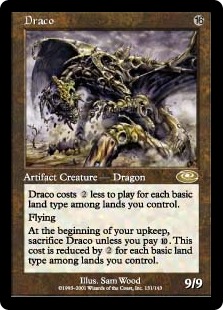
Draco

There was formerly an Extended deck called Draco-plosion that combined this card with Erratic Explosion. You see, when a person looks at Draco, they aren't looking at a metallic dragon or a cool finisher for a Domain deck. No, Draco simply prompts the question of “what do I do with something that costs sixteen mana?” Right now, it's the most expensive spell in the game (shuddup, Gleemax!) and there's no shortage of people who want to flip Draco with Erratic Explosion.

My favorite Draco use? It popped up occasionally in Extended before Invasion rotated out, often as a surprise. Tiago Chan used it in Enduring Ideal, since with Shock-lands and Fetchlands, opponents would often deal themselves four points of damage. In this way, if Enduring Ideal was too slow, you could sixteen the opponent, as early as the third turn. I have to believe that there are still some people who want to do this.

$2.75

Eladamri's Call

I like the Call, even though it has strong competitors. It jockeys with Worldly Tutor, Congregation at Dawn and Survival of the Fittest for utility monster-fetching, but it works at instant speed with no card loss. You need no creature in hand, nor do you need to push away a draw step. This pulls that Gaddock Teeg right into your hand, for immediate mischief. My favorite use of Eladamri's Call was in a GW Haterator Extended deck, which used the Call to grab 1-of annoyances. My most-loved target for the card in a Tarmogoyf-choked metagame? Intrepid Hero.

$2.50

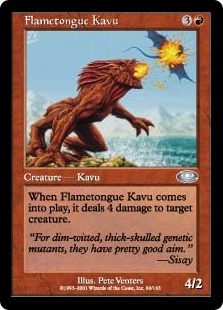
Flametongue Kavu

Absurd format distortion.

If you want a look at format-warping cards, this is the banner card. For the longest time, you just could not play big monsters with a toughness of four or less. Serra Angel was brought back in this time, but it never saw play because everyone could splash four FTKs and fireball that angel right outta the sky. After it dispatched a monster, it presented a very fast clock; remember that creatures sucked in this time period – you actually had to pay five mana or more for a 5/5 in most cases. Since FTK had a high power, the opponent often had to trade another creature with it, making an uncomfortable 2-for-1. If they played a creature-light deck, they might not even be able to stop the FTK before it won the game. People played Evil Eye of Orms-By-Gore as tournament-worthy blocker, for heaven's sake! R&D realized that you just can't make a creature as good as FTK at its cost, with no practical drawbacks. It's up in the air whether Bloodbraid Elf is better than FTK; the former has a lot of power, but requires you to build a deck around not whiffing on the Elf. The latter, though, fits into anything that can wedge some Mountains in.

If not for the reprints in Planechase and Jace vs. Chandra, FTK would still be worth more than a buck. It's an incredible card.

$4.00 in foil

This card's image alone kindles rage in veteran players.

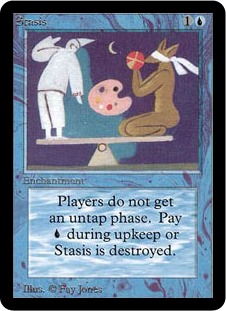
Forsaken City

It delights me that I hear from newer Magic players who read the column and learn about cards they've never seen before. One of the joys of being relatively new to the game is that you probably never fought against a Stasis deck. A Stasis player would crank out their namesake card and then use a variety of ways to make you want to sell your cards and buy an Uno deck. They could land Kismet, for example, then use Chronatog to skip all their turns. They could drop a Serra Angel and fly on over for some hate. The only saving grace was that Stasis had a mounting cost each turn, one that guaranteed that you'd eventually be free of the lock piece.

Forsaken City lets Stasis players completely sidestep the upkeep requirement, since it has a special untap ability built in. Now, a Stasis player could drop a Yotian Soldier and then toss every card they subsequently draw to feed their Enchantment. It wasn't pretty and I'm glad that most people have forgotten about Stasis. There are, however, enough fans of the silly strategy that this card is worth a buck.

$1.00

Lord of the Undead

Oh man, if there was ever a hidden tribe, it's Zombies. The most unlikely people have a Zombie theme deck of some sort, and they all want the Lord of the Undead to fuel it. He's been reprinted in 8th, 9th and 10th edition and still commands a great price! His ability is pretty slick and he finally gave a decent lord to people who had to rely on Zombie Master. These trade and sell to store buylists all day long, so I suggest trading for them if folks aren't hip to their real value.

$3.00

Meddling Mage

Meddling Mage was designed by Chris Pikula, winner of an event Wizards used to hold, called the Invitational. It was a gathering of the top players of the year and the prize was that you could have a card of your choice designed and printed. It is from this contest that we got Meddling Mage, Dark Confidant, Rootwater Thief, Shadowmage Infiltrator, Ranger of Eos, and several more. Meddling Mage saw a lot of play in Standard, since it could run interference for the rest of the deck against removal. Name Flametongue Kavu or Urza's Rage and your opponent cannot utilize those spells to dismantle your team. In Legacy and Vintage, it has often been used to halt specific finishers like Tendrils of Agony.

Meddling Mage was reprinted in Alara Reborn. The problem was, they didn't exactly paint Pikula on the card again... A byproduct was that the Mage entered into Standard, flooded collections, and was then prompty igonored until today. Since Mythics drive down the price of rares and Meddling Mage wasn't played in Standard, the price plummeted. I remember getting mine at $10 apiece before the reprinting was announced, then cashing them out at $6 apiece several years later. I was kicking myself when the reprint was announced and they shot to $14, but I'm glad I got out when I did. The price is pretty sad these days for what was once a very powerful card.

$2.75

Nemata, Grove Guardian

Enough people like Saprolings such that most cards that make the tokens are in demand. Nemata can crank them out with just a little mana, so green players want the card. If someone is running a Verdeloth EDH deck, they probably have a copy of this in it somewhere.

$1.50

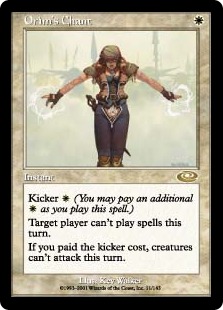
Orim's Chant

Some went so far as to run Blinkmoth Well to tap down an opposing Scepter.

This card is played in two ways. The first is to protect a combo that will kill an opponent from being disrupted. It, like Silence, will halt Force of Will or Krosan Grip from an opponent. The second use, incorporating the kicker, has been to place the spell on Isochron Scepter and start locking the opponent. Against a deck full of sorcery-speed cards, this combo all but ends the game immediately. Scepter-Chant saw a bit of play in Extended, especially when you could put a Lightning Helix on another Scepter and just peck away at the opponent. In an era before Krosan Grip, the Chant player often had a counterspell on hand to stop that one Disenchant from the opponent.

Silence dropped the price of Chant a little bit, because combo players could pick up the new spell at a fraction of what Chant costs. The people who pick it up now usually want it alongside the Scepter, and they are willing to pay a lot of money for it.

$12.00

Phyrexian Scuta

The people who like Suicide Black decks are fond of Juzam Djinn and his friends. The Scuta harkened back to the original Djinn, so people nabbed the critter. It still holds a little bit of value, probably due to nostalgia.

$1.50

Shivan Wurm

When you want to pound down an opponent with big monsters, then Shivan Wurm is your guy. The “gating” ability is easily paid with a mana elf, and you're left with an undercosted pounder on the table. It's not elegant, but it does let you get another use from your Flametongue Kavu. This sort of interaction is enough to make sure the Wurm is better than bulk.

$1.50

Tahngarth, Talruum Hero
As I mentioned earlier, there were some versions of this card printed with new art in foil. There are also regular-art foils, which makes this rarer by comparison. They are infrequently sold, but they are pretty expensive. One recently went for $36 on Ebay, which is good for an unplayable card.

$36.00

Although not chock full of hits, Planeshift can make a collector a pile of money if they know what to look for. Next week, we'll look at enemy-color madness in Apocalypse and glimpse some of the biggest chase cards in modern history!

Until next week,

Doug Linn

www.twitter.com/legacysallure

It Wasn’t Supposed to Happen Like This!

Are you a Quiet Speculation member?

If not, now is a perfect time to join up! Our powerful tools, breaking-news analysis, and exclusive Discord channel will make sure you stay up to date and ahead of the curve.

In case you live under a rock, we had an influx of twenty cards spoiled that totally weren't supposed to be. In fact, Wizards is probably really pissed off about it because you know there was a big article about the first colourless planeswalker, not to mention the fact that every card was rare or mythic. Oh, and Phyrexian mana. They probably wanted that to be officially spoiled too. Since the spoiled cards are all rares, I figured it's worth talking about all of them, and I will do so from every angle possible.

Note: If you are unfamiliar with Phyrexian mana, here's the run down:

Phyrexian mana is essentially hybrid mana, except your choice is between paying one color of mana or two life. Written down, this mana is represented as {P/C}, where 'C' is the color. So 3{P/W}{P/W} would mean a costs of 3WW, 3W and 2 life, or 3 and 4 life.

With that out of the way, let's talk about some rares!

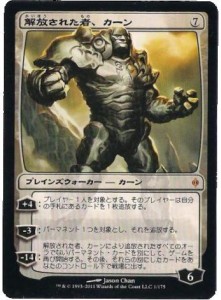
Karn, the Released 7
Planeswalker - Karn
Mythic Rare
+4: Target player exiles a card from his or her hand.
-3: Exile target permanent.
-14: Set aside all non-Aura permanent cards exiled with Karn, then restart the game. Then put all cards set aside this way onto the battlefield under your control.
6

If nothing else, this card is hilarious. However, it suffers the problem of being seemingly similar to other cards which I feel is making people misevaluate it. This is not [card Liliana Vess]Liliana[/card]. This is not Spine of Ish Sah. This is also not a multi-format four-of. With a casting cost of 7, this card is pretty much disqualified from being anything but a one or two-of in a deck. However, I guarantee you that Karn will see play. Karn's first ability is okay, but fairly underpowered. His second ability is very strong, and will be used a lot, though rarely the first turn.

So what is Karn's deadliest weapon? His loyalty. With a de facto starting loyalty of 10, this guy is nigh indestructible. It is obviously a card for control decks which will have means of defending him, but your opponent MUST kill him. Karn's ultimate ability, like most ultimates, is game over. Even dealing the three damage to take care of Jace, the Mind Sculptor can prove challenging at times, so trying to take this guy down will likely be a nightmare for many players. Oh yeah, it will also be in like 50% or more of Commander (EDH) decks with all likelihood. Not a $50 card by any stretch of the imagination, but a powerful card that's worth owning... as soon as the price drops.

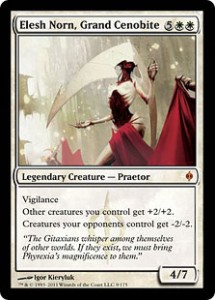
Elesh Norn, Grand Cenobite 5WW
Legendary Creature - Praetor
Mythic Rare
Vigilance
Other creatures you control get +2/+2.
Creatures your opponents control get -2/-2.
4/7

This thing is a house in limited to be sure. I'd say it's just as soul-crushing to see drop down on the table against you as Massacre Wurm is, and that thing is quite the pain in the ass. Despite how powerful all of its abilities are I don't expect to see this making an sort of a splash in constructed. It's a good card for Commander (EDH) and a new general, but it's only the sort of thing you'd cast if you want to make enemies real fast.

Norn's Annex 3{P/W}{P/W}
Artifact
Rare
Creatures can't attack you or planeswalkers you control unless their controller pays {P/W} for each attacking creature.

It's another card that feels like it was designed just for Commander (EDH)! It's interesting to see that after multiple blue cards with this ability they've shifted it permanently to white (Although [card Ghostly Prison]every[/card] [card Propaganda]color[/card] [card Koskun Falls]has[/card] [card Elephant Grass]a card[/card] [card Kazuul, Tyrant of the Cliffs]that[/card] does this). If white weren't such a heavily played color right now, I would like this for standard. I'm a big fan of Ayesha Tanaka in Commander (EDH) because it screws them if they're not playing white, and forcing them to pay life to attack will slow some players down. This card has definite potential as a sideboard card if white starts seeing less play, and doesn't even need to be in a white deck which is also what makes it a very high draft pick.

Phyrexian Unlife 2W
Enchantment
Rare
You don't lose the game for having 0 or less life. As long as your life total is 0 or less, sources that deal damage to you have infect.

This brings us back to the age old question of "how much life do you need to gain for it to be worth playing?" Life gain is normally useless unless it's on a card that's already good (Loxodon Hierarch, Baneslayer Angel). Would you run this card if it said "2W - sorcery - gain 10 life"? No, you'd be pissed that it was your rare. And that's what this card says. Get this thing out of my face!

Puresteel Paladin WW
Creature - Human Knight
Rare
Whenever an Equipment enters the battlefield under your control, you may draw a card.
Metalcraft - As long as you control 3 or more artifacts, each Equipment you control has equip 0.
2/2

This card is great for limited where there's lots of metalcraft and lots of equipment, and it's great for Commander (EDH). Beyond that, there isn't currently a deck that would have any application for it, and I don't see one popping up any time soon.

Psychological Surgery 1U
Enchantment
Rare
Whenever an opponent shuffles his or her library, you may look at the top 2 cards of that library. If you do, you may exile one of them. Then put the rest on top of that player's library in any order.

Eternal sideboard card against tutor heavy combo decks or Mind's Desire decks if you're really lucky? I dunno, this thing has its applications, but it's about 10 cents shy of being a bulk rare.

Species Transplantation 4U
Enchantment
Rare
When this enters the battlefield, choose a creature type. Creatures you control are the chosen type in addition to their other creature types.

Yes, this is an infinite combo with Turntimber Ranger. No, it will not be a viable standard deck. It's a cute Commander (EDH) card, but worse than Conspiracy as it doesn't affect cards in your library/hand/graveyard. Even so, decks running Conspiracy shenanigans now have a second copy they can play.

Chancellor of the Dross 4BBB
Creature - Vampire
Rare
If this is in your opening hand, you may reveal it. If you do, at the beginning of your first upkeep, you may have each opponent lose 3 life. Gain life equal to the life lost this way.
Flying, Lifelink
6/6

This cycle of cards is cute, but at 7 mana they're all pretty useless. Sure you get to Lava Spike your opponent at the start of the game, but for the rest of the game most likely a dead card. Why not just splash Lightning Bolt?

Glistening Oil BB
Enchantment - Aura
Rare
Enchant creature
Enchanted creature has Infect. At the beginning of your upkeep, put a -1/-1 counter on enchanted creature. When this is put into a graveyard from the battlefield, return this to its owner's hand.

It's the lovechild of Phyresis and Takklemaggot. Yay?

Phyrexian Canceler BBBB
Creature - Horror
Mythic Rare
Trample
Whenever a source deals damage to this, that source's controller sacrifices that many permanents.
5/5

This creature is a house when it's in play, but I don't think it's likely that there'll be a deck for it. The four black mana cost is simply too prohibitive for this to really be effective, and it requires Sphere of the Suns to be cast on turn 3. People are creaming themselves over this card, but I think it's all hype. If you open these at the prerelease, sell them while the selling's good.

Praetor's Grip 1BB
Sorcery
Rare
Search target opponent's library for a card and exile it face down, then that player shuffles his or her library. As long as it remains exiled, you may look at it and cast it as though it were in your hand.

Geez, remember when Grinning Totem was a $20 card? I hear this can be used in Vintage sideboards, and it will likely be a sideboard card in standard as well. Another awesome Commander (EDH) card though!

Chancellor of the Furnace 4RRR
Creature - Giant
Rare
If this is in your opening hand, you may reveal it. If you do, at the beginning of your first turn's upkeep, you may put a 1/1 red Goblin creature token with haste onto the battlefield.
When Chancellor of the Furnace enters the battlefield, put X 1/1 red Goblin creatures with haste onto the battlefield, where X is the number of creatures you control.
5/5

It's just like Chancellor of the Dross, except its beginning of game ability is worse and its in play ability is better. Still a nothing card.

Invasion Parasite 3RR
Creature - Insect
Rare
Imprint - When this enters the battlefield, exile target land.
Whenever a land with the same name as the exiled card enters the battlefield under an opponent's control, this deals 2 damage to that player.
3/2

If this guy cost 1 mana less or if land destruction was a viable strategy this would have a lot of potential. Fortunately, R&D has unanimously agreed that printing good land destruction spells is a terrible idea. Even so, seeing Stone Rain and Ankh of Mishra on the same card is nice.

Scrapmetal Fiend R
Creature - Construct
Rare
This creature's power and toughness are each equal to the number of artifact cards in all graveyards.
*/*

This thing is awful situational. Fine for draft, but not really a first pick. Has potential in some weird artifact heavy aggro deck, but it lacks trample or a base toughness of one, both of which hurt it severely.

Urabrask, the Hidden 3RR
Legendary Creature - Praetor
Mythic Rare
Creatures you control have haste.
Creatures your opponents control enter the battlefield tapped.
4/4

This guy is pretty damn good, if you're into the whole mindless aggro thing. A 4/4 haste for 5 isn't terrible, but tack Fires of Yavimaya and Kismet onto that and you've got a real force to be reckoned with. It's also pretty interesting as a Commander, even though it encourages mindless aggro strategies. I wouldn't expect this to be more than like a $6 card, of course, but it can certainly be a two-of main and maybe a couple more sideboard.

Spawning Shell 3{P/G}
Artifact
Rare
1{P/G}, {T}, Sacrifice a creature: Search your library for a creature with converted mana cost equal to the sacrificed creature's converted mana cost plus one and put it onto the battlefield. Then shuffle your library. Activate this ability only any time you could cast a sorcery.

So they banned Survival of the Fittest in Legacy, but then they put Survival and Recurring Nightmare on the same card? I'm in love with this thing for Commander (EDH). It's pretty amazing in that regard if your deck is all enters the battlefield/leaves play creatures. In terms of constructed, however, it has a severe drawback: unless the translation is incorrect, the creature you get must cost exactly one plus the CC of the sac'ed creature. This is severely limiting in terms of building a combo deck, but it also creates a nice chain of increasingly expensive creatures. My gut is telling me that there won't be a way to use this in standard, but I'm prepared to be wrong.

Fresh Meat 3G
Instant
Rare
Put a 3/3 green Beast creature token onto the battlefield for each creature put into your graveyard from the battlefield this turn.

It's like Caller of the Claw all over again! I like the Caller better since it can be recurred with Genesis, but this is still good for limited and nice [card Wrath of God]Wrath[/card] protection in constructed in decks that don't exist yet.

Caged Sun 6
Artifact
Rare
When Caged Sun enters the battlefield, choose a color.
Creatures you control of the chosen color have +1/+1.
Whenever you tap a land for one or more mana of the chosen color, add one mana of the chosen color to your mana pool.

Grab as many foils of this as you can if you can find them cheap. Gauntlet of Power and Mirari's Wake say that this card will settle at $6, and $15 foil. Amazing card for EDH.

Hex Parasite 1
Artifact Creature - Insect
Rare
X{P/B}: Target a permanent. Remove up to X counters from that permanent. This creature gains +1/+0 until end of turn for each counter removed this way.
1/1

This thing is awesome. A one mana artifact that can go in every deck and says "I eat planeswalkers!" is just what we need. I'm not saying planeswalkers need to stop being played, but having a silver bullet against them is really nice, even if it's extremely fragile.

Screamwhip 4
Artifact - Equipment
Rare
Living weapon
Equip {P/B}{P/B}
Equipped creature gets +1/+1 for each Swamp you control.

Miss my article two weeks ago? If so, let me point out that this is not strictly better than Nightmare Lash, just better. This is a great card for Commander (EDH), as most of these rares are, and it's certainly going to help make Phyrexian Cancelor a playable card. I still don't think the pieces are there for that deck, but I also haven't played against an opponent with this equipped to a Vampire Nighthawk yet.

Spellsplitter 2
Artifact Creature - Horror
Rare{P/U}: Target spell or ability that targets only a single creature targets this creature instead.
0/4

...why isn't this uncommon? Oh well. It's fine, and the four toughness is key because it survives Lightning Bolt. Redirecting abilities is also key since it can eat a Journey to Nowhere for you. This isn't going to be an expensive card, but I suppose it has its uses.

Join us next week when hopefully there are more cards spoiled!

Countertop for Fun

Are you a Quiet Speculation member?

If not, now is a perfect time to join up! Our powerful tools, breaking-news analysis, and exclusive Discord channel will make sure you stay up to date and ahead of the curve.

Hello. My name is Anthony, and I have a confession to make.

I like to attack.

For two, for three…it doesn’t matter. I’ve done it for an entire day…an entire weekend! Sometimes I attack with two or more people at the same time. Sometimes I get down with untapping my lands afterwards; sometimes I get freaky with [card Goblin Piledriver]Piledriver[/card] math.

I attack so much that I’ve gotten pretty good at it. I’ve been seen on the Internet attacking. I even got paid for it a few times, but that doesn’t matter because I’d do it for free. As a matter of fact, I’ve paid for the right to do it with a bunch of other people in the same room.

I’m AA (Anthony Avitollo), and I belong in AA: Attackers Anonymous.

Imagine my complete and utter dismay when it became very obvious to me and others in my support system that attacking is not the way to win Legacy games right now in the Star City Games Open Series.

What am I supposed to do?

I had both Adam Prosak and Ben Weinburg telling me that I should play Brainstorm (Adam recently added it to the Burn deck in SCG: LA), but I recently tried that and it turned out horribly: I played Team America at SCG Memphis and promptly went 1-3 drop, with three losses to Merfolk. I felt like I got punished for not just playing Goblins since Junk did not turn up in the numbers that I expected and I am just so comfortable and confident playing Goblins in a non-Engineered Plague field.

Distraught, I turned to the Internet for succor. I found Kithkin master Cedric Phillips, and he had this to say:

Cedric Phillips:

i mean

we are who we are

we attack

While Cedric’s comments really did hit the mark (and made me feel worse about not playing Goblins in Memphis), I felt like I was missing out on a big part of Magic. In addition to beating down, I’ve played plenty of combo decks in my career (even going so far as to play Pyromancer’s Ascension in local Legacy tournaments) but I’ve never been able to successfully grasp the ‘control’ deck. Sure, I won a lot with Faeries, but that doesn’t really count since it was much more aggro-control and just had unbeatable draws.

By ‘control’ I mean grind-it-out, card-advantage, prioritizing-threats, pulling-the-trigger-on-removal/countermagic, if-you-mess-up-you-probably-die ‘control’ decks. I wasn’t going to be good at it out of the gate, but I was interested in at least trying it out. Based on previous results, it looked like all the attacking decks were going to suck for the Atlanta Open because of the proliferation of combo decks in the format.

It seemed to me to be a good time to learn how to play a deck like Counterbalance.

Fortunately for me, I have one of the best (if not the best) and most experienced Counterbalance players on speed dial. It was like that scene in movies where the aging bachelor/bachelorette tells their aging mother that they are getting married.

Me: “Hey Adam, I have something to tell you. I’m going to play Counterbalance in Atlanta.”

Prosak: “I’M SO HAPPY! YOU’RE ALL GROWN UP!”

I basked in a warm, proud glow.

After talking to Adam for a while about lists, I decide to try the following for the local $100 Legacy tournament on Wednesday:

[deckbox did="a56" size="small" width="560"]

This is basically Adam’s SCG: DC list, with the Mountain moving to the main deck and the sideboard changing to accommodate the extra slot. We decide that if it went well on (or just felt good about) Wednesday, I’d play the deck on Sunday. (We also decided we would explore other options if that wasn’t the case.)

With deck in hand, I head on over to play 5 rounds with a top 8. Here’s a mini-report:

Round 1 – Lose mirror, but I had a Game 1 loss due to arriving late.

Round 2 – Beat a R/G Madness deck.

Round 3 – Lose to U/G Madness due to a turn 2 Rootwater Thief taking too many win conditions in Game 1 when he swings for lethal with 0 cards left in his library. In Game 2 I am solidly in control, but time runs out. My opponent was leaving, however, so he gave me the win. J

Round 4 – Lose to Iggy Pop because I mistakenly said ‘OK’ to acknowledge a spell when I could have blind-flipped on Counterbalance. Losing is how I decided to learn that lesson instead of trying to explain what I meant by ‘OK’. (See the end of this article for the solution to this problem.)

Round 5 – Concede to the 2-0-2 player since he can make top 8 and I cannot. We play anyway, and he smashes me with his Sneak Attack/Show and Tell deck. Game 1 he had 3-4 counterspells to back up his Sneak, and Game 2 he just S&T’d me on turn 2.

While Wednesday was not great, I felt as though I could have won almost all of the matches if I had more experience with the deck and seen slightly better cards (In one of the games vs. Iggy Pop, I saw about 18 different cards without seeing a non-land when I needed an answer to 6 goblin tokens). I felt good about playing the deck, and decided that I will indeed run it on Sunday.

Quick aside: It is amazing how easy it is to play a new deck at a big event when you can drive to the tournament that morning, and it doesn’t cost anything to sign up. Hooray for Player’s Club levels!

After picking up the last couple cards I needed for the sideboard, accidentally slow-rolling someone on an ANT deck (Sorry, Matt!), and trying to find people to Cube after my inevitable round 5 drop, the pairings go up and it is game time. HOOGH!

Round 1 (vs. Team America) – Game 1 I get attacked down to 1 by around turn 8, but I worked hard to stay alive while slowly seizing control of the game. I finally draw a Jace, and activate his ultimate with about 12 minutes left on round clock.

In Game 2 I am able to get the soft lock in play fairly quickly, and time is called while I am working on getting Jace up to that lucky 13 loyalty.

Round 2 (vs. Counterbalance w/green) – I am playing J.T., a friend who I know is a good player with a lot of experience playing the deck. Game 1 I had Sensei's Divining Top and Counterbalance in play, but I was outmaneuvered into putting my Top on top of my library, while he has both in play along with a Tarmogoyf. I stuck a Jace, the Mind Sculptor to keep the Tarmogoyf off my back but I never see a spell of converted mana cost two to get rid of it for good with Counterbalance.

I also dropped a Vedalken Shackles, which looked good for me until J.T. plays not one, but two Shackles of his own! Game over, man, game over.

Game 2 I had a good anti-spell draw with Spell Pierces and such, but he sticks an early Tarmogoyf and Trygon Predator which ran me over pretty quickly.

Round 3 (vs. White Stax) – Game 1 I [card Force of Will]Force[/card]’d a turn 2 Trinisphere, counter a turn 3 Metalworker, counter a turn 4 Smokestack, counter a turn 5 Armageddon, and play a Jace afterwards. He drew nothing else relevant, and then died to Jace’s ultimate.

Game 2 my opponent tried to resolve some Suppression Fields but I counter them and I have Top/Counterbalace/Jace in play by turn 4. Nice cards, real fair.

Round 4 (vs. Tempo Faeries) – He resolved two Tombstalkers because even though I have the soft lock, I didn’t have any hard counters due to losing a counter war over a Bitterblossom (that seems really bad for me). I resolved a Jace, and he pushed the Tombstalkers off the board for a while (since my opponent’s graveyard was empty), but he Stifle’d the bounce trigger and I die to the extra attack he gets in.

Game 2 he plays an early Bitterblossom with multiple counter backup, managing to counter everything else I do to answer it. I died to Faerie tokens and another Tombstalker easily.

Round 5 (vs. a Kuldotha Forgemaster deck) – I [card Swords to Plowshares]Sword[/card]ed a turn 2 Lodestone Golem and a turn 4 Wurmcoil Engine, much to my opponent’s chagrin (“That card is so bad right now!”), before I find a Counterbalance to go with my Top. I countered his other relevant spells, and Jace fatesealed the win.

He sided in about 10 cards for Game 2, and got a pretty disruptive start including a turn 1 [card Chalice of the Void]Chalice[/card] for 1 (my hand at the time was 3 lands and 3 1-drops) and a Defense Grid. He eventually wound up with a Blightsteel Colossus in play off of a Forgemaster and 2 artifact lands. Two turns later, I hadn’t found a Swords (Chalice had been destroyed by a Disenchant).

In Game 3 his only lands are Ancient Tombs so he took a ton of damage, which let an early Vendilion Clique finish him off before he could get anything going. The final damage is actually done by Ancient Tomb as my opponent decided to commit seppuku instead of having a deck with Swords to Plowshares beat him.

Round 6 (vs. Burn) – In Game 1 I take some early damage but stabilize at 9 life, and Jace ensures the victory while my opponent gets mana flooded.

Game 2 he plays two Grim Lavamancers and a Figure of Destiny by turn 2, and I felt great knowing that the Trinket Mage in hand will be crushing when it finds Engineered Explosives…until I actually I search my library and find that the EE somehow it didn’t make it into my deck! I have 6 basics in play as lands (shutting off Price of Progress), but the Lavamancers do too much damage.

The third game he starts off the same opening as the second, but this time I have a Fire//Ice to blow out his early creatures (“I did not see that coming”) and I stabilize with the lock in play at a healthy 12 life.

Round 7 (vs. NO Bant) – Game 1 I get stuck on three lands, while he floods a bit in the early going. The only action in the first eight turns or so involved casting a Swords on an early Noble Hierarch to prevent a turn 3 or4 Natural Order with counter backup, and a second Swords on a Rhox War Monk. While he continued to flood, I managed to draw some land to help set up Top/CB without tapping out then started looking for a win condition.

He played a Dryad Arbor, which I promptly Shackled, and started beating (I had to get my fix somehow!). He then played a Tarmogoyf (to block or Natural Order I wasn’t sure), and I decided that it was a better target for Shackles. I resolved a Jace and was able to keep blockers off the field long enough for a Fire/Ice to deal the final two points of damage.

In Game 2 I Swords another early Hierarch to keep him off of a green creature, and I establish control of the board with the soft lock + counters in hand by turn five. Jace briefly makes an appearance before time is called in the round, and my opponent couldn’t win quickly enough since he boarded the combo out anyway.

Round 8 (vs. Reanimator) – For Game 1 I mulligan down to five cards on the play, but that hand is three lands, Sensei’s Divining Top, and Counterbalance! I played the Top, but he untapped and Thoughtseized me and took the Counterbalance. Frown.

Unfortunately for him I’m a “master” and draw another Counterbalace, and played it. Smile. He doesn’t resolve another meaningful spell for the rest of the game.

Game 2 I counter an early spell or two, then assemble the lock and just float cards with converted mana cost 1 and 2 on top of my deck until I find Jace. It was all academic from that point.

Round 9 (vs. [card Painter’s Servant]Painter[/card]/Grindstone – In Game 1 we play cat and mouse for a while, but Jace eventually forced him to combo off while I have a Swords in hand to break up his combo. Game 2 he landed a turn 1 Goblin Welder and I could not kill it. This caused problems as all I had were Disenchants to break up his combo; he could just activate Welder to get back his Servant to keep the combo going. As it turned out he also had more counterspells than I did too!

Game 3, much like an earlier match, was a race between Ancient Tomb damage and Vendilion Clique beats to see which would kill my opponent first. Together, however, they worked even better as a path to victory. He did manage to assemble the combo anyway, but I broke it up with another Swords to Plowshares.

The Recap

Nine rounds, nine different decks. The top 16 consisted of eight distinct archetypes, even though High Tide appears to be the big winner overall (wish I would have played it!). What about me?

The final result:

16 DeAngelo, John P         21 53.6390
17 Avitollo, Anthony        21 52.7704
18 Braverman, Phillip T       19 45.5306

I missed an extra $50 and an additional 2 Open Series points by 0.8686%, and am the only 21-pointer outside of top 16. This was nothing new for me, unfortunately. In Philadelphia last season, this happened:

17 Avitollo, Anthony        19 67.0209

I had drawn unintentionally in the last round when a win would have put me solidly in the Top 8. Back in those days, you didn’t even get fifty bucks for being 17; all you got was a thank you for playing, and slap on the rear, and a deep-down longing for what could have been.

The real final result?

I played a deck that was outside of my comfort zone, played it pretty well all day (outside of the mirror), won $50 for my efforts, and walked away with some large tournament experience, a sense of accomplishment, and a healthy dose of confidence that I could play Counterbalance/control decks in future tournaments and be successful.

The biggest lessons I took from my experience was to use your life as a resource freely (the first 15 points or so don’t matter as much as the last 5), identify which threats need to be countered and which can be handled in permanent form, and to never give up on a bleak-looking game when you are playing powerful cards like Jace and Top in your deck.

If a lifelong AA member like me can do it, you too can break the addiction of turning guys sideways.

-AA

P.S. I hope I can play Goblins again sometime in Legacy. I miss those crazy guys. (Sniffle)

Bonus: Saying ‘OK’

David Mayer had a great solution to this problem which I’d like to share with all of you. Once it is obvious that you are playing control, tell your opponent that you will tell them that the phrase “OK” is only an acknowledgement of their casting of a spell, and that “Resolves” or “It resolves” is the only way you will communicate that their spell is resolving.

Clarifying your intent with your statements will keep you and your opponent in line!

Learning to Evaluate Cards

Are you a Quiet Speculation member?

If not, now is a perfect time to join up! Our powerful tools, breaking-news analysis, and exclusive Discord channel will make sure you stay up to date and ahead of the curve.

Spoilers are starting to trickle in for New Phyrexia, and there is already a buzz surrounding the new Planeswalker, Karn, and his pre-order price. This is a good time to review the basics of pre-order pricing, and new set speculation. Evaluating cards is a big aspect of drafting, and most drafters are drooling over spoilers to start making evaluations of pickorders and archetypes. The finance guru, on the other hand, is evaluating cards to determine what their price point will be both immediately after the release, and for the upcoming seasons. While the drafter and the finance guru may have different priorities, the skill set of evaluating the cards is very similar. There is a lot of content out there about spoilers, pricing, and speculation, but it’s important to be able to judge for yourself, so you can make adjustments or filter the information you find on the Internet. To follow, is a breakdown of how to judge a card during spoiler season.

Rarity
While this first step is obvious, one must start at the beginning. The rarity of a card will give an upper limit to the possible value of the card. In standard, a Mythic has been shown to hit numbers as high as $100, a rare around $20, and uncommons as much as $5 in recent years.

These are extreme cases, but it is important to have an idea of what the maximum possible value could be, so we can compare each individual card to that. Due to speculation, part of a cards current value is dependant on its potential maximum value in the future. In that vein, reprinted cards are going to depend a lot on the general availability and desirability of the previously printed copy. When Nantuko Shade was reprinted, they were already readily available, so adding more to the market simply did not have a strong impact on its price. If it had seen competitive play, it would have sat a dollar or two lower than it would have if it were not a reprint.

Playability
Obviously, if a card isn’t going to be played, it won’t have much (if any) value; however, how much does it have to be played to have some value? There are a few things to consider in this category. The first, in which formats will it see play? Mythics that are limited to standard playability rarely crack the $20 price point (Grave Titan, Koth of the Hammer). While rares that are playable exclusively in standard, typically sit below $10 (Creeping Tar Pit). Rares that are only playable in Vintage, sit even lower well below $5 (Lodestone Golem). The cards that can really grasp the full price for their rarity are multi-format all-stars, like Jace, the Mind Sculptor and Stoneforge Mystic. A big indicator for playability is it’s mana cost, and many of the sources you find on the Internet reference this the most. The cheaper the mana cost, the more possible decks that can play the card, and the more possible copies that can be included. The 5cmc planeswalker rule, revolves around this idea, but Gideon Jura has certainly shattered that mold, but also will never be a 4-of in any competitive deck.

Role
What role will this card play while it is Standard legal? Is it going to be a nice slot-in to an existing archetype? Will it be a miser’s one-of in a control deck? Will it require decks to be built around it? This will affect the way the price moves after release. Tezzeret, Agent of Bolas is a great example. It was clearly a powerful, playable card, keeping its price reasonable, but once someone found a way to build a deck around it, it quickly shot up, and then came about half-way back down. This is pretty common of cards in this group. People have their eye on them, and they overbuy on the sudden hype, and the price corrects. The miser’s one-of is comparable to a Martial Coup, which hit a max of $3.50 in its prime. This is a pretty typical patter,Black Sun's Zenith falls in this group too. It’s only used in a small number of decks, and not as more than 2 copies. That’s not to say all sweepers hit this level, just that control decks tend to be the only ones that can take advantage of a high-cost high-reward spell, like those. Keep in mind, those are both rares, a mythic in that same role, like Avenger of Zendikar, hit a peak of $15 but settled around $8.

Casual Appeal
Even if a card doesn’t fit any of the above categories, it’s price may stay up due to the casual market, which we all know is a powerful one. In current sets, it isn’t often enough to keep the price at any noticeable level, if it’s the only factor, but can certainly add a few percentage points to a card that is already in high demand. Cards that fit this category often have splashy effects, or fit in to common theme or tribal decks. Nicol Bolas, Planeswalker, has never seen much competitive play of any kind, and has wildly bounced around between $7-20. Cards like this are great to pick up when they dip, because that same casual market will swing it back around eventually.

Great, so we have some things to look at while evaluating cards, let’s put it to practice.
The new incarnation of Karn is upon us, in the new set, and pre-sale pricing is about $50.

For reference, here is his (unconfirmed) oracle text:

Mythic
(mana cost) 7
Planeswalker - Karn
+4: Target player exiles a card from his or her hand.
-3: Exile target permanent.
-14: Set aside all non-aura permanent cards exiled by Karn, then restart the game. After that, put into the battlefield under your control all cards set aside this way.
(loyalty) 6

No doubt, a set of powerful effects. He also has no color requirements, which is of note. Let’s apply what we’ve learned to this card, and see if a $50 pre-sale price is worth speculating on.

Rarity
Mythic. Obviously, any card in this price range would have to be a mythic in the modern sets.

Playability
The abilities Karn brings to the table are nothing to scoff at, but his cost of 7 mana is a bit prohibitive. The fact that he costs only colorless mana, means its possible to crank him out using Everflowing Chalice. But he isn’t an Artifact, so he won’t be powered out by a Grand Architect. More importantly a Mishra's Workshop or Tinker, won’t work either. At his best, he’s playable only in standard, or as a fringe playable in a 12-post Legacy deck. This puts our best case price in the $20 range. Also, not that I expect it to happen, but if a card were to be banned based on how long its effects take to resolve in tournament play, this card would be it.

Role
Here is the interesting part of this card. His cost is high enough, that most decks that would want him, couldn’t afford to play more than a couple. On the other hand, some decks may want to be built around him, and might require 4. If such a deck arises, it won’t be the entire format, and will actually be a narrow application of him. It’s more likely a few decks in the format run one or two copies of this guy, at best.

Casual Appeal
Casual Appeal for Karn is through the roof. He’s playable in all colors, hearkens back to a classic time in magic, and his cost is much less a factor in multiplayer games, while his effect is all the more powerful. When availability of a card is low, the casual appeal has a bigger impact on moving the price. Even if that section of the market is only buying one copy for an EDH deck, there simply isn’t ANY availability of the card, because it hasn’t been released! Online retailers, and ebayers are only willing to pre-sell (See: Sell Short) a certain quantity of this card, so they don’t risk either not having enough, or missing out on further profits if it continues to climb. This is why pre-sale prices shot up to $50 so quickly, but will likely drop back down soon.

Using our facts, our initial price is given as a best case of $20, and since its role is expected to be fairly narrow, we can bring it down to around $15, The casual appeal however, will get this guy flying off of shelves just as fast as he’s opened, so He may stay between 40-50 for the first month or two. This same Casual Appeal will probably keep this card around $15 even after it rotates from Standard. In this case, I predict a long term equilibrium price between $15-20.

Conclusion

Now, how do we use this type of analysis going forward? You use it to make your own adjustments to the information you find. Where did I miss the mark on Karn? The information on the Internet is everywhere, and lots of people have access to it. The cards you’re going to make the most money on is the ones where you see something that no one else did, or at least no one else is giving enough weight. Find that one card where you think people’s expectation doesn’t fit this model, and capitalize on it. I made a killing on Frost Titans by sticking to my guns and continuing to trade for them until I dumped them at a PTQ for $17 a piece, when I had be trading for them actively for under $10.

Happy Speculating during spoiler season!
Chad
@torerotutor on twitter

Preparing for Grand Prix: Dallas

Are you a Quiet Speculation member?

If not, now is a perfect time to join up! Our powerful tools, breaking-news analysis, and exclusive Discord channel will make sure you stay up to date and ahead of the curve.

I’ve spent all week trying to decide if I wanted to jump into the Legacy discussion. I wanted to avoid it because I feel like a number of writers have covered it in a ton of detail, I’ve made my thoughts clear through Twitter and I don’t think I have much to add. Then Sean Morgan blew up the MTG financial world with this article on ManaNation.com, where he called out Star City Games and Ben Bleiweiss. I posted a longer version of my thoughts in the comments section, and there is a very interesting discussion there, along with Ben Bleiweiss’ personal take on the issue.

But this week we’ve got something else a little more immediate to focus on. Grand Prix Dallas is in just a few days, and whether you’re attending or not you need to keep an eye on what comes out of Texas. Grand Prixs, especially in the United States, have much larger consequences than the weekly SCG Open Series.

There are a few reasons for this. Firstly, there are simply more people, in particular more pros. Combined with the additional number of rounds, this means decks that truly have the best percentages against the field are going to shine, rather than the same four pros getting 5-6 wins with CawBlade against lesser competition after having byes at an SCG Open.

Secondly, there is much more incentive to “break” the format this weekend than there is on a weekly basis on the Open series. Why is this? Because winning Star City Games Open nets you (possibly) $2000 and some SCG points. This is great for anyone playing competitively and helps the game as a whole, but it doesn’t compare to the incentive of winning a Grand Prix, where the prize is $3,500, pro points (which have a much higher EV than SCG Open points) and invitations to the Pro Tour on the line, where the top prize is $40,000.

We saw some of this last week, with a group of European players getting to the top with traditional UB Control. Now it’s time for the American pros to get in on the act, using Barcelona as a template. With that said, CawBlade is still going to be the most-played deck and is going to post a number of very good finishes.

So what does this mean for you financially? In short, it means there’s a lot more riding on this weekend than usual. Expect some movement in the market this weekend, which you can stay ahead of in a few ways.

The first is going to be this column. If you remember, I suggested picking up Inferno Titan back in February as decks with a lot of small creatures began to pick up. Since then, Inferno Titan has been steadily climbing, and is currently the most expensive it’s been since its release. One of two things are going to happen with this card this weekend. Either it doesn’t see much play at the top tables (unlikely), or it keeps beating down on aggro decks and its price really jumps after the tournament. If you haven’t picked any up yet, I highly suggest doing so before this weekend. On the other hand, if it tanks this weekend I would look to unload these next week. The only way I see this card falling off is if something emerges to make it not worth playing Squadron Hawks and Stoneforge Mystic.

From what I can tell, other decks to look out for are Mono-Green Eldrazi Ramp and possibly BR Vamps. Both decks posted strong results against CawBlade in Barcelona and are two of the most-talked about “sleeper” decks going into Dallas.

If Vampires puts up a strong finish look at Kalastria Highborn and Bloodghast as potential pickups. Keep in mind that Vamps is easily hated out by a Pyroclasm or two, so I see these as short-term pickups if the deck performs this weekend. Both are off their previous highs right now and Bloodghast in particular has had a roller-coaster ride throughout its run in Standard, so it could easily see a rise back to its previous price.

For Eldrazi, the possible gainer is Ulamog, the Infinite Gyre. He’s being run as a 4-of in the deck and has fallen about 15 percent off his previous peak.

The second-best thing to do is the usual coverage following, with a few notes. If you’re on-site, you can take a look around the top tables and talk to those on site to get an idea of what’s doing well late in Day 2, allowing you to possibly buy from the dealers or pick up a card in trades before the price jumps. If you’re at home, follow along on Twitter more than anything else. It gives you the quickest updates both from pros talking about their decks, and financial coverage people tweeting updates. Unfortunately I probably won’t be able to tweet as much as I would like due to my decade-old phone, but that’s the breaks.

I’m also planning on doing some coverage when (if) I scrub out of the tournament. My day job is being a journalist, and that’s the approach I’ll be bringing to what I write. I was on the Mana Screwed podcast this week, and Robert Martin (@TheBeme) and I are planning to feature the “average Joe” of the Magic world. There’s enough coverage about how Brian Kibler or LSV is doing with their newest tech, but I think the best stories are going to be from the average PTQ grinder.

Style-wise, the stories I write are more like the stories you’d see in a newspaper or news website than they are like the typical deck tech you read at every tournament. It’s something I haven’t seen much of in the Magic community, and I’m really interested to see how it goes over. I’m not sure where everything will be posted, but I’ll make sure to let you know via Twitter once I figure it out.

On the other hand, I might just Top 8 the tournament, in which case you aren’t going to find much event coverage from me.

That’s all I’ve got for this week. I’m looking forward to the event and meeting up with some people from around the Magic world. If you’re at the tournament feel free to stop by and say what’s up, and please don’t embarrass me too badly if I get paired up against you!

- Corbin Hosler

@Chosler88 on Twitter

The Preconstructed Deck Buyer’s Guide: An Introduction

Are you a Quiet Speculation member?

If not, now is a perfect time to join up! Our powerful tools, breaking-news analysis, and exclusive Discord channel will make sure you stay up to date and ahead of the curve.

I haven't always loved preconstructed decks. Although I've come to be almost inextricably linked to them now through writing here and on Ertai's Lament, my passion for collecting and playing them has a rather pedestrian origin. The more I've thought about it, the more I've concluded that it stems from something that many (if not most) of us have done at least once: quit the game.

This is the third time I've taken up Magic: The Gathering as a hobby, and it's certainly after the longest drought. I began at the very start of the game and continued on through Legends, quitting when I left home and moved on my own out of state. I fell into it again somehow right around Mirage, and stuck with it a little longer this time, quitting right before Mercadian Masques.

Returning once again for Zendikar, it seems that a fair part of the reason that I fell in love with preconstructed decks was because I had missed so much of Magic's history in my time away. Whole blocks had come and gone, new mechanics surfaced and submerged, stories were started and finished their telling.

Entire worlds had passed me by.

I had neither the time nor inclination to go chasing down scads of booster packs to catch up on lost time, and I've never been all that partial to any format other than Standard. Although I'd only owned a single theme deck in my time before (Deep Freeze from Tempest), I suddenly discovered that they made the perfect little windows into the sets I had missed. Having the interest kindled, the next step was to go about collecting them.

This presented some rather unique challenges. For one, it was largely unexplored country. I really had no idea what was a 'good' price for a precon deck, and what was a rip-off. Were some decks better than others? More valuable? More scarce? It wasn't too hard to gauge the price of Magic singles as there are always scores of dealers out there vying for business, and one only had to check a few pulses and read a few articles to get a feel for what was the fair market value for a card. We may no longer have access to standardised pricing like Beckett for sports cards or Scrye for Magic, but in the age of the internet those resources are obsolete.

Another factor adding to the difficulty was scarcity. You can go on eBay at any time and you're all but guaranteed to find [card Stoneforge Mystic]Stoneforge Mystics[/card], [card Tezzeret, Agent of Bolas]Tezzerets[/card], and anything else you might want for Standard. You're highly likely to get anything you need whenever you want it for Extended. Vintage and Legacy? You're probably good. And if you happen to have a spare $100,000 burning a hole in your pocket, what says 'sound investment strategy' quite like a BGS-10 graded Beta Black Lotus?

But when it comes to precons it's not quite so easy. I would have liked to have had some sort of guide or advice as I began my collection, and as the proud owner almost 150 precon decks I felt it might be time to create one for others who might be starting to do the same thing. We'll begin today with an overview of the series to come.

In order to build a good precon collection, it helps to be one of three things.

1. Rich

This is the easiest way to assemble a collection: just buy 'em all and damn the cost. As cruel fate has it, this category probably doesn't cover a great many of us. It certainly doesn't me.

2. Patient

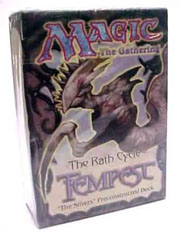
This is the one I'd recommend, effectively trading time for money. If you are able to manage the impulse to buyitnow, you can slowly and steadily amass a very solid collection for a relatively modest amount of money. Here's an important observation: you can buy most precons for between $5.00 and $8.00, a  figure that includes shipping. There are a small number of decks you'll rarely see at this price point, but that's where the patience comes in. One of the most expensive theme decks to acquire is Tempest's The Slivers, which typically sells for $60-80. To my disgust, I once missed bidding on an auction for two sealed Tempest decks, one of which was The Slivers. When I saw the closing bid was $10, I wanted to retch. The deals are out there, though, and they're waiting to be found. Of course, when all else fails, that leads us to our next characteristic:

3. Crafty

Know that most precon decks hold the value they're assigned for one of three reasons. One is demand. Obvious, right? But to dig a little deeper, most of the expensive precons contain something in demand beyond the precon itself. The best example is the Betrayers of Kamigawa deck Rat's Nest. Nobody cares much about the Rat nezumi anymore, outside of a few tribal enthusiasts whose dreams contain waterfalls of Relentless Rats, but this deck typically clocks in at the $20-25 level. The reason? Umezawa's Jitte. How about Prophecy's Distress, which retails for the distressingly large sum of around $40? Hint: it ain't the Maggot Therapy. No, we've got the wildly-popular Avatar of Woe to thank for this one.

Our friend the Avatar is a nice transition to Reason Two: inertia. Unlike the singles market, where inertia can be death, the precon market is marginal enough not to demand the fastidious attention that a singles inventory does. Prices can spike, but they tend to stick around that level. The Avatar of Woe has since been reprinted twice (and again as a Pro Tour foil), and you can find her at your card-merchant-of-choice for around five bucks. For a more modern example, the prospect of a foil Student of Warfare spiked the price of Rise of the Eldrazi's Leveler's Glory. How many Students do you see burning up the tables in Standard? She faded, but her intro deck's price often stayed right where it was: too high.

Finally, we have Reason Three: cult status. This is a characteristic generally found in tribal decks of the Elf, Goblin, and Sliver varieties, as folks from all stripes of the game do love their tribes. As we'll see ahead, this boosts the price of decks as varied as Scourge's Goblin Mob and Legions's Sliver Shivers to Lorwyn's Elvish Predation. All three (and others) punch above their wight because they offer players a readymade tribal experience.

So what does this have to do with crafty? Simple. Unless you're an absolute purist who absolutely must have the original box and insert, you can bypass these ridiculous prices altogether by assembling the deck from scratch out of singles. That $60-80 The Slivers? How does less than $24 on CoolStuffInc sound? That's using Tempest versions of each card. Opt for more generic Counterspells and Dark Banishings and you save even more. If, like me, you're something of a traditionalist who at least wants to preserve the feel of the deck, throw in a little extra for some Tempest Islands and Swamps at about thirty cents apiece. You'll still save a bundle.

The documentarian nature of the Internet means that the insert manual you're sacrificing is probably excerpted on some Wiki somewhere. Here's another pro tip: the old inserts used to be standardised booklets that were the same for each theme deck. In other words, get one and you've got 'em all.

In the coming weeks I'll be looking in great detail at the preconstructed marketplace. If you're a collector of precons, or just looking to start, you may be interested to know that we'll be checking every step of the consumer experience, from buying through an online retailer versus eBay; which decks will save you the most to make yourself; and how much you really should (and should not) be paying for your precons. The answers might surprise you.

For simplicity's sake, I've divided Magic's precon history into three broad periods. The "Vintage Era" begins with the advent of the theme deck way back in Tempest, and ends with 2002's Judgment. The "Classic Era" picks up from there with Onslaught, and finishes with Coldsnap, from 2006. Finally, that leads into the "Modern Era", which began with Time Spiral. Naturally, we'll also be looking at the Core Set decks from each era, and will also be taking a critical eye on other releases such as Beatdown and the Duel Decks.

Thanks for joining me today. If you have any specific areas of interest or concern, please don't hesitate to make a suggestion in the comments below. See you next week, when we begin with the Modern!

Jay Kirkman

@ErtaisLament

www.ErtaisLament.com

Our New Overlords!

Are you a Quiet Speculation member?

If not, now is a perfect time to join up! Our powerful tools, breaking-news analysis, and exclusive Discord channel will make sure you stay up to date and ahead of the curve.

So I'll make it easy and just jump on the bandwagon, and bow before our new Phyrexian Overlords! Hooray! Actually I'm more excited about it all because this means its crash time in the financial and speculation community. New sets always give some of the freshest margins as we begin figuring out what to buy now and what to hold off on. While we don't know a lot of the new cards, we do already know a few of the mythics, and most of them are pretty good. We're going to put our faith in the MTGSalvation community this week and go with their "confirmed" list of new cards, and evaluate from there.

First guy I want to address? Urabrask, the Hidden. This guy is a beast (but not really, his creature type is praetor after all.

So what abilities does a 4/4 mythic creature for 5 have? Creatures you control have haste, and creatures your opponents control enter the battlefield tapped. Not terrible, though I think he costs a bit too much for his Kismet effect to help much. Awesome art, cool flavor, but I don't see him seeing any major constructed play at this moment.

Price Projection: $5 mythic

Reason: Commander players will eat this thing up. Hes legendary, and has an awesome effect overall for a multi-player format. Might benefit you to have one or two in the first few weeks after the pre-release, but I wouldn't be investing in him too heavily.

SCG Pre order price at time of writing: $2.99

Up next is one of the two mythics I would classify as the big hype cards. This one has the possibility to pan out, as its abilities are quite strong. Yep, I'm talking about Phyrexian Canceler.

So, we give it similar art to a Phyrexian Negator, a very similar name (negator, canceler), make it cost 1 more, and make it a mythic. Oh, did I leave out the part where its 100X better?

Here's the translation on the card:

Trample

Whenever a source deals damage to Phyrexian Canceler, that source's controller sacrifices that many permanents.

I also misread it the first few times, but its a reverse Negator, if they lightning bolt it, they sac 3 permanents. This thing is nuts!

Price Projection: $15 mythic

SCG Pre order price at time of writing: $19.99

Reason: As awesome as this card is, it needs deck support to justify a higher price. It won't be long until people are building mono black, in all forms of both control and aggro to make the best use of this card, but I have a feeling that those projects will fall to the wayside. The rest of the support may be here for him in the remainder of the set, and time will tell.

The next card is a Grand example of Phyrexian power.

That's right, all bad jokes aside this one is for Elesh Norn, Grand Cenobite. For the small investment on 7 mana, you get a 4/7 Vigilance creature that gives all your creatures +2/+2, and all theirs -2/2. Awesome effect, and 7 is a good late game number for control decks against aggro. Will she see play though? Perhaps in a few decks here and there, but I don't seem her being a mythic staple card. Sadly, her biggest role will probably be commanding in Commander, where just like Urabrask, the Hidden, she will probably do the most good. Her abilities however may prove me wrong

Price Projection: $6 mythic

Reason: She's strong enough to see fringe play in constructed, and Commander players will love her even more than Urabrask, the Hidden. Assuming she's not the pre release or release party card, I would currently say she is decently positioned to be the mid level mythic of the set.

SCG Pre order price at time of writing: $5.99

Side note: Ever have one of those feelings that you're looking at one of the promo cards? Yeah, I'm getting that here. It remains to be seen, but this has my vote for "most likely to be a promo".

Alright, so we've covered most of the mythics, leaving the "Big One" for last. Personally I feel cheated that they did this to a famous character of the old MTG story, but it was bound to happen again. I give you, Karn the Released!

He breaks the common conception of "4 mana planeswalker good, others bad" because seeing his abilities we can clearly see that he has some insane power. Here's the stats; 7 mana buys you a starting 6 loyalty. for +4, you can make target player exile a card from their hand. for -3, you exile target permanent. for a massive -14, you set aside all non-aura permanent cards exiled with Karn, and restart the game. Then put all cards set aside this way onto the battlefield under your control.

Alright, I'm a skeptic, I'll admit it. I know WOTC isn't too hot about making games start over, so this one is the only card that I'm currently looking at and thinking its possibly not real. We have been surprised by WOTC moves lately though, and part of speculation is working with unknown factors so I'll roll with it.

Price Projection: $45 - $50

Reason: Seven mana is nothing to get to in today's deck environment. It has a way to protect its self, it gains massive positive loyalty, and its ultimate is probably one of the most "ultimate" feeling that I've seen aside from Jace and Bolas. This might be even more awesome than theirs, but just by a little bit.

SCG Pre order price: $39.99

Does this mean you should be buying Karn? Perhaps, but that's a decent chunk of change to wager on something that's not 100% confirmed. SCG did however say that the text may not be 100% accurate, so at this point its buyer beware. If this is the text on Karn however, I would expect a run on him the moment its confirmed. He is a lot of "firsts" for a planeswalker. First colorless one, first one that restarts games, first time I've considered getting more than 4 on pre order. Regardless, for the time being only Elesh Norn is confirmed. Give it a bit more time and we'll have more solid cards. Thanks for reading!

Till next week,

Stephen Moss

@MTGstephenmoss on twitter

MTGstephenmoss@gmail.com

Stephen Moss

Stephen Moss currently lives in Lancaster, CA, is a usual PTQ grinder in the southwest region and working on his Masters in Business Administration. He has an obsession with playing League of Legends when not working on articles or school work. His articles often take on a business minded tone, and usually contain information applicable to magic trading as well as real world business.

View More By Stephen Moss

Posted in Finance, Free InsiderTagged , 6 Comments on Our New Overlords!

Have you joined the Quiet Speculation Discord?

If you haven't, you're leaving value on the table! Join our community of experts, enthusiasts, entertainers, and educators and enjoy exclusive podcasts, questions asked and answered, trades, sales, and everything else Discord has to offer.

Want to create content with Quiet Speculation?

All you need to succeed is a passion for Magic: The Gathering, and the ability to write coherently. Share your knowledge of MTG and how you leverage it to win games, get value from your cards – or even turn a profit.

Black is Black?

Are you a Quiet Speculation member?

If not, now is a perfect time to join up! Our powerful tools, breaking-news analysis, and exclusive Discord channel will make sure you stay up to date and ahead of the curve.

This week's article will be a break from the practical applications of painting. Instead we will discuss some of the color theory that goes into matching colors and ultimately creating better alters. It would be easy to blow this article off as filler, but any artist of any kind needs to know the theory of color. Understanding the theory behind what we see is the biggest step towards not needing a guide to paint cards. So, we begin!

The color wheel

To understand anything about color, we must familiarize ourselves with the color wheel. We all remember this from high school art class, but it is easy to lose touch with just how fundamentally important this tool is. The color wheel shows us the three primary colors or hues (Red, Blue, Yellow), and in turn three secondary hues (Purple, Green, Orange) make up the basis of its' existence. All of the other colors exist as a mixture of any of these six colors. In addition we find that adding white or black to any color will change it's' value, thus creating a different version of that color.

On the more practical side, we can use the color wheel to help us find exactly which colors we need to mix to achieve a certain hue or value. More to the point, this tool is free from the effects of light and shadow, and therefore gives us a more accurate reading of color than looking at the picture we are trying to match.

It's all an illusion...

Color is a very tricky subject. There are certain illusions that are created by light, shadow, and even adjacent colors. Take a look at the checkerboard. Our brains will apply logic to this picture and tell us that “A” cannot possibly be the same color as “B” because one is a black square and one is a white square. The reality of the situation is that both squares are the same shade of gray. Square “B” looks lighter than “A” because of the light and shadow of the squares around it. This is an example of the Color Constancy Illusion, and people far more learned than myself study it (So if you don't believe me, Google it). You can see examples of this anywhere there is shadow. Take a look at the surface of your desk, and note the color. Then create a shadow over a part of the desk, our brain tells us that the desk is brown (or whatever color yours is) even though we are looking at a completely different value of brown where the shadow hits. If we are to re-create this image we must use two different values of brown to do so. When the image becomes more complex, our brain still strives to maintain its' opinion of the color we see, and illusions like the ones shown here are the result. Once we have grasped this concept, we understand that logic plays almost no role in color theory.

Furthermore, as shown in the color cubes, we see that it is not only light that can change our perception of color, but the hues and values around that color as well. This model also introduces us to the term “complimentary color”. Despite their name, complimentary colors are pairs of colors that are opposite each other on the color wheel. Notice that a dominance of one complimentary color can mute the appearance of the other.

Putting it all together

Now that we have a basic understanding of the theory, we can look at it in action. Look at the picture of the Aether Vial. The trees that grow behind the woman appear brown, but as I painted it, I realized that I needed a value so light, that it was almost tan on my palette. It appears brown due to its' proximity to the very light background. Similarly, the green highlights on the tree are actually a dark shade of Hunter Green that appear light due to the apparent darkness of the wood. This card shows a dark color made to appear light by a light color made to appear dark. Does your brain hurt yet? Mine does.

We established earlier that logic plays a very small role in color. What then do we use to replace logic? We must turn to our imaginations. Allowing yourself to believe that these examples are possible (which they are) is the first step to being able to create these illusions yourself. Utilizing this information in practice will help you train your eye to recognize exact colors sooner. This will help you save yourself a lot of paint and frustration, and more importantly time as you continue with your painting.

Before I sign off, there is a question that I get asked rather often that I would like to take some time to answer. The question is:

“Which cards net you the most value when you alter them?”

This is an interesting question. I always have the best success with EDH generals, or Commanders as they are now being called. Flashy generals are always popular, as evidenced by the rise in value of foil legendary creatures.

My success with standard and legacy cards has been rather limited. This is due, I'm sure, to the fact that some judges will deem these cards “marked” and therefore illegal to use in tournaments. To clarify, this is the ruling set forth from the rulebook itself:

Section 3.3 Authorized Cards:
Artistic modifications are acceptable, provided that the modifications do not make
the card unrecognizable or contain substantial strategic advice.
The Head Judge is the final authority on acceptable cards for a tournament.

Thanks for reading and don't forget to leave some feedback for me, you know I love the attention.

-The Painters Servant
Twitter: PaintersServant
Email: Mbajorek02@gmail.com

The checker board illusion was taken from www.forgetomori.com
The Color cube illusion was taken from gurneyjourney.blogspot.com

Posted in Finance, Free Insider4 Comments on Black is Black?

Have you joined the Quiet Speculation Discord?

If you haven't, you're leaving value on the table! Join our community of experts, enthusiasts, entertainers, and educators and enjoy exclusive podcasts, questions asked and answered, trades, sales, and everything else Discord has to offer.

Want to create content with Quiet Speculation?

All you need to succeed is a passion for Magic: The Gathering, and the ability to write coherently. Share your knowledge of MTG and how you leverage it to win games, get value from your cards – or even turn a profit.

Casually Trading Part 2: Selling Out

Are you a Quiet Speculation member?

If not, now is a perfect time to join up! Our powerful tools, breaking-news analysis, and exclusive Discord channel will make sure you stay up to date and ahead of the curve.

Last week I covered some of the more casual traders you may encounter in the Magic world.  This week I will continue with another casual trader that is more common, though still not of the caliber most competitive players would expect.  After covering this new type of trader I will devote the remainder of this week to a hot button topic from the past few weeks, the sudden rise in Legacy prices.  Many people have been split down the middle on this subject and though I am sure you all have kept up with the situation and perhaps read on the subject already I offer a different approach and viewpoint.

Casual Shop Player

This is probably a trader everyone has run into at some point or another either at your local shop or college.  This player is usually newer to the game and seeks more than most casual players. Instead of the usual chaos games and combos this trader looks to break into the more competitive scene usually in the form of FNM’s.  Though not a regular at these tournaments they make it whenever possible with their latest concoction.  Unlike the FNM/PTQ Grinder they are usually unwilling to net deck and seek like a flashier, yet competitive way of finishing their opponent off.  Though not of the highest caliber as far as play skill goes they have the ambition to learn and may even, with enough effort, break into the PTQ/GP scene down the road.

In trade this player probably has a deck already in mind and though their card stock may be low it is in your favor to help them as best you can.  Though you may not need anything they have, helping them with their current endeavors can prove best for you in the future, both in trades and in making a friend.  This doesn’t mean you have to take a loss by any means, (I would never encourage such a trade) value trading is still a good idea. Sometimes breaking even to help a newer player is the best course of action.  Usually this player will understand that their stock is small and in turn not ask for your more expensive cards but if they do request them sometimes trading for store credit or even future trade value can be a viable option.

Steering these players in the correct direction can also be a helpful way to grow friendship over time and become a trusted trade partner.  If a player seeks a competitive deck that doesn’t cost muchm helping them find what they are looking for will only help you later.  Suggesting something like Vampires can not only allow them to start doing well on a local level but also open trade opportunities  if you have what they would need for the build.  If they already have a deck or build in mind you can help them critique it to fit the local scene or perhaps to just make the build stronger.  This doesn’t always mean turning it into a cookie cutter build of last week’s winning deck as sometimes they have attachments to certain ideas and that is fine for now.  Don’t force an idea. Sometimes people have to learn at their own pace but suggestions are always welcome for improvement.

The Attitude

This can be a fairly difficult trade partner if handled poorly but in the long run a very beneficial person to invest your time in.  The key to remember here is this player may one day be traveling with you to events, so creating a friendship is far more important than short term gain in these situations.  This can be accomplished in and out of trades, remembering your days as a player that was just starting can be very helpful and humbling.

Telling them how awful a card is will not make you friends, instead use positives in example showing them a card that may be stronger in that spot or fit their theme better.  No one wants to hear how bad their deck is and when you’re first starting that can be a huge blow to your ego and even drive you away from future trades with that person.  Keeping the mood friendly can relax the newer player who may at first be intimidated not only by you but just the atmosphere of a competitive tournament scene.  Help them and encourage them in and out of trades, asking how they are doing or listening to a story each week can add up and make a great addition to your local shop.

Other Matters at Hand…

So as I am sure everyone is aware of by now Legacy is on the rise with a strong backing by Star City Games.  In a recent move on their large vendors part prices for many staples in this format have risen anywhere from 25-100% of their initial value just weeks ago.  Talk of this has been rampant in every aspect of the game, from #MTG on Twitter to local shops.  Though I have my own opinions of these current actions this article would be better served to inform rather than rant.

The facts are available, Star City has done nothing to hide their recent actions and have instead advertised their new “buylist” as the highest on old staples on the web.  Since then sites such as Channel Fireball have caught up with the trend and now offer more on most cards as the market begins to adjust to the recent flux.  What does this mean for you?  Good question, only to be answered based on what you make of your trade binder.  If you are a Standard FNM player who rarely deals in older cards it means very little, perhaps a quick skim of the new card prices to keep up with the trends, but little more.  If you are a strong legacy player it gives you an option, do you stay in the format and ride the wave of uncertainty or do you sell out while most buy prices are higher than their old sell prices?  Even more dangerous is if you are in the game of value trading such as myself. It is a very uneasy time to be trading in Legacy stock and there is much to risk and possibly just as much reward.

As a legacy player you probably have a few decks that you have had together for a long while and have picked the cards up over a long period of time when the price was right.  Now faced with the current dilemma do you sell out or keep in the market?  This is solely on the player though before you make a decision I think it is important to weigh the facts at hand.  On one hand anything you are not using, or are willing to part with can be turned in currently for a great deal of profit over what you acquired them for in the past.  This may seem enticing at first and I am sure some players have already unloaded most of their stock but you must take another look at the situation.  If you need the money this may have been a great opportunity for you, though if you are still on the fence you should look at all the facts before proceeding.  The first fact is Ben at Star City’s comments about the lofty assumption that Force of Will would reach a hundred dollars by year’s end.  This seemed crazy at first as the card could regularly be found for 35-40 on ebay, but with the buylist releasing shortly after, this comment seemed less and less farfetched.  Force has already reached 75 on most sell lists and still demand at least a solid 60-65 on ebay.

With this in mind we have to believe that Star City has the tools at their disposal to drive the price to wherever they like.  Though they walk a tightrope with the format being on the rise, if correctly maneuvered they may just accomplish their goal.  The potential remains that the high prices may be enough to drive new players from the format while old players sell out.  If this happens Star City could find themselves in an awkward situation given they currently are the largest supporter of the format.  However if the numbers do not dwindle the money they and you stand to make could be great.  The only other fear you must hold is reprints, though some cards that have risen are on the reserved list and therefore do not face this dilemma, staples such as Wasteland and Force of Will could see new borders soon.  Will this drive the price down?  At first, certainly, but with the ever growing demand we may actually still see an increase in value if properly executed.  This also heavily depends on how and when the reprint would take place.

If you reprint Force or Wasteland in a Standard set you would flood the market with new stock, and while that at first seems like a sure way to drop value you have further to investigate.  If either of these cards were to be standard legal both would be likely to see a heavy amount of play and similar to Jace, the Mind Sculptor the format may demand more than what has been printed.  With this in mind it may actually drive the price even further on both the reprint and the old classic border.  Some people prefer the older cards when playing as a sign of prestige or experience, or sometimes just to pimp out a deck.  In addition to a rise in the actual price, with a reprint also comes a foil.  Imagine what a Foil Japanese Force would go for….100?....200?....more?  This demand would create a surge in price in both markets and though the price would quell after enough product had been opened the initial surge would leave you with a great profit.

The other possible reprint scenario would be in a FTV style set, and though this would add additional forces to the pool, I don’t believe the price would drop in such a dramatic fashion as most fear.  A great example of this is Mox Diamond. Many feared the worst when the reprint was announced, selling out while they could and in the end the total value dropped two dollars…hardly noticeable.  Force of Will would probably see no drop at all given a FTV reprint for the sheer number of decks that need them over Mox Diamonds.  If anything, the price could see a rise as people seek them out for anything from cube, Legacy, and EDH to foil out.  Without much risk of a high stock addition (FTV adds very few to the already existing number) the price would be very unlikely to change.

To wrap up this week’s article I just want to say I by no means support what Star City has done with their situation but am envious on a business level.  The amount of money they could stand to make is incredible though only time will tell.  The only true way for anyone reading this to lose out would be if the format died altogether.  I do not foresee this anytime soon since if the numbers dwindle the stock will become more abundant, therefore lowering prices back down and allowing newer players to invest.  Investing in Legacy may seem like a risk but if you know how to evaluate the situation it can be a very profitable endeavor.

Until next week keep trading!

Ryan Bushard on Facebook

ryanbushard@hotmail.com

@CryppleCommand on Twitter

Investigating Invasion, Pt. 2

Are you a Quiet Speculation member?

If not, now is a perfect time to join up! Our powerful tools, breaking-news analysis, and exclusive Discord channel will make sure you stay up to date and ahead of the curve.

We're picking up this week where we left off last week, taking a financial gaze at Invasion. I consider Invasion to be the first really modern set, because it expresses good understanding of color combinations and power level. The number of gold cards in this set guarantees that a lot of casual cards end up being played. Let's move on down the list!

It makes any color of Skittles!

Phyrexian Altar

On paper (or cardboard), the Altar looks unimpressive. Just about every creature costs more than one mana, and the times that you'd like the sacrifice (like when you're chump-blocking), the mana won't do you much good. In that regard, something like Viscera Seer is better. However, the Phyrexian Altar fits a niche along with Ashnod's Altar – it lets people sacrifice lots of dumb creatures over and over with Enduring Renewal or similar cards. Sometimes, you just want that monster sacrificed for free, like with the Hulk Flash decks that ran Carrion Feeder just to eat Kiki-Jiki over and over, unconcerned about the creature pumping.

Though this doesn't make a lot of mana, it color-fixes, which can be helpful. I run a copy in my Shirei, Shizo's Caretaker EDH deck just for free sacrifices. When you're playing a Highlander format and you really want your Enduring Renewal deck to work, then this is perfect. It also has a decent trading volume, meaning you might not have to settle for bulking it out.

$1.00

Planar Portal

Yes, it's a lot of mana. People like to play decks that generate a lot of mana with Power Artifact and Grim Monolith, Metalworker, or just a random infinite-mana loop. Planar Portal fetches up whatever kill condition you need. In EDH, you often have the mana to crank this Demonic Tutor every turn. Thus, it's a popular card that can fit in plenty of decks. Though the Portal has been reprinted in 8th, it's only black-bordered in Invasion. Foil copies command a nice premium, too.

$2.00 ($8.00 in foil)

Reya Dawnbringer

Reya used to be the stone nuts in Reanimator. Cast Buried Alive and bin Reya and two of her friends. Bring back a zombified Angel and then she'll bring her buddies out on the next few turns! Though the high cost makes her prohibitively mana-intensive for actual casting, it's been a big fan-fave for years. It was reprinted in 10th Edition – it was even the prerelease foil! That cratered the value of Reya, which has been a couple of bucks since then. It's nice to see that it at least costs a little bit of dough, compared to the once-mighty Verdant Force, reprinted to oblivion.

$3.25

Rith, the Awakener

Rith was the most successful of the new Dragon cycle, seeing a bit of play in white-splashed Fires decks. Making tokens is really cool, and even though Rith making a bunch of buddies won't actually seal the deal any faster, it still feels glitzy. It occupies a rare triad of colors for EDH generals, so people like the big dragon.

$2.75

Rout

Rout is, to my knowledge, the only white instant-speed removal around. Seven mana, no other questions, everything gone. It was phenomenal in Standard because you could still play U/W Control without tapping out on your turn to sweep things away. That made it a little too good. It also makes it powerful in multiplayer formats and casual, since you can blow away everything and still untap to lay out something new. Rout is also very valuable in foil.

$2.75 ($18.00 in foil)

Saproling Symbiosis

How many of these did you unwittingly bulk away?

I was honestly surprised by the value on this one. It's a card I would easily dismiss as a bulk rare, but it's one of the more valuable casual cards in Invasion. It lets you make double the army of elves you have already out, and there's no shortage of people who really dig on Saproling decks (thanks, Thelon of Havenwood!). It's not a serious card because it requires you to have a couple dudes before it actually does anything. When you have time to make Thallids and Saprolings, it's a fine card.

$3.50

Skizzik

Does anyone play this guy without kicker? It was part of the Machine Head deck and other random Red aggro decks. It's a little slow for burn decks, but it appeals to the folks who love Ball Lightning. Skizzik is interesting because it isn't worth much more in foil than the nonfoils, which tells me that casual players (but not EDH players) are looking for the card.

$2.00

Sterling Grove

Enchantress is a perennially fun deck for both casual players and Legacy enthusiasts. Sterling Grove superpowers the deck, protecting things like Moat and Solitary Confinement. If someone tries to take it out, it pulls up whatever silver bullet you'd like. It's an uncommon, but worth more than most rares. This is solid gold to pull out of a bulk box!

$4.00 ($10.00 in foil)

Tangle

I'm surprised at how much Tangle runs, but it's also sort of a green Time Walk. You can stop the opponent's strike, then catch them on your turn with a blowout. Tangle reminds me of Turnabout in that way. It's an uncommon and people apparently actually spend money on them, so keep an eye out for them in bulk boxes. Spotting these cards can make a substantial difference in what you take away when you buy a collection.

$1.00

Treva, the Renewer

If you're looking for a Bant EDH general, Treva is low on the list; you've got Rafiq of the Many ahead of it, for example. Treva also competes with Angus Mackenzie and Rubinia Soulsinger. In spite of that, it's a heck of a general because it's hard to find a flying general in Bant colors (yes, Phelddagrif, I know you). Treva's ability is mostly meaningless, which is sad; it's just a pile of beef that flies for six mana. That, along with being reprinted in the Phyrexia vs.The Coalition theme decks, has dropped her price.

$1.75

Undermine

Though not as good as Absorb, folks still love UB control decks and Undermine is classic for that. The lifeloss is mostly meaningless, especially since UB decks kill bit by bit (Creeping Tar Pit), in fives (Tombstalker) or all at once (Psychatog). Undermine doesn't help with any of those races, but it does twist the knife nicely in EDH.

$3.25

Urza's Rage

In German, it's "Urza's Zorn"

This was a super-crazy chase rare, even though it was almost never kicked. The possibility, though, of killing the opponent with just a pair of these is great to dream about. They popped up in a lot of decks at the time, usually just to Lightning Bolt something for three mana. Burn, as you might recall, kind of sucked at the time. This was a $20 card during its low points, but like I said, it was fun to dream about kicking it, even if the card seems quaint these days.

$1.50

Utopia Tree

The Happy Tree used to be a budget replacement for Birds of Paradise, but since they have plummeted in value, it's dropped as well. I only see it in multicolor EDH decks, but it still seems weird there; it can't be better than a signet, for example.

$1.25

Thanks for joining me through Invasion! Next week, we'll see Planeshift and the economic powerhouse that is Apocalypse!

Until next week,

Doug Linn

www.twitter.com/legacysallure

Coming to a Theater Near You…

Are you a Quiet Speculation member?

If not, now is a perfect time to join up! Our powerful tools, breaking-news analysis, and exclusive Discord channel will make sure you stay up to date and ahead of the curve.

Know what would make an awesome movie? Knights vs. Dragons. In fact, that's the basis of many, many movies. Know what's a terrible idea for a Duel Deck? Knights vs. Dragons.

Yes, many people were excited when they heard the announcement. Knights? Dragons? #winning. What we all seemed to forgot, however, is how awful these decks would actually work in principle.

You see, the fundamental flaw with this Duel Deck is that it is not Knights vs. Dragons; that's not how the game of Magic works. The game is still me versus you, except I'm playing a Knight deck and you're playing an awful Dragon deck. What this product really translates as is Two Drops vs. Eight Drops. Suddenly it seems like a much worse idea.

I understand that there are things to help the dragon deck along. There are a couple mana ramp cards as well as a lot of burn. A lot of burn. Mostly bad burn, but still a lot. In fact, the deck has almost as much burn as it does Dragons (And the only reason it's not a tie is because they cheated and put a creature with changeling in). The deck also has more spells than creatures, which doesn't seem to really fit for a Dragon themed deck.

What's even worse about the Dragon deck are the Dragons they chose. Of the ten Dragons, one is a changeling which doesn't even count, one is a crappy, non-flying artifact that had to be errata'ed to be a Dragon, two of them are both very recent and terrible (Mordant Dragon? Do you have any idea how many of those pieces of crap I already own? Even if you don't have lots of them, if you had any hopes of opening a Jace, the Mind Sculptor in a pack then chances are you own your fair share) and four of them were in From the Vault: Dragons. That just leaves Kilnmouth Dragon which is kinda cool, and Shivan Hellkite which we just had in Tenth Edition.

The only possible draws on the dragon portion of this product are Bogardan Hellkite and Thunder Dragon, except those were both already in From the Vault: Dragons, so they're not exciting anymore. At all.

Clearly I have a lot of hatred towards the Dragon deck, but that doesn't mean that the Knight deck isn't without its faults as well. As a whole, the deck is pretty much in line with what you'd expect, which is fine. There's one thing that I can't forgive however: mythic rare Knight of the Reliquary. As much as I'm sure everyone appreciates getting foil Knight of the Reliquary's handed to them, I can't forgive them for putting a mythic rarity symbol on it. In fact, I can only describe how I feel about it using words that my editor won't let me use. [Editor's Note: Darn straight.]

Why does this piss me off so much? After all, they've done it before. However, when they did it before, it was on cards that were printed before mythic rarity even existed. Maybe they would have been mythic rares, given the chance! The thing is, Knight of the Reliquary had that chance. It had that chance, and it said "no thanks, I'm just a rare, guys." I understand that there aren't really any mythic rare Knights that they could have used for this deck and that the foil Knight of the Reliquary would help sell it, but maybe the fact that there aren't any mythic rares for them to choose should have been a good signal that this wasn't their best idea.

In conclusion, I'm really glad that we were able to call our distributors as soon as the decklists came out and drastically cut our numbers on this embarrassment of a product. At the time of writing this we have sold exactly one of these, and I'm getting ready to lock the doors in a few minutes. Wizards, stick to planeswalker themed Duel Decks. They make more sense, they sell better (Phyrexia vs. the Coalition was almost as much of a dog as the all foil Sliver decks!), and you'll never have people complaining that the foils aren't really mythic rares.

A Closer Look At Tezzeret

Are you a Quiet Speculation member?

If not, now is a perfect time to join up! Our powerful tools, breaking-news analysis, and exclusive Discord channel will make sure you stay up to date and ahead of the curve.

When he was first spoiled, Tezzeret, Agent of Bolas was one of the most talked about cards in Mirrordin Besieged.  While he has performed well in some decks, including a top eight at PT Paris in the hands of Patrick Chapin and a SCG Qualifier win for Chase "The Tezzerexpert" Stefani (@DrunkestMan on twitter) at GP Denver, he has not seen nearly the amount of success the hype would have predicted.

Why not?

There are several obstacles in Tezzeret's path if he is to become the cornerstone of a successful deck.  He requires more help than other strategies (and is thus more inconsistent), he is more difficult to play correctly than many other strategies (which will further bring his success down), and he is more vulnerable to sideboard hate than many other decks.

Help wanted: To be useful, [card Tezzeret, Agent of Bolas]Tezzeret[/card] requires a fair number of artifacts in your deck.  In order to consistently have an artifact in your top five cards, to avoid whiffing on his +1 ability, you need to have at least 60/5=12 artifacts in your deck.  That is the bare minimum number required to consistently hit one artifact in your top five cards.  As anyone that has played with Summoning Trap can tell you, however, the fact you are mathematically favored to see one specific card type in a given number of cards does not mean you always will - that's why we shuffle.  The twelve artifact minimum also does not give you any extra card selection options - in a perfectly distributed deck you will see one artifact in the top five, but that means you are locked into taking that one artifact.  [card Tezzeret, Agent of Bolas]Tezzeret[/card] is significantly stronger if you can see multiple artifacts and choose which one will suit you best at the moment.  That means you have to play with an even larger number of artifacts in your deck, or you will not be using the +1 to its fullest potential.  Not every card needs to be used to its fullest potential to be useful, as we can see in the use of Wild Nacatl in some RG decks or Mox Emerald in Vintage decks with no intention of casting Green spells, but a card's maximum potential is still worth knowing when using it as the cornerstone to a new deck.

The -1 ability does not require as many artifacts be in your deck as the +1, but it is still necessary to have some support to be used.  Even if you only have one artifact, paying four mana for a 5/5 and making your opponent either attack with nothing or run the risk of seeing another 5/5 appear is a fairly good deal.

Tezzeret's ultimate is rarely relevant outside of situations involving Myr Battlesphere because most games are going to be finished by animating 5/5s before the -4 becomes threatening.  If a quality token generator is printed in the next set I could see a deck being built to take advantage of his ultimate, but for the moment I will be focusing on the +1 and -1s.

The fact that Tezzeret requires a good bit of support is one of the largest obstacles to his success.  Unlike [card Jace, the Mind Sculptor]Jace[/card], Ajani Vengeant, or other Planeswalkers that have been widely adopted and played, you can not just cut four cards from a given deck and jam in Tezzeret and expect it to perform well.  [card Jace, the Mind Sculptor]Jace[/card] and Ajani Vengeant both have extremely powerful abilities that could be put to use regardless of the rest of the board state, but Tezzeret is useless without artifacts either in play or in your deck.

If you look at the non-Tezzeret decks in Standard today, there are very few artifacts seeing play.  Tumble Magnet is starting to be more widely adopted, Boros and CawBlade both have [card Sword of Feast and Famine]Swords[/card] they can tutor for, and anyone playing Brian Kibler's Poison deck is going to have Contagion Clasp.  Beyond that, almost nothing.  This tells me something rather important: most artifacts aren't good enough.  If more artifacts were good enough to see play on their own more decks would play them.  The fact that artifacts haven't been more widely adopted means that they aren't good enough to see play on their own.  That means that any Tezzeret deck that is trying to play with one or two dozen artifacts is jamming itself full of cards that other decks don't consider good enough.  While they may be good enough to be threatening when [card Tezzeret, Agent of Bolas]Tezzeret[/card] hits the field, what happens when you don't draw Tezzeret or he is counterspelled?  You suddenly have a deck filled with cards that most decks aren't playing because they don't have a strong enough impact on the field, which means your average topdeck without Tezzeret is going to be significantly weaker than your opponent's.  If all goes well and you both resolve and protect Tezzeret, you may be fine, but the games that you don't draw Tezz or he is countered or immediately killed will leave you wishing for stronger, more relevant topdecks.

This is related to a question I ask anyone that has built a new deck they are sure is good: why hasn't this been seen before?  If you are right and this really is as good as you think, why hasn't anybody else built it before now?  You are hardly the only deckbuilder in the world and it seems a safe bet that given the number of players and number of people playing in tournaments all over the world, someone else has thought of something similar to this.

In the same way, when I see a deck full of cards that no one else is playing, such as the Tezzeret decks filled with Everflowing Chalices, Sphere of the Suns, Prismatic Lenses, etc., I ask: If these cards don't suck, why isn't anyone else playing any of them?  They clearly are going to have more synergy in a Tezzeret deck than in other brews, but you can't build a deck living in Magical Christmas Land and assume you are always going to have the cards you are hoping for.  Barring numerous tutors, your deck has to be able to function and do relevant things even if you don't draw one specific card, which means all the pieces have to be decent (or at least not vomit-inducing) topdecks on their own.  Sure, Everflowing Chalice and Sphere of the Suns do relevant things even if you don't draw a [card Tezzeret, Agent of Bolas]Tezzeret[/card], but if what they did was really worth it on their own they would have been adopted by other decks.  They haven't.

Difficulty: I believe that Tezzeret decks are also more difficult to play than many other strategies, a fact that hasn't seen much discussion.  Boros requires a decent amount of math in regards to whether you play a Steppe Lynx on turn one or a Goblin Guide, as well as when to sacrifice the numerous [card Arid Mesa]fetchlands[/card], CawBlade demands a good idea of what matters most in any given matchup and how that can change depending on the board position, as sometimes you want to play a control deck and win a long game with [card Gideon Jura]Gideon[/card] and other times you can afford to race.  [card Tezzeret, Agent of Bolas]Tezzeret[/card] brews, however, require both of these and more.  Most lists that I have seen so far can function as either Control or Aggro depending on the situation, demanding its pilot know who is the beatdown on any given turn, much like CawBlade.  It also requires its pilots to know what matters in a given matchup, and based on that what to do with their Tezz.  At times they may want to attack opposing Planeswalkers before they can do more damage, and others they may want to attack the player directly and ignore the [card Jace, the Mind Sculptor]Jace[/card]/[card Koth of the Hammer]Koth[/card]/whatever.

Tezzeret also requires a number of skills that have never been seen before, most notably the decision of when to +1 and when to -1.  Anyone that has played [card Wild Nacatl]Legacy[/card] [card Chain Lightning]Zoo[/card] can pick up [card Plated Geopede]Standard[/card] [card Lightning Bolt]Boros[/card] and have a fairly good idea of what they are doing with it. Someone that has played with [card Wing Shards]UW[/card] [card Decree of Justice]Control[/card] and/or [card Lord of Atlantis]Fish[/card] decks from formats past can decipher CawBlade without a terrible amount of difficulty, but there is nothing like Tezzeret from older formats that I know of.  That means that players that are quite skilled in the fundamentals of Magic but don't have much time to thoroughly test new decks before playing with them on the day of a tournament are probably going to have more success with a deck other than Tezzeret because their previous experience will have more application.  Someone brand new to the game with this standard format would have a bit more difficulty deciphering the correct lines of play than some other decks but would be fine with testing, but players that have been coasting on their experience with previous formats would be on new and unfamiliar ground.

This means that many people, in playtesting, are making mistakes when piloting the deck which would give them a false sense of the deck's power and capabilities.  After deciding that the deck isn't very strong, there are fewer people willing to play Tezzeret-based brews in tournaments compared to other strategies.  With a smaller percent of the metagame, there are naturally going to be fewer wins for Tezzeret, which results in fewer people playtesting the deck... you can see where this is going.

Hate: Another obstacle in the way of Tezzeret's success is that it is more susceptible to sideboard hate than some other decks in the format.  The fact that Tezzeret requires a large number of artifacts to be successful is a large chink in its armor as there are a plethora of artifact destruction spells available to virtually every deck, and many decks are already sideboarding those spells to deal with opposing [card Sword of Body and Mind]Swords[/card] due to their stranglehold on the current format.  Building a new deck is an admirable undertaking, but if you build a brew that is susceptible to existing hate that people are playing without taking your deck into consideration you are probably not going to accomplish much.

An example of this that came to mind is from Extended from several seasons ago, one of the last seasons before Extended was shortened.  A popular deck at the time was Scepter-Chant, a UW or UW/r Control deck that played Isochron Scepter and Orim's Chant to lock an opponent out of the game.  It was a tier one deck and one of the premier Control strategies.  Then Time Spiral was released, and with it Ancient Grudge.  People started playing with the Grudge to deal with Scepter-Chant, and overnight Affinity dropped off.  Affinity wasn't a huge chunk of the metagame at the time and people weren't specifically gunning for it - it was just vulnerable to hate cards that people were already playing to deal with a more popular and dominant deck.  In the same way, [card Tezzeret, Agent of Bolas]Tezzeret[/card] decks are vulnerable to Divine Offering, Manic Vandal, Nature's Claim, Acidic Slime and other answers that people are already playing to handle Sword of Feast and Famine and Sword of Body and Mind.

Possible Fixes: One option that could be explored is adding more powerful cards to the deck that don't operate on the same principals as the rest of the deck.  Tezzeret, Agent of Bolas-centric decks are built on synergy.  Tezzeret turns otherwise unplayable artifacts into 5/5s.  The mana artifacts are there to accelerate out a turn three Planeswalker, giving the deck a strong enough early game to make up for the fact that those same artifacts are worse in the late game.  The entire deck is built around synergy and letting the pieces form a larger whole than the sum of their parts.  This opens the door to being overly reliant on one card (Tezzeret) and crumbling if it isn't drawn/doesn't resolve, while also making the deck more vulnerable to hate cards.  Instead of going all-in on synergy, why not play a large threat or two that is capable of dealing some serious damage on its own?  One option that is worth considering is adding a few titans.  A Grave Titan or Inferno Titan would be a significant threat on its own and would be able to help a Tezzeret player out even if their Tezzerets were countered or weren't drawn, or if the opponent sideboarded in significant amounts of hate.  Chase Stefani won a Qualifier with a Tezzeret build that was two cards different from Patrick Chapin's list at PT Paris, but this is his latest brew:

[deckbox did="a55" size="small" width="567"]

The changes from the PT Paris list are swapping out the Treasure Mage and tutorable Wurmcoil Engine and Mindslaver for a trio of Inferno Titans as well as changing from two Stoic Rebuttals to a fourth Sphere of the Suns and Tumble Magnet.  The Inferno Titans provide another way to win that is not as dependent on resolving Tezzeret, Agent of Bolas as the rest of the deck, while the additional Sphere of the Suns provides additional mana fixing for a manabase that is being stretched further than before, as well as an additional accelerator for the higher mana curve.  The Tumble Magnet is additional protection against the many [card Sword of Feast and Famine]Swords[/card] floating around today's metagame.

With no counterspells the Valakut matchup is going to be weaker than it was previously.  The Tumble Magnets are good at buying time against Overgrown Battlements or, later, Primeval Titans and with six early removal spells there is a good chance of taking out a Lotus Cobra before serious damage is done, but I don't think this deck can expect to race a Primeval Titan and its accompanying [card Valakut, the Molten Pinnacle]Valakuts[/card].  When Valakut gets a hand full of Explores and Harrows it seems like a disaster waiting to happen.

With Valakut on the decline, however, that might be OK.  It is certainly solvable after sideboarding with Spell Pierce, Mana Leak, Spreading Seas[card] or other options, and almost every deck has at least one weak matchup.  With four board sweepers and four [card]Tumble Magnets, this deck is clearly aiming more at aggressive decks and public enemy number one, CawBlade.

Another option for a Tezzeret deck is to play with White instead of Red.  This would allow the deck to play Gideon Jura, who can take the place of the Inferno Titans in providing a way to win that is not reliant on Tezzeret, while also providing significant defense to either protect your other Planeswalkers or buy you time to dig for a Tezzeret.  Playing with White would unfortunately push Tezz into playing with Day of Judgment instead of Pyroclasm and Slagstorm, which is probably a downgrade.  Almost every creature seeing play today dies to Slagstorm, and the ones that don't are pretty much all Titans.  The Titans are fairly rare, and can be handled by Tumble Magnets long enough to either race or permanently handle them with [card Gideon Jura]Gideon[/card].  Against Kuldotha Red and Boros, however, the lowered mana cost on Pyroclasm and Slagstorm makes them a significant upgrade compared to Day of Judgment.  Playing with White instead of Red would also allow the deck to play with Celestial Colonnade in addition to Creeping Tar Pit, if desired, which seems stronger than Lavaclaw Reaches as manlands numbers five through eight.

Good luck brewing!

Brook Gardner-Durbin

@BGardnerDurbin on twitter

Want Prices?

Browse thousands of prices with the first and most comprehensive MTG Finance tool around.


Trader Tools lists both buylist and retail prices for every MTG card, going back a decade.

Quiet Speculation