menu

Cube SWOT: Black

Are you a Quiet Speculation member?

If not, now is a perfect time to join up! Our powerful tools, breaking-news analysis, and exclusive Discord channel will make sure you stay up to date and ahead of the curve.

Much like white, black plays a very supportive role in cube by helping to provide redundancy for some themes while providing its own strengths to various archetypes. What are they? Let's take a look.

Strengths:

Black shares a strength with white in that many of its 1 and 2-mana creatures are very solid for aggressive decks. While the two-power creatures at 1 mana all have a drawback they still form a solid foundation for aggressive decks, even if they are "worse" than those found in white (and, arguably, those in green.)

  • Carnophage
  • Vampire Lacerator
  • Sarcomancy

Much like white, black has a strong roster of 2-mana creatures that compare extremely well to white's 2-mana aggressive creatures. Due to the fact that a significant number of them cost 1B, they are easier on mana costs than their BB counterparts. While white's 2-mana creatures typically combine a 2/2 body with a variety of protection abilities and evasion, black's 2-mana creatures offer some more unique and quite powerful abilities.

  • Dark Confidant
  • Nezumi Graverobber
  • Bloodghast
  • Nantuko Shade

Black shares another strength with its "reanimator" cards: recursive tools that return creatures from the graveyard onto the battlefield. Due to the ability to "cheat" high-cost cards like Terastodon into play at a premium, reanimator effects are generally better as they become cheaper in cost. No color performs this task better and cheaper than black.

  • Reanimate
  • Animate Dead
  • Recurring Nightmare

Black is also excellent at disrupting opponents through discard and mana disruption.  Discard effects can proactively remove problematic threats from an opponent's hand. This is important because something like a turn 4 Wrath of God or Jace, the Mind Sculptor can ruin a black player's day; discard effects can ensure that these cards can't throw a wrench in a black player's plans.

  • Liliana's Specter
  • Duress
  • Hymn to Tourach
  • Hypnotic Specter

While black may not have spells like Armageddon and Ravages of War in its arsenal, its mana disruption cards are able to give a black aggressive deck an important means of disrupting an opponent's mana development and strategy.

  • Sinkhole
  • Braids, Cabal Minion
  • Nether Void

Black also has a lot of ways of dealing with opposing creatures. Like white, it has some of the most efficient tools in the game (including a few free ones in Contagion and Snuff Out) including various "edict" effects: cards that make an opponent sacrifice a creature. These are very important tools against creatures with shroud and protection from black.

  • Snuff Out
  • Go For The Throat
  • Shriekmaw
  • Consuming Vapors

Black also has some powerful mass removal effects through cards like Damnation, Black Sun's Zenith and Bane of the Living, but for the most part, these effects are weaker than mass removal effects found in white. That said these are still very useful tools for black midrange and control decks, providing redundancy for mass removal effects.

Weaknesses:

Many of black's strongest cards use life as a resource byt trading points of life for a benefit. Some of the more notorious examples being cards like Juzam Djinn (additional power and toughness) and Bitterblossom (additional creatures). While these cards are very useful in black decks, since the benefit gained is worth the life loss, having multiple life loss effects in a deck can be problematic as the life loss effect can quickly add up if there are multiples of these effects in a deck. The "insignificant" drawback on cards like Plague Sliver cumulatively become rather significant, especially against a red player. This weakness can be mitigated through cards like Sword of Light and Shadow and Vampire Nighthawk, but it is still important to keep this in mind.

Black has the strongest weakness to enchantments and artifacts, since the color cannot deal with these permanents on its own and must rely on other colors for assistance. Even blue can counter these threats and can sometimes steal them, but without proper tools, black is helpless against something like an opposing Moat.

Opportunities and Threats - Archetypes:


Photobucket

Orzhov (Black-White) - Aggressive

As was discussed in the white Cube SWOT article, white brings upgrades to black's 1-drop creatures, some powerful spot removal effects, the ability to deal with artifacts and enchantments. Black's creatures like Dark Confidant, Bloodghast, and Hypnotic Specter provide redundancy to white's creatures as they are cheap enough to help to win the game through disruption and sustainable damage.

Black's unique disruption suite is helpful in Orzhov decks. Cheap discard through cards like Duress and Hymn to Tourach can rip an opponent's hand to shreds, removing troublesome cards like Starstorm and Balance from an opponent's hand. Further, disruption through cards like Sinkhole and Braids, Cabal Minion are exceptional since they can keep an opponent from being able to deal with aggressive Orzhov creatures. Since Orzhov decks typically have access to a lot of cheap creature removal, Braids almost always forces an opponent to start sacrifice lands, making it so that the player cannot get to the later stages of the game. Similarly, Sinkhole's cheap mana cost is excellent for Orzhov aggro since the value of such disruption is better at a cheaper mana cost.

Orzhov aggressive decks aim to end the game before a difficult-to-answer creature can enter the battlefield, but black's edict effects can ensure that even a reanimated Sphinx of the Steel Wind doesn't stop an Orzhov aggro deck from winning the game.

Orzhov can also good at midrange strategies since both black and white have similar supportive roles. In these decks, black shifts more towards using its creature removal and mass-removal to ensure a long-term game plan, bringing strong finishers like Grave Titan and Tombstalker to the cause.


Photobucket
Dimir (Black-Blue) - Control

Black is able to assist blue by addressing one of blue's weaknesses: its  inability to cheaply destroy opposing creatures. Blue's cheapest creature removal is Psionic Blast with much of its removal suite being based on stealing or only temporarily removing creatures. In particular, stealing permanants is an exceptionally powerful ability but most of these cost at least 4 mana. Therefore, it is important for Dimir decks to utilize black's cheap creature removal, through cards like Go For The Throat and Terror, since these spells are able to destroy opposing cheap creatures before they deal a significant amount of damage.

Much like how decks like Azorius are able to utilize more expensive counterspells and card draw effects due to the long-term nature of the deck, Dimir decks are able to utilize more expensive discard engines like Liliana Vess and Nezumi Shortfang, since the deck's aim is to win through a long-term card advantage.

Some Dimir decks are able to circumvent the early and middle stages of the game by reanimating a difficult-to-answer threat, by putting a creature like Myr Battlesphere into the graveyard then into play shortly thereafter. Black reanimation-enabling cards, like Oona's Prowler and Entomb, paired with its reanimating cards, like Reanimate and Animate Dead, are Crucial. This is because, while white and blue do have cards that can reanimate creatures from a grave, the fact that these cost at least five mana means the strategy of "cheating" the creature into play is dependent on black's strong and cheap recursion.

Even in Dimir decks that don't seek to circumvent the mid-to-late game, the ability to re-trigger creatures like Mulldrifter, Vendilion Clique and Grave Titan once they've died is extremely powerful a tool for Dimir decks. Black also brings powerful tutoring through cards like Vampiric Tutor and Liliana Vess. Despite the fact that the card disadvantage is mostly a non-factor with these types of cards, blue is able to mitigate the drawbacks on these cards as blue decks typically have many card draw tools in their decks.

Photobucket

Rakdos (Black-Red) - Aggressive

Black-red aggro is one of the classic archetypes in Magic. Black provides redundancy in the early creature slots since both colors bring pretty good cards at 1-mana, but black's creatures generally outclass red's creatures at 2 mana. These powerful cards allow Rakdos aggressive decks to reach a critical mass of aggression to win the game quickly.

Much like in Orzhov, black's hand and land disruption goes hand-in-hand with the Rakdos strategy.  Red's pinpoint land disruption (as opposed to white's mass-land destruction) in cards like Pillage, Molten Rain, and Avalanche Riders are provided redundancy through cards like Sinkhole and Nether Void.  It is important, however, to note that the excellent mana disruption in red and some of the best black cards are all at 4 mana, so it is important to not have too many aggressive cards at 4 mana for Rakdos decks.

Black's unique discard can help to deal with troublesome enchantments, a weakness that both black and red share, along with other cards that could ruin your day. Would a Chameleon Colossus ruin your Rakdos victory? Make an opponent discard it with a Thoughtseize!

Photobucket

Golgari (Black-Green) - midrange.

Golgari midrange is what many people immediately think of when they think of midrange strategies, cube being no exception. The archetype is built on grinding out card advantage through a series of 2-for-1s (Cultivate for my 2 lands, my Viridian Shaman's artifact destruction and 2/2 body for your Icy Manipulator) and winning through a dominant board state, typified by large, difficult-to-answer creatures.

Black is able to deal with one of the weaknesses in green: its inability to directly deal with creatures through providing many creature-removal effects.  Expensive "edict" effects, like the flashback on Chainer's Edict and Consuming Vapors, are mitigated by the mana acceleration in green and much of the removal suite in black can destroy anything that could hope to destroy a Kodama of the North Tree or a Chameleon Colossus in combat.

Much like in Dimir, black's recursion can help to "cheat" powerful and expensive creatures like Terastodon or Woodfall Primus into play, pairing well with several tools green has available, like Survival of the Fittest and Fauna Shaman, to aid in reanimation strategies.

Also like in Dimir control, having reanimation as a central focus of the deck isn't necessary for the archetype's success but it can definitely help to serve as a powerful sub-theme. This is because Golgari decks naturally tend to have a high amount of mana-ramping effects in the deck to support the archetype's high concentration of cards at the 4-6 mana range, making the themes of reanimation and mana acceleration through cards like Cultivate and Sakura-Tribe Elder complement each other extremely well. These ramp spells help the deck to play expensive black creatures and spells quickly, like Sorin Markov and Ob Nixilis, the latter being exceptional with ramp.

Photobucket

Mono-black - aggressive.

Many mono-black decks are similar to the classic suicide black decks, dealing as much damage to the opponent as possible even at the cost of its own life by demolishing the opponent's hand, manabase, and creatures in play by means of cheap and efficient creatures, discard and land disruption. Fellow Quiet Speculation author Steven Menendian 3-0ed the Cube draft portion of the 2007 Wizards' Invitational via a mono-black strategy, first-picking Dark Confidant over the incredible and broken Time Walk. Artifacts like Molten-Tail Masticore and Cursed Scroll are excellent in this strategy, since they are colorless sources of reach that can destroy creatures with protection from black, planeswalkers, and players.

Looking at black's archetypes, there are 2 aggro archetypes, 1 midrange archetype and 1 control archetype. It is important to support the aggressive Orzhov and Rakdos archetypes through a high amount of aggressive 1-mana and 2-mana creatures and cheap disruption, since these are cards that are key to black-based aggressive archetypes. These cards will help cards like Nether Void and Braids, Cabal Minion to shine.

Black's mass removal and reanimation themes provide support to midrange and control decks, giving redundancy to the tools that make slower decks shine.

I hope that this article has helped you to realize how the colors of good and evil play similarly as well as differently in cube and how that manifests itself in its represented archetypes.

Thank you very much for reading!

Blog: http://idratherbecubing.wordpress.com
Twitter: @UsmanTheRad

Going Infinite in a Different Way

Are you a Quiet Speculation member?

If not, now is a perfect time to join up! Our powerful tools, breaking-news analysis, and exclusive Discord channel will make sure you stay up to date and ahead of the curve.

By Mike Lanigan

I am fascinated with the concept of going infinite, but there are a variety of ways to accomplish this goal. One of the most fun is on MODO. All you have to do to achieve an infinite stream of Event Tickets is to win more than you lose, and then you can almost draft for free, after of course your initial investment. This is a great concept and a ton of fun if you can manage it. If you find this interesting, I recommend trying the 4-3-2-2's because then the impact is less if you don't do quite as well, especially until you get good enough or know the draft format well enough to be wrecking the 8-4's.

This is supposed to be a financial article so I guess I should move on. Magic is expensive. If you play the game at all you know this to be true, now in many ways more so than ever. Also true, Magic players are often poor, or at least often don't have a ton of money to be buying all the hot new Mythic Rares. We revisit this problem frequently as authors write articles complaining about what the Mythics have done to the game and how it is too expensive for many people to play. I'm sure you have read one of those articles and they are great… this is not one of them.

Don't get me wrong, I do love the financial content to death and literally read every financial article I can get my hands on anywhere on The Internet, but we need an actual way to deal with the rising price of Magic cards. How can we actually stop focusing on the problem and figure out a workable answer? Well, I have it for you today. For the past year I have been playing competitive magic on a budget, playing top-tier decks, and doing it with almost no money. You're still with me, right? Good.

Now that I have your attention, let me share this little secret with you: First, you need to save enough for your initial investment. This needs to be at least one hundred US Dollars. Usually, given enough time, this is not going to be much of a problem, but you can always supplement by selling cards (we'll get back to that shortly). What is this first one hundred dollars for? Well the truth is, it would be nice if the investment were larger, so feel free to increase the amount of dollars to however many hundreds you are capable of. OK, so you have your investment ready to go, what now? Go preorder boxes of Magic cards: one if you saved up one hundred dollars, more if you were able to save up more than that. But how are we going to make our money back? Well, you have to be willing to sell some cards! If you have never done this, have some faith. Most sites online are reputable and are great to do business with. Any of the big sites are a good place to start, but talk to your friends and try to figure out where they have sold to before if you are skeptical. If you are reading this, you most likely have a handful of places you have sold cards to, or even regularly sell to. Though this article is geared toward the budding financial expert, it should be pertinent to everyone.

Right, so now we have received our box(es). This is the best part: Open them! Isn't it a great feeling, searching for that money Mythic in every pack? How exhilarating! Now that you have opened your box, sort out all the Rares, Mythics and even Uncommons you think you can sell or trade. An example of good Uncommon would be Arc Trail or Memnite from Scars of Mirroden. Now here is the real problem, what do you keep? Well, that's a difficult question to answer. You need to start by planning what decks you are going to be playing this season, and that can be really difficult to do. For me, I saw Koth of the Hammer and knew that I wanted to be playing that card. The Venser the Sojourners, Elspeth Tirels, Molten-Tail Masticores, etc. were not a priority for me. You can always trade for most of these cards later if it turns out you want them. If you don't open any of the Mythics you are looking for, that's actually better for you, so don't feel bad. Continuing to use Scars as our example here, let's say you opened an Elspeth Tirel and a Venser the Sojourner, but you were looking for that Koth just like I was. You are in luck, do you know how much the other Scars of Mirrodin Planeswalkers were being bought for originally from dealers? Over 30 dollars each!

Whatever online store, real life store, eBay, or person you know that you decide to sell to, make sure that you make them give you some amount of bonus store credit. Did you know that many online retailers offer up to an additional 30% store credit just for selling cards to them? If there is a store that offers more than that, message me in the forums because I will do my business there instead! That bonus store credit is our bread and butter. It's the oil that makes this machine continue to move. Keep in mind that you need to compare the actual buy prices of the cards too because they can differ quite a bit between sites, but you really want to settle on one dealer and send them all of your cards.

Alright, so we have these two Mythic Rares we opened, and really, they could be anything that fetches some significant amount of money. Let's estimate the buy prices for both cards at close to what they were, even though they are much lower now. That gives us $30 each, so that's $60, plus an additional $18 from our bonus 30% store credit. That gets us $78, so we need to add a couple other cards like maybe that Sword of Body and Mind you know you probably will never play, a couple lands for $2 each, and a playset of Memnites because you already traded for your set at the Prerelease. Now we have $60 for the 2 Planeswalkers, $10 for the Sword, $4 for the two new duals and $6 for the 4 Memnites. That gives us a total of $80 plus $24, since we are choosing bonus store credit, for a grand total of $104. Selling just 3 Mythics, 2 Rares and 4 Uncommons out of our box, and we are ready to afford another box.

What if you want to go all in? Sure, have at it. Sell every card the site will buy from your box(es), and typically this will double your investment. Wait did you hear that? DOUBLE your investment. Using this method will allow you to repeat this process every time a set comes out to continue buying your boxes.

Alright, so where's the catch? Well, there are a couple things you have to watch out for. The most important thing that you have to realize is that you have a limited window of opportunity. You cannot falter on your plan otherwise you stand to lose a ton of your investment. The sooner you sell, the better. Open a pricey Mythic you don't need at the Prerelease? Put that sucker on eBay when you get home and you could make more money than you thought was possible. A good example here is the foil Scalding Tarn I opened at the Zendikar Prerelease. It sold for I think $45 or $50, and you would be lucky to get half of that now. The important thing to remember is that your window is open for about two weeks once the set is released. After that the majority of the cards in the set drop significantly, or at least stabilize as demand goes down. Usually they do not show a dramatic increase. The exceptions are cards that financial experts highlight as cards to watch for or to invest in.

What does all this get me? Well, if you were like me, I always had to trade for even the Uncommons I needed for my decks, but that is now a thing of the past. It's basically the same with regular Rares now too because they basically cap out at $10 and are usually much less. Also, what about all the rest of the cards you didn't sell? Talk about increasing your trade binder. You would be surprised how much of the stuff you can't sell but that you can actually trade away. Players want all kinds of crazy cards for all kinds of crazy decks so make sure you put all those extra cards in your binder. If you're not into that you can just bulk them out to increase your investment a little more.

Another thing you can do with the extra cards is to sell them as repacks. A lot of players in my area will buy repacks, with these junk rares, for a dollar each. You can draft with them, practice sealed decks, or just buy them if you're short on cash. I have been having a lot of success with my repacks, just make sure your shop owner is OK with it.

Once you trade a bunch of the cards left over for cards you actually need or can then resell, you can increase your investment for the next set that comes out. With most sets you won't want to reinvest your money right away, you will want to hold onto it so you can buy more boxes of the next set. This is not always true though. There have been two sets in the past year that have been extremely profitable for me and you need to watch out when sets like this are printed. The two sets have been M11 and Rise of the Eldrazi. These two sets broke my “Don't sell after the initial two weeks” rule. I ended up buying six boxes of M11 and eleven boxes of Rise. That's a ton of boxes if you consider that my initial investment was just that one hundred dollars I advocated at the beginning of the article. I did add another one hundred dollars later on, but that's about it. If you think about it, this system may just revolutionize the way you buy and sell Magic cards. The thing with those two sets was that the Mythics were so in demand that, even after the two weeks was over, you could just keep buying and selling cards from your boxes because so many people wanted the cards. It's a hard thing to spot, and even though I should have continued with M11 in particular to buy and sell even more, it was still quite a profitable ordeal. After all, you can just keep the money as profit instead of buying cards that you need, but then what are you going to play with?

Now you know my secret. It's been working for me for a year and I don't plan on stopping anytime soon. If you plan to use this method, make sure you keep your Magic money separate from the rest in your wallet, you need to still have it when the next set is up for preorder. My four boxes of Mirroden Besieged are ordered already, are yours? I hope it has helped you see just another way you can go infinite.

Next time, we'll take a look at what else we can do with all our extra Rares and try to improve our investment a little more through trading.

It's an exciting time to be playing magic, selling cards, and having fun.

-Mike Lanigan-

mtgjedi on twitter

shadowrunner11 in the forums

Back That Thing Up?

Are you a Quiet Speculation member?

If not, now is a perfect time to join up! Our powerful tools, breaking-news analysis, and exclusive Discord channel will make sure you stay up to date and ahead of the curve.

When a player makes a mistake in a game of Magic, or when they inadvertently break the rules, it’s often caught right away. When it is, it’s dealt with. Maybe a penalty is issued, but the mistake is taken back so it can be played legally. What happens when a player makes a mistake and it isn’t noticed right away? Is it really okay to let something that happened illegally stand? How far back should we go to fix a mistake? This is one of the questions from the PTQ a few weeks back that I promised to do a full write up on.

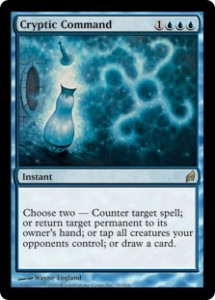
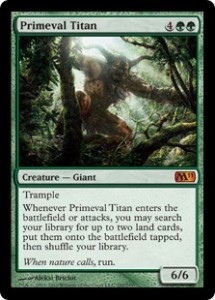
“Judge! My opponent tapped 6 lands and cast a Primeval Titan. I used Cryptic Command to counter it and draw a card. That resolved, and then she cast a Summoning Trap, looking at the top seven cards and put a second Primeval Titan into play. At this point I noticed that one of her 6 lands in play was a Terramorphic Expanse. So she didn’t have enough mana to cast the first Primeval Titan. What happens now?”

So we can all agree that you shouldn’t be able to cast a 6 mana spell with only 5 lands that produce mana. So we just take everything back, untap the lands and try again, right? The first thing I did when trying to figure this out was to ask them to break down the situation a little more. I wanted to make sure this was truly an accident.

The girl that played the Titan said that she played the Expanse the turn before, with the intention of cracking at the end if her opponents turn. She knew she had the 6th land and the Titan in her hand. When it came time to do so, she got a little excited about getting to cast her 6/6 and just ran it right out there, forgetting to fetch a land that can produce mana.

On the flip side, her opponent didn’t notice the misplay. He cast the Cryptic Command with almost as much confidence as she slapped down her Titan. Everyone knows the best Cryptic Commands are the ones that counter 6 drops on turn 6.

I was reasonably confident nothing shady was going on. Some players can get excited and overlook things. However, this doesn’t make it okay. So now that we know that nobody is getting thrown out over this, how do we fix it?

The Infraction Procedure Guide says that if this mistake was caught right away we can back up the game to the point right before the Titan was cast, untap her lands, and let them continue playing. However, this was not caught right away. There was a lot that happened in the game based on the fact that the Titan was cast. Cryptic Command wouldn’t have been cast if the Titan wasn’t. Summoning Trap would not have been sprung if the Command hadn’t been cast. There were cards drawn, cards looked at, lots of information gained on both sides of the table. Trying to back all of this up would have been a huge mess, and would have likely ended up with things not even 100% the way they were before.

Knowing all that, I choose to let the game state stand. Some players might think that this isn’t okay. She clearly cheated to get that Titan into play, why does she get to keep it now? While this is true, I made an effort to make sure that it was an accident, and it is her opponent’s responsibility to make sure she is playing legally just as much as it is hers. If he had noticed the Expanse right away than it would have been backed up and no harm would have come of it.

This does bring up an interesting question though. When exactly is it “too far” to back the game up. There really isn’t a hard set rule on this subject. It is really a judgment call. There are however, some guidelines that can be considered.

Generally speaking, the drawing of a card is too far. Because most Magic players have the tendency to flick the cards in their hand (I do it too), it is likely that the moment the card enters the hand you will not be able to identify it 100%. Now this doesn’t mean that drawing a card is automatically too far though. Say a player casts Day of Judgment with only one white source, destroying all creatures, and then just passes the turn. Their opponent draws a card and before they do anything else, they notice the mistake. At this point I am likely to back up. Put a card from player’s hand that just drew a card back on top of their library. Ideally the card drawn, but if you can’t know for sure, a random card from their hand. We would back up to the point right before the Day of Judgment was cast and let that player try something else.

The real breaking point for me is this. If significant decisions have been made based on a mistake like this it’s probably too far to back up. Cards were cast in response, and lots of things happened. Backing up all of that would have changed how both players played the rest of the game. One player would have to live in fear of every spell the cast being countered by the powerful Command. And the other player would have to make sure that the spell countered would count, knowing that a Trap was coming up afterwards. It could have changed the way both players played the game from that point on.

The bottom line is that the game of Magic is played by both players. It is both players responsibility to make sure it is being played by the rules and that all actions are taken legally. If your opponent doesn't have the right mana you should point it out to them. If you don’t, bringing it up later will likely not do you any good.

As always, Keeping it Fun

Kyle Knudson

Level 2 Judge

Allon3word at gmail.com

BONUS RULES STUFF

This falls under the category of Game Rules Violation in the Infraction Procedure Guide. A Game Rules Violation is kind of a catch all for this section of the IPG. Pretty much anything directly involved with an actual game that isn’t covered by another category is considered a GRV. Because it covers such a broad area of potential mistakes it is unreasonable to try to create a list of “fixes” for each and every situation that comes up. In order to remain consistent the emphasis is put strongly on the players to be responsible for what happens during a game. It is also said that we shouldn’t try to find any partial fixes to a situation. We shouldn’t try to compromise and come up with a solution that is fair to both players.

A fix needs to be all or nothing. Once you start to try to fix things you run the risk of favoring one player over another. It either needs to be backed up all the way, so the game can be played correctly, or not backed up at all. After all, it is the players themselves that didn’t notice the mistake in time. If it causes one of them the game, the best outcome may be that it would teach them a tough lesson in paying attention to what their opponents are doing.

The Great Designer Search 2: Scott’s Deck

Are you a Quiet Speculation member?

If not, now is a perfect time to join up! Our powerful tools, breaking-news analysis, and exclusive Discord channel will make sure you stay up to date and ahead of the curve.

Having wrapped up testing for Ethan Fleischer's deck, Tooth and Claw, for his entry in the Great Designer Search 2's next challenge (designing an intro pack), we had little time to spare with the remaining three decks queuing up ahead of us. Ethan's deck set a high standard for what we could expect: it was clean and fun, with a good mix of cards and a balanced mechanic in evolve. We sent him the final bit of analysis and set his deck to the side.

Since we'd resolved to run the decks through our precon gauntlet in the order in which they were received, that meant that Scott Van Essen's Breakout from Malgareth was next. Unlike the other three finalists, Scott's deck was completely mocked up on Magic Set Editor by one of his contributors, so we were able to better replicate the feeling of playing on actual cards. This wasn't vital, but it helped 'suspend disbelief' a little and get us into the mood for the set. Additionally, Scott's graphic collaborator had something of a sense of humour, and some of the card images were hilarious (we've used these card images for this article for Scott's deck). I'd had them printed up in full colour, so we cut them, sleeved them, and got underway.

Scott Van Essen: Breakout from Malgareth

The World: Malgareth. "In an underground prison, death is the only escape."

The Mechanic: Breakout is a creature-based keyword that triggers and grants its creature a special ability whenever it is attacking and an attacking creature is unblocked. This was meant to simulate a riot or breakout in a prison, where the prisoners wildly rush their guards. There have been some templating concerns with the mechanic, as it seems a bit complicated, though in actual practice we found it quite simple to grasp. Basically, if any of your attackers are unblocked, then everyone with "breakout" gets a nifty little bonus. An example:

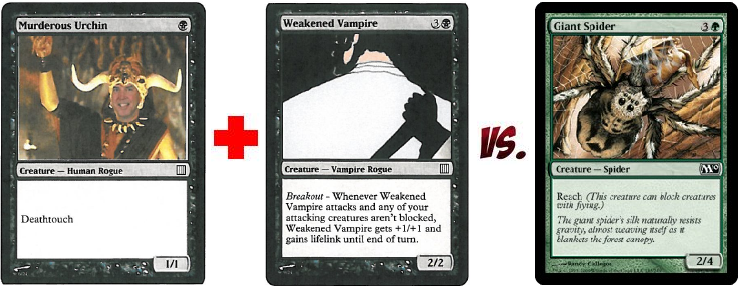
You have a Murderous Urchin and a Weakened Vampire, and are swinging in with both. Your opponent, not wanting to trade his beloved Spider for the one-drop Urchin, decides instead to block the Vampire. Ordinarily, this would result in the Vampire dying to the Spider, but not so! The Vampire has breakout, and the Urchin is unblocked. Because no blocker was assigned to the Urchin, the Vampire's breakout triggers- and this is critical- even though the Vampire was itself blocked. The Vampire gets +1/+1 and lifelink until the end of turn. Although it's not enough to kill the Spider outright, the Spider no longer can kill the Vampire either, so the two bump against each other (and you gain +3 life). The Urchin, of course, nicks your opponent for one.

The Deck: Scott's deck is a Black/Red agrro deck that features a generous serving of breakout. What was a little concerning was the mana curve. Like Ethan's, it was heavy on the back-end, with nine 4-drops and four 5-to-6-drop creatures it clearly was a deck that wanted the luxury of a little time. Wisely, Scott had salted in most of the noncreature spells in the cheaper casting-cost slots, so the deck would seldom be without something to do. In other colours, you might look to some ramp to accelerate your mana base production, but Black and Red don't go in for much ramping. Instead, they typically rely on removal to keep the board state manageable while biding time for the heavier hitters to make their way onto the scene.

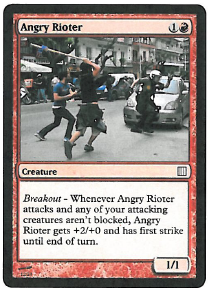
Breakout Creatures: Scott's deck was still in the tinkering stages when it made its way to us, and a number of the creatures had changes made to them after we'd received the file and during our testing. We were quite happy to be flexible and, without exception, the changes were necessary ones. The breakout beaters were the biggest concern. The deck had a healthy proportion of them (just shy of 50% of all creatures) and their effects were widely disparate. They began rather small with a pair of Angry Rioters as two-drops. Gaining +2/+0 and first strike on breakout, they frequently punched above their weight. A similar creature further up the chain (costing five mana) was the Breakthrough Bandit, a 3/3 which could get double strike. There were removal effects in the Grifter (Shatter) and the Apprentice Assassin (Assassinate). The Weakened Vampire,that we saw above, and the remaining creatures had some rather nifty tricks.

The Back Alley Slasher was a 4/4 for four mana that came into play with two -1/-1 counters on him. Whenever his breakout triggered, he was free to move one of these counters to another target creature. The Seizer of Thoughts allowed you to Duress your opponent each time its breakout engaged. Not only was this rather broken, it was time-consuming and horribly unfun. After getting in three times in a row on my opponent in one of our matches, we switched to a simple "choose and discard a card" with no reveal. (To be fair, Scott had told us upfront that the card's ability as-is was suspect). Finally, there was Angathrak, Gang Leader- the deck's "foil premium rare." A beefy 5/5 body for 6 in red, his breakout triggered a Relentless Assault effect. Although with so many abilities possible the potential for confusion was there, we generally found that this added a welcome level of complexity to blocking situations.

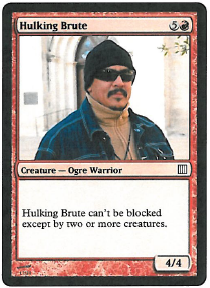
Other Inmates: Many of Breakout from Malgareth's other beaters were intended to enable breakout situations. The Red one-drop Pawn of Angathrak was a simple 1/1 body that could be sacrificed to give target creature haste until end of turn. When one of the deck's two Tunneling Escapists attacked, they'd make a small creature unblockable that turn. And the Hulking Brute was only blockable by two or more creatures. Also of note was the Resourceful Scavenger, a 2/1 body for two that allowed you to "loot" (draw a card, then choose and discard a card) when it entered the battlefield. With Mark Rosewater talking about moving looting to red, it was a timely inclusion. [Editor's Note: The exact hypothetical looting card was discussed on Episode 239 of Monday Night Magic, with both myself and Conley Woods agreeing it would be amazing.]

Removal: Supporting the jailbreak was a solid amount of removal and combat trickery. The Ambusher was a 2/2 creature with haste that did 2 points of damage to another creature or player (these quickly became a favourite). Pile On put a -1/-1 counter on a target creature for each creature you controlled. Drug the Guards tapped two target creatures, leaving the gift of a -1/-1 counter behind for each (a sort of double Stabbing Pain). Finally, Falling Stalactite, although expensive, was useful and flavourful, destroying target land and dealing 3 damage to a creature or player. Like many intro decks, it was enough burn to be useful but not quite as much to get complacent. Topping it off were a pair of [card Thunder Strike]Thunder Strikes[/card], combat tricks and ersatz removal in one.

Miscellany: Befitting an intro deck, the rest of the noncreature cards were something of a hodge-podge. There were a pair of Rise Ups, which were comparable to Dragon Fodder but game them haste in return for costing one more mana. Flailing in the Dark was a Black enchantment that gave blocking creatures -2/-0 until end of turn (obviously making attacking more favourable). Buddy System was a version of Splinter Twin, while Fist of Chains was an Equipment that granted intimidate; supremely useful here.

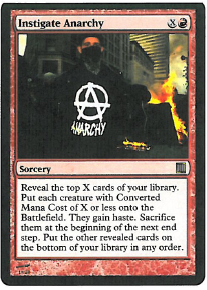
The final spell was the controversial Instigate Anarchy, a flavourful and evocative sorcery and one probably a bit too cheap for its effect. In the testing to come we'd both blow out out games with it, and essentially Time Walk our opponent when we tapped out and whiffed. It was one of the most powerful (and most fun) cards in the deck.

And there we had it, Breakout at Malgareth. Stall in the early and early-midgame until that fourth critical land drop, and begin funneling out your prisoners. Attack early and often once your breakout bodies hit the table, and back it up with burn to clear the way. With precious few ways to damage an opponent, Breakout would be doing most of its talking in the red zone.

The Playtest: Scott had submitted a list of things he wanted us to watch out for. Was his deck fun? Did it permit the opponent to also have fun? How did breakout impact the way you played the deck? Was it swingy? How did it do on a crowded board versus an empty one?

Like a chef in a well-stocked kitchen, we threw open the card boxes and begin pulling precons out, to represent a variety of opposition. As before, we operated on a five-point scale system and graded after each game. A score of '3' meant that you felt your deck was approximate in power to the other, win or lose. A '2' or a '4' meant that your deck was either somewhat weaker or stronger, while '1' and '5' meant that the test was lopsided. We also kept our standard "three games per deck" structure to the gauntlet.

Breakout from Malgareth opened up with a hideous beating against Magic 2011's Stampede of Beasts. This was our go-to deck for fat, efficient bodies, and no-one has them like Green does. These are a litmus test against the designer's creature cost. Like Ethan's deck, Scott's was filled with creatures that cost more for the body because they come equipped with a special ability. Price them too highly, and the deck will find itself playing 2/2's while Big Green stomps their head in with 4/4's or worse. It's an ideal first stop.

Breakout from Malgareth did a passable job, taking one game of the three, but the difference in quality was noticeable- it just couldn't race a good Green start. In the game it won it did manage to get out early enough, and the Seizer of Thoughts (the critter whose breakout ability was a Duress) struck three times in succession, fatally depleting Stampede's hand. This is where we decided that the Seizer was indeed broken, and went with the less powerful discard option.

Next up was Phyrexian Poision, whose inefficient Infect critters would be a better match for Breakout's. This was in fact the case- they were very balanced against one another, and we both played these three games with big grins on our faces. Although a little awkward at first due to templating, breakout was proving to be a fun mechanic, and it worked well here. Each game felt balanced, and while Breakout picked up a 2-1 record, both wins were relatively close.

We stayed with Scars of Mirrodin for the next matchup, selecting Metalcraft. Don't let Breakout's 0-3 record fool you here, for Scott's deck made a fine accounting for itself. The first match was what we call a swingback, where one deck gets its hands around the throat of the other and is poised to win, but the other deck manages to battle back and snatch the victory. These are, naturally enough, encouraging signs of balance. The second match was a blowout, with an Embersmith grinding up Breakout's smaller creatures, but the third was relatively close.

With the beats and midrange options covered, we moved on to aggro/swarm with Worldwake's Fangs of the Bloodchief. This was a similar test as Stampede of Beasts, but in the early game versus the mid- and end-game. With the Breakout player overpaying for small bodies, we expected the fast-starting Fangs to chew it up, and it did. Breakout lost all three matches here. Fangs was consistently able to get out some early beaters, and had the removal to keep the lanes clear once Breakout started delivering bodies. With Breakout's sparse spot removal, Anowon, the Ruin Sage was virtually unbeatable when he resolved.

In theory, if Breakout could last until the middle of the game the tide should begin to turn as it deployed its answers. In game three it had the chance to do so. In what would later be billed as the "game of the day" each side found a way to start gaining life and the game went long. Fangs had a Vampire Nighthawk that Breakout couldn't answer, while Breakout landed a Weakened Vampire who had lifelink on breakout. Breakout showed tremendous resilience- it snuffed out [card Anowon, the Ruin Sage]Anowon[/card] with a Pile On, got a two-for-one with the Back Alley Slasher (which killed a Child of Night with a -1/-1 counter when another critter got through and triggered its breakout, and then since it was now a 3/3 it took its blocker- a Jagwasp Swarm- with it). The heartbreaker of the game was when Breakout could have siezed the win with a 6-point Instigate Anarchy, and only got a 1/1 Pawn of Angathrak for its troubles.

Because of the substantial difference in quality beween the Zendikar-block intro decks and the most recent ones for Scars of Mirrodin, we decided to go back to Mirrrodin for Myr of Mirrodin, an early/mid-range deck with a heavy artifact creature component. These were far more swingy affairs. Breakout owned the Myr with a Grifter (who destroys artifacts on breakout) in game one, and dominated game two by dropping its bombs (a Hulking Brute and Angathrak, Gang Leader) after softening up the board with Ambushers for a couple of two-for-ones (the 2 damage the Ambushers did upon entering the battlefield were perfect for slaying Myr). The Myr rolled back with [card Myr Galvanizer]Galvanizers[/card] and a [card Myr Battlesphere]Battlesphere[/card] in game three; Breakout never stood a chance.

Wanting to take another look at a faster-paced environment (where Breakout seemed most vulnerable), we rounded off the gauntlet with Worldwake's Rapid Fire (Boros landfall aggro) and Zendikar's Kor Armory. Breakout broke even here, going 3-3, and by the end of the testing session had compiled a slightly worrying 8-13 record.

Final Analysis

Again, we'll reprint our final analysis from the report we delivered to Scott.

Overall I’d say Breakout from Malgareth was good, but it needs some tuning to consistently perform. Part of the problem was identified above: this deck can’t race well on the creature curve. Sure it’s got great abilities rolled into its beaters but if you keep getting outclassed and outpaced by your opponents creatures when are you going to be able to profitably attack? Green, with its big and efficient bodies, absolutely ate Breakout’s lunch. Decks with a bit of fat in them, like Infect critters, matched it perfectly, while decks with cheaper critters seemed to be at a disadvantage once Breakout stabilized, because then you had two sets of similarly-sized critters out but one had a slew of nifty tricks with breakout. Fast aggro, like the Vamps, would just kill the deck too quickly to get it stabilized.

What’s the solution? It feels like there’s nothing in the deck that’s not doing some busywork, and that starts to feel more like Constructed and less like an intro deck. I’d prune the tree a little, and replace some underperformers with some decent, on-curve efficient vanilla bodies. Is it as sexy as the all-singing, all-dancing breakout ensemble? No, but it provides a hedge against getting blown out, slows itself down a bit when it looks to be the deck doing the blowing-out, and keeps it at a somewhat more stable and moderate rate of performance.

To hit your questions directly:

- Is it fun?

Definitely. I really liked breakout. I generally am not a big fan of critters or combat, so making combat involve decisions it normally doesn’t made it “fresh’ again. I really enjoyed the different ways it affected the board. It was a little hard to grasp at first, but was quick to be understood once seen.

- Is your opponent having fun?

Only a blazing Incite Anarchy threatened their fun at any point. Otherwise definitely, especially with Phyrexian Poison.

- Does the Breakout ability read well?

It’s okay. Again, a bit hard to grok in the abstract, but once seen a few times becomes somewhat intuitive.

- How does the Breakout ability change the way you play?

It incentivized me to attack more than I normally do, and made numbers count. I often had to settle the question: is the creature(s) I’ll lose while attacking worth more or less than the benefit from doing so? I really enjoyed that part of it.

- Is the play too swingy?

See: Incite Anarchy. At any other point, not consistently.

- How does it play on a crowded board? On an empty board?

On a crowded board, it definitely clogs the middle. You don’t want to go all in because a bad attack (and I made one at least once) can be catastrophic, or if the opponent has combat tricks. Still, that’s a good tension to have. On an empty board, it can result in a soft lock if you have the right creatures out. That’s not necessarily bad, because it didn’t find a lot of empty boards to rampage over.

And so we set aside Breakout from Malgareth, and readied to spend the latter half of the day with Devon Rule's contribution, which we'll call Utopian Gold as it came through unnamed. So far we'd found both decks to be sound and solid, but we were in for a very different experience next. Tune in tomorrow to catch that story!

SMIP: Mirrodin Besieged Vintage Set Review, Pt. 2

Are you a Quiet Speculation member?

If not, now is a perfect time to join up! Our powerful tools, breaking-news analysis, and exclusive Discord channel will make sure you stay up to date and ahead of the curve.

(Continued from Part 1, found here)

Shriekhorn

1

Artifact

Shriekhorn enters the battlefield with three charge counters on it.

{T}, Remove a charge counter from Shriekhorn: Target player puts the top two cards of his or her library into his or her graveyard.

A derivation of Millstone. There are plenty of playable Millstone effects in Vintage: Jace, the Mind Sculptor’s ultimate ability, Grindstone + Painter’s Servant, Helm of Obedience + Leyline of the Void, Oona, Queen of Fae + Worldgorger Dragon combo, among others. What each of those effects have in common is that they mill the opponent’s library in one fell swoop. This card is not efficient enough to aid a dedicated Millstone strategy, but it may nonetheless have applications.

First of all, it is incredibly efficient. For one mana, you can immediately move cards from a library to the graveyard. What kinds of applications might such a card have? First of all, such an effect can be used to “counter” an opponent’s topdeck tutors, such as Mystical Tutor, Vampiric Tutor, or Imperial Seal. However, that application doesn’t offer much value.

Second, it could be used to mill one’s own library, to put dredge cards in the graveyard, to move artifacts into the graveyard that can be Welded in for this card, to create Reanimation targets, or to dig deeper into one’s library with Sensei’s Divining Top. This card may actually be most useful in Legacy, where Bazaar of Baghdad does not exist, and where it could turn Goblin Welder into a legitimate Reanimator threat, it the Welder could be protected for a turn.

This card is efficient enough for Vintage play, but its effect may be too marginal to justify including in one’s 75. If it milled 3 cards, rather than just 2, you would have better odds of hitting a dredge. Still, I wouldn’t be shocked to see it tried. It’s theoretically Vintage playable, although I’m skeptical that it will actually be played.

Signal Pest

1

Artifact Creature — Pest

0/1

Battle cry (Whenever this creature attacks, each other attacking creature gets +1/+0 until end of turn.)

Signal Pest can't be blocked except by creatures with flying or reach.

A one mana zero power card is not exactly the shining standard of Vintage playability. The only possible Vintage application I could imagine is with Artificer’s Intuition and Myr Servitors. By playing a bunch of Servitors and tutoring up multiple Signal Pests, you could alpha strike pretty well. Add Cranial Plating to the mix… But I’m not sure if such a deck would be disruptive enough to win in Vintage. It theoretically could be, but it probably wouldn’t be. Still, someone enterprising enough could establish otherwise.

In a deck like Noble Fish that features Exalted creatures with Cold-Eyed Selkie, Signal Pest represents another card drawn on each attack. However, it is fairly narrow as a creature pump spell for Noble Fish decks.

Silverskin Armor

2

Artifact — Equipment

Equipped creature gets +1/+1 and is an artifact in addition to its other types.

Equip {2}

Anyone in Vintage would play Umezawa’s Jittle over this. Did you know that Skullclamp is also unrestricted in Vintage?

Skinwing

4

Artifact — Equipment

Living weapon

Equipped creature gets +2/+2 and has flying.

Equip {6}

Another 4 mana 3/3. This is worse than Jitte, too. Although it could theoretically be playable if the equip cost were much reduced.

Sphere of the Suns

2

Artifact

Sphere of the Suns enters the battlefield tapped and with three charge counters on it.

{T}, Remove a charge counter from Sphere of the Suns: Add one mana of any color to your mana pool.

Darksteel Ingot saw a tiny amount of Vintage play because this effect is important. The existence of Mox Opal greatly diminishes the need for this kind of spell. Still, it is an interesting effect that could be used in a 5c Stax deck for greater mana reliability, if only it didn’t come into play tapped. As is, this card is much worse than many other mana fixers that exist. Unplayable.

Spin Engine

3

Artifact Creature — Construct

3/1

{R}: Target creature can't block Spin Engine this turn.

See Bladed Sentinel.

Spine of Ish Sah

7

Artifact

When Spine of Ish Sah enters the battlefield, destroy target permanent.

When Spine of Ish Sah is put into a graveyard from the battlefield, return Spine of Ish Sah to its owner's hand.

In addition to having a very cool name, this card has a very useful effect. Workshop decks are in the business of mana denial and board advantage. This card can not only take out a basic land, it can kill difficult permanents like Jace or a Time Vault. The second ability actually makes this card subtly stronger. If you were to using Goblin Welder to weld out Spine of Ish Sah, you would find the Spine returned to your hand, at no loss of card or permanent advantage. If you use an effect like Bazaar of Baghdad to put it into your graveyard, you can then Weld it back in without it first going back to your hand. That gives you the best of both worlds. You can Weld it in, but when you Weld it out, it returns back to your hand, which can be incredibly powerful for recursive use of Bazaar of Baghdad, an application I fear this card is destined for. This card is Vintage playable, and will see a good deal of Vintage play.

Strandwalker

5

Artifact — Equipment

Living weapon

Equipped creature gets +2/+4 and has reach.

Equip {4}

This card is far too expensive. See Bladed Sentinel. A 5 mana 2/4 is not vintage playable, and the equip cost is out of Vintage range. Equip costs in Vintage probably can’t cost more than 3 mana, since you won’t have more than 3 non-Workshop mana reliably available.

Sword of Feast and Famine

3

Artifact — Equipment

Equipped creature gets +2/+2 and has protection from black and from green.

Whenever equipped creature deals combat damage to a player, that player discards a card and you untap all lands you control.

Equip {2}

This card is just much worse than Sword of Fire and Ice. Won’t see play.

Tangle Hulk

5

Artifact Creature — Beast

5/3

{2}{G}: Regenerate Tangle Hulk.

The regeneration ability is probably too expensive for most Workshop decks, and not sufficiently valuable to justify playing this over Juggernaut, which doesn’t currently see much play in Vintage anyway.

Thopter Assembly

6

Artifact Creature — Thopter

5/5

Flying

At the beginning of your upkeep, if you control no Thopters other than Thopter Assembly, return Thopter Assembly to its owner's hand and put five 1/1 colorless Thopter artifact creature tokens with flying onto the battlefield.

Steel Hellkite sets the bar for 6 mana 5/5 flying artifact creatures in Vintage. What advantage does this offer? It is undeniable that this offers a potentially huge upside: gigantic permanent advantage in the Workshop mirror. That said, one of the problems with this card is that it returns to hand in your upkeep, which means that it will be two turns before you can begin attacking with it. While the permanent advantage is undeniable, I find it difficult to imagine playing this over Precursor Golem. Golem provides more power, is a bigger threat, and is more efficient. I don’t expect this to see play.

Titan Forge

3

Artifact

{3}, {T}: Put a charge counter on Titan Forge.

{T}, Remove three charge counters from Titan Forge: Put a 9/9 colorless Golem artifact creature token onto the battlefield.

So, for 12 mana I can get a 9/9 creature? What a deal!

Training Drone

3

Artifact Creature — Drone

4/4

Training Drone can't attack or block unless it's equipped.

The cost of reversing this drawback is too steep for Vintage. And not because there aren’t enough playable equipment spells, there are. Sword of Fire and Ice, Umezawa’s Jitte, Cranial Plating, Skullclamp, and, arguably, Lightning Greaves. The problem is that you wouldn’t want to clog your deck with enough equipment to reliably use this guy. Not Vintage playable.

Viridian Claw

2

Artifact — Equipment

Equipped creature gets +1/+0 and has first strike.

Equip {1}

This card would compete with Shuko and Bonesplitter in Vintage. Oh yeah, and Skullclamp. None of those cards see play, and this won’t either.

B. White

Accorder Paladin

1W

Creature — Human Knight

3/1

Battle cry

There are plenty of 2cc white creatures that are playable in Vintage: Kataki, War’s Wage, True Believer, Jotun Grunt, Ethersworn Canonist, Leonin Arbiter, Tidehollow Sucller, and, if you count them, Qasali Pridemage, Gaddock Teeg, and Meddling Mage, among others. The unifying feature of each of these cards is the disruptive effect they have on the opponent. 2cc creatures in this format are utility creatures: they either disrupt the opponent or generate an advantage for the controller. This card does neither.

The fact that there are no playable 2cc beaters (i.e. cards whose sole function is combat or to support combat) does not mean that such a cards is unplayable. There happens to be several 2cc creatures who fit that description that are playable in Vintage, most prominently (although not exclusively), Tarmogoyf. As you know from my Gush book, Kiln Fiend and Quirion Dryad are also so playable, and there are a few others. The key feature of these spells is their incredible efficiency. Kiln Fiend is, on average, a 9 power creature. Tarmogoyf is used because it reaches 4 to 5 power regularly. This creature does not rise to that level of efficiency, and is even less efficient – although more reliable – than Jotun Grunt.

The key advantage Accorder Paladin has is that it powers up the rest of your team. That is non-trivial. But does that advantage counteract the somewhat below-the-bar power on this creature? Possibly. If this creature had 4 power, I would say that it is Vintage playable, at least in theory. Whether it would see Vintage play, even with those stats, I could not say with certainty. With 3 power, the chances are reduced, but I wouldn’t completely rule this card out. Serra Avenger has, in strange cases, seen play before.

Having the right home is as important as having the proper stats, as measuring up. If there isn’t a playable archetype for a card like this, then the card’s inherent strength is irrelevant. The home for a card like this would be a Fish deck with white splash or a Beats deck. Beats decks generally require maximum disruption, and use Tarmogoyf as the sole beaters, if any. This card could generate more power for a beats deck than a Goyf thanks to Battle Cry, powering up all of the other bears, including Spirit Guides.

This card is probably the best pure beater with three or more natural power in the format, which makes it potentially Vintage playable, although unlikely so.

Ardent Recruit

W

Creature — Human Soldier

1/1

Metalcraft — Ardent Recruit gets +2/+2 as long as you control three or more artifacts.

Following the two step analytic framework for evaluating metalcraft spells I described above, I will review Ardent Recruit. Simply put, this is a 1cc 3/3 creature with no disruptive effect or utility. Wild Nacatl is comparable to this card in terms the constraints and requirements imposed by the card. Wild Nacatl sees no Vintage play, which bodes poorly for this card. If this were a natural 2/2 with the same ability, it would be playable. As it is, I don’t expect it to see any Vintage play.

Banishment Decree

3WW

Instant

Put target artifact, creature, or enchantment on top of its owner's library.

This card would have to cost at least two mana, and arguably three, to see play in Vintage. Five Mana is a pipe dream. This card is completely unplayable.

Choking Fumes

2W

Instant

Put a -1/-1 counter on each attacking creature.

Darkblast is legal in Vintage, as is Lava Dart, Fire/Ice, etc. White gets Swords to Plowshares for 33% of the cost. This is not Vintage playable. It might not even see Vintage play if it was just a white Darkblast that couldn’t be recurred.

Frantic Salvage

3W

Instant

Put any number of target artifact cards from your graveyard on top of your library.

Draw a card.

Argivian Find is a very powerful effect. This is Argivian Find with a potential huge upside. You can, for example, put Scroll Rack or a Sensei’s Divining Top on top, and then use it to draw more cards. Unfortunately, this casting cost is simply prohibitive for any Vintage deck. If this cost 2 mana, it could be playable. At four, it’s simply too expensive.

Gore Vassal

2W

Creature — Hound

2/1

Sacrifice Gore Vassal: Put a -1/-1 counter on target creature. Then if that creature's toughness is 1 or greater, regenerate it.

There aren’t many 3cc non-artifact creatures that see play in Vintage: Trygon Predator, Vendillion Clique, Aven Mindcensor, Thada Adel, Cold-Eyed Selkie, Trinket Mage, Faerie Macabre, Elvish Spirit Guide/Simian Spirit Guide, and arguably Psychatog, among others. These cards are almost all very disruptive, utility creatures or strategically important. Gore Vassal probably doesn’t make that very exclusive list. It’s not blue, and its ability is not that great, despite the ability to destroy a Dark Confidant, Lotus Cobra, or even a Goblin Welder. If this card cost 2 mana, it might be playable. As it is, it’s simply not disruptive enough or large enough for Vintage.

Hero of the Bladehold

2WW

Creature — Human Knight

3/4

Battle cry

Whenever Hero of Bladehold attacks, put two 1/1 white Soldier creature tokens onto the battlefield tapped and attacking.

There are currently only a few 4cc non-artifact creature that sees play in modern tournament Vintage (although Auriok Salvagers is arguably the basis of a deck, and Glen Elendra Archmage was popular in 2009 and early 2010, and is playable). And most of those creatures are reanimation targets(Flame-Kin Zealot/Ichorid). Academy Rector used to see quite a bit ofplay, and Flametongue Kavu saw a marginal amount of play 4-5 years ago. Since then, the only 4cc creature that sees play in Vintage is Sower of Temptation. Meloku is also playable, and costs one more. In general, though, 4cc spells in Vintage have to be of the power level of restricted bombs like Gifts Ungiven or Jace, The Mind Sculptor to see play. Hero of the Bladehold is not going to be the exception.

Kemba's Legion

5WW

Creature — Cat Soldier

4/6

Vigilance

Kemba's Legion can block an additional creature for each Equipment attached to Kemba's Legion.

Obviously Vintage unplayable. 7 cc creatures with no relevant Vintage ability don't see play.

Leonin Relic-Warder

WW

Creature — Cat Cleric

2/2

When Leonin Relic-Warder enters the battlefield, you may exile target artifact or enchantment.

When Leonin Relic-Warder leaves the battlefield, return the exiled card to the battlefield under its owner's control.

Now, this is what I’m talking about. This guy isn’t just Vintage playable, he’s really good. He’s gonna see plenty of Vintage play. In fact, this guy is arguably the best 2cc white creature of all time.

The obvious comparison of Qasali Pridemage, which I picked as the number one Vintage printing in 2009. Pridemage has seen lots and lots of play, and is one of the best answers to Time Vault. This guy is just as castable as Pridemage, but has many advantages over Pridemage.

First of all, there is no activation cost to get the Disenchant effect. That can matter if your opponent has just resolved an Oath, is constraining you with Sphere effects like Lodestone Golem, or is about to go infinite with Time Vault. Secondly, you get the Disenchant effect without having to sacrifice your creature. You can attack and kill your opponent’s Time Vault. Third, exiling some artifacts is better than destroying them. When you destroy an artifact, like Time Vault, or an enchantment like Oath, it can always be replayed later with Regrowth or Yawgmoth’s Will. When you exile such a spell, it can’t be replayed in that way. Not to mention, this card can deal with Blightsteel Colossus, whereas Qasali Pridemage can’t. Incidentally, this guy can actually remove a Sphinx, whereas Pridemage can’t.

In a metagame such as ours where Mishra’s Workshop decks are dominant, this guy is perhaps as good as it gets. From the moment he hits, he takes out the most menacing artifact on the table, which will often be a Lodestone Golem. The capacity to take out problematic permanents, whether it be a Steel Hellkite, Crucible of Worlds, a Tangle Wire or a Smokestack makes this guy amazing. He’s a great tempo play: he can take out a threat, and beat down just long enough to survive a Workshop players counter-tactics. This guy may not be able to survive indefinitely in a format where cards like Duplicant and Triskelion see a good deal of play, but Workshop decks often lack the search or card advantage to find one of these answers soon enough.

One of the main feature of modern Fish is mana denial. Cards like Wasteland, Null Rod, and Stifle all help generate tempo, creating a window for the Fish pilot to win the game before the opponent can stop them or achieve their own strategic objectives. Relic Warder is an excellent tempo card. Even the minor ability to take to exile a Mox is solid value. There should almost always be a target in Vintage, and that’s what makes this guy so spectacular.

This guy is not just playable, it’s great.

I am more than eager to try to build a U/W/x Fish deck with four Qasali Pridemage and four Leonin Relic-Warder. Once you get the mana right, that deck will be downright deadly. One of the best possible options is Aether Vial. Vial not only helps you obviate the mana problems, but it will allow you to maximize the effect, killing key targets at instant speed. This card could usher the return of Vial Fish in Vintage.

Loxodon Partisan

4W

Creature — Elephant Soldier

3/4

Battle cry

Is neither disruptive nor generates card, mana or permanent advantage. As a beater, this would have roughly one mana to be playable.

Master’s Call

2W

Instant

Put two 1/1 colorless Myr artifact creature tokens onto the battlefield.

Raise the Alarm doesn’t see play in Vintage. This card won’t either, despite the ability to aid Metalcraft.

Mirran Crusader

1WW

Creature — Human Knight

2/2

Double strike, protection from black and from green

Protection from black and green aren’t particularly important in Vintage. 4 power for 3 mana isn’t a bad deal in general, but it’s not efficient enough for Vintage.

Phyrexian Rebirth

4WW

Sorcery

Destroy all creatures, then put an X/X colorless Horror artifact creature token onto the battlefield, where X is the number of creatures destroyed this way.

No Wrath effects are Vintage playable except Balance.

Priest of Norn

2W

Creature — Cleric

1/4

Vigilance

Infect

Vintage unplayable. See Gore Vessel.

Tine Shrike

3W

Creature — Bird

2/1

Flying

Infect

See Gore Vassal: 3cc creatures that don’t disrupt the opponent or produce card or mana advantage are not Vintage playable. At least, none are currently so. This card would probably have to cost 1 mana to be even seriously considered.

Victory’s Herald

3WWW

Creature — Angel

4/4

Flying

Whenever Victory's Herald attacks, attacking creatures gain flying and lifelink until end of turn.

At this casting cost, this card is an Oath or Reanimation target, not a castable play. In that respect, there are far too many superior options to this. Not playable.

White Sun’s Zenith

XWWW

Instant

Put X 2/2 white Cat creature tokens onto the battlefield. Shuffle White Sun's Zenith into its owner's library.

Decree of Justice sees no play in current Vintage, and it’s much better than White Sun’s Zenith since it draws a card, and isn’t conventionally counterable.

C. Blue

Blue Sun’s Zenith

XUUU

Instant

Target player draws X cards. Shuffle Blue Sun's Zenith into its owner's library.

Neither Stroke of Genius nor Braingeyser see any play in modern Vintage. Skeletal Scrying seems some play, in lieu of these formerly popular blue draw spells. I don’t expect this card to see any play either, even though it’s arguably better than Stroke of Genius, especially if there were a High Tide deck legal in the format.

Consecrated Sphinx

4UU

Creature — Sphinx

4/6

Flying

Whenever an opponent draws a card, you may draw two cards.

Six mana is the upper limit for the playability for non-artifact spells in Vintage, and it’s a standard set by cards like Yawgmoth’s Bargain and Mind’s Desire. Spells that cost more than six mana are playable, but they are playable only to the extent that they can be cheated into play with cards like Tinker, Oath, Show and Tell, or Reanimation effects. Example of such creatures include Iona, Shield of Emeria, Inkwell Leviathan, Terastodon, Tidespout Tyrant, and, much rarer these days, Worldgorger Dragon.

This card does not generate an effect powerful enough to warrant using cheats. Oath targets shut down the opponent in many ways and win the game. Reanimation targets generate lethal damage with Flame Kin Zealot or infinite mana with Worldgorger Dragon. Specifically, the effect allows you to draw cards whenever the opponent draws cards, but it doesn’t stop the opponent from drawing cards. It doesn’t shut the opponent down. If this card stopped the opponent from drawing cards at all, it would be a playable card. As it is, Tomorrow, Azami's Familiar is probably better in applications where you want this.

Corrupted Conscience

3UU

Enchantment — Aura

Enchant creature

You control enchanted creature.

Enchanted creature has infect. It deals damage to creatures in the form of -1/-1 counters and to players in the form of poison counters.

Control Magic no longer sees play in Vintage, but that’s a consequence of the presence and popularity of cards like Sower of Temptation and Domineer. This card doesn’t offer enough advantages over either card to justify playing it over them. Casting cost trumps the benefits of infect. This card is not Vintage playable, and should see no Vintage play.

Cryptoplasm

1UU

Creature — Shapeshifter

2/2

At the beginning of your upkeep, you may have Cryptoplasm become a copy of another target creature. If you do, Cryptoplasm gains this ability.

Although there are very few 3cc creatures that see play in Vintage, those that do fit the mold of Vendillion Clique, Trygon Predator, Trinket Mage, Thada Adel, Old Man of the Sea, Cold-Eyed Selkie, etc: cards that generate card advantage or disrupt the opponent. This card does not generate card advantage, but it is the most efficient Clone effect I’ve seen, outdoing previous attempts like Dimir Doppleganger and Shapesharer. It can copy your best creature or your opponent’s best creature, which may well be a Blightsteel Colossus or other Tinker target. In that respect, it can be quite disruptive. Any Fish-type card that can copy a Tinker target is potentially playable. The drawback is the fact that you must wait a turn for it to copy something else, but that drawback compensates for the card’s mana efficiency. This card is an option for the Fish player, and is playable, at least in theory. The opportunity cost of the slots in any Fish deck is very high, so whether it will see play or not is another matter altogether.

Distant Memories

2UU

Sorcery

Search your library for a card, exile it, then shuffle your library. Any opponent may have you put that card into your hand. If no player does, you draw three cards.

Tutoring effects are valuable in Vintage and see heavy play. Conditional tutors only see play if they can be manipulating to guarantee a particular result, such as Gifts Ungiven. In addition, most tutors cost three or less mana, such as Grim Tutor or Merchant Scroll, as cards that see play. This card costs as much as Diabolic Tutor without guaranteeing a particular result. This card is not only too expensive to see play, but it is too conditional.

Fuel For the Cause

2UU

Instant

Counter target spell, then proliferate. You choose any number of permanents and/or players with counters on them, then give each another counter of a kind already there.

Counterspells in Vintage are either free or cost one mana, with the exception of Mana Drain. This card is unplayable.

Mirran Spy

2U

Creature — Drone

1/3

Flying

Whenever you cast an artifact spell, you may untap target creature.

Yes, there are many possible combos with this card that can generate infinite mana or infinite storm and even infinite damage or milling. Three card infinite loops generally don’t see play in Vintage because they are too inconsistent to be relied upon. Less infinite combos seem no more promising. You can untap Master Transmuter, Metalworker, Waterfront Bouncer, Vedalken Certarch, Goblin Welder, or even Magus of the Unseen. That is not to say that untapping these cards has no value, or that 3 mana is even too much to pay to get this ability. The problem is the general opportunity cost of a slot dedicated to this card. It’s just not worth it.

Mitotic Manipulation

1UU

Sorcery

Look at the top seven cards of your library. You may put one of those cards onto the battlefield if it has the same name as a permanent. Put the rest on the bottom of your library in any order.

Blue spells that cost three mana have great potential in Vintage because it’s a sweet spot for playability. Good 3cc blue spells usually earn restriction: Thirst For Knowledge, Tinker, Windfall, Timetwister, Frantic Search (now unrestricted), among others. However, usually that means 2U rather than 1UU. UU1 is significantly less playable as a casting cost, and the ability must be marginally better.

Seeing 7 cards is quite deep, and only a few other cards dig as far for 3 or less mana, such as Ancestral Knowledge. Unfortunately, this card doesn’t even guarantee replacing itself. The condition, of requiring that a card share the same name as a permanent, is incredibly stringent. Blue Vintage decks tend to be predominantly singletons. It’s difficult to imagine a permanent other than a dual land that could be revealed and put into play in this manner. There isn’t much value to be gained from that kind of effect. I’d rather have Impulse.

Compulsive Research sees a tiny amount of Vintage play, and it is much closer to Thirst For Knowledge than this card.

Neurok Commando

1UU

Creature — Human Rogue

2/1

Shroud

Whenever Neurok Commando deals combat damage to a player, you may draw a card.

A new, blue Ophidian. Unfortunately, Ophie sees no play these days, thanks to the availability of superior options. Cold-Eyed Selkie is the current standard-bearer of the Ophidian effect, and has the most effective force thanks to having Islandwalk. Scroll Thief is an almost strictly superior M11 improvement on Ophidian. Vedalken Heretic is more efficient. The lack of Scroll Thief in Vintage tournaments suggests that this guy probably won’t see any play either, although it’s the closest point of comparison. Scroll Thief is easier to cast, but Commando has Shroud. In any case, Cold-Eyed Selkie is probably just better than both. This is a potential Vintage playable, but I wouldn’t expect to see it in Vintage tournaments any time soon.

Oculus

1U

Creature — Homunculus

1/1

When Oculus is put into a graveyard from the battlefield, you may draw a card.

This card does the exact opposite of what blue-based tempo decks want, and should see no play. Calling Silvergil Adept…

Quicksilver Geyser

4U

Instant

Return up to two target nonland permanents to their owners' hands.

This is a potent effect, but should cost 3 mana to be playable. Rushing River occasionally sees play in Vintage. This could safely cost UU1. I’d rather have Echoing Truth or Turbulent Dreams, or even Hull Breach.

Serum Raker

2UU

Creature — Drake

3/2

Flying

When Serum Raker is put into a graveyard from the battlefield, each player discards a card.

4 mana for a 3 power flyer with a very marginal leaves play ability. Argent Sphinx seems like a better deal, and both Sea Drake and Esperzoa seem better than Sphinx. Sphinx sees no Vintage play, and Sea Drake and Esperzoa only rarely appear in Vintage Top 8s. Not Vintage playable.

Spire Serpent

4U

Creature — Serpent

3/5

Defender

Metalcraft — As long as you control three or more artifacts, Spire Serpent gets +2/+2 and can attack as though it didn't have defender.

Even with metalcraft, this wouldn’t be playable. It’d be an inferior win condition to both Tezzeret and Meloku for the same casting cost.

Steel Sabotage

U

Instant

Choose one — Counter target artifact spell; or return target artifact to its owner's hand.

This card will be in the running for “most appearances in Vintage Top 8s from Mirrodin Besieged” by the time of my next set review.

This card meets every Vintage criteria for efficiency by costing one blue mana. The ability also meets the Vintage playability threshold, fusing elements of cards that are already Vintage playable. Annul is Vintage playable, and the main problem with Annul is that it is ineffective once the artifact has resolved. This card solves that problem with a mode that allows you to bounce the problematic threat. Thus, it solves Annul’s main drawback. As a consequence, it also happens to be useful against Tinker targets and anyone trying to activate a Time Vault, for buying another turn.

That said, this is not strictly superior to Annul, since it cannot address enchantments, such as Oath of Druids or Fastbond. But the advantage should more than compensate for the loss of this functionality, and I expect this card to not only replace Annul in most sideboards, but to far outpace Annul’s recent Vintage performance.

Countering problematic artifacts is preferred to bouncing them. But if they can’t be countered, then bouncing them will have to suffice (though with two copies available, you can counter the artifact eventually). This card could help stem the tide of artifact domination currently extant in Vintage. It’s mana cost and utility is efficient enough to see broad usage. It can be played in control, combo, and tempo decks alike. Almost every major archetype will attempt this card as a sideboard plan, not with the expectation that it will solve every problem, but with aim of dramatically improving one’s maindeck. Workshop decks may have to contend with 4 Forces and 4 Steel Sabotage post-board when facing most blue decks. The current predominance of mono-brown Workshop decks only makes this card more attractive, since there will rarely be Welders around to recur countered artifacts.

Steel Sabotage is Vintage playable, and will see plenty of Vintage play upon its introduction into the format.

Treasure Mage

2U

Creature — Human Wizard

2/2

When Treasure Mage enters the battlefield, you may search your library for an artifact card with converted mana cost 6 or greater, reveal that card, and put it into your hand. If you do, shuffle your library.

Trinket Mage sees its fair share of play, and Vintage Top 8s appearances for its ability to find a bevy of utility artifacts and by generating card advantage. This card is clearly reminiscent of Trinket Mage, in that it can find artifacts of a limited casting cost. You might be interested to know that Trinket Mage has 176 unique possible targets in the Vintage card pool, while Treasure Mage has a mere 132 to by comparison. It is also arguable that the 0-1 casting cost artifacts are far superior to the 6+ casting cost artifacts, if the Restricted List is any judge.

Popular targets for Trinket Mage include Black Lotus, Moxen, Chalice of the Void, Pithing Needle, Spellbombs, Sol Ring, Tormod’s Crypts, and Sensei’s Divining Top. Popular targets for Treasure Mage may include Mindslaver, Duplicant, Mirror Universe (unlikely), Myr Battlesphere, Platinum Angel, Memnarch, Steel Hellkite, Sundering Titan, Wurmcoil Engine, and other Tinker targets.

I can see this card being dismissed on the ground that most of these cards are cards you’d rather have in your graveyard, to Weld in, or in your library, as Tinker targets. However, these critics overlook the fact that being in one’s hand is a small step removed from being in the graveyard. Cards like Riddlesmith and Frantic Search could work very well with Treasure Mage, and power up Goblin Welders or otherwise. Treasure Mage could find a Blightsteel Colossus which could be promptly discarded with Riddlesmith to repeat the process. Frantic Search may see increasing play as a Welder engine, and would work well with Treasure Mage as well.

Treasure Mage is potentially Vintage playable, and is worth developing further.

Turn the Tide

1U

Instant

Creatures your opponents control get -2/-0 until end of turn.

Echoing Truth is almost always going to be better in Vintage.

Vedalken Anatomist

2U

Creature — Vedalken Wizard

1/2

{2}{U}, {T}: Put a -1/-1 counter on target creature. You may tap or untap that creature.

The body is too small, the costs are too expensive, and the ability is not particularly relevant. I’d rather have Prodigal Sorcerer in general, and Magus of the Unseen against artifact creatures.

Vedalken Infuser

3U

Creature — Vedalken Wizard

1/4

At the beginning of your upkeep, you may put a charge counter on target artifact.

Four mana is prohibitively expensive, but is this ability worth it? Potential applications include Umezawa’s Jitte, Chalice of the Void, Aether Vial, Engineered Explosives, and not much more. Nope, it doesn’t seem worth it.

Vivisection

3U

Sorcery

As an additional cost to cast Vivisection, sacrifice a creature.

Draw three cards.

A blue Skulltap (which sees no Vintage play), but costs twice as much. It’s hard to see how this can see play at 4 mana. For two mana you can draw two cards with Night’s Whisper or for free with Gush. I’d rather just play Compulsive Research as a draw spell. If this cost 2 mana it still would only net one card advantage, and be possibly playable. At four mana, it’s unplayable. I don’t understand why they couldn’t have made this cost, at most, 3 mana.

D. Black

Black Sun’s Zenith

XBB

Sorcery

Put X -1/-1 counters on each creature. Shuffle Black Sun's Zenith into its owner's library.

See White Sun’s Zenith.

Caustic Hound

5B

Creature — Hound

4/4

When Caustic Hound is put into a graveyard from the battlefield, each player loses 4 life.

Whereas the new Mirrodin block seems to be setting new power level marks for most cards, especially in terms of efficiency, this card is a step backwards. Carnifax Demon seems better, as does Kokusho. Laquatus Champion could give this guy a run for his money. None of those cards are Vintage playable, and neither is this.

Flensermite

1B

Creature — Gremlin

1/1

Infect

Lifelink

A 10 turn clock for 2 mana is not playable, especially when you could be playing Night’s Whisper, Vampire Hexmage, or Dark Confidant in that slot.

Flesh-Eater Imp

3B

Creature — Imp

2/2

Flying

Infect

Sacrifice a creature: Flesh-Eater Imp gets +1/+1 until end of turn.

To be playable in Vintage at this casting cost and be a creature, you have to be of the power level of a card like Braids or not be played conventionally. Juzam Djinn sees no play in modern Vintage, and it’s comparable to this card. Not playable.

Go For the Throat

1B

Instant

Destroy target nonartifact creature.

There are plenty of similar black removal spells that have seen play in Vintage: Smother, Doom Blade, Death Mark, Diabolic Edict, Warren Weirding, etc. This is also Vintage playable. Like Smother, it can kill Welder, Dark Confidant, Quirion Dryad, Lotus Cobra, and almost any Fish creature. However, also like Smother, Go For the Throat can’t kill a Sphinx of the Steel Wind, a Lodestone Golem, or a Karn. In the current environment, killing artifact creatures is the most important priority, and therefore this card will have to take a back seat to Doom Blade for the near future, despite the fact that it can kill Dark Confidants. It is Vintage playable, and will see Vintage play, but not much for the next few months.

Gruesome Encore

2B

Sorcery

Put target creature card from an opponent's graveyard onto the battlefield under your control. It gains haste. Exile it at the beginning of the next end step. If that creature would leave the battlefield, exile it instead of putting it anywhere else.

Is this any better than Reanimate, Animate Dead, Dance of the Dead or Necromancy? I can’t see a meaningful advantage.

Horrifying Revelation

B

Sorcery

Target player discards a card, then puts the top card of his or her library into his or her graveyard.

If only opponents were dumb enough to play topdeck tutors before your main phase ,this could have a serious game impact in certain situations. As is, I can’t imagine playing this over Duress or Thoughtseize.

Massacre Wurm

3BBB

Creature — Wurm

6/5

When Massacre Wurm enters the battlefield, creatures your opponents control get -2/-2 until end of turn.

Whenever a creature an opponent controls is put into a graveyard from the battlefield, that player loses 2 life.

Six mana to wipe out an opponent’s army of Fish creatures sounds about right. This may be mono black control’s best answer to white weenie… in Legacy. This is not vintage playable.

Morbid Plunder

1BB

Sorcery

Return up to two target creature cards from your graveyard to your hand.

Regrowth effects are often played in Vintage. Regrowth itself sees plenty of play, and Yawgmoth’s Will is obviously a format staple. Many other Regrowth effects do not see play. Recall, Relearn and Nature’s Spiral see no play.

Grim Discovery sees some Vintage play in Hexmage/Depths, which are modern Suicide Black decks. That’s because it can return either combo component to hand. Morbid Plunder has less flexibility, but offers card advantage. Unfortunately, the type of advantage it offers is not particularly important. Creatures are the least valuable card type in the format. Grim Discovery offers arguably better card advantage at a cheaper price. Morbid Plunder should see no Vintage play.

Nested Ghoul

3BB

Creature — Zombie Warrior

4/2

Whenever a source deals damage to Nested Ghoul, put a 2/2 black Zombie creature token onto the battlefield.

This is not Vintage playable. For five mana you can play Ad Nauseam in Vintage.

Phyresis

1B

Enchantment — Aura

Enchant creature

Enchanted creature has infect. It deals damage to creatures in the form of -1/-1 counters and to players in the form of poison counters.

This is like a bad Berserk.

Phyrexian Crusader

1BB

Creature — Zombie Knight

2/2

First strike, protection from red and from white

Infect

Protection from blue would be much better. Unplayable.

Phyrexian Vatmother

2BB

Creature — Horror

4/5

Infect

At the beginning of your upkeep, you get a poison counter.

A three swing game winner? Interesting, but Flesh-Eater Imp might be better.

Sangromancer

2BB

Creature — Vampire Shaman

3/3

Flying

Whenever a creature an opponent controls is put into a graveyard from the battlefield, you may gain 3 life.

Whenever an opponent discards a card, you may gain 3 life.

Phyrexian Vatmother might be better.

Scourge Servant

4B

Creature — Zombie

3/3

Infect

Phryrexian Vatmother is better.

Septic Rats

1BB

Creature — Rat

2/2

Infect

Whenever Septic Rats attacks, if defending player is poisoned, it gets +1/+1 until end of turn.

A nice ability, but Phyrexian Negator is better.

Spread the Sickness

4B

Sorcery

Destroy target creature, then proliferate.

The maximum casting cost for black removal spells is probably 2 mana, maybe 3.

Virulent Wound

B

Instant

Put a -1/-1 counter on target creature. When that creature is put into a graveyard this turn, its controller gets a poison counter.

You’d have to have a great poison strategy to play this over Darkblast.

E. Red

Blisterstick Shaman

2R

Creature — Goblin Shaman

2/1

When Blisterstick Shaman enters the battlefield, it deals 1 damage to target creature or player.

The only three casting cost red creatures that are Vintage playable are either Goblins or tap to destroy artifacts. Fire Imp kicks this guy’s butt. And he isn’t played in current Vintage.

Burn the Impure

1R

Instant

Burn the Impure deals 3 damage to target creature. If that creature has infect, Burn the Impure deals 3 damage to that creature's controller.

Doesn’t target a player? Can’t kill Jace; isn’t playable.

Concussive Bolt

3RR

Sorcery

Concussive Bolt deals 4 damage to target player.

Metalcraft — If you control three or more artifacts, creatures that player controls can't block this turn.

Far too expensive for just four damage. Pyrokinesis is better.

Crush

R

Instant

Destroy target noncreature artifact.

Non-creature artifacts only? I’d rather play Crash than Crush. And Shattering Spree and Ingot Chewer seem better at the same casting cost, despite the fact that Crush is instant speed. Beyond that, you get Overload, Ancient Grudge, Meltdown, Primitive Justice, Shatter, Pulverize, Shattering Pulse, and Rack and Ruin, all cards that would arguably see play before Crush.

Galvanoth

3RR

Creature — Beast

3/3

At the beginning of your upkeep, you may look at the top card of your library. If it's an instant or sorcery card, you may cast it without paying its mana cost.

This card meets the initial threshold for creature playability in Vintage: it generates card and mana advantage. This effect is enormously powerful, in theory. It becomes another way to cheat ridiculously expensive spells, ala Mind’s Desire. And the card advantage is recurring.

One problem with this kind of advantage though is the fact that you would be forced to play the spells in your upkeep. There are many such spells, like a Mind’s Desire, that you wouldn’t want to play in your upkeep. All counterspells would be lost forever, as well. Still, the potential upside is enormous if it could be leveraged well enough.

The casting cost is a bit high, though. If this cost 2 or 3 mana it would be presumptively playable. At five mana, this card requires a major resource investment and is slow coming to the table. To make it worth the investment, you’d have to leverage otherwise borderline unplayable spells, increasing your reliance on this card. You’d also have to have plenty of ways to manipulator your library to guarantee its usage. Recurring Beacon of Tomorrows is a possibility, particularly if you could Oath this creature up. Time Stretch doesn’t sound bad either.

Although I don’t expect this card to see play because of its casting cost and the limitations and challenges of abusing it effectively enough to justify the resource investment, this card is a helluva lot better than Dream Halls. Denying Wind could be annoying.

Gnathosaur

4RR

Creature — Lizard

5/4

Sacrifice an artifact: Gnathosaur gains trample until end of turn.

This card is almost strictly inferior to Fire Elemental. That means it’s not Vintage playable.

Goblin Wardriver

RR

Creature — Goblin Warrior

2/2

Battle cry

This is playable, and potentially a useful addition, to the Vintage goblins deck. It’s a quasi-Lord, and should help speed up the kill. It’s cheap, too.

Hellkite Igniter

5RR

Creature — Dragon

5/5

Flying, haste

{1}{R}: Hellkite Igniter gets +X/+0 until end of turn, where X is the number of artifacts you control.

This is probably just worse than Hellkite Overlord as an Oath creature.

Hero of Oxid Ridge

2RR

Creature — Human Knight

4/2

Haste

Battle cry

Whenever Hero of Oxid Ridge attacks, creatures with power 1 or less can't block this turn.

There are currently no four casting cost red creatures that are Vintage playable that don’t provide some sort of critical advantage, disrupt the opponent, or can be cheated into play. Goblin Ringleader generates card advantage and can be cheated into play (and tutored with Goblin Matron). This card has many nifty abilities, but precedent suggests that this guy isn’t playable, and I’m inclined to agree.

Into the Core

2RR

Instant

Exile two target artifacts.

The obvious comparison is Rack and Ruin. Rack and Ruin has appeared in six different Top 8 decklists in the last four months, so it is still making the rounds. The main problem with Rack and Ruin is the casting cost, which is often too much when facing cards like Lodestone Golem. Into the Core’s casting cost is much worse, not only in costing four, but in requiring double red. If this is playable, it would be so in a mono-red Workshop sideboard, and even there, it would be very difficult to cast. I’m not seeing it. Ancient Grudge and Rack and Ruin are probably just better.

Koth’s Courier

1RR

Creature — Human Rogue

2/3

Forestwalk

Forestwalk is about as useful in Vintage as banding. Unplayable.

Kuldotha Flamefiend

4RR

Creature — Elemental

4/4

When Kuldotha Flamefiend enters the battlefield, you may sacrifice an artifact. If you do, Kuldotha Flamefiend deals 4 damage divided as you choose among any number of target creatures and/or players.

I’d rather have Kamahl, Pit Fighter or Rorix.

Kuldotha Ringleader

4R

Creature — Giant Berserker

4/4

Battle cry

Kuldotha Ringleader attacks each turn if able.

Five mana for a 4/4? Again, Fire Elemental would compete with this card.

Metallic Mastery

2R

Sorcery

Gain control of target artifact until end of turn. Untap that artifact. It gains haste until end of turn.

This is better than Act of Treason or Grab the Reins, but to be playable it probably needs to be an instant. That way you could steal a Time Vault and take an additional turn, in addition to all of the other possible applications.

Ogre Resister

2RR

Creature — Ogre

4/3

Just play Flametongue Kavu instead.

Rally the Forces

2R

Instant

Attacking creatures get +1/+0 and gain first strike until end of turn.

Unplayable for many reasons, not the least of which is the casting cost.

Red Sun’s Zenith

XR

Sorcery

Red Sun's Zenith deals X damage to target creature or player. If a creature dealt damage this way would be put into a graveyard this turn, exile it instead. Shuffle Red Sun's Zenith into its owner's library.

Red X spells haven’t been playable in Vintage since Kaervek’s Torch was used as a win condition in the 1990s.

Slagstorm

1RR

Sorcery

Choose one — Slagstorm deals 3 damage to each creature; or Slagstorm deals 3 damage to each player.

Firespout is better.

Spiraling Duelist

2RR

Creature — Human Berserker

3/1

Metalcraft — Spiraling Duelist has double strike as long as you control three or more artifacts.

With metalcraft satisfied, this can deal six damage for four power per turn. That’s not bad, but that probably not good enough, especially when you could play with Flametongue Kavu. That said, even if this were playable, getting Metalcraft would be an enormous challenge. This card is too expensive to play in a Workshop deck.

(this continues in Part 3, here)

Douglas Linn

Doug Linn has been playing Magic since 1996 and has had a keen interest in Legacy and Modern. By keeping up closely with emerging trends in the field, Doug is able to predict what cards to buy and when to sell them for a substantial profit. Since the Eternal market follows a routine boom-bust cycle, the time to buy and sell short-term speculative investments is often a narrow window. Because Eternal cards often spike in value once people know why they are good, it is essential for a trader to be connected to the format to get great buys before anyone else. Outside of Magic, Doug is an attorney in the state of Ohio.  Doug is a founding member of Quiet Speculation, and brings with him a tremendous amount of business savvy.

View More By Douglas Linn

Posted in Finance, Free Insider, StrategyLeave a Comment on SMIP: Mirrodin Besieged Vintage Set Review, Pt. 2

Have you joined the Quiet Speculation Discord?

If you haven't, you're leaving value on the table! Join our community of experts, enthusiasts, entertainers, and educators and enjoy exclusive podcasts, questions asked and answered, trades, sales, and everything else Discord has to offer.

Want to create content with Quiet Speculation?

All you need to succeed is a passion for Magic: The Gathering, and the ability to write coherently. Share your knowledge of MTG and how you leverage it to win games, get value from your cards – or even turn a profit.

So Many Insane Plays: Mirrodin Besieged Set Review

Are you a Quiet Speculation member?

If not, now is a perfect time to join up! Our powerful tools, breaking-news analysis, and exclusive Discord channel will make sure you stay up to date and ahead of the curve.

I. Introduction

Welcome loyal reader! In this article I continue my long tradition of reviewing new sets for Vintage format (the greatest format!) applications. As always, I will also provide a checklist of cards from Mirrodin Besieged that you will want to acquire to complete your collection and enable you to play any deck in the format. This checklist will give you a heads up over the competition and allow you to make better trades. I will tell you which cards you should pick up now, which cards you should wait to pick up (because I expect them to fall in price), and which cards will be the sleepers you can make a killing on. In addition, I continue my tradition of updating the “Complete Vintage Checklist,” a checklist of cards that features every single playable in the Vintage format for dealers, traders and players alike.

While continuing those traditions, this set review marks a major change in my approach. In the past, I have selected for review only those cards that I perceived to be either clearly Vintage playable, borderline Vintage playable, or were otherwise mentioned or discussed by others in the Vintage context. In this article, I review every single card in the set. I do so for a number of reasons.

First of all, while my previous approach has proven successful, there have been a few times where I have overlooked, underestimated or failed to mention cards that later became Vintage staples or otherwise saw Vintage play. The two critical examples of this in the last five years are Empty the Warrens and Jace, the Mind Sculptor. I dismissed the former and did not mention the latter. By reviewing every single card, I avoided such omissions, even if my conclusions turn out to be wrong. Second, by forcing myself to analyze every card for Vintage playability, I reduced the chance that I inadvertently dismiss a card based on existing standards of playability. Direct comparisons to existing cards are inadequate because small differences can make a big difference. It is rare that a card is strictly inferior to another, and minor advantages can make a big difference in the Vintage context.

Third, and perhaps most importantly, by reviewing every single card, I am compelled to explicitly confront and describe the boundaries of Vintage playability, to explore the range and mixture of functions that matter in Vintage, and to more directly compare new cards with pre-existing cards in terms of utility and efficiency. This process of trying to draw a line between playability and unplayability and of more explicitly identifying functions that matter in this format, and trying to measure them, is valuable in itself for a number of other reasons. For example, it should help you better understand the limits of Vintage playability, and to see what kinds of changes actually make a difference.

In short, this article will be more analytical and broad in its sweep. When evaluating whether a card is playable or not, I will as a consequence also consider what changes would make it so. There will be more comparisons to existing cards, and a broader view of the format as a whole. This should make for a deeper and more insightful read. This will be the most analytical, and longest, set review I’ve ever produced. This would not be possible had I been bound by the deadlines of a weekly column. My goal is to make this the best Vintage set review you’ve ever read, and certainly the best set review of Mirrodin Besieged.

Mirrodin Besieged is a thinking man’s set. It’s a set of many Pithing Needles. By that analogy I mean that Mirrodin Besieged is a set with many playables, but whose application and usage is highly contextual and skill-dependent. Pithing Needle is a card card whose utility is often a sum of its individual applications, rather than a single, obvious application. This set offers many cards in that mold. It’s also a set of complicated cards. Knowledge Pool is symbolic in this regard. Knowledge Pool is arguably the most complicated single card ever created, even more than the infamous Chains of Mephistopheles. It involves more specific zone transfers than any card since Mind’s Desire, and it has one of the arguably most confusing triggers ever printed. The type of review I offer here befits the nature of this set.

Please email me at Stephen@quietspeculation.com if you have any questions or comments. I’d love to hear from you.

II. Scars of Mirrodin Recap

In my Scars of Mirrodin set review, I identified the following cards as Vintage playable and likely to see Vintage play.

4 Contagion Clasp
4 Galvanic blast
4 Leonin Arbiter
4 Mox Opal

4 Nihil Spellbomb
4 Precursor Golem
4 Ratchet Bomb
4 Steel Hellkite
4 Sylvok Replica
4 Vedalken Certarch

Contagion Clasp has shown up in multiple Vintage Top 8s – it has proven itself Vintage playable. If Goblin Welder picks up in popularity, expect to see this card in even more Top 8s.

Galvanic Blast has not, as of yet, appeared in any reported Vintage Top 8. That does not mean that it is not Vintage playable; it just means it has yet to show up as such. As I said in my set review, this is Vintage playable, but that doesn’t mean it will see play. I am confident that it eventually will, however, if mono red Workshop decks ever see more than marginal play again. Currently, the dominance of mono-brown Workshop decks is keeping this card from seeing play.

Leonin Arbiter has appeared in multiple Vintage Top 8s, and has most frequently shown up in G/W/x beats decks. It has proven itself Vintage playable.

Mox Opal has appeared in many Vintage Top 8s, and has proven itself Vintage playable. If multi-color Workshop decks begin to see more play, expect to see this card’s value rise.

Nihil Spellbomb has appeared in many Vintage Top 8s, and has also proven itself to be Vintage playable. It’s appeared in 45 reported Vintage top 8 decklists, making it the second most played card from the set thus far. I stated that this card would be great in Vintage in my set review, but it somehow failed to make the final checklist, an error which I corrected.

Precursor Golem has appeared in multiple Vintage top 8s, and most recently has become a go-to answer for the Workshop mirror because of the permanent advantage it generates.

Ratchet Bomb has been enormously popular, appearing in 28 different decks in reported Vintage Top 8s. It is clearly Vintage playable.

Steel Hellkite has been even more popular, appearing in 60 different reported decks in Vintage Top 8s. It is a Vintage staple. Steel Hellkite has, thus far, proven the most successful card in the set.

Sylvok Replica is appearing in Vintage Top 8s where Workshop decks are using green. It has proven itself Vintage playable, and will become more popular if multi-color Workshop decks see play again.

Vedalken Certarch has, as of yet, made no Vintage top 8 appearances. But, as I explained in the last set review, this card is Vintage playable, and has a lot of potential, but is much less obvious. This card is only playable in Workshop decks that run blue. Like Galvanic Blast, this card is held back by the current dominance of mono-brown Workshop decks. If, and when, Workshop decks begin to emerge once again that run multiple colors, expect to see this guy begin to appear. For example, if Lodestone Golem is restricted some day, and I wouldn’t be surprised if it were, this card would become very playable. If you can acquire foil Certarchs, hold onto them. You might be able to make a good profit a year from now. Certarch also gains value with Mirrodin Besieged and the threat of Blightsteel Colossus.

In addition, there was a list of cards I identified as playable, but wasn’t sure would actually see play:

4 Arc Trail
4 Darksteel Juggernaut
3 Myr Battlesphere
4 Riddlesmith
4 Rusted Relic
4 Tunnel Ignus
4 Kuldotha Forgemaster
4 Wurmcoil Engine

Arc Trail has not yet appeared in any reported Vintage Top 8s. Darksteel Juggernaut has appeared in a reported Vintage Top 8. Myr Battlesphere has appeared in 15 reported Top 8s, and has become an excellent Vintage Tinker target. Riddlesmith has been advocated by Andy Probasco, but it has yet to appear in a reported Vintage Top 8. Rusted Relic has not yet appeared in a Vintage Top 8. Neither has Tunnel Ignus. Kuldotha Forgemaster has appeared in multiple Vintage Top 8s. And Wurmcoil Engine has appeared in 30 different Vintage Top 8s.

All of the cards I identified as Vintage playable have so far appeared in reported Vintage Top 8s except for Galvanic Blast, Vedalken Certarch, Arc Trail, Rusted Relic, and Tunnel Ignus. If those cards, I maintain that each is Vintage playable, and I continue to expect that Galvanic Blast and Vedalken Certarch will eventually see Vintage action.

Steel Hellkite has proven itself to be the most successful card from Scars thus far. My prediction regarding Steel Hellkite appears to have come true: “Decks with Hellkite are going to be a force in the new Vintage, and is a contender for the best 6 cc artifact creature of all time!” Hellkite is indeed a force in this format, and is a clear contender for top 6cc artifact creature. It has been especially useful in handling Trygon Predators from base-blue decks.

The biggest surprise for me has been Wurmcoil Engine, which I identified as playable, but as a niche playable. It’s the third most successful Vintage card from the set.

One card I discussed that I didn’t add to the buy list is Palladium Myr, which has appeared in a few Top 8s.

If you haven’t picked up those cards, now is the time to do so.

III. The Mirrodin Besieged Set Review

There are 155 cards in Mirrodin Besieged. 13 cards are reprints (including the 10 basic land). That means there are 142 cards to review.

I will begin with the artifacts.

A. Artifacts

Bladed Sentinel

4

Artifact Creature — Construct

2/4

{W}: Bladed Sentinel gains vigilance until end of turn.

One of the recurring themes of this set review is what makes a creature playable in Vintage. A refrain you’ll hear over and over again is that creatures in Vintage are generally only playable if (1) they disrupt the opponent’s game plan (e.g. Aven Mindcensor or Gaddock Teeg) or (2) generate some advantage (usually card or mana advantage) for the controller (e.g. Dark Confidant or Lotus Cobra). Some creatures do both (e.g. Tidespout Tyrant).

There are a few exceptions to this general rule. The first exception is creatures that are cheated into play with cards like Oath of Druids, Tinker, Dread Return, or Show and Tell. These creatures can serve as pure beaters. The second exception is cards that are in the top .002% (to be exact) in terms of mana efficiency of the nearly 6000 unique creatures in the Vintage card pool. These are the Tarmogoyfs of the format. What’s interesting, however, is how many cards that might seem to fit into one of the exceptions also provide unusual advantages. For example, Precursor Golem and Myr Battlesphere are both important because of the permanent advantage they generate, not simply the power to mana cost efficiency.

Disrupting the opponent or generating some advantage (mana, card, or permanent) is not sufficient, but it is generally necessary for a creature to be playable. The other major consideration is cost. The vast, vast majority of playable Vintage creatures cost 1, 2, or 3 mana. There are a few creatures that see play that cost more, but they are extremely rare: Glen Elendra Archmage, Sower of Temptation, Auriok Salvagers, and, very rarely, Meloku the Clouded Mirror. These creatures each generate card or mana advantage.

Artifact creatures can cost more because of Mishra’s Workshop. So, as a general rule of thumb, artifact creatures can cost two more mana on average than non-artifact creatures and still be playable for the same kinds of advantages.

A four mana 2/4 is well below Vintage standards of efficiency for a pure beater. In Vintage, a combined 8 power and toughness is expected for that mana cost, with Juggernaut and Su-Chi as examples. The additional ability of vigilance does not compensate for the loss of power. Unplayable.

Blightsteel Colossus

12

Artifact Creature — Golem

11/11

Trample, infect

Blightsteel Colossus is indestructible.

If Blightsteel Colossus would be put into a graveyard from anywhere, reveal Blightsteel Colossus and shuffle it into its owner's library instead.

Blightsteel Colossus is not only Vintage playable, it is going to become a Vintage staple. Nearly every Vintage player will intuit this, and I would not be adding much if I were to leave it there. Clearly, Blightsteel Colossus is Vintage playable. Blightsteel Colossus is going to see plenty of Vintage play. The more important questions are: How much play is Blightsteel Colossus going to see? What will Blightsteel Colossus replace/displace? What will be the repercussions of Blightsteel Colossus in the format? To answer those questions, we need to have a more nuanced evaluation of the card.

Vintage players have more Tinker target beatdown options than ever, especially with the recent printing of Myr Battlesphere. Myr Battlesphere, Sphinx of the Steel Wind, Inkwell Leviathan, and Darksteel Colossus each offer particular advantages and disadvantages as a Tinker target and win condition. Add Blightsteel Colossus to the list.

Monster Turns to Kill
Darksteel Colossus 2 Turns (11 damage per hit)
Sphinx of the Steel Wind 4 Turns (6 damage per hit)
Inkwell Leviathan 3 Turns (7 damage per hit)
Myr Battlestation 2 Turns (12 damage/life loss per hit)
Blightsteel Colossus 1 Turn (11 poison counters per hit)

As you can see from this table, Blightsteel Colossus is the fastest Tinker summoned creature win condition ever printed! From the resolution of Tinker to the combat phase, Blightsteel Colossus takes the fewest turns to win the game. Unimpeded, it offers the quickest victory. To appreciate the advantage Blightsteel Colossus offers, we need to evaluate, with some precision, the role of speed in Tinker-based win conditions.

If speed were the only or predominant consideration in terms of Tinker target selection, then Darksteel Colossus would see more play than Sphinx of the Steel Wind or Inkwell Leviathan. But for most of 2009 and 2010, Sphinx and Inkwell saw far more play than Darksteel Colossus. Why?

First of all, defense. Sphinx of the Steel Wind takes twice as many turns to win, but unlike Darksteel Colossus, it can play defense while dealing damage (thanks to Vigilance and lifelink). Thus, you need not fear that attacking your opponent will allow them to counter-attack with a lethal army. Even if an opponent has more than enough damage, the lifelink will prevent you from losing the game. This life also matters when generating card advantage with Dark Confidant. An opponent will have a very difficult time making an alpha strike if Sphinx is on the board, even if they can easily overwhelm it. Because of First Strike, Sphinx can almost always survive combat.

Second, resilience. Darksteel Colossus may be indestructible, but that doesn’t count for much in a format where the primary forms of removal do not deal damage, but instead bounces permanents or causes them to change zones. Thus, Darksteel Colossus can be Echoing Truthed, Swords to Plowshared, Goblin Weldered out of play. Inkwell Leviathan can’t be touched by any of these. Not even Jace, The Mind Sculptor can get at him. Sphinx of the Steel Wind has protection from Goblin Welder, and can’t ever been killed by Tarmogoyfs or Rack and Ruin. Inkwell Leviathan is the most resilient, followed by Sphinx, and then Darksteel Colossus.

Third, permanent advantage. The primary advantage that Myr Battlesphere has over every other Tinker target is that it can’t be stopped by Tangle Wire or easily answered by Smokestack. Nor can Jace remove it with a single bounce, as tokens will still remain to kill Jace. With the rise of Workshop decks and the predominance of Tangle Wire in both Workshop Aggro and Workshop Control strategies, Myr Battlesphere has become arguably the best Tinker target option.

These advantages, together with the situational advantage of being blue, and therefore pitchable to Force of Will in hand, more than compensate for the additional turns needed to win the game. This is why Sphinx of the Steel Wind and Inkwell Leviathan see more play than Darksteel Colossus, and the permanent advantage explains why Myr Battlesphere is seeing more and more play as well.

Now, let’s analyze how these various factors affect Blightsteel Colossus. Being a one hit-wonder (that is, winning in one-swing) actually renders the “defense” point pretty much irrelevant. Consider this two turn sequence:

You: Tinker for a Darksteel Colossus

Your Opponent: Play a Tarmogoyf and a Dark Confidant.

You: Attack with Darksteel Colossus, sending your opponent to 8. On your endstep, your opponent Flashes in a Vendillion Clique.

Your Opponent: Attack you with two 5/6 Tarmogoyfs, a Vendillion Clique, a Qasali Pridemage, and a Dark Confidant. You are dead.

Now, substitute Sphinx of the Steel Wind for Darksteel Colossus, and you probably win this game.

The key point is that Sphinx has the advantage of being able to play defense while killing your opponent. From the turn it hits play, it is a deterrent to attacking, and prevents your opponent from alpha striking while your creature is tapped.

The critical turn was the turn after your first attack. Notice that Blightsteel Colossus, by winning in a single turn, renders this quality irrelevant. Direct comparisons to Darksteel Colossus will obscure this point. It’s only in context that we can see that Blightsteel Colossus, by winning so quickly, actually has the quality that Sphinx provides: defense. It does so through the cliché: the best defense is a great offense.

Consider if Blightsteel Colossus were used in the sequence above. Your opponent would be forced to block to avoid acquiring lethal poison counters. They would have to throw at least two toughness in front of the Colossus rather than simply sucking up all of the damage. This may not seem like much, but it can make the difference between winning and losing, especially since the Aggro player must mount a lethal strike while the Colossus is tapped!

Granted, an opponent can still launch an alpha strike the turn after Blightsteel Colossus arrived on the battlefield, and this is one of the few areas wherein Sphinx of the Steel Wind still has a slight advantage.

Blightsteel Colossus should give Myr Battlesphere a run for its money. Blightsteel Colossus is faster than Myr Battlesphere, and that is a clear advantage. On the other side of the ledger, Blightsteel Colossus does not create a permanent advantage, like Myr Battlesphere, and that is one of the key features that will hold it back. In addition, it can be removed with Duplicant, Welded with Welder, and held at bay with Tangle Wire. In that respect, Inkwell Leviathan, and to a lesser extent, Sphinx of the Steel Wind, still offer advantages over Blightsteel Colossus. Blightsteel Colossus’ main impact will be to displace or cause Darksteel Colossus to disappear. Secondarily, it should reduce the amount of play that Sphinx of the Steel Wind sees. However, it may inadvertently make Inkwell Leviathan a better option, as opponent’s adjust their Tinker counter-tactics for Blightsteel Colossus.

The things that have been identified that matter: speed, color, permanent advantage, defense, lifegain, resilience… these are all important qualities that endow a card with utility. It’s only through the array of options that we see how each of these elements matters. Unfortunately, these elements can’t be directly compared because they are qualitative, not quantitative. There is no way to measure the value of being blue against the value of 2 turns versus 3 to win the game. This is a good thing. Judgment, and therefore player skill, matters more than ever. With more Tinker options than ever before, the player that gets it right, who correctly identifies how each advantage or disadvantage counts in the metagame, will be rewarded over those who don’t.

Blightsteel Colossus, welcome to Vintage. You will be around for a while.

Bonehoard

4

Artifact — Equipment

Living weapon (When this Equipment enters the battlefield, put a 0/0 black Germ creature token onto the battlefield, then attach this to it.)

Equipped creature gets +X/+X, where X is the number of creature cards in all graveyards.

Equip {2}

Bonehoard is not Vintage playable. The bar is pretty high for a 4 mana artifact in Vintage. Currently, the top examples are Smokestack and Lodestone Golem, cards that are highly disruptive. In order for this to be playable, it would probably have to start with 5 power, and probably 6-7 to be more than marginal. As it is, in Vintage, there are very rarely more than a few creatures in graveyards. Getting more creatures into the graveyard to make this a lethal or at least threatening play would require more resource expenditures and tactical effort. Even with effects like Dredge or Hermit Druids, this card would produce a fragile, inefficient, and ineffectual win condition.

Brass Squire

3

Artifact Creature — Myr

1/3

{T}: Attach target Equipment you control to target creature you control.

The merit of this spell is the ability to move equipment from creature to creature at instant speed. There is virtually no utility to be gained from changing equipment in Vintage. The only equipment that really sees play in Vintage is Sword of Fire and Ice and Umezawa’s Jitte. With that in mind, this creature is for almost all intents and purposes a 3cc 1/3, which makes it just worse than Bottle Gnomes for the same stats. Bottle Gnomes sees no current Vintage play. This will see no Vintage play.

Copper Carapace

1

Artifact — Equipment

Equipped creature gets +2/+2 and can't block.

Equip {3}

The very best equipment has proven to be Vintage playable. Umezawa’s Jitte sees play because of its versatility and dominance in combat. Sword of Fire and Ice sees play because it is a source of card advantage and tremendously accelerates your clock. A four mana equip to generate two additional damage per attack is probably below Vintage standards. If the play and activation costs were reversed, it would be much stronger candidate for Vintage, since it could be played off of a Workshop and then equipped using any other mana source. Whether such a card would be Vintage playable may be unlikely, but it is not a question we have to decide today. As it is, this card is not Vintage playable.

Core Prowler

4

Artifact Creature — Horror

2/2

Infect (This creature deals damage to creatures in the form of -1/-1 counters and to players in the form of poison counters.)

When Core Prowler is put into a graveyard from the battlefield, proliferate.

At first glance, a 4 casting cost 2/2 does not appear to be a very efficient creature, by any standard, let alone Vintage. That’s worse than a Grey Ogre, let alone Grizzly Bear. However, this creature has infect. Delivering 2 poison counters per swing can win the game in 5 swings, the same amount of turns a 4/4 (think Su-Chi) would deliver a death blow. A coup de-grace, if this creature were to leave play, it would deliver another poision counter.

Unfortunately, in terms of killing the opponent, the additional poison counter is unlikely to matter, since it wouldn’t supply the critical 10th counter, unless another means of poisoning could be produced. That means that this would likely need to swing in at least five times, without being destroyed or blocked, to win the game. That’s simply too slow. As a point of comparision, Su-Chi doesn’t even see play in current Vintage, and it has the same clock speed. Like Su-Chi, however, Core Prowler can trade with a Lodestone Golem or a Juggernaut, so it has that going for it. This card is simply too slow to be Vintage playable.

It does raise an interesting design question: how fast would a creature have to be to be a pure beater in a Workshop deck to see play? Juggernaut does, from time to time, see play, but the relative utility of slightly more expensive creatures like Precursor Golem, outshines it. Precursor Golem has begun to appear in Vintage Top 8s, as I forecast. The main advantage of Precursor Golem is permanent advantage in the Workshop mirror, and that’s why, for example, Ben Carp has included 4 in his sideboard. Precursor Golem offers 9 power for 5 mana, a standard that is pretty high. I would expect that Core Prowler would need at least 3 power to be considered for Vintage play. If it had 5 power, it would definitely be Vintage playable, since it could win the game in two swings. With 3 or 4 power, it might be Vintage playable. We need not answer the question definitively since we can conclude in any case that 2 power is not enough. Core Prowler is not Vintage playable unless Workshop Aggro decks can pair it with very efficient ways to generate poison counters.

Darksteel Plate

3

Artifact — Equipment

Darksteel Plate is indestructible.

Equipped creature is indestructible.

Equip {2}

This card brings into focus the value of indestructibility. There have been plenty of cards with indestructibility that have seen play in Vintage: Darksteel Citadel, Darksteel Colossus, and Darksteel Ingot, among others. Indestructibility clearly has some utility. But in Vintage, although creatures frequently deal combat damage, they less frequently do it to each other. Creatures in Vintage either attack or serve as a speedbump to an opposing attacker. In that particular respect, indestructibility is not particularly important.

The other benefit of indestructibility is some degree of immunity from permanent removal. With cards like Ancient Grudge, Nature’s Claim and Trygon Predator seeing plenty of play, indestructibility can be an important answer. However, there are two critical caveats. First, while there are plenty of permanent destruction spells in Vintage, an appreciable number of such answers are either bounce spells or spells that ignore indestructibility. For example, Hurkyl’s Recall, Swords to Plowshares, Goblin Welder, and Jace the Mind Sculptor each deal with a permanent in a way that indestructibility is no shield. In many of those cases, other forms of protection generated by similar equipment is superior or just as effective. For example, Lightning Greaves will protect against a spell as well or better against many of the cards from both lists. Similarly, Sword of Fire and Ice will stop many of those as well. However, Lightning Greaves is more efficient and Sword of Fire and Ice does much more. For Vintage purposes, both of those equipment would seem to offer better value than Darksteel Plate. This shouldn’t see any Vintage play.

Decimator Web

4

Artifact

{4}, {T}: Target opponent loses 2 life, gets a poison counter, then puts the top six cards of his or her library into his or her graveyard.

This card is not Vintage playable. The flavor text should be “It does everything, but nothing well.” Cards with multiple functions are usually better in Vintage. Staff of Domination sees more than its fair share of play. Decimator Web’s functions are largely substitutes for each other, rather than complements, and that’s the first problem with this card. The multiple effects generated by its activated ability do not synergize or build towards a common goal. The other problem is this card’s enormous expense. Eight mana for this effect is egregiously overpriced. Staff of Domination offers a counterpoint for affordable activation costs in Vintage.

Dross Ripper

4

Artifact Creature — Hound

3/3

{2}{B}: Dross Ripper gets +1/+1 until end of turn.

See Bladed Sentinel.

Flayer Husk

1

Artifact — Equipment

Living weapon

Equipped creature gets +1/+1.

Equip {2} {2}: Attach to target creature you control.

Generating two permanents for one mana is noteworthy, but I don’t see a practical use for this effect. If the germ token were an artifact, it might be good in an affinity style shell, since it could be sacrificed to Arcbound Ravager, and then the equipment would still be around. Shouldn’t see play.

Gust Skimmer

2

Artifact Creature — Insect

2/1

{U}: Gust-Skimmer gains flying until end of turn.

For two mana you can get Arcbound Ravager in Vintage. This card is not Vintage playable.

Hexplate Golem

7

Artifact Creature — Golem

5/7

This is a better deal than Ebony Rhino, but for 7 mana, you can get Myr Battlesphere, Platinum Angel, Pentavus, Triskelavus, or just spend six and get Steel Hellkite, Wurmcoil Engine, or Duplicant. This guy shouldn’t see any play.

Ichor Wellspring

2

Artifact

When Ichor Wellspring enters the battlefield or is put into a graveyard from the battlefield, draw a card.

We’ve come a long way since Jayemdae Tome. This is a potential component to a creative Vintage draw engine. There are only a few artifacts, like Tsabo’s Web, that have this Comes Into Play trigger. I’ve mentioned Tsabo’s Web and cards like Jester’s Scepter in connection with cards like Esperzoa before, and this is yet another possible application of that idea.

What’s most interesting about this card, however, is the application with Goblin Welder. Wellspring immediately replaces itself, so no additional cost is necessary. But by sacrificing it to a Smokestack, Tinker, Transmute Artifact, or even an Arcbound Ravager or Kuldotha Forgemaster, you can generate an additional card. The really busted potential begins when you begin Welding it. Weld it out. Draw a card. Weld it in. Draw a card. And on and on.

Ichor Wellspring is Vintage playable. This card is a natural fit in any Arcbound Ravager deck in Vintage (although there are precious few of them these days), and a serious consideration in any Workshop Welder deck.

Knowledge Pool

6

Artifact

Imprint — When Knowledge Pool enters the battlefield, each player exiles the top three cards of his or her library.

Whenever a player casts a spell from his or her hand, that player exiles it. If the player does, he or she may cast another nonland card exiled with Knowledge Pool without paying that card's mana cost.

This card is bound to confuse. Knowledge Pool is a complex multi-functional, chaotically symmetrical, multi-zone-changing card. Knowledge Pool requires solid knowledge of many of the most difficult areas of the rules, save the layering of state based effects. I would argue that Knowledge Pool is the most confusing card ever printed, even ahead of the notorious Chains of Mephistopheles. If you doubt this, consider which card is more confusing in multiples. The final trigger requires an FAQ to understand. I am more than a little surprised that Wizards would print, let alone design and template, a card of this complexity and inevitable confusion.

To analyze this card for Vintage playability, we need to get a handle on this card’s functionality in the Vintage context. Unfortunately, this card has many functions. It exiles cards, it may allow you to ‘cheat’ spells into play, and it prevents players from resolving spells from the stack.

Let’s begin with the last item. This card actually prevents players from resolving spells they put onto the stack! Every new spell added to the stack is exiled, and may be replaced with a previously exiled spell, frustrating the attempts of players to resolve important spells. Let me provide an example.

Suppose Knowledge Pool is in play. Six spells are exiled by the Knowledge Pool. Your opponent wants to play a game-winning Yawgmoth’s Will. They play Yawgnoth’s Will. Knowledge Pool triggers. When the trigger resolves, Yawgmoth’s Will is exiled, and they must play another spell instead from the Knowledge Pool. To play the Yawgmoth’s Will, they must expend mana or other resources to play another spell, frustrating their attempts to win the game with Yawgmoth’s Will. This is the simplest scenario illustrating Knowledge Pool’s disruptive influence.

The important point here is that Knowledge Pool does something very powerful: it frustrates player’s attempts to resolve spells from the stack. The ability to prevent the opponent from resolving spells is unbelievably potent, in theory. Players attempt to win games by resolving spells in pursuit of strategic ends. This card prevents players from doing that. To the extent that it does so, it can actually serve as a strategic trump, preventing the opponent from achieving strategic objectives! In magic, the ability to thwart the opponent from achieving such objectives is the essence of the “control” role. From that perspective alone, this card is potentially enormously powerful and useful. It is can serve as a complete control trump.

On the other hand, Knowledge Pool doesn’t totally prevent the opponent from resolving relevant spells. To resolve a spell, they’ll first have to remove it with the Knowledge pool, and then play another one. So, for example, if an opponent wants to resolve Yawgmoth’s Will, they will first have to exile the Yawgmoth’s Will onto the Knowledge Pool, and then play another spell and resolve the Knowledge Pool trigger before the opponent steals the Yawgmoth’s Will by playing a spell themselves.

That may seem like a minor hoop to jump through. However, you can – in theory – perpetually thwart an opponent’s attempt to resolve a critical spell such as Yawgmoth’s Will. Suppose, continuing the example above, that the active player follows up the Yawgmoth’s Will with another card from hand, say a Mox, which then triggers the Knowledge Pool. In response, the opponent may play an instant to trigger the Knowledge Pool, and ‘steal’ the Yawgmoth’s Will before the active player may resolve their Knowledge Pool trigger and cast their own Yawgmoth’s Will.

There are a few cards that produce this kind of effect, with Dovescape being the closest analogue. Other cards include Zur’s Weirding and Counterbalance. Eye of the Storm is superficially similar, but it doesn’t shut down the opponent to the same degree, because you can’t ultimately stop the opponent from resolving their critical spells. For example, you can’t stop an opponent from eventually resolving a Krosan Grip on the enchantment. Dovescape does, but Dovescape isn’t as totalitarian because the tokens can win the game.

Of course, like Dovesecape, this card is symmetrical. In practice, the symmetry of Dovescape is usually practically asymmetric, hurting one player more than another. Similarly, Knowledge Pool’s superficial symmetry can be broken. Players with more instants will have the advantage in being able to resolve their Knowledge Pool triggers first. For example, suppose you resolved Knowledge Pool, exiling one of your opponent’s Jace, the Mind Sculptors. You attempt to play a Mox, which triggers the Knowledge Pool. Your intent is to replace the Mox with your opponent’s Jace, the Mind Sculptor. Recognizing your intent, they decide to play Force of Will, targeting your Mox. Their Force triggers Knowledge Pool, which exiles it, and they instead play their own Jace. Now your plan has backfired.

This example, and the underlying principle, pretty much rules out Workshops as a home for this card, although it is a potentially game-ending control effect that Workshop Prison decks might otherwise enjoy. Workshop decks are also the place where most 6cc artifacts find a home: Duplicant, Steel Hellkite, and Triskelion each see a lot of play.

On the other hand, this example, and the underlying function of the card, also suggests that the advantage definitely goes to the active player, which is defined in the rules as the player whose turn it is. The active player will have a broader range of spells they can play to trigger Knowledge Pool in the first place. But as the example above also illustrates instant speed spells can negate this advantage because of the card’s symmetry. That makes this card unpredictable and chaotic. But it is not as unbounded or unpredictable as many critics or readers may think.

There is a limit to the number of triggers that Knowledge Pool can or is likely to generate during a turn. Further, there is a limit to the number of Knowledge Pool triggers that can go on the stack at the same time. The factors that constrain this are the number of cards in each players hand, the potential instants they may have, and their mana and hand resources. Each player can only play so many spells at a time. This makes Knowledge Pool a known unknown, like counting the number of counterspells your opponent may have. You don’t know exactly what they have, but you can calculate an upper limit and estimate a likely number. To that extent, Knowledge Pool is not as chaotic or unpredictable as it may seem. Even when you pass the turn, it is possible to thwart the opponent from resolving their most important spells if you have enough instants in hand or happen to have a counterspell in the Pool.

It’s my assessment that a blue player with a carefully designed deck should be able to deploy Knowledge Pool as a strategic finisher to win the game by preventing the opponent from achieving their strategic objectives. If this is playable in Vintage, I think it would be in a blue based control deck as a finisher. Once resolved, the blue pilot would then use this to take complete control over the game, preventing the opponent from resolving anything important. As a big finisher, this card can take complete control over the game. It’s expensive, and using it as a finisher will require a strong defense in the interim, including the ability to survive the early and mid-game. I don’t expect it to be played in Vintage in the near future, but it is, at least in theory, potentially playable.

There is another, less likely, potential application. This card also functions like a mana cheat spell, like Eureka or Sneak Attack. This card allows you to play cards for free or for a much reduced casting cost. It doesn’t just allow you to play any card for free, but cards that were exiled when Knowledge Pool came into play or subsequently. In terms of immediate, practical application, this means the top 3 cards of both players libraries. So, if you have an Emrakul on top of your library, you can play a Mox and then play Emrakul instead. For example, Worldly Tutor can be used to put Emrakul on top, and then a subsequent Knowledge Pool can allow you to play it for just a few mana.

Knowledge Pool is an unlikely Vintage playable, but it generates effects so powerful that they cannot be discounted. Knowledge Pool is a theoretically playable card, but I don’t expect it to be showing up in Vintage Top 8s near you. If it does appear, I expect it to show up as a singleton or 2-of in blue control decks as a strategic trump.

Lumengrid Gargoyle

6

Artifact Creature — Gargoyle

4/4

Flying

Strictly inferior to Stell Hellkite.

Magnetic Mine

4

Artifact

Whenever another artifact is put into a graveyard from the battlefield, Magnetic Mine deals 2 damage to that artifact's controller.

It’s too bad this card is symmetrical. The only possible application I could see is to stop decks built around artifact recursion, such as Bomberman or certain variants of Affinity. Neither of those decks sees more than fringe level play in Vintage, and there are probably better answers in any case.

Mirrorworks

5

Artifact

Whenever another nontoken artifact enters the battlefield under your control, you may pay {2}. If you do, put a token that's a copy of that artifact onto the battlefield.

If this copied opponent’s artifacts, it would be Vintage playable. Neither Mirari nor Minion Reflector see play in Vintage. However, a five mana artifact that just copies instants or sorceries is too expensive for Vintage play, and an equally expensive artifact that just copies creatures is too narrow for Vintage play. Mirrorworks copies the best card type in Vintage: artifacts, and it is not too expensive for a Workshop deck.

The problem is that the main application of this kind of card would be to copy opponent’s artifacts, not yours. Copying your own spells is relevant, particularly in the Workshop mirror match. The Workshop mirror match is often defined by the struggle for board superiority. When the board is overflowing with Sphere-type effects, the ability to resolve permanents can be decisive. Although it may cost 4-5 mana to play a Thorn of Amethyst, you can copy the spell for just two more mana. Ditto a Lodestone Golem or Triskelion. Imagine copying a Tangle Wire! The bonus can be very important.

If this card copied opponent’s spells, then you could match your opponent every time they played a permanent, regardless of how much they spent to cast it. In that respect, it could easily overwhelm the Workshop mirror match. More intriguingly, such a card could answer many of the most potent threats to your strategy: copying Tinker targets or Time Vaults as they come into play. It is these applications, copying the opponent’s permanents, that would generate the most value, although not all of it.

The casting cost and application is efficient enough for Vintage play, but its applicability is probably too narrow given the opportunity cost of the slot. You’d rather just have Precursor Golem for the mirror.

Mortarpod

2

Artifact — Equipment

Living weapon

Equipped creature gets +0/+1 and has "Sacrifice this creature: This creature deals 1 damage to target creature or player."

Equip {2}

There are too many other efficient artifact sources of direct damage for this to see play.

Myr Sire

2

Artifact Creature — Myr

1/1

When Myr Sire is put into a graveyard from the battlefield, put a 1/1 colorless Myr artifact creature token onto the battlefield.

Reminiscent of Arcbound Worker, and another possible addition to Vintage affinity.

Myr Turbine

5

Artifact

{T}: Put a 1/1 colorless Myr artifact creature token onto the battlefield.

{T}, Tap five untapped Myr you control: Search your library for a Myr creature card, put it onto the battlefield, then shuffle your library.

This card is not Vintage playable.

Myr Turbine generates a potentially amazing effect: Tinkering up a Myr. The cost of doing so is exorbitant. Even with a full clip of Myr Servitors, it’s difficult to see what advantage could be generated that couldn’t be generated with the same resource utilization. Yes, there are plenty of combos: Myr Retriever, Myr Servitor, etc, but are any those any good? I am skeptical.

For it’s base cost, this card is little better than the hive. The second activation is very difficult to execute, and therefore unreliable. This card shouldn’t see any Vintage play.

Myr Welder

3

Artifact Creature — Myr

1/4

Imprint — {T}: Exile target artifact card from a graveyard.

Myr Welder has all activated abilities of all cards exiled with it.

This guy is Vintage playable.

The name of this card and its ability may appear to suggest that this card serves a recursive function. I’m not convinced. What artifacts in Vintage will you be exiling to take advantage of the recursive possibility? What artifacts with activated abilities will you be recurring? Here is a list of playable artifacts from my previous set review with activated abilities:

1 Aether Spellbomb

4 Aether Vial

4 Arcbound Ravager

1 Black Lotus

4 Chromatic Sphere

4 Chromatic Star

4 Chrome Mox

4 Cranial Plating

1 Coalition Relic

3 Engineered Explosives

4 Goblin Charbelcher

4 Grindstone

4 Grim Monolith

1 Helm of Obedience

4 Jester’s Cap

4 Karn, Silver Golem

1 Lion’s Eye Diamond

1 Lotus Petal

1 Mana Crypt

1 Mana Vault

3 Masticore

1 Memory Jar

4 Metalworker

4 Mindlock Orb

2 Mindslaver

4 Mox Diamond

1 Mox Emerald

1 Mox Jet

1 Mox Pearl

1 Mox Ruby

1 Mox Sapphire

4 Powder Keg

1 Pyrite Spellbomb

3 Razormane Masticore

4 Relic of Progenitus

4 Serum Powder

3 Sensei’s Divining Top

4 Skullclamp

1 Sol Ring

4 Staff of Domination

4 Sword of Fire and Ice

1 Time Vault

4 Tormod’s Crypt

4 Triskelion

3 Umezawa’s Jitte

4 Voltaic Key

Then, if we add Scars of Mirrodin additions, we get a few more, like Steel Hellkite and Ratchet Bomb.

We can further filter out cards whose activated abilities depend upon internal characteristics, which Myr Welder would not imprint, such as Triskelion’s counters. Over a third of these artifacts are primarily mana sources, like Sol Ring and Metalworker. Of the remaining cards, many are either highly situational, like Goblin Charbelcher or Aether Spellbomb, or Serum Powder, and would not likely be imprinted for value.

As you can see, the individual possibilities for imprinting aren’t overwhelming or all that impressive. Among the single best applications may be a card like Masticore, where both of the activated abilities can be copied without the drawback. In the end, this card’s utility may be more a function of the range of possible uses than a single particularly broken application. For example, spinning a Top or copying a Mox may provide enough functionality over time to justify its inclusion in a deck, which, by the late game, can become a Karn or something of that power level. In the meantime, a 1/4 body can serve on defense until better applications become available.

If we move away from strict ability copying applications, we see other functions for Myr Welder. Welder is not bad at thwarting opposing Goblin Welders, a long-standing problem for mono-brown Workshop decks or Workshop decks facing blue control players with Welder. It’s also useful at combating threshold applications, like Cabal Pit or Barbarian Ring that some Workshop decks use.

Another criticism of this card is its speed. Artifacts with relevant abilities probably don’t go to the graveyard that quickly without help, and it’s not clear how much this guy can contribute in the most important stages of the game.

Myr Welder is playable, but it will remain to be seen whether he actually sees play. I think he’ll probably show up somewhere at some point in the next 6 months.

Peace Strider

4

Artifact Creature — Construct

3/3

When Peace Strider enters the battlefield, you gain 3 life.

Four mana for a 3/3 body is well below Vintage standards. This card is not playable. I’d rather play Arcbound Crusher for the same casting cost.

Phyrexian Digester

3

Artifact Creature — Construct

2/1

Infect

A ten turn clock with 1 toughness is not likely to get the job done. This card probably wouldn’t be playable even if it cost 1 mana, let alone 2.

Phyrexian Juggernaut

6

Artifact Creature — Juggernaut

5/5

Infect

Phyrexian Juggernaut attacks each turn if able.

At six mana, this card has steep competition with Wurmcoil Engine, Steel Hellkite, Triskelion, and Duplicant. Each of those cards is disruptive and has a quick clock. This creature is less disruptive than any of those, but features a faster clock, at least, unimpeded. I have a difficult time imagining people selecting Phyrexian Juggernaut over any, or most, of the aforementioned cards.

As a point of comparison, I wonder whether a 6 mana 10/10 artifact creature would be playable. We already get 9 power for 5 mana with Precursor Golem, and it only sees marginal amounts of play. As I said in the context of Core Prowler, if this cost 4 mana, it would be playable. But at six mana, I’m skeptical. A 10/10 for 6 mana might actually be playable, but 5 toughness means it can’t survive combat with most Tinker targets, whereas a 10 toughness creature might. And, of course, the question of whether a card is playable or not is not the same as whether it will see play. The latter question I think is probably easier to answer: I don’t expect this guy to show up in any Vintage Top 8s in the next 3-5 months. Whether it’s playable or not, I truly can’t tell, but I don’t think so.

Phyrexian Revoker

2

Artifact Creature — Horror

2/1

As Phyrexian Revoker enters the battlefield, name a nonland card.

Activated abilities of sources with the chosen name can't be activated.

A virtual Pithing Needle on legs. Pithing Needle is a Vintage staple, and this guy should be too.

First of all, two casting cost is the norm for playable disruptive creatures in the format: Meddling Mage, Kataki, Qasali Pridemage, etc. In that respect, he is efficient enough for Vintage play.

Pithing Needle is heavily played in Vintage because of its broad utility. However, a non-trivial amount of cards named with Needle are lands: Bazaar of Baghdad, Wasteland, Mishra’s Factory and Library of Alexandria are often Needled. That said, being a creature and being able to deal damage gives a card even more utility that I believe compensates for this limitation vis-à-vis Pithing Needle. And, moreover, unlike PIthing Needle, you can name artifact accelerants with this card! That seems like more than a fair enough trade off.

What cards might be likely Needle targets in Vintage?

  • Artifact Accelerants: Sol Ring, Moxen, Black Lotus, Mana Crypt, etc.
  • Jace, the Mind Sculptor
  • Time Vault
  • Metalworker
  • Steel Hellkite
  • Triskelion
  • Grindstone
  • Sensei’s Divining Top
  • Goblin Welder
  • Tezzeret
  • Memory Jar, Necropotence, Yawgmoth’s Bargain

In short, this card has many applications across a variety of matchups. Stopping Jace and Time Vault is a priority for Fish decks, and now there is another 2 mana answer to both. This guy may also be useful in Workshop decks for a similar reason, although he will compete with other options, and is probably more of a sideboard card for specific Workshop mirror matches.

I expect to see Phyrexian Revoker in Fish and Beats decks, and occasionally in Workshop decks. This is a Vintage playable, and could become a Vintage staple.

Pierce Strider

4

Artifact Creature — Construct

3/3

When Pierce Strider enters the battlefield, target opponent loses 3 life.

A better comes into play trigger than Peace Strider, but the same analysis applies.

Piston Sledge

3

Artifact — Equipment

When Piston Sledge enters the battlefield, attach it to target creature you control.

Equipped creature gets +3/+1.

Equip—Sacrifice an artifact.

This is the most promising equipment from the set thus far. For three mana, you get an immediate 3 power boost to the creature of your choice. It could play out like this:

Turn One:

Mishra’s Workshop, Mox, Lodestone Golem

Turn Two:

Piston Sledge, equipping Golem, Ancient Tomb, Sphere of Resistance. Attack for 8.

However, for two additional mana, you can get more damage out of a Sword of Fire and Ice, and the benefit of card advantage and protection from blue and red. I don’t expect this to see play in Vintage, but it is efficient enough by Vintage standards. The reason I don’t expect it to see play is that cards that produce only damage are less valuable than cards that produce damage and generate either card advantage or some degree of protection or resiliency. Still, if someone were to design a super fast Workshop Aggro deck, this card would be a serious consideration.

Plague Myr

2

Artifact Creature — Myr

1/1

Infect

{T}: Add {1} to your mana pool.

You’d rather have Grim Monolith, which is unrestricted in Vintage.

Psychosis Crawler

5

Artifact Creature — Horror

*/*

Psychosis Crawler's power and toughness are each equal to the number of cards in your hand.

Whenever you draw a card, each opponent loses 1 life.

Again, this card is primarily, although not exclusively, a beater. The ability of making an opponent suffer a damage for each card you draw matters, but it only matters if you have other ways to draw cards or if you expect this to be out for several turns before you win the game.

The place to start in our analysis is to figure out how big he has to be to be playable. The standard is Precursor Golem. This guy isn’t nearly large enough to justify including. Perhaps if it pinged the opponent every time they drew a card it would be playable, since it would do damage faster and punish specific spells like Jace. As is, this guy is just too slow for Vintage.

Razorfield Rhino

6

Artifact Creature — Rhino

4/4

Metalcraft — Razorfield Rhino gets +2/+2 as long as you control three or more artifacts.

In my Scars of Mirrodin Set Review, I established a clear two step framework for evaluating cards with Metalcraft. First of all, for the purposes of analysis, it is helpful to evaluate a card as if its metalcraft condition were always satisfied. No card is playable unless it can be satisfied. If a card is unplayable even with its metalcraft condition satisfied, then we need not progress any further. Second, we need to evaluate whether the card can be reliably supported to satisfy the metalcraft condition. After running the math, you need about 33 artifacts in your deck to meet that condition reliably enough for Vintage play. In general, this will restrict the use of most metalcraft spells to Workshop decks or affinity decks. Although it is possible, as described in the previous set review, for Fish or other decks to meet that threshold requirement.

Applying that framework, we can see that this card fails at the first step. With the metalcraft condition satisfied, this is a 6/6 creature for 6 mana, which makes it worse than Wurmcoil Engine, which is rarely a four-of. That also makes it probably worse than Phyrexian Juggernaut. Razorfield Rhino is not Vintage playable.

Rusted Slasher

4

Artifact Creature — Horror

4/1

Sacrifice an artifact: Regenerate Rusted Slasher.

Another 4 power 4cc creature with a non-trivial ability. This is probably just worse than Su-Chi, since the small creature will require a regeneration, and definitely worse than Juggernaut. However, it is probably better than Synod Centurion. Neither sees any play in current Vintage.

Shimmer Myr

3

Artifact Creature — Myr

2/2

Flash

You may cast artifact cards as though they had flash.

A 3 mana 2/2 is not Vintage playable, so its playability hinges on its ability. What is the value of having flash and/or giving other artifacts flash?

At first glance, the ability to give your artifacts Flash may not seem that valuable. After all, Workshop decks operate best with their cards are in play, not in hand. It is only when lock parts are in play that they disrupt the opponent. Playing a Sphere of Resistance in response to a spell will not have the intended effect. Relatedly, the opportunity cost of such a situational effect could be quite high. Workshop decks typically develop their board to prevent the opponent from winning. That is, given a hand with a mix of disruption and beaters, the disruption is usually the priority. The disruption is deployed quickly so that the opponent can’t or won’t be able to combo out with Time Vault, Tinker or some other threat. For example, imagine your opening hand is: Mishra’s Workshop, Mox Pearl, Ancient Tomb, Shimmer Myr, Triskelion, Sphere of Resistance, and Tangle Wire. You’re going to prioritize the Sphere and the Tangle Wire, making Shimmer Myr a largely dead card. Even if it weren’t, it’s not clear how much advantage you derive from being able to play Triskelion at instant speed, but it does appear to be a marginal advantage.

In spite of these general concerns, I see two critical applications for Shimmer Myr, one obvious, one more subtle. The first, and most obvious, is the interaction with spells like Hurkyl’s Recall – mass artifact bounce. Shimmer Myr allows you to replay all of your spells, beginning with this one, after your opponent has resolved Hurkyl’s Recall or a Rebuild effect. Hurkyl’s Recall effects are enormously popular in Vintage because they can single-handedly wipe out an opponent’s board, allow the controller to untap and then play whatever they might wish to play unmolested. Hurkyl’s Recall costs a mere two mana, and is about the best single silver bullet against Workshop decks you can resolve on the Workshop players endstep.

When an opponent resolves Hurkyl’s Recall on your endstep, you can simply respond with Shimmer Myr, and then replay most, if not all, of your board! That is a tremendous upside. This application is important above all because of the ubiquity of Hurkyl’s Recall. Storm combo decks, and a range of blue control decks, rely on Hurkyl’s Recall effects as a post-board strategy against many Workshop decks. The potential to invalidate that tactic is enormously valuable.

However, before we laud this card as the end of Hurkyl’s Recall effects, there are a number of other considerations to bear in mind in connection with this application. First, while this an important potential application, the opportunity cost of the slot must always be considered. While Shimmer Myr will help you replay your board after a Hurkyl’s Recall has resolved, it is also possible that Hurkyl’s Recall may not have resolved in the first place had you played something other than Shimmer Myr. Secondly, while this application is important, you must have drawn the Shimmer Myr in the relevant time frame. In this respect, I could see Shimmer Myr being used as an anti-Hurkyl’s Recall sideboard tactic. The third problem, however, is that it may simply shore up matchups that you are already strong against.

The second, and potentially more important application, is the interaction this spell has in combating counterspells like Mana Drain. In the control matchup, there are two time frames: before your opponent is able to play Mana Drain and after they are able to play Mana Drain. Before your opponent can play Mana Drain, Workshop players generally play any spell they can afford to cast. After the opponent has Mana Drain mana available, the entire dynamic changes. If an opponent is able to resolve a Mana Drain, they can often leverage that additional mana to play game winning effects. Thus, Mana Drain mana is a deterrent to playing spells at all, at least until it can be safely overwhelmed.

Shimmer Myr has the potential to change that dynamic entirely. Shimmer Myr allows you to play spells on your time frame, which may mean playing spells on your opponent’s endstep or second main phase. This will make it easier both to resolve spells on your turn and force them to counter bait spells. Thus, you can play an EOT Smokestack, untap and add a counter, for example. You can play a big mana spell without fearing losing. Yes, the control player can still play Mana Drain, but now you have more resources to try and trump them. You can untap and play Tangle Wires, Karns, etc.

Again, the main concern is going to be opportunity cost of the slot. Every slot in a Workshop player’s 75 is precious. That’s because about half of the mainboard is going to be mana, and half of the sideboard for the Dredge matchup. That doesn’t leave a lot of room for play or give. Each card has to carry its weight, and that’s where I have the most concerns about Shimmer Myr. Is it Vintage playable? Without question. Will it see play in the near future? I think it will be tried, but I’m just not sure it will be appearing in Top 8s near you. It could very well be, but I won’t be surprised if it isn’t.

(part 2 continues here)

Charging for set reviews

Are you a Quiet Speculation member?

If not, now is a perfect time to join up! Our powerful tools, breaking-news analysis, and exclusive Discord channel will make sure you stay up to date and ahead of the curve.

EDIT: be sure to read the comments below; much of this information has changed today.

We recently put up Steve Menendian's set review for sale on the publishing side of our site. I've gotten a few comments and questions about why we are selling it instead of giving it away, and what we can do for Insiders.

Steve's articles are worth money. I think we can all agree that he should be compensated, somehow.

Steve wanted to work with QS and we want to work with him, but we simply do not have the money to pay Steve what it would take to retain him as a full-time writer. These reviews are cool, but they don't generate the conversion rate we would need to finance it as a piece of advertising that converts people to Insider.If you want the numbers, here they are. Online advertising revolves around something called CPM; essentially, it is the rate of what you pay for one thousand people to see your ad. CPM is about $4 right now. Steve's last set review generated about 9,000 views, which is badass. Thus, if we are looking at it as a piece of advertising, it was worth about $36. Steve's set reviews, to him and to us and to you, are worth more than what we could compensate if we just treated it as advertising. Even if we considered that the highly-targeted audience is worth, say, $10 CPM, we still would be better off paying for ads instead of paying for the 65 page tome that he wrote for Mirrodin Besieged. One of the core messages of QS is to do what makes financial sense.

Thus, we're in a bind - we want to publish Steve, he wants to write for us, but the material he generates isn't related enough to premium to make fans of his stuff want to pick up Insider. It would be unfair to our Insider subscribers to make them subsidize a non-financial article, when what they are paying for is financial articles. Insider money goes to pay the Insider writers, who also generate content worth paying for. We have never represented that Steve's articles are part of Insider, but I am still sympathetic to members who want to get a little benefit for being one of our subscribers. Of the money charged for this review, QS pockets very little; I am not trying to rip you off, and neither is Steve - this is simply what this kind of content costs, on a bare a la carte level.

I am talking to Kelly about what we can do for Insiders. It may be the case that Insiders would like a meaningful portion of their subscription fee to go to paying for Steve's articles every two or three months. We did not want to assume that our subscribers would want to pay for something that was not directly finance-related, since they were not asked at the beginning to pay for that. We want to be fair to all parties involved, and I'd like to hear from you on what we can do to be fair to you, the reader.

-Doug

Douglas Linn

Doug Linn has been playing Magic since 1996 and has had a keen interest in Legacy and Modern. By keeping up closely with emerging trends in the field, Doug is able to predict what cards to buy and when to sell them for a substantial profit. Since the Eternal market follows a routine boom-bust cycle, the time to buy and sell short-term speculative investments is often a narrow window. Because Eternal cards often spike in value once people know why they are good, it is essential for a trader to be connected to the format to get great buys before anyone else. Outside of Magic, Doug is an attorney in the state of Ohio.  Doug is a founding member of Quiet Speculation, and brings with him a tremendous amount of business savvy.

View More By Douglas Linn

Posted in Biz Blog9 Comments on Charging for set reviews

Have you joined the Quiet Speculation Discord?

If you haven't, you're leaving value on the table! Join our community of experts, enthusiasts, entertainers, and educators and enjoy exclusive podcasts, questions asked and answered, trades, sales, and everything else Discord has to offer.

Want to create content with Quiet Speculation?

All you need to succeed is a passion for Magic: The Gathering, and the ability to write coherently. Share your knowledge of MTG and how you leverage it to win games, get value from your cards – or even turn a profit.

Scouring through Saga, Part Two

Are you a Quiet Speculation member?

If not, now is a perfect time to join up! Our powerful tools, breaking-news analysis, and exclusive Discord channel will make sure you stay up to date and ahead of the curve.

This week marks the second half of our exploration into the mammoth trove of valuable cards from Urza's Saga. No other block contains as many solid cards to be traded for, plucked out of collections or rummaged from bulk bins for profit. You can take a look at the previous half of this article here to see where this article picks up. Let's start!

Lifeline

Lifeline has a great effect – your creatures don't really die, sort of like Enduring Renewal. It even combines with Contamination from the same set for a perma-lock. The downside is that Lifeline affects everyone equally, but if you build your deck around it, you can make better use of the card than an opponent can. Lifeline has seen no reprinting and the creature recursion is a casual classic. You can expect to move these to EDH players who want fun, global effects as well.

$3.50

Lightning Dragon

As far as Dragons go, this is a very Dragon-y one. It pumps up, it's in Dragon colors, and it harkens back to Shivan Dragon, the queen mother of all terrible lizards. The downside is that pesky echo; you give up your entire fifth turn for the card, and with luck, you may be able to swing for five points. Due to its Echo, Lightning Dragon is essentially unplayable and has always been. This means that many people will look at it and discount it as a worthwhile card. You can flip Lighting Dragons for a decent profit if you know their actual worth to Dragon collectors!

$3.50

Lotus BlossomLotus Blossom has seen no play competitively, but it benefits from the Lotus bump – it has that L-word in its name that conjures up fantastical dreams of an iconic card. The Blossom showcases the “growing” theme in Saga. The idea was that you could put out some piddling cards early on that would grow in power over time. If the opponent did not handle it there, you might return six creatures from your graveyard to your hand, counter a spell later in the game, or make piles of 3/3 Beasts. I think the great failing of this mechanic was that the cards were not sufficiently powerful to be playable off the top. A Lilting Refrain on turn 7 is absolute trash, and there is little incentive to play it on any turn after two. If Saga were a modern set with the growing mechanic, I think you'd see cards that functioned like Proliferate or helped one move counters from one card to another. Maybe that Lilting Refrain could be sacrificed to turbocharge a Vile Requiem the turn it came off the top.In any case, Lotus Blossom is another card that is an unlikely above-bulk candidate. Pick them up and trade them at a slight premium.$1.75Mishra's HelixThis card is a redo of the disappointing Floodwater Dam. The Helix forms a fundamental part of the Wildfire deck that Kai Budde put together and won big bucks with. Incidentally, the Wildfire deck is a perennial fan favorite. You can easily find players at your local store who remember it fondly and maybe want to recreate it. Big mana red controlling decks are rare and fun, and the Wildfire list was a powerful and enjoyable deck. The Helix served to lock down an opponent, and with Grim Monolith, it could come out very quickly. Incidentally, as printed, the Helix didn't target, which made some people view it as much more powerful than it was (since if they tapped lands for mana in response, you coul theoretically tap other lands with the Helix instead).Largely because of its appeal in Wildfire and to a lesser extent, Elf decks, the Helix is in demand.$2.50MorphlingOh, how the mighty have fallen! For those of you just getting into Magic, Morphling basically read like this:3UUFlying, Vigilance, Shroud5/8 (or better)Morphling was a highly distorting card because it could come out, play defense, then shred an opponent on the counter-attack. It was very hard to remove and because it could stay back and defend, given enough mana, blue decks could pack a pair of Morphlings and consistently take them to victory.In large part, this depended on the fact that you could pump Morphling to five power and put damage on the stack, then shrink it to survive any combat encounter. In the meantime, it could almost never be removed with spot-kill. It saw play in Accelerated Blue, Keeper, Oath of Druids and many other decks. For a long time, it was considered the best creature in the game and could readily pull in $25 or more. Thanks to better creatures in the meantime and a complete gutting with the new combat rules, the Morphling has dropped substantially in price. Its value now comes from the fun of having what was once a great creature. Incidentally, this terror was made as a “fixed” version of Versuvan Shapeshifter that was less likely to confuse new players...$7.50Opal ArchangelFor a two-mana discount, you get a conditional Archangel. This card has modest appeal for Angel collectors. It is also fun for its political aspects. My brother, for example, was never a serious Magic player but had a multiplayer white deck full of lifegain and things like Combat Medic, which he would use politically. He used Opal Archangel as a threatening card that said “look, if you make any attempt to be aggressive, this thing is gonna come out and pound you.” Don't underestimate cards like this for casual players, since they have a fun effect for the price.$1.25PariahA pariah, by the way, is an outcast.Pariah was fun with the En-Kor creatures because you could distribute around a lot of damage with them. Combine those Kor with a few walls and you could avoid taking most of the pain coming your way. Pariah also functions as one of those really cool political kill spells. In a multiplayer game, tag an opponent's creature with it and then you gain an ally of sorts when repelling attacks. If you choose to take the damage, that Goblin Welder or Steel Hellkite of theirs might just bite the dust instead. If they want to keep it around, they might go about protecting you.Pariah has seen only a little bit of competitive play; it did get attention in White Weenie decks during Standard at that time, especially as a removal spell. However, it is a fan favorite and commands a premium.$2.50Persecute
Mass discard never looked so good! Part of the real fun of Persecute was slipping it past a blue opponent, blowing away all their carefully-hoarded counterspells. It came up in Standard during the Solar Flare era, among others, as a good way to smash opponents in the mirror. Persecute has a tremendous appeal for casual players when they dream of casting it off of a Dark Ritual to dismantle an opponent on the second turn. Persecute seems a little more fair in casual play than Mind Twist because it doesn't take out lands and sometimes, requires the Persecute player to make an accurate read of what an opponent is holding. It's a sort of mega Cabal Therapy.

$1.75

Phyrexian Colossus

Phyrexian Colossus also saw attention in competitive play, due to Tinker. Back when Tinker was merely a “fair” card, it was played in Extended alongside a toolbox with Mishra's Helix and Phyrexian Colossus. Though this giant looks like it has a terrible drawback, the Tinker deck ran four Voltaic Keys to power up its Grim Monoliths. Thus, for a single mana, it could swing with a nearly unblockable monster. Phyrexian Colossus has been reprinted in subsequent sets, which makes me a little curious about why it is still priced above bulk.

$1.25

Phyrexian Processor

Those Phyrexians make really cool tools. The Processor was an instant fan favorite when it came out. You could make minions that were huge – 7/7s every turn! Remember that this was a time when big creatures came with big drawbacks, and the cost of paying 4 and some life for repeatable monster production is still cool today. At the time of printing, people looked to offset the downside of the Processor with Worthy Cause and Diamond Valley. They Tinkered it up for a fast win condition or only gave up a little life to make good use of the tokens for sacrifice. The standard at this time for token production was junk like The Hive and Serpent Generator, so you must imagine the impact that Processor had for casual players.

Today, Phyrexian Processor gets modest fringe attention in Legacy, but it really shines in EDH because of the high starting life totals. It is quite realistic to make 20/20 minions with it every turn, but it is wise to save up eight mana for an immediate activation in that case.

$2.50

Phyrexian Tower

More Phyrexian stuff? The Tower is popular for people who need to control their creature sacrifices. It is only infrequently used for actual mana acceleration. In Standard, it combined with Academy Rector to pull out Yawgmoth's Bargain and end the game immediately.

The Tower still sees attention because, as a land with some utility, it slots in well for EDH decks. Some players pack the Tower in their black casual decks on the off chance that they can send a used-up Thrull to the butcher for a bigger Drain Life.

$2.75

Planar Birth

Planar Birth can make a lot of cards change zones, but it only works for basic lands. It is fine when combined with a card like Reprocess or Forbidden Ritual, but it has very limited real applications.

$1.00

Planar Void

This is a triggered effect, making it worse than Leyline of the Void most of the time. It is also symmetrical, which hurts you if you run your own recursion. However, Planar Void does have the advantage that if you draw it later in the game, it is much easier to cast than Leyline. It is an uncommon worth pulling from boxes, since it remains a fringe sideboard card.

$1.00

Priest of TitaniaThis has that golden ability of being an elf that is great with other elves. Priest of Titania is like a mini-Rofellos and it's not a legend, so you can run plenty of them. Green cards have actually gotten good in the past few years. When the Priest was printed, that mana could only be funneled into cards like Masticore that were good everywhere. You eventually had Plow Under, and there was Stunted Growth and other mildly-disruptive cards, too.These days, though, Green has worthwhile cards to pump seventeen mana during your mainphase into. Cards like Regal Force, Tooth and Nail and even Helix Pinnacle give good mana dumps for your Priests.Most importantly for you, the reader, Priests are a very expensive common. They can be the saving grace in a purchased collection that has been picked over, and they are a perpetual reason for me to go through commons boxes.$3.00Serra AvatarUntil probably Lord of Extinction, Serra Avatar was the biggest monster in Magic. It is still a very valuable card. It rewards white lifegain players and it is a perfect monster to combine with Sneak Attack. Its revolutionary reshuffling quality made it so that you could pull out the Avatar if the opponent managed to off it. All of this combines to make a fan favorite to this day.$10.25Serra's SanctumThough it doesn't come close to Gaea's Cradle, the Sanctum is still chased by Enchantress players. It is one of the few white cards that actually accelerates your mana, and people just happen to like Enchantment decks. It is a card that is worth knowing the current value of, so if you are buying or trading one, try to get the current price on the spot.$13.50Shivan GorgeBecause it is a land with a marginal effect, the Gorge sees a little attention in casual circles. Unfortunately, since it is Legendary, you cannot dream of using two of these to slowly grind down an opponent.$1.00Shivan HellkiteThe Hellkite was a chase card when it first came out, because it had an ability that wasn't really seen before on Magic cards. You had marginal effects like Reckless Embermage or one-shots like Rocket Launcher, so the allure of a firebreather on this level was big. The Hellkite saw a bit of play in Vintage as a way to funnel infinite mana from Worldgorger Dragon into a kill. These days, though, the dragon only sees casual affection. It's important to note that this is barely half the price of Lightning Dragon!$1.75Show and Tell
People thought that combining this with Dream Halls is something new, but the truth is that S&T was used for that from the beginning. It could also salaciously cheat out Mind over Matter in Academy decks. What I find most interesting about the recent price-ramp on S&T is that it spiked on speculation, and while Dream Halls has come down, the enabler has not! S&T was also keyed into pretty quickly; in about a week, everyone knew that it was a hot commodity.

$19.50

Smokestack

Smokestack is one of my favorite cards. It's a brutal choice to force on someone. Remember that you can stack the ability so that you sacrifice before you add a counter. It also tags up well with Crucible of Worlds and Trinisphere to choke out opponents. It is an integral part of the Stax strategy in Vintage, which has been around for nearly eight years. It's a hot card with a lot of value to it.

$10.00

Sneak Attack

Sneak Attack represented one of the first big endeavors that I made into speculation, and it remains one of my most profitable ones. The thing about nabbing them in anticipation of Eldrazi was that they were $12.00 when the Eldrazi were announced. Ergo, a lot of money to wrap up into the card at the time. I picked up two sets with an eye on flipping them and just waited until they hit a good price.

Sneak Attack is the ultimate cheater card. Who cares when you have to lose it at the end of the turn? Even smashing down an Avalanche Riders for R is a deal! When you combined it with Darksteel Colossus, you'd get your monster back. Given a little more mana, a Dragon Tyrant can smoke an opponent in one or two hits. It's not hard to see why Sneak Attack has such appeal.

$23.00

Stroke of Genius

This was heralded as an improved Braingeyser when it first came out. It was an exciting card when combined with Grim Monolith and could potentially refuel your hand at the end of the opponent's turn. Stroke had immediate play in Academy decks, both as a draw card and kill mechanism to deck the opponent. For a long time, it was restricted in Vintage for power reasons. These days, you can pack four copies. It also has a good deal of appeal in casual formats, since you can hit whoever you want with it and you don't have to risk tapping out on your own turn.

$4.75

SunderI am kind of shocked why Sunder doesn't see more play. It's a blue Armageddon, but maybe blue doesn't need that. Crucially, Sunder is an Instant! You can dismantle an opponent at the end of their turn by Sundering their lands back and forcing them to discard most of them. What a grind!$1.00Temporal ApertureAnother element in the Wildfire deck, the Aperture serves as colorless card draw. For some reason, my playgroup referred to it as The Whammy, perhaps a reference to Press Your Luck. That gameshow featured a game of chance where the Whammy represented losing. So, you'd say “big money, no whammies!” when using the Aperture in an attempt to chase away lands from the top of your deck and call up big spells that you could benefit from.$1.00Thran QuarryA rainbow land that has a bit of appeal; the Quarry doesn't get a lot of love because most of the multicolored spells you want to cast don't end up putting creatures on the board. That said, it has some appeal and since it is a rainbow land with only one printing, people want it.$3.25Tolarian AcademyLegendary Land is an understatement.Academy was responsible for more people leaving the game than any other card except, possibly, Skullclamp. People felt that losing on the third turn before they did anything was not the way to play the game of Magic, and this was the poster child for degenerate combos. It was played in Standard for a couple of months before it got the axe, and those were some scary months. You could untap it with Mind over Matter or use it to punch up Time Spiral for more cards. In Vintage, it was the core of the Academy deck, which could use Crop Rotation to pull it out and make even more mana with moxes.It's also worth mentioning that this abomination of a land was supercharged because the storyline department thought that it should make blue mana, instead of the colorless mana it originally made. Thanks, guys.$30.00TurnaboutTurnabout saw some play in Legacy High Tide decks as an untapper, and it sees a little bit of attention in casual circles. It's sort of like a Cryptic Command in that it can Fog things down, or it can even tap down an opponent during their upkeep to deny them a meaningful turn. It's an uncommon to watch for.$1.50Vernal BloomIf Green needs anything more, it is apparently good mana production. The Bloom last saw serious attention when it could power out a Tooth and Nail at an early turn. It gets a little bit of play these days in casual circles, but it benefits the opponent with Forests and it's seen reprinting. That said, it is above bulk prices.$1.50Victimize
Did you know this was a dollar? People like Reanimation and especially seem to like pulling out several monsters. Trade in a token for two more pounders! Check your boxes for Victimize; before I started this series, I had no idea it was worth a buck.

$1.00

Voltaic Key

Though it's been reprinted, the original is still desirable. Untap a Time Vault or play fair and only untap your Mana Crypt. At one to play and one to activate, the Key is a perpetual fan favorite for all sorts of mischief.

$2.50

Whirlwind

Green mass removal spells are exceedingly rare, and Whirlwind can tackle cards like Iona, Akroma and all sorts of Dragons. It was printed in Starter 1999 too, but that barely affects its price.

$1.00

Wildfire

Wildfire is a fantastic name for a horse and a pivotal spell for the eponymous red control deck. Not much survives the four-by-four, especially if you can ramp into it and catch all of the opponent's lands with it. Wildfire saw play early on, but it also popped up in Magnivore decks as a way to dominate the board with a single spell. It has been printed a lot, but this is the only black-bordered copy.

$1.50

Windfall

Windfall is another one of those absurd Draw-7s, limited only because it gets worse as the game goes on. My favorite play with it in Vintage was to use Hurkyl's Recall to bounce an opponent's board of lock artifacts at the end of their turn, then blow them away for eleven or more cards with Windfall.

$1.25

Worship

Though Worship is fragile, it is an alluring effect. For the bargain price of maintaining a creature, you cannot die to most things! Worship has gotten a little bit of tournament attention because it can be hard for monocolored decks to remove. It's a very popular casual card.

$1.75

Yawgmoth's Will

This obscure Saga card is mostly sought after for this “killer combo”

Courtesy of Inquest Magazine, Dec. 1998

$15.25

Thanks for joining me on this romp through Saga! We will continue the Urza insanity next week with the next set in the block.

Until then,

Doug Linn

www.twitter.com/legacysallure

The Evolution of Trap: An Extended Story

Are you a Quiet Speculation member?

If not, now is a perfect time to join up! Our powerful tools, breaking-news analysis, and exclusive Discord channel will make sure you stay up to date and ahead of the curve.

[Today's Guest Author is Matt Becker, who many of you may know from Twitter as @KeysMyaths. I hope you enjoy, and please let us know in the comments about what you think of both this article and Matt writing regularly for Quiet Speculation! -Dylan]

It all started in a hotel room in Eau Claire, Wisconsin. Fellow grinder Alan Canode and I were headed to a PTQ in Minneapolis, but we got caught in the snow and had to stop. Lucky for us, it gave us time to test.

I had my Faeries deck built and ready to go. I had tested quite a bit online and was fairly comfortable with it, but in playing against Alan (Jund), I started to realize some severe issues. First of all, the preboard matchup was fairly tough. That was fine, but after sideboarding, it was brutally awful. Talking through the different matchups further, it was obvious that Faeries was the deck to play, so other decks would be packing the hate. Plus, I wasn’t confident in the mirror at all.

Alan had also brought along the shell for Summoning Trap, which is a deck I had seen and liked initially. After looking at the deck laid out – I figured an audible was in order. Why? I simply wasn’t going to win the tournament with Faeries, so my best chance was to change decks. Obviously, it’s a risky play, but I didn’t make this long drive to go 2-2 and feel good about it. The deck he lent me:

Summoning Trap – Initial List

Untitled Deck

Creatures

3 Baneslayer Angel
4 Emrakul, the Aeons Torn
4 Primeval Titan
4 Lotus Cobra
4 Nest Invader
4 Knight of the Reliquary
4 Birds of Paradise
4 Noble Hierarch

Instants

4 Summoning Trap

Lands

1 Sejiri Steppe
1 Wooded Bastion
1 Sejiri Steppe
1 Plains
1 Verdant Catacombs
1 Mutavault
1 Murmuring Bosk
5 Forest
4 Misty Rainforest
4 Windbrisk Heights
1 Mosswort Bridge
4 Stirring Wildwood

Sideboard

1 Admonition Angel
3 Gaddock Teeg
4 Leyline of Sanctity
2 Linvala, Keeper of Silence
1 Baneslayer Angel
2 Qasali Pridemage
2 Wurmcoil Engine

The next day, we arrived about an hour early so we playtested one match – the only match I played with the deck before the PTQ. I crushed Alan.

Good.

I did a quick lap around the store to figure out what the metagame would be. Small sample size, but it looked like a few RDW, a lot of Faeries, and a little Naya – with other decks sprinkled in. So, I fit the rest of the deck to that:

Summoning Trap - Minneapolis PTQ

Untitled Deck

Creatures

3 Baneslayer Angel
4 Emrakul, the Aeons Torn
4 Primeval Titan
4 Lotus Cobra
4 Nest Invader
4 Knight of the Reliquary
4 Birds of Paradise
4 Noble Hierarch

Instants

4 Summoning Trap

Lands

1 Khalni Garden
1 Wooded Bastion
1 Sejiri Steppe
1 Plains
1 Verdant Catacombs
1 Mutavault
1 Murmuring Bosk
5 Forest
4 Misty Rainforest
4 Windbrisk Heights
1 Mosswort Bridge
4 Stirring Wildwood

Sideboard

1 Admonition Angel
3 Gaddock Teeg
2 Qasali Pridemage
4 Leyline of Sanctity
2 Linvala, Keeper of Silence
1 Baneslayer Angel
2 Wurmcoil Engine

During the tournament, the deck performed admirably. However, I noticed a few things. First of all, I only activated Stirring Wildwood once all day. With it, I couldn’t cast my mana dorks on turn one – and when I didn’t, I struggled.

At 6-1-1, I made top 8. I beat Jund in the quarterfinals, then lost the mirror to a faster version of the deck.

Now that I had a bit of experience with the deck, I worked through some flaws. I wasn’t getting the turn 1 Green mana often enough to cast my eight one-drops. I also wanted an additional Admonition Angel for the mirror and for Elves – since I suspected I’d be seeing them more as the meta shifted.

So, it transitioned to this:

Summoning Trap – Post-Minneapolis

Untitled Deck

Creatures

1 Iona, Shield of Emeria
3 Baneslayer Angel
4 Primeval Titan
4 Lotus Cobra
4 Nest Invader
4 Noble Hierarch
4 Birds of Paradise
4 Knight of the Reliquary
3 Emrakul, the Aeons Torn

Instants

4 Summoning Trap

Lands

4 Misty Rainforest
1 Murmuring Bosk
1 Mosswort Bridge
6 Forest
1 Mutavault
4 Windbrisk Heights
2 Verdant Catacombs
4 Razorverge Thicket
1 Stirring Wildwood
1 Sejiri Steppe

Sideboard

2 Admonition Angel
1 Baneslayer Angel
4 Leyline of Sanctity
2 Qasali Pridemage
2 Gaddock Teeg
2 Wurmcoil Engine
2 Linvala, Keeper of Silence

Next up: preparing for the MTGO PTQs.

In testing here, I realized the online field was quite a bit different. Fewer Faeries decks, more Aggro, RDW and Valakut, the Molten Pinnacle.

Now, playing in the 2- and 8-man queues isn’t the only way to see how the metagame is changing. It’s too small of a sample size. You should be looking at each Daily/Premier event that fires and the top decklists at www.mtgonline.com. There’s so much information on what’s popular, the deck tweaks people are making, and for finding anything rogue that comes along. Doing that alone will make your decks a lot stronger.

Simplified: If you don’t know who jway is – you’re already three steps behind.

After this, I had a discussion with a few folks on Twitter. How do I beat Valakut? Leyline of Sanctity wasn’t cutting it. They were easily bouncing it and killing me that same turn, and I have no counter defense. The solution? More Qasali Pridemage, more Gaddock Teeg, less Leyline of Sanctity. Also, I added Iona, Shield of Emeria. Since she can be hardcast in this deck – it’s better than the fourth Emrakul.

So, with all that information in mind, I made my PTQ deck:

Summoning Trap - MTGO PTQ

(located at http://www.wizards.com/Magic/Digital/MagicOnlineTourn.aspx?x=mtg/digital/magiconline/tourn/2007152)

Untitled Deck

Creatures

3 Baneslayer Angel
4 Birds of Paradise
3 Emrakul, the Aeons Torn
1 Iona, Shield of Emeria
4 Knight of the Reliquary
4 Lotus Cobra
4 Nest Invader
4 Noble Hierarch
4 Primeval Titan

Instants

4 Summoning Trap

Lands

5 Forest
1 Khalni Garden
4 Misty Rainforest
1 Mosswort Bridge
1 Murmuring Bosk
1 Mutavault
1 Plains
4 Razorverge Thicket
1 Sejiri Steppe
2 Verdant Catacombs
4 Windbrisk Heights

Sideboard

3 Gaddock Teeg
3 Kitchen Finks
3 Linvala, Keeper of Silence
4 Qasali Pridemage
2 Wurmcoil Engine

To make a long story short – I punted a game against mono-Red that cost me the match, and ended up a very disappointing 6-2 for 25th Place.

So what’s next?

Well, we have to figure out two metagames right now – one for the online world in the next few weeks, and one for the paper release of Mirrodin Besieged.

I wouldn’t change the deck much for the online metagame right now. In fact, I’m shying away from the deck online right now because of the amount of cheap (1cc) removal that’s starting to appear in decks. If that continues – this deck becomes Tier 2, or even Tier 3. You can’t explode fast enough if they kill your mana dorks.

After Mirrodin Beseiged? Well, there are two things to look at here:

1. How will the metagame shift with the new cards?
2. What cards are better in our deck than current ones?

The first question is much more important than the second. As certain decks improve, those decks might rise in prominence. If those matchups are bad for us, we can’t be sticking with this deck, or we will have to significantly change it to keep up, regardless of the cards we add in Besieged.

Green Sun's Zenith might be interesting. That improves Elves quite a bit. Go for the Throat improves Faeries and 5CC. Inkmoth Nexus improves Mythic, and possibly makes Infect playable.

In all, it seems OK for us. Elves is an OK matchup, but the Zenith makes them more consistent. It will probably require faster starts from us.

Go for the Throat actually will slow Faeries down against us, since this will replace Disfigure in a lot of cases. That’s really good for Summoning Trap.

Inkmoth Nexus lets Mythic kill us with one swing if we’re not prepared. That’s bad.

What cards are good for us in Besieged?

Zenith is definitely interesting. However, is it really better than Summoning Trap? Is it worth casting on turn 3 or 4 to get Lotus Cobra or Knight of the Reliquary, but slow us down and cost us a creature slot for Summoning Trap?

I don’t think so.

Thrun, the Last Troll looks like an immediate fit in our sideboard.

Victory's Herald is interesting. Can that just win races? Is it better than Baneslayer Angel? The problem seems to be its casting cost – 6 is a crowded slot, and I’m not thrilled with competing with Primeval Titan. I’m voting no.

So with all that in mind, here’s my proposed build for paper:

Summoning Trap – Post-Besieged

Untitled Deck

Creatures

1 Iona, Shield of Emeria
3 Baneslayer Angel
4 Primeval Titan
4 Lotus Cobra
4 Nest Invader
4 Noble Hierarch
4 Birds of Paradise
4 Knight of the Reliquary
3 Emrakul, the Aeons Torn

Instants

4 Summoning Trap

Lands

4 Misty Rainforest
1 Murmuring Bosk
1 Mosswort Bridge
6 Forest
1 Mutavault
4 Windbrisk Heights
2 Verdant Catacombs
4 Razorverge Thicket
1 Khalni Garden
1 Sejiri Steppe

Sideboard

3 Day of Judgment
1 Baneslayer Angel
3 Thrun, the Last Troll
2 Qasali Pridemage
2 Gaddock Teeg
4 Linvala, Keeper of Silence

Wait, doesn’t Day of Judgment seem strange in an Aggro deck? Absolutely.

However, against other hyper-aggressive decks (Elves, WW, Mythic), Trap is the control deck – you just stall until you can go bigger. If that happens early – great. If not, DoJ really helps.

The deck is still fairly well-positioned on paper, at least in my meta. Online, I’d lean toward something else right now. No matter what deck you play, though – make sure you’re constantly testing and constantly changing the card mix. This game changes weekly (if not daily) now.

Keep up!

Matt Becker

@KeysMyaths on Twitter

Unlocking Competitive Magic

Wizened Sentiments: Mirrodin Besieged In-Depth Set Review

Are you a Quiet Speculation member?

If not, now is a perfect time to join up! Our powerful tools, breaking-news analysis, and exclusive Discord channel will make sure you stay up to date and ahead of the curve.

In the grim darkness of the far future, there is only war...

What, wrong game? Nah, I got this. There are robots that reassemble themselves, goblins building weird machines, creepy space bugs, and even an orbital laser.

OK, I might have confused one or two things.

Welcome to the Mirrodin Besieged overview, a quick look at all things Mirrodin Besieged. Besieged is the latest addition to the Magic: The Gathering family, the 75th set released, adding another 142 brand new
cards to play with, and 13 reprints with brand new art. Mirrodin Besieged prereleases are this coming weekend, and the set’s street date is next Friday.

First, let’s take a look at the set for sealed play. The first sealed event you’re likely to play in with Besieged is the prerelease. That’s just the start, though, as the PTQ season for Philadelphia is Sealed deck. I’d love to lump both of the prerelease and the PTQs together, but I can’t, because Wizards has chosen to run the prereleases in an interesting faction-based format. When you show up to a prerelease, you’ll make a choice (or, more likely, have a choice made for you) of either Phyrexian or Mirran. You’ll receive three packs of Scars of Mirrodin and three of Mirrodin Besieged that have only cards from your chosen faction. It’s an interesting idea from Wizards, following the special prizes for faction aligned decks at the Scars of Mirrodin Game Day, and people seem to be happy about it.

I expect that to last until the end of the prereleases. You see, the two factions are clearly unbalance for limited play. Which faction gets the short end of the stick? I’ll save you the suspense of several paragraphs and tell you immediately; pick Phyrexia. In fact, call ahead right now and reserve Phyrexia, because I’ll bet that the organizers are going to be running out and shoving Mirran packs down people’s throats.

Why Phyrexia? They’ve got the cards you’ll want to play with to win sealed games. Sealed deck is about attrition, and about gaining card advantage piece by piece, play by play. Actually, sometimes sealed is about opening six absolute bombs and wrecking face. But mostly, sealed is about attrition, about grinding out two for ones wherever you can. Barring a pool with a ridulculous mythic, your commons and uncommons will be the cards that win you the majority of games, and the Mirran faction has just two (and a half) cards in the common or uncommon slots that render any sort of advantage; Trinket Mage and Kuldotha Flamefiend (and Blisterstick Shaman) Instead, the Mirrans get the Battle Cry mechanic, which prompts you to build a weenie deck hoping to curve out each game. If you want to play with the Mirrans, you’ll want to find a prerelease that is running drafts. In a draft, the additional control you get over your card picks should better enable yout to capitalize on the Mirran theme.

The Phyrexians, on the other claw, have common and uncommon sources of card advantage in every color, pretty much ensuring that you’ll crush any Mirran opponent you run into at the prerelease. Choking Fumes is a combat trick that will deal with multiple attacking creatures, Into the Roil is a two for one instant speed removal spell, and if you’re in blue you can play with an upgraded Mind Control. I’ve won a fair amount of money will old and tired Mind Control, so new hotness Corrupted Conscience makes me all kind of excited.

Phyrexia gets the Living Weapon mechanic, which debuted to lackluster reviews on various internet discussion sites. I think people are having problems placing these cards into the correct mental role. When evaluating a new set, if you see a green instant with “+3/+3” on it, you think “Giant Growth, ok” and move on. This is a useful mental process, enabling you to quickly evaluate what certain cards are good and save on mental strain. If you do this with Living Weapons though, thinking “equipment with an upside,” you’ll be making a large misstep. Living Weapons are creatures, not equipment, and should be thought of as such. They get sorted with creatures, they get played like creatures, they pick up other equipment like creatures and punch our opponent just like creatures. Look at Strandwalker, the [card Giant Spider]Giant Spider Living Weapon[/card]; if you evaluate this as traditional equipment, you see a five mana cost pair of pants that costs an additional four mana to equip, for an solid, but uninspiring benefit. But if you think of it as a five mana Giant Spider, you realize that you might be playing it into your deck even if it didn’t have the equip ability. Living Weapon removes not only the Equipment drawback of sometimes not having a creature to suit up, but also the hidden drawback of spending that extra mana for the initial equip. There are five Living Weapons in the set, only one of which is rare, and Mortarpod is the only one of five that I’d even entertain not putting into my deck.

On top of several two for one spells and the Living Weapon mechanic, Phyrexia gets some also run like Blightwidow, a Giant Spider with infect, unconditional creature kill with a Proliferate bonus in Spread the Sickness, and what is effectively a 10/5 guy for six mana in Phyrexian Juggernaut. When cards of this caliber are also run, there’s a lot of power cards to choose from....

But can’t you just rip a busted Mythic from the Mirran faction and go to town? Not really. Of the Mirran mythics, I’d only be happy to see the Sword of Feast and Famine from the Mythic slot, or the [card Blue Suns Zenith]Blue[/card] or [card White Suns Zenith]White Zeniths[/card] from the rare slot. With everyone playing Phyrexia, Sword should be able to seal any game it show up in, and the two Zenith’s should each win a game where’s they’re cast at seven or more mana. The Heroes of [card Hero of Bladehold]Bladehold[/card] and [card Hero of Oxid Ridge]Oxid Ridge[/card] are both strong cards but also both likely to simply trade for a couple of your opponents creatures, making them equivalent to a good Phyrexian common or uncommon, and [card Thrun, the Last Troll]Thrun[/card] just gets poisoned to death pretty quickly. Mirran Crusader might be a house, but it also might as often run into artifact creature to trade in combat. Phyrexian Mythics, though, will straight rip you apart. Draw all the cards you’ve played this game? Deathtouch, First Strike, card advantage engine? Kill your team wurm? And of course, Mr. One-shot himself, [card Blightsteel Colossus]Blighty[/card].

I briefly entertained the thought of playing Mirran to get a spare copy of Hero of Bladehold, but I‘ve since come to realize that with no one playing that side, there’ll be plenty of extras for me to wheedle out of the TO. And though I’d love to open a copy of [card Thrun, the Last Troll]Thrun[/card] and sell it before the price drops, I’d much rather sell the packs that I get for winning the event.

This odd tournament structure also means that a player paying attention at the prerelease can gain profitable knowledge by watching his opponent’s plays. As soon as you see a card from Besieged hit the table, you’ll know which faction your opponent picked, and therefore what tricks to be looking out for. See a living weapon, and feel free to stop playing around Go for the Throat. See a Leonin Skyhunter, and you don’t need to be playing around Choking Fumes any more. In this same mental process, if you see a Phyrexian player in red, there’s a better then even chance that he’s on at least one copy of Into the Core, and a Mirran player in black is probably rocking [card Go for the Throat]Go for the Throats[/card] like nobodies business. Phyrexia only appears on two red cards in Besieged, and Mirrodin on two black cards, so players would need a strong reason to go into those colors.

Sealed decks not at the prerelease should play out more like most players are familiar with. It will be much easier to build a dedicated poison deck, as Besieged adds in several strong poison creatures. As an initial analysis, I’d expect the main archetypes to remain GB poison, WR with or without metalcraft, and Blue with a splash color. With the addition of Blightwidow and more strong equipment, the poison deck can choose now to move to a slower game, capitalizing upon the wither effect of Blightwidows, Cystbearers, and anyone wearing an [card Accorders Shield]Accorders Shield[/card] while incrementally dinging the opponents. Contagion Clasp becomes much better here, which is a shame as you’ll be seeing it half as often. WR may choose to still aim for metalcraft, and several new additions help that strategy, such as Silverskin Armor, Myr Sire, and the Living Weapons (if you can get any). WR may instead choose in the new format to go for a dedicated aggressive build without focusing on artifacts. Leonin Skyhunter complements [card Kembas Skyguard]Kemba's Skyguard[/card] and Glint Hawks as cheap fliers for an evasion based offense that still benefits from the various Battle Cry effects. In this direction of build, [card Masters Call]Master's Call[/card] and potentially Kuldotha Rebirth are very. And finally, Blue may still gum up the ground with Plated Seastriders and [card Neurok Replica]Replicas[/card], and win on the back of impressive fliers. This deck is the best one to capitalize on not only Volition Reins, but now also Corrupted Conscience, the deal with the opponent’s bombs. It gets Serum Raker as a three power flier for four mana, and a couple of strong tricks in Turn the Tide and Quicksilver Geyser.

The cutting technology for Sealed formats tends to move fairly quick, so be prepared to reevaluate cards in the format if they’re under (or over) performing.

Onward, upward, to constructed implications, with a dash of financial advice.

First, my pick for best card from the set: [card Green Suns Zenith]Green Sun’s Zenith[/card]. I’m confidant enough in this card that I preordered fifty copies when they first went up for sale in an expectation of flipping them for profit. I did the same thing with Stoneforge Mystic, so I’m confidant in my investment. I also did the same thing with Pyromancer Ascension, so maybe I shouldn’t be...

[card Green Suns Zenith]Green’s Sun Zenith[/card] takes the “fair” part of Fauna Shaman and removes the pesky turn of waiting. No, you don’t get to abuse it with Vengevines or [card Demigod of Revenge]Demigods[/card], In fact, you can’t even use it with [card Demigod of Revenge]Demigod[/card]. But you also don’t get shut down by any removal spell in existence, and you get to plop that lovely choice right into play, ready to beat face. Standard applications? Well, it gets Primeval Titan for Valakut and RUG. It also picks up a Lotus Cobra or Joraga Treespeaker if you’re ramping into those [card Primeval Titan]titans[/card]. It can pull up Acidic Slime to deal with a problem permanent, or Terastadon to deal with three. It gets Elvish Archdruid or [card Ezuri, Renegade Leader]Ezuri[/card] to supercharge elves, Obstinate Baloth to protect against burn to the face, or your miser’s [card Gaeas Revenge]Gaea’s Revenge[/card] against control. It even gets Fauna Shaman herself for a late game grind.

Extended brings more exciting options to the mix. Kitchen Finks is an upgrade to Obstinate Baloth against red. In addition to the Elvish Archdruid and [card Ezuri, Renegade Leader]Ezuri[/card], you can fetch up Nettle Sentinel or Heritage Druid to help Elves get the engine started, and Regal Force to keep it going. Noble Hierarch is still playable at two mana, and Knight of the Reliquary is still fine at four. You can snag that one Dauntless Escort as [card Day of Judgment]Wrath[/card] protection. Gaddock Teeg shuts down your additional copies, but also shuts down Scapeshift. In a [card Doran, the Siege Tower]Doran[/card] build, it grabs the namesake, as well as Putrid Leech. A single Master of the Wild Hunt can handle stalled board states. A single Chameleon Colossus or Oversoul of Dusk can be near impossible for [card Mistbind Clique]Faeries[/card] to deal with. A Bant list could search up a Rhox War Monk to stabilize, or [card Rafiq of the Many]Rafiq[/card] to go on on the offensive. A Naya list could get extra saucy and fetch a singelton Realm Razer, sealing a game instantly.

The card is even a serious consideration in Legacy play. Dryad Arbor makes the [card Green Suns Zenith]Zenith[/card] a one mana Rampant Growth. Is that good enough to see play? Drew Levin thinks it might be, and he knows his way around the format. In legacy, it can fetch the best fatty ever printed, Tarmogoyf himself, and endless other interesting effects from the depths of Magic’s past. It also gives green strong game against a resolved Counterbalance or Chalice of the Void, letting you overpay for your dude to make sure he resolves.

At this point, [card Green Suns Zenith]Green’s Sun Zenith[/card] is up to $7-$8 from the online retailers. I’m not sure it’ll keep heading upwards, but I wouldn’t be overly surprised if it did. Pick up your four now, or more if you can find it cheap.

Moving onwards from my pet choice, what else is interesting in the set?

Blightsteel Colossus has generated a fair amount on buzz. Will he see any serious play? There’s a chance at least. Minds more familiar than mine with Eternal formats have him pegged as a good Tinker target, but not necessarily the best one. This makes sense, as Swords to Plowshares is fairly prevalent still and Inkwell Leviathan still exists. Or, alternatively, Diabolic Edicts is fairly prevalent and Myr Battlesphere still exists. I’m even sure that someone will try to build a Polymorph-ish list in Standard with Shape Anew. If you are considering being that person, allow me to save weeks of your time: it’s a bad idea. Yes, you can cast Shape Anew on your Master’s Call tokens or your Inkmoth Nexus. Yes, you can Trinket Mage up a single Darksteel Axe to prevent [card Natures Claim]Nature's Claim[/card] blowouts. Yes, you might even be able to cheat [card Blightsteel Colossus]Mr. One-shot[/card] onto the battlefield, where he will promptly get bounced by [card Jace, the Mind Sculptor]Jace[/card], put to sleep, redirected to [card Gideon Jura]Gideon[/card], or, lord forbid, [card Mind Control]Mind Controlled[/card]. If you want to cheat fatties into play, go with the [card Emrakul, the Aeons Torn]flying spaghetti monster[/card]; who comes with a more robust protection plan.

What’s that? Not of This World? That’s … cute. But the deck is still bad.

Mike Flores thinks that Inkmoth Nexus could see some potential play in control decks suck as UW or UB. I’m not so sure about that. Yes, the [card Inkmoth Nexus]Nexus[/card] is a nifty card, providing a ten turn clock with evasion. However, both of these decks already have manlands that provide seven or five turn clocks, with evasion. [card Inkmoth Nexus]Inkmoth[/card] kills you through lifegain, but eventually so do [card Creeping Tar Pit]Tarpit[/card] and [card Celestial Colonnade]Colonnade[/card]. Still, I could get past all that, and there’s certainly nothing wrong with providing redundancy to your effects. What I can’t get past, though, is the lack of colored mana from Inkmoth Nexus. Both Creeping Tar Pit and Celestial Colonnade not only make colored mana, they make colored mana very, very well. Not having the blue you need to land a [card Jace, the Mind Sculptor]Jace[/card] is effectively game over in several cases. Tectonic Edge sees play in these decks because it provides a needed effect and is incredibly powerful. Trading the risk of mana problems for an answer to opposing manlands and the chance to lock your opponent out of a color is a value positive play. I think [card Inkmoth Nexus]Inkmoth[/card] has to compete with the [card Tectonic Edge]Edge[/card], not complement it, and I can’t see [card Inkmoth Nexus]Inkmoth[/card] winning that battle.

Which is not to say that Inkmoth Nexus does not have a home. Poison decks in varying combinations of Black and Green are happy to see an infect creature that doesn’t die to Day of Judgment. In these lists, it’s almost an automatic four-of include. I could also see it showing up as a win condition in a UB deck focused on abusing the new [card Tezzeret, Agent of Bolas]Tezzeret[/card], although I’m not sure that it’s the best win condition there. The [card Inkmoth Nexus]Nexus[/card] certainly isn’t double digits good, but you might want to pick some up if you see them around $6.

Speaking of [card Tezzeret, Agent of Bolas]Tezzeret[/card], is his newest incarnation the real thing? Probably, although I haven’t quite figured out the best way to abuse him yet. For value, he’s a four CMC walker (check), with an initial ability that puts him out of Lightning Bolt range (check) and provides card advantage (check), and he’s blue (check). In the blue based control decks that already exist, he could make a splash with a few copies. He searches for Everflowing Chalice, Wurmcoil Engine, Ratchet Bomb, and Elixir of Immortality, animates your otherwise dead [card Everflowing Chalice]Chalices[/card] late game, pumps halfwurms by a couple power, and randomly gains you enough life to jump out of burn range. He also pairs up well with [card Jace, the Mind Sculptor]Jace[/card], serving the same purpose as a fetchland after [card Jace, the Mind Sculptor]Jace’s[/card] brainstorm effect. Where I’m really interested in seeing him, though, is in a dedicated artifact list. The big question for this type of list is whether to focus on Grand Architect or Day of Judgment. In this kind of list, some number of Everflowing Chalices, Sphere of the Suns, and Mox Opals bring him down early and bash in later, Myr Battlesphere is a ramped into threat and a great play before he ultimates, and saucy additions like maindeck Wall of Tanglecords gain added value by being both fetchable and synergistic with the ultimate....

My playtest list is shaky, but there’s potential there. Really.

[card Tezzeret, Agent of Bolas]Tezzeret[/card] is perhaps the best walker to pair up with Thrummingbird. If you haven’t been playing with this little bird horror (!), you’ve been missing out. In a UB deck like the one I just mentioned, Thrummingbird taps for Grand Architect to make mana, proliferates up counters on [card Everflowing Chalice]Chalice[/card], [card Sphere of the Suns]Sphere[/card], and Walkers, and can do some absolutely bonkers things, like make ten mana available on turn 4. Most importantly to this deck, Thrummingbird allows [card Tezzeret, Agent of Bolas]Tezzeret[/card] to ultimate the turn he comes down without any additional mana investments. That’s really, really good. Most planeswalkers come down in price after the preorder frenzy. I can see [card Tezzeret, Agent of Bolas]Tezzeret[/card] going up. Pick him up if you can.

Thrun, the Last Troll get my vote for the most overrrated card of the set. Sure, he regenerates. Sure, he can’t be targeted. What people seem to be forgetting is that control decks have already adapted to dealing with 4 power attackers that are hard to permanently remove. Patrick Chapin said “If you can’t think of sixty answers to [card Thrun, the Last Troll]Thrun[/card], you’re not trying hard enough.” Squadron Hawks, Elspeth Tirel, even Contagion Engine or Wall of Omens with a +1/+1 counter shut down this guy. [card Thrun, the Last Troll]Thrun[/card] doesn’t even have the same blowout potential as Vengevine, since you can’t run multiple copies out there on turns three, four, and five for aggressive pressure. If you open him (which you shouldn’t. Didn’t I tell you to play Phyrexia?), play with him, then sell him for whatever profit you can. He should hit $3 by the end of March.

What else in interesting from the set? Some quick hits:

Accorder Paladin: Four power for two mana is good enough for constructed, if White Weenie or Knight Weenie become a real option. Which I think they will.

Leonin Relic-Warder: Should have been a knight, to fit into the upcoming tribal deck. Qasali Pridemage is likely better in Extended and Legacy, but this could conceptually see play in a white weenie deck.

Phyrexian Rebirth: This just worse than Day of Judgement. It’s also probably worse than Lightmine Field, Hallowed Burial, Scourglass, and so on. I’m looking to play a [card Wrath of God]Wrath[/card] when it will stop me from dying, and turn six or later is often too late. In other words, and extra two mana is not worth a (usually) 3/3 tacked on. A wrath effect that drew me a card? I’d pay six for that. Hell, I might even pay seven for that.

[card White Suns Zenith]White Sun’s Zenith[/card]: This was initially spoiled as a sorcery, which prompted me to comment that it’d be playable if only it was an instant. Now, of course, I’m tempted to reconsider, but I’m still fairly confidant that this remains playable in Standard. At four or five mana it’s underwhelming, but starting at six mana it’s something that a control deck feels fine tapping out for on the opponent’s end step. Slightly better than half of Decree of Justice, so expect to see single copies showing up in lists.

[card Blue Suns Zenith]Blue Sun’s Zenith[/card]: At four mana, Foresee is better. Even at five or six mana, Foresee and [card Jaces Ingenuity]Jace’s Ingenuity[/card] are better. At seven mana it’s a argument, and at eight mana this starts to pull ahead. I think that by the time I reach 8 mana I’d rather [card White Suns Zenith]make an army of 2/2s[/card] than draw cards, but it’s close. I shouldn’t expect more than one of this in a list, but some lists may run that one.

Consecrated Sphinx: If they have the Doom Blade in hand, you’ve just gotten blown out. At least a [card Frost Titan]Titan[/card] there would have netted some incremental value. But if they’re tapped out, or need to draw into the answer? In that case, this guy may actually be better than a [card Sun Titan]Titan[/card], giving you two cards instead of the average one or one and a half from the other [card Primeval Titan]Titans[/card]. I don’t think I’d play him over Grave Titan, but I can certainly see myself playing him here and there.

Corrupted Conscience: I toyed with a deck that used Kor Spiritdancer and as many Auras as I could fit. It was fun, except for the games where I didn’t draw the [card Kor Spiritdancer]Spiritdancer[/card]. Eventually, that idea got abandoned. This card goes right into that sort of deck. It also replaces Mind Control if you’re running it in Blue control build, and possibly even replaces Volition Reins, since it turns that [card Primeval Titan]Titan[/card] you stole into effectively a 12/6 instead of a 6/6.

Cryptoplasm: Renegade Doppelganger was $0.50 when it came out, $10 briefly, and now it’s $0.50 again. The things you can do with this card are amazing and fun, but none of them feel consistent enough to be tournament quality things, so expect the same fate as the other [card Renegade Doppelganger]Doppelganger[/card].

Fuel for the Cause: I hate Cancel. I mean, really, really hate Cancel. It’s not so much that I liked playing with Counterspell, it’s more that I liked playing with Forbid, Hinder, [card Stoic Rebuttal]and[/card] [card Dissipate]the[/card] [card Faerie Trickery]other[/card] [card Mystic Denial]counterspells[/card] [card Tidal Control]that[/card] [card Logic Knot]cost[/card] [card Lullmage Mentor]1[/card] [card Echo Mage]U[/card] [card Dream Fracture]U[/card] [card Spiketail Drakeling]and[/card] [card Daring Apprentice]had[/card] [card Callow Jushi]an[/card] [card Kira, Great Glass-Spinner]upside[/card]. I was happy to see Stoic Rebuttal. I would have been ecstatic to see this card at 1UU, but I’m also aware of how strong proliferating can be in the right deck, and so I accept that this may even be slightly undercosted at 2UU. Imagine Everflowing Chalice turn 2, and camping this turn 3. Now imagine that you’ve been playing a longer game, leaving Mana Leak up on turn 2, casting Everflowing Chalice to still leave Mana Leak up on turn 3. He gets greedy and goes for [card Jace, the Mind Sculptor]Jace[/card], which you [card Mana Leak]Leak[/card], letting you land a second [card Everflowing Chalice]Chalice[/card] into your own [card Jace, the Mind Sculptor]Jace[/card]. How amazing does Fuel for the Cause look now? I’d bet money that this is going to be in several winning lists from large events this year.

Mitotic Manipulation: The cards that you really want to make a copy of all cost six anyway, so why not wait until you can play Summoning Trap, play it, and not hate yourself when you see three [card Primeval Titan]Titans[/card], but none of them matching the one already out? I think this might actually have a home, but it’s probably dumping something like extra Dreamstone Hedrons onto the field rather than anything in a current top tier list.

Steel Sabotage: Yes, it will see play in Eternal formats. And the foil is pretty, so trade for it.

Treasure Mage: I thought that this would be comparable to Trinket Mage. Boy was I wrong. In the current format, Trinket Mage gets Everflowing Chalice to out land your opponent. It gets Memnite to bring back Vengevines. It gets Brittle Effigy to deal with that threat. It gets Basilisk Collar to suit up your Cunning Sparkmage. It gets Nihil Spellbomb as a random catchall. And it gets Elixir of Immortality to stabilize against red and to handle the super late game in the control mirror.
Treasure Mage gets Wurmcoil Engine, Myr Battlesphere, Steel Hellkite and the like. These are all great creatures, but they are all creatures. They will die. And when they do, you just played a Gray Ogre in constructed. He gets Contagion Engine and Mindslaver too, but you don’t want to be playing four copies of either of those, and so you don’t want to be playing four copies of Treasure Mage, and you still run into games where Treasure Mage has nothing left to search for. On top of this frustration, Treasure Mage isn’t a fun turn three play, leaving you staring at that [card Wurmcoil Engine]Wurmcoil[/card] or whatever in your hand for at least another three turns. Trinket Mage on turn three means I’m playing whatever I got next turn. Trinket Mage after turn three means I’m playing what I got right away. Treasure Mage into [card Wurmcoil Engine]Wurmcoil[/card] on nine lands is just begging to get [card Mana Leak]Mana Leaked[/card]. I’m perfectly happy running two Trinket Mages and four Everflowing Chalices in a deck. I’m ok running three Trinket Mages and adding an [card Elixir of Immortality]Elixir[/card] and an [card Brittle Effigy]Effigy[/card] to those [card Everflowing Chalice]Chalice[/card]s. Running X Mindslavers and X/2 Treasure Mages kinda makes me nauseous.

[card Black Suns Zenith]Black Sun’s Zenith[/card]: Does black control of any flavor really need this? Marsh Casualties exists at two and five mana, making it a better early game play than this. Consume the Meek also exists, which is usually better than this too. Grave Titan is a better play on six mana, since it deals with three creatures and leaves you a toy to play with. Seven mana? Sure, but what has five toughness and matters? So you’ll usually end up casting this at eight mana. If you succeed in killing two titans with this at eight mana, you should have already lost. Go put a better removal spell in your deck. [card Thrun, the Last Troll]Thrun[/card]? Grave Titan still deals with him. So does Consuming Vapors, All is Dust, Gatekeeper of Malakir, and other cards that Black control has no problems playing.

Go for the Throat: It might be a little better than Doom Blade. Whoop. I didn’t get my panties in a twist when Doom Blade replaced Terror, and I’m not getting them that way now.

Massacre Wurm: Oh look, a board sweeper that is probably better than [card Black Suns Zenith]Black Sun’s Zenith[/card].

Phyrexian Crusader: I could see this guy going up in price a little bit. Not so much because I expect the poison decks to storm the tournament scene, but because he is an absolutely amazing blocker for a black control deck, soaking and killing one creature from most any aggro deck each turn.

Galvanoth: Yes, it’s a combo with [card Jace, the Mind Sculptor]Jace[/card]. But then you’re playing Galvanoth and a bunch of expensive (and likely terrible) sorceries.

Hero of Oxid Ridge: This guy is the real deal in constructed. He’s at least a 4 power attacker with haste for four mana. That’s a pretty good way to top off a red curve. And if you happen to have another couple creature? Six power for four mana is more than constructed playable. His second ability stops Wall of Omens, Squadron Hawk, Sea Gate Oracle, Elspeth Tirel tokens, Birds of Paradise, and so on from blocking. Basically, control now has to worry about whether you’re dropping this guy or [card Koth of the Hammer]Koth[/card] on turn four, and they have no good way of answering both. I wouldn’t expect this guy to go up in price too much, but Kargan Dragonlord didn’t hit the shelves at $14 either, so look to pick these up if you think you might be playing RDW any time soon.

Slagstorm: Yes, it immediately replaces Firespout in Extended or Legacy. But everyone who insists that it immediately replaces Pyroclasm in Standard might be wrong. Slagstorm does hit for an extra point of damage, but how relevant is that right now? How many three toughness creatures are there running around on the field? Formats have “critical numbers”, numbers around which combat, burn spells, and life totals revolve. Invasion had a critical number of four, primarily because of Flametoungue Kavu, which is why Lightning Angel wasn’t good then. Kamigawa standard had a critical number of two, owing to Shock being the one mana removal of choice, which is partly why Gnarled Mass was a constructed all star then. Current standard’s point removal burn is Lightning Bolt, which deals a whopping three damage. When that’s around, you want your creatures to either have four toughness, or you don’t bother getting all the way up to three. When you decide between this or Pyroclasm, you’re really deciding whether or not the ability to dome [card Jace, the Mind Sculptor]Jace[/card] for three (and take three in the process) is worth taking an extra four or more damage from Vampires, or worth letting Fauna Shaman get an activation off. I’d wager that it’s usually not worth it.

Creeping Corrosion: Mono brown decks aren’t brown anymore; they’re blue. Playing Blue gives them [card Jace, the Mind Sculptor]Jace[/card], Grand Architect, and all sorts of goodies. Before this card, running Stoic Rebuttal was just a good idea. Now, it’s a necessity. In other words, this will help you beat bad artifact decks.

Lead the Stampede: Patrick Chapin already talked about this card at length in his preview article, calling it one of the best in the set. I’m inclined to agree. I’m excited to try it out in a monster truck version of Jund in Extended, with 32 creatures and four of these.

[card Praetors Counsel]Praetor’s Counsel[/card]: Is the Dream Halls and Conflux deck still being played? If so, this might actually see play at a GP or 5K. Otherwise, it will just see tons of play in EDH.

Viridian Emissary: The comparisons to Sakura-Tribe Elder are apt; each costs two mana, each gets you a basic land. This guy has got an extra point of power, which is nice. But this guy falls well short of the [card Sakura-Tribe Elder]Elder[/card] in playability, since he has no built in way to get his ramping effect. Sakura-Tribe Elder functioned equally well in either of two roles; as acceleration or as an early threat that would eventually become troublesome. Playing this guy and chumping on turn two is the only time he’ll be as good as Sakura-Tribe Elder, which means that I don’t see a place for him in Standard.

Glissa the Traitor: Ratchet Bomb. [card Executioners Capsule]Executioner’s Capsule[/card]. Engineered Explosives. Probably going to see some play in all formats, but boy does she just eat Lightning Bolts all day long.

Brass Squire: Might replace Kor Outfitter in Quest decks. Know what’s better that Mono W Quest? GW Quest. Know whats better than GW Quest decks? “Everything” is a bit of a disingenuous answer, but I’m gonna go with it anyway.

Decimator Web: My favorite card from the set. No, it’s not good. I just really dig the flavor.
(Editor's Note: I think this is the best named Magic card Ever)

Ichor Wellspring: I tried it in Standard, in that [card Tezzeret, Agent of Bolas]Tezzeret[/card] deck. Turns out, even when it became a 5/5 I was underwhelmed. Great in Extended with Time Sieve, but no good in Standard.

Myr Turbine: This might actually make a Myr deck playable. Myr Reservoir already gave the deck some resilience, but this is a way to just pump out a guy a turn, with the second ability just being gravy. I’d imagine it looks something like this as a very rough draft:

Untitled Deck

Creatures

4 Myrsmith
4 Myr Galvanizer
4 Myr Sire
4 Perilous Myr
4 Palladium Myr
4 Myr Battlesphere

Spells

4 Tempered Steel
4 Myr Reservoir
3 Myr Turbine
2 Mox Opal

Land

4 Inkmoth Nexus
4 Tectonic Edge
15 Plains

Myr Welder: Doesn’t die to Lightning Bolt, but does die to a bunch of other things. You can do cute things with it, but ultimately too fragile. Were I to try to break him, I’d look at imprinting something like Lux Cannon and playing some [card Myr Galvanizer]Galvanizers[/card].

Phyrexian Revoker: I’d have preferred to have Pithing Needle in the format, since it’s fetchable by Trinket Mage and far more resilient. This is a worse Pithing Needle. That makes it merely OK rather than great.

Signal Pest: You can try to put this in a token deck, but all it is an Honor of the Pure that dies to Pyroclasm.

Sphere of the Suns: My opinion on this has gone from outstanding to merely amazing. Still, it’s going to see a whole lot of play, enabling turn three [card Jace, the Mind Sculptor]Jace[/card] and [card Tezzeret, Agent of Bolas]Tezzeret[/card], fixing off color splashes, and generally being awesome. Three is probably the right number in a deck rather than four, but that won’t stop foil copies from reaching above (maybe far above) the $5 mark.

Spine of Ish Sah: Yes, it’s awesome when [card Venser, the Sojourner]Venser[/card] blinks it. You should build the deck and do it once, just to get it out of your system. I am keeping an eye on this though, along with my old focus, Semblance Anvil. There are a couple ways to sacrifice an artifact for no mana cost in the format, and Semblance Anvil might be part of an engine here. With one [card Semblance Anvil]Anvil[/card] down, Ichor Wellspring is free and nets one card positive. With two [card Semblance Anvil]Anvils[/card] down, Corpse Curs have infinite enter the battlefield and enters the graveyard triggers. With two [card Semblance Anvil]Anvils[/card] out, Spine of Ish Sah is three mana for a Vindicate with buyback. Semblance Anvil is just a three for one waiting to happen with Acidic Slime in the format, but if you felt like taking this list to an FNM, I wouldn’t object.

Untitled Deck

Creatures

4 Runed Servitor
4 Rusted Slasher
4 Corpse Cur

Spells

4 Semblance Anvil
4 Ichor Wellspring
2 Spine of Ish Sah
4 Temple Bell
4 Prophetic Prism
4 Ancient Stirrings
1 Golem Foundry
1 Golems Heart

Land

4 Tectonic Edge
4 Inkmoth Nexus
4 Khalni Garden
4 Halimar Depths
8 Forest

Sword of Feast and Famine: I’m of the strong opinion that this is the worst of the three Swords currently available in Standard (Sword of Body and Mind, Sword of Vengeance). Both of the rider effects will often be useless, and equipment is more useful against the UG decks in the current environment that the black decks. Sure, your pro black guy can block a vampire, but you’re still getting overrun. And Sword of Vengeance? That cards is an absolutely beating in Titan mirrors, leaving your Grave Titan or [card Wurmcoil Engine]Wurmcoil[/card] alive, and turning Acidic Slime into a veritable engine of destruction.

Thopter Assembly: One will be run in Extended Time Sieve. In Standard, Myr Battlesphere is better in nearly every way.

Contested War Zone: You can’t really count this as a land slot, as too often you’ll be losing it to random plays from the opponent. So, is giving Honor of the Pure “T: Add 1” worth also giving it the chance of losing it? Maybe. I’d personally leave this in the board if they’re in a list.

[card Plains]B[/card][card Island]a[/card][card Swamp]s[/card][card Mountain]i[/card][card Forest]c[/card] [card Plains]l[/card][card Island]a[/card][card Swamp]n[/card][card Mountain]d[/card][card Forest]s[/card]: At first, I was bothered by the fact that we were getting new basic lands. After all, set sizes have already shrunk. Do we really need them to shrink more? but then I collected myself and considered things, and realized that Mirrodin Besieged is a standard size set, plus ten basic lands. We’re not losing anything by having them in there. And being aware of how much art costs, I’d say that Wizards choosing to change up the art the way they did with these basics is an absolute smash hit, and approve wholeheartedly.

And finally, the Training Grounds Watch:

Vedalken Anatomist, Hellkite Igniter, Dross Ripper, Myr Welder, Tangle Hulk.

No real stars for this update to the watch, although Myr Welder can open up an entire class of cards to us, which include, in Standard, Contagion Clasp, Contagion Engine, Mimic Vat, and Myr Reservoir.

Go have fun at you prereleases, and make sure to weigh in with your TO and online with how you feel about this new take on the prerelease format.

Arthur Halavais
http://arthur.halavais.net/
@ahalavais on Twitter

No One Cares How Awesome Your Collection Is

Are you a Quiet Speculation member?

If not, now is a perfect time to join up! Our powerful tools, breaking-news analysis, and exclusive Discord channel will make sure you stay up to date and ahead of the curve.

Welcome to my first of what I hope to be many articles here on Quiet Speculation. While I write about enumerable topics, many of them completely unrelated to Magic, I decided that my introductory article on this site should have at least a little bit of a financial element to it.

With that in mind, here’s a little bit about myself: I’ve been playing Magic for almost 16 years now. Just before M10 came out, I had to sell almost my entire collection because of college loans. Before selling those cards, I had a playset of every popular card in Standard, Extended, and Legacy, about 70-80% of which were foiled. And I’m willing to bet that you couldn’t care less about that and wouldn’t care even if I still owned them, nor should you. I didn’t acquire these cards because I wanted to show off how damn cool I am, I got them so I could play any deck in any format whenever I felt like it. As for the foils? I’m distracted by shiny objects.

Admittedly, that’s a pretty impressive collection. However, it’s also admittedly not something that my trade partners would give a damn about, and not something they want to see. Fortunately for me, my brother, Syd Lexia, figured out the proper way to handle this years ago. One night we were playing cards with our friends, and everyone was pulling out their trade binders. We all noticed that Syd had a binder labeled “Syd’s Fallen Empires Set" which he did not hand us. It seemed silly and made us vaguely curious, but he’s also the type of guy who really would carry around a Fallen Empires set just for laughs, so we largely ignored it. Then, for reasons I don’t recall, one of us opened the binder one night. It was NOT a Fallen Empires set. It was a binder filled with Sneak Attacks, Oath of Druids, [card Tolarian Academy]Tolarian Academies[/card], Gaeas Cradles, and lots of other cards that we’d all like to own more of. This was our first introduction to the concept of a “no trade binder.”

Simply put, unless you are someone who just grinds the trade tables all day and doesn’t actually have any intention of ever playing Magic, you need a no trade binder. As if the name doesn’t make it obvious, this is the binder where you put all your cards that are not for trade. If you actually play Magic and don’t just trade, you should have some. I owned the same set of Birds of Paradise and Wrath of Gods from like 1995 until they were reprinted with black borders. If they weren’t in a deck at the time, they needed a home. Boxes are an option, but most people prefer binders; I am no exception. Be they tournament staples like Wrath (Or now Day of Judgment), Commander staples like your foil No Mercy and foil Kor Haven, or just cards that you like or have some sentimental value to you, like the first Vizzerdrix you opened or a card signed by your favourite pro player, these cards need to get out of your trade binder.

If you’re wondering why I am so adamant about this, I assure you it’s for your benefit. Sure, I believe cards should be sorted. In fact, I’m so anal retentive I bought a controlling interest in Pepto Bismol. That’s not the reason I’m telling you to do this, however. Quite honestly, having cards in your trade binder that are not for trade is bad for business.

Have you ever tried trading with someone who filled their binder with junk that wasn’t for trade? You know the guys I’m talking about: people who fill their binders with all their most impressive cards so they can say, “Look what I have!” as though trading cards between rounds at a tournament was supposed to be some sort of pissing contest. Asking what someone values cards at and being told over and over again, “Oh, that’s not for trade,” gets really old, REALLY fast. Not everyone who has cards in their trade binders they don’t intend to trade is like those guys, but whether you’re trying to show off or you simply never thought about it before, creating a no trade binder is a simple way to ensure that you don’t chase away any potential trading partners. It won’t make you better at trading for value, but this is a sure fire way to decrease the number of people who walk away before you can make a deal.

And since every rule has them, here’s the one caveat to this golden rule of binder assembly: You are absolutely not required or expected to carry your no trade binder around with you; it’s probably better if you don’t, unless you get to use it as a wish board in multiplayer games. That being the case, keep a blank page or two at the end of your binder in which to put everything you pick up over the course of a day. That way, when you begin trading with someone you can let them know that the last page is stuff you just picked up that day, but everything else is for trade. Sometimes just saying aloud that everything is for trade will be enough enticement for people to consider your binder more carefully.

Finally, a simple rule of trade etiquette: Much like that no one wants to see all the cool stuff you have that isn’t for trade, no one wants to hear about it either. If someone asks you “Do you have any Koths for trade?” the answer is never, “I do, but not on me,” unless it’s someone you see regularly, and the answer is ESPECIALLY never, “I have some, but they’re not for trade.” The appropriate answer is simply, “No, I do not.” Unless you’re a total douchebag. You’re not a douchebag, are you?

Dr. Jeebus

The Amazing World of Dr. Jeebus

dr_jeebus on Twitter

Insider: MTGO Standard and Extended Buy Lists

Are you a Quiet Speculation member?

If not, now is a perfect time to join up! Our powerful tools, breaking-news analysis, and exclusive Discord channel will make sure you stay up to date and ahead of the curve.

This week we’re going to take a look at some of the MTGO pricing that is floating around out there. I’ve imported the pricing from every site that I could find and produce usable data from. There are surprisingly few posted price lists online for MTGO. For the data I was able to locate and use I’d like to thank Supernovabots, Magic Traders, Sharpbot, and Foggy. I was unable to pull down the data from CardHoarder, MTGO Academy, and MTGO Library. Some of those listed above that I was able to capture don’t have Buy Lists or Price Lists online, or in one case generates all their pricing figures as pictures instead of text. I may be able to do more in the future when I’m running something more sophisticated than Excel, but for now this is what I could get. Some of the online listings don’t allow browsing and you have to search for cards one at a time. If you have a favorite that isn’t listed here, please let me know and I will try to add it.

These spread sheets are all templated off of those designed for paper Magic so they may look a bit familiar. Keep in mind that like the other lists I work with, they will continue to get updated as time goes on, so you can always check back in later to this same article to see what might have changed.

First up, we have our Top 60 list. You may also notice that I have many of the columns figures going out to three digits after the decimal. This isn’t really nessesary for some of the charts, but some of the bots list prices at less than a cent, and this is a tradeoff so that my sheet doesn’t just round them to $0.00.

[iframe https://spreadsheets.google.com/pub?key=0AukC5EWiTvOpdHdSLWNJMEdNZTZ5UHMyZXFfbEVVSGc&hl=en&single=true&gid=9&output=html&widget=false 567px 600px]

Just like in the world of offline MTG Jace, the Mind Sculptor is still sculpting the minds of players into the top spot for Standard and Extended. Next in line for the most valuable cards being bot bought are Vengevine, Primeval Titan, and Lotus Cobra. It takes five cards down the list before we hit our first Extended card Figure of Destiny. It’s about this time that we start to see the bigger differences between online and offline. A paper Figure of Destiny goes for under $9, but online it’s more than double. I would imagine that is a scarcity issue more than its relative worth. If anyone can point me toward MTGO historical population and sales figures we might be able to get a reason being such a swing. I’m thinking that if a set is relatively unpopular online for some reason we end up with a very different economy then we do IRL. For physical cards the markert is going to at least get it’s initial print run, no matter how popular it is… Online though only gets how many are purchased, one for one, so there would be fewer cards out there and available if it suddenly “got good” later on. Figure of Destiny was always good, but perhaps that was realized too late? Going on down the list we start to get into more Extended cards like Bitterblossom and Mutavault, the Fae staples. I did a double take, and rechecked my numbers when i saw that Superovabots was buying and selling Twilight Mire for over $20. There also seems to be a large disparity in what the bots are selling for and some of the deals going through in eBay. There isn’t much data there, but we’ll look at it more later on in this article.

[iframe https://spreadsheets.google.com/pub?key=0AukC5EWiTvOpdHRCdEw3MVlLTFBzV1U2R0xCVVVkUHc&hl=en&single=true&gid=3&output=html&widget=false 567px 600px]

[iframe https://spreadsheets.google.com/pub?key=0AukC5EWiTvOpdHdSLWNJMEdNZTZ5UHMyZXFfbEVVSGc&hl=en&single=true&gid=3&output=html&widget=false 567px 600px]

This is only a guess since I don’t operate a bot myself, but the 24 hour nature of Magic Online must play into the slim margins on these cards. With the top end cards show margins as small as 6% there must also be a very large number of Commons and Uncommons being played to make this a viable system for any serious bot owner. I could also image that a series of market driven price cuts just got away from the big providers and ended up being the norm. Other than changes to the order of the cards on the Standard list above, it’s only two cards different from the paper version (Online has Eldrazi Monument and Avenger of Zendikar, where offline has Frost Titan and Abyssal Persecutor). The Extended lists share six of the same cards and the values are wildly different. I may have to focus in on that a bit more in another article. On to our MTGO Womby lists.

[iframe https://spreadsheets.google.com/pub?key=0AukC5EWiTvOpdHdSLWNJMEdNZTZ5UHMyZXFfbEVVSGc&hl=en&single=true&gid=11&output=html&widget=false 567px 600px]

[iframe https://spreadsheets.google.com/pub?key=0AukC5EWiTvOpdHdSLWNJMEdNZTZ5UHMyZXFfbEVVSGc&hl=en&single=true&gid=13&output=html&widget=false 567px 600px]

I have a bit of a caveat on these lists. The eBay community for MTGO cards is nowhere close to as large as it is for the cardboard croud. For our purposes this means that there are far fewer sales to be able to track and that has some adverse effects on our data. Normally, in order to eliminate false positives, I establish a minimum threshold number of transactions. The data that comes from MagicTraders doesn’t filter out completed but unpurchased sales, so if someone puts up a sale for a random Uncommon at 100 times the price, realizes the mistake and deletes the auction, it gets counted as a sale. Generally, if i card has fewer than say, 10 sales in a month I don’t count it. This is not something I can do with the MTGO list because nearly all the cards have only a single monthly transaction. So if something looks wrong here, it might be one of these false positive sales.

This may in fact be the case with the Time Warp that has a paper price of $7, and MTGO price of about $3 and an eBay price of about $1. If you can grab MTGO Time Warps for $1 on eBay and sell them to randombot for almost $3… more power to you! Take a look at the other items on this list where you might be able to rake in the tickets and pay for that Insider Subscription you’ve had your heart set on (or already purchased!)

The second list shows you similar data but it’s bots vs. bots. In the case of the number one slot (at the time of writing) Jenara, Asura of War, it’s certinaly some kind of mistake that they are selling the card for so much less than they are buying them for. I would not in fact advocate taking advantage of their clerical error since those kinds of things are a drain on the whole community and kindness tends to be self-rewarding, but there are going to be some legitimate times that one bot will need cards and pay more for them than others are selling them for. If any bot owners are reading this, make sure to get your sales online so that I can track these points of viable cross selling! For the rest of you guys, gobble ‘em up!

[iframe https://spreadsheets.google.com/pub?key=0AukC5EWiTvOpdHRCdEw3MVlLTFBzV1U2R0xCVVVkUHc&hl=en&single=true&gid=5&output=html&widget=false 567px 600px]

[iframe https://spreadsheets.google.com/pub?key=0AukC5EWiTvOpdHdSLWNJMEdNZTZ5UHMyZXFfbEVVSGc&hl=en&single=true&gid=5&output=html&widget=false 567px 600px]

Here we have the full list of MTGO Standard and Extended Rares in alpha order by set. If you want to look something up, this is the place.

[iframe https://spreadsheets.google.com/pub?key=0AukC5EWiTvOpdHdSLWNJMEdNZTZ5UHMyZXFfbEVVSGc&hl=en&single=true&gid=14&output=html&widget=false 567px 600px]

[iframe https://spreadsheets.google.com/pub?key=0AukC5EWiTvOpdHdSLWNJMEdNZTZ5UHMyZXFfbEVVSGc&hl=en&single=true&gid=15&output=html&widget=false 567px 600px]

Once more we have some Womby Lists, eBay and Stores. These are a lot more Rares than Mythics in Standard and Mythic so there are more options to make some margins. Take a look and hunt down the bots to grab what you can.

[iframe https://spreadsheets.google.com/pub?key=0AukC5EWiTvOpdHRCdEw3MVlLTFBzV1U2R0xCVVVkUHc&hl=en&single=true&gid=7&output=html&widget=false 567px 600px]

[iframe https://spreadsheets.google.com/pub?key=0AukC5EWiTvOpdHdSLWNJMEdNZTZ5UHMyZXFfbEVVSGc&hl=en&single=true&gid=7&output=html&widget=false 567px 600px]

Above are the complete MTGO Uncommon lists.

[iframe https://spreadsheets.google.com/pub?key=0AukC5EWiTvOpdHdSLWNJMEdNZTZ5UHMyZXFfbEVVSGc&hl=en&single=true&gid=17&output=html&widget=false 567px 600px]

[iframe https://spreadsheets.google.com/pub?key=0AukC5EWiTvOpdHdSLWNJMEdNZTZ5UHMyZXFfbEVVSGc&hl=en&single=true&gid=18&output=html&widget=false 567px 600px]

Much like in corporeal Magic there aren’t many opportunities for Uncommons. The best suggestion I have is to try and get deals on the higher value ones and trade them in… this might be more tedious then it’s worth though.

That’s all I have for this week. If you guys have anything in mind that you'd like to see or a different way to arrange the data, let me know.

Magic Analyist
Chris McNutt
Level 1 Judge
@fatecreatr on Twitter

Want Prices?

Browse thousands of prices with the first and most comprehensive MTG Finance tool around.


Trader Tools lists both buylist and retail prices for every MTG card, going back a decade.

Quiet Speculation