menu

Extending Profits

Are you a Quiet Speculation member?

If not, now is a perfect time to join up! Our powerful tools, breaking-news analysis, and exclusive Discord channel will make sure you stay up to date and ahead of the curve.

Before I delve into the coming world of Extended and how to best profit from it, I know you’re all dying to hear about my first-ever Scars of Mirrodin draft last Friday. Well, I first picked… oh, you want financial advice instead of my tale of Wurmcoils and Poison counters? I guess we can do that instead.

Extended season will be on us before we know it, and it’s time to get moving on soon-to-be staples in the format. I assume you’ve all been picking up Reflecting Pools and Cryptic Commands, but if not, I have a primer for you as we near the season. And if you have taken my previous advice and are snapping up all the Commands you can, I have some tips for you as well.

Quiet Speculation’s Editor-in-Chief Kelly Reid wrote a nice piece over on ManaNation about the format and the potential hits, but I think there’s a few he missed that I’ll cover here.

First of all, let’s start with the easy ones. Everyone who’s following the format knows these cards are good, but they have room to grow despite that. I’m using BlackLotusProject for prices, since they track completed Ebay sells.

Your Baidu stock circa 2009 (criminally unknown, but a potential gold mine)

Forgive the stock references. After Quiet Speculation and DailyMTG.com, my first stop every morning is CNNMoney.com. If you don't know what Baidu is, you're likely where everyone else was two years ago. After the Google/China hacking incident, Baidu, the country's largest search engine, was trading at $12 a share in January 2009. Today? $100 a share.

So what's your Baidu stock for Extended? My money is on these cards from the Elemental deck Gavin Verhey posted last week.

Why this deck? The upside. If there's a White Stag to be found in the format, it's in these cards.

Primal Beyond

$1.

Horde of Notions

$.50

This is how you break the format trading-wise.There is next to no risk on these two cards, and the potential upside is massive. If this deck has any kind of performance at Worlds, you're looking at easily tripling your value on these cards. In addition, the deck is a ton of fun to play and has game against all of the field. And it runs a little combo we've seen before in Fauna Shaman/Vengevine, which, if you haven't noticed (and I didn't think about off the top of my head) is an Elemental. So is Mulldrifter. And Reveillark. And Fulminator Mage. And Cloudthresher. All tutored up by Flamekin Harbinger or Fauna Shaman while discarding Vengevines.

Okay, that's my best Mike Flores Top Decks impression (More drama than TNT). But seriously, this deck is fun to play, and good. The best bets are the Horde and the Primal Beyond. You will make money on these cards if you buy now.

There is potential here for these cards to skyrocket if the deck performs next weekend. I suggest being very ready come Worlds, because if this deck performs, you are going to be able to go nuts with these dollar-bin cards, if you're quick enough.

(Note: The preceding section was omitted from the original article because the deck was completely off my radar at the time of writing this)

Your basic CDs (extremely safe investments)

Cryptic Command

This card has been a monster ever since it was printed, and it’s going to be nuts in the new Extended format. It’s been creeping up over the last few months and is currently sitting just a hair under $10, as opposed to the $6 they were in July. You don’t have long left if you want to make profit on these. It’s going to hit at least $15 by the end of the season.

Reflecting Pool

If you don’t remember, this was a $20 card back in the spring of 2009. It’s unlikely that 5-Color Control will be dominant again, but Grixis Control is a real deck, and just about every deck with three or more colors is running this. It’s currently sitting at about $7, so I expect an increase of at least $4-5 dollars in this.

Noble Hierarch

Some deck in the format is going to end up using this card, and it’s price is going to tick up a few dollars when that happens. This hasn’t dropped off as much since it rotated out of Standard, where it was a $15 card. As such, it’s not going to eclipse that mark, but you should be able to flip these easily from players who don’t play Extended to players who do.

Doran, the Siege Tower

The toast of Amsterdam, Doran has fallen off very slightly since then, but it’s a very safe investment. The bottom line is that Doran decks have the best manabase in the format outside of mono-colored decks, and playing both White and Black give it a ton of flexibility to adapt in the metagame. At under $4, Doran will be easy to flip at $6-7, especially in trade value.

Spectral Procession

White Weenie won Amsterdam, and loses very little. Is that enough to sell? Of course, there’s context behind this, and that is that the White Weenie deck was very resilient to the Punishing Fire / Grove of the Burnwillows combo that completely warped that format.

But White Weenie is still a very good deck, and sometimes chase uncommons like this are actually easier to make a profit on, especially in trading. I suggest digging yours up and keeping them on hand, because not many people will. Use that to your advantage, and you can get rid of these at a very nice premium.

A solid mutual fund (low risk-medium reward)

The cards on this group might not see a ton of movement, but it’s unlikely you’re going to lose much value on these through the course of the season if you invest now.

Ranger of Eos

This guy has quite the toolbox to search up, not to mention being huge in the Extended Elf deck. A lot to like here at $2.50 a pop.

Path to Exile

THE chase uncommon of the last few years, Path is holding steady at $3 apiece and still has room to grow since it’s down from it’s peak of $4 last year. Pick these up in trades at $1-2 from people who don’t value uncommons highly, and you’re going to do very well for yourself. From a non-trading standpoint, these are a solid investment with a ton of appeal, so you’re safe in these either way.

Joraga Treespeaker

This card is pretty great in Standard. And it turns out it’s pretty great in Extended too, being a 4-of in the combo Elves deck. It’s a relatively quiet $1.30 uncommon and has room to grow to $2 or more with some solid showings in Extended.

Scapeshift

A viable alternate win condition in Titan ramp decks. Scapeshift is currently going for $2.50 apiece on Ebay. I don’t see this card growing much more than $3, but they will be easily tradable, so be on the lookout.

Murmuring Bosk

The train has largely passed on this one, with the card sitting above $4. It still the only fetchable multi-colored land in the format, though, so it could easily eclipse $6. This is a card I’m looking to pick up in every trade I make, because it’s got a lot of trade demand going for it right now.

Merfolk cards

The ‘Folk have been performing pretty strongly in recent tournaments, so there’s a lot to go look at with this deck. It runs Grand Architect into Molten-Tail Masticore, Sygg, River Guide, Merrow Reejery, and Wanderwine Hubs.

That’s a lot of cards right now that are underestimated by a lot of traders. Pick them up as you can, as everything but the Architect has a lot of potential. The Architect is being heavily drafted right now, and unplayed in Standard, so there’s plenty of supply of this guy to meet the demand.

Maelstrom Pulse

This isn’t a great investment cost-wise because Pulse is still $9-10 at the moment. But it is going to have a ton of targets in Extended, such as Bitterblossom and Pyromancer Ascension, and can be played in Doran and Jund, so it’s not unlikely that it creeps up a few dollars. It also does a pretty good job of taking care of Honor of the Pure.

Your Ford Motors stock circa 2008 (weak investment because of a toxic environment)

Faerie cards

The deck is just a huge dog to Volcanic Fallout, and this little mechanic called Cascade gets through some of the Faerie countermagic wall. The deck can still do broken things, but it’s just not going to be as dominant as it was.

More importantly, this deck is perceived as being the front-runner entering the season. This means that status is already being priced into the cards, making them a very poor investment, because it’s pretty difficult to overachieve when you’re expected to achieve everything. Get rid of these in trades before it becomes clear that the deck just isn’t the solution to the format.

As a note, the only “Faerie” card that you should continue to demand a high premium for is Bitterblossom. It has uses in multiple archetypes, so it’s not 100 percent tied into the fortunes of Faeries.

Vivid Creek and friends

It’s my opinion that there are just better options for lands, and making your control deck actually be five colors is probably unnecessary when you don’t need all five. With Scars lands, Worldwake lands, Filter lands, M10 lands, and Reflecting Pool you start to wonder how much in demand these lands are actually going to be.

That’s all the room I have for this week. This is not a comprehensive list, but it’s a very good place to work from as we prepare for the format. Any hot cards I missed or over/undervalued? Let me know in the comments!

Thanks,

Corbin Hosler

@Chosler88 on Twitter

Jump In The Pool!

Are you a Quiet Speculation member?

If not, now is a perfect time to join up! Our powerful tools, breaking-news analysis, and exclusive Discord channel will make sure you stay up to date and ahead of the curve.

Welcome back! Last week I talked about setting the foundations of a cube and how they effect what cards can go into a cube and what effect this has on its overall contents. This week, I'll discuss how to build a pool of cards to use as a bank of ideas before creating an initial cube list.

Essentially, you'll be Brainstorming to find ideas for cards that may go into your cube, in your initial list, or in the future. This isn't just an internal process done by going into the think tank and trying to find every cubeworthy card; ideas for cards to put into your cube can come from many places and it's a good idea to use these resources efficiently.

One of the most important steps for brainstorming is that it's much better to err on the side of inclusion than to err on the side of exclusion. This is because brainstorming is all about pooling together as many ideas as possible so that ideas (or in this case, cube-worthy cards) aren't disregarded early in the process which can happen in conventional idea gathering processes. Much like in a brainstorming session, don't worry about ideas/cards that "aren't good enough" and just focus on getting ideas out there and noted, as this bank of ideas will be pared down later when making an initial cube list. Building a cube's pool of cards is a pretty big process but like jumping into a pool, making the first step towards getting the card pool made is the hardest part since it seems so daunting (And the water's really cold!). Thankfully, you don't have to go it alone as there are a lot of resources out there to use that help make the brainstorming process easier. What are they? First, tap an Island...

To the think tank, batman!

1) One of the best places to look for cube cards is through looking at other cube lists. When I first built my cube list, I looked to Evan Erwin's and Tom LaPille's cube lists because, well, that's pretty much what was available when I built my cube. The Cube Comparison Result Thread on MTGSalvation's Cube Forum is a source of information in this vein but with a LOT more data. The thread uses about 75 cube lists and makes a ranked comparison of what cards are being used. In other words, it'll show how many cubes are using a certain card (62 people are using Savannah Lions, 8 people are using Aven Riftwatcher) and ranks the cards accordingly.

This is a very powerful tool for cube designers since it gives a good impression of what cards are being used most (and for the most part, it's because the more oft-used cards are better (Savannah Lions is a better card than Aven Riftwatcher). There are also posts showing what the "average" cube plays at commonly used cube-sizes: 360, 450, and 540.

You can also check out individual lists in the thread and many posters have individual threads on the main cube forum at MTGSalvation (and I have my cube lists posted on my blog) and pretty much all of the lists on MTGSalvation are great sources of information for ideas. Large cube lists such as Kenny Mayer's cube list can have an additional benefit of providing a lot of ideas since there's more "wiggle room" than in smaller lists. I've successfully used cube lists like his for ideas.

However, looking at other lists and the comparison thread doesn't really say why a card is good. 54 more people are using Savannah Lions than Aven Riftwatcher but that doesn't really give information about Savannah Lions being the better than Aven Riftwatcher, just that many cube designers think (correctly, I believe) that the lions trump the bird soldier. Exactly why that's the case may not be so obvious, especially to new cube designers, since someone can discuss the merits of a card and why it should be in a cube (after all, if a card didn't really have merits it wouldn't be considered for a cube at all). The important question is whether it's good enough of an effect.

When it comes to cubes in the non-rare variety there isn't as much data since cubes like uncommon/common cubes and common cubes are more esoteric than cubes that allow for rares. In terms of lists, I can personally recommend Eric Klug's common/uncommon cube as it's considered the gold standard for that rarity restriction. Adam Styborski's, my commons list, and essentially every commons list on MTGSalvation are good for ideas for common cubes. Regardless of how much data's out there for your cube's rarity structure, looking at other cubes is a very useful tool for finding ideas.

As I said previously, when I first built my cube years ago, I used Evan Erwin's and Tom LaPille's lists for comparisons as those were the only lists that I could find and used those lists for ideas and when I built my commons cube recently, I similarly used other lists like Adam Styborski's, my friend's commons list and other lists on MTGSalvation in addition to other resources to build my commons cube. Granted, my ability to discern useful information from the lists was much better when I made my commons cube than it was when I built my original cube because I've gotten better at cube design, but the process was still pretty similar: find what others have used to success, analyze the cards, and use those ideas for my own cube.

2) Another valuable tool are Magic card databases like magiccards.info and Gatherer. Both sites are very valuable for cube designers due to their robust search engines. This is because their ability to do very customized searches is useful.

Looking for more ideas for white 2-drop creatures? Easy.
Looking for all of the common 4-cost red sorceries? Not hard at all!

Looking through these sites can help uncover useful tech. When I was building my cube I discovered Soltari Trooper, a card that was for the most part ignored but has performed amazingly since its inclusion (and has become an oft-used cube creature due to its having 2 shadow attacking power for 1W). If you only have limited time, looking through card databases may provide not as much return on your time for finding cube cards as looking through lists, but it's still very useful.

This method is especially useful for cubes with rarity restrictions since the search engines can help uncover some cards that you may think are unavailable due to rarity restrictions, such as Pyrotechnics, Sinkhole, and Ray of Command are commons, and Hypnotic Specter is uncommon (just know that Gatherer is better for being 100% sure on rarities since it's official). I was able to find some really interesting common cube tech such as finding Spike Colony by doing searches for common 5-drops in green, and finding Opaline Bracers by looking through all available common artifacts.

Much like looking through a list this doesn't necessarily show what cards are amazing but if something looks good for the idea bank make note of it! In fact, when using search engines you should definitely err on the side of inclusion since ideas can always pared down later. It may be very hard to remember some obscure Prophecy card when you're considering red 4-drop creatures once you decide to pare down the idea bank into an initial cube list.

I've learned a lot about the history of Magic: I wasn't playing Magic when Invasion, Odyssey, and Onslaught were around and looking through these blocks for cube cards has helped me gain knowledge about these blocks that I had no experience with. For example, how else would I have encountered Kirtar's Desire for my commons cube if not for Gatherer?

3) Getting ideas from other players is also a really good source of ideas for your cube. If you're making a cube for a group or a store it's a good idea to get some outside opinions.

Getting ideas isn't as formal as group brainstorming but some information from a UK brainstorming site outlines some of the major points that are useful for generating ideas for a cube:

  • Postpone and withhold your judgment of ideas
  • Encourage wild and exaggerated ideas
  • Quantity counts at this stage, not quality
  • Build on the ideas put forward by others
  • Every person and every idea has equal worth

All of these points are very useful, but I'd like to discuss the last one in detail. Just because someone's a Pro Tour player or has had success in a MTG format doesn't mean that all of their cube ideas will be amazing. Players who have played at Worlds, PTQs, GPs, and on the Pro Tour have recommended some really bad cube cards to me (Furnace of Rath, Stalking Vengeance) but they've also recommended some great ones (Sulfuric Vortex, Deranged Hermit). The same can be said of "regular players" who aren't tearing up the competitive scene, so don't disregard ideas just because someone doesn't have a Top 8 Competitor pin on his or her play mat: doing that will result in the loss of many good ideas and an overall weaker cube.

Getting ideas from others can help foster some ideas and can help to cover some areas that you may have forgotten. "Card X looks good, we should consider it." "Wickerbough Elder seems good, there are a lot of targets for it." As has been said before, it also makes sure that you get a lot of ideas from various sources, but getting outside ideas can help re-evaluate some cards. I initially had dismissed Dimir Infiltrator but I gave it another chance when I talked to Adam Styborski about it and eventually tried it and liked it. Had I not had the conversation with Adam, I'd have never used the card! Conversations about potential additions can foster a lot of discussion and even when heated, can be fun, leading to new ways of card evaluation and understanding.

So what do you do with this pool of cards? Well... that'll have to wait until next week. I'll discuss how to take the idea bank and pare it down into an initial cube list. After that I'll be getting into the more interesting part of cube theory, including more detailed and in-depth material like overall card efficiency and how to properly evaluate the strength of cards for cube, how to use the unused "idea bank" for making changes to your cube (because as I noted on an article on Evan Erwin's cube site, making changes is usually the hardest part of cube design), aggro support (a sequel or two to my original article on aggro in cube), opportunity cost, approaching cube from a holistic view, and all of that fun stuff! If you've been skimming through these articles because you're an experienced cube designer and found that most of this material has been review, well, let's just say that class is going to truly begin next week!

As always, my cube blog's at idratherbecubing.wordpress.com,
twitter's at @UsmanTheRad
and my email's at my twitter address + gmail.com!

Usman Jamil

Usman "The Rad" Jamil started playing Magic around the time of Revised and Fallen Empires, joining the mass of people who quit the game around Masques and came back to the game at the Betrayers of Kamigawa prerelease. Since returning to the game, he focused mainly on Limited formats and discovered the cube drafting format around the time of Morningtide. He has since become an expert in the fledgling format, through discussions, in-depth analyses, writing articles and maintaining a blog on the format at idratherbecubing.wordpress.com. During his MBA studies, he focused on approaching Magic, especially cube drafting, from an efficiency and holistic-based point of view in a similar way that Japanese automobile manufacturers did in the 1980s. His quantitative and strategic background has given him a unique insight to the format. When he's not drafting the latest set or a cube, he is an active member of the cube community, sharing knowledge about the cube drafting format as well as providing occasional financial information on cubing and Magic.

View More By Usman Jamil

Posted in Finance, Free, TimmyTagged , , , , , , , , , , , , , , , , , , , , , , 5 Comments on Jump In The Pool!

Have you joined the Quiet Speculation Discord?

If you haven't, you're leaving value on the table! Join our community of experts, enthusiasts, entertainers, and educators and enjoy exclusive podcasts, questions asked and answered, trades, sales, and everything else Discord has to offer.

Want to create content with Quiet Speculation?

All you need to succeed is a passion for Magic: The Gathering, and the ability to write coherently. Share your knowledge of MTG and how you leverage it to win games, get value from your cards – or even turn a profit.

Stuck in the Middle With You

Are you a Quiet Speculation member?

If not, now is a perfect time to join up! Our powerful tools, breaking-news analysis, and exclusive Discord channel will make sure you stay up to date and ahead of the curve.

Lightning Angel is one of my favorite cards from Apocalypse. When the set was first released, I thought there was something so intriguing about her color combination combined with her ruthless efficiency on the table. It is a mystique that has never truly been explored...until now.

If you are an EDH player, you'll have no doubt heard and read about Wizards of the Coast's recent announcement to support the format (known now as Commander) with its line of Commander pre-constructed decks. While there's much discussion to be had from this announcement I wanted to talk a bit about Wizards' choice of colors for these new Commander decks, and why they're so interesting.

Each of the five decks will introduce two new Legends in "wedge" colors, for a total of 10 new Commanders. You may hear the term "wedge" thrown around a bit in the coming months leading up to the Commander release. In case you weren't already aware, a wedge is a combination of colors consisting of one color paired with its two enemy colors - this single color is "wedged" in between two it does not usually get along with. Like the addition of the proverbial third wheel many unexpected and interesting interactions can result from brewing and playing a wedge Commander deck.

Like a cheese wedge, these gameplay interactions can also be delicious.

There currently exists only one Legend for each wedge color combination, except for WBG, which has two. As you may have guessed, the first five are all part of the Dragon Legend cycle in Planar Chaos:

Oros, the Avenger (WBR)
Intet, the Dreamer (URG)
Teneb, the Harvester (WBG)
Numot, the Devastator (WUR)
Vorosh, the Hunter (UBG)

As Aaron Forsythe wrote in a Daily MTG article many moons ago, the Planar Chaos Dragon cycle was created to mirror the original Dragon Legend cycle from Invasion, a move befitting the WTF-is-going-on theme of the Time Spiral block.

Many of us generally have an idea about allied tri-color combinations and their synergies because of the profound influence of the Alara block (how often do you hear terms like Bant and Jund nowadays?), but interactions between wedge colors are less often tread. What I want to do is discuss each wedge and how its Commander influences the deckbuilding process for that wedge.

Five Guys Sittin' in a Bullpen in San Quentin

Oros, the Avenger:

Oros, and his wedge in general, are quite flexible in that while you will likely incorporate a suite of cards to abuse the Commander's ability the deck's theme is pretty much up to you. I feel this is due to the fact that for a wedge, the three colors are actually quite similar.

If you want to keep creatures off the board, between Black, White and Red have infinite sweepers and spot removal spells available. Oros also has no shortage of ways to finish the game. If you're a fan of dropping players with a giant burn spell you have all the best ones available to you in Red and Black. All three colors also have very capable token strategies, although you may want to stick to White-based tokens because of Oros' ability (unless Vicious Shadows is also part of your strategy). With access to Angels, Demons and Dragons, Oros packs some of the nastiest fliers in the format.

Oros himself has a rather unimpressive-looking ability, until you realize the myriad ways you can abuse it. By giving him Deathtouch or other abilities that trigger on damage (Scythe of the Wretched, Sword of Kaldra) he suddenly becomes all the more dangerous. By giving Oros Infect, via Tainted Strike or Grafted Exoskeleton, you can severely mess up other players' boards and potentially kill them with poison counters.

What Oros' wedge possesses in removal and creature-based strategies it lacks in counter magic and mana fixing. Luckily it has artifacts and enchantment, likeLand Tax, to make up the gap in the latter category.

Intet, the Dreamer:

It is difficult to find a common thread running through Intet's colors. UG offers a number of flexible cards like Coiling Oracle, Mystic Snake, and Voidslime. Blue shares some spell-copying effects with Red, but the colors don't have as nearly as many parallels as Oros does.

Luckily, Intet possesses one of the strongest "build around me" abilities of the five Dragons. He is the opposite of Oros' flexibility: you are almost always going to build your deck around Intet, because his ability is that good. There are a plethora of ways between Blue (Future Sight, Magus of the Future, Mystical Tutor), Green (Sylvan Library, Mirri's Guile, Oracle of Mul Daya, Worldly Tutor) and artifacts (Sensei's Divining Top, Scroll Rack) to ensure that the top card of your library is one of the most powerful you can cast when you can trigger Intet's ability. And in Commander, there are no shortage of game-ending cards in Intet's colors to cast for free. Intet almost screams (or roars) for you to play high-cost, high-reward spells to get the most out of his ability.

It should not surprise many that Intet is the "Blue" dragon in the cycle.

Intet's wedge is more limited in terms of removal, but can cope with bounce and tuck effects (and Pongify!), and more than makes up for the removal deficit with counterspells and library manipulation to find existing answers to threats.

Teneb, the Harvester:

A combination of White, Black and Green likely means that the deck will boast a strong creature-based strategy. All three colors have very strong search abilities and share a deep affinity for getting prime value out of creatures. With cards like Genesis, Karmic Guide, Reveillark, Gleancrawler, Living Death and Debtors' Knell, inevitability is this wedge's middle name.

If Intet is one of the two wedge Dragons to make a case for the strongest in the cycle, Teneb is the other. If you are playing Teneb, you are likely taking advantage of the most powerful creature recursion strategy available to you. And like Intet, the amount of card advantage and board position you can gain for just three mana is an utter steal.

A color combination like Teneb's has very few glaring holes in its game. Red and Blue can fall back on strong sorceries and instants to help win them games, but Teneb also has access to gamebreaking spells like Tooth and Nail, Genesis Wave, or even Exsanguinate. It's this solid base that would lead me to rank Teneb above Intet in terms of sheer power.

Numot, the Devastator:

If Oros is the choice for a flexible aggressive strategy, then Numot's wedge would be the ideal choice for a control player looking to craft his or her own game plan. Because Numot's ability is so flexible, what the deck does is entirely up to the player. The three colors offer a healthy blend of counterspells, library manipulation and removal.

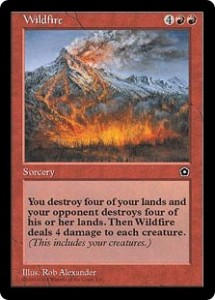
The addition of Blue to any deck usually slows down its strategy, which is not a problem for Numot. Because Numot's colors lack the Green necessary to ramp for potential early land destruction, it is more favorable to sit back and use Numot as a precision tool to remove problematic lands like Cabal Coffers and Gaea's Cradle. Numot's ability can also be the centerpiece for a potential land destruction theme by pairing it with Dingus Egg and other powerful LD spells like Wildfire and Lavaball Trap.

Like Oros, Numot's wedge is fairly balanced. Red doesn't offer a whole lot to the party, but the addition of burn as a win condition (Banefire, Comet Storm) is a good Plan B.

Vorosh, the Hunter:

Vorosh consists of an impressive combination of control-friendly colors. Green can ramp and smooth mana; Black tutors for key cards and removes problematic ones; and Blue provides countermagic and card advantage.

However Vorosh himself seems to pale a bit in comparison to the other Dragon Legends. Don't get me wrong: his ability is perfectly fine when you can kill a player with 21 Commander damage. But when the other Legends can impact the board in more profound ways, six +1/+1 counters seems too focused to capably measure up.

But a properly supported Vorosh can be a scary thing: giving Vorosh double strike with Fireshrieker or Grappling Hook can potentially net 12 +1/+1 counters in one turn. Repeatable unblockable-granting cards like Ethereal Usher and (for the ballers) Zhuge Jin, Wu Strategist ensure you can finish opponents in short order. Vorosh can also become more resilient and evasive with the help of UG Graft-themed cards like Plaxcaster Frogling and Sporeback Troll.

Vorosh's wedge is surprisingly solid because each color solves a problem. When you think about a checklist of scenarios you are likely to encounter, Vorosh seems to have solutions for most, if not all of them.

I'm sure I missed some strategies with these generals but the main take away is that your choice of Commander can either pidgeonhole your deck's strategy or grant you carte blanche. Some people enjoy building a themed deck; others prefer to start from scratch and discover entirely new strategies.

By choosing to print new Legends in the wedge colors Wizards is giving these sparsely populated color combinations a huge boost and some much needed love in Commander. Having the Planar Chaos Dragons is great and all, but new wedge Legends will help foster new play styles and deck types. When Commander is released next year it will offer a fresh experience for new players of the format, letting them discover their own Lightning Angels. And it will also give the old dogs some new tricks to try as well.

All in all, like a cheese wedge: delicious.

EDH Speculation

Are you a Quiet Speculation member?

If not, now is a perfect time to join up! Our powerful tools, breaking-news analysis, and exclusive Discord channel will make sure you stay up to date and ahead of the curve.

Last Thursday WotC announced that they would be getting a bit more involved in EDH. If you haven't already read about it the main article can be found here. I'm very excited about a number of these changes but especially the printing of new generals. When I first started playing EDH my first decks were mono-colored because they had easier mana bases to acquire. My first serious deck was a Teysa deck and at that point I had a mono-black deck as well. I figured the next step would be to build a three color deck and I wanted to start picking up some of the staples from the other three colors so I figured a URG deck would be the best way to go.

I was pretty upset when I found out that the only legend in those colors was Intet. I'm not a fan of using a general that doesn't have a ton of synergy with the rest of my deck and there didn't seem to be many exciting ways to build Teneb so I moved on to a Momir Vig deck instead.

Fortunately WotC is going to be filling in some of these holes. As a player this is what has me most excited but there is some opportunity here for trading as well. I'm sure I wasn't the only person who held off on building a URG deck until a better general was released. The same is true for other color combinations. Right now it is hard to speculate exactly what will be good since we don't know the generals but I would try to pick up some bulk cards in those wedges as throw-ins and just hold them until the decklists are released.

Kelly Reid recently wrote an article http://www.mananation.com/edh-future/ where he talked about why he thought EDH was more than just a fad. When I first read it I thought that the article was written a bit late since every big event I've attended for awhile has been filled with people playing EDH. On the larger scale this is true but then I thought about the times I've gone to smaller stores and no one had an EDH deck.

At my school there was no one, to the best of my knowledge, who had an EDH deck until the beginning of the last spring semester. I started bringing some around and slowly other people saw how much fun the format was and began to build their own decks. Of course this created an entirely new market for me since I was able to move EDH staples much easier than I had in the past.

Some of these new players just weren't aware of the format or only had a vague understanding of it but for the majority they knew what it was but didn't want to invest the time and money into a deck they may not even get to use that often. This is understandable and the new premade decks are going to make this format explode in popularity. There will be new EDH communities sprouting up all over the place as new players experience the fun that can occur in EDH.

Once players have the opportunity to actually play with others the only thing holding them back will be the perception that you need to spend a lot of money to have a good EDH deck. This is far from being true for a number of reasons. Sure you can spend a ton of money building a five-color EDH deck with all the duals, Mana Drain, etc. but most decks don't really need the expensive cards to function. EDH decks are filled with bulk rares.

In multi-player games having the most powerful deck isn't a guarantee that you will win and may actually make it more difficult since other players may gang up on you. If the premade decks are decent, as I expect them to be, there is no telling how popular these products will be. Some of the biggest problems that hurt other premade decks just aren't existent in EDH. The consistency that is lost by not including multiples of the better cards, for example, really hurt the playability of the usual premades but obviously that isn't a problem here. Many of the most powerful cards in EDH are off the reserved list and relatively cheap since they see no play in competitive formats. I don't really see a reason why they can't make these decks great starting points.

Of course they won't be as finely tuned as they can be and the cards Wizards leaves off are the cards you will want to have in your binder. These decks won't be coming out until the summer so it may be some time before we get decklists but as soon as they are out we need to pour over them and figure out what they are missing so we can make some gains off of them.

The biggest area that I'm currently considering is the mana-fixing. What options are they going to give us. Obviously the Revised duals won't be in them but will the Ravnica shock lands? I doubt it but it isn't impossible. Still, with the recent printing of the Zendikar fetch lands the shocks become essential in multi-color EDH decks. If they aren't included, and my gut feeling is that they won't be, then the demand for them will rise so I feel that picking them up now might be a good choice.

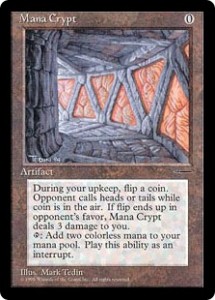
On the other hand I have a good feeling that cards like Solemn Simulacrum will be included. I would trade those away. Coalition Relic is another EDH mana-fixer that I bet will be included but they have already reprinted that in other multiplayer releases so that shouldn't affect it much. While they don't fix your mana, both Mana Vault and Mana Crypt are great in EDH decks and possible candidates for inclusion. Mana Vault is already pretty cheap but the Crypt is another story. To be honest I wouldn't be surprised if it was included but I also wouldn't be surprised if it wasn't. The best way to handle this type of a situation would probably be to hold off on picking any of them up unless the deal was good enough to mititgate the risk. If they aren't reprinted the price will probably go up a bit because there should be a little more demand for it but I don't think it would be significant enough to want to invest in them. On the other hand if does get reprinted...

Next week I plan on talking about Extended since we will have some results from Worlds. I'm also going to start using my Twitter account to actually tweet instead of just reading the tweets of others. There have been a number of occasions I thought about something during the week that doesn't make it into my article and I think may be worth tweeting about. Follow me @mattsedlak. Also I want to give a random shoutout to my friend Derek who made his first PTQ top 8 this weekend. What does everyone think about the EDH announcement from last week? Its nice to see Wizards make good decisions from time to time!

Command(er) & Conquer(ed)

Are you a Quiet Speculation member?

If not, now is a perfect time to join up! Our powerful tools, breaking-news analysis, and exclusive Discord channel will make sure you stay up to date and ahead of the curve.

The speculation was rampant. The suggestions, and their reasoning behind them, were varied. And ultimately many of us were correct in some ways but all missed the big surprise from behind the scenes.

Magic: The Gathering Commander decks are coming and I could not be more excited.

You see as an avid advocate for the format formerly known as EDH I, and many others, want Magic players to experience Commander in its true glory. We want wacky and over-the-top awesome spells. We want ridiculously sized creatures paired up against equally (or nearly as equally) sized creatures. We want tribal decks, all-colorless decks, and this-is-everything-I-like-about-my-favorite-color decks. We want a touch (or deep drenching) of political intrigue, and a few other previously unknown surprises along the way.

Everything that makes up the heart and spirit of Commander is a powerful collection of ideas, themes, and shared ideals that stretch and twist within the heart of the community. Discussion of what, exactly, Commander should or shouldn’t be has been done multiple times. Rehashing that isn’t what I’m going to talk about today.

What I’m going to share is why the changes and new product announced last Thursday are potentially the greatest news yet.

Build Order

If you’re new or recent to Commander (which you can mentally substitute with Elder Dragon Highlander (or EDH) if it helps) you may not be aware of a few key facts:

  • Commander is player driven; rules and banning are set independent of DCI and Wizards (thanks to the hard work of the Rules Committee).
  • Commander has player-participants and advocates with Wizards of the Coast.
  • Magic R&D has designed cards with Commander, and other multiplayer formats, in mind.

It’s not a secret that prominent Wizard employees such as Aaron Forsythe, Ken Nagle, Scott Larabee and Kelly Digges all love it. So does Sheldon Menery, top dog of the DCI and frequent writer of all things Commander. Even professional players, like Sam Black, actively get in on the action.

That is why there should be little wonder that more and more cards that seem “perfect for Commander” have appeared recently: there is significant interest, demand, and personal investment for them. This summer’s product release is simply another way to actively support it by designing unique cards in a unique product release.

And like just about every new change there’s been some voices disagreement:

  • What if a new card becomes valuable for Legacy or Vintage?
  • Five decks at $30 (plus tax!) is OMGWAYTOOMUCH!
  • Wizards is now taking over and changing everything!
  • Now Commander is now a tournament format and everything is ruined forever!

Before I continue let me clarify: it’s okay to feel strongly about the announcement. Whether it’s favorably or unfavorably, being invested in and caring about the something you love (or hate, because haters got to hate and all that) is a really good thing. That passion is what drives things, and each of us, to greatness. (And my personal passion is exactly what drives me to write about this.)

But these complaints should not be concerns at all.

A New Card Becomes Valuable to Legacy or Vintage?

Let’s be honest: they previewed two cards. One gives a 5/5 dragon to every player other than the targeted one for a healthy seven mana. The other is an expensive legendary awesome that can recur a creature, by paying full mana price, once per turn.

These were not chosen randomly.

In fact, as so clearly stated, these were chosen to exemplify the principle of multiplayer interaction and social atmosphere of the multiplayer games Commander is meant to encourage. We’re not talking about a new Survival of the Fittest (they did that in Fauna Shaman), functional copies of the dual lands (something that’s expressly forbidden by the Reserved List agreement, and was essentially done with the Ravnica Block “shock” lands), or some hyper-efficient version of an already efficient Legacy staple.

We’re talking about a card that is a very expensive way to get a basic 5/5 flying Dragon, or a wacky but very interesting legendary creature at a converted mana cost that is only every cheated into play in Eternal formats.

These cards are specifically designed to not be these staple type cards. They are powerful, sure, but in contexts that are more common and specific to Commander games. Just like the scheme cards from Archenemy and the plane cards from Planechase some of these new cards will certainly be “better” in the terms of efficiency, power potential, and flexibility.

But it appears that the goal for the design of these new cards was to be optimal in a multiplayer environment.

Is there a chance that a card would be amazing for the deepest of competitive formats? Perhaps; stranger things have happened. But if I were a gambling man I’d place my bets solidly on the side of “Not going to happen.”

The Price is Unfair and Hurtful

There’s a lot of talk about prices in Magic, especially today in this age of financial content and ever growing discussions on trading and price trending. To say that there won’t be a financial impact due to these upcoming decks is a straight up lie: with decks of this size there should be at least a handful of reprints that will be useful cards.

All of the special release products, such as the Premium Deck Series and Duel Decks series, have included a few cards that easily carry some value. I won’t go into specific specifics as this isn’t my area of expertise but it’s easy to accept some reprinted cards are going to be useful to Commander players in general. When talking about building 100 card decks some utility is naturally going to appear.

Is $30 a fair price? Is $150 a fair price for all five decks? That’s an very subjective question.

These decks have to cost something and this price point, considering the size, scope, likely utility, new designs, and oversized “enhanced” Commander cards (for lack of a better term) I believe $30 is pretty fair.

Let’s put a little perspective on it: you want a Jace, the Mind Sculptor (like everyone else playing Magic). Either you’re buying him outright or cracking booster packs.

Only one of these ways is a solid guarantee.

If you want some new things for Commander these decks will likely be a sure thing. There’s no chance you’ll end up missing things. There’s no disappointment that what you opened isn’t what you had hoped. You get exactly what you ordered every time.

How much getting what you want is worth to you is entirely subjective. A price can be fair even if it’s obscene; if you wanted to buy the Hope Diamond the price can be nothing other than exorbitant. Worth is subjective; what’s obscene to you may be more than reasonable to someone else.

The Dirty Hands of Wizards are Now All Over My Precious

Recall the love for Commander, in its true community form, expressed and participated in by many members of our favorite hobby company. Now factor in that the format now known as Commander has been part of the comprehensive rules since September 2009.

Yes, EDH was “official” for well over a year.

There was no “BANG!” bullet of death for the format. There was no Pro Tour with it as a format. The point of inclusion of the rules, as determined by the player run committee, was to ensure that official Magic documentation shared the same information to everyone.

They wanted to make the message clearer than simply providing a web link. The rules are something not considered lightly. They wanted to make sure everyone had an indisputable source to point to.

Every big Magic event that I have attended has had Commander as a side event. Judges still play pickup games after the rounds have all ended for the day but you’re also just as likely to catch it everywhere throughout the events. Traders are ever more seeking out the cool cards they “need” for their Commander decks are as ubiquitous as black tee-shirts.

Wizards doesn’t want to change or force anything that contributes to the organic growth of Commander. They want to help more players experience it. Decks with new cards can only be produced by the Wizards themselves.

Relatedly, the biggest issue I’ve run into with Commander is that new and newer players have neither the card pool nor the card knowledge (that is knowing specific effects and cards exist) to put together a deck. They can borrow decks, and many do, but having your own deck feels so much better than anything customized by, and for, someone else. While I hesitate to truly say the upcoming decks will be “strong” since we know nothing about them (and that’s also very subjective), having a deck you can own, to change and try things as you want, that has some awesome cards you want anyway is going to be a great thing.

Pro Tour: Commander is Just Around the Corner

No. Just no. This, for fact, is not going to happen.

Yes, there are Commander tournaments. Anytime there is an amazing way to play some players are going to want to play it more competitively. During the heyday of Peasant (I sure do miss that format!) “Championships” were played at GenCon. The rules and banned list were constantly attended to and updated if needed. Strategy, tech, and a unique metagame emerged. And its cousin online, Pauper Deck Challenge, continues down the same trail already blazed.

Commander and competitive is an interesting dynamic. To say that it’s “wrong” to want to compete is the same as to say that it’s “wrong” to want to play an aggro deck or the color blue. We all want to play the ways we want to play. Regardless of what discussions or “social contracts” are placed on Commander, competitors will compete.

And that’s perfectly fine.

Commander tournaments aren’t for everyone the same way any tournament isn’t for everyone. If you don’t want to compete you don’t have to. Find those who also don’t want to throw down for prizes and start your own games.
That’s what I do at big events.

Players having decks designed for competition being at, unfortunate, odds with players who do not is a longstanding situation. But its been repeatedly stated that Commander isn’t going to be a big sanctioned format. There won’t be any Commander ratings or “real, ultimate tech” to be discovered. Some decks will blow out a combo on turn four every game, or artfully craft a board presence that cannot be mitigated or countered.

But from my experience on the floor of tournament events most decks will continue to be the crazy, wacky, good-times-are-a-comin’ decks those of us who buy into the community spirit of Commander love.

You can’t force others to play the way you want but you can choose to play only with players who do. (Say that five times fast – then don’t forget it.)

Get Over Yourself

Commander, at least for me, is fun incarnate. How you define that fun and exactly what deck you build to experience it may be intimately personal, but Wizards understands this. They aren’t looking to take everything that’s working and wreck it. They want the same thing we want: good times and great Magic.

Magic: The Gathering Commander decks are a good-faith statement from the highest level of the game – the makers themselves – joining in and giving the greatest gift they can: cool, new cards and even easier access to playing.

Stop griping, quit bitching, and join in celebrating the amazing response the community had been given for its years of hard work and proselytizing. This is a great time to playing Magic and will soon be and even greater time to be playing Commander.

Don’t let your unfounded fears ruin it for yourself.

Adam Styborski

Adam Styborski is a Magic player, marketer, and writer based out of the Washington, D.C. metro area. An acolyte of big events, kitchen tables, and everything inbetween, Adam finds interesting and contemplative subject matter across the entire range of Magic. With his trusty pauper cube, EDH decks, and occasional Constructed favorite you'll find just about everything touched at some point - mainly what you are asking to hear. As an editor for Quiet Speculation, Adam is a resource for your suggestions, submissions, questions, and concerns about anything that doesn't involve tournament decks and financial musings. You can reach out to him at styborski@gmail.com or on Twitter as @the_stybs.
View More By Adam Styborski

Posted in Feature, Free, TimmyTagged , 4 Comments on Command(er) & Conquer(ed)

Have you joined the Quiet Speculation Discord?

If you haven't, you're leaving value on the table! Join our community of experts, enthusiasts, entertainers, and educators and enjoy exclusive podcasts, questions asked and answered, trades, sales, and everything else Discord has to offer.

Want to create content with Quiet Speculation?

All you need to succeed is a passion for Magic: The Gathering, and the ability to write coherently. Share your knowledge of MTG and how you leverage it to win games, get value from your cards – or even turn a profit.

Gathering Specimens

Are you a Quiet Speculation member?

If not, now is a perfect time to join up! Our powerful tools, breaking-news analysis, and exclusive Discord channel will make sure you stay up to date and ahead of the curve.

This week I’m going to change the format up a little bit, and cover a variety of topics. There were a lot of smaller things that happened, but nothing worth covering in a large amount of detail so I’ll try to give all of you a general update on everything I can cover here from the SCG invitational and opens, the Wizards announcement for EDH/Commander support, and a bit of a recap for the newer readers to the site that we’ve picked up.

Awesome things have happened since last week, and most of them have happened in the past few days. As many of you probably know, Gerry Thompson (@G3RRTY) won the SCG Invitational with R/G Titan Ramp.

On the upward swing. Train is leaving the station.

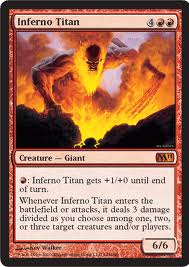
While its focus was abusing Primeval Titan there was also a single copy of Inferno Titan in his list, and another 2 copies of the red titan in one of the R/U/G control deck played by Adam Cai. Inferno Titan is picking up in popularity, and Worlds this week could be its breakout stage. I hope you picked yours up earlier in the year, because the train may have already left the station as Starcity already has them at $9.99 and CFB is sitting at $8.99. You can still probably pick them up in trade for $4 - $5 if you’re quick, but they are being affected by the metagame shift as B/R Vampires and Boros based aggro strategies start becoming more prevalent. This could bring the trade value of Inferno Titan at or above $10 as it sees an increase in popularity in the same fashion that Frost Titan did.

Things also got interesting on the Vintage side of the metagame, as Quiet Speculation’s own contributor and first e-book author Stephen Menendian (@SMenendian) took a top 8 slot in the RIW Vintage tournament with his Gush Oath deck which he talks about in his book. I tried to find the rest of the top 8 lists to see if anything innovative came from there, but so far I’ve been unsuccessful.

The SCG Legacy open was also this past weekend, with a top 8 that saw the continued dominance of the Survival of the Fittest/Vengevine combination making up 50% of the top 8, a pair of Ad Nauseam Tendrils or ANT decks, Aggro Loam, and U/W aggro. Going over these lists, there isn’t a whole lot of new tech out there that we can capitalize on, but something to note is that the U/W aggro list is worth taking a look at as some of the uncommons in the list could see a small surge in popularity. Survival won the event again, is anyone surprised?

On the more causal (read: highly profitable) side of things, Wizards has announced support for EDH/Commander in the form of preconstructed decks for the format. For us this is great, because this will open more people to the format, and create more demand for niche cards that can carry a weighty price tag. Stock up on popular generals and necessary EDH/Commander staples now, because once the precons come out it will be much easier to open up a market and then help people improve their decks, while you improve your profit margins. Blue is one of the most popular colors to play in EDH because of its power, so consider getting cards like Sen Triplets, Dralnu, Lich Lord, Grand Arbiter Augustin IV, and Sharuum, the Hegemon now to trade off as generals. Since I don’t play much in the way of EDH/Commander myself I asked a friend of mine Brian D. (@MTGVeteran) for some advice on basic staples to pick up.

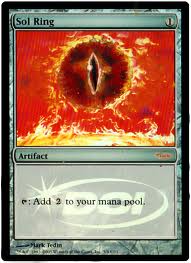
“Pick up Sol Ring,Temple of the False God, Sensei's Divining Top, tutors, and fetch lands, dual lands, karoo lands, and signets to help players build their mana bases.” – Brian

"Eye" see this being traded for much profit to EDH players.

Since mana bases are often one of the most expensive pieces to build in a multi color EDH deck this is a great potential source of profit, so pick up anything multi colored that you can now if you can get it cheap, because when someone is looking to complete their mana base or smooth it out a bit, having the cards on hand will allow you to charge a premium for them.

The site has gone through some major overhauls recently, and I can’t begin to state how awesome it is that we’re expanding the way we are. All of our Spike content has been quality material, and though I may not be much of a fan of the Timmy side, it’s been fun to read and look outside the world of trading and competitive magic. Big props to both of our new teams, and if you haven’t gone through and read their stuff yet, you’re missing out.

For those of you who are new to the financial side though, I’d like to offer you my favorite three finance related articles. If you don’t read any other material from the past, I think these three are the most important for you to develop faster as a trader.

  1. Maximizing E-Bay Profits by Douglas Linn
  2. Uncommonly Good Chas Andres
  3. The Demand Matrix Chris McNutt

Doug's article is amazing for anyone looking to sell anything on e-bay, not just magic cards. His article answered questions about selling on e-bay I didn’t know I had.

Uncommonly Good covers how uncommons can actually turn up a ton of unexpected profits, and is a stellar read all on its own. Many people trade off uncommons at a rate nowhere near their actual value, and knowing which ones to go after will help you keep the margins in the black.

Chris McNutt, master of Excel spreadsheets, keeper of buy list prices and demand indexes. His articles are easily one of the most powerful tools you can incorporate into your toolbox and I highly recommend them. His information is always useful, and up to date.

That’s about it for this week, I know none of this was super in depth, but as I said I’m trying out a new format. Please let me know what you think in the comments, great discussion starts there, and your voice means a lot.

Until next week,

Stephen Moss

@MTGStephenmoss on Twitter
MTGstephenmoss@gmail.com

Eldrazi Green-Red

Are you a Quiet Speculation member?

If not, now is a perfect time to join up! Our powerful tools, breaking-news analysis, and exclusive Discord channel will make sure you stay up to date and ahead of the curve.

Welcome to the Present-Present League! In this new semimonthly article series I'll explore new decks and new twists on known decks for the current Standard environment. The column title, "Present-Present League" is a nod to Wizards of the Coast R&D's Future-Future League in which I participated quite avidly for a couple of years. This week I'm easing into things with a twist on a known deck. I've added Red to Eldrazi Green to see if I can improve the deck's chances against the faster decks in the format, without sacrificing anything against the Control matchups.

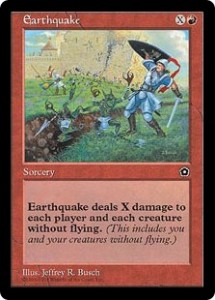
I played an Eldrazi based deck in US Nationals earlier this year, and modified the pure Green version to include Red. I played Lightning Bolts and Earthquakes to great effect. They allowed me to keep Aggro decks from under-running me, and gave me removal effects for Planeswalkers that the mono-Green version can't really handle before it gets to All is Dust mana.

Current standard is quite a bit different, but Eldrazi Green is still around. Here's the Red-including version that I'll be looking at today:

Eldrazi Green-Red

Creature

1 Emrakul, the Aeons Torn
1 Ulamog, the Infinite Gyre
4 Primeval Titan
1 Wurmcoil Engine
2 Pelakka Wurm
2 Acidic Slime
4 Joraga Treespeaker
4 Overgrown Battlement

Instant

4 Summoning Trap
4 Lightning Bolt

Sorcery

4 Explore

Artifact

4 Everflowing Chalice

Land

4 Copperline Gorge
3 Raging Ravine
1 Rootbound Crag
4 Eldrazi Temple
4 Khalni Garden
7 Forest
1 Mountain
1 Eye of Ugin

SB

2 All Is Dust
4 Pyroclasm
4 Obstinate Baloth
1 Terastodon
2 Staggershock
2 Plummet

The maindeck Lightning Bolts are excellent against all the fast decks, and they're pretty effective at killing off Jace, the Mind Sculptor. The sideboard is loaded with Pyroclasms and the obvious Obstinate Baloth.

Matchups

Kuldotha Red

Michael Farrell's Kuldotha Red

Creature

4 Goblin Guide
4 Goblin Bushwhacker
4 Goblin Chieftain
2 Spikeshot Elder
4 Memnite

Instant

4 Lightning Bolt
3 Burst Lightning

Sorcery

4 Kuldotha Rebirth
2 Devastating Summons

Artifact

4 Panic Spellbomb
4 Chimeric Mass
1 Trusty Machete

Land

4 Arid Mesa
4 Scalding Tarn
2 Teetering Peaks
10 Mountain

SB

3 Arc Trail
3 Mark of Mutiny
3 Perilous Myr
3 Ratchet Bomb
2 Shatter
1 Sword of Body and Mind

I hadn't tried this deck yet, so I wasn't sure at first what would happen. Turns out it's strangely inconsistent for a fast deck. It would sometimes deal 8 damage on turns 2 and 3, and sometimes it would plink away pitifully until I cast a fatty to dominate it with. Kuldotha Rebirth is the most dangerous card they have, as you rarely have more than a couple of guys to block with, and they have two ways to make them all 2-power attackers. I tended to win the games they didn't cast Rebirth, especially if I had a Bolt to take out at least one of their guys. Khalni Garden is excellent against them as well - never use the token to block just one damage, their minimum burn spell is 2, so you should always save at least 2 damage. (Spikeshot Elder not withstanding. He's weak in this matchup, and it is a card I would side out if I were playing the Kuldotha deck).

Sideboarding

+4 Pyroclasm
+4 Obstinate Baloth
+2 Staggershock
-4 Summoning Trap
-2 Acidic Slime
-1 Primeval Titan
-1 Emrakul, the Aeons Torn
-1 Ulamog, the Infinite Gyre
-1 Eye of Ugin

I know, you're playing Eldrazi because you like the fatties, but Kuldotha Red is very fast and has little reach in longer games. Comparatively, you are still playing much bigger guys than they are. They'll bring in Mark of Mutiny against you, which you can sometimes play around. When you play a big guy, see if you can account for having it borrowed for a turn. Sometimes you will have to risk it, but sometimes you can hold back just enough to not die if they have it. Pyroclasm demolishes the draws that really scare you, and combined with the Obstinate Baloths and other burn, it should keep you high enough in life that a single Mark won't kill you. Pelakka Wurm is a real hero, and if you can cast one you should be fine. Note that it gains almost as much life as it can Mutiny for.

GW Quest

Gregory Weiss's GW Quest

Creature

4 Birds of Paradise
4 Fauna Shaman
4 Glint Hawk
4 Squadron Hawk
4 Vengevine
4 Memnite
4 Ornithopter
3 Molten-Tail Masticore

Enchantment

4 Quest for the Holy Relic

Artifact

2 Argentum Armor

Land

5 Forest
8 Plains
4 Razorverge Thicket
3 Sunpetal Grove
3 Stirring Wildwood

SB

3 Stoneforge Mystic
1 Kor Outfitter
1 Sword of Body and Mind
1 Trusty Machete
3 Devout Lightcaster
3 Kor Firewalker
2 War Priest of Thune
1 Kor Sanctifiers

This is a really cute Aggro-Combo hybrid deck. Game 1 you can die from a pile of 1/1 fliers, the Fauna Shaman + Vengevine combo, or an early quested-out Argentum Armor. The Armor is actually the least scary, because the maindeck Acidic Slimes handle it quite well. The fliers are a big problem because you don't have anything that can block them, and there always seem to be a full squadron coming at you. Sometimes you'll have a choice between bolting a Fauna Shaman or accelerating mana. Always Bolt the Shaman! That gal is extremely dangerous and one of the reasons Bolts in the main are so good. In games 2 and 3 I wouldn't hesitate to spend a Pyroclasm on a single Fauna Shaman, which brings us to...

Sideboarding

You can sideboard the same as against Kuldotha Red, or if you want to keep in the biggest guys you can try it this way:

+4 Pyroclasm
-4 Summoning Trap

The important thing is to get those Pyroclasms into your deck. Obstinate Baloths can help here, but they "trade" with Vengevine (who will just come back anyway) and are poor finishers against this deck. This deck doesn't seem to have any sideboard cards against you other than Sword of Body and Mind. It's a good card, to be sure, because it can push a Vengevine past your chump blockers, but their mana is usually best spent elsewhere. You also still have the Acidic Slimes to take it out. I didn't lose with either of the above sideboarding plans, but my sample size was only 6 games. If they hold back against a Pyroclasm you ramp up and get too far ahead. If they play out their guys, you Pyroclasm. I recommend you draw at least one each game, haha!

RUG Control

Ryan Rolan's RUG Control

Creature

2 Avenger of Zendikar
2 Frost Titan
4 Lotus Cobra
3 Oracle of Mul Daya

Instant

4 Lightning Bolt
4 Mana Leak

Sorcery

4 Preordain
4 Explore

Enchantment

1 Volition Reins

Planeswalker

1 Garruk Wildspeaker
4 Jace, the Mind Sculptor

Land

3 Copperline Gorge
4 Forest
2 Halimar Depths
4 Island
4 Misty Rainforest
2 Mountain
4 Raging Ravine
4 Scalding Tarn

SB

2 Flame Slash
3 Flashfreeze
1 Gaea's Revenge
3 Obstinate Baloth
3 Pyroclasm
3 Spell Pierce

This matchup seemed pretty luck dependent. Ideally, you'll have a bunch of mana dudes and Summoning Traps. You can safely cast all the Joraga Treespeakers and Overgrown Battlements you want and hope they counter them so you can Trap out a real creature on turn 2. Most likely, they will have learned that lesson already, and won't counter your little guys, which is fine with you. If you then find a big guy and they try to counter that, you just Trap them anyway. Watch out for Red mana, because it means a Lightning Bolt could be headed for your Elf del Sol Ring as you level it up. Casting a Battlement might be a better idea that turn. Avenger of Zendikar is their best win condition against you. Start calculating carefully if one hits the board, you might feel okay but often you have only one out from that position and need to play to it. That out is often top-decking Emrakul to hard-cast it, or more likely, finding All is Dust (in games 2 and 3) before you run out of life. Eye of Ugin is really nice here, because they can't destroy it (unlike other control decks, RUG doesn't play Tectonic Edges).
It's true that the Jace, the Mind Sculptor / Oracle of Mul Daya engine is strong, but it's also extremely fragile. Lightning Bolt is so very good in this matchup. The hard part comes when you need to decide to Bolt an early Lotus Cobra or save it for one of their combo pieces. I don't claim to know the answer, as Lotus Cobra is very dangerous. They can't realistically play a 6-drop on turn 3, but they could chain out a series of Explores and Oracles that put them way ahead on mana. Unless they played two fetchlands already to cast the snake, I'll usually Bolt it, and certainly if it doesn't cost me acceleration of my own. Don't beat yourself up too much if you made this choice one way and it seems like you were wrong when they destroy you later on, it can be difficult to tell what they will do next turn.

Sideboarding

+2 All is Dust
+1 Terastodon
-2 Pelakka Wurm
-1 Wurmcoil Engine

The Wurmcoil doesn't exactly shine here, though there might be another card you'd rather take out. Ulamog is just so much better most of the time, and Terastodon is often a triple Ulamog against them. If you take away all of their sources of a single color, especially Blue, it can be crippling. All is Dust is amazing against them, and one of the few cards that can turn the game around in a single turn, saving you from plant tokens (they are green) or releasing you from a Jace or Frost Titan lockdown. RUG is doing very well right now, because too few decks have ways to kill of their small guys. Despite all the draw-smoothing effects I find the deck to be very draw dependent. If you think carefully about what they have played so far, and what they could have played, if they had it, you can often guess what they've got in their hand. If you like All is Dust you can certainly use this matchup as an excuse to find room for one maindeck or even 4 sideboard slots for it. It's a little show as a Wrath against the weenie decks, but it could still save you in game 1.

BR Vampires

Oh look, you found it! I built a variety of Vampire decks for the FFL, most of which did not make a real appearance in Standard. For example, I never saw a splash for Maelstrom Pulse back when that and Vampire Nocturnus were legal. Nowadays, the Viscera Seer / Kalastria Highborn combo has not gone unnoticed and we are seeing a fast and deadly Lightning Bolt-including deck that's very similar to one R&D found in development.

BR Vampires

Creature

4 Vampire Lacerator
4 Pulse Tracker
4 Bloodghast
4 Gatekeeper of Malakir
4 Viscera Seer
4 Kalastria Highborn

Instant

4 Lightning Bolt
2 Burst Lightning

Sorcery

3 Mark of Mutiny

Enchantment

2 Dark Tutelage

Planeswalker

1 Sarkhan the Mad

Land

12 Swamp
4 Dragonskull Summit
4 Lavaclaw Reaches
4 Blackcleave Cliffs

SB

3 Arc Trail
4 Duress
4 Doom Blade
3 Manic Vandal
1 Mark of Mutiny

Hmm, what have we here? I've changed a card! I took out one Burst Lightning for a copy of Sarkhan the Mad. This Planeswalker does everything the Vampire decks could want it to do. It can draw cards for free (and since everything else is so cheap it can draw many cards over time), it can give the deck surprising reach (Pulse Tracker makes for an excellent 5/5 Flyer), and it serves as a sacrifice outlet for Mark of Mutiny and Kalastria Highborn. Plus it can finish off an opponent the next turn if they leave both it and your new pet Dragon alone. The only drawback to the card is the 5-mana casting cost, so while one of them almost has to be an upgrade to this deck, I'm not sure about more. Finally, while I wouldn't expect it to happen, in a pinch it can also turn a Trapped-out Eldrazi into a 5/5 Flier.

Game 1 is difficult for the Eldrazi side. You simply have to send back hands that don't have a Lightning Bolt or an Overgrown Battlement, as there's not much you can do without them if their draw is decent. Vampires was by far the most consistent of the aggressive decks I tested against, and I did not fare well before sideboarding. When you have the choice, always bolt Kalastria Highborn (if that wasn't obvious). If they untap with one, you are already dead.

Sideboarding

+4 Pyroclasm
+4 Obstinate Baloth
-2 Summoning Trap
-2 Acidic Slime
-1 Emrakul, the Aeons Torn
-1 Ulamog, the Infinite Gyre
-1 Primeval Titan
-1 Eye of Ugin

Almost the same as for Kuldotha Red. I left out the Staggershocks here because they're slower than the other burn, and you really need some guys on the table to survive. Keeping two Traps gives you a little bit more chance of finding a Pelakka or Baloth when you're desperate for life. That, and I felt a little lame giving the same sideboard plan for so many match-ups. In games 2 and 3 they can bring in Doom Blades, but there's not much to take out as everything else is pretty effective. In my small sample size (small number of games actually played) this was the most difficult opponent.

UB Control

I forgot where I found this UB Control

Creature

2 Grave Titan
4 Sea Gate Oracle
3 Abyssal Persecutor

Instant

4 Mana Leak
4 Doom Blade
2 Into the Roil

Sorcery

4 Preordain
2 Consuming Vapors

Artifact

2 Mimic Vat
3 Everflowing Chalice

Planeswalker

4 Jace, the Mind Sculptor

Land

4 Darkslick Shores
4 Creeping Tar Pit
4 Drowned Catacomb
4 Tectonic Edge
1 Misty Rainforest
1 Marsh Flats
5 Island
3 Swamp

SB

2 Consume the Meek
3 Memoricide
3 Disfigure
2 Flashfreeze
1 Jace Beleren
2 Spell Pierce
2 Duress

I choose a Mimic Vat build because you have a lot of guys worth imprinting. This turned out to be quite telling, as the Vat was a serious problem. This matchup is what led me to including Acidic Slime maindeck, and I later found it was quite good against other decks as well. If you feel the metagame is more Aggro than Control, or if you feel you don't need the Slimes against Control, these two slots can be Obstinate Baloth in game one. But I've digressed.

As I said, Mimic Vat can be an enormous problem if you don't have an Acidic Slime. Naturally Ulamog can do the job too. He's excellent here, as bouncing him with Jace often does very little. The other big problem UB has for you is Abyssal Persecutor. It kills you very fast, and it's a race for you to kill them first. I added Plummets to the sideboard, for both Abyssal and UW's Baneslayer Angel.

Sideboarding

+1 All is Dust
+1 Terastodon
+2 Plummet
-2 Pelakka Wurm
-2 Lightning Bolt

Not much to change here. The matchup is pretty good, though by no means a blowout in your favor. The biggest problem is that they can bring in Memoricide from the sideboard, and there's not much you can do about it. I considered attempting threat diversity by pulling out a Primeval Titan, but it's silly to take them all out. Might be hilarious for game 3 though, if you want to experiment. I wish there was a Cloudthresher type of guy to bring in instead of Plummet, but at least the Instant is cheap to cast.

UW control

Kyle Sanchez's UW Control

Creature

3 Baneslayer Angel
1 Sun Titan
4 Wall of Omens

Instant

3 Condemn
2 Into the Roil
4 Mana Leak
3 Spell Pierce

Sorcery

3 Day of Judgment

Enchantment

2 Journey to Nowhere

Artifact

2 Ratchet Bomb

Planeswalker

3 Jace Beleren
3 Jace, the Mind Sculptor
2 Gideon Jura

Land

4 Celestial Colonnade
4 Glacial Fortress
3 Island
3 Plains
4 Seachrome Coast
4 Tectonic Edge
3 Terramorphic Expanse

SB

1 Condemn
1 Day of Judgment
4 Flashfreeze
1 Jace Beleren
4 Leyline of Sanctity
3 Negate
1 Ratchet Bomb

They only have one real threat: Baneslayer Angel. UW seems weaker than UB control these days, and certainly less popular. Use Acidic Slime to take out lands, especially Celestial Colonnade when you can. Spell Pierce and Ratchet Bomb can stunt your early mana development pretty badly. Also keep Spell Pierce in mind when you think it's safe to cast a trap. Don't give up too soon against any Control deck. The long games are yours to win and a small mistake by them can give you the room you need.

Sideboarding

+1 Terastodon
+2 Plummet
-2 Pelakka Wurm
-1 Lightning Bolt

Similar to sideboarding against UB, though All is Dust is less useful here. You could take out Acidic Slime for All is Dust, but I find the land destruction capability to be quite useful at times. The other great thing about Acidic Slime against Control is the way it draws the tapping from Frost Titan, leaving your mana free to cast the next threat. Their sideboard seems unexciting against Eldrazi, despite their weakness to it. They can bring in a pile of counterspells, but all that does is make the game take longer and make it more certain to end in your most favorite way - with a hard-cast Emrakul, the Aeons Torn.

I have not yet tested against the Luminarch Ascension version of the deck. Again, I expect Acidic Slime to be excellent, but the Angel-spewing enchantment has been underestimated as a choice for Standard for far too long.

That's all the testing I was able to get in for this article. I certainly found that Pyroclasm makes the Aggro matchups much more winnable, some shifting entirely in your favor (Kuldotha Red). The Bolts are fine against the Control decks, and Raging Ravine is great to have in many matchups. I took out all the Cultivate type effects to fit in the Red cards, because I feel there is too much of that sort of card in the deck. You need to draw a balance of acceleration and threats or answers no matter what, and having an overload of mana sources doesn't do you as much good as it does for Valakut, the Molten Pinnacle decks.

Join me in two weeks, when I try to create an entirely new deck for standard. Thank you for reading!

Gregory Marques
Design-Side Out

Sideboarding With Pyromancer Ascension

Are you a Quiet Speculation member?

If not, now is a perfect time to join up! Our powerful tools, breaking-news analysis, and exclusive Discord channel will make sure you stay up to date and ahead of the curve.

The current Standard environment appears very defined, indeed almost boring. Yet there are still places for archetypes to slip through the cracks. One of the main things that the current metagame is lacking is a Combo deck - something to balance out the Control-Midrange-Aggro competition. While R&D has done their best to make it difficult for Combo to prosper in Standard, it is by no means impossible to break out with it. In today’s article I want to look at a well known and well loved archetype that fell out of favor after the last rotation: Pyromancer Ascension. Let’s take a look at my current list.

Untitled Deck

Maindeck:

4 Lightning Bolt
2 Burst Lightning
4 Pyromancer Ascension
4 Preordain
2 Spell Pierce
4 See Beyond
4 Treasure Hunt
4 Mana Leak
3 Into the Roil
2 Call to Mind
3 Foresee
4 Halimar Depths
4 Scalding Tarn
10 Island
6 Mountain

SB:

3 Pyroclasm
1 Burst Lightning
2 Spell Pierce
1 Into the Roil
3 Jace, the Mind Sculptor
4 Flashfreeze
1 Jace Beleren

The deck should be pretty easy to understand. Power up the Ascension with cheap card draw and fling copied Bolts at the opponent’s head, using copied Call to Minds to buy back as many burn spells as you need to finish the job. I feel that the deck has a place in the current metagame because of its amazing matchup against Control, as well as the more Midrange RUG decks running around. While UB control does have Memoricide, and a few builds of other control decks have Into the Roil or Ratchet Bomb, because they all have so few ways to deal with an Ascension, you’ll almost always have enough countermagic to deal with them.

A popular sideboarding strategy last season was to bring in a Polymorph package, which unfortunately isn’t available any more. While some have suggested other creatures, like Kiln Fiend or Echo Mage, I feel removal is too prevalent right now due especially to the rise of Vampires as a legitimate Aggro deck. If I was to board in creatures, it would probably be some kind of Titan, most likely Frost, though Wurmcoil Engine could be pretty good. But let’s move on and look at some common matchups.

U/W Control
+3 Jace, the Mind Sculptor, +1 Jace Beleren, +2 Spell Pierce
-2 Burst Lightning, -2 Foresee, -1 Lightning Bolt, -1 Into the Roil

Here you want to maximize your ability to play the long game by boarding in your Planeswalkers. While Foresee is an amazing source of card advantage, you end up with too many expensive spells in your deck, so it needs to get cut. Problem cards in this matchup are pretty varied, ranging from fairly standard Into the Roil and Ratchet Bomb, to some stranger stuff like Luminarch Ascension (which is actually pretty bad against us). All in all, an excellent matchup, as they put almost no pressure on you and have few ways to deal with turn 2 Ascension, especially on the draw.

U/B Control
Same boarding as U/W

A similar archetype to U/W but a significantly worse matchup. Because U/B has access to Duresses and Memoricides, I’ve often had to depend on trying to win with Jace, but it's not too effective when they have a Creeping Tar Pit. It is critical you DO NOT tap out on turn 4 for Jace, even if they are tapped out, if you suspect they have a Memoricide. It is almost impossible to win without an Ascension. I’ve only managed it once, milling out an MBC player twice with Jace Beleren.

Valakut Ramp
+3 Jace, the Mind Sculptor, +4 Flashfreeze
-2 Burst Lightning, -2 Foresee, -3 Into the Roil

An even to slightly favorable matchup, the die roll is critical here. The question really is if you can power up an Ascension before they can resolve a Primeval Titan or Avenger of Zendikar. We do unfortunately have to board out Foresee, because tapping out on turn 4 against the threat of a Primeval Titan kind of sucks, so we need to board into a cheaper, more streamlined build. Into the Roil is also quite bad against Valakut. Unless they’re one of the stranger builds running a Swamp in the sideboard for Memoricide, you shouldn’t have too much to worry about other than Primeval Titan or Avenger of Zendikar. Gaea's Revenge and Oracle of Mul Daya aren’t typically problems unless you have no action, and Wurmcoil Engine is almost a joke.

Vampires
+3 Pyroclasm, +1 Burst Lightning
-2 Foresee, -2 Spell Pierce
(if it’s B/r Vampires, add +1 Flashfreeze, -1 Into the Roil)

Terrible, terrible matchup. Traditional Aggro decks are fine, but Vampires is a very difficult matchup. Bloodghast, Kalastria Highborn, and Bloodthrone Vampire all team up to make your life a nightmare, and you often need to both win the die roll and get quite fortunate to win this one. Good luck!

Quest WW
+3 Pyroclasm, +1 Burst Lightning
-2 Spell Pierce, -2 Foresee

A pretty good matchup, but it’s very dependent on whether they have the Stoneforge Mystic or the Quest for the Holy Relic draw. If they have Quest, it’s not too hard as you can answer Argentum Armor with Into the Roil and then Pyroclasm their army, but facing down Squadron Hawks with Sword of Body and Mind can be quite difficult. Just play cautiously and don’t spend mana unnecessarily.

Those are all the matchups I’m covering for now, as the rest are just variations on this, and they can easily be figured out if you choose to play the deck. While this deck doesn’t have the same pedigree or resume that RUG or U/B control do, it is a possible contender in today’s environment. So if you’re looking to play an innovative, fun, and fast deck that can still win, Pyromancer Ascension is probably your best bet. Best of luck to all of you who choose to play it, and even those that don’t, and I wish you well at your upcoming PTQs or SCG Invitationals.

--Noah Whinston
mtgplayer@sbcglobal.net
nwhinston on Twitter
Arcadefire on MTGO

Building a Better Pyromancer Sideboard

Are you a Quiet Speculation member?

If not, now is a perfect time to join up! Our powerful tools, breaking-news analysis, and exclusive Discord channel will make sure you stay up to date and ahead of the curve.

Welcome back to The Brewery on Quiet Speculation!

Just about anybody who has played the Pyromancer Ascension deck in Standard will confirm: Postboard games can be quite frustrating! First, a decklist:

Untitled Deck

Maindeck:

4 Preordain
4 Lightning Bolt
2 Burst Lightning
1 Pyroclasm
4 Mana Leak
3 Into the Roil
2 Deprive
4 Pyromancer Ascension
4 See Beyond
3 Jace Beleren
2 Call to Mind
4 Foresee
9 Island
7 Mountain
4 Scalding Tarn
3 Halimar Depths

SB:

4 Negate
4 Flashfreeze
1 Spell Pierce
1 Jace Beleren
3 Pyroclasm
1 Burst Lightning
1 Into the Roil

I settled on this particular maindeck after quite the well-documented love affair with Pyromancer Ascension. Every card pulls its weight just about perfectly, although I could see the numbers of Into the Roils and Burst Lightnings being swapped without too much complaint.

The sideboard, however, is a piece of crap.*

Pyromancer Ascension needs an alternate win condition in the sideboard

There was a time when this deck was flying under the radar (well, as much as arguably the strongest deck from last season can really do) and the best reason to bring in a card like Kiln Fiend or Frost Titan was that your opponent simply sideboarded out their removal for game 2! This would also put your hapless opponent in a difficult decision for game 3: Assuming you practice crafty sideboarding procedures (You do shuffle all 75 cards together after every game, right?), what the hell are they supposed to do for game 3?

But I'm getting ahead of myself.

Let's look at a different list.

Yikes. Okay. That's a bit of a mess, but it includes every card in Standard that can destroy a Pyromancer Ascension (as well as a couple, like Vampire Hexmage, the Leylines, or ultimate buzzkill Memoricide, that make duplicating Lightning Bolts just a little more difficult). Of those 26 cards, I've played against all but 4 of them in postboard matches on MTGO this season. You have to expect them. Let's face it, Enchantments have never been that difficult to destroy, and the Pyromancer Ascension decklist above only has so many Counterspell effects to protect its relatively fragile win condition.

A creature-based "semi-transformative" sideboard strategy is ideal

Take the following scenario: Your opponent has a maindeck with useless creature removal game 1 and a sideboard with a playset or so of enchantment removal. You, devil that you are, are playing Pyromancer Ascension with an unknown (to your opponent) sideboard. What should he do?

1. Swap out creature removal for enchantment removal

2. Leave in some creature removal, leave out enchantment removal

3. Leave in some creature removal, bring in some enchantment removal

Do you notice how none of these options are really all that kind to him? He risks dead cards in options #2 and #3. He risks getting eaten by a very angry Kiln Fiend in option #1.

Other benefits of boarding in creatures

Look at the last two cards on that list, Leyline of Sanctity and Leyline of the Void. Evil, evil, evil. I once mistakenly boarded out all of my Into the Roils against a UW Control deck on MTGO. I was being really greedy with countermagic and had no creatures as backup. Game 3 ended on turn 0 to Leyline of Sanctity. Oops.

Kiln Fiend doesn't target your opponent to smash face. Calcite Snapper doesn't care what's in your graveyard. You get the picture.

A look at your options

Here is a list of all of the creatures I would consider. They are mostly going to be extremely aggressive, but there are a few interesting alternatives as well. Note that this the first stage, our list is going to start much broader than is probably necessary.

Blue has some interesting choices! Calcite Snapper in particular is exciting. Now, if your opponent chooses to leave in some creature removal to anticipate your sideboard move, they're still dead cards. It can play defense as a 1UU 1/4, although it can be a little anemic on offense. Conundrum Sphinx (4/4 Flyer for 2UU), Sphinx of Jwar Isle (5/5 Flyer for 4UU), and Goliath Sphinx (8/7 Flyer for 5UU) are all similar creatures at scaling mana costs, though Frost Titan becomes the Fatty of choice when getting up to 6- and 7-drops.

On Coralhelm Commander: He can be played as early as turn 2, and consider his stats for various mana investments. 2UU gets you a 3/3 Flyer. 4UU gets you a 4/4 Flyer. This isn't all that worse than Conundrum Sphinx or Sphinx of Jwar Isle (raw P/T only, of course), but the cost can be split among many different turns and the Merfolk "lord" can start attacking on turn 3.

On Echo Mage: The only card of the group that won't ever do much attacking, Echo Mage serves to nullify your opponent's enchantment removal by serving as a mini-Ascension on legs.

Of the Blue creatures, I would consider Calcite Snapper, Frost Titan, Coralhelm Commander, and Echo Mage.

Kargan Dragonlord can be excluded because of his Red-intensive mana costs, and high costs in general. Likewise, Plated Geopede needs more fetchlands than the four Scalding Tarns in the deck to truly be a threat. Hellkite Charger is an interesting alternative to Inferno Titan (and with a 7th land drop is able to swing for a not insignificant 5 followed by 10), but the Titan is a much more versatile card and can probably out-race a Hellkite Charger in many, if not most, circumstances.

Kiln Fiend or Chandra's Spitfire? Well, in this deck, the choice is obvious. Kiln Fiend triggers off of Preordains and See Beyonds, Chandra's Spitefire does not. Kiln Fiend hits the board on turn 2 and can start attacking for 4 or 7 quite regularly on turn 3 (and 4+ damage every turn after is often quite sustainable).

The last card on this list is a bit janky, though it is intriguing to me on some level: Scute Mob's awkward cousin, Dragonmaster Outcast. It's pretty clear here though that Kiln Fiend and Inferno Titan are the only Red creatures worth seriously considering.

The Artifacts present an inherent problem: look back at most of those enchantment removal spells. A large portion of them also target Artifacts. However, it's impossible to ignore Precursor Golem as a virtual 9/9 for 5 or Wurmcoil Engine as a removal-resistant choice. Platinum Angel is mostly included here to be complete, though I suppose it's possible to create a situation against some archetypes where your opponent is drawing dead. Even with their potential benefits, I think Blue or Red creatures are most likely going to be the answer.

Before compiling the next list, a deckbuilding note: You'll notice that I that I usually use the same techniques to whittle a large cardpool into decklists (whether that be a 60 card Constructed deck, its 15 card sideboard, or a Limited deck). In Standard there are 89 Blue creatures, 90 Red creatures, and 55 Artifact creatures. For our sideboard plan we might get, at best, 6 total slots. That means we have to cut those 234 cards down to 6 (and if you really think about it, you're cutting 4*234=936 possible choices down to 6). Here is a sorted list of the creatures to consider.

Small attackers
Coralhelm Commander
Calcite Snapper
Kiln Fiend

Titans
Inferno Titan
Frost Titan

Other creatures
Echo Mage

Before this stage can go any further, it's important to determine just how many slots are available. With my maindeck, I know I want a few spells for sure.

Jace Beleren
2 Pyroclasm
Burst Lightning

Pardon the skipping of a few steps (namely, dozens of matches on MTGO), but these are my desired minimums. Pyroclasm is a beating against most of the "Vomit Out a Board Full of Creatures" Aggro decks, Jace Beleren is the deck's most important card in the Control matchups outside of Pyromancer Ascension itself, and the third copy of Burst Lightning helps shore up the Aggro matchups just a little bit more. From 15 cards we're left with 11 to choose...

Countermagic Suite

My maindeck plays 4 Mana Leak and 2 Deprive ala Patrick Chapin's take on the deck post States. [Note: I included a link here that is refusing to cooperate. But you've all seen his deck, right? Right?] As far as I'm concerned, most of his deck is perfect. I was skeptical about Deprive at first, but not only have I found an extreme like for the card, it has cemented Halimar Depth's place in the deck for me as well even as Tectonic Edge appears to be everywhere. However, anyone who has played this deck will tell you that you need some number of additional Counterspell effects in the sideboard. But which should you choose? And how many? For that, we start with another list:

Today's Standard environment is a far cry from the ones that made Complicate or Dismiss Constructed-playable cards, and there certainly aren't any Cryptic Command-level cards in this group, so the 3- and 4-mana counters above can be dismissed (hehe) offhand. And even if you're going to go with the Kiln Fiend beatdown plan, I don't think you want to run any parlays there with Unified Will. Cancel is strictly worse than Stoic Rebuttal. That leaves us with a relatively short list.

Dispel
Spell Pierce
Negate
Flashfreeze
Deprive
Stoic Rebuttal

Of these, the first cut is easy. Two Deprive is awesome, but a third becomes too much to handle. In fact, I'd rather play a single Deprive (and a Spell Pierce or Negate) before I upped the count to three. And when considering the 1-mana options, Spell Pierce just outclasses Dispel in most scenarios. On the draw and your opponent casts Pyromancer Ascension? Spell Pierce. Need to go over-the-top in a counter war? Spell Pierce usually wins just as often as Dispel. Dispel is a solid card, but Spell Pierce is so much more versatile. And Stoic Rebuttal can be the third cut: That third mana becomes extremely significant in the matchups where you're going to board it in, and Negate ends up acting as a cheaper hard counter most times that Stoic Rebuttal would be needed (yeah, shut up, Frost Titan). So from the original 6, only 3 are really worth considering. If we're going to stick with the original “I want 6 Counterspell effects,” here is how I would arrange them:

1 Spell Pierce
3 Negate
2 Flashfreeze

As much as I would love to play 4 Flashfreeze especially, something has to give in order to fit the creature plan in. However, this is with the caveat that on MTGO (and its overabundance of Valakut Ramp) I would either swap the numbers on Negate and Flashfreeze to 2/3 and/or cut Spell Pierce for Flashfreeze. And for easier reference, these six cards mean we've got 5 creatures to select.

Back to the Creatures

I'm going to ignore Echo Mage for now. Sorry dude, you're part of a different article for now, although it's noteworthy that he starts out as a fairly efficient 2/3 for 1UU.

So without any more rambling, here are a few different configurations that I'd recommend testing. In all honesty, the choice will probably come down to personal preference more than anything, as these creatures should all perform fairly similarly to each other. More important to note is which category of creature is chosen (Titan versus “small”)

Hyper Aggressive

Untitled Deck

1 Jace Beleren
2 Pyroclasm
1 Burst Lightning
1 Spell Pierce
3 Negate
2 Flashfreeze
4 Kiln Fiend
1 Frost Titan

Offense or Defense

Untitled Deck

1 Jace Beleren
2 Pyroclasm
1 Burst Lightning
1 Spell Pierce
3 Negate
2 Flashfreeze
3 Calcite Snapper
2 Frost Titan

Fish

Untitled Deck

1 Jace Beleren
2 Pyroclasm
1 Burst Lightning
1 Spell Pierce
3 Negate
2 Flashfreeze
3 Coralhelm Commander
2 Inferno Titan

MTGO

Untitled Deck

1 Jace Beleren
2 Pyroclasm
1 Burst Lightning
2 Negate
4 Flashfreeze
3 Calcite Snapper
2 Frost Titan

Heavy Aggro Field

Untitled Deck

1 Jace Beleren
3 Pyroclasm
2 Burst Lightning
1 Spell Pierce
2 Negate
3 Flashfreeze
3 Inferno Titan

Mythics Are Expensive

Untitled Deck

1 Jace Beleren
2 Pyroclasm
1 Burst Lightning
1 Spell Pierce
3 Negate
2 Flashfreeze
4 Kiln Fiend
1 Coralhelm Commander

And so on. I tried to pair the right Titans with the right creatures. It's kind of hard to go wrong though if you're resolving either of them.

That wraps things up for today! Please browse around Quiet Speculation, our recent downtime has overshadowed some exceptional articles that I swear will be worth your time to read. If you plan on gaming with Pyromancer Ascension at any upcoming event, I hope this is all of some use! And do remember, the best way you can give back, either to Quiet Speculation or to the authors themselves, is by commenting and sharing these articles on your favorite social networks (Twitter, Facebook, etc.). It is so very much appreciated <3 Dylan Lerch @dtlerch on Twitter
dtlerch at gmail dot com
The Brewery

*I feel a slight bit of satisfaction knowing that anyone who just grabs this decklist without reading the article (or at the very least, this footnote) will play a subpar sideboard. Does that make me evil? 🙂

We’re sorry about the connection issues.

Are you a Quiet Speculation member?

If not, now is a perfect time to join up! Our powerful tools, breaking-news analysis, and exclusive Discord channel will make sure you stay up to date and ahead of the curve.

As many of our regular readers might have noticed, along with the additional content we seemed to have lost some stability.

Waring: Technical information spoiler!

This is just a quick note to let you all know that the problem has finally been identified (a connection loop triggered by multiple simultaneous article views originating from Firefox 3.6.12 that caused no error codes to be thrown but that would critically max out the server memory in a matter of seconds.)

It's taken us this long to track it down because there was no direct link to the event in the server logs because technically there was no error until the web server went down. When the logs were checked we were given every indication that it was some kind of a distributed but targeted denial of service attack because the only thing it showed were several hundred connections requests in the space of a second. Also, any single event wouldn't crash the server. It took many people all using Firefox, to view the same article at the same time. We don't believe this to be a problem with Firefox, it only served as the catalyst to the actual problem.

So, although there was no direct link to the offending code, through trial and error and an obsessive drive to know not just that the problem was being addressed, but to know exactly what was the cause, Quiet Speculation is now stable again.

Technical spoiler complete.

We thank you very much for your patience (even if you weren't patient, if you're reading this you came back to us despite the issues). It's been a frustrating ride for us as well, but please know that no matter the scope of the issues, we won't rest until your experience is as perfect as we can make it.

Chris McNutt

Chris McNutt

Born in Seattle, Washington, Chris McNutt has been playing and collecting Magic: The Gathering since Unlimited Edition. As an active player, tournament organizer and judge he regularly scrubs out of Pro Tour Qualifiers but inexplicably cleans up at the local draft tables. When not net decking Chris is either busy working as an Information Technology Sales Rep or spending time with his family. Other non-magical pastimes include playing guitar and an unhealthy number of video games. Cursed with an undying love of generating spreadsheets purely for “fun”, he’ll be crunching the numbers each week in order to serve up delicious data burritos to the salivating, hungry readers of Quiet Speculation.

View More By Chris McNutt

Posted in FreeLeave a Comment on We’re sorry about the connection issues.

Have you joined the Quiet Speculation Discord?

If you haven't, you're leaving value on the table! Join our community of experts, enthusiasts, entertainers, and educators and enjoy exclusive podcasts, questions asked and answered, trades, sales, and everything else Discord has to offer.

Want to create content with Quiet Speculation?

All you need to succeed is a passion for Magic: The Gathering, and the ability to write coherently. Share your knowledge of MTG and how you leverage it to win games, get value from your cards – or even turn a profit.

Back into the Portal

Are you a Quiet Speculation member?

If not, now is a perfect time to join up! Our powerful tools, breaking-news analysis, and exclusive Discord channel will make sure you stay up to date and ahead of the curve.

You might think that Wizards had just about enough of Portals by the time 1998 rolled around.

You would be wrong.

On June 24th, 1998, novice mages were once again ushered through Wizards’ Portal and back into a land of confusing text and sorceries that could be played at instant speed, but only sometimes.

The set was streamlined significantly, and the size was cut down to 165 cards instead of Portal’s whopping 221 cards. (Except in Portugal, where Portal II only had 49 cards. Does anyone know why? Do they only play red or something?)

Of course, Wizards did actually make improvements this time around. Creature types were back, this time in their modern state of “Creature – Brushwagg” instead of the classic “Summon Brushwagg.” That templating, which is still in use today, originated in Portal 2.

Also gone were the confusing changes that Portal brought to blocking, the graveyard, and the library. References to “Intercepting” and “The discard pile” from Portal were purged like so many week-old newspapers.

Portal 2 also brought a new flavor concept to Magic: Guns! Love them or hate them, it sure is odd to see the soldiers of the Magic multiverse hauling muskets around. And while Wizards considers the addition of guns in Portal II to be regrettable, I would love to see them come back. Doesn’t it make sense that some wizard on some plane has invented the gun?

Oh – and did I mention that they introduced a brand new tribe to the game? Welcome to the fold, Nightstalkers! I hope you settle in for the ride, because I’m sure loads more of you will be seeing print in the years between 1998 and 2010! (Or not…)

We Don’t Need No Stinking Sample Size!

Just a reminder: the sample size for sales of Portal II cards is as low or lower than the Portal cards we looked at last week. Again, I will use Magic Traders, Star City, AND Channel Fireball prices as a way to attempt to find a value for these odd cards.

Alternate Art

Archangel


The Portal II Archangel is well ahead of the Portal Archangel on the ‘desirable angel artwork’ curve. While the Portal Archangel sells for $3 on Star City, the Portal II Archangel is worth double that. On Channel Fireball, she’s sold out at a whopping $9.61.

Since Magic Traders doesn’t have a separate entry for the Portal II version, I am unable to determine the eBay value for the card. Needless to say, this is the most valuable version of Archangel save the Japanese Gotta magazine promo.

Armageddon


The Portal II Armageddon, unlike Archangel, seems to be worth exactly the same as the Portal Armageddon on Star City ($7.99). Of course, I think the art on this one is far better, so I might value it a bit higher.

Magic Traders agrees with me. 15 Portal I Armageddons sold for an average of $3.50. Only one Portal II Armageddon has recently sold, and it fetched just over $7.

Channel Fireball has the card on sale for just over $5.

Cruel Edict


There are times when this card is fringe playable in standard, at which point this version becomes a neat pimp card. Since it isn’t in standard right now, though, it’s not really worth anything.

You can pick these up for a buck on Channel Fireball and a $1.50 on Star City. One sold on eBay for $0.08, reflecting just how unwanted this card is right now.

Denizen of the Deep


The original alliterative sea monster, this denizen is still getting re-printed, appearing most recently in Duels of the Planeswalkers.

While this monster seems unplayable and untradeable, I can see one place for him: Quest for Ula’s Temple based EDH decks. And yes, there ARE those of us out there with a foil Lorthos and a very big dream.

The Portal II Denizen is worth $2 according to Magic Traders and $4 according to Channel Fireball and Star City.

Earthquake


While Star City games prices both Portal I and Portal II Earthquakes at $3.99, they are the exception.

Channel Fireball, for example, has Portal I at $2 and Portal II at $3.50. Magic Traders has an even larger gap, with the Portal I version selling for $2.50 and the II version over $5.

Regardless, this is the cooler version to get, and this is the only version with this artwork while the Portal 1 picture was re-printed in M10.

Exhaustion


You have to give the Portal II creative team some credit: every card I’ve examined so far that has been re-printed from Portal I has new art!

Star City slaps a $0.99 price tag on both Portal versions of this card and calls it a day. Channel Fireball prices this one lower than Portal 1, and you can buy it there for $1.50. Magic Traders reflects the fact that one copy sold on eBay for $0.25.

Goblin Matron


For those of you who can’t afford $50 for a 7th edition foil Matron, this is the next best thing. While one sold on eBay for $0.50, the card goes for $1.50 on Star City and Channel Fireball.

Hidden Horror


Yeah, this was re-printed as an uncommon in tenth edition. Yeah, it’s horrible, and that fact isn’t well hidden. But collectors need rares to complete their sets, and this card goes for two bucks on CFB and SCG. One sold for $0.50 on eBay.

Sleight of Hand


This seems like a good card to know about, because it’s only a common, yet it sells for $1 on eBay and $1.50 on Star City and Channel Fireball. As a cheap filter spell that is outclassed by most others, I don’t expect this to be a major trade target in your binder, but a set of these could be a nice throw-in to anyone who wants to try them out.

Sylvan Basilisk


Another Portal II rare that was re-printed as a rare in 10th edition! This guy is a buck on Magic Traders and Star City, and a buck fifty at Channel Fireball. Woo.

Vampiric Spirit


Another rare that’s really only good for making sets complete. $1.50 on Channel Fireball and Magic Traders, $1.75 on Star City.

Wildfire


It might be a good time to buy in on this version of Wildfire in case the card is re-printed again. One sold on Magic Traders for $0.50, and you can get ‘em on Channel Fireball and Star City for right around $2 each.

When this card is in standard, people play it, and this is a beautiful version. Right now, of course, there’s just no home for it anywhere. It’s not really an eternal or casual card.

Unique Cards

Alaborn Zealot


She’s almost a 1/1 for W with deathtouch, which is almost kind of good but not really.

I somehow doubt she’ll ever see play, making this strictly a card for weird casual soldier decks and collectors.

She goes for $1.75 on Magic Traders, and close to $2 on Star City and Channel Fireball.

Ancient Craving


At four mana, Ancient Craving is a little behind the curve for these kinds of spells. Compare this card to Skeletal Scrying or the big dog Necropotence.

That said, this card does have its use in mono-black EDH decks and fringe strategies in Legacy, so I can see it having a small amount of demand still.

A copy of the card sold on eBay once for $0.25, so that’s what it goes for on Magic Traders – there are no other data points. It’s sold out on CFB at $1.50 and sold out on Star City for $4.

Angel of Fury


I thought I knew all the angels before writing this, but I was wrong!

Angel of Fury, a six-mana 3/5 that can shuffle back into your library if it dies, is probably in the bottom 10% of playable Angel cards. She is, however, one of the rarest angels out there based on the fact that I have never heard of it before 35 seconds ago. Remember that angel collectors are rabid for completing their sets of cool rare angels.

She also has a whip. I think there are people who will want her because of that too.

Angel of Fury goes for $5.50 on Magic Traders and is up near $8 on both Channel Fireball and Star City.

Brimstone Dragon


Finally proving beyond a shadow of a doubt that there are more Dragon collectors than Angel collectors, the unimpressive Brimstone Dragon goes for a whopping $18 on Channel Fireball!

Star City has the card up near $20, while Magic Traders estimates its value at just over $12.

Coastal Wizard


I guess wizards who live by the sea don’t like to have anyone over for tea.

This card sells for a buck on Channel Fireball, but goes for a buck fifty on Magic Traders and Star City.

Cunning Giant


This is kind of a cool, weird reversal on the Thorn Elemental ability. I kind of wish a more aggressively-costed version of this was printed in a new set, because it would be a really sweet limited mechanic.

If you can’t wait that long, though, you can buy the world’s sneakiest giant for $1.50 on Channel Fireball and Star City. It goes for over $3 on Magic Traders.

Dakmor Sorceress


Nightmare has the exact same mana cost, flying, and (hopefully) WAY more toughness than Dakmor Sorceress ever will.

Nightmare is worth less than $1.

Nightmare, however, is a flying horse. Dakmor Sorceress is an attractive woman.

Dakmor Sorceress goes for $10 on Magic Traders and Star City and $15 on Channel Fireball.

Deathcoil Wurm


Ah, more riffs on Thorn Elemental! This time in a more classic flavor.

Despite not being a dragon and not being good, Deathcoil Wurm goes for $6 on Magic Traders and Star City and $7 on Channel Fireball.

Wurm collectors of the world unite?

Goblin General


Yeah, he’s always going to be worse than Goblin King. So what? This guy still has his uses, and he slots in well in my tribal cube. I’ve also seen him in demand for Goblin EDH decks, where lords are pretty much auto-includes.

Goblin General books for $1.75 on Magic Traders, $4.25 on Channel Fireball, and $5 on Star City Games.

Harmony of Nature


This uncommon is sold out on Channel Fireball at $0.48, but goes for $3 on Star City and $5.50 on Magic Traders. Why? Is this a playable amount of life gain for a token deck? I guess it is situationally better than Congregate.

Just Fate


It is just that this card’s fate is to be strictly worse than the already unplayable Dispense Justice.

Still, the card goes for a buck on Magic Traders and Star City as well as a buck fifty on Channel Fireball.

Nightstalker Engine


Contagion Engine this card is not. It’s not even Witch Engine.

If you want it, you can have it for $1 on Channel Fireball and Star City. One did sell on eBay for just over $3, leading me to believe that there are times when one might REALLY need a Nightstalker Engine RIGHT NOW. I don’t know when that time might occur, though.

Norwood Priestess


Finally, an Elvish Piper that isn’t shut down by Linvala, Keeper of Silence!

The Priestess is actually a reasonably cool card, seeing as how she can act as a second Elvish Piper in highlander and EDH decks. She’s also an elf, which makes her desirable in tribal decks.

Though isn’t Norwood a town in Massachusetts with a Jordan’s Furniture?

At any rate, you can buy her for an average of $16 on eBay, and $18 on Star City or Channel Fireball.

Piracy


Y’arr! Any deck that be tryin’ to set sail o’er the briny deep best be bringin’ a copy of Piracy along for the trip.

This card be a treasarrrrr worth many doubloons. All Pirate-themed decks be needin’ one o’ these!

It be sellin’ for eight dolarrrrrrrrrs on eBay and Channel Fireball. Meanwhile, whose scurvy dogs at Starrrrrr City Games are askin’ for ten dolarrrrrs in return.

Rain of Daggers


For anyone who needs a wrath in black and can’t afford to buy Damnations or Mutilates, I guess this can be some daggers for you.

The card sells for two bucks on Star City and Channel Fireball, so it’s not exactly the world’s priciest board sweeper. One copy that sold for $12 on eBay kind of skews the Magic Traders value, but maybe that one was gold plated or something.

Razorclaw Bear


This card is out of stock for $4 on Channel Fireball despite being a useless bear that is awful and terrible.

They used to have one in stock, but I have a shameful admission to make:

I bought it last time I was there for my Bear EDH deck.

So, uh, I guess that makes this a sought-after card!

And you thought it was an uncommon when you first looked at it, didn’t’ you?

SCG sells it for $5 and one sold on eBay for just under $3, so I didn’t get taken I suppose.

Return of the Nightstalkers


I love everything about this card.

I love that it costs seven mana. I love that two of the mana have to be black so you can’t splash it in your non-Nightstalker deck. (All Nightstalkers are black.) I love it out-of-context in modern Magic where I had never heard of a Nightstalker before seeing this card.

I especially love that you have to sacrifice all of your swamps.

I’ll be honest – this card was in my cube for a time even though there are no actual Nightstalkers. I was secretly hoping that someone would play it just because they liked it as much as I do.

That never happened, though.

Anyway, this card only sells for $1 on Channel Fireball and there are 11 copies in stock! What are you waiting for!?

When you’re done there, you can buy 10 more on Star City for only $1.25 and then move on to eBay, where only a single copy sold recently for almost $3.

Righteous Fury


So for 4BB, you get to wrath the board but then you fall on a pile of razor blades or something. For 4WW, you get to wrath all the tapped creatures and gain life for them!
Think of this as a Sunblast Angel but, uh, without the Angel.

It’s out of stock on Channel Fireball for $5.25, but you can pick it up for $6.00 on Star City. That seems reasonable considering the Magic Traders price is $6.50.

Sea Drake


We finally get to answer the question that’s been on the tip of everyone’s tongue: What happens if one of these terrible Portal rares is accidentally kind of almost fringe playable in a deck that I’ve never actually see anyone play?

Sea Drake is good because you can get around the drawback by playing him off, like, a land plus a couple of Mox Diamonds, right? Or maybe you want to return the lands? If any of you out there are Faerie Stompy players who want to educate me on the usage of this card, I’d love to hear about it.

Anyway, Sea Drakes go for just over $18 on Magic Traders, $25 at Channel Fireball, and $30 on Star City.

Steam Catapult


Heck yeah, Steam Catapult! I expect this to get an awesome re-print whenever they do a steampunk block, which I certainly hope is coming soon.

I assume this card is worth money mostly because its name is sweet, but it’s not the worst card in the world. You could do worse at an EDH table than to have this innocuous guy on the board, picking things off here and there like a white Royal Assassin.

One sold on eBay for a buck forty, and it is sold out at $4 on Channel Fireball. If you want one right now, you’ll have to shell out the $6 on Star City.

Sylvan Yeti


I’ve yeti to want to play this.

$1.00 on Magic Traders and Star City, $1.50 on Channel Fireball.

Talas Researcher


Talas Researcher is the go-to guy for anyone who wants to play an additional mana for an Archivist.

Actually, this guy does have one redeeming quality: His oracle creature type is “Human Pirate Wizard!” I think this wins for ‘creature type I most want to have myself.’

Talas Researcher had one sale on eBay for $2.50, which is dumb considering you can get him for a buck on CFB and SCG.

Talas Warrior


In a world…

Where Phantom Warrior is a rare…

Yeah, I got nothing.

$4 on Magic Traders, $3 on Star City, $2 on Channel Fireball. What makes this unplayable rare worth twice as much as the last unplayable rare I don’t understand.

Temporal Manipulation


Finally, a card I can get behind!

Temporal Manipulation is a second copy of Time Warp for Cubes and EDH decks. Add to that the awesome time machine art, and you’ve got a winning card.

This card traded at $6-$8 for a very long time, but it’s currently Out of stock for $15 on Channel Fireball and out of stock at $19 on Star City. Magic Traders says it’s worth just under $6, though, so your mileage may vary when trading this card at prices over $10.

Kind of a Portal II Price Guide

Based on my best guess at the value of each card in Portal II.

Twenty-Five Dollars

Sea Drake

Seventeen Dollars

Norwood Priestess

Fourteen Dollars

Brimstone Dragon

Temporal Manipulation

Ten Dollars

Dakmor Sorceress

Eight Dollars

Piracy

Six Dollars

Angel of Fury

Archangel

Armageddon

Deathcoil Wurm

Righteous Fury

Four Dollars

Goblin General

Steam Catapult

Three Dollars

Denizen of the Deep

Earthquake

Razorclaw Bear

Two Dollars

Ancient Craving

Rain of Daggers

Talas Warrior

Wildfire

One Fifty

Alaborn Zealot

Cunning Giant

Harmony of Nature

Hidden Horror

Vampiric Spirit

One Dollar

Coastal Wizard

Cruel Edict

Goblin Matron

Exhaustion

Just Fate

Nightstalker Engine

Return of the Nightstalkers

Sleight of Hand

Sylvan Basilisk

Sylvan Yeti

Talas Researcher

Again, a lot of value in a very small set. While the cheaper cards probably won’t trade well, there are some interesting alternate versions of classic cards that shouldn’t be hard to move to EDH/cube builders.

Conclusions

Despite Portal II cards being roughly worth the same as Portal 1 cards, I got the sense in doing this research that there are FAR fewer of these out there. Many of the Magic Traders listings for the alt-art cards had 10-15 data points for the Portal 1 version and only 1 or 2 for Portal II.

This tells me that if any of these cards ever truly saw competitive play, there would be a price spike unlike anything we’ve experienced so far in Magic.

Of course, I don’t think there is a card here other than Sea Drake that is strictly better than any other card at doing something a tournament player would need to do, and Sea Drake is unlikely to go up anytime soon. (they would have to errata it to ‘Creature – Merfolk’ for a start.)

That said, there is still a lot of value here. Keep this article in mind next time you look through Fat Billy’s fall-apart binder of horrible old junk! Is there a Dakmor Sorceress hiding in there for you?

-          Chas Andres

Gamers of a Certain Age

Are you a Quiet Speculation member?

If not, now is a perfect time to join up! Our powerful tools, breaking-news analysis, and exclusive Discord channel will make sure you stay up to date and ahead of the curve.

It happens almost every Friday night when I go to my local card shop: around six o’clock, when the tournament organizer’s giving his last call for sign ups for the Draft and Standard tournaments, I start to pack my stuff up and go home. As everyone’s taking their seats around the table I wish everyone goodbye and good luck.

The regulars have stopped asking the question; they already know the answer. Every once in a while one of the newer players asks that question:

“You’re not playing tonight?”

I shake my head no.

It’s always funny to see the looks these players give me. I come to the game store for about 45 minutes, and then leave when all the fun is going to start. “Why?” they wonder aloud. Players who aren’t in this situation really don’t understand.

I have more going on in my life than Magic.

Shocking, I know. Doesn’t mean I love Magic any less, it just means my life is winning out over cards at that particular moment. And some players, especially the younger ones that visit the FNMs, really don’t get this concept.

There’s a huge reason why you don’t see many older players on Pro Tours. Most of the players are in their late teens, in their twenties, or early thirties. Magic’s not like professional sports where you have to have muscle reflexes and strength to play Magic (ever since they banned Falling Star and Chaos Orb at least). To play at that high quality of Magic there has to be knowledge and experience, something older players would certainly have. But that’s the double edge sword.

It’s all about time, responsibilities, and priorities.

It’s about growing up.

Since Peter Pan and Never Never Land isn’t real (Warning: Spoiler) there’s no way for us to stop aging. And while the youth of today might be taking a lead from the Baby Boomers and try not to grow up, we all do. And with growing up comes more responsibilities. While we might not all take the same path to adulthood and to other cultural checkpoints of our society the general rule is that the older we get the more we have to do.

We don’t expect toddlers to mow lawns and take out the trash as much as we don’t expect teenagers to earn jobs to pay for a mortgage. It’s believed that the older you getthe more you can handle and contribute to society. But there’s an age group that has the ability to do almost what it wants without the stress of societal norms of said responsibility.

Late teens to mid-twenties.

And that’s pretty much the age group of most of the people who play “serious constructed” Magic. Look around at the next FNM or PTQ and consider the ages of players there. There’s going to be a bell curve of the younger and older players but they won’t be the ones making up the majority.

It’s the players who have part-time jobs, or lower level entry, and are most likely still living with their parents, are in college, or share an apartment with a friend or two. None of these are bad things; I went though all of these phases as well. But these are the people with the lower threshold for responsibility in our society, which means they can devote more time into playing Magic. They’re the ones who have the time to playtest matchups, and work on draft pick orders. Available funds go into buying cards and paying for gas for car trips. Weekends are free for those PTQs and grinders and the travel to go to those places.

This is not a slam against these people. Without them we don’t have our next generation competing in future Pro Tours, or our next writers for web sites, or our new innovators for deck ideas. Magic can take up time in one’s life, which is why that age group can afford to use their responsibility free time to focus on it. These are the same people who if they weren’t playing Magic would be backpacking around Europe, or going to the clubs every night, or making cheap movies with their friends. They’re enjoying their time of lesser-responsibility in a way that they enjoy. And everyone is secretly jealous of this age group.

But this isn’t about them.

This is about the people who’ve passed beyond this phase. While not all of them are older (though a majority of them are) it’s about the people who have those responsibilities and priorities that don’t allow them to play Magic whenever they want. When you get the older gamers in a room with the responsibility-free crowd, then explain you have to go, they don’t understand. They think it’s funny that you have to ask your wife if it’s alright to go play cards.

It’s like Vietnam; you won’t understand because you weren’t there.

Let’s say you’ve found someone who’s interested in you as more than just friends (And since I am a straight male this is my prescriptive, your millage with the pronouns may very). In order to build and cultivate a meaningful relationship you have to spend time together. Unfortunately for you, most women don’t believe sitting around watching you play cards for the whole day Saturday is very exciting or romantic. While you might get her to pick up a Magic card every once in a while, not every female will want to play the game meaning that card playing time is not “together time.” She wants you to talk to her, pay attention to her, and compliment her hair. Sometimes that means going out with her Friday nights to go see a romantic comedy, or dinner (or most likely both). It involves meeting her family and her meeting yours.

As with any endeavor there are trade offs. Yes, you’ll most likely start playing Magic a little less but you’ll be starting a complicated and passionate relationship with another human being that you can’t put a price on. Plus women are soft and they tend to smell good. There is the issue of the two of you not getting together to get married, but most likely you’re not going to win that PTQ either. Experience is what helps us grow and learn.

Most people who aren’t in those relationships don’t know that after a while it’s not “your” time: it’s “our” time. I don’t make the rules. This is just how it happens. If I’m living by myself I can decide after work to go play cards until two in the morning if I wish to. That doesn’t cut it when you’re living with your significant other. What are they going to do with that time? This is not a “Let’s spend every second together!” issue. You made a choice to be involved with someone and you need to spend time with them. It’s exactly like Magic: you made a conscious decision to try and make it big by playing cards you need to spend time with it.

The time you spend doing something is the time you can’t spend on something else.

While some might call it a prioritizing problem (and I know Kelly Reid is really into this right now), it’s not just that. You can’t do a million things and expect them to be done all the time. If you read Adam’s post on Monday (I hope you did) you saw that I’m going to be writing here at least once a month. A little odd, right? Well, since I already run two other Magic blogs and write about EDH for ManaNation (it’s all in my bio) I’m trying to give my best attention to everything I write. I personally feel that I can’t do that if I’m writing all of the time. Currently it feels as though I spend more time researching and writing about Magic than playing the game itself. Who does that benefit? Better time management skills do correlate with more interests but sometimes it all interweaves together. Not everything you want to do can be put in the blocks of time you have to plan with.

Let’s say you get married to this woman you’ve been dating. You buy a house together. You start a family together. Each of these things takes time to maintain. Keeping the house clean, mowing the lawn, raising a baby. Your wife’s friends don’t care if you’ve got that Legacy tournament when they scheduled brunch. Nature doesn’t care that the first non-raining day in weeks so you can get outside and clean up the lawn is the same day as your PTQ. Your crying baby doesn’t care that FNM is tonight and you can’t get your decklist together.

Don’t believe that it’s just relationships either. If you get a job that’s more than just minimum wage it’s very likely you might have to take other people’s shifts, or stay late at the office to work on a TPS report, or even travel to meet a client. You might be too tired after the week to think about if you want to play Blue White control or even the correct picks to draft. Mix this with everything else that you want to do in your life.

If you’re working a job AND you’re married AND you’ve got offspring?

Suddenly, life can get full.

It’s not that you don’t care about Magic; you just don’t have the time.

To avoid all of this you don’t have to get married, nor try to get a higher paying job, nor pursue anything else. That’s the impression that non-players have of Magic people; one of that non-responsible age group with a low level job, living at home in their parent’s basement, and most likely they’re dating no one. Don’t worry, that used to be the idea of bloggers and video game players as well but that idea has slowly shifted over time (though that is still the perception of WoW players – but that’s a different story).

You might think this is all doom and gloom but there is good news: wives will still let you go out and play Magic and your boss will have to let you leave work some time. It’s all about balance and compromise. If my local card shop is on my way home from work and I happen to stop in for just a little bit, Wife will let that slide. I’m not coming home at eleven at night and screwing up our date night so she doesn’t feel like Magic is “the other woman.” I know a ton of girlfriends and wives tend to believe that.

When I’m playing Magic it’s not more important that my wife; it’s the activity that I decide to do at that certain time. Sometimes I choose cards, sometimes the Wife. If I didn’t want to spend time with her, I wouldn’t have married her. The younger gamers at the store think that it’s a trick not to let me go play cards. Because they don’t have this experience and this knowledge, they just don’t understand.

Having Magic in your life when you’re growing up isn’t a fantasy, you just have to change your priorities of why you’re playing. You might not be able to qualify for the Pro Tour but you can still get friends together over at your house and sling cards. No one says that you have to give up cards when you get older. To paraphrase Lethal Weapon: you're not getting too old for this stuff. If you work it out right someday you’ll have a future child that you can show this wonderful game to. A bit later, you both can go to FNMs and pre-releases where the whole cycle starts over again.

Just make sure you give them sleeves. I hear chewing and drooling on your Jace, the Mind Sculptor may be bad beats – and I don’t have to go to Kelly for that advice.

Robby Rothe Jr

Robby Rothe Jr. is currently one of the only players to have read the Revised rule book to learn how to play. After he attacked with an 11/21 Kird Ape, believing it received +1/+2 for each forest in play, he has never looked back. Robby has been writing about Magic for the past three years on his design/humor/culture blog MTGColorPie.com as well its Elder Dragon Highlander cousin blog 99EDHProblems.com. Since then he has branched out and is currently writing a weekly EDH column for ManaNation.com as well. As a “Not quite a casual/not quite a professional” player, he knows that there’s a larger group out there that fits into that same mold. Believing that Magic is more than decklists and who made the Top 8, Robby focuses on what makes the game tick; from the cards to the people. Even though he lives with his wife in the Seattle area near WotC headquarters, you can always find Robby on Twitter at @mtgcolorpie.
View More By Robby Rothe Jr

Posted in Feature, Free, TimmyTagged , , , 18 Comments on Gamers of a Certain Age

Have you joined the Quiet Speculation Discord?

If you haven't, you're leaving value on the table! Join our community of experts, enthusiasts, entertainers, and educators and enjoy exclusive podcasts, questions asked and answered, trades, sales, and everything else Discord has to offer.

Want to create content with Quiet Speculation?

All you need to succeed is a passion for Magic: The Gathering, and the ability to write coherently. Share your knowledge of MTG and how you leverage it to win games, get value from your cards – or even turn a profit.

Want Prices?

Browse thousands of prices with the first and most comprehensive MTG Finance tool around.


Trader Tools lists both buylist and retail prices for every MTG card, going back a decade.
Latest Magic Sets

ION Suite

Quiet Speculation