menu

Flashback Frenzy: Dreadhorde Arcanist in Delver

Are you a Quiet Speculation member?

If not, now is a perfect time to join up! Our powerful tools, breaking-news analysis, and exclusive Discord channel will make sure you stay up to date and ahead of the curve.

Another eventful week of War of the Spark spoilers is in the books, and with it, another batch of wrapped-up brewing projects. As always, I've got some insights to share on that front today; this time dealing not with planeswalkers, but utility creatures. Dreadhorde Arcanist, for all its Snapcaster/Confidant imitations, struck me as a potential Modern-playable the moment I saw it. I've spent the past week refining a Delver shell that integrates the Zombie Wizard.

Evaluating Dreadhorde

In this section, we'll compare Dreadhorde Arcanist to its obvious foils and see how it lines up.

Dreadhorde vs. Snapcaster Mage
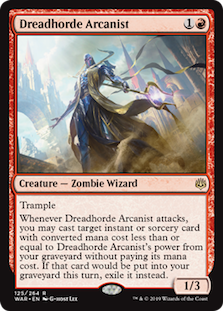
Far and away the most common parallel I've encountered is between Dreadhorde and Snapcaster Mage. True, they both dig instants or sorceries out of the graveyard, but the two are miles apart in terms of play. Snap provides a small burst of value and gives players the card immediately, while Arcanist makes them wait, but promises further resources down the road. Additionally, Snapcaster charges for the flashbacked spell, while Arcanist casts it for free if it lives for a turn cycle. And finally, the blue Wizard has flash, ensuring it remains a contender in control shells, while Arcanist seems destined for aggro-control.

Dreadhorde vs. Dark Confidant

This is a comparison I haven't heard anywhere, but I think Arcanist is much closer in function to Dark Confidant than it is to Snapcaster. It provides a recurring source of card advantage as of the turn its controller untaps with it, and until opponents find a way to deal with it: in Confidant's case, by attacking its pilot's life total; in Arcanist's, by either killing it or sticking a blocker. This key difference is one of a few that differentiate Bob from the newcomer.
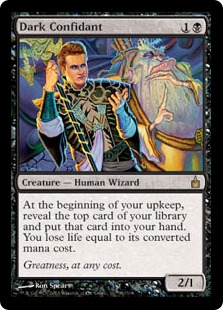
Dark Confidant requires two things of pilots. Deckbuilding-wise, their deck must be sparing with high-CMC spells, lest the creature outright kill its controller by revealing something like Tasigur, the Golden Fang. Arcanist has a similar condition: it demands players run a critical mass of one-mana instants and sorceries. While that condition is more specific and harder to meet than Bob's, it also allows players the wiggle room to run high-cost spells should they so desire.

A nuance to this point is that Confidant rewards players for running many lands, a habit increasingly looking suspect in Modern as even the dominant rock decks are starting to trend Turbo Xerox in their construction (cantrip-heavy, land-light shells which increase consistency over long games, e.g. Grixis Shadow). On this deck construction metric, I think Arcanist slightly wins out over Bob, as cantrip-stocked decks have proven themselves better than land-heavy ones in this metagame (and, perhaps, in Magic).
Moving beyond deck construction, we can examine Confidant's second requirement: life. The Human taxes players life points for cards, and stops working when players run low on that resource. Conversely, Arcanist asks players to have one-mana instants or sorceries in the graveyard, something significantly tougher to achieve for most players, but perhaps trivial in the right shell; otherwise, it too stops working. On the plus side, though, choosing from a makeshift toolbox of cheap spells probably beats drawing a random card, especially when some of those spells are cantrips with tacked-on library manipulation. Arcanist's effect has a higher ceiling.

Life is usually in short supply down the road but in abundance early, and the inverse is true of spells in the graveyard. So I'd assess that overall, Confidant is better early-game, while Arcanist has the upper hand later. There are exceptions, of course; Arcanist is stronger against Burn; Confidant is more reliable against Rest in Peace; etc. Similarly, I think a deck can be built to consistently ensure Arcanist resembles Dark Confidant as of turn two.
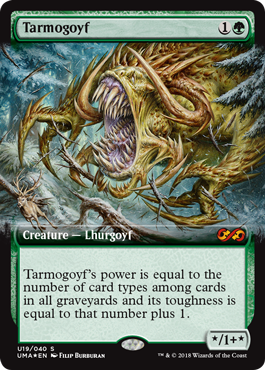
Arcanist has one additional condition, though, that Confidant lacks: it needs to attack to activate its effect. That means that staring down the likes of Tarmogoyf, the 1/3 can't even help pilots find answers to such a game state, while Confidant is happy to draw players out of board stalls. This condition is perhaps tougher to account for. It helps that Arcanist is red, the color of direct damage spells. These cards remove blockers, but also maintain relevance against players lacking creatures, which is the kind of versatility we'll need from an effect Arcanist incentivizes us to load up on.

The final point of comparison is stats, which I evaluate as about even. 2 power is twice as much as 1 when it comes to bringing the beats, but Arcanist's surgical selection somewhat makes up for its lower damage output; it can flashback Lightning Bolt, after all. As for toughness, 3 is much greater than 1, especially since every point matters in Modern these days. Confidant dies to literally everything, including Gut Shot; Arcanist survives Stage 1 creature removal like Collective Brutality, Magma Spray, and Pyroclasm, which is ideal for sniping early-game threats that would otherwise put players on the back foot. Besides Bolt, it mostly just dies to the heavy-duty stuff reserved for Tarmogoyf, Crackling Drake, and other Stage 2 creatures: Fatal Push, Lightning Axe, Path to Exile, etc.
Play Parameters

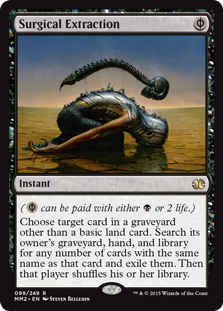
Given how the metagame has congealed around Arclight Phoenix, I decided to construct the Dreadhorde Arcanist deck in a way informed by that shape. After all, most of my testing would be done using free online clients, presumably against meta-conscious opponents. The most recent data I had access to identified Lightning Bolt as the most-played mainboard card and Surgical Extraction as the likeliest sideboard include, so my build set about mitigating the impact both those cards would have on my gameplan.

Beating Surgical

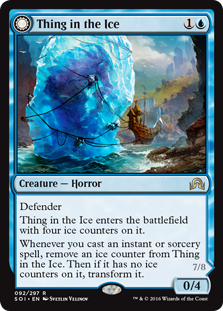
As I've written, UR decks not featuring Arclight Phoenix are already quite good against Surgical Extraction. To keep from being a much worse version of the established best deck, though, I retained its other threat, Thing in the Ice. Thing gives us ample game against go-wide and combo-oriented creature decks alike, allowing us to point most of our burn at opponents.

Beating Bolt
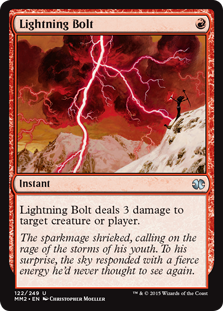
That leaves Lightning Bolt, a card that conveniently trades up on mana against Dreadhorde Arcanist. Also convenient, except for us this time, is the Zombie's high toughness; Mutagenic Growth saves it from all kinds of stats-matter removal spells, including Bolt and even Flame Slash. Protecting Confidant while tapped out is a powerful, if unreliable, gameplan I tried four years ago in "Some Bobs With Your Bugs: Confidant in Delver." Mutagenic asks far less of us than Disrupting Shoal did, although it only works against stat-based removal.

Alongside Arcanist, Mutagenic has additional utility. It can pump the 1/3 from the hand and then be flashed back, giving us a 5-power trample for the turn. And a buffed Arcanist can flash back pricier spells than just one-drops.
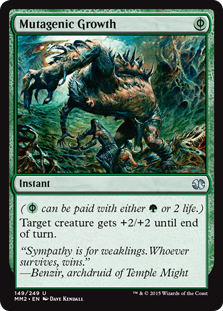
While Mutagenic Growth is an elegant answer to Lightning Bolt, and plays nice with Arcanist otherwise, I wanted it to do more in this shell. Maximizing the instant meant employing a Stage 1 combat creature that also fades Bolt with some help from the pump; the 2 damage from Growth would need to add up somehow. I settled on Delver of Secrets, although Monastery Swiftspear is also probably worth a look. Since Delver is a Wizard, this choice opened the door for Wizard's Lightning, a powerful option that can even be re-used by Arcanist when it's 3/5 or larger.

Thing in the Ice also interacts nicely with Growth. The instant saves Thing from spells run in Modern specifically to kill it, such as Flame Slash, Dismember, and Lightning Axe. But the instant's real appeal is its propensity for flipping thing early, or while tapped out.

Here's the list I landed on:

UR Delver, by Jordan Boisvert

Creatures

4 Delver of Secrets
4 Thing in the Ice
4 Dreadhorde Arcanist
2 Snapcaster Mage

Instants

4 Lightning Bolt
4 Wizard's Lightning
4 Thought Scour
4 Opt
4 Mutagenic Growth
2 Vapor Snag
2 Spell Pierce

Sorceries

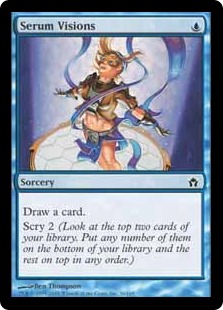
4 Serum Visions

Lands

4 Scalding Tarn
3 Misty Rainforest
3 Steam Vents
4 Spirebluff Canal
3 Island
1 Mountain

Sideboard

3 Damping Sphere
2 Crackling Drake
1 Hazoret the Fervent
2 Surgical Extraction
1 Spell Pierce
2 Spite of Mogis
2 Anger of the Gods
2 Shattering Spree

Card Choices

Snapcaster Mage: While I think Arcanist is better in this deck overall, we can only run 4, and I still like the utility Snapcaster provides. Between the flash, the immediate flashback, and the body, no other card in Modern does all this creature does. Bouncing Snap with Thing also occasionally comes up and is nice.
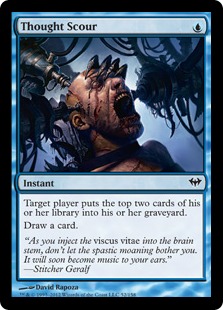
Thought Scour: One of Modern's best cantrips, Scour's issue is that running it often means dipping deep enough into a graveyard strategy that enemy hosers become serious threats. Just as I've found Grim Lavamancer to assuage this conundrum, Dreadhorde Arcanist fills a similar role. Scour is great at stocking the 'yard for the Zombie.

Opt: My additional cantrip of choice after Serum Visions and Thought Scour. I tried Faithless Looting in small numbers, but was more impressed with the raw card advantage offered by a self-replacing cantrip alongside Arcanist.

Vapor Snag: A way to quickly clear lager threats so Arcanist can crash through. Combined with the creature, Snag makes for a potent removal engine. If opponents only have one big beater, we can bounce it, swing, flash back a cantrip, and next turn swing and bounce all over again; when multiple targets are in play, we can bounce two in a single combat step, and before blockers to boot. I didn't want many of these because of its redundancy with Thing, but the instant tested very well.

Spell Pierce: Pierce has no synergy with Arcanist, but I hold that it's terrific right now, and in the tempo-sensitive Modern generally. It was also important to me to have some dedicated stack interaction available. Our many cantrips help find Pierce before something critical like Through the Breach or Ad Nauseam can resolve.

Other Possibilities and Closing Thoughts
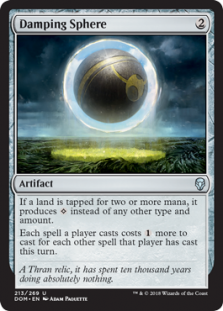
UR Delver featuring Mutagenic Growth was actually the third of a few decks I tried with Dreadhorde Arcanist. I also tested a more dedicated Wizards shell, and a midrange build in Grixis colors. Neither of those strategies were fast enough to race Tron, though; Lightning, Pierce, Growth, and Delver all help with this matchup, as do the Damping Spheres. But it's fully possible my deckbuilding biases are at work here, as they often are in my articles, and Arcanist is better suited in a deck without Delver. As always, I'll happily receive advice and opinions in the comments; until then, happy spoiler season!

Tales from the Buylist #9 – Lightning Fast Movement

Are you a Quiet Speculation member?

If not, now is a perfect time to join up! Our powerful tools, breaking-news analysis, and exclusive Discord channel will make sure you stay up to date and ahead of the curve.

War of the Spark spoilers continue, and that's got a lot of folks participating in some reactionary buying and selling. While it's a bit early to call which of these cards are truly duds, that won't stop people who are quick on the draw with snapping up singles ready to make the quick flip. Reactionary buying rules the day, and we're seeing a ton of cards be subject to it.

The Command Zone Effect

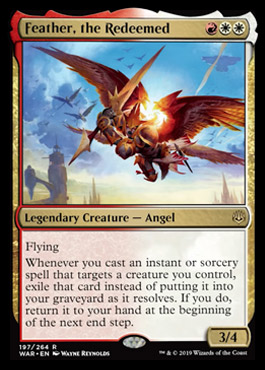
First thing's first, I have to talk about Feather, the Redeemed. This card got a high-profile spoiling from The Command Zone, notable for their potent ability to spur movement on Commander-relevant cards due to their Game Knights video series. This is somewhat recent, as we saw the first major proof of this occur when popular cosplayer Ashlen Rose showcased her Kozilek, the Great Distortion deck back in March.

There was an error retrieving a chart for Kozilek, the Great Distortion

Lately, I see a lot of chatter around their content and upward price movement every day in our Insider Discord. This has even led some to label it "The Command Zone Effect." I've never been much of a Commander player myself, as I don't typically enjoy multiplayer formats, but it gets harder and harder to ignore this particular piece of content the further we go. I'll be honest in saying I make the effort to watch it every week, as soon as possible, just in case.

There was an error retrieving a chart for Sunforger

One of the big callouts within the video this week was Sunforger, a piece of equipment that plays quite well with Feather's ability. You'll be able to tutor up spells for the low cost of RW to your heart's content. Rebuying any of your spells found here is insane value, and that's good enough reason for the quick buyout.  In my opinion, this buyout will set a new price for the card long-term, and will likely lead to Sunforger stabilizing at around $8 once a bit of the hype dies down. Supply below the $10 price point has all but dried up, which leaves little room for buying in. If you bought in low or you're holding on to these, I suggest flipping them as soon as possible.

Legacy Liabilities

There was an error retrieving a chart for Thought Lash

Thought Lash is another card that I'll be watching very closely for the next few weeks, especially after War of the Spark's release has passed. Its interaction with the new Jace's static ability or Laboratory Maniac is undoubtedly strong but may be an example of wishful thinking from Legacy combo players. Even with another combo piece to accompany it, I think the upward price movement on Thought Lash will likely be very short-term, and I suggest flipping them quickly. Spot removal breaks up this combo so easily, and I honestly don't have much faith in this card's upward trajectory for the years to come.

There was an error retrieving a chart for Telim'Tor's Edict

Some would argue that it may be unwise to get rid of a Reserved List card so quickly, given the movement we've seen for that class of card in the last few years. I would quickly point them to Telim'Tor's Edict to prove my point. A bit of meme-worthy gameplay was posted on Channel Fireball by Matt Nass, Sam Pardee, and Andrew Baeckstrom featuring Telim'Tor's Edict as part of a Jenga-esque combo to put a Marit Lage token into play this time last year. Shortly after it was posted, copies were very quickly snapped up by those looking to make a quick buck (myself included), and the hype lasted for a very short period. There was some gain there, the time spent on the venture made it hardly worth it.

I feel like going hard on Thought Lash may end up much the same way, as the price will quickly plummet when it puts up no Legacy results.

Modern Still Feels Safe

There was an error retrieving a chart for Scapeshift

On the flipside, I'm very happy to participate in some reactionary buying on cards like Scapeshift. A Modern staple through-and-through, Scapeshift has been present in the Modern meta at pretty much every point. The spoiling of Evolution Sage has prompted some small movement, on the off-chance that proliferating several times a turn could be a viable strategy in Standard. Should you go deep on it? Possibly! Scapeshift is at a relative low for where it once was since its Core 2019 printing, and in my opinion can only go up from here. Picking up copies for under $10 will be the safest bet for a long-term hold. Even with Core 19's rotation coming up later this year, I believe this is still a relatively safe pick.

To add to this, Primeval Titan is an easy complement to Scapeshift that I want to highlight here for much the same reason. While it's banned in Commander, Prime Time is seeing a bit of success in Modern in Amulet of Vigor decks that are able to compete at the top level. I pointed to this card a few weeks ago, and I'm still confident that a few good tournament results with either Titanshift or Amulet Titan could push this card up since the price drop of its Iconic Masters release. Amulet Titan recently took down an SCG Open, and looks like the first step towards something bigger.

There was an error retrieving a chart for Flusterstorm

With Modern Horizons' release date drawing closer, it's hard to say whether any of these archetypes will be powerful enough in the new format. Should we get more potent answers in the form of efficient counter-magic like Counterspell or Force of Will, evergreen strategies will either have to adapt to this change, or fall out of favor entirely. Some have reasoned that we'll get more fair cards like Flusterstorm entering the format. I can't see the future here, but if Cabal Therapist was any indication, we can at least expect classic spells like these returning entering Modern in some form.

Bring it on Home

The potential for a lot of new cards to spike is still very high as we move to the end of spoiler season on Friday of this week. We'll likely see some more reactionary Commander buyouts between now and Monday, so I recommend keeping a close eye on Twitter, YouTube, and especially our QS Insider Discord. Plenty of our members will be happy to point out their favorite picks, and offer some insights on cards you may not have considered. The value of you can expect to gain is well worth the cost of admission.

Picks

  • Scapeshift
  • Primeval Titan

Holds

  • Flusterstorm

Folds

  • Sunforger
  • Thought Lash


That does it for this week! You can follow me on Twitter @chroberry or Instagram @chroberrymtg if you want to see extra goodies and spoilers for next week’s article. Feel free to let me know how you feel about my targets here in the comments, or if there’s anything you think I missed!

Peace!

Evaluating Opportunities, Pt. 2 – Value Factors and Opportunity Cost

Are you a Quiet Speculation member?

If not, now is a perfect time to join up! Our powerful tools, breaking-news analysis, and exclusive Discord channel will make sure you stay up to date and ahead of the curve.

Welcome to part two of my series on evaluating opportunities. You can find part one here.

Previously I covered the initial steps one should take before looking for opportunities, like establishing a basic budget and goals. I then reviewed a method of looking at the potential risks and strategies to mitigate them.

Today I'll look at what factors might affect a given spec's potential, and cover the idea of opportunity cost. Finally, I'll illustrate with an example and touch on the importance of diversification.

Determinants of Value

Whenever you're speculating, it's critical to understand what factors can affect the value of a card. I keep a list of likely determinants for a card's value that helps me evaluate the overall potential of a spec. As of now, I ask myself the following questions for each card.

  1. Is the card on the Reserved List?
  2. How much play does it see?
  3. How many printings does it have?
  4. What rarity are its printings?
  5. When was the last printing?
  6. Is its demand heavily metagame-dependent?
  7. Is its effect unique?
  8. Is it the best version of what it does?
  9. What is the likelihood a better option will be printed?
  10. Is the card's color relevant for the format it's played in? For instance, blue cards in Legacy and green cards in Commander.
  11. Does it have any additional "collectability" factors (i.e. drawn by a beloved artist, a relevant creature type, etc.)?

These are questions I like to ask myself when looking at any card, whether it's a new card or an older potential speculation opportunity. I've expanded the list from previous articles (which typically focused on evaluating a card for a specific format) to get a more complete picture of a card's prospects in general.

In this way I view cards as many sports commentators view upcoming draft picks, though they often have easier-to-define criteria (40-yard dash, vertical jump, standing long jump, etc.). We as speculators need a consistent set of criteria to evaluate any given card.

These are the questions I use when considering cards to invest in, although I imagine someone with more time on their hands could come up with a more elaborate ranking system.

Opportunity Cost

So many of us use this term incorrectly, and honestly I'm guilty of it too. It involves more than just a look at the Return on Investment (ROI) of a particular investment. To calculate the true opportunity cost you must compare that to the ROI of an alternative investment of equal risk.

I'll illustrate this with a concrete, MTG finance example. Our potential investment opportunities will consist of two cards from Ultimate Masters (UMA), Engineered Explosives and Noble Hierarch.

You can currently buy UMA Engineered Explosives for $19-$20 each, while UMA Noble Hierarch costs around $40. So if you have $120 to invest, you could purchase 3x Noble Hierarch or 6x Engineered Explosives.

There was an error retrieving a chart for Engineered Explosives
There was an error retrieving a chart for Noble Hierarch

Noble has the original Conflux printing, two Masters set printings, a GP Promo printing, and a Judge Promo printing. Explosives has its original 5th Dawn printing, as well as two Masters sets and a Masterpiece. Comparing the all-time highs, we see Explosives peaked at $104.5 in August 2018, while Hierarch peaked at $84.30 in March of the same year.

Looking at MTG Goldfish's most-played cards in Modern, we see Hierarch at the #20 spot. Explosives was at #49 just a few days ago, but has since fallen out of the top 50.

Both cards seem like good options. They both see heavy play in Modern, have been reprinted recently, and have reprints restricted to limited-run products. Both are priced below their historic highs, which occurred last year. Here you can see me putting to use those determinants of value listed above.

However, there is one big difference—Explosives is half the price of Hierarch. For the same expense, you can acquire more copies of Explosives. Should both cards increase by $5-10 within the next year, one would make twice as many gains on the Explosives.

This line of thinking is incredibly powerful when it comes to investment decision-making. After all, as I discussed in my previous article, given we operate with limited financial resources, optimizing their usage is critical to maximizing our profits.

Diversification

There is one more thing to be aware of before applying the logic of opportunity cost to concrete investment decisions. One could easily argue that the smartest play is to determine a set of factors to look at, and then sink all your money into whatever card ranks highest in those criteria. At the core this seems to make a lot of sense, but it goes against a fundamental principle of investment: diversification.

Most financial advisers will tell you to diversify your investments, and you'll find the same advice here on Quiet Speculation. Diversification spreads out risk—and there is a lot of risk inherent in Magic finance. After all, the game is made by a single company who has complete control over what they print—they can print as much or as little as they want, and thus can control supply to match whatever they think the demand is.

In a way, it's similar to investing in a specific country's currency. In that case there are typically laws in place to protect investors from countries printing massive amounts of money and/or devaluing their currency, though it obviously does happen.

Conclusion

In the end we have to decide our own level of acceptable risk, and how much potential profit we are willing to sacrifice to reduce it.

While I understand this may be tedious to do for every single Magic card you might consider speculating on, it's important to remember that you are investing your hard-earned money on these pieces of cardboard. You are hoping to make additional money by doing so, and you are taking on risk that you may lose money.

I'll admit that I don't follow all these steps for every single card I have ever speculated on. That's part of the reason I have a box of "long-term" specs that could likely be renamed "box of shame"—and I know I'm not alone.

However, I do follow these steps when considering any larger speculative purchases. I have sunk a fair amount of money into UMA singles since they released last December, and I definitely passed up on some of the reprints to focus instead on the ones that ranked higher in my evaluations.

The Time War: Teferi, Time Raveler in UW

Are you a Quiet Speculation member?

If not, now is a perfect time to join up! Our powerful tools, breaking-news analysis, and exclusive Discord channel will make sure you stay up to date and ahead of the curve.

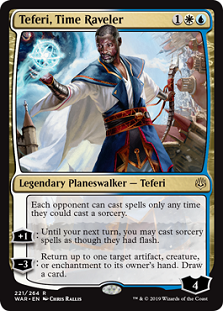
A new set is on the horizon, so it's spoiler time again! War of the Spark is the first set designed as a planeswalker set, which means there are an unprecedented number about to drop. More interestingly, most of them have static abilities rather than the traditional plus, minus, and ultimate combo we've become accustomed to. A number of them look to be curious and impactful, but they have a problem that may be disqualifying. Today I'll be examining a promising example in Teferi, Time Raveler, using him to demonstrate the issue with these static walkers.

Cleveland Phoenix Check-In

Before moving on, there was another major Modern event last weekend, this time the Cleveland SCG Open. I have been hopeful that the apparent warp in the metagame caused by Izzet Phoenix would diminsh. The data from Cleveland indicates this is not the case. The Day 2 metagame is what we've come to expect: Phoenix is the most popular deck by far, though underneath those numbers the metagame looks diverse and healthy.

The Top 8 is more interesting because Phoenix and Amulet Titan are tied for most copies. Of note, the winning list readopted the Hive Mind combo kill. Said combo had disappeared after Summer Bloom's banning, and I'm curious whether this was inertia on Sam Lawrence's part or a deliberate metagame choice. In any case, it appears that the format continues to struggle to control the firebird.

New Time Pressure

Jordan covered Karn, the Great Creator last week, smelling real potential. The other discussion-worthy new planeswalker is Teferi, Time Raveler. A three-mana walker with 4 loyalty is already worth looking into, but Teferi has an ace up his considerable sleeves: he shuts out opposing instants, boasting huge implications for control mirrors.

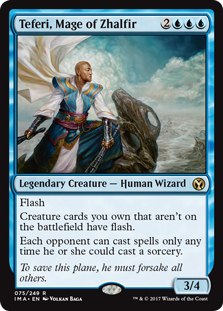
Based on past experience, it seems like new Teferi should be very good, because the last card with that static ability was very good. Teferi, Mage of Zhalfir proved a critical card for Time Spiral-era Mythical Teachings control, and in the mirror, whoever untapped with him typically won. Teachings decks played almost entirely at instant speed, and the mirror was dictated by correct sequencing and card advantage. Teferi allowed his controller to dictate the pace of the game and invalidate any counterspells or other protection while establishing a clock.
Time Raveler costs just half what Mage does, which is everything in Modern. It also allows for greater flexibility with a player's own sorceries. This appears to be a very potent combination.

Obvious Home

Naturally, it makes sense to try Raveler in a control shell. As of when I did my testing, the most recent good finish came from GP Calgary in the form of UW Control. The Esper list from Cleveland is very interesting, but given how testing played out, I doubt I would have come to a different conclusion.

UW Control, Austin Anderson (7th Place, GP Calgary)

Creatures

3 Snapcaster Mage

Instants

4 Opt
4 Path to Exile
1 Spell Snare
1 Condemn
1 Logic Knot
1 Negate
1 Mana Leak
1 Absorb
1 Hieroglyphic Illumination
1 Settle the Wreckage
3 Cryptic Command

Sorceries

2 Serum Visions
4 Terminus

Enchantments

2 Detention Sphere
1 Search for Azcanta

Planeswalkers

3 Jace, the Mind Sculptor
2 Teferi, Hero of Dominaria

Lands

6 Islands
2 Plains
4 Flooded Strand
4 Field of Ruin
3 Celestial Colonnade
3 Glacial Fortress
2 Hallowed Fountain

Sideboard

2 Rest in Peace
2 Celestial Purge
2 Dispel
2 Timely Reinforcements
2 Surgical Extraction
1 Baneslayer Angel
1 Stony Silence
1 Negate
1 Settle the Wreckage
1 Lyra Dawnbringer

I've previously noted that this deck is well-positioned against Izzet Phoenix, though it's a little light in the sideboard against other control decks. Still, with eleven counterspells and plenty of card advantage, it had everything necessary as a test vehicle.

Actual Utility

I only tested Raveler in the control mirror, because that's where I deemed him most likely to be relevant. Limiting opponents to sorcery speed is a fine ability, but that's usually all non-combo decks do anyway. Aggro may play a few instants, almost always creature removal; outside of Spirits, though, the creatures don't have flash. Lots of decks have Lightning Bolt, but that's not important against control. A typical Tron deck has no instants, so Raveler's static ability isn't relevant there, either. My example deck only has six sorceries, so it would be most impacted by Teferi.

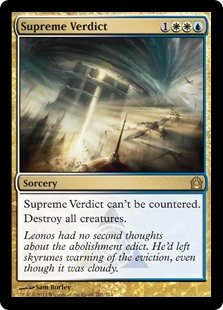
His other abilities are also pretty mediocre. The main reason to play sorceries at instant speed against not-control is to Supreme Verdict during combat or end of turn, and when Terminus can already be miracled as an instant, it's not a very useful upgrade. There is something to be said for playing Serum Visions and sorcery speed card advantage as instants for the mana advantage and flexibility, but since they don't see much play in the first place I think it's marginal at best.
The downtick isn't bad, as bouncing a creature and drawing a card is a decent tempo play. It may be actively good if the creature is Gurmag Angler or you have your own threats out. However, most creature decks are either going too wide or gain intrinsic value from being played these days, so Repulse isn't a very good ability. That Raveler is great in control mirrors is the impression most players have when they see him, and all things considered it makes the most sense to test him in that capacity.

The Catch

The question lingers of just how valuable Raveler actually is. Again, the original Teferi was often crippling in the control mirror, and given that my example deck runs 11 total counterspells, it seems like Raveler should be great. However, I was skeptical. Yes, he shuts off opposing counterspells and locks opponents off your turn, but Teferi cannot win the game alone. None of his abilities actually kill the opponent, so they can just ignore him entirely if they wish. At least Teferi, Hero of Dominaria demands an answer, because he can tuck himself into the library and opponents will eventually deck themselves.

There's also the question of relevance. It makes sense that countering critical spells is good for control, but I'm not certain that it actually translates into wins. Modern UW Control wins mostly by forcing a concession once it has cleared the board and has overwhelming card advantage. What may be the Ur-example of a control mirror came from Time Spiral block and wasn't decided by counterspells, but through exceptional resource management: for the most part, both players were resolving their important spells at sorcery speed. This wasn't because of Teferi but because each deck had exactly 4 Cancel and 2 Draining Whelk so there was limited need to play around counters. Their spells were better as sorceries anyway and since the match was about maximizing card impact, Teferi's disruption wasn't very relevant.
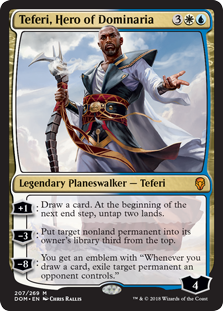
It's been a while since I sleeved up a control deck. I remember counters were very relevant in the mirror back then, but Modern is a very different format now.  Before I tested Raveler personally, I asked some dedicated local control players what they thought. Every one's knee-jerk reaction was that it was a house and would be a great sideboard card. However, as they started to explain why, they all walked their opinion back. The consensus answer ended up being, tautologically, that counterspells only matter when they matter because what's important is sticking some form of persistent card advantage and riding it to victory. Teferi ensures that you will resolve your own subsequent walkers, but it may or may not impact the opponent's ability to do so first. Thus, they weren't sure how good Teferi would actually be in practice.

An Overall Problem

To test Teferi, I took the example list and proxied two decks. One was the list in it's control mirror configuration (sweepers out, angels and counters in) and the other played Time Raveler instead of the extra Negate and a Dispel. The default won 8 of 13 games. In fairness to Teferi, I was testing against a more experienced control player. However, if the roles were reversed I don't think it would suddenly have made Teferi a game changer.

The problem was that Teferi didn't do anything. He's like Null Rod's flavor text but worse. Teferi came down and shut off opposing counters. And then I could downtick him to bounce Search for Azcanta and draw a card at best, but typically I could only tick him up. And I could tick Teferi up indefinitely at no penalty to my opponent or meaning for me because I only had 2 Serum Visions and Time Raveler has no ultimate. Meanwhile, my opponent could simply ignore Teferi and start slamming threats until I cracked. And despite having counters I often did crack because I'd spent a card on Teferi. He also frequently made me spin my wheels with Cryptic Command, which unlike the other counters still had text. The nail in the coffin was that Time Raveler doesn't interact with planeswalkers nor can he keep up with their card advantage. He was simply outclassed.
Teferi's static ability and cost make him seem like a very potent card. However, the reality is that he only really impacts counterspells and which are of such variable importance that I'm not sure it's worthwhile. Combine that with really mediocre abilities and I don't think Teferi justifies sideboard space in control decks. I didn't test him as combo protection, but I'm skeptical that he'd ever beat Boseiju, Who Shelters All as counterspell killer.

A Designed Flaw

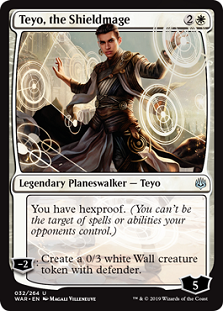
Ultimately, this is the problem with all the new static planeswalkers. The static abilities are very relevant, but if the rest of the planeswalker isn't, what's left is a worse enchantment. Consider Teyo, the Shieldmage. At three mana, he provides the same effect as Leyline of Sanctity. Teyo always costs three mana, while Leyline is zero or four dependent on having it in your opening hand. The advantage there is unclear, but being an enchantment is a big advantage for Leyline, because it can only be removed with Assassin's Trophy or actual enchantment removal. Teyo can be Bolted or attacked. For that reason, Leyline is often game over against Burn, while I would guess that Teyo is mildly annoying at best.
The only other thing Teyo can do is downtick to make 0/3 walls. That is potentially relevant against Burn since it blocks Goblin Guide, but that's all Teyo can do. There's no way to add loyalty because he has no uptick ability at all. This is partially a balance consideration and mostly to make proliferate relevant.

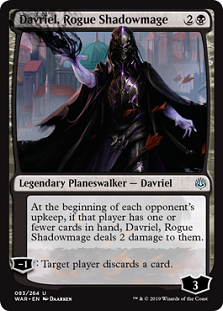
As another example, consider Davriel, Rogue Shadowmage. He's been speculated on since he makes 8-Rack into 12-Rack and adds to the hand pressure without hitting you, unlike Liliana of the Veil. However, he can only be used twice before going away, unlike the infinitely-usable Liliana.
He's also worse than The Rack or Shrieking Affliction. He's not only more vulnerable as previously discussed, but he also does less damage which translates into more time for opponents to find a way out and/or race 8-Rack. Davriel is a fine card, but not an exceptional one and that's really the story of the War 'Walkers. They're fine cards in context, but not exceptional.

Limited Utility

This is no accident. Wizards was worried that too many normal planeswalkers would destabilize Standard, and they had to heavily moderate them. The static walkers were designed to have potent effects, but be fragile. There's very little utility to these cards unless the static effect is relevant, and even if it is, they're all very fragile.

This means, for the most part, the new planeswalkers are more fragile and swingy than any previous iterations. On the one hand, they have potentially game-swinging static abilities. On the other, if that isn't the case, they're irrelevant to the point of unplayability. To make matters worse, they're far easier to remove than equivalent enchantments or artifacts.

War is Changing

There are still plenty of walkers to be revealed, which could change my mind. However, they'll need to be powerhouses to overcome the inherent vulnerability of being attackable enchantments. Only time will tell whether that is the case.

Three Current MTG Finance Trends that Confuse Me

Are you a Quiet Speculation member?

If not, now is a perfect time to join up! Our powerful tools, breaking-news analysis, and exclusive Discord channel will make sure you stay up to date and ahead of the curve.

Magic is a vast landscape, consisting of a multitude of stories, game pieces, and ways to interact with the hobby. It is virtually impossible for any one person or company to keep their finger on the pulse of every single trend in the game. When it comes specifically to following singles prices, staying on top of the market is a fool’s errand. As soon as you learn the value of cards, they inevitably change.

Being that this is a finance-based site, my focus this week will be on three different trends I’ve observed that strike me as a bit odd. They may have catalysts that provide a rational explanation, but I’ll attempt to present an argument as to why I think these observations don’t make sense.

I wonder if these oddities are occurring because people are hyper-focused on their own strategies. Maybe people aren’t looking deeply enough into the past, or broadly enough at current prices and offerings. After all, if we don’t learn from the past, we are doomed to repeat it, right?

Trend 1: The Mana Crypt Conundrum

Last week I flagged the recent price appreciation of Mana Crypt. The Eternal Masters version has gone from $140 to $190 since 2019 (TCG market pricing).

There was an error retrieving a chart for Mana Crypt

The readily available supply of the card has also dwindled. As of Sunday morning, there were 23 sellers with English copies of this card in stock on TCGplayer. One moderately played copy is listed at $179—the next cheapest is near mint and $194.99. Once the cheapest ten copies sell, this will be a $225 card.

This card is a major Commander staple that can slot into any deck. It appears in over 28,000 lists on EDH REC. This card is the real deal, so it’s no wonder its price has been rallying aggressively of late. Eternal Masters has gotten old enough that its impact on the market supply is diminishing. No surprises here.

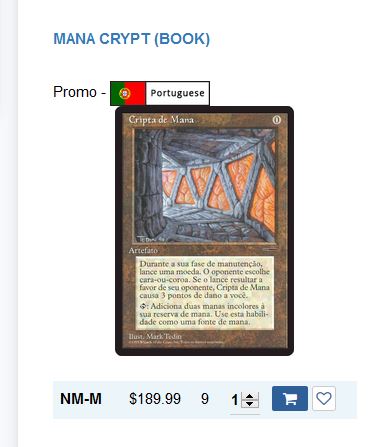
Now onto the part that confuses me. At this point, the relative pricing of the different versions of Mana Crypt are perplexing. For example, if you’re fine with playing the original Book Promo version of Mana Crypt, you can obtain an English copy for $165.30 (moderately played). Ignoring the seller with 0 feedback on TCGplayer, lightly played copies start in the $180’s.

I would have expected the original promotional printing to be more valuable, but instead the reverse is true. Card Kingdom agrees with me—they have near mint EMA copies listed for $230 and the Book Promo at $250. (Random aside: I pointed out that this card was actionable in the QS Insider Discord back on 4/1, when Card Kingdom had copies listed at $180…check out the image below. Just another data point showing the value of the Discord!)

Okay, so Card Kingdom charges more for the Book Promo than the Eternal Masters version. I’d expect their buylist to reflect this trend. Yet, as of this morning, it does not. They pay $165 on EMA copies and $150 on Book Promo copies. So they pay more for the version they sell for less. That makes no sense too!

The last thing that confuses me about Mana Crypt involves the Masterpiece version. Since its printing, the Masterpiece version of Mana Crypt has been much more expensive than any other version. But the premium has slowly been evaporating.

Since January 1, the market price on this version of Mana Crypt has gone from $300 to $323. That’s a much smaller increase than the EMA version! At the end of 2018, the Masterpiece version cost 2.1x the Eternal Masters version. Today that premium is at 1.7x and closing. Card Kingdom offers $200 on the Masterpiece version but $165 on EMA copies—that’s hardly a premium at all!

This trend also makes no sense and something has to change. My prediction: the Masterpiece version ticks up a notch. Until then, the trend is just bizarre.

Weird Practices at ABUGames

I’ve written at length about how strange I find ABUGames’s current business strategy. Their aggressive move towards any and all Alpha, Beta, and Unlimited cards may pay out in the long term, but for now it is perplexing. They offer such a huge premium in store credit on these cards, while not nearly reflecting that same premium on newer cards.

But that’s not the strangest thing. The thing that really confuses me about ABUGames is the fact that they sell many of these Alpha, Beta, and Unlimited cards on eBay for far less than on their website. I understand this is a way for them to maintain sufficient cash flow, but the practice leads to trends that don’t add up.

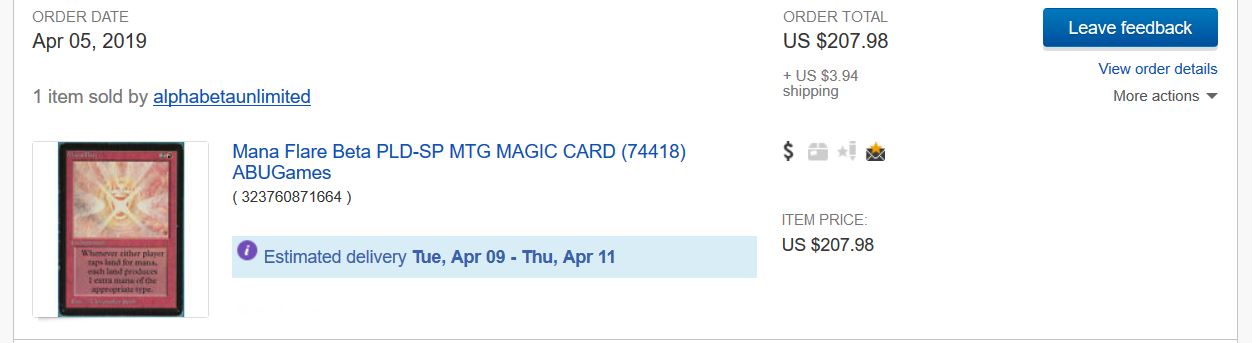
Consider this: last Friday I was the only bidder on an auction of theirs for a played Beta Mana Flare.

There was an error retrieving a chart for Mana Flare

I bid on the card after watching the same card listed at auction the week prior fail to receive any bids. At the time the card was listed a few bucks higher—clearly after failing to sell, ABUGames relisted the card on eBay with a lower price point. This is a practice they’ve been implementing quite a bit lately. If I hadn’t bid on this card, I suspect it would have dropped a couple more bucks even still.

(Click to expand.)

Why did I decide to bid anyway? Because of the craziness that is ABUGames’s pricing strategy. With shipping I paid $211.92 for this Beta Mana Flare. Humor me for a second and check out what ABUGames offers in store credit for this card. The number is $415—nearly double what they sold it for!

You can probably predict what I’m going to do next. Once the card arrives, I’m going to submit a buylist order and ship it right back to ABUGames for $415 in store credit (unless they change their credit price in the interim). With this credit I can shop around for some fairly priced, played Modern staples. Or I could pick up a couple Portuguese Book Promo Mana Crypts because, at this point, they’re actually priced fairly.

If you look at their eBay listings, I suspect you will be able to find other opportunities to get ABUGames credit at half price simply by buying cards from ABUGames themselves.

Leveler Déjà Vu

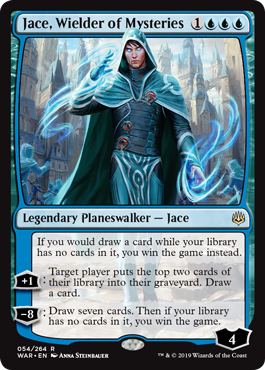
This morning I noticed Leveler was the top mover overnight according to MTG Stocks. The card went from $0.75 to $9 in a few short days. This buyout was triggered by the spoiling of Jace, Wielder of Mysteries. The former wipes out your library and the latter lets you win the game if you try to draw from an empty library. A match made in heaven.

There was an error retrieving a chart for Leveler

This version of Jace also catalyzed the buyout of Thought Lash. It seems a bunch of cards are spiking because of their potential interaction with Jace. This makes perfect sense, and we often see folks jump on the bandwagon when a new combo emerges.

Here’s what confuses me. Take a look at that Leveler price chart above. Notice how the card has been essentially bulk for years, but back in 2013 was higher and in the process of a gradual decline?

The data doesn’t quite go back far enough, but if you could trace it back to 2011 you’d see something remarkably reminiscent of today’s trend. You’d see Leveler spike in September 2011—to be more precise, thanks to this guy:

There was an error retrieving a chart for Laboratory Maniac

Winning with an empty library isn’t a new concept. Back in 2011, people went wild over Leveler, Divining Witch, and Paradigm Shift. Now there’s another card that does the same thing, and people are going crazy all over again. This is the part that causes me to scratch my head.

I was around doing MTG finance in 2011. I even bought a bunch of Paradigm Shifts and Divining Witches, only to get burnt by them. I couldn’t flip them fast enough, and I was left holding a small stack of $0.10 rares. Now I’m seeing the same buyouts occur a second time. I bet some people are even going to make a big profit flipping these cards.

My advice: don’t bother. If you didn’t already have copies in hand, you’re likely going to have a tough time flipping these for worthwhile profits. Just like Leveler did from 2012 until 2018, you’ll see these cards drop right back down in price all over again. History is going to repeat itself unless this Jace gives the “empty library” deck redundancy it needs to suddenly break into Modern or Legacy. I don’t think it’s a stretch for me to predict that won’t happen.

Wrapping It Up

It’s impossible to stay on top of every trend in Magic. With new cards coming at us all the time, reprints on the horizon, and a seemingly limitless set of options for buying and selling cards, you can’t know the pricing trend on every card all the time. If enough people overlook something, it can appear quite odd to the alert observer.

This week I wanted to share three distinct trends that screamed “strange” to me. ABUGames’s business strategy has me buying cards from them with the sole intent of selling them right back. Then there’s Mana Crypt’s spike—apparently a privilege saved only for Eternal Masters copies. Lastly there’s the repeated buyouts of horrible Magic cards that empty your library. Each of these trends leave me scratching my head.

But you know what? We don’t have to understand these trends to take advantage of them. Now that everyone’s aware, I encourage you to act accordingly until the oddity is no longer present. By then, I’m sure there will be three more counterintuitive trends to take their place!

…

Sigbits

  • Card Kingdom’s buylist has finally cooled down on Dual Lands. For a while they were getting quite aggressive. Instead, I noticed they’ve been warming up to Jace, the Mind Sculptor. This card keeps climbing in price and Card Kingdom’s buylist reflects the trend. They’re offering $90 for the Worldwake version. And while they only pay $80 on the other nonfoil versions, I suspect this to bump higher soon enough.
  • There are a ton of foils on Card Kingdom’s hotlist now. They’ve really stepped up their foil game lately, and it shows! For example, they pay $85 for foil Crop Rotation (a common!) and $105 for foil Timeshifted Gemstone Mine.
  • What blows me away the most, though, is Card Kingdom’s aggressiveness on Unlimited. I see their buy prices fluctuate constantly depending on how many they get in stock, but they inevitably sell out every time and the price marches higher. Now they’ve got a buy price of $10,200 for Black Lotus, $2,880 for Mox Jet, $2,400 for Timetwister, and $2,280 for Mox Ruby. These are amazing numbers.

War of the Spark Spoiler Specs

Are you a Quiet Speculation member?

If not, now is a perfect time to join up! Our powerful tools, breaking-news analysis, and exclusive Discord channel will make sure you stay up to date and ahead of the curve.

War of the Spark spoiler season has finally started, and we’re starting to see what the set is all about. With a bit of information we can infer more, and that means the market is already in motion.

For example, the reveal of the proliferate keyword on a single card implied more support to come, and the market has reacted with spikes on cards like Atraxa, Praetors' Voice and Contagion Engine. The set’s impact is going to be felt everywhere, from Commander spikes like Atraxa, to Eternal formats, and of course to Standard.

Zombies look to play an important part in War of the Spark. They can be found in four colors so far and are central to the amass mechanic. That mechanic also has a powerful flagship in Dreadhorde Invasion, which has been compared to Bitterblossom. Eternal Taskmaster is high-quality Zombie with an ability fitting for the tribe, and helps lay the groundwork for a real Zombie tribal deck in Standard.

There was an error retrieving a chart for Death Baron

Liliana, Untouched by Death has already spiked, but Death Baron remains a very juicy opportunity. It's showing clear signs of growth and won’t be so cheap for long. Also consider the card was over $20 before being reprinted in Core Set 2019, so the long-term potential is high.

There was an error retrieving a chart for Underrealm Lich

Zombies in other colors also open up the possibility for a multicolor Zombie deck. One pairing is green, with the new Storrev, Devkarin Lich being a big draw. That brings attention to Underrealm Lich, another Golgari Zombie with graveyard synergy.

It has shown some growth online, up from 0.8 tix to 1.1, so there might be paper growth to follow. As a $2 mythic that will be in Standard for over another year, there’s potential. Like Storrev it also happens to be an Elf, and that crossover demand could help if Elf tribal sees more support. The set does bring a very strong new Elf in Paradise Druid, so it’s a possibility.

Red is also shaping up to be a Zombie color, and strong one at that. There is a lot of support for amass in red so far, including Widespread Brutality. Dreadhorde Arcanist is one of the best-looking cards in the set so far, and its Zombie status could take it even further. Death Baron increasing its power would allow it to cast more expensive spells, for example. Dreadhorde Butcher is another strong red Zombie, and another beneficiary from an anthem effect. 

There was an error retrieving a chart for Thud

A cheap spec that might yield some large gains is Thud, which is being talked about because of its potential with Dreadhorde Butcher. It unlocks the death trigger, and with a pump spell like Collision // Colossus can actually lead to a turn three-kill.

It’s still about a quarter, but has actually shown on up on lists of moving cards this week. Uncommons from Core Sets becoming expensive is not out of the ordinary. I could easily see this selling for $1 or more at some point, especially if you can offload them in person at events for a premium.

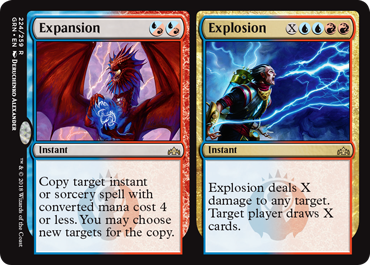
Another nasty interaction from War of the Spark is the leaked Ral, Storm Conduit going infinite by copying the front end of Expansion // Explosion. This leads to a chain-reaction of copy triggers on a spell of your choice, with Shock being the cleanest option to end the game.

Expansion // Explosion is already a premium Standard card, and the planeswalker looks decent on its own, so it’s no stretch for this to become a real top-tier deck. Whether it’s when Ral is officially spoiled, or not until it becomes a staple, I think it’s only a matter of time before Expansion // Explosion sees significant growth.

There was an error retrieving a chart for Blood Crypt

Rakdos in general looks to be one of the best guilds in the set, with some great cards like Angrath's Rampage. No surprise we’re seeing increase in some Rakdos staples online, including Blood Crypt and Rix Maadi Reveler.

There was an error retrieving a chart for Goblin Trashmaster

The Goblin tribe wasn’t left out of War of the Spark either, and Krenko, Tin Street Kingpinlooks pretty powerful. Goblin Trashmaster has nudged up in price in both online and paper. Given that it doesn’t have much downside at this level below $1, this might be a good spec.

There was an error retrieving a chart for Trostani Discordant

Selesnya is also seeing increased demand, likely on the back of the new Ajani, the Greathearted. It brings back memories of Ajani Goldmane, which was a Standard staple, and should become a staple now by outshining Ajani, Adversary of Tyrants.

Trostani Discordant is particularly attractive, as is Knight of Autumn, which could also benefit from proliferate shenanigans in a Bant deck.

There was an error retrieving a chart for Benthic Biomancer

A card with the potential to get much better with War of the Spark is Benthic Biomancer. It’s the perfect card to pair with proliferate, since each added counter will trigger a loot effect.

The leak of Roalesk, Apex Hybrid shows that proliferate could be quite powerful, and Benthic Biomancer has already tripled on MTGO from 0.1 to 0.3. I think it’s a real bargain now under $1, especially given that it has become a staple of Modern Merfolk and has utility beyond Standard rotation.

There was an error retrieving a chart for Chromatic Lantern

Niv-Mizzet Reborn brings attention to five-color decks, whether in Standard or Commander, which explains an uptick in the price of Chromatic Lantern. Its price bottomed out at $3.50 but is now up to $5, and doesn’t look to ever be cheaper until it’s reprinted again.

The card was $15 before being reprinted, so demand will likely catch up and bring the price above $10 eventually, even if it does take a few years. I like Chromatic Lantern for its long-term potential, and any Standard play for Niv-Mizzet Reborn would be bonus.

There was an error retrieving a chart for Sarkhan, Fireblood

One card that might go hand-in-hand with Niv-Mizzet Reborn if it does make its way to Standard is Sarkhan, Fireblood. It provides a nice way to get around the restrictive five-color mana cost, allowing it to be cast in a three-color deck.

There was an error retrieving a chart for Sensei's Divining Top

Bolas's Citadel might make an impact in Standard—but it’s obviously going to see a ton of play in Commander and all variety of casual formats.

A very simple and extremely powerful way to abuse the card is with Sensei's Divining Top, which basically turns it into a Yawgmoth's Bargain. There has already been a noticeable uptick in the price of Sensei's Divining Top, and I like its long-term prospects.

There was an error retrieving a chart for Leveler

It’s pretty wild, but Leveler is being discussed as a way to speculate on the new Jace, Wielder of Mysteries. Its static ability is the same as that of Laboratory Maniac, so combining it with Leveler would lead to an instant victory. Whether or not people are actually going to build decks around this remains to be seen, but foil copies doubling from $4.40 to $9 means at least someone is banking on it.

-Adam

Karn, the Great Creator in Colorless Eldrazi

Are you a Quiet Speculation member?

If not, now is a perfect time to join up! Our powerful tools, breaking-news analysis, and exclusive Discord channel will make sure you stay up to date and ahead of the curve.

A year ago, Colorless Eldrazi Stompy received a potent new tool in Zhalfirin Void. I described the card's potential for the archetype in detail, cursing Karn, Scion of Urza under my breath in the intro paragraph. In War of the Spark, the deck is all set to receive yet another potential game-changer, if a less certain one, in an updated, upgraded version of that four-mana walker: Karn, the Great Creator. This article assesses Karn's implications for Colorless and proposes a preliminary decklist.

Karn in Colorless

From my seat, the most intriguing War card spoiled so far is Karn, the Great Creator. Karn has promising applications in Colorless Eldrazi Stompy, my competitive deck of choice, where the walker appears to solve a number of problems the archetype encounters.

Boundless Utility

Karn's most obvious draw is the utility he provides. CES already runs a suite of niche-use artifacts in the sideboard to help with certain matchups; nonpermanent spells, often being colored, are rarely an option for us. The planeswalker affords us access to those bullets as early as Game 1 of a match. To run Karn, we'll want to tweak the sideboard so it offers maximum versatility.
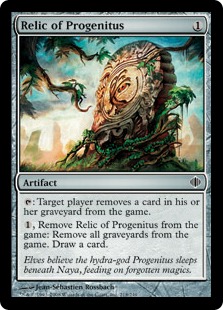
One of the juiciest targets to fish out is Relic of Progenitus. Relic has been a fixture of the deck's post-Eye incarnation since I first brewed it three years ago, as it substantially disrupts graveyard strategies while recycling our own copies of Eternal Scourge. This latter function is more of a late-game one, and so gels with Karn's hefty mana cost. Since we essentially have access to mainboard Relics with the new walker, we can finally nix the clunky Scavenger Grounds for better lands, and stand to further improve our already positive midrange matchups.

Modern features some strategies that are very difficult for us to defeat. Chief among those is Whir Prison, which sets up what amounts to a hard-lock with Ensnaring Bridge protected by Welding Jar. Since Karn shuts off activated artifact abilities, Jar no longer works, forcing Whir to search up Pithing Needle to counteract the Ratchet Bomb we now have access to before siding.
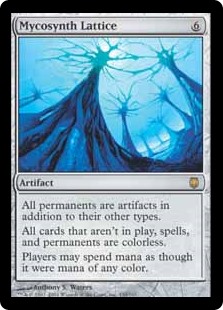
The flashiest Karn target, though, is Mycosynth Lattice. The walker's static ability combines with the artifact's to prevent opponents from activating abilities of their creatures or lands—including, yes, "T: add R." With enemies locked out of mana for the rest of the game, overcoming whatever board state they've assembled should be trivial, especially with Karn helping get us to what we need. Opponents will therefore try to deal with the walker ASAP, taking pressure off us and perhaps baiting some otherwise suspect attacks.

Wishboard Options

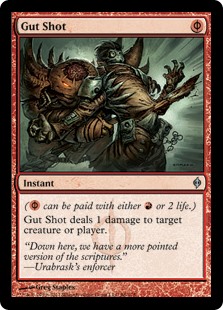
So that's Relic and Ratchet. But what other artifacts should we run in the sideboard? Since artifacts still don't give us any head-turning sweepers, I think the wishboard package should be as small as possible, giving us space for ample removal spells. Spatial Contortion seems like our best option right now, with Gut Shot following close behind. But I definitely want at least one Gut Shot to randomly hit planeswalkers with, as well as one Surgical Extraction to blow out anyone discarding our Eternal Scourge or trying to reanimate Phoenix.
In other words, the artifacts we elect to run as wishboard targets should play multiple roles, and do so well. Here's what I've auditioned so far, sorted by apparent usefulness.

Low-tier:

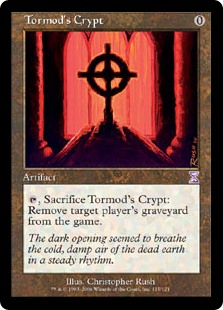
  • Tormod's Crypt. While usually worse than Relic, Crypt does offer us the utility of Karn acting as Bojuka Bog when we need it to, or coming down and immediately nuking an opponent's graveyard. But I don't think we need this effect on turn three or four, which is when access to Crypt could ever matter; later on, we don't mind paying to crack Relic for the cantrip. (I would probably play Zuran Orb were it Modern-legal.)
  • Liquimetal Coating. A sort of mini-Mycosynth Lattice, Coating turns enemy lands into artifacts so Karn can tick up to destroy them. It's slower and less decisive than Lattice, but we don't have to worry about finding the mana to cast it. Coating does monopolize our Karn activation, making it harder to find time for fishing out more bullets.
  • Darksteel Citadel. The purpose of Citadel would be to guarantee a land drop for next turn, specifically for Reality Smasher, regardless of whether Karn survives the turn cycle. We probably already have four lands for Thought-Knot, and as we'll soon see, other options are better for setting up a late-game mana advantage.
  • Ghostfire Blade. A card I've considered before, Ghostfire turbo-charges our Scourges and manlands on the cheap. But it was hard to run main because of tension with Chalice of the Void. We can now search it when Chalice is off the battlefield, though I'm not sure it's high-impact enough to warrant a slot.

Mid-tier:

  • Damping Sphere/Grafdiggers' Cage/Torpor Orb. These hosers are all great in their respective matchups, but only when dropped early; a turn five Cage isn't going to prevent many creatures from reanimating! Similarly, Sphere might prove too slow against Storm and Tron. But I can see Torpor Orb retaining late-game usefulness against Humans, and maybe our other disruption will buy us the time needed for these artifacts to do their job from the wishboard.
  • Spellskite. Similarly, Karn into Skite seems a tad slow against the aggro-combo decks that struggle versus the Horror. But I like its ability to protect our other lock pieces, such as Chalice, as well as Karn himself—or that killer Smasher we've sandbagged in hand.
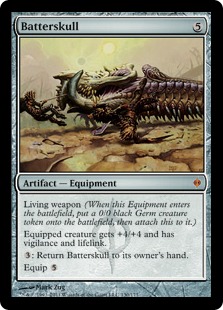
  • Batterskull. Perhaps a solid anti-aggro option, my beef with Batterskull is its mana cost. And everything answers this card. With Karn resolved and active, we're not going to have much mana to throw around bouncing, recasting, or equipping Skull, which makes me think the card might as well die to Fatal Push. That said, it's possible Skull promises the tempo swing we need in aggro matchups. Wurmcoil Engine is another option, but I think it's too pricey.
  • Lightning Greaves. The boots basically grant us "emblem of haste" for two mana, which could help us turn the tide in a mid-game tempo war or fade sorcery-speed removal on our critical creatures. Compared with Ghostfire, haste is better than +2/+2 on Scourge in many matchups, and costing 0 to equip is huge for us. I've made no secret of my affinity for Lightning Greaves, and am eager to try it in Modern again.

High-tier:

  • Relic of Progenitus/Ratchet Bomb. We've covered these two already, though I will mention that the single Bomb can be exiled by Relic and then recycled through Karn in longer games.
  • Sorcerous Spyglass. While Needle effects are occasionally great for this deck, they are also bad in multiples, and unreliable in small numbers. I even went so far as to cut Spyglass entirely from my Regionals list last year. But with Karn in the picture, Spyglass is all upside. Looking at the hand has applications of its own; we can now check for Settle the Wreckage or a stray counterspell before slamming Smasher for the win.
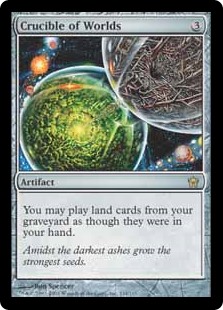
  • Crucible of Worlds. Crucible, too, is immensely powerful in the right scenario, but woefully anemic in others. Karn removes the guesswork and grants us access when we want it. Of course, the artifact's chief purpose is to rebuy Ghost Quarter so we can decimate an opponent's manabase or manlands to keep the pressure on. Still, there are some neat plays we can make with Crucible on the field, such as Quartering our own Temple and replaying that Temple from the grave to generate extra mana, or doing the same with Zhalfirin Void to net extra scry triggers. In fact, tutoring Crucible with Quarter in play guarantees that we'll make land drops up to six without needing to draw more: turn four tap out for Karn; turn five drop Crucible, Quarter our land for a wastes, play that same land; turn six play Quarter from the 'yard, slam Lattice.
  • Mycosynth Lattice. Enables the one-card combo we've heard so much about. Wurmcoil might be too pricey, but it also doesn't end the game on most board states. The threat of Lattice pressures opponents to deal with Karn, and we need to be able to adequately punish those who fail to interact.

Strategic Impacts

Besides tutoring up situational sideboard cards when we need them, Karn alters our strategic profile. For one, we no longer have dead cards. Excess lands, Serum Powder, and Simian Spirit Guide help ramp us into Mycosynth Lattice, or else into whatever artifact we grab with a freshly-deployed Karn. Powder can even go on the offensive, as Karn's +1 turns it into a Wild Nacatl for the turn cycle.

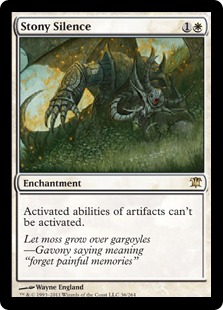
Some of our tougher matchups catch a break, too. The Karn-plus-Lattice plan is extremely threatening for UW decks, which can pose issues for us in the late-game.  And anyone relying on activated abilities of artifacts is in for a beating, as Karn doubles as mainboard copies of Stony Silence. Hardened Scales and Whir Prison are two major, difficult matchups that improve with this addition.

All that upside comes with one critical drawback: a less consistent aggressive plan. Karn doesn't impact the board the way our other cards do, and is therefore worse in racing situations. Even when there's a bullet in our sideboard for a given situation, that bullet will take quite a while to enter the battlefield. Matchup-wise, then, Karn hurts our odds against linear aggro, combo, and aggro-combo decks, unless those decks rely on activated artifact abilities. I imagine this caveat will make Karn sub-optimal in certain fields.

Attempting the Great Creation

With all that smoky exposition clearing, we start to see a decklist forming. No dead cards? No need for Smuggler's Copter. Extra points in grindy matchups? Guess we can cut Matter Reshaper. Expensive permanent incoming? Let's go back up to 23 lands. Aggro-combo becoming harder to beat? Cue a return to Endless One.

The math led me here:

Colorless Eldrazi Stompy, by Jordan Boisvert

Creatures

4 Eldrazi Mimic
4 Eternal Scourge
4 Thought-Knot Seer
4 Reality Smasher
3 Endless One
4 Simian Spirit Guide

Planeswalkers

2 Karn, the Great Creator

Artifacts

4 Chalice of the Void
4 Serum Powder

Instants

4 Dismember

Lands

4 Eldrazi Temple
3 Gemstone Caverns
4 Zhalfirin Void
4 Ghost Quarter
3 Mutavault
3 Blinkmoth Nexus
2 Wastes

Sideboard

4 Relic of Progenitus
1 Ratchet Bomb
1 Sorcerous Spyglass
1 Crucible of Worlds
1 Mycosynth Lattice
1 Torpor Orb
1 Lightning Greaves
3 Spatial Contortion
1 Gut Shot
1 Surgical Extraction

I initially tried 3 Karn, which felt way too clunky. And I'll need some testing against Tron to see if Damping Sphere is dearly missed there, but I think between Chalice and Karn shutting off their cantrip rocks (and the latter, Oblivion Stone) and the set of Quarters, that matchup shouldn't be too tough. For now, Orb and Greaves are the sideboard flex spots, and may just be replaced by the fourth Spatial and another Gut if no other artifacts impress me. Finally, I went with Gemstone Caverns as the 23rd land; I always did like having a third copy, and casting Karn early is another perk of starting on the play, one way or the other.

Oh, I Just Karn't Wait to Be King

Izzet Phoenix? Dredge? London Mulligan? And now Karn, the Great Creator? 2019 is shaping up to be a fantastic year for Colorless Eldrazi Stompy. Which War cards have you brewing? Drop me a line in the comments.

Tales from the Buylist #8 – Commander Moves the Needle

Are you a Quiet Speculation member?

If not, now is a perfect time to join up! Our powerful tools, breaking-news analysis, and exclusive Discord channel will make sure you stay up to date and ahead of the curve.

War of the Spark hype is getting very real! Already we're seeing movement on cards based on what was spoiled, and a lot of speculative buyouts based on revealed information about the set in general.

Atraxa, Praetors' Voice is currently undergoing a buyout, and we're likely not close to a settling price yet. This buyout was spurred on by the spoiler weekend during the Mythic Invitational at PAX East, with the announced return of proliferate.

Proliferate

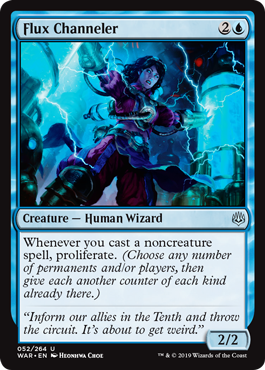
Atraxa is destined to sit upwards of $60 should this demand continue, especially considering her relatively low print run. We did see the card reprinted in Commander Anthology Vol. II, but not too many more copies were made available from this product. For those who were willing to jump in as soon as Flux Channeler was spoiled, it wasn't hard to pick up a good percentage of the total population of Atraxa. Many Commander-exclusive cards are seeing a lot of pressure, and Atraxa is no different.

There was an error retrieving a chart for Atraxa, Praetors' Voice

As a Praetor, the card comes equipped with casual appeal, and could likely have connected items in the other four on-color Praetors for those looking to build flavorful decks. I'm thinking that the more competitive-minded players will be focused on going all in with the proliferate madness, choosing to abuse mechanics like infect to win the game quickly. Proliferate is an incredibly strong mechanic if you're able to distribute counters across the board evenly, and cards that do this will be worth examining going forward.

There was an error retrieving a chart for Contagion Engine

On the subject of proliferate, there are several cards that could be subject to demand in the near future. Contagion Engine is one of the more notable cards that can repeatedly use the mechanic, and will synergize with an artifact strategy in general. The added bonus of -1/-1 counters across the board to weaken your opponent's creatures and keep you alive is a bonus side effect, and could lead to a board wipe with consecutive activations.

There was an error retrieving a chart for Inexorable Tide

Similar to Contagion Engine, Inexorable Tide will be an auto-include in counter-based Atraxa decks. It was most recently reprinted in Modern Masters 2015. It's sitting at a relatively low price of around $3, given the possible demand it will see in the near future. There is already a small uptick from its earlier $2 price, and it could likely hit as high as $5 or more going forward.

There was an error retrieving a chart for Decimator Web

Kind of a spicier pick here, but I think Decimator Web has largely flown under the radar for a strategy like this. Seeing this artifact resolve and activated is pretty mean, and you'll hope not to be the unlucky recipient of it. The card was only printed in Mirrodin Besieged, and foils could be an awesome pickup for explosive gains should it catch on.

There was an error retrieving a chart for Mycosynth Lattice

Mycosynth Lattice was recently reprinted in Battlebond, and if we can take the recent Karn, The Great Creator spoiler to be real, this enables you to tutor any card from outside the game you own into your hand. This will be significant for Commander play mostly, and we're already seeing a lot of these go out the door. There's still room to get in under the $20 mark, but I would not be very keen on picking these up past that point.

Planeswalkers Matter

There was an error retrieving a chart for Knowledge Pool

I'm noticing a pattern here. Most of the cards I've mentioned above are Mirrodin- and Scars of Mirrodin-block artifacts with absurd effects. Knowledge Pool is seeing a small uptick from below a dollar currently, and could end up much, much higher. We've recently seen Modern chatter about this card when Saffron Olive covered it in his Against the Odds series, noting its game locking interaction with Teferi, Mage of Zhalfir. The printing of the new three-drop planeswalker Teferi, Time Raveler offers a similar way to set up the lock.

There was an error retrieving a chart for The Chain Veil

The Chain Veil continues its upward trajectory we've seen since the announcement of War of the Spark, though is starting to slow down a bit. The appeal of multiple planeswalker activations will keep pushing this card to new heights. I think this card is destined to pass the $30 price point, especially if it dodges this year's Commander print cycle.

There was an error retrieving a chart for Doubling Season

It's always worth taking a look at Doubling Season when you're talking about planeswalkers, proliferate, or really any reference to EDH in general. This card is somewhat of a signpost for Commander-related finance, and will always be a relevant player regardless of the number of printings it sees.

It continues to climb towards what I estimate will be $50 a copy as a fair market price, and likely around $60+ at most retailers. I don't necessarily recommend going deep on picking these up, but I wouldn't be getting rid of them either.

There was an error retrieving a chart for Deploy the Gatewatch

I talked about Deploy the Gatewatch in my article All About Eldritch Moon weeks ago, and I believe we still haven't quite reached the ceiling for cards like this. Oath of Nissa and Call the Gatewatch are in a similar situation, and will likely be more desirable once packs of the new set are available.

Effects like this play nicely with the new walkers we'll be receiving, and the downshifted rarity of War of the Spark's cast will give players on a budget a chance to actually build this strategy. What's more, having an even wider selection of playable planeswalkers will allow these decks more flexibility in the walkers they choose.

A Brave New World

Last up, I'd like to leave you all with some food for thought. While this spoiler season is not too dissimilar to ones we've seen before, I'd like to note that Magic: The Gathering has never had more eyes on it than now. The Mythic Invitational was a huge event that brought our game to the front page of Twitch, and the War of the Spark teaser trailer has gone practically viral. At this time it has 6.7 million views, and will likely keep climbing.

Considering these things, I think many of our expectations of the market are about to undergo a shift of sorts. Arena will eventually be out of the open beta stage and will be a full release, likely with a ton of hyped advertising to go along with it. It's an exciting time to be involved in Magic, and I think a lot of new, unprecedented investment opportunities will be opening up soon.

Pickups

  • Knowledge Pool
  • Decimator Web
  • Inexorable Tide
  • Mycosynth Lattice

Holds

  • Atraxa, Praetors' Voice
  • The Chain Veil
  • Doubling Season
  • Call the Gatewatch
  • Oath of Nissa
  • Deploy the Gatewatch

That does it for this week! You can follow me on Twitter @chroberry or Instagram @chroberrymtg if you want to see extra goodies and spoilers for next week’s article. Feel free to let me know how you feel about my targets here in the comments, or if there’s anything you think I missed!

Peace!

Metagame Tide’s Changing: GP Calgary

Are you a Quiet Speculation member?

If not, now is a perfect time to join up! Our powerful tools, breaking-news analysis, and exclusive Discord channel will make sure you stay up to date and ahead of the curve.

Nothing lasts forever; the mighty will eventually fall; time erases all wounds; change is the only constant. All such platitudes mean for Modern is that one deck can only remain on top of the format for so long. Eventually, the format either adapts to the deck, there's a structural change to the metagame, or the banhammer drops. There was movement in the latest GP data which suggests that such a change is happening, although it is still too early to be certain.

This is not too surprising. When Grixis Death's Shadow's reign ended, it did so with a whimper rather than a roar; despite months of dominating Modern, the emergence of anti-decks, and calls for a bannings, it just faded away in fall 2017. It's been just another deck since then. Humans was the deck of 2018 until Spirits rose to dethrone it in late summer. And now, Izzet Phoenix has been crushing tournaments for months. GP Calgary marks the first big Modern tournament where Izzet Phoenix wasn't a significant portion of the Top 8. What this means isn't clear yet, but I'm hoping it means that the firebird's reign is coming to an end.

Day 2 Metagame

The defining feature of Izzet Phoenix Modern has been its huge Day 2 numbers. The GP weekend saw Phoenix average 21% of the Day 2 population, and previous tournaments showed similar numbers.  This result is significant for any Modern deck, but the real kicker has been the gap between Phoenix and the next deck.

Deck NameTotal %
Other26.14
Izzet Phoenix 17.65
Burn9.15
Mono-Green Tron8.50
Dredge6.54
Grixis Shadow6.54
UW Control5.88
The Rock5.23
Humans5.23
Amulet Titan3.27
Hardened Scales3.27
Spirits2.61

Calgary's metagame is quite a change from last time. Izzet Phoenix is not only not the top category, but it's well below the previous percentage. Instead, "other" is the most populous category. Plainly: players were more likely to hit a rogue deck on Day 2 than a given established one.

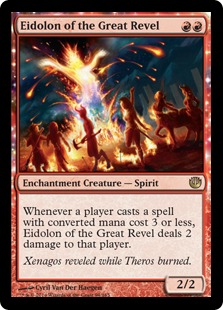
More interesting for me is Burn and Tron beating out Dredge. For the past several months, Dredge has been following in Phoenix's wake as not necessarily the number two deck, but typically close behind and second in Top 8s. Being this far behind Phoenix is a notable change. I'm also gratified to see Burn doing well. In a world full of cantrips, Eidolon of the Great Revel is a huge beating.
The other thing to highlight is the lack of Whir Prison. Despite being billed as a Phoenix killer, it failed to warrant its own category on this metagame table. It's possible that Canada just has a prisonless metagame, but I suspect the deck's weaknesses are to blame. I've roasted the deck for being mostly air and weak to hate, but like all prison decks, Whir is also weak to Tron. There are simply too many cards that can break its locks, and given the high Tron turnout, I'm not surprised it didn't succeed.

A final thing to note is that the three most interactive decks in Modern are right after Dredge in the standings. The top deck may be uninteractive, but as I've constantly harped on, that just makes interaction and answer decks better. All it takes is adapting and running the right answers.

The Top 8

A natural result of Phoenix's Day 2 dominance has been huge numbers of Top 8's. It's statistically unlikely for every member of the highest population group to lose, and with population figures so high compared to the other decks, it was inevitable that many Phoenix players made Top 8 over the past few months. Calgary's Day 2 may not have been quite as skewed as previous GPs, but the warp was still present, so the logical assumption would be for another Phoenix-heavy Top 8. However, that's not the case.

Deck NameTotal #
Jund Breach Titan1
Grixis Death's Shadow1
Izzet Phoenix1
Humans1
Dredge1
The Rock1
UW Control1
Blue Moon1

A Top 8 of eight different decks: it doesn't get much more Modern than that! Despite months of the prevailing rhetoric pegging Izzet Phoenix the best deck, Modern's diversity is holding strong. The bracket was also filled with some interesting decks. I've never seen Jund Breach Titan before, and I'm a little dubious. It obviously worked well for Attila Fur, but given the metagame I don't see why Fatal Push and Assassin's Trophy are better for this deck than either running extra Anger of the Gods or Abrade. The sideboard Slaughter Games and graveyard hate I can understand, but stretching the mana for a couple removal spells is very strange to me.
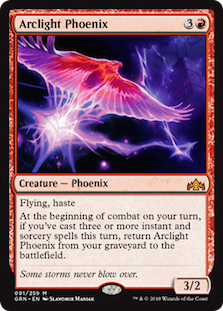
And then there's Blue Moon. I can't remember the last time this deck made waves, especially one full of as many singletons as Brian Willms's deck, although we've seen it win a bit online. I actually suspect the deck started life as a control-oriented Izzet Phoenix deck and simply dropped the Phoenixes at some point. As some have said about Izzet Phoenix, Brian's deck is really a Thing in the Ice deck, and the Blood Moons look like incidental inclusions. Maindeck Spell Snare, Flame Slash, and Ral, Izzet Viceroy certainly seem like cards meant to win Thing mirrors.

The Complication

The Top 8 only having a single Izzet Phoenix deck certainly suggests that the metagame has moved on from Phoenix, and the drop off has begun. That suggestion is premature. Tempting though it may be to declare Calgary proof that the format has adapted and the reign of the firebird has ended, some confounding factors with GP Calgary may not make it the best indication in light of available, contradictory data.

Is Izzet Fading?

Failing to hit 18% of Day 2 is a significant drop from the previous several weeks of data. However, recall that those huge numbers are a recent phenomenon. Phoenix has been around for months, but its Day 2 domination was unique to March. Before then, Phoenix was only putting up solid Top 8 numbers and winning events. In this light, Calgary is more return to form than true deviation.

Also, in this case, a ~3% drop off is hardly earthshaking. If Phoenix had started off at 5% and dropped to 2%, we'd have a more significant decline percentage-wise. However, it's a move of ~21% down to ~18%. I'd still call that a dominating metagame share. It's also still 8.5% higher than the next individual result. It would be disingenuous at best to say that Phoenix's decline this weekend indicates a relinquishing of position.
There is the point that Phoenix was behind the "other" category by 8.49%. That's roughly the same as its lead over Burn. By itself, this doesn't mean much, but recall that it's not the first time that the highest results were Izzet Phoenix and "other." What exactly this means is hard to say, since Modern has always been a diverse format. Butt this rise in "other" might indicate that Phoenix isn't dominating the format like previous heavy hitters did. It could also be that players are drifting away from pure Izzet Phoenix now that the deck is known and their metagame niche is too crowded.

...Or Simply Fluctuating?

It's equally possible that Phoenix's numbers are just natural variance. Each event is different, and there was a relative lack of Izzet players in Calgary. Izzet Phoenix averaged 21% two weeks ago, but exhibited significant variance between the three events. Calgary's 17.65% isn't far off from Tampa's 19.5%, and probably within the margin of error for the sample size. This slight dip relative to previous numbers might then prove non-indicative of the actual trend.

Our uncertainty is made worse by questions about the starting population. If Calgary's initial attendance was reported, I couldn't find it, but I would guess that it wasn't anything special. From what I understand, Calgary is not exactly a tourist mecca; it's also early spring, Calgary is quite far north, and when even those in lower latitudes had snow last weekend, I imagine that many otherwise interested players weren't willing to risk the trip.
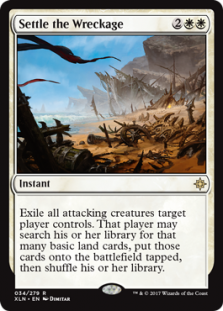
Matters are further muddled considering that PAX East, and with it the Mythic Invitational, happened on the same weekend. I enjoy playing GPs as much as anyone, but all things being equal, I'd never pick that over PAX. I can't prove that watching the Invitational or attending-related issues actually kept players away from Calgary, but pondering these factors does raise enough questions that I wouldn't consider Calgary a good data point.

A Counterpoint

There is also the fact that Calgary's main event is only one data point. That's never enough data to draw any meaningful conclusion. The result is also undercut by another data point: the Calgary MCQ's Top 8 looks more like what we've come to expect in the Phoenix era.

Deck NameTotal #
Izzet Phoenix2
Dredge2
Humans1
UW Control1
Grixis Death's Shadow1
Mono-Green Tron1

Phoenix closed out the finals, and Dredge was the second-highest performer. That's pretty consistent with previous events. An MCQ may not be as high-profile or high-attendance as the GP main event, but it does reinforce Phoenix's potency. Taken alongside the previous results and compared to the GP results, it lends credence to the idea that Calgary was a fluke. The circumstances and pilots may have just been wrong this time, rather than the metagame actually adapting.

Adaptation via Playstyle

If the metagame is adapting, how is it happening? I only have the Top 8 decklists from the GP and MCQ to work with, but I'm not seeing much new tech or deck adaptation. Austin Anderson's UW Control deck is the only Phoenix-ready deck on paper, with Terminus and Settle the Wreckage as sweepers, Detention Sphere as backup, and Celestial Purge in the sideboard. The UW deck in the MCQ was still running Supreme Verdict, although it arguably compensated with a full set of Relic of Progenitus maindeck. Otherwise, it's mostly tech we've seen before or deck configurations that haven't changed in months.
It has been suggested to me that the real adaptation isn't happening in terms of cardboard tech, but tactical. Players have had plenty of time to refine their play against Phoenix and figure out how to win. If the Top 8 is indicative of the trends throughout the tournament, it would suggest that players are learning to modify their responses to Phoenix to better answer the actual problem rather than trying to exploit a perceived weakness; for example, the perhaps overblown reaction of running mainboard Surgical Extraction seems to have been nixed by all but Phoenix itself.

History Repeats

Adapting playstyles rather than deckbuilding, understanding how a deck actually works, focusing on that rather than on the threats is a repeat of Grixis Death's Shadow's trajectory in Modern. There, players learned to accept that they would be hit with discard early. This led them to stop keeping speculative hands and just play more robust decks. Once its attack became less potent, Grixis naturally fell off.
Maybe Modern is finally getting over its firebird blitz as the format registers the deck's fragility. Izzet Phoenix burns through lots of cards, but there's never any guarantee that Phoenix will hit the bin. It will see Phoenix eventually, and probably several copies, but to reanimate those early demands Faithless Looting or a lucky Thought Scour. Meanwhile, Thing in the Ice is actually controllable, and thus a far more reliable plan. Therefore, it's the actual threat and power of the deck, as hinted at by Blue Moon's surprise success.

Insufficient Data
In the end, there's not enough data to determine whether Calgary is the start of a meaningful change or simply a normal fluctuation. I am hopeful that players are adapting and the metagame will return to the health that the Top 8 shows still exists, but we need to wait and see more data before confirmation. In any case, we'll keep you posted on Izzet Phoenix's developments as Modern continues to evolve.

Learning from Missed Opportunities

Are you a Quiet Speculation member?

If not, now is a perfect time to join up! Our powerful tools, breaking-news analysis, and exclusive Discord channel will make sure you stay up to date and ahead of the curve.

I’ve heard the phrase “FOMO” before, most recently in QS's Insider Discord. It’s a concept that follows us throughout life, and it has affected everyone differently. For those of you that don’t know, FOMO stands for Fear Of Missing Out.

There was an error retrieving a chart for Opportunity

Let’s take my own experiences as an example. When I was much younger (between about 5 and 8) I had such a hard time falling asleep night after night after night. I would go to bed and shut my door, but I could hear my parents in the living room laughing to something on TV or occasionally the sounds of Mario looking for Peach from my old NES. It would honestly take me until the early morning hours sometimes to fall asleep, and that would take its toll on me the next day. I was sad and scared that I was missing out on something that my parents were experiencing, so much so that it would affect my health from lack of sleep. This is just one experience in an entire world of people, but we can learn and grow from it.

I’m sure many of you are asking how this applies to MTG finance. There are many people I’ve seen, even Insiders (and including myself sometimes), who have FOMO with Magic. It's not necessarily a bad thing, but it can put a wrench in our cogs if we're not careful.  Let’s look at some examples of cards that have spiked to get a better idea.

There was an error retrieving a chart for Torrential Gearhulk

Torrential Gearhulk is a card that started out pretty low and ran under the radar until it was seen on camera and in many decks at Pro Tour Kaladesh. Watching someone hold up six mana to cast it while having a Disallow in their graveyard was pretty cool, and for some reason, that concept hadn’t quite hit the majority of the community until that moment.

It was around the $5 mark, then started to rumble towards $8. No one thought it would see a penny over $10 or $11. On Friday, October 14, folks started hearing rumors that pros were playing it as a four-of in any deck with blue. The very next day, it was seeing prices of $15 minimum. It peaked just under $40 before the weekend was over, and slowly started to settle around $18 before two more spikes over the following months.

There was an error retrieving a chart for Arclight Phoenix

Arclight Phoenix is the talk of the meta right now in almost every format. Believe it or not, this card could be obtained at one point in time for $2 or less. I even know a few folks who picked them up in bulk for a brief time.

Rumors started and whispers were heard, and slowly this card moved its way from $2 to about the $5-to-$8 range. There was a lot of talk about how this card wouldn’t hit $10, and if it did, it would only be temporary (another article on this later). There were pros and YouTubers who were trying to break this card with awkward combos involving Pact of the Titan and strange storm brews. It hit $10 and plateaued a bit around $12. The time to buy for maximum profit had passed, but there was still time to buy. It spiked hard again and has floated between $22 to $30 since.

Getting Ahead

Alright, so I've pointed out a few examples of cards that could cause FOMO with certain audiences.  How do we avoid that and how do we get ahead of the game?  How do you know what the next Phantasmal Image is going to be?  Let's take a look at some trends to follow and what to look at when deciding if you want to buy-in on a card.

YouTube

First on my list is YouTube. It's a site I visit every day with a number of channels that I like to check.  And yes, I watch some of them because I enjoy MTG content quite a bit, but there are some that can have a greater effect on the financial aspect of the game as well.

I won't point out directly who some of them are (a magician never gives away all of their secrets), but I will say that there are a couple of channels that have a very high subscriber count and are vastly popular.  Alright, I'll give you a good one: The Command Zone.  It's a fantastic channel where some folks get together to play none other than the namesake of the channel, Commander.  They have great deck techs, fantastically edited videos, and are a fun group of folks to both watch and listen to.  Because of their popularity, cards have been known to spike thanks to their deck techs and crazy Commander games.

There was an error retrieving a chart for Kozilek, the Great Distortion

Recently, Kozilek, the Great Distortion has seen an uptick in popularity.  March 1, 2019, saw the posting of this particular video, in which Ashlen pilots a deck headed by Kozilek, the Great Distortion.  If you follow the trends on MTGStocks, you can see that as of March 2, Kozzy started to see a rise.  This same trend follows when, on March 19, the deck tech is posted, and now the lowest listed non-foil, near mint, English Kozzy on TCGplayer (as of the writing of this article) is roughly $10.

Not only is it popular, but the card has other variables that make it appealing as well – it's an Eldrazi, it has a cast trigger, it has a unique ability and mana cost, it's legendary, and it's no longer in Standard.  Following along?

Twitter

Yes, I am plugging my own Twitter.  No, you don't have to follow me, but it's a great place to follow other folks like LSV, Zac Elsik, The Professor, and the hashtag #MTGFinance.

Twitter is a great place to find conversations about new decks that people are testing, what's going on in each format, why folks get so hyped about Pauper, sudden news within the Magic community, and a variety of other things.  Twitter is an awesome resource!  It's also a site where folks buy and sell cards – so you can follow trends or find some cheap pickups too.

Twitch

There was an error retrieving a chart for Twitch

I won't go too deep into why Twitch is amazing, because it holds a lot of the same value that YouTube does.  The biggest difference is that Twitch is live.  You can get instant information about who is playing what on camera at an SCG Open, MagicFest, FNMs, and tons of folks playing Arena or MTGO live.

There are a lot of content creators who have a Twitch schedule, and it's a great way to find the up-and-coming cards.  You can watch SaffronOlive try to break ridiculous things like Worship just to find out that it's actually fairly good, can be competitive to a certain level, and thus if the price is right, could be a great investment.

Conclusion

So, what’s my point here? To level up our MTG finance decision making, we need to stop buying into cards that suddenly spiked to $20 just because we could find one or two copies at $16 or $17. Let's return to my examples of Torrential Gearhulk and Arclight Phoenix.

First of all, these two cards are very good at what they do. Gearhulk was a great finisher for control decks. Phoenix is a build-around card that happens to have been introduced in a time of fast decks for each format.

Secondly, there were a lot of people trying to buy into each of them just under a spike price point and sell for almost no profit, just to see it spike again. Part of speculation is risk. Yes, many folks will say “the greater the risk, the greater the reward” but the part they fail to mention is sometimes it’s a great fail too. One of the rules of thumb I use for speculating on Magic cards is that you need to have confidence in what you are buying in on and you need to have multiple justifications for why you feel the need to buy it.

Thirdly, do your due diligence on cards. You also have to remember that part of your profit isn’t actually profit, you also have to factor in fees and shipping. Selling a $5 card you bought at $3 won’t net you any profit, but selling a $5 card you got for $0.50 will (another article on this in the future).

Crucially, if you find yourself getting anxious and having FOMO with buying and selling cards, maybe taking a step back and a deep breath to gain some focus will help.  You don’t have to buy in or try and profit from every single Death's Shadow or Nether Traitor.

Pat’s Predictions

  • There’s a massive gap between UMA cards and their other printings. This is a good time to start picking up some Modern staples that are underpriced, especially foils. Fulminator Mage foils are a good example of this.
  • Pauper is starting to pick up, especially after the on-camera coverage from MagicFest LA. The meta is fairly diverse and there are a lot of cards that have room to grow, especially cards with only one or two printings or foils. Tortured Existence is under $2 right now and has the potential to hit $4 or $5 – the deck is literally named after this card. If you can find some hiding in boxes, bulk bins, or for around $1, then I would pick them up and hold on to them.
  • Kefnet, the Mindful is the last of the five Gods from Amonkhet that can be found for under $1 on most major retail websites (including TCGPlayer).  In terms of price, it's not that far from Oketra the True, but they are all great pick-ups for Commander.  This is a long-term hold, but even if you don't want to worry about selling a pile you acquire, they can always be buy-listed.  Grab them for under $1 and send them to Card Kingdom in a year or two for $2 or more in store credit.

Popular Cards Dodging Reprint

Are you a Quiet Speculation member?

If not, now is a perfect time to join up! Our powerful tools, breaking-news analysis, and exclusive Discord channel will make sure you stay up to date and ahead of the curve.

This morning I was running my daily check of MTG Stocks’ Interests page when a couple of price increases grabbed my attention. First, I saw that Mana Crypt had climbed over $200, hitting an all-time high. Second, Blightsteel Colossus hit an all-time high approaching $70 and likely on a one-way trip to $100.

Besides being popular Commander artifacts, these two cards have little in common, but to me they fall in a very similar category when it comes to classifying cards. They are both surprisingly expensive cards that are not on the Reserved List. In fact, Mana Crypt has already gotten the reprint treatment a couple times, although the Masterpiece printing likely didn’t add a statistically significant number of copies to the market.

There was an error retrieving a chart for Mana Crypt

The fact that these cards are maintaining such a high price tag despite their vulnerability to reprint is a testament to the community’s mindset about them: there is no expected reprint anytime soon, and these cards are so important that one can justify the steep price tag to acquire a needed copy. This is a recipe for an expensive, modern-era card. Are there others that fit this same description, with equal upside potential? This week I’ll dig into the data and find out!

Low Reprint Risk, High Price Potential

The key is finding cards that are in the process of spiking due to a powerful demand profile alongside a low reprint likelihood. That’s where profits are likely to be made, especially if affordable copies at the “old price” can be found before a full-blown buyout occurs.

Here are my ideas in no particular order:

There was an error retrieving a chart for Sylvan Library

Sylvan Library – This green card-drawing machine is powerful enough to make occasional appearances in Legacy. It’s also very playable in Old School. But without a doubt the primary source of demand for this card is from Commander: the card shows up in over 32,000 decks on EDH REC!

The card already moved aggressively, but you may be able to find cheap copies scattered throughout the internet. Once thought to be a $15-$20 card, this is now a solid $35 card with plenty of further upside should it dodge reprint another year or two.

Could Sylvan Library appear in Modern Horizons, introducing the card into the Modern format? It’s not impossible. Watch spoiler season closely, and as soon as this card is ruled out of contention it should be safe to hold for a while longer.

There was an error retrieving a chart for Oracle of Mul Daya

Oracle of Mul Daya – Would a reprint of this green creature from Zendikar really hurt so much? For some reason this Commander staple (23,000+ decks on EDH REC) has dodged reprint time and again. Given it is in Zendikar, a Modern-legal set, there’s zero chance this is reprinted in Modern Horizons as well.

Could it show up in a future Commander product? Possibly. But as a $30 card, it’s getting dicey. Should the Oracle spike towards $50, reprinting her in a Commander deck would generate lopsided demand for that deck, and Wizards of the Coast is trying to avoid that phenomenon. Only time will tell, but in the interim expect this card to climb higher.

There was an error retrieving a chart for Worldly Tutor

Worldly Tutor – The more research I do, the more I realize green cards get the shaft when it comes to reprinting. This is an uncommon, originally printed in Mirage and reprinted once in Sixth Edition. It has not been reprinted since. As a result, we have a $10+ uncommon that appears in over 21,000 lists on EDH REC.

This one could be too powerful for Modern, though I’m hardly the expert to judge. If so, then it won’t show up in Modern Horizons and will continue to climb in price. There are only 115 or so listings on TCGplayer across both printings of this card—as supply gradually dwindles I expect to see the price ramp towards $20.

There was an error retrieving a chart for Sphere of Resistance

Sphere of Resistance – Let’s dig a little deeper to see if we can find any diamonds in the rough. It’s trivial to find all the most played, least reprinted Commander cards. How about something different, such as Sphere of Resistance? It’s not on the Reserved List, which is why it got the Masterpiece treatment not long ago. But other than that, this rare from Exodus has never been reprinted.

There are over 100 vendors with this card on TCGplayer, so a spike isn’t imminent. But Sphere does show up in over 2500 EDH REC lists and it is very popular in Vintage. Granted, Vintage demand isn’t going to move a card’s price all too quickly. But I doubt a reprint is likely anytime soon, giving this coiled spring plenty of room to pop in price in time.

There was an error retrieving a chart for Phyrexian Metamorph

Phyrexian Metamorph – It’s not easy to reprint Phyrexian-mana cards. They don’t fit in Standard sets due to the Phyrexian mana mechanic, not to mention I don’t know if Wizards regrets pursuing that ability as it led to some broken cards (Mental Misstep, Gitaxian Probe).

Given its legality in Modern, Phyrexian Metamorph isn’t going to show up in Modern Horizons. So your only chance at a reprint in the next year is going to be some Commander set. Given it's in over 20,000 lists on EDH REC, I think a reprint is possible, but far from a guarantee. Wizards has opted not to reprint it so far, and it's only getting older and sparser. I expect a push towards $20 at some point in the next year or two if this trend continues.

There was an error retrieving a chart for Jace, the Mind Sculptor

Jace, the Mind Sculptor – He’s Jace. He’s extremely powerful. He’s Modern-legal, and likely to get better as the card pool in Modern expands. And he can’t be reprinted in Modern Horizons. The card has already risen past $100, but is there really a ceiling on this guy? At some point, I wonder if Masters 25 booster boxes become attractive due to the inherent Jace lottery…if only there weren’t so many bulk rares in that set.

As for the Reserved List…

Speaking of Jaces over $100…it’s uncommon for a non-Reserved List card to crack $100 these days. Wizards has done a fine job playing whack-a-mole, reprinting cards where they can to keep prices down. That said, highly desirable Reserved List cards are simply doomed to rise in price as long as Magic is healthy. In fact, some Reserved List cards haven’t crossed the century mark even though I would have expected them to by now.

In the forefront of my mind is Sliver Queen. Rumors abound that Slivers may show up in Modern Horizons. Whether or not they do is irrelevant. Casual players love Slivers and Sliver Queen is an obvious include (though not usually as the general). There are currently 28 English listings of this card on TCGplayer—it is near a tipping point and $100 is virtually guaranteed.

Next, you have Serra's Sanctum, a powerful land played in both Legacy and Commander. This one peaked over $100 at one point, but copies can still be found for $80-$90. Given its presence on the Reserved List and unmatched power level, this card will inevitably break $100 permanently. This could even be the year, as we’ve seen Card Kingdom sell out of the card and jack up their buylist once already. It won’t be long before a $100 buylist price is a mainstay on this card.

Lastly, let’s talk briefly about the cheapest Dual Land, Plateau (though maybe it’s Savannah at this point).

There was an error retrieving a chart for Plateau

The current market price on this card is technically over $100, but plenty of HP and MP copies are available for under the century mark. LP copies start in the mid $90’s. It has taken over 25 years, but I believe the last of the cheapest of the Dual Lands will finally sell for over $100 soon. Sure, there will be beat up, bent-in-half copies that sell for less. But any decent-looking Dual Land will cost you more than a Ben Franklin before you know it…even for Plateau.

Wrapping It Up

While we’re not witnessing the seemingly daily buyouts of cards these days, a lot of popular playables have quietly risen to all-time highs. This goes for both Reserved List cards and reprintable cards. Mana Crypt, Sylvan Library, and Jace, the Mind Sculptor have been on my radar a while now but there are a handful of others showing plenty of price movement.

While I tend to shy away from cards that are at risk of reprint, I have to question how Wizards plans to reprint some of these pricey, popular Commander cards. Some are too powerful for Modern, and some are too expensive to include in the annual Commander products. Without a good reprint outlet, some of these cards will climb higher and higher.

And, of course, there are always Reserved List cards on my radar. Recently I’ve been following Sliver Queen, Plateau, and Serra's Sanctum, waiting for them to crack the $100 mark once and for all. For these it’s a matter of when, not if.

Whether you prefer the security of the Reserved List or not, one thing is clear: Commander is a major driver for card prices and will help generate profits for years to come. Wizards can’t possibly keep up with all the reprints necessary to keep card prices down. This means there are still plenty of opportunities to profit.

…

Sigbits

  • Here’s a hotlist card you don’t see every day: Alpha Counterspell. Card Kingdom currently offers $570 on their buylist for Near Mint copies. Be careful selling to them, though, as their downgrade percentages on Alpha can be a bit rough. Then again, how many people actually own Alpha Counterspells?
  • I noticed Eureka returned to Card Kingdom’s hotlist recently. At first it was listed with a $305 buy price, but the price has since dropped to a more realistic $260. Honestly, this is such a fun, unique card and I think its price tag is merited. There really aren’t many of these in stock, and I think it will be a $500 card before 2020 is over.
  • There are still a ton of Masterpiece cards on Card Kingdom’s hotlist. I suspect these are rare enough that it’s difficult for Card Kingdom to get and keep many in stock. Scalding Tarn receives top billing with a $235 buy price. Verdant Catacombs is on there with a $165 buy price and Chalice of the Void at $115. Each of these have a very robust demand profile.

Insider: QS Cast #118 – Time Management [Unlocked]

Are you a Quiet Speculation member?

If not, now is a perfect time to join up! Our powerful tools, breaking-news analysis, and exclusive Discord channel will make sure you stay up to date and ahead of the curve.

Welcome to the QS Cast 2019! Our co-hosts Chaz and Tarkan explore the financial aspect of Magic the Gathering – and in this episode they discuss the following:

  • Fellow QS Writer Chris Martin re-joins the Podcast!
  • We discuss time management and tailoring that to your finance strategy.
  • MTG Arena Changes
  • Insider Questions

Cards to Consider


*This Podcast was Recorded on 03/22/2019 for QS Insiders. If you want live recording sessions and up to date postings before anywhere check out the QS Insider Discord!

Insider: QS Cast #117 – London Lookout [Unlocked]

Are you a Quiet Speculation member?

If not, now is a perfect time to join up! Our powerful tools, breaking-news analysis, and exclusive Discord channel will make sure you stay up to date and ahead of the curve.

Welcome to the QS Cast 2019! Our co-hosts Chaz and Tarkan explore the financial aspect of Magic the Gathering – and in this episode they discuss the following:

  • Fellow QS Writer Chris Martin joins the Podcast!
  • We look at the London Ruling article from Frank Karsten on CFB.
  • Insider Questions

Cards to Consider

*This Podcast was Recorded on 03/14/2019 for QS Insiders. If you want live recording sessions and up to date postings before anywhere check out the QS Insider Discord!

Avatar photo

Chaz V

Started playing during Invasion block at the age of 13. Always a competitive person by nature, he continues playing to this day. Got into the financial aspect of the game as a method to pay for the hobby and now writes, Podcasts, and covers all aspects of the game, always trying to contribute to the community and create great content for readers and listeners.

View More By Chaz V

Posted in Free, QS CastTagged , , , Leave a Comment on Insider: QS Cast #117 – London Lookout [Unlocked]

Have you joined the Quiet Speculation Discord?

If you haven't, you're leaving value on the table! Join our community of experts, enthusiasts, entertainers, and educators and enjoy exclusive podcasts, questions asked and answered, trades, sales, and everything else Discord has to offer.

Want to create content with Quiet Speculation?

All you need to succeed is a passion for Magic: The Gathering, and the ability to write coherently. Share your knowledge of MTG and how you leverage it to win games, get value from your cards – or even turn a profit.

Want Prices?

Browse thousands of prices with the first and most comprehensive MTG Finance tool around.


Trader Tools lists both buylist and retail prices for every MTG card, going back a decade.

Quiet Speculation