menu

Rebels — The Never-ending Stream of Conscripts

Are you a Quiet Speculation member?

If not, now is a perfect time to join up! Our powerful tools, breaking-news analysis, and exclusive Discord channel will make sure you stay up to date and ahead of the curve.

When I first learned about Commander, I was fascinated by the unfair combo decks. Azami, Lady of Scrolls with Mind over Matter; Seton, Krosan Protector with Masticore and Kamahl, Fist of Krosa.

When you first start playing a casual format, it can be hard to differentiate it from whatever competitive formats you may already play. In those formats, the goal is to win as quickly and efficiently as possible. Players may pursue their own sub-goals like assembling a crazy ten-card combo or hardcasting Griselbrand, but fundamentally the point of those formats is to win the game.

The most important thing to realize about a multiplayer format is that it's not primarily about winning. Sure, everyone's still trying to win, but unlike in other formats, not at all costs. Fundamentally, the goal is to have a good time with your friends, regardless of what's happening on the card table. There are always exceptions; some people love their degenerate games and that's fine too. But in my experience, most people prefer interactive games.

The experience that hammered this home for me happened at a time when my group was all playing degenerate combo decks. One of our regulars brought a Lin Sivvi, Defiant Hero deck to the table and we were ready to ignore him. He wasn't playing blue, black, or green, so what was the worst that could happen?

Well, he cast some mana rocks and rebels, and then played Armageddon. He tutored up more guys, beat down a little, and cast Ravages of War. Then Catastrophe. Every game the plan was to play some guys and destroy everyone's lands.

While it was definitely awesome to witness his fair deck full of dorky white creatures repeatedly smashing our fast combo decks, we realized it wasn't the kind of Magic we wanted to play. Since then, I've always wanted to build a Lin Sivvi deck, but one that was interactive and grindy rather than prison-based.

The Rebel Alliance
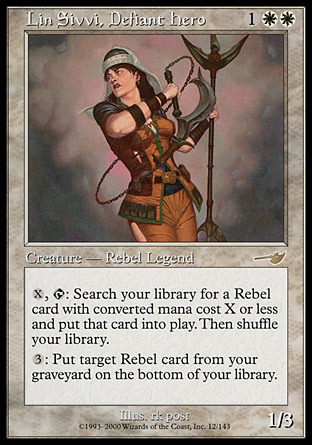
The exciting thing about Lin Sivvi is that she's an engine unto herself. Once you decide which rebels are good enough, you get to cast them as many times as you want each game.

This means you can build a ton of synergies into the deck and that it will be very difficult to break up your combos. One of my favorites, for example, is Zealot il-Vec and Basilisk Collar. Here are the rebels I decided to run with:

  • Lin Sivvi, Defiant Hero -- Commander
  • Defiant Vanguard
  • Mirror Entity
  • Zealot il-Vec
  • Changeling Hero
  • Outrider en-Kor
  • Task Force
  • Whipcorder
  • Cho-Arrim Bruiser
  • Aven Riftwatcher
  • Lawbringer
  • Lightbringer
  • Children of Korlis
  • Bound in Silence
  • Condemn
  • Skullclamp
  • Helm of Possession
  • Gorgon Flail
  • Mortarpod
  • Basilisk Collar
  • Sword of Feast and Famine
  • Steelshaper's Gift
  • Stoneforge Mystic

There are a number of sweet engines here, most of which involve recycling rebels and sacrificing them for value. It's a lot like any other token deck, except that your creatures have increased utility against the rest of the table.

We have Mortarpod to turn the rest of your rebels into pseudo Zealot il-Vecs, and both Lightbringer and Lawbringer to crush decks in opposing colors.

Whipcorder does a great job of containing creatures that trigger when they attack, like Eldrazi and titans. Changeling Hero protects your guys from removal or sweepers. Aven Riftwatcher is a great recursive beater and lifegain engine. Children of Korlis is similarly easy to recycle and does a great job of keeping your life out of the red zone.

Of course your best lifegain engine is a tutorable infinite life combo. Task Force and Outrider en-Kor are both tutorable with Lin-Sivvi, and when you draw a Condemn or Miren, the Moaning Well you can just gain a billion life. I don't feel bad about running an infinite life combo because it doesn't end the game, it just changes the win conditions. You have to be decked or killed with commander damage or poison, but you're far from unkillable.

It's possible that this deck wants a few more actual rebel searchers, for games where Lin Sivvi gets tucked. Where I play, tuck effects really aren't common so I didn't go out of my way to prepare for them. But it's certainly not unreasonable to run a few extra searchers like Amrou Scout or Ramosian Sergeant.

Utility Effects

The unfortunate part of a rebel theme is its narrowness. Since only two blocks had any rebels at all, only so many have been printed. What's worse, most of them are inefficient vanilla creatures that tutor for more rebels, an effect we don't need access to if we always have Lin Sivvi. One or two more searchers will help you swarm the board more efficiently, but they aren't necessary when your plan is to tutor up Mirror Entity and overrun them.

The only things the deck is lacking are a stable mana base and efficient ways to interact with the decks you expect to face. The mana is especially important because every turn you want to both cast spells and activate Lin Sivvi, which can get pricey.

Let's start with the utility effects, the foundation of the deck:
  • Martial Coup
  • Terminus
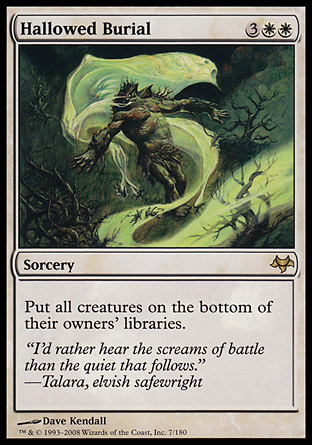
  • Hallowed Burial
  • Austere Command
  • Swords to Plowshares
  • Path to Exile
  • Return to Dust
  • Aura of Silence
  • Seal of Cleansing
  • Diversionary Tactics
  • Saltblast
  • Tormod's Crypt
  • Faith's Fetters
  • Sun Titan
  • Weathered Wayfarer
  • Steel Hellkite
  • Thousand-Year Elixir
  • Swiftfoot Boots
  • Shelter

The most interesting thing here is the deviation from the sweepers I usually like. Generally I prefer ones like Austere Command that are flexible and hit multiple types of permanents, or things like Oblivion Stone that can be recurred with Sun Titan.

But when you're tutoring things out of your library, there's a ton of value in putting your rebels back on the bottom of your library. Hence Terminus and Hallowed Burial. You want to be careful to champion Lin Sivvi with Changeling Hero or get her in the command zone somehow before you pull the trigger, but setting up your rebels again immediately is incredible.

The rest of your removal is pretty standard. It's possible that you want more graveyard hate, but you don't want something like Relic of Progenitus since it can exile some of your important rebels and neuter your own late-game plan.

All we have left to do is make sure you can go bigger than the other creature decks and have enough mana to support the rest of your deck.

Over the Top

The biggest weakness of this deck is the finite number of rebels in the deck. Unlike with a commander like [card Kemba, Kha Regent]Kemba[/card] or [card Darien, King of Kjeldor]Darien[/card], you can't make an infinite number of tokens and alpha strike through any number of blockers. You have to actually win through everyone's creatures. Fortunately, there are a few tools available in white that serve this purpose:
  • Storm Herd
  • Ajani Goldmane
  • True Conviction
  • Eldrazi Monument
  • Caged Sun
  • Gauntlet of Power
  • Ranger of Eos
  • Soul Warden
  • Soul's Attendant
  • Serra Ascendant
  • Reveillark

There are two things going on here.

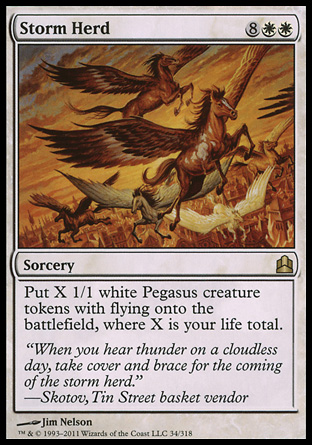
The first is making all of your guys gigantic and getting in for a billion, especially in conjunction with Mirror Entity. The most interesting thing here is Lin Sivvi powering your Eldrazi Monument, which is more cute than sweet. It is kind of fun that you have both Storm Herd and Ajani Goldmane to take advantage of your infinite life combo though!

The other thing is a ton of lifegain. Ranger of Eos finds both of the [card Soul Warden]Soul[/card] [card Souls Attendant]Sisters[/card] and the life will add up very quickly once you start recycling rebels. There aren't a ton of great ways to leverage that life into something proactive, but it is intended as a late-game plan. If people simply can't kill you, you'll win the long game since you can never run out of threats.

Winning the Long Game

Even if you never run out of threats, other players get to keep drawing bombs and answers of their own, so you need ways to keep up. Thankfully, Lin Sivvi has a very powerful effect attached to her: a way to shuffle your deck. Not only that, but a means to thin your library of low-impact cards. This means that you can set yourself up to draw more meaningful business spells than everyone else at the table.

  • Scroll Rack
  • Sensei's Divining Top
  • Mind's Eye
  • Treasure Hunter

Every deck includes some kind of card advantage and selection engines, but the strength of those effects is limited by your ability to shuffle away the cards you don't like. Scroll Rack isn't nearly as good if you just have to redraw all the bad cards that you put back! Thankfully, Lin Sivvi will always be there, so you can keep rebels out of your hand, shuffle away bad cards, and get a look at a fresh set every turn.

We also have Mind's Eye to actually pull ahead on cards and Treasure Hunter to keep our artifacts on the board as the game goes longer. As long as the game goes long and you have your engine running, you should be able to come out on top.

After adding some mana rocks and lands to the deck, here's where I ended up:

Commander: Lin Sivvi, Defiant Hero

Untitled Deck

Creatures

Sorceries

Instants

Artifacts

Enchantments

Planeswalkers

Lands

26 Plains

On the whole, I don't think this deck is as powerful as some other mono-white strategies, mainly because you have to keep reinvesting mana every turn to keep the engine running. That said, tutoring every turn is one of the most powerful things you can do in Magic, regardless of what the restrictions are. This is only compounded when you consider that you can also recycle the same targets. How exactly does a black deck beat recurring Lightbringer?

I think the deck turned out pretty well and the flexibility should be an exciting change of pace from my usual mono-white decks.

One thing my friends and I have discussed is house-ruling some creatures to be rebels to make things more interesting and give Lin-Sivvi more cool tricks. Nothing too flashy, like Reveillark, but role players like Stonecloaker and Fiend Hunter. What are some creatures you'd be interested in trying out as rebels?

I'm excited to return to my favorite topic next week: lands! I've received quite a few requests to see my most recent build of Child of Alara, and we've seen three sets since I formally updated the deck. If you want to be That Guy at your table, be sure to check it out!

Carlos Gutierrez

cag5383@gmail.com
@cag5383 on Twitter

[Editor's note: An earlier version of this article had an incomplete final decklist, which has been updated. Sorry for the error.]

Insider: Game Theory and Behavioral Economics, Pt. 2

Are you a Quiet Speculation member?

If not, now is a perfect time to join up! Our powerful tools, breaking-news analysis, and exclusive Discord channel will make sure you stay up to date and ahead of the curve.

The votes are in and I am pleased to inform you that the readership has asked for Part II of this article! Whether out of kindness or genuine interest I cannot verify. Nonetheless, I will remain optimistic and strive to reveal some of the deeper connections between psychology, economics and Magic: The Gathering through this second installment.

Before I return on topic, let me first make two helpful statements. First, I do intend to summarize my Grand Prix Columbus experience from this past weekend in a future article. There may be an appearance of urgency behind publishing key value information. The inherent consequence of playing Modern, a format which is now going into hibernation for a few months, implies a lackluster set of recommendations coming out of the event. In short: Kiki-Jiki, Mirror Breaker sold for a million dollars ($30) before the event started and once the tournament was underway no one would pay more than $8 for a SP copy of the card.

Second, I want to emphasize that this series of articles is purposefully different from mainstream finance articles. It is possible that some of the technical concepts shared within are not directly applicable to making profit, per se. Rather, consider this series of articles as an opportunity to learn more about how the study of behavioral economics can help us learn more about Magic trading behavior. Even though I may not say “buy this, sell that”, I want to emphasize how understanding the reasoning behind certain decisions and thought processes has a possibility of helping you with Magic trading for years to come.

The Implications of “Free”

Before I relocated to Boston and unloaded all my bulk, I possessed boxes of commons and uncommons across a couple dozen sets. This didn’t prevent me from accepting free commons from random players at the end of a draft even though they were virtually worthless and took up more space.


(picture from http://deaconjohn1987.wordpress.com/2011/03/12/have-a-garbage-free-day/)

Why did I accept these freebies? Because the concept of free is so alluring that I was willing to ignore the fact that I already had excess copies of these cards and no space for them. If someone approached me and offered to sell me those same commons plus a bulk rare for $0.15, I would likely turn the deal down even though the bulk rare can be buy listed for two-thirds the paid amount.

Many studies have been done which reveal the power of “free”, and, once again, they are well-captured in Dan Ariely’s book Predictably Irrational.

But how does the power of “free” manifest itself in Magic: The Gathering? Since Magic Cards have a well-defined economic structure, surely this concept can be learned from.

Has your trade partner ever offered a “throw-in” card to help sweeten a deal? While you may have been looking for that last fifty cents to even out the values of the trade, it’s likely that added bonus card sweetened the deal for you considerably. The “free-ness” of the card makes the deal seem that much more attractive.

Consider as a mental exercise a possible experiment. What if your trade partner started a transaction by asking you to remove a fifty cent card from his binder? Then your trade partner indicates that the card you removed would be a “throw-in” and that he would deduct fifty cents in value from the cards he or she wants of yours.

How are you feeling about this “throw-in” now? My hypothesis is that you will be less satisfied with this trade even if the rest of the cards exchanging hands were identical to the previous scenario. My rationale is that if you perceive that card as being a free toss-in at the end of the trade, you will be much more delighted to complete the deal. While if you started with that toss-in on the table before taking any other cards out, the card no longer appears “free”.

Practically speaking, my hypothesis implies a prediction of irrationality. But this is exactly what Ariely’s book is about. How one could predict a human’s behavior even though it is irrational? After all, in both scenarios you would be receiving the same net value, but your perception of the trade would be significantly different.

The key takeaway here: card throw-ins are worth more than their cash values a lot of the time. Next time you or your trade partner offers one, take a step back and consider if the “free-ness” of the card is making both parties happier about the deal even though it has virtually no impact on the overall value exchanging hands.

Social Norms vs. Market Norms

Have you ever had a lovely dinner at a friend’s house, with discussions ranging from the old times at college, to relationships, to politics? Now, imagine yourself thanking the host at the end of the evening and then asking “Okay, now how much do I owe you for the food I’ve eaten?”

Awkward, right? With friends, you don’t necessarily discuss money at events like a dinner party. It would be much more appropriate if you had given a nice $20 bottle of wine to the host to thank them for their hospitality rather than a $20 bill. Even if the host is a beer drinker, it is still far more appropriate within the situation to offer the wine, even though a $20 bill could have bought the host some of his or her favorite beer instead.

The reason for this social trend lies within the distinction between social norms and market norms. In a perfectly transactional scenario (e.g. restaurant), it’s not only appropriate but also within the law to pay cash for food and festivities. Within this realm, market norms dictate behaviors.

In social situations like interactions with friends, however, it can be a completely different ballgame. Here, even if an outcome is not economically the most efficient, social norms dictate behaviors and have a significant impact on an outcome. Even though your friend would prefer even $15 in good beer over $20 in wine (saving you $5 in the process), you simply should not offer that $20 bill at the end of the evening. It just wouldn’t be right.

This distinction between market norms and social norms again manifests within the realm of trading Magic cards. And in this case, value may even be obtainable if done correctly. The key is keeping trades within social norms rather than market norms as best as possible.

Have you ever handed a trade partner your binder, watch them open, and immediately point to your Standard staple and asked “What do you value this at?” The moment you exchange numbers, the trade immediately becomes transactional. Forget about what format he or she likes, what colors he or she likes to play, etc. All they care about (and as a result all you’ll focus on) will be value.

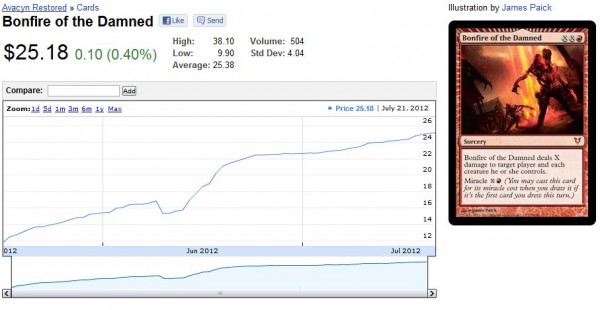
On the other hand, consider a different scenario where you and your trade partner browse each other’s binders discussing the latest metagame and format preferences. Perhaps your trade partner glances down at your Bonfire of the Damned and comments about how he really needs one of them for his Standard deck. You could then ask them what they are running in Standard and if they need any other cards for the deck. Perhaps you could even make suggestions on other cards that may be worth testing.


(chart courtesy of blacklotusproject.com)

Notice the difference here? In the second scenario, you have established casual conversation and thus a mutual appreciation for the game of Magic. This may help tip the transaction into the realm of social norms.

Remember, social norms create market inefficiency to the benefit of friendship/camaraderie. With that in mind, in which scenario do you see yourself getting a better trade? Since the second trade partner has built a connection with you through conversations on a common interest, they will likely be more willing to adhere to social norms over market norms. Thus they may be willing to sacrifice some value to your benefit, whether financial or interest driven. If nothing else, you’ve developed a connection with someone, and this may pay dividends in the future.

With Great Power Comes Great Responsibility

For me, the study of the irrationality in human behavior is a fascinating topic. Being able to apply the concepts of behavioral economics to my hobby makes the field even more interesting. And rewarding.

But the object here is not to rip off all your trade partners by being phony. No one likes a fake, and I’m definitely not advocating this. My goal is to drive awareness of why we respond in certain ways and provide some coaching on how to make Magic trading a more fulfilling experience.

Next time you sit down across from someone you don’t know and exchange binders, be observant. Are they only interested in market norms, or is there a possibility to influence the outcome by introducing social norms? Can you make your trade partner happier with a deal by throwing in a freebie?

At the end of the day, you may feel like you’ve made a good trade whenever you’ve increased the value of your stock. But I would argue a successful trade is distinctively different and hinges upon both participants walking away from the exchange feeling good about it.

-Sigmund Ausfresser
@sigfig8

Avatar photo

Sigmund Ausfresser

Sigmund first started playing Magic when Visions was the newest set, back in 1997. Things were simpler back then. After playing casual Magic for about ten years, he tried his hand at competitive play. It took about two years before Sigmund starting taking down drafts. Since then, he moved his focus towards Legacy and MTG finance. Now that he's married and works full-time, Sigmund enjoys the game by reading up on trends and using this knowledge in buying/selling cards.

View More By Sigmund Ausfresser

Posted in Finance, Free InsiderTagged , 5 Comments on Insider: Game Theory and Behavioral Economics, Pt. 2

Have you joined the Quiet Speculation Discord?

If you haven't, you're leaving value on the table! Join our community of experts, enthusiasts, entertainers, and educators and enjoy exclusive podcasts, questions asked and answered, trades, sales, and everything else Discord has to offer.

Want to create content with Quiet Speculation?

All you need to succeed is a passion for Magic: The Gathering, and the ability to write coherently. Share your knowledge of MTG and how you leverage it to win games, get value from your cards – or even turn a profit.

Insider: Ask Kelly – Thundermaw Hellkite, Goryo’s Vengeance and Bonfire of the Damned

Are you a Quiet Speculation member?

If not, now is a perfect time to join up! Our powerful tools, breaking-news analysis, and exclusive Discord channel will make sure you stay up to date and ahead of the curve.

Have a question? Ask Kelly here!

~

Q: Where do you see Bonfire in 3 months? 6 months? 2 years/long-term?

- Daniel from Halifax, Nova Scotia

Kelly: Bonfire of the Damned is a card like none I have ever seen, and I don't think it has a cent of downside. After it leaves Standard, it will still see play in other formats. There's no telling what will happen after it leaves Standard, since the metagames change frequently, but my inclination is that this is a "forever card".

Q: What do you think about Drogskol Reaver as a possible alternative to titans after rotation? Do you see Tidehollow Sculler making a significant jump in the near future?

- Deven from Michigan

Kelly: Drogskol Reaver is a very large creature that has a massive impact on the board, but the 7 mana cost is very prohibitive.  It doesn't effect the board beyond being a large blocker when it comes down, so it's certainly not on par with the titans.  If you can get an attack through, you're in good shape, but there's no guarantee you'll even be able to resolve a 7-drop, let alone cast one.  It's a fine pickup if you can get them cheap, but I have no specific goals to acquire many.  I see no specific reason for Tidehollow Sculler to jump in price, and it's only an uncommon.  The Zombie tribe is relevant, but not enough to make him Modern-relevant.  He might be a dollar uncommon at some point but it's not something I'm excited about right now.

Q: Wolfir jumped from $1 to $10 overnight and, while good, is only a rare and is in a precon. Thundermaw Hellkite was selling for $18 but is now on buylists for $17 and hasn't even made a decklist. Would he be a 4x, 2x, or a bench player?

PS: How much weight have you lost Kelly? Good job man.

- Shazam

Kelly: Thundermaw Hellkite is a card with 5+ CMC that can, and likely will, have a huge impact on the game.  The cost-to-power ratio is insane, and the combination of haste and the 'tap' ability ensures you're going to get in for 5 unblocked.  I have to wonder if the 1 damage part has to do with Lingering Souls, and I'm going to guess that it does.  While the Lingering Souls decks have plenty of ways to pump the tokens, at least this gives red decks another weapon against the card advantage engine.  Unless Thundermaw Hellkite sees ZERO play, which seems very unlikely to me, I think he'll be around $20 for a while.

He's in good company with other red cards right now - like Bonfire - and since you asked this question he's gone up in price.  It seems like you can't find them for under $20 right now.  Upside?  Not on a $20 mythic, and even if there was upside I wouldn't try to get it.  If you need a set to play, just get it.  This is not a card to play upside gamble with.

As far as my weight loss, the short answer is "somewhere between 60 and 70 lbs".  Check out my new venture, www.sleekgeekblog.com, to learn more.

Q: On the topic of titans needing a replacement after M13 rotates, how do you feel about Wolfir Silverheart?

- Jake Traut

Kelly: Wolfir Silverheart had its time. The removal in Standard is way better than the removal in Block, where it was non-existent. It shot up to around 10, and then stabilized around 4, which is usually how these crazy jumps happen. I don't think there's upside past $4, and it's in a premade deck which just adds to the supply. Standard decks aren't really using him because of the abundance of reasonable removal.

This Week’s Winner:

Q:  What do you think about Goryo's Vengeance in Modern? The reanimator deck has been hyped quite a bit, and you can pull back an Emrakul with it. Along with that, is there room to grow with Through the Breach as well?

- Paulo

Kelly: Goryo's Vengeance has been price-adjusted for a while.  It used to be a < $1 rare, but the popularity of Modern and some usage here and there has pushed the price up to the $3 range.  I don't like to play upside on cards that have already seen a bump, but I'd keep an eye on the results of GP Columbus this weekend since Modern is the format.  The card has always had potential but has not really had a chance to live up to said potential.

Through the Breach is in the same boat. It used to be dirt-cheap but has been price-adjusted as well, still selling for $5 or so.  In short, I wouldn't play upside on these unless there's an immediate gain to be made in the wake of a particular event.

Q: What's the window look like for the reprinting of the Shock Lands now that the guilds have been released? Is there value to be had with holding the second set since they'll see some Modern play?

- Alan W.

Kelly: If they get reprinted, they'll be relevant in Standard and that will, of course, raise demand alongside with the supply.  Although it seems likely, it's impossible to speculate if they'll reprint or not at this point.  It's entirely possible that they print one set of Shocks in the first set, one in the second, but that doesn't seem like something they'd do.  I see no upside in the Shock Lands either way  and wouldn't want to guess whether they'll get reprinted or not.

~

Have a question? Ask Kelly here!

So, You Wanna Be a Retailer?

Are you a Quiet Speculation member?

If not, now is a perfect time to join up! Our powerful tools, breaking-news analysis, and exclusive Discord channel will make sure you stay up to date and ahead of the curve.

I get a lot of questions from readers who want to go into business for themselves. It's not surprising: in my time I've opened, managed and closed a brick-and-mortar retail store, and I currently help manage an online store and other ventures. I also write about entrepreneurship for Forbes.com, so I'm a pretty reasonable authority on entrepreneurship. The trouble is, I run into the same questions all the time, and I want to begin answering them in a place where people can gather, discuss and share knowledge.

First, a little bit about what I'm doing right now:

Forbes.com - I cover Chicago entrepreneurship and the 'startup scene'.

MTGCardMarket.com - I am the President of Technology, helping to build and maintain our infrastructure. I also help manage our marketing endeavors, which is just as crucial.

QuietSpeculation.com - The site you're reading right now! I was the original founder, but brought on Douglas Linn and Tyler Tyssedal to round out the executive team as we grow. I'm currently acting as our CEO, managing our overall strategic direction and developing new projects.  I also make it a point to answer the support emails myself, since I believe it's the CEO/Founder's job to be the point of engagement for his customers. This is despite the fact that I could easily farm the work out to a virtual assistant in the Philippines or anyone else on my team.

The Sleek Geek - Those who have met me recently may not know this, but I used to weigh around 260 lbs (standing at exactly 6 feel tall). Those who know me now are seeing me at a standing weight just under 190 lbs. I'm no mathematician but that means I lost 70 lbs. It took 3 years and it was pure hell, but I learned a lot along the way. I'm now teaching out my method via this site, and will begin working on a full-length book in the fall. We focus on quantifying actions and goals, and we like using data analytics to supplement the traditional "diet and exercise" model. We are currently soliciting contributors and/or people who want to lose weight to follow the system.

That's what I'm working on right now, and as you can see my plate is quite full. Welcome to the life of an entrepreneur, baby! I wouldn't have it any other way.

So, on to starting a store. I'm going to address the most crucial question this week, and follow up with more in each subsequent column. The CEO of MTG Card Market, Noah Whinston, will also be writing a few times a month, discussing more of the "front office" challenges like pricing against the market and predicting trends. I will be discussing more of the "back office" topics like how to build an infrastructure, maintain and launch a website, and all that kind of thing.

Brick and Mortar vs. Bits and Bytes

This is the first decision, and a big one. There are definite pros and cons of both models, but at the end of the day it comes down to two things: market opportunity and capitalization.

Market Opportunity: When I started my retail store, I opened it in a college town populated by three other stores. They were all full-line gaming stores with an established customer base, but I was focusing solely on Magic: The Gathering. You've got to ask yourself which you want to be. If you're aiming to be a full line gaming store, you'll want to dramatically increase your capitalization because board games don't turn over nearly as fast as MTG singles do. You'll have a ton of carrying costs for slow-moving inventory, but this inventory might be a draw to potential customers.

If there are no game stores in your local area, don't mistake that for an opportunity. Instead, ask yourself why. The rents might be too high, or there might not be enough interest. Perhaps the local university hosts a gaming club, and that negates the need for a real store. Make sure you validate your business model before signing a commercial lease. There's no going back once the pen hits the paper. Ask everyone you know what they would expect from a game store, from events to hours to stock levels. Don't promise anything, and don't assume anyone knows what they're talking about. The best and most relevant ideas will percolate to the top and you'll start to see a theme.

Captalization: As a mentor of mine likes to remind me, "No one has any money and the people that do don't want to spend it." This is true, from venture capitalists to hedge fund managers to the average gamer on the street. The world is a screwed-up scary place. It seems like there's a new financial scandal every day, and the financial well-being of entire continents is in serious jeopardy. If you have money right now, you're surely not interested in risking it, not when everyone else is losing it. In a bear market, he who loses least wins.

When I opened my retail store, I asked some authorities in the industry how much capital I would reasonably need. The number I heard from multiple sources was $20k. That seemed like a ton of money to me when I was 25, but three years into my life as an entrepreneur I can see that number is missing a zero. The first lesson you must learn: everything costs more than you think it will, and there are so many expenses you'll never be able to predict. Most small businesses fail for one simple reason: they run out of money. I recall a month where sales were slow and I had to fire-sale inventory to cover a few bills. That put a real hurt on my business, and you never want to get into the position where you're sacrificing margin for cash liquidity. Liquidity risk is a huge factor in financial markets, and since you can't pay your rent with Magic cards, it's a risk for you too. Raise as much money as you reasonably can, and then raise about 50% more.

Brick and Mortar: There are a few advantages to opening a real live shop. You can buy booster boxes and other MTG products at wholesale, which amounts to a 25% discount on the retail price of a booster box (around $75) and a 50% discount on things like Duel Decks. In many cases, this is just a license to print money, as long as you have enough capital to cover your costs and carry product for some time. You also have a good amount of innate advertising: your retail frontage. Walk-in traffic is easy to convert if the potential customer is at all interested in your industry. As long as you're personable and a good salesman, you can easily convert someone to a loyal customer with just a little bit of charm.

You also get to host events like FNM, prereleases and booster drafts, which are also great for your bottom line. The effort that goes into managing an event is colossal, and you will almost always want a dedicated and trained staff member to do this for you. Trying to run an FNM and a retail store at the same time is absolutely maddening, especially when everyone needs singles for their decks. Getting this workflow right will save you many headaches but ultimately you should just have a dedicated event-running employee.

The overhead of a retail store, however, is astronomical. You have many additional costs compared to an online store: Rent, HVAC, Electric, CAM (common area maintenance -- a fee paid to a shopping center or mall for maintaining the common space) and paying off the local mafia*. That list is not exhaustive either.

The financial overhead isn't the only kind of recurring cost. The minutiae of a retail operation will grind your free time to the bone. Mercilessly. Sweeping the floor, changing light bulbs, cleaning the bathroom and anything else required just to keep a physical space looking presentable takes ages. And gamers are not clean people. I once had to pay someone to clean a clogged and defiled toilet because I was too disgusted to do it myself. Yes, you will spend some of your time literally cleaning up shit. Have fun with that.

*I'm mostly kidding here. Mostly....

Online: There's a huge trade-off here, but in my mind it's a no-brainer. The overhead for an online store is so low compared to a brick and mortar operation that I cannot see doing it any other way. An online store works best if you're a trader about town -- someone that everyone knows and already deals with. If you don't have a pre-made customer base, you've also got your work cut out for you. Convincing people to shop at your site rather than an established site (oh I don't know...maybe MTG Card Market!) is tough.

We're backed with some top-tier talent and have an aggressive marketing campaign, and drawing eyes to our site is still a struggle sometimes. Don't underestimate the power of the incumbents, and don't think that just playing a "race to the bottom" will work -- competing on price alone is almost never the way to win in business. My favorite question to ask a new business is "what's your unfair competitive advantage?" My answer for MTG Card Market -- "our user interface is cleaner, simpler and more intuitive than those of our competitors. Our prices are always in line with, or lower than the market and we stock some rare and hard-to-find items other stores just cannot find." We aren't claiming to be the lowest price, but we do stay competitive.

Though the overhead of an online store is far lower, the barrier to entry is much higher because you just have to convince people to buy from you. With a B&M store, people can walk in and locals have an incentive to buy -- immediate gratification. Online, you have to compete with hundreds of other people selling Magic cards.

Finally: At the end of the day, both models have very large barriers to entry, require large amounts of capitalization and will almost assuredly be too much work for one person to handle alone. Overhead will eat through your starting capital quickly if you don't have sales within the first few months and you'll get caught in a cash crunch. Once that happens, you'll be out of business before you know it. Do not romanticize the model or the lifestyle; most people who want to start a game store really just want to get paid to hang out in one. You will not be profitable any time soon, nor will your work hours resemble anything reasonable or sane, but if you still want to do this, do it. The worst case: you lose all your money, all your financier's money and learn a lesson. It's still cheaper than an MBA.

Keep checking back on Quiet Speculation for more articles about the retail side of MTG, especially if you're interested in starting a proper business of your own! I'll be covering infrastructure and operations and Noah will be covering front-office things like market trends.

Insider: Digging Up The Plants (2012 edition)

Are you a Quiet Speculation member?

If not, now is a perfect time to join up! Our powerful tools, breaking-news analysis, and exclusive Discord channel will make sure you stay up to date and ahead of the curve.

The Return To Ravnica is growing closer by the day! That means a lot of exciting things for us, not the least of which is the change brought on by rotation, and what new cards that may make playable.

Last year, I suggested targeting Phantasmal Image and Surgical Extraction in trades for this series. These ended up being significant opportunities and this season is no different.

If you don’t know what I’m talking about offhand, or didn’t understand the title, here’s the idea. With “cross-seeding” of sets much more prevalent both in the current sets and the Core Set, we’re able to make some educated guesses about good targets based on what we know is coming in the next block.

Here’s what we know so far about Ravnica:

-       Guilds are back, as is multicolored.

-       No keywords from the first block are returning.

-       The Simic Guild (UG) is supposed to be full of Merfolk.

-       From the previous point, we can extrapolate that there will be some amount of tribal component present in the set, even if it’s secondary, as in Innistrad. This also makes sense with Cavern of Souls.

That’s pretty much it, as far as cards go. It’s a little less to go on than last year with the “Graveyard set” of Innistrad coming out, but it still gives us some room to work. Now let’s look at the cards printed in the last year that will interact favorably with Ravnica, and we can find the ones that present a good buy-in opportunity.

For the purposes of this article, “buy” means trade for aggressively, as I’ll be doing, and “watch” will apply to cards we should have on our minds if we see the pieces come together during spoiler season.

Human Cards

We don’t know for sure that there are Humans in Ravnica nowadays, of course, but there were the first time around. That, combined with the rotation of Vapor Snag, makes Champion of the Parish very appealing. Likewise, I’m stocking up on Silverblade Paladin. People want to play these cards, and even something like Champion of Lambholt and Mayor of Avabruck have some nice upside if the tribe gets any more support. Elite Inquisitor is also positioned nicely, being pretty much free right now, as does Thalia, Guardian of Thraben. There’s a ton to like here.

Verdict: Buy

Bloodline Keeper/Falkenrath Aristocrat

This guy has fallen quite a ways from his height earlier this year, and he represents a good buy for a few reasons. For starters, there’s been quite the Vampire push in M13. On top of that, Vampires were around in the first Ravnica, though in small numbers, so there’s a precedent for bringing back more.

The Vampire deck is very close to being playable. It has great three and four-drops, and one good one-drop (Noble) and one two-drop (Blood Artist).  Stromkirk Captain is actually probably the most innately powerful of the Captain cycle, so if this deck gets a few more pieces, it’s going to be quite the player, especially with Cavern to both fix the mana and provide uncounterability.

Aristocrat sits in the same spot as Keeper and Nocturnus. I’m not sure how many four-drops the deck could support, and I’m not sure which one gets the boot. Still, Aristocrat tops out the Zombie curve as well, so it’s a good pickup.

Verdict: Buy

Stromkirk Noble

Apply everything above to this guy as well, only there’s even more upside to Noble since he can go into a typical aggressive Red deck. Timely Reinforcements is gone after rotation, as is Celestial Purge, so this little Vamp can get out of hand very quickly. Remember, this was an $8 card at one point, so seeing it go back upwards of $5 is very plausible.

Verdict: Buy

Dual Lands

As we’ve been talking about forever, the Innistrad duals are worth getting into now. I expect shocklands to be reprinted, and here’s what I see happening.

Innistrad lands, which (while not as cheap as Scars lands were) are very affordable, and all but Isolated Chapel can be traded for under $5. You may see even more of this when Shocks are spoiled, since people will assume they’re just superior to the checklands. But the reality is you’ll want some number of Shocks, but still a ton of Checklands because the damage from Shocks truly does add up quickly. I see all the Innistrad checklands going to at least $6-8, with spikes past $10 for the flavor of the week.

Verdict: Buy

Lingering Souls

While this doesn’t connect to Ravnica in any meaningful way, it does seem to indicate we’ll have another set of B/W Lands come in if/when we get Godless Shrine. Lingering Souls is already insane and primed for a price jump after rotation, and this just seems to help it along even more.

I also like nabbing Vault of the Archangels cheap for this reason. Activating it becomes a lot easier with eight duals instead of four.

Verdict: Buy

Riders of Gavony

I know, thanks to Naya and Delver decks, that Tribal isn’t a huge component of the format right now outside of a few Zombie decks. But with the expected increase of Vampire players thanks to M13, and the possibility of even more support in Ravnica, this could become a nice little sideboard answer, even though it’s super outclassed by Restoration Angel at the four-drop spot.

Verdict: Watch

Craterhoof Behemoth

This guy has quietly become the go-to target for reanimating in Frites, thanks to his ability to win on the spot and therefore avoid Zealous Conscripts. With Mana Leak rotating, Unburial Rites gets a big boost, and with Sun Titan/Image also gone, this could really become a solid pickup.

Verdict: Watch

Master of the Pearl Trident/Augur of Bolas

People initially laughed at Master when it was spoiled, since it was a Lord of Atlantis remake that seemingly had no place in Standard, since there were very few other Merfolk. However, now that we’ve learned that the Simic Guild will be made of Merfolk, I really like picking up both the Master and foils of the Augur (which has play across multiple decks).

Master is fiveish right now, but in about a month that will probably be more like $3, and it’s going to be a really nice cheap speculation target. In addition to Standard, the fact that more Merfolk are coming could potentially give the deck another upgrade in Legacy and/or Modern (another one-drop, anyone?)

Verdict: Buy

That about wraps it up. There’s some more obvious plants, such as Arbor Elf and Farseek, but those aren’t really actionable due to being Commons. Still, the list above is a pretty good starting point for when spoilers start rolling in. Stocking up on some of these now, especially as easy trade targets, will set us up nicely once those spoilers start hitting your local FNM.

Thanks for reading,

Corbin Hosler

@Chosler88 on Twitter

Insider: Whose Value Are We Talking About, Again?

Are you a Quiet Speculation member?

If not, now is a perfect time to join up! Our powerful tools, breaking-news analysis, and exclusive Discord channel will make sure you stay up to date and ahead of the curve.

This past weekend I had the distinct privilege of working on the Judge staff at San Diego Comic Con for the Magic Events, while also attending a sweet Judge Conference (and obtaining some super-sweet judge foils).

It was a very interesting experience, for two main reasons. First, there was a significantly larger portion of first-time or new-ish players there than any other event I've worked at. Second, the prizes were extremely juiced compared to the sizes of the event.

Combined, this created an interesting environment. The minimal numbers of spike-grinder-types were trying to roll through as many events as possible, while new players were learning the game. As new players played with each other, it was interesting to see them realize right in front of my face how important trading is.

They would pay $15 for an intro pack from M13 and enter a "league" that lasted the weekend. Every opponent they faced, they'd receive cards to add to their deck. As the weekend was winding down, people were trying to leave the venue with a solid idea of what this game was about, and what they wanted it to mean to them.

They were so narrowly engrossed in the intro-deck they had, that the concept that these cards had a secondary market value was totally lost on them. "I'll trade you this Green Rare for your Blue Rare." Said the guy with the Blue Intro Deck to the guy with the Green Intro deck.

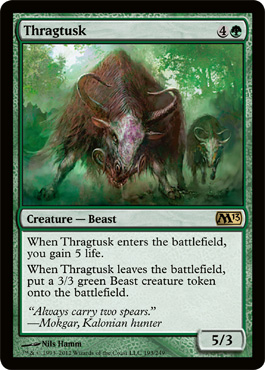
The fact that he was trading a Thragtusk away for a Talrand, Sky Summoner was not something they even considered to be a financial transaction.

Normally, when this sort of thing happens, one person is taking advantage of another. But these were two friends, first time players, and I didn't feel the need to intervene. For purposes of why there were there, Talrand was actually worth more to the Blue player than the Green player. Also, them being friends, I figured they could hash this sort of thing out on their own once they found out such things later, leaving them with a good learning experience.

Judge Promo Commander Exclusive for Standard Cash

Later in the day, I was trading with one of my good friends. I had just received my Foil Command Tower, and since I don't play Commander, I had promised to trade it to a friend. Initially, I told him I was likely to sell it, so if we could find something in his binder I could sell at a similar price, we'd be all set.

This is when his friend (who I didn't know) chimed in: "Command Tower is only a $30 buy on Star City Games, so that for Ajani is probably in your favor as-is."

First, I have no idea why SCG only buys that card at $30, which I'd guess is likely because they don't want it, because that's only 37% of their listed sell price.

I told the third party, "I'm not really interested in SCG buyprices, thanks anyway."

I tried to redirect back to my friend, so we could carry on our trade (which was going fine). This guy didn't like my response, and pulled out his smartphone, "Which buy list do you want to check then? I can check them all!"

I had to insist, "I appreciate the offer of help, I have a smartphone too, but I just don't feel it necessary to have a third party interjecting here."

At the end of the day, my friend and I made an agreement and moved on.

Simple as Price vs Price?

I just want to point out the huge flaw I see in the "Let's just look this price up." Even if you're looking at the same source, for two different cards, it doesn't mean you're comparing apples to apples. Think about a pile of Standard Staples as compared to a Judge Promo (especially one that is only legal in EDH). Standard Staples are going to move very fast. In fact, faster than almost any other type of stock, while a high-ticket Commander card has to find the right buyer who's willing to pay the price to pimp out his deck.

As a dealer, which one would you rather invest a fixed amount of money in? Obviously, the faster moving item. To offset the time it will take to turn the product around, you have to have a bigger gap between buy and sell, especially since your sell price runs the risk of decreasing if it doesn't sell soon enough and more Judge Foils are distributed. Comparing just a buy list price isn't enough if you're legitimately trying to strike a fair deal.

What are these cards worth to me? Well, I planned to sell them. But sell them how? If Command Tower Foil was really $30 on the StarCity Buylist, I'm just not going to sell it to them. I can get nearly twice as much after fees on eBay. Where as with Standard Staples, I can dump those to a dealer at only a small loss compared to an eBay sale.

My trade partner, however, plays exclusively Commander. Cards in his binder have the express purpose of finding foils for his EDH decks, so I am his outlet. I saved him from having to trade his cards into a dealer at buy prices, and then buy a Command Tower at sell prices. We both have different priorities here, and because we're friends we can be vocal about those priorities and reach an agreement.

I told him, even with SCG Buyprice at $30, I'm more apt to use their buylist to consider your Standard Staples, but give you the Command Tower at a price that's more comparable to what I can actually get for it, which would be bottom of the eBay range, less fees.

I don't generally agree with alienating your trade partner by telling their friends to "Butt Out!", especially, if they have asked that friend to help them make a decision. But don't let a loud trade partner (or their friend) tell you what a card is worth.

The Heart of Value

This is the concept behind the question, "What do you value this at?" If you don't know what peoples values are, then it's hard to reach an agreement. I think there are better ways to gain this information without being a scary value-trader. Rather than asking them for a number, ask them why they're trading it or trading for it.

More importantly, be forthright about your intentions. You can derive values from there. In my case, I wanted to turn my judge foil into cash. So if he's offering me something other than cash, it needs to be at least as much as I could get by selling it directly.

He wanted it for his deck, and wanted to dump cards he has no use for in exchange. Focusing on their goals, rather than finite dollar values allows you to present options to your trade partner that are beneficial to both of you, like the Thragtusk for Talrand situation, which is an obvious extreme.

Final Note

A final note that I don't want to ignore until next week: Thragtusk is absurdly hot right now. Seven out of Eight Star City Games top8 decks included this monster. He's sold out at $15 on both StarCityGames and Channel Fireball. CardKingdom still had a few as of today. I don't know how much higher a non-Mythic can get, but this guy is worth watching. I'm not going to buy in on this card, but if I owned any I'd try to sell into this hype while more are being opened by the day.

A Colorful Standard: Monoblack is Dead or Long Live Monoblack?

Are you a Quiet Speculation member?

If not, now is a perfect time to join up! Our powerful tools, breaking-news analysis, and exclusive Discord channel will make sure you stay up to date and ahead of the curve.

If you were to mention the color black to Forrest Ryan his first and only response would be to state that “Monoblack is back.”

Make no mistake, though. He doesn’t say this because it’s true. He says this as a slight to the monoblack players who have been saying nothing but the above for the past seventeen years. It seems that every time somebody sees a good black card they want to play nothing but monoblack. It’s an unhealthy trend that borders on insanity.

It seems to me that every time a black card is spoiled, potential monoblack players immediately evaluate the card in a vacuum and decide that it’s good. As it usually turns out, they end up a bit off their mark.

Game. Blouses.

Some players would argue that monoblack has seen some success on the SCG circuit lately. The simple truth of the matter is that sometimes decks do well. The best counterpoint to any results oriented argument is to cite the SCG Sacremento Legacy Open.

I know what you’re thinking. “Why all the hate, Ryan? Let the monoblack players have their dreams!” and “Hey, I liked that Blouses deck!” And yeah, I don’t really have a problem with players wanting to play a certain style of deck. As a matter of fact, I played a deck that was considerably under-tested last weekend because I thought it was really cool. What I do have a problem with is people saying that their pet decks are better than they are.

Before I get into why I’m underwhelmed by the best black has to offer, I’d like to go over what I feel is important in Standard currently and what the other colors bring to the table.

The State of Standard

To put things simply, Standard is all about creatures right now. There are approximately four billion creatures with strong comes into play abilities, a fair amount of haste and some relevant mans with hexproof. All of these things push creature-based decks to the forefront of playability. Even the control decks tend to be based on making bigger creatures than the aggro decks.

Things are currently relatively open while we wait for the dust to settle from the launch of M13, but for the most part creatures are king, and value is the currency of choice. Black seems to have pulled the short straw in both of these categories.

Blue

It’s possible that blue is being dethroned as the best color in standard, but there are still two very good reasons to play it:


It has been said a thousand times before, but Snapcaster Mage most certainly borders on the “too good” side of the power spectrum. The vast majority of the time he replaces himself all the while adding a high level of redundancy to any deck featuring him. Presuming that the things your deck does are worth doing, then redundancy is obviously strong.

Mana Leak has lost a bit of stock with the printing of Cavern of Souls, but it still carries quite a bit of weight strictly because of how many good 187s there currently are.

From the aforementioned Snapcaster Mage to Titans to Thragtusk to Restoration Angel, there are just too many creatures that are dangerous simply by merit of resolving.

Even when Cavern of Souls shows up, Mana Leak is still good at dealing with Swords or creatures of varying types. Additionally, decks like Dungrove Green can’t really afford to play Caverns, so Mana Leak gains a lot of value there. It’s true that Cavern will embarrass blue players with some consistency, but not as much as the sheer power of current creatures will embarrass a player trying to deal with them after they’ve resolved.

White

Sometimes referred to as the best synergy in Standard, white offers a marvelous creature suite in the form of Restoration Angel and Blade Splicer.


Trying to beat down into this pair is frustrating at best. Both block incredibly well and aren’t too shabby at getting into the red zone either. It is becoming more common to see a Sun Titan or two at the top of the curve of white decks, and that layer can be absolutely backbreaking.

When it comes to straight creature battles, white is leading the race by a mile.

Red

Red has been a bit underwhelming as a color since the removal of Lightning Bolt and the printing of Timely Reinforcements, but it does currently offer two very powerful cards:


The power of Bonfire of the Damned is no secret anymore. Frequently it is cast as a discounted Plague Wind and can often just kill your opponent along with their creatures. It is largely accepted that playing red sources without four of these is just a mistake.

Thundermaw Hellkite hasn’t really taken off just yet, and it might take the printing of Return to Ravnica for it to start seeing major play, but make no mistake - this card is real. It alone hits your opponent for at least a quarter of their life total most of the time, given its hasty nature, and has a solid body for blocking in desperate situations. Not to mention that it murders all of the spirit tokens.

Green

While I feel that white currently has the best creatures, green is certainly no slouch. It currently has three creatures that can dramatically warp games.


If I was forced to play only one spell in Standard, that spell would be Strangleroot Geist. Multiple Geists in the early turns can easily win games on their own. The number of cards that tango with it one-for-one is few and far between and haste is nothing to scoff at.

Thragtusk is another joke of a card. The only ways to realistically beat it consistently are countering it or playing larger creatures. Once Titans and Mana Leak rotate, you can expect to lose to this guy a lot. Thragtusk may just be the new mayor of Value Town.

I’m not a big Dungrove Elder fan, but with Rancor back in standard it is a major player again. Most removal is useless against it and chump-blocking may just be a losing proposition. It often finds itself out of Bonfire range as well. It even has the ability to outgrow Titans. I won’t be sad to see this card rotate.

So what does black give us?

With blue having the best disruption, white and green having insane creatures and red having Plague Wind, black had best have some insane cards if it intends to be a standalone color. Let’s take a look at the best that monoblack has to offer:

Mutilate

There is a reason that I didn’t list Day of Judgment as one of white’s best cards. Wraths just aren’t great right now. Undying creatures and the number of one-man armies that exist right now make cards like this too easy to play around. It’s true that Mutilate kills Wolfir Avenger dead, but there’s no guaranteeing that it can kill Titans or Dungrove Elders.

Additionally, Mutilate makes the inclusion of Cavern of Souls in black decks much weaker. I think that having uncounterable Grave Titans and other such creatures is far more important than having a conditional sweeper.

Liliana of the Veil

I was really excited about Liliana at first, and she’s been in a number of winning decks, but she has lost a bit of stock lately. With everybody attacking and Blade Splicer, mana-dorks and Strangleroot Geist running around, she really doesn’t do a lot. There also isn’t much that monoblack can do to break parity on her discard ability.

Lashwrithe

This might be the best monoblack card printed recently, at least the best with a reasonable casting cost. While it’s nice that you can move it around after the germ dies, this card just isn’t Dungrove Elder. There are so many good artifacts running around currently that most players have at least some hate on their sideboards. Many even maindeck some. I could see this card getting a lot more attention in a world without Swords. As things stand, it’s rather loose.

Phyrexian Obliterator

Man, we’ve come a long way since Phyrexian Negator. Obliterator just isn’t good. There are too many Vapor Snags and Dismembers for this card to really do anything. It might appear good against the creature decks, but a few factors hold it back against them. For starters, it doesn’t do anything against fliers. Additionally, decks like Naya are more than capable of easily producing lethal swingbacks, making Phyrexian Obliterator into a wall a good portion of the time.

BBBB just isn’t worth it for a wall.

Geralf's Messenger

Okay, this card is really good. If it had a more manageable casting cost it would probably be seeing a ton more play. It plays very well with Pod and is an insane aggressor. The only problem with him is that he has to be paired with garbage like Diregraf Ghoul. We’ve come a long way since Carnophage.

Griselbrand

If we can ignore casting costs, this is very easily the best black card in Standard. Some would argue of all time.

He’s larger than the other creatures in Standard and he produces more value. His weakness is that you have to live to cast him. I can see a deck with Pristine Talisman and Guilded Lotus accomplishing this task well, but at that point I’m not sold on that deck needing to be monoblack. There is a huge difference from having four black symbols in your four drop and your eight drop. Griselbrand is fairly obviously the best endgame available, but there is no way that monoblack is his best home.

~

Far be it from me to tell somebody not to play the type of decks that they enjoy. At the end of the day Magic is a game, and if you’re not having fun, you shouldn’t be playing. That said, it’s a huge pet peeve of mine for somebody to insist that things are good just because they like them.

I’ll keep casting my Think Twices and you keep casting your Mutilates, but let’s at least agree that we’re both idiots.

-Ryan Overturf

Jason’s Archives: Crashing Gates, Altering Reality and the Impact of M13 on St. Louis

Are you a Quiet Speculation member?

If not, now is a perfect time to join up! Our powerful tools, breaking-news analysis, and exclusive Discord channel will make sure you stay up to date and ahead of the curve.

Greetings, Speculators!

Last weekend was relatively dull in places other than San Diego and St. Louis, as many local games stores opted not to run release weekend events and many draft pods failed to fire. Players got their first chance to play with M13 at FNM and financiers were working hard to get their hands on their called shots before they went up.

I spent the weekend swimming in a bathtub full of [card Thragtusk]Thragtusks[/card] I preordered when they were still $6, then watching all of season four of Breaking Bad (added to Netflix this weekend) in a sixteen hour period.

It goes without saying that I spent part of the weekend wishing I was at San Diego Comic Con. I've been to this event many times before, but always spent the whole time working and didn't get much time to enjoy it.

This year Comic Con attendees who were willing to brave the line were treated to a panel hosted by Maro himself about what's in store for the future of Magic. The name of the second set of Return to Ravnica block was announced. "Gatecrash" may sound more like a mechanic than a set name, but if you know Ravnica lore (I don't) it's a pretty evocative title.

For those of us who couldn't make the trip, Maro summarized a lot of the salient points from his presentation on Twitter:

  • All ten guilds are returning in Return to Ravnica block. Each guild will get a new keyword. No old guild keywords are coming back.
  • Return to Ravnica will be a large set coming out this fall. It will feature five guilds (Azorius, Rakdos, Selesnya, Izzet & Golgari).
  • Gatecrash is the name of the 2013 winter set. It too will be a large set with five guilds (Dimir, Gruul, Orzhov, Boros & Simic).
  • Return to Ravnica will have two planeswalkers, one of which is Jace. Gatecrash will also have two planeswalkers, one of which is Gideon.
  • RTR and GTC will each have five guild leaders, two-color mythic rare legendary creatures.
  • Azorius: Isperia, sphinx -- Rakdos: Rakdos, demon -- Selesnya: Trostani, dryad triumvirate -- Izzet: Niv-Mizzet, dragon -- Golgari: Jarad, elf zombie
  • Dimir: Lazav, shapeshifter -- Gruul: Borborygmos, cyclops -- Orzhov: Obzedat, ghost council -- Boros: Aurelia, angel -- Simic: Zegana, merfolk

According to Maro, any returning guild leader (the ones they didn't kill off in the novels, supposedly -- R.I.P. Momir Vig) will get a new card. Apparently they don't want Niv-Mizzet, the Firemind and Curiosity legal at the same time.

"Guild packs" were also announced, similar to the faction packs from Mirrodin Besieged Limited. Each "guild pack" will have cards in the two colors of a guild of your choice in addition to land and artifact cards.

As a limited player, this is exciting. You get to receive a pack from the guild of your choice. You don't have to build your deck in those colors, but having an entire booster dedicated to one guild will be a big help.

I'm Simic. Which guild are you?

Speaking of Simic, did you notice that Momir Vig has been replaced by Zegana, a merfolk? If you were worried about the playability of Master of the Pearl Trident in Standard, you may not have to wait long for a playable merman, besides Augur of Bolas, to pump up.

And the Community Weighs in

Left to digest the news about the upcoming sets, the community has already come up with some interesting stuff.

Just watch the 700 Club claim this pentagram is further evidence of Magic's involvement in satanic worship.

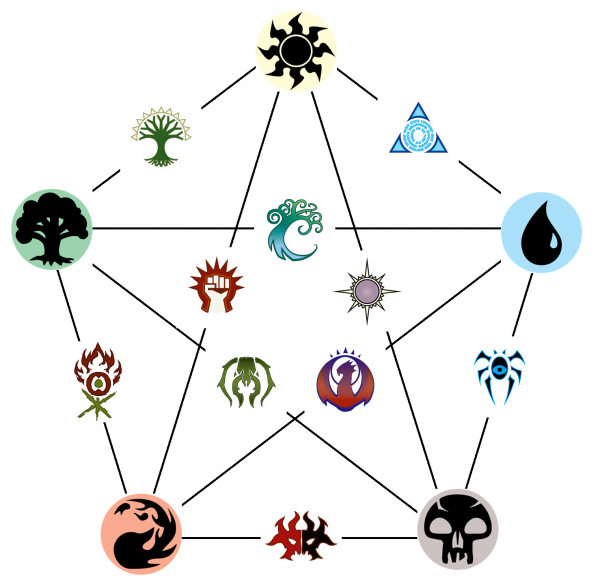
Redditor Benjyt21 brings us this handy visual guide to the two-color combinations and their corresponding guild insignia. My first thought: "Does anyone else think the new Gruul symbol looks slightly goofy?"


He's strangely silent on how much the Golgari symbol looks like the prawns from District 9.

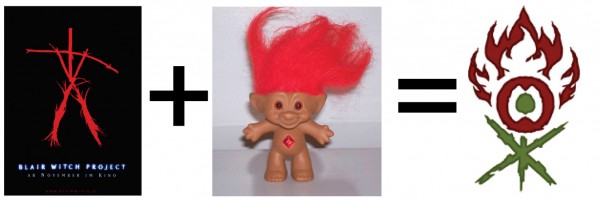
Redditor Wormslol answered my question with this hilarious theory about the inspiration behind the Gruul seal of approval. It looks suspiciously like the kind of thing certain Italian plumbers might be prone to consume.


It's like a Rorschach test for nerds.

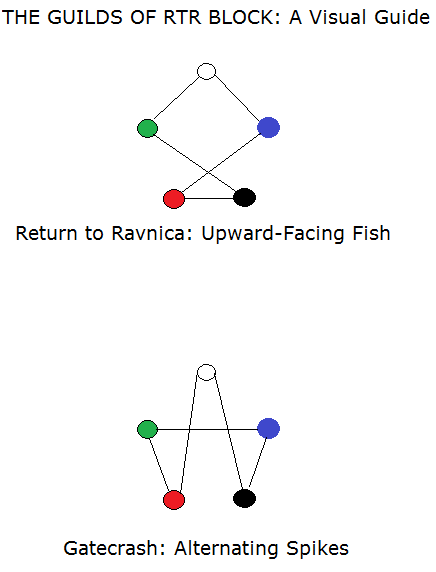
Redditor daragovelicant brings us yet another visual guide, this time for the guild configurations for the upcoming two sets (It's not the same as it was last time we visited the City of Guilds). Something tells me he wasn't the first to notice the pattern made by these color combinations.


This whole article is turning into an episode of CSI.

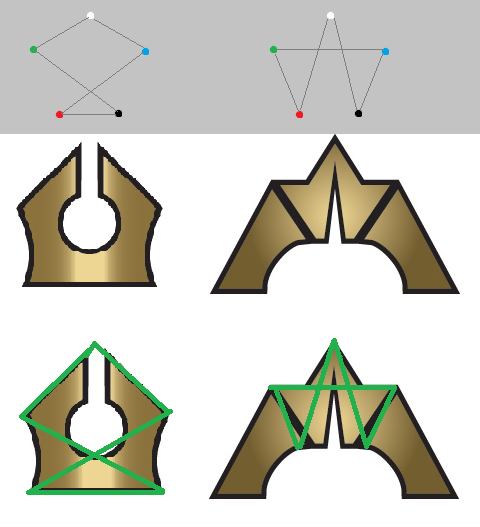
Redditor Alextfish thinks the expansion set symbols might be based on the patterns made by connecting the dots. It's not a bad theory, especially given that the Gatecrash symbol doesn't look all that much like a gate. Not that a picture of a gate isn't already taken.

An Altered Reality

I think Altered Reality would be a sweet name for a future column by yours truly. Here are some of the killer alters I ran across on the net this week.

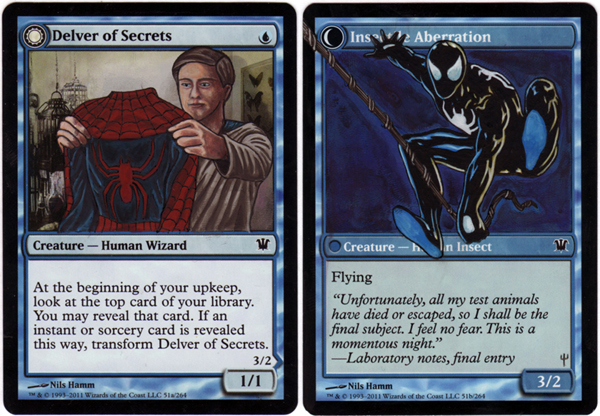
First person to refer to Symbiote Spider-Man as "Venom" gets a free kidney punch.

Redditor trunksshe brings us this killer Delver of Secrets alter. I'm so impressed I'm willing to ignore the fact that spiders are arachnids, not insects.


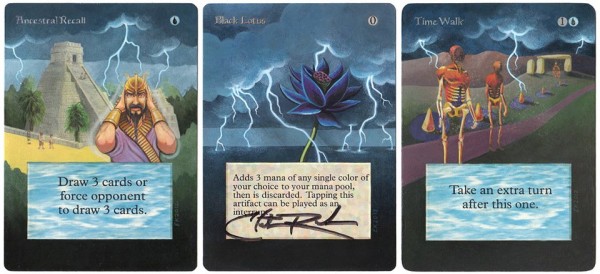
These look way better than the Lotus my buddy altered with a can of Mountain Dew.

The talented Mr. Klug brings us this stormy panorama of power. It looks like the guy on the Recall is really afraid of thunderstorms. What a sissy.

The Spirit of St. Louis

The first impact of the newly legal M13 was felt at the SCG Open in St. Louis. We have a lot to cover so I won't keep you waiting.

Standard Decklists

Naya proves it's no joke, giving us an exciting finals showdown between Caleb Durward's Naya Pod deck and Lance Behrens' Naya Aggro list. Durward took home top honors, but both lists are compelling.

The two decks feature a combined four copies of Thragtusk (TUSK!) and a combined zero copies of Thundermaw Hellkite. I really like Thragtusk in pod strategies as it fills the role of both Obstinate Baloth and Blade Splicer at the same time. When you gain five life, make a 3/3 beast and tutor for Zealous Conscripts all on the same turn, your opponent ends up on the back foot rather quickly.

With three Elvish Visionary (which pods nicely into Blade Splicer, I might add), this deck maximizes card advantage every way it can. I find it telling that the pod decks with the best finishes haven't been running blue cards for quite some time. That is a testament to the advantage generated from value creatures as well as the sheer one-sidedness of Bonfire of the Damned.

As cool as it is that my favorite M13 card (TUSK!) is getting attention, some other decks got a bit of attention, too.

Wizards and Drakes, Oh My!

First, the spotlight was on Adam Prosak and his innovative Mono-Blue Wizards build.

Jamming three copies of Talrand, Sky Summoner makes good use of the instants and sorceries already in abundance in the deck to flip [card Delver of Secrets]Delver[/card] and ruin lives with Snapcaster Mage. A smidge of white mana (i.e. a mana base nearly identical to U/W Delver lists) provides access to four Restoration Angel out of the board, not to mention the maindeck Moorland Haunt.

Talrand has great potential, and the 4th place finish seems to reinforce that assessment. It doesn't hurt that the deck was piloted by Adam Prosak, either.

Rancorous Elders

Also in the top four was a deck that has been making some waves of its own. Running an impressive zero copies of Delver of Secrets, this deck instead opts to beat face on the ground. I'm referring, of course to Michael Alakayleh's Mono-Green Aggro deck.

This deck is a sleek, Dungrove Elder-based strategy that jams three copies of a favorite card of mine, Predator Ooze. The ooze is so good, the only reason Michael didn't make the finals is he took a beating to the dome from his own conscripted ooze.

This deck would happily run more copies of Rancor if it could, given that Dungrove Elder's main weakness is his inability to trample over dorky 1/1 spirits and 2/2 wolves even when his power approaches double digits. Rancor is great in a format full of Vapor Snag and it makes Strangleroot Geist an even better threat than it was before.

I love this deck, and Rancor solves all of the problems green decks had before, namely their inability to deal with chump blockers and their tendency to get pantsed by Vapor Snag. Traditional auras are terrible in a format where the best deck is tempo control with bounce spells. But Rancor comes back to your hand when the creature is bounced, mitigating the tempo loss by adding damage to the next attack for only one mana.

The top eight was rounded out by Bant Pod, G/W Humans and Naya Humans, all of which ran cards from M13. In fact, the only deck in top eight that didn't run M13 cards was the Esper Midrange deck.

There were more copies of Thragtusk than any other card in the top eight, proving that this guy is the real deal. I'm still waiting for Thundermaw Hellkite to make the showing everyone is expecting, and which its $30 price tag would seem to indicate.

Legacy Decklists

The M13 innovation didn't stop with Standard, however. I'll gloss over how awesome it is that another Belcher deck made top eight to head straight to the Merfolk deck.

The Triumphant Return of the Fishes

I'm sure Corbin will write the entirety of his next article about this. But I want to briefly mention how the Merfolk deck solved a problem I foresaw with Master of the Pearl Trident, namely that there was no room for it in Legacy lists. Jospeh Gebhart solved this problem by cutting the most expendable card in the deck so he could jam four Masters.

Can you guess which card he cut to make room?

If you said "Force of Will," I don't believe you, because no one would guess that. While it's true that decks had been cutting back on Force of Will in the past, that was at a time when Mental Misstep was still legal. Merfolk has a huge liability, namely its tribal affiliation and reliance on overextending. A well-placed Engineered Plague or Pernicious Deed can wipe a merfolk deck out.

And yet Gebhart bravely cut all of his Forces to run more creatures. Joshua Snider, the pilot of the 11th place Merfolk deck, wasn't so brave. Maybe it's true what they say — no gamble, no future.

Other Brews

My favorite brewer, Jeff Hoogland (you may remember him as the architect of the Glissa Bomb deck I wet my pants over) is back with another top eight. This time he jammed Deadguy Ale, a tasty brew whether constructed with hops or two-drops.

Essentially an Orzhov goodstuff deck, Deadguy Ale uses discard and removal to clear a path for such beatings as a Tombstalker wearing a Batterskull. Continuing the "stuff with zealous in the name getting there" motif we see carried over from Standard, it uses Zealous Persecution to invite Maverick players to shuffle up for the next game.

Sam Black is also back, jamming his Zombardment deck in an otherwise not-all-that-remarkable top 32.

Very few M13 cards other than Master of the Pearl Trident have been tried in Legacy, but expect good things from a few more in the future. I really think [card Talrand, Sky Summoner]Talrand[/card] has potential and it will be interesting to see how this diverse, healthy format continues to evolve.

Also worth noting is the return of Burning Wish to Ad Nauseum Tendrils lists (listed as "Storm" by SCG, which I find misleading). This has financial implications. Badlands was the cheapest dual land for a while, but as it's seeing more play, expect the price to rise along with the new-found demand. You can still get these at around $35 and I wouldn't pass on the opportunity if you see them that cheap.

You Don't Have to Log Off But You Can't Stay Here

Join me next week when I will regale you firsthand with tales of my experiences at GP Columbus and watching all three Batman movies with Ryan Bushard. Spoiler: He takes up the whole armrest and sucks his thumb during the scary parts.

As always, if you can't get enough of me in this weekly dose you can always follow me on Twitter or check out the Brainstorm Brewery podcast.

Until next time!

Jason Alt
@JasonEAlt on Twitter

Insider: Game Theory and Behavioral Economics, Pt. 1

Are you a Quiet Speculation member?

If not, now is a perfect time to join up! Our powerful tools, breaking-news analysis, and exclusive Discord channel will make sure you stay up to date and ahead of the curve.

Magic: the Gathering is more than just a game. Because of the wild fluctuations in card values, rapid format turnover and strategy evolutions, Magic: The Gathering has acquired the characteristics of an economic model. There is supply and demand, and, in theory, an “Invisible Hand” which regulates the price.

There is even a bit of speculation, much like commodity markets such as oil and gold.

Sometimes basic economic theory breaks down and a more complicated model is required to explain people’s decisions. If everything was 100% rational, there would never be opportunities to profit in the market. Everyone would acknowledge identical card prices and everyone would base their valuations on the same variables. Trading would be exceptionally easy, but value trading would not exist.

Obviously, this is not the case.

Somehow, people’s emotions influence their decisions and this causes market inefficiencies. They often don’t even realize they are making sub-optimal decisions in their transactions. This week I will highlight a couple examples of how irrational behavior arises from competitive game theory.

Put on your thinking hats, as this one gets a bit technical. But awareness of these shortcomings could be invaluable at the trade tables.

Game Theory and the Prisoners’ Dilemma

According to Wikipedia, a Prisoners’ Dilemma can be defined as:

Aa canonical example of a game analyzed in game theory that shows why two individuals might not cooperate, even if it appears that it is in their best interest to do so.

In its essence, two people are engaged in a simultaneous decision where it would be in their best interests to cooperate, but due to the structure of their payouts, they end up mutually defecting. Thus, they forfeit the optimal outcome because of their own self-interest.

The namesake scenario involving two prisoners has been described ad nauseam on the internet, so I’ll provide a different example that I experienced firsthand.

While visiting family a few months ago, I was playing street basketball with my nephew. After seeing all the fun we were having, my niece and her two friends both wanted to play. Somehow we ended up with a game which involved picking them up one at a time to dunk the basketball into the net.

Dunk after dunk they each took turns playing. After each of the three girls had multiple tries at the game, they asked to play yet another round. I decided to try a harmless little experiment. I told the girls, who were no older than seven, that to continue the game I needed them to choose the order in which I should lift them for the dunk.

This did not go over well.

Rather than cooperating by agreeing on an order to play, they each “defected” and insisted they all go first. The result – all three girls received poor “payouts” and the game abruptly ended. Because they all wanted the best payout (going first) and they did not want to let the others have this payout, the result was a poor payout for all three of them (no one played) even though if they had gone one at a time, it would have yielded a better payout for all three of them. Thus, even small children are not immune to the Prisoners’ Dilemma.

What does little girls playing basketball have to do with Magic finance?

Well, have you ever spent ten minutes leafing through someone’s trade binder, pulling out all these exciting staples you’re looking to pick up, just to find out your trade partner wants retail values on their cards but cash value on yours? There are many sharks on the trade floors, and some are less subtle than others about their end goal. But if they are too aggressive, then you are most likely to walk away without completing a trade – a disappointment for both parties.

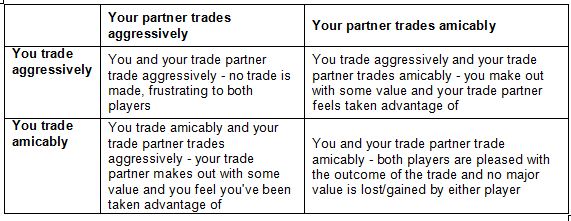
Here is what the 2x2 matrix of this simultaneous “game” looks like:

Just like the Prisoners’ Dilemma and the basketball game, the outcome here based on Game Theory is [tragically] the top left quadrant – players are so concerned with losing significant value on a trade that they themselves trade aggressively, seeking value. Even though two value traders could agree to “cooperate”, putting value second and mutual appreciation first, each trade partner wants to avoid loss in value and confidence and so they “defect” to the aggressive option. This is ultimately why it’s very difficult for two sharks to trade amicably.

So next time you find yourself unable to make a trade with someone because they are being aggressive, try taking a step back and figuring out if an amicable outcome is possible through cooperation. Sometimes an honest comment about your partner’s trade practice could be all it takes to break down the barrier.

Price Anchoring

I recently read about the concept of price anchoring in Dan Ariely’s behavioral economics book Predictably Irrational. In short, the concept of price anchoring suggests that when a person is unfamiliar with how to “value” a particular item, they are impressionable by a [potentially arbitrary] place to compare to. There are many examples cited in the book, but I’ll try to use a Magic example.

Without looking, what is the value of a Promo Foil Gaeas Cradle? If you have no clue, I bet I can influence your guess. Let’s say I showed you the only active eBay listing for this card at the time of this article:

If you really wanted to purchase this card, you would shop around at different sites and determine that anything less than $239 is a good price. For example, Star City Games is selling SP copies for $200. This seems like a great deal, especially because eBay prices are frequently cheaper than retail and not the other way around.

Now, let’s say you pulled the trigger on the Star City Games SP copies, since $200 seemed like a great price relative to your initial anchor, the single eBay listing. Well, perhaps we should have checked eBay completed listings before buying because we’ll see something rather surprising:

Uh oh…your $200 price doesn’t seem that great anymore does it? And even though someone did pay $239 before, we now see that this price is just ridiculous. If you had first done this search to establish your “anchor”, you may have thought that the $200 price tag at Star City Games was a bit high. Clearly if multiple copies of this card have sold for $160, this should be the card’s value. Now to consider buying any copy above that price seems like a losing concept.

This type of predictably irrational behavior can enable you to influence trades significantly. If you saw one of these Promo Gaeas Cradles in someone’s trade binder and they were unsure how to value it, you should theoretically show them these eBay completed listings first. You could say “well, at auction these have been selling for $160, so I can value it at $180 in trade”. If you looked up only active listings, your trade partner may be inclined to say “well, there’s only one left on eBay at $239, so I’d like a value around there”.

With the examples from the book I mentioned, combined with a Magic-specific example of my own, you may see how you could influence trade values. This won’t work with every trade – many traders know the value of their cards already (although this just means they have a price anchor from somewhere else already). But in the case where you can choose the price anchor (i.e. you get to pick which site you look up card prices for a trade), you may be able to honestly sway trades in one direction or another by referencing strategic price anchors.

Next Time…

The Prisoners’ Dilemma and price anchoring can both manifest themselves in the realm of MTG finance in different ways. Understanding these concepts and the rationale behind them can help us become more well-rounded traders.

These ideas are not meant to enable readers to bully their trade partners or “trick” them into believing misleading pricing information. The knowledge can instead be used defensively. That is, make sure you search a couple sites for pricing on a rare card. Don’t let yourself get pushed around in trades, but you also won’t benefit from doing the pushing yourself.

There are a couple more of these economic concepts I would like to discuss, but I’ve run out of room here. I petition my readers – would you like me to continue next week with part two of this article, or would you prefer I return to a more traditional topic? My readers are valuable to me, and so I will make sure I appease the majority with this decision. As always, thanks for reading!

-Sigmund Ausfresser
@sigfig8

Avatar photo

Sigmund Ausfresser

Sigmund first started playing Magic when Visions was the newest set, back in 1997. Things were simpler back then. After playing casual Magic for about ten years, he tried his hand at competitive play. It took about two years before Sigmund starting taking down drafts. Since then, he moved his focus towards Legacy and MTG finance. Now that he's married and works full-time, Sigmund enjoys the game by reading up on trends and using this knowledge in buying/selling cards.

View More By Sigmund Ausfresser

Posted in Finance, Free InsiderTagged 11 Comments on Insider: Game Theory and Behavioral Economics, Pt. 1

Have you joined the Quiet Speculation Discord?

If you haven't, you're leaving value on the table! Join our community of experts, enthusiasts, entertainers, and educators and enjoy exclusive podcasts, questions asked and answered, trades, sales, and everything else Discord has to offer.

Want to create content with Quiet Speculation?

All you need to succeed is a passion for Magic: The Gathering, and the ability to write coherently. Share your knowledge of MTG and how you leverage it to win games, get value from your cards – or even turn a profit.

To HELLion and Back again – Hyping Hellion Crucible in M13

Are you a Quiet Speculation member?

If not, now is a perfect time to join up! Our powerful tools, breaking-news analysis, and exclusive Discord channel will make sure you stay up to date and ahead of the curve.

So I was just mentioning in the forums that I was surprised nobody was talking about this card:


Okay, where’s the downside?

What’s not to like about it? It’s a “free” 4/4 with haste, isn’t it? If it were a “come into play tapped” land, I could see it having a huge downside, but it still allows regular tempo should you need to play that T4 DOJ to survive and instead you rip a Seachrome…

At best (proliferate aside, even) it’s a T3 drop & charge, charge T4, crack T5 for a 4/4 … but that’s ONLY if you devote all of your time to charging it! And even then, if you have no plays T3-> 5 you really should just be thankful that you can get something that can threaten a Restoration Angel in a pinch. It may get even buy you that T6 to actually draw yourself out of your predicament. Pray for Terminus?

Not only good in RDW!?

Some people may initially look at it and automatically assume it’s something that would only be played in mono red aggro style decks. But what’s preventing it from being the finisher in a control deck? Or just being a supplemental 2-3x in Wolf Run right now?? UR Delver may appreciate this spicy little morsel to add to their arsenal, as it allows them to counter relevant spells, or if nothing is played add a counter EoT and with Hellion.

^ That right there is pretty awesome in itself: May not be able to make the air block on a Delver / Angel, but if either of them are left behind to block, they brunch & Mr. Hellion survives. There is nothing in the Delver deck that stands toe to toe with a Hellion token and survives solo. They pray for Vapor Snag I guess?

Why is this card good?

Here are a few points on Hellion Crucible that makes me really like it, exploring its potential:

  1. It produces mana (untapped) the turn it comes into play. It’s almost even scary to drop this T3 and charge it vs control. They can’t counter a Hellion, after all…
  2. It’s a mana sink for when you’ve got nothing else to do. It gives you plays when you'd otherwise "just say pass", preventing the Timewalk scenario.
  3. It allows you to keep mana up and “trick” opponents: “Are you leaving that mana up to charge Crucible, or do you actually have a [burn / buff / counter] spell?”
  4. It allows you to recover from their “massacre” effect. Your board is gone, but fortunately you’ve got a charged up Crucible to keep up your tempo.
  5. Produces something out of nothing. It doesn’t cost a card in hand, just a few turns of activating for a big payoff (5 turn clock).
  6. You only need to be playing 1 color, unlike the Innistrad lands where you need 2x. If you’ve got red in your deck, you can play this card. The more decks that can play it, the higher the demand for it.
  7. It is a may effect. There is nobody forcing you to charge the Crucible if you have something better to do.
  8. All kinds of Magical Christmas land scenarios, including but not limited to:
  • Popping more than 1 in a turn?
  • Copy effects like Parallel Lives / Doubling Season?
  • Them using up a Doom Blade against your token?
  • 5 Lands. Crucible at 2. Pop crucible, play Phantasmal Image, swing 8?
  • DoJ on your turn, activate Gideon and Crucible, swing 10?

So many other good “combos” that really aren’t even combos, just good synergy with different styles of decks. And soooo many different decks can use him!

So what decks can use this right now?

To name a few:

R/U delver
Wolf Run
R/G Aggro
RDW
Boros / Hellrider Tokens
R/B Vampires

And that’s not including any R based control decks that may want to include it. It’s just so versatile it can be played in anything supporting an R in it’s CC.

Hey man, I’ve got 5 kids to feed!

A wise man once commented that “If none of the ISD lands are over a buck I doubt this will be there”. Ah yes, but we are forgetting that Wolf Runs were commanding a $3.50 premium, and Moorlands a solid Toonie (… $2) for a long time before falling into obscurity / market flood.

I agree that spending $1 each is a risk, and they could very well take the plunge to $0.25. BUT they could also be on some deck tech somewhere and / or some pro could release a blog post in praises harmonious with my own to make the card seem incredible and *BOOM* your chance is over.

Channel Fireball currently has these at $0.99 on TCGPlayer, and the cheapest is “the mana fix” @ $0.94. eBay is, however, looking grim for our hero with prices around $2.12 / playset being the norm. The auctions are going as high as $8 however, which is strange. BiN is at lowest $3.96 for 4x on eBay by ChannelFireball as well, so they must know something we don’t!

I hate it I hate it I hate it!

"Carl, you told me my Visions of Beyond were going to be worth something... they're not! I hate this card, and I hate you too!"

I wish I had the ability to see into the future and always offer you a sure thing on a silver platter, but speculating doesn't work like that. Even if you hate my pick, be sure to look at how it was that I came to my conclusions so that you can do so for yourself next time. Being able to evaluate cards for yourself is a skill that needs to be honed and practiced. You dont have to be perfect, just have a reason for why you think the way you do and see if it pans out. Look for things like:

  • Card playability (where will this card be used / does it fit into any existing decks?)
  • Card selection (Are other cards competing with this card for slots in decks?)
  • Price References (Other cards with similar effects went for X, so this should follow suit?)

Until next time, may your specs burst forth for you like a giant, writing, gold-plated hellion that you cheated into play a turn sooner by proliferating. (Because we all love to proliferate at times, yes? :))

Carl Szalich

[Editor's Note: The original article featured inaccurate information regarding Hellion Crucible and has since been corrected. We apologize for the mistake.]
Carl Szalich

Currently found ranching Orggs in the wilds of London, Ontario, Canada, I've been playing MTG for the past 15 years. I remember when trading Dual Lands for Craw Wurms was the "in thing to do", and Shivan Dragon fought Royal Assassin to see which would carry the higher price tag. I'm primarily interested in MTG finance, and like a good Icatian Moneychanger I believe that we are all "bigger than we think" when it come to what we have, and what our potential may be.

View More By Carl Szalich

Posted in Free, M13Tagged 9 Comments on To HELLion and Back again – Hyping Hellion Crucible in M13

Have you joined the Quiet Speculation Discord?

If you haven't, you're leaving value on the table! Join our community of experts, enthusiasts, entertainers, and educators and enjoy exclusive podcasts, questions asked and answered, trades, sales, and everything else Discord has to offer.

Want to create content with Quiet Speculation?

All you need to succeed is a passion for Magic: The Gathering, and the ability to write coherently. Share your knowledge of MTG and how you leverage it to win games, get value from your cards – or even turn a profit.

Vampire Sunrise — Comboing with Vish Kal

Are you a Quiet Speculation member?

If not, now is a perfect time to join up! Our powerful tools, breaking-news analysis, and exclusive Discord channel will make sure you stay up to date and ahead of the curve.

My favorite cards are ones that can be used both proactively and defensively depending on what the situation calls for. Removal, Vapor Snag, and random creatures (especially with flash) are examples of cards with both offensive and defensive utility.

These cards are immensely powerful in one-vs.-one games where efficiency is key. But they don't generate a big enough swing in board presence or card advantage to be nearly as effective in a multiplayer game. To find versatility in multiplayer, you have to consider more expensive cards or be willing to do a little more work.

One of my favorite cards of all time can do a little bit of everything if you're willing to build your deck around it: Second Sunrise. Its obvious application is to counter sweepers, but it has lots of other uses too, as evidenced by the number of combo decks built around the card over the years.

A particularly awesome version of this strategy is the zubera combo deck. The deck aims to sacrifice changelings and zuberas alike and rebuy them over and over with Second Sunrise and similar effects. The combo generates tons of creatures, cards, life and other resources, before going infinite for the kill.

These aren't all the pieces but rest assured you will up to your ears in zuberas.


An engine like this is what makes or breaks a deck. Second Sunrise can always be used defensively, but in a shell like this it becomes a threat itself, capable of putting you in a dominating position.

This week I want to try to capture the feeling of Second Sunrise’s degenerate side without devolving into actual combo. This means finding sacrifice outlets that don't lead to infinite combos like Phyrexian Altar.

I think the best way to accomplish this is to use a commander that provides a sacrifice outlet and pack the deck full of value creatures in addition to the aforementioned [card Second Sunrise]Second Sunrises[/card].

The Blood Arbiter and His Minions

[card Vish Kal, Blood Arbiter]Vish Kal[/card] is perfect for this deck for a few reasons. First and foremost, he's a free sacrifice outlet whose ability (hopefully) won’t lead to many degenerate infinite combos. But he still offers the avenue we need to establish a board presence and generate value off of Faith's Reward and Second Sunrise.
The big question is what creatures we're going to sacrifice and reanimate. Here is my starting suite:

  • Horobi, Death's Wail
  • Solemn Simulacrum
  • Karmic Guide
  • Twilight Shepherd
  • Stoneforge Mystic
  • Bone Shredder
  • Mikaeus, the Unhallowed
  • Bloodghast
  • Sun Titan
  • Rune-Scarred Demon
  • Fiend Hunter
  • Adarkar Valkyrie
  • Angel of Despair
  • Sheoldred, Whispering One
  • Reveillark
  • Puppeteer Clique
  • Harvester of Souls
  • Duplicant
  • Treasure Hunter
  • Teysa, Orzhov Scion
  • Cloudgoat Ranger
  • Nezumi Graverobber
  • Phyrexian Rager

There are a ton of interesting interactions here and not enough time to explain all of them. But I do want to touch on a couple of themes that show up repeatedly throughout the deck.

Unfortunately, a few infinite combos did creep in to the deck in spite of my best efforts to forestall them.

Sun Titan and Fiend Hunter let you make [card Vish Kal, Blood Arbiter]Vish Kal[/card] arbitrarily large and sweep away everyone else's creatures. Mikaeus, the Unhallowed and any creature with power less than or equal to its toughness can be rebought infinitely. You sacrifice the creature, let it undie, then put the counters from Vish Kal on that creature to reset it. There are, of course, also a billion things you can do with Reveillark, Karmic Guide and any free sacrifice outlet.

The more interesting half of the deck is comprised of value engines rather than combo pieces. Teysa, Orzhov Scion and Adarkar Valkyrie both combine with [card Vish Kal, Blood Arbiter]Vish Kal[/card] to great effect.

These interactions take over a game more subtley than the infinite combos. They build up to obscene turns in which you sacrifice your board, rebuy it with effects like Adarkar Valkyrie or Karmic Guide, and repeat the whole process with Faith's Reward.

These turns will put you far ahead on the board and draw a billion cards. They will also typically provide the resources necessary to do it all again the next turn and lock things up!

Cauldron Dance

The next thing we want to add is every version of Second Sunrise we can get our hands on. These are supposed to be the backbone of the deck: the cards that suddenly catapult you to your end game.

The downside of Second Sunrise is that it reanimates your opponents’ stuff, which prevents you from using it in conjunction with a sweeper to put yourself ahead. Fortunately, there are a ton of Second Sunrise variants that function specifically on your creatures. A higher density of these cards will enable you to use them liberally to protect your board or to generate smaller, cumulative advantages each turn.

  • Second Sunrise
  • Faith's Reward
  • Nim Deathmantle
  • Necromancy
  • Unburial Rites
  • Phyrexian Reclamation
  • Mimic Vat
  • Cauldron of Souls
  • Sword of Light and Shadow
  • Undying Evil
  • Cauldron Haze
  • Dawn of the Dead
  • Grim Harvest

Unfortunately, there are only a few really explosive effects here. Second Sunrise, Faith's Reward, Cauldron Haze and Cauldron of Souls let you do some incredibly unfair things, generating a burst of card advantage and board presence.

The rest of your tools are more grindy and attrition-based. They yield the same results, sometimes even outpreforming the mass effects, but only over the course of multiple turns.

Dawn of the Dead and Phyrexian Reclamation, for example, produce a steady stream of creatures and cards to pull ahead as the game goes longer. Even Necromancy falls into this category when you use it in conjunction with something like Twilight Shepherd or Sun Titan.

The best thing about the incremental value cards is that they let you avoid overextending into graveyard hate. You can keep rebuying one or two creatures and force the table to deal with that without dumping any extra resources into the inevitable Tormod's Crypt.

Keeping Things Cool

As with any deck that wants the game to go long, this one needs to prevent others from getting too far ahead. Fortunately, white-black has a ton of ways to keep the board under control.

Between these two colors you have answers to any kind of permanent, targeted and mass discard, and graveyard hate. My choices below are pretty generic, and intended to be tweaked depending on your expected field of opposition. You should be able to build a suite of answers custom-fit to pretty much any metagame.

  • Path to Exile
  • Swords to Plowshares
  • Austere Command
  • Grave Pact
  • Return to Dust
  • Martyr's Bond
  • Unmake
  • Nihil Spellbomb
  • Decree of Pain
  • Identity Crisis
  • Leyline of the Void

You may note the exclusion of powerful, all-purpose answers like Mortify and Vindicate. I don’t like to run these cards without a specific purpose in mind -- for example to answer Blood Moon in a five-color deck.

There's usually a better answer available for specific kinds of permanents. I've been a part of very few metagames that required an answer to actual everything. I'd rather run specific answers that are more efficient, like Unmake and Return to Dust.

Grinding It Out and Going Big

Generating small advantages over the course of many turns can be very effective. In a lot of cases, this is actually what determines the outcome of a game. Whoever survives the big exchanges of the game with the most resources intact will have a huge edge moving forward.

Unfortunately, people can disrupt your grindy engines. They can force you to waste valuable turns setting up all over again by destroying parts of your engine. In cases like this, you need bursts of cards, ways to dig for the tools not yet available.

You also need ways to kill people, which we haven't really addressed yet. Unless you plan on beating them down with Solemn Simulacrum, you're going to want a few big win conditions.

  • Skullclamp
  • Cradle of Vitality
  • Well of Lost Dreams
  • Promise of Power
  • Expedition Map
  • Increasing Ambition
  • Diabolic Tutor
  • Ambition's Cost
  • Ancient Craving

The most interesting choices here are Cradle of Vitality and Well of Lost Dreams, since both interact well with [card Vish Kal, Blood Arbiter]Vish Kal[/card] and especially well with one another.

Cradle of Vitality is a card I'm especially excited about, since it acts as removal, life-gain and a clock all at the same time! I really can’t get enough of cards like this, which are normally awful but can be made to accomplish so much in the right context. Finding gems like this is definitely one of my favorite aspects of brewing Commander decks.

After adding these, we have space for thirty-eight lands and some mana rocks to get Vish Kal into play more quickly, since this deck does hinge on him as a sacrifice outlet. After adding some light acceleration and mana fixing, here's the finished list:

Commander: Vish Kal, Blood Arbiter

Untitled Deck

Creatures

Sorceries

Instants

Artifacts

Enchantments

Lands

12 Plains
8 Swamp

The one thing that does disappoint me about this deck is the number of ways it can go infinite. I've often said that I'm not a fan of infinite combos, but each of the pieces are so awesome on their own that I'm loathe to cut any.

This is definitely a deck I could see keeping together for a long time. It's built around one of my favorite effects and has all kinds of cute stack shenanigans. Only time will tell if the infinite combos are too obnoxious, and which pieces need to be cut to eliminate them.

All said, it's a sweet list. If I elect to keep it together though, I may be obliged to add more [card Ashen-Skin Zubera]zuberas[/card]!

Next week I plan to explore one of the more linear commanders available, one I've wanted to try out for a long time. I keep making excuses not to build the deck, but I think it's about time to give [card Lin Sivvi, Defiant Hero]Lin Sivvi[/card] the shot she deserves.

Carlos Gutierrez

cag5383@gmail.com
@cag5383 on Twitter

Insider: Comicon and the Coming Year In Magic

Are you a Quiet Speculation member?

If not, now is a perfect time to join up! Our powerful tools, breaking-news analysis, and exclusive Discord channel will make sure you stay up to date and ahead of the curve.

I don't know how Comicon became the place to release all the news about Magic - GenCon would be the much more appropriate spot - but that's the reality and the Magic announcements just happened. This week, I'll be looking at the unconfirmed rumors about reprints, first-time prints and what we can anticipate from Return To Ravnica.

From The Vault: Realms

Currently, we've confirmed that the following cards are going to be in FTV:R.

With the following new art:

This obviously means that these cards will be worth less when the reprintings come out, and typically it results in about a 25% drop. However, these cards... aren't exactly that sought-after to begin with. While we are still free to speculate about Karakas being included as well, we haven't seen the Thunder Dragon, Mox Diamond or Berserk in this set, which makes me lukewarm on the whole thing. Those cards were all rare, expensive and hugely popular among casual players. Let's put it this way - if these are the lands they are spoiling to build hype, they have not done a great job. You've got, in order, a Lands.dec card, a mostly-dead combo land, a land for a boring tribe, an Oath of Druids engine, an actual 100% great land and then another corner-case land for a few playable decks. These don't scream "casual superstar" with the exception of Urborg. I'm sorry to say this but based on what we've seen now, this looks a lot more like FTV: Legends than FTV: Relics.

What this means financially is that if this set bears out more like Legends than Relics, it's probably not worth buying unless you have deep needs for several cards in it. Without knowing if Karakas is in it, we don't know if it's worth sticker price, but you're going to have FTV foil Glacial Chasms in your binder for years.

Duel Deck: Izzet vs. Golgari

First off, this duel deck has a new-art Niv-Mizzet, the Firemind in it. That means that the currently expensive dragon will dip in price. People love the Izzet guild, which did not get a fair shake last time in Ravnica. Sure, pairing aggressive burn spells with draw and counters can be intrinsically dangerous, but Izzet was nerfed enough to just be the joke guild; Goblin Flectomancer didn't help.

Golgari never had many fans because the Dredge mechanic so quickly outstripped the "fair" things that the guild was about. Their spells like Putrefy were great, but nobody really planned on hardcasting Stinkweed Imp... That said, G/B is a huge, huge, huge casual fan favorite. Look at the long-standing love of Rock decks and the current price tag on Pernicious Deed, despite seeing zero play. I foresee a lot of attempts at B/G Midrange when we Return to Ravnica, especially on the back of Thragtusk and Liliana of the Veil.

The Golgari guild deck is captained by Jarad, Golgari Lich Lord. You haven't heard of him because he hasn't been printed yet, but he is costed at BBGG, which is tempting. Ghost Dad, a B/W deck, could make Ghost Council of Orzhova appear with regularity in turn 4 and it had only Godless Shrine and Caves of Koilos to make the mana work. We don't have enemy painlands but we have something better - Woodland Cemetery and friends. If this Legend is worth playing, he'll be castable in Standard.

Financially, you should be picking up all of the enemy "check" lands from Innistrad that you can, if you were not already. Focus on the fan-favorite combos - B/G and B/W are solid bets. Remember that every color has access to checklands, but the friendly checklands have been printed over and over, while enemy lands have only been in Innistrad block - which will be out of print by the time RTR rolls in. Both of these decks have the potential for really nice allied reprints, too.

More (mostly irrelevant) Commander stuff

While MaRo said that we'll see more Commander decks because they were so popular (yay!), we won't have the next set until 2013 because they didn't plan them on their multi-year printing cycle. That means that we'll be getting a product called Commander's Arsenal, which promises new sleeves, oversized cards, dice, foiled regular cards and more. Only that last part - reprints of pre-existing cards in new foil forms - is really interesting to us. For the most part, nobody uses or likes the oversized cards (see: Helvault). Rosewater mentioned cards that had not been premium before, which means that they were not foiled. I interpret this to mean foil in any form, which cuts out things like judge-promo'd Sol Ring. This creates a very narrow band of Commander cards that people want in foil but cannot get already. Most of the pre-Urza sets aren't popular in Commander because they are too weak.

What you should know about Return to Ravnica

The guilds broke up at the end of Ravnica, but they're back now! RTR will consist of the following five guilds in a Big Set: Azorius (UW), Rakdos (RB), Selesnya (GW), Golgari (GB) and Izzet (UR). Golgari and Izzet are the two enemy color guilds in this set, so again - Sulfur Falls and Woodland Cemetery are your friends! Gatecrash is the second set and is also a Big Set, with the remaining five guilds. This has echoes of the previous Ravnica set because they are releasing the enemy guilds later. Enemy color combinations tend to produce some of the strongest cards in Magic - Vindicate, Pernicious Deed, Lightning Helix and more. I don't blame them for staging the stronger ones later so that they can do last-minute tinkering on the set before it goes to print. The final set is going to be a small set with all ten guilds.

None of the keywords are returning.

We've got confirmation that some form of Jace will be in RTR and Gideon in another form will appear in Gatecrash. Of the two, I reckon that Gideon will be stronger, since Jace gets intentionally shafted from now on. I'd also like to see any planeswalker in blue besides him, since I think as a character, Jace is getting a little tiresome. There will be two Planeswalkers in each big set, so there are two mystery mythics off the bat.

Prereleases are going to be guild-centric, with guild-specific packs, prerelease cards and dice. I can't say that I'm excited about much of this, but guild-centric packs are thrilling to me because I wager 99% of them will be opened. Collectors are going to want unopened packs and the unspoken question will be "should I open this Izzet pack and try to win my prerelease or do I hold this booster?" These will be super, hyper rare in sealed form. I expect more discussion on this when we find out more about the packs.

A word on buying sealed product on Ebay

Finally and unrelatedly, I must advise against buying sealed booster packs on Ebay that are not in sealed booster boxes. The reason is that you can "map" packs if you have about two cases of cards. What this means is that a person can set up an elaborate spreadsheet and attempt to pattern the pack-stuffing - it's not truly random. With enough time and cases, you can say things like "this pack will contain Snapcaster Mage" and be correct. When a person can predict where all the money rares are, they can, and do, dump the rest of the packs on unsuspecting people. This can mean that they get dumped on Ebay for incredible prices. Not every seller does this, but the threat is real enough that you should avoid buying packs individually. Look for the Wizards-branded shrink wrap on booster boxes that you'd like.

Leaving that dark note for a moment, let's talk more about RTR! Post your initial insights and reactions to these rumors in the feedback bleow!

Until next week,

Doug Linn

Want Prices?

Browse thousands of prices with the first and most comprehensive MTG Finance tool around.


Trader Tools lists both buylist and retail prices for every MTG card, going back a decade.

Quiet Speculation