
Are you a Quiet Speculation member?
If not, now is a perfect time to join up! Our powerful tools, breaking-news analysis, and exclusive Discord channel will make sure you stay up to date and ahead of the curve.
Here we go again! It’s Top 10 time. I hope you’re ready for a revolt!
What exactly are we revolting from, though? I’ll admit, maybe I missed something from the lore, but there doesn’t seem to be much to cause a revolt on Kaladesh. The first set of the block was just about the happiest set we’ve ever had. If there was a villain, I’m not sure who it was, so they couldn’t have been that bad – right?
The set seemed like, "Hey, let’s all get together and make cool gadgets." This resulted in some cool new cards for us and some interesting new twists like with vehicles. Aether Revolt seems to be more of the same. There are lots of cool things going on with this set. Probably the most interesting part about it is how it interacts with older cards. Those could be cards from Kaladesh or prior, but there are a ton of nuanced interactions based on cards from this set. I think these interactions are what I’m the most excited about in the set so far.
Honorable Mention
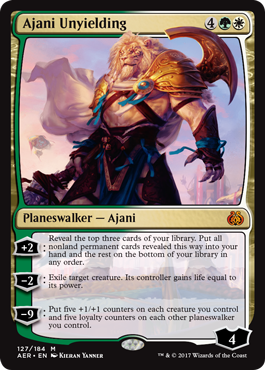
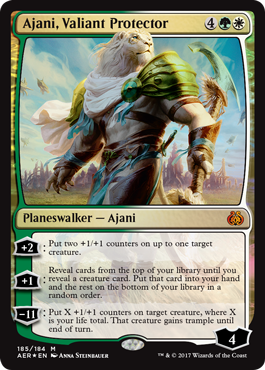
We’ve had many different versions of Ajani so far, and most of them have been tournament staples. Ajani Goldmane started us out pairing well with tokens to overwhelm the opponent quickly. Ajani Vengeant was almost the exact opposite, preferring a more controlling path to victory, but many consider him to be one of the best. Even Ajani, Caller of the Pride and Ajani, Mentor of Heroes served us well in aggressive strategies during their time in Standard. Ajani Steadfast was one of the least playable of the variants and it still functioned well in some situations, as well as holding the second highest price point to Ajani, Mentor of Heroes.
What’s up with these two new Ajanis, though? Both are six mana? I spoke at length about these two cards in an article a couple weeks ago, but my opinion hasn’t changed much since then. Even with the Standard bannings (crazy, right?), I’m not sure there’s room in Standard for these two six-mana 'walkers that don’t add threats to the board. Ajani Unyielding can at least kill a guy, but his ultimate only fits well if you have a bunch of dudes in play. Ajani, Valiant Protector can kill your opponent with his ultimate, so that seems better, but neither of these two six-mana ‘walkers is anywhere near the top of my list of cards to work on. I’m very disappointed with these two new versions of my favorite planeswalker.
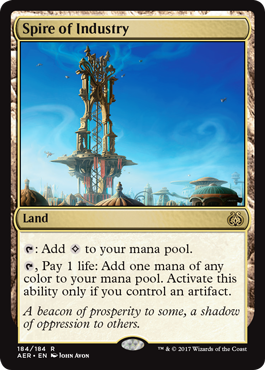
Spire of Industry seems like a potential candidate for Affinity as well as other artifact-based decks. It’s unclear how much impact it will have, but I like its potential.
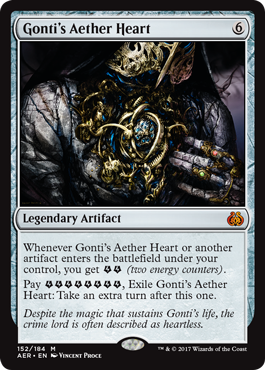
Maybe I missed one here by putting this in the Honorable Mention section, but I honestly think that this artifact will get cut from the Aetherworks Marvel decks in favor of more streamlined cards. Extra turns are great, but this seems like a win-more card rather than one that makes my combo more consistent.
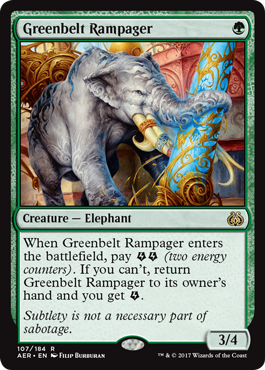
Man, I want to love Greenbelt Rampager so much. It reminds me of one of my first loves, Rogue Elephant. Even if you play this in the midgame, the body should be good enough to fight well for you. I think this has a home right away in the Energy Aggro deck, but I’m not sure what they would cut for it, so I stuck it in this section. Solid card, though.
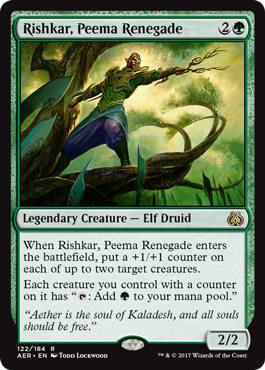
There is a lot of potential for the terribly named Rishkar, Peema Renegade. Are they running out of names or something? Peema? Rishkar was bad enough but Peema? Come on now. Ranting about the name aside, I think ramping with this guy sounds sweet. What do we want to ramp to, though? Is this even the best way to ramp? I like this creature and I think there could be something here using this as a build-around-me type of card.
And now, onto the Top 10!
10. Heart of Kiran
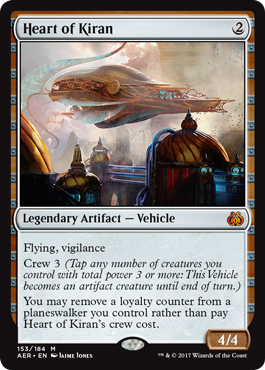
Last time around, I may have underestimated the power of vehicles, but this time I think I pegged Heart of Kiran correctly. In my mind, much of this vehicle's power level depended on its pairing with Smuggler's Copter to form the WR Vehicles dynamic duo. I figured that this artifact’s home would be better suited in an aggressive deck than a midrange strategy.
How good is the ability to pilot it with a loyalty counter from a planeswalker you have on the battlefield? Obviously having this option is a huge boon, but do we really want to be removing counters from our planeswalkers in order to make this into a guy? That’s the main question I have right now about this 4/4 flyer.
I want to try this card out in a couple of different places, and I think it will impact our new Standard format, but I don’t know the best fit for the card. It’s weird to think of Heart of Kiran as a flying ship, but it’ll be interesting to see whether we fly over our opponents with this 4/4 or not.
Financial Implications
Financially, I think we have some room for the price to decrease a bit here. Double digits is fine for this card, but I doubt it will have the same ever-present impact permeating many of the top decks in the format as Smuggler’s Copter did. I think the $10 range seems more likely than the $20-plus price tag it currently holds. It has already gone up in preorder price, largely due to Copter’s ban, though.
9. Tezzeret the Schemer // Tezzeret, Master of Metal
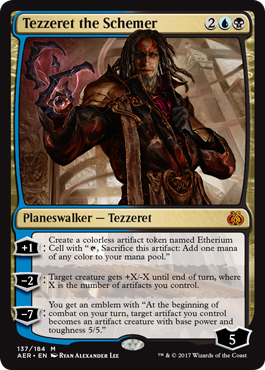

Tezzeret, the master of artifacts, is back and ready to create new decks in the metagame. Just like with Ajani’s new variants, I think Tezzeret has taken a huge step down in power level. Tezzeret the Schemer ramps you, kills a small guy, and then makes one of your artifacts a 5/5 each turn. These are all decent abilities, but none of them seem impactful enough for me to want this card in a deck. Maybe his high starting loyalty and synergy with artifact decks will be enough to get him some playing time, but I think he’s going to warm the bench. We’ll see, though.
Tezzeret, Master of Metal seems like the better of the two cards. Depending on what an artifact deck looks like in Standard, utilizing a -3 that drains your opponent for a ton of life could be deadly. Will this deck come together and be good enough to compete? That I’m not sure of just yet, but I think Tezzeret mastering metal is more likely than him sitting around scheming all day. Tezzeret’s schemes seem weak, but the metal he’s creating looks worthy.
Financial Implications
If there is an actual deck for the Master of Metal, his price will explode and all those planeswalker decks will sell out. It wouldn’t be a bad idea to hedge and get a copy or two so you can be ready to list them if they surge in price. Unless I’m missing something, or Tezzeret the Schemer is one of those cards you have to play to see how good it is, I think he will fall below $10 within the first week or two of release.
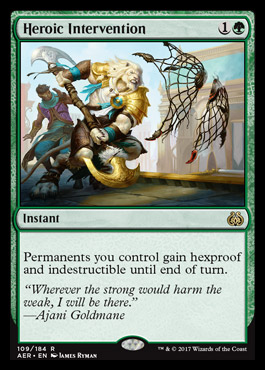
8. Heroic Intervention
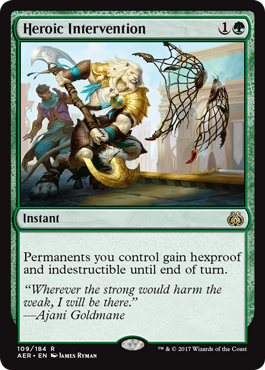
"Permanents you control gain hexproof and indestructible until end of turn" is a powerful line of text from Heroic Intervention. I think this two-mana instant has tons of potential in multiple formats. It seems like Wizards is constantly thinking of new ways to create fast linear aggressive strategies. Whether it’s Bogles, Infect, or just GR Energy Aggro, there is always a deck that wants to protect its creatures with a card like this. I could even see this getting some Modern slots in the aforementioned decks.
Financial Implications
Pricewise, it doesn’t get much better than under $2. If this card falls to bulk status, I’ll be intervening to grab a couple play sets. I doubt there is much growth potential, but long term its price seems solid. Foils will be a higher multiplier if it starts seeing play in Commander or Modern or both.
7. Baral, Chief of Compliance
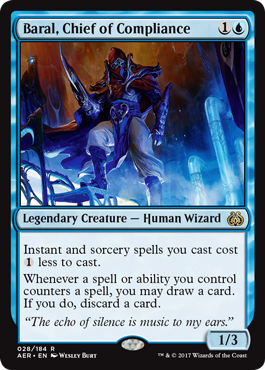
Baral, Chief of Compliance screams combo card to me. It’s like a Goblin Electromancer with additional potential upside. I think this creature could show up in a couple places. Obviously it would be good in Storm, the same way Electromancer is, but I think he could also be great in a normal control deck as a blocker, cost reducer, and card filterer. This idea of how to play him fits well with Torrential Gearhulk as well.
Financial Implications
Already at $5, I think Baral is more likely to go down than up, but if he’s part of a tier-one deck then there’s a little room for growth. The foil, though – wow. I’ll bet if you didn’t know his foil was $25 that you’d never have guessed it was that high. I’d believe $10. Even $15 seems reasonable, but $25 – wow, that blew me away.
6. Yahenni’s Expertise
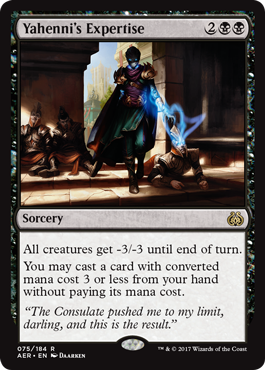
I’ll admit that I’m not sure this is the right time for Yahenni's Expertise in Standard. What aggressive deck are you targeting with this card? As of right now, -3/-3 to all creatures wouldn’t be very good against the metagame, but by banning three cards, I think a ton more creative space has just opened up in Standard. We really have no idea what’s going to happen when these cards come out, but a four-mana sweeper is something we typically look for in control decks. I might rather pay an extra mana and Fumigate them instead, but sweepers will always be a crucial component of control strategies.
The -3/-3 level may or may not seem broken depending on what the rest of the metagame looks like. This rate could be practically the same as Wrath of God, but it could also be like trying to cast Languish against Siege Rhino and Tasigur, the Golden Fang. Sometimes the free three-mana-or-less spell option might go unused as well, but having the option to double up on spells sometimes is great, especially since you get to cast it after the -3/-3 resolves, so you can follow up with your own creature.
Financial Implications
Preorders seems to indicate that Yahenni’s Expertise will be decent as well, since it’s sitting around $6 right now. The immediate amount of play this sorcery sees will likely determine its initial price trajectory. If a deck utilizes it, there’s some upside, but otherwise, it’ll drop down to $2 or $3 quickly.
5. Metalic Mimic
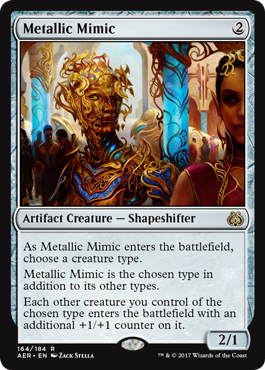
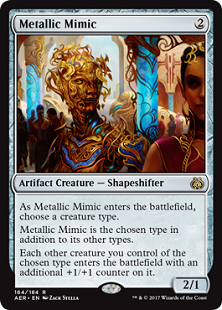
Metalic Mimic is one of the most interesting and powerful cards in the set. Not only is it generically powerful in combination with any creature type, but it also combos with Animation Module to create a pseudo-Sword of the Meek-plus-Thopter Foundry interaction.
Financial Implications
A lord like this usually fetches roughly the $4 this is currently at. I’d expect this card to follow a similar price trajectory to that of Adaptive Automaton. They are similar cards that will be used for similar purposes. The only difference is that Mimic might be the core of a Standard deck, while Automaton is just casual gold. Both have strong low-end price potential with bigger upsides with their foil printings.
4. Paradox Engine
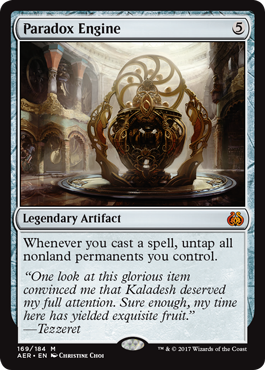
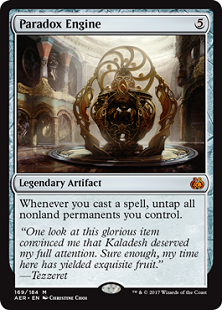
Paradox Engine immediately screams broken combo to me. You can technically combine it with Greenbelt Rampager, Servant of the Conduit, and Aetherflux Reservoir, but I think that’s the least threatening combo this card will have available to it. One problem with this artifact is that there are so many possibilities that seem available, it may be hard to nail down which ones are the best to combo with it.
Financial Implications
Unsurprisingly, the foil of this card is over $20. I could definitely see that going up as well once players start designing more and more combos with it. I’m not sure the normal copy has much potential for growth, but it could go up a couple more dollars at least.
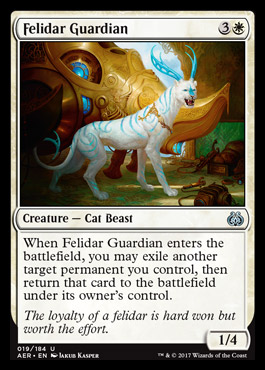
3. Felidar Guardian
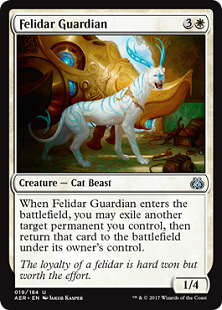
Speaking of combos, who at Wizards thought it would be okay to ban three cards from Standard yet leave a turn-four infinite combo with Felidar Guardian and Saheeli Rai? I think this combo will define Standard, so start brewing with or against it. I thought when the ban announcement was going to happen that it was because they missed this in production and wanted to clear it out before it was a problem, but we get to deal with functional Splinter Twin combo in Standard for the time being.
How good will this deck be? What direction will the deck take? Will the strategy be fully focused on assembling and protecting the combo or will it be embedded within another Jeskai deck? There are many questions surrounding this interaction, but one thing’s for sure: you will be seeing this across the table from you, so get your $20 Saheeli’s now or start brewing on how to beat them.
Financial Implications
As one of the most broken interactions to come out of a Standard set in a long time, Felidar Guardian gets a well-deserved spot in the top 10 for this set. It does seem fun to play with in Commander as well, and there are limitless possibilities for fun in the format. Foils will likely be expensive, but I doubt that this uncommon will jump up to or above $2 for the regular copies. Wouldn’t hurt to pick through draft leftovers looking for them, as well as holding onto a playset or two for your binder.
2. Hope of Ghirapur
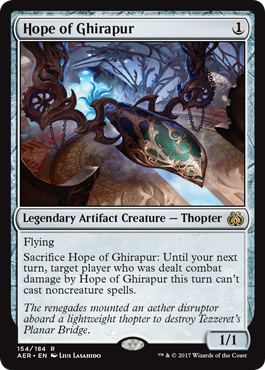
Modern has been missing a card just like Hope of Ghirapur. Legacy has Xanthid Swarm, but Modern lacks this effect to preemptively protect your combo outside of something like Silence. Hope of Ghirapur is a huge deal. It’s like Spellskite in some regards, but this creature shuts down all spells, not just one. There is the potential for this to see play in Affinity as well, and that adds a little to the hype.
Financial Implications
If you play Modern, I’d pick up your playset for $2 each, or less if they dip down, and hold onto them until you need them. The Saheeli Rai-Felidar Guardian combo could utilize this as well as Metallic Mimic-Animation Module, so Standard could potentially be seeing a lot of this little guy. He can fit into any deck, and that’s always a powerful financial aspect to consider.
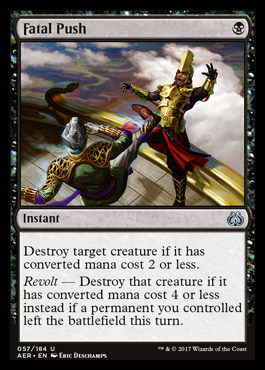
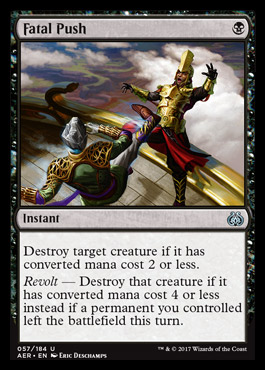
1. Fatal Push
Thinking back through all of the Top 10 articles I’ve written, I don’t think there’s ever been a set where an uncommon landed the number one slot. This is 2017, though. It’s going to be a great year and this removal spell nabbing the top spot is just one indication of how we’re going to shake things up.
At first glance, this one-mana black instant seems innocent and mediocre. Sure, it’s great to kill a one- or two-mana creature, and sometimes you’ll be able to kill something up to a four-drop. Once we inspect how potent the revolt mechanic is, though, it’s easy to see just how powerful this card truly is. Revolt is similar to the dies keyword, but instead of only triggering with creatures, revolt applies to any permanent. The most important aspect to it being a permanent in this case is that it pairs with lands. That means Evolving Wilds, Windswept Heath, or any fetchland will trigger revolt cards, making them basically always be triggered in formats with these cards available.
Financial Implications
Fatal Push is going to be the black Lightning Bolt. Foils are already a whopping $40, and although that price will probably come down, there’s strong incentive for further growth for a spell that will see play in every format. We are talking Path to Exile levels of influence here, if not more than that. I’m excited to play with it in Standard where it will be much more balanced, but players will sleeve this up in Modern and Legacy as well right away.
Get your copies sooner rather than later because this has nowhere to go but up. Stores will be buying and selling these quickly too. I know my store has a hard time keeping cards like this in stock, so make sure you get your copies and any extras to get rid of when an opportunity arises.
Aether Revolt seems poised with potential for financial growth of cards from this set as well as other cards influenced by these printings. So what are your thoughts about this Top 10? Did I pick them correctly, or did I miss something? Let me know your thoughts in the comments.
Until next time,
Unleash the Frontier Force!
Mike Lanigan
MtgJedi on Twitter
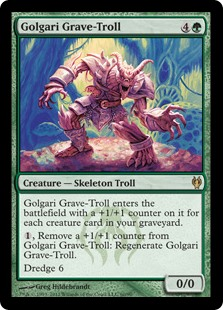 Dredge just kind of circumvents the rules of engagement, taxes sideboard space, and is surprisingly resilient to hate.
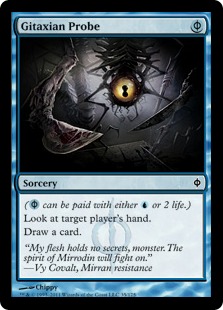 I was curious about Pyromancer Ascension making a comeback in the era of Fatal Push but it doesn't look like it was meant to be, as Storm is one of the decks that is absolutely killed by this ban.
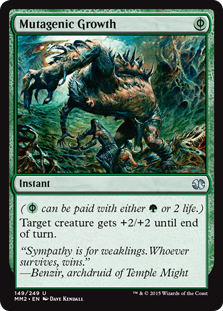 A number of Modern decks with varied threats have been taking advantage of Mutagenic Growth. Most are hurt by the absence of Gitaxian Probe, given that these decks prominently feature Monastery Swiftspear and other prowess threats. I will say that making these decks significantly worse while leaving Infect more or less intact makes it so that Lightning Bolt will be on average better against your linear aggressive opponents. That's a positive for players who advocate the more interactive and reactive decks.
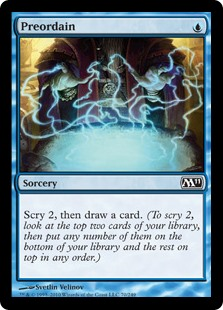 In the past I personally have made the case that Preordain is definitely too good for Modern—this paragraph certainly falls more in line with the crowd that thinks spell-based combo is due for a shot in the arm. I wouldn't read too much into this, as it doesn't explicitly state anything suggesting that they care about the strength of spell-based combo, just that this reasoning doesn't demonstrate that it was the target.
 The combination of the removal of Gitaxian Probe from the format and the addition of Fatal Push will almost assuredly slow things down. Not to mention that when the fair decks remove the graveyard hate from their sideboards, they'll have even more tools to punish the fastest decks in the format. Time will tell just exactly how much the format will slow down, but I wouldn't bet on all of the fast decks being dead—there are still plenty of tools to beat down and combo-kill.


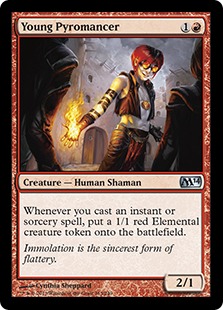 Probe will always be at its best in less fair decks. Yes, it saw play in fair decks as well, mostly to enable Young Pyromancer, but it was never as strong. Probe let you see what, if anything, you had to play around or prepare for, and plan your sequencing exactly correctly. There's "correct" sequencing based on matchup knowledge and playing around problem cards, and then there's actually correct sequencing based on what your opponent actually has. Knowledge of how to correctly sequence a turn has always been more powerful in unfair decks than fair decks because they will kill in a single turn and need to know when to go for it (which doesn't really count as "going for it" when you know it will work). That power for free is simply absurd. As a result, Probe will always benefit unfair decks more than fair decks and so the damage to fair decks is unfortunate but acceptable.
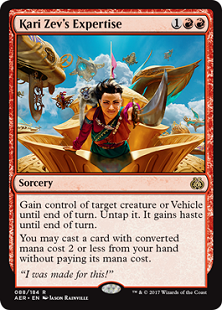 was a trigger that cast an additional card when you cast the spell. Now that extra card is dependent on you having it in your hand and on the initial spell resolving. In exchange you get to choose what to cascade into.
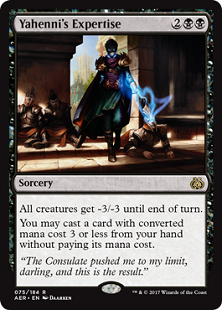 [/tippy] effect is the most playable, but it's directly competing against Damnation and I don't think it wins.
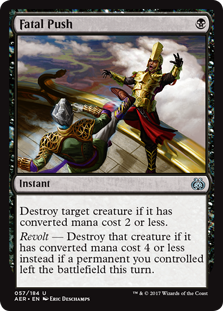 [/tippy], the card that everyone else has lost their mind about. I agree with Ryan's assessment and only have this to add: what do you cut for Push? Obviously Disfigure is out of a job now, but that card didn't see much play. So what goes? If you cut unconditional removal like Murderous Cut you lose to Primeval Titan and Reality Smasher. If
 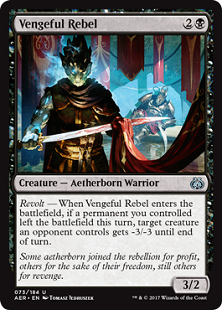 you cut something like Lightning Bolt you lose flexibility. So what will be sacrificed for this card?
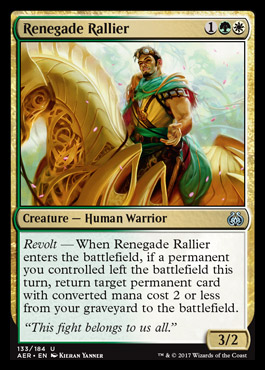
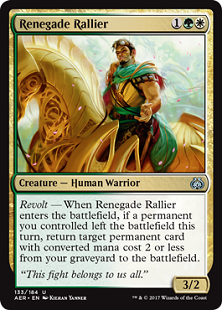 [/tippy]. It looks innocuous, but my inner Craig Wescoe is giddy at the sight of that card. Alongside Aether Vial, this card is a recovery engine. I have visions of Vialing in Rallier following Supreme Verdict, getting back Voice of Resurgence and then using Flickerwisp to do it again next turn. Is this good? Maybe. Will it be fun? Oh, yes.
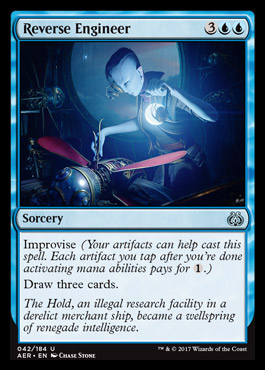
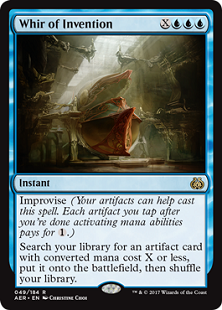 This is the mechanic that has the most potential for bustedness in Modern. It works like convoke for artifacts, but you cannot reduce a colored cost. This appears to be weaker than convoke but these are artifact we're talking about. It isn't hard to flood your board with them, meaning you can pretty easily pay for a lot of improvisation.
 Eggs is getting other tools as well (the Implements, for example, which fit perfectly into the deck's game plan) and I'm sure somebody will discover the optimal configuration before long. We could also conceivably see an entirely new combo deck arise on the back of [tippy title="Whir of Invention" width="330" height="330"]
 Now it has [tippy title="Sram, Senior Edificer" width="330" height="330"]
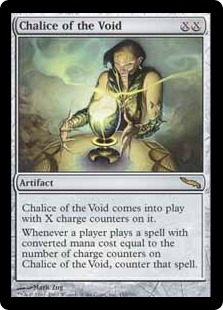
 [/tippy] to act as another Paladin, so it is less prone to failure than before. Still loses to Thalia and Chalice though.
 Finally, I'd be remiss if I skipped [tippy title="Metallic Mimic" width="330" height="330"]

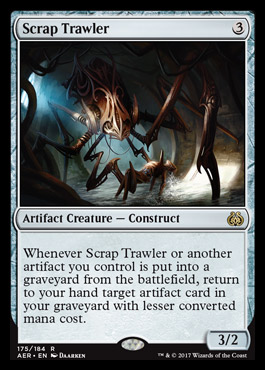
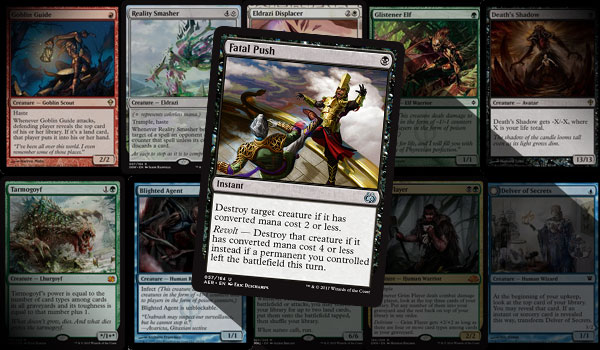
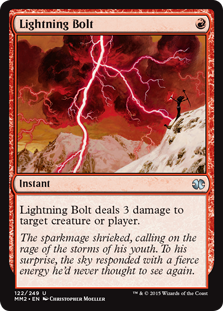 Unlike Path to Exile, both the old Bolt and the new Push are conditional removal spells that can't dispatch everything. Their strength in Modern is directly related to how many creatures they can reliably remove. Consider the iconic Lightning Bolt. For Bolt-slingers everywhere, the card is at its strongest in a format where 100% of the decks are playing creatures with exclusively 1, 2, or 3 toughness, and no cards to boost their toughness. Also, no Slippery Bogles. Bogles need not apply to this article. In that theoretical metagame, Bolt would be the optimal removal spell, killing every creature with no drawback for only one mana. By a similar token, Bolt would be horrible in a format where every deck is playing only creatures with 4+ toughness. This spectrum was at the core of
 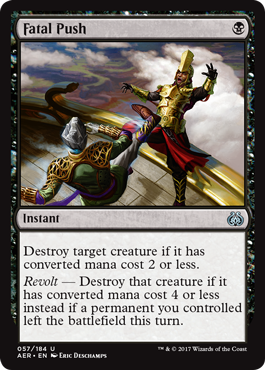 Push operates in a similar fashion. In a format where every deck is playing only creatures that cost 0-2 mana, Fatal Push is the new Bolt. Especially if some of those 0-2 mana creatures are Bolt-resistant beefcakes named Tarmogoyf or Death's Shadow. By contrast, a format that's all Tron and Breach Valakut all the time is too heavy to Push around. At least it's a flavor win: no one kicks, let alone pushes, Primeval Titan anywhere. As with the Bolt Index accounting for toughness, a so-called "Push Index" would need to account for mana cost. Specifically, for unconditional hits (i.e. creatures costing 0-2 mana), conditional hits (i.e. creatures costing 3-4 mana), and misses (i.e. creatures costing 5+ mana).
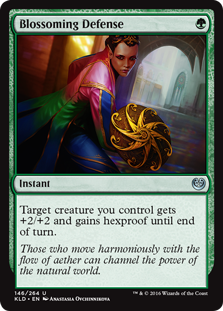 In any case, many of the best players in the game have been calling Infect the best deck in Modern, and for December at least it appears to be true. The arrival of Blossoming Defense most likely has played a part, but so has Dredge's rise. Infect is, of course, one of the best answers to the graveyard menace, which is still posting a 6.8% metagame share despite the giant target on its head and the supposed effectiveness of the hate cards.
 Compare this to something like Abzan vs. Jund, which ends up shifting a large number of cards in the change over to a different splash color, or the other Tron decks (Mono-U and Eldrazi Tron) which are pretty clearly distinct.
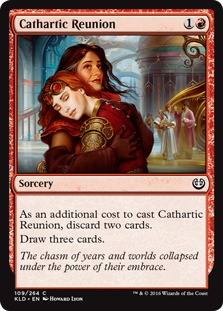 Again, regarding Dredge, it's notable that the total share has increased over the last few months, when such powerful sideboard cards are available and it's on everyone's radar. Dredge was already doing pretty well before the release of Kaladesh gave it an explosive new tool in Cathartic Reunion. We'll touch more on the implications of this in the discussion below on the banlist changes.
 Lantern Control benefits from new tools. The bizarre prison deck
  Sun and Moon overcomes its middling fringe status. The unlikely control strategy
 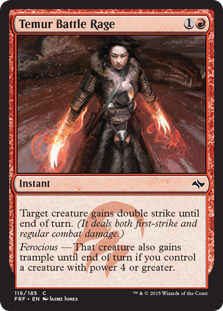 Death's Shadow Blue, the other Battle Rage deck. Another major story in 2016 was the rise of Death's Shadow Aggro, and the wider adoption of Temur Battle Rage and Become Immense. Infect has long used the delve spell, but players started to figure out other uses for it, including decks that could port over the full Standard combo. Eventually, someone realized that Monastery Swiftspear was contributing enough wins to the Death's Shadow deck and asked, "What if we just cut all that other stuff?" Cue the appearance of "Death's Shadow Blue," or UR Prowess. Back in September it was rounding out the bottom of Tier 3 at 0.3%, but by December its share has grown to 2.2%.
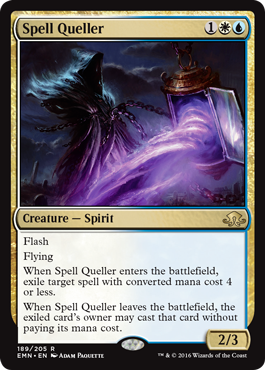 UWx midrange is splintered across several decks. Jeskai Nahiri (which we've often reported as Jeskai Control) is a well-established archetype that varies only slightly in build from pilot to pilot. Jeskai midrange decks have been a much bigger challenge to classify, presenting a wide range of variation that really falls along a continuum from midrange to control. This is all complicated by the relatively new arrival of blue-white midrange and control decks, which share a lot in common with their more storied Jeskai siblings.
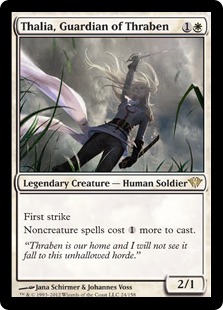 Eldrazi and Taxes slides farther down the rankings. In past updates I've called this deck Death and Taxes and grouped it together with other Leonin Arbiter/Thalia, Guardian of Thraben decks. Practically speaking, the black-white Eldrazi version is the de facto consensus build, with mono-white, GW, and occasionally UW versions appearing much more infrequently. Furthermore, especially when we look at the green-white decks, there's a ton of variation and an unclear difference between GW Hatebears and GW Aggro. For now I prefer to report them separately as Eldrazi and Taxes and Hatebears. My theory is that Thalia simply pairs better with Thought-Knot Seer et.al. than with Noble Hierarch and Collected Company, and a prison-like creature deck gets a pretty big shot in the arm from giant walking Thoughtseizes and the board-dominating Eldrazi Displacer. Add Tidehollow Sculler and Wasteland Strangler into the mix, and I'm hard-pressed to see how a board-control deck would rather give all that up for a clunky beatstick like Loxodon Smiter. Either way, it doesn't seem like a great time for Thalia in general.
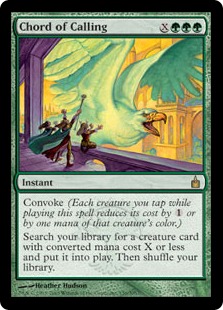 Green-based toolbox strategies continue to languish. Kiki Chord and Abzan Company have been dropping off gradually for some time, and since September we've seen the Abzan shells shed about half their metagame share. Now Abzan Company and Evolution decks combined only make up 0.9% of the field, while Kiki-Jiki Chord decks add in another 1%. Most of the experimentation with Eldritch Evolution seems to have run its course, with most Abzan players returning to the traditional duo of Collected Company and Chord of Calling. Kiki Chord still uses the Eldritch card, however, so it doesn't appear that its adoption was purely conventional, or unwarranted. Now that Dredge is being nerfed, it will be interesting to see if the toolbox strategies (which rely at least partially on graveyard shenanigans) can make a comeback.
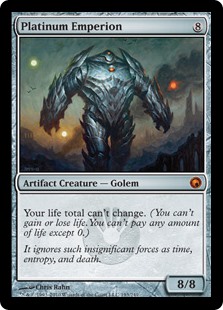 Madcap Moon rears its head. Kaladesh introduced a brand new combo to Modern in the form of Madcap Experiment and Platinum Emperion. The way the timing works, you can reveal any number of cards to the Experiment and it won't hit you with the damage until Emperion is already in play. A couple other decks have tried to adopt the combo (RG Ponza, Titan Breach) but it seems to be
 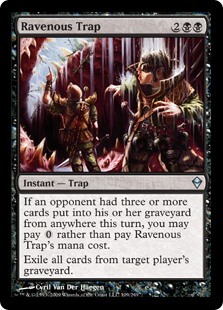 But just like Infect, Dredge has managed to put up numbers over and over in spite of the relatively large target on its head. If it isn't in violation of the turn rule itself, it creates the same kind of pressure on any lower-tier deck trying to compete. Dedicate sideboard space or perish. Or perish anyway, because Dredge is strong even through the hate.
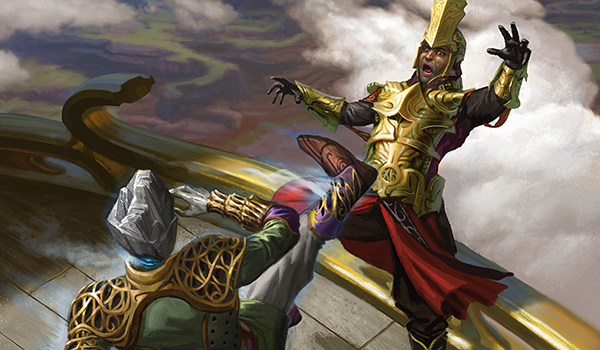
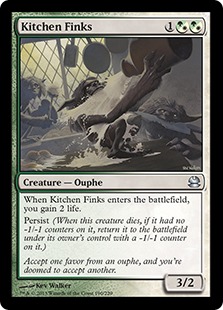 When it comes to four-drops, we begin to tread shakier ground. Four-drops are just as easy to kill with Fatal Push as three-drops are, so creatures need a great reason to cost one extra mana. Those that don't immediately provide value as many three-drops do, including Kalitas, Traitor of Ghet and some Restoration Angels, risk becoming obsolete with Push around. We can say that any four-mana creature that doesn't provide immediate value, or an overwhelming late-game advantage, fails the Push test.
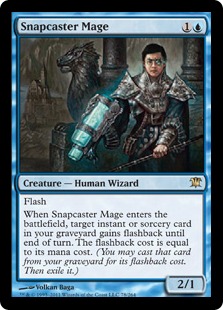 The arrival of a hyper-efficient removal spell in black signals a new era for interactive strategies in Modern. No longer must control, tempo, and midrange decks side with red or white to combat the format's aggro-combo strategies. Fatal Push stands to make Sultai and Esper, as well as the color pairs UB, BG, and BW, selectable as color combinations for interactive strategies.
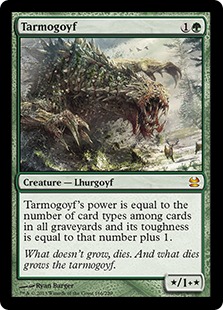 Until now, Tarmogoyf has never failed a removal test. But it fails the Push test. So do Flayer and Scooze, the latter of which at least fails it in style (you know, after Jund players sink a bunch of mana into it). Raging Ravine, specifically a big draw to Jund over Abzan, also dies to Fatal Push. The BGx archetype's iconic creatures have never been so vulnerable.