menu

Insider: Standard Innovation From the MOCS

Are you a Quiet Speculation member?

If not, now is a perfect time to join up! Our powerful tools, breaking-news analysis, and exclusive Discord channel will make sure you stay up to date and ahead of the curve.

If you like control, now is your time to shine. It has been said that Standard right now can be boiled down into choosing whatever twenty removal spells you'd like to play and pairing them with any number of powerful finishers. You can essentially play whatever four colors you wish with no repercussions, so building your deck to kill everything and win in the mid-game is the game plan for most competitive players.

If you like combo, Rally is always looming in the shadows ready to strike. This is a difficult deck to attack---you would think some number of hate cards would defeat a deck built on exploiting synergies, but that doesn't work out much of the time.

If you have Anafenza, the Foremost, or the new hotness Kalitas, Traitor of Ghet, they cannot combo kill you. They can, however, still play value dude after value dude until they find the Reflector Mage, the Azorius version of Flametongue Kavu. There's also Hallowed Moonlight, but I heard a story about Rally winning through three copies of that sideboard spell being cast. I think most of the time Rally helps you out by running inconsistently through its matches, but no doubt the deck is good.

Good old mainstay Abzan is there to save the day but we all know a pack of Siege Rhinos is no one's hero. Or R/B Dragons can be a fun way to go about your business of making a token army and then swinging with the "lower-powered" Kolaghan, the Storm's Fury.

But since none of those things are new and fun, what's a brewer to do? Never fear! Mike is here to save the day! Well, I'm just bringing you the data boiled down from the recent Magic Online Championship Series (MOCS), but I'll take the credit for shining light on the hidden gems from the event. Here we go.

Eldrazi Ramp

Mono-Green Eldrazi Ramp (MOCS 2nd place)

Creatures

3 Whisperer of the Wilds
2 Hedron Crawler
4 Rattleclaw Mystic
3 Thought-Knot Seer
4 World Breaker
2 Ulamog, the Ceaseless Hunger

Spells

4 Explosive Vegetation
4 Nissa's Pilgrimage
4 Hedron Archive
4 Oath of Nissa
2 Ugin, the Spirit Dragon

Lands

4 Sanctum of Ugin
4 Shrine of the Forsaken Gods
1 Crumbling Vestige
1 Wastes
14 Forest

Sideboard

1 Ugin, the Spirit Dragon
3 Hangarback Walker
4 Jaddi Offshoot
2 Reclaiming Vines
2 Spatial Contortion
3 Winds of Qal Sisma

If you like a deck dedicated to big mana, now is your time to shine. Similar to other archetypes, there are multiple ways to build a viable Ramp deck.

With this version, our focus is on utilizing the two-mana creature accelerants to jump to four mana for Thought-Knot Seer, Explosive Vegetation, and Hedron Archive. With this sequence, you can achieve an amazing eight mana on turn five to cast World Breaker or Ugin, the Spirit Dragon. We haven’t seen this type of acceleration since Primeval Titan and Lotus Cobra were legal for Standard play.

After you've found enough mana, a card like Hedron Archive grants the deck the ability to draw into threats should the game go past your initial finisher. World Breaker gives the deck such inevitability as well. Having a recursive threat makes winning quite difficult for any opponent. I’ve noticed that the land destruction component from World Breaker plus Ulamog, the Ceaseless Hunger can really shut down an opponent’s ability to interact with you as well.

For me, the aspect of the deck that distinguishes this version from the previous ones is the inclusion of Oath of Nissa. The green Ponder allows you to search for the right creature for the situation. If you need to ramp, you might take Rattleclaw Mystic, but you could just as easily use the Oath to find a threat or disruption.

The other great thing about running creatures as your accelerants is that they act as great blockers against the aggressive decks. You do give them targets for their removal spells, but transitioning from ramping your mana to blocking to give you more time to survive is a huge boon.

Bant Company

Bant Company (MOCS 6th place)

Creatures

2 Bounding Krasis
4 Deathmist Raptor
3 Den Protector
4 Eldrazi Skyspawner
3 Jace, Vryn's Prodigy
4 Reflector Mage
2 Stratus Dancer
4 Sylvan Advocate
2 Wingmate Roc

Spells

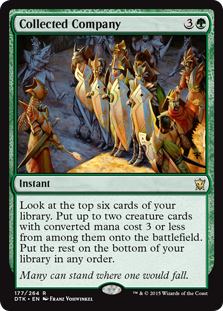
4 Collected Company
3 Dromoka's Command

Lands

2 Canopy Vista
4 Flooded Strand
2 Forest
1 Island
4 Lumbering Falls
3 Plains
2 Prairie Stream
4 Windswept Heath
1 Wooded Foothills
2 Yavimaya Coast

Sideboard

1 Stratus Dancer
2 Arashin Cleric
3 Disdainful Stroke
3 Dispel
1 Harbinger of the Tides
1 Hidden Dragonslayer
1 Silkwrap
1 Surge of Righteousness
2 Valorous Stance

The MOCS is a prestigious event and it draws the best players from around the globe to compete. So, when I say that many of them chose this archetype to compete with, it’s worth your time to take the deck seriously. The Ramp deck above may have taken second, but there were two different versions of Bant Company in the Top 8 as well as many others in the Top 32. This particular version was played by Standard expert Brad Nelson.

Collected Company is great in Standard right now. There are a ton a great three-mana creatures that not only present excellent stats but also provide card advantage or silver bullet-like abilities against specific matchups.

The biggest draw to this Bant version has to be Reflector Mage. That card is a beating and it’s no surprise that it’s seeing so much play in Standard. We will see what happens with the mana bases after rotation in a couple months, but if players can make it work, this card should be seeing a ton of play the entire time it’s legal.

While I’ve been jamming Temur Company to take advantage of Savage Knuckleblade, others have been running their Companies with an Abzan shell. This version takes what I liked about Temur and combines it with the ability to set back your opponent using Reflector Mage. I have found Harbinger of the Tides to be great as well but you may not need that in addition to Reflector Mage.

My red version gets Roast and Fiery Impulse while this version has access to Dromoka's Command as well as a plethora of white options in the sideboard. These two decks are similar and they both get a pile of counterspells in the sideboard which is great against decks like Ramp and any midrange control deck.

My Temur version has one more spell slot for some maindeck counters and I think that could be a good idea here as well. The best part about this type of deck is confusing your opponent when you leave open mana. Your opponent never knows whether you are leaving mana available for a creature with flash, Collected Company, or a counterspell.

Being able to play the game on your opponents turn is a powerful aspect to any deck, and although I have not played Bant Company, I would probably make those types of changes right away before bringing this deck to battle. Either way, the deck is great and I’ve watched many players have success with this archetype recently. Be ready to battle with or against it at your next event.

R/g Tokens

R/g Tokens (MOCS 9th place)

Creatures

4 Abbot of Keral Keep
4 Monastery Swiftspear
3 Pia and Kiran Nalaar
4 Reckless Bushwhacker
3 Zurgo Bellstriker

Spells

4 Dragon Fodder
4 Hordeling Outburst
4 Atarka's Command
4 Fiery Impulse
3 Outnumber

Lands

4 Bloodstained Mire
2 Cinder Glade
1 Forest
11 Mountain
1 Windswept Heath
4 Wooded Foothills

Sideboard

1 Cinder Glade
3 Windswept Heath
2 Arc Lightning
3 Den Protector
4 Nissa, Voice of Zendikar
2 Yasova Dragonclaw

Tokens has my heart. This is a strategy that I am always drawn to. Whether it’s Commander, Cube Draft or Standard, I am enthralled with making a seemingly benign token army and then pumping your insignificant forces to make them terrifying.

R/g Tokens stood out to me in the Top 32, not only because it was the ninth place deck, but also because I was working on this strategy during Oath of the Gatewatch spoiler season, although my lists always started with Hordeling Outburst and Goblin Dark-Dwellers.

This version opts for a sideboard strategy of Den Protector plus Nissa, Voice of Zendikar. You'll notice four additional lands (!) in the sideboard to support the transformational sideboard and cast all the green spells contained there.

I like this deck because it can overwhelm the opponent who is trying to kill your creatures one-for-one. This deck spreads out its creatures into a mass of little dudes rather than single efficient creatures. Between Outnumber, Atarka's Command and Reckless Bushwhacker, there are a lot of payoffs for your token army.

Demonic Pact Control

Demonic Pact Control (MOCS 28th place)

Spells

2 Crush of Tentacles
4 Duress
2 Ruinous Path
4 Transgress the Mind
1 Treasure Cruise
2 Anticipate
2 Dig Through Time
2 Dispel
2 Disperse
1 Empty the Pits
2 Grasp of Darkness
3 Silumgar's Command
4 Demonic Pact
3 Oath of Jace

Lands

4 Bloodstained Mire
3 Dismal Backwater
4 Flooded Strand
4 Island
4 Polluted Delta
2 Sunken Hollow
5 Swamp

Sideboard

2 Dispel
2 Flaying Tendrils
2 Infinite Obliteration
2 Languish
2 Negate
2 Ob Nixilis Reignited
1 Shifting Loyalties
2 Ultimate Price

Finally, we have the icing on the control cake. This gem was hidden at the end of the MOCS results. If you want to make all of your opponents’ removal spells dead draws, this is the deck for you.

This deck features sweet win conditions like Demonic Pact, Crush of Tentacles and Empty the Pits, alongside all the removal spells you could ever want.

It was surprising to me that there are no main deckplaneswalkers. It seems like a deck like this would be greatly served by adding Jace, Vryn's Prodigy and maybe moving those Ob Nixilis Reignited to the main deck as well. I do love Oath of Jace in this deck as a way to draw and filter through the cards you don’t need.

~

The MOCS provided us with plenty of great options for Standard going forward. We still have a couple months to work with this Standard format and there are a lot of unexplored options.

The main one I want to work on is how best to implement the Eldrazi. All of the Eldrazi that see play in Modern are also playable in Standard. I don’t think we’ve found the best build for these creatures yet and that’s an idea I’ve been tinkering with.

Until next time,
Unleash the Force!

Mike Lanigan
MtgJedi on Twitter
Jedicouncilman23@gmail.com

Modern Metagame and Eldrazi Checkup

Are you a Quiet Speculation member?

If not, now is a perfect time to join up! Our powerful tools, breaking-news analysis, and exclusive Discord channel will make sure you stay up to date and ahead of the curve.

Magic feels like it's under attack. Reddit has gone ballistic with the so-called #vendorleak scandal, incensed by stunning (or not so stunning...) allegations of merchant misconduct from an anonymous tipster. Wizards announced Eternal Masters to the joy of many and dismay of many more, reigniting debate about the Reserved List, Legacy, Modern, and future Constructed formats. Blake Rasmussen and Aaron Forsythe tried to quash some of the most conspiratorial rumors, at least for now. Meanwhile, Eternal Masters led to rocketing Reserved List prices, paralleling Modern's trend of spikes for niche playables that haven't seen tournament play in years. On their own, these events would have me feeling a little apocalyptic, but none of them incite doomsayers more than Modern's Eldrazi takeover. We'll explore this metagame Twilight Zone today.

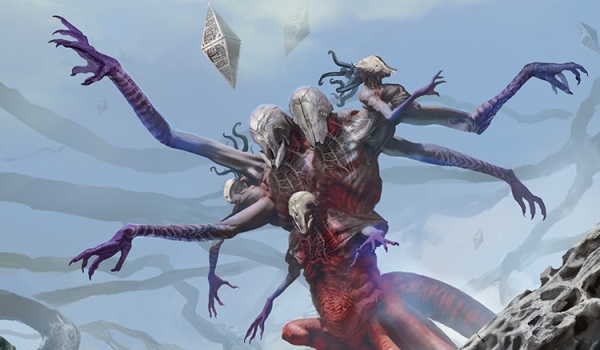
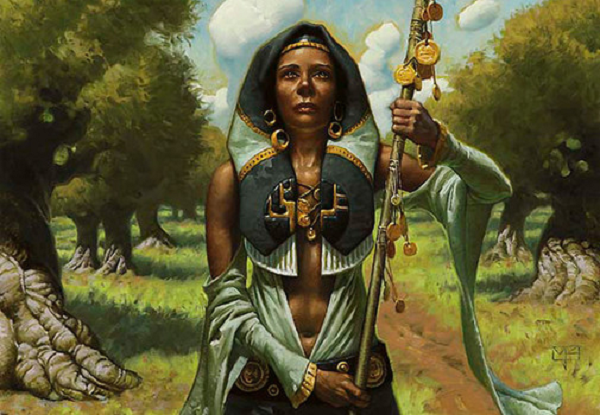
Endless One art

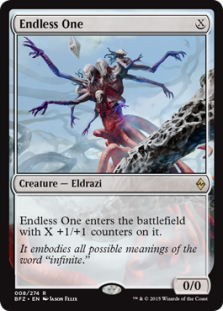
We've investigated the Eldrazi rampage before, both in a Pro Tour Oath of the Gatewatch debrief and in an explicit discussion of its ban potential. It's been about a week-and-a-half since Eldrazi Day 0 (February 5, a date which will live in Modern infamy), and we finally have enough metagame data to discuss the broader field in the Pro Tour's wake. 20 MTGO events, 34 paper, and roughly 500 decklists later, we're ready to analyze the Eldrazified Modern world. Today, we'll identify frontrunning Tier 1 and Tier 2 strategies, compare MTGO and paper scenes, and assess the Eldrazi's impact on Modern. There is still potential for internal regulation, but it fades daily with each new turn one Eldrazi Temple. Be forewarned: as befits our eldritch invaders, this is a disturbing metagame picture.

[wp_ad_camp_1]

Collecting Datapoints

In the spirit of my "Metagame Snapshot" and pre-Pro Tour "Metagame Report" articles, we don't have enough data to conduct a full metagame breakdown like we did in early January. Stay tuned for the March's Grand Prix aftermath for that more comprehensive metagame portrait! Thankfully, we have more than enough data to describe the format's evolution over the past eleven days. With a pair of well-attended Pro Tour Qualifiers Endless oneand a paired Daily and League each day (minus a few missed Dailies), MTGO brings 20 events and just over 210 decks to the analysis. Looking to paper, we see 34 tournaments spanning every continent and hemisphere and contributing about 270 lists. This is on top of Pro Tour Oath's Day 2 field and dozens of high-performing Pro Tour decklists.

By tabulating these datapoints and calculating a weighted average of the three groupings (based on the values of N relative to metagame periods with more data), we can make a conservative estimate for different deck shares in your average Modern event. We'll draw on those numbers today in diagnosing metagame diversity and testing if it really is Endless Ones all the way down.

Post-Pro Tour Metagame Summary

If you thought the Pro Tour Oath field was a mess, the current one is going to give you an Eldrazi-sized heart attack. Not Eldrazi Scion-sized either. We're talking an X=10 Endless One. Analyzing the period from February 5 through February 16, we see a Modern under siege. We'll make a stop in each of Modern's different competitive tiers, touching on core format themes along the way.

Our tour through the wreckage begins in Tier 1, which we define as the most-played strategies in Modern. You are likely to encounter these decks in tournaments and need to prepare for them in your testing and sideboarding. For more on our Tier 1 definitions, and those of other metagame classifications, check out our Top Decks page. With that in mind, here's Tier 1 in all its tentacled glory:

Tier 1: 2/5/16 - 2/16/16

DeckOverall
Metagame %
MTGO %Paper %Day 2%
Eldrazi25%41.5%22.3%10.7%
Affinity11.3%11.8%10.4%13.6%
Burn6.3%2.8%5.9%12.3%
Infect4.5%4.2%3%10.3%
Jund4.1%3.3%4.1%5.3%
Abzan Company3.7%2.8%4.1%3.7%

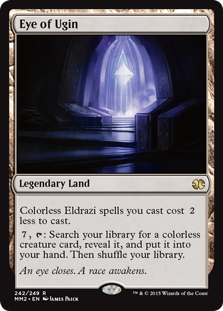
These numbers are about as bad in context as they look in a vacuum. Maybe worse! Eldrazi's share is more than double that of the next highest deck (Affinity), which itself is about double the next highest after that (Burn). We've also never observed such pronounced gaps between different Tier 1 decks, which provides statistical backing to the format polarization we've all suspected. Thinking about Eldrazi specifically, the deck has paper shares comparable to the format's most stifling archetypes in the Bloodbraid Elf, Deathrite Shaman, Treasure Cruise, and Birthing Pod eras. Its MTGO prevalence is, quite literally, the highest I've Eye of Uginever seen for any deck: only URx Delver came close in October 2014 at 25%. We'll talk more about distinct Eldrazi flavors later, but with a core overlap of over 20 cards (central to which are Eldrazi Temple and Eye of Ugin), it's as fair to group the Eldrazi dominators as it was to lump together Twin, URx Delver, and others.

The rest of Tier 1 isn't much better, with three linear decks edging the two midrange holdouts to the bottom. At least Jund is hanging on for dear life: I shudder to think of a metagame period where zero BGx representatives claim a piece of Tier 1 territory. Even if we grouped all the non-Affinity strategies together, they still wouldn't surpass Eldrazi's 25% throne. This pattern of Eldrazi doubling Affinity, and in turn exceeding everything else combined, is echoed in both MTGO and paper. Of course, MTGO is the real disaster here, where every single Tier 1 deck combined is barely over half of Eldrazi's online share. We could make some misleading spins on the data (Abzan Company is finally Tier 1 up from Tier 2! Paper is overall better than MTGO!), but these just obfuscate the real narrative of Tier 1: Eldrazi have truly taken over.

None of this precludes the possibility of a metagame reversal in March. Strategies such as Merfolk, Abzan Company, and even Jund are adapting to fight back. It does, however, make the turnaround much less likely. When decks consume such a commanding share, there's only so much they can realistically decline. Eldrazi at 20% of MTGO, an unlikely 50% drop, would still be a problem.

If you're still breathing after surveying the Tier 1 devastation, we'll look now to Tier 2. These Tier 2 strategies represent tournament viable decks, ones you can bring to your average event and have a realistic shot at the Top 8. From a gauntlet perspective, these are also the decks you'll need to understand how to beat, even if you don't sideboard specific cards to target them. As with Tier 1, Tier 2 has been dramatically altered by the colorless invasion.

Tier 2: 2/5/16 - 2/16/16

DeckOverall
Metagame %
MTGO %Paper %Day 2%
Merfolk3.3%2.4%4.1%2.1%
RG Tron2.7%1.9%3%2.9%
Griselbrand2.3%0.5%2.6%3.7%
Abzan1.8%1.4%1.5%3.7%
Naya Company1.7%1.9%1.9%0.8%
Gruul Zoo1.6%0.5%1.9%2.5%

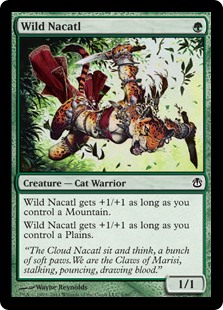
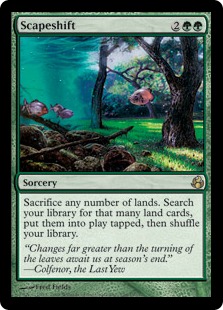
With a mere six decks, Tier 2 houses the fewest viable strategies we've ever seen in a Nexus metagame update. Our previous 10 breakdowns showcased Tier 2s averaging 13 decks each, ranging from 11 (the lowest in July 2015) up to 15 (in August and November). Today's six is less than half that average. Even comparing datasets of a similar size, our pre-Pro Tour Oath analysis found 13 legitimate Tier 2 contenders, despite covering the same date range and roughly the same sample size. Taken on top of the Tier 1 situation, Wild NacatlTier 2 illustrates an unprecedented narrowing of the competitive field down to just a few decks. The remainder has been shipped to Tier 3, where one-time Modern regulars such as Bogles, Living End, and Scapeshift now wallow with sub-.5% shares on either MTGO or paper. Tier 2 also repeats Tier 1's linearity, with only Abzan deviating from this model (even if Merfolk and Naya Company at least pack a degree of interaction).

On the topic of linear strategies, I'm reminded of a fascinating r/spikes post on proverbial "canaries in the coal mine" in Modern. In essence, Reddit user Selkie_Love asks us to consider what cards, strategies, or shifts indicate metagame-wide danger. Tier 2 offers us an alarming example of this principle in action: Gruul Zoo. Not necessarily Gruul Zoo alone, which is just a function of Modern rewarding early, proactive strategies (which itself might be another broader symptom to discuss another time). Rather a) that in a metagame with just six Tier 2 decks, Gruul Zoo happens to be one of them, and b) that Gruul Zoo somehow makes the six-deck list when zero blue-based control lists can cut it. This simultaneously points to Eldrazi's ability to edge out fairer strategies and also warp the metagame towards more linear ones.

So where have all of Modern's blue decks and Tier 2 regulars gone? At the end of our Modern safari, I welcome you to the desperate Tier 3 hopefuls, all of which are frantically trying to carve out a niche in this Eldrazified climate. Tier 3 is our newest Top Decks category for 2016, including metagame-specific decks which might be strong choices depending on matchups you encounter. We've refined our Tier 3 math since last time, although the format has been thrown into such disarray that it's hard to tell by looking at the table below.

Tier 3: 2/5/2016 - 2/16/2016

DeckOverall
Metagame %
MTGO %Paper %Day 2%
Ad Nauseam1.4%0.5%1.9%0.8%
UW Control1.3%1.9%1.5%0%
Scapeshift1.3%0.5%1.5%1.6%
Living End1.2%2.8%0.4%1.6%
Bogles1.2%0.9%1.5%0.4%
Abzan Liege1.1%0.5%1.5%0.4%
Suicide Zoo1%0%0.4%4.5%
Jeskai Control1%0.9%0.7%2.1%
Blue Moon1%0.5%1.1%1.2%
Elves1%0%1.5%0.4%
Kiki Chord1%0%1.5%0.8%
Titan Shift0.9%0%1.1%1.6%
Esper Midrange0.9%0%1.5%0%
Lantern Control0.8%0.5%1.1%0.4%
Jeskai Kiki Control0.8%1.4%0.7%0%
Abzan Chord0.7%0.5%0.4%2.1%
UR Delver0.7%0%1.1%0%
Jeskai Delver0.7%0%1.1%0%
Temur Delver0.7%0%1.1%0%
Allies0.6%1.4%0.4%0%
Mono U Tron0.3%1.4%0%0%

None of our 2015 metagame breakdowns tracked Tier 3, but even without those points of comparison we still notice worrisome patterns. For one, a bunch of decks Scapeshiftwhich should probably be in Tier 2 have fallen below the prevalence cutoff, dipping into Tier 3 instead. These include Scapeshift, Bogles, Grixis Control/Midrange (which don't even make Tier 3!), Elves, UW Control, Ad Nauseam, URx Delver, and others. Do all of these decks need to be Tier 2 at any given time? Certainly not, and we'd be hard-pressed to observe a metagame period in 2015 where this was the case. But should at least some of them meet the criteria? Definitely: 2015 saw zero metagame periods where at least 3-4 of those decks weren't Tier 2 instead of Tier 3. As we saw in the Tier 2 section, this points to an overall narrowing of competitively-viable Modern decks. Yes, it's a small window of data, but we did not see this same narrowing (and certainly not to the same extent) during the weeks between the Splinter Twin ban-effect date and the last day before Pro Tour Oath. This suggests it was Eldrazi, not Twin, which narrowed the field.

When considering Tier 3 decks, you'll want to focus less on their overall metagame share and more on prevalence in each column. This shows where a deck is most competitive and where it makes few (if any) showings. For instance, Living End is on a solid MTGO run at 2.8%. In paper, however, it's more "Dead End" at a paltry .4%. Elves and Kiki Chord see similar patterns, with the 0% shifted to the MTGO side and paper logging a respectable 1.5%. Read this way, the table gives a sense of which decks excel in totally Eldrazi-warped fields (i.e. MTGO) versus a more balanced but still Eldrazi-heavy metagame (i.e. paper).

Many Moderners won't be particularly shocked by these numbers. Shaheen Soorani certainly isn't, even if the end result still wouldn't have justified the preemptive banning some authors and players clamored for. Others, particularly those who still doubt the scale of the Eldrazi occupation, will be more aghast. Maybe you saw the Eldrazi coming. Maybe you didn't, tried to get Grixis to work, and then sold off what's left of your foiled Twin deck in an indignant fury. Wherever you fall on the Modern spectrum it's still important to understand these statistics, their relationship to one another, and their historical context. In the short-term, it helps you make informed metagame decisions, whether deciding to bring UW Control or Gruul Zoo to an event, or choosing linear decks to sideboard against. In the mid-term, it allows us to voice informed opinions about the Eldrazi and the field before, during, and after Grand Prix weekend. Most importantly, in the long-term, it reminds us to be critical consumers of metagame data, building a Magic culture that's more Neil deGrasse Tyson and less B.o.B flat-earther.

Eldrazi Field Notes

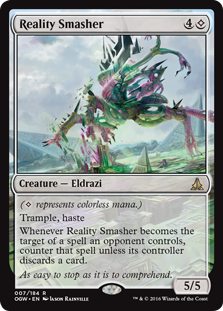
Before we close for today, we're going to make a brief stopover at the vast Eldrazi preserve to see what kinds of Eldrazi decks are seeing play. To be clear, the distinct variants of Eldrazi only matter so much from a metagaming and metagame health perspective. If you're trying to attack the field, you are up against Eldrazi Temple and Eye of Ugin decks with playsets of Thought-Knot Seer, Eldrazi Mimic, Endless One, and Reality Smasher. That Reality Smasheramounts to a 20-24 card-core which we need to target in our metagaming calls. If you, like Patrick Chapin, have given up on beating the Eldrazi and are just trying to assess format health, you'll take the Eldrazi collectively just as you did the same for URx Twin, URx Cruise Delver, BGx Pod, and BGx Deathrite Midrange. The banlist announcements in each of those eras explicitly group strategies together, and Eldrazi's core lends itself to similar classification as much as (and maybe more than) those earlier decks.

Despite those disclaimers, we'll still want to see which specific Eldrazi species are running riot. Metagamers need this information to know if they are facing spot removal and sweepers (RG Eldrazi), a midrange grindfest (UR Eldrazi), or a three-turn clock (Colorless Eldrazi). Metagame analysts need it to see how Eldrazi is itself evolving from its UR and Colorless Pro Tour roots to meet its opposition. The table below breaks down different color pairings in the Eldrazi supertype, splitting them between their MTGO and paper counts. First, let's look at the top 88% of Eldrazi decks, all of those making up 2%+ of the average Eldrazi pool.

Eldrazi Color Pairings (The Top 88%)

Eldrazi ColorMTGO %Paper %Average %
Colorless30.3%50%40.2%
UR23.6%23.3%23.5%
RG22.5%1.7%12.1%
Mono Black1.1%8.3%4.7%
UG3.4%3.3%3.4%
UB0%5%2.5%
Jund2.2%1.7%2%

The remaining 12%, consisting of a whopping 11 pairings, can be found in the spoiler box below. To me, those Eldrazi builds packing Urza's Tower and company are the funniest of the lot. The new ramp deck on the block couldn't just take Tron's metagame share: it had to steal their land too!

[su_spoiler title="Even MOAR Eldrazi!" style="fancy" icon="arrow"]

Eldrazi Color Pairings (The Other 12%)

Eldrazi ColorMTGO %Paper %Average %
Mono Red0%3.3%1.7%
Urzatron1.1%1.7%1.4%
BW1.1%1.7%1.4%
BR2.2%0%1.1%
BG2.2%0%1.1%
RB2.2%0%1.1%
UW2.2%0%1.1%
Bant2.2%0%1.1%
GW1.1%0%0.6%
Mono Green1.1%0%0.6%
Mono Blue1.1%0%0.6%

[/su_spoiler]

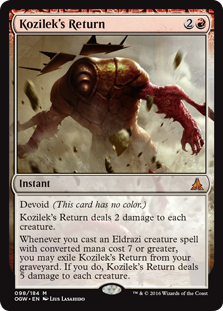
That's a lot of Eldrazi, which might come as a surprise or a snore depending on how you felt about Eldrazi after the Pro Tour. If you believed Colorless and UR flavors represented the strategy's zenith, you'll be taken aback to see RG variants (those with Kozilek's Return, Lightning Bolt, Ancient Stirrings, and others) almost tied with the Pro Tour winning combination. If you believed the Pro Tour was just the beginning, you'll see nothing unusual about the 18 different Eldrazi offerings, but Kozilek's Returnmight be more startled by Colorless and UR Eldrazi's staying power at the top. In both those cases, Eldrazi have both lived up to expectations and challenged them, showing the archetype still has room to grow but also making a strong case for the Pro Tour lists' power.

If you're venturing forth into this hostile environment, you'll need to expect two different kinds of Eldrazi lists. Colorless Eldrazi represent the linear, face-CRUNCHing Stompy decks which try to win fast and hit hard. These decks pack the Chalice of the Void/Simian Spirit Guide package along with minimal removal and maximum beatdown. Basically every other Eldrazi list, although largely focused on UR and RG, play a more interactive game. UR's Drowner of Hope seeks to win the midrange grind against decks trying to block favorably. RG's Lightning Bolts combine a bit of extra reach with some early-game disruption against decks like Affinity seeking to go under the 5/5 trampling mobs. Other Eldrazi decks will fit in either the more linear or more midrange categories, and then again within either the grindier camp of UR or the damage and removal-heavy RG party.

As a whole, these numbers point both to the raw power of known Eldrazi lists, but also to the adaptability of the core Eldrazi engine (depend on Ensnaring Bridge and Worship at your own peril!). This deck is evolving both to beat the hate and overcome the mirror. We'll need to keep both in mind as we move closer towards the Grand Prix weekend.

Fighting Back?

As a deck, Eldrazi is beatable. You can do it with mainstream Abzan Company, offbeat Knightfall brews, throwback enchantment prison decks, or with all those Magus of the Tabernacles you maniac speculators bought out without a single tournament performance to back your investment. As a metagame force, however, Eldrazi is looking very problematic. True, we're only ten days into the Eldrazi period, but these signs are significantly worse than even the most warped week-and-a-half I've seen since starting to track metagame numbers a few years back. It's going to take some serious firepower for Grand Prix journeymen to innovate their way out of this mess, and even then, the broader issues across Tier 1 and Tier 2 might not be resolved: narrowed deck options, the absence of blue, a linear majority, etc. I'll keep Tweeting regular metagame updates as we draw closer to the March tournaments, but don't expect to see an Eldrazi retreat any time soon. After all, Emrakul is coming...

That's all for today's metagame update and our analysis of the current Eldrazi situation. And remember, as I talked about last week, even this current picture would't justify an immediate banning: we really do need to wait until April's scheduled update. Let me know in the comments if you have any questions about the numbers or their meaning, deck or card choices, Modern as a whole, or how the heck you are going to survive the Eldrazi hegemony (your pick of Affinity, drink, or angry Tweets/Reddit comments). See you all soon!


IQing with Eldrazi

Are you a Quiet Speculation member?

If not, now is a perfect time to join up! Our powerful tools, breaking-news analysis, and exclusive Discord channel will make sure you stay up to date and ahead of the curve.

I have a long standing history of playing Delver of Secrets in Modern even when it's bad. Tempo decks are just my style, what can I say? I like blue cards and I like Lightning Bolt. That said, the release of Battle for Zendikar generated an Eldrazi deck that was a horrendous matchup for Delver decks. Then Pro Tour Oath of the Gatewatch happened, and it looked like the odds of playing against similar strategies would be significantly higher going forward.

There was an error retrieving a chart for Delver of Secrets

I had a free Saturday this past weekend, which I was intending on wasting entirely. This plan was foiled by Mike Hawthorne, who intermittently gets a strong itch to play competitive Magic followed by many months of not wanting to touch the game. The fire is currently burning bright in Mike, and I told him that I'd go to the IQ with him. Rather than try to get clever, I decided to take advantage of the card availability afforded by being part owner of a Magic vending business and to just build an Eldrazi deck. There have been a bunch of lists with varying color combinations since the Pro Tour, and I really had no way of determining which of them were actually good. As such, I decided not to get clever and to play something very close to the PT winning deck. After all, Jiachen Tao didn't lose a match of Modern on his way to becoming a PT champion. There's no way his deck could be bad. Save for the exception of two questionable Ruination Guide.

There was an error retrieving a chart for Ruination Guide

Listen, I'm not afraid to sleeve up draft fodder, but Ruination Guide is a turd. This isn't a deck that's trying to swarm the board with dorks, this is a meaty, efficient, beat-down machine. Vile Aggregate might not look great either, but I know what an asterisk means. That dude is a Tarmogoyf that never dies to Lightning Bolt. The fourth Eldrazi Obligator was a no-brainer for me, and a miser's Gut Shot to combat fast aggro decks like Affinity and Infect sounded solid. We didn't have a Gemstone Caverns, so I just played the fourth Cavern of Souls over it. They're both colorless sources that can generate colored mana and have Cavern in their name. The differences are negligible, really.

Lastly, I was a bit skeptical of the sideboard Chalice of the Voids. This is a four or zero card in my mind. It either KOs your opponent or you shouldn't bother with it- especially in a deck without fast mana for the Chalice itself. We only had three copies, so that made my choice easy.

I didn't play with the numbers too much, but I knew for sure I wanted more Ratchet Bombs. It kills every problem card that people are suggesting to beat Eldrazi, such as Worship and Ensnaring Bridge, so again that change seemed rather obvious to me. This is what I registered:

Izzet Eldrazi

Creatures

4 Drowner of Hope
4 Eldrazi Mimic
4 Eldrazi Obligator
4 Eldrazi Skyspawner
4 Endless One
4 Reality Smasher
4 Thought-Knot Seer
4 Vile Aggregate

Spells

3 Dismember
1 Gut Shot

Lands

4 Cavern of Souls
4 Eldrazi Temple
4 Eye of Ugin
2 Island
4 Scalding Tarn
4 Shivan Reef
2 Steam Vents

Sideboard

2 Spellskite
2 Gut Shot
3 Hurkyl's Recall
3 Ratchet Bomb
2 Relic of Progenitus
2 Stubborn Denial
1 Tomb of the Spirit Dragon

Battles

Round 1 Vs. Gruul Eldrazi

My opponent was on a more experimental build of the deck with Kozilek's Return and World Breakers. The sweepers help you beat up on the decks that are faster than you while World Breaker lets you rebuy Return and also blow up things like Ensnaring Bridge.

I won the die roll and mulligained to five while my opponent kept six, and my turn two Thought-Knot Seer exposed the fact that my opponent's hand hinged heavily on a Mind Stone. Naturally, I took it away from him and killed him before he could recover. Game two mostly came down to the fact that Eldrazi Obligator makes combat math stupid, and I was able to deal 15 damage in one turn from a losing position.

1-0

Round 2 Vs. Jund

I won the die roll again, and opened up on this hand:

I did something very stupid, and thought about keeping this hand. In doing so, I convinced myself to actually keep it. I mean, it had a 2-4 curve and everything! That's not what this deck does, and I got super punished.

Game two I mulliganed to five and won very easily.

In game three I am positive that I made some tactical errors in trying to combat a Scavenging Ooze when I knew my opponent had a Lightning Bolt in hand. My memory of the game isn't very good, but I know I messed up at least once. For me, this match more than anything boils down to keeping that garbage hand in game one. From there I committed to being smarter about my keeps, convinced that this tournament was easily winnable.

1-1

Round 3 Vs. Zoo

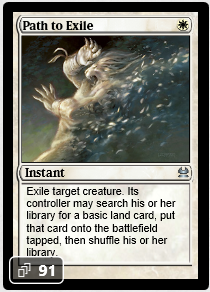
My opponent was playing a "Big Zoo" variant with Knight of the Reliquary, Loxodon Smiter, Wilt-Leaf Liege and Qasali Pridemage. He had that cute technology of playing a Path to Exile on a Reality Smasher and discarding creatures into play.

Game one I mulliganed to five and won very easily.

In game two my opponent played a bunch of Magus of the Moons, but they don't really do much. I already had creatures in play and I drew an Island for my Drowner of Hope. You can't just Blood Moon Eldrazi. You have to kill them, or they'll draw out of it, and when they do they hit hard and fast.

2-1

Round 4 Vs. UW Control

My opponent was on Spreading Seas, Supreme Verdicts, counterspells, and planeswalkers. I was on a fated four Cavern of Souls deck with busted mana and huge creatures. I won this match 2-0 and was never very concerned about it.

There was an error retrieving a chart for Cavern of Souls

During this match I was seated next to my Zoo opponent, who was discussing his tournament with his opponent. He said that his only losses were to nut draws from Eldrazi. I told him, "This deck only has two kinds of hands. Nut draws, and mulligans."

3-1

Round 5

Standings put me in third place going into the final round, with all the nine pointers needing to play. As luck would have it, the one seed had already played the two seed, so I was paired against the last undefeated player in the tournament. A draw would lock him as the one seed and lock me for Top 8, but I really wanted a high seed. I wasn't sure exactly what I wanted to do when I made my way to the table, and the conversation started along the lines of both of us being able to safely ID. I then said how I was weighing playing for position, and remarked, half-jokingly, that he'd make my life easier if he just conceded. To my surprise, his response was, "Yeah, sure. I'll concede."

I had never been more convinced of my Force-sensitivity in my life. Naturally, when the Top 8 announcement rolled around I was the one seed and my round five opponent was the two.

Quarterfinals Vs. Colorless Eldrazi

Game one wasn't very interesting. I think it's established that Izzet is favored here, especially on the play, and that's the way things played out. A really strange thing happened in game two though.

I knew my opponents hand, and knew that he had to top deck me to kill me with his board of Eldrazi Mimic and Matter Reshaper from my life total of eight. My life total had become eight when I cast a Dismember as I said the words "I'll go to eight," on the previous turn. While I was completely tapped out, my opponent drew a Reality Smasher, played it, triggered his Mimic... and then went into tank. Somehow, he came out of the tank with an attack for five, and then attempted to confirm that my life total was now seven. I told him that it was three, and proceeded to win the game. Comically, his alpha strike was lethal even from the 12 life that he thought I was at, so I really have no idea what happened there. Other than the undeniable fact that I am a Jedi.

There was an error retrieving a chart for Dismember

Semifinals Vs. Gruul Edlrazi

This match was against the same opponent that I dispatched in round one.

I kept a five land hand with Eye of Ugin and Eldrazi Temple in game one and drew a few more lands and lost. I know how to mulligan into Ancient Tomb, but my skill at mulling hands that already have it could probably use some tuning. I think the keep was probably fine but things just broke the wrong way.

There was some tension playing against a known Kozilek's Return in the sideboarded games, and it can lead to the Gruul deck just completely going over the top of other builds. That said, I think that the strategy is just to force them to have it because you're not winning by holding back. You can also potentially just Obligator and win anyway. Either way, I was able to fade some draws and win the match.

Finals Vs. Jeskai Eldrazi

If memory serves, my opponents deck was basically the Izzet build with some Eldrazi Displacers. Displacer is a freaking combo with Drowner of Hope, and I lost game two to this combination. That said, I don't think that anything can really compare to Eldrazi Obligator, and the deciding game ended with me killing him from 17 by attacking for 21.

~

This tournament doesn't really say a ton about Eldrazi against non-Eldrazi decks, but the fact that I played "mirrors" all through the Top 8 evidences the fact that the non-Eldrazi decks were doing plenty of losing to Eldrazi. I've been playing the same list on Magic Online since the event, and it continues to feel completely degenerate.

I don't advise trying to beat the Eldrazi deck. The power level is actually an absurdity, and in going too far out of your way to try to beat them you end up with cards that leave you weak to the other people not playing Eldrazi. Meanwhile, at least in my experience, you'll lose matches to Eldrazi on top of that. I'll be in the booth for the Louisville Open this weekend, but if I were playing I'd definitely just be playing Eldrazi Obligators and Drowner of Hopes, as I feel the Izzet build is best positioned in the mirror.

I've seen remarks that people claiming that Eldrazi needs a ban are just lazy and unimaginative. I believe that the people making these remarks are being unrealistic, though I agree that the deck doesn't need to just be banned tomorrow. It's super fun to play a degenerate deck for a while (RIP Treasure Cruise), though I'm confident that it won't be available in the format forever.

I, for one, welcome our new Eldrazi overlords.

-Ryan Overturf
@RyanOverdrive on Twitter

Insider: MTGO Market Report for February 17th, 2016

Are you a Quiet Speculation member?

If not, now is a perfect time to join up! Our powerful tools, breaking-news analysis, and exclusive Discord channel will make sure you stay up to date and ahead of the curve.

Welcome to the MTGO Market Report as compiled by Matthew Lewis. The report will cover a range of topics, including a summary of set prices and price changes for redeemable sets, a look at the major trends in various constructed formats, and a trade of the week section that highlights a particular speculative strategy with an example and accompanying explanation.

As always, speculators should take into account their own budget, risk tolerance and current portfolio before buying or selling any digital objects. Questions will be answered and can be sent via private message or posted in the article comments.

Redemption

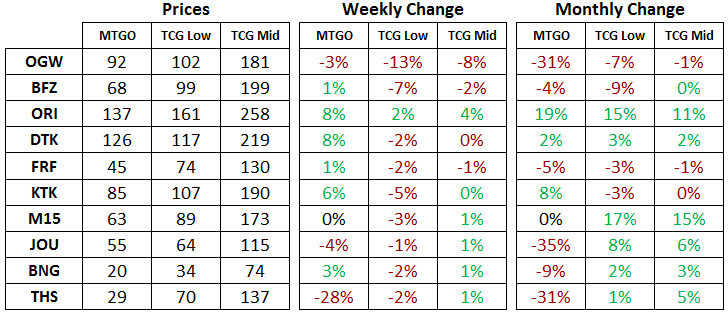
Below are the total set prices for all redeemable sets on MTGO. All prices are current as of February 15th, 2016. The TCG Low and TCG Mid prices are the sum of each set’s individual card prices on TCG Player, either the low price or the mid price respectively.

All MTGO set prices this week are taken from Goatbot’s website, and all weekly changes are now calculated relative to Goatbot’s ‘Full Set’ prices from the previous week. All monthly changes are also relative to the previous month prices, taken from Goatbot’s website at that time. Occasionally ‘Full Set’ prices are not available, and so estimated set prices are used instead.

Feb15

Flashback Draft of the Week

Flashback drafts restart this week with triple Champions of Kamigawa (CHK) beginning on Wednesday the 17th. A few of the rares to keep an eye out for from this set are Through the Breach, Boseiju, Who Shelters All and Kiki-Jiki, Mirror Breaker. There are also a couple of valuable uncommons in Sensei's Divining Top and Ghostly Prison. Pauper players will want to get their set of Lava Spike over the next couple of weeks as well.

Triple CHK is a slower draft format in my memory, but don't pass up those Kabuto Moths! This card has an ability which lets you dominate combat, and is also close to being a reasonable body on a flier already. Throw in relevant creature type in spirit and you have a first pick common, no problem. White has some of the top commons and this is one of them.

This set is from the pre-mythic era, so all rares and uncommons will show up less often than you would see from a current set. Speculators and players looking to buy CHK cards as drafters sell them should look towards the second week of flashback drafts as Betrayers of Kamigama gets added to the mix.

Legacy and Vintage

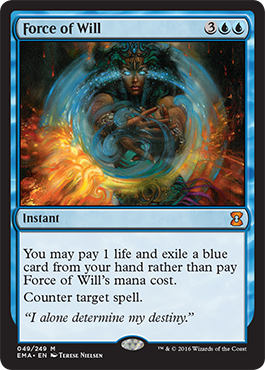
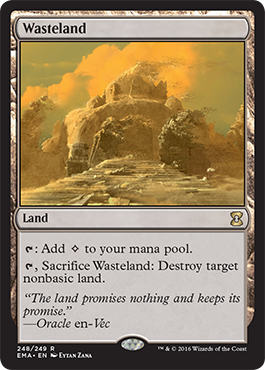
The big news this week was the announcement of Eternal Masters and its release date. Splashy cards included are Force of Will as a mythic rare and Wasteland at rare. Forum member and Quiet Speculation writer Alexander Carl has started a thread on Reserved List cards that could or are already seeing a price bump as a result of the announcement.

That's an excellent starting place for anyone interested in playing Legacy or Vintage, though keep in mind the Reserved List does not exist on MTGO. Any card can be "printed" online and a substantial amount of Vintage Masters cards were introduced into the MTGO economy two years ago.

Novice speculators would do themselves a favor by avoiding speculating on these formats. The player base is small when compared to Modern, and the bots typically have higher margins on these older cards.

Modern

For those redeemable sets that are out of Standard, it's obvious something unusual happened with Theros (THS) in the past week. A 28% decline in one week is a substantial drop for any set, including those being drafted. The event that occurred to precipitate this move was THS sets going out of stock for redemption in the MTGO store. This change removed the link to tangible value that redemption provides.

With that link gone, the supply and demand are free to wreak havoc on prices. In this case, a race to the bottom has occurred as players and bots try to sell their devalued stock.

For those who don't know, there are two important dates for set redemption. First, there is the guarantee date. Standard sets are always redeemable and the guarantee date occurs after a set has rotated out of Standard. After that date, sets may be redeemed but the guarantee of the set being in stock has expired. Essentially, WotC will print new sets to demand before the guarantee date, but afterwards they will no longer print new sets and will just run through their existing stock until it is gone.

The other date is for redemption cutoff. After this date, even if there are sets still in stock, WotC will no longer redeem the sets in question. This date occurs a year after rotation.

In the case of THS, WotC ran out of stock a few months after that guarantee date and about nine months before the cutoff date. It's worth noting that WotC has run out of the last two Fall set releases to rotate out of Standard, namely Return to Ravnica and now Theros.

This will be worth considering in the Spring when Khans of Tarkir (KTK) rotates out of Standard. If KTK will only be redeemable for a few months after it rotates, then junk mythic rares from that set will be quite risky.

Standard

With madness spoiled as a keyword out of Shadows Over Innistrad, Jace, Vryn's Prodigy has gone on to the rare heights of 80+ tix for a single copy. Currently Jace represents over 50% of the sticker price for a set of Magic Origins (ORI). This type of imbalance won't last forever, so I've taken to examining where value may have appeared in ORI.

As usual, the first stop I make in any examination is the junk mythic rare file. Currently priced below 0.2 tix is Disciple of the Ring. This price is very low for a mythic rare from a redeemable large set. Patient speculators should put away a few copies of this card into their long-term hold binder.

By the time ORI rotates out of Standard, value will flow from Jace to the rest of the set as that card goes from being a pillar of Standard to Modern playable. I give it a 95% probability that Disciple of the Ring will go higher than 0.4 tix by December of 2016.

From a more short-term orientation, the pending rotation of the fetchlands out of Standard means players will have to contemplate new ways to fix their mana in April. One of the colour-specific ways to do this will be with Knight of the White Orchid, which is currently under-appreciated and priced at 0.25 tix. At this price, consider this card good value for future Standard.

Standard Boosters

With the end of OGW release events this week, there will be better clarity on the direction of Standard boosters. The end of the relatively high-expected-value release events will encourage drafting of Tarkir block and Magic Origins as grinders look towards old favorite formats and the better chances of opening higher priced cards.

The boosters that speculators should be paying attention to are the ones priced below 3.5 tix, which include BFZ, KTK and FRF. Each of these boosters has the potential to see price increases over the next month.  In next week's report I will report on the development of any price trend and I will update my outlook on these boosters for March.

Trade of the Week

As usual, the portfolio is available at this link. This week is an unusual trade in which I bought the Modern Masters 2 (MM2) version of Eye of Ugin. The motivation for this trade is the price difference between the Worldwake (WWK) version and the MM2 version, with the original being twice the price at 30 tix.

On MTGO, where the majority of a card's value is derived from its in-game use, this type of difference is very unusual. In the case of something like Force of Will, which has multiple versions online, there is an observed preference for the original art version from the first Masters Edition. It goes for 40 tix at the moment, with the Vintage Masters version (with its different art) going for 28 tix. The different price for different versions has been consistent over time.

For the different versions of Eye of Ugin, there is no clear reason why one would be priced at 30 tix and the other at 15 tix. The art is identical and the in-game function is the same. The only observable difference is the mythic rare symbol on the WWK versions versus the rare symbol on the MM2 version. It's my contention that the difference in price is thus irrational and will close over time.

The reason that the difference has opened up is because the MM2 version is more liquid and is traded by more bots than the WWK version. As a result, it's found an equilibrium much sooner than original, since it is being bought and sold more often by more players, bots and speculators.

The trick for speculators is to figure out how the two prices will meet and whether they will meet before the card is banned in Modern. I think the prices will get to within 2 tix of each other in the next five weeks, and that they'll meet in the 20 to 25 tix range. I put the chance of this happening at 70% and I have purchased four copies of the MM2 version for the portfolio.

Video: Using a Normal Webcam with ION Core (Logitech C920)

Are you a Quiet Speculation member?

If not, now is a perfect time to join up! Our powerful tools, breaking-news analysis, and exclusive Discord channel will make sure you stay up to date and ahead of the curve.

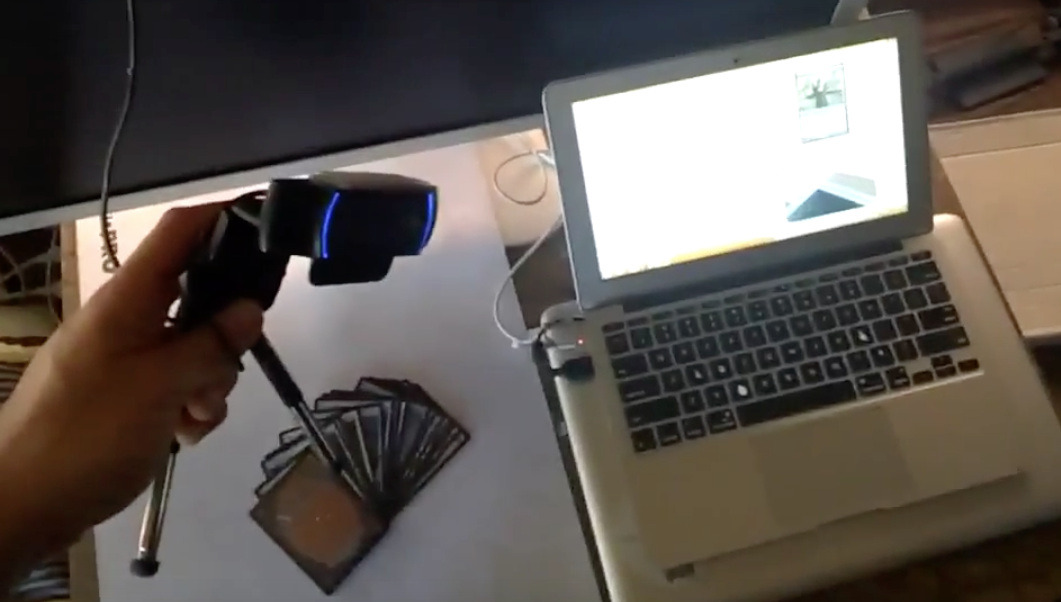
A few people have asked about using the ION Scanner with their existing webcams. ION will work with just about any USB webcam; it doesn't even need to be HD. Getting the camera set up correctly is the most important thing here, not the camera itself.

So, I made a little video to help demonstrate how to set up a typical webcam, the Logitech C920, to scan cards with.

I've set the camera atop my computer monitor (about 18" off the scanning surface), pointed straight down onto a light grey playmat.

The only light in the room is natural afternoon sunlight. Check out how I line up the camera and set everything up.

Once the camera is set up right, it should be able to scan cards as quickly as shown above.


Also, we just saw this on Twitter. Not sure how well it's working for the user, but it's clever!

@QuietSpec Ever wonder if you can use the cardboard from your fat pack box to make something? Try a camera stand! pic.twitter.com/0K0KV4p6Wg

Seeking Some Company for a Broken Metagame

Are you a Quiet Speculation member?

If not, now is a perfect time to join up! Our powerful tools, breaking-news analysis, and exclusive Discord channel will make sure you stay up to date and ahead of the curve.

So. Eldrazi is everywhere. The metagame is warping around the colorless menace, driving out interaction. Linear aggressive decks sit comfortably atop the field. This is unhealthy and probably won't last, either because answers will be found and the warp will disappear, or because Wizards will mollify Reddit and take action April 4th. However, that doesn't help us now. What will is, instead of worrying or whining, recognizing that Modern has a defined metagame for one of the few times in its history, and this gives us as players an opportunity for Old School Metagaming.

Noble Hierarch banner

A Lesson from History

Defined and constrained metagames are nothing new, not even in Modern, where many format-defining cards now languish on the banned list. However, when you think of defined metagames, you most commonly think of Standard. The smaller card pool has long meant only a few decks can really contend and that the metagame will become known, if not "solved," between set releases. This is not a bad thing, at least if you're not the sort that tries to play weird combo decks and laments Siege Rhino is just too good when your deck isn't viable in the first place. Many players like the subtle tweaks and positioning changes that take place over a Standard season as tech is discovered, answered, discarded, and rediscovered. This is what kept Standard so popular for so long. But sometimes, one deck would rise and dominate Standard for its entire two-year life cycle. In these cases, opportunity arose.

[wp_ad_camp_1]

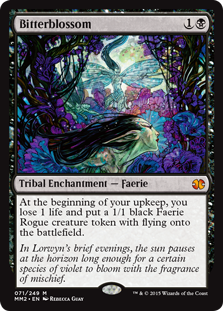
BitterblossomNow, I am not talking about the Affinity or Cawblade eras. If you buy that Standard becomes rock, paper, scissors then those decks were dynamite, and were banned as a result. What I am talking about are Standards like the Lorwyn era. Faeries quickly rose to the top and was cemented in place once Bitterblossom was printed, and it was only rotation that knocked it off its perch. However, there was plenty of space around that deck for other strategies to thrive, and they did. At various points 5-Color, Gruul, Merfolk, Dragonstorm, Elves, and many other decks I've forgotten were perfectly viable and matched Faeries. Rather than being oppressive, Faeries provided definition and constraints to the format. If you recognized what they were, you would be rewarded.

For me, the best example of this comes from waning months of Lorwyn-Alara Standard. Going into Regionals that year, everyone knew 1/1 fliers defined the format. Between Bitterblossom and Spectral Procession, Standard was overrun by token strategies with Faeries getting the nod as the most powerful due to Mistbind Clique, Spellstutter Sprite, and Thoughtseize. Every other mainstream deck was either looking to sweep up tokens (5-Color's Firespout andVolcanic Fallout), get under them (usually with Great Sable Stag), ignore them (red decks), or simply win the token war (Ajani Goldmane in BW Tokens). I and a few other players, however, realized you didn't have to fight the token war on the token decks' terms. You can't go over 1/1s that fly and you can't go wider than Bitterblossom, but it was possible to go through them once you realized that the best evasion available was trample. After that, the possibilities for brewing opened up.

As a result of understanding the format being defined by 1/1 fliers, I played what may have been the best positioned deck of the tournament: Bant Crashers.

Bant Crashers, by David Ernenwein

Creatures

3 Shorecrasher Mimic
4 Rhox War Monk
3 Vendilion Clique
4 Noble Hierarch
4 Jhessian Infiltrator
3 Rafiq of the Many

Artifacts

2 Loxodon Warhammer
1 Behemoth Sledge

Instants

4 Path to Exile
4 Bant Charm
4 Cryptic Command
2 Broken Ambitions

Lands

4 Treetop Village
4 Yavimaya Coast
2 Mystic Gate
2 Flooded Grove
4 Seaside Citadel
2 Brushland
1 Forest
1 Plains
2 Island

Noble Hierarch into Shorecrasher Mimic followed by Rafiq of the Many was game over for Bitterblossom. Add counters for protection and artifacts to give more trample and chump blockers never looked more... like chumps? (Had something there and lost it). If all else failed you just went under everyone with Jhessian Infiltrator or used lifegain to turn the Blossom into your win condition.

I never lost to Faeries or 5-Color and only fell once to BW due to a game loss caused by a misplaced Tidehollow Sculler pick. I didn't Top 8 thanks to an additional loss to a Demigod of Revenge deck and an Elves deck that did Top 8 running the combo of Elvish Archdruid and Umbral Mantle, but I still think I made the correct deck choice. Don't fight on the same axis as the rest of the tournament or focus on beating the best deck. Instead, identify the unifying thread of the metagame and attack that to get the best results.

Taking the Metagame as it is

How does that nostalgia trip to 2009 help us in 2016? Here's the lesson: metagames defined by certain cards, or decks, have unifying themes. To beat the field, we attack the theme itself. I did it by negating blocking. The Elves player used an infinite combo to kill before the... not "slow," exactly, but the "methodical" decks of the day got going. If we look at Modern right now, I will argue there is a similar unifying thread and an opportunity to exploit it. Take a minute to look over the Top Decks page I linked last sentence and Reality Smashersee what the top five have in common, I'll wait.

Do you see it?

No, not the linear part: that's not shared with Jund. Look deeper.

See it?

They all win fairly. Every single deck is trying to win by attacking with creatures over multiple turns. Granted, most of them do it in very unfair ways, but all of them win by attacking. This is in contrast to "true" combo decks that win by drawing a specific card or sequence of cards, or "true" control decks that win via card advantage. This means if we can make combat damage irrelevant, we blank most of Tier 1. The question then becomes, how do we go about accomplishing that? Sheridan gave us one solution yesterday and the Top Decks page gives us another clue:

Abzan Company, Paul Bradford (1st Place Denver SCG Regionals)

Creatures

2 Anafenza, Kin-Tree Spirit
2 Spellskite
1 Aven Mindcensor
4 Birds of Paradise
3 Eternal Witness
1 Fiend Hunter
4 Kitchen Finks
1 Murderous Redcap
3 Noble Hierarch
2 Viscera Seer
2 Voice of Resurgence
2 Wall of Roots
1 Liliana, Heretical Healer
2 Melira, Sylvok Outcast

Instants

4 Chord of Calling
4 Collected Company

Lands

2 Forest
1 Plains
1 Swamp
3 Gavony Township
1 Godless Shrine
2 Horizon Canopy
2 Overgrown Tomb
2 Temple Garden
4 Verdant Catacombs
4 Windswept Heath

Sideboard

1 Archangel of Thune
1 Burrenton Forge-Tender
3 Fulminator Mage
1 Orzhov Pontiff
1 Qasali Pridemage
1 Scavenging Ooze
1 Spike Feeder
2 Abrupt Decay
2 Path to Exile
1 Kataki, War's Wage
1 Linvala, Keeper of Silence

Thanks to the persist/Melira/Anafenza combo, Abzan Company completely negates nearly all other Tier 1 decks' win conditions. Melira also turns off poison. I suspect this is the reason that it is currently in sixth place on the Top Decks page. I also suspect it is going to stay there rather than rise for two reasons:

  • Jund's removal package is very good against this deck in general and the combo is easy to disrupt with said removal
  • It's a fairly difficult and slow combo to pull off.

collected companyCollected Company and Chord of Calling help with reliability but not the speed problem, making this combo occasionally unreliable. Abzan does have a good backup plan, just like Pod did, of getting big with Gavony Township and swamping the opponent. The problem with that right now is it's just slower than the other aggressive options and Eldrazi and Affinity don't really give you the time to durdle around with +1/+1 counters. There's a reason GW Hatebears isn't played right now. The deck is good, the stats don't lie, but I think we need something more to really take advantage of the metagame.

Kiki Chord is certainly an option as well, though as Jeff Hoogland explained, it is also very difficult to play well. The other problem I have with Kiki Chord is Collected Company's absence. Company really is the best card draw spell in Modern and if I'm going the route of fast combos to race Eldrazi, I want to increase my chances of finding my pieces as much as possible. This points me toward Company itself, which Kiki Chord can't run. I also like building a little forgiveness into my decks and powerful card draw fulfills that role exceptionally. Yes, you miss sometimes, but at least you're getting cards that aren't part of your gameplan out of the way.

Never Fight Fair

Over the past week, both StarCityGames and ChannelFireball attempted to see how well Splinter Twin would have kept Eldrazi down. The results were interesting, particularly for the purposes of this article, because they showed Eldrazi really isn't set up to deal with a two-card combo except by racing (which, admittedly, was often enough). Yes, none of the test decks were really optimal for the situation but that's not the point. What's important is they identified another significant weakness to exploit: Eldrazi doesn't interact well with fast combos, in this case a two-card instant win combo at instant speed. Unfortunately, a true Twin replacement doesn't exist but we've highlighted one that comes close before:

Knightfall, Trevor Holmes

Creatures

4 Geist of Saint Traft
4 Noble Hierarch
3 Birds of Paradise
4 Steppe Lynx
4 Tarmogoyf
3 Voice of Resurgence
2 Loxodon Smiter
4 Knight of the Reliquary

Enchantments

4 Retreat to Coralhelm

Instants

4 Path to Exile
3 Remand

Lands

1 Breeding Pool
1 Hallowed Fountain
2 Temple Garden
1 Oboro, Palace in the Clouds
1 Sejiri Steppe
1 Gavony Township
1 Horizon Canopy
1 Ghost Quarter
4 Windswept Heath
3 Misty Rainforest
3 Forest
2 Plains

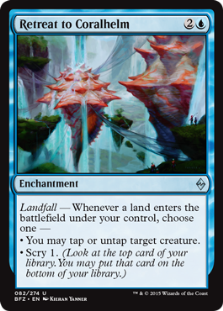
Knightfall got a lot of hype when Retreat to Coralhelm was printed and almost no discussion since. The problem it had prior to January 18 was the Retreat to Coralhelmcombo was a worse version of URx Twin. If you want to win your deck should be the best possible at what it's doing, not being different for the sake of being different. Since then everyone has been justifiably skeptical that you can set up a quick combo when Thought-Knot Seer is everywhere.

But what if the combo is made to look less threatening? Fair value decks are very strong against aggro decks when they're able to keep up, which is why they've dropped off so much. But UW Titan showed me having good value creatures, with a powerful card advantage engine to supplement them, can beat very fast aggro back when Zoo was big. Taking this lesson, and some inspiration from a deck Stephen Fachs showed me, led to this:

Knightfall Company by David Ernenwein

Creatures

4 Knight of the Reliquary
4 Noble Hierarch
4 Lone Missionary
4 Voice of Resurgence
3 Eternal Witness
2 Vendilion Clique
4 Flickerwisp
3 Court Hussar

Enchantments

3 Retreat to Coralhelm

Instants

4 Collected Company
3 Path to Exile

Lands

2 Breeding Pool
1 Hallowed Fountain
2 Temple Garden
1 Sejiri Steppe
1 Gavony Township
1 Horizon Canopy
1 Ghost Quarter
4 Windswept Heath
4 Misty Rainforest
3 Forest
2 Plains

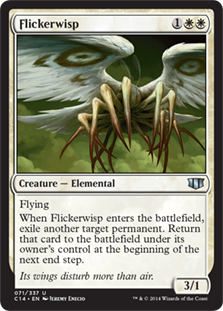
The advantage of this deck over most other Knightfall decks is you don'treally need the combo. The deck that inspired me was just a value Bant Company list that could have, but Flickerwispelected not to, run the combo. The fundamentals that made that deck work are still present. You play a solid value game using your enter-the-battlefield creatures and Collected Company and sometimes just win with Retreat to open a hole for a gigantic Knight to swing through.

There's a lot of potential here, but I'm still not satisfied. UR Eldrazi can make far too many blockers for Retreat to work its magic, not to mention tapping down our fatal Knight with Drowner of Hope. On top of that, Knightfall isn't quite the "I Win" button that Twin was. I liked the fact that, provided you survived the initial aggro onslaught, the value plan gradually pulled you ahead until you eventually won the game. I also liked the fact that Flickerwisp is insane against Eldrazi and Affinity, but this deck isn't quite the metagame bomb I was looking for.

Hybridize to Survive

It's almost cliche to go from mentioning a combo deck's weaknesses to then talking about hybridizing the deck to close them. Cliches aside, it's a good approach and, furthermore, given how I've set this article up you should have seen it coming. The stock Knightfall and Abzan Company lists already share a lot of cards and their non-combo gameplans are virtually the same. Why not merge them? Knightfall requires a lot of fetchlands anyway, so even the manabase shouldn't be a stumbling block.

Abzan Knightfall by David Ernenwein

Creatures

4 Birds of Paradise
3 Noble Hierarch
2 Viscera Seer
2 Voice of Resurgence
2 Anafenza, Kin-Tree Spirit
2 Melira, Sylvok Outcast
1 Spellskite
3 Eternal Witness
1 Fiend Hunter
4 Kitchen Finks
3 Knight of the Reliquary
1 Murderous Redcap

Enchantments

2 Retreat to Coralhelm

Instants

4 Chord of Calling
4 Collected Company

Lands

2 Forest
1 Plains
1 Swamp
1 Island
1 Gavony Township
1 Godless Shrine
1 Hallowed Fountain
1 Breeding Pool
1 Horizon Canopy
1 Overgrown Tomb
2 Temple Garden
1 Marsh Flats
2 Verdant Catacombs
2 Misty Rainforest
4 Windswept Heath

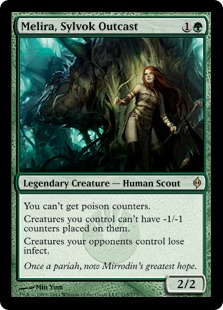
At the cost of some maindeck toolbox creatures, we have an additional, faster combo to complement Melira. The manabase definitely needs work but Birds of Paradise tends to cover up those weaknesses, especially when Lightning Bolt saturation is low. The best part is Knightfall's combo staying relevant even when not going for the win. Knight is a huge threat on its own, and Retreat can generate considerable mana advantage with Birds and Hierarch, enough that it Meliramakes me wonder if there's some additional thing you could fit in to take advantage of all the mana you can make with this deck. The additional fetches and scrying also make hitting combo pieces or your search engines easier.

Is this list optimal? Almost certainly not. Is it well positioned? Probably. The Melira combo is very good right now, despite the graveyard hate (much of which is in the Eldrazi sideboard), and adding some robustness appears to have improved the Jund matchup as well. That said, my current testing has also showed it is very hard to play, so if you're going to go this route, you definitely need to commit to it. Also, I'm worried I'm being inefficient about this. Maybe I should just stick to known plans rather than falling for the danger of cool things. I also can't overstate the deck's vulnerability, just like its predecessors, to graveyard hate. Despite these reservations, there is definite potential for decks like this to take advantage of the linearity and aggressiveness of the Modern metagame.

Seek and Ye Shall Find

When most of the metagame is trying to do the same thing, even if in different ways, an opportunity exists to target that one thing. Whether it's make 1/1 fliers or aggroing you to death so fast it should be illegal, a defined and constrained metagame creates openings intelligent deckbuilders can identify and exploit. With a very aggressive metagame, and interaction at a low ebb, infinite combo decks are very well positioned to take down tournaments. This situation is unlikely to last, so I advise you to get out there and start tinkering before we are forced to start doing fair things fairly again.

Fighting Back Against Rally and the Eldrazi

Are you a Quiet Speculation member?

If not, now is a perfect time to join up! Our powerful tools, breaking-news analysis, and exclusive Discord channel will make sure you stay up to date and ahead of the curve.

It feels like it has been forever since my last SCG Open, and it kind of has been. I mean, it was nearly three weekends ago! Since then the sky has fallen in Modern due to the Eldrazi invasion at the Pro Tour, and standard is still trying to rally back against Rally. But I'm here to tell you that everything will be alright. In fact, I will tell you how I plan on fighting back.

There was an error retrieving a chart for Rally the Ancestors

Let's start in standard and how to fight Rally the Ancestors. You must know your enemy in order to defeat them. First, the deck is a combo deck that uses Rally the Ancestors to bring back a graveyard full of creatures and either kill you with Zulaport Cutthroat, or, if they are lucky enough to have a Nantuko Husk in play they can sacrifice the creatures they got back to make that Husk kill you. The deck can also play a tempo game with the addition of Reflector Mage. While the creatures in the Rally deck aren't very big, if you can't ever get one of your threats to stick they can make short work of you. These are the two ways for Rally to beat you- either tempo you out with small creatures and bounce spells or kill you in one fell swoop with Rally the Ancestors.

So how can we stop them? Well, one thing about the printing of Reflector Mage is that it is also great against the Rally deck. You don't want their creatures in their yard to just Rally back, and you don't want them in play, so the best place for them to be is in their hand. Unfortunately, this isn't going to be enough to beat the deck on its own, but it is enough to slow them down quite a bit. We need a way to punish them now that we have slowed them down. Creatures like Mantis Rider, Thunderbreak Regent, and Dragonlord Ojutai are all great vs the Rally deck, as they can clog up the ground but are generally unable to deal with fliers. Also, having a few counterspells would be great to both save Ojutai and to stop either Collected Company or Rally the Ancestors. I'm thinking about something a bit like this:

Jeskai Dragons

Creatures

2 Soulfire Grand Master
4 Jace, Vryn's Prodigy
4 Mantis Rider
4 Thunderbreak Regent
3 Dragonlord Ojutai
4 Reflector Mage

Spells

2 Dispel
2 Wild Slash
3 Silumgar's Scorn
3 Draconic Roar
1 Jeskai Charm
3 Dig Through Time

Lands

4 Flooded Strand
4 Polluted Delta
3 Mystic Monastery
3 Island
1 Plains
2 Mountain
3 Bloodstained Mire
1 Prairie Stream
1 Sunken Hollow
1 Smoldering Marsh
2 Wandering Fumarole

Sideboard

3 Hallowed Moonlight
1 Soulfire Grandmaster
2 Radiant Flames
2 Negate
1 Chandra, Flamecaller
2 Sarkhan, the Dragonspeaker
2 Planar Outburst
2 Disdainful Stroke

I will admit that the numbers for this deck might be a bit off. The mana will need some work for sure, and the sideboard needs some testing, but I like the look of this deck. If you would like to beat Rally, this is a great starting point.

There was an error retrieving a chart for Thought Knot Seer

Next is the Eldrazi deck. This deck is a bit tougher, as the power level of this deck is insane. Once again, let's figure out what the deck does. For the most part it is a beat down deck with very powerful lands that allow it to deploy efficient threats quickly. The great thing about beat down decks is that if you survive the initial onslaught, you generally have a pretty good chance at winning the game. So, let's focus on how we plan on surviving. There are a couple ways that we can do that.

First, we can try and kill all of their creatures. This can be tough as most of their better creatures, such as Thought-Knot Seer, Reality Smasher, Drowner of Hope, and World Breaker, force you to trade two for one. Also, your deck will have to be very dense with removal spells as Thought-Knot Seer can take one of your removal spells. If you don't have a back up you might be dead right then and there. This combined with the fact that you have to find a steady flow of cards due to almost every one of their creatures being a two for one makes me not like this approach.

I have decided that I want to block the Eldrazi decks. That might sound kind of weird, because if you are just blocking them how are you going to win? With an infinite life combo. Duh. As it turns out beat down decks have a problem with depleting infinite life. One of the better decks in Modern that is both great at combat and has an infinite life combo is Melira Company. With creatures like Voice of Resurgence and Kitchen Finks you can block the Eldrazi for days, which should buy you enough time to assemble your combo. Also, the left over Voice of Resurgence token easily gets bigger than anything on the other side of the table. The right build of the Abzan Company deck is going to be hard to find, as it is a deck with a ton of options but, this is something I wouldn't mind registering if there was a tournament tomorrow:

Melira Company

Creatures

2 Anafenza, Kin-Tree Spirit
4 Birds of Paradise
2 Eternal Witness
2 Fiend Hunter
4 Kitchen Finks
2 Melira, Sylvok Outcast
1 Murderous Redcap
3 Noble Hierarch
1 Wall of Roots
1 Scavenging Ooze
1 Spellskite
3 Viscera Seer
3 Voice of Resurgence

Spells

4 Chord of Calling
4 Collected Company

Lands

2 Forest
1 Swamp
1 Plains
3 Gavony Township
1 Godless Shrine
1 Misty Rainforest
2 Overgrown Tomb
2 Razorverge Thicket
2 Temple Garden
4 Verdant Catacombs
4 Windswept Heath

Sideboard

1 Burrenton Forge-Tender
3 Fulminator Mage
1 Kataki, War's Wage
1 Big Game Hunter
1 Orzhov Pontiff
3 Path to Exile
1 Reclamation Sage
1 Spellskite
2 Thoughtseize
1 Ethersworn Canonist

This is how I plan on fight back against the Eldrazi. I'm sure there are plenty more ways to do it and I would love to hear everyone else's ideas.

Whether you are playing Standard or Modern this weekend, good luck! I hope that I was of some help and as always thanks for reading.

Follow me on Twitter @conanhawk

Insider: Two Months of Picks – A Self-Evaluation

Are you a Quiet Speculation member?

If not, now is a perfect time to join up! Our powerful tools, breaking-news analysis, and exclusive Discord channel will make sure you stay up to date and ahead of the curve.

I got to talking with one of my friends about my Magic finance endeavors and he asked, "How have your picks done?"

"Oh, they always do pretty well," I told him. He commented that I provide picks on QS and wanted to know at what rate my picks hit. I realized that I had no idea.

I always assumed they do pretty well (because I make a lot of value on speculative trades) but I'd never actually double-checked my data. I think it's only fair that I should review my work now and again, so I decided to go over the past few months and evaluate the picks I made to see how they did.

Totals for the Past Two Months

Well, apparently I'm on fire...

  • 38 picks increased in value.
  • 7 picks decreased in value.
  • 15 picks remained the same in value.

(For this summary I eliminated doubles, so if I picked a card two different weeks I only counted it once.)

So, nearly two out of every three picks I made went up in value over the course of the past two months. And, of the ones that didn't appreciate, two out of three stayed the same! Pretty good results overall.

February 6th - Pre-Pro Tour Picks

The Mimic pick that I've been harping on ever since the Oath spoiler finally paid off in a big way after the PT, with the card increasing 500%.

With the Eldrazi madness Jund didn't make as impressive of a splash as I would have thought (leading to no gains on Jund staples Scavenging Ooze and Dark Confidant). I still like these picks long-term and think we will see gains on Scooze and Bob. You can't keep a good midrange deck down!

  • Inkmoth Nexus - Up
  • Dark Confidant - Same
  • Eldrazi Mimic - Up
  • Ghost Quarter - Up
  • Scavenging Ooze - Same

Jund and Tron were pretty disappointing but I do expect those decks to adapt and survive in the coming months. So, I'm perfectly cool with owning extra Oozes, Bobs, and Wurmcoils until after all the Eldrazi hype has died down.

Up/Down/No Change: 3-0-2

January 26th - Modern Picks

When we were starting to see lots of movement in Modern I feel I did very well with my picks. Basically, mostly winners and some stayed the same. The key for me has always been betting on cards that feel like they have nowhere to go but up. Angel's Grace was a big gainer. I don't think we've hit the ceiling on Gavony Township yet either.

We may see a decline in some of the Tron cards over the coming months as it appears to have been completely outclassed by Eldrazi (something I wouldn't have expected a month ago).

  • Wurmcoil Engine - Same
  • Gavony Township - Up
  • Lingering Souls - Same
  • Etched Champion - Up
  • Blinkmoth Nexus - Up
  • Angel's Grace - Up
  • Phyrexian Unlife - Same
  • Pyromancer Ascension - Up
  • Past in Flames - Up

Maybe there are just too many copies of Lingering Souls in existence for the card to have much value. I do wonder if the next Innistrad block will have some more enablers for spirits to make it even better in Modern. The card is absurdly powerful and I think it's destined for more great things down the line.

Up/Down/No Change: 6-0-3

January 19th - More Modern Picks

Another strong series of picks. Urborg, Tomb of Yawgmoth essentially doubled the following week. Not to mention Though-Knot Seer, Stony Silence, Mimic, Pia and Kiran Nalaar and Leonin Arbiter, which all saw significant spikes in value. Ooze has really been dragging my averages down, but I still have faith!

  • Urborg, Tomb of Yawgmoth - Up
  • Thought-Knot Seer - Up
  • Eldrazi Mimic - Up
  • Pia and Kiran Nalaar - Up
  • Burrenton Forge-Tender - Same
  • Scavenging Ooze - Same
  • Thalia, Guardian of Thraben - Up
  • Leonin Arbiter - Up
  • Stony Silence - Up

I was really into Death and Taxes this week and most of the cards did see increases in value. I think there may be a solid place for the archetype even in the midst of the Eldrazi invasion so I'm still cool with acquiring all these cards.

Up/Down/No Change: 7-0-2

January 12th - More Modern Picks

To be fair Splinter Twin did see some gains before it was banned and subsequently plummeted in value. You can see a lot of Tron and Twin hype in these picks. Overall pretty solid, considering nobody expected Twin would get banned.

  • Ulamog, the Ceaseless Hunger - Up
  • Splinter Twin - Down
  • Ghost Quarter - Up
  • Keranos, God of Storms - Same
  • Leonin Arbiter - Up
  • Kolaghan's Command - Up

I still think the Twin banning was really ridiculous and these picks would have all been great had they not banned Twin. You can't win all the time. Sometimes you make smart picks and the DCI goes and bans a deck for no good reason.

Up/Down/No Change: 4-1-1

January 6th - Betting on the Banned List

In this article I talked about making investments based on fluctuations in the B&R list. It turns out betting on the banned list is generally speaking very smart as most of the cards saw growth and very few dropped. I actually think a lot of these picks will pay out even more as I have a strong suspicion we'll get some cards off of the banned list at next rotation. Sword of the Meek and Ancestral Vision both seem like they are prime for an unbanning.

  • Summer Bloom - Down
  • Valakut, the Molten Pinnacle - Up
  • Scapeshift - Up
  • Pyromancer Ascension - Up
  • Goryo's Vengeance - Up
  • Footsteps of the Goryo - Up
  • Protean Hulk - Up
  • Blood Moon - Same
  • Ancestral Vision - Up
  • Bloodbraid Elf - Up
  • Green Sun's Zenith - Up
  • Jace, the Mind Sculptor - Same
  • Stoneforge Mystic - Same
  • Sword of the Meek - Up
  • Umezawa's Jitte - Up

The Eldrazi mania has stirred up a lot of speculation about the banned list. I suspect that no matter what happens to that deck in particular, something is coming off. Maybe it could even be Twin, which would make most of my "misses" disappear long-term as they all rebound and gain value!

Up/Down/No Change: 11-1-3

December 21st - BFZ Standard Picks

Considering how crappy Battle for Zendikar turned out, I think my picks fared pretty well. Most of the cards in the set lost value. I've got a strong Eldrazi theme among my picks which is smart considering they are the most popular cards in the set. I also remember that I had been pushing pretty hard on Oblivion Sower basically since it was spoiled and that card turned out pretty great.

  • Ulamog, the Ceaseless Hunger - Up
  • Void Winnower - Up
  • Oblivion Sower - Up
  • Conduit of Ruin - Up
  • Undergrowth Champion - Down
  • Nissa's Renewal - Same
  • Painful Truths - Up

I still feel like Undergrowth Champion might have its day at some point. I was picking him when he dropped down to five and he surprised me by finding a way to go even lower. It is a great card for sure but may never find a real home or place to shine. So sad.

Up/Down/No Change: 5-1-1

December 7th - Khans Block Picks

This was by far my worst series of picks, but considering the circumstances I don't feel too bad about it. We all know that as we move closer to Khans rotating that the value of the cards will decline. The fact that of my picks more than twice as many didn't go down (in a system where things are primed to go down) I feel alright. Even so, looking back I feel like these are among the cards from the block that one should hang onto because they will retain and grow value in the long run.

I mean, do you really think Deflecting Palm will stay $0.50 in two years? Or Jeskai Ascendancy? I also specified that I like these as long-term picks and I still agree with that assessment for many of these cards. Mythic rare hydras tend to slowly gain value over time with the casual crowd.

  • Anafenza, the Foremost - Up
  • Become Immense - Up
  • Deflecting Palm - Same
  • Hardened Scales - Down
  • Hooded Hydra - Same
  • Jeskai Ascendancy - Same
  • Monastery Swiftspear - Up
  • Murderous Cut - Same
  • Siege Rhino - Down (but was up)
  • Polluted Delta - Up
  • Archfiend of Depravity - Down
  • Gurmag Angler - Up
  • Monastery Mentor - Up
  • Monastery Siege - Down
  • Tasigur, the Golden Fang - Down
  • Ugin, the Spirit Dragon - Up
  • Temporal Trespass - Same

Considering most of these picks were meant to be long-term holds, it is a little bit off to discount this as a bad week. I expected these cards to lose a little value in the short term on the brink of rotation, but I think they will eventually be worth having held onto.

Some of these cards are going to be perpetual Modern staples: Tasigur, Ascendancy, Monastery Siege, Deflecting Palm, Siege Rhino, etc. People may be in the mode to liquidate at the moment but there will be a new crop down the line looking to pick these back up.

Up/Down/No Change: 7-5-5

~

I love sharing my strategies for picking winners here on Quiet Speculation. It also looks like I'm not too terrible at it either! Hopefully you were able to take advantage of some of my advice.

- Brian

Insider: An Initial Look at Eternal Masters

Are you a Quiet Speculation member?

If not, now is a perfect time to join up! Our powerful tools, breaking-news analysis, and exclusive Discord channel will make sure you stay up to date and ahead of the curve.

Today we got quite the bomb dropped on us with the announcement of Eternal Masters.

FoW Wasteland

Wizards made it explicit that nothing on the Reserved List will make an appearance (in case it was in doubt at all). But this will nonetheless create a lot of new interest in Legacy, and gives WotC a chance to reprint some expensive older cards whose value is due almost exclusively to their extreme rarity. Those latter cards are the ones that will likely take the biggest hits in value.

As of now the only confirmed inclusions are Wasteland and Force of Will. The name seems to suggest that it's not limited to "Legacy-only" cards, though, so keep that in mind.

Today I'd like to consider how this will affect eternal prices so we can prepare to take appropriate action. To start, let's look at the top ten most expensive cards in each color that satisfy these conditions:

  1. Not on the reserved list
  2. Non-foil, regular-print cards (not special promos, etc.)

All cards marked with an asterisk are Modern-playable, though we don't know if they will or won't include Modern-legal cards in this set.

White

  1. Ravages of War - Portal: Three Kingdoms
  2. Zhang Fei, Fierce Warrior - Portal: Three Kingdoms
  3. Pang Tong, "Young Phoenix" - Portal: Three Kingdoms
  4. Linvala, Keeper of Silence* - Rise of the Eldrazi
  5. Loyal Retainers - Portal: Three Kingdoms
  6. Auriok Champion* - Fifth Dawn
  7. Monastery Mentor* - Fate Reforged
  8. Stoneforge Mystic - Worldwake
  9. Huang Zhong, Shu General - Portal: Three Kingdoms
  10. Guan Yu's 1,000-Li March - Portal: Three Kingdoms

Blue

  1. Capture of Jingzhou - Portal: Three Kingdoms
  2. Force of Will - Alliances
  3. Flusterstorm - Commander
  4. Jace, the Mind Sculptor - Worldwake
  5. Mana Drain - Legends
  6. Show and Tell - Urza's Saga
  7. Snapcaster Mage* - Innistrad
  8. Temporal Manipulation - Portal: Second Age
  9. Jace, Vryn's Prodigy* - Magic Origins
  10. Sun Ce, Young Conquerer - Portal: Three Kingdoms

Black

  1. Damnation* - Planar Chaos
  2. Imperial Seal - Portal: Three Kingdoms
  3. Grim Tutor - Starter 1999
  4. Liliana of the Veil* - Innistrad
  5. Overwhelming Forces - Portal: Three Kingdoms
  6. Sinkhole - Alpha
  7. Xiahou Dun, the One-Eyed - Portal: Three Kingdoms
  8. Dark Confidant* - Ravnica
  9.  Zhang He, Wei General - Portal: Three Kingdoms
  10. Vampiric Tutor - Visions

Red

  1. Burning of Xinye - Portal: Three Kingdoms
  2. Goblin Settler - Starter 1999
  3. Imperial Recruiter - Portal: Three Kingdoms
  4. Rolling Earthquake - Portal: Three Kingdoms
  5. Zodiac Dragon - Portal: Three Kingdoms
  6. Warrior's Oath - Portal: Three Kingdoms
  7.  Dong Zhou, the Tyrant - Portal: Three Kingdoms
  8. Yuan Shao, the Indecisive - Portal: Three Kingdoms
  9. Diaochan, Artful Beauty - Portal: Three Kingdoms
  10. Sneak Attack - Urza's Saga

Green

  1. Berserk - Alpha
  2. Riding the Dilu Horse - Portal: Three Kingdoms
  3. Tarmogoyf* - Future Sight
  4.  Zuo Ci, the Mocking Sage - Portal: Three Kingdoms
  5. Wolf Pack - Portal: Three Kingdoms
  6. Lady Zhurong, Warrior Queen - Portal: Three Kingdoms
  7. Meng Huo, Barbarian King - Portal: Three Kingdoms
  8. Natural Order - Visions
  9. Noble Hierarch - Conflux
  10. Scapeshift* - Morningtide

Artifacts

  1. Arcbound Ravager* - Darksteel
  2. Crucible of Worlds* - Fifth Dawn
  3. Mana Crypt - Promotional (This breaks my rule #2 above, but it's a likely candidate.)
  4. Sword of Fire and Ice* - Darksteel
  5. Aether Vial* - Darksteel
  6. Chalice of the Void* - Mirrodin
  7. Ensnaring Bridge* - Stronghold
  8. Mox Opal* - Scars of Mirrodin
  9. Oblivion Stone* - Mirrodin
  10. Spellskite* - New Phyrexia

Lands

  1. Rishadan Port - Mercadian Masques
  2. Wasteland - Tempest
  3. Enemy Fetchlands* - Zendikar
  4. Cavern of Souls* - Avacyn Restored
  5. Dark Depths - Coldsnap
  6. Grove of the Burnwillows* - Future Sight
  7. Horizon Canopy* - Future Sight
  8. Eye of Ugin* - Worldwake
  9. Glimmervoid* - Mirrodin
  10. Inkmoth Nexus* - Mirrodin Besieged

Gold

  1. Fulminator Mage* - Shadowmoor
  2. Voice of Resurgence* - Dragon's Maze
  3. Dack Fayden - Conspiracy
  4. Gaddock Teeg* - Lorwyn
  5. Kaalia of the Vast - Commander
  6. Sliver Legion* - Future Sight
  7. Animar, Soul of Elements - Commander
  8. Glimpse the Unthinkable* - Ravnica
  9. Maelstrom Wanderer - Planechase 2012
  10. Sen Triplets* - Alara Reborn

That's a pretty impressive list so far. The key thing to note is there are a ton of Portal: Three Kingdoms cards on this list, due to such a small print run so long ago. We are very likely to see many of these cards show up in Eternal Masters, which will obviously tank their value.

The original print versions will likely maintain a pretty good markup over any reprints due to collectibility, but a lot of the value of the more expensive ones comes from Commander demand. These are players whose demand will happily be met via reprints in Eternal Masters.

From an investment standpoint, I wouldn't want to hold any cards on this list as the set starts getting spoiled. But remember that space constraints will guarantee some of these cards miss a reprint.

Eternal Masters is a 249-card set, the same as Modern Masters 2015 (MM15). Assuming the same rarity breakdown, that gives us the following:

  1. 15 mythic rares
  2. 53 rares
  3. 80 uncommons
  4. 101 commons

The spoiler shows Force of Will at mythic and Wasteland at regular rare. So we likely have 14 mythics and 52 rares remaining to be spoiled. That means a solid 20 or so cards from my list above that don't make the cut minimally. Of course, they won't just pick every valuable card, so realistically many of these cards won't see a reprint.

Impact on Eternal Formats

Remember that the original Modern Masters helped grow the Modern playerbase by providing reprints at a significant reduction in cost compared to other options. As the Modern playerbase grew we saw many of the Modern Masters cards continue to rise in value (often coming close to their pre-reprint prices, and eventually surpassing them in many cases).

Thus, Eternal Masters may well usher in a new demand for Legacy and Vintage. That being said, don't forget how many heavily-played cards in the format are on the Reserved List and thus ineligible for reprint. The most significant in this category are the dual lands. It stands to reason that if Eternal Masters creates demand for Legacy or Vintage, the cards not included as reprints will rise in value.

Some are at all-time highs, like Black Lotus, the Moxen, Time Walk and Ancestral Recall on the Vintage front. However, many dual lands have trended downward significantly since Star City Games announced that every Sunday would no longer feature a Legacy Open. We could well see the dual lands rebound with the release of this set.

Being on the reserved list makes them a pretty safe bet. However, the upfront investment cost for duals is still very significant, with an average price around $134 per copy.

Final Observations

A note on foils. There will almost certainly be some foils that have never been available before (or some which have extremely expensive foil versions, like Force of Will). Picking up foil copies of any of the true staples will most likely yield the best results---Legacy and Vintage players are often the biggest proponents of foils, with Commander players right behind them.

It will be interesting to see if Wizards pushes Vintage/Legacy staples hard or if they pepper in a lot of specifically Commander cards from Portal Three Kingdoms and the like. It will also be interesting to see how many cards change rarity (as we already saw Wasteland upgraded to rare and in MM2015 we saw Eye of Ugin downgraded to rare).

Some other random cards that are valuable simply due to low supply are:

  1. Three Visits
  2. Hunting Cheetah
  3. Ravaging Horde
  4. Brimstone Dragon
  5. Cruel Bargain
  6. Cruel Tutor
  7. Sylvan Tutor
  8. Devastation
  9. Norwood Priestess
  10. Personal Tutor

Should any of these show up at lower rarities expect their values to tank as well.

~

What are your thoughts on Eternal Masters' likely impact? Are we about to witness a new resurgence in the Legacy or Vintage formats? What cards do you expect to see reprints, or get passed over?

Sound off in the comments, and thanks for reading.

- David

Insider: Risk Assessment in the Current Modern Context

Are you a Quiet Speculation member?

If not, now is a perfect time to join up! Our powerful tools, breaking-news analysis, and exclusive Discord channel will make sure you stay up to date and ahead of the curve.

I've played Modern since 2011 and I've never seen the community, metagame or market as volatile as I see them today. The Twin ban alone promised to be a tumultuous event. Add the Eldrazi takeover and we're in a real mess.

Prices have soared to unmatched heights on timeless staples and breakout hits, both because a deck has performed spectacularly and because a card has done nothing whatsoever. Bannings are discussed in every article (sorry---mine included). Eldrazi has claimed a 40%+ share on MTGO in the past week and a 20%+ share in paper. None of this looks to slow down until at least the March Grand Prix weekend and, if anything, it will probably get worse.

It's going to be a long three weeks.

Volatility in Modern

Since last Monday, I didn't read, write, or hear about a Modern article that didn't discuss Modern's present upheavals in some form or another. Some readers are tired of this nonstop panic and hype (not to mention, Eldrazi), which can all feel more frantic than CNN's daily coverage of the American presidential race's primary season.

Personally, I think it's necessary. To talk about any other aspect of Modern would be disingenuous, ignorant or misleading. These forces are going to define Modern for years to come, and it's critical we try and negotiate them in the present.

That said, with widespread financial and format instability, it's difficult to isolate any lasting takeaways for readers to act on. Painter's Servant sold out in roughly 12 hours before even appearing in a real Modern tournament. Many players wanted Eldrazi Temple banned before Pro Tour Oath even finished. This constant turmoil makes it challenging to advise Modern investors on anything permanent.

There was an error retrieving a chart for Painter's Servant

Instead of identifying new speculation targets today (Valentine's Day present to my beloved readers: Magus of the Tabernacle), I want to focus on the broader themes which can help anchor you in the Eldrazi and Modern storm. Specifically, how you can avoid losing a lot of money on the Eldrazi hype train.

It's easy to get caught up in the Modern frenzy and throw dollars around in a TCGPlayer cart here and an eBay auction there. This article will help you be smarter with your money to minimize losses if Wizards plans a grisly end to the Eldrazi invaders in April.

Sell Out Ahead of Bans

Whether or not you think Eldrazi are going to get banned in April, you will probably want to sell the priciest staples now to avoid a potential share-collapse following a banning. For a moment, separate yourself from the hyperbole and mania surrounding this issue---this is purely a financial risk analysis that finds many Eldrazi staples too risky in the short term, and not valuable enough in the long run, to retain.

Metagame Regulation to Prevent a Ban

Some contest it's premature to act on banning chances or even talk about them. In my role of metagame analyst, I partially agree.

Despite Eldrazi's roaring success in week one (40%+ on MTGO!), there are powerful metagame forces which can battle the colorless scourge. This includes decks like Merfolk, Abzan Liege, Abzan Company, and U/W Control. It also includes sideboard and maindeck bullets such as Spreading Seas, Ghostly Prison, Worship and more.

Eldrazi Slayers Unite

We're already seeing some of this regulation at play in events, where Eldrazi players are losing to opponents better prepared to grapple with the monsters. Pro Tour breakout decks can catch fields unaware, and adaptation is possible against even powerful new strategies. These are all encouraging signs suggesting the possibility of Modern's rebalancing, and the related possibility of Eldrazi dodging a ban.

Going deeper into banning context and financial risk analysis, however, I'm much more worried. All of us want to believe in the possibility for metagame change to avoid a ban. Unfortunately, the stakes are too high and the chance is too low to bank on it.

To break this down, we'll consider both cards that could be banned themselves, and cards that will suffer if another staple gets banned.

Calculating Financial Risks for Ban Targets

For the most part, this section is going to focus on Eye of Ugin, which has the highest ratio of cost to bannability. You could easily apply the same logic to Eldrazi Temple or even Simian Spirit Guide and Chalice of the Void if you prefer, but we'll stick with Eye for now.

In all these cases, we have cards with high present valuations that stand to lose a lot from an April ban. This means we need to assess what factors will need to emerge for a ban to transpire. If those factors are found to be likely, we will also conclude these cards should be sold off at their highest pre-ban price to maximize profit and minimize losses. If those factors are found to be unlikely, we will not necessarily need to sell.

There was an error retrieving a chart for Eye of Ugin

At first glance, many start and stop their ban analysis at metagame prevalence. They see Eldrazi's obscene 40% MTGO share and commanding 20% paper prevalence and ask how likely these are to drop.

Of course, the answer is "relatively likely." Because of the metagame forces I discussed earlier, there is almost no chance these decks stay at this level. No deck in Modern's history sustained a 25%+ share for more than a month, and Eldrazi is unlikely to be the exception to that, especially with so many early-identified weaknesses. Based on this, many conclude that the chance of a share-drop is high which, in turn, means the chance of a ban is low.

Sadly for those who want to keep Eldrazi stock, this calculation is deeply flawed. It misses two other critical variables which also need to be true for Eldrazi cards to hold value and/or avoid a ban.

The first factor is metagame warpage. Even if Eldrazi's share declines, this needs to not come at the expense of too many players playing too many anti-Eldrazi cards and decks. We are reminded of the Skullclamp ban back in old Standard, when Wizards explained the importance of metagames not just consisting of decks doing one thing and other decks trying to beat them:

Every competitive deck either had four in the main deck, had four in the sideboard, or was built to try and defend against it. And there were a lot more successful decks in the first two categories than in the third. Such representation is completely unhealthy for the format.

This adds a complicated dimension to Modern's metagame diversity. Many players have pointed to cards like Worship, Ensnaring Bridge, Ghostly Prison, Painter's Servant, and many more as examples of Modern's adaptability to decks like Eldrazi.

Narrow Answers to a Broad Problem

If those cards are too narrow, however, and Modern devolves into an Eldrazi vs. Anti-Eldrazi format, then Eldrazi's share alone won't matter. The overall format climate will still be unhealthy (particularly if Eldrazi remain successful). For Eldrazi to avoid a ban, the share must go down and the metagame can't warp too heavily in the process.

Now let's add a third factor to the mix: player satisfaction. It's not enough for Eldrazi to both occupy healthy metagame shares and not to bend other Modern decks too heavily while doing so. Players also need to be happy with the Eldrazi situation, not complaining too much, and attending tournaments.

If any of this doesn't happen, bans are immediately in the mix. We saw this at play in the Stoneforge Mystic and Jace, the Mind Sculptor bannings in early 2011. There, Wizards discussed the importance of keeping players happy:

The ultimate goal is player enjoyment, and if most people were enjoying themselves, we weren't going to take any rash actions based solely on the math of deck lists.

But then the formal complaints began pouring in, followed by a drop in attendance---pronounced at Pro Tour Qualifiers, shocking at the recent New Phyrexia Game Day, more subtle but just as real at Friday Night Magic---that we can't ignore. If people don't want to play the game, we need to fix it.

Attendance matters, whether for players trying to enjoy the game, organizers trying to host events, or Wizards trying to manage and profit from the game. Given the overwhelming outcry against Eldrazi so far, and considering the possibility of this impacting Grand Prix attendance in early March, there's real cause for worry if you're betting on Eldrazi's long-term chances.

To some extent, many of the unhappy players don't have evidence to stand on---much of their discontent is unjustified. But if you combine the perfect storm of high metagame shares, a narrowed anti-Eldrazi field and that dissatisfaction, things look grim for our colorless overlords.

This puts Eldrazi owners in a much tougher position. For Eldrazi value to hold at present levels, you would need all three of these scenarios to work out in your favor. Any one of them could sink the Eldrazi ship and lead to an April banning, which of course would torpedo your Eye of Ugin value. Or your foil Eldrazi Temples.

There was an error retrieving a chart for Eldrazi Temple

As yet another consideration, we need to understand the risk of short-term overvaluation. Pro Tour Oath sent the Modern world into a tizzy over the Eldrazi surge, with many players moving towards the deck before understanding where it really settled in the metagame. As a rule, initial Modern hype almost always overvalues a staple relative to its eventual settling point. Even Modern regulars like Blood Moon eventually stabilize after spikes.

When you add this fourth factor into the mix, it becomes much harder to stick around the Eldrazi hype train, at least with your valuable staples. There are just too many elements working against the cards to safely stay on board. If you make a bad call, your hundreds of dollars in Eyes become pennies overnight.

That's simply too much to gamble against. Following these risks, I'm giving you a few pieces of advice for a few different cards.

  • Eye of Ugin and Eldrazi Temple: Sell. These cards stand to lose a lot if banned and are at artificial highs today. If no ban comes down, you can buy them back immediately after the April announcement hits. If a ban does happen, you'll make the most by selling now and not after the cards crash.
  • Chalice of the Void: Hold. Chalice has been safe in Modern for years and many Eldrazi decks don't even use it. Price memory is likely to keep Chalice high for a while, especially if Eldrazi remains in some post-banning form in the Tier 2 range.

Calculating Financial Risks for Ban Collateral Damage

I don't envision Wizards banning more than one card if an update comes down the April pipeline. If so, Eldrazi would still keep Eye or Temple and would still be viable in some form. Tier 2 Eldrazi could certainly be a thing!

Temple might even pair with Vesuva as a slower Eye replacement (minus the inevitability and explosiveness). Eye, of course, would maintain the deck's burst-speed. All of this would ensure most Eldrazi cards remain playable.

Playable Eldrazi after Possible Bans

Most of the cards in this category aren't particularly valuable to begin with, although they have all gained value since Pro Tour Oath. This gives you two options in negotiating your Eldrazi stock in advance of April.

If you purchased a few Eldrazi to play them, or have a meager stock of 8-12 copies (or something similar), you might as well keep your cards. By the time you handle shipping costs and all the resources going into a sale, you won't be up much money. Even if you made $2.00 per card, that's only $20 or so in profit, which doesn't account for the drop-off between the buylist and retail prices. Moreover, all these cards will probably remain viable after a possible ban, so you aren't taking on a lot of risk in keeping them for the future.

On the other hand, if you hoarded Eldrazi en masse after the Pro Tour, this is a good time to unload. We're in a major Eldrazi bubble kept afloat by hype more than anything else.

These are all high print-run rares from recent sets, many of which are likely to drop naturally even if Eldrazi does dodge a ban. If they don't, the price crashes even further. Either way, if you're one of those canny investors who snagged 100 copies of Endless One at quarters per piece, this is the safest time to cash out.

Remember the Risks!

One of the hardest things to do as a Magic speculator is knowing when to get out. Everyone wants to wait one more day to squeeze out a few extra bucks. This isn't always a bad strategy (Modern price memory is so real that you don't stand to lose a lot), but it becomes much more pressing in moments like this.

For Eldrazi to survive in April, and for Eldrazi cards to keep value past that announcement date, we'll need four factors to align. Although this could certainly happen, it's at least as likely as it not happening, and the cost to you of a failed metagame adjustment is too high. This cost should move us to sell before we hold.

I'll keep checking in on metagame forces as we work to combat and understand the interloping Eldrazi. Until next week, head down to the comments if you have any questions about the deck, the overall Modern context, specific Eldrazi cards, or any and all things Modern!

I’m a Believer! Enduring Ideal in Modern

Are you a Quiet Speculation member?

If not, now is a perfect time to join up! Our powerful tools, breaking-news analysis, and exclusive Discord channel will make sure you stay up to date and ahead of the curve.

We've all heard the old adage: if you can't beat 'em, join 'em! Most of MTGO appears to have heeded this wisdom: Eldrazi has already ingested 40% of the online format with little sign of relenting. Paper events also have the Eldrazi bug, where the Tier 1 superstar occupies 20% of the 27 tournaments since Pro Tour Oath of the Gatewatch. Me? I prefer a different saying: if you can't beat 'em, try beating 'em again! There's no chance you'll find me allying with our format invaders, but I'll certainly keep trying to contain their advance at every turn. Last week, I pointed to Abzan Company and UW Control as frontrunning strategies to blunt the Eldrazi offensive. Today, we're getting idealistic as we dig into a fringe prison deck with some "epic" potential in our Eldrazified Modern: Enduring Ideal.

Leyline of Sanctity art

Enduring Ideal is a prison deck uniquely suited to punishing overly-linear opponents. In the early game, it clogs the battlefield with defensive measures like Ghostly Prison and Leyline of Sanctity, backed with a removal screen. After you establish your defenses, the deck's namesake tutors for win conditions in Phyrexian Unlife and Form of the Dragon. Enduring Ideal really struggled against the kind of tempo decks we saw in Twin and Delver formats, as it lacked cheap removal and got completely stalled by Snapcaster Mage/Remand sequences. Certain fast decks can also go under it before the shields go up, and Abrupt Decay just made Idealists sad. In this current format, however, Enduring Ideal has spectacular positioning to confront Modern's most-played decks and emerge a winner. Today, I'll go over Enduring Ideal's cards and strategies, discussing key synergies you need to know if you want to be a Modern Idealist too!

[wp_ad_camp_1]

Enduring Ideal 101

I've been waiting to revisit Ideal since Wizards took away my Seething Songs in 2013, and I got excited a month ago when David Nolan posted a first place finish with the deck at a StarCityGames Invitational Qualifier in Indiana. Ideal was one of the first decks I looked at once Eldrazi's rise became undeniable, and I've been jamming games with it since Eldrazi lists started slithering out of the Pro Tour. I'm still tweaking slots and sideboard bullets, but here's the most recent 75 I've been succeeding with:

Enduring Ideal, by Sheridan Lardner

Enchantments

2 Sphere of Safety
2 Greater Auramancy
3 Suppression Field
4 Oblivion Ring
1 Form of the Dragon
4 Ghostly Prison
1 Nevermore
4 Leyline of Sanctity
4 Runed Halo
1 Luminarch Ascension
1 Phyrexian Unlife
1 Peace of Mind

Instants

3 Path to Exile

Sorceries

4 Enduring Ideal

Lands

8 Plains
1 Ghost Quarter
2 Mistveil Plains
3 Nykthos, Shrine to Nyx
4 Clifftop Retreat
4 Temple of Triumph
2 Sacred Foundry
1 Saltcrusted Steppe

Sideboard

1 Wrath of God
3 Porphyry Nodes
1 Path to Exile
1 Dovescape
1 Suppression Field
2 Stony Silence
2 Wear // Tear
2 Rest in Peace
1 Boseiju, Who Shelters All
1 Nevermore

Whether you've been an Enduring Idealist since Saviors of Kamigawa, a Stasis fan since forever, or have been bullied by Eldrazi into exploring prison strategies like Lantern Control and 8Rack, the deck offers you a powerful angle to attack our new Modern. I want to unpack the deck's main interactions and important cards, analyzing this not only with regard to the rest of the strategy but also with respect to the broader metagame context of an Eldrazi and Affinity-packed Modern.

All of this will help you understand why the deck is ready to clamber from Tier 5 (to be generous) Modern obscurity to hero-of-the-day. Thought-Knot Seers, beware!

The Win Package
Enduring IdealEnduring Ideal: I'm always nervous about playing synergies in Modern. Discard and removal are rampant, and you rarely have time to set up combos in the face of linear pressure. Following Scapeshift's example, Enduring Ideal is a "one-card combo" which effectively wins the game, albeit over a few turns instead of in a decisive Valakut blast. Ideal gets an edge because it's supplemented not by ramp, which does nothing to stop a stampeding Eldrazi horde, but by a gallery of enchantments eager and willing to hold the line. It also doesn't fold to the dreaded Thought-Knot Seer, courtesy of a turn zero Leyline or a turn two Halo. These maindecked defenses dramatically increase your chances of resolving a turn 4-5 Ideal. Once cast, Ideal immediately fetches whatever answer you need most, whether a Greater Auramancy to ensure security on a stable board or a Phyrexian Unlife to buy you a turn until the fatal Form of the Dragon upkeep. Or snag Nevermore to preempt an All is Dust!

Phyrexian Unlife: Halfway to immortality! On its own, Unlife buys you at least a turn, absorbing everything from a five point jab for lethal to a million-and-one Restoration Angel copies. No matter how many attackers hit in one swing, they all deal damage simultaneously, all bring you below 0, and all fail to kill you. True, a subsequent hit will do the trick, but it better be for 10+ damage, which often buys more than enough time to get Form online off a subsequent Ideal trigger. Just be careful for Infect, where Unlife is useless, or something like Grapeshot with multiple damage instances.
Form of the DragonForm of the Dragon: Immortality attained. Form restores your life total to five every turn, which means an opponent needs to deal at least fifteen damage to bring you down: five to turn on Unlife's infect clause, and ten more to poison you to death. They'll also need to do it with fliers alone, and probably without targeting you (thanks, Leyline) or attacking with more than one creature (hats off, Prisons/Spheres). Good luck! Meanwhile, Form puts your opponent on a four turn clock, spitting for five damage each upkeep. This card alone is often a one-hit-KO against most Eldrazi builds, especially the Colorless and RG versions that lack a sizable airforce. Merfolk and Zoo are other decks that sit around staring stupidly at the Form, but be careful against flier-heavy Affinity.

Luminarch Ascension: Sometimes you lose your Dragon-shifting enchantment to an untimely Thought-Knot Seer or a Thoughtseize into Scavenging Ooze. Sometimes you're not drawing Ideal and need another win condition on the battlefield. In these cases, Ascension takes advantage of a stagnant board and an excess of Nykthos mana to churn out an army of 4/4 Angels. There's anti-synergy between Ascension and Suppression Field, but you should have more than enough turns and resources to power through that tax. Some builds use Heliod, God of the Sun instead, but I find we have enough devotion to ensure he's a creature, which puts him in double-Dismember range (or, much worse, Path to Exile range). We also aren't maindecking the Porphyry Nodes plus Heliod combo, which also makes the God less viable.

Experienced prison players might argue against the sacrilegious Ascension clock, and with good reason. We don't necessarily need it to win, and can often get there on a locked down board alone: "decking" is a perfectly viable win condition if the Form can't go all the way. I love watching our opponents squirm as much as the next prison warden, but there's a real cost in tournaments for rounds going to time. If you don't want too many 1-1s or 1-0s on your match slips, you'll want a way to win in five minutes instead of 25. Ascension (or Heliod) fulfills that function.

Shields Up!

Leyline of Sanctity: Turn zero Leyline puts a pounding on a wide range of Modern strategies. The Eldrazi lose their invaluable Thought-Knot Seer interaction. Burn loses all its targeted damage. For BGx, it's the discard suite of Thoughtseize and Inquisition of Kozilek. Although there are certainly strategies which will ignore Leyline completely (Affinity, Infect, and Merfolk are the big three here), you're still generating Nykthos devotion and Sphere tax off a Leyline, and you can easily board them out for Games 2-3. When Leyline is good, however, it's gamebreaking. Eldrazi loses a high degree of security without the benefit of its turn 2-3 Thought-Knot, and Leyline sets up all the enchanted goodness to follow.
runed haloRuned Halo: At the risk of contributing to another spike, Runed Halo is one of the most undervalued cards in Modern. Our present metagame is packed with decks you can identify based on their turn one play. This means you can almost always name a relevant card for Halo to shutdown. If you're a Legacy player or old Extended veteran, you'll enjoy the Halo challenge as much as you love a good Cabal Therapy session: choose wisely and it negates something in every single matchup. Eldrazi, Infect, Affinity, Burn, and Merfolk (i.e., most of Modern's format) are heavy on playsets for Halo to answer, and often over-commit to a few damage sources. See Infect pledging to the turn two Blighted Agent or Affinity deploying a Master of Etherium. Moreover, none of these decks have reliable outs to an active Halo (short of the slow Ratchet Bomb pair in Eldrazi). Halo was horrible in an Abrupt Decay metagame. Know what's horrible against Eldrazi? Abrupt Decay. These factors all contribute to Halo being a deck and format all-star. Added bonus: in open linear metagames, Halo almost always turns off a win condition without the enemy's maindeck having an out.

Ghostly Prison / Sphere of Safety: Many of Modern's top decks are threat-dense but mana source-light. Sure, they can power out clocks in a hurry, but it's often through a combination of cheap mana costs, cost reductions, and mana tricks like Aether Vial or Simian Spirit Guide. These same decks rely on constant pressure via additional threats and nonstop attacks to win the game. Prison and Sphere stop this approach cold. If you're trying to go wide, the turn three Prison funnels aggressors through a virtual Crawlspace as you try to pay the attacker tax. If you're hoping to maintain pressure, the Propaganda replacement forces you to choose between board development or damage. If you're thinking about manlands (Eldrazi, Affinity, and Infect generally are), Prison effectively doubles your mana requirements for each manland attack. And that's just a lone Prison! By the time you get multiples out, or big-daddy Sphere, it's a virtual Blazing Archon in a field that doesn't have the maindeck removal to get it off the board.

Suppression Field: Inkmoth Nexus, Ghost Quarter, Eye of Ugin, Mutavault, Blinkmoth Nexus, Spellskite, Cranial Plating, Arcbound Ravager, Ratchet Bomb. Field is a single card that stymies or outright neutralizes hallmark staples in about 50% of the format's top decks, just looking at Eldrazi and Affinity alone. Add fetchlands, Aether Vials, Viscera Seer activations, and Oblivion Stone/Karn Liberated abilities (for those still living #DatTronLife), and Field has never been better. Like Halo, this is another card which greatly benefits from the absence of Abrupt Decay.
nevermoreNevermore: Quoth the Idealist, Nevermore! If you aren't making Edgar Allan Poe jests whenever playing the card, you're doing it wrong. Similar to the almighty Halo, Nevermore gets a lot better in metagames full of known decks with playsets of cards and established play-trees. It's much worse when metagames are wide open and packing strange singletons. Guess which one we're in today? Eldrazi may be taking on many color iterations, but the deck's core remains relatively stable. Affinity is, well, Affinity. That's about 50% of the MTGO field and 35% of the paper field where Nevermore has obvious targets even if you don't know a thing about how your opponent has tuned their particular build. The card gets significantly better against players you know, whether in a Top 8 where lists are published or a local event where you're familiar with your opposition. I'm only on a single copy because it's a bit passive and is not something you want to see when you're behind, but a grindier metagame could justify going up to two or even three.

Greater Auramancy: If anyone is still playing Decay, Auramancy gives you a maindeck answer. It's also important against Chord of Calling and Collected Company players, who often tote lone enchantment destruction bullets in their decks (and the Eternal Witnesses to recur them). Don't forget World Breaker too! A pair of Auramancies renders your entire enchantment board immune to all this removal. Privileged Position gives more devotion with the same effect, but I prefer lower-cost enchantments to curve into bigger Nykthos plays on turn four or five.

Enduring Ideal veterans will note the absence of Ensnaring Bridge. I love my Stronghold Bridge playset, but am not crazy about it in this deck. With 25 lands, a bunch of expensive spells, and a weighty curve, we rarely have an empty hand. That's fine against Eldrazi's enormous beefcakes but a major problem against Affinity's, Infect's, Burn's, and Zoo's soldiers: remember, contrary to Reddit and forum opinion, the metagame isn't literally 100% Eldrazi. Bridge also doesn't contribute to either our Nykthos devotion or Sphere of Safety, which further pushes me away from the prison staple.

Clearing the Board

Oblivion Ring: Blows up all of Eldrazi's biggest sluggers, many of Affinity's scariest threats (especially Cranial Plating), and generally offers a versatile solution to random problems like opposing Leyline of Sanctity copies and Ratchet Bomb. Karn Liberated, Liliana of the Veil, and Oblivion Stone are also juicy targets! If you're facing endless swarms of Eldrazi and aggro, you can lower your Ring count in favor of Journey to Nowhere copies: both banish Reality Smasher without triggering a discard, but Journey gets you closer to parity with cheaper aggro adversaries.
Path to ExilePath to Exile: I tried to get Porphyry Nodes, Journey to Nowhere, and additional Nevermores to work in this slot. Wrath of God was also a contender. Then I remembered that, as we talked about earlier, Modern isn't really 100% Eldrazi, even if it sometimes feels that way in comment sections. Path gives you an early response to something problematic like turn one Glistener Elf or turn two Inkmoth Nexus with Arcbound Ravager backup. It also tangles favorably with utility creatures like Aven Mindcensor, Melira, Sylvok Outcast, and Gaddock Teeg. Path is even passable against those Eldrazi goons, as long as you aren't aiming it at Reality Smashers. Although the instant doesn't contribute to devotion or Sphere's X, I've found this cost is worth the benefit of early interaction.

One of the strongest arguments against Path is its obnoxious interaction with Prison, Field, and other taxing effects, giving opponents more mana to pay for more of the effects we're trying to shut down. In that regard, it will remind you a lot of the frustrating but necessary Mana Leak/Path anti-synergy we see in many Jeskai and UW decks. Personally, I never found this to be a huge issue: Path is still saving you from taking damage, and those vaunted tax effects don't do anything if the lethal creature was getting paid through anyway. If you are super worried about this conflict of interests, however, you can easily swap Path out for either Lightning Bolt (bad against Eldrazi, better elsewhere) or Dismember (risky against aggressive, swarm strategies, but more attractive if you only need to nuke a few bombs)

Mana and Tricks

Mistveil Plains: Drew a win condition? No problem! Pitch it with either Peace of Mind or your natural discard step and then Mistveil it back on the bottom. Ideal will fetch it up during your next upkeep. Plains also prevents decking if you can't close a game with Form or Ascension and need to do your best Lantern Control imitation as your opponent slowly draws their way to oblivion.

Peace of Mind: Dropped in the early game, it contributes to Nykthos devotion and buys you multiple turns against damage-based strategies. Activated later, Peace of Mind lets you dump cards from your hand into your graveyard for Mistveil Plains recycling.
Nykthos, Shrine to NyxNykthos, Shrine to Nyx: We may have lost Seething Song, but Nykthos serves as an acceleration upgrade in many respects. Imitating Song, it allows you to get the turn 4-5 Enduring Ideal in a format where turn four wins (or virtual wins) are at a premium. True, you'll need good draws to Ideal on turn four, but it's almost guaranteed on turn five with virtually any combination of enchantments on the battlefield. Unlike Song, Nykthos doesn't force you to run dead instants in a deck tight on slots, and generates usable stores of mana for Luminarch Ascension activations.

Temple of Triumph: We're not running cantrips or one-drops outside of Path to Exile, which opens up our turn one for something that Chalice of the Void won't affect. Temple smooths those critical, early draws so you can survive initial aggression. It's also a great topdeck when you're chilling behind Prisons and Spheres, just waiting for Ideal.

Sideboard Smorgasbord

If I sleeved up the deck for a tournament tomorrow, I'd expect a solid 50% of the field to be on Eldrazi, Affinity, Burn, and Merfolk (with most channeling their inner Cthulhu). Jund/Abzan and Abzan Company would definitely be there too, along with linear weirdos like Gruul Zoo, Suicide Shadow, Naya Company, Ad Nasueam, and Grishoalbrand. Add in the diehards trying to make blue-based control work (Jeskai, Esper, and UW primarily), and that's about 70%-80% of the format. I'd depend on catch-alls like Nevermore, Path to Exile, Runed Halo, and Wear // Tear for the rest, but with respect to those bigger matchups, here's how I'm outfitting the board.

Stony Silence: Between Prison, Halo, Field, and Path, the Game 1 Affinity matchup is actually better than it might seem. Silence swings it much further in our favor, especially when the opponent tries to bring in the already overworked Wear // Tears to combat our enchantments (if they are running them at all). Between Silence, maindeck and sideboarded Paths and Fields, plus the added Wear // Tears of your own, this matchup should be relatively comfortable.
porphyry nodesPorphyry Nodes: Nodes feels like maindeck material until you test it against Affinity or encounter a fast Eldrazi start. Manlands also give this card fits. In those situations, you really miss the surgical Path to Exiles. That said, against decks that can't vomit creatures like Affinity, and against those with less concentrated burst than Eldrazi, Nodes acts as a one-sided The Abyss that comes down on the first turn. Either an opponent plays around it and effectively waste their turn, or they play into it and incur massive losses. The effect is disgusting against decks which regularly deploy creatures but a) can't exert immediate and decisive pressure with their army or b) require a critical mass of attackers to exert that pressure. I'm up to three Nodes in the board to handle all the creature-based aggro decks and those further up the midrange spectrum.

Dovescape / Boseiju, Who Shelters All: We're light to countermagic and control decks, and this pair helps plug those holes. In a control-heavy metagame (which we are definitely not a part of today), you'd probably need both of these in the maindeck with another 2-3 anti-control bullets in the sideboard: Defense Grid is very sweet in such a format.

Rest in Peace: Random graveyard decks are rampant in Modern, and Rest in Peace ensure these decks play fair in Games 2-3 (or don't play at all). These also help your control matchup if they're relying on Snapcaster Mage, not to mention all the unhappy Living End, Storm, Dredgevine, and Grixis players you'll crush along the way.

When sideboarding, your first question is always "Do I need my Leylines anymore?" When answering this question, think back to your extensive metagame research to predict who summons Thoughtseize for Games 2-3. Affinity, for instance, is a post-sideboard Thoughtseize regular, even if Leyline feels pretty anemic in Game 1. Path to Exile is another swift cut, notably if your opponent is too wide for Path to handle (BW Tokens comes to mind) or doesn't play meaningful creatures (Blue Moon). This will free up slots either for your matchup-specific inclusions or to shore up something in the maindeck which is working well (+1 Path, +1 Nevermore, +1 Field, etc.).

Believing in the Splash

There's nothing that says you need to go red-white for your own Enduring Ideal lists. Mono-white is the historic option, with blue, red, and many other colors all offering unique advantages. I'll consider a few of those options here, acknowledging this isn't an exhaustive list of splashes and off-color ideas.

Simian Spirit Guide and Blood Moon: Two can play at the fast-mana game, Eldrazi! Blood MoonModern's red Lotus Petal is great in a deck with a range of powerful three-mana cards that feel much more broken landing a turn earlier. The faster you plop a Ghostly Prison, the more damage you're going to prevent. Guide also improves your chances of the turn 4-5 Enduring Ideal. Once you're investing in the Ape, you could also go deeper into Blood Moon: a turn two Moon on the play is just as crippling today as it was a year ago. I've been known to enjoy some speedy Moons, but I admit Ideal isn't always the best place to deploy it. Moon shuts off your valuable Nykthos' without any major clock to capitalize on a disrupted opponent. Even so, the Moon effect can be crippling enough to get you to a natural turn 6-7 Ideal (six with Guide, seven alone). You can also use the bought-time to set up your defenses.
Guide / Chalice of the Void: A much better piece of technology, also borrowing from the Eldrazi playbook, is probably Chalice of the Void. You'd likely need to lose all the one-mana options in the maindeck and sideboard, but the added anti-linear power can help a lot. Affinity hates this at 0, and a variety of aggro enemies loath it at 1. As tempting as it might be to maindeck Chalice in your best Pro Tour homage, I would avoid it. Chalice does its best Null Rod flavor text impression against most Eldrazi builds (which make up most of Modern today), and many of the anti-Eldrazi decks are even evolving to contend with Chalice. This makes the artifact a powerful sideboard playset but a risky maindeck inclusion: make the deckbuilding call accordingly.
Spreading SeasDetention Sphere and Spreading Seas: I'm in red to cast Form of the Dragon off weird boardstates and for sideboard flexibility in Wear // Tear (I originally had Pyroclasm there too, but felt comfortable enough against aggro to ditch it for now). If you want to lose the Wear // Tear versatility and double-down on your anti-Eldrazi crusade, blue pushes the matchup percentage into Infect vs. Ad Nauseam territory. The color gives you too many bullets for Eldrazi to dodge: Spreading Seas to cripple the manabase, Detention Sphere to detain all their redundant threats, and Copy Enchantment to do it all again. You'll need to rely on bounce in the sideboard in place of Wear // Tear's flexibility, but blue gives you enough advantages that this can be worth the exchange.

Utopia Sprawl and Helix Pinnacle (!): Green's biggest edge is, by far, turn one Utopia Sprawl. It's like red's Guide but permanent, a substantial edge in a deck that relies on regular mana output to play increasingly expensive threats. You can add Courser of Kruphix for the ramp angle (he also blunts damage-based aggro), although the Centaur loses some utility in a deck lacking fetchlands due to their anti-synergy with Field . Horizon Canopy makes up for that to some extent, combining with Temple of Plenty for even more land-based draw and selection. Of course, no green splash is complete without Helix Pinnacle, which beats even those Abzan Company players with more life than MTGO has Eldrazi collaborators. I'd be lying if I said Helix Pinnacle was a big reason to go green, but you'd also be lying if you tell me the card isn't awesome. Even if you aren't a Pinnacle believer, green still gets you Choke, Seal of Primordium, and the techy Spreading Algae (take that, you Urborg, Tomb of Yawgmoth abusers!) in your sideboard.

Living Up to your Ideals

Thanks for joining me today as we unpacked one of Modern's coolest and most underappreciated prison strategies. I know David probably had a rough time reading through this (his round three opponent, Tim Feldhaus, would be much prouder), but I'm hoping the rest of you got some deck or even individual card ideas for our current metagame. Even if you aren't interested in casing seven-mana sorcery bombs, technology like Ghostly Prison and Runed Halo can probably slot into many other lists you're working on.

What questions or comments do you have about the deck? Any cards you think I missed or builds you'd like me to discuss? Is there any interest in a follow-up article with discussion of matchups and similar, in-depth analysis? Have you been pioneering any other fringe Modern strategies in the Eldrazified and Affinitied Modern of today? I'm excited to see you all in the comment section, and will see you all again later in the week as we unpack some metagame statistics on our current format.


Insider: High Stakes MTGO – Feb 7th to Feb 13th

Are you a Quiet Speculation member?

If not, now is a perfect time to join up! Our powerful tools, breaking-news analysis, and exclusive Discord channel will make sure you stay up to date and ahead of the curve.

Welcome back to High-Stakes MTGO!

This past week saw a lot of movements in both directions. Pro Tour Oath of the Gatewatch polarized Modern prices with any Eldrazi-related cards going up and pretty much everything else falling abruptly. Later Legacy leagues were announced to be coming on MTGO along with the monthly Legacy Challenge. All of that created several selling and buying opportunities I tried to capitalize on.

Lets see how it went and what might be next in both Modern and Legacy. Here is the link to the spreadsheet.

Buy This Week

BFZ34

The price of a Battle for Zendikar full set didn’t really go below 65 tix this past week and a half. Nevertheless I wanted to get more sets and definitively established my BFZ full set position with seven additional sets.

From now on I would expect the price of a BFZ full set to stabilize or slightly increase until the release of Shadow Over Innistrad. If prices fall in the 60-63 tix price range or below between now and April, or during SOI release events, I might add couple more BFZ sets.

PtE

Path to Exile may be out of favor these days but it is still a very potent removal spell in Modern, back to a 2 tix floor recently. I decided to reinforce my position here with 41 additional copies for about 2 tix per copy. Conflux flashback drafts are not scheduled until much later this year and with very low chances of reprint, the Modern pseudo-Swords to Plowshares has a lot of potential pricewise.

RPCF

Now that a few Modern flashback drafts have taken place I’m assuming that investing in cards from these sets is decently safe, especially if these cards are at or close to their long-term lows. Although it may take a long time to get a return on these investments there’s pretty much no risk in stocking up on such cards.

All of the above cards spiked at some point in their recent history, and I bet it can happen again. As more sets are flashback-drafted I’ll keep looking for these cheap/bulk cards in addition to the obvious Modern staples we all know.

KL

Following the ban of Splinter Twin and Summer Bloom, a lot of cards including Karn Liberated got a huge boost, for nothing. Now that the price took a good hit this was another opportunity to buy a card nobody wanted.

OS

Similarly to Karn, Oblivion Stone suffered from poor results posted by Tron decks. I already had 10 copies of the Stone but the price was getting more attractive and I could afford it. I reloaded 7 copies at ~15.5 tix on average.

EotGR

Not a big winner after PT OGW, Eidolon dropped from 25 tix to 15 tix in two weeks. However this is still a great card and Burn decks are always around. I'm not expecting miracles from this spec---coming back to the 20-25 tix range is all I'm aiming at with my 16 copies of Eidolon of the Great Revel.

Legacy

Legacy leagues and the monthly Legacy Challenge have been announced last week. Two great reasons to see players get more into the Legacy format and to see prices rising.

When it comes to prices Legacy is clearly not Pauper, but Pauper leagues had a huge effect on Pauper prices; will we see the same with Legacy? I could not buy everything I wished for but here is what I got. Hopefully there are solid specs for the weeks to come.

Sales This Week

Pro Tour OGW collateral damage. Selling into the hype is always good, selling into the hype with two major positions (Chalice of the Void and Eye of Ugin) having more than doubled in merely two weeks is even better.

With big gains on big positions it was merely impossible to pass and it was clearly a good move. A symbolic comparison: the Eyes of Ugin generated more profit in less than two weeks than the "100 Tix 1 Year" project did in one year.

On My Radar

I was talking last week about foil mythics from OGW. I could not get enough certainty from previous data and sets when I looked into it. It was already supposed to be a low margin spec but without enough convincing data in my opinion I'll simply pass on these. If it turns out to be a good spec I'll remember it for the set following Shadows Over Innistrad.

One thing I'm keeping an eye on currently are my Legendary Cube (Pz1) positions and boosters. They were a great acquisition back in December and the value of all my positions with this set are up, some even having tripled already. The advent of Legacy leagues and the Legacy Challenge will certainly give another boost to them.

I surely don't want to be too greedy here. I'll be checking prices more often than before to try to get the most out of my PZ1 positions without risking another bout of Pz1 packs hitting the market as prizes again.


Thank you for reading,

Sylvain Lehoux

Deck Overview- Modern Jeskai Control

Are you a Quiet Speculation member?

If not, now is a perfect time to join up! Our powerful tools, breaking-news analysis, and exclusive Discord channel will make sure you stay up to date and ahead of the curve.

Once upon a time, Shaun McClaren won a Pro Tour with a Jeskai Control deck. After that, the deck slowly disappeared from the format at large, with much blame for its disappearance based on Splinter Twin being a better strategy to employ in a Steam Vents deck. With Twin banned now, some players are picking up Jeskai Control once again. With some metagame choices to combat the Eldrazi menace, of course.

Jeskai Control by KZRDS

Creatures

2 Restoration Angel
4 Snapcaster Mage
2 Vendilion Clique

Spells

1 Anger of the Gods
3 Cryptic Command
2 Electrolyze
3 Lightning Bolt
2 Lightning Helix
3 Mana Leak
4 Path to Exile
2 Remand
2 Spell Snare
1 Sphinx's Revelation
4 Spreading Seas

Lands

3 Arid Mesa
4 Celestial Colonnade
4 Flooded Strand
1 Hallowed Fountain
3 Island
1 Mountain
1 Plains
1 Polluted Delta
1 Sacred Foundry
2 Steam Vents
1 Sulfur Falls
3 Tectonic Edge

Sideboard

1 Anger of the Gods
2 Lightning Helix
1 Dispel
1 Elspeth, Sun's Champion
1 Gideon Jura
2 Negate
1 Pia and Kiran Nalaar
1 Spell Pierce
2 Stony Silence
2 Supreme Verdict
1 Timely Reinforcements

Snapcaster Mage and Lightning Bolt are, unsurprisingly, still great. While the Eldrazi deck is explosive, many hands can be one-for-oned in the early game, and then shut down if your late game is strong enough. Path to Exile deals with any threat, and I can't express how happy I am to see so many Cryptic Command's in a 5-0 League deck.

There was an error retrieving a chart for Cryptic Command

The maindeck isn't completely dedicated to beating Eldrazi, but the sideboard contributes a lot of help in that matchup. Supreme Verdict and the pair of heavy-hitting planeswalkers in Elspeth, Sun' Champion and Gideon Jury give this deck some serious punch in long games.

Traditionally, decks like this have played Wall of Omens in the two slot, in part due to its interaction with Restoration Angel. It turns out that Wall is quite poor against Eldrazi with the ease at which the deck generates four power creatures, whereas Spreading Seas is extremely well-positioned currently. Turning off Eye of Ugin is only scratching the surface of the card's power level. It also turns off creature lands from Affinity and Infect while being about as good against Jund as it has ever been.

There was an error retrieving a chart for Spreading Seas

Personally I'm in the "join 'em" camp when it comes to Eldrazi (tournament report coming tomorrow!), but if I were invested in "beating them" this is the deck that I've seen that shows the most promise. There are other archetypes like Living End and Lantern Control that can compete, but none are quite as good at just playing Magic nor appear to have as strong matchups against the format at large as this deck.

Want Prices?

Browse thousands of prices with the first and most comprehensive MTG Finance tool around.


Trader Tools lists both buylist and retail prices for every MTG card, going back a decade.

Quiet Speculation