Are you a Quiet Speculation member?
If not, now is a perfect time to join up! Our powerful tools, breaking-news analysis, and exclusive Discord channel will make sure you stay up to date and ahead of the curve.
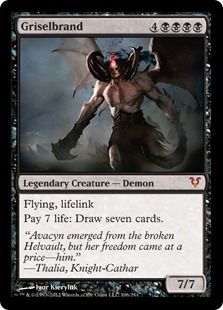
Grishoalbrand has made a big impact in Modern and in this article, I want to explain the deck's matchups against the top 6 decks in Modern: Jund, Abzan, UR Twin, Affinity, Grixis Control and Abzan Company. I will describe both how to approach the matchup, how to properly sideboard, and how to assess the opposing decks and what threats they will board in themselves. I will also explain which hands you can keep, which you have to mulligan, and how this relates to each different matchup.
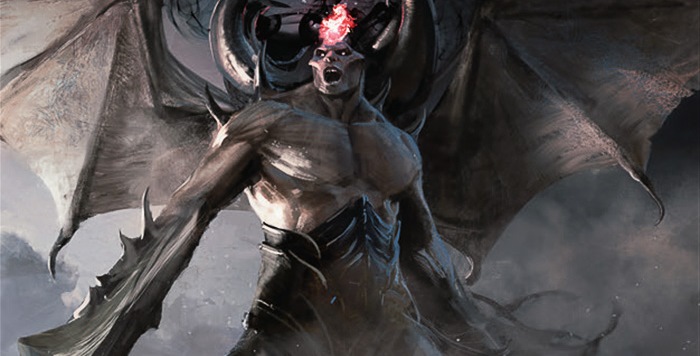
This article assumes some knowledge of the Grishoalbrand deck, so it will not explain the basic of the deck, the card choices for the deck, and how the deck plays out. If you want to read more about these two topics (and some other things about the deck), you can find this information in the MTGS Griselbrand Reanimator thread, Bob Huang's piece on Channelfireball, or Zach Jesse's two-part reflections on MTGCardMarket.
[wp_ad_camp_1]
The Grishoalbrand List
I started playing this deck last August/September, but only the classic Emrakul version. I switched to the Shoal version in October, when I saw the finish at GP Kobe 2014 (or rather, when I saw the report, since he was just shy from the top 64). I have been playing the deck on and off since then, including at GP Vancouver where I went 6-3. My GP run was cut short on two Infect matchups (one of our worst matchups), and because I punted a game against RG Tron. Shortly thereafter, I got 9th place at a local Super Sunday Modern event with a little more than 160 players in attendance. I 6-2, again losing to Infect.
To make our lives easier as we go through the matchups, I will use Zach Jesse's Top 8 list from GP Charlotte.
Grishoalbrand, by Zach Jesse (GP Charlotte 2015, T8)
Creatures
4 Worldspine Wurm
4 Griselbrand
4 Simian Spirit Guide
2 Borborygmos Enraged
Sorceries
4 Faithless Looting
4 Night's Whisper
2 Tormenting Voice
Instants
2 Manamorphose
2 Desperate Ritual
4 Through the Breach
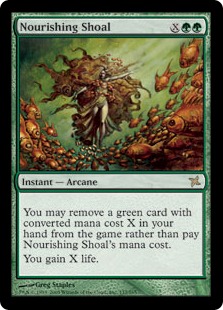
4 Nourishing Shoal
4 Goryo's Vengeance
1 Noxious Revival
Lands
4 Bloodstained Mire
4 Temple of Malice
2 Blood Crypt
2 Blackcleave Cliffs
2 Mountain
5 Swamp
Sideboard
3 Pact of Negation
1 Pithing Needle
2 Thoughtseize
3 Pyroclasm
1 Defense Grid
1 Torpor Orb
4 Blood Moon
It's important that we are all using the same list for this kind of testing, because there are so many different ways to build both the Grishoalbrand maindeck and sideboard. As for the other decks in the article, I will use the most recent and best finish those decks have (so mainly Top 8/16 at recent GPs).
Jund: Favorable (60-40)
The list: Marcio Carvalho's Jund - GP Copenhagen 2015, Top 8
Let's start with the former and rising bogeyman of Modern: Jund. Jund always tries to gain an advantage in the early game through discard (Thoughtseize/Inquisition of Kozilek) before landing one bomb after another one. This includes cards like Dark Confidant, Tarmogoyf, and Liliana of the Veil. Furthermore, Jund plays hyper-efficient removal in Lightning Bolt, Abrupt Decay, and Terminate, which should be able to deal with nearly every kind of creature the 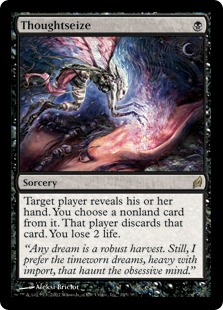 opponent may cast.
But Jund's greatest strength is also it greatest weakness: discard. Discard doesn’t help you against stuff, which the opponent draws from the top. If you are comparing Jund's deckplan with ours, you will recognize that their discard will hurt us if it comes early enough. But we can topdeck much better than Jund can. Furthermore, their removal interacts poorly with Griselbrand and Worldspine Wurm, since the first one can kill the Jund player before it dies to a Terminate and the Wurm will leave his buddies on the battlefield. 5/5 Wurm tokens are still bigger than all but the largest Tarmogoyfs and Scavenging Oozes). It helps that Jund's staple removal spell, Lightning Bolt is basically useless for killing creatures in this matchup. Just watch out for Abrupt Decay aimed at leftover Wurms.
Approaching the Jund Matchup
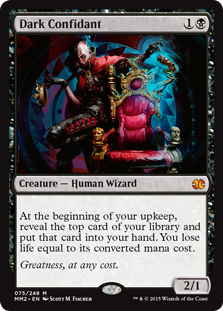 Jund chooses to run discard spells as their main mode of interaction. This is something which may hurt us if we have a weak hand, but we can beat it through stronger top decks. Their best card against us is actually Dark Confidant. There is a reason why people say if you can’t kill a Confidant immediately he will run away with the game. This is also true against us: several Thoughtseize/Inquisitions and a Goyf/Tasigur (i.e. early interaction plus a clock) is the best way to beat us. Liliana, another historically strong Jund card, is in a much more interesting spot against us. On the one hand, Jund wants to get us down to 0 cards. On the other hand, sometimes we lack discard outlet and Liliana provides us with one. Liliana also hurts the Grishoalbrand plan of Breaching in a Wurm, especially if the first hit doesn't end the game.
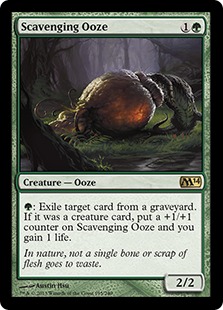 Scavenging Ooze is the second most dangerous card after Bob. Ooze provides Jund with both a two drop (an early clock) and a card which hoses the graveyard, given enough time. Ooze can either eat your Griselbrands or your Lootings. This can be annoying, but at least the Griselbrand problem can be played around either with Through the Breach, two Goryo's Vengeances, or one Goryo’s plus some splice action. Remember: you always need X Goryo’s effects, where X is the times he can activate Ooze + 1 (especially when the opponent knows what he is doing and waits for you to cast the first Goryo’s).
Based on these threats, you want to keep either a hand which has either a fast combo in hand (so that Dark Confidant can’t win the game for them and Ooze can't get online), or has several draw spells which let you recover from early discard (Night's Whisper is golden here). Don’t keep hands, which just have several Looting effects. The problem with these hands is that they don’t net you cards. This makesdiscard more effective against us.
As a final note, Jund is incredibly weak to a Breached Wurm, since they don’t have access to Path to Exile and, if they don’t die immediately, the tokens represent lethal for next turn. Also, most builds have only one Maelstrom Pulse to clean up the tokens, which makes it even harder for Jund to remove the Wurm leftovers.
Sideboarding against Jund
BGx decks are always soft to Blood Moon, and Jund is no exception. Here are two ways to sideboard the deck to get in the Moons and remove some unneeded cards:
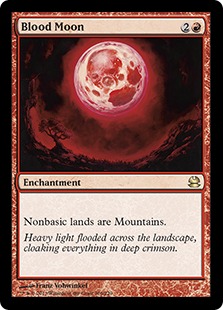 +4 Blood Moon
- -1 Faithless Looting
- -2 Tormenting Voice
- -1 Noxious Revival
Another option, depending on how you personally play the deck, is to remove ritual effects:
- +4 Blood Moon
- -2 Tormenting Voice
- -1 Simian Spirit Guide
- -1 Desperate Ritual
Finally, you can board in the lone Needle to handle Ooze/Liliana. If you want it, take out another Guide/Ritual, but never go below 1 Ritual and 3 SSGs: you need those to keep your speed.
- +4 Blood Moon
- +1 Pithing Needle
- -1 Faithless Looting
- -2 Tormenting Voice
- -1 Simian Spirit Guide
- -1 Desperate Ritual
Abzan: Even (55-45)
The list: Ian Farnung's Abzan - GP Copenhagen 2015, 18th place
To start, I want to acknowledge that Ian’s list is different from some stock lists. He decided to run Dark Confidant and Noble Hierarch as early drops, which definitely affects how this matchup plays out. Besides those changes, Abzan has still the same idea as Jund: early discard backed up by bombs like Tarmogoyf, Liliana, and Siege Rhino. Because of how similar the deck strategy is to Jund, I'm going to focus on the key differences instead of just re-explaining their deck plan.
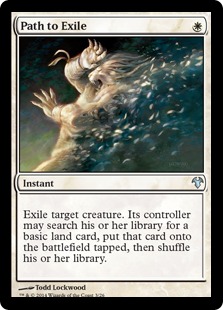 The biggest advantage Abzan has over Jund is Path to Exile. Path is the biggest reason why a Breached Wurm can fail. When playing against Abzan, don’t try to win with Worldspine Wurm if there's any chance of a Path. The two exceptions to this are if you have no choice but to go for it (because you would be dead otherwise), or if the opponent is tapped out/has no access to white mana. Another key difference between Jund and Abzan is that Abzan plays a higher mana curve. This plays out in our favor. Abzan is more likely to tap out in the later stages of the game (so turn three and onward), and have overall a slower clock than Jund (Jund has around 11 two-drops and Tasigur as virtual three-drop, whereas Abzan has normally only 6-7 plus maybe a Tasigur). This gives us more than enough time to assemble a win with Griselbrand instead of the more vulnerable Wurm.
Approaching the Abzan Matchup
As I mentioned earlier, the Abzan matchup is mostly very similar to the Jund matchup, but there are a few key differences. For one, you can expect less discard from Abzan, due to their not running as many Confidants as Jund (if they run any at all). Abzan has no real card-advantage engine to help them dig for those discard spells. Abzan also has a rather slow clock, which lets you keep slower hands (a turn 4-5 Breach win is totally fine), but you still have to except some discard from them. Again, you don’t want to keep a looting heavy hand, if you have no way to win either fast, or have no Whispers in hand. Finally, be careful about Path and its interaction with your Wurms: plan your win condition accordingly in those early turns.
Sideboarding against Abzan
Abzan is even more vulnerable to Blood Moon than Jund, since their mana requirements are worse and their nonbasics ar emore fragile: whenever you want to cast Lili on turn three into a Siege Rhino on turn four, you can expect a heavily nonbasic manabase. Indeed, in many cases, Abzan can't fetch their basics since they both need an early clock and early interaction. Basics often don't allow this. Because of this, you want to board this the same way as you board the Jund matchup (see above).
Affinity: Unfavorable (35-65)
The list: Andrew Wagoner's Affinity - GP Charlotte 2015, Top 8
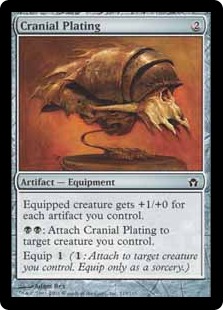
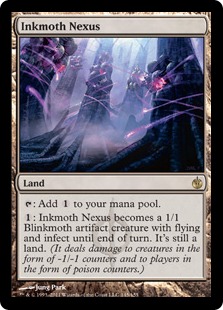 Here's a golden rule in Modern: if your deck isn’t utterly broken, you will need interaction for Affinity in your SB. This puts us in a decent game one position, when Affinity doesn't have interaction of their own stop us. We have the faster kill (turn two or three for us, turn three or four for them), but we also can't interact with their win conditions if we are playing slower. Our deck cuts maindeck interaction for a streamlined and consistent combo turn, which makes it hard for us to beat strong draws with Plating and Ravager. Affinity can also kill us with Infect on turn three or four, something we have no outs against (nice Nourishing Shoal you have there).
Unfortunately, this puts us in a terrible games 2/3 position. Affinity gets access to some combination of Thoughtseize, Spell Pierce, Dispatch, and graveyard hate, all cards that are incredibly strong against us. This makes the matchup go from "decent" to "horrible", and makes the match a much harder one for Grishoalbrand to win. As I've mentioned earlier, the best way to beat our deck is with a fast clock and some form of interaction. Affinity in game one only meets half of those criteria. But in game two, it meets both. This makes Affinity easily one of our worst matchups. Indeed, only Infect and Temur Delver are worse in the currrent metagame.
Approaching the Affinity Matchup
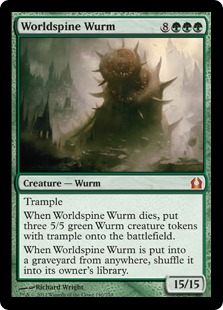 You have to have the kill as soon as possible. This is especially true in game one, where there is only the simple question of "Who has the faster goldfish kill?" A turn four Worldspine Wurm sounds good on paper, but might be not enough against a fast Affinity start. In fact, most of the times it will not be enough to get the Affinity win.
Avoid slow keeps, which means pitching all draw-heavy hands (so several Lootings/Whispers/Tormenting Voices). When you draw your opening seven, you are looking for as many combo pieces as possible (like Griselbrand plus either Breach or Goryo’s). If you have no natural discard outlet and you are on the draw, you can always take the draw-and-discard line if the only thing you lack is that outlet. This can even be worth it on the play, since Affiniy can’t punish us with discard in game one. In games two and three, these fast hands become even more important because now you are both racing Affinity's win conditions and trying to punch through their interaction.
Sideboarding against Affinity
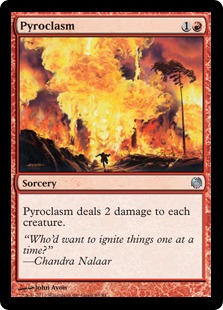 Zach Jesses opted to play more Pyroclasm/Pithing Needle over Shatterstorm. Whether you are playing Clasm or Storm, you want any and all Affinity hate out of your sideboard and jammed into your deck. With Zach’s list, that's the three Pyroclasms and the lone Needle. Affinity will board interaction in, so Pyroclasm and/or Shatterstorm need to buy you enough time to assemble your win.
- +3 Pyroclasm
- +1 Pithing Needle
- -1 Noxious Revival
- -1 Tormenting Voice
- -2 Night's Whisper
UR Twin: Favorable (60-40)
The list: Sam Pardee's UR Twin - GP Charlotte 2015, Top 8
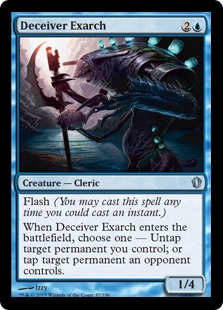 Twin is the remaining pillar of Modern after BGx and Affinity. Even in times where Twin looks less viable, the deck still preyed on all those linear aggro or combo decks which were trying to beat BGx. It's able to achieve this this with cheap counterspells in Remand, Spell Pierce, and Spell Snare, the almighty Lightning Bolt, and access to a turn four kill you always have to respect. This is why the older versions of Goryo's Vengeance decks had horrendous Twin matchups. Because they had to attack to win, simply tapping down an Emrakul or Griselbrand with Deceiver Exarch/Pestermite was often gamebreaking (especially if they could back it up with a the combo kill next turn).
With the rise of the new Shoal version, however, things have changed. Due to the instant-speed nature of our combo, we can play the draw-go matchup too without losing anything. Once the Twin player taps low, we can safely combo off ourselves. Furthermore, we can just force our Arcane spells through their counterspells by abusing the splice mechanic. This has turned a once impossible matchup to a solidly favorable one. Be warned that the Temur and Grixis Twin matchups are a little worse than the UR Twin one, due to their ability to land a high-power threat early (Goyf/Tasigur).
Approaching the UR Twin Matchup
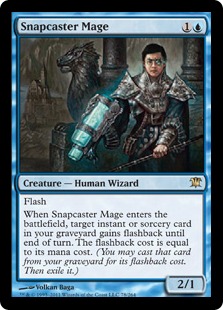
As good as it may sound that we have access to an instant combo kill against Twin, the matchup still has dangers. Against a good Twin player, the window for going off is extremely tight. An experienced Twin 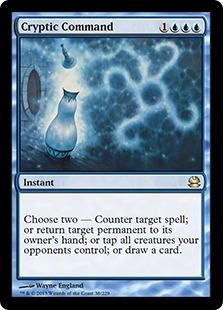 pilot will never tap low after the first turn. Of course, he needs to apply pressure sooner or later, otherwise we can just overload his counter suite/his mana. But in the early stages of the game, we don’t have the resources to make those plays. Another danger is that a good Twin player doesn’t need the combo to kill us. He just needs some form of a clock with countermagic and disruption backing it up (Snapcaster, Clique or Pestermite: Exarch is often too slow). That said, at some point the Twin players needs to commit enough power to the board that he can close out the game within 5-6 turns. If not, we can assemble a win to punch through his counter suite. After all, the average UR Twin list has only 2-3 hard counters in their maindeck (some numbers of Cryptic, Spell Snare, and Dispel). The other counterspells are either only a tempo counter (Remand), or soft counters (Spell Pierce/Mana Leak). We can play around one and pay for the other.
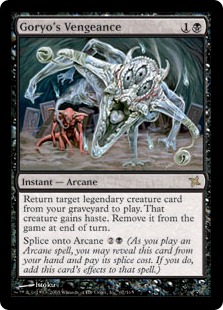 Thinking towards keepable hands, you want to go off via Goryo's Vengeance, since it is more mana efficient than Breach and it is easier to play into soft counters. Any hand which has some form of draw spells (Looting would be ideal), either Griselbrand or Goryo’s (both would be optimal), and lands is an easy keep. The problem with Breach is twofold. First, the card is very expensive, which makes it soft to both Remand and counters like Leak. Second, the Twin player can just tap down a Worldspine Wurm, which forces us to Breach in Griselbrand to guarantee a win. If you do want to go the Wurm route, cheat him into play at the second mainphase from the Twin player. That guarantees you the three 5/5 tokens, and he shouldn’t be able to tap all those down next turn.
Sideboarding against UR Twin
Post board, things get more interesting. On the one hand we get access to a “free” counter in Pact of Negation, a land, which makes our stuff uncounterable (Bosejiu) and access to both Defense Grid and Torpor Orb. On the other 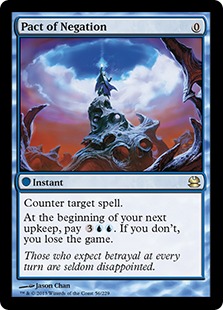 hand, Twin players can bring in some number of Dispel, Negate, Counterflux, and similar counterspells out of their board. Teferi is surprisingly annoying, since he shuts off our instant-speed win and prevents us from using our own Pacts. For me, the key here is not to bring all our own hate in (for instance, don't board in the Thoughtseizes). This puts us in too much danger of diluting the deck.
- +3 Pact of Negation
- +1 Defense Grid
- +1 Torpor Orb
- -2 Tormenting Voice
- -1 Through the Breach
- -1 Night's Whisper
- -1 Noxious Revival
Abzan Company: Even (55-45)
The list: Ian Bosley's Abzan Company - GP Charlotte 2015, Top 8
The big problem with evaluating the Abzan Company matchup is the lack of a current stock list. There are several different design philosophies out there, either the full combo approach, the value version, or a combination of those. Ian Bosley has chosen the more combo-centric approach, and that's what I chose to do most of my testing against.
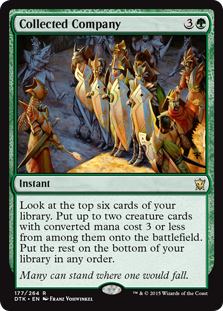 Most of the Abzan Company decks have nearly the same game plan as the old Pod decks. They want to be a little bit bigger than the other midrange decks and win through gaining too much board advantage. This is accomplished both through generically strong creatures like Finks and Voice, but also through a ton of utility creatures and silver bullets. Just looking at Bozley's list, we see examples of this in Spellskite, Qasali Pridemage, and Fiend Hunter. Chord provides Company decks with an instant-speed way to fetch annoying creatures the Grishoalbrand pilot doesn't want to see: cards like Scavenging Ooze, Tidehollow Sculler, Fiend Hunter, Sin Collector, and/or Eidolon of Rhetoric.
Since the deck is relatively slow (it relies heavily on the early mana acceleration in form of Noble Hierarch or Bird of Paradise) we normally have more than enough time to assemble any kind of kill. Furthermore, all of Company's interaction is creature-based due to the deckbuilding requirements of Company itself, which means we don't need to worry about threats like turn one Thoughtseize or Path to Exile (at least pre-board, and only in some of the less value-driven versions of Abzan Company). Abzan Company does have an infinite life and damage combo, but the earliest turn for this form of "kill" is turn three and, more realistically, turn four. This means we want to have a hand which can win the game in the first 3-5 turns.
Approaching the Abzan Company Matchup
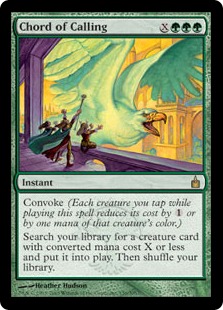 The biggest challenge in this matchup is knowing which silver bullet Abzan Company has in its deck and can find off Chord or Collected Company. To know this, you always have to be aware of how much mana your opponent can produce, including convoke. As a related point, you always need to know how far away the opponent is from a combo kill, or even a natural kill with just combat damage. The nice thing about Company is that the maximum power generated off a two-creature flip is six (or eight if an Anafenza is on the battlefield), so you can always plan with those numbers in mind.
Apart from those details, the matchup is fairly simple. They have no early interaction (at least pre-board) and a rather slow clock (besides the random turn 3-4 combo). Both Worldspine Wurm and Griselbrand are viable ways to win the game. The only problem which might occur with Wurm is if you can’t one-shot the opponent and he combos of next turn. Otherwise, both win conditions and any hand that supports them are fine.
Sideboarding against Abzan Company
Most of the Abzan Company decks are very vulnerable to sweeper effects, so you always want to board all of those in. Furthermore, both Torpor Orb and Pithing Needle can be good cards in this match-up. Orb is very strong here, but the Pithing Needle isn't totally necessary. Depending on your play 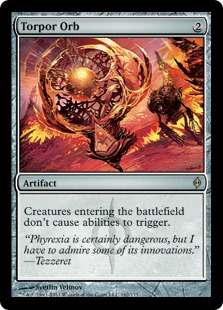 preferences, you can leave it in the sideboard if you want the second Ritual or that fourth Whisper.
- +3 Pyroclasm
- +1 Torpor Orb
- +1 Pithing Needle
- -1 Noxious Revival
- -2 Tormenting Voice
- -1 Simian Spirit Guide
- -1 Desperate Ritual OR -1 Night's Whisper
As a final note on this matchup, our win-rate depends heavily on the particular Abzan Company build. It can vary from incredibly strong (65-35) to nearly even (55-45 or 50-50). Overall, we tend to be favorable against all versions, especially the more they go into the combo gameplan: we have a faster goldfish kill than Abzan Company does, and they have to cut back on interaction to support it and the deckbuilding parameters around Company. That said, the value-heavy versions of Abzan Company actually are maindecking discard, or just more cards which are annoying for us like Path. Keep this in mind when playing out this matchup.
Grixis Control: Even (50-50)
The list: Thiago Rodrigues's Grixis Control - GP Copehagen 2015, Top 8
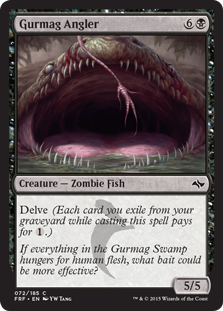 Grixis Control is a fairly new deck (same with all those Company decks) that we've only seen in the past few months. Back at GP Charlotte, Patrick Chapin developed a version of Grixis Control which played both a reactive game with Cryptic Command, Snapcaster Mage, and removal, while also keeping an option to switch to a proactive gameplan with turn two Tasigur or Gurmag Angler. Looking at Rodrigues's list from GP Copenhagen a few weeks later, it has both cheap counterspells in Remand, Mana Leak, Spell Snare, and Dispel, along with lategame value in Cryptic. The deck also plays very efficient removal in Bolt and Terminate, on top of Thought Scours and other cantrips to power out turn 2-3 Tasigurs and Anglers.
Approaching the Grixis Control Matchup
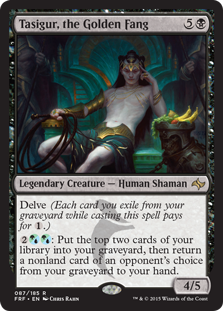 This matchup boils down to how fast they can resolve an Angler/Tasigur with countermagic back up. A turn two Tasigur with Dispel/Spell Snare behind it will win most of games regardless of what we are trying to do. Due to their setup from the counter suite and Snapcaster, they can have access to a counter in every stage of the game, which they can use to disrupt us while riding their delve creature to victory. But if they can’t stick a Tasigur/Angler early, we have enough time to set up a hand and all our splicing and Arcane tricks. This will allow us to win through their counters. It also helps that Grixis Control tends to tap “low” at some point, whether for Cryptic, a Tasigur activation, or a Snapcaster flashback. Even one extra mana can make a huge difference for us if we are trying to punch through a win condition. Apart from these nuances, the matchup is fairly straight forward (as always when playing Grishoalbrand against some form of Control). You just have to find a way to grind through their counter magic.
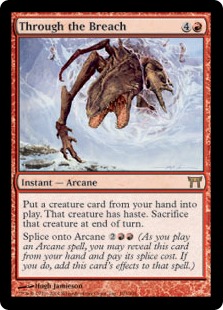 When deciding whether to keep or mulligan, you want to keep either a very fast hand (turn two), or a hand which would allow you to grind through their counterspells. It can be a little bit on the slow side, but then you have to accept a potential loss to the turn two Tasigur opening. If you want to go with the Through the Breach Wurm route, the same rule applies here as against Twin: you want the tokens to swing instead of the big Wurm. Of course, you might lose to some tokens to Anglers, but better to risk that than risk losing creatures to Terminate. Another problem with the Wurm plan is that Wurm can be bounced with Cryptic Command. This is even more problematic, since we won’t get the tokens from the Wurm. All of this puts the emphasis on the Griselbrand kill, which is much more reliable than Wurm here.
Sideboarding against Grixis Control
Post board, Grixis Control will bring in more Dispels and Negates, both of which can hit all of our combo cards. We want all of the Pacts, the Defense Grid, and 1-2 Thoughtseize (again, you don’t want to over-board here, but you can board 1-2 of your discard spells without thinking twice). Because we are adding both a free counter and Grid, we will have an easier time fighting over 1-2 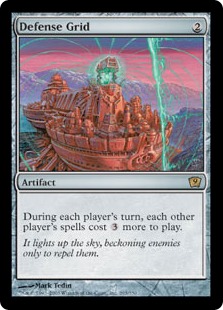 counters. Because of this, the post-board matchup is actually stronger than the pre-board one. Just be sure not to board out the Revival here, because it really shines in this matchup.
- +3 Pact of Negation
- +1 Thoughtseize
- +1 Defense Grid
- -2 Tormenting Voice
- -1 Through the Breach
- -1 Night's Whisper
- -1 Simian Spirit Guide
Thinking more about the pre and post-board matchup differences, our game one win-rate is closer to 45-55 or even 40-60, depending on builds and player experience. But postboard, this shifts back to us and becomes much closer to 50-50.
Interpreting Win Percentages and Next Steps
When looking at the win-rate percentages, you will notice Grishoalbrand has a good matchup against both the BGx decks and UR Twin (as I said earlier, Temur and Grixis are different). The Affinity matchup is a well-known problem, which is the main reason we are running Pyroclasm, Shatterstorm, or other artifact hate in our sideboard. As for Abzan Company and Grixis Control, we need to wait and see about what direction these decks are developing. As long as there isn't a stock list, we can't make an exact win-rate percentage. For my own part, I will have to collect more data on both Abzan Company and Grixis Control. In the first case, there are huge differences in between different builds. For Grixis Control, we simply need more data (I only did around 60 games here).
Do you have any remaining questions regarding those match-ups? Other matchups? Agree or disagree with the conclusions? Just let me know them in the comment section and I will try to answer them as soon as possible.
Greetings,
Fabian Gollmann