menu

Insider: Recapping the Modern Invitational

Are you a Quiet Speculation member?

If not, now is a perfect time to join up! Our powerful tools, breaking-news analysis, and exclusive Discord channel will make sure you stay up to date and ahead of the curve.

No big official Standard event this week, but a pretty good Modern event--SCG's Invitational. The Invitational promises eight rounds of Modern, and the event is like a strong Day Two of a Grand Prix.

I like the Invitational results and I think they tend to be more representative of the competitive metagame for a couple of reasons:

  • The player skill level is a bit higher than an event open to the public. It's not a Pro Tour, but the players generally aren't making ridiculous play mistakes and that means that decks aren't losing due to player error (and skewing results).
  • The prize is large enough that people who are not regular Modern players will be serious about the format and learn their deck. If this were a four-round event, we'd see less buy-in.
  • Eight rounds means fewer "glass cannon" decks like Ad Nauseam, the Griselcannon pile and to a lesser extent, Bogles.
  • Players competing in the Invitational can lean on friends to borrow cards (not everyone is playing) so there are far fewer budget decks.

All this adds up into a tournament worth watching. The Top 8 is interesting, but what I'm really going to focus on today are the 7-1 or better decks. The list makes for a good place to take the pulse of Modern.

7-1 or Better Decks

Grixis Control â– â– â– â–  (with or sans Gurmag Angler and Cryptic Command)
Amulet Bloom â– â– â– â– 
Abzan â– â– 
Affinity â– â– 
Collected Company Abzan â– â– 
Jund â– 
Grixis Delver â– 
G/R Tron â– 
Sultai Delver â– 
Burn â– 
Merfolk â– 
Grixis Twin â– 

The Bloom in the Room

Let's start off with the Amulet of Vigor deck. Speculating on this deck is playing with fire. That's because I feel like Amulet Bloom is a highly disruptive and bannable deck. I'm not saying this because I can't stand playing against it—Merfolk is a pain and that deck is fine. Amulet is a highly consistent deck that also breaks out early enough to force an opponent to mulligan or die. It also has a superb lategame, thanks to cards like Tolaria West.

Most worrisome is that Amulet has a few different angles that I like to refer to as Oath of Druids threats. Oath, after all, is an enchantment that turns into a creature. That is, if you have Erase when I cast my Oath, you've stopped it. If I get to Oath once, though, your Erase is worthless. The threat has changed permanent types.

To apply it here, that means that your Vandalblast is great on turn one against the Amulet, but it is a lot worse after the opponent resolves Summer Bloom (or makes it to turn four playing out their lands). The Path to Exile in your hand is good against the Titan, unless they get Tolaria West for a Summoner's Pact to reload on the Titan. You can also keep the three-Path hand, feeling confident, only to run directly into Hive Mind. So the Amulet deck demands quick answers, but you aren't even guaranteed success if you draw the wrong ones.

I've made my case against speculating on the Amulet deck at this point. I urged people to pick up Hive Mind at $1 and now it's at $6, so the money has been made on the list already. We are getting close to Origins and if it can weather that banning cycle, the deck will be safe and its components will again rise in price.

As a side note: I'm puzzled why people are surprised when cards get banned in Modern. It's like being surprised that Modern staples get reprinted. Wizards has been very clear that they're more actively going to ban things in Modern.

Luckily, most bannings don't kill decks completely. Jund still exists, intrepid people Open the Vaults instead of casting Second Sunrise, and Amulet players will still have a Titan/Hive Mind deck if Amulet and/or Bloom get banned. When I hear people say things like "if Wizards bans something from this deck, I'm quitting Modern," all I can hear is "I want to keep beating people with an unfair deck and if I can't do that, I don't care about this format any more."

Grixis Control and the Rise of Gurmag Angler

The Grixis Control decks have a few variables, but they tend to share a common core. They have a light suite of counterspells, some discard, a few Kolaghan's Command and Tasigur, the Golden Fang to finish. I can't really call them tempo or control decks because they tend to do a little of both.

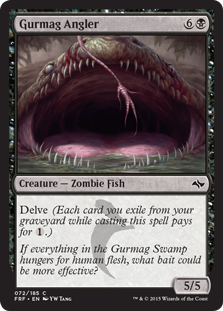
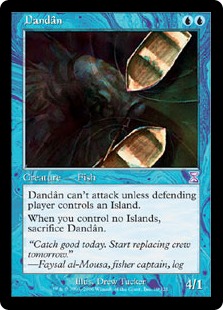
Some lists run one or two Young Pyromancer as another cheap threat. Others pack a Vendilion Clique. They often run Blood Moon maindecked. And sometimes, they run a Zombie Fish alongside the Banana King.

Kolaghan's Command has really invigorated the archetype. It was a card that I dismissed, since three mana is a lot to ask for and "guaranteed value" makes me think of Izzet Charm and people saying "well you can always loot with it."

Nonetheless, it seems to be more than just a pet card people are trying out. The fact that it two-for-ones Affinity from the maindeck has really cramped that archetype, for example. The ability to cast it and force a discard while bringing back Snapcaster Mage reminds me of Rise // Fall (talk about pet cards!).

It's currently $6 on hype. The Command is good and there's still a lot of space in DTK that needs to rise in value so that its profitable to redeem sets. I think $6 is a fair price to buy in at, but I don't predict any larger rise in the near future.

Tasigur is a phenomenal pickup right now. He's about $4.50 and a steep discount from where he once sat. He sees consistent play in Abzan and all sorts of Grixis lists. The downside of Tasigur is that, like Siege Rhino, he makes Dark Confidant problematic to play. In a Lightning Bolt world, Bobby doesn't live very long. That makes me see Tasigur as a stronger long-term play for deckbuilding as well as speculating.

Quick Hits: Singleton Deck Edition

Apart from the above two decks, the rest of the field was a diverse blend of decks. I'll go over the highlights here.

  • Path to Exile is rare right now. Abzan decks run a few copies, but not a full playset. UWx Control is nowhere to be found at the moment. If you want to attack this metagame, then Path is a superb card to knock out threat-light decks like Amulet and Grixis Control.
  • Keranos, God of Storms is going to be the trump card for these Grixis decks. They lack many hard counters and a Negate isn't going to clip out a Keranos. He's $8 right now.
  • Similarly, Olivia Voldaren ($7) is the Grixis sideboard card to reach for when you're facing down Junk. She's very hard for the deck to kill, since Abrupt Decay bounces right off.
  • No Infect. It's kind of a glass cannon deck, but this is a supremely hostile format to it with all the spot removal.
  • I was honestly surprised about R/G Tron packing away both the SCG Invitational and Modern Open. The deck is good for a five-round event but I often feel it lacks consistency to take down something major.
  • Do you know how many tix Deceiver Exarch is online? 8.5 tix. That's ridiculous. In paper, we've got a Commander printing containing the price, but it's still $1. This is a card I'd see players readily paying $3-5 for, as they do with Kitchen Finks.
  • Gerard Fabiano has a copy of Slay in his sideboard and that makes me so happy.
  • The Abzan Company deck is common enough that Anger of the Gods should come back to your sideboards. I thought we could be done with it, but the Born of the Gods sweeper is necessary again.
  • The fact that two Affinity decks still made it to 7-1 is a testament to the power of that deck, not its fragility. In the face of the new Command and a Bolt-heavy format, the deck can still crush people.
  • It's interesting to see Jund back again. I get the sneaking feeling, though, that Grixis and Abzan are just better at doing what Jund can do. They have the same quality of threats and a card like Scavenging Ooze is just not as threatening any more.

Next week, we'll cover GP Charlotte. This should be a phenomenally interesting Grand Prix in the Modern format. I expect many cards to move around in price, so if it happens there, you'll read about it here.

-Doug

[MTGO] 1 Year, 100 Tix May Report

Are you a Quiet Speculation member?

If not, now is a perfect time to join up! Our powerful tools, breaking-news analysis, and exclusive Discord channel will make sure you stay up to date and ahead of the curve.

Modern, Modern and Modern again. Thanks to Modern, and after only five months, I have doubled the value of my account!

Similarly to January, my Modern specs played a big role in boosting my bankroll in May. So no surprise today, I'll discuss Modern specs. Modern positions are the bread and butter of speculators on MTGO and a big chunk of your bankroll should be dedicated to such positions.

The unlocked article from the Nine Months of Portfolio Management Series this month is Part 6--Standard Rotation Opportunities. Standard rotation and the subsequent price decreases start quite early on MTGO, as early as May.

Unlike paper Magic this trend is merciless with digital cards. Standard staples that once were over 15 Tix can plunge as low as 0.3 Tix. But it's also a great opportunity to invest into several positions with an almost guaranteed positive outcome.

Before we begin May’s report, be sure to check out the following links (if you haven’t already):

Doubling Up: +46.4% in May, +139% Since January

In January, my Modern picks jump-started the project with an explosive +54% increase. After a subdued month of April almost everything went up in May, especially my Modern positions.

Old positions, new positions, all have increased by about 50% within few weeks and greatly benefited the account. Here is the graph of the progression.

Summary of May's Specs

Anticipating or reacting to the Modern Masters 2015 reprint list, all my new acquisitions with the exception of Soul of Shandalar in May were in Modern. There's nothing extraordinary here as pretty much any non-reprinted and playable Modern cards went up this past month.

But there is nothing more efficient. Speculations on MTGO, and especially with Modern positions, is very often a game of buying known good cards when everybody else is looking elsewhere (looking at Dragons of Tarkir for instance), and selling when everybody wants them.

I was also pleased to see my Pauper positions recovering from their dip at the end of April. I sold Mental Note during nice price recovery that is actually still going on--I didn't want to miss this opportunity this time around. While Flame Slash hasn't moved from its floor yet, I'm still holding on Innocent Blood and Moment's Peace as they have more potential in my opinion.

Lastly, I also performed two other short sells in May. In addition to short-selling Jeskai Ascendancy between April 28th and May 1st with a net +2.65 Tix profit I also short-sold Narset, Enlightened Master and Surrak Dragonclaw. This time around profits were not as great with +0.42 Tix for Narset and -0.09 Tix for Surrak.

There's a lot to say about short-selling on MTGO and with Magic cards in general. Although the concept is nothing new for the finance world this is a speculating move that has long been considered an impossible fantasy with Magic finance. The process is simple: I borrowed the cards, sold them and bought them back cashing in the difference.

To be totally transparent, I borrowed the card from my main account, and to be totally fair I also applied fees to these transactions (2% of the value of the cards when borrowed and per week until given back). These fees would apply to anyone willing to borrow cards from my main account, so anyone can replicate the specs done with my "100 Tix 1 year" account.

I'm currently working on a detailed article about short-selling on MTGO. This article is likely to be two- or three-part series for QS Insiders, so be on the lookout for it.

A Modern World

Modern is by far the best place to speculate on MTGO. With literally hundreds of different speculative targets to chose from and high price variations Modern can generate a consistent stream of Tix for small and big bankrolls.

The strength of Modern positions is that they are cyclical. When the interest for Modern is limited (during Standard PTs, new set releases, etc...) prices are low. And when Modern again becomes the center of players' attention (Modern PTs, Modern MOCS or PTQ season) prices sharply rise. Even in between these identifiable seasons a lot of cards simply fluctuate up and down in a very predictable way.

Unlike the Standard metagame, the Modern metagame is very stable and any card that has been good and pricey will be good and pricey again. Only bans have a definitive negative impact on the prices of Modern cards.

In March and April, and after the little boost produced by the Modern Pro Tour Fate Reforged, prices all across the Modern format started to tank. The attention and Tix from players were shifting to Standard again with the release of Dragons of Tarkir. In addition, the fear of reprints in Modern Masters 2015 (whose list was unknown at the time) pushed for further price drops--a perfect buying opportunity for Modern specs.

When the list of MM2015 was spoiled, non-reprinted cards soared, many increasing by 50% or more in a week or so. On the day the list was spoiled, Matt Lewis and I put together two special MTGO Market Reports discussing Mythics, and Rare, Uncommons and Commons that constituted several of the best speculative targets at that moment.

When big announcements like the MM2015 list are made it doesn't take long before prices start moving. These two reports certainly helped QS insiders with their MTGO Modern speculations.

Between May 8th (when we made our buying recommendations) and Wednesday June 3rd, the 32 recommendations we made were up by an average of 67.4%. We have already recommended selling six of these positions, Slippery Bogle, Pyromancer Ascension, Gitaxian Probe, Fauna Shaman, Path to Exile and Serum Visions, which were up by an average of 149%.

Next Month

Next month I will be half way through this project. With an additional push from my Modern positions the account should be over 250 Tix by then. We will also reveal the person who guessed the closest for the six first months contest.


Thank you for reading and following!

Sylvain Lehoux

Insider: Much Ado About Modern

Are you a Quiet Speculation member?

If not, now is a perfect time to join up! Our powerful tools, breaking-news analysis, and exclusive Discord channel will make sure you stay up to date and ahead of the curve.

Welcome back, readers!

It seems a lot of people are focused on Modern thanks to the SCG Invitational and GP Charlotte coming up. With no big Legacy events in the near future, my love of the eternal formats (or really just...not Standard) needs to be satiated and Modern is a great option.

I was a Legacy player before the format existed and for a long time simply viewed it as "diet Legacy"--half the fun for half the cost. For awhile it was just that; many people simply ported Legacy decks into the format, sacrificing relatively pain-free mana bases and free counter magic for slightly more painful manabases and not quite free counter magic.

My first Modern deck was Hive Mind using Ethereal Usher, Ponder, Preordain, and all the red rituals (both Seething Song and Rite of Flame) to cheat it into play really fast. Then you just played one of about 11 Pacts and won the game...pretty consistently on turn three. Then they started banning many of said components, and I went back to playing Legacy.

By now Modern has proven itself a strong and diverse format (well, relatively diverse) and a lot of players who weren't already playing are starting to pick up the stuff they need after this last Modern Masters release. This means we're likely to see steady growth of the format's player base, which in turn means demand for the format staples.

How has that demand changed? Below is a list of the top 25 most played Modern cards as well as their prices now, one month ago, six months ago, and one year ago.

Card Spot Card Name % of Decks # Played # of Copies per Deck Current Price Price 1 Month Ago Price 6 Months Ago Price 1 Year Ago
1 Lightning Bolt (M11) 45.53% 46.02% 4 2.49 2.64 1.97 1.69
2 Serum Visions 27.18% 27.38% 4 11.04 7.77 7.3 6.48
3 Snapcaster Mage 26.55% 28.74% 3.7 62.99 54.6 31.5 31.4
4 Path to Exile (CFX) 24.08% 31.26% 3.1 7.87 7.17 5.76 6.64
5 Thoughtseize (THS) 18.69% 29.90% 2.5 22.79 21.05 19 16.98
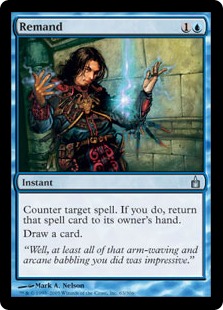
6 Remand (RAV) 18.11% 25.63% 2.8 13.05 15.74 12.75 11.95
7 Tarmogoyf (FUT) 15.34% 15.34% 4 190.74 196.42 179.99 189.95
8 Inquisition of Kozilek 15.19% 16.50% 3.7 9.78 8.16 5.49 6.99
9 Spellskite (NPH) 13.69% 40.39% 1.4 22.4 24.75 17.95 18.27
10 Scavenging Ooze (M14) 13.25% 24.85% 2.1 5.41 5.37 5.23 6.78
11 Abrupt Decay 13.06% 20.78% 2.5 14.99 13.3 10.55 12.32
12 Spell Snare (DIS) 11.94% 23.50% 2 5.5 5.01 3.99 3.74
13 Kitchen Finks (SHM) 11.55% 17.09% 2.7 5.17 4.02 3.85 4.14
14 Gitaxian Probe 11.55% 11.65% 4 3.29 3.08 2.84 2.28
15 Thought Scour 11.46% 11.46% 4 0.64 0.57 0.45 0.37
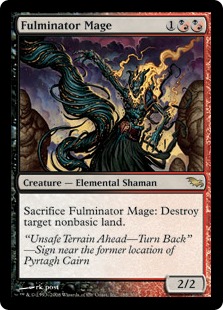
16 Fulminator Mage (SHM) 10.92% 13.59% 3.2 30.72 38 35.65 37.97
17 Terminate (PLS) 10.92% 22.33% 2 1.32 1.09 0.82 0.89
18 Ancient Grudge (INN) 10.58% 22.14% 1.9 0.2 0.19 0.18 0.16
19 Collected Company 10.53% 11.07% 3.8 12.41 4.37 N/A N/A
20 Tasigur, the Golden Fang 10.44% 24.27% 1.7 6 6.5 2.66 N/A
21 Rending Volley 10.15% 21.36% 1.9 0.3 0.39 N/A N/A
22 Ancient Stirrings 10.10% 10.10% 4 0.9 0.91 0.62 0.55
23 Blood Moon (CHR) 10.00% 21.55% 1.9 45 22.22 16.93 14.24
24 Nature's Claim (WWK) 10.00% 13.98% 2.9 0.39 0.37 0.41 0.42
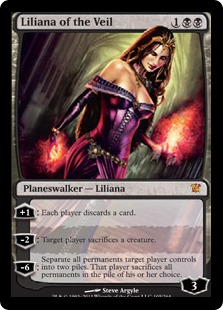
25 Liliana of the Veil 9.90% 13.40% 3 90 89.98 54.7 64.95

Single Prints

Now that you can see the full data set we're working with, let's break it down a bit more.

First, let's isolate the single printing cards from the pack. As you know, the single printing cards tend to have the highest chance of major gains (and also major losses with a reprint).

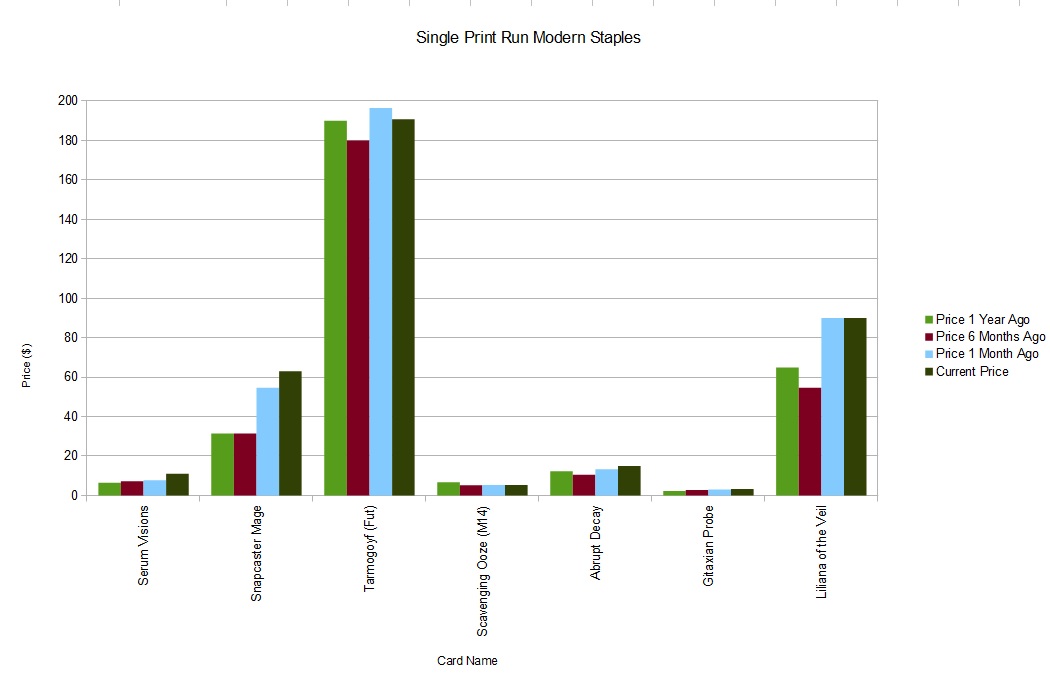
For this subset of data I will allow minor reprints (like RPTQ foils,  judge foils, or MM reprintings @ mythic level) as they tend not to affect the price nearly as much. For now, we'll also ignore anything that is still in print and thus can have additional supply added to the market. I'm also pulling out the really cheap stuff (under $1) simply because with the scale of the graph they would make it basically unreadable.

singleprint run

As you can see by the graph, overall we see growth of the staples. It's important to note that the reprinting of Tarmogoyf in MM2015 (as well as MMA) does seem to have an effect on its price overall, so it may be wise to remove it from our data set, since it alone forces me to double my axis size.

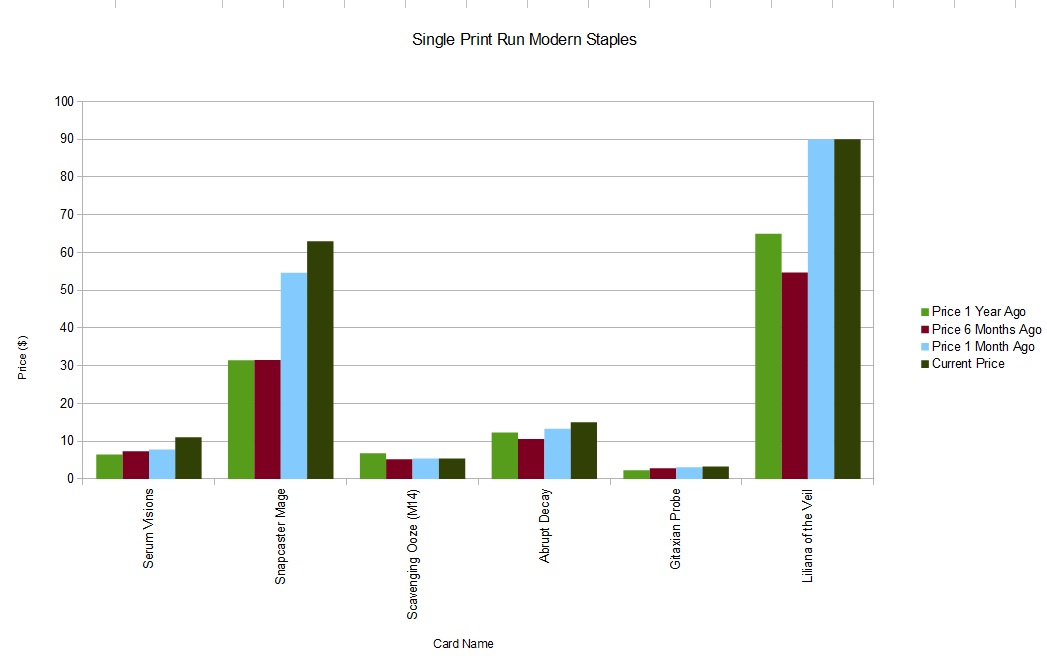
With Tarmogoyf removed we have something more like this:

sprwogoyf

Now we're seeing a better overall positive trend as the only card not showing solid gains currently is Scavenging Ooze, who is #10 on our list. This, to me, highlights Scavenging Ooze as a solid speculation target.

While he did show up in the original Commander product (and for a while he sat at $40+ dollars each), his reprint in a core set (and likely more painful promo printing with said core set) has kept his price down dramatically. However, being the tenth most played card in Modern and very good against the #3, #7, and #13 most played cards implies that he has a lot of potential moving forward.

Reprints

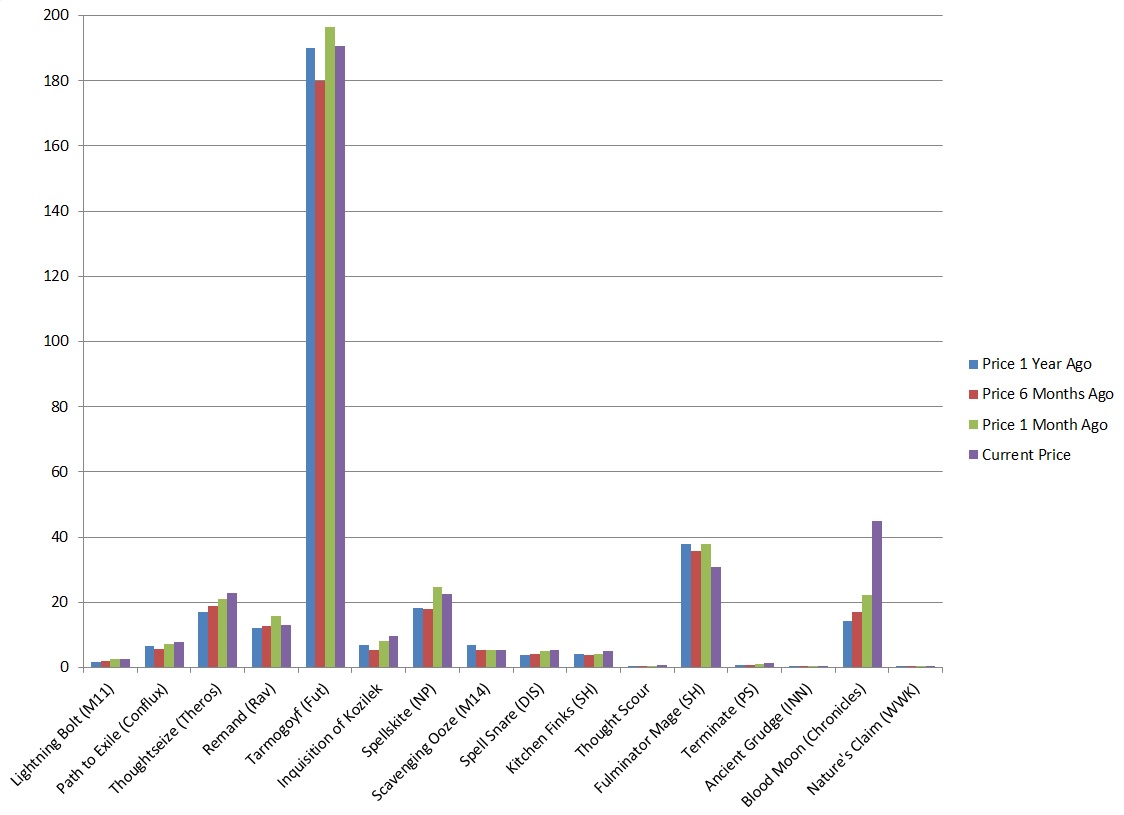
I see single-printing cards as having the most potential due to their (usually) smaller total supply in the marketplace. However, as Blood Moon will show you, the number of printings doesn't always matter if the card is extremely powerful (or possibly if all those printings were a long time ago).

So let's look at the data set for all reprinted cards on the list, regardless of how they were reprinted; i.e. duel deck, Modern Masters, Standard-legal set reprint, etc. The only thing we'll ignore are FNM promo reprintings, because these print runs tend to be small enough that they may not add a lot to the supply.

Card Name Current Price Price 1 Month Ago Price 6 Months Ago Price 1 Year Ago Printed In
Lightning Bolt (M11) 2.49 2.64 1.97 1.69 Alpha, Beta, Unlimited, Revised, 4th Edition, 5th Edition, M2010, M2011
Path to Exile (CFX) 7.87 7.17 5.76 6.64 Conflux, Commander, Modern Masters, Archenemy, DD: Venser vs Koth, Modern Event Deck
Thoughtseize (THS) 22.79 21.05 19 16.98 Lorwyn, Theros
Remand (RAV) 13.05 15.74 12.75 11.95 Ravnica, DD: Jace vs Vraska, Modern Masters 2015
Tarmogoyf (FUT) 190.74 196.42 179.99 189.95 Futuresight, Modern Masters, Modern Masters 2013
Inquisition of Kozilek 9.78 8.16 5.49 6.99 Rise of the Eldrazi, Modern Event Deck
Spellskite (NPH) 22.4 24.75 17.95 18.27 New Phyrexia, Modern Masters 2015
Scavenging Ooze (M14) 5.41 5.37 5.23 6.78 Commander, M2014, M2014 Promo
Spell Snare (DIS) 5.5 5.01 3.99 3.74 Dissension, Modern Masters
Kitchen Finks (SHM) 5.17 4.02 3.85 4.14 Shadowmoor, Modern Masters
Thought Scour 0.64 0.57 0.45 0.37 Dark Ascension, DD: Jace vs Vraska
Fulminator Mage (SHM) 30.72 38 35.65 37.97 Shadowmoor, Modern Masters 2015
Terminate (PLS) 1.32 1.09 0.82 0.89 Planeshift, Alara Reborn, Archenemy, DD: Sorin vs Tibalt
Ancient Grudge (INN) 0.2 0.19 0.18 0.16 Time Spiral, Innistrad
Blood Moon (Chronicles) 45 22.22 16.93 14.24 The Dark, Chronicles, 8th Edition, 9th Edition, Modern Masters
Nature's Claim (WWK) 0.39 0.37 0.41 0.42 Worldwake, Conspiracy


reprints

(Note: I have Tarmogoyf on both sets of data because it's been reprinted twice, but both times were at a mythic level in a limited print run so the total number added to the supply is still somewhat limited--it's in a sort of awkward "middle ground" between both sets of data.)

The data show that reprinting cards seems to cause an initial drop as expected, but the true staples eventually recover. We can see this trend when we compare cards with reprintings from more than a year ago, like Thoughtseize or Blood Moon, to the cards that have been reprinted in the past year (see Remand, Fulminator Mage and Spellskite).

What this means is that you can and likely should pick up the format's true staples after they've been reprinted (see some of my previous articles to get a good time estimate of the lowest prices) and expect them to recover. The only problem now is that enough people seem to have caught onto this particular trait and people are weary of trading away a lot of these staples rather than waiting for a better price.

This also means that the MM2015 reprints are prime targets to pick up. While they may go down a bit more, they will likely rise back up and then past their previous price points (barring any additional reprints in the next year or so).

I'm targeting the following MM2015 reprints:

  1. Spellskite - #9 on the most played list and the third most played card that was in MM2015. This card can fit into any deck and serves as a powerful "hate bear" against some of the format's linear decks (Infect, Bogles, Burn) and it hoses Splinter Twin pretty hard as well. Its most recent price high point was around $25 and the MM2015 version can be picked up for around $18.
  2. Fulminator Mage - #16 on the list, this card was as high as $42 per copy and his reprinting has dropped copies to less than half that. With the resurgence of Tron and Amulet Bloom, this is one of the most efficient hate cards against both decks that can fit into any deck with either red or black in it, though decks that only splash either color may still have trouble utilizing it.

Tiny Tuesday- Alesha, Who Smiles at Death

Are you a Quiet Speculation member?

If not, now is a perfect time to join up! Our powerful tools, breaking-news analysis, and exclusive Discord channel will make sure you stay up to date and ahead of the curve.

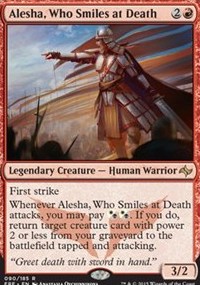
In Commander, there are a lot of sweet things to do with graveyards. There are a lot of very high power graveyard themes that run across black, blue, and green. There are a few neat things to do with graveyards in Tiny Leaders, but the power level of the graveyard interactions simply isn't as high. Interestingly enough, one of the more powerful leaders as it pertains to the graveyard is a red creature with white in its color identity.

There was an error retrieving a chart for Alesha, Who Smiles at Death

Alesha has a lot of cool things going on. As a 3/2 first-striker, she comes at a decent rate for three mana. The activated ability that she comes with adds a ton of extra value. Tiny Leaders isn't overflowing with ways to fill the graveyard, but Mardu decks will naturally lend themselves to having a lot of creatures that you want to kill. Dark Confidant and Stoneforge Mystic are at the forefront of my mind for great creatures that are legal in Tiny Leaders, and Goblin Rabblemaster isn't a slouch either.

There was an error retrieving a chart for Stoneforge Mystic

Mardu has a couple tricks that will help it keep its graveyard stocked. Faithless Looting and Buried Alive play quite well with Alesha. Liliana of the Veil and Pack Rat are right at home here, too. You can even support a few creatures that naturally recur from the graveyard. This is my current list for Alesha:

Tiny Alesha

creatures

1 Pack Rat
1 Dark Confidant
1 Stoneforge Mystic
1 Bloodghast
1 Goblin Rabblemaster
1 Fulminator Mage
1 Necrotic Sliver
1 Merciless Executioner
1 Fleshbag Marauder
1 Sin Collector
1 Brain Maggot
1 Mesmeric Fiend
1 Tidehollow Sculler
1 Mogg War Marshal
1 Tymaret, the Murder King
1 Mentor of the Meek
1 Pain Seer

spells

1 Buried Alive
1 Faithless Looting
1 Lightning Bolt
1 Swords to Plowshares
1 Smother
1 Lightning Greaves
1 Liliana of the Veil
1 Thoughtseize
1 Inquisition of Kozilek
1 Sword of Fire and Ice
1 Sword of Feast and Famine
1 Entomb

lands

1 Badlands
1 Scrubland
1 Plateau
1 Godless Shrine
1 Sacred Foundry
1 Blood Crypt
1 Marsh Flats
1 Bloodstained Mire
1 Verdant Catacombs
1 Polluted Delta
1 Wooded Foothills
1 Scalding Tarn
1 Arid Mesa
1 Windswept Heath
1 Flooded Strand
1 Swamp
1 Plains
1 Command Tower
1 Blackcleave Cliffs
1 Wasteland

There are a few options missing here that you'll definitely want in your sideboard. Bone Shredder and Ghitu Slinger will generally be more powerful than Fleshbag Marauder, but I wanted to be sure to be able to wreck Geist of Saint Traft. For this reason I also recommend a sideboard Crackling Doom.

There was an error retrieving a chart for Geist of Saint Traft

One of the cooler interactions to be aware of in the deck is Tymaret, the Murder King and the trifecta of Mesmeric Fiends. If you sacrifice these creatures with the trigger on the stack, you'll be able to permanently remove a card in your opponent's hand from the game.

Deck Overview: Modern Grixis Control

Are you a Quiet Speculation member?

If not, now is a perfect time to join up! Our powerful tools, breaking-news analysis, and exclusive Discord channel will make sure you stay up to date and ahead of the curve.

This weekend I piloted Grixis Delver to a 7-1 record in the Modern portion of the Columbus Invitational. The deck is great, and the interaction between Snapcaster Mage and Kolaghan's Command makes playing an honest game of Magic against the deck extremely difficult. The weakest card in the deck has been Delver of Secrets, but I haven't been able to find a way to cut the card. Fortunately (or maybe unfortunately) for the Magic Community, Matt Costa broke it.

Grixis Control

creatures

1 Spellskite
4 Snapcaster Mage
3 Tasigur, the Golden Fang
1 Keranos, God of Storms

spells

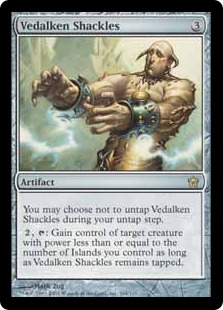
2 Vedalken Shackles
2 Blood Moon
2 Cryptic Command
2 Deprive
1 Dismember
2 Go for the Throat
2 Kolaghan's Command
4 Lightning Bolt
2 Mana Leak
3 Spell Snare
3 Thought Scour
4 Serum Visions

lands

6 Island
1 Mountain
1 Swamp
1 Flooded Strand
4 Polluted Delta
4 Scalding Tarn
2 Steam Vents
2 Watery Grave
1 Academy Ruins

sideboard

2 Engineered Explosives
1 Spellskite
1 Blood Moon
1 Counterflux
3 Dispel
1 Murderous Cut
1 Negate
2 Vendilion Clique
1 Keranos, God of Storms
1 Jace, Architect of Thought
1 Anger of the Gods

I'm not much of a Blood Moon guy, but the card solves most of the problems that the deck has when you cut Delver- that is wanting for a clock against decks like Tron and Amulet Bloom. Turns out that you don't need a clock if you cut them off of the ability to execute their game plan in any sort of timely manner.

There was an error retrieving a chart for Blood Moon

This change does make you weaker against decks like Infect where your deck just isn't as efficient and you can't really race, though Blood Moon does at least shut off Inkmoth Nexus. I would be wary about playing against something like Collected Company Elves with this build, but the sideboard Engineered Explosives do some serious work there. Which reminds me of one of the cooler pieces of technology from this deck...

There was an error retrieving a chart for Academy Ruins

Ruins is great not just for recurring Engineered Explosives, but also for combating all of the opposing Kolaghan's Commands in the format in games where you want Spellskite and/or Vedalken Shackles. It's also worth noting that once you've drawn Academy Ruins you can rebuy any of these artifacts that you mill with a Thought Scour. Ruins and Blood Moon are certainly at odds, but the impression that I get is that Blood Moon is either winning you the game or you're not casting it.

Winning Games With Kolaghan’s Command

Are you a Quiet Speculation member?

If not, now is a perfect time to join up! Our powerful tools, breaking-news analysis, and exclusive Discord channel will make sure you stay up to date and ahead of the curve.

I often hear Modern players complain Wizards isn't throwing us enough new cards. But seriously, have they visited Tarkir recently? Between Siege Rhino and Tasigur, the Golden Fang, Atarka's Command and Monastery Swiftspear, the Onslaught fetchlands, Collected Company, and a card so good it got banned in Legacy and restricted in Vintage, Tarkir block felt like a Return to Ravnica all over again. Many of these cards were instant winners from the second they were spoiled: it took about 15 minutes for the first cries of "ban Atarka's Command" to echo across the internet. Other cards took longer to get recognized: Rhino saw almost zero play for over a month. Now with June starting and big Modern events around the corner, we are seeing more and more of a card that many players overlooked in the DTK release, a card instrumental to the recent rise of Grixis Delver/Twin and Jund.

Kolaghans Command Art Cropped

Atarka may have gotten early attention, but Kolaghan's Command wasted no time making up for lost ground. The Rakdos-colored Command is poised to be a huge Modern player in the coming months. In this article, I will discuss the card's rise, its individual strengths and modes, and its overall effect on the format. Command might not be for every Modern deck, but it's an integral part of the new Modern. If you're already using the card, this article will affirm your decision. If not, this article will hopefully convince you of Command's power.

[wp_ad_camp_1]

The Rise of Kolaghan's Command

When DTK spoilers were finished, Command received decidedly mixed reviews. I gave this card a favorable review in our DTK evaluation article, and have been excited to see it live up to expectations. Kolaghans CommandBut Carsten Kotter didn't touch it in his SCG review of DTK in eternal formats (SCG premium). Pat Chapin and Shaun McLaren gave it a brief nod in their Standard-focused reviews, and it was only Reid Duke that gave Command its much-deserved props in one of his own DTK-in-Modern articles. The community was also lukewarm, with players questioning its importance and what it added to existing decks. In all those sources, the Command discussion was largely the same. On one hand, reviewers thought the card was versatile, enabled 2-for-1s, and generated value and card advantage. But on the other, it didn't have a home, felt a little expensive, and had a power level that felt too modest (even underpowered) for Modern. Comparing Shock to Lightning Bolt felt like comparing Cancel to Counterspell. And who the heck wanted to play Grim Harvest or Shatter anyway, even if as part of a potentially-valuable package deal?

The metagame results are in, and it turns out a lot of players and decks want to play Command. This isn't to accuse authors of mis-evaluating the card. Most writers legitimately saw Command's viability and predicted it would be at least decent. But as Grixis Delver and Grixis Twin, along with the almighty Jund, continue to rack up results, the card is exceeding expectations by the week. To explain Command's continual rise, and why some early reviewers didn't fully appreciate its power, we don't want to start with Command's modes themselves. We need to look at the format as a whole and how Command fit into it.

TasigurBack when DTK was spoiled, Modern was not a red/black format. It was the Rhino format, the UR Twin format, and the Infect/Amulet/Burn format. Delver had been dead for weeks, Jund had been dead for over a year, and there seemed to be few reasons to move back to red and black. Then came Tasigur, the Golden Fang. Black Tarmogoyf fundamentally changed Modern, opening up a string of decks that could now run their own "Goyf" alongside color pairings they wouldn't otherwise have access to. Tasigur allowed URx decks to keep the color-defining Snapcaster Mage and Bolt, but also access discard and hard removal you couldn't get in green, red, or blue. The black splash gave historically UR or Temur decks a new edge in a metagame that rewarded early interaction (e.g. Inquisition of Kozilek) and demanded removal that could outgun Bolt and Roast (e.g. Terminate and Murderous Cut). That shift would have been impossible without Tasigur, because those cards weren't worth it if you lost Goyf in the process.

The second metagame context, one more relevant for Jund, was the renewed relevance of Bolt. This shift incentivized a return to red and revived interest in red cards that paired with Bolt (e.g. Huntmaster of the Fells). If Bolt had remained an inferior choice to Path to Exile, there would have been no reason to switch from Abzan into Jund. And if Abzan had remained the BGx deck of choice, Command alone would never have swung the pendulum back. But once Jund supplanted Abzan on the strengths of Bolt (or at least became strong enough to rival it), Command immediately found its second home outside of Grixis.

Tying those two metagame developments together, we see why Kolaghan's Command found its home. In the case of Grixis, it was Tasigur (not Command) that set the URB groundwork. Command just fit into those decks after Tasigur enabled them. For Jund, the metagame shifted to make the deck stronger than its Abzan alternatives. Command only slotted in afterwards to make it stronger.

Evaluating Kolaghan's Command's Modes

Now that we've identified the preconditions for Command's rise in Modern, we can look at the card itself. Obviously, it wouldn't have been enough for Command to just be a red/black card (refer to Silumgar's Commands extensive play in Grixis decks...). The Command's modes still had to be strong, and this section is a discussion of those strengths.

When I first drafted this article, I alternated between describing Command as one spell with four modes or as six different spells in one slot. Although I think the six-in-one model is interesting and potentially helpful, it's perhaps a bit too prescriptive. I don't want players to look at the six "spells" and just list scenarios where they are useful. Instead, I want players to be able to evaluate all four modes independently and then apply those modes dynamically in a game. As some wise man once said, if you give a man Kolaghan's Command, he wins for a day. If you teach a man Kolaghan's Command, he wins for a lifetime.

"Return target creature card from your graveyard to your hand."

Effects in the tradition of Grim Harvest and Raise Dead have never really been playable. The closest were Grim DiscoveryGurmag Angler, which at least provided card advantage, and Rise // Fall, which had both card advantage elements, versatility, and Snapcaster synergy. Command blows those earlier versions out of the water. In Grixis and Jund, you are all but guaranteed to recur a high-value threat. Tasigur, Gurmag Angler, Goyf, and Huntmaster are already hard to answer. If your opponent invests in Terminate, Roast, Mana Leak, Lily, or some other one-shot effect, this mode at least ensures you come out even. But if your opponent had to double-block or double-burn one of your creatures, now you're a card ahead. Bonus points for killing the Lily that nuked your Tasigur and then bringing Tasigur back for round 2. Command is also strong at recurring removal-magnets like Dark Confidant, Delver, Pyromancer, and other early drops that you might want back in the mid-to-late game (especially Bob), but are probably killed the turn after they land.

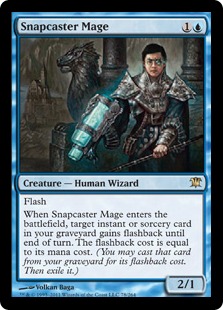
Snapcaster MageBut the real creature that pushes this mode over the top in Grixis is Snapcaster Mage. Casting Snapcaster to flashback a binned Command is already a lot of value. But casting Command with a dead Snapcaster in the yard is just gamebreaking. This returns the Mage, who already returned a spell and maybe blocked a creature, and then puts you up another card from the second mode. Then you recast Tiago and flashback the Command, getting a straight 2-for-1 off the second Command and a body on the board. Where does that leave the boardstate? You have now invested just 2 cards to put a creature in play and either kill 3 things or generate 3 cards worth of value. All for two separate investments of 3 and 5 mana, and all at instant speed. Company decks are making similar plays with Eternal Witness, but this is actually better because it's not random and it's much cheaper. It's hard to play fair magic when Grixis decks can run this playline or just topdeck into it in the midgame. This synergy is one of the top reasons as to why URB decks are some of the decks to beat in Modern right now.

Fulminator MageJund obviously doesn't get Tiago, but it still derives value from recurring Goyf, Confidant, or its high-end creatures like Huntmaster or Olivia Voldaren. Jund, however, does get some Tiago-lite value once it brings Fulminator Mage out of the sideboard. This improves a number of key matchups. Chaingun Rain of Tears is brutal in all the midrange grindfests where cards like Gavony Township, Stirring Wildwood, and Celestial Colonnade provide lategame value.  Fulminator also gives Jund renewed viability in the RG Tron matchup. It's much harder for Tron to recover from losing Urzatron lands on turn 3 and turn 5 than it was for them to stabilize after losing just one. Same goes for Amulet Bloom, especially if Jund can hold the line on turns 1-2 until Mage can start controlling the board. Command's recursion enables all of these synergies.

"Target player discards a card."

Liliana of the VeilOne of Modern's coolest cards has always been Funeral Charm (and its colorshifted cousin, Piracy Charm). Instant-speed discard is rare in Magic and with good reason: being in topdeck mode on its own isn't fun. But being in topdeck mode and having your entire turn blown out by an instant-speed discard spell? That's about as fun as watching Eggs go off back in 2013. The Modern midrange game is often defined in topdecks and Command is great at exploiting this. For instance, BGx players often win the mirror by boarding out some number of less valuable topdecks (e.g. targeted discard) and jamming in topdeckable threats in their place. That's where Command comes in, blowing up a draw step on top of an extra mode of value (typically recursion in the midrange grindfest). Liliana of the Veil is a big contributor to this playstyle. An early Lily wrecks the hand and forces an opponent into topdeck mode. Command finishes the job, turning topdecks into Time Walks and overall shoring up Jund's hand-control game.

As you can probably tell from the above paragraph, the discard clause is pretty narrow. Some might call it "limited", or even Command's weakest mode. I wouldn't go that far. In situations where it's strong, it's really strong. Locking a BGx or URx player out of a draw step is unfair. If they weren't sandbagging cards to begin with, this really is a straight Time Walk in the mid- or late-game. RemandAnd if they were sandbagging, they were probably losing to pressure anyway. That said, there are lots of situations where you don't want to use this mode. In fact, knowing when not to discard randomly is more important than knowing when to use it. There are two things you need to worry about here. The first is fueling delve or enemy Goyfs. This danger is most important in Grixis decks, where you don't even have a Goyf of your own to benefit from a new card type in the yard. But it's also important in any matchup where you are facing delve cards, even if Goyf isn't present. The difference between a 3 mana and a 2 mana Tas/Angler is enormous: that's mana for Spell Snare, Inquisition, or Bolt. Or even Remand, Leak, or Terminate. The tempo blowout from turn 3 Tas/Angler into Remand alone is probably game over. Or against Abzan or Jund, allowing them to play Inquisition or Thoughtseize to clear the path into turn 3 Tas.

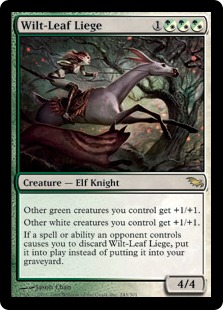
Wilt-Leaf LiegeThe second big discard danger are cards like Loxodon Smiter and Wilt-Leaf Liege (and Lingering Souls, to a lesser extent). Thankfully, the metagame has shifted away from these bullets. As Abzan falls, Abzan Liege also slides into a hard decline. Zoo decks are in a three-way battle for supremacy, and the Naya variants using Smiter have no clear edge over the Domain variants with Tribal Flames or the "Gruul Zoo" types with stuff like Flinthoof Boar. Hatebears and the other GWx variants are still something to worry about, but those decks are also losing popularity to Abzan Company, so they also aren't too common. Even so, know your matchup and opponent before using this mode. A misplayed Command into an active Liege is a disaster, even moreso than inadvertently fueling delve to enable an earlier Tasigur. At least in Tas's case the opponent still has to expend resources to cast him. But giving the opponent a free Smiter or Liege is too much tempo turnaround to recover from.

"Destroy target artifact."

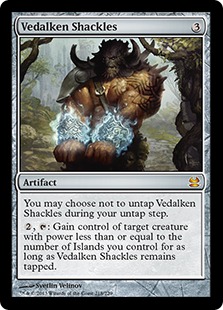
Vedalken ShacklesIf I was forced to pick one mode that makes Command good, it's this one. Modern is an extremely diverse (read: unpredictable) format where people are playing a lot of varied (read: unexpected) threats. How many times have you been playing a fair game of Modern when the opponent slams down something bizarre like Vedalken Shackles? This isn't early 2012! This is the post-Decay world! Same goes for Batterskull, Ensnaring Bridge, Crucible of Worlds, Sword of Fire and Ice, and all sorts of other unexpected artifacts you want a game 1 answer to. It's also true of more mainstream cards like Spellskite, Amulet of Vigor, Oblivion Stone, Aether Vial, and other artifacts you should expect in tier 1 or tier 2 decks. In all those cases, Command gives you a game 1 answer for these cards, many of which must be answered or they take over a game. But unlike other artifact removal spells, Command does so without sacrificing slot flexibility in other matchups. This is one reason Decay was so good, and Command does a great Decay initiation in that capacity.

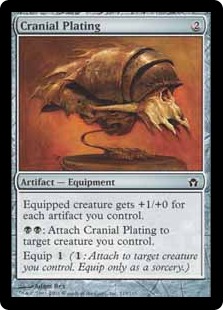
Cranial PlatingThe other reason that Command's Shatter mode is so strong is Affinity. Affinity is one of those tier 1 decks you can't forget about or ignore but also don't want to prepare for. No one really wants to stick 2-3 Stony Silence in their sideboard if those cards are only relevant against one tier 1 deck and a handful of tier 2-3 decks you probably will never see at an event (although maybe that's less true after the Tron-filled weekend of June 6th and 7th). And absolutely no one wants to maindeck anti-Affinity measures in game 1. Command gives decks like Grixis and Jund a real fighting chance in all games without sacrificing slot flexibility. Every time you cast this card against Affinity, you are getting a 2-for-1. But unlike similar 2-for-1s like Pyroclasm or Electrolyze, you aren't just killing Affinity's weakest cards. You are actively blowing up Plating, Inkmoth, and any Master of Etheriums that are still seeing play. Preboarding against powerful, albeit niche, strategies like Affinity is always good. If you can do it in such a versatile package as Command, that's almost always a good inclusion.

"Kolaghan's Command deals 2 damage to target creature or player."

If you look at this mode and just see Shock then yes, it seems underwhelming. This is one reason the card was mis-evaluated in DTK's release: Shock obviously doesn't cut it in Modern, so this mode feels like it won't either. Don't think of it that way. Instead, think of this as your guaranteed upside to whatever other mode you are using. More than any other mode, this is the one that ensures 2-for-1s. There are just so many matchups where you will be able to kill something. True, you might not be killing the scariest creature on the board, but you are still adding one card to your 2-for-1 equation in almost every matchup. Just to demonstrate the mode's relevance, here's a quick list of tiered decks with some of their valuable targets.

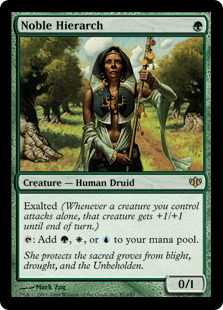
  • Noble HierarchJund/Abzan: Dark Confidant (Jund), Scavenging Ooze (both), Noble Hierarch (Abzan), Liliana of the Veil (both, particularly if she goes -1 after a turn 3 drop)
  • Twin variants: Snapcaster Mage, Pestermite
  • Grixis variants: Delver of Secrets, Young Pyromancer, Snapcaster Mage, Vendilion Clique
  • Affinity: Inkmoth Nexus, Vault Skirge, Steel Overseer, etc.
  • Burn: Goblin Guide, Eidolon of the Great Revel, Grim Lavamancer
  • Abzan Company: Noble Hierarch, Birds of Paradise, Anafenza, Kin-Tree Spirit, Melira, Sylvok Outcast, etc.
  • Elves: Nettle Sentinel, Heritage Druid, Elvish Archdruid, etc.
  • Infect: Noble Hierarch, Blighted Agent, Inkmoth Nexus, Glistener Elf
  • Merfolk: Lord of Atlantis, Master of the Pearl Trident, Silvergill Adept, etc.

A 3 mana Shock obviously won't cut it on its own. But getting that Shock-based value tacked on to another effect? That's what makes the card. As a Arcbound Ravagergreat example of this, you actually feel bad using this against Affinity. Shatter blows up one of their threats and Shock kills another. That's at least a 2-for-1 in almost all board states in the Affinity matchup. You can even get 3-for-1s with Command if you disable metalcraft on Etched Champion by blowing up two of the enabling artifacts. Then just block the naked 2/2 Champion and laugh. When throwing Commands into active Arcbound Ravagers, remember that even if one mode is countered, the other mode will still go through as long as its targets are legal upon resolution. So if you blow up a Ravager with Shatter and recur a Huntmaster with the Raise effect, you still get the Huntmaster even if the Ravager sacrifices itself in response. True, Command will not resolve if you zap a target and break another and both get sacrificed to Ravager, but that won't matter because the end result (a 2-for-1) will still be the same. And if nothing else, you can always just fire a mini-Lava Spike to the dome, which is not irrelevant in Grixis decks that switch to an aggressive Burn strategy off Bolt and Snapcaster.

The Future of Kolaghan's Command

We are only a week into summer, and already Command is making its mark on major paper events. Josh Ravitz rode a pair of Commands to a 3rd place Jund finish at the SCG Invitational in Columbus. On the SCG Open side of the event, we saw multiple commands in both the 6th place Grixis Twin and the 8th place Jund finishes. This was in addition to seven decks using the card in the Invitational's 7-1 or better Modern deck bracket. I expect to see similar finishes in the weeks to come, all based on the strengths described in this article.

Grixis and Jund are back in Modern, which means Kolaghan's Command is here to stay. You need a very good reason to not run this card in those colors, and I predict there won't be a single Grixis or Jund list in any of the upcoming T16s that doesn't rock it. If you are playing those decks, use the card wisely and you will be rewarded. If you are playing against them, respect it and know its modes or you will be punished.

Insider: Post-MM2015 Modern Investing

Are you a Quiet Speculation member?

If not, now is a perfect time to join up! Our powerful tools, breaking-news analysis, and exclusive Discord channel will make sure you stay up to date and ahead of the curve.

Hello readers, and welcome back!

We are now in the “post-mortem” period of GP Vegas and all the lovely drama that has come out of the massive Grand Prix weekend. While I personally didn’t get caught up in any of that, I’m sure many of you found it entertaining...

That being said, let’s get to the point of this article. In the wake of the triple GP weekend, and another re-order of MM2015 product that I outlined in previous articles, there has been much price movement across the board. Reprinted singles are in flux, and some non-reprinted singles are already jumping considerable amounts.

Instead of worrying about price floors and “what to do next" with the reprinted stuff, you should save yourself the headache and look at the non-reprinted stuff! Isn’t that easier? I think so.

I have explained before how some non-reprinted cards may take longer to start trending upward in value than others. We have already seen quite the price spike in Blood Moon. The window of that investment is all but closed, but there are certainly more opportunities worth investing in.

Today I'll highlight some of these cards, which you may remember from previous articles, and put them under the microscope. I hope that most, if not all, of them are on people’s radar at this point. If they’re not, they should be!

Cards I’m Targetting

There was an error retrieving a chart for Living End

Let’s start with one I mentioned earlier: Living End. Since I last talked about this card, Living End and "Twinning End" decklists have seen increased popularity in MODO dailies. At this point it’s common that some version of a Living End deck puts up a 3-1 or 4-0 finish. Some recent finishes highlighted here:

http://www.mtggoldfish.com/tournament/17653
http://www.mtggoldfish.com/tournament/17625
http://www.mtggoldfish.com/tournament/17657

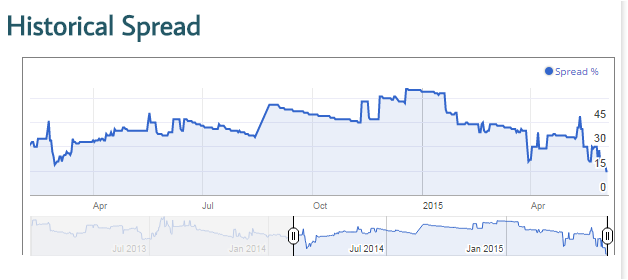
Another telling sign is the current spread on the marquee card:

Living End Historical Spread

As one can see the spread is historically low, which means a low-risk investment. With only a 15% spread on buylists, we're talking really minimal losses should it not pan out.

Speaking of buylists, Trader Tools charts indicate that there has been an increase in buylist pricing since May 12 2015, up from $2.75 to the $4.65 we’re seeing right now. Almost a 50% increase in little under a month's time. This should be setting off red flags.

Just so there’s full disclosure, I am currently holding four playsets of this card. I understand this card has been a roller-coaster if one looks back through its price history, and there were already some great opportunities in the past for profit on this card. Perhaps we’re being presented with another one.

Untitled Deck

Creatures

3 Architects of Will
4 Deadshot Minotaur
4 Deceiver Exarch
4 Fulminator Mage
2 Jhessian Zombies
4 Monstrous Carabid
3 Simian Spirit Guide
4 Street Wraith

Spells

3 Demonic Dread
3 Living End
4 Violent Outburst
4 Splinter Twin

Lands

2 Blackcleave Cliffs
1 Blood Crypt
2 Bloodstained Mire
1 Breeding Pool
2 Grove of the Burnwillows
1 Mountain
1 Overgrown Tomb
1 Steam Vents
1 Stomping Ground
1 Swamp
1 Watery Grave
4 Wooded Foothills

Sideboard

3 Brindle Boar
2 Dismember
1 Faerie Macabre
2 Ingot Chewer
2 Ricochet Trap
2 Shriekmaw
3 Slaughter Games

One last thing I want to mention is that the cost of this deck has dropped drastically, due to a key reprint in Fulminator Mage (and in some builds Splinter Twin). Some builds are as low as $230, with most no more than the lower $400s.

This makes Living End a great introductory deck, and even with an increase in price of the eponymous card, the deck would stay relatively cheap. That bodes well for demand for the card.

The next card is Glimmervoid.

There was an error retrieving a chart for Glimmervoid

Here we have another card with things lining up well. The recently reprinted Mox Opal may bring a new interest into the popular Affinity archetype, since the cost is even lower than before. With a semi-attractive spread of 27%, vendors have been increasing buylist prices since the release of Modern Masters 2015. I have picked up a couple extra sets, finding them fairly easily in the 8-10$ range and even stashing a few at buylist prices.

Glimmervoid may be the card that soaks up the most value should the deck continue to do well. Also note that this card is usually a three-of in the archetype. I do think it will gain a healthy amount going into the coming Modern season, since most of the deck outside of Opal is fairly inexpensive.

On the verge about these

Out of these, Eternal Witness seems like a strong candidate to keep rising, with many decks in Modern adopting it, even outside of “CoCompany” lists. Mike Lanigan posted a great article here about the metagame shifting, and if Jund lists start to adopt this card more, I think we could see the card rising despite its multiple printings.

Much like Blood Moon has recently, Eternal Witness keeps rising in the ranks as one of the top 50 creatures played in Modern. I know most people would be hesitant on Eternal Witness, but the exact same could be said for Kitchen Finks. This doesn’t have as many reprints and just dodged one in MM2015, and it's also one of the top creatures played. So that’s also something to consider given the opportunity cost.

If Jund continues to be the deck of choice over Junk than our ol’ pal Huntmaster of the Fells could be a card that benefits. With copies being fairly stagnant since its time in Standard, it could rebound nicely. It might not command the premium price it once did in its glory days, but enough to turn a profit at the 5-6$ investment.

I know some members on the QS forum have already secured some copies “just in case” and rather to be an early bird on these. As I see them continue to show up in decklists, I may pull the trigger as well. Just to highlight some recent lists:

http://www.mtggoldfish.com/deck/293497#paper
http://www.mtggoldfish.com/deck/293498#paper

As a side note, foils of these are extremely hard to find.

I know I must sound like a broken record right now, but I can’t help but stash proven Modern-playable cards when the spread is attractive enough for investment. Some of these I have highlighted in the past, and I wanted to re-iterate again just as a way for people to understand that the buylist prices are telling signs. The increase over a short period of time should be clear indication that vendors want to hold these.

I have put these on a few of my “master lists” so everyone can evaluate them for themselves. They should be in previous articles and very easy to find.

That’s the update on what I’m investing in, and I like having that transparency with my readership. I'd love to discuss some of the cards I'm on the verge about. I've seen a few of them discussed on the forums, and for people who have not seen those posts feel free to cruise the Single Card Discussion threads.

Hope you all enjoyed it, until next time!

-Chaz

Insider: Artful Maneuvers – Choosing a Card

Are you a Quiet Speculation member?

If not, now is a perfect time to join up! Our powerful tools, breaking-news analysis, and exclusive Discord channel will make sure you stay up to date and ahead of the curve.

So far we've gone through the basics of how to paint cards, and why to paint cards. Today I'll be discussing which cards to paint.

There are tens of thousands of Magic cards to choose from, and some of those cards have two, three or even four different versions with unique art. Some cards are worth altering, some are worth practicing on and some are barely worth your time at all. I want to go over a few basic factors in choosing your next project.

Does Anybody Want This?

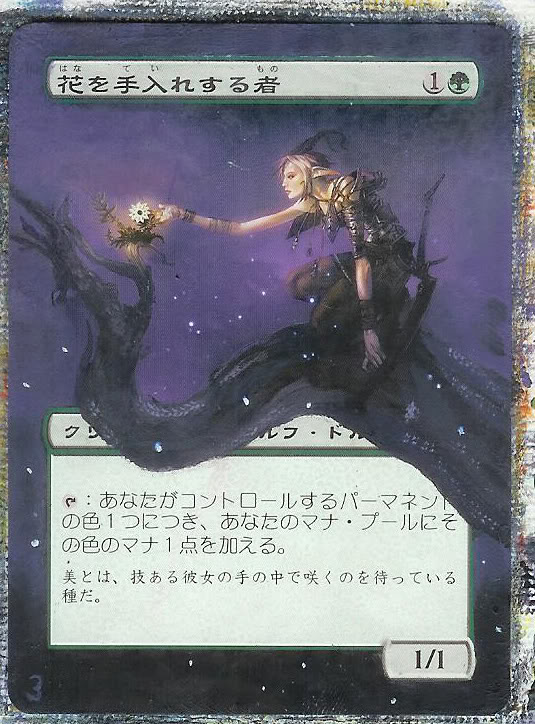
Bloom Tender was one of my all time favorite alters. I couldn't move it to save my life though...
The first and foremost thing to consider is the cards' playability. If it is played in any format then you have a winner. Even if the card is a one-of in the sideboard of a fringe deck in a fringe format, it has a market.

Obviously you'll want to target cards with a wider market than this, but if you really want to paint on that Swans of Bryn Argoll then go for it. Somebody somewhere is going to want it.

Of course if you find a card in high demand like Thunderbreak Regent after Pro Tour: Dragons of Tarkir, then you have a choice to make. The card may lose momentum and bottom out while you work on it, or it may spike in price and suddenly you are the only one with an extended Thunderbreak Regent in your binder. Hopefully we have provided you with enough financial insight to make the right decision.

Personally, I stick to popular Commander cards and cards that see play in eternal formats. The prices and positions in certain decks are a bit more stable this way.

Valuable Cards

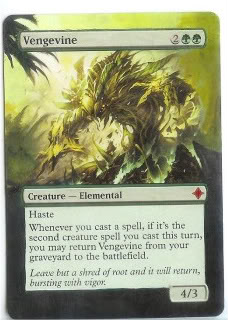
At the time I painted this, Vengevine was $50. People thought I was crazy to paint on it, but every one of those people flipped through my binder while saying it.
High value cards are also intriguing projects. Dont look past the Karn Liberated in your binder due to its $40 price tag. Altering cards can raise the value of any card, regardless of its original value.

Altered high value cards attract the most attention in your collection. These cards are valuable due to the serious demand for them. This means there are more internet searches and more binder inquiries. You have a huge market to play to, and if you advertise correctly you can draw more attention to your portfolio as a whole.

Remember, it's all about getting your cards in front of as many faces as possible. The person who stumbled upon your online store looking for a Vendilion Clique may not be able to afford your $70 altered faerie wizard, but they may be interested in that $12 Spell Pierce next to it.

The Earth Without "Art" Is Just "Eh"

After I consider the potential market a card has I look at the artwork. We all know that time is money. I prefer to spend 90 minutes altering three cards rather than 90 minutes altering one--therefore I want a card that is easy to alter.

This means the artwork has straightforward coloring and a distinct lack of detail. Splinter Twin is a great example of this.

If a card has a good market then I won't turn down detailed artwork. I need to be able to picture how the detail will play out across the borders of the card before I start it. If it seems like I won't be able to get a price worthy of the work I put into creating the alter, than I will skip over it.

Cards like Attrition fall into this category. Painting character forms is demanding work, and there is only so much money a person will pay for a card like this, even if it is perfectly done.

A card will get bonus points if it is used as a general in singleton formats like Commander and Tiny Leaders. These are the most sought-after alters you can have in your binder, and the most common commission jobs. They are often worth any amount of work put into them, and also the most fun for me to paint. Which cards do you enjoy painting?

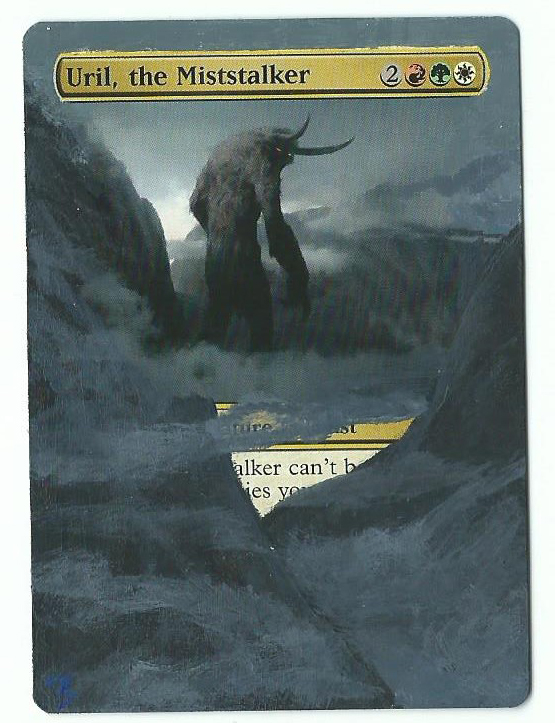
A classic Commander and a very popular alter. I've painted this card four times through various commissions
A classic Commander and a very popular alter. I've painted this card four times through various commissions.

Welcome to the Jungle: Mandrills in Modern

Are you a Quiet Speculation member?

If not, now is a perfect time to join up! Our powerful tools, breaking-news analysis, and exclusive Discord channel will make sure you stay up to date and ahead of the curve.

Editor’s Note: Jordan Boisvert took down the 5/24 Starcitygames Premier IQ in Worcester with an innovative take on Temur Delver. In this article, Jordan explains the deck, its history, its gameplay, and how you can take “Monkey Grow” to top 8 finishes of your own!

Remember playing Pokemon and casting multiple Bills in a turn? How about playing Yu-Gi-Oh! and chaining Pot of Greed into Graceful Charity? I sure do. There’s a reason I stopped playing these games and transitioned to Magic: the Gathering a decade ago, and that reason is resource management. This game has no sorceries that draw you cards for free; spells cost mana, of which Magic players have a finite amount. Beyond that, we only get one draw step, one land drop, and one combat phase per turn. We begin each game with 7 cards and 20 life. Magic requires players to manage these resources more than other card games, and the tempo archetype asks pilots to manage resources more closely than any other. It follows that just as Dredge players, who largely ignore resource management, “aren’t playing Magic,” tempo players experience the game in its purest expression. The tempo archetype has its roots in Merfolk and CounterSlivers, tribal aggro decks with a countermagic package. As the archetype evolved, decks started employing a few autonomous threats over an army of Lords.

Enter Alan Comer’s Miracle Grow, which combined green creatures with free countermagic, 10 lands, and a healthy number of cantrips. The principles Comer established with this deck influence every deck I design. It’s comforting to have in-deck answers to everything, even if it means closely budgeting resources (mana, time, life, cards, etc.) to move those answers from deck to hand. I also get a kick from attacking, and tempo decks rarely waste a Combat Phase. Here’s Mike Long’s deck from GP Sendai, brewed just a week after Comer went public with his own list:

Miracle Grow, by Mike Long (3rd, GP Sendai 2001)

Creatures

4 Quirion Dryad
4 Wild Mongrel
4 Werebear
2 Waterfront Bouncer

Sorceries

4 Sleight of hand
4 Land Grant

Instants

4 Brainstorm
2 Opt
4 Gush
4 Daze
4 Force of Will
2 Foil

Other

4 Curiosity
4 Winter Orb

Lands

4 Tropical Island
6 Island

Sideboard

4 Chill
4 Legacy's Allure
2 Phyrexian Furnace
2 Submerge
2 Hydroblast
1 Annul

Today, swinging with cheap, robust threats behind walls of blue Instants is best represented by Legacy’s Canadian Threshold, a Delver of Secrets deck with Nimble Mongoose and Lightning Bolt. I’ve always wanted to explore the archetype in Modern, but lacked the tools to do so prior to Khans of Tarkir. A certain 4/4 Ape filled the hole dug by Modern’s 8th Edition cutoff, leaving me with the deck I played to an 11-1 (in games: 24-6) finish at the SCG Worcester IQ:

Monkey Grow, by Jordan Boisvert (1st, SCG IQ Worcester 2015)

Creatures

4 Hooting Mandrills
4 Delver of Secrets
4 Tarmogoyf
2 Snapcaster Mage

Sorceries

4 Serum Visions
4 Gitaxian Probe

Instants

4 Thought Scour
4 Lightning Bolt
4 Disrupting Shoal
3 Stubborn Denial
3 Mana Leak
1 Simic Charm

Other

2 Curiosity

Lands

4 Misty Rainforest
4 Scalding Tarn
1 Wooded Foothills
2 Steam Vents
1 Breeding Pool
1 Stomping Ground
3 Island
1 Forest

Sideboard

4 Huntmaster of the Fells
3 Blood Moon
2 Destructive Revelry
2 Ancient Grudge
1 Simic Charm
1 Vapor Snag
1 Flashfreeze
1 Dismember

I’ve worked on this list for months and am confident the build is close to optimal. I’ll get to the card choices after describing the deck’s origins.

The Missing Link
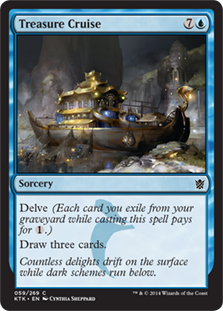
Treasure CruiseRUG Delver began its life in Modern as a tempo deck with a midrange plan B. It had significant success in 2012, its initial pro stint epitomized by Antonio De Rosa's 1st place finish at GP Turin. Some scattered finishes aside, the deck saw considerably less action after RTR, relegated to the format's fringes by BGx newcomers Abrupt Decay and Deathrite Shaman. Treasure Cruise heralded a promising return-to-form for the archetype, which finally forewent its midrange roots for a more singular tempo strategy. The infamous sorcery gave Delver a whopping 20% metagame share, and Immanuel Gerscenson took his own 1st place GP victory with RUG.

Wizards’s ensuing January bans put an end to the Cruising, spelling the end of Delver for many players. But the deck doesn’t need Treasure Cruise. Delver can pursue a tempo gameplan with another fantastic delve spell. To grasp the power of Hooting Mandrills, we must understand how Delver’s threats work together.
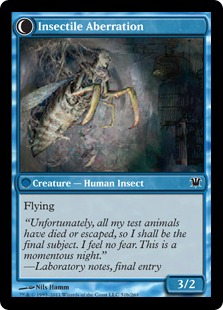
Insectile AberrationFew creatures promote a protect-the-queen strategy like Insectile Aberration. It steals games in a way Geist of Saint Traft or Goblin Rabblemaster, other classic tempo threats, can never hope to do. While these threats require you to spend cards clearing the ground, Delver simply flies over it, allowing you to eat damage while racing in the skies from the second turn onwards. Goyf also exemplifies the qualities of a blue-chip tempo threat, comfortably resolving before opponents represent their countermagic and ignoring most varieties of defense. While Delver’s evasion gets him through, Tarmogoyf leans on his massive bulk to deal damage; not many creatures can withstand a blow from the Lhurgoyf, allowing him to generate cards by eating defenders and to come in uninterrupted next turn.

Hooting Mandrills boasts the best of both worlds, outclassing most blockers and pushing through damage even when confronted. Trample makes him a fair bit better than either Tasigur, the Golden Fang or Gurmag Angler in tempo, since the strategy counts on squeezing in small bits of damage wherever possible to run away with a win.

My starting list ran 2 Tarfire, 2 Vapor Snag, and a second Foothills in the flex slots, and was otherwise identical to the one I played at the IQ. The deck seemed extremely powerful in testing, but I couldn’t beat a Siege Rhino. Mana Leak was a start, and Simic Charm mitigated the problem.

Monkey Grow Core

Creatures

4 Hooting Mandrills
4 Delver of Secrets
4 Tarmogoyf

Sorceries

4 Serum Visions
4 Gitaxian Probe

Instants

4 Thought Scour
4 Lightning Bolt
4 Disrupting Shoal
3 Stubborn Denial
3 Mana Leak

Lands

4 Misty Rainforest
4 Scalding Tarn
1 Wooded Foothills
2 Steam Vents
1 Breeding Pool
1 Stomping Ground
3 Island
1 Forest

This 55-card core only allots us 5 flex slots, but the high cantrip density ensures we’ll find our bullets when we need them. I ran 2 Snapcaster Mage, 2 Curiosity, and 1 Simic Charm in these slots for Worcester, anticipating a lot of Grixis Delver and some Abzan Midrange (our worst matchup). I wasn’t worried about anything else.

Card Choices

Creatures
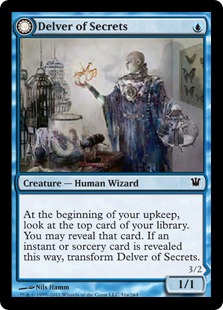
DelverDelver of Secrets: RUG Delver’s namesake for a reason. To quote Jeff Hoogland: "The reason to play Delver is free wins. Sometimes you play this little guy on turn one, he flips on turn two, and you ride the Aberration to victory. I’ve won a number of games while stuck on exactly one land because my Delver flipped the turn after I played him."

Tarmogoyf: Goyf was a mainstay in Delver decks before Delver even saw print. He’s the best stand-alone 2-drop in Modern and often demands multiple answers (i.e. two Bolts). In the words of mtgsalvation user Pizzap, "Strictly speaking Goyf dies to removal, but actually your removal is dying to Goyf."

Hooting Mandrills: One part Werebear, one part Nimble Mongoose. 4/4 isn't quite Shroud, but Mandrills dodges the ubiquitous Bolt and Decay. Tasigur and Angler outclass his stats, but trample brings him over the edge in tempo, and I can’t think of a fitter body for Curiosity.

Snapcaster Mage: Tiago’s infamous invitational card loves a shell like this one, recycling critical spells and providing an attacker. Thought Scour turns Snapcaster into an attacking Demonic Tutor, helping him cast the best Instant or Sorcery in the deck at a given time. I ran 1 for awhile and fit the second copy for an edge against Abzan.

Cantrips
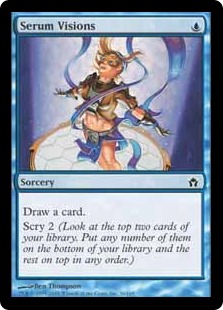
Serum VisionsSerum Visions: The worst of the best but the best we've got. How about some perspective? Before Ponder, Legacy Threshold lists complimented their Brainstorms with a set of these bad boys. Library manipulation is that powerful.

Gitaxian Probe: Flips Delver, fills the grave for Mandrills, squeezes value out of an early Snapcaster, clears the way for Curiosity, and Bolt-proofs Tarmogoyf. And all for a measly 2 life!

Thought Scour: Hyper-enables Mandrills and supports Goyf and Snapcaster.

Removal and permission

Lightning Bolt: Bolt is integral to Modern tempo decks since it’s more efficient and versatile than anything else in the format. Tempo always needs a specific tool to carry out its gameplan, explaining its reliance on cantrips. With its capability to either remove a creature or burn an opponent for one mana, Bolt embodies multiple tools in a single card at the lowest possible price. Early this season, the card wasn’t that good; January’s bans meant the rise of Abzan, and with it Tron on point duty. Now, Delver’s back, and with Collected Company picking up steam, Modern events are packed with juicy targets.
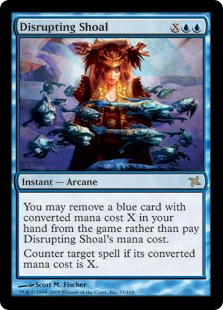
Disrupting ShoalDisrupting Shoal: Shoal does two things here. It allows the deck to play very aggressive game 1s, and it hoses the linear archetypes that define Modern. Turn 1 Delver, turn 2 Goyf in a deck without Shoal might get there, but it might also lose to Lightning Bolt and Terminate. Conversely, leading with Delver and Shoaling an opposing Hierarch can devastate opponents. Mana Leak hits everything with CMC 3+, since by the time those spells see the stack we should have a threat and some mana. Shoal also gives us an edge against Infect, Bloom Titan, Burn, Living End, Bogles, and others. Modern’s lack of catch-all answers like Force of Will allows these decks to shape the format. But while the linear decks attack from different angles, and often demand very specific sideboard answers (Ancient Grudge, Feed the Clan, etc.), they all rely heavily on one- and two-drops. This deck is full of one- and two-mana blue cards. We have Force of Will.

Mana Leak: Stronger than Remand in this build, which absolutely needs hard answers to meaningful disruption. There are only so many cards in our opponent’s deck that can deal with a second-turn 4/4 6-drop, and if we stop the ones they happen to draw, we’ll win.

Stubborn Denial: Force Spike mode already isn’t bad against opponents aiming to slam Liliana of the Veil or Karn, Liberated on-curve. With a fatty out, the card turns into one-mana Negate. That 50% price reduction means a lot in a deck requiring such diligent budgeting – Denial only asks that we summon a green guy, which we want to do anyway.

Utility
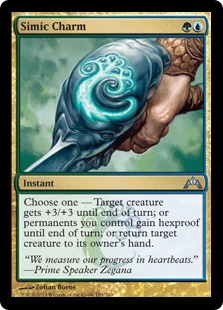
Simic CharmSimic Charm: The deck’s sleeper workhorse, Charm offers us three pertinent modes. Unsummon mode Time Walks opponents casting Wurmcoil Engine and Tasigur, removes tokens, and 2-for-1s Splinter Twin; Giant Growth wins ground wars and Lava Spikes opponents with an unblocked attacker; and Hexproof mode counters just about every removal spell, including Decay and even Molten Rain.

Curiosity: When I began testing for this summer’s Magic events, I wanted a fifth card type (artifact, enchantment, tribal, or planeswalker) to grow Goyf past Tasigurs, Anglers, and Rhinos. Thought Scour could generate extra value by “accidentally” milling these cards, but I still needed something appropriate for my low-curve, tempo-focused game plan. I started with Mishra's Bauble. It wasn’t bad in an opener and it didn’t make Delver much worse, adding variance to flips without compromising his flip percentage – we can sacrifice Bauble on our opponent’s turn and stack its “Draw a card” trigger before or after Delver checks the top card of our library to have two goes at flipping him. Still, I’d sometimes need an answer or a threat and draw a Bauble, forcing me to wait another turn. I wanted a card with mainboard applications in the Goyf mirror. Curiosity, a major player in Comer’s original Miracle Gro list, interested me since it can ruin Abzan’s primary plan of grinding out its opposition. It’s also decent elsewhere, as drawing an extra card each turn in a 17-land deck packed with counterspells and cantrips feels just as degenerate as it reads. The key to casting Curiosity is to wait for the perfect window. We don’t just slam it on our first threat and attack, because even if we draw a card before the threat dies – achieving card parity and Battlegrowthing the Goyfs of the future – we’ve lost an opportunity to Opportunity for U. Just as I support Denial with 8 Ferocious enablers, Insectile Aberration and Mandrills make 8 evasive bodies for Curiosity. We can also pitch unused Curiosities to Shoal.

I’ve seen some pros suggest Ior Ruin Expedition for this slot. That card costs 2 (probably tapping us out on the turn we’d rather commit a threat or hold up permission), requires us to make 2-3 additional land drops (bringing us at least to 4 lands, an unlikely event in game 1) and provides a decidedly lackluster return. Curiosity can steal the game; Ior Ruin Expedition is only valuable in a few situations and, when it works, doesn’t do much anyway. Tarfire does well over Curiosity in a Jund/Collected Company-heavy meta.

Sideboarding

The Monkey Grow sideboard is as vital to the deck as the main 60, containing a few pivotal packages and some meta-specific flex slots. It’s almost transformational, offering anywhere from 8 to 12 cards in most matchups. I’ll go over the sideboard, then I’ll cover what to board out.

The sideboard
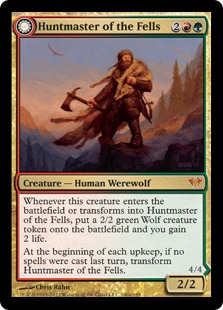
Huntmaster of the FellsHuntmaster package: Huntmaster of the Fells gives us a lot of breathing room against Abzan, but it’s not Abzan-specific; Huntmaster comes in against every fair deck. The Human Werewolf excels in blue decks, since flipping him back and forth is effortless between Snapcaster and a cantrip suite. He provides an immediate burst of value and takes over a game if unanswered, like some fusion of Snapcaster and Dark Confidant. Casting him off 17 lands isn’t tough thanks to our cantrips and the inherent grindiness of games 2 and 3, and Path to Exile inadvertently ramps us into him. To play Huntmaster effectively, we hold him until we can ensure resolution, then pour energy into transforming him constantly. I can see cutting his numbers should Modern divert from midrange.

Blood Moon package: I started with 2 Blood Moons and moved to 3 for some added punch against Abzan. A control card, Moon shines in a tempo shell. It usually plays like two-four Time Walks, slowing down opponents enough for Delver to go the distance. It also destroys some decks on its own, among them Abzan Midrange, Bloom Titan, and Bogles.
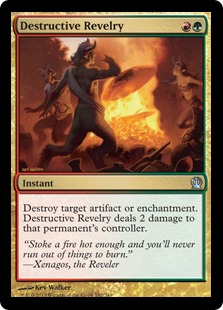
Destructive REvelryRevelry/Grudge package: Destructive Revelry efficiently answers problematic permanents while bringing opponents closer to 0 life. I wouldn’t want more than 2 in most matchups. Ancient Grudge needs less of an introduction, but it rarely comes in against non-Affinity decks. I’ve experimented with 1, 2, and 3 copies, and 2 seems like the sweet spot for this matchup.

Flex slots: Just to be clear about my Worcester list, I never wanted Vapor Snag in the 75. I was counting on StarCityGames having the last copy of Simic Charm for me on site, and they didn’t. I ran Dismember to kill Rhino, Tasigur, Angler, and Tarmogoyf, and to help out against random creatures like Knight of the Reliquary and Archangel of Thune. Flashfreeze obviously counters Siege Rhino, but it also came in against Mono-Green Stompy, Zoo, and Jund. Some other cards to run in the flex slots include Rough // Tumble, Feed the Clan, Pillar of Flame, Engineered Explosives, Vendilion Clique, Spellskite, and the 4th Stubborn Denial.

What to cut

Disrupting Shoal: I’ve clarified Shoal’s game 1 strengths – without it, opponents have an easier time trading with us 1-for-1. Post-board, we actually benefit from 1-for-1s by getting ahead on cards with Curiosity and Huntmaster. It’s just icing that opponents fear the Arcane Instant the rest of the match. At Worcester, I kept the Shoals against Affinity and Bloom Titan, and cut them in my other 10 rounds.

Thought Scour: When we’re trading cards with opponents, the graveyard fills up by itself. We also don’t need to cantrip as much since the interactive nature of post-board games gives us time to draw lands for Huntmaster. Scour stays in against decks that don’t give us a way to interact early on (i.e. Amulet Bloom, Tron).

Lightning Bolt: Close to useless against any deck without on-board targets. We want counterspells and threats for these matchups, not Lava Spike.

Gitaxian Probe: Perfect information is incredibly valuable. I only cut Probe against Burn.

Why Not Grixis?

The only Modern Delver lists putting up results lately splashes black for Tasigur and Angler. I currently don’t think the Grixis decks are as good as mine. A few reasons to play RUG instead:
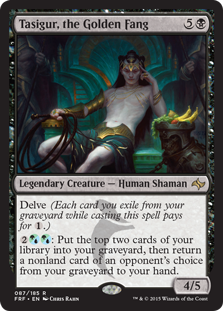
TasigurMandrills and Goyf over Tasigur and Angler: I’ve already discussed trample in Delver decks; the keyword beats an extra point of toughness, particularly assuming Simic Charm backup and the fact that Flame Slash has largely fallen off in favor of Dismember and Roast (thanks, Siege Rhino!). Black fatties aside, 4/4 still trumps most bodies in Modern. x/5 stats are mostly relevant against Siege Rhino decks, which stomp Grixis Delver anyway. Gaining a slight edge in a practically unwinnable matchup is not a valid reason to favor Tasigur over Mandrills, as RUG offers more in this department regardless with Huntmaster and Blood Moon to trump Abzan. Mandrills is also the color of money – Gurmag Angler is big, but it’s smaller than a 5/6 Tarmogoyf, which RUG Delver can be tuned to enable (as it was for Worcester).
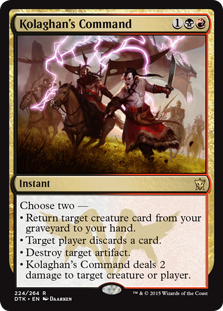
Kolaghans CommandHuntmaster of the Fells over Kolaghan’s Command: Both of these value spells give casters a boost in resource wars. Kolaghan's Command is cheaper, but in a grind, one extra mana doesn’t matter much. Command Shocks a troublesome creature, but an untouched Huntmaster machine-guns defending lines turn after turn while breeding an army of Wolves. Drawing Command gives Grixis players back their best creature that’s died this game, whereas drawing Huntmaster gives RUG players the best creature in their decks. He's already a two-for-one, at worst eating valuable removal and at best eating the whole game. It’s true that Huntmaster won’t kill artifacts, but RUG already alotts us the best artifact hate in the format (Ancient Grudge) as well as the most flexible and tempo-positive (Destructive Revelry).
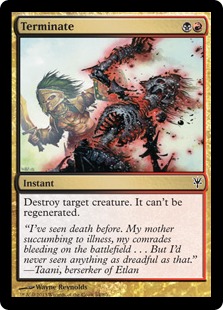
TerminateSimic Charm over Terminate: RUG will never get a card that kills as dispassionately as Terminate, but Grixis can only dream of a two-drop as dynamic as Simic Charm, which I posit provides a better effect in the Delver deck than even the pricier Kolaghan's Command. Charm may only remove creatures temporarily, but it also helps Mandrills trample over challengers, provides reach with an unblocked threat, and counters removal spells. Tempo decks need their cards to do many things at once. That's why we can't have Delver in non-red colors; Bolt is way too versatile and powerful to give up in this format. (Legacy has BUG Delver precisely because there are cards in that format that match Bolt's level of versatility and power in BUG colors, such as Deathrite, Daze, and Ponder). Terminate is very good at doing one thing, but it can't do anything else. We win the game on small margins. Killing the hell out of a creature is worse than delaying it a turn if it means giving up the plasticity of Simic Charm, especially when bouncing it for a turn often gets the job done.

Disrupting Shoal: Another thing Charm does is pitch to Disrupting Shoal. Grixis Delver can’t support the card, as it runs a good deal more nonblue cards than RUG, among them Young Pyromancer, Terminate, Kolaghan's Command, and Murderous Cut. Shoal helps us play an all-out tempo game, tapping out for threats on turns 1 and 2 without fearing opposing resistance.

Improved linear matchups: Shoal “fixes” all our linear matchups. Revelry trounces Bogles. Storm can’t beat Stubborn Denial. Grixis has Kolaghan's Command for Affinity, but RUG gets Grudge. The biggest upgrade comes with Burn. Grixis Delver lists have moved to Death's Shadow in the board to help out here, but we have a “mainboard” Shadow in Lhurgoyf form. Even Mandrills can force through some damage against Burn pilots aiming to chump lethal attacks and topdeck Boros Charm for your head. Huntmaster also plows Burn decks by clogging the board, removing creatures, gaining life, and trampling for lethal.

Grixis Delver’s primary upside is its ability to transition seamlessly into a midrange role. Electrolyze, Command, and Terminate all slot happily into this plan. On the other hand, this benefit weakens the deck’s tempo game. Grixis can also “go wide" with Young Pyromancer, something the Mandrill deck, in its current incarnation, cannot do. Monkey Grow could accommodate Pyromancer itself, but I prefer the creature suite of Delver/Goyf/Mandrills right now.

Matchups

To determine the deck’s matchups, I jammed dozens of hours weekly with the deck against skilled Modern players, constantly tweaking the 75 as I went. The results are by no means conclusive, but they’ve served me well during event preparation.

Favorable MUs
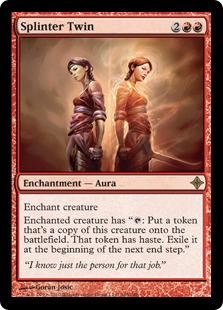
Splinter TwinSplinter Twin: Twin hates facing big green creatures. It’s trivial to slide a threat under Remand and Mana Leak, and our own Leaks love those three-mana Exarchs. Stubborn Denial nabs Cryptic Command or the second Bolt for our fatties. Simic Charm blows out the combo. Huntmasters from the board dominate the midrange mirror in game 2.

Infect: Good Infect pilots will recognize the times they need to pump their creatures, and we remove their threats either in response to these moves or when we’re sure they won’t have an answer (i.e. vs. a tapped out opponent during our Main Phase). Revelry/Grudge hits Wild Defiance and Inkmoth Nexus. Shoal counters every threat, and Moon keeps more from resolving.

Bloom Titan: Fast pressure and efficient disruption make a nightmarish combination for all combination decks. Curiosity keeps the counterspells flowing, and Blood Moon from the side entirely shuts Bloom Titan down.

GR Tron: Tron is built to crush midrange, so Delvers and Leaks naturally predate it. Goyf and Mandrills blank Pyroclasm. Our countermagic stops real cards like Karn and Oblivion Stone. Simic Charm keeps Tron off its Wurmcoils, and Moon from the sideboard slows it to a crawl.

Reasonable MUs
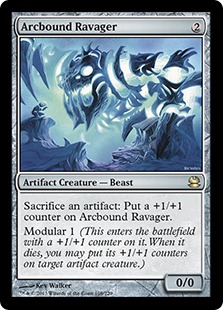
Arcbound RavagerAffinity: Game 1 asks us to race Affinity, which seldom works. Post-board we’re firmly midrange, cutting threats for disruption and keeping Affinity off its “money cards” (Arcbound Ravager, Steel Overseer, Master of Etherium, Cranial Plating). Insectile Aberration can play defense while we wait for Huntmaster.

Burn: Tarmogoyf and Hooting Mandrills wall Burn early on and become huge clocks when we draw a second creature. Post-board, they stabilize until Huntmaster takes over.

Jund: Much easier to defeat than its greedy cousin. Our Bolts actually do something in this matchup, and Confidant helps us in the damage race. Moon turns off manlands and complicates casting Liliana. Jund’s lack of beefy blockers like Siege Rhino lets Hooting Mandrills tear up the ground.

Grixis Delver: This matchup often devolves into a midrange grindfest, so Huntmaster pulls a lot of weight. Tasigur and Angler wall Mandrills, making Simic Charm very important.

Merfolk: Like all Aether Vial decks, Merfolk is great when it opens with one. Disrupting Shoal does a Mental Misstep impression in those situations, and the Revelry package post-board keeps the deck slow enough for Huntmaster to run it over.

Collected Melira: Without Collected Company or Chord of Calling, this deck is a bad aggro deck. Denial keeps these Instants from resolving, and Bolting mana dorks gives us time to find it. Our bodies outclass theirs, but CoCo can run us over if it gets going, so we mainly want threats and counterspells in this matchup.

Bad MUs

siege rhinoAbzan Midrange: A nightmare. Every card in the deck stomps us. Huntmaster’s a hard-to-remove body that generates card advantage, but if Abzan players find their removal spell, we’re back on defense. Getting lucky with Blood Moon is our best shot.

Naya Zoo: Zoo out-aggresses the Delver deck while pointing its ample removal at our outnumbered threats. Huntmaster and Tarmogoyf are paramount to survival, and Revelries come in to answer Choke. Naya Zoo is the only deck I lost to at the Modern IQ.

How to Play

Despite the deck’s obvious gameplan, playing Monkey Grow is extremely challenging. Its wealth of one-mana spells gives pilots a huge amount of potential plays each turn and greatly rewards those who dedicate energy to learning the lines. There are far too many playlines to explain in one article, but I’ll list a few to get prospective Monkey Grow players started.
Thought ScourDon’t always cantrip. A few reasons to hold them in your hand include transforming Ravager of the Fells back into Huntmaster, having a card to exile to Disrupting Shoal, gaining additional info from Gitaxian Probe, digging for a specific answer with scry after your opponent presents a certain threat, and waiting to mess up up your opponent’s scry with Thought Scour. As a rule, if you have other things to do with your mana and like your hand and board positioning, don’t cantrip.

If you’re going to cantrip this turn, do so pre-combat. You may draw Curiosity. This strategy also protects your threats; if you smell a Terminate and have a Shoal in hand, you can cantrip before attacking to dig for a two-drop. If you won’t have mana for Curiosity, wait until the latest possible time to cantrip – after combat, or on your opponent’s end step in Scour’s case. Waiting gives away less information about your lines and represents tricks like Denial.

Effectively sequence your threats. You generally lead with Tarmo, since Mandrills is best when he costs only G and doesn’t cannibalize the Lhurgoyf. Still, if Goyf won’t top 2/3 or even 3/4 until turn 4, maybe you lead with Mandrills to turn on Denial. Ask yourself how the next few turns will play out and decide which creature you’d rather have in play each turn. Plan your mana spending accordingly, and turns in advance.
Lightning BoltCount your on-board damage and pay attention to your opponent’s. Consider your options, and his, for getting in extra points with reach. Learn when to start pointing those Lightning Bolts at your opponent’s head – Mike Flores’s stellar article “The Philosophy of Fire” might help.

Pace your most versatile cards. With a Delver on the table, do you cast Simic Charm, Mana Leak, or Snap-Stubborn to counter your tapped out opponent’s Forked Bolt? If you expect Abrupt Decay, you might want to save Charm. If Probe showed you Keranos, you may keep the Mana Leak. If your opponent has an empty board, cementing your advantage with Snapcaster Mage might justify losing an answer to Dismember. Keep in mind the most important cards in a given matchup and sequence your permission and utility to give yourself the most options down the road.

Going Forward with Hooting Mandrills

With Abzan Midrange on the decline and Jund picking up steam, Monkey Grow is even better positioned than it was at the IQ. I’d definitely run a third Simic Charm in the sideboard and would like the full set in exchange for Dismember or Flashfreeze. As long as Modern teems with linear aggro and combo strategies, the build will remain a dangerous competitor.

Miracle Grow reinvented resource management. Deckbuilders applied its groundbreaking principles across formats, culminating in decks as potent as Gro-A-Tog and Canadian Threshold. Card velocity machines designed to extract maximal value from limited resources, the decks all share a steep learning curve and promise success to their best pilots. Those who give Monkey Grow the hours it deserves, committing time and patience to discovering its many intricacies, will find themselves among the first to experience the timeless strategy’s explosive power in Modern.


Jordan Boisvert

Jordan is Assistant Director of Content at Quiet Speculation and a longtime contributor to Modern Nexus. Best known for his innovations in Temur Delver and Colorless Eldrazi, Jordan favors highly reversible aggro-control decks and is always striving to embrace his biases when playing or brewing.

View More By Jordan Boisvert

Posted in Modern, Tech, TournamentsTagged , , 16 Comments on Welcome to the Jungle: Mandrills in Modern

Have you joined the Quiet Speculation Discord?

If you haven't, you're leaving value on the table! Join our community of experts, enthusiasts, entertainers, and educators and enjoy exclusive podcasts, questions asked and answered, trades, sales, and everything else Discord has to offer.

Want to create content with Quiet Speculation?

All you need to succeed is a passion for Magic: The Gathering, and the ability to write coherently. Share your knowledge of MTG and how you leverage it to win games, get value from your cards – or even turn a profit.

Insider: Time to Move on Modern

Are you a Quiet Speculation member?

If not, now is a perfect time to join up! Our powerful tools, breaking-news analysis, and exclusive Discord channel will make sure you stay up to date and ahead of the curve.

With the release of Modern Masters 2015, many were hopeful for a cheaper barrier to entry into the Modern format. Some speculated things as wild as $100 Tarmogoyfs. Reality has set in, and while most regular rares have dropped in value, we're back to expecting rising prices for the Modern format.

There was an error retrieving a chart for Tarmogoyf

Aggressive retailers have kept cheap copies off the market with high buylist prices, and now that we've passed Modern weekend we can expect additional supply to have a minimal impact on the market. Further, non-Modern Masters singles have made significant gains in the short term, which we can expect to stick unless a real threat of reprint looms, which could be as far off as 2017 for a card like Blood Moon. If you're looking to play those, I sure hope that you've already invested in a set.

There was an error retrieving a chart for Blood Moon

Even Standard-legal Modern cards are spiking. Everybody is already aware that we can expect little if any dip in price on Thoughtseize and fetchlands when they rotate, but the recent spike in Kolaghan's Command came sooner than I would have predicted.

There was an error retrieving a chart for Kolaghan's Command

Today marks the first SCG Invitational featuring the Modern format, and as such we can expect demand to be generated by well performing cards. The upcoming change to PPTQs which will now feature Modern seasons will also serve to increase demand. There are still a number of underpriced cards in Modern, though the window to profitably act on them is closing.

There was an error retrieving a chart for Dark Confidant

Bob hasn't been hot for a while, but that's changing. GerryT is only one of a number of pros taking the position that Jund is the best version of The Rock in Modern right now. Bob saw a dip with an MM2 reprint, but the card is about to see a real increase in demand. Especially if Gerry spikes Columbus with the Jund deck he's been streaming. The buyin is high, but the potential is definitely there.

There was an error retrieving a chart for Abrupt Decay

Speaking of The Rock, Abrupt Decay has been slowly creeping up in value, to the surprise of no one. I could definitely see this being reprinted in some kind of Modern supplementary product, so I'm not sure how much I like this as a spec.

That said, it will only gain value until such a thing happens. If you expect to play The Rock in Modern anytime soon and you're short a set, get these now.

There was an error retrieving a chart for Noble Hierarch

Here's a card that saw a dip with its reprint like Bob, but unlike Bob was more relevant before its reprinting. With Abzan and Infect still being very real decks, now is a great time to move in on Hierarchs. They're still expensive, but as we all have seen there is plenty of room to grow.

There was an error retrieving a chart for Spell Snare

Snapcaster Mage is the best card in Modern. You might disagree with the absolute nature of this statement, but you're delusional if you can't see that Tiago is of a very high power level and is a card that wins games.

Snapcaster's power is one of many reasons that Spell Snare is so great right now. It hits Snaps, Goyf, Bob, Eidolon of the Great Revel, and many other format staples. And it happens to pair very well with your own Snapcasters. I am playing four of these in Columbus, and I can't imagine that I'll be the only one.

There was an error retrieving a chart for Tasigur, the Golden Fang

Tasigur is awesome, and shortly after release commanded a ten-dollar price tag. The price has declined since then, but with Modern being in the limelight and less Fate Reforged being opened than ever I expect the price here to take off.

Dodging Abrupt Decay and Lightning Bolt while still functionally costing one is just absurd, and the biggest threat to Tasigur's price ceiling would be a Modern banning. I don't see this as a realistic option and I strongly recommend moving in on Tasigur.

There was an error retrieving a chart for Thought Scour

And then there's the card that enables turn-two Tasigurs. If something as bad as Mishra's Bauble can spike for being "good with delve," then why can't we see a slight price bump in a card that's a four-of in the Delver deck starting to be considered by some as the best deck in Modern?

It already buylists for a quarter, and I assure you that plenty of copies can be found for that or less. Acquire every copy you can. This card is great and can easily be moved for $1 on tournament floors.

~

My best advice for speculating on Modern is to pay lots of attention this weekend. You can rest assured that we will see a spike or two. From there it's only a matter of finding out what will logically spike next. There's still plenty of money to be made on Modern staples. It's only a matter of time.

Thanks for reading.

-Ryan Overturf
@RyanOverdrive on Twitter

Changes at Modern Nexus

Are you a Quiet Speculation member?

If not, now is a perfect time to join up! Our powerful tools, breaking-news analysis, and exclusive Discord channel will make sure you stay up to date and ahead of the curve.

Hello Nexus readers and Modern community!

As many of you have probably noticed, it's later in the day and no article has been published yet. We recently underwent some staff transitions and today was the day to get things switched over and make sure the transition went smoothly. As Sean announced yesterday on Facebook and Twitter, he is stepping down from the Editor in Chief position. You can read more about his decision there, but I wanted to speak to this on my end and on how it affects our site going forward. I am a big believer in transparency and open communication, and I want that reflected in how we interact with our readers.

Torchling ArtSean was instrumental to starting up Modern Nexus and he has worked hard to get us where we are now. Our articles were great complements to each other and that brought the site a unique perspective. But as the site has been shifting to more spike-oriented Modern content, it became clear that our overall plan and leadership needed to shift as well. In that spirit, I will be be the site's Editor in Chief going ahead. Sean will definitely be missed: he's the rare brewer who balances creativity with competitiveness, and it's been a joy to work with him and read his work. Without him, I would still just be lingering around the forums and Modern Nexus would still just be a dream.

[wp_ad_camp_1]


What does this mean for content going ahead? Here are some shorter and longer term goals you can expect from in the future:

  • More in-depth analysis of competitive decks, cards, and strategy
    How are you supposed to beat Twin decks? What sideboard cards should you never leave home without? What are the key interactions you need to know in the Burn vs. Jund matchup? How the heck do you even play Amulet? We're redoubling our focus on questions and topics like this, so look for lots of competition-level content in the weeks and months to come.
  • More statistical analysis and format evaluation
    We've gotten a lot of feedback on our data and stats articles, and they are some of the strongest parts of our site. We will keep bringing you this content, with regular checkins on our different analyses, discussions of why data matters, and general commentary on Modern format statistics.
  • More contributors with tournament and competitive experience
    As part of our shift towards competitive content, you can be sure that the site will be expanding to include contributors from across the tournament spectrum. There will be an announcement about this soon, so keep your eyes open for ways to get your work and Modern experience out there.
  • More volunteer opportunities
    I get lots of emails from users who want to help out the site in different ways but don't necessarily want to write. Going forward, we will have more opportunities for these community members to add value to the site and to contribute to the broader Modern community.
  • Don't forget the brews!
    Just because we are doubling down on competitive content, doesn't mean we are leaving brews in the dust. My favorite decks are actually tier 5 trainwrecks, so you can expect to see about an article a week focusing on some underplayed decks, brewing concepts, and inspirational cards.

Guardians PledgeI'm very excited to continue working on the site and providing the quality content you have come to expect of Modern Nexus. If you have any feedback, ideas, criticisms, suggestions, or just want to chat about Modern, feel free to email me at sheridan@quietspeculation.com. Thanks for all your support and I'm looking forward to all the exciting Modern content and coverage to come! And don't think you've seen the last of Sean. He'll definitely be back with some more decks, videos, and articles at some time in the future.

-Sheridan Lardner
Modern Nexus Editor in Chief


Editor's note: edited a sentence on brews because it was unclear about how frequently such articles might be run. 

Insider: Modern Metagame Update

Are you a Quiet Speculation member?

If not, now is a perfect time to join up! Our powerful tools, breaking-news analysis, and exclusive Discord channel will make sure you stay up to date and ahead of the curve.

Welcome, fellow Magic players, to this week’s episode of the Modern Metagame Update. A couple of months ago, we had Birthing Pod and Treasure Cruise on the show to talk about their recent bannings.

While they were distraught about not being able to play in the format any longer, their early retirement came as no surprise. Rumors were going around that some all-stars were coming out of retirement to see if they could put up a good fight, but those proved to be false. Here’s what they had to say.

Treasure Cruise said, “Well my boy, it seems like I barely got started before they were telling me I was too good. I thought players just wanted to have fun. My cruises are the best in the business, old chap. I have no regrets.”

Birthing Pod followed up with, “It’s been a good run. I’ve helped a lot of players start their careers off on the right foot. As I always say, a good tutor is the best way to find success."

Dig Through Time added in, “I couldn’t believe it! I was shocked to see my name come up. I was just minding my own business helping an underperforming deck succeed and they came along and ripped everything I had away almost before I had even gotten started. We could have had something.”

In the wake of these changes to the format, many players were also struck by the bannings and took some time off to play other formats. Local news said that Modern events stopped firing for a while as players recovered from their decks being unplayable.

Then along came the young challenger, Collected Company. Today on the show we’ll be talking decks to beat and first up is Mr. Collected Company himself. Take a quick look over his first success story and then we’ll be back for an interview.

Abzan Company

Creatures

4 Birds of Paradise
2 Viscera Seer
3 Wall of Roots
3 Voice of Resurgence
2 Anafenza, Kin-Tree Spirit
4 Kitchen Finks
4 Eternal Witness
1 Melira, Sylvok Outcast
1 Spellskite
1 Scavenging Ooze
1 Fiend Hunter
1 Murderous Redcap

Spells

2 Abrupt Decay
4 Chord of Calling
4 Collected Company

Lands

4 Windswept Heath
4 Verdant Catacombs
2 Temple Garden
1 Godless Shrine
1 Overgrown Tomb
4 Razorverge Thicket
2 Gavony Township
2 Forest
1 Plains
1 Swamp

Sideboard

1 Spellskite
1 Scavenging Ooze
2 Dromoka's Command
3 Thoughtseize
2 Path to Exile
1 Sin Collector
1 Orzhov Pontiff
1 Kataki, War's Wage
1 Ethersworn Canonist
1 Aven Mindcensor
1 Qasali Pridemage

Mr. Company had this to say when we spoke to him, “Yeah everyone thought I was just a casual kid favorite, but I told them I had real potential. Now, everyone knows I belong at the forefront of Standard.

"I’m not happy with just Standard though, you know? I want more for myself. I want to really live it up for my whole career and the best way to do that is to get a foot into Modern now. Not a lot of players are respecting me, but respect is earned you know? I’ve been helping out those poor folks who lost their Birthing Pod teammate, but I’m not stopping there. I’m trying to help out Elves, Naya, and who knows, maybe I’ll even pop up somewhere else.

"For now, I’m trying to focus on this Abzan team because I think they are my best shot to victory. I’ve already had some initial success but we’re still working out the kinks.”

Grixis Twin

Creatures

3 Snapcaster Mage
4 Deciever Exarch
2 Pestermite
2 Tasigur, the Golden Fang

Spells

4 Serum Visions
4 Lightning Bolt
2 Thoughtseize
2 Spell Snare
1 Dispel
2 Terminate
1 Kolaghan's Command
1 Electrolyze
2 Cryptic Command
4 Splinter Twin

Lands

4 Polluted Delta
3 Scalding Tarn
1 Bloodstained Mire
2 Steam Vents
1 Watery Grave
1 Blood Crypt
3 Sulfur Falls
1 Desolate Lighthouse
4 Island

Sideboard

1 Kolaghan's Command
2 Dispel
1 Shatterstorm
1 Keranos, God of Storms
1 Murderous Cut
1 Rending Volley
1 Negate
1 Thundermaw Hellkite
1 Batterskull
1 Spellskite
2 Engineered Explosives
1 Vedalken Shackles
1 Jace, Architect of Thought

Next up we have Ms. Splinter Twin. She’s been the belle of the ball for quite some time, but will she ever settle down? There are rumors about you seeing a new guy, any comment?

“I’ve been hanging around with that fella in the blue and red for a while now and everyone knows about our relationship, but we decided to just be friends. We’ll hang out from time to time, but nothing serious. As far as your question about Mr. Grixis, yes, it’s true, I’ll finally admit it. I’ve been seeing him for some time now in secret, but I think the cat’s out of the bag now. Some people still don’t know about us, but I want the world to know were together and we’re going to do great things together!”

You heard it here first folks, Grixis and Twin are officially together!

G/R Tron

Creatures

3 Wurmcoil Engine
1 Ulamog, the Infinite Gyre
1 Emrakul, the Aeons Torn

Spells

4 Expedition Map
4 Chromatic Star
4 Chromatic Sphere
2 Relic of Progenitus
4 Ancient Stirrings
4 Sylvan Scrying
3 Pyroclasm
4 Oblivion Stone
4 Karn Liberated
2 Ugin, the Spirit Dragon

Lands

4 Urza's Tower
4 Urza's Mine
4 Urza's Power Plant
4 Grove of the Burnwillows
2 Ghost Quarter
1 Eye of Ugin
1 Forest

Sideboard

1 Pyroclasm
1 Feed the Clan
3 Rending Volley
4 Nature's Claim
2 Spellskite
1 Sundering Titan
1 Witchbane Orb
2 Boil

I’m honored to bring you an interview with our grizzled veteran. Tron, how are you today? The biggest question on everyone’s mind is will you finally break through into the big leagues? You’ve been around for a while now, but we haven’t seen much from you. There are a lot of dedicated fans out there though and despite your lack of results, players still stick by you.

“I’m Tron the Great. No one is going to get me down and if I get knocked down, I’ll get back up again. I have a lot of tutors and I’m always consistent. Many of my fans think that this is my time and I’m going to prove it to them. They’ve been loyal to me and I’m going to bring them a championship!”

There you have it. Tron says, this is his time. Some players think Tron’s time will never come, while others think that his time is now. We’d like to hear from our viewers on this one. Post in the comments and let us know. Are you true supporter, or do you think Tron should sit the bench?

Jund

Creatures

4 Dark Confidant
4 Tarmogoyf
3 Scavenging Ooze
2 Olivia Voldaren
1 Tasigur, the Golden Fang

Spells

4 Inquisition of Kozilek
2 Thoughtseize
4 Lightning Bolt
3 Terminate
3 Abrupt Decay
1 Maelstrom Pulse
1 Kolaghan's Command
4 Liliana of the Veil

Lands

4 Verdant Catacombs
3 Bloodstained Mire
2 Wooded Foothills
2 Overgrown Tomb
1 Blood Crypt
1 Stomping Ground
4 Blackcleave Cliffs
2 Raging Ravine
2 Swamp

Sideboard

2 Anger of the Gods
1 Night of Souls' Betrayal
2 Feed the Clan
1 Ancient Grudge
2 Choke
2 Fulminator Mage
1 Batterskull
2 Duress

We barely managed an interview with Junk as he stormed away from reporters. Here’s what the irritated competitor had to say.

“What. Yeah I changed my image, so what? This is who I really am. Sure I’m still me, I have all my normal components and I’m just getting back to who I really am. I may have changed my name and colors to Jund, but that’s me. Junk was just me trying out a new image. Jund is who I really am. You’ll see.”

What do you the viewers think? Should he stick to his current image Junk? Or get back to his Jund roots? Initial reports are that Jund will stick this time, but only time will tell.

Temur Delver

Creatures

4 Delver of Secrets
4 Tarmogoyf
2 Snapcaster Mage
4 Hooting Mandrills

Spells

4 Gitaxian Probe
4 Serum Visions
4 Thought Scour
4 Lightning Bolt
3 Stubborn Denial
3 Mana Leak
4 Disrupting Shoal
1 Simic Charm
2 Curiosity

Lands

4 Scalding Tarn
4 Misty Rainforest
1 Wooded Foothills
2 Steam Vents
1 Breeding Pool
1 Stomping Ground
3 Island
1 Forest

Sideboard

1 Simic Charm
1 Dismember
4 Huntmaster of the Fells
3 Blood Moon
2 Ancient Grudge
1 Vapor Snag
1 Flashfreeze
2 Destructive Revelry

Finally, our last interview today is with Temur Delver. This kid is new to the scene but with how many supporters his dad has in Legacy, players are definitely throwing their support with him quickly. Temur Delver, how are you adapting to life in the big leagues?

“Hey, let’s get one thing straight. My dad may be a big deal from time to time in Legacy, but Modern is my format and I’m going to take what’s mine. They say that Tasigur, the Golden Fang is too much for my Hooting Mandrills, but did you see how many spells I can counter? And you know what? If they resolve one, maybe I’ll just start Vapor Snagging his butt back to the bench.

"The best part is the punch they never see coming. I sneak Huntmaster of the Fells back in the game after sideboarding and they never know what hit them. Did I mention I have Delver of Secrets too!? Yeah that’s right. He may be underappreciated right now, but he’s ready to help us out and get back to the big time at tier one."

We tried to continue the interview, but Temur Delver threw the mic down and stormed off shouting about how he was going to show everyone what’s up. We wanted to ask him about his interesting teammates Simic Charm and Curiosity, but he was unavailable for comment. So, are they a thing of the past? Should Temur Delver just stick to Legacy and stay out of Modern? When we get more info on this, you’ll be the first to know.

So, Modern fans, that’s our show. Until next time, this has been the Modern Metagame Update.

Summary

For those of you just interested in a less flavorful summary, here’s the short version for you. I talked about Abzan Company first and it being the new deck to watch out for in the format. It seems underrated despite putting up consistent numbers. This is most likely due to the fact that the past few months have not highlighted any big events for Modern. This weekend with the Invitational and Open having some Modern coverage, that is likely to change. If Abzan Company gets a lot of air time and/or Top 8’s the event, expect lots of players to switch to Podless decks using the new Dragons of Tarkir card.

I’ve been helping some friends prep for the Invitational this weekend and at the top of our gauntlet is Grixis Twin. From testing, the deck seems extremely strong, maybe even the best thing you can be doing in the format. Most of the decks we’ve thrown at it have been left in the dust.

I thought Kolaghan's Command was a neat new card that might be a little helpful, but is has proved a potent weapon that is staggeringly good. I would start trading for these immediately, especially foil versions because this card isn’t going anywhere but up. Expect this deck to have a good showing this weekend, maybe even winning the event, so if you want on board, get on now before the results start pouring in.

G/R Tron has definitely been around since the beginning of the format. When you can get lots of mana early in the game, players will always try to utilize that route to victory. This deck definitely does have some good matchups but I think once more players start playing Collected Company and Grixis Twin, Tron players will back down.

Tron is great when you are fighting against Junk all day, but some of these other decks have a hard time losing to this deck. One thing to be said for this deck is that the matchups where you are favored feel like such easy wins, but the ones where you are the underdog feel unwinnable. The sideboard helps, but only so much.

Don’t skimp on lifegain or Rending Volley either. If you’re planning on playing Tron, I would suggest updating the sideboard from the deck I posted. That deck may have done well, but the sideboard needs to be changed according to where the meta is headed.

On the Junk vs. Jund front, Jund seems to be not only the winner in the semi-mirror, but also better positioned in the meta. I know from my testing, Junk always felt a little clunky against these new current decks. While they are quite similar, I think you want the efficiency of Lightning Bolt and the new options of Kolaghan's Command. Any of the modes combined with getting back your Tarmogoyf are insane and the deck might need a second copy of the card maindeck.

Temur Delver is in an interesting spot right now. On the one hand, draws where you sequence Delver of Secrets into a bunch of Counterspells, makes the deck seem as dominant as it once was, but other draws where you are filling your graveyard so you can cast Hooting Mandrills while your opponent has any of their 4/5’s seems like you won’t be able to win many games.

This is on my decks-to-test list, but there have been higher priorities. It’s possible that this deck just wants to swap out the Mandrill plan for Young Pyromancer and/or go Grixis instead of Temur. The deck is interesting though and if you are playing Modern, I would expect to face off against some type of Delver deck. This is just the latest iteration.

When preparing for Modern, there are so many viable archetypes that it can be difficult to get an accurate picture of the metagame. Make sure you test against the most common matchups and try to also prepare for some others that may come up.

My current gauntlet has these decks in it: Abzan Company, G/R Tron, Jund, Junk, Grixis Twin, Affinity and Burn. I want to add Grixis Delver and/or Temur Delver. Those decks are just scrapping the surface of playablity in the format though.

Whatever deck you are going to play, know it well and know how you plan to sideboard in a plethora of matches. The best thing you can do for yourself is play against a bunch of archetypes and watch others play them as well.

Until next time,
Unleash the Force!

Mike Lanigan
MtgJedi on Twitter
Jedicouncilman23@gmail.com

A Different Way to Draft Fish

Are you a Quiet Speculation member?

If not, now is a perfect time to join up! Our powerful tools, breaking-news analysis, and exclusive Discord channel will make sure you stay up to date and ahead of the curve.

Modern Masters weekend featured a lot of Magic, and in turn, a lot of coverage. There are probably very few people who have seen all of the coverage, and some parts were certainly more entertaining than others. Yesterday somebody told me about a particularly good comedy feature from the weekend that I just got around to watching and I highly recommend.

If you're interested in watching world-class player Shouta Yasooka draft sushi, then you've come to the right place.

Nathan Holt's content is also usually very strong, though sushi draft stole the show for me here. 11 minutes might be a little long for the sketch, but the first few minutes are very enjoyable, and moments like this help make large events truly special.

Avatar photo

Ryan Overturf

Ryan has been playing Magic since Legions and playing competitively since Lorwyn. While he fancies himself a Legacy specialist, you'll always find him with strong opinions on every constructed format.

View More By Ryan Overturf

Posted in FreeLeave a Comment on A Different Way to Draft Fish

Have you joined the Quiet Speculation Discord?

If you haven't, you're leaving value on the table! Join our community of experts, enthusiasts, entertainers, and educators and enjoy exclusive podcasts, questions asked and answered, trades, sales, and everything else Discord has to offer.

Want to create content with Quiet Speculation?

All you need to succeed is a passion for Magic: The Gathering, and the ability to write coherently. Share your knowledge of MTG and how you leverage it to win games, get value from your cards – or even turn a profit.

Want Prices?

Browse thousands of prices with the first and most comprehensive MTG Finance tool around.


Trader Tools lists both buylist and retail prices for every MTG card, going back a decade.

Quiet Speculation