
menu

Why You Should Play With Robots in Modern

Are you a Quiet Speculation member?

If not, now is a perfect time to join up! Our powerful tools, breaking-news analysis, and exclusive Discord channel will make sure you stay up to date and ahead of the curve.

For whatever reason, at some point in my lifetime a great deal of nerds have convinced themselves that eventually zombies will rise to end humanity. Perhaps 28 Days Later is just more compelling, but maybe we've all just forgotten about The Terminator. While both concepts are pretty wild, I find the idea of a robot uprising both more likely and more terrifying than one of zombies. Robots tend to be more impervious to guns while also wielding some of their own. Murder machines are just more intimidating than dead guys.

And that brings me to Arcbound Ravager. Every time one of these resolves I can't fight this unshakable feeling that that guy is going to kill me. When that beast of a robot sits beside Etched Champion, suddenly I feel completely powerless.

[cardimage cardname='Arcbound Ravager'] [cardimage cardname='Etched Champion']

I've been trying a lot of different Modern decks, and I've consistently found myself being a dog to the best draws from our robot overlords. Even still, it wasn't until I saw the results of GP Richmond that I even considered playing the deck. Two copies of the deck made it to the top 8 of the largest constructed GP to date, but it wasn't even that statistic that caught my attention. It was Mike Sigrist's player profile that made me think twice.

What deck are you playing, and why?
Affinity. It loses to cards, not decks.

At first glance, I was focused on the statement that the deck loses to cards. I inferred from this statement that against hate cards, the deck will just lose. Then I took a step back and thought more on the first part of the idea.

Affinity doesn't lose to decks.

The implication here, is that Affinity in Modern has the same place in the metagame that Dredge has in Legacy, Vintage, or old Extended. That is, the deck should win the overwhelming majority of game ones, and will have a bit of trouble against dedicated sideboards.

In terms of assessing what this actually means, the two important questions are;
1) How true is it that Affinity is heavily favored in game one against everything?
2) How dead is Affinity to sideboard hate?

Now, if I were happy with any of the Modern decks I'd been trying, I likely wouldn't be exploring these questions, but as things have played out the decks that I've been trying lately have been failing on the "being dead to hate" test. Specifically, Relic of Progenitus and Deathmark were embarrassing my Wild Nacatl deck and Electrolyze, Anger of the Gods and Leyline of Sanctity were embarrassing my Grixis deck. This combined with the fact that I knew somebody who for some reason owns four Mox Opal on MTGO (Thanks, Dana!) left me willing to give robots a try.

I've been using Frank Karsten's analysis of the deck as well as the comments on his articles as a starting point for sculpting a 75.

Currently, I'm sitting on this:

Robots

spells

4 Arcbound Ravager
4 Steel Overseer
4 Ornithopter
3 Memnite
2 Master of Etherium
2 Etched Champion
4 Vault Skirge
4 Signal Pest
4 Mox Opal
3 Springleaf Drum
1 Welding Jar
2 Thoughtcast
2 Galvanic Blast
4 Cranial Plating

lands

4 Glimmervoid
4 Blinkmoth Nexus
4 Inkmoth Nexus
4 Darksteel Citadel
1 Island

sideboard

1 Rule of Law
3 Thoughtseize
1 Dismember
2 Ancient Grudge
1 Relic of Progenitus
1 Grafdigger's Cage
2 Spellskite
1 Etched Champion
1 Illness in the Ranks
1 Whipflare
1 Torpor Orb

I've played a handful of 8-man and 2-man queues thus far, and I must say that game one against nearly everything does, in fact, feel very good. You'll generally lose to a combo hand that can win on turn 3 or 4, but outside of that your cards will generally hit harder than theirs pre-board and you have access to Thoughtcast, which is the most-efficient form of card advantage in the format. Your bad hands are definitely worse than the bad hands of most decks, but you tend to mulligan better than other decks.

If testing continues the way that it has, then I'll be sold on Affinity being "Modern's Dredge". The question then, is how badly does this deck get wrecked by hate? The short answer is that it depends. There are quite a few options for players to use to hose affinity.

It's pretty comical how good these cards can be against you. Deathmark was really frustrating for my Wild Nacatl deck, and the analog to that card with flashback is actually the least troublesome item on this list. Things don't sound very good, but in testing they've have gone much better than I had originally thought. Mulligaining, piloting and sideboarding correctly are key to overcoming this hate.

Vs. Ancient Grudge

Ancient Grudge can be frustrating, but at the end of the day it's only

Vs. Creeping Corrosion, Shatterstorm and Shattering Spree

The long and short of it is that you bring in Thoughtseize and Spell Pierce if you have it, and hope. When you suspect that your opponent has any of these you need to determine whether you can reset after having your board wiped or if you just have to bet against them drawing it. Minimally, I'd advise against running out two Cranial Platings against opponent's with these cards.

Vs. Stony Silence

So, there's good and bad news here. The good news is that Stony Silence does nothing in multiples, so most opponents won't have more than one or two. The bad new is that if they have it early you sometimes just can't win. Occasionally you can win games if your opponent keeps a hand strictly on the basis that it has Stony Silence in it and doesn't have enough pressure to race Memnite beats. Typically you just need to hope to Thoughtseize it or that they draw it late or not at all.

Some people are inclined to sideboard enchantment hate as an answer to Stony Silence, but that's an extremely dicey plan. For starters, Stony Silence turns off all of your non-Glimmervoid mana sources for casting enchantment hate, which means that if you're playing around SS and don't have Glimmervoid you'll need to leave Springleaf Drum or Mox Opal untapped all game, which is very bad for your tempo. You may as well just play Thoughtseize, tap that mana once and if they have it you hit it and if they don't you disrupt them otherwise, which strikes me as a much higher upside. Additionally, if you draw your enchantment hate and the SS never comes then you have functionally mulligained. Bigger downside, smaller upside. Hard pass.

Vs. Kataki

Kataki isn't as good against Affinity as Stony Silence, so you'll typically only see this one out of Pod decks. They'll probably only have one copy, but with Birthing Pod and Chord of Calling they don't have much trouble finding it. Unless you see a better use for Galvanic Blast, which there sometimes can be, I advise leaving a red mana open so that this guy never lives to your turn. Ravager can also mitigate the damage from Kataki by eating your other artifacts, but removal is definitely the A plan.

Vs. No Hate

And then sometimes your opponent just doesn't have anything for you. This can either be because they're as fast as you or because they want to lose. Even the combo decks tend to have something though, so don't expect to see this one too often.

~

Everything that I've read recently about Modern points to the format being largely about knowing one's own deck inside and out. Assuming that testing continues to go well, I plan on battling this deck a ton before the Minneapolis GP in May. Specifically mulligaining and what to do with Arcbound Ravager tend to be the most skill intensive aspects of this deck. While Ravager has a reputation for winning games on its own, it definitely wins more in the hands of a good pilot. Come May, I hope to be one. And, you know, dodging the hate would be nice.

On Other Brews

One last thing before I sign off this week. While my decision to pick up Affinity very clearly suggests dissatisfaction with my brews, there are a few things that I'm working on that I would play more seriously if I could completely figure out.

I believe that Abrupt Decay is extremely well positioned right now. It hits Pestermite/Deceiver Exarch, Pyromancer Ascension and Cranial Plating. It's marginal against Pod and dead against Tron, but it's awesome against aggressive decks. The reason that I haven't committed to playing the card is that I don't believe the Jund deck is very good. It's just a slow, draw the right cards in the right order type deck. That and I'd ideally be playing Abrupt Decay alongside Snapcaster Mage. But then I'm just at a BUG version of Jund. Even with Abrupt Decay being as awesome as it is, I can't justify being a Snapcaster Mage deck that isn't casting Lightning Bolt. Abrupt Decay, Lightning Bolt and Snapcaster Mage could all be in the same deck fairly easily when Deathrite Shaman was legal, but now Blood Moon, Tectonic Edge and Fulminator Mage just seem like too big of problems for a plain old "value" deck to have. I've had this on the backburner for a while, and if I have any sudden stroke of genius I would certainly like to try to make this work.

The other cards that I find interesting but nearly unplayed are Jace Beleren and, by extension, Phyrexian Arena. I started trying Jace when all of my Dark Confidants were dying in Grixis, and despite overall dissatisfaction with the deck I was very pleased with Jace. It just needs a home in an actually competitive shell. I'd argue for a couple copies somewhere in the 75 of the Twin decks. Spellskite and Pestermite are definitely good at protecting Jace, and post-board games with the deck are often very grindy.

[cardimage cardname='Jace Beleren'] [cardimage cardname='Phyrexian Arena']

Phyrexian Arena is a bit more difficult to find a home for. I'd try one or two in the BG or Jund shells that are around, but those decks aren't really my style. I've considered the viability of a Gray Merchant of Asphodel deck in Modern, and that just seems sweet with Arena. It might just be bad, but it's some more food for thought.

Whether you decide to bow before our robot masters, walk the path of a different established deck or explore an entirely new brew Modern is definitely looking to be a better format with every ban list update. Have any thoughts on brews to try or unique angles for the Affinity deck? I'd love to hear them.

Thanks for reading.

-Ryan Overturf

Insider: What Not to Buy

Are you a Quiet Speculation member?

If not, now is a perfect time to join up! Our powerful tools, breaking-news analysis, and exclusive Discord channel will make sure you stay up to date and ahead of the curve.

Welcome back Speculators! Today's article was inspired by a statement from Kelly Reid. He discussed the fact that because Quiet Speculation is not store-affiliated we can actually tell you not to buy cards.

Going through my articles I realized I hadn't really touched on this subject much. We like to harp on the cards that people should buy because they are at a good price, but we don't really mention the ones that are overpriced and shouldn't be touched (or unloaded if you have them).

First off, the easiest ones.

Standard

Brimaz, King of Oreskos

This card's average is $32, but the low is down to $24 or so on TCG Player. I have yet to see actual demand for this card from most players and everyone I know seems hellbent on unloading them as soon as possible. It isn't showing up in SCG top 16's anywhere.

There was an error retrieving a chart for Brimaz, King of Oreskos

The current price is likely due to price memory. If you have them and aren't playing them, unload them. It's unbelievable that this card is above $30 and has yet to play a major part in any Standard deck (or find a home in Modern).

Garruk, Caller of Beasts

This card's current price of $21 is also difficult to explain. It's occasionally a one-of in some G/R Monster decks and is a hit with the casual players (he's pretty good in EDH as a card advantage machine).

There was an error retrieving a chart for Garruk, Caller of Beasts

Being printed in M14, there aren't likely to be nearly as many copies as mythics from other recent sets (save Dragon's Maze). He will likely be reprinted in M15 (along with Chandra, Pyromaster) and his price will drop by 25-40%.

Either way, I wouldn't hold onto any, though I wouldn't be opposed to picking them up when he is spoiled in M15.

Archangel of Thune

This card is yet another example of a card with a high price tag and almost no actual appearances in top 16's. It is part of an infinite life combo seen in some Melira Pod decks (one that doesn't require the graveyard). It is a mythic angel with a cool ability.

There was an error retrieving a chart for Archangel of Thune

It could be reprinted in M15, but may not be as much of a shoe-in as Chandra/Garruk. After rotation I expect this card to follow the path of Sublime Archangel (which also had only one printing at mythic in a core set and sits at $7.50).

Jace, Architect of Thought

This card already took a hit when the duel deck was announced. Jace, Memory Adept has already seen three printings so Jace AoT could well be reprinted in M15 to replace Memory Adept.

There was an error retrieving a chart for Jace, Architect of Thought

If he is, expect him to drop further. His current price of $16 will likely drop to $12-13 should he be reprinted in M15 and if not $10-12 at rotation.

Domri Rade

Currently Domri is a three- or four-of in a top tier Standard deck (G/R Monsters), but his $33 price tag is not likely sustainable and he lacks Eternal playability (not that he'll never find a home, but he hasn't yet and the liklihood is rather limited).

There was an error retrieving a chart for Domri Rade

I wouldn't hold onto them, but I don't expect the price to start dropping until early spring (in the ever expected "impending rotation drop").

Kiora, the Crashing Wave

Another of Born of the Gods mythic that has yet to see a price drop, despite seeing virtually no play in any top Standard decks and absolutely none in Eternal (much less than Domri Rade). She has shown herself to be good against control decks (as a difficult answer that can ramp/provide card advantage), however her color combination isn't seeing much play.

There was an error retrieving a chart for Kiora, the Crashing Wave

She has some love from the casuals, but given how few are willing to trade/pay for her at her current price, I can only assume that her price will eventually drop to the price point that they will pay (my guess is $12-14).

Modern

Karn Liberated

Karn is currently a mainstay in the Tron decks of Modern, but those decks have been pushed to Tier 2. It is a third set mythic, colorless, and a planeswalker that can fit into almost any EDH deck. It has a high likelihood of being reprinted and I haven't seen a ton of demand for him anymore.

There was an error retrieving a chart for Karn Liberated

The high spread between TCG mid and TCG low shows that people are having to drop the price by quite a bit to actually sell him.

Fulminator Mage

While an excellent sideboard card, this card sees little play outside of that and even then only in a few decks. It is the most expensive card in Shadowmoor (by far), but the fact that it's only a sideboard card in a few Modern decks (Jund and Living End) and somehow sits at $40 befuddles me. I fully expect this card to be reprinted simply because of its price.

There was an error retrieving a chart for Fulminator Mage

Mox Opal

While Mox Opal is a four-of in a Tier 1 Modern deck (and Tier 2 Legacy deck), its current price of $60 leaves little room for more growth. I think it will eventually hit $70, but the total gains aren't worth the high initial investment.

There was an error retrieving a chart for Mox Opal

If you are going to play Affinity this Modern season, you need to get them now (as there is little chance of a reprint beforehand), but if you aren't this is not a good investment opportunity.

Steel Overseer

Another Affinity staple--unfortunately this is one isn't mythic and isn't played in anything else. It doesn't show up in Legacy Affinity lists so it's limited to Modern appeal. The ability is still good for some casual decks. At $10 each I don't see this guy going too much higher, even if Affinity has a few more good showings.

There was an error retrieving a chart for Steel Overseer

Batterskull

This one was a good call, until all the GP promos started hitting the market. It is a Legacy staple (albeit a one-of) from a third set but its current price of $25 is too high to invest in. It might see minor gains throughout the season if the GP promos aren't enough to satisfy demand, especially since some of the Modern decks run several copies.

There was an error retrieving a chart for Batterskull

Bitterblossom

This card is still inflated from its unbanning. Price memory keeps the current price higher than it should be based on its lack of success in the tournament scene. It hasn't done particularly well at any major events, but the fact that people paid $70+ for it just a month ago means that many are unwilling to accept it was a poor investment and sell them off.

There was an error retrieving a chart for Bitterblossom

Its current price of $57 is still higher than it should be. I would expect it to eventually drop to sub $50. Should it show up in the Modern event deck, I'd expect the price to drop more (say $35-40).

Legacy

Dark Depths

While it is a rare in Coldsnap (which means there are likely far fewer of them than most other newer rares as the set didn't do so well), it's a one- to two-of in Legacy Lands decks and it's banned in Modern. The high cost of Legacy Lands usually keeps the number of potential pilots to a minimum. It recently spiked when Lands did well at a few SCG events and its price memory is still inflated from this spike.

There was an error retrieving a chart for Dark Depths

Insider: Inefficient Markets

Are you a Quiet Speculation member?

If not, now is a perfect time to join up! Our powerful tools, breaking-news analysis, and exclusive Discord channel will make sure you stay up to date and ahead of the curve.

While Modern prices climb and more creative speculators nibble at the fringes of the format looking for the next big thing, the MtG secondary market as a whole remains (as ever) an inefficient landscape of opportunities.

So first up, Dance of Many, a clone effect that goes infinite with Opalescence. The spread here comes up as 130%, of course a one of purchase from a dealer is not worth your time. Thankfully ABU Games is also buying up to twenty copies at $1.04. Risk free specs are my favorite and pairing copies with the infinite combo should help these fly out of trade binders when any Johnny stumbles across this gem.

Speaking of Opalescence, Cape Fear Games still has a foil copy available for only 88% of the buylist price to Troll and Toad.

Case Studies

Before moving on to other plays, lets examine why these inefficiencies exist and see what we can look for to take advantage of them. Because Cape Fear Games' buylist has not been coded into our Trader Tools, they often find themselves on either side of a risk free spec. Because their player base is heavily focused on both Standard and Modern, picking up cheap cards for other formats that have dealer safety nets is easy.

Rather than plug cards I'm looking to buylist away into Trader Tools, I often just compare the offers of ABU Games and Cape Fear Games. ABU has developed a market for collectors and as a result they both command a premium when they price cards and pay out more. They also are willing to take on much more of the market, often taking the default ninety-nine copies of a particular card. How they afford to do this is a combination of paying slightly better for more in demand cards and then slightly less than bulk for the rest. They are taking advantage of being a one stop shop on the sell side.

Cape Fear Games is only rarely buying more than twenty copies of anything. Because they specialize in Modern and Standard, they are much more likely to get whipsawed by the rapid price fluctuations in those particular markets. Knowing this, they then hedge against price volatility by tightly controlling how much stock they are willing to buy, a speculator can make reasonable assumptions about how Cape Fear expects a cards price to change based on how many copies they are willing to buy. Further demonstrating their intolerance for volatility, Cape Fear rarely looks to buy more than a playset's worth of foils at a time.

The Writing on the Wall

So, take cues from these retailers. If you are going to focus on collectors, a category I put EDH players in as they are often looking for obscure cards not seeing any play in other formats, be ready to ask for more. Test the market. You will have to sit on more product, but you won't suffer the same price risks as someone trading out of a binder of Modern/Standard staples.

If you would rather have velocity, making sure stuff is always flying out of your binders, then Modern and Standard are your playground. Don't let yourself take large positions in any one card. Don't let yourself be sold out on the 4-of's, even if that means paying up to obtain a set. Being the first person people go to for their cards is more important than squeezing value out of every trade. If the market falls, your limited exposure to any one card protects you. At the same time, having payed up for staples means a free ride should they continue to appreciate in value. Dealers paying an extra five or ten dollars for our Tarmogoyf just a month ago have absolutely no regrets. Finally, let retailers focused on the same pool of players be your guide. If you notice Cape Fear Games both paying up for a card and taking on a large supply of that card, that is a pretty clear sign they think the card will appreciate in value.

I am content to sit out of Modern for the time being and just use draft wins and the occasional cross market trade to keep me on the periphery of Standard. That said, with the recent success of combo in Modern and decks still pushing their mana bases hard, cards with a spread of less than 15% between buylist and TCGplayer prices that stymie these strategies look like good bets.

[cardimage cardname="Ethersworn Canonist"]

I like Death and Taxes as a good approach to the current Modern meta. Ethersworn Canonist can stop Ad Nauseam strategies on time and the ability to mana deny through Leonin Arbiter, Ghost Quarter, Aven Mindcensor and Tectonic Edge position it well against the field. Maintaining a stable mana base also keeps Blood Moon from wrecking its game plan.

There are two more cards that I like for Modern and Casual formats:  Crucible of Worlds and Wrath of God. Unfortunately only one of these cards has a spread of less than 15% between buylist and TCGplayer pricing:

[cardimage cardname="Crucible of Worlds"]

That card is worthy of interest to anyone looking for more gains in Modern, but Magic's original Wrath effect has a plethora of similar effects and multiple reprints holding its price in check. Wrath of God will always be sought after by EDH players and Cube enthusiasts, and could see an increase in play in Modern. With some copies already trading risk free, taking a position is relatively painless. Just expect the card to move based on it's appeal outside of Modern and present it in the right light.

Taking advantage of inefficiencies in markets is the job of any speculator. When markets are unsettled, we ultimately find the fair market value. The failure of speculators to run up the price of shocklands or force a sustained price increase on Modern staples is an example of a working market. As speculators buy up copies, retailers let more supply into the market. You'll make more money helping people exchange ownership of cardboard than cornering the market on cards that have no verifiable print run numbers. Identify different markets and bring the right cards to the right places.

Podcast: How To Play Magic Without Going Broke

Are you a Quiet Speculation member?

If not, now is a perfect time to join up! Our powerful tools, breaking-news analysis, and exclusive Discord channel will make sure you stay up to date and ahead of the curve.

Jason Alt makes a guest appearance on the Kitchen Finks podcast to discuss how he thinks about EDH with his 75% rule and how to get the most out of your time trading Magic cards.  Guaranteed to be neither the best nor worst 60 minutes of your time

Listen Here

(or download it and listen later)

Avatar photo

Jason Alt

Jason Alt is a value trader and writer. He is Quiet Speculation's self-appointed web content archivist and co-captain of the interdepartmental dodgeball team. He enjoys craft microbrews and doing things ironically. You may have seen him at magic events; he wears black t-shirts and has a beard and a backpack so he's pretty easy to spot. You can hear him as co-host on the Brainstorm Brewery podcast or catch his articles on Gatheringmagic.com. He is also the Community Manager at BrainstormBrewery.com and writes the odd article there, too. Follow him on Twitter @JasonEAlt unless you don't like having your mind blown.

View More By Jason Alt

Posted in Commander, Finance, Free, Podcasts2 Comments on Podcast: How To Play Magic Without Going Broke

Have you joined the Quiet Speculation Discord?

If you haven't, you're leaving value on the table! Join our community of experts, enthusiasts, entertainers, and educators and enjoy exclusive podcasts, questions asked and answered, trades, sales, and everything else Discord has to offer.

Want to create content with Quiet Speculation?

All you need to succeed is a passion for Magic: The Gathering, and the ability to write coherently. Share your knowledge of MTG and how you leverage it to win games, get value from your cards – or even turn a profit.

Insider: MTG Finance on a Time Budget

Are you a Quiet Speculation member?

If not, now is a perfect time to join up! Our powerful tools, breaking-news analysis, and exclusive Discord channel will make sure you stay up to date and ahead of the curve.

MTG finance can be a highly profitable venture, but it can also be an enormous time sink. If your primary income source is selling Magic cards, you’ve probably already accepted this fact. You can’t expect to make a living wage if you’re not willing to put in full-time hours, after all.

But for many, myself included, MTG finance is a hobby, a supplement to a non-MTG-fueled income, and/or a part-time job of sorts. If this describes your situation, then today’s article is for you.

Situations Change

A few years ago, I traded constantly at FNMs. I was the guy going around asking everyone in the room, “Got trades?”. Trading was my primary out at that time, to the point where I didn’t like selling cards for cash, because I wasn’t getting “full value” for them. I was playing Standard at that time, so my trades were all aimed obtaining cards for decks. I wasn’t tuned in to the MTG finance community yet, but I intuitively bought low and sold high to the best of my abilities.

A little further down the road, I found that I still traded a lot, but realized that I didn’t need to build up a large personal collection. I was discovering more and more that Draft was my favorite format and that I probably didn’t need more than one Standard deck. I got over my illogical aversion to selling cards, and I turned to eBay to supplement my trading.

Fast forward to today: I exclusively draft now. I don’t need cards for Standard, and rarely trade anymore. When I go to my LGS, I’m there to win a draft, not to haggle over dimes with players who don’t understand why I won’t trade Modern staples for Standard-only cards. For many months now, I’ve been leaving my LGS having completed either one or zero trades. It’s just not worth the time to me anymore.

On top of that, I’ve completely given up on eBay. Listing items takes a long time, especially since stock photos from Gatherer are no longer acceptable. Even worse, if I list a whole bunch of separate items, they’re not all going to sell at the same time. When I have several active eBay listings, that likely means I have to go to the post office every day during the week. And I despise going to the post office.

Recognizing Time Availability and Setting Goals Accordingly

My evolving willingness to invest time and money into different aspects of Magic was influenced not only by my preferences within the game, but also my personal life. I don’t know about you, but I find that the older I get, the more responsibilities I have. Money, family, work, and school are among the most common, and you probably have a few specific to your own situation. The important part is recognizing how much time you’re willing and able to devote to MTG finance despite your outside responsibilities.

The thing about grinding trades or selling on eBay/TCGplayer is that people have to actively want your cards. Not only that, but people aren’t going to want them all at once. You have to be willing to list and relist, pack and ship on a near-daily basis, and look through binder after binder. With trades, you might find someone who wants something but nothing you want in return. Selling online comes with constantly having your prices undercut and being forced to lower them in order to make sales.

Instead of these tedious methods, my primary out for cards these days is buylisting. Back when I used to grind trades, I thought buylisting was horribly ineffective. I couldn’t understand players who sold their collections to dealers. “You’re just getting a fraction of the value that way,” I would say. But I’ve changed my tune now.

Buylisting offers perks that none of these other methods do: immediate sales at your convenience, only one trip to the post office, advance knowledge of how much you’ll be making, and no transaction fees. Since this has become my primary out, I’ve put together a buylist only a few times a year. In the interim, I keep an eye out for good acquisitions (usually bought with cash or store credit these days) to go with my next buylist order.

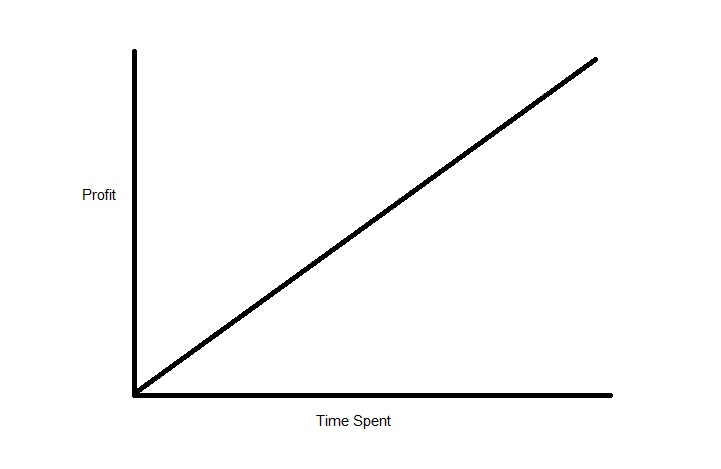
Here’s a very rough visual representation of my thinking behind MTG finance.

Profit-Time Spent

Yes, I was eking out a little bit of extra cash by grinding trades and selling on eBay, but it took me much longer to make that extra profit. As more demands in my life have come up, I’ve begun to value my time more than my money. Am I making less profit? Almost certainly. But I’m devoting a fraction of the attention I used to, and am still indeed seeing gains.

I can’t tell you the best system for you, because only you know where on the above spectrum you fall. It’s also a guarantee that your priorities change as your life advances. So don’t think that just because one way is best for you right now that it always will be. If you recognize the circumstances you’re in and stay open to change, you’ll be best able to determine the time-and-money investment strategy that’s right for you.

MTG Finance on a Time Budget

Assuming you like the idea of my current strategy—spending just a few hours a week actively involved in MTG finance but still making decent profits—here’s some tips to help you maximize value:

Buy cards due for price corrections. My current specs are cards like Primeval Titan, Birthing Pod, and Restoration Angel: cards that see play and were undervalued at the time of purchase. I got in on all of these cards before they spiked (and am still holding them because I anticipate further increases during Modern season).

Don’t buy into coverage hype. I watch coverage for entertainment. I don’t often buy cards seeing play on camera because everybody else will be on that plan. Cards like Porphyry Nodes and Amulet of Vigor require fast action to turn a profit, which just doesn’t fit with my current strategy. In my opinion, watching a card you’re already deep on see on-camera play is the best way to enjoy coverage.

Be aware of buylist values for your deepest specs. One thing I do spend a decent amount of time on, at least comparatively, is checking the buylist price on the cards I’m deepest on. I don’t send buylist orders on a regular schedule. Instead, I send them when an investment has hit a target price. Once something hits, it’s time to prepare a buylist order.

Be prepared to spend time when it’s necessary. Going with my last point, even though I usually only send a buylist order a few times a year, when I do send one, it’s a big one. Thus, it’s usually a culmination of a lot of work. The cost of spending as little time as possible on MTG finance activities is that when it is time to make some profit, it’s going to take a while to get everything ready to go. Minimizing time spent is great, but don’t be lazy. When there’s work to do, do it right.

Pay attention to the MTG finance community. My favorite sources for MTG finance info these days are Twitter and QS. You’re ultimately going to be making your own decisions, but a tip from a financier you trust can push you in a direction to make a good investment. On the flipside, there’s a lot of noise out there, so be sure to know the reasons you think a particular spec is good. If you don’t know why a card is going up, you probably shouldn’t buy it.

Be on the lookout for cards at buylist prices. Any time you can acquire cards for buylist prices, be it through other players, underpriced singles, or just buying collections, you should do it (unless, of course, the cards are rotating Standard staples or crashing in price due to some other factor). This may not come up often for non-retailers, but it’s one of the safest things you can do in MTG finance, so these should be opportunities you try to create.

Remember: situations change. I have a pretty nice full-time job right now, but in this economy, I can’t be sure that will always be the case. All of my MTG finance activities are education for a possible future where I need these skills to survive. I don’t particularly want to ever reach that point, but it’s nice to know I have a fallback if I need it. Every success and failure you have with speculating is a lesson, and you should treat it that way. Take notes. Keep records. Don’t make the same mistakes over and over again. And be prepared to change your strategy when your situation warrants it.

Irony

I’ve been thinking about this article for quite a while, and as a result, I had a lot to say. Ironically, this means that drafting and then trimming this article down to a digestible length took me longer than most of the articles I’ve written for QS. I just finished cutting about a quarter of this piece, so if you have any questions, feel free to hit me up on Twitter, @dbro37. There’s a good chance I’ve got an answer ready to go.

Insider: [MTGO] Taking Advantage of Hype on MTGO

Are you a Quiet Speculation member?

If not, now is a perfect time to join up! Our powerful tools, breaking-news analysis, and exclusive Discord channel will make sure you stay up to date and ahead of the curve.

I don't know if it is me or not, but one thing caught my attention these last months and feels different since I started investing on MTGO. Sudden price spikes have been getting stronger and faster than ever. Consequently, the MTGO market is sold out quicker and quicker when a card attracts too much attention.

Maybe I'm paying more attention to price evolution now than two years ago. Maybe the tools we have now, especially MtgGoldfish, make things more obvious than ever. Or maybe more and more people are trying to speculate on popular cards to generate few extra tix. This is specially true with Modern cards, where everything seems to be a hidden gem waiting for the spotlight.

During the last six to twelve months, hype drove the price of many cards extra high before falling flat down after barely a week or two. Very few cards "survived" a violent increase of 500% or more of their price in a matter of hours. These sudden spikes might have caught some of us--we bought too late and too high and/or we sold too low too late.

In this article we'll see that not all hyped cards are equal. Depending on how a card is "revealed", its price may rise more or less rapidly and can be sustained for couple of hours to weeks. I'll also discuss the strategy I think is viable to make some profits with these unpredictable and fast opportunities.

Different Types of Hype

GP and PT Exposure

These types of events make it patently clear to the Mtg community that a card, or a deck, is potentially interesting. Potentially only.

Not a long time ago, Fist of Suns saw a second round of increase due to coverage at GP Prague. Early in December, Fist of Suns got some attention because the card started being seen in Modern Daily Events (DE).

The initial jump was pretty nice, from 0.4 tix to 2 tix, an already substantial 400% increase. The final stroke after GP Prague made the price of the artifact double despite its already inflated price.


Since then, Fist of Suns keep dipping as the deck is not consistent enough, even after the ban of Deathrite Shaman.

During the last PT, Amulet of Vigor received a strong but extremely short moment of glory after the deck got on camera. However, neither Matthias Hunt, nor any other Amulet player, had a strong day two. The fame of Amulet of Vigor lasted two days and it went back to its original price, around 1.5 tix.


Pyromancer Ascension is another interesting and revealing case of 1) the popularity of Modern, 2) the PT effect, and 3) a bigger and faster hype.

Making its way through several B&R changes, the Pyromancer Ascension deck has been around since Modern's inception, placing two decks in the Top 8 of PT Philadelphia in 2011 and receiving the continued blessing of Jon Finkel who played the deck at all three Modern PTs.

So, nothing really new. The price of Pyromancer Ascension was nicely oscillating between 0.5 and 2 tix, until PT Valencia, where the red enchantment jumped to more than 4 tix in two days. Why? Probably more speculators this time around...

Lastly, and in connection with Pyromancer Ascension, Past in Flames also got hot last month. The sorcery was on nice and slow upward trend since last October, and the PT happened. For similar reasons as Ascension, the price of the 10-tix mythic more than doubled in a couple days.


The Travis Woo Effect

By posting videos of his brews on the ChannelFireball website, Travis Woo made himself a name as an alternative but competitive deckbuilder, mostly for Modern but also Standard, and as a "hype creator" in the MTGO world.

Woo's decks are mostly non-Tier 1 decks in between casual and competitive. He is often brewing with unusual cards which set a perfect ground for a spectacular rise in price.

He was at the origin of the Breach-Post deck that made Top 8 at PT Philadelphia in 2011 and greatly contributed to make Living End deck a serious contender in Modern. Among the decks he popularized are Intruder Alarm Elves, different variants of OmniDoor decks, Ninja Bears, Modern Mono-Green Devotion and Mono-White Enchantments.

Six months ago, the cards Travis Woo was using in his brews showed moderate and slow increases in price. The effect was there and you could see it happening over a period of several days or weeks.

Not all the cards he touched were instantly transformed into gold. But the simple mention of a card in his decks or his tweets is sometimes enough to set it on fire overnight. If the deck shows positive results in DE's, the hype might last for several weeks.

For instance, it took several days for cards such as Omniscience, Intruder Alarm or Disrupting Shoal from the Polymorph deck to get noticed and have their price significantly up.

However, more recently the same Disrupting Shoal really spiked when it was featured in the Ninja Bear deck. The deck got trendy and made several appearances in DE's, but never made the cut at bigger events. The Ninja Bear deck is probably more competitive and attractive than the Polymorph deck but the second spike was really a heck of a spike!


Primal Command, Summoner's Egg and Sigil of the Empty Throne are other examples of the hype that Woo's brews generates, around cards that were not necessarily born to be stars.


New Set Spoilers

New mechanics or cards can be enough to trigger a price rise of previous cards thought to benefit from the spoilers. Without any certainty of viable strategies for future, the Standard metagame cards can get caught in a hype.

During Theros spoiler season, when the devotion mechanic was revealed Boros Reckoner was in everybody's mind. The minotaur gained about 2 tix quickly and went finally up to 10 tix when confirmed to be playable in Mono-Red Devotion decks.

Boros Reckoner's ascension was overall "slow". Again, more recent examples showed us that that sudden spike is becoming the new norm.

Trostani, Selesnya's Voice doubled in two days with the revelation of the green-white god. Similarly, Ral Zarek also jumped from 5 tix to more than 8 tix almost overnight when the inspired mechanic was spoiled.


B&R List Announcements

Typically, B&R list changes are a great time for speculations and hype surrounding changes to the list. This time around, the new B&R changes in Modern had a dramatic effect on several cards in a matter of hours.

When Bitterblossom got unbanned, several Faeries-related cards got a huge boost. Among them, Mistbind Clique and Scion of Oona spiked instantly. After a week or so they were almost back to their initial price.


And when Wild Nacatl got reintroduced to the zoo, Knight of the Reliquary tripled on the spot, for not more than a couple of days.


Profiting Off Sudden Spikes

A trait common to all these recent spikes is a very narrow time frame. In only a couple of hours, one day at most, the price skyrockets. And it usually takes not more than a week for the prices to seriously drop to close to their origins. This trend seems to be the new norm.

I have been caught myself wanting to hold these cards for too long, blinded by the hype. Even if I was able to grab some copies at low price, I was simply becoming too greedy with these highly speculative positions.

For instance, I got stuck with my copies of Trostani, Selesnya's Voice, hoping for unreal expectations. I also sold only half of my stock of Mistbind Clique at the top price. I sold the other half at my buying price because I waited too long, knowing that Faeries were not great in Modern.

Nonetheless, and despite bad judgment on few cards, many others turned out profitable. Here are some rules I try to apply in order to keep a positive balance in any circumstances.

Defining Goals and Discipline

Speculation based on hype can be quiet risky if you haven't established a goal and concrete expectations. As you see in the examples mentioned in this article, price movements are ridiculous, 100% to 1000% in a matter of days. However, these prices only last for couple of days, sometimes even less. Integrating these parameters is crucial for such speculations.

I suggested in a previous article that these quick flip positions could represent up to 50% of small bankrolls. This is a fast way to grow your bankroll if your are able to maintain strict discipline.

Timing Is Crucial

Timing is pretty much is only thing that matters here. You have to be vigilant to any news (such as the one mentioned here) that can lead to sudden spikes. You may have only a couple of hours (in the case of GP/PT coverage and B&R announcement) or one or two days (spoilers season or Travis Woo videos) to buy as much as you can of the hot card. Have you seen how fast the MTGO bots get sold out these days?

Then, I would strongly suggest selling after two or three days, whatever the price is. Hopefully, the price will be still on the rise or will have reached its peak. This is where you have to take your profits and move on. If you are getting greedy or think you can outsmart others you are heading for trouble.

Prices are going crazy, very high, very fast, and then falling flat. More and more people are speculating--you want to be the smart one, who actually doesn't speculate, but rather sells into the hype.

You only lose money when you want too much, never when you sell too early as compared to the real peak. Your goal is not to sell at the tip-top of the curve, your goal is to grow your bankroll. Your goal is to generate profits, not to established a record, and I really think you can successfully ride these sudden spikes.

Thank you for reading,

Sylvain Lehoux

Insider: Rebalancing Your Modern Portfolio

Are you a Quiet Speculation member?

If not, now is a perfect time to join up! Our powerful tools, breaking-news analysis, and exclusive Discord channel will make sure you stay up to date and ahead of the curve.

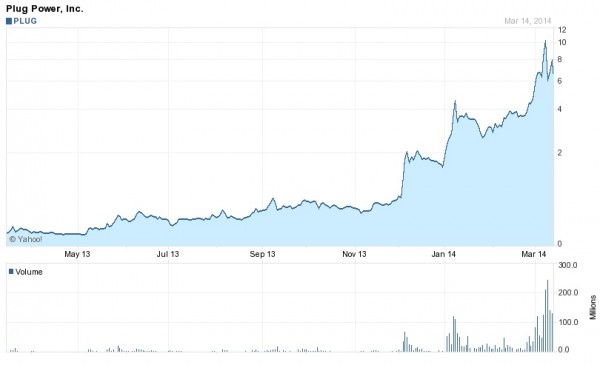
Over the last week and a half I made an uncharacteristic gamble on Wall Street. After tracking a speculative Hydrogen Fuel Cell stock, Plug Power (PLUG), for a number of months I discovered the stock was experiencing some speculative activity. This type of chart puts most MTG finance curves to shame!

PLUG

I included the volume bar graph to indicate the step change in activity, a suggestion that more than just a few risk-taking investors are interested in this company. After the hype became unbearably high I pulled the trigger and bought a handful of shares at $5.76/share.

A few days later the company’s CEO appeared on CNBC and declared the company would be profitable this year. I saw the stock top $11--after witnessing this phenomenal growth (in speculation, that is) I decided my ride on this roller coaster was finished. I sold at $11, banking a solid 80% gain in less than five business days.

Since then the speculation has continued, but in a significantly less favorable manner. Once the price reached double-digit levels the sellers came out in full force. Suddenly there were too many shares available on the market, and the price plummeted. It now rests at $6.71 (as of market close last Friday).

The MTG Connection

Up until the end of 2013, PLUG stock was gradually motioning upward in a healthy fashion. Once speculators got wind that this was a “hot stock” due to recent contracts, newsworthy buzz, etc., the stock’s price took off.

But the growth may not be at all sustainable. Too many hands in the kitchen trying to speculate has led to a bubble. The future is unclear for this company and there will likely be many more double-digit percent moves for PLUG in the future. The gamble I took was profitable and fun, but I also recognize my fortunate timing.

Taking a step back, the shape of this chart looks awfully familiar. Haven’t we seen massive speculative buying before? Perhaps on every Modern card worth mentioning?

Pod

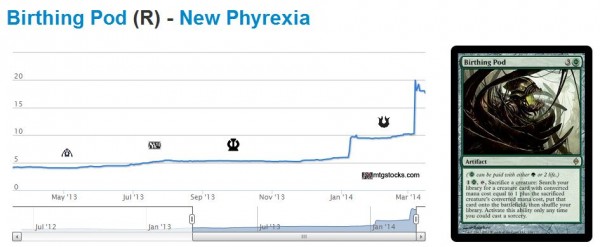
It’s eerie how similar the price curve for Birthing Pod resembles that of PLUG stock. The card was gradually rising in price through the end of 2013, but a few successful results at major tournaments led to sudden spikes in demand.

This begs the question: who has been moving the market these past couple months? Granted, more players will likely want to play Birthing Pod in their Modern decks knowing how powerful Pod lists can be. But could this be enough reason for the drastic changes we’ve seen? I suspect there’s more to this story.

Speculators.

Speculators are buying up copies by the dozen in anticipation of increased demand. Granted, the card’s price was destined to increase in the coming months as PTQ season approaches. But the price jump seems rushed and overdone.

This argument is supported by the fact that the card’s price has pulled back (similar to PLUG stock) over the last few days. Spikes like this are difficult to sustain, and there is usually a regression, at least in some small degree, as players react to the new price.

So You're Saying Sell Modern Staples?!

That sounds silly, doesn’t it? Selling Modern staples prior to Modern season’s beginning seems rushed and ill-timed. Prices are bound to rise higher once PTQ grinders all over the world seek Modern staples for their decks. Aren’t they?

On average, yes. But I would argue that the potential growth going forward varies significantly from card to card. Now that Birthing Pod is already a $20 card, it’s much more difficult to say with confidence that the price will go higher.

The great power of Birthing Pod was bound to drive the price higher, but now this growth is mostly priced in. Speculators anticipated Pod’s success in the Modern format. After all, Pod decks took five of the Top 8 slots at GP Richmond--what surprise remains? Everyone already knows and expects Birthing Pod to continue its dominance.

The same goes for many successful Modern staples, such as Splinter Twin.

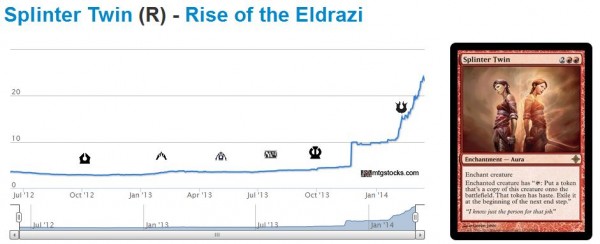
Splinter Twin

This aura is the backbone of a popular, Tier 1 Modern deck. As a result, we’ve watched the card spike from $5 to $25 in a few short months. The price increase is absolutely merited--of this I have no doubt.

But now that everyone knows and expects Splinter Twin to be a successful archetype in Modern I question what upside remains. Speculators have moved in hard on staples like Splinter Twin. Unless no one decides to sell their copies come Modern season, I suspect the supply will suddenly become available at these new, high prices.

My Soapbox

Here’s my point. Some Modern staples have demonstrated their power time and again, and speculators have bought in hard on these cards. No one is surprised by Living End’s sudden price jump because the deck is popular and has some level of success.

[cardimage cardname='Living End']

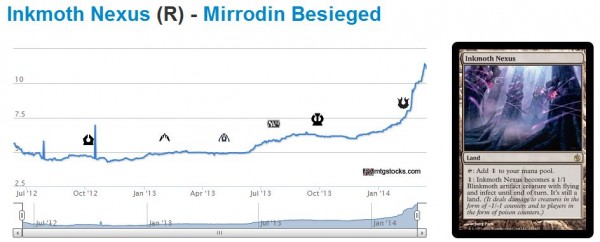
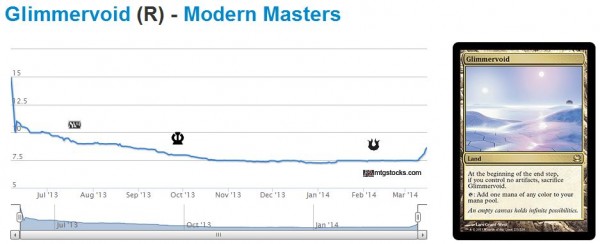
But with so much upside already priced in, I’m tempted to take profits off the table and move my resources elsewhere. For example, some Modern staples in Tier 1 decks have not shown bubble-like trends. Compare Affinity cornerstones Inkmoth Nexus and Glimmervoid.

Nexus

Glimmervoid

Inkmoth Nexus has jumped significantly in the past couple months. No surprise, right? Most speculators expected this.

What I want to point out is the lack of movement on Glimmervoid. Both lands are mainstays of Modern Affinity. Yet speculators have flocked heavily towards the former and not to the latter. This could be due to the recent reprint of Glimmervoid in Modern Masters. Perhaps there are more copies available on the market due to this reprint, versus the infect land that hasn’t been printed in a few years.

This only signifies opportunity in my mind. Speculators are neglecting Glimmervoid in favor of Inkmoth Nexus while both are key to a Tier 1 Modern deck. My inclination is to do the opposite of the market and move away from Inkmoths and into Glimmervoids. The remaining upside on the latter is significantly higher in my opinion, and the risk of a bubble burst (or reprint?) is lower.

The Plan Going Forward, And Disclaimer

It’s not that I expect Inkmoth Nexus to decline in price. If you’re in the camp holding 100% of your Modern portfolio until the summer, I can’t fault you.

But when assets spike in value, just like Plug Power stock and Birthing Pod, I call into question the sustainability of the spike. If speculators are truly the ones driving these prices higher, then the prices may have bubbled a bit. And while the long-term trajectory may still be upward, I feel much less confident holding cards that may be in a bubble. Why not take some profits off the table and move into safer assets?

This is precisely what I plan to do. I’ll be at GP Cincinnati this weekend and I sincerely hope dealers will continue their aggressive pursuit of Modern staples as they prepare for the upcoming PTQ season. If this is the case, it will be difficult to convince me not to move my inventory that has most displayed this “bubbly” behavior. Birthing Pod, Inkmoth Nexus, Blood Moon, etc.

But I don’t plan on sitting on the proceeds for long. No sir. My plan is to move into other Modern staples that have not bubbled…yet.

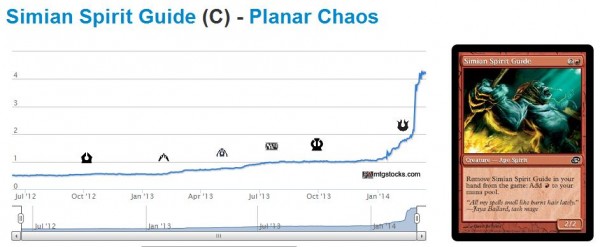
Glimmervoid is just one example. Scars of Mirrodin fast lands are another stable position with plenty of upside. Gemstone Mine is another land I have my eye on--it has gone up a couple bucks in the past month, but that’s not nearly the percentage spike we’ve seen on stuff like Simian Spirit Guide.

Spirit Guide

It’s all about buying low and selling high. And while rising tides do raise all ships, I hope to be onboard the ships with the greatest potential. As I’ve said many times in the past, every dollar that a card rises means a dollar less upside.

While fundamentals could impact potential gains, remember most upside of the Modern PTQ season approach is already priced in. No one knows if a new deck will suddenly break out, but everyone knows that Simian Spirit Guide will be in demand. But if everyone knows this, the price should already reflect this widely understood conclusion.

What upside remains is not going to behave like the speculative movements witnessed recently on these staples. We will only see gradual rises in demand from actual players needing cards for decks. And when this happens, rest assured the speculators will come out in full force with their copies to meet demand.

One disclaimer: reprints! I still have no clue what cards will be reprinted in Conspiracy and the Modern Event Deck. I won’t even bother trying to guess. All I’ll say is that a sudden increase in supply from Wizards of the Coast, in any sizable quantity, will change the trajectory of the reprinted cards.

I’m tempted to guess that the more expensive cards will be more susceptible to reprinting. But this is a wild assumption with little to back it up. There’s little we can do to plan for reprints, but I can advocate diversification to minimize impact on your portfolio.

I’ll close by reiterating one fact: we’re not done making profits on Modern. Prices of Modern staples will inevitably rise. Rather than sit complacently on whatever staples you already have in your portfolio, I advocate shifting the balance away from cards which have already spiked and into cards on the gradual rise.

In my opinion, this is where the largest percentage gains lie in the coming months. Therefore, that’s where I want my money to be.

…

Sigbits

Winds

  • Remember a few months ago when Wheel and Deal and Forced Fruition were spiking because of Nekusar? I did a whole Sigbits section on other related ideas and one of them was Winds of Change. Apparently I should have taken my own advice. SCG still has a few cheap copies in stock if you still want to make a move here. I still like Wheel of Fortune the most (it’s on the Reserved List!).
  • Vendilion Clique has been another steady riser, and SCG is sold out of Modern Masters copies at $59.99. I expect a bump higher in the next month or two, and I’d rather be in these than Birthing Pod at this point. More potential upside (SCG has over 70 in stock!).
  • In the Eye of Chaos has spiked hard on TCG Player. Most eBay copies have sold out as well. It looks like SCG hasn’t joined the bandwagon yet, as they have a couple of SP and MP copies at $37.99 and $34.99, respectively. Maybe I should buy a couple…hmmm….

Zero to Draft: Extracting Every Last Penny of Value

Are you a Quiet Speculation member?

If not, now is a perfect time to join up! Our powerful tools, breaking-news analysis, and exclusive Discord channel will make sure you stay up to date and ahead of the curve.

Zero to Draft Series: Part 1 | Part 2 | Part 3 | Part 4 | Part 5 | Part 6 | Part 7


One of the most important factors within your control when you’re trying to play Magic for free is actually an ideal that can be applied throughout your life: don’t be lazy. This doesn’t necessarily mean that you have to work your ass off at all times, but it does mean that little things make a difference, sometimes in a big way. Today I’d like to discuss the bulk commons and uncommons that pile up when you draft regularly.

I’ve written about this in general terms before, but today I’m going into more detail. Let’s start by reviewing the most up-to-date Zero to Draft stats:

Events played: 20 total – 17 Draft, one Sealed, two 2HG Sealed

Money spent: $164

Money received from card sales/buylisting: $113.32

Buylist value of trade binder: $186.09

Net money spent: -$135.41

Packs held: 10

Draft record: 32-6-12

Sealed record: 3-1

2HG Sealed record>: 5-2-1

Since the last installment of this series, I’ve managed to 2-0-split two more eight-man pods, all while increasing my total number of events as well as the value of my collection (especially helped by a Thoughtseize I was passed in my last draft. Yes, it was thrilling). But what I really want to draw attention to today is one of the stats above: “money received from card sales/buylisting.”

I’ve detailed many of my sales in earlier Insider installments of this series. When Theros was initially released, cards were (of course) hyped in price and worth far more than I was anticipating they would be a couple months later. I was lucky enough to open sweet cards like Xenagos, the Reveler and Stormbreath Dragon at the prerelease, so I sold them in my local community at low but still hype-driven prices. In my experience, a non-retail seller has the best chance of selling cards to local players at close-to-retail prices right after a set is released. So if I open a hyped new card at the prerelease, I place special emphasis on getting rid of it as soon as possible.

Another major portion of my card sales have come from buylisting, either to my LGS or one of the vendors in Trader Tools. I generally ship out cards that I don’t anticipate going up over time: bulk foils, not-quite-but-soon-to-be bulk rares, overhyped new cards, soon-to-rotate old cards, and spiking cards fueled by speculation rather than results. Shipping costs definitely impact the bottom line when mailing buylist orders, but Trader Tools allows you to find the best buy prices. I think those two factors more than balance each other out.

What About Everything Else?

Okay, if you’re reading this site, you likely already have an idea of the best ways for you to get value from your mythics, rares, and money uncommons. You might even buylist a few lesser items. But if you’re obtaining new cards only from drafting, like I am in Zero to Draft, you’re going to find you have a much smaller pile of rares compared to a quickly-growing pile of commons and uncommons.

Many players just leave these commons and uncommons at the LGS as freebies, and for my purposes, I couldn’t love this practice more. I will always accept an offer of free cards, no matter how “useless” they are. Bulk adds up, and bulk equals money. The last big portion of my card sales in this project come from selling casual collections on Craigslist. I post something like this:

Collection of Magic: The Gathering cards perfect for beginning or casual players. This lot includes 10 rares, 120+ basic lands, 200+ uncommons, and 600+ commons. These are draft leftovers from [names of blocks included], so most cards in this lot have been played no more than once. This is a kitchen-table collection at a kitchen-table price, so don’t expect too many Standard staples or any money cards. Text Danny if you’re interested.

I make sure to include a picture so people can see how many cards they’re getting, and while I’m definitely including only bulk rares in these collections, I specifically choose ones that casual players are likely to enjoy. These lots easily sell for $15. I pay $2 to my LGS for the card box (and yes, I know I can get them cheaper by ordering in bulk online, but I only need a few a year and I don’t mind paying a little more to help out a locally-owned store), so I net $13 per box sold. Since I started Zero to Draft,  I’ve sold two of these boxes, have a third one ready to list on Craigslist as soon as I get around to it, and am well on my way to filling a fourth one. I’ve managed to fill so many because I regularly accept offers of draft decks people don’t want.

This really doesn’t take much time extra time, either. Putting some cards in a box at my LGS and transferring to a box at home takes essentially no more time than just transferring my own draft decks into a bulk box, and listing items on Craigslist takes 90 seconds once one is familiar with the process. The most time-consuming part is the meetup, but I always have folks meet me at a location close to my work or home, so even the exchange never takes longer than 10 minutes. It’s a very small time investment for what ends up being a significant help in drafting for free—for each of these boxes sold, I can do a draft and buy a bag of M&M’s!

Non-Bulk Commons and Uncommons

Did you notice the part of my Craigslist ad where I said, “Don’t expect too many Standard staples”? That’s fair warning for buyers, because I’m definitely picking these out before listing these lots. Players don’t always place a lot of stock in commons and uncommons while a set is being opened, but those cards can get relatively pricey the following year, when they’re needed for Standard but no longer being drafted. Check out the highest-selling uncommons from Return to Ravnica block:

[cardimage cardname='Burning-Tree Emissary'] [cardimage cardname='Azorius Charm']

[cardimage cardname='Unflinching Courage']

These are relatively high buy prices for cards many people just abandon. Even some commons, like Ethereal Armor, currently buylist for as high as 17 cents. This doesn’t seem like much, but a year of drafting could lead to dozens of copies of any single common piling up. If you buylist 20 copies of several different commons and uncommons at once, you’re going to start reaching actually-relevant amounts of money.

Here are the commons (first photo) and uncommons (second photo) that I have pulled from my bulk boxes during the Zero to Draft project.

photo1 (1)


photo2

Some questions and observations to keep in mind when considering which commons and uncommons to pull and which to leave in the bulk box:

  1. Does the card see Standard, Modern, or Legacy play? It it powerful enough to do so? If so, pull it.
  2. Does the card have casual appeal and/or a power level appropriate for EDH? If so, pull it.
  3. Is the card uncommon or common? To buylist for a reasonable amount, commons need to see a significant amount of play in a format. For this reason, I am much more aggressive and optimistic when pulling uncommons than pulling commons. After all, uncommons that see play can buylist for more than $1, so it’s worth a little bit of extra space to store powerful uncommons, even ones that haven’t yet found a home.
  4. Does the card have a unique effect not easily replicated by other cards? If it’s a powerful effect, you should probably pull it.
  5. What set is the card from? If it’s from a large fall set, it will likely be worth less than cards from winter or spring sets (compare Azorius Charm to Burning-Tree Emissary, for example. On the flipside, Unflinching Courage isn’t currently seeing much play, and Dragon’s Maze is a bit of an anomaly where value is concerned, so be aware that rules of thumb don’t always hold true). This means I will more aggressively pull cards from Born of the Gods and Journey into Nyx than from Theros, especially because I’ll be acquiring fewer of them.
  6. Check the format staples list on MTG Goldfish. If a card appears anywhere on any format’s list, it’s probably worth pulling.

This doesn’t really take a lot of time, folks. When I get home from a draft, I separate out cards for my trade binder, cards for my bulk boxes, and cards for my to-buylist-next-year box. When Theros is no longer being drafted, I’ll sort Trader Tools by buy price and see which cards are selling for a reasonable amount. By that time, I’ll have enough copies to make it worth my while to send an order over. If a card doesn’t hit and I’m later forced to throw it in a bulk box, what have I lost? A minute or two of my time? For the chance at $5-10? Seems like a fair trade to me.

I’ll close today by listing cards I’ve been actively pulling (or will actively pull when I actually draft some copies) from the current format. Remember: just because a card was really, really good in Limited doesn’t mean it will ever have a buylist value. For example, Stab Wound was a first-pickable common, but only in the context of its Limited format. Cards like this (Wingsteed Rider and Griptide come to mind for Theros) are not worth pulling. Here’s what I’m thinking is worth it:

Theros Cards to Pull for Later Buylisting

Commons

Uncommons

Born of the Gods Cards to Pull for Later Buylisting

Commons

Uncommons

There are cards that I haven’t been pulling that I think maybe I should have (possibly Gods Willing and Rescue from the Underworld), and some of the ones listed above may not ever come to fruition. It’s also possible that as the metagame evolves, more format staples will be born. And of course, seeing that Drainpipe Vermin now buylists for 10 cents reminds me that this is an art, not a science. All we can do is to try to maximize value while minimizing time and money spent. Everything else is up to factors outside of our control.

Do you have any suggestions for additions to the lists above? Please share in the comments!

Introductions Are In Order

Are you a Quiet Speculation member?

If not, now is a perfect time to join up! Our powerful tools, breaking-news analysis, and exclusive Discord channel will make sure you stay up to date and ahead of the curve.

Last week I got swept up in the surge of the Modern storm that was Grand Prix :Richmond so I got right into the action by debuting my first article without introducing myself.  It seems that introductions are in order.   I have been writing a weekly column for magic.tcgplayer.com for three years, and I have recently begun producing a video column. A month ago Doug Linn approached me to see if I was interested in writing a column for Quiet Speculation as well.  I started by publishing a  primer detailing the most important Modern sideboard cards for the Grand Prix . You can find the two halves of that primer here and here.

Snapcasting at Pro Tour: Dark Ascension 2012

That dust from the GP has settled, giving all of us time to take a deep breath and plan for the future in the wake of the tournament. I will get back to Modern in a moment, but I this week I want to start off with the story of my Magic career that has brought me to this point. By knowing what I bring to the table, you’ll be able to get the most out of my work.

I started playing Magic casually fifteen years ago, in the spring of 6th grade. My best friend  Tim had already played for years, and he tried to convert me many times. I have "fond" memories of the Shandalar computer game.  Tim couldn't get me interested until one  Saturday afternoon when the "neighborhood cool kid"  brought over Magic cards to my house. He had already showed them to my neighbor and friend Alex, who in turn immediately acquired some of his own that very day. I already knew what the game was, and I could see clearly  the tides had shifted, so I could avoid the Magic no more.

At that point I was in, two feet-first, and soon after I made a trip to the local comic book shop to buy some cards of my own. I found the Magic cards on a shelf right across from shopkeep’s counter. They were displayed in boxes side-by-side, row-after-row, just like candy at the grocery story, and they were wrapped in shiny foil just the same.  They had fantastical names like Mirage and Urza’s Saga, and at that point I knew there was a whole world awaiting me. Tim, true to his name, recommended I buy the simple Fifth Edition, as it was the best option for a new player.  I came home with some starter decks full of white-bordered cards, and my journey began.

No, this is not a Mug Shot. This is Adam winning States in 2007.

My early attempts at deckbuilding  were putting all of my powerful (read: high power/toughness) cards together into five-color abominations with no regard to mana-curve, statistics, or any other well-accepted Magic theory. I have vivid memories of losing handily to my friends’ similarly misconstrued brews.  Other local kids caught on too, as did my little brother for a time period. I played with the neighborhood kids frequently, I played with Tim, and I played with whomever else I could.  Eventually, almost everyone else’s interest in the game eventually faded away as they came into their teenage years, but my interest only grew.

Nearly a year into playing I heard about the new “Arena League,” starting at the local mall, and it offered a chance to play in a new, semi-competitive environment. It was Mercadian Masques-Nemesis sealed deck, but my brother and I had the good fortune of receiving Nemesis boosters with a rare and 14 uncommons, a fortuitous start to my Magic career.

On Day 1 of the Arena league, there were only 2 other participants aside from me and my brother.  One was an eccentric-seeming man named Steve and the other was George, a high-school aged employee of the local Gamekeeper shop that ran the league.  It didn't take long for word to spread quickly, and the popularity of the league grew. Every Tuesday and Thursday, just before 7pm, George would push a cart full of supplies from tiny Gamekeeper store to the centrally-located food court and use a red-velvet rope  to take over a big section of food court tables along the main mall  drag, between the Auntie Anne’s kiosk and the DQ Orange Julius shop. While girls from high school walked by with bags from American Eagle and PacSun, my mind was delved into an exciting new world.

Arena League gave you points for playing against different people, win or lose, so you  got to meet everyone. The guy Steve seemed to have a lot of Magic experience, though he also had lots of strong opinions.  I learned a lot about Magic in the 6-player games of “Emperor” he organized at the league. George knew lots of people,  and I eventually became good friends with his younger brother and met some his friends who joined the league. I’d go on to hang out with some of those guys outside the league and, years later, travel to tournaments together. The experience opened my world to the depths of Magic and went along with it, the games, the trading, the people. I even learned about the competitive tournament scene.

At the Arena League  I learned about the Junior Super Series circuit, the now-defunct scholarship series for kids 15 and under. The online schedule showed one coming up soon on the west side of Cleveland, a hefty fourty-five minute drive away, but it was easy to arrange a ride to tournament that gave a $1,000 college scholarship check to the winner. At this point I had just one year of casual Magic under my belt. My Magic knowledge was limited to what I learned from people at the Arena league and what little I could find on the Internet. I brought a hodge-podged Mono-Green Stompy deck I found online that had made the top 8 of the previous World Championship, which in retrospect was a very fine strategy . I did not have all the cards and I don’t think I had any real experience with the deck, but I beat some people. In round five I took my second loss to a kid playing Opposition. I was locked down for a few turns before he killed me, so I had time to let the loss sink in. It felt terrible, and my opponent looked so happy. This isn’t some story where that kid turns out to be Jon Finkel or Kai Budde, but it taught me that I wanted to be the one winning. I wanted to control the Opposition.

[img n='Blastoderm'][img n='Fires of Yavimaya']

I had another chance the following Autumn, this time with a Fires of Yavimaya deck that was all the rage on the Internet; a deck I actually had some experience playing. This time I started off with a 5-0 sweep against less prepared opponents before taking an intentional draw with a young Paul Nemeth, another new addition to the Quiet Speculation staff.  At the time, it  was rumored that Paul was some kind of chess prodigy.

I fell in the top 4, but my fires were stoked higher.  I got yet another chance the following spring. I met Paul  again in the last round of swiss. Ever the competitor, he worried about his tie-breakers in the 30 player event and so declined the intentional draw.  This choice forced a grueling match between my updated Fires deck and his deck that revolved around Jokulhaups and Nether Spirit. His deck was designed to beat Fires, and it went on to become the hottest deck of Regionals soon after. We couldn't finish our match in the allotted 50 minutes so it ended in a draw anyway.  Paul and I have yet to to settle the score.

[img n='Nether Spirit'][img n='Jokulhaups']

I went on to win the tournament, qualifying myself for the JSS Champs held concurrently with US Nationals at Disney World.When I first arrived in Orlando, the hotel lobby was full of people playing Magic on every spare table. The excitement was palpable. After getting settled in I found the conference room,  which seemed to hold endless rows of tables filled with cards. People were everywhere, and I could recognize some Pros. The feeling in that room was unforgettable.

I had time to see the theme park, but at that point in my life, the Magic Kingdom turned out to be not so exciting. I got seperated from my family at Epcot, so I  wandered around alone all day before a thunderstorm forced me inside a burger joint. I found my mother waiting for me on the last shuttle back to the hotel, while my father and brother had already returned. Apparently that same day the player hotel had a fire-scare, forcing hundreds of players to cease money-drafts in progress and frantically evacuate with board-states in hand, much to the amusement of my brother.

As far as the JSS championship event, I had my trusty Fires deck with me, but the night before, after playing with some other kids, I decided I splash both white and black for access to the Invasion dragons and the Planeshift battlemages. My deck was inconsistent, and most my opponents seemed well prepared, and I was off to a 1-2 start. In round 4 my opponent was a young lady playing Counter-Rebels, and her sideboard Wrath of God completely leveled me. After the match, she held it up straight-armed and proudly displayed it to her father watching from the bleachers. The tournament was in a Track and Field building and quite literally had bleachers all around it.  I dropped after another loss a couple rounds later. I remember going outside and getting teary-eyed because of my poor finish, and I vowed to return to the event. After regaining my composure, the next day I had the opportunity to see the top players compete in US Nationals, the big show.

A handshake and a win at Nationals 2009

That trip was a defining point for me, and I was hooked on Magic at that point. I even picked up a job right when I turned 14 so I had some extra cash for Magic.  As my Magic experience and knowledge grew I made more money growing my Magic collection by trading cards at the Arena league than I did making $20 a shift bussing tables. I continued to grind the JSS circuit, and I discovered Pre-Releases, States and Regionals.

A major turning point came a year later when the Gamekeeper store moved from its small mall location to a full-fledged store, allowing it to host the league inside. It even started Friday Night Magic drafts, the first-ever consistent local tournament option, which provided an outlet for my competitive fire. It was also around this time that I discovered Magic Online, and I opened up a beta account. Magic Online opened up a whole new world, and it was a key later success.

I played the JSS events when they came to town, and two  seasons later I won another JSS. I beat my friend Paul in the finals, who had beat our friend Chris in the top 4, all of us playing none other than Monoblack control. It was a real team effort. We tested together, we drove together, and we won together.  I returned to the JSS Championship again in 2003 and put up a money finish. I was then over the age limit, and my JSS career came to a close.

I turned to the PTQ circuit. I had no success at first, but I finally cracked the top 8 of a 36 player sealed PTQ in the fall of 2004 during my senior year of high school. I followed that up by top 8ing the the Ohio State Championship the following weekend. My first PTQ victory came the next February, a week before my 18th birthday. I played a UW Mind's Desire Combo deck, and I made the top 8 at 5-2. Three tough matches later, I was the champion. This qualified me for Pro Tour Philadelphia, Kamigawa Block Constructed.

I did my  Pro Tour testing through Magic Online events and I played a 5-color control brew that I got from a Zvi Mowshowitz article series.  I skipped my senior prom to attend the Pro Tour, and lost three straight matches after winning round 1. I was simply unprepared, but I learned that the average Pro Tour opponent was really no better than I was. PT Philly was the only “skins” payout tournament in history, a triple-elimination tournament that paid an increasingly large sum for each individual match won throughout the tournament  rather than paying by the final standings, so I earned $100 for my efforts in round 1.

Adam unleashes the Beast Within at Pro Tour Philadelphia in 2011

Playing on the Pro Tour completely changed my mindset, and it gave me a new baseline of success to work towards. I had a whole summer  ahead of me with nothing but Magic planned, so I got to work. The major competitive format that season was still Kamigawa Block Constructed, so I started by copying Kai Budde’s BW control deck from the PT and won a trial for Grand Prix: Minneapolis.

That summer I would drive to the west side of town many times a week to meet up with the competitive young players, many of whom I’d met grinding the JSS circuit years earlier. We would stay up all night long drafting, only to do it again the next day.  It was in these sessions I learned the basics of Limited magic and how to properly navigate the combat step.

I picked up White Weenie in Kamigawa Block Online, and I went to Origins Game Fair where I finished 2nd place and top 4 in back-to-back PTQs. After a night of drafting I took the deck to a PTQ in Detroit, where I finally won. I took this new confidence along with the byes I won earlier, and I converted it into a top 4 finish at Grand Prix: Minneapolis, where I also won the second-place amateur prize. I had done everything with the same deck, and I tuned it extensively between each event that summer. My experience that summer became a framework for future success.

I went on to college in Columbus, OH, at a time when I was first tasting success in Magic and I had the full freedom to pursue it further. Columbus was a prime location, and it gave me easy  access to at least a dozen PTQs each season.  The real resource in Columbus was the wealth of talent and experience that came with it.  My second PTQ win qualified me for Pro Tour: Los Angeles in 2005.  I was involved in my first experience testing for a fresh Pro Tour format while collaborating with Tom LaPille, who would go on to work in Magic R&D. During weekly drafts I learned an immense amount from Sam Stoddard, who was also hired by R&D a couple of years ago. These players and many more taught me a great deal about the finer aspects of the game.

Not everyone gets to high-five Raph Levy in SIngapore!

When people were not around, Magic Online offered the constant opportunity to grind at my convenience. My game improved quickly, and another PTQ win that winter was followed by going undefeated at Regionals and earning my first invitation to US Nationals. I also started traveling to more Grand Prix within driving distance, though it was over two more years before I found further success on that circuit. At the end of 2006 I acquired a passport after my DCI Constructed rating qualified me for the World Championships in Paris.

I strung together PTQ wins for years, playing a few Pro Tours each season throughout my time in college. A finals finish at Grand Prix: Philadelphia 2008 immediately followed by a ninth-place finish at Pro Tour: Hollywood 2008 gave me enough momentum and Pro Points to get me onto the Pro Tour “gravy train” for the 2009 season, earning me an invitation to every Pro Tour that year. Strings of money finishes at Pro Tours and Grand Prix kept me on the train through 2012, while the last Pro Tour I played was Gatecrash in Montreal last year.

US Nationals 2009

Along the way I have made the top 8 of six Grand Prix, including a win in Houston 2010.  I was a member of the US National Team in 2009 after making the finals of US Nationals. Magic has brought me to Europe eight times, Asia three, and to all reaches of the USA, including three trips to Hawaii. My biggest success is the countless number of amazing friends I have made throughout the years, and the experiences we have made together.  My current goal is to make more friends, and to teach them what I do know while learning from them what I do not. I am a life-long student of the game with the goal of achieving and demonstrating true mastery of the game of Magic, and to apply those skills beyond the game itself.

My goal of this column is not to simply digest tournament decklists or re-hash things that have already been written. I know most Quiet Speculation readers approach the game of Magic with an angle of efficiency and from a competitive perspective , so I am interested to learn about what you actually want to hear and read about. Maybe there is something that other writers ignore, or that they don’t do well. Maybe there is a type of article that you find most valuable, or perhaps a certain subject will be pressing during any given week or month.

On an Auger Spree at GP Indianapolis 2012
I am open to anything. Communicate with me and I will be able to provide the best service to my readers. I bring a unique set of skills and experience to the table, and hope to be a valuable resource for anyone serious about improving their Magic game. By cultivating knowledge, we may develop confidence in ourselves, certainty in our actions, and  success in our endeavors.

Insider: What Real Economics Can Teach Us About Modern

Are you a Quiet Speculation member?

If not, now is a perfect time to join up! Our powerful tools, breaking-news analysis, and exclusive Discord channel will make sure you stay up to date and ahead of the curve.

Modern - Oh how I love thee. Seeing the hard work, observation, and thought put in bring about astounding results is truly a sight to behold. The thought that a format could be the bastard child of Magic formats should be banished from every man, woman, and child now. The success that GP Richmond provided shows just what a fun, complex, eternal environment can do for the gameplay of Magic. Unfortunately - now it's also showing that darker side too. Affordability will soon no longer be the keyword associated with Modern. "Cheaper Legacy" will be a term lost to the sands of time unless the market corrects. I promise you though, Wizards is already on the case. They either saw this coming, or figured it would happen sooner or later.

The question of if Modern could be a reliable crowd pleasure was initially answered with the release of Modern Masters. With that release though, it brought a buzz that I believe is still really growing. GP Richmond had many things going for it: Location, Timing, Playmat, Reasonable Expectation of affordability to get involved. That's soon going to be a dream of the past. This upcoming season we just might start seeing decks rival their older Legacy counterparts. I would not be surprised to see that in the least. Fortunately, this does not mean it's a time to panic sell everything. Don't push that button!!

Wizards has truly shown an understanding of Supply & Demand. Even more though, they have shown repeatedly that they understand the concept of something that cannot be undone. The measured reaction that Modern Masters gave them has got to be thrilling and exciting to those behind closed doors. It, however, was a "careful step." A step in the direction of correcting the market and making Modern singles more available. Wizards may have already come out and said that it was everything they hoped, but it stands to reason that it's been even more. That step has created even more Demand and now will require even more from Wizards of the Coast. This is what I envision will happen in the future: More. Why more? Because the laws of Supply & Demand require it.

Learning Time

To understand this further - let's take a dive into understanding what Supply & Demand really is:

1) A commodity is a good that is perceived to be worth the same amount regardless of the supplier.

Simply put - regardless of which vendor is supplying the Secondary market singles; there is a perceived value among the buyers and sellers that a card has worth. This concept has been there for a very long time, yet as trend setters there are very few that are willing to take that first step in setting the market. That appears to have changed as even the perceived possibility of a buy out is now starting to move prices before it truly happens.

2) When the price of a good rises, the demand for that good decreases and when the price falls, the demand for that good increases. This is the law of demand.

[cardimage cardname='Tarmogoyf']

This is still based on perception of value.  Tarmogoyf is moving. What if the value was suddenly $400? Would people still want it? More than likely not. The price shock alone would decrease the Demand as a result of the price memory. But a slow climb will consistently keep Demand rising with the cost of a good.

3) When the price of a good rises, the supply for that good increases and when the price of a good falls, the supply for that good decreases. This is the law of supply.

It stands to reason that the higher price something gets combined with people wanting it less because of high price; a price will typically fall until it reaches that median place again. More of something available means more competition to be the source for your purchase.

[cardimage cardname='Misty Rainforest']

4) Perfect price information and equivalency of goods are some principles of perfect competition.

If you had multiple Dealers in front of you, but ONLY ONE was selling Misty Rainforest for 10% less, this makes for perfect competition. This doesn't always happen, but as you are a Quietspeculation Insider, you have access to more information than most.

5) Instantaneous price adjustments are another aspect of perfect competition.

This is the results of consistent sales of an item and less about knee jerk reaction, tournament results, or speculation buyouts. But with all the information available, most stores will try to position themselves better.

[cardimage cardname='Scalding Tarn']

6) If there is a surplus, a lower price or perhaps a smaller supply of an item by the supplier are examples of market corrections.

There have been many examples of this as of late, but the buyout of Blue Fetchlands comes immediately to mind. This is an example of forcing a market correction. Another would be Wizards reprinting another large swath of high priced cards in order to make the market more affordable.

7) If there is a shortage, a higher price or perhaps a larger supply of an item by the supplier are again examples of market corrections.

Finally, we come to the heart of the matter. Supply is currently fixed. The Demand has increased for Modern singles to the point that Supply has run short and prices have jumped. Either by Speculators, Stores, or Players hoarding, destroying, or simply just playing - the Market has responded in kind. There is going to start being a shortage and a market correction is going to be needed. Either by Wizards reprinting or a hoard of recently unattainable copies flood back into the market dropping prices left and right. There's a crux though - Modern season will soon be upon us. Understanding this back and forth, wax & wane, is the key to this new Millennia of  speculation. The Game is changing and in large part to the dissemination of more information on the ways and hows of best practices - we have this ever fluctuating chaotic market to look forward to. What will you do? As always: Buy low. Sell High. Pick your target point and then choose your exit. At some point....

8) The market will correct itself until a point of equilibrium is reached.

Ladies & Gentleman - welcome to the "When not If" Era.

It's no longer a matter of if a card will rise in value. No, no, no. That would be too easy. Now, it has become simply just a matter of Time. Are you prepared to properly assess when to get out, and when to stay? As we watch the Modern market fluctuate chaotically like it is, this should be a primer for what to expect from the Suppliers. Wizards or other Stores will strike while the market is in hand or reaching a boiling point. More copies will enter into the market and then you will be too late to exit for the most profit.  The market will quickly reach equilibrium and your hard earned profit will start to drip away until the item finally sells, or is buylisted. Welcome to the future of constant market corrections.

-Till next time.

Avatar photo

Dylan Beckham

Dylan has been involved in Magic: The Gathering since the heyday of The Dark. Continually invested in the community, he's been a Pro Tour Player, Trader, Judge, Tournament Organizer, Volunteer, and Vendor. Currently involved with the day to day operations of selling online, Dylan has brought his experience to Quiet Speculation to make you a better investor. Hailing from the Atlanta area, and now part of the Dallas scene - he's often at big events sourcing cards or discussing Life, the Universe, and Everything. Have a question? Feel free to comment, message, or email anytime.

View More By Dylan Beckham

Posted in Finance, Free Insider, ModernTagged , , 15 Comments on Insider: What Real Economics Can Teach Us About Modern

Have you joined the Quiet Speculation Discord?

If you haven't, you're leaving value on the table! Join our community of experts, enthusiasts, entertainers, and educators and enjoy exclusive podcasts, questions asked and answered, trades, sales, and everything else Discord has to offer.

Want to create content with Quiet Speculation?

All you need to succeed is a passion for Magic: The Gathering, and the ability to write coherently. Share your knowledge of MTG and how you leverage it to win games, get value from your cards – or even turn a profit.

Insider: The “Big Picture” of MTGO in 2014

Are you a Quiet Speculation member?

If not, now is a perfect time to join up! Our powerful tools, breaking-news analysis, and exclusive Discord channel will make sure you stay up to date and ahead of the curve.

Today I take a break from the day-to-day grind of speculating to do some big picture thinking. This is my outlook for the next couple months.

April

At the end of March, Cube will return to MTGO, along with with one week of Mirage-Visions-Weatherlight (MVW) queues, followed by one week of Scars of Mirrodin (SOM) block queues. See the full details on the mothership. Generally speaking, there's no cookie cutter way to speculate off of these events. The trick is to identify a good price on a card you like, and then start buying if that price is reached.

This time around, I'd be on the lookout for Modern staples from SOM block in particular. Interest in Modern doesn't show any signs of abating, as many of the staples have hit high prices in both digital and paper. This suggests that any dips in price should be seen as a buying opportunity.

Players tend to overestimate the impact of these drafts on prices. So, in (erroneous) anticipation of the market being flooded, they sell their own copies with an eye to rebuying at a lower price.

This means that the dip in price speculators should look for will occur in and around the SOM block drafts, but will not be a result of the queues themselves. The buying opportunity occurs because players are flooding the market with their playsets, not the recently cracked cards from the flashback draft queues.

The short list of Modern cards I'd look to pick up include Spellskite, Mox Opal, Dismember and Inkmoth Nexus. A longer list might include Thrun, the Last Troll, Surgical Extraction, Karn Liberated, Tezzeret, Agent of Bolas, and Torpor Orb.

After these cards drop in price, there will probably be a short-term bounce back as players try to reacquire their playsets. Again, this is a difficult proposition to time well as the MTGO market tends to move quickly. Deciding in advance which cards you are interested in and at what price will help you navigate any market fluctuations.

Keep in mind that we'll also be heading into a period of continued Modern demand as players start testing that format. The release of the third set of Theros (THS) block will still be weeks away from shaking up Standard, so the Modern format will probably see some new price peaks at that time.

Although it doesn't look like there will be online PTQs, Modern seems to be going from strength to strength. Until we see a real weakening in interest, don't bet against higher prices.

May

The big event in May will be the release of Journey Into Nyx (JOU). It will be released on MTGO on May 12, followed by the Pro Tour event in Atlanta Georgia. The constructed format the pros will be testing is THS Block Constructed. All the details can be found on the mothership at this link.

Block Constructed is well attended on MTGO as it is often one of the cheapest formats to start playing. It would pay the attentive speculator to get familiar with THS Block Constructed in advance of the release of JOU.

Knowing what makes the format tick might yield insight on which cards from JOU will make a splash at the Pro Tour. And with JOU being a third set and only available online for a week by the time of the PT, there is strong potential for large price swings based off of what happens in Atlanta.

As for what we do know is coming in JOU, we know for sure that the last two of the scry land cycle will appear, as well as the remaining five demigods.

When the Born of the Gods (BNG) demigods were beginning to get spoiled, speculators started bidding up the price of the RTR block guild leaders, such as Trostani, Selesnya's Voice. The heavy coloured mana requirements in these permanents were seen as a good way to power up the new demigods.

This time around I would expect a similar response, so I would cast my eyes towards the guild leaders that might see play in conjunction with the new gods. I'd start with Aurelia, the Warleader.

This card has a lot going it for as a spec. It has casual appeal, which has kept the price above junk. It also saw some play in the big Naya builds from Standard of last year. Over the summer, this card might dip down into the 1.0 to 1.5 tix range in advance of rotation.

With that downside in mind, buying at the current level in anticipation of the hype around the release of JOU should give an opportunity to take short-term gains based off any speculative activity. Upside will be further magnified if Aurelia appears in a top deck. Longer term, i.e. out past Fall rotation, I'd expect Aurelia to eventually get to the 2 to 3 tix range based solely off of demand from redeemers.

June

At the end of Spring, the long anticipated appearance of the Power 9 on MTGO is set to happen. Although they've previously been playable in the powered version of Cube draft, this time players will be able to slide these cards into their collections.

The exact method of their release is up in the air, but the delivery mechanism will be Vintage Masters. This set will have prerelease events from June 13th to 16th, with the full release scheduled for June 16th. Check the announcement here.

All indications are that Vintage Masters will be modeled after the successful Modern Masters, a release designed to tame prices, get cards in the hands of players, and be a fun draft format.

If WOTC can develop a draft format that players enjoy, then any rare or uncommon reprints we see in this set will take a nose dive in price. The Power 9 will start at a high valuation and might never come down, but for the rest of the set, lower prices on all but the most played mythic rares are in order.

For speculators, the best course of action would be to sell down any staples that did not see printing in a Modern-legal set.

For instance, I'd expect to see Rishadan Port in Vintage Masters. Port is from a set that doesn't fire a lot of drafts when available, so it will perennially be a pricey staple. Putting it in Vintage Masters will solve the problem of having to use Mercadian Masques draft queues to get product into the market. WOTC has demonstrated that draft queues are their preferred method for keeping prices in check, but if players are not willing to draft the set, the process is moot.

WOTC needs a set that is both fun and contains value in order to get product into the market. Packaging up the expensive cards from the worst draft sets seems like a logical move.

This is also a reason to expect something like Wasteland in Vintage Masters. Although Wasteland is probably priced too high, including it in Vintage Masters could kill the value of future Tempest block queues, a relatively popular flashback draft format.

I think WOTC will be careful not to cannibalize too many of the popular draft formats in order to get players interested in Vintage Masters. In that regard, the Power 9 should do most of the heavy lifting, and then there will be a look towards some of the less popular draft formats in order to get cards into players hands.

Modern Deck Primer: Splinter Twin Pt. 3 – WUR Twin

Are you a Quiet Speculation member?

If not, now is a perfect time to join up! Our powerful tools, breaking-news analysis, and exclusive Discord channel will make sure you stay up to date and ahead of the curve.

Part 1: Splinter Twin | Part 2: Tarmo-Twin  |  Part 3: WUR Twin


In Part 1 of this primer series, we discussed the basics of the Splinter Twin archetype in Modern and a Tempo Twin decklist from Pro Tour: Born of the Gods. In Part 2 we discussed Tarmo-Twin, a more aggressive version of Splinter Twin. To conclude this series, let's take a look at a more controlling version of the Twin combo deck that uses white cards to slow the game down a bit.

WUR Twin

Tim Rivera

Untitled Deck

Creatures

2 Snapcaster Mage
4 Wall of Omens

Combo Pieces

4 Deceiver Exarch
4 Restoration Angel
3 Kiki-Jiki, Mirror Breaker
4 Splinter Twin

Spells

4 Path to Exile
4 Remand
4 Lightning Bolt
3 Lightning Helix

Lands

2 Mountain
4 Arid Mesa
4 Celestial Colonnade
1 Hallowed Fountain
1 Plains
2 Island
2 Sacred Foundry
4 Scalding Tarn
2 Sulfur Falls
2 Steam Vents

Sideboard

3 Anger of the Gods
2 Sowing Salt
3 Dispel
2 Stony Silence
1 Engineered Explosives
2 Spellskite
1 Wear // Tear
1 Lightning Helix

Cute Play of the Deck: Against decks with few creatures, Wall of Omens and Path to Exile can seem pretty bad. Sometimes you just need a land no matter the cost. Target your own Wall of Omens with your Path to Exile to build your own Rampant Growth!

Compared to Tarmo Twin, this white list is more defensive. Wall of Omens, Lightning Helix and Restoration Angel are a brick wall that aggressive decks are unlikely to break through. This comes at a cost of decreased pressure against combo and control decks. Notice that UWR twin plays 3 lands more than Tarmo Twin. Why? First, Celestial Colonnade is an excellent use of mana when flooding out, and can win the game all by itself. Second, Wall of Omens isn’t as good as Serum Visions at helping you hit early land drops. Third, no Gitaxian Probe. White has slightly better sideboard options than green, particularly Stony Silence over Ancient Grudge.
[cardimage gid='240096'][cardimage gid='193545']

If you’re considering buying in to Modern or playing a Splinter Twin deck at your next tournament, I think Tarmo Twin is the way to go. It is likely to be one of the best decks in Modern for months to come. If you can find the time, consider how the metagame is likely to adjust to recent events and shift 1 or 2 cards to adapt to those changes. WUR Twin may be preferable if you expect a Wild Nacatl heavy metagame, which I do not expect in the near future. Tempo Twin is largely the budget option, although it is more resilient to Blood Moon than Tarmo Twin.

Insider: Standard – The “Other” Format

Are you a Quiet Speculation member?

If not, now is a perfect time to join up! Our powerful tools, breaking-news analysis, and exclusive Discord channel will make sure you stay up to date and ahead of the curve.

Modern, Modern, Modern. Fish, Faeries and Fulminator Mage. Snapcaster, Scapeshift and Storm.

It’s all we’re hearing these days. And with good reason. The format was put on display at the Pro Tour and again at the largest constructed GP ever hosted. Cards are steadily rising, cards are spiking and not a single card is tanking. So we’ve paid the most attention to the exciting format, and to be honest I don’t really expect that to change any time soon.

But what about Standard?

I get that it’s as unpopular as it ever gets. Mono-Black seems to be dominating and there’s no innovation. But even a stale Standard format at the valley of its popularity is still the most popular format Wizards offers.

So let’s try to pay it some mind, if only for today. After all, it’s especially important for me, since I’ll be doing official text coverage for WOTC at Grand Prix: Cincinnati next week. I’m pretty excited about the opportunity and will be making the most of it. And, of course, if anyone reading this is there, feel free to stop and say hi!

Anyway, let’s get back to looking at Standard.

The Witch Is Dead?

Okay, so maybe Mono-Black won the last Standard SCG Open, which is all the results we have to go on at this point. There haven’t been any GP-level Standard events for a while, though Melbourne from right after the release does give us some info.
[img n='Pack Rat'][img n='Nightveil Specter']
Basically, Mono-Black isn’t the only deck anymore. It’s interesting, because after Born of the Gods dropped people were lamenting a lack of change to Standard. But the truth is, despite Mono-Black getting even better, the field has opened up a little.

Basically, a small number of decks define the meta right now:

  • Mono-Black
  • Mono-Blue
  • Control (Esper or U/W)
  • R/G Monsters
  • B/W Midrange

The White Weenie aggro decks seem to have fallen to the wayside, leaving us with the five decks above. Of those, all are known qualities, so it’s hard to find financially-relevant pickups there.

Theros Cards

In general, I just hate having these. The set has been opened a ton, and will continue to be for a time to come. That creates so much downward pressure on the cards that, while I want Stormbreaths and Caryatids and Polukranos’s in my binders, I don’t think there’s a ton of upside even though they move well.

So if we want to find any opportunities, we’ve got to go back farther.

Domri Rade

Notice how this has continued to trend up over the last month. I’m going to make a bold prediction here: Domri is the next Liliana.

What I mean is that Domri will stay high after rotation, and probably hit $40 before then. It’s something I really want to have in my binder moving forward, because a deck like R/G or Jund Monsters has more room for upgrades than something like Mono-Black, which is already about as streamlined as possible.
[img n='Domri Rade'][img n='Liliana of the Veil']

Will Domri fall before rising again? Sure. But that doesn’t mean I don’t want to have an eye on this card in the meantime.

Mutavault

On the other side, one card I do see dropping hard is Mutavault. Yes, like Domri, Mutavault is heavily played in Modern. But it has so much farther to fall, because of both its rarity and number of printings.

A good way to look at a card like this is to say “What could happen to make it increase in price?” If the answer is “nothing, because it’s already a four-of in everything Tier 1,” well then we’ve found a card at its ceiling. I didn’t think this would hit $40, but I’m even more confident it’s not going to $50. The play is to out these now at max value.
[img n='Mutavault'][img n='Desecration Demon']

Desecration Demon

Here’s one that’s trending down, mostly because a lot of the Mono-Black lists are moving to B/W Midrange in order to play Brimaz. That means some amount of cuts, and some of those cuts are coming to Demon. I don’t think it’s going to hit its old $2-rare status soon, but it’s likely not going back up to $10 either. And every day we march closer to rotation.

Mizzium Mortars

There’s been some fluctuation in its price, but the rise of G/R again seems to be pushing Mortars back up. We could see this move from $3 to $6 in the next month as people start looking at Standard again after the Modern fever passes.
[img n='Mizzium Mortars'][img n='Blood Baron of Vizkopa']

Blood Baron of Vizkopa

The fact that this hasn’t moved at all is surprising. Here we have a Dragon’s Maze mythic that has began popping up everywhere in Standard. It’s available for $15 now, but there’s not way it doesn’t at least hit $20 very soon, and $30 is certainly possible if it stays as relevant as it’s been recently. Remember, somehow this thing isn’t legendary, so you don’t even have to worry about drawing multiples.

Angel of Serenity

While this has begun to see a little more Standard play, I mention it because I’ve seen it for as low as $2-3 recently. That seems insane for an out-of-print mythic angel. It has flatlined at that price, showing us as low as it can go, so the play on it is soon and the long-term upside is huge.
[img n='Angel of Serenity'][img n='Witchstalker']

Witchstalker

One of the only true “breakout” decks recently has been Naya Hexproof, and Witchstalker seems like the prime target here if you’re a believer in the deck. It’s been holding steady at $3, and this represents an easy double-up if this deck breaks into the meta in any real way.

It’s also a deck that gets better every set in a way that doesn’t necessarily care how much better the opponent’s deck gets. After all, Witchstalker doesn’t care about Mono-Black’s upgrade in Bile Blight, but it does care about its own upgrades. This is something that is realistically probably one piece away from really taking off, so even if it goes nowhere in the next month don’t forget that come Journey into Nyx.

Standard concerns

Well, trying to re-familiarize myself with Standard really does lead to the impression that it’s kind of a rock-paper-scissors format that isn’t ripe for innovation. That said, we seem to be a little better off than we were two months ago.

What do you think? Is Standard as bad as they say it is, or do we have a somewhat-stale format that nonetheless rewards innovation?


Thanks for reading,

Corbin Hosler

@Chosler88 on Twitter

Want Prices?

Browse thousands of prices with the first and most comprehensive MTG Finance tool around.


Trader Tools lists both buylist and retail prices for every MTG card, going back a decade.

Quiet Speculation