menu

Playing in the MUD

Are you a Quiet Speculation member?

If not, now is a perfect time to join up! Our powerful tools, breaking-news analysis, and exclusive Discord channel will make sure you stay up to date and ahead of the curve.

Hopefully you all received Doug Linn’s e-mail sent to Insiders regarding the Legacy Artifact Stompy deck that made it to the Finals of SCG: Indianapolis (if you didn’t you should figure out why). Today I’m going to further examine the deck, the cards in it Doug pointed out, what’s happened to those cards since then, and where it might go from here.

But maybe you didn’t get the e-mail in time to really make a move on it. Did you know Doug also posted the same message in the forums more than a week ago? Here’s the post in question.

ā€œI am posting this on the off chance that you guys have cards for Legacy Welder MUD that you are considering trading.

I would suggest waiting until AFTER SCG: Indianapolis to trade off the following:

City of Traders lololol

Ancient Tomb

Metalworker

Grim Monolith

Goblin Welder

I bring this up because a friend has cooked up a very reasonable welder MUD deck for Legacy that has been putting up very good results. He will be bringing it to Indy on the 5th. I'm sure you can picture what would happen if Grim Monolith popped up in a T4 of that tournament.

I'm not endorsing buying any of these cards right now, but I wouldn't trade them away if I had them until after that date or unless I was getting a real sweetie of a deal.ā€

That was posted on Jan. 29, and gave everyone ample time to get ahead on this. But if you are late to the party, don’t worry, there’s still money to be made.

For reference, the decklist I’ll be referring to can be found here.

For today’s article, I’m going to focus on the cards Doug pointed out as worth holding on to. I’ll be using prices from BlackLotusProject.com unless I specify otherwise.

City of Traitors

This card was already heavily played in Legacy, and I don’t think adding one more deck is going to do much to its price. BLP shows its price has been static since the tournament, and I don’t expect that to change. However, this card has been a steady gainer in the last year, and I would try to pick them up in trades if you can get them from older players.

Ancient Tomb

I think there’s some opportunity with this card. The BLP price on it is $5.57, whereas the SCG price is $5.99 (and they’re sold out). SCG prices are typically much, much higher than BLP, so I see them raising their price when they get more in stock. I would pick them up in trades now before SCG updates their price and people will value it at that. Also, looking at City of Traitors, we see that there is growing demand for lands that make two mana, so I think these are a pretty safe pick-up at this point. The City has gone up more than a dollar on Ebay in the last two months, even without seeing much play.

The best part about these two lands is that they aren’t specific to the MUD deck (I assume I’m just an idiot for not knowing what that stands for). This means that even if the deck doesn’t begin to show strong results the lands might continue to tick up in value anyway.

Now that we’re getting into the cards specific to the MUD deck, let’s start with the big one.

Grim Monolith

As Necrite98 pointed out in the forums, SCG sold 18 of their 36 Monoliths overnight after the deck’s performance. The card has already started to climb on BLP, up more than a dollar since Sunday.

But it’s not too late to jump on this. If the deck catches on, this card is going to be a part of it and it’s price is going to continue to climb. You still have a window to get these from people at $15 apiece and hold onto them while they appreciate. This (and the lands) are the best investments into this deck, as they are vital to it and serve a greater number of strategies anyway.

Metalworker

This card hasn’t moved at all since Sunday, but it is up solidly in the last month and has doubled in price in the last year and a half. The only conclusion I can reach is that it was bought up when rumors began to swirl regarding a return to Mirrodin. That or there’s a Vintage factor involved, which I wouldn’t know because I don’t follow the format. Either way, this card is very narrow within the MUD deck and I wouldn’t recommend buying now, since it’s the highest it’s ever been. I do think you should try to pick these up in trades, because most people don’t know the card has been on the rise.

Goblin Welder

The Welder has sold out on SCG at $7.99 and has begun a rise on BLP. With a lower starting price, the Welder is a good pickup for a few reasons. First off, there’s the MUD deck. Secondly, there’s the fact that we have another set of power-creeping artifacts to come before we leave Mirrodin, so there’s another round of cards coming that might further break it.

While the Welder’s price has fluctuated, it’s not been extreme, so this is a relatively safe investment to make.

That covers it for the cards Doug initially pointed out. As long as you don’t pay inflated prices, they are all relatively safe pickups and a few (mostly Monolith) have the potential to skyrocket.

Now, let’s move on to the more recent cards that appeared in the deck.

Lodestone Golem

I really thought the Golem could be broken before Mirrodin came out and it was clear that it just wasn’t going to be. Maybe that changes with the third set, but we’re not there yet. As far as the MUD deck goes, this card isn’t going to do much because it’s plentifully available as far as Legacy cards go.

With that said, this is nearly a dollar-bin rare, so I’m going to be angling to pick these up as throw-ins in trades. Cards from Worldwake have proven to have a higher ceiling than most other sets (see Stoneforge Mystic), so the Golem is practically no-risk and might see a modest increase if it becomes viable in Standard in addition to Legacy. What will be in higher demand due to the nature of Legacy is foils of this card, so if you go for it, that’s the route I suggest.

Kuldotha Forgemaster

See above. Foils are the way to go, though there’s nothing at this time making it particularly appealing.

Myr Battlesphere

Foils.

Mox Opal

This deck isn’t going to affect the Opal much, though it does represent another home for it in the Legacy metagame. Due to this and the card’s inherent moxy, it is worth picking up as the price drops, because after experiencing the initial rotation drop, it’s going to hold its value.

What this teaches us

This is the first time since the banning of Survival of the Fittest that we’ve seen a truly innovative Legacy deck finish so well. The effect on prices hasn’t been huge, but it’s been there. I predict this effect to increase as we move forward in the future and the SCG Opens and tournaments like it expand.

Opens are nowhere near the level of impact a Pro Tour carries, but it is growing. Even a year ago very few people followed SCG events and immediately bought cards because of it. Now we have more and more people showing up at the tournaments, bigger prizes and Adrian Sullivan talking like he’s a financial expert while broadcasting.

What this means is that you will need to be even more on your game to stay ahead of the curve. Rather than GPs and PTs every month that you have to keep track of, you have an event basically every other week that can affect prices of cards. I don’t see Opens getting any smaller anytime soon, and as the prize pool increases, so does the number of players traveling for these tournaments and investing in the latest tech.

Bonus – Standard pick up

While I focused on the Legacy portion of the tournament, the breakout deck from the Standard side was Kuldotha Red. I’ll tell you that I’ve bought a few playsets of Contested War Zone, since that card is apparently the business in the deck. It’s cheap (under $2) on Ebay, but sold out at $5 apiece on SCG. I was able to get 8 at $1.91 apiece, and I suggest picking them up at $3 or less in trades.

The card could really shoot up if the deck performs well at the next Pro Tour, but after the last Open I suspect most pros will pack a ton of hate for the deck and keep its numbers down. But it will be a strong FNM deck and PTQ choice as we move into Standard season, making it a reasonable pickup now.

That’s it for this week, let me know what you think in the comments!

Thanks,

Corbin Hosler

@Chosler88 on Twitter

Building on the Basics

Are you a Quiet Speculation member?

If not, now is a perfect time to join up! Our powerful tools, breaking-news analysis, and exclusive Discord channel will make sure you stay up to date and ahead of the curve.

Vince Lombardi of Green Bay fame had a very unique way of starting his pre-season training. He would walk to the front of the room, hold out the football, and with five simple words set the tone for what was to come; "Gentlemen, this is a football.".

He assumed nothing about his players skills, knowledge, or capabilities. It was not to belittle them, but to reinforce the fact that the basics are one of the most vital points in whatever you're doing. To mirror him, this is the tone that this three part series is going to take.

Gentlemen, this is a trade binder.

Remember when QuietSpeculation went from Kelly's personal blog and changed into an article site? It was shortly after they had to take down DoublingSeason.com, and every week as a new author came aboard, there were articles trying to help cover the basics. They were all quite good, and each looked at a different dynamic, had a different piece of advice, and went about it different ways. The beginning of my series was no different and if you're interested you can read through them by scrolling to the bottom of this page. I'll be the first to say that they aren't great, and I wrote them with the player-vendor that wanted to work a larger area in mind.

Recently though, there has been a distinct lack of articles centered on the people that want to go back to basics, and relearn the ropes, or even for new people that need to know how to apply the more advanced theories to their greatest effect.

A few weeks ago a member posted on our forums with the following request;

Hey guys,

This is kind of embarrassing to admit, but here goes.

I feel like I have all kinds of advanced financial strategies from reading the articles here, but I don't have a good grasp of pricing/values when I am trading, so I sometimes feel out of my element. I don't have the time to/know how to get to that point, so I would appreciate an article or series of articles to enlighten me and people in my situation.

Thank you Smiley

How could I refuse that request? Its been a while sine anyone here has covered the ground level stuff. Somewhere along the road of life, we all come to understand you can't build a huge structure without a solid foundation to support it. That's what this series is going to be about. For some of us it will be a refresher course, for a few others it will be reinforcement, and for others still it will lay the brickwork that they can build off of for many months to come.

Knowing your research, where to research, and why to research is one of the most important tools you have. If you only look at one site for all of your prices, your prices will be skewed. This is a problem that I find to be common with people just starting to get into trading. Research helps you with price memorization, and with time can make it very easy to adjust to price changes quickly.

How to research: Realize now that research is going to take a decentĀ amountĀ of time. You don't have to spend 8 hours a day looking up prices, nor should you, but I would recommend you spend about an hour a week dedicated to financial research outside of reading articles. This keeps your head in the game, and helps you to see trends as they develop.
Where to research: Starcitygames, Channelfireball, MODO, Findmagiccards.com, ABUgames.com, and of course the price charts located here done by Chris McNutt. With those resources it should be no issue to find prices.
What to do with the data: Studying the information you find is crucial, as is tracking it. When you begin tracking information on cards that you are invested in its much easier to see when they should be sold, held, or more should be bought. Any spreadsheet program can be used to track prices. You don't have to check prices daily, even just a quick once a week on Thursday or Friday before FNM's and taking note of anything that's had its value change up or down a dollar is amazingly helpful.

The product of that research leads to the establishment of baselines. These baselines help you in developing a deeper knowledge of fringe cards. This lays your groundwork for on-the-fly pricing, and accurate evaluations building on your research.

Baseline Rares: Quick! How much is a birds of paradise worth? A Zen fetchland? An Onslaught fetchland? How about a Day of Judgement? These are all cards that you will come across in trading, and things you need to know the price of. They are common cards that can be used as a price reference point again and again, and can even out the dollar differences in trades. Rares tend to hold the value they settle at much better than mythics which tend to swing in price based on demand.
Baseline Mythics: For the record, Jace, the Mind Sculptor is NOT a baseline mythic. In the sense of baselines its established, but its something of a freak. Good baseline mythics to look at would be the Titan cycle, Baneslayer Angel, Vengevine, and the average price on "bulk" mythics. You can use that information along with the research and tracking data you already have and be able to spot upward ticks and drops faster and more consistently.
Lands: Lands are something of an oddity. I mentioned the fetchlands above, but they are more suspect to pricing changes than other rares. Lands tend to hold value better and over more formats than other cards. Good land cycles are used to fix mana in every format, and especially in extended as more archetypes are explored due to new lands making things possible. Because of this lands are typically the strongest investment you can make for long term profits. If its a land that could see Legacy play, its traditionally blue based lands such as the original blue based Fetchlands flooded strand and polluted delta that see the best gains over time. I still see Misty Rainforest and Scalding Tarn gaining value even after they rotate from extended, since they are more readily available than the Onslaught lands. Their greater abundance will also keep their price lower than the originals.

That's all I'm going to cover in this part. I feel that those are the three things that should be learned first, as they will be the basic skills used even in the more advanced theories. If you have questions or comments I urge you to post them below or in the forums. If you have anything you want to directly ask me, my mailbox is always open.

Till next time,

Stephen Moss

@MTGstephenmoss on Twitter

MTGstephenmoss@gmail.com

Deck/Decklist Problems

Are you a Quiet Speculation member?

If not, now is a perfect time to join up! Our powerful tools, breaking-news analysis, and exclusive Discord channel will make sure you stay up to date and ahead of the curve.

Losing a game to an error on your decklist sucks; we all know that. And knowing that we can all admit that it’s happened to us (yes, even Judges are not immune from this type of error). There are a surprising number of reasons that you can get a Game Loss for a decklist error. Usually after getting that Game Loss you are so focused on how you’re going to win your match starting a game down that you don’t really focus on why you got the game loss in the first place.

In an effort to keep everyone from receiving this penalty in the future I am going to review some of the most common decklist errors that can net you a Game Loss. Most of them are just clerical errors. Maybe you were running late and had to frantically write your decklist. Maybe you changed a card at the last minute or switched around your sideboard. Decklist errors are handled the same way as any other penalty: we do a quick sniff around to make sure nothing fishy is going on (which would result in something much worse than a Game Loss) and issue the appropriate penalty.

I’m going to start off with things that would usually come up during the first round when the Judge staff is counting all of the collected decklists.

Decklist 1:

The list submitted only had 58 cards listed in the main deck. There were 15 cards in the sideboard.

The Problem: A constructed deck must contain at least 60 cards.

Why this is a Problem: If there are only 58 cards on the list the player could potentially switch out the last two cards before each match or could be playing more than 4 copies of a non-basic land card and not realize it.

The Correction: Issue a Game Loss and correct the decklist to match the deck.

Decklist 2:

A list has 4 copies of ā€œJaceā€ on their decklist.

The Problem: ā€œJaceā€ is not a legal card name.

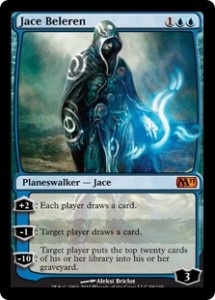
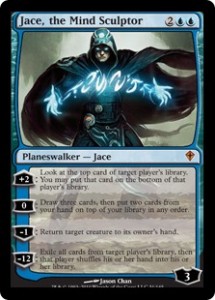
Why this is a Problem: Players are going to shortcut some card names. A lot of the time, that is fine. However in this case there is more than one card named ā€œJaceā€ Ā and there is a big difference between Jace Beleren, and his [card Jace, the Mind Sculptor]Mind Sculpting[/card] counterpart.

The Correction: Issue a Game Loss and figure out which copy of ā€œJaceā€ he is using. Correct the decklist appropriately.

Decklist 3:

A decklist submitted for a Legacy tournament has ā€œLand Taxā€ listed in the main deck.

The Problem: Land Tax is banned in Legacy.

Why this is a Problem: Land Tax is banned in Legacy. It would probably be hard to float this one by your opponent before the judge tracks you down but stranger things have happened.

The Solution: Issue a Game Loss and remove the Illegal card from the deck and add a Basic Land of the player’s choice. Correct the decklist appropriately.

The rest of these errors are things that fall under the same category but are more likely to be found over the course of playing and not by just checking the registered lists.

Decklist 4:

It is discovered by the player that there are only 56 cards in his deck. There are 60 legal cards listed on his decklist.

The Problem: A constructed deck needs to have at least 60 cards.

Why this is a Problem: Playing less than 60 cards could give you an advantage. Your chances of drawing a particular card are higher than someone playing a full 60.

The Solution: Issue a Game Loss and have the player replace the missing cards in his deck with those on his list. If those cards cannot be found in a timely manner (approximately the time it would take for you to be tardy to your match and it is up to the Head Judge how lenient they are going to be about this) they are replaced by Basic Lands and the decklist is corrected accordingly.

Decklist 5:

During a deck check it is discovered that a player didn’t unsideboard from his last round.

The Problem: You need to start each round with the ā€œMain Deckā€ listed on your decklist.

Why this is a Problem: If you know what deck your opponent is playing you could gain a huge advantage from playing cards from your sideboard during game 1.

The Solution: Issue a Game Loss and return the deck with the main deck and sideboard the way it is on the decklist.

Decklist 6:

A player notices that he has his opponents Arrest in his deck after he draws it for his turn. Both players are playing solid black sleeves that they purchased before the event.

The Problem: One player has one more card in their deck, the other has one fewer.

Why this is a Problem: This one is pretty obvious.

The Solution: In a Constructed event, both players would get a Game Loss. It is the responsibility of both players to make sure they get their cards back and both players are playing with a legal deck. Return the card, and if needed, keep playing. If it was a player from another table (their last round’s opponent, or from a friendly game), you would need to track that player down as well. If necessary, this player would also get a Game Loss for playing an illegal deck.

In a Limited event this can get interesting. In Limited events you are not required to sideboard cards one-for-one like you are in a Constructed event. You can add and remove cards between games as long as your deck ends up legal at the end. Let’s assume that the player that lost the Arrest was playing more than 41 cards. If he lost a card, his deck is still legal. He would then be missing a card from his sideboard but the penalty for losing a sideboard card is just a Warning. If you replace it before the start of the next round you can continue to use it. The player that gained the Arrest however, even if there was one lurking in his sideboard somewhere, is getting a Game Loss. If there is a copy of Arrest in his deck and one in his sideboard, but only one listed on his decklist, he would have an illegal deck still.

These are the most common issues that come up under the Deck/Decklist Problem category of the Infraction Procedure Guide. Hopefully this will help you avoid this penalty next time you go to a PTQ. Few things can ruin a day more.

As always, Keeping it Fun

Kyle Knudson

Level 2 Judge

Allon3word at gmail.com

BONUS RULES STUFF:

Sometimes the fix for this penalty can seem kind of harsh considering that most of the errors are simple mistakes that are unintentional. This may be true but these simple mistakes come with such a heavy penalty because the potential for abuse of these mistakes is quite high. Ambiguous card names, cards left off of the list, and playing illegal cards are all things can be easily taken advantage of by a more shady class of player. This is one of those situations where a few bad apples spoil it for everyone.

For the most part these errors are typically handled between rounds so they do not disrupt a match in progress. Most often these penalties are handed out at the start of the second round and from then on only if something is discovered during a Deck Check. When a Game Loss is issued neither player gets to sideboard before the start of the next game unless a game has already been played during that match (the Game Loss happened after game one).

Stop. You’re Not Going to Break The Format

Are you a Quiet Speculation member?

If not, now is a perfect time to join up! Our powerful tools, breaking-news analysis, and exclusive Discord channel will make sure you stay up to date and ahead of the curve.

Between Twitter, forums, and talking to people barely a day goes by where I don't witness someone saying that they're trying to break "the format," regardless of which format it is. Unfortunately I think only about 10% of the time it's being said jokingly, which is a problem. I'm going to let you in on a little secret: you're not going to break the format because you can't break the format. If you find that statement offensive then either your name is Zvi, in which case I apologize, or you're too damn sensitive.

This isn't a personal attack against you. The fact of the matter is that no one, no matter how brilliant a deck builder, is going to be breaking any formats anytime soon. Do you know how many people have "broken" a format in Magic's 17½ years? It's possible I'm missing someone but by my count it's three.

First, we should define what it means for the format to be broken which is simple. Unless a card or cards are added to the banned or restricted list, the format is not broken. Afterall, if it was broken then Wizards would fix it because that's what they do. Jund didn't break standard at any point. It was a dominant deck and it was a pain in the ass but there were still plenty of competitive decks being played in large numbers.Ā So now that we know what we're looking for, it's history time!

The first person to break a format has no name because I have no idea who it is. To the best of my knowledge, based on both my memory and a decent amount of research, the banned and restricted list did not yet exist as of March 1994 when Antiquities was released.

If I'm correct the first person to ever look around at a room full of people wasting their time with things like creatures and proceed to say "Mox, Mox, Mox, Mox, Mox, Rack, Rack, Balance. Go." was the first person to break a Magic format. Of course, the format was broken from the start but people weren't thinking like combo players yet. Whether The Rack was printed or not yet, the 20 Mox and 4 Balance deck was absolutely the first combo deck to exist; this is fact.

Unlike the player favourite combo of Channel/Fireball which could be thrown in any deck, the Balance deck was an entire deck dedicated to comboing the opponent out of the game.

Credit goes to Paul Pantera as being the second person to ever break a format. While I'm pretty confident that he's not the designer, Paul was the first person to top 8 a PTQ with Necropotence, and in fact won the tournament. This was in 1996 and since the Pro Tour existed at that point no one gets credit for anything unless they did it at PTQ or on the Pro Tour because life isn't fair. No explanation of this deck is necessary because if you're reading this then you should know about the Black Summer. And if you somehow care enough about Magic to be reading this but don't know what the Black Summer is something is seriously wrong with you. For the record, however, as much as many of you think you know about this awful time period it's a lot like the Great Depression: you can read about it all you want but unless you were there then you'll never fully appreciate how bad things were.

Finally, the most legendary player to ever break a format was Zvi Mowshowitz. Zvi was not only responsible for the famous Turbo Zvi deck, a deck that won by casting a single copy of Inspiration on the opponent about 27 times in a single turn, but I believe he is also responsible for the Tolarian Academy deck. The Academy deck was the first deck to win be consistently taking infinite turns starting on the first or second turn, and it resulted in a whole lot of banning.

A lot.

Not just the Academy itself, but several pieces of the deck all the way down to the lowly Lotus Petal were banned. In fact so many cards were banned between the Academy deck and the Memory Jar deck that Wizards actually instituted an "Oops! We're sorry!" policy where you could mail them banned rares and they would mail you an equal number of booster packs (If you knew what you were doing back then you'd trade for the banned rares really cheap to get extra cheap boxes of cards. And if you really knew what you were doing you'd just stock up on cheap Academies).

You may be thinking "But, Jeebus! Those aren't the only times the format broke!" and you would be correct to say so. However, those are the times when an individual person could claim credit. And afterall, isn't the entire point of wanting to break a format to show how super awesome you are and how much smarter than everyone else you are? I mean, no one wants the format to be broken. It's boring and terrible and makes people quit the game in droves. No, this is all about bragging rights and the one other time the format broke no one got to brag. Why? Because the other time the format broke was duringĀ Mirrodin and the deck that broke the format was a preconstructed deck. If anyone threw together an affinity deck and tried to take credit for breaking Standard I will personally call them out and insert a box of Thrull tokens into their rectum.

We're (eventually) talking about deck design here and there's no pride in having Wizards build your deck for you.

Alright, history lesson over. So what do you do then? Get over yourself and stop thinking you can break Standard, Extended, or any other format. When you design trying to break a format you wind up with a pile of grotesque combo decks and inconsistent aggro decks that all win on turn one 0.0000001% of the time and auto-scoop the rest of the time.

The lesson of this story? There is no unbeatable deck and as such you will not create said unbeatable deck and become famous forever.

By all means, build and test your own decks. I do and so you should. Deck design is an important part of the game and something any competitive player should understand well and have experience in even if they've never successfully designed a "tier 1" deck. Just remember when you're building that you will not have a favourable match up against every deck in the format.

That's what the sideboard is for.

Dr Jeebus

Dr. Jeebus is the most electrifying man in intellectual sports entertainment. He has been playing all forms of Magic since early 1995, and was recently voted the angriest Magic personality on Twitter. Though Jeebus does not have the time or money to go pro, but he's still really good and understands both the intricacies of play and of design, so you should listen to him. His notable accomplishments include beating a pro player so severely as to make him cry while at the age of 13, and defeating 5 multiplayer opponents using a single Thoughtlash.

View More By Dr Jeebus

Posted in Free, StrategyTagged , , , , , , , , 14 Comments on Stop. You’re Not Going to Break The Format

Have you joined the Quiet Speculation Discord?

If you haven't, you're leaving value on the table! Join our community of experts, enthusiasts, entertainers, and educators and enjoy exclusive podcasts, questions asked and answered, trades, sales, and everything else Discord has to offer.

Want to create content with Quiet Speculation?

All you need to succeed is a passion for Magic: The Gathering, and the ability to write coherently. Share your knowledge of MTG and how you leverage it to win games, get value from your cards – or even turn a profit.

MOAR CRADS! (Gassing Up)

Are you a Quiet Speculation member?

If not, now is a perfect time to join up! Our powerful tools, breaking-news analysis, and exclusive Discord channel will make sure you stay up to date and ahead of the curve.

With the release of Mirrodin Besieged I’ve been switching around the cards in my Jaya Ballard, Task Mage Commander deck in my search for the elusive optimal build. While there weren’t many new red cards to play with (although Red Suns Zenith and Into the Core come to mind) a couple of artifacts caught my eye, particularly Bonehoard. In an archetype that is often hurting for card advantage, Bonehoard offers great value in a colorless Lhurgoyf that can turn your other creatures into Lhurgoyfs as well.

That said I am completely sold on the living weapon mechanic. Much like Sword of Body and Mind, which solves the ā€œdead equipmentā€ issue by generating bodies with which to equip the sword, living weapons are equipment cards with the creatures provided free of charge. And casting Godo, Bandit Warlord to search for a Bonehoard... how much card advantage (and rhyming) is that!?

Card advantage isn’t always an easy thing to measure and it’s sometimes difficult to figure out what kind your Commander deck needs. But you know that in any given multiplayer game you never want to be the player sitting dead in the water with one card in hand, durdling around while the other players get to have fun with their shiny toys. You always want to be making plays and you want to be continuously impacting the board or progressing your own game plan. It’s probably obvious, but card advantage helps you win as well as have fun.

Not all card advantage is equal, nor is it so simple to just compare one spell to another. It is sometimes more difficult to gauge in Commander where there are so many differing strategies and color combinations to choose from. Some cards will serve you better in the early game while others serve much better later on. Some cards fit one main role but offer card advantage as a secondary function. Still other spells offer great value for their cost while indirectly providing card advantage.

This week, in honor of the mighty Bonehoard, I hope to shed a little light on some of the differences between certain cards classified as ā€œcard advantageā€ and help you avoid certain thinking traps when building and tweaking your Commander deck. I hope this breakdown won’t be too elementary to readers but I want to emphasize the importance of building card advantage into a Commander deck.

Incremental card draw engines

Incremental card advantage is pretty straightforward. A good card draw engine offers you physical cards every turn, essentially adding extra cards to your draw step. Untapping with one of these in play is a pretty darn nice feeling.

In Commander these kinds of cards are incredible early on for their ability to grease the gears of your game and can also help reload your hand in the late game (although not as quickly as you may like). If left untouched, an early card draw engine will go a long way to winning the game for you. Sylvan Library is a bit of a blend because it lets you manipulate your library while letting you decide if you want to draw more cards. For just two mana this is obviously busted. Unlike Constructed, players are not likely to remove your engine so early on in Commander. The only card that should be the exception, in my opinion, is Rhystic Study which people should be killing way more often. [Editor's Note: And pay one mana every time until it is killed. Seriously, it's not that painful!]

Library manipulation engines

I am not a fan of library manipulation spells in Commander (like Impulse). Each card slot in your list is precious and burning a card to look for another card, which you may or may not find, is not the best use of resources. That is why I prefer permanents that provide continuous opportunities to dig and search.

Card manipulation lets you look at and reorder the top cards of your deck to help you dig for a card you need at any given moment. The key point here is that unless you have a shuffle effect handy, like an unused "fetch" land (Arid Mesa), you are only paying for a short-term benefit because you are not drawing additional cards and, cards with scry aside, you are likely leaving less helpful cards on the top of your deck. For the uninitiated, that is why people play fetch lands with Jace, the Mind Sculptor, or Land Tax with Scroll Rack. Dig for a card you want, then shuffle away the chaff.

Library manipulation is more helpful in the mid to late game when you are actively looking for answers to your opponents and seeking specific cards to assemble your board state and win conditions. That is not to say that library manipulation is not helpful early on. Like incremental card draw engines the more cards you see the more options are available to you. But when you’re under the gun and things become urgent, library manipulation pulls ahead because it helps you look deeper into your deck.

Tutor spells

Tutors don’t provide raw card advantage but they are a bit like library manipulation on steroids: you get what you want exactly when you want it. I don’t like including too many of these cards in my Commander decks because while they are quite powerful they are a little useless in the early game. You never really want to burn a card, or in some cases a draw step, to find something that doesn’t immediately impact the table and help you win you the game. A word of warning: tutors also draw a bit of hate in Commander because other players will realize you are clearly up to something no matter how much you try to convince them you’re just searching for a mana source. [Editor's Note: Just "a mana source" can be something scary too given the right context.]

Card draw spells

I do not necessarily like these spells for the same reason as library manipulation spells: while they are certainly helpful in some parts of the game, burning one card to get three or even four cards is not always the best use of resources. In the mid game it is almost perfect but often it is too much or just not enough. I never turn my nose up at drawing cards but I try to use these one-shot spells sparingly.

Explosive card draw

While tutors are one-shot spells that get you what you want in any given situation, explosive card advantage spells will instantly give you your second wind and pull you head and shoulders above the rest of the table. Many of these cards are almost considered unfair because they are so powerful but don’t feel bad about using them. You don’t want to be the one durdling, remember? Once you’ve landed one of these expect to have a target painted on your head by other players. But the sheer card advantage is usually well worth the hate.

Cantrips

Cantrips begin to drift more into the discussion of value in terms of playing your spells while negating your those of your opponents. With cantrips you are playing a spell with a main purpose and getting a card draw as a ā€œbonusā€ which essentially replaces the spell you played. The almighty Bonehoard, in a sense, falls into this category because you are paying for the equipment but getting a "free" creature.

It is important not to include so many cantrips that the overall power of your spells is diluted. Sure, Smash draws you a card but is that as strong as Into the Core? Maybe there are better ways to draw extra cards. In my experience, the best ones to play in Commander are the ones you can potentially abuse, like bouncing or recurring Coiling Oracle and Mulldrifter.

So, what kind of card draw works best for you? The easy answer, and the one I will invoke, is ā€œIt depends.ā€ If you are playing an aggressive deck that wants to quickly play out its cards early on you may need a Necropotence or Lead the Stampede to reload your hand for a second go. If your deck is slower and more methodical Jace Beleren can provide a steady source of card advantage until you’ve reached critical mass. Even so, if you plan on assembling a combo to winyou may need the precision power of tutors to get the cards you need. And sometimes you’re just abusing enter-battlefield abilities so you may prefer to focus on just creature-centric cantrips.

It’s important to remember that card draw shouldn’t overshadow the rest of your deck. Unless your Commander is Niv-Mizzet, the Firemind, card draw shouldn’t be the sole focus of the deck. Your deck still needs a cohesive strategy and answers to a wide range of threats. Additional card advantage should just grease the wheels enough to help you out when you’ve hit a snag in your game.

Until next time, try not to play Distant Memories.

David Lee
@derfington on Twitter

(Author’s note: I wanted to name this article ā€œMOAR CRADSā€ but such a title would not have withstood the withering editorial gaze of Adam Styborski.)

[Editor's Note: Partially wrong. The "crads fad" may be old but I enjoy asking people if they have "any foil crads" to trade. Sometimes.]

Looking through Urza’s Legacy

Are you a Quiet Speculation member?

If not, now is a perfect time to join up! Our powerful tools, breaking-news analysis, and exclusive Discord channel will make sure you stay up to date and ahead of the curve.

Hello, and welcome to our exploration of Urza's Legacy! The second set in the Broken Block amped up the power even more for Magic. It was the first set to be printed in foil, as well. Foil-mania swept collectors around this time; fresh from $100 Pokemon foils, people scrambled to make sets. Importantly, foils were rarer when first introduced than they are now; hence, the prices are higher. I'll be discussing foils in this article and subsequent ones, but know this: most foils are worth about a buck to the right person unless they are truly awful. I'll be making notes of only the ones that are worth substantially more than they are normally. Let's get started!

Crawlspace

You can tell Legacy is a smaller set price-wise because we are starting with C! Crawlspace is a pretty popular multiplayer card, because it acts like a funnel instead of a wall. The player with dragons doesn't really care, but the Thallid guy is going to be hunting for their removal. It is an inex

pensive card to cast and it is very easy to understand how it works. That's why I like it personally over Portcullis.

$1.00

Lovingly called "Crap Rotation"

Crop Rotation
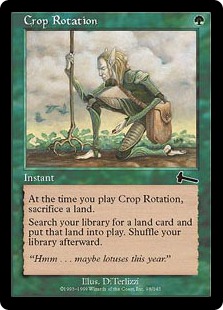
For years, I didn't think this would be unrestricted in Vintage. The reason it was tanked in the first place is that the Roto-Tiller is very good at finding Tolarian Academy. That deck needed to be throttled back, so Rotation had to go. However, I didn't think that it was Academy that would hold it back. No, thanks to Crucible of Worlds, I thought Crop Rotation for Strip Mine would be too powerful. Obviously, I was wrong and the card is now bought and sold pretty frequently on Ebay. Highly noteworthy is the fact that it grabs Gaea's Cradle; Elf players who have a single Cradle but cannot afford the full set can make good use of the Rotation to get their copy.

$1.00
$9.25 in foil – yeah, really!

Defense of the Heart

Long before Tooth and Nail, we had this card. It is easy as sin to trigger in multiplayer games and, at one colored mana, the card is easily splashed for. What can you get with DOTH? How about Sundering Titan and Kiki-Jiki, Mirror Breaker? What about Kiki-Jiki and Pestermite so you can just win right there? It threatens to combo-kill very easily, and that's alluring to many players. It's good to have a copy for EDH since it goes in just about every green deck; you can remind trading partners of this fact when they see it!

$5.75
$20.25 in foil

Deranged Hermit

Oh, the stories.

This card kickstarted a million Squirrel decks and I doubt it would be nearly as popular if it made Saprolings or something rational. Liege of the Hollows finally had a friend! Hermit saw a lot of play in Constructed because it plays well with Recurring Nightmare and Skyshroud Poacher. However, its continued high price is driven nearly entirely by kitchen table Squirrel guys. Nine power for five mana is pretty good, as is Zerg rushing with little mammals.

$5.00

Frantic Search

This card is mainly popular because it plays so well with High Tide, which you have to remember is a very popular casual deck for people to have together. Frantic Search sees a little play in Vintage, but it is nothing showstopping. However, folks love free Careful Study, so this card is actually quite valuable to have, especially as a foil common! This showcases that while a card might be worth fifty cents as a common, the foil version is radically higher.

$20.50 in foil

Only affordable to the eleven richest kings of Europe

Goblin Welder

Your favorite Goblin from technical school has been a fixture of Vintage for eight years. He's not made a big splash in Legacy until now, with the rise of Welder MUD. Goblin Welder works well in both Stax decks that aim to abuse Smokestack so they never have to sacrifice permanents, alongside the Control Slaver decks of old that would recur Mindslaver over and over.

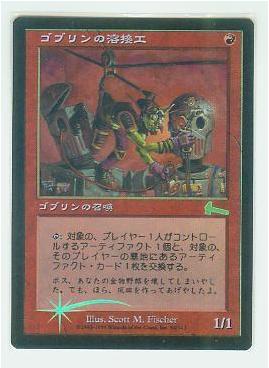
Goblin Welder is absurdly expensive as a foil and was long the poster child for Vintage collectors. In its Japanese foil version, I've seen Welders sold for over $500. Those days are past now, and the market right now is a meager $350. Cheap, right?

Due to the recent success of Welder in MUD in Legacy, I expect this price to double or triple. Get them now.

$6.00
$62.00 in foil

Grim Monolith

When Grim Monolith was unbanned in Legacy, it shot up to $30 on speculation, despite not having a home. It was previously about $6, which was dictated by fans of Wildfire decks from the Urza Block. It combines swimmingly with Voltaic Key to make gobs of mana. Now that MUD is popular, it has shot up in value. I expect it to easily hit $40 two weeks after this article is published.

$15.00 (if you can find them now)

Karmic Guide
White reanimation is so... foreign. Karmic Guide has some really, really weird abilities tacked together on a single card. It has a bit of value because it was once part of the Flash – Protean Hulk combo deck, before that deck moved on to other kill mechanisms. Mainly, though, it's a real workhorse in EDH, fueling Reveillark combos there and making big monsters come out to fight again. It is also an example of how EDH distorts foil pricing on certain cards.

$2.75
$42.25 in foil

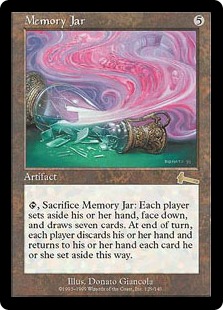
Memory JarBack before Mirrodin Block came along and gave us great artifacts, Tinker essentially only got Memory Jar in Vintage. It was to the point where a teammate joked that they should just have the art showing Hanna holding the Jar. There, it was 2U for a Draw-7, which is as good as it sounds. Memory Jar also has the distinction of being one of the few (if only) cards to have been emergency banned. It was part of a degenerate deck in Standard that could kill on the first or second turn with some real regularity, helped along by Grim Monolith and Dark Ritual. It would eventually land a single copy of Megrim, making the opponent discard about twenty-one cards and killing on the spot. Yuck. So Memory Jar has a long history of being played for absurdity with fast mana. It still sees a lot of love in Vintage and EDH, where everyone loves a good Draw-7.$3.50 $15.00 in foilMultani, Maro-SorcerorBack in The Day, decks paired Maro along with Armageddon in an attempt to drop a fattie and nuke the board for victory. Multani came along afterward as a great multiplayer card, especially since he tallies everyone's hands. Oh, and his Shroud means that someone is probably gonna get hit by him. He sees a bit of attention in EDH, but the fact that he's Legendary means you don't really need four copies in casual formats where you can pack quads. At one point, he was a great finisher for Reanimator decks, but that's mostly a history lesson at this point.$1.25No MercyIt's the black Moat! I love this card because of how political it is in multiplayer games. Hit me with your favorite Angels and lose them after combat! What a great way to dissuade people from attacking you. No Mercy has been a quiet fan favorite for years and it's worth ferreting them out because they are worth considerably more than bulk.$3.25PalinchronJust in case you liked Great Whale, we printed a much better version. For one less point of power, you get flying and a blink effect. That's fair. Palinchron was used extensively in High Tide decks because, if you hit seven lands, you could loop it for infinite mana. If an opponent had a stopper like Arcane Laboratory, you could just attack in with your flier every turn to kill them! What a silly, silly card. Palinchron sees a tiny bit of attention casually and none competitively.$2.25 $19.25 in foilQuicksilver AmuletI love this little thing, this mega Aether Vial. I liked the Amulet a lot in my GWU Legends EDH deck, which ran a lot of cards like Akroma, Angel of Wrath. You get something Flashed in, which is pretty rad, and you get to pay colorless mana for it, which is devastating. I didn't have to look at my Akroma and Multani in hand and just hope that the mana came together for it. I can't imagine what it would be like to play with four of them, but hey, people do.$4.00 (surprised?) $9.00 in foilRack and RuinR n' R is such an elegant design with enough power to make it still valuable in Vintage against Stax decks. Three mana lets you blow away two moxes, or a Chalice of the Void and Smokestack, or whatever you'd like to point it at. It is one of those cards that doesn't see too much play, but it is important enough that Vintage players need it on their sideboards.$2.25 $10.25 in foil (search those collections!)Radiant, ArchangelFolks love Angels, especially Angel bosses. Radiant was kind of a brutal guy in the novels and he's a fundamental part of people who want Serra-themed cards. The Super-Serra is really appealing in Angel decks, too. I assume that there is also a Radiant-themed EDH deck somewhere. It commands a truly staggering foil price.$3.25 $50.00 in foilRancorI am sort of surprised that a card this powerful actually made it to print, but hey, maybe it's tame in the landscape of Urza block. Rancor has been a cornerstone of many aggressive decks, since the Trample makes sure that you can get past thorny blockers. The card would be nothing if it didn't come back to your hand, either. It lent its name to one of the most fun Extended decks around, Three-Deuce. That deck ran hits like Granger Guildmage and River Boa, alongside disruptive cards to slow an opponent. Its name comes from the power and toughness on a Rancored Dwarven Miner.Rancor gets a lot of attention in casual circles and it's a power common in this set. Dig through boxes for them!$1.25RebuildRebuild is relevant because it is a Vintage sideboard card that bounces artifacts at insant-speed. It dodges Chalice of the Void at two counters and it can be used to bounce your own Moxes for lethal Storm with Tendrils of Agony. Not much else to see here, except for its foil pricetag.$15.50 in foilSubversionThis is a casual card, through and through. You've got to understand that there's a huge element of kitchen table players who love pinging and walls and all that fun, awful junk. Subversion is the kind of card that makes someone say ā€œI can gain three life a turn in multiplayer? What happens when I have two copies out?!?ā€ I think that's where Subversion shines, too – when you have multiples out. It gets people chasing the dream of this passive kill mechanism that doesn't annoy everyone so much that they just up and destroy it. Subversion has a lot of fans.$1.00TinkerOne day, Mark Rosewater, after three scotches, said:ā€œTransmute Artifact has TOO MANY WORDS. I can't understand this card! Let's chop it all down. It's not like artifacts are great, or even that we printed a Draw-7 artifact in this same set. They'll probably use it for trash like Teeka's Dragon anyway.ā€So that's why that Mox got turned into a Mindslaver. Or Blightsteel Colossus. Or Sundering Titan. Probably the most fair thing I've ever done with it is get Tormod's Crypt against Dredge, but even that felt pretty rude. Tinker is hyper-powerful and people know it. It's not a card you'll get from a store junk box, but it's something that you might find in collections here and there. The foil version has come down to a respectable price; Japanese versions once sold for over $200 in their heyday.$3.25 $11.00 in foilViashino HereticAnother Vintage sideboard card, especially in Stax decks. With it on the board, you make an opponent think twice about playing that Tangle Wire. Relevant only for its foil price.$6.00 in foilWeatherseed TreefolkThese are perennial fan favorites because they do away with the traditional problem of dying that most creatures cope with. These Treefolk are free from existential quandaries about their mortality and willingly hurl themselves at an opponent with Sneak Attack.$1.00
To wrap this up, I'd like to talk about foils a little. They are a welcome part of the game at this point, since they only offer positive value; people who don't use them can get a benefit by trading them to people who do. At the time foils were introduced, it was looked at as a cash grab by WOTC. Foils don't exactly sell more boxes, but they did create a new breed of collector who will attach a value to them. I like having people who want to collect varied aspects of Magic, and part of that might be as many foil Angels or Plains or whatevers that they can get ahold of.

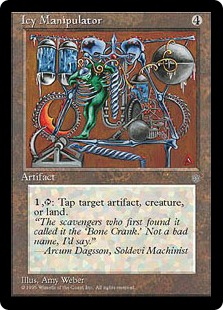
At its introduction, the hyped card in Legacy as a foil was Ring of Gix. People LOVED Icy Manipulator and looked at the Ring as the best card in the set. They didn't realize that Icy was dead by that time; creatures were much better and the game wasn't as focused on riding one big attacker through. You couldn't use Fellwar Stone and Armageddon with Icy to tap down the opponent's lands

anymore – it was terribly inefficient.

If you were facing down Sligh, the Ring or Icy were both just obsolete for stopping attackers. Nonetheless, the Ring was the chase card of the set for awhile and its foil version hit $100 and beyond at times. It's both interesting and sad to see cards like Icy, Juggernaut, Serra Angel and Erhnam Djinn utterly fail when reintroduced. I suppose Kird Ape alone comes away better.

Join me next week when we tear through Urza's Destiny! I wouldn't be surprised to see cards from previous reviews, like City of Traitors and Ancient Tomb, go up because of MUD as well. We'll see!

-Doug

Hello, and welcome to our exploration of Urza's Legacy! The second set in the Broken Block amped up the power even more for Magic. It was the first set to be printed in foil, as well. Foil-mania swept collectors around this time; fresh from $100 Pokemon foils, people scrambled to make sets. Importantly, foils were rarer when first introduced than they are now; hence, the prices are higher. I'll be discussing foils in this article and subsequent ones, but know this: most foils are worth about a buck to the right person unless they are truly awful. I'll be making notes of only the ones that are worth substantially more than they are normally. Let's get started!

Crawlspace

You can tell Legacy is a smaller set price-wise because we are starting with C! Crawlspace is a pretty popular multiplayer card, because it acts like a funnel instead of a wall. The player with dragons doesn't really care, but the Thallid guy is going to be hunting for their removal. It is an inexpensive card to cast and it is very easy to understand how it works. That's why I like it personally over Portcullis.

$1.00

Crop Rotation

For years, I didn't think this would be unrestricted in Vintage. The reason it was tanked in the first place is that the Roto-Tiller is very good at finding Tolarian Academy. That deck needed to be throttled back, so Rotation had to go. However, I didn't think that it was Academy that would hold it back. No, thanks to Crucible of Worlds, I thought Crop Rotation for Strip Mine would be too powerful. Obviously, I was wrong and the card is now bought and sold pretty frequently on Ebay. Highly noteworthy is the fact that it grabs Gaea's Cradle; Elf players who have a single Cradle but cannot afford the full set can make good use of the Rotation to get their copy.

$1.00

$9.25 in foil – yeah, really!

Defense of the Heart

Long before Tooth and Nail, we had this card. It is easy as sin to trigger in multiplayer games and, at one colored mana, the card is easily splashed for. What can you get with DOTH? How about Sundering Titan and Kiki-Jiki, Mirror Breaker? What about Kiki-Jiki and Pestermite so you can just win right there? It threatens to combo-kill very easily, and that's alluring to many players. It's good to have a copy for EDH since it goes in just about every green deck; you can remind trading partners of this fact when they see it!

$5.75

$20.25 in foil

Deranged Hermit

Oh, the stories.

This card kickstarted a million Squirrel decks and I doubt it would be nearly as popular if it made Saprolings or something rational. Liege of the Hollows finally had a friend! Hermit saw a lot of play in Constructed because it plays well with Recurring Nightmare and Skyshroud Poacher. However, its continued high price is driven nearly entirely by kitchen table Squirrel guys. Nine power for five mana is pretty good, as is Zerg rushing with little mammals.

$5.00

Frantic Search

This card is mainly popular because it plays so well with High Tide, which you have to remember is a very popular casual deck for people to have together. Frantic Search sees a little play in Vintage, but it is nothing showstopping. However, folks love free Careful Study, so this card is actually quite valuable to have, especially as a foil common! This showcases that while a card might be worth fifty cents as a common, the foil version is radically higher.

$20.50 in foil

Goblin Welder

Your favorite Goblin from technical school has been a fixture of Vintage for eight years. He's not made a big splash in Legacy until now, with the rise of Welder MUD. Goblin Welder works well in both Stax decks that aim to abuse Smokestack so they never have to sacrifice permanents, alongside the Control Slaver decks of old that would recur Mindslaver over and over.

Goblin Welder is absurdly expensive as a foil and was long the poster child for Vintage collectors. In its Japanese foil version, I've seen Welders sold for over $500. Those days are past now, and the market right now is a meager $350. Cheap, right?

Due to the recent success of Welder in MUD in Legacy, I expect this price to double or triple. Get them now.

$6.00

$62.00 in foil

Grim Monolith

When Grim Monolith was unbanned in Legacy, it shot up to $30 on speculation, despite not having a home. It was previously about $6, which was dictated by fans of Wildfire decks from the Urza Block. It combines swimmingly with Voltaic Key to make gobs of mana. Now that MUD is popular, it has shot up in value. I expect it to easily hit $40 two weeks after this article is published.

$15.00 (if you can find them now)

Karmic Guide

White reanimation is so... foreign. Karmic Guide has some really, really weird abilities tacked together on a single card. It has a bit of value because it was once part of the Flash – Protean Hulk combo deck, before that deck moved on to other kill mechanisms. Mainly, though, it's a real workhorse in EDH, fueling Reveillark combos there and making big monsters come out to fight again. It is also an example of how EDH distorts foil pricing on certain cards.

$2.75

$42.25 in foil

Memory Jar

Back before Mirrodin Block came along and gave us great artifacts, Tinker essentially only got Memory Jar in Vintage. It was to the point where a teammate joked that they should just have the art showing Hanna holding the Jar. There, it was 2U for a Draw-7, which is as good as it sounds. Memory Jar also has the distinction of being one of the few (if only) cards to have been emergency banned. It was part of a degenerate deck in Standard that could kill on the first or second turn with some real regularity, helped along by Grim Monolith and Dark Ritual. It would eventually land a single copy of Megrim, making the opponent discard about twenty-one cards and killing on the spot. Yuck. So Memory Jar has a long history of being played for absurdity with fast mana. It still sees a lot of love in Vintage and EDH, where everyone loves a good Draw-7.

$3.50

$15.00 in foil

Multani, Maro-Sorceror

Back in The Day, decks paired Maro along with Armageddon in an attempt to drop a fattie and nuke the board for victory. Multani came along afterward as a great multiplayer card, especially since he tallies everyone's hands. Oh, and his Shroud means that someone is probably gonna get hit by him. He sees a bit of attention in EDH, but the fact that he's Legendary means you don't really need four copies in casual formats where you can pack quads. At one point, he was a great finisher for Reanimator decks, but that's mostly a history lesson at this point.

$1.25

No Mercy

It's the black Moat! I love this card because of how political it is in multiplayer games. Hit me with your favorite Angels and lose them after combat! What a great way to dissuade people from attacking you. No Mercy has been a quiet fan favorite for years and it's worth ferreting them out because they are worth considerably more than bulk.

$3.25

Palinchron

Just in case you liked Great Whale, we printed a much better version. For one less point of power, you get flying and a blink effect. That's fair. Palinchron was used extensively in High Tide decks because, if you hit seven lands, you could loop it for infinite mana. If an opponent had a stopper like Arcane Laboratory, you could just attack in with your flier every turn to kill them! What a silly, silly card. Palinchron sees a tiny bit of attention casually and none competitively.

$2.25

$19.25 in foil

Quicksilver Amulet

I love this little thing, this mega Aether Vial. I liked the Amulet a lot in my GWU Legends EDH deck, which ran a lot of cards like Akroma, Angel of Wrath. You get something Flashed in, which is pretty rad, and you get to pay colorless mana for it, which is devastating. I didn't have to look at my Akroma and Multani in hand and just hope that the mana came together for it. I can't imagine what it would be like to play with four of them, but hey, people do.

$4.00 (surprised?)

$9.00 in foil

Rack and Ruin

R n' R is such an elegant design with enough power to make it still valuable in Vintage against Stax decks. Three mana lets you blow away two moxes, or a Chalice of the Void and Smokestack, or whatever you'd like to point it at. It is one of those cards that doesn't see too much play, but it is important enough that Vintage players need it on their sideboards.

$2.25

$10.25 in foil (search those collections!)

Radiant, Archangel

Folks love Angels, especially Angel bosses. Radiant was kind of a brutal guy in the novels and he's a fundamental part of people who want Serra-themed cards. The Super-Serra is really appealing in Angel decks, too. I assume that there is also a Radiant-themed EDH deck somewhere. It commands a truly staggering foil price.

$3.25

$50.00 in foil

Rancor

I am sort of surprised that a card this powerful actually made it to print, but hey, maybe it's tame in the landscape of Urza block. Rancor has been a cornerstone of many aggressive decks, since the Trample makes sure that you can get past thorny blockers. The card would be nothing if it didn't come back to your hand, either. It lent its name to one of the most fun Extended decks around, Three-Deuce. That deck ran hits like Granger Guildmage and River Boa, alongside disruptive cards to slow an opponent. Its name comes from the power and toughness on a Rancored Dwarven Miner.

Rancor gets a lot of attention in casual circles and it's a power common in this set. Dig through boxes for them!

$1.25

Rebuild

Rebuild is relevant because it is a Vintage sideboard card that bounces artifacts at insant-speed. It dodges Chalice of the Void at two counters and it can be used to bounce your own Moxes for lethal Storm with Tendrils of Agony. Not much else to see here, except for its foil pricetag.

$15.50 in foil

Subversion

This is a casual card, through and through. You've got to understand that there's a huge element of kitchen table players who love pinging and walls and all that fun, awful junk. Subversion is the kind of card that makes someone say ā€œI can gain three life a turn in multiplayer? What happens when I have two copies out?!?ā€ I think that's where Subversion shines, too – when you have multiples out. It gets people chasing the dream of this passive kill mechanism that doesn't annoy everyone so much that they just up and destroy it. Subversion has a lot of fans.

$1.00

Tinker

One day, Mark Rosewater, after three scotches, said:

ā€œTransmute Artifact has TOO MANY WORDS. I can't understand this card! Let's chop it all down. It's not like artifacts are great, or even that we printed a Draw-7 artifact in this same set. They'll probably use it for trash like Teeka's Dragon anyway.ā€

So that's why that Mox got turned into a Mindslaver. Or Blightsteel Colossus. Or Sundering Titan. Probably the most fair thing I've ever done with it is get Tormod's Crypt against Dredge, but even that felt pretty rude. Tinker is hyper-powerful and people know it. It's not a card you'll get from a store junk box, but it's something that you might find in collections here and there. The foil version has come down to a respectable price; Japanese versions once sold for over $200 in their heyday.

$3.25

$11.00 in foil

Viashino Heretic

Another Vintage sideboard card, especially in Stax decks. With it on the board, you make an opponent think twice about playing that Tangle Wire. Relevant only for its foil price.

$6.00 in foil

Weatherseed Treefolk

These are perennial fan favorites because they do away with the traditional problem of dying that most creatures cope with. These Treefolk are free from existential quandaries about their mortality and willingly hurl themselves at an opponent with Sneak Attack.

$1.00

To wrap this up, I'd like to talk about foils a little. They are a welcome part of the game at this point, since they only offer positive value; people who don't use them can get a benefit by trading them to people who do. At the time foils were introduced, it was looked at as a cash grab by WOTC. Foils don't exactly sell more boxes, but they did create a new breed of collector who will attach a value to them. I like having people who want to collect varied aspects of Magic, and part of that might be as many foil Angels or Plains or whatevers that they can get ahold of.

At its introduction, the hyped card in Legacy as a foil was Ring of Gix. People LOVED Icy Manipulator and looked at the Ring as the best card in the set. They didn't realize that Icy was dead by that time; creatures were much better and the game wasn't as focused on riding one big attacker through. You couldn't use Fellwar Stone and Armageddon with Icy to tap down the opponent's lands anymore – it was terribly inefficient. If you were facing down Sligh, the Ring or Icy were both just obsolete for stopping attackers. Nonetheless, the Ring was the chase card of the set for awhile and its foil version hit $100 and beyond at times. It's both interesting and sad to see cards like Icy, Juggernaut, Serra Angel and Erhnam Djinn utterly fail when reintroduced. I suppose Kird Ape alone comes away better.

Join me next week when we tear through Urza's Destiny! I wouldn't be surprised to see cards from previous reviews, like City of Traitors and Ancient Tomb, go up because of MUD as well. We'll see!

-Doug

Mirrodin Beseiged Design Review, Pt. 2 (G, Colorless)

Are you a Quiet Speculation member?

If not, now is a perfect time to join up! Our powerful tools, breaking-news analysis, and exclusive Discord channel will make sure you stay up to date and ahead of the curve.

(For Part 1, please click here!)

Welcome back for Part 2 of my Mirrodin Beseiged Design Review! Rather than reviewing the set as it applies to Constructed or Limited play specifically, I'll be going over how the set appears from a designer's standpoint.

Green


This is a serious Giant Spider upgrade. Most of the time, Giant Spider is a 2nd-pickable creature that holds down the fort against all 3-drops and in some cases provides a much needed attacker. The only time I'm sad about my Giant Spider is when I have to chump block a big flier just to stay alive. Blightwidow generously puts some -1/-1 counters on that mortal threat, giving you more time or making your next block a trade. It's also better on offense, where poison makes it hit like a 4/4.


I'm not exactly surprised to see a green Shatterstorm, and I was expecting an outright reprint of Shatterstorm now or in the 3rd set of the block. Unlike Mana Flare, which I agree is really a Green card, I don't think Shatterstorm is. Green already has Tranquility, and while it could be tied for #1 in artifact destruction, I believe that role belongs to red. It's obvious why this card is here; Green went to Phyrexia 2nd (after Black), and Red looks like it will be the last line of defense (or the hero that saves the plane). So if they want to give this effect to Phyrexia now, they need it to be Green. If Phyrexia is to win, I'd have waited for set 3 and just printed Shatterstorm with a watermark. Maybe this is a clue that Red is never totally overcome? Anyway, I feel this card is unfair to Red. I'd have gone for more of a 4GG Sorcery that destroys all artifacts and then gives each player a poison counter for each artifact put into their graveyard this way.


That's a lot of potential lifegain! This beast might make for some interesting limited situations. There seem to be a lot of "dinosaurs" in BSS draft / sealed, and while you obviously don't want all of them in your deck, it's important to get the right one (or to know which of those you already have that you'll play) so you can enhance their interactions a little bit more.


The mirror to Koth's Courier, and as I said before these two play up the war theme nicely. I like that the CC in their casting costs mean that not every deck can splash them out of the sideboard against you if you happen to be playing Mountains (or Forests). Cliff Threader and Marsh Threader were a little too easy to play and it was too easy to lose to them just because you went into colors that were open.


Possibly the most powerful Zenith in Standard and Extended. Tutoring for creatures has rarely been easier than it will be now, and heck, tutoring in general (with Trinket Mage, Treasure Mage, Stoneforge Mystic, Kuldotha Forgemaster, Hoarding Dragon, Diabolic Tutor, Archmage Ascension, Quest for the Holy Relic, Squadron Hawk, Trapmaker's Snare, Totem-guide Hartebeest, Eye of Ugin, and Liliana Vess, not to mention all the land searching) is probably at an all-time high in Standard (don't quote me on that). There is far too much tutoring available in Standard and Extended right now. This is a mistake by R&D as it makes games too predictable and decks too efficient. Fauna Shama, obviously the biggest offender, is a super-exciting card, and a lot of fun to play with, so it's very hard to resist printing it. Everyone loves it! It's not too powerful, but it makes many decks a large amount more consistent and narrower in focus. Combined with all the other searching I think it's too much.


If at first you don't succeed, try, try again. I guess Beast Hunt was supposed to be playable so here we have a much more efficient version. This kind of "digging for creatures" effect is great design space for Green. It helps Green decks do what they do best: flood the board with monsters and bash till the Aurochs come home. I hope to see this on a creature sometime in the future.


I guess these guys killed a Tatterkite and made shields out of it?


Giant Growth with the block's mechanic. However basic is might seem, it's critical that cards like this be designed. Note that there is more than one option here. 1G for +3/+3 and +6/+6, for example. I think that they chose these numbers for two reasons. First, all the Metalcraft stat bonuses are +2/+2 so it makes sense for this to match. Second, the Growth effects that cost G are the most effective in limited play.


On this Hydra, when you cut off a head it stays cut off. This guy's a pretty big guy for 5 mana, and it's super effective against much larger monsters, giving seven -1/-1 counters and only taking one.


Another direct poison counter delivery card. Don't be too surprised if someone combos Flight Spellbomb with this against you for the win.


My initial reaction to this card is that it creates some bad tension. You have a 4/3. Don't you want to attack with it instead of tapping it for a very non-combat ability? I thought about it some more though, and perhaps it just offers those two options to you. Either you can attack with it, if that's what you're doing, or if you have a bunch of stuff to Proliferate, you're probably not in a position where you need to attack with it. You can always block and then use the ability... but for that I would like to see it be a 3/5. Nope, it still looks like a sloppy design that doesn't know what it's for. Throne of Geth is the sleek Proliferate sacrificer, and Plaguemaw Beast is the ugly half-brother.


"What if we made a card that let you Regrowth everything?!" This is an exciting card, and I love the use of unlimited handsize here. It really sells it, because you know you won't have to worry about not getting to keep everything you get back - you can live the big dream of playing a ton of stuff in a long game and then drowning your opponent in an avalanche of everything they fought so hard to deal with the first time around.


This is how you design a vanilla creature. Uncommon can support guys you don't see at common... er, well, usually don't see at common. Green can have an 8/8 for less than 8 mana. This card is plenty cool without any text at all.


Interesting. Is this better or worse than Cystbearer? I'm not sure, though I suspect it's better. With any equipment, or a trick, or even if you can double block and make your opponent want to kill this rather than a better creature just so you can't get more cards out of it. This ability is excellent card-draw for Green, and I hope they use it once every other set from now on.


Sure.


To me, this card says "we screwed up, U/B is too powerful, again, for like the 57th time in Magic's history. I mean, who saw that coming?" Blue and sometimes Black are the only colors that have so many completely hosing creatures printed against them. Is that really part of the color pie?


I feel like this card got bumped out of several sets I worked on, but maybe that's because it's a pretty obvious set of numbers and words. Should be excellent for Infect decks in limited, and maybe constructed too.


Viridian Shaman is a classic in many formats, cool to see the Infect version for almost the same cost. It's looking like Green Infect has a lot of powerful 3-drops, I wonder if the 2-drop slot will be critical to fill while drafting.


I like that this has two power, encouraging you to attack until it dies and mana accelerates you into a fatty.

Most Standard Worthy: Green Sun's Zenith
Coolest / Most Exciting: Praetor's Counsel
Most Interesting Design: Rot Wolf

Gold


Oh first strike and deathtouch, BFFs forever! Glissa takes down just about anything (without first strike or protection) in combat. It can clearly kill stuff in order to trigger its ability, and the ability is almost perfectly opposite that of Glissa Sunseeker's. It must have been a genius who designed this card. Oh yeah, it was me. (At least Mark Gottlieb, the set's lead, remembers it as being me, and I think he's right, but I'm wary of claiming credit when I'm not 100% positive.)


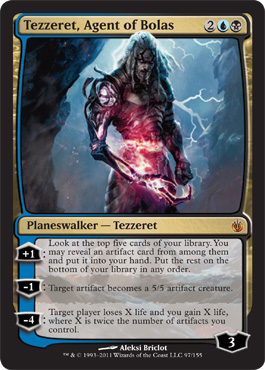
As I said in my last article, this planeswalker has the whole package: can defend itself (well, if you control an artifact), gains immediate card advantage (if your deck has artifacts in it) and can kill the opponent (if you control enough artifacts). Do I detect a theme here? This is one of the most well tied-together Planeswalkers ever. All of the abilities work together. I will certainly be trying to build an artifact-Control deck around it.

Most this and that: it's a tie!

Artifact


Hey look, it's the loser of a cycle. If you've read a lot of Rosewater's articles, or studied magic design for any length of time and still don't understand why weak cards must exist, you probably never will. If this is the first time you've thought about it, I'll give you a hint: If all cards were strong, would any of them actually be strong?


I love this card. I think it hits on all cylinders, and I was really surprised at the negative reaction it's been getting. Is it because a lot of players hate poison, and feel like it's not Magic if they die to poison? I've heard others say it obsoletes Darksteel Colossus. Um, so? New Magic cards are going to obsolete old ones, get used to it. My friend (and excellent game designer, who is currently working on Darkspore) Paul Sottosanti, and I were discussing this card the other day. He said he would have liked it more if it didn't have trample. Trample makes it inevitable that you'd be poisoned to death in ore or two turns, and makes the card too much of a game over, rather than an interesting problem you have to get around. While I can see that, it sounds like taking Annihilator off of Eldrazi. You can still chump block Big Blighty (I coined it first!), you just have to do it with sufficient toughness. You know, like with your Titan or Wurmcoil Engine. I also love the flavor of this card, I feel a great foreboding at learning Phyrexia has claimed Mirrodin's mightiest champion for their own.


Living Weapon is a great mechanic, as your equipment are now creatures, completely solving the card-disadvantage problem of Auras, instead of just mostly solving it, like regular equipment does. I could imagine a deck where every (non-land) card has living weapon. It might work out like Modular, where each time one of your guys dies you put his corpse onto another guy you control, until you have some pretty uber monsters stomping around. Is that intentional? That Living Weapon and Modular have something in common, or is it just serendipity?


This is the sort of on-board trick that's really annoying to play against. Even just 3 creatures and one equipment will probably mean there's no way you can attack.


Most of the time the "can't block" text is used as a reasonable drawback, but here it reads like "some text we threw on to make this not just a pure numbers equipment."


This is quite interesting. Very likely this will come out once your opponent is already poisoned, and it gives them a "damned if they do, damned if they don't" problem. It trades with a 3/3 and still poisons them for one. I think it'll surprise you with how effective it is.


Sexy. There are few equipment that not only protect your creature, but also themselves. I feel like they've been planning this card since Darksteel (the set) and a lot of players will be excited to get their hands on this.


If you opponent has a 60 card deck, and you play this on turn 4, first using it on turn 5, they'll have drawn 11 or 12 cards, and it will take 8 activations to mill them to 0 cards in their library. They'll have 4 life left and be at 8 poison. Not quite a triple-kill, but pretty close. You can't really triple kill anyway, because this card doesn't make them draw, so even if you use the last activation during their upkeep they would die of poison and life loss before their draw step. It would still be a cool story, though. It's a very cute design that is sure to amuse a lot of players.


I like the shade creatures that take more than B to pump because they're a lot less devastating while still being serious threats. Crypt Ripper, for example, was too often game-over in ZZZ draft.


The fact that this is a 1-drop 1/1 as well as a fine piece of equipment might make it one of the draft format's best first-turn plays.


I'm not going to do the search this time, but I feel we've seen this exact guy for 1U. Simple and effective, it's hard to say a lot about it other than it's very good design work.


Wins the fight against Razorfield Thresher every time.


I talked about this in my previous article. It should be a powerhouse in a Time Sieve deck. I like that it seems both useless and very effective at the same time. Compare it to Courier's Capsule and see how you feel about it.


I worked hard to get this effect to work out the way I wanted it to. My goal was to have a little set-aside pile where players would go to get their next spell. The key was having it take a few cards from everyone's library to seed the pool and get you excited about what was in there so you'd want to go get it. I hope this is as hilarious in Commander as I expect it to be.


Seems like just another big dumb artifact guy, doesn't it? Flying makes it a serious threat!


This design is interesting because you have to think about how you're going to get it to work. The downside is that without a card like Enchanted Evening for artifacts, it probably won't work well enough. If only there was some sort of Liquimetal Coating in this block...


Look, if you didn't want a lot of wacky artifact rares you really shouldn't be opening Mirrodin-block packs. Oh, hey, I think if you have 7 mana and cast this you can get 2 of it, and then for 4 mana more each time you can get 3 of everything else you make after that.


This card is ping-tastic, and remember that Infect creatures will ping with -1/-1 counters. It maybe the only Living Weapon that doesn't give even stats - and you can bet there was a fight about it. Looks like development took the "best card for limited play" version, but I would rather it cost more somewhere and gave an even +1/+1.


Two Myr for the price of...? Memnite is a free 1/1 but with Myr Sire I have to pay 2 to get one now and then another later? The good thing about this card is that it helps you get to metalcraft and it's harder to de-metalcraft you when you kill it.


What's the point of this design? A card that taps to make Myr - that part's great. What I don't get is the second ability. The only Myr worth getting is Myr Battlesphere, and you might as well just play four of those and zero Turbines. In Extended you can get Changelings too, but the best of those cost less than 5. I think they should have printed at least one more giant Myr that would be worth getting before making this design. I would have found a more interesting output to tapping 5 Myr.


So you have to get artifacts into a graveyard, probably your own, in Constructed. Then you have to use a turn exiling each one of them, then eventually you could have a Necrotic Ooze variant? I feel like there are too many hoops to jump through to get anything out of this card in Standard or Extended. Maybe in other formats there's some use for it, but as a build-around -me card it's far too fragile and takes far too much work to get anything out of it.


This and its Phyrexian counterpart, Pierce Strider, are a cute pair of value-added creatures for any artifact deck.


This has got to be the worst infect 3-drop by a huge margin.


That is a big infect creature. As with Blightsteel Colossus, I love the transformation of a known card into a Phyrexianized version.


I'm glad to see a branching out of Pithing Needle. Magic needs a variety of anti-one card strategy cards, like this and Memoricide.


A little more effective than the Peace version, This card might be worth blinking out every turn with Venser, the Sojourner.


We get a little bit of equip cost variety here, and as you might expect it supports a theme of the block - sacrifice. I like that they counteract the steep equip cost by giving you the first one free, making this a pretty exciting card for limited.


The latest mana Myr adds only colorless, but infect decks couldn't ask for more. So many cards from Scars that get a Phyrexian version really show the infection spreading across the plane. This is a great way to show change from one set in a block to the next.


Gleemax, is that you? You might think the best "Maro" cards (power and toughness linked to hand size) would give you a way to draw more cards. That's exciting in a level 1 kind of way, but it's too complete. The player doesn't need any other cards to go with it. Sure, getting the player to want more cards sells the game, but it also makes deckbuilding more fun and more interesting. You'll obviously want to had card-drawing to go along with your Maro creature, so on this one you're rewarded further with life loss against all of your opponents. Now where can we get some card drawing? Blue Sun's Zenith perhaps? Or maybe Consecrated Sphinx or Vivisection? It's good to have ways of making a build-around-me work in the same set. Card draw is always going to be around, so it's easy, but if you have another combo-type ability on a build-around rare, be sure to provide cards that make it work.


A bigger Chrome Steed. They would look dumb in the same set, but they're perfectly fine in adjacent sets.


Four power for four mana is a good deal, and you'll want to attack with it, of course. Regeneration and one toughness go well together - you'll obviously need the ability. Four power and regeneration also go together, because it's worth paying to keep around. How do you pay? Sacrifice theme, of course!


At the prerelease I observed one player showing another his plans to flash out a Molten-Tail Masticore when his opponent attacked. This could also be effective for an all-artifact deck against a counter-heavy opponent.


What a cool piece of art. Besieged provides a few "comes with 3 counters" artifacts. While it's awful in limited, this does mill 6 cards for 1 mana, which is a lot more efficient than most other milling effects.


Small Battle cry creatures have the problem that they die on the first attack. This one nicely provides itself a little bit of evasion to help it last through more than one combat step. The Signal Pest, land, 4 Memnites and an Ornithoper hand attacks for 9 on turn 2. Not bad.


The equipment version of Ashnod's Transmogrant? You'll have to be pretty desperate for Metalcraft to play this.


Living weapon with various numbers. If you line them all up side-by-side you can get a good look at how to design a set of cards that share a mechanic and need various numbers and keywords.


This is an interesting version of the 2-mana artifact accelerator. It's limited to 3 uses and enters tapped, but it provides any color. More proof that any fair land is a fair 2-mana artifact... or is it the other way around? (This one is nearly Gemstone Mine)


The ability to prevent everything from blocking it makes this a pretty powerful attacker. It's unlikely to die in combat, so the 1 toughness gives the other player more hope of killing it with any removal they have.


This is a really cool design. It's an expensive Vindicate, but with a sacrifice outlet you can really go to town. Instead of a small effect that you think you can amplify, it's a big effect that you want to find a way to make more efficient.


It's a little weird to me that this set has an infect Giant Spider and a Living weapon Giant Spider.


The fourth sword has arrived. There can be only one more enemy-colors sword, hopefully in the final set of this block. Designing these swords is quite different from a lot of other cards. The name is so closely tied to the functions - it's very similar to split cards, actually. You have to come up with a name and abilities that are balanced and fitting. If it doesn't work out the first time, you can try new abilities for the same name, or change the name and start again.


Except for the White-powered one, this cycle came out quite appealing. Note that of the two regenerating artifacts, one requires Green mana, and the other asks you to sacrifice an artifact. More than just numbers, this pushes these two cards apart, which is important if they're to be in the same set.


This is a pretty interesting ability. You have to cast it twice, but you end up with a 5/5 and five 1/1s. Then, if you lose four of the little guys you might want to kill the last one yourself so you can start all over again. It also protects itself from control magic effects, which might be something you're looking for.


It's interesting that destroying a permanent doesn't require mana input every turn, but making a 9/9 does.


Are three mana artifact 4/4s with a drawback a thing now? This is more useful with Living weapons around, because you can have a lot more equipment in your deck.


I expected to see this exact thing in Scars, but we got Bladed Pinions instead.

Most Standard Worthy: Phyrexian Revoker
Coolest / Most Exciting: Spine of Ish Sah
Most Interesting Design: Thopter Assembly (I didn't want to pick Knowledge Pool because I remembered designing it so clearly.)

Land


Very interesting. The drawback is quite severe, but if you have enough creatures that you can make good use of the ability, maybe your opponent won't be able to hold onto this land, even if they take it for a turn or two. Spike-tastic!


I think I've said all I can about the Phyrexianization of Mirrodin classics. We've had a real flood of creature-lands recently, and I hope we can take a break from them for a while soon.

That concludes my set review of Mirrodin Besieged. Be sure to check out my game design blog, Design-Side Out, and follow me on twitter: @GregoryMarques


Choosing a Deck: By the Numbers

Are you a Quiet Speculation member?

If not, now is a perfect time to join up! Our powerful tools, breaking-news analysis, and exclusive Discord channel will make sure you stay up to date and ahead of the curve.

Warning: this article's spreadsheet nerd status goes to 11. If you want to skip the how-to and go directly to the data I've compiled, click this link.

For formats that are well-explored, it is often a good idea to select decks based on what's been winning. However, Magic is a game with inherent variance, and as a consequence, looking at the outcome of a single event is a poor way to select a deck. The winner may have gotten lucky in any one of a number of ways - good draws, good pairings, or opponents making mistakes they shouldn't have.

In a similar fashion, someone who brought a perfectly viable deck - possibly even the best deck in the room - could easily fail to make the Top 8. Perhaps the player made mistakes with piloting the deck, perhaps he didn't mulligan a hand he should have, or perhaps he simply got bad draws or bad pairings.

At almost any event, many good players and good decks (and those in combination) still fail to make the cut. Even the best Magic players can only have a 70% or so win rate.

(As an aside: if you don't want to count the wins and losses in your rating history yourself, you can go here to get your percentages.)

With all that in mind, the idea of selecting a deck based on one tournament's result is completely absurd. The antidote to variance is more data, and that's the goal of this exercise: to use as much data as is reasonable in order to decide which deck to play.

Since I'm heading to the SCG Open in Indianapolis this weekend, I'm going to use Standard data in order to decide which archetypes are the best ones to work on this week, remembering that Mirrodin Beseiged's release is going to alter the format in ways that are not yet understood by anyone.

The first thing to do is simply to collect the data and enter it into a spreadsheet.

Results from the Decks of the Week feature can get you a great deal of results, but since I want more recent events, I'm using the Magic Online page itself, as it's more up-to-date.

There's also the SCG Open series to look at, and their decklists are readily available on the right side of their home page. If I wanted to add more decklists to my spreadsheet to break things down further, I could; but there are diminishing returns after a certain point, especially considering that the format is going to be altered somewhat with the introduction of Mirrodin Besieged.

After entering a mere two events, we can already see the metagame taking shape:

Standard
Dates
Archetype 01/26/11 01/26/11 01/25/11 01/25/11
Daily 4-0 Daily 3-1 Daily 4-0 Daily 3-1
Boros 1 2
Br Vamps 1 1
BUG Control 1
Caw-Go 1 1 2
Elves 1 1
Goblins 1 1
GW Quest 1 1
GW Ramp 1
Kuldotha Red 1
Monogreen Ramp 1
Monument Green 1
RG Valakut 7 1 4
RUG Control 1
UB Control 1 2 1 4
UG Wave 1 1
UW Control 1

Clearly, RG Valakut was absurdly popular in those two dailies. Equally clearly, we can note that it doesn't do a good job of going 4-0, only landing one person in that tier. We don't yet have enough data to really calculate things properly, but with some more effort we will.

If you start doing this for yourself, you'll notice that as you enter events, your archetype names will scroll off the left of the screen and you'll have to jump back and forth. Both Excel and OpenOffice.org have a feature called "Window Splitting" which will be instantly familiar to anyone who's ever navigated web sites from the early '90s. For those of you under the age of 18, it separates your spreadsheet into aligned frames which scroll together. You put the cursor one square to the right of the column you want to freeze it on, and you will thereafter have a much easier time of scrolling the screen. If your cursor is at the top of the column, you get a two-way split. If your cursor is elsewhere, you'll get a 4-way split.

So now we've entered all the data. What do we do with it? How do we compare a Daily Event 3-1 to a Premier Event top 4 finish to a SCG Open win? We've got to have some sort of scaling system. We also don't want to wipe out the raw data. So what do we do? Go ahead and SUM() the row, then "paste special" into a new column with only the "numbers" box checked. That'll become our "unadjusted totals" column.

Now what we want to do is add another column next to every current one for an adjusted point value. This way, we can say a Daily Event 4-0 is worth twice as much value as a Daily Event 3-1, or whatever value is deemed appropriate. Then, because our SUM() operation is going to sum across the entire row, including both adjusted and unadjusted columns, we subtract away our "unadjusted totals" column to fix our math.

If I assign values as follows, we can see that I'm just giving a deck an extra point for beating another deck of its "level"- a daily 4-0 obviously picked up a win over a daily 3-1, a SCG 1st place deck picked up a win over the 2nd place deck, etc.

Point Table
Daily 4-0 2
Daily 3-1 1
Premiere t8 1
Premiere t4 2
Premiere 2nd 3
Premiere 1st 4
SCG t16 1
SCG t8 2
SCG t4 3
SCG 2nd 4
SCG 1st 5

This is pretty much the simplest scaling system that you can use, and yet it provides a pretty deep insight, as the resulting measure is one of how far the deck tends to make it into an event. In this dataset, we see Valakut go from 66 appearances to 80 points, whereas RUG Control made a massive jump from 12 appearances to 23 points.

At this point, we add an additional column to our spreadsheet to measure the percentage gain. This is rather straightforward, and the resulting numbers are:

Unadjusted Totals Percent Improved Adjusted Totals Archetype
3 33.33 4 Aggro Red
1 0 1 Allies
1 0 1 Bant Caw-Vine
1 100 2 Bant Venser
19 36.84 26 Boros
20 25 25 Br Vamps
2 0 2 BUG Control
24 29.17 31 Caw-Go
9 44.44 13 Elves
5 0 5 Goblins
7 14.29 8 GW Quest
1 0 1 GW Ramp
2 0 2 Kuldotha Red
2 0 2 MonoGreen Ramp
1 100 2 Monument Green
1 0 1 Pyromancer
66 21.21 80 RG Valakut
12 91.67 23 RUG Control
37 40.54 52 UB Control
1 0 1 UG Ramp
6 66.67 10 UG Wave
5 20 6 UW Control
2 0 2 WW Quest
1 100 2 Vamps (monoB)

From here, we can make an informed decision that the deck that performs the best at the top level is RUG Control. Now, the relative scale of this benefit is hard to measure, and it's likely that I'm overvaluing a SCG Open win by treating it at 5 times the value of a SCG Open top 16 finish. This is likely resulting in an overvaluation of RUG.

If I change the valuation system to the following:

Point Table
Daily 4-0 1.5
Daily 3-1 1
Premiere t8 1
Premiere t4 1.5
Premiere 2nd 2
Premiere 1st 2.5
SCG t16 1
SCG t8 1.5
SCG t4 2
SCG 2nd 2.5
SCG 1st 3

The spreadsheet will change to accommodate this new scaling system.

Unadjusted Totals Percent Improved Adjusted Totals Archetype
3 16.67 3.5 Aggro Red
1 0 1 Allies
1 0 1 Bant Caw-Vine
1 50 1.5 Bant Venser
19 18.42 22.5 Boros
20 12.5 22.5 Br Vamps
2 0 2 BUG Control
24 14.58 27.5 Caw-Go
9 22.22 11 Elves
5 0 5 Goblins
7 7.14 7.5 GW Quest
1 0 1 GW Ramp
2 0 2 Kuldotha Red
2 0 2 MonoGreen Ramp
1 50 1.5 Monument Green
1 0 1 Pyromancer
66 10.61 73 RG Valakut
12 45.83 17.5 RUG Control
37 20.27 44.5 UB Control
1 0 1 UG Ramp
6 33.33 8 UG Wave
5 10 5.5 UW Control
2 0 2 WW Quest
1 50 1.5 Vamps (monoB)

Now, there's only one more thing to do: adjust for the fact that I'd rather be playing in the top 8 than telling the ggslive chat room how great my deck's matchup against them is.

There are various ways to take into account that Valakut's 66 out of 229 appearances in this spreadsheet is nearly twice that of any other deck. I've included several methods in the following table, with the same point scale:

Point Table
Daily 4-0 1.5
Daily 3-1 1
Premiere t8 1
Premiere t4 1.5
Premiere 2nd 2
Premiere 1st 2.5
SCG t16 1
SCG t8 1.5
SCG t4 2
SCG 2nd 2.5
SCG 1st 3

Constant Penalty follows the formula =F7/($A$31-A7).
Linear Penalty follows the formula =A7/$A$31*F7.
LOG Penalty follows the formula =LOG(A7)/LOG($A$31)*F7.
SQRT Penalty follows the formula =SQRT(A7)/SQRT($A$31)*F7.
Note that $A$31 is the cell with the total number of decks entered in the spreadsheet, A7 is the number of instances of this deck, and will change to A8, A9, etc. as you move down the spreadsheet. F7 is the "Percent Improved" cell for this deck and will likewise change to F8, F9, etc.

Unadjusted Totals Constant Penalty Linear Penalty LOG Penalty SQRT Penalty Percent Improved Adjusted Totals Archetype
3 0.07 0.22 3.37 1.91 16.67 3.5 Aggro Red
1 0 0 0 0 0 1 Allies
1 0 0 0 0 0 1 Bant Caw-Vine
1 0.22 0.22 0 3.3 50 1.5 Bant Venser
19 0.09 1.53 9.98 5.31 18.42 22.5 Boros
20 0.06 1.09 6.89 3.69 12.5 22.5 Br Vamps
2 0 0 0 0 0 2 BUG Control
24 0.07 1.53 8.53 4.72 14.58 27.5 Caw-Go
9 0.1 0.87 8.99 4.41 22.22 11 Elves
5 0 0 0 0 0 5 Goblins
7 0.03 0.22 2.56 1.25 7.14 7.5 GW Quest
1 0 0 0 0 0 1 GW Ramp
2 0 0 0 0 0 2 Kuldotha Red
2 0 0 0 0 0 2 MonoGreen Ramp
1 0.22 0.22 0 3.3 50 1.5 Monument Green
1 0 0 0 0 0 1 Pyromancer
66 0.07 3.06 8.18 5.69 10.61 73 RG Valakut
12 0.21 2.4 20.96 10.49 45.83 17.5 RUG Control
37 0.11 3.28 13.47 8.15 20.27 44.5 UB Control
1 0 0 0 0 0 1 UG Ramp
6 0.15 0.87 10.99 5.4 33.33 8 UG Wave
5 0.04 0.22 2.96 1.48 10 5.5 UW Control
2 0 0 0 0 0 2 WW Quest
1 0.22 0.22 0 3.3 50 1.5 Vamps (monoB)
229

I've bolded the decks which stand out. At this point, unless you've just got a sick read on the format with one of the underplayed decks (Bant Venser for instance), you should play one of the bolded decks, depending on what factors you find the most important.

[iframe https://spreadsheets.google.com/pub?key=0ApnnKmM0DlHedGREWjRJdWp2TERtMm1OWlg5NktRR1E&hl=en&single=true&gid=0&output=html 700px 555px]

Boros and Br Vampires are the two standout Aggro decks, both with extremely similar results - with this point scaling system they actually have the same score, and the only difference comes from the fact that 1 fewer Boros deck was played. This is not enough to be a statistically significant difference, and yet because that turned a 12% gain into an 18% gain, our numbers are considerably higher for Boros. On paper, we need to treat them as roughly equal in terms of overall power against the field. They're both fairly popular, and have to be attacked in a slightly different manner, so that has to be taken into consideration.

Elves is its usual combination of ramp and swarm Aggro. Obviously getting a huge boost from Matt Nass's performance in San Jose, the deck makes only 9 appearances in my spreadsheet. This lack of data suggests that it's either underplayed or it gets crushed before it can get to the top of the standings.

Caw-Go, Brian Kibler's Blue-White Control variant from Worlds, puts up low, middle-of-the-pack numbers among these decks and is clearly inferior to UB Control on paper, with fewer decks making it on the list and a worse performance once it's there.

UB Control's got the numbers at the top to be worth playing, and is the second-most popular deck that's doing well. The challenge with UB Control is finding the right decklist, as minor changes in the build can have a major impact on how the games play out.

RG Valakut is the top performer in terms of getting near the top, but is the worst deck of the lot in terms of winning once it's there. This causes me to believe that the deck is overplayed and is picking up its wins from sheer volume. My recommendation is to avoid playing the deck, but be well-prepared to face it. At 30% of the metagame, Valakut is this year's Jund, and has what is quite possibly an even worse mirror match. Why do that to yourself?

RUG Control and U/G Genesis Wave are the two remaining decks, with the highest point gain at the top level. However, 4 of Wave's 6 results on this spreadsheet are from the SCG Open series. This can be interpreted as a good thing: Wave does well against the real-world Standard field. Alternatively, it can be interpreted in a bad way: Wave is obsolete. It got a considerable amount of its improvement points from the 2nd place in Kansas City at the beginning of the month and if the point system didn't favor SCG Open decklists heavily Wave wouldn't even be in consideration.

RUG Control is the top performer by far in terms of improvement, and has a respectable number of individual entries in the table. The only concern I have about the deck is its lack of wins on MTGO - if it's got a bad Valakut matchup, it's clear why the deck is unviable on MTGO, but will that carry over to the real world?

At this point, anyone netdecking for SCG Indianapolis should be choosing from among the following four decks: RUG Control, UB Control, Genesis Wave, Valakut. Boros and Vampires are the next two decks in line, but I cannot recommend either of them- the data shows no points in their favor over any of the other 4 decks. Were I to play one, I'd pick the more resilent Vampires over Boros simply due to the increased power of sweepers post-Besieged.

Anyone building a deck from the ground up for SCG Indianapolis should be building their deck to attack the following decks: Valakut, UB Control, Caw-Go, Boros, and Vampires. There will probably be people bringing all-in Infect decks and you may want to hedge around the possibility of facing Inkmoth Nexus and Plague Stingers. Spreading Seas obviously gets better here, and Day of Judgment gains a little value, as does Squadron Hawk. Depending on how many people play Infect, Caw-Go may gain value over UB Control. (Note that RUG and Valakut both gain Slagstorm, which is a point in favor of those two decks over UB Control if lots of aggro decks show up.) There will also likely be people trying to break Tezzeret, Agent of Bolas, but card availability will be an issue this early in the format.

With all this data, what am I taking to Indianapolis? I don't know yet. It'll either be one of the 4 decks I mentioned above, or something designed from the ground up to prey on the existing decks while keeping an eye out for Infect decks.

To get a copy of the spreadsheet to make your own changes to the scores assigned to different kinds of finishes or try different scoring algorithms, you can get a copy here..

Joshua Justice

@JoshJMTG on Twitter

Joshua Justice

Joshua Justice is a Magic player in Atlanta who's been to the Pro Tour twice. College put him on hiatus from the game until January 2010, and 5 months later he won his first Pro Tour invite with Super Friends. After a series of narrow misses in the second half of the year, Joshua won a GPT and used that to make top 16 of Grand Prix: Atlanta and secure his second Pro Tour invite in just over a year. While Nagoya was a bust, Joshua has been grinding points on the SCG Open Series, and is a virtual lock for the second Invitational. His focus is primarily on metagaming and deck tuning, and partially-open formats are his favorite playground.

View More By Joshua Justice

Posted in Free, StrategyTagged , , , , , , , 5 Comments on Choosing a Deck: By the Numbers

Have you joined the Quiet Speculation Discord?

If you haven't, you're leaving value on the table! Join our community of experts, enthusiasts, entertainers, and educators and enjoy exclusive podcasts, questions asked and answered, trades, sales, and everything else Discord has to offer.

Want to create content with Quiet Speculation?

All you need to succeed is a passion for Magic: The Gathering, and the ability to write coherently. Share your knowledge of MTG and how you leverage it to win games, get value from your cards – or even turn a profit.

Get Organized!

Are you a Quiet Speculation member?

If not, now is a perfect time to join up! Our powerful tools, breaking-news analysis, and exclusive Discord channel will make sure you stay up to date and ahead of the curve.

I love snow and I hate school. So today was pretty much the perfect day. A massive snowstorm has shut down pretty much all of Chicago, and I get to explore this new winter wonderland while having the first snow day at my school in 23 years. Despite the roads being blocked, the internet knows no such constraints! So welcome back to Whinston’s Whisdom on Quiet Speculation. This week I’ll discuss how to organize your binders, in a way significantly different than some others have suggested. Let’s start right in!

One of the most important tactics for creating favorable and easy trades is to maintain a system of organization. Nothing's worse than opening up a binder and seeing cards haphazardly strewn about, with no regard to format, playability, or even color. Maintaining an organization system will make your trading partners more willing to trade again, and make your own life much easier when trying to locate a specific card.

The first binder you want to have is your Type 2 binder. All your Standard staples and fringe rares should be in here. This ranges from the Jaces to the Basilisk Collars. Anything worth more than $1.50 goes in here, but only if it’s rare. This should be organized by color, then by set. Having a proper system of organization will make it easier for people to find the cards they want, making everyone’s trading experience much easier and more pleasant. This type 2 binder should be the staple of your trades. Because most people play Standard, the majority of people you trade with will be interested in your Standard cards, so be sure to keep it well stocked. There are of course cards that aren’t rares, but are still important pieces in type 2 decks, but we’ll get to that later.

Next up, we have the Extended binder. This should be significantly smaller than type 2, because Extended is only ever a PTQ format, but it’s still important to keep this binder around to trade with Spikes trying to finish off their deck before the next PTQ. Unlike type 2, I like to organize my Extended binder by archetype rather than color. Why? Mainly because Extended archetypes don’t conform to colors as much. In Standard, there are the known factors of U/B and U/W control, but in Extended, decks can range up to U/R/W control splashing Black, or the ridiculous mana costs of 5 color control. Because colors less clearly define archetype boundaries in Extended, I always sort this binder by archetype. There will be some overlap between decks, in which case you’ll just need to remember whether you have Thoughtseizes with Faeries or in 5CC. Like type 2, make sure that this binder is only rares.

To round out the formats, we have 2 Eternal binders. The first and larger of these is the basic Eternal binder. Like Extended, this should be organized by archetype. Eternal is the format where the colors have the least impact on how an archetype functions because of the extremely easy mana bases with the original duals. But unlike Extended, you should set a cap for the larger Eternal binder of a card price of $40. Anything the cost of a dual land or higher shouldn’t be in this basic binder. But the more archetype specific cards, like Back to Basics for Merfolk, or Sneak Attack, or Show and Tell, go in here. This makes it easier for players with a specific archetype in mind that they want to build or need cards for to find them. The 2nd binder should be the higher level cards: dual lands, Tarmogoyf, Force of Will, and the Power 9/Bazaar of Baghdad level cards for Vintage. These are less archetype specific, and also of significantly higher value. Keeping them separate makes them easily findable, more organized, and also helps keep your collection secure. If someone sits down to trade with you, you hand them your lesser Eternal binder, and they take it and run, at least you didn’t lose your extremely expensive cards, and can recover more easily. As with Standard and Extended, make sure these binders are only Rares.

So, I’ve been stressing to only keep rares and Mythics in your format specific trade binders. This is where the commons and uncommons come in. I keep them in a separate binder. This prevents over cluttering for your other binders, and makes them easier and quicker to find. Even though some of them may be more expensive than many rares, I’ll still keep them with the other commons and uncommons. This binder I’ll sort first by format in which a card is useful, with a bias toward newer formats. For example, I’ll put Path in the Extended section even though it is played in Eternal formats as well. Then sort these by color. This leads to players being able to accurately find that specific card they are trying to pinpoint without too much of a hassle.

Only three more to go!

The pimp binder is a little more contentious, as some traders simply won’t have enough ā€œpimpā€ cards to fill one. But if you do, it’s extremely important to keep the older ones in here. Pimp cards are essentially foreign, miscut or misprint, foil, promo etc. cards. This is important because Eternal players will pay a premium for these ā€œpimpā€ cards, so sorting them out will let you make a greater margin than you would otherwise.

The EDH binder is devoted entirely to that most noble of formats, Commander. All of the format specific cards belong here, like Blatant Thievery, Trade Secrets, and of course, a large supply of quality generals. Unlike the type 2, Extended, and Eternal binders, keep your EDH pimp in the main EDH binder rather than sorting it out. EDH players, like Eternal players, love their pimp, so keep it in the normal binder with the normal cards.

My final binder is bulk. This is where I keep all the dollar or less rares that aren’t ever played, or the big bomby Mythics that casual Timmies love. I’ll usually sort this so that the more recent cards are at the front, and then sort by color. While most players wont even look at this binder, it’s useful to have it to break it out when evening a trade, or when trading with a more casual player who will go wide eyed over multiple Mythic Rares on a single page. I’ll try and keep at least 150 bulk rares in here, and you can always easily pick up more during trades. Always remember that standard bulk rares will go for at least 10 cents to dealers, so you can clean this binder out consistently by selling off part of it.

Now obviously not everyone will have the immense quantity of card stock necessary to maintain this many individual binders. If you are one of those people, it’s more than acceptable to combine several of these binders. I usually keep my ā€œPimpā€ and Eternal sections in the same physical binder, along with EDH. This article is mainly just a guideline for keeping your cards organized, accessible, but also advertised. You will continue to make margins on trades where your trading partner wants more and more cards, so the goal of your binders should be to convince them to take more. While the descriptions were relatively brief for each binder, I hope the theory as a whole will help you to organize your binder more effectively.

On to the comment contest! The winner for last week was q1006662, so if you’ll send me your mailing address through my email I’ll get your prizes out to you. This week’s winner will receive an altered art Man o’ War. I don’t have a scan for you, but I assure you it’s a very nice alter. Remember, a minimum of one positive comment, one constructive criticism, and one future article idea. The responses from last week were all great, so keep it up everyone!

Until next week,

--Noah Whinston

mtgplayer@sbcglobal.net

nwhinston on Twitter

arcadefire on MTGO

baldr7mtgstore on Ebay

Mirrodin Besieged Design Review, Pt. 1 (WUBR)

Are you a Quiet Speculation member?

If not, now is a perfect time to join up! Our powerful tools, breaking-news analysis, and exclusive Discord channel will make sure you stay up to date and ahead of the curve.

Look, I know you can't get enough card-by-card reviews of the new set, and I would hate to disappoint you, so today's article will be a card-by-card review of Mirrodin Besieged. I'm no LSV, and I don't want to steal his thunder anyway (or that of many others who do similar reviews) so I'm taking an angle that I feel few others can take: A design review. As a one-time Magic designer I hope my perspective will be particularly interesting. Let me know if it is with some comments! Also, I should warn you by saying that I was on the design team for Besieged for a couple of weeks, but I barely remember it. A lot was going on for me at the time. Without further ado...

White


When I first saw Blade of the Sixth Pride I fell in love with it. Though I admit some of that has to do with the expanded art. I'm sure most of you are happy to trade that for new keyword ability. This is Magic's fifth two-mana 3/1, and I'm a fan of that number configuration, as it looks aggressive and it delivers on it. Battle cry is a great ability, though a bit of a force for a keyword. Probably a case of keywording in order to emphasize its thematic use throughout the set.


Wild Nacatl? A pretty obvious number combination for Metalcraft. Unlikely to be of use in Standard or Extended, but you'll lose to it in drafts despite it not being a very high pick. I'm not sure if that kind of card is skill testing or just annoying (for the highly competitive Spike). It's good design though.


A more versatile and more expensive Excommunicate. This falls into the "necessary" design category. Somebody has to do it, but it's not going to win you any medals of recognition from players.


Now this is a card! A most excellent design, giving White the kind of combat trick it needs, but almost powerful enough to be considered a Wrath variant. As a sweet bonus it's a very Phyrexian-feeling twist on the usual damage-to-attackers template we've come to expect. I have a feeling this will end up being sexy tech in formats other than limited.


Straightforward, clean, a fine card that was first printed in Legends. It will be very relevant in limited, being almost a blowout against fast Metalcraft decks. Especially so when played by Controlling decks with big finishers.


I like what's going on here. It seems like a dull card designed for the kiddies at first, but the "draw a card" text is doing something special here. This is how you add cantripping to a card the right way. Take note, amateur designers! This card probably won't affect Standard, but just maybe there is a place for it in some artifact Combo deck, or as an almost-reloader in a Tempered Steel deck. While I'm on that, can you guess why this sort of effect might be counterproductive? Your opponent will know what your next several draws will be, and that information can be more valuable than hitting real cards for the next few turns. Also, it's a little too expensive for Constructed.


Yuck. I thought this is the kind of bad tension design is supposed to avoid. It's also the kind of "why would I ever do that to my guy" effect that I personally hate. Usually you see it as a +3/-3 enchantment or instant that you just know you're never casting on your own creature. It's even worse here, asking you to sacrifice a 2/1 to shrink another of your guys, just so you can regenerate it? Yeah, right.


An obviously Constructed worthy mini-Grave Titan. Cards feel really good when they give you cake and let you eat it, and that's exactly what we get here. Free, no-lies cake! An excellent way to show off the Battle cry keyword as well. Someone gets a gold star.


LOL! The 5WW casting cost is like the kiss of death. So many bad cards have - actually, wait... I just did a search on that and I'm totally wrong! Lots of 5WWs are limited bombs and Eternal Dragon has seen Constructed play. Well, this card is weak. Not only that, but I don't like how it's dragging Kemba, Kha Regent down with it. (I have tried to draft around that cat many times, and have yet to get a single token out of it.) At least Kemba was worth dreaming about.


I love the way this design reverses Journey to Nowhere. Instead of an enchantment that can hide a creature, we have a creature that can hide (an artifact or) an enchantment. Feels more like a hoarder than a warder to me, and in the art it looks like his mom just walked in on him with his bong, but it's good design.


This reprint was a fine design the first time, and it's nice that it still looks good on the modern creature curve.


Filling out the 4W slot with a basic new-keyword guy. Makes you think design leaves slots that just say "fill curve with a Battle cry creature" doesn't it? Well they don't. "But wouldn't that would save some time?" You ask. Only rarely. Think about a set like Rise of the Eldrazi. The common curve-fillers there are totally different from those in Mirrodin Besieged, because design is often trying to create a certain limited environment or show a particular picture of the plane. Rise is an extreme example, but in almost every set design is trying to craft an environment. Development might change it, but it's best if you give them a starting place.


Generating Metalcraft at instant speed and practically out of nowhere elevates the already useful creation of 1/1s at instant speed to a new level of effectiveness for Mirran decks.


A sexy card that sells the war theme (along with it's mirror card) very nicely. Double strike, double protection, double-White... okay I was stretching at the end there.


Despite my guess that this will read like a bad Martial Coup to many players, I like the design of this card. The concept of creating a new monster out of all the dudes I just killed is cool, though a little bit Black-feeling. Perhaps that makes it all the better for a White Phyrexian card?


Basic numbers Infect guy, but I like it; it's aesthetically pleasing. It's also cheaper than you might think, and could be impressive the way Snapping Creeper was in many a ZZW draft deck.


I think I just learned a new word for "bird". This card should prove interesting in limited. It's hard to quantify what exactly makes a card like this feel good or bad. It's a combination of everything: color, power, keywords, set themes, and something that experienced designers and developers gain an intuitive grasp of over time.


At 3WWW, this is no Baneslayer Angel. It certainly could be a game changer, but not likely in Constructed. If only the ability didn't require it to attack it might be on par with Eldrazi Monument. Doesn't mean it's not a cool design though. I like it a lot - it has a cool dream.


At first this seems exciting, but it's no Decree of Justice. In fact, it's really just a more-rare Howl of the Night Pack. Wait, it's an instant?! Well, that changes everything! I hope you like losing to a bunch of cats and counterspells, because this is a most excellent finisher for draw-go style U/W Control decks.

And now, in honor of the Golden Globes and Academy Awards, we have some bests to hand out:
Most Standard Worthy: White Sun's Zenith
Coolest / Most Exciting: Hero of Bladehold
Most Interesting Design: Choking Fumes

Blue


No-brainer design. Hey everyone, let's make a cycle where the Blue one draws cards! I really wish they'd break that mold a little more often. All I see here is an increase in the chance for my vintage rotisserie opponent to draw Stroke of Genius once they have the High Tide + Palinchron combo going. I guess it could be worse... it could be Upheaval.


How can design give you the world's most repeated card drawing card back to back with one of the most interesting card-drawing cards you've ever seen? If nothing else, that's what makes R&D awesome. They can deliver the necessary basics and the new and exciting all in one set. Every time this ability triggers I'll be saying, "One for you, two for me."


Control Magic... with Infect!? At first I thought this was the first card to give a creature you steal a keyword, but it turns out that was Yavimaya's Embrace. This is a cool design niche, and I hope to see similar cards that grant flying, shroud, and unblockable in the future. Maybe even some gold cards that grant first strike, haste, and deathtouch; why, there are a plethora of possibilities! Also, awesome flavor.


In a vacuum, I like this design, but in light of the many very recent shapeshifters that read like templating variations of this card I have to say that it should have been put off for a few years. R&D did this with Hydras while I was there, and that too seems like a mistake in hind sight. Sure, we did eventually find Protean Hydra (the most Hydra-est Hydra of all, thanks to Nate Heiss), but it might have been more noticed if it was separated from Apocalypse Hydra, Feral Hydra, and Khalni Hydra a little bit more. I don't think this sort of shapeshifter is a well that design can keep going back to. Right design, wrong place.


This is an interesting combination of Demonic Tutor and Standstill. I'd like to try it a few times and see if it's as fun to play with as it reads. For a rare, you can usually assume that development did this testing for you, and left it in the set because it was that fun.


Super-typical Counterspell with this set's mechanics. You had to know this was coming at some point in the block, and it just happens to be in the middle set. It's easy for me to say "this is uninteresting because it's so basic in it's design," but after following the GDS2 I'd rather say, "Please, for the love of the five suns, study this!" This kind of card is really important to making a set work.


This is a sleeper hit. I love the simplicity and the possibilities that spawn in my mind. It helps a lot that Grand Architect was in the set before this, so that your gears can start turning all the faster. It just might fit into Constructed, and I bet it can be the cornerstone of a fun limited archetype. At worst it's a 1/3 flier so you don't have to be embarrassed to try it out.


This is the cutest secret Blue Rampant Growth ever. I wonder if it could be wacky sideboard tech in a particular mirror-match? It's a neat design that will be fun to play even if it's not top tier. Combining "always fun" with "possibly Standard-worthy" makes for an appealing card, and it's a sweet spot R&D should (and does) aim for a lot.


I've really enjoyed the modern use of the Rogue creature type. This uncommon isn't too fancy, but I feel like it won't really do anything. Shroud on a 1-toughness guy doesn't do much, since it still dies to any other creature, and this guy will need a lot of help to connect on turn 4. Good overall flavor, but I think the practical side of this design falls short.


Being a Full Metal Alchemist fan has really altered my perception of the word Homunculus. I now expect them to be indestructible badasses, and instead this little dork is begging me to kill him. Elvish Visionary you are not! This card is clearly here to help out the sacrifice subtheme. I would have loved to see a Merfolk that costs only U here instead, just to see if it could be used in a Merfolk deck in Standard. That's a card people would be talking about, instead of this card that most people will ignore.


Need a new Disperse variant? How about double? Another fine basic design that does a good job of moving a 2-mana Blue spell into the 5-mana slot when you have too many other cheap Blue spells at common that you don't want to change.


It's starting to worry me a little bit that "Phrexianizing" cards seems to mean making them Black/x gold cards without the Black mana. I'm sure we've seen a very similar card in mono Black, and discard doesn't really belong in Blue. Add to that the fact this this is another pretty transparent sacrifice theme enhancer and I can't help but feel like this card is "trying too hard" design.


Sea Serpent variations have gotten a lot more interesting in the last few years. I blame Tom LaPille.


It's Artifact Blast with additional uses. This card might be really good (especially in limited) - you can bounce an equipment mid-combat or counter a Wurmcoil Engine. Don't dismiss this one too quickly.


It all comes together beautifully here. The comparison to Trinket Mage, the utility of searching up a well known, standard worthy fatty, A+ design (and flavor).


Oh Bewilder variants, will you ever be playable? This one could be, in draft or sealed. At least they can still come up with variations instead of just reprinting the same power-reducing Blue instant over and over.


Now let's see, if I can get an Everflowing Chalice into play with enough counters on it, make it a 5/5 with Tezzeret, Agent of Bolas, then I can make some extra mana and... You get the idea: there are possibilities here, and this is a fine card for you to try and break. The real question is: does it cost 2U just because it's Blue removal, or because it was a busted combo at 1U? Note that this can also fall into the Black/x Phyrexianization category, but it feels much more acceptable than most.


I always want these card to work with Planeswalkers. This looks like a way to get a charge counter deck going, but it's going to be far too slow and clunky to be any good. I feel like this card is a cruel joke - all the low-skill players will play it and lose to stronger players, and the stronger players are disappointed that it's not good enough for them to play even though they want to have fun with it. Either way it's setting up players for disappointment, and that can't be good for business.


This is a Phyrexianization of a card that doesn't feel like so much like a gold card. The flavor is cool (and creepy), and it's a sweet combo with Oculus. As a bonus, it teaches you a science word so you can tell your mom that Magic is highly educational.

Most Standard Worthy: Treasure Mage
Coolest / Most Exciting: Consecrated Sphinx
Most Interesting Design: Mitotic Manipulation

I found Blue to be less exciting than White. A lot of the cards felt like they fit neatly into their assigned roles, but didn't have as much individual appeal.

Black


This card reads like Mutilate for a lot more mana. I guess one of the good things about the shuffle-in on these cards is that it makes you feel better about casting them early for a small X because you might draw them again later for a big X. Sure, top-level pros know that's a pretty small effect, like the way milling doesn't really hurt you (because those cards might as well have been on the bottom of your deck), but a lot of players will see it as a "rebuy" of sorts on the card. Also, I totally cast this card twice in the same game at the Seattle Prerelease. I won that game.


Why must this be each player? Just to make it extra unappealing? I get that Black does these symmetrical pain guys, but aside from the rares, I don't see any way to gain life and be ahead when this dies - and if this dies you're probably losing. Oh riiight, it's for the sacrifice theme. I'm not buying it. The imagery is cool though, his acid-filled belly explodes all over everyone when he dies.


Oh, here's some extra lifelink that I almost didn't notice. It neatly provides the Infect attack with lifegain to keep you alive. Too bad it dies right away and doesn't actually gain you more than 1 life, like ever. Well, something has to be the 23rd card in an Infect deck desperate for 2-drops.


I like this design for both infect decks and sacrifice combo decks. It might be hard to bridge them into one deck because all of Mirrodin's sacrifice effects seemed to focus on dealing damage. It won't take a lot of creatures to make this into a game-winning attacker. Getting passed this should be one of the bigger signals that infect is open. (Besieged is pack 1, don't forget!)


I love action-worded kill spells. "I'm going to go for this Primeval Titan's throat" rolls nicely off the tongue as you savagely kill their only relevant creature. I expect to see this played more than Doom Blade in a lot of decks. Don't be surprised by 2-2 splits if artifacts are featured prominently.


This is some excellent design. Graveyard Threaten, as I'm sure it was playtest named, does a beautiful thing that you always wanted to do but didn't quite know you wanted to do. Well, unless you played Puppeteer Clique a lot, which you didn't, because it was grossly underplayed. Where was I? Oh yeah, hilarious name too.


I like this B discard variant quite a bit. It's hard to make the weak discard slot interesting. Sometimes you get lucky and can make an Inquisition of Kozilek that is weak in limited because of what the set is doing, but is practically a staple in Standard / Extended. Horrifying Revelation is a new twist on something you have to provide in every set. Note that it has slight synergy with Gruesome Encore.


"Hey guys! Sorry I'm late and I crashed through the wall and squished a bunch of you. Are you okay? Look, do you mind if I eat some of the guys I killed? I'm famished. Mmm, they sure are delicious." I'm sure you're excited about this guy, like I am. Few cards say comeback like this one does. Even if only half of your opponent's creature are killed immediately, your other guys can attack this turn into their shrunken remainders, who probably can't come back effectively through this 6/5 next turn. It does everything you want in a creature fight and will be very fun to play with.


Does this set have a minor "double up" theme? Double Disperse and now Double Raise Dead with Disentomb. This card should be great in draft and sealed where it reads much better than "draw two" most of the time.


You get a 2/2 when it dies, and if you can ping it every turn you'll have quite the token generator. It's great when just a few words can get your mind working on ways to take over the game.


An obvious card in the place it belongs. It's great design, because you would notice if it didn't exist. It's the kind of expectation-meeting that makes players happy rather than bored.


That is a sweet text box. First strike and Infect are a hot combination that allow this 2/2 to not-trade and yet lay the smackdown on a 3/3 (or even 3/5). Protection from not one but two of the 3 removal colors gives it even more game against important fatties, while avoiding death from lightning and permanent vacations. Makes me wonder if Go for the Throat was created just to handle this knight.


A beloved reprint. This is a pretty good use of "draw a card" because of the incorporation of life loss to give it the Black flavor of gaining advantage at a dangerous price.


We were all waiting for the "you get a poison counter" drawback guy, right? Why this isn't a more perfect (5/5) recreation of Juzam Djinn I have no idea. Perhaps it was too good in Constructed? If not then I think the 4 power is a sad missed opportunity to mirror the Arabian Nights favorite. Let's hope it was too strong, and this version is still strong enough to be a powerhouse in limited and perhaps Constructed worthy.


I want this creature to be good. I think it's good, but it's the sort of build-around me that doesn't do much on its own. Also, what it does doesn't really help you win, it just prevents losing. A 3/3 flier for 2BB is a threat, to be sure, but it's hard to believe it will be seen in Standard or Extended. The design is pretty good, rewarding you for doing two very Black things. I feel like Black has had a lot of cards like this recently - that try to reward you for doing stuff Black does well... is this some sort of new element to the color pie? Can we see some of this in other colors? Have we seen it and I just didn't notice?


Infect [card Sea Snidd]Snidd[/card]!!!


Are these possibly Constructed worthy? They're almost a 3-mana 3/3 that kills your opponent like a 6/3. If there's a pure Infect creature mono-Black deck in Standard these rats should at least be tested in it. I love the use of "poisoned" as game terminology and hope they find a few more uses for it in Mirrodin Pure / New Phyrexia.


Solid application of Proliferate to a necessary game effect for limited.


This is some nice upside on a -1/-1 trick. Limited games will be won and lost over this card. I like that they were able to keep it cheap by requiring the creature's death for the poisoning. The fact that you can shrink a blocker or attacker for a creature kill plus poisoning ensures its usefulness.

Most Standard Worthy: Go for the Throat
Coolest / Most Exciting: Massacre Wurm
Most Interesting Design: Gruesome Encore

Red


I was looking for this when trying to build a Venser, the Sojourner deck for Standard. This probably isn't good enough, but at least it could ping each turn. A fine card for limited, even if it's a very typical progression from Sparkmage Apprentice. See also Merfolk Looter and Cephalid Looter. On that note, let me say this: Doing so is good design, not lazy or bad design. Bad design is not doing this when it's obviously what you want to do. Many amateurs are inexplicably afraid of such a simple step (from 2-cost 1/1 to 3-cost 2/1, or any similar numbers change).


A first-pick removal spell that's a blowout against the Infect drafter? Sign me up! I should say that this is another card in the "too many of the same thing in a row" group (Lash Out, Searing Blaze, Burn the Impure, maybe also Smash to Smithereens), but I happen to love this particular effect, so I won't.


Cool! This is a Lava Axe with a really nice side-effect. If you thought Metalcraft decks were fast before (in draft) wait until they finish you off with this and a couple of Chrome Steeds.


Bleh. I mean, it's a fine design, it just makes me tired, looking at a card like this. It's far worse than a dozen other cards in Magic's history, yet you just know you'll need to draft it sometimes because it can destroy a non-creature artifact. Hopefully it will go 15th and you can have 3 in every sideboard. This is a waste of a really excellent card name.


I immediately searched for expensive instants and sorceries that are available in Standard and Extended. That is the easiest way to spot a great design. If you immediately search for a way to make a deck, the design is excellent. You probably thought of Cruel Ultimatum and Destructive Force without having to search though, right? (I could have said "a great design for a build around me slot," but even a card like Leatherback Baloth can get you searching for the cards to make a deck.)


For some reason I don't believe this guy exists on Mirrodin. Does it have any dinosaurs at all? I guess if Creative okayed it, it exists, but it's not consistent with my image of Mirrodin. It has numbers, they fill a role: 14th-pick common. This card fails for me on many levels.


Goblins should be a deck in Standard, and this goes in it. Keep trying, it's out there. Battle cry seems like a perfect fit for Goblins, as it works well mechanically with a bunch of small dudes and the "you can't block" effects, and it brings a classic image of a hoard of charging and screaming Goblins to mind.


I don't know why people are excited about this. It's yet another so-called Dragon that costs too much and isn't powerful enough to do anything in Standard or Extended, and it is totally outclassed in many other environments. I wish Dragons more often got A+ power level cards, but that's probably because I love Dragons too much. Oh no wait, that's not possible - you can't love Dragons too much. Well, at least he 2-shots any opponent if you have a couple of artifacts in play (you can activate that ability more than once, you know).


This is pretty interesting. It's a good haster with abilities that will be surprisingly effective a lot of the time, I bet. Battle cry combines will lots of little dudes, as you know by now, and saying your opponent's little dudes can't block means a lot of your guys that now have +1/+0 will probably get through.


Oops, looks like I missed a White card - what? This is Red? How is that? Does instant speed make it Red somehow?


Like the crusaders, the couriers do a good job showing the war with parallel creatures on each side. Where a lot of numbers commons are just numbers, this one really emphasizes the set theme in an extra way.


I like it! Damage divided has always proven to be a fun ability to play with, and this is a good card to reinforce the sacrifice theme, playing artifacts, and doing things Red likes to do. It just might be a star in limited, turning the tables on your opponent almost as well as a Massacre Wurm would.


The part I don't like about this card is that when you are forced to attack with it, you'll feel you're also forced to attack with other guys to get your value out of it. Maybe that will be good, as in a ground stall you often need encouragement to do the math on attacking with a lot of guys when it would be easier to just sit back and pass. So I've decided that I like it, after all.


I only want to hear one story from this card: My opponent cast Mindslaver. I untapped, played my 7th mana, Metallic Mastery, and used the opponent's Mindslaver against them. I feel like we're getting spoiled with two cool new Threatens in the same set.


Shatterskull Giant #3! It's like Magic has endless need for new names on this creature. It's not like Mirrodin doesn't have Giants, and it's not like Ogre is more relevant a creature type. Well, it's also not like it matters either way, I just need to say something about it.


I don't like how close this reads to Battle cry. I'd rather have different numbers in the same set as a keyword that gives +1/+0. I would have argued against this card being in this set. There is some danger in printing tricks like this that say "attacking creatures" on them. One of my opponents at the Prerelease cast this during my attack step, thinking he would blow me out. I let him take it back after pointing out he was going to give my guys +1/+0 and first strike.


"Lets make a cycle where the red one deals damage!" Oh, you're saying I used that joke already? Then the best thing about this card is that it costs XR and not XRR. It's not all that interesting, really.


Take this, Infest! Red gets to kill 3-toughness guys with the bonus alternate mode of finishing off an opponent (or Planeswalker). This choice will be interesting a lot of the time, and it's good to make burn spells with unusual choices like this.


This card has quite a nice dream. Makes me wonder what a fair cost for a 3/1 unconditional doublestriker is. Oh right, probably 2RR. I find myself liking Metalcraft less with each non-artifact card I read that has the keyword on it. Instead of a "play all of these" mechanic it's a "choose one of these only" mechanic. Too counterintuitive.

I want to know why we didn't get this rare: 1RR Sorcery, "Creatures you control gain Battle cry until the end of turn."

Most Standard Worthy: Slagstorm? It's a close one, none of them seem over-the-top powerful.
Coolest / Most Exciting: Galvanoth
Most Interesting Design: Concussive Bolt

That concludes the first half of my set review of Mirrodin Besieged. Tomorrow, we'll finish up with Green, Multicolor, and Colorless!

Be sure to check out my game design blog, Design-Side Out, and follow me on twitter: @GregoryMarques

The Great Designer Search 2: Shawn’s Deck

Are you a Quiet Speculation member?

If not, now is a perfect time to join up! Our powerful tools, breaking-news analysis, and exclusive Discord channel will make sure you stay up to date and ahead of the curve.

In two straight days of testing, we'd managed to knock out three of the four Great Designer Search 2 finalist's decks, playtesting and reviewing submissions from Ethan Fleischer, Scott Van Essen, and Devon Rule. The final member of this august group, Shawn Main, had just managed to squeak his deck in at the buzzer, so we dutifully rose that Sunday morning, put on a good breakfast, brewed two pots of coffee and sleeved up The Blight.

If there was aĀ deck that had me most concerned on a sight-unseen basis, it was this one. From what I'd previously gathered, blighting was a mechanic that destroyed permanents on the field. That sounded intriguing but also had the potential to be horribly unfun, especially against decks that weren't part of its set. It might be balanced to be blowing the crap out of your opponent'sĀ  board if she's blowing the crap out of yours, but what happens when the opponent is playing something else? Do they just watch their board state get ground up with little hope of survival? It was with these concerns in mind that I entered the world of Wodotha. As the deck had arrived nameless, we quickly took to calling it, quite simply, The Blight.

Shawn Main: The Blight

The World: Wodotha. "The Blight descends and the horizon is gone; succumb or soldier on."

The Mechanic: Blighting is a mechanic that is similar to Scott Van Essen's breakout in that it's a bit tricky to grasp at first (especially on paper), but you quickly figure it out and from there on it's quite simple. When blight is triggered, two things happen. First, you look at the board for any and all permanents that have a blight counter placed upon them, and these are destroyed. Next, you put a blight counter on a legal permanent. What constitutes a 'legal permanent' has some variations to it, illustrating some rich design space available to the mechanic. Creatures tend to blight other creatures, Blight Naturalize blights an artifact or enchantment (as you'd expect), and there are a few ways to blight just about anything (such as the Void Sphere, an artifact which blights target permanent). Remember the Ghosts in StarCraft, who would 'paint' a target then call in a nuke strike? This is rather similar: your first blight card 'paints' a target, then your next blight card thenĀ nukes the one you painted while painting another.

The Deck: Shawn opted to go with a Black/Green construction that showcased the blight mechanic in a number of different ways, using the common formula of 12 lands each in two colours, 24 creatures and 12 noncreatures. A mana curve of 2-6-6-4-6 (1,2,3,4,5+ CMC) gave the deck plenty of things to do at neary any point in the game and nearly 40% of these creatures interact with blight.

As you might expect, blight doesn't start to make an appearance until the mid-game. Early options like Deathgreeter and Runeclaw Bear offer some early board presence, while a quartet of weenies with interesting abilities disincentivise an opponent from attacking. The Venturesome Gatherer is a two-drop 1/1 elf that lets you draw a card when it dies, while the Gravechatter Rat is similarly a 1/1 rat that forces your opponent to discard upon death. Given that many players exhibit anĀ aversion to discard, something understandable, albeit irrational, the Rat in particular can be an effective stall tactic. Moving into the three-drops, you have the Hungry Vampire, a 2/2 that gets +1/+1 and flying when a critter is fed to it, a weaker but evasive version of Vampire Aristocrat. And that's when you run into the blight critters.

If there's one thing the blight creatures all have in common it's that they trigger a blight before anything else. If there's anything on the board that's been 'painted' then these creatures double as a removal spell as well. The Doom Herald is a 3/1 Horror that blights a creature; simple enough. Then you have the Void Serpent which carries "blighttouch." This means that whenever it deals damage to a creature, then a blight happens (again, destroying anything alreadyĀ painted) and the damaged creature gets a blight counter as well.

Moving on to the four-drops, you have two each of the Blightsky Horror and the Bone Courier (the latter a functional reprint of Gravedigger). The Blightsky Horror is a 3/3 bodyĀ (a good deal for Black) which also has a twist. After its blight resolves, it then puts a blight counter on a flying creature. Making things worse for the doomed target, the Horror also says "Creatures with blight counters on them lose flying." Doomed and grounded? Quelle horreur indeed!

Finally, we arrive at the fat end of the pack, the 5+ costed creatures. Of the six, three of them interact with blight. The three that don't are the Worldedge Sentinel (a 4/4 Green creature with vigilance, of which you get two in the deck), and the rare Purveyor of Corruption. While the Purveyor doesn't get its hands dirty in the messy business of blighting, it certainly reaps a tidy profit from it: whenever an opponent has one of their creatures put into a graveyard, you may pay a black mana and get a 3/3 Horror creature token.

That leaves us with a pair of Omen Vultures and the premium foil rare, Corruption Dragon. The Vultures are a bit of a raw deal: for five mana you only get a wimpy 2/2 flyer, but on the upside they doĀ blight (try and look at it as a kicked Heartstabber Mosquito which makes the pill go down a little easier). What difference does adding a Black mana to the casting cost and upping it a rarity level (from uncommon to rare) make? That takes you from the Vulture to the Dragon, a 5/5 flyer which blights every time it attacks. Quite a contrast!

The Support: The noncreature cards in Shawn's deck take on a strong supporting role. You have some mana ramp in Harrowing Horizons (sac a creature, fetch an untapped basic land, and not quite as bad a deal as it first looks when you can 'repurpose' a creature that's about to die anyway) and a pair of [card Fog]Fogs[/card] to blank out incomging damage. There's an equipment card in the form of the Berserker's Dualaxe, which gives a slight power boost and requires that the equipped beater be blocked only by two or more creatures. And finally, you have everything else, all of which involves blight.

Blight Suffering is one of the deck's all-stars. For one thing, blight tends to be a slow affair mostly done through the casting of creatures. Blight Suffering is a three-mana Black instant that triggers a blight, then puts a blight counter on a target creature. But wait, there's more! The creature's controller then loses life equal to the creature's toughness. Take that, [card Kozilek, Butcher of Truth]Kozilek[/card]!

Next we have a pair of Impending Dooms. These are cheap creature auras that afflict its target with the Doom status a la Final Fantasy. Once it's on, that creature knows its turns are numbered. Finally, we have a pair of the Blight Naturalizes mentioned above, and a Void Sphere (an artifact which allows for two blight triggers before it dies).

The Playtest: No matter what a deck might look like, there is simply no substitute for putting rubber to the road. At all points during out playtest weekend, we'd had our assumptions challenged once the cards were shuffled. Ethan's evolve deck seemed simple, but it was nuanced. Scott's breakout seemed complicated, but it was simple. Devon's gold deck seemed solid, but it was broken. Would Shawn's deck follow suit? With thoughts of blight counters smashing the landscape like an antimatter Stone Rain, we sleeved up and went to battle.

WeĀ had my first snaking suspicion that things were not quite as we'd feared in the first round, when where The Blight beat Kor Armory two games to one. With both games very even affairs (low single-digit life), the decks felt well-balanced against one another. In game oneĀ IĀ was able to blight out a Serra Angel to set up the win, but then in game three an Armament Master was able to last several turns withoutĀ The Blight being able to solve him, until Kor Armory resolved a Conqueror's Pledge, equipped the Master and finishedĀ the game.

The deck struggled more against the Boros-aggro Rapid Fire from Worldwake, which had the quickness of white weenie with some burn to punch through. With blight cards tending to congregate at the higher end of the mana curve, I was blown out in the very first game after being swarmed. I lost the second, though I left my opponent clinging to life, and I sqeaked a win in game three. Once blight had the time it needed to set up it could be devastating, but the [card Steppe Lynx]Steppe Lynxes[/card] and [card Kor Skyfisher]Kor Skyfishers[/card] had a vested interest in stopping that from happening, to which they were largely successful.

Round three was the big test, Magic 2011's Stampede of Beasts. This has consistently been the meatgrinder matchup for these GDS2 intro decks, as their bloated-cost creatures typically can't pace the lean, efficient beaters that Green brings. Fate was no less kind to The Blight. Lack of consistent spot removal meant I watched my demise unfold in slow motion in game one as I couldn’t snipe out a Prized Unicorn before it was able to clear my defenders out, letting the rest of the Green beaters destroy me on the back of an Overwhelming Stampede. I caught a break in game two with an early Blight Dragon, and it was able to give me some control over the board and set up a win. In game three, I was close until a great play sequence from my opponent saw my Dragon get [card Act of Treason]Act of Treasoned[/card], swing in alongside a Spined Wurm, then get [card Fling]flung[/card] to close the game out. In my closing moments, IĀ muttered something perhaps worth noting, "why does it always feel like this deck is a turn or two from going off?" After three rounds of play, The Blight had a pleasingly even record of 4-5.

If Stampede of Beasts are where tricky-critter decks go to die, Scars of Mirrodin's Phyrexian Poison is the one where they go to get hope. Because infect critters are slightly inefficient compared to regular ones it gives opposing decks a little bit of breathing room. The Blight took two games handily, and only lost one because of my inability to find even a single Forest for almost the entire game. The Blight was riding high but things were about to change.

StayingĀ on the planeĀ for Myr of Mirrodin The Blight wore the 0-3 collar for the first time. The Myr were relatively quick to develop and had solid presence in the skies: two things that The Blight had a hard time coping with. When I asked my opponent to describe their play experience they said they felt like they had to go fishing to cause me pain, setting up intricate sequences of plays rather than just tossing off a Doom Blade. The same experience happened next with the monoblack aggro deck Fangs of the Bloodchief. Our testing was exposing a significant Achilles' Heel for The Blight:Ā it was frighteningly vulnerable to early-game rushes. Things weren't entirely grim, although it did end up going 0-3 against Fangs overall, as one of the games was a swing back where The Blight had the vampires on the ropes. Unfortunately it couldn't quite finish them off and ended up losing from ahead.

The session ended with a run against Scars of Mirrodin's Metalcraft which had a rather unique weapon in its arsenal. The Argent Sphinx was The Blight's worst nightmare: aĀ flying creatureĀ which could shake off blight counters almost at will. Still, one of our three games was a marathon session that ran just over half an hour. I kept landing threats and The Blight was able to keep pace in removing them. Neither one of us seemed able to turn the corner and get an edge until the very end. Beyond the fun of the game it was a great sign for the balance of both the deck as well as theĀ mechanic.

The Blight went 7-14 on the day, revealing the misconception that the blight mechanic was overpowered. With submissions by the finalists due the same day I made straight for the computer and composed a report and analysis for Shawn. Here was its conclusion:

Overall, I enjoyed playing the Blight deck as well as playing against it but we feel it needs some fine-tuning. The mechanic itself is nuanced and perhaps just a point shy of feeling really elegant. I love how it works and the narrow-focus blightings really gave it some flavour. One card blights Artifacts/Enchants, another flying creatures. I think there’s some untapped potential here because no matter how narrow a blighting it still begins by killing anything with a blight counter on it. This means that there’s still synergies amongst them.

I wish I had done so earlier but in the second half of our testing I began keeping track of how many things I lost to the blight to see how influential the mechanic was. It was widely variant but I could usually count on losing two permanents a game for an average game. Far from being broken (my initial impression) that put it right on par with intro deck-level removal which was a most reassuring realisation.

Here’s another casual metric. At the end of every match my opponent and I would rate our deck’s performances on a 5-point scale. A rating of ā€˜3’ meant the deck felt balanced against the other, 1-2 meant it felt weak (very weak, somewhat weak), and 4-5 similarly indicated strong. Both ratings kept very close to 3 for all 21 matches and off-the-cuff I’d say this is the most consistent results we’ve seen.

That means that the Blight deck, whether it wins or loses, still feels like it has intro deck levels of power which is certainly encouraging.

So where does the deck fall short? First, the deck is heavily draw-dependant. Don’t get enough blight cards and you’re going to be at a loss to remove anything at all. It’s undoubtedly a tough balance. You don’t want to sprinkle in a bunch of Doom Blades because that makes it too good at removal when paired with blight. But fundamentally a player does want to feel in control of their deck and blight doesn’t give them the same reassurance.

The other problem it faces is that its creatures tend to be a bit smaller in size. You’ve done well addressing this with the Dragon, the Demon, and the Worldedge Sentinelsthough. Feeling an acute sensation of being outclassed in the red zone might just be a factor of not feeling like you can just up and kill something that’s a threat.

Overall, great job on the whole making the mechanic flavourful and balanced!

As it turned out it did seem our initial fears of an overpowering mechanic were misplaced and the deck did not steamroll its way through the gauntlet; far from it! There was a certain balance inherent in the blight; it was lots of removal, yes, but it never actually killed right away. Instead, you had to paint your threat, then play another blight card to remove it. If you didn't happen to have one on hand you could be in serious trouble.

We've stayed out of the predictions business in the interests of impartiality, and we won't be breaking that. What I can say is that we had a lot of fun running the decks and consider it an honour and a privilege to have been asked by all four of the finalists. Wizards will be announcing their final elimination soon, nd we at Quiet Speculation wish all four of the designers (Ethan, Scott, Devon, and Shawn) the very best of luck as they look for a chance to grab the gold ring of their dream job in both hands.

Prices Besieged!

Are you a Quiet Speculation member?

If not, now is a perfect time to join up! Our powerful tools, breaking-news analysis, and exclusive Discord channel will make sure you stay up to date and ahead of the curve.

A new week is upon us and with it came a new set. The pre-release has finished, and the release is just a few days away, so with that I'm going to present the current Winners, Stable holders, Losers, and Undervalued items. After that I'll reveal my next project, which I'm sure will help a number of members.

Winners

1. Green Sun's Zenith: A card I said would financially act much like Fauna shaman did. This started its pre-sales weeks ago at just $2.99, and since then has risen to $9.99. Star city is currently buying them for $4, so you're already ahead if you pre-ordered them at $2.99 each.

2. Go for the Throat: Currently sitting at $1.49 for this uncommon, I see this hitting a mark close to Path to Exile. It deals with almost everything, and its only downside, not hitting artifacts, is hardly a downside at all.

3. Blightsteel Colossus: The hype around this card has created quite the demand as people try to get it before it jumps. I see this being a short term demand, which will stabilize between $10 and $15. Since its currently selling for $15 I say trade for them, or open them. If you really have an immediate need for them, then pick them up.

4. Massacre Wurm: This was out of left field to say the least. For the time being, I don't see this being more than an $8 mythic. It will see play in FNM's, and many black casual lists, but with the possibility of Mono Black control, this is one to watch. Sadly, I fear it will see the same fate as my beloved Lux Cannon and its price will be a temporary thing, until it proves its worth on bigger stages than kitchen counters. Expect it to move into the Losers bracket within 2 weeks, so off them now.

5. Inkmoth Nexus No one is surprised about this card, with people claiming that its the next Mutavault its easy to see why its demand and price have been driven up. I think it will find a home in the $10-$15 range, dependent on tournament play, but casual appeal will never let this land fall much below $10.

Stable holders

1. Thrun, the Last Troll: Thrun started at $19.99, and that's still where he sits. I don't expect to see much action from him for a few weeks, and even then I don't think hes a $20 card. Being a hard to kill legend limits his desire to have him in multiples, which will keep his price down overall, whereas Vengevine is a hard to kill non-legendary mythic, which caused its price to spike. I may be proven wrong about this card, but the factors are there to keep his price down.

2. Glissa, the Traitor: Glissa's price will be dictated by the fact that she was the promo card for the faction that was more popular than Mirran at the pre-release. The market currently has a large number of this card floating around, but I know many people are looking for the promo ones given out.

3. Phyrexian Revoker: This has held steady at $5 since it was spoiled, and I would consider pricking a few up. If Pithing Needle isn't reprinted in the next core set then this card can gain a decent about of value.

Losers

1. Rare cards: Like with every set, the rares are being oppressed by the mythics in the set. Rares that would normally see prices of $5 and up such as Phyrexian Vatmother are only selling for $1.99 currently. With this is mind, sell your high value rares now before they adjust.

2. White, blue, and Red Sun's Zenith: The other three suns haven't seen much in the way of financial gains, which is about what I expected from them. Some are over costed, and others currently don't have much demand for what they do.

Undervalued

1. Black Sun's Zenith: It started and currently stays at $2.99, which is rather low from where I'm looking. It may not be staple now, but its worth picking a few up now because of current demand, and because of its strong possibility of going up in the months ahead.

2. Hero of Oxid Ridge: Haste and the Battlecry mechanic were the right way to do this. His effect on 1 toughness creatures is negligible outside of limited, but his cost for effect is efficient.

Faction Packs: These are going up in value, selling on Ebay for as much as $8. Almost all financial writers have commented that these are worth holding onto, unopened. I see the Phyrexian packs being worth more than the Mirran packs, simple because more of the Phyrexian faction packs were opened. At the two pre-releases I went to Phyrexian players outnumbered Mirran players almost four to one, meaning there will be more Mirran packs available on the market. If you have Mirran packs and want to secure profits, sell them now for $8 if possible or you can wait and see what happens, just know that there will be more Mirran packs coming than Phyrexian.

Standard Gains:

There was a Shape Anew deck on magic-league.com recently that won on the backs of a UB control shell, packing Blightsteel Colossus to polymorph into. I don't know how legitimate the deck isĀ  in the long run, but currently its seeing an increase in play on Magic Work Station.

The other deck that got a boost from Mirrodin Besieged was Goblins, which made an easy transformation into Signal-Goblins. Using Kuldotha Rebirth and explosive starts fueled by Signal Pest and Mox Opal, it has the makings of an extremely aggressive deck that is something to watch for. I know that Signal Pest was almost impossible to trade off from the few people that had them, so for the time being I'm going to say get them if possible, but be ready to drop them at a moments notice, or if a decent offer is made.

Next week I'm going to begin a new multi-part series focusing on the basics of trading. From evaluations, to snap number quotes, and then branching into the finer details of keeping your trading partners happy while you're still able to turn a profit, my aim is to make this a mainstay of your trading bookmarks, and a reference tool for you to come back to whenever necessary.

Until next week,

Stephen Moss

@MTGstephenmoss on Twitter

Mail box is always open: MTGstephenmoss@gmail.com

Tezzeret, Agent of Change

Are you a Quiet Speculation member?

If not, now is a perfect time to join up! Our powerful tools, breaking-news analysis, and exclusive Discord channel will make sure you stay up to date and ahead of the curve.

A few weeks ago, I talked about how important it is to take ownership of your predictions if you’re a financial writer. That means admitting when you’re wrong (also see this by QS Editor-in-Chief Kelly Reid).

Luckily, that’s not what I have to do this week. If not for this week’s column, though, I likely would be apologizing to you for my call on a certain Planeswalker in a few short months. The Planeswalker in question?

Tezzeret, Agent of Bolas

For reference, here’s what I said about Tezzy in my column last week.

ā€œI think the presale price of $35 is high, but Dark Tezzy does have a ton of utility. The ultimate factor in his price is going to be whether or not he finds a home in Standard, which he might well do before his run in Standard ends. That said, I don’t see such a deck existing right now in Standard. Tezz is nuts in Vintage, though that doesn’t drive demand that much. I’m going to put a call of $20-25 BlackLotusProject.com average on him after a few months. Same thing as above applies, keep an eye out for any winning decks sporting Tezzeret, because if he jumps, he’s going to jump big.ā€

I still think the pre-release price is high, for now, since they are available for $25 apiece on Ebay. But I think a few months down the road this guy can easily eclipse $35-40, even on Ebay.

Tezzeret's trip to the dark side is going to be a profitable one...

Why have I changed my stance? The short answer is testing. The longer answer means taking a look at the environment Tezz 2.0 exists in.

Let’s start by looking at the things the card has going for it already:

-Ā Ā Ā Ā Ā Ā  It costs four mana. This can’t be overstated. There’s a reason Elspeth 1.0 was insane, and version 2.0 is underwhelming, and it has a lot to do with that extra mana symbol floating around in the top right. Tezz 2.0 will nearly always hit play on Turn 3, since he’s going to be played with Everflowing Chalice and Sphere of the Suns.

-Ā Ā Ā Ā Ā Ā  He immediately leaves Bolt range. This is huge for Jace 2.0, and the ability can be even more relevant on Tezz. Whereas Jace would sometimes Fateseal and leave the card on top, just to have them Jace rule you out on their turn, leaving you with no value, Tezz doesn’t have that problem. He leaves Bolt range and immediately nets you a card, often one that will help to protect him.

-Ā Ā Ā Ā Ā Ā  His Ultimate takes only one turn to use. This makes him incredibly powerful in the mid-to-late game, as well as the early game. Where Jace threatens to end the game within a few turns by providing you with massive amounts of card advantage, Tezz can simply end the game.

-Ā Ā Ā Ā Ā Ā  He can also immediately protect himself by ā€œkingingā€ a random artifact, providing a 5/5 beater or defender. This means that a Tezz topdeck can represent an immediate 5 damage to the face while hanging around.

As you can see, Tezz has all the attributes of a great Planeswalker, provided you jump through the one hoop he presents – playing with Artifacts. I think it’s pretty clear at this point that isn’t such a drawback.

Now onto why I think Tezz represents not just a good card, but a good financial pickup.

To understand fully why Tezz is going to impact Constructed in a serious way, we have to take into account the following factors that are true about the environment he is entering.

-Ā Ā Ā Ā Ā Ā  Control decks are king. Outside of a spare performance by Boros or Elves, control (particularly U/B) continues to reign supreme, flip-flopping with Valakut as the top deck. U/B also happens to be Tezz’s colors, and he fits perfectly into Control decks. There is going to be an explosion of U/B control decks working Tezz in, and most of them are going to be substandard. But sooner or later (and possibly at Pro Tour: Paris next weekend) a good U/B Tezz list is going to post a good finish, and the card is going spike.

-Ā Ā Ā Ā Ā Ā  We’re living in Mirrodin right now. There’s another full set to put out cards to work with Tezz, and he’s already got a few nice tools to work with.

-Ā Ā Ā Ā Ā Ā  Looking forward down the road to rotation, we’re going to be left with Block decks from Mirrodin. Safe to say Tezz is going to play a large part in many of those.

-Ā Ā Ā Ā Ā Ā  Against your worst matchup, all-out aggro, this guy digs for a handy card known as Wurmcoil Engine. Consider the following sequence against a deck like RDW.

  • Turn 1: Creeping Tar Pit
  • Turn 2: Sphere of the Suns/Everflowing Chalice
  • Turn 3: Tezzeret, Agent of Bolas and dig for Wurmcoil.
  • Turn 4: Chances are Tezz eats some damage from their dudes and you have some combination of two removal spells, which in this deck could be something like Tumble Magnet and Go for the Throat.
  • Turn 5: Drop Wurmcoil. I understand this isn’t insane or anything, but in addition to the other ways U/B has to handle aggro decks, it’s a pretty reasonable scenario that a Tezz deck can present.

-Ā Ā Ā Ā Ā Ā  Proliferate exists. While we haven’t seen anything insane out of Proliferate yet, there are certainly constructed-playable cards. Maybe in a dedicated deck something like Thrummingbird does work, but a more likely scenario for a U/B Tezz deck is Contagion Clasp. In a test game against an updated U/B Control deck with no Tezzeret, I had the following occur. It’s Turn 10-12, we’ve done a lot of Jace and manland trading and we’re both topdecking. I rip Tezzeret, immediately proliferate, and kill him from 17. How often do Control mirrors boil down to who can keep the biggest bomb on the table? Tezz is about the best thing you can have in these situations outside of maybe Grave Titan.

-Ā Ā Ā Ā Ā Ā  There are naturally some open slots in U/B Control decks. Many lists are still playing cards like Sea Gate Oracle, which is most aptly described as ā€œmeh.ā€ No one is clamoring to draw the Oracle, and it can easily be cut to help clear room for the artifact engine.

-Ā Ā Ā Ā Ā Ā  Looking outside of Standard, it’s possible Tezzeret makes a splash in Vintage, and possibly Extended as well before it rotates out of Standard.

I’m not a pro deckbuilder, but I do think I’m pretty solid. I don’t want to give away the list I’ve been working on with a few other writers (because it’s not primarily mine), but playing with the deck has made me a believer that Tezz is going to be extremely powerful, whether that’s in two weeks, three months or after the rotation.

As far as profiting from this goes, I have a few suggestions. First, trade for the new Besieged cards before the whole set begins to drop, and turn them into Tezzerets. For current trade purposes, I’m valuing Tezz at $25-30, which is pretty easily justified by pointing at Ebay prices. Many people are willing to accept an Ebay price on a card without looking up all the other cards involved on Ebay. This is primarily laziness on the part of these traders, but I’ve been able to sweeten a lot of deals with this technique, since most people don’t know Ebay prices off the top of their head (BlackLotusProject.com isn’t a widely-known commodity), and they don’t want to spend their time pulling up Ebay auctions on their phone.

The majority of Besieged cards are going to suffer the typical drop after the set releases, but Tezzeret is the one that is going to be able to best rebound at some point in the future. Right now, I see it being a $40-50 card on major sites like Star City, and $30-35 on Ebay in a few months, with the potential to jump to even higher heights if things work out for the Tezz deck.

That’s all the space I have for this week. Make sure to leave a comment and let me know if you think I’m on the right track or you think Tezz is going to disappoint.

Thanks,

Corbin Hosler

@Chosler88 on Twitter

Want Prices?

Browse thousands of prices with the first and most comprehensive MTG Finance tool around.


Trader Tools lists both buylist and retail prices for every MTG card, going back a decade.

Quiet Speculation