menu

How To Go Infinite

Are you a Quiet Speculation member?

If not, now is a perfect time to join up! Our powerful tools, breaking-news analysis, and exclusive Discord channel will make sure you stay up to date and ahead of the curve.

It’s been more than a year since I’ve paid to play at Friday Night Magic. But I’ve played nearly every week. I’ve done what’s called “going infinite.” It’s as nice as it sounds, and if you have the means, I highly recommend it.

To give you some context, let’s back up about 15 months. I first read about the concept of “going infinite” on MODO from this LSV article. I thought that if I could perfect it, I could have the perfect way to play. What I found out in researching it is that, in the end, it just wasn’t going to work out like I wanted it to. It was going to take more than $20 to start, and since the best way to go infinite on MODO is to play Constructed, the initial cost was too high for me, being a broke college student and all.

I was pretty discouraged about my findings regarding MODO, and to top it off, I was looking for a new game store in town after the closure of my previous home. I finally settled on a hole-in-the-wall shop named, aptly, Little Shoppe of Games. During my first draft there I found out the owner was offering store credit for prize support, if the players asked for it. Hearing this, I immediately was right back on my crusty old computer reading LSV’s article, and this time I really could start with the price of a draft.

The first few months were inconsistent, but slowly I began to build up some credit. There were ups and downs, and I certainly learned a few lessons along the way. But eventually I “got there,” and today I’m sitting on $77.50 in store credit. If you want to experience a feeling that doesn’t suck, show up to FNM, pay $4 in store credit, borrow a friend’s deck, drop $2 store credit and a soda and a bag of candy, go 5-0, and receive $24 store credit for your time.

And I can show you how.

How you can go infinite

The first step is the hardest, and the one I can’t help you with. Become a consistently good Magic player. Going infinite doesn’t work if you can’t consistently place highly. I’m no pro, but I hold down an ~1890 Limited rating earned only from FNMs, and I’m rated in the Top 10 in Oklahoma (which admittedly is not currently sporting a long list of pros). I’m not bragging, but I reasonably expect to place in the top 2-3 of any tournament at my store, which is full of mostly casual players.

The second thing you need is a store owner who offers store credit. Most stores I’ve encountered offer some form of credit, but not all offer the full amount. Some stores offer 50 or 75 percent credit, which makes going infinite more difficult, but not impossible if you have the discipline needed. Other stores offer credit that only lasts two weeks or a month. I suggest avoiding these places, but if you have no choice, you can still go “semi-infinite,” similar to rare drafting and MODO and selling the singles.

Be disciplined

When you start to get $40-50 store credit, it can be really tempting to drop $20 on a fat pack or a Duel Deck, but you need to restrain yourself. I don’t care if you’ve won the last two drafts without dropping a game, there’s going to be a dry spell, and you need a reserve. If you spend $20 on a fat pack today and flame out of your next few tournaments, you’re going to be out of credit and starting over, which can be very demoralizing. It doesn’t matter how bad your beat was or how much credit you had a month ago. You’re going to pulling out your credit card again, and it’s not an easy decision to start the process all over again.

Hoard your store credit. I don’t mind getting a Coke in between rounds on mine now, but when I was floating around the $20-30 mark, I valued each dollar more. Not many people pinch pennies like I do, so don’t feel bad if you want to pick up a pack here or there, but you need to prepare for the inevitable losing streak, because you can’t avoid it.

What’s your EV?

EV, or Expected Value, is the first thing I look at in any tournament I enter on store credit. For most tournaments, each player constitutes one prize pack, so a 12-person tournament usually yields 12 packs to split among the designated number of players. While the player-to-prize ratio stays the same no matter what format you’re playing, the EV of the tournament entry-to-winnings ratio does not.

My store rotates Draft-Standard-Sealed for FNMs, and each has a vastly different EV.

The best format is Constructed. In a 12-person tournament, the distribution of prizes typically is something along the lines of 6-3-2-1. This means that in order to break even on store credit, all you have to do is place in the Top 4 (If you can’t consistently Top 4 a 12-person FNM, you aren’t going infinite. Sorry).

This is great EV, and where you can really get ahead of the game. Even placing second in a tournament like this means you’ve effectively “paid for” your next two constructed tournaments, essentially making them a freeroll. String a few wins together, and you start to make some serious headway into going infinite.

Drafts are the middle ground. For $15, you need to win the 12-person draft to actually gain credit. The difference between Draft and Constructed is that you actually get new cards in the process, which makes something like a second or third place performance more bearable despite losing some store credit in the process. It’s difficult to go infinite from drafts alone, but if you can continue putting up top-rung finishes as the number of drafters increases, it can be done.

Last is the worst format imaginable to go infinite with. For $25, you cannot even make your credit back by winning the 12-person tournament. And my store doesn’t even usually have 10 players for Sealed due to the price. Yeah, you get six shiny new packs, but if that was your goal, you should have just bought the packs in the first place.

I can accept the possibility of not gaining store credit on a draft, but to enter a tournament where you have no chance to make your store credit back is suicide in the world of going infinite. This means I sit out every third FNM at my store despite Sealed being my favorite format. It sucks, but it’s not worth blowing my store credit for a seven-person event. I understand that many of you probably count on getting new cards from prize packs or Sealed events, but there’s another handy trick for growing your collection. It’s called trading, and I think I know a place where you can find out how to do that.

There are two exceptions to the don’t-play-in-Sealed rule. Pre-release and Release events. For whatever reason, people who’ve never been to a FNM come out of the woodwork for these events. This is the perfect place to make a bundle of store credit.

For example, at the Scars of Mirrodin pre-release, 40-45 people showed up at Little Shoppe. I ended up somewhere in the Top 4 players, and made nearly double my investment in store credit. Let’s look at how this breaks down.

With 45 prize packs in the pool, a reasonable breakdown is somewhere along the lines of 15-10-8-5-3-2-1-1 (I completely estimated that, so it probably not 100 percent accurate, but you get the idea). In my experience, stores throw extra prizes into the pool at big events such as these, so you’re actually working with a better EV, but for the purpose of this exercise we’ll look at the guaranteed packs.

Placing in the Top 4 of this tournament makes you a profit on your Sealed adventure, and you get six packs of all-new cards. Truthfully, I’ll play in Pre-release and Release events regardless of EV, but it certainly helps if you can make a profit on it. The average Pre-release player is not going to be better than you, QS-Insider and someone who has gone infinite playing Magic. All the casual players who show up every three months for an event are essentially free money. That’s not disrespectful to those players, it’s just the way it is.

So you understand the EV of your respective tournaments and are a solid Magic player. Is that enough to go infinite? Maybe, but you can’t check your quest to go infinite at the store cash register. It should also affect the way you draft, and the way you play.

Be conservative

We all like to rare-draft. Many players believe that picking up a few rare cards “pays for their draft.” As I wrote a few weeks ago, this doesn’t pay for anything at all. Just because you’re playing at FNM and not on the Pro Tour doesn’t make it okay to rare-draft, except in extreme cases (Vengevine, Jace, the Mind Sculptor, etc.).

Because our plan is to increase our store credit through winning, it is correct 99 percent of the time to pick that Galvanic Blast over that Mox Opal. Unless your store redrafts the rares (most don’t), then you need to make the correct pick, even if it sucks to do so. Look at it this way. If taking an Arrest instead of the Razorverge Thicket you need for a deck wins you even one game you wouldn’t have if you took the land, then you’re going to easily make up the price difference between the store cards in your winnings. Make the correct pick while drafting, and spend $3 of the credit you win on buying the land from the store.

Another consideration is when to play or draw. While this is always an important decision in tournaments, it becomes even more important when trying to go infinite. For example, if I’m in a situation where a draw locks both my opponent and I into the Top 4 (my store doesn’t cut after Swiss) but a loss knocks me out of prize support, I offer the draw nearly every time, even if winning the match would give me more store credit than the draw. The reason I do this is because the difference in one place is usually not worth the chance to lose out entirely, even if I know I’m favored in the matchup.

Obviously this example is extremely fluid, and changes based on a number of factors and probable outcomes (For you Poker buffs, it’s analogous to pot odds), but when in doubt, be conservative, and make back what you can on your store credit. Remember, a tie is a win when you’re drafting. If you spend $12 credit to enter the tournament and win back $12 in credit, you’ve actually profited because you’ve got a free night of entertainment and some new cards to boot.

I’m more than out of words for this week, so that’s where I’ll stop. Next week I’ll look at the dark side of store credit and discuss how it can actually hurt a shop’s bottom line. Until then, remember to check out the QS forums!

Thanks,

Corbin Hosler

@Chosler88 on Twitter

Avatar photo

Corbin Hosler

Corbin Hosler is a journalist living in Norman, Oklahoma (also known as the hotbed of Magic). He started playing in Shadowmoor and chased the Pro Tour dream for a few years, culminating in a Star City Games Legacy Open finals appearance in 2011 before deciding to turn to trading and speculation full-time. He writes weekly at QuietSpeculation.com and biweekly for LegitMTG. He also cohosts Brainstorm Brewery, the only financial podcast on the net. He can best be reached @Chosler88 on Twitter.

View More By Corbin Hosler

Posted in Finance, Free, Free FinanceTagged , , , , , 6 Comments on How To Go Infinite

Have you joined the Quiet Speculation Discord?

If you haven't, you're leaving value on the table! Join our community of experts, enthusiasts, entertainers, and educators and enjoy exclusive podcasts, questions asked and answered, trades, sales, and everything else Discord has to offer.

Want to create content with Quiet Speculation?

All you need to succeed is a passion for Magic: The Gathering, and the ability to write coherently. Share your knowledge of MTG and how you leverage it to win games, get value from your cards – or even turn a profit.

Adventures in Freemium

Are you a Quiet Speculation member?

If not, now is a perfect time to join up! Our powerful tools, breaking-news analysis, and exclusive Discord channel will make sure you stay up to date and ahead of the curve.

We excitedly launched our Insider service this week, which we have been planning to do for probably near on seven months. Kelly and I decided that this was the right course awhile back.

First, our server is expensive. Our WordPress plugins are expensive. We want to provide the coolest site to people that we can. On top of that, we want to pay our writers and our editors. When you pay people, all sorts of great things happen - deadlines get met, people write better articles, more people are interested in writing for the site, and everyone on down the line takes things seriously.

For those of you saying "just put banners up," ads do not work. You don't click on them and neither do I. Let me give you an example: before we launched this, Kelly ran QS as a blog that got about 30,000 views monthly. He used AdSense, which is a pretty good revenue generator. He was barely able to "keep the lights on" even with that many hits - Adsense generated about $12 a month for QS. The truth of it is that our readers are smart, technically savvy people who have learned to tune out ads of all kinds, if they don't just straight-up use AdBlock. Sites greater than ours, like ArsTechnica, have had to plead with their customers to actually use ads or turn off AdBlock. Every site that you read good, free material on is supported by a store behind it - SCG, CF, Mananation and more. QS doesn't have a store that can bankroll articles that serve as sophisticated marketing tools. I don't ever want to be in a position where we have to shut down the site, nor do I want to be in a position where we cannot pay people for all their hard work.

We have had an encouraging number of subscribers already, and the really cool thing about that for me isn't the money coming in (we aren't getting rich off this) but that these readers clearly see the value in what we produce. When Kelly and I first met, we talked about personal development, which is an internet term for self-help that covers topics from eating better and exercising more to hot to pick up hot babez at da club. In any of these communities, you'll find people who apply what they read and people who are "keyboard jockeys" that are fine to read everything, but don't attempt the risks and work required for true success. So it was good for me to see that many people have already shown us that QS has made them more successful at Magic, whether it means getting better trades or hopping on card trends early. I am very interested in connecting the person who wants to be better at trading with what we offer. I am not so interested in convincing someone who expects everything to be free to make an investment in their cards when they are opposed to paying for any Magic content. I hope that we can one day offer the financial content that will make people who are interested in it, but not subscribing now, to sign up.

In other news, Kelly is about two months away from his round-the-world Magic Trip. He'll be going to London, Europe, Australia, Brazil and more. What's cool about this is that through a combination of corporate sponsorships and Kelly's hustle in the past few months, the trip is paid for (with a free video camera too!) at no cost to our Insiders. Know that this badass trip isn't a junket bankrolled by our most loyal readers! It promises to be the most involved, interesting, in-depth series on Magic around the world that we've ever seen.

And that's worth getting really excited about.

Douglas Linn

Doug Linn has been playing Magic since 1996 and has had a keen interest in Legacy and Modern. By keeping up closely with emerging trends in the field, Doug is able to predict what cards to buy and when to sell them for a substantial profit. Since the Eternal market follows a routine boom-bust cycle, the time to buy and sell short-term speculative investments is often a narrow window. Because Eternal cards often spike in value once people know why they are good, it is essential for a trader to be connected to the format to get great buys before anyone else. Outside of Magic, Doug is an attorney in the state of Ohio.  Doug is a founding member of Quiet Speculation, and brings with him a tremendous amount of business savvy.

View More By Douglas Linn

Posted in Biz Blog3 Comments on Adventures in Freemium

Have you joined the Quiet Speculation Discord?

If you haven't, you're leaving value on the table! Join our community of experts, enthusiasts, entertainers, and educators and enjoy exclusive podcasts, questions asked and answered, trades, sales, and everything else Discord has to offer.

Want to create content with Quiet Speculation?

All you need to succeed is a passion for Magic: The Gathering, and the ability to write coherently. Share your knowledge of MTG and how you leverage it to win games, get value from your cards – or even turn a profit.

Inside Free

Are you a Quiet Speculation member?

If not, now is a perfect time to join up! Our powerful tools, breaking-news analysis, and exclusive Discord channel will make sure you stay up to date and ahead of the curve.

I get it. I hear you. The pitchforks and torches aren’t invisible, you know? Quiet Speculation just unveiled the long-coming Insider feature, putting a pay wall between you and some of the content you love.

Burn them all! Demons and witches they be!

Some of you won’t even read this article as you’ve simply taken the “change” in stride (as it wasn’t exactly a secret, and it wasn’t WikiLeaks that let the bird loose) and queued up to continue receiving the powerful information you were already accustomed to; information that leads you to better trading, approaching the game with the trends and prices of card well-known, and generally employing knowledge for personal gain, namely the value of the Magic cards you come into possession of.

You know what isn’t in the list of things that Insider is exclusive for? The stuff I, and the team of Timmy and Spike writers, pound out week after week.

What Else Do You Burn? MORE WITCHES!

Well, that’s not entirely true. From time to time there may be things that we lock behind the gilded doors of Insider but far and away all of the new content that’s been cropping up for the past month will be out in the open, free for the taking.

Let’s start with the easy part of the discussion: you don’t have Insider and for any number of reasons you choose or cannot pay the small subscription fee. How do you know what is and isn’t available for you?

Aside from the normal assumption that Timmy and Spike articles will be and that Finance articles will not, every article has categories associated.

Red Arrow Pointing to the Free Category Listing Under Articles

In a new window (say, through this handy link) open QS and jam your mouse over the “Free” visible right below the title image. Click your mouse button.

How easy was that? (Rhetorical question, smarty pants.)

Let me repeat that: if you don’t have Insider you can just hit the Free category to filter to only what you have instant access to, no login required. That’s all there really is to it. Tell your friends, bookmark your search, do whatever you want to spread the word: articles categorized “Free” are just that. Insider isn’t everything (despite its epic level of awesome).

What Knockers!

With the easy gimme out of the way let me jump to the other side of the coin: why should a player like you or I get Insider? I’ll assume for the sake of argument that you aren’t into approaching the game with eyes firmly on the financial. Perhaps you just like to trade, or have some competitive buddies you trade on behalf of. Maybe you like to pimp our certain decks, or acquire staple cards when their prices sag or dip. There’s even a chance you’re a true casual veteran and you’ve simply stumbled across this article searching for things I’ve written (Sorry, I just had to slip one ridiculous statement in there).

You’re barely interested in applying just the rudiments of financial analysis and don’t plan to treat Magic as a business to turn a profit. If you think Insider isn’t for you, you’re wrong.

Insider is something you can use even if you aren’t the player-dealer extraordinaire. I know this because I use the information personally.

I admire Chris McNutt’s spreadsheets of buy lists. There is significant work that goes into creating these documents and, unless some breakthrough is out there that I’m unaware of, grabbing that data is a nightmare. Fiendish and ornery, massaging data is not something to be undertaken lightly. The sources are disparate, the pitfalls many, and the reward is simply a comparative breakdown that could have been performed manually by individuals on a card-by-card basis.

But it’s there and it’s awesome. Yet as much as I am pleased to see such work displayed I feel obligated to point out something: I, personally, don’t use those spreadsheets. I don’t dabble much in selling to dealers as I approach trading as a revolving door: acquire what I want and let the rest and extra go for more things I want. I do like foils for my cube and Commander, after all!

And that’s the thing: everything that Insider offers isn’t for everyone. You’ll certainly find useful things but, like virtually every other set of content behind a pay wall, not every item will be equally useful for you personally.

That’s just how it works.

It’s impossible for every piece of content on any given site to be 100% awesome, useful, and highly pertinent to everything about every individual. If there was such a system, that would be something to actually go sell to companies creating communities. Since this isn’t Magic Christmas Land and any given article is something someone somewhere doesn’t like we’ll stick to the truth: Insider is only what you make of it.

Help Me Help You

What am I getting at? Insider is something to consider and follow through with joining if you want financial information of any sort. I don’t run my trade binder and decks like a business and if you’re like me you might wonder if the subscription is worth it.

Here’s why I feel it is:

  • I want to know what’s trading hot and why, with comparative and speculative values.
  • I want to know how those with more time to dedicate to trading and speculating are viewing newly previewed cards.
  • I want a sweet discount to Kelly Ried’s online card shop.
  • I travel to events and have time to trade, making the latest information prior to events immediately relevant.
  • Those who travel to events frequent my local game store, consistently hitting me up for whatever wares I have.

You don’t have to be running a business to know that information is valuable in of itself. What’s important is that if you have the opportunity to use information in a meaningful way it behooves you to do so. Insider is a powerful, dense source of information that you will probably want to use for one overriding reason: protection.

I’ve avoided weighing in on the ethics of trading, buying and selling from stores, and leveraging real-time Magic information for short or long term financial gain. I’m just not a savvy type with an overwhelming interest in all of it. But I can share that, like many of you at one point or another, have felt the burning sting of lacking information in the aftermath of more than one trading session.

Many of us casual players simply don’t put stock in knowing prices because we’re too busy focused on other, more pressing matters (like “Will Johnny finally assemble the doom machine or is Timmy over there going to drop the Overwhelming Stampede bomb on us?). Trading is an afterthought or something we engage in when we’re looking for something specific. It isn’t the requirement but a necessary means to the end: acquiring cards we want.

It’s hard enough to keep track of several singleton decks of 100 cards as well as what we want for said decks. It’s nearly impossible to always have four copies of any card we want to use to try out in our latest casual creation. We have to buy or trade for cards we really want because we’re certainly not the ones going infinite through drafting.

Trading heavily doesn’t carry as much stigma as it used to but the general feeling of “You’re in it to take advantage of me.” is something I come away with from more than a handful of traders at events. Even at my local game store there are a few “sharks” that prowl around, scouting for new, fresh blood and pounce at snapping up whatever hot cards of the week happen to be there for the taking.

What feels wrong and what is ethically wrong can be very different things and I’m not about to declare the real, ultimate truth (should said truth be within my knowledge to share). But having the base knowledge and crucial updates provided daily through Insider can be the protective armor you need to deflect those you feel would wrong you.

Knowledge is powerful and you don’t have to be using it offensively to benefit: simply being conscious and aware of the market of things you have and are interested in acquiring can be more than enough. Savvy doesn’t mean offensive, it means wise. Coming equipped for the fights that are brought to you, whether you seek them or not, is simply good measure.

Gumdrops and Rainbows

It’s up to you whether you choose to be an Insider or not. There is going to be plenty of awesome things to read without the additional login required. Ultimately, I my goal here today wasn’t leave you on the fence: if you’ve been here from the start now is the time to stay. Whether it’s for the basic knowledge of “What’s hot. What’s not.” or an in-depth analysis of the entire book of Standard (or Extended, or Legacy) to apply to the everyday of being a player-business, Quiet Speculation’s Insider is something that will provide value to you today.

And that doesn’t even begin to touch on the future coming down the road. Stay tuned and hang tight: next week will be a return to more usual fun stuff set to Free–I promise it only gets better from here!

Adam Styborski

Adam Styborski is a Magic player, marketer, and writer based out of the Washington, D.C. metro area. An acolyte of big events, kitchen tables, and everything inbetween, Adam finds interesting and contemplative subject matter across the entire range of Magic. With his trusty pauper cube, EDH decks, and occasional Constructed favorite you'll find just about everything touched at some point - mainly what you are asking to hear. As an editor for Quiet Speculation, Adam is a resource for your suggestions, submissions, questions, and concerns about anything that doesn't involve tournament decks and financial musings. You can reach out to him at styborski@gmail.com or on Twitter as @the_stybs.

View More By Adam Styborski

Posted in Free, TimmyTagged 19 Comments on Inside Free

Have you joined the Quiet Speculation Discord?

If you haven't, you're leaving value on the table! Join our community of experts, enthusiasts, entertainers, and educators and enjoy exclusive podcasts, questions asked and answered, trades, sales, and everything else Discord has to offer.

Want to create content with Quiet Speculation?

All you need to succeed is a passion for Magic: The Gathering, and the ability to write coherently. Share your knowledge of MTG and how you leverage it to win games, get value from your cards – or even turn a profit.

Looking Forward, Looking Back

Are you a Quiet Speculation member?

If not, now is a perfect time to join up! Our powerful tools, breaking-news analysis, and exclusive Discord channel will make sure you stay up to date and ahead of the curve.

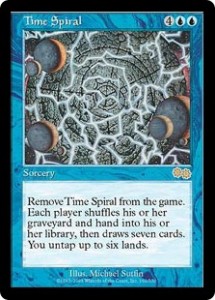
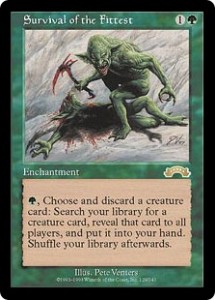
Over the past four weeks all of us here at Quiet Speculation Financial have bombarded you with information about the upcoming extended season. We took last seasons data and made predictions on good pick up's and things that we felt were good investments. We've analyzed the impact of worlds, and found the fringe cards to try and pick up. We saw the demise of Survival of the Fittest and the potential rise in Time Spiral, and the price spike that went along with it. Three weeks ago might as well have been years in the MTG financial world, because none of it matters anymore. You either picked up the cards for extended or you didn't, you either kept yourself in the black, or put yourself into the red through actions or inaction. Here is my advice; as of now none of the past three weeks matter. We will not bemoan our losses or failures to act, we will look forward to our next potential profit.

With extended season officially starting, it is now time to look at the next series of events that we can prepare for; standard and legacy. With the SCG Open hitting so many different cities, one is bound to be close enough that you can drive to it.*

While neither format is going to provide you with bank-breaking profit lines, you can still easily do well for yourself if you make the preparations necessary. For this example, I'll put together a list of things I would be looking for if I were attend GP Atlanta January 22-23. Its close enough that buylists should stay mostly the same, but far enough out that I can put some preparation into trading for what I want to sell.

The first thing we have to do is identify who will be there that we want to sell to. I personally enjoy selling to Troll and Toad, Cool Stuff Inc, and Gaming Etc. These three vendors usually make up the cornerstones of all buying and selling I do and have always been fair, flexible, and friendly.

I went to Troll and Toad's buy list first, and quickly found a list of cards I knew I could pick up far below the price I could sell it for. Prices on the end are T&T's buy list price.

Dragon Broodmother - $2.50
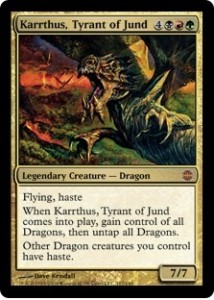
Karrthus, Tyrant of Jund - $2.00
Mind Funeral - $1.75
Thraximundar - $1.25
Death Barron - $2.50
Mycoloth - $1.00
Sarkhan Vol - $5.00
Maelstrom Archangel - $2.50
Chandra Ablaze - $2.00
Felidar Sovereign - $2.50
Kalitas, Bloodchief of Ghet - $1.00
Sorin Markov - $8.00
Dragonmaster Outcast - $2.50

Even selling 1 of each of those nets you almost 35 dollars. if you're able to get your hand on 10 of each, thats almost 350 dollars. If you were to trade for the cards at half their sell value, which for some of those is generous, thats still a profit of $17.50. Not counting the fact that its projected-on-paper to cash-in-hand profits, thats still amazing. The trader who puts in the time and effort to trade even just for those cards could easily pay for his or her entire trip very quickly.  Using the buy list updates we have here on this site can make your work much easier, and often times provide you with excellent results when going to a large event to sell cards. Who knew I could sell Mind Funeral for almost $2.00 a piece?!

Shifting backwards a bit, we can glance at Legacy. With the absence of SotF, it gives us an opportunity to make profits on staples for other decks, namely Goblins, Merfolk, and ANT.

Those three decks will most likely make up a large majority of the decks played in the early SCG Legacy Opens, so if you're looking for a quick turn around, those would be where I would focus in the next few weeks. Currently people are trying to make Time Spiral work, though I don't see a Solidarity / Spring Tide deck making many waves in the face of the current metagame.

Looking in on the current Blue Chips in Magic such as Force of Will, Jace, the mind Sculptor, and Wasteland we have to wonder where these may be going. While I don't see Force and Wasteland moving around in price too much, the big question on my mind right now is Jace. Currently you can vendor him off for around $75, and e-bay between $80-$90+ but when Mirrodin Besieged hits, we must realize that the days of Jace may be numbered. Numbered to the effect of about 180, because thats roughly how long he will have left in standard when Mirrodin Besieged comes out. Its no secret that many standard staples take heavy hits in the months before they rotate out, and while Jace may not take as big a hit, unless he shows his power in extended over the next few months he could take as much as a 30% price hit. While 30% may not seem like much on a card that only sells for $5.00, when were talking about Jace that could be a potential $25+ loss. With four Jace's, your looking at a $100+ loss. Watch extended over the next few months, and mark the day the final set of Mirrodin comes out on your calendars. If he hasn't done much for extended it may be worth it to dump your Jace's at or just below peak, an then pick them up again when they hit their bottom a few months after they rotate.

The other side to this argument is that Jace has already seen occasional Legacy play which could help to protect his price, but it would take more than occasional play in Legacy to keep his price at the levels its at now. A perfect example of this would be to look at Tarmogoyf. While its premature cut from Extended hit its value for a while, its crept back up, but never to the highs it was once at. I expect Jace to react in much the same way, and in the coming months we can expect to see the Jace "bubble" pop and his price plummet for a few weeks. Taking advantage of this and playing both sides of the market will help secure your profits by avoiding loss, and reclaiming your stock of Jace at its temporary lower price. If you sell for $90 each and pick them up again for $70 each after they drop you still made $80, and were left without Jace for maybe a month. Its something to consider.

Thats all for this week, the discussion's are open and I'm happy to talk with you. Don't forget the forums!

Stephen Moss

@MTGStephenMoss on Twitter

MTGStephenMoss@gmail.com

* Alaska and Hawaii; sorry guys no opens for you.

Taming Tempest

Are you a Quiet Speculation member?

If not, now is a perfect time to join up! Our powerful tools, breaking-news analysis, and exclusive Discord channel will make sure you stay up to date and ahead of the curve.

Tempest holds a special place for me as a collector and trader. It was the first set where we saw “good” cards that were not just anomalies. Sure, Mirage Block had some goodies that heralded modern design, like Vampiric Tutor, Nekrataal and Hammer of Bogardan, but there's a reason that Tempest Block is such a fan favorite. It seems that around that time, R&D started pushing the curve on power level. We ended up with cards like Living Death and Cursed Scroll, which turned out to be powerhouses that exhibited design elegance not seen before in a Magic set.

This week, we are going to take a romp through Rath to look at the sure-fire hits of Tempest, as well as the unknown money cards. It'll be a nostalgic and profitable adventure! I am using MOTL pricing and spreadsheets on these cards to bring you accurate data about what the market really is, not just what a dealer reckons it is.

Let's go!

Avenging Angel

Angels and Dragons hold a special appeal for a lot of collectors. The price on these two tribes has dropped; I don't know if less people are collecting the cards, or whether there are just too many to “catch 'em all.” The Angel clocks in at the start of the list at a modestly above-bulk price.

Price: $1.25

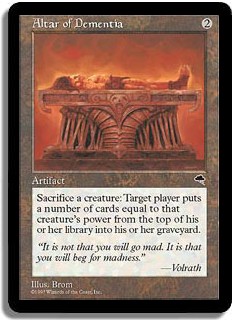
The Altar got a cool early start when it was part of one of those quaint, pre-Storm combinations involving Enduring Renewal and Ashnod's Altar. Kill an artifact creature of yours that costs 1, replay it for an extra mana until you generate infinite mana, and then start tossing it at your opponent. It's just about the most successful Altar Theme Deck there is, which isn't saying much!I have some good news for you, though. Thanks to its low casting cost and fun of milling, the Altar has a suitably insane after-market value. Did you know this thing regularly sells for over $5? If you are going to pillage a dollar box at your local store, keep an eye out for the Altar Of Abe Lincoln In Your Wallet.Price: $5.50AlurenAluren had its best days in Extended when paired with Cavern Harpy and then saw a second life when joined together with Imperial Recruiter in Legacy. Aluren still carries a premium due to being part of a halfway-playable combo as well as being nostalgic for many older players. Everyone knows Aluren is worth something, but you can benefit by knowing exactly how much.Price: $4.75Ancient TombTempest had several “power uncommons” and this is certainly one of them. Inquest Magazine's infamously-picked “worst card in the set” (picks from other sets included Dream Halls and Necropotence) blew up Extended because it powered up clunky combos like the aforementioned Enduring Renewal deck. Later, the Tomb of Boom saw play in Tinker decks in Extended (yes, Tinker was legal for awhile) and still sees plenty of play in both Legacy and Vintage.Price: $4.50ChillChill violates the color pie in some absurd ways. What is Blue supposed to do in the time it stalls Red? Draw more awful counterspells to stop Shocks? It's not like it will be mounting an efficient attack with its army of Cloud Elementals and Spindrift Drakes. Chill saw some play in Extended and now, shows up to slow down Goblins in Legacy and really annoy that burn player in your playgroup. It is another “power” uncommon in the set.Price: $1Coffin QueenMy favorite use of Coffin Queen was to grab someone's Squee, Goblin Nabob in a Survival of the Fittest mirror to exile it. Such tricks! Coffin Queen sees more legitimate use as a perennial fan favorite in multiplayer decks, since she can pull out a friend from any graveyard. She's also sort of goth-mixed-with-Hindu-god with her black dress and four arms.Price: $2.25Corpse DanceWhen I was growing up in my awful phase of Magic, Corpse Dance was the coolest thing around. You could animate a Spike Feeder and get some life, you could use a Thrull Surgeon to dismantle someone's hand, and if you could convince a friend that end-of-turn timing actually did work the way you said, you could get two taps out of a reanimated utility creature. Corpse Dance is still a popular EDH card, especially because its light black mana cost means you can splash it in decks that only tangentially run the color.Price: $2.00Cursed ScrollIf you played during Tempest, you either have a story of screwing someone out of their Cursed Scrolls in trading or you have a story about it happening to you. A card that is unintuitively good, the Scroll has been an all-star since its printing. The problem is that people often think their Scrolls command Tempest-era prices, when the truth is that the market has significantly dropped on them. They still command a premium, but good luck convincing someone they are worth what they actually sell for if you are trading for this sentiment-laden card.Price: $6.75Diabolic EdictAnother “power” uncommon, the Edict regularly goes for a buck. The most popular way to kill Shroud creatures still gets play in sideboards and maindecks.Price: $1EarthcraftThis green enchantment can be combined with Squirrel Nest to make an infinite amount of mammals. It commands a respectable price, even though it is banned in Legacy and sees no attention in Vintage. My best guess is that a lot of people love their elf decks (and you can take that one to the bank) and Earthcraft is pretty darned good in Elf decks. Some amount of its price is doubtless due to speculation that the DCI will unban the card, but it is mostly casually driven.Price: $6.75Eladamri's VineyardThanks to the loss of mana burn, the Vineyard became a little better. It lost some of its power because against control decks, it sometimes functioned as a green Cursed Scroll when they could not dispose of the mana on their turn. It sees some play in monogreen Survival decks, Elf decks and EDH.Price: $2Eladamri, Lord of LeavesMore accurately, Lord of “Leave Us Alone!” The first elf Head Honcho clocks in at a respectable price because he gives a nearly-unique effect to elves in his color. The only other affordable card that mimics him is Dense Foliage, but you cannot Wirewood Herald that enchantment up! Despite seeing no play, Eladamri showcases the effect that the little green dorks have on the market, a trend I call “Elf Power.”Price $6.75
The Medallions (Emerald Medallion, Pearl Medallion, Jet Medallion,Sapphire Medallion, Ruby Medallion)

These little artifacts even share their naming lineage with the original Moxes, so you know they're good. Sapphire Medallion has always been at the top of the heap because it combined well with the buyback cards in the set to make a seriously annoying Block deck. Cards like Jet Medallion provide acceleration in colors that often lack permanent mana assistance, and the Jet and Ruby are especially good because Black and Red have excellent high-mana spells. A brisk trade in EDH and casual circles keeps these cards popular.

Price: $3.25 (Emerald) - $5.25 (Sapphire)

Extinction

Though it has been outclassed by Tsabo's Decree (the original Rebel-slayer), Extinction still sees some traction as pinpoint removal against tribal decks. It can be a good card to trade to people who have lots of Allies, Elves and Angels running around their casual groups.

Price: $1

Grindstone

Grindstone sat in anguish for years until Painter's Servant pulled it to life. I remember wondering whether I should buy them for $3 when the Servant was spoiled! Regrets, I've had a few. Grindstone sees some play in Legacy, but it is held back because to really cook, the decks also need to run Imperial Recruiter, which brings its own problems. Grindstone used to be the star child of Tempest, the first really visible price explosion in Eternal. It has settled down from a high around $30, but it still commands a premium.

Price: $14.50

Hanna's Custody

This enchantment also falls into the “grab from the bulk pile” category. It keeps your toys safe in EDH and other multiplayer formats, and it's good enough to command a buck. The art is an interesting and unconventional portrayal of Hanna, which makes me a bit more fond of the card.

Price: $1

Horned Sliver

I remember that one friend who loved his Slivers. He went to Origins that year so he could buy a Sliver Queen! The joys of pre-internet card collecting... Everyone had that friend who loved Slivers, and they probably still do. Horned Sliver is just one of the many Slivers that carry a hefty price tag. If you see it in a commons box, pick it up! The trampler is worth considerably more than bulk, and there is a brisk market for it.

Price: $2.25

Humility

When a judge wants to ascend to The Final Level, they must solve The Riddle Of Humility:

“In my graveyard, I have two copies of Humility, Shifting Sky, Story Circle, Opalescence, Blood Moon, Living Lands, and Pandemonium. I cast Replenish.

What happens?”

(I give it four hours before this is solved in the comments and six hours before someone posts an even harder one)

Humility is Legacy-playable and it's in decent demand in casual circles. Since Humility plays well with Man-Lands, it gets attention in UW Control decks that plan to Wrath and Humiliate the opposition. I have seen the card double in price in the last year, from $3 to its current price. Humility is worth finding and trading for, since many players want the card for their collection. The Foglio art doesn't hurt, either.

Price: $6.50

Intuition

Blue's best tutor is still on top. Intuition has had a strange life. It saw a lot of play in Extended, since you could go get your Saproling Bursts and then Replenish them or find those Accumulated Knowledges for cards. I have fond memories of using Intuition to draw massive stacks of cards in Vintage decks like Goth Slaver. The proper way to use it with AK, by the way, is to cast it after you have drawn your first AK. That way, you can stack up a draw-three and a draw-four alongside each other.

Intuition currently sees play in Legacy as a tutor for the Blue Lands deck, and it has been picked as the next “speculation” card by some pundits. It is unplayed in Vintage because the classical combo with it and AK or Deep Analysis is easily foiled with a Spell Pierce. Intuition is one of the banner cards of the set and you can still find people who value it around $5-7.

Price: $16.50

Lotus Petal

Since it has “Lotus” in the name, it's probably good. Seeing play as a four-of in Legacy and a perennial casual favorite, Lotus Petal is one of those especially rare cards – a power common! They are highly liquid as a tradable card, so they are worth picking up or putting in your binder if you have spares.

Price: $2.25

Meditate

Aside from the incredible Draw-7s like Windfall and Timetwister, competitive players are left with slim pickings when it comes to more Blue card draw. Meditate has always been a classical card for this, especially when fueling High Tide combo decks. What's the harm in giving the opponent another turn when they'll be dead before they can use it? Meditate commands a surprisingly high price tag because it is both efficient (though casual) card draw, and because it can play well in thematic decks with cards like Smokestack and Tangle Wire.

Price: $4.50

Perish

Perish has seen some play lately in Legacy, since it can do a number against Survival decks and clears away the normally-untouchable Progenitus. The Tempest version commands a slight premium.

Price: $2

Propaganda

These “taxing” effects are hugely popular with the casual crowd; Ghostly Prison is also appealing. The reason is that, especially in multiplayer, when you offer an opponent the chance to either attack you for eight mana or attack that other guy for free, they'll usually pick the latter. Propaganda is one of those classic “rattlesnakes” that tells opponents to go elsewhere, all the while being inconspicuous. It also gets attention in Legacy, where it can stall out a Dredge deck or stop creature hordes from finishing the game too quickly.

Price: $3

Rathi Dragon

More proof that Dragons have a casual appeal, the Rathi Dragon has an above-bulk price despite being reprinted in 9th. It also has the attraction of being realistically the first tournament-playable Dragon, aside from awesome Shivan Dragon sagas from early Magic.

Price: $1.50

Reanimate

Yet another power common! Reanimate is hugely popular because people figured out that even though you took eight points of life, you have a Verdant Force on the table. That's something to be proud of. Reanimate spiked when Entomb was legalized because it is the best reanimation spell in the game. Luckily, it was printed at common, but that has done little to sate players. It was even reprinted in a boxed set and that hasn't touched the price! Reanimate is a relatively stable card to hold onto, since I think it will always command at least five dollars. That makes me regret trading three away for a Pithing Needle (before it was reprinted).

Price: $5.50

Reflecting Pool

Here's Reflecting Pool's life cycle: first year of life: generate any color alongside City of Brass in some pretty cool Standard decks. Sit stagnant for ten years. Get reprinted in the same set as those Vivid lands and shoot up to a phenomenal price. Leave Standard, drop to $4, then benefit from Extended being changed around. That brings us to today, where this yo-yo card is expected to see a lot of play in Extended. I prefer the old Tempest copy to the newer one, and it commands a slight premium.

Price: $8.00

Sarcomancy

Can you believe this thing is a rare? I can't imagine how many annoyed players tossed it aside in anger. I can imagine calls to Customer Service asking why the pack didn't come with a rare! Sarcomancy, along with Carnophage, formed the bedrock of the Hatred Black deck, which was very popular. So many players have fond memories of making Zombies on the first turn that this card is still valuable.

Price: $3.25

Scroll Rack

Scroll Rack sat at $4 for years until it got hyped up with Treasure Hunt. That card didn't pan out, but the Rack has stayed up in price. It is highly tradable to EDH players because it is a colorless card draw/selection tool. There is also speculation based around Land Tax; if the white enchantment is legalized in Legacy, you can expect that Scroll Rack will, at least briefly, flirt at Grindstone-level prices as players get hugely excited about a mediocre combination.

Price: $8.25

Selenia, Dark Angel

For years, Selenia was the only BW Legend, and being an Angel made her even more special. Selenia is hard to find in local stores and she is moderately popular as an EDH general. For these reasons, she is traded above bulk.

Price: $1.25


Tradewind Rider

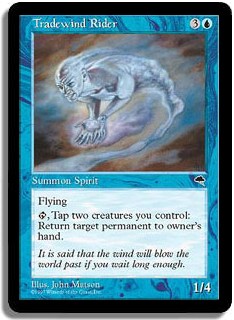
One issue with cards like Tradewind Rider is that there is a huge crop of casual players who have no idea that something like this exists. Tradewind Rider is one of the most frustrating cards of all time and it has just plummeted in value. You can, for example, play it in just about any Elf deck, powered out by Birchlore Rangers to make the blue mana. From there, it is a board control engine. This card used to be a monster! If you paired it with Awakening, you could get three bounces by putting the Awakening trigger on the stack in your upkeep and responding to it. The Rider did nothing short of dominate Standard when it was legal. If you have them in your binder, do your best to introduce newer casual players to the bouncing machine.

Despite my rant about it fading into obscurity, Tradewind Rider still has plenty of fans, who have maintained a decent price for the card.

Price: $2.00

Verdant Force

So, does every player get a token or just you? Every upkeep? Huh, this guy looks pretty good,then... Verdy is a beloved card, the original One-Man Army. Despite being reprinted, many players just want to run the original if they can conjure one up. It sees play in many casual games, and has been known to occasionally pop up in Eternal formats.

Price: $3.25

Vhati Il-Dal

Vhati does some pretty cool things as an EDH general and has other casual uses as well. I don't know why it specifically is worth much more than bulk, but it has a unique effect that makes for great politics. You can imagine making an attacking creature shrink down after an opponent has declared attackers, seeing that Primeval Titan bite it to a Saproling! He can also imitate Forcefield decently well, in either his Tempest or Timeshifted incarnations.

Price: $1.25

Wasteland

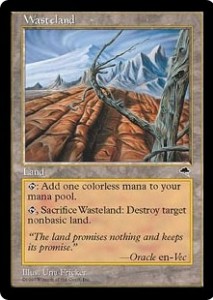
It's sort of cute that the most expensive card in the set is a boring, role-playing uncommon. Since it sees play in Eternal formats as a 4-of in plenty of decks, Wasteland has had a strong appeal for years. The price has really taken off on these, by the way. They started going up around GP: Columbus (Pt.1) and have been a steady gainer since. They are anomalous because, aside from Mana Drain, I cannot think of another uncommon that demands such a high price tag.

$22.50

Winds of Rath

Wrath of God analogues are popular in Highlander formats that allow only one copy of any named card. Winds of Rath can also protect your creatures if you are playing one of the popular “Voltron” decks that aim to pile on Auras and Equipment upon your army.

Price: $1

For a collector or trader, Tempest also represents a good benchmark for valuing a collection that you are considering buying. It is the first tangible departure from the “Dead Zone” of Magic that began with The Dark. You can figure that any collection of a person who was actively playing during Tempest is stocked with a few goodies. The only caution I have is that if these players were tournament players, they might still remember paying $18 for Cursed Scrolls and the like, and might subsequently haggle about those sorts of cards.

Join me next week, when we move on to the next set!

Banning and Restricting Retailers

Are you a Quiet Speculation member?

If not, now is a perfect time to join up! Our powerful tools, breaking-news analysis, and exclusive Discord channel will make sure you stay up to date and ahead of the curve.

By: Jeph Foster

Author’s Note: For some reason, I really like writing on controversial topics.  They tend to really speak to me.  Please keep in mind, this is meant to be a neutral piece, and will focus on both sides of the argument.  I am not out for anyone’s head on a pike at all.  Unlike my usual articles, I will not be namedropping any person or business in this article, and I would appreciate it if you provide the same courtesy, should you choose to comment. Whether or not you feel offended at any point in this piece, please try to stick it out until the end. This article has no intent on offending anyone, and is meant to provide perspective on this issue.

This is a situation that has been occurring for a while and has needed a great deal of attention.  Wizards’ R&D has recently adopted a policy in Legacy of opening a door every time they close another.  That is, every time there is an emergency banning in Legacy, at least one other card with little potential for abuse will be taken off the list.  This allows more deck types to arise from the wreckage of the decks that fall apart due to bannings.  Obviously, as good cards become usable in more formats, their prices will rise due to the demand for those cards going up relative to their unchanged supply.  Therefore, it stands to reason that those people who stay on top of the Banned and Restricted list have the potential to make a great deal of money.

Yeah, If you live in Magical Christmasland.

Whenever a card becomes unbanned, players hop onto eBay and other websites to scoop up as many copies of this card as possible.  The next morning, people act surprised when they receive emails from these retailers telling them “The card you ordered is no longer in stock,” “We will contact you when this card is back in stock. The new price will be $30.00,” and any other nonsense they can come up with.  The problem with this is that retailers are outright lying about the quantity of their stock, and are taking players like us for idiots.  While lying to us is a very unsavory practice, all the blame doesn’t really lay on just the retailers’ shoulders.

A Plea to Retailers

The biggest problem with this is a lack of integrity in regards to business practices as a whole.  When websites advertise a certain price for a card, they should have an obligation to fill orders at the listed price.  As consumers, we understand that the point of these businesses is to make as much profit as possible to buy more cards from players, perpetuating the business.  If a dealer really wants to pull cards off the market because of an unforeseen price hike, the least they can do is send out a legitimate, honest apology.  It generates more respect for the dealer when they send an email telling the customer they can’t fill their order because they undercharged them when a business lies about it being beyond their control.

It’s not like some other card games where Banned and Restricted lists are updated sporadically, whenever Wizards feels a card has just become a bit too powerful.  These lists are released once every three months, on the same day of the month each time.  Retailers can easily place a 24-hour hold on all orders containing cards that are on the Banned and Restricted list, with a clear notice on the checkout cart stating why these orders are being held.

Canceling these orders can really be seen as downright scummy for deeper reasons, however.  How many orders were filled with Survival of the Fittest in late December at the full $50-60?  How many people were selling Time Spirals to these retailers at $2, with their cards in transit during the change?  If changes to card economy constitute immediate change in business practice, shouldn’t these retailers be refunding the extra money that Survival of the Fittest is sure to drop, or offer extra money to these players who decided to sell their Time Spirals at $2, whose buy orders have not been processed yet?  Furthermore, if a player cancels several buy or sell orders to or from a dealer, the dealer will blacklist that player.  Players, however, are much more fickle.  With a myriad of stores to deal with, both online and brick-and-mortar, being shafted just once by a store can alienate a customer enough to convince them to discontinue business.

A Plea to Players

Okay, now that the players’ point of view is out of the way, let's play Devil’s advocate for a bit.  While a great deal of players purchase and trade for cards to play the game, quite a few (myself included) do so with the main intent of turning a profit.  As soon as the Banned and Restricted announcement went up, sales of Time Spiral skyrocketed.  Japanese versions were showing up on eBay for $100, and almost every dealer on the internet was “sold out” (legitimately sold out – an order was placed, whether or not it was filled, for each card these sites had in stock) in a matter of hours.  I heard from several players who were going on a Time Spiral shopping spree on Twitter several times.  Honestly, isn’t every person who decided to buy more than their playset being just as scummy as the retailers who decided not to fill these orders?  These retailers canceled these orders because the players were deliberately trying to take advantage of them and the abrupt change in market price.  If you found out right before a trade was completed that the person you were trading with was blatantly trying to rip you off, would you still complete this trade just to be a nice guy?  Hell no.  You would scoop up your cards, exchange a few choice words, or make up some bullshit excuse to get out of the trade.  Who cares if you thought your Japanese Foil Memnarch was only worth ten bucks?  It’s not.  Who cares if the guy you were trading with gets mad and doesn’t want to trade with you anymore?  You don’t want to deal with a rip-off artist anyway.  If you just wanted to buy your four and move on, it’s unfortunate.  But, when you try to buy twenty Time Spirals at five dollars each because you know they’re going to jump up to twenty or more dollars by morning, that’s you.  You’re being “that guy.”
On the same point, how many people sold your Survivals to retailers and other players at $30-40 each, because you knew it was on the chopping block, and didn’t want to get stuck with that value loss?  Who is stuck with that loss now?  These retailers are just using Time Spirals to recoup the losses they are inevitably going to take on the plethora of Survival of the Fittest that have to sit on their digital shelves and collect dust.  Granted, these stores will likely do better than break even on this exchange, but it’s just another example of players taking advantage of dealers.  Taking advantage of Survival of the Fittestdealers is very easy to do; just look at many of the finance articles here and other sites, and you can find plenty of examples of how to take advantage of dealers who don’t update some of their buy prices.  Why should dealers feel any incentive to be nice to us, when we are just going to take advantage of them whenever we can?

Calming the Storm

Turning a profit on Legacy (or any format, for that matter) is about speculation.  Investing in a card because you expect it to be good, whether a result of personal preference or because you just happen to be at the breakout tournament and can get a head start on everyone else, is one of the only sure-fire ways to make money.  Trying to get money by cleaning out online retailers is a method that simply will not work – these retailers understand the market and know when they are underselling.

The best way for retailers to maintain loyal customers is simply to be honest.  During Pro Tours and Banned and Restricted announcement times, something as simple as a message to buyers that prices are subject to change, and a letter of apology to players who mass-buy these cards to take advantage of the hike – not for being “out of stock,” but an honest, truthful apology – can go a long way toward keeping customers.  Still selling or offering a reduced price to players who intended to buy four or less can also be an excellent good-faith measure.

In truth, both sides are in the wrong regarding this debate. Just like you, these stores are trying to maximize their profit and minimize their losses.  Remember, placing an order online actually isn’t a legal obligation to ship the product in question if the seller issues a refund.  The best course of action for players is to write a letter to the vendor explaining the dissatisfaction.  Some retailers actually do go out of their way to help loyal customers.

Standard Issue Planeswalkers

Are you a Quiet Speculation member?

If not, now is a perfect time to join up! Our powerful tools, breaking-news analysis, and exclusive Discord channel will make sure you stay up to date and ahead of the curve.

There are 14 Planeswalkers currently legal in Standard. Planeswalkers are some of the most powerful, multifunctional, card-advantageous cards ever printed. Why is it then, with 14 to choose from, I only see one or two of them in decklists? Let's go through them, and see if we can find the problem:

Ajani Goldmane - A one time role player in the tokens deck of Standard past, Ajani hasn't seen much play lately. Well, what can he offer us? A little bit of lifegain? What ever happened to that lifegain special we saw at US Nationals? Well, if you just want to gain life I recommend Lone Missionary. Second, some +1/+1 counters for our creatures. If you have a bunch of creatures that you need to be slightly bigger, Ajani's your cat. I like to designate cards that do things like this "win more" cards. If you're already winning the game, as you likely are if you have a bunch of creatures in play, the card helps you win more. What win more cards don't help you do, is stop losing, or even start winning. Ajani's ultimate at least offers something: If your opponent isn't killing you, Ajani will eventually provide a really big, albeit rather defenseless token.

Overall it's pretty clear why Ajani doesn't see much play, he's just not that good. He doesn't solve problems, and the path to victory he provides is easily solved by most removal spells.

Chandra Ablaze - This is a card? Has anyone ever played it? It looks like a reject rare. What? You say that I helped Aaron Forsythe and Dave Guskin design it at the last minute? I guess I do remember being there... Why does it cost so much? Oh, right, last minute... and to be sure it was safe you leave the cost high enough that you're not worried about it. It does let you cast spells for free, after all. Well, still, what does it do. It deals 4 to something in exchange for a red card from your hand. That's not bad, considering it sticks around. The second ability seems like it could be really good against some decks, like control. If they tap out you can at least destroy their hand while refilling yours... if this is your last card... and if the threat they just played won't kill Chandra immediately and then you. It works with her ultimate... but at -2 it's less likely you'll be able to use it and get her back up to full. Maybe? Her ultimate sure could be game ending. You just have to get a big pile of game-ending red cards into your graveyard.

This newer Chandra can more or less defender herself with her +1, and change the board state... the problem is that this takes a red card from your hand... so what other red card are you playing that couldn't do that job? It's hard to imagine a deck where your 6-drop shouldn't be Inferno Titan instead of Chandra Ablaze.

Chandra Nalaar is next up (alphabetically) - Her first ability doesn't do much. 1 damage to a player? The best it can do is feebly peck away at another planeswalker. She does have a solid board-affecting ability though. She can kill most threats, and many without dying herself. Unfortunately, the most likely problems in Standard these days are 5/5s and 6/6s. Her ultimate is certainly game-ending in most cases, but not by itself. Players start with 20 life, not 10. Chandra Classic's main problem is that she can't solve a bit threat by herself, and she isn't enough against multiple small creatures. You have to have plenty of defense already to get her ultimate off, or if the opponent has no creatures her ultimate isn't really that devastating. She basically doesn't work the way she seems to want to work.

Elspeth Tirel - One of the three newest additions to the Planeswalker family. I'm sure you recall Elspeth, Knight Errant being a powerhouse in constructed. Even so, I would say the first Elspeth was underplayed in standard. She's extremely powerful, offering immediate board presence in the form of a defensive token, a powerful win condition in giving a creature both size and evasion, oh and also she had an ultimate. This new Elspeth... not so much. She gains life, which I've already discussed as being a rather weak ability for a Planeswalker. She makes tokens, which is excellent, but for 5 mana you could make twice as many tokens with Conquerer's Pledge. Well, in two turns Elspeth can make all 6 tokens; it's a good ability, and if she lives, from there you can gain life twice and use her ultimate. This is a powerful ultimate, destroying all non-token and non-lands in play. I think there is a home for this card in standard, but it really needs some good token makers at 2, 3, and 4 mana you can play before it. Roc Egg anyone?

Garruk Wildspeaker is a solid planeswalker that should have a place in decks. He can provide a 3/3 token creature for immediate board presence, defending himself or giving you some way of winning, however small. Untapping two lands is great for casting a second card, giving you another reasonable plan on the same turn. A turn later he turns 4 mana into 6, and most of the game-winning cards seem to cost 6 mana these days. His ultimate is a legitimate threat as long as you have a few creatures, even if they are just Lotus Cobras. So why aren't we seeing more of him? In part, I think it's because Valakut, the mana-ramping deck, needs to put lands into play, not simple cast 6-drops, and therefore don't want him. Control decks simply draw and play their mana slowly, also not needing a jump from 4 to 6 or 7. But where is the aggressive green deck that uses Garruk as a threat-generator, accelerator, and finisher? I have seen some Elves decks around, but they can use Elzuri, Renegade Leader to very much the same effect.

Garruk is certainly worthy of Standard, and I bet there are decks, either current or undiscovered, that would benefit from his inclusion.

Gideon Jura is next up. He's certainly seen standard play. Most hilarious for me was the crazy flip-flopping everyone seemed to do when they first heard about him. "He's awful, he's amazing, he's terrible, he's pretty good" - nobody was sure what to make of him. Probably a lot of that was because his first ability doesn't protect him. Quite the opposite, it invites his destruction. What many didn't realize, or were not able to calculate without playing with him, was that at 8 loyalty counters he's out of reach a typical turn-5 board state in many a Standard game. Obviously, destroying a tapped creature is an excellent defensive ability, quite savage considering it will leave him with more loyalty than any other Planeswalker that tries to rid the board of a creature on the same turn it is cast.

The ultimate is where Gideon truly shines, as it is free, and gives you a 6/6 attacker. If there were simply a 3WW 6/6 that read "prevent all damage to me" it might have a place in standard, and while that's clearly a very different card, it gives you and idea of how powerful Gideon is. We'd probably see more of him if there were more white-based decks being built. You can obviously have confidence putting him into a deck.

Jace Beleren - Oh little Jace, you have never disappointed. But wait, little Jace has very little effect on the board, often gives a symmetrical card draw to both players, and has an ultimate that barely does anything at all. By the metrics you would use to decide if it's a good Planeswalker Jace fails in many ways. Why has it been a solid card in many decks? It can't defend itself at all, often reading as a reboundless Survival Cache. The reason he's so good? He only costs 3 mana! In a control game he comes down long before any threats and gives you a lot of card advantage - which is how those games are won. Playing for control against aggro he can distract your opponent and help you dig for a way out. Many blue decks succeed with late game cards, and casting Jace Beleren forces the game to go longer.

Also, there's the matter of him having the same "legendary" type as another card of interest...

Jace, The Mind Sculptor is certainly one of the most powerful cards printed in recent years. Why, after the near total dominance of Cryptic Command, would WotC print another obnoxiously powerful blue card like this? There are several reasons. Jace is the main character of Magic. He has to shine, and I'm sure the creative team put some pressure on R&D to make him strong, not that they needed to. The first Jace was a powerful presence in Standard, and everyone wanted to be sure the new one would be too. Somehow it was decided that Jace would have four abilities, the second of many twists on the expected shape of Planeswalkers. (Double + abilities, 0-cost abilities, no way to gain loyalty being others we've seen.) Four abilities has proven to be significantly better than three.

I worry that R&D consistently underestimates the sway control strategies can have over standard. I think one of two things is happening. Either R&D undertests control decks, or the top players favor control even if a non-control strategy might be stronger. I think control decks take more work to perfect, as they are reactive, and they have to pay closer attention to the metagame. In FFL testing, it's easier to see if an aggro deck is very strong, and if they don't give control decks more time, they can be underestimated. It only takes a small underestimation to have a big effect on Standard. If the top players favor control decks, they'll build and play more of them, and everyone else looks to the top players for what to play - both in terms of deckbuilding and in terms of results. I certainly noticed this past season that websites talked a lot about control and combo decks, even while Vampires were winning many events. The articles would ooh and ahh at the newest UW or UB decks, and then almost in passing say "oh yes and there's also vampires." I don't think they were being dismissive, just that aggro decks tend to have narrower form, and less innovation can take place once the deck is found out... or so you might think. That's a whole other article though. Even if R&D gets control and aggro balanced, pros favoring control will lead to more and stronger decks. I worry about these things, but I don't think it's really either of them. I think it's just one or two very powerful cards that get through, and somehow those cards are very frequently blue. Cryptic Command, and Jace, the Mind Sculptor. They are enough to imbalance Standard in favor of control, when there might otherwise be a more open field. How many of the current top decks run Jace 2.0? And it's $90 on the secondary market? That just doesn't seem healthy.

The "Brainstorm" ability is at the core of the card's power. It has tremendous synergy with current standard. Fetchlands, Preordain, Sea Gate Oracle, Summoning Trap, Oracle of Mul Daya, the list goes on. All in addition to being an enormously powerful card advantage and selection engine. If I could go back in time, I'd argue strongly that it should cost -1 loyalty, not 0. This Planeswalker can also defend itself (and you) with the "Unsummon" ability. If those two aren't enough to win you the game (they usually are), you can win any game in which you resolve his ultimate. More than almost any other planeswalker, the Mind Sculptor's ultimate ends the game in your favor almost immediately. I shouldn't need to tell you that this card belongs in every blue deck you make for current Standard.

Koth of the Hammer is next. There was a lot of excitement around this card at first, and while it is still appearing in sideboards, I don't think the deck in which it stars has been found. Koth has a devastating ultimate, that likely wins you every game in which you get it off. You can come back from behind by shooting down creatures and planeswalkers left and right, not to mention killing the opponent pretty quickly. The problem with this Planeswalker is that the other two abilities don't really do all that much for you. Extra mana can be great, but you need a really sweet card to cast with that mana. If you use it the same turn, you will at best get 4 mana. Have you looked at the 4-drops available to red lately? Koth of the Hammer is the only one to see any real play in constructed. Obsidian Fireheart isn't too shabby looking, but what I'd really like to see is a 2RR 2/2 flier that deals 2 damage to a creature or player when it enters the battlefield. I guess a Murderous Redcap with flying instead of persist is a little too much to ask of the color pie?

Liliana Vess - poor Black, your planeswalkers are so late in the alphabet. Also, they're a little weak. Liliana doesn't do anything to the board until she ultimates. She can't defend herself at all. She can tutor for a card, which can get you out of a tough situation, but she doesn't even put the card into your hand. (I guess it's a combo with Explosive Revelation this way?) Being able to find any card in your deck easily is quite powerful, but also leads to annoying gameplay. Magic isn't much fun when the opponent always has just the card they need to turn the tables on you. This is why we have Diabolic Tutor and Liliana Vess and no longer have Demonic Tutor. Still, I wonder if Liliana couldn't find a place as a finisher in a hand-destruction deck. Megrim was even made cheaper in Liliana's Caress. Are you laughing at that suggestion? Most experienced players probably would laugh, because an enchantment that does nothing on its own, even a cheap one, doesn't have much place in Standard, right? I mean, who ever did anything with cards like Pyromancer's Ascension and Quest for the Holy Relic.

Nissa Revane is a rather underplayed Planeswalker. Like Garruk and Elspeth, she provides a threat / defender the turn you play her. Unlike Garruk, and much like the dominating Elspeth, Knight Errant, she gains loyalty in doing so. Also like Elspeth she has two + abilities. Her other + isn't nearly as strong, but her ultimate is much more game-ending. With multiple elf lords available I'm really surprised more players aren't trying to find a powerful elf deck. This is definitely a card worth putting more effort into and gaining more experience playing with.

Sarkhan the Mad - I'm not sure the usual analysis works on this card. It doesn't really do a lot by itself, except act as a really bad Jace Beleren. Yet is has seen some play in Standard, and I think it could see even a little more. It can't gain loyalty (proliferate?), and the first ability can outright kill Sarkhan depending on what's in your deck. 3BR: cycle is pretty bad! His ultimate looks like it belongs in the Commander format, and the second ability is very odd, turning anything creature unto a 5/5. So it can defend itself if you have a weak creature and need a stronger one. It can, in an emergency, turn an Emrakul the Aeons Torn into a much smaller threat, but I'm not sure that counts as defending itself, or you. Like Gideon Jura (and perhaps many cards in Rise of the Eldrazi) it took people playing with this version of Sarkhan for them to better understand it. If you haven't you should certainly try it out. What happens when you turn a 1/1 into a 5/5 dragon, then attack for 5 in the air and use the ultimate to blast the opponent for 5 more? I recommend having one of these in your Vampires deck, and perhaps a second in the sideboard.

Sorin Markov is the other 6-mana monster Planeswalker. I sometimes wonder if he's really an enchantment in disguise. The first ability does everything he will likely ever do for you - remove small threats and provide a win condition, however slow it might be. His second ability is almost a joke - it turns on all your little vampires that want the opponent at 10 life, get it? Yeah sure, but what kind of deck are you playing in which you have those vampires, but your opponent is above 12 life on turn six? They should be dead by then, or at least facing down one of Sarkhan's pet dragons. Sorin's ultimate? I think you'll have more success trying to perfect the Prototype Portal + Mindslaver combo. It's too bad this card has one of the best pictures in all of Magic, because you're not going to see it on the table very often.

Venser, the Sojourner - our last character on the list is also one of the newest. His abilities are quite interesting, and I very much wanted to build a deck for him. There are several problems with this proposition, however. Blinking a permament you own would be most excellent... if only there were some blue or white cards that cost 4 or less that would be worth blinking. Sure, I can gain a card with Sea Gate Oracle, or I can bounce an opponent's creature (again) with Aether Adept... but Jace, the Mind Sculptor does both of those things by himself, for only 4 mana and without needing white mana. If I look into adding a third color to my deck the possibilities are much better, but I'm still just killing creatures or artifacts using cards that don't see much standard play (though Skinrender is on the rise these days). If we go above 4 mana, there are some truly epic things to be done, but why would you need Venser for that? Titans win games on their own! I think we're stuck waiting for Mirrodin Besieged (or the 3rd set in the block) to give us the tools we need to make a worthwhile combo.

How about the second ability? Making all your creatures unblockable might have some potential, as soon as someone comes up with a blue-white attack deck that gets stuck against the format's dominating midrange deck. Oh wait, there is no dominating midrange deck. It's all control and combo (Valakut) these days. If you find a good blue, white, or blue-white attack deck (Merfolk?) you'd probably be fine without Venser, but perhaps he's a sideboard option? Well, without having the deck it's hard to say.

Venser's ultimate is certainly powerful, and if you can get to it, and cast a couple of spells that turn, you're going to be the favorite to win. Unlike Admonition Angel, Venser can exile lands (Valakut) and none of it ever comes back. I admit I have tried to build a couple of different decks around him, but none of them have panned out. Maybe you'll have more luck?

Well that's all of them. Next time I think I shall try to find a red deck to clean up all this blue mess we've gotten all over our standard format. See you then!

Trade Analysis

Are you a Quiet Speculation member?

If not, now is a perfect time to join up! Our powerful tools, breaking-news analysis, and exclusive Discord channel will make sure you stay up to date and ahead of the curve.

So the holidays are here and Corbin wanted a week off, but to make sure you all don't miss his trade analysis goodness, he wanted to re-run his very first article from this site. For those of you that read it, it's worth a second look to see where Corbin's come from compared to now, and for those who weren't with us back then, this is a way to get caught up without digging through our archives. Hope you enjoy, and Happy Holidays Everyone!

If you’re anything like me, you love Magic. More specifically, you love trading Magic cards. The thrill of the trade is just as exciting as winning FNM or cracking that first Baneslayer Angel.

If you’re reading this site, then I’m sure you’ve seen some of the great advice of the other writers here and maybe you’ve even acted on some of it. But what if you can’t spend hours scouring a store’s dollar bin to find that elusive Lim-Dul's Vault? What if you don’t have the time, energy or resources to track minute shifts in demand or constantly buy and sell cards on Ebay?

Just because you can’t keep up with the demands of tracking the ever-shifting Magic secondary market doesn’t mean you don’t want to build value in your trader binder. I’m here to help you with that.  First, a little about myself. I’m a Journalism student at Oklahoma City University. I’ve played Magic since Shadowmoor, and I primarily play at FNM. I didn’t make the jump to higher levels of competition until about 6 months ago and in that time I’ve posted some okay, but not spectacular, finishes (~1925 Total rating; 2nd at an Extended PTQ; 6-3 record at GP: Houston).

As you can see, I’m no Magic prodigy, but I understand how to make a trade work in my favor and make both parties happy. The ability to make astute trades has made Magic a very affordable hobby for me, as I can play on store credit and trade for the decks I want to play. If this sounds like something you’re interested in, stick with me.

His name is Robert Paulson...

The first thing I need to impress upon you is that trading at the FNM level is a vastly different ballgame than trading with seasoned vets at a PTQ. The Friday night warriors don’t care that your Vengevine sells for $35; they still don’t feel comfortable trading six cards for your one. Playing and trading Magic is not about dollar signs to them; it’s all emotion. They don’t want you to get that Elspeth they opened in their very first booster pack, no matter what you throw at them. This can be frustrating at times, but you can learn to make it work for you.

So how do you, the shrewd trader that you are, work with these players to build value in your binder? I have a few tips to get you started and then I’ll recap the trades I made at my most recent FNM so you can see these principles in action.

It’s about building friendships, not matching dollar signs.

Your typical trade partner isn’t looking to be your best friend, but they don’t want a cold and calculating opponent picking through their cards. Talk to them about why you want certain cards, tell them about the decks you’re building, share bad beat stories. I know this may sound trivial and like a waste of time, but the relationships you make with your fellow players will last far longer than the Fauna Shaman you’re getting from them.

Don’t just trade when you need something.

Hear your neighbor talking about needing a Goblin Guide while you’re drafting? Get with them after the draft and offer to trade them a Goblin Guide so they can finish their deck. If they ask you what you need, make sure to let them know you’re not looking for anything in particular, but you want to help them out. This will go a long way. Of course, in return for your help, you’ll make a nice margin on the trade.

Don’t be afraid to ask for more than you give.

Sure, you know your Leyline of Punishment goes for about $3 and the Knight of the White Orchid you’re getting in return is worth about $4. You can take the trade and be happy with your margin, but it’s never killed anyone to ask for that Leyline of Anticipationas well.  You’d be surprised how many players are happy to give you these “throw-ins” because they simply don’t need them. You aren’t going to build your binder through trades that only make you a few dollars a time. Be bold.

Respect their deck ideas.

If you consider yourself a decent competitive Magic player, it’s easy to scoff at someone when they tell you about their sick Quest for Ula's Temple deck. This is a surefire way to kill a trade. Rather than tell them how jank their deck is, suggest something that might be good in it. Ask them if they’ve seen that sweet Stormtide Leviathan in M11 that would be awesome in that deck.  If you’re starting to notice a theme, you'll notice that how you trade with others is more important than what you trade them.

Don’t apply prices to trades unless they want to

There is certainly nothing wrong with using price guides to complete trades, but not everyone is comfortable with this method of trading. For instance, they may not want to hear that their favorite mythic rare is only worth a few dollars, or maybe they don’t trust your source.

Another common thread among the traders you’re likely to encounter at FNM is that they simply don’t care about prices. They don’t need that $20 Thoughtseize, but they sure love themselves some $2 Predator Dragon (Rest assured this story will return in the future). The point is one Jonathan Medina has made before, and it bears repeating here: a card’s value is what the people trading decide it is – nothing else matters.

Hopefully you found those suggestions helpful, and I encourage you to apply them at your next tournament. For the purpose of demonstrating some of these principles, I recorded my trades at the July 23 FNM.

His: Fauna Shaman ($14)

Mine: Abyssal Persecutor ($14)

Net: $0

As has been discussed endlessly online, Fauna Shaman is the real deal, and is already seeing a ton of play. I may have technically come out even on the trade, but the Shaman is going to be much, much easier to move.  I need the Shamans for my own Standard decks, which is where they're headed.

His: Fauna Shaman ($14)

Mine: 2x Bloodghast ($12)

Net: $2

Same thing as above. Which of these are more likely to move if I need it to? Everyone who wants Bloodghasts pretty much has them at this point. And if either of these is going up, it’s going to be the Shaman.

His: Fauna Shaman ($14)

Mine: Time Reversal ($12)

Net: $2

The Time Reversal is dropping fast, and I don’t think we’ll see its price come close to $12 again, so I unloaded this one I picked up drafting as quickly as possible. This card has been mostly dismissed by Spikes, but its effect just screams “Play me at your kitchen table!”

His: Noble Hierarch ($14)

Mine: Stoneforge Mystic ($4.50)

Net: $9.50

This is one of those trades that you can make much easier with casual players than you can with tournament sharks. All Noble Hierarch does is make mana – they have their fifth edition Birds of Paradise for that. The Mythic deck can fetch that fancy new Sword of Vengeance they drafted last night! This is in no way degrading their reasoning for the trade. They have their reasons for making it, and I have mine.

His: 3x Obstinate Baloth ($21)

Mine: Sarkhan the Mad ($17)

Net: $4

Something you must know when trading with casual players is that they value even the lowliest Planeswalkers exorbitantly high. This has both pros and cons. Here I got him to take the Sarkhan even though he didn’t really need it. I was anxious to make this trade because another player had mentioned he was actively looking for Baloths.

Sarkhan is certainly a good tournament card, but he’s on the way out. It remains to be seen how he fares in the post-M11 metagame, and his only home (Jund) rotates in a few months. The Baloths should hold some value against RDW for a while to come.

Now this is where the trades start to really pick up. As I said, I knew a player was looking for the Obstinate Baloths, and I wasn’t going to let him off easy.

His: Temple Bell ($1.50), All is Dust ($17), Ulamog, the Infinite Gyre ($9), Leyline of Sanctity ($6), Foil Sword of Vengeance ($8) Total: $41.50

Mine: 3x Obstinate Baloth ($21)

Net: $20.50

Hereafter Known as Fauna Sauna

At first he wanted to keep this trade to the Ulamog and All is Dust, but I told him I just couldn’t do that, especially since I had traded for the Baloths to help him out. He was initially reluctant, but was happy in the end because he got the cards he needed to build his deck.

I was happy to pick up some great trade fodder and a foil Sword, which really has the potential to take off.  It even made an appearance in an undefeated Japanese PTQ deck.

This next “trade” is something that primarily happens with casual players. A guy I play with at my local shop but don’t know very well was content to simply give me a stack of cards on the condition that we record the trade and I loan him cards in the future when he finds a deck to build. I gladly accepted this for a few reasons, some of which are particularly germane to some of the concepts we discussed.

First, I knew someone was looking for the Bituminous Blast and Kargan Dragonlord, and I wanted to flip them as quickly as possible.

Secondly, and more importantly, when you are focusing on trading with a small and mostly casual audience, you need to develop good relationships with those people. I would never have been able to pull this off if I hadn’t put in the time to get to know the guy and help him with his limited decks and Magic theory. In short, it pays to be a friend to your trading partners, because you never know when you’ll need the favor returned.

This practice is one of the only reasons I am able to compete at a PTQ level. Since I don’t buy boxes or boosters and accept store credit instead of winnings, my decks come together through a combination of drafting, trading and borrowing. Unless you have hundreds of dollars to spend to put together decks, this is something most players, even pros, have to do. Building relationships through interactions such as this provide you that opportunity.

His: Kargan Dragonlord ($14), Mystifying Maze ($3.50), Glacial Fortress ($6.50), Destructive Force ($2.50), Kozilek, Butcher of Truth ($10), Textless Bituminous Blast ($2.50) Total: $39

Mine: A promise to loan future cards

Net: Infinite

When you are trading at this level, your reputation is everything. If you rip a guy on a deal like this, you are destroying your chances at dealing with him ever again, not to mention you will have your name dragged through the mud, and deservedly so. I have every intention of helping this man out in the future, because he’s a good guy who was willing to help me.

His: Birds of Paradise ($4.50), Steel Overseer ($5), Leyline of the Void ($4), Grave Titan ($35) Total: $48.50

Mine: Leyline of Sanctity ($6), Kargan Dragonlord ($14), 2x Textless Bituminous Blast ($5), Total: $25

Net: $23.50

This trader mostly keeps up on card prices and I let him set the values on the cards involved. He valued the Dragonlord at $15 and the Grave Titan at $15. The Steel Overseer was considered a throw-in, and I didn’t even realize it was selling at $5. It’s a card I think is definitely worth picking up on the cheap because it has the possibility to be totally broken when Scars of Mirrodin releases.

I definitely felt like I was on a streak after getting the Grave Titan on the cheap. I wanted to keep up the momentum, so I approached a player I didn’t know as he finished up his limited game. He is a newer player at my store and I haven’t traded with him before. His thing was collecting artifacts, regardless of what they did. When you’re running hot, sometimes you just have to go with it.

His: Dragonskull Summit ($7), Creeping Tar Pit ($4), Consuming Vapors ($7.50), Leyline of Sanctity ($6), Fauna Shaman ($14) Total: $38.50

Mine: Eternity Vessel ($1), Mirrodin Platinum Angel ($4.50), Temple Bell ($1.50), Keening Stone ($1), Lodestone Golem ($1.50) Total: $9.50

Net: $29

My last trade of the night was a dandy, and the guy I was trading was insistent about getting some valuable cards out of me. I was really looking to hold on to the Hierarch since 2 of the 4 I’m running in Standard are borrowed, but in the end I didn’t mind passing it along to him. He’s always been willing to trade me what I need, so I can think of worse ways to return the favor.

His: Promo Ajani Vengeant ($5.50), Goblin Guide ($7), Foil Goblin Guide ($10), Coralhelm Commander ($3.50), Nicol Bolas, Planeswalker ($10), Time Reversal ($12), Oracle of Mul Daya ($3.50), Consuming Vapors ($7.50), Mass Polymorph ($1), Call to Mind ($0.50) 2x Tome Scour ($0.50) Total: $61

Mine: 2x Master of Etherium ($7), 2x Sharding Sphinx ($2), 2x Quest for Ula’s Temple ($1), Noble Hierarch ($14), Elvish Archdruid ($6) Total: $30

Net: $31

Total Friday Night Net: $121.50. I picked up the commons and uncommon to give to a player I had traded with earlier who had told me his friend was looking for them. Again, being a good neighbor gets you a lot farther in trading than being able to quote a price guide.

By this point, hopefully you’re starting to understand the way trades are conducted by people who aren’t tracking daily price updates on CoolStuffInc.com. This is vitally important if this is your trading audience.  In this example, my trade partner needed the green cards for his mono-green standard deck, the artifact creatures for his casual artifact deck, and he thought the Ula’s Temple would be cool to build around. If he doesn’t care that the prices don’t match up, then it’s not my job to make him. As this trade turned out, we both left the table happy, and have the picture to prove it!  That’s all you can really ask for after trading, isn’t it?

That’s all I have for today. Remember to check out the other great content on Quiet Speculation and @Chosler88 on Twitter!  Good luck trading, and leave a comment below to let me know how you liked this article.  Do you prefer theory, or the trade analysis more?

Evolution of Sales

Are you a Quiet Speculation member?

If not, now is a perfect time to join up! Our powerful tools, breaking-news analysis, and exclusive Discord channel will make sure you stay up to date and ahead of the curve.

I hope everyone's Christmas was good to them, I know mine was. No, I didn't get any Time Spirals in my stocking this year, but we can't win them all right? Speaking of that lets jump back to last week. I asked for people to post if they had any of their orders canceled, intelligent discussion, and ways to help solve the current issue. The response was amazing, with one of the most active discussion threads seen in my articles. Thank you to everyone who participated in that, there were some really great ideas thrown out, like this one from QED

QED - " If I ran a shop, I would just shut my store for a few hours every B&R update while I reprice things. It baffles me that no one does this. "

Often in the business world, the simplest solution is the best one. In this case, we have a very simple solution that has you lose all of maybe a combined 16 hours a year for B&R updates, helps you sell correctly priced inventory during a rush, and probably most importantly protect the name of you and your business.

These are aspects that all of us should be looking at, because understanding the "large dealer" and the problems that they have to deal with can help us to understand the reasons behind their decisions, and help us if we ever decide to go into the card dealer side of things for ourselves.

The end of an era

When I began playing Magic, there were two stores in town that I could buy cards at, and only one of them held a tournament weekly. The idea of buying cards online didn't strike me until a long while after I had started playing, and even then there were very few vendors that had online stores. Obviously this is far from the case now, a simple Google search for Magic the Gathering gives me a link to the Wizards site, a couple TCG player articles, and a Wiki link. Other than that the entire first page is stores selling product. Even as recently as 5 years ago, this would be the opposite, as strategy articles and strategy sites were much more common. The face of the market has changed, and has moved away from a primarily Brick and Mortar (B+M) based business and onto an online and on demand, from the comfort of your own home  business.

In many ways this parallels many modern US businesses, with online home delivery sales occasionally matching and sometimes exceeding in store sales. Why did this happen to the Magic market though?

Vendors - Magic players as a whole aren't known to have the best foresight. The number of times I've gone to a PTQ and forgot to bring the alternate cards for my sideboard is probably more than I would like to admit. I'm sure a few of you are in the same boat. Be it cards or sleeves we've all had a memory lapse or two, and our friendly local PTQ dealer has been there to charge us a premium on our lack of memory or foresight.

By the same token, they have also been there to buy off our unneeded cards, and usually offer a higher trade in value for "credit" towards a purchase from them. This leaves many PTQ players buying and selling at PTQ's out of convenience.

E-bay - 10 years ago e-bay was really starting to heat up, and it didn't take long for people to start posting their extra Magic cards online for other people to buy. After all, you could sell them for a higher price than the vendor or the store would pay for the, and buy them cheaper (usually) than either would provide them for. This made consumer to consumer sales much more common as it opened up not just your local area, but the rest of the county. If you were willing to pay higher fees, it even opened up the entire world to you.

E-bay, while it quickly grew the player to player selling market, it helped to grow something else too. The secondary market we know today was created primarily on the back of sites like e-bay and the MOTL. This, coupled with the constant competition of dealers at PTQ sites quickly impacted B+M stores. The feel of your local stores "player economy" will be different primarily based on the above two factors. If you have a primarily PTQ player base, your store will be much different in what they offer and what products they carry than if its primarily a casual player base.

Dealer tables at PTQ's; usually full of binders.

Individual online stores - I almost want to call this the nail in the coffin. The ability for anyone to easily, quickly, and cheaply set up their own online store through any of the multitude of options available was something that many stores had to either do themselves to compete, or rely on their local player base. Personally I think individual online stores are an amazing thing, as long as they realize that they very much are a business and need to think of themselves as one. The term "Individual online store" may be misleading to some, so lets take a moment to look at some notable individual stores.

Starcitygames.com

Channelfireball.com

Shuffleandcut.com

All three of those are Individual online stores, we just don't think of them like that most of the time because they are the "big" online shops.

For a while the above was the usual, but that secondary market kept working its way up, and recently has created the next step in Magic sales points. The evolutionary track currently experienced is that of the player-vendor. With the explosion of new people to the game, comes a new set of people looking to play at the highest levels available, though due to economic factors many players don't have the money that vendors want per card/tournament staple.

Player-Vendors - Created partially because this is the next step, and partially out of necessity. Many player-vendors that currently exist are people who have been in the game for a while and have seen it mature. It is rare to find someone that is extremely price oriented that hasn't been playing for at least three years (lorywn era block) and many have been around twice that long or more. They are the middle point between Vendors and traders, and at almost any point could dedicate themselves one way or the other, opening their own online store, or focusing primarily on trading for value. Many of you probably consider yourselves to be in the player-vendor category, and this site was created to give us a meeting place, and an area to express our ideas and grow our community.

Did you read the benefits? Insane!

Large scale vendors have also taken their next evolutionary step, which is the creation of for-profit large scale tournament series. Cash prize tournaments are held by many of the biggest vendors on the market; Star City Games, Channel Fireball, TGCplayer. Given time for these events to mature and grow I believe we could see some of these events begin to rival the actual Pro Tour. With the creation of the Star City Games Players Club (an awesome idea) and the expansion of their Open series, I wouldn't be surprised to see other major companies in the game continue with something very similar of their own. Time will tell, but the next evolution for the game and its market on all ends is already taking shape. Its an exciting time to be playing Magic on any level, and I'm excited to see where it goes from here.

Until next week,

Stephen Moss

MTGstephenmoss@gmail.com

@MTGstephenmoss on twitter

Stephen Moss

Stephen Moss currently lives in Lancaster, CA, is a usual PTQ grinder in the southwest region and working on his Masters in Business Administration. He has an obsession with playing League of Legends when not working on articles or school work. His articles often take on a business minded tone, and usually contain information applicable to magic trading as well as real world business.

View More By Stephen Moss

Posted in Feature, Finance, Free, Free FinanceTagged , Leave a Comment on Evolution of Sales

Have you joined the Quiet Speculation Discord?

If you haven't, you're leaving value on the table! Join our community of experts, enthusiasts, entertainers, and educators and enjoy exclusive podcasts, questions asked and answered, trades, sales, and everything else Discord has to offer.

Want to create content with Quiet Speculation?

All you need to succeed is a passion for Magic: The Gathering, and the ability to write coherently. Share your knowledge of MTG and how you leverage it to win games, get value from your cards – or even turn a profit.

Extended Outliers

Are you a Quiet Speculation member?

If not, now is a perfect time to join up! Our powerful tools, breaking-news analysis, and exclusive Discord channel will make sure you stay up to date and ahead of the curve.

Extended season is well on its way, with the first Nagoya PTQ taking place online on January 1st. in anticipation of these, prices for Extended cards on MTGO have reached unprecedented proportions (really? 20 tix for a Twilight Mire?). over the past week, many of the format staples have more than doubled in price, and now most of them sit at a point where the market will not let them go any higher. So today I want to cover the few outliers, those Extended cards which still hold potential, but haven’t experienced the rapid price increases that their counterparts on MTGO have.

#1: Leaf Crowned Elder

Since I got my playset at .5 tix each, a friend reported to me that these went up to around 2 tix each with the popularity of Gavin Verhey's Shaman Extended deck. I've been tinkering with the deck since it was posted and can attest to its viability in the current metagame, mainly because of its dominance in the 5 CC and Jund matchups. While personally I'm not a huge fan of the Elder, it is a critical part to the deck, acting as a bet-hedging 4 drop that is good against anything, in contrast to Master of the Wild Hunt, Goblin Ruinblaster, and Masked Admirers, which all shine and fail depending on who you play against. In any Shaman deck, Elder will be an automatic 4 of in the maindeck, so if the deck sees significant PTQ and PE success over the course of the season, we could definitely see more of a price increase in the Elder

#2: Fauna Shaman

The Fauna machine also is linked to the Shaman deck, as it plays an integral role there to tutor up continued land destruction. but it also features heavily in Elf aggro/combo as well as in the BG or BUG Necrotic Ooze decks, designed by Conley Woods. Fauna serves a critical role for midrange decks, as it allows them some amount of card selection capability that normally base Green decks would lack, especially without the card advantage of other midrange decks such as Faeries or Elementals. For some reason, despite it's popularity in multiple formats all the way through Eternal, Fauna Shaman has never really gone above $10, yet it has legs in this Extended format, and has potential to become even more played in Standard. Not something I would run out and buy, but a card I would keep my eye on.

#3: Demigod of Revenge

Last Extended season, Demigod made a slight splash in the All-In Red deck popularized by Rashad Miller at PT Berlin. While that deck is no more, Demigod is still making waves as a finisher for slower builds of Jund. It is yet one more spell that generates card advantage for the former Standard powerhouse, and is ridiculously good against the rampant 5 CC and Faeries decks in the metagame. That said, its play is somewhat restricted, being a 4 of in some builds of one deck, but like Fauna Shaman, if Jund continues to see play, Demigod could  be a safe bet for a 15% price increase over the course of the season.

#4: Sygg, River Cutthroat

A card that is only played in Jund, it still serves a critical purpose against Fae and 5 CC. Coming down under Mana Leak on the play, Sygg is a card advantage machine. he turns every Bolt and Blight into a cantrip, and the second a Boggart Ram-Gang resolves, he threatens to draw even more cards. Against Fae, he almost demands a Smother, while 5 CC has fewer cheap ways to deal with him, but more countermagic and board sweepers to control the number of men with 3 power on the board. Like Demigod, a safe 10-15% increase on the season if Jund starts putting up the numbers.

#5: Summoning Trap

Despite seeing heavy maindeck and sideboard play in Standard Eldrazi Ramp and Valakut decks, Summoning Trap never saw very high prices, mainly because of the amount of Zendikar product that was opened. Extended has offered yet another frontier for the card, both in Mythic, which isn't played much but is still a powerful aggressive option, as well as the GW Trap deck, which gets consistent Emrakuls off hideaway lands, powered by Baneslayer Angel and Primeval Titan. Eventually this card will be played enough to increase in price, but we have yet to see if we have reached that point.

#5: Baneslayer Angel

Baneslayer saw a massive reduction in price with its reprinting in M11, as well as it being dropped from most U/W Control lists in Standard. This once $40 card has dropped down to barely $15 in some places. It sees play in most of the same decks as Summoning Trap, and acts as a less resilient but faster Wurmcoil Engine. Much like during its tenure in Type 2, there are some decks that just cannot beat a Baneslayer Angel, so she should be stealing some wins from day 1. Again, much like Summoning Trap, we will need to see how well White based midrange decks perform before evaluating a potential price rise for the "new girl".

#6: Wurmcoil Engine

The attack of the fatties continues! Wurmcoil is the creature based finisher of choice for almost all builds of 5 Color Control, though some versions have gone for Grave Titan, as its better in the mirror. Wurmcoil is resilient to removal, has massive board presence, and helps 5 CC generate more card advantage, because it DEFINITELY needed more. As an aggressive deck, Wurmcoil is the last thing you want to see coming down on the other side of the table, and like Baneslayer, there are some decks that cannot beat it. Even Cruel Ultimatum is less devastating. Like Baneslayer, Wurmcoil was a card that was heavily hyped as a finisher for Standard Control decks, usually Blue-Black, but ended up being surpassed by Grave and Frost Titan. Its former $20 price tag is long gone, but Wurmcoil is far from defeated. 5 Color Control is one of the most powerful and popular deck archetypes in Extended and is being heavily hyped by many pros to be the best deck in the format. With so many pilots needing 2 Wurmcoil Engines for 5CC, it wouldn't be impossible to see him hit $15 again for the remainder of the season.

#7: Fulminator Mage

For those of you still on the fence about the LD plan for Black and Red based midrange decks, I have a message for you: it's the real deal. The Ld plan backed by Fauna Shaman in Verhey's Shaman list and BG Ooze singlehandedly  gives these decks a game plan against 5 CC that more often than not will take the game. While Fulminator Mage is well past the point of speculation on MODO, up to around 8 tix, in paper he still remains low and ripe for the picking. He is an integral part to the strategy of multicolor Fauna Shaman decks, and so out of all of these choices, I rate him the most likely to succeed, regardless of archetype performance.

That's all I've got for now. I'll reserve my thoughts on the Time Spiral debacle for a later date when I have more time to formulate a coherent and rational response to the issue, which is one I'm taking very seriously. Until then, enjoy your holiday vacations, and check back here at Quiet Speculation for even more awesome Magic content.

--Noah Whinston

mtgplayer@sbcglobal.net

nwhinston on Twitter
Arcadefire on MTGO

baldr7mtgstore on Ebay

Six Degrees of Newness

Are you a Quiet Speculation member?

If not, now is a perfect time to join up! Our powerful tools, breaking-news analysis, and exclusive Discord channel will make sure you stay up to date and ahead of the curve.

A few weeks ago, I talked about how to use different resources like the MTGSalvation Cube Comparison thread and card databases like Gatherer to find cards for your cube.

However, I didn't talk about a subset of cards that's particularly relevant right now.  Pierce Strider and Peace Strider were the first unveiled cards from Mirrodin Besieged, but they weren't very good, at least for cubes.   With the recent unveiling of Mirran Crusader and Phyrexian Crusader, we suddenly have some better Mirrodin Besieged material to work with and there's no better time than now to talk about how to evaluate newly spoiled cards.

I talked about using card context in my article on ManaNation but to summarize, even with hidden gems like Soltari Trooper, just about every Magic card in existence has some form of history with it with the card being used in some shape or form in the past.   For example, Wild Dogs was used in aggro decks around Saga/Masques block, Teroh's Faithful was one of the most prominent white cards in Torment limited (which made you pretty fly if you forced it in draft.)  I went into depth about how there's a correlation between a card's success in a format and its success in a cube, so I won't rehash that point, but I mention this because sometimes using a card's success can be a useful tool (if used carefully.)

But what about spoiled cards?  There's no such history to draw from!  Some cards are pretty easy to evaluate since they're pretty basic cards and they compare pretty easily to other similar cards.  Grave Titan was a pretty easy card to evaluate when it came out in Magic 2011, 10 power for 6 mana is an amazing deal in cube and that's not too hard to figure out.   It was easily more powerful than the non-Kokusho 6-mana black finishers like Visara, the Dreadful or Skeletal Vampire, throwing one of those out for Grave Titan is about as hard as it is for Uncle Phil to throw Jazzy Jeff out.

But other types of newly spoiled cards aren't so easy to evaluate for cube.  Thankfully, the newly spoiled Mirran Crusader and Phyrexian Crusader represent both sides of that coin.

Photobucket Photobucket

Let's first look at a simple card like Mirran Crusader.No one outside of R & D has gamed with Mirran Crusader so there aren't any limited rankings or standard deck techs that can be used to see if Mirran Crusader's being used to success, but that doesn't mean that the card can't be evaluated, right?

Mirran Crusader's double strike essentially gives it 4 power, which is pretty hard to come by for 3 mana (especially in white) and when it does happen, usually it's with a drawback (consider examples include cards like Skittering Horror, Arrogant Bloodlord, Spur Grappler, or Wake Thrasher).  Mirran Crusader also compares really well to other existing cubeworthy 3-drops like Pianna, Nomad Captain, Soltari Champion, Spectral Procession (it's really a 3-drop creature, not a 6-mana sorcery) and the card that the crusader's riffing on, Paladin En-Vec.  The crusader's protection from black helps it get around removal and its having protection from green is pretty useful too. Those who have cubed with Sword of Body and Mind can attest to that (although it's not as useful as pro-red because pro-red helps creatures dodge a lot of removal from Burst Lightning to Rolling Earthquake.  While it could be be argued whether Mirran Crusader's better than cards like Spectral Procession, there's hardly a doubt that it's in the same league as those cards and that it should go in a cube because it compares very favorably with other white 3-drops.

Just like in my article on lessons learned with evaluating Grizzly Fate, I'm not merely saying "Mirran Crusader is really good, use it in your cube" but rather that comparing cards, even new ones, to other cards with similar functionality and casting cost.  It's pretty easy to make comparisons for simplistic cards like Mirran Crusader.  Bash,  beat.  Lather, rinse, repeat.

Phyrexian Crusader's a whole different beast... er, Zombie Knight.

I've mentioned several times in my writings that linear strategies in cube are more difficult to evaluate. Cards like Goblin Ringleader obviously aren't very good in cube because there isn't the required critical mass to make it good but cards like Stoneforge Mystic and Totem-Guide Hartebeest (in all-common cubes) typically do have the required critical mass required to make them work.  I've lately warmed up to cards like the latter two, since in my early cube days I thought "Well, what good is Stoneforge without a toolbox?  Then all you have is a Squire if you draw the 1 equipment.  Oh joy!"  I found that wasn't the case and that Stoneforge Mystic was usually able to find itself in decks with 2+ equipment without much trouble (and Hartebeest fetching up a Kirtar's Desire or a Pacifism is typically not a pretty sight for opposing decks.)  Decks that can be carefully built around a toolbox card, like Stoneforge Mystic with a Basilisk Collar and Behemoth Sledge toolbox in Naya Lightsaber or a Time Spiral era deck with 2 Mystical Teachings and a toolbox of instants and cards with flash, but those (Mystic, Teachings) cards are still rock-solid even if they can't have the same toolboxes that made them constructed all-stars.

Phyrexian Crusader at first glance looks like one of those "good on its own, but better in linear decks" types of cards.  It's a riff on Paladin En-Vec and that card's solid, after all.  The problem is that this comparison method doesn't really work with Phyrexian Crusader since it having infect changes how the card works by a lot.  Those who have drafted Scars of Mirrodin have learned that mixing poison damage and regular damage is generally not the best avenue to victorysince both sources of damage do not interact with one another.  Phyrexian Crusader's having infect, therefore, is a big "drawback" since there are not any other good (at least, not good enough for a cube) infect cards.

While it's true that Phyrexian Crusader does get a huge boost from power-pumping cards like Bonesplitter like Mirran Crusader does, the important distinction is that Phyrexian Crusader is going to be on guard duty for the majority of the game since it requires 5 hits to have worth as an attacker (since if it attacks 4 times and dies, its 8 poison damage will have no impact), which is a lot to ask from a creature in a cube and even with something like a Bonesplitter, the Crusader requires 3 hits to kill an opponent.  "Living the dream" with something like that, while nice, isn't going to happen most of the time.  Phyrexian Crusader effectively reads like this in cube:

Photobucket

This isn't a terrible cube creature, but its having virtual defender doesn't make it outclass other 3 drops in its color like Mirran Crusader does.  It looks like it'll be a good defensive creature for black control decks (another problem with equipment like Bonesplitter and Phyrexian Crusader is that typically they won't be used in the same deck) but I don't feel that it's better than options like Vampire Nighthawk and Hypnotic Specter because of its defensive nature, since it'll be spending a lot of its time hosing aggro decks (and rather well at that, since it insta-kills X/2s, dodges white, red and a lot of black removal, and can easily block 3/3s.)  I could be wrong and the Crusader may make its way into my cube after some testing but I don't see Phyrexian Crusader coming into my cube right now.

The most important thing is to be realistic when evaluating newly spoiled cards for your cube.  Many people initially dismissed cards like the level-up creatures from Rise of the Eldrazi because they compared cards like Kargan Dragonlord to Figure of Destiny.  "You'll spend 4 red mana leveling it up and it'll die to a Disfigure in response.  Spending 6 red mana for a 4/4 flier too, that's just awful.  You can't even do it at the end of an opponent's turn.   Unplayable!"  While statements like these show understanding of the potential downfalls of the level mechanic, they aren't realistic with how often those kinds of scenarios actually play out.  Sure, a leveled up Dragonlord can get Disfigured in response to its 4th activation, but how often is that actually going to happen?   How much value did you get out of the card - did you really pay 6 red mana for a 4/4 flier by leveling it up or did it have value before dying?

When Æther Adept was spoiled, I saw people dismiss it as a terrible card because it had a cost of 1UU instead of 2U (like Man-o'-War.)  Sure, Æther Adept's harder casting cost made it worse than the old jellyfish, but did that render it unplayable in cube?  Of course not.  Man-o'-War's value came from being a 3 mana 2/2 that bounced a creature.  Despite the fact that Æther Adept was harder to cast, it lost little overall value since it was still a 3 mana 2/2 that bounced a creature, so Æther Adept worked well in cubes.

Exaggerating drawbacks and benefits of cards is unfortunately a pretty common occurrence in Magic discussion.  After all, statements like these are unfortunately not uncommon to hear:

"Stillmoon Cavalier's a 3 mana 2/1, Death Grasp ends games.  Obviously, Death Grasp is better."

"Jace the Mind Sculptor is terrible, it'll just die to Lightning Bolt after giving you a Brainstorm!  Who wants to pay 4 mana for a sorcery-speed Brainstorm?  Junk."

Having a truly analytical eye for evaluating cards is a particularly important skill set to possess when designing and maintaining a cube.  It's even more important to have this skill when new cards are unveiled, since all of the card evaluation at that point is abstract until you test the card out.   Testing a card definitely helps to alleviate this kind of polarized thinking for new cards: I used to think that Wretched Anurid would be a terrible card in my commons cube because it could potentially kill me, but testing the card helped prove that its drawback was much less severe than I initially thought.   Myr Battlesphere's a more recent example; I initially dismissed it because it looked unimpressive but thinking about the card's overall value got me to testing it in a control deck shell and the Battlesphere performed wonderfully, thus earning a place in my cube.

It's easy to think of new cards in terms of "Best Case Scenario Mentality" and "Worst Case Scenario Mentality" but the truth always lies in the middle of these extremes.  Kargan Dragonlord will sometimes die in response to being leveled via Disfigure/Swords to Plowshares/Burst Lightning, but that's not always going to happen.   Even if there is a plethora of this kind of removal effect, the opponent isn't always going to have it and the overall probability of that kind of scenario happening isn't very high overall.

To quote the late Mitch Hedberg:

You know when you see an advertisement for a casino and they have a picture of a guy winning money? That's false advertising, because that happens the least. That's like if you're advertising a hamburger, they could show a guy choking. 'This is what happened once.'

New cards can be notoriously difficult to evaluate. Tarmogoyf was a junk rare until people figured out that it was an amazingly efficient creature. Inquest, a now defunct gaming magazine, infamously said that Necropotence was "the worst card in Ice Age" before the dreaded enchantment caused the "Black Summer" of 1996. Many people, myself included, initially thought that the Lorwyn planeswalkers were weak cards but we learned the error of our ways once the power of these cards became clearly known.

My hope is that this article will help you to avoid these kinds of mistakes, allowing you to be in on the ground floor of powerful cube cards right out of the gate.

As always, my cube blog’s at idratherbecubing.wordpress.com,
twitter’s at @UsmanTheRad
and my email’s at my twitter address + gmail.com!

Three Deadly Shortcomings

Are you a Quiet Speculation member?

If not, now is a perfect time to join up! Our powerful tools, breaking-news analysis, and exclusive Discord channel will make sure you stay up to date and ahead of the curve.

There's a superlative film that came out in France in 1996 you might have seen, entitled Ridicule. It's set in the king's court at Versailles in the 18th century, and illustrates an aristocratic culture that places tremendous stock in the duelling of wits and cleverness as a way to increase one's standing with le roi.

In one notable scene, L'abbé de Vilecourt- a man of the cloth- has a shining moment in the sun before the king when he has the rapt attention of the hall, explaining through logic why God's existence is a logical certainty. Swollen with pride after the court breaks into applause at his conclusion, he makes a fatal, boasting misstep. "This evening I proved the existence of God," he boasts, "and I can prove the reverse if it pleases your majesty." In that one moment, overreaching triumph becomes disgrace.

In selecting as a topic the common pitfalls and negative characteristics of preconstructed decks, I must be mindful not to make a similar mistake as the poor Abbé. Having written on the five characteristics of a successful precon deck but a fortnight ago, it would be simplicity indeed to phone in a column on bad decks using only the reverse! See all these positive qualities of good decks, yes? Well bad ones, they don't have them. Furthermore, the absence of good doesn't make bad, but rather that languid half-sibling mediocrity.

Besides, as amusing as the exercise might be, we'd hardly learn much from such 'insights' as bad decks have bad mana curves or bad decks have no coherent strategy. These are obvious and not worth rehashing. Instead, we'll be focusing today on exploring less charted territory on where some decks happen to fall short, and how they might turn their fortunes about.

High Variance

The first of these shortcomings is high variance. Variance is the enemy of consistency, and is one of the greatest factors that contribute to a weak deck. In order for a deck to be played at its highest level you need to be able to rely on certain cards being drawn, and be able to plan for those spells which aren't even in your hand. You need to know what cards are left in your library and what the likelihood of drawing what you need is. Above all, you need to be able to formulate plans that span of multiple turnsand you can only do all this by knowing what your deck is capable of. Otherwise, how can you play to your outs?

If you had five more removal spells in your library and you were in desperate need, and each of them had a different mana cost (say, Vendetta, Doom Blade, Assassinate, Flesh Allergy, and Corpsehatch), how well would you be able to plan your next moves? Obviously, you wouldn't; what you did and were able to do would depend on which of these five cards you happened to draw into. That's variance.

To some degree variance is a desirable attribute. It's certainly what makes the game of Magic fun and rewarding, as limiting the number of copies in a given deck to four mandates a certain level of it. By the same token, too much of it robs a deck of focus and predictability. It's worth noting here that there are two different ways to combat variance. Consistency we'll use to refer to number of copies of a particular card in a deck, while redundancy will describe the presence of different cards that do the same thing (put another way, a deck with 36 creatures has redundancy, while a deck with nine different playsets of creatures has both).

Once upon a time, theme decks had a great deal of both baked right into the card list. Looking back at the earliest decks we see examples aplenty! What do you think the chances of you drawing countermagic are in Tempest's Deep Freeze, with two Power Sinks, one Spell Blast, three Counterspells, and two Dismisses? Or removal in Stronghold's Migraine, with a full playset of Death Strokes, two Diabolic Edicts, and- sure- a singleton Dark Banishing? These decks relied on those spells for their success, and made sure you were able to find it, virtually every game. You could counter or kill with greater license, having trust that the numbers would soon bring you a replacement.

Somewhere along the way this admirable reliability was adjudged to be less desirable than the wacky, madcap "every draw's a-different!" approach that has characterised the modern precon. Want removal in Worldwake's Fangs of the Bloodchief? Take your pick from the following singletons: Urge to Feed, Brink of Disaster, Consume Spirit, Dead Reckoning (sorta), Feast of Blood, or Hideous End. Delightful redundancy, but dreadful consistency!

Howabout Rise of the Eldrazi's Leveler's Scorn? If you find yourself needing to spot-kill something in a pinch, better cross your fingers! With a pauper's choice of a lone Doom Blade or Unsummon pair of Last Kisses, you're going to need all the luck you can muster. Even taking into account that these Zendikar-block decks are only 41 cards rather than 60, these is a woeful state of affairs from a gameplay perspective.

It's almost as if these decks are something of a Magic version of a Whitman's Sampler box: try a little bit of everything to find out what you really like?

Call me silly, but you know what I like? Countering spells and killing creatures when I need to. Which brings us neatly to...

No Removal

This is so obvious and painful, it deserves its own category.

Once upon a time, land destruction was actually fun to play (Note: I'm making no such claims for those who played against it). Stone Rain, Sinkhole, Choking Sands, Rain of Tears... you could do quite well for yourself starting on turn three. Of course, it's commonly known that Wizards determined that this was a state of affairs too unfun to stand, and rightly or wrongly land destruction became more expensive, more situational, and less common.

The same slow erosion of critical cards seems to have happened in the world of the preconstructeds with creature removal. I actually single this out for a header all its own because of the high frequency with which we downgrade a deck in scoring because of underwhelming removal. The exact reasons are unknowable, but you have to wonder if perhaps this is something of a sop to the new-player market. Casting creatures is fun. Casting big, fat ones to pound your opponent with even moreso. Casting a big, fat creature only to have it Doom Bladed might well be seen as something not unlike land destruction once was.

With the competitive game being what it is creature kill will likely never fade or diminish, but it certainly has from the precons aimed at the newer player. This is a mistake! Making the game introductory is one thing, but dumbing it down quite another. I'll put it plainly: with decks as overwhelmingly creature-focused as they have been in recent years, bad decks are those that have pared down their removal suite. Letting a deck do all its talking in the red zone without fear of what lurks in players' hands is a recipe for a boring deck, full stop.

Although it's nice to have the occasional bit of non-creature hate it should be said that this mainly applies to creature-kill, which is where most of a precon's threat lies.

Unfocused Card Choices

Unlike the previous problems, this is one that has always been around. In 'Five Elements of the Best Preconstructed Decks' I spoke about the 'elevator pitch,' the ability to distill the essential win condition of a deck into a couple of sentences. Almost every precon deck has cards that work towards this goal a little less stridently than others, and that's to be expected (they can't all be winners). But what's particularly characteristic of bad decks are when you have a subset of cards in virtual diametric opposition to this aim.

Consider Dissension's Rakdos Bloodsport, a deck that demands you play ultra-aggressively and dump your hand as soon as possible, so that the guild mechanic (Hellbent) is triggered. Most of its creatures are small and cheap, ideal for an early aggro-rush. But then you have baffling inclusions like the Torpid Moloch or Slithering Shade (which, it must be noted with a sense of irony, are at least consistently bad with two copies of each in the deck).

For a more recent example, consider Rise of the Eldrazi's Totem Power. It's core strategy seems simple enough: deploy some beaters, enchant them with totem armor and pound away! With such a creature-based strategy some targeted removal becomes critical for clearing a path for your beaters, yet the deck packs in virtually none. Instead, we get cards that reward defensive play such as Harmless Assault and Angel's Mercy.

Weenie/swarm with no removal. Fatties with no ramp. Combo without card searching. Aggro decks with defensive creatures (hello there, Giant Spider). If from top to bottom the deck was designed to meet a deadline with little sense of itself, then that is a deadly shortcoming.

Thanks for Playing

For all its elabourate staging, Ridicule at its heart remains a tale of personal growth and maturity. When the protagonist, the Marquis de Malavoy, resolves to leave the decadent life of the court behind him, he scrawls a word on each of three playing cards, "paradoxes," "quips," and "repartees." Representing 'cards' he'd held during his battles of wits in Versailles, he dramatically throws them to the ground upon his departure. The cards held by today's preconstructed decks- high variance, light removal, and conflicted self-identity- may not have the resonance of the Marquis', but are no less worthy of being left behind.

The good news is, the decks for Scars of Mirrodin in many ways seem to have taken several steps in the right direction. I've highlighted some of the improvements before with regards to Core Set content, and seeing more copies of multiple spells was a very welcome sight indeed! Although one set may be too early to tell, rest assured there will be much to look forward to in six weeks when Mirrodin Beseiged launches.

And in the meantime, you could always rent Ridicule.

Want Prices?

Browse thousands of prices with the first and most comprehensive MTG Finance tool around.


Trader Tools lists both buylist and retail prices for every MTG card, going back a decade.

Quiet Speculation