menu

Modern Movers After the B&R Announcement

Are you a Quiet Speculation member?

If not, now is a perfect time to join up! Our powerful tools, breaking-news analysis, and exclusive Discord channel will make sure you stay up to date and ahead of the curve.

Monday’s banned and restricted announcement completely exceeded expectations. Hogaak, Arisen Necropolis was banned as expected. Along with it came Faithless Looting, which besides Hogaak’s Bridgevine deck took Arclight Phoenix decks and Dredge along with it, as well as various fringe graveyard strategies like Grisshoalbrand and even Mardu Pyromancer. It’s one of the largest routs of archetypes in Modern’s history and has left a huge void in the metagame.

Much of this void, however, will be immediately filled by the surprising unbanning of Stoneforge Mystic. I expected that Wizards would take more conservative action and stick with just bans, since they were already so significant, but Stoneforge Mystic is now in Modern for the first time. The hype is real, and my social media feeds are flooded with people sharing their Stoneforge Mystic decks and screenshots from games. It’s a Legacy playable that literally won the last Legacy Grand Prix in April, and it’s going to be more than good enough for Modern. 

There was an error retrieving a chart for Stoneforge Mystic

Stoneforge Mystic’s impact on the market has been immense, spiking its price along with the prices of associated cards like Batterskull and Sword of Feast and Famine. So far just the most low-hanging fruit has spiked, but there will be plenty of cards on the rise once we start to get an idea of what the best Stoneforge Mystic decks look like.

I’ve also found that the best way to peer into the future of the metagame is to just look on Magic Online, where players have already been grinding with Stoneforge Mystic since Monday night. Its impact on the Magic Online market has been severe, and I believe it holds clues about where the paper market will head once Stoneforge Mystic proliferates.

There was an error retrieving a chart for Force of Negation

For example, in terms of raw price increase the biggest winner this week on MTGO has been Force of Negation, growing from around 30 tickets before the announcement to over 50 now. Force of Negation is slated to become the Force of Will of Modern, and it’s going to go alongside Stoneforge Mystic in all of the White-Blue decks where it’s found. History and initial reports show this is likely to be the premier archetype for the card.

Hogaak and Bridgevine have had the metagame completely warped since Modern Horizons was released. With them out of the picture, we’ll see a lot more of the set's other staples like Force of Negation take over, with according price increases. It looks to already be trending upwards and is now firmly over $35. 

There was an error retrieving a chart for Teferi, Time Raveler

Another major spike was Teferi, Time Raveler, up from around 28 tickets before the announcement to over 44 now, and still rising. This massive rise in demand is due to the planeswalker being a fantastic card in the White-Blue Stoneforge Mystic decks, which further cements it as a Modern staple. I assume that its $15 price tag is mostly held up by Standard and Commander play right now, with some Modern play in White-Blue Control and Urza Whir decks, but a surge in Modern play should drive its price significantly higher.

There was an error retrieving a chart for Urza, Lord High Artificer

On the topic of Urza, Lord High Artificer, its price has grown to 24 tickets, nearly twice its price a week ago. It started increasing before the announcement because of the anticipation that the Whir Urza deck would become one of the best in Modern after a Hogaak ban. The unbanning of Stoneforge Mystic makes its prospects even better. It has become apparent that Stoneforge Mystic is a great way to find Sword of the Meek and help set up the Thopter Foundry combo which Urza makes go infinite. 

There was an error retrieving a chart for Giver of Runes

Another major Modern Horizons winner since the announcement is  Giver of Runes, a perfect way to protect Stoneforge Mystic, which has more than doubled since the unban to around 9 tickets. I’d also take note of Eldrazi Displacer, which saw its price double to 2 tickets on Thursday on the back of White Eldrazi, which as a natural home for Stoneforge Mystic is suddenly back in the metagame picture. 

All of these cards associated with Stoneforge Mystic should start growing in paper, and in terms of market timing now seems like the ideal time to buy Modern Horizons cards. Supply should now be near peak. Prices should be at or near a minimum, especially after mass quantities of the product were opened at Magic Fest Las Vegas. As well, player focus will soon be shifting to Throne of Eldraine in October.

There was an error retrieving a chart for Fulminator Mage

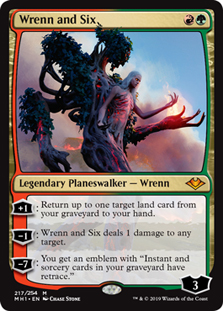
Stoneforge Mystic won’t be the entire metagame, and there are certainly other decks on the rise that present opportunities. What really stands out is the sudden movement on Fulminator Mage on MTGO, which saw all of its printings grow around 50% on Thursday, to around 11 tickets. It’s a clear indication of the rise of Jund, especially next to a 10% rise in Wrenn and Six. Jund is especially well-positioned because it’s one of the best homes for Kolaghan's Command, which will be one of the best cards in the format against Stoneforge Mystic decks.

The spike in Fulminator Mage also indicates the strength of Urzatron, which is widely believed to be one of the best decks after the changes. This could help explain the spike of Inkmoth Nexus, up around 25% Thursday to over 5 tix. Both Infect decks and Hardened Scales Affinity have the ability to race Tron decks, and are also among the greater beneficiaries of these banlist changes. 

There was an error retrieving a chart for Inkmoth Nexus

One interesting card to start rising this week is Collector Ouphe, which is actually a decent hoser for Stoneforge Mystic. It doesn’t stop Batterskull from coming down, but it does stop it from being recycled and turns off all of the other typical equipment. Along with being a strong hoser in general and green’s version of Stony Silence, it’s a true staple with strong prospects. 

There was an error retrieving a chart for Collector Ouphe

There are plenty more cards out there that will start to rise once the new Modern metagame shakes out, so the best plan is to stay informed and keep track of results. Most players are clueless right now and desperate for someone to show them the way, so early results and lists will be widely copied and could set off some significant price movement.

The premier event to watch will be SCG Dallas-Forth Worth this weekend, which will be looked to by players around the world, as well as the results of MTGO events like a Mythic Championship Qualifier on Sunday.


Batt to the Bone: Five Guys and the New Modern

Are you a Quiet Speculation member?

If not, now is a perfect time to join up! Our powerful tools, breaking-news analysis, and exclusive Discord channel will make sure you stay up to date and ahead of the curve.

Hogaak and Looting are banned, and Stoneforge Mystic is free at last from the Modern banned list. What do these changes promise for our beloved format? And what does equipment searching have to do with fast food chains? Let's find out!

Elephant in the Room

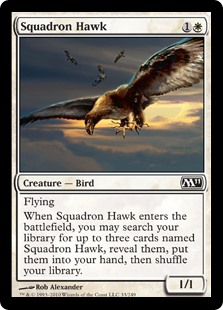
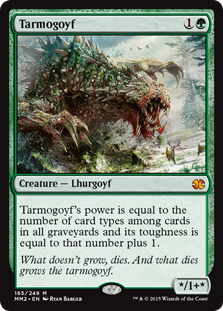
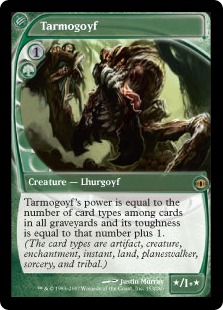
Before even thinking about the void left by Hogaak, or the implications of the Faithless Looting ban, or whether Squadron Hawk will somehow become a playable Modern card overnight, we've got a more pressing issue to discuss. As of Stoneforge Mystic's coming into Modern, the full cycle of busted, splashable two-drops is legal in Modern for the first time. The playerbase at any given FNM tonight is likely to employ, collectively, all five creatures—surely you know a Snapcaster guy, and a Tarmogoyf guy. Soon, you'll meet Stoneforge guy.

You may even be Stoneforge guy yourself. Or Pyromancer guy. Or Confidant guy. But Modern's always been about pushing ideas to their logical limits. So, stay with me: what if you could be all the guys at once?

Five Guys, by Jordan Boisvert

Creatures

4 Stoneforge Mystic
4 Snapcaster Mage
4 Dark Confidant
4 Young Pyromancer
4 Tarmogoyf

Artifacts

1 Batterskull
1 Sword of Fire and Ice
1 Sword of Feast and Famine

Instants

4 Lightning Bolt
4 Thought Scour
2 Fatal Push
1 Path to Exile
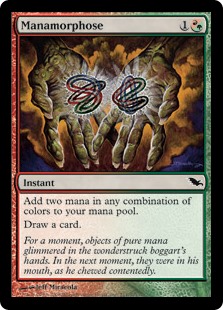
4 Manamorphose

Sorceries

4 Inquisition of Kozilek

Lands

4 Polluted Delta
4 Bloodstained Mire
3 Scalding Tarn
1 Steam Vents
1 Watery Grave
1 Blood Crypt
1 Overgrown Tomb
1 Hallowed Fountain
1 Sacred Foundry
1 Swamp

Sideboard

4 Damping Sphere
3 Surgical Extraction
2 Grim Lavamancer
2 Ancient Grudge
1 Spell Pierce
1 Ceremonious Rejection
1 Negate
1 Disdainful Stroke

In-Tense Company

Some empath/old soul/introvert was bound to attempt building this juicy burger of a deck soon enough, so I went ahead and took a stab at the principle with my own french fry. Its creatures each enjoy some pedigree, but they aren't necessarily made to play together. All in a row, they boast palpable tension.

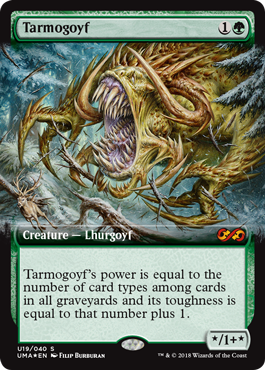
Goyf and Stoneforge are birds of a feather, perhaps; both are early plays that threaten a lot of pressure. While Tarmogoyf doesn't require investment beyond its initial casting cost, it also doesn't run away with the game like Stoneforge can against anyone looking to play fair.

And speaking of running away with the game, Dark Confidant does just that if unchecked. To its detriment, Confidant's especially fragile, biting the dust even to Gut Shot. Unlike Stoneforge, though, Confidant attacks opponents from a card-advantage angle, drowning them in the game's most tangible resource rather than in damage points. Snapcaster, too, generates value, but at one time only. Its benefit over Confidant is the immediacy of its impact. In this way, Snap and Confidant mirror Goyf and Stoneforge, respectively.

Betwixt and between lies Young Pyromancer, a card that takes over the battlefield like Confidant and Stoneforge, dies to everything like Pyromancer and Snapcaster, and pumps out both card advantage and damage in the form of bodies. Pyro diverges from the rest in that it doesn't easily slot into a midrange strategy; it requires more build-around, explaining why we haven't seen it in something like Jund, the primary home of Confidant and Goyf which would happily adopt Stoneforge and Snapcaster were they on-color. It does have some synergy with Stoneforge, as does Snapcaster, by providing extra bodies for the equipment.

Tied Together

All I knew going into this project was that I wanted to run 4 of each creature. The rest of the deck, then, was dedicated to bridging as many chasms as possible between those creatures so that they could fit into a cohesive shell.

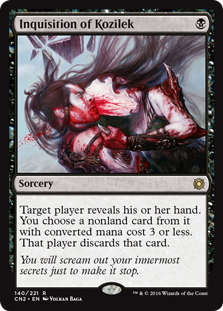
Inquisition of Kozilek: Confidant and Goyf, as Jund has showcased since Modern's creation, perform exceedingly well alongside one-mana removal and targeted discard. Gently disrupting opponents and then presenting a clock of some sort has always been a winning strategy here. Stoneforge fits into this mold as well; strip the removal spell, chase with Batterskull will win a lot of Game 1s against other fair decks. The same principle applies to Young Pyromancer, as we've seen from Mardu Pyromancer(s), so long as the deck has enough cheap spells to turn the 2/1 into a must-answer creature. And discard never hurt alongside Snapcaster Mage; there's plenty of precedent for that, too. So discard was a shoe-in. I went with the set of Inquisition of Kozilek; while some Thoughtseizes could also feasibly fit, I was worried about life-loss from the manabase, and tight on space in general.

Bolt/Push/Path: There's no midrange deck without removal, and in five colors, we get the cheapest and most flexible removal around. Bolt is the clear winner here, with Push taking up the rear. A single Path makes it for Snapcaster utility.

Manamorphose: Looting may be gone, but there are other enabling cantrips in Modern. This one makes a token with Pyromancer and gives us a Snapcaster target in a pinch. More frequently, it filters our mana, helping us take less damage from early land drops but still cast whatever we've got in hand.

Thought Scour: This one buffs Snapcaster more directly, as well as Tarmogoyf. But it's mostly relevant as a one-mana cantrip for Young Pyromancer.

Equipment

On to the equipment, a package I think will vary between Stoneforge decks.

Three is bound to settle as the go-to number; we don't have Brainstorm to shuffle drawn pieces back into the deck, and Modern games are faster than Legacy ones. If we expect to get value out of at least two Stoneforges in a game, I think three is the baseline.

Batterskull is a shoe-in, but there's no Umezawa's Jitte here, either. Which leaves the other two pieces somewhat up in the air. I agree with David that Sword of Fire and Ice is a great tempo-generator, but Sword of Feast and Famine may slot more seamlessly into the midrange decks that employ Stoneforge; getting an extra four-five mana each turn is a godsend for this kind of deck. And Sword of Sinew and Steel packs enough utility to surface in some lists, too.

As for non-swords, most of what exists is probably too cute. But I do think a tech we might see is simply a second copy of Batterskull. It's so far above the other equipment in terms of power that being able to recreate the initial Stoneforge effect once opponents Abrade/Trophy/Grudge (and there will be Grudge) the first Skull may be appealing.

Notable Omissions

Does this deck work? Kind of. There are definitely ways to make it much better. Trimming a color or two does wonders; adding planeswalkers also can't hurt. Even in five colors, though, there's one walker in particular that would do great here: Wrenn and Six. The issue is how congested our two-drop slot is already. But in terms of pure strategy, cutting just about any of the five creatures outright for Wrenn would likely yield better results.

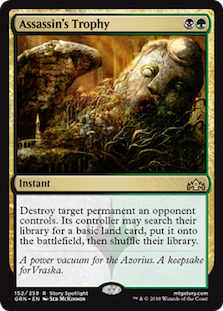
Planeswalkers exist in large part to provide ongoing value over the course of a longer game. Non-walker cards that fulfill a similar purpose are also absent from this list, and again for spatial reasons; the 20-creature requirement takes up a lot of spots, and tying them together with the right mix of enablers takes up even more. As such, narrower or pricier utility cards like Unearth, Assassin's Trophy, and Kolghan's Command get benched. The lack of walkers and utility boosters give this deck a strategic void in the mid- to late-game.

Modern Implications: Quick Takes

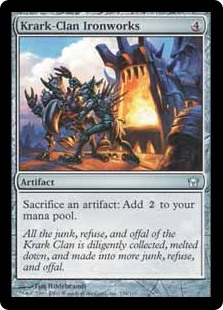
I was surprised by this announcement, but that's because I was anticipating the banlist in the context of previous announcements. Wizards often makes decisions that are initially controversial by virtue of introducing new parameters to the banlist discussion. For instance, I figured they would ban Scrap Trawler from Ironworks Combo because in previous bannings, they've opted to weaken decks without killing them outright; that was even the (failed) intention behind the Twin banning (Kiki-Jiki was singled out in the announcement as a replacement, har har). Wizards instead banned Krark-Clan Ironworks itself, saying it didn't want this deck to exist in Modern at all.

Death of Looting

This time around, I assumed Hogaak would get the axe, but not Looting. Enablers allow multiple decks to thrive in Modern, which nurtures the format's image as a beacon of diversity; additionally, Looting didn't apparently create a "battle of sideboards" as Golgari Grave-Troll, and apparently Hogaak, did.

But Looting indeed contributed to a Modern extremely preoccupied with the graveyard, and Wizards was in the mood for a shake-up. I agree that hitting Looting and unbanning Stoneforge will likely refocus the format away from the graveyard, which may well prove refreshing. But man, will I miss the little guy. Lately, I'd been slotting Looting into everything from Counter-Cat to my revitalized TURBOGOYF deck, the shell that first sold me on Looting as a serious piece of hardware.

Of the many Modern decks that use Looting, I expect UR Phoenix and Dredge to survive the best. The former has access to slower, but decent, options such as Izzet Charm, and still maximizes Thought Scour. The latter doesn't really care about its cards in hand once it gets going, and there are plenty of other ways to put dredgers into the graveyard. With Hogaak gone, Dredge should reclaim its standing as the format's premier graveyard deck.

Mardu had just gained some oomph in Seasoned Pyromancer plus Unearth, but that combination gets much worse without Looting. I expect players dedicated to this wedge to flock to Mardu Shadow instead, which never ran Looting, rather than try to fight an onslaught of Batterskulls with such a sub-par midrange deck. Then there are the even-more-fringe strategies, like Grishoalbrand; those players can find a Lootingless analogue in Neoform.

Arrival of Stoneforge

I think Stoneforge has been fine in Modern for quite a while now. But it's far from underpowered. Midrange decks of all walks will adopt the 1/2, including updated builds of UW Control (which should split into two distinct decks) and BGx (though Wrenn and Seasoned are likely to prevent the pendulum from swinging totally Abzan). On the flip side, Jund won't be the only midrange deck without Stoneforge; Mystic will simply emerge as a powerful option among the many powerful options available in Modern. Further to Wizards' credit, the Kor does stand to shift things slightly away from the graveyard, as Stoneforge operates independently of that resource (and, conveniently, shares a color with Rest in Peace).

Battering Into the Future

Plenty of content has rolled out since the banlist announcement dropped, and I'm not sure what else needs to be said. At this point, we'll just have to see how things milk-shake out over the coming weeks!

Insider: Bulk Treasures, Part 1

Are you a Quiet Speculation member?

If not, now is a perfect time to join up! Our powerful tools, breaking-news analysis, and exclusive Discord channel will make sure you stay up to date and ahead of the curve.

Thanks to the internet, many finance realms are now 24/7, and the Magic finance realm is no different; though there aren't as many players in this particular realm. You may be wondering why I bring this up. The reason is that it's easy to miss important price changes and the reasons behind them. Every morning I check MTGStocks' Interest page to see what cards moved the most the previous day.

Sometimes the price changes make sense, especially when an old card is found to combo with something recently spoiled. Other times, we get very odd spikes typically driven by market manipulation. It may be obvious it's manipulation, it may not be. The purpose of this series of articles is to highlight some price changes in sub $5 cards and to dig into why the price changed, and hopefully, to help consolidate information and ideally serve as a great list of cards worth digging out of your bulk.

There was an error retrieving a chart for Aphetto Runecaster

Aphetto Runecaster's recent price movement is tied to the fact that it was not included in the Faceless Menace (Sultai Morph) Commander 2019 deck. Repeated mana free card draw is definitely something every player wants in Commander so this seems like an obvious "upgrade" card choice for the deck. This was a bulk uncommon right up until August 12th when it started to move. I have been selling these pretty easily in the $3.5.-$5 range the past few days and this is definitely the type of card that you would find in bulk boxes.

There was an error retrieving a chart for Ideas Unbound

Ideas Unbound and Psychic Puppetry are both recent price jumps due to the Twiddle Storm deck that has emerged in Modern. The deck uses the power of Lotus Field and various Twiddle effects instead of the usual rituals to generate large amounts of mana very quickly. Like many Modern Storm variants, it also uses Past in Flames which has also seen a price jump recently.

Ideas Unbound serves as a 2-Mana Ancestral Recall, given that the deck only casts it the turn it's trying to go off. It is also important to know that Ideas Unbound is arcane so you can splice Psychic Puppetry to and then cast the puppetry later in the turn. Ideas Unbound has been found in some older versions of Pauper storm, so it was already a card worth separating from typical bulk.

There was an error retrieving a chart for Psychic Puppetry

Psychic Puppetry was also a big jumper recently thanks to the Twiddle Storm deck; however, this card is one that you're very likely to find in old bulk boxes as it hasn't really been used since it left standard; I didn't play during Kamigawa block so I don't even know if it was actually used then. I've sold multiple playsets at $3+ per card so the demand is real.

There was an error retrieving a chart for Coretapper

Coretapper has started popping up in some versions of modern colorless Tron decks as well as the occasional Urza deck, which look to power out a fast Karn, the Great Creator and lock the game up using Ensnaring Bridge and/or Mycosynth Lattice. It has actually been above typical bulk for quite some time, having a steady price of over $0.75 for the past few years, however, there's a lot of power behind it and Surge Node artifact decks looking to abuse charge counters.

This one may be a bit harder to find in bulk bins thanks to the fact that it has been above $0.75 for so long, but it still may be worth digging for. Interestingly enough Surge Node has also doubled in price recently, however, going from bulk to $0.4-$0.5 means it's really not worth digging for. However, this is definitely a card to keep a watch on and it's worth pulling from bulk if you're already in the process of going through it.

There was an error retrieving a chart for Soothsaying

Soothsaying was the poor man's Sensei's Divining Top in many a budget Commander deck. Couple this with a single printing from 20 years ago and it isn't surprising to see it's price gaining momentum. It originally spiked in price after Top was banned in Legacy and some Miracles players picked up their playsets in hope of rebuilding the deck. Sadly, I was not one of them as the lack of the instant speed card draw made it a much weaker substitute.

There was an error retrieving a chart for Primal Amulet

While one might expect Primal Amulet's recent price movement to be tied to Twiddle Storm, as it might seem like a possible inclusion, I couldn't find anything tying this movement to any sort of breakout deck. However, it is fair to acknowledge that this card is fantastic in any mostly-spells Commander deck, so it's quite plausible to be an "upgrade" option for the Jeskai flashback Commander 2019 deck, Mystic Intellect.

I and many of my fellow writers here at QS believe many of the Ixalan block flip cards to be good potential speculation targets, thanks to the difficulty of reprinting them. Any reprint would require checklist cards to be printed as well, and the fact that they are often quite powerful once flipped adds to that. I will admit that this card's price has basically been above $2.00 its entire lifetime, so it was never really "bulk." It is currently sitting below $5.00 and has room to grow.

There was an error retrieving a chart for Fractured Identity

This is a card I've actually been speculating on for awhile. In an article Niels Rietkerk wrote, he mentioned how instead of resolving a problem it may very well be exacerbating it. However, in cEDH decks, it serves as both a removal spell and a clone for any non-land permanent. Basically, it turns it into at least a 2-for-1 spell. It's also the type of card you'll see in homemade cubes, so it's likely that the price growth is organic.

There was an error retrieving a chart for Grenzo, Havoc Raiser

Grenzo, Havoc Raiser saw a pretty major price spike back in July of 2018 after sitting under $2.00 for almost a full year. His price since that jump has remained stable with some mild continual growth, so it's likely to stick. With the initial jump being over a year ago it's unlikely you will find these in bulk rare bins at major events, but if you do see them they are most likely going to be a good pickup at typical bulk rare bin prices which I've seen to be $0.33-$0.5 per card.

Conclusion

This is the first installment of what I hope to be many in a series highlighting recent price movement in cheaper cards that you might find in bulk boxes or bulk bins. I am currently ignoring some of the Core 2020 commons that have spiked recently as those look to have no merit and are solely due to market manipulation. Did I miss anything? Feel free to comment below or message me on our Discord chat.


Leaving GP Vegas: Report and Bannings

Are you a Quiet Speculation member?

If not, now is a perfect time to join up! Our powerful tools, breaking-news analysis, and exclusive Discord channel will make sure you stay up to date and ahead of the curve.

It's been a packed weekend for Modern. Not only was there a major event, but there's been a major, cataclysmic upheaval. August 26 will be remembered as a major turning point in Modern's history. Which way it's turning isn't clear. But turn it will.
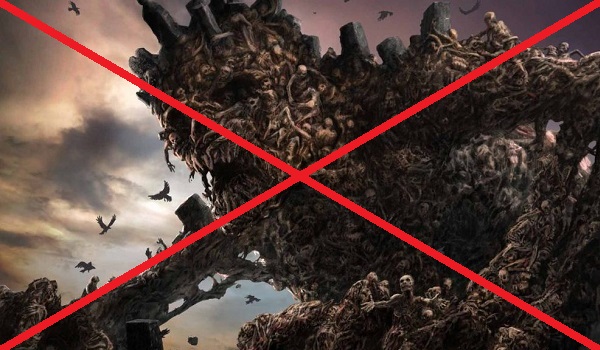
In this article, I'll give a quick report of my GP Vegas results before diving into the significance of the banlist update.

Vegas Report

GP Las Vegas was to be the first main event I'd played in for over a year. If memory serves, the last time was Dominaria sealed at GP Dallas last year. As such, I was starting from a weaker position than I'm used to. I play a lot of local events in a week, so I still had a round 1 bye. However, without those GP point multipliers, it's almost impossible to maintain two. This may seem petty, but experience has shown that most of the randomness gets cleaned up in the first few rounds, and you mostly hit known decks starting out 2-0, which you can prepare for. Byes also mean having to win fewer games to make Day 2, and in a game where luck is a factor, that's huge. Thus, making Day 2 would be a lot harder than last time I was in Vegas.

As I've alluded to several times, my plan was to just run back Spirits.

UW Spirits, David Ernenwein (GP Las Vegas 2019)

Creatures

4 Mausoleum Wanderer
3 Spectral Sailor
4 Selfless Spirit
3 Rattlechains
4 Supreme Phantom
3 Unsettled Mariner
4 Drogskol Captain
4 Spell Queller

Artifact

4 Aether Vial

Instant

4 Path to Exile
2 Force of Negation

Lands

4 Flooded Strand
4 Hallowed Fountain
3 Cavern of Souls
3 Field of Ruin
1 Seachrome Coast
3 Plains
3 Island

Sideboard

3 Rest in Peace
3 Auriok Champion
2 Stony Silence
2 Settle the Wreckage
2 Runed Halo
2 Detention Sphere
1 Force of Negation

Against Hogaak, my plan was to morph into a control deck, using Champion to contain the zombies, the enchantments to draw removal away from Rest in Peace, and Settle to seal the game. I never got to see how well it worked in practice.

What Happened
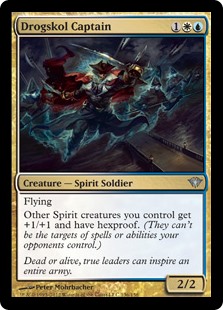
I went a glorious 2-3 drop this time. Not having two byes anymore certainly hurt, but given how things went overall, I don't think having them would have substantially helped. See, variance was entirely against me. In all my losses I was against favorable matchups, but I mulliganed unkeepable hands into mediocre ones where my opponents were keeping good to great ones. Round 2 against Eldrazi Tron saw my opponent on the play go turn 2 Chalice of the Void, turn 3 Endbringer, then Reality Smasher in games 1 and 3. Those are far from typical starts. Game 2 was far more typical where he didn't have all the acceleration and I got some threats down. I also got to Field him out of the game.

Round four was against Humans and I lost in two thanks to awkward hands and triple Thalia's Lieutenant each game. I might have survived an extra turn or two with different lines, but it would have taken a lot of lucky draws in a row to actually turn the corner. Round 5 I was eliminated when I mulliganed to five twice against Burn and got choked on mana while he curved out. It's unfortunate, but sometimes your deck just doesn't come to play.
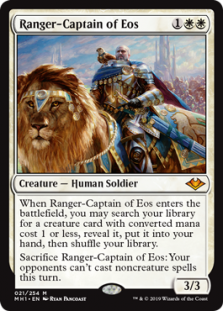
The one match I won is also the only time I actually played Magic. Round three I was on the draw against Mardu Death's Shadow, which I'd never played against before, but it did not impress. My opponent did an impressive amount of damage to himself both games with multiple early Thoughtseizes and Street Wraiths, which left me with anemic hands. However, he didn't have a follow-up until he played Ranger-Captain of Eos, and by then I'd beat him too low and Fielded him off red mana. Tutoring for Death's Shadow is great and Temur Battle Rage is scary, but without all the cantrips the deck seemed really inconsistent.

Floor Perspective

In terms of the wider tournament, this didn't feel like Eldrazi Winter. It felt normal. I realize that is subjective, but in Detroit, there was this sense of inevitable doom-and-gloom hanging over the tournament. Eldrazi was so oppressive that it tangibly hung in the air. There was none of that this time, almost indistinguishable from any normal GP I've ever been to. Additionally, player experience swung wildly. For me, this was a normal field that I just crapped out on. Many other players told me the same thing. A few had run into Hogaak once, lost, then moved on. One Denver player lost consecutive win-and-in games to Hogaak, and boy was he SALTY! In Detroit, everyone was hitting some form of Eldrazi almost every round. Hogaak Summer was not a healthy time for Modern, but everything I experienced says it wasn't as bad as commentary would suggest.

B&R Day!

However, that all happened in a past format that is no longer relevant, because it's time for another Banned and Restricted Announcement! <fanfare plays> And oh boy, is it a doozy. In addition to a major shakeup in Vintage, Rampaging Ferocidon was unbanned in Standard. For a whole month. Then it rotates, so great? But who cares about a format most can't afford and a functionally dead one, because Modern's officially been turned on its head.

Modern:

Hogaak, Arisen Necropolis banned.
Faithless Looting is banned.
Stoneforge Mystic is unbanned.

Well now, that's a lot to unpack. The first part is not at all surprising, so I won't dwell on it too long. The real shock is that Faithless Looting has been banned. Faithless has become almost as omnipresent in Modern as Brainstorm is in Legacy, to the point that many compared the two cards. But as we've seen with past bannings, there are no sacred cows in Modern. Stoneforge Mystic was also released. I'm not sure how I feel about that yet.

Hogaak, Banned Necropolis

And so ends the arisen menace. Good riddance and everything, but we all saw it coming. There was no other choice after Birmingham, and with Vegas confirming the previous results, this ban was inevitable:

In looking at the evolution of the archetype over time and the variety of successful ways to build the deck, it's clear that the card Hogaak, Arisen Necropolis is the crux of the problem.
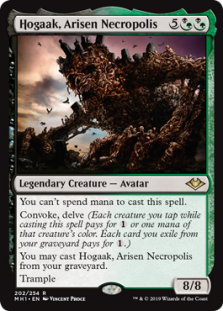
I think that if Wizards hadn't reprinted so many sacrifice outlets alongside Hogaak, Arisen Necropolis in Modern Horizons, things would never have gotten so bad. The question of why Hogaak was deemed acceptable in the first place will likley remain a mystery until NDA's expire, but Hogaak is a great target for Path to Exile. It's very unfortunate that Carrion Feeder protects it so effectively. At the end of the day, Hogaak was both the payoff and the problem, so it had to go.

In fairness to Wizards, it wasn't immediately clear that banning Bridge from Below wasn't enough to prevent this. For several weeks it looked like there were too many hoops to jump through and that hate was effective enough to keep Hogaak in check. Then the optimized decklist was found, and the rest is many weeks of head shaking. One can only hope that Wizards learns and internalizes that graveyard recursion and cost reduction mechanics are very dangerous.

Faithless Looting

More importantly, Faithless is gone. I predicted that it was possible, but unlikely. Given everything that had happened last year, I thought that it would a really busted deck built around Looting to get it banned. Apparently, history and a desire to be done with an era was all it took.
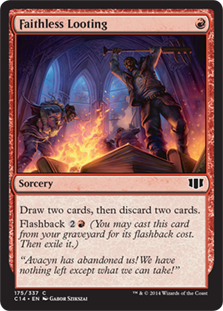
By our data gathered from Magic Online and tabletop tournament results, over the past year the winningest Modern deck at any given point in time has usually been a Faithless Looting deck.
Faithless Looting would be a likely eventual addition to the banned list in the near future. In order to ensure the metagame doesn't again revert to a Faithless Looting graveyard deck being dominant, we believe now is the correct time to make this change.

Basically, Wizards has enough egg on its face over Hogaak. They want graveyard decks to go away and a completely new Modern to take shape, which I respect. It was getting tiresome. There isn't anything close to Looting, so straight replacement is impossible. The nearest thing at Looting's mana cost is Insolent Neonate. The nearest effects are two or more mana. They also can't be used a second time late in the game. Thus any deck that had looting will have to adapt.

This forces a complete revaluation of not only Looting decks, but of Modern itself, which is the intention. The format has been about velocity and card selection up until now, and Looting was great at both. There were so many decks that used Looting that I can't possibly predict how they'll all change or what that does to Modern as a whole, though slow-down is the softball answer. There are seven decks that I can think of off the top of my head, and while some will be fine most will need a huge rethink to survive.

Currently Dead

These decks are, for all intents and purposes, dead in their current incarnations. Looting was too integral to their strategy to replace, and so the deck must be completely redesigned. Every deck could remerge, but it will be have to be in very different configuration if they're recognizable as the same deck at all.
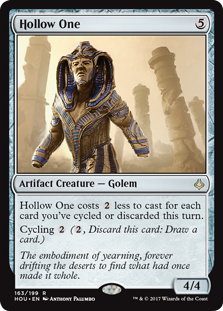
Hollow One. Looting was the only real option for reliable early Hollow Ones, since the alternative Burning Inquiry sometimes bites back. With only two-mana options available to fill the gap, Hollow One slows down by at least a turn. Explosiveness being its primary draw, this is a crippling blow. Given that players were already fed up with the random discard and general inconsistency and subsequently abandoned the deck for Phoenix last year, I can't imagine anyone but diehards running the deck.

Vengevine Decks. Despite losing their other payoffs in Bridge from Below and Hogaak within two months, the enabler core of Vengevine was enough for the deck to potentially return. Without Looting, that's not possible. The deck is based around busted starts which require specific cards in hand and in the graveyard at the same time. Stitcher's Supplier makes it easy to fill the graveyard, but as an actual setup card Supplier is lacking since you have to get lucky flips. You can't actually filter, so having Vengevine in hand is disastrous without Looting to correct it. As the alternatives are much weaker and slower, that busted start that defines the deck disappears and so too goes the draw to actually sleeving it up.

Grishoalbrand. Another graveyard-centric, high-velocity, has-to-be-explosive deck that lived and died by its Lootings. There was already little reason to play it over the harder-to-interact-with Neoform combo. Now I don't think there's any question.

Heavily Impacted

The decks in this category have core strategies that remain intact, but won't be as effective without Looting. Thus these decks need to be retooled rather than completely redesigned. Instead of scrapping the whole thing until a Looting replacement is found these decks just need to adjust away from Looting based gameplans.
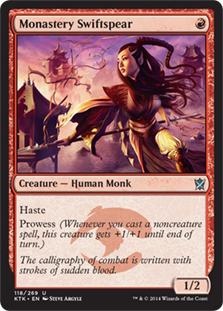
Mono-Red Prowess/Phoenix. I realize that these are not quite the same deck, but they're close enough. Looting was a very key card, and was the main way to facilitate Phoenix, so the decks will have to substantially evolve. Given how inefficient, comparatively speaking, the remaining red filtering is, I don't think that Phoenix will remain an integral piece of the deck. This brings into question the survival of the strategy, but with Manamorphose staying legal, it is plausible. Chaining spells together remains a potent strategy and while the best one is gone, enough of the deck remains for it to survive.

Mardu Pyromancer. The poster child for "fair" uses of Looting, I cannot fathom Pyromancer surviving the banning. Not only does the deck have a lot of graveyard interactions and require high-velocity to survive, but it also suffers from the "wrong half" problem more than most midrange decks.

Mardu has historically been quite bad in Modern because it's a pile of removal with no other unifying force. Looting was that glue. Whether filling the graveyard for Bedlam Reveler, filtering away dead cards, or just making tokens, Pyromancer leaned so heavily on Looting that now it falls on its face. There's nothing comparable in both the late and early game. However, the core strategy of all-the-removal-colors is intact, so a deck should remain viable.  I expect Mardu Pyromancer to shift towards Death's Shadow based on its recent success, playing most of the same cards, and having a very similar strategy.

Survivors

The final category of affected decks are relatively unscathed. Yes, Looting was an important card, but they can take the hit in stride and remain competitive without major surgery. A patch here, an adjustment there, and these decks will be ready to go.
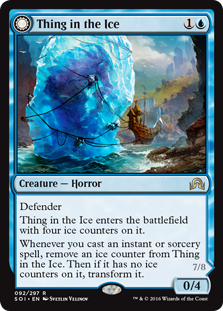
Izzet Phoenix. Compared to its mono-red cousin, Izzet Phoenix will be just fine. Looting was the key to the versions that put Phoenix on the map, but Izzet has been moving away from the Arclight Blitz strategy for some time now. It's become more of a combo-control deck focusing on Thing in the Ice and Aria of Flame rather than its namesake. Thus, as good as Looting is for such a deck, it isn't critical.

Izzet also has plenty of options for replacing Looting. If it wants to go more towards combo, it can just scrap Phoenix entirely and play more blue cantrips. If not, it can adopt the versatile Izzet Charm. Or it may go for value with Chart a Course, Ideas Unbounded, or Jace, Vryn's Prodigy. The deck slows down, but the plethora of options ensures it will remain a factor in the metagame in almost the same form.

Dredge. As good as looting is at finding and setting up dredgers, Legacy has shown that it doesn't really matter how Dredge gets going, just that it does. Like Phoenix, Dredge has plenty of options to replace the early cantrip. Insolent Neonate used to be commonly played, and could be again. Dredge could also crib Hogaak's notes and run Stitcher's Supplier. Regardless of its final form, there will continue to be a dredge deck that is undeniably Dredge, so the impact of the ban will be minimal.

The bottom line is that without Faithless Looting, graveyard and velocity decks are worse. But not gone.

Mystic Revival

Finally, there was the unbanning. I heard speculation that Bridge might return since it died for Hogaak's sins, but I never believed that. If not Hogaak, something else would eventually have broken Bridge, and Wizards is done with graveyard decks for now. Bridge is barely a Magic card in the first place, so there's nothing to be gained by an unban. Instead, Wizards decided to go all-in on slowing Modern down by unleashing Stoneforge Mystic.
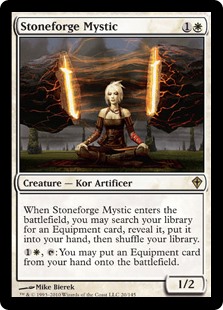
While the card being unbanned is a surprise, the timing isn't really. Normally, Wizards only unbans anything every two years and in January/February. It only being a year-and-a-half since Bloodbraid Elf and Jace, the Mind Sculptor were unbanned makes this unban seem out of place.

However, there's another trend at play. I argue Mystic's freedom isn't because Wizards was looking to unban it, and there's evidence to suggest they had no intention of doing so. It's just that they had to. Wizards has a history of unbanning something after major bans. Golgari Grave-Troll was unbanned after Treasure Cruise and Birthing Pod were banned, and Wizards exchanged Ancestral Vision and Sword of the Meek for Eye of Ugin as an apology after Eldrazi Winter. As the list is getting thin on reasonable candidates, and seeing that it took multiple bannings to make things okay again, Mystic was unleashed to restore interest in Modern.

It is worth noting that Wizards is wary about this decision, and regards it similarly to Grave-Troll.

While we think it's unlikely, there is a scenario where Stoneforge Mystic could come to suppress this type of gameplay, in which case we would re-examine its legality (similar to Golgari Grave-Troll's history in Modern).

I also want to highlight that Wizards's concern is drawn from the same place as my skepticism years ago.

The danger in reintroducing Stoneforge Mystic, and the reason it's remained on the banned list up until this point, is that it's at its strongest against straightforward decks that play to the battlefield.
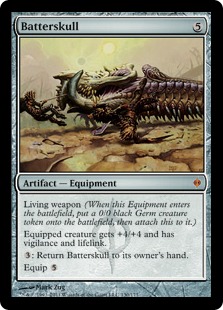
I have no idea if those arguments still hold. Modern was completely different when I tested Mystic, and coupling that with all the disruption from Looting's ban, there's no way to even speculate if Mystic will be good, let alone oppressive. My gut says that the underlying principle that you can't beat Stoneforge head on, you have to go around her, remains true. If that's the case, then Humans may be in for a bad time. If not, then control players will be sorely disappointed.

I absolutely will extensively test in the coming weeks, but for the moment there's no way of knowing the actual impact that Mystic may have. Also, there's the question of what package to run. Batterskull and Sword of Fire and Ice are givens as the most powerful equipment, but the normal third piece, Umezawa's Jitte, is banned. Standard and Legacy experience don't really apply since those formats are so different from Modern. Further and as noted, there is reason to worry about the power level, so don't get too attached. That said, I'm hopeful that this will incentivize more interactive decks in Modern.

Looking Ahead

Fresh Modern, fresh cards, and an upcoming MCQ means I have a lot of work to do sorting all this out. Here's to the new era!


Examining MF Vegas Trends from Afar

Are you a Quiet Speculation member?

If not, now is a perfect time to join up! Our powerful tools, breaking-news analysis, and exclusive Discord channel will make sure you stay up to date and ahead of the curve.

I couldn’t attend MagicFest Las Vegas this year. Traveling for Magic events is prohibitively difficult given my current family dynamic. But just because I couldn’t attend the event doesn’t mean I can’t extract a few nuggets of useful finance data from it. In fact, there’s one readily available set of data on social media that could provide some insights.

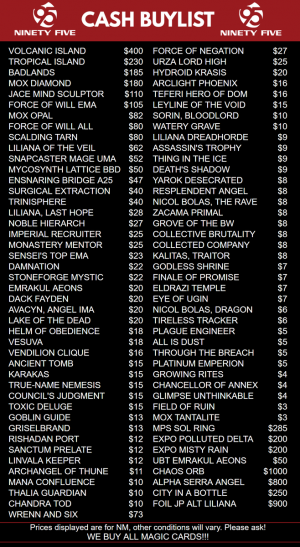
It’s Ninety-Five’s daily hotlist!

Day 1
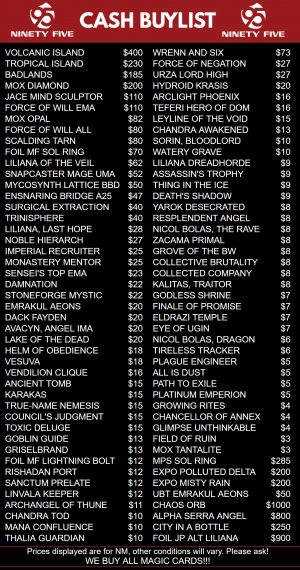
Day 2
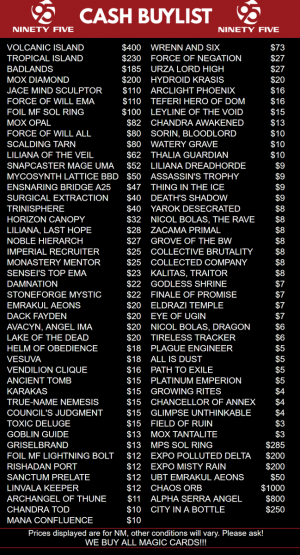
Day 3

Ninety-Five MTG was clever enough to post their hotlist each day of the event. Their formatting is legible and easy to navigate through. Not surprisingly, some prices did change throughout the event. Although there are going to be local factors to this particular vendor, we can safely assume changes to this hotlist reflect their ability/inability to acquire certain cards throughout the event.

So without further adieu, let’s dive in and see if we can glean some valuable information about the Magic market from MagicFest Las Vegas.

Additions

I’m going to start by focusing on cards that were added to the hotlist from Day 1 to Day 2 and from Day 2 to Day 3. These are the cards for which Ninety-Five probably saw consistent demand. Perhaps they sold out of some of these cards. Or perhaps their pricing was too low relative to the rest of the vendors in the event hall. Whatever the reason, it’s safe to say Ninety-Five added cards to their list that they wanted to purchase more copies of due to greater demand.

When comparing Ninety-Five’s Day 1 hotlist with Day 2’s, I see three additions:

First, the foil promotional Sol Ring was added onto the list—this makes sense, since people started receiving them once tournaments began. People weren’t going to have them to sell at the very beginning of the event. No surprises there.

The second addition is the MagicFest foil promo Lightning Bolt. Like before, this addition seems logical once numerous players receive this promo for playing in events.

The third addition, however, is more indicative of a real trend: Chandra, Awakened Inferno from Core Set 2020. This must be a reflection of demand, or else a price adjustment. Either way, Ninety-Five wanted to acquire more copies on Day 2 of the event as evidenced by their placing the card on their hotlist. Their $13 buy price eclipses all buylists on Quiet Speculation’s Trader Tools page, indicating an aggressive move to acquire copies. Perhaps these were selling quickly on the event floor?

There was an error retrieving a chart for Chandra, Awakened Inferno

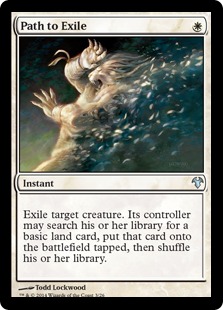
The final addition to Ninety-Five’s hotlist between Day 1 and Day 2 is Path to Exile. Despite its many reprintings, this card refuses to stay cheap. Ninety-Five’s buylist price of $5 is underwhelming when compared to other online vendors. I’m not sure if other vendors on site were paying more or less aggressively, but this is a noteworthy addition at least.

Next, let’s examine additions from Day 2 to Day 3. The only addition I note is Horizon Canopy, with a $32 hotlist buy price. The top price on Trader Tools for Iconic Masters copies is $30, so this is a very good number. Again, this must reflect on-site demand for the card (or else a sudden run on their stock online). Otherwise, there would be no need to suddenly add this card to their hotlist.

There was an error retrieving a chart for Horizon Canopy

Subtractions

Converse to assumptions around hotlist additions, we can probably assume that removal of a card from a hotlist indicates diminished desire to purchase copies. I’m sure Ninety-Five was still buying cards they removed from their hotlist—but they made a conscious choice to prioritize other cards for that given day. They only have so much real estate on their hotlist board, after all!

From Day 1 to Day 2 I can only find one subtraction from Ninety-Five’s hotlist: Through the Breach. They were paying $5 on the card Day 1, and it’s possible their buy price didn’t even change much from Day 1 to 2. But a decision was taken to deprioritize Through the Breach, perhaps in favor of Path to Exile at the same price tag. The best buy price on Ultimate Masters copies of Through the Breach online is $4 according to Trader Tools, so maybe they took in enough copies Day 1 by offering a competitive buy price.

There was an error retrieving a chart for Through the Breach

From Day 2 to Day 3, the first hotlist exit is Resplendent Angel. On Days 1 and 2 they were offering $8 for the card, 33% higher than the top buy price online. Perhaps they took in a bunch of copies after the first couple days. Or maybe they simply ran out of space after adding Horizon Canopy. Either way, someone had to make the choice that Horizon Canopy was in and Resplendent Angel was OK to fall off the list.

The second card to fall off the Day 3 hotlist was foil Japanese version of Liliana, Dreadhorde General. Their $900 offer was extremely high, leading me to believe they were on the hunt for copies to supply a particular buyer. Card Kingdom’s buy price, by comparison, is only $650 (though they are sold out, so this could increase). But perhaps they just like to have these in stock and were trying hard to take in a few copies. Either way, they must have satiated the most urgent demand since the conscious decision was made to take this card off their hotlist on Day 3.

As far as I can tell, these were the only subtractions from the hotlists.

Price Changes

The final thing I want to review from Ninety-Five’s hotlists are adjustments to buy prices. I’d expect only price increases to occur on these hotlists—if a hotlist price was to be decreased, it means enough copies were acquired and the card probably doesn’t belong on the hotlist anymore.

From Day 1 to Day 2, Ninety-Five’s buy price on Mox Diamond increased from $180 to $200. This reflects a recent increase in the card’s price. The top buy price online is $185 for the Stronghold printing, so $200 is certainly aggressive. But given this card’s recent strength, I’m sure other vendors will follow suit in the near future.

There was an error retrieving a chart for Mox Diamond

Another increase from Day 1 to Day 2 was Urza, Lord High Artificer, which increased on Ninety-Five’s hotlist from $25 to $27. This card must have been tough to take in when the buy price was $25, so a move higher was made in an attempt to attract more prospective sellers. The top buy price online is $25 according to Trader Tools, but perhaps supply is outpacing demand at the moment and this card’s price is on its way up?

Shifting to Day 3, the most significant buy price increase was in the MagicFest foil promo Sol Ring. After offering $70 for the card at first, Ninety-Five decided to increase their offer to $100! This has to reflect the demand for this card and Ninety-Five’s desire to be competitive with other vendors in the room. In fact, they even tweeted out their $100 buy price on this card, specifically, later during Day 3.

Wrapping It Up

MagicFest Las Vegas is always a great event to study the Magic market. It reflects the simultaneous presence of so many cards and so many vendors, enabling instantaneous transactions to help market prices reach equilibrium. There’s no delay in shipping, no arguments over grading, and no order cancellations in the traditional sense. This is why I like to examine this event closely for pricing trends.

Unfortunately, I wasn’t able to attend this year. But that doesn’t mean I can’t glean some important information about Magic’s economy. By examining hotlist trends, I can identify what cards were on the move and what cards were a bit more stagnant. Since Ninety-Five graciously tweeted out their hotlist each day of the event (and their hotlist is organized, easy to read, and so extensive), I used their numbers as my gauge.

After this assessment, there are some clear trends. Horizon Canopy and Mox Diamond are hot; Through the Breach is not. But the biggest winner of all is the foil MagicFest promo Sol Ring. I get the card is attractive and the current supply is constrained. But I’d recommend caution to people interested in acquiring copies. We know more copies will be disseminated at subsequent Magic events, and we are nowhere near peak supply just yet.

Once vendors return home from Vegas and start listing their newly acquired inventory for sale, we should see the price on this Sol Ring pull back. It’ll be interesting to see how this card’s price evolves over time, along with the rest of the weekend’s hotlist movers and shakers.

…

Sigbits

  • I already talked about Mox Diamond’s recent move. Card Kingdom is currently offering $180 for Stronghold copies and $210 for the FtV foils. This is nearing recent highs, and it wouldn’t surprise me to see these numbers both climb. Perhaps the printing of Wrenn and Six has fueled demand for this card? I could see the synergy making it more playable in Legacy.
  • One card I don’t talk about much is Intuition. Foil copies of this card are quite costly, and Card Kingdom has it on their hotlist with a buy price of $140. While not bad, it’s worth noting that ABU Games offers even more: $145.63 in cash or a whopping $311.85 in credit (valued at roughly $180).
  • Today must be Reserved List foil day, because I have yet another one for you on Card Kingdom’s hotlist: foil Yawgmoth's Will. Card Kingdom is currently paying $130 for the card. But if you have some of these foils to sell, you should again look to ABU Games because they’re offering $150.15 in cash, $321.75 in credit!

Modern Top 5: Beaters

Are you a Quiet Speculation member?

If not, now is a perfect time to join up! Our powerful tools, breaking-news analysis, and exclusive Discord channel will make sure you stay up to date and ahead of the curve.

Beaters, or combat creatures, are among my favorite types of Magic cards. They serve to pressure opponents in the most straightforward way possible: by attacking efficiently. Weaker beaters, such as Delver of Secrets, are at their best when paired with disruption; stronger ones can emerge later in the game to take over or put things away. One beater in particular has deeply altered the Modern landscape since rearing its ugly head.

Reality Smasher

In "Tough as Nails: Combat, Removal, and Stats," I slotted these creatures into different Stages depending on the part of the game they usually resolve. Today we'll go a step deeper, breaking down the biggest, baddest beaters in Modern.

Beating the Horse

A standby metric for these articles is power, which describes a spell's impact relative to its mana cost. But since beaters are just glorified stat vessels, I've split that metric into its two rightful parts.

  • Bulk: The creature's power and toughness.
  • Castability: The ease and speed with which decks tailored to do so can produce the creature.

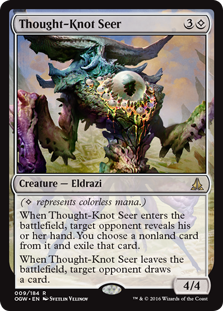
Omitted from these metrics is utility, a definite factor when it comes to certain beaters, such as Thought-Knot Seer. This call was made on the basis that beaters are rarely employed for their utility applications. For instance, Tron is the only non-beatdown deck that runs Seer; while the fair Plan B does contribute to that choice, Seer is more critical as a colorless Thoughtseize. Then there's keywords, specifically evasion ones; I've tied these into bulk.
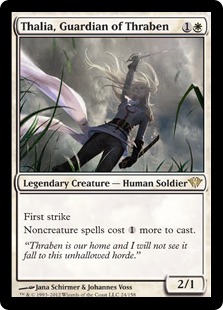
For this edition of Modern Top 5, I've elected to get away from the splashability metric. Tarmogoyf's fall from grace as a splashable beater symbolizes Modern's larger shift into a format that doesn't indiscriminately pack beaters; rather, the format's premier combat creatures helm decks all their own, as perhaps introduced by Hollow One. The resulting decks are machines designed to produce, and then extract the most from, their respective threats.

Another old metric returning in its original form, though, is resilience. To quote "Modern Top 5: Enablers:"

Resilience: The degree to which the card proves unfazed by targeted or splash disruption.
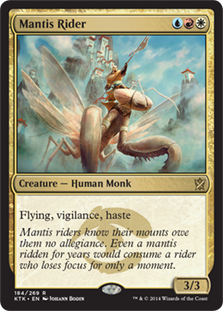
Resilience describes an enabler’s ability to function under pressure. Cards like Thalia, Guardian of Thraben, Chalice of the Void, and Damping Sphere are Modern mainstays, and each of these mess with a subset of played enablers. Factors to consider when judging resilience include how common the top hate cards are in the format, whether they see mainboard play, and the amount they cramp the enabler in question.

As applied to beaters, resilience asks how much targeted hate they can stand before ceasing to apply adequate pressure: the larger the amount, the higher they score. One common factor in this metagame is immunity to graveyard hate. Ignoring less surgical options, such as all-purpose targeted removal or sweepers, yields extra points.

#5: Mantis Rider

Bulk: 3

Let's be honest: 3/3 isn't much to write home about. Freaking Wild Nacatl costs one mana! But Mantis Rider's keywords pack a subtle punch that functionally increases its size.

Haste, the most gamebreaking of the evergreen mechanics, gives Rider a sizable power boost. Say it stays on the battlefield for only one turn cycle after coming down. That's still two attacks; its power may as well have been six in this case. Three turns? May as well have been four. And in a turn four format, how often is the turn clock going to outrun the damage advance?
Then there's flying, grandfather of evasion keywords. Being able to out-muscle enemy beaters becomes less of a factor when Rider just soars over them. And vigilance, which lets pilots essentially double up on Riders—with "one" attacking and "one" blocking, that three mana ends up buying twice as much power and toughness as advertised.

Castability: 3

Rider is mostly played in Humans, a deck capable of pumping it out on turn two should Noble Hierarch live. If the dork dies, though, Rider becomes a top-end threat for the deck, and one they might not have time to cast against the format's faster decks. This volatility speaks to Humans's dependance on its opener and on enemy options not lining up correctly, and plants Rider firmly in the middle of the metric.

Resilience: 2

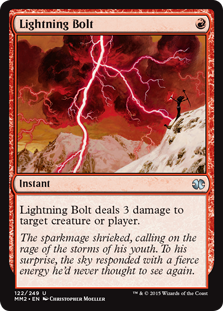
All the removal spells kill Mantis Rider, including Lightning Bolt. But against Humans, that Bolt may have been spent on Champion, Hierarch, or Thalia by the time the 3/3 resolves. To its credit, Rider enjoys total immunity to graveyard hate and hosers like Chalice of the Void; in this metagame, Leyline of the Void in fact sees more play than the red instant.

Overall: 8

#4: Tarmogoyf

Bulk: 3

4/5 really ain't what it used to be. These days, the only decks running Goyf count on the beater as 3/4 or 4/5 in the early game, and plan on growing it to around 5/6 later on. The Lhurgoyf indeed boasts the potential to grow much larger, but if your deck is going to be built around a beater, better make it one of the higher-reward creatures listed below. Rather, Goyf shines alongside a core packed with disruption and in lieu of more effective attacking options. When a deck is stuffed to the gills with ways to tell the opponent "no," it simply can't accommodate the wealth of enablers required by Modern's more alluring combat creatures.

Castability: 5

Man, is Goyf ever castable. That's always been the case in Modern, when even utterly off-color decks like UR Twin would splash for the threat. Its cheap, color-light price tag is what keeps it at the top tables at all these days, now right at home in its favorite midrange deck, Jund. That strategy's otherwise color-intensive roster and high curve make Goyf a welcome draw at all stages of the game.

Resilience: 1

I never thought we'd see the day where Mantis Rider is tougher than Tarmogoyf, but here we are. Goyf was once feared in large part thanks to its resilience; graveyard hate was far less prevalent in Modern's early days, and we didn't have Fatal Push to check Goyf at a tempo gain. Push itself relegated Goyf to usage in just a few strategies, but the uptick in graveyard hate has also hurt the card—it's just incredibly fragile right now. No matter when Rest in Peace comes down, all Goyfs will be reduced to 0/1, be they in play, in hand, or in deck. That's untrue of other graveyard creatures, which may demand more resources to be cast, but reward pilots by sneering in the face of late hate once on the battlefield.

Overall: 9

#3: Thing in the Ice

Bulk: 4

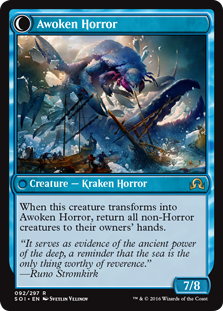
Enter the big boys. At 7/8, Thing in the Ice possesses more raw size than any Modern staple this side of Horizons. Its transform ability also clears the battlefield for a first hit, dealing with would-be chump blockers and revenge killers.

Castability: 2

While 1U is supremely reasonable, sticking Awoken Horror is a bit harder than its casting cost might suggest. Thing requires four instants or sorceries to be cast before flipping, making it among the least "castable" beaters here—before transforming, after all, it's not so much a beater as a poor man's Wall of Omens.
It's true that UR Phoenix, Thing's primary home, is more than capable of accommodating the 0/4 by turn three. But mulligans complicate this gameplan, as can extenuating game state circumstances. In many scenarios, that turn-three Thing is a lot easier to achieve than a turn-six one; without a stream of resources handy, Thing forces pilots to wait around until they've met its demands prior to turning sideways.

Resilience: 4

Fatal Push kills Thing, but Bolt doesn't. Sound familiar? Goyf's is a similar story on that front; Thing's big advantage over its green counterpart is a complete obliviousness to the graveyard. It's also very difficult to kill once Awoken, as swaths of damage-based removal are currently employed to remove buff creatures: Dismember and Lightning Axe, for instance, become useless in the face of a 7/8.

Overall: 10

#2: Reality Smasher

Bulk: 4

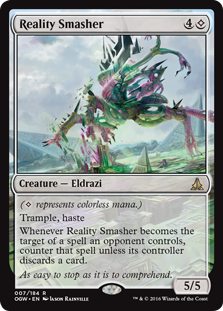
Joining thing at 4 bulk is Reality Smasher, who makes up for its smaller frame with evergreen mechanics. Haste puts its damage output above Thing's for the first three turns, and trample deals with chump blockers beyond the pivotal transformation turn. The broken Eldrazi deck of winters yore may well have still dominated without Reality Smasher, but this 5/5 nonetheless proved the face of the menace, in no small part thanks to its raw aggressive output. CRUNCH!

Castability: 2

Castability is where Smasher struggles. It doesn't require additional work like Thing, but five is a heck of a converted mana cost. The decks that employ Smasher tend to have Eldrazi Temple on hand, or simply assemble Tron with some accuracy, making Smasher closer to a four-drop.

But that's still more mana spent than anything else on this list. Indeed, Smasher is the only Stage 3 combat creature here, signaling a momentous shift in Modern's power balance that we'll delve into in the next section.
Resilience: 5

Leyline? Shrug. Fatal Push? lol. Assassin's Trophy? Congrats; enjoy your discard! Whatever your answer, Smasher probably just doesn't care. And if it does, opponents are forced to minus just to get it off the table. The exceptions are sweepers, a card type nigh-exclusive to UW Control, and larger-still bodies, which can be run over with Dismember.

Overall: 11

#1: Hogaak, Arisen Necropolis

Bulk: 5

This is it: the final frontier. Nothing dwarfs Hogaak in Modern except for dangerous Death's Shadows. But even those don't have trample, a keyword that takes Hogaak from dumb to absurd; Shadow clings to red for Temur Battle Rage, while Hogaak has one built-in.

Castability: 4

Two black or green creatures in play and five cards in the graveyard. Steep casting conditions? Apparently not; Frank Karsten asserts that Hogaak can be cast on turn two in 60% of games, a feat eminently doable even on a mulligan to five. And who are we mortals to argue with the numbers?

The wizards behind the curtain are Stitcher's Supplier and Satyr Wayfinder, which turbo-charge the graveyard, provide bodies to convoke with, dig for additional bodies in the form of Bloodghast and Gravecrawler, and draw into Hogaak itself. These creatures ensure Hogaak's dominance, helping it come down with the speed of a Stage 2 combat creature despite boasting Stage 4 stats.

Resilience: 4

Before we touch on graveyard hate, let's consider Modern's other checks to fatties. Terminate, Assassin's Trophy, and the like take Hogaak off the table as they do Reality Smasher. But instead of making opponents discard, Hogaak does us one better: it comes right back to the battlefield! Removing Hogaak really means exiling it, but that's also a shaky plan; Path to Exile can be responded to with Carrion Feeder, sacrificing Hogaak for the Greater Good. In lieu of Feeder, exiling one Hogaak won't change the world, either; its namesake deck specializes in stuffing the graveyard full of convoking delvers, so there's likely to be another in tow.
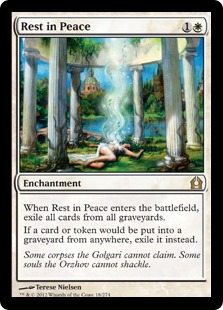
Which brings us to the elephant in the room: hosers, of which Modern stocks plenty. With either Leyline of the Void or Rest in Peace in play, Hogaak can never hit the battlefield. So why does the data indicate that packing these cards in spades does not add many, or any, percentage points against the infamous Avatar?

For one, Hogaak is ready for the hate. Its enablers are efficient enough, and the deck streamlined enough, that its pilots don't mind running more enchantment-removing cards than opponents could even have hateful enchantments. And they're all coming in, with little change to Hogaak's speed consistency.
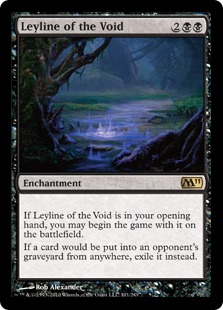
Second, the deck is too fast. Slamming Rest in Peace doesn't invalidate a Hogaak already on the battlefield, as with Tarmogoyf; the enchantment needs to be in play first. Except Rest in Peace pilots, even assuming they run four copies, don't play one- and two-mana creatures that cast functional Ancestral Recalls and Impulses upon resolution to look for that enchantment. In other words, Hogaak is far more likely to have Hogaak than anything else is to have Rest in Peace—or Leyline of the Void, actually fast enough to stop Hogaak, but also stringent enough to necessitate a copy in the opening hand. This option has been considered by some high-level (and tournament-winning) players too unreliable to even employ.

Then there are lower-tier grave-hate options, such as Tormod's Crypt, Ravenous Trap, and Relic of Progenitus. These speedbumps are of little import to Hogaak, which can go off without even removing them. My favorite of this bunch is Surgical Extraction, which can indeed prove gamebreaking when it successfully exiles the titular threat. But targeting Hogaak itself is no picnic, as pilots retain priority to cast the 8/8 after milling it; wary Hogaak players won't give opponents a window to use Surgical.

Overall: 13

Hard to Beat

All these factors combine to give Hogaak a score not just one, but two points higher than my #2 choice. Modern has become about beaters, but looking more closely, it seems to have become mostly about one in particular. Whether the deck's supposed volatility will end up checking it over the coming weeks remains to be seen, but color me skeptical. There are other players in this beater's game, but the deck seems stacked against them.

Grave Matters: GP Birmingham Analysis

Are you a Quiet Speculation member?

If not, now is a perfect time to join up! Our powerful tools, breaking-news analysis, and exclusive Discord channel will make sure you stay up to date and ahead of the curve.

Another event-filled weekend, another data dump, another chance for Modern to adapt and contain the arisen menace. It may not be likely, but as someone locked into making the trip to GP Las Vegas, I feel the need to hope. Barring a sudden abandonment of Hogaak, Arisen Necropolis in Birmingham, I was also hoping against all reason for an emergency ban. Since there was no ban as expected, lets get into the data from GP Birmingham.

Day 1 Metagame

I genuinely feel spoiled by Channelfireball this time. They released not only the usual Day 2 and Top 8 data, but Day 1 as well. Thus, for I think only the second time, I can analyze the entire event as it unfolded. Only the percentages were reported, but since Channelfireball also reported the attendance numbers, I was able to convert that into actual deck numbers (plus or minus one due to rounding). I'm only focusing on those decks that represented 3% of the field or more to make the data comprehensible.

Deck NameTotal %Total #
Hogaak10.394
Jund7.770
Tron7.366
UW Control6.256
Burn5.954
Izzet Phoenix5.449
Mono-Red Phoenix4.1 37
Humans4.137
Eldrazi Tron3.633
Urza Thoptersword3.027
Other21191

Day 1 doesn't look like anything special. As we've come to expect over the years, the other category is the largest by quite a wide margin. Hogaak is the most popular deck, but at just 10%; this data spread would lead you to think that the format is relatively healthy.

Day 2 Metagame

And then you'd look at the Day 2 metagame and have that illusion snatched away. This chart shows the same decks from the previous table so we can compare conversion rates. It's not a pretty picture.

Deck NameTotal %Total #
Hogaak21.937
Tron7.112
Burn7.112
Urza Thoptersword5.910
Mono-Red Phoenix5.910
Jund 5.39
Izzet Phoenix5.39
UW Control4.17
Eldrazi Tron4.17
Humans3.05
Other11.319

With ~22% of the Day 2 field and a massive ~40% conversion rate, Hogaak completely dominated GP Birmingham. Its nearest competition was other with ~11% and a piddly 10% conversion rate. This is very clearly an unbalanced metagame. Tron and Burn are the best-represented decks after Hogaak. Burn makes sense to me since in my experience Hogaak readily bolts itself multiple times in the early turns. Tron has the sweepers to manage Hogaak, but most of its threats are so slow I'm surprised by its success. I'd guess that maindeck Relic of Progenitus is key, though I'm skeptical that it is enough.

The Top 8

The Top 8 is not really useful for judging the metagame as a whole so much as seeing how that metagame turned out. The Day 2 numbers were mostly predictive of the final results.

Deck NameTotal #
Hogaak3
Mardu Shadow1
Urza Thopter Sword1
Burn1
UW Control1
Hardened Scales1

That's a lot of Hogaak in the Top 8. However, unlike last week, Hogaak didn't win. Instead, it was Mardu Death's Shadow. The reason it won is instructive. Game 1 was won thanks to Temur Battle Rage, where Game 2 was won thanks to discard spells eliminating all Hogaak's enablers. Like all Belcher decks, Hogaak's payoff cards only work when used alongside a specific combination of enablers. Disrupting them in a timely manner is the key.

The SCG Classic

Concurrently, there was an SCG Open in Richmond. This was a team event, so I'm not going to look into its results. Team events completely distort individual deck performance. However, the Modern Classic is another matter, and is worth inspecting.

Deck NameTotal #
Hogaak2
Jund2
Tron2
Eldrazi Tron2
UW Control2
Izzet Phoenix2
Mono-Red Phoenix1
Four-Color Urza1
Cheer0s1
Burn1

Once again, the SCG Classic presents an odd counterpoint to the rest of the data. Hogaak was just another deck. True, in a change from last time, it won the event, but that's not analytically important right now. Based on the observed results, any deck could have won. Also again, this apparent contradiction between events highlights the mercurial nature of Hogaak. At least other busted decks showed consistent results. Hogaak is certainly absurd, but the lack of consistency keeps raising question marks and muddies the picture.

The Deck Dump

The results data tells a clear story of Hogaak warping Modern, dominating events, and generally being a huge mistake that I can't fathom Wizards missed. However, the more specific data complicates that story. Specific events show huge deviations from expectations given the narrative, and that deviation gets wider if you dig even deeper.

In what I imagine is a first, all the decklists from the GP have also been published. Praise be to Frank Karsten! A pile of decklists doesn't mean much for statistical analysis unless you pull them all apart to look at archetype card choices (which takes more time than I have available), but it doesn't need to. Instead, decklist data allows me to get a look inside players heads.

In a vacuum, players  choose the cards that define their archetype and make their gameplan possible. Card selection is therefore sterile, predictable, and too boring to investigate. However, in reality players are actively testing matchups and making choices about which cards to actually run in flex slots and sideboards. These decisions reveal how they see their place in the metagame as a whole, and therefore an insight into their minds. And what I find by reading those tealeaves really muddies the picture.

The Big Question

Do the actual decklists show evidence of Hogaak's warping of Modern? Reading through all 911 decklists would take too long for me to do for this article (and frankly be so mind-numbing I'd just forget anything I found), so instead I used a random number generator to select about 100 decks to look at. A random sample is valid for analysis as long as each member of the population had the same chance of being picked. Thus, the odds of each opinion or outcome had the same chance of appearing in the sample, and therefore should appear in the sample in proportion to the actual population; the sample should indicate whether or not players' choices are being warped by the existence of Hogaak.

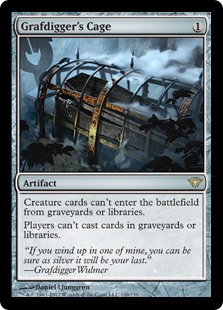
After going through my sample, I can't conclude that they are. For the most part, they look like normal decks. For example, the 97th place Humans deck could be a pre-Modern Horizons Humans list. There's no overwhelming dependence on graveyard hate, special anti-Hogaak cards, or other signs of a warp. Ravenous Trap isn't a common card, but it's not outside of Humans' wheelhouse. It's significant that, given the narrative that graveyard hate is essential to beating Hogaak, Chris Vincent only ran three pieces. This decision was echoed up and down the list, such as the four Grafdigger's Cage in the 720th place Hardened Scales deck (the fifth place version only had three), the 27th place Merfolk deck, or the 104th place Burn deck. Most of the players in my sample decided that it was better to maintain their gameplan and their sideboard percentages against non-Hogaak decks than worry about beating Hogaak with hate.
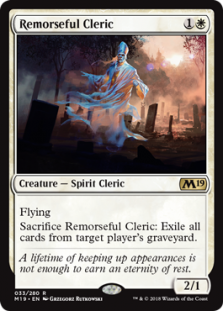
For the most part, the decks that do some evidence of warping only have it weakly. The 67th place UW Control list has maindeck Surgical Extraction and a full set of Rest in Peace in its sideboard. However, that isn't too extraordinary, because it's not a recent change; control players had been maindecking Surgical since Arclight Phoenix became a thing, and typically run at least two Rests regardless. The 8th place UW list had the Surgicals but only three Rests.

The 101st place Eldrazi Tron list had a full set of Leylines in its sideboard and a Tormod's Crypt. While I have no way of knowing, I'd guess that the Leylines are only there because wishing for Crypt with Karn is too slow most of the time, and without Hogaak, Fabio Aldrighetti wouldn't have bothered. Otherwise, his deck looks like normal Eldrazi Tron. The signs of an actual warp in player's decisions are minimal.

A Wrinkle

That is, until the actual Hogaak lists are also considered. Every Hogaak list in my sample and in the Top 8 played a full set of Leyline of the Void. They also never had less than five cards that remove enchatments in the sideboard, with a minimum of 2 Force of Vigor every time. The most common configuration was 3 Force and 3 Nature's Claim sideboard, and 2 Assassin's Trophy maindeck. Even if everyone else demonstrated indifference towards Hogaak, it was not doing so towards itself, and was fully prepared for an anti-Hogaak meta.

The other twist in this warp narrative is that there is no correlation between a deck's quantity of graveyard hate and its final placing. To reiterate, the 5th place Hardened Scales deck had less hate than the 720th place version, and few differences in flex slots. Almost all the Burn lists are maindeck copies of the 6th place deck with less than three sideboard cards different. Thus, I cannot conclude that it pays off for any non-Hogaak deck to specifically target Hogaak.

Deep Dive

This is in line with my testing for GP Las Vegas. I spent many hours running a very hateful UW Spirits with maindeck Remorseful Cleric with Leyline of the Void and Surgical Extraction sideboard against various Hogaak lists. I then compared its results to a tweaked version of my MCQ list (-2 Damping Sphere, +2 Settle the Wreckage, for the curious). The normal Spirits list won more than the very hateful list, but not by enough to matter statistically. I think it currently stands at ~100/~90 in favor of the normal list. I've been skeptical of Leyline and Surgical for a long time, and my testing justified a lot of that skepticism.

The problem is that graveyard hate is only useful against Hogaak under specific circumstances: if you can exile their 'yard after they've spent a ton of resources to fill it, but before they get any value from doing so. Removing the power cards in Hogaak and Vengevine with Surgical is good, but happens if and only if Surgical is in hand while they're in the 'yard. Given that you're only ~40% to have Surgical in hand and Hogaak can churn through its deck extremely quickly, the odds aren't in your favor. Drawing Rest in Peace later in the game isn't optimal, but is still useful since it still exiles the existing graveyard and shuts down recursion engines. Late Leylines or Surgicals do nothing. By going for the silver bullets, I was putting a lot of cards into my deck that were dead if not drawn at exactly the right time. When things line up, it does great; when it doesn't, I lose.
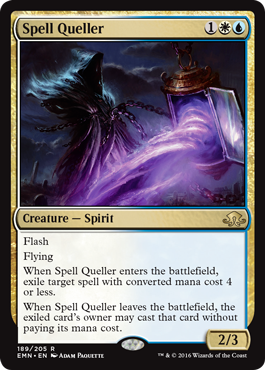
Besides, the hate isn't all that effective against Hogaak. With Rest on the board, the recursion engine is dead, and Hogaak is almost certainly uncastable. That doesn't stop Hogaak from just swarming the board with dinky creatures and Vengevines. Given that the hateful builds don't actually kill Hogaak and sometimes lose to having unusable cards, I don't think it's worthwhile.

Conclusion for Vegas

The conclusion I draw from all this data is that I shouldn't try too hard to beat Hogaak. My testing has shown that the fast graveyard hate is ineffective and frequently counterproductive, so I'll be playing a more normal deck this Friday. The other thing I've found testing is that Hogaak needs to do a busted thing to be good. It digs through its deck better than anything else I've tested against, but if that doesn't turn into a significant board presence, it can't win a game. Given time, any deck can beat Hogaak, and it relies on getting very good flips into its graveyard to win. The deck can go off turn two 60% of the time under lab conditions, but it also has to do that at least two times in a row to win. I'm better off focusing on playing a reasonable game rather than trying to shatter their statistics.
I also expect Vegas to be a relatively small tournament. Birmingham and Minneapolis have been down from their previous numbers, and I expect the trend to hold. I think this is the result of players being turned off by the threat of Hogaak rather than the deck in actual fact. You're unlikely to hit a single copy in the Swiss, after all. That's what I hope, at least.

Final Hurrah

One way or another, we're nearing the end of Hogaak's influence. Next Monday, the Necropolis will likely be banned, and then Modern can finally start to figure out the real impact that all the new sets have had this summer. And I'll see you then, with my lessons from Vegas.

Preparing to Sell at MagicFest Indianapolis

Are you a Quiet Speculation member?

If not, now is a perfect time to join up! Our powerful tools, breaking-news analysis, and exclusive Discord channel will make sure you stay up to date and ahead of the curve.

Well, it’s official. I’m planning to attend MagicFest Indianapolis next month—hopefully, I’ll have the opportunity to connect with many of my readers. With any luck, I’ll squeeze in a few games and even try my luck at a draft. However, none of these activities is my primary objective for the trip.

Instead, I intend to sell some cards.

Selling cards will be complicated, though. If my collection were filled with Standard and Modern staples, it would be straightforward—I’d wander each vendor’s booth, glancing through hotlists and finding the best offers on each of my cards. With a little preparation, I’d also have a rough estimate of TCG low pricing as well as top buylist for comparison.

Unfortunately, with my collection, this isn’t going to be this simple.

Randomness is Random

Many of my readers are already familiar with my general approach to Magic these days. I gravitate towards older cards, often on the Reserved List, both because I enjoy the Old School format and simply because such a collection fuels my nostalgia craving. But these are cards aren’t exactly the easiest to sell to vendors.

Granted a stack of Dual Lands and Legacy staples wouldn’t be difficult to liquidate. Many vendors in a MagicFest room would jump on the chance to purchase such cards. But that’s not what I’m going to be shopping around. Instead, I’m going to have stuff like Alpha Mind Twist.

There was an error retrieving a chart for Mind Twist

Cards like Alpha Mind Twist are valuable, but it’s challenging to put a precise value on such a rarity. I could browse buylists, but are buylists really the right metric when vendors are completely out of stock of the card? This may set a floor in negotiation, but I’m confident the market value of a moderately played Alpha Mind Twist is greater than the $2160 * 60% = $1296 Card Kingdom would offer.

I could also look at eBay and TCGPlayer listings, but these data are spotty at best. There is exactly one listing for Alpha Mind Twist on TCGPlayer at the moment: an HP copy for $1899 (plus that critical $0.79 shipping). If my copy was identical in condition to this one, it may be a useful data point. But mine is a little better than HP, and so I’m still left scratching my head. eBay has similar results.

Then there’s the next challenge: finding the vendors who are most interested in purchasing Alpha and other Old School cards. Some vendors probably have no interest whatsoever in acquiring stuff like Island of Wak-Wak or Pixie Queen, even though they hold decent value. I have to imagine some of the less playable Legends and Arabian Nights cards are very difficult to sell, and so some vendors are likely to be inclined to offer disappointing numbers.

There was an error retrieving a chart for Pixie Queen

Hopefully, I’ll be able to walk from booth to booth and inquire about Old School interest to try and find the most eager buyers. But assuming I do, that still leaves me with one more hurdle to overcome.

Presentation and Organization

How should I organize a collection of cards printed in 1993 and 1994? Currently, many of my cards are either in sleeved decks or a Monster binder. Neither of these is conducive to quick, painless transacting with vendors. If I had a Commander or Standard deck, it would be easy for a vendor to skim through the cards and pull out cards of value. But when an all-Alpha deck contains 60 cards worth $10 or more, this fast-sorting approach breaks down.

There was an error retrieving a chart for Plague Rats

The other reason organization is critical is that these card values vary heavily on condition. Most newer cards are going to be near mint; maybe the occasional Dual Land or older card in a Commander deck needs to be pulled from a sleeve for closer scrutiny. But an Old School deck can be filled with moderately and heavily played cards. Every single one could potentially be harshly scrutinized because pricing varies so greatly by condition.

It becomes prohibitively time-consuming for a vendor to take every card of a 60 card deck out of a sleeve to scrutinize condition and try and negotiate price.

Monster binders are probably not much better. I appreciate these binders because they provide ample protection for my cards—no binder dings for me! However, they’re not ideal for browsing Old School cards because a vendor can’t see the condition of the backs of these cards without first removing them. Again, this is likely to slow down transactions significantly, and that could hurt my ability to cash out at top dollar.

The Plan

Recognizing all of these potential pitfalls, I’ve devised a plan that should help me navigate this upcoming MagicFest. I’ve boiled this plan down to three tips—hopefully, they prove helpful to others who also plan on selling at events, but perhaps don’t do so very often (I average once a year).

Tip 1: Know your prices

This is going to be time-consuming, but the time investment prior to the event should help me maximize my time (and vendors’ time) when buylisting. I’m going to look up every card I intend to sell online and create a spreadsheet summarizing prices. The key numbers I’m going to include in this spreadsheet are:

  • Card Kingdom’s buy price adjusted for condition
  • ABU Games’ trade credit price by condition * 60% (my cash value of ABU credit)
  • TCG low for condition, if applicable

With these numbers in hand, I’ll be well prepared to talk pricing with a vendor. My going in asking price will in a range established by the three numbers above, and the lowest I’d go is probably around 50-60% of ABU’s trade credit number—any lower, and I’m better off trading to ABU. By knowing these prices in advance, I’ll come prepared to each vendor with numbers in hand. Their job will become simpler, as they’ll just have to say “yes” or “no” to my proposed prices.

Tip 2: Organize cards by price

How will vendors know my asking price for each card? I don’t plan on handing them each a copy of my Excel sheet. Instead, I’m going to sort cards I wish to sell by value. This doesn’t have to be 100% perfect—if a $10 card falls between an $11 and a $12 card, it’s not the end of the world. But in general, I want my cards to be broken into piles based on their relative worth.

This way, I can hand a vendor a small stack and say something like, “This stack is between $10 and $20.” The top-end cards will be in a separate pile, all 1-offs, and will definitely require higher scrutiny. But for the low-end stuff, if a vendor has no interest in paying $20 for Alpha Plague Rats, they’ll be able to leaf past those quickly.

Tip 3: Pull Cards Out of Sleeves and Binders

Don’t worry, I’m not crazy. I won’t walk around with a pile of loose Alpha cards in my hands and I definitely won’t hand a loose Alpha Mind Twist to vendors for evaluation. But I do plan on removing most cards from their sleeves/binders and keeping them, sorted, in a box of some sort. The box will offer sufficient protection to card condition while also being easy for vendors to browse through and inspect condition as they go.

Higher-end cards, of course, will still be in soft sleeves. Those will all require unique discussion and negotiation, and I’m sure every vendor will understand why 3- and 4- figure cards should be kept in sleeves.

Wrapping It Up

After listening to the Cartel Aristocrats podcast, I’ve learned a few things about how vendors feel when buying at large events. Their time is very valuable, and their goal is to perform many transactions. If a prospective seller sits down with a disorganized collection, cards in sleeves, and no idea of how much cash they want for each card, it can be a nightmare for the vendor.

I’ve even heard stories that vendors have offered less for a given card in such nightmare scenarios because they need greater margins to make up for the lost time.

There was an error retrieving a chart for Greed

Because it has been so long since I’ve buylisted at a large event, I know I need to do my homework in advance. Good organization and advanced knowledge of what I want for each card should go a long way in making my engagement with vendors as pleasant and mutually profitable as possible.

To tackle this task, I’ve devised a plan. That plan can be boiled down into 3 tips: know what you want for your cards, organize your cards by value (some call this “Ogre Box”), and remove lower-value cards from sleeves / make them easy to examine front and back. Even though I’m using this approach to sell Old School cards, it can readily be reapplied to any in-person buylisting situation.

Hopefully, these tips will help others in their preparation. Efficiency is what vendors are after, and they just may be willing to offer a little more if you demonstrate your consideration for their time. At least, that’s my hope come MagicFest Indianapolis—wish me luck!

…

Sigbits

  • Even though some Old School cards have faded in value, some still remain robust. Mishra's Workshop recently returned to the top of Card Kingdom’s hotlist with a buy price of $1140. This card is a mainstay of Vintage and despite some players’ wishes, it will remain so for quite some time; no banning likely.
  • It was gone and then came back again—FtV printing of Mox Diamond has returned to Card Kingdom’s hotlist with a $200 buy price. This card, along with the Stronghold version, has been fluctuating quite a bit lately but demand remains strong overall.
  • Card Kingdom’s buy price on Legends copies of Mana Drain recently jumped from $110 to $130. When browsing supply online, it appears this card has finally tightened up after it was reprinted in Iconic Masters. Barring another reprint, this card should be stable for now with long-term upside potential.

August ’19 Brew Report, Pt. 1: Bubbling Tech

Are you a Quiet Speculation member?

If not, now is a perfect time to join up! Our powerful tools, breaking-news analysis, and exclusive Discord channel will make sure you stay up to date and ahead of the curve.

It's Hogaak's world; we're just living in it. So are some great-looking brews that manage to 5-0 against the odds and the format boogeyman. With August halfway done, let's peek at the coolest decks emerging from the delve/convoke wreckage.

Hogaak's New Bags

It's no secret that Hogaak is still a force to be reckoned with in Modern. Not only is this graveyard strategy the format's most-played archetype, it's dominating big-event Top 8s, giving it plenty of visibility and sparking additional banlist discussion. But bubbling under the surface are some new builds that see Hogaak, Arisen Necropolis slipping into more than just Dredge and its now-infamous namesake deck.

Glowspore Hogaak, by JAPANESEFISHERMAN (5-0)

Creatures

3 Glowspore Shaman
4 Birds of Paradise
3 Bloodghast
4 Carrion Feeder
4 Gravecrawler
4 Hogaak, Arisen Necropolis
2 Knight of Autumn
4 Lotleth Troll
4 Satyr Wayfinder
4 Stitcher's Supplier
4 Vengevine

Sorceries

2 Driven // Despair

Lands

4 Bloodstained Mire
4 Blooming Marsh
2 Godless Shrine
1 Nurturing Peatland
2 Overgrown Tomb
1 Swamp
4 Verdant Catacombs

Sideboard

2 Knight of Autumn
1 Dromoka's Command
3 Fatal Push
4 Leyline of the Void
2 Plague Engineer
3 Thoughtseize

First up is Glowspore Hogaak, which taps the unlikely Glowspore Shaman as extra copies of Hogaak's best buddy, Stitcher's Supplier. Sure, we can only run four Suppliers, but is a two-mana, color-intensive, half-effect Supplier worth dipping into? Conventional format knowledge says no; decks generally don't want enablers this far below the next-best option, and the line for creature playability is strict in Modern. So I was weirded out when I saw this list the first time.

But seeing it another time, and then even a third, made me rethink things a bit. Perhaps there's actually something here. Then again, the Hogaak lists all over the Challenge results don't run Glowspore, so it's possible these players 5-0'd their leagues on the back of the deck's other strengths and not because of the newcomer.

It still bears mentioning that Glowspore Hogaak is built a bit differently from the two standard builds of Hogaak, which respectively rely on Satyr Wayfinder and Hedron Crab to get things going. This one sacrifices a bit of speed for a more reliable plan in the face of graveyard hate, shoring up the weaknesses David identified with the deck. It's possible that a slower build of Hogaak proves palatable should the metagame somehow find a way to adjust independent of Love from Above.

Hexdrinker Hogaak, by KHOKDEN (5-0)

Creatures

4 Hexdrinker
4 Bloodghast
4 Hogaak, Arisen Necropolis
3 Satyr Wayfinder
2 Scavenging Ooze
4 Stitcher's Supplier

Planeswalkers

4 Liliana of the Veil

Instants

2 Assassin's Trophy

Sorceries

3 Collective Brutality
4 Inquisition of Kozilek
3 Thoughtseize

Lands

1 Dryad Arbor
1 Forest
2 Marsh Flats
1 Misty Rainforest
4 Nurturing Peatland
3 Overgrown Tomb
1 Polluted Delta
4 Swamp
4 Verdant Catacombs
1 Windswept Heath
1 Wooded Foothills

Sideboard

1 Scavenging Ooze
1 Assassin's Trophy
2 Collector Ouphe
3 Fatal Push
2 Maelstrom Pulse
2 Necrotic Wound
2 Nihil Spellbomb
2 Surgical Extraction

I said slower, but this deck is freakishly sluggish next to the Hogaak we know and love or hate. Hexdrinker Hogaak is a straight-up BGx deck tuned to accommodate the 8/8 trampler, who indeed dwarfs the usual suspects of Tarmogoyf and Tireless Tracker.

One pure beater gets the nod, though: Hexdrinker, a versatile one-drop that can help cast Hogaak or present a constant mid- to late-game threat off the top of the library. Hogaak already does that, of course, but not through graveyard hate, which Hexdrinker totally ignores. The mix of Hexdrinker and Hogaak gives this discard-centric midrange core multiple angles of attack and strikes me as a particularly exciting blend.

Blink and You'll Miss It

That's how it can feel sometimes speeding through endless online dumps looking for diamonds in the rough. But between all the Humans, Eldrazi Tron, and Burn lists, there's always something juicy lurking underneath. This deck showed up in a few iterations, graduating from its casual-room incarnations into the Competitive leagues and apparently carving out a metagame niche in the process.

UW Blink, by THEOINKENATOR (5-0)

Creatures

2 Soulherder
2 Epochrasite
3 Ethersworn Canonist
4 Flickerwisp
4 Giver of Runes
4 Leonin Arbiter
4 Spell Queller
3 Thalia, Guardian of Thraben
2 Watcher for Tomorrow

Planeswalkers

2 Teferi, Time Raveler

Artifacts

4 Aether Vial

Instants

4 Path to Exile

Lands

1 Field of Ruin
1 Gemstone Caverns
4 Ghost Quarter
4 Hallowed Fountain
4 Seachrome Coast
2 Shefet Dunes
2 Silent Clearing
1 Snow-Covered Island
3 Snow-Covered Plains

Sideboard

3 Deputy of Detention
1 Geist of Saint Traft
1 Gideon, Ally of Zendikar
2 Grafdigger's Cage
1 Kitchen Finks
1 Mirran Crusader
2 Rest in Peace
2 Stony Silence
1 Teyo, the Shieldmage
1 Winds of Abandon

UW Blink received a few potent tools from Modern horizons, the most widely-adopted one displayed here: Soulherder. Herder lets Blink play more like a fish deck packed with flashy micro-synergies than a midrange deck relying on the clunky Restoration Angel; it now has much more in common with the Eldrazi & Taxes decks inhabiting Tier 3.

Soulherder acts like a mini-planeswalker here, blinking creatures every turn and promising streams of value if opponents don't deal with it. It also grows pretty large in that case, making it even tougher to remove as the game drags on. Another new card here is Watcher for Tomorrow. Despite the creature entering tapped, the prospect of casting multiple pseudo-Impulses, and having a 2/1 to boot, seems to beat the blind-draw blocking of Wall of Omens.
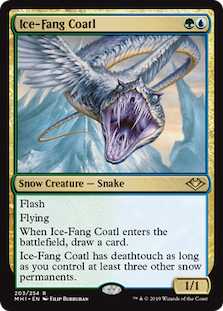
Teferi, Time Raveler ensures pilots at lest generate a trigger off Soulherder the turn it comes down, and Aether Vial speeds up the deck's deployment of creatures and effects. Rounding things out are Thalia, Guardian of Thraben and Ethersworn Canonist, floodgate effects stapled to aggressive bodies that disrupt while clocking Ă  la Humans.

Bant Blink, by SAFFRONOLIVE (5-0)

Creatures

4 Coiling Oracle
1 Deputy of Detention
3 Eternal Witness
4 Ice-Fang Coatl
1 Knight of Autumn
1 Mulldrifter
4 Soulherder
2 Wall of Blossoms
2 Watcher for Tomorrow

Planeswalkers

2 Jace, the Mind Sculptor

Instants

4 Ephemerate
4 Force of Negation
4 Path to Exile

Sorceries

2 Time Warp

Lands

1 Breeding Pool
1 Flooded Strand
1 Hallowed Fountain
4 Misty Rainforest
3 Prismatic Vista
3 Snow-Covered Forest
3 Snow-Covered Island
2 Snow-Covered Plains
1 Temple Garden
3 Windswept Heath

Sideboard

2 Knight of Autumn
3 Celestial Purge
2 Disdainful Stroke
1 Dovin's Veto
2 Rest in Peace
1 Scavenging Ooze
1 Stonehorn Dignitary
1 Surgical Extraction
1 Thragtusk
1 Tormod's Crypt

Going a level deeper, Bant Blink splashes green for Coiling Oracle, long lauded as one of the game's most appealing enters-the-battlefield effects. Knight of Autumn, Eternal Witness, and Ice-Fang Coatl are also significant reasons to go green, buffing the scope of Blink's enters effects and adding a multi-pronged defensive plan.
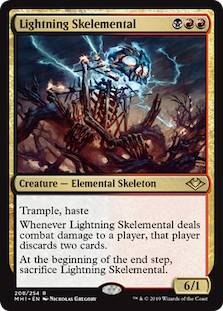
Also present here is Ephemerate, a one-mana upgrade to Momentary Blink. Modern is way too fast to be focusing on long-term value with the older spell. At one mana, Ephemerate still casts Cloudshift twice, making it a shoe-in for Blink decks singularly focused on their namesake mechanic.

Reefer Madness

Speaking of Coiling Oracle, a recent spin on the card is now transitioning from Standard appeal to Modern lists in spite of its hefty mana cost.

Bant Company, by MILIKIN (5-0)

Creatures

4 Risen Reef
4 Voice of Resurgence
4 Birds of Paradise
1 Eternal Witness
4 Ice-Fang Coatl
4 Noble Hierarch
2 Phantasmal Image
2 Reflector Mage
4 Spell Queller

Planeswalkers

1 Teferi, Time Raveler

Instants

4 Collected Company
4 Path to Exile

Lands

1 Botanical Sanctum
1 Breeding Pool
1 Flooded Strand
1 Gavony Township
1 Hallowed Fountain
4 Misty Rainforest
2 Prismatic Vista
3 Snow-Covered Forest
1 Snow-Covered Island
1 Snow-Covered Plains
2 Temple Garden
1 Waterlogged Grove
3 Windswept Heath

Sideboard

2 Collector Ouphe
2 Deputy of Detention
2 Dovin's Veto
1 Eidolon of Rhetoric
2 Knight of Autumn
3 Rest in Peace
3 Stony Silence

Bant Company has been around forever, but not in this iteration. Here, Risen Reef has little synergy with the deck's other creatures, which are mostly not Elementals; the Oracle-draw of its own 187 ability seems almost reason enough to include it. Almost, of course, because Voice of Resurgence brings it over the edge. When Voice enters or dies, Risen Reef triggers, creating a snowball of card advantage in which to drown opponents who've spent their early removal on mana dorks.

Elementals, by MIDCARDPROMO (5-0)

Creatures

4 Vesperlark
3 Creeping Trailblazer
4 Flamekin Harbinger
2 Fulminator Mage
4 Lightning Skelemental
1 Omnath, Locus of the Roil
4 Risen Reef
2 Smokebraider
4 Thunderkin Awakener
3 Voice of Resurgence

Artifacts

4 Aether Vial

Instants

3 Collected Company

Lands

4 Cavern of Souls
4 Copperline Gorge
2 Fiery Islet
1 Mountain
4 Primal Beyond
2 Sunbaked Canyon
3 Unclaimed Territory
2 Waterlogged Grove

Sideboard

1 Fulminator Mage
2 Alpine Moon
2 Collector Ouphe
2 Domri, Anarch of Bolas
2 Healer of the Glade
2 Ingot Chewer
3 Leyline of the Void
1 Weather the Storm

Of course, why not take things a step further? Elementals isn't focused on the synergy between Unearth, Thunderkin Awakener, Seasoned Pyromancer, and Lightning Skelemental, like earlier decks showcasing the tribe; it's built around fully enabling Risen Reef. And despite the available Elementals generally not wow-ing, that payoff is at least good enough for a 5-0, leaving me to believe the unlikely three-drop may have a real future in Modern.
Temperature's Rising

As Hogaak continues to dominate Modern, the pressure's mounting on Wizards to do something, and players seem as divided as ever. Where do you fall on the format's top deck? My position is clear, with some conditions: if we're to continue seeing decks like these, but on a larger scale, in the wake of a mostly-despised 8/8, who am I to complain?

Insider: Lessons Learned From Commander 2019

Are you a Quiet Speculation member?

If not, now is a perfect time to join up! Our powerful tools, breaking-news analysis, and exclusive Discord channel will make sure you stay up to date and ahead of the curve.

Commander 2019 comes in the wake of one of the busiest seasons in Magic finance I can remember. This spring was defined by a rapid succession of new releases, starting with the extremely popular War of the Spark, followed by the format-shattering Modern Horizons, and then Core Set 2020.

Each of these releases has brought about what feels like an unprecedented amount of speculation around the new cards, and Commander 2019 has brought it to a zenith. An early leak of information on the set’s themes was just enough tinder to spark a wildfire of speculation around them, leading to rises in a variety of cards around morph, flashback, populate, and madness. 

Don't Panic

I’ve been following the market closely this year looking for opportunities, so I joined in the action and snapped up a bunch of cheap copies of these cards when they began spiking. I positioned myself with a stack of Dream Chisel and Catalyst Stone, but I was unable to actually move any of my copies. It became clear that the market was filled with other speculators racing to the bottom, and both retail and buylist prices were going stagnant.

Every day I checked to see if buylists prices improved or if TCGplayer prices increased, but there were no real options besides moving at maybe break-even. I ended up moving a small number of Dream Chisel to ABU’s buylist for a small profit in-store credit when their price increased, but otherwise, I sat with the rest and even had more arrive in the mail from previous orders. 

Then the official spoiler season for Commander 2019 season started, and decklists started being revealed in their entirety. Suddenly the veil was being lifted, and with perfect information on deck contents, there was nothing holding the market back. The morph deck was first to be spoiled, and upon its reveal, there was a spike in numerous morph-themed cards not included such as Dream Chisel and Ixidor, Reality Sculptor.

Each of these were obvious targets that saw a spike when C19 themes were first leaked, but the potential for reprint in the decks helped keep them in check. The confirmation they would not be reprinted combined with hype and excitement for deckbuilding opportunities spiked the prices. Not from speculation, but from real player demand for those looking to add these cards to their morph builds.

I sold a steady stream of Dream Chisel one-by-one all week until I ran out, presumably to Commander players. I also sold numerous Catalyst Stone the same way, though at a slower pace reflecting the theme’s lesser popularity. 

Determine Who is Buying, Speculators or Players

One big takeaway for me is the knowledge of how the market behaved in regards to this information, first to the set’s theme leak and later to the full decklists. This set was special because of the leak, but every set is going to offer pieces of actionable information that will influence the market, whether revealed officially or not. Whenever prices start to move, consider who is moving them (speculators or players) and what that means for their price trajectory. 

When I bought in, I just knew that I had found a cheap price lower than the current spiked price and was going to make a profit somehow, but I did not have a clear exit plan. When they arrived in the mail and I wasn’t able to sell any or find any good opportunities, I sort of panicked and then I immediately seized the first decent buylist opportunity that popped up.

Luckily, this was capped to eight copies or I would likely have sold my entire stock. I should have foreseen that speculators would drive prices down and that the real opportunity from these cards would come later, once the sets were spoiled.

There was an error retrieving a chart for Ixidor, Reality Sculptor

Even now the hype is still building towards release, with Dream Chisel still slowly increasing in price and Ixidor, Reality Sculptor now seeing a third spike to almost $18.  Unlike the initial spike, this time it's not speculators buying these cards, it's players who want them for their decks. It’s possible these cards could keep increasing still, and I’ll be paying close attention to see what exactly happens to them and other cards so I have a better idea of what to expect during the next release. 

There was an error retrieving a chart for Mischievous Quanar

For example, this week saw a spike in Mischievous Quanar, which until now hadn’t budged. These sort of late-comer spikes are more likely to be from players naturally buying-in as they learn it plays well in the deck, either organically or perhaps from being popularized by someone in the community or going around on social media.

I suspect these sort of spikes will hold. It’s a theory that I’ve placed a wager on by buying a few dozen copies of the card at about $1 each. I checked buylist prices and found I could turn the near-mint copies into $0.98 in trade at CardKingdom, which even if it doesn’t hold is a sign my spec should have low downside. 

Explore Every Option to Out Specs

I haven’t thought too hard about my plan to out them, and will likely buylist them all because they are too cheap to bother selling individually unless they spike even higher. One buylist option I will explore that I’ve recently become accustomed to is the TCGplayer buylist builder. I hadn’t previously sold to it, but now I’m a believer and think it’s a great way to complement Trader Tools. 

TCGplayer allows individual stores to buy cards on the platform much like they sell cards, and it leads to a competitive and dynamic buylist. I’ve been able to find some strong offers on old specs that I otherwise wasn’t able to profitably move, and after my first experience went smoothly I’ve now sent in a second order.

I originally assumed I would be paid in-store credit, and that’s an option, but it turns out you can take that same amount in cash, paid directly to your bank just like if you sold cards on the platform. 

Looking Ahead

At this point, we can expect a Commander product every year, and each will offer its own opportunities. These same lessons should also be applicable to any release, and with both the Magic player base and people playing the market higher than ever before and continuing to grow, the opportunities and the stakes continue to grow.


Dominaria: The Truth about Nostalgia

Are you a Quiet Speculation member?

If not, now is a perfect time to join up! Our powerful tools, breaking-news analysis, and exclusive Discord channel will make sure you stay up to date and ahead of the curve.

Dominaria is the plane where it all began for me. It was 1999 when my friends and I biked up to our local Jewel (a grocery store chain in the Midwest) and opened our first packs of Magic called Urza's Saga. I still have the Gaea's Cradle that my friends and I pulled that day and it is still turning sideways for (a lot of) green mana in my Seton Druid EDH deck.

You can find me on Instagram for more photos like this one!

Surprising as this might be: Magic escalated slowly for me. As a 12-year-old who was dabbling with Pokemon cards and loved playing sports, Magic started as an afterthought. My best friend Nick was really excited about the sci-fi and imaginative aspects of the cards, though, and because he is like a brother to me I felt I had to give it a shot.

The expansive lore based on the plane of Dominaria is what drew me in further to the game. Specifically, in 2000, the Invasion block novels got my imagination hooked. I can still remember reading the books at our local Barnes and Noble and buying packs of Invasion afterward. This was back before Amazon, Kindles, and iBooks when a good hardcover or comic was a go-to source of entertainment.

Those novels cemented Magic in my life forever.

Learn from History and Repeat it

Urza's Saga was a fairly complicated set for a 12-year old; it had lands like Cradle and Tolarian Academy which back then seemed insignificant (what little we knew). All my friends and I wanted at that age were cool heroes and scary monsters to construct our own stories and games around. There were worthwhile cards in Saga for us, but in general, the set was underwhelming given our "narrow" goals. I even remember pulling a Phyrexian Plaguelord and it being one of the most coveted cards any of us got from Saga, despite it not actually being very good.

Needless to say, we stuck with Magic in jest, making up rules as we went and playing more with Winding Wurm and Skittering Skirge than Gaea's Cradle and Sneak Attack. To be honest, I think we almost entirely disregarded the rarity symbols and were more excited by the art and the power/toughness combinations of creatures. The abilities and features of "powerful" cards were unbeknownst to us back then. If it wasn't a creature or basic land, it probably didn't make the cut.

Little did I know looking back on it that Saga (and the Dominaria-based sets of the time) would become some of the richest and most defining sets in Magic's history. The storylines and lore were vast, and are often referenced to this day (see: Urza, Lord High Artificer and Yawgmoth, Thran Physician). Not coincidentally, a few of the Reserved List cards from the Urza's block are among the most expensive non-A/B/U cards ever printed.

Enter Spring 2018: the Dominaria expansion.

We are creatures of habit and memory, and it is well-known in marketing and advertising that these human characteristics (i.e. feelings of nostalgia) cause a connection far beyond what a jingle or catch-phrase can do. Wizards knew this, so what better way to sell a set than return to the plane where many (if not most) Magic players began their journeys.

I cannot fathom a guess as to how many players began playing Magic between the Urza's and Invasion blocks. I tried to find more information about player base growth to little avail (I knew this was a tough subject to research as Wizards was a private company back then and therefore not obligated to share this data). It does appear based on anecdotal evidence that there was sizable growth during the late-90s, and whether confirmed or not, I have to believe this was a part of the inspiration for the Dominaria expansion.

The set tugged at our heartstrings with nostalgia, lore, and incredible limited design. Wizards knew how to play all of our angles, ensuring that feeling of opening our first packs could rush back through us with Dominaria. They went all out, too.

We got the first series of legends printed at uncommon; we got a look at Teferi, Hero of Dominaria for the first time in almost five years; and most importantly, we got nods and references to icons of our past (Mending of Dominaria, Phyrexian Scriptures, and the list goes on).

Unsurprisingly, tugging at our heartstrings worked. Dominaria sold like crazy and forged itself in Magic's history as one of (if not the) most well-received sets in Magic's 25 (now 26) year history.

Chris's Commander Corner

I was stuck in a Time Warp talking about my love for all-things Dominaria. It is close to my heart and talking about it flows so easily. That made this week's edition of rotating set reviews really fun for me, so let's get to it!

There was an error retrieving a chart for Helm of the Host

In my opinion, this is the easiest pick from the entire set. Helm of the Host checks three critical boxes:

  1. Demand! It is the most popular card in the entire set according to EDHREC
  2. It is an artifact that only gets better over time
  3. It is a flavorful acknowledgment to the Queen of Vesuva making it harder to reprint outside of a supplementary set

I only own two copies of Helm of the Host but I plan on acquiring more for personal use after rotation. I feel like this card will follow the trajectory of Panharmonicon post-rotation where it will drop ever-so-slightly, then catapult to higher highs within 3-6 months.

Investment Plan #1

I am a believer in non-foils believe it or not. I think they have room to grow into a $10 card by as early as Spring 2020. I am planning on grabbing a playset if I can find it for $4 per copy (I am watching eBay auctions right now in hopes this is a possible price-point).

I see the foils with upside into the mid-$20 range, especially for near mint copies as those will command a premium due to the heavy play Helm of the Host sees in commander. I picked up one NM foil at $12.99 during my set review analysis and I intend to grab at least 2-3 more foils if I can find them for that price.

There was an error retrieving a chart for Muldrotha, the Gravetide

Is she the best commander ever printed? Maybe; maybe not. One thing is for sure: if you value a commander who is a dream to brew with and filled with everlasting longevity, then Muldrotha, the Gravetide is for you.

At 2,644, she ranks only 12 decks behind Meren of Clan Nel Toth as the third (!) most popular commander of all-time. She's also the #1 commander on EDHREC who was not printed as a general in a precon Commander set. Read that again because it is extremely important when factoring in EDHREC rankings (which use time and weight precons heavily in all of their rankings).

Suffice it to say that Muldrotha is the most popular commander ever printed in a standalone, non-commander set and it isn't even close (for perspective, Queen Marchesa ranks #2 for standalone cards at 1,794).

Investment Plan #2

My only non-foil copy of Muldrotha, the Gravetide is leading the charge in a +1/+1 counters deck. I have ambitions of upgrading this to a foil printing if I can find a NM or LP copy sub-$25 (likely during an upcoming promotion on one of the sales platforms).

Barring a reprint of any kind, Muldrotha foils have a realistic shot at $40+ in the next 3-6 months. Non-foils are equally intriguing as a potential $15 card in the future.

My only real reservation towards Muldrotha is that it would make for a beautiful promo card someday which could hinder its long-term growth. Even so, the popularity, demand, and general longevity of this premium commander will always keep prices on an upward trajectory.

The Legendary Sorceries

The above-captioned four are my favorites from both a speculator and player perspective, but I love the concept and design for all six of these cards.

In full disclosure, I bought between 12 and 20 foil copies of each Legendary Sorcery back in 2018 when you could find them for $1 or less (I also did the same with Thran Temporal Gateway). I almost never buy large quantities of cards as I did with these but the unique design combined with the impact when they resolve in EDH had me clamoring to own as many as I could.

Investment Plan #3

I currently run at least one copy across all of the EDH decks I own. I use the four captioned above in more than one deck and feel they have the widest array of applications. For those reasons, I believe these are still worth picking up wherever you can find foils of them at $2 or less.

Most of these have exceeded the $2 price-point on TCG, but be patient and keep an eye out as they might come out of binders during rotation, especially given their narrower applications in commander (i.e. while they are huge impact, they all require a commitment to running a lot of legendary permanents). I'd also suggest watching eBay for auctions of these as you might be able to find copies below TCG low using that route.

I expect all of the Legendary Sorceries will appreciate at a slow but steady rate and envision most of them selling between $3-6 within 12 months.

There was an error retrieving a chart for Song of Freyalise

Song of Freyalise is probably my favorite sleeper of the entire set. It compares favorably to Cryptolith Rite and with Populate in focus due to Commander 2019, I expect this card could see some appreciation sooner than most rotating cards. It got even better with War of the Spark cards like Evolution Sage and Karn's Bastion, and let's face it that a +1/+1 counter strategy never gets old in the world of commander.

Investment Plan #4

I am buying foils of Song of Freyalise and avoiding the non-foils due to the sheer supply available (though those make for a great budget alternative). I acquired two NM foil playsets for $1 per copy and I like this price-point quite a bit if you want to speculate on the card.

It is unique and flavorful to Dominaria which will prove difficult to print anywhere but a supplemental product. As a result, I envision the foils will appreciate to $3 within six months and depending on reprint status I could see this being a $10 foil in two years.

There was an error retrieving a chart for Tetsuko Umezawa, Fugitive

We recently saw another foil uncommon legend from Dominaria explode in price - Tatyova, Benthic Druid - caused by demand increases due to synergy with Yarok the Desecrated and Chulane, Teller of Tales.

I am predicting that foils of Tetsuko Umezawa, Fugitive will be next to jump in value based on its current supply and its unique ability. It already sees plenty of play in two archetypes - Ninjas (Yuriko, the Tiger's Shadow) and Walls (Arcades, the Strategist) - and it could start seeing more use in decks centered around the Commander 2019 printing of Pramikon, Sky Rampart.

While I don't expect this to jump overnight, my approach was to buy foils sooner rather than later because I know personally, I want copies for my own decks (I already play a non-foil copy of Tetsuko in my Arcades deck).

Investment Plan #5

While I was doing the research for this article I acquired a playset of Tetsuko Umezawa, Fugitive foils for $2.50 per copy. I felt after looking at buylists and general supply on the card that $2.50 is going to be about as low as I will find for Tetsuko.

If you are not in need of a foil Tetsuko immediately but might want a copy for the future, I recommend grabbing it now at or under $3 then acquire additional copies later if the price retraces at all.

I expect six months from now this will be a $5+ foil with $10 upside (similar to the aforementioned Tatyova). I am shying away from non-foils for the same reasons described with Song of Freyalise above.

Additional Cards to Consider

All four of these cards I either own or have added to my watchlist to acquire a copy for personal use. I provided detailed summaries of Shalai and Jhoira in the Quiet Speculation Insider Discord. Join us there to get the additional insight and perspective!

Wrapping Up

As you can see, Dominaria emits a deep sense of passion and excitement for me. It takes me back to my childhood and evokes strong feelings and emotions. Last spring was a trip down memory lane and I think the best part about Dominaria is how successful the set was at reinvigorating Magic.

I'll be forever excited to talk about Dominaria lore (including other sets that took place there), so please feel free to connect with me more on Twitter or on the QS Discord if you have the same passion. My inbox is always open!

You can find all of my past articles here, including my Ixalan and Rivals of Ixalan set reviews.

Insider: The Value of Inaction

Are you a Quiet Speculation member?

If not, now is a perfect time to join up! Our powerful tools, breaking-news analysis, and exclusive Discord channel will make sure you stay up to date and ahead of the curve.

Our goal here at Quiet Speculation is to assist our members in increasing their collection's value through Magic finance, or at the very least make the game more affordable to play. Usually, that means discussing the pros and cons of potential speculation opportunities that arise from new decks, new tech, new products, or changes to banned lists. Then, allow each person to decide whether to take action or not.

Now, most people think you only make money when you act, but this isn't always true. If you define "making money" simply as having more money now than you did in a previous time, the concept opens up a bit. I honestly believe that one of the most valuable tools one has as a QS Insider is the collective "hivemind" of all Insiders.

There was an error retrieving a chart for Tunnel Vision

Tunnel Vision is one of the more dangerous things that can occur for any speculator. Most people's minds are wired to look for positives. Once you start seeing cards solely as a prospective speculation target, it's easy to focus solely on these positives and ignore any potential negatives. I, along with many other QS Insiders, like to mention my targets in the Discord chat to see if anyone else agrees with me or finds flaws in my arguments. I've saved numerous dollars by being talked out of bad speculation targets thanks to my fellow Insiders.

Associated Risk

Now, obviously, if everyone agrees it's a great target there is a bit of risk that someone else snipes any that might be in your cart; but that risk is far outweighed by the potential losses you can occur when you're wrong. I love getting input from other like-minded people, many of whom have as strong a grasp if not stronger of the Magic finance realm. I don't own a physical store, so hearing from those who do, namely those that have their fingers on the pulse of their local metagames, is extremely valuable information.

After all, metagames can shift very rapidly thanks to the playerbase hivemind on MTGO running multiple iterations of decks, tuning them, and retuning them after other decks get tuned to beat them. This constant change can be quite daunting and frankly impossible to track and monitor for potential financial relevance; at least for a single person, hence the importance of the QS community.

There was an error retrieving a chart for Hive Mind

As all this change occurs, both good and bad speculation targets will constantly ebb and flow. Buying last week's tech is often a losing proposition as decks evolve to counter it and holding a stack of bad specs is worse than holding no specs.

Cash is King

One phrase you'll hear a lot in MTG Finance is "Cash is King". Basically, actual money is always more fungible than Magic cards and having it on hand allows you to extract the best deals. Most people will accept less than retail value on a card in cash, whereas, most trade at retail prices. This means that you can maximize your gains by using cash as often as possible and the only way to do that is to have as much available as you can.

Now there are some limits to the truth of "Cash is King". If you bought four copies of a card yesterday for $5 and overnight it shot up to $10, you wouldn't sell all four copies to the guy that walks up offering you $5.25 each. Sometimes it pays to be patient and not act by selling your copies for a $1 gain. You want to maximize your potential gains as well.

Now, if the guy instead offers you $8 it most likely would be smart to sell. Most cards drop after their initial spike and the likelihood of that card dipping down is high. The point, however, is that while it's generally better to have cash on hand than cards, it's not a hard and fast rule.

Exercise Patience

There was an error retrieving a chart for Impatience

The last valuable "inaction" I want to discuss today is that of patience. Impatience is the reason that so many cards start out higher in value before a set is released and then plummet shortly thereafter. A lot of Magic players want to get their new toys as soon as possible and that impatience costs them. This is why you don't see smart speculators preordering lots of different cards from a set.

It used to be that you could find a lot of Commander gems at rock bottom prices from multiple online vendors. Unfortunately, those days are long gone and the new strategy is to start the price high and lower it until it sells.

Patience doesn't solely apply to pre-ordering cards. One of the best times to speculate on cards from a set is when prices have bottomed out, which typically occurs three to six months after a set's release. While this rule can be a bit different for limited-run sets, like masters ones, it's shown to be pretty accurate for almost every non-limited set release. Modern Horizons released June 13th, 2019, so as of me writing this we are almost two months post-release. We should expect prices to continue to trend downward for most cards, which is what we have been seeing.

There was an error retrieving a chart for Wrenn and Six

Now, I do realize that there have been some conflicting beliefs about this particular set and price floors. Some have advocated that the time to begin buying has already passed. I am not one of those people. This is especially true as Wrenn and Six is soaking up a ton of the sets value. People are still buying packs and boxes hoping to win the W&6 lottery, similar to how people kept buying Worldwake even after Rise of the Eldrazi released hoping to get Jace, the Mind Sculptor

Conclusion

The good news about that is that we haven't totally missed the ideal buying window yet; the bad news is that we all get impatient, so I don't blame you if you jumped the gun a bit early. I am currently sitting on nine copies of Sword of Truth and Justice because I didn't think it could possibly go any lower than $10. Just a week after purchasing them I've seen them for as low as $7 on Facebook sales groups.

There is value in not acting in risky situations. This isn't to say one should never act. Sometimes it's necessary to remind ourselves that while we as a society tend to value action, there is also value in inaction. So long as it's done at the right time with the right motivations, anyway.

Grave Concerns: GP Minneapolis Analysis

Are you a Quiet Speculation member?

If not, now is a perfect time to join up! Our powerful tools, breaking-news analysis, and exclusive Discord channel will make sure you stay up to date and ahead of the curve.

With another GP in the books, it's time once again to dig into the data. When I last did so right after the big MC weekend, the picture was muddied by contradictory results. Half indicated that Hogaak was a dominant force in the metagame. The other half indicated that it was just another deck. Its apparent domination was the result of hype driven population spikes rather than power. Hopefully, Minneapolis' data will clear things up.

Players have had two weeks to digest and react to Barcelona, so the new data should indicate how the metagame has reacted. If the domination narrative is true, then we should see Hogaak facing a sea of counter strategies and still succeeding. If the other narrative is true, Hogaak's final results will be lost in the crowd to an extent. My starting assumption is that Hogaak will have a huge presence in Day 2 because of hype and attention. It will be the final standings which actually provide answers.

Day 2 Metagame

There is very little information about Day 1 to go on. All that I have is the three undefeated decks, none of which were Hogaak. Statistically and narratively, this fact means nothing. However, it is worth noting that all three decks look relatively normal for their archetypes. The only indication that Hogaak was the big deck in Modern are the four Leyline of the Void in both Humans' and Burn's sideboards. This suggests that the key to beating Hogaak is not overloading on hate or warping your deck. The undefeated players maintained good strategies and just enhanced them with hate.
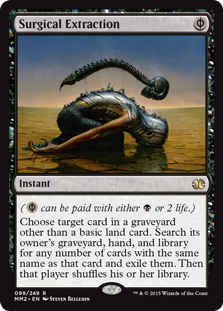
There were 168 other decks in Day 2 representing 35 different decks. That sounds like a lot, but most of those decks had two pilots or fewer. As a result, I'm only going to focus on the top eight decks from Day 2, which incidentally account for 2/3 of the results.

Deck NameTotal #Total %
Hogaak3319.3
Mono-Red Phoenix179.94
Burn137.6
Tron137.6
Jund127.02
Eldrazi Tron116.43
Urza105.85
UW Control74.09

That is a lot of Hogaak. I expected this to be the case, but I didn't think it would be by this wide a margin. The next best performer, Mono-Red Phoenix, has half as many representatives. That does give credence to the domination narrative, but as mentioned it's not quite that simple. That mono-Red came second is very interesting. It has always been in Izzet's shadow, but it appears the all-in strategy is doing better in a Hogaak-heavy world. I'm guessing that being a hybrid Burn deck, and therefore having a faster kill speed at the cost of Thing in the Ice and late-game gas, is the answer, but I have no way to be sure. That normal Burn is also doing very well does lend credence to that theory.

The Complication

Given that the starting population is unknown, I would not dig much further into the Day 2. Without knowing the Day 1 population, the Day 2 is contextless. In an even field, the a priori assumption is that decks make Day 2 in proportion to their overall population. Unbalanced formats should have the offending deck be disproportionate compared to the starting population. If Hogaak was around 20% of the Day 1 population, then its Day 2 numbers are to be expected and don't mean anything. If it was less than that, we'd be looking at a very dominant performance and  more than 20% of Day 1 would indicate that Hogaak underperformed. We don't have the data to determine which scenario is true.

Given the spotlight on Hogaak, its performance in Barcelona, and the general narrative of it being broken, I'm more inclined to believe that the latter scenario is true. It wouldn't be the first time the heavily hyped deck showed up in high numbers but didn't convert proportionately. This does not diminish the numbers Hogaak put into Day 2 or hand-wave away the deck. It simply means that this apparent domination may not be merit-based but population-based. This would tend to overstate the power and prevalence of the deck relative to its true value.

The Top 16

The real decider will be the final standings. The difference between high finishes and the overall population was the source of the MC Weekend's ambiguity. Truly dominant decks should finish highly in addition to filling up the field. Izzet Phoenix never really did this, while it was the defining feature of Eldrazi. Hogaak needs overwhelming numbers to prove itself.

Deck NameTotal #
Hogaak 7
Mono-Red Phoenix3
Mono-Red Prowess1
Burn1
Humans1
Eldrazi Tron1
Hardened Scales1
Merfolk1

And it has them. By a slightly wider margin over Mono-Red Phoenix than it had in the Day 2 data. This would tend to confirm the domination narrative. More significantly, Hogaak is 5/8 of the Top 8; comparatively, all the Phoenix decks were just Top 16, and 11th at best. Hogaak also closed out the finals. It is very hard to argue that Hogaak wasn't the defining deck of GP Minneapolis. Given the narrative from Barcelona, that it is defining Modern as well is looking probable. Why this has happened given its variance remains unclear, but that fact that it has done so is increasingly uncontestable.

It is notable that the only Day 1-undefeated player in this data is the Burn player Lucien Longlais. The other notable thing about Lucien is that he's not running Deflecting Palm, which seems really powerful against Hogaak. Choosing Hogaak is a 16 point life swing in Burn's favor, but only if Hogaak isn't sacrificed before damage. I still think that would be a favorable outcome, but I didn't Top 8 a GP with Burn.

Implications

It is clear that if you're going to any competitive event in the next few weeks, Hogaak will not only be the deck to beat, but very popular. Before this week, I'd say that skepticism was justified. That's very hard now, especially given how the wider press is handling the results. I expect Hogaak to only get more popular, either quantifiably or relatively as players shy away from events, as a result of GP Minneapolis. The question this leaves is how to respond. And that is tricky.

What to Do

Given that the chances of an emergency ban happening are close to nil, players at both GP Birmingham and Las Vegas must endure Hogaak if they want to compete. I'm regretting registering for Vegas right after Bridge was banned. The conventional wisdom is to run lots of graveyard hate. Hogaak is all graveyard synergies and can't realistically cast the namesake card without a graveyard, so it makes sense to target that resource. Indeed, data analysis of MC Barcelona showed that successful non-Hogaak lists ran 4-8 pieces of hate depending on their speed. The faster the deck, the less hate it needed. Therefore, logically maxing out on hate will contain Hogaak.

Leyline Needs a Lifeline

However, that strategy clearly isn't working. Hogaak dominated the MC weekend Day 2 populations, despite not winning anything or posting impressive Top 16 results. Then, it did it again this weekend, won the whole thing, and dominated the Top 16. All indications are that word is out and players are packing graveyard hate in quantity. And it just isn't working. It isn't that Hogaak is faster than the hate. Almost every player in the Top 16 had Leyline of the Void or something else playable turn 1. Hogaak apparently just beats all the hate. Given that coverage of Minneapolis was limited to twitter, I can only speculate as to why this happened.
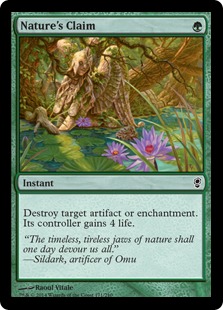
My theory is that the reliance on these fast hate cards is the problem. I'm always ragging on Surgical Extraction as overrated, but my feelings are similar for Leyline of the Void. That card is only good or even effective if it's in the opening hand. Odds of that happening are only ~40%, and aggressive mulliganing isn't a guarantee, even with the London mulligan.

Then there's the question of the rest of the hand. I suspect that, given how much stock is put into hate against Hogaak, players are willing to keep otherwise bad hands if they open with Leyline or similar hate. These players are banking on Hogaak being impotent in the face of hate and giving them enough time to draw into the cards to start playing Magic. In a world where it's hate card or bust, that can be a viable strategy. However, that isn't true for Hogaak. For one, it has lands and can cast its threats, even if they're mediocre when cast rather than reanimated. Secondly, Leyline isn't game over for Hogaak, which completely invalidates the aggressive mulligan strategy and arguably makes it a liability.

Hogaak is very prepared for to fight Leyline and graveyard hate in general. Most Minneapolis lists had full sets of Force of Vigor as well as various combinations of Assassin's Trophy and Nature's Claim. Hogaak's so ready for hate the winning player didn't even bring in his Leylines in the mirror just to give his opponent a lot of dead cards. Given the density of answers to Leyline, the risks involved, and the fact that even if Leyline is unanswered it may actually win, I'd stop running Leyline of the Void.

Another Line

Last week I observed that given the poor odds of success, it may be better to eschew Leyline entirely. Instead, I'm investigating whether it is better to simply try and play normal Magic and utilize more conventional hate like Rest in Peace. Instead of diluting my deck with lots of fast hate, I maintain my core strategy and look to beat Hogaak's slower starts with normal hate and removal. This functionally concedes to Hogaak's best starts, but again the evidence suggests there isn't much chance of beating those in the first place. If I therefore give up on trying to fight on that axis, I don't have to mulligan as aggressively and give up on otherwise playable hands. This gives my deck a better chance of executing its own plan and therefore winning on its own merits.

My results have been inconclusive so far. I've been testing a very hateful UW Spirits deck vs a more conventional one against various Hogaak decks, and they're in a statistical tie. Neither is doing measurably better. However, Hogaak's gameplan is still as swingy as ever, which muddies the waters to the point I can't tell if I'm actually having any effect on the games. More testing is required.

Even if my theory is wrong, moving away from graveyard hate may still be correct. I've heard a lot more anecdotal evidence of Hogaak players losing to Chalice of the Void, Ensnaring Bridge, Meddling Mage, and similar prison cards even more than to Leyline. This is somewhat supported by the data from Barcelona, where Urza decks appeared to have an advantage over Hogaak. Hogaak is stuffed with cheap enablers and is entirely combat focused. Thus is it quite vulnerable to a prison attack. This isn't a perfect solution since Hogaak's sideboard is filled with answers to prison cards, but they do tend to require answers. Graveyard hate can be ignored in a pinch.

More to Come

Perhaps GP Birmingham this weekend will show a turnaround and that Hogaak is finally being contained. I am skeptical, but there is always reason to hope that GP Las Vegas won't be horribly warped by graveyard decks. I've been down this road before, and occasionally broken formats are the price of playing competitive Magic. Best of luck to everyone searching for an answer to the menace. And if you find it, please share it with me. My testing for Vegas could use the help.

Want Prices?

Browse thousands of prices with the first and most comprehensive MTG Finance tool around.


Trader Tools lists both buylist and retail prices for every MTG card, going back a decade.

Quiet Speculation