If not, now is a perfect time to join up! Our powerful tools, breaking-news analysis, and exclusive Discord channel will make sure you stay up to date and ahead of the curve.
One of the most important things for Standard in the next couple of months will be the guilds in Return to Ravnica. These color combinations will give some direction for deck construction, as a starting point for initial brainstorming. There will be many powerful multicolored cards in the set and usually these are good building blocks for decks. Here are the guilds we'll have access to.
Rakdos (R/B)
Azorius (U/W)
Selesnya (G/W)
Golgari (G/B)
Izzet (R/U)
If you noticed, there are three allied-colored guilds and two enemy-colored guilds.
The available dual lands will contribute to some interesting decks while Ravnica is in Standard. Wizards confirmed the shock lands from original Ravnica are back in this set and the next one. Here are the lands that will be legal once this set hits the scene:
Five M13 dual lands
Five Innistrad dual lands
Five Ravnica shock lands
Five Ravnica gates (dual lands that come into play tapped)
What this means is that three color decks will be commonplace. By combining two guilds that share a color, Azorius and Selesnya for example, you will have lots of lands to make a stable mana base. Shock lands are even better alongside the M13 and Innistrad lands, allowing the latter to come into play untapped off their basic land types. We already know this interaction from Modern and it will be just as potent in Standard.
Another complication of shock lands is the life loss. One of the skills we will need to learn is when to lose life and when to wait a turn. That decision can make the difference in some games. If you are playing against an aggressive deck, the impact is magnified.
The lands in Standard are always important. Ravnica is going to give every player a chance to work with interesting mana bases for the time it is legal. I am excited to work with this new environment and see where it takes us.
The Spoiled Charms
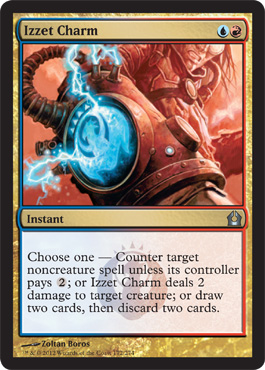
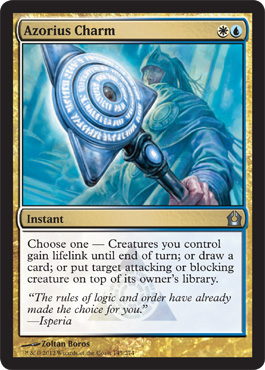
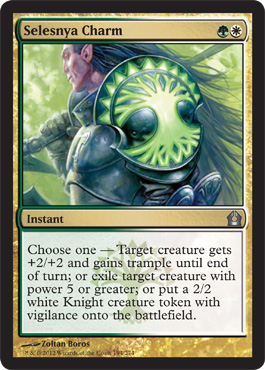
The Ravnica cards I want to talk about today are the charms. This cycle is shaping up to be as influential as the charm cycle from Shards of Alara. Since they are only two colors, they will be able to fit in more decks than the previous ones. Three have been spoiled so far: Izzet, Azorius, and Selesnya.
First up is Izzet Charm. Wow. You have your choice of Spell Pierce, Magma Spray (essentially) or Faithless Looting. That is a wide range of options. The ability to use it as both a counterspell or a removal spell is quite powerful. Add on the ability to discard some lands late in the game and we have a card that is certain to see a lot of constructed play. This charm is even powerful enough that it may effect some of the older formats.
Next, Azorius Charm. While this card is not quite as powerful as Izzet Charm, the effects it provides are good enough that it should impact Standard.
I think the Excommunicate option is the most important effect on the card. It's easy to underestimate effects that put a permanent on top of its opponent's library. This effect is almost like making them draw one less card because they basically skip their next draw step. The lifelink option can be good if you find yourself in a racing situation where you cannot deal with a creature (Invisible Stalker for example) but usually you would just Aethertow the creature instead.
The cylcing ability is also good, especially in the late game, but I keep thinking it should have been a minor upgrade to an effect like Sleight of Hand.
Finally we have Selesnya Charm. When I break this instant down, what I see are three different types of removal spells. You can choose from Sylvan Might, a slightly worse Smite the Monstrous and Reap the Seagraf. The first one is a good combat trick to mess up your opponent's combat math or force through some damage. The second ability would be better if it were four instead of five, but that is still removal for your opponent's bomb.
The third ability is my favorite. Being able to play your creature at instant speed is a powerful effect. You can surprise block their guy or simply flash in a guy they didn't expect EOT and attack with it.
All three charms we know about so far are Constructed playable. Each has three relevant abilities and I think they will all see a lot of play.
Zombie Pod
Before I go, I wanted to post my updated Zombie Pod deck. This is the list I would play in a tournament tomorrow.
Untitled Deck
Creatures
3 Blood Artist
3 Ravenous Rats
3 Fume Spitter
4 Geralfs Messenger
4 Gravecrawler
1 Massacre Wurm
4 Phantasmal Image
1 Skaab Ruinator
2 Skinrender
2 Phyrexian Metamorph
1 Thragtusk
Spells
4 Birthing Pod
1 Mortarpod
3 Tragic Slip
Lands
4 Cavern of Souls
4 Darkslick Shores
4 Drowned Catacomb
4 Woodland Cemetery
8 Swamp
Changes
-1 Fume Spitter
-1 Butcher Ghoul
-1 Tragic Slip
+3 Ravenous Rats
That may not seem like a major change but it really does have a big impact. If you don't care for the rats, three Butcher Ghoul is an option as well. This change fits how I play the deck, but depending on your play style you might customize it differently. For example, if you tend to play this deck more like a zombie aggro deck, then adding in Diregraf Ghoul might be the way to go. No matter the changes you make, the basic concept of combining Birthing Pod and Zombies is quite powerful.
Next week I will be diving into spoilers and hopefully telling you about some powerful interactions from our Return to Ravnica.
Until Next Time,
Unleash the little kid force!
(What? Yeah, you know because spoiler season is like Christmas. OK bad joke, but you laughed a little. See you guys next week.)
If not, now is a perfect time to join up! Our powerful tools, breaking-news analysis, and exclusive Discord channel will make sure you stay up to date and ahead of the curve.
Welcome to the first episode of "Good Luck, High Five!"
Your hosts Mike Hawthorne and Ryan Overturf are joined by Dana Kinsella and SCG Minneapolis Legacy Champion Kyle Olson.
In this episode we talk about the results of SCG Minneapolis and dissect the deck lists. We round off the episode by taking a look at some Return to Ravnica Spoilers.
(The views expressed in "Good Luck, High Five!" are those of the personalities featured and do not necessarily represent the views of and should not be attributed to our host.)
Parental Advisory: May Contain Mild Obscene Language
If not, now is a perfect time to join up! Our powerful tools, breaking-news analysis, and exclusive Discord channel will make sure you stay up to date and ahead of the curve.
It’s that time again! No, I’m not talking about spoilers, although they are coming in quickly now and are awesome. Personally, I’m looking forward to brewing with Splinterfright again. The deck is fine to move on with after rotation, and the Golgari cards as well as the rotation of mass graveyard removal means we may get a shot to make good on my 94 copies.
I’m sure I’ll spend plenty of time on spoilers in the coming weeks. Right now I want to talk about something that is probably quickly leaving everyone’s minds – Magic 2013. The newest Core Set was a breath of fresh air, limited-wise, after the non-interactive solitaire game that was Avacyn Restored.
Specifically, it’s time to look back on my M13 calls to evaluate (harshly) my financial calls on the set, and reevaluate those same cards now under the lens of Return to Ravnica spoilers, using SCG prices as usual (the regular price, not the current sale price, which is slightly lower).
Ajani, Caller of the Pride
Then: “This cat is going for $40 on SCG, and that’s definitely high. I see him in a Liliana-type role. He’s very good, but doesn’t slot into every deck that shares his color. That said, there will be plenty of games where you lose the dice roll and have one land in play, facing down a 5-loyalty Planeswalker. Normally you don’t evaluate the ultimate to determine power level of Planeswalkers, but as early as this guy comes down it’s relevant enough that his ultimate is something to be scared of.
I see him setting around $25, give or take five bucks either way, unlike the next Walker on this list.”
Now: $20. I’m okay with where this is now. Though at the moment it’s not very played. Rotation and the Selesnya guild coming in the first set means it should see some more play, and we’ll see where the price goes from there.
My Liliana of the Veil comparison does seem apt, since both are sitting at $20 right now.
Liliana of the Dark Realms
Then: “Preselling at $30, which as you would expect, is too high. It’s possible Liliana finds a home in Standard, but I can’t imagine it’s going to be a nice one. She basically just doesn’t do anything. Hitting your land drops is nice, and I understand it can “fix” your mana with Shocklands, but in the end she’s just not that threatening.
Still, there’s EDH demand along with whatever playability she has, so I see a $10-15 price tag holding up down the road. It may take a little while to fall that low, but a year from now she’s going to be all but forgotten.”
Now: Still holding at $20. Mutilate, and especially Trading Post, have given Mono-Black the tools it needed to become at least a part of the metagame. That, along with still-fresh EDH appeal, have kept Liliana from dropping like a rock.
That said, Post strategies lose a lot of gas after the rotation, and if Mono-Black, and therefore Liliana in Standard, are to survive, it must find additional tools. I still think Liliana will pop up as a 2-of in some lists, but that shouldn’t stop the price from falling to the $10-15 I pinpointed.
Serra Avenger
Then: “I think it’s incredibly awesome they’re reprinting this card. I also don’t love it in Standard, as crazy as that might sound. Since you can’t play it until turn 4, it’s a virtual four-drop, where it will compete with Restoration Angel and the new (gives) Exalted Angel. That’s some stiff competition, not to mention it loses in a fight with Resto. All of that means the $3 pricetag is about right.”
Now: Down to $2 on SCG. I find it really disappointing that the Avenger isn’t any better than it is, since it’s just a sweet card, but power creep has kept it down. It will never be bulk due to occasional play in older formats and the fact that it is an Angel, but it’s not going to spike either.
Sublime Archangel
Then: “This is a really difficult card to pin down for me. A lot of times attacking with one creature is worse than swinging with the team, but there’s still a lot to like here. For starters, it trades straight-up with Restoration Angel, which is a good test to pass. Secondly, it has pseudo-haste since it will provide a huge pump the turn it comes into play, much the way Rafiq of the Many did. And there are a ton of Hexproof guys running around right now, meaning you’re even less likely to get blown out in combat.
It’s out of stock at $20 on SCG, and I wouldn’t be surprised to see some upward movement from there. I don’t think it can go much higher than $25 for very long (if at all), but it also will have a difficult time going below $12-15. I’m looking at Geist of Saint Traft levels here, between $20-25, especially since the pair will go in many of the same decks. Geist is played more in older formats, but the Angel is well, an Angel, and won’t be opened as long as Geist was, so it should mostly balance out.”
Now: $25 on SCG. I’m glad I got pretty close on this one, since as I noted it wasn’t an easy card to predict. The casual appeal of this card has been huge, and that means a few things to us. First, the price should be pretty solid and more prone to big jumps than big drops, which will be gradual.
More importantly, it means if the card ever hits it really big in Standard there will be a lot of added demand, and we’ll see jumps past $30-35. That said, I don’t particularly like getting on this card at $25 since the upside is, admittedly, a little undesirable.
Master of the Pearl Trident
Then: “Merfolk! Merfolk! Merfolk! (Listen to the latest cast of Brainstorm Brewery for more context). Presells at $5 is probably a few bucks too high, but I do think this will help to revitalize Fish in Legacy, where they were already on the upswing, as well as possibly pushing the deck into Modern. Look for gains in the peripheral Merfolk cards from older sets.”
Now: Still $5 on SCG. As anyone who knows me or follows me knows, I love some Merfolk. As I predicted, this revitalized the deck in Legacy, where it recently won an Open, all the way to Modern, where it has become a much larger presence.
In addition to all of this, the Simic Guild in Gatecrash is going to be full of Merfolk, so I like picking this guy up for the foreseeable future, as moves to $8-10 aren’t all that unlikely if we see some nice, new, powerful Merfolk.
Disciple of Bolas
Then: “This is my pick for sleeper card of the set. At $3 pre-sales, I’m not sure how much upside there is, and I don’t like a cash buy. But I do like aggressively trading for it at two bucks on Prerelease day. This guy doesn’t fit into a possible Vampires deck since the 4-spot is full, but if Zombies is looking to complement Falkenrath Aristocrats at the 4-drop spot, this guy is great. He eats a Messenger for infinite value, and even chomping on a Gravecrawler isn’t exactly bad.”
Now: Still $3 on SCG. Everything I said before applies. Zombies really doesn’t lose any of its creatures post-rotation, but it does lose some peripheral cards. That could open the door on Disciple, so it’s still an easy grab to round out trades with some upside.
Vampire Nocturnus
Then: “This guy is rightly expensive, sitting at $13 on SCG. Thanks to this reprint, his days as a $20 card are over, but we could see a spike to that level if the big guy busts back into Standard. The Vampires deck is about two cards away (another 1 and 2-drop) from being really good. I expect this guy to trade extremely well during his second run through Standard.”
Now: $10 on SCG. That’s $10 while seeing no play at all, and as a result I see people valuing him lower than that. Pretty safe target in trades as we move into Ravnica, and a theoretical Vampire build still seems very strong.
Thundermaw Hellkite
Then: “They wanted a Baneslayer Angel in Dragon form, and they found it here. He’s out of stock at $20 on SCG, and there are only 2 copies of foils at $50! This Dragon is the real deal. Even if Vapor Snagged he’s going to do some work, and the only problem is how many competing options RG has at the five-drop spot now with him, Thragtusk and Silverheart. Hellkite is a definite beating, though, so I expect him to stay over $10 without a doubt, and probably settle in the $13-15 range, with even higher numbers possible if he becomes the go-to five-drop.”
Now: Still $20 on SCG. By the way, did you know what the most historically popular tribe is, after Angels? It’s Dragons. I’ve seen people come in and ask for every Dragon I own. That really happens. That provides a solid baseline for this guy, and will probably keep him at $10+ forever.
I don’t like $20 for how much play he’s seeing right now, so if you have any I wouldn’t be hesitant to trade them off. I think he has a place post-rotation as a foil to Lingering Souls, and you should watch the post-rotation metagame accordingly.
Thragtusk
Then: “Now this beast is truly, well, a beast. Says no to Vapor Snag and helps stabilize immediately. I don’t like how splashable he is, but that’s just my design complaint, not a dismissal of his power. I wouldn’t be surprised to see a few Cavern of Souls name Beast just to make sure this bad boy hits play.
As just a rare, and another five-drop, $10 is probably high. I see him on the Silverheart level of $7-8 instead, but you can’t really go wrong trading into this guy at the prerelease.”
Now: $13 on SCG. As I said in the review, this guy is insane. I think I was probably a little off in my initial assessment, but not by much. Even with the event deck he probably stays around $10 rather than $7, and I think I probably didn’t correctly include in the Core Set factor, which allows Rares to stay a little higher than other sets since it isn’t drafted nearly as much. That’s how you get $15 Phantasmal Images and $13 Thragtusks rather than something more like $10 and $7, respectively.
All in all, I’m extremely happy with my picks from Magic 2013. It wasn’t perfect, but it was, all things considered, pretty accurate. I’ll take that to the bank, and hopefully you will as well.
If not, now is a perfect time to join up! Our powerful tools, breaking-news analysis, and exclusive Discord channel will make sure you stay up to date and ahead of the curve.
One of the unfortunate side effects of popularity or power is a tendency for the apparently powerful to engage in delusions of self importance. Put more simply, when you get good at something you tend to be a dick about it. The problem with turning to trading as the focal point of your time spent in the Magic community is the relative ease with which you can become the dominant trader in the room.
Despite all my pretensions otherwise, at this point I would consider it to be incredibly easy for a person to break into the trading scene, simply because of the small size of the culture. Even though Magic is a comparatively large game community, the number of hardcore traders in that group is only a miniscule percentage.
The trap I see many semi-experienced traders fall into is the assumption that other people not caring about trading is the same as the trader being better than them and that the strict players aren’t worthy of their respect. This is wrong on multiple levels.
Magic is a Game
A game very much like this one, in all important ways.
It’s important to remember that Magic is a game and people are in it for different reasons. You’ve heard this time and time again, but it’s important that it sticks - taking advantage of people for the sake of profit has been covered extensively by almost every other writer. But I want to approach this a little differently.
First of all, despite my lecture at the beginning of the article, I find it’s particularly ineffective to pontificate on the moral bankruptcy of sharking. I don’t really want to write it, you really don’t want to read it, and anyone who’s reading Quiet Spec likely has a better moral compass than I give them credit for.
The attitude you take and the persona you project, however, have deep and long lasting repercussions when it comes to your trading. Let’s start with the basic ones.
Opinions Change, Sometimes for the Worse
People will classify the individuals they interact with, bluntly, in two categories: the people they look down on and the people they’re trying to impress. It’s important to note that this is a sliding scale, not a binary problem, and that the differences aren’t always stark and apparent.
If a person looks up to you, the odds are that they probably won’t forever. When I first started trading, a couple people stood out as exceptional traders to me, and I looked at them with respect bordering on awe. As time went on and I understood the process of trading more and more, this awe disintegrated. I started to see the flaws in their logic and to understand the bad trades they made with me for their own benefit.
I no longer trade with those people, because I remember how badly those early trades went for me when I didn’t know any better.
As time has gone on, I’ve tried to get my friends more into trading. Whether or not they plan to dedicate their lives to it, which I sincerely doubt, it’s important to understand card values the same way every person should be able to tell if they’re receiving correct change at the grocery store, or how to use Edmunds to check the value of the new car they want to buy.
I’ve seen them trade with sharks, true sharks, the kind of people who force every dollar they can out of the people they trade with, and I don’t say a thing. After the trade I’ll take my friend aside and explain what just happened. And in some of the more egregious cases I’ll give them some cards to make the damage less severe.
In most cases, however, I do one thing and one thing only: I black ball the shark.
The Kiss of Death
The Kiss of Death, featuring the greatest actor of all time.
In order to be an effective shark, you need to make a lot of trades with a lot of people and compound your collection. For any trader, one of the most basic needs is for trade partners. I’m not the biggest trader in my area, and I’m probably not even close to the most well known, but I make an impact and math is on my side.
If I refuse to trade with a single trader, I lose one effective partner and so does the other guy - we lose each other. If I tell my friends to avoid him, I still only lose one partner, and he loses everyone I talk to. Maybe a couple of those people I talked to go for the trade anyway, but I can guarantee that they’ll be particularly alert for price inequality and more than willing to draw out the process to get a fair deal.
It’s important to note that this is in no way a threat, but it happens to a lesser extent all the time. Everyone tells their friends about the sharks and the traders, pointing out danger zones. Most of the time the warning isn’t forceful enough to actually dissuade anyone from trading, but it’s a constant drain on your ability to make money.
Bad Karma is Bad Business
This crowd mentality hurts you if you shark hard, but think about this as well: if you take a person for all they’re worth, why would they trade with you in the future? For every person you completely steamroll, the risk goes up significantly that you lose future business because they took the time to check StarCityGames.com. If they do trade with you after having checked the numbers, they’re on the look out for disparity in values and there’s very little chance you can make as much as you could before.
What about if you’re at an SCG Open, however? What if this random guy is just dropping by the trade tables to get some stuff for his EDH deck? It’s in a city you don’t spend time in, and you’re surrounded by people you’ve never seen before and probably won’t see again. Aside from the obvious moral dilemma, what’s the big deal with making as much of a profit as humanly possible on this next trade?
Unfortunately for this hypothetical trader, trades aren’t made in a vacuum. If you’re sitting at the trade tables, you could be surrounded by as many as a dozen people watching your trade out of the corner of their eyes. Every move you make will be subconsciously stored for future use, every price you state will be noted. Luckily for you, for many this information is utilized only so far as to come to a conclusion about whether you know your prices or not. Some, however, the truly great traders, will note some other useful facts.
Take Notes, This is Useful
This is the kind of pretentious I felt like when I wrote this article
What cards were priced correctly? What format seemed most accurately valued? What holes were there? What happened when the trade partner quoted an inaccurate number? Was there a consistent response to high values, to low numbers, or to major differences? In what cards was interest expressed?
All these questions, and more, help you or anyone else to assess the skill of the trader in question. For many traders, this assessment or something similar classifies for you the trader. The better they are, the more wary you are of tricks, and the fewer risk you’re willing to take on cards you don’t know exact values for.
This works both ways, however. Remember that huge simplification of interpersonal interaction? Looking down on people and impressing people? It’s easy, having classified a person as an inferior trader to yourself, to look down on them and underestimate their knowledge of financial Magic. It’s even easier to let your guard down, trade for cards the value of which you aren’t sure of and make risky assumptions on the grounds that your goofball trading partner doesn’t know enough to rip you off.
On a side note, a person can take advantage of this by trading in what seems to be a detrimental way. I’m willing to trade at a loss to happy, fresh faces, for two reasons. First of all, I like having new people playing the game. But in a far more selfish state of mind, I understand how my looking stupid in front of sharks makes them much less careful when trading with me.
In the End...
Being the nice guy has its advantages. You have no moral ambiguity, you don’t have the detriment of a network of people talking negatively about you and your trading habits, and you sometimes get the added bonus of a little misinformation.
I’ll take it any day, and I strongly believe the long term benefits far outweigh any short term advantages of sharking. I hope this helped, and I look forward to hearing what you have to say in the comments!
If not, now is a perfect time to join up! Our powerful tools, breaking-news analysis, and exclusive Discord channel will make sure you stay up to date and ahead of the curve.
Last week somebody posted in the comments section of my article that he believed there is a lot of value to playing rogue strategies in Legacy. While I am the type to support going rogue in formats with smaller cardpools, I tend to disagree with his assertion about Legacy.
Part of the problem is that most existing decks have already been played many thousands of times against the existing archetypes of the format. All of this playing has led them to the forms in which they currently exist. Do you think that somebody just decided to play Green/White one day and threw Maverick together? Not a chance in hell. It’s a deck that constantly changes, if only slightly, to battle the tools that other decks bring to the table. It’s a hatebear deck in disguise that relies on its creatures being good in the context of other decks to win any matches at all.
I can’t even being to imagine how many hours must have gone into coming up with working lists for TES and ANT. The simple fact of the matter is that actually building a rogue deck is going to be a lot more work than picking up an existing archetype.
But Will it Not Be More Rewarding to Go Rogue?
Well, that depends on the goals you set for yourself. If you place value on playing with your own creations, that is something that I can respect. I’m sure that Tyler Tyssedal loves playing Griffins to death (though not enough to play Chamelon Colossus), and there is a lot of value in just playing with a deck that you enjoy playing regardless of result.
However, I think that you’re unlikely to see more success with a rogue deck than with an existing archetype.
One of the arguments for going rogue is that your opponents will have no idea how to play against your deck. The thing about Legacy, though, is that very few people have much of any idea what they’re doing in the first place.
Legacy is immensely complicated and it is the format in which players experience the most bad playtesting. Part of the problem is probably that a lot of pros don’t pay much attention to Legacy, as it’s largely a format for smaller cash tournaments. And pro points are worth a lot more than a Mox Ruby.
In light of this, there is less content available on how to play Legacy well and fewer good players actively looking to playtest Legacy. I’ve often joked that the mirror is one of my best matchups with RUG given just how poorly most players pilot the deck.
Here’s a fun story from SCG Minneapolis last weekend. It was round 8 and I was playing RUG against Lands. I was on the play and lead with a Wooded Foothills. My opponent’s first turn was Rishadan Port, double Mox Diamond discarding Maze of Ith and Tolaria West, and finally a Life from the Loam to pick up his discarded lands.
I spent about a minute looking at my hand:
Truth be told, my keep was pretty loose against most decks, but it felt damn near impossible for me to beat a Maze AND a Loam. I tanked for a good minute about whether or not to just scoop, but finally, perhaps out of sheer masochism, decided to play it out.
And you know what? I won somehow. My victory was entirely contingent on my opponent’s greed in the following turns and some sloppy play that left his Zuran Orb in his graveyard, but that’s the entire point. Even the guy that’s 5-1-1 in round eight isn’t always going to impress you.
What I’m driving at here is that your opponents are going to mess up plenty in Legacy anyway, and if that’s your angle when you play something rogue or fringe, then you need to be certain that your deck is on the same level as tier one strategies, because nobody knows how to play against them in the first place.
But Isn’t it More Likely That an Opponent Will be Unprepared for Fringe/Rogue Decks?
Only if they’re really bad. That is - your opponent is really bad or your deck is really bad. In either case, I’ll reiterate that you’re not really increasing your odds of success.
The other point fringe deck advocates like to make is that sideboard space is limited, that you can’t be prepared for everything.
Sure, you can’t possibly prepare for everything, but the fact that sideboards are only fifteen cards severely understates just how many matchups for which you can come prepared.
Let’s take a look at my current RUG Delver sideboard:
These cards sure look narrow. Many of them look for specific colors or land types. While that is the case, they all still come in against a handful of decks.
Blue Elemental Blast, while on the surface looks as narrow as a card like Warmth, is good against a lot more than just burn. I bring it in against Sneak and Show, Belcher, some Storm variants, Zoo, Goblins, etc…
I think that the most surprising level of flexibility comes from Sulfur Elemental. Initially it was played as a reaction to Lingering Souls as well as being a nice tool against Mother of Runes. While it is very good in these roles, it is also a very useful tool against combo decks, which is somewhat counterintuitive. I’ve found that Tarmogoyf is a massive liability against many combo decks, which are frequently able to just untap and kill you when you tie up too much of your mana at sorcery speed. The major issue with boarding all four out is that it leaves your deck incredibly threat-light. Conveniently, Sulfur Elemental addresses both of these issues.
The last major point against going rogue is that it is highly unlikely that you’ll find an entirely unique angle from which to attack your opponent. Odds are you are battling with creatures, powerful spells and/or your graveyard.
While this statement is simple and obvious, it is nonetheless true. I don’t care if you’re casting Pox, Isochron Scepter or Cunning Wish - I can Spell Pierce all of them just the same. Your Goblin Lackey dies to Lightning Bolt the same way Mother of Runes does.
While your angle might be creative and different, it can never really be that different.
~
When it comes to battling Standard, Extended or Modern you’ll usually see me battling with something rather original. That said, I don’t believe that the advantages of doing so exist in Legacy to anywhere near the same extent as other constructed formats.
Call me uncreative if you like, I don’t mind, but don’t think my lack of creativity is hurting me in any way. Matter of fact, if you’re planning on rogue-ing out in an upcoming Legacy event, then I wish you the very best of luck.
If not, now is a perfect time to join up! Our powerful tools, breaking-news analysis, and exclusive Discord channel will make sure you stay up to date and ahead of the curve.
I just got done with a very relaxing holiday weekend. I got a chance to relax and also game some Magic. Over the weekend, I got a chance to chit-chat with a good number of folks at the Local Game Store about the Return to Ravnica spoilers revealed so far, as well as Legacy. There’s a few items I want to make sure to touch on this week. Let’s start with a look at the RTR Spoilers.
Return to Ravnica Spoilers
Chromatic Lantern
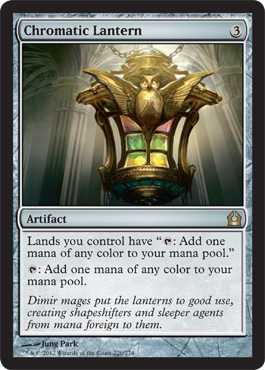
This is the card I’m most excited about thus far. This is an extremely awesome piece of artifact ramp and fixing all in one, and I expect it to see some significant play in both Commander and Standard. I wouldn’t be surprised if it made cameos in older formats like Modern too. Joiner Adept's ability on an artifact is much more resilient than a 2/1 creature and the Lantern itself taps for mana. This will be the cornerstone of any 3+ color control deck, which by the looks of the cards spoiled thus far, is not out of the question at all.
Allowing control decks to jam a large number of multi-colored spells, including charms, into their deck will give them a wide variety of cheap answer cards as well as granting the ability to finish the game with the most powerful card they can find is no joke. The fact that every 3+ color Commander deck will want a copy of this is another huge factor. This card is pre-ordering at $5 on StarCityGames.com and I think that’s a steal. I’d like to see this card hit $10 fairly quickly after it releases.
Jace, Architect of Thought
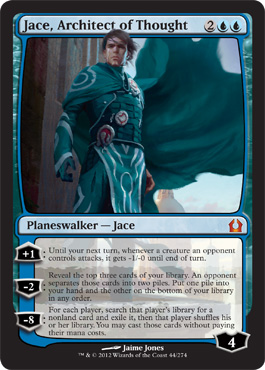
“Meh.” Was my first thought when I read this spoiler. I’ve forced myself to try and be a bit more open minded about this card, but I’m still not sure I like him. His first ability may be relevant if a token deck exists, but with cards like Intangible Virtue in the format, they can counteract his ability fairly easily. His 2nd ability is undoubtedly insane, but paying four mana to use it once is not exactly value. A deck that likes this Jace, would also likely play Tamiyo. In connection, they do stuff, kind of. Jace requires that they attack with all their creatures for less damage, while Tamiyo can tap their largest creature or draw cards from all their attackers. Tamiyo is really the strong card in this combo, but if a heavy blue control deck exists it may play some number of this Jace, but I don’t expect it to stabilize much more than $12.
Judge’s Familiar/Dryad Militant
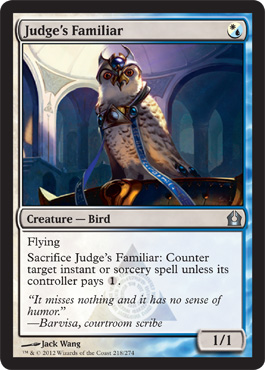
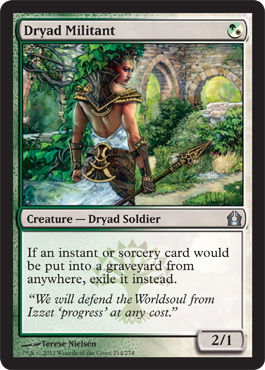
We have two aggressively costed hybrid creatures at 1-mana spoiled, and they are both going to make a splash, even though they are uncommon. The Judge’s Familiar adds Flying to Cursecatcher and also gives it to White mages. This card will undoubtedly slot into many a Modern/Legacy deck and will almost assuredly appear in next seasons iteration of Delver, whatever that may look like. The Dryad Militant is another Savannah Lions variant that will probably not see a remarkable amount of play in Standard. Both because his creature types are irrelevant, and also because Savannah Lions just isn’t as good as it used to be; however, I do expect Modern decks to play this guy to combat Snapcaster Mage.
Lotleth Troll
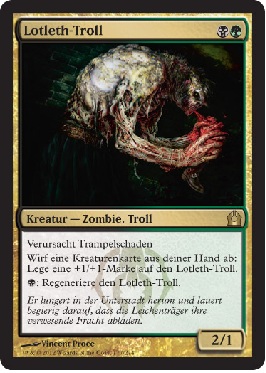
This card is difficult to evaluate. It’s cheap and it Regenerates, and it has Trample. On it’s own, sticking an equipment on him ought to be enough to end the game pretty quickly. His other abiltiy, which discards creatures to give him +1/+1 counters, is the interesting bit. I’m not sure how abusable this will be in Standard. I could see discarding a creature, and then using its Scavenge ability to pump this guy further, but I just don’t know how viable that is. Obviously, with the rotation of Vapor Snag his weakness is a bit diminished. I’m not yet ready to pick a price point on this guy, but I wouldn’t be surprised if it was the central two-drop in either a Jund or Junk aggro deck.
Legacy News
Trample Discard a creature card from your hand: Put a +1/+1 counter on Lotleth Troll. b: Regenerate Lotleth Troll. Well, the insane morphing of the Show and Tell deck, which turned into to Sneak-n-Show, which turned into Omniscience has now devolved into an Academy Rector deck. Some guys at my store, who have been on top of and in front of most of these Legacy changes are already looking at bringing this cycle full circle from where it started. Hive Mind. Hive Mind was one of the best cards to put into play with Show and Tell at one time, and that may be happening again. Since so much hate exists for Show and Tell players, having an enchantment that can actually be cast if need be, and wins the game immediately on resolution is a bit more desirable. Being able to Academy Rector for it directly is a bonus. Show and Tell players have been telling me that they have to use so many resources to resolve their Show and Tell they don’t have a back up plan. Hive Mind, however, simply ends the game, and allows them to play 4 more free counterspells maindeck in Pact of Negation. Hive Mind isn’t an expensive card, and it isn’t going to be, but Pact of Negation is already nearly $20, and this will only increase if Hive Mind does see more play. Not to mention that when Modern season comes it’s demand will continue to increase. It’s a risky play, but I like picking up Pacts and trying to make about $5 a piece on them right now. It doesn’t stand to lose much ground with Modern and Commander keeping it a float, so even though it’s not inexpensive, at worst it shouldn’t fall too far.
Wrapup
As spoilers come out until next week I’m keeping my eyes open for an sweet Control finisher and a Show and Tell hoser. Those are the the types of items I’m willing to jump in on right away. In the mean time, I’m hunting for deals on Laterns and Pacts. See you next week with more spoiler news!
If not, now is a perfect time to join up! Our powerful tools, breaking-news analysis, and exclusive Discord channel will make sure you stay up to date and ahead of the curve.
Commander is a format in which the players can unlock the full potential of even the most obscure [card Black market]Magic cards[/card], which dramatically shifts the color balance. Blue, for example, is thought to be the best color in Legacy, while red is probably the worst. Does this hold true for Commander? If not, what determines whether a color is good? Let's take a look at each of the five colors and evaluate its contribution to the world of Commander.
White
I would rank white as the worst color in Commander, although this essentially becomes irrelevant once it gets paired with other colors. My goal as a Commander enthusiast is to create a deck for every possible color combination (currently 27). I began this epic endeavor by making all five mono-colored decks. Red was first, followed by black, blue and green, and then all that was left was white. I started this project over a year ago and still haven't crafted a quality mono-white Commander deck. Why can't I make one! It's so simple. Let's take a look at white's strengths and weaknesses.
Strengths
Mass removal - White is hands down the best at this. It is capable of killing every nonland permanent in play several times if needed, and this is exactly the kind of card advantage that works best in Commander.
Exiling things - Surprisingly, exiling cards instead of putting them into the graveyard is quite important in Commander. Graveyard themes are more prevalent and making sure your opponent's Palinchron is gone forever will put your mind at ease.
Weaknesses
Drawing cards - Sadly, white is very poor at drawing cards which is why I think it is at the bottom of the rankings. Sure you can kill all of your opponent's permanents, but all they have to do is cast a Stroke of Genius and they are back in the game.
Effective threats - White has some [card baneslayer angel]sweet angels[/card], but overall the creatures are weak and cheaply costed. The lack of good mono-white legends is also a reason why I haven't made a white Commander deck yet.
Summary
I'm certainly not saying never to use white in Commander, because it does play a very important support role. White is probably the most reactive color, allowing you to deal with almost anything your opponents throw at you, but it will have problems keeping those kinds of cards in your hand due to its lack of card draw. White's best role is as a support color that deals with threats while other colors go in for the kill.
Blue
I rank blue at number three in the color hierarchy. This is surprising, due to its authority over the other colors in other eternal formats. Blue is kind of weird in Commander because as soon as you want to be even somewhat competitive with it you end up comboing every game, whether it be with Palinchron or a horde of wizards drawing infinite cards. Blue does, however, synergize very well with artifacts, which is fun.
Strengths
Drawing cards - Blue is hands down the best color if you want to draw a ton of cards, which is quite a good strategy in Commander. You just have to make sure you can use those cards to win, because drawing more draw cards by itself isn't getting you anywhere.
Denial - Counterspells! A solution to nearly every card your opponents throw at you. Some are better than others, but a well placed Counterspell can sometimes win the game.
Theft - Blue is good at borrowing your opponents cards and killing them with them. Some all-stars are Treachery, Bribery, and Desertion.
Weaknesses
Effective threats - Just like white, blue doesn't really clog the battlefield with monstrous creatures, which is why competitive blue decks end up comboing off.
Dealing with permanents - You can only steal so many. There are essentially no blue cards that can kill enchantments or artifacts and very few that actually kill creatures. Blue usually has to settle for temporary solutions like Capsize.
Summary
If you are playing to win, blue is quite good at it, but no one does that in Commander, right? If blue plays fair it is another quality support color, keeping your hand full of those juicy [card Craterhoof behemoth]green beasts[/card] or exciting [card bogardan hellkite]red dragons[/card], and maybe even borrowing some of your opponents'. Blue pairs well with all the colors except white because of the lack of threats. Blue/White decks will have to rely more on equipment and using card advantage to deploy a horde of smaller creatures.
Black
I put black at number two, with blue close behind. Black is personally my favorite color in Commander because I really enjoy utilizing [card grave pact]death themes[/card]. My current mono-black Commander deck is led by Toshiro, Umezawa and makes use of a ton of instant-speed removal spells and a horde of demons to destroy my opponents.
Strengths
Tutors - Black loves to bargain. "Your soul for this Thran Dynamo? Deal." What makes black best is the fact that you almost always have the best cards in your deck. However, this also leads to redundant games, which can be boring.
Killing creatures - Black loves this. Damnation, Decree of Pain, Plague Wind, the list goes on. There are a ton of mass creature removal spells as well as fun enchantments that cripple your opponents' creatures.
Reanimation - Black does wonderful things with the graveyard. Reanimation effects are far more potent in Commander when the average converted mana cost of creatures is six.
Weaknesses
Destroying artifacts/enchantments - Gate to Phyrexia... that's it. Black just can't kill artifacts or enchantments which is quite annoying in some situations. You'll have to rely on other colors to fill this role.
Summary
Black is a very good primary color in Commander. It has adequate threats, card draw, and can deal with any creatures your opponents play. Its large mass of tutors also allows you to find whatever you need to deal with most situations, and including other colors in your deck only strengthens this. Just be sure you can deal with pesky [card doubling season]enchantments[/card] and [card akromas memorial]artifacts[/card].
Red
Outside of Commander, red is by far the worst color in eternal formats, but Commander breaks all the rules. Red has all the time in the world to amass a horde of dragons to swiftly devour your opponents. Still, it has many shortcomings that put it at number four on the list, but not far behind blue and still quite far ahead of white. Also, I think red encompasses the spirit of Commander the best, and I believe it is the most entertaining color to play.
Strengths
Threats - Red has many quality threats which are very important in a multiplayer format in which players start with 40 life.
Breaking artifacts - Red has the best artifact destruction of any color and this turns out to be very powerful in a format where artifacts are so prevalent.
Weaknesses
Drawing cards - Overall red is quite weak at drawing cards. Sure there's Wheel of Fortune and Reforge the Soul, but those help your opponents as well.
Destroying enchantments - A problem that both red and black share is dealing with those pesky [card Moat]enchantments[/card].
Summary
Red is a quality primary color, but should almost always be supported in order to function well. It can pump out major threats, but may have trouble staying in the game after a wrath. Another strength one might include is red's ability to destroy lands, but this is usually frowned upon in Commander, so I left it out.
Green
Finally we get to green, the best color bar none. In a format where large creatures rule, and a full hand of cards is essential, green shines brightest. Everything that works best in Commander green does very well.
Strengths
Mana ramp - This is the strength that sets green at number one. Being able to play your high cost threats several turns early is key to victory. A lot of the most powerful Commander decks have green simply to ramp and fix mana.
Threats - Green is also very good at amassing a horde of monsters to quickly crush your opponents, and due to its mana ramping capabilities, it can reliably do this several turns before any other color.
Destroying noncreature permanents - Another clutch strength is to be able to efficiently deal with enchantments and artifacts that ruin your game plan.
Weaknesses
Destroying creatures - There aren't too many green cards that deal with creatures directly, so usually you have to rely on your large green monsters to overwhelm whatever creatures you opponents may cast.
Summary
Green contains some of the most powerful cards in Commander and the ability to accelerate them out early. Pair this with a color that efficiently deals with creatures and you'll have a quality Commander deck.
Wrapping up
Don't think that any particular color or combination of colors is bad in Commander. Some just work more effectively than others.
This article was meant to be more of an overall judgment of each color and the roles it plays. I could have broken each color down into it's strengths and weaknesses as they relate to themes. Blue, for example, is exemplary and almost necessary when it comes to an 'enters the battlefield' theme (my second favorite Commander deck theme). Maybe a theft theme sounds fun. What other color does this well? Red! Or a graveyard theme, or tokens, etc. The thing that makes Commander fun is that there is always an interesting theme to take advantage of.
If not, now is a perfect time to join up! Our powerful tools, breaking-news analysis, and exclusive Discord channel will make sure you stay up to date and ahead of the curve.
When Avacyn Restored was in the spoiling phase, a card caught the attention of the QS staff and Doug Linn sent the insiders an e-mail with a hot tip.
The spoiling of Misthollow Griffin was certain to put upward pressure on the cost of Food Chain and now was the time to get it because it was 24-48 hours away from quintupling in price. Since the griffin could be played from exile, it interacted nicely with a host of Legacy cards. It was a great card to pitch to Force of Will since it could just be played later. Your opponent's Swords to Plowshares don't phase the griffin (or rather they DO phase the griffin, temporarily relegating him to another zone until he returns, akin to the phasing mechanic). But the most important interaction the Braumeisters of the world concocted when they saw griffin was that with Food Chain.
Food Chain allows players to exile a creature they control and get X + 1 mana of any color where X is the creature's cost. A popular Legacy deck of yesteryear featured the use of Food Chain in conjunction with increasingly-expensive Goblins. How useful is [card Goblin Lackey]Lackey[/card] once it's already connected to the dome? Why not make it a Goblin Piledriver?
But with Griffin, exiling it for five blue mana only to turn around and use four of it to replay griffin nets you an arbitrarily large but finite amount of mana. This mana can only be used to play creature spells, but that seems OK given all the creatures printed over the years with useful abilities. An infinite amount of mana to cast creatures can still get you all the Mulldrifters you can chain together, or a hardcast [card Emrakul, the Aeons Torn]Emrakul[/card]. When is a Fireball not a Fireball? When it's Maga, Traitor to Mortals, an excellent mana sink for all of that creature-only mana.
Most insiders saw Doug's e-mail and lol'd. Food Chain spiked as predicted, and many of us, myself included, made bank on buying Food Chain for two dollars and shipping them on eBay for over $40 a playset. Not a bad payday. I picked up foil Food Chains for $6 as well and managed to sell out of them. Generally the "let's play this goofy combo" crowd and the "let's foil this Legacy deck completely" crowd don't have a ton of overlap, but foil Food Chains were a commodity for a short time.
Once more Avacyn Restored cards were spoiled, people found other cards to brew with, leaving a very small contingent of devotees to pore over the list of useful creatures and try to perfect a deck I'm calling Griffin Food.
One such devotee was a man without whom Quiet Speculation.com could not function: content manager Tyler Tyssedal. If you have a mind like a steel trap, you may remember that months ago I mentioned Griffin Food in the Legacy deck coverage portion of that bastion of cutting edge Legacy tech that is this column. A lot of you lol'd. It was there that I mentioned that Tyler was hard at work on perfecting the deck for posterity and that he liked to play it at Legacy events in the Minneapolis area.
I'll wait for you to click the link. Your eyes aren't deceiving you, faithful readers. That is really a link to a deck tech interview where QS' own Tyler Tyssedal is having a serious conversation with another human being and fielding serious questions about his serious deck that he's playing in a serious, actual, for-real event. For serious. Always maintaining that the deck is more fun than it is competitive, Tyler nonetheless managed to get the SCG coverage team to take notice.
Tyler finished in 162nd place at the SCG event in Minneapolis, which isn't great. You know what IS great? Griffin Food, a deck that is a lot of things and isn't a lot of things. It's not competitive but it is fun. It's not going to win an event soon but it is going to get a lot of attention. It's not RUG Delver or Sneak and Show but at least it isn't RUG Delver or Sneak and Show because Legacy doesn't need more of that. It needs more Griffin Food.
Due to the SCG Opens, Legacy is being played more now than ever before. Chances are you don't go alone to events in other cities. You probably go in a car with other people. Even if you aren't inclined to put the time into building and tuning Legacy decks, you're already at the event on Sunday if any of your buddies are. You can putz around the event center, you can putz around the city (Pro Tip-- if you're in Minneapolis, for example, this is not the play) or you can booster draft. Or, you can sleeve up Griffin Food and have a few laughs.
Trust me, it's impossible to maintain a serious composure and a competitive attitude when you have to say things like "I'll cast Fierce Empath to search my library for Aethersnipe." Every once in a while you need to play Magic for fun, and this is a deck that will get you there. Personally, I prefer Cloudstone Curio Kobolds (I'll cast grapeshot for 12 trillion) but to each their own. Give this deck a shot if you want to spend the entire day laughing and getting high fives.
Good job, Tyler.
Riddle Me This: When Is a Profit Not a Profit?
I don't have Cable. Sometimes it's an issue, like when I have to watch a grainy download or wait for months to watch Game of Thrones or Walking Dead. But considering to the amount of money I'm not paying to not have Cable it seems like a no brainer. Netflix is approximately 65 cents a month for streaming and there are more hours of content there than there are hours in the average lifetime. Even though it's El Cheapo.
When I did have Cable, I would watch anything that was on when I was sorting collections. One such show was "Storage Wars", a show about people buying storage units in auctions and trying to sell the stuff they found inside for a profit.
From what I have seen, it's a pretty hit or miss process, and when a member of the show finds information online they don't understand, it can lead to some pretty hilarious situations. For example, an NES and 5 games sold on eBay for $13,000 a few years ago. This had nothing to do with the NES itself (unbeknownst to the seller who posted the auction), but rather to the inclusion of an incredibly rare game called Stadium Events in its original box. This lead to a hilarious situation where a guy thought the broken NES he found in a unit was worth 13 grand because of its serial number.
I always wondered if these people were getting a decent profit for the stuff they found, because they often consulted experts on unfamiliar items, who would try to get them for as cheap as possible. It wasn't until Storage Wars ran across some materials I knew all about that I realized how much better they could fare if they were more knowledgeable.
Best I can do is 50 bucks.
Any reader of this site, given a Collector's Edition [card Mox Pearl]Mox[/card] and [card Timetwister]Twister[/card] and an Unlimited [card Black Lotus]Lotus[/card] could probably do a bit better than selling the entire binder for $700. It makes me wonder how badly they get ripped off selling other stuff, or whether they care. $700 is well below buylist for this stuff, but for a quick flip they did OK. It just goes to show how hard it is to keep abreast of the myriad different collectibles and antiques out there. It seems unfair that the people who get to live every Magic player's dream of stumbling across power for cheap don't even maximize their profit.
Still, it goes to show that what I said in my series about shop crawling is true. There is treasure out there waiting to be uncovered but you're not going to find it sitting at home. Maybe pull over next time you drive past that garage sale, or check out that shop a few towns over that has a faded Magic poster from Tempest block but doesn't run events. There is good stuff out there, so go find it.
Riddle Me This: When Is Classic Not an Online Format?
I have a lot of coverage so I will go through it quickly.
In Knoxville this weekend Star City had a Standard Classic.
Once again, GW Aggro takes top honors. It's tough to combat the synergy between efficient green beaters, good CIP abilities and Restoration Angel. Sublime Archangel makes an appearance here, and this card is perhaps the best way to make use of mana dorks late in the game since Fauna Shaman. Thragtusk was played here to great effect, cementing its place as format staple. Congrats to David Rackza on his win.
Also beating with the tuskmaster general was Joseph Page who decided copying tusk with Phantasmal Image was a worthwhile pursuit. Resembling Bant control decks from the past, black is added here for more removal and to cast the September FNM promo Lingering Souls. Souls gives the deck a ton of reach without removing anything essential from the Bant-only lists, and it is perhaps the best configuration of the deck I've seen. Good job Joseph.
In the "making me laugh" category we have a W/B Trading Post deck. It even runs a Staff of Nin! I couldn't be happier that this deck beat a bunch of [card Delver of Secrets]Delver[/card] and [card Bonfire of the Damned]Bonfire[/card] decks to make Top 16.
Lots of Delver decks in the Top 16, more than we've seen at previous events. Perhaps indicative more of the metagame in Knoxville than the metagame at large. Delver ruled the top 16 with seven copies, including one [card Talrand, Sky Summoner]Talrand[/card] variant.
Let's test my hypothesis about the metagame in Knoxville by examining the Standard decks from the SCG Open in Minneapolis.
And we have an embarrassment of Delver decks. Not quite what I was hoping to see, Delver comprised a full 50% of the Top 16. While it didn't win either event, it was over-represented in the top echelons of both.
Perhaps Stephen Hink's inclusion of Flames of the Firebrand in his winning B/R Zombies list was included to help against Delver decks. Making short work of Lingering Souls, murdering a pile of Phantasmal Images or merely bolting the face, this card has a lot of applications and may warrant a deeper look.
Straight to the point and not messing around with Killing Wave or equipment, Hink's deck packed four copies of every beater, including Falkenrath Aristocrat. If you went deep on this guy when I recommended, you're probably feeling pretty good right now as the card has spiked to $8 and shows no signs of stopping.
Something about a deck with red not running any Bonfire of the Damned makes me feel warm and fuzzy inside.
Speaking of Bonfire, isn't it curious that the Top 16 saw exactly three copies in Minneapolis and seven in Knoxville? Maybe this card doesn't need to be $50 like some have predicted. In light of a red deck winning an event without it, perhaps we don't need to join it since we can beat it after all.
I Guess I Can Talk about a Few Decks Other Than Griffin Food
Scapeshift? Huntmaster of the Fells? Thragtusk? What manner of ridiculousness is this? A Jund-colored twist on a traditional Nic Fit build, of course, with Scapeshift added for one-shot KOs. After ramping with a Veteran Explorer or two, the deck Scapeshifts into the tried-and-true double [card Valakut, the Molten Pinnacle]Valakut[/card] plus a pile of duals. Also, Primeval Titan, because why not? Sun Titan is good in traditional Nic Fit, and Prime Time is similarly silly.
Who said you couldn't play Valakut in Legacy? Thanks to Eric Warns for giving us all something to think about.
During Kamigawa/Ravnica Standard I played Sea Stompy. Quick beats from Kird Ape, control in the form of Plaxmanta, recursion from Ninja of the Deep Hours, countermagic, burn spells: this deck had it all. Since then, we have gotten plenty of blue and green creatures even more worthy than Plaxmanta of a trip back to hand via ninjitsu trickery. Snapcaster Mage, Spellstutter Sprite, Venser, Shaper Savant, etc.
Brandon Semerau ported the Extended "Faeries" deck from four years ago to Legacy and turned it into Mono-Blue Tempo. Jace's Phantasm is getting his first serious consideration as a flying mongoose, his lack of shroud mitigated by the sheer amount of control in the deck. Playing a ton of instants flips [card Delver of Secrets]Delver[/card], powers Snapcaster Mage and gives Jace's Phantasm quite a boost.
This deck, perhaps the first to play Vapor Snag in Legacy, controls the tempo of the game to great effect. An empty board on the other side allows you to swing with creatures like Snapcaster Mage which can be deadly if you're holding Ninja of the Deep Hours. The evasion on Spellstutter Sprite makes it a great ninja target as well, and casting Sprite early and often is never a bad idea. If it were me, I'd jam a Mistblade Shinobi or two, but that's me.
Still no Academy Rector popping up in a Top 8 Omniscience or Hive Mind list, but expect that to change soon.
Kyle Olson got there with a relatively standard Junk list. This is a good time to be playing Knight of the Reliquary decks as you don't have to jam three copies of Karakas in the sideboard like some decks. Between Knight main and potentially some copies of Crop Rotation in the board you should be able to keep [card Emrakul, the Aeons Torn]Emrakul[/card] or Griselbrand out of your grill.
Great job, Kyle!
One More Thing Before I Go
I could easily devote another 2,500 words to the Players Championship, won by Yuuya Watanabe. The full coverage is here on the mothership and it's all worth reading, from cube draft to Modern. There is something in there for everyone, and I hope there is a Players Championship every year from now on.
That's All for Today
Make sure you check out the RTR Spoiler page full of great spoilers and analysis from Sigmund and yours truly. We'll be bringing you new cards as soon as we find them and, best of all, this page is in our free section so make sure to share it with your friends.
Until next time, keep brewing, and don't play anything I wouldn't play.
If not, now is a perfect time to join up! Our powerful tools, breaking-news analysis, and exclusive Discord channel will make sure you stay up to date and ahead of the curve.
Chances are, you're going to make a lot of money from RTR because you're going to be actively reading and trading all through the next month or so. However, you have got to avoid losing money along the way, too! You don't want to be stuck with Magic cards that you could have sold a few weeks ago for double the value.
Biggest Loser: Huntmaster of the Fells
Currently updating his resume.
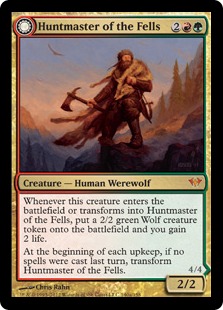
Huntmaster was an incredible card - it's a fun, reversible Kitchen Finks. A lot of Insiders made a lot of money on it. Huntmaster briefly looked a little better when Lightning Bolt wasn't in M13, but Bonfire of the Damned's continued dominance has been holding it down. I see Huntmaster taking the final bow because of Mizzium Mortars.
Mizzium Mortars looks boring; it just kills dudes, after all. The 3RRR cost is a lot to pay. On the other hand, it's a sweeper like Bonfire that will knock only their monsters. Some prominent people on Twitter have been saying that it's the real deal and I'm inclined to agree with them. The chance to use it as a general Flame Slash makes for a decent card and the Overload is achievable. Bonfire typically takes nine mana to do the same amount of damage! Since it becomes untargeted when you Overload the card, it can also kill Geist of Saint Traft. The Mortars are going to see play and they can kill both sides of the Huntmaster.
I'll make an aside here to note that this can have a warping effect similar to what Flametongue Kavu did. For those who weren't playing a decade ago, FTK was a powerhouse card that every deck ran. It was splashable and would always 2-for-1 or better an opponent. The most warping thing about it was that FTK made playing monsters of 4 toughness a terrible idea. You could still play little UW 2/2s like Meddling Mage, but investing in the newly-reprinted (and hyped) Serra Angel was awful. You'd spend 3WW for the Angel and then have her bite it to a 4/2 that stuck around. The defining Invasion block card, Desolation Angel, pulled off having a small butt only because she stopped the opponent from actually casting FTKs. Mizzium Mortars might have a similar effect. Beware of monsters that are x/4 and ask for a lot of mana. Restoration Angel will be fine, but don't put a lot of stock into other guys. There's a good chance that the new Niv Mizzet will see a lot of play as a finisher, but if it were still a 4/4, it would be getting Mortared out of the sky and not played. Remember this warping effect.
We also cannot discount Izzet Charm. Izzet Guild used to be this goofy, unplayable guild in Ravnica with clunkers like Tibor and Lumia that just happened to have a very useful signet for the Tron deck. The Charm can Shock something, which means it'll take out an unflipped Huntmaster. It's also a pretty strong spell on its own (as I mentioned last week). When Ravnica first came out, it was so unlike Champions of Kamigawa that people started jamming lots of cards and decks together in the beginning to see what worked. I think the same thing will happen here. There are a few holdover cards like Geists and Snapcasters that people will continue to play, but Ravnica is really going to help us when playing specific Guilds and those benefits might not actually reward us for playing Innistrad. Izzet Charm is going to be a part of the new Standard for at least a few weeks. With it and Mizzium Mortars joining Bonfire, it's time to get rid of those Huntmasters that you still have. He's not going to get the love that he used to.
The Collateral Damage: Bonfire of the Damned
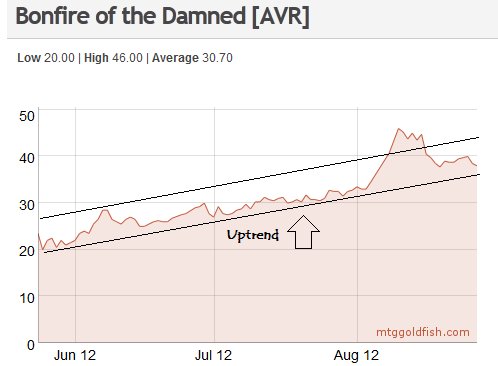
With all the talk about Mizzium Mortars above, you've got to wonder whether Mortars will replace Bonfire and the Miracle will tank in value. This isn't going to happen because a lot of decks are still going to be able to cast Bonfire for retail and profit. They'll have some of the ubiquitous ramp from Ravnica and play a Bonfire for X=2 on turn 4 naturally. However, now that decks are going to have the option of "play Bonfire and hope to Miracle it because casting won't really happen," decks can ask about Mortars. I think we'll see people running Mortars over Bonfire since it's a better fit in non-ramp decks and the mere option should pull people off of the Mythic. People have been wondering whether Bonfire will hit $50 and Mizzium Mortars is the speedbump that will stop it from hitting that level. How much it affects the Bonfire remains to be seen.
The Called Reversal: Cursecatcher
Judge's Familiar is a 1000% upgrade to Cursecatcher - this thing even flies! How great! However, it's not a Merfolk, which means that it's much worse than the crummy Cursecatcher. Cursecatcher snatches a few dollars because it's an early-curve monster in Merfolk with a sometimes-relevant ability. This bird is better, but it doesn't become a 2/2 on the second turn and then a 3/3 soon afterward.
I have a feeling that people are going to get rid of their Cursecatchers and not realize the fact that the Familiar isn't a good replacement. The price in trades might drop for the next few weeks. If you encounter this, jump on it. Merfolk isn't a great deck at this point and it's middling in Modern, but it has devoted players. If people are coming off of their Cursecatchers in anticipation of Judge's Familiar, you stand to profit.
Unrelated Blatant Hope For A Return To The Past: Chromatic Lantern
I love Coalition Relics a lot. They ramp up into really good spells on turn 4 and they make the pain of actually worrying about your manabase go away. I'm hoping that there are enough reasons to run the Lantern that 5-color Control becomes a thing again. Coalition Control of seasons past ran four Relics, four Prismatic Lenses and just said "to hell with the color pie! Cast those Ancient Grudges and Draining Whelks and Tendrils of Corruption all you want!" Cards like this can be very dangerous in Standard because there may be an effective strategy in jamming everything. It also almost exclusively rewards control decks. This card in play means you're kicking Mizzium Mortars on turn 5 all day long. You're certainly not spending Lanterns to cast whatever Watchwolves come along. This card is a real steal at the $5 it's currently selling for.
More Rampant Speculation About Goblin Storm
Guttersnipe is like a Tendrils of Agony on legs and Goblin Electromancer makes things much easier to cast. I have to wonder whether we'll see constructed-worthy decks that aim to land Guttersnipe and then cast Rituals and blast through the deck with Faithless Looting. There's also a shot that Guttersnipe is just good in Delver decks by itself. While you're losing a lot of the good cantrips, it really makes good use of Snapcaster Mage and things like Gitaxian Probe.
Have You Got Your Sigardas Yet? Why Not?
Sigarda, Host of Herons is currently about $5 shipped. This is a real deal, too. Here's why: big killers are always at a premium. Things that kill big creatures are also really common right now. If you play that new Niv Mizzet and the opponent Azorius Charms it to the top of your library, you're going to wish he just cast Remand instead. Otherwise, they might peel off a Selesnya Charm and play Retribution with it. Sigarda dodges all of that stuff. She even dodges Mizzium Mortars! What a heck of a card. I'd imagine we'll see plenty of decks running Selesnya Charms and topping out on Sigarda.
Okay, so that escalated quickly. There's more to talk about in RTR next week! Until then,
If not, now is a perfect time to join up! Our powerful tools, breaking-news analysis, and exclusive Discord channel will make sure you stay up to date and ahead of the curve.
Finance writers, myself included, are always discussing cards they are buying and selling. We are quick to identify cards that are possibly due for a price increase and we are sometimes able to point out when a card has hit its peak.
All these articles make it seem like finance writers are the cowboys of MTG finance. They take wild risks, they buy hundreds of a card and hope to run up the price. And they are not as accurate as they make themselves to appear. This is not wholly true.
I buy cards with the hope of profiting on them – of that there is no secret. But what some people may overlook is the fact that the majority of my purchases are not solely based on speculation. In fact, being so risk averse, very few of my hard-earned dollars go into pure speculation. Why take such high risks when there are better reasons to buy cards?
The Hype Curve
Cards don’t increase in price overnight (unless they are unbanned from constructed play). There is often a period of a few days to a week where the card price slowly rises before making what appears to be a significant jump.
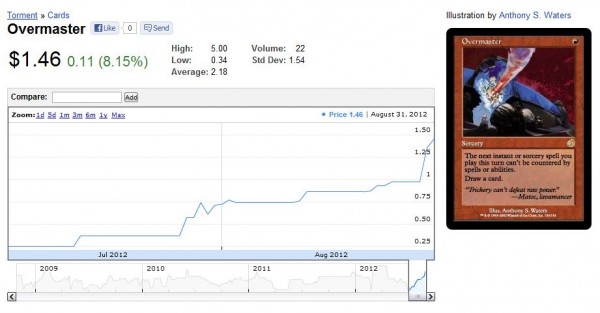
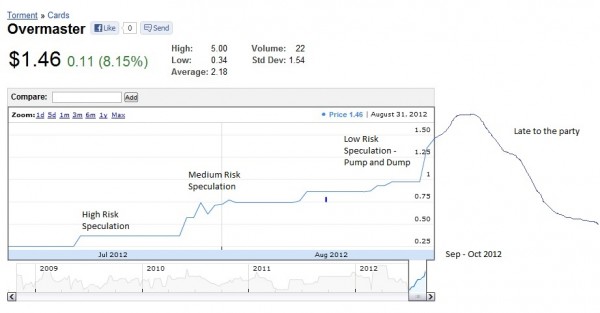
The most recent example I can site is Overmaster (chart from blacklotusproject.com):
Observe how the card was making a steady rise throughout July and most of August, but recently the card has spiked. It’s almost as if there were a few people truly speculating on this card and when it gained some notice, the masses decided it was worth jumping in.
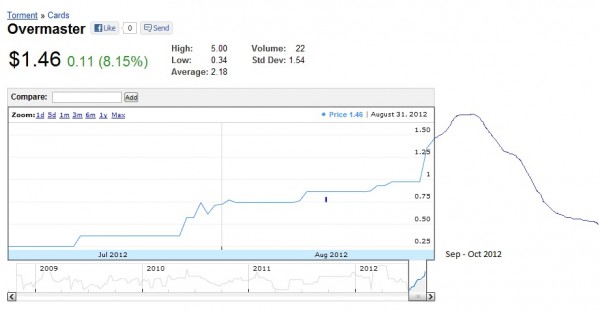
Of course, much like other cards which go through a brief period of hype, I’m willing to take a guess at how this curve will look in September and October…
Okay, maybe this is a bit pessimistic. If Overmaster sees fringe Legacy (such as Troy Thompson's Omni-Tell deck from this past weekend) play it could end up in the $2-$3 range, kind of like Trickbind or Angel's Grace. But it will probably hit a peak soon and then pull back.
Let’s dissect this curve a little further. Here, we can try and identify what type of buyers are purchasing a card like Overmaster as it passes through this hype curve.
Buying Overmaster in July when it was initially “noticed” would have been very risky. This is where the true speculators play. They identify a card that saw Legacy play for the first time ever in someone’s sideboard and they snap-buy a bunch. I call this area high risk based on the likelihood of return. In a way, the risk isn’t really too high since copies of this card could be had for $0.25 at the time. But the likelihood of profit was still debatable.
In the middle of the chart, the card already gained some traction. Pros may have taken notice to the card, testing it out in MTGO events. This is where the risk level begins to diminish but the potential reward has shrunk, due to the card’s doubling in price.
Finally, right before the huge spike is the pump and dump zone. This is where many speculators buy out eBay and TCG Player, driving the price up to a ridiculous high only to sell them right away. At this stage, finding a copy of Overmaster below $1 was the easiest way to make money since the card was already selling for over $2 on eBay. As long as you are thorough in your search to ensure you are paying less than auction prices, there really is a low degree of risk here.
When I “speculate”, I try to participate in the second half of that curve. I wait for the card to gather some attention and maybe buy a set. Then when I observe that I can sell this set on eBay for profit and we are approaching the price spike, I scour the internet for any underpriced copies of the card (side note – in this case it was Amazon and Card Shark, where I bought 8 copies and 5 copies respectively for under $1 each shipped). I made this purchase only after seeing sets selling on eBay for over $2 each.
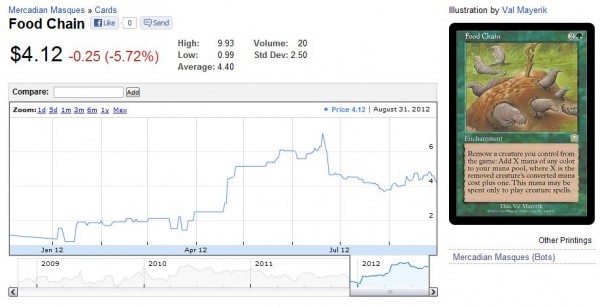
A well-known finance writer once sent me a Tweet that appeared condescending at first, but truly was a solid piece of advice in the end. I had been sharing my thoughts on Food Chain being a good speculation target (chart from blacklotusproject.com).
To paraphrase, this well-known writer told me that what I was doing was not true speculation. Rather, I was merely practicing good timing.
While this offended me at first, I later realized he was absolutely right. Food Chain was already noticed as a speculation target and I was merely buying underpriced copies and selling them for profit. This is precisely where I like to play. It keeps risk down and it nets me rapid profit.
Real Estate
I’m not advocating only waiting for these opportunities to buy cards. After all, this would lead to long periods of stagnation when your money could be working for you!
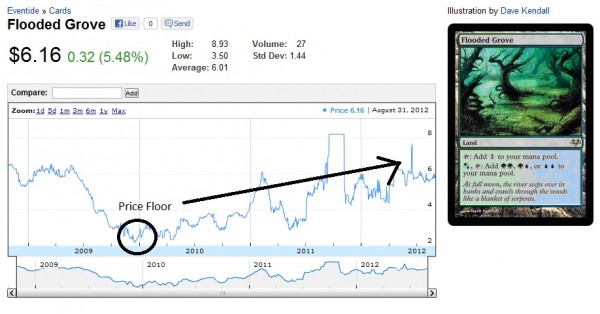
In between the hyped cards, I often try to slowly acquire cards I have high reason to believe will be stable or even increase in value. I’ve already discussed the Innistrad Dual Lands to oblivion, so I won’t waste space here elaborating upon why I felt these were a constant buy in the past couple months.
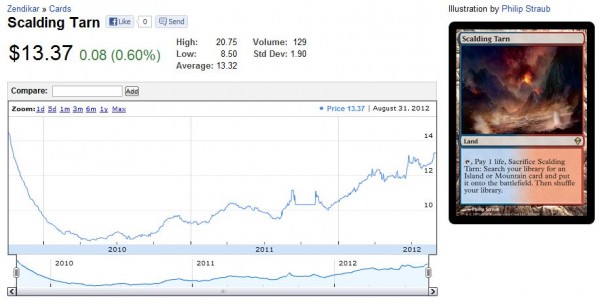
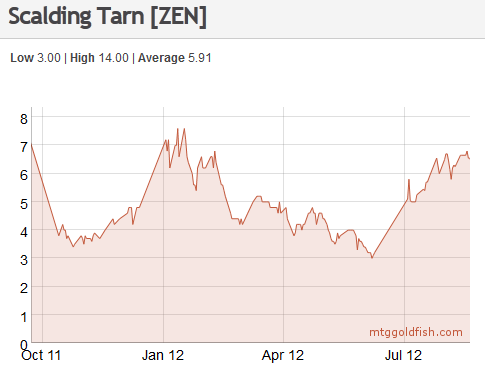
Real Estate is generally a solid approach to take even beyond Innistrad Duals – especially if the land cards are playable in Eternal formats. Everyone knows about the Zendikar Fetch Lands, and I make it a point to always have an extra dozen or so in my trade binder. When I have the chance to trade them away or sell them for profit, I do so only to restock them again when I find a deal (chart from blacklotusproject.com).
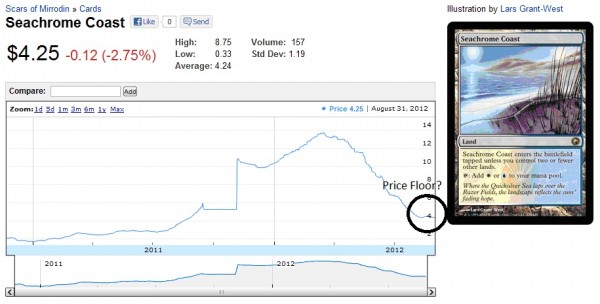
Other Real Estate I’ve got my eyes on now are the Scars of Mirrodin Fast Lands. After spiking to double digits a couple months ago, the blue ones are hitting lows as they approach rotation. But these lands do see some play in Modern and they supplement mana bases of aggressive decks very well.
I just may be looking to pick up my set of 20 Fast Lands in the coming months if I can find a good price. Don’t agree? Just compare the chart of Seachrome Coast with the charts of the Filter Lands, which also see some Modern play (charts from blacklotusproject.com).
High Turnover
Another category of cards I actively purchase are cards which I find generally easy to move. Whether it is in trades or sales, I always strive for high turnover in my binder. Cards that I can move quickly, especially at a premium to what I bought them at, are cards I often like to purchase.
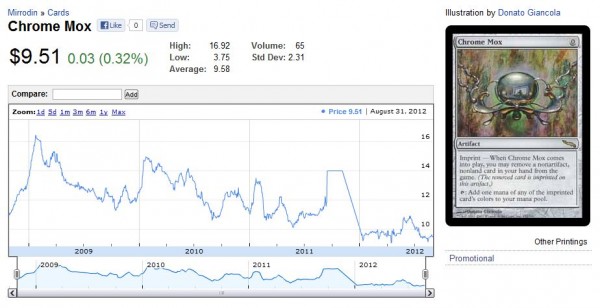
A recent example of a card like this is Chrome Mox (chart from blacklotusproject.com).
While it may appear this card has fallen out of favor, I had no difficulties moving the couple extra copies I owned at GP Boston. This card appears to move in cycles, possibly with Legacy or Modern seasons. Either way, I always like to have ubiquitous staples like these in my trade binder. Other examples include Aether Vial, Vampiric Tutor and, of course, Dual Lands.
I don’t necessarily buy every copy of these cards that I can find. Instead, I do occasional eBay and MOTL searches to see if anyone is selling these cards at a discount. If so, I make my move. But again, the idea here is that I’m taking very little risks when I acquire these cards at a discount knowing they aren’t too difficult to move.
It’s Not About The Glory Of Speculation
I am not a frequent speculator – I am way too risk averse. In fact, I’ve had a couple abysmal experiences with true speculation. Past in Flames and Skaab Ruinator were both cards I bought into with no success.
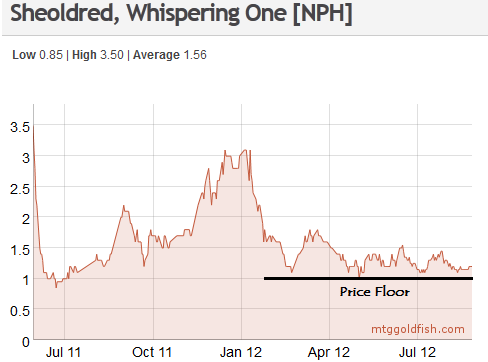
I find the easiest way to profit without major risk is to a) buy cards at the right time, b) buy into Real Estate at their price floors and c) buy into cards that are always easy to move. Perhaps this sets me apart from other finance writers. Or perhaps I’m more honest with myself when I confess I am no great guesser.
Instead, I take pride in being good at scouring the internet for good prices and timing my purchases well. This is how I’ve made my profits and I think it’s very reproducible.
If not, now is a perfect time to join up! Our powerful tools, breaking-news analysis, and exclusive Discord channel will make sure you stay up to date and ahead of the curve.
The last time I spoke about competitive Magic, I said that even though the end of the current Standard is near, there is still a lot of room to grow. I was excited to see this prediction in action at the World Magic Cup. Two different decks stood out to me from this event and I want to talk about both of them today.
The first deck on my list is Mono-Green Infect. I know you might be saying that this deck is nothing new, but when M13 first came out most players dismissed it as a competitor. Now a lot of players are jumping on board so you should take it more seriously. Infect is capable of some blazingly fast kills and despite its low number of creatures is actually quite resilient.
There are three newer cards that really make this deck a pillar of the format: Cathedral of War, Rancor, and Wild Defiance.
I have spoken at great length about how amazing Rancor is. I know there will be a lot of Rancor action in my deck lists over the next year. With a low curve and a monocolored mana base, Cathedral of War also seems like an obvious inclusion.
Wild Defiance is hard card to nail down in terms of powerful level. The effect it provides is obviously powerful, but it does require you to have other instants and sorceries in hand to do anything. While the deck can win without Wild Defiance, the enchantment reminds me of Tempered Steel in that winning is much easier when you have it. That being said, there is some discussion about whether the deck actually needs it or not.
Take a look at two different versions of the deck.
Mono-Green Infect
by Grgur Petric-Maretic
5th Place at World Magic Cup 2012
Untitled Deck
Creatures
4 Glistener Elf
4 Ichorclaw Myr
1 Blight Mamba
1 Viridian Corrupter
Spells
4 Rancor
4 Wild Defiance
4 Apostles Blessing
4 Gut Shot
3 Mental Misstep
4 Mutagenic Growth
4 Titanic Growth
2 Green Suns Zenith
Lands
4 Cathedral of War
4 Inkmoth Nexus
13 Forest
Sideboard
3 Spellskite
3 Viridian Corrupter
2 Beast Within
4 Dismember
1 Mental Misstep
1 Withstand Death
1 Melira, Sylvok Outcast
Mono-Green Infect
suggested by Todd Anderson
Untitled Deck
Creatures
4 Glistener Elf
4 Ichorclaw Myr
1 Blight Mamba
1 Viridian Corrupter
Spells
4 Rancor
3 Wild Defiance
1 Dismember
4 Gut Shot
3 Mental Misstep
4 Mutagenic Growth
4 Rangers Guile
4 Titanic Growth
2 Green Suns Zenith
Lands
4 Cathedral of War
4 Inkmoth Nexus
13 Forest
Sideboard
3 Livewire Lash
3 Spellskite
1 Viridian Corrupter
2 Apostles Blessing
2 Dismember
1 Mental Misstep
2 Naturalize
1 Melira, Sylvok Outcast
As you can see, there are not many differences between these two decks. The main difference is which pump effects the deck runs and in what numbers. I would imagine that each player has a slightly different list depending on their play style.
Even Melira, Sylvok Outcast is often not enough to stop this deck because they can just kill you with damage. Wild Defiance pumps your creature up quickly on top of the pump spell you cast in order to trigger the enchantment.
One of the best ways to disrupt this deck is by using your instant speed removal on your own turn. This seems counter-intuitive, but it's really just playing smart. If you use your Gut Shot on your turn, it turns their Mutagenic Growth into just a Counterspell instead of a Counterspell plus pump spell. By making this change, you force your opponent to decide how important their creature is. Do they waste a pump spell on your turn, or do they let their creature die? It is a tough situation to be in.
The second deck I wanted to mention is my favorite deck of recent memory. The deck plays like Mono Black Zombies but it also has Birthing Pod. It's more of a midrange deck but there are still some aggressive draws as well. Some other players have tried to include Birthing Pod in Zombies before but this list streamlines the two ideas and makes them flow well together.
With Blood Artist, Geralf's Messenger, and Birthing Pod, this deck feels more like a combo deck sometimes. Often you kill your opponent from ten or more life just by sacrificing a bunch of your creatures. Take a look.
Zombie Pod
by Tamás Glied
4th Place at World Magic Cup 2012
Untitled Deck
Creatures
3 Blood Artist
1 Butcher Ghoul
4 Fume Spitter
4 Geralfs Messenger
4 Gravecrawler
1 Massacre Wurm
4 Phantasmal Image
1 Skaab Ruinator
2 Skinrender
2 Phyrexian Metamorph
1 Thragtusk
Spells
4 Birthing Pod
1 Mortarpod
4 Tragic Slip
Lands
4 Cavern of Souls
4 Darkslick Shores
4 Drowned Catacomb
4 Woodland Cemetery
8 Swamp
Sideboard
1 Nihil Spellbomb
1 Sylvok Lifestaff
1 Phyrexian Obliterator
1 Reaper from the Abyss
1 Skirsdag High Priest
1 Thragtusk
1 Trinket Mage
2 Doom Blade
2 Gut Shot
2 Liliana of the Veil
2 Distress
My favorite inclusion here is Skaab Ruinator. I have been telling people for quite a while how good he is in Birthing Pod decks. I know it takes a lot to cast, but the reward is worth the investment. You are already sacrificing creatures left and right so your graveyard should be stocked.
One thing I don’t like about this deck is the lack of Ravenous Rats. I think the reprinting of Rats was a lot more important than players are giving it credit for. It is a good card, especially for a Birthing Pod deck. I will be working on this deck in the next couple of weeks and my first change will be to add a few Rats.
Standard is still evolving. Is there a deck you have built recently that no one is talking about? If so, post what you’re working on below and maybe it will make it into my next article. Have fun with Standard while you can because it’s all about to change soon with Return to Ravnica.
If not, now is a perfect time to join up! Our powerful tools, breaking-news analysis, and exclusive Discord channel will make sure you stay up to date and ahead of the curve.
Long Term Capital Management (LTCM) was a hedge fund set up in the 1990s that had a financial model designed to identify market discrepancies. Their idea was that if you had two very similar assets, but the market priced them differently, then over time they should converge in price. The fund would buy the 'cheap' asset, and short the 'expensive' asset. Once prices converged, they would make money. Applying this strategy, the fund was very successful out of the gate, achieving 40% annualized returns after fees in it's early years.
It all went bad for LTCM, though, as they made bets that were sound according to their model, but the market proved wrong. Their model suggested that the market was undervaluing Japanese and European bonds during the Asian Financial Crisis of 1997. So, they bought these bonds and sold US bonds.
Before prices could converge, however, the Russian government defaulted on it's debt in 1998 which triggered a massive flight to safety, driving up the price of US bonds and driving down the price of Japanese and European bonds. When your short positions are rising in price and your long positions are falling in price, things can get pretty ugly. The resulting losses for the fund were huge, forcing a bailout and the fund was closed in 2000.
LTCM's bet would have eventually proven correct as the price of bonds did converge after the fact, but, in the short term, they didn't have the capital to ride out the turbulent market. The smart people (Nobel prize winners in fact) at LTCM had a very sound model, but when an unusual event occurred, their model couldn't cope with what was happening in the market. Once the market decides that you are wrong, it doesn't matter how sophisticated your model or trading strategy, the market will win.
Listening to the market and knowing when to change direction is an essential skill to develop.
The Market Speaks
Prices for most Modern staples have been drifting down since the end of the PTQ season. This is a predictable seasonal cycle based on what the player base is interested in playing. Using this simple (but accurate) model, it's easy to suggest that buying staples in the off season and selling in season is a sure fire way to profit. But for the exact moments of when to buy and sell, one will have to pay closer attention to the market.
At the end of May, right in the middle of online Avacyn Restored release events, the Zendikar fetch lands had fallen into a price range of 1.8 to 3.25 tix. This was the market speaking loud and clear. These were very attractive prices and almost identical to the bottom they had set at the end of October 2011 when they had just rotated out of Standard. Applying the knowledge that this price level had previously been a price floor made it an easy decision to start buying, as there was no reason to expect fetch lands to fall further based on historical prices.
Scalding Tarn is the most played and typically the highest priced of the Zendikar fetch lands. It saw prices of 4 to 7 tix during the most recent Modern PTQ season. Although the next season was 6+ months away, there was no reason to expect these prices to stick around.
The assumption that prices should remain relatively stable in the off season is not a well founded one. In this instance it was important to listen to what the market was saying and not worry about how the dip in price fits into a theory of when to buy and sell. The market was screaming ‘Big Sale on Scalding Tarn!’. Expecting that sale to return at a more convenient or theoretically pleasing time is foolish.
Those sale prices rapidly disappeared as players twigged on and started buying, pushing prices back up. Once prices started to move, they moved quickly, even reaching the price peak from the previous season. In this case, the market had completely reversed directions in a short period of time.
Now the market was saying ‘Desperate for Scalding Tarn! Willing to Over Pay!’.What is the sense of Scalding Tarn having a mid season price, when the start of the next season is half a year away? There is no sense. But at times the market is not sensible and it’s best to just follow along with what it wants to do.
What Is The Market Saying Today?
Rotation is nearing and the prices on the mythics from Scars block are generally bottoming out. If a mythic is used to some degree in Standard, it's price bottom will probably occur after rotation, but for other mythics the price bottom appears to be more unpredictable.
One of my past articles outlines how to profit on mythics that are rotating out of Standard, featuring some examples from last Fall, which observes that buying any old junk mythic will not necessarily yield a profit. In order to improve the odds of success, focus on sets with shorter print runs and sets with both casual appeal and Eternal staples. These are the easiest ways to distinguish where one should park their tix.
New Phyrexia fits the bill in this case, as it is the 3rd set of the block and the presence of Eternal staples such as Elesh-Norn, Grand Cenobite, Batterskull, and Birthing Pod suggest the set will hold good value for redeemers post Standard rotation. Picking up the cheaper Praetors is a good way to make a play on this. They are big, powerful monsters, which gives them casual appeal.
All these factors line up to suggest a steadily rising price for Jin-Gitaxias, Sheoldred, Urabrask and Vorinclex over the coming year. Buying at the price bottom ensures a very low level of risk with good upside.
Bonfire of the Damned has been taking a breather in the 38-40 tix range after it shot up to 43-45 tix in recent weeks. There's no indication that sentiment or supply has meaningfully changed for this card. With Standard being in a lull right now, Bonfire is set to run to 50 tix once October hits. Try to pick off copies for 37 or 38 tix on the classifieds by scanning for players selling their lone copies or posting a buy ad.
Taking a position in this card at such an elevated price level is somewhat risky so speculators with only a small amount of capital or low tolerance to risk should look elsewhere.
Checking in on the calls from this article, Breeding Pool has steadily found strength, indicating that the opportunity for easy profits on this card have passed for the moment. It's a similar story for Sulfur Falls and Woodland Cemetery as they, like all the Innistrad duals, have risen in price lately.
On the other hand, both Stomping Ground and Godless Shrine have fallen in price and are now in the 9 to 10 tix range. Keep your eyes on these over the next two months. If they creep down into the 7 to 9 tix range, those are good prices and both will yield profits leading up to the Modern PTQ season.
October of last year was a good time to buy into these two lands and that might be the same case this year.
These speculative ideas all hinge on seasonality, i.e. cards move in and out of favor based on what the player base is currently interested in playing.
This model should be the backbone of any serious strategy for speculating on MTGO. But in order to make the most of this simple model, one must listen to the market and be willing to shift course. Don't blindly follow any model until you have a sense of the market and experience in how it moves.
If not, now is a perfect time to join up! Our powerful tools, breaking-news analysis, and exclusive Discord channel will make sure you stay up to date and ahead of the curve.
Last time I covered how Europe operates in the world of Magic. I want to thank everyone who gave me feedback, as I really appreciate the discussion we had.
This week I am going to cover something I have recently started doing. I talked very briefly about buying most of the small sites inventory in my last article, and now I want to highlight what my methodology is and how I invest my capital in these cards to grind a profit.
Searching
The first step to find these small shops is using search engines. Most of these internet retail shops are not SEO optimized. I mostly go beyond Google, utilizing other search engines, local language search engines and sometimes browse through forums where people can advertise their marketplace.
When you find some websites, be extremely careful to ensure that they are still active. It is handy to call them or send them an email before you transfer any funds via PayPal or bank wire, as as it is extremely hard to find the owner if you can't contact them. If they update their website by adding new sets every month, you should be good. I mostly do this check after I have found out if it is worth my time picking up cards from the shop.
Let's imagine we found a website where we've browsed through some sets and found some underpriced cards. For quick reference, I look at the Zendikar, Mirrodin and Innistrad block cards to find out if anything is severly underpriced or overpriced, where overpriced is something like Skaab Ruinator or Temporal Mastery, which tells me that the owner is not fully up to date on today's market prices.
I use two monitors for this because it is easier to have the shop's website on one screen and buylists of several other sites on the other, including a spreadsheet where I write the cards down I want to purchase. For your convenience, if you click on the screenshot below, you will be redirected to Google Docs of a template you can use for your own ''online shopping spree'':
I think the template is relatively easy to use. Enter the cardname, set, the shop's selling price and quantity there.
I think the most critical thing about the spreadsheet is the usage column where I write down why I want to buy this card. Is it for direct resell profit? For speculation? Or does it happen to fit in my deckbuilding plans? I also include some sort of eBay / MagicCardMarket average in the Usage column, as I get a general idea where I can sell the specific card on.
I also write down the buylist price and the trade price as I typically want to cash the cards in, which I will write a paragraph about it later on.
Grinding
So as soon as I am ready to delve through the retail shops list, I browse through all the sets to find the underpriced cards that I can flip profitably. I mostly recommend doing this between other projects, as it can be very dull but the first few times. I learned what sets are worth looking at with many high value cards, and which others are worth skipping over. I think it takes a lot of practice to memorize cards at buylist and trade value so I took this opportunity to learn it by heart.
When my list is complete, I typically email or phone the owner to see if any discount is available because I am interested in x cards with a total of at least 3 digits. Surprisingly, most of them comply, increasing your profits even more. I generally get between 10-20% discount on singles and sealed products.
Furthermore, it confirms that the shop owner is still active and running.
Assessing
As soon as I have found cards I consider worth buying, worth the currency risk and shipping cost, I make an assessment around how to make profit out of my purchase. I formulate this around the sense of when to trade or when to sell, where do I sell my cards to, what cards will I keep for speculation? This is certainly the hardest thing for me to do as I have encountered some pitfalls, which will be highlighted later on.
Risk & Opportunities
Certainly there are pitfalls regarding an ''online shopcrawl''.
I encountered one this summer, as buylists update themselves due to other customers selling cards to the vendors. If your spread between buying and reselling a card is minimal, we risk being anywhere from marginally up to selling at a loss.
I believe it also has to do with the seasons, as we are now in the holiday summer season in Europe where people are mostly outside (rightfully so at 30-35 degrees Celsius / 86 Fahrenheit !), so demand seasonally drops. I already saw it with Standard staples like Snapcaster Mage, going from 15 to 10 in many buylists.
The Standard PTQ season and World Magic Cup are over, and everyone is going to enjoy the spoiler season of RtR. This leads me to foresee a slight decrease in demand.
Another pitfall can occur if one is timid with buying. Sometimes the prices unexpectedly go up because the store owner had just updated his/her pricing. The item may also be bought out by other customers, diminishing profitability.
When To Move
An important point of discussion is when to move your cards, which I feel largly depends on your community.
If you have a lot of trading activity in your LGS, then it is certainly fine to put the acquired cards in your binder and see if you can trade up for value. If you need the cash, then your priority often lies in selling it as soon as possible for a profit.
Personally, I put the cards in my binder for around 1.5 - 2 weeks, both online and offline, then proceed to sell the rest off. Just like poker, there is no clear cut walkthrough as there are many different variables. Writing about different strategies could take me an entire article, although I am happy to give you my advice at all times!
I recommend you to read Corbin Hosler's formidable article about the Myths of Making Profit, since it comes down whether putting extra effort in uptrading your cards is worth it versus direct reselling to vendors/players. It can help you in making a better assessment on whether to keep the cards for trading or to sell them directly on marketplaces or to players and retail sites.
I was surprised from the shopcrawls that certain cards have a high or low ratio of buylist/trade value, meaning some cards are easier to move than others. Becoming familiar with card prices makes you more comfortable and confident in your trading, creating a big edge in trading with almost everyone.
You also become acquainted with the online store owner who might give you future discounts and free goodies, as well as price spotting store price trends. I know a few that have underpriced Standard stock, indicating they may be underpricing upcoming RtR stock as well.
Another topic: trades!
I am looking to post some remarkable trades I made online and offline with my thoughts on each. This is not a section where I want to brag, but I am mostly looking for a discussion around finding out if something was wrong so we can all benefit from the dialogue.
Trade #1
I gave: 1x Cathedral of War 3.5 , 1x Scavenging Ooze 35 , 2x Thalia, Guardian of Thraben 5.5, Spell Pierce 1. Total 50.5 euro or $62
I received: 1x Bonfire of the Damned 29 , Splinter Twin 4.8, Master of Etherium 3.95 , Ancient Ziggurat 1.8, Necropotence 3.95 , Tradewind Rider 3.5 , Silverblade Paladin BaB Promo 4.5 Total: 51.5 or $63.5
Rationale: We rated Nedermagic.com retail prices, which put me in a bit of a disadvantage, since the market low price of Scavenging Ooze is around 30 euro. There was a big discussion about Bonfire of the Damned and if/when the bubble will burst.
My Scavenging Ooze got the attention of lowballing traders, but other than that it was just sitting there for 5 months from back when I bought a used Commander deck for 30 euro. Furthermore, I also own 2 sealed Counterpunch Commander decks, so I can crack them for 2 Oozes when I need them. I also bought the Thalia at 3 from my online shopcrawl as well as the Spell Pierces for 20 cents.
I already have 5 Bonfires butm from my observation, the demand is overwhelming on all websites I operate on. It was sad it changed from 25 to 29 during my negotiations, but I felt it was still good enough. The Splinter Twin and Master of Etherium are cards I wanted to pick up for my Modern deck, and they are pretty overpriced here. Necropotence and Ancient Ziggurat are cards for my EDH deck and have a stable value rating. The Tradewind Rider is a card I picked up only because of its buylist value. The Silverblade Paladin is rated 10 on other sites, so picking it up for 4.5 seems nice.
So doing this trade for me was simply trading away a Legacy staple that had not moved well in my binder (and features some 'reprint' risk) for Bonfire and Modern staples.
Which side do you prefer to be on?
~
If there is anything you would like me to write about here in Europe or in general, please do not hesitate to mention it in the comments section or on Twitter (@gervinho_)
Thank you for reading and I am welcome any comment!
- Gervaise ''Gerv''
Want Prices?
Browse thousands of prices with the first and most comprehensive MTG Finance tool around.
Trader Tools lists both buylist and retail prices for every MTG card, going back a decade.