menu

Insider: Finding a Spec

Are you a Quiet Speculation member?

If not, now is a perfect time to join up! Our powerful tools, breaking-news analysis, and exclusive Discord channel will make sure you stay up to date and ahead of the curve.

Sometimes I find myself filled with inspiration of what to speculate on, trade for, or otherwise acquire. Other times, I find myself antsy to buy in to something, but unable to pinpoint exactly what that thing is. In a situation like this, it’s often wise to just wait for a bet you’re more confident in to come along.

That doesn’t mean that just because a spec takes some digging that it’s not a good one. In past articles I’ve discussed various methods of researching and evaluating specs, ranging from watching spreads on Trader Tools, noting discrepancies between MTGO and paper prices, keeping a close eye on MTG Goldfish’s format staples page, and more.

Those are all useful tools for determining if a spec is a good one, but what if you’re not yet thinking of a particular card? What steps can you take to find a spec from scratch, determine if it’s a good one, and move in? Today I’d like to go over some ways I go through this process.

Watching People Play

A big part of MTG finance is watching people play Magic to get a sense of which cards are seeing play, overperforming, and underpriced. Obviously this includes official coverage, especially of the Pro Tour and major constructed Grands Prix.

If a card is breaking out over a given PT weekend, watching it happen live will not only alert you to a potential spec target but also give you more confidence to buy in or pass, since you’ve seen the card in action. If you’re just watching your Twitter feed, you won’t have a great idea if the hot new tech is Master of Waves or Nivmagus Elemental.

Paying attention to well-known brewers is also important to the MTG financier. Some of the more influential names include the likes of Luis Scott-Vargas, Patrick Chapin, and Travis Woo. By watching one of Woo’s most recent videos, I was reminded of Vedalken Shackles. This is one of the more fun cards in Cube, and is also very powerful in constructed formats.

There was an error retrieving a chart for Vedalken Shackles

Shackles was once as high as $25, but took a hit upon its Modern Masters reprinting and never really recovered. I think this is a good candidate for my favorite type of card—one that can be obtained gradually with a look to long-term growth.

Obviously if the card sees significant play in a winning Modern deck, the issue will be pushed in a big way. But short of that, I don’t see how this card is not $20 this time next year, assuming it’s not reprinted again.

Forums

My favorite two forums for MTG finance talk are Twitter and the QS forums.

I admit I tend to lurk on the QS forums more than anything, but was able to buy in to Winding Canyons thanks to the community getting behind it. Following the #mtgfinance hashtag on Twitter is a good way to keep up with up-to-the-minute news, and it’s been responsible for me being on top of several spiking cards.

These are also good places to vet potential specs that you like before putting money towards them. We don’t all know everything, so getting some community discussion can really help to put things in perspective.

Considering Current Events with an Eye to the Future

Booster boxes of Innistrad have long been touted as a great purchase by many in the community, especially QS’s Sigmund Ausfresser. Just in the last several weeks, they have finally begun to spike, reaching close to $200. Whether or not they have potential to reach even higher, I’m not really interested in investing in $200 booster boxes, so it appears that ship has sailed.

However, Return to Ravnica booster boxes are still available around $100. The set is exactly one year older than Innistrad, so it stands to reason that we may see a similar trend for these boxes next year.

Was the RTR draft format as good as the INN draft format? Absolutely not. But it was enjoyable (except for freaking Pack Rat), and both sets are high-powered and filled with eternal staples. I’ll be looking to pick up a few of these to stash in my closet.

Just Browsing

One of the simplest things you can do is to browse through various sources to see if anything sticks out to you. I was checking out the spreads in Trader Tools on some of my favorite sets, and noted that there are currently eight cards from Tempest with negative spreads, including a few approaching close to negative 50 percent!

Arbitrage opportunities like this are a bit time-sensitive for my tastes, but if you are confident you can turn around shipments quickly, they're a great opportunity to make money.

Sorting TCGplayer by price and going through entire sets is useful for two reasons. First, you’ll start to learn the going prices on cards, which will make you a more efficient, effective trader. Second, you may run across underpriced cards at a great deal. Anything can be a good buy if the price is right, so combing various sites to see if anything is available cheap is a great way to pad your profits.

As I mentioned, MTG Goldfish’s Format Staples section can often give you insight to underpriced cards, but my experience lately hasn’t been as fruitful. Perhaps more people are catching on to the data? Or maybe a card making that list requires enough play that it’s will inevitably be driven up by reaching that point?

Regardless, it’s still worth checking. Grafdigger's Cage appeared on both the Modern and Legacy lists while it was still only a dollar, so there are goodies to be found. Furthermore, the format reflected on the site is that of MTGO, so it’s a good way of seeing if a successful deck on MTGO is likely to make the jump to paper.

Wild Speculation

I hope these methods of identifying and vetting specs are useful to you. These certainly aren’t the only ways to come up with spec ideas, but they are simple, convenient, non-time-demanding things you can do to up your game in MTG finance. Have your own tips or strategies? Share them in the comments below!

The Cheapest Way to Win in Standard

Are you a Quiet Speculation member?

If not, now is a perfect time to join up! Our powerful tools, breaking-news analysis, and exclusive Discord channel will make sure you stay up to date and ahead of the curve.

One of the common refrains of Magic is that it can cost too much money. And let's be real: it can. Not only do Eternal staples reach the hundreds of dollars, even Standard decks can be prohibitively expensive for a lot of people.

That's where the infamous "budget deck" comes in.

Historically, people view these decks as sub-optimal and for beginners. A lot of the times, they are. Commons and Uncommons that get left over in drafts can actually combine to make a pretty potent deck, even if it does seem a little simplistic to seasoned vets.

Today's deck is no exception.

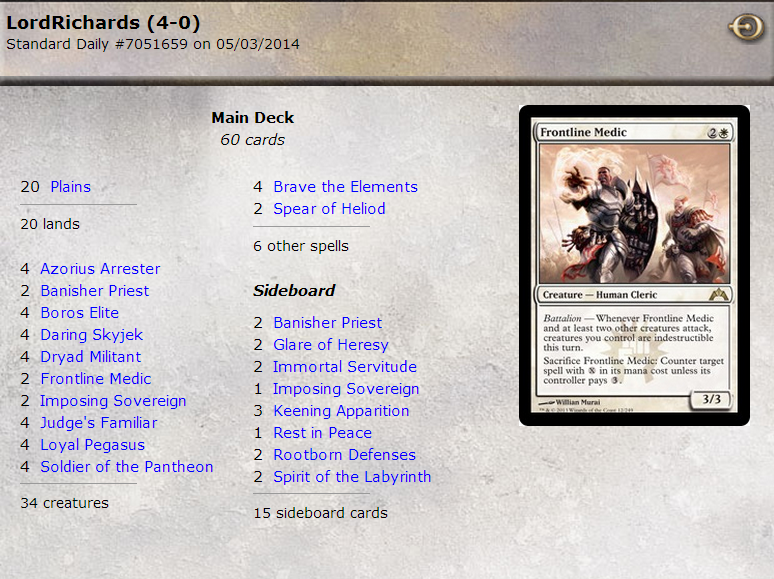
Michael Jacob, a popular streamer, tweeted about this deck earlier today. It's quick, powerful and a real player in the format (it 4-0'ed a daily here). Most of all, it's cheap.

About as cheap/good as it gets.

So if you're looking to go cheap in Standard, check this out! You can see the full post here.

Avatar photo

Corbin Hosler

Corbin Hosler is a journalist living in Norman, Oklahoma (also known as the hotbed of Magic). He started playing in Shadowmoor and chased the Pro Tour dream for a few years, culminating in a Star City Games Legacy Open finals appearance in 2011 before deciding to turn to trading and speculation full-time. He writes weekly at QuietSpeculation.com and biweekly for LegitMTG. He also cohosts Brainstorm Brewery, the only financial podcast on the net. He can best be reached @Chosler88 on Twitter.

View More By Corbin Hosler

Posted in Feature, Free, Standard6 Comments on The Cheapest Way to Win in Standard

Have you joined the Quiet Speculation Discord?

If you haven't, you're leaving value on the table! Join our community of experts, enthusiasts, entertainers, and educators and enjoy exclusive podcasts, questions asked and answered, trades, sales, and everything else Discord has to offer.

Want to create content with Quiet Speculation?

All you need to succeed is a passion for Magic: The Gathering, and the ability to write coherently. Share your knowledge of MTG and how you leverage it to win games, get value from your cards – or even turn a profit.

Insider: [MTGO] Nine Months of Portfolio Management – Introduction

Are you a Quiet Speculation member?

If not, now is a perfect time to join up! Our powerful tools, breaking-news analysis, and exclusive Discord channel will make sure you stay up to date and ahead of the curve.

Finally, this project is completed! Nine months managing a portfolio, investing in MTGO.

This week I'll begin a series of a dozen articles dedicated to this portfolio management, its results and the lessons I drew from it.

This project started in August 2013 and, back in those days, several buying opportunities were lining up: M14 mythics, Innistrad block redemption, Modern, and Ravnica block mythics and rares.

I was confident enough in the potential of these targets that I offered some of my friends the opportunity to invest in a portfolio that I would manage for them. Five of my friends were interested in the deal--good friends, current or former Magic players, aware of my interest in the MTGO economy.

The end result of this adventure was overall pretty positive, even if not all of my positions turned out as I anticipated. Some of my positions ended up in the negative, while others outperformed my ideal scenario.

Now, with nine months of history and a chance to consider the final result, many conclusions can be drawn and several lessons can be learned. What went right? What went wrong? What can be modified to make it more profitable in the future? The series of articles I'm starting today will deal with all the factors that have influenced the outcome of this project and will hopefully enhance our next MTGO investments.

The Portfolio Rules

When I proposed this investment to my friends, I specified a couple of rules and promise to be as clear and transparent as possible. Here is what was established:

  • The time frame for the investment was clearly defined. This was going to happen between August and April. At the end of April, I give them their money back. For me, this time frame was the best considering the different opportunities I anticipated. After April I wasn't sure how relevant my predictions would be, as I anticipated less activity between Spring and Summer 2014. Most of the action was supposed to take place during these nine months, August and April.
  • Every month I was going to give them an Excel spreadsheet summarizing what happened with their money and the different positions I invested in, what I bought and what I sold. This way they were able to follow their investment and my decisions were transparent. To give them an idea of the value of their portfolio every month, I was going to take the value of cards I sold (when it was the case) or an estimation of the value of the cards when they were not yet sold. As an estimate, I would use the average buy/sell price of cards from Goatbots and 90% of the Mtgotraders selling prices when cards where not available with Goatbots.
  • All the funds coming from my friends were converted to tix and then pooled together with some of my own the tix. This pool of tix constituted the Initial Investment. According to their share of the Initial Investment, each of us would own a certain percentage of the cards I would buy.
  • My plan was to invest about 95% of the Initial Investment right away in the different positions I thought were good back in August, with April in mind as the finish line. I kept about 5% in free tix ready for quick flip opportunities.
  • Finally, I proposed my friend two types of return on investment. One type of ROI had a minimum guaranty + a defined percentage of whatever I would make beyond the guarantied %. The other ROI was more of a 50%/50% opportunity in which I guaranteed to return their initial capital if things had turned bad.

Two of my friends, who also play Magic and know me, were reluctant to invest in my deal. Despite my two years experience with the MTGO market and some previous positive track records, and despite guaranties of ROI, they were not confident enough in my abilities, fearing that my previous success was more due to luck than anything else. I completely respected their decisions and offered to send them the monthly report anyway, just appease their curiosity.

This also showed me that even for relatively advanced Magic players (one of them was a recurrent PT player, two years strong), the concept of speculating/investing on MTGO (or paper cards) sounds like gambling.

That was another challenge for me, proving them that I was mastering enough the MTGO market and that luck had no place in my investing strategy.

Acquiring Tix

The first goal of this portfolio management was to acquire some tix--a large amount of tix.

I proposed my friends to hand me the cash and I was going to buy the tix for them. Two of them didn't have an MTGO account, and therefore the decision was a no-brainer for them. Alternatively, they could transfer me with some tix. In the end, three of my friends handed me cash and the two others bought their tix by themselves.

Nonetheless,  the two friends who bought their own tix bought them from online stores and got the tix at ~$0.99/tix. I was certainly able to get a better rate. I was buying tix directly at $0.95/tix or buying MTGO collections on eBay. This last option turned out very profitable. Using the process described in my previous article here, I was able to transform newly acquired collection into tix at an incredible rate.

Overall, with about $2000, I was able to buy tix at an average cost of $0.90/tix.

Considering that this project would have a beginning and an end, the price the tix were bought and sold at was going to matter a little bit. I knew I would be able to sell the tix after the nine months for about $0.95/tix. Thus, getting tix at a rate of $0.90/tix already represented a 5.5% profit, and, at the opposite end, there was a handicap for acquiring them at ~$0.99/tix.

The Primary Portfolio

The initial investment started with 5133 tix. 95% of these tix were invested in 67 different cards and constituted the Primary Portfolio. All 67 cards were bought during the first month, in August.

235 tix were kept available for quick flips and very short term investments. As I suggest in my previous articles, setting aside some liquid tix allows for the opportunity to profit from sudden spikes and hype. The goal was to use spoilers season, GP and PT results to grab few extra tix throughout these nine months.

Here are the initial 67 cards purchased back in August:

The Primary Portfolio

Here is the link to the Excel sheet, with all the quantities and prices I started with.

My initial plan was to try to invest, whenever possible, about the equivalent amount in tix in each card, and to follow the “5% rule” (no more than 250 tix invested in a single position). In practice, things went slightly different. None of my position represented more than 2% of the portfolio. Part of it was because I wanted to diversify, part of it was because buying 250 tix of a 0.5 tix junk mythic is extremely time consuming and almost impossible unless you buy at unreasonable prices.

My limit per position was pretty much defined by what I could acquire of the M14 mythics, about 100-120 tix. I was strict with this "equal amount of tix" rule for the experiment I wanted to conduct with the M14 mythics. I bought about 120 tix of all of the fifteen M14 mythics, of which the lessons I will dedicate to a future article.

As you can see in the Excel spreadsheet, the quantity invested in the other positions were quiet variable. For some cards, if it was in the 50-80 range, I only invested a couple of tix. Either I didn't have time to buy 100 tix of each card or the prices were moving out of the comfort zone I was okay to buy within. I only bought 24 copies of Reveillark and a ridiculous 6 copies of Reap Intellect. Nonethless, I recorded everything.

There was an error retrieving a chart for Reveillark

Why these cards in particular and why buying them all in August?

Based on the price history of previous years, the release of the Core set seemed to me to be one of the best opportunities to buy M14 mythics, Ravnica block cards and some MMA reprints. I was expecting to generate profit on most of my picks once April came about. I knew that not all of them would be winners, but with so many positions I expected to end up in the positive.

As you will see next week, most of these positions generated profits in the end, but a fair percentage of them were disappointing. Among these loser positions, some were my fault as I was not able to pull the trigger when the time came. Others plunged continuously during these nine months, with no events to put them under the spotlight--and I was expecting some positions to do just that.

Category by category, I will discuss and comment on these picks in articles to follow, and I look forward to exploring what could have been done differently in order to increase my ROI and cut losses.

The Secondary Portfolio

This is something I hadn't initially planned . In the beginning, my strategy was pretty straight and simple: buy in August, and sell most, if not all, of the cards between January and April according to their performance. Even though I anticipated most of my positions peak this Winter, I knew that some cards would see their price increase earlier, between September and December. This shouldn't be a problem, since the overall value of my portfolio was suppose to be higher in January-April.

However, when several cards saw their prices triple after a month or two, I had to revise my strategy and cash in the profits. A big part of this phenomenon I had not anticipated was the Standard Pro Tour being earlier in the season this year, in October. Due to that chance, Standard, particularly M14 cards, moved quicker than I thought, and not selling when one of your positions has tripled in two months seems unreasonable, especially since I knew other opportunities were just ahead.

Since I sold some of the positions from the primary portfolio earlier than January, I decided to reinvest part of these tix in a Secondary Portfolio.

As early as October I started to sell the cards that had experienced a huge rise, as well as some I was convinced had no positive outcome through April. In Fall, ISD block cards and some Modern positions were becoming pretty attractive, so I decided to reinvest 66% of the tix available from my first sales. The other 33% were kept to secure some gains.

As months passed, I kept selling cards from the primary portfolio, with 66% of the proceeds re-routed to the Secondary Portfolio, which kept growing until February when I decided to not invest anymore in the Secondary Portfolio, the finish line being too close.

Here are the 85 positions of the Secondary Portfolio:

The Secondary Portfolio

The Excel sheet is here for the details about the quantities and buying prices. With the month by month Excel sheet I'll provide next week, you'll be able to see the progression of all of these secondary positions. A vast majority of them ended up positive. Once again, Modern cards showed their speculative potential: highly predictable and a quick return on investment.

The Top 3 Losers

Without giving you more details for now (I'm saving all the numbers for next week), let me introduce you to my Top 3 Loser positions after nine months.

Interestingly, the Top 3 Losers is quiet representative of what went wrong with my portfolio during these nine months.

Varolz, the Scar-Striped is the biggest loser. I sold the copies I had acquired in August at the end of April, with a staggering 87 % loss of value. Varolz didn't do anything at all. I thought this guy had some potential and I probably overpaid on it. Along his slow decent to a junk rare status, Varolz did experience a rebound in November, when I should have gotten rid of it. I didn't, waiting for a miracle that never came.

There was an error retrieving a chart for Varolz, the Scar-Striped

Loxodon Smiter. Surprised to find such a card in the 2nd position of the Top losers? Well, the timing was good when I bought this card, but my selling timing was rather awful. I should have sold him around the release of Theros, but I kept the elephant anticipating an even better time to sell that never came. This perfectly illustrates the result of having a Standard PT at different time (in October), as compared to the previous year when it was in February.

Duskmantle Seer is the typical example that past successes and high expectations don't guaranty anything. The Vampire almost doubled a little bit before Dragon's Maze released, when he got incorporated into a few decks. Being back to a fairly stable and confortable 3.5 tix bottom for a mythic, this card seemed like a good position for the future Standard. Theros and Born of the Gods didn't bring anything to toy with the seer, so it dropped to a miserable 1 tix, when I finally sold it.

The Top 3 Winners

Now, let's take a look at my Top 3 Winners.

Number one, head and shoulders above the 2nd and the 3rd, is Knight of the Reliquary from the secondary portfolio. I had bought this lady in November due to a very low price compared to what it could offer in the Modern season, even with Deathrite Shaman around. The ban of black and green Elf gave the Knight an incredible boost. With a price that had quintupled in a matter of days, the occasion was too good to pass, so I sold my copies of knight of the Reliquary into the hype.

There was an error retrieving a chart for Knight of the Reliquary

Burning-Tree Shaman won an unexpected second place. Another great story of Modern price swings. The Shaman got a huge price boost when some copies found their way into some Modern decks and jumped from 0 to 2.5 tix. The dust settled down and the price of the Shaman settled down to 0.1 tix last Fall, a great buying opportunity. As you can see in the Excel sheet, I only bought an anemic fifteen copies. I don't remember exactly why I bought so few copies of this guy...

Chandra's Phoenix is a great example of what happens when a previous powerhouse is being reprinted: its price starts really low before people realizes that 1) the card is actually still really good and is going to be played and 2) its price is ridiculously low for what it should be. Considering that mono red is always a deck at some point, and that the M12 Phoenix toped out at 5 tix when is was Standard legal, I saw here a great opportunity in the very alluring 0.4 tix buying price.

These are the Top 3 "percenters" and not the Top 3 "gainers". It underlines the fact that it is important to try do dedicate the same amount of tix for each of your positions whenever possible, which I didn't really do here for Burning-Tree Shaman and Knight of the Reliquary. You never know which one of your position is going to explode. A loser position can only let you down by 100% of its value at most. On the contrary, a winner has virtually no limits, and you never know which card is going to be affected by an extra 400% boost.

The Top 3 Tix Makers

When looking at the "real" winners, the positions which significantly contributed to grow my bankroll, the order is slightly different. Generating a 400% profit on a pile of junk rares you bought for 5 tix is nice, but it becomes almost useless when your bankroll is several thousands tix big. Here are the positions that truly generated tix and really helped to grow this portfolio. Here are my Top 3 tix makers after nine months.

1) Chandra, Pyromaster. This Planeswalker finished with a generous +285.6% and generated me more than 330 tix in profits. I sold it after the PT Theros when, to me, the card didn't deliver all its promises. The "Red Jace" never recovered from its highest in October. Definitely the best move of this portfolio.

There was an error retrieving a chart for Chandra, Pyromaster

2) Mutavault. +193.6%. We knew back August that this man-land had some potential. The first tournament results with Theros revealed a rather mono-colored oriented metagame where all decks, including UW control decks, were playing several copies of Mutavault. This land kept rising and actually became the most valuable card in M14, establishing a record high for a non-mythic card in the mythic era. I sold my copies maybe a little bit too early, but it was hard to imagine it could reach 30 tix!

There was an error retrieving a chart for Mutavault

3) Chandra's Phoenix. If I had bought more copies of this bird, it would have been the top gainer, but, as I will discuss in future articles, it's not an easy task to buy AND sell more than 100 copies of a card if you don't want to sacrifice your profit.

There was an error retrieving a chart for Chandra's Phoenix

What's Next?

Here is an overview of the topics generated from this experience I'm going to explore in the coming weeks.

  • The article next week will provide and discuss the raw data from this portfolio management. This will help to have a better overall understanding of what happened to the tix I invested in these 150 positions.
  • The M14 mythics. If you have looked at the Excel spread sheet, you have noticed that I bought an almost equal quantity of all the 15 mythics. Are the mythics an investment you can't lose? Betting on all the fifteen M14 mythics at the same time was a way to experiment with this idea. How did it go for me? Answer pretty soon.
  • I'll talk about Moderns positions, the never-ending winners.
  • Opportunity cost. Retrospectively, this appeared to me as incredibly true and should really be a part of your reasoning when you buy, sell or decide to hold a position. Why did I hold on cards like Varolz, the Scar-Striped when Modern opportunities were all over the place?
  • Standard sets during their second year--are they really worthwhile your time and your tix?
  • Rotating out of Standard sets. Betting on cards that have Modern or Legacy applications can be very profitable. Enjoy the sale in October and ride the wave!

Thank you for reading! See you next week for a lot of graphs, curves and numbers.

Sylvain Lehoux

Naya Hexproof in Standard

Are you a Quiet Speculation member?

If not, now is a perfect time to join up! Our powerful tools, breaking-news analysis, and exclusive Discord channel will make sure you stay up to date and ahead of the curve.

Hexproof is getting a lot of buzz right now. With new threats, better mana thanks to Mana Confluence and a shift from monochromatic lists, it's a good time to give Hexproof another look. Anything to avoid Standard getting stale.

Here is a list from Brian DeMars on Star City

Creatures (18)

4 Bassara Tower Archer
2 Ghor-Clan Rampager
4 Gladecover Scout
4 Voice of Resurgence
4 Witchstalker
Lands (22)

4 Mana Confluence
4 Sacred Foundry
2 Selesnya Guildgate
4 Stomping Ground
4 Temple Garden
4 Temple of Plenty

Spells (20)

2 Banishing Light
1 Chained to the Rocks
4 Ethereal Armor
2 Gift of Orzhova
4 Madcap Skills
4 Unflinching Courage
3 Boros Charm
Sideboard

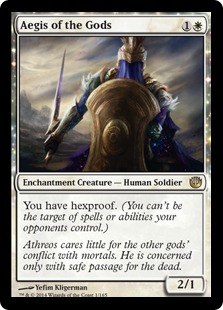
3 Aegis of the Gods
3 Boon Satyr
3 Ajani's Presence
3 Electrickery
3 Wear

New from Journey into Nyx is Mana Confluence which is sure to fix a lot of mana bases moving forward. While it seems crazy to think it could maintain $20, I am getting anecdotal reports that while this card is not mythic, no one is opening them. I experienced something similar with Cavern of Souls so it's possible we see a slightly similar price trajectory, although Cavern was good outside of Standard and I'm not convinced Confluence is to a similar extent.

Also new is a card DeMars wishes he'd run in Cinci - Aegis of the Gods which protects your hand from getting shredded. Brain Maggot is both gross and popular in black decks, and we have to deal with Lifebane Zombie for a bit longer.


All in all, I like the list and I'd run it at any FNM.

Insider Video: Zwischenzug Plays Domri Obliterator Jund

Are you a Quiet Speculation member?

If not, now is a perfect time to join up! Our powerful tools, breaking-news analysis, and exclusive Discord channel will make sure you stay up to date and ahead of the curve.

The Deck, and How To Play It

Domri Obliterator Jund

Creatures

4 Dark Confidant
4 Tarmogoyf
4 Scavenging Ooze
4 Courser of Kruphix
4 Phyrexian Obliterator

Other

2 Inquisition of Kozilek
3 Thoughtseize
4 Lightning Bolt
3 Abrupt Decay
1 Maelstrom Pulse
3 Domri Rade

Lands

4 Blackcleave Cliffs
4 Raging Ravine
4 Twilight Mire
4 Verdant Catacombs
1 Marsh Flats
2 Overgrown Tomb
1 Blood Crypt
2 Swamp
1 Forest
1 Urborg, Tomb of Yawgmoth

Sideboard

2 Grafdigger's Cage
1 Thoughtseize
1 Ancient Grudge
1 Slaughter Pact
3 Drown in Sorrow
4 Fulminator Mage
1 Shatterstorm
1 Obstinate Baloth
1 Batterskull


Match 1

There was an error retrieving a chart for Domri Rade

Match 2

There was an error retrieving a chart for Courser of Kruphix

Match 3

There was an error retrieving a chart for Abrupt Decay

Match 4

There was an error retrieving a chart for Drown in Sorrow

Insider: Important Observations from SCG Cincinnati

Are you a Quiet Speculation member?

If not, now is a perfect time to join up! Our powerful tools, breaking-news analysis, and exclusive Discord channel will make sure you stay up to date and ahead of the curve.

It’s a rare occasion when I have the opportunity to attend a large MTG event these days. Family obligations and a full-time job tend to absorb the vast majority of my time, and rightfully so. That being said, I still maintain a passion for this game. Any time a large event is held within thirty miles of my home, I always make an effort to attend for at least a few hours to trade and network. The information gained at such events often justifies the trip.

This past weekend the event I managed to attend was the Star City Games Cincinnati Open. It’s quite convenient that the “Cincinnati” open is actually about fourteen miles north of the city and therefore about ten miles from my house. Even I can make such a short trek to have an opportunity to trade with dozens of grinders and sharks alike.

Taking a Step Back – Preparation

This was only my second time at a Star City Games Open. I’ve never prioritized these events in the past, and so I was a little unfamiliar with the financial landscape of this event. Surprisingly enough there are some significant differences between these Opens and Grand Prix, of which I’m more used to attending.

At Grand Prix there are often upwards of 2,000 attendees along with over a dozen vendors. If you don’t like a dealer’s buy price, you can politely decline and move to the next. It’s also much easier to negotiate with vendors and players – the phrase “So-and-so dealer is buying/selling this card at XYZ dollars, so we need to value it at such-and-such price”.

My advanced research usually consists of identifying which vendors are paying most for buy lists and which cards recently spiked so I can try and find them at older prices. This is very much in-line with my daily research of MTG Finance, so the transition is easy.

Negotiation takes a much different shape at SCG Opens for one obvious reason: they are the only vendor there!

Because of this different dynamic, the research one should do beforehand can also differ significantly. Instead of leveraging dealer prices on the floor for trades, nearly everyone was valuing cards at SCG’s prices. Unfortunately, I was ill-prepared in this regard. As an eBay buyer/seller, I’m admittedly unfamiliar with SCG’s retail pricing.

My lack of knowledge beforehand took me off of any trading advantage. If I had planned better, I would have done my homework the week leading up to the event. Normally I love trading at SCG’s prices because it enables me to trade hyped cards at full retail for less-popular, but still valuable, cards at a discount.

Additionally, trading small cards into one large card is very favorable because SCG has a lot of random $1 - $3 cards which elsewhere wouldn’t sell on TCG Player for a worthwhile amount. It’s almost like rounding up on all your cheap cards.

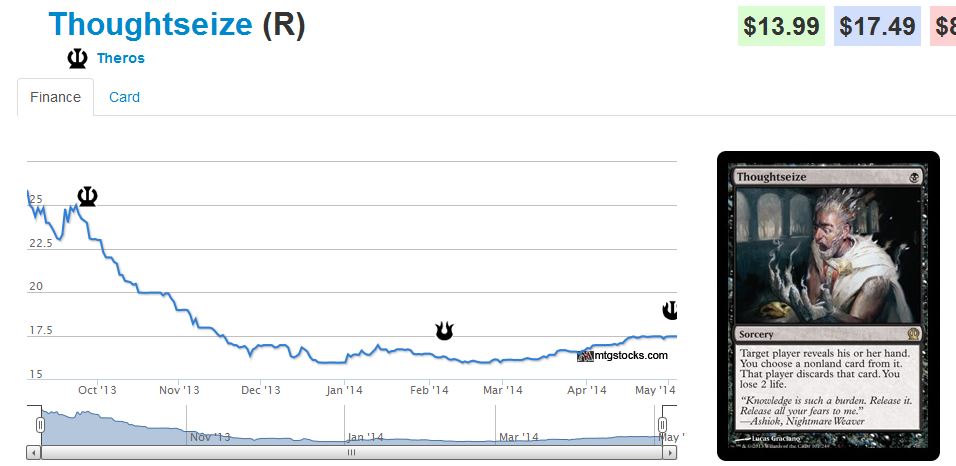
Without knowledge of which cards have the smallest spread between eBay pricing and SCG pricing, I was left with only my instincts. Normally those work well because I at least know what’s hot and what’s not. But when I have to acquire Theros Thoughtseizes at $20 in trade, I struggle to identify whether or not it’s worth my while. I know this card will rise in price going forward, but giving such a premium on a $14 card (in my mind) is a tough pill to swallow.

There was an error retrieving a chart for Thoughtseize

Thoughtseize

Transitioning Into Observations

I did decide to pick up a couple Thoughtseizes despite the premium I had to cough up on them. While they currently retail for $20, I wouldn’t be surprised if they sold for $20 cash come this summer. In a similar vein, I was not dissatisfied in valuing Swan Song at $1.50 and foils at $10 because I am also a believer in their growth long term.

What I really wanted to pick up last weekend, however, were various Temples from across Theros block. Temple of Epiphany is an especially great pick-up in trade because it retails for $5.99 yet sells all day at $5 – a small premium to pay! In fact, TCG Mid on the U/R Temple is $5.93, so you’re essentially giving less than 2% in premium when valuing the card at SCG’s prices.

There was an error retrieving a chart for Temple of Epiphany

Compare this to TCG Mid of Thoughtseize, which at $17.49 vs. SCG’s $20 price tag means a nearly 15% premium must be sacrificed in trade.

Unfortunately for me, everyone was on the Temples plan. I mean everyone. I really should have taken those out of my trade binder as I acquired them because as soon as I’d pick a Temple of Epiphany, someone's attention would be gouth. Throughout the day I had at most three or four of these in my binder.

But somehow at the end of the day, all the U/R Temples were gone – traded away. One person was willing to mark down his smaller cards significantly to obtain one. Another person had a set foil Jaya Ballard, Task Mage (I couldn’t pass that up). Next thing I knew, the U/R Temples were all gone.

It comes as no surprise that the U/R Temple, newly printed in Journey Into Nyx, was one of the hottest Rares in the room. So few copies have been opened so far and people are just now starting to get their hands on them. Hype should settle down in the coming weeks as more and more are opened.

I must emphasize however, the short duration for which the two Temples in Journey Into Nyx will be opened. As part of a Large/Small/Small Block format, the U/R and B/G Temples will be opened in much smaller quantity relative to those in Theros. As a result the window to acquire these as a Standard rotation play is small. Plan accordingly.

Other Temples were popular as well, and I had no qualms giving others full retail on their copies (besides Temple of Enlightenment). Swan Songs were also an easy pick-up for me and I love the two foils I grabbed at $10. Keep in mind, all these prices are retail and the cards I gave up were also valued at retail. I’m sure I didn’t gain maximum value, but I did my best to acquire cards I felt would continue to rise in price – this knowledge was my only ammunition when dealing with the Sharks.

Big Ticket Items

Besides Temples, the only other noteworthy cards that got much attention were the “pimp” Staples. Textless Lightning Bolts, Promo Cryptic Commands, and Foil Gaea's Cradles all changed hands multiple times last weekend.

Not surprisingly, foil Legacy staples from newer sets were also hot. Most of my trade partners expressed interest in my foil Abrupt Decays and foil Liliana of the Veil. These are very popular right now, and players are realizing their prices will only rise unless they are reprinted.

Speaking of reprint risk – this disclaimer needs to be on many Modern staples nowadays. While this risk ranges from “definitely will be reprinted someday” (Fetch Lands) to “Unlikely in the near term but not impossible” (Liliana of the Veil), I am so risk averse when it comes to dealing in cardboard that I am inclined to shy away from holding these valuable cards for too long.

Don’t get me wrong – acquiring these now for a quick flip come Modern season seems strong. But I tend to like a portfolio where I can sit on cards for some time. This should be well-reflected by my investments in Booster Boxes, graded Alpha Rares, and RtR Block Shock Lands. And now I have a new member of the long-term hold family:

Bazaar

Last weekend I traded away my Foil Liliana of the Veil along with a couple other Foil Modern staples for the Reserved-List, Vintage-Staple, and EDH-legal Bazaar of Baghdad. Which pile will rise more quickly in the short term? Probably the Foils. Which one is virtually guaranteed to rise and can never be reprinted? Bazaar.

The trade was a significant one for me, but it’s 100% in line with my general investment strategy and I was glad to take it. Converting gains from popular foil investments into a Reserved List Vintage staple is exactly what I was hoping for. I hope to repeat this process again in the future.

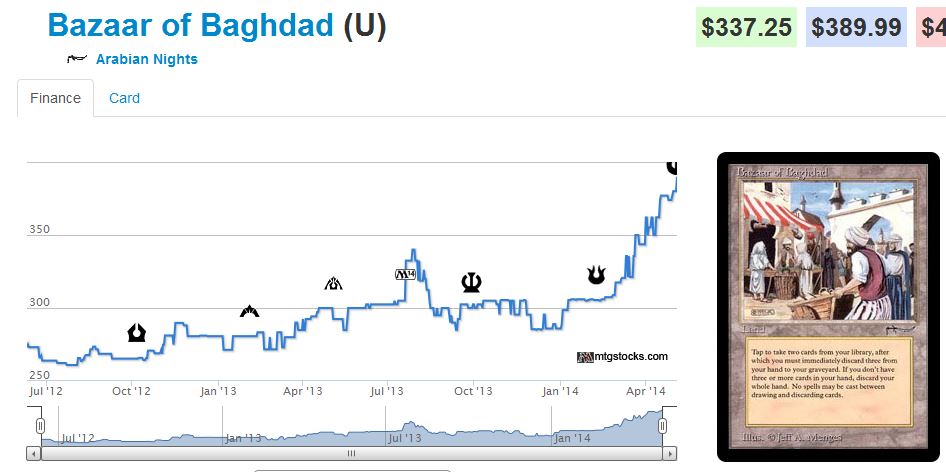
One last thought – isn’t it interesting how rapidly Bazaar of Baghdad has risen so far in 2014? Many Vintage staples have followed a similar trend, and I have developed two theories that explain the recent movement.

  • Theory 1: Upcoming Vintage Masters and the Bazaar of Moxen tournament spiked interest in the format.
  • Theory 2: The recent spike in Legacy prices is enabling players to trade into Vintage. I read on Twitter that the number of Vintage players in the Bazaar of Moxen tournament increased from 152 players last year to 214 players this year.

I sense a whole separate article coming out of the chart above. These theories require further elaboration, but those will have to wait for another article.

…

Sigbits

  • I wasn’t kidding about Vintage spiking. Bazaar of Baghdad is sold out at SCG with a $399.99 price tag. When they inevitably relist more copies, I expect something closer to $449.99 or even $499.99 for NM.
  • Foil Abrupt Decay is also on the rise. It’s sold out at SCG at $69.99 and there aren’t many copies on TCG Player below that price. I see an $80 value come this summer.
  • Another card that’s been on the move is Karakas. I see this showing up on mtgstocks.com’s Interests page now and again. English copies are retailing at $179.99 now, and SCG currently has no NM copies in stock. They do have a few SP/MP copies and some Italian copies, but NM English versions should demand a healthy premium in trades.

Required Reading for Beginners

Are you a Quiet Speculation member?

If not, now is a perfect time to join up! Our powerful tools, breaking-news analysis, and exclusive Discord channel will make sure you stay up to date and ahead of the curve.

We were all new once.

Some of us more recently than others. For instance, I got started back in Shadowmoor. While that may sound like olden times to some of you, to others it will be the new days since you've been playing since cards had white borders and all that.

The point is, we've all been there. And we've all needed a few places to start as we moved from the kitchen table to the competitive scene, even if that scene is just the LGS for Friday Night Magic. And there's definitely a lot of great content to get you started. Magic is a game full of writers and full of great articles to get you going.

Of course, finding that information when you're new isn't exactly easy, since it's spread out across a ton of sites and years.

Reddit user /u/basic_forest has you covered. He's assembled a great list of required reading, from "Who's the Beatdown" to newer articles to get you going.

Seriously, this is an impressive list. Don't believe me? Check it out for yourself.

Avatar photo

Corbin Hosler

Corbin Hosler is a journalist living in Norman, Oklahoma (also known as the hotbed of Magic). He started playing in Shadowmoor and chased the Pro Tour dream for a few years, culminating in a Star City Games Legacy Open finals appearance in 2011 before deciding to turn to trading and speculation full-time. He writes weekly at QuietSpeculation.com and biweekly for LegitMTG. He also cohosts Brainstorm Brewery, the only financial podcast on the net. He can best be reached @Chosler88 on Twitter.

View More By Corbin Hosler

Posted in Casual, Feature, FreeLeave a Comment on Required Reading for Beginners

Have you joined the Quiet Speculation Discord?

If you haven't, you're leaving value on the table! Join our community of experts, enthusiasts, entertainers, and educators and enjoy exclusive podcasts, questions asked and answered, trades, sales, and everything else Discord has to offer.

Want to create content with Quiet Speculation?

All you need to succeed is a passion for Magic: The Gathering, and the ability to write coherently. Share your knowledge of MTG and how you leverage it to win games, get value from your cards – or even turn a profit.

More Junk on the Free Side

Are you a Quiet Speculation member?

If not, now is a perfect time to join up! Our powerful tools, breaking-news analysis, and exclusive Discord channel will make sure you stay up to date and ahead of the curve.

I like Jeff Hoogland.

Jeff is a good friend of the Brainstorm Brewery brand and contributed to the site when we first started out. He's been a guest on the podcast and no matter how he's getting the word out, the word is "Brew".

Whether it's the RUG flash deck he popularized a year ago in Standard, the various Knight of the Reliquary decks he plays to great effect in Legacy or his determination to break Delver of Secrets in Modern, Jeff is always brewing.

Those of us who watched the Star City Open this weekend noticed he managed to finish fourth with a new brew.

Creatures (17)

2 Archangel of Thune
2 Blood Baron of Vizkopa
1 Lifebane Zombie
3 Scavenging Ooze
4 Sylvan Caryatid
4 Courser of Kruphix
1 Obzedat, Ghost Council

Planeswalkers (3)

2 Ajani, Mentor of Heroes
1 Elspeth, Sun's Champion

Lands (25)

2 Forest
1 Swamp
3 Godless Shrine
1 Mana Confluence
4 Overgrown Tomb
3 Temple Garden
3 Temple of Malady
4 Temple of Plenty
4 Temple of Silence

Spells (15)

2 Banishing Light
2Underworld Connections
3 Abrupt Decay
4 Advent of the Wurm
4 Hero's Downfall

Sideboard

2 Lifebane Zombie
2 Sin Collector
1 Underworld Connections
2 Bile Blight
2 Golgari Charm
2 Putrefy
1 Obzedat, Ghost Council
1 Erebos, God of the Dead
2 Thoughtseize

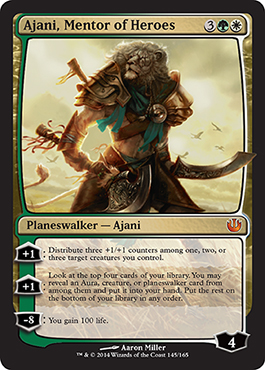
A lot of people are talking about Ajani, Mentor of Heros following Jeff's strong showing. Is there financial opportunity here?

I will point out that when Theros was spoiled, a deck running Ashiok. Nightmare Weaver managed to finish Top 8 of an Open. The card shot from $15 to $25 on SCG. I managed to get some for $12 and while I sold a few for around $18 on TCG Player, the rest I outed for about what I paid. I made some money on some of the copies, but the price plummeted too quickly for the spec to really pan out, and the opportunity cost of having so much tied up was a real issue. I was very, very lucky to make any money at all as reality quickly caught up with the weaver of nightmares and soon he became a nightmare for speculators.

If you think Ajani may be in the same boat, I would stay away. If you have them, sell into the hype. If you have Advent of the Wurm this may be your last chance to cut your losses. I think this deck's success is about 80% pilot, 10% unprepared metagame and 5% favorable matchups. That means I put the odds that Ajani will maintain its current value at about 5%.

Zac Hill was on Brainstorm Brewery for the set review this week and if you don't want to listen to the entire episode, the tl;dr is that Moldervine Cloak was played in its day and Ajani's +1 is worth 3 mana minimum. Irrespective of how "win more" his ultimate is, if you have targets, Ajani's +1 is very good. I don't like his middle ability very much, but it worked out in Jeff's deck. Mana Confluence and Temple of Malady may be all decks like this needed to grow the beard, but I personally remember my Ashiok venture too acutely to try and spec on Ajani now. The card could be good, but with supply low, hype from a good finish and pre-sale priced of planeswalkers being out of control, I'd say this is a poor time to buy.

Conspiracy Theories

Are you a Quiet Speculation member?

If not, now is a perfect time to join up! Our powerful tools, breaking-news analysis, and exclusive Discord channel will make sure you stay up to date and ahead of the curve.

I like Kenji Egashira. He streams on MODO with the username NumotTheNummy and he recently played Magic events on MODO every day for a whole year. I watched quite a bit, and Brainstorm Brewery sponsored his 365 days of Magic because we love that he is entertaining us as a full-time job. Despite ending his 365 day project, he's still at it.

Kenji's catch phrase whenever anything goes wrong is "Blame Worth", referring to Worth Wollpert who is Magic Online's official whipping boy. Worth occasionally watches Kenji's stream and this weekend, some magic happened. Worth typed the following code into the chat window.

Immediately, Reddit was on the case. Within minutes, a thread was up and Reddit detectives go to work cracking the code.


Untitled

Simple ciphers weren't doing the trick.

Was this indeed a Conspiracy spoiler? The Original Poster was credulous.

aaa

After hours of fruitless plugging away at cracking the code Worth planted, the secret was revealed.

Untitled


Conspiracy - where the lands and the hats are foil.

Avatar photo

Jason Alt

Jason Alt is a value trader and writer. He is Quiet Speculation's self-appointed web content archivist and co-captain of the interdepartmental dodgeball team. He enjoys craft microbrews and doing things ironically. You may have seen him at magic events; he wears black t-shirts and has a beard and a backpack so he's pretty easy to spot. You can hear him as co-host on the Brainstorm Brewery podcast or catch his articles on Gatheringmagic.com. He is also the Community Manager at BrainstormBrewery.com and writes the odd article there, too. Follow him on Twitter @JasonEAlt unless you don't like having your mind blown.

View More By Jason Alt

Posted in Free9 Comments on Conspiracy Theories

Have you joined the Quiet Speculation Discord?

If you haven't, you're leaving value on the table! Join our community of experts, enthusiasts, entertainers, and educators and enjoy exclusive podcasts, questions asked and answered, trades, sales, and everything else Discord has to offer.

Want to create content with Quiet Speculation?

All you need to succeed is a passion for Magic: The Gathering, and the ability to write coherently. Share your knowledge of MTG and how you leverage it to win games, get value from your cards – or even turn a profit.

New Card Frame Enters Circulation

Are you a Quiet Speculation member?

If not, now is a perfect time to join up! Our powerful tools, breaking-news analysis, and exclusive Discord channel will make sure you stay up to date and ahead of the curve.

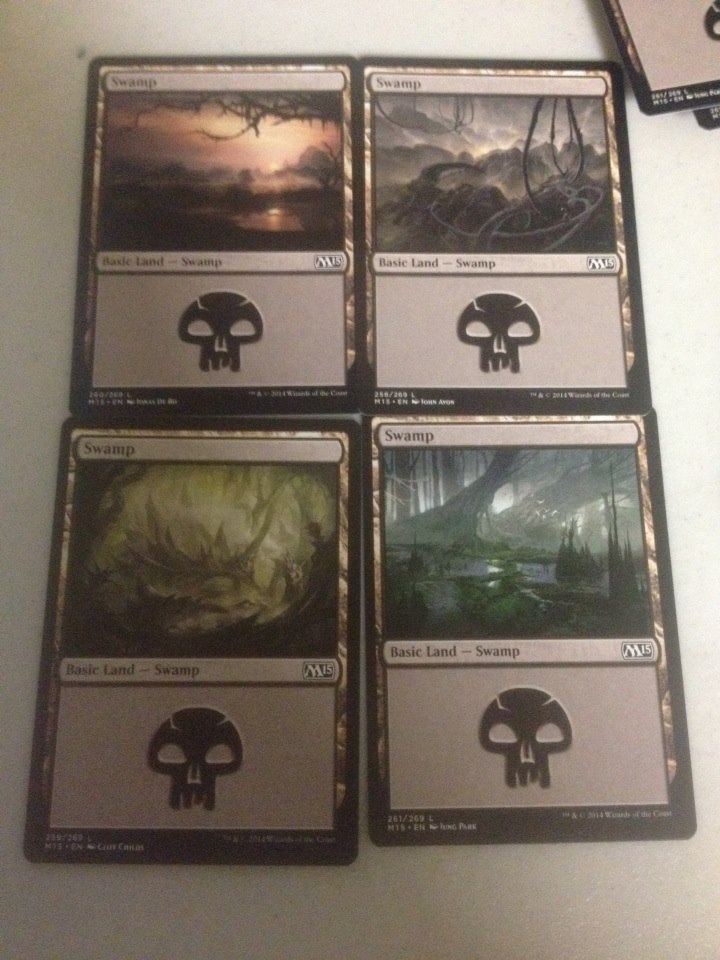
Journey into Nyx had more than new cards for us. Some old ones had a new twist as well.

Look at the bottom, and you can see the new template for card frames.

Pretty cool, right? Granted, these don't look as dramatic as it does on the rest of the cards we'll see in M15 going forward.

Pretty different, I know. But also pretty cool.

It's not the first time card frames have changed, and I'm sure it won't be the last. And, despite the doom and gloom some people paraded around when this was announced, I can attest that precisely zero people were upset about the new lands at my prerelease.


Avatar photo

Corbin Hosler

Corbin Hosler is a journalist living in Norman, Oklahoma (also known as the hotbed of Magic). He started playing in Shadowmoor and chased the Pro Tour dream for a few years, culminating in a Star City Games Legacy Open finals appearance in 2011 before deciding to turn to trading and speculation full-time. He writes weekly at QuietSpeculation.com and biweekly for LegitMTG. He also cohosts Brainstorm Brewery, the only financial podcast on the net. He can best be reached @Chosler88 on Twitter.

View More By Corbin Hosler

Posted in Casual, Feature, Free7 Comments on New Card Frame Enters Circulation

Have you joined the Quiet Speculation Discord?

If you haven't, you're leaving value on the table! Join our community of experts, enthusiasts, entertainers, and educators and enjoy exclusive podcasts, questions asked and answered, trades, sales, and everything else Discord has to offer.

Want to create content with Quiet Speculation?

All you need to succeed is a passion for Magic: The Gathering, and the ability to write coherently. Share your knowledge of MTG and how you leverage it to win games, get value from your cards – or even turn a profit.

The Magic Man Cave

Are you a Quiet Speculation member?

If not, now is a perfect time to join up! Our powerful tools, breaking-news analysis, and exclusive Discord channel will make sure you stay up to date and ahead of the curve.

As a homeowner, I feel lucky to have the basement entirely to myself. I ceded the entire upstairs to my wife and in exchange I've made the basement mine. Our built-in shelving holds my cards. The office is my war room- I write articles and ship orders from in here. The card table is just that - it's covered in cards. I make the Magic happen down here.

If I had kids, I imagine that claiming the basement as mine wouldn't fly. Some Magic parents have run into issues of having space to claim as their own. One Magic Dad decided to repurpose his shed and turn it into a gaming pad. Very cool.


Redditor /u/sponge133 is the architect of this awesome project. Check out the reddit post at this link to reddit or just browse the album on imgur.

Very cool! Anyone else do a Magic DIY project like this? Send me some pix!

Avatar photo

Jason Alt

Jason Alt is a value trader and writer. He is Quiet Speculation's self-appointed web content archivist and co-captain of the interdepartmental dodgeball team. He enjoys craft microbrews and doing things ironically. You may have seen him at magic events; he wears black t-shirts and has a beard and a backpack so he's pretty easy to spot. You can hear him as co-host on the Brainstorm Brewery podcast or catch his articles on Gatheringmagic.com. He is also the Community Manager at BrainstormBrewery.com and writes the odd article there, too. Follow him on Twitter @JasonEAlt unless you don't like having your mind blown.

View More By Jason Alt

Posted in Free1 Comment on The Magic Man Cave

Have you joined the Quiet Speculation Discord?

If you haven't, you're leaving value on the table! Join our community of experts, enthusiasts, entertainers, and educators and enjoy exclusive podcasts, questions asked and answered, trades, sales, and everything else Discord has to offer.

Want to create content with Quiet Speculation?

All you need to succeed is a passion for Magic: The Gathering, and the ability to write coherently. Share your knowledge of MTG and how you leverage it to win games, get value from your cards – or even turn a profit.

Insider: Layers

Are you a Quiet Speculation member?

If not, now is a perfect time to join up! Our powerful tools, breaking-news analysis, and exclusive Discord channel will make sure you stay up to date and ahead of the curve.

Ah! The big reveal. Weeks of talk, teasing, spoiling and finally getting our dirty little mitts on Journey Into Nyx has finally paid off. I must admit, I've found this week a particular challenge. Not that there isn't anything important to talk about, but most of it has already been covered by someone else. Therein lies the crux of the matter.

My only responsibility to you, the reader, is to bring insightful, concise, useful information. I could just reiterate what you've already heard a thousand times over, but this does nothing for the both of us, though, doesn't it? You want to trust that week in and week out you should listen to the pieces I publish on this site. Frankly, I want you to trust that, too!

I write for Quiet Speculation not to hear my own voice. If I wanted to do that, I'm sure the local psyche ward would be entertained daily with my renditions of "I Feel Pretty." Remember Murdoch in A-Team? Oh, I could go full crazy if you want me to. Frankly though, I like my clarity. Otherwise, ya, I could see myself knocking on the door of my local "I Love Myself!" Hospital.

download

Seems like a great place to visit during the summer.

Pay No Attention to That Man Behind the Curtain

In reality though, I feel Wizards has become a savant in a way. What if the Magic: The Gathering movie was just all about their Enigma Code? It's just so very hard to crack their vision of what a brand new format should be. It has been clear for years, their eyes are clearly on Standard. Now, with the shift in New World Order, it has become "how does this fit in Standard, and can it fit into Modern or Legacy?"

Fortunately those are easier to spot, but the Commander all-stars come from all angles. Commander pieces are carrying such a dramatic amount of the finance scene that it is one of the few things that I will absolutely label absurd. Most of my sales, day in and day out, are Commander staples. Hands down.

When it comes to fitting together the next piece of a Standard metagame, I've always found it hard to build from scratch. Once the metagame has really shaken itself up once or twice and the problems that rise to the forefront of most peoples minds--that is where I excel.

Guessing what the first thing other people want to try is, I just don't know how to do it. I have absolutely come to the conclusion that I just do not think like most people. Fortunately, this means I'm usually a few steps ahead.

For instance:

In the Modern universe right now - keep an eye on this card:

There was an error retrieving a chart for Loxodon Smiter

Want to solve  all your problems in Modern? Look no further.

Seriously.

This card is a problem the format just does not know how to handle right now. The most efficient answer is obviously Path to Exile. Looking away from Path to Exile, though--I challenge you the reader to give me one commonly played card that deals with this creature one for one (outside of plain removal.) Just about every interaction is a two-for-one or a large amount of mana, once this guy hits the board. Liliana of the Veil is a situational one-for-one, and when she is in the mix Loxodon Smiter's role changes dramatically.

There was an error retrieving a chart for Lightning Bolt
There was an error retrieving a chart for Lightning Helix

There was an error retrieving a chart for Loxodon Smiter

Modern is currently defined by damage, be it attacking or dealing it through spells. Newly minted fellow Quiet Speculation writer Adam Yurchick talked this week in depth about Mark of Asylum.

There was an error retrieving a chart for Mark of Asylum

He made a good point bringing this up:

"In a nutshell, the text of this card reads “creatures you control have protection from burn spells.” Burn is the most commonly played form of creature removal in the Modern format, and, without it, many decks are simply defenseless against creatures. In a world where the best targeted removal spell is Lightning Bolt and the best sweeper is Anger of the Gods, it’s clear why a card like Mark of Asylum has a lot of utility."

I fully agree with his assessment. Even in Storm, one of the backup plans is to sweep the board with a Grapeshot before it proceeds to go off, or to power through an Empty the Warrens for the win. What should be next season's Modern Tier 1 Champion, UWR, relies on Bolts and Helixes to constantly clear a path to victory. Zoo, Jund, Tempo Twin--even Affinity occasionally uses Whipflare.

If it's not Path to Exile, it's a plethora of burn spells looking to do the heavy lifting. So if that's the case--how close are you watching Path to Exile?

There was an error retrieving a chart for Path to Exile

Loxodon Smiter also manages to do a great job of making counterspells just look silly. Got two mana up on turn three? Remand? Mana Leak? I scoff at thee! Nice Cryptic Command. All of these are current Modern all-stars. Yet, Abrupt Decay still sees play primarily for this wonderful reason. Is it truly better than Maelstrom Pulse? That's hard to quantify. For what Abrupt Decay does, in Modern, it does a lot of heavy lifting. Although, my money is still on Terminate at this moment.

With that being said, I will reveal my current build for Modern. Modern has been my love and my baby for a long time. It qualified me for Pro Tour Avacyn Restored in Barcelona. As well as brought in many boxes from Win-A-Boxes and store credit during weekly tournaments.

I am not looking forward to the days Modern tournaments are hard, and this season's tournaments I am predicting will be a massive turn around from the days of ole' Extended. Those of us that have played for a long time will finally have the format Wizards promised years ago.

Modern Ajundi

Modern Jund/Junk

Creatures

4 Tarmogoyf
4 Dark Confidant
4 Loxodon Smiter
2 Scavenging Ooze
2 Kitchen Finks

Sorceries

3 Inquisition of Kozilek
3 Thoughtseize
1 Anger of the Gods

Instants

1 Abrupt Decay
2 Terminate
4 Lightning Bolt

Planeswalkers

3 Lilliana of the Veil
2 Ajani Vengeant

Lands

4 Marsh Flat
3 Verdant Catacombs
1 Swamp
1 Forest
1 Plains
4 Blackcleave Cliffs
4 Raging Ravine
1 Temple Garden
1 Godless Shrine
1 Sacred Foundry
1 Overgrown Tomb
1 Blood Crypt
1 Stomping Ground
1 Twilight Mire

Sideboard

1 Kitchen Finks
1 Anger of the Gods
2 Rest in Peace
2 Torpor Orb
1 Terminate
1 Grafdigger's Cage
1 Maelstrom Pulse
2 Fulminator Mage
3 Stony Silence
1 Obstinate Baloth

If there's enough interest, I'll follow this week's article with a breakdown of how this new version has adapted to the void Deathrite Shaman left. I didn't believe it at first, but Loxodon Smiter does all the things that Deathrite Shaman did for the deck, while actually making it more capable of applying early pressure. It's a vast improvement.

After All Is Said and Done

I have gone over all of these things to bring to the front one thought--these are just some of the the ways I think about solving formats. This mode of thinking is important in understanding what the next trend will be.

It's not always about figuring out what you believe should be the first thing played, but where the natural progression of things will go once things have solidified. All cards come in, settle as everyone holds their breath, and then explode as popularity drives supply and demand increases its cost. Figuring out what everyone else thinks will be popular is the key.

A card does not simply go up or down in price based on its power level alone. You have to understand why a card is played. When all things are equal, no one starts at the same square one. But what if there's a specific problem that has been introduced?

Once people start looking for answers, Wizards has this tendency of knowing what you are going to look for. They design sets based on certain points of view, and let things shake out from there. Occasionally, they will have to respond after the fact. Call it an emergency card design. It's only when we do something as a collective that Wizards wasn't planning on.

I have to admit though, the ladies and gentlemen at Wizards R&D get a little nod from me. The level of planning and depth they put into set design really is impressive. I am just really now starting to grasp how deep it goes and all the view points they encourage. There's multiple layers to focus on. Hopefully, this will help you to start to envision what those levels could be.

-Till Next Time

Top Five Journey Into Nyx Cards that will see fluctuations before June 1st:

There was an error retrieving a chart for Eidolon of the Great Revel
 
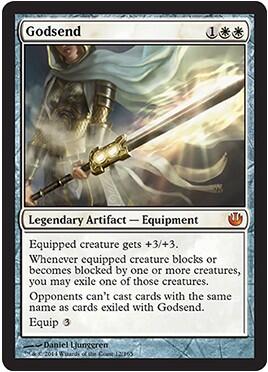
There was an error retrieving a chart for Godsend
There was an error retrieving a chart for Ajani, Mentor of Heroes
There was an error retrieving a chart for Deicide
There was an error retrieving a chart for Prophetic Flamespeaker

Insider: Rising Standard Sideboard Stock

Are you a Quiet Speculation member?

If not, now is a perfect time to join up! Our powerful tools, breaking-news analysis, and exclusive Discord channel will make sure you stay up to date and ahead of the curve.

Every new set has an impact on Standard, and Journey Into Nyx is no exception. Being the third set of a block, people have high expectations for powerful and exciting new cards. Journey Into Nyx certainly has those elements, complete with Gods and Planeswalkers, but I believe its biggest single impact on Standard will be the nonbasic lands.

There was an error retrieving a chart for Temple of Malady
There was an error retrieving a chart for Temple of Epiphany

With the printing of Temple of Malady and Temple of Epiphany, now all colors are created equal in their access to mana, and this helps redistribute the Standard metagame by boosting Golgari and Izzet. The tri-color shard decks like Jund, Junk and UWR are boosted. All of the devotion decks can now splash equally, including Black Devotion splashing green and Blue Devotion splashing red.

There was an error retrieving a chart for Mana Confluence

Mana Confluence pushes the mana envelop to the extreme, super-charging the colored mana in the format and giving every deck the opportunity to play whatever it wants. It’s the single biggest change to the format. Return to Ravnica block gave Standard all sorts of powerful gold cards, but not necessarily the mana to cast them all.

Mana Confluence is a real boon to aggressive decks, which can ignore the incremental life-loss costs by ending the game quickly. Aggressive decks will become faster and more powerful, which means aggressive decks will be better than ever before. I expect to see a renaissance in strategy, particularly in the early weeks of the format.

I’ll be attending SCG Cincinnati this weekend, and Journey Into Nyx is in the forefront of my Standard preparation. I am not focused on the individual new cards in the set so much as the overall impact it’s going to have upon the format.

I’ve devoured all the relevant articles on the internet, had conversations, written, analyzed, and now feel like I have a picture of what the new format will look like. It’s aggressive. In order to adapt, all of the top archetypes in the format will have to adopt a more anti-aggressive stance, particularly out of the sideboard. I’ve composed a list of Standard sideboard cards that are well-suited for combatting an aggressive metagame and should be considered this weekend.

Black Devotion

When I play competitive Standard it’s with Black Devotion, and it’s what I’ll be playing this weekend. Though the deck now has more splash options available, I’m reluctant to play shock lands in an aggressive format. Regardless of the particular build, Black Devotion has some excellent anti-aggro sideboard cards at its disposal:

There was an error retrieving a chart for Drown in Sorrow

Drown in Sorrow was among the most hyped cards in Born of the Gods. It answered the prayers of black players everywhere, who finally had the sweeper they were looking for. The early days of Theros Standard were filled with rush decks, but the printing of Drown in Sorrow and Bile Blight was their nail in the coffin. With no aggressive decks to play against, the sweeper was no longer necessary and all but disappeared. Now, with aggro on the rise, put Drown in Sorrow back in the sideboard and punish unsuspecting opponents.

There was an error retrieving a chart for Pharika's Cure

Pharika's Cure had a similar fate to Drown in Sorrow, and with the decline of aggro, what was once in the main deck became absent from the 75. While I think it’s outclassed in the maindeck by Bile Blight, now is the time to sideboard Pharika's Cure.

Blue Devotion

Blue Devotion has often been considered a foil for aggressive decks, which suffer against the synergistic, tempo-oriented strategy of Blue. Over the last seven months, however, aggressive decks have since gotten wiser and more sophisticated, and with each additional set they have gained more tools at their disposal while Blue has stayed relatively stagnant. Blue Devotion needs to keep up, so it's fortunate that  it has some great sideboard tools :

There was an error retrieving a chart for Sensory Deprivation

This card is not pretty, but it does the job of acting like a bonafide removal spell against rush aggro decks. And with more good one-drops now than ever before, Sensory Deprivation seems better than ever. It also provides a devotion to Blue, which helps make up for the drawbacks associated with being an enchantment rather than hard removal.

There was an error retrieving a chart for Jace, Architect of Thought

Jace, Architect of Thought is ideal against rush aggro decks, where the +1 ability can cut their attackers in half. While this is a fine maindeck card, it’s an excellent way to change gears post sideboard, slow down and employ a more controlling strategy.

Moving On

M14 brought some nasty color hosers to Standard. Dark Betrayal and Gainsay have been played heavily, and I expect to see more of the others in the cycle:

There was an error retrieving a chart for PEAK ERUPTION

With better mana available, now more and more decks have access to red hate in the form of Peak Eruption. This card is an absolute blowout against Chained to the Rocks, and it also has applications against any deck with Mountain shocklands.

There was an error retrieving a chart for GLARE OF HERESY

Glare of Heresy is a clean answer to White permanents, which have gotten a big boost from Journey Into Nyx. This is a great answer to permanents like Godsend, Athreos, God of Passage and Ajani, Mentor of Heroes. Exiling gets around Tethmos High Priest.

There was an error retrieving a chart for ANGER OF THE GODS

Anger of the Gods is the red version of Drown in Sorrow, and it’s even better because it hits harder and removes even more creatures. This card has more maindeck potential, but it’s primarily an effective sideboard card against rush aggro decks. I expect to see this from all sorts of sideboards, including UWR control decks, decks like Gruul and Jund Monsters, and even in aggressive mirrors.

There was an error retrieving a chart for FIENDSLAYER PALADIN

This creature fights very well against rush aggro decks, and its abilities all work together to create a very effective and reliable sideboard card for White aggro decks, hexproof decks, and even from the sideboard of control decks.

There was an error retrieving a chart for NYX-FLEECE RAM

Nyx-Fleece Ram stands out as one of the best anti-aggro cards in the new set. The big body serves very well on defense as a blocker, and the passive lifegain every turn effectively erases half of a 2/2 attacker and helps its controller help pull away by creating a life-total buffer.

There was an error retrieving a chart for Golgari Charm

Golgari Charm might be the best card of all on my list, and it’s the biggest winner of all because it pairs with Temple of Malady. This card does it all, whether it serves as a small sweeper, a counterspell for removal or enchantment removal. This flexibility makes it a very valuable asset to the sideboard and potentially the maindeck.

What sideboard cards are you looking forward to using this weekend? Share in the comments!
-Adam

Want Prices?

Browse thousands of prices with the first and most comprehensive MTG Finance tool around.


Trader Tools lists both buylist and retail prices for every MTG card, going back a decade.

Quiet Speculation