
menu

Insider: Pick a Pack of Ravnica Spoils

Are you a Quiet Speculation member?

If not, now is a perfect time to join up! Our powerful tools, breaking-news analysis, and exclusive Discord channel will make sure you stay up to date and ahead of the curve.

Week after week Wizards has blown me away with how awesome Return to Ravnica will be. I’m excited to see what will happen to Standard (and even Modern or Legacy). I am also anxious to start drafting this set. Since last week we’ve gotten a lot of new cards that are certainly going to shake up Constructed come release day.

Spoilers!
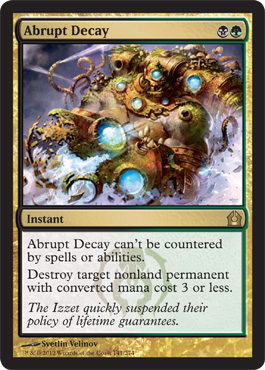
Abrupt Decay is a card that is getting a lot of attention, and deservedly so. Unfortunately, it’s pre-order price of $15 is a bit prohibitive to make a move. This price is pretty spot on, in my opinion. It’s such a cheap spell with a powerful, uncounterable effect. It will see play in older formats as well. Maelstrom Pulse, the closest thing we’ve seen to this card in Standard for quite some time hit as high as $17 during its Standard tenure, and I expect we’re looking at something quite similar, despite the additional demand from older formats. When this card was pre-ordering around $10 I liked it, but at $15 there’s too much risk with far too little reward.

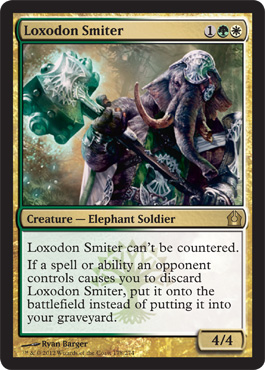
In the same “uncounterable” cycle, we have Loxodon Smiter. This guy is pretty interesting. He’s a 3-mana 4/4, which on it’s own is aggressively costed. Additionally, he gets put into play for free if your opponent forces you to discard him. While Standard hasn’t been plagued by much discard lately, it is an interesting clause, perhaps even a foreshadowing of things to come. His $5 price tag is curious, because either he’ll be a great sideboard card if discard reappears in Standard, or he’ll simply be the right call for the curve in a G/W aggro deck, but in either case, it’s way too early to know what the format will look like around him, and he’s not powerful enough on his own to create an archetype.
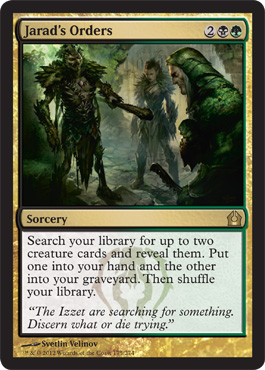
Jarad’s Orders is a card I’m personally pretty excited about. Combining Eladmri's Call and Entomb onto one card is certainly a powerful effect, yet it’s costed high enough (4-mana) that it will not likely see much play in Modern or Legacy. In Commander, however, this card is insane. I’d imagine most G/B/x decks in Commander can make good use of both parts of this spell and will include this in their 99 almost immediately. $1.50 is a bit low for a preorder on this one, in my opinion. This will be at least $2-3 in the short term, and possibly higher if a Standard deck can play it. Golgari hasn’t really shown me enough synergy with this card to warrant running it but there’s still over 100 cards to spoil. I’m not exactly chomping at the bit to pre-order this card, but I do think it has room to grow, and if we see any reanimation spells (entomb my Griselbrand, maybe?) then this card can shoot up a bunch. I’ve got it bookmarked if such a card pops up.

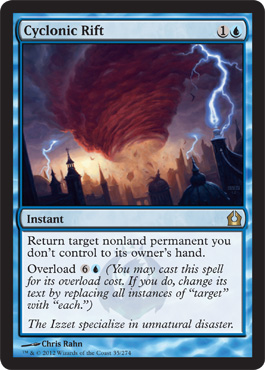
Speaking of cards that I’m personally excited about, Cyclonic Rift. This card is my kind of card. It’s clearly meant for the control player, and has unrestrictive color requirements. We could slot this into a 4-5 color control deck as a haymaker. While it’s preorder price of $4 is likely too high, it’s a card that will be on my radar in trades as prices start stabilizing. Most control decks wont play more than one or two of this card, and it’s unlikely to see play in older formats with the exception of Commander, where it will be amazing. Overload is a great mechanic for multiplayer as it scales well for large games without an additional cost.
Shocklands have shot up in pre-order pricing, initially sitting at $10, some have risen to $15. This is insanity in my opinion. $10 should be the ceiling for these on a whole, while there may be one particular shockland that sits just above once we know what the format looks like. Being a second printing, there are a ton of these around. They also aren’t hidden in boxes, they are out and around in trade binders and fairly easy to find.

Reminder on New Set Speculation

I’ve been hearing lots of talk about Return to Ravnica being one of the best sets to open since Future Sight. While that may be true, I want to reiterate a point I’ve made here before. Distributors pay a fixed rate for product. They sell to stores/dealers at a (mostly) fixed rate. These are businesses, and their goal is to profit.

Now that we’ve established some facts, let’s talk about the theory here. It’s easy to say, “this card is $X, that card is $Y” but keep in mind that this is all within the context of where it came from. When we start slapping preorder prices on cards this early in speculation, we’re not leaving too much room for value in the remaining cards that get spoiled. The sum value of a set of Magic in the modern era is fairly consistent, and this is because the price of a box/case is fairly consistent. We saw Jace hit heights of $100 because the rest of the set was essentially worthless, and in order to find him, you had to open a lot of packs (see: Spend a lot of money). What you could think of, is how many packs out of each case would the dealer need to open to make his money back in singles, compared to his cost of a case.
As more and more cards are spoiled and slapped with high price tags, that number of packs the dealer needs to open starts to fall. At a certain point, and this is just economic theory talking here, more dealers would enter the market to get at this free money. Well in order to compete with each other they’d have to lower their singles prices cutting their profits back down a bit. This is where the timeline of Spoiler season hurts the consumer who wants to pre-order. Spending top dollar on the new G/B planeswalker for example, is a huge mistake. We still have lots of cards left to see, and if those cards are exciting, it will actually decrease the value of the planeswalker in the long run.

Remember, the overall value of the set is relatively fixed, so if other cards in the set are increasing (from unknown spoilers to known cards that have pre-order value) than the existing high dollar cards would have to decrease to offset that change. No matter how amazing this set appears, buying product and cracking it for profit is not as easy as it sounds, and is not something I would recommend doing without an excellent system in place to start moving the singles immediately. Also keep in mind, this will be available for set redemption on MTGO, and if prices stay as high as they are now, you could simply build sets on MTGO, redeem them, and sell them at a profit. So, if you doubt the theory behind this, just wait for MTGO to abuse it, where the speed at which you can buy and sell is much lower, and boosters cost a flat rate and are essentially never stocked out.

Insider: The Bird’s Eye View On Return to Ravnica

Are you a Quiet Speculation member?

If not, now is a perfect time to join up! Our powerful tools, breaking-news analysis, and exclusive Discord channel will make sure you stay up to date and ahead of the curve.

Children of yesterday
Heirs of to-morrow,
What are you weaving--
Labor and sorrow?

Look to your looms again;
Faster and faster
Fly the great shuttles
Prepared by the Master.

Life’s in the loom,
Room for it– room!

from "A Song of Hope" by Mary A. Lathbury

There's a lot to be hopeful about in Return to Ravnica. I have not seen preorder prices for boxes go up this soon since Future Sight and the Zendikar treasures. Those boxes are going to be packed with money. What's also cool is that this set is going to get people brewing with their favorite color schemes and trying out old favorites. These favorites aren't going to be winners, but it'll get things moving. One of the best recent examples for me was the rise and failure of rebooted Solar Flare. If you were not around for Solar Flare the first time, it was a deck that ran six Signets. That's the defining factor of it. It had reanimation and discard elements, but what made the deck actually good was that it had four mana on the third turn a lot of the time. Many brewers, however, looked back with rosy glasses and just saw the reanimation that Unburial Rites creates and went with that. Solar Flare drove prices of Liliana of the Veil sky-high for a few weeks at the beginning until people realized that the deck was not going to do what we thought it would.

I expect many reboots from the older Ravnica era to resurface throughout this block. I also expect a lot of early riffs on deckbuilding from a lot of people. My advice on early trading is this: treat your RTR cards that you acquire in a month to be purely short-term holds in terms of trading. You'll encounter many players who must have Card X to complete their brew. Sure, in six weeks they'll glumly give up on whatever it was, but now, they want whatever you've got in that binder. Even the first month's worth of events won't exactly be telling - it took so long to figure out Caw-Blade and Delver, for example, and even Wolf-Run Ramp took some time to be proven. In the meantime, people are going to try decks out. Keep your stock moving and don't dip too heavily into anything that's not shocklands (as if people are going to trade those away anyway!).

In general, deck memory will also plague builders because the manabases are a little harder than they were when we were first in Ravnica. "But Doug," you say, "there are a crazy number of checklands! That's great!" to which I reply yes, but there are no signets. Signets allowed for truly busted expansion. Standard also had painlands, which sucked because they were bad, but they were also guaranteed to make mana when they landed. Thus, decks like the Black Hand list and Ghost Dad, both of which were White/Black, could make dependable and aggressive curves. The lack of painlands and checklands means that it will be a lot harder to splash for a third color and have it pay off immediately. Mike Flores' deck, That Girl, which he's all too fond of, ran three colors with Firemane Angels and Compulsive Research. That's a brutal manabase to pull off these days, even with an assortment of checklands. You run into a number with them, like with the filter lands of Lorwyn, where the pain of having two in the opening hand is just brutal in a three-color deck. Mark my words: people are going to make the mistake of thinking that things like Supreme Verdict (the 1WWU Wrath) will just slide right into their decks that splash blue (or white) and they'll die with Wraths in hand.

Now I KNOW that we've only seen 70 or so new cards, but we already know a lot about these guilds and their eventual playability. We're going to look at them and ponder the long-term positions on these guilds.

Izzet: Lots of Bluster, Not Much Substance

Aside from Izzet Charm, there's nothing in this guild that tells us that we can build around it and win. The Overload spells are nice - I want to especially call your attention to Cyclonic Rift, which will see lots of play. But aside from Niv-Mizzet, where are the cool finishers? How do we capitalize on tempo from the Rift? Izzet was this goofy guild for Johnny, full of cranky scientists who couldn't make any spells worth casting. I don't think it'll change this time around, based on what has been spoiled. U/R is too powerful of a combination if you make it great.

More on Cyclonic Rift: 1U is a fair price to pay for a bounce spell. We paid 1U when we had Aether Burst because in time, you'd get the crazy tempo blowouts. This makes for a decent stall card but it also doubles as a giant, Instant-speed reset for the opposing team. This card is big. It's very, very easy to splash for and pay off. I like Mizzium Mortars a lot but Cyclonic Rift looks like all that and more. You can even endstep it on an opponent with a nearly-full grip and make them discard most of what you bounced. People hit Cruel Ultimatum all the time in Standard with no acceleration and strict color requirements. Seven mana to get everything off your back is a fair plan.

Golgari: Packed with Role Players

Now we're talking about a role reversal from last time! The mere existence of Abrupt Decay is going to pull people to the Golgari tribe. Vraska, whose ultimate is a lot like the whistle-killers in Assassin's Creed: Brotherhood, is also obvious and tempting. Golgari is halfway to a deck already, thanks to its solid midrange cards. You have heard a lot about Woodland Cemetery, but I should also remind you of Twilight Mire. It's wise to keep an eye on all of the Jund cards in Modern because Jund is a popular and pro-backed deck that is going to really benefit from Abrupt Decay. Anything that Rakdos and Golgari come up with will be a great extra for the deck. The BG Impulse, Grisly Salvage, is very exciting, too.

Azorius: This Guild Will Never Live Up To Your Hopes

Again, where are our great finishers? This question matters; there are many excellent sweepers and a lot of Magic is won by big monsters or guy + Sword these days. The only real exceptions that I can think of are the Pod decks that didn't make Sun Titans or Elesh Norn and the Zombie decks that use attrition to nail people with Geralf's Messenger. It's sad but all that has come along so far is more big and awful Sphinxes. Restoration Angel and Snapcaster Mage are going to be the core of tempo for a long time, to be sure. Azorius Signet and Cyclonic Rift are going to be gigantic pains in your ass if you want to do meaningful things with monsters or tokens. I am doubtful that the card quality that Ponder gave us will be repeated in any form. Jace 4.0 is not a Consecrated Sphinx, that's for sure. Supreme Verdict is a holy and powerful Wrath of God, but a.) we're not seeing really any playable counters and b.) the Azorius color combo is really creature-heavy these days and might not want to wipe out their own Angels to kill other monsters.

Rakdos: Because Blighting Being Good Was A Fluke

The Unleash mechanic is just there for Limited. Nothing that Rakdos is making is exciting to me. If Rakdos Charm had totally crazy abilities, like destroying a land, I don't think it would get much play! There is so little in both Red and Black to reward us for playing that color combination. It's unfortunate. What's still good is Falkenrath Aristocrat. You must keep an eye on this thing. Haste is a big deal in the world of all this bounce and sorcery-speed killing. Gut Shot and Mortarpod are gone, which means that this has a much better chance of cruising in for 4 or 8.

Selesnya: The New Clock For Standard

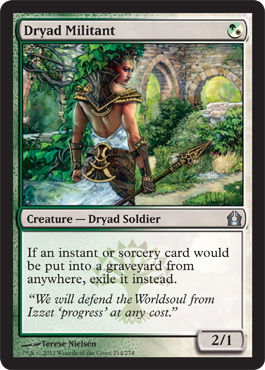
Like a cheese course at the end of the meal, the best is saved for last. I have seen amazing things from this guild in just a handful of cards. Dryad Militant is a serious threat on its own. Remember, Ravnica was also threatened by turn-one Isamaru, Hound of Konda. You saw that and you knew you were in for a fast fight. You see Dryad Militant, this crazy, gun-toting militia member pop up on the first turn, Gadsden flag in hand, and you're on that same clock. You're going to spend at least two mana to kill her or you'll get munched by her friends. There will be nightmare scenarios from Selesnya decks that start with an opening Dryad Militant or Slitherhead and then follow into a Selesnya Charm knight or Precinct Captain and just continue with Wayfaring Temples. That's a serious amount of monster power. I grant that G/W has been typically the worst aggressive color combo (because it lacks draw or staying power against sweepers) but you are going to see a lot of this deck at the beginning. It tends to build itself. You have seen a lot of love for Izzet, but Selesnya is going to really pull the FNM crowd out with token insanity.

Tell me where you see the guilds developing! What we will be pulling forward from Innistrad? What would it take for you to play Rakdos spells?

Until next week,

Doug Linn

P.S. I'd like to ask for your pardon that this did not get published yesterday and I do hope its quality surpasses its tardiness.

Jason’s Archives: Time to Pick a Side

Are you a Quiet Speculation member?

If not, now is a perfect time to join up! Our powerful tools, breaking-news analysis, and exclusive Discord channel will make sure you stay up to date and ahead of the curve.

Greetings, Speculators!

There has been a lot of talk about Return to Ravnica heralding a three-, four- or even five-color format. Easy mana fixing in Shocklands coupled with their co-partners the M10 duals and other spoiled cards like Chromatic Lantern hint at the tantalizing possibility of a solid, five-color control build.

I'm here today to rain on that parade. You will be better served by playing a 2-color deck.

What Makes You Say Craziness Like That?

First of all, like never before, Wizards is pushing people to identify with a guild. This quiz is used to help you identify which of the ten guilds is in line with your play style and philosophy. And there are special, guild-specific achievements to unlock on the planeswalker points page to make you feel like you're contributing to the success of your chosen guild.

This push will also help players choose which of the five guilds in Return to Ravnica they might want to choose at the prerelease in order to get their special "guild pack" and, for the first time ever, playable-in-the-prerelease promo specific to the guild they elect.

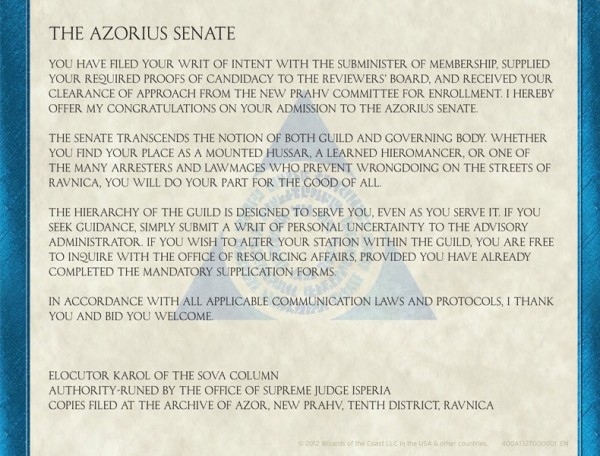
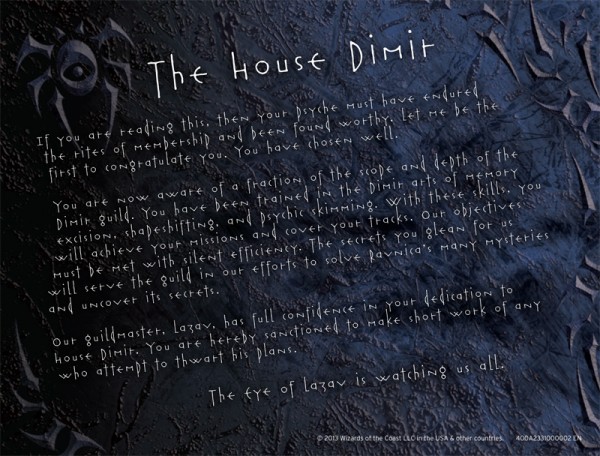
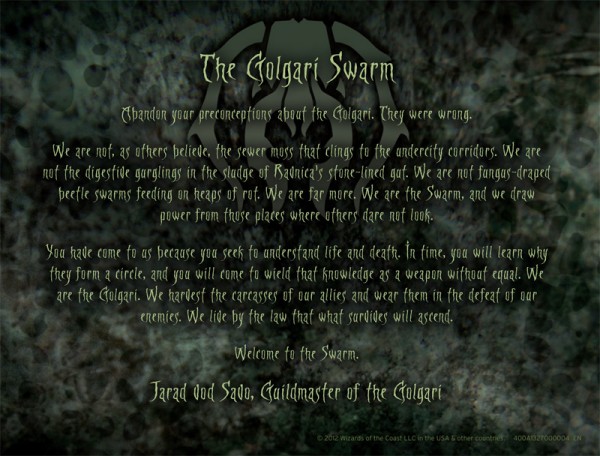
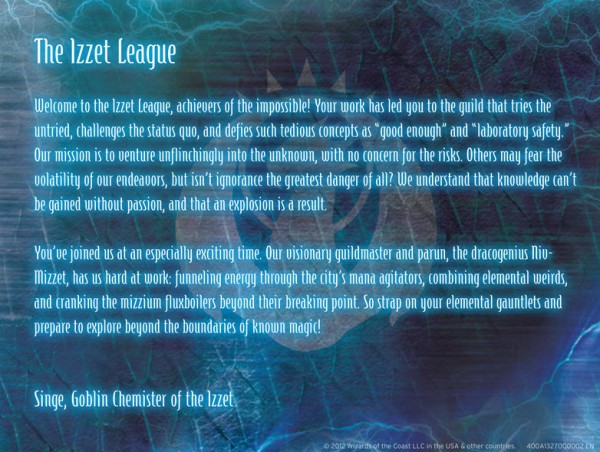
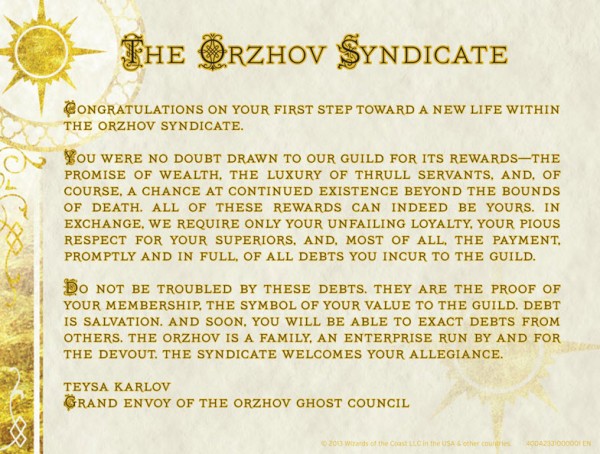
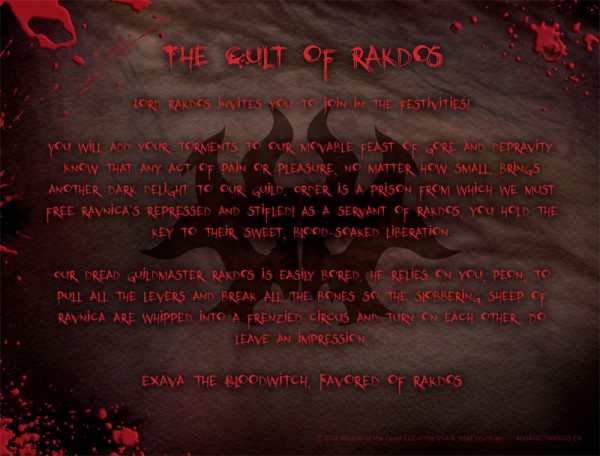
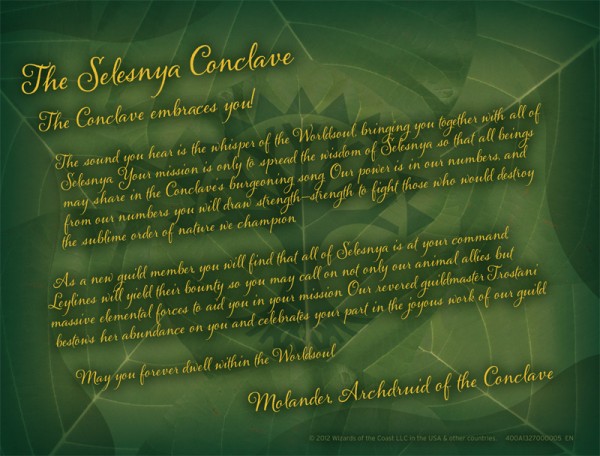
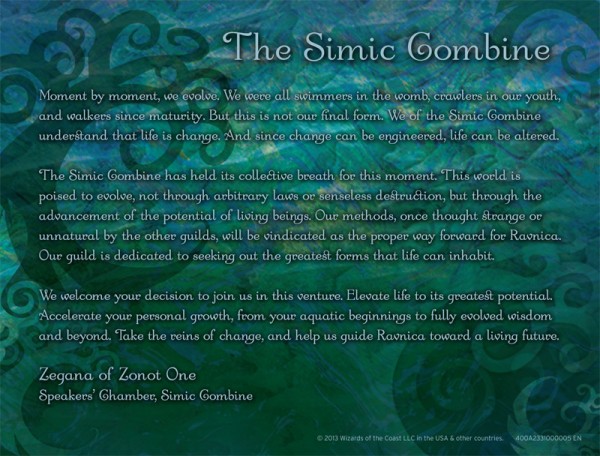
Once a guild is selected, the player can read the letter from their guild.


Clearly a lot of effort has gone into making the election of a guild more than just an arbitrary exercise.

How Does Identification with a Guild Preclude Five-Color Decks?

If you will notice, subtle differences are evident everywhere you look, which show how players are being cajoled toward making their own Sophie's choice-esque guild election.

Exhibit A

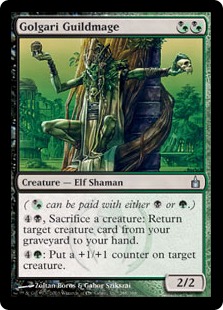
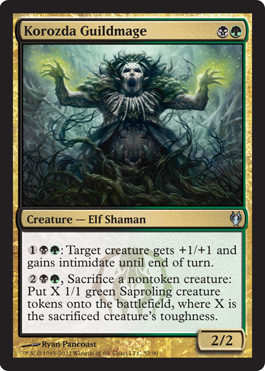
Let's compare a cycle of guildmages from both old and new Ravnica.

Even though hybrid mana is back, confirmed by other cards previously spoiled, the new cycle of guildmages doesn't have hybrid mana in the mana cost or activation cost. This makes them much less splashable in draft and, if picked early, likely to steer players toward a guild.

The absence of signets and their early pickability will also help to steer players toward a two-color combination early in draft, and the lack of hybrid mana on the most playable cards makes the sealed format a little more hostile to splashes.

Certainly splashes aren't precluded, and three-color seems like it may almost be a necessity with certain sealed pools. The "gate" cycle of common dual lands that come into play tapped can help fragile mana bases in limited and have the added benefit of powering certain other cards that look for gates. Expect them not to table in draft.

Doesn't Hybrid Mana Promote Splashing Outside of a Guild?

I would argue quite the opposite. From what we've seen so far, absent activated abilities that use hybrid mana, the hybrid cards spoiled so far may actually steer players toward fewer colors rather than more.

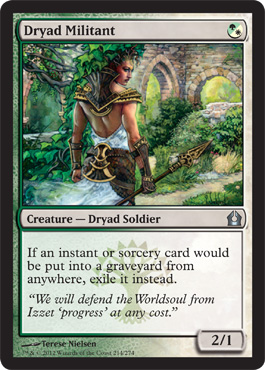
I'll explain. Taking for example, this bad boy below, we can illustrate how the hybrid mana in its cost may lead players to play it in a mono-colored deck rather than a three-or-more-colored one.

Back in my day, hate bears had to be bears

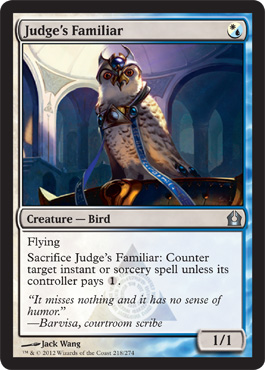
While obviously a good one drop in a Selesnya build, couldn't this card just as easily fit in a 5-color control deck as a way to shut down opposing Snapcaster Mages? Upon closer inspection, its aggressive nature makes for a better fit in a chain of aggressive creatures such as turn one Dryad, turn two Thalia, Guardian of Thraben, turn three Silverblade Paladin, etc. Mono-green could also easily make use of this card.

Again, the design of the card doesn't necessarily preclude use in a Selesnya or three-plus-colored deck. However, I feel that it's much more attractive to players who want access to salient elements of a given guild without requiring the other color.

Magical Christmas Land

From what we've seen so far, it seems that five-color control decks don't have the support they'd need besides the mana base and, barring huge new developments, probably won't be better than fringe playable.

However, three-color decks may be a bit more realistic. If a player were to pick two guilds and combine them, there are exciting possibilities. Golgari and Rakdos, for example, would combine to give the player access to all of the best removal spoiled so far and Izzet and Azorious would have the best control elements.

While the mana base can certainly support these combinations, it seems much stronger to build around the powerful guild mechanics. Golgari's scavenge, in particular, scarcely needs help from a few red cards when that room could be better served by jamming in a ton of Innistrad block zombies.

Time will tell whether or not players will truly benefit by going deep on a guild strategy, or whether the availability of easy mana fixing will yield a format dominated by four- or five-color good stuff decks. Certainly more cards need to be spoiled before we can say for certain, but if you haven't chosen a guild yet, you'd better get on that. It's time to pick a side.

Too Much Magic for Just One City

It appears last week's Star City Classic wasn't just a fluke as there was another Classic this weekend, this time in Birmingham, Alabama.

Birmingham Classic Top 16

Always sort of a deck, but never really dominating the metagame, Esper Control managed to get there in Birmingham, this time piloted by Chi Hoy Yim. Also referred to as Solar Flare, this deck hasn't experienced much popularity recently as Bonfire of the Damned slowly creeps up toward $45-$50 dollars. But there were as many copies of this deck in the Birmingham Top 16 as copies of U/W Delver.

A Zombie Pod deck managed Top 8, which warms the cockles of my heart. Needs more Gloom Surgeon if you ask me. However, pilot James Kingsley used those spots to jam Restoration Angel. Angel is hardly a bad card when used in concert with Thragtusk, Skinrender or Geralf's Messenger, and it was only a matter of time before it made it into decks as the sole white card. I'm really going to miss Birthing Pod when it rotates.

Also a blast from the past was a Heartless Summoning pile, maneuvered into the Top 8 by Zac Hicks. Jamming four copies of Thragtusk seems OK in a deck with Havengul Lich, a card that also forms a machine gun kill combo with Heartless Summoning and Perilous Myr.

It's nice to see a (somewhat) diverse Top 16.

The Spirit of the '90s is Alive in Portland

Portland SCG Open Top 16

B/R Zombies managed to win the day in Portland, running through an angry gauntlet of Mono-Green Infect, G/W Elves, Pod and Zombie decks and... zero Delver decks! A Top 16 with zero copies of Delver and four copies of Bonfire of the Damned will likely have the pundits scratching their heads.

Mono-Green Infect was clearly the deck to beat that day and may have been what kept Delver lists from finishing well. Whatever it was, I hope it continues, as a Top 8 with six different decks is oh so refreshing.

Zombies, Pods and both together appear to be very popular plans and I would expect Zombies to be a force post-rotation as the deck remains mostly intact and gains some powerful new allies from the Golgari guild. Quinn Kennedy's winning list is pretty stock and resisted the temptation to jam Bonfire of the Damned, electing instead to bank on the synergy between Mortarpod and Brimstone Volley.

With a few weeks left until rotation, it's nice to see U/W Delver unseated as the king of Standard. Will Mono-Green Infect be a force to be reckoned with in Modern? Will Delver survive rotation given the loss of Vapor Snag, Mana Leak and Ponder? This is shaping up to be the most exciting rotation in a decade.

Any Given Sunday

Legacy is a diverse format. Play skill matters to a much greater extent than does metagaming, and sideboarding can shore up matchups more effectively than it can in Standard. Every once in a while, a deck we had forgotten about can come out of the woodwork and take an event by storm. This weekend in Portland was no different.

Portland Legacy Top 16

Death and Taxes, named for its tendency to destroy enemy permanents and tax opponents' mana bases, managed an upset this weekend in the hands of pilot Ben Nash.

Filled with hate monsters and the abusive combo of Mangara of Corondor, Aether Vial and Karakas, this deck can give permanent-based strategies fits. Whenever Flickerwisp is vialed in at instant speed hilarity ensues, and the Fiend Hunter out of the sideboard can get join the fun to really ruin some lives. Considering I built and promoted this deck a few years ago, I love to see it win an event. Congrats, Ben!

Fourteen different decks in the Top 16 says all that needs to be said about the health of the format. Legacy is a format where you can pick a deck you like, learn how to play it, sideboard for the meta and do well every week. You may not win them all, but your play skill and familiarity with the field matter a lot. Practice really can make perfect here and it shows in the plethora of decks that continue to perform.

And Finally...

I expected more blue

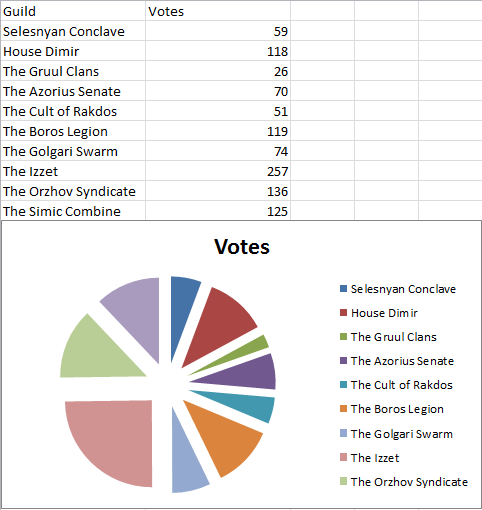
Redditor Wafflecopter42 compiled the results of the informal reddit guild poll which more or less jive with the results on the Planeswalker Points page. You will want to take the quiz if you haven't already. Which guild are you? Tell me in the comments.

Hit me up next week for more of the same. Until then, kiddies.

Stacking Your Library with Maelstrom Wanderer

Are you a Quiet Speculation member?

If not, now is a perfect time to join up! Our powerful tools, breaking-news analysis, and exclusive Discord channel will make sure you stay up to date and ahead of the curve.

Creating a powerful, yet fun, Commander deck is always a challenge. One major problem that arises is everyone's differing interpretation of 'fun'. I've covered this topic in previous articles (and probably will in the future too).

Today I want to share with you my most powerful Commander deck that still adheres to my definition of fun. I'll walk you through the mental process I undertook to build this deck, step by step, to give you an idea of how I build for Commander.

Brainstorming (Also Pondering) a Theme

I always feel compelled to incorporate a theme into Commander decks I create. One theme I had always wanted to explore was deck manipulation and cards that benefit from it.

These are a few examples of cards I thought of to 'fix' my deck. The next step was finding cards to take advantage of this.

Here are a couple of cards that synergize well with knowing the top cards of your library. Other mechanics I looked at were clash, cascade, and miracle. All of these work very nicely when you can manipulate your library.

With cards like this in mind, I started to think about a Commander.

The Perfect Commander for the Job

I've had this idea in mind for quite a while. During that time the best commander option was Intet, the Dreamer. I toyed around with this idea with her at the helm, but never really filled out a decklist until this guy was spoiled:

The epitome of Commander.

Maelstrom Wanderer! Could it get any better than this? He was perfect in every way for the deck. Not only is he blue and green, he is super aggressive and can single-handedly kill in three swings with commander damage. This was the card that finally set my idea in motion.

The Deck

I began by assembling a list of cards that reordered my library or put cards on top of it somehow. Here is what the deck currently uses:

Untitled Deck

Foresee

Brainstorm

Serum Visions

Preordain

Soothsaying

Ponder

Mystical Tutor

Jace, the Mind Sculptor

Mirris Guile

Sylvan Library

Worldly Tutor

Brutalizer Exarch

Senseis Divining Top

Crystal Ball

Scroll Rack

There are just enough to reliably see a few each game. Obviously the repeatable ones are best, especially Scroll Rack, but cards like Brainstorm and Preordain are always helpful right before casting Maelstrom Wanderer.

So, how do I take advantage of all this manipulation? Here's the awesome part:

Untitled Deck

Reforge the Soul

Temporal Mastery

Devastation Tide

Maelstrom Wanderer

Etherium-Horn Sorcerer

Bloodbraid Elf

Future Sight

Magus of the Future

Oracle of Mul Daya

Proteus Staff

Mosswort Bridge

Spinerock Knoll

Coiling Oracle

Recross the Paths

Lurking Predators

Druidic Satchel

Call of the Wild

These cards provide various types of advantage. Some cheat creatures into play, some cast cards for free, some ramp mana, and some provide simple card advantage. All of these are powerful tools in Commander.

As you can see, the theme takes up a good chunk of the deck. I decided to fill out another good portion of the deck with sweet cascade targets for Maelstrom Wanderer.

Untitled Deck

Inferno

Balefire Dragon

Crater Hellion

Ixidron

Palinchron

Great Whale

The first four provide 'wrath' effects before Maelstrom Wanderer resolves (remember, the cascades happen first, then Maelstrom Wanderer enters the battlefield). Palinchron and Great Whale are fun to cascade into because they make Maelstrom Wanderer almost free, and are also large hasty creatures thanks to Maelstrom Wanderer's other ability.

I also run a bunch of other powerful cards with large mana costs to get the best use of Maelstrom Wanderer's cascades:

Untitled Deck

Sphinx of Uthuun

Phyrexian Ingester

Frost Titan

Sphinx of Jwar Isle

Primeval Titan

Boundless Realms

Inferno Titan

Simic Sky Swallower

Duplicant

These provide threats to cascade into or simply hardcast. These enormous creatures also benefit from haste, especially titans.

I filled out the rest of the deck with some awesome green ramp spells, a sol ring (duh), and a few other solid staples. Mana ramp is always amazing, and I needed a few ways to deal with artifacts:

Untitled Deck

Wood Elves

Kodamas Reach

Rangers Path

Explosive Vegetation

Cultivate

Skyshroud Claim

Sakura-Tribe Elder

Sol Ring

Fact or Fiction

Eternal Witness

Artifact Mutation

Hull Breach

Wheel of Fortune

Onto the lands:

Untitled Deck

5 Mountain
9 Island
7 Forest

Taiga

Steam Vents

Sulfur Falls

Hinterland Harbor

Rootbound Crag

Yavimaya Coast

Karplusan Forest

Shivan Reef

Fire-lit Thicket

Flooded Grove

Gruul Turf

Simic Growth Chamber

Izzet Boilerworks

Reflecting Pool

Command Tower

Exotic Orchard

Alchemists Refuge

Temple of the False God

This part of the deck could use some updates. A Tropical Island, Volcanic Island, Cascade Bluffs or a [card wooded foothills]few fetches[/card] would be good additions.

Piloting Maelstrom Wanderer

This deck works very well. It is full of fun synergy that keeps the game interesting, and each game is usually unique.

There are a ton of fun things to do with this deck. Setting up a cascade into Great Whale or Palinchron, which allows me to pile on the threats the turn I cast Maelstrom Wanderer. Constantly floating a large monster on top with Lurking Predators. Transforming a lowly [card sakura-tribe elder]Sac-tribe[/card] into an Inferno Titan with Proteus Staff.

I like this deck because it is powerful, yet it doesn't employ any ridiculous combos. It simply utilizes quality synergy to keep threats on the board as often as possible. No annoying counterspells, no boring land destruction, just pure monster assault (although I may cheat them out a few turns early).

This is the type of deck I strive to create. I want it to be powerful, because losing every game sucks, but I don't want to do annoying things to my opponents. If getting killed by large expensive creatures is annoying, then Commander is probably not the format for you.

If you have any suggestions or ideas for this deck feel free to post them in the comments. I am always looking for improvements to my decks.

Thanks for reading!

Insider: Return to Ravnica Anticipation

Are you a Quiet Speculation member?

If not, now is a perfect time to join up! Our powerful tools, breaking-news analysis, and exclusive Discord channel will make sure you stay up to date and ahead of the curve.

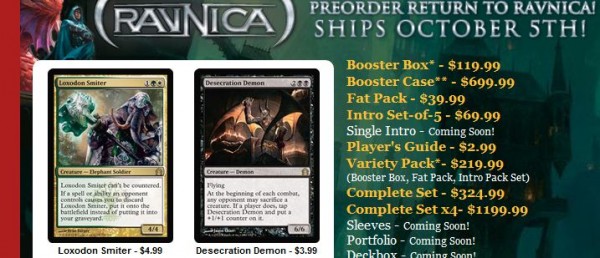
Return to Ravnica spoilers have continued to arrive, and this set is gathering a good amount of hype. Perhaps more than any previous set in recent history. This is the first time I can remember seeing booster box preorders averaging over $100 at auction and retailing for $120, other than maybe Zendikar after the treasures program was announced.

Shocklands are certainly a factor in this, and there are some pretty powerful spells in the set which also drive up demand. Finally, casual players will likely want to draft this set for years to come.

With this incredibly popular, highly anticipated set, what are the solid buys? Are there some cards that may gain in value thanks to RtR? Should you buy a booster box now or wait until release? Are there any cards worth preordering? I’ll try to touch on all these topics in this week’s article.

All The Hype

Not half the set has been spoiled, yet Return to Ravnica already contains many financially relevant cards. But which ones are worth acquiring? And at what price?

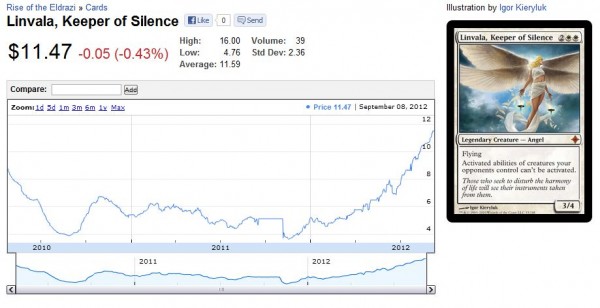
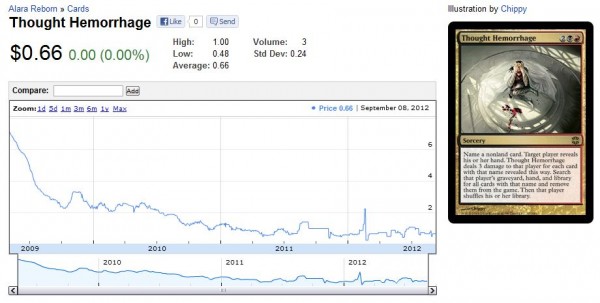
To begin, let me start with a general statement – I never preorder cards. Well I suppose that’s not completely true. I preordered cards once – a set of Linvala, Keeper of Silence, which were both necessary for my Angel collection and which appeared powerful for competitive play. (Funny how all but one were traded away long before their spike thanks to Modern, chart from blacklotusproject.com).

Normally there are only one or two cards from a new set which quickly rise in value after release. In Avacyn Restored, the cards were Bonfire of the Damned and Restoration Angel. Wolfir Silverheart also jumped initially but has since pulled back.

Being able to identify the gems is not easy. Since there is normally a window to acquire cards after they are “noticed” but before they jump in value, this is typically the time I decide to buy to avoid risk. I’ve already made some profits flipping a few Bonfires and I have about ten Restoration Angels I acquired in the $4-$7 range.

With that disclaimer aside, I move my attentions towards the noteworthy spoiled cards.

New Planeswalkers

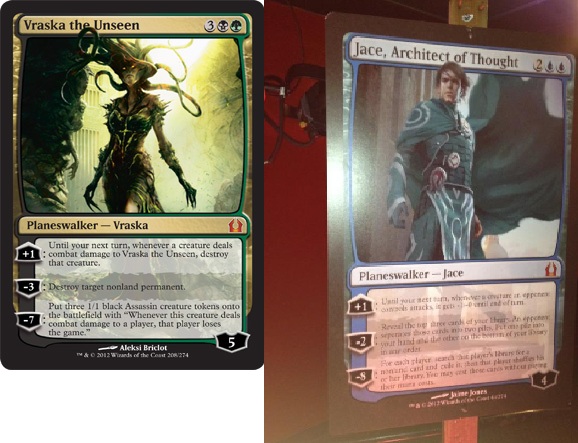
So far we’ve seen two new Planeswalkers spoiled: Jace, Architect of Thought and Vraska the Unseen.

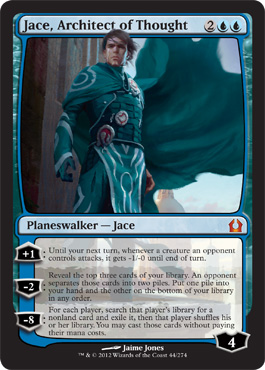
It certainly seems like Wizards is forever paranoid to create another overpowered Jace, and so they deliberately make him virtually unplayable in constructed play. There are some who believe his +1 combined with his starting four loyalty will keep him alive long enough to be relevant. I’m not so convinced, and personally I am much more excited about the newest Planeswalker, Vraska.

She pretty much guarantees you will be trading relevant cards with your opponent when she hits the battlefield. Just to attack her means certain death for your opponents 6-power creature or array of smaller dudes. Her -3 ability is certainly powerful and should help her stay on board. And while her ultimate doesn’t mean game over like Jace, the Mind Sculptor, it certainly shifts the dynamic of the game tremendously.

On the downside, she is B/G. However, with a multitude of mana-fixers in Standard, this should be barely prohibitive. I expect Vasra to see ample play in Standard.

But what about pricing? Jace can be pre-ordered for $20-$25 while Vraska averages in the $30-$40 range. I see neither holding their initial price-tags. Planeswalkers nearly always pre-sell at inflated prices due to hype and anticipation. Players don’t want to miss out on the next Big Jace ,but I assure you, these two likely aren’t it.

Still, once prices settle down (maybe 30-40% drop) I may give Vraska a try – she seems pretty sweet.

Uncounterability

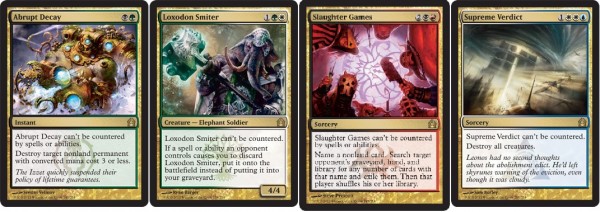
There have already been four distinct cards with a clause that they cannot be countered.

These four multi-colored cards represent quite the array of powerful rares. Notice how the is one uncounterable spell per guild? I wonder if the fifth and final guild, Izzet, will have such a spell as well…


Value-wise I am most excited about Abrupt Decay which is sure to be powerful in Eternal formats. A two-mana instant that is uncounterable and can destroy the vast majority of relevant non-land permanents is a force to acknowledge. It’s also pre-selling higher than the other cards, so again I wouldn’t go and order a dozen of these just yet.

But Eternal relevant cards are always noteworthy, and if Abrupt Decay sees Standard play as well, it could quickly become a $15 rare. For now I’m in a holding pattern – current prices don’t enable much profit and are likely inflated.

The others are interesting and none of them should be bulk. The Smiter is incredibly powerful for a 3-drop, but it becomes somewhat irrelevant in the late game as a nearly Vanilla 4/4 creature. Supreme Verdict is an uncounterable Day of Judgment… so what? Like most rare mass-removal spells, this one will probably end up in the $5 range. Slaughter Games is very similar to Thought Hemorrhage, which received a lot of hype at release but ended up being a dud (chart from blacklotusproject.com).

In terms of value, once Return to Ravnica launches, I predict these uncounterable cards will order themselves (highest to lowest) as: Abrupt Decay, Loxodon Smither, Supreme Verdict, and Slaughter Games. They are currently pre-selling on SCG for $15, $5, $6, and $1 respectively. While they may drop from there a bit, these prices may not be as inflated as the Planeswalker prices.

Shocklands

Everyone wants to know where these will end up price-wise. Although a reprint, these will be in massive demand for both Standard and Modern, and this should keep prices up. If I had to make a guess, I’d say the less popular Shocklands will settle in the $6-8 range while the more in-demand lands (blue ones) will still remain double-digits, but lower than where they have been since Modern’s announcement.

My rational is based on comparison with Zendikar Fetch Lands. While not reprinted, Zendikar was opened and drafted a ton, driving the supply incredibly high. Still, their utility in two formats – Legacy and Modern – have kept their prices near the $8-$10 mark on non-blue copies and $12-$15 mark on Scalding Tarn and Misty Rainforest.

So I feel these will be the price ceiling on Shocklands, but their floors will be kept in check because of their Standard playability in the near-term.

Expensive Pre-order Pricing

As I mentioned at the beginning of this article, Booster Boxes are now preselling reliably in triple digits, going as high as $120 + shipping on major retail sites. What will become of Return to Ravnica booster box prices?

First I should begin with another disclaimer: when I talk about buying a booster box of RtR, it is with the intent of keeping it sealed. I am not an advocate of opening boxes. Some people have managed to profit from opening their pre-ordered boxes immediately and selling singles while prices are high. While a viable strategy, I simply do not have the time and energy to do this.

I’m in it for the long haul. This set will remain in high demand for years to come, both because of casual player demand as well as demand for the Eternal staples (Shocklands, Abrupt Decay, etc.). Therefore, like other successful sets, booster boxes from this set will go higher in the long term. But as for the here and now, I honestly think it’s best to wait.

Once the set is released and people have Return to Ravnica cards in their hand, the hype will settle down and boxes will return to normal prices. Supply will shoot up on sites like eBay, driving the prices down to the typical $90 range. This is where I intend to buy. I just can’t see prices of boxes of an in-print set – even Return to Ravnica – go even higher until after it rotates out of Standard

Quick Ideas For Other Pickups

While Return to Ravnica promises us some very financially relevant cards for years to come, I struggle recommending a buy on any cards at this stage. Pre-ordering is always a game of chance, and I personally don’t like the unfavorable odds. In a couple months, when the hype calms down, I will return to this set to highlight some winners to pick up. This is my risk averse strategy.

But this doesn’t mean I’m not buying. In fact, I have been making purchases left and right across eBay, Card Shark, Amazon and MOTL in anticipation of the launch of Return to Ravnica and the impending influx of Magic players resulting.

In rapid-fire fashion, I’ll close with some of my latest pick-ups along with a brief explanation for why I’m targeting them.

  • Innistrad Dual Lands – The reason to acquire these is obvious, but as their prices have already increased, I’d only recommend a buy for any one you can find under $5.
  • Sigarda, Host of Herons – You could do a lot worse with $5 than a 5/5 Flyer with Hexproof for 5 mana, and with Titans rotating this could become a strong finisher for Selesnya.
  • Chandra, the Firebrand – This Planeswalker is selling for $2-$3 at auction and at retail. That’s the same price as the much-worse Chandra Ablaze, and since the Firebrand still has a chance to see Standard play, downside is virtually zero.
  • Tibalt, the Fiend-Blooded – This is pretty much the cheapest Planeswalker and it will be Standard legal for another year or so. Casual players will keep this from going any lower despite the Dual Deck announcement. No downside to acquiring a couple.
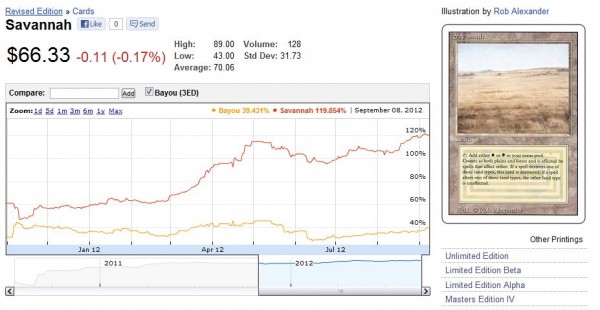
  • Bayou – Abrupt Decay will impact Legacy and there may be an increase in decks than run black and green to support the card. A metagame shift could move the price of Bayou much like it did with Savannah while Maverick was rampant. Just check out the chart from blacklotusproject comparing recent performance of the two lands:

-Sigmund Ausfresser
@sigfig8

Insider: The Bonds of MTGO — Investing in Packs

Are you a Quiet Speculation member?

If not, now is a perfect time to join up! Our powerful tools, breaking-news analysis, and exclusive Discord channel will make sure you stay up to date and ahead of the curve.

The stock market is an exciting place where money is made and lost every day as prices zig and zag. The bond market on the other hand is filled with relatively boring and predictable investments. Bonds are an asset class that you want in your portfolio to diversify your holdings in order to protect against large downward movements in the stock market.

With MTGO speculating, in-print booster packs are analogous to high quality bonds. These digital packs are in steady demand, they are highly liquid and their prices are stable compared to digital singles.

It's important to note that out-of-print packs do not have the same liquidity or utility on MTGO as in-print packs. Out-of-print packs are much less fungible due to not having any use unless a draft queue opens up for them.

Discounted Packs in the Secondary Market

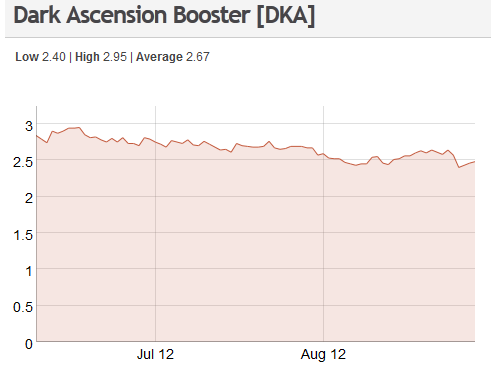
Among the in-print sets, as of August 29, 2012, you can buy packs of Dark Ascension (DKA) on the Classifieds for 2.40 tix. If you bought tix instead of packs at the store and used those tix to buy DKA packs from bots, this is a discount of 1.59 tix per pack. This difference in price between the store and the market should get your attention. Why are packs of DKA so much cheaper on the secondary market?

This discrepancy has occurred because of the large overhang of supply left over from DKA release events, the first period of cube draft, and constructed prizes. Each of these factors injected more packs into the market than were being consumed in draft and sealed events. Supply of DKA packs relative to players’ current needs is high, which results in a depressed price as players sell packs into the market for tix.

Currently, the only format to award DKA packs as prizes is Block Constructed. From August 17th through August 29th, a total of 49 Block Constructed Daily Events fired. That quantity of dailies keeps up a steady flow of new packs into the market. Combined with the current popularity of M13 Limited, there is very little demand for DKA packs at the moment. The chart below shows a steady decline since June, from just under 3 tix all the way down to sub 2.5 tix.


The trend is currently still downward, so prices might scrape even lower. However, Block Constructed will shift from Innistrad to Return to Ravnica (RtR) once the latter is released in October. At that point, the excess supply from constructed prizes that has been steadily eroding the price of DKA packs will be severed.

If Innistrad/Dark Ascension Limited events continue to fire, rational players will buy tix and then purchase DKA packs on the classifieds in order to take advantage of the large secondary market discount. Over time, the overhang of supply will reduce and market prices will align with store prices. This process of price alignment will occur with any set that floods the market but continues to be consumed through limited play.

The question for speculators, then, is if there will be enough interest in ISD/DKA Limited to absorb the extra supply of booster packs on the market. When choosing what limited format to play online, most players consider two things, cost and novelty. If a format is dull and uninteresting, drafters will avoid that set in favor of a different limited format or they will even dabble in constructed. Cost of online limited play must also take into account the expected value of what is opened. Casual players will quickly drop a format if there is no chance of recouping a draft or two by opening pricey mythics or rares.

Expected Value and Going Infinite

Seeking expected value in drafting is most prominent among grinders but is endemic to the MTGO player base. Playing cheaply is good, playing for free is better. If a limited format is cheap to enter and the packs hold chase rares and constructed staples, players will be drawn in for drafts and sealed deck in the hopes of "going infinite" or simply chaining a few events in a row for free.

As for chase cards, typically the most expensive MTGO cards in a Standard environment come from the previous year's third set. In the case of a block that has the large-small-large format, the third set effect is somewhat shared between the middle and last set. The previous block with such a structure was Zendikar block where Worldwake (WWK) and Rise of the Eldrazi (RoE) had the priciest cards of the year in Jace, The Mind Sculptor, Vengevine and Gideon Jura.

Worldwake as a Blueprint

The price history of WWK packs should be a useful guide for this speculative position. WWK packs were widely available for around 3 tix during Rise of Eldrazi (RoE) release events, and eventually they shot up to around 4 tix. WWK had the chase mythic, a cycle of manlands as well as other valuable cards which would have encouraged drafters to stick with ZZW over RRR. In terms of block structure, being analogous to WWK is encouraging for the prospect of investing in DKA booster packs.

In terms of constructed playables though, DKA does not measure up to WWK. However, it does feature two powerful mythics in Huntmaster of the Fells and Sorin, Lord of Innistrad, as well as three tribal favorites (and Standard playables): Falkenrath Aristocrat, Gravecrawler and Geralf's Messenger.

Limited Action

Currently ISD/DKA limited events are the third choice of limited players. M13 Limited is the current most popular format in the Limited Queues room, followed by AVR. At this point, there is no reason to believe that ISD/DKA Limited will move up in popularity in any meaningful way in the short term. And that means that RtR Limited will soon take the spotlight, further pushing thoughts of older limited formats out of drafters' heads.

This situation should naturally correct itself over time. If cards from Innistrad and Dark Ascension are heavily played in Fall Standard and beyond, then there will be a steady demand for these cards. If limited play is not putting enough copies onto the market, prices will rise. This trend of ISD/DKA being the least popular limited format from the last year will reverse as players naturally seek out higher expected value from the packs that they open. Eventually, prices on DKA packs will rise as packs get consumed in limited play.

Taking A Position

Implementing this trade requires some patience and some work. The bots on the classifieds that sell packs have the appearance of many different dealers, but in fact most of them are controlled by one individual. Fortunately the margins this near monopolist demands on packs are thin, so we are not faced with monopoly prices despite the market being controlled by one individual. The drawback is that this dealer is unwilling to sell great quantities, so you are restricted to buying 3 packs per day.

The buy/sell spread on DKA is currently 2.30/2.40. If DKA prices rise to 3/3.15, this is a net profit of .60 tix per pack, a return of 25%. Importantly, this dealer does not share credits among all the bots. Some bots are connected in small chains so make sure you use the same bot or bot chain when making purchases so as to not lose track of a few tix held in credit between many different bots.

A few other market players can round out your purchases though if you are impatient. The Supernova Bot chain regularly stocks boosters and The Card Nexus also has booster bots. These two dealers are independent from the big pack dealer, but their prices match the market, usually with a small discount. However, they are smaller players and will sometimes run out of packs to sell. Also, Supernova will adjust prices on any purchases over one booster, so trying to load up on packs from Supernova will not work as the prices will rise the more you try to buy.

What's the Downside?

There are a few risks with this trade. The overhang of supply might never get reduced. This occurred with ROE packs which never got above 3.3 tix after M11's release. If DKA only reached this price it would still be greater than a 25% return. A larger risk is that anyone who attempts this trade runs out of patience and either sells the packs back into the market, eating the spread, or straight up spends them to enter a limited event.

Once RtR hits in October, the bottom for DKA packs should be reached, so buying in over the following 6 to 8 weeks should be the best time for this position. At the outset of this trade, Spring of 2013 is the target selling period, so if you cannot stand to have packs sitting in your collection for 8+ months, then find a different trade. If you are willing to hold onto DKA packs for the medium to long term, then this highly liquid asset should produce a positive return of 25%+ with little downside risk.

The Guilds of Ravnica and Zombie Pod Updates

Are you a Quiet Speculation member?

If not, now is a perfect time to join up! Our powerful tools, breaking-news analysis, and exclusive Discord channel will make sure you stay up to date and ahead of the curve.

One of the most important things for Standard in the next couple of months will be the guilds in Return to Ravnica. These color combinations will give some direction for deck construction, as a starting point for initial brainstorming. There will be many powerful multicolored cards in the set and usually these are good building blocks for decks. Here are the guilds we'll have access to.

  • Rakdos (R/B)
  • Azorius (U/W)
  • Selesnya (G/W)
  • Golgari (G/B)
  • Izzet (R/U)

If you noticed, there are three allied-colored guilds and two enemy-colored guilds.

The available dual lands will contribute to some interesting decks while Ravnica is in Standard. Wizards confirmed the shock lands from original Ravnica are back in this set and the next one. Here are the lands that will be legal once this set hits the scene:

  • Five M13 dual lands
  • Five Innistrad dual lands
  • Five Ravnica shock lands
  • Five Ravnica gates (dual lands that come into play tapped)

What this means is that three color decks will be commonplace. By combining two guilds that share a color, Azorius and Selesnya for example, you will have lots of lands to make a stable mana base. Shock lands are even better alongside the M13 and Innistrad lands, allowing the latter to come into play untapped off their basic land types. We already know this interaction from Modern and it will be just as potent in Standard.

Another complication of shock lands is the life loss. One of the skills we will need to learn is when to lose life and when to wait a turn. That decision can make the difference in some games. If you are playing against an aggressive deck, the impact is magnified.

The lands in Standard are always important. Ravnica is going to give every player a chance to work with interesting mana bases for the time it is legal. I am excited to work with this new environment and see where it takes us.

The Spoiled Charms

The Ravnica cards I want to talk about today are the charms. This cycle is shaping up to be as influential as the charm cycle from Shards of Alara. Since they are only two colors, they will be able to fit in more decks than the previous ones. Three have been spoiled so far: Izzet, Azorius, and Selesnya.

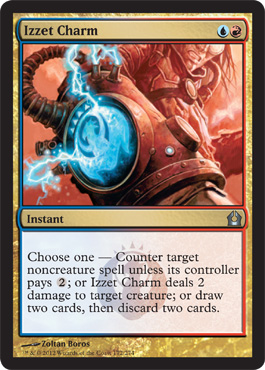
First up is Izzet Charm. Wow. You have your choice of Spell Pierce, Magma Spray (essentially) or Faithless Looting. That is a wide range of options. The ability to use it as both a counterspell or a removal spell is quite powerful. Add on the ability to discard some lands late in the game and we have a card that is certain to see a lot of constructed play. This charm is even powerful enough that it may effect some of the older formats.

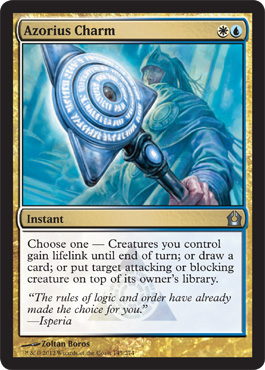
Next, Azorius Charm. While this card is not quite as powerful as Izzet Charm, the effects it provides are good enough that it should impact Standard.

I think the Excommunicate option is the most important effect on the card. It's easy to underestimate effects that put a permanent on top of its opponent's library. This effect is almost like making them draw one less card because they basically skip their next draw step. The lifelink option can be good if you find yourself in a racing situation where you cannot deal with a creature (Invisible Stalker for example) but usually you would just Aethertow the creature instead.

The cylcing ability is also good, especially in the late game, but I keep thinking it should have been a minor upgrade to an effect like Sleight of Hand.

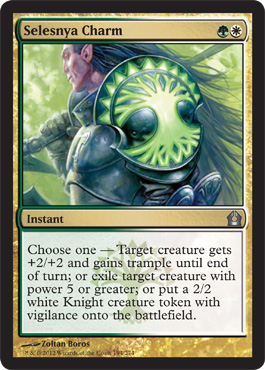
Finally we have Selesnya Charm. When I break this instant down, what I see are three different types of removal spells. You can choose from Sylvan Might, a slightly worse Smite the Monstrous and Reap the Seagraf. The first one is a good combat trick to mess up your opponent's combat math or force through some damage. The second ability would be better if it were four instead of five, but that is still removal for your opponent's bomb.

The third ability is my favorite. Being able to play your creature at instant speed is a powerful effect. You can surprise block their guy or simply flash in a guy they didn't expect EOT and attack with it.

All three charms we know about so far are Constructed playable. Each has three relevant abilities and I think they will all see a lot of play.

Zombie Pod

Before I go, I wanted to post my updated Zombie Pod deck. This is the list I would play in a tournament tomorrow.

Untitled Deck

Creatures

3 Blood Artist
3 Ravenous Rats
3 Fume Spitter
4 Geralfs Messenger
4 Gravecrawler
1 Massacre Wurm
4 Phantasmal Image
1 Skaab Ruinator
2 Skinrender
2 Phyrexian Metamorph
1 Thragtusk

Spells

4 Birthing Pod
1 Mortarpod
3 Tragic Slip

Lands

4 Cavern of Souls
4 Darkslick Shores
4 Drowned Catacomb
4 Woodland Cemetery
8 Swamp

Changes

-1 Fume Spitter
-1 Butcher Ghoul
-1 Tragic Slip

+3 Ravenous Rats

That may not seem like a major change but it really does have a big impact. If you don't care for the rats, three Butcher Ghoul is an option as well. This change fits how I play the deck, but depending on your play style you might customize it differently. For example, if you tend to play this deck more like a zombie aggro deck, then adding in Diregraf Ghoul might be the way to go. No matter the changes you make, the basic concept of combining Birthing Pod and Zombies is quite powerful.

Next week I will be diving into spoilers and hopefully telling you about some powerful interactions from our Return to Ravnica.

Until Next Time,

Unleash the little kid force!
(What? Yeah, you know because spoiler season is like Christmas. OK bad joke, but you laughed a little. See you guys next week.)

Mike Lanigan
MtgJedi on Twitter
Jedicouncilman23@gmail.com

Good Luck, High Five! – Episode 1: SCG Minneapolis & Return to Ravnica Spoilers

Are you a Quiet Speculation member?

If not, now is a perfect time to join up! Our powerful tools, breaking-news analysis, and exclusive Discord channel will make sure you stay up to date and ahead of the curve.

Banner

Welcome to the first episode of "Good Luck, High Five!"

Your hosts Mike Hawthorne and Ryan Overturf are joined by Dana Kinsella and SCG Minneapolis Legacy Champion Kyle Olson.

In this episode we talk about the results of SCG Minneapolis and dissect the deck lists. We round off the episode by taking a look at some Return to Ravnica Spoilers.

(The views expressed in "Good Luck, High Five!" are those of the personalities featured and do not necessarily represent the views of and should not be attributed to our host.)
Parental Advisory: May Contain Mild Obscene Language

Show Notes:

Stephen Hink's Zombies
Kyle Olson's 4-color Pod
Kobie Spaeth's Frites
John Penick's UW Delver

Kyle Olson's Legacy Junk
Troy Thompson's Legacy Omni-Tell
Brandon Semerau's Legacy Mono Blue tempo
Nick Marriott's Legacy Maverick

Musings on Magic 2013 Predictions

Are you a Quiet Speculation member?

If not, now is a perfect time to join up! Our powerful tools, breaking-news analysis, and exclusive Discord channel will make sure you stay up to date and ahead of the curve.

It’s that time again! No, I’m not talking about spoilers, although they are coming in quickly now and are awesome. Personally, I’m looking forward to brewing with Splinterfright again. The deck is fine to move on with after rotation, and the Golgari cards as well as the rotation of mass graveyard removal means we may get a shot to make good on my 94 copies.

I’m sure I’ll spend plenty of time on spoilers in the coming weeks. Right now I want to talk about something that is probably quickly leaving everyone’s minds – Magic 2013. The newest Core Set was a breath of fresh air, limited-wise, after the non-interactive solitaire game that was Avacyn Restored.

Specifically, it’s time to look back on my M13 calls to evaluate (harshly) my financial calls on the set, and reevaluate those same cards now under the lens of Return to Ravnica spoilers, using SCG prices as usual (the regular price, not the current sale price, which is slightly lower).

Ajani, Caller of the Pride

Then: “This cat is going for $40 on SCG, and that’s definitely high. I see him in a Liliana-type role. He’s very good, but doesn’t slot into every deck that shares his color. That said, there will be plenty of games where you lose the dice roll and have one land in play, facing down a 5-loyalty Planeswalker. Normally you don’t evaluate the ultimate to determine power level of Planeswalkers, but as early as this guy comes down it’s relevant enough that his ultimate is something to be scared of.

I see him setting around $25, give or take five bucks either way, unlike the next Walker on this list.”

Now: $20. I’m okay with where this is now. Though at the moment it’s not very played. Rotation and the Selesnya guild coming in the first set means it should see some more play, and we’ll see where the price goes from there.

My Liliana of the Veil comparison does seem apt, since both are sitting at $20 right now.

Liliana of the Dark Realms

Then: “Preselling at $30, which as you would expect, is too high. It’s possible Liliana finds a home in Standard, but I can’t imagine it’s going to be a nice one. She basically just doesn’t do anything. Hitting your land drops is nice, and I understand it can “fix” your mana with Shocklands, but in the end she’s just not that threatening.

Still, there’s EDH demand along with whatever playability she has, so I see a $10-15 price tag holding up down the road. It may take a little while to fall that low, but a year from now she’s going to be all but forgotten.”

Now: Still holding at $20. Mutilate, and especially Trading Post, have given Mono-Black the tools it needed to become at least a part of the metagame. That, along with still-fresh EDH appeal, have kept Liliana from dropping like a rock.

That said, Post strategies lose a lot of gas after the rotation, and if Mono-Black, and therefore Liliana in Standard, are to survive, it must find additional tools. I still think Liliana will pop up as a 2-of in some lists, but that shouldn’t stop the price from falling to the $10-15 I pinpointed.

Serra Avenger

Then: “I think it’s incredibly awesome they’re reprinting this card. I also don’t love it in Standard, as crazy as that might sound. Since you can’t play it until turn 4, it’s a virtual four-drop, where it will compete with Restoration Angel and the new (gives) Exalted Angel. That’s some stiff competition, not to mention it loses in a fight with Resto. All of that means the $3 pricetag is about right.”

Now: Down to $2 on SCG. I find it really disappointing that the Avenger isn’t any better than it is, since it’s just a sweet card, but power creep has kept it down. It will never be bulk due to occasional play in older formats and the fact that it is an Angel, but it’s not going to spike either.

Sublime Archangel

Then: “This is a really difficult card to pin down for me. A lot of times attacking with one creature is worse than swinging with the team, but there’s still a lot to like here. For starters, it trades straight-up with Restoration Angel, which is a good test to pass. Secondly, it has pseudo-haste since it will provide a huge pump the turn it comes into play, much the way Rafiq of the Many did. And there are a ton of Hexproof guys running around right now, meaning you’re even less likely to get blown out in combat.

It’s out of stock at $20 on SCG, and I wouldn’t be surprised to see some upward movement from there. I don’t think it can go much higher than $25 for very long (if at all), but it also will have a difficult time going below $12-15. I’m looking at Geist of Saint Traft levels here, between $20-25, especially since the pair will go in many of the same decks. Geist is played more in older formats, but the Angel is well, an Angel, and won’t be opened as long as Geist was, so it should mostly balance out.”

Now: $25 on SCG. I’m glad I got pretty close on this one, since as I noted it wasn’t an easy card to predict. The casual appeal of this card has been huge, and that means a few things to us. First, the price should be pretty solid and more prone to big jumps than big drops, which will be gradual.

More importantly, it means if the card ever hits it really big in Standard there will be a lot of added demand, and we’ll see jumps past $30-35. That said, I don’t particularly like getting on this card at $25 since the upside is, admittedly, a little undesirable.

Master of the Pearl Trident

Then: “Merfolk! Merfolk! Merfolk! (Listen to the latest cast of Brainstorm Brewery for more context). Presells at $5 is probably a few bucks too high, but I do think this will help to revitalize Fish in Legacy, where they were already on the upswing, as well as possibly pushing the deck into Modern. Look for gains in the peripheral Merfolk cards from older sets.”

Now: Still $5 on SCG. As anyone who knows me or follows me knows, I love some Merfolk. As I predicted, this revitalized the deck in Legacy, where it recently won an Open, all the way to Modern, where it has become a much larger presence.

In addition to all of this, the Simic Guild in Gatecrash is going to be full of Merfolk, so I like picking this guy up for the foreseeable future, as moves to $8-10 aren’t all that unlikely if we see some nice, new, powerful Merfolk.

Disciple of Bolas

Then: “This is my pick for sleeper card of the set. At $3 pre-sales, I’m not sure how much upside there is, and I don’t like a cash buy. But I do like aggressively trading for it at two bucks on Prerelease day. This guy doesn’t fit into a possible Vampires deck since the 4-spot is full, but if Zombies is looking to complement Falkenrath Aristocrats at the 4-drop spot, this guy is great. He eats a Messenger for infinite value, and even chomping on a Gravecrawler isn’t exactly bad.”

Now: Still $3 on SCG. Everything I said before applies. Zombies really doesn’t lose any of its creatures post-rotation, but it does lose some peripheral cards. That could open the door on Disciple, so it’s still an easy grab to round out trades with some upside.

Vampire Nocturnus

Then: “This guy is rightly expensive, sitting at $13 on SCG. Thanks to this reprint, his days as a $20 card are over, but we could see a spike to that level if the big guy busts back into Standard. The Vampires deck is about two cards away (another 1 and 2-drop) from being really good. I expect this guy to trade extremely well during his second run through Standard.”

Now: $10 on SCG. That’s $10 while seeing no play at all, and as a result I see people valuing him lower than that. Pretty safe target in trades as we move into Ravnica, and a theoretical Vampire build still seems very strong.

Thundermaw Hellkite

Then: “They wanted a Baneslayer Angel in Dragon form, and they found it here. He’s out of stock at $20 on SCG, and there are only 2 copies of foils at $50! This Dragon is the real deal. Even if Vapor Snagged he’s going to do some work, and the only problem is how many competing options RG has at the five-drop spot now with him, Thragtusk and Silverheart. Hellkite is a definite beating, though, so I expect him to stay over $10 without a doubt, and probably settle in the $13-15 range, with even higher numbers possible if he becomes the go-to five-drop.”

Now: Still $20 on SCG. By the way, did you know what the most historically popular tribe is, after Angels? It’s Dragons. I’ve seen people come in and ask for every Dragon I own. That really happens. That provides a solid baseline for this guy, and will probably keep him at $10+ forever.

I don’t like $20 for how much play he’s seeing right now, so if you have any I wouldn’t be hesitant to trade them off. I think he has a place post-rotation as a foil to Lingering Souls, and you should watch the post-rotation metagame accordingly.

Thragtusk

Then: “Now this beast is truly, well, a beast. Says no to Vapor Snag and helps stabilize immediately. I don’t like how splashable he is, but that’s just my design complaint, not a dismissal of his power. I wouldn’t be surprised to see a few Cavern of Souls name Beast just to make sure this bad boy hits play.

As just a rare, and another five-drop, $10 is probably high. I see him on the Silverheart level of $7-8 instead, but you can’t really go wrong trading into this guy at the prerelease.”

Now: $13 on SCG. As I said in the review, this guy is insane. I think I was probably a little off in my initial assessment, but not by much. Even with the event deck he probably stays around $10 rather than $7, and I think I probably didn’t correctly include in the Core Set factor, which allows Rares to stay a little higher than other sets since it isn’t drafted nearly as much. That’s how you get $15 Phantasmal Images and $13 Thragtusks rather than something more like $10 and $7, respectively.

All in all, I’m extremely happy with my picks from Magic 2013. It wasn’t perfect, but it was, all things considered, pretty accurate. I’ll take that to the bank, and hopefully you will as well.

Thanks for reading,

Corbin Hosler

@Chosler88 on Twitter

Insider: Why Not to Be a Shark

Are you a Quiet Speculation member?

If not, now is a perfect time to join up! Our powerful tools, breaking-news analysis, and exclusive Discord channel will make sure you stay up to date and ahead of the curve.

Bad Mojo Spreads.

One of the unfortunate side effects of popularity or power is a tendency for the apparently powerful to engage in delusions of self importance. Put more simply, when you get good at something you tend to be a dick about it. The problem with turning to trading as the focal point of your time spent in the Magic community is the relative ease with which you can become the dominant trader in the room.

Despite all my pretensions otherwise, at this point I would consider it to be incredibly easy for a person to break into the trading scene, simply because of the small size of the culture. Even though Magic is a comparatively large game community, the number of hardcore traders in that group is only a miniscule percentage.

The trap I see many semi-experienced traders fall into is the assumption that other people not caring about trading is the same as the trader being better than them and that the strict players aren’t worthy of their respect. This is wrong on multiple levels.

Magic is a Game

A game very much like this one, in all important ways.

It’s important to remember that Magic is a game and people are in it for different reasons. You’ve heard this time and time again, but it’s important that it sticks - taking advantage of people for the sake of profit has been covered extensively by almost every other writer. But I want to approach this a little differently.

First of all, despite my lecture at the beginning of the article, I find it’s particularly ineffective to pontificate on the moral bankruptcy of sharking. I don’t really want to write it, you really don’t want to read it, and anyone who’s reading Quiet Spec likely has a better moral compass than I give them credit for.

The attitude you take and the persona you project, however, have deep and long lasting repercussions when it comes to your trading. Let’s start with the basic ones.

Opinions Change, Sometimes for the Worse

People will classify the individuals they interact with, bluntly, in two categories: the people they look down on and the people they’re trying to impress. It’s important to note that this is a sliding scale, not a binary problem, and that the differences aren’t always stark and apparent.

If a person looks up to you, the odds are that they probably won’t forever. When I first started trading, a couple people stood out as exceptional traders to me, and I looked at them with respect bordering on awe. As time went on and I understood the process of trading more and more, this awe disintegrated. I started to see the flaws in their logic and to understand the bad trades they made with me for their own benefit.

I no longer trade with those people, because I remember how badly those early trades went for me when I didn’t know any better.

As time has gone on, I’ve tried to get my friends more into trading. Whether or not they plan to dedicate their lives to it, which I sincerely doubt, it’s important to understand card values the same way every person should be able to tell if they’re receiving correct change at the grocery store, or how to use Edmunds to check the value of the new car they want to buy.

I’ve seen them trade with sharks, true sharks, the kind of people who force every dollar they can out of the people they trade with, and I don’t say a thing. After the trade I’ll take my friend aside and explain what just happened. And in some of the more egregious cases I’ll give them some cards to make the damage less severe.

In most cases, however, I do one thing and one thing only: I black ball the shark.

The Kiss of Death

The Kiss of Death, featuring the greatest actor of all time.

In order to be an effective shark, you need to make a lot of trades with a lot of people and compound your collection. For any trader, one of the most basic needs is for trade partners. I’m not the biggest trader in my area, and I’m probably not even close to the most well known, but I make an impact and math is on my side.

If I refuse to trade with a single trader, I lose one effective partner and so does the other guy - we lose each other. If I tell my friends to avoid him, I still only lose one partner, and he loses everyone I talk to. Maybe a couple of those people I talked to go for the trade anyway, but I can guarantee that they’ll be particularly alert for price inequality and more than willing to draw out the process to get a fair deal.

It’s important to note that this is in no way a threat, but it happens to a lesser extent all the time. Everyone tells their friends about the sharks and the traders, pointing out danger zones. Most of the time the warning isn’t forceful enough to actually dissuade anyone from trading, but it’s a constant drain on your ability to make money.

Bad Karma is Bad Business

This crowd mentality hurts you if you shark hard, but think about this as well: if you take a person for all they’re worth, why would they trade with you in the future? For every person you completely steamroll, the risk goes up significantly that you lose future business because they took the time to check StarCityGames.com. If they do trade with you after having checked the numbers, they’re on the look out for disparity in values and there’s very little chance you can make as much as you could before.

What about if you’re at an SCG Open, however? What if this random guy is just dropping by the trade tables to get some stuff for his EDH deck? It’s in a city you don’t spend time in, and you’re surrounded by people you’ve never seen before and probably won’t see again. Aside from the obvious moral dilemma, what’s the big deal with making as much of a profit as humanly possible on this next trade?

Unfortunately for this hypothetical trader, trades aren’t made in a vacuum. If you’re sitting at the trade tables, you could be surrounded by as many as a dozen people watching your trade out of the corner of their eyes. Every move you make will be subconsciously stored for future use, every price you state will be noted. Luckily for you,  for many this information is utilized only so far as to come to a conclusion about whether you know your prices or not. Some, however, the truly great traders, will note some other useful facts.

Take Notes, This is Useful

This is the kind of pretentious I felt like when I wrote this article

What cards were priced correctly? What format seemed most accurately valued? What holes were there? What happened when the trade partner quoted an inaccurate number? Was there a consistent response to high values, to low numbers, or to major differences? In what cards was interest expressed?

All these questions, and more, help you or anyone else to assess the skill of the trader in question. For many traders, this assessment or something similar classifies for you the trader. The better they are, the more wary you are of tricks, and the fewer risk you’re willing to take on cards you don’t know exact values for.

This works both ways, however. Remember that huge simplification of interpersonal interaction? Looking down on people and impressing people? It’s easy, having classified a person as an inferior trader to yourself, to look down on them and underestimate their knowledge of financial Magic. It’s even easier to let your guard down, trade for cards the value of which you aren’t sure of and make risky assumptions on the grounds that your goofball trading partner doesn’t know enough to rip you off.

On a side note, a person can take advantage of this by trading in what seems to be a detrimental way. I’m willing to trade at a loss to happy, fresh faces, for two reasons. First of all, I like having new people playing the game. But in a far more selfish state of mind, I understand how my looking stupid in front of sharks makes them much less careful when trading with me.

In the End...

Being the nice guy has its advantages. You have no moral ambiguity, you don’t have the detriment of a network of people talking negatively about you and your trading habits, and you sometimes get the added bonus of a little misinformation.

I’ll take it any day, and I strongly believe the long term benefits far outweigh any short term advantages of sharking. I hope this helped, and I look forward to hearing what you have to say in the comments!

Avatar photo

Tucker McGownd

Hi, I'm Tucker McGownd. I'm a low risk trader that spends most of my time in Minnesota, where I go to school, play magic, study for school, play Ultimate for my college team, study for school, and read. I've been playing for a long, long time (I first played during Mercadian Masques block, and first bought a pack in Urza's Saga). I was incredibly lucky when I cracked packs until I learned how much cards were worth, at which point I proceeded to open Thoughtlace in every set until Scars, where I picked up more than my fair share of molten psyche. I'm currently looking forward to the inevitable reprint of Chimney Imp.

View More By Tucker McGownd

Posted in Free Insider6 Comments on Insider: Why Not to Be a Shark

Have you joined the Quiet Speculation Discord?

If you haven't, you're leaving value on the table! Join our community of experts, enthusiasts, entertainers, and educators and enjoy exclusive podcasts, questions asked and answered, trades, sales, and everything else Discord has to offer.

Want to create content with Quiet Speculation?

All you need to succeed is a passion for Magic: The Gathering, and the ability to write coherently. Share your knowledge of MTG and how you leverage it to win games, get value from your cards – or even turn a profit.

A Net-Decker’s Paradise, or Why Not to Go Rogue in Legacy

Are you a Quiet Speculation member?

If not, now is a perfect time to join up! Our powerful tools, breaking-news analysis, and exclusive Discord channel will make sure you stay up to date and ahead of the curve.

Last week somebody posted in the comments section of my article that he believed there is a lot of value to playing rogue strategies in Legacy. While I am the type to support going rogue in formats with smaller cardpools, I tend to disagree with his assertion about Legacy.

Part of the problem is that most existing decks have already been played many thousands of times against the existing archetypes of the format. All of this playing has led them to the forms in which they currently exist. Do you think that somebody just decided to play Green/White one day and threw Maverick together? Not a chance in hell. It’s a deck that constantly changes, if only slightly, to battle the tools that other decks bring to the table. It’s a hatebear deck in disguise that relies on its creatures being good in the context of other decks to win any matches at all.

I can’t even being to imagine how many hours must have gone into coming up with working lists for TES and ANT. The simple fact of the matter is that actually building a rogue deck is going to be a lot more work than picking up an existing archetype.

But Will it Not Be More Rewarding to Go Rogue?

Well, that depends on the goals you set for yourself. If you place value on playing with your own creations, that is something that I can respect. I’m sure that Tyler Tyssedal loves playing Griffins to death (though not enough to play Chamelon Colossus), and there is a lot of value in just playing with a deck that you enjoy playing regardless of result.

However, I think that you’re unlikely to see more success with a rogue deck than with an existing archetype.

One of the arguments for going rogue is that your opponents will have no idea how to play against your deck. The thing about Legacy, though, is that very few people have much of any idea what they’re doing in the first place.

Legacy is immensely complicated and it is the format in which players experience the most bad playtesting. Part of the problem is probably that a lot of pros don’t pay much attention to Legacy, as it’s largely a format for smaller cash tournaments. And pro points are worth a lot more than a Mox Ruby.

In light of this, there is less content available on how to play Legacy well and fewer good players actively looking to playtest Legacy. I’ve often joked that the mirror is one of my best matchups with RUG given just how poorly most players pilot the deck.

Here’s a fun story from SCG Minneapolis last weekend. It was round 8 and I was playing RUG against Lands. I was on the play and lead with a Wooded Foothills. My opponent’s first turn was Rishadan Port, double Mox Diamond discarding Maze of Ith and Tolaria West, and finally a Life from the Loam to pick up his discarded lands.

I spent about a minute looking at my hand:

Truth be told, my keep was pretty loose against most decks, but it felt damn near impossible for me to beat a Maze AND a Loam. I tanked for a good minute about whether or not to just scoop, but finally, perhaps out of sheer masochism, decided to play it out.

And you know what? I won somehow. My victory was entirely contingent on my opponent’s greed in the following turns and some sloppy play that left his Zuran Orb in his graveyard, but that’s the entire point. Even the guy that’s 5-1-1 in round eight isn’t always going to impress you.

What I’m driving at here is that your opponents are going to mess up plenty in Legacy anyway, and if that’s your angle when you play something rogue or fringe, then you need to be certain that your deck is on the same level as tier one strategies, because nobody knows how to play against them in the first place.

But Isn’t it More Likely That an Opponent Will be Unprepared for Fringe/Rogue Decks?

Only if they’re really bad. That is - your opponent is really bad or your deck is really bad. In either case, I’ll reiterate that you’re not really increasing your odds of success.

The other point fringe deck advocates like to make is that sideboard space is limited, that you can’t be prepared for everything.

Sure, you can’t possibly prepare for everything, but the fact that sideboards are only fifteen cards severely understates just how many matchups for which you can come prepared.

Let’s take a look at my current RUG Delver sideboard:

These cards sure look narrow. Many of them look for specific colors or land types. While that is the case, they all still come in against a handful of decks.

Blue Elemental Blast, while on the surface looks as narrow as a card like Warmth, is good against a lot more than just burn. I bring it in against Sneak and Show, Belcher, some Storm variants, Zoo, Goblins, etc…

I think that the most surprising level of flexibility comes from Sulfur Elemental. Initially it was played as a reaction to Lingering Souls as well as being a nice tool against Mother of Runes. While it is very good in these roles, it is also a very useful tool against combo decks, which is somewhat counterintuitive. I’ve found that Tarmogoyf is a massive liability against many combo decks, which are frequently able to just untap and kill you when you tie up too much of your mana at sorcery speed. The major issue with boarding all four out is that it leaves your deck incredibly threat-light. Conveniently, Sulfur Elemental addresses both of these issues.

The last major point against going rogue is that it is highly unlikely that you’ll find an entirely unique angle from which to attack your opponent. Odds are you are battling with creatures, powerful spells and/or your graveyard.

While this statement is simple and obvious, it is nonetheless true. I don’t care if you’re casting Pox, Isochron Scepter or Cunning Wish - I can Spell Pierce all of them just the same. Your Goblin Lackey dies to Lightning Bolt the same way Mother of Runes does.

While your angle might be creative and different, it can never really be that different.

~

When it comes to battling Standard, Extended or Modern you’ll usually see me battling with something rather original. That said, I don’t believe that the advantages of doing so exist in Legacy to anywhere near the same extent as other constructed formats.

Call me uncreative if you like, I don’t mind, but don’t think my lack of creativity is hurting me in any way. Matter of fact, if you’re planning on rogue-ing out in an upcoming Legacy event, then I wish you the very best of luck.

You’ll probably need it.

-Ryan Overturf

Insider: Tis the Season for the Spoils

Are you a Quiet Speculation member?

If not, now is a perfect time to join up! Our powerful tools, breaking-news analysis, and exclusive Discord channel will make sure you stay up to date and ahead of the curve.

I just got done with a very relaxing holiday weekend. I got a chance to relax and also game some Magic. Over the weekend, I got a chance to chit-chat with a good number of folks at the Local Game Store about the Return to Ravnica spoilers revealed so far, as well as Legacy. There’s a few items I want to make sure to touch on this week. Let’s start with a look at the RTR Spoilers.

Return to Ravnica Spoilers

Chromatic Lantern

This is the card I’m most excited about thus far. This is an extremely awesome piece of artifact ramp and fixing all in one, and I expect it to see some significant play in both Commander and Standard. I wouldn’t be surprised if it made cameos in older formats like Modern too. Joiner Adept's ability on an artifact is much more resilient than a 2/1 creature and the Lantern itself taps for mana. This will be the cornerstone of any 3+ color control deck, which by the looks of the cards spoiled thus far, is not out of the question at all.

Allowing control decks to jam a large number of multi-colored spells, including charms, into their deck will give them a wide variety of cheap answer cards as well as granting the ability to finish the game with the most powerful card they can find is no joke. The fact that every 3+ color Commander deck will want a copy of this is another huge factor. This card is pre-ordering at $5 on StarCityGames.com and I think that’s a steal. I’d like to see this card hit $10 fairly quickly after it releases.


Jace, Architect of Thought

“Meh.” Was my first thought when I read this spoiler. I’ve forced myself to try and be a bit more open minded about this card, but I’m still not sure I like him. His first ability may be relevant if a token deck exists, but with cards like Intangible Virtue in the format, they can counteract his ability fairly easily. His 2nd ability is undoubtedly insane, but paying four mana to use it once is not exactly value. A deck that likes this Jace, would also likely play Tamiyo. In connection, they do stuff, kind of. Jace requires that they attack with all their creatures for less damage, while Tamiyo can tap their largest creature or draw cards from all their attackers. Tamiyo is really the strong card in this combo, but if a heavy blue control deck exists it may play some number of this Jace, but I don’t expect it to stabilize much more than $12.


Judge’s Familiar/Dryad Militant

We have two aggressively costed hybrid creatures at 1-mana spoiled, and they are both going to make a splash, even though they are uncommon. The Judge’s Familiar adds Flying to Cursecatcher and also gives it to White mages. This card will undoubtedly slot into many a Modern/Legacy deck and will almost assuredly appear in next seasons iteration of Delver, whatever that may look like. The Dryad Militant is another Savannah Lions variant that will probably not see a remarkable amount of play in Standard. Both because his creature types are irrelevant, and also because Savannah Lions just isn’t as good as it used to be; however, I do expect Modern decks to play this guy to combat Snapcaster Mage.


Lotleth Troll

This card is difficult to evaluate. It’s cheap and it Regenerates, and it has Trample. On it’s own, sticking an equipment on him ought to be enough to end the game pretty quickly. His other abiltiy, which discards creatures to give him +1/+1 counters, is the interesting bit. I’m not sure how abusable this will be in Standard. I could see discarding a creature, and then using its Scavenge ability to pump this guy further, but I just don’t know how viable that is. Obviously, with the rotation of Vapor Snag his weakness is a bit diminished. I’m not yet ready to pick a price point on this guy, but I wouldn’t be surprised if it was the central two-drop in either a Jund or Junk aggro deck.


Legacy News

Trample Discard a creature card from your hand: Put a +1/+1 counter on Lotleth Troll. b: Regenerate Lotleth Troll.
Well, the insane morphing of the Show and Tell deck, which turned into to Sneak-n-Show, which turned into Omniscience has now devolved into an Academy Rector deck. Some guys at my store, who have been on top of and in front of most of these Legacy changes are already looking at bringing this cycle full circle from where it started. Hive Mind. Hive Mind was one of the best cards to put into play with Show and Tell at one time, and that may be happening again. Since so much hate exists for Show and Tell players, having an enchantment that can actually be cast if need be, and wins the game immediately on resolution is a bit more desirable. Being able to Academy Rector for it directly is a bonus. Show and Tell players have been telling me that they have to use so many resources to resolve their Show and Tell they don’t have a back up plan. Hive Mind, however, simply ends the game, and allows them to play 4 more free counterspells maindeck in Pact of Negation. Hive Mind isn’t an expensive card, and it isn’t going to be, but Pact of Negation is already nearly $20, and this will only increase if Hive Mind does see more play. Not to mention that when Modern season comes it’s demand will continue to increase. It’s a risky play, but I like picking up Pacts and trying to make about $5 a piece on them right now. It doesn’t stand to lose much ground with Modern and Commander keeping it a float, so even though it’s not inexpensive, at worst it shouldn’t fall too far.


Wrapup

As spoilers come out until next week I’m keeping my eyes open for an sweet Control finisher and a Show and Tell hoser. Those are the the types of items I’m willing to jump in on right away. In the mean time, I’m hunting for deals on Laterns and Pacts. See you next week with more spoiler news!

The Commander Color Wheel

Are you a Quiet Speculation member?

If not, now is a perfect time to join up! Our powerful tools, breaking-news analysis, and exclusive Discord channel will make sure you stay up to date and ahead of the curve.

Commander is a format in which the players can unlock the full potential of even the most obscure [card Black market]Magic cards[/card], which dramatically shifts the color balance. Blue, for example, is thought to be the best color in Legacy, while red is probably the worst. Does this hold true for Commander? If not, what determines whether a color is good? Let's take a look at each of the five colors and evaluate its contribution to the world of Commander.

White

I would rank white as the worst color in Commander, although this essentially becomes irrelevant once it gets paired with other colors. My goal as a Commander enthusiast is to create a deck for every possible color combination (currently 27). I began this epic endeavor by making all five mono-colored decks. Red was first, followed by black, blue and green, and then all that was left was white. I started this project over a year ago and still haven't crafted a quality mono-white Commander deck. Why can't I make one! It's so simple. Let's take a look at white's strengths and weaknesses.

Strengths

  • Mass removal - White is hands down the best at this. It is capable of killing every nonland permanent in play several times if needed, and this is exactly the kind of card advantage that works best in Commander.
  • Exiling things - Surprisingly, exiling cards instead of putting them into the graveyard is quite important in Commander. Graveyard themes are more prevalent and making sure your opponent's Palinchron is gone forever will put your mind at ease.

Weaknesses

  • Drawing cards - Sadly, white is very poor at drawing cards which is why I think it is at the bottom of the rankings. Sure you can kill all of your opponent's permanents, but all they have to do is cast a Stroke of Genius and they are back in the game.
  • Effective threats - White has some [card baneslayer angel]sweet angels[/card], but overall the creatures are weak and cheaply costed. The lack of good mono-white legends is also a reason why I haven't made a white Commander deck yet.

Summary

I'm certainly not saying never to use white in Commander, because it does play a very important support role. White is probably the most reactive color, allowing you to deal with almost anything your opponents throw at you, but it will have problems keeping those kinds of cards in your hand due to its lack of card draw. White's best role is as a support color that deals with threats while other colors go in for the kill.

Blue

I rank blue at number three in the color hierarchy. This is surprising, due to its authority over the other colors in other eternal formats. Blue is kind of weird in Commander because as soon as you want to be even somewhat competitive with it you end up comboing every game, whether it be with Palinchron or a horde of wizards drawing infinite cards. Blue does, however, synergize very well with artifacts, which is fun.

Strengths

  • Drawing cards - Blue is hands down the best color if you want to draw a ton of cards, which is quite a good strategy in Commander. You just have to make sure you can use those cards to win, because drawing more draw cards by itself isn't getting you anywhere.
  • Denial - Counterspells! A solution to nearly every card your opponents throw at you. Some are better than others, but a well placed Counterspell can sometimes win the game.
  • Theft - Blue is good at borrowing your opponents cards and killing them with them. Some all-stars are Treachery, Bribery, and Desertion.

Weaknesses

  • Effective threats - Just like white, blue doesn't really clog the battlefield with monstrous creatures, which is why competitive blue decks end up comboing off.
  • Dealing with permanents - You can only steal so many. There are essentially no blue cards that can kill enchantments or artifacts and very few that actually kill creatures. Blue usually has to settle for temporary solutions like Capsize.

Summary

If you are playing to win, blue is quite good at it, but no one does that in Commander, right? If blue plays fair it is another quality support color, keeping your hand full of those juicy [card Craterhoof behemoth]green beasts[/card] or exciting [card bogardan hellkite]red dragons[/card], and maybe even borrowing some of your opponents'. Blue pairs well with all the colors except white because of the lack of threats. Blue/White decks will have to rely more on equipment and using card advantage to deploy a horde of smaller creatures.

Black

I put black at number two, with blue close behind. Black is personally my favorite color in Commander because I really enjoy utilizing [card grave pact]death themes[/card]. My current mono-black Commander deck is led by Toshiro, Umezawa and makes use of a ton of instant-speed removal spells and a horde of demons to destroy my opponents.

Strengths

  • Tutors - Black loves to bargain. "Your soul for this Thran Dynamo? Deal." What makes black best is the fact that you almost always have the best cards in your deck. However, this also leads to redundant games, which can be boring.
  • Killing creatures - Black loves this. Damnation, Decree of Pain, Plague Wind, the list goes on. There are a ton of mass creature removal spells as well as fun enchantments that cripple your opponents' creatures.
  • Reanimation - Black does wonderful things with the graveyard. Reanimation effects are far more potent in Commander when the average converted mana cost of creatures is six.

Weaknesses

  • Destroying artifacts/enchantments - Gate to Phyrexia... that's it. Black just can't kill artifacts or enchantments which is quite annoying in some situations. You'll have to rely on other colors to fill this role.

Summary

Black is a very good primary color in Commander. It has adequate threats, card draw, and can deal with any creatures your opponents play. Its large mass of tutors also allows you to find whatever you need to deal with most situations, and including other colors in your deck only strengthens this. Just be sure you can deal with pesky [card doubling season]enchantments[/card] and [card akromas memorial]artifacts[/card].

Red

Outside of Commander, red is by far the worst color in eternal formats, but Commander breaks all the rules. Red has all the time in the world to amass a horde of dragons to swiftly devour your opponents. Still, it has many shortcomings that put it at number four on the list, but not far behind blue and still quite far ahead of white. Also, I think red encompasses the spirit of Commander the best, and I believe it is the most entertaining color to play.

Strengths

  • Threats - Red has many quality threats which are very important in a multiplayer format in which players start with 40 life.
  • Breaking artifacts - Red has the best artifact destruction of any color and this turns out to be very powerful in a format where artifacts are so prevalent.

Weaknesses

  • Drawing cards - Overall red is quite weak at drawing cards. Sure there's Wheel of Fortune and Reforge the Soul, but those help your opponents as well.
  • Destroying enchantments - A problem that both red and black share is dealing with those pesky [card Moat]enchantments[/card].

Summary

Red is a quality primary color, but should almost always be supported in order to function well. It can pump out major threats, but may have trouble staying in the game after a wrath. Another strength one might include is red's ability to destroy lands, but this is usually frowned upon in Commander, so I left it out.

Green

Finally we get to green, the best color bar none. In a format where large creatures rule, and a full hand of cards is essential, green shines brightest. Everything that works best in Commander green does very well.

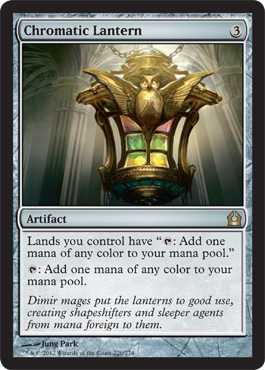
Strengths

  • Mana ramp - This is the strength that sets green at number one. Being able to play your high cost threats several turns early is key to victory. A lot of the most powerful Commander decks have green simply to ramp and fix mana.
  • Threats - Green is also very good at amassing a horde of monsters to quickly crush your opponents, and due to its mana ramping capabilities, it can reliably do this several turns before any other color.
  • Destroying noncreature permanents - Another clutch strength is to be able to efficiently deal with enchantments and artifacts that ruin your game plan.

Weaknesses

  • Destroying creatures - There aren't too many green cards that deal with creatures directly, so usually you have to rely on your large green monsters to overwhelm whatever creatures you opponents may cast.

Summary

Green contains some of the most powerful cards in Commander and the ability to accelerate them out early. Pair this with a color that efficiently deals with creatures and you'll have a quality Commander deck.

Wrapping up

Don't think that any particular color or combination of colors is bad in Commander. Some just work more effectively than others.

This article was meant to be more of an overall judgment of each color and the roles it plays. I could have broken each color down into it's strengths and weaknesses as they relate to themes. Blue, for example, is exemplary and almost necessary when it comes to an 'enters the battlefield' theme (my second favorite Commander deck theme). Maybe a theft theme sounds fun. What other color does this well? Red! Or a graveyard theme, or tokens, etc. The thing that makes Commander fun is that there is always an interesting theme to take advantage of.

Want Prices?

Browse thousands of prices with the first and most comprehensive MTG Finance tool around.


Trader Tools lists both buylist and retail prices for every MTG card, going back a decade.

Quiet Speculation