menu

Sealed at Grand Prix Nashville

Are you a Quiet Speculation member?

If not, now is a perfect time to join up! Our powerful tools, breaking-news analysis, and exclusive Discord channel will make sure you stay up to date and ahead of the curve.

Although my articles usually focus on Standard, this week I'm taking a break to talk about Sealed. Sealed is becoming more and more important. In addition to the awesome and ever-present Prerelease and Sealed PTQ season, we are starting to see more and more Limited Grand Prix.

Sealed always has been (and probably will be) my favorite format. I love the even playing field that six unopened packs puts all the players on. Would you rather compete against professionals with decks each of you built, or with a random assortment of cards? Personally, I prefer the latter.

In addition, Sealed stays fresh and interesting through repeated play. Every sealed event you enter presents a new deck-building puzzle to solve. With most sealed pools there are multiple decks that can be built. Each player sees the pool differently and it is quite interesting to talk about the merits and flaws of different options.

This weekend I traveled with some friends down to Nashville, Tennessee for a sealed Grand Prix. The trip was going to be a long one, nine hours down and nine hours back. But for a sealed Grand Prix it was definitely going to be worth it and I was super excited.

Some of my friends wonder how I can afford to travel so much. To begin with, I keep costs really low by splitting the hotel and gas with two or three other people. If you have not road tripped for Magic before, I definitely recommend giving it a try. Its not as expensive as it may seem and its always a blast! (As for ways to pass the time, I highly recommend Magic-themed Twenty Questions.)

Building the Pool

My sealed pool for Day One was interesting and difficult to build, which is actually what inspired me to write this article in the first place. I used up almost all the allotted time to settle on the final build and agonized during my bye over whether I made the right decision or not.

Take a look at what I opened:

Untitled Deck

White

1 Avacynian Priest
1 Break of Day
1 Chapel Geist
1 Curse of Exhaustion
1 Dearly Departed
1 Elgaud Inquisitor
1 Fiend Hunter
1 Gavony Ironwright
1 Intangible Virtue
1 Moment of Heroism
1 Niblis of the Mist
1 Ray of Revelation
1 Silverchase Fox
1 Smite the Monstrous
1 Stony Silence
1 Thraben Doomsayer
1 Unruly Mob

Blue

2 Armored Skaab
1 Chant of the Skifsang
1 Dissipate
1 Dream Twist
1 Griptide
1 Ludevics Test Subject
1 Moon Heron
1 Mystic Retrieval
1 Nephalia Seakite
1 Saving Grasp
1 Silent Departure
1 Stitchers Apprentice

Black

1 Abattoir Ghoul
2 Black Cat
1 Curse of Thirst
1 Farbog Boneflinger
1 Gruesome Deformity
1 Highborn Ghoul
1 Reap the Seagraf
1 Skeletal Grimace
2 Spiteful Shadows
1 Stromkirk Patrol
1 Tragic Slip

Red

1 Desperate Ravings
2 Erdwal Ripper
1 Fires of Undeath
1 Hellrider
1 Hinterland Hermit
1 Increasing Vengeance
2 Kessig Wolf
1 Kruin Outlaw
1 Markov Warlord
2 Night Revelers
1 Rage Thrower
1 Rolling Temblor
1 Scorch the Fields

Green

1 Avacyns Pilgrim
1 Dawntreader Elk
1 Festerhide Boar
1 Gatstaf Shepherd
1 Grave Bramble
1 Hollowhenge Beast
1 Hunger of the Howlpack
1 Kessig Recluse
1 Lambholt Elder
1 Orchard Spirit
1 Scorned Villager
1 Travel Preparations
1 Village Survivors
1 Wild Hunger

Multicolored

1 Drogskol Captain
1 Immerwolf

Artifacts

1 Blazing Torch
1 Geistcatchers Rig
1 Ghoulcallers Bell
1 Runechanters Pike
1 Sharpened Pitchfork
1 Wooden Stake

Land

1 Evolving Wilds
2 Haunted Fengraf

Looking over the sealed pool once more, I realize now that there are probably a lot more possible builds than I thought of in Nashville. There is definitely a lot going on in these six packs so I'll take a moment to break down how I approached it.

A First Pass
The first thing I register is the artifacts. This is important because it lets me see which cards I am most likely playing in any deck I build.

These cards are not set in stone, but many times there are a few I know I'll play for sure. Blazing Torch and Geistcatchers Rig are two such cards, as they are excellent removal. Whatever deck I play, these two cards are almost certainly making the cut.

Scanning through the colors, I was immediately drawn to red.

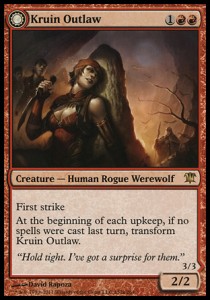
At the Innistrad Prerelease, I had Kruin Outlaw in my deck and it was very hard for players to deal with. Add Hellrider and Fires of Undeath to the mix and I was on board. Red had some other good creatures like Rage Thrower and Markov Warlord which are both good at finishing off opponents.

I could pair the red cards with green. This allows me to play Wild Hunger and Immerwolf, who will pump a large number of my creatures.

Avacyns Pilgrim provides acceleration and enables the flashback on Travel Preparations. With Dawntreader Elk and Evolving Wilds, I can even splash black for the second half of Fires of Undeath and maybe even Tragic Slip and Farbog Boneflinger.

Perhaps something like this:

Untitled Deck

Creatures

1 Avacyns Pilgrim
1 Scorned Villager
1 Gatstaf Shepherd
1 Dawntreader Elk
1 Hinterland Hermit
1 Orchard Spirit
1 Lambholt Elder
1 Kruin Outlaw
2 Kessig Wolf
1 Immerwolf
1 Kessig Recluse
1 Festerhide Boar
1 Hellrider
1 Village Survivors
1 Farbog Boneflinger
1 Rage Thrower
1 Geistcatchers Rig

Spells

1 Blazing Torch
1 Tragic Slip
1 Fires of Undeath
1 Travel Preparations
1 Wild Hunger

Lands

1 Evolving Wilds
7 Forest
7 Mountain
2 Swamp

This deck is not bad and I would not fault you for playing it. There will be some games that you win off of a fast start your opponent cannot recover from. However, this version did not sit well with me as it felt like most of the cards were underpowered. Sure, the two red rares were amazing but beyond that it felt lackluster.

My final decision to play a different deck was based on two things.

The first reason I did not play this version is a matter of personal preference. Over a long event like a Grand Prix or Star City 5k, I prefer a deck that is going to be consistent. I could have made the deck's manabase more consistent by cutting Black but I thought the resulting deck would be too low in power.

The second reason was the lack of more removal spells like Geistflame and Brimstone Volley. Without lots of removal this deck risks stalling out. Few of your creatures have evasion and most of them are easily answered by any removal spell or a three-toughness creature. You can't just rely on drawing Gatstaf Shepherd and Kruin Outlaw every game.

Rage Thrower helps out in this regard by making blocking difficult but he isn't really enough to fix the problem by himself. Ultimately I felt that this deck wasn't quite there, but even with just one more piece of removal I probably would have played it.

Back to the Drawing Board
So what did I end up doing? Why, playing none of those colors of course.

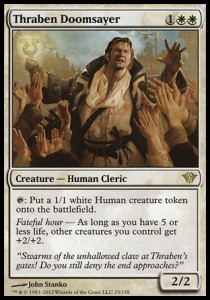
My white cards had synergy, evasion, removal and some really powerful spells. Thraben Doomsayer in particular was very powerful and every game I untapped with him I won. Usually I got three tokens out of him before he died. His Fateful Hour ability never came up but I assume that when it does you just win the game.

Once I decided to play white I had to determine which color to pair with it. At first, I wanted to risk the perils of an insane manabase and play White-Red-Black.

Think about Thraben Doomsayer and Hellrider in the same deck! Now add a couple other double-white and double-red spells and some Black mana to flashback Fires of Undeath. When the mana worked I most likely would have won, but I'm pretty sure I would have lost more games to bad mana than I was willing to give up.

Another reason to stick to two colors in this format is the often overlooked Haunted Fengraf. This land impressed me quite a bit and I plan on playing it more in the future.

In a two color deck, one colorless land will not significantly hinder your ability to play your spells. As it doesn't take up a spell slot, this makes the raise dead effect essentially "free".

In my deck that meant getting back some juicy targets like Avacynian Priest, Fiend Hunter, and Thraben Doomsayer. Being able to return high impact cards like these drastically increases the power level of your deck. You do have some control over when to fire it off as well, so if necessary you can pop it early to guarantee it gets your best creature.

In light of all this I took a look at the Blue. Initially I had dismissed blue as unplayable because there were not enough cards. But when building a sealed deck it's important to reexamine the cards available to you and consider each of your options carefully.

Blue may not have been deep, but it did have half a dozen excellent cards and would also allow me to play Drogskol Captain. Hmm, so I have spirits to synergize with the captain and humans to complete the loop with Dearly Departed. Blue-White tempo had been quite good to me in this format and I wondered if I could make it work.

I laid the following list out on my table and stared at it deep in thought for a full five minutes.

Untitled Deck

Creatures

1 Unruly Mob
1 Silverchase Fox
1 Avacynian Priest
1 Ludevics Test Subject
1 Stitchers Apprentice
1 Fiend Hunter
1 Gavony Ironwright
1 Chapel Geist
1 Thraben Doomsayer
1 Niblis of the Mist
1 Drogskol Captain
1 Elgaud Inquisitor
1 Nephalia Seakite
1 Moon Heron
1 Dearly Departed
1 Geistcatchers Rig

Spells

1 Blazing Torch
1 Silent Departure
1 Break of Day
1 Moment of Heroism
1 Chant of the Skifsang
1 Griptide
1 Smite the Monstrous

Land

1 Evolving Wilds
1 Haunted Fengraf
9 Plains
6 Island

Sideboard

1 Dissipate
1 Ray of Revelation
1 Saving Grasp

What did this deck do well? It had enough evasion and removal to form a solid base. As for bombs, Dearly Departed, Thraben Doomsayer, and Ludevics Test Subject would definitely win some games on their own.

The deck's curve is also quite good. There are enough creatures at each mana cost to impact every turn of the game. Mana curve is extremely important to me in this format and I value it above almost anything else. There were even relevant sideboard cards in Dissipate, Ray of Revelation, and Saving Grasp.

The Moment of Truth

I made my final decision to play the Blue-White deck with one minute remaining in the build time. After losing the first round, I began to have reservations about my build, but the rest of the tournament would prove that I made the right decision.

My first loss was ultimately out of my control. I was well in control in game one when I noticed my opponent counting something. I assumed he was trying to figure out how to kill me with some combat trick but I knew he could not.

What he was actually counting turned out to be the cards in play, in my hand and in my graveyard. Soon after that I lost to the dumbest card printed in a long time, Increasing Confusion. Losing to that card felt like losing to Phage the Untouchable. It was dirty and cheap and I really would prefer it hadn't been printed.

I lost game two because I failed to draw a third land at any point in the game after keeping a two-lander.

As I said above, the rest of the day went better and validated my deck choice. The only other round I lost was in three pretty close games against an Esper deck (which turned out to be a common way to build your sealed deck.) It wasn't much of a blowout, and a small change in any of the games could have easily swung the match.

Wrapping Up

Overall the deck performed well and gave me a lot of room to outplay my opponents. There were a lot of decisions involving different lines of play and the deck could switch between offensive and defensive very easily. I am glad I ended up playing this version as I do not think I would have done as well with the other builds.

Unfortunately Day Two did not go as well. My draft was one of those corner-cases involving crazy packs. For instance, I remember one of the packs in particular messed things up because it had literally eight red cards. Oddities like that seem to happen a lot in this block and I don't like how it messes up drafts.

I hope you enjoyed my Limited adventure as much as I did. Feel free to post your build of my pool below and comment on mine. What would you have done differently? Would you have played the same deck I did?

Until next time,

Unleash the Force on Limited!

Mike Lanigan
MtgJedi on Twitter
Jedicouncilman23@gmail.com

Insider: The System, Part One: Learning The Real Price of Cards

Are you a Quiet Speculation member?

If not, now is a perfect time to join up! Our powerful tools, breaking-news analysis, and exclusive Discord channel will make sure you stay up to date and ahead of the curve.

Today's article is both revolutionary and simple in its premise. It introduces you to a pricing model that sophisticated financial markets use, but the fundamentals are easily understandable. Kelly Reid and I have worked on getting better at what we're calling The System when we make runs on stores, trade and speculate on the next upcoming cards, and today, we are going to start sharing it with you - our Insiders. We have already made hundreds of dollars on this, but we can't make all the money there is to be made in this, since we don't have infinite cash to throw at it. That's why we're sharing it.

This is a principle that's stupidly simple and you might be inclined to say "Doug, why are you wasting our time with this? This is self-evident!" The System is designed to mitigate the worst enemy that a speculator faces: his own fear.

It's your fear that holds you back from hitting "buy" when you get an email from us saying "buy Olivia Voldaren" when she's $3, and it's fear that makes you distrust your own gut instincts about the next hot card. That fear feeds into a loop where you see what would have happened if you'd trusted yourself and you feel even worse that you didn't go for the good tip. Worse, you might start over-correcting and throwing money around.

The System depends on a few central maxims, and I am going to share what Kelly and I have discovered with you.

The real price of a card is the difference between what you buy it for and what you can sell it for.

This is the core principle and all others flow from it. When a currency trader considers buying British pounds or Icelandic Krona (don't!), he must consider that the transactional costs - dealer fees, conversions, credit card processing, etc., add friction to the exchange. If he turns dollars into pounds and back all day at the same exchange rate, he will go poor - he'll lose 1% or more each time, seeing his fortune shrink. The cost of a dollar, to our currency trader, is the difference between what he can buy it for - $1.00, and the price he can sell it for, after all is accounted for - $0.98, let's say. If our trader gets one dollar and the markets don't shift at all, he's risked 2% of his investment. All he needs to see is the dollar rise to cover that 2% and he's broken even. He just needs to see it rise another penny to see a profit.

People who trade on the foreign exchange know this principle well, and they use it to borrow vast sums of money to leverage against the market. Our trader borrows $10,000 to put into the bet on the dollar, knowing that if he's really only risking $200 at the outset. The cash inlay is big, but the risk is miniscule.

ForEx traders can run into big problems when the market shifts, but Magic cards are relatively stable in value over days. When you look at speculating on a card, you can depend on being able to resell it to dealers for the approximate value that you trusted when you bought it, and that price can hold up for about a week.

Let's look at an example. Kelly and I have been bragging on calling Huntmaster of the Fells early on. Why not? We've heard from multiple readers that the tip paid for their entire year of QS Insider. When we called it, Huntmaster was $11.50, which is a lot of cash. However, dealers were buying it for $9. If we bought every Huntmaster we could and immediately sold them, we'd only lose $2.50! The difference between the buy/sell price was about 21%. That means that if it went up to where playable Mythics usually go, we would see a big profit. Even if we had to sell them in a week or two at a loss, we'd only lose 20% of our investment. Of course, you know what happened to Huntmaster's price (and we seamlessly sold them back to the same dealers later in the week for $20 apiece), but let's look at something else that's a little more obscure.

Whipflare was another call from that same weekend. Whipflare was a decent sideboard card that shone in the playoff of the Pro Tour. It sold at 25 cents, but dealers were buying it for 15 cents. That means that we were only risking 10 cents on the card, not 25 cents - Whipflares would not suddenly be worth absolutely zero. The buy/sell margin was much bigger - 40% - but remember, we are looking at pennies of investment here. It pays to think big when you're looking at a card that only needs to make 25 cents to double up on.

With The System in mind, Kelly and I poured a lot of money into Whipflare and we should have pumped much more in than we did. We ended up buying 98 copies - an astronomical amount. Thanks to TCGPlayer for not canceling our orders! Of course, we "smurfed" our orders like a good money launderer would - buying twenty here and twelve there. Combined with other calls we were making, the shipping was manageable. But those 98 copies doubled in value, so our $25 investment ($15 risk) turned into $50. I know it looks like we doubled up, but we really tripled - we only put $15 on the line, after all. If we didn't keep the buy/sell margin in mind, we would have thought that Whipflares sold for zero to a dealer and not risked the 25 cents apiece. Looking it up, seeing that it had a buy price from someone, meant that the card was much less risky than it normally appeared.

Here's a thought experiment: what if I told you to pick up an old Arabian Nights card that's currently $50? Do you balk at that price? Would it change your mind if dealers bought it for $40? Now all you need to see is your card rise a little in value - a $10 value change on buylists - and you'd cover your cost. You're paying $10 to see if this bet pays off - not $50.

The size of your war chest dictates whether you make "some" money or "lots of" money.

I'll admit that my last experiment involved a little bit of cheating on my part. I assumed that you had hundreds or thousands in your trading account to get that Elephant Graveyard I was telling you about. We all take our war chest into speculative battle, full of gold and treasure. The bigger your initial amount, the more you can make. I have a finite amount, though, and so do you. Another big element of The System is to identify the smallest margins and capitalize on those, since you can only have so much money wrapped into your cards at any point.

Though you're dealing on margin risk and not actual cost, you would need $5,000 in hand to risk only $1,000 on our Huntmasters. I like to think of this as kind of like casinos that will only let you gamble on the upper floors when they know the size of your bank account, even though you're not risking the whole account that night. When you're looking at rent money vs. speculative money, you should always pay what you have to, first, but to make big profits with The System, you'll need to release your idea of absolute costs and embrace only the risk cost. It may mean putting $300 in where you only put $30 in before. After all, those Dungeon Geists that we told you to buy at fifty cents could sell to a dealer for half their price already... It may mean that you have forty copies of those geists instead of the two playsets you were thinking of buying. It may result in the fact that you made $120 instead of $20, all while only risking $12.50.

Don't risk more than 50% in a speculation.

Magic speculation can bring a lot of profits, but it can also make your money evaporate quickly if you put your money in cards that you cannot resell. The cards with the smallest margins are the most playable cards. That's because a dealer has both a demand for the cards and supply issues in making sure that they have enough to sell the customer. They'll happily buy a $10 card for $7.50 if they know they can make 25% on it all day long. They won't pay as much for something casually-popular but lightly played (so a high markup, like Gilded Lotus). If your card costs $1.00 but won't sell for anything above bulk, it'll only break your heart. You'll have enough opportunities, with cards like Whipflare, Vapor Snare, Dungeon Geists and Skirsdag High Priest, to risk only a little and stand to make quite a bit.

I'm happy to answer questions posted below, and I'm sure that Kelly will chime in, too. Until next week (with more examples of The System at work!)

-Doug Linn

Douglas Linn

Doug Linn has been playing Magic since 1996 and has had a keen interest in Legacy and Modern. By keeping up closely with emerging trends in the field, Doug is able to predict what cards to buy and when to sell them for a substantial profit. Since the Eternal market follows a routine boom-bust cycle, the time to buy and sell short-term speculative investments is often a narrow window. Because Eternal cards often spike in value once people know why they are good, it is essential for a trader to be connected to the format to get great buys before anyone else. Outside of Magic, Doug is an attorney in the state of Ohio.  Doug is a founding member of Quiet Speculation, and brings with him a tremendous amount of business savvy.

View More By Douglas Linn

Posted in Finance, Free Insider, Special4 Comments on Insider: The System, Part One: Learning The Real Price of Cards

Have you joined the Quiet Speculation Discord?

If you haven't, you're leaving value on the table! Join our community of experts, enthusiasts, entertainers, and educators and enjoy exclusive podcasts, questions asked and answered, trades, sales, and everything else Discord has to offer.

Want to create content with Quiet Speculation?

All you need to succeed is a passion for Magic: The Gathering, and the ability to write coherently. Share your knowledge of MTG and how you leverage it to win games, get value from your cards – or even turn a profit.

Insider: Tales from the Floor – GP Nashville

Are you a Quiet Speculation member?

If not, now is a perfect time to join up! Our powerful tools, breaking-news analysis, and exclusive Discord channel will make sure you stay up to date and ahead of the curve.

I’m back from Grand Prix: Nashville, and I have it say it was quite the experience. I want to take you through my weekend (a trading tournament report, if you will) and offer some input directly from the trading floor.

Friday

After convincing my carmates to leave Thursday at midnight, we started the 11-hour drive to Nashville from Norman, Oklahoma.

Nothing of note happened, unless you count the fact that I drank two Red Bull and my body couldn’t handle it since I normally don’t drink caffeine. I was still exhausted since as I began the 4 a.m. – 8 a.m. driving shift, but my body was all twitchy. Not really the most pleasant experience of my life.

But we did eventually make it into the Country Music Capital of the World (very exciting for me), and promptly found out that the car that had left some seven hours before us had stopped for the night, so we couldn’t actually get into where we were staying in Nashville, which turned out to be a pair of quaint cottages about a half-hour from the event site.

While we did get a very favorable price on the rooms, I can’t say I recommend such a plan. I’ve never regretted paying more to be walking distance from the event site, and that would have held true for last weekend as well.

Anyway, after getting some pretty decent barbeque for lunch, we talked of going to a distillery to kill time, but since the closest open one was another hour’s drive, we passed and settled for a trip to the liquor store (don’t worry, this isn’t going to devolve into a “we got drunk and acted dumb and we’re so cool! Report like some do).

On site, I had a few friends with byes go to dreamcrush in the grinders just for fun while I took to the trade tables. As expected, Geralf's Messenger and Gravecrawler were trading hot, and I targeted those.

The other important thing I did on Friday is something I suggest any trader do at a large event. I went to every dealer booth in the room and asked for a buylist. This allows you to spot anything that you can get a particularly good price for.

My entire trading strategy at events like this where I am planning to cash out is to find a few target cards for the weekend that I know are being undervalued on the trade floor. For last weekend it was Black Suns Zenith, which was being bought on site for $4, and Birds of Paradise, which could be sold for $2 to dealers.

Considering that was the price most people traded them at, you can see how easy it is to quickly turn trades into cash, and it’s something you can do just by spending a few minutes picking up buylists from around the room.

Saturday

Little did I know Friday was going to be my best day. I had never attended a Friday at a GP before, and from now on I won’t miss one. It was my best trading day, since many traders weren’t yet on the floor and people hadn’t cashed out to dealers yet.

By Round 3 on Saturday the floor was infested with sharks and grinders. And while a good many of them are my friends (and/or readers of this column) and I enjoyed getting to hang out with everyone, it certainly makes it more difficult for each of us to profit on the day. Contrast this with last weekend at SCG Dallas, where I had the run of the floor and had an insanely good weekend.

Anyway, I appreciated meeting everyone who introduced themselves to me and I hope you all had a good as time hanging out as I did. There’s little better than just shooting the sh!t with a group of like-minded traders at a big event, and Nashville was no different.

Another card that jumped out to me was how hot Phantasmal Image was. You might think that since it’s been such an in-demand card for a few months now it would cut down on the number of people looking for it (like Hero of Bladehold, which is still pricy but not often inquired about), but that was the opposite of true. Everyone wanted Images in Nashville, and despite my best attempts to hold onto some for both my Modern Merfolk deck and the local shop owner at home, I couldn’t turn down people giving $17 in trades for them.

Speaking of things I traded at $17, hello Misty Rainforest. You all know of my current project with fetchlands, but again, it’s tough to turn down someone offering to trade for Mistys at $17 when I know I picked them all up at $8. I still have a very sizable fetchland collection, but it’s something I’ll have to wait a few months on to begin picking back up cheaply after Modern season is over.

Sunday

Here’s my one comical tale from the weekend. At our cottages we had three rooms. After sleeping in the “Violet Room” on Friday night, I came back late Saturday to find one of my roomates who was playing in Day 2 (Will Craddock, who Top 16’ed) had stolen my bed.

Whatever, right? I figured I’d just grab a blanket and crash on the floor whenever I went to sleep, which turned out to be a few hours later after I finished crushing everyone playing 60-card casual with my Master Transmuter deck. Of course I ended up not being able to find a blanket and how to get into a tiny bed with another man for the night, which wasn’t really on my to-do list for the weekend.

The real trouble came in the morning. The people in my cottage were all heading out but I was riding with the group from next door, leaving later. This allowed me some sleep-in time, which is another big advantage to being a trader and not a player. Of course, it absolutely backfired in this case.

Upon rolling out of bed I find that the Violet Room is locked from the inside, stranding all of my belongings inside. This is obviously annoying but not the end of the world. I call the group that left, who tell me they don’t have an extra key and don’t have time to double back. I then call the groundskeeper, who despite allegedly being available “anytime” is not answering his phone. I then went up the chain to the owner whose number was on the sign with the friendly reminder “just a few blocks away!”

Of course she didn’t answer either, which led to half an hour of me in my pajamas without a shirt just chilling on the ol’ porch swing in front of my 1800s cottage. I’m sure it would have made for quite the picture.

Finally the owner calls me back and sends me on what I can only describe as a scavenger hunt. She directs me over the phone to her office, where I am to start digging through her old bills to find a bag of keys. Upon finding said bag of keys, I tell her there isn’t one labeled what I need only to hear “Yeah, I didn’t think we had one.”

She then tells me to pick up the bag of keys to the house next door and try them, since one of them might have the same lock and work. 20 keys later, I find the perfect fit and am finally able to put on a shirt. Of course everyone found this entire situation hilarious but me, since I was more interested in murdering whoever closed the door behind them.

Finally back on site, I get a few more trades in but mostly hang out with the crew and help Kelly look for his lost Commander deck, which we were unable to find. He did, however, locate when he got back home.

But on a more important note, we were able to out a con artist and thief at the event and have him thrown out and banned from all future events. Ryan and I talk about “bulk rare guy” more in our most recent podcast of Brainstorm Brewery here, and I can assure you there is no measure too harsh to get people like this driven from our community.

When I finally cashed out at the end of the day, my binder was back to about where it was before Dallas, only now I had two more mint condition dual lands in it and a cool $800 in my pocket. After all expenses for the two weekends, including all food and the $100+ steakhouse we went to on Saturday, I profited somewhere between $500 and $600, which is solid for a pair of weekends spent hanging out with friends.

It’s so great to be able to not only pay for your hobby but also for the pleasure of hanging out with old friends and meeting new ones at large events like Grand Prix. I’m not sure when I’ll next make it to a big event, since I’m getting married in about two months, but I hope to see you all back out on the trade floor again as soon as possible!

Thanks for reading,

Corbin Hosler
@Chosler88 on Twitter

Insider: The Revenue Review – Of Podcasts and Pitfalls

Are you a Quiet Speculation member?

If not, now is a perfect time to join up! Our powerful tools, breaking-news analysis, and exclusive Discord channel will make sure you stay up to date and ahead of the curve.

[Corbin wrote this article last week while traveling to Grand Prix Nashville. He was unable to find a reliable connection in his travels, so here is his Insider article from 3-16-2012.]

I’m in the middle of a big two-week stretch for me where I hit up SCG Dallas last weekend and am traveling to Nashville for the Grand Prix there this weekend. I want to talk about a few things I noticed on the trade floor last weekend and my plan for this weekend, but first I need to announce something pretty cool.

The first-ever Financial Podcast is now live!

Calling it Brainstorm Brewery, it’s Ryan Bushard (@CryppleCommand) and myself (@Chosler88) talking about MTG financials while Marcel tries to keep us from going on too long about prices and such. Why the Brewery, though? Because we’re also talking rogue deckbuilding. All three of us like to brew, and I only brew when I know my deck is competitive.

You can find all that, and more, on our first episode here. Our second episode should also be up very soon, so keep an eye out for it.

Please provide feedback to us in whatever medium you want, whether that’s on here or on Twitter (@Chosler88). We want to turn this cast into what you guys want it to be, so don’t hold back.

With that in mind, let’s get into a few other things I want to talk about this week. For starters, the pitfalls of selling, also known as “the power of a good buy list.”

Finding the right list

It makes me really sad when I attend a SCG Open weekend and see players lined up to sell their collection there. This is not a knock on Star City directly, but it’s a well-known fact that they have some of the lowest buylist prices around on the majority of the cards you have in your collection (though I’ll duly note their Legacy buy prices are typically better).

Of course, cash is king, and that’s why people sell to them. But they are leaving, in many cases, hundreds or even thousands of dollars on the table by selling out like that.

A good trader has a number of outlets for selling. When I’m at a big event with multiple dealers, I shop around to find out where I can get the best prices on individual cards, and then split up where I’m selling to maximize profit. I’m sure you would do the same, since it seems so obvious. Why, then, do people not do this when it actually comes time to sell?

My best guess is that many people are either unfamiliar or uncomfortable with the process. Selling your cards is the time you should be looking forward to, not dreading, because it’s when your hard work at the trade tables turns into actual pay-the-rent money instead of theoretical dollars sitting in a binder.

Not that there’s necessarily anything wrong with that, provided you have a real reason for making theoretical dollars instead of real ones. For instance, since I won’t sell to Star City Games at an Open weekend, I used my time in Dallas to simply stock up in preparation of selling the next week at Grand Prix Nashville.

Remember, there are a ton of dealers out there and they all have different needs. Don’t think that just because you have a growing collection means you have to be in a rush to sell, especially if you’re sitting on more stable cards such as casual hits like Mind Funeral or something that’s steady due to older formats, like Stoneforge Mystic. It may be worth it to move your Runechanters Pikes as soon as you can to make a profit, since sitting on the Standard flavor of the week is dangerous, but for the other cards make sure you get the right deal.

In no particular order, here are some other tips that I wish I had known when I started to learn the process of cashing out your cards.

Shop around

I’ll admit that my very first sell ever came to Star City Games over the internet, simply because I didn’t know any better. I imagine I’m not the only one who’s been in that position. Treat your Internet selling like you would if you were at Grand Prix and find the lists you like.

As I said, buy prices fluctuate like crazy between different stores, but Card Kingdom, Strike Zone Online, and AdventuresOn all typically offer very good buy prices, and Don’s Magic and Sundry offers a blanket buy policy based on percentages, which can be helpful. You encounter different standards from each of these stores on things such as condition, so make sure to consult the Reseller Reviews in our forums, but these four stores are all a good place to start.

Keep it local

You don’t have to take to the Internet to sell. Make friends with the dealer at your local game store. I’ve called a couple different shops home now, and there have been advantages and disadvantages to each.

For instance, the shop where I used to live didn’t really have a thriving singles business, but the owner let me sell cards for cash on site. This meant I could get better than buy prices whenever I made a sell, but it also raised the probably of not being able to move cards whenever I wanted to. At the store I go to now, the owner and I have a very good partnership where he cuts me pretty decent prices and I keep cards moving to him that he needs.

Develop and foster these relationships as best you can, because a lot of the time you can save yourself the trouble of dealing with a store across the country (and save a trip to the post office).

Don’t be scared to negotiate

I’ll let you in on a secret: the price a dealer quotes you when you sit down across from them is not set in stone. They’re going to make a profit when they resell your cards, whether that’s at a 30 percent margin or a 40 percent margin, and you’d be surprised how willing many dealers are to work with you, particularly if you understand what both parties need from each other.

Dealers and floor traders have a symbiotic relationship wherein both parties need the other. Dealers need stock to sell to customers, and traders need an outlet for their cards.

I’m not saying to nickel and dime them on every card, but if you know they’ve got Gravecrawlers in the case at $10 and they’re only offering you $5, don’t be scared to ask for a dollar more on each, because that’s still a perfectly acceptable margin for them. This won’t work every time, but it will definitely make an impact on your bottom line if you can keep it easygoing and friendly with dealers when you’re selling.

Use the power of the buylist

If one dealer is offering you $5 on Green Sun's Zenith but another is offering you $4, it’s pretty easy to know what to do. But what if you’re selling online and the second dealer only has a better price on one card, in this case the Zenith? If you’re not careful, you can eat up the extra money you’re getting by spreading yourself too thin and incurring more expenses.

Knowledge is truly power, as they say, and you can use this to your advantage. Establish a line of communication with the dealer and let them know that you need a certain price on this card. More often than not, if you’re giving them real numbers, they’ll match the price because, like I said above, they need you just as much as you need them.

This works even better if you have a local outlet to move cards and can use the power of a good online buylist to get the same prices at home. You save the hassle and expense of shipping and get to help out and establish a good working relationship with your friendly local shop owner.

That’s all the space I have, but I feel like I’m just getting started. I plan on recounting how Grand Prix Nashville next time, but I’ll definitely revisit the topic of working with dealers in the future. Let us know in the comments or Twitter or wherever else if you guys have any other helpful tips!

Thanks for reading,

Corbin Hosler
@Chosler88 on Twitter

Insider: Covering Your Collection

Are you a Quiet Speculation member?

If not, now is a perfect time to join up! Our powerful tools, breaking-news analysis, and exclusive Discord channel will make sure you stay up to date and ahead of the curve.

We all put a lot of time and money into our collections. As a person who has had a collection stolen, I know how it feels when something suddenly disappears, especially something that takes years to acquire and money out of your pocket to replace.For some of us it's a yearbook of memories of years past, for others its a transient inventory.

How important is your collection to you? What would you even do if your collection was stolen? As I once learned the hard way, you simply need to insure your collection.

I’m intimately familiar with Insurance laws in the State of California, but things may differ in your region. This is meant to be a guide to the types of questions to ask and the types of coverages you need.

Your belongings can be insured a number of ways. The most common are through a Homeowners/Renters policy and the other is a Personal Articles Rider. I’ll talk a little about both, and let you know what to look for when insuring your collection.

Is your stuff safe?

Homeowners Insurance

If you’re a homeowner, you likely already carry Homeowners Insurance. Homeowners Insurance protects more than your home, it also protects all of your belongings, including your Magic Cards, without having to add other coverages!

Be careful and talk to your company to be sure that there are not limitations on certain types of collectables. Many companies have limitations on Sporting Cards but not other collectibles, so investigate this closely.

Other companies may have a limit on how much they’ll pay for any individual collectible item that is stolen. Also, your stuff doesn’t have to be stolen from your home to be covered, it covers you around the world wherever you take your stuff. Ask your company if there are any exceptions to this, especially regarding theft from your vehicle.

Homeowners Insurance pricing will vary specifically to your area and the size of your home. Talk to a professional to be sure you have adequate coverage. Also keep in mind most Homeowners Policies have a decently high deductible, so make sure that’s something you’re comfortable with, for if something happens to your collection, they will only pay for the portion that exceeds your deductible.

Renters Insurance

Renters Insurance is very similar to Homeowners Insurance, it simply does not provide coverage for the dwelling where you live. It does cover, however, your belongings in a similar way.

Typically Renters policies have better coverage for your belongings because it is the primary chunk of coverage. Renters insurance starts around $12/month and, depending on the amount of coverage you want, can be up to $40 or $50 per month.

You’ll be asked to select the amount of coverage for all of your belongings on a Renters policy. It is important you do this and not simply the amount of Magic Cards you want to cover.

For example: If you obtain a Renters policy with $10,000 in coverage, and your home is broken into and your collection is stolen, your carrier will ask why you are claiming $10,000 is stolen, but all your other belongings are still there. They will then say you were underinsured and decrease the amount of your claim.

Personal Articles Rider

A personal Articles Rider is an add-on to a Renters or Homeowners policy that provides coverage for items that are excluded or limited from the main policy. If your carrier doesn’t include coverage for your collection on the basic policy, ask them if they have a Rider available (sometimes called a Floater).

With a Rider you get to specifically state the value of your collection and choose a specific deductible for those items only. This really is the best option, but is typically much more expensive than the coverages built into a package Homeowners or Renters Policy.

Valuation

There are 3 ways Insurance Companies will value your collection, the first being Actual Cash Value.

This term may sound great, but this is probably not what you want. An item’s Actual Cash Value is its price when new less any depreciation. In the eyes of a non-collector, a 10 year old piece of cardboard is worth next to nothing, and if something happens to it, that’s what they’ll offer you.

Another valuation option is Replacement Cost Value. This means the carrier will pay you the cost (Including Shipping and Tax) to actually replace the loss with like-quality items. This is what you’re looking for if you want to actually recoup your loss. For this method, there is typically no requirement to track or log what items you own in the case of a loss, but any documentation or proof you can show will be helpful.

I suggest taking a video camera and walking through your entire house (and also scanning over your collection) and saving the tape in a secure location away from your home (preferably at your insurance agent’s office). In the case of a loss, they will do some research and find out what it would cost them to replace it and make you an offer.If you accept they cut you a check, or you have the option to prove to them it would cost you even more to replace.

The third option is Agreed Value, which is what’s typically seen on a Personal Articles Rider. Upon entering the contract, you and the insurance company agree on the exact value of all the items covered, and you must provide a list, or other proof, of what items you are covering. This guarantees that you will receive the value you expect from any loss.

Wrap-up

The key to protecting your collection is asking a lot of questions. Know what’s covered and know what isn’t. Ask specifically about how thefts away from the home (at a Magic Event, for example) are handled in the claims process and how they value collectibles.This is one way you will see the difference between the discount companies and the major carriers.

Remember, if it only costs you a fraction more to be with a carrier that actually protects the items that are important to you, its likely a good idea to switch.

I’m happy to answer any questions about insurance in the comments below!
Guard your stuff!

Avatar photo

Chad Havas

Chad has been with Quiet Speculation since January of 2011. He uses price speculation to cover all his costs to keep playing. Follow his journey from format to format and be prepared to make moves at the right times.

View More By Chad Havas

Posted in Finance, Free Insider, Special3 Comments on Insider: Covering Your Collection

Have you joined the Quiet Speculation Discord?

If you haven't, you're leaving value on the table! Join our community of experts, enthusiasts, entertainers, and educators and enjoy exclusive podcasts, questions asked and answered, trades, sales, and everything else Discord has to offer.

Want to create content with Quiet Speculation?

All you need to succeed is a passion for Magic: The Gathering, and the ability to write coherently. Share your knowledge of MTG and how you leverage it to win games, get value from your cards – or even turn a profit.

Insider: What Is the Fate of Legacy?

Are you a Quiet Speculation member?

If not, now is a perfect time to join up! Our powerful tools, breaking-news analysis, and exclusive Discord channel will make sure you stay up to date and ahead of the curve.

First, I want to give a heartfelt thank you to Tyler for covering me last week. I spent a full five nights in the hospital with my wife and newborn. Any attempts at an article would have been poorly thrown together and likely full of content with no value. Now I am home with baby Landon and my wife, and things are slowly stabilizing yet again.

Having a child changes my perspective of many things. I promised myself that one sacrifice I was not willing to make was in Magic. I vowed to maintain this as my only hobby for the next trying year or two. It has grown to be a significant part of who I am, and I couldn’t imagine giving it up.

So with that I begin my next article, still partially inspired by my son.

Many Years Ago – An Anecdote

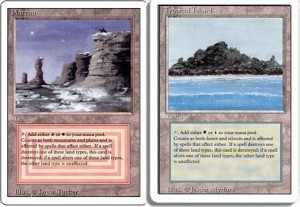
I still remember the first dual lands I ever purchased. I bought a Plateau and a Tropical Island for about $12 each.

Sounds like a great deal, right? Well this was back in 1997, so the deal was not as phenomenal as your initial impression. Still, it was an exciting purchase for me because it was the largest Magic purchase I had ever made.

When I got home I was enthusiastic to play with my now most valuable cards! But I quickly realized something. These cards were just lands that produced mana! They wouldn’t bash my opponent for six like Craw Wurm, nor would they deal any direct damage like Fireball. Worst of all, I had to play a Blue/Green deck or a Red/White deck to even use these cards?! What a poor purchase.

Needless to say, these two cards didn’t remain in my collection for long. (Darn!)

Fast Forward to Today

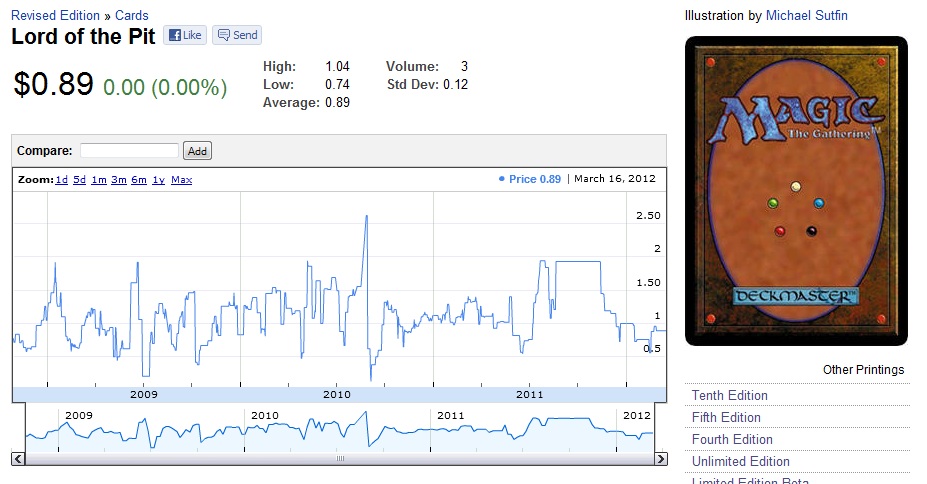
When my son grows a little older, he will most certainly be exposed to the world of Magic: the Gathering. He has a tremendous advantage in having a father who can guide him along the way. When my friends and I started playing, we had no one to advise us on which cards were powerful and which were most valuable. We believed in the fallacy that Dark Banishing was the ultimate removal spell and Scaled Wurm the ultimate creature. Until, that is, we discovered Lord of the Pit which was immune to the former!


(Chart courtesy of blacklotusproject.com. Disclaimer: the writer does not own any Lord of the Pits for investment)

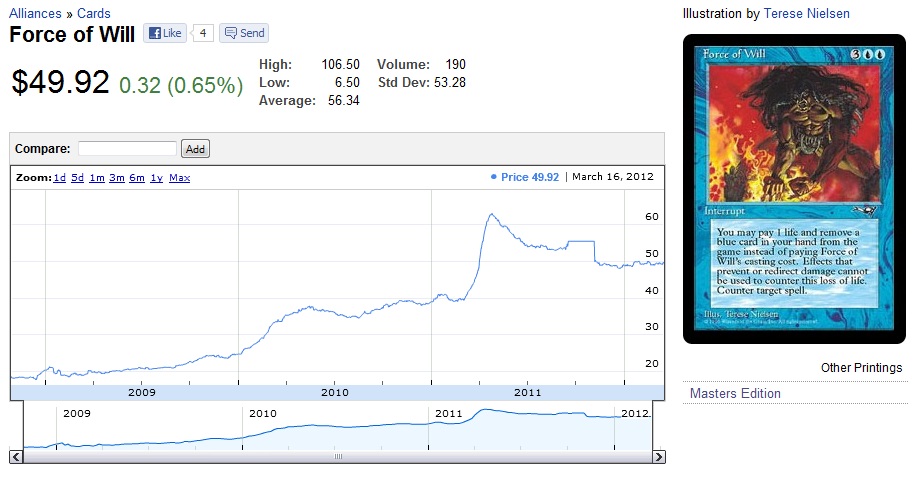
I now realize how powerful and valuable Dual Lands are. Thanks to the Legacy boom largely driven by Star City Games, the Dual Lands have multiplied in value several times. Other staples such as Wasteland and Force of Will have likewise shot up in price.


(Chart courtesy of blacklotusproject.com)

I managed to obtain all the Legacy staples I was most interested in shortly before the cards hit their peak. Now I am sitting on a sizable Legacy collection and I have a moral dilemma in front of me.

Now that I have a child there is no way I will be able to get my money’s worth from playing these Legacy cards. I simply cannot play frequently enough nor can I travel to larger events. I have begun to question whether I need to have a collection of Legacy staples at all, since they simply sit in a binder within my closet for months at a time.

Other Factors

While the birth of my son was a primary trigger that causes me to reconsider necessity of my collection, there is an array of other external factors which also drive me to this consideration.

First, I have observed that conversation on The Source, Legacy’s major forum, has dwindled somewhat. There are more posts discussing cards getting stolen, players getting banned and artworks getting altered than there are discussing Legacy strategy. Is this an indicator that focus is shifting away from Legacy?

The second observation I’ve made is that the Star City Games Legacy opens seem to have become uninteresting. When I began playing Legacy there was a vastly diverse metagame. I could play a deck with mostly lands, mostly enchantments, mostly instants/sorceries, or mostly creatures.

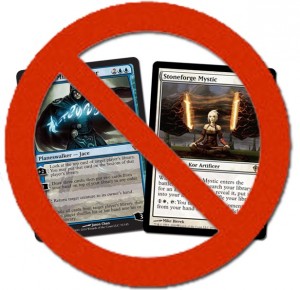
Now, it feels like recent printings have warped the format in such a way that diversity is lacking. Cards like Stoneforge Mystic, Jace, the Mind Sculptor, and Batterskull have left a recent scar on Standard and thus leave a sour taste in my mouth when I see them so heavily played in Legacy. It almost feels like Legacy has become Standard with Dual Lands and Force of Will rather than its own unique format.
(Picture courtesy of thegamerssanctuary.blogspot.com)

The final external factor which causes me to question keeping my Legacy collection lies in the youngest format: Modern.

A light version of Eternal, this format promises a widely diverse format reminiscent of old Legacy. While Legacy feels like a stronger Standard, it’s ironically Modern that fills the void of a diverse Eternal metagame. The result is an immensely popular format – one where I’d prefer to spend my time and money to be honest.

My Options

Legacy is not as alluring as it once was. I, like many, have come to this fateful conclusion. So what should I do with all my cards?

If this were the stock market, this would be a no-brainer. I have made a significant return on my investment in Legacy, and now I feel the card prices have stagnated. I should sell out of these cards and move into something with larger upside, such as Modern.

But emotions do exist and they play a role here. It took me a couple years to assemble my set of 40 Dual Lands – do I want to give them up so quickly? What if Legacy rises in popularity again? Isn’t Underground Sea one of the safest MTG investments one could make?

I could keep only cards for one Legacy deck and sell the rest. But this seems noncommittal to me. I’m in or I’m out – I do not want to straddle the fence here. All it takes is one new card or one banning and the deck I chose could go to the wayside.

Finally, I could sell everything and play a low-budget deck such as Burn. While uninteresting, this option would enable me to play in Legacy tournaments competitively while banking all the profits I’ve made from my initial Legacy investment.

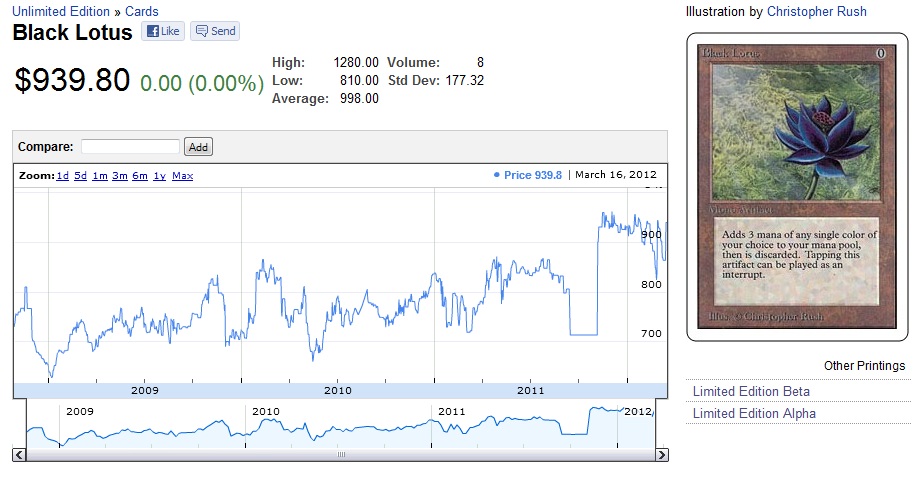
Clearly, I am distraught with this decision. Having all these cards is exhilarating and I love browsing through my binder of Legacy staples. But looking at these cards on occasion simply is not sufficient to motivate me to keep this collection. Opportunity costs here are immense. I could invest in other formats, obtain the holy grail of cards, Black Lotus, or even use the money elsewhere in my life.

I petition the readers for some guidance here. Considering the information I’ve provided above and keeping in mind the context of my current situation, what would you suggest? I would greatly appreciate the suggestions!

Damia, Sage of Mirrors

Are you a Quiet Speculation member?

If not, now is a perfect time to join up! Our powerful tools, breaking-news analysis, and exclusive Discord channel will make sure you stay up to date and ahead of the curve.

If you've been reading this column for awhile or listening to Commandercast, you probably already know how much I love The Mimeoplasm.

Ever since that guy was spoiled, I've put him at the helm of several Commander decks and tried to christen him with the unofficial title of "The best Voltron Commander in the format." There are few things I enjoy as much as starting a game with The Mimeoplasm and letting him devour some souls.

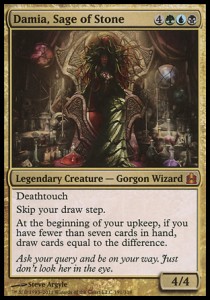
The problem is that I enjoy playing with The Mimeoplasm to the exclusion of the other BUG colored Commanders, Vorosh, the Hunter and Damia, Sage of Stone. Over the last few weeks I've been pushing the theme of trying new things, and in that spirit I decided to build a deck that did something crazy with one of these two BUG Commanders.

I boiled it down to two ideas: a Proliferate-themed [card Vorosh, the Hunter]Vorosh[/card] deck or a [card Damia, Sage of Stone]Damia[/card] deck that tries to turbo through its library and win with Laboratory Maniac.

In the end, I decided to build [card Damia, Sage of Stone]Damia[/card] for two reasons. The first is that I have a sweet signed copy of Damia, Sage of Stone from Grand Prix Baltimore. The second was that some twitter personalities wanted to put together a quick Podcast to discuss different takes on [card Damia, Sage of Stone]Damia[/card]. By the time this goes up, you should be able to check it out over on Redsitewins.

The Dangers of Damia

One of the things I was most concerned about, which the podcast confirmed, was that [card Damia, Sage of Stone]Damia[/card] decks tend to lean towards goodstuff or combo.

You're starting with a Commander who is a draw engine unto herself in colors that can ramp aggressively to cast her early, all while running the best tutors in the game. Almost incidentally, this means that if you play any combo pieces at all, your deck has the ability to combo off with surprising speed and consistency.

This means that I want to avoid cards like Palinchron and Tooth and Nail, because of how easy it is for those cards to turn a "normal" deck into a combo deck. Instead, I want to focus on protecting [card Damia, Sage of Stone]Damia[/card], digging through my library, and ending the game with Laboratory Maniac.

Naturally, we'll be doing some other cool stuff along the way.

The Engine

[card Damia, Sage of Stone]Damia's[/card] ability to fill your hand is obviously insane, but there is another line of text that you need to be mindful of. Skipping your draw step can be dangerous, since it makes it possible to get Damia-Locked in the event you have seven cards you can't do anything with.

What this means is that you want a lot of ways to get cards out of your hand and keep your "deck-velocity" up. The more new cards you see, the more exciting things you can do.

Have I ever got a way to see a ton of cards!

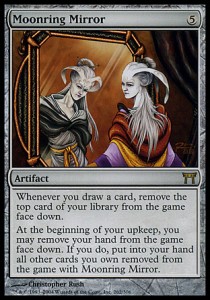
  • Moonring Mirror
  • Bottled Cloister
  • Sculpting Steel
  • Phyrexian Metamorph
  • Copy Artifact
  • Thought Reflection
  • Tezzeret the Seeker
  • Fabricate
  • Laboratory Maniac
  • Eternal Witness

The goal here is to go off with [card Damia, Sage of Stone]Damia[/card], Moonring Mirror and/or Bottled Cloister to draw a billion cards.

Moonring Mirror lets you double however many cards you've drawn with [card Damia, Sage of Stone]Damia[/card] for each copy that you have, which is awesome. But what's more awesome is having two or three hands of between ten and twenty cards floating around between different artifacts! How often does that happen?

In contrast to the absurd card selection of Moonring Mirror, Bottled Cloister has two large. First, you can't play on your opponents' turns anymore, and second, if Bottled Cloister dies your hand is exiled forever.

That said, it has two huge upsides that involve manipulating different triggers on your upkeep. The first and most straightforward one is to stack your Bottled Cloister and [card Damia, Sage of Stone]Damia[/card] triggers so that you have no hand when [card Damia, Sage of Stone]Damia's[/card] ability resolves and draw seven cards every turn, which is absurd!

What's even better though is that you can use Bottled Cloister to combine hands hidden under Moonring Mirrors with your "normal" hand. Let the trigger from Moonring Mirror switch your empty hand with the cards under Moonring Mirror, and then let Bottled Cloister return your "other" hand.

The problem with this plan is that you're relying on a combination of two or more very vulnerable permanents, all of which are reasonably expensive. Let's get to work on those two problems, shall we?

Ramping Up

One of the things that all [card Damia, Sage of Stone]Damia[/card] lists agree on is a heavy ramp component. When your general costs seven and is as powerful as [card Damia, Sage of Stone]Damia[/card], you want to be able to consistently resolve her early in the game. You could certainly run cards like Mana Crypt to make that happen even more often, but as that's out of my budget for the time being, this is what I'm running with for now:

  • Search for Tomorrow
  • Rampant Growth
  • Farseek
  • Far Wanderings
  • Harrow
  • Explosive Vegetation
  • Deep Reconnaissance
  • Sakura-Tribe Elder
  • Sol Ring
  • Mana Vault
  • Worn Powerstone

I like a heavy suite of two-cost ramp spells to let you curve into your other accelerants. I haven't played too many games with this list yet, but it seems like it will be able to play a turn four or five [card Damia, Sage of Stone]Damia[/card] pretty consistently, which is about where I want to be. You can get this to be turn four more consistently by adding more cards like Coalition Relic that ramp you two lands as opposed to one.

The thing about this deck is that you don't want to just jam [card Damia, Sage of Stone]Damia[/card] and hope for the best. If you ramp a bunch, cast [card Damia, Sage of Stone]Damia[/card], and then they destroy her, you're down a bunch of cards. If she sticks for a turn, then you've recouped all of the cards you've invested; consequently, this deck is more interested in casting [card Damia, Sage of Stone]Damia[/card] with one or two mana up to protect it.

This leads us to the second problem that needs to be taken care of: protecting our commander.

Free Answers

One of the goals I had for this deck was to be able to cycle through your hand as quickly as possible, even without your artifact engines.

In order to do that, I wanted to play many free and one-mana answers to removal and different kinds of permanents. Since [card Damia, Sage of Stone]Damia[/card] is a lightning rod for removal, you want access to as many Force of Will-esque effects as possible so that you can run her out early and still manage to untap with her in play.

Countermagic

  • Avoid Fate
  • Dispel
  • Divert
  • Autumn's Veil
  • Intervene
  • Flusterstorm
  • Mental Misstep
  • Stifle
  • Turn Aside
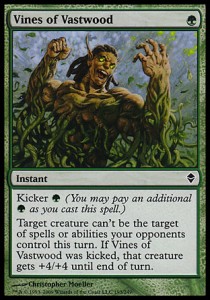
  • Vines of Vastwood
  • Envelop
  • Force of Will
  • Pact of Negation
  • Foil
  • Counterspell

The bulk of this deck is made up of efficient answers to different kinds of cards, and just about half of those answers are counterspells of different varieties. It's important to recognize that you need to choose the suite of countermagic that fits your playgroup; if people are playing efficient, compact decks, then Spell Pierce is much better than it is against ramp decks, for example.

One trap to avoid is being too conservative with your countermagic. You certainly don't want to fire all of it off at once, since you need to make sure that [card Damia, Sage of Stone]Damia[/card] doesn't die, but don't be afraid to use most of the spells in your hand. As long as [card Damia, Sage of Stone]Damia[/card] lives, you're just getting free cards by using up all of your answers every turn cycle.

If you have prior knowledge of your opponents' decks, you can definitely leverage that information to help decide whether to hold an answer or use it at the first opportunity. As a rule of thumb I'd say to be more aggressive with your spells than most BUG decks tend to be.

Other Cheap Answers

  • Coffin Purge
  • Crop Rotation
  • Rescue
  • Ghastly Demise
  • Nature's Claim
  • Noxious Revival
  • Pongify
  • Tragic Slip
  • Undying Evil
  • Nihil Spellbomb
  • Tormod's Crypt
  • Preordain
  • Ponder
  • Brainstorm

And here are the rest of your cards! One thing that I'm not sure of is the amount of graveyard hate. This deck runs four pieces: Tormod's Crypt, Nihil Spellbomb, Coffin Purge and Bojuka Bog. Crop Rotation and potentially Vesuva give you two more ways to access this effect.

Part of the reason I wanted to run so much is that these are cards you can just get out of your hand to keep drawing with [card Damia, Sage of Stone]Damia[/card], but still get full value out of later. It's possible, however, that your ability to dig through your deck for specific cards means that you can skimp on graveyard hate more than usual.

Besides that, you have some cantrips to dig for specific answers you really need, a small suite of creature removal and a Nature's Claim. Depending on your metagame, you might want more Naturalize-style effects, but in general my games are heavily based on spells, as opposed to creatures or other permanents.

As strange as it is, this is most of the deck. There's only a handful of other cards, the goal of which is to make sure you can use up your hand every turn cycle and see a new grip of cards.

Emptying your Hand

I keep coming back to the idea of being able to use all of your cards every turn. Making sure cards don't get stranded in your hand is very important for this style of deck, and these cards are here to make sure that you can get cards out of your hand and dig for better ones!

  • Manabond
  • Azusa, Lost but Seeking
  • Burgeoning
  • Oracle of Mul Daya
  • Dreamscape Artist
  • Demonic Collusion
  • Forbid
  • Psychatog
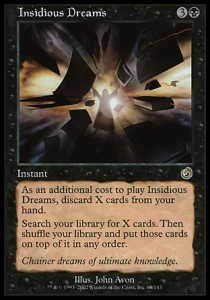
  • Insidious Dreams
  • Asceticism
  • Diviner's Wand

The first set of cards here helps to make sure you can get rid of all of the lands in your hand. Of all the cards in your deck, those are the hardest to get rid of since you can only play one per turn. Other cards you can at least cast for very little effect in most cases, but sometimes lands are just impossible to get rid of.

That's yet another reason that ramp is so crucial to this deck. Generally, the deck-thinning that ramp provides is a minimal advantage at best, but when you're drawing between five and twenty cards each turn, the difference in card quality becomes much more noticeable.

The second set of cards here are mostly good cards that have an upside if you want to discard a ton of dead cards.

Demonic Collusion is certainly the worst of these, but it's still something I want to try. Insidious Dreams is a card that's just stupidly powerful in this style of deck, but gets commonly overlooked because it's a little obscure.

Psychatog used to be One With Nothing, but the DamiaCast suggested this awesome replacement for it. Psychatog is a great alternate win condition and lets you cycle cards in your hand at will, and is just all around insane for this deck.

Last is Forbid. This is a difficult card to play in this kind of deck, because your temptation is to just Forbid everything, which is usually a bad idea. Forbid is an oppressive card that people hate to play against. When people hate to play against your cards, you don't tend to live very long.

The real problem with this deck is that you're all in on Laboratory Maniac to win, which is fine when people don't know what you're doing, but really bad otherwise. That's where Diviner's Wand comes in!

If you can resolve the wand and copy it, then you can start one-shotting people with Damia pretty easily. Alternately, one or two copies of [card Diviners Wand]Diviner's Wand[/card] makes any creature in this deck a gigantic threat, and will close out most games pretty quickly.

Lands

Last but not least, we've got to build a manabase for this monstrosity!

  • Hinterland Harbor
  • Woodland Cemetery
  • Drowned Catacomb
  • Command Tower
  • Reflecting Pool
  • River of Tears
  • Terramorphic Expanse
  • Evolving Wilds
  • Tainted Wood
  • Tainted Isle
  • Bojuka Bog
  • Vesuva
  • Urborg, Tomb of Yawgmoth
  • City of Brass
  • Flooded Grove
  • Sunken Ruins
  • Twilight Mire
  • 8 Island
  • 7 Forest
  • 5 Swamp

This manabase doesn't have too many bells and whistles. There's certainly a case to be made for lands like Ancient Tomb and Hickory Woodlot to make your turn four [card Damia, Sage of Stone]Damia[/card] more consistent, but I prefer untapped lands that don't punish you over a game that lasts more than five or six turns.

Besides that, I really don't think this is a deck that can eke much extra value out of its lands. Perhaps that's an oversight on my part and some manlands or such would be worth including, but making untapped land drops is crucial to consistently ramping out and casting [card Damia, Sage of Stone]Damia[/card]. Because of this, be careful when adding bouncelands or tap lands to the deck.

[deckbox did="a153" size="small" width="560"]

This is a deck that I have a ton of fun playing. It does an awful lot of nothing, but does it with style!

There's certainly a lot more exploration to be done with a list like this. For example, I want to look into Retrace and Spellshapers as ways to filter your draws and get rid of lands that are stranded in your hand.

Besides cute new things that I want to try, I'm really happy with this list. It does some unique and powerful things without being overpowered or overbearing for a table. There's still some tweaking I want to do, but overall I'm really happy with the core of the deck!

Be sure to check out next week, when I'll be taking a look at some of the decks I've gotten in recent emails! I've had some pretty fun discussions with some Commander enthusiasts recently, and I'm excited to share some of the results!

Carlos Gutierrez
cag5383@gmail.com

@cag5383 on Twitter

Insider: An Early History of Market Bubbles

Are you a Quiet Speculation member?

If not, now is a perfect time to join up! Our powerful tools, breaking-news analysis, and exclusive Discord channel will make sure you stay up to date and ahead of the curve.

Speculation and market investment in Magic is in its Golden Era right now. We have access to information at a speed that we never had before in Magic. If you're spying for new tech, you don't have to wait for a tournament report on the Dojo or read about it a month later in Inquest - you can hustle over to GGSlive and watch Kibler cast Huntmaster of the Fells in real-time. This article is about Magic speculation and price bubbles in what I am calling the "early modern" era. This is defined as the era that began with mass Legacy support. That takes us all the way back to Grand Prix: Philadelphia, which is nearly ancient history at this point. I think that's a good place to start looking because it was the first time that there was a serious amount of money on the line for a format that depended on old cards. It also was the first time we saw the attendances that are now commonplace - over a thousand people playing Eternal formats.

Today, we are going to look at banner cards through the era - why they bubbled, what happened to them, and where they are today. This is loosely chronologically organized and my hope is that it aids in training you to identify when the conditions are right for another boom card.

Time Vault, Part 1

Background: Time Vault is the black sheep of Magic. For over a decade, TV had errata so that you could not use something like a Voltaic Key to untap it. The DCI accomplished this by making up Time Counters, adding a phantom step in between turns (Wall of Boom, #4, pops) and all sorts of other activated abilities. At one point, Time Vault had language that basically stated "Skip your next turn: untap Time Vault." It was only a matter of time before a card would come along that made this actually matter. That card was Flame Fusillade and the event was GP: Philadelphia. The problem was that the deck needed three or four Time Vaults, which were both expensive and worthless at the time.

The Bubble: When this combo was discovered, people thought that it would ruin the first-ever Legacy GP. However, the combo was not as resilient as people first thought, and many players passed on the deck before the GP. Time Vault, nonetheless, jumped from a $30 card to about $65.

Where is it now? After the GP, Time Vault settled down to about $50... but more on that in a little bit.

Flash

Background: Many of these bubble cards are the result of strange, new card interactions. Some of them get dusted off or changed in an Oracle update. Flash is one of those cards. Flash would, when printed, let you put a guy into play and then into the graveyard if you did not pay the full mana cost. This was dangerous with Academy Rector and Yawgmoth's Bargain, so Flash got its wording changed. There, it languished for years until the errata came off of the card and Protean Hulk was printed. Protean Hulk could grab several different combinations with which to kill an opponent.

The Bubble: The Flash deck was incredible in Legacy, which was a departure from the Time Vault business. You had Merchant Scrolls for Force of Will and Flash, you had Brainstorms galore, and you had enough creatures to assemble instant kills. Flash jumped from a quarter to over $10 in about a week, and I would attribute that to the upcoming GP: Columbus. Flash was known early enough that people could try to hate it, but it was the #1 best deck going into the event anyway. On Day 2, Future Sight became legal in side events and I remember people just massacring opponents with the Green and Blue Pacts. Flash had to go.

Where is it now? After the GP, Flash was banned in Legacy. It also was restricted in Vintage, since that format also let you play four Merchant Scrolls and four Brainstorms at the time. Flash is now a dollar or two, but it's not worth it unless and until Flash ever gets unrestricted in Vintage.

Show and Tell

Background: The real impetus for S&T's rise was the unbanning of Dream Halls. S&T let you get the card out on the first turn with Ancient Tomb and Lotus Petal if you needed it. From there, you could discard Progenitus to Conflux, get Beacon of Creation and False Cure and eventually kill the opponent. Dream Halls was kind of a sloppy deck, but S&T stayed high in price because people realized that you could just sneak out Progenitus and still stand a chance of killing the opponent. One need not mess with big, convoluted combos.

The Bubble: When Dream Halls first showed up, people ran over each other to buy the Enchantment and accompanying Sorcery. Dream Halls went from about $3 to $15, while Show and Tell went from $4 to $8 to $16 to $20, with no signs of coming down when people moved past the Halls. A big factor in keeping this card expensive was that the Eldrazi were printed soon after this card saw more attention. Along with Eureka and Sneak Attack, people picked up Show and Tell for cut-rate fattie production.

Where is it now? Show and Tell, unlike our other cards above, is still an expensive card. It's played in Sneak and Show decks and, with Emrakul, forms a sideboard plan in other decks. It also helps power Hive Mind out far before that Enchantment should hit the board. Sometimes, it's not the unbanned card, but its quiet support card, that shoots up in price.

Time Vault, Part 2

Background: Remember how I said that the DCI tried to nerf Time Vault for years? Well, persistent articles and argument from Steve Menendian got the DCI to remove all the power errata from Time Vault and allow it, as a one-of, into Vintage.

The Bubble: Time Vault went from about $50 to the near $300 that it is now. I still kick myself for balking at paying $35 for one the night that the card was changed. Tezzeret, The Seeker made Time Vault a heck of a card, though Jace has proven to be much better in Vintage.

Where is it now? Time Vault was on the precipice of ruining Vintage. There are those who argue that its existence and unerrata-ing has killed the format. One cannot be sure, but the general tone I hear from other players is that they are unhappy that the card exists as it does in Vintage. It's one of the Power Nine right now (nobody loves you, Timetwister!) and it isn't going away. It's as expensive as a Mox and it will likely stay that way.

Karakas

Background: Karakas was an unloved land; it couldn't even be played in Commander, since it inadvertently bounced Generals. Its moment in the sun began precisely with the confluence of Entomb being unbanned in Legacy and Iona, Shield of Emeria being printed. Karakas was the one and only answer to Iona for a lot of decks, so people slowly started picking them up. One can tutor for Karakas with Knight of the Reliquary, and the land comes into play untapped - not a big tempo loss, even if you don't need the White mana.

The Bubble: Karakas was about $7 in Italian and $11 in English when Iona started making a big impact on Legacy. I warned people on Twitter that they would be happy to pay $20 for Karakas in two months, and by that time, the card had jumped to $30. Though Entomb's power waxes and wanes, the downside of running Karakas is very low and its power level is increased by the existence of Thalia.

Where is it now? Karakas has become an unlikely staple of Legacy. Much like Mana Crypt, it's the goofy, rare card that nobody really wants to have to pay real money for. I expect to see it reprinted in From The Vault: Realms. If it is not, Karakas will continue to rise in price as long as Legacy is played.

Dark Depths

Background: Dark Depths was this silly land that you tried to use Aether Snap on. It was a junk rare from a junk set that nobody cared about. Then, Vampire Hexmage was printed and people figured out Dark Depths pretty quickly.

The Bubble: From $1, Dark Depths shot to over $25 in the frenzy over the card. Extended season was in swing and people paired Dark Depths with Vampire Hexmage and the Thopter Foundry/Sword of the Meek combination to add backup. Muddle the Mixture and Pact of Negation added tutoring and protection; one could make a turn-1 Marit Lage token with a lot of work, but a turn-2 token was entirely reasonable, too.

Where is it now? Dark Depths got axed in Modern and the Extended rotation killed the deck. It still gets a bit of attention in Legacy, but every deck seems to pack Swords to Plowshares and Wasteland to answer the giant flying monster. Dark Depths is still an expensive card despite lacking a proper home, proving that when a card gets up, sometimes it just stays up.

Candelabra of Tawnos

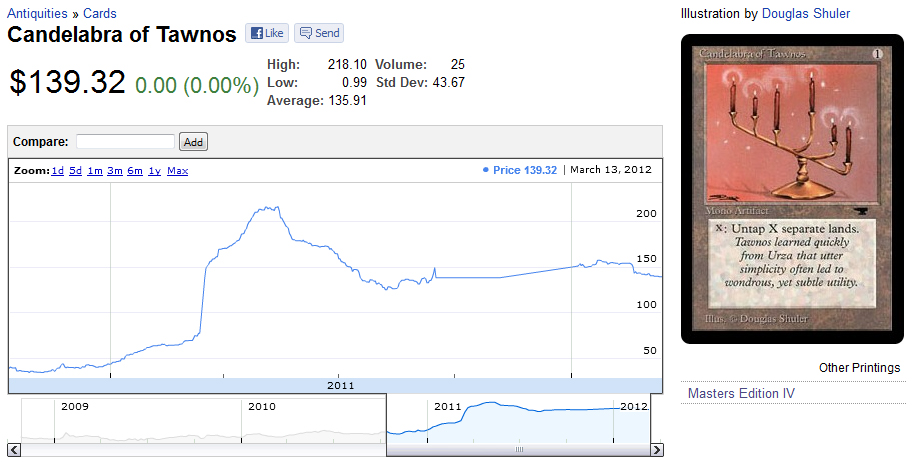
Background: The rise of the Candlestick is directly correlated with the unbanning of Time Spiral. Before Time Spiral came off The List, Candelabras were about $45. That means that they were available, but only for dedicated casual players who wanted really hard to make High Tide or Mana Flare decks work. When Time Spiral came off the list and a High Tide deck did well at a Starcity event, the race was on to snag Candelabras.

The Bubble: Candelabras shot up to $115 nearly overnight and people thought that the price was ridiculous. However, High Tide decks just kept winning and doing well. It was a fascinating and fun deck to play. Candelabras climbed up to $200 and sustained that price for quite awhile. Much like with Show and Tell, it was the enabler, and not the banner card, that saw the most consistent high-dollar spikes.

Where is it now? Mental Misstep did a huge number on High Tide decks; the deck basically could not win through two or three Missteps. With the free counterspell gone, High Tide has come back in small ways. Candelabras dropped by about 25%, but they still get a bit of play. I don't think it's wise to sink $600 into a playset of these for a deck that isn't always good, but on the other hand, you don't have to sink that money into fetchlands and dual lands if you're playing High Tide, either.

Takeaways

Aside from that one Time Vault blip, Vintage does not move Magic bubbles. Legacy and Modern do. Modern has not caused ridiculous price swings (yet), but it moves markets. Look at how Plow Under went from $1 to $4 in a week after people figured out that Cloudpost was a great deck and they needed something for the mirror. Heck, Vesuva went from $4 to $20, thanks to Cloudpost. Standard tends to cause big price swings as well, but they are not the $100 jumps that we sometimes see in Legacy. As I have mentioned before, I am unsure that enthusiasm for Legacy is sustainable as a format. That is unfortunate, because it's a nice format to play in. Modern does not have the same deep pool that causes card rarity, though Mirrodin is what, eight years old at this point?

Another big point is that most of these price swings did not happen overnight. Some of them happened over weeks and took awhile to break big heights. A lot of people thought Time Vault would top out at $70 like it did the first time around. The savvy and gutsy speculator can throw their funds behind a card early in its rise, but one can still jump on a little later and gain some profit. If you got on Show and Tell at $12, you were a happy camper a week later when they hit $18. This should embolden you to pick up hyped cards early. When it comes to older formats, they almost always pay off.

Until next week,

Doug Linn

canshepherd@gmail.com

The Key to Going Rogue

Are you a Quiet Speculation member?

If not, now is a perfect time to join up! Our powerful tools, breaking-news analysis, and exclusive Discord channel will make sure you stay up to date and ahead of the curve.

When is it right to build your own deck and go against what the masses believe is best? If your goal is to have fun, the right answer may well be always. However, if succeeding in competitive play is your goal, you will need to follow certain guidelines when going rogue.

I’ve played many rogue decks over the years, but this past year I’ve begun to see their true strategic value. It all comes down to information.

Think about [card Delver of Secrets]Delver[/card] for a minute. Everyone knows this deck and can probably recognize it without too much difficulty. Once a player has identified the deck, they can easily guess which cards are likely to appear in the list, and play accordingly.

Now imagine that I play a tapped Rootbound Crag on turn one, and follow it up with Plains into Thalia, Guardian of Thraben. My opponent will not have any idea what else to expect from me. I can leverage this lack of information to my advantage.

Taking the Road Less Travelled

There is merit to going rogue, but you need to know when it is appropriate. Here are the steps I try to follow when brewing a new deck.

Step One: Analyze Recent Data

Your first task is to analyze data from recent events to get a general picture of the metagame.

Players usually look at the last few big events to determine what deck to play in the next one. Often, the decks that preformed well draw in more players and end up heavily represented.

If you are not up to date on what people are playing, your trip can be ruined before you even leave.

Make sure you know what you are getting yourself into. What decks did well? What decks are good against those decks? How will you sideboard against your expected metagame? These are the types of questions you need to ask yourself while looking over the coverage from the events.

Step Two: Examine Established Archtypes

After you have some idea about the expected field, your next task is to examine the various tier-two archetypes to see if one may be well-positioned in the new metagame.

Sometimes going rogue just means playing a deck that others had underestimated.

Team Channel Fireball is particularly good at recognizing when a given archetype is ready for a ressurgence, a skill that no doubt contributes to their continued tournament dominance.

Recently at Grand Prix Baltimore, most of the team played Blue-Black Control. Up until then, the deck enjoyed a small and dedicated following but had yet to put up any significant results. The Channel Fireball crew ascertained correctly that the metagame had shifted to favor Blue-Black.

In this case, the strength of the deck lay in [card Curse of Deaths Hold]Curse of Death’s Hold[/card], which basically wins you the game against any aggressive opponents. The key to that tournament was recognizing the increased value of this card and its accompanying strategy.

Step Three: Identify Unexplored Space

Finally, you want to look at the strategies that have been unexplored or dismissed by the community at large, and identify those with competitive potential. This is the step most people think of when they hear “rogue deck.”

Take a look at Black White Tokens. When Sorin, Lord of Innistrad was first spoiled, everyone, including myself, thought the format would be dominated by the new tokens deck. Things didn’t really work out the way we expected.

Why didn’t that happen? To begin with, a lot of [card Ratchet Bomb]Ratchet Bombs[/card] helped keep it down. Players were afraid enough of the hate to leave their token makers at home.

Now, however, the deck is starting to see some play and put up pretty good results. The deck hasn’t really changed, but the metagame has shifted away from token hate.

Another example is the Naya Pod Aggro deck I talked about a while ago. Around the time of my article, no one had really put those cards together in the same deck before. Along came the Pro Tour and one team put someone in the top 8 with a similar list.

This previously fringe strategy paid off in this tournament because the metagame had shifted. The additions of Strangleroot Geist and Huntmaster of the Fells certainly helped the deck out, but part of its success was due to the changed value of its other pieces.

Tying it All Together

The key to this approach to deck building is recognizing when the value of particular cards or strategies has changed.

If you notice a particular card or deck that is powerful in the abstract but isn’t seeing any play, ask yourself why. What is holding this strategy back? Has something recently changed to make the underplayed strategy better than it was?

If you can find an idea that seems to have become better positioned in this way, write some deck lists down and see how they look. Then sleeve or proxy them up and give them a try. They won’t always work, but you will learn a lot in the process.

When they do work though, you may find yourself doing much better at events.

Developing Standard

This weekend I am taking a break from Standard to attend the limited Grand Prix in Nashville. (If you’re in Nashville, feel free to stop over and say hello.) In the mean time however, other events will be happening to influence Standard.

I have been thinking a lot about how the metagame is going to evolve in the coming weeks. Most of my thoughts have centered on Zombies.

People have started playing a lot more [card Curse of Deaths Hold]Curse of Death’s Hold[/card], which presents a problem for Zombies. [card Curse of Deaths Hold]Curse[/card] is one of the few cards I am actually afraid of when playing Zombies. It just shuts down everything you want to do. You may manage to get your opponent down to a low life total before they land it, but then have a hard time finishing them off.

How can we fix this? Perhaps a dash of red will do the trick.

Remember when Char was first printed, how completely bonkers it was? Well Brimstone Volley is even better. If you have a way to reliably sacrifice creatures, it becomes three mana for five damage!

Another excellent red card is Galvanic Blast. Because morbid is so easy to attain in Zombies, the typical wisdom says to play Tragic Slip. With morbid active, Tragic Slip is one mana to remove any non-hexproof creature in Standard. That is definitely good, however Galvanic Blast is capable of functioning almost as well in this role while also providing the reach you need.

Take a look:

Untitled Deck

Creatures

4 Gravecrawler
4 Diregraf Ghoul
3 Fume Spitter
2 Skirsdag High Priest
3 Porcelain Legionnaire
4 Geralfs Messenger
3 Phyrexian Metamorph

Spells

4 Galvanic Blast
1 Surgical Extraction
2 Go for the Throat
3 Mortarpod
4 Brimstone Volley

Lands

4 Blackcleave Cliffs
4 Dragonskull Summit
4 Drowned Catacomb
11 Swamp

Sideboard

2 Phyrexian Obliterator
2 Curse of Deaths Hold
2 Surgical Extraction
2 Ratchet Bomb
1 Phyrexian Metamorph
3 Distress
1 Nihil Spellbomb
1 Sword of War and Peace
1 Sword of Feast and Famine

The main reason to play blue in Zombies is Phantasmal Image, which we’ve replaced with Phyrexian Metamorph. It costs a little more mana, but I did include a few [card Drowned Catacomb]Drowned Catacombs[/card] to help out with the blue mana occasionally. Without blue we also lose access to Diregraf Captain, but I think he was one of the weakest cards in the deck. He may seem good, but in my testing he just didn’t have a large impact on the outcome of games.

In the blue-black version, you have to rely on the additional power bonus of the captain to end the game. With red, you just deal that damage to them directly. It shouldn’t be hard to get four damage out of a Galvanic Blast either. Between Mortarpod, Porcelain Legionnaire, and Phyrexian Metamorph, metalcraft should be fairly easy to attain.

This is just one example of how to brew for a new metagame. By adding a new dimension to an established deck, we benefit from that deck’s strengths and put our opponents in uncomfortable territory. While they may not be overly surprised at something like a red splash in Zombies, it is unlikely they have any experience playing against it. This works to the rogue deckbuilder’s benefit.

So, remember to look for weaknesses in the metagame that can be exploited. Whether that means changing a few cards in an already known deck or developing your own from scratch, sometimes going rogue can give you the edge you need to win the event.

Until next time,

Unleash your rogue force!

Mike Lanigan
MtgJedi on Twitter
Jedicouncilman23@gmail.com

Monday Night Magic #301 | Blood in the Water

Are you a Quiet Speculation member?

If not, now is a perfect time to join up! Our powerful tools, breaking-news analysis, and exclusive Discord channel will make sure you stay up to date and ahead of the curve.

"You read it somewhere else, but you heard it here first!"

Hit the button to play, or download the entire episode!

Our Sponsors

We are brought to you by MTGOTraders.comCapeFearGames.comCardHoarder.comDecked BuilderDrafter iPhone apps, MagicOnABudget.comHalfPriceHobbies.comMTGPad.com and MTGMintCard.com!
Get your own MTGCast t-shirt today! - http://www.zazzle.com/mtgcastshirts

Check us out on Quiet Speculation.

MNM Host(s) This Week

Chewie Slate from Monday Night Magic - http://www.mtgcast.com/

Jack LaCroix from Monday Night Magic - http://www.mtgcast.com/

Jay Kirkman from Ertai's Lament - http://ertaislament.com

Amanda Stevens from Red Site Wins - http://redsitewins.com

This Week in Magic and other MTGCast News

-- GP Indy results, Tom Martell takes it down

-- Vintage and Legacy World Champs prizes revealed, Vintage GP-level events shot down

-- Command Tower and Sneak Attack are upcoming Judge foils

-- New season of Preconstructed Playoffs going on over on Ertai's Lament

-- Giant Sharkgate Video #1

-- Giant Sharkgate Video #2

-- MTGPad.com announces new full-color printings and a podcaster special discount

-- Bookwyrm & Bandersnatch: A thought-provoking yet snarky blog reviewing the wide array of books the library has to offer, including hot best-sellers, guilty pleasures, and all the books you should have read in school, but didn't.

-- Ask Sharuum The Hegemon Tumblr account

-- MS Charity Magic tourney

Magic Calendar

-- MTG MOM Events Calendar

-- MTGO Events Calendar

MTGCast Website Donations

-- MTGCast in is need of Donations. We are a bit low behind the monthly goals at this point.

MTGO MTGCast Official Clan: Limited Resources

Contact "marshall_LR" in game to join the MTGO Clan, Limited Resources. Marshall can also be reached via twitter at: http://twitter.com/#!/Marshall_LR
Subscribe to the MTGCast Monday Night Magic RSS feed!
RSS feed for Monday Night Magic
iTunes feed for all shows on the MTGCast network
RSS feed for all shows on the MTGCast network
Twitter for MTGCast
Hoodchefz favored by MTGCast crew

Contact Us!
Call us and leave a voice message at 570-486-6637!

Join the MTGCast Facebook Group - Discussion, Photos, Videos and More!

Chewie at chewie@mtgcast.com -- http://twitter.com/#!/themanapool
Jack LaCroix at jack@mtgcast.com -- http://www.twitter.com/jacklacroix
Christopher E. Otwell at otwellc@mtgcast.com-- http://www.twitter.com/otwellc
Tom Gustafson at pitimp@mtgcast.com -- http://www.twitter.com/mtgcast
Chris Lansdell at lansdellicious@gmail.com -- http://www.twitter.com/#!/lansdellicious
Adena Chernosky at prsgrrl@gmail.com -- http://twitter.com/#!/prsgrrl
Eric McCormick at eric@mtgcast.com -- http://twitter.com/#!/EricMTGcast
Conley Woods at conley@mtgcast.com -- http://twitter.com/#!/Conley81
Robert Martin at robert@mtgcast.com -- http://www.twitter.com/thebeme
Tristan Gregson at tsg@channelfireball.com -- http://twitter.com/#!/TristanGregson
Marcel White at marcel@mtgcast.com -- http://twitter.com/#!/AllUpOnMyDeck

Chewie, Jack, Chris, Adena, Eric, Conley, Marcel, Chris, Robert, & Tom - The Monday Night Magic News Team!

Posted in Free, PodcastLeave a Comment on Monday Night Magic #301 | Blood in the Water

Have you joined the Quiet Speculation Discord?

If you haven't, you're leaving value on the table! Join our community of experts, enthusiasts, entertainers, and educators and enjoy exclusive podcasts, questions asked and answered, trades, sales, and everything else Discord has to offer.

Want to create content with Quiet Speculation?

All you need to succeed is a passion for Magic: The Gathering, and the ability to write coherently. Share your knowledge of MTG and how you leverage it to win games, get value from your cards – or even turn a profit.

Insider: MTG and Taxes, Part 2 – Business Expenses

Are you a Quiet Speculation member?

If not, now is a perfect time to join up! Our powerful tools, breaking-news analysis, and exclusive Discord channel will make sure you stay up to date and ahead of the curve.

Last week I talked about Hobby tax for those that use MtG Finance as just a supplement to our hobby. Some of us, however, use it as a reliable source of income. Those folks have a slightly different scenario when it comes to tax time.

There’s both some benefits and some drawbacks. Again, I must reiterate, I’m not a CPA nor Tax expert, so this information shouldn’t replace the need to see a professional. The goal is to be more informed about what types of expenses to track so you can properly itemize your deductions, whether you use a professional tax preparer or do them yourself.

I’ve been Self-Employed for 10 years and have always done my own taxes. My situation is fairly simple, but for you it may not be, so don’t hesitate to explore professional customized help. IRS publication 334 gives a walk through of what a Self-Employed person must file each year.

Self Employment Tax

Self Employment Tax is certainly the primary drawback of operating as a business instead of keeping your operations at the hobby level. Most typical wage-earners have automatic deductions from their pay for things like Social Security and Medicare, which amounts to approximately 7.6% tax.

What they don’t see is that their employer also matches that amount on their behalf. As a self-employed person, you’re responsible for both halves, totaling 15.3%. Half of this Self Employment expense is deductible from your Adjusted Gross Income. This tax rate is reduced to 2.9% on any income above $106,800. This is important, because if you also have a normal wage-paying job, you are already paying into Social Security from your job. If your wages alone are $106,800 or more, you will only pay the 2.9% Medicare tax on the portion for your Self-Employed Magic Card business.

Net Income

Your Net Income is your Revenues less the Cost of Goods Sold.

The cost of Goods sold is the tricky one. I’ve heard people using methods that I personally believe are less than scrupulous, and I wouldn’t recommend them. The costs of your goods sold is any purchases of inventory less any amount that is kept for personal use.

Suppose you buy a collection for $100. You plan to resell the collection, but decide to keep a Mana Drain that was hiding inside. Some would say to claim the Mana Drain was of nominal cost, and the collection makes up the actual cost, so that it all could be attributed to your Costs of Goods Sold.

However, the more appropriate way to consider this is what percent of the collections resale value does the Mana Drain make up? This is the percent of the cost of the collection you should subtract as an item kept for personal use.

In this example, if the Mana Drain makes up about 30% of the value of the collection, you would subtract $30 ($100 x 30%) from the $100 cost of the collection, and the amount applied to your Cost of Goods Sold is $70. Once you’ve determined how much actual cash you’ve spent on inventory, you subtract it from your cash receipts to get your Net Income. Your cash receipts may come from selling singles or sealed product, but should be combined, as would your costs of obtaining that inventory.

Again, if you set aside a certain portion of the sealed product you open for yourself to keep or use, you should not include that portion as part of your Costs of Goods Sold. You’ll want documentation of anything you buy and how much it cost you. This is easy if you’re using online transactions, but buying collections in person is different. Keep a log book and have each seller sign their name and the value of what they sold you in the book.

Income Tax Deductions

The IRS provides Publication 535 specifically describing all types of Business Expense deductions.

When calculating your Adjusted Gross Income (and corresponding Tax Bracket) you’ll take your Net Income and subtract all itemized deductions. Most commonly this will be travel expenses to events where you buy, sell or trade cards, as well as use of your vehicle to find collections and other associated costs for your vehicle like insurance and gasoline.

If your home has an office that is dedicated to Magic Card sales, you can deduct a portion of your rent or mortgage as a business expense. To do so, what percent of your home does the office take up in square feet? That’s the percent of your rent you may deduct.

Keep in mind the office space must be specifically dedicated for work. It may not be a spare bedroom or living quarters for any person. If you are operating as a business, you’ll likely want Business Owners Insurance, and the cost of this can be deducted as well. (If you are on the Hobby plan, you should look into Renters or Homeowners insurance for your collection, which isn't deductible. I’ve received a lot of requests for an article about insurance, which will be next week.)

Charitable Donations

Donations are not a business expense and should not be written off as such. They can be written off of your personal tax return as long as you have the appropriate receipt from a charity. The general rule of thumb for valuing donations is ¼ of its original cost.

So if you donate 1000 cards, that’s approximately 71 packs worth of cards, which would cost you around $282 if you use the retail price of $3.95 each. ¼ of $282 is a $70 deduction. If you are able to make use of the deduction, it will likely save you some tax dollars, more so than selling off bulk will.

Just make sure to get detailed receipts and photograph everything you donate. Save this information with your tax documentation. You may also want to consider a Magic Friendly charity: Gamers Helping Gamers

Don’t dodge your tax liability, don’t write off more than what’s allowed and don’t try to hide the fact that you are a business from the Government. There’s a big difference between making a mistake on your taxes and paying the appropriate penalty and directly evading taxes.

Tax evasion is not a joke and you don’t want to get in that predicament just to save a few dollars.
Next week, insuring your inventory...

Until then!
Chad Havas

Avatar photo

Chad Havas

Chad has been with Quiet Speculation since January of 2011. He uses price speculation to cover all his costs to keep playing. Follow his journey from format to format and be prepared to make moves at the right times.

View More By Chad Havas

Posted in Finance, Free Insider, SpecialTagged Leave a Comment on Insider: MTG and Taxes, Part 2 – Business Expenses

Have you joined the Quiet Speculation Discord?

If you haven't, you're leaving value on the table! Join our community of experts, enthusiasts, entertainers, and educators and enjoy exclusive podcasts, questions asked and answered, trades, sales, and everything else Discord has to offer.

Want to create content with Quiet Speculation?

All you need to succeed is a passion for Magic: The Gathering, and the ability to write coherently. Share your knowledge of MTG and how you leverage it to win games, get value from your cards – or even turn a profit.

Insider: Top 10 Most Expensive Non-Land Legacy Legal Cards

Are you a Quiet Speculation member?

If not, now is a perfect time to join up! Our powerful tools, breaking-news analysis, and exclusive Discord channel will make sure you stay up to date and ahead of the curve.

First off, an announcement: As of March 4th, 2012, Quiet Speculation's very own Sigmund Ausfresser is now a proud father! Congratulations Sig!

As Content Manager at Quiet Speculation, I often have the honor of reading the work of our writers and offering feedback in the form of angry, harsh criticism. Most of it is scathing, vitriolic diatribes about Oxford commas and compound sentences. Since Sigfig now has a son at home, I thought it might be best to give him a week off so that he can really reflect on everything we've talked about recently.

So Sigmund has vowed to return next week with his fantastic weekly contribution. In the meantime I wanted to offer up an overview of some of the most expensive cards around.

The cost of Power, restricted Vintage cards, Duals and Fetches remains obvious for most out there. What's less known are those elusive non-land, Legacy legal cards that, for reasons of competition or collection, happen to be worth pursuing. I did not include on this list Alpha and Beta prints due to their collectors value and are primarily limited to those runs. An Alpha Birds of Paradise, for example, is worth $299.99.

Doug mentioned in his article on Monday the uncertain future of Legacy as a format, which I tend to sympathize with. It would seem that Modern could easily displace the attention that Legacy has gotten as the accessible eternal format, but I personally believe it will continue to be deeply seeded in Magic culture for a long time to come. At least I hope so, as nothing quite beats countering that last spell before a Storm player gets to [card Ad Nauseum]five mana[/card].

Anywho, onto the list! All prices are based off of Star City Games' listings and buylist.

1) Moat

NM: $299.99
Buylist: $150

Sold out at NM/M, Moat is an absurdly powerful card from Legends. While Moat essentially stops most creature decks in their tracks, proving especially troublesome for an ill-prepared Zoo deck, it falls out of favor in metagames plagued by combo and flying creatures. Delver of Secrets and Vendilion Clique come to mind.

While you can spot Moat in utility decks running Enlightened Tutor, it really shines in Enchantress, even as a common one-of (although some run two: you never expect the second moat).

In fact, the only card keeping Enchantress from seeing more play (aside from the sure oddity it is to pilot) is this $300 four-drop. The unfortunate part about that is that most dedicated Enchantress players already have theirs, which can make trading one away a bit more challenging than you'd suspect, though the $150 SCG buylist price means it would translate into cash fairly easily.

2) Candelabra of Tawnos

NM: $249.99
Buylist: $125

High Tide has been seeing some success recently, Top 8ing GP Indy and an SCG Open. This resilient combo deck relies heavily on resolving a High Tide coupled with some untapping. When Time Spiral became unbanned, this was the card to have buried in the back of your book, next to your Goblin Lords (chart courtesy of blacklotusproject.com):

While it has wound down from it's high, High Tide still performs well when it has its seasons. And who wouldn't want to float a ton of Blue mana with Pact of Negation backup?

3) Imperial Recruiter

NM: $299.99
Buylist: $125

Imperial Recruiter finds homes in Aluren and Mono-Red Painter's Stone (Imperial Painter), fetching up the missing piece of the combo. Portal Three Kingdoms was also the home of the $249.99 Time Warp, Capture of Jingzhou, which I didn't give its own spot to because of the nature of Portal Three Kingdoms, where nearly every card is worth something due to the sheer rarity of the set.

Imperial Recruiter is unique in that it has a uniquely broken ability that finds its home in a few decks. Like Candelabra, Imperial Recruiter has its seasons, although the last time Aluren got any public love was when Gerry T. played it because he thought it was fun.

In case you're unfamiliar with the combo, you use these five cards to win:

You only need to have in hand the first two in order to make the board blow up. If you ever find one in the back of a binder, don't hesitate to pick it up. If you get a set, sleeve up the rest of Aluren and catch your local metagame by surprise.

4) Grim Tutor

NM: $199.99
Buylist: $125

Tutors are strong. And tutors that put any card into your hand are rare, most of which are banned. Grim Tutor happens to cost three mana and three life, which makes its potential for abuse justifiable. You see Grim Tutor occasionally as a 1-3 of in Storm, but the deck manages to do just fine without.

The fact that it's from the Starter 1999 set makes it all the harder to find. If you have a chance to scoop one up, jump on it. There's only one in stock on SCG, which is SP at $189.99. Since you'll likely be bartering for it in trade, as with the previous cards, the high buylist price essentially means it's cardboard cash.

5) Juzam Djinn

NM: $199.99
Buylist: $100

You may be asking "Why is this terrible Arabian Nights card so expensive?" Well, back in the day it used to be a powerhouse Black creature, played off of Dark Rituals and surrounded by Hymn to Tourachs and Sinkholes.

Now it's just a rare card from a rare set.

6) Loyal Retainers

NM: $149.99
Buylist: $80

Loyal Retainers actually saw play as a way of turning the rampant Survival of the Fittest/Vengevine combo into an Iona, Shield of Emeria Reanimator deck. Much fun was had by everyone during that time period trying to play anything that wasn't Survival.

It's another example of Portal Three Kingdoms and print rarity overriding actual competitiveness. I could see it hitting the playmat again someday, even though Reanimator is likely always going to be a better and more consistent deck. You also cannot forget about casual appeal. "You can play Iona for three!" will always make friends.

7) The Abyss

NM: $129.99
Buylist: $70

Kelly got ahold of one of these around a year ago and asked me if it was ever going to make anything resembling a wave in Legacy. While there are always rumors of new tech floating about forums, The Abyss seems to always be at the back of brewers' minds. "If only we could play this... they could never have a creature during their upkeep again!"

Unfortunately Jace, the Mind Sculptor and now Liliana of the Veil exist, both of which lock up the slot for a bigger permanent. Not only that, it's completely useless in non-creature matches. Although I've seen it a couple times in Pox lists, it's not likely to sweep the format.

Still, one can dream, right? If you have one or two, please build around it and crush some tourneys so those of us who wish we could sleeve it up would. I suppose the price-tag, being from Legends, is a hopeful lure.

8 ) Tarmogoyf

NM: $99.99
Buylist: $60

Not much to say here. Extended ballooned the price once. It dipped and now Modern has done it again, all while seeing play in basically every deck playing Green (aside from those favoring Xanthid Swarm).


(chart courtesy of blacklotusproject.com)

And it doesn't look to be getting any weaker any time soon, especially with all these Noble Hierarchs running around.

9) Nether Void

NM: $99.99
Buylist: $60

Another card with a case of "I am from Legends and I want to play!"

You sometimes see Nether Void pop up in a mono-Black or B/G list, but it's more of a pet card than anything. While it would always be the dream to resolve a Void T1 or T2, the chances of that actually happening are so slim, with the payoff being so minute, that the strategy rarely bubbles up as a real possibility. Then there's always the battle of: there are more powerful cards you could be playing with.

If you have a bunch of Nether Voids sitting around, please feel free to throw together a list and goof around. A buylist price of $60 tells me that there are enough people out there wanting to do just that, but I don't see them as being the same people driving across country to a GP...

10) Force of Will

NM: $69.99
Buylist: $40

...unlike Force of Will, which is the card you play when you want to make sure you can do something on turn zero.

If you don't understand the power and prevalence of Force, I suggest you poke around the internet and look at some recent Top 8 lists, counting how many Blue decks don't run it.

I remember a couple of years ago when I would see it for sale for $25. I wish I had the foresight to pick them up, but so it goes.

Honorable Mention: Chains of Mephistopheles

NM: $69.99
Buylist: $35

As with the other two Black enchantments, Chains wants to see more play than it likely ever will. It does turn off Brainstorm and Jace, the Mindsculptor, and I will admit to having played a mono-Black deck at a larger tournament where my opponent snuck one by. Pretty sure that was the only time I've ever hated a topdecked Brainstorm.

In case you're wondering what this card actually does, here's the oracle:

If a player would draw a card except the first one he or she draws in his or her draw step each turn, that player discards a card instead. If the player discards a card this way, he or she draws a card. If the player doesn't discard a card this way, he or she puts the top card of his or her library into his or her graveyard.

Honorable Mention: Eureka

NM: $79.99
Buylist: $30

Eureka sells for $10 more than Force of Will, but its buylist is $10 lower, which tells me that it's not in too high of demand at SCG despite its high price tag.

Wrapping Up

That does it for me. I hope you've enjoyed our tryst through some of the more expensive Magic cards out there. Perhaps I'll review the most expensive lands (or creatures!) sometimes soon.

If I happened to miss a card that belongs in this list, or unjustly criticized your favorite Black enchantment, please feel free to say so in the comments!

Tyler Tyssedal
@myownbed

Ertai’s Trickery

Are you a Quiet Speculation member?

If not, now is a perfect time to join up! Our powerful tools, breaking-news analysis, and exclusive Discord channel will make sure you stay up to date and ahead of the curve.

This week I continue my recent exploration of three-color combinations. I've mentioned before my interest in expanding into areas that my personal play style usually leads me to avoid. For one thing, that means the colors Blue and Black; for another, it means counterspells.

Many people hate playing against countermagic, and for that reason I've intentionally avoided it in the past. However, it's still a valid and popular tool for building decks in Commander, and I wanted to utilize it as a centerpiece of this week's Commander deck.

The task, therefore, is to come up with a three-color deck, centered in blue and black, that uses counterspells as a major theme.

My first thoughts for this exercise were of Dralnu, Lich Lord and a Flashback control deck with Secrets of the Dead and similar engines. [card Dralnu, Lich Lord]Dralnu[/card], however, is of course only two colors.

In the end, I narrowed the options down to Gwendlyn Di Corci and Ertai, the Corrupted.

These commanders interact differently with the counterspell theme and pull you in different directions. They both encourage you to include cards like Thousand-year Elixir to double up on activations, but from there the decks tend to diverge.

Gwendlyn Di Corci plays well with counterspells by forcing people to play into them due to the pressure she puts on cards in hand. However, she really encourages you to build more towards the discard effect with things like Geth's Grimoire, and seems to want countermagic only incidentally.

On the other hand, Ertai, the Corrupted seems to fit the counterspell theme perfectly. If we build around him correctly, we can set him up to counter multiple spells in any given turn. He also encourages the inclusion of cards like Hatching Plans that get value when sacrificed.

Sounds like an opportunity to build a clunky deck out of some strange interactions. Sign me up!

Ertai's Meddling

The goal with [card Ertai, the Corrupted]Ertai[/card] is to make the sacrifice cost in his ability negligible or to turn it to your advantage. Ideally, you'll be able to set things up so that he reads: "U: Counter target spell." Here's how:

The End Game

  • Lullmage Mentor
  • Thornbite Staff

With enough blue mana, this little combo can counter every spell your opponents cast for the rest of the game.

While [card Ertai, the Corrupted]Ertai[/card] is equipped with Thornbite Staff, you get to untap him every time you sacrifice a creature to activate his ability. With Lullmage Mentor out, every time his ability resolves you get a brand new Merfolk token to sacrifice for the next time! The only other thing you need is a disposable creature to begin the chain.

Unfortunately, players can respond to the untap trigger from Thornbite Staff to ruin your fun, but that's why we're going to need some backup counterspell engines!

Did Somebody Call for Backup?

  • Voidmage Prodigy
  • Glen Elendra Archmage
  • Sage of Fables
  • Summon the School
  • Merrow Harbinger
  • Stonybrook Schoolmaster

These cards give you additional ways to protect [card Ertai, the Corrupted]Ertai[/card] and to start locking the game down with an oppressive amount of counterspells.

First of all, you have the pretty straightforward interaction between Sage of Fables and Glen Elendra Archmage for infinite [card Negate]Negates[/card]. Add in Voidmage Prodigy to the mix for infinite [card Counterspell]Counterspells[/card]. Alternatively, you can make a ton of Merfolk Wizards to feed to Voidmage Prodigy and counter things off of Lullmage Mentor.

Of course, when things go awry the practical but less interesting option of just casting a counterspell from your hand should be available.

Ertai's Tributes

While the ultimate goal is to lock people out of the game entirely, sometimes you'll have to play fair with [card Ertai, the Corrupted]Ertai[/card]. In those cases, you want a steady stream of creatures and enchantments that can be sacrificed without causing too much pain.

As it turns out, there are a lot of sweet things ready-made for sacrifice. Let's start with the easy part: creature tokens.

Send in the Tokens

  • Bitterblossom
  • Thopter Foundry
  • Sword of the Meek
  • Pawn of Ulamog
  • Grave Titan
  • Phantasmal Image
  • Phyrexian Metamorph
  • Sakashima the Impostor

Tokens are the most versatile kind of card to sacrifice, but also provide the weakest return. They cost very little to sacrifice as they're easy to come by, but there isn't nearly as much upside as with some of the other cards we'll talk about shortly.

The other cards here fall into the category of clone effects, which actually do a lot of work and enable some cute tricks.

Copying Persist creatures gives you two creatures to sacrifice to [card Ertai, the Corrupted]Ertai[/card], whereas doubling up on [card Lullmage Mentor]Lullmage Mentors[/card] lets you amass seven Merfolk tokens pretty quickly. You can also copy all kinds of creatures with "Enters the Battlefield" abilities, either your own or someone else's. Which brings us to:

Value Guys

  • Yosei, the Morning Star
  • Karmic Guide
  • Reveillark
  • Body Double
  • Mulldrifter
  • Monk Idealist
  • Sun Titan
  • Draining Whelk
  • Academy Rector
  • Puppeteer Clique
  • Nim Deathmantle

Here we have some creatures that do awesome things when they enter the battlefield or die. Most of these are pretty generic, but there are a few sweet interactions I want to point out.

First, Puppeteer Clique interacts very well with Sage of Fables when combined with some kind of sacrifice outlet.

Second, Monk Idealist and Sun Titan are excellent with our suite of enchantments, which we'll get to below. Rebuying Hatching Plans in particular is not even remotely fair, and makes it easy to pull far ahead. Even as the Archenemy of an entire table, pulling off this interaction should be enough to guarantee victory!

Lastly, Academy Rector is absurdly powerful in this deck. If you manage to get Academy Rector and [card Ertai, the Corrupted]Ertai[/card] in play at the same time, you will make a lot of people think twice before casting any spells at all, for fear of letting you cheat in a bomb like Debtors' Knell.

Enchanting the Opposition

  • Chime of Night
  • Reality Acid
  • Hatching Plans
  • Copy Enchantment
  • Debtors' Knell
  • Parallax Wave
  • Parallax Nexus

These cards provide some of the power plays available to the deck.

With an active [card Ertai, the Corrupted]Ertai[/card], Chime of Night and Reality Acid become removal plus countermagic two-for-ones. Hatching Plans and Debtors' Knell are just absurdly powerful, and two of the most fun cards in the deck.

The coolest cards here are definitely the Parallax enchantments though. With one of these out, you can respond to an opponent's spell by removing fade counters while holding priority. Then with all those activations still on the stack, you sacrifice the Parallax enchantment to counter your opponent's spell.

The result of all this is that the "leaves play" trigger resolves first, before the targeted cards have been exiled. Then all of your exile abilities resolve, removing the targeted cards permanently.

If you're feeling particularly fancy, you can exile some of your own creatures first, let those abilities resolve, then exile a bunch of other permanents and preform the trick above. Then the other permanents will be exiled, but yours will return to play!

These kinds of stack manipulation tricks are some of my favorite things to do, and lead to the next set of cards which let you pull off some flashy tricks.

Getting Tricksy

  • Leyline of Anticipation
  • Vedalken Orrery
  • Fiend Hunter
  • Oblivion Ring
  • Journey to Nowhere
  • Squadron Hawk

The interactions with these cards work on the same principle as the Parallax enchantments, except that they require you to jump through more hoops.

Leyline of Anticipation and Vedalken Orrery allow you to respond to a spell you want to counter by flashing in Oblivion Ring or Fiend Hunter, and responding to their exile trigger by countering the spell.

The last card I want to talk about is the seemingly odd Squadron Hawk.

Don't get me wrong, its certainly the worst card in the deck. However, you get to do something with Hawk that amuses me way too much for me to cut it.

With Leyline of Anticipation in play, you can flash in your Squadron Hawk in response to a spell you want to counter, counter the spell with [card Squadron Hawk]Squadron Hawk's[/card] trigger on the stack, then shuffle it back into your deck with something like Mistveil Plains. When the hawk trigger resolves, you get to search up the original hawk itself!

Is this necessary? Of course not, but it's awesome! Besides, how many opportunities do you get to play Squadron Hawk in a singleton format?

Filling in the Gaps

Consistency and Card Advantage

Every deck needs some ways to ensure that it can execute a consistent game plan, particularly a deck like this that is so reliant on specific interactions. This means that a reasonable portion of your deck will be dedicated to finding your combo pieces. You want the tutors to be as flexible as possible, but you also need to identify which pieces are the most important and be absolutely certain that you can find those consistently.

  • Demonic Tutor
  • Stoneforge Mystic
  • Muddle the Mixture
  • Enlightened Tutor
  • Dimir House Guard
  • Idyllic Tutor
  • Expedition Map
  • Tolaria West
  • Intuition
  • Forbidden Alchemy
  • Fact or Fiction

The first few non-Demonic Tutor spells are there to find the three equipment in your deck -- Thornbite Staff, Nim Deathmantle and Sword of the Meek. Next you have Idyllic Tutor and Dimir House Guard into Academy Rector as your Enchantment tutors. These will most often be used to find Reality Acid or Leyline of Anticipation.

After that, you have Tolaria West and Expedition Map to find important lands like Winding Canyons and Mistveil Plains, or even Hall of the Bandit Lord to give Ertai haste.

Finally, there are a few cards that set up graveyard shenanigans or simply dig through your deck. Fact or Fiction and Forbidden Alchemy help you fill your graveyard for a giant Open the Vaults in the late game. Intuition is a little weaker in this regard (usually fetching some combination of Enchantments and Replenish), but can also grab a pile of three tutors in a pinch to get you whatever you need.

Utility Spells

  • Replenish
  • Open the Vaults
  • Capsize
  • Counterspell
  • Return to Dust
  • Swords to Plowshares
  • Unburial Rites

Last but not least we come to our generic utility spells. The merits of most of these should be obvious, but I do want to talk briefly about Capsize.

Generally, a deck like this can easily get to a point where it can answer everything that gets cast, but has trouble with what's already on the board. Capsize is a concession to that weakness, letting you take over a game once you've set up your "lock" with [card Ertai, the Corrupted]Ertai[/card] or one of the other engines.

As for Unburial Rites, I've loved playing this card in Standard and Modern, and I look forward to building with it more in Commander. The card is just awesome, and well suited to a format populated by giant creatures with a habit of ending up in your graveyard. It's definitely one of the better cards that I missed out of Innistrad.

The Mana Base

The important thing to remember for this deck is that it's going to be very hungry for Blue mana to fuel [card Ertai, the Corrupted]Ertai[/card] activations. This means that things like [card Azorius Signet]Signets[/card] are worse than in normal three-color decks, and that lands like Godless Shrine are actively bad. Since the deck is so mana-intensive and slow, some amount of artifact mana is necessary for playing a reasonably paced game.

Mana Ramp

  • Sky Diamond
  • Coldsteel Heart
  • Coalition Relic
  • Eye of Ramos
  • Sol Ring

Nothing too exciting going on here, just most of the cheap artifacts that produce blue mana or help you ramp into your mid- and late game. Artifacts like Sky Diamond are certainly better than things like Mana Crypt or Thran Dynamo. There may be a high demand for colorless mana in the early game, but there's nothing worse than drawing it in the late game when you're struggling to produce Blue mana.

Lands

  • Glacial Fortress
  • Drowned Catacomb
  • Sunken Ruins
  • Mystic Gate
  • Celestial Colonnade
  • Creeping Tar Pit
  • High Market
  • Faerie Conclave
  • Reflecting Pool
  • Command Tower
  • Halimar Depths
  • Winding Canyons
  • Bojuka Bog
  • Nimbus Maze
  • River of Tears
  • Hallowed Fountain
  • Watery Grave
  • Minamo, School at Water's Edge
  • Flood Plain
  • Mistveil Plains
  • Azorius Chancery
  • Dimir Aqueduct
  • Adarkar Wastes
  • Underground River
  • Skycloud Expanse
  • Darkwater Catacombs
  • Hall of the Bandit Lord
  • 3 Plains
  • 2 Swamp
  • 4 Island

Lastly, we've got some lands. You'll note that there are a total of four lands in the deck that don't produce blue mana, so you should have no difficulty paying for your counterspell engines once you get them up and running.

Besides that, there are a few interesting choices.

Minamo, School at Water's Edge untaps [card Ertai, the Corrupted]Ertai[/card] when you don't have Thornbite Staff. Winding Canyons is another pseudo-Leyline of Anticipation, and it in conjunction with Hall of the Bandit Lord means you can flash in
[card Ertai, the Corrupted]Ertai[/card] for counterspell action even if he gets removed on someone else's turn!

[deckbox did="a152" size="small" width="560"]

I don't think I have the optimal build yet, but overall I like where it's going. I probably went a little overboard on things that enable [card Ertai, the Corrupted]Ertai[/card] to the exclusion of answers to on-board permanents. It's likely correct to cut some of the counter magic and engines for things like Austere Command. That said, I'm excited to get to play with Lullmage Mentor, and will be playing this deck much more frequently to get all the kinks worked out!

Next week we'll be looking at a Damia, Sage of Stone deck that I'm very excited about. To give you an idea, it's the only deck I've ever played casually that required a judge to help us out with resolving everything correctly. The deck is a ton of fun, and very different than the other decks I tend to build. Check in next week to learn more!

Carlos Gutierrez
cag5383@gmail.com
@cag5383 on Twitter

Want Prices?

Browse thousands of prices with the first and most comprehensive MTG Finance tool around.


Trader Tools lists both buylist and retail prices for every MTG card, going back a decade.

Quiet Speculation