menu

Taking Desperate Delver to the Top 8 of States

Are you a Quiet Speculation member?

If not, now is a perfect time to join up! Our powerful tools, breaking-news analysis, and exclusive Discord channel will make sure you stay up to date and ahead of the curve.

Editor's note: Oklahoma ringers Trey Ballew and Eric Centauri brewed up the following deck, which took Trey to the Top 8 of Oklahoma States. Enjoy the article!

---

Thursday night, 9:00 PM, after another night of poor testing results and giving up on my BG Heartless Pod list:

Me: “I have no idea what I’m playing now.”
Eric: “Me neither.”
Me: “Let me take another look at your UR deck. How many instants and sorceries were you running?”
Eric: “Like, Twenty-six.”
Me: “Can we try Delver of Secrets?”

The UR CounterBurn list Eric Centauri had been testing the previous week showed some promise, but wasn’t quite good enough. It lacked an aggressive early play and had a bad tendency to stall out in a race. Adding four Delver of Secrets changed all that.

This is the list I top-8’ed with at Oklahoma States (156 players):

Desperate Delver, by Eric Centauri and Trey Ballew:

Untitled Deck

Creatures

4 Delver of Secrets
4 Snapcaster Mage
3 Grim Lavamancer

Spells

4 Ponder4 Mana Leak4 Desperate Ravings4 Incinerate4 Brimstone Volley4 Arc Trail2 Devils Play

Lands

7 Mountain
10 Island
4 Sulfur Falls
2 Rootbound Crag

Sideboard

2 Dissipate
2 Twisted Image
2 Ancient Grudge
4 Slagstorm
2 Flashfreeze
3 Phantasmal Image

I skewed the basic land count toward Islands because Delver of Secrets is the best possible turn one play. In this deck, Delver is basically a flying Wild Nacatl. Which is fair, you know, ‘cause usually blue only gets the best instants, sorceries, and planeswalkers.  Thanks, WotC, for finally showing blue some love and printing not one but two incredibly efficient blue creatures in one set. Snapcaster Mage and Delver of Secrets make this deck work.
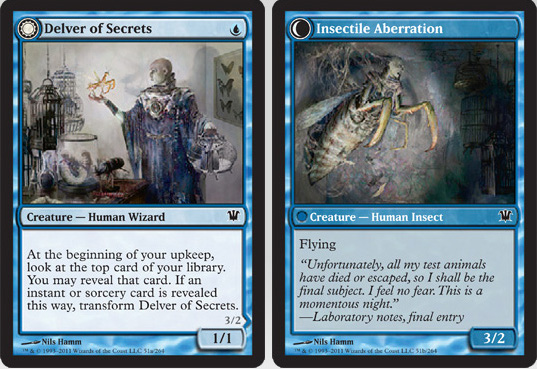
Not just a Legacy staple

Ponder is good for setting up an existing Delver’s metamorphosis, and is great when it shows you Delver plus one of your 26 instants and sorceries.

Desperate Ravings is really good in this deck, and I feel it’s not getting the attention it should.  Holding onto unneeded lands and emptying your grip of as much burn as possible before casting it nets sick value. The card is basically Fact or Fiction meets Gamble. It is also really, really fun to cast.

It is almost always right to throw all your burn at your opponent’s facehole.  Even Arc Trail usually domes the opponent for two while killing something small, even if there is another creature available for the killing. Flashing in Snapcaster Mage for the chump block and flashing back Brimstone Volley or even Incinerate is key to getting there.

Arc Trail is the card I was least happy with in the maindeck. I wish I had gone with the 2-2 split between those and Slagstorms for the maindeck, as Eric advocates. The option to dome players and planewalkers is nice to have.

As for the sideboard, Dissipates are obviously quite good against Solar Flare, but they also come in against anything mid-range, ramp or control. Twisted Image was for Spellskite and Tree of Redemption, but I never actually brought it in. Ancient Grudges come in for Shrine of Loyal Legions, Inkmoth Nexus, Tempered Steel decks, Wurmcoil Engine, etc.  Flashfreezes help to make sure you can counter a turn three Dungrove Elder even on the draw. Phantasmal Images are for Thrun and Geist of Saint Traft.

Round One – UB Infect

Game one I have two Arc Trails to answer his first two creatures, shocking him twice in the process. Once he stops playing creatures, I Incinerate him twice with a Snapcaster assist, reload with Desperate Ravings, and finish him off with the 2/1 and a Brimstone Volley.

I board in Slagstorms and Ancient Grudges since most of his guys are artifacts.

Game two I keep a hand with an Arc Trail and a Snapcaster, but he just beats me with Inkmoth Nexus until he casts Phyrexian Crusader and poisons me to death.

Game three I keep a hand with Mountain, Rootbound Crag, Incinerate, Ancient Grudge and some blue spells.  He never plays one of his many artifacts or activates Inkmoth Nexus. I die to his turn three Phyrexian Crusader and Skithryx having never drawn a blue source.

0-1

Now I just have to win seven in a row to top 8, no big.

Round Two – UW Control

We have to play sideways on a round table as punishment for losing round one of an overcrowded tournament. Luckily, this match took all of ten minutes.

The two games we played were almost identical. Game one I am on the play. We each start with Island, go. Turn two I cast Ponder and see Incinerate, Delver of Secrets, Desperate Ravings. I draw the Delver and flip an Insectile Aberration the next turn.  After bugging him for four turns and Mana Leaking his Timely Reinforcements I am able to burn him out.

Game two was similar except I cast Delver turn one and got the lucky flip on turn two. I have a Mana Leak, a Dissipate, and a Snapcaster to counter his plays while I three him to death.

1-1

Round Three – Rb Vampires

Did you know that Delver is still a human after he grows wings? I didn’t, until I got hit for 12 game one when my opponent cast Vampiric Fury. Luckily, Team Edward was already in burn range thanks to the bugman and died before getting another attack step after that one.

For game two I board in the Slagstorms. This game was pretty boring as I drew two Arc Trails and a Snapcaster mage while my opponent repeatedly played two guys a turn.

2-1

Round Four – BUG (no pod)

I hate playing against a friend at a large tournament – especially when he is one of four people in the room who know my list. Game one he takes four to Dismember a Delver. I play another. He kills that one a couple turns later, at which point I Volley him for five. When he swings at me with a fatty I flash in SCM for the block and Volley from the yard for the game.

Game two I stick a couple Delvers, but have trouble flipping them up (‘talk to your doctor about Insectile Dysfunction
’).  Once I do, I am able to kill him the turn before I would die to Grave Titan. He tries to save himself by casting Tribute to Hunger and sac’ing his Grave Titan but, uhh, that card – it does not do what he thinks it does.
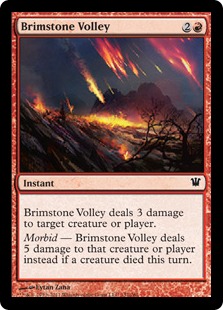
Even better when played twice

3-1

Round Five – RG Kessig

Game one I have turn one Delver, turn two [card Grim Lavamancer]Lavamancer[/card]/Ponder to set up a Delver flip. I hit him for four a turn until he is dead, dead, dead while Leaking or Snapcaster-Leaking all his relevant non-Thrun plays.

Game two he plays a turn one Nihil Spellbomb, so I start using my Lavamancer early to get max value out of my instants. A lucky Desperate Ravings traded a SCM from my hand for a Leak and a Volley. I finally block the Viridian Emissary that was two’ing me to turn on morbid for Volley, which put him in easy burn range for my next turn.

4-1

Round Six – Solar Flare

Game one I almost make the misplay of the tournament by Mana Leaking his Liliana on turn four. I remember before announcing the spell that the most expensive card in standard does nothing against me. We each discard (he pitches Unburial Rites) and I Incinerate his face. I guess he didn’t get the read on my Leak because he flashes back Rites with two mana open next turn.  I make a 2/1 at end of turn with no bonus to speed up the clock. When he untaps with Liliana at 6 he uses her third ability. I float all my mana, and he lets me choose between my 2/1 and three Mountains, or three Islands.  I keep Mountains and Mage. I drop another Mage and flashback Incinerate with the floating mana, and he is dead the next turn.

Game two I kept a hand without counterspells and got beat down by a reanimated fatty on his turn four. Sometimes Solar Flare does that.

Game three was pretty boring as I burned him to death with Incinerates, Volleys, and SCM’s while he looked on in horror at the failure of his three-color manabase.

5-1

Round 7 – UBR Burning Vengeance

This was probably the tensest match of the tournament for me.  Game one I stuck a Delver, which flipped and got in there for four turns before he could kill it by casting Geistflame and flashing it back. Lavamancer did some work while we took turns casting three copies of Desperate Ravings each. I got him down to one, and then stalled out for several turns while he set up multiple Burning Vengeances. I eventually cast a burn spell he couldn’t answer. Despite the 20-0 final life total, this game was really close.

I side out the Arc Trails for Dissipates and two Slagstorms, since they can hit players and I didn’t really have anything else for this matchup.

Game two he won on the back of an early Vengeance, while I drew all my one-toughness creatures.

We had only seven minutes for game three. I got a fast start with a Delver and a Lavamancer, but he drew a Geistflame to deal with them. I stuck a second Lavamancer and starting chucking burn spells at him. When he tapped out turn five for Jace, I took the opportunity to cast Devil’s Play for a guaranteed five damage on my turn. He starts milling me and countering my burn. The turn he mills the last of my library, I take him down to two and kill him with Lavamancer on my upkeep.

6-1

My tiebreakers are atrocious due to losing in round one, so I have the luxury of getting to play another round of Magic: The Gathering collectible trading card game before cutting to top 8.

Round 8 – RG Kessig

Game one I had Leak and Snapcaster-Leak for his first two non-Rampant Growth plays. I get in there a couple times with SCM while burning him a bit.  I kill him from nine by casting Arc Trail to clear away an Emissary and shock him, getting in for two more with SCM, then spiking a Volley for exactsies.

Game two I play Delver, Flashfreeze a Dungrove Elder, have Phantasmal Image for Thrun, Snap-Freeze another Elder, and then he was dead. Delver did 15 damage this game while I was countering his spells.

7-1

Quarterfinals – RG Kessig

Game one I got two Aberrations online early and raced him. He died the turn before he could swing with Wurmcoil Engine.

Game two I have Image for Thrun, but can’t find enough damage to kill him before dying to the Dungrove Elder he sneaked in the turn after I dealt with Thrun.

Game three I mulligan to six and keep a hand with Image but no counters and can’t deal with all his Dungrove Elders. It was a bad keep and I got punished for not going to five like I should have. My opponent went on to win the tournament.
This deck is competitive, can race almost anything, and is really fun to play. That said, I would make a few changes for Star City Games Open: Kansas City.  I would go with the 2-2 split between Arc Trails and Slagstorms in the main. Also, the Twisted Images were a waste of sideboard space. I feel like Steel Sabotage is good here and is sometimes favorable to Ancient Grudge, especially against Wurmcoil Engine. Also, Frost Titan is pretty good against Kessig and Solar Flare, but I wouldn’t want more than one due to the cost. I recommend the following list:

Updated Desperate Delver by Eric Centauri and Trey Ballew

Untitled Deck

Creatures

4 Snapcaster Mage3 Grim Lavamancer4 Delver of Secrets

Spells

4 Ponder4 Mana Leak4 Desperate Ravings4 Incinerate4 Brimstone Volley2 Arc Trail2 Slagstorm2 Devils Play

Lands

7 Mountain
10 Island
4 Sulfur Falls
2 Rootbound Crag

Sideboard

3 Dissipate2 Ancient Grudge1 Steel Sabotage2 Arc Trail2 Slagstorm2 Flashfreeze2 Phantasmal Image1 Frost Titan

Good luck, and I hope you have as much fun piloting this deck as I do.

- Trey Ballew

Insider: State of the Format

Are you a Quiet Speculation member?

If not, now is a perfect time to join up! Our powerful tools, breaking-news analysis, and exclusive Discord channel will make sure you stay up to date and ahead of the curve.

Formats are changing everywhere, and as the dust settles, we have to take a snapshot to see where things are at, and assess any changes to your plan. Every format has some sort of cycle, or seasonality to it, and being aware of what’s going on gives a larger scale perspective of what’s happening. I’ll talk a little about each format, covering what to expect in general, and how to use that information to make calls and adjust values. Any successful businessperson has a specialization, and the most successful traders do too. “That Foil Guy;” “The Guy that has 2 playsets of all the good Legacy stuff;” “The Guy that stocks every standard playable in a long box.” These are actual phrases I’ve used to describe people, and often people know exactly who I’m talking about when I do.

The fact is, its not only an image you can market, but it gives you a narrower field to have expertise in. This is a good thing, but ignoring items outside your strongest market is not. I’m primarily a Limited player. Trading for me means converting the rares I open into bigger and better rares, or even into constructed decks. Whatever your specialty is, you probably know how to exploit it already - but learning how to overlap your current operations with other markets is important. I want to touch on some of the general categories of markets, and for each one you should be thinking about if you are prepared for whats happening in that market or if you’ve been out of it. If you’ve been out of it, is there a way for you to gain value by jumping in?

Legacy

Misstep bannings are long behind us, and we see such a diverse format now! Legacy fans everywhere rejoice! There were 4 decks that made up 13 of the top 16 slots in Baltimore. U/W Stoneblade, RUG, Reanimator and Team America. The “rogue” 3 were Merfolk, Dredge and G/W Aggro. Even among the decks that showed up in force, a variety of card choices were present, and it’s become clear that the format has returned to a healthy status. The Legacy price craze has completely died down, and we’ve reached a fairly stable market place. What does this mean for you? That depends on what Legacy means to you.For a long time, Legacy was a very daunting world for me to dive into. There was worry that I’d invest in the wrong cards or buy in at the wrong time. I was worried I’d invest in a deck, only to have it be hated out of the format. Those fears are gone. We now have a solid base to understand what the accurate market price of Legacy staples is now, at the current level of demand. The other thing to take away is that a diverse format means there’s an opportunity for new things to appear.

With Misstep gone can High Tide make a come back? I’m wagering on yes, but not in the way you may be thinking. When Misstep was printed, I shouted “Sell your candles!” I’m not expecting Candelabra to shoot back up simply because Misstep is now banned, but I’m keeping my eye out for a new High Tide variant to win over the format, and when it does jumping on the right pieces at the right time will be key. In a format like this, looking at decklists for new technologies in existing decks is the way to find hidden gems. Just be sure to scan the decks each week after a StarCity Open, and see what’s changing. As you spend more time learning the way the format changes, you’ll be better prepared to anticipate change before it happens.

If you play Legacy and you have a deck, you’re pretty comfortable for the time being. If you’re trying to get in, now’s a time to start slowly trading for staples and mana bases. Prices have dipped back down a tad, and until the next wave of Legacy craze hits, you’ll want to be well on your way to building a stock. Also keep in mind, Legacy stock is one of the safest investments. Dual lands will always be desirable and their price floor is pretty high. Same can be said for other format staples like Tarmogoyf, Dark Confidant, and Jace, the Mind Sculptor. Find out how this market meets your demand at the trade tables, and plan accordingly.

Modern

Prices of Modern playables have fluctuated so greatly since the introduction of the format; there is a lot of variance and risk involved. Bannings have been vast, and likely not yet completed. A format like this has such a large card pool, but Wizards doesn’t want things to get completely busted, so expect more bannings in the future. The initial price spike was a result of speculators and early adopters, but the prices have receeded since then, once the speculators (myself included) got their money out of the transition. With a PTQ season around the corner, we can expect prices to come back up again at some point, but which cards and decks are going to be hot? It’s really hard to know. There’s little access to decklists, and the Pro-Tour that featured the format had a completely different banned list. Manabases, key spells that overlap with Legacy (Confidant, Tarmogoyf, Aether Vial etc), and inexpensive Uncommons are the best targets at this point. The idea is to minimize risk in a volatile market like Modern. Manabases are guaranteed to be used. Legacy staples have an established price floor, and cheaper uncommons have a much more potential for percentage gain on average. In my personal market, working with Modern stuff isn’t easy. Most of the people who hold all the Modern cards are dealers and sharks. The gold is found in the binders of EDH players who are the few who tend to keep obscure cards from any format proudly displayed in their binders.

Standard

The youngest sibling of the bunch is predictable. It doesn’t have the depth or complexity to give us many surprises. The format has 5 legal sets, and with such a limited card pool the format gets solved almost as quickly as its born. Wolf Run decks are running rampant, with U/B control seeming to be one of the best ways to fight it. Mono Black Infect was the flavor of the week, but if prepared to beat it, it quickly folds to the right answers. How can Standard fit your plan now? Picking up cards on value is the best way to go. Rather than targeting sleepers or speculations (which you should still do to some degree) finding the right trade partner to gain incremental value is the best strategy. Decklists are of course important, and new technology and decks will appear, but they will likely include the already known cards. Keeping a big stock of desirable uncommons has been my bread and butter for cashing out when PTQ season comes, and this year is no different.

Limited

Yep, limited is indeed a format, and it does affect the trading marketplace. Drafting and Sealed events spew Innistrad product into the market at alarming rates. Watching the card prices stabilize is an interesting game. Now that most of the chase rares are no longer needed for at least a few months, it’s tough to cash out limited cards for huge value after a draft. Stashing these in your binder and waiting for a spike sometime next year, is wise. In the meantime, leverage that collection into bigger and better trades.

EDH/Commander

While there’s much overlap with modern and Legacy cards, being aware that the EDH/Commander crowd at your LGS has a completely different set of priorities is important. Luckily this format doesn’t rotate or change very often, and keeping your knowledge base current is easy. Just know what cards in your binder have more value to an EDH player, and make sure they get a chance to see what unique goodies you have that will make their decks even more impressive.

Wrap-up:
Think about each format in this light every couple of months, and revise your trading plan. How do these formats pan out at your LGS (or wherever you do your trading)? What are your plans to participate in these formats? What portion of your trade partners participate in these formats? Put yourself in a position to succeed, and you will.

Chad Havas
@torerotutor on Twitter

Scrapbasket

Are you a Quiet Speculation member?

If not, now is a perfect time to join up! Our powerful tools, breaking-news analysis, and exclusive Discord channel will make sure you stay up to date and ahead of the curve.

Many people have one or more Commander decks that they've been playing for years and still enjoy to play, but the sad fact of the matter is that even your favorite deck won't survive forever. There are a lot of reasons to set a commander aside. Maybe your playgroup is fed up with a deck and refuses to play against it; maybe a better option has been printed for the sort of game play you crave; or maybe, just maybe, the deck is no longer fun to play.

A large part of Commander's draw is the promise of unique and ever-changing game play. Run fifteen games with a Standard deck and your future games will probably start to run together, but your fortieth game with a Commander deck is still full of new interactions and discoveries. At least, that's the theory.

Invariant
The more tutors you run, the more quickly games go stale. The more cards that serve similar roles you pack into your deck, the more quickly it stops feeling fresh. The more heavily you build your deck around your commander, the more quickly you get bored. You can go tutorless, you can avoid doubling up on effects, but at its core, the format discourages disregarding your commander. Increasing your deck's lifespan is a great thing, but it's not worth abandoning the format for. I, for one, would rather play a Commander deck for a few months than a normal Highlander deck for years.

Then again, we have a tool to combat repetitive game play beyond the actual deck list: building more decks. This solution isn't always feasible; those of us with limited Magic budgets can't just amass more and more Commander decks without ever trading away the old for the new, but if a deck has been your favorite for years and is just now getting boring, you might consider setting it aside for a couple of months rather than tearing it apart. Repetition is unpalatable when it's fresh, but playing a familiar game after a long break will be nostalgic rather than grating.

Don't you miss Winter Orb?

On the other hand, not all fun can be preserved. Some decks are fun because they let you do something genuinely enjoyable, such as attacking with creatures. Others can be fun for a while, but will have a hard time fulfilling their quota of enjoyment down the road. Some decks are fun because they're novel.

When Double-Faced Cards were first announced during the Innistrad spoiler season I was unimpressed. The cards seemed to be causing a lot of logistical problems without much gain. But once I held one in my hand I was convinced otherwise. As some one who has played this game for a decade, I have a strong mental image of a card; at the moment flipping over a DFC when I catch the first glimpse of an unfamiliar back, I'm always surprised. Playing with DFCs feels like I'm breaking an ancient covenant; it's invigorating and frightening. Not so for new players. Without a long association between the fronts and backs of Magic cards DFCs aren't so strange, and thus lose much of their appeal. In time the same will happen to me; I'll get used to them and they will no longer be exciting. Double-Faced Cards are an extreme example, but playing Dredge or Storm is very much the same; once you grow bored of playing Jhoira of the Ghitu, you'll never be able to recapture the initial rush of excitement you felt suspending Darksteel Colossus. If you're bored with a deck, you need to take a good, hard look at what made that deck fun to play so that you can determine whether or not simply giving it a rest will be enough to rekindle the flame.

Failure

Of course, not every deck you come up with becomes an instant favorite. When you have a flash of inspiration, you might as well give it a try. Sometimes things work out and you end up with a new favorite deck, but the majority of the time your brand new deck won't succeed at being everything you hoped it would be. The question is whether it failed in concept or execution.

Being not only a casual format, but a very slow one, Commander allows for a near infinitude of viable game plans. Pretty much anything that's fun can be made to work, so if your new deck isn't playing out the way you want it to, but the initial idea still seems worthwhile, don't give up! It may take quite a bit of tweaking, or even overhauling the entire deck list, but there's almost certainly some way to make your idea work. The experiment isn't a failure because your first iteration didn't live up to expectations, that's just your first data point among numerous potential builds. Failure only occurs when your deck-building is a success. Let's take a recent example.

When the Magic: The Gathering Commander decks were revealed, I was ecstatic at the prospect of putting Riku, of Two Reflections to work leading a Warp World based Commander deck. I love huge effects and getting value out of enters the battlefield triggers, and I'd wanted to build a Warp World deck for a long time. Riku promised adequate ramp, token production, and tutoring to make World Warping a viable strategy, and copied the deck's namesake sorcery on top of it. What could go wrong?

Did the deck play out wrong? Was I unable to find Warp World? Or not getting value out of it? No. Everything came together perfectly; the problem was that the idea didn't have to potential to be fun. Warp World is great when it's a big shift from the norm, but as soon as it starts going off every game, or multiple times per game, it stops having the same effect. The first problem is in resolving Warp World itself; doing so requires a lot of counting, shuffling, and stacking triggers, all of which feels futile when another copy is sitting on the stack ready to undo all of the work you put into figuring out the new board state. On top of that, once the spell becomes commonplace, people notice that it doesn't do what it promises to. Warp World says it's going to make a chaotic board state in which power is redistributed arbitrarily without starting the game over. In actuality, it puts its caster, who has undoubtedly built around it, way ahead while mana screwing all of the rest of the players and stopping their game plans cold. Playing a couple of games against Warp World shatters the illusion and robs the spell of its appeal.

If your experiment fails like this, it's best just to scrap the idea entirely. Sure, you might be able to tone the deck down to a point where people are willing to play with you, but unless it's absolutely the most fun you've ever had playing Magic, you'll be better off playing something everyone can get behind. It can be painful to admit a concept that you've put a lot of work into simply isn't going to work out, but this momentary strife is well worthwhile if it means you can go back to having fun playing Commander.

Cold Hard Facts

Up to this point we've been floating in the wonderland of Commander theory, but sometimes reality has other thoughts. Building decks is expensive. Sure, shelling out $100 for a new Commander deck might not be as bad as building a new Legacy deck from scratch, but it's not exactly cheap either. To ease the strain on our wallets, most of us trade cards we're not using for whatever it is we're looking for. It's just impractical to keep a deck together if you don't play it; those cards could serve you a lot better trading for something you'll use, but sometimes the cards you don't use aren't enough, and you'll have to take apart a Commander deck you do play in order to build a new one. I've certainly taken apart my share of decks that I still played occasionally to avoid having to acquire yet another set of Demonic Tutor, Vampiric Tutor, and Sol Ring. Then again, I usually have a deck sitting around that should have come apart a long time ago anyway.

Turning it Over

Take a look at your decks. Are you clinging onto one that just isn't fun to play anymore? Would you be better served by trading one's parts to build the deck you've been yearning for? Scrapping a deck you've poured your time into certainly isn't fun, but often it is right. It's easy to espouse ideals, but harder to act on them. I should probably take apart my Shirei, Shizo's Caretaker deck: it's not a whole lot of fun for the other players at the table, and it's losing the novelty that endlessly recurring creatures brought. I've foiled out almost half the deck, and more than that, Shirei was the first commander I really enjoyed playing. I haven't worked up to setting it aside yet, but at least this way I can be held accountable. Good luck in your own battles!

Jules Robins
julesdrobins@gmail.com/Google+
@JulesRobins on twitter

In Memory of Tom | MNM 282

Are you a Quiet Speculation member?

If not, now is a perfect time to join up! Our powerful tools, breaking-news analysis, and exclusive Discord channel will make sure you stay up to date and ahead of the curve.

"You read it somewhere else, but you heard it here first!"

Our Sponsors

We are brought to you by MTGOTraders.com, CapeFearGames.com, CardHoarder.com, Decked Builder / Drafter iPhone apps, MagicOnABudget.com, HalfPriceHobbies.com, MTGPad.com, and MTGMintCard.com!

Get your own MTGCast t-shirt today! - http://www.zazzle.com/mtgcastshirts

Check us out on Quiet Speculation!

This Week in Magic

Jack, Chris, Chris, Adena, and Chewie brings you a another edition of Monday Night Magic to the MTGCast Network!

In Louisiana it is now illegal to use Cash to buy secondhand merchandise, such as Magic Cards from another Magic Player.

Reports are mushrooming of major translation issues and smearing text of the apparently poor quality of Korean Magic 2012 cards. Related to this comes a story of the complete hack-job on the Portuguese Stoic Rebuttal.

Most of the "2011's" (the events that were formerly known as the State Championships) were assigned an event multiplier of 1x for Planeswalker Points since it was not a WotC sponsored event, which place then as far less helpful than a typical FNM event for players.

Chris Lansdell wrote an Article about Planeswalker Points

What did people play at that event formerly known as the State Championships?

MTGCast News
Tom will be taking a MNM sabbatical.  He has a new baby on the way, and is in real need of a break from Podcasting.  The show will live on under the direction of Jack and Chewie, who will be joined by the normal stable of awesome guest-hosts each week, all in the memory of Tom.

MTGO MTGCast Official Clan:  Limited Resources

Contact "marshall_LR" in game to join the MTGO Clan, Limited Resources.  Marshall can also be reached via twitter:  @Marshall_LR

Subscribe to the MTGCast Monday Night Magic RSS feed!
RSS feed for Monday Night Magic
iTunes feed for all shows on the MTGCast network
RSS feed for all shows on the MTGCast network
Twitter for MTGCast
Hoodchefz favored by MTGCast crew

Contact Us!
Call us and leave a voice message at 570-486-6637!

Join the MTGCast Facebook Group - Discussion, Photos, Videos and More!

Jack at jack@mtgcast.com -- @jacklacroix
Chewie at themanapool@cardshark.com -- @themanapool
Chris at otwellc@gmail.com --  @otwellc
Tom at pitimp@mtgcast.com -- @mtgcast
Adena at prsgrrl@gmail.com -- @prsgrrl
Eric at eric@mtgcast.com -- @EricMTGcast
Conley at conley@mtgcast.com -- @Conley81
Robert at robert@mtgcast.com -- @thebeme
Tristan at tsg@channelfireball.com -- @TristanGregson
Adam at styborski@gmail.com -- @the_stybs
Marcel at marcel@mtgcast.com

Chewie, Jack, Chris, Adena, Eric, Conley, Marcel, Robert, & Tom - Your Monday Night Magic news team!

Posted in Free, TimmyTagged , 1 Comment on In Memory of Tom | MNM 282

Have you joined the Quiet Speculation Discord?

If you haven't, you're leaving value on the table! Join our community of experts, enthusiasts, entertainers, and educators and enjoy exclusive podcasts, questions asked and answered, trades, sales, and everything else Discord has to offer.

Want to create content with Quiet Speculation?

All you need to succeed is a passion for Magic: The Gathering, and the ability to write coherently. Share your knowledge of MTG and how you leverage it to win games, get value from your cards – or even turn a profit.

Horde Magic: An Open Source Project

Are you a Quiet Speculation member?

If not, now is a perfect time to join up! Our powerful tools, breaking-news analysis, and exclusive Discord channel will make sure you stay up to date and ahead of the curve.

If you're just collecting and trading cards, you're leaving money on the table. Learn how to get more out of your cards and join thousands of QS readers who fund their hobby by subscribing to our free newsletter. It'll change the way you play Magic forever.

Peter Knudson follows up on the format that took the web by storm, digging into alternative Horde lists, the concept of Survivor decks, how to handle Planeswalkers, and a proposed banned list.

Read the original article here: "Horde Magic: A New Way to Play Magic and Survive Zombie Invasions"

Horde Magic got a lot of people really excited. It makes me super happy that I’m not alone in my love of killing zombies.

What I love about Magic is how it generally adheres to the philosophy of ‘open-source.’ For those not familiar with the term, open-source is often used in the context of computer software, where the final product’s source code is freely distributed to the public, so other developers can improve it, expand on it, or change it how they wish. When you appeal to the hivemind for improvements, great things can happen.

Magic is mostly open-source, in my mind. While it’s true that Wizards of the Coast designs and develops each Magic expansion, that’s not the final story. The Magic community is vast and highly engaged in their hobby and want to see only the best for it. The hundreds of Magic blogs and forums are a testament to players demanding their own Magic content. Community driven formats such as Commander and Overextended pop out of nowhere and change the way people look at their collection. Does anyone even remember where the idea of a Cube came from? People still argue as to what is correct Cube Philosophy, which shows how generative and awesome the idea is.

Also have you seen Space: The Convergence Cube? It’s freaking sweet.

Etc, etc. Magic circle-jerk is over.

The point is that I hoped Horde Magic get people excited enough to try it out, make changes, and bring the format to a sweet place. And boy they did.

If you want to hear what some people are saying about Horde Magic, Rob Rothe’s thoughts, Adam Styborski’s recap, and this thread on The Source are great places to start. The conversation has made its way to kitchen tables all across the, well, world.

I’d like to now take a look at some peoples' thoughts on the format and give my take. Many left their thoughts in articles, various forums, and on Twitter, and you should continue to feel free to send me a message if you wish to share your own opinions.

Scaling Problems

A few people mentioned the issue of scaling and how the Horde deck doesn’t scale. @bassiuz mentioned that, while his two-player experience was fine, it got too easy as he added more players. Indeed, simply adding more cards to the Horde deck won’t always make gameplay as adequately difficult as you’d like, especially if the Survivors are using fully-powered Commander decks. He mentioned decreasing the number of start-up turns.

I’m in favor of scaling the number of start-up turns for 3-4 player games down to 2. It puts people on the back-peddle faster and will certainly help with the scaling problems.

However, I’ve got some problems with changing more rules to fix the scaling problems. When looking at the power-level issue in Horde Magic, you’ve got two levers: the rules and the cards that the Horde can play. I like the current set of rules because they are simple, easy to remember, and achieve the gameplay that I was looking for. While some players felt the games were to easy, others did not. This leads me to believe that the issues some had with the difficulty is in the cards themselves, not the rules.

Adam Styborski (@the_stybs) wrote an excellent break down of the rules on the Mothership. So if you’re finding the Zombie Horde too easy, make the Zombies way scarier! Which means sayonara, Maggot Carrier, Rotting Zensnake, and Walking Corpse!

Some sweet additions you can add to your Horde:

Noxious Ghoul: Honestly, this was in one of my original lists, but I have no idea how or why it got cut. Back you go! It’s a very good card in the Horde deck because it’s a board sweeper, plays well autonomously, and is very flavorful.

All is Dust (h/t @ahalavais): Board sweepers are great because they don’t let the survivors pile-up defenses without consequences. Even the threat of an All is Dust turns every play into cost-benefit situations (and Magic loves those!). All is Dust beats everything, and while it’s not Zombie-flavored, which is kinda sad, it actually plays really nicely as it resets ALL the things.

Smallpox: At first I wasn’t a huge fan of having zombies make any choices at all, but if all they are doing is sacrificing a creature, it’s not a big deal. Just have the Horde bin a zombie token. No biggie. And Smallpox is a devastating hit early, so I’m endorsing it as a good addition.

Mnemonic Nexus: I must admit, I’m a bit of a flavor purist. That means no cards that don’t reference Zombies. However, the user K405 from MTG Salvation listed this card as a potential addition, and I must admit I’m intrigued. Imagine getting this played on you after you’ve gone through almost the whole Zombie pile. Damn!

Vulturous Zombie: A big hitter, and also addresses the noticeable lack of flying creatures in the Zombie deck. While I don’t think there should be too many flyers, like any good tower defense, there have to be some flying units.

Living Death: Having another board-sweep/game changer can make the game more interesting and Living Death is also pretty flavorful, so it has my vote of confidence. Although, it does have the ability to just end the game if played late, so be sure to save your Moment's Peace or Counterspell for this bad boy.

Planeswalker Problem

Sort of a big, glaring omission from the original set of rules. How do we deal with Planeswalkers?  Jace, you've ruined ANOTHER perfectly good format.  Good going.

There are a number of suggestions, but after considering the options, this is what I'm going with.

  • If the Survivors control a Planeswalker, flip a coin at the beginning of combat.  If it comes up heads, the Horde randomly allocates one Zombie per point of loyalty for each Planeswalker the Survivors control, starting in a random order (in case there are multiples).

It's not pretty, but it gets the job done.

It's also fairly flavorful. Imagine Planeswalkers being "that guy" in the group, the one you sort of feel okay about leaving behind. If the coin comes up heads, you're put in a hard spot: do you spend blocks and resources in order to stop the onslaught facing your Walker, or do you leave it behind and keep running?

Pre-Constructed Survivor Decks

Fixed experiences are never bad. One way to experience Horde Magic is to create some preconstructed Commander decks explicitly designed to battle against the Horde. Each Survivor Deck would have it’s own role, so one player might play the role of the Cleric, while another could be a Warrior. Here is a Survivor deck, courtesy of @mtgcolorpie:

G/W Survivor (h/t @mtgcolorpie)

Commander

1 Tolsimir Wolfblood

Creatures

1 Ancestors Chosen
1 Avacyn
1 Borderland Ranger
1 Captain of the Watch
1 Carven Caryatid
1 Catapult Master
1 Champion of the Parish
1 Conclave Phalanx
1 Dearly Departed
1 Elder Cathar
1 Elder of Laurels
1 Elite Inquisitor
1 Eternal Witness
1 Fiend Hunter
1 Grave Bramble
1 Hamlet Captain
1 Juniper Order Ranger
1 Knight-Captain of Eos
1 Mentor of the Meek
1 Mirran Crusader
1 Overgrown Battlement
1 Perimeter Captain
1 Skinshifter
1 Slayer of the Wicked
1 Soul Warden
1 Souls Attendant
1 Stalwart Shield-Bearers
1 Steward of Valeron
1 Sunscape Familiar
1 Temple Acolyte
1 Tracker
1 Transcendent Master
1 Tree of Redemption
1 Unruly Mob
1 Veteran Armorer
1 Veteran Armorsmith
1 Vine Trellis
1 Wall of Blossoms
1 Wall of Hope
1 Wall of Mulch
1 Wall of Omens
1 Wall of Reverence
1 Wall of Roots
1 White Knight
1 Yavimaya Elder
1 Reinforced Bulwark
1 Solemn Simulacrum
1 Darien, King of Kjeldor

Spells

1 Even the Odds
1 Hail of Arrows
1 Hold the Line
1 Ray of Revelation
1 Captured Sunlight
1 Day of Judgment
1 Rampant Growth
1 Armadillo Cloak
1 Bonds of Faith
1 Marshals Anthem
1 Mirari
1 Promise of Bunrei
1 Righteous Cause
1 Sigil of the Nayan Gods
1 Behemoth Sledge
1 Sharpened Pitchfork

Lands

13 Plains
9 Forest
1 Elfhame Palace
1 Evolving Wilds
1 Gavony Township
1 Graypelt Refuge
1 Kabira Crossroads
1 Llanowar Reborn
1 Nantuko Monastery
1 New Benalia
1 Stirring Wildwood
1 Temple of the False God
1 Terramorphic Expanse
1 Vitu-Ghazi, the City-Tree
1 Pendelhaven

I like this for a Survivor deck for a few reasons.  Firstly, it's not overpowered - meaning that beating the Horde is more of a challenge than with your typical tricked-out Commander deck.  Secondly, it's thematic, which is right up my ally, and the copious amount of soldiers demonstrate the role of "fighter" in a party of Survivors.  I'm brainstorming ideas for the Wizard and Cleric currently; hopefully some sweet teamwork can come into play.

Other Horde Decks

I haven’t seen a list for the Squirrel Horde yet, but I’m still hoping someone will make my dreams a reality.

The creative juices started flowing and there are a number of interesting alternative Hordes you can check out. Granted, these are probably untested, but good starting points nonetheless!

Sliver Horde (h/t @wobbles)

55 Metalic Sliver
5 Venser's Sliver
3 Planar Clensing
4 Sinew Sliver
4 Muscle Sliver
1 Plated Sliver
1 Blade Sliver
1 Sidewinder Sliver
1 Spined Sliver
1 Crystalline Sliver
1 Frenzy Sliver
1 Ghostflame Sliver
1 Talon Sliver
1 Two-Headed Sliver
1 Winged Sliver
1 Frenetic Sliver
1 Horned Sliver
1 Shadow Sliver
1 Bonesplitter Sliver
1 Fungus Sliver
1 Root Sliver
1 Shifting Sliver
1 Toxin Sliver
1 Vampiric Sliver
1 Watcher Sliver
1 Brood Sliver
1 Lymph Sliver
1 Might Sliver
1 Spitting Sliver
1 Battering Sliver
1 Fury Sliver
1 Virulent Sliver
1 Sliver Legion

Slivers are pretty sweet in Horde Magic because they have a peon-type unit that gets pumped, which makes the game get increasingly harder as the game progresses. @wobbles also noted that Sliver Overlord should be placed at the bottom, which would create an awesome “End Boss” feel. So, with that in mind, what would the end boss be for the Zombie Horde?

Cat Horde (h/t d0su from MTG Salvation forums)

60 Cat Tokens
1 Blade of the Sixth Pride
1 Glittering Lion
1 Glittering Lynx
1 Grizzled Leotau
1 Leonin Arbiter
1 Leonin Skyhunter
1 Mirri, Cat Warrior
2 Mist Leopard
1 Penumbra Bobcat
1 Phantom Tiger
1 Skyhunter Skirmisher
1 Springing Tiger
2 Stalking Tiger
1 Blistering Firecat
1 Crazed Firecat
3 Leonin Armorguard
1 Jedit Ojanen of Efrava
1 Jhovall Queen
1 Marisi's Twinclaws
2 Nacatl War-Pride
1 Panther Warriors
1 Phantom Nishoba
1 Pride of Lions
1 Sabretooth Nishoba
1 Savage Firecat
1 Spirit of the Hearth
1 Intangible Virtue
1 Purify
1 Sulfuric Vortex
1 Volcanic Awakening
1 Yawning Fissure
2 Collective Unconscious
1 Beastmaster Ascension
1 Warp World
1 Titanic Ultimatum

Really interesting idea here and I can't wait to try this one out.  Cat tokens are excellent because they're identical to Zombie tokens, so we don't have to play around with power-level too much (as opposed to 1/1 tokens).  I really like the breakdown of non-token cards: you've got your mediocre cat flips, some bigger, scarier cats, and then your game-enders.  It's multi-colored, but stays on theme.  Honestly, it looks tough to defeat, but that could be considered a challenge by many Horde Magic fans.

Merfolk Horde (h/t @Bassiuz)

58 Merfolk Token
1 Vodalian Zombie
1 Meekstone
2 Wake Thrasher
1 Rebuild
1 Hollowsage
1 Coral Merfolk
1 True Conviction
1 Riptide Pilferer
1 Inundate
2 Inkfathom Infiltrator
2 Summon the School
3 Merrow Reejerey
1 Phyrexian Rebirth
2 Lord of Atlantis
2 Hysterical Blindness
1 Veteran of the Depths
1 Stonybrook Schoolmaster
1 Merfolk of the Pearl Trident
1 Aura of Silence
1 Waterspout Weavers
1 Isolation Cell
1 Grand Abolisher
1 Balance
1 Deepchannel Mentor
1 Rootwater Commando
1 Grand Architect
1 Sunken City
1 Day of Judgment
1 Vodalian Soldiers
1 Wanderwine Prophets
2 Gaeas Skyfolk
1 Cosi's Trickster
1 Merrow Witsniper
1 Shoreline Raider

Merfolk was not a tribe I thought would make a good Horde deck, but @bassiuz might just prove me wrong.  Merfolk tokens are 1/1, but there are enough lords that it might not be an issue.  Hysterical Blindness, Veteran of the Dead, Summon the School, and Balance (for the lulz) are perfect examples of cards that you can find in your collection that make great Horde Magic cards.

Banned List

One of the first things people noticed about Horde Magic was that certain cards automatically destroy the Horde deck. This is not fun, can be an obvious flaw, but there isn’t anything we can do about that, except...

Well, every format has a banned list, so why not Horde Magic?

Here is a good place to start (Thanks @gg_crono for help compiling this list - you caught a lot of them!).

The following cards are hereby banned from use in the Survivor decks:

Horde Magic Banned List (10/25/11)

1 Aether Flash
1 Aurification
1 Barbed Foilage
1 Caltrops
1 Crawlspace
1 Dueling Grounds
1 Dread
1 Elesh Norn, Grand Cenobite
1 Ensnaring Bridge
1 Eradicate
1 Grindstone
1 Haunting Echoes
1 Island Sanctuary
1 Lethal Vapors
1 Leyline of Singularity
1 Magus of the Moat
1 Mind Funeral
1 Moat
1 No Mercy
1 Platinum Emperion
1 Platinum Angel
1 Silent Arbiter
1 Solitary Confinement
1 Stormtide Leviathan
1 Surgical Extraction
1 Tainted Aether
1 Teferis Moat
1 Time Stretch
1 Trepanation Blade
1 Urabrask the Hidden

Obviously a rough list at the moment, but it catches a lot of the auto-wins. Please sound off with more possible additions in the comments below, if you have 'em.

Until Next Time!

I’m stoked that so many people tried out Horde Magic. As always, I’m always down to brainstorm new ideas, so hit me up on Twitter. I’ll follow up this article with an updated banned list and some new Horde deck ideas in a few weeks, so definitely check back if you find this format fun.

I’ve got a few more up my sleeve, so stay tuned.

Hit me up on Twitter (@mtg_pete) or in the comments below.

-Peter Knudson


Read the original article here: "Horde Magic: A New Way to Play Magic and Survive Zombie Invasions"


Insider: On Scalar Business Models

Are you a Quiet Speculation member?

If not, now is a perfect time to join up! Our powerful tools, breaking-news analysis, and exclusive Discord channel will make sure you stay up to date and ahead of the curve.

I've been pondering the scalar possibilities of selling Magic cards as a business model.  

Scalar businesses are models in which return on investment increases non-linearly in respect to cost.  Cost can be time or effort, or anything else that's a finite resource.  Consider a typical retail model in which a middle man purchases large lots of [product] from a wholesale outlet and sells them individually, at a markup, to retail customers.  

Simply, by subtracting the cost of goods sold and their operating expenses (staff, utilities, physical plant, etc.) from their revenue, you see the business's profit.  If they buy [product] at $x.00 and sell [product] at $(x*2).00, then their margin per [product] is $x.00.  If their overhead is $(100 * x).00, they will need to sell 100 [product]s to break even:

for x = $10.00,

Cost of Goods Sold:  $1000.

Operating Expenses: $1000.

Net Sales (100 units): $2000.

Profit: $0

At 100 products, the theoretical business breaks even.  Let's say they sell 200 units:

Cost of Goods Sold:  $2000.

Operating Expenses: $1000.

Net Sales (100 units): $4000.

Profit: $1000

Now we're making money!  The problem is that our profit increased $1000, but so did our expenses.   What if we extrapolate to 1000 units?

Cost of Goods Sold: $10,000.

Operating Expenses: $1000.

Net Sales: $20,000.

Profit: $9000.

After we deduct operating expenses, which we're assuming to be a fixed cost (it rarely is), we see that our costs grow linearly with our revenue.  This is a Bad Thing.  Your overhead will also inevitably shoot up.  Look at a store like Best Buy, or any other retail operation.  More sales imply more customers in the store, which require more staff, more floor space, a larger physical plant, more electricity, more HVAC, and so on.  The model scales poorly, but they make up for it with volume.

~

Selling cards has a similar issue of scale.  Take a retailer like Star City Games, which is probably the closest analogue to Best Buy in our industry.  Their value propositions are in-stock product, a trusted brand name and excellent customer service.  Their prices are rarely the lowest, but they are a safe, known quantity.  As they sell more cards, their inventory grows and so do their operating costs and cost of goods sold.  They are, presumably, a very profitable enterprise, so this is not an issue for them.  Their executive staff know how to run a business of scale, but this model just doesn't translate to the individual trader.

How does the math change when a bigger warehouse isn't an option?  When hired help isn't an option?  How do you scale a model once a single employee is a non-negotiable factor?  Most traders do this for fun, or as ancillary income, and they do not want to deal with expansion, hiring, or anything of the sort. We have to assume that, other than a friendly helping hand, the trader is doing all the work by hand.  To figure out where to get the most efficient use of time and capital, we need to analyze our expenses.

Shipping scales on a transaction basis;  units per transaction & number of transactions.  It costs more money to ship more cards, and the more times you ship cards, the more shipping fees you pay.

Transaction Fees scale on a dollar amount basis.  CardShark, eBay, and other services all take a cut of your revenue with no regard to your other costs.  This is the convenience fee for access to an efficient marketplace.   Selling Standard singles requires a marketplace, since there are so many people selling these cards.  You need to put your listing in front of the most eyes at the lowest prices.  I call this "grinding retail".  The more cards being sold, the greater need there is for a market infrastructure.

Storage and Supplies scale on a inventory quantity basis.  Binders, boxes and sleeves scale linearly with the quantity of cards you own, but there may be some marginal savings when buying these in bulk.  These savings probably don't amount to enough to factor into the model.

Time scales on a transaction basis and an inventory quantity basis.  This is the real killer; the reason I decided to "cut the fat" on my retail operation and move to a more agile model (backpack trading) had everything to do with my return on time invested.  Any time not spent selling or buying inventory was wasted time.  When you're plunging a clogged toilet at 10pm on a Friday, you're not making money.  Sure, there's the value of having a clean store so you can attract customers that will ostensibly sell or buy cards, but that time would be better spent just making sales. The only thing that doesn't cost more time is larger sales.  I once sold a Beta Black Lotus.  It took about 5 minutes to pack, ship and insure, and I closed a sale within 24 hours.  If anything, the high dollar items more more easily than Standard singles.

These are your main costs.  I'm certain there are others worth factoring, but this brings us to a reasonable conclusion.  Examining the points where the model does and does not scale, we see the following:

To reduce shipping costs, sell fewer cards less frequently.

To reduce transaction fees, sell cards that do not require a market infrastructure (like the Black Lotus example).

To reduce storage and supply costs, hold fewer cards in inventory.

To reduce time expenditure, sell fewer cards, less frequently, and sell cards with the greatest liquidity.

This round-about discussion on scalar business has led to a somewhat obvious conclusion: you should be selling fewer cards, less frequently, for more money.  The more liquid the card, the better.  

A Beta Black Lotus is a great example of this: it's dead simple to locate a buyer, the card is worth more than almost every "normal" card in existence, and you are only processing a single card in a transaction.  

There is another option: sell complete sets or playsets.  This does not dodge the shipping cost issue, but it can cut down on storage costs.  You don't need to binder your rares if you're just going to box them up and sell them as a set.  You also get the efficiency of a single transaction, which is much better than selling singles or playsets individually.

~

This is all well and good in theory, but it's not exactly easy to trade up to a Lotus.  Traders also need to maintain liquidity in their trade binder. If you operate on a cash basis, this is easier, but most traders don't have the scratch to plop down a few grand right out of the gates.  

The solution, it seems, is to slowly trade up.  

Turn your $5 Standard cards into $20 Standard Mythics.  Turn those into Legacy staples.  Turn your Legacy staples into Legacy Power (The $200+ stuff).  Turn that into Vintage Power, and then keep upgrading your Vintage Power.  Clearly, the difficulty grows along with the price of the cards, but this is the path to scalar Magic trading.

There is also much to be said for big trade-downs.  I had a few Dual Lands sitting around, and I wasn't particularly hard-up for cash.  I took a Tropical Island and acquired a stack of Standard and Modern staples at approximately dealer buy price.  You can get away with this because other players understand that they must pay a premium for trading "up".  This is a great way to "cash out" your higher-end cards and reinvest the value into more liquid assets.  Repeat the process until you want/need to cash out.

Ultimately, there is a sweet spot somewhere along this path.  It is not easy to trade up to a Black Lotus.  

The sweet spot seems to be the stable Legacy cards like Dual Lands.   They command enough of a price tag that each transaction is of a worthy dollar amount, and they sell easily enough so you can avoid eBay and CardShark's fees.  They are always in demand and always will be.  

Cards like Candelabra of Tawnos and The Tabernacle at Pendrell Vale are more expensive, but the market is nowhere near as liquid.  

Non-land cards always run the risk of being banned or effected by metagame shifts (like Mental Misstep), whereas lands are usually a safe bet.  

I would conclude that Dual Lands and similar assets are the best way to achieve a respectable volume of dollar sales without investing a disproportionate amount of time or effort.   If nothing else, a stockpile of Dual Lands can facilitate larger trade-ups.  

They are the gateway to bigger cards, always liquid, and seem to be a very stable investment.

Insider: Gaming the System

Are you a Quiet Speculation member?

If not, now is a perfect time to join up! Our powerful tools, breaking-news analysis, and exclusive Discord channel will make sure you stay up to date and ahead of the curve.

Hello everyone! My name is Pat McGregor and this is the beginning of a new Insider series.

I love nothing more than to drink victory

I have had a few decent accomplishments in Magic, such a GP Top 8, two Star City wins as well as Top 8ing the Star City Invitational.  But I am not here to talk to you about all the sweet road trips I've taken.  I am here to tell you how I play most of my Magic: grinding out tickets in the comfort of my very own home.

Why, might you ask, is this local curmudgeon qualified to tell me about MODO and the deals and profits to be made within?

I am cheap.  Cheap as hellllll.

I shop with coupons and my wallet is full of frequent member cards for every restaurant, gas station or store that I go to.  I am a Market Maven, as you'd know if you have ever read the book Tipping Point by Malcolm Gladwell.

I sleep drink and eat deals.  This means that when I get invested in a system such as MODO, I immediately search for the most efficient ways to eek tickets out of everything I do.

This article will be a purely financial look at MODO, mainly honing in on the difference between trading and speculating in real life versus online.

Let's start off with a list of the main things that may not be apparent on the MODO market and what they mean to you as an investor.

These Are the Basics For Understanding the System:

1.  Bots Run the Trading Market

Got any trades?

You cannot exploit the normal knowledge gap from trade to trade.

You’re not trading with Johnny Pack Cracker, and Billy Rare For Rare.  You are trading with heartless robots that feed on your tickets.  The few people you do trade with are very hard to get value out of because they can easily look at what the bots are selling cards for. This is very different from real life and makes getting value on MODO much harder because you cannot use your salesmanship and personality to get good trades.

On the plus side, this means that when you find something you want to invest in, you can buy it in bulk in a very short period of time instead of trying to grind it out with traders.

A recent example of this was when Modern was announced.  A LOT of people made money buying all of the bots out of Modern staples within minutes.

2.  Bot Margins are Very Small

On lower end cards (<1 tic), they are generally marking cards up 30%. On medium level cards (<5 tix), they make a 15-20% profit. And on everything above that, it is usually 15% or less.  Compared to real dealers who give nickels and dimes for cards, then proceed to sell them for dollars, this is a huge improvement.  Even on premium paper cards, you are very unlikely to get much more that 50% of what the dealer’s sale price on an item is.

In real life, a card has to go up drastically in value for you to be able to say you made money from buying and selling it for cash with no other work involved.  If you buy a paper card for $10, it typically has to go up to $20 before you even break even when working with dealers.  Online, however, it only has to go up to maybe $2 or $3 to break even.

This means that you stand to have far more “hits” as cards need to move up far less, percentage wise, for you to make monetary gain.  This also makes missing on speculations much less costly.  As long as the card in question did not go down too much, you can most likely sell it back to the bot you bought it from for a small to medium loss.  This is unlike real life, where your cards will be nothing more than a stack of shame.

3. Cards are Cheaper Online

Since there is only one avenue to get rid of cards (the classifieds), values drop very quickly.  A lot of people who draft sell all the rares immediately to get more tix for drafting again.

Liliana is currently about 17 tix and slowly stabilizing. Cards that have seen little or no play are even worse off.  Our good friend Skaab Ruinator is a whopping 2 tix online and release events haven't even been going for a week yet.  This is even more pronounced with non-mythics, which usually fetch a buck or two in real life end up being pennies online.

This is actually a very good thing when looking at it from an investors point of view: it costs very little to buy up a card in bulk.  Buying three or four hundred of a non-played rare is $20-50, compared to $300-400 in paper.  Which one are you more likely to take a chance with?

4.  There is No Casual Community

I realize that one, if not both, of the casual MODO players might attempt to refute this... but it's true.

For the most part, unless your cards are tournament caliber they are worth very little.  There are very few virtual kitchen tables that casual players are crowding around.  You cannot trade sweet tribal and EDH cards for value unless there are special [card Vampire Nocturnus]circumstances[/card]. This heavily skews the market towards the cream of the crop cards.

This is a big downside to online because there are far fewer formats to take advantage of when looking at a card's value. On the plus side, when a card that is both casual and competitive hits the market, it is usually much cheaper online.

The Zendikar fetches are a great example of this (note: Legacy is, for all intents and purposes, a casual format online).  For a long time Misty Rainforest's were less than 2 tickets since the only relevant format they were in was Standard.  Even now, most of the fetches are under 3, and Modern is only a few months away...

5.  Cards Only Hold Value If They Are Played

Most cards have very little value memory.

This has been explained in other Magic trading articles, but this essentially means that most cards are valued based on their current play ability, not what they used to be or what they have spiked to before.

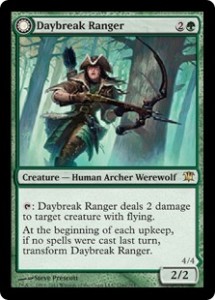
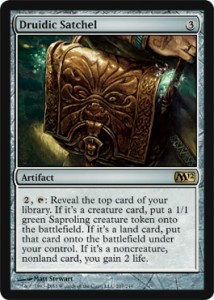
Things like Frost Titan spike from almost nothing then drop immediately when new tech is released. When an article goes up with someone hawking a card as the “New [card Druidic Satchel]Squadron[/card] [card Daybreak Ranger] Hawk[/card]”, the price rockets up within hours on MODO.

However, a lot of the time this is due to speculation. Not necessarily playability or value.

Once it becomes apparent that not everyone wants to play Satchel Control, or that werewolves don’t historically beat [card Twilight Mire] any [/card] [card Underworld Dreams] mythical [/card] [card True Conviction] creature[/card], [card Bloodlord of Vaasgoth] including [/card] titans, the value drops just as quickly as it rose.

If you examine the price curve of Druidic Satchel, it goes up from .07 to 1.0 in only 12 or so hours due to Mike Flores praising Garruk’s man purse as "insane".

That's a 1320% increase in a half day.

All of the bots were sold out and multiple people had classifieds up selling the card for 1. The only problem is that the card wasn’t actually being played in anything. It went back down to .12 a day later.

Druidic Satchel may have some niche place in Standard in the future, but the entire reason for the inflation was pure speculation.  It is sometimes difficult to figure out which cards this will happen to, so the best rule of thumb is to get out sooner rather than later with non-mythic,  [card Stoneforge Mystic]non-broken[/card] rares.

This exact same thing happened in real life with Brian Kibler’s boasting about Daybreak Ranger being good in the new Standard.  I can safely say that the same price spike and drop would have happened with Teen Wolf,  had he been released on MODO at the time of the article.

I am not saying you should not trust strategy writers. It is simply that these cards were not battle tested significantly to show that the decks they are used in would be anywhere close to Tier 1.

6.  There Is a Lot of Speculation On MODO

Following the previous point, it is especially important to realize when a card is going to stick at an inflated value because it is being played or if it is just a quick hype spike waiting for a drop.

Watch some daily results.  If the deck the new cards go in is nowhere in sight, dump them while you can.  People start playing new things immediately on MODO, so hype vs playability gets sorted out much more quickly.

7.  There Are No Collectors

A lot of players constantly cycle through all of the good cards in their collection on a yearly basis, selling out of and buying into every new format.  This is most pronounced in the Modern season. It spikes in popularity when it's PTQ season (January through March) and dies very quickly thereafter.

This happens with paper magic, too, but the prices seem to go down a lot further online than in real life, coming back to my previous point of things not holding value unless they are played.  This is where a good portion of the  long term money to be made on MODO is.

If you have a decent bankroll, just buy up all of the cards that are good in Modern right after the season ends and then wait 9 months.  If you are unsure of what cards will go up, just invest in dual lands and fetches.  Every single Modern deck will end up needing them and they always go up during the season.

You can actually buy Modern staples at any time up to the PTQ season's actual starting. You will just get better deals the earlier you do it.

So What Can We Take Away From All of This?

  • Mainly deal in competitive cards in formats that are heavily played (or going to be heavily played).
  • You are not using your salesmanship to trade for value. You are using cold hard economics. This is an entirely different skill set.
  • MODO allows you to purchase cheap and in bulk much more than paper magic.
  • When you speculate, go big or go home.  If you or a friend find some tech, or even see someone in the know playing with a penny rare, buy HUNDREDS of them.  The worst thing that can happen is you are out 10-15 bucks, but if they hit you are up usually 1000+%.  Wall Street would balk at those odds.
  • A good portion of the easy money to be made is on the yearly cycles of each format.  Most people do not have the discipline (nor the bankroll) to do this.
  • Speculation wildly affects the market.  Think about what you are investing in and look for evidence that it is putting up results, not simply being inflated.  If it isn't, dump quick.

Until Next Time!

Thanks a lot for reading!  I realize this may feel fairly elementary for some, but I did not know most of these things when I entered the MODO community with my first Stronghold sealed. And I am happy to ensure you do.

Pat McGregor
SARCASTO on MODO

In Memoriam

Are you a Quiet Speculation member?

If not, now is a perfect time to join up! Our powerful tools, breaking-news analysis, and exclusive Discord channel will make sure you stay up to date and ahead of the curve.

First and foremost, apologies are in order for missing a week. I don't know whether our mighty, benevolent editor, @the_Stybs is going to post two articles this week, or just skip one and proceed as normal, but regardless, I plan on returning to a normal schedule.

Unfortunately, the reason that I missed a week was due to the death of a good friend. He was someone I'd known since grammar school and had a profound impact on the way I looked at the world. This is the guy who first introduced me into the world of gaming. Over the years we went through all manner of board games, card games, and video games, did all kinds of really, really dumb things, and went through all the other trials and tribulations of childhood and early adolescence. Importantly, this is the friend that first introduced me to Magic, a game that has introduced me to people from all across the United States even the world. It's humbling to think of just how profound an impact one person, one thing can have on your life; how different things would be.

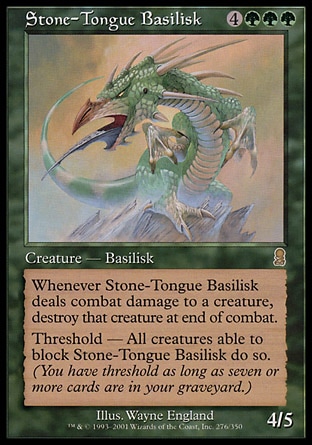
In the aftermath of all of this, I was given my friend's old collections of cards and games, and while digging through them I stumbled onto this gem:

We'd both been collecting cards since around Mercadian Masques, but started actually learning the rules just after Odyssey had been printed. As such, more than a few of our games degenerated into his Stone-Tongue Basilisk versus my Iridescent Angel. Those were the days! The days when we'd splash Hypnox in mono-white decks off of four Abaondoned Outposts; when games revolved around Seton's Desire and Frantic Purification instead of Wild Mongrel and Psychatog; when we traded away all the Mutilates and Nantuko Shades we opened because Black was the evil color, and neither of us wanted to be evil.

Looking forward, I don't know what else this game is going to do for me in the future. but I know for sure that I don't want to forget what it's done for me already. I know this may seem a little ridiculous, but I don't want this Stone-Tongue Basilisk to go unplayed. I don't even know if my friend touched his cards since we graduated 8th Grade and started growing apart, but I'd to think that he'd be happy that his Stone-Tongue Basilisk is still beating face. I'd like this guy to act as a reminder of the important things: where we all start, why we play the game, and that, in the end, it is just a game, and it's supposed to be fun, not matter how seriously you take it.

If you've been reading for awhile, you might recall that, recently, I've started working on building a deck for each color combination. Ideally, each of these decks will have its own unique identity, and play differently than each of the others. You'll also recall that the two colors I was looking forward to building least were Blue and Green, because of just how similar all of the "good" decks in those colors are.

Now I've got a Stone-Tongue Basilisk in need of a home, and I think that a mono-green deck is a great place for it. Stone-Tongue Basilisk is pseudo-removal in a color that doesn't get much of it. It's a reasonably interesting effect to build around, and is an interesting take on the color. With that in mind, I want to try to build a Stone-Tongue Basilisk theme deck. The problem is that Stone-Tongue Basilisk is only one card in 99,yet I want to play with it all the time. Otherwise it's not really a theme deck, is it?

Let's start the deck with a copy of each of the nine basilisks in our color combination, and see what that gives us to work with:

Basilisks

  • Stone-Tongue Basilisk
  • Daggerback Basilisk
  • Lowland Basilisk
  • Greater Basilisk
  • Simic Basilisk
  • Thicket Basilisk
  • Sylvan Basilisk
  • Serpentine Basilisk
  • Turntimber Basilisk

So, based on this, it seems that our theme is going to be deathtouch guys, and leveraging that ability to our advantage in the combat step with effects like Lure. The biggest problem with this plan is going to be the sheer number of cards that you have to invest to generate a single combat step where you can generate an advantage off of these abilities.

Stone-Tongue Basilisk makes that kind of effort worth it, because you can get multiple creatures out of the deal with his Lure ability. Since most of these Basilisks come with deathtouch attached, we're looking for ways to Lure things into the way:

Lures

  • Lure
  • Alluring Scent
  • Nemesis Mask
  • Shinen of Life's Roar
  • Seton's Desire
  • Tempting Licid
  • Grappling Hook

The trick here is to find as many repeatable Lure effects as possible so that you can generate incremental advantage over multiple combat steps by picking off creatures. Because of that, cards that are normally pretty abysmal are perfectly reasonable, like Nemesis Mask and Tempting Licid. One interaction I'm pretty excited about is the one between Genesis and Shinen of Life's Roar/Tempting Licid, since that lets you at least pretend that you've got some resiliency.

Grappling Hook, though, that's an unexplored dimension. First strike plus deathtouch is obviously insane, though admittedly less so when you have the "destroy at end of combat" version of deathtouch. Still, that's an interaction that's worth building around, since deathtouch gives utility guys a little more value and first strike is reasonably difficult to come by in Green. Similarly, when your opponents know that you're trying to Lure/deathtouch their guys to death, they'll just attack with any important creatures. Haste is a powerful ability that will let you prevent that!

First Strike and Haste

  • Coiled Tinviper
  • Hornet Cobra
  • Basilisk Collar
  • Lace With Moonglove
  • Quietus Spike
  • Sword of Vengeance
  • Akroma's Memorial
  • Lightning Greaves
  • Swiftfoot Boots

Now, as I said before, first strike doesn't help with the creatures that have a delayed trigger version of deathtouch so what can we do to help those? Well, how about indestructibility or regeneration? Having these mechanisms to protect your guys gives you resiliency to sweepers and makes most of your deathtouch guys much better. Here are some of the better ways I could find to protect my guys:

Regeneration

  • Eldrazi Monument
  • Molting Skin
  • Asceticism
  • Broken Fall

I don't really want too many cards with this kind of effect, since they're only really good when you've already got a Deathtouch engine of sorts going. Also, since two of them are repeatable and dodge most any kind of removal, you'll generally only need to see one over the course of a game to really take advantage of it.

At this point, we've only got 27 cards out of the 60 or so non-lands that most decks start with. Remember that we haven't even chosen a Commander for this yet! After quite a bit of thinking, Seshiro the Anointed is what I decided to go with. Snakes are sort of like basilisks thematically, and a number of them have the same deathtouch/delayed-trigger deathtouch interactions. Finally, and most importantly, the Ophidian ability Seshiro gives your Snakes is an awesome way to take advantage of the Lure effects that the deck is built around!

Bring on the Snakes!

  • Seshiro the Anointed (Commander)
  • Cobra Trap
  • Kashi-Tribe Elite
  • Orochi Eggwatcher
  • Orochi Hatchery
  • Snake Basket
  • Snake Pit
  • Sosuke's Summons
  • Ambush Viper
  • Ohran Viper
  • Shisato, Whispering Hunter
  • Tangle Asp
  • Seed the Land

Now, these Snakes are how you’re actually going to win the game. Having a double anthem as your Commander means that even just a Cobra Trap can be incredibly threatening if you untap and cast [card Seshiro the Anointed]Seshiro[/card]. The worst card here, by far, is Sosuke's Summons, simply because it's very difficult to rebuy. I figure that if your Commander is a Snake himself, then you can probably get back the Summons just about any time you'd need to, and any other Snakes are pure value.

That's the real backbone of the deck, the pieces that are going to make it play differently than the rest of the decks I'm working on. Now the most important question is what utility spells will give the deck the most game against the field. The deck is built to handle creatures reasonably well, so most of the utility is going to focus on making sure that you have ways to interact with decks based on spells and other permanents, rather than creatures.

Utility

  • Regal Force
  • Acidic Slime
  • Genesis
  • Eternal Witness
  • Green Sun's Zenith
  • Triumph of the Hordes
  • Abundance
  • Sylvan Library
  • Beast Within
  • Krosan Grip
  • Primal Command
  • Fierce Empath
  • Chord of Calling
  • Hall of Gemstone

Most of these are reasonably straightforward, so let's focus on the more interesting ones, shall we? I don't see how you could have a Basilisk/Snake/Deathtouch deck without Triumph of the Hordes as a finisher. Poisoning them to death with Snakes is just incredibly appropriate once you've poisoned all their creatures.

Hall of Gemstone is a card that knew was very good in this format, but never knew quite how good until I played with one of the local's mono-green decks. That card just straight up shuts down multicolor decks. It shuts off counterspells, and makes decks choose between casting ramp spells, creatures, or efficient answers. This guy does it all, but is reminiscent of Contamination locks. People get to play the game, but they don't really get to play very much. The card is very good, but be careful when you choose to run it; there will be backlash!

Sylvan Library is a card that is certainly on most people's radars, but you really can't say too much about it. The card is, in my experience, better than Sensei's Divining Top in Green decks, since it actually generates card advantage, rather than being just a really good source of card selection. Generally, I find that if you pay less than 8 life to a Sylvan Library over the course of a game, you're probably doing it wrong. There's also the reasonably well known interaction with cards like Abundance and other replacement effects. Since you didn't actually draw the cards, you don't have to put any back!

Last, because this is green and a more beatdown deck, you have to be able to get out of the gates quickly. The mana base and ramp spells have to do a lot of work here; they need to be consistent enough that you can curve out aggressively, but give you longevity and resiliency in longer games. Here's what I've got as a pretty typical manabase for non-ramp Green decks:

Mana!

  • Kodama's Reach
  • Cultivate
  • Explosive Vegetation
  • Explore
  • Into the North
  • Skyshroud Claim
  • Hall of the Bandit Lord
  • Vesuva
  • Mosswort Bridge
  • Scrying Sheets
  • Mouth of Ronom
  • Dust Bowl
  • Buried Ruin
  • Yavimaya Hollow
  • Petrified Field
  • Mutavault
  • Slippery Karst
  • Tranquil Thicket
  • Blasted Landscape
  • 25 Snow-Covered Forest

There are a few lands to note here. Hall of the Bandit Lord and Yavimaya Hollow give the deck additional copies of effects that it really wants to have access to. Cycling lands like Tranquil Thicket let you artificially increase the land count in your deck, which is important in any strategy. I'm of the opinion that decks should run as many spell-lands as they can, so that you don't feel bad about running enough lands in your deck. Finally, Buried Ruin is here for the awesome interaction with Snake Basket and Orochi Hatchery.

Now let's take a look at the finished deck and see what it looks like!

[deckbox did="a131" size="small" width="560"]

That's it! A deck that's built around a card with a lot of meaning attached to it, and one that I'll be trying to work the kinks out of for some time once I assemble the cards for it. One approach that I thought about some, but then discarded was to go Black/Green for Sisters of Stone Death as the Commander. Going black gets you some powerful cards like Gift of the Deity, or Glissa, the Traitor. The problem, in my mind, is that once you go black there's too much temptation to move the emphasis away from the combat step. I'm curious to hear what you guys think a better approach would be, or if there are any sweet cards or interactions I missed! I'll be working on this for the forseeable future, so be sure to let me know!

Carlos Gutierrez
cag5383@gmail.com
@cag5383 on Twitter

Blue Braids Will Drink Your Tears | CC S4E6

Are you a Quiet Speculation member?

If not, now is a perfect time to join up! Our powerful tools, breaking-news analysis, and exclusive Discord channel will make sure you stay up to date and ahead of the curve.

A three-man show this week, CommanderCast has Andy hosting both Justin and Neale as they continue their investigation of Commander with a W5-style, hard-hitting journalistic approach. The following tough questions are explored:

  • Where is the place of fast mana in the format, if it has one at all?
  • What are some ways to get your friends excited to play Commander?
  • When should you play proactive rather than reactive decks?
  • Why should you bother basing a strategy around a single, non-Commander card in your decks?
  • Who is Braids, Conjurer Adept, and why is she so awesome?

All this and more in another hard-edged, gritty episode of CommanderCast, where we're divulging the secrets they don't want you to know!

Hit the button to play, or download the entire episode!

For more Wrexial-approved content hit us up at CommanderCast.com, including information on the Gifts Given charity drive! Today's full show notes can be found here!

QS Drafts: Drafting Innistrad #1 [MTGO]

Are you a Quiet Speculation member?

If not, now is a perfect time to join up! Our powerful tools, breaking-news analysis, and exclusive Discord channel will make sure you stay up to date and ahead of the curve.

Forrest Ryan and Kyle Stoll draft Innistrad on video, bringing us along with thoughts behind the picks and plays.

Note: Audio quality has been addressed and future videos will begin featuring professional level audio clarity. Stay tuned!

Other drafts:
QS Drafts: Drafting Innistrad #1
QS Drafts: Drafting Innistrad #2

Insider: Pondering Planar Chaos

Are you a Quiet Speculation member?

If not, now is a perfect time to join up! Our powerful tools, breaking-news analysis, and exclusive Discord channel will make sure you stay up to date and ahead of the curve.

This week, we are looking at Planar Chaos, the second set in the nostalgia-heavy Time Spiral block. PC was based on the concept of a shifted color pie; that is, what if different colors had access to the same spells from regular Magic? What if White had direct damage and blue could shrink guys? Funeral Charm became Piracy Charm, for example. It was an interesting concept, but it was a popular failure. The reason is that fans, especially newer ones, couldn't put together the MaRo puzzles of card design. They didn't see why Sunlance was a big deal or why Red should get a Giant Growth. They just shrugged, confused, and opened some packs.

With that said, Planar Chaos is full of treasure for us. I think you'll be surprised at some of the cards on this list; I know I was!

Akroma, Angel of Fury - $3.50

Anything with "Akroma" in it is typically worth money. People like the T-1000 of Magic. She's an Angel, a babe, she's got crazy abilities... and now she's a redhead. Red Akroma saw a decent amount of Standard play because there were a lot of decks that just couldn't get past her protections. People liked being tricky, flipping her on the fourth turn with Seething Song and the like. She sees continued play in Commander, where her power and abilities shine as well. People like dragons and the like, and this is an angelic dragon if there ever was one.

Damnation - $15.50

The big deal in Planar Chaos was this, the colorshifted Wrath of God. It's still a huge deal and it'll probably never get reprinted - Black isn't meant to have this kind of power. Tom Lapille, both a Magic R&D member and a good personal friend, laid out what was wrong with Time Spiral Block and summed it up with just this card. Damnation let Mystical Teachings decks support Urborg, Tomb of Yawgmoth and Tendrils of Corruption, which let them fight aggro decks a little too well. You see, Tendrils and Urborg wouldn't do the job alone; you had to assemble them, which took searching. However, Damnation just let you play out a Coalition Relic into the sweeping Sorcery, buying you a lot of time against aggressive decks. After that, you'd have Tendrils around and blast away a weenie. You'd gain half a dozen life and be beyond burn spells and more attacks; lots of time to tighten the screws and kill the opponent.

Black has removal, sure, but it's always been qualified - to this day, there's no black spell that just says "destroy target creature." (though watch someone prove me wrong). Damnation got a little attention because of Modern, but I think mostly the platinum-level casual circuit drives the value of this card.

Extirpate - $5.50

"Extirpate" means to rip something out by its roots, and it is an apt word to describe this spell. Extirpate is a solid sideboard card in most formats where you can play it; sometimes it will just wreck someone's day. However, it's never been a reliable strategy on its own. I know how it goes - "I could Wasteland their Tropical Island and Extirpate all the other copies and then they won't be able to play guys!" That combo doesn't come up in play or the opponent can fight through it. It's best used on things like gutting a Life from the Loam deck. Even though we have Surgical Extraction now, I think Extirpate has some superior uses in sideboards.

Harmonize - $1.25

I sometimes see this Concentrate in junk bins. Pick 'em up! They're worth over a dollar and the Commander players create a consistent market for the card.

Kavu Predator - $1.00

The Sexual Predator is worth a little bit because it's good in Modern Zoo lists. You can combine it with Grove of the Burnwillows, Oust and more to create a super-aggressive Zoo deck with a lot of in-loaded value. Fiery Justice is the biggest blowout ever, for example. People also use it to disarm their friend's lifegain decks, which is useful.

Urborg, Tomb of Yawgmoth - $9.00

Phase One: power up crazy Tendrils of Corruptions against White Weenie in Standard. Gain seven or more life in a single shot. Do this whenever you want, thanks to Mystical Teachings.

Phase Two: Combine with Dark Depths and Vampire Hexmage to make an infernal Extended combination, letting your deck "go off" on the second turn with a Marit Lage token.

Phase Three: Worm its way into all of your Commander decks with Black, making all those Mountains into Not-So-Badlands.

Urborg has gotten a lot of love over the years and it shows no signs of slowing. It's a decent manabase fixer and the Tendrils combo is still pretty fresh. I wouldn't be surprised if we saw it show up in Modern, for example. People value these at crazy numbers, so be sure people are realistically trading them to or away from you.

I wish I could bring you some more power uncommons from this set, but that's it. Next week, we'll tear into Future Sight, one of the most valuable sets to open packs of. It's incredible and I can't wait to share stories, combos and especially, prices next week!

Until then,

Doug Linn

Insider: Value is Not a Dirty Word

Are you a Quiet Speculation member?

If not, now is a perfect time to join up! Our powerful tools, breaking-news analysis, and exclusive Discord channel will make sure you stay up to date and ahead of the curve.

Blame Medina.

The rise of the “value” trader can be directly attributed back to Pack To Power, which Jon Medina started in the summer of 2010. After that, everyone thought they were “value traders.” Not only are the majority of these people either terrible at trading or just out to shark people (which also falls into the “terrible at trading” umbrella), it made things a bit more complicated for the rest of us.

The backlash has been growing. For instance, at States last weekend I wasn’t able to do as much trading as I wanted, since I was playing Solar Flare and taking a lot of time in the rounds even though I play quickly (went 5-1-2, losing out on Top 8 in the last round).

However, the tournament was a fun experience, mostly because people are awesome and someone loaned me the entire deck to play. The person who loaned me the deck? Someone that I met through trading, incidentally, proving that the point of trading is not just to make money — it’s to make friends.

But back to the story. After missing out on Top 8, I began finally hitting the trade tables, and doing some pretty good work. As I’m trading, some jerk I don’t know walks up to me literally three different times and yells “what’s up value trader?” loud enough that it was clear he was trying to cause a scene.

I have no idea what prompted this, who this guy is, or if he has a problem with me or is someone who just recognized me. Either way, it was both annoying and rude. Not one of my trade partners at this time said anything about it, and we went on to complete trades that were both profitable to me and helpful to them. In short, everyone was happy, as every trade should accomplish.

As I said, some d-bag calling me a value trader is annoying, but it’s not offensive.

Because “value” is not a dirty word.

So I traded for value. Who doesn’t? Does the guy who ships me $10 retail in cards for $7 of mine not get value from the fact that he has now completed his deck for the PTQ? What about the guy who picks up Liliana “at a steal” just to have its price plummet the next week? (Which it did, as we all warned you).

“What do you value this at?”

I’ve seen multiple articles pop up in the last week or two claiming that anytime someone asks “what do you value this at?” you’re immediately supposed to label them a “value trader” and stay away.

This is flat-out ridiculous.

I trade for value a good deal of the time (though not always), but I will trade anything out of my binder and the same people come back to me time and time again knowing full-well how it’s working. They get what they want, and that’s all that matters to them. Numbers on a web site really aren't the end-all, be-all for most people, since they aren’t going to do much with those particular cards outside of either playing them or keeping them in their collection.

I completely understand the desire to not want to “lose” in a trade, and I have no problem with people bringing out the smartphone. You can still make trades you want to make while coming out even or even losing “value.” Know some people who want EDH? Trade your $5 Standard card for their $4 EDH card that you know you can easily move later. I’ve written about having the right audience before, and making these connections means you don’t have to “win” every trade to make it worth your time.

An even more objective defense of the “value” question is this. If I ask you what you value Solemn Simulacrum at, what’s your answer? The card retails for $12 on SCG, the TCGPlayer mid is about $10 and the low is about $8. CFB sells it for $10, and you can get them at about $7 on Ebay. That’s a $4-5 difference (30-50%), and I’ve seen regular players on the floor price out cards on every one of those systems.

And that’s on a low-variance card like Solemn. If you go bigger and look at something like Liliana of the Veil, the difference is even more pronounced! $60 on SCG, $54 mid on TCGPlayer, $44 low, and the card is closing under $30 on Ebay! How can you even begin to trade with someone worried about “losing” a trade if you can’t even find out what price system they affix to their cards?

With this in mind, the question is not how can a person dare ask another what they value a card at, the question is how can you not!?

I will allow that the majority of people who open a trade conversation like this are out to make money from you. But sometimes that’s okay. Down $2-4 theoretical dollars? Deal with it. You got what you wanted without giving up a single dime out of your pocket. On the other hand, if you don't want to deal with this hassle (and with many of the people who think they're "value traders" these days, it is a hassle), then just don't trade with them. That's fine. But don't be afraid to start throwing around prices with your trade partner, it doesn't mean they're only going to shark you and it doesn't mean that they'll think you're trying to shark them.

I could go into even more ways that “value” is misused, but I’ve done it before and Chas Andres, former QS and current Channel Fireball writer, has covered it recently as well. I’ve covered a ton of the ways this breaks down in the past (here and here for a few examples), but today I want to look at a particular trade I made at States that illustrates quite a few important things to keep in mind.

Before we get into it, I want to relink this article. It's one of the works I'm most proud of, and applies perfectly to this topic.

I made this trade with Trevor Hunt, the Oklahoma 2010 States champ, who also just missed Top 8 this year.

Mine:

Geist of Saint Traft

3x Hero of Bladehold

3x Consecrated Sphinx

Foil Brimstone Volley

2x Tempered Steel

Stromkirk Noble

Chandra, the Firebrand

Solemn Simulacrum

His:

3x Wooded Foothills

2x Mutavault

Cascade Bluffs

Tell me, without prices yet, who do you think gained “value” in this trade? Which side of the trade would you rather be on? Is that the same thing?

Now let’s try it with prices (SCG used)

Mine:

($20) Geist of Saint Traft

($45) 3x Hero of Bladehold

($45) 3x Consecrated Sphinx

($5) Foil Brimstone Volley

($10) 2x Tempered Steel

($10) Stromkirk Noble

($16) Chandra, the Firebrand

($12) Solemn Simulacrum

Total: $173

His:

($75) 3x Wooded Foothills

($60) 2x Mutavault

($15) 1x Cascade Bluffs

Total: $150

So tell me again — who won this trade? I’m happy with my end of this deal every time.

But here’s the important thing about this trade: we both knew exactly what was going on. Trevor sought me out (literally hounded me all day) to “take his expensive cards.” Why would he do this? We all know that getting Legacy staples is much more important than picking up Standard cards, and Trevor knows this as well, so why would he seek me out to do this deal, and why me?

The important piece of information here is Trevor works a store in a different city and said they literally cannot keep the Standard cards in stock. He’s going to take those cards home and move them very quickly at retail.

On the other hand, I love picking up Legacy stock. The buy price percentage from dealers is terrible on something like Stromkirk that is used only in Standard compared to something like the foothills, when I know I can get 50-60% of retail in cash when I sell it. And I don’t have to rush to move them. I’m happy to take a sizable loss in “value” because it fits my business model, just as the Standard cards fit his.

There was no arguing over prices, we were operating as two dealers helping each other out. We used “in” prices while making this deal so as to avoid the mess with different pricing schemes I explained above. I set the prices on everything using the one system I care about most — buylist prices. He agreed or negotiated a small change on each and we both walked away extremely pleased, even though we both knew he made the “value” in the deal on the surface.

In case you’re wondering, the final tally using SCG buylist prices is this: $69 for the stuff he got,  $73.50 for the stuff I got. See what I mean about how meaningless the concept of “value” is? This perfectly illustrates the point that so many people miss, both “value traders” and regular players alike who are wary of traders.

I’ve seen multitudes of “value traders” brag about how they made $10 in some sick trade, only to let the cards rot in their binders for months until they lose value. Newflash: You’re not making a cent if you’re not selling cards. You may grow the monetary value of your collection at that moment, sure, but if you aren’t constantly moving cards for cash or you deal exclusively in the eternal market (which is so very few people), then you aren’t making any real money, regardless of how much “value” you think you’re making.

By the same token, I see players all the time cry about how a trader took them for $10 and whine and say it ruined trading for them forever. The money they “ripped you off” for? Probably something like $2-3 in actual cash. I gave a man on the street $2 today. I also spent $2 on a soda I didn’t need. I waste two bucks all the time. And guess what? So does the guy complaining as he casts the Akroma's Memorial he got “so ripped off” trading for.

Why me?

Another thing I wanted to touch on regarding the above trade. Trevor sought me out in particular for this deal. Why? Because he was told by multiple people that I was “the trading guy” in Oklahoma. We’ve seen each other around tournament before, but haven’t spoken much and certainly weren’t friends beforehand.

But he came to me and trusted me based on my reputation, as suggested to him by the very same people I’ve traded with and asked them the infamous question “what do you value this at?” I’ll be honest, I make a decent profit trading, usually through volume rather than big scores, and I don’t hide that fact. Yet people still trust me enough to suggest that a stranger come to me to trade off some big-ticket Legacy items.

That’s what happens when you do trading the right way, and the concept question of “value” doesn’t matter a damn bit if you’re doing things the right way.

Thanks for reading,

Corbin Hosler

@Chosler88 on Twitter

Welcome to Snapcaster Standard!

Are you a Quiet Speculation member?

If not, now is a perfect time to join up! Our powerful tools, breaking-news analysis, and exclusive Discord channel will make sure you stay up to date and ahead of the curve.

Greetings folks, I'm coming to you live from the Snapcaster Mage Standard Season. We have a lot going on here at the event and new tech is showing up all over the place. The latest news comes from Mike Flores who tried to take down his New York State Championship with a dedicated Snapcaster Mage deck. Let's take a look and see what he has to offer.

4-Color Control

Untitled Deck

Creatures

4 Snapcaster Mage

Spells

1 Ancient Grudge
4 Brimstone Volley
3 Dissipate
4 Forbidden Alchemy
4 Galvanic Blast
4 Mana Leak
4 Think Twice
3 Slagstorm
1 Batterskull
3 Druidic Satchel

Lands

7 Island
7 Mountain
4 Drowned Catacomb
3 Rootbound Crag
4 Sulfur Falls

Sideboard

1 Batterskull
3 Azure Mage
2 Frost Titan
3 Ancient Grudge
1 Dissipate
4 Shock
1 Arc Trail

This deck has everything going on for it! Card drawing check. Removal and counter spells check. Little to no win conditions just like every other successful control deck check check!

What's that? Druidic Satchel? Mike says "This is very likely going to be a Top 10 card in Standard for the rest of the year, a kind of cross between maybe four different very good planeswalkers...It has a dramatic effect against both fast beatdown and long-game control decks." Wow! I don't know if he's right but if so, get yours now before those speculators dive right in snatching them up by the hundreds.

What's my take on the deck? Low on win conditions for my tastes and I am not on the Druid Satchel party bus just yet. He's gonna have to prove his worth to me. Seems like a strictly worse version of Crystal Ball and we all know that was not playable. Sure Crystal Ball didn't gain life and yes that is important but the bag of random effect doesn't seem like it will impact the game enough. Mike Flores has my highest level of respect so the card will be tested rigorously by myself and the magic community but at first glance, I will take the role of skeptic.

I like the direction of the deck though and it seems like something similar to what I would enjoy playing. Take a look at the list I am thinking about taking this Friday to grind some FNM planeswalker points with.

4-Color Control: Aggro Control Version

Untitled Deck

Creatures

3 Spikeshot Elder
4 Stromkirk Noble
4 Snapcaster Mage

Spells

2 Sword of Feast and Famine
4 Brimstone Volley
3 Dissipate
3 Forbidden Alchemy
4 Galvanic Blast
4 Mana Leak
4 Think Twice
1 Batterskull

Lands

7 Island
7 Mountain
3 Drowned Catacomb
3 Rootbound Crag
4 Sulfur Falls

Sideboard

3 Slagstorm
1 Batterskull
2 Azure Mage
2 Frost Titan
3 Ancient Grudge
1 Dissipate
1 Flashfreeze
2 Dismember

That is way more my style. Sure the little creatures are going to die but they put pressure on your opponent letting you play fish some games and counter burn others. A lot of decks still have no answer for Stromkirk Noble. Cannot be blocked by humans is HUGELY relevant. Spikeshot Elder provides a reusable source of damage that will likely do as much as Slagstorm just against more opponents with the benefit of being completely busted with Sword of Feast and Famine.

What I like about this deck and decks like it is the ability to have answers for any deck. Might wanna add some Phantasmal Images to the sideboard though to fight Geist of Saint Traft and Thrun, the Last Troll.

Continue reading "Welcome to Snapcaster Standard!"

Want Prices?

Browse thousands of prices with the first and most comprehensive MTG Finance tool around.


Trader Tools lists both buylist and retail prices for every MTG card, going back a decade.

Quiet Speculation