menu

War Domri in Temur Delver and GR Moon

Are you a Quiet Speculation member?

If not, now is a perfect time to join up! Our powerful tools, breaking-news analysis, and exclusive Discord channel will make sure you stay up to date and ahead of the curve.

One of the more exciting War of the Spark cards for me was Domri, Anarch of Bolas. The card didn't appear especially powerful, but it did pique my interest as a potential role-player in a couple of my favorite decks: GR Moon and Temur Delver.
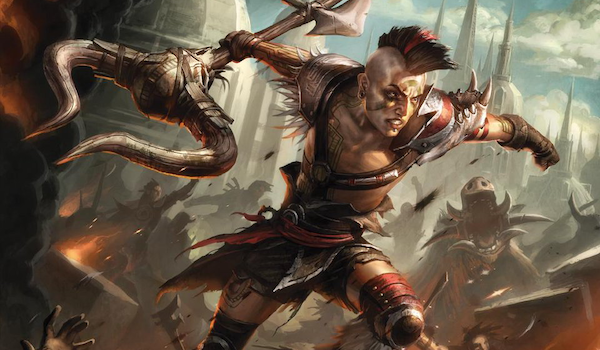
As the static-ability walkers spoiled, I identified in them one critical weakness: a lack of cohesion. While the abilities they offered seemed interesting one by one, taken together on a card, I felt most of the walkers did too many different things. We'd only want one of its many abilities in a given matchup, for instance, and Modern has better cards for executing that ability.
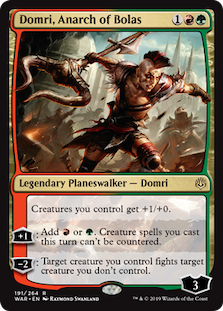
Domri, Anarch of Bolas offends less on this count, and I felt it would be possible to build a deck that benefited from all three of his modes. To make use of Domri's abilities, the deck would need to:

  • Go wide or want to buff creature power by 1 for some other reason
  • Make use of an additional mana per turn
  • Have creatures large enough to turn fight mode into a reliable kill spell

As it does every so often, my brainstorming led me back to two of my old pet decks: GR Moon and Temur Delver. Read on for proposed builds in each archetype and my preliminary thoughts on Domri in the decks.

An Embarrassment of Riches Walkers
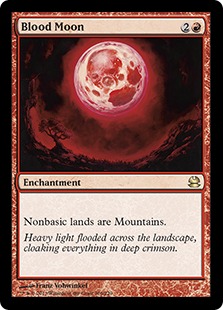
GR Moon is a stompy deck that ramps into turn two Blood Moon and promptly pressures opponents until the game is over. It differs from Ponza in that it doesn't run land destruction cards, and has a much lower mana curve, enabling Faithless Looting to sift through the deck. Its primary closer is Tarmogoyf.

One of my longtime nitpicks with GR Moon, an archetype I've played around with for four years now, has always been the lack of effective planeswalkers to run. With Fatal Push legal, it's critical that Tarmogoyf be as big as possible, giving us plenty of incentive to fit walkers into the list. Granted, we've since received an adequate walker for the strategy in Sarkhan, Fireblood—see this article for more on his roles in the deck. But as they say, the more the merrier, and I think Domri too offers GR Moon some unique angles.

Domri's Roles

Domri's static ability rewards us for running Goblin Rabblemaster. The 2/2 has made it into a few of my Moon builds, especially the earlier ones with rituals, but has mostly held a flex spot in my builds. Lately, the card is proving itself as one of Modern's strongest options for quickly pressuring disrupted opponents. Giving every Goblin token +1/+0 significantly increases Rabblemaster's power, effectively doubling its per-turn damage output. Additionally, granting our creatures +1/+0 turns an excess of mana dorks into more pressure.
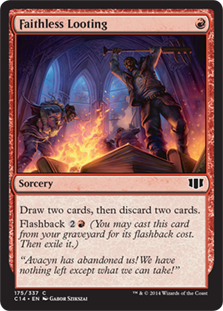
The mana addition also meshes with GR Moon's strategy. We like to dump mana sources beyond the fourth with Faithless Looting and Sarkhan, using that chaff to dig into business. Domri gets that ball rolling a turn earlier. Instead of deploying a fourth land, we can sandbag it and still have access to the same amount of mana. It's icing on the cake that our creatures can't be countered.

Fight mode is nothing new, as it's something the old Domri Rade also featured. But while Rade's other two abilities weren't worth our time, Anarch's are, incentivizing us to seriously weigh fight mode's applications. One of GR Moon's classic issues is its lack of hard removal. While splashing black is an option, and the first one I employed, it's not so elegant, especially with color-intensive walkers in the mix. Domri's -2 lets Tarmogoyf take out pretty much any threat across the battlefield, including other Goyfs thanks to the +1/+0. I've also used the -2 on a freshly-deployed Hazoret the Fervent before making a hasty attack. Of course, in lieu of a fatty, the ability leaves much to be desired—we can't be caught bringing a Bird of Paradise to a gun fight.

Here's the build I'm working with:

GR Moon, by Jordan Boisvert

Creatures

4 Noble Hierarch
2 Birds of Paradise
4 Tarmogoyf
4 Goblin Rabblemaster
2 Magus of the Moon
2 Hazoret the Fervent

Planeswalkers

3 Sarkhan, Fireblood
3 Domri, Anarch of Bolas

Enchantments

4 Blood Moon
4 Utopia Sprawl

Instants

4 Lightning Bolt
2 Tarfire

Sorceries

4 Faithless Looting

Lands

4 Wooded Foothills
3 Misty Rainforest
3 Verdant Catacombs
2 Stomping Ground
4 Forest
2 Mountain

Sideboard

4 Anger of the Gods
4 Damping Sphere
3 Dire Fleet Daredevil
2 Ancient Grudge
2 Dismember

Card Choices

This deck really wants to start with a mana dork in hand, be it Birds, Hierarch, or Sprawl. That's why we run 10 of them, an ample amount under the pending London Mulligan. With all those Bolt targets, as well as Rabblemaster, I figured it safe for Magus of the Moon to make an appearance. 4 Blood Moon isn't so many when your gameplan depends on it.
I split the walkers down the middle, maximizing the odds of sticking both. Looting can then ditch walkers as necessary with an equal chance of finding the right one down the road.

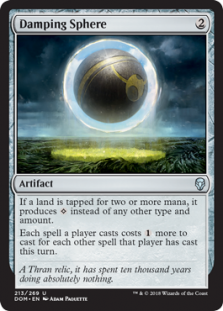
The sideboard maxes out on some of the best hate in the format. Dire Fleet Daredevil returns from the last build as another way to remove large threats across the table, especially against the Goyf decks, which also tend to run Fatal Push. There are no Surgical Extractions here because Damping Sphere hoses Izzet Phoenix better, and Anger of the Gods takes care of Dredge.

Tuning Temur Delver

My other long-lost deck, Temur Delver, uses Domri for slightly different purposes. It has no interest in deploying lots of creatures or going wide with tokens. Rather, Temur takes advantage of Domri's planeswalker type with self-mill effects to grow Tarmogoyf for value, and especially enjoys the +1/+0 boost on its creatures.

Domri's Roles

Tarmogoyf has long proved problematic for this deck, too, and now our Goyfs beat theirs in combat. Hooting Mandrills is also way more threatening when it's got Gurmag Angler-levels of power, not to mention impossible to stonewall with an Angler under Domri. Cutest of all, though, is the buff granted to Delver of Secrets. Not only does a 4/2 flier end the game very fast, Insectile Aberration now grants ferocious for Stubborn Denial!
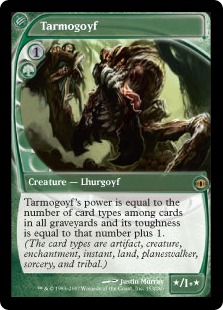
As with GR Moon, Temur Delver usually finds itself strapped for mana. The extra boost from Domri helps cast threats while keeping up counterspell mana. And fight mode is relevant for the same reasons: we can finally remove big creatures with our bigger Goyfs.

Something to keep in mind about Domri in this deck, compared with in GR Moon, is that it won't be coming down ahead of schedule. Rather, Domri is a tap-out turn three play, or a way to punish opponents who commit mana to dealing with our creatures. Once it's down, they can't counter our future threats, which are larger than before and can also take out enemy creatures. Against aggro decks, Domri doesn't need to be dead on arrival each time; his +1 can generate a mana for Hooting Mandrills, or Tarmogoyf if we've got another to spare, and these creatures can protect him for the turn cycle.

The list:

Temur Delver, by Jordan Boisvert

Creatures

4 Delver of Secrets
4 Tarmogoyf
4 Hooting Mandrills
1 Snapcaster Mage

Planeswalkers

2 Domri, Anarch of Bolas

Artifacts

4 Mishra's Bauble

Instants

4 Thought Scour
4 Lightning Bolt
3 Stubborn Denial
2 Mana Leak
1 Simic Charm
1 Lazotep Plating
1 Tarfire

Sorceries

4 Serum Visions
2 Faithless Looting
1 Flame Slash

Lands

4 Misty Rainforest
4 Scalding Tarn
2 Steam Vents
1 Breeding Pool
1 Stomping Ground
3 Spirebluff Canal
2 Island
1 Forest

Sideboard

3 Damping Sphere
2 Blood Moon
2 Huntmaster of the Fells
1 Hazoret the Fervent
1 Snapcaster Mage
3 Surgical Extraction
2 Anger of the Gods
1 Stubborn Denial

Card Choices

Snapcaster is a bit clunky in Temur, but I like the upside of keeping a single copy in the mainboard of a four-Scour deck. Taking a cue from Grixis Shadow, I've included 2 Faithless Looting here as a means to sift through unwanted cards or dump rare card types into the graveyard—Domri in particular can clog in the early-game. Bauble is here to make Tarmogoyf worth playing over Death's Shadow, and so is Tarfire.
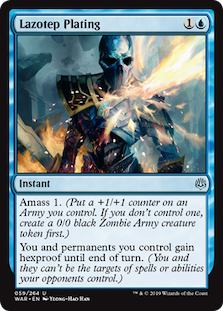
The other flex spots are occupied by Flame Slash, a killer of Thing in the Ice, and a couple blue protection spells: Simic Charm and Lazotep Plating. Both of these save our threats from removal with upside. Simic's benefit is its flexibility: we can use it to soft-disrupt a combo by bouncing a creature, or to trample over an enemy blocker with Hooting Mandrills. Plating, too, is flexible, as outlined in my War of the Spark spoiler review. But its bonus effect of generating a token happens no matter which "mode" we choose—countering a burn spell; saving a creature; protecting Domri; or just end-step amass. Of note: with the planeswalker in play, our amass token is a 2/1! I like amass here because it insulates us from edict effects, as on Liliana of the Veil, and gives us blockers for the damage race or pressure for an enemy planeswalker.

This sideboard does indeed run Surgical Extraction, as well as Damping Sphere and some Moons of its own for the big mana matchups. Huntmaster and Hazoret remain Temur staples in my eyes. The Werewolf and his token increase their power by a lot with Domri in play, and Hazoret hits like a ton of bricks no matter what. The final Stubborn sits in the sideboard for spell-based matchups.

A Walker on the Wild Side

I don't think either of these decks will upend Modern, or even close—they both have fundamental issues that Domri doesn't fix. But I do think the walker improves them on some metrics. For me, part of the fun of Modern is being able to gradually strengthen beloved decks as new cards are released. Which War cards have you feeding your pets?

Mulligans, Modern, and the Mythic Championship

Are you a Quiet Speculation member?

If not, now is a perfect time to join up! Our powerful tools, breaking-news analysis, and exclusive Discord channel will make sure you stay up to date and ahead of the curve.

Mythic Championship II took place over the weekend, featuring Modern Constructed and the experimental London Mulligan. Many expected combo decks to perform well. They did overall, but were just shy of making the Top 8 of the event. As expected, the most linear strategies that were already at the top had the chance to perform better under the new mulligan conditions.

Just As Expected

The decks people expected to do well showed up in force, and the metagame appears to be relatively the same as it was leading up to the event.

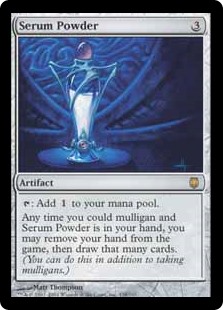
Many tried their hand at new archetypes that would supposedly benefit from the rule, such as Serum Powder Eldrazi variants. I expect this card to be on the sharp decline very soon, as its results were fairly underwhelming. Bigger winners with similar effects were Leyline of the Void and Leyline of Sanctity.

There was an error retrieving a chart for Serum Powder

Others opted for more reliable decks like Tron, Humans, and Izzet Phoenix, which were played much more than the rest of the archetypes below them.

There was an error retrieving a chart for Karn Liberated

Tron being the most played deck does not strike me as odd in the slightest, as it appeared to be the front runner from all the preliminary testing going on in the weeks leading up to the tournament. While it didn't put up the win percentage to fully back that up, that didn't stop it from having a good showing, with two copies (nearly three) in the Top 8 of the tournament.

Going forward, I believe there will be some rising demand for many of the Tron pieces, especially with War of the Spark making its debut this week. The new Karn, the Great Creator and Ugin, the Ineffable add even more efficiency to the suite of threats the seven-mana landbase can enable.

Cards to keep your eye on are Wurmcoil Engine, Oblivion Stone, and Expedition Map. The deck even gets a nice new piece of bling when War of the Spark: Mythic Edition drops today in Ugin, the Spirit Dragon.

There was an error retrieving a chart for Arclight Phoenix

Only one Phoenix deck managed to crack the Top 8, piloted by none other than reigning World Champion Javier Dominguez, but the archetype had a great showing overall with a positive win record. With a smaller field, many players were able to adjust their decks against the top Modern deck, and yet it still finished quite well.

Notable tech for these lists is the one-of copy of Set Adrift, an uncommon from Khans of Tarkir. I've already talked to death about this deck, as have others—you won't be surprised to know I've got eyes on Manamorphose, Thing in the Ice, and Pyromancer Ascension.

There was an error retrieving a chart for Aether Vial

The last dominant archetype I'd like to mention here is Humans, which Eli Loveman used to take down the event. Newer tech such as Deputy of Detention and Whirler Rogue were key cards in a lot of matchups, but the strength of this deck really just lies in its linearity and ability to play disruptive creatures.

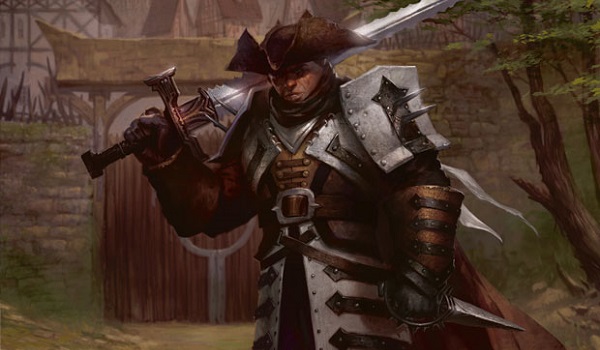
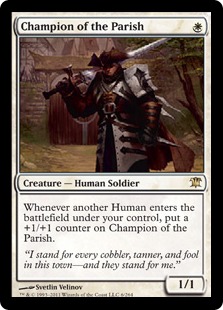
Many of the on-camera wins we saw with this deck involved Thalia's Lieutenant and Champion of the Parish aggro plans, but the more disgusting plays the deck powered out mainly involved Kitesail Freebooter and Meddling Mage. Who needs Duress and Counterspell when you can simply put them on a creature and start bashing?

The deck contains the obvious pieces that make it tick like Noble Hierarch and Thalia, Guardian of Thraben, but financially I look to cards like Cavern of Souls and Aether Vial as standouts. These will likely be high-priority acquisitions moving into Modern Horizon's release.

Just Outside the Spotlight

While the top decks of the format comprised a majority of the top slots, I feel it's best to examine the decks that had higher win rates over the course of the tournament. As I mentioned before, the London Mulligan was very kind to decks looking to assemble a specific sequence of cards. I called Tron out before, but even more impressive is Ad Nauseam's win rate, likely due to this mulligan rule.

There was an error retrieving a chart for Ad Nauseam

While there were only eight players piloting this deck at the tournament, a 67% win rate is nothing to scoff at considering the caliber of players. While this deck weaves in and out of the metagame, it's never really been a terrible choice to enter a tournament with.

It also has a lot of very specific cards, like Angel's Grace, Phyrexian Unlife, and Lotus Bloom. While the namesake card is pushing a $20 price tag, the rest of the unique pieces likely have a lot of room to grow with their sub-$10 prices.

There was an error retrieving a chart for Scapeshift

I know I've been carrying on about Scapeshift for a while, but I think we're likely going to see the main pieces of this deck become more expensive. Scapeshift saw some minimal pressure due to the printing of Evolution Sage in War of the Spark, but I think there's likely to be more if Valakut, the Molten Pinnacle decks are able to hack it after the release of Modern Horizons.

Primeval Titan gets even more interesting to me as a spec target, as it's still well under $20 a copy. If we see the London Mulligan rule implemented fully, this is certainly one deck you'll want to be invested in, as it's one of the most consistent combo decks in the format.

There was an error retrieving a chart for Cryptic Command

I'll point this one out again too, as UW and Esper Control's successful showing at the Mythic Championship was enough to get me moving in on some Cryptic Commands. This deck did far better than I expected it to, considering the room had strong Tron stench, but its decent matchups against most of the field make it a compelling choice. With recent innovations such as Surgical Extraction and Rest in Peace seeing mainboard play, you can bet that UW had a much easier time finding the right answers with the London Mulligan in effect.

These are the premier decks running Jace, the Mind Sculptor and his cohort Teferi, Hero of Dominaria, and will have players excited from just a raw power standpoint alone. At present, I don't think UW decks are anywhere near on par with decks like Tron, Humans, and Izzet Phoenix (I'll put Dredge at the top of the format as well). But a few key additions from Modern Horizons could cause a paradigm shift towards blue control.

Aside from Cryptic, I think Path to Exile will be the most relevant card to hold going forward, despite its upcoming reprint in Signature Spellbook: Gideon.

Bring it on Home

I'll have to admit, I wasn't incredibly high on this Mythic Championship. It highlighted the worst parts of the format for me again, and despite having some very exciting and controversial moments, was an underwhelming pro-level event. However, with new cards getting injected into the format with War of the Spark, we may see some shifts very soon. Regardless of my opinion of the format, there is no denying that there will be cards on the move due to this event.

Interests:

  • Cryptic Command
  • Path to Exile
  • Ad Nauseam cards
  • RG Valakut cards
  • Aether Vial
  • Cavern of Souls

Cards to get out of:

  • Serum Powder. Really, just that one card.

That does it for this week! You can follow me on Twitter @chroberry or Instagram @chroberrymtg if you want to see extra goodies and spoilers for next week’s article. Feel free to let me know how you feel about my targets here in the comments, or if there’s anything you think I missed!

Peace!

Insider: QS Cast #121 – War of the Spark Part II [Unlocked]

Are you a Quiet Speculation member?

If not, now is a perfect time to join up! Our powerful tools, breaking-news analysis, and exclusive Discord channel will make sure you stay up to date and ahead of the curve.


Welcome to the QS Cast 2019! Our co-hosts Chaz and Tarkan explore the financial aspect of Magic the Gathering – and in this episode they discuss the following:

  • QS Writer Chris Martin re-joins the Cast! Has been dubbed an honorary QS Cast host!
  • War of the Spark dive.
  • Another look at War of the Spark Commander implications
  • Insider Questions

Cards to Consider

*This Podcast was Recorded on 04/11/2019 for QS Insiders. If you want live recording sessions and up to date postings before anywhere check out the QS Insider Discord!

Avatar photo

Chaz V

Started playing during Invasion block at the age of 13. Always a competitive person by nature, he continues playing to this day. Got into the financial aspect of the game as a method to pay for the hobby and now writes, Podcasts, and covers all aspects of the game, always trying to contribute to the community and create great content for readers and listeners.

View More By Chaz V

Posted in Free, QS CastTagged , , , , , Leave a Comment on Insider: QS Cast #121 – War of the Spark Part II [Unlocked]

Have you joined the Quiet Speculation Discord?

If you haven't, you're leaving value on the table! Join our community of experts, enthusiasts, entertainers, and educators and enjoy exclusive podcasts, questions asked and answered, trades, sales, and everything else Discord has to offer.

Want to create content with Quiet Speculation?

All you need to succeed is a passion for Magic: The Gathering, and the ability to write coherently. Share your knowledge of MTG and how you leverage it to win games, get value from your cards – or even turn a profit.

The Culmination: MC London

Are you a Quiet Speculation member?

If not, now is a perfect time to join up! Our powerful tools, breaking-news analysis, and exclusive Discord channel will make sure you stay up to date and ahead of the curve.

At last, we've got the Mythic Championship results. It's been quite the build up between the ongoing saga of Izzet Phoenix and questions over the proposed mulligan change. We were all looking for definitive answers from London, and while I didn't get all of them, I think there's enough evidence to answer some of them. Though not without some caveats.

The Disclaimers

This is the time where I make my usual disclaimer about over-analyzing results from the Pro Tour, now Mythic Championship. This is an invitation-only tournament, so the sample is not random. It is also quite small, so there is opportunity and motive to try and game the field rather than pick on deck based on merit alone. This is also a mixed-format event, and the draft portion has a huge impact on final standings. A player can be mediocre in constructed and flawless in draft for a high finish and vice-versa. Thus, the data should always be viewed skeptically.

However, MC London's data is particularly disorienting when it comes to assessing the metagame at large. There were a lot of new policies in place that may have skewed the results. The London Mulligan is the most notable, but it's not alone. Historically, the PT has taken place a few weeks after a new set releases so that players can learn the draft format. But London was a prerelease. Therefore, there was far less time to practice. In turn, this meant draft practice was prioritized over constructed practice, and the Modern results may have been affected as a result.

A Metagame Question

This reprioritization almost certainly exacerbated the problem of pro-level players struggling with Modern. If Twitter is any indication, a lot of players couldn't find a deck. This isn't new: most of competitive Magic isn't Modern so they don't play that much. Modern is a format that rewards mastery and experience over all else, and if players don't naturally have that, it is hard to manufacture for one tournament.

For this reason, pros have tended to pick very safe and well-known decks. That London would be Modern was also a relatively late announcement, so it didn't leave that much time to prepare. In these circumstances, it's natural for players to just default to whatever decks they've had previous success with or appear to be doing well. Rather than try something new, it's just better to stick with the new hot deck in Izzet Phoenix or last year's best deck Humans.
Also of note is the London Mulligan's pre-tournament effects. Before the tournament, all the buzz said that Tron would be the biggest beneficiary, which mathematical models appeared to confirm. Given that Tron is a known good deck and not that hard to play, all the hype and expectation were naturally going to inflate its numbers.

An Information Advantage

The final factor impacting London's data is open decklists. Wizards likes letting spectators see the decklists and has long been worried about scouting, so they decided to publish all the decklists on Day 1. The only hidden information was how many of each card was in each sideboard. This gave Humans a huge advantage and suppressed combo decks. Humans' maindeck has been pretty stable for over a year now, so there's not much difference between hiding and revealing their decklist.

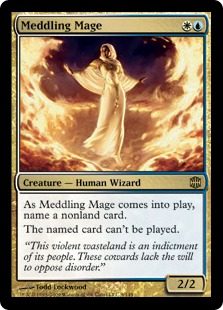
Specifically, the decklist rule makes Meddling Mage much better. Mage is a very powerful card, but only good if you actually name a relevant card. It struggles against decks with multiple key cards or imperfect information. Forest, go could mean a slow start from Elves, Hardened Scales, and Tron or Amulet Titan. A turn 2 Mage in the dark is a wild guess. With access to opponents' decklists, each blind Mage was at least in the ballpark, and far more potent.
Additionally, combo decks were denied the surprise boost from opponents' confusion. There are a lot of very powerful combo options in Modern, and at least some players may have been trying to break the format with the London Mulligan. However, the threat of Humans combined with their deck's reliance on surprise was killed by open decklists. The incentive was to fall back on safe, known lists, rather than branch out.

Day One

So when it comes to actually looking at the data from London, there really isn't much surprise. According to Wizards, Tron made up 14.6% of the field, followed by Izzet Phoenix at 12.0% and Humans with 10.3%. There is a steep drop-off to fourth place with UW Control's 7.4%. The expectation that the more well-known and popular decks would do well is holding strong. Humans was last year's big deck, and Izzet has been this year. What I didn't expect was Tron to show up as strongly as it actually did. Beating out Izzet Phoenix for most popular deck is no small feat, and I suspect happened on the strength of the hype around Tron benefiting from the new mulligan. Other than that, the metagame looks quite diverse for an invitational tournament.

Day Two

The Day 2 data is rather unexceptional, as every deck made Day 2 in numbers equivalent to its initial population. The win rates are all over the place, but their order in terms of total representatives didn't change at all. This doesn't indicate any noticeable change in strength. Focusing on conversion rates is something of a fallacy, since popular decks will suffer from their popularity. This is borne out in the data, since the lower the starting population, the higher the conversion rates.

In Context

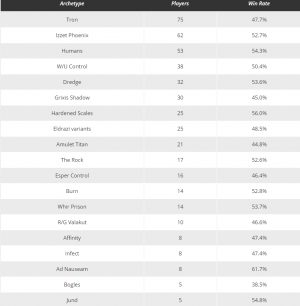
When it comes to overall win percentages, things get more interesting. Despite expectations set by Humans' advantage, the best performer was Ad Nauseam. Tron is indeed a great matchup, but Humans is quite bad. I presume that expert sideboarding is the reason for this jump. Overall, no deck really shone. The average win rate is roughly 50%, so Tron's 47.7% is not very good. This is likely due to players expecting the deck and packing enough Damping Spheres to protect themselves.

The Top 8

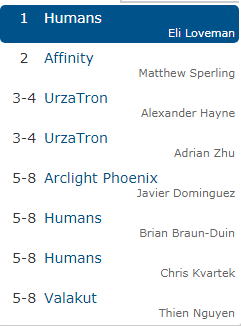
Humans won, which is hardly surprising considering there were three copies in the Top 8. Tron managed two, with TitanShift, Affinity, and Izzet Phoenix rounding it out. Tron and Human's numbers are hardly surprising considering their Day 2 presence, nor is Phoenix placing. It is proving very hard to keep the firebirds down. It's impressive that Matt Sperling made it with Affinity since it's been displaced by Hardened Scales. I imagine the Experimental Frenzys were critical to his success.

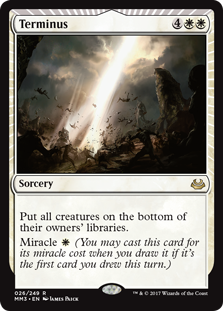
Given that, the interesting part of the Top 8 is that no UW Control made it. UW has a close matchup against Izzet Phoenix, can be made to handily defeat Tron, and fairly good against the field. I imagine it fell foul of Humans. UW doesn't play that many unique creature removal spells so it's easy to Meddling Mage it out of the game. You can also prevent a miracled Terminus by Vialing in Kitesail Freebooter in response to the trigger. Jeskai had a far better matchup, but it's weaker against the field.
Despite all this, I wouldn't read too much into the Top 8. Given that draft results are included, the actual finishes aren't very indicative of a deck's strength. To look

The Modern Story

Instead of the final placings, I would look at just the Modern match points. Doing so eliminates any boost or drag from the draft, and gives a clearer picture of deck strength. No deck ran better than 9-1 in Modern. This is the metagame of 8-2 or better decks.

Deck NameTotal #
Izzet Phoenix5
Humans4
Dredge2
Ad Nauseam2
Red Eldrazi2
UW Control2
Tron2
Burn1
Jund1
Titanshift1
Hardened Scales1
Affinity1
Amulet Titan1
Whir Prison1

This table looks very similar to the metagame we've been observing for the past several months. Izzet Phoenix is clearly on top, with Humans nipping at its heels. The rest of the metagame is very broad and roughly equal in metagame share, and therefore power level. To keep beating the dead horse, this indicates that the overall metagame is very healthy. The question remains: is Phoenix's continued seat atop the standings still acceptable? I think the answer has become no.

Despite its numbers being relatively down from GP levels, Phoenix is maintaining a high win rate. The second most popular deck, it had a 52.7% win rate. That's pretty average for the field. However, popular decks should necessarily have a lower rate, because they have more mirror matches and pilots that bomb out, cancelling some wins of the successful. Ad Nauseam did the best with 61.7%, and only boasted eight copies in the tournament. So only one player had to do well for the rate to bloom.
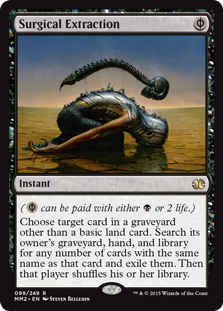
However, despite appearances, Izzet Phoenix's win rate is staggering considering that players were running a ridiculous amount of Surgical Extractions in London. The card that players are convinced is critical to beating Phoenix, despite everything, was the most popular card in London, and five Phoenix players still managed 8-2 or better. Granted, there are other (better) options for defeating Phoenix, but Surgical's speed and splashability, as well as the perception players have of it being great against Phoenix, continue to make it a favored sideboard choice. In terms of other hate, Relic of Progenitus was 15th place and Path to Exile 4th. Players were clearly aware of Phoenix, prepared for it, and yet Phoenix was still winning more than everyone else. Given that the field was extremely hostile, a 52.7% is very high. This makes me think Phoenix is running out of time.

My Take

I predicted that the metagame was relatively settled going into London, with Phoenix on Top followed by Humans with the rest of the meta trailing in their wake. I didn't account for Tron's popularity, but other than that London's results do look very similar to GP Yokohama's which were consistent with all the earlier results. Thus it's safe to say that Izzet Phoenix is clearly on top of the metagame with Humans, Tron, and Grixis Death's Shadow being strong contenders.

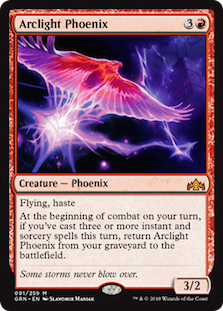
As for Phoenix itself, I've remained hopeful that the metagame would naturally adjust and push it back down. That doesn't appear to be happening. Izzet Phoenix continues to show up in large numbers and then turn those into high tournament placings. Couple that with a high win rate in a very hostile field, and it's hard to argue that Izzet Phoenix can't overcome any obstacle. This moves the deck from an interesting anomaly into a metagame trend, and potentially a dangerous one.
I don't think it's inherently broken by any means. However, all the data is indicating that it's taking up a worrying amount of Day 2 space and is arguably dominating Modern. This often warrants action. It could be winning too early too often as well, but only Wizards knows if that rumor is true. I imagine based on available data that action will be taken against Izzet Phoenix. My guess is a Faithless Looting ban to nuke the best starts.

The Mulligan Question

This begs the question of whether the London Mulligan will be sticking around. The simple answer is that I don't think the Mythic was a very good test. As a result, I can't determine anything conclusive about the mulligan change. The fundamental problem was that there were too many variables at play per my disclaimers. If this weren't a prerelease draft, pros would have had more time to test Modern. This could have led them to make less safe deck choices.

Open decklists also punished players looking to branch out. A lot of the value of picking a wonky rogue deck is opponents being confused by something unexpected. That wasn't possible. Therefore, London was not really a test of what the mulligan was capable of because there was no incentive to push the envelope. As a result the rule didn't get a very rigorous field trial, just a nice safe unveiling. Thus I don't consider it valid data.
The real test is ongoing (at time of writing) via MTGO. Unless Wizards has a massive change of heart, we'll never know the exact effect of the mulligan because we'll never see the data. If testimonials saying the change is fine are correct, the rule will stick. If Ken's is more accurate, then it may not. Many definitely think the rule is good, and apparently Mark Rosewater said in a panel that he expected it to stick. Therefore, I expect that it would take a major distortion in the MTGO metagame to prevent this change.

What Comes Next?

Even if Wizards doesn't change the mulligan rules nor ban anything from Izzet Phoenix, there are big changes on the horizon for Modern. Specifically, Modern Horizons' spoiler season begins later this month. Even if the set's impact is muted, as I expect, it will still shake things up and is guaranteed to bring in some fresh blood. I look forward to seeing what shakes out soon.

War of the Spark Combos and Synergies

Are you a Quiet Speculation member?

If not, now is a perfect time to join up! Our powerful tools, breaking-news analysis, and exclusive Discord channel will make sure you stay up to date and ahead of the curve.

While I know I typically am the writer who looks at MTG Finance from the macro level, I do like to jump into the micro level stuff from time to time and War of the Spark has got me excited. This is the first set in a long time that I've actually pre-ordered more than one box and I've also purchased quite a few Feather, the Redeemer specs, many of which have already turned solid profits.

Plenty of other writers have already discussed the Feather, the Redeemed specs and we have seen some other interesting combo's including Celestial Kirin + Ugin's Construct which when you cast the construct for 0 destroys all lands. Though we don't know if that is a viable combo or not.
Some other potential specs I haven't heard people talking about:

Standard

With regards to Feather, the Redeemed, there aren't any standard infinite 2-card combos, simply some interesting synergies.
Feather, the Redeemed
+
Essence Capture
This provides you with an Essence Scatter every turn while making a creature bigger each time. While this combo is very color heavy and it won't be online until likely turn 4 if you have the colors it would lock out a lot of midrange style decks. Unfortunately, Essence Capture is only an uncommon so the price ceiling is very low, thus the potential ROI (Return on Investment) is also not that great.
There was an error retrieving a chart for Essence Capture
+
Ajani's Influence
This combo will add +2/+2 to a creature every one of your turns and digs you for another white card within the top 5. While it may not be as impressive it does provide repeatable card advantage within an RWx deck. I like this option enough to pick up a playset myself, though admittedly when I bought them I was actually thinking of it more for Commander. This spec does have some legs on it though, as you can only get a single copy in the Ajani planeswalker decks, which don't tend to be extremely popular and thus not a lot of copies enter the market. That being said it isn't absurdly powerful and I do fear this one may end up in the old "box of shame specs."
There was an error retrieving a chart for Ajani's Influence
+
Ancient Animus
While this combo requires you to be at least Naya colors, it does provide a slow continual growth of your Feather. She's also a legendary that keeps fighting opposing creatures, meaning you could lock your opponent out of playing creatures for the rest of the game. Sadly this one is a common so any potential ROI on this is basically nothing.
There was an error retrieving a chart for Ancient Animus
+
Jaya's Immolating Inferno
While you have to keep the X in this spell to under 4, unless you can grow Feather's toughness; this does allow you to burn an opponents creature for 3 and your opponent for 3 every single turn, which against some decks would likely prove unbeatable.
There was an error retrieving a chart for Jaya's Immolating Inferno
Tamiyo, Collector of Tales
+
Planewide Celebration
While this doesn't come off as the most impressive combo, Tamiyo allows you to return a card from your graveyard to your hand, and because Planewide Celebration allows you to proliferate three times and then use one of its other modes, you can keep casting Celebration every turn while still getting one other mode on it. This is obviously quite mana intensive, however, with something like Nissa, Who Shakes the World you can get this going as quickly as turn 5. I don't know how powerful this combo could be, but it's important to note that it can be done with just green mana. If you throw in something like Magistrate's Scepter you could easily take infinite turns. I haven't heard anyone mention this interaction before and my love of homebrews makes me really want to build something around this. If you come up with any "must includes" please comment below or message me on QS discord.
There was an error retrieving a chart for Magistrate's Scepter
Doom Whisperer
+
Bolas' Citadel
While this one obviously requires a lot of life, you can use the Doom Whisperer to sculpt the top of your deck and remove lands you don't need. Now the rest of your deck will likely need to be made up of spells that gain you some amount of life to keep this gravy train rolling. However, if you can resolve both these cards with a high life total you can dig through a lot of your deck. The fact that this interaction is entirely possible in Mono-Black means that it could fit into a multitude of potential shells. The most obvious pairing is with white thanks to cards like Revitalize and Ritual of Rejuvenation, which thanks to gaining more life than they cost, come off as free spells with added benefits.
There was an error retrieving a chart for Doom Whisperer
Ral, Storm Conduit
+2x Expansion//Explosion
+ any instant or sorcery that costs 4 or less.
This one has been discussed before but it's still worth noting. While it seems somewhat convoluted, the basic idea is that you cast your cheap instant or sorcery with a Ral in play and then Expansion it, and then Expansion the Expansion. This creates an infinite loop of copies that then trigger Ral's static ability, pinging the opponent to death. It's not even that mana intensive, as if the Ral is already in play you can go off with only 5 mana at instant speed. However, it does require three specific cards and then one that could be one of many, so it may not be all that consistent. It is important to note that Ral's first ability can help you dig towards a missing piece and his second is pretty powerful on its own.

Conclusion

While none of these appear to be anywhere near as broken as Deceiver Exarch + Splinter Twin, whenever you have any type of powerful combos in standard it's important to take notice, especially given that the Standard card pool is so much smaller than eternal formats, so the ability to interact with these types of combos is far more limited.

While I didn't find anything that screams "perfect speculation target" while looking for these combos, I think it's important to make people aware of them as once the Magic hivemind gets its wheels turning we can very quickly come to an optimized build. If you felt like I missed any standard combos that we now have thanks to War of the Spark, please let me know below.


Insider: QS Cast #120 – War of the Spark Reactions [Unlocked]

Are you a Quiet Speculation member?

If not, now is a perfect time to join up! Our powerful tools, breaking-news analysis, and exclusive Discord channel will make sure you stay up to date and ahead of the curve.


Welcome to the QS Cast 2019! Our co-hosts Chaz and Tarkan explore the financial aspect of Magic the Gathering – and in this episode they discuss the following:

  • QS Writer Chris Martin joins the Cast!
  • War of the Spark Reactions- Pre Orders
  • Additional Commander Reactionary buying?
  • Insider Questions

Cards to Consider

*This Podcast was Recorded on 04/04/2019 for QS Insiders. If you want live recording sessions and up to date postings before anywhere check out the QS Insider Discord!

Avatar photo

Chaz V

Started playing during Invasion block at the age of 13. Always a competitive person by nature, he continues playing to this day. Got into the financial aspect of the game as a method to pay for the hobby and now writes, Podcasts, and covers all aspects of the game, always trying to contribute to the community and create great content for readers and listeners.

View More By Chaz V

Posted in Free, QS CastTagged , , , Leave a Comment on Insider: QS Cast #120 – War of the Spark Reactions [Unlocked]

Have you joined the Quiet Speculation Discord?

If you haven't, you're leaving value on the table! Join our community of experts, enthusiasts, entertainers, and educators and enjoy exclusive podcasts, questions asked and answered, trades, sales, and everything else Discord has to offer.

Want to create content with Quiet Speculation?

All you need to succeed is a passion for Magic: The Gathering, and the ability to write coherently. Share your knowledge of MTG and how you leverage it to win games, get value from your cards – or even turn a profit.

Breaking Down Hasbro’s Q1 Earnings Report

Are you a Quiet Speculation member?

If not, now is a perfect time to join up! Our powerful tools, breaking-news analysis, and exclusive Discord channel will make sure you stay up to date and ahead of the curve.

Recent chatter on social media has sounded very positive for Magic’s health. This motivates me (and others I’m sure) to increase financial exposure to cards—further price appreciation seems almost inevitable at this point. But how confident can we be in Magic’s health?

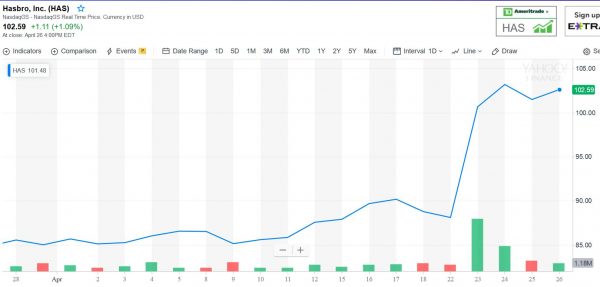
Fortunately, this past week Hasbro (parent company of Wizards of the Coast) reported their quarterly earnings. Upon doing so, their stock chart mirrored a traditional Magic card buyout, spiking suddenly and meaningfully and aggressively.

Hasbro’s a giant company with many brands—we can’t assume Magic was the sole reason for this spike. But it did play a contributing role, and Hasbro’s management called the game out multiple times for its strength. This week I’m going to dig into Hasbro’s earnings reports for tidbits on Magic to try and glean just how strong this franchise truly is.

Quarterly Report PowerPoint Presentation

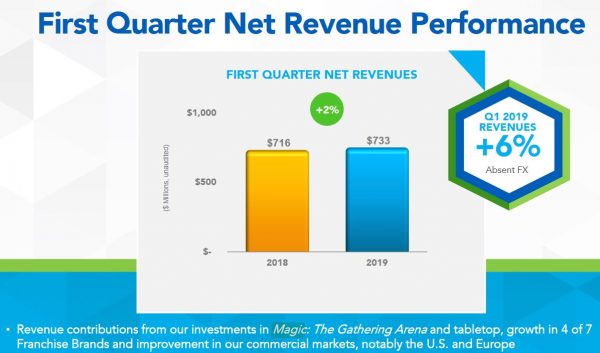
When Hasbro reports earnings, they like to summarize results in PowerPoint form; it’s a handy way of merging pictures and text to communicate top level results. For those interested in following along, you can view the publicly available report here.

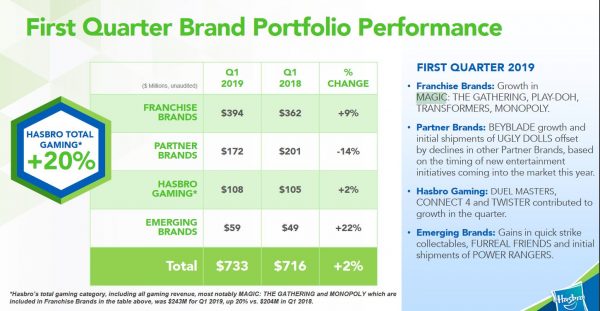
In total, Magic was explicitly referenced five separate times in the presentation. Here are the snippets associated with each reference:

From these five mentions, we can draw two key conclusions about Magic.

First, it’s clear that Hasbro is committed to investing in Magic. They clearly state their intent to invest in advertising and product development for Arena. This commitment bodes very well for Magic. As players discover the game through the Arena platform, they may make the transition into the paper form of the game, driving higher sales and revenue growth for Hasbro.

The second valuable nugget from these slides is the overall strength of Magic revenues in general. In the one slide, there’s a statement that “Hasbro’s total gaming category, including all gaming revenue, most notably Magic: the Gathering and Monopoly…was $243M for Q1 2019, up 20% vs $204M in Q1 2018. To see 20% growth in such a mature business is phenomenal and it’s a testament to how strong these games are. Clearly, Hasbro is high on Magic and Monopoly to call them out individually like this.

But is this really conclusive? It’s nice to see Hasbro call out the strength in Magic and declare their intent to invest further in Arena, but can we really feel confident investing in Dual Lands and Black Lotuses based strictly on these slides?

There was an error retrieving a chart for Black Lotus

Perhaps not. Fortunately, there is more data to react to within Management's Remarks about this quarter.

Management’s Remarks on Magic

The PowerPoint presentation is really a high-level summary to help management navigate their conference calls with market analysts. The document containing management’s remarks provides additional color commentary around results. This is where some of the most interesting nuggets on Magic’s health reside.

Magic itself appears a dozen times in the document. Below are the snippets of the most interesting references.

  1. "During the first quarter we realigned our segments and began reporting the digital gaming revenue associated with our Wizards of the Coast two brands, including Magic: The Gathering Arena and several other games, in the renamed Entertainment, Licensing and Digital Segment.
  2. Our long-term investments in growth opportunities provided a meaningful contribution from our digital and e-sports initiative, Magic: The Gathering Arena, as well as growth in MAGIC: THE GATHERING tabletop revenues.
  3. …great success at our premier MAGIC: THE GATHERING Mythic invitational at Pax East in March…..which generated 2.7 million viewer hours on Twitch and paid out a million-dollar prize pool.
  4. Engagement with MAGIC: THE GATHERING is growing – in both digital gaming and analog tabletop. In-store player growth increased double digits and grew at an even higher rate for new players. The latest Magic card set, War of the Spark, was unveiled at Pax East and drove over 10 million views of the trailer, shattering the previous record…Magic: The Gathering Arena is performing well, with over 700 million games played to date during the open beta with the average player spending 8 hours per week in the game.  We will be further supporting the game with additional tournaments and marketing support as the year progresses.
  5. …we are also expanding the MAGIC: THE GATHERING franchise to reach a broader audience through an entirely new game, designed for mobile. The team launched this game, Valor’s Reach, into test markets during the first quarter.
  6. We reclassified revenues of $10.4 million and operating profit of $3.2 million…revenues grew 24% this quarter…driven by revenues from Magic: The Gathering Arena as well as consumer product licensing. Operating profit increased to $30.0 million, or 32.6% of revenues, driven by the higher revenue and lower amortization for film and television. This was partially offset by continued investments in the business, including in digital gaming initiatives for MAGIC: THE GATHERING."

Some of the snippets above echo what’s in the PowerPoint presentation: Magic is growing and Hasbro is committed to investing in Arena. They even explicitly mentioned their realignment of segments so that Arena revenue falls under a digital gaming category—this will make it easier to track Arena’s growth.

However, I think there are two new takeaways from these comments that are worth highlighting. First, Wizards provided some actual numbers when it comes to player engagement that appear to be very positive. Whether it's playing online, at a local shop, or watching coverage on Twitch, overall engagement with Magic is strong!

  • 7 million viewer hours on Twitch during Mythic Invitational
  • In-store player growth increased double digits
  • 10 million views of the War of the Spark trailer
  • 700 million games played in Arena during open beta

Secondly, what’s this mobile game “Valor’s Reach” all about? Seriously, am I the only one who didn’t know that Wizards is trying to expand the Magic franchise into a mobile game?

This is fantastic news! If the game has a lower barrier to entry than Magic, it may attract a far broader audience—some of those newcomers would naturally funnel to the card game.

Wrapping It Up

We need to be somewhat skeptical here in that Hasbro will naturally spin all their analyses in a positive light. Naturally, their management is confident in the decisions being made (if they weren’t, then Hasbro would need new management). But even with this skepticism, I am still left feeling quite optimistic about this earnings report. It’s clear Hasbro will continue to spend some of their cash to grow Arena while also transforming Magic into a true esport. At the same time, they’re seeing strong engagement with the paper version of the game.

What are the action steps for us speculators and investors coming out of this earnings report? I don’t think I’d make any sudden changes in my approach per se. But in the past, I have stated that Magic investing—especially in the Reserved List and high-end market (Duals, Power, Masterpieces, Alpha/Beta)—are great long-term investments as long as Magic stays healthy. What I’m reading in the last quarterly statement is that Magic is in the best shape it has ever been!

There was an error retrieving a chart for Serra Angel

This means we have the green light to proceed as planned…at least until the next quarterly earnings when we can examine numbers all over again.

…

Sigbits

  • At one point, the Winter version if Mishra's Factory spiked very high and buylisted for nearly $300. Since then stores restocked the card and the price pulled back significantly. But it is appearing on Card Kingdom’s hotlist yet again. Even though the buy price is a modest $160, I’ll still be paying close attention to see if the card runs higher once again.
  • I saw a fair amount of Dark Confidant on camera throughout the Mythic Championship in London. While I don’t think the card got much attention on Sunday, Bob still saw more play in Modern than he had for quite a while. I see Card Kingdom has the Judge Promo printing on their hotlist with a $120 price tag.
  • Right around the time of the Winter Mishra's Factory spike, Card Kingdom had aggressively high buy prices on all the Legends legendary creatures. Since then prices dropped back down to earth, but Angus Mackenzie has made a reappearance on CK’s hotlist recently, with a $110 buy price. This isn’t anywhere near its peak (probably around $200) but perhaps these cards are all finding a base and will appreciate going forward.

Sales Tax on Magic – Reacting to Increasing Costs

Are you a Quiet Speculation member?

If not, now is a perfect time to join up! Our powerful tools, breaking-news analysis, and exclusive Discord channel will make sure you stay up to date and ahead of the curve.

On April 1st, a change made by several TCG vendors quietly snuck into our everyday Magic: The Gathering purchasing habits. Depending on the state you live in, you may notice that your final cart price on various sites such as TCGplayer and Card Kingdom is a little higher now due to the introduction of sales tax.

For some states and vendors, these changes went into effect a while ago (I was actually impacted by it on TCGplayer back in mid-2018). For others, this change may be entirely new and a big shock to the system.

Most of us are used to paying sales tax on various daily goods or services, and already pay tax on purchases at our LGSs. As a result, taxation of Magic cards purchased online might not be a big deal as we get used to it over time—but as a speculator and player, the change stings in the moment.

I couldn't help but stop and think about the consequences of this change to the various parties who are impacted. The thing that stands out to me the most is how much money a single Magic card might generate in sales tax for states over its lifetime.

Think about this scenario for a moment:

You live in Illinois (like I do) and buylist $400 worth of Magic cards to Card Kingdom. Using their store credit bonus (1.3 multiplier), you buy a VG copy of Underground Sea (retail value at the time of this writing: $511.99).

Card Kingdom charges you $32 in sales tax on your Underground Sea (the Illinois rate of 6.25%). This effectively requires you to trade in an extra $25 worth of cards to cover the price change, if you're paying entirely with store credit.

Fast-forward eight months and it's Christmas time. You need cash to cover cost of gifts for your friends and family, so you list your Underground Sea on TCGplayer for $500 and it sells to someone in California.

Of course, you pay the fees and taxes on the sale to TCGplayer, but guess what? Your buyer just paid a California sales tax on that purchase—possibly as high as 10.25% (depending on your municipality, etc.). So, that Underground Sea now has somewhere between $60-80 worth of sales tax accrued on it just by changing hands twice.

We can all imagine how often "trading cards" change hands, but if you were to start to add up the sheer volume of actual sales per card, the taxation aspect becomes a mind-boggling statistic.

I was talking with folks in the QS Discord about this a few weeks ago—I am convinced the average Magic card will generate more sales tax in its lifetime than any major commodity.

To illustrate the point, some of us were jokingly using an analogy of underwear sales (picking it as a random commodity to compare) to Magic card sales. While hilarious, the comparison also perfectly underscores the biggest difference of sales taxation on Magic vs. the majority of other things that taxes hit. It is unlikely to resell underwear (or most commodities) after purchase, but it is highly likely to resell Magic cards.

Besides the hit to our wallets, what other impacts should we consider regarding the new sales taxation on Magic cards?

There was an error retrieving a chart for Swords To Plowshares

Downsizing the Box of Shame

We all know the pain of whiffing on specs. Whether the card falls out of favor, is reprinted, or simply just never hits in popularity, the cost of whiffing can be exorbitant (shipping, resale fees on various platforms, storage space, etc.). Anyone who is in the business of speculation should focus on keeping miss rates low and ROI high. The new sales tax cost, combined with the postage hike earlier this year, makes ROI even more difficult than before.

My advice: stick to the lowest-hanging fruit. There's no room to get cute with specs, because the costs of missing are even more punishing than before. Easier said than done, though. To shore this up on my end and keep the miss rate low, I have adjusted my strategy ever-so-slightly.

Leverage Overseas Options

There was an error retrieving a chart for Trade Routes

For one, I've begun using overseas options to help increase margins, notably by making several purchases recently from Hareruya. The EDH scene is smaller outside of the U.S., which means two things:

  1. Cards in demand here could still be available overseas.
  2. The cost of the cards might still be at the "old" (pre-demand) price.

We've heard a lot in the community about arbitrage of late (there have been some fantastic discussions about the pros and cons in the QS Discord). I'm not sure this is the same thing, though, since I'm not buying cards simply to flip for a modest 20% profit.

Instead, I'm waiting to find cards that I know are moving here in the U.S. Then while other speculators are purchasing from the U.S. mainstays (eBay, TCGplayer, Card Kingdom, etc.), I'm looking at Hareruya and picking up larger quantities all at once. I had a ton of success with this strategy when Feather, the Redeemed was spoiled, and will continue to use this strategy sporadically in the future.

Eliminate Early Movers

There was an error retrieving a chart for Preferred Selection

The second adjustment I've made to combat rising costs is not calling cards that rank below a 3/5 on my "confidence rating scale." In other words, I won't be formally calling "early-mover status" cards moving forward. I may still put these cards on a "watchlist" but I won't recommend purchasing them (nor will I buy them) until they blossom into a 3/5. This should limit the number of cards I put in my box of shame (also affectionately referred to in my household as the very-long-term specs box) and hopefully help you avoid doing the same.

You might be thinking that the best time to get in on a spec is when no one else knows about it, and this was my mindset for a long time as well. However, my thought-process has changed while contemplating why cards are ones and twos on the confidence scale in the first place—because there isn't enough demand yet to move the needle.

I have started tracking cards more closely, looking for the proverbial "tipping point." I have realized cards at that point (i.e. 3/5 or better on my scale) are much more likely to tip over within 3-6 months on the back of natural demand, rather than requiring a new card to catalyze them. This is important as it means the hold time is much shorter and the returns are more consistent.

There are good cards out there in the "early-mover" class (see: Preferred Selection). But they are simply not positioned to climb quickly, because there is something holding them back (in Preferred Selection's case, it is outclassed by other cards like Sylvan Library, Mirri's Guile, and now Guardian Project).

By avoiding these types of cards as specs, I will cut down the size of my very-long-term spec box, and keep money freed up to remain agile as metas shift and cards go in and out of spikes.

Increase Sales Volume

There was an error retrieving a chart for Increasing Ambition

Ultimately, I want to keep the box of shame small and the "for sale" pile large, because one of the best ways to combat a rising costs/lower margins scenario is to increase top-line sales volume. This brings me to my final strategic adjustment: lowering my target ROI on specs.

I normally shoot for a 100% gain on specs (i.e. a double-up) before fees and shipping are factored in. This usually keeps my margins around 50-70%, depending on the price of the card sold. Now I have made an adjustment to shoot for a lower pre-expense gain (80%) and a lower margin (30-50%). This should still allow me to profit handsomely on cards while making it a little easier to churn out specs faster and keep the sales volume higher.

Of note is that this strategy may not work for everyone, as it requires more time for the overall handling aspects (packaging, post office visits, etc.). I've been working on ways to offset some of that time spent via automation—for example, I bought a return label stamp to avoid writing it out by hand. Similar to any production line, my time-spent-per-envelope actually goes down when I'm doing more at once, so I've found this has actually improved my hourly rate when working on MTG-related sales.

The lower-target profit margin obviously hurts, and if I were a large company telling a Wall Street analyst this was my strategy to combat rising costs, my stock price could easily get crushed. For me, though, this strategy in a small sample size is working well. My expectation is that this will allow me to scale further over time, while absorbing more costs along the way.

Wrapping Up

While I believe the bad taste of sales tax on Magic cards will wear off in a few short months, the impacts will be felt for years to come.

I obviously cannot predict the future (wouldn't that be nice!) but I can be as prepared as possible for it knowing what I know now. To reiterate my adjustments to rising costs, I've adapted three new strategies: buy overseas more frequently to create a lower entry point on my EDH specs; reduce speculation to only the finest cards ranking 3/5 or higher on my confidence scale; and accept lower margins but offset them by increasing my top-line sales volume.

I recommend reviewing your speculation habits to factor in the constantly rising costs. If you are in it just to keep Magic cheaper, make sure you are finding ways to offset the rising expenses, and that you aren't spending more than you would if you simply did not speculate at all. Similarly, if you are in it for profit, make sure you know the ever-changing surroundings of the cost-basis on each spec you purchase, and have a plan for combating it.

The strategies I described above may not work for you, but the good news is they do not represent a list of all the possible solutions available. Be creative; challenge the norm; and try find ways new ways to optimize your speculation habits. I would love to hear what others are doing to adapt to the rising costs, and exchange notes.

To discuss further, you can always reach me in the QS Discord or on Twitter (@ChiStyleGaming)! Thanks!

Brew Report: That’s Wizard’s Chess

Are you a Quiet Speculation member?

If not, now is a perfect time to join up! Our powerful tools, breaking-news analysis, and exclusive Discord channel will make sure you stay up to date and ahead of the curve.

By the time this piece is published, Mythic Championship London will be streaming, and Modern players will be testing the London mulligan in a high-pressure environment for the first time. The results of that event will have a massive effect on the format's future. For those who just can't wait until the Top 8 ends to decide if they like the rule change or not, today's brew report explores the shifts in published online lists after Wizards began the London's trial period through the lens of brand-new Modern tech.

The New Mulligan: Pre-London Impressions

It's not much, but we've now at least got some tangible data regarding the London Mulligan's potential effects on Modern. That data takes the form of four MODO 5-0 dumps, two Modern Challenges, and two MOCS events, all published by Wizards. Poring over that data led me to a couple conclusions.

Combo Isn't Crazy

As in, combo decks don't seem to have polarized the metagame, despite combo decks benefiting more from the London Mulligan than other strategies. In fact, interactive decks seem to be doing even better than before. Perhaps we owe part of this result to Cheeri0s, a faster combo deck that naturally preys on other combo decks, or on decks otherwise interaction-light. When the London was implemented online, Cheeri0s is the one combo strategy that saw an immediate surge in performance, epitomized by a Modern MOCS that featured two copies in the Top 32. That success was not replicated in the other large event postings, indicating that Cheeri0s is not suddenly broken under the London, but rather just "a deck" again, something it couldn't boast under the Vancouver (or "scry 1") mulligan.
Cheeri0s becoming consistent enough to function unmolested bodes well for Modern's interactive and fair decks; the ones that are likely to have Fatal Push, Path to Exile, or Lightning Bolt handy as of turn one. These decks can easily disrupt the deck and go on to win the game, while other combo strategies, including big mana archetypes like Tron, must aggressively mulligan for their limited removal spells rather than for their enablers. Indeed, the deck continued to post 5-0s throughout the London's trial period.

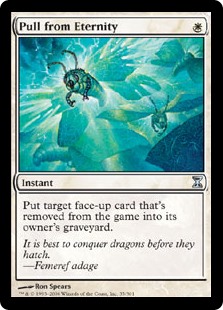
Other combo decks weren't as fortunate. I did catch a single Jeskai Ascendency deck, and one Bring to Light Scapeshift deck, but these kinds of fringe-strategy blips are common enough over the course of a month's MODO dumps that I'd hesitate to attribute them to the London Mulligan. Griselbrand-based combo decks did seem moderately viable, but not nearly as much as pundits the likes of Frank Karsten have cautioned; I spotted zero copies of Pull from Eternity, and Goryo's-Breach decks had set a precedent this month even before the London was implemented.
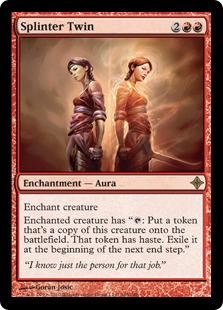
There was one final combo deck that resurged after the London was put into place: UR Twin. Splinter Twin is a card an extremely vocal subset of Modern players clamor for unbanning pretty much any time they're displeased with the format, including while Arclight Phoenix was bursting onto the scene (and bursting, and bursting...). Its defenders argue that by forcing opponents to interact, the deck encourages fair Magic and removes the ever-vague element of "degeneracy" from Modern. As examined above, Cheeri0s seems to be wearing that hat quite well right now. More curious still, the three Kiki-Exarch decks I found (linked below) showed up after the London was debuted. It's possible that this rule change revitalizes the archetype in a way Modern can demonstrably handle.

Looks Like Modern

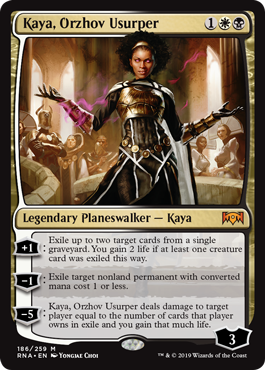
Most striking about the new data is how familiar Modern looks. A range of archetypes continue to be present, and new tech choices keep cropping up, as they always do—this month, Kaya, Orzhov Usurper has made a name for herself, popping up in BW Tokens, Whir Prison, Abzan Rock, and Esper Control, sometimes all at once! Phoenix appears on a decline as the metagame finally starts to adapt to the format boogeyman via mainboard hate cards.
Such innovation was on full display this month, as it tends to be in Modern, and as we'll observe now.

Mainboard Hate at a Premium

Existing and fringe archetypes alike are staking a claim in Modern with more mainboard hate. This month featured not one, but two Death & Taxes lists packing Jötun Grunt, as well as a Grixis Control build with a full set of Cremates in its 60. Others still went not for a splash of hate, but opted to build their decks around hosing Modern's top decks.

Esper Eldrazi, by MEHHOLE (5-0)

Creatures

4 Tidehollow Sculler
2 Spellskite
1 Wall of Omens
4 Spell Queller
4 Eldrazi Displacer
3 Wasteland Strangler
2 Deputy of Detention
4 Ulamog's Nullifier
2 Thought-Knot Seer

Artifacts

4 Aether Vial
1 Relic of Progenitus

Enchantments

2 Rest in Peace

Instants

4 Path to Exile

Lands

4 Eldrazi Temple
4 Cavern of Souls
4 Flooded Strand
2 Polluted Delta
2 Godless Shrine
2 Hallowed Fountain
1 Watery Grave
1 Moorland Haunt
1 Plains
1 Swamp
1 Island

Sideboard

1 Relic of Progenitus
1 Rest in Peace
1 Celestial Purge
1 Fatal Push
2 Lingering Souls
2 Phyrexian Revoker
4 Thoughtseize
3 Timely Reinforcements

Esper Eldrazi boasts a proactive, disruptive gameplan revolving around exiling an opponent's cards. Sculler, Queller, and Deputy all temporarily exile spells and permanents on the cheap, but processors like Wasteland Strangler and deck lynchpin Ulamog's Nullifier render that zonage permanent. A primary benefit of this synergy is the deck's desire to mainboard Rest in Peace and Relic of Progenitus, terrific cards against Phoenix, Dredge, and even the BGx Rock decks gaining steam.

Vizier Combo, by PARABOL336 (5-0)

Creatures

4 Devoted Druid
4 Vizier of Remedies
4 Thalia, Guardian of Thraben
3 Duskwatch Recruiter
4 Militia Bugler
2 Eternal Witness
1 Ezuri, Renegade Leader
1 Walking Ballista
4 Simian Spirit Guide

Instants

4 Collected Company
3 Chord of Calling

Artifacts

4 Chalice of the Void

Lands

4 Windswept Heath
2 Misty Rainforest
1 Overgrown Tomb
1 Temple Garden
4 Horizon Canopy
3 Razorverge Thicket
3 Gemstone Caverns
3 Forest
1 Plains

Sideboard

2 Assassin's Trophy
1 Kataki, War's Wage
2 Knight of Autumn
1 Kor Firewalker
2 Postmortem Lunge
2 Scavenging Ooze
1 Selfless Spirit
2 Sin Collector
2 Tireless Tracker

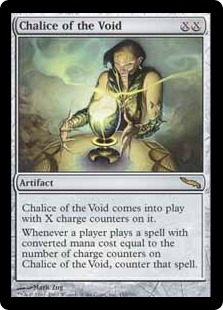
Vizier Combo, like Cheeri0s, makes great use of the London Mulligan to hastily find its combo pieces. As in Colorless Eldrazi Stompy, the deck has chosen here to maximize the buff it gets from enhanced mulligans by running Simian Spirit Guide and Chalice of the Void instead of mana dorks like Noble Hierarch, which upgrade lackluster hands with many cards. The package gives Vizier Combo a free-win dimension against Izzet Phoenix, most notably, but also Infect, Cheeri0s, and other various decks. Even some Humans decks have opted to run a set of Chalice in the main and enjoyed 5-0s.

Rakdos Stompy, by RAYSTACK (5-0)

Creatures

3 Goblin Rabblemaster
2 Master of Cruelties
1 Hazoret the Fervent
1 Phyrexian Obliterator
4 Simian Spirit Guide

Planeswalkers

3 Chandra, Torch of Defiance
2 Liliana of the Veil

Artifacts

4 Chalice of the Void
4 Ensnaring Bridge
2 Serum Powder

Enchantments

4 Blood Moon

Instants

2 Kolaghan's Command

Sorceries

3 Collective Brutality
1 Damnation
1 Dreadbore

Lands

4 Bloodstained Mire
2 Verdant Catacombs
2 Blood Crypt
2 Dragonskull Summit
2 Graven Cairns
1 Lavaclaw Reaches
7 Swamp
3 Mountain

Sideboard

1 Goblin Rabblemaster
1 Kolaghan's Command
2 Anger of the Gods
1 Damping Matrix
1 Eidolon of the Great Revel
3 Leyline of the Void
1 Nihil Spellbomb
1 Pia and Kiran Nalaar
1 Rakdos Charm
1 Ravenous Trap
1 Slaughter Games
1 Torpor Orb

I covered Rakdos Stompy in detail last month, and am here to report that the deck is apparently not a fluke. It sustained impressive numbers for all of April, and has even evolved to include some new tech in the form of—no way—Serum Powder! Without Eternal Scourge synergies, I'm honestly not sold on Powder in the deck, but I also haven't tested this build. In any case, Rakdos seems more streamlined, now running Goblin Rabblemaster in the main for quick pressure and dropping Magus of the Moon from the mix entirely. I'm excited to see how this archetype shakes out in the near future.

Emperor Izzet's New Clothes

Izzet Phoenix's Top 8 appearances are apparently declining, if sluggishly. But no matter your take on the boogeyman's dominance, it would be tough to deny UR's recent stratification. Other Izzet decks are seeing play!

UR Suspend, by QEL33 (5-0)

Creatures

4 Greater Gargadon
2 Simian Spirit Guide

Planeswalkers

1 Chandra, Torch of Defiance
1 Jace, the Mind Sculptor

Artifacts

1 Tormod's Crypt

Enchantments

4 As Foretold

Instants

4 Opt
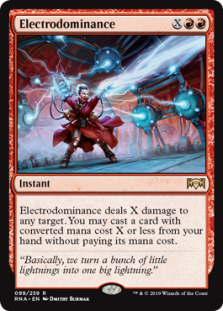
4 Electrodominance
3 Remand
2 Abrade

Sorceries

4 Ancestral Vision
4 Restore Balance
4 Serum Visions
1 Flame Slash

Lands

4 Scalding Tarn
4 Steam Vents
4 Spirebluff Canal
1 Cascade Bluffs
4 Tolaria West
2 Island
2 Mountain

Sideboard

1 Remand
1 Tormod's Crypt
2 Anger of the Gods
4 Dispel
1 Pithing Needle
4 Relic of Progenitus
1 Shattering Spree
1 Shatterstorm

UR Suspend is a deck I have some experience working on: when As Foretold was spoiled, I spent a few weeks trying out different builds, finally settling on UR and Grixis as ideal shells for casting Restore Balance, which I understood to be the best suspend spell. This list seems like a natural evolution of that one given how Modern's cardpool has grown.

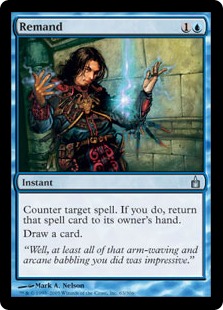
A Chandra was dropped for a Jace, which was banned at the time; Sleight was nixed for Opt, which was also not legal. But the biggest addition to the deck was Electrodominance, which allows the combo to be more consistent. This introduction informs the other swaps: Leak was traded for Remand, a superior option when the combo is more reliable; with less need for Plan Bs, Bolts, Snaps, and Moons became Abrade, Flame Slash, and Tormod's Crypt, all better interactive cards for staying alive, and more copies of Greater Gargadon.
This streamlined version of UR suspend reads like a significant upgrade, but Modern's other decks have gotten more powerful, too. We'll need more data to determine if it's better than the As Foretold Living End decks, which have more of a pedigree at this point.

Remand Burn, by KO_MAK (23rd, Modern MOCS #11845695)

Creatures

4 Goblin Guide
4 Monastery Swiftspear

Sorceries

4 Sleight of Hand
4 Lava Spike
4 Rift Bolt
4 Skewer the Critics
4 Exquisite Firecraft

Instants

4 Lightning Bolt
4 Remand
4 Skullcrack

Lands

4 Scalding Tarn
3 Flooded Strand
3 Polluted Delta
4 Steam Vents
4 Ramunap Ruins
1 Island
1 Mountain

Sideboard

4 Satyr Firedancer
4 Searing Blaze
3 Torpor Orb
2 Shatterstorm
1 Blood Moon
1 Grafdigger's Cage

Remand Burn splashes blue into Burn for, you guessed it, Remand... and Sleight of Hand. Not Serum Visions, or Opt, but Sleight of Hand! Sleight offers immediate selection and gets a little deeper than Opt, but at the cost of letting down shields. In a deck splashing 4 Remand, I'm still a bit puzzled about its inclusion.
The rest of Remand Burn started to make sense as I unearthed more of the online metagame. With both clunky midrange decks and Chalice of the Void decks on the rise, this deck wants to extract a tempo advantage from the counterspell while side-stepping the hate with pricier, higher-impact damage-dealers. Rift Bolt, Skewer the Critics, and Exquisite Firecraft could all care less about the XX artifact, and closers like Wurmcoil Engine or even Tarmogoyf look much less appealing in the face of a pseudo-Time Walk.

UR Twin, by DARTHKID (1st, Modern MOCS #11845700)

Creatures

4 Deceiver Exarch
4 Snapcaster Mage
1 Pestermite
1 Vendilion Clique
2 Kiki-Jiki, Mirror Breaker

Planeswalkers

2 Jace, the Mind Sculptor

Instants

4 Lightning Bolt
4 Opt
4 Remand
4 Cryptic Command
1 Spell Snare
1 Abrade
1 Electrolyze

Sorceries

4 Serum Visions
1 Flame Slash

Lands

4 Scalding Tarn
3 Flooded Strand
3 Steam Vents
3 Sulfur Falls
1 Cascade Bluffs
1 Field of Ruin
6 Island
1 Mountain

Sideboard

1 Abrade
1 Spell Snare
2 Anger of the Gods
2 Blood Moon
1 Ceremonious Rejection
1 Disdainful Stroke
2 Dispel
1 Rending Volley
1 Shatterstorm
2 Surgical Extraction
1 Teferi, Mage of Zhalfir

And here's that UR Twin deck mentioned above. The deck looks remarkably similar to Twin in its prime, but it has adopted some newer tools: Jace, the Mind Sculptor seems important for tracking down those Kiki-Jikis; Abrade gives the deck's removal package some much-needed utility; Opt compliments Serum Visions and Twin's flash-in nature.

Besides winning the MOCS, DARTHKID also 5-0d with the deck in a dump published the same day, and another pilot did so a few days later. If Twin continues to post even lower-tier results using Kiki-Jiki, I doubt Wizards will rush to unban Splinter Twin itself for any reason.

The London Mulligan: Totally Barbaric?

I'm optimistic about the London mulligan. We know Wizards is interested in going forward with it, or they wouldn't be taking so much testing time. This weekend's Mythic Championship is the final proving ground for the rule change. I think should the tournament's results reflect the trends explored here, or deviate minimally, there's a good chance the London is implemented. That being said, London has much higher stakes than Magic Online, and the world's best will be trying their darnedest to break the mulligan. But they haven't succeeded so far. Here's hoping for another failure on their part and better openers for the rest of us!

Speculating on Modern Trends Before the Mythic Championship and Modern Horizons

Are you a Quiet Speculation member?

If not, now is a perfect time to join up! Our powerful tools, breaking-news analysis, and exclusive Discord channel will make sure you stay up to date and ahead of the curve.

Buying surrounding the London Mulligan will come to a head this weekend at the Mythic Championship II in London, which will reveal what the pros bring to battle. The results will help set the course of the Modern metagame afterward leading into Modern Horizons. This event is also likely to drive a lot of buying, especially if there are surprises.

I’ve been paying close attention to results in the past weeks, specifically on Magic Online where the new rule has been in effect since April 10th, in hopes of finding some insight into what the new rule enables and what decks we could see at the MC. It’s also a growing time for Modern and Magic in general, and with Modern Horizons coming and likely to spur more buyouts and real demand, it feels like a great time to be investing in the format.

There was an error retrieving a chart for Enter the Infinite

An example of a deck that could break out at the MC is the Narset, Enlightened Mastercombo deck. The deck hasn’t been putting up any published results to speak of since February, but I could not help but notice the price movement on Enter the Infinite, a staple of the deck. Before the London Mulligan rule was implemented on MTGO, its price was around 0.1 tickets, but it has steadily grown to over 1 ticket. A look at the paper price shows very steady and rapid movement over the past year when it was available under $2 last April, and has now broken $5. I imagine this increase has been from almost entirely non-Modern demand, so some significant increases would be due if the Narset deck breaks out. Regardless, it seems likely to keep slowly growing even if the deck doesn't perform.

There was an error retrieving a chart for Goryo's Vengeance

An extreme combo deck that has been putting up results is Grishoalbrand, which has now finished in the top 8 of multiple high-level MTGO events, and looks to be growing into a real contender with the new mulligan rule. When some of its big staples, including Goryo's Vengeance, Through the Breach, and Nourishing Shoal were reprinted in Ultimate Masters we saw spikes on some of its other staples like Griselbrand and Worldspine Wurm. For that reason, I think the best way to cash-in is to target these reprinted cards, which are currently very cheap and likely at a low. I think targeting cards in sets like Masters 25, Iconic Masters, and especially the recent Ultimate Masters make a lot of sense, and this fits right into that strategy.

There was an error retrieving a chart for Through the Breach

Cheating Griselbrandinto play is one of the most powerful things in Modern, and that plan has now appeared in a non-Grishoalbrand deck. It takes a more classic approach, using a set of Emrakul, the Aeons Torn to pair with Through the Breach, and a set of Jin-Gitaxias, Core Augur as another way to K.O. an opponent with Goryo's Vengeance.

There was an error retrieving a chart for Jin-Gitaxias, Core Augur

Jin-Gitaxias, Core Augur saw a spike online this week, and that brought my attention to the paper price, which despite an Iconic Masters reprint is over $9, a pretty solid price for a card that sees mostly casual play. It was under $8 at the new year and now approaching $10. It seems like a great buy because like Enter the Infinite its fortunes clearly are not tied to Modern and will likely slowly appreciate indefinitely until a reprint.

Tron has become the most popular Modern deck on MTGO since the London Mulligan, with Humans in second. Humans was once the top deck in Modern before losing metagame share to Spirits, and then getting further knocked down by Izzet Phoenix and Whir Prison, both tough matchups. Its fortunes are starting to turn, from a combination of things like the new rule helping it find Aether Vial, and an increase in combo decks for it to prey on. The prices of Humans staples have been in decline, and they are likely a bargain given the strong future prospects of the deck, especially given that it can incorporate any new Human printed.

There was an error retrieving a chart for Auriok Champion

The juiciest Humans target looks like Auriok Champion, which has become a true sideboard staple of the deck, often as a 2-of but up to a full playset. Humans' resurgence has spurred its price online to spike from 4 tix in February to over 22 tix now. It’s very easy to forget that Auriok Champion was once over $40, and was around $20 before Iconic Masters accelerated its decline to an all-time low of under $9 this March. Things are starting to turn around, and I expect this will get expensive again sooner than later.

There was an error retrieving a chart for Sliver Hive

I’ve taken notice of Sliver Hive, which in the past month moved from 0.1 tix to over 0.5 and growing. At the same time, its paper price has moved from around $6.50 to $9.50. Around this initial period of growth, we saw spikes in Sliver Queen and Sliver Legion, so it seems likely Sliver Hive is riding the same wave. Sliver Hive should have good prospects on the back of it being an essential Sliver Commander card, but even goes beyond with some competitive potential, whether it’s in Legacy or Modern. The presence of Slivers in a future set - which seems like a matter of when and not if - would surely send the prices of these Sliver staples higher.

There was an error retrieving a chart for Scalding Tarn

One of the best investments in Modern right now may be the Fetchlands. These cards are essentially unaffected by either the metagame or new releases, and are the prime example of an evergreen staple, a blue-chip stock. They are the exact class of cards that will rise if Modern sees growth in the player base, that could happen from the release of Modern Horizons. All of them look to be showing signs of slow and steady growth, and won’t turn around until we see another reprint.


Ravnica Allegiance Financial Power Rankings: Uncommon Edition

Are you a Quiet Speculation member?

If not, now is a perfect time to join up! Our powerful tools, breaking-news analysis, and exclusive Discord channel will make sure you stay up to date and ahead of the curve.

Welcome back. Today it's time for the Part 2 of my Financial Power Rankings series for Ravnica Allegiance. You can read about the rares here. For mythics, we'll have to wait for the redemption period to end. I expect mythic prices to decline across the board, and I'll be studying what happens to the price trajectories of Guilds of Ravnica and Ravnica Allegiance mythics so that I know what to expect from future sets.

Today's power rankings are going to be shorter than the rares. There aren't that many uncommons worth discussing, but the ones that are are ???. Let's get to it!

And remember: Treasure Chests no longer will be pumping uncommons into the market because the uncommon slot was replaced with Play Points. Investing in uncommons is among the safest and lowest-risk investment strategies one can employ.

Also remember: This next week will be a great time to invest, because folks will be selling their cards to pay for their Draft and Sealed events.

5) Single Deck Uncommons

Current Price: $0.02--$0.04
Risk: Low
Potential: Low
Chance of Success: <5%

Supply for these uncommons is lower than it was in the past, but it's not low enough for single-deck uncommons to rise beyond bulk. In theory Rhythm of the Wild serves a role as both build-around and anti-control tech out the of the sideboard, but Domri, Anarch of Bolas encroaches on that turf. I'll be surprised if any of these rise above $0.15, but it's not impossible.

Grade: D

4) Mortify

Current Price: $0.02
Risk: Low
Potential: Low
Chance of Success: 5%

Mortify is a control staple. If it wants to rise above bulk in the future, it needs to find a home in one or two other archetypes. A tall order, but not impossible. The power level is definitely here. Perhaps what it needs is for an enchantment set to come out—Return to Theros, anyone?

Grade: D+

3) Collision // Colossus

Current Price: Bulk
Risk: Low
Potential: Low
Chance of Success: 10%

Collision // Colossus is a powerful card, useful as hate against fliers and a pump spell for aggressive beatdown decks. It has already proven its worth as a sideboard staple in several archetypes. Don't be fooled into thinking this is a card for best-of-one only. I think it has a ceiling of $0.25, but as a penny stock I don't think you can go wrong here.

Grade: C-

2) Light up the Stage

Current Price: $0.17
Risk: Low
Potential: High
Chance of Success: 75%

Wizards has been pushing these effects ever since their introduction in Dragons of Tarkir to fix Red's card advantage problem. After a bunch of misses, they finally hit a home run. Light up the Stage sees play in tier one strategies in Standard and Modern, and even sees play in tier two strategies in Legacy.

Demand for Light up the Stage, therefore, is sky high, and supply will gradually decrease over the coming months thanks to redemption. It's hard for me to imagine Light up the Stage not being a $0.50 to $1.00 card within the coming year. My main fear lies in the fact that it got a promo treatment in paper and could find its way into the Player Reward Program, but I'll be rolling the dice.

Grade: A-

1) Pteramander

Current Price: $0.09
Risk: Low
Potential: High
Chance of Success: 75%

Like Light up the Stage, Pteramander is a powerful uncommon that's seeing play in tiered decks across all formats. In Standard it sees play in UR Drakes, Phoenix or Mono-U Tempo strategies. In Modern and Legacy it sees play in Delver variants.

Even if it merely maintains current demand, I expect it to rise to the $0.25 to $0.35 range—and if it finds its way into a tier one Modern deck it could go way up. I'm surprised Wizards printed this card, and I'm surprised it has flying prior to adapting.

Grade: A-

Signing Off

Thanks for reading, and let me know your thoughts in the comments below or on the QS Discord. Which cards from Ravnica Allegiance are you investing in? Are you ready for War of the Spark? I know I can't wait to draft this set on MTGO, and maybe for the first time in a long time I'll draft it in paper as well.

MagicFest: Niagara Falls and the Future of Tundra

Are you a Quiet Speculation member?

If not, now is a perfect time to join up! Our powerful tools, breaking-news analysis, and exclusive Discord channel will make sure you stay up to date and ahead of the curve.

The Grand Prix at MagicFest: Niagara Falls over the weekend was the first Legacy GP of the year. Daniel Goetschel (AKA Gul Dukat on MTGO) took the event down with this rock-solid UW Stoneblade list, a good showing for Tundra decks all around. The results have me taking a closer-than-usual look at the Legacy metagame, and more importantly, the pricing of select Legacy staples moving forward.

Force of Will and Wasteland

A little over a month ago, I took a similar look at market signposts for Legacy in order to get a baseline for the movement I expected to happen. As many have said before, the Legacy format is essentially held together by these two cards. When gauging Legacy demand and interest, always look to these first.

For those looking to enter the format, a playset of either one of these is almost always the first investment, as there are very few established decks that don't play at least one of the two. Legacy was in a lull period around the holiday season, but is now having a significant resurgence. At present, we're seeing these two cards hit retail highs as we've never seen.

There was an error retrieving a chart for Force of Will
There was an error retrieving a chart for Wasteland

If you take a look at the last month, there has been sharp upward movement on both of these, most likely due to players' interest in this event, SCG Syracuse last month, and Legacy in general.

Even in the face of the Reserved List, which locks down key staples such as the ABUR Duals, Lion's Eye Diamond, and City of Traitors, players are still entering the format. Options like Merfolk, Death and Taxes, and even Burn can give you an option to skirt the Reserved List. For those willing to spend a little more for some Revised Duals, Tundra decks are the easiest entry point into a fair blue strategy.

Tundra Decks

There was an error retrieving a chart for Tundra

Tundra is perhaps the unsung hero of the blue Dual Lands in Legacy. It has classically been the lowest of the four, with Underground Sea, Volcanic Island, and Tropical Island all taking a place above it in price and playability. However, I think we could see a changing of the guard if things keep going right for UW decks in Legacy. While it's highly unlikely it will every usurp U-sea at the top slot, it's already pushing higher than Trop, and has Volc in its sights.

The winning list of the event happened to be UW Stoneblade, a deck some would consider the fairest pile of cards possible to see success in Legacy—but it's been a while since Tundra decks were on top. As far as raw power goes, many would look to Grixis strategies such as the Storm Variants (ANT and TES), Grixis Delver, or Grixis Control. Combo decks like Sneak and Show or Turbo Depths have also been dominating strategies, and have been solid choices in recent years.

While Legacy's history has had a variety of strategies at the top, UW decks haven't been the top dog since the banning of Sensei's Divining Top, when Miracles commanded a staggering 14% of the metagame. The power vacuum was then filled by Deathrite Shaman strategies until its recent banning last year, when its metagame share was approaching the same percentile.

With these two power cards out of the format, the metagame has achieved a decent balance, with several strategies being equally viable any given weekend.

From this Day 2 metagame snapshot, you can see a pretty wide range of decks. I think Stoneblade, Miracles, and UW Delverblade's performances here are most noteworthy. In terms of overall success, fair decks are doing quite well, which some would call a sign of a healthy format. On that note, let's look at some of the cards I think will be significant winners going forward.

There was an error retrieving a chart for Council's Judgment

Council's Judgment is one of the cards that really holds these strategies together. It's the catch-all answer for nearly every problem that can't be solved by Swords to Plowshares, and demands at least a one-of in the mainboard.

The first Conspiracy set was a bit of an experiment from Wizards to create a fun, wacky draft environment outside of silver-bordered cards, and had a lower supply than that of a regular Standard set. Council's Judgment remains one of the most expensive cards in the set, and the supply of these is a lot lower than the new demand may be due to this weekend.

In addition to being core removal in UW Stoneblade, it sees regular play in Death and Taxes, another Stoneforge Mystic strategy, for much the same reason. Speaking of which...

There was an error retrieving a chart for Stoneforge Mystic

If you've read any of my work, you'd know that I have kept my eyes on this card for the better part of two years now, and these GP results only reinforce this habit. The case for its unban in Modern is strong, and could become a reality as early as this Summer with Modern Horizon's release.

While I can't say for certain that the Squire will make its debut this way, I'd rather have my copies sooner than later. At any rate, the fact that you can get a lot of use out of these in Legacy in decks like Stoneblade, Maverick, and Death and Taxes makes it feel more worthwhile than speculating on other banned cards like Splinter Twin or Birthing Pod.

There was an error retrieving a chart for Palace Jailer

Palace Jailer has the power to swing even games in your favor, especially in tandem with evasive creatures like True-Name Nemesis or Vendilion Clique. The immense value gained from resolving one of these and retaining the crown can break a board stall wide open.

I believe foils of this card are pretty much gone, but normal copies are already getting difficult to find at reasonable prices for an uncommon. Much like Council's Judgment, Palace Jailer has a Conspiracy-unique mechanic in Monarch. The obvious place for cards like this to come back are in Commander products where multiplayer mechanics are the focus, rather than a feature. Should these cards dodge reprints going forward, there's a real opportunity for growth.

There was an error retrieving a chart for Monastery Mentor

Monastery Mentor is the odd one out of the bunch here, as I don't think metagame share is currently pushing its price. War of the Spark spoiler season ended this weekend—a lot of pressure was put on this card due to the printing of Feather, the Redeemed and the relevant interactions in Commander. Mentor is often the win condition of choice in Miracles, and has the fringe strategies of Bomberman and Esper Mentor to vouch for its playability in the format.

The card's price has literally doubled in the past week, but I think a lot of this is due to hype. The card is definitely powerful, but I would expect this to settle around $15-$18 once War of the Spark is in circulation.

Foils are probably a different story. The single printing of this card in a small, under-opened set will result in a high multiplier we may have not hit the ceiling on just yet. I'll be keeping my eye on this over the next couple of weeks.

There was an error retrieving a chart for True-Name Nemesis

Probably the most unfair "fair" card, TNN rears its ugly head as one of the premier three-drops of the weekend. Even though we've got more answers than ever to stop this menace, it still proves difficult to answer with normal removal. Those answers are often at three or four mana as well, which can prove a liability, given the speed of Legacy and the prevalence of Wasteland.

TNN shines brightest when you make it difficult for your opponent to answer it. Grixis Delver does this best with a combination of Daze, Force of Will, Wasteland, and even Thoughtseize in the main.

The jury's still out on whether or not we'll get True-Name Nemesis, or any of the aforementioned cards, back in Modern Horizons, Commander 2019, or even a Standard set. If not, expect upward price movement going forward.

A Note on Coverage

Unfortunately, because this GP's coverage was subject to what some perceive as budget cuts, video coverage of the event was not available. Luckily, there was sparse social media coverage from the players in attendance (shoutouts to AnziD for holding it down), and some regular tweets from Channel Fireball to keep us updated.

This was an awesome win from a hardworking MTGO grinder dedicated to the format, and it seems odd not to have video coverage to memorialize the weekend for those looking to watch gameplay after the fact. Should this trend continue for premier Legacy events, it could be a bad sign for the format's overall visibility and lifespan.

Take this statement with a grain of salt, though, as many have heralded the end of Legacy for years for one reason or another. This will only just be the latest entry on that lengthy list.

Bring it on Home

It was a bit strange clamoring for the information from the event by constantly refreshing my Twitter feed, or combing Reddit for a possible update on the events, what decks people were seeing, and so on. As always, I'm bummed out Miracles didn't win the event, but UW Stoneblade is close enough, right? My big takeaways from outside looking in:

  • Stoneforge Mystic is still good. (But probably not too good for Modern.)
  • Palace Jailer has proven itself as a viable creature.
  • True-Name Nemesis is still the most frustrating creature in Legacy.
  • Combo strategies appear less successful than they could be.
  • Legacy isn't dead yet.

That does it for this week! You can follow me on Twitter @chroberry or Instagram @chroberrymtg if you want to see extra goodies and spoilers for next week’s article. Feel free to let me know how you feel about my targets here in the comments, or if there’s anything you think I missed!

Peace!

MTGO Market Report for Spring 2019

Are you a Quiet Speculation member?

If not, now is a perfect time to join up! Our powerful tools, breaking-news analysis, and exclusive Discord channel will make sure you stay up to date and ahead of the curve.

Welcome to the MTGO Market Report as compiled by Matthew Lewis. The report covers the fundamental speculative strategies that anyone can use to build an MTGO portfolio and harvest tix from the digital Magic economy. The three fundamental strategies involve foil mythic rares, in addition to full sets and boosters of the most recent draft format.

This time around the report will cover what changes the MTGO economy has gone through and how those changes have impacted the fundamental strategies. For an in-depth look at each of these strategies, please refer to this article. For a complete look at the transactions regarding these strategies, please check out the portfolio.

Changes to the MTGO Economy

The wide release of MTG Arena in the fall has had a substantial impact on the MTGO economy. Player participation in release leagues was down, with over 8000 participants in the fall for Guilds of Ravnica sealed deck (GRN) and less than 5000 participants in the Ravnica Allegiance sealed deck (RNA) leagues.

In the midst of this change, there was a market panic in December as the announcement regarding the future of professional Magic didn't mention MTGO, even though esports was the story they were pushing. Although that announcement triggered the panic, priming the market was the Channel Fireball article earlier that week speculating on the death of MTGO at the hands of Arena.

Market panics have come and gone in the past and this one was no different. Although the economy has not fully recovered, the buy price for tix is still below its long-term average of around $0.90. Nevertheless, stability has returned. Below I will detail the changes to the MTGO economy and their impact on the fundamental speculative strategies for foil mythic rares, full sets, and boosters.

To illustrate the changes, have a look below at a chart of a full set of Dominaria (DOM) while it was being drafted (all charts are courtesy of Goatbots). The price starts out at over 200 tix but quickly drops off during release week. The overall trend is down while the set is being drafted, and the price bottom of 74 tix occurs on July 6, 2018 just as Core Set 2019 (M19) is released on MTGO.

This overall pattern is the result of a tussle between limited players injecting the market with supply on one hand, and redeemers and constructed players removing supply on the other. Based on the observed trends, the supply of cards from limited players was the dominant factor for DOM specifically, and this is true more generally of most sets in recent memory.

Now let's take a look at what happened with GRN. The same chart is reproduced below, that being the price of a full set of GRN while it is being drafted. Instead of the downward trend over time, we see a gradual increase. In fact, the set price of 104 tix when RNA was released on January 16, 2019 was higher than at any other point outside of its release week.

The conclusion to draw from this chart is that redemption and demand from constructed players is now the dominant factor in the MTGO economy for a set being drafted. Although the pattern for RNA gives a more mixed signal, I'm confident in the analysis, and in the conclusion that redemption is now the dominant effect. This has profound implications for speculators.

The first result is that the full set strategy will no longer work in a predictable way. The strategy relied on limited players being the dominant factor. Without that, there is no way to reliably predict when full sets will be close to their lowest price. As long as redemption is the dominant factor acting on the supply of cards, then the full set strategy must be put aside.

The other result is that with more stable set prices, a new area of speculation has opened up. In exactly the same way as the foil mythic rare strategy, it makes sense to pursue buying regular mythic rares as well. Have a look at the two charts for mythic rares with large price gains as a result of this dynamic. The first is Modern staple Arclight Phoenix, the second Modern playable Kaya, Orzhov Usurper.

It's not just the constructed-playable mythic rares that can see big gains either. Have a look at the price chart for Captive Audience. It reached a price below 0.50 tix after RNA was released and it's basically been on a steady incline since then.

I experimented with a strategy around nonfoil mythic rares for RNA. I will detail some loose guidelines for employing this twist on the foil mythic rare strategy, but first let's revisit the original three fundamental strategies. I'll provide an update on how they have fared, with the outlook of using them for the release of War of the Spark (WAR).

Foil Mythic Rares

This strategy worked very well for GRN. Once I identified and avoided the seeded-booster mythic rares, there was lots of opportunity for picking up foil mythic rares at relatively cheap prices. The average price was around 20 tix per copy. I ultimately ended up selling at an average price of 28 tix for a gain of around 40%.

Unfortunately the market has been catching onto this trend and the prices for RNA foil mythic rares not in seeded boosters started at a much higher level. It was so high that I didn't actually pursue the strategy for that set, although I have a secondhand report from another speculator who employed the strategy. They achieved a modest return of 7%, which is a low return overall for this strategy.

If these anemic returns are the new normal, then the strategy will be still be suitable for players as a way to preserve value, but speculators will have to consider their opportunity cost of pursuing this strategy.

At this time, it looks like the seeded boosters will not be a part of WAR release leagues. This removes some uncertainty from the strategy. Supply of foil mythic rares is typically very thin in the early days of release events, so you'll have to spend some time to scour the bots for foil mythic rares if you are considering this strategy.

Full Set Strategy

As discussed earlier, the full-set strategy must be put aside as a fundamental strategy for the time being. Without being able to reliably predict a price bottom, buying full sets is a gamble that hinges on Constructed playability. If you are a master of the metagame this strategy might be for you, but I will not be pursuing it for WAR.

If the price of a set of WAR drops to 80 tix, then I would examine the differential between paper and MTGO prices to see if WAR is underpriced. Both GRN and RNA have stayed mostly in the 95-to-120 tix range, so a price of 80 tix would have enough margin of safety to get me to take a closer look. At prices higher than 80 tix, the potential returns and the risks do not favor speculation.

Booster Strategy

The booster strategy is alive and well, and GRN draft sets yielded a 26% return. The average buy price was 5.4 tix per draft set, and I was able to sell over 100 draft sets for an average price of 6.8 tix. The price peak for GRN boosters after the release of RNA was 3 tix a booster, or 9 tix per draft set, so potential profits were actually much higher.

This strategy will continue to work and I will be employing it with the release of WAR. Once the new set is released, I will look to purchase up to 200 draft sets of RNA for a price of 6 tix or less.

The key to this strategy is not to get antsy and start buying or selling too early. Definitely do not buy any RNA boosters prior to the release of WAR, and you must wait until at least June to consider selling. Prices will stay depressed until drafters start picking up cheap boosters to enter the RNA draft queues—this process can take a while to gain traction in the weeks after a new set is released.

Regular Mythic Rares

As introduced above, this strategy is similar to the foil mythic rare strategy. We rely on a relatively stable price per set, demand from redeemers, and the fact that mythic rares are the choke point for redemption. With these factors in place, buying mythic rares early in a set's release is a good speculative strategy. Unfortunately, it requires a bit more subjectivity than the other strategies, so I will try to highlight some aspects of the strategy as I understand it today.

For pure junk mythic rares, look for a price in the 0.5-to-1.0 tix range, but basically be willing to buy as much as you can of any WAR mythic rare below 0.5 tix. From RNA, these were cards like Captive Audience, Emergency Powers, and Rakdos, the Showstopper. They all eventually settled into the 1.0 to 2.0 tix range, yielding substantial profits in percentage, if not absolute, terms.

Next up will be the cards that have some appeal but are generally not considered good enough for constructed play. These will typically be in the 1.0 to 3.0 tix range.

From time to time the market will mistakenly put a Constructed-playable card into this category. This is what happened to Kaya, Orzhov Usurper, as it was priced at under 2.0 tix in the weeks after RNA's release. That is an unusual outcome—a card like Domri, Chaos Bringer is more typical, reaching a bottom of 2 tix and rising to close to 3 tix over time.

The third category contains cards that are Constructed-playable. At some point these will range in price from 3.0 tix to 5.0 tix. These are cards like Biogenic Ooze, Seraph of the Scales, and Spawn of Mayhem. Depending on how the Standard metagame unfolds, these can have quick price spikes that should be sold into. It's also possible that some of these will see lower prices over time, and could result in losses depending on the purchase price. These are worth buying but returns can be unpredictable as a result.

Lastly there's the Constructed staples that start out at prices of 10 tix or higher, like Hydroid Krasis and Prime Speaker Vannifar. Generally speaking I would avoid speculating on cards in this category, as the Standard metagame is too difficult to predict for me. Avoid buying the most expensive mythic rares and stick to the lower-priced ones if you want to employ this strategy.

Having said that, after a set has been available for a month or longer, the dynamics of the market are such that price trends on the most expensive mythic rares tend to continue. Hydroid Krasis and Kaya, Orzhov Usurper are great examples. Over time, Hydroid Krasis has been bleeding value while Kaya has been gaining value.

Demand from redeemers means that the value in mythic rares will increase over time, and player preferences are revealing that Kaya has much more in-game utility than initially thought. Don't be afraid to ride these trends out as long as they appear to be continuing.

This week I have bought about 20 copies of Kaya, with an eye to it hitting 40 tix or more in the next month. This will be the third time I have speculated on Kaya in the last three months. I was a buyer at 2 tix and a seller at 8 tix; a buyer at 21 tix and a seller at 28 tix, and now a buyer again at 31 tix.

Of course, buying early and riding the whole trend out would have been best in hindsight, so I am trying to take a lesson from this new type of trend.

The MTGO Economy and the Future of Speculation

Although the MTGO economy took a beating this winter, the bounce-back in Modern singles in the past few months has been substantial. There is still life in this old platform despite the rise of Arena. As long as players are drafting on MTGO and redemption exists, then the fundamental strategies as outlined here will yield profits.

Just remember that consistent profits can be found if you observe the big trends in the MTGO economy. Follow the fundamental strategies. Deploy tix in the weeks after a set is released, as this is when tix are worth the most.

In order to be able to deploy tix, you'll have to be a seller at some point—so be sure to sell your cards and boosters in advance of a new set's release. Sell your Modern cards during cyclical peaks, and don't be afraid to rebuy them in the fall, a typically low-demand time of year.

And if there's a market panic, get your tix ready to take advantage. It's not every day you get to buy staples like Polluted Delta for under 2 tix, but that was the card's price during the depths of the December panic.

Want Prices?

Browse thousands of prices with the first and most comprehensive MTG Finance tool around.


Trader Tools lists both buylist and retail prices for every MTG card, going back a decade.

Quiet Speculation