
Are you a Quiet Speculation member?
If not, now is a perfect time to join up! Our powerful tools, breaking-news analysis, and exclusive Discord channel will make sure you stay up to date and ahead of the curve.
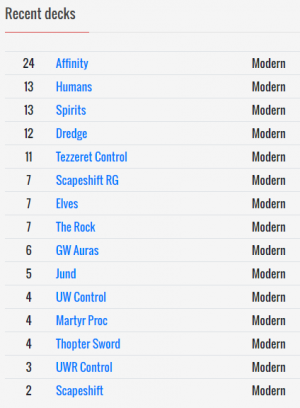
Creeping Chill has been sanctioned for a month now, and Dredge is steadily regaining its former status as format boogeyman. David's article from last week met the deck's rise with an optimism I'm no longer sure I can personally espouse: despite the hate, Dredge put three copies into the Top 32 of GP Atlanta and, more recently, twice that many copies in the Top 32 of the latest Modern Challenge. So, is Dredge really back to stay? And how can Modern players beat it?
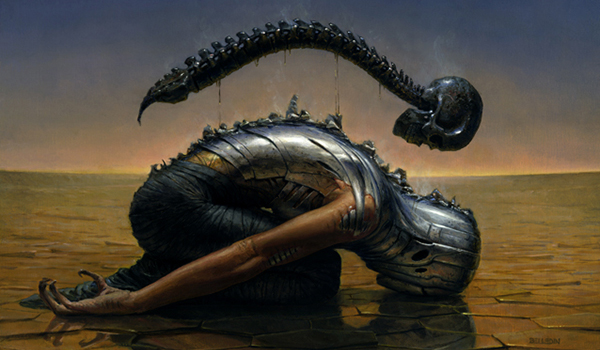
This article examines Dredge's known effects on Modern and whether they hold true without Golgari Grave-Troll in the picture. We'll also weigh the respective merits of some of the top tools available to fight Dredge.
The Dredge Effect: "A Battle of Sideboards"
Why was Golgari Grave-Troll banned in the first place? Here's Wizards's rationale for the ban:
Dredge, the mechanic and the deck, has a negative impact on Modern by pushing the format too far toward a battle of sideboards. With the printing of Cathartic Reunion and Prized Amalgam, the deck once again became unhealthy for the format. While those cards were discussed, the real offender always has been the dredge mechanic itself.
 When the ban was announced, I and some other Modern devotees saw this rationale as a new criterion in Wizards's arsenal. Previous offenders had been axed from Modern on the basis of causing diversity issues or violating the Turn Four Rule. Never had a card been banned for creating a so-called "battle of sideboards."
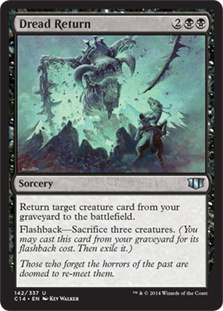
At least, never before in those exact words. But a similar justification had been used for Dread Return at the format's outset:
Dredge is not known for being fun to have around. Although games against it are often interesting, the larger game of deciding whether to dedicate enough sideboard slots to defeat it or ignore it completely and hope not to play against it is one that is not very satisfying for most tournament players. We chose to ban the most explosive graveyard card rather than leave that subgame present.
Whether Dredge is safe from the banlist depends on whether things are different this time around. Does the deck still force a battle of sideboards? Based on the lists I've seen online, I'm leaning towards yes: players are packing more graveyard hate than we've seen in years, and heavier graveyard hate to boot. Nihil Spellbomb, when it's not chilling in the mainboard of some BGx deck, has taken a backseat to blazing-fast blowout answers like Ravenous Trap, a card that's slumbered since the Troll ban.
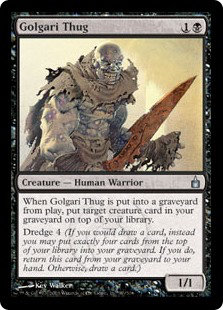 For its part, Dredge has adapted slightly to circumvent the hate. The major innovation we've seen in the last week has been its re-adoption of Golgari Thug, an additional heavy dredger. This inclusion makes the deck more resilient to targeting hate like Surgical Extraction, which can otherwise neuter its dredging abilities.
With that being said, Dredge is proactive and consistent enough that it doesn't need much tweaking to maintain its shares. Even with the level of hate present, it's putting up results. Unlike other aggro-combo decks in Modern, traditional means of disruption—removal; targeted discard; countermagic—do little to contain the strategy. That's why Affinity never ate a ban for forcing a "battle of sideboards;" BGx doesn't need to aggressively mull into Ancient Grudge to stand a chance. The fact remains that Dredge eats just about every deck alive if that deck doesn't either a) draw its sideboard cards in a two-turn window or b) race it, something that's become quite challenging for fair decks thanks to Crippling Chill.
Wider Format Effects
Two nuggets of conventional wisdom surround the notion of Dredge performing in a given format:
- Decks become more linear and proactive in an attempt to race Dredge
- Other graveyard-reliant decks suffer the splash hate of everyone packing relevant interaction
At least one thing has changed since Troll's reign over Modern: the second point no longer applies. The reason for this is that the decks that are faster than Dredge also rely on the graveyard. Storm, Ironworks, Hollow One, Infect, anything with Arclight Phoenix or Bedlam Reveler; these decks are putting up numbers through the hate, just like Dredge. How come?
My take: Modern's new breed of aggro-combo decks are built with more resilience. Their parts function well together, but don't necessarily all cannibalize one resource, allowing them to attack from multiple angles without sacrificing much synergy. Take the Hollow Phoenix deck that's been tearing up the online metagame:
Hollow Phoenix, by KIREWIZ91 (3rd, Modern Challenge #11681656)
Hollow Phoenix replaces the delve threats and Flamewake Phoenix of traditional Hollow One with a more Hollow One-esque card, Arclight Phoenix, to have a 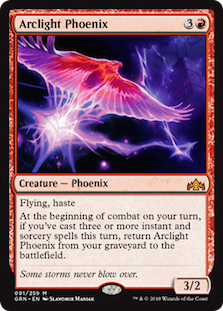 functional eight copies of its namesake creature. Sure, different conditions trigger each creature, but they share a philosophy: come down for free after pilots churn through their decks with cheap loot effects, and quickly close out the game.
Heavy-duty hosers prove underwhelming against this deck, as the only card they even hit is Arclight Phoenix. Players are better off attacking Phoenix with something like Surgical Extraction, which even still does nothing against two-thirds of the deck's threats. In this way, Hollow Phoenix is a graveyard-utilizing aggro-combo deck that can withstand the hate, making it ideal for the Dredge-housing metagame. The many other Arclight decks are following suit.
Loving the Hate
Whether or not they pose an existential threat to format diversity, there's still plenty to do against Dredge and other graveyard decks besides simply race them. Each card featured here is ranked from 1-5 on three metrics:
- Power: The degree of impact the card tends to have for its cost.
- Speed: How little pilots must wait before the card comes online.
- Splashability: The ease with which Modern decks can accommodate the card.
Naturally, the number scale engenders some degree of bias, as I have no objective way of measuring a card's power in a vacuum. But I believe breaking the list down into numbered ratings this way nonetheless injects some degree of impartiality into the ordering process.
#5: Rest in Peace
- Power: 5
- Speed: 2
- Splashability: 1
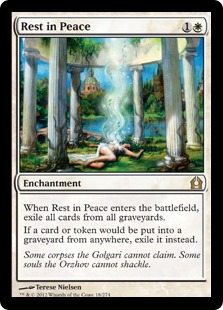 Rest in Peace is usually a game-ender against decks that live and die by the graveyard. Not only does it prevent opponents from developing their gameplan, it undoes all the work they've done so far! That "so far" is one of its problems, though—players get two whole turns to build a board before Rest resolves. On the draw, that makes the enchantment even less enticing against faster graveyard decks.
Even more damning are Rest's deckbuilding requirements. To utilize the enchantment, players must both be in white—one of Modern's least proactive colors—and have little use for the graveyard themselves. Very few decks check both of these boxes, but those that do are having success online; BW Processor Eldrazi even appears to be making a comeback. Of course, UW Control is the default home for the card. UW is such a great fit for Rest that a build placed 2nd in the aforementioned Modern Challenge running no Snapcaster Mages in its 75... but 3 Rest in Peace main!
The card's slow speed and low splashability combine to make it a lackluster option for filling niche roles like dealing with Arclight Phoenix. There, it's clunky and inefficient. Rest seems best at supporting the few strategies that can fit it, as it destroys graveyard-focused decks while significantly disrupting slower fair decks relying on Tarmogoyf, Bedlam Reveler, Tasigur, and the like.
#4: Leyline of the Void
- Power: 4
- Speed: 4
- Splashability: 3
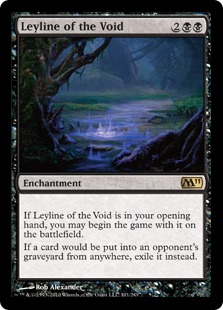 A one-sided Rest in Peace, Leyline of the Void is a go-to choice for many of the graveyard decks. These decks avoid spending mana disrupting opponents when possible, instead allocating their resources to developing a gameplan and stopping opponents from interacting with them. Leyline shuts down opposing plans from the start of the game for a 0-mana investment.
Opening Leyline certainly trumps opening Rest in Peace, but drawing it later reveals its shortcomings. The card is a functional blank off the top of the deck, going from turn zero deployment to turn four. That's no matter for Dredge, which hardly draws from the deck at all; it's tougher for slow, interactive decks like (hypothetically) Grixis Control, which are bound to see the card a few times in each winning game. Leyline is therefore a favorite of faster decks, and incidentally of Faithless Looting decks—these can handily chew through naturally-drawn copies of the enchantment. The slower the deck, the harder it is to accommodate Leyline.
#3: Grafdigger's Cage
- Power: 4
- Speed: 4
- Splashability: 4
Cage doesn't exile all graveyards upon entering the battlefield, making it a good deal less powerful than Rest in Peace. But it still says "you can't play graveyard Magic." And for half the mana, at that. Cage's mana cost may be its most alluring factor: just about any deck that isn't dead-reliant on the graveyard can run it and feel confident they'll have the mana required to deploy it.
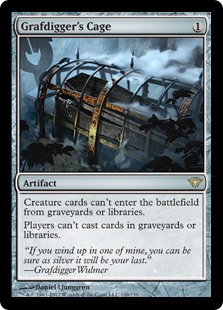 The artifact hits Dredge square on the head and while boasting applications against Arclight Phoenix, Snapcaster Mage, and the ever-popular Faithless Looting. It also stops Chord of Calling and Collected Company. Notably, it does nothing against Bedlam Reveler, Tarmogoyf, or delve creatures, making it a safe include in fair decks. Cage is more concerned with hosing opponents who cheat egregiously on mana, and only excludes those players from wielding it.
While it's a little more fragile than Rest in Peace, an enchantment, I don't think this aspect of Grafdigger's Cage subtracts much from the card's viability. Graveyard decks usually run Nature's Claim or Assassin's Trophy these days to out everything from Rest to Leyline, so randomly dying to Abrade shouldn't be a fear players have unless they're playing many other cards that die to Abrade, such as Mantis Rider. And Ancient Grudge? Well, at least it no longer has flashback!
#2: Surgical Extraction
- Power: 3
- Speed: 5
- Splashability: 5
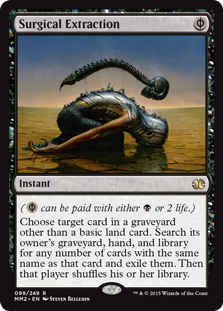 Down from #1 in our old Modern Top 5 of Utility Cards, Surgical Extraction nevertheless returns here as an excellent answer to graveyard strategies. In Yu-Gi-Oh!, we call this sort of card a "hand trap:" it activates from the hand at no cost, and at instant speed. But since Surgical is so, well, surgical—it only hits one target, after all—its inherent surprise factor as a hand trap is rather limited. Instead, Surgical's main purpose is its ability to remove key cards from opposing strategies.
Against Dredge, those cards are Stinkweed Imp and Conflagrate; against Phoenix decks, the card is probably Arclight Phoenix. But depending on the game state, it could be Bedlam Reveler. This flexibility is a major draw to Surgical over other hate. The instant can play a myriad of roles depending on the matchup—hitting a destroyed Valakut, the Molten Pinnacle or a discarded Krark-Clan Ironworks can spell lights out for combo decks. It even has applications in fair matchups, countering persist triggers or Snapcaster flashback targets (cue endless debate about how over-boarded Surgical is).
#1: Ravenous Trap
- Power: 4
- Speed: 5
- Splashability: 5
Ravenous Trap, too, scores perfect marks on speed and splashability: any deck can run it, and it's never too early in a game for the card to fulfill its purpose. But while Surgical focuses down specific cards, Trap exiles an opponent's entire graveyard.
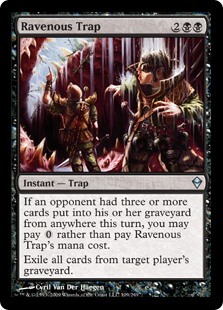 That nuance can be beneficial or detrimental, but in the current Modern, I'd say it's generally a plus. Activating Trap before opponents reanimate Arclight Phoenix might not feel as good as activating Surgical, as we miss out on the "search" information and leave opponents with more copies in their deck. But opponents still have to get those copies into the graveyard. And how hard are those decks to read, anyway? If anything, I'd argue that the 2 life saved by Trap is often relevant in many graveyard matchups, which are by and large beatdown decks.
The largest power boost Trap has over Surgical is its potential for blowouts. After opponents spend a few turns setting up their graveyard, dashing their plans with a well-timed Trap can simply end the game. Drop a Nihil Spellbomb and opponents will play around it; they statistically shouldn't expect Trap, making it correct for them to play into it. Because of its high ceiling, Trap perfectly wields the surprise factor innate to hand traps.
Overall, Trap is more narrow than Surgical, but more devastating. Since we're not grading on flexibility today, Trap wins out.
Grave Heart
Even for an opinion piece, this one lays out a lot of claims. Is Dredge warping Modern to a fault? Is Ravenous Trap quietly one of the best sideboard cards in the format? Will Stinkweed Imp go the way of the Troll? Let's keep the discussion going in the comments!




 because it had been banned in the
  While this is the experimental result, and any result is still a result
  have adjusted earlier.
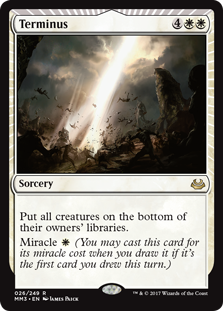
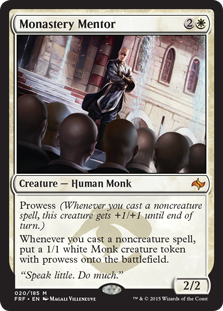 retrieve. At the time, Miracles won either through concession, Jace, or a single Entreat the Angels. The eventual solution was to become more aggressive by following Terminus with Monastery Mentor and winning before Goblins rebuilt.
 new releases, but if I was going to change the sideboard, I figured I might as well alter the maindeck, too. I was also keeping a closer watch on the data this time so nothing surprised me again.
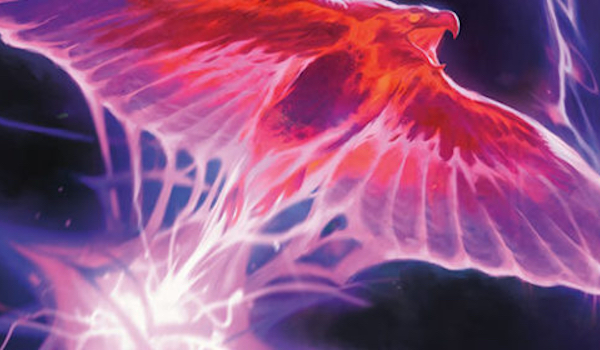
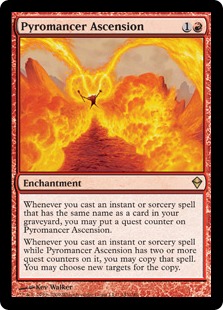 Strategic curving follows the same principle, but deals with limitations placed on cards other than their mana cost. Take, for instance, Thing in the Ice and Pyromancer's Ascension. These cards occupy the same notch on the strategic curve: pilots need to deploy them early and power them up with instants and sorceries cast after the fact. Until "turned on," the cards do nothing; if bounced or drawn late, they rot on the battlefield. Running full sets of both cards helps ensure players have one to cast on turn two, but also locks players into that slot on the strategic curve.
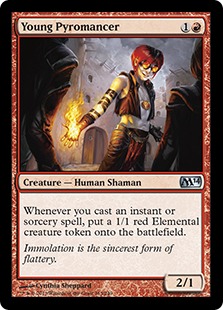 In the middle of this see-saw rest cards like Monastery Swiftspear, Kiln Fiend, Young Pyromancer, and Arclight Phoenix. These cards don't have as steep a late-game requirement as Bedlam Reveler, but still provide value without a full grip of instants and sorceries at the ready; the value they generate (be it damage or tokens) also lasts if removed, unlike Ascension and Thing (counters irrelevant with their permanents absent from the battlefield).
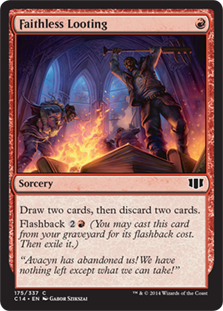 Strategically, Arclight Red lords two things over Burn: impressive bodies and incidental value. A 3/2 flying and a 3/4 prowess let this deck dominate the red zone in ways Burn can only dream of. And native to the apparent Phoenix core is Faithless Looting, which not only turbo-charges Monastery Swiftspear by turning lands into business, but effectively draws players cards when pitching Fiery Temper or Phoenix itself. These dimensions allow the deck to function on fewer cards than Burn, a deck that assembles 20 damage more traditionally: by just having it.
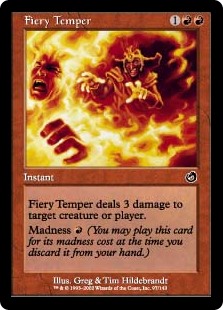 while digging through the deck with Faithless Looting. That journey's sponsored by the Elemental, which first made Modern headlines amidst
 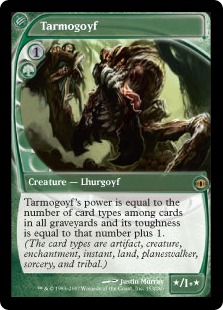 beefy Bomat can immediately draw pilots into big turns, even after combat; that said, Bomat could just as well draw a more traditional Burn deck into enough Lava Spikes to close out the game.
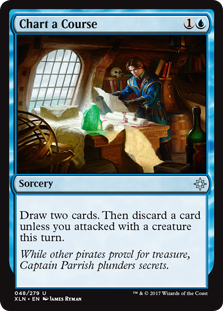 the picture. Discarding a card with Chart can even prove preferable when it comes to pumping out Bedlam Reveler or casting Fiery Temper, giving the sorcery more play.
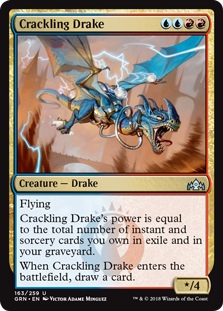 and Stubborn Denial—the former can be cast after no blocks are declared while Denial stays up to protect the Elemental, and the latter immediately turns on ferocious, as it does with an almost-flipped Thing.
 I've come away with a couple conclusions from this onslaught of Phoenix decks. For one, the card clearly has a place in Modern, both as one worthy of building around and perhaps as a role-player for other strategies (I even spotted a set in