menu

Daily Stock Watch – Ultimate Masters Edition Part Three

Are you a Quiet Speculation member?

If not, now is a perfect time to join up! Our powerful tools, breaking-news analysis, and exclusive Discord channel will make sure you stay up to date and ahead of the curve.

Hello, everyone and welcome to the last edition of our special Ultimate Masters review on the Daily Stock Watch! My apologies for the delay on the release of this last part as there were some very personal issues that I had to deal with. It feels great that some readers have asked me for it, so I'm still proceeding with it to start the week before I return to the usual segment tomorrow. For today, I'm going to talk about cards from the set that had a special "reboot" that would affect its financial value.

There was an error retrieving a chart for Mana Vault

Mana Vault was one of those cards upon spoiling the box toppers that gave us the feel that this was going to be an EDH/Legacy kind of set. This used to be a rare card that last saw print back in Fifth Edition, and is widely used as a key cog of multiplayer Commander decks along with the likes of Sol Ring, Mana Crypt, and Grim Monolith among others. Even though it was not being used elsewhere, it has remained popular and expensive due to its power level. This mythic promotion is justifiable, and the new art is great enough to attract more interest for the card. It will also be the first time for it to have a foil (outside of the Masterpiece version) so I would be suggesting that you be on the lookout for the normal foils or even the box topper if that's possible, as they will command some pretty good prices down the line.

There was an error retrieving a chart for Laboratory Maniac

What was once considered a bulk rare came to life because of decks like Tin Fins in Legacy, and Ad Nauseam in Modern. It was doing well years removed from its original print until WotC decided that it's time to make it an uncommon. The $8 tag that it's currently enjoying is almost as good as gone once UMA hits the shelves, and this would be back to a dollar or less in no time. Don't be afraid to move your copies now while you have time.

There was an error retrieving a chart for Temporal Manipulation

Cards like Temporal Manipulation are seen in the same light as Three Visits or Xiahou Dun, the One-Eyed: pretty expensive because of low supply, but not as powerful as they seem for what they could do. I remember seeing a list in Reddit before about cards that are above $50 and aren't part of the Reserved List, and there's a clamor from the masses to see them reprinted again. This card gets the reprint axe, and the rest of the cards from that list that didn't appear on UMA should be safe for now -- for as long as WotC keeps its word that this would be the last Masters set in a while. If you plan on playing Unli-Turns deck on Commander, now's the best time for you to get this card. Capture of Jingzhou might not be too far ahead at this rate.

There was an error retrieving a chart for Demonic Tutor

Arguably one of the best cards to get printed in this set, Demonic Tutor makes a return with a new art and a new foil that would make Commander and Vintage players cringe. There's never enough copies of this card to go around, as it could just get you what you need for such a cheap cost. Of course, the same thing cannot be said in reality where it is expected to maintain at least a $25 price tag for normal copies, but way more for the normal foil and box topper versions. Along with Back to Basics, this would be one of the cards that I would be keeping an eye on.

There was an error retrieving a chart for Leovold, Emissary of Trest

This card was banned in Commander for a lot of obvious reasons, and it also had something to do with why Deathrite Shaman and Gitaxian Probe was hit with the banhammer in Legacy because of the dominance of the Czech Pile. One of StarCityGames' most recent sales dropped this to as low as $21, and that was even before the box toppers were revealed. Unless some new list abuses this card, I don't see it climbing past $15 once UMA hits the shelves. The formats where it could be of premium use just stopped it from becoming the powerhouse that it already is.

All in all, I think that Ultimate Masters is indeed the best of its kind until WotC decides that it's time to make another one. A lot of this product will be opened while it lasts but if the print run is indeed limited, there would be lots of value in the unopened boxes and the box toppers. Buy singles appropriately, and don't get blinded by price drops. We should have learned our lesson from past Masters sets by now.

And that’s it for today’s special edition of the Daily Stock Watch! See you again next time, as we check out a new card that should be on the go, or good enough for speculating. As always, feel free to share your opinion in the comments section below. And if you want to keep up with all the market movement, be sure to check in with the QS Discord Channel for real time market information, and stay ahead of the hottest specs!

Speculating on Cards Missing From Ultimate Masters in a Moving Modern Metagame

Are you a Quiet Speculation member?

If not, now is a perfect time to join up! Our powerful tools, breaking-news analysis, and exclusive Discord channel will make sure you stay up to date and ahead of the curve.

Ultimate Masters has generated more buzz than any set since (maybe) the announcement of fetchland reprints in Khans of Tarkir. With an incredible amount of high-quality reprints, plus many new Masterpieces with a new frame, Wizards held nothing back.

Not all the talk is positive, though, and the new ultra-premium MSRP of $34.99 for a three-pack blister pack, higher than past Masters sets, has some crying that it’s the worst thing to ever happen to the game since the Reserved List. Personally, I don’t see how it’s anything but good for players. Even if someone can’t afford to buy packs of the set, reprints will bring the prices of cards down, and the set is filled to the brim with quality Modern and Legacy staples.

What’s most interesting to me about Ultimate Masters (UMA) is what’s not in the set. When a staple is not reprinted in a Masters set, that means it’s mostly safe until the following year’s special release, so demand for copies of these cards tends to rise. Now that UMA is full spoiled, we have a clear look at what is not in the set, so today I want to identify some key cards that were absent, and as such, are likely due to rise in price during 2019. The Modern card pool is huge, but there are some elephants in the room. There are also some hints about what might start rising based on what has started appreciating on Magic Online after the spoiler hit, and now that the paper market has had some time to process the news, there have been some small initial paper movements that could accelerate. I’ll also explain some Modern metagame factors at play that are exacerbating the effect and could catalyze a spike.

Mox Opal and Hardened Scales Affinity Cards

Conspicuously absent from UMA is Mox Opal, which is also one of the very best cards in Modern. It’s played in multiple top-tier strategies, including the Krark-Clan Ironworks combo deck that might be the best deck n the format. It’s also used in Affinity, including the Hardened Scales Affinity deck that has been rapidly increasing in popularity over the past couple weeks.

There was an error retrieving a chart for Mox Opal

Since last week, Blinkmoth Nexus quadrupled in price online after being bought out, presumably “crunched” out of UMA, meaning someone figured out it couldn’t be in the set even before it was fully spoiled (based on collector numbers and alphabetization). Now that UMA has been spoiled, other staples of the deck are starting to trend upwards, including Steel Overseer growing 75 percent, Arcbound Ravager 45 percent, and Hangarback Walker 35 percent. With the deck on the rise, I see this increasing demand likely to carry over to paper, so I see growth ahead.

I have a theory that Mox Opal was purposely left out of UMA because it’s so high on the list of potential cards to ban in Modern, and because I assume UMA was in the design process last year and very early this year, when Lantern Control was at its zenith, that it could have been seriously up for discussion to ban. Modern seems like it's in a pretty good place now, so I don’t expect to see a banning of Mox Opal or anything else in the near future, but it is something to keep in mind. Potential to be banned does make Mox Opal a relatively risky spec, but because this bannability factor makes Wizards hesitant to reprint it, the risk is rewarded with a lower risk of reprint. It seems to have already been slightly creeping up in price in paper, and may be due for a breakout, or at least some modest growth back to its former peak of around $110, from where it currently sits just shy of $100.

There was an error retrieving a chart for Cranial Plating

An interesting spike related to Mox Opal is Cranial Plating, which isn’t in the Hardened Scales Affinity deck but is a staple of the classic version. It has seen some massive growth, from under 0.1 tickets to over 0.3 to 0.5 for the various versions. Despite multiple reprints, maybe its paper price under $1 is too low?

Dark Confidant and Rock Cards

One oft-reprinted card absent from UMA is Dark Confidant, which also escaped reprint in Modern Masters 2017. Its omission is understandable since its play has been minimal in recent years, but that didn’t stop its price from seeing a massive spike at the release of Masters 25, where it was absent.  This also coincided with Bloodbraid Elf’s unbanning, which brought Jund, and thus Dark Confidant, back into the picture. While nothing can compare to the effect of an unbanning, similar conditions are shaping up surrounding Dark Confidant and this Masters release.

Assassin's Trophy has now become industry-standard in Modern Rock decks, like Jund and Abzan, and have brought about a  revival of straight Golgari decks, and Dark Confidant plays a key role in the strategy. The card missing reprint seems like the perfect catalyst to change its price trajectory, which has been steadily falling since its spike back to its current position at pre-spike levels.

There was an error retrieving a chart for Dark Confidant

Fetchlands

A key card for The Rock is Verdant Catacombs, which along with other fetchlands has been appreciating online this week. UMA was an opportunity to reprint them, but it is not surprising Wizards held such a juicy card for a better opportunity. These cards are among the most important staples in Modern, and the reprint of shocklands in Guilds of Ravnica has made them even more appealing. In the short term, the smaller supply of enemy-colored fetchlands might see the most movement, but they are more at risk for reprint, so for a longer horizon the allied-color lands will be safer.

Humans and Spirits Cards

I’d keep my eyes on cards from Humans and Spirits that missed reprinting. Aether Vial is shared by both, which explains why it’s now trending up online this week.

There was an error retrieving a chart for AEther Vial

I am watching Phantasmal Image, which is also in both decks. One card that seems overdue for some growth is Collected Company, a staple of Spirits.

Don’t Ignore Uncommons

There are few staple uncommons missing from UMA that are starting to spike. Mishra's Bauble is a staple of Death's Shadow decks, which has been increasing in popularity, is used in the Ironworks deck, and sees other scattered play. Its price had been slowly increasing online all month from where it had slumped to around 6 to around 8 tix at the beginning of the week, and is now over 10 tickets.  Its paper price has slumped to a low of $6, so it looks to have plenty of upside.

There was an error retrieving a chart for Mishra's Bauble

An even bigger staple is Manamorphose, a key card in Storm, but one that is seeing a ton of new demand from Arclight Phoenix and Runaway Steam-Kin. It’s also in very short supply, being from the notorious Shadowmoor, which is why its price has always been so high to begin with. It hasn’t been reprinted since the first Modern Masters. Its online price has actually slumped since the announcement because it was inflated from hype, but the paper prices of both printings are clearly on the move up from $10, with the reprint pulling ahead.

There was an error retrieving a chart for Manamorphose

Buy Low, Sell High

For a more speculative pick, look at Living End, which spiked online this week, up from half a ticket to over a ticket. Its namesake deck is at a low in the metagame, currently suffering severely from hate against Dredge.  This explains why its price was so low, and why its paper price has been steadily falling all year.

There was an error retrieving a chart for Living End

The graph of the card is actually rather interesting, with its entire history being cycles of spikes followed by a steady decline, which has really been accentuated over the past two years. With its demand and price currently at a bottom, it seems like future growth is inevitable as the metagame shifts and the deck becomes viable again.

–Adam

Brew Report: Spell-Attack Renaissance, Pt. 1

Are you a Quiet Speculation member?

If not, now is a perfect time to join up! Our powerful tools, breaking-news analysis, and exclusive Discord channel will make sure you stay up to date and ahead of the curve.

New aggro decks in Modern tend to be streamlined synergy machines full of critters. But "goodstuff"-style creature decks à la Jund, which wield Modern's known best cards, do slip through occasionally. Perhaps the best-known example of this phenomenon is Traverse Shadow, a deck that blew Modernites away when it first reared its head over a year ago. But recently, I've noticed a steady influx of novel, spell-based aggro decks 5-0ing Competitive Leagues online. Even more surprising, many of these decks lean blue.

Today, we'll take a close look at some of the Temur decks we've seen crop up lately: Temur Midrange, Eternal Command, and a particularly maddening make of Temur Delver. At the end of the week, we'll look at the Jeskai decks.

Turning Temur

My longstanding love of Goyf, Bolt, cantrips, and permission, coupled with my track record on Temur Delver, have led some players to peg me as a Temur aficionado. Truth be told, the wedge doesn't do all that much for me besides happen to house my favorite cards; Temur trends a tad reactive for my tastes. I also believed the wedge too reactive for Modern's demanding metagame parameters. Still, Temur decks aren't complete strangers to success in the format, and lately have been putting up results.

Temur's main hurdles in Modern are:

  • Its reactiveness. Tarmogoyf just doesn't produce pressure like it used to. In some matchups, sure, but Fatal Push now exists to throw a wrench in this gameplan. And relative to what Modern's other decks are doing nowadays, hitting a few times with Goyf is a far cry from "aggressive."
  • Its inability to remove large creatures. Anything with 4 or more toughness is a challenge for Temur to trump reliably. Black has Fatal Push; white has Path to Exile; Temur has a wealth of way-worse options available.

I'd argue that the wedge still struggles with these issues today. So how have the recently successful Temur lists addressed them?

Fairest of Them All

Temur Midrange, by THE_GUNSLINGERS (5-0)

Creatures

2 Huntmaster of the Fells
4 Tarmogoyf
3 Snapcaster Mage
2 Tireless Tracker
1 Vendilion Clique

Planeswalkers

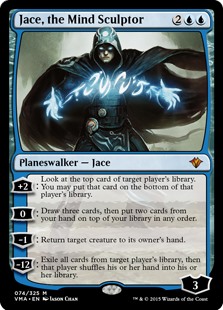
2 Jace, the Mind Sculptor

Artifacts

3 Engineered Explosives

Enchantments

1 Search for Azcanta

Instants

2 Cryptic Command
4 Lightning Bolt
2 Mana Leak
4 Opt
2 Remand
2 Spell Snare

Sorceries

2 Ancestral Vision
1 Bonfire of the Damned

Lands

4 Misty Rainforest
4 Scalding Tarn
2 Wooded Foothills
2 Steam Vents
1 Stomping Ground
1 Breeding Pool
1 Lumbering Falls
5 Island
2 Forest
1 Mountain

Sideboard

1 Vendilion Clique
1 Anger of the Gods
2 Blood Moon
2 Ceremonious Rejection
2 Destructive Revelry
2 Izzet Staticaster
1 Keranos, God of Storms
2 Negate
2 Surgical Extraction

We'll start with the most generic-looking Temur Midrange list possible, courtesy of Todd Stevens. Temur Midrange has its devout followers, and this deck looks to me like it would fulfill just about all of their needs. Cantrips? Check. Utility creatures? Check. Reach? Check. Cryptic Command? Check!

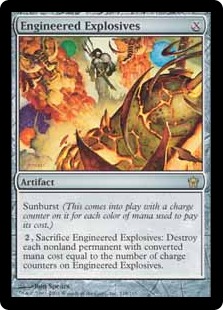
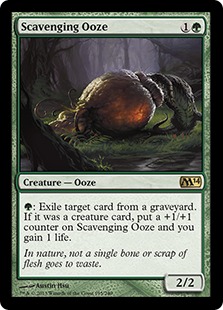
I think Todd's big innovation here is mainboarding 3 Engineered Explosives. Temur has always struggled to kill creatures with more than three toughness, as outside of Lightning Bolt, its viable removal spells are limited to say the least. Here, Explosives plays that role against low-cost creatures specifically. Hollow One and Tasigur? We won't be killing those. But Tarmogoyf, Scavenging Ooze, and Death's Shadow just became much more manageable.

Related are Explosives's abilities as a utility card. It doesn't have to remove a creature, unlike lackluster options such as Roast or Harvest Pyre; Explosives can take out artifacts and enchantments, planeswalkers, and even 20 Goblins tokens against Storm. David's piece on the latest artifact combo deck, "The Hidden Strength of Krark-Clan Ironworks," examines the card's many abilities in detail, further speaking to the sunburst card's relevance in Modern.

Eternal Devotion (Remix)

Eternal Command, by TEAM5C (5-0)

Creatures

3 Eternal Witness
2 Huntmaster of the Fells
2 Scavenging Ooze
4 Snapcaster Mage
4 Tarmogoyf
2 Vendilion Clique

Artifacts

4 Aether Vial

Instants

3 Cryptic Command
2 Electrolyze
4 Lightning Bolt
4 Opt
4 Remand
1 Spell Snare

Lands

4 Misty Rainforest
4 Scalding Tarn
1 Flooded Strand
1 Wooded Foothills
2 Breeding Pool
1 Steam Vents
1 Stomping Ground
2 Flooded Grove
3 Island
1 Forest
1 Mountain

Sideboard

1 Scavenging Ooze
2 Abrade
2 Ancient Grudge
1 Batterskull
2 Ceremonious Rejection
1 Dismember
1 Izzet Staticaster
1 Keranos, God of Storms
1 Negate
1 Spell Pierce
1 Surgical Extraction
1 Sword of Fire and Ice

Eternal Command is a deck first seen in the hands of Souta Yasooka, who took the Vial-featuring spell deck to Top 4 at the 2012 Players Championship. Return to Ravnica, with its Deathrite Shamans and Abrupt Decays, spelled doom for Eternal Command as they did for many blue-based tempo shells of that era. This showing is the first I've seen from the deck in years.

Some things have changed since Command's glory days: Scavenging Ooze has entered the format, and makes an appearance here. So does Huntmaster of the Fells. Most game-changing of all, though, is Opt, the unassuming cantrip that's all but taken over Modern blue decks. Swapping Serum Visions for Opt lets Eternal Command play at instant-speed more often, taking pressure of its mana and increasing synergy with Aether Vial. I imagine the switch is particularly helpful against reactive control decks like UW.

One thing to note about both this deck and the above Temur Midrange list is their inclusion of Keranos, God of Storms in the sideboard. Keranos is another card we haven't seen much of since the Twin days, but it seems to be making a comeback, also due to UW. The control deck is forced to have Teferi or Detention Sphere to answer Keranos, or may drown in the snowballing advantage it provides; the God also boasts applications in midrange mirrors.

Flip or Be Flipped

Temur Delver, by KYLEHL (5-0)

Creatures

4 Delver of Secrets
4 Tarmogoyf
3 Hooting Mandrills
1 Hazoret the Fervent

Artifacts

4 Mishra's Bauble
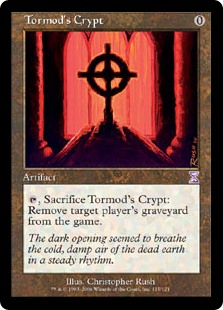
1 Tormod's Crypt

Instants

4 Lightning Bolt
2 Tarfire
4 Vapor Snag
4 Stubborn Denial
1 Spell Snare
2 Opt
1 Abrade

Sorceries

4 Serum Visions
2 Faithless Looting
2 Traverse the Ulvenwald
1 Anger of the Gods

Lands

4 Misty Rainforest
2 Scalding Tarn
2 Wooded Foothills
2 Breeding Pool
2 Steam Vents
1 Stomping Ground
1 Forest
1 Island
1 Mountain

Sideboard

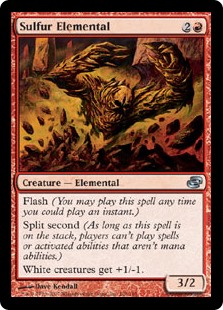
1 Sulfur Elemental
1 Alpine Moon
1 Blood Moon
1 Pithing Needle
1 Grafdigger's Cage
1 Ancient Grudge
1 Back to Nature
1 Ceremonious Rejection
1 Disdainful Stroke
1 Entrancing Melody
1 Flame Slash
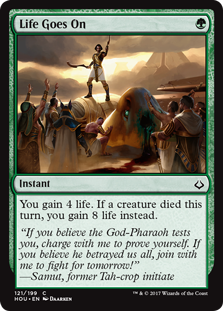
1 Life Goes On
1 Natural State
1 Ravenous Trap
1 Spell Pierce

Now this is more my speed, if absolutely insane. KYLEHL's Temur Delver mashes various Temur Delver notions into an incredibly teched-out 75.

I Get Delirious

While I was initially down on Traverse and Mandrills in the same shell, I later realized that without Bedlam Reveler further cannibalizing the graveyard resource (demanding instant/sorcery while Traverse required creature/artifact/enchantment and Mandrills needed a critical mass of cards to exile), the two were supportable together. Of course, I was running Thought Scour. Not so with KYLEHL, who instead trims Traverse down to two copies, maxes out on Baubles, and adds velocity figurehead Faithless Looting into the mix.

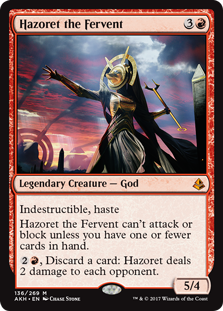
Over Snapcaster Mage, KYLEHL includes a peculiar bullet for Traverse the Ulvenwald: Hazoret the Fervent. Over the last year, I've become totally enamored with Hazoret in this kind of list. The God is excellent at closing out games, sniping planeswalkers, and providing resilience and even a free-win dimension against many interactive decks; everyone not on white or Dismember simply cannot remove her, allowing Hazoret to completely change the texture of many matchups after resolving. Maining her initially struck me as odd, as KYLEHL only plays 16 lands. But Traverse and Bauble help get to them, and Hazoret can always be pitched to Looting in matchups that don't call for a 5/4 haste.

Other Bullets

Hazoret isn't the only eyebrow-raising one-of in the mainboard. Another is Abrade, a standard tech in URx interactive decks, but a strange choice for a deck with such a low curve. I imagine KYLEHL didn't want to lose to any random artifacts in game 1, and decided to do something about it.

Same deal with Dredge, and a couple of sideboard cards make the cut here: Anger of the Gods and Tormod's Crypt. Anger doesn't just deal with Dredge, but with any wide board Temur is otherwise hard-pressed to beat. Without Snapcaster Mage in the picture, reach is harder to come by in the mid-game, and Anger can punch through a board for a final strike.

Crypt was tougher for me to wrap my head around. It's good enough against Dredge that we're starting to see Burn, Arclight, and other aggressive decks play a few in the side. But does it do anything elsewhere? As its floor, Crypt helps Mandrills or Traverse get going, as well as pump Goyf free-of-charge. So does Bauble, but KYLEHL already maxes out on those. And I imagine Crypt has plenty of edge-case applications against existing Modern decks besides Dredge: exiling a Snapcaster target, say, or taking Grixis off its Gurmag Anglers for a turn or two. Arclight Phoenix's recent explosion onto the scene is another factor to weigh.

In these roles, Crypt is definitely worse than Surgical Extraction, as opponents learn about it before it activates. But perhaps its synergistic elements make up the difference. I'd be interested in hearing what the pilot has to say about the card.

Sideboard

Speaking of speaking of bullets, check out this sideboard! I'll admit that I have little-to-no idea about what's holistically going on here, but I do have a few random observations:

  • Ravenous Trap and Grafdigger's Cage come in as additional Dredge hate
  • Alpine Moon, Blood Moon, Ceremonious Rejection, and Disdainful Stroke help against Tron
  • Natural State, Ancient Grudge, and Back to Nature make up the artifact/enchantment removal suite
  • Flame Slash and Entrancing Melody answer large creatures, with the latter helping specifically against Goyf and Shadow (as Explosives does for Temur Midrange)
  • Pithing Needle and Spell Pierce have applications against combo and control
  • Sulfur Elemental can be found by Traverse and answers Lingering Souls tokens, certain Humans boards, and the pesky Martyr-Proc deck we've seen so much of online lately
  • Life Goes On hoses Burn

It seems KYLEHL's choices were made largely with the intent of giving the pilot lots of choice and flexibility while sideboarding. Many of these cards play multiple roles, with Life Goes On being the big exception; I wouldn't be surprised if after many matches of tuning, KYLEHL landed on this sideboard configuration organically, as opposed to via having lost a bet.

Spell-Slinging and Taking Names

Are Temur decks finally ready to emerge as a solid Tier 2 option in Modern? Or were these three pilots just lucky? Share your thoughts in the comments, and join me Friday for a look at cool-little-brother Jeskai's new offerings.

Buying the Dips with Little Risk

Are you a Quiet Speculation member?

If not, now is a perfect time to join up! Our powerful tools, breaking-news analysis, and exclusive Discord channel will make sure you stay up to date and ahead of the curve.

After a week away from writing, I feel more refreshed and interested in Magic finance than I have been in quite some time. So much so, that I have even become a net buyer of cards. My interest is magnified by the fact that the stock market is floundering, meaning my MTG returns are greater than my stock returns. Given the choice right now between Magic and stock, I am inclined to lean towards Magic.

My (admittedly biased) Twitter following sort of agrees:

From reading through the Insider Discord, it seems like many people are chasing after the Modern staples that were not reprinted in Ultimate Masters. Those who bought Surgical Extraction or Manamorphose did quite well.

There was an error retrieving a chart for Surgical Extraction

But you already know that’s not my area of interest. I have no desire to go out and buy Modern cards left and right (not with cash, anyway). Instead, I’ve been leveraging a different strategy to grind out profits in Magic these days.

The Recent Pullback is a Gift

We all know the market had gone a bit soft these last couple months—it really is a healthy retreat given the massive gains we’ve seen in 2018. But I don’t see the recent weakness as a bearish signal. In fact, I believe the retraction in prices and the return of supply to the market is quite the buying opportunity.

In an extreme example, consider Unlimited Power. At one point, it was nearly impossible to find sleeve-playable power for much under $2000. A well-loved Black Lotus would easily run you nearly $6000 at peak. Even now, Card Kingdom can’t keep a “Good” condition piece of Unlimited Power in stock for more than about five minutes. Demand for fairly priced HP stuff has been quite robust.

However over the past month or two, supply has slowly returned to the market. Now if you want a sleeve-playable Black Lotus, you can simply buy the cheapest heavily played copy off TCGplayer for $5100 (with a juicy chunk of store credit if you bought during the Black Friday sale). It’s not the steal of the century, but three months ago such copies were scooped up aggressively.

Heavily played moxes are in the $1500’s, Time Walks in the $1600’s, and Ancestral Recalls start at around $1800. These prices would have all been considered very solid a few months ago, and I believe we will be longing for these prices again when 2019 comes along.

You also don’t have to look to Power to see these market trends. I browsed all Unlimited rares on TCGplayer and found multiple cards that seemed to be priced fantastically relative to their three-month-ago price. For example, I grabbed three moderately played Unlimited Braingeyser during the 15% credit bonus event last Friday, at around $50 a copy.

There was an error retrieving a chart for Braingeyser

I also picked up a couple smaller Antiquities Reserved List cards and an Ifh-Biff Efreet through Twitter sales. These aren’t immediately profitable purchases, but I’m trying to put money to work while I see prices retract so much.

The best part about these purchases is that there is very little risk involved. Why am I so confident about this? It all has to do with buylists.

Buylists: The Backup Plan

It’s true: buylists have cooled off quite a bit since prices became overheated a couple months ago. But that doesn’t mean the rug was pulled out from them altogether. In fact, there are still some fairly aggressive numbers out there, giving me confidence that I won’t be losing money with my recent purchases.

For example, consider those Unlimited Braingeysers I told you about. Did you know that ABU Games offers $87 in store credit for played copies? Granted, that’s not worth nearly $87 in US Dollars, but I’ve been using a 60% multiplier to back out what I should be able to get for my trade-in. That equates to about $52, which is a hair higher than my purchase price. Therefore, if I decide I don’t want to hold these cards for long, I can just trade them to ABU Games for something more interesting.

In fact, ABU Games has some fairly aggressive credit numbers on many Alpha, Beta, and Unlimited cards. This means I can make my speculative purchases with confidence knowing the worst-case scenario is that I simply trade the cards in for something else.

Separately, Card Kingdom has been gradually increasing some of their Old School buy prices. I’ll reiterate that of course numbers aren’t near their all-time highs; those prices were egregious. But some have seen a nice bounce. Erhnam Djinn is a good example: recently Card Kingdom upped their buy price from $125 to $155.

There was an error retrieving a chart for Erhnam Djinn

They moved some Legends and Antiquities cards up in price as well. And if you ever get some time, I’d encourage you to use Trader Tools to browse the top buy prices for Alpha and Beta cards (by set). Card Kingdom has very aggressive numbers on the more desirable cards from these sets—just watch out for those pesky downgrades!

The Trade-In Strategy

Perhaps I’ve piqued your interest. Maybe you’re interested in trying to flip some cards to buylists for credit to try and make a few bucks. The next question you may be asking is what to target with said store credit?

I will share my recent strategy, though I think everyone really needs to invest the time it takes to browse stock at these major vendors to find the best-priced options. This is tedious but required if you really wish to make some money with this approach.

In general, I strive to trade up. I want to ship a bunch of lower-end cards to get a lump of credit and use that credit to purchase one desirable card. This helps me streamline my collection, while also making it easier to cash out in the future.

For example, I recently traded a few played Beta cards and a Field of Dreams for a Gaea's Cradle. That Cradle will arguably be easier to sell than an HP Beta Manabarbs, for example, since the population of players who want one is much larger.

There was an error retrieving a chart for Gaea's Cradle

Other cards I’ve been targeting recently at ABU Games are Zendikar Expeditions. Any Masterpieces are probably worth considering, though I find the most desirable ones have the highest mark-up. I’m sure there are plenty of other options if these don’t interest you—the key is to find something with the least amount of mark-up so that you can sell the cards you get to convert as much credit to cash as possible. Or, better yet, trade for cards you’ll actually need, getting them at a fair discount to the market when trade credit is factored in.

When it comes to Card Kingdom, I continue to stick with Alpha, Beta, and Unlimited cards in “Good” condition. One recent acquisition I made was an Unlimited Two-Headed Giant of Foriys. Card Kingdom’s “Good” price was $44, and I knew I could sell the card for near that. This means I can convert a fraction of that 30% trade bonus they offer into cash.

Even if I didn’t manage to sell the card, I had a solid backup plan. Because Card Kingdom marks down their “Good” cards so much (and often times their “Good” condition still passes for “Played” at ABU Games), I can flip stuff from Card Kingdom directly to ABU Games for a bump in store credit! That’s one of my favorite pastimes–credit flipping! You may even be able to add Channel Fireball into your repertoire of vendors to credit flip with. They pay pretty well on certain things, and some of their Old School prices are quite competitive. It just takes time and research to find the opportunities.

Wrapping It Up

I certainly can’t argue with the success people have been having flipping Modern cards. Those staples that didn’t see reprint in Ultimate Masters can be a hotbed of price action in the near term. For me, however, I’ve been engaging with MTG finance via a different avenue.

As prices stabilize in the Old School market, I’ve been slowly acquiring cards strategically at prices well below their former peak. I suspect come 2019, when everyone gets their tax refunds and is done with holiday spending, prices will rebound. I want to be well-positioned when that happens.

In case they don’t rebound as I anticipate, I have a solid backup plan: I focus my acquisitions either on cards I want to keep or cards I can flip to buylists at minimal or no loss. Between ABU Games, Card Kingdom, and Channel Fireball, there are some attractive buylists out there. Despite these buylists, people are still listing their cards for sale on TCGplayer at or below what vendors are offering. Therefore, I consider the risk of my purchases nonexistent because I know I can trade these cards in for store credit and acquire something different if I so choose.

And that’s precisely what I’ve been doing lately. I’ve made multiple trades with ABU Games and Card Kingdom, consolidating small stacks of cards into just a couple more liquid and valuable cards. This makes raising cash easier while helping me keep turnover in my portfolio—one of my favorite pastimes. It’s this constant refresh that keeps me interested in the hobby, and I hope to leverage this approach for years to come!

Sigbits

  • For the longest time, Angus Mackenzie has been the Legends legend with the highest vendor buylist. But recently Card Kingdom has placed Hazezon Tamar in that number one spot (currently $200). Does this reflect a shift in demand? I’m not sure, but it’s a trend worth keeping an eye on if you’re trying to complete a set.
  • Card Kingdom still has a bunch of Masterpieces on their hot list, which gives me confidence that these are worth picking up with ABU Games credit. Recent numbers that caught my eye include Wasteland ($95), Blood Moon ($105), and Sacred Foundry ($56).
  • After dropping all the way down to $50, Card Kingdom once again has an aggressive buylist number for Legends Sylvan Library: $70. This card sees Commander demand in addition to Old School, so I can see it climbing even higher as long as it continues to dodge reprint. In fact, I’d go out on a limb and say I’d prefer buying these over Manamorphose at this point!

Daily Stock Watch – Ultimate Masters Edition Part Two

Are you a Quiet Speculation member?

If not, now is a perfect time to join up! Our powerful tools, breaking-news analysis, and exclusive Discord channel will make sure you stay up to date and ahead of the curve.

Hello, everyone and welcome to the second part of this week's special edition of the Daily Stock Watch! The spoiler is complete for Ultimate Masters as of writing time, and there aren't more of those cards that made us go "wow" after yesterday. It seems that WotC's initial attempt to woo us in to buying UMA boxes were successful, as the rest of the set seems underwhelming for me for its price. This is just my opinion from a financial standpoint, and I guess that's where the box topper comes in. Instead of gauging the set in whole, let's check out more cards from the set (outside of the ones included in the box toppers) that will suffer financially from this reprint, but will make a lot of players happier.

There was an error retrieving a chart for Containment Priest

This card isn't exactly a pricey one but the supply is somehow limited because it was only available via Commander. It is a favorite in multiplayer EDH games as it stops a lot of shenanigans that could end games in an instant (such as the dreaded Worldgorger Dragon and Animate Dead combo). After peaking last July at $25.92, this card should go back to $10 range. This will be having its first time foil though (outside of the Masterpiece version) so be on the lookout for that one.

There was an error retrieving a chart for Bridge from Below

The BR Bridgevine deck in Modern didn't have much success that people thought it would amass in Modern. It requires some serious stroke of luck to play with and a lineup of matches against decks that don't pack Leyline of the Void to win consistently. It had its fair share of hype spikes last August, with the FS version reaching a high of $41 when the deck first burst onto the competitive scene with a top eight finish by Jacob Nagro in the Pro Tour 25th Anniversary. It's no surprise that Vengevine was included in this set for some synergy purposes in draft (if you're lucky enough to draft both!) and it's also cool that Faithless Looting is out there. Another one of those cards that will be down to $10 range because of the reprint.

There was an error retrieving a chart for Nourishing Shoal

Another card that's seeing some competitive play in Modern is Nourshing Shoal. It's part of the now unpopular GriselShoal deck that is still capable of winning tournaments on its own given the right matchups, but isn't drawing enough attention to keep the deck in respectable tier one territory. I had the feel that this would be included in the set when I saw Through the Breach and Goryo's Vengeance in the spoilers, but there's no Griselbrand in sight. Emrakul, the Aeons Torn wouldn't be alone though as his Eldrazi brothers are also in the set. A $7 card for the past two years, expect this card to go down to $3-$5 range as soon as UMA supplies hit the market. Now would be the best time to get your foils, though.

There was an error retrieving a chart for Fauna Shaman

One of the reprints that I didn't see coming was this of Fauna Shaman. Timetable-wise, this makes sense as this was only printed once way back in Magic 2011. It was barely seeing play in Modern, with Kiki-Chord as the only possible deck where I think this could be used, but is almost a guaranteed staple in Commander for decks that run more creatures than spells along with Survival of the Fittest. This has been above $10 for quite a few years now, and it should go back to $8-$10 range with this reprint. Snag one of those foils if you could as it has a premium because of EDH.

There was an error retrieving a chart for Flagstones of Trokair

A card that was printed a decade ago with no functional reprints of sorts, Flagstones of Trokair returns to the mainstream audience with very little fanfare in UMA. It sees fringe play in Modern via Martyr Proc, and it is known as a fodder for Boom//Bust or Wildfire types of deck in EDH. It has been a $20 because of scarcity, but should be down to $10 as well with this printing. Again, be on the lookout for foils as there will be good prices for it in the long run.

There are notable reprints in the set that were a bit surprising, but I would be talking about that in tomorrow's segment to end the week.

And that’s it for this edition of the Daily Stock Watch! See you again next time, as I continue to talk about the last set of cards from Ultimate Masters. As always, feel free to share your opinion in the comments section below. And if you want to keep up with all the market movement, be sure to check in with the QS Discord Channel for real time market information, and stay ahead of the hottest specs!

Daily Stock Watch – Ultimate Masters Watch Edition Part 1

Are you a Quiet Speculation member?

If not, now is a perfect time to join up! Our powerful tools, breaking-news analysis, and exclusive Discord channel will make sure you stay up to date and ahead of the curve.

Hello, everyone and welcome to a new week of the Daily Stock Watch! It's Thanksgiving week right now and that also means that it's time for the Ultimate Masters spoilers to start popping out. There are already a few surprises as early as now and this is the reason why I decided to start with an article about these cards that we've seen by now and try to analyze how it impacts its financial value in the long run. I will try to talk about cards that I am familiar with since I am into competitive Commander gaming and that's where I see some of them seeing play.

There was an error retrieving a chart for Back to Basics

This was a $90 card when I featured it right here so it's kind of painful to see for those who got their copies anywhere that price range. It went mojos last September as it even hit a high of $300 before eventually going back down to $150 territory. It's now sitting at $81 (average price) and I wouldn't be surprised if it continues to dwindle down as the release of UMA approaches. I was very scared of speculating on the card back then because it's not part of the Reserved List and rightfully so, the reprint came sooner than expected. A good job to you if you were able to let go of these copies at its peak!

There was an error retrieving a chart for Runed Halo

Another card that went berserk financially early this year is Runed Halo. As an almost exclusively sideboard card for UW Control, this went to as high as $49.99 back in January until it settled in the $40 range when I wrote about it. This reprint in UMA will definitely hurt its stock, and I wouldn't be surprised to see it dip down to $10-$15 as the Shadowmoor version is now at $28.50 (average price). It was clunky for me from a financial standpoint back then and I was never a fan of the card. This rendition of the card was merely an attempt from WotC to help stabilize the market for cards like this one that only saw print almost a decade ago.

There was an error retrieving a chart for Phyrexian Altar

I was so glad when I was able to sell my copies of this card for $50 just a few days ago when the spoilers wasn't up yet. I've had them with me for a while now and I remember getting lectured by some of my readers about how good this card was when I talked about it and honestly spoke bluntly about it in an actual game situation. Any sacrifice outlet is great in Commander, and I'll stand by that claim from here on out that this is probably the best one you could use on any deck that runs creatures (Food Chain is a green card and you could just right about insert the altar on any deck you want) so this reprint is actually good for those who wants copies of this card. I expect this to drop in the $20-$30 range once UMA is out in the market.

There was an error retrieving a chart for Phyrexian Tower

Back then, I thought this card was part of the Reserved List along with the likes of Volrath's Stronghold and Yavimaya Hollow but apparently, I didn't know much. This is one of the better cards that lets you sacrifice your creatures and have a decent pay off out of doing it by giving you two black mana instead of just producing one. It is another one of those reprints that's very much welcome to the Commander community, and I think that more of its kin are coming in the new few days of spoiler season. Although there's always a premium on lands regardless of format, I don't think that its current price tag of $48.45 will hold out because of lack of demand. It's an almost strictly EDH card for now and based on how Rishadan Port was hit hard by the Masters 25 reprint, expect the same to happen to this one. Another one of those cards that will go down eventually to $20-$25 territory once supplies hit their peaks.

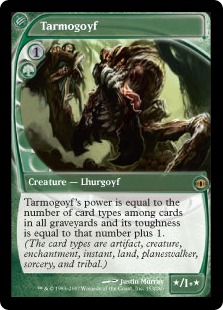
There was an error retrieving a chart for Tarmogoyf

WotC just can't stop printing Goyf. It has been included in every Modern Masters version, and it's no surprise that it was included in this one as well. I must say that this was the poster card of the whole Masters concept, and the lack of its success in Modern and Legacy has transitioned to a more affordable price of the card than its peak price of $219 each back in 2015. We've gone a long way since and the $65 price tag that it carries now will continue to slide as more copies of it are circulating in the market. I must say that the art for this card is pretty sick, and it should attract enough attention from a financial standpoint. I would still be after the box topper version of this card, though.

And that’s it for this edition of the Daily Stock Watch! See you again next time, as I continue to talk about more cards from Ultimate Masters. As always, feel free to share your opinion in the comments section below. And if you want to keep up with all the market movement, be sure to check in with the QS Discord Channel for real time market information, and stay ahead of the hottest specs!

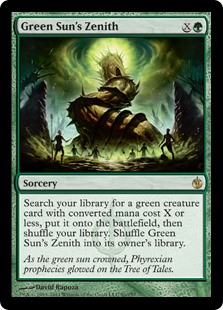
Green Sun’s Zenith Tests: Intangibles/Conclusion

Are you a Quiet Speculation member?

If not, now is a perfect time to join up! Our powerful tools, breaking-news analysis, and exclusive Discord channel will make sure you stay up to date and ahead of the curve.

It is a common trap to look only to hard data when making decisions. After all, numbers are clear and unequivocal. However, they don't tell the full story of the data. Confounding variables and intangible effects color the results and complicate the data. The data from my latest banlist test indicate that Green Sun's Zenith is a powerful card in Modern. But the lessons I learned and the observations my team made about the test matches suggest that the card's real power isn't what we expected, both in usage and scale. I now think that GSZ could become legitimately broken if unbanned.

This article marks the third in a series on Green Sun's Zenith. If you're just joining us, be sure to first read the Experimental Setup for this project, and then the Quantitative Results.

The Arboretum

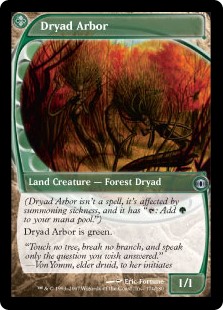
A prominent argument I've seen against GSZ being unbanned is comboing with Dryad Arbor to become a ramp spell. Indeed, everyone told me I needed to include Arbor in whatever deck I used for the test. It makes sense as that's the norm in Legacy, and briefly was in Modern. Dryad's assumption has led some to suggest that GSZ could come off if Arbor was banned in its place. Discounting the fact that it's ridiculous to ban a fairly innocuous card to make a powerful one reasonable, the point does stand that Arbor does grant GSZ significant utility, as Batterskull does for Stoneforge Mystic.

Having tested with Arbor in my deck, I actually wish that I hadn't. Dryad Arbor did not impress in my test, and its mediocrity there makes me question whether it merits an automatic slot in the GSZ deck. While I wouldn't entirely discount the impact of Arbor with GSZ, I don't think it really factors into whether GSZ could be unbanned or not.

In Elves

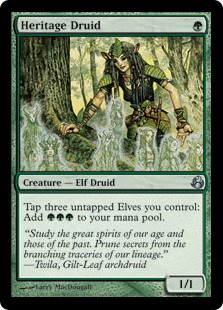
While not necessarily bad, I never wanted to use GSZ to find Arbor turn one. Most of the time, doing so would prove unnecessary, as Elves already had Llanowar Elves/Elvish Mystic on hand. Even when that wasn't the case, it was generally better to save GSZ for a payoff card and/or play another one drop to set up an explosive turn two with Heritage Druid. It just felt inefficient as a ramp trick.

This may seem odd since Legacy Elves often runs two Arbors. However, Legacy Elves isn't really using them for turn one ramp, though that does happen. Arbor is there because it synergizes with the Legacy payoff cards Natural Order, Craterhoof Behemoth, and Gaia's Cradle. Being able to fetchland for another creature generates a lot of mana in Legacy. Arbor also sacrifices to flash back Cabal Therapy, in Elves and elsewhere. However, Modern's payoffs are all Elf tribal synergies. If Arbor isn't ramping, it just doesn't do anything.

Everywhere Else

As such, I'm of two minds about the argument of Arbor's universality alongside GSZ. On the one hand, it certainly could be done, as it's fairly easy to cut a Forest for Arbor. On the other, is that something players will want to do? While it is relatively small, there is a cost to running Dryad Arbor in Modern. There will be times, just like in Legacy, where decks draw GSZ alongside their one Arbor and can't ramp. There will be times where having Arbor in place of a normal land forces players to mulligan otherwise keepable hands.

I think that a lot of players will decide that the benefits are worth the risk and run Arbor with GSZ. Having more mana early is very powerful. and Arbor is less space-intensive than just running more mana dorks. But verifying its viability once and for all will require more testing than I can manage. Due to the lack of payoffs other than ramp and Liliana of the Veil protection for Arbor, I'm skeptical that it will be universally correct. As such, I don't think Arbor's existence is a real help or impediment to GSZ's potential strength in Modern.

Working with Tutors

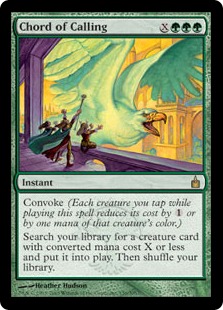
I did not fully appreciate the impact that playing multiple tutors had on Elves, perhaps because playable tutors are so elusive in Standard. The only straight-up tutor that sees regular play in Modern is Chord of Calling; the only deck I know of in Legacy with multiple tutors is Storm, which plays Infernal Tutor and Dark Petition. Vintage players have all the tutors, but they're restricted. This impact of having multiple full sets of tutors in the same deck houses GSZ's true power.

Mechanics

Wizards doesn't print tutors like they used to: just compare Demonic Tutor to Diabolic Tutor. They also don't print them in the same quantity as they used to (see: the Enlightened Tutor cycle). Their reasoning is that tutors benefit degenerate strategies more than fair ones while making gameplans consistent to the point of being repetitive. There are correct lines of play in any given situation, and tutors make it easier to take those lines every time, whether the line involves finding the right answer or setting up a combo.

This effect wasn't obvious in exploratory testing or in my practice matches, but as the test wore on, I had flashes of déja vu. I was able to take the same successful lines over and over thanks to all the tutors in my deck. The games did feel quite repetitive towards the end. It was rare for games to be exactly the same, as variance affects both decks, but the tutor-heavy games definitely bled into each other. I would describe the effect of playing Collected Company, Chord of Calling, and Green Sun's Zenith in the same deck as severely diminishing negative variance. It was like I took a variance sine wave and cut the bottom off. I don't recall losing many games where I resolved two tutors.

My opponents echoed my assessment. They consistently reported feeling up against the wall as I hit ideal curves so consistently. The games played out mechanically from their perspective, too. I was definitely going to hit payoffs and have big turns if my tutors resolved, and I ran enough of them to threaten it several times. That critical mass proved difficult to combat. Even my Storm opponent, with all of his cantrips, felt that test Elves was the more consistent and mechanical deck.

Shuffling Weirdness

An additional factor unique to GSZ is that it shuffles back into the library after resolving. In other words, it replaces the chosen creature with itself. The library's size doesn't change, but its composition does. On net, this means that with repeated uses, the odds of drawing GSZ increase.

The probability of drawing another copy of the chosen creature drops by n-1/x, where n is the remaining copies of that creature in the library and x is the total cards in the library. The probability of drawing GSZ symmetrically increases by n+1/x. No other probability changes because the library's overall size is unaffected. Therefore, GSZ is not only a tutor, but a way to improve deck composition during a match. I don't know of nor could I find any mathematical or statistical model of the impact of this effect, but it feels like it should have some impact. If anyone has any guidance, please help me out.

Misunderstood Effects

I did not appreciate that because I had multiple tutors in my deck, I could have pushed the Elves deck harder than I actually did both in-game and in composition. In normal Elves, it was correct to hold the actual tutor, Chord, for whatever I needed to win the game. I fired off Company anytime I could just for value. However, in test Elves, GSZ allowed me to smooth out and actually hit my ideal curve for a very low price. Chording for Heritage Druid was okay, but casting GSZ for it was busted. The way I ended up using my tutors was GSZ for power, Company for bulk, and Chord for specialized cards. This division of labor function frighteningly well.

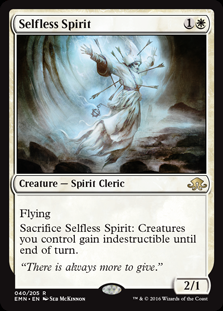
In hindsight, I believe I mis-built the test deck. I could, and probably should have, been Abzan Elves. Adding white improves the sideboard options, and having GSZ and Company to find the Elves lets Chord become a multipurpose toolbox. Having Selfless Spirit and/or Phyrexian Revoker to Chord for would have helped a lot against Tron. It also allows Chording for Eidolon of Rhetoric against Storm. I underestimated just how much more toolbox-focused Elves could become with GSZ.

My other mistake was not appreciating just how busted Elves could be. There were a number of times where I had nine mana available turn 3. I didn't record how many, because I didn't realize that it kept happening until midway through testing. Had I been playing it, I could have GSZ'd for Craterhoof Behemoth and won the game, which I couldn't quite do with Ezuri because of summoning-sick creatures.

Given how easy it proved to generate absurd mana when I was hitting Heritage Druid every game, I should have cut Elvish Clancaller and some Shaman of the Packs for Craterhoof, Company, and more one-drops. It wouldn't have been so grindy against UW Control, but the increased explosiveness would have improved the other matchups, and perhaps blitzed control regardless.

Final Assessment

The data show clearly that it had a significant impact on the deck's win percentage. As I now believe, the test deck is suboptimal for GSZ; I think that win percentage could have been even higher.

The intangibles also point to GSZ having effects that are less positive for Modern's competitiveness and diversity. There is a lot of potential for GSZ to facilitate some truly degenerate combo decks. Given Magic's history, GSZ will almost certainly help green combo decks more than fair ones and will encourage fair decks to become more unfair. As a result, I think there is great danger in unbanning GSZ.

Comparison to Previous Tests

I know that I was skeptical of Bloodbraid Elf and Jace, the Mind Sculptor when I tested them, but I believe this test is different. I predicted those cards would primarily impact fair matchups, particularly slower ones. That outcome would give decks with Jace and Bloodbraid an edge over similar decks without, and would eventually drive competitors out of the metagame. I would also argue that this exact scenario is playing out now: Jace is played in almost every UWx deck, while Jund is holding steady as Abzan and Mardu midrange decline. That said, the situation also seems to be fine for Modern as a whole.

Unlike with Jace and Elf, GSZ carries the risk of breaking Modern in half. I had positive results with a beatdown deck, and yet I feel that I should have played combo. Had I been doing so, I definitely would have had more turn 3 kills, something Wizards wants to prevent from happening consistently in Modern. I suspect that in the event of an unban, players will happily run GSZ in GW Valuetown or Hatebears, but it will be Combo Elves or Abzan combo decks that really make the card shine, especially given how explosive Elves and Counters Company are already.

The worst-case scenario for Jace and Bloodbraid was them pushing otherwise viable fair decks out of the metagame. With GSZ, the worst-case is combo decks just flooring everyone else with speed and, more importantly, consistency: fast combo is fine, but consistency is where the power lies. There are plenty of fast combo deck in Modern like Grishoalbrand, but they're too inconsistent to be a problem. GSZ potentially making fast creature combo too consistent is a real threat. As the former result is less damaging than the latter, I remain against an unban.

Wizards Gets a Vote

The nail in the coffin for GSZ is that I can't imagine that Wizards wants Modern to have it. They don't want there to be too much tutoring in a format, both for diversity of gameplay and as a check against degeneracy. Green creature decks already have Chord of Calling and Collected Company, and Abzan/Counters Company has been Tier 1 several times already. Traverse the Ulvenwald and Eldritch Evolution are also options, but they're far more conditional and niche.

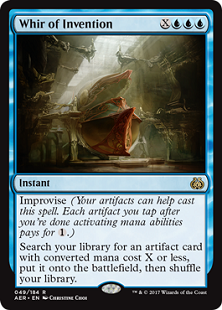
Wizards also doesn't want tutoring to be too efficient. I will argue that because GSZ finds a creature from your library and puts it into play for its converted mana cost plus one, it is the most efficient tutor ever printed. Other tutors have their CMC to pay, the tutored card is put into hand, and then players pay to cast the card. GSZ is clearly more efficient, and in Magic, efficiency is power. Chord and Whir of Invention cost triple colored mana plus the tutor CMC, which is a far greater ask for an effect similar to GSZ's. Those times I could have had GSZ-for-Craterhoof on turn three, I couldn't have quite hit Chord mana. In testing, GSZ just felt busted compared to Chord of Calling.

High-Risk, Low-Reward

For all these reasons, Green Sun's Zenith strikes me as a high-risk, low-reward unban. The risk of degeneracy is high with any playable tutor, especially one as efficient as GSZ. Even if it isn't actually degenerate, the additional tutor will push fair decks in a combo direction. That situation makes me think of Commander, where most decks include several tutors to facilitate multiple combos with their commander. I don't think that making Modern more like Commander through adding tutors is a good thing, so I wouldn't unban GSZ. Considering the effort Wizards puts into making formats distinct from each other, they are likely agree with my sentiment.

Cubing with Guilds of Ravnica (As Inexpensively as Possible)

Are you a Quiet Speculation member?

If not, now is a perfect time to join up! Our powerful tools, breaking-news analysis, and exclusive Discord channel will make sure you stay up to date and ahead of the curve.

As established in the past, my goal is to create a cube including the best cards over the history of Magic: The Gathering, but at the lowest possible cost to myself. We’re not talking about foils today, folks – we’ll be looking at the least expensive version of each card in question.

Cubing inexpensively while still trying to pick up the best cards means early identification, periodic price checking, and lots of patience. In some cases, a card is fine to pick up while still in Standard, either because it sees no Standard play or not enough to greatly impact its price. That’s why early identification is important – why wait to pick up a card that belongs if you don’t have to? On the other hand, have you ever purchased a card for $10 or $20, not used it much, and then saw it for 50 cents months or years down the line? That's the kind of feeling I'm trying to avoid.

To that end, let’s take a look at Guilds of Ravnica. For reference, this is my current cube list. I’m not touching on reprints today, as they are probably already in tuned lists if they deserve to be. Onward!

White

There was an error retrieving a chart for Citywide Bust

I don't anticipate adding this to my cube, but this is kind of a cool sweeper to help White Weenie get out from under ramp decks. Supporting White Weenie is something I do, but it's not exactly a priority for me. At bulk pricing, if you want the card, you might as well get the card.

There was an error retrieving a chart for Conclave Tribunal

I think I lean more toward Oblivion Ring, but that might be wrong to do. With token makers like Lingering Souls in a lot of cubes, this could be a solid addition to white's removal package. Again, I don't anticipate adding it to my list, but as a cheap uncommon, there's no reason not to pick up a copy if you want.

Blue

Honestly, I'm not seeing a lot in blue that's worth considering. Nightveil Sprite is worse than Looter il-Kor and Mission Briefing is way worse than Snapcaster Mage, for example.

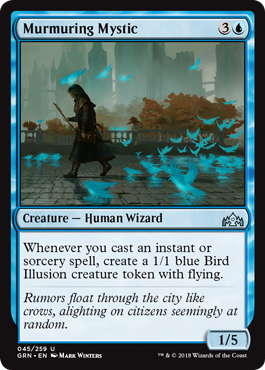
Murmuring Mystic

This is maybe the closest to being something that could help one go off in a combo-like fashion. It could be just the win condition that the Storm-deck-that-didn't-quite-come-together needs, for when you just can't string enough spells together to make an Empty the Warrens or Brain Freeze good. That seems like a rather niche role, though. It's also the kind of card you should be able to pick out of draft leftovers or buy for literal pennies.

Black

There was an error retrieving a chart for Doom Whisperer

My first thought is to write this off for not being as good as Griselbrand, but then I noticed its {3BB} casting cost. That's a lot of power, toughness, evasion, and filtering for five mana. The problem is that it doesn't have an enter-the-battlefield effect that swings the game wildly. Griselbrand leaves you with seven cards if it immediately killed. This guy lets you ... set up your next draw step? If you live that long. Or you could dig for your reanimation target – only to not have enough life left to Reanimate it. On the other hand, this could be tough to beat when ramped out on turn three or four. I'm ultimately not likely to add it to my list, and I'm especially not interested at its current price tag of about $20. This is unlikely to have more than a dollar or two of value in the long term.

Red

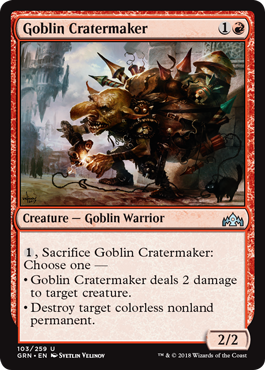
Goblin Cratermaker

This is a nice, inexpensive utility card that can beat down or act as removal of various things. I think it will be taking Lightning Mauler's slot in my list. If Torch Fiend is still hanging around your cube, Cratermaker should definitely replace it. Find it in draft leftovers or pay some cents for it, whatever you want.

There was an error retrieving a chart for Legion Warboss

This is a less explosive version of Goblin Rabblemaster. I could see Warboss replacing Sin Prodder, Chandra, Fire of Kaladesh, or Dualcaster Mage in my list. At $2 to $3, this will look like a bargain if it catches on in Standard but will seem like a huge overpay when it rotates in a couple years.

There was an error retrieving a chart for Runaway Steam-Kin

You know, I've played this card a bit in RDW on Magic Arena and it overperforms in a big way. It doesn't take long at all for it to become a 4/4, and occasionally you attack for four damage, use the mana to play a couple other things, and have it back up to a 4/4 again by the time you're on your next attack. This card will absolutely be in my cube. At $3 to $5 retail, I'm not in any rush to obtain a copy, but I could easily see this replacing Gore-House Chainwalker or maybe even a three-drop. I expect this to eventually settle to bulk rare status – unless it catches on in Eternal formats, in which case all bets are off.

Green

I could mention Beast Whisperer, Kraul Harpooner, or Pelt Collector, but I don't think any of those cards are really good enough for a Powered Cube environment, though they may be worth considering in lower-power environments.

Multicolored

Guilds of Ravnica is a multicolor-focused set, so it's not too surprising that the mono-colored cards didn't offer much. Unfortunately, most cubes (mine included) don't devote as much space to multicolor cards as they do to mono-color cards. Thus, the difficulty to break into a cube increases for multicolor cards by a wide margin. These cards are going to need to be among roughly the best five in their color combination to make the cut. Let's get into it.

There was an error retrieving a chart for Assassin's Trophy

This is a great start in the top-five-cards-in-its-colors-of-all-time category. The Gitrog Monster and Garruk, Apex Predator are easy cuts for this, and I think you could make arguments for cutting Maelstrom Pulse, Pernicous Deed, or Deathrite Shaman in favor of Assassin's Trophy. Easy include for any cube.

At a current retail price around $16, when is the question that needs answering. I expect this to see play in every format in which green and black are played together, so this is never going to be a card you can acquire for cheap. I would not be surprised to see Assassin's Trophy behave similarly to Abrupt Decay from when it was in Standard. Namely, start at $20, drop to $5 at the lowest, and then slowly climb until it's reprinted. This is a card I'll be watching closely for the best moment to acquire.

There was an error retrieving a chart for Knight of Autumn

Selesnya is generally pretty stacked with playables, but Knight of Autumn just does too many things to feel good about leaving out. It is seeing plenty of Modern play already and is currently right around $4. On one hand, that's a bargain for a card that's seeing Standard and Modern play. On the other hand, this is a non-mythic rare from a large fall set, so there's a lot of downward pressure on the price to come. Think Siege Rhino, which was a key player in a top Modern deck but could never get over $4 and is now less than $1. I couldn't fault you for buying now, but I'm sure a better price will be available before long.

There was an error retrieving a chart for March of the Multitudes

Instant-speed tokens with lifelink are extremely powerful. This card's mana cost requires a hard lean into ramp or for the game to go long. I never like to count on the latter in Powered Cube, and I prefer fatties to something like this for a ramp deck. Add in a $10 price tag and you can count me out. This is flashier than Knight of Autumn, but I'll take a powerful and flexible utility card over an interchangeable finisher every day of the week. I don't think this is worth acquiring for Cube at a price of more than a dollar or two. I just don't think it can compete with Selesnya's deep bench.

There was an error retrieving a chart for Ral, Izzet Viceroy
There was an error retrieving a chart for Vraska, Golgari Queen

Meh. I think these both require you to do too much work to be good. Before even checking their prices, I was expecting them to be too much, and they are. They're actually not as much as thought they'd be, and maybe that means players are catching on that not every planeswalker is playable anymore. It's not impossible or even unreasonable to build a spell-focused Izzet deck or a sacrifice-focused Golgari deck, but I'll stick to planeswalkers that are good on their own, thank you. If you are looking to acquire, I think $5 is a perfectly reasonable target and $3 is possible.

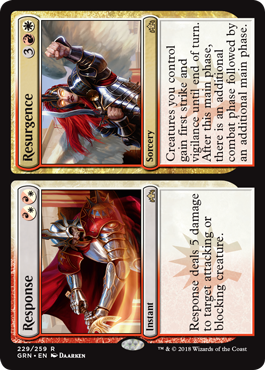
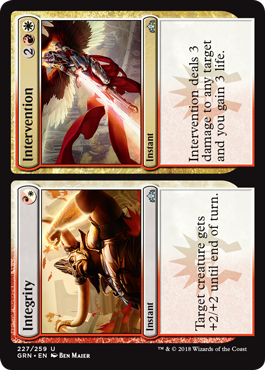
Response // Resurgence Integrity // Intervention

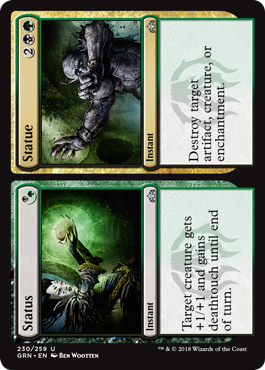
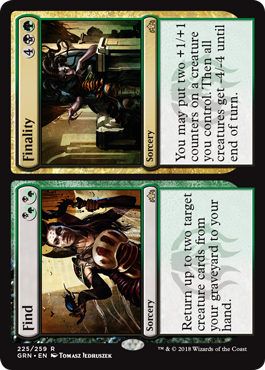
Status // Statue Find // Finality

The Boros and Golgari cards stand out as possibilities to me, but I'm not in love with any of the split cards from GNR for Cube. More testing may reveal differently, as there's a lot of cool utility effects and tons of flexibility here, but the power level is hard to gauge. For rares and uncommons, I'm looking for bulk prices exclusively for these cards.


That's it!

In summary, GNR doesn't offer a ton of obvious must-includes for Cube. We've got some nice multicolored utility cards and red's two-drop bench has added some depth, but ultimately, the set is more of a powerhouse for traditional Limited play than for Cube. No matter – Cube lives on, slowly but surely increasing in power level. Financially, almost all of these cards will be available for less than a dollar at some point, and that's where I intend to acquire them. The exception is Assassin's Trophy, where I'm aiming to acquire at a presumed low point of approximately $5.

In the meantime, we have a fantastic draft format to enjoy. I can't get enough of playing Dimir. What's your favorite guild in the format?  Have comments, questions, concerns? Want to harangue me for not even mentioning Aurelia, Exemplar of Justice? Go right ahead! The comments section is below.

Daily Stock Watch – Ezuri’s Predation

Are you a Quiet Speculation member?

If not, now is a perfect time to join up! Our powerful tools, breaking-news analysis, and exclusive Discord channel will make sure you stay up to date and ahead of the curve.

Hello, everyone and welcome to the Freaky Friday edition of the Daily Stock Watch! It's that time of the week again where I get to talk about a card that's getting some financial gains without actually making an impact in the competitive scene. My featured card for today is only available for certain formats, but one look at it and you already know what format I'm talking about. It just reached its all-time high of $4.99 as of today after starting off as a 30 cent card two years ago when it was released.

There was an error retrieving a chart for Ezuri's Predation

Would you be paying for a $5 card that's eight to cast and has no certainty of actually clearing the board when it's done doing what it's supposed to do? More often than not, the answer in an actual table top game of Commander is yes. There is no crazy combo out there that lets you win a game easier by using Ezuri's Predation in any possible Show and Tell and Omniscience variant, so we could easily count Legacy and Vintage out of the equation for this card. I'm still baffled how the lack of supply could just help raise a mediocre card like this to certain levels where it shouldn't. No matter how much we complain though, it's thru cards like this where we hit home runs as finance junkies. I'm pretty sure there will be more of if its kin that will enjoy financial success as the days go by.

Commander 2016 Sleepers

These are cards from the set Commander 2016 that have enjoyed some success since they became playable, and there should be other cards like Ezuri's Predation from this set that will also reach $3-$10 at some point in time after spending much of its existence in bulk territory. I'm starting to think that investing in those Commander sets is a good thing if you're pretty much going to just store them somewhere, and just start selling singles when some cards from the list have already spiked. Of course, this is just another option that we could explore if you're not into the idea of moving cards around every month or don't have the luxury of time to see price movements everyday.

My verdict for this card would be to sell it now while it's at its "peak". I don't think that this card is going to stay put in this range no matter how much it will be bought out, even though green is a popular color in Commander. Sure, there are players who are not into competitive Commander multiplayer games who would be interested in buying this, but I don't think that there is enough out there in the market to help this card demand such a price. Don't be discouraged if the card spikes a little more from this point on as this will be short lived and we'll have that proven in a few months time. Be smart enough to stray away from cards like this as spec targets. They are dangerously volatile even though they are low priced targets.

At the moment, you could get Ezuri's Predation from Card Kingdom for $2.99, while a few vendors at TCGPlayer still has it for as low as $0.92 but it's already at a median price of $6.23. StarCityGames is out of stock and should restock soon at a higher price that will trigger more price spikes once all online stores run out of this card. It should be safe to sell now if someone's buying it at $6 or more, as this card won't be useful. There are no foil copies of this card so it's safe to assume that this could pop out in any supplemental product as well in the near future. Cash out early while you can!

And that’s it for this week’s edition of the Daily Stock Watch! See you again next time, as we check out a new card that should be on the go, or good enough for speculating. As always, feel free to share your opinion in the comments section below. And if you want to keep up with all the market movement, be sure to check in with the QS Discord Channel for real time market information, and stay ahead of the hottest specs!

Colorless Eldrazi Stompy at SCG Regionals

Are you a Quiet Speculation member?

If not, now is a perfect time to join up! Our powerful tools, breaking-news analysis, and exclusive Discord channel will make sure you stay up to date and ahead of the curve.

After a lengthy hiatus from playing the deck, I brought Colorless Eldrazi Stompy to SCG Regionals last weekend, and duked it out with around 250 players over nine rounds of Modern. I ended up finishing in 9th place.
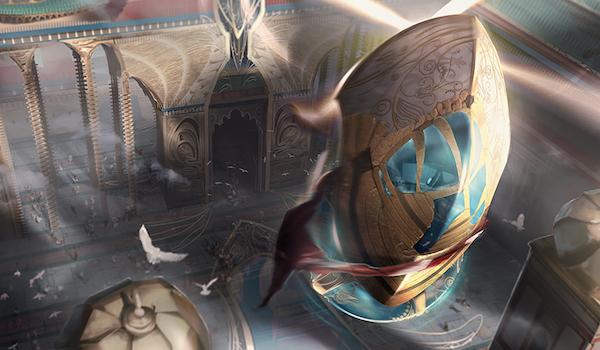
Despite my Top 8 miss, it was exhilarating to again play Colorless at this level. This report seeks to give an idea of how the deck performs in the current Modern metagame and my thoughts on the list going forward.

Notes on the Deck

Regionals marked my first Competitive REL outing with Colorless Eldrazi Stompy since the Worcester Classic in March, not counting one PPTQ this summer. In the meantime, I've been playing Counter-Cat and other brews in the smaller tournaments I frequent. I altered my list from the last Matchup Guide to account for this lack of practice, adding cards to help fight decks I had no experience against.

Colorless Eldrazi Stompy, by Jordan Boisvert

Creatures

4 Eldrazi Mimic
4 Eternal Scourge
4 Matter Reshaper
4 Thought-Knot Seer
4 Reality Smasher
4 Simian Spirit Guide

Artifacts

4 Serum Powder
4 Chalice of the Void
2 Smuggler's Copter

Instants

4 Dismember

Lands

4 Eldrazi Temple
3 Gemstone Caverns
4 Zhalfirin Void
3 Blinkmoth Nexus
2 Mutavault
3 Ghost Quarter
1 Scavenger Grounds
2 Wastes

Sideboard

4 Relic of Progenitus
1 Surgical Extraction
3 Ratchet Bomb
2 Ravenous Trap
3 Spatial Contortion
2 Gut Shot

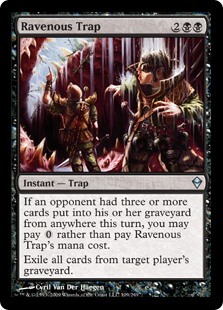
I had yet to face Dredge and didn't want to lose to that matchup, so I took my own advice and cut the fourth Bomb and the Sorcerous Spyglass from the side for a pair of Ravenous Traps.
Gemstone Caverns #3 also moved main to make room for another Spatial Contortion, a hedge against Humans and Spirits. It usurped the second Scavenger Grounds main, which I feel is too slow to reliably hose contemporary graveyard decks without Simian Spirit Guide or a fast Thought-Knot Seer as backup. Grounds is better against fair decks as a way to nerf Tarmogoyf, complicate Snapcaster Mage plays, or recur Eternal Scourge.

The Contortion came in handy, but I ended up not boarding in Ravenous Trap a single time during the tournament, and didn't even see one Dredge player in the room. I would also have brought Trap in against Arclight Phoenix decks, BR Hollow One, Bridgevine, Ironworks, and Storm.

SCG Season 2 Regionals – Swiss (9 rounds)

Colorless Eldrazi Stompy doesn’t just mulligan a lot, it Serum Powders a lot. At the beginning of every game, I’ll use a key to simplify relaying die rolls and the mulligans taken by each player. Some examples:

(Play; MPM 5 – 7): I’m on the play. I mull to 6, Powder for 6, and then mull to 5; my opponent does not mulligan.
(Draw): I’m on the draw. Nobody mulligans or Powders.
(Play; P 7ss – MM 5): I Powder for 7 and end up with two copies of Eternal Scourge in exile. My opponent mulligans twice.

Round 1 vs. GR Scapeshift (2-1)

Game 1, W (Play; 7 – M 6): I open Temple and curve out normally with Reshaper into Thought-Knot. Seer reveals Cinder Glade, Windswept Heath, Stomping Ground, Valakut, the Molten Pinnacle, Anger of the Gods, and Lightning Bolt. I take the Anger so my opponent has more trouble removing Matter Reshaper next turn. He ends up Bolting the 3/2, which flips a land, but never casts anything else significant all game and concedes as I continue deploying threats.
Sideboarding:

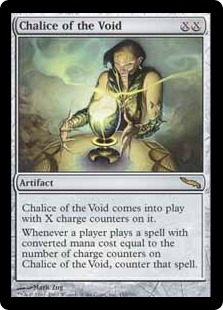
-4 Chalice of the Void

+1 Surgical Extraction
+1 Spatial Contortion
+2 Gut Shot

Gut Shot is great at removing Sakura-Tribe Elder as a blocker, and at finishing off Baloth, Titan, or Chandra in a pinch. Surgical can sometimes nab all the Valakuts in conjunction with Quarter, but another Spatial may be better.

Game 2, L (Draw; M 6 – M 6): After a round of mulligans, I slam a bunch of Eldrazi off Temple and disrupt my opponent's hand. Dismember takes out Obstinate Baloth and I attack him down to 1 life with manlands in play, but he rips Scapeshift on his final turn to steal the game.
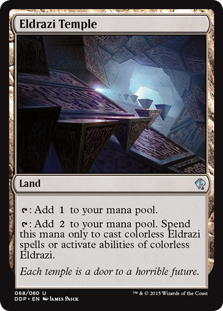
Game 3, W (Play; P 7 – M 6): I keep a seven with three Temples, Seer, and Reshaper, and soon draw a second Reshaper. My turn one Temple is chased by a second Temple and the Seer, which sees a bunch of lands and exiles Summoner's Pact. Next turn, I cast two Reshapers, and my opponent concedes when I attack him for 10.

Takeaways: Based on my encounters with Scapeshift over the last year, this matchup feels much better than I initially pegged it. As usual, the key to success lies in aggressively mulling for a certain kind of hand: Scapeshift requires a highly proactive one. I'd never keep a hand of five or more cards without Temple, Mimic, or Seer in this matchup.

Round 2 vs. Jund (2-1) draw

Game 1, W (Draw): My opponent leads with Raging Ravine tapped, and I play a Temple. Reshaper resolves next turn, and my opponent summons Dark Confidant. I Dismember the Bob and swing with Matter, which dies to a Lightning Bolt; it flips a second Temple, so in second main, I cast Thought-Knot Seer, seeing Liliana of the Veil, Scavenging Ooze, Swamp, Forest, Stomping Ground, and Bloodstained Mire. I take Ooze and play Smuggler's Copter for protection.

I crew Copter with Seer to save the 4/4 from Liliana, then play another Copter. Seer gets Pushed, but Copter starts activating each turn to hit my opponent down to 12, then to 9, then to 6. He concedes to a Smasher.
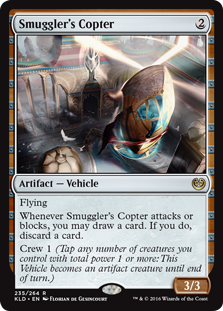
Sideboarding:

-4 Eldrazi Mimic
-4 Simian Spirit Guide
-4 Chalice of the Void
-1 Smuggler's Copter

+4 Relic of Progenitus
+1 Surgical Extraction
+3 Ratchet Bomb
+3 Spatial Contortion
+2 Gut Shot

Game 2, L (Draw): We trade resources for awhile and I establish Relic-Scourge. But I forget I have Scourge in play when his Bloodbraid Elf cascades into Tarmogoyf, and miss a crucial block (he casts four Elves this game). The mistake gives my opponent a narrow win some turns later.
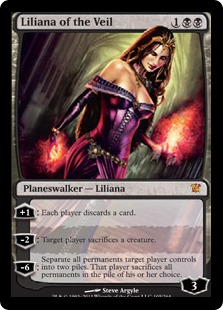
Game 3, W (Play; MP 6s – 7): I keep a one-lander with Temple-Relic and miss a land drop, but then rip one and cast Scourge from exile. My opponent's creatures eat kill spells in the meantime. I eventually let him keep a Scavenging Ooze, as the graveyards have been exiled. This is a longer game in which my opponent resolves 4 Liliana of the Veil (Seer crucially exiles a Liliana, the Last Hope). The walkers keep dying to Blinkmoth Nexus after minusing, and Mutavault is joined by Seer towards the end to close things out, trading with a reluctant Ooze.

Takeaways: My opponent apparently didn't have Assassin's Trophy in his deck, but I have played the Jund matchup a bit with it legal and hold that it's still a great matchup. Trophy ramps us into our big spells and Scourge turns, and they are usually forced to burn it on three-drops, Temple, or Relic anyway. One-mana removal spells are actually better against us.

Round 3 vs. UR Pyromancer (2-0) draw
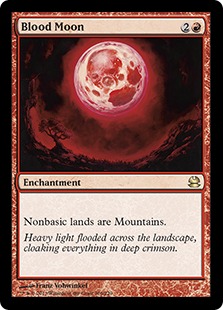
Game 1, W (Draw; MPPPPMMMMM 1ss – 7): I almost keep a six-carder with Gemstone and Scourge, but end up Powdering it. The other hands are clear Powders or ships; towards the end, they stop having lands. I end up with a one-carder of just Eldrazi Mimic and scry Smasher to the bottom.

Amazingly, my draw for turn is Eldrazi Temple, and instead of killing the Mimic, my opponent cracks Flooded Strand and casts Opt. On turn three, he casts Blood Moon, putting me another turn behind Eternal Scourge. I never draw Wastes and all four of my Powders are gone, so Seer, Reshaper, and Smasher rot in my hand all game.

Mimic gets Electrolyzed, and I make two more land drops to resolve the first Scourge. My opponent proceeds to cantrip through his deck and Remand the occasional spell as I attack each turn.

He's on some UR deck and seems stuck on four lands (two Islands), so I assume Through the Breach (or Cryptic Command) is on the way. Instead, he casts Pia and Kiran Nalaar, which I Dismember before the tokens can bounce my Scourges. Five mana merely yields Snap-Electrolyze and a Jace, Vryn's Prodigy, and my 3/3s get there.
Sideboarding:

-4 Eldrazi Mimic
-4 Simian Spirit Guide
-1 Dismember

+4 Relic of Progenitus
+3 Spatial Contortion
+2 Gut Shot

Game 2, W (Draw): I play a perfectly normal Temple game with a three-drop and a Seer, which just shows me two Islands when it finally resolves around turn five. My opponent cantrips some more and I get to Dismember a Young Pyromancer.

Takeaways: Always mulligan.

Round 4 vs. Humans (0-2) draw

Game 1, L (Draw): My opponent is Dylan Hand, who I consider among the most competent Humans pilots in Modern. As I already deem this matchup bad-to-close, I'm not optimistic about my chances, and Dylan doesn't disappoint.

I keep a solid Temple hand which he reads fluently with a pair of Meddling Mages, shutting down Seer and then Smasher (stranding three fatties in hand) after I cast Powder to bring myself to five mana. His Phantasmal Image copies Reshaper, and blocks mine to reveal Mantis Rider. Mayor of Avabruck makes the clock too fast for my late Dismember to matter.
Sideboarding:

-4 Simian Spirit Guide
-4 Chalice of the Void

+3 Ratchet Bomb
+3 Spatial Contortion
+2 Gut Shot

Game 2, L (Play): Another Temple hand from me, but with no removal. Instead, I have Mimic, three-drop, Seer, Smasher. In practice, this sequence doesn't beat the Hierarch, Champion, Lieutenant draw from Humans, and a double-exalted Rider again soars over my monsters after Meddling denies Smasher.

Takeaways: We should mulligan into removal post-board, especially since we keep Serum Powder. During almost every part of the second game, any kill spell would have turned things around. In my matchup analysis, I may have underestimated Meddling Mage.

Round 5 vs. Bant Spirits (2-0) draw

Game 1, W (Draw): I begin with Gemstone Caverns in play, exiling Scourge. Despite not having Temple, my hand curves out admirably, chasing Mimic with the Scourge and then Seer. For his part, my opponent fails to lead with a one-drop, which makes it impossible to race me. While swinging, I throw Dismembers at his guys on my end steps after he flashes them in, and a Smasher wraps things up.
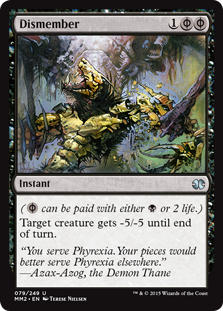
Sideboarding:

-4 Simian Spirit Guide
-4 Chalice of the Void

+3 Ratchet Bomb
+3 Spatial Contortion
+2 Gut Shot

Game 2, W (Draw): My opponent again misses his accelerant and patiently makes land drops to three mana, with me Gut Shotting his Rattlechains along the way. I kept a removal-heavy hand with Smuggler's Copter. Instead of slamming guys into the Spell Quellers, I animate Mutavault and hit with Copter a couple times, and my opponent flashes in Queller on my end step the second time I do. By then, I've looted twice, and promptly Dismember the Spirit. Next turn I run Seer straight into a second Queller, Dismembering this one as well to get a peek at the hand. I take Supreme Phantom, leaving a second one in the wings, and again crew and swing with Copter.

Phantom soon comes down with a twin regardless, but my Ghost Quarter destroys Mutavault and forces my opponent to chump Seer with his 2/4s.

Takeaways: No accelerant hurts Spirits enough that I think they mulligan low looking for one. The third Spatial is ridiculous in this matchup, as our removal snowballs just as their lords do. Gut Shot still the MVP.

Round 6 vs. Infect (2-0) play

Game 1, W (Play): Temple, Guide, Guide ramps me into a turn one Thought-Knot Seer, which strips Noble Hierarch. My opponent is left with Mutagenic Growth, Apostle's Blessing, Blighted Agent, Inkmoth Nexus, and Pendelhaven, and lacks a play turn one. I Dismember the Agent on his next end step and cast Smasher, attacking him down to 2. He goes to 1 fetching Dryad Arbor, draws, and concedes.
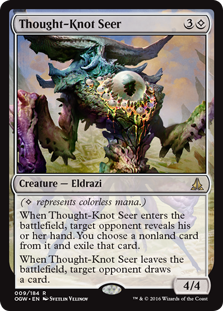
Sideboarding:

-4 Eternal Scourge
-2 Reality Smasher
-2 Smuggler's Copter

+3 Ratchet Bomb
+3 Spatial Contortion
+2 Gut Shot

We don't need Eternal Scourge because our mana's quite limited in this matchup, so we're happy to merely cast what we draw. Pump spells otherwise blanked by Chalice can also become Vapor Snags against Scourge. Copter comes out for a similar reason: we can't afford to constantly deploy threats for crew.
Game 2, W (Draw): My opponent leads with Hierarch, and I respond with Temple, Mimic. He drops another Hierarch and an Inkmoth Nexus. I swing and hold up removal, but end up letting through 4 Poison in the air. I fail to make a third land drop, swing, and pass again. He boots up the Inkmoth and casts Might of Old Krosa in the main phase. I respond with Spatial Contortion, which meets Blossoming Defense. Spirit Guide exiles for R and I Dismember it, winning the counter-war; my opponent hits for 2 with Hierarch and passes. I cast Reshaper and beat my opponent to death with that and a Mutavault, finally making my third land drop on turn six or so.

Takeaways: This matchup is as good as ever. The kill spells we play for Humans and Spirits are simply insane alongside the free win dimension of Chalice of the Void. Ratchet Bomb and Ghost Quarter don't hurt, either.

Round 7 vs. UW Control (1-2) play

Game 1, L (Play): I lead with Temple and then Eternal Scourge, following that with Matter Reshaper. My opponent blind-rips Terminus and tucks my team. I tap out for two more Reshapers, but they eat Detention Sphere. Clique and Jace come down and I scoop.
Sideboarding:

-4 Simian Spirit Guide
-4 Serum Powder

+4 Relic of Progenitus
+1 Surgical Extraction
+1 Ratchet Bomb
+2 Gut Shot

Further testing has led me to refine my sideboard plan for UW, now keeping Chalice to turn off Opt and Path. With those cards out of the picture, we can force opponents into pricey sweepers on our own terms. Powder comes out because we're likelier to draw many copies in longer games, and want to be drawing bodies.

Mid-round deck check race, W (Sunshine Airport): The judge denies my opponent a chance to use his cell phone, but grants us the ability to use the Switch. Things are a little rocky for me at first as I adjust to 100CC physics, and I drive into a couple crates and bananas. My opponent even passes me at one point and seems relatively unfazed by two straight Shocks. But then I get my bearings and Baby Peach ends up out-speeding Wario by a full four spots, with my opponent spinning into 5th just as our decks are returned.

Cyber Slick wheels were mostly a meta call.

Game 2, W (Play): My opponent again gets an early 2-for-1 with a blind Terminus, but I feel more in control with sideboard cards in the picture. I end up grinding him out the Eldrazi way: carefully deploying one Chalice at a time; committing creatures to the board so as not to pack it in to board wipes; nerfing planeswalkers with Mutavault and Copter. Seer's able to snag a Crucible of Worlds, and I end this long game with plenty of fatties in hand.
Game 3, L (Draw): This time around, I single-handedly lose the mid-game slog to a resolved Crucible, which my opponent uses to Field of Ruin me about six times. Lyra Dawnbringer resolves minutes away from time, and my first Dismember is Negated; the second one goes through, but a follow-up Baneslayer Angel spells my doom.

Takeaways: I still feel okay about this matchup, although it's by no means our easiest. We can answer what UW throws at us, and attack them with decent power from different angles depending on the game stage. My opponent had some amazing Terminuses, I made a few critical misplays in our last game, and Crucible of Worlds is a beating when we're riding on a grind plan. Sorcerous Spyglass was also sorely missed this round, as it would have answered both planeswalkers and Field.

Kelsey, on Counter-Cat, had also been 5-1 heading into this round. Unbeknownst to any Regionals players at the time, us x-2s would wind up just out of Top 8 contention.

Round 8 vs. Traverse Shadow (2-0) draw

Game 1, W (Draw): After I exile a land to Gemstone Caverns, my opponent plants Verdant Catacombs and passes the turn. I go for Chalice on 1, which meets Stubborn Denial, and pay with Simian Spirit Guide. From there, Matter Reshaper keeps Tarmogoyf from attacking, as my opponent's low on life from trading swings and cycling Street Wraiths; I end up winning with Blinkmoth pecks while sandbagging Reality Smasher.
Sideboarding:

-4 Eldrazi Mimic
-4 Simian Spirit Guide
-4 Serum Powder

+4 Relic of Progenitus
+1 Surgical Extraction
+3 Ratchet Bomb
+2 Spatial Contortion
+2 Gut Shot

Just about all our hands are good post-board, and we want the games to go long, so Powder gets the axe for removal spells. Combined with Relic, these all take out Tarmogoyf, and they help kill a Shadow otherwise.

Game 2, W (Draw): Turn one Inquisition of Kozilek sees Reshaper, Bomb, Seer, Zhalfirin, Mutavault, Copter, and Chalice, which it takes. Bomb comes down and trades for two Goyfs after I take a huge hit down to 9 life. My opponent rushes out a 3/3 Death's Shadow to keep the pressure on, but I hit it with Spatial Contortion and then target it with Surgical Extraction on his draw step. He can never out-field me after that.

Takeaways: Shadow's only real out is to rush out multiple huge guys and kill us, maybe with Temur Battle Rage. That's quite hard for them to do, as they lose to most of our cards post-board, especially Chalice, Relic, Bomb, and Scourge.

Round 9 vs. Jeskai Saheeli (2-1) play

Game 1, W (Play; P 7 – 7): Temple and Guide give me turn two Seer, which sees Path, Lightning Helix, Field of Ruin, Suflur Falls, Glacial Fortress and Saheeli Rai. I take the Path, and then cast another Seer to take Saheeli (by now, my opponent's drawn a second copy). Temple eats Field of Ruin, so I cast Reshaper next, but Smasher's not too far behind, forcing a last-ditch chump block with Felidar Guardian.
Sideboarding:

-4 Eldrazi Mimic
-4 Simian Spirit Guide

+4 Relic of Progenitus
+2 Ratchet Bomb
+2 Gut Shot

Game 2, L (Draw; P 7s – 7): I build a big board and strip my opponent of resources, eventually coming to a critical turn in which I know his two-card hand of Saheeli and Guardian. Since I have Dismember in hand and my opponent's on just four lands, I feel confident that he has no outs to my board. So I make a big attack, tap out to cast Powder and Scourge, and say "go" without playing my land for the turn. He combos me and I lose.

Game 3, W (Play; PM 6 – 7): Temple lets me drop a bunch of Nacatls and I handily race my opponent, with Dismember taking out a Wall of Omens.

Takeaways: I felt like I won all three games this round and am not sure how we could ever lose a match (given an awake pilot). Gut Shot and Dismember are way too good at disrupting the combo, and we don't need to play around sweepers.

Number CRUNCH!

Despite my lack of practice, piloting Colorless Eldrazi Stompy after all those months felt like riding a bike. And the deck itself impressed me, too: I did not expect it to be nearly as strong given how much better Modern's become at doing what we do, AKA putting large dudes into play quickly. Another Colorless player even ended up in 5th at the same event. Although I didn't face many dedicated graveyard decks, I think mainboard Chalice is still excellent, and wouldn't trade it for Relics.
Going forward, I'd like to swap a Blinkmoth and the last Grounds for two more Mutavaults. These should help in the control and combo matchups. There are fewer small fliers around without Signal Pest, and our fair matchups already seem fine without Grounds. We also have more cards in the side right now to fight small creatures and graveyard decks, respectively, and I'd like to keep it that way until I have a chance to at least cast Ravenous Trap once.

As for the players continuously putting up 5-0s with the deck, I see you! Perhaps I'll even score a 5-0 of my own one of these days. Until then, keep on flying that colorless flag!


Lessons from Buying for My Online Store

Are you a Quiet Speculation member?

If not, now is a perfect time to join up! Our powerful tools, breaking-news analysis, and exclusive Discord channel will make sure you stay up to date and ahead of the curve.

Today’s article is going to cover some lessons I’ve learned since ramping up my online store’s inventory. Up until March of this year, I was selling mostly cards I had speculated on or picked out of collections, extras that I’d acquired, or cards that had spiked on MTG Stocks. However, I decided in March to take things to the next level and specifically start buying cards for my online inventory.

The first step was determining a method for pricing cards I was going to buy. Obviously, I couldn’t pay retail, but at the same time, I needed to be competitive with other online stores and LGSs. Before buying a card, I needed to have a good understanding of exactly how much I’d recoup off of a retail sale, so I needed to gather all my costs.

After understanding what I’d actually get after covering all fees and shipping costs, I could then look at additional factors that affect a card’s price, predominantly the condition. I added a column to my buylist that includes a factor for card condition (as I’m not going to pay the same for an HP card as I would a NM copy).

Lastly, I set a desired “profit” per card, as without this I’m wasting my time. The next step was deciding how much I was willing to “invest” into my store inventory. I decided to start somewhat small and set a modest $500 goal.

There was an error retrieving a chart for Bazaar Trader

With all this completed, I started buying cards on March 4th. By having my buylist calculator as a Google Sheet, I was able to track all purchases, and then move each card, date of purchase, and price of purchase to a master sheet to track my overall buys. Note that while I used my buylist for local purchases, I also bought cards on Facebook when the sale price seemed like I could turn it into a profit. Here we hit my first pitfall.

Always Run the Numbers First

There was an error retrieving a chart for Enchantress's Presence

I purchased a playset of Enchantress's Presence for $26.50 (I always include any shipping costs in my purchase) on March 12. The TCGplayer Market Price at the time was $10.30, and this was a card I often had requests for from local Commander players, so I figured they would be an easy sell.

I have since sold three of the four, but after fees and shipping costs, haven’t recouped my initial investment. The three sales only made a measly 11-percent profit.

Since that time, it was reprinted in one of the Commander 2018 decks and the average price dropped, though honestly not as far as I’d expected. However, it seems that the Commander reprinting has satiated what demand the market has currently, and I’ve dropped my price to the point where I’m just trying to break even now after fees and shipping costs. I purchased these cards because I thought they’d be an easy sell, but I didn’t run the prices through my buylist calculator.

It’s Business, Not Charity

There was an error retrieving a chart for Leyline of Sanctity

In late March, one of my friends lost his job and was trying to free up some cash by selling some of his Magic cards. He saw my post and approached me with a decent-sized list of cards he was looking to move. I set my profit-margin goal lower than usual to help make sure I gave him good numbers. I spent almost $270 buying up a decent amount of Modern staples from him, and I still haven’t broken even.

Don’t Speculate

There was an error retrieving a chart for Raging Ravine

On May 30, I purchased two Raging Ravines for $11.40 each, and on June 18th I purchased four Wooded Foothills at $15 per copy. At the time, I was expecting Jund to see a resurgence in popularity, though I honestly don’t remember exactly why. The buy prices were around 80 percent of the TCGplayer Market Price, but the retail price on both was a few dollars more. Thus, if I was able to sell closer to the average price, I’d make a solid 40-percent profit margin.

I speculated that with any rise in demand from Jund, both cards would move upward, flat-out ignoring the pretty constant downward trend Raging Ravine was showing (and still is).

I realize that this guideline seems quite counter-intuitive for a site that is rather dedicated to speculation. I'm not saying don't speculate ever—I’m saying don’t speculate with store inventory, unless you want to assume additional risk with regards to running a business.

Buying Into the Hype Doesn’t Always Pay Off

There was an error retrieving a chart for Oppression

On August 12, I saw on MTG Stocks that copies of Oppression were spiking. Very few copies could be found on TCGplayer, and none for the old price. I started searching for other online stores and located eight copies at the “old price” from a single vendor (to keep shipping costs down). I purchased all eight and then relisted them when they arrived.

On average I have $1.73 invested per copy, and despite the fact that the current TCGplayer Market Price is $6.83 and the median price is $7.01 (for Urza’s Saga copies), there are copies available in the $4.50 to $5 range that aren’t selling. This implies a buyout with no real demand to back it up (hence why copies considerably below the market price still aren’t moving).

Foreign Really Is Harder to Move

Earlier this year in April, Star City Games had a big foreign card sale and a lot of Commander staples were priced way below their English counterparts. I purchased a significant amount (a little under $200 worth) for my online store. I’ve actually sold enough of that inventory that I’m slightly ahead by around $16.50, and still have some of that purchase in my inventory.

There was an error retrieving a chart for Kruphix, God of Horizons

So with some moderate success after that purchase, I made another large purchase from Hareruya Games on August 20 totaling $104. Specifically, I purchased 12 copies of Kruphix, God of Horizons, two of Tamiyo, the Moon Sage, and two of Argothian Enchantress, all in Japanese.

In over two months, not a single card from this buy has sold. This despite having cut the price to the lowest on TCGplayer on multiple occasions, and despite the English version of Kruphix actually seeing price increases during this timeframe.

I think the biggest difference between these two purchases was that the SCG one involved a lot of different cards, as opposed to multiple copies of a few cards. While my SCG purchase was about twice as much money, this allowed me to spread my inventory dollars around. I might miss out on making a larger profit if one of the cards spiked, but I also reduce my risk if one of the cards ends up getting reprinted or demand otherwise drops.

Realistic Profit Margins

This experience has also forced me to reign in my expectations for profit margins on Magic cards. For a few years, we would see cards grow in price rapidly and by very large margins, and it wasn’t surprising to reap a 150-percent profit margin on a decent speculation target. However, when it comes to store inventory, that kind of margin is much rarer. I’m perfectly happy when a card I bought for $10 sells for $15 (after fees), netting a nice 50-percent profit margin.

It’s also important for us to remember that in many other industries, profit margins are typically much lower even than that (in many, a 10-percent profit margin is exceptional). This is important because if you try to buy with 100-percent-or-better profit margin expectations, then your buy price will tend to be extremely low and noncompetitive.

Conclusion

I learned a lot of lessons buying cards for my online inventory over the year, and I hope that my pain can be your gain. Don't repeat my mistakes. If you have any mistakes or tips of your own you'd like to share, please comment below.

The Significance of Monday’s MOCS Announcement

Are you a Quiet Speculation member?

If not, now is a perfect time to join up! Our powerful tools, breaking-news analysis, and exclusive Discord channel will make sure you stay up to date and ahead of the curve.

On Monday there was a Magic Online announcement that outlined plans for its marquee event, the Magic Online Championship Series (MOCS) in 2019. The announcement has some major financial implications. Today I want to dig into exactly what it all means for Magic and the market, from the immediate impact it's already had to what it means for next year and beyond.

The MOCS has been the highest-level competitive event of Magic Online since 2009, so if nothing else, the simple fact that the series will continue into next year cements Magic Online as a major part of Magic’s competitive digital presence—any death knells for the program have been unwarranted, or at least premature. There has been a lot of hype over Magic Arena lately, and in turn discussion about Magic Online’s future, which many consider very bleak; but with MOCS events now scheduled into January 2020, it’s not going away anytime soon.

A few weeks ago I went into detail about my thoughts about the future of MTGO, and this news only makes me more optimistic. The announcement should build confidence in the Magic Online market. I expect the trend of players exiting in favor of Magic Arena to slow and in fact turn around, and I expect to see growth as more players join. Magic Arena is introducing new players to Magic, and bringing existing Magic players to a digital platform for the first time, both which will inevitably create some number of new Magic Online players. So the rising tide from Magic Arena may actually buoy Magic Online.

The finer details of the announcement is what really has people excited. The MOCS has always been comprised of qualifier events throughout the year, culminating in a championship for thousands of dollars in prize, essentially a mini-Pro Tour. That’s not changing, but new for 2019 is the addition of Format Championships in Modern, Legacy, Vintage, and Pauper, each of which will invite one player to the championship to compete for the top prize.

New Formats in the Spotlight

Qualifying for these championships means playing Leagues and Challenges in their respective format throughout the year. Because all the MOCS championship players also receive an invitation to the Pro Tour, this means that one can now technically make it to the Pro Tour playing nothing but their preferred format. This fact has players going wild, and it sent the market into a frenzy right after the announcement.

Vintage

There was an error retrieving a chart for Black Lotus

The main buying target has been the Power 9, all of which saw their prices spike significantly on Monday after the announcement. Most pieces nearly doubled in price, some nearly tripling. These had all essentially been slowly depreciating since printing and were at all-time lows, so given how cheap they were it’s not surprising so many people bought in.

Prices have fallen back considerably, with their net growth over the week now in the 50-80% range, so there were definitely speculators at play. But there’s also some real demand. As the week developed more staples of the format started to rise, including Bazaar of Baghdad and Mishra's Workshop, which has now nearly tripled in price this week, but is still barely over a ticket.

Vintage is a complete bargain on MTGO, with Black Lotus sitting just under 30 tickets (up from 16 on Sunday), and that’s attractive. The new MOCS season starts December 5th, just a few weeks from now. I expect demand to slowly build until that date, at which point players can start grinding points towards the Vintage championship, so the market should surge in December and into the new year.

Pauper

There was an error retrieving a chart for Standard Bearer

The announcement is most significant for Pauper, which will now receive some serious online support. Being added as one of the MOCS formats means Competitive Pauper Leagues will be also added to the program’s offering, where there were previously just Friendly Leagues.

The announcement warned that competitive queues could be removed if they ruin the metagame and the health of the format, but I don’t expect that to happen. The format is already plenty competitive, and the metagame well developed for over a decade, so I don’t see it suddenly just breaking down.

What I do see happening is the changes catalyzing further interest in Pauper, which means more growth. Wizards is further helping support awareness of the format by including occasional Pauper events on Magic Arena. The days of the fabled Pauper Grand Prix could actually be upon us.

Pauper has seen modest growth on some staples since the announcement. It's nothing rivaling the massive Vintage growth, but there is clearly some renewed vigor in the market. There’s likely more growth ahead, and new players entering paper Pauper may start those cards moving too.

Legacy

There was an error retrieving a chart for Underground Sea

Legacy being included as a MOCS format is also a boost to that format, which sees relatively little support from Wizards because it includes Reserved List cards.

It hit the spotlight as part of Pro Tour 25th Anniversary in August, and has also been bolstered by SCG Team Open events. But this addition of another competitive Legacy event to the calendar will ensure it lives on strong for at least a year longer.

Modern

There was an error retrieving a chart for Horizon Canopy

Modern will also have a format championship, so it too will be bolstered by the announcement. There have been some small movements in the market this week. However, it seems that the bigger factor for that is the release of Ultimate Masters reprints, not necessarily the MOCS announcement, which makes sense since Modern is already so popular.

What is interesting about the selection of Modern is that it rounds out the selections with another Eternal format. What is left off is Standard, and that’s significant because Standard is very much the realm of Magic Arena. It appears that Magic Online is being set-up as the place to play non-Standard constructed Magic, to live in harmony with Magic Arena’s Standard.

MTGO Still Going Strong

With Magic Online receiving a bad rap lately, or at least being discounted in the face of Magic Arena, this announcement was a huge vote of confidence in the program from Wizards, and the market is responding. Prices across the board have been slumping and cards can be had at bargain prices, so now seems like a great time to move in and invest on the platform, at least for the 2019 horizon.

-Adam

Want Prices?

Browse thousands of prices with the first and most comprehensive MTG Finance tool around.


Trader Tools lists both buylist and retail prices for every MTG card, going back a decade.

Quiet Speculation