
menu

Daily Stock Watch – Seedtime

Are you a Quiet Speculation member?

If not, now is a perfect time to join up! Our powerful tools, breaking-news analysis, and exclusive Discord channel will make sure you stay up to date and ahead of the curve.

Hello, readers and welcome to a new week of the Daily Stock Watch! It's my first year anniversary with Quiet Speculation, and I do hope that we would be in for more together as we continue our financial adventure with our favorite card game. For today's segment, I would be featuring a card that just made a huge financial spike overnight which isn't really quite surprising for cards that are only legal in casual formats. Nonetheless, is it a good idea to jump the hype train for this one?

There was an error retrieving a chart for Seedtime

The mechanic "extra turn" and the word "expensive" usually belong in the same sentence, and we're used to seeing extra turns in blue cards and some occasional red cards so a green card that basically allows you to Time Walk for two mana is huge. How come this card has been worth only $2 after all this time? Why aren't there any reprints of it or inclusions in a supplemental set? I guess we should be able to figure this one out today.

Time Walking Without Blue

As you can see above, there aren't to many options outside of blue for taking turns without facing dire consequences for not winning on that extra turn, or without fulfilling certain conditions just so you could take the extra turn. Seedtime is a conditional card that you could only activate if an opponent casts a blue spell on your turn, and this is something that's worth exceptionally a lot when you're playing competitive EDH. Having one of your spells intentionally countered to set this up and go big on the extra turn is an awesome way to steal games from unsuspecting opponents. Although this card is Vintage and Legacy legal, there's just not enough leg room to abuse it in those formats but you could almost always expect blue to be present in Commander games. The jump to its new all-time high of $11.60 is surprising, but it looks pretty promising going forward. I don't see this getting reprinted anytime soon even if we take into consideration the fact that it was last printed in Judgment, so I would be hedging my bet on this one as a short term spec if we could still get it for a profitable price.

At the moment, we still have a shot at 40 remaining copies (played) of Seedtime via StarCityGames, while some vendors via TCGPlayer has it at $7.30 and that's for moderately played copies. Card Kingdom is already out of stock, and it should remain that way for the time being while the market stabilizes. Foil copies are already at a premium prior to this spike, and I do think that Judgment foils are hard to acquire anyway. If you could get your hands on the remaining copies via SCG, you're in for a treat on a short to mid-term basis. They should be easy to sell for under $10 if there will be demand for it. Foil copies should be a steal at $15 and less and should be very hard to get but would be easier to sell this time. This is one of those specs that could net you big gains pretty quick!

And that’s it for today’s edition of the Daily Stock Watch! See you again next time, as we check out a new card that should be on the go, or good enough for speculating. As always, feel free to share your opinion in the comments section below. And if you want to keep up with all the market movement, be sure to check in with the QS Discord Channel for real time market information, and stay ahead of the hottest specs!

Insider: Ten Underappreciated Reserved List Cards

Are you a Quiet Speculation member?

If not, now is a perfect time to join up! Our powerful tools, breaking-news analysis, and exclusive Discord channel will make sure you stay up to date and ahead of the curve.

It’s evident the Reserved List hype of 2018 has come to an end. Not long ago the Interests page on MTG Stocks was lit up with Reserved List cards, many of which doubling or tripling in price overnight. Nowadays we see virtually no movement on these cards.

But I don’t think this means Reserved List speculation is over for good.

In fact, this may be an opportune time to acquire strategically. But buying on the dip isn’t a new idea to anyone—everyone should be aware that buying when others are fearful, and selling when others are greedy, is a good strategy. Instead of harping on this, I want to get specific this week.

There are a handful of under-the-radar Reserved List cards that may be worth checking out. You don’t need to buy these today. Or next week. Probably not even next month. However, when that next batch of buyouts begins, the cards on this list may have a moment to shine. Having a couple playsets of these may not be such a bad idea, and you never know when you can spike a Card Kingdom buylist and make a few extra bucks.

Without further ado, here’s a list of ten underappreciated Reserved List cards. (Shout-out to Kelly Reid for this article idea!)

10. Reflect Damage (Mirage)

There was an error retrieving a chart for Reflect Damage

Are you tired of playing against the Commander player who throws numerous enchantments and equipment onto an unblockable, untargetable creature, then launches lethal attacks at one player at a time? Do you face opponents who create infinite mana combos, destroying their opponents with a giant burn spell? If so, then Reflect Damage may be for you.

Its mana cost is a bit steep, but in Commander this rarely matters. This card is likely not well known, and would be a fun surprise to spring on your opponents. This one may never hit $10, but it’s under a buck and that seems like a bargain for a playable Reserved List card from Mirage.

9. Triangle of War (Visions)

There was an error retrieving a chart for Triangle of War

There are other cards that do the same thing as Triangle of War. There’s even a keyword now that simplifies its effect: fight. That said, this is a useful effect on a one-mana artifact. That means it can be tutored for with Trinket Mage. It’s not going to win you many games, but being on the Reserved List and from Visions means this card will one day be worth more than its current sub-$1 price tag.

8. Phyrexian Negator (Duel Deck Foil)

There was an error retrieving a chart for Phyrexian Negator

This card isn’t the powerhouse it once was back in the day. I don’t think it’s going far out on a limb to say it’s not really too playable nowadays. Despite that, this is still a foil Reserved List card. The Judge Promos admittedly look better, but those are basically gone from TCGplayer, with the lowest listing at $125.

Meanwhile you can get a handful of the Duel Deck printing for under $0.50. Is the Judge printing 250 times cooler and rarer than the Duel Deck printing? I wouldn’t doubt it. But someone may catch on someday that the card is on the Reserved List, and the Duel Deck foil printing is worth speculating on.

7. Dwarven Thaumaturgist (Weatherlight)

There was an error retrieving a chart for Dwarven Thaumaturgist

Thaumaturgy: the capability of a magician or a saint to work magic or miracles (Wikipedia). This Reserved List card was color-shifted in Planar Chaos, but you’ll never see the original printed again. It’s a pretty unique effect in red, and can serve many dastardly purposes in Commander. It is also the classic partner to Sorceress Queen. Does this card belong under $0.50? I’m not sure, but I would wager not.

6. Hakim, Loreweaver (Mirage)

There was an error retrieving a chart for Hakim, Loreweaver

My favorite aspect of this card is the oddly lowercased “h” in Hakim. I would have thought this was a proper noun, Hakim being a name, but what do I know? This is such a bizarre card from Mirage that even if it weren’t on the Reserved List I don’t think it’d ever see a reprint.

It’s not played much in Commander, but how cool would it be to marry with Eldrazi Conscription or some other busted Aura? Its effect is unique and being able to recur enchantments for repeated come-into-play triggers could be breakable one day. I’d keep this on your radar.

5. Ebon Praetor (Fallen Empires)

There was an error retrieving a chart for Ebon Praetor

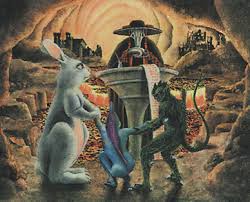
Okay, this card has a giant bunny in the artwork. Do I need to say more? Probably. How about the fact that this card creates the need to keep track of -2/-2 and +1/+0 counters? I once thought about how weird it would be to make a deck that created as many unique power/toughness altering counters as possible to maximize confusion among your friends.

It’s a stupid idea, but if this thought caused you to brainstorm other unique counter-generators, then go out and buy a few playsets of Ebon Praetor. These are dirt cheap anyway so why not?

4. Tainted Specter (Mirage)

There was an error retrieving a chart for Tainted Specter

This specter doesn’t have the power level of Hypnotic Specter, but it has some unique advantages in the right setting. The key is that this card lets you mess with your opponent’s hand without having to damage them—fairly different from most specters. You get the added bonus of either forcing your opponent to draw a card they already had in hand or else doing one damage to each creature and player.

I don’t understand why this is the chosen effect on the card, but there you have it. A very odd combination of abilities on a Reserved List card—add in a cool piece of art—and you have a card worth picking up.

3. Earthlink (Ice Age)

There was an error retrieving a chart for Earthlink

The casting cost on this one is quite prohibitive, I’ll admit. I checked EDH REC and this card sees virtually no Commander play (though it could slot in Xira Arien nicely). You also don’t make many friends when forcing players to sacrifice lands.

But with all that said, the most creative of mana-denial fanatics may be able to build a deck that breaks this card. It would take a lot of work, but it basically gives you a recurring land-destruction effect, and that can be quite dangerous. Keep this on your radar, or better yet go grab a few playsets for a couple bucks and throw them in a shoebox for a year or two.

2. General Jarkeld (Ice Age)

There was an error retrieving a chart for General Jarkeld

This is such a cool effect on a legendary creature. I mean, it’s a billion times better than Sorrow's Path, right? There isn’t a surprise component since this is a combat trick that must be in play, but it can really mess with combat.

Just like many of the other cards on this list, this is unplayed in Commander. But I think that is in error. There must be ways to abuse this card. It doesn’t make the most interesting general, but it will certainly give you many political levers to pull in multiplayer games. I think this card should be worth far more than where it is now.

1. Jabari’s Influence

There was an error retrieving a chart for Jabari's Influence

How many ways can you permanently take control of an opponent’s creature when you’re playing white? Probably very few, but this is one of them! It’s awkward that combat must take place first before you can cast this card. But casting this card in a game will likely earn you “biggest surprise play.” It’s steep to hold up five mana, but I love the blowouts this card can achieve when playing it at the end of an opponent’s turn, stealing their most powerful creature. Then you can untap and go to town.

Don’t forget this effect doesn’t end at the end of turn and it’s not an enchantment. Your opponents can’t just Disenchant something to get their creature back. They’ll need to be far more creative.

Oh, and one other thing: according to a post I read on MTG Gatherer, this is the only card that ever used -1/-0 counters. You know, just in case you were going to build that confusing counter deck I told you about before.

Wrapping It Up

The Reserved List has been covered ad nauseam, most especially by me. However I’d wager these cards have received virtually no attention from the MTG finance community. That’s about to change. I wouldn’t encourage you to go out and buy dozens of copies of these cards, mind you. You’ll have the worst time trying to move them. I also despise market manipulation. But these cards do useful things, often outside the traditional color pie. For the reasons presented, they really do merit consideration.

For full disclaimer, I own zero copies of every card mentioned on this list. I’m not trying to hype up cards I’m speculating on. I probably won’t even purchase any immediately after this article gets published. There’s little reason to rush—the market is soft right now and that won’t change in the next couple months.

However, I will definitely keep these in mind in the future and will eventually pick up some copies while they’re still cheap. The opportunity cost is minimal and, as we’ve seen with Reserved List cards in the past, the upside is significant.

Sigbits

  • Arabian Nights City of Brass is back on Card Kingdom’s hotlist, although their $265 buy price isn’t best in class. It’s also not their best price ever. But maybe if they don’t get more copies in, they’ll bump the price up again. I have a spare HP copy and if they go back to over $300 on their buyprice, I just may ship them the card (which, ironically, I acquired from them months ago for a bit less).
  • A few Legends cards are reappearing on Card Kingdom’s hotlist, and their numbers are slowly climbing. Perhaps this reflects the beginning of the end of the softening on Legends. For example, Concordant Crossroads is up to $70 and Divine Intervention is at $46. These are both fairly strong numbers, and maybe they’ll climb higher.
  • Collectors’ Edition cards aren’t talked about as much these days after their prices jumped through the roof. But I do see Mana Vault from the set on Card Kingdom’s hotlist at $49. It still amazes me people will pay so much for cards they can’t use in tournaments. But as I’ve said before, this just reflects the popularity of Old School and Cubes where these cards can be played.

The Worst Reserved List Cards (That You Might Still Buy)

Are you a Quiet Speculation member?

If not, now is a perfect time to join up! Our powerful tools, breaking-news analysis, and exclusive Discord channel will make sure you stay up to date and ahead of the curve.

These are the Reserved List cards that have increased the least in value over the last two years.

They are horrible. The art kind of sucks. Most of them are from Homelands.  (Fallen Empires was better than you think).

May I present to you...

The worst cards they'll never print again!

Each card has been rated for Playability and Aesthetics.  Rather than fabricate some kind of idiotic 1-10 system, I've elected to use colorful adjectives and mild praise (where appropriate).

Editor's Note:  This article was originally meant to serve as an internal proof-of-concept for "data-driven" content on QS.com - articles built around reports built atop our six-year historical price database.  This was not supposed to see the light of day, but we decided it was actually worth publishing, just for fun.

There was an error retrieving a chart for Typhoon

Playability: Laughable, but style points if you kill someone with this in Commander.

Art: Pretty cool, in an old-school way.  Anson Maddocks is timeless.

Verdict: Skip it unless you want those Commander style points.

There was an error retrieving a chart for Autumn Willow

Playability:  Pitiful.

Art: Confusing.  Is it the tree?  Is it the lady?  Is the lady actually a tree?  Or the other way around?  Who cares?

Verdict: Make like a tree and leave.

There was an error retrieving a chart for Phyrexian Negator

Playability: Borderline, actually.  It's a big body for a low cost, and there are decks that can abuse it's drawback!

Art: SO. METAL.  Literally.  It's a foil card.

Verdict: Actually, I'd buy these.  A Duel Deck foil on the Reserved List with unique art that's marginally playable?  At this point, given the fate of other RL cards, heck, sign me up.

There was an error retrieving a chart for Leeches

Playability: I mean, I guess there's a place for this somewhere? Maybe? Why did they even print this?

Art: Mundane and overly literal.

Verdict:  If you can kill someone with this in Commander...

There was an error retrieving a chart for Baki's Curse

Playability: At first I thought, hey, an answer to Bogles.  And then I realized that for 4 mana they also printed Wrath of God.

Art: I have literally no idea what this is supposed to represent. I see a fish, a beetle, and a carrot.

Verdict: Baki's not the only one cursing, here.

There was an error retrieving a chart for Grandmother Sengir

Playability: Showing its age.  Power creep is a real thing.

Art: Fantastic, like everything Pete Venters does.  Except...a book?  How terrifying.

Verdict: Ancient history.  Homelands at it's finest.

There was an error retrieving a chart for Zephid

Playability: Untouchable.  And, aren't Illusion creatures supposed to die when targeted? Not be all shroud-y?

Art: Not as hideous as the flavor text would imply, nor as illusory as its creature type would lead you to believe.

Verdict: Spells aren't the only things staying away...

There was an error retrieving a chart for Aysen Highway

Playability: Devastating in those mono-white mirror matches where the late game is all about board stalls.  Which is never.

Art: Is the highway the thing the horse-rider is standing on?  Because it's higher than the gray line which I assume is meant to represent a road.

Verdict: If given a choice between this, and my way...well, you know what I'll pick.

There was an error retrieving a chart for Balm of Restoration

Playability:  I can see a format where this is useful.  No, seriously.  It's not a format I'd ever play, but its base stats don't fully suck.

Art: Not sure what Marie Antoinette is doing here, but it's an upgrade from "let them eat cake".  Fun Fact: "cake" is incorrectly translated; she was saying "let them eat bread".  Cake sounds OK.  Bread? boring.  But, I digress.

Verdict: Cake's fine.  Bread? Nope, that'll start the French Revolution.

There was an error retrieving a chart for Marjhan

Playability:  I don't even know where to start here.

Art: You know "Scale Birds"?  The little birds they paint into the sky to show how BIG something is?  Well, let me introduce you to the Scale Whale.  Otherwise, you'd just think this is a really toothy fish of indeterminate size.

Verdict: I'm still struggling to pronounce this card's name.

There was an error retrieving a chart for Elven Lyre

Playability: See Balm of Restoration.  There's a format where this is actually a legitimate on-board trick.

Art:  Cute, in the way that only Kaja Foglio art can be.

Verdict: I wish this was a card that involved guessing and hidden choices, not a musical instrument.

There was an error retrieving a chart for Mammoth Harness

Playability: If this cost 1 mana, it'd be a really good card. But it costs 4.  "Last Strike" is pretty funny though.

Art: It's a harness on a woolly mammoth featuring Melissa Benson's obnoxious signature in the background.

Verdict: Show some restraint when thinking about buying these out.

There was an error retrieving a chart for Goblin Flotilla

Playability: Gray Ogre got an...upgrade?  Downgrade?  The fact that I have to think about this at all tells me what I need to know.

Art: Good old fashioned 90's fantasy goblins.  Wish it were on a better card.

Verdict:  The flavor text redeems this card in full.

There was an error retrieving a chart for Exalted Dragon

Playability: Should have cost 4 mana.  Maybe 3.   But 6? Why?

Art: Matt Wilson has drawn some amazing things for Magic.  This isn't one of 'em.

Verdict: Don't get greedy.

There was an error retrieving a chart for Avenging Angel

Playability: Borderline, especially in low powered formats.

Art: Remember what I said about Matt Wilson?  Yeah.  Matt, let's stick to drawing pretty ladies and leave the dragons alone, k?

Verdict: Worth owning, since eventually some yahoo is gonna buy out the internet because "hey, it's an angel on the reserved list".

There was an error retrieving a chart for Herald of Serra

Playability: You know when they seem to just put keywords on cards to show off the new keyword?   Isn't that annoying?  Well, it's ten times worse when the new keyword makes everything cost double mana.

Art: Matt Wilson, pretty Angel ladies, you know the drill by now.

Verdict: See Avenging Angel, above.  Sigh.

There was an error retrieving a chart for Heart Wolf

Playability: Before there was equipment, there was Heart Wolf.  Luckily, now we have equipment.

Art: There appear to be two wolves here.  This is far from my only critique, but I'll leave it there.

Verdict: They give wolves, a bad name.

There was an error retrieving a chart for Reveka, Wizard Savant

Playability: Someone in your play group will try to find a way to make this work.  Show them why Prodigal Sorcerer is better in every way.

Art: She looks mildly annoyed that a giant dragon is about to murder her.  Respect for that much courage under fire.  2 damage isn't going to get the job done.

Verdict: For a Wizard Savant, doesn't seem to savvy.

There was an error retrieving a chart for Homarid Shaman

Playability: Take THAT, Tarmogoyf!   This would be brutally oppressive against a mono-green deck, aside from the fact that you'll be dead before you cast a 2/1 for 4 mana.

Art: Art Director: "Draw a lobster with a feather necklace shaking an enchanted stick at the moon."  Artist: "Can I draw a small crab watching the whole thing"?

Verdict:  The crab is a nice touch.

There was an error retrieving a chart for Dwarven Sea Clan

Playability: Classic on-board "trick" that you'll never use because your opponent will play around it.  Overly restrictive in the name of 'flavor'.

Art: There's no one on those ships.  They're just empty boats colliding in the open ocean.  What the hell?

Verdict: Nothing here makes sense.  Not even the flavor text.

MTG Arena and the Future of Online Magic

Are you a Quiet Speculation member?

If not, now is a perfect time to join up! Our powerful tools, breaking-news analysis, and exclusive Discord channel will make sure you stay up to date and ahead of the curve.

Today's article is comprised of more questions than answers. Sorry about that! With that disclaimer out of the way, I think the questions raised in today's article are extremely important and will potentially play a huge role in the future of digital and paper finance. While I don't have a crystal ball with which to tell you the future, I can at least lay out some key ideas that are likely to have far-reaching effects down the road.

MTG Arena Is a Game Changer

The first premise (upon which all of my queries are built) is that MTG Arena is a game changer with regard to how Magic will be played in the future. It's still relatively new, so here's the lowdown in case you haven't gotten a chance to play it or have written it off.

MTG Arena is the new online play platform that Wizards has recently released. It's much flashier than MTGO and is a much more intuitive play process. In fact, it feels like one of the major reasons Arena exists is to directly compete with Hearthstone.

MTGO is a terrible program if you are using it for anything other than grinding playtesting for a larger event. It's non-intuitive, buying and selling cards with bots is frustrating and complicated, and it is a snoozefest to watch played. Arena directly fixes all of these problems in one big swoop.

There are a couple of key differences where MTGO still holds the advantage:

  1. MTG Arena is currently only Standard-legal sets.
  2. MTG Arena does not currently have actual PTQs.
  3. MTG Arena does not have a "redemption for cards program," or the ability to sell or buy cards. So, you cannot actually "make money" grinding MTG Arena.

Arena does not have any of these features—yet.

I'm not here to debate whether or not Arena is better or worse than MTGO, but to share my opinions. I think MTGO is the past and it is a bad program compared to what it needs to be in order to compete with Hearthstone in terms of attracting new players and views for streamers.

Also, I actively enjoy playing and streaming MTG Arena, whereas I actively loathe every second I spend on MTGO. Obviously, what I like isn't the be-all, end-all as far as public opinion is concerned. But it is telling that even with a decade head-start on MTGO, I was immediately like, "Yep, Arena is what I've been waiting for," the first time I played it.

One or the Other - You Can't Have Both

We can have both for now, but as is always the case, one of these systems will cannibalize the other in the long run.

MTG Arena has so many advantages, from being newer, better, faster, and more modern. All of the areas where MTGO is favored (older sets and PTQs) can simply be added to MTG Arena later.

My point, and my first question is: Does MTG Arena spell the end for MTGO down the road?

Obviously, MTGO is fine for now because it has features MTG Arena doesn't. However, as more and more people get around to picking up Arena, that is bound to change. Also, getting MTG Arena on IOS to be played from one's phone would be an insane game changer. Who wouldn't want to be able to draft or play matches from their phone while riding the bus to school or work?

As a streamer (subscribe and watch!), I have basically zero incentive to play MTGO over Arena. MTGO is much more difficult to actually play and is way more boring to watch.

Possible Fallout

I think the most obvious fallout from Arena is that it could potentially impact MTGO prices. In particular, Standard card prices. If people are interested in drafting and crafting Standard cards on Arena, are they really going to acquire these cards twice to play on two separate platforms? I doubt it.

You may be considering the following questions: Are people really going to foresake MTGO and jump onto the Arena bandwagon?

Great question! Yes and no. People who have gigantic MTGO collections and enjoy that program have very little incentive to start over on Arena. People who primarily play Modern or Eternal also have no reason to jump ship.

However, anybody new or in the middle has a lot of incentive to switch over to Arena. In particular, new players, since you can play and craft a collection without actually having to pay money. Daily rewards for simply playing the bad preconstructed decks against other low-tier players earn you gold, cards, and decks. It doesn't take very long to craft a constructed Standard deck without having to input much (if any) actual money.

I Have the Power

What does this all mean for MTGO finance? Well, I certainly wouldn't want to invest in Standard cards if there is a superior Standard Online play platform! However, the fact that Modern and Eternal are not options makes me more interested in investing in older cards.

I could easily see short-term gains for popular non-Arena staples, as people look to cash out Standard and reinvest into older cards. In particular, I'd consider buying into Legacy or Vintage cards such as Power 9 or dual lands as investments.

The reason I say this is that the moment that Arena expands its card pool to include Modern, the end of MTGO feels inevitable. Who would want to pay hundreds of dollars to acquire Tarmogoyf and Liliana of the Veil when they could craft them for free using a Wild Card in Arena? Not I, said the fly.

There was an error retrieving a chart for Tarmogoyf

Legacy and Vintage, on the other hand, are likely the furthest down the road, which makes them the best possible investment cards—assuming that you are buying the line of thinking that I'm selling today.

The Impact on Paper Magic

Will Arena impact the prices of paper cards? Hard to tell.

Again, the biggest concern is whether people want to own multiple sets of cards. Let me rephrase: "Will the average player want to own two sets of Standard?" We all know that the die-hards will own three sets of Standard if they think it gives them an advantage on Saturday!

Paper card prices are not driven by the demand of the elite players for cards to build decks. The elite players are such a small percentage of people who play Magic. If anything, elite-level players drive prices through influence on the metagame, by developing and winning with new decks.

The FNM and kitchen table crowd are who buy the bulk of the Magic cards. The elite players tend to borrow cards or cash in store credit. The FNM crowd whips out their credit card for a playset of the new mythic rare for FNM. If Arena gets people stoked to play Standard, it could be really good for paper prices. More demand = Higher $.

Also, it could be good for Modern prices as well. If players (in particular the newer crowd) are playing Arena online, perhaps they will be playing Modern at FNM. If Arena is attracting new players this could be good for the health of paper Modern.

Well, I think that gets me to the end of my article. I think I've more than delivered on raising questions about how Arena will impact future MTG finance. Don't sleep or ignore the fact that Arena is going to be a big deal just because it's a little bit slow to start. The program is fantastic and it's only a matter of time before the tide starts to shift from MTGO to Arena. In fact, it's already begun. Don't let the fact that there are a lot of vocal objectors who are deeply entrenched in MTGO fool you—Arena is the future and it is great.

Whatever you decided to be true about the future, make sure that the existence of MTG Arena plays into your plans, because it will be there.

Magic Finance Moves to Make in November

Are you a Quiet Speculation member?

If not, now is a perfect time to join up! Our powerful tools, breaking-news analysis, and exclusive Discord channel will make sure you stay up to date and ahead of the curve.

October is coming to a close, and November means the holiday buying season is just around the corner. This time of year offers some unique opportunities for Magic finance, so today I want to share my recommendations for moves to make over the coming weeks in order to seize on them.

Prepare for Black Friday and Cyber Monday

Black Friday and Cyber Monday make the weekend after Thanksgiving the biggest time for shopping all year long, and it presents some great opportunities in Magic from both a buyer's and seller’s perspective.

As a buyer, big box stores will likely have some sort of Black Friday deal that can be applied to cards, so it’s an opportunity to buy what can be found there, with special products like Commander decks potentially offering the most value. In my experience local game shops will cash in Black Friday too, and they could offer any variety of discounts, especially on sealed product like booster boxes, and potentially on singles.

Online Magic retailers want to cash in too. I expect that the major stores like SCG, CFB, etc. are going to offer discounts on Black Friday and Cyber Monday, maybe through the whole weekend. I’d count on eBay offering some sort of coupon or deal, while TCGplayer is likely to have some sort of store credit kickback percentage offered on purchases.

It all combines to make Black Friday weekend a really a great time to buy cards if you have a purchase in mind. Now is a good time to start getting cash ready in order to capitalize on any opportunities that come up.

From the seller’s perspective, Black Friday and Cyber Monday are incredible opportunities to move product. What’s really attractive are places like eBay and TCGplayer where you can sell your wares at full price, but reap the rewards of the coupons and kickbacks that come out of their pocket. On the other hand there’s likely to be more competition from other sellers, but there’s so much buying going on that there should be room to make sales.

It seems like the most unique items would be ideal candidates to sell. High-ticket items like graded cards, Power 9+ cards, oddities, complete sets, old sealed product, etc. would be a less crowded market, and they offer buyers a great opportunity to cash in on coupons and kickbacks.

Acquire Recently Rotated Staples

The recent Standard rotation that came with Guilds of Ravnica’s release has moved Kaladesh block and Amonkhet block out of relevancy, and their prices to new lows.

The period after a rotation offers the opportunity to buy cards at their price bottom, which in the long-term will lead to significant gains on cards that see future demand from things like Modern and Commander. Now is a great time to figure out what rotated cards have the most potential and could offer major gains over the next couple years. This sort of investment ties up capital for a while, so it needs to be made carefully, but it’s also a relatively low-risk endeavor if done carefully.

I personally like focusing on the cards that are already proven to be playable in Modern and already have Commander demand. For example, Bomat Courier bucked the trend of most rotated cards and actually increased in price over the summer and into rotation.

There was an error retrieving a chart for Bomat Courier

Now it's up to $0.75 from a bottom of $0.50 in July, which it hit a few months after being reprinted in the Hazoret Red Challenger deck. Bomat Courier sees Legacy and Modern play, where it’s now seeing increased play with Guilds of Ravnica’s Arclight Phoenix. I interpret its price increase to mean that there is very strong demand apart from Standard—which should continue to support its price and make it a valuable card in the future.

There was an error retrieving a chart for Rhonas the Indomitable

A better example of cards that have actually been falling in price are things like the Amonkhet gods, which have been falling steadily, but will eventually flatline at a low before seeing future gains.

There was an error retrieving a chart for Soul-Scar Mage

In his latest article Christopher Martin pointed out Soul-Scar Mage. This is a great target because its price was derived by Standard, but it is also coming into its own as a Modern staple with a bright future.

Anticipate Ravnica Allegiance

When we get through the holiday season and into the New Year we will be in the midst of spoiler season of the next set, Ravnica Allegiance, to be released at the end of January. It’s going to have a big impact on Standard, most of all by releasing the five shocklands missing from Guilds of Ravnica.

This will reshape the landscape of Standard, and I predict will significantly increase demand for the cards that go along with these colors. In particularly I am eyeing the corresponding checklands. Guilds of Ravnica has increased the price of its corresponding checklands, and while the other five have also started to creep up, I do see room for more gains into the spring.

There was an error retrieving a chart for Hinterland Harbor

I’d also pay attention to cards relevant to those color pairs that are currently underappreciated. For example, Merfolk and Vampires will be elevated by the printing of their shocklands, and if they were improved enough to become a part of the competitive metagame they would see some significant gains.

What moves are you making in November and into the new year?

-Adam

Just the Person: Should Splinter Twin Come Back?

Are you a Quiet Speculation member?

If not, now is a perfect time to join up! Our powerful tools, breaking-news analysis, and exclusive Discord channel will make sure you stay up to date and ahead of the curve.

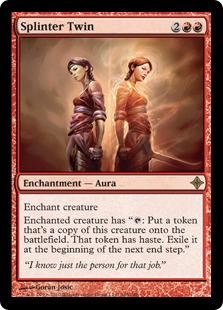
Birthing Pod may have held the title for a good while, but Splinter Twin takes the cake as Modern's most controversial ban ever. Even today, players debate its place on the banlist ad nauseam, a discussion seemingly reinvigorated with each new deck and expansion; Twin's defense league has persisted to the extent of literally becoming a meme. Today, we'll try approaching the issue from a more academic lens, weighing the purpose of the banlist against available information to determine whether Splinter Twin could, or should, be released back into Modern.

Here's the deck that got the card banned:

UR Twin, by Antonio Del Moral León (1st, Pro Tour Fate Reforged)

Creatures

4 Deceiver Exarch
2 Pestermite
3 Snapcaster Mage
2 Vendilion Clique

Enchantments

4 Splinter Twin

Instants

1 Peek
1 Dispel
2 Electrolyze
2 Spell Snare
2 Cryptic Command
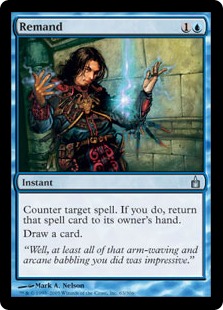
4 Remand
4 Lightning Bolt

Sorceries

1 Flame Slash
4 Serum Visions

Lands

4 Misty Rainforest
4 Scalding Tarn
4 Sulfur Falls
1 Stomping Ground
3 Steam Vents
1 Desolate Lighthouse
1 Tectonic Edge
1 Mountain
5 Island

Sideboard

1 Dispel
1 Flame Slash
2 Keranos, God of Storms
2 Blood Moon
2 Spellskite
1 Negate
1 Ancient Grudge
1 Pyroclasm
1 Threads of Disloyalty
1 Jace, Architect of Thought
1 Shatterstorm
1 Anger of the Gods

Splinter Twin was a force to be reckoned with in Modern, and made up one of the format's interactive pillars (the other was Jund). As the premier police deck, Twin kept linear strategies in check, as those had to either win before turn four (which might lead to their banning, as with Amulet Bloom) or present interaction for the Twin combo as of turn three (a big ask for streamlined combo shells). It played a fair tempo game with flash creatures and taxed opponents mana as of turn three, when it began threatening the combo. Opponents then felt obligated to represent removal mana, giving Twin an additional tempo advantage. Against decks without ways to interact with creatures, or opponents who tapped out on turn three, Twin would simply go off.

Arguments For Splinter Twin

When Twin was banned, multiple outlets decried Wizards's decision. I seemed among the minority in defending the ban, citing that the company's stated motives appeared valid when explored. But many of the gripes players had with Twin's banning had little to do with its number of Grand Prix Top 8s, and those arguments are still made in regards to taking Twin off the banlist.

Twin Produced Magic at its Most Fun/Skillful

I think this point forms the backbone of most unbanning discussion, and is the primary reason for the outrage over Splinter Twin's ban. Modern's by-the-numbers best deck, Twin naturally had a devoted following. Prospective players and Twin veterans alike enjoyed a vast sea of content on and resources pertaining to the deck. Twin's raw power and stupid-simple combo element also provided even lackluster players with the wins they so craved, deepening what attachment the playerbase as a whole had to the strategy.

My issue with this argument is the subjectivity of its terms. Twin required skills of its pilots, sure, but so do many decks. For instance, skill sets required to play Twin are simply different from those required to play something like Lantern Control, a deck practically nonexistent during UR's dominance. Besides, I'd call it ambitious at best to attempt to measure the amount of skill required to play any deck.

As for fun, it goes without saying that there's no accounting for taste, in Modern and elsewhere. I know players personally who loved playing Twin and never found another deck they enjoyed as much. I also know players who hated playing against Twin and were inspired by the ban to become Modern aficionados. The most important group, in Wizards's eyes, is the biggest one—it's a company, after all. But given Modern's snowballing popularity over the years, catering specifically to the "unban Twin" crowd can't be high on Wizards's agenda. As with "skill," I don't find "fun" a compelling reason to unban Twin.

Modern Is More Powerful Now

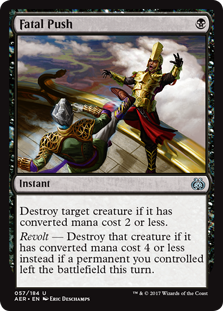
Nearly three years have passed since the Twin ban, and in that time, countless strategies have reared their heads in Modern. Some may have been enabled by the Twin ban. Others, by new cards or freshly discovered technology. It's these decks that buoy this argument: with Fatal Push, Hollow One, Death's Shadow, Thought-Knot Seer, and Thalia's Lieutenant running around, would Splinter Twin even be competitive?

I think so, but me thinking won't do us much good. There's no way to assess with pinpoint accuracy how good Twin would be in Modern as we know it. I'm not sure how valuable it would be even to painstakingly amass a list of decks new to Modern since the ban, and one of decks gone from Modern since, and compare their apparent diversity. In three years, the format has shifted in many other ways that are impossible to control for at that level of analysis, so I'd think it more productive to focus on more tangible evidence.

The Ban Failed at Its Purpose

Embedded in the "competitive diversity" justification of the Twin ban announcement was the idea that other blue-based control shells were being suppressed by Twin. From the announcement:

Decks that are this strong can hurt diversity by pushing the decks that it defeats out of competition. They can also reduce diversity by supplanting similar decks. For instance, Shaun McLaren won Pro Tour Born of the Gods playing this Jeskai control deck. Alex Bianchi won our most recent Modern Grand Prix playing a similar deck but adding the Splinter Twin combination. Similarly, Temur Tempo used to see play at high-level events but has been supplanted by Temur Twin.

We considered what one would do with the cards from a Splinter Twin deck with Splinter Twin banned. In the case of some Jeskai or Temur, there are very similar decks to build.

By almost any standard, the Twin ban did not leave metagame space for reactive blue decks. Soon after, Eldrazi showed up and was subsequently banned itself; even an Ancestral Vision unban did little for reactive blue decks, which continued to flounder. In regards to this goal, then, the Twin ban was a failure.

But what about in regards to metagame diversity in general? Consider the Top 8 numbers for this year's Grand Prix and Pro Tours versus in 2015, poached from Sheridan's data vault:

2015 GP/PT T8 stats
Unique decks in T8s: 28 (25 if Twin variants are grouped)
Decks that had T8s in 2018: 11
Decks that did not have T8s in 2018: 17 (non-Twin: 13)
Non-Twin blue decks in T8s: 4 (Twin decks: also 4)

2018 GP/PT T8 stats
Unique decks in T8s: 25
Decks that had T8s in 2015: 11
Decks that did not have T8s in 2015: 14
Non-Twin blue decks in T8s: 5

Here, too, the Twin ban appears to have failed. While blue diversity decreased in the past three years, total diversity remains constant.

With that being said, GP/PT Top 8s are not the only elements Wizards considers when banning cards. The Gitaxian Probe and Golgari Grave-Troll bans provide a solid example: according to Wizards, these cards were banned because of their warping of the format's strategy. I think it's also quite possible that their bans reflect their respective metagame shares, which were quite high on Magic Online.

This revelation plays into the Twin ban, too. Not only does Modern feel more diverse to me and many I've spoken with, what numbers we do have on a consistent basis (cherry-picked 5-0s and the occasional breakdown from someone brave enough to try their hand at a detailed summary) support this idea. During Twin's reign, the deck constantly pushed at consuming 10% of the format's shares, a figure that was therefore considered tolerable by most players. Today, few decks ever seem to break the 7% mark for more than a week at a time, even in the supposedly more inbred online metagame.

Reasons to Unban Cards

Twin's ban may not have achieved its goals. But is that reason enough to release it three years later? The format has changed, and the card must be evaluated within this new context. As almost every past unban has been for the sake of diversity according to its respective announcement, it's likeliest Wizards unbans Twin for this reason, if at all. So would unbanning Twin increase diversity in Modern?

Diversity Gain

Between Jeskai and UW Control, blue decks are already heavily represented. They're even relatively diverse, with fringe players like UR Thing and Madcap Moon carving out niches for themselves. While we again cannot know the result of releasing Twin into this picture, I assume it would prove more impactful than unbanning Sword of the Meek turned out to be.

That said, there is little evidence to suggest that unbanning Twin would lead to much additional diversity. I'd instead expect a diversity reshuffle, as we saw in the above GP/PT data. Decks like Delver, which have historically posted strong Twin matchups, may pick up steam; at the same time, tap-out strategies light on interaction, such as Hardened Scales, could fall by the wayside. Of course, we'd never know for sure until it happened, which makes such an unban all the more risky for Wizards.

That's not to say there's no precedent for this kind of unban. Bolstering the "things change" argument is Wizard's recent announcement unbanning Bloodbraid Elf, in which the company discussed the previous (and no longer relevant) homogenization of BGx decks:

There is now a healthy choice between, for example, adding red for Lightning Bolt and Ancient Grudge versus adding white for Lingering Souls and Stony Silence. With the unbanning of Jace, we may even see some of these decks shifting toward blue. On top of that, other midrange decks like Mardu Pyromancer have emerged. There are now sufficient options available to have confidence that Bloodbraid Elf will no longer be as detrimental to deck diversity as it once was.

I can envision a similarly phrased justification for releasing Twin now that other reactive blue options exist and perform. But again, we lack evidence that these decks wouldn't simply be better with Twin in them, as they were in 2015.

The worst-case scenario of Twin homogenizing Ux decks while rendering other strategies unplayable is something I doubt Wizards will take lightly when considering a Twin unban, and perhaps the biggest hurdle when it comes to unbanning the card for diversity reasons. Since that's the reason Wizards unbans most of their cards, I don't like Twin's odds currently.

Appropriate Power Level

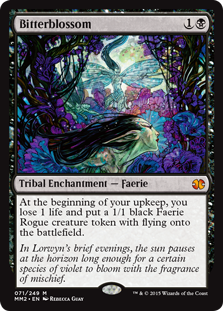
There is one other reason Wizards unbans cards, although this justification is invoked far more sparingly. Consider this passage from Bitterblossom's unbanning:

At the time of Modern's inception, the dominance of Faeries in Standard was at the front of our minds. Therefore, we took the conservative approach of including Bitterblossom in the initial banned list. After observing the evolution of the Modern format, we feel that it is of an appropriate power level to compete with the other powerful strategies in the format.

Modern becomes more powerful every year. Given that trajectory, it's possible that Splinter Twin be given the Bitterblossom treatment eventually, as it is for many other cards on the banlist. I think Wizards will start with some of the safer options, though, i.e. Stoneforge Mystic.

Are Two Heads Better Than One?

Splinter Twin was polarizing three years ago, and it's polarizing now. So let's discuss it! Drop me a line in the comments if you think Modern is better off with or without the four-mana enchantment.

Jordan Boisvert

Jordan is Assistant Director of Content at Quiet Speculation and a longtime contributor to Modern Nexus. Best known for his innovations in Temur Delver and Colorless Eldrazi, Jordan favors highly reversible aggro-control decks and is always striving to embrace his biases when playing or brewing.

View More By Jordan Boisvert

Posted in Modern, OpinionTagged , , , , 26 Comments on Just the Person: Should Splinter Twin Come Back?

Have you joined the Quiet Speculation Discord?

If you haven't, you're leaving value on the table! Join our community of experts, enthusiasts, entertainers, and educators and enjoy exclusive podcasts, questions asked and answered, trades, sales, and everything else Discord has to offer.

Want to create content with Quiet Speculation?

All you need to succeed is a passion for Magic: The Gathering, and the ability to write coherently. Share your knowledge of MTG and how you leverage it to win games, get value from your cards – or even turn a profit.

How Deep is Too Deep?

Are you a Quiet Speculation member?

If not, now is a perfect time to join up! Our powerful tools, breaking-news analysis, and exclusive Discord channel will make sure you stay up to date and ahead of the curve.

Welcome back, readers! Today's article is inspired by one of QS's Insiders, who went very deep on a recently spiking Standard uncommon. How deep, you ask? 3000 copies. This member saw potential and went all-in. Depending on their buy-in costs, this could net them some major gains

There was an error retrieving a chart for Siren Stormtamer

One of the biggest challenges involved with MTG speculation is that, as opposed to something like the stock market, the pool of buyers and sellers is considerably smaller. Where you can buy and sell large quantities of a given stock in a matter of seconds most of the time, doing so with Magic cards is considerably more difficult because there aren't always others looking to buy them at the very moment you are selling them; hence, you can't simply list them and sell immediately.

To make matters worse, because the demand pool is so much smaller, the longer the sales take, the more likely the price will adjust – and if you're adding a ton of copies to the supply, then it's far more likely to adjust downward than it is to adjust upward, which would require a massive rise in play in the metagame.

It's difficult for a major store to unload 3000 copies of a card quickly, let alone someone who doesn't have a storefront, large local playerbase, and well-known store-name recognition.

What are the Best Ways for a Backpack Grinder to Sell Cards?

  1. Sell on TCGplayer or eBay – In my opinion, the obvious best place to unload cards that have spiked is online (where people can buy into the hype if they so choose), and with these services you only pay 10-13% of the final sale value (which is likely retail or close to it).
  2. Sell on Facebook or Craigslist – This option will likely provide the most profit (as the fees are very low or nonexistent); however, your likelihood of moving a large number of copies is minimal.
  3. Sell to a buylist – This option will allow you to move a large number of copies of a given card; unfortunately, it will usually be far below retail. To make matters worse, most buylists don't adjust quickly (so you miss out on the highest retail value) and the new updated buylist prices will be a percentage off of the stabilized price (which is typically lower). While buylists are likely the last resort for maximizing profits, when you have a lot of cards to move, they are by far the easiest route to take. Unfortunately, many of the higher-paying ones may have a limit of how many copies of a card they will accept.
  4. Don't forget store credit – There is one last option our Insider can look at, though it won't see profits immediately. If they don't need immediate cash, there is the option to take advantage of some of the large trade-in bonuses many stores offer when buylisting. This credit can be used to reinvest in cards and grow profits even more.

At the time of this writing, Siren Stormtamer has dropped from a high of $5.25 down to around $4.50 (retail). It was around 80 cents all the way through the end of April 2018 before it started to climb, plateaued at around $2.50, and then this next spike jumped it even more.

The key for our Insider is that the price on this card was already decent before this latest spike.

Why Is a Decent Preexisting Price Before the Spike Important?

Because, as I mentioned, store buylist prices tend to lag behind retail prices, though it does appear like they are starting to reduce that window (it used to be one to two weeks before you'd see most buylists shift, in order to eliminate the risk of a pump and dump).

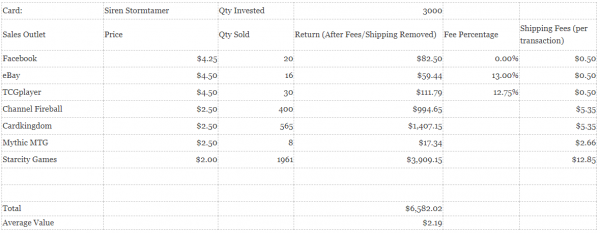
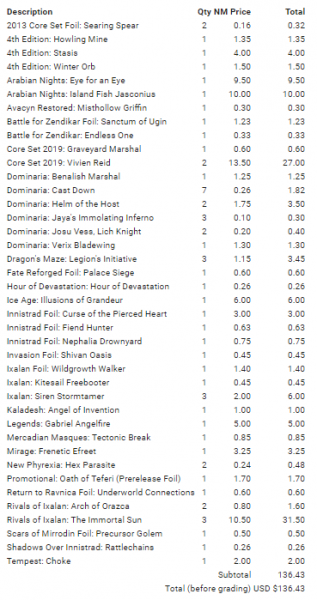
So below is a table showing what our QS member might expect to be able to get for his giant pile of Siren Stormtamers:

Note: The "Return" value assumes that the cards are sold in playsets each time, which is reasonable given that it's a four-of in its respective deck.

This does assume that Star City Games will in fact take 1,961 copies of the card (while they don't advertise a max quantity, it seems reasonable that they might consider limiting very large quantities of a card like this).

This also assumes that our seller wants to unload said cards ASAP. The longer the new price sticks, the higher the buylist prices will likely go, as stores gain confidence in the new price. However, that does mean that our Insider takes on a fair amount of risk: if the deck driving demand falls out of favor and the price starts to fall, they will have missed out on the highest prices as buylists and retail prices drop.

The Buy-In Price Matters

Looking over this chart, the big question is "what was their buy-in price"? Looking over the price graph of Siren Stormtamer, we see that it held steady at around 80 cents for a long time (at TCGplayer mid), so the low was likely closer to 50 cents.

If our Insider's buy-in was in the 25- to 40-cent price range, they come away making a lot of money. Some quick math shows that 3000 copies at 25 cents each would be $750 and 3000 copies at 40 cents each would be $1200. A buy-in in this range means our Insider would make somewhere in the range of $5,000 to $5,700, which is very impressive.

Consider the Risks

However, let's not ignore that our Insider took on a fair amount of risk with this play. We shouldn't simply ignore that risk because the outcome turned out extremely favorably.

It's very rare that we have a Standard-legal uncommon break and maintain $5, especially if it is not an Eternal staple (like say Fatal Push or Path to Exile). Now, I actually think Siren Stormtamer could find a home in an Eternal format given its aggressive cost, evasion, and extremely powerful ability. That being said, it's nowhere near as ubiquitous as the previously mentioned removal spells, and it's likely to return to the 50- to 75-cent range at rotation. The reason this is important is that it puts a clock on unloading one's copies,  as any copies that don't move will likely drop back down to or below the acquisition price. It's extremely important for everyone speculating to understand their outs before they start buying in.

One of the key things to consider when speculating, regardless of how deep you plan on going, is to know your outs ahead of time. This isn't to say it will always work out (buylists change, stores close down, etc.), but having a plan ahead of time is huge when you're up against a clock to unload a card after it has jumped up in value.

Flashback Friday: The Hidden Value of Fair Trades

Are you a Quiet Speculation member?

If not, now is a perfect time to join up! Our powerful tools, breaking-news analysis, and exclusive Discord channel will make sure you stay up to date and ahead of the curve.

New to Quiet Speculation? An old-school lover of the classics? Looking for a refresher? Just want something to read? No matter who you are, Flashback Friday is here to bring you some of the finest work from QS's history, with information that still stands the test of time today. Enjoy!

The typical Magic card trading wisdom is something along the lines of “buy low, sell high.” Others refer to it as “survival of the fittest.” There is a ruthless, winner-take-all, zero sum mentality that permeates through the culture from top to bottom. Unfortunately, many small-scale traders take this sort of mentality to heart, and ripping off a new player at the local store is their way to feel like a big-time player in the finance game. This sort of mentality is destructive to the health of the game and communities.

From another perspective, typical “value” trading grows increasingly difficult to do in a world where pricing information grows increasingly more accurate and obtainable every day. Of all the trades I have done in the last year, only a handful haven’t involved a smartphone on either side checking prices on TCGplayer or one of the various pricing apps in widespread use.

When neither party is able to take advantage of a pricing knowledge gap, trades are likely to be executed fairly in a pure value sense. Also consider that the more the community is aware of prices in general, and the more people are attempting to extract value, there is less value to go around.

Looked at it from either a moral or practical sense, attempting to execute classic value trades by exploiting a card pricing knowledge gap is not a valid strategy. That being said, there is plenty of value to be gained from trading that benefits everyone involved.

When trades are executed at even value, both parties are effectively just moving cards around. From a value perspective, nothing is being accomplished. No value is being gained by either party, but also consider that nothing is being lost. This has some important implications.

Trading Eliminates Transaction Costs

There was an error retrieving a chart for Bazaar Trader

Trading eliminates transaction costs. If two parties can get together and work out a trade where they each get what they want, then everybody wins.

Imagine two cards, X and Y, each worth $10. Now imagine that I want card X for my deck, and you want card Y for your deck. If we get together and trade, and you discover that I have card Y, and I see you have card X, we can make an even trade where everybody wins.

Now, what if we never got together? Maybe I wouldn’t have had any use for card Y, and I would have just buylisted it away for $7. If you couldn’t find card Y in a trade, you’d be forced to spend $10 for card Y online, perhaps plus a shipping cost. If we both acted in this way, then something like $6 or more would vanish from our mutual collections and our community.

In that scenario, trading allowed each of us to turn our cards into something valuable to us, but without losing any value on the transaction. If we each buylisted our cards and then purchased what we needed, then we both were forced to attrition away our value to a third party.

This sort of trading is particularly great for fostering a Magic community at the local level. Assuming the goal of everyone is to play more Magic, more fun and engaging, more deep and dynamic Magic, then having more cards and thus more options makes that happen. Trading allows us to all get what we want and get to playing, and it allows us to keep our card value right in our community, as opposed to bleeding it out to some far-away store.

Trading for Speculation

There was an error retrieving a chart for Trade Routes

Trading is a great way to achieve speculation goals, especially given what we now know about its minimal transaction costs. Trading is an excellent way to change the specific composition of a collection, even if the actual dollar value remains the same after each transaction. If trading just moves cards around between people, then having a goal in mind and strategy to achieve it is important, and speculation is one such strategy.

Speculation is attempting to take advantage of perceived metagame and market fluctuations in the future. In this case, value is created by the forces of time. At the basic level, it means trading for cards that you expect to rise in price in the future, and conversely, it means trading away cards that you expect will fall in price in the future. The best speculative trades are ones that trade away cards expected to fall for cards expected to rise, which accomplishes both goals at the same time.

Trading as a method of speculation requires planning ahead. One must develop a strategy based on their future expectations, which can be tricky, but luckily anyone reading this article has access to the wealth of information available from QuietSpeculation Insider articles and the Insider forums to help make those judgments.

On a practical level, speculative trading requires tailoring a trade binder with speculation goals in mind.

Trading partners will view anything in the binder as up for trade, and no one likes the person who has a binder littered with cards that they “just aren’t looking to trade right now.” Identify the cards you want to hold for the future, physically remove them from the binder, and store them in place dedicated to your speculative holds. In the trade binder, these cards will only serve to distract trade partners, waste time, and possibly even sabotage your entire trade.

Conversely, stock your trade binder with cards that you are looking to get rid of. If someone is interested in any of those cards, trade them away for anything you expect will maintain value. As time goes on don’t be afraid to trade these away at a discount for cards on the move upwards, because if you are right about your speculation, given enough time your assumptions will be realized and your cards will no longer be worth what they once were. Also, people often discount cards when trading up to expensive high-end cards, so these are perfect candidates for that sort of transaction.

It could be argued that speculation takes advantage of an information gap the same way that value trading does, but in reality, it comes with significant uncertainty and risk. It’s also important to realize that trading partners are acting under their own agency and volition. Their reasons for trading aren’t necessarily in line with yours.

While you may be trading away a card because you think it will be reprinted, they may be trading for it because they need it for a tournament that weekend. You could be trading for a card you think will rise, and they may be trading away part of their old deck so they can construct an EDH deck for their group game with friends. It’s a simplistic explanation, but assuming everyone gets what they came for, it’s win-win.

Trading to Buylist

There was an error retrieving a chart for Jace, the Mind Sculptor

Buylisting is the easiest and perhaps the most efficient way to turn cards into cash. For someone who buys large collections for profit, is looking to liquidate or downsize their collection, or incorporates buylisting into their overall Magic finance strategy–or simply needs a little bit of spending cash–trading is an excellent way to achieve buylist goals.

Buylisting is interesting because it is quite variable based on the conditional needs of stores. Two cards may be worth $10, but one might have a buylist price of $8 and another a buylist price of $6. If you are knowledgeable about buylist prices, which Trader Tools 3 puts at your fingertips, then trading can be an excellent way to get the most out of what you have.

Here is a simple example: I trade my $10 card X, which buylists for $6, for your $10 card Y, which buylists for $8. The trade was an even value for both parties, but in a buylist sense I actually netted $2 profit, and that is without sharking someone.

This also opens up the opportunity for sharing this value with a trading partner. If for example, I trade my $10 retail/$6 buylist card for your $9 retail/$7 buylist card, we both made money. It’s also possible to take this value as extra profit, for example by balancing the trade with a $1 retail card. This facet of trading to buylist is especially important to keep in mind when trading up at a discount for a high-end card, because giving away value may actually lead to increased profit.

Trading also an especially excellent way to achieve buylist goals because of its ability to manage the condition of cards. Buylisting at full value requires near-mint if not mint cards, and often many cards in a collection won’t fit the bill. Most trade partners I encounter aren’t too concerned with the condition of cards beyond very glaring damage, usually because they just want cards to play with. Even if the trade partner is concerned with value and places a premium on condition, if the premium is less than the premium the buylist places, the result is still trading played cards for near-mint cards for a net buylist profit. Trading is a great way to turn cards that aren’t in near-mint condition into cards that are near-mint, which ensures the capturing of full buylist value.

Wrapping It Up

Trading need not be a zero-sum game. Both parties can be self-interested, yet both parties can profit. By employing the strategies I shared today, you can get the most out of trading while adding value to your trade partner along the way. What other trading strategies unlock value hidden within cards to the benefit of all involved? Share your thoughts in the comments.

–Adam

Avatar photo

Adam Yurchick

Adam started playing Magic in 1999 at age 12, and soon afterwards he was working his trade binder at school, the mall food court, FNM, and the Junior Super Series circuit. He's a long-time Pro Tour gravy-trainer who has competed in 26 Pro Tours, a former US National Team member, Grand Prix champion, and magic.tcgplayer.com columnist. Follow him at: http://twitter.com/adamyurchick

View More By Adam Yurchick

Posted in Flashback Friday, ION Academy, TradingLeave a Comment on Flashback Friday: The Hidden Value of Fair Trades

Have you joined the Quiet Speculation Discord?

If you haven't, you're leaving value on the table! Join our community of experts, enthusiasts, entertainers, and educators and enjoy exclusive podcasts, questions asked and answered, trades, sales, and everything else Discord has to offer.

Want to create content with Quiet Speculation?

All you need to succeed is a passion for Magic: The Gathering, and the ability to write coherently. Share your knowledge of MTG and how you leverage it to win games, get value from your cards – or even turn a profit.

Patience & Capital: An Investment Strategy

Are you a Quiet Speculation member?

If not, now is a perfect time to join up! Our powerful tools, breaking-news analysis, and exclusive Discord channel will make sure you stay up to date and ahead of the curve.

Welcome back readers! A few weeks back, I took an increasingly bearish stance towards MTG finance, and mentioned some investing strategies I have been reinforcing on myself in anticipation of an MTG market downturn.

Since writing that piece, there was great news out of the LGS segment of our community. Prerelease and release weekends had overwhelming turnout for Guilds of Ravnica, and several store owners reported on the QS Discord that prerelease sold out entirely. The hype didn’t come as a surprise, given set rotation and new life for the Standard meta, but I’m interested to see if this momentum can continue beyond the Pro Tour in November.

As it is, prices continue to see relief across the broader MTG market while the pockets of increases have been driven mostly by Standard and Modern demand. EDH and Old School have cooled off significantly, and we have been chatting on Twitter and the QS Discord about the outlook for higher-end cards.

The sentiment echoed by many of the most respected and knowledgeable voices on both platforms is that higher-end cards should continue to drop through the holidays before hitting their floor. I have been trying to voice this information to anyone looking to acquire higher-end—especially Reserved List—cards, because I think there is still a little money to be saved by waiting. I have also been using this information to help shape my own investment strategy for the rest of 2018.

There was an error retrieving a chart for Underground Sea

Applying an Age-old Cliché

"Patience is a virtue," is a phrase we have all probably heard at least once in our life. For me, this time of the year is always tougher with regard to MTG finance. I don’t speculate much on Standard or Modern, and EDH is usually in a holding pattern while GPs and the Pro Tour garner the attention and dollars of most players.

Because of that, my MTG financing strategy during the winter months focuses on a few areas: EDH cards that are hitting peak supply; no-brainer opportunities at their tipping point; or not spending at all. Patience and discipline during the Standard and Modern season become critical to my investing strategy because EDH tends to drag behind, and speculating on anything other than those formats can take six months or more to realize a profit.

The most important thing I have been asking myself before I make any purchase right now is, “Will I use this card if the spec does not pan out?” If the answer is anything short of a firm “yes,” then I pass on the card. As a result, my purchasing habits have declined dramatically compared to springtime, while my sales volume has picked up quite a bit.

There was an error retrieving a chart for Crop Rotation

To help refocus my MTG finance efforts, I have made a conscious decision to free up some capital. This has involved buylisting bulk I accrued earlier in the year, while also unloading a good portion of profitable long-term specs I hadn’t previously cashed in on. I want to be prepared if the market downturn opens up attractive entry-points to higher-end cards on my wishlist.

Just last week, I turned an Italian Chains of Mephistopheles originally acquired for $250, and two foil Rayne, Academy Chancellor originally acquired for $8, into Scalding Tarn and Flooded Strand Expeditions via the ABUGames buylist. I loved this move for a couple reasons:

  1. Expeditions are gorgeous and they should be easier to liquidate if I need cash.
  2. Italian Legends has become noticeably more difficult to move as budget (replacement) options have hit a wall in this softer market.

This review of my strategy has allowed me to rebalance my portfolio to a better mix of free cash and price-resistant cards. I have always made it a priority to own more desirable and easier-to-liquidate cards over budget/replacement options like Italian Legends or certain EDH foils.

Earlier this year, the rising tide lifted everything, and it was okay to pick up Italian Chains of Mephistopheles because the multipliers to the English version were attractive. Unfortunately, holding the Italian version beyond peak demand hurt me because I missed on the peak sell-point. It is in free-fall now, and could settle 25% or more below the high point I could've sold at before it hits its floor.

Remember this important fact when making a tough decision to rotate cards: profit is profit. It is always okay to miss on 20% when you are already up 50%.

If you need capital, and have cards that have been listed for a long time and aren't selling at the new prices established by the bull market earlier this year, I suggest looking for the best buylist option or lowering those prices just a bit and eating a loss.

I want to be clear, though: I am not suggesting to panic-sell, or even to sell at all. I am merely pointing out that many players and vendors are overextended right now, so having capital available and the patience to wait for a dip on blue chip cards over the coming months is worth considering. My hypothesis is the patient and savvy investors who are able to acquire desirables on the dip will be in for nice profits on the same cards in 2019.

Investment Plan

I have been running lean on specs the past two months or so, but I am always keeping an eye out for cards with short- or long-term potential. Here are the notables I picked up over the past two weeks:

Soul-Scar Mage

There was an error retrieving a chart for Soul-Scar Mage

Affectionately called “SSM,” this card keeps popping up in random Modern chatter I see on social media, and it’s one I couldn’t ignore any longer. By the time this article goes live, I suspect near mint foil copies will be all but gone on the internet. There are a couple at $6.99 on CardKingdom, but for the most part the new price-point on them is showing up closer to $10.

Played foils are still available on TCGplayer under $5 at the time of writing, so if you think you could see yourself running a Red Deck Wins concept with Soul-Scar Mage as part of the package, I would consider grabbing them.

I don’t like the non-foil version as much; it is sitting around $2 already, and in my best estimate it will take a great performance at GP Atlanta (or more solid MTGO results to post) before that needle can move higher.

Second Harvest

There was an error retrieving a chart for Second Harvest

With the release of Guilds of Ravnica, EDH token strategies received a huge boost to their arsenal. March of Multitudes, Divine Visitation, Trostani Discordant, and Emmara, Soul of the Accord all come to mind.

Knowing this, I am surprised Second Harvest hasn’t moved higher already. At the time of writing this, near mint foils can still be had under $2 on TCGplayer, while CardKingdom has three in stock at $1.99. Inventory does appear to be waning and I won’t be surprised if foils are selling for $5 in a few weeks. If you need a foil copy or simply want a good spec to add to your portfolio, now is a great time to grab these. They won't stay this cheap for much longer.

Ever After

There was an error retrieving a chart for Ever After

On a per-mana basis, the value of Ever After is outstanding. Most reanimation effects require five mana to get one creature back to the battlefield. With Ever After, you get two for six. It is important to note the creatures have to be from your graveyard which limits the upside a bit in EDH. The card is also put back into the library instead of into the graveyard after being cast; this small note can have some relevance, positively or negatively, depending on your deck’s capabilities.

I decided to add one of these to my Dragons EDH deck. I grabbed a handful of additional foil copies (all at $1 or less) to add to my spec binder. I think this one will take about six months to mature, minimum, but I also felt for $1 a piece I could do worse. I would not recommend going deep on this one, but I do think it has a very safe floor.

Bonus Card (Watch List Only)

Insult // Injury

There was an error retrieving a chart for Insult

I will start by saying I found this one late into my writing and do not believe it is actionable without a little more data and research to back it. That said, the ability to double your damage output for a turn seems ridiculously powerful.

I have noticed this card show up as a one-of in a handful of Modern Burn lists recently (all experimental), and I also couldn’t help but think how powerful this card would be in certain EDH builds as a wincon. I wouldn’t go deep on this one by any means, but it’s a good card to add to your watchlist.

Wrapping Up

Whatever your investing strategy is for MTG finance, I personally advise trying to free up capital in advance of the holiday months. The combination of overextended vendors, Standard and Modern owning the spotlight, and the year-end push for sales goals, should create a perfect storm of opportunity for savvy and patient investors. I believe higher-end cards which pushed to record highs earlier in 2018 will have attractive new entry-points by December.

Over the past two months, I have personally focused on turning over my portfolio and generating free cash flow and store credit in the process. I plan to monitor cards on the higher end of the market closely, and acquire any staples that fit my strategy and hit my target entry-points. I feel this will give me the best chance at owning cards I will be happy to use, while also being well-positioned for another bounce in 2019 should the market pick back up. Worst case, I will own a lot of cards I enjoy and that are relatively price-resistant should I need to liquidate for any reason.

As a reminder, Edward Eng and I will be co-hosting the second installment of Office Hours for QS Insiders at 9 p.m. eastern time on the QS Discord. We will try to answer any MTG finance questions you may have, so please Insiders, come prepared! If you are not an Insider, I highly recommend signing up and giving it a try.

That’s it for today! Talk to you on the QS Discord or Twitter (@ChiStyleGaming)!

Hold ‘Em & Fold ‘Em #16

Are you a Quiet Speculation member?

If not, now is a perfect time to join up! Our powerful tools, breaking-news analysis, and exclusive Discord channel will make sure you stay up to date and ahead of the curve.

There was some pretty cool stuff that happened this past weekend at the SCG Dallas Open. The winner, Peter Hollman, put Four-Color Death’s Shadow and Tarmogoyf back on the map. And the runner-up, Ian Thorne, along with well-known players like Zac Elsik and Pieter Tubergen, proved Creeping Chill is the real deal in Modern Dredge.

We also saw Evart Moughon showcase some creativity with Arclight Phoenix—which I mentioned in article #14—outside of Standard, taking it to a 16th place finish with his Izzet Spells deck. And Zan Syed took Humans to another level by putting Tormod's Crypt in the sideboard, as he and others expected Dredge to show up in numbers at the tournament. It was a good prediction.

Meanwhile, Standard has still been a little stagnant, with Golgari decks continuing to beat up the field. But as always, the need to stay ahead of the metagame exists.

Article Series Main Focus Points

  • Cards that you should hold on to or pick up for tournaments if you need them before they rise in price. These cards are either seeing increased play in one or more formats, the supply is drying up, or they’re pretty far from the next reprint.
  • Cards that you should consider selling or trading away. Their prices are pretty much at the ceiling owing to inflation from speculation, reprint inevitability in the near future, a lull in tournament play, or some combination of these.

Modern: Izzet Spells by Evart Moughon

Creatures

4 Arclight Phoenix
4 Bedlam Reveler
4 Thing in the Ice
2 Jace, Vryn's Prodigy

Non-Creature Spells

4 Fiery Temper
4 Izzet Charm
4 Lightning Bolt
4 Manamorphose
2 Thought Scour
4 Faithless Looting
1 Insult
4 Serum Visions

Lands

1 Island
3 Mountain
4 Bloodstained Mire
4 Scalding Tarn
4 Spirebluff Canal
3 Steam Vents

Sideboard

3 Dragon's Claw
2 Izzet Staticaster
2 Alpine Moon
2 Abrade
2 Dispel
4 Surgical Extraction

Recent Sells

Shriekhorn - Mirrodin Besieged (Foil)

There was an error retrieving a chart for Shriekhorn

Sold Price
$5

I mentioned this as a Fold in article #15. Was I correct with my prediction in the uptick of Dredge in Modern? Yes. Was I took quick to sell these? Maybe. Is it wrong to lock in some profit? No.

These have spiked to about $10-12 now. If you have these and aren’t using them, you might as well sell into the hype and get them again if you need them when they’re reprinted.

Seekers’ Squire - Ixalan (Foil)

There was an error retrieving a chart for Seekers' Squire

Purchased Price
$1.50

This was also mentioned as a Fold in article #15. I stuck to my word and sold a couple of extra sets I had lying around, as this will probably never see play outside of Standard.

Here’s a buylist order I placed with Card Kingdom on Sunday, October 21.

Some of these cards weren’t in near mint condition so the total will definitely be less than $136. But a lot of those cards have been rotting in my trade binder and boxes in a closet, so I decided to get rid of them to turn the cash into something more useful. I didn’t want to go through the hassle of trying to sell these cards on eBay, TCGplayer, or Facebook. I went with Card Kingdom, which, from my experience, has been a decent place to buylist cards.

Recent Buys

Tempest Djinn - Dominaria (Prerelease Foil)

There was an error retrieving a chart for Tempest Djinn

Purchased Price
$2.71

I picked up a set of these because the Standard Mono-Blue deck might have some legs. Take a look at Crash_CZ’s 5-0 list from Magic Online.

Standard: Mono-Blue Aggro by Crash_CZ

Creatures

2 Exclusion Mage
4 Merfolk Trickster
4 Mist-Cloaked Herald
2 Nightveil Sprite
4 Siren Stormtamer
4 Tempest Djinn
2 Warkite Marauder

Non-Creature Spells

2 Chart a Course
2 Dive Down
3 Essence Scatter
2 Spell Pierce
4 Wizard's Retort
4 Curious Obsession

Lands

21 Island

Sideboard

1 Dive Down
3 Diamond Mare
2 Disdainful Stroke
3 Negate
1 Sentinel Totem
2 Sleep
3 Syncopate

And although Travis Woo is banned, he still plays online and posts stuff in the Magic for Good Facebook group, including a recent post featuring this same list. This list also includes Disdainful Stroke in the sideboard, which was mentioned in article #11. And worst-case scenario I can buylist them to Card Kingdom for $2.50 cash or $3.25 store credit if I decide not to use them.

Creeping Chill - Guilds of Ravnica (Foil)

There was an error retrieving a chart for Creeping Chill

Purchased Price
$5.99

$5.99 is a pretty high entry point, but I didn’t have a playset yet so I bought one just to have it. As I already mentioned above, the card is definitely the real deal. So having a playset of these if you want to play Dredge isn’t too bad.

However, with that said, it really only goes in Dredge right now. Thus, I don’t know how much higher this can go. If you need or want them, get them as they’ll probably hold value for quite a while. If you don’t need or want them, sell into the hype just like with Shriekhorn foils.

Sentinel Totem - Ixalan (Foil)

There was an error retrieving a chart for Sentinel Totem

Purchased Price
$0.99

The Mono-Blue list posted above has been running 1-2 Sentinel Totem in the sideboard. It also shows up once in a while in Mono-Red and Boros lists. At the very least, it’s an option for any deck to deal with pesky cards like Rekindling Phoenix, Arclight Phoenix, jump-start cards, and Golgari decks that utilize the graveyard.

Also mentioned above, was Zan Syed’s innovation to add Tormod's Crypt to his Modern Humans deck to combat Dredge and other decks that abuse the graveyard like Storm, Living End, and Control.

Now, is the scry 1 good enough to warrant playing Sentinel Totem at the cost of an extra generic mana and exiling both graveyards? I highly doubt it. But maybe I’m wrong. With that said, $0.99 is pretty cheap for a card that can slot into pretty much any deck’s sideboard.

Mistcaller - Core Set 2019 (Foil)

There was an error retrieving a chart for Mistcaller

Purchased Price
$2

Corbin Hosler recently wrote on TCGplayer about Nikachu’s Merfolk deck that he’s been doing decent with in Modern, which features Mistcaller instead of Cursecatcher. Granted, both of these players are diehard Merfolk fans, so I would proceed with a bit of caution here. However, that doesn’t mean the deck is terrible.

As a matter of fact, as I take at the deck a little more, there’s actually a Wizards sub-theme in the deck. Something like Wizard's Retort might be a better option than Deprive in the sideboard and might even be good enough to eventually make it into the maindeck, since both Merfolk Trickster and Aether Vial give you added flexibility. Does that also mean Harbinger of the Tides needs to make its way back into the deck? I’m not so sure yet.

Anyhow, $2 for this Merfolk Wizard that could potentially become the go-to one-drop for the deck is relatively inexpensive. It seems like a pretty useful card compared to Cursecatcher with all the decks in Modern right now that are looking to cheat creatures into play from the graveyard like Dredge, Hollow One, Living End, and Bridgevine.

And as a bonus, the Open House promo version of Silvergill Adept is also around $2.

Accumulated Knowledge - Masters 25 (Foil)

There was an error retrieving a chart for Accumulated Knowledge

Purchased Price
$0.75

Gul_Dukat came in first place of the Magic Online Legacy Challenge on October 22. If you look a bit closer, there are four other Miracles players that also ran a playset of Accumulated Knowledge in their lists. It sure looks like Miracles is on the rise again, even without Sensei's Divining Top.

Legacy: Miracles by Gul_Dukat

Creatures

2 Monastery Mentor
2 Snapcaster Mage

Non-Creature Spells

1 Flusterstorm
2 Predict
2 Counterspell
4 Force of Will
4 Accumulated Knowledge
4 Brainstorm
4 Swords to Plowshares
1 Portent
1 Council's Judgment
3 Terminus
3 Preordain
4 Ponder
2 Back to Basics
2 Jace, the Mind Sculptor

Lands

1 Arid Mesa
1 Volcanic Island
1 Tundra
3 Plains
4 Scalding Tarn
4 Flooded Strand
5 Island

Sideboard

3 Surgical Extraction
3 Pyroblast
1 Engineered Explosives
2 Counterbalance
1 Celestial Purge
2 Flusterstorm
1 Council's Judgment
1 Snapcaster Mage
1 Volcanic Island

But be careful, as demand from one deck in Legacy alone won’t cut it. However, Accumulated Knowledge also pops up in the occasional Landstill and High Tide decks. There’s a small chance the popularity of the card in Miracles will spark more interest to play the card, since it looks at both graveyards and pitches to Force of Will.

The other thing to notice is that it also sees play in blue Pauper decks.

The Masters 25 foils are pretty cheap compared to the Nemesis foils and FNM promos which all have the same artwork, so there’s potential for this version to spike a little bit.

Fiery Temper - FNM Promos

There was an error retrieving a chart for Fiery Temper

Purchased Price
$0.35

This one is a bit tough because there are five foil versions with two of them being promos. But the main thing is that this card is starting to see more play in Modern alongside Arclight Phoenix and Runaway Steam-Kin thanks to Faithless Looting, a.k.a. the red Brainstorm as Ben Friedman has once said.

Check out MentalMisstep’s Phoenix Burn deck.

Modern: Phoenix Burn by MentalMisstep

Creatures

4 Arclight Phoenix
4 Goblin Electromancer
4 Monastery Swiftspear
4 Runaway Steam-Kin

Non-Creature Spells

1 Gut Shot
4 Lightning Bolt
4 Risk Factor
4 Manamorphose
4 Fiery Temper
4 Chart a Course
4 Faithless Looting

Lands

1 Stomping Ground
1 Island
2 Bloodstained Mire
3 Steam Vents
4 Mountain
4 Scalding Tarn
4 Spirebluff Canal

Sideboard

2 Tormod's Crypt
4 The Flame of Keld
1 Surgical Extraction
3 Spell Pierce
2 Grim Lavamancer
3 Ancient Grudge

Watchlist

Diamond Mare - Core Set 2019 (Foil)

There was an error retrieving a chart for Diamond Mare

Observed Price
$2.5

This has been showing up in the sideboard in a lot of the mono-colored decks in Standard. Supply seems pretty low on TCGplayer too. Sadly though, I don’t think this will see play in Modern or Eternal.

Adventurous Impulse - Dominaria (Foil)

There was an error retrieving a chart for Adventurous Impulse

Observed Price
$1-2

This card, however, is starting to see play outside of Standard. Take a look at this short list of decks, which could grow over time. It’s a one-drop that does a decent job at making sure you hit your land drops early, while mitigating flood and digging for your powerful threats.

Llanowar Elves - Open House Promos

There was an error retrieving a chart for Llanowar Elves

Observed Price
$7

This card has been printed into oblivion since we first saw it in Alpha. But this is probably one of the coolest promo versions that Wizards has printed. This has been out for a few months now, so I don’t see this going too much lower. And even if it does, I doubt it will ever drop past $5. On the flip side, I see this slowly increasing in value over time and never looking back.

Soul-Scar Mage - Amonkhet (Foil)

There was an error retrieving a chart for Soul-Scar Mage

Observed Price
$5-8

This just rotated out of Standard and hasn’t seen a whole lot of play in Modern or Legacy yet. But that could change over time since it’s a one-drop with prowess which plays nicely with the cheap, powerful spells in both of those formats. I would keep an eye on this one. If the price drops to $2-3, I would definitely pick up a few playsets.

Mass Hysteria - Mirrodin (Foil)

There was an error retrieving a chart for Mass Hysteria

Observed Price
$6-8

Here’s another interesting card. This has steadily risen over time but I’m not really sure where demand has been coming from prior to something like Runaway Steam-Kin. And even then, I haven’t seen it in a list with the two cards together. However, I could see an updated Mono-Red Runaway list with Mass Hysteria, Insolent Neonate, and Empty the Warrens joining the party. But that’s just a brewer’s idea for now.

Office Hours

I’ll be co-hosting Quiet Speculation’s Office Hours again. This will be the second time. You can catch the audio of the inaugural session with Sigmund Ausfresser and me here in case you missed it. Christopher Martin will be joining me for the second session. It’s set for today at 8pm Central, so mark your calendars and join us in the Discord channel.

Summary

Recent Sells

  • Shriekhorn - Mirrodin Besieged (Foil)
  • Seekers' Squire - Ixalan (Foil)

Recent Buys

  • Tempest Djinn - Dominaria (Prerelease Foil)
  • Creeping Chill - Guilds of Ravnica (Foil)
  • Sentinel Totem - Ixalan (Foil)
  • Mistcaller - Core Set 2019 (Foil)
  • Accumulated Knowledge - Masters 25 (Foil)
  • Fiery Temper - FNM Promos

Watchlist

  • Diamond Mare - Core Set 2019 (Foil)
  • Adventurous Impulse - Dominaria (Foil)
  • Llanowar Elves - Open House Promos
  • Soul-Scar Mage - Amonkhet (Foil)
  • Mass Hysteria - Mirrodin (Foil)

Public Spreadsheet

Hold ‘Em & Fold ‘Em Spreadsheet

Let me know what you think in the comments below. Agree? Disagree? Why? You can also connect with me on Twitter at @edwardeng. I’m also open to suggestions on how to make this series more valuable. Hit me up.

Have fun,
Eddie

Daily Stock Watch – Mutavault (GP FOIL)

Are you a Quiet Speculation member?

If not, now is a perfect time to join up! Our powerful tools, breaking-news analysis, and exclusive Discord channel will make sure you stay up to date and ahead of the curve.

Hello, everyone and welcome to a new edition of the Daily Stock Watch! Modern has been fairly quiet and prices have been dropping left and right so we'd like to take a peek at what we could speculate on while the prices are low enough for us to hedge our bets on. Today's featured card is supposedly a staple in aggro decks, but Spirits is excelling without it and this is what has been stopping it from exploding out of the gates financially. I have a soft spot for foil cards that could be worth more given the right time, and I still have hopes for this card.

There was an error retrieving a chart for Mutavault

I'd like to particularly focus on the Grand Prix Promo of this card for today's segment as this has already dipped to its all-time low of $11.36 as of writing time, and I do think that it deserves a way better price tag than this in the future. Gone are the days when Merfolk could just lord over other aggro decks with its tempo-based approach that allows Mutavault to be a lethal threat that's quite hard to catch with removals. Today, decks such as Humans, Hardened Modular, and Red Deck Wins are the more popular aggro approach decks that player resort to and none of them have any interest in having Mutavault on their lists.

One particular deck that has shown some need for Mutavault is Spirits (although the Bant archetype of it has been more successful thanks to Collected Company) where UW lists still have two to four copies of the card on their 75. Here's a list that's still showing some love for Mutavault.

UW Spirits

Creatures

1 Thalia, Guardian of Thraben
1 Remorseful Cleric
1 Nebelgast Herald
2 Selfless Spirit
2 Geist of Saint Traft
3 Rattlechains
3 Phantasmal Image
4 Mausoleum Wanderer
4 Drogskol Captain
4 Spell Queller
4 Supreme Phantom

Other Spells

1 Vapor Snag
1 Spell Pierce
4 Path to Exile
4 Aether Vial

Lands

1 Misty Rainforest
1 Windswept Heath
1 Ghost Quarter
2 Moorland Haunt
2 Mutavault
3 Plains
3 Island
4 Hallowed Fountain
4 Flooded Strand

Sideboard

1 Worship
2 Stony Silence
1 Steel of the Godhead
1 Runed Halo
2 Rest in Peace
1 Negate
1 Kor Firewalker
1 Dispel
1 Disenchant
2 Damping Sphere
1 Blessed Alliance
1 Spell Pierce

Mutavault acts like a one to cast spirit in this deck with the capability of going extra big with the bonuses that spirit lords such as Drogskol Captain and Supreme Phantom could give. It benefits a lot from the hexproof bonus that the captain provides as it becomes a sneaky threat that is hard to time with the best removals in the format. It's just sad to see that the more successful Spirits build have focused more on its midrange prowess that aims to finish games by pushing with its threats off a well-timed Collected Company. The need to balance out its mana base made Mutavault dispensable, as it would be hard to support a three color deck by including a colorless mana source. I still think though that this land will gain its financial value over time. I am quite interested to pick it up now that it's being undervalued in the market.

Sleeping Lands

Man lands are some of the best things ever created in the game in my opinion as they keep your opponents guessing and on their heels at every point of the game where they could act as legal threats. Most prominent in ending games on this list is arguably Inkmoth Nexus in my opinion, especially in the Hardened Modular list where it could do the trick in three turns. Mutavault is the most efficient to be included in any list because of its activation cost and built-in ability to be every creature type possible.  This is the reason why I think that this is a good pickup now as it will soon be a $20 card again that foil lovers would be looking for.

At the moment, the GP Foil Promo of Mutavault is available via TCGPlayer, StarCityGames and Card Kingdom for anywhere between $9.30 up to $13.99. I would love to get my hands on copies under $10 (probably three to five playsets) and wait for it to reach $15-$20 in the coming year. Guilds of Ravnica has shown some love for aggro decks with some really nice additions, so we could probably expect the same from Ravnica Allegiance. We could be in for a pretty surprise there so keep your eyes and ears open!

And that’s it for today’s edition of the Daily Stock Watch! See you again next time, as we check out a new card that should be on the go, or good enough for speculating. As always, feel free to share your opinion in the comments section below. And if you want to keep up with all the market movement, be sure to check in with the QS Discord Channel for real time market information, and stay ahead of the hottest specs!
Daily Stock Watch – Vanquisher’s Banner

Are you a Quiet Speculation member?

If not, now is a perfect time to join up! Our powerful tools, breaking-news analysis, and exclusive Discord channel will make sure you stay up to date and ahead of the curve.

Hello, everyone and welcome to a new edition of the Daily Stock Watch! The Standard market has been very active as of late, and it has pretty much lived up to what we expected in the wake of the arrival of a new set. There are brews of new archetypes and upgrades of old ones, but not everything has been consistent as the meta shapes up. One welcome addition to the competitive scene is the rise of what are deemed to be casual cards financially, and the implications that it has to the current scene at the same time. Today's featured card belongs to that category, although it also looks promising for other formats outside Standard.

There was an error retrieving a chart for Vanquisher's Banner

Coat of Arms was pretty popular back in the day as it could put your deck over the top with just three to four tribal creatures in play. The same could not be said for Vanquisher's Banner but it gives you that power to draw cards which allows for continuity in case you can't overpower your opponent with what you have in play. The latest reincarnation of Elves in Standard hasn't proven its worth just yet, but it could make a case for something that could be considered going forward as new sets fill the Standard vacuum. For a reference of how the list looks like, here's one that we could use as a model.

Standard Elves

Creatures

4 Beast Whisperer
4 Marwyn, the Nurturer
4 Llanowar Elves
4 Elvish Clancaller
4 Druid of the Cowl
4 Steel Leaf Champion
4 Pelt Collector
4 Thorn Lieutenant

Other Spells

4 Adventurous Impulse
4 Vanquisher's Banner

Lands

20 Forest

Sideboard

2 Vivien Reid
4 Vine Mare
3 Shapers' Sanctuary
3 Reclamation Sage
3 Diamond Mare

The deck looks promising with the tribal concept, but Standard is ran amok right now by Golgari and Boros Angels which could both wipe out our elf friends in one fell swoop. The platoon of removals at Golgari's disposal and Deafening Clarion could just ruin the day for a creature-based strategy like this one, which could be off to a very bad start if we miss out on a turn one Llanowar Elves or Pelt Collector. One thing you could count on this deck though is the steady pressure it will apply given the correct draw, and powering out Vanquisher's Banner before our opponents could answer our threats should be good enough to keep flooding your board with weapons to win the game. It also helps that Beast Whisperer does something of the same caliber as the banner, which then allows you to have tremendous card advantage in match ups where creatures and not spells could win games.

Standard Elves

There should be lots of tribes in the format that could try the power that the banner has to offer (I remember featuring saproling-powered decks before with Tendershoot Dryad) but I do think that the elves has the biggest potential to break through because it could power it out faster than any other tribe could. It is no Glimpse of Nature for sure but the power boost it gives, along with the drawing prowess, makes it a good card for Commander. It's current all-time high of $5 is a bit justified for me, and I still see room for growth. Ixalan won't be opened much in the coming months for sure so I would be very interested in getting my copies now before some insane brew happens and this skyrockets out of the gate. It's better that we act now than later on when the window of opportunity has passed.

At the moment, you could get copies of Vanquisher's Banner from online stores such as TCGPlayer and Card Kingdom for anywhere between $3.90 up to $6.49 while StarCityGames is already out of stock at $5.99. The foil version of the card isn't fetching a very huge a price right now so that's an indicator that there isn't much interest in formats outside Standard right now. I would be glad to clean up all copies under $4 that I could get my hands on and sit on it till it peaks at $8-$10 during the course of the season. It's a low risk, decent reward investment that should be paying off in the future. Let's carry the banner!

And that’s it for today’s edition of the Daily Stock Watch! See you again next time, as we check out a new card that should be on the go, or good enough for speculating. As always, feel free to share your opinion in the comments section below. And if you want to keep up with all the market movement, be sure to check in with the QS Discord Channel for real time market information, and stay ahead of the hottest specs!

Fighting Control: A Beginner’s Guide

Are you a Quiet Speculation member?

If not, now is a perfect time to join up! Our powerful tools, breaking-news analysis, and exclusive Discord channel will make sure you stay up to date and ahead of the curve.

The Beginner's Guide series offers advice to new to Modern players and dispels common myths about the format's workings. This week, inspired by some consistent misplays I've observed, I am going to be tackling Modern's control decks. There appears to be a perception that they're something to tread carefully around. But control is just another archetype, and there's no reason to play scared.

Blue-based control is one of the top-performing archetypes in Modern right now. Some even say UW Control is the best deck in Modern. Regardless, top-tier control decks are a fairly recent addition to the metagame. Consequently, Modern players don't have much experience playing against Modern control decks. Standard players have a leg up on Modern in this regard, as control decks have been top-tier for some time. However, the experience doesn't translate well, as the strategies differ dramatically.
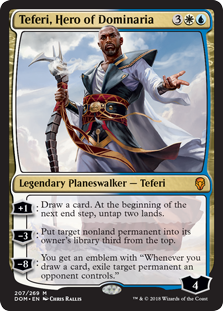
The recent version of Standard UW Control is almost entirely reactive. It piled answers and card draw on top of each other, winning by looping Teferi, Hero of Dominaria. Modern's control decks also play lots of answers and card advantage, but they're more about buying time and space to land a win condition and then ride it to victory. This difference in strategy means that players relying on their Standard experience are playing the matchups wrong.

Know Thy Enemy

The classic aggro/control dichotomy says that aggro decks try to actively win the game while control seeks to prolong the game. Alternatively, aggro wants to end the game by winning, while control functionally wins the game, and then ends the game as an afterthought.

Compare Dominaria Standard UW Control to Modern UW. The Standard deck has a wide variety of hard answers and 5-8 sweepers. The Modern decks lean heavily on 4 Terminus, 4 Path to Exile, and a few counters. Standard has at most three Teferi and two Approach of the Second Sun to actually win the game, while Modern has 3-4 Celestial Colonnade, 4-5 planeswalkers, 2 Snapcaster Mage, and occasionally some number of Vendilion Clique. Standard plays a variety of card draw spells; Modern is dependent on cantrips and Search for Azcanta.

This difference in strategy is critical to understanding how to play against Modern control. Standard UW is a truer control deck than Modern. The answers in Standard may be less efficient than in Modern, but it plays more of them and wins well after the game is won. Modern is about precisely using tools to exhaust the opponent, dropping a win condition, and then protecting it as would a tempo deck. Terminus tucks creatures back into the library; they're not gone for good, and in a long game will return. The goal is to stall the game long enough for Jace or Teferi to take over and convince the opponent things are hopeless, but not so long that Terminus-returned creatures start to matter. Standard in contrast is perfectly capable of actually answering everything, drawing its entire deck, and winning by naturally decking their opponent, a control ideal.

What Matters

Time is the critical factor when playing against control, both in the literal sense (as especially in control mirrors, the game clock can become a factor) and the mechanical sense (regarding tempo and resources). Modern players must restrict control's clock and force them to take the initiative. Doing anything else is allowing control to execute its ideal gameplan. If it can be avoided, never give control players extra time.

Counterspell Conundrum

Counterspells are a relatively recent addition to Modern control. While Jeskai has always hung around, Grixis was the control deck of choice for years. Combined with Jund's prevalence, counterspells took a back seat to targeted discard for years in slower decks, which may have caused players to forget how to play against permission.

Never play around counterspells unless there is a definite and advantageous strategic reason to do so. Specifically, correctly playing around counters requires that 1) waiting makes the counter a dead card, and/or 2) it advantages you more than the control player. This is especially true of the early game. Fear of having a spell countered is largely irrational, and the more time provided to a control deck, the more likely it is to win. Playing around Mana Leak makes no sense if the card will never be rendered dead, or if doing so inhibits advancing your own gameplan. Scaring opponents into inaction is far more powerful than actually countering anything. Therefore, most decks should treat opposing counters as situational removal rather than disruption, and just play their spells.
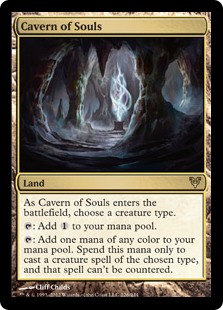
Some decks can play around counters by playing through them, such as UW Spirits playing Aether Vial and Cavern of Souls and Jund using discard to clear the road for threats. Their design makes playing around correct. However, most decks can only play around counters by just waiting for a better opportunity to play their spells. Unless said deck has crafted its strategy to force such a gamestate, the plan is unlikely to work. When not under pressure, control is free to draw cards and play lands, which is all it wants to do, and isn't likely to create an opening on its own.
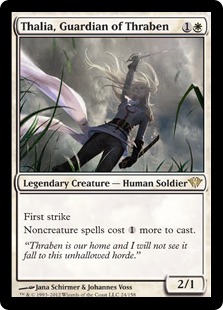
Burn is a master of forcing control to tap out and generate that opening. After the initial flurry of spells, if Burn has control under ten life, it can just wait until it can cast multiple instants on control's endstep, draw out all the counters, and then finish with sorceries on its own turn. Thus, the control player must tap out to win the game first, which naturally gives Burn the opening to finish the job. Since most decks can't put this kind of pressure on control and therefore can't gain significant advantage by waiting, they shouldn't worry about playing into counters.

Take Advantage

Another reason not to fear counters is that the control player probably doesn't have one. Counterspells may be more popular and prevalent now than they have been before, but UWx only plays around eight, of which four are the expensive Cryptic Command. Odds are there was no point in playing around the counter in the first place. Even if they do counter a spell, it will probably be a favorable mana exchange and therefore to your advantage. A second reason is every counter spent early is one not spent later. Trading Leak for Thalia, Guardian of Thraben is a fairly neutral exchange, but Leaking Primeval Titan is devastating. Let control counter the cheap spells so they can't counter the game winners!
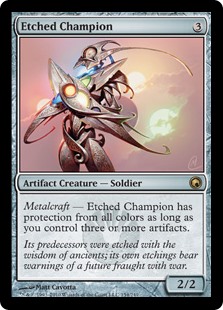
The final reason to just jam into counters is that even if the control player has them, the may just let it go. I and every other control player in Magic has died at least once to spells they could have countered but did not because we wanted to get more value countering something better. Control decks are full of answers, so it seems reasonable to let that otherwise useless Reflector Mage through because you'll just Lightning Bolt it later. Cue the end of the game where I used all my removal killing subsequent threats and died to the Mage with three counters in hand. Just jam spells at the control deck; they may flinch and let you win.

Know Thyself

The other half of playing against control depends on your own deck. In the classic world of Who's the Beatdown, one deck is the aggressor while the other defends. Control decks are built to be defensive, but that doesn't mean they have to be. It is possible and in fact optimal to force control out of its comfort zone. When that isn't possible, it's critical to understand how the matchup actually works, and to play to your deck's strengths. Oftentimes, it's best to just put your head down and charge right at control. This is not a great strategy as Modern control decks assume that will happen and are built accordingly. However, depending on the deck, it may be the only option.

In this section, we'll look at ways each macro-archetype can navigate control matchups.

Aggro

For the guaranteed aggressor in a match, the keys to victory lie with exploiting strategic holes in the control deck and with properly managing pressure. The former key is dictated by how the control deck is built. Every deck has blind spots, and if the aggressive deck has the option to play into them, it should. The latter is about keeping control on the back foot in the face of removal and sweepers.

Classic Affinity vs Jeskai Control should be a slaughter. Affinity is filled with tiny creatures that die to one-for-one removal, and Jeskai plays nothing but cheap removal. There are very few cards that actually threaten Jeskai on their own, so Jeskai can afford to be judicious with its removal and clean up the Memnites and Vault Skirges once the Arcbound Ravagers and Signal Pests are gone. However, most Jeskai lists only have two Supreme Verdicts, which are the only ways it can remove resolved Etched Champion. Thus, the matchup is actually about forcing Jeskai to use its counters and Verdicts on non-Champions. If Affinity succeeds in doing that, it can steal an easy win.
There's also the classic playing-around-sweepers strategy. Holding extra creatures to rebuild the board after Wrath of God is a tried-and-true technique. However, it's extremely contextual. The trick is to use enough resources to force control's hand by actually threatening a kill. A common strategy is to use enough cards to put control dead on board, with leeway for a removal spell, and then hold back. Should control hit Terminus, aggro should be able to threaten lethal the turn afterwards. For this reason, counterspells and the aggro-control archetype have a long and successful history against control.
Not every deck can afford to hold back, as their clock isn't robust enough. Merfolk can definitely play around sweepers because lords make weak creatures good, but 8-Whack cannot. It needs a critical mass of weak creatures plus an enabler to do anything worthwhile. Unless it can explode twice, 8-Whack is better off pretending sweepers don't exist. Just as with counterspells, aggro should only play around sweepers if it can meaningfully rebuild.

Combo

Combo decks tend to have polarized strategies against control. Some, like Ironworks, must win very quickly, while Ad Nauseam can afford to wait until the last minute. The distinction is interaction. Completely uninteractive combos need to sneak their key pieces through, while interactive combos can protect themselves and ensure the win. Knowing how to play depends on the type of combo deck.

Ironworks must land a Krark-clan Ironworks and eventually Scrap Trawler to win. It has no relevant maindeck interaction, and so has to try to sneak its pieces into play and hope the control deck has no answer. Smart sequencing and using bait spells is therefore essential for success. While these types of combo decks can and frequently do have counters of their own post-board, packing too many risks diluting the combo and making it hard to go off. Ironworks solves this problem with a transformational board featuring Sai, Master Thopterist. These decks must prioritize speed over resilience and mulligan aggressively.

At the opposite end is Ad Nauseam. While perfectly capable of fast wins, Ad Nauseam doesn't have to rush against control because it plays Pact of Negation and combos at instant speed. It can simply wait and sculpt its hand and mana until it can either go off through counters or go off twice. Post-board, it has more counters and Boseiju, Who Shelters All to ensure victory. This type of combo forces control into the aggressive role by seizing the inevitability, and so can afford to keep slower, interactive hands.

A very simple tool that used to be the primary combo plan against control, but has now fallen out of favor, is Gigadrowse. Having that card allows any combo deck to take its time, hold inevitability, and win with certainty when used on the opponent's end step to take them off blue mana for counterspells. I still see and use Gigadrowse in Storm, but the card is very rare anywhere else. It's a brute-force but tough-to-disrupt solution for decks that really struggle against permission.

Control

Control vs control is often billed as the most skill intensive Magic there is. To some extent that's true, and I often act with that assumption, but that most strongly applies to true 75-card mirrors. The key to control-on-control matches centers on knowing what actually matters and leveraging whatever differentiates the two decks against that thing.

Esper and Jeskai Control often have the advantage against UW because they can use discard and burn respectively to dictate the flow of the game. In the former match, the game becomes about card advantage, as Esper's discard either strips relevant cards from UW or clears the road to resolve its own spells, forcing UW to find the right answers or die. In the latter, life total matters, since Jeskai is able to gradually whittle down UW with burn spells. The onus is on UW to either change the field of battle or win first.
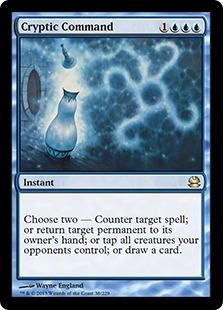
One of the greatest examples of control-mirror mastery is the 2002 World Championships. Carlos Romao won because he understood the Psychatog mirror better than everyone else. Psychatog was a UB control deck packed with counters and card advantage which won by casting Upheaval, then Psychatog with floating mana. The accepted strategy was to counter all the card draw spells to prevent the opponent assembling the combo. Carlos and his team realized that doing so used up counters that could answer the combo. Instead, he saved his counters for the few win conditions his opponents had, and enjoyed a very easy run to the championship. Don't always fight the fight your opponent wants; pick what your deck is best at and leverage that aspect against the opponent.

Victory Is Assured

Control decks have a reputation for being hard to play against, and while this can be true, it doesn't have to be. The fear that reputation creates is so potent that players attempt to play around control. Sometimes this mindset is fine because the deck can fight on equal terms, but frequently, it just plays into control's strengths by giving it more time. As a result, players need to evaluate their decks and play without letting a fear of control dictate the matchup.

Want Prices?

Browse thousands of prices with the first and most comprehensive MTG Finance tool around.


Trader Tools lists both buylist and retail prices for every MTG card, going back a decade.

Quiet Speculation